Cambridge IGCSE Chemistry (9-1) 0971 — 2018 May/June Paper 2 · Variant 1
0971/21/M/J/18 · 40 questions · 40 marks · ≈45 min
The question paper and its mark scheme, free to read here and free to download. This is Cambridge’s own paper, exactly as it was sat.
Question paper16 pages
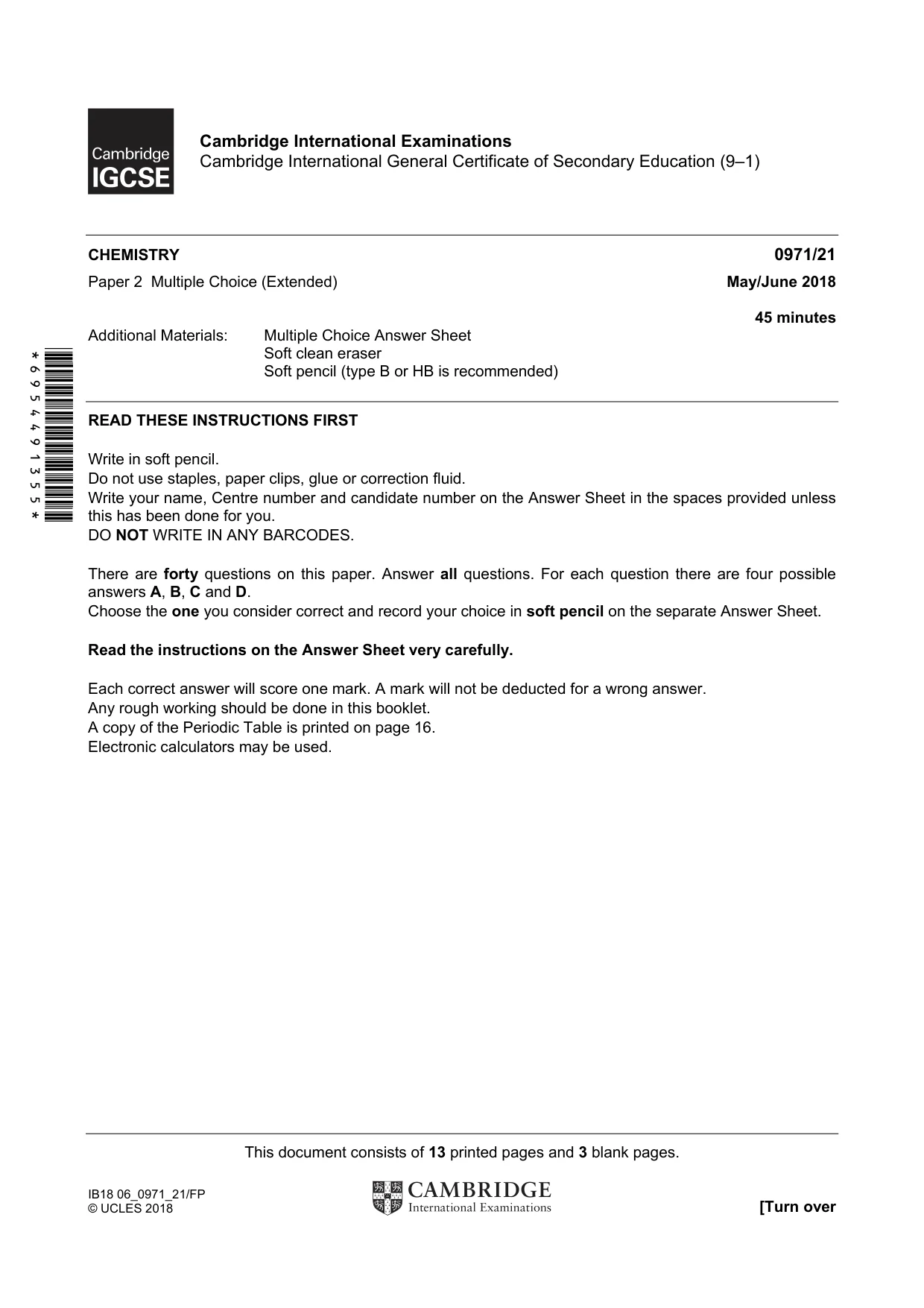



Mark scheme3 pages
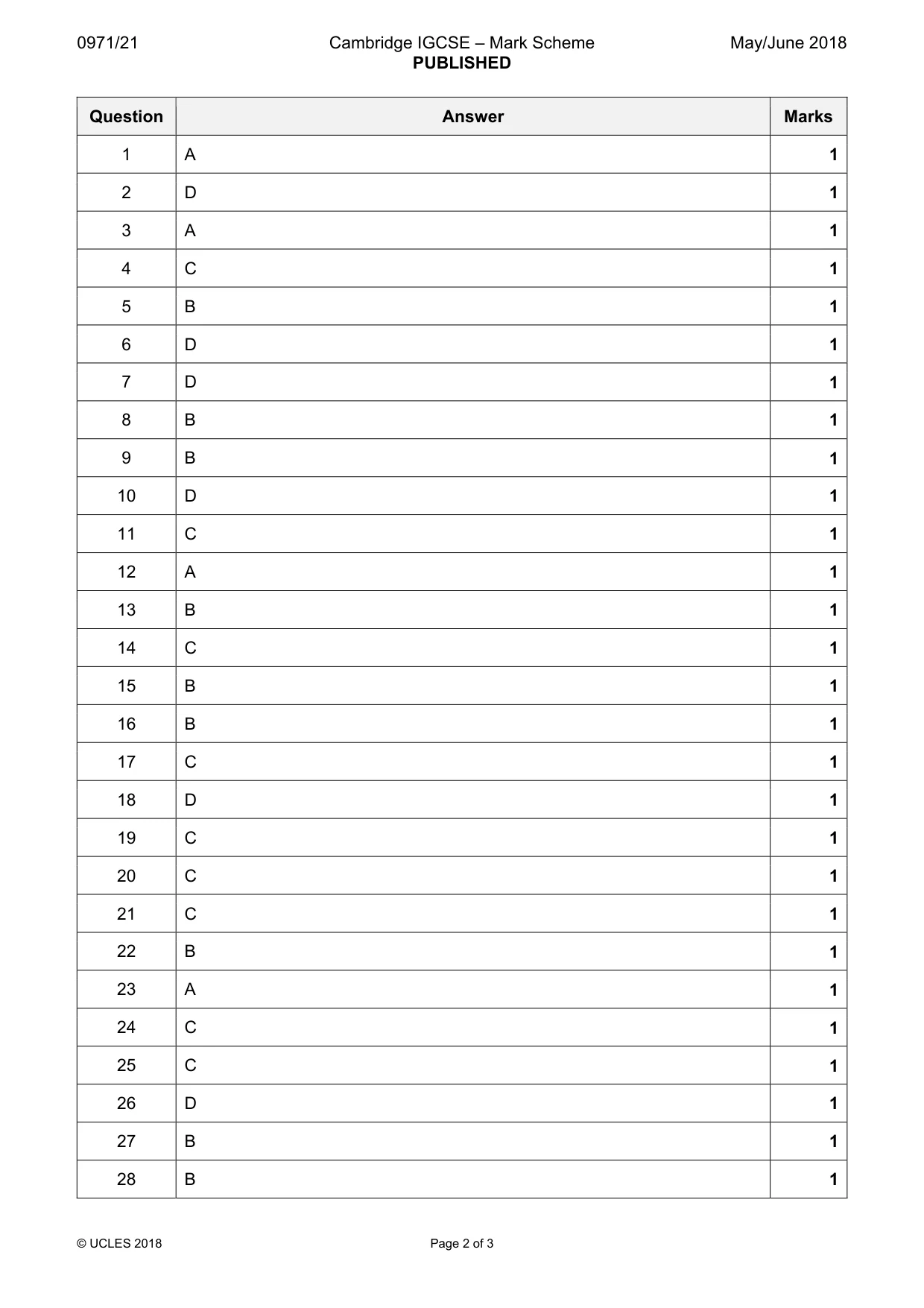
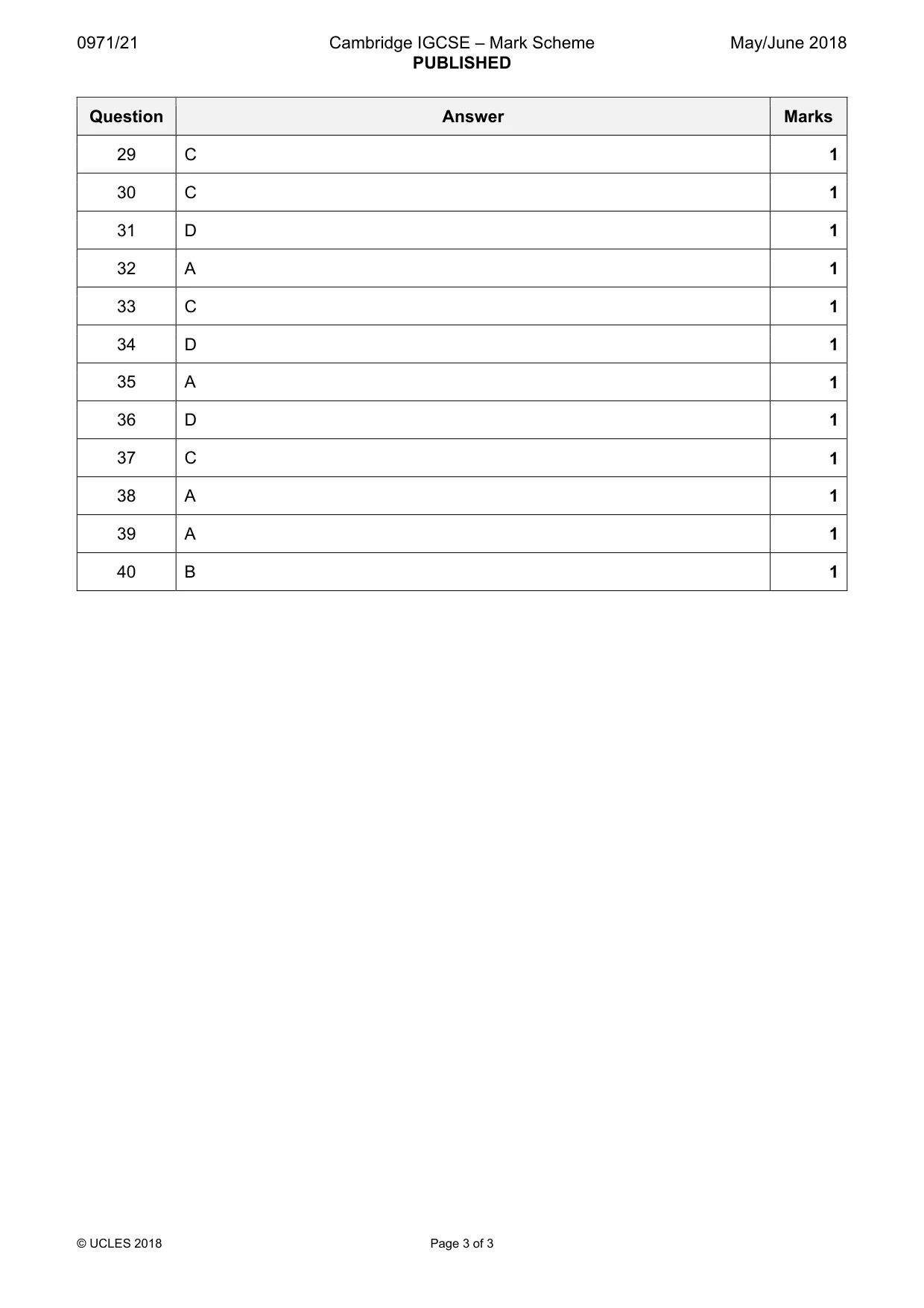
Answers below. Sit the paper first if you are practising.
Questions as text
Q1 · A student investigated the diffusion of ammonia gas, NH3, and hydrogen chloride gas, HCl
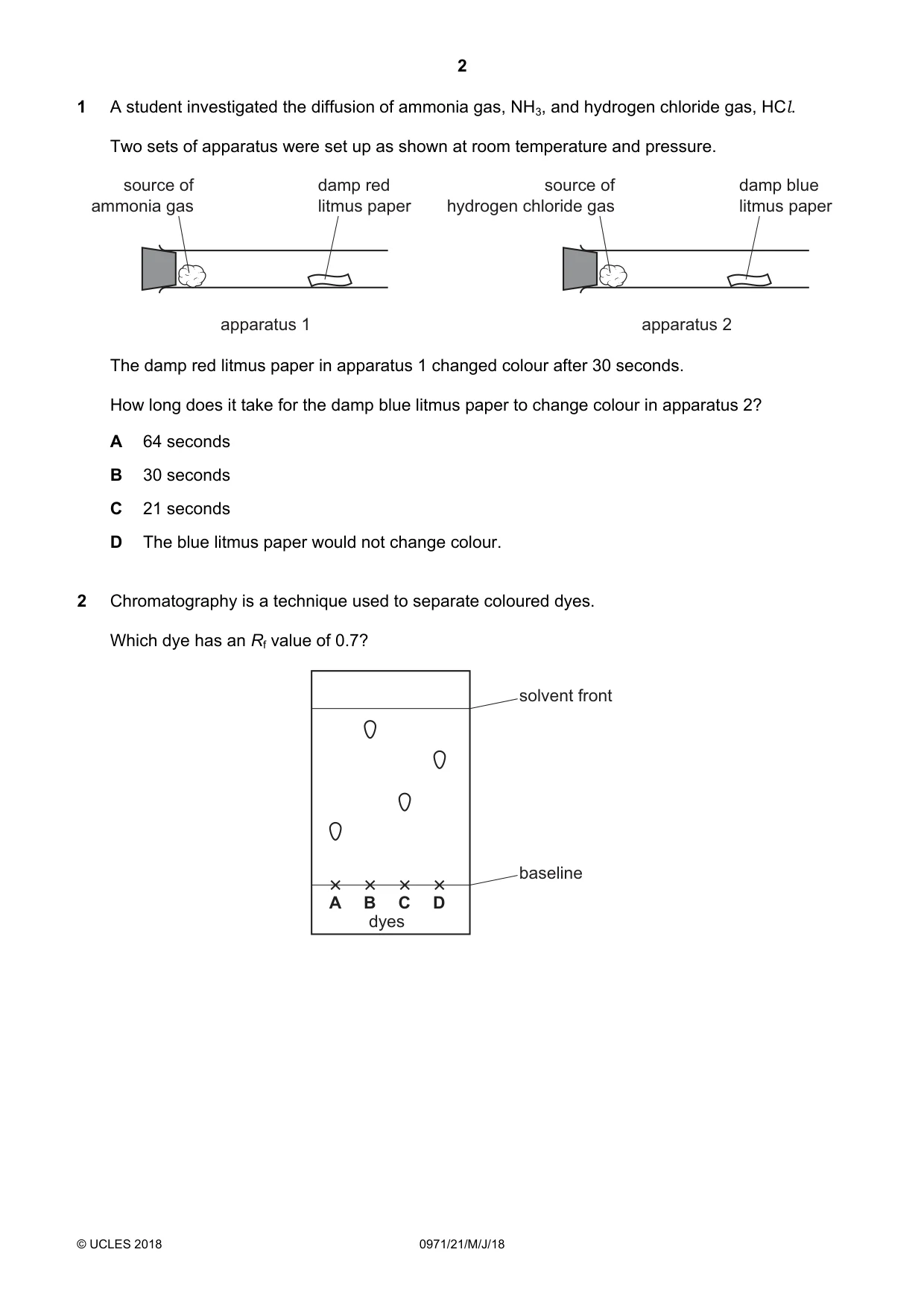
1 A student investigated the diffusion of ammonia gas, NH3, and hydrogen chloride gas, HCl. Two sets of apparatus were set up as shown at room temperature and pressure. source of damp red source of damp blue ammonia gas litmus paper hydrogen chloride gas litmus paper apparatus 1 apparatus 2 The damp red litmus paper in apparatus 1 changed colour after 30 seconds. How long does it take for the damp blue litmus paper to change colour in apparatus 2? A 64 seconds B 30 seconds C 21 seconds D The blue litmus paper would not change colour.
Mark scheme: A
Q2 · Chromatography is a technique used to separate coloured dyes
2 Chromatography is a technique used to separate coloured dyes. Which dye has an Rf value of 0.7? solvent front baseline A B C D dyes
Mark scheme: D
Q3 · Which piece of apparatus is used to measure exactly 26.3 cm3 of a liquid?
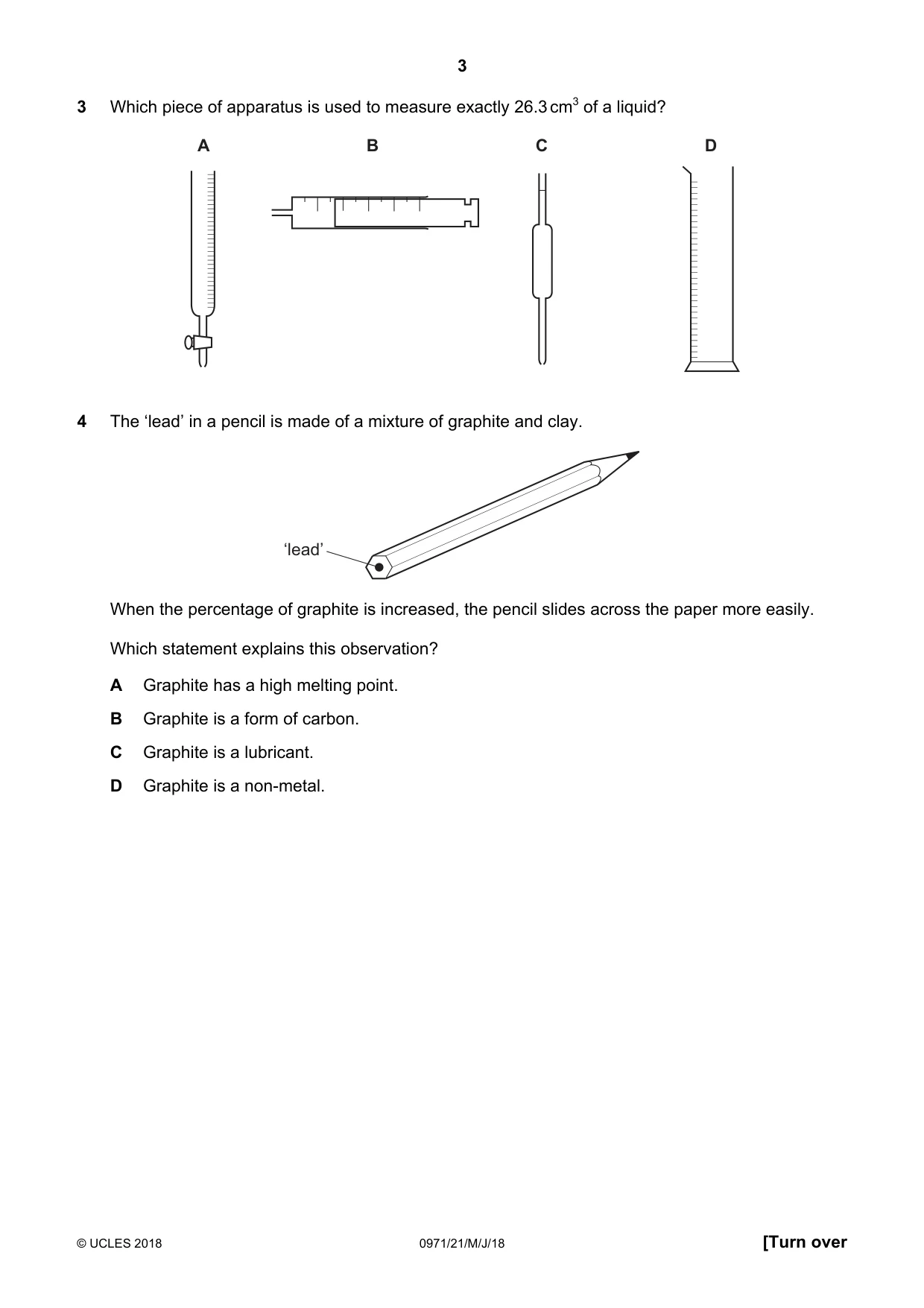
3 Which piece of apparatus is used to measure exactly 26.3 cm3 of a liquid? A B C D
Mark scheme: A
Q4 · The ‘lead’ in a pencil is made of a mixture of graphite and clay
4 The ‘lead’ in a pencil is made of a mixture of graphite and clay. ‘lead’ When the percentage of graphite is increased, the pencil slides across the paper more easily. Which statement explains this observation? A Graphite has a high melting point. B Graphite is a form of carbon. C Graphite is a lubricant. D Graphite is a non-metal.
Mark scheme: C
Q5 · Chlorine exists as two common isotopes, 35Cl and 37Cl
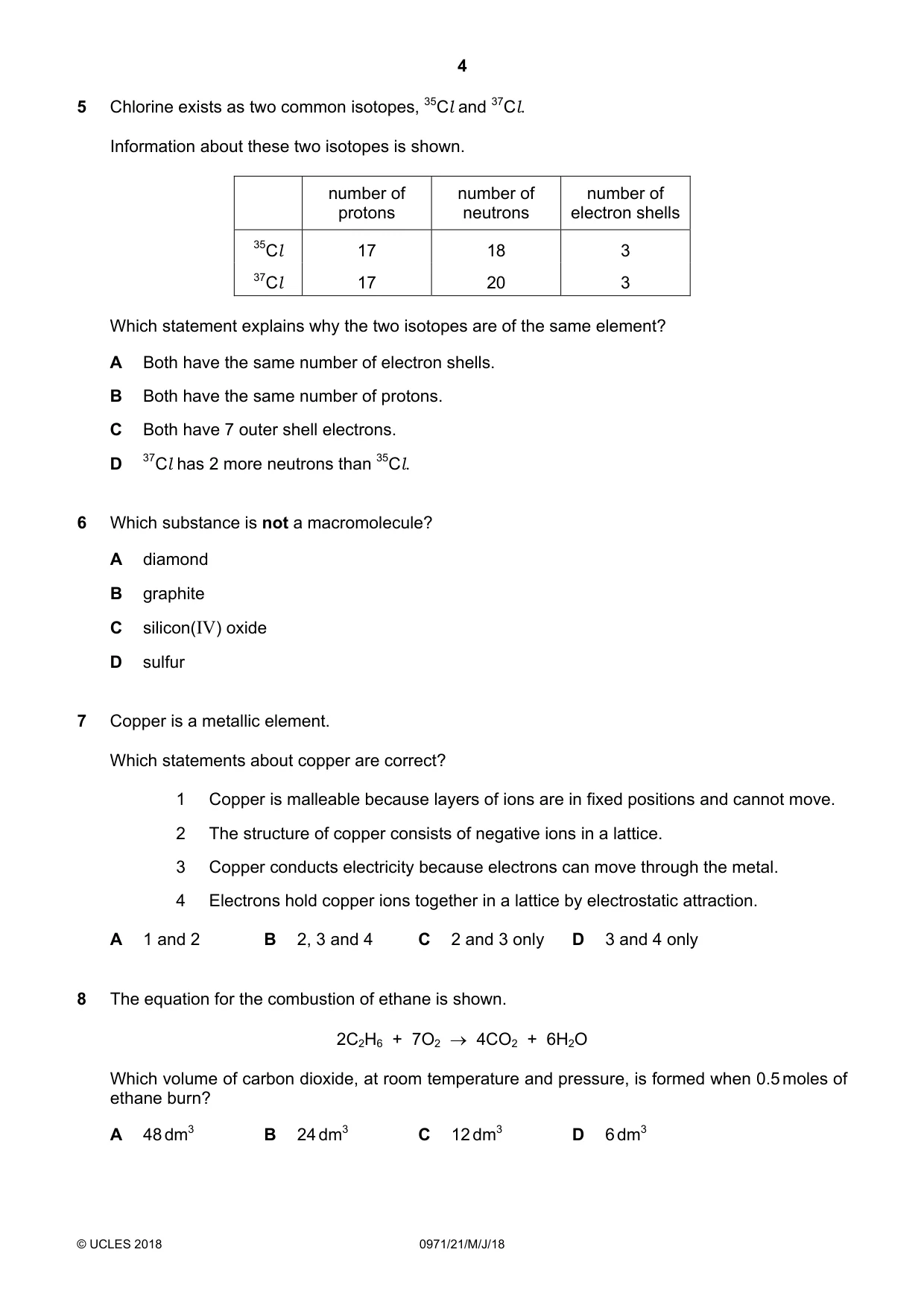
5 Chlorine exists as two common isotopes, 35Cl and 37Cl. Information about these two isotopes is shown. number of number of number of protons neutrons electron shells 35Cl 17 18 3 37Cl 17 20 3 Which statement explains why the two isotopes are of the same element? A Both have the same number of electron shells. B Both have the same number of protons. C Both have 7 outer shell electrons. D 37Cl has 2 more neutrons than 35Cl.
Mark scheme: B
Q6 · Which substance is not a macromolecule?
6 Which substance is not a macromolecule? A diamond B graphite C silicon(IV) oxide D sulfur
Mark scheme: D
Q7 · Copper is a metallic element
7 Copper is a metallic element. Which statements about copper are correct? 1 Copper is malleable because layers of ions are in fixed positions and cannot move. 2 The structure of copper consists of negative ions in a lattice. 3 Copper conducts electricity because electrons can move through the metal. 4 Electrons hold copper ions together in a lattice by electrostatic attraction. A 1 and 2 B 2, 3 and 4 C 2 and 3 only D 3 and 4 only
Mark scheme: D
Q8 · The equation for the combustion of ethane is shown
8 The equation for the combustion of ethane is shown. 2C2H6 + 7O2 → 4CO2 + 6H2O Which volume of carbon dioxide, at room temperature and pressure, is formed when 0.5 moles of ethane burn? A 48 dm3 B 24 dm3 C 12 dm3 D 6 dm3
Mark scheme: B
Q9 · A solution of ethanoic acid, CH3COOH, has a concentration of 2 mol / dm3
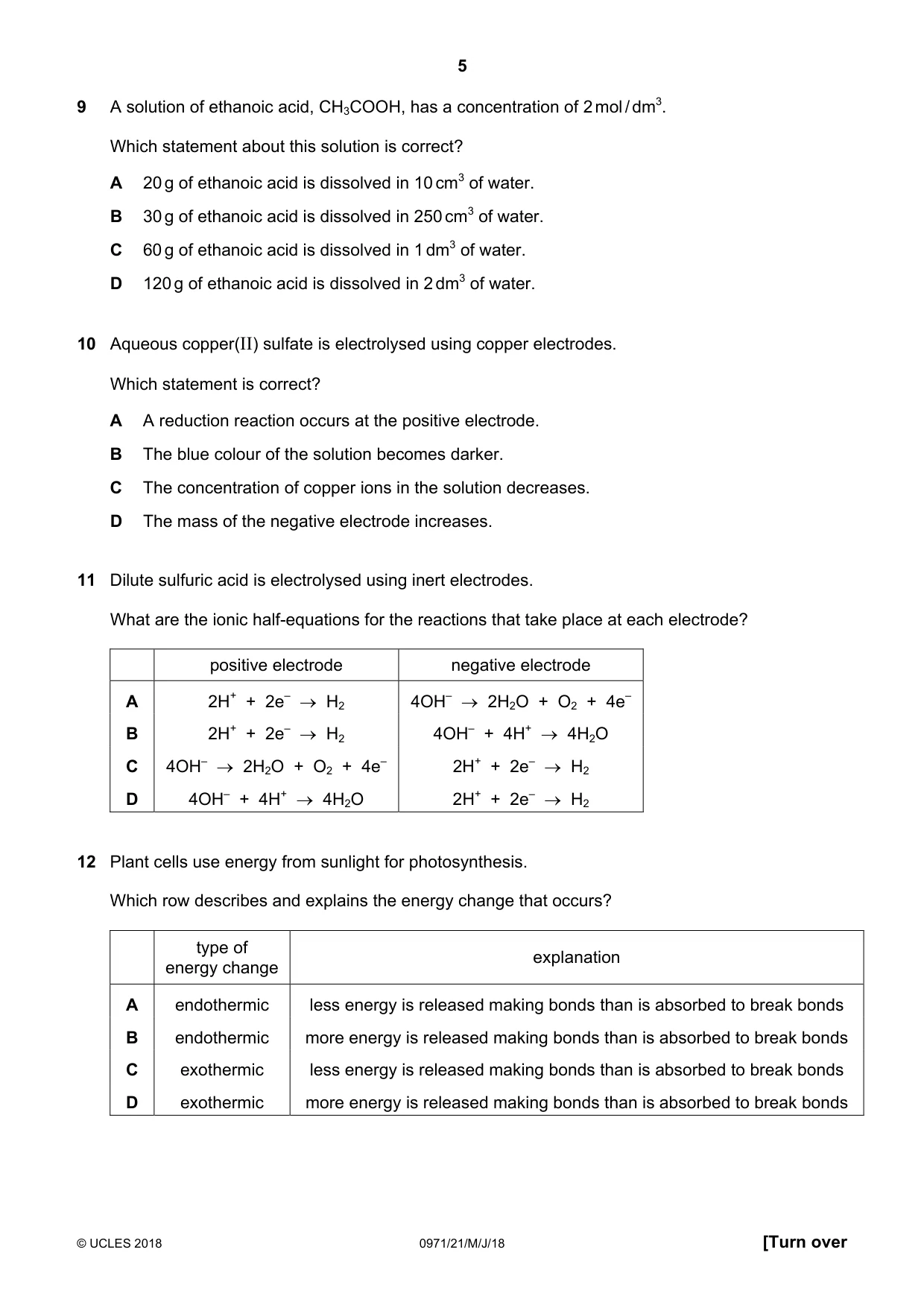
9 A solution of ethanoic acid, CH3COOH, has a concentration of 2 mol / dm3. Which statement about this solution is correct? A 20 g of ethanoic acid is dissolved in 10 cm3 of water. B 30 g of ethanoic acid is dissolved in 250 cm3 of water. C 60 g of ethanoic acid is dissolved in 1 dm3 of water. D 120 g of ethanoic acid is dissolved in 2 dm3 of water.
Mark scheme: B
Q10 · Aqueous copper(II) sulfate is electrolysed using copper electrodes
10 Aqueous copper(II) sulfate is electrolysed using copper electrodes. Which statement is correct? A A reduction reaction occurs at the positive electrode. B The blue colour of the solution becomes darker. C The concentration of copper ions in the solution decreases. D The mass of the negative electrode increases.
Mark scheme: D
Q11 · Dilute sulfuric acid is electrolysed using inert electrodes
11 Dilute sulfuric acid is electrolysed using inert electrodes. What are the ionic half-equations for the reactions that take place at each electrode? positive electrode negative electrode A 2H+ + 2e– → H2 4OH– → 2H2O + O2 + 4e– B 2H+ + 2e– → H2 4OH– + 4H+ → 4H2O C 4OH– → 2H2O + O2 + 4e– 2H+ + 2e– → H2 D 4OH– + 4H+ → 4H2O 2H+ + 2e– → H2
Mark scheme: C
Q12 · Plant cells use energy from sunlight for photosynthesis
12 Plant cells use energy from sunlight for photosynthesis. Which row describes and explains the energy change that occurs? type of explanation energy change A endothermic less energy is released making bonds than is absorbed to break bonds B endothermic more energy is released making bonds than is absorbed to break bonds C exothermic less energy is released making bonds than is absorbed to break bonds D exothermic more energy is released making bonds than is absorbed to break bonds
Mark scheme: A
Q13 · Hydrogen bromide decomposes to form hydrogen and bromine
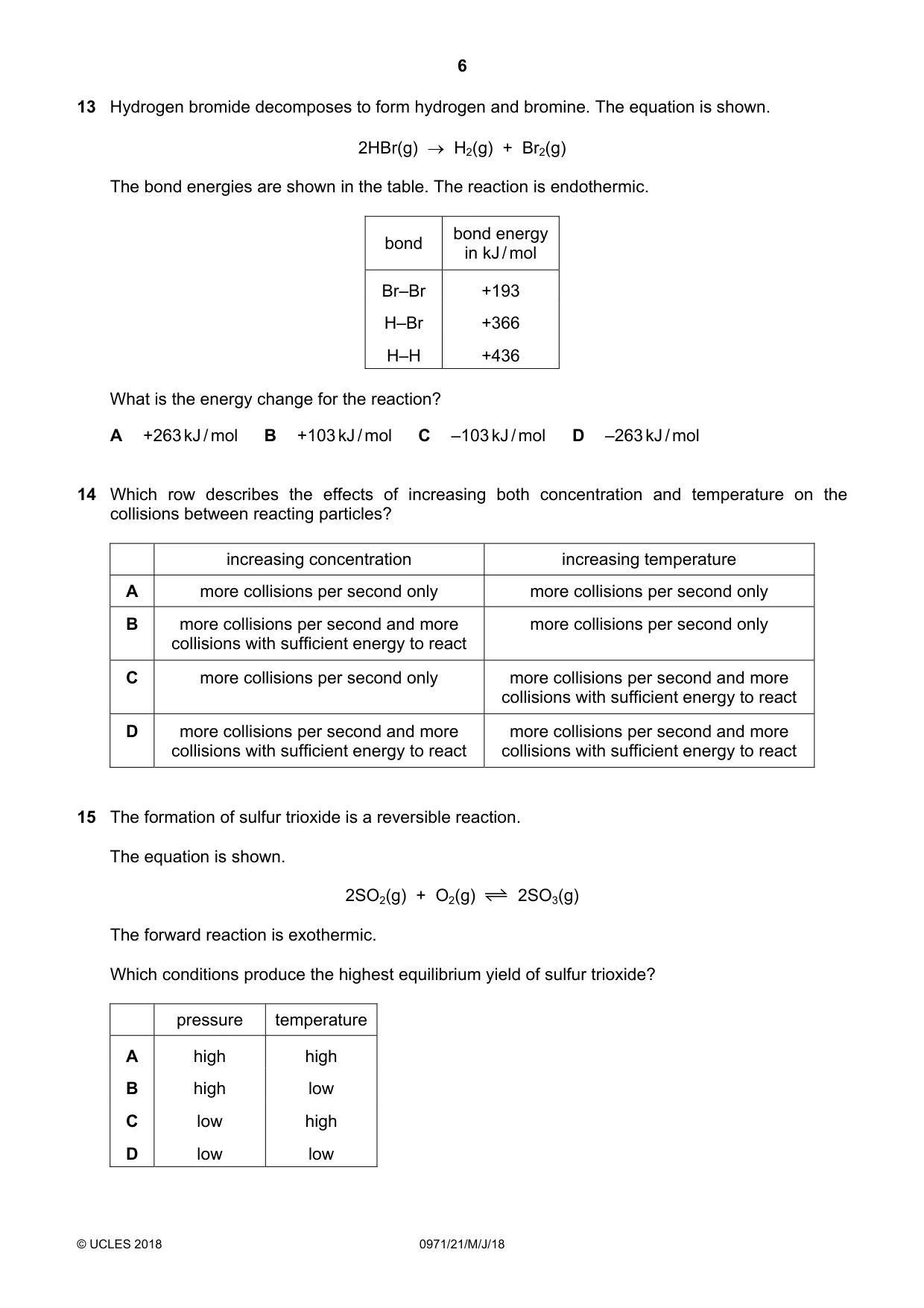
13 Hydrogen bromide decomposes to form hydrogen and bromine. The equation is shown. 2HBr(g) → H2(g) + Br2(g) The bond energies are shown in the table. The reaction is endothermic. bond energy bond in kJ / mol Br–Br +193 H–Br +366 H–H +436 What is the energy change for the reaction? A +263 kJ / mol B +103 kJ / mol C –103 kJ / mol D –263 kJ / mol
Mark scheme: B
Q14 · Which row describes the effects of increasing both concentration and temperature on the…
14 Which row describes the effects of increasing both concentration and temperature on the collisions between reacting particles? increasing concentration increasing temperature A more collisions per second only more collisions per second only B more collisions per second and more more collisions per second only collisions with sufficient energy to react C more collisions per second only more collisions per second and more collisions with sufficient energy to react D more collisions per second and more more collisions per second and more collisions with sufficient energy to react collisions with sufficient energy to react
Mark scheme: C
Q15 · The formation of sulfur trioxide is a reversible reaction
15 The formation of sulfur trioxide is a reversible reaction. The equation is shown. 2SO2(g) + O2(g) 2SO3(g) The forward reaction is exothermic. Which conditions produce the highest equilibrium yield of sulfur trioxide? pressure temperature A high high B high low C low high D low low
Mark scheme: B
Q16 · Chlorine displaces iodide ions from potassium iodide
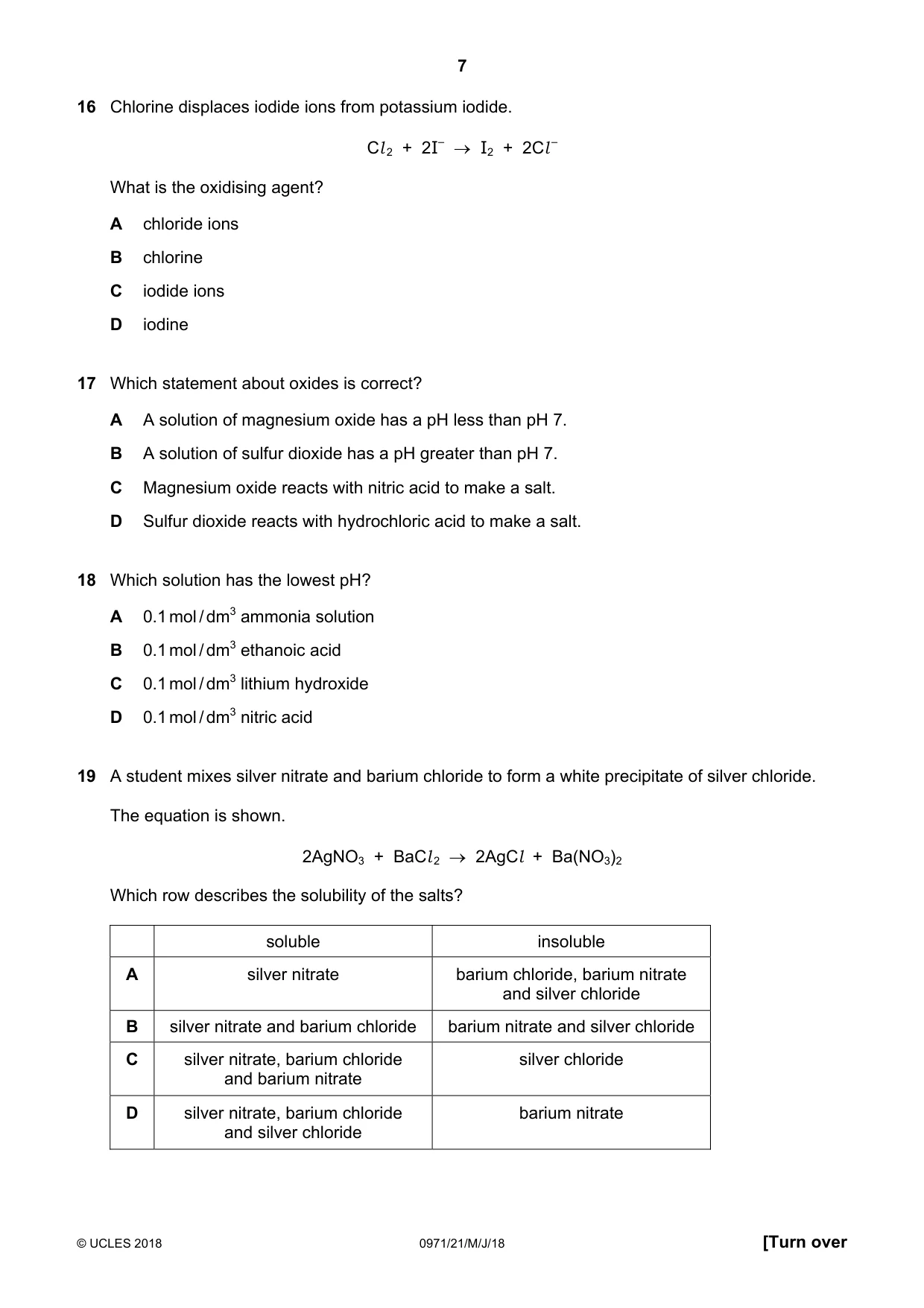
16 Chlorine displaces iodide ions from potassium iodide. Cl 2 + 2I– → I2 + 2Cl – What is the oxidising agent? A chloride ions B chlorine C iodide ions D iodine
Mark scheme: B
Q17 · Which statement about oxides is correct?
17 Which statement about oxides is correct? A A solution of magnesium oxide has a pH less than pH 7. B A solution of sulfur dioxide has a pH greater than pH 7. C Magnesium oxide reacts with nitric acid to make a salt. D Sulfur dioxide reacts with hydrochloric acid to make a salt.
Mark scheme: C
Q18 · Which solution has the lowest pH?
18 Which solution has the lowest pH? A 0.1 mol / dm3 ammonia solution B 0.1 mol / dm3 ethanoic acid C 0.1 mol / dm3 lithium hydroxide D 0.1 mol / dm3 nitric acid
Mark scheme: D
More questions on The characteristic properties of acids and bases
Q19 · A student mixes silver nitrate and barium chloride to form a white precipitate of silver…
19 A student mixes silver nitrate and barium chloride to form a white precipitate of silver chloride. The equation is shown. 2AgNO3 + BaCl 2 → 2AgCl + Ba(NO3)2 Which row describes the solubility of the salts? soluble insoluble A silver nitrate barium chloride, barium nitrate and silver chloride B silver nitrate and barium chloride barium nitrate and silver chloride C silver nitrate, barium chloride silver chloride and barium nitrate D silver nitrate, barium chloride barium nitrate and silver chloride
Mark scheme: C
Q20 · Which methods are suitable for preparing both zinc sulfate and copper(II) sulfate?
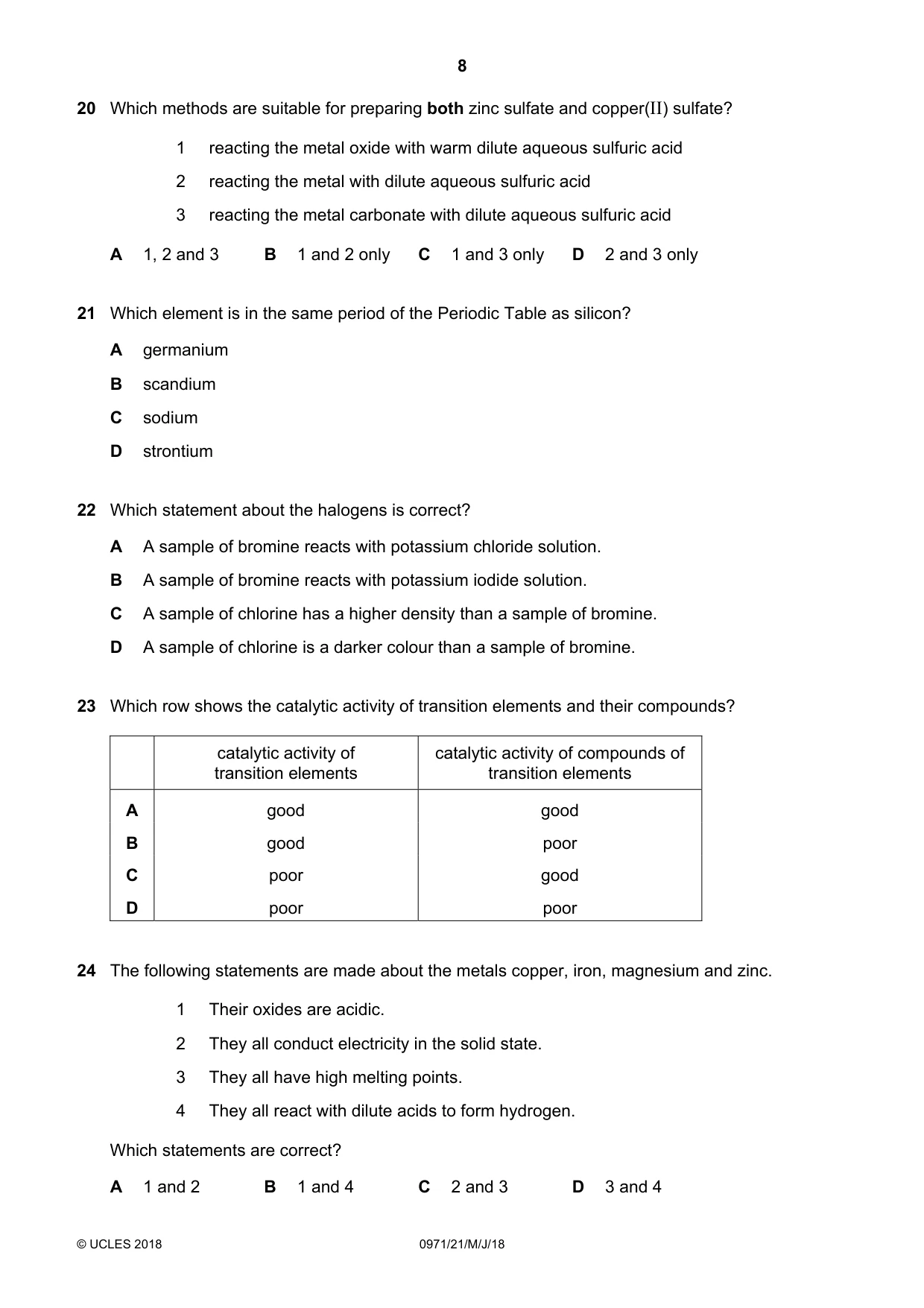
20 Which methods are suitable for preparing both zinc sulfate and copper(II) sulfate? 1 reacting the metal oxide with warm dilute aqueous sulfuric acid 2 reacting the metal with dilute aqueous sulfuric acid 3 reacting the metal carbonate with dilute aqueous sulfuric acid A 1, 2 and 3 B 1 and 2 only C 1 and 3 only D 2 and 3 only
Mark scheme: C
Q21 · Which element is in the same period of the Periodic Table as silicon?
21 Which element is in the same period of the Periodic Table as silicon? A germanium B scandium C sodium D strontium
Mark scheme: C
Q22 · Which statement about the halogens is correct?
22 Which statement about the halogens is correct? A A sample of bromine reacts with potassium chloride solution. B A sample of bromine reacts with potassium iodide solution. C A sample of chlorine has a higher density than a sample of bromine. D A sample of chlorine is a darker colour than a sample of bromine.
Mark scheme: B
Q23 · Which row shows the catalytic activity of transition elements and their compounds?
23 Which row shows the catalytic activity of transition elements and their compounds? catalytic activity of catalytic activity of compounds of transition elements transition elements A good good B good poor C poor good D poor poor
Mark scheme: A
Q24 · The following statements are made about the metals copper, iron, magnesium and zinc
24 The following statements are made about the metals copper, iron, magnesium and zinc. 1 Their oxides are acidic. 2 They all conduct electricity in the solid state. 3 They all have high melting points. 4 They all react with dilute acids to form hydrogen. Which statements are correct? A 1 and 2 B 1 and 4 C 2 and 3 D 3 and 4
Mark scheme: C
Q25 · Silver is a less reactive metal than cadmium
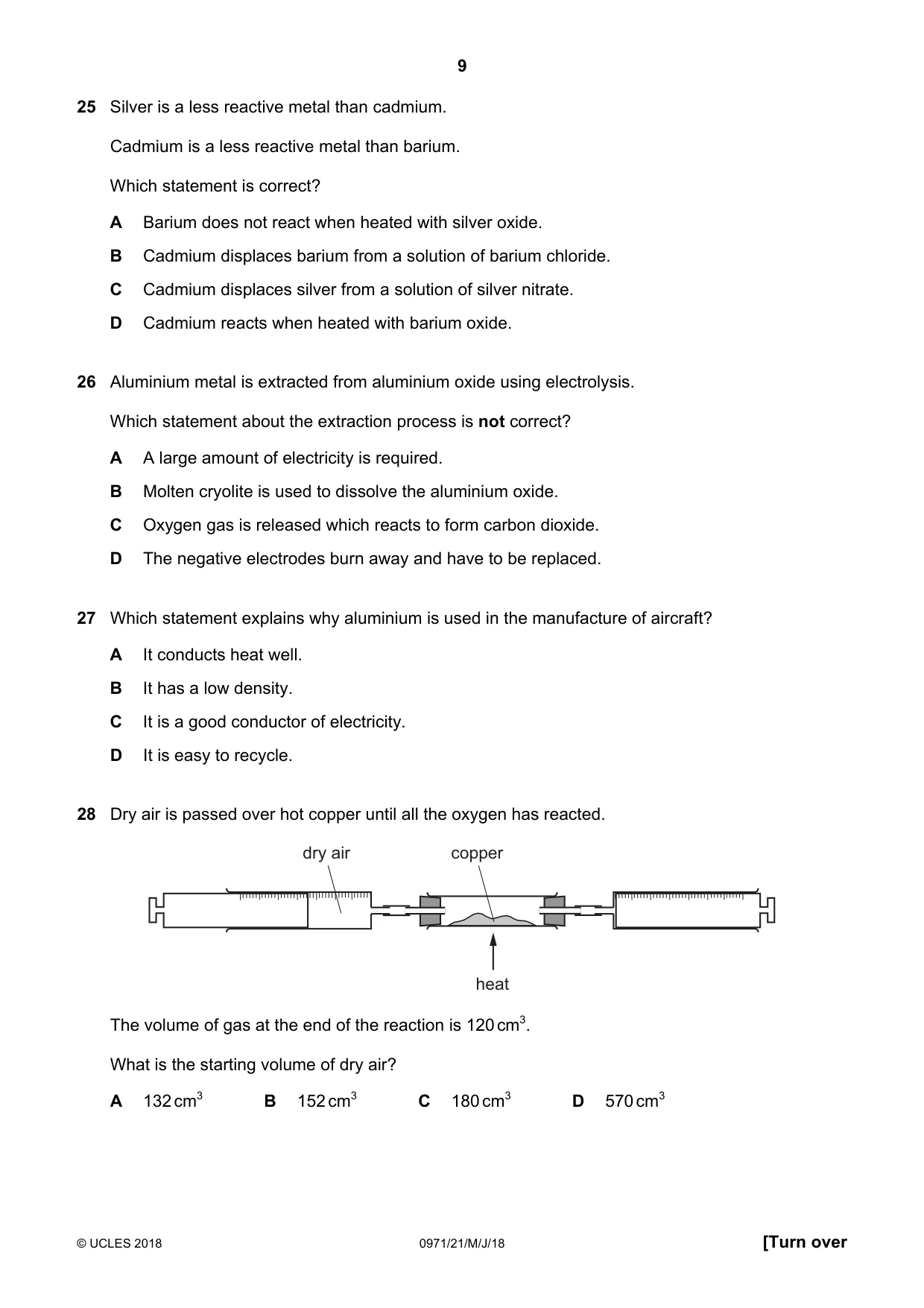
25 Silver is a less reactive metal than cadmium. Cadmium is a less reactive metal than barium. Which statement is correct? A Barium does not react when heated with silver oxide. B Cadmium displaces barium from a solution of barium chloride. C Cadmium displaces silver from a solution of silver nitrate. D Cadmium reacts when heated with barium oxide.
Mark scheme: C
Q26 · Aluminium metal is extracted from aluminium oxide using electrolysis
26 Aluminium metal is extracted from aluminium oxide using electrolysis. Which statement about the extraction process is not correct? A A large amount of electricity is required. B Molten cryolite is used to dissolve the aluminium oxide. C Oxygen gas is released which reacts to form carbon dioxide. D The negative electrodes burn away and have to be replaced.
Mark scheme: D
Q27 · Which statement explains why aluminium is used in the manufacture of aircraft?
27 Which statement explains why aluminium is used in the manufacture of aircraft? A It conducts heat well. B It has a low density. C It is a good conductor of electricity. D It is easy to recycle.
Mark scheme: B
Q28 · Dry air is passed over hot copper until all the oxygen has reacted
28 Dry air is passed over hot copper until all the oxygen has reacted. dry air copper heat The volume of gas at the end of the reaction is 120 cm3. What is the starting volume of dry air? A 132 cm3 B 152 cm3 C 180 cm3 D 570 cm3
Mark scheme: B
Q29 · A steel bicycle which had been left outdoors for several months was starting to rust
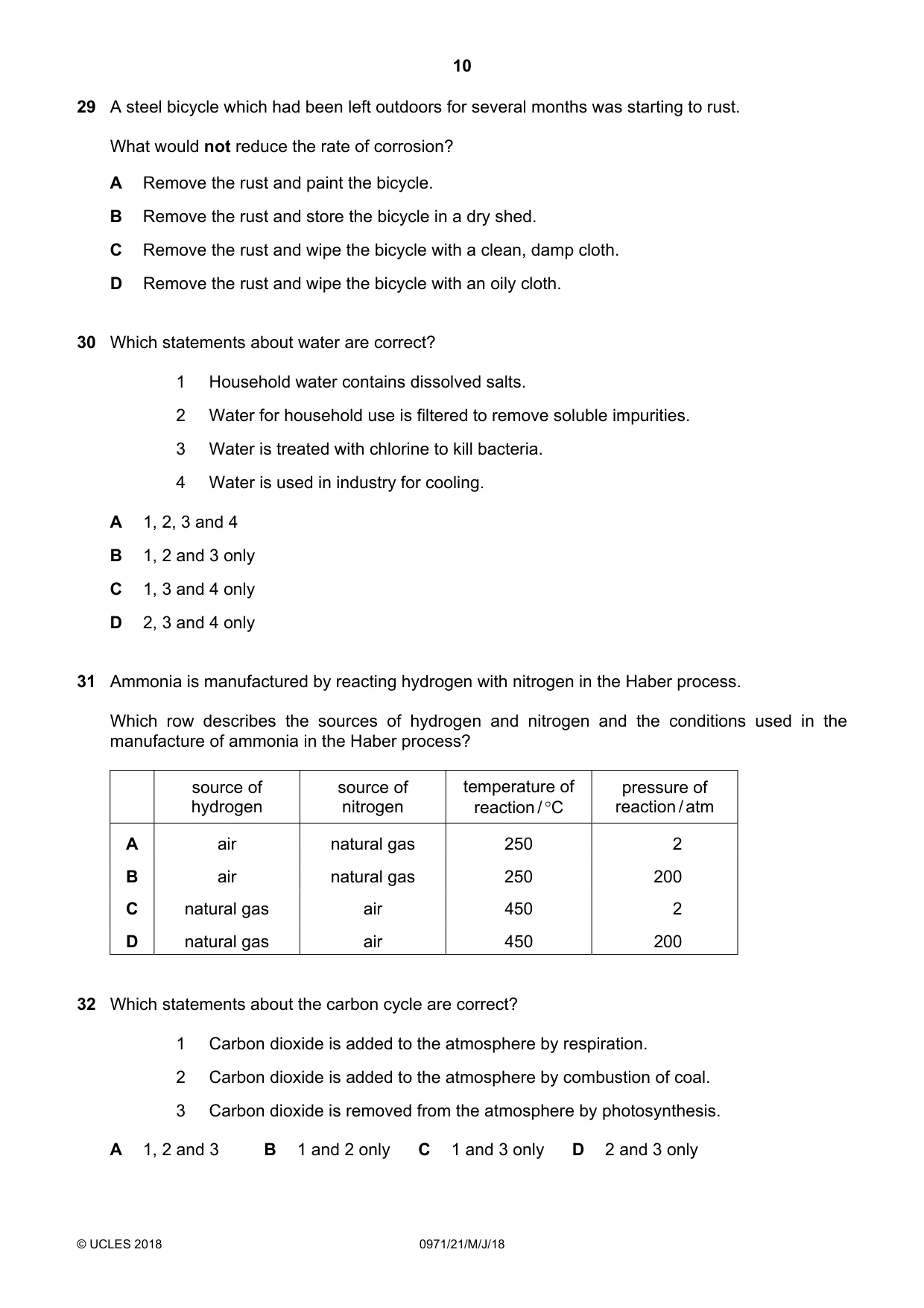
29 A steel bicycle which had been left outdoors for several months was starting to rust. What would not reduce the rate of corrosion? A Remove the rust and paint the bicycle. B Remove the rust and store the bicycle in a dry shed. C Remove the rust and wipe the bicycle with a clean, damp cloth. D Remove the rust and wipe the bicycle with an oily cloth.
Mark scheme: C
Q30 · Which statements about water are correct?
30 Which statements about water are correct? 1 Household water contains dissolved salts. 2 Water for household use is filtered to remove soluble impurities. 3 Water is treated with chlorine to kill bacteria. 4 Water is used in industry for cooling. A 1, 2, 3 and 4 B 1, 2 and 3 only C 1, 3 and 4 only D 2, 3 and 4 only
Mark scheme: C
Q31 · Ammonia is manufactured by reacting hydrogen with nitrogen in the Haber process
31 Ammonia is manufactured by reacting hydrogen with nitrogen in the Haber process. Which row describes the sources of hydrogen and nitrogen and the conditions used in the manufacture of ammonia in the Haber process? source of source of temperature of pressure of hydrogen nitrogen reaction / °C reaction / atm A air natural gas 250 2 B air natural gas 250 200 C natural gas air 450 2 D natural gas air 450 200
Mark scheme: D
Q32 · Which statements about the carbon cycle are correct?
32 Which statements about the carbon cycle are correct? 1 Carbon dioxide is added to the atmosphere by respiration. 2 Carbon dioxide is added to the atmosphere by combustion of coal. 3 Carbon dioxide is removed from the atmosphere by photosynthesis. A 1, 2 and 3 B 1 and 2 only C 1 and 3 only D 2 and 3 only
Mark scheme: A
Q33 · Which statement about sulfur and its compounds is not correct?
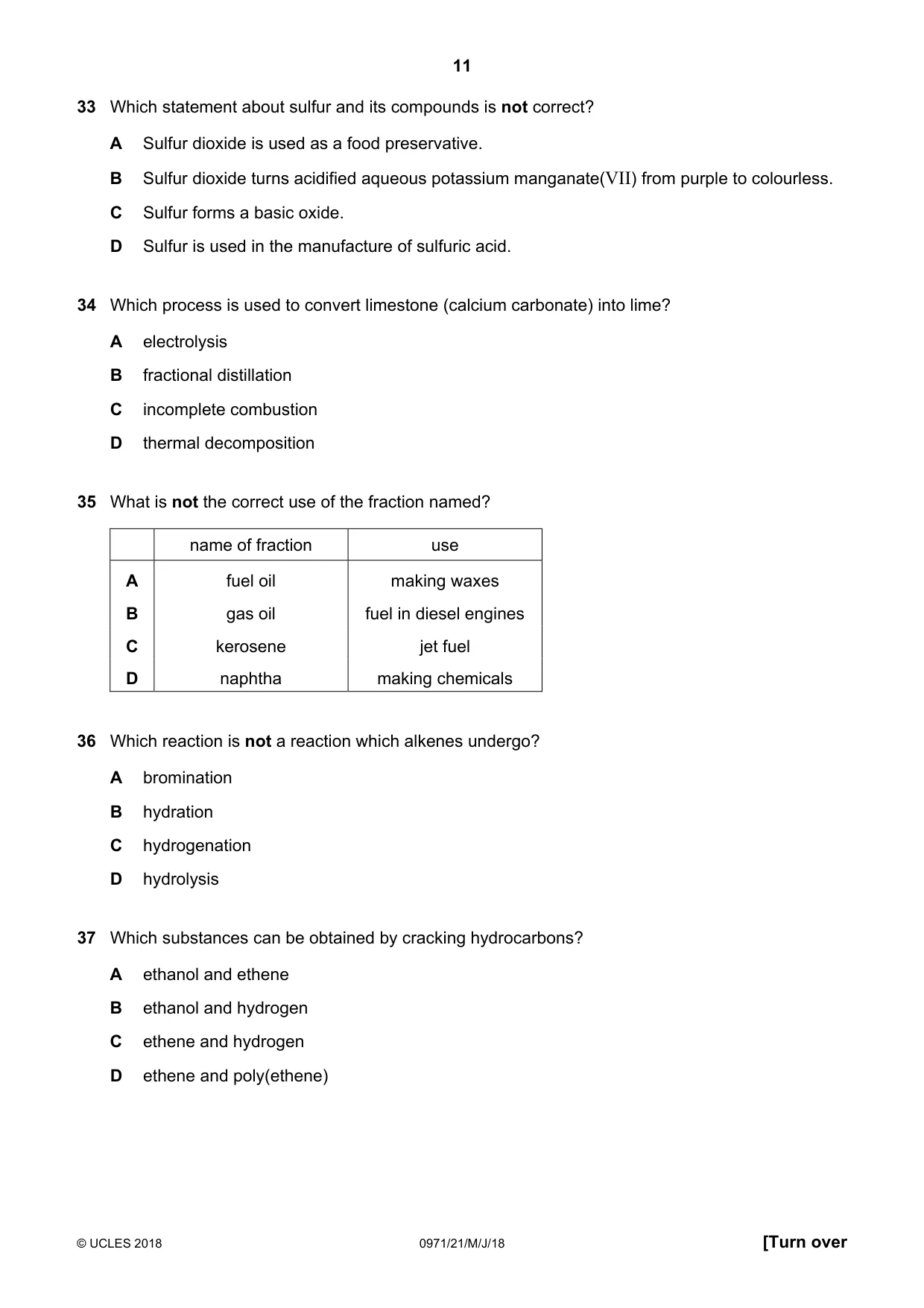
33 Which statement about sulfur and its compounds is not correct? A Sulfur dioxide is used as a food preservative. B Sulfur dioxide turns acidified aqueous potassium manganate(VII) from purple to colourless. C Sulfur forms a basic oxide. D Sulfur is used in the manufacture of sulfuric acid.
Mark scheme: C
Q34 · Which process is used to convert limestone (calcium carbonate) into lime?
34 Which process is used to convert limestone (calcium carbonate) into lime? A electrolysis B fractional distillation C incomplete combustion D thermal decomposition
Mark scheme: D
Q35 · What is not the correct use of the fraction named?
35 What is not the correct use of the fraction named? name of fraction use A fuel oil making waxes B gas oil fuel in diesel engines C kerosene jet fuel D naphtha making chemicals
Mark scheme: A
Q36 · Which reaction is not a reaction which alkenes undergo?
36 Which reaction is not a reaction which alkenes undergo? A bromination B hydration C hydrogenation D hydrolysis
Mark scheme: D
Q37 · Which substances can be obtained by cracking hydrocarbons?
37 Which substances can be obtained by cracking hydrocarbons? A ethanol and ethene B ethanol and hydrogen C ethene and hydrogen D ethene and poly(ethene)
Mark scheme: C
Q38 · Ethanol is produced by fermentation or from ethene
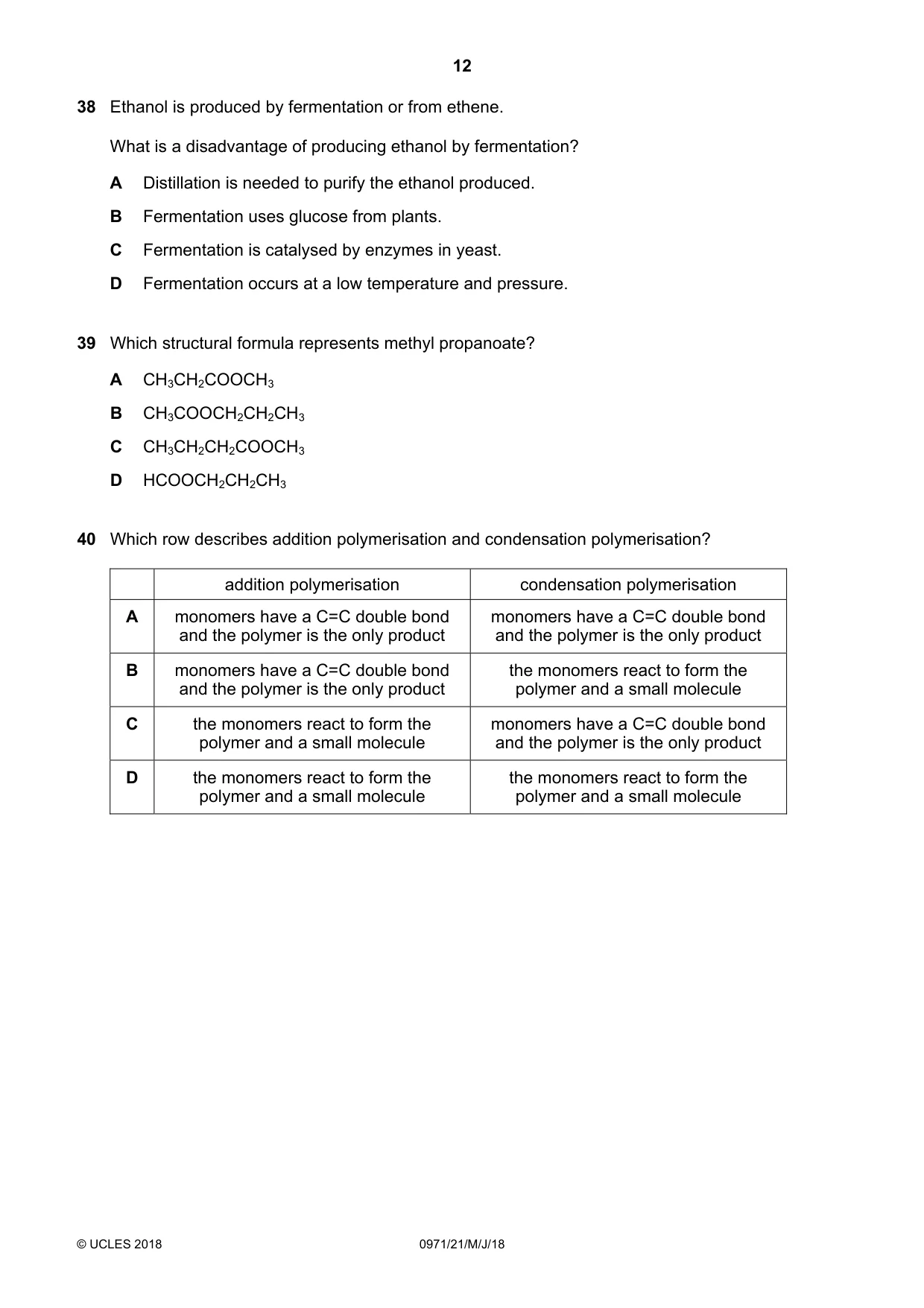
38 Ethanol is produced by fermentation or from ethene. What is a disadvantage of producing ethanol by fermentation? A Distillation is needed to purify the ethanol produced. B Fermentation uses glucose from plants. C Fermentation is catalysed by enzymes in yeast. D Fermentation occurs at a low temperature and pressure.
Mark scheme: A
Q39 · Which structural formula represents methyl propanoate?
39 Which structural formula represents methyl propanoate? A CH3CH2COOCH3 B CH3COOCH2CH2CH3 C CH3CH2CH2COOCH3 D HCOOCH2CH2CH3
Mark scheme: A
Q40 · Which row describes addition polymerisation and condensation polymerisation?
40 Which row describes addition polymerisation and condensation polymerisation? addition polymerisation condensation polymerisation A monomers have a C=C double bond monomers have a C=C double bond and the polymer is the only product and the polymer is the only product B monomers have a C=C double bond the monomers react to form the and the polymer is the only product polymer and a small molecule C the monomers react to form the monomers have a C=C double bond polymer and a small molecule and the polymer is the only product D the monomers react to form the the monomers react to form the polymer and a small molecule polymer and a small molecule
Mark scheme: B
What was in this paper
The subtopics covered by these 40 questions, and how many questions each got. Open one in a new tab to see every Cambridge question on it.
3Air quality and climate2Electrolysis2Exothermic and endothermic reactions2Fuels2Giant covalent structures2Preparation of salts2Reversible reactions and equilibrium2The mole and the Avogadro constant2Alcohols1Alkenes1Arrangement of elements1Carboxylic acids1Chromatography1Corrosion of metals1Diffusion1Experimental design1Extraction of metals1Group VII properties1Isotopes1Metallic bonding1Polymers1Properties of metals1Rate of reaction1Reactivity series1Redox1The characteristic properties of acids and bases1Transition elements1Uses of metals1Water1What you needed in this session
Cambridge’s own grade thresholds for 2018 May/June, Paper 2 · Variant 1. A higher threshold means an easier paper — the bar moves with how the cohort did.