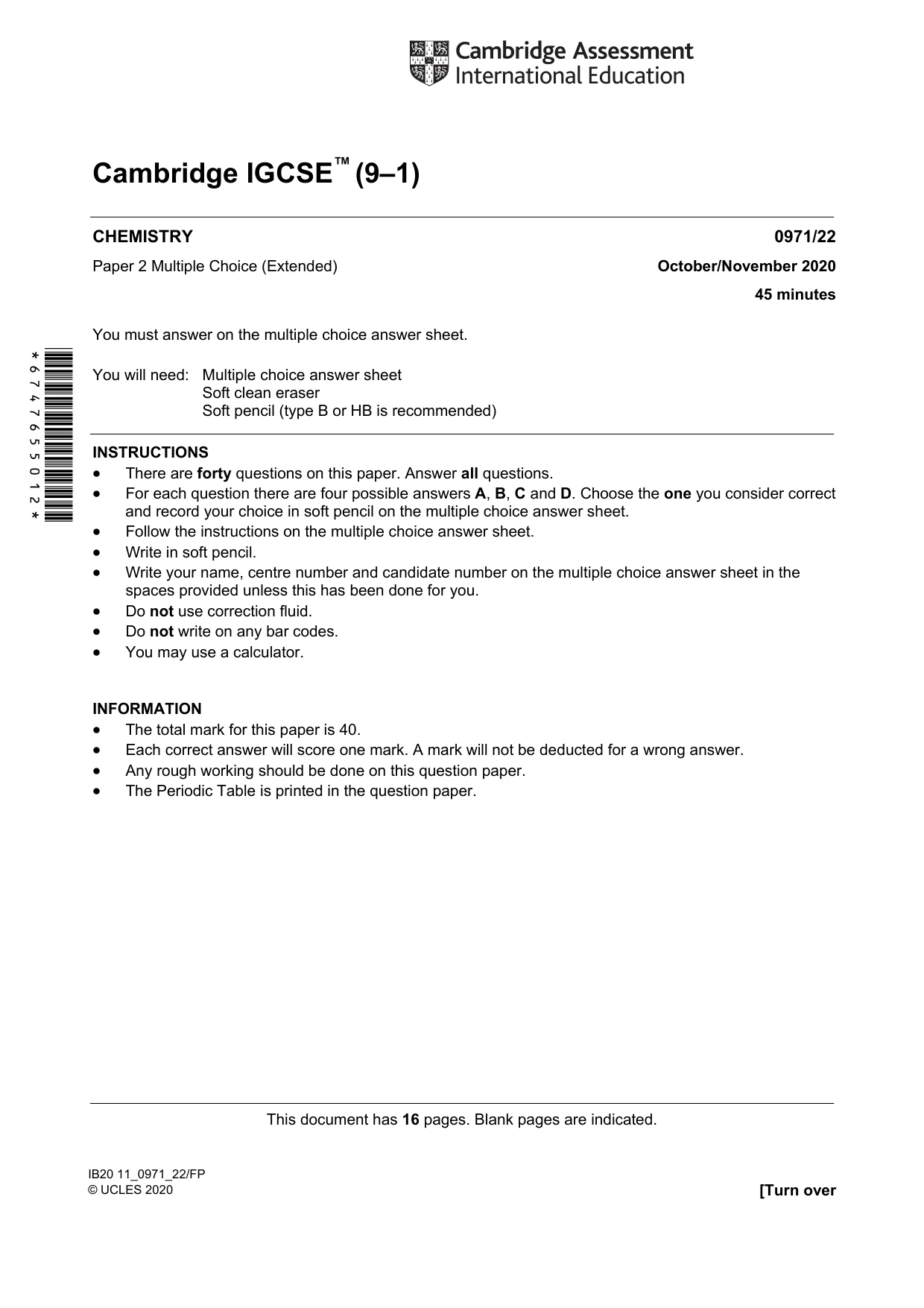
Cambridge IGCSE Chemistry (9-1) 0971 — 2020 Oct/Nov Paper 2 · Variant 2
0971/22/O/N/20 · 40 questions · 40 marks · ≈45 min
The question paper and its mark scheme, free to read here and free to download. This is Cambridge’s own paper, exactly as it was sat.
Question paper16 pages


Mark scheme3 pages
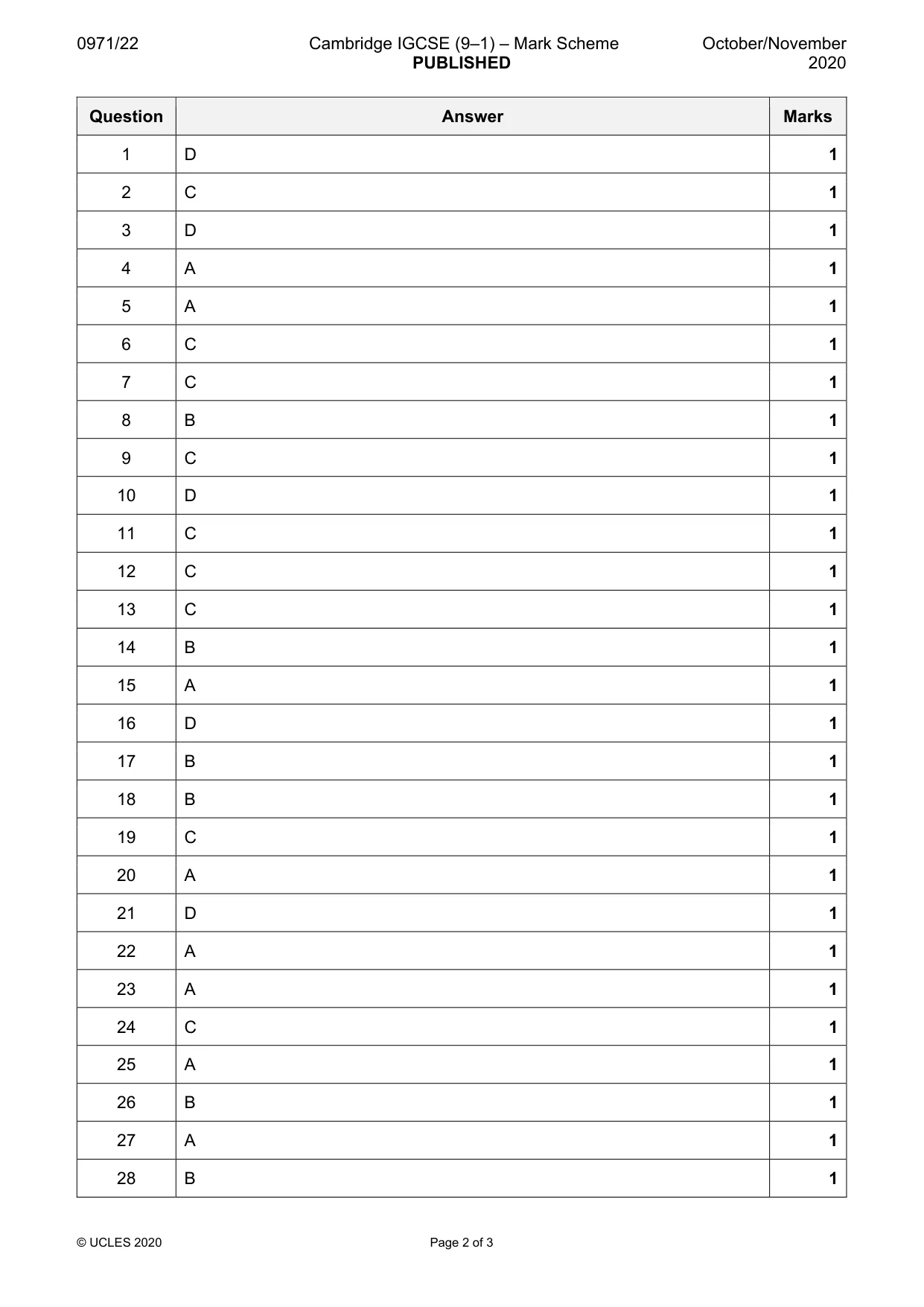
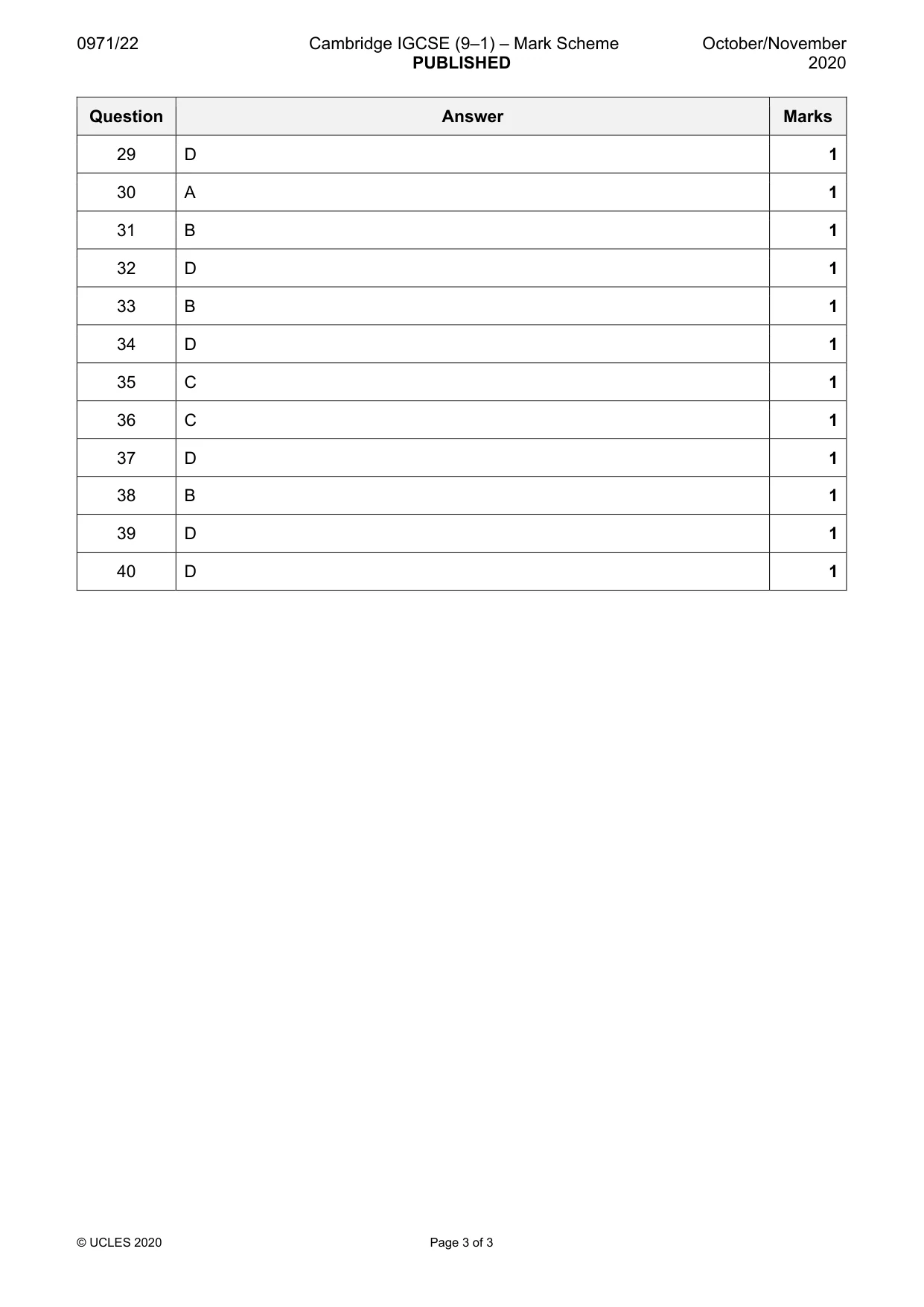
Answers below. Sit the paper first if you are practising.
Questions as text
Q1 · Which gas has the slowest rate of diffusion?
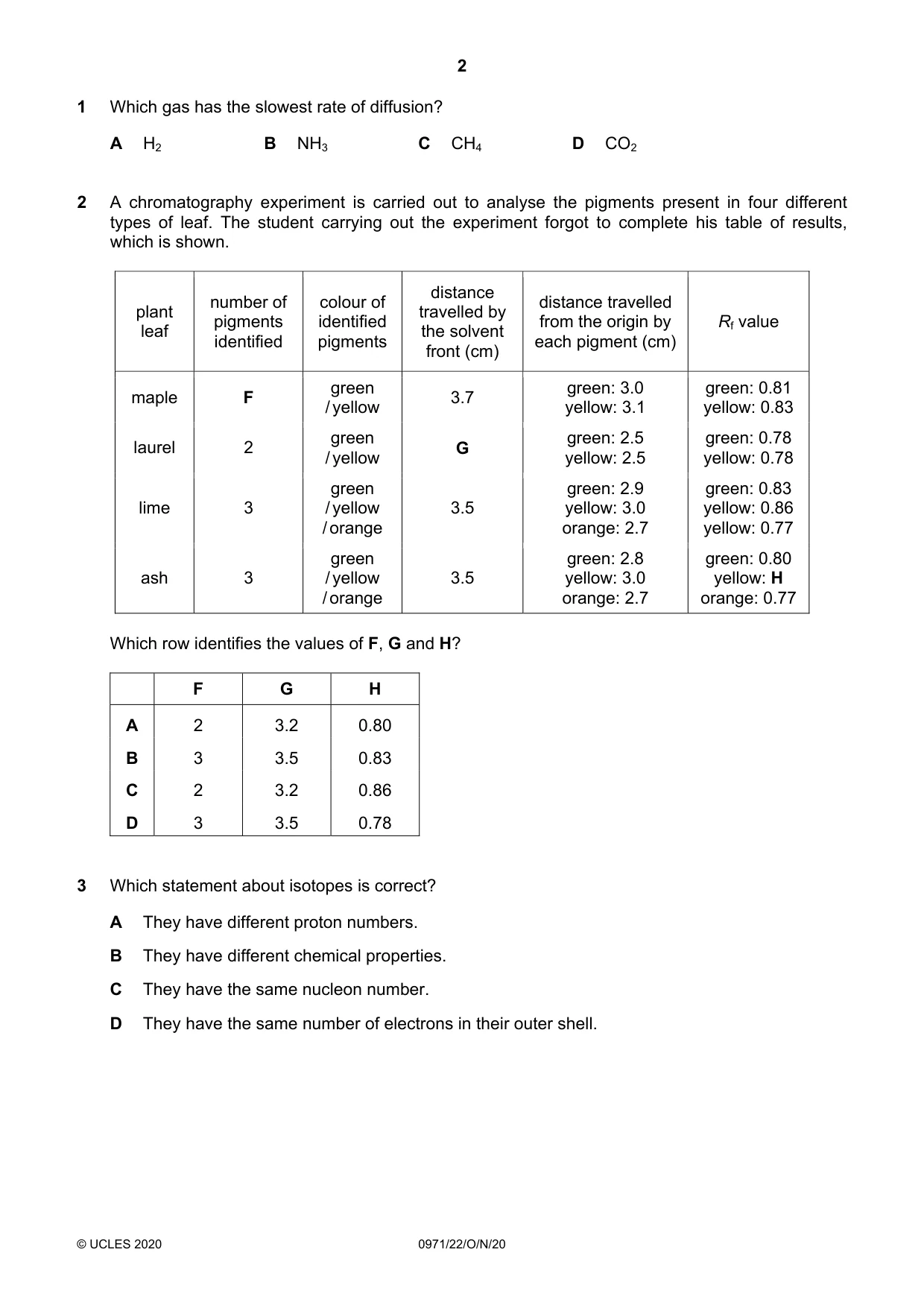
1 Which gas has the slowest rate of diffusion? A H2 B NH3 C CH4 D CO2
Mark scheme: D
Q2 · A chromatography experiment is carried out to analyse the pigments present in four…
2 A chromatography experiment is carried out to analyse the pigments present in four different types of leaf. The student carrying out the experiment forgot to complete his table of results, which is shown. distance number of colour of distance travelled plant travelled by pigments identified from the origin by Rf value leaf the solvent identified pigments each pigment (cm) front (cm) green green: 3.0 green: 0.81 maple F 3.7 / yellow yellow: 3.1 yellow: 0.83 green green: 2.5 green: 0.78 laurel 2 G / yellow yellow: 2.5 yellow: 0.78 green green: 2.9 green: 0.83 lime 3 / yellow 3.5 yellow: 3.0 yellow: 0.86 / orange orange: 2.7 yellow: 0.77 green green: 2.8 green: 0.80 ash 3 / yellow 3.5 yellow: 3.0 yellow: H / orange orange: 2.7 orange: 0.77 Which row identifies the values of F, G and H? F G H A 2 3.2 0.80 B 3 3.5 0.83 C 2 3.2 0.86 D 3 3.5 0.78
Mark scheme: C
Q3 · Which statement about isotopes is correct?
3 Which statement about isotopes is correct? A They have different proton numbers. B They have different chemical properties. C They have the same nucleon number. D They have the same number of electrons in their outer shell.
Mark scheme: D
Q4 · In the chromatography experiment shown, which label represents the solvent front?
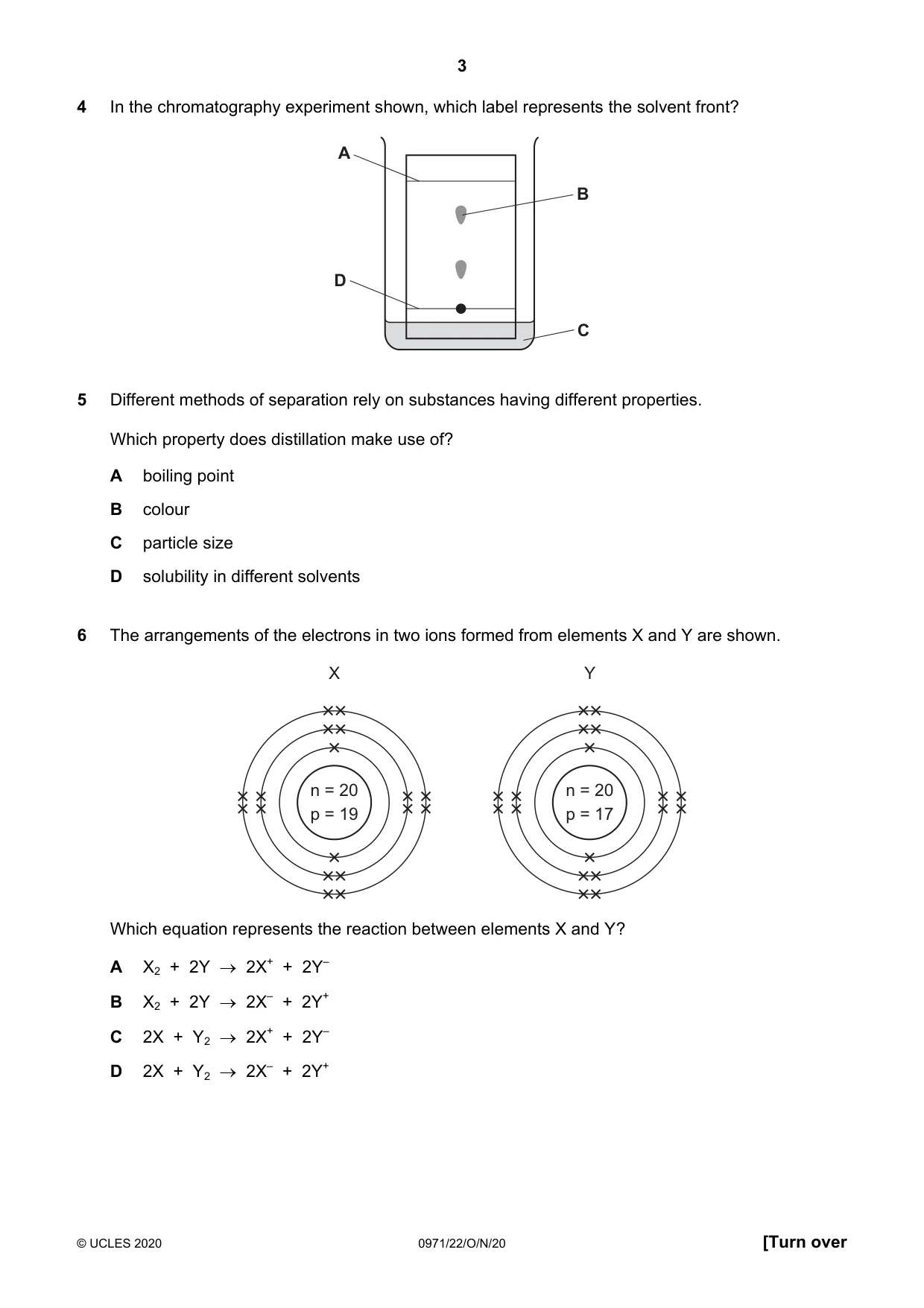
4 In the chromatography experiment shown, which label represents the solvent front? A B D C
Mark scheme: A
Q5 · Different methods of separation rely on substances having different properties
5 Different methods of separation rely on substances having different properties. Which property does distillation make use of? A boiling point B colour C particle size D solubility in different solvents
Mark scheme: A
Q6 · The arrangements of the electrons in two ions formed from elements X and Y are shown
6 The arrangements of the electrons in two ions formed from elements X and Y are shown. X Y n = 20 n = 20 p = 19 p = 17 Which equation represents the reaction between elements X and Y? A X2 + 2Y 2X+ + 2Y– B X2 + 2Y 2X– + 2Y+ C 2X + Y2 2X+ + 2Y– D 2X + Y2 2X– + 2Y+
Mark scheme: C
Q7 · Which row identifies compounds that contain single covalent bonds only, double covalent…
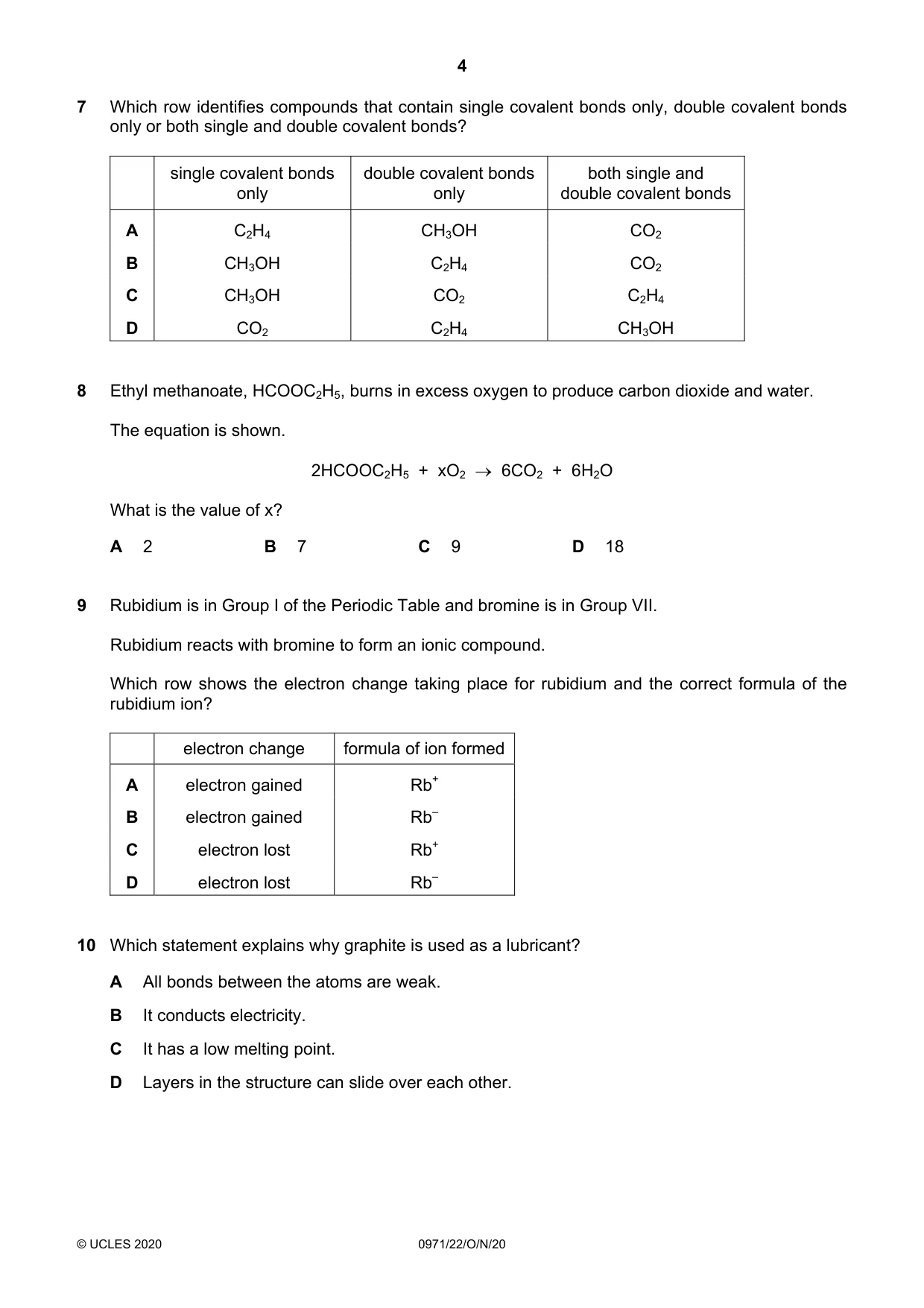
7 Which row identifies compounds that contain single covalent bonds only, double covalent bonds only or both single and double covalent bonds? single covalent bonds double covalent bonds both single and only only double covalent bonds A C2H4 CH3OH CO2 B CH3OH C2H4 CO2 C CH3OH CO2 C2H4 D CO2 C2H4 CH3OH
Mark scheme: C
Q8 · Ethyl methanoate, HCOOC2H5, burns in excess oxygen to produce carbon dioxide and water
8 Ethyl methanoate, HCOOC2H5, burns in excess oxygen to produce carbon dioxide and water. The equation is shown. 2HCOOC2H5 + xO2 6CO2 + 6H2O What is the value of x? A 2 B 7 C 9 D 18
Mark scheme: B
Q9 · Rubidium is in Group I of the Periodic Table and bromine is in Group VII
9 Rubidium is in Group I of the Periodic Table and bromine is in Group VII. Rubidium reacts with bromine to form an ionic compound. Which row shows the electron change taking place for rubidium and the correct formula of the rubidium ion? electron change formula of ion formed A electron gained Rb+ B electron gained Rb– C electron lost Rb+ D electron lost Rb–
Mark scheme: C
Q10 · Which statement explains why graphite is used as a lubricant?
10 Which statement explains why graphite is used as a lubricant? A All bonds between the atoms are weak. B It conducts electricity. C It has a low melting point. D Layers in the structure can slide over each other.
Mark scheme: D
Q11 · The relative atomic mass of chlorine is 35.5
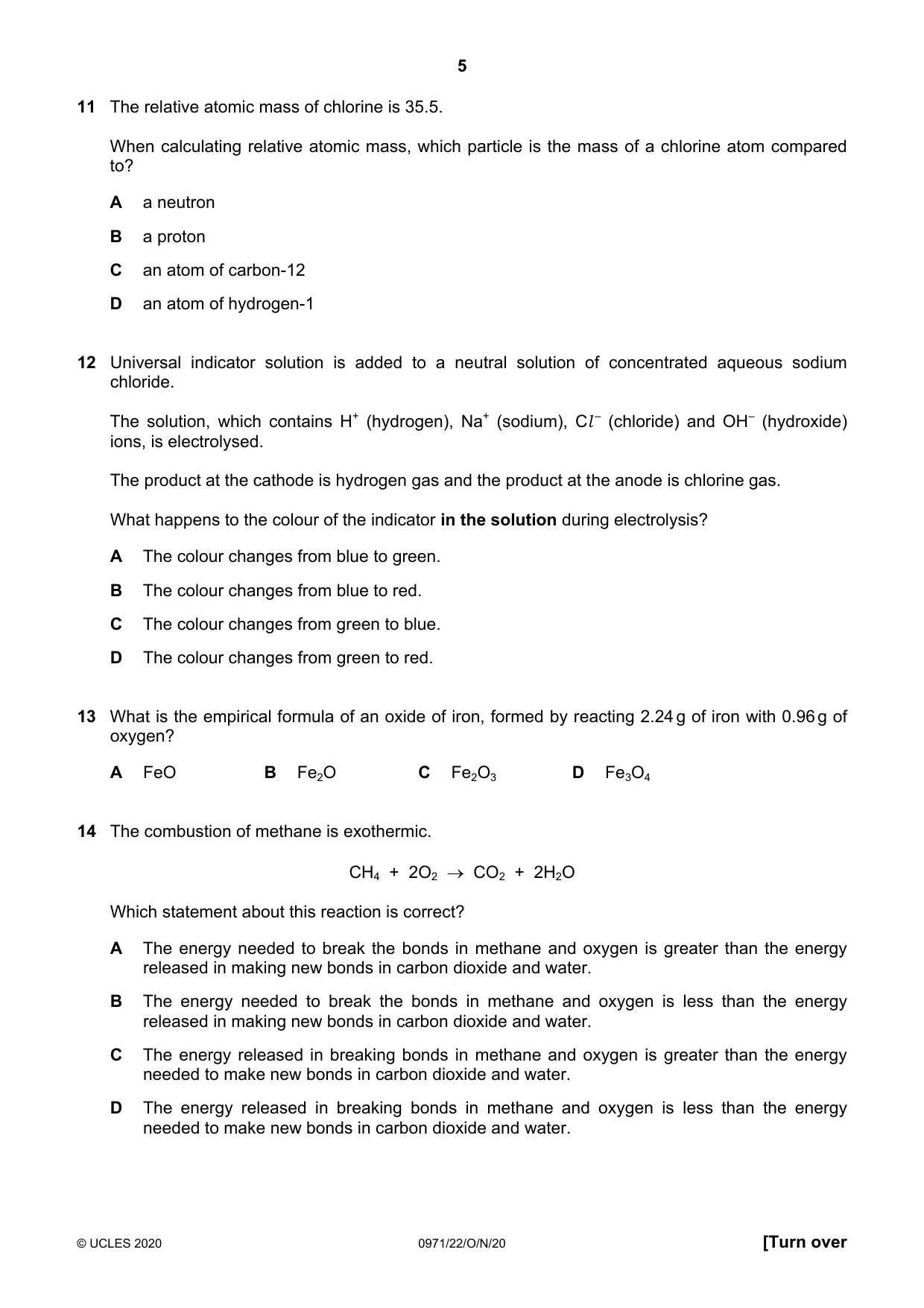
11 The relative atomic mass of chlorine is 35.5. When calculating relative atomic mass, which particle is the mass of a chlorine atom compared to? A a neutron B a proton C an atom of carbon-12 D an atom of hydrogen-1
Mark scheme: C
Q12 · Universal indicator solution is added to a neutral solution of concentrated aqueous…
12 Universal indicator solution is added to a neutral solution of concentrated aqueous sodium chloride. The solution, which contains H+ (hydrogen), Na+ (sodium), Cl – (chloride) and OH– (hydroxide) ions, is electrolysed. The product at the cathode is hydrogen gas and the product at the anode is chlorine gas. What happens to the colour of the indicator in the solution during electrolysis? A The colour changes from blue to green. B The colour changes from blue to red. C The colour changes from green to blue. D The colour changes from green to red.
Mark scheme: C
Q13 · What is the empirical formula of an oxide of iron, formed by reacting 2.24 g of iron with…
13 What is the empirical formula of an oxide of iron, formed by reacting 2.24 g of iron with 0.96 g of oxygen? A FeO B Fe2O C Fe2O3 D Fe3O4
Mark scheme: C
Q14 · The combustion of methane is exothermic
14 The combustion of methane is exothermic. CH4 + 2O2 CO2 + 2H2O Which statement about this reaction is correct? A The energy needed to break the bonds in methane and oxygen is greater than the energy released in making new bonds in carbon dioxide and water. B The energy needed to break the bonds in methane and oxygen is less than the energy released in making new bonds in carbon dioxide and water. C The energy released in breaking bonds in methane and oxygen is greater than the energy needed to make new bonds in carbon dioxide and water. D The energy released in breaking bonds in methane and oxygen is less than the energy needed to make new bonds in carbon dioxide and water.
Mark scheme: B
Q15 · Hydrogen reacts with oxygen in a fuel cell
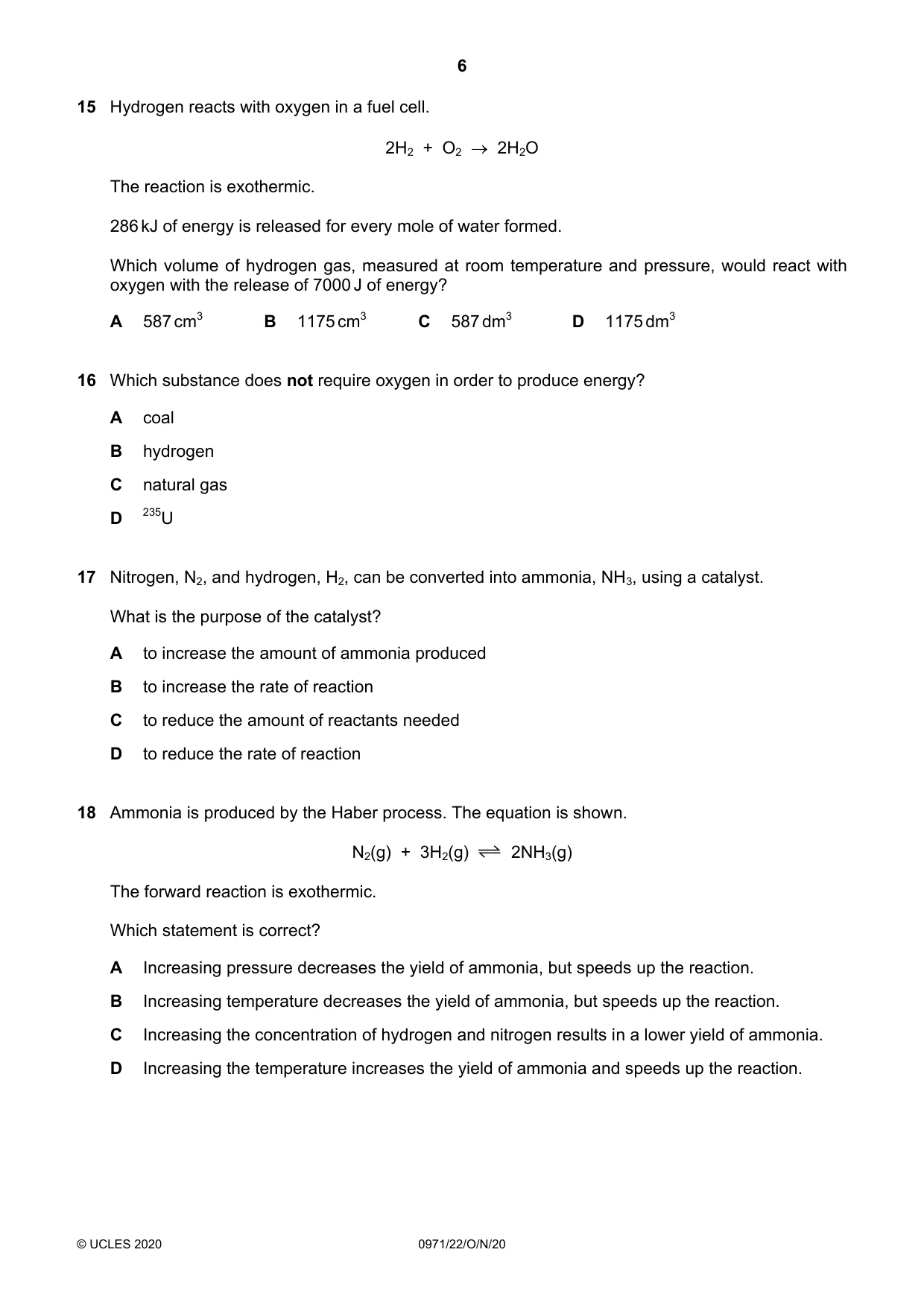
15 Hydrogen reacts with oxygen in a fuel cell. 2H2 + O2 2H2O The reaction is exothermic. 286 kJ of energy is released for every mole of water formed. Which volume of hydrogen gas, measured at room temperature and pressure, would react with oxygen with the release of 7000 J of energy? A 587 cm3 B 1175 cm3 C 587 dm3 D 1175 dm3
Mark scheme: A
Q16 · Which substance does not require oxygen in order to produce energy?
16 Which substance does not require oxygen in order to produce energy? A coal B hydrogen C natural gas D 235U
Mark scheme: D
Q17 · Nitrogen, N2, and hydrogen, H2, can be converted into ammonia, NH3, using a catalyst
17 Nitrogen, N2, and hydrogen, H2, can be converted into ammonia, NH3, using a catalyst. What is the purpose of the catalyst? A to increase the amount of ammonia produced B to increase the rate of reaction C to reduce the amount of reactants needed D to reduce the rate of reaction
Mark scheme: B
Q18 · Ammonia is produced by the Haber process
18 Ammonia is produced by the Haber process. The equation is shown. N2(g) + 3H2(g) 2NH3(g) The forward reaction is exothermic. Which statement is correct? A Increasing pressure decreases the yield of ammonia, but speeds up the reaction. B Increasing temperature decreases the yield of ammonia, but speeds up the reaction. C Increasing the concentration of hydrogen and nitrogen results in a lower yield of ammonia. D Increasing the temperature increases the yield of ammonia and speeds up the reaction.
Mark scheme: B
Q19 · During the manufacture of sulfuric acid, sulfur dioxide is converted to sulfur trioxide
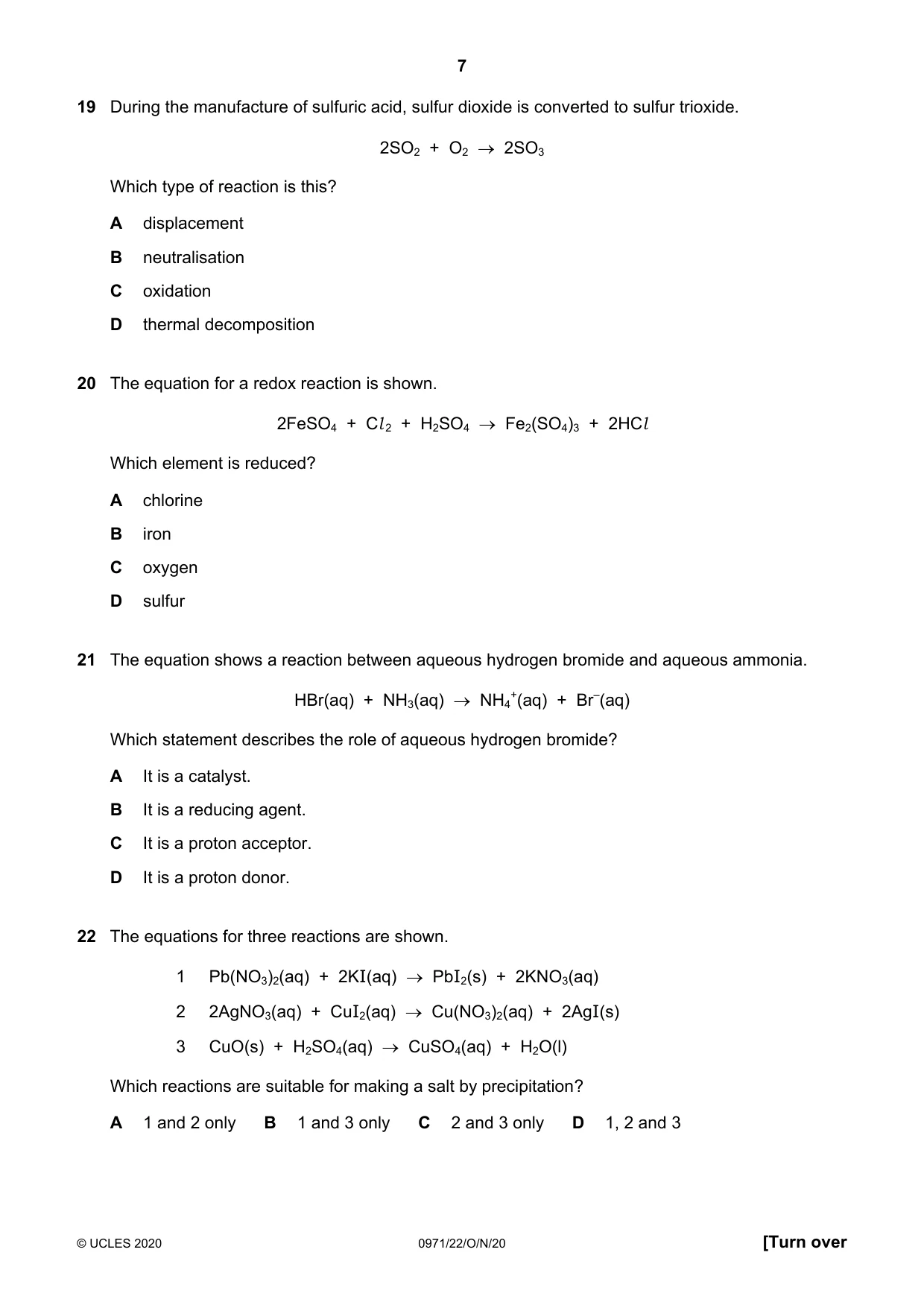
19 During the manufacture of sulfuric acid, sulfur dioxide is converted to sulfur trioxide. 2SO2 + O2 2SO3 Which type of reaction is this? A displacement B neutralisation C oxidation D thermal decomposition
Mark scheme: C
Q20 · The equation for a redox reaction is shown
20 The equation for a redox reaction is shown. 2FeSO4 + Cl 2 + H2SO4 Fe2(SO4)3 + 2HCl Which element is reduced? A chlorine B iron C oxygen D sulfur
Mark scheme: A
Q21 · The equation shows a reaction between aqueous hydrogen bromide and aqueous ammonia
21 The equation shows a reaction between aqueous hydrogen bromide and aqueous ammonia. HBr(aq) + NH3(aq) NH4 +(aq) + Br–(aq) Which statement describes the role of aqueous hydrogen bromide? A It is a catalyst. B It is a reducing agent. C It is a proton acceptor. D It is a proton donor.
Mark scheme: D
More questions on The characteristic properties of acids and bases
Q22 · The equations for three reactions are shown
22 The equations for three reactions are shown. 1 Pb(NO3)2(aq) + 2KI(aq) PbI2(s) + 2KNO3(aq) 2 2AgNO3(aq) + CuI2(aq) Cu(NO3)2(aq) + 2AgI(s) 3 CuO(s) + H2SO4(aq) CuSO4(aq) + H2O(l) Which reactions are suitable for making a salt by precipitation? A 1 and 2 only B 1 and 3 only C 2 and 3 only D 1, 2 and 3
Mark scheme: A
Q23 · Zinc oxide is an amphoteric oxide
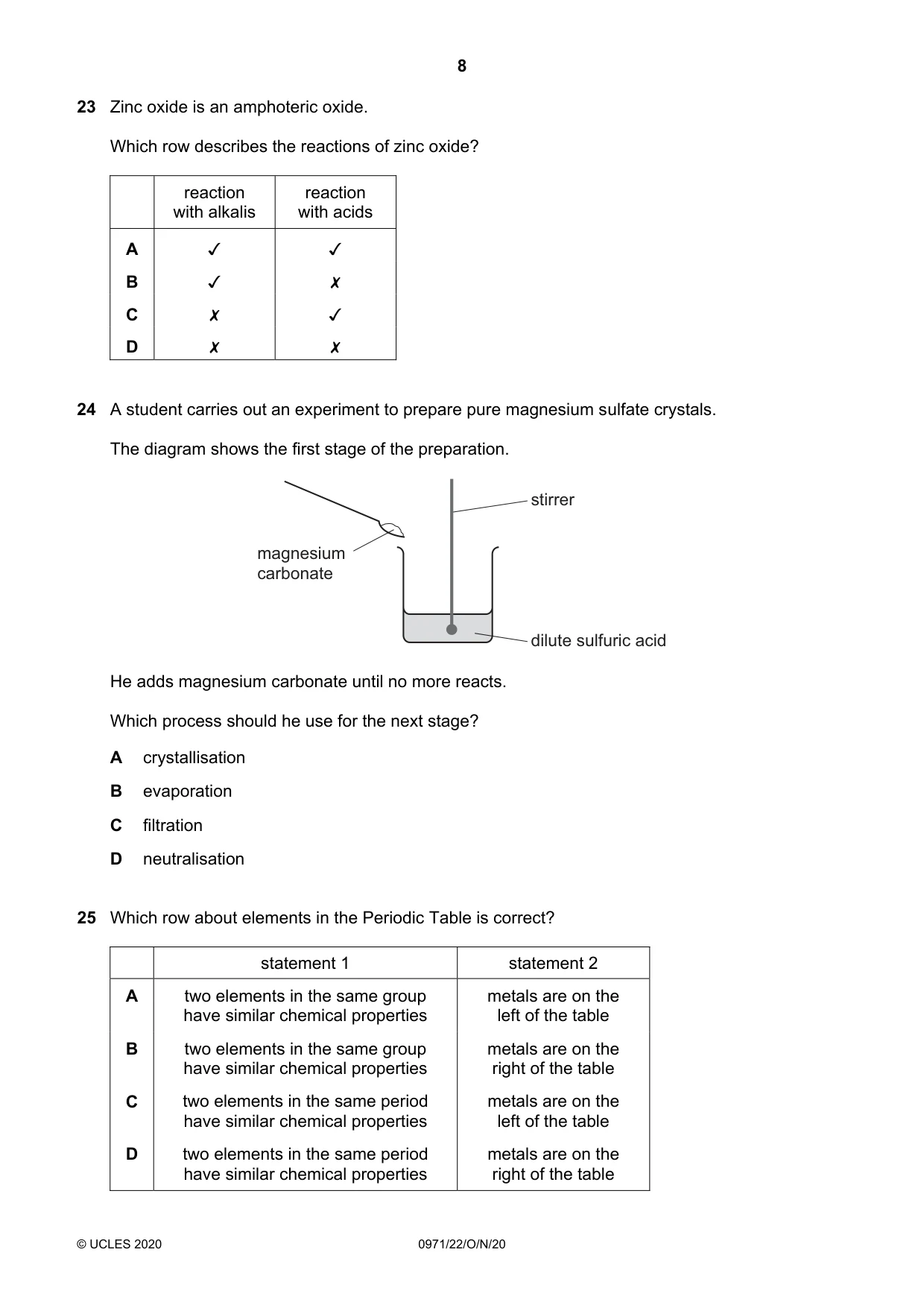
23 Zinc oxide is an amphoteric oxide. Which row describes the reactions of zinc oxide? reaction reaction with alkalis with acids v v v x x v x x
Mark scheme: A
Q24 · A student carries out an experiment to prepare pure magnesium sulfate crystals
24 A student carries out an experiment to prepare pure magnesium sulfate crystals. The diagram shows the first stage of the preparation. stirrer magnesium carbonate dilute sulfuric acid He adds magnesium carbonate until no more reacts. Which process should he use for the next stage? A crystallisation B evaporation C filtration D neutralisation
Mark scheme: C
Q25 · Which row about elements in the Periodic Table is correct?
25 Which row about elements in the Periodic Table is correct? statement 1 statement 2 A two elements in the same group metals are on the have similar chemical properties left of the table B two elements in the same group metals are on the have similar chemical properties right of the table C two elements in the same period metals are on the have similar chemical properties left of the table D two elements in the same period metals are on the have similar chemical properties right of the table
Mark scheme: A
Q26 · A new element oxfordium, Ox, was discovered with the following properties
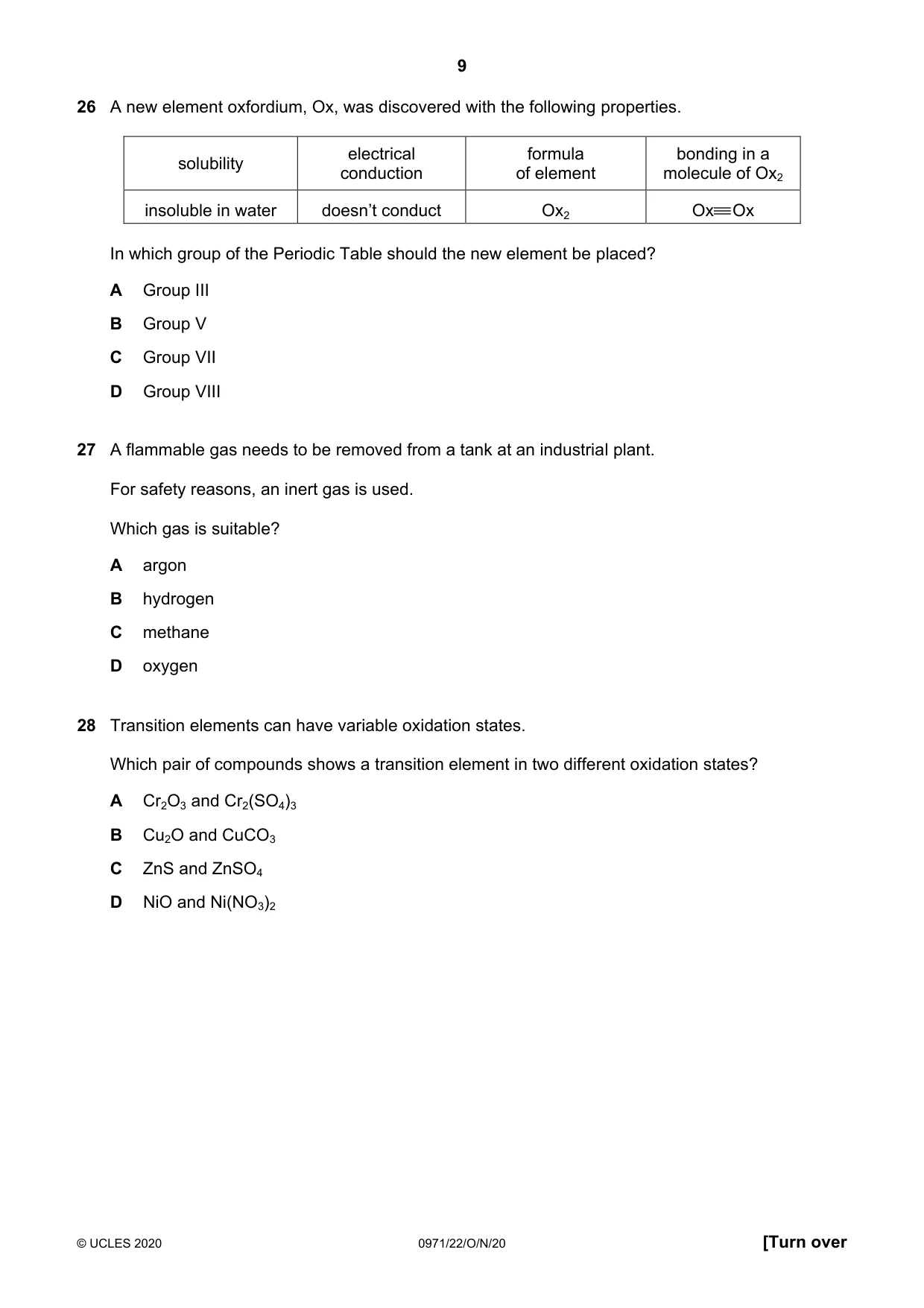
26 A new element oxfordium, Ox, was discovered with the following properties. electrical formula bonding in a solubility conduction of element molecule of Ox2 insoluble in water doesn’t conduct Ox2 Ox Ox In which group of the Periodic Table should the new element be placed? A Group III B Group V C Group VII D Group VIII
Mark scheme: B
Q27 · A flammable gas needs to be removed from a tank at an industrial plant
27 A flammable gas needs to be removed from a tank at an industrial plant. For safety reasons, an inert gas is used. Which gas is suitable? A argon B hydrogen C methane D oxygen
Mark scheme: A
Q28 · Transition elements can have variable oxidation states
28 Transition elements can have variable oxidation states. Which pair of compounds shows a transition element in two different oxidation states? A Cr2O3 and Cr2(SO4)3 B Cu2O and CuCO3 C ZnS and ZnSO4 D NiO and Ni(NO3)2
Mark scheme: B
Q29 · Which diagram best represents the structure of a substance that is a good conductor of…
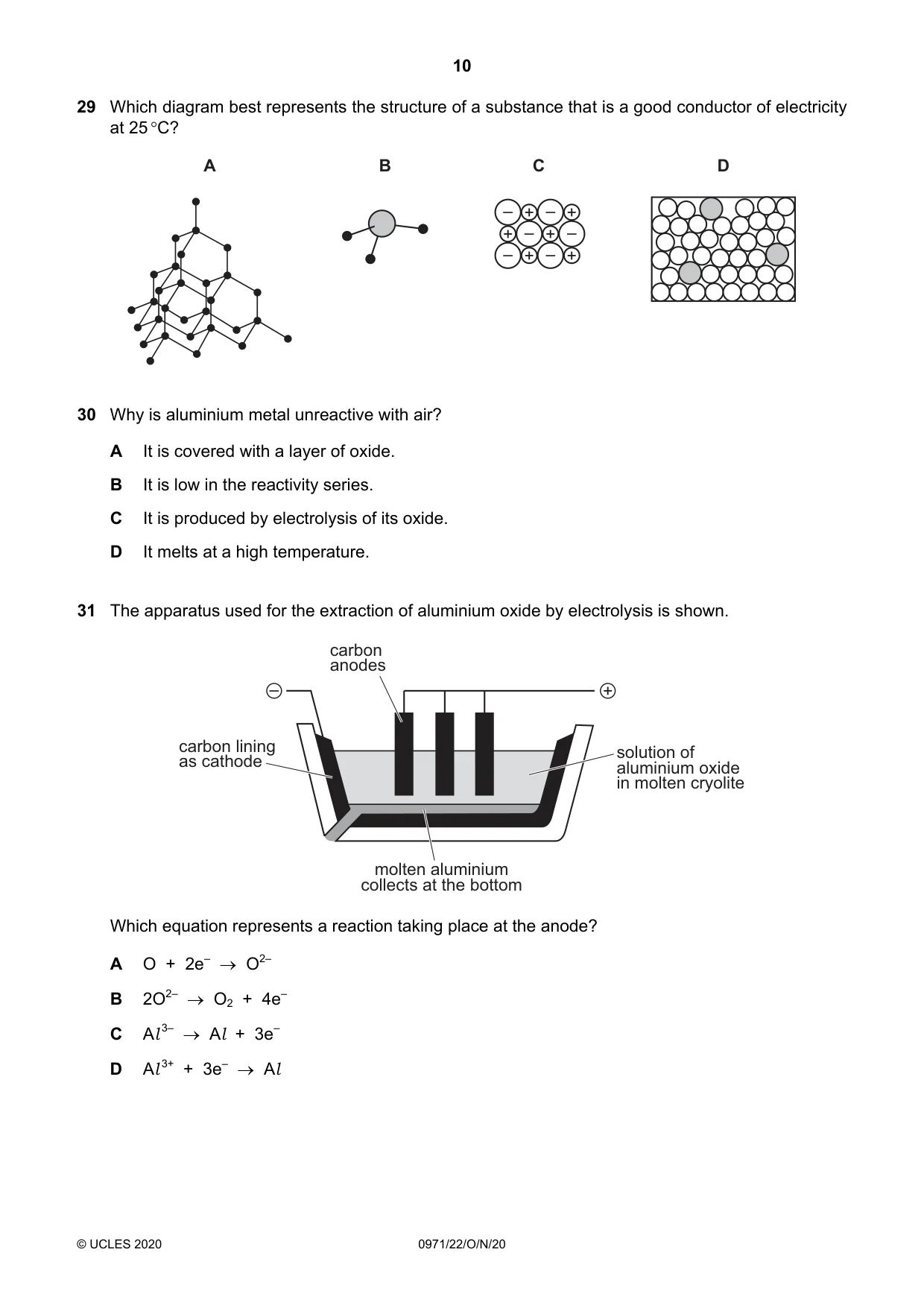
29 Which diagram best represents the structure of a substance that is a good conductor of electricity at 25 C? A B C D – + – + + – + – – + – +
Mark scheme: D
Q30 · Why is aluminium metal unreactive with air?
30 Why is aluminium metal unreactive with air? A It is covered with a layer of oxide. B It is low in the reactivity series. C It is produced by electrolysis of its oxide. D It melts at a high temperature.
Mark scheme: A
Q31 · The apparatus used for the extraction of aluminium oxide by electrolysis is shown
31 The apparatus used for the extraction of aluminium oxide by electrolysis is shown. carbon anodes – + carbon lining solution of as cathode aluminium oxide in molten cryolite molten aluminium collects at the bottom Which equation represents a reaction taking place at the anode? A O + 2e– O2– B 2O2– O2 + 4e– C Al 3– Al + 3e– D Al 3+ + 3e– Al
Mark scheme: B
Q32 · The results of tests on solid S and its aqueous solution are shown
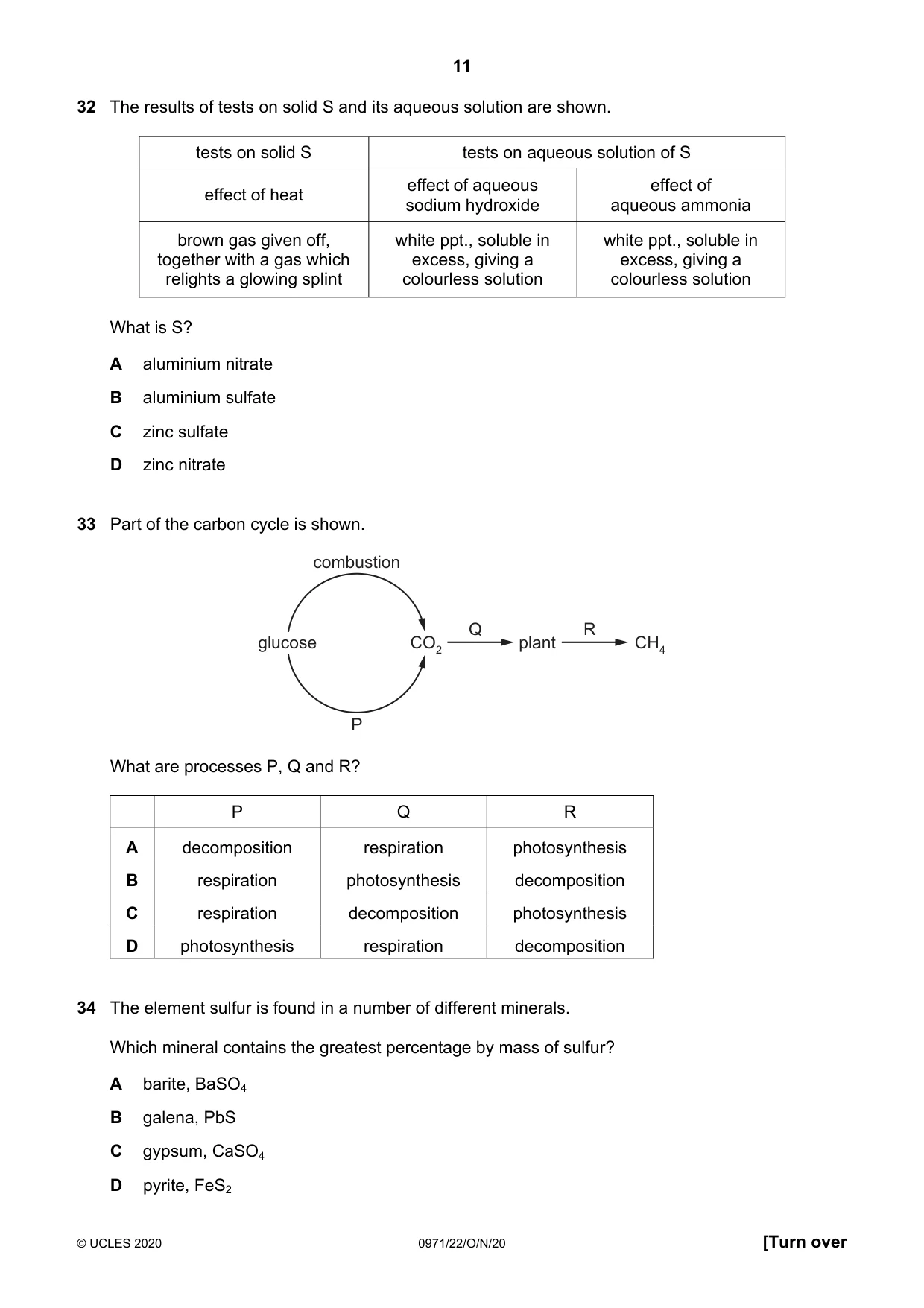
32 The results of tests on solid S and its aqueous solution are shown. tests on solid S tests on aqueous solution of S effect of aqueous effect of effect of heat sodium hydroxide aqueous ammonia brown gas given off, white ppt., soluble in white ppt., soluble in together with a gas which excess, giving a excess, giving a relights a glowing splint colourless solution colourless solution What is S? A aluminium nitrate B aluminium sulfate C zinc sulfate D zinc nitrate
Mark scheme: D
Q33 · Part of the carbon cycle is shown
33 Part of the carbon cycle is shown. combustion Q R glucose CO2 plant CH4 P What are processes P, Q and R? P Q R A decomposition respiration photosynthesis B respiration photosynthesis decomposition C respiration decomposition photosynthesis D photosynthesis respiration decomposition
Mark scheme: B
Q34 · The element sulfur is found in a number of different minerals
34 The element sulfur is found in a number of different minerals. Which mineral contains the greatest percentage by mass of sulfur? A barite, BaSO4 B galena, PbS C gypsum, CaSO4 D pyrite, FeS2
Mark scheme: D
Q35 · Which structure represents a molecule of ethanol?
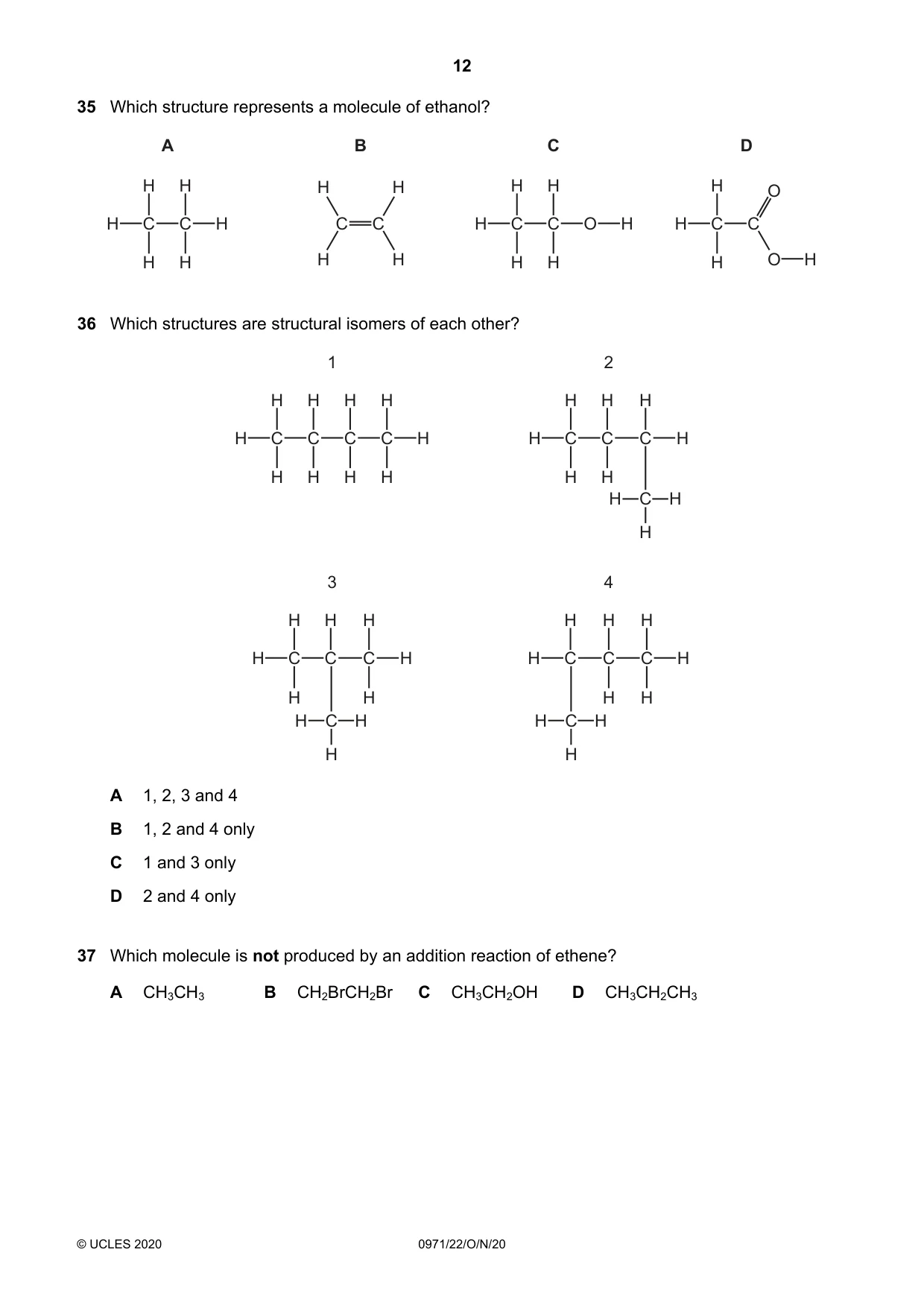
35 Which structure represents a molecule of ethanol? A B C D H H H H H H H O H C C H C C H C C O H H C C H H H H H H H O H
Mark scheme: C
Q36 · Which structures are structural isomers of each other?
36 Which structures are structural isomers of each other? 1 2 H H H H H H H H C C C C H H C C C H H H H H H H H C H H 3 4 H H H H H H H C C C H H C C C H H H H H H C H H C H H H A 1, 2, 3 and 4 B 1, 2 and 4 only C 1 and 3 only D 2 and 4 only
Mark scheme: C
More questions on Formulae, functional groups and terminology
Q37 · Which molecule is not produced by an addition reaction of ethene?
37 Which molecule is not produced by an addition reaction of ethene? A CH3CH3 B CH2BrCH2Br C CH3CH2OH D CH3CH2CH3
Mark scheme: D
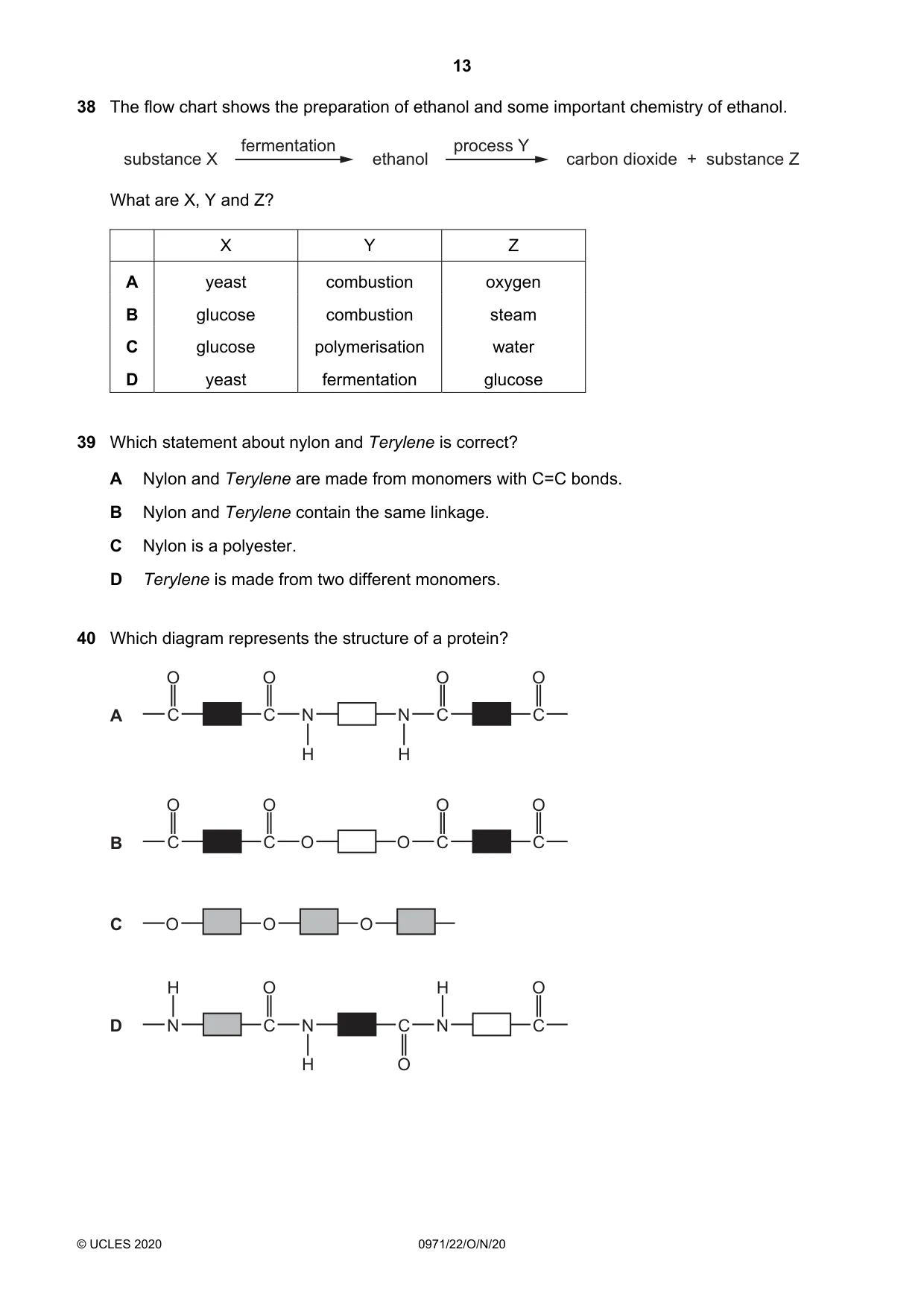
Q38 · The flow chart shows the preparation of ethanol and some important chemistry of ethanol
38 The flow chart shows the preparation of ethanol and some important chemistry of ethanol. fermentation process Y substance X ethanol carbon dioxide + substance Z What are X, Y and Z? X Y Z A yeast combustion oxygen B glucose combustion steam C glucose polymerisation water D yeast fermentation glucose
Mark scheme: B
Q39 · Which statement about nylon and Terylene is correct?
39 Which statement about nylon and Terylene is correct? A Nylon and Terylene are made from monomers with C=C bonds. B Nylon and Terylene contain the same linkage. C Nylon is a polyester. D Terylene is made from two different monomers.
Mark scheme: D
Q40 · Which diagram represents the structure of a protein?
40 Which diagram represents the structure of a protein? O O O O A C C N N C C H H O O O O B C C O O C C C O O O H O H O D N C N C N C H O
Mark scheme: D
What was in this paper
The subtopics covered by these 40 questions, and how many questions each got. Open one in a new tab to see every Cambridge question on it.
3Alcohols2Chromatography2Electrolysis2Ions and ionic bonds2Noble gases2Polymers2Preparation of salts2Redox2Air quality and climate1Alkenes1Arrangement of elements1Corrosion of metals1Diffusion1Exothermic and endothermic reactions1Formulae1Formulae, functional groups and terminology1Fuels1Giant covalent structures1Identification of ions and gases1Isotopes1Metallic bonding1Oxides1Rate of reaction1Relative masses of atoms and molecules1Reversible reactions and equilibrium1Separation and purification1Simple molecules and covalent bonds1The characteristic properties of acids and bases1Transition elements1What you needed in this session
Cambridge’s own grade thresholds for 2020 Oct/Nov, Paper 2 · Variant 2. A higher threshold means an easier paper — the bar moves with how the cohort did.