Cambridge IGCSE Chemistry (9-1) 0971 — 2022 Oct/Nov Paper 2 · Variant 2
0971/22/O/N/22 · 40 questions · 40 marks · ≈45 min
The question paper and its mark scheme, free to read here and free to download. This is Cambridge’s own paper, exactly as it was sat.
Question paper16 pages
Mark scheme3 pages
Answers below. Sit the paper first if you are practising.
Questions as text
Q1 · The rate of diffusion of three gases, ammonia, carbon dioxide and methane, is measured
1 The rate of diffusion of three gases, ammonia, carbon dioxide and methane, is measured. What is the order of the rate of diffusion of the gases from slowest to fastest? A CO2 NH3 CH4 B CO2 CH4 NH3 C CH4 NH3 CO2 D NH3 CH4 CO2
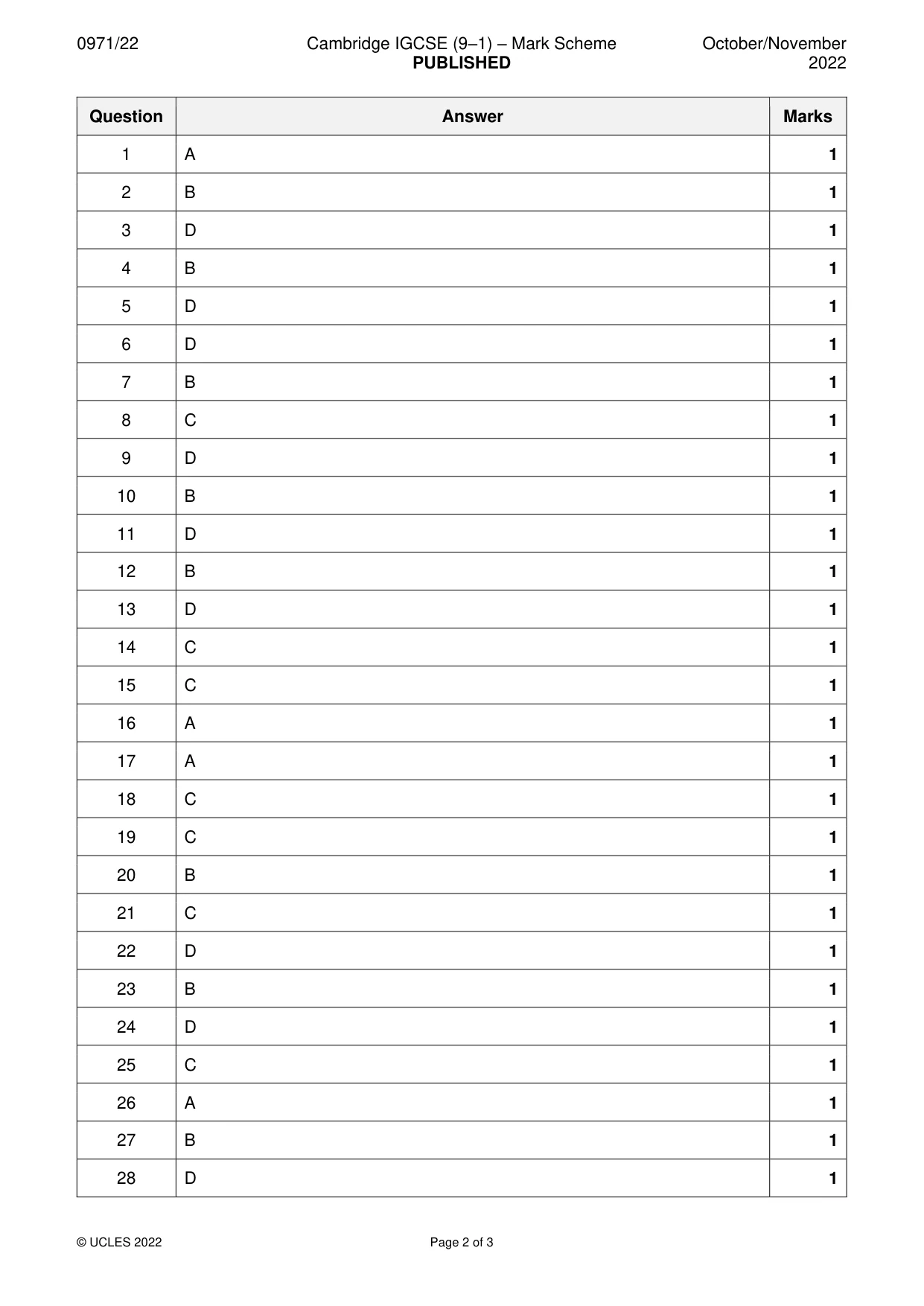
Mark scheme: A
Q2 · Which description of Brownian motion is correct?
2 Which description of Brownian motion is correct? A random movement of particles due to bombardment by larger particles B random movement of particles due to bombardment by smaller particles C random movement of particles from a high concentration to a low concentration D random movement of particles from a low concentration to a high concentration
Mark scheme: B
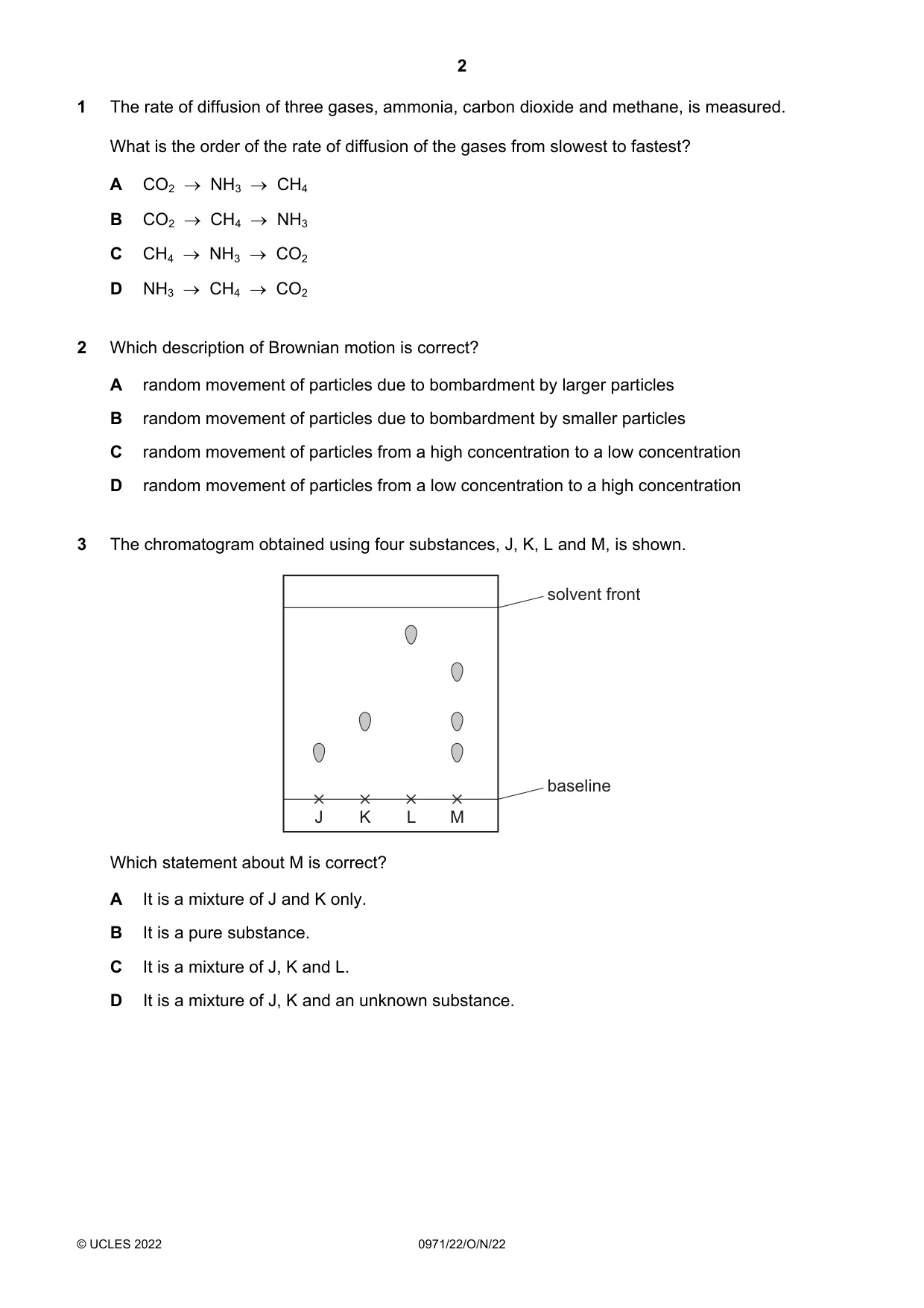
Q3 · The chromatogram obtained using four substances, J, K, L and M, is shown
3 The chromatogram obtained using four substances, J, K, L and M, is shown. solvent front baseline J K L M Which statement about M is correct? A It is a mixture of J and K only. B It is a pure substance. C It is a mixture of J, K and L. D It is a mixture of J, K and an unknown substance.
Mark scheme: D
Q4 · Which statements about isotopes of the same element are correct?
4 Which statements about isotopes of the same element are correct? 1 They are atoms which have the same chemical properties because they have the same number of electrons in their outer shell. 2 They are atoms which have the same number of electrons and neutrons but different numbers of protons. 3 They are atoms which have the same number of electrons and protons but different numbers of neutrons. A 1 and 2 B 1 and 3 C 2 only D 3 only
Mark scheme: B
Q5 · Which statement about solid magnesium oxide is correct?
5 Which statement about solid magnesium oxide is correct? A It is a giant structure made up of magnesium and oxygen atoms bonded covalently. B It is an electrical conductor with mobile magnesium ions and oxygen ions. C Magnesium loses electrons and these electrons move freely through a lattice. D Oxygen ions and magnesium ions are attracted to each other in a giant lattice.
Mark scheme: D
Q6 · Which molecule contains only three shared pairs of electrons?
6 Which molecule contains only three shared pairs of electrons? A CH3OH B Cl 2 C H2O D N2
Mark scheme: D
Q7 · Which particles are present in the structure of metals?
7 Which particles are present in the structure of metals? 1 positive ions 2 negative ions 3 shared pairs of electrons 4 mobile electrons A 1 and 2 B 1 and 4 C 2 and 3 D 2 and 4
Mark scheme: B
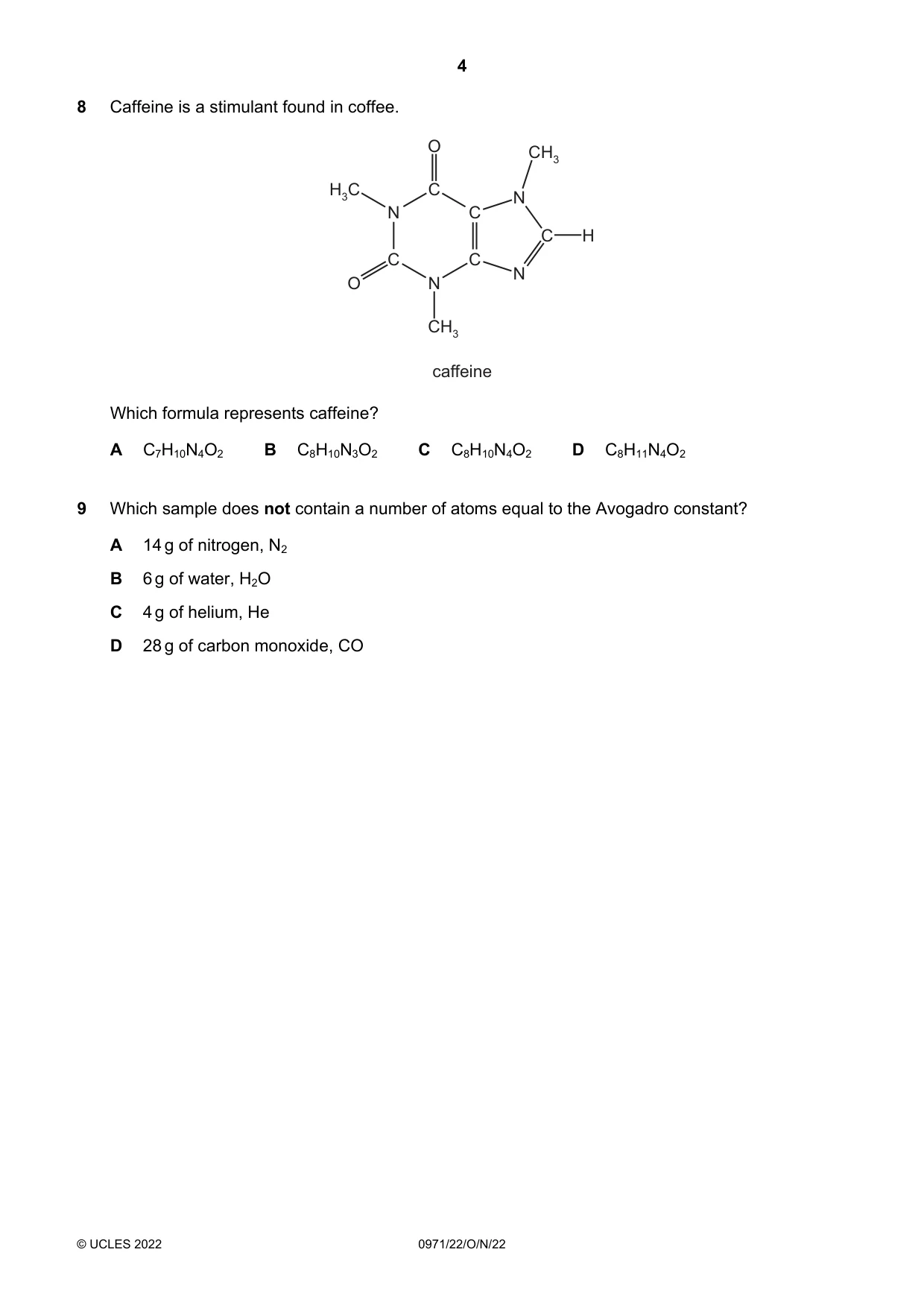
Q8 · Caffeine is a stimulant found in coffee
8 Caffeine is a stimulant found in coffee. O CH3 H3C C N N C C H C C N O N CH3 caffeine Which formula represents caffeine? A C7H10N4O2 B C8H10N3O2 C C8H10N4O2 D C8H11N4O2
Mark scheme: C
More questions on Formulae, functional groups and terminology
Q9 · Which sample does not contain a number of atoms equal to the Avogadro constant?
9 Which sample does not contain a number of atoms equal to the Avogadro constant? A 14 g of nitrogen, N2 B 6 g of water, H2O C 4 g of helium, He D 28 g of carbon monoxide, CO
Mark scheme: D
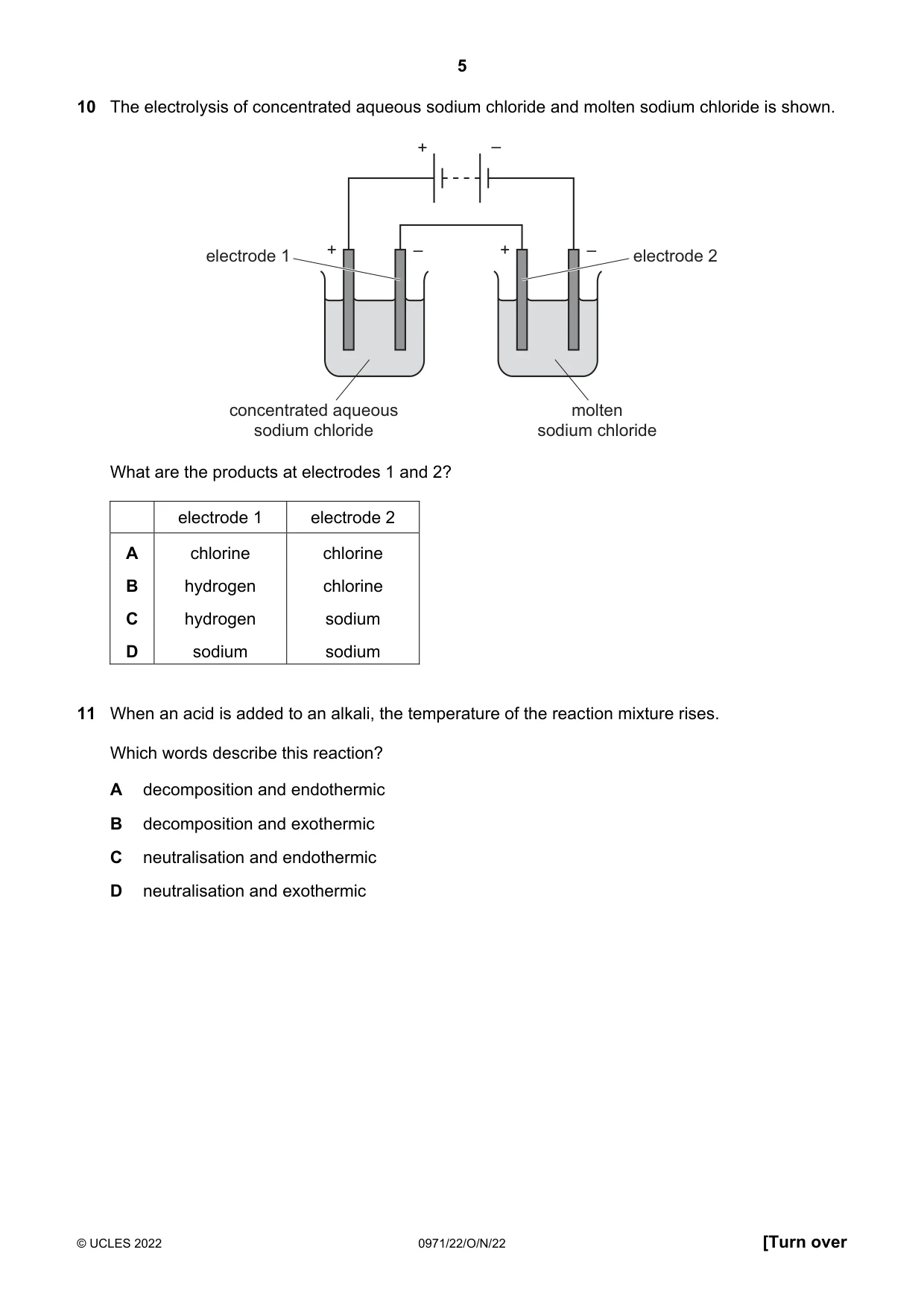
Q10 · The electrolysis of concentrated aqueous sodium chloride and molten sodium chloride is…
10 The electrolysis of concentrated aqueous sodium chloride and molten sodium chloride is shown. + – electrode 1 + – + – electrode 2 concentrated aqueous molten sodium chloride sodium chloride What are the products at electrodes 1 and 2? electrode 1 electrode 2 A chlorine chlorine B hydrogen chlorine C hydrogen sodium D sodium sodium
Mark scheme: B
Q11 · When an acid is added to an alkali, the temperature of the reaction mixture rises
11 When an acid is added to an alkali, the temperature of the reaction mixture rises. Which words describe this reaction? A decomposition and endothermic B decomposition and exothermic C neutralisation and endothermic D neutralisation and exothermic
Mark scheme: D
Q12 · Some properties of four fuels are shown
12 Some properties of four fuels are shown. Which fuel is a gas at room temperature and makes two products when it burns in a plentiful supply of air? melting point boiling point fuel formula / C / C A hydrogen H2 –259 –253 B methane CH4 –182 –164 C octane C8H18 –57 126 D wax C31H64 60 400
Mark scheme: B
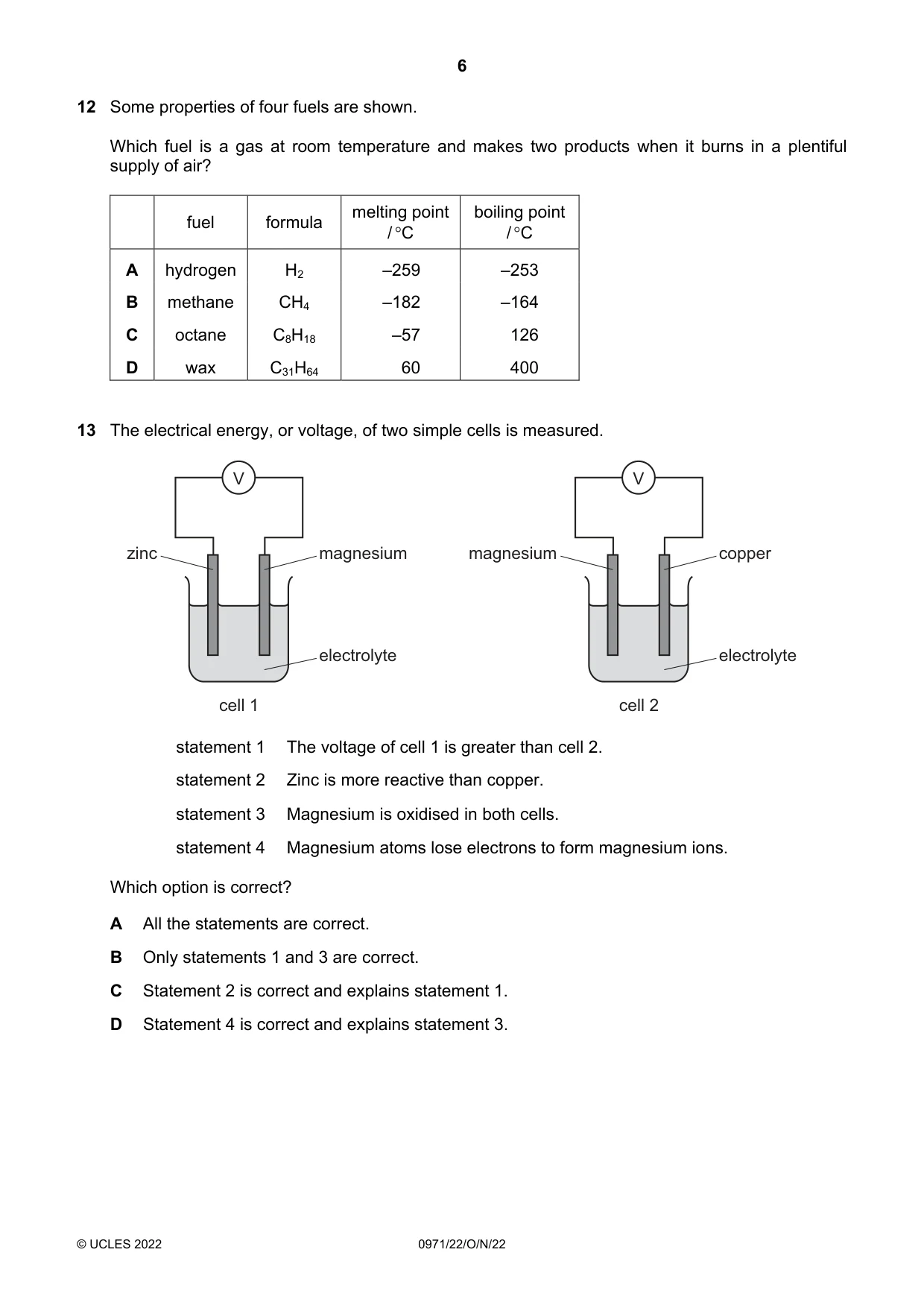
Q13 · The electrical energy, or voltage, of two simple cells is measured
13 The electrical energy, or voltage, of two simple cells is measured. V V zinc magnesium magnesium copper electrolyte electrolyte cell 1 cell 2 statement 1 The voltage of cell 1 is greater than cell 2. statement 2 Zinc is more reactive than copper. statement 3 Magnesium is oxidised in both cells. statement 4 Magnesium atoms lose electrons to form magnesium ions. Which option is correct? A All the statements are correct. B Only statements 1 and 3 are correct. C Statement 2 is correct and explains statement 1. D Statement 4 is correct and explains statement 3.
Mark scheme: D
Q14 · Dilute aqueous sodium chloride is electrolysed using carbon electrodes
14 Dilute aqueous sodium chloride is electrolysed using carbon electrodes. What is the product at the anode? A carbon dioxide B hydrogen C oxygen D sodium
Mark scheme: C
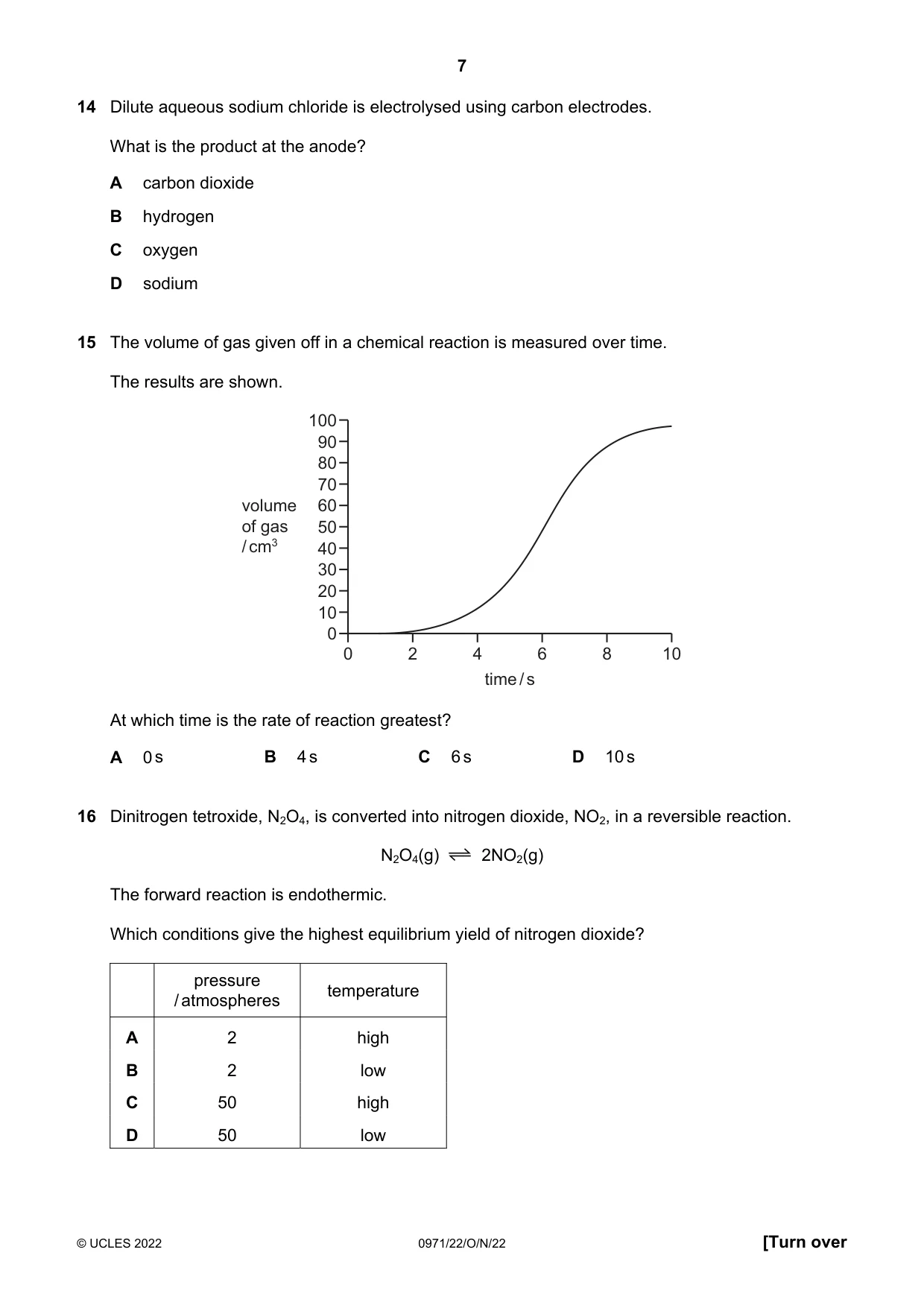
Q15 · The volume of gas given off in a chemical reaction is measured over time
15 The volume of gas given off in a chemical reaction is measured over time. The results are shown. 100 90 80 70 volume 60 of gas 50 / cm3 40 30 20 10 0 0 2 4 6 8 10 time / s At which time is the rate of reaction greatest? A 0 s B 4 s C 6 s D 10 s
Mark scheme: C
Q16 · Dinitrogen tetroxide, N2O4, is converted into nitrogen dioxide, NO2, in a reversible…
16 Dinitrogen tetroxide, N2O4, is converted into nitrogen dioxide, NO2, in a reversible reaction. N2O4(g) 2NO2(g) The forward reaction is endothermic. Which conditions give the highest equilibrium yield of nitrogen dioxide? pressure temperature / atmospheres A 2 high B 2 low C 50 high D 50 low
Mark scheme: A
Q17 · When magnesium is heated with zinc oxide a reaction occurs
17 When magnesium is heated with zinc oxide a reaction occurs. The equation is shown. Mg + ZnO MgO + Zn Which substance is oxidised? A magnesium B magnesium oxide C zinc D zinc oxide
Mark scheme: A
Q18 · X and Y are oxides of two different elements
18 X and Y are oxides of two different elements. ● X reacts with water to produce aqueous solution Z. ● Z turns universal indicator paper blue. ● An aqueous solution of Y reacts with sodium carbonate to produce carbon dioxide gas. Which statement is correct? A X and Y are both the oxides of metals. B X and Y are both the oxides of non-metals. C X is the oxide of a metal and Y is the oxide of a non-metal. D X is the oxide of a non-metal and Y is the oxide of a metal.
Mark scheme: C
Q19 · Ethanoic acid reacts with water to produce an acidic solution
19 Ethanoic acid reacts with water to produce an acidic solution. Which row describes the roles of ethanoic acid and water in this reaction? ethanoic acid water A accepts a proton donates a proton B accepts an electron donates an electron C donates a proton accepts a proton D donates an electron accepts an electron
Mark scheme: C
More questions on The characteristic properties of acids and bases
Q20 · Copper(II) sulfate is a soluble salt
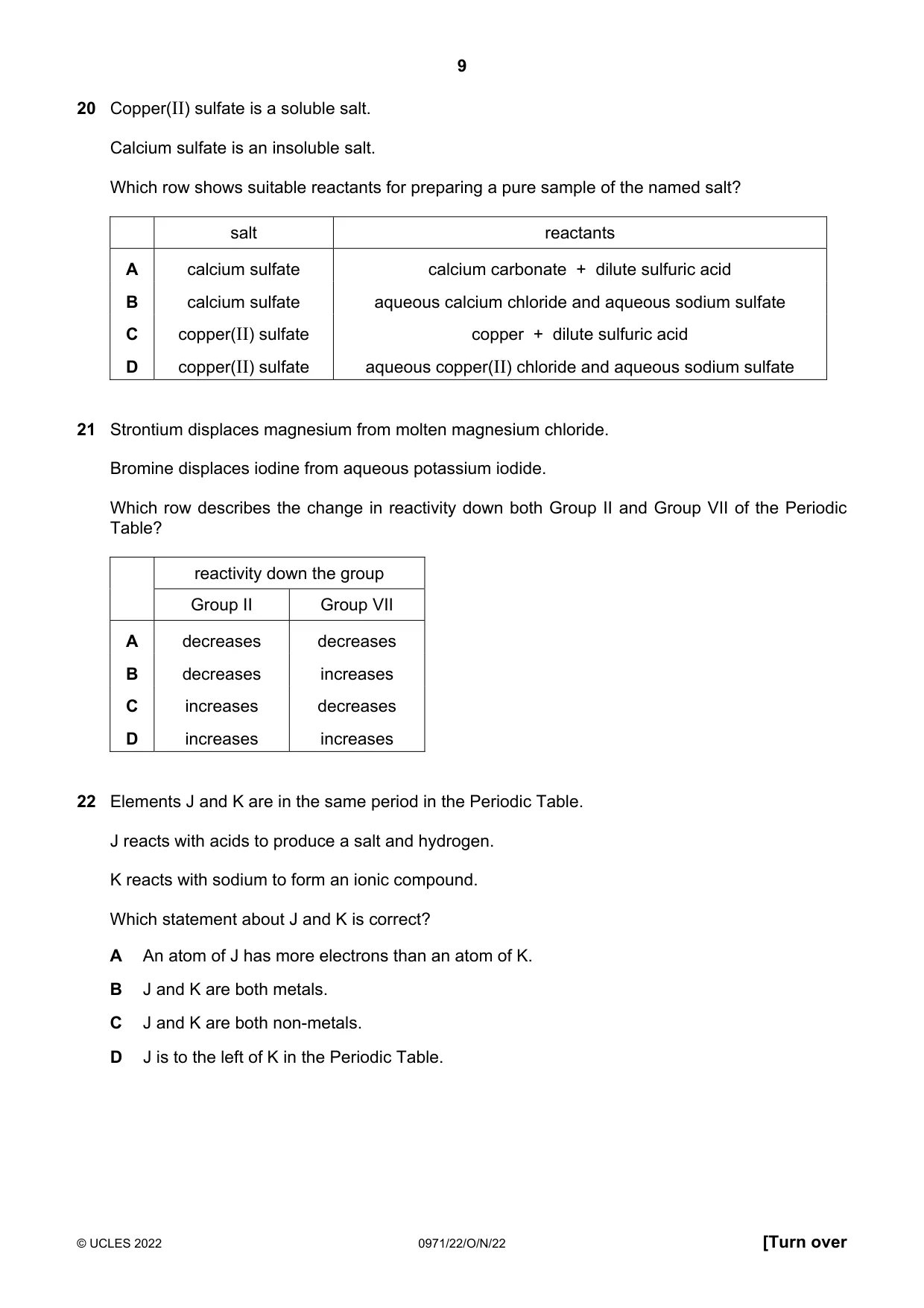
20 Copper(II) sulfate is a soluble salt. Calcium sulfate is an insoluble salt. Which row shows suitable reactants for preparing a pure sample of the named salt? salt reactants A calcium sulfate calcium carbonate + dilute sulfuric acid B calcium sulfate aqueous calcium chloride and aqueous sodium sulfate C copper(II) sulfate copper + dilute sulfuric acid D copper(II) sulfate aqueous copper(II) chloride and aqueous sodium sulfate
Mark scheme: B
Q21 · Strontium displaces magnesium from molten magnesium chloride
21 Strontium displaces magnesium from molten magnesium chloride. Bromine displaces iodine from aqueous potassium iodide. Which row describes the change in reactivity down both Group II and Group VII of the Periodic Table? reactivity down the group Group II Group VII A decreases decreases B decreases increases C increases decreases D increases increases
Mark scheme: C
Q22 · Elements J and K are in the same period in the Periodic Table
22 Elements J and K are in the same period in the Periodic Table. J reacts with acids to produce a salt and hydrogen. K reacts with sodium to form an ionic compound. Which statement about J and K is correct? A An atom of J has more electrons than an atom of K. B J and K are both metals. C J and K are both non-metals. D J is to the left of K in the Periodic Table.
Mark scheme: D
Q23 · Part of the Periodic Table is shown
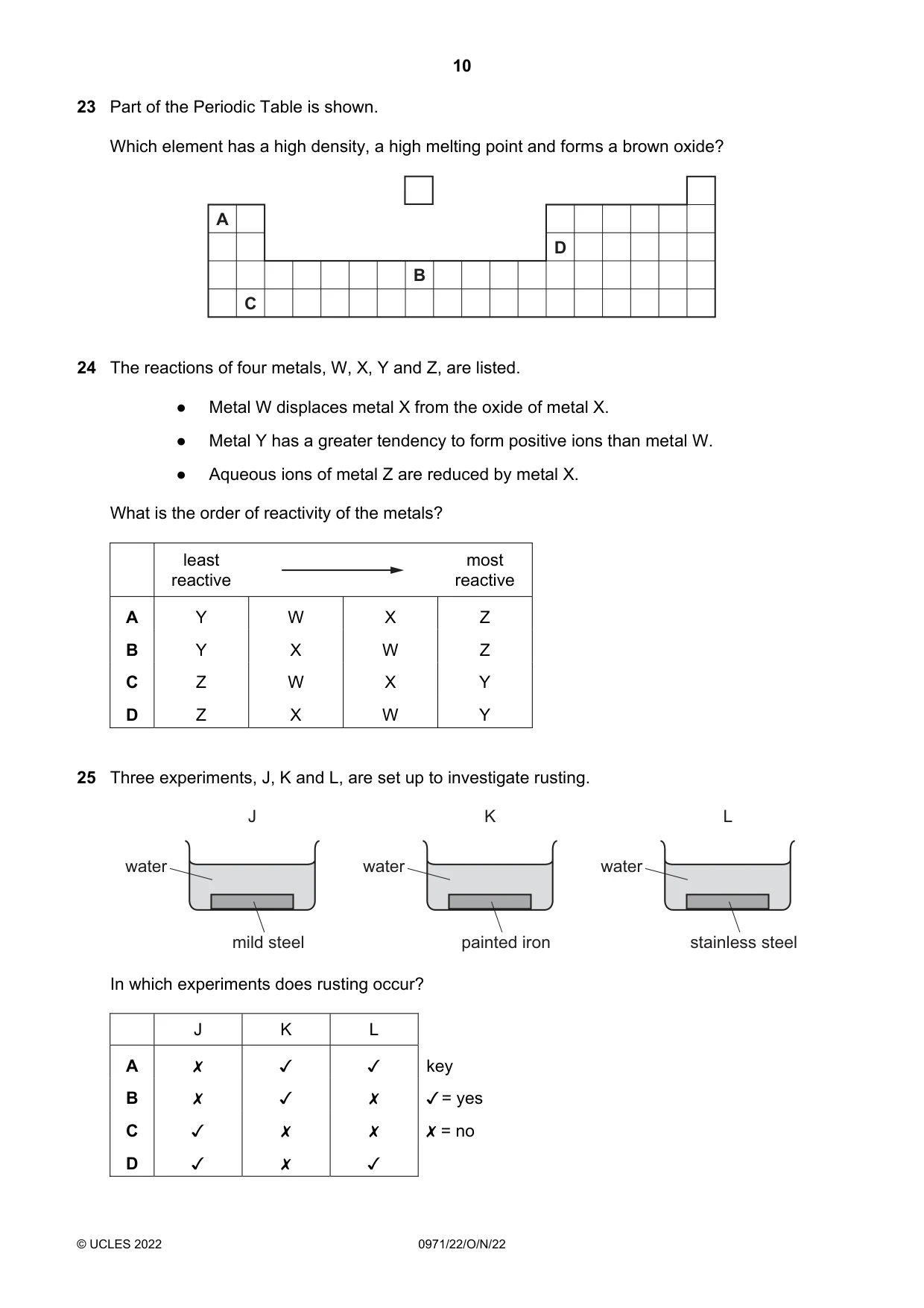
23 Part of the Periodic Table is shown. Which element has a high density, a high melting point and forms a brown oxide? A D B C
Mark scheme: B
Q24 · The reactions of four metals, W, X, Y and Z, are listed
24 The reactions of four metals, W, X, Y and Z, are listed. ● Metal W displaces metal X from the oxide of metal X. ● Metal Y has a greater tendency to form positive ions than metal W. ● Aqueous ions of metal Z are reduced by metal X. What is the order of reactivity of the metals? least most reactive reactive A Y W X Z B Y X W Z C Z W X Y D Z X W Y
Mark scheme: D
Q25 · Three experiments, J, K and L, are set up to investigate rusting
25 Three experiments, J, K and L, are set up to investigate rusting. J K L water water water mild steel painted iron stainless steel In which experiments does rusting occur? key /=yes X=no
Mark scheme: C
Q26 · Silver is below copper in the reactivity series
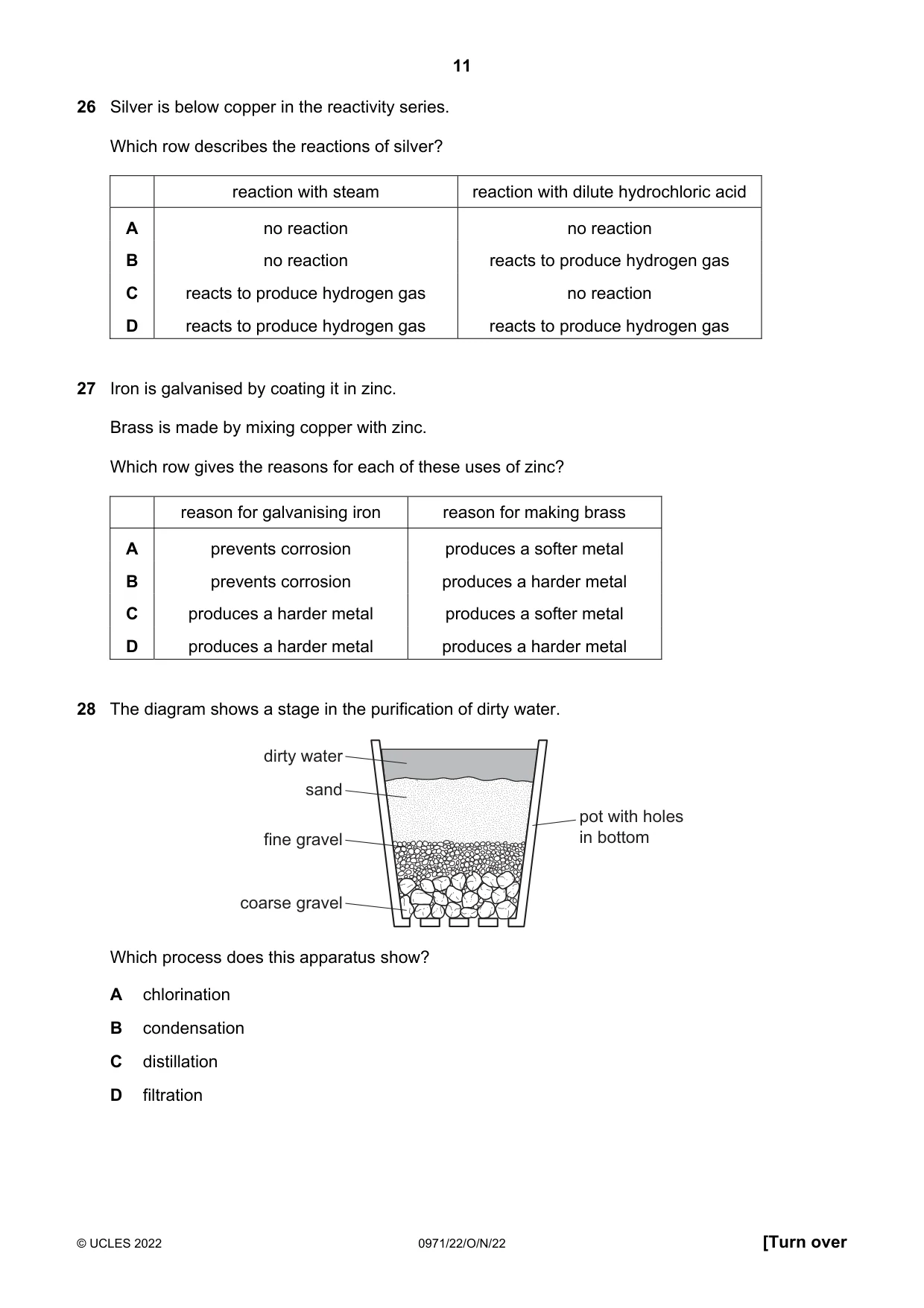
26 Silver is below copper in the reactivity series. Which row describes the reactions of silver? reaction with steam reaction with dilute hydrochloric acid A no reaction no reaction B no reaction reacts to produce hydrogen gas C reacts to produce hydrogen gas no reaction D reacts to produce hydrogen gas reacts to produce hydrogen gas
Mark scheme: A
Q27 · Iron is galvanised by coating it in zinc
27 Iron is galvanised by coating it in zinc. Brass is made by mixing copper with zinc. Which row gives the reasons for each of these uses of zinc? reason for galvanising iron reason for making brass A prevents corrosion produces a softer metal B prevents corrosion produces a harder metal C produces a harder metal produces a softer metal D produces a harder metal produces a harder metal
Mark scheme: B
Q28 · The diagram shows a stage in the purification of dirty water
28 The diagram shows a stage in the purification of dirty water. dirty water sand pot with holes fine gravel in bottom coarse gravel Which process does this apparatus show? A chlorination B condensation C distillation D filtration
Mark scheme: D
Q29 · Which substance in polluted air damages stonework and kills trees?
29 Which substance in polluted air damages stonework and kills trees? A carbon dioxide B carbon monoxide C lead compounds D sulfur dioxide
Mark scheme: D
Q30 · Ammonium nitrate, NH4NO3, is a fertiliser and is added to fields to help crops grow
30 Ammonium nitrate, NH4NO3, is a fertiliser and is added to fields to help crops grow. Slaked lime, Ca(OH)2, is an alkali and is added to fields to reduce the acidity of the soil. Ammonium nitrate and slaked lime should not be added to a field at the same time because they react with each other to form a gas, Z. What is Z? A ammonia B hydrogen C nitrogen D oxygen
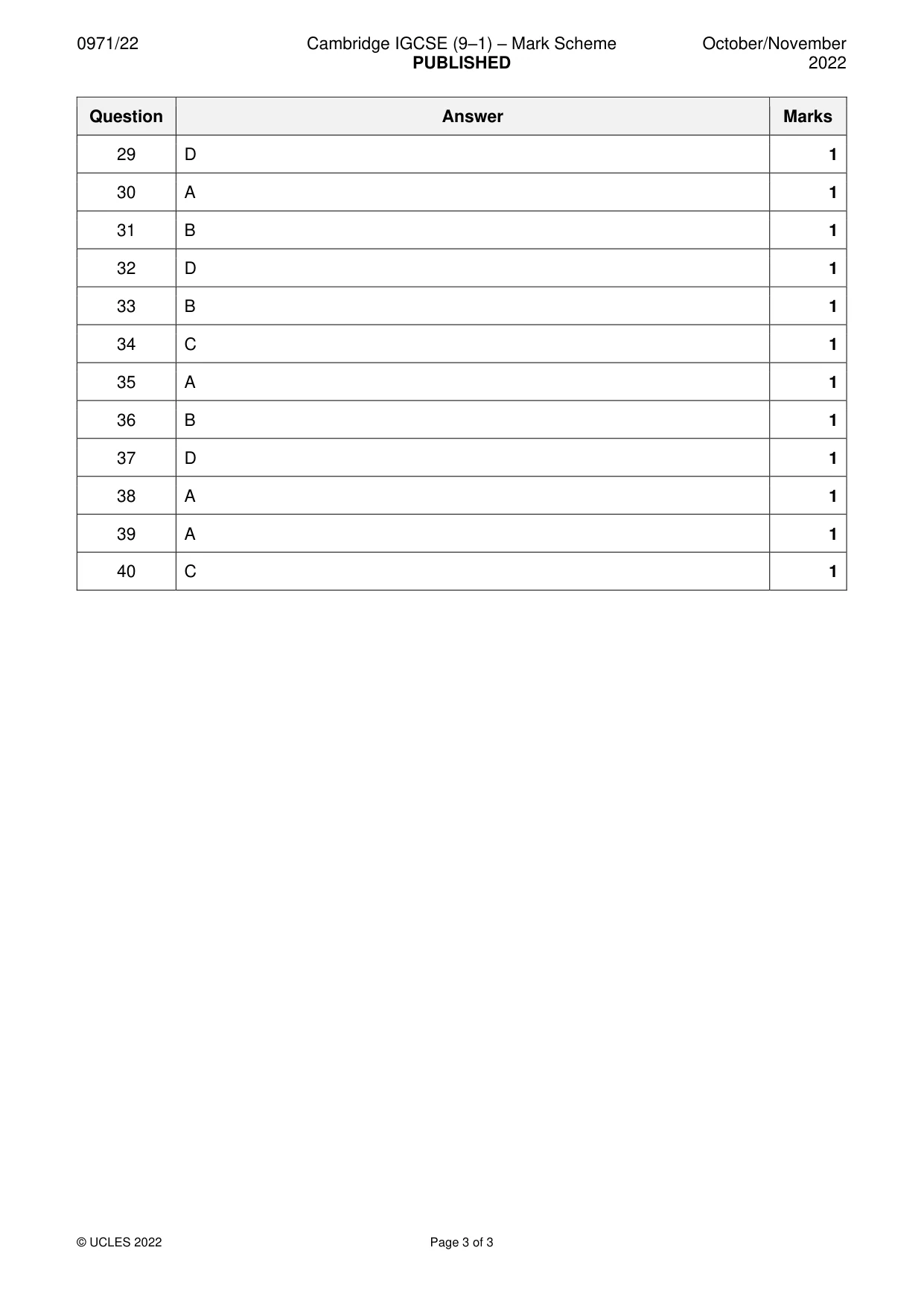
Mark scheme: A
Q31 · The scheme shows four stages in the conversion of sulfur to sulfuric acid
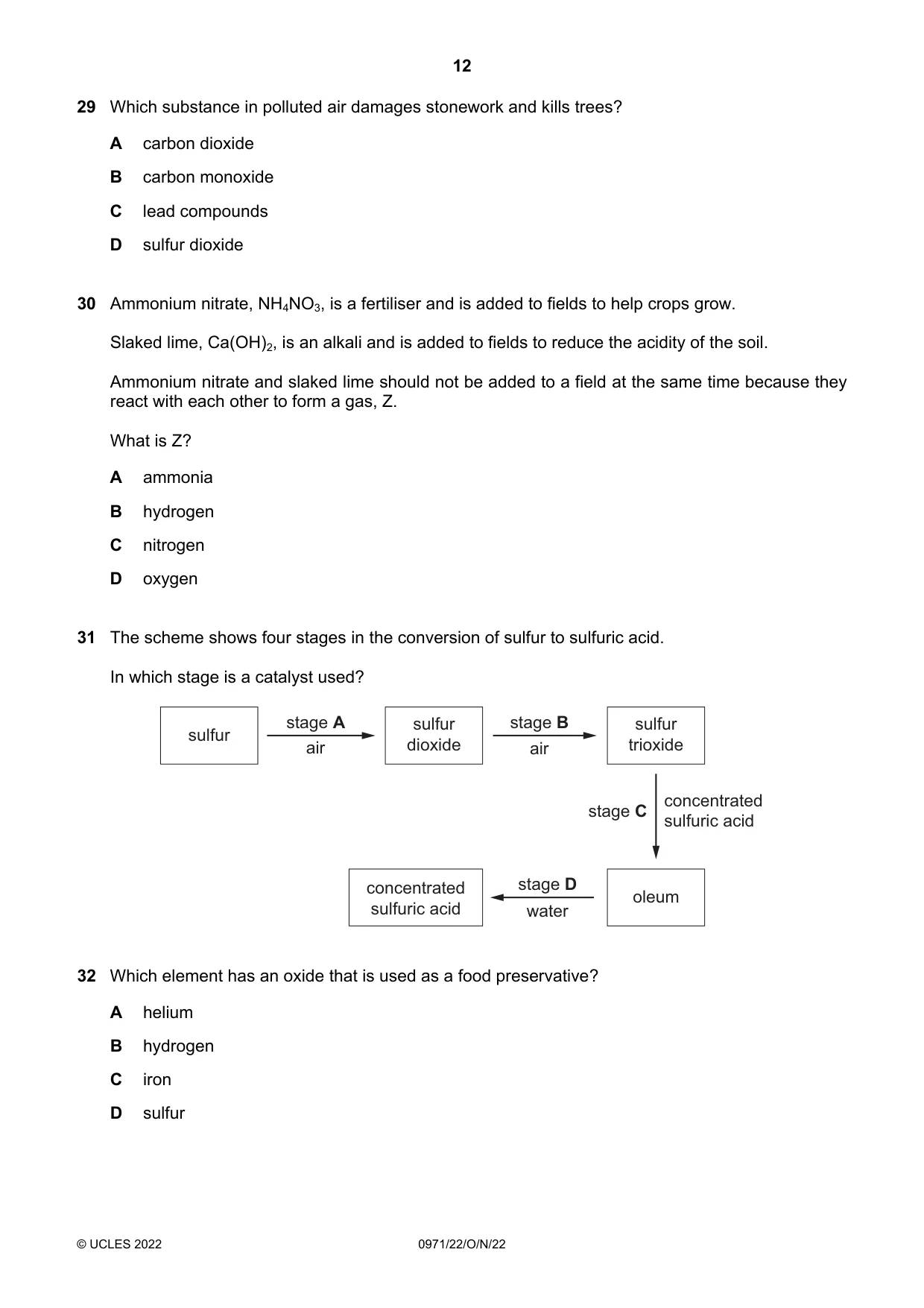
31 The scheme shows four stages in the conversion of sulfur to sulfuric acid. In which stage is a catalyst used? stage A sulfur stage B sulfur sulfur air dioxide air trioxide stage C concentrated sulfuric acid stage D concentrated oleum sulfuric acid water
Mark scheme: B
Q32 · Which element has an oxide that is used as a food preservative?
32 Which element has an oxide that is used as a food preservative? A helium B hydrogen C iron D sulfur
Mark scheme: D
Q33 · Which substance gives off carbon dioxide on heating?
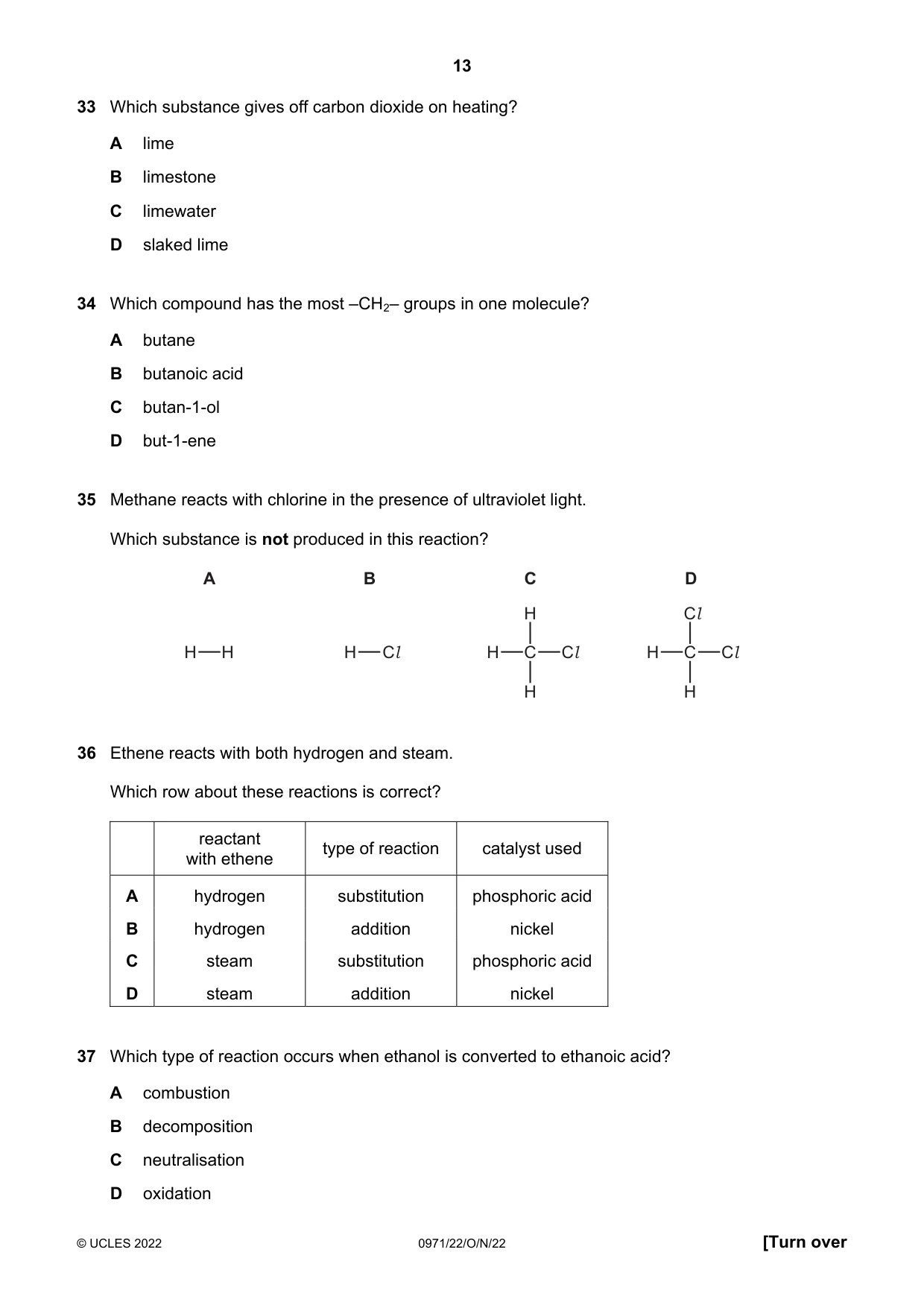
33 Which substance gives off carbon dioxide on heating? A lime B limestone C limewater D slaked lime
Mark scheme: B
Q34 · Which compound has the most –CH2– groups in one molecule?
34 Which compound has the most –CH2– groups in one molecule? A butane B butanoic acid C butan-1-ol D but-1-ene
Mark scheme: C
More questions on Formulae, functional groups and terminology
Q35 · Methane reacts with chlorine in the presence of ultraviolet light
35 Methane reacts with chlorine in the presence of ultraviolet light. Which substance is not produced in this reaction? A B C D H Cl H H H Cl H C Cl H C Cl H H
Mark scheme: A
Q36 · Ethene reacts with both hydrogen and steam
36 Ethene reacts with both hydrogen and steam. Which row about these reactions is correct? reactant type of reaction catalyst used with ethene A hydrogen substitution phosphoric acid B hydrogen addition nickel C steam substitution phosphoric acid D steam addition nickel
Mark scheme: B
Q37 · Which type of reaction occurs when ethanol is converted to ethanoic acid?
37 Which type of reaction occurs when ethanol is converted to ethanoic acid? A combustion B decomposition C neutralisation D oxidation
Mark scheme: D
Q38 · Hydrolysis of polymer P produces the three compounds shown
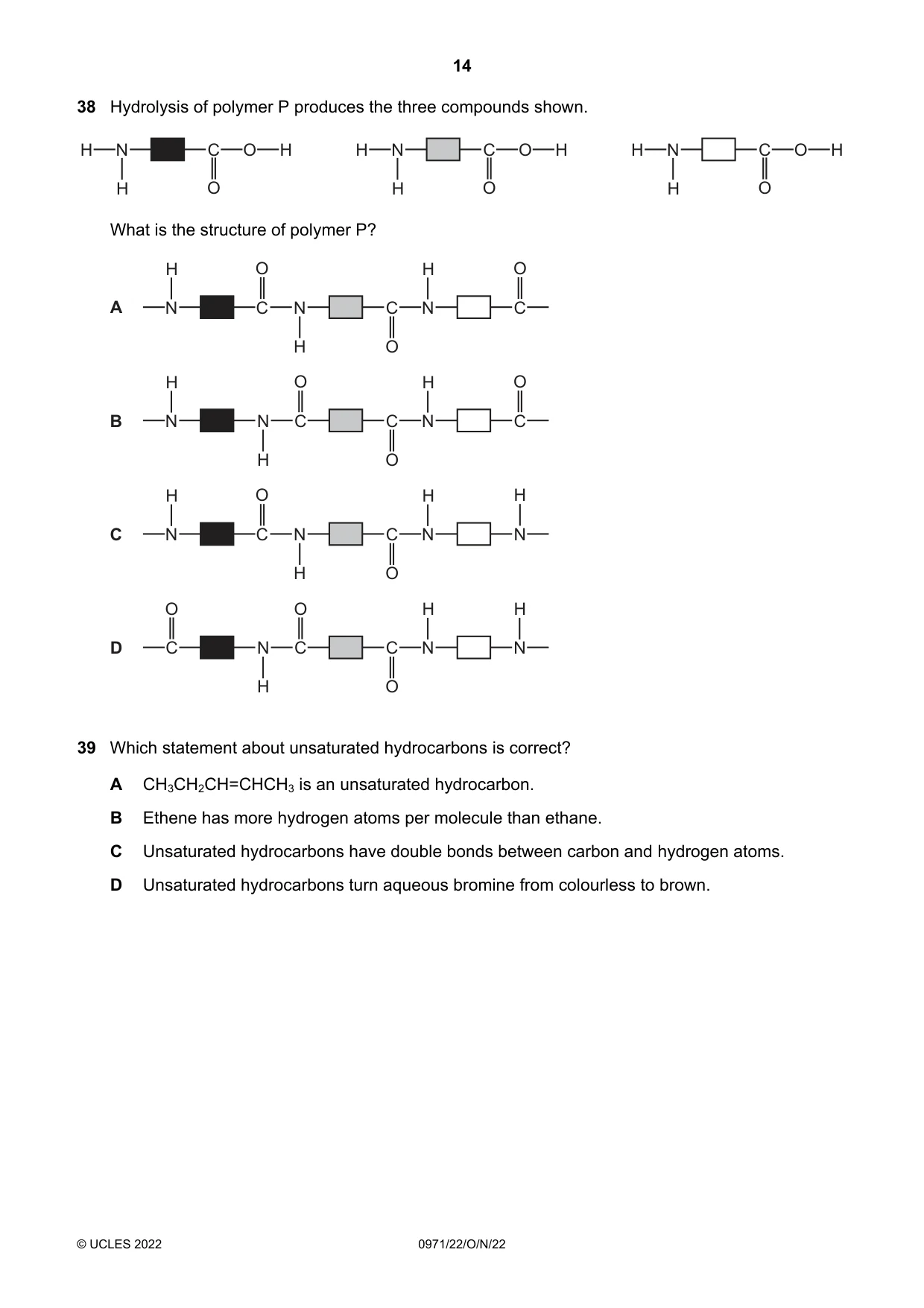
38 Hydrolysis of polymer P produces the three compounds shown. H N C O H H N C O H H N C O H H O H O H O What is the structure of polymer P? H O H O A N C N C N C H O H O H O B N N C C N C H O H O H H C N C N C N N H O O O H H D C N C C N N H O
Mark scheme: A
Q39 · Which statement about unsaturated hydrocarbons is correct?
39 Which statement about unsaturated hydrocarbons is correct? A CH3CH2CH=CHCH3 is an unsaturated hydrocarbon. B Ethene has more hydrogen atoms per molecule than ethane. C Unsaturated hydrocarbons have double bonds between carbon and hydrogen atoms. D Unsaturated hydrocarbons turn aqueous bromine from colourless to brown.
Mark scheme: A
Q40 · The equation shows the formation of a polymer called Kevlar
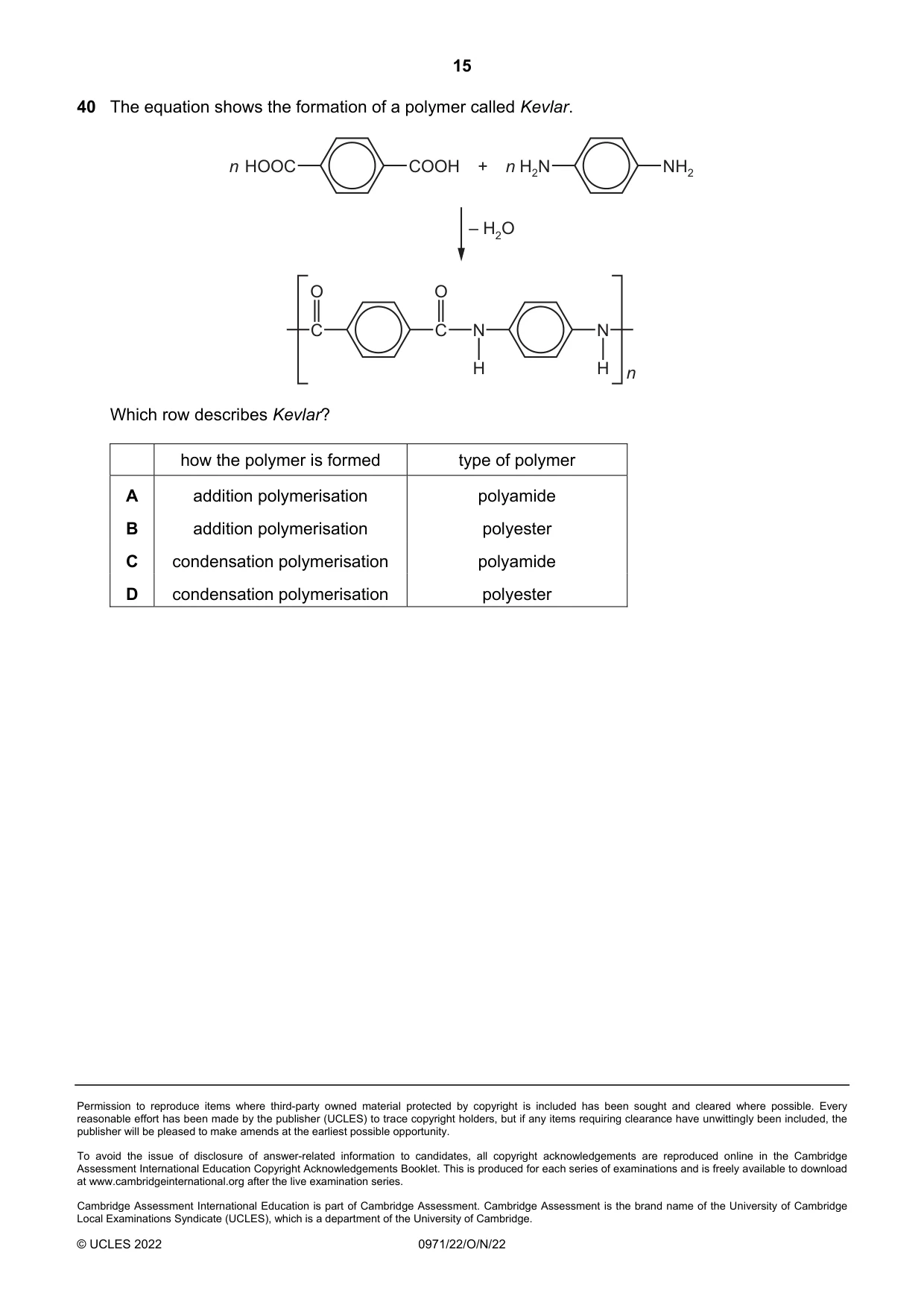
40 The equation shows the formation of a polymer called Kevlar. n HOOC COOH + n H2N NH2 – H2O O O C C N N H H n Which row describes Kevlar? how the polymer is formed type of polymer A addition polymerisation polyamide B addition polymerisation polyester C condensation polymerisation polyamide D condensation polymerisation polyester
Mark scheme: C
What was in this paper
The subtopics covered by these 40 questions, and how many questions each got. Open one in a new tab to see every Cambridge question on it.
3Reactivity series3Alkenes2Arrangement of elements2Electrolysis2Formulae, functional groups and terminology2Polymers2Rate of reaction2Air quality and climate1Alcohols1Alkanes1Alloys and their properties1Chromatography1Corrosion of metals1Diffusion1Exothermic and endothermic reactions1Fertilisers1Fuels1Ions and ionic bonds1Isotopes1Metallic bonding1Preparation of salts1Redox1Reversible reactions and equilibrium1Separation and purification1Simple molecules and covalent bonds1Solids, liquids and gases1The characteristic properties of acids and bases1The mole and the Avogadro constant1Transition elements1What you needed in this session
Cambridge’s own grade thresholds for 2022 Oct/Nov, Paper 2 · Variant 2. A higher threshold means an easier paper — the bar moves with how the cohort did.