Cambridge IGCSE Chemistry (9-1) 0971 — 2024 May/June Paper 2 · Variant 1
0971/21/M/J/24 · 40 questions · 40 marks · 45 min
The question paper and its mark scheme, free to read here and free to download. This is Cambridge’s own paper, exactly as it was sat.
Question paper16 pages

Mark scheme3 pages
Answers below. Sit the paper first if you are practising.
Questions as text
Q1 · A gas is heated
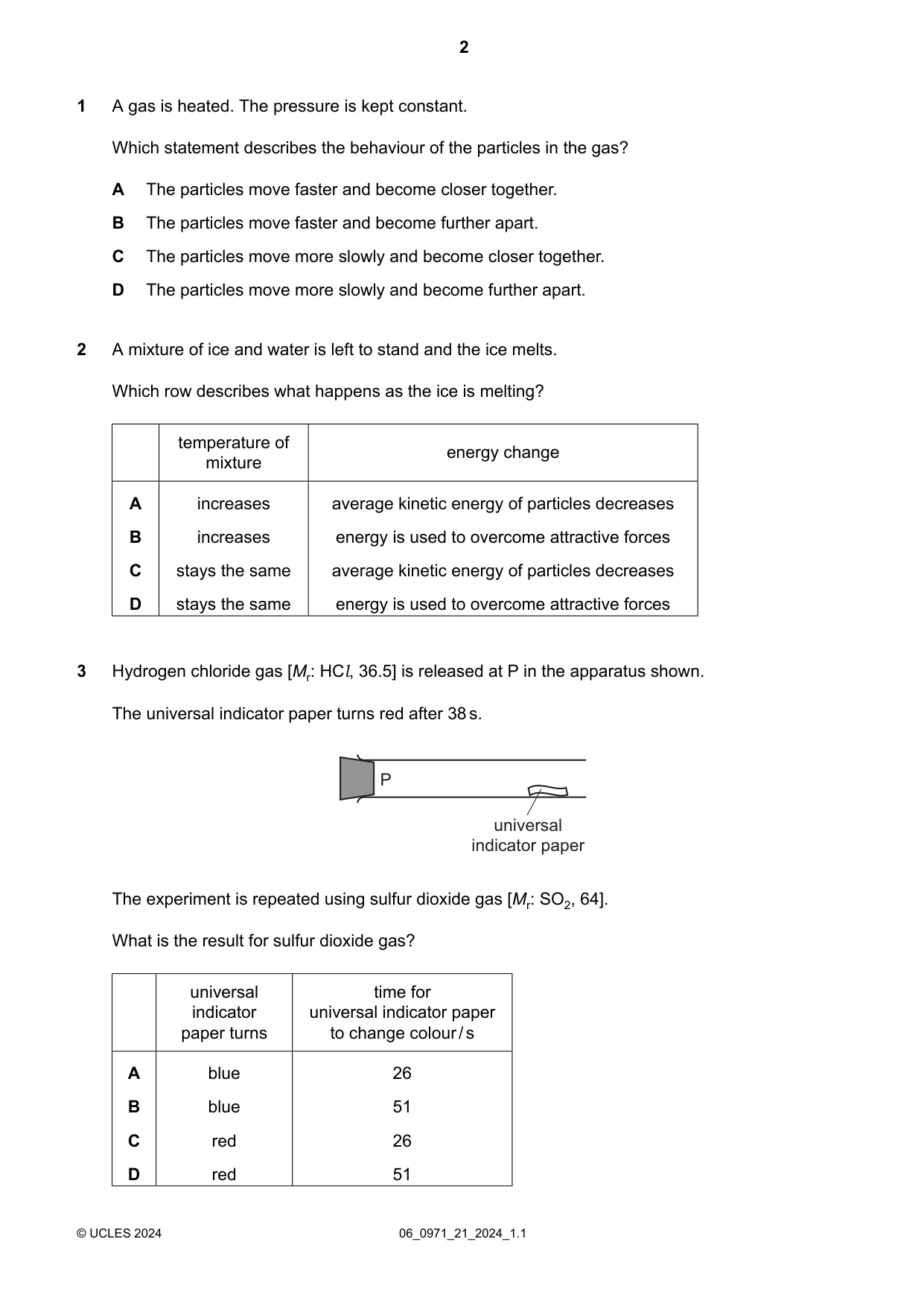
1 A gas is heated. The pressure is kept constant. Which statement describes the behaviour of the particles in the gas? A The particles move faster and become closer together. B The particles move faster and become further apart. C The particles move more slowly and become closer together. D The particles move more slowly and become further apart.
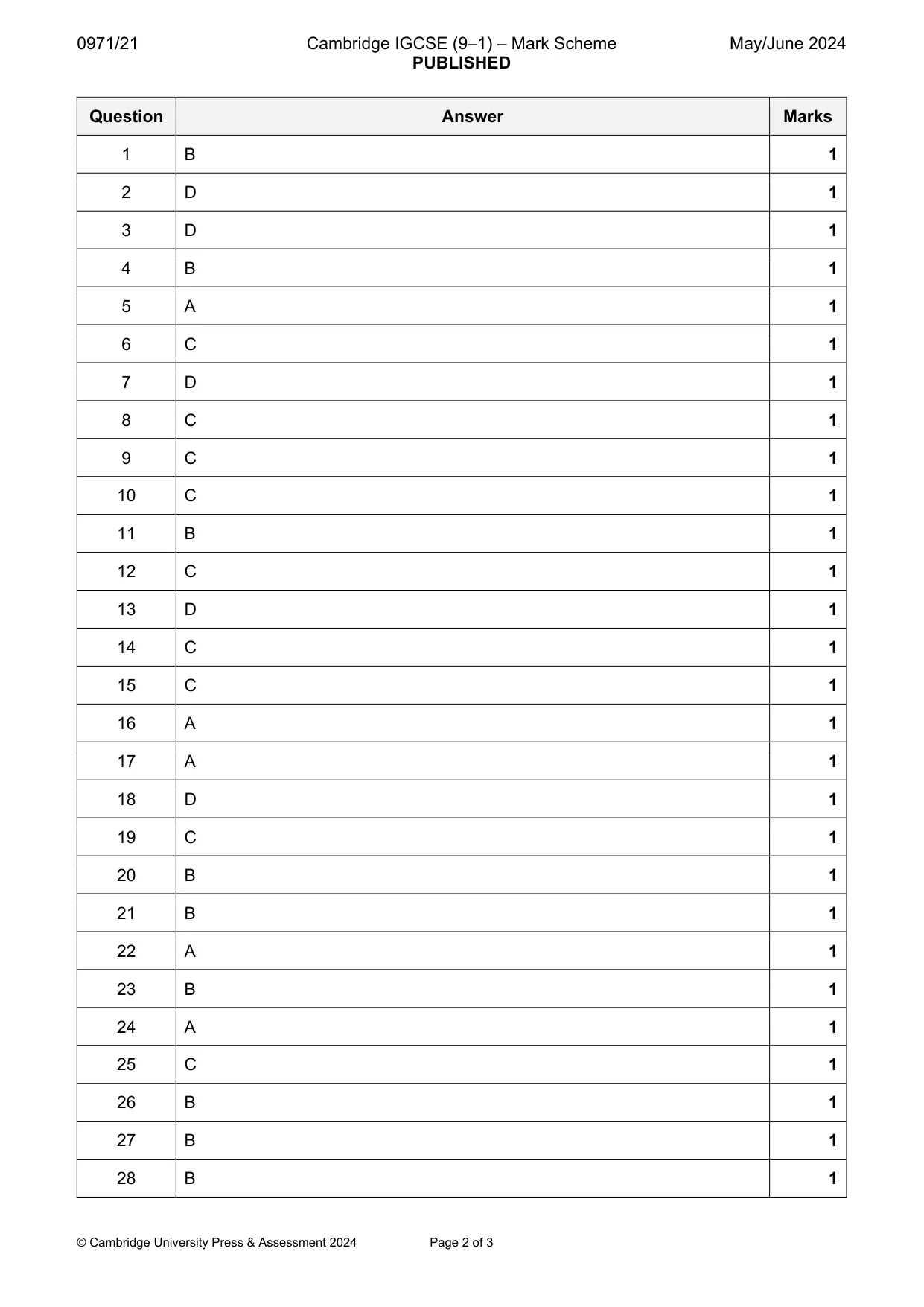
Mark scheme: B
Q2 · A mixture of ice and water is left to stand and the ice melts
2 A mixture of ice and water is left to stand and the ice melts. Which row describes what happens as the ice is melting? temperature of energy change mixture A increases average kinetic energy of particles decreases B increases energy is used to overcome attractive forces C stays the same average kinetic energy of particles decreases D stays the same energy is used to overcome attractive forces
Mark scheme: D
Q3 · Hydrogen chloride gas [Mr: HCl, 36.5] is released at P in the apparatus shown
3 Hydrogen chloride gas [Mr: HCl, 36.5] is released at P in the apparatus shown. The universal indicator paper turns red after 38s. P universal indicator paper The experiment is repeated using sulfur dioxide gas [Mr: SO2, 64]. What is the result for sulfur dioxide gas? universal time for indicator universal indicator paper paper turns to change colour/s A blue 26 B blue 51 C red 26 D red 51
Mark scheme: D
Q4 · Four statements about atoms are listed
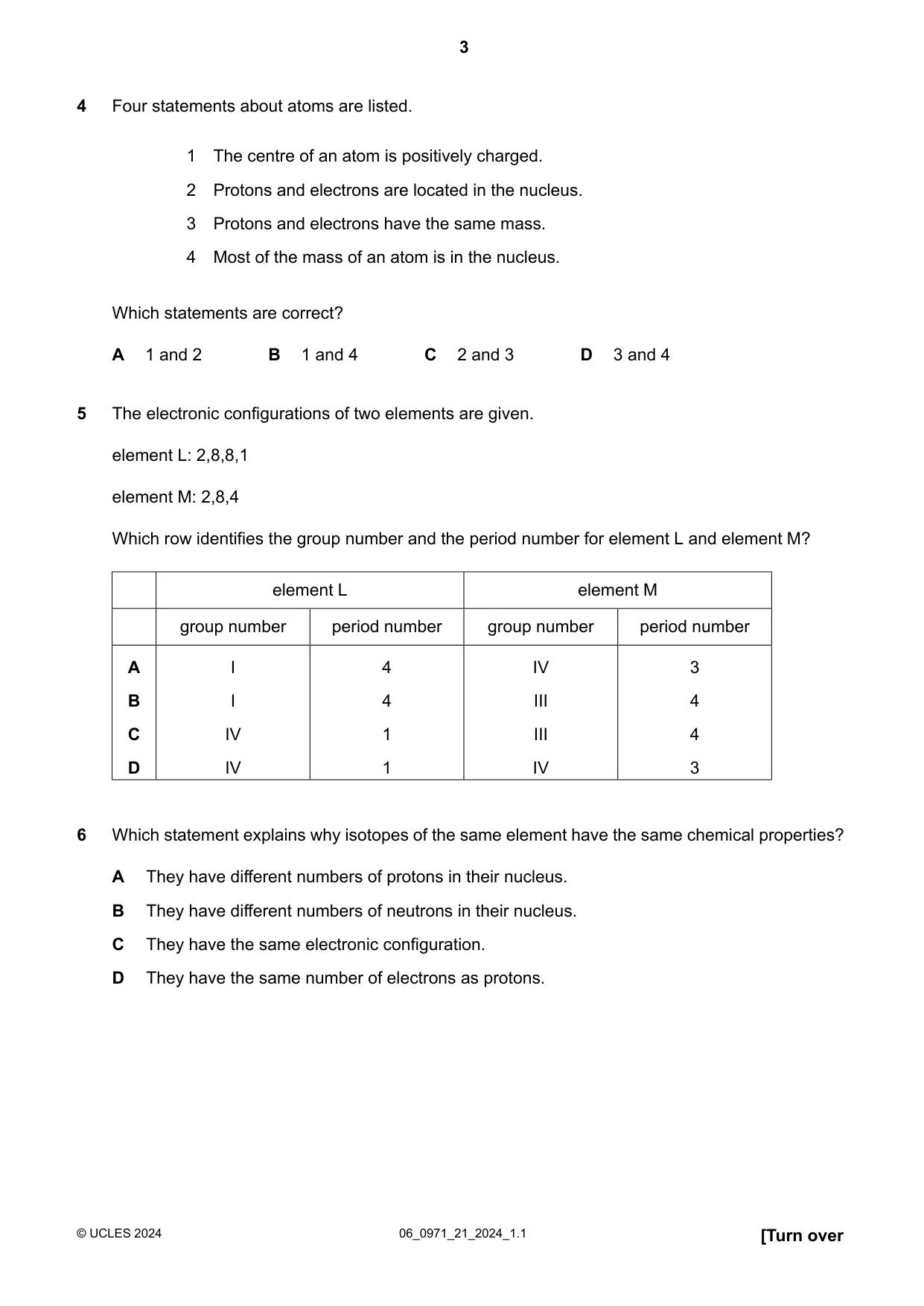
4 Four statements about atoms are listed. 1 The centre of an atom is positively charged. 2 Protons and electrons are located in the nucleus. 3 Protons and electrons have the same mass. 4 Most of the mass of an atom is in the nucleus. Which statements are correct? A 1 and 2 B 1 and 4 C 2 and 3 D 3 and 4
Mark scheme: B
Q5 · The electronic configurations of two elements are given
5 The electronic configurations of two elements are given. element L: 2,8,8,1 element M: 2,8,4 Which row identifies the group number and the period number for element L and element M? element L element M group number period number group number period number A I 4 IV 3 B I 4 III 4 C IV 1 III 4 D IV 1 IV 3
Mark scheme: A
Q6 · Which statement explains why isotopes of the same element have the same chemical…
6 Which statement explains why isotopes of the same element have the same chemical properties? A They have different numbers of protons in their nucleus. B They have different numbers of neutrons in their nucleus. C They have the same electronic configuration. D They have the same number of electrons as protons.
Mark scheme: C
Q7 · Which statements about potassium chloride are correct?
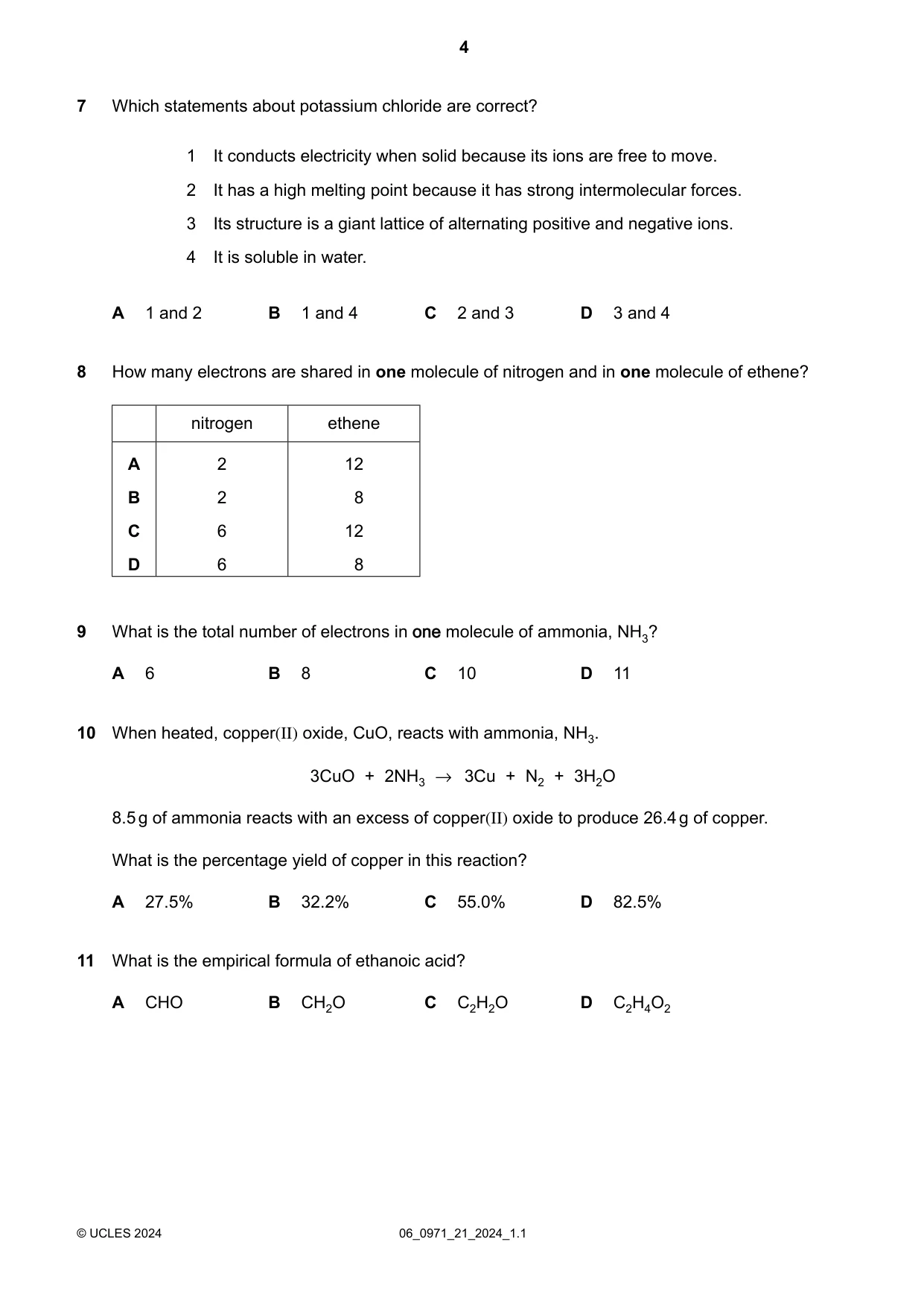
7 Which statements about potassium chloride are correct? 1 It conducts electricity when solid because its ions are free to move. 2 It has a high melting point because it has strong intermolecular forces. 3 Its structure is a giant lattice of alternating positive and negative ions. 4 It is soluble in water. A 1 and 2 B 1 and 4 C 2 and 3 D 3 and 4
Mark scheme: D
Q8 · How many electrons are shared in one molecule of nitrogen and in one molecule of ethene?
8 How many electrons are shared in one molecule of nitrogen and in one molecule of ethene? nitrogen ethene A 2 12 B 2 8 C 6 12 D 6 8
Mark scheme: C
Q9 · What is the total number of electrons in one molecule of ammonia, NH3?
9 What is the total number of electrons in one molecule of ammonia, NH3? A 6 B 8 C 10 D 11
Mark scheme: C
Q10 · When heated, copper(II) oxide, CuO, reacts with ammonia, NH3
10 When heated, copper(II) oxide, CuO, reacts with ammonia, NH3. 3CuO + 2NH3 →3Cu + N2 + 3H2O 8.5g of ammonia reacts with an excess of copper(II) oxide to produce 26.4g of copper. What is the percentage yield of copper in this reaction? A 27.5% B 32.2% C 55.0% D 82.5%
Mark scheme: C
Q11 · What is the empirical formula of ethanoic acid?
11 What is the empirical formula of ethanoic acid? A CHO B CH2O C C2H2O D C2H4O2
Mark scheme: B
Q12 · Magnesium chloride, MgCl 2, contains magnesium ions and chloride ions
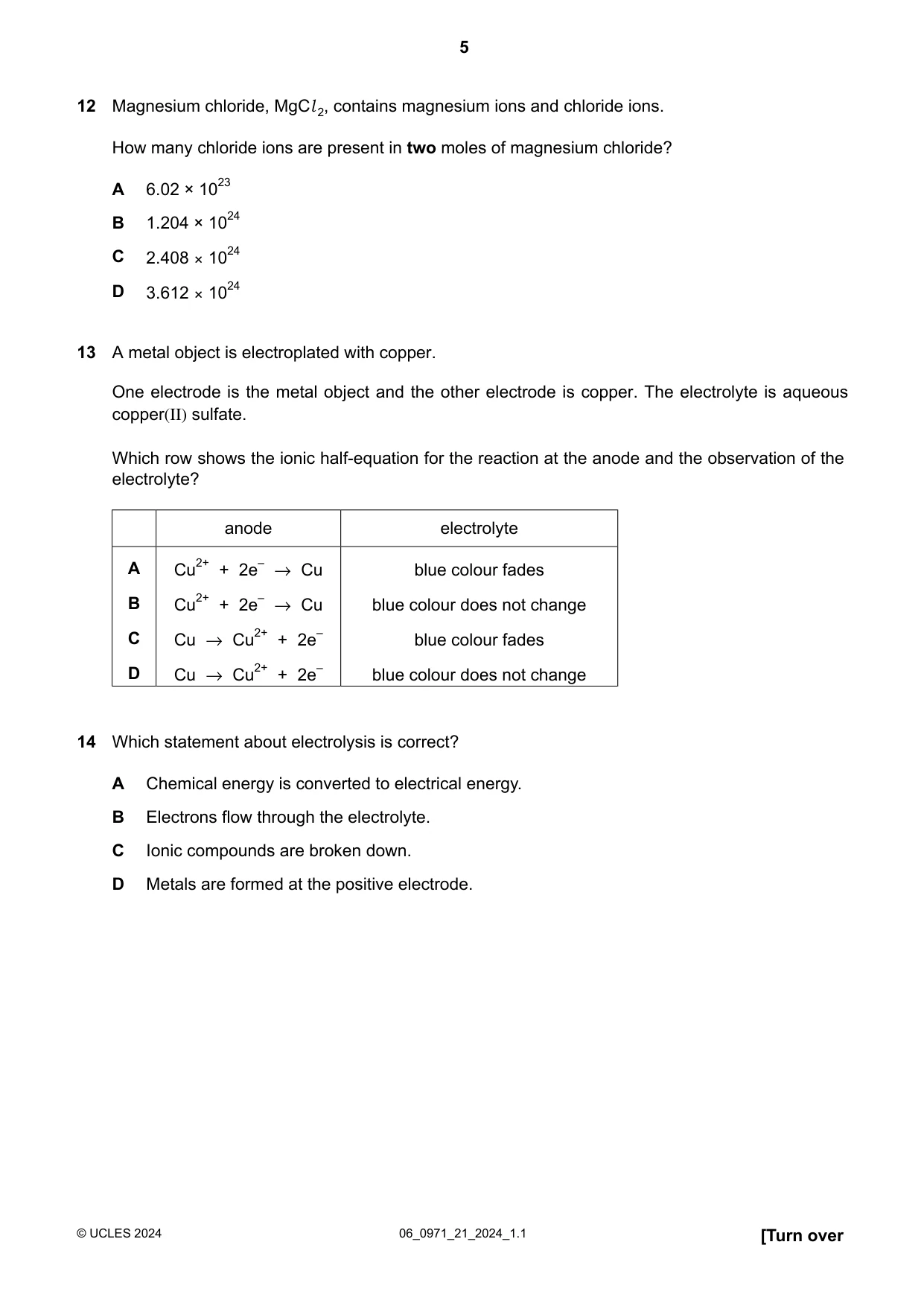
12 Magnesium chloride, MgCl 2, contains magnesium ions and chloride ions. How many chloride ions are present in two moles of magnesium chloride? A 6.02 × 10²³ B 1.204 × 1024 C 2.408 × 1024 D 3.612 × 1024
Mark scheme: C
Q13 · A metal object is electroplated with copper
13 A metal object is electroplated with copper. One electrode is the metal object and the other electrode is copper. The electrolyte is aqueous copper(II) sulfate. Which row shows the ionic half-equation for the reaction at the anode and the observation of the electrolyte? anode electrolyte Cu2+ + 2e– →Cu A blue colour fades Cu2+ + 2e– →Cu B blue colour does not change C Cu →Cu2+ + 2e– blue colour fades D Cu →Cu2+ + 2e– blue colour does not change
Mark scheme: D
Q14 · Which statement about electrolysis is correct?
14 Which statement about electrolysis is correct? A Chemical energy is converted to electrical energy. B Electrons flow through the electrolyte. C Ionic compounds are broken down. D Metals are formed at the positive electrode.
Mark scheme: C
Q15 · The reaction between hydrogen and oxygen releases 486kJ/mol of energy
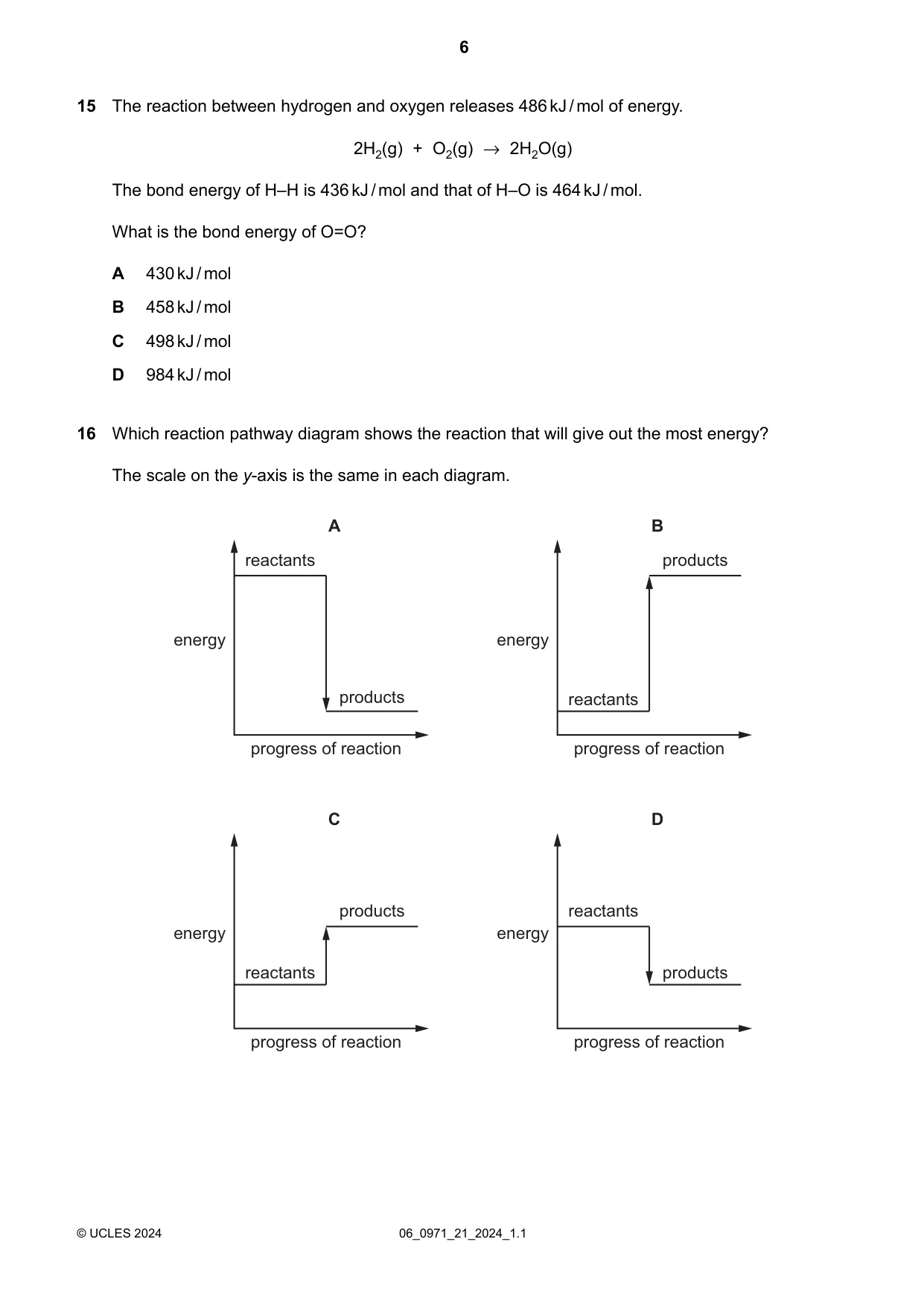
15 The reaction between hydrogen and oxygen releases 486kJ/mol of energy. 2H2(g) + O2(g) →2H2O(g) The bond energy of H–H is 436kJ/mol and that of H–O is 464kJ/mol. What is the bond energy of O=O? A 430kJ/mol B 458kJ/mol C 498kJ/mol D 984kJ/mol
Mark scheme: C
Q16 · Which reaction pathway diagram shows the reaction that will give out the most energy?
16 Which reaction pathway diagram shows the reaction that will give out the most energy? The scale on the y-axis is the same in each diagram. A B reactants products energy energy products reactants progress of reaction progress of reaction C D products reactants energy energy reactants products progress of reaction progress of reaction
Mark scheme: A
Q17 · When calcium carbonate is heated strongly, a gas is given off
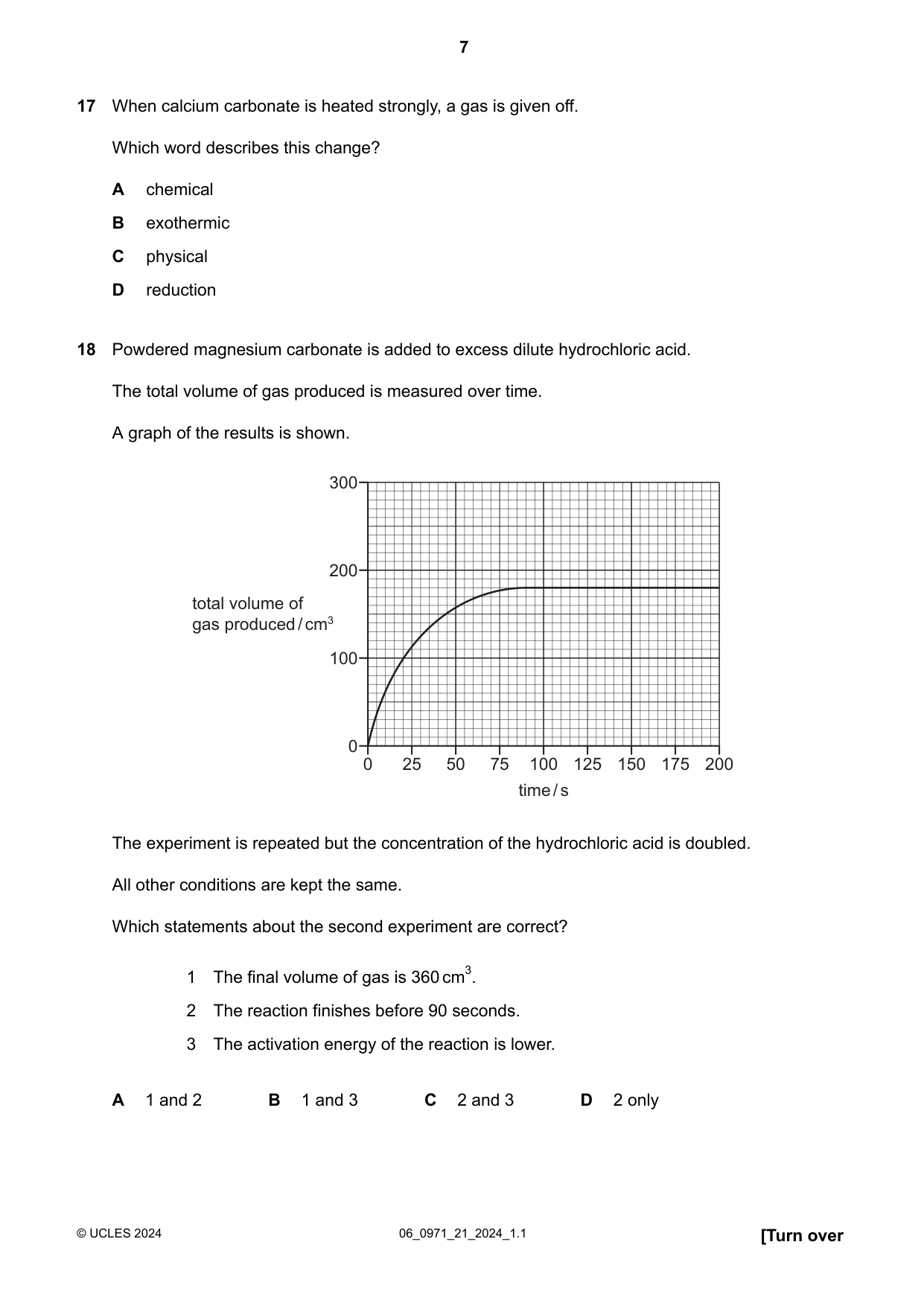
17 When calcium carbonate is heated strongly, a gas is given off. Which word describes this change? A chemical B exothermic C physical D reduction
Mark scheme: A
Q18 · Powdered magnesium carbonate is added to excess dilute hydrochloric acid
18 Powdered magnesium carbonate is added to excess dilute hydrochloric acid. The total volume of gas produced is measured over time. A graph of the results is shown. 300 200 total volume of gas produced / cm3 100 0 0 25 50 75 100 125 150 175 200 time / s The experiment is repeated but the concentration of the hydrochloric acid is doubled. All other conditions are kept the same. Which statements about the second experiment are correct? 1 The final volume of gas is 360cm3. 2 The reaction finishes before 90 seconds. 3 The activation energy of the reaction is lower. A 1 and 2 B 1 and 3 C 2 and 3 D 2 only
Mark scheme: D
Q19 · Which statements explain why increasing the temperature changes the rate of a chemical…
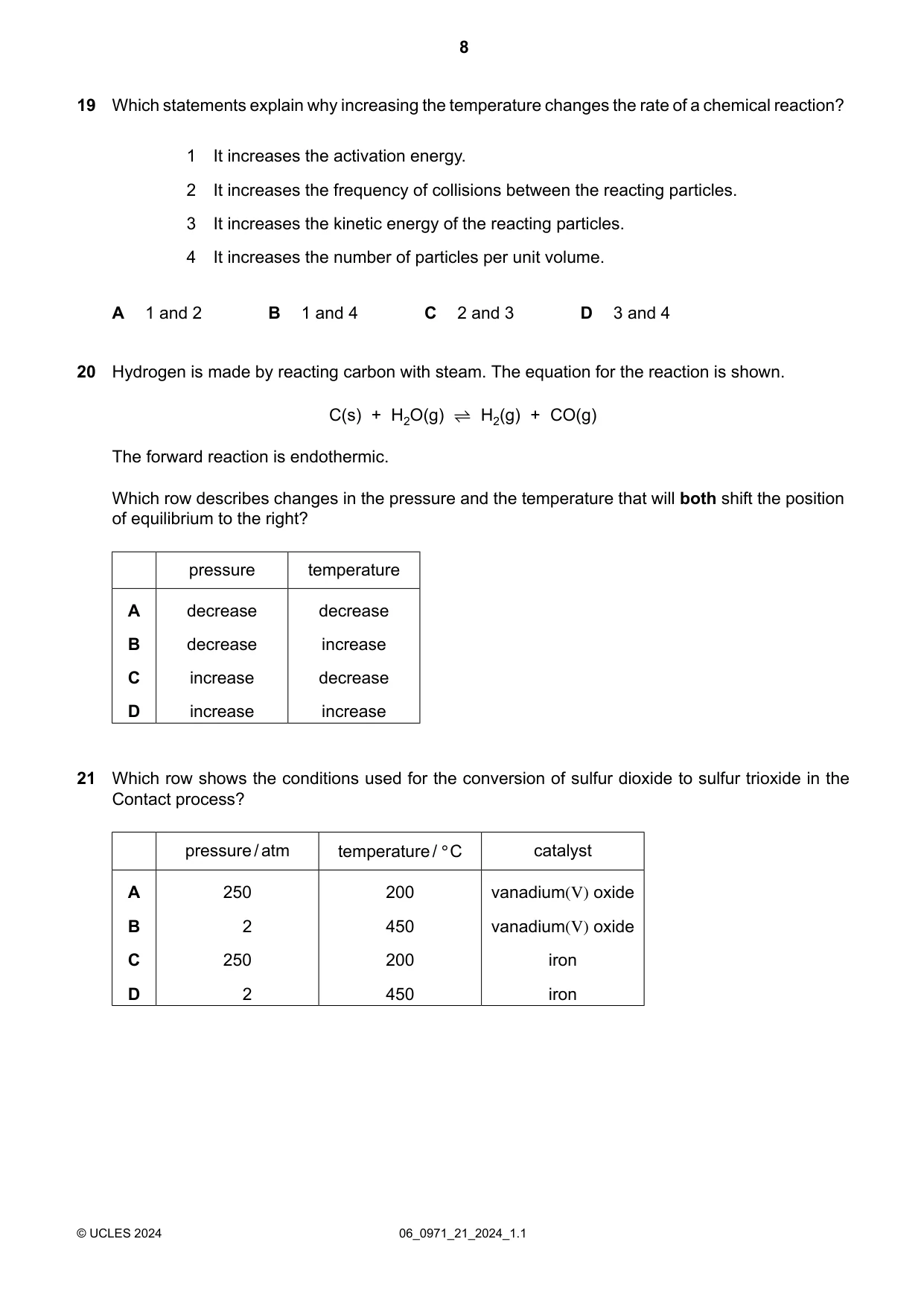
19 Which statements explain why increasing the temperature changes the rate of a chemical reaction? 1 It increases the activation energy. 2 It increases the frequency of collisions between the reacting particles. 3 It increases the kinetic energy of the reacting particles. 4 It increases the number of particles per unit volume. A 1 and 2 B 1 and 4 C 2 and 3 D 3 and 4
Mark scheme: C
Q20 · Hydrogen is made by reacting carbon with steam
20 Hydrogen is made by reacting carbon with steam. The equation for the reaction is shown. C(s) + H2O(g) ⇌H2(g) + CO(g) The forward reaction is endothermic. Which row describes changes in the pressure and the temperature that will both shift the position of equilibrium to the right? pressure temperature A decrease decrease B decrease increase C increase decrease D increase increase
Mark scheme: B
Q21 · Which row shows the conditions used for the conversion of sulfur dioxide to sulfur…
21 Which row shows the conditions used for the conversion of sulfur dioxide to sulfur trioxide in the Contact process? pressure/atm temperature/°C catalyst A 250 200 vanadium(V) oxide B 2 450 vanadium(V) oxide C 250 200 iron D 2 450 iron
Mark scheme: B
Q22 · The equation for the reaction of magnesium with carbon dioxide is shown
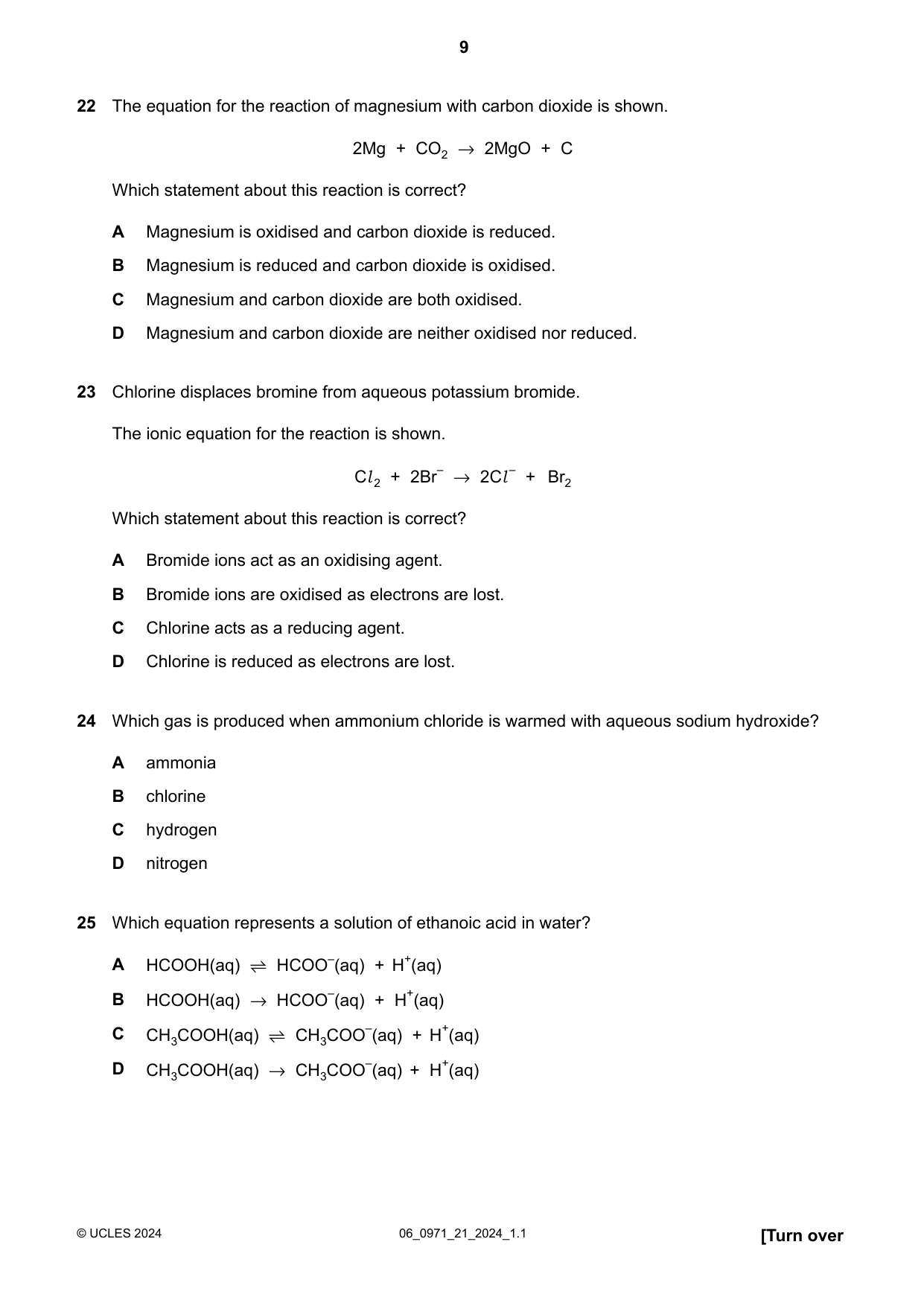
22 The equation for the reaction of magnesium with carbon dioxide is shown. 2Mg + CO2 →2MgO + C Which statement about this reaction is correct? A Magnesium is oxidised and carbon dioxide is reduced. B Magnesium is reduced and carbon dioxide is oxidised. C Magnesium and carbon dioxide are both oxidised. D Magnesium and carbon dioxide are neither oxidised nor reduced.
Mark scheme: A
Q23 · Chlorine displaces bromine from aqueous potassium bromide
23 Chlorine displaces bromine from aqueous potassium bromide. The ionic equation for the reaction is shown. Cl 2 + 2Br– →2Cl – + Br2 Which statement about this reaction is correct? A Bromide ions act as an oxidising agent. B Bromide ions are oxidised as electrons are lost. C Chlorine acts as a reducing agent. D Chlorine is reduced as electrons are lost.
Mark scheme: B
Q24 · Which gas is produced when ammonium chloride is warmed with aqueous sodium hydroxide?
24 Which gas is produced when ammonium chloride is warmed with aqueous sodium hydroxide? A ammonia B chlorine C hydrogen D nitrogen
Mark scheme: A
Q25 · Which equation represents a solution of ethanoic acid in water?
25 Which equation represents a solution of ethanoic acid in water? A HCOOH(aq) ⇌HCOO–(aq) + H+(aq) B HCOOH(aq) →HCOO–(aq) + H+(aq) C CH3COOH(aq) ⇌CH3COO–(aq) + H+(aq) D CH3COOH(aq) →CH3COO–(aq) + H+(aq)
Mark scheme: C
More questions on The characteristic properties of acids and bases
Q26 · Four statements about the reactions of oxides with dilute hydrochloric acid and with…
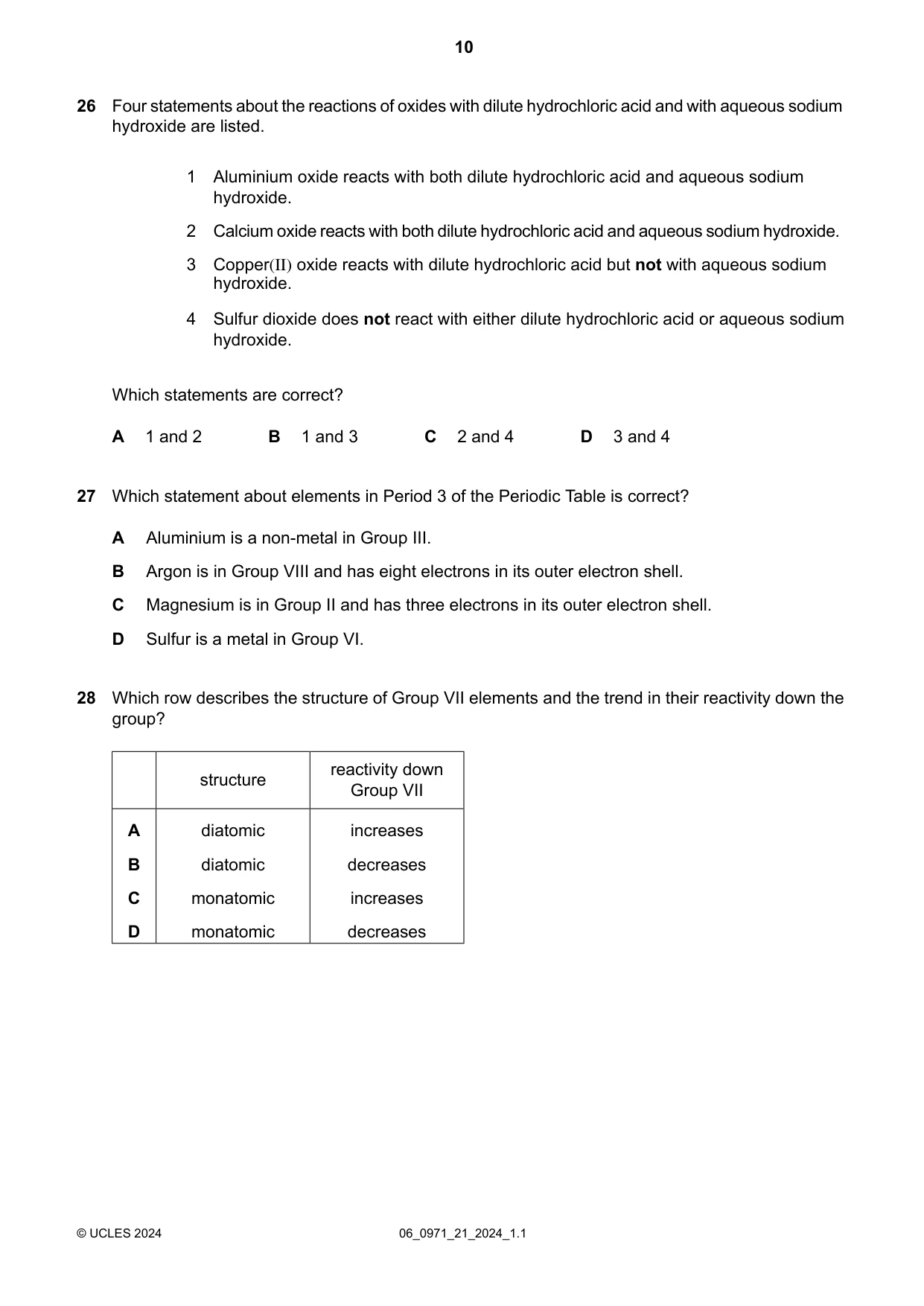
26 Four statements about the reactions of oxides with dilute hydrochloric acid and with aqueous sodium hydroxide are listed. 1 Aluminium oxide reacts with both dilute hydrochloric acid and aqueous sodium hydroxide. 2 Calcium oxide reacts with both dilute hydrochloric acid and aqueous sodium hydroxide. 3 Copper(II) oxide reacts with dilute hydrochloric acid but not with aqueous sodium hydroxide. 4 Sulfur dioxide does not react with either dilute hydrochloric acid or aqueous sodium hydroxide. Which statements are correct? A 1 and 2 B 1 and 3 C 2 and 4 D 3 and 4
Mark scheme: B
Q27 · Which statement about elements in Period 3 of the Periodic Table is correct?
27 Which statement about elements in Period 3 of the Periodic Table is correct? A Aluminium is a non-metal in Group III. B Argon is in Group VIII and has eight electrons in its outer electron shell. C Magnesium is in Group II and has three electrons in its outer electron shell. D Sulfur is a metal in Group VI.
Mark scheme: B
Q28 · Which row describes the structure of Group VII elements and the trend in their reactivity…
28 Which row describes the structure of Group VII elements and the trend in their reactivity down the group? reactivity down structure Group VII A diatomic increases B diatomic decreases C monatomic increases D monatomic decreases
Mark scheme: B
Q29 · Some information about four elements, P, Q, R and S, is shown
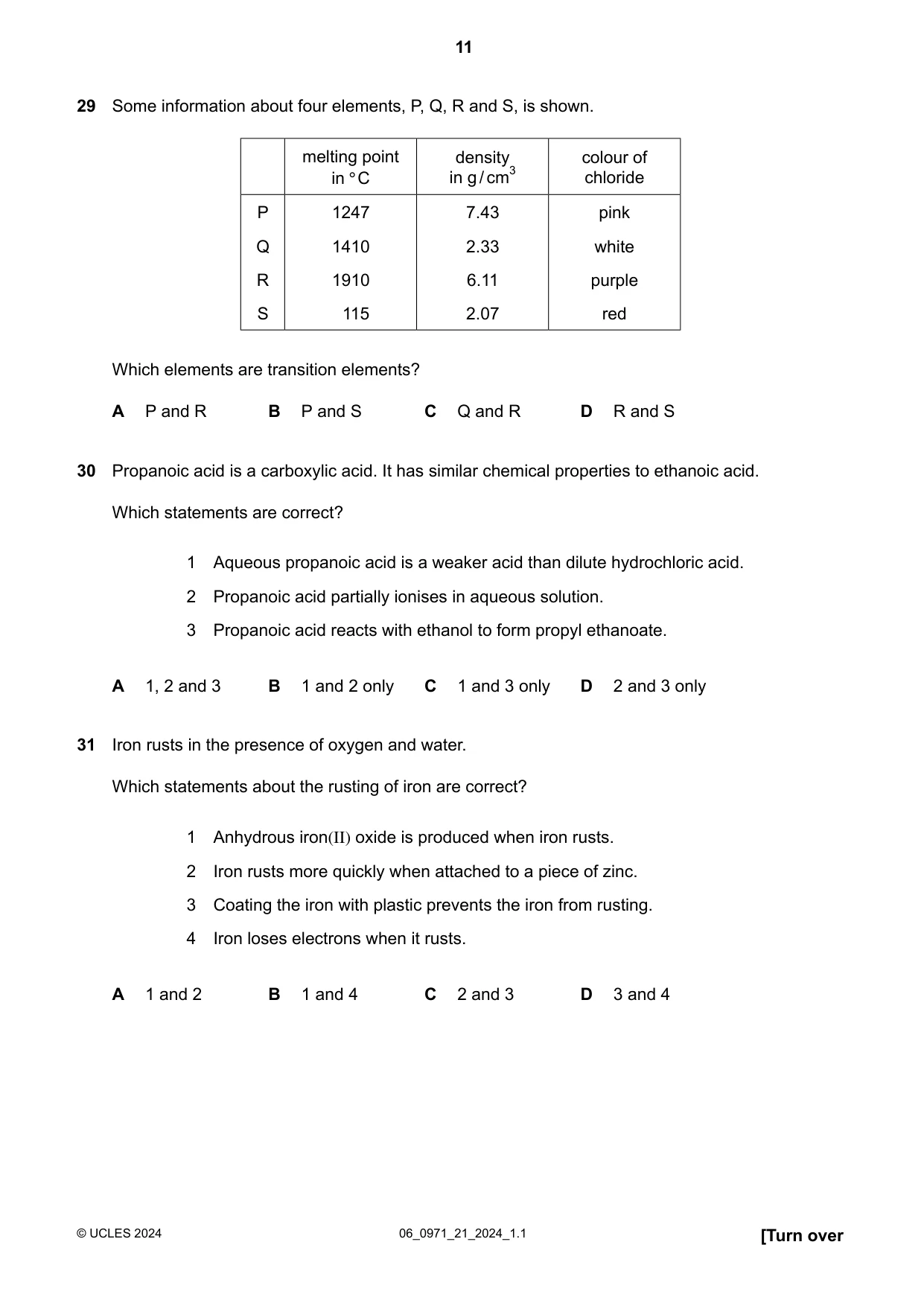
29 Some information about four elements, P, Q, R and S, is shown. melting point density colour of in°C in g/cm3 chloride P 1247 7.43 pink Q 1410 2.33 white R 1910 6.11 purple S 115 2.07 red Which elements are transition elements? A P and R B P and S C Q and R D R and S
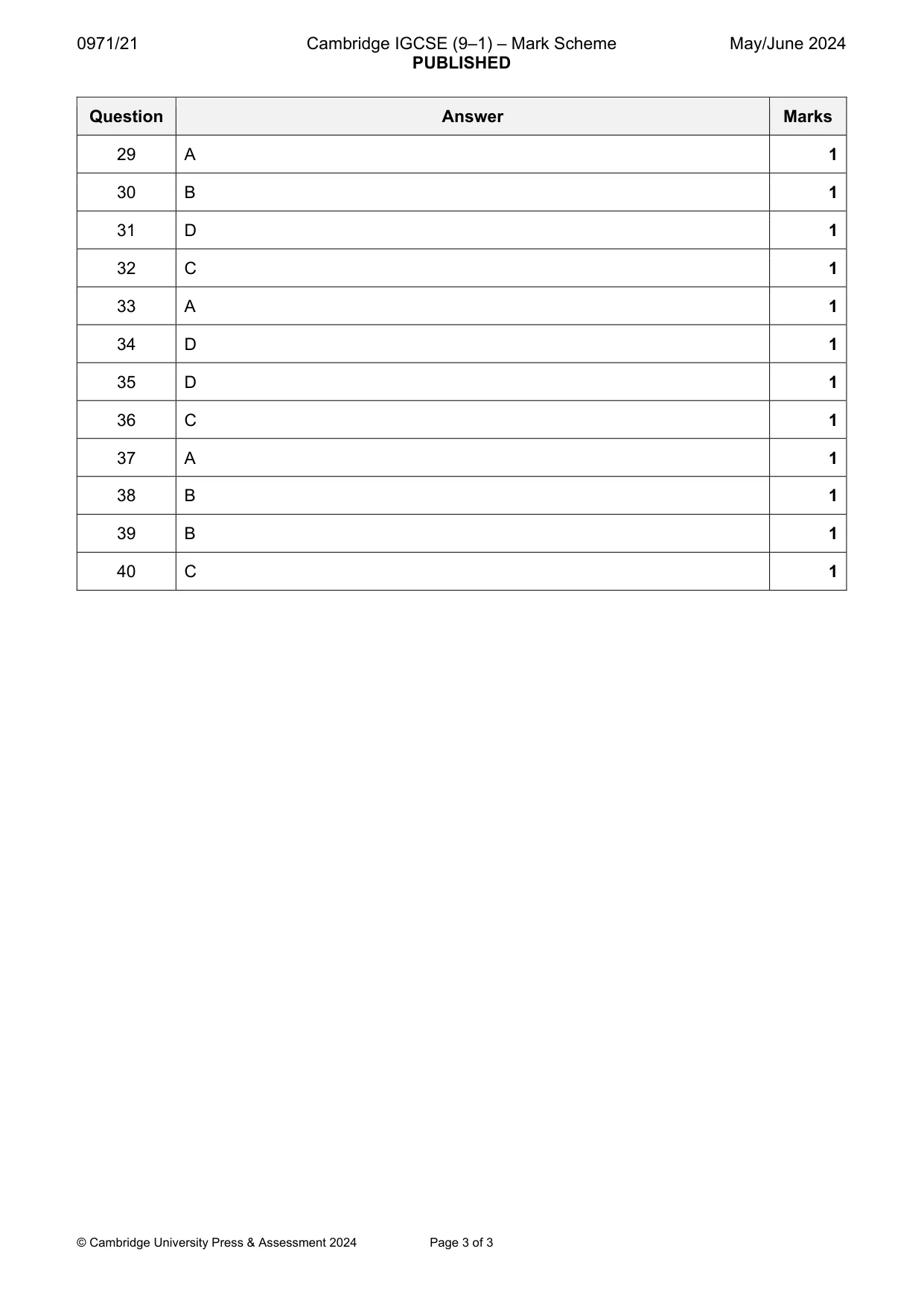
Mark scheme: A
Q30 · Propanoic acid is a carboxylic acid
30 Propanoic acid is a carboxylic acid. It has similar chemical properties to ethanoic acid. Which statements are correct? 1 Aqueous propanoic acid is a weaker acid than dilute hydrochloric acid. 2 Propanoic acid partially ionises in aqueous solution. 3 Propanoic acid reacts with ethanol to form propyl ethanoate. A 1, 2 and 3 B 1 and 2 only C 1 and 3 only D 2 and 3 only
Mark scheme: B
Q31 · Iron rusts in the presence of oxygen and water
31 Iron rusts in the presence of oxygen and water. Which statements about the rusting of iron are correct? 1 Anhydrous iron(II) oxide is produced when iron rusts. 2 Iron rusts more quickly when attached to a piece of zinc. 3 Coating the iron with plastic prevents the iron from rusting. 4 Iron loses electrons when it rusts. A 1 and 2 B 1 and 4 C 2 and 3 D 3 and 4
Mark scheme: D
Q32 · An iron nail is added to aqueous copper(II) sulfate and a different iron nail is added to…
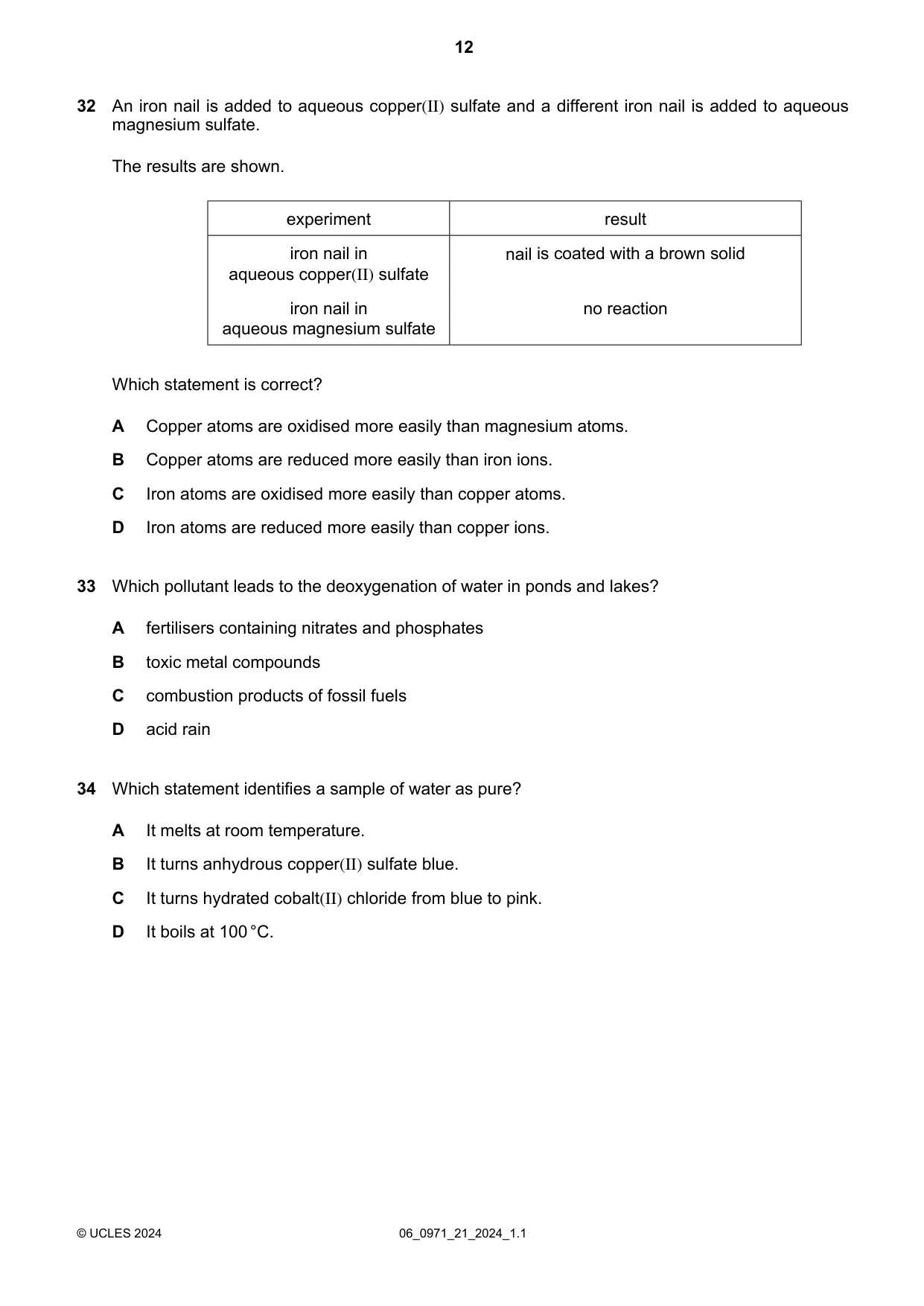
32 An iron nail is added to aqueous copper(II) sulfate and a different iron nail is added to aqueous magnesium sulfate. The results are shown. experiment result iron nail in nail is coated with a brown solid aqueous copper(II) sulfate iron nail in no reaction aqueous magnesium sulfate Which statement is correct? A Copper atoms are oxidised more easily than magnesium atoms. B Copper atoms are reduced more easily than iron ions. C Iron atoms are oxidised more easily than copper atoms. D Iron atoms are reduced more easily than copper ions.
Mark scheme: C
Q33 · Which pollutant leads to the deoxygenation of water in ponds and lakes?
33 Which pollutant leads to the deoxygenation of water in ponds and lakes? A fertilisers containing nitrates and phosphates B toxic metal compounds C combustion products of fossil fuels D acid rain
Mark scheme: A
Q34 · Which statement identifies a sample of water as pure?
34 Which statement identifies a sample of water as pure? A It melts at room temperature. B It turns anhydrous copper(II) sulfate blue. C It turns hydrated cobalt(II) chloride from blue to pink. D It boils at 100°C.
Mark scheme: D
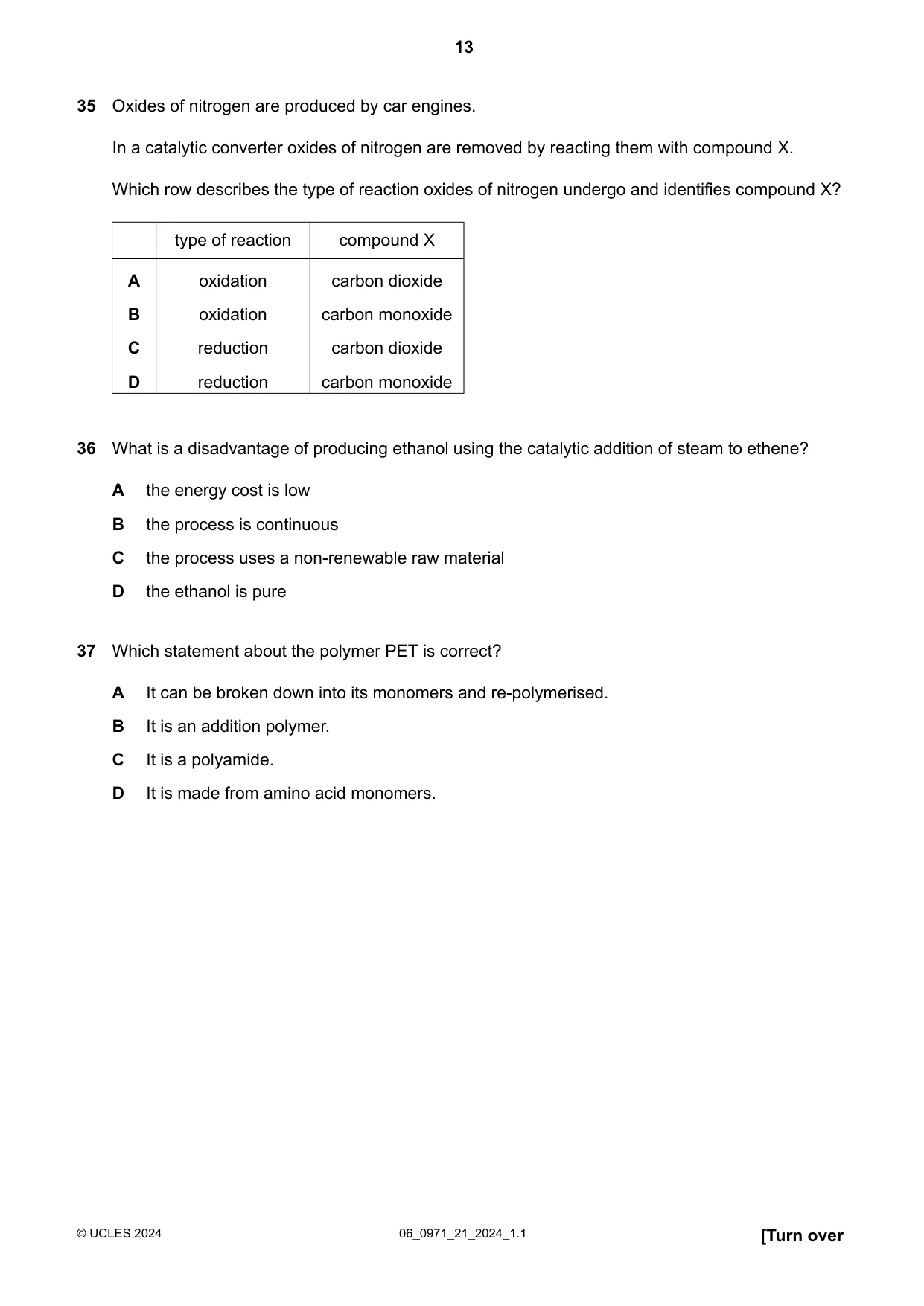
Q35 · Oxides of nitrogen are produced by car engines
35 Oxides of nitrogen are produced by car engines. In a catalytic converter oxides of nitrogen are removed by reacting them with compound X. Which row describes the type of reaction oxides of nitrogen undergo and identifies compound X? type of reaction compound X A oxidation carbon dioxide B oxidation carbon monoxide C reduction carbon dioxide D reduction carbon monoxide
Mark scheme: D
Q36 · What is a disadvantage of producing ethanol using the catalytic addition of steam to…
36 What is a disadvantage of producing ethanol using the catalytic addition of steam to ethene? A the energy cost is low B the process is continuous C the process uses a non-renewable raw material D the ethanol is pure
Mark scheme: C
Q37 · Which statement about the polymer PET is correct?
37 Which statement about the polymer PET is correct? A It can be broken down into its monomers and re-polymerised. B It is an addition polymer. C It is a polyamide. D It is made from amino acid monomers.
Mark scheme: A
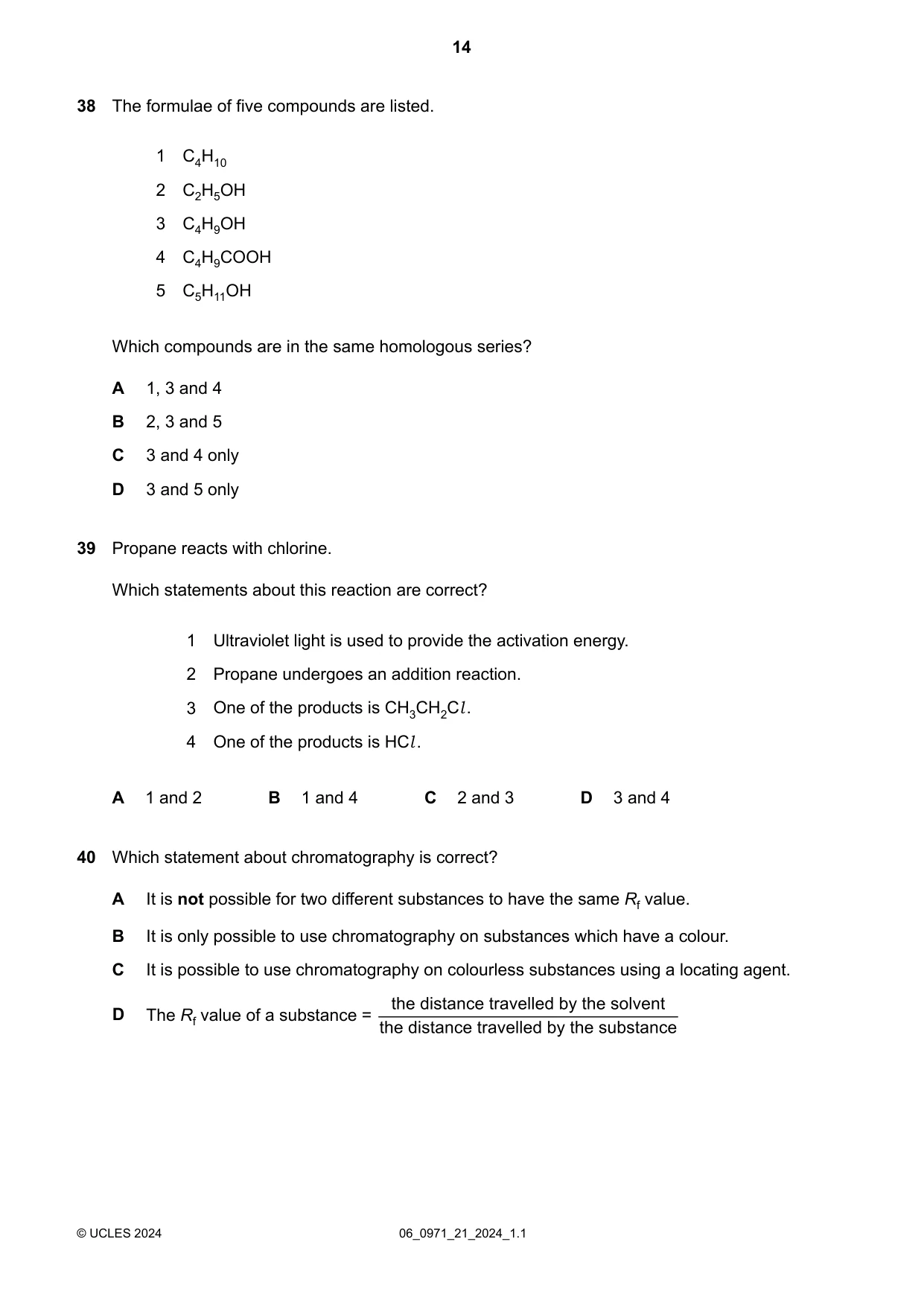
Q38 · The formulae of five compounds are listed
38 The formulae of five compounds are listed. 1 C4H10 2 C2H5OH 3 C4H9OH 4 C4H9COOH 5 C5H11OH Which compounds are in the same homologous series? A 1, 3 and 4 B 2, 3 and 5 C 3 and 4 only D 3 and 5 only
Mark scheme: B
More questions on Formulae, functional groups and terminology
Q39 · Propane reacts with chlorine
39 Propane reacts with chlorine. Which statements about this reaction are correct? 1 Ultraviolet light is used to provide the activation energy. 2 Propane undergoes an addition reaction. 3 One of the products is CH3CH2Cl. 4 One of the products is HCl. A 1 and 2 B 1 and 4 C 2 and 3 D 3 and 4
Mark scheme: B
Q40 · Which statement about chromatography is correct?
40 Which statement about chromatography is correct? A It is not possible for two different substances to have the same Rf value. B It is only possible to use chromatography on substances which have a colour. C It is possible to use chromatography on colourless substances using a locating agent. D The Rf value of a substance =
Mark scheme: C
What was in this paper
The subtopics covered by these 40 questions, and how many questions each got. Open one in a new tab to see every Cambridge question on it.
2Electrolysis2Exothermic and endothermic reactions2Rate of reaction2Redox2Reversible reactions and equilibrium2Simple molecules and covalent bonds2Solids, liquids and gases2The mole and the Avogadro constant2Air quality and climate1Alkanes1Atomic structure and the Periodic Table1Carboxylic acids1Chromatography1Corrosion of metals1Diffusion1Fertilisers1Formulae1Formulae, functional groups and terminology1Fuels1Group VII properties1Identification of ions and gases1Ions and ionic bonds1Isotopes1Oxides1Physical and chemical changes1Polymers1Reactivity series1The characteristic properties of acids and bases1Transition elements1Water1What you needed in this session
Cambridge’s own grade thresholds for 2024 May/June, Paper 2 · Variant 1. A higher threshold means an easier paper — the bar moves with how the cohort did.