Cambridge IGCSE Chemistry (9-1) 0971 — 2025 Oct/Nov Paper 2 · Variant 2
0971/22/O/N/25 · 40 questions · 40 marks · 45 min
The question paper and its mark scheme, free to read here and free to download. This is Cambridge’s own paper, exactly as it was sat.
Question paper16 pages
Mark scheme3 pages
Answers below. Sit the paper first if you are practising.
Questions as text
Q1 · What happens to the volume of a fixed mass of gas when the temperature is increased or…
1 What happens to the volume of a fixed mass of gas when the temperature is increased or the pressure is decreased? increased temperature decreased pressure A volume decreased volume decreased B volume decreased volume increased C volume increased volume decreased D volume increased volume increased
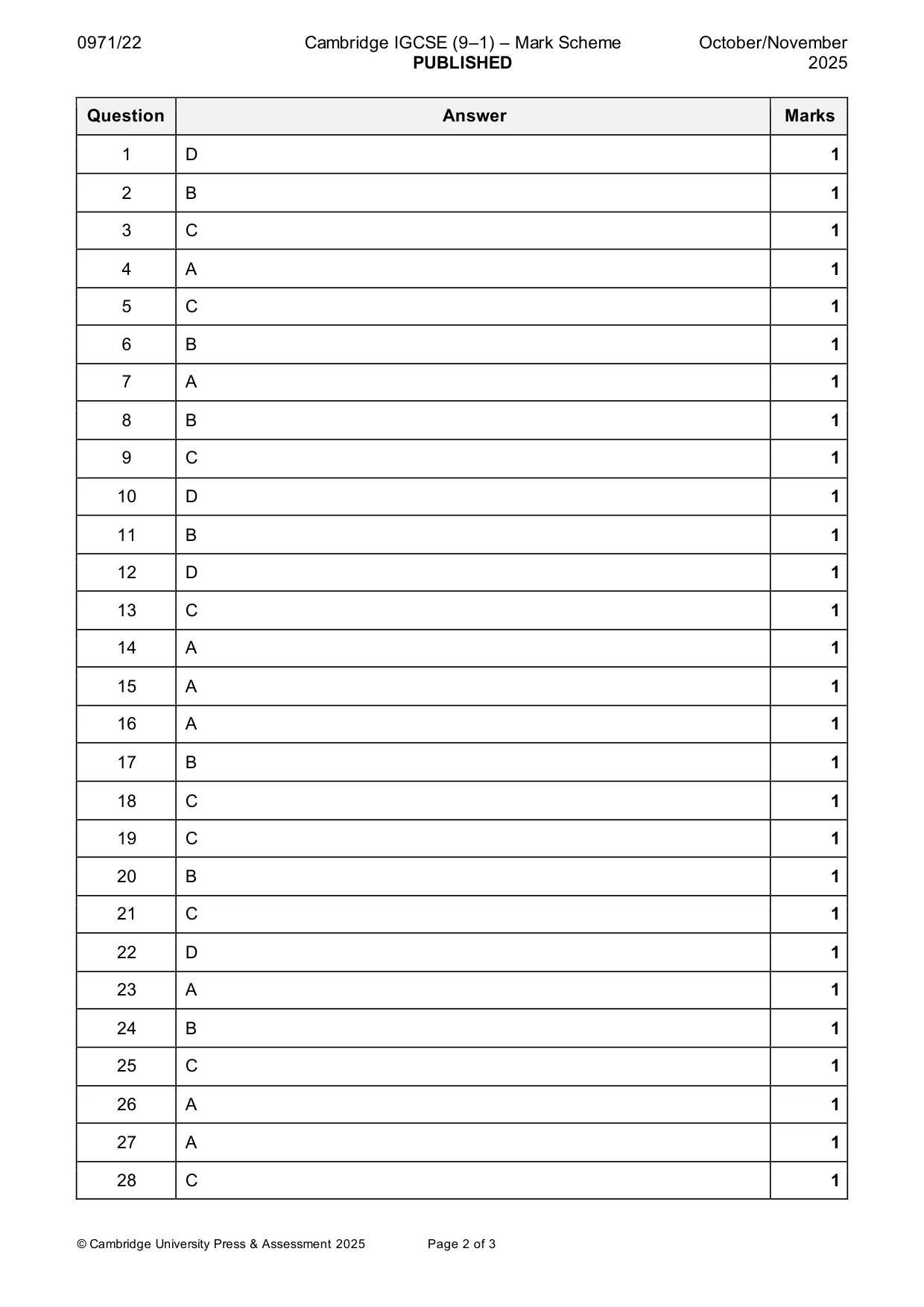
Mark scheme: D
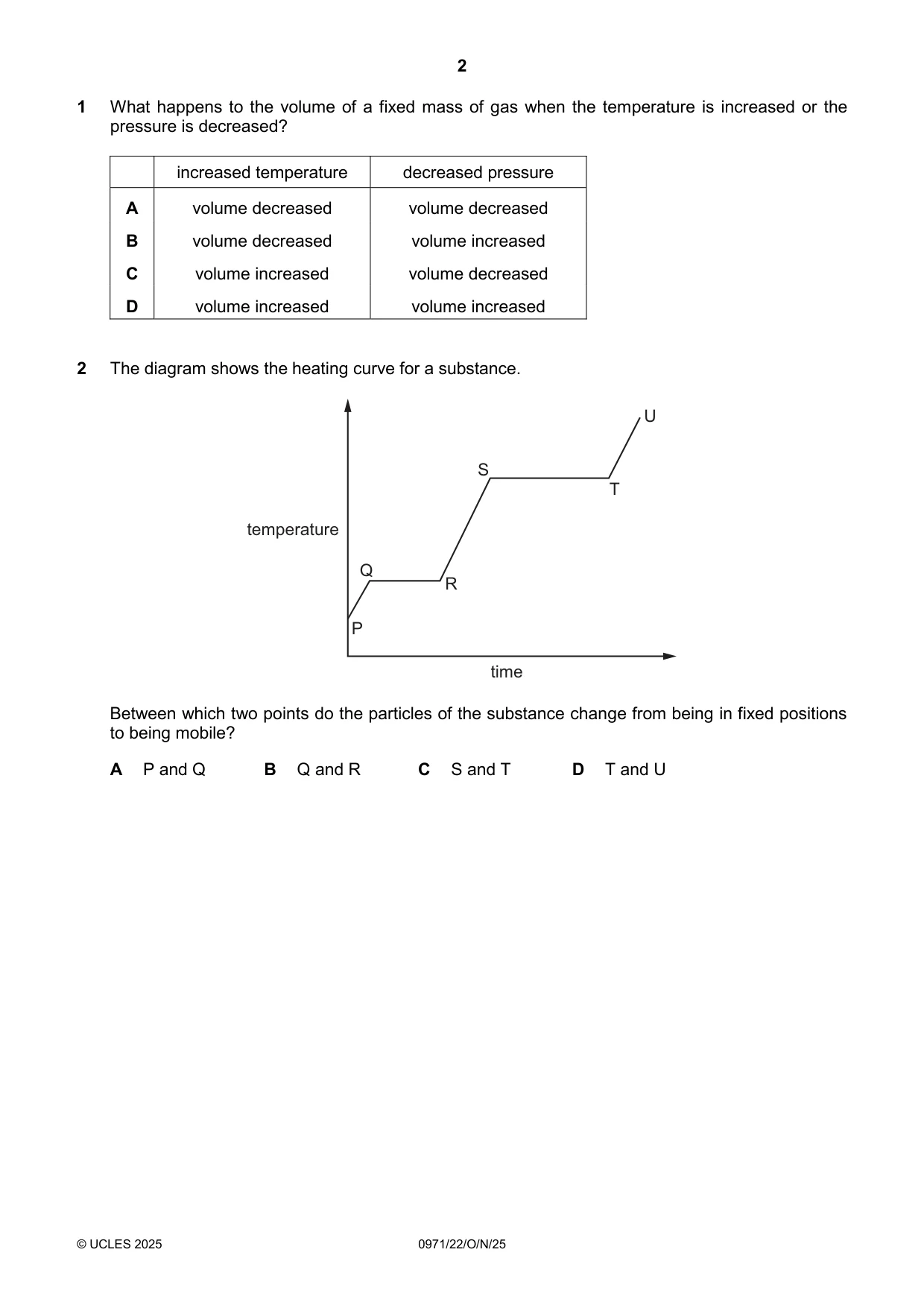
Q2 · The diagram shows the heating curve for a substance
2 The diagram shows the heating curve for a substance. U S T temperature Q R P time Between which two points do the particles of the substance change from being in fixed positions to being mobile? A P and Q B Q and R C S and T D T and U
Mark scheme: B
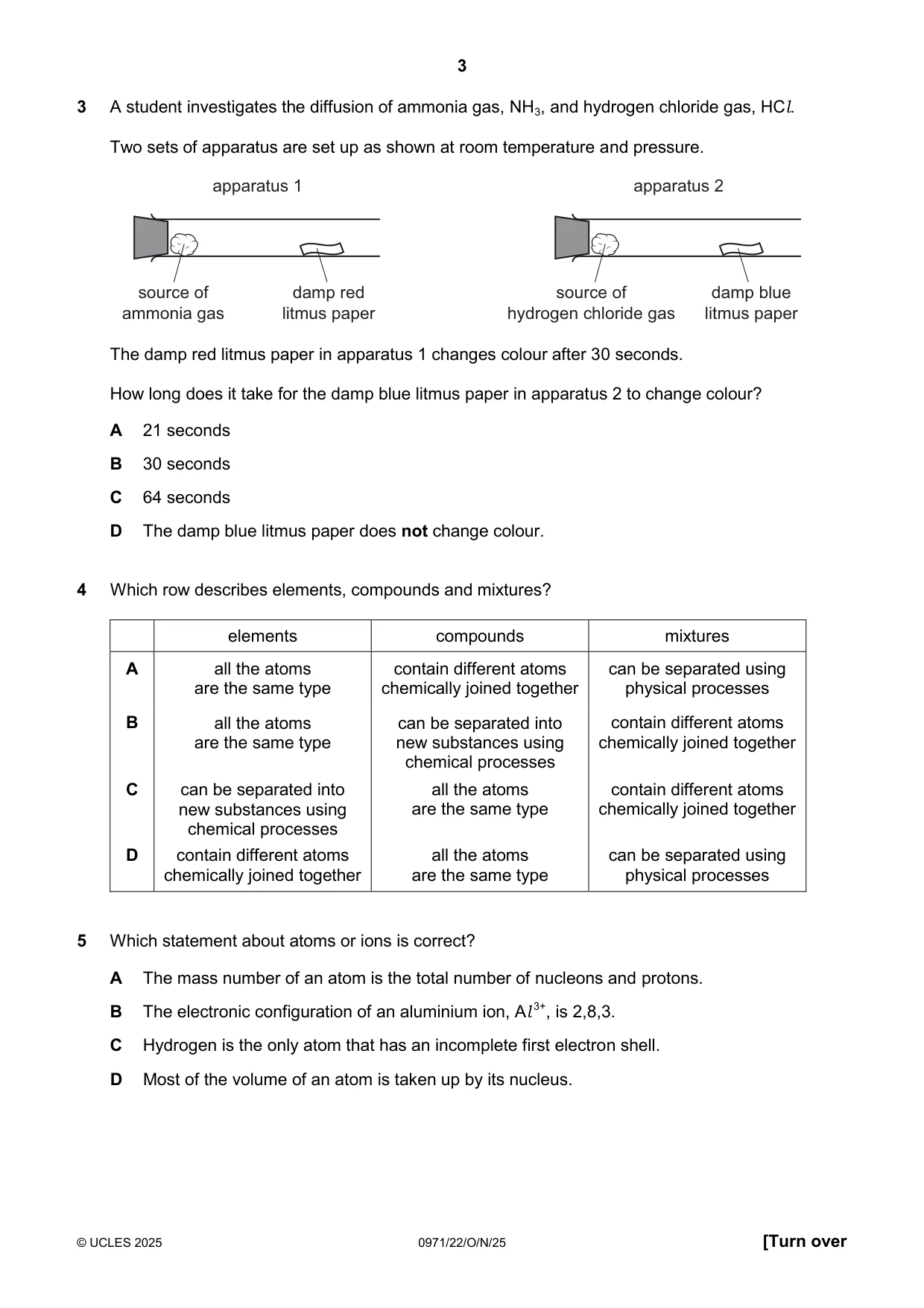
Q3 · A student investigates the diffusion of ammonia gas, NH3, and hydrogen chloride gas, HCl
3 A student investigates the diffusion of ammonia gas, NH3, and hydrogen chloride gas, HCl. Two sets of apparatus are set up as shown at room temperature and pressure. apparatus 1 apparatus 2 source of damp red source of damp blue ammonia gas litmus paper hydrogen chloride gas litmus paper The damp red litmus paper in apparatus 1 changes colour after 30 seconds. How long does it take for the damp blue litmus paper in apparatus 2 to change colour? A 21 seconds B 30 seconds C 64 seconds D The damp blue litmus paper does not change colour.
Mark scheme: C
Q4 · Which row describes elements, compounds and mixtures?
4 Which row describes elements, compounds and mixtures? elements compounds mixtures A all the atoms contain different atoms can be separated using are the same type chemically joined together physical processes B all the atoms can be separated into contain different atoms are the same type new substances using chemically joined together chemical processes C can be separated into all the atoms contain different atoms new substances using are the same type chemically joined together chemical processes D contain different atoms all the atoms can be separated using chemically joined together are the same type physical processes
Mark scheme: A
Q5 · Which statement about atoms or ions is correct?
5 Which statement about atoms or ions is correct? A The mass number of an atom is the total number of nucleons and protons. B The electronic configuration of an aluminium ion, Al 3+, is 2,8,3. C Hydrogen is the only atom that has an incomplete first electron shell. D Most of the volume of an atom is taken up by its nucleus.
Mark scheme: C
Q6 · Which two values are used to calculate the relative atomic mass of a sample of boron?
6 Which two values are used to calculate the relative atomic mass of a sample of boron? value 1 value 2 A the total number the total number of boron isotopes of boron atoms B the relative abundance of each the relative mass boron isotope in the sample of each boron isotope C the relative abundance of each the total number boron isotope in the sample of boron atoms D the total number the relative mass of boron isotopes of each boron isotope
Mark scheme: B
Q7 · Which statement describes the structure of sodium chloride?
7 Which statement describes the structure of sodium chloride? A a lattice of alternating positive and negative ions B a lattice of positive ions surrounded by a ‘sea’ of delocalised electrons C a mixture of sodium and chlorine atoms D a regular lattice of sodium and chlorine atoms
Mark scheme: A
Q8 · Graphite and diamond are both forms of the element carbon
8 Graphite and diamond are both forms of the element carbon. Which row shows the number of other carbon atoms that each carbon atom is covalently bonded to in graphite and in diamond? graphite diamond A 3 3 B 3 4 C 4 3 D 4 4
Mark scheme: B
Q9 · Which row describes the structure and bonding in cobalt?
9 Which row describes the structure and bonding in cobalt? structure bonding A giant ionic B simple ionic C giant metallic D simple metallic
Mark scheme: C
Q10 · The equation for the combustion of ethanol is shown
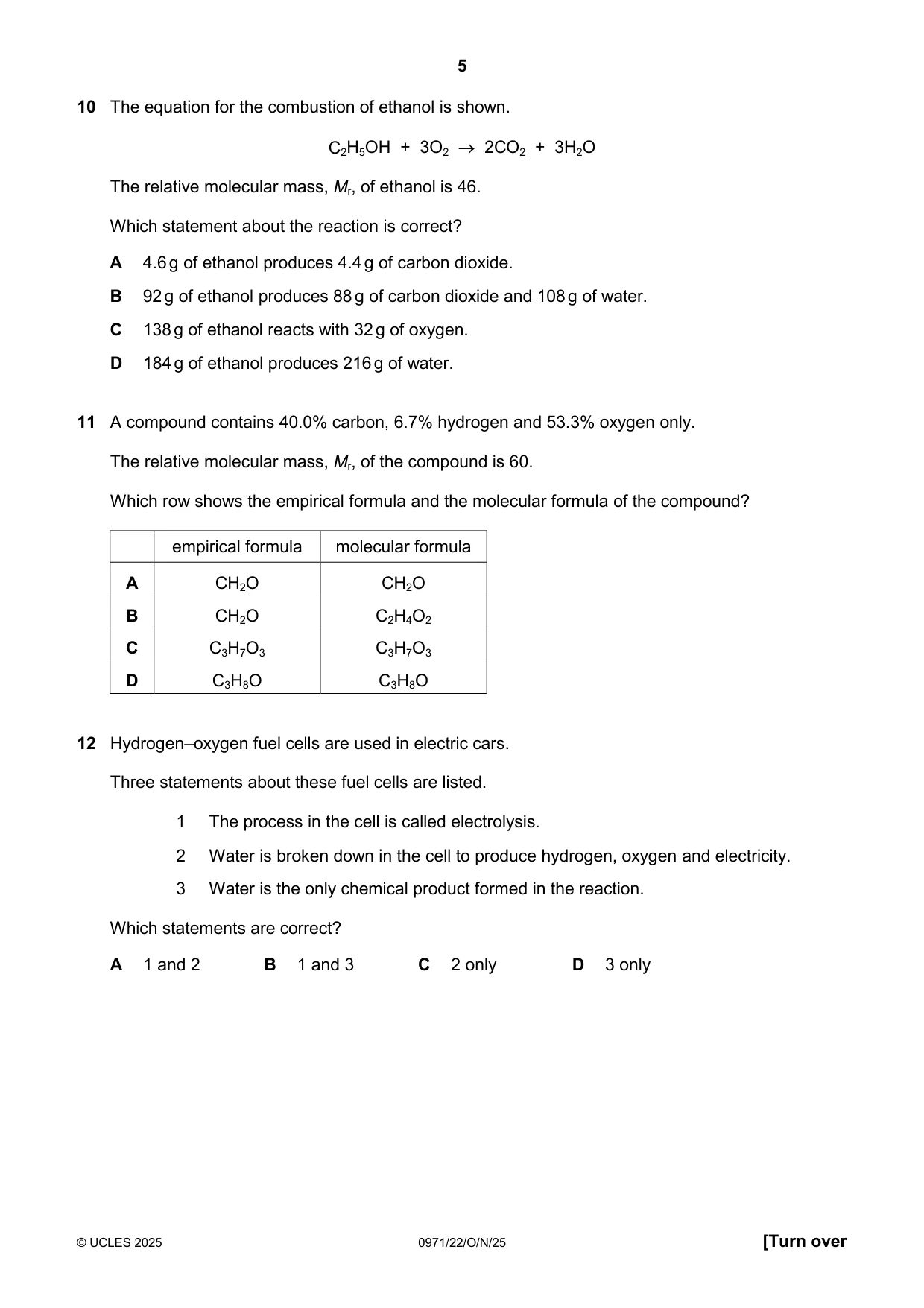
10 The equation for the combustion of ethanol is shown. C2H5OH + 3O2 2CO2 + 3H2O The relative molecular mass, Mr, of ethanol is 46. Which statement about the reaction is correct? A 4.6 g of ethanol produces 4.4 g of carbon dioxide. B 92 g of ethanol produces 88 g of carbon dioxide and 108 g of water. C 138 g of ethanol reacts with 32 g of oxygen. D 184 g of ethanol produces 216 g of water.
Mark scheme: D
Q11 · A compound contains 40.0% carbon, 6.7% hydrogen and 53.3% oxygen only
11 A compound contains 40.0% carbon, 6.7% hydrogen and 53.3% oxygen only. The relative molecular mass, Mr, of the compound is 60. Which row shows the empirical formula and the molecular formula of the compound? empirical formula molecular formula A CH2O CH2O B CH2O C2H4O2 C C3H7O3 C3H7O3 D C3H8O C3H8O
Mark scheme: B
Q12 · Hydrogen–oxygen fuel cells are used in electric cars
12 Hydrogen–oxygen fuel cells are used in electric cars. Three statements about these fuel cells are listed. 1 The process in the cell is called electrolysis. 2 Water is broken down in the cell to produce hydrogen, oxygen and electricity. 3 Water is the only chemical product formed in the reaction. Which statements are correct? A 1 and 2 B 1 and 3 C 2 only D 3 only
Mark scheme: D
Q13 · A solution of copper(II) sulfate can be electrolysed using copper electrodes or carbon…
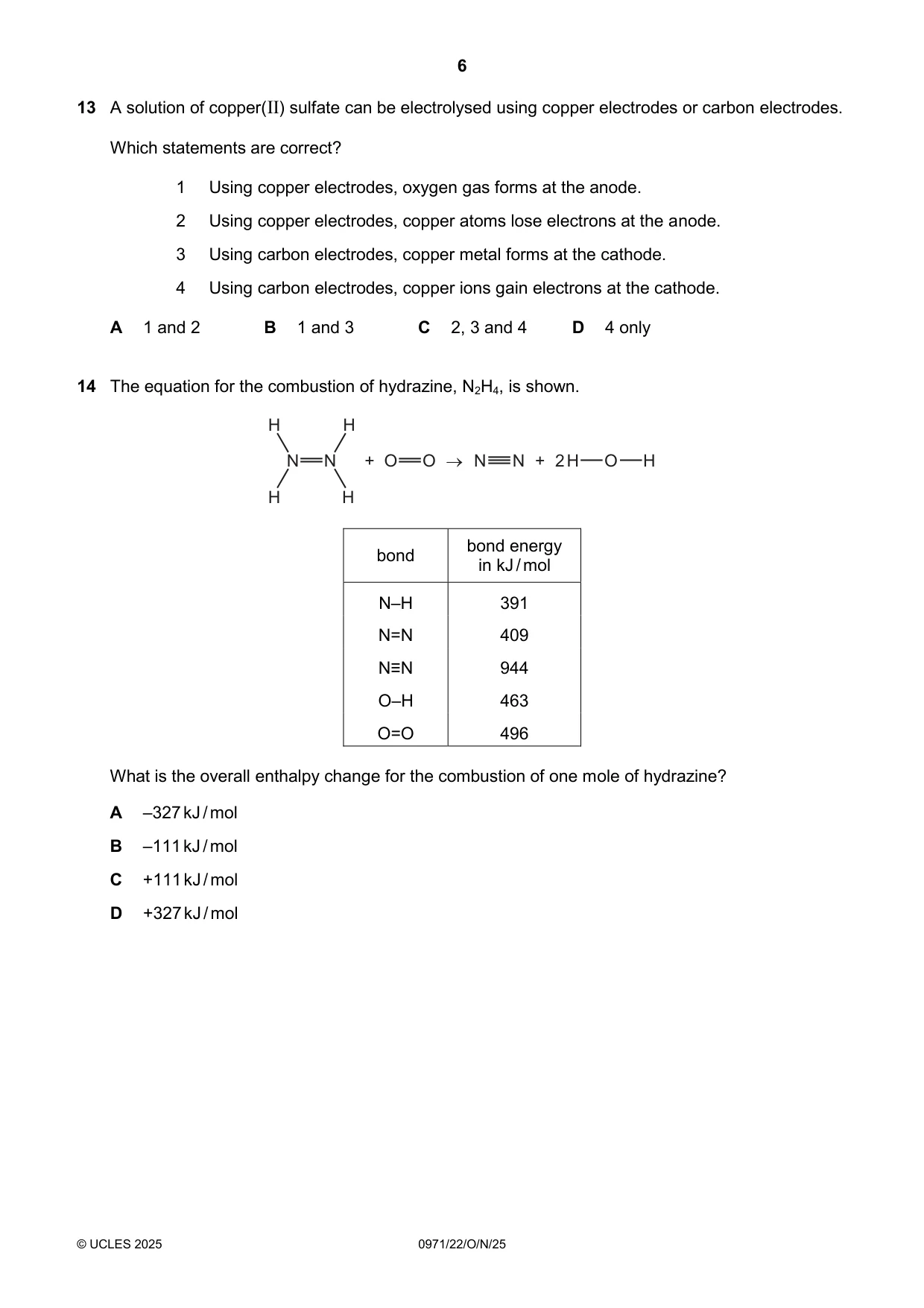
13 A solution of copper(II) sulfate can be electrolysed using copper electrodes or carbon electrodes. Which statements are correct? 1 Using copper electrodes, oxygen gas forms at the anode. 2 Using copper electrodes, copper atoms lose electrons at the anode. 3 Using carbon electrodes, copper metal forms at the cathode. 4 Using carbon electrodes, copper ions gain electrons at the cathode. A 1 and 2 B 1 and 3 C 2, 3 and 4 D 4 only
Mark scheme: C
Q14 · The equation for the combustion of hydrazine, N2H,, is shown
14 The equation for the combustion of hydrazine, N2H,, is shown. H H N=N + OO > N=N + 2H—O—H { \ bond | tn elmo! N-H 391 N=N 409 N=N 944 O-H 463 O=O 496 What is the overall enthalpy change for the combustion of one mole of hydrazine? A -327kJ/mol B -111kJ/mol C +111kJ/mol D +327kJ/mol
Mark scheme: A
Q15 · Dissolving ammonium chloride in water is an endothermic change
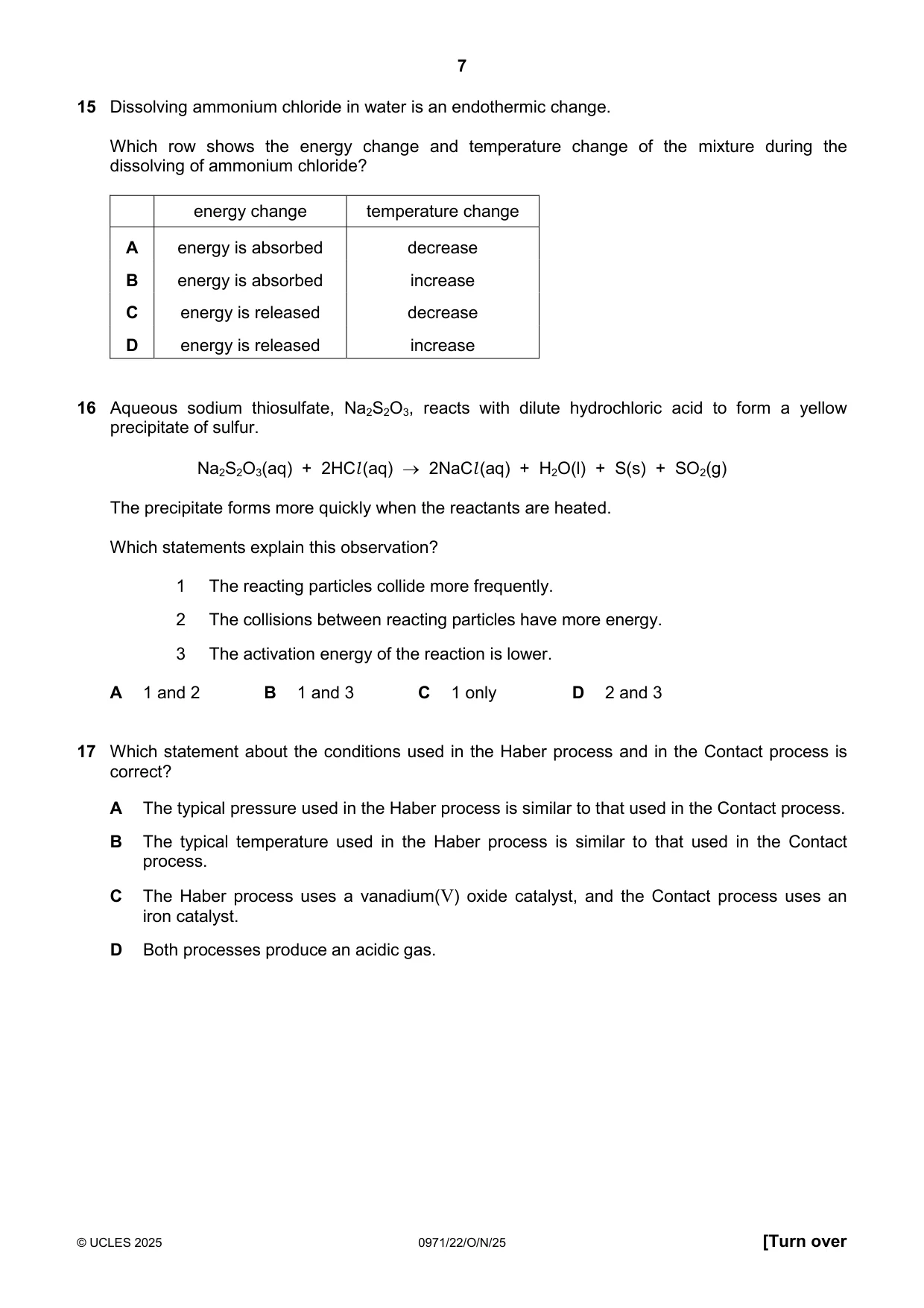
15 Dissolving ammonium chloride in water is an endothermic change. Which row shows the energy change and temperature change of the mixture during the dissolving of ammonium chloride? energy change temperature change A energy is absorbed decrease B energy is absorbed increase C energy is released decrease D energy is released increase
Mark scheme: A
Q16 · Aqueous sodium thiosulfate, Na2S2O3, reacts with dilute hydrochloric acid to form a…
16 Aqueous sodium thiosulfate, Na2S2O3, reacts with dilute hydrochloric acid to form a yellow precipitate of sulfur. Na2S2O3(aq) + 2HCl (aq) 2NaCl (aq) + H2O(l) + S(s) + SO2(g) The precipitate forms more quickly when the reactants are heated. Which statements explain this observation? 1 The reacting particles collide more frequently. 2 The collisions between reacting particles have more energy. 3 The activation energy of the reaction is lower. A 1 and 2 B 1 and 3 C 1 only D 2 and 3
Mark scheme: A
Q17 · Which statement about the conditions used in the Haber process and in the Contact process…
17 Which statement about the conditions used in the Haber process and in the Contact process is correct? A The typical pressure used in the Haber process is similar to that used in the Contact process. B The typical temperature used in the Haber process is similar to that used in the Contact process. C The Haber process uses a vanadium(V) oxide catalyst, and the Contact process uses an iron catalyst. D Both processes produce an acidic gas.
Mark scheme: B
Q18 · The equation shows the equilibrium between dinitrogen tetroxide, N2O4, and nitrogen…
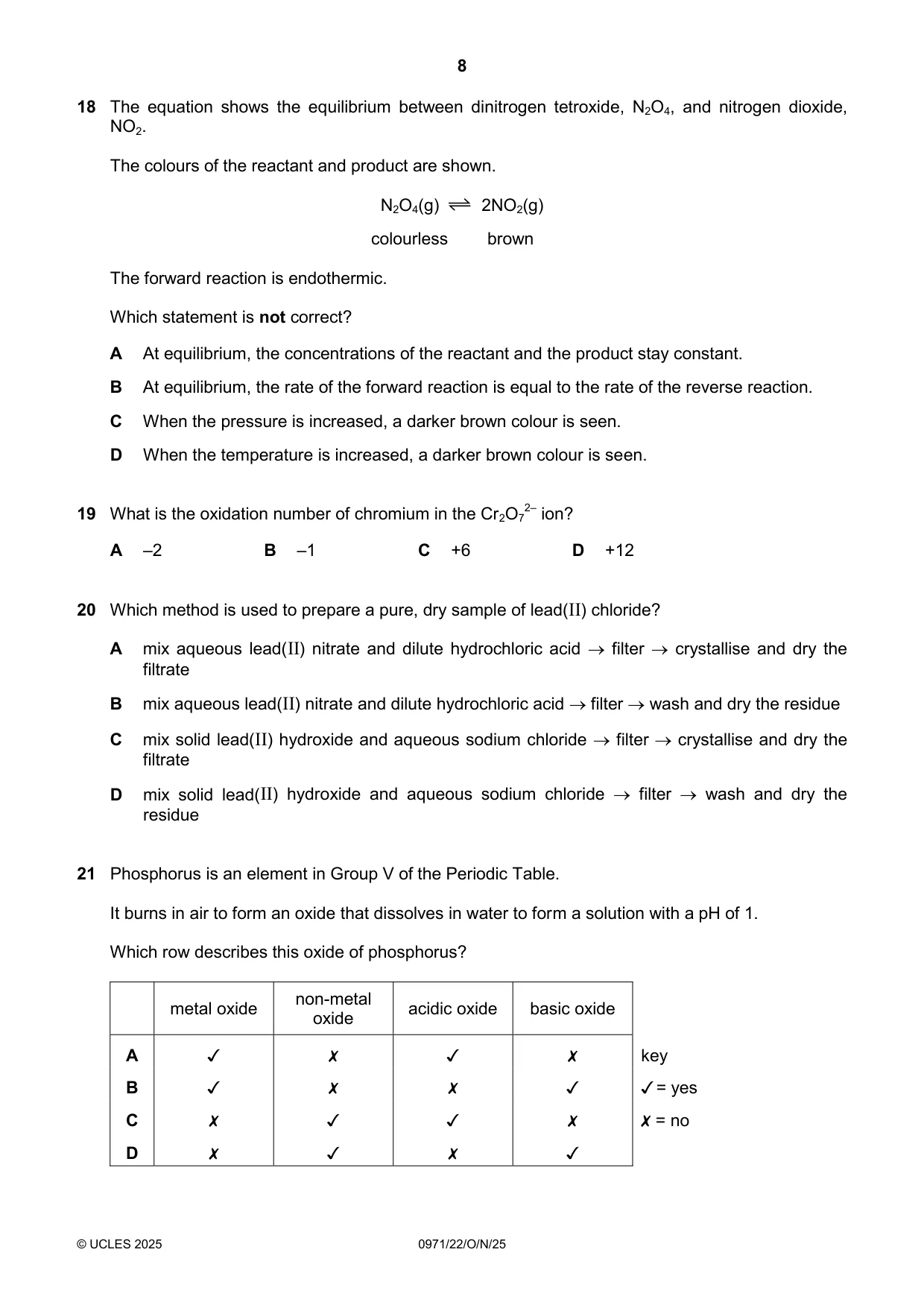
18 The equation shows the equilibrium between dinitrogen tetroxide, N2O4, and nitrogen dioxide, NO2. The colours of the reactant and product are shown. N2O4(g) 2NO2(g) colourless brown The forward reaction is endothermic. Which statement is not correct? A At equilibrium, the concentrations of the reactant and the product stay constant. B At equilibrium, the rate of the forward reaction is equal to the rate of the reverse reaction. C When the pressure is increased, a darker brown colour is seen. D When the temperature is increased, a darker brown colour is seen.
Mark scheme: C
Q19 · What is the oxidation number of chromium in the Cr2O7 2– ion?
19 What is the oxidation number of chromium in the Cr2O7 2– ion? A –2 B –1 C +6 D +12
Mark scheme: C
Q20 · Which method is used to prepare a pure, dry sample of lead(II) chloride?
20 Which method is used to prepare a pure, dry sample of lead(II) chloride? A mix aqueous lead(II) nitrate and dilute hydrochloric acid filter crystallise and dry the filtrate B mix aqueous lead(II) nitrate and dilute hydrochloric acid filter wash and dry the residue C mix solid lead(II) hydroxide and aqueous sodium chloride filter crystallise and dry the filtrate D mix solid lead(II) hydroxide and aqueous sodium chloride filter wash and dry the residue
Mark scheme: B
Q21 · Phosphorus is an element in Group V of the Periodic Table
21 Phosphorus is an element in Group V of the Periodic Table. It burns in air to form an oxide that dissolves in water to form a solution with a pH of 1. Which row describes this oxide of phosphorus? metal oxide nonmetal acidic oxide basic oxide x key Jv /=yes x X=no Jv
Mark scheme: C
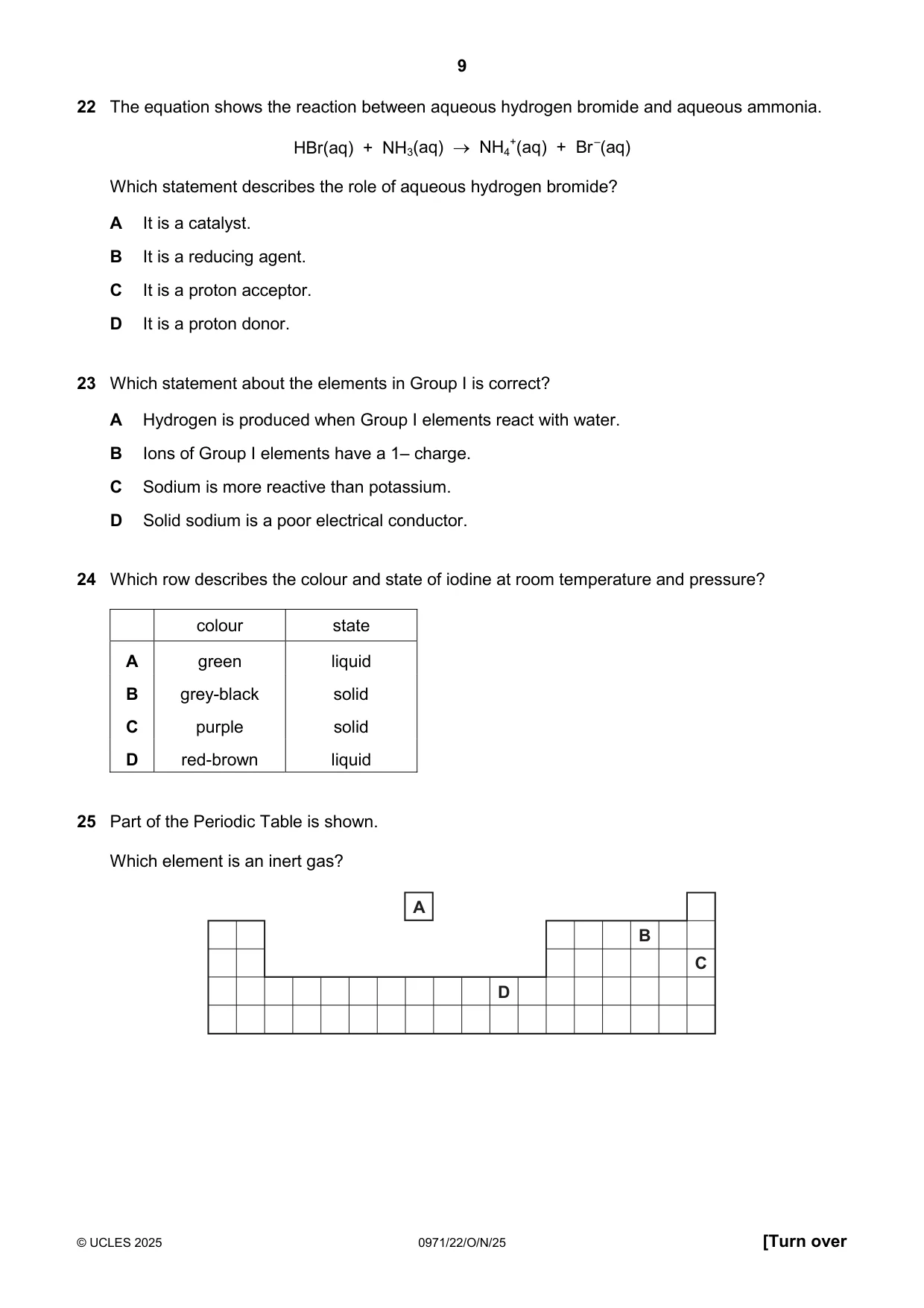
Q22 · The equation shows the reaction between aqueous hydrogen bromide and aqueous ammonia
22 The equation shows the reaction between aqueous hydrogen bromide and aqueous ammonia. HBr(aq) + NH3(aq) NH4 +(aq) + Br –(aq) Which statement describes the role of aqueous hydrogen bromide? A It is a catalyst. B It is a reducing agent. C It is a proton acceptor. D It is a proton donor.
Mark scheme: D
More questions on The characteristic properties of acids and bases
Q23 · Which statement about the elements in Group I is correct?
23 Which statement about the elements in Group I is correct? A Hydrogen is produced when Group I elements react with water. B Ions of Group I elements have a 1– charge. C Sodium is more reactive than potassium. D Solid sodium is a poor electrical conductor.
Mark scheme: A
Q24 · Which row describes the colour and state of iodine at room temperature and pressure?
24 Which row describes the colour and state of iodine at room temperature and pressure? colour state A green liquid B grey-black solid C purple solid D red-brown liquid
Mark scheme: B
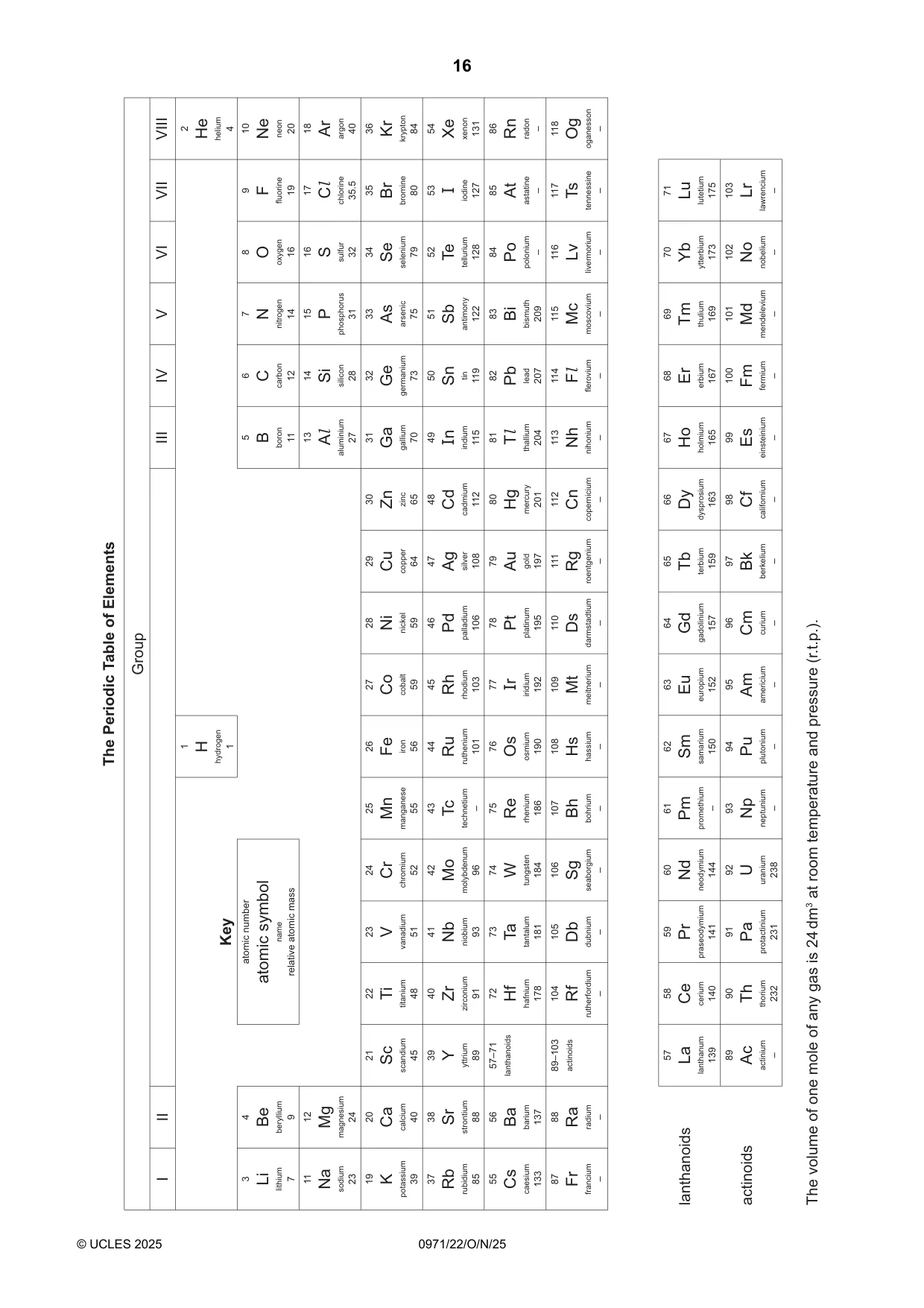
Q25 · Part of the Periodic Table is shown
25 Part of the Periodic Table is shown. Which element is an inert gas? A B C D
Mark scheme: C
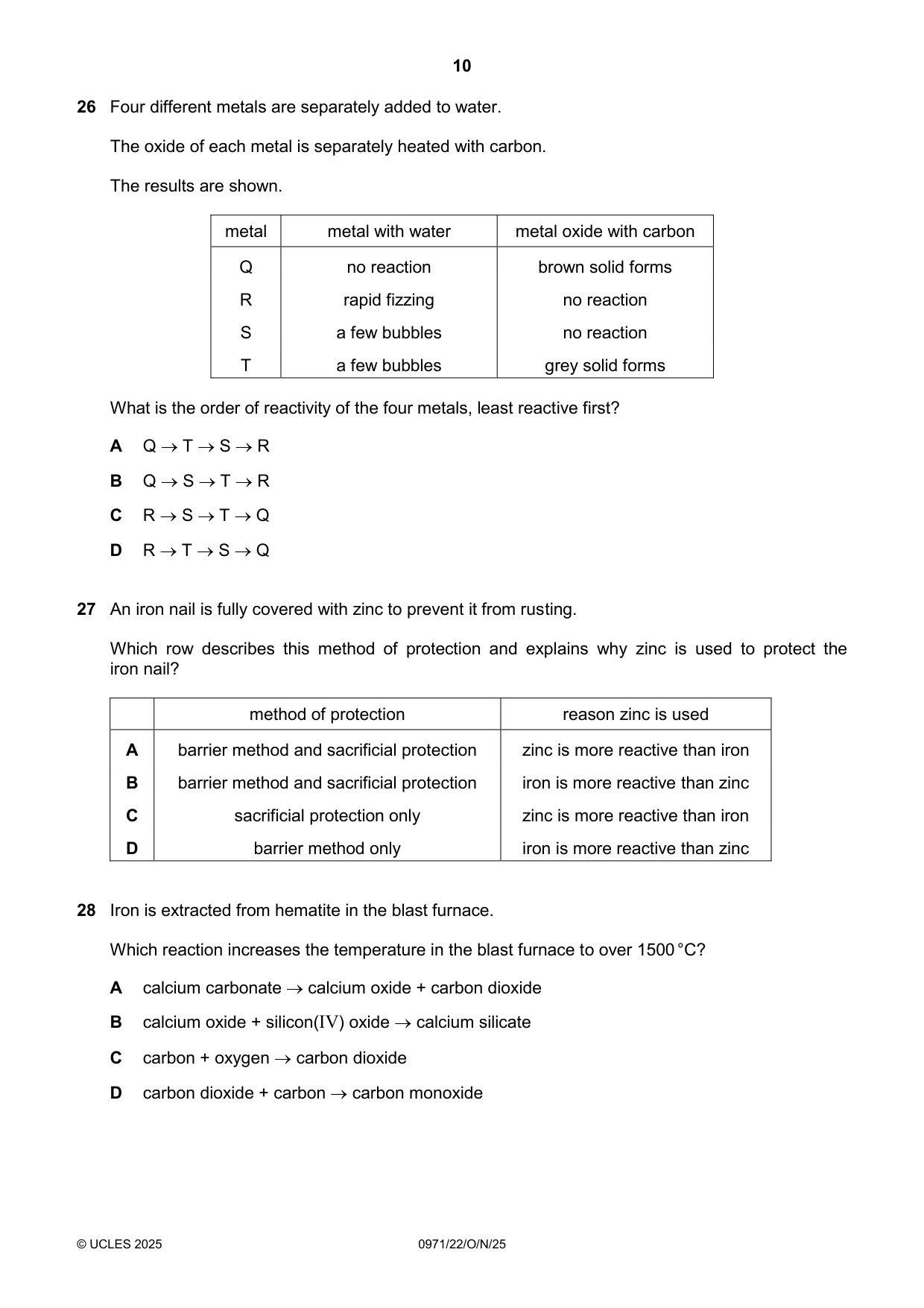
Q26 · Four different metals are separately added to water
26 Four different metals are separately added to water. The oxide of each metal is separately heated with carbon. The results are shown. metal metal with water metal oxide with carbon Q no reaction brown solid forms R rapid fizzing no reaction S a few bubbles no reaction T a few bubbles grey solid forms What is the order of reactivity of the four metals, least reactive first? A Q T S R B Q S T R C R S T Q D R T S Q
Mark scheme: A
Q27 · An iron nail is fully covered with zinc to prevent it from rusting
27 An iron nail is fully covered with zinc to prevent it from rusting. Which row describes this method of protection and explains why zinc is used to protect the iron nail? method of protection reason zinc is used A barrier method and sacrificial protection zinc is more reactive than iron B barrier method and sacrificial protection iron is more reactive than zinc C sacrificial protection only zinc is more reactive than iron D barrier method only iron is more reactive than zinc
Mark scheme: A
Q28 · Iron is extracted from hematite in the blast furnace
28 Iron is extracted from hematite in the blast furnace. Which reaction increases the temperature in the blast furnace to over 1500 °C? A calcium carbonate calcium oxide + carbon dioxide B calcium oxide + silicon(IV) oxide calcium silicate C carbon + oxygen carbon dioxide D carbon dioxide + carbon carbon monoxide
Mark scheme: C
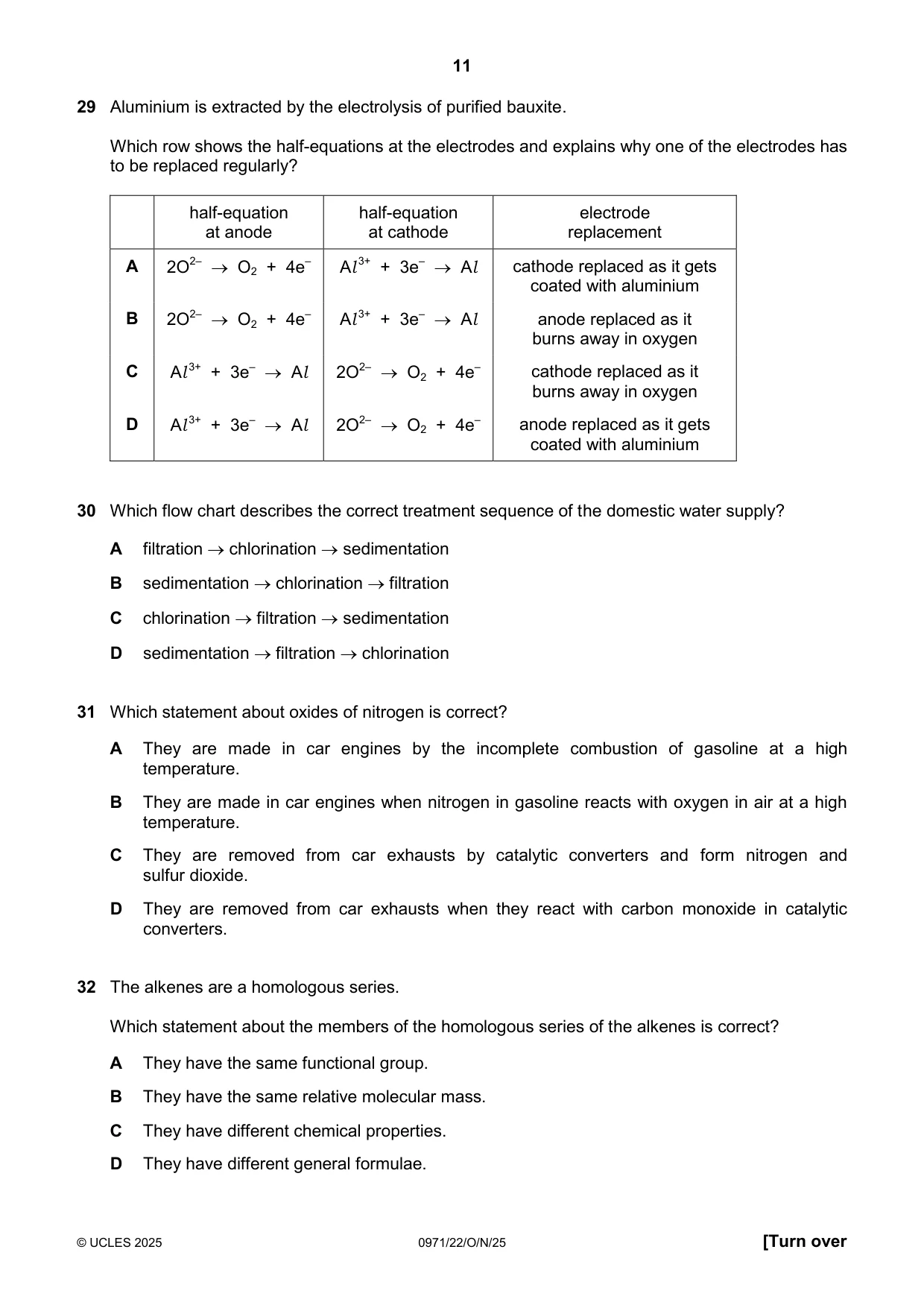
Q29 · Aluminium is extracted by the electrolysis of purified bauxite
29 Aluminium is extracted by the electrolysis of purified bauxite. Which row shows the half-equations at the electrodes and explains why one of the electrodes has to be replaced regularly? half-equation half-equation electrode at anode at cathode replacement A 2O2– O2 + 4e– Al 3+ + 3e– Al cathode replaced as it gets coated with aluminium B 2O2– O2 + 4e– Al 3+ + 3e– Al anode replaced as it burns away in oxygen C Al 3+ + 3e– Al 2O2– O2 + 4e– cathode replaced as it burns away in oxygen D Al 3+ + 3e– Al 2O2– O2 + 4e– anode replaced as it gets coated with aluminium
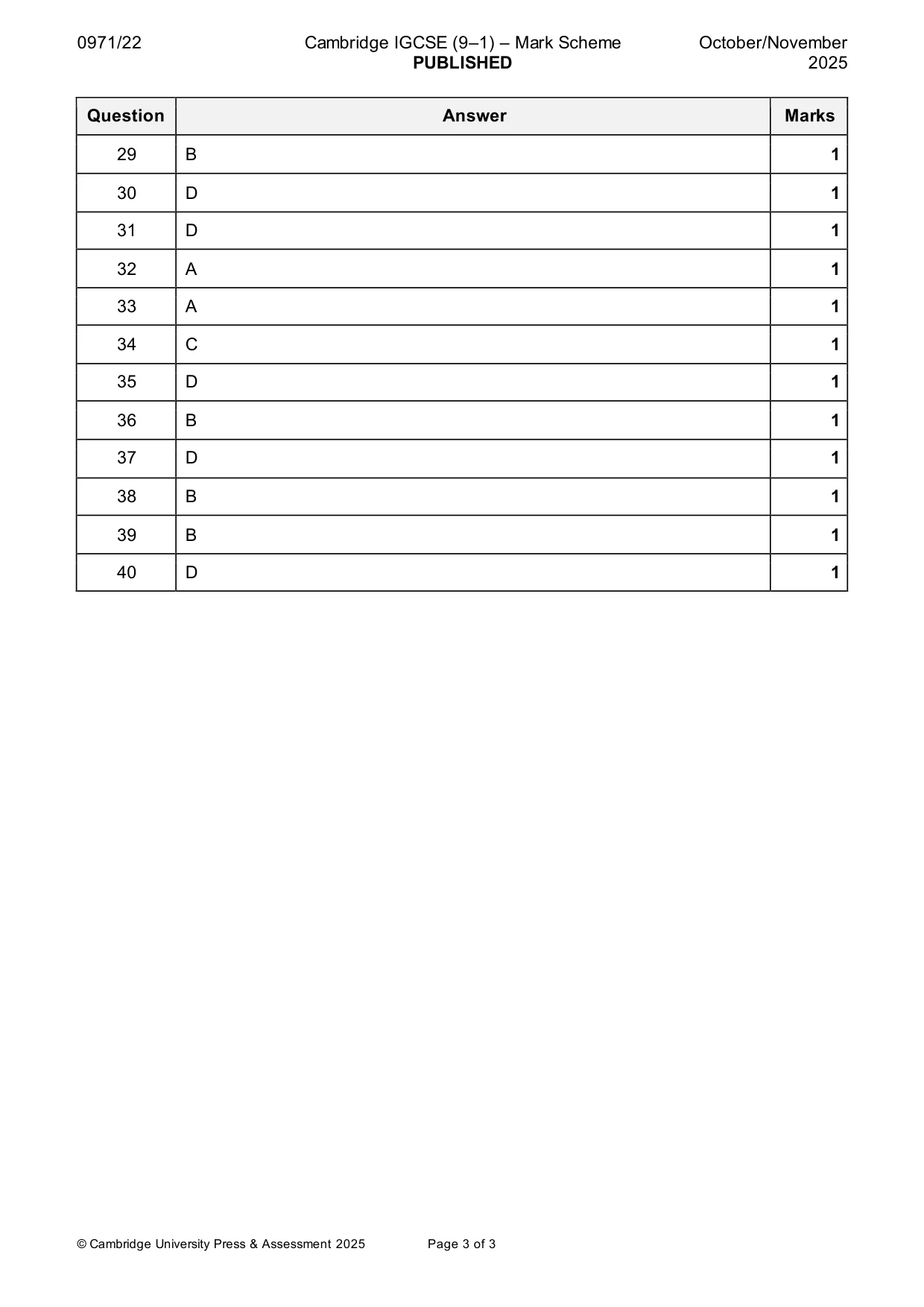
Mark scheme: B
Q30 · Which flow chart describes the correct treatment sequence of the domestic water supply?
30 Which flow chart describes the correct treatment sequence of the domestic water supply? A filtration chlorination sedimentation B sedimentation chlorination filtration C chlorination filtration sedimentation D sedimentation filtration chlorination
Mark scheme: D
Q31 · Which statement about oxides of nitrogen is correct?
31 Which statement about oxides of nitrogen is correct? A They are made in car engines by the incomplete combustion of gasoline at a high temperature. B They are made in car engines when nitrogen in gasoline reacts with oxygen in air at a high temperature. C They are removed from car exhausts by catalytic converters and form nitrogen and sulfur dioxide. D They are removed from car exhausts when they react with carbon monoxide in catalytic converters.
Mark scheme: D
Q32 · The alkenes are a homologous series
32 The alkenes are a homologous series. Which statement about the members of the homologous series of the alkenes is correct? A They have the same functional group. B They have the same relative molecular mass. C They have different chemical properties. D They have different general formulae.
Mark scheme: A
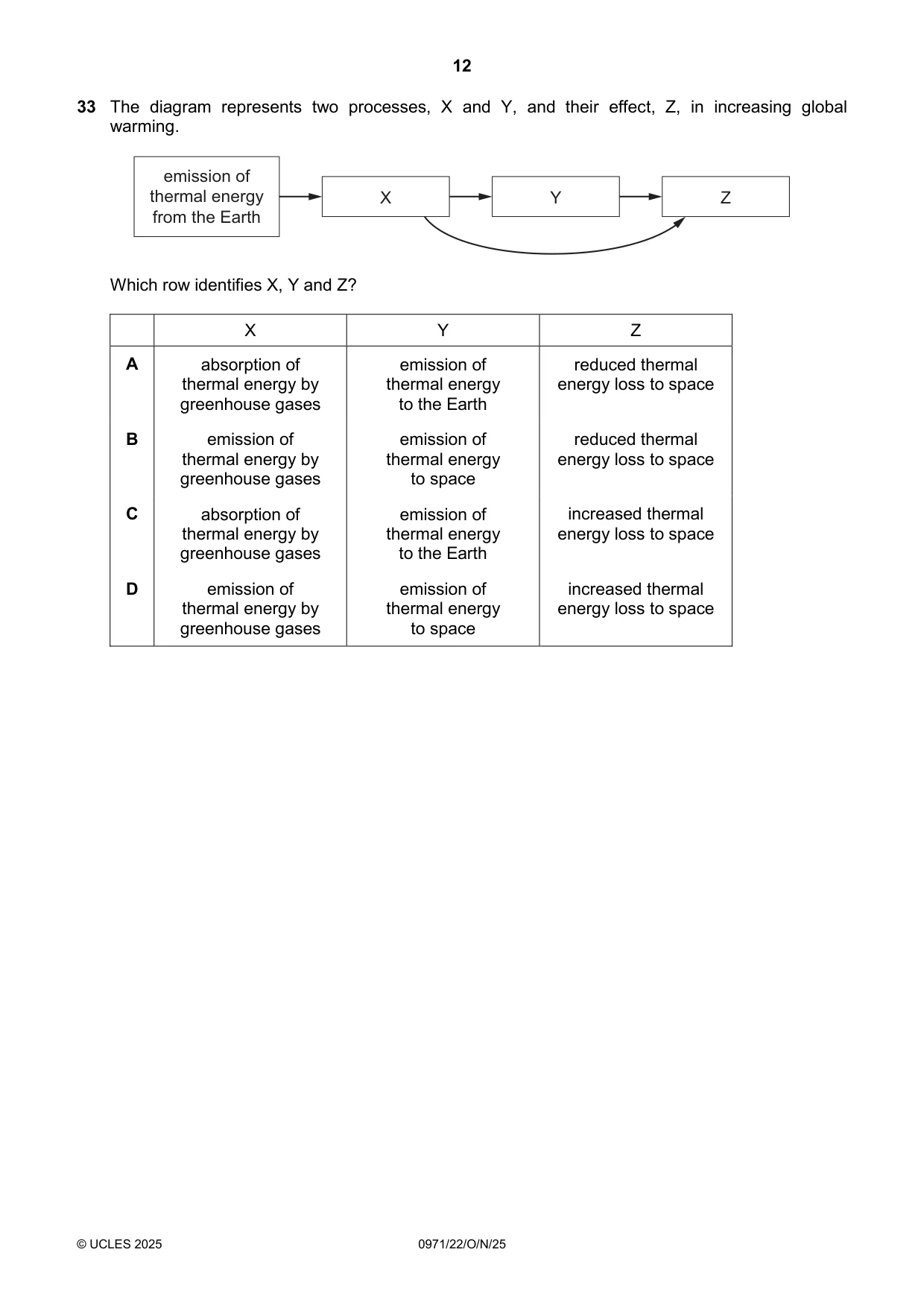
Q33 · The diagram represents two processes, X and Y, and their effect, Z, in increasing global…
33 The diagram represents two processes, X and Y, and their effect, Z, in increasing global warming. emission of thermal energy X Y Z from the Earth Which row identifies X, Y and Z? X Y Z A absorption of emission of reduced thermal thermal energy by thermal energy energy loss to space greenhouse gases to the Earth B emission of emission of reduced thermal thermal energy by thermal energy energy loss to space greenhouse gases to space C absorption of emission of increased thermal thermal energy by thermal energy energy loss to space greenhouse gases to the Earth D emission of emission of increased thermal thermal energy by thermal energy energy loss to space greenhouse gases to space
Mark scheme: A
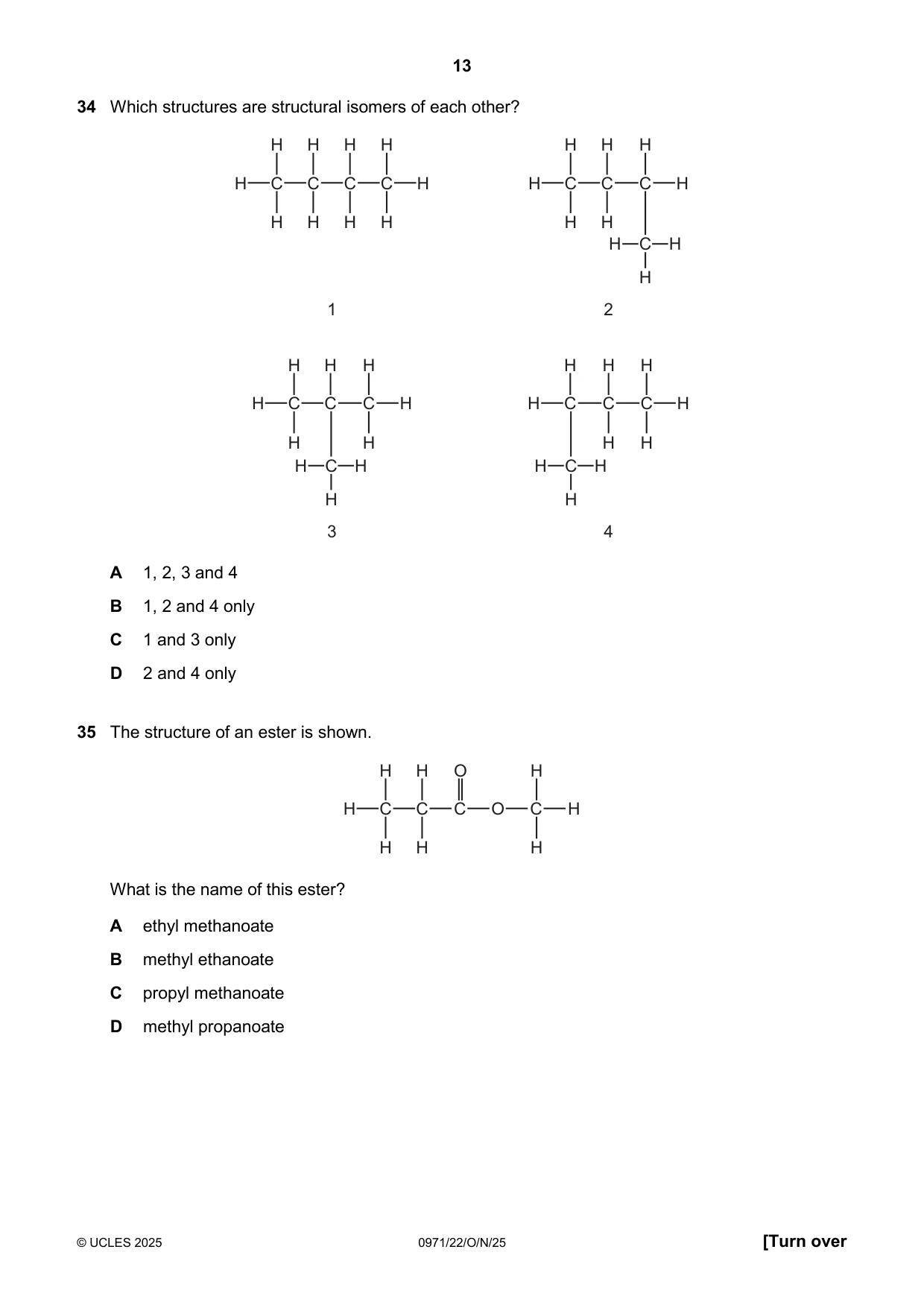
Q34 · Which structures are structural isomers of each other?
34 Which structures are structural isomers of each other? H H H H H H H H C C C C H H C C C H H H H H H H H C H H 1 2 H H H H H H H C C C H H C C C H H H H H H C H H C H H H 3 4 A 1, 2, 3 and 4 B 1, 2 and 4 only C 1 and 3 only D 2 and 4 only
Mark scheme: C
More questions on Formulae, functional groups and terminology
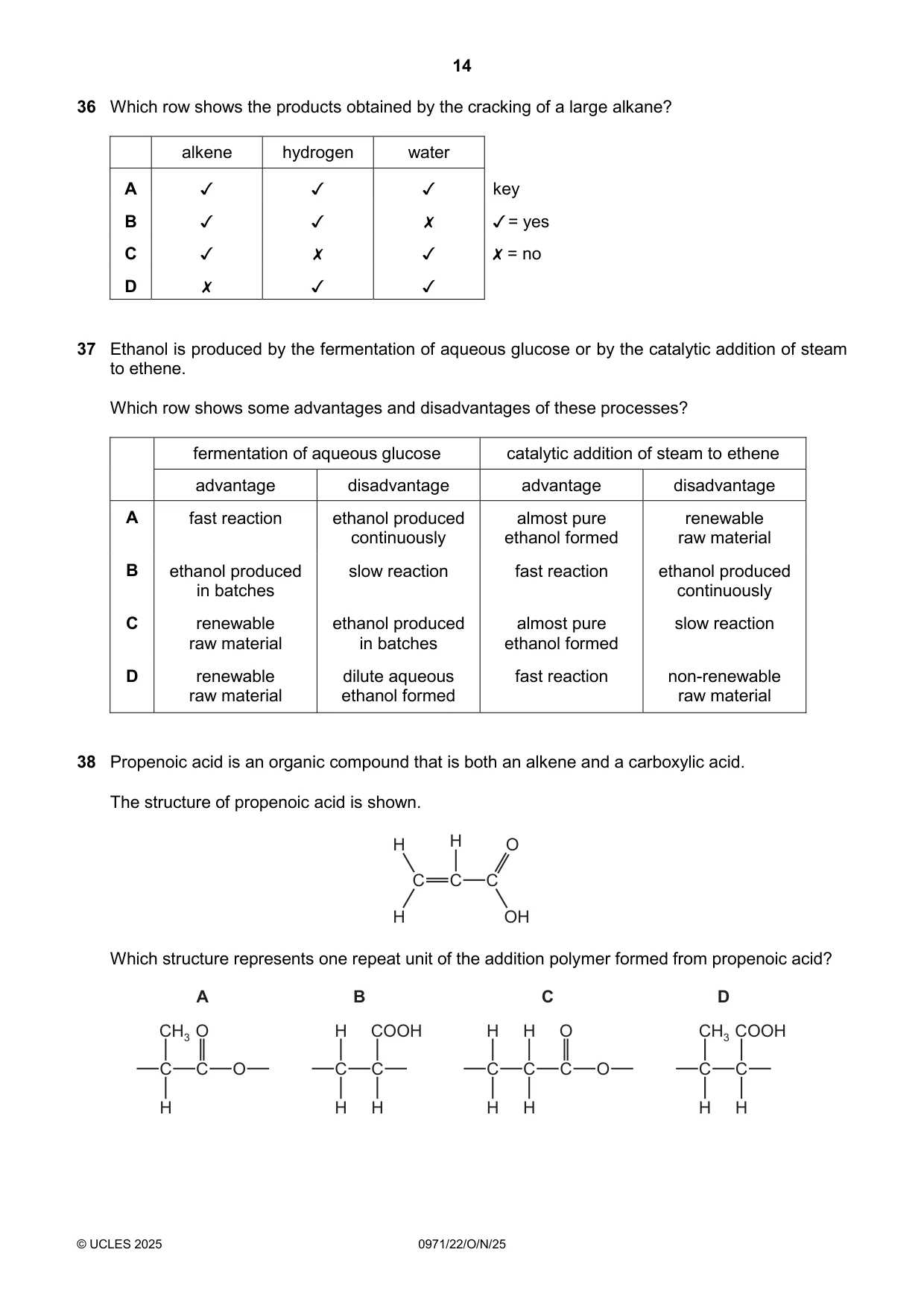
Q35 · The structure of an ester is shown
35 The structure of an ester is shown. H H O H H C C C O C H H H H What is the name of this ester? A ethyl methanoate B methyl ethanoate C propyl methanoate D methyl propanoate
Mark scheme: D
Q36 · Which row shows the products obtained by the cracking of a large alkane?
36 Which row shows the products obtained by the cracking of a large alkane? alkene hydrogen water v v v key /=yes 0 0O WwW > J Jv x Jv x Jv X=no x Jv J
Mark scheme: B
Q37 · Ethanol is produced by the fermentation of aqueous glucose or by the catalytic addition…
37 Ethanol is produced by the fermentation of aqueous glucose or by the catalytic addition of steam to ethene. Which row shows some advantages and disadvantages of these processes? fermentation of aqueous glucose catalytic addition of steam to ethene advantage disadvantage advantage disadvantage A fast reaction ethanol produced almost pure renewable continuously ethanol formed raw material B ethanol produced slow reaction fast reaction ethanol produced in batches continuously C renewable ethanol produced almost pure slow reaction raw material in batches ethanol formed D renewable dilute aqueous fast reaction non-renewable raw material ethanol formed raw material
Mark scheme: D
Q38 · Propenoic acid is an organic compound that is both an alkene and a carboxylic acid
38 Propenoic acid is an organic compound that is both an alkene and a carboxylic acid. The structure of propenoic acid is shown. H H O C C C H OH Which structure represents one repeat unit of the addition polymer formed from propenoic acid? A B C D CH3 O H COOH H H O CH3 COOH C C O C C C C C O C C H H H H H H H
Mark scheme: B
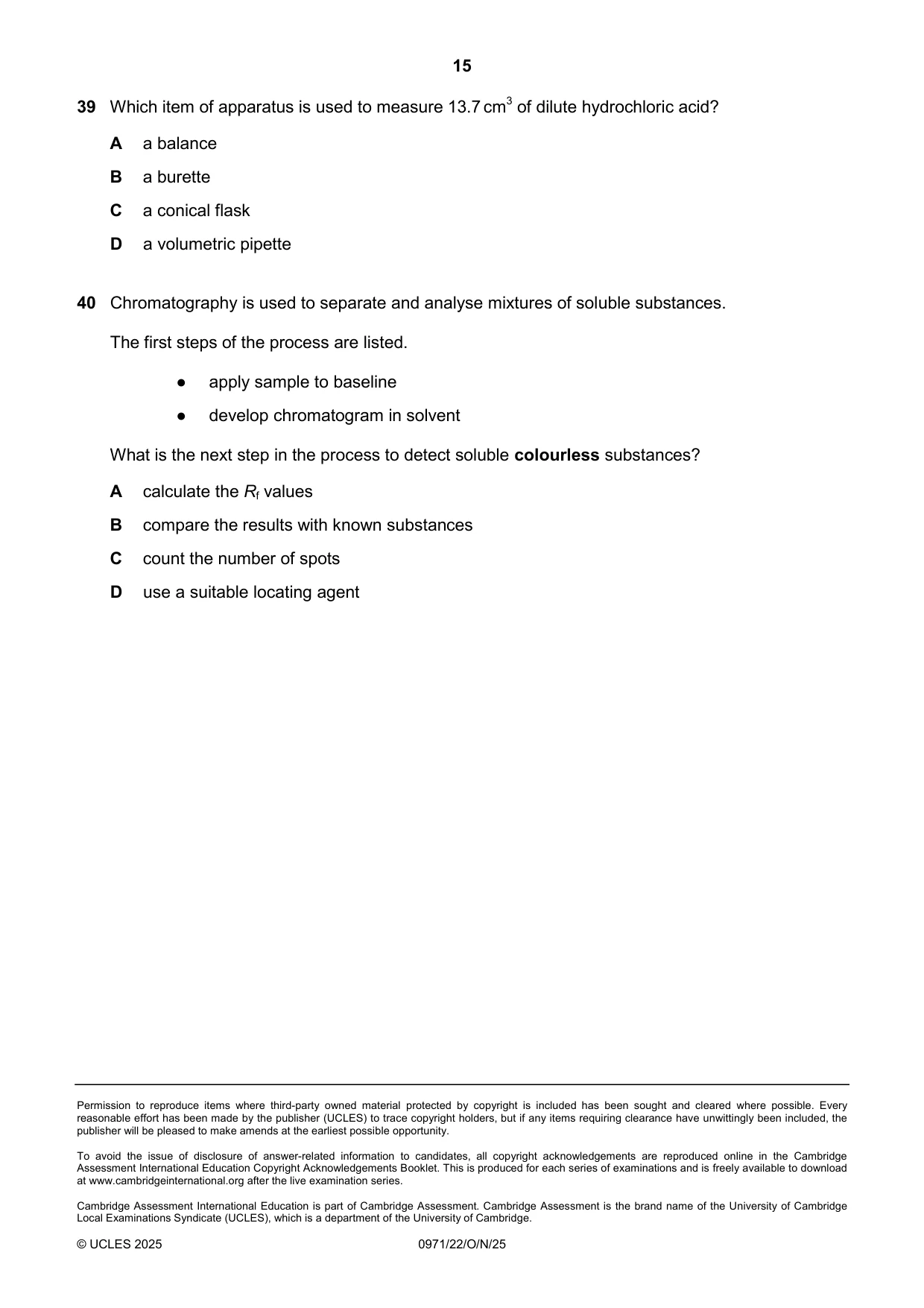
Q39 · Which item of apparatus is used to measure 13.7 cm3 of dilute hydrochloric acid?
39 Which item of apparatus is used to measure 13.7 cm3 of dilute hydrochloric acid? A a balance B a burette C a conical flask D a volumetric pipette
Mark scheme: B
Q40 · Chromatography is used to separate and analyse mixtures of soluble substances
40 Chromatography is used to separate and analyse mixtures of soluble substances. The first steps of the process are listed. ● apply sample to baseline ● develop chromatogram in solvent What is the next step in the process to detect soluble colourless substances? A calculate the Rf values B compare the results with known substances C count the number of spots D use a suitable locating agent
Mark scheme: D
What was in this paper
The subtopics covered by these 40 questions, and how many questions each got. Open one in a new tab to see every Cambridge question on it.
2Exothermic and endothermic reactions2Extraction of metals2Reversible reactions and equilibrium2Solids, liquids and gases2Alcohols1Alkenes1Atomic structure and the Periodic Table1Carboxylic acids1Chromatography1Corrosion of metals1Diffusion1Electrolysis1Elements, compounds and mixtures1Experimental design1Formulae1Formulae, functional groups and terminology1Fuels1Giant covalent structures1Group I properties1Group VII properties1Hydrogen–oxygen fuel cells1Ions and ionic bonds1Isotopes1Metallic bonding1Noble gases1Oxides1Polymers1Preparation of salts1Rate of reaction1Reactivity series1Redox1The characteristic properties of acids and bases1The mole and the Avogadro constant1Water1What you needed in this session
Cambridge’s own grade thresholds for 2025 Oct/Nov, Paper 2 · Variant 2. A higher threshold means an easier paper — the bar moves with how the cohort did.