Cambridge IGCSE Chemistry (9-1) 0971 — 2019 May/June Paper 2 · Variant 1
0971/21/M/J/19 · 40 questions · 40 marks · ≈45 min
The question paper and its mark scheme, free to read here and free to download. This is Cambridge’s own paper, exactly as it was sat.
Question paper16 pages
Mark scheme3 pages
Answers below. Sit the paper first if you are practising.
Questions as text
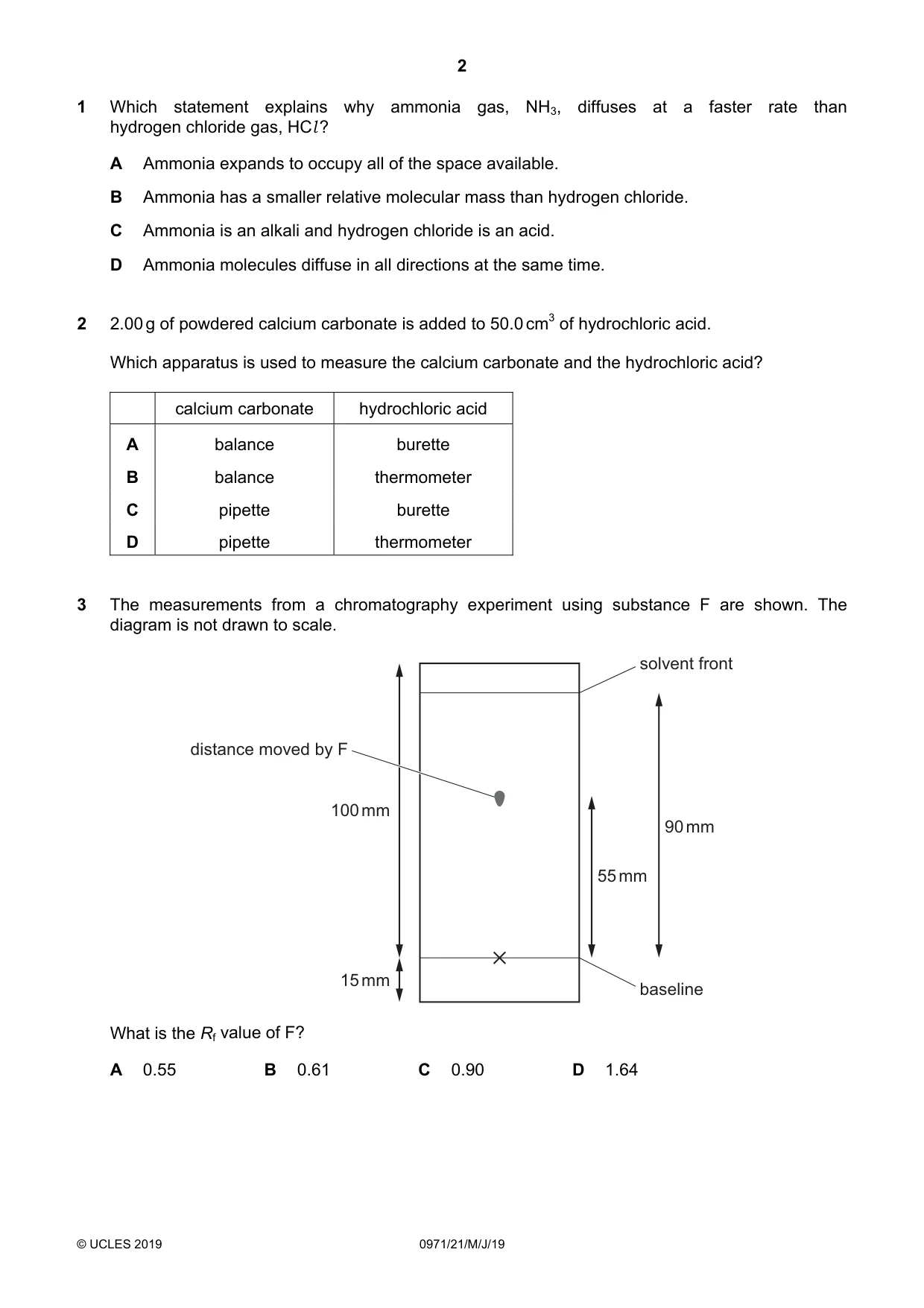
Q1 · Which statement explains why ammonia gas, NH3, diffuses at a faster rate than hydrogen…
1 Which statement explains why ammonia gas, NH3, diffuses at a faster rate than hydrogen chloride gas, HCl ? A Ammonia expands to occupy all of the space available. B Ammonia has a smaller relative molecular mass than hydrogen chloride. C Ammonia is an alkali and hydrogen chloride is an acid. D Ammonia molecules diffuse in all directions at the same time.
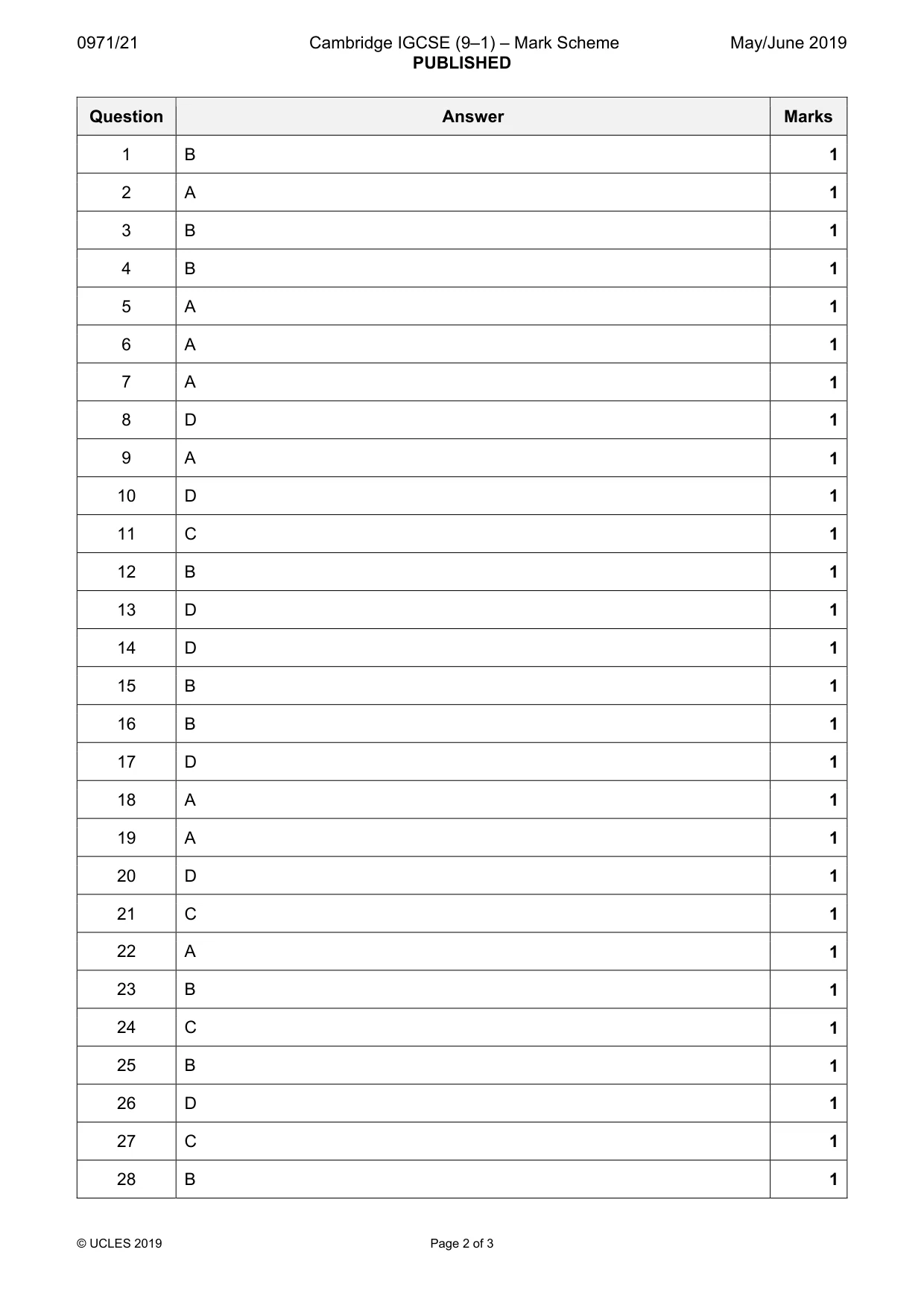
Mark scheme: B
Q2 · 2.00 g of powdered calcium carbonate is added to 50.0 cm3 of hydrochloric acid
2 2.00 g of powdered calcium carbonate is added to 50.0 cm3 of hydrochloric acid. Which apparatus is used to measure the calcium carbonate and the hydrochloric acid? calcium carbonate hydrochloric acid A balance burette B balance thermometer C pipette burette D pipette thermometer
Mark scheme: A
Q3 · The measurements from a chromatography experiment using substance F are shown
3 The measurements from a chromatography experiment using substance F are shown. The diagram is not drawn to scale. solvent front distance moved by F 100 mm 90 mm 55 mm 15 mm baseline What is the Rf value of F? A 0.55 B 0.61 C 0.90 D 1.64
Mark scheme: B
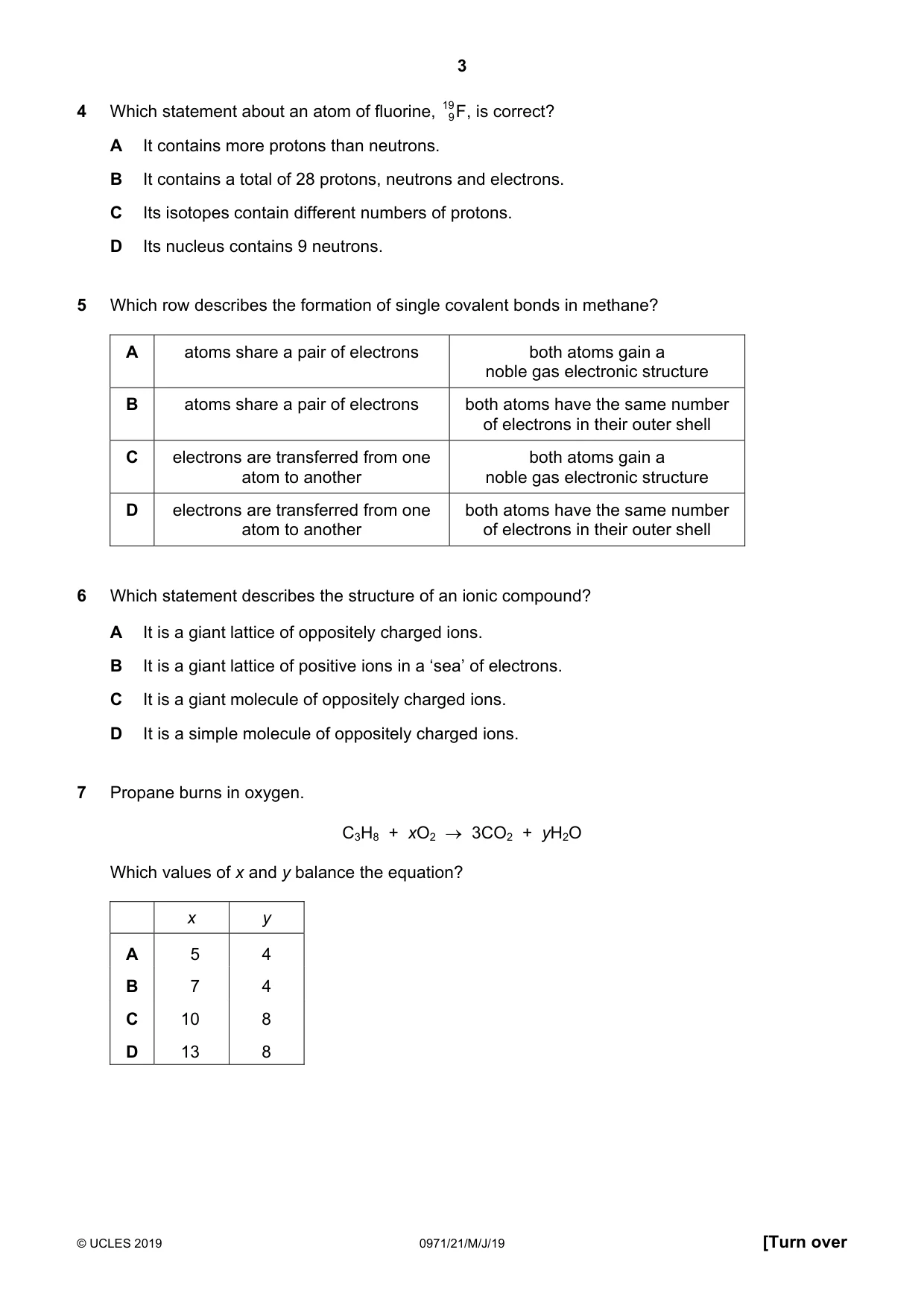
Q4 · Which statement about an atom of fluorine, 19 9 , is correct?
4 Which statement about an atom of fluorine, 19 9 , is correct? F A It contains more protons than neutrons. B It contains a total of 28 protons, neutrons and electrons. C Its isotopes contain different numbers of protons. D Its nucleus contains 9 neutrons.
Mark scheme: B
Q5 · Which row describes the formation of single covalent bonds in methane?
5 Which row describes the formation of single covalent bonds in methane? A atoms share a pair of electrons both atoms gain a noble gas electronic structure B atoms share a pair of electrons both atoms have the same number of electrons in their outer shell C electrons are transferred from one both atoms gain a atom to another noble gas electronic structure D electrons are transferred from one both atoms have the same number atom to another of electrons in their outer shell
Mark scheme: A
Q6 · Which statement describes the structure of an ionic compound?
6 Which statement describes the structure of an ionic compound? A It is a giant lattice of oppositely charged ions. B It is a giant lattice of positive ions in a ‘sea’ of electrons. C It is a giant molecule of oppositely charged ions. D It is a simple molecule of oppositely charged ions.
Mark scheme: A
Q7 · Propane burns in oxygen
7 Propane burns in oxygen. C3H8 + xO2 → 3CO2 + yH2O Which values of x and y balance the equation? x y A 5 4 B 7 4 C 10 8 D 13 8
Mark scheme: A
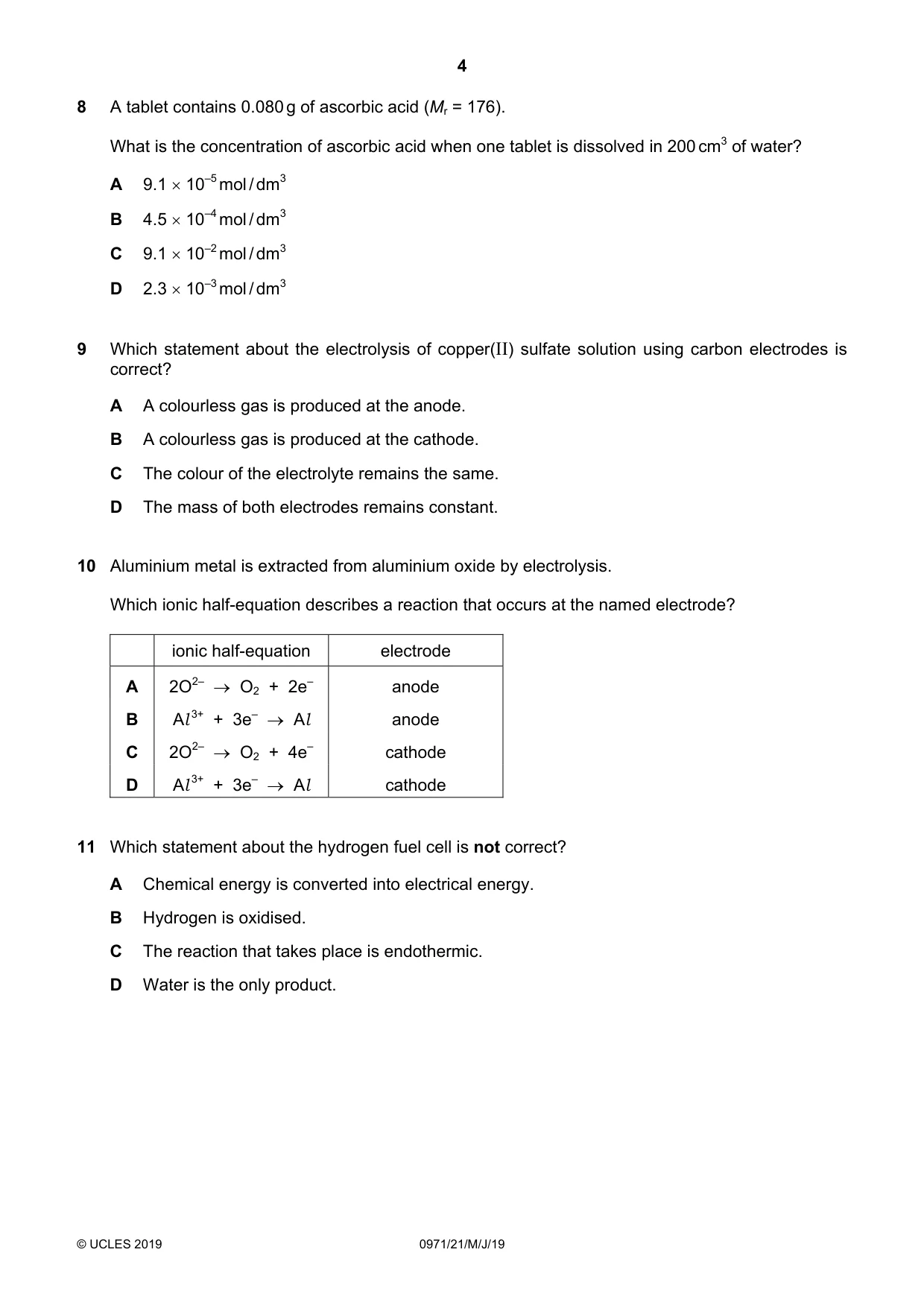
Q8 · A tablet contains 0.080 g of ascorbic acid (Mr = 176)
8 A tablet contains 0.080 g of ascorbic acid (Mr = 176). What is the concentration of ascorbic acid when one tablet is dissolved in 200 cm3 of water? A 9.1 × 10⁻⁵ mol / dm3 B 4.5 × 10⁻⁴ mol / dm3 C 9.1 × 10⁻² mol / dm3 D 2.3 × 10⁻³ mol / dm3
Mark scheme: D
Q9 · Which statement about the electrolysis of copper(II) sulfate solution using carbon…
9 Which statement about the electrolysis of copper(II) sulfate solution using carbon electrodes is correct? A A colourless gas is produced at the anode. B A colourless gas is produced at the cathode. C The colour of the electrolyte remains the same. D The mass of both electrodes remains constant.
Mark scheme: A
Q10 · Aluminium metal is extracted from aluminium oxide by electrolysis
10 Aluminium metal is extracted from aluminium oxide by electrolysis. Which ionic half-equation describes a reaction that occurs at the named electrode? ionic half-equation electrode A 2O2– → O2 + 2e– anode B Al 3+ + 3e– → Al anode C 2O2– → O2 + 4e– cathode D Al 3+ + 3e– → Al cathode
Mark scheme: D
Q11 · Which statement about the hydrogen fuel cell is not correct?
11 Which statement about the hydrogen fuel cell is not correct? A Chemical energy is converted into electrical energy. B Hydrogen is oxidised. C The reaction that takes place is endothermic. D Water is the only product.
Mark scheme: C
Q12 · Nitrogen reacts with hydrogen to produce ammonia
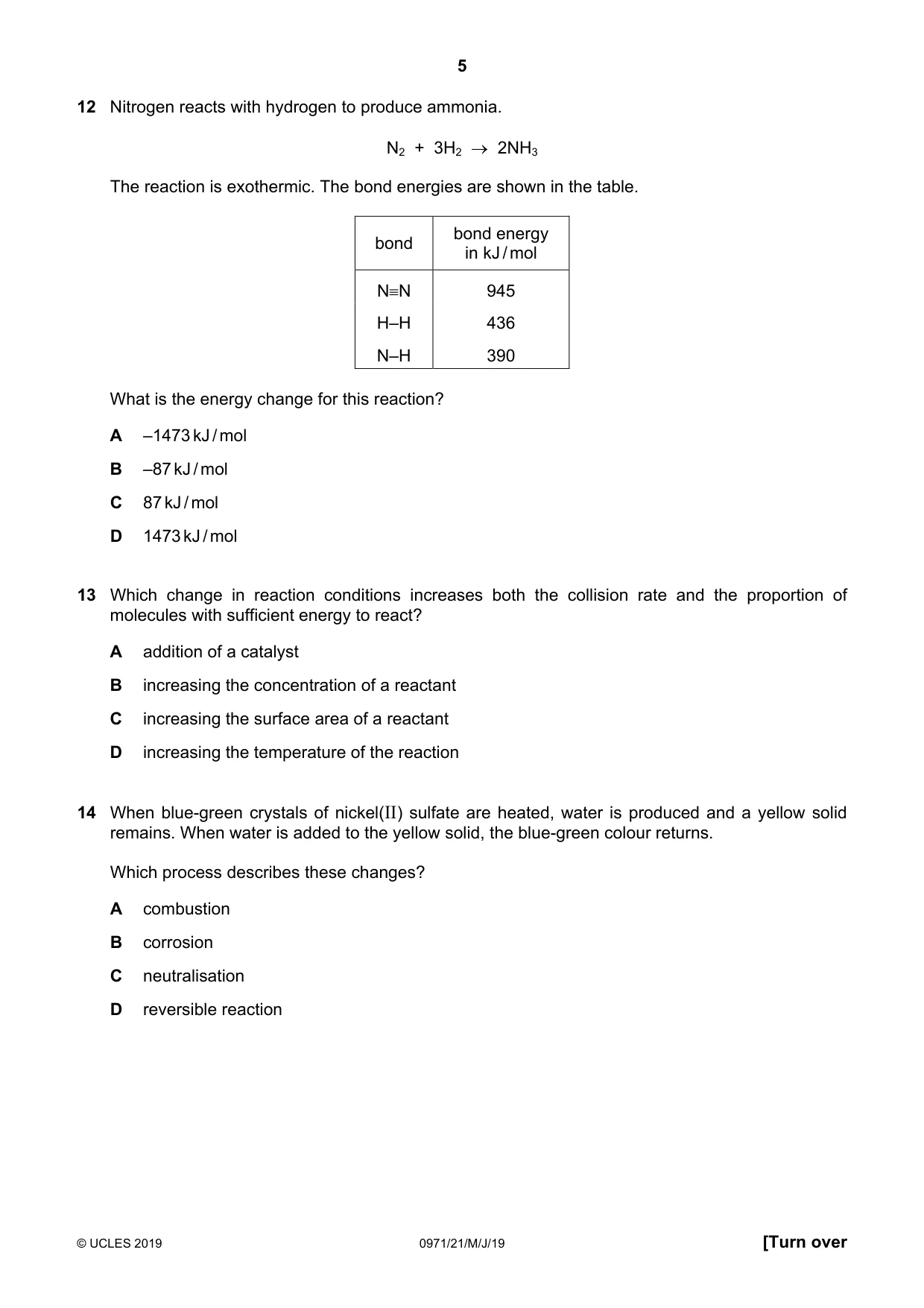
12 Nitrogen reacts with hydrogen to produce ammonia. N2 + 3H2 → 2NH3 The reaction is exothermic. The bond energies are shown in the table. bond energy bond in kJ / mol N≡N 945 H–H 436 N–H 390 What is the energy change for this reaction? A –1473 kJ / mol B –87 kJ / mol C 87 kJ / mol D 1473 kJ / mol
Mark scheme: B
Q13 · Which change in reaction conditions increases both the collision rate and the proportion…
13 Which change in reaction conditions increases both the collision rate and the proportion of molecules with sufficient energy to react? A addition of a catalyst B increasing the concentration of a reactant C increasing the surface area of a reactant D increasing the temperature of the reaction
Mark scheme: D
Q14 · When blue-green crystals of nickel(II) sulfate are heated, water is produced and a yellow…
14 When blue-green crystals of nickel(II) sulfate are heated, water is produced and a yellow solid remains. When water is added to the yellow solid, the blue-green colour returns. Which process describes these changes? A combustion B corrosion C neutralisation D reversible reaction
Mark scheme: D
Q15 · The graph shows how the yield of product in a reversible reaction changes as the…
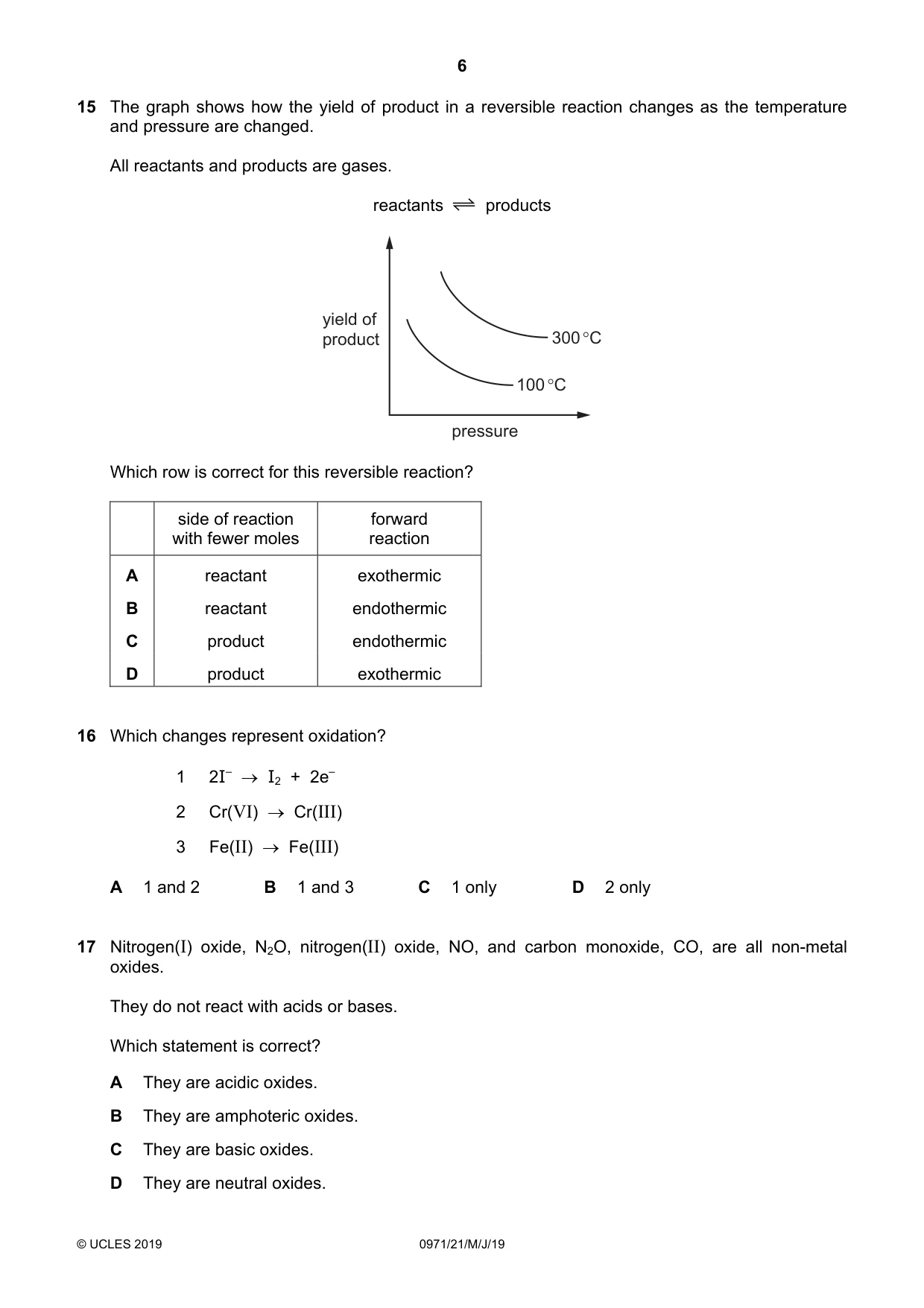
15 The graph shows how the yield of product in a reversible reaction changes as the temperature and pressure are changed. All reactants and products are gases. reactants products yield of product 300 °C 100 °C pressure Which row is correct for this reversible reaction? side of reaction forward with fewer moles reaction A reactant exothermic B reactant endothermic C product endothermic D product exothermic
Mark scheme: B
Q16 · Which changes represent oxidation?
16 Which changes represent oxidation? 1 2I– → I2 + 2e– 2 Cr(VI) → Cr(III) 3 Fe(II) → Fe(III) A 1 and 2 B 1 and 3 C 1 only D 2 only
Mark scheme: B
Q17 · Nitrogen(I) oxide, N2O, nitrogen(II) oxide, NO, and carbon monoxide, CO, are all…
17 Nitrogen(I) oxide, N2O, nitrogen(II) oxide, NO, and carbon monoxide, CO, are all non-metal oxides. They do not react with acids or bases. Which statement is correct? A They are acidic oxides. B They are amphoteric oxides. C They are basic oxides. D They are neutral oxides.
Mark scheme: D
Q18 · The positions of elements W, X, Y and Z in the Periodic Table are shown
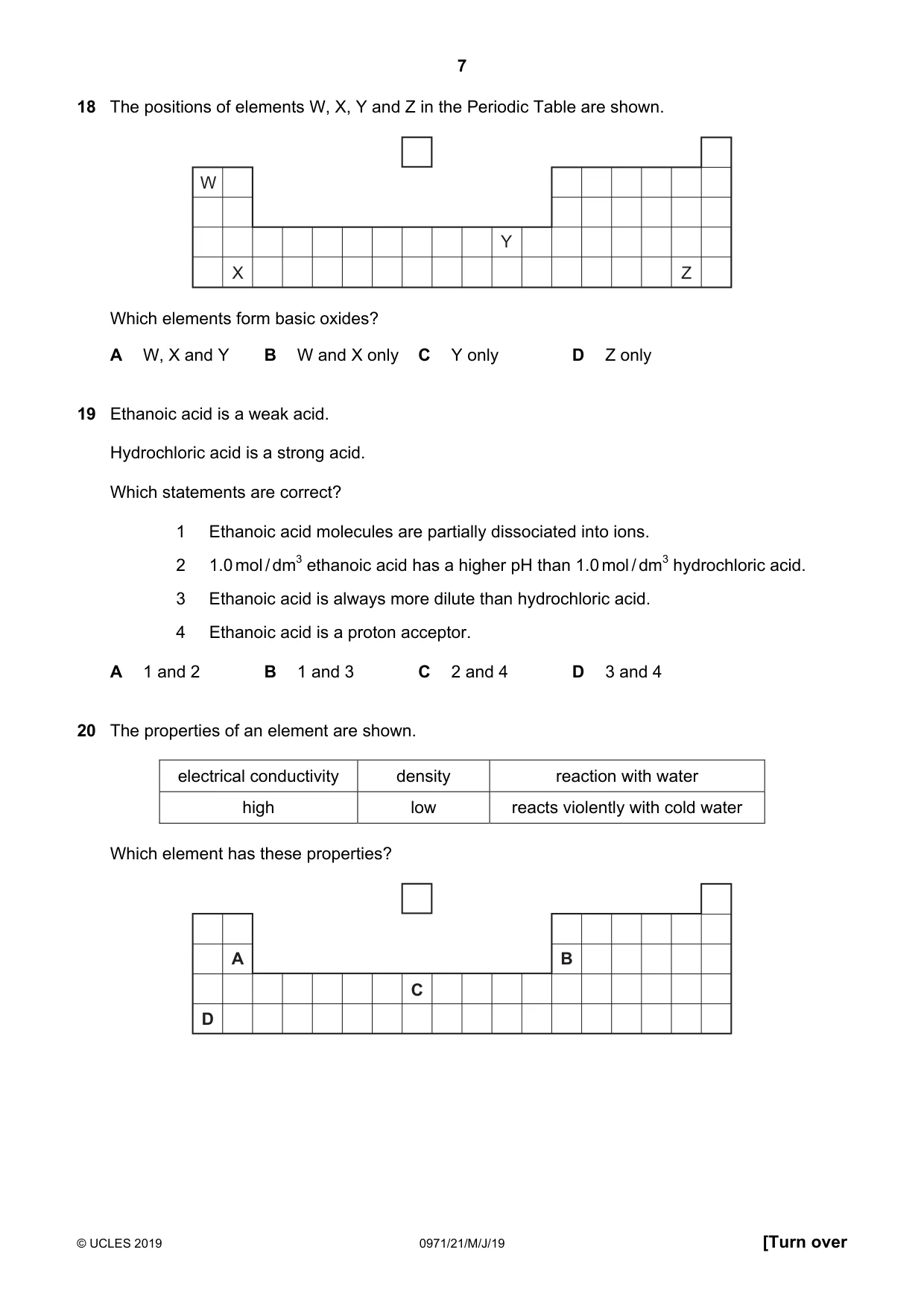
18 The positions of elements W, X, Y and Z in the Periodic Table are shown. W Y X Z Which elements form basic oxides? A W, X and Y B W and X only C Y only D Z only
Mark scheme: A
Q19 · Ethanoic acid is a weak acid
19 Ethanoic acid is a weak acid. Hydrochloric acid is a strong acid. Which statements are correct? 1 Ethanoic acid molecules are partially dissociated into ions. 2 1.0 mol / dm3 ethanoic acid has a higher pH than 1.0 mol / dm3 hydrochloric acid. 3 Ethanoic acid is always more dilute than hydrochloric acid. 4 Ethanoic acid is a proton acceptor. A 1 and 2 B 1 and 3 C 2 and 4 D 3 and 4
Mark scheme: A
More questions on The characteristic properties of acids and bases
Q20 · The properties of an element are shown
20 The properties of an element are shown. electrical conductivity density reaction with water high low reacts violently with cold water Which element has these properties? A B C D
Mark scheme: D
Q21 · Which statement about elements in Group I and Group VII of the Periodic Table is correct?
21 Which statement about elements in Group I and Group VII of the Periodic Table is correct? A Bromine reacts with potassium chloride to produce chlorine. B Iodine is a monoatomic non-metal. C Lithium has a higher melting point than potassium. D Sodium is more reactive with water than potassium.
Mark scheme: C
Q22 · Which statement about elements in Group VIII of the Periodic Table is correct?
22 Which statement about elements in Group VIII of the Periodic Table is correct? A They all have a full outer shell of electrons. B They all react with Group I elements to form ionic compounds. C They are all diatomic molecules. D They are all liquids at room temperature.
Mark scheme: A
Q23 · The diagrams show the structure of two substances used to make electrical conductors
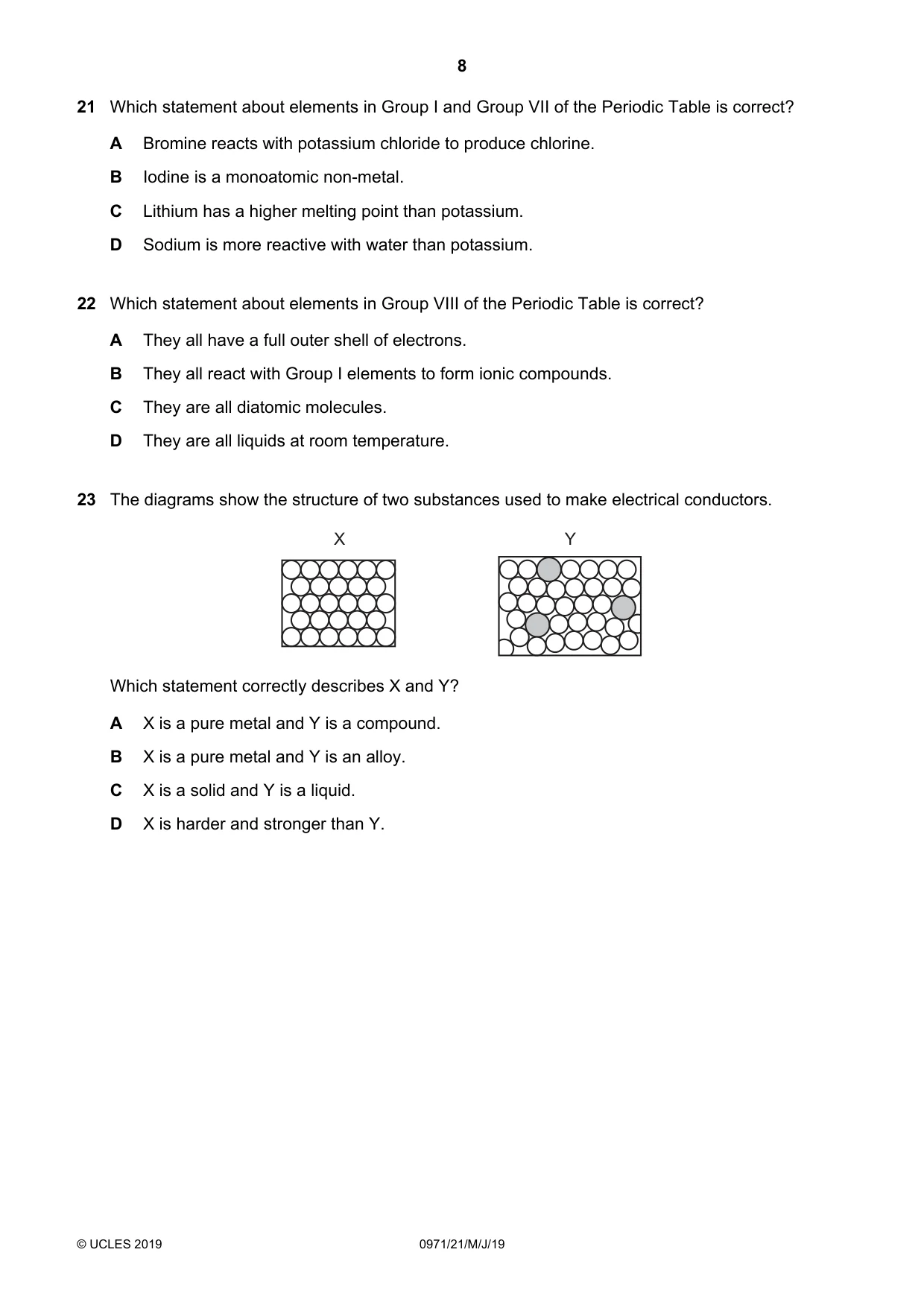
23 The diagrams show the structure of two substances used to make electrical conductors. X Y Which statement correctly describes X and Y? A X is a pure metal and Y is a compound. B X is a pure metal and Y is an alloy. C X is a solid and Y is a liquid. D X is harder and stronger than Y.
Mark scheme: B
Q24 · Three metal compounds, P, Q and R, are heated using a Bunsen burner
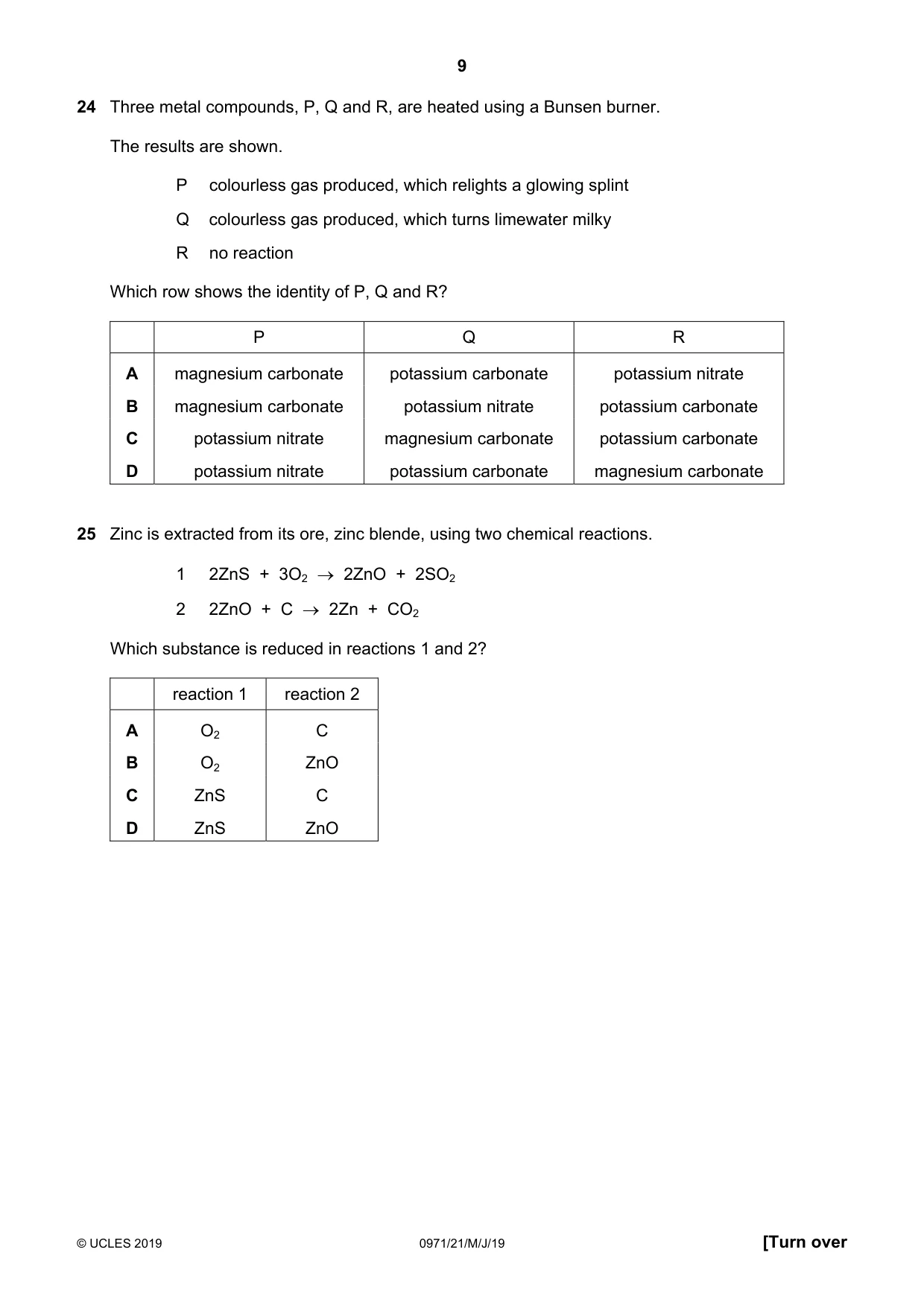
24 Three metal compounds, P, Q and R, are heated using a Bunsen burner. The results are shown. P colourless gas produced, which relights a glowing splint Q colourless gas produced, which turns limewater milky R no reaction Which row shows the identity of P, Q and R? P Q R A magnesium carbonate potassium carbonate potassium nitrate B magnesium carbonate potassium nitrate potassium carbonate C potassium nitrate magnesium carbonate potassium carbonate D potassium nitrate potassium carbonate magnesium carbonate
Mark scheme: C
Q25 · Zinc is extracted from its ore, zinc blende, using two chemical reactions
25 Zinc is extracted from its ore, zinc blende, using two chemical reactions. 1 2ZnS + 3O2 → 2ZnO + 2SO2 2 2ZnO + C → 2Zn + CO2 Which substance is reduced in reactions 1 and 2? reaction 1 reaction 2 A O2 C B O2 ZnO C ZnS C D ZnS ZnO
Mark scheme: B
Q26 · Four metals, zinc, M, copper and magnesium, are reacted with aqueous solutions of their…
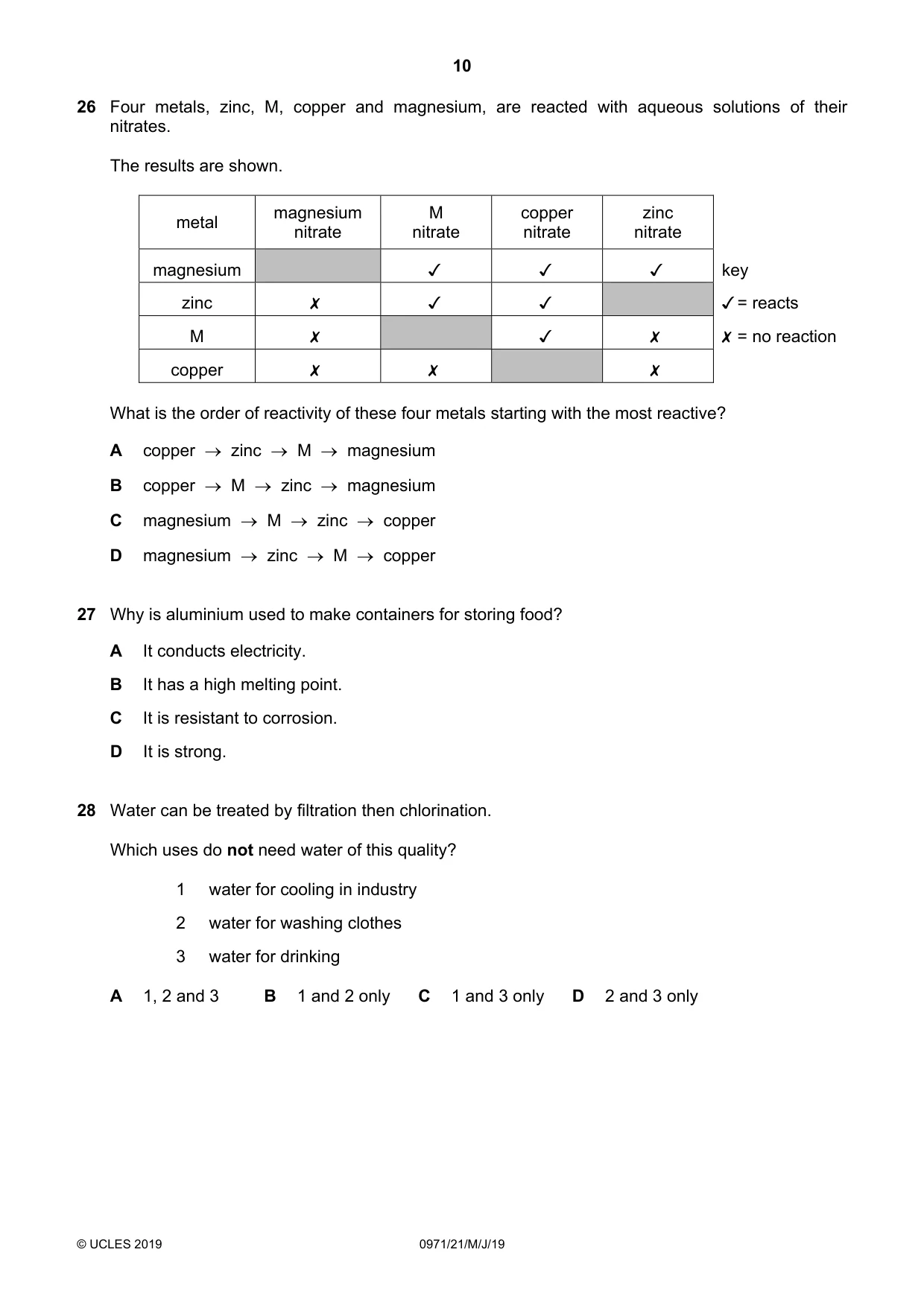
26 Four metals, zinc, M, copper and magnesium, are reacted with aqueous solutions of their nitrates. The results are shown. magnesium M copper zinc metal . . ; ; nitrate nitrate nitrate nitrate magnesium v v v key zinc x Jv v J/ = reacts M x Jv x X =no reaction copper x x What is the order of reactivity of these four metals starting with the most reactive? A copper > zinc + M + magnesium B copper > M -> zinc + magnesium C magnesium > M -> zinc > copper D magnesium — zinc + M -— copper
Mark scheme: D
Q27 · Why is aluminium used to make containers for storing food?
27 Why is aluminium used to make containers for storing food? A It conducts electricity. B It has a high melting point. C It is resistant to corrosion. D It is strong.
Mark scheme: C
Q28 · Water can be treated by filtration then chlorination
28 Water can be treated by filtration then chlorination. Which uses do not need water of this quality? 1 water for cooling in industry 2 water for washing clothes 3 water for drinking A 1, 2 and 3 B 1 and 2 only C 1 and 3 only D 2 and 3 only
Mark scheme: B
Q29 · Oxides of nitrogen are formed in car engines and are a source of air pollution
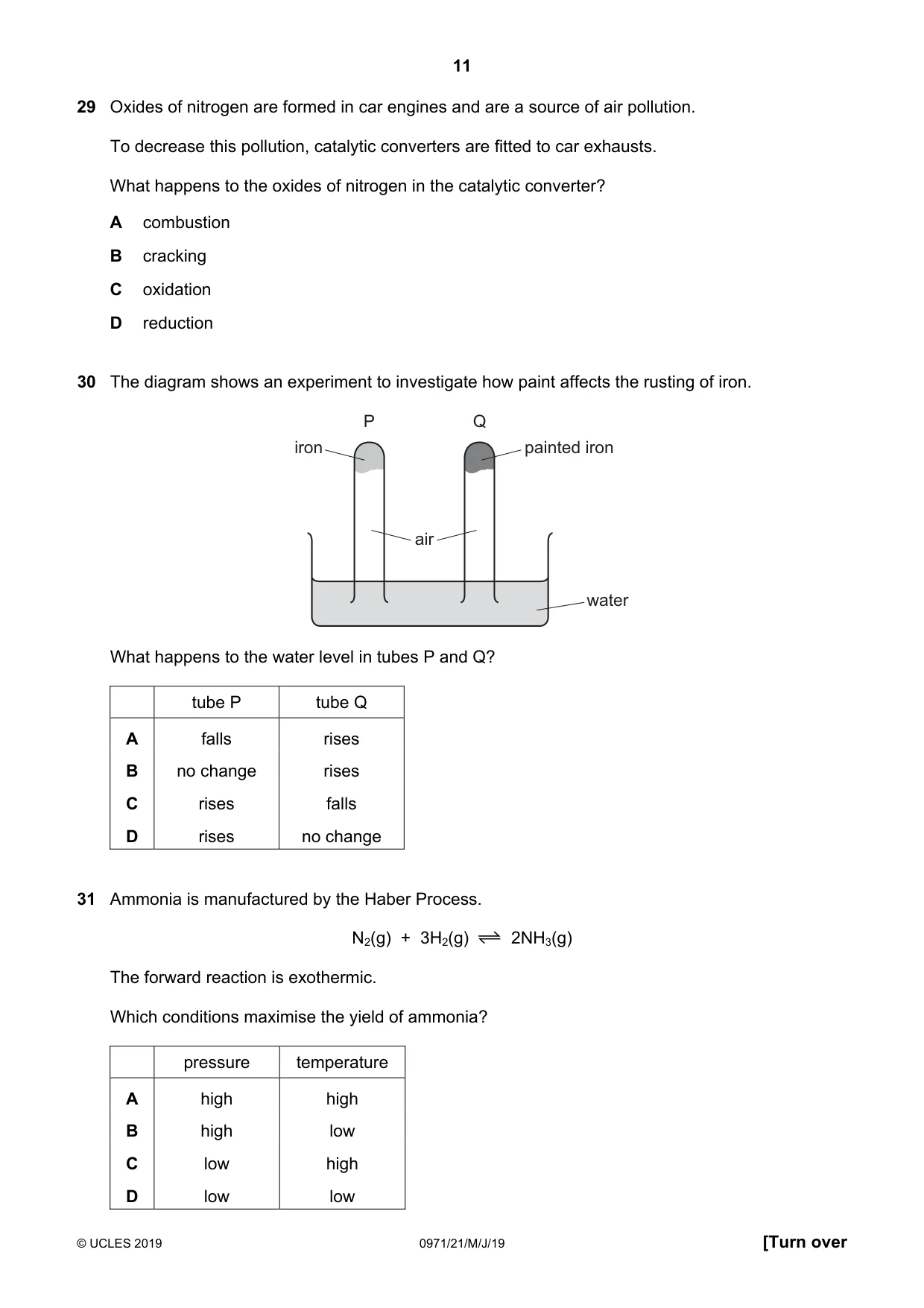
29 Oxides of nitrogen are formed in car engines and are a source of air pollution. To decrease this pollution, catalytic converters are fitted to car exhausts. What happens to the oxides of nitrogen in the catalytic converter? A combustion B cracking C oxidation D reduction
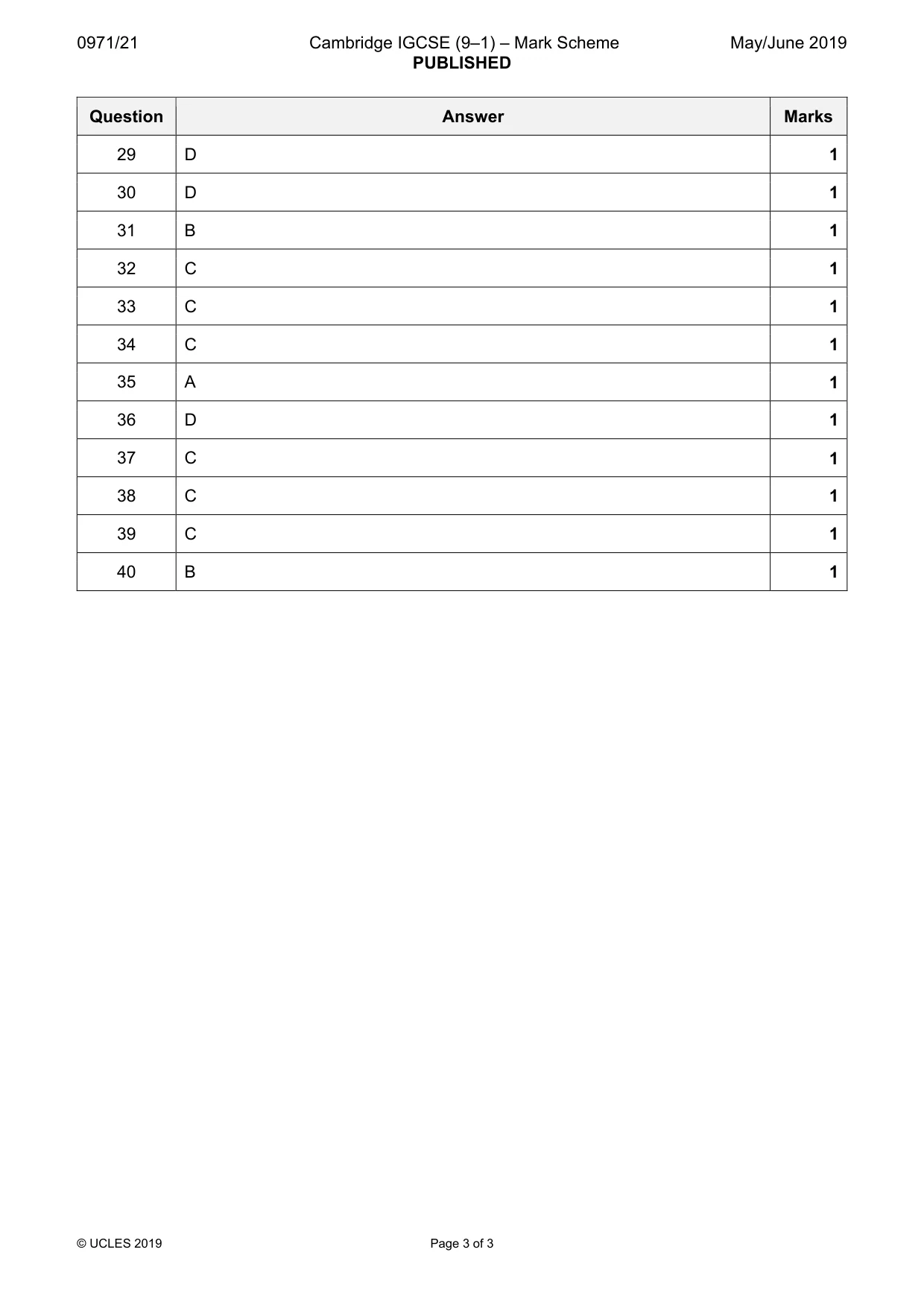
Mark scheme: D
Q30 · The diagram shows an experiment to investigate how paint affects the rusting of iron
30 The diagram shows an experiment to investigate how paint affects the rusting of iron. P Q iron painted iron air water What happens to the water level in tubes P and Q? tube P tube Q A falls rises B no change rises C rises falls D rises no change
Mark scheme: D
Q31 · Ammonia is manufactured by the Haber Process
31 Ammonia is manufactured by the Haber Process. N2(g) + 3H2(g) 2NH3(g) The forward reaction is exothermic. Which conditions maximise the yield of ammonia? pressure temperature A high high B high low C low high D low low
Mark scheme: B
Q32 · The carbon cycle is shown
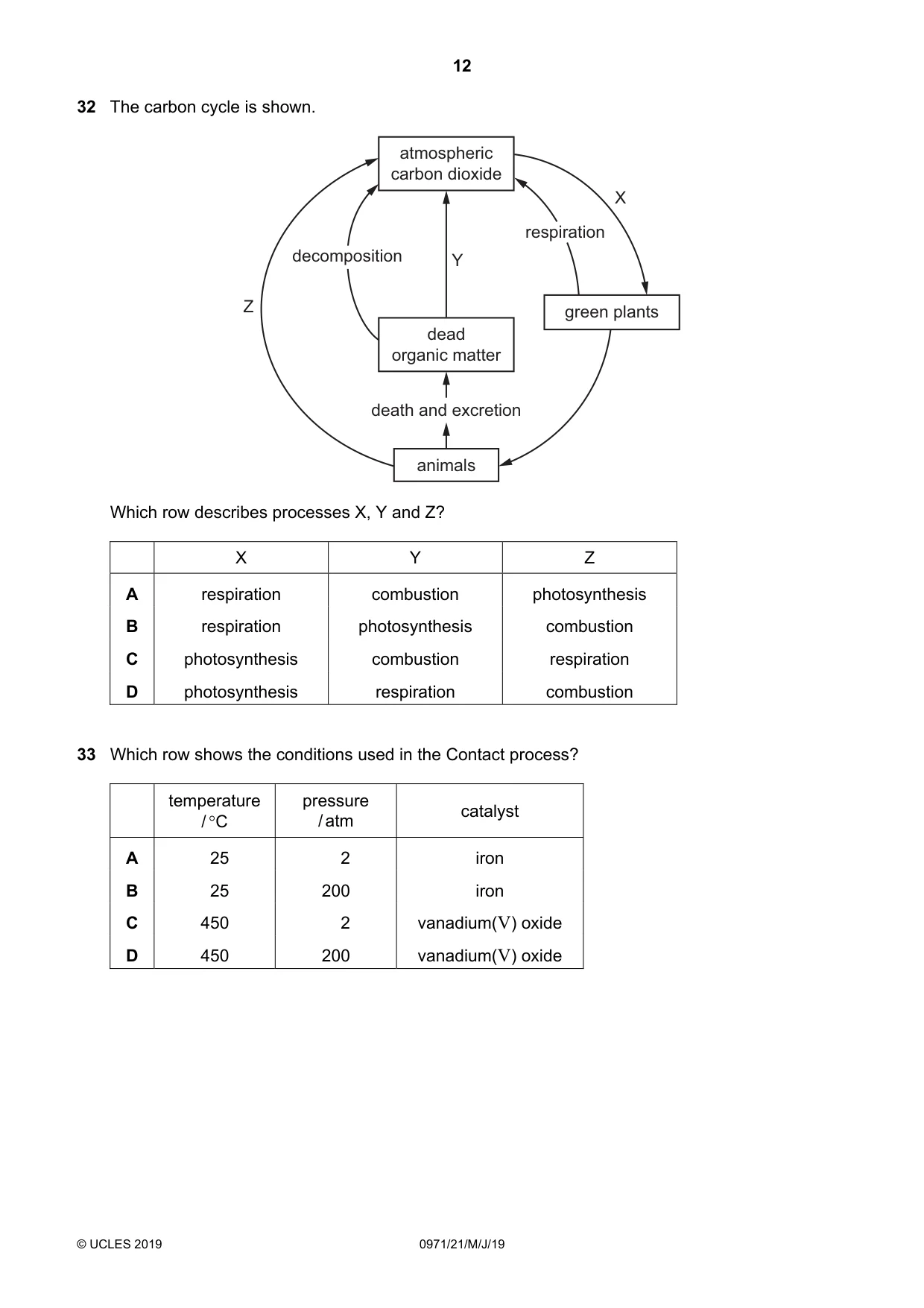
32 The carbon cycle is shown. atmospheric carbon dioxide X respiration decomposition Y Z green plants dead organic matter death and excretion animals Which row describes processes X, Y and Z? X Y Z A respiration combustion photosynthesis B respiration photosynthesis combustion C photosynthesis combustion respiration D photosynthesis respiration combustion
Mark scheme: C
Q33 · Which row shows the conditions used in the Contact process?
33 Which row shows the conditions used in the Contact process? temperature pressure catalyst / °C / atm A 25 2 iron B 25 200 iron C 450 2 vanadium(V) oxide D 450 200 vanadium(V) oxide
Mark scheme: C
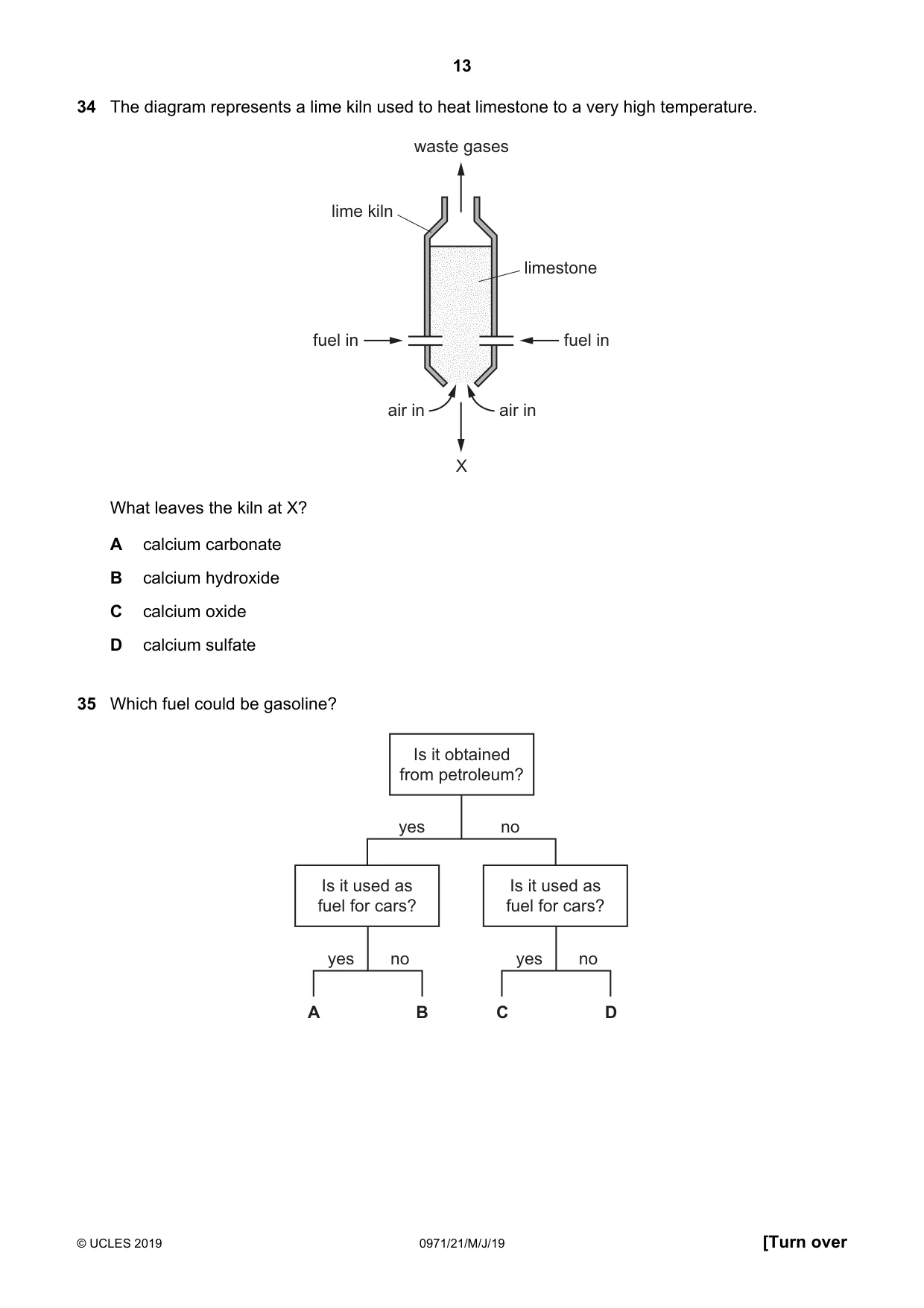
Q34 · The diagram represents a lime kiln used to heat limestone to a very high temperature
34 The diagram represents a lime kiln used to heat limestone to a very high temperature. waste gases lime kiln limestone fuel in fuel in air in air in X What leaves the kiln at X? A calcium carbonate B calcium hydroxide C calcium oxide D calcium sulfate
Mark scheme: C
Q35 · Which fuel could be gasoline?
35 Which fuel could be gasoline? Is it obtained from petroleum? yes no Is it used as Is it used as fuel for cars? fuel for cars? yes no yes no A B C D
Mark scheme: A
Q36 · Why is ethanol a member of the homologous series of alcohols but propane is not?
36 Why is ethanol a member of the homologous series of alcohols but propane is not? A Ethanol has two carbon atoms per molecule but propane has three. B Ethanol can be made from ethene but propane is obtained from petroleum. C Ethanol is a liquid but propane is a gas. D Ethanol contains the same functional group as other alcohols but propane does not.
Mark scheme: D
More questions on Formulae, functional groups and terminology
Q37 · Chlorine reacts with methane
37 Chlorine reacts with methane. Which statements are correct? 1 The reaction takes place in the dark. 2 The reaction of chlorine with methane forms chloromethane. 3 Chloromethane reacts with chlorine to produce dichloromethane. 4 The reaction of chlorine with methane is an addition reaction. A 1 and 2 B 1 and 3 C 2 and 3 D 3 and 4
Mark scheme: C
Q38 · Which statements about aqueous ethanoic acid are correct?
38 Which statements about aqueous ethanoic acid are correct? 1 Ethanoic acid contains the functional group –COOH. 2 Ethanoic acid reacts with carbonates to produce hydrogen. 3 Ethanoic acid turns Universal Indicator paper blue. 4 Ethanoic acid has a pH lower than pH 7. A 1 and 2 B 1 and 3 C 1 and 4 D 2 and 4
Mark scheme: C
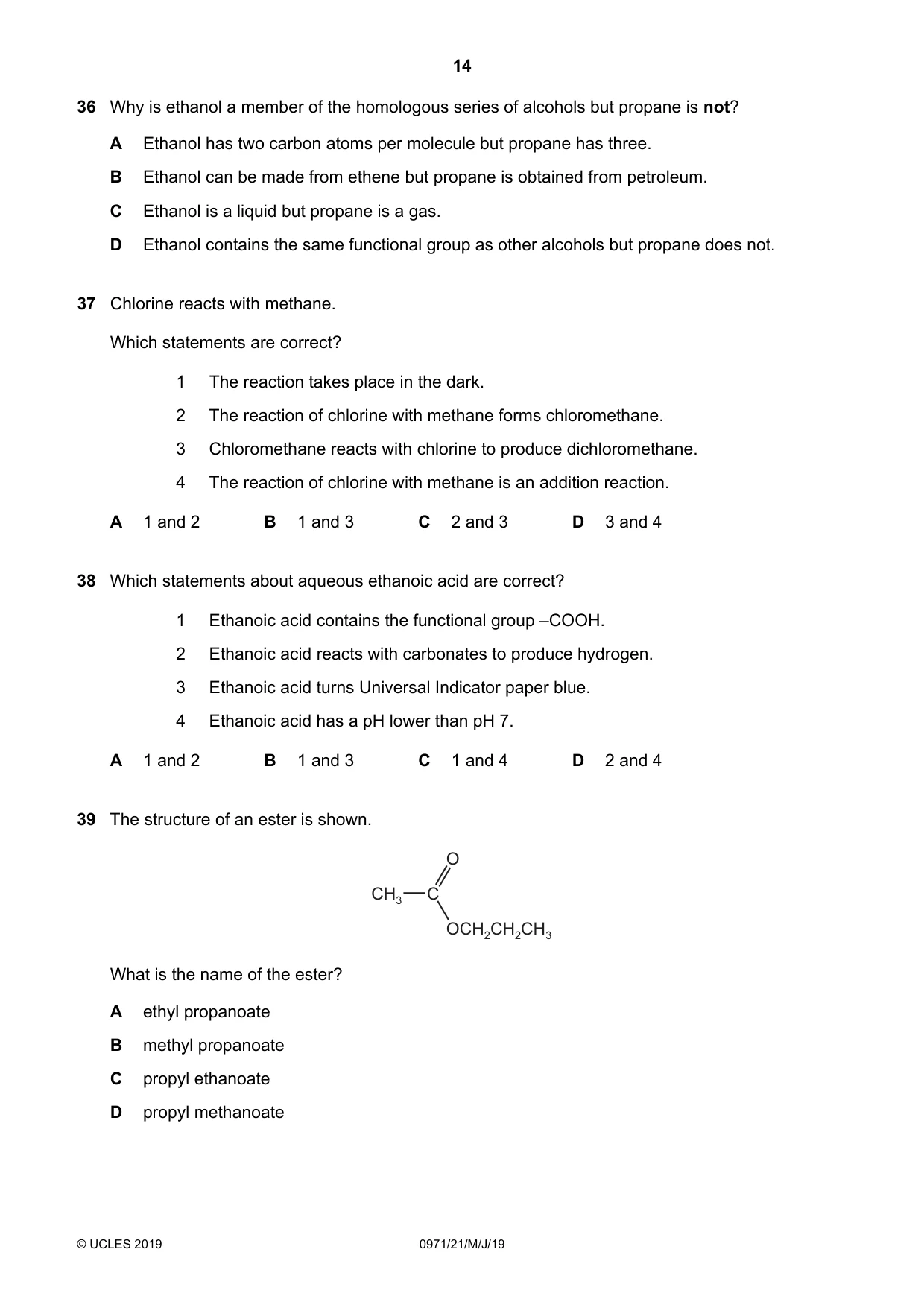
Q39 · The structure of an ester is shown
39 The structure of an ester is shown. O CH3 C OCH2CH2CH3 What is the name of the ester? A ethyl propanoate B methyl propanoate C propyl ethanoate D propyl methanoate
Mark scheme: C
More questions on Formulae, functional groups and terminology
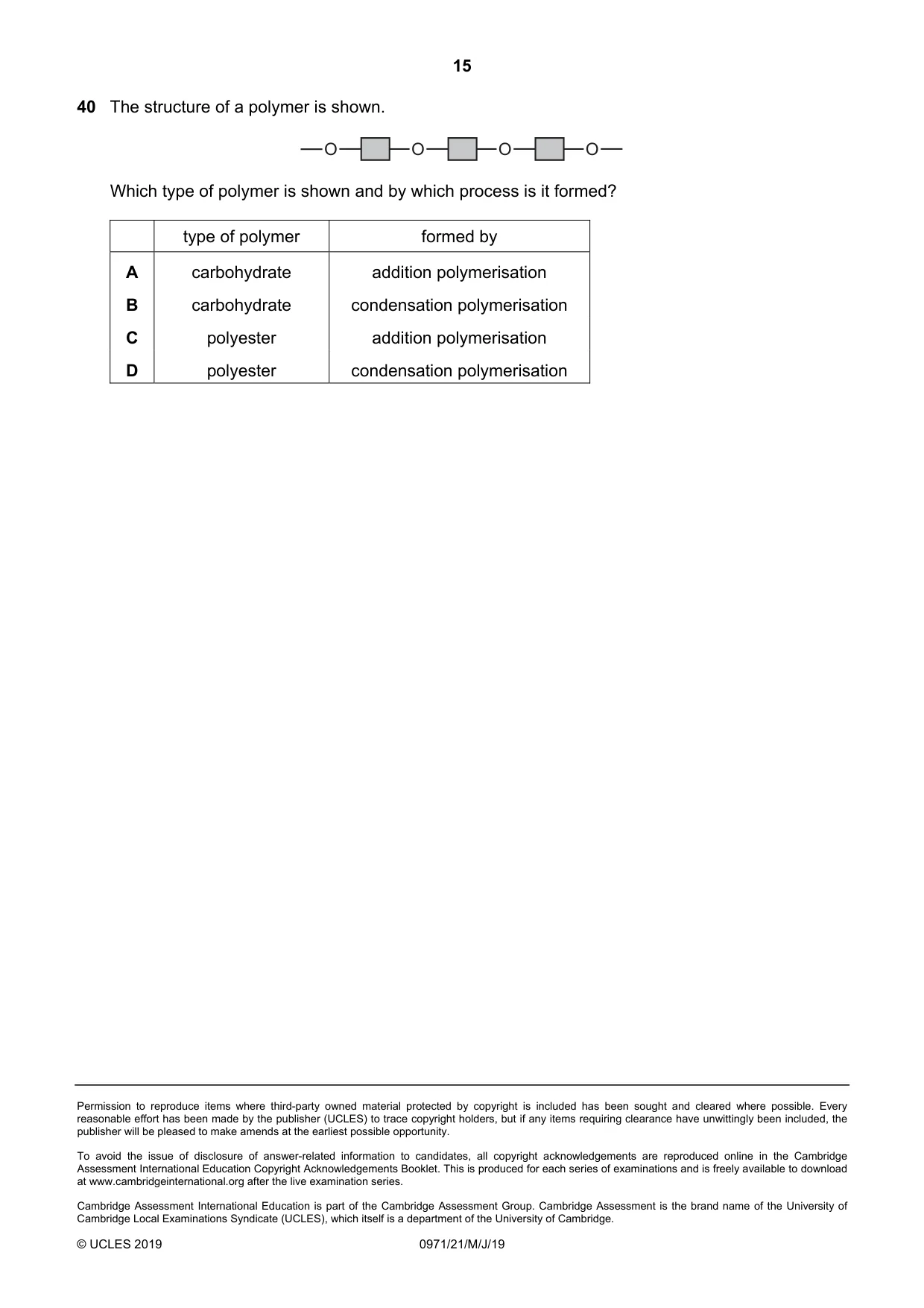
Q40 · The structure of a polymer is shown
40 The structure of a polymer is shown. O O O O Which type of polymer is shown and by which process is it formed? type of polymer formed by A carbohydrate addition polymerisation B carbohydrate condensation polymerisation C polyester addition polymerisation D polyester condensation polymerisation
Mark scheme: B
What was in this paper
The subtopics covered by these 40 questions, and how many questions each got. Open one in a new tab to see every Cambridge question on it.
4Oxides3Air quality and climate2Corrosion of metals2Electrolysis2Formulae, functional groups and terminology2Redox2Alkanes1Alloys and their properties1Atomic structure and the Periodic Table1Carboxylic acids1Chromatography1Diffusion1Exothermic and endothermic reactions1Experimental design1Formulae1Fuels1Group I properties1Group VII properties1Hydrogen–oxygen fuel cells1Identification of ions and gases1Ions and ionic bonds1Noble gases1Polymers1Rate of reaction1Reactivity series1Simple molecules and covalent bonds1The characteristic properties of acids and bases1The mole and the Avogadro constant1Water1What you needed in this session
Cambridge’s own grade thresholds for 2019 May/June, Paper 2 · Variant 1. A higher threshold means an easier paper — the bar moves with how the cohort did.