Cambridge IGCSE Chemistry (9-1) 0971 — 2023 May/June Paper 2 · Variant 1
0971/21/M/J/23 · 40 questions · 40 marks · 45 min
The question paper and its mark scheme, free to read here and free to download. This is Cambridge’s own paper, exactly as it was sat.
Question paper16 pages


Mark scheme3 pages
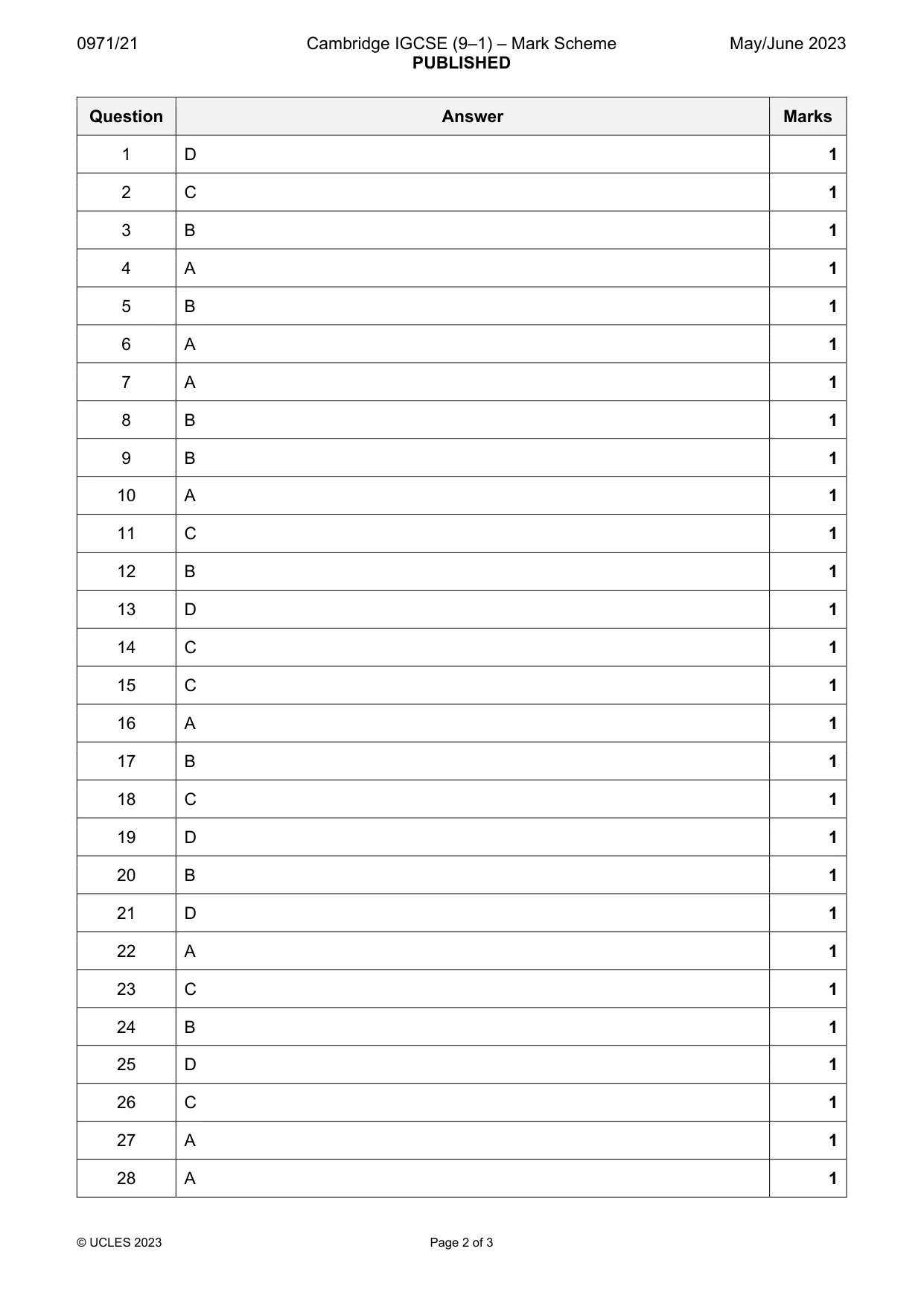
Answers below. Sit the paper first if you are practising.
Questions as text
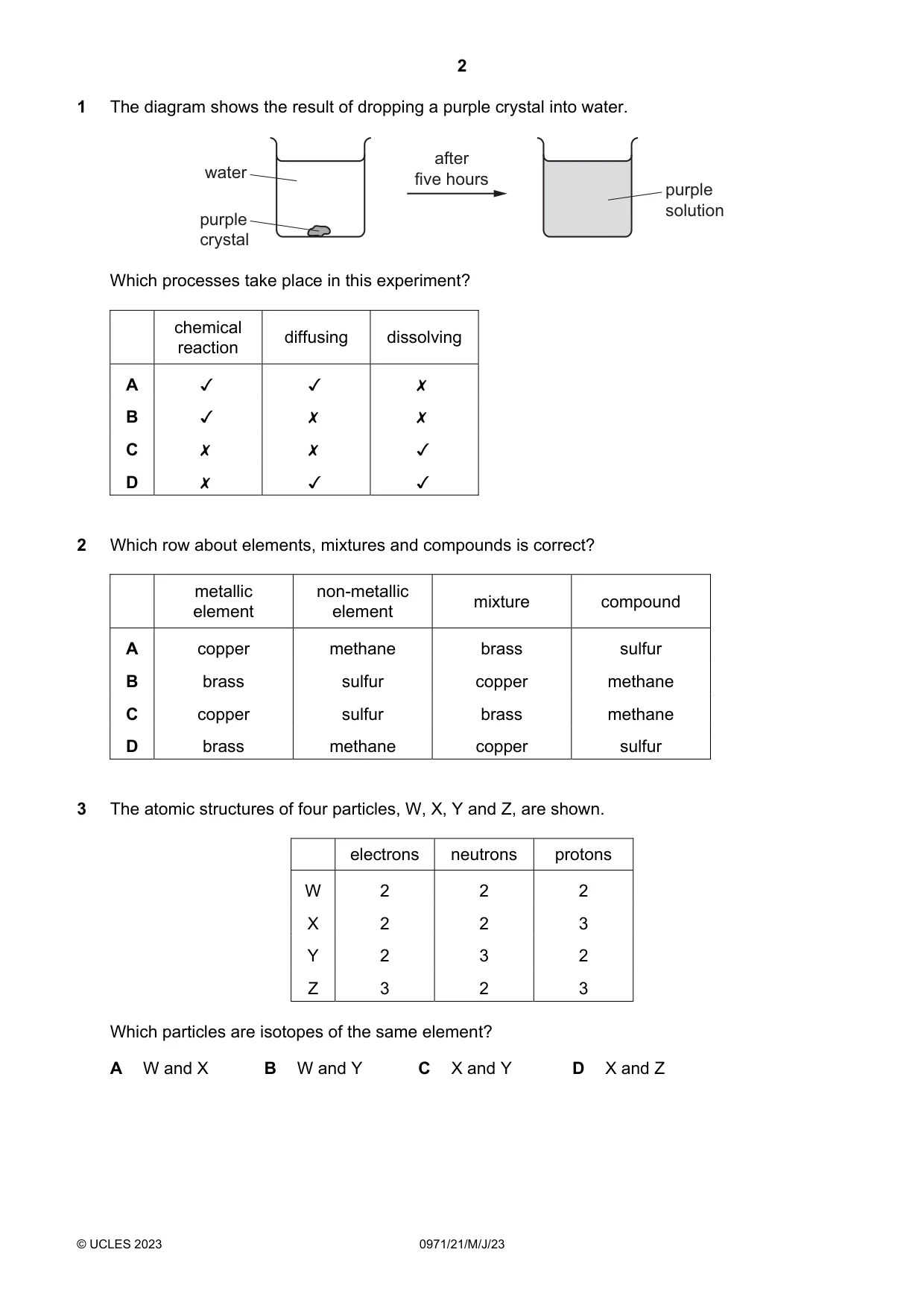
Q1 · The diagram shows the result of dropping a purple crystal into water
1. The diagram shows the result of dropping a purple crystal into water. after water five hours —__ > purple purple solution crystal Which processes take place in this experiment? chemical reaction diffusing dissolving 0 OO WwW PY x « & Ke O&K << & x
Mark scheme: D
Q2 · Which row about elements, mixtures and compounds is correct?
2 Which row about elements, mixtures and compounds is correct? metallic non-metallic mixture compound element element A copper methane brass sulfur B brass sulfur copper methane C copper sulfur brass methane D brass methane copper sulfur
Mark scheme: C
Q3 · The atomic structures of four particles, W, X, Y and Z, are shown
3 The atomic structures of four particles, W, X, Y and Z, are shown. electrons neutrons protons W 2 2 2 X 2 2 3 Y 2 3 2 Z 3 2 3 Which particles are isotopes of the same element? A W and X B W and Y C X and Y D X and Z
Mark scheme: B
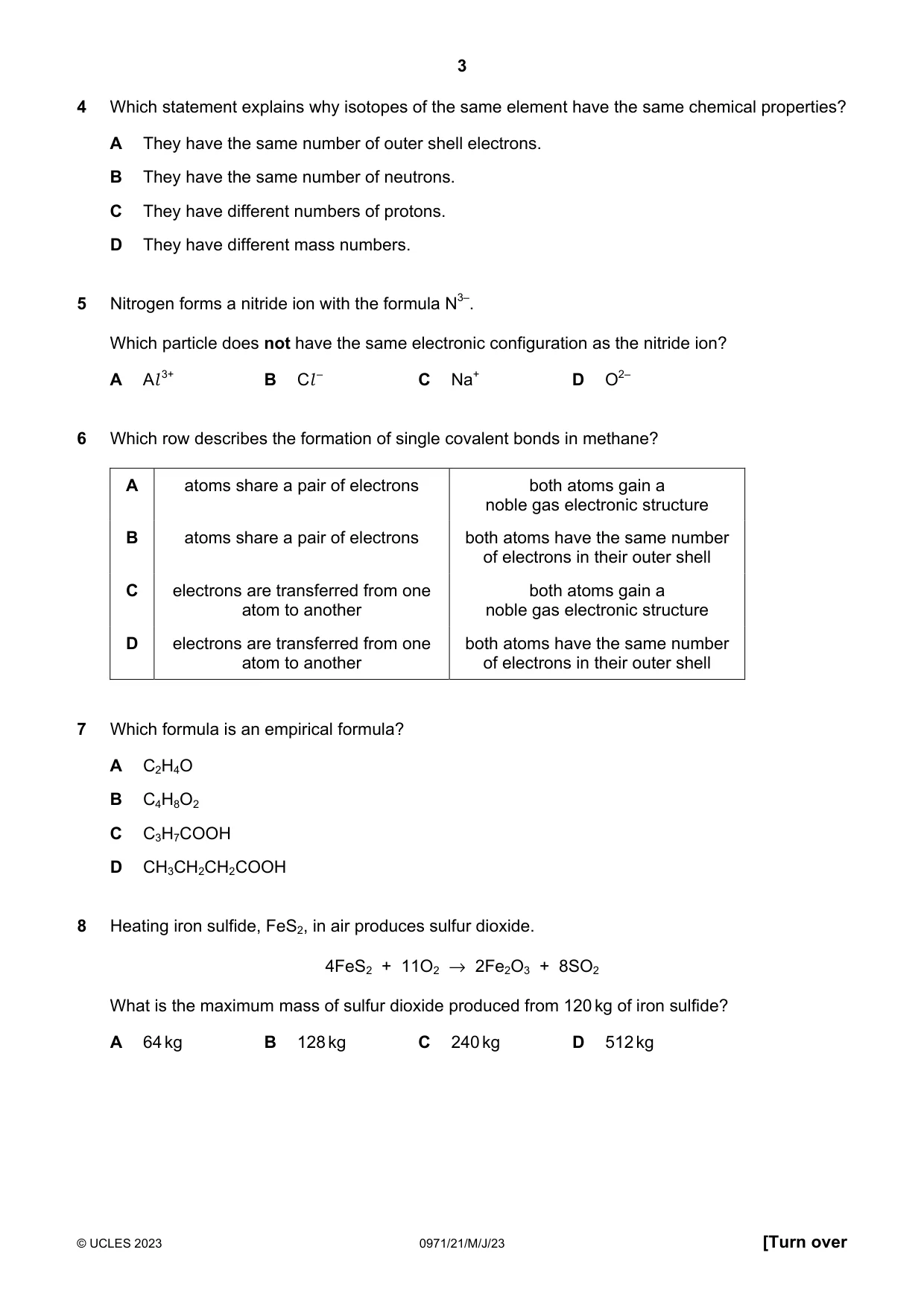
Q4 · Which statement explains why isotopes of the same element have the same chemical…
4 Which statement explains why isotopes of the same element have the same chemical properties? A They have the same number of outer shell electrons. B They have the same number of neutrons. C They have different numbers of protons. D They have different mass numbers.
Mark scheme: A
Q5 · Nitrogen forms a nitride ion with the formula N3–
5 Nitrogen forms a nitride ion with the formula N3–. Which particle does not have the same electronic configuration as the nitride ion? A Al 3+ B Cl – C Na+ D O2–
Mark scheme: B
Q6 · Which row describes the formation of single covalent bonds in methane?
6 Which row describes the formation of single covalent bonds in methane? A atoms share a pair of electrons both atoms gain a noble gas electronic structure B atoms share a pair of electrons both atoms have the same number of electrons in their outer shell C electrons are transferred from one both atoms gain a atom to another noble gas electronic structure D electrons are transferred from one both atoms have the same number atom to another of electrons in their outer shell
Mark scheme: A
Q7 · Which formula is an empirical formula?
7 Which formula is an empirical formula? A C2H4O B C4H8O2 C C3H7COOH D CH3CH2CH2COOH
Mark scheme: A
Q8 · Heating iron sulfide, FeS2, in air produces sulfur dioxide
8 Heating iron sulfide, FeS2, in air produces sulfur dioxide. 4FeS2 + 11O2 → 2Fe2O3 + 8SO2 What is the maximum mass of sulfur dioxide produced from 120 kg of iron sulfide? A 64 kg B 128 kg C 240 kg D 512 kg
Mark scheme: B
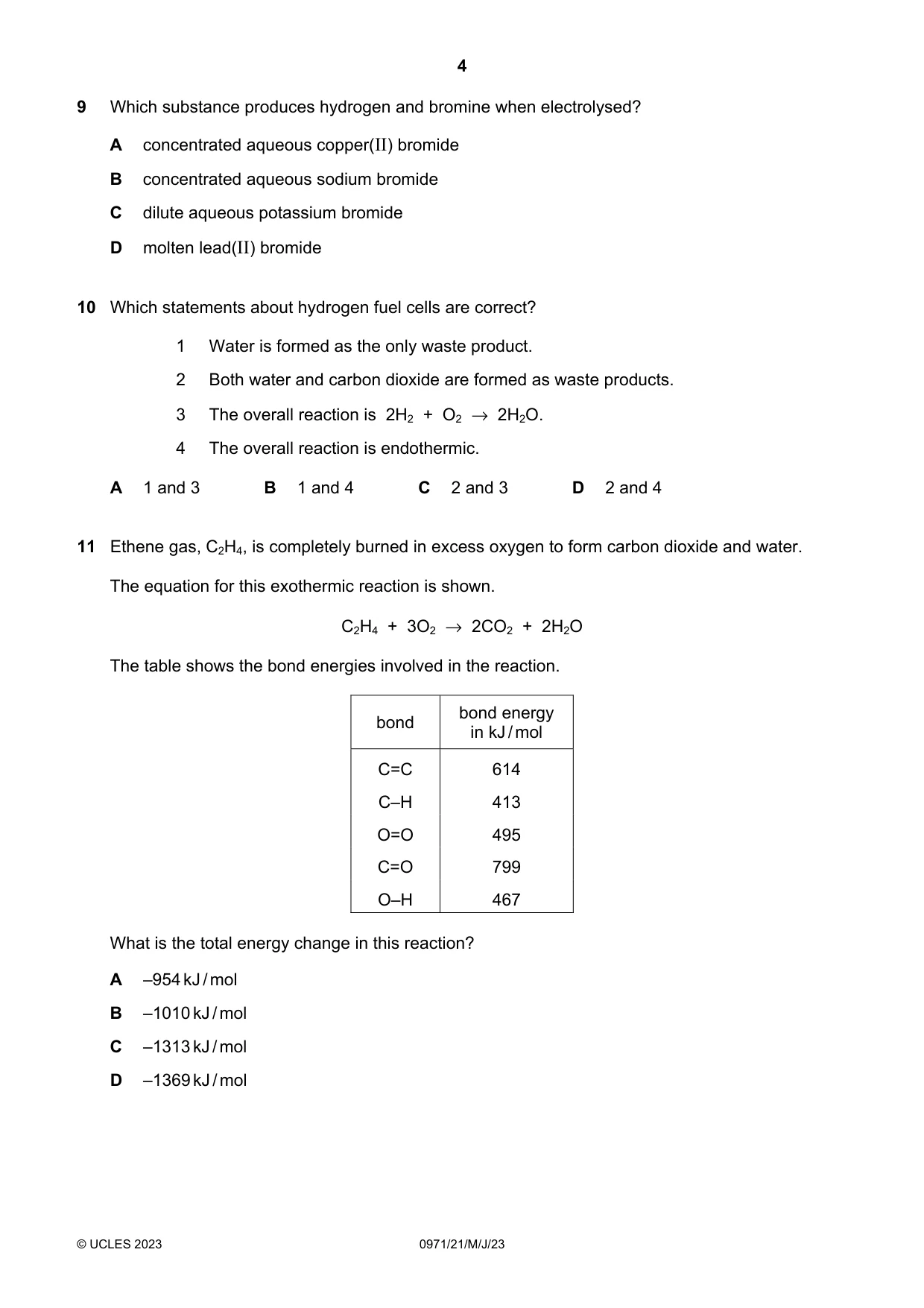
Q9 · Which substance produces hydrogen and bromine when electrolysed?
9 Which substance produces hydrogen and bromine when electrolysed? A concentrated aqueous copper(II) bromide B concentrated aqueous sodium bromide C dilute aqueous potassium bromide D molten lead(II) bromide
Mark scheme: B
Q10 · Which statements about hydrogen fuel cells are correct?
10 Which statements about hydrogen fuel cells are correct? 1 Water is formed as the only waste product. 2 Both water and carbon dioxide are formed as waste products. 3 The overall reaction is 2H2 + O2 → 2H2O. 4 The overall reaction is endothermic. A 1 and 3 B 1 and 4 C 2 and 3 D 2 and 4
Mark scheme: A
Q11 · Ethene gas, C2H4, is completely burned in excess oxygen to form carbon dioxide and water
11 Ethene gas, C2H4, is completely burned in excess oxygen to form carbon dioxide and water. The equation for this exothermic reaction is shown. C2H4 + 3O2 → 2CO2 + 2H2O The table shows the bond energies involved in the reaction. bond energy bond in kJ / mol C=C 614 C–H 413 O=O 495 C=O 799 O–H 467 What is the total energy change in this reaction? A –954 kJ / mol B –1010 kJ / mol C –1313 kJ / mol D –1369 kJ / mol
Mark scheme: C
Q12 · Which row describes the effect on the activation energy and the frequency of particle…
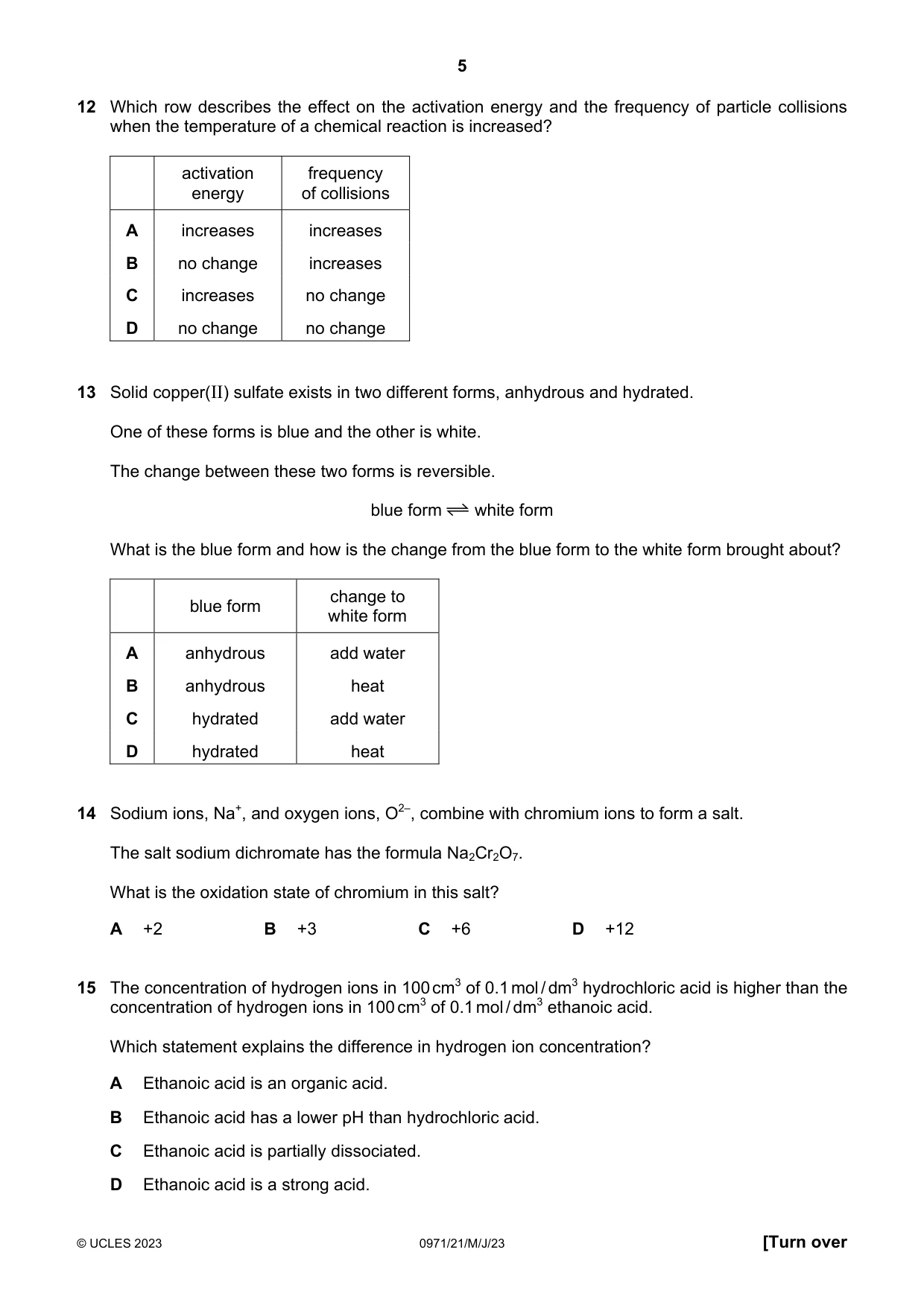
12 Which row describes the effect on the activation energy and the frequency of particle collisions when the temperature of a chemical reaction is increased? activation frequency energy of collisions A increases increases B no change increases C increases no change D no change no change
Mark scheme: B
Q13 · Solid copper(II) sulfate exists in two different forms, anhydrous and hydrated
13 Solid copper(II) sulfate exists in two different forms, anhydrous and hydrated. One of these forms is blue and the other is white. The change between these two forms is reversible. blue form white form What is the blue form and how is the change from the blue form to the white form brought about? change to blue form white form A anhydrous add water B anhydrous heat C hydrated add water D hydrated heat
Mark scheme: D
Q14 · Sodium ions, Na+, and oxygen ions, O2–, combine with chromium ions to form a salt
14 Sodium ions, Na+, and oxygen ions, O2–, combine with chromium ions to form a salt. The salt sodium dichromate has the formula Na2Cr2O7. What is the oxidation state of chromium in this salt? A +2 B +3 C +6 D +12
Mark scheme: C
Q15 · The concentration of hydrogen ions in 100 cm3 of 0.1 mol / dm3 hydrochloric acid is…
15 The concentration of hydrogen ions in 100 cm3 of 0.1 mol / dm3 hydrochloric acid is higher than the concentration of hydrogen ions in 100 cm3 of 0.1 mol / dm3 ethanoic acid. Which statement explains the difference in hydrogen ion concentration? A Ethanoic acid is an organic acid. B Ethanoic acid has a lower pH than hydrochloric acid. C Ethanoic acid is partially dissociated. D Ethanoic acid is a strong acid.
Mark scheme: C
More questions on The characteristic properties of acids and bases
Q16 · Which oxide is classified as an amphoteric oxide?
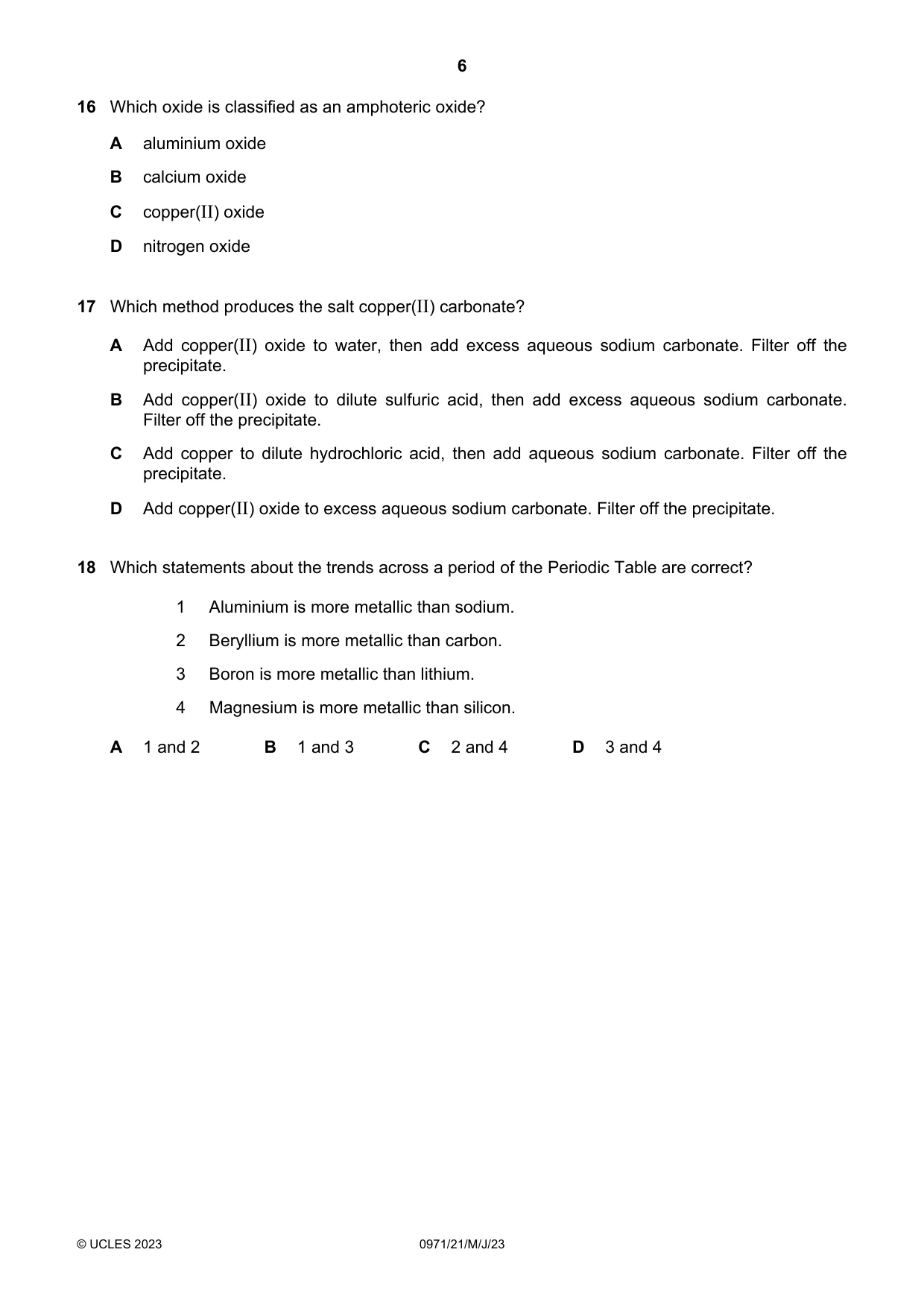
16 Which oxide is classified as an amphoteric oxide? A aluminium oxide B calcium oxide C copper(II) oxide D nitrogen oxide
Mark scheme: A
Q17 · Which method produces the salt copper(II) carbonate?
17 Which method produces the salt copper(II) carbonate? A Add copper(II) oxide to water, then add excess aqueous sodium carbonate. Filter off the precipitate. B Add copper(II) oxide to dilute sulfuric acid, then add excess aqueous sodium carbonate. Filter off the precipitate. C Add copper to dilute hydrochloric acid, then add aqueous sodium carbonate. Filter off the precipitate. D Add copper(II) oxide to excess aqueous sodium carbonate. Filter off the precipitate.
Mark scheme: B
Q18 · Which statements about the trends across a period of the Periodic Table are correct?
18 Which statements about the trends across a period of the Periodic Table are correct? 1 Aluminium is more metallic than sodium. 2 Beryllium is more metallic than carbon. 3 Boron is more metallic than lithium. 4 Magnesium is more metallic than silicon. A 1 and 2 B 1 and 3 C 2 and 4 D 3 and 4
Mark scheme: C
Q19 · Some information about elements in Group II of the Periodic Table is shown
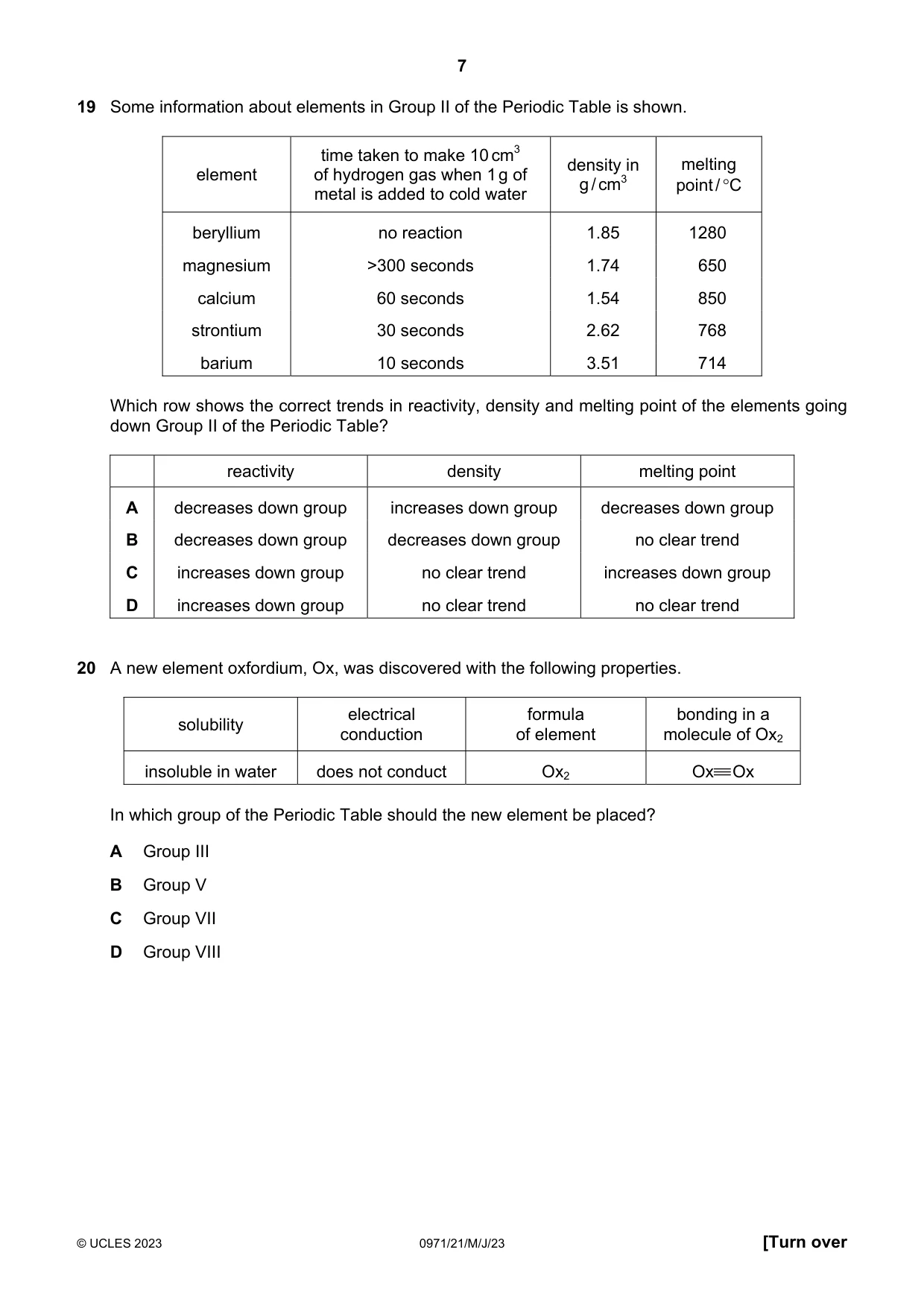
19 Some information about elements in Group II of the Periodic Table is shown. time taken to make 10 cm3 density in melting element of hydrogen gas when 1 g of g / cm3 point / °C metal is added to cold water beryllium no reaction 1.85 1280 magnesium >300 seconds 1.74 650 calcium 60 seconds 1.54 850 strontium 30 seconds 2.62 768 barium 10 seconds 3.51 714 Which row shows the correct trends in reactivity, density and melting point of the elements going down Group II of the Periodic Table? reactivity density melting point A decreases down group increases down group decreases down group B decreases down group decreases down group no clear trend C increases down group no clear trend increases down group D increases down group no clear trend no clear trend
Mark scheme: D
Q20 · A new element oxfordium, Ox, was discovered with the following properties
20 A new element oxfordium, Ox, was discovered with the following properties. electrical formula bonding in a solubility conduction of element molecule of Ox2 insoluble in water does not conduct Ox2 Ox Ox In which group of the Periodic Table should the new element be placed? A Group III B Group V C Group VII D Group VIII
Mark scheme: B
Q21 · Which row describes a similarity and a difference between chlorine and bromine?
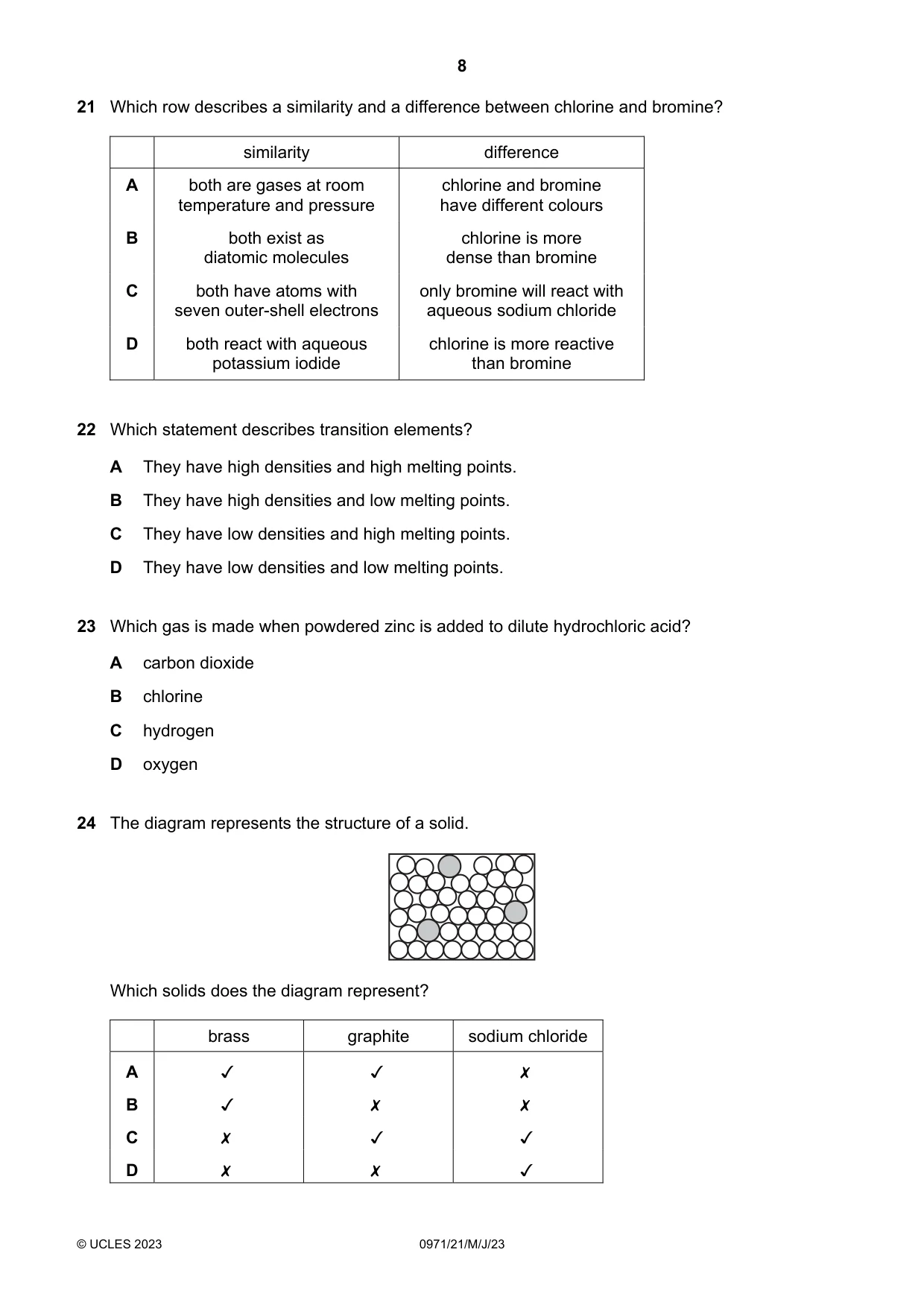
21 Which row describes a similarity and a difference between chlorine and bromine? similarity difference A both are gases at room chlorine and bromine temperature and pressure have different colours B both exist as chlorine is more diatomic molecules dense than bromine C both have atoms with only bromine will react with seven outer-shell electrons aqueous sodium chloride D both react with aqueous chlorine is more reactive potassium iodide than bromine
Mark scheme: D
Q22 · Which statement describes transition elements?
22 Which statement describes transition elements? A They have high densities and high melting points. B They have high densities and low melting points. C They have low densities and high melting points. D They have low densities and low melting points.
Mark scheme: A
Q23 · Which gas is made when powdered zinc is added to dilute hydrochloric acid?
23 Which gas is made when powdered zinc is added to dilute hydrochloric acid? A carbon dioxide B chlorine C hydrogen D oxygen
Mark scheme: C
Q24 · The diagram represents the structure of a solid
24 The diagram represents the structure of a solid. Which solids does the diagram represent? brass graphite sodium chloride A Jv v x B Jv x x Cc x v v D x x v
Mark scheme: B
Q25 · Steel is an alloy of iron
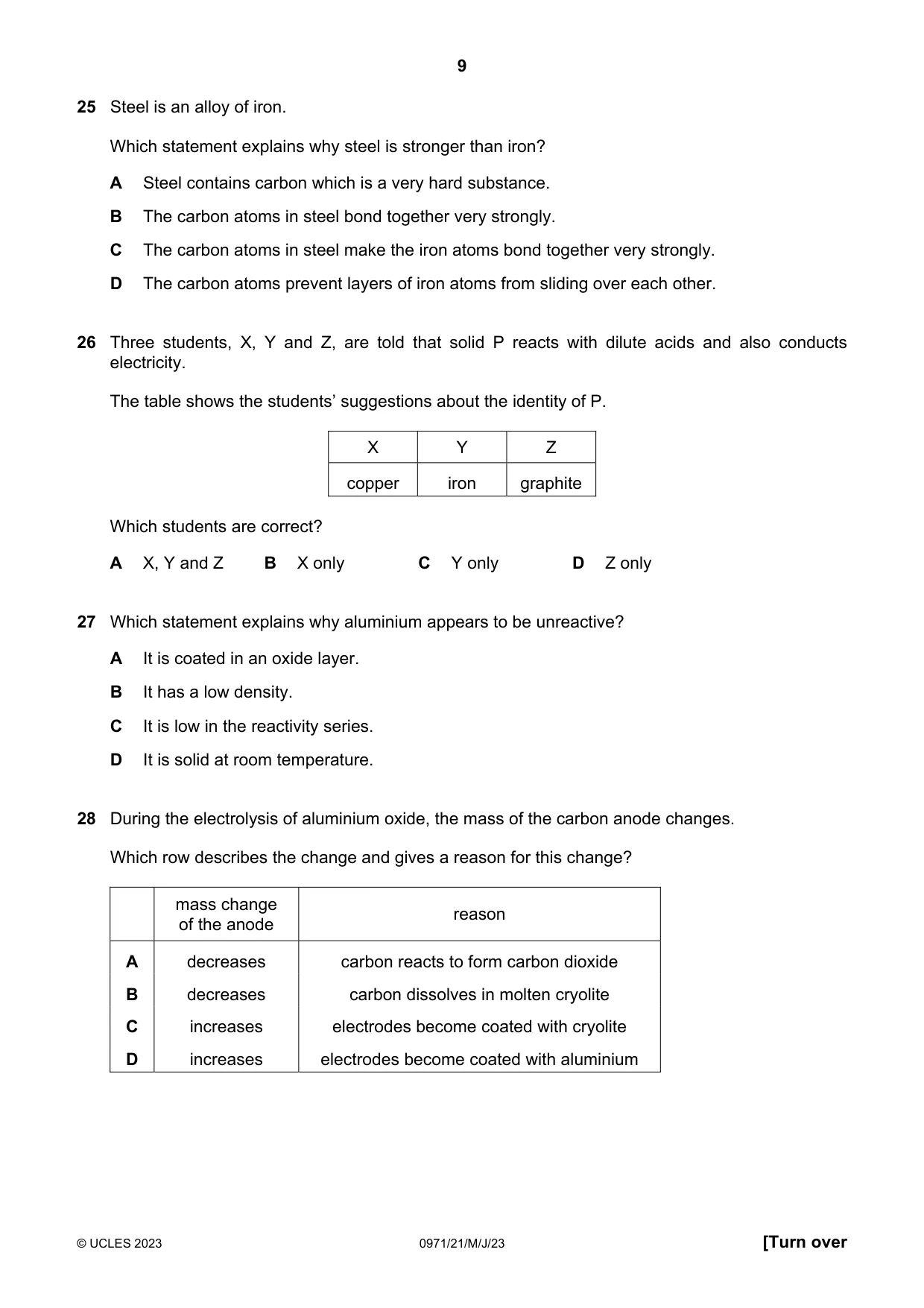
25 Steel is an alloy of iron. Which statement explains why steel is stronger than iron? A Steel contains carbon which is a very hard substance. B The carbon atoms in steel bond together very strongly. C The carbon atoms in steel make the iron atoms bond together very strongly. D The carbon atoms prevent layers of iron atoms from sliding over each other.
Mark scheme: D
Q26 · Three students, X, Y and Z, are told that solid P reacts with dilute acids and also…
26 Three students, X, Y and Z, are told that solid P reacts with dilute acids and also conducts electricity. The table shows the students’ suggestions about the identity of P. X Y Z copper iron graphite Which students are correct? A X, Y and Z B X only C Y only D Z only
Mark scheme: C
Q27 · Which statement explains why aluminium appears to be unreactive?
27 Which statement explains why aluminium appears to be unreactive? A It is coated in an oxide layer. B It has a low density. C It is low in the reactivity series. D It is solid at room temperature.
Mark scheme: A
Q28 · During the electrolysis of aluminium oxide, the mass of the carbon anode changes
28 During the electrolysis of aluminium oxide, the mass of the carbon anode changes. Which row describes the change and gives a reason for this change? mass change reason of the anode A decreases carbon reacts to form carbon dioxide B decreases carbon dissolves in molten cryolite C increases electrodes become coated with cryolite D increases electrodes become coated with aluminium
Mark scheme: A
Q29 · Several processes are used to treat domestic water
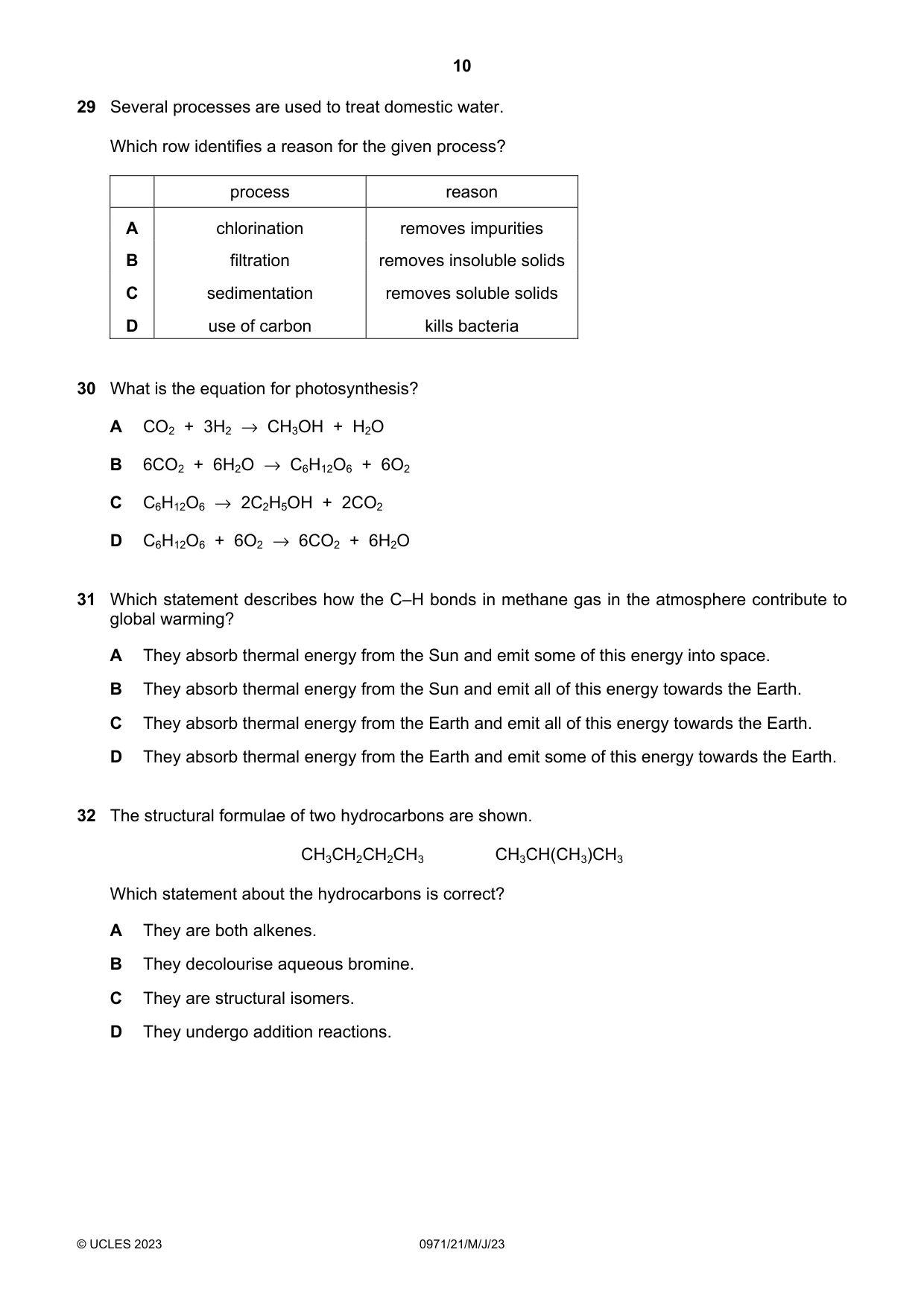
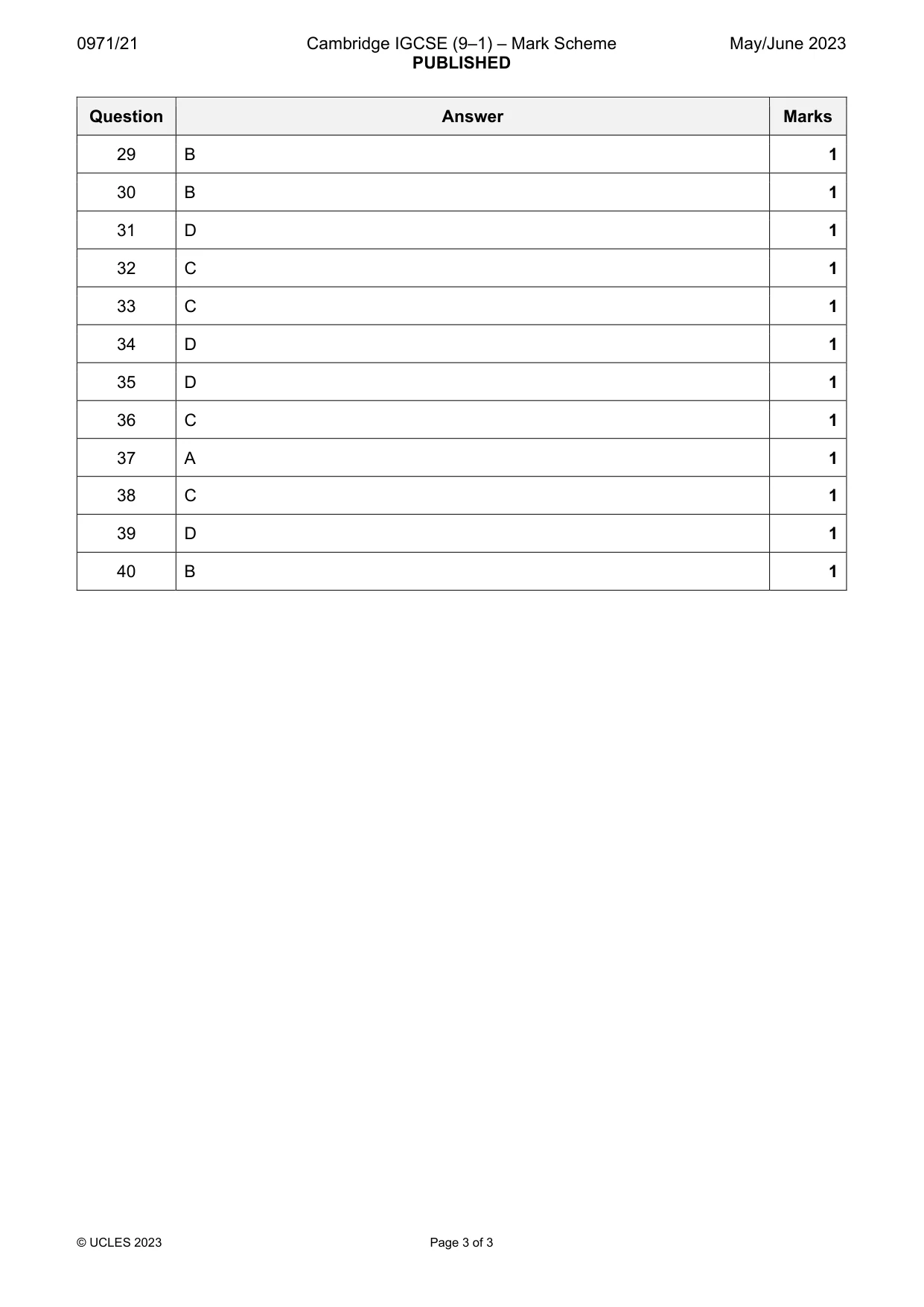
29 Several processes are used to treat domestic water. Which row identifies a reason for the given process? process reason A chlorination removes impurities B filtration removes insoluble solids C sedimentation removes soluble solids D use of carbon kills bacteria
Mark scheme: B
Q30 · What is the equation for photosynthesis?
30 What is the equation for photosynthesis? A CO2 + 3H2 → CH3OH + H2O B 6CO2 + 6H2O → C6H12O6 + 6O2 C C6H12O6 → 2C2H5OH + 2CO2 D C6H12O6 + 6O2 → 6CO2 + 6H2O
Mark scheme: B
Q31 · Which statement describes how the C–H bonds in methane gas in the atmosphere contribute…
31 Which statement describes how the C–H bonds in methane gas in the atmosphere contribute to global warming? A They absorb thermal energy from the Sun and emit some of this energy into space. B They absorb thermal energy from the Sun and emit all of this energy towards the Earth. C They absorb thermal energy from the Earth and emit all of this energy towards the Earth. D They absorb thermal energy from the Earth and emit some of this energy towards the Earth.
Mark scheme: D
Q32 · The structural formulae of two hydrocarbons are shown
32 The structural formulae of two hydrocarbons are shown. CH3CH2CH2CH3 CH3CH(CH3)CH3 Which statement about the hydrocarbons is correct? A They are both alkenes. B They decolourise aqueous bromine. C They are structural isomers. D They undergo addition reactions.
Mark scheme: C
Q33 · The structural formula of compound Q is given
33 The structural formula of compound Q is given. CH3CH2CH2COOCH2CH2CH3 What is compound Q? A butyl butanoate B butyl propanoate C propyl butanoate D propyl propanoate
Mark scheme: C
More questions on Formulae, functional groups and terminology
Q34 · The fractional distillation of petroleum is shown
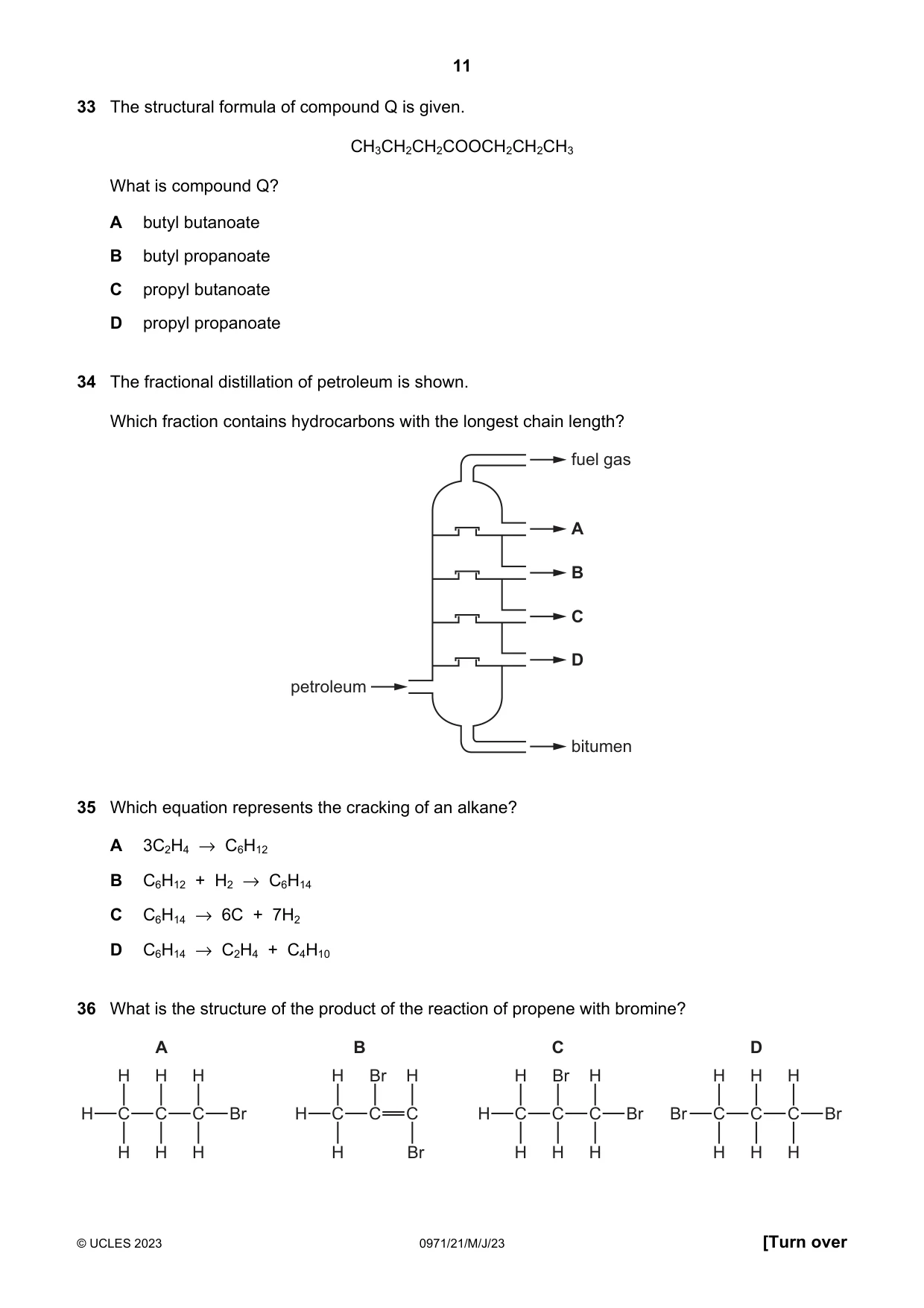
34 The fractional distillation of petroleum is shown. Which fraction contains hydrocarbons with the longest chain length? fuel gas A B C D petroleum bitumen
Mark scheme: D
Q35 · Which equation represents the cracking of an alkane?
35 Which equation represents the cracking of an alkane? A 3C2H4 → C6H12 B C6H12 + H2 → C6H14 C C6H14 → 6C + 7H2 D C6H14 → C2H4 + C4H10
Mark scheme: D
Q36 · What is the structure of the product of the reaction of propene with bromine?
36 What is the structure of the product of the reaction of propene with bromine? A B C D H H H H Br H H Br H H H H H C C C Br H C C C H C C C Br Br C C C Br H H H H Br H H H H H H
Mark scheme: C
Q37 · In reaction R, 2000 molecules of CH2=CH2 react to form a single molecule X only
37 In reaction R, 2000 molecules of CH2=CH2 react to form a single molecule X only. 2000 CH2=CH2 → X Which terms describe reaction R, CH2=CH2 and X? reaction R CH2=CH2 X A addition monomer polymer B addition polymer monomer C substitution monomer polymer D substitution polymer monomer
Mark scheme: A
Q38 · Part of the structure of a polymer is shown
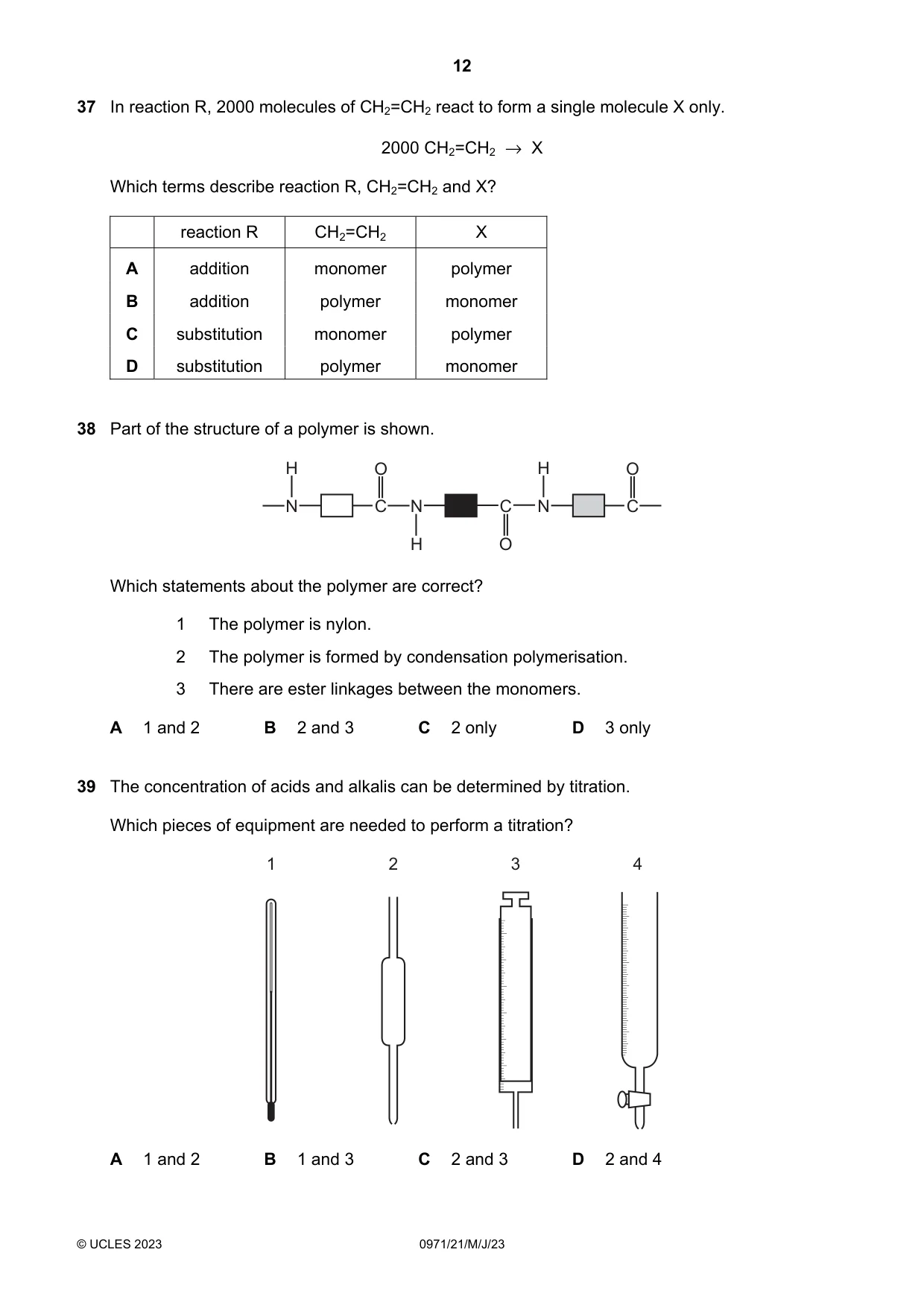
38 Part of the structure of a polymer is shown. H O H O N C N C N C H O Which statements about the polymer are correct? 1 The polymer is nylon. 2 The polymer is formed by condensation polymerisation. 3 There are ester linkages between the monomers. A 1 and 2 B 2 and 3 C 2 only D 3 only
Mark scheme: C
Q39 · The concentration of acids and alkalis can be determined by titration
39 The concentration of acids and alkalis can be determined by titration. Which pieces of equipment are needed to perform a titration? 1 2 3 4 A 1 and 2 B 1 and 3 C 2 and 3 D 2 and 4
Mark scheme: D
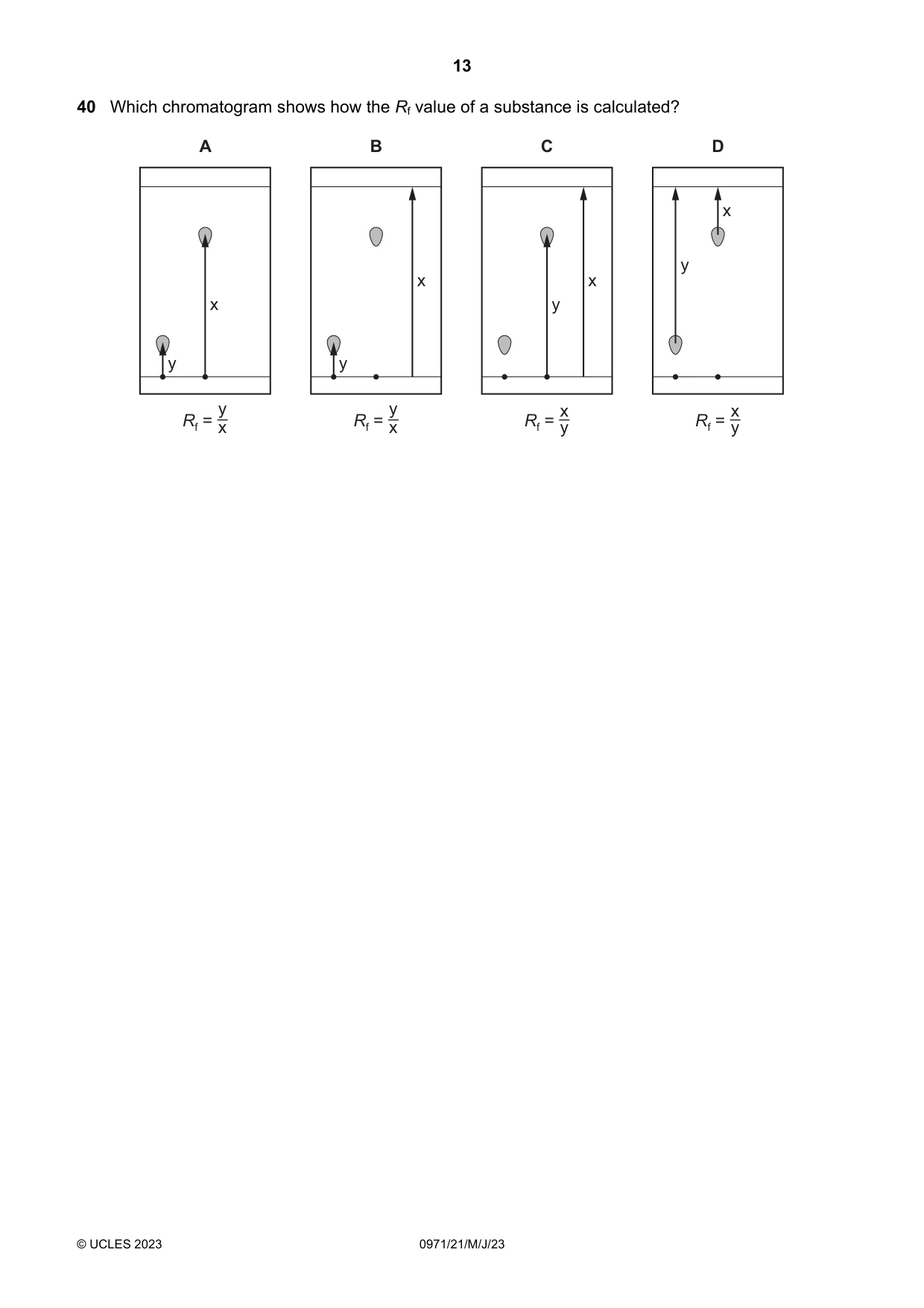
Q40 · Which chromatogram shows how the Rf value of a substance is calculated?
40 Which chromatogram shows how the Rf value of a substance is calculated? A B C D x y x x x y y y Rf = y Rf = y Rf = x Rf = x x x y y
Mark scheme: B
What was in this paper
The subtopics covered by these 40 questions, and how many questions each got. Open one in a new tab to see every Cambridge question on it.
2Alkenes2Group VII properties2Isotopes2Polymers2Acid–base titrations1Alkanes1Alloys and their properties1Arrangement of elements1Chromatography1Corrosion of metals1Diffusion1Electrolysis1Elements, compounds and mixtures1Exothermic and endothermic reactions1Extraction of metals1Formulae1Formulae, functional groups and terminology1Fuels1Giant covalent structures1Group I properties1Hydrogen–oxygen fuel cells1Ions and ionic bonds1Oxides1Preparation of salts1Properties of metals1Rate of reaction1Reactivity series1Redox1Reversible reactions and equilibrium1Simple molecules and covalent bonds1The characteristic properties of acids and bases1The mole and the Avogadro constant1Transition elements1Water1What you needed in this session
Cambridge’s own grade thresholds for 2023 May/June, Paper 2 · Variant 1. A higher threshold means an easier paper — the bar moves with how the cohort did.