Cambridge IGCSE Chemistry (9-1) 0971 — 2021 May/June Paper 2 · Variant 2
0971/22/M/J/21 · 40 questions · 40 marks · ≈45 min
The question paper and its mark scheme, free to read here and free to download. This is Cambridge’s own paper, exactly as it was sat.
Question paper16 pages
Mark scheme3 pages
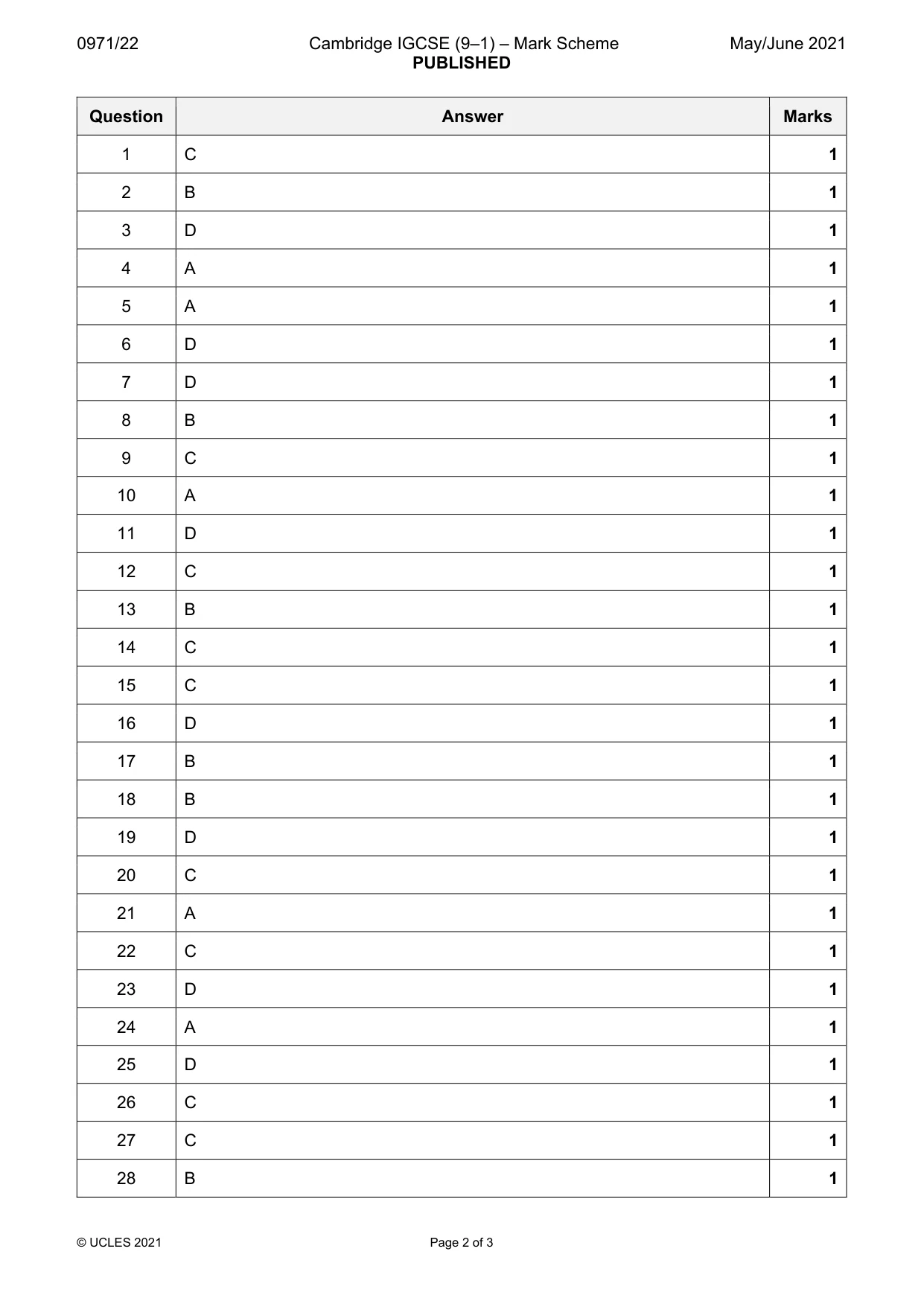
Answers below. Sit the paper first if you are practising.
Questions as text
Q1 · A gas is released at point P in the apparatus shown
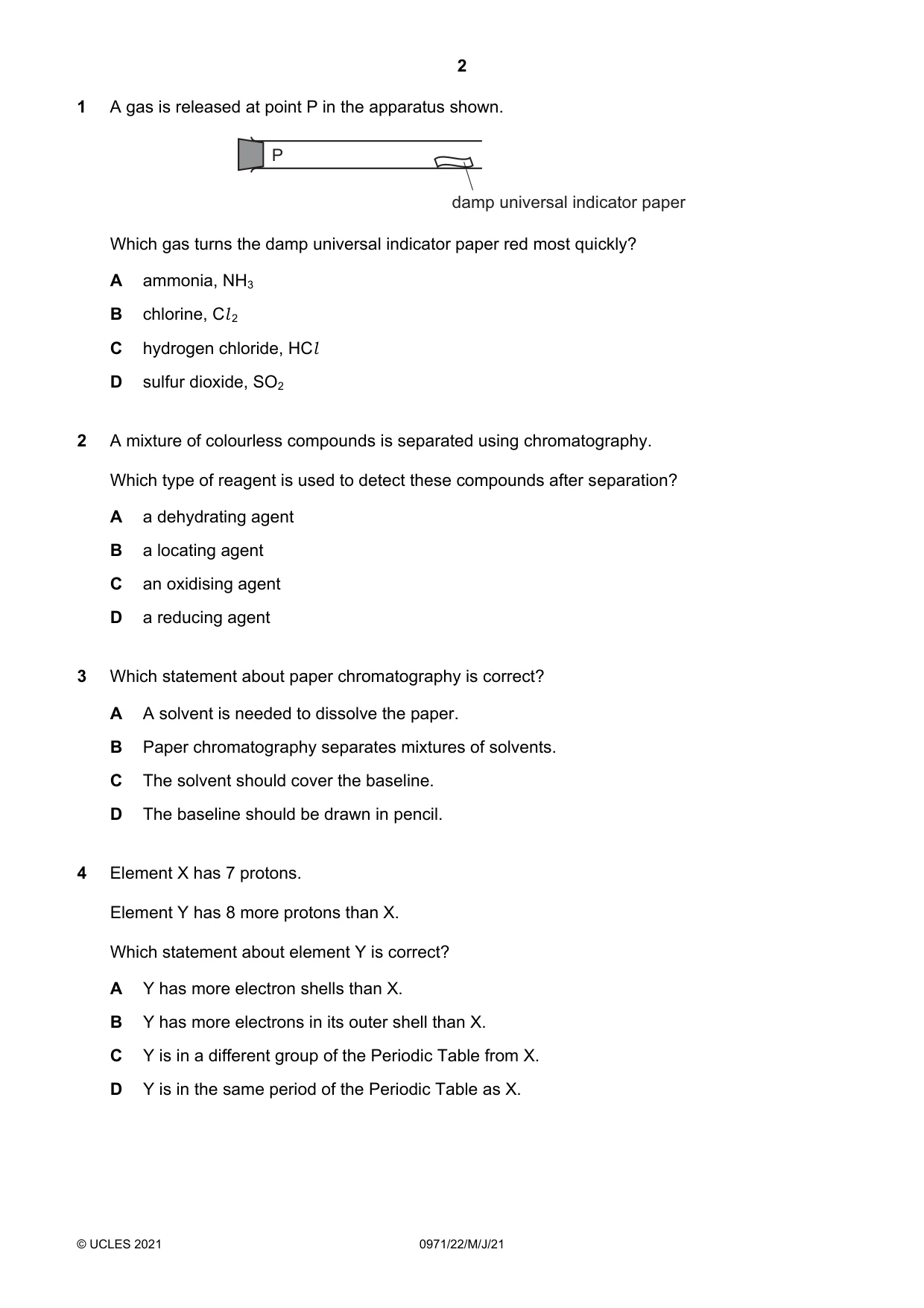
1 A gas is released at point P in the apparatus shown. P damp universal indicator paper Which gas turns the damp universal indicator paper red most quickly? A ammonia, NH3 B chlorine, Cl 2 C hydrogen chloride, HCl D sulfur dioxide, SO2
Mark scheme: C
Q2 · A mixture of colourless compounds is separated using chromatography
2 A mixture of colourless compounds is separated using chromatography. Which type of reagent is used to detect these compounds after separation? A a dehydrating agent B a locating agent C an oxidising agent D a reducing agent
Mark scheme: B
Q3 · Which statement about paper chromatography is correct?
3 Which statement about paper chromatography is correct? A A solvent is needed to dissolve the paper. B Paper chromatography separates mixtures of solvents. C The solvent should cover the baseline. D The baseline should be drawn in pencil.
Mark scheme: D
Q4 · Element X has 7 protons
4 Element X has 7 protons. Element Y has 8 more protons than X. Which statement about element Y is correct? A Y has more electron shells than X. B Y has more electrons in its outer shell than X. C Y is in a different group of the Periodic Table from X. D Y is in the same period of the Periodic Table as X.
Mark scheme: A
Q5 · A covalent molecule Q contains only six shared electrons
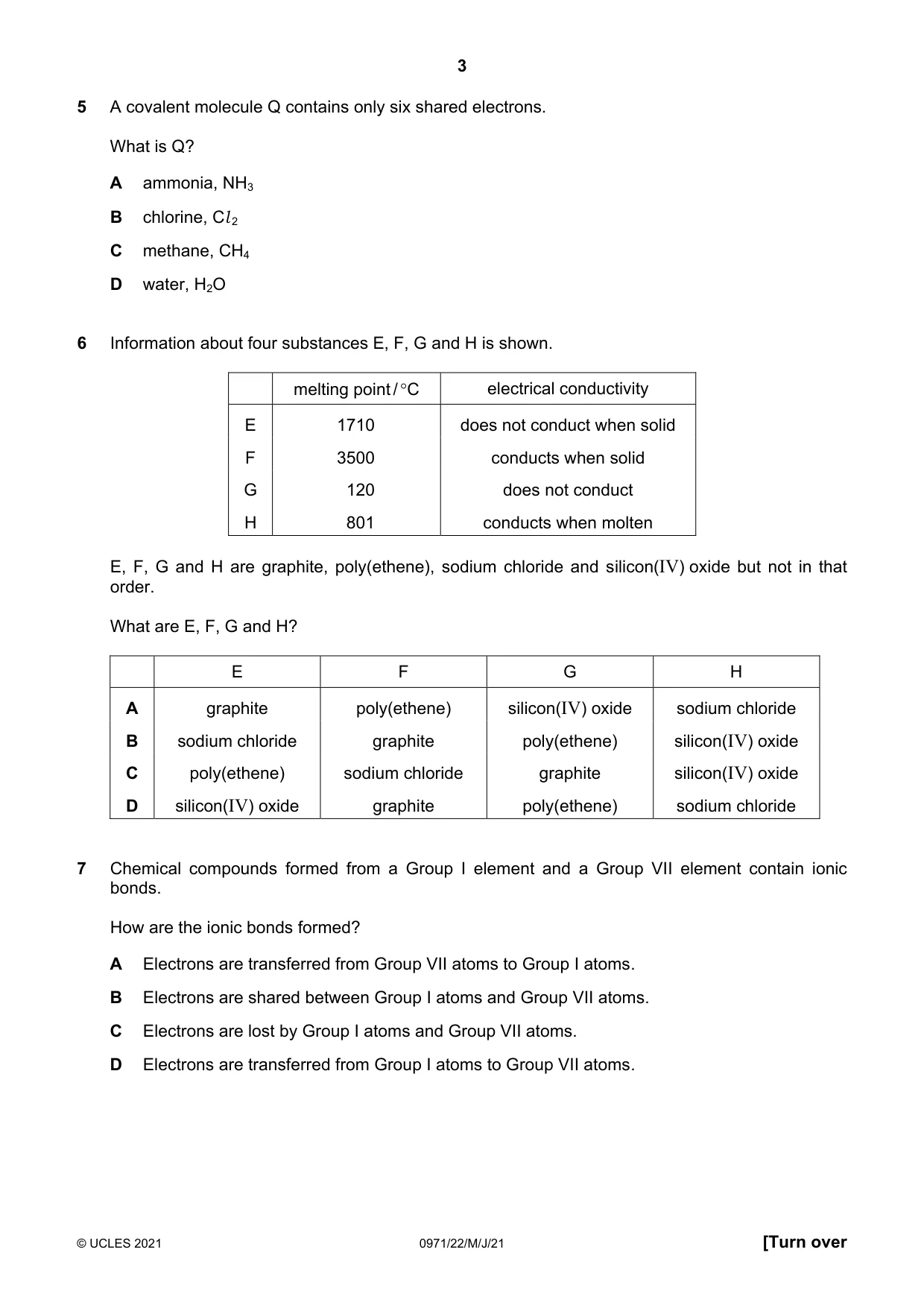
5 A covalent molecule Q contains only six shared electrons. What is Q? A ammonia, NH3 B chlorine, Cl 2 C methane, CH4 D water, H2O
Mark scheme: A
Q6 · Information about four substances E, F, G and H is shown
6 Information about four substances E, F, G and H is shown. melting point / C electrical conductivity E 1710 does not conduct when solid F 3500 conducts when solid G 120 does not conduct H 801 conducts when molten E, F, G and H are graphite, poly(ethene), sodium chloride and silicon(IV) oxide but not in that order. What are E, F, G and H? E F G H A graphite poly(ethene) silicon(IV) oxide sodium chloride B sodium chloride graphite poly(ethene) silicon(IV) oxide C poly(ethene) sodium chloride graphite silicon(IV) oxide D silicon(IV) oxide graphite poly(ethene) sodium chloride
Mark scheme: D
Q7 · Chemical compounds formed from a Group I element and a Group VII element contain ionic…
7 Chemical compounds formed from a Group I element and a Group VII element contain ionic bonds. How are the ionic bonds formed? A Electrons are transferred from Group VII atoms to Group I atoms. B Electrons are shared between Group I atoms and Group VII atoms. C Electrons are lost by Group I atoms and Group VII atoms. D Electrons are transferred from Group I atoms to Group VII atoms.
Mark scheme: D
Q8 · Some information about particles P, Q, R and S is shown
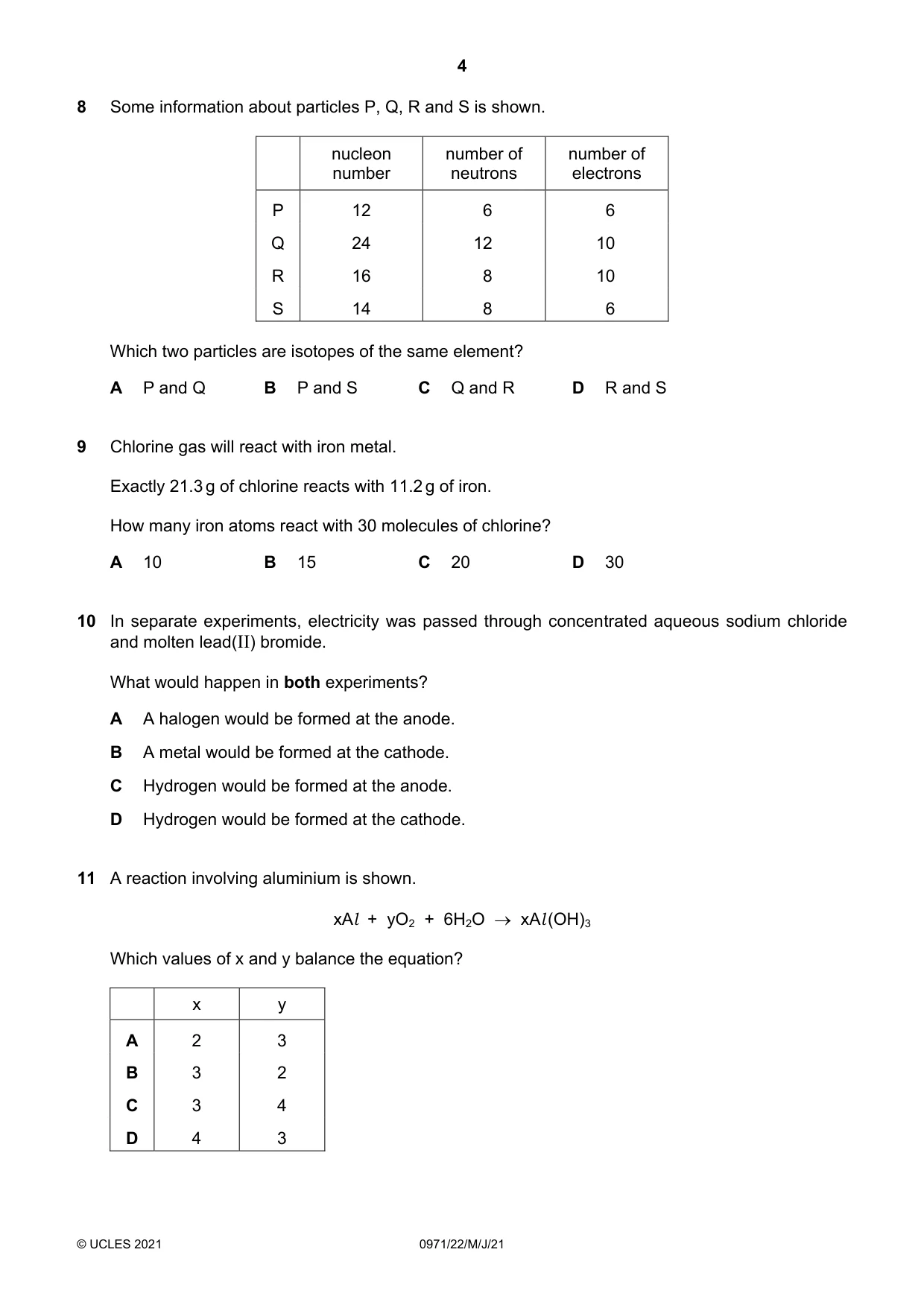
8 Some information about particles P, Q, R and S is shown. nucleon number of number of number neutrons electrons P 12 6 6 Q 24 12 10 R 16 8 10 S 14 8 6 Which two particles are isotopes of the same element? A P and Q B P and S C Q and R D R and S
Mark scheme: B
Q9 · Chlorine gas will react with iron metal
9 Chlorine gas will react with iron metal. Exactly 21.3 g of chlorine reacts with 11.2 g of iron. How many iron atoms react with 30 molecules of chlorine? A 10 B 15 C 20 D 30
Mark scheme: C
Q10 · In separate experiments, electricity was passed through concentrated aqueous sodium…
10 In separate experiments, electricity was passed through concentrated aqueous sodium chloride and molten lead(II) bromide. What would happen in both experiments? A A halogen would be formed at the anode. B A metal would be formed at the cathode. C Hydrogen would be formed at the anode. D Hydrogen would be formed at the cathode.
Mark scheme: A
Q11 · A reaction involving aluminium is shown
11 A reaction involving aluminium is shown. xAl + yO2 + 6H2O xAl (OH)3 Which values of x and y balance the equation? x y A 2 3 B 3 2 C 3 4 D 4 3
Mark scheme: D
Q12 · Four different fuels are used to heat a beaker of water, for the same amount of time…
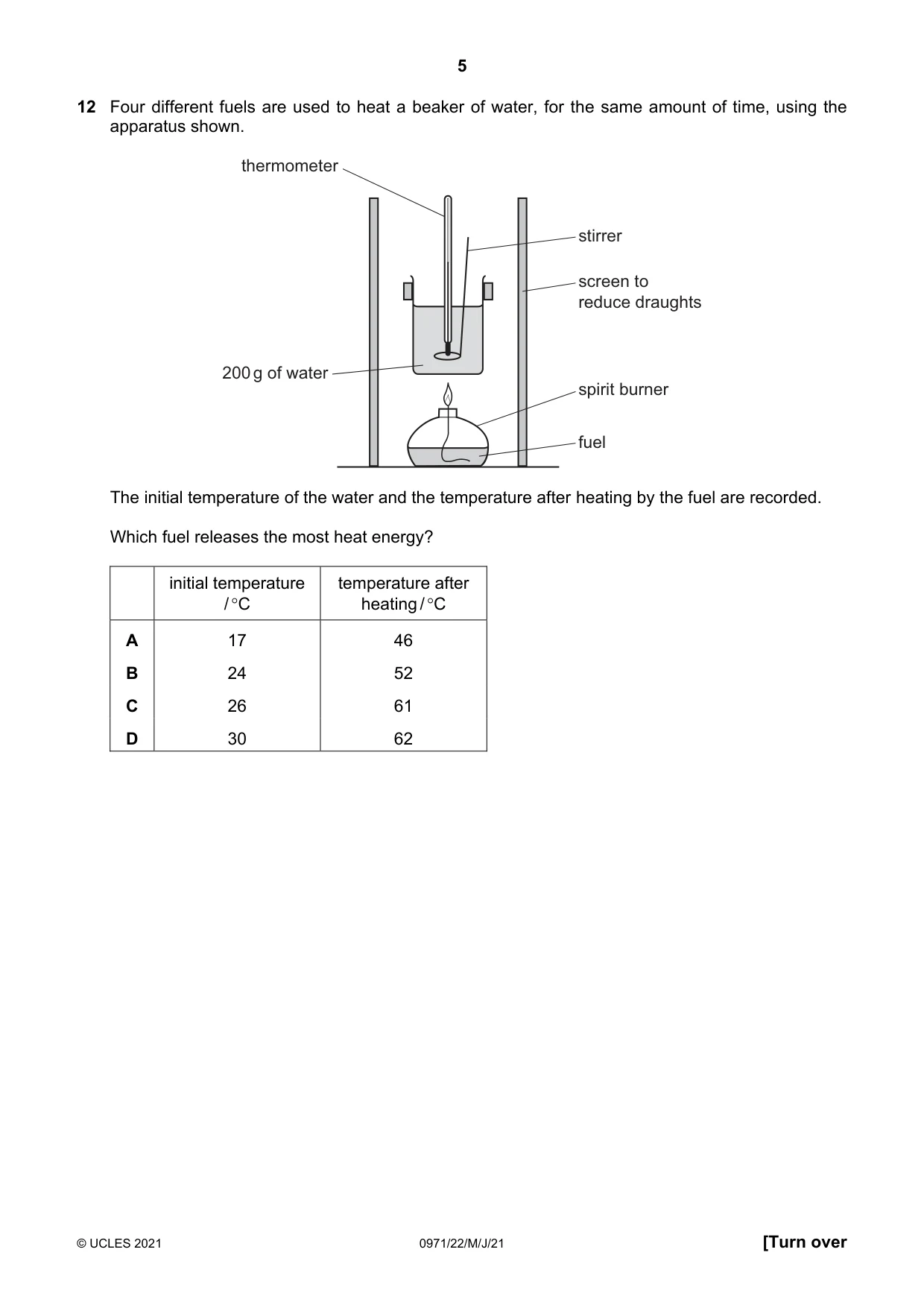
12 Four different fuels are used to heat a beaker of water, for the same amount of time, using the apparatus shown. thermometer stirrer screen to reduce draughts 200 g of water spirit burner fuel The initial temperature of the water and the temperature after heating by the fuel are recorded. Which fuel releases the most heat energy? initial temperature temperature after / C heating / C A 17 46 B 24 52 C 26 61 D 30 62
Mark scheme: C
Q13 · An excess of calcium carbonate reacts with dilute hydrochloric acid
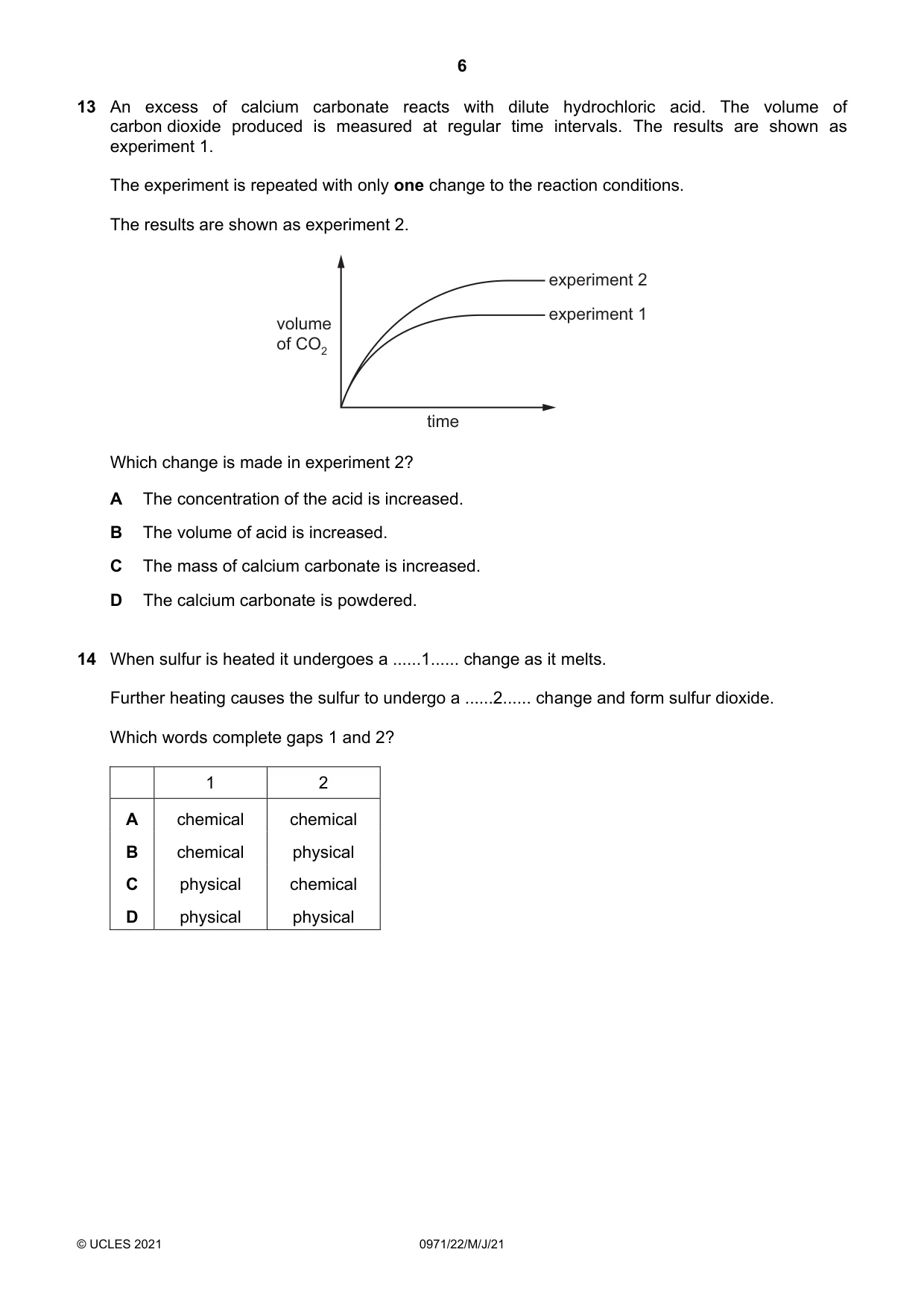
13 An excess of calcium carbonate reacts with dilute hydrochloric acid. The volume of carbon dioxide produced is measured at regular time intervals. The results are shown as experiment 1. The experiment is repeated with only one change to the reaction conditions. The results are shown as experiment 2. experiment 2 experiment 1 volume of CO2 time Which change is made in experiment 2? A The concentration of the acid is increased. B The volume of acid is increased. C The mass of calcium carbonate is increased. D The calcium carbonate is powdered.
Mark scheme: B
Q14 · When sulfur is heated it undergoes a ......1.....
14 When sulfur is heated it undergoes a ......1...... change as it melts. Further heating causes the sulfur to undergo a ......2...... change and form sulfur dioxide. Which words complete gaps 1 and 2? 1 2 A chemical chemical B chemical physical C physical chemical D physical physical
Mark scheme: C
Q15 · Four statements about the effect of increasing temperature on a reaction are shown
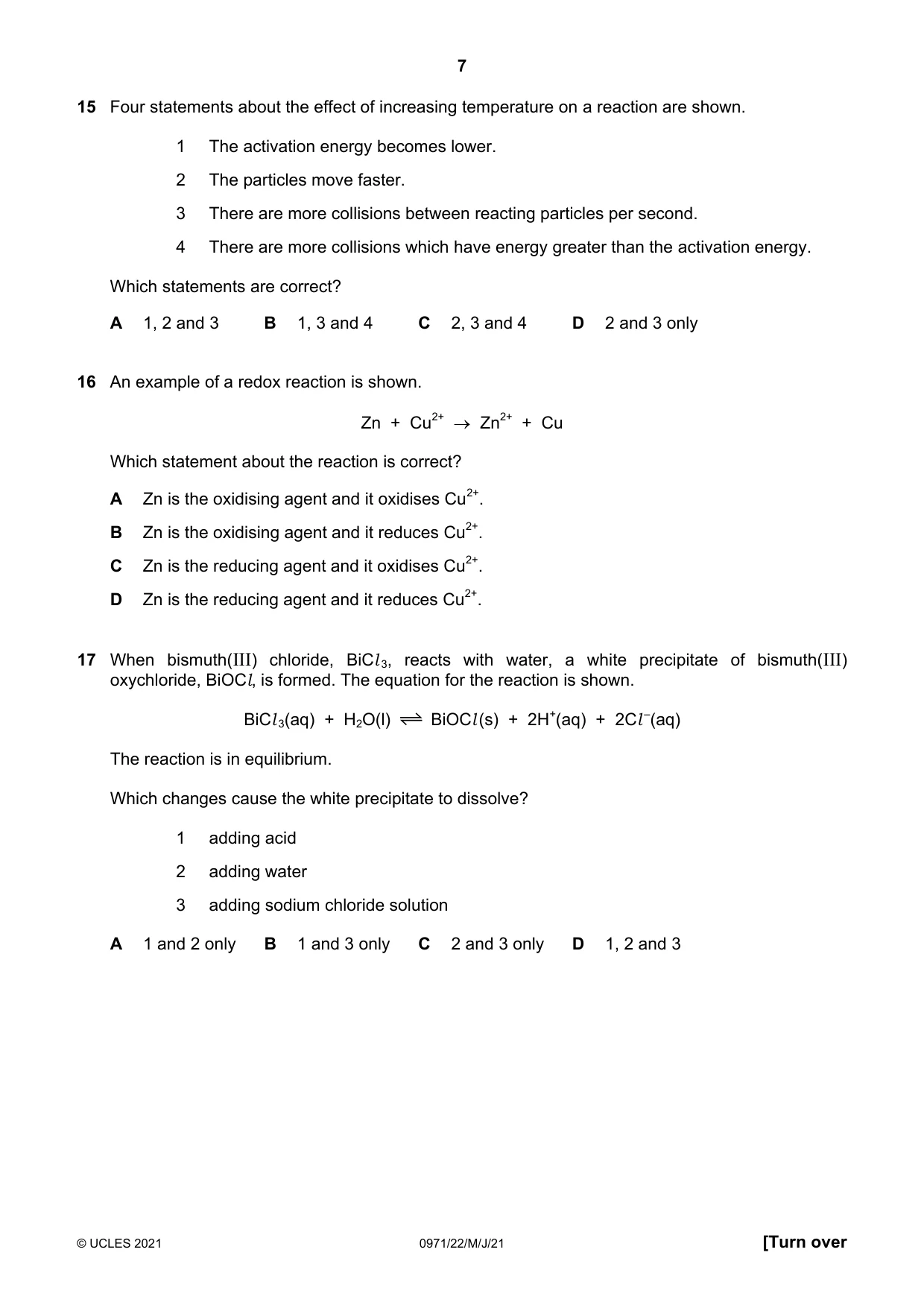
15 Four statements about the effect of increasing temperature on a reaction are shown. 1 The activation energy becomes lower. 2 The particles move faster. 3 There are more collisions between reacting particles per second. 4 There are more collisions which have energy greater than the activation energy. Which statements are correct? A 1, 2 and 3 B 1, 3 and 4 C 2, 3 and 4 D 2 and 3 only
Mark scheme: C
Q16 · An example of a redox reaction is shown
16 An example of a redox reaction is shown. Zn + Cu2+ Zn2+ + Cu Which statement about the reaction is correct? A Zn is the oxidising agent and it oxidises Cu2+. B Zn is the oxidising agent and it reduces Cu2+. C Zn is the reducing agent and it oxidises Cu2+. D Zn is the reducing agent and it reduces Cu2+.
Mark scheme: D
Q17 · When bismuth(III) chloride, BiCl 3, reacts with water, a white precipitate of…
17 When bismuth(III) chloride, BiCl 3, reacts with water, a white precipitate of bismuth(III) oxychloride, BiOCl, is formed. The equation for the reaction is shown. BiCl 3(aq) + H2O(l) BiOCl (s) + 2H+(aq) + 2Cl –(aq) The reaction is in equilibrium. Which changes cause the white precipitate to dissolve? 1 adding acid 2 adding water 3 adding sodium chloride solution A 1 and 2 only B 1 and 3 only C 2 and 3 only D 1, 2 and 3
Mark scheme: B
Q18 · Element X forms an oxide, XO, that neutralises sulfuric acid
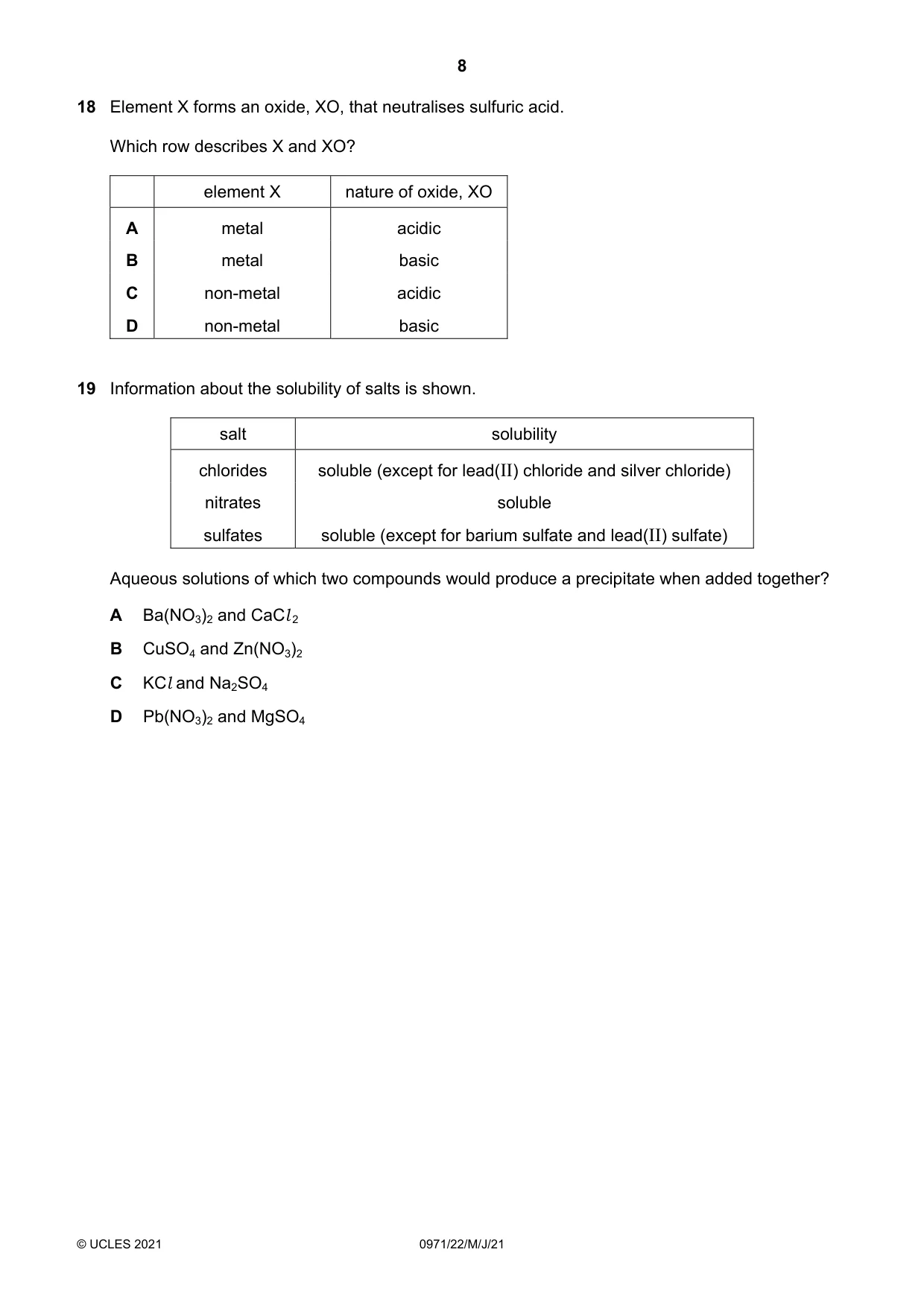
18 Element X forms an oxide, XO, that neutralises sulfuric acid. Which row describes X and XO? element X nature of oxide, XO A metal acidic B metal basic C non-metal acidic D non-metal basic
Mark scheme: B
Q19 · Information about the solubility of salts is shown
19 Information about the solubility of salts is shown. salt solubility chlorides soluble (except for lead(II) chloride and silver chloride) nitrates soluble sulfates soluble (except for barium sulfate and lead(II) sulfate) Aqueous solutions of which two compounds would produce a precipitate when added together? A Ba(NO3)2 and CaCl 2 B CuSO4 and Zn(NO3)2 C KCl and Na2SO4 D Pb(NO3)2 and MgSO4
Mark scheme: D
Q20 · The equation shows the reaction between hydrogen and oxygen
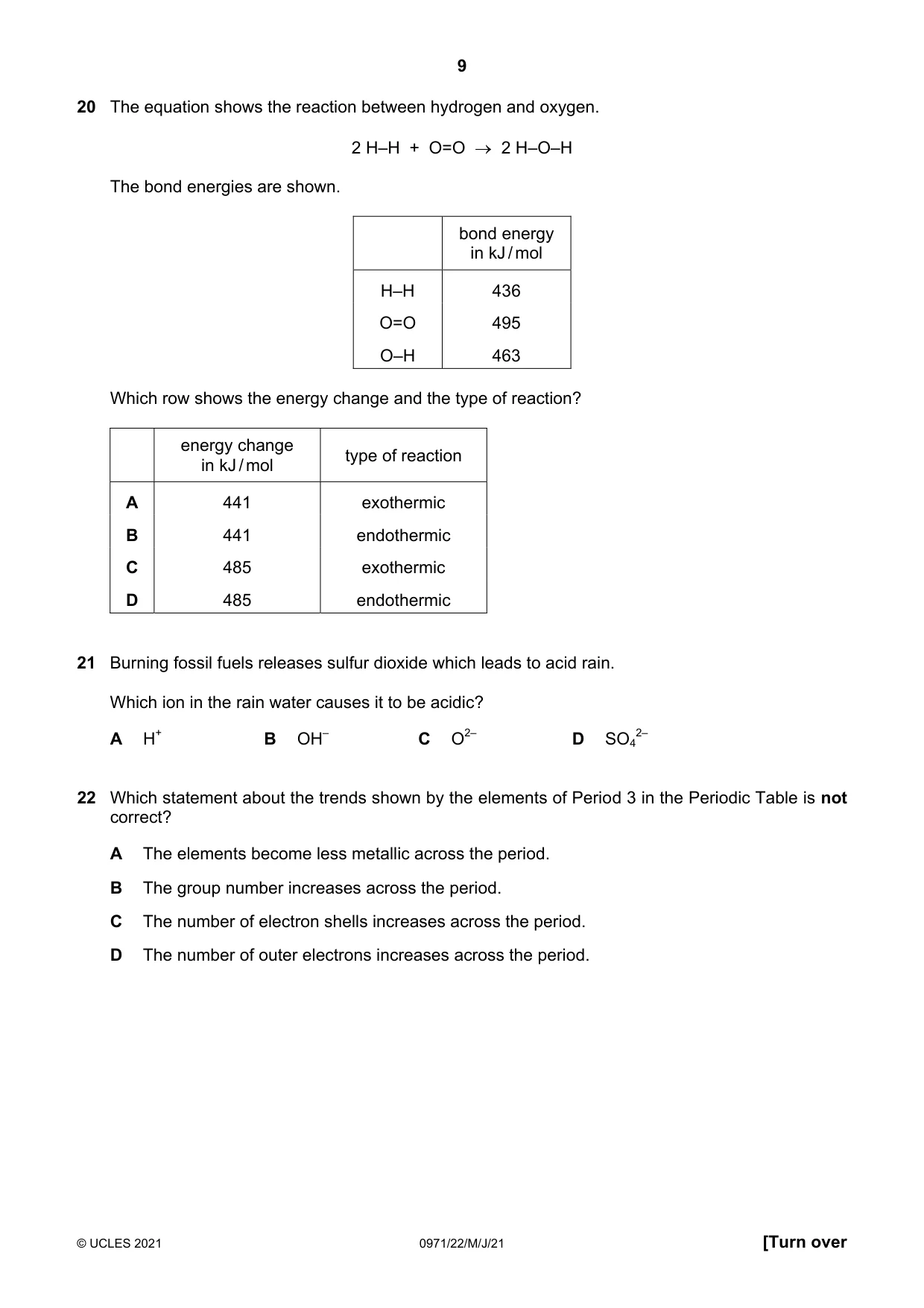
20 The equation shows the reaction between hydrogen and oxygen. 2 H–H + O=O 2 H–O–H The bond energies are shown. bond energy in kJ / mol H–H 436 O=O 495 O–H 463 Which row shows the energy change and the type of reaction? energy change type of reaction in kJ / mol A 441 exothermic B 441 endothermic C 485 exothermic D 485 endothermic
Mark scheme: C
Q21 · Burning fossil fuels releases sulfur dioxide which leads to acid rain
21 Burning fossil fuels releases sulfur dioxide which leads to acid rain. Which ion in the rain water causes it to be acidic? A H+ B OH– C O2– D SO4 2–
Mark scheme: A
Q22 · Which statement about the trends shown by the elements of Period 3 in the Periodic Table…
22 Which statement about the trends shown by the elements of Period 3 in the Periodic Table is not correct? A The elements become less metallic across the period. B The group number increases across the period. C The number of electron shells increases across the period. D The number of outer electrons increases across the period.
Mark scheme: C
Q23 · The diagram shows the positions of elements E, F, G and H in the Periodic Table
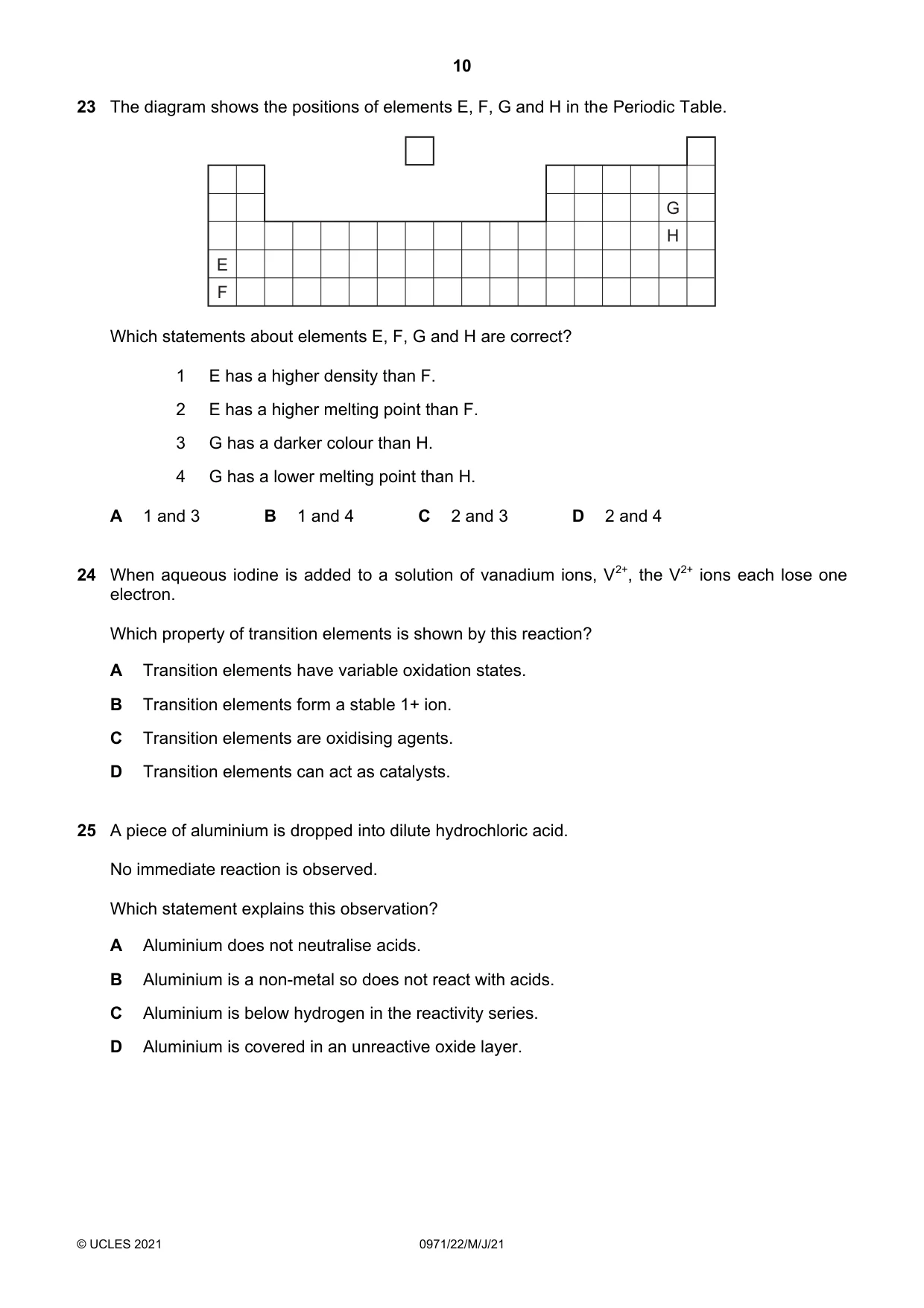
23 The diagram shows the positions of elements E, F, G and H in the Periodic Table. G H E F Which statements about elements E, F, G and H are correct? 1 E has a higher density than F. 2 E has a higher melting point than F. 3 G has a darker colour than H. 4 G has a lower melting point than H. A 1 and 3 B 1 and 4 C 2 and 3 D 2 and 4
Mark scheme: D
Q24 · When aqueous iodine is added to a solution of vanadium ions, V2+, the V2+ ions each lose…
24 When aqueous iodine is added to a solution of vanadium ions, V2+, the V2+ ions each lose one electron. Which property of transition elements is shown by this reaction? A Transition elements have variable oxidation states. B Transition elements form a stable 1+ ion. C Transition elements are oxidising agents. D Transition elements can act as catalysts.
Mark scheme: A
Q25 · A piece of aluminium is dropped into dilute hydrochloric acid
25 A piece of aluminium is dropped into dilute hydrochloric acid. No immediate reaction is observed. Which statement explains this observation? A Aluminium does not neutralise acids. B Aluminium is a non-metal so does not react with acids. C Aluminium is below hydrogen in the reactivity series. D Aluminium is covered in an unreactive oxide layer.
Mark scheme: D
Q26 · Some metal nitrates and carbonates decompose when heated strongly
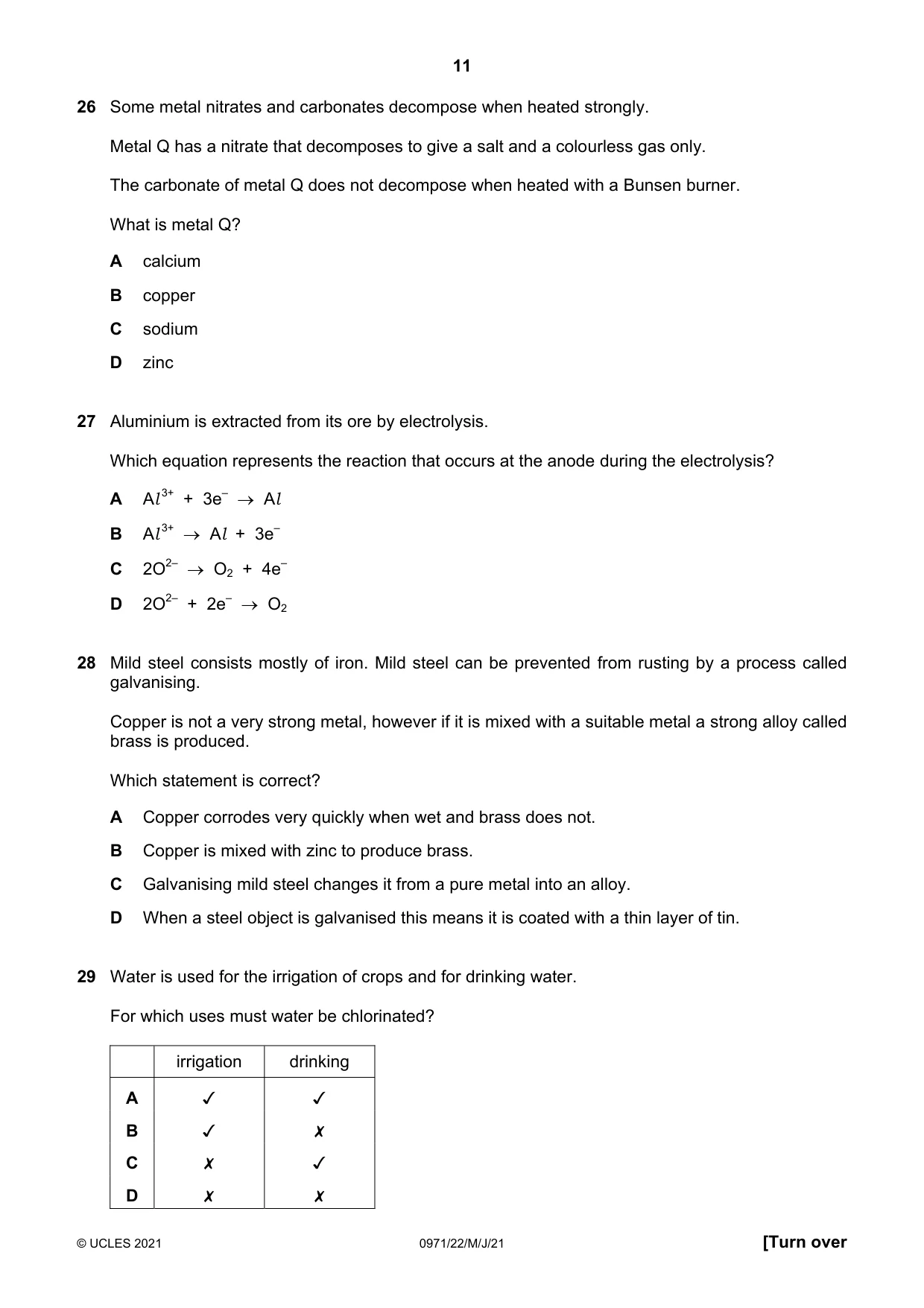
26 Some metal nitrates and carbonates decompose when heated strongly. Metal Q has a nitrate that decomposes to give a salt and a colourless gas only. The carbonate of metal Q does not decompose when heated with a Bunsen burner. What is metal Q? A calcium B copper C sodium D zinc
Mark scheme: C
Q27 · Aluminium is extracted from its ore by electrolysis
27 Aluminium is extracted from its ore by electrolysis. Which equation represents the reaction that occurs at the anode during the electrolysis? A Al 3+ + 3e– Al B Al 3+ Al + 3e– C 2O2– O2 + 4e– D 2O2– + 2e– O2
Mark scheme: C
Q28 · Mild steel consists mostly of iron
28 Mild steel consists mostly of iron. Mild steel can be prevented from rusting by a process called galvanising. Copper is not a very strong metal, however if it is mixed with a suitable metal a strong alloy called brass is produced. Which statement is correct? A Copper corrodes very quickly when wet and brass does not. B Copper is mixed with zinc to produce brass. C Galvanising mild steel changes it from a pure metal into an alloy. D When a steel object is galvanised this means it is coated with a thin layer of tin.
Mark scheme: B
Q29 · Water is used for the irrigation of crops and for drinking water
29 Water is used for the irrigation of crops and for drinking water. For which uses must water be chlorinated? irrigation drinking v v 0 0O WwW > v x x v x x
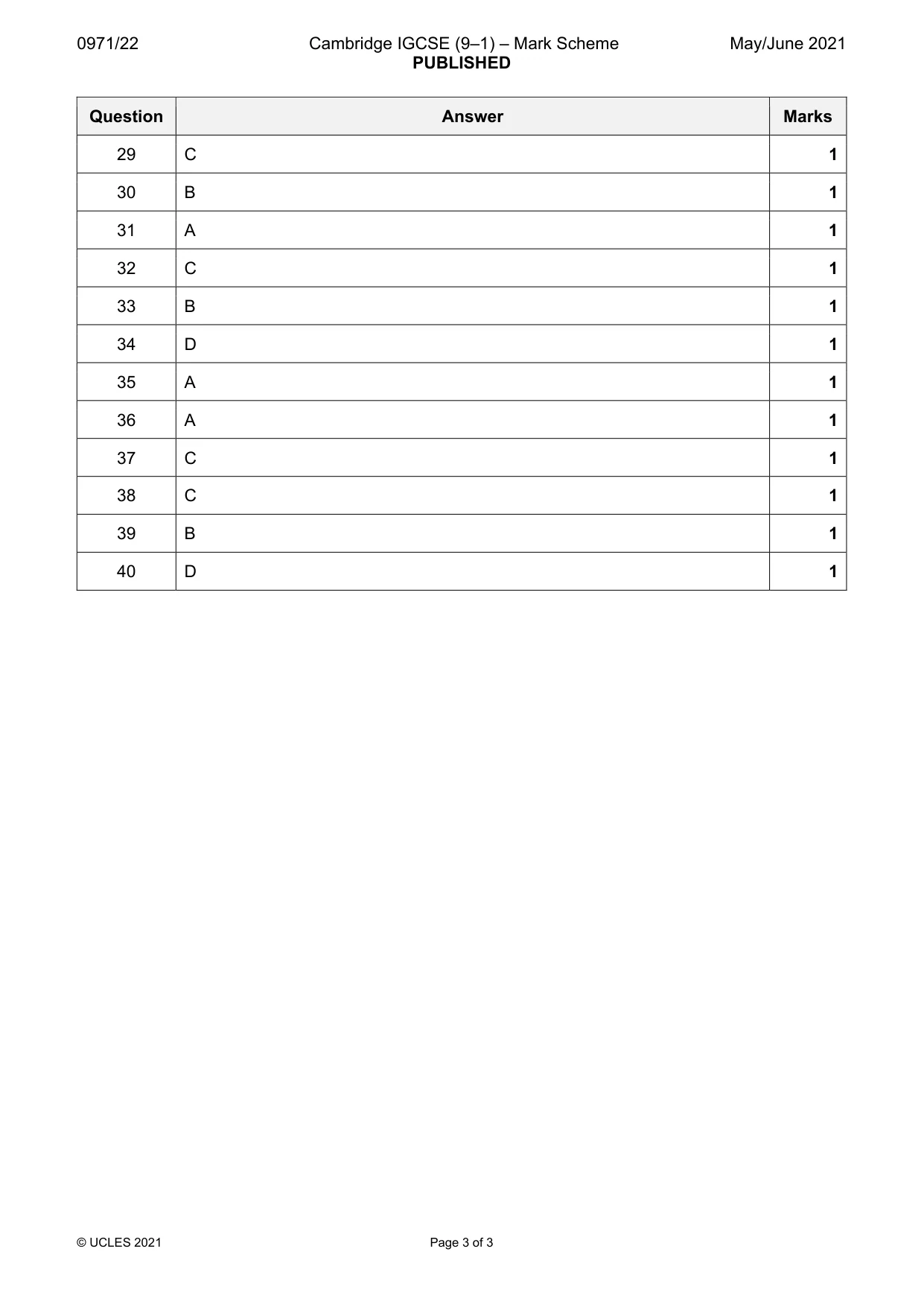
Mark scheme: C
Q30 · Which natural resource cannot provide a raw material for the manufacture of ammonia?
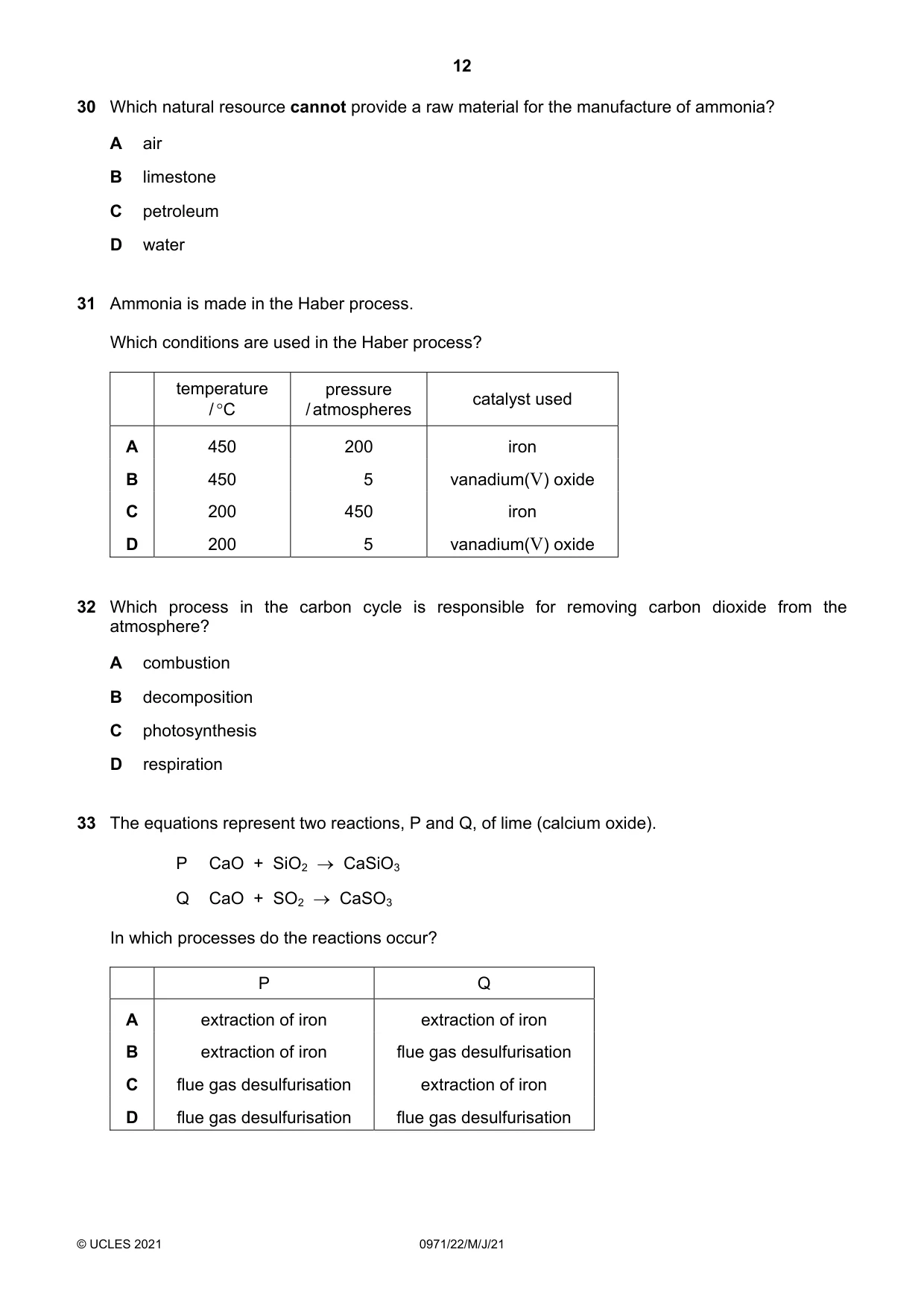
30 Which natural resource cannot provide a raw material for the manufacture of ammonia? A air B limestone C petroleum D water
Mark scheme: B
Q31 · Ammonia is made in the Haber process
31 Ammonia is made in the Haber process. Which conditions are used in the Haber process? temperature pressure catalyst used / C / atmospheres A 450 200 iron B 450 5 vanadium(V) oxide C 200 450 iron D 200 5 vanadium(V) oxide
Mark scheme: A
Q32 · Which process in the carbon cycle is responsible for removing carbon dioxide from the…
32 Which process in the carbon cycle is responsible for removing carbon dioxide from the atmosphere? A combustion B decomposition C photosynthesis D respiration
Mark scheme: C
Q33 · The equations represent two reactions, P and Q, of lime (calcium oxide)
33 The equations represent two reactions, P and Q, of lime (calcium oxide). P CaO + SiO2 CaSiO3 Q CaO + SO2 CaSO3 In which processes do the reactions occur? P Q A extraction of iron extraction of iron B extraction of iron flue gas desulfurisation C flue gas desulfurisation extraction of iron D flue gas desulfurisation flue gas desulfurisation
Mark scheme: B
Q34 · Which statement about ethanol is not correct?
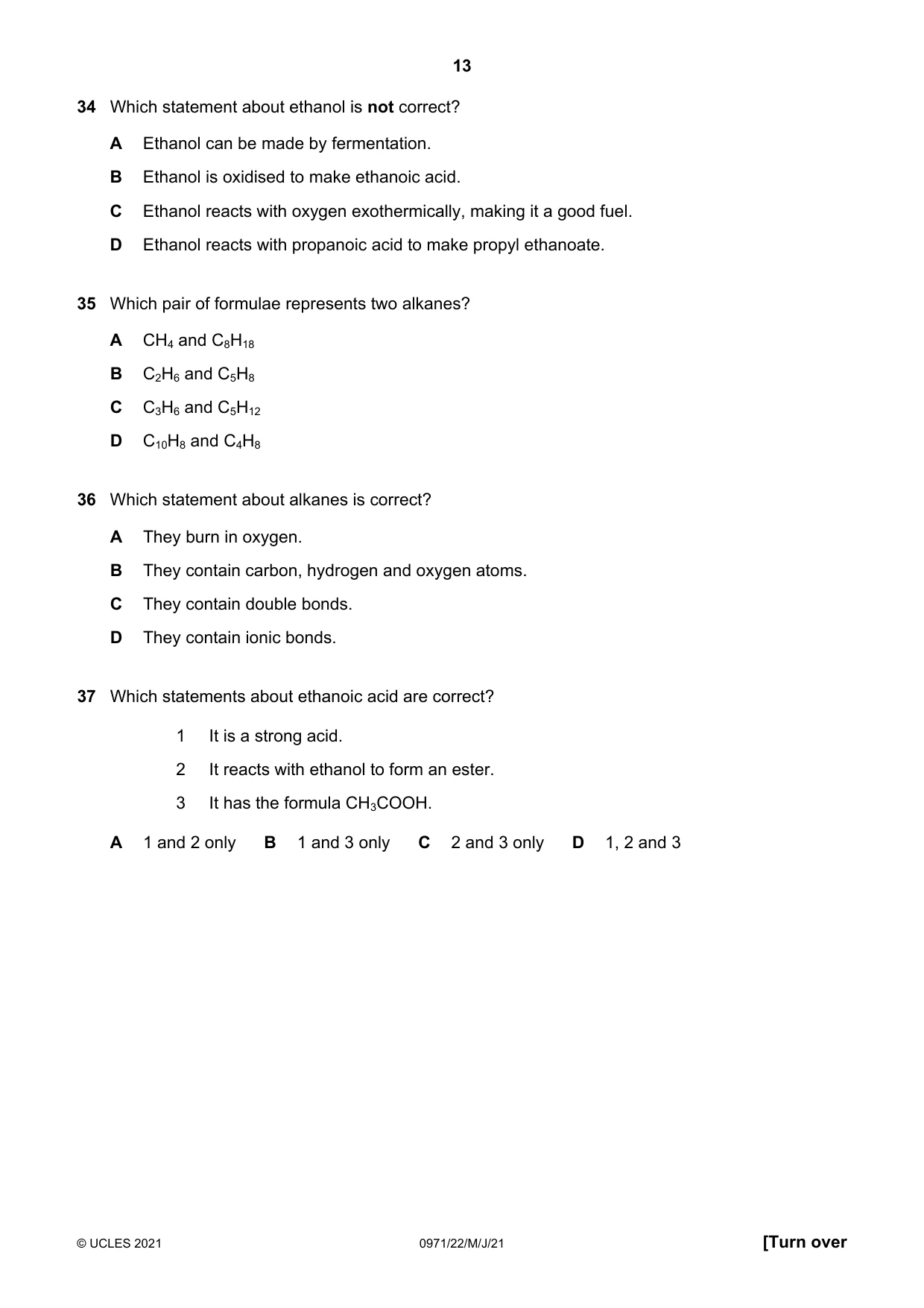
34 Which statement about ethanol is not correct? A Ethanol can be made by fermentation. B Ethanol is oxidised to make ethanoic acid. C Ethanol reacts with oxygen exothermically, making it a good fuel. D Ethanol reacts with propanoic acid to make propyl ethanoate.
Mark scheme: D
Q35 · Which pair of formulae represents two alkanes?
35 Which pair of formulae represents two alkanes? A CH4 and C8H18 B C2H6 and C5H8 C C3H6 and C5H12 D C10H8 and C4H8
Mark scheme: A
Q36 · Which statement about alkanes is correct?
36 Which statement about alkanes is correct? A They burn in oxygen. B They contain carbon, hydrogen and oxygen atoms. C They contain double bonds. D They contain ionic bonds.
Mark scheme: A
Q37 · Which statements about ethanoic acid are correct?
37 Which statements about ethanoic acid are correct? 1 It is a strong acid. 2 It reacts with ethanol to form an ester. 3 It has the formula CH3COOH. A 1 and 2 only B 1 and 3 only C 2 and 3 only D 1, 2 and 3
Mark scheme: C
Q38 · The flow chart shows how petroleum may be turned into a plastic
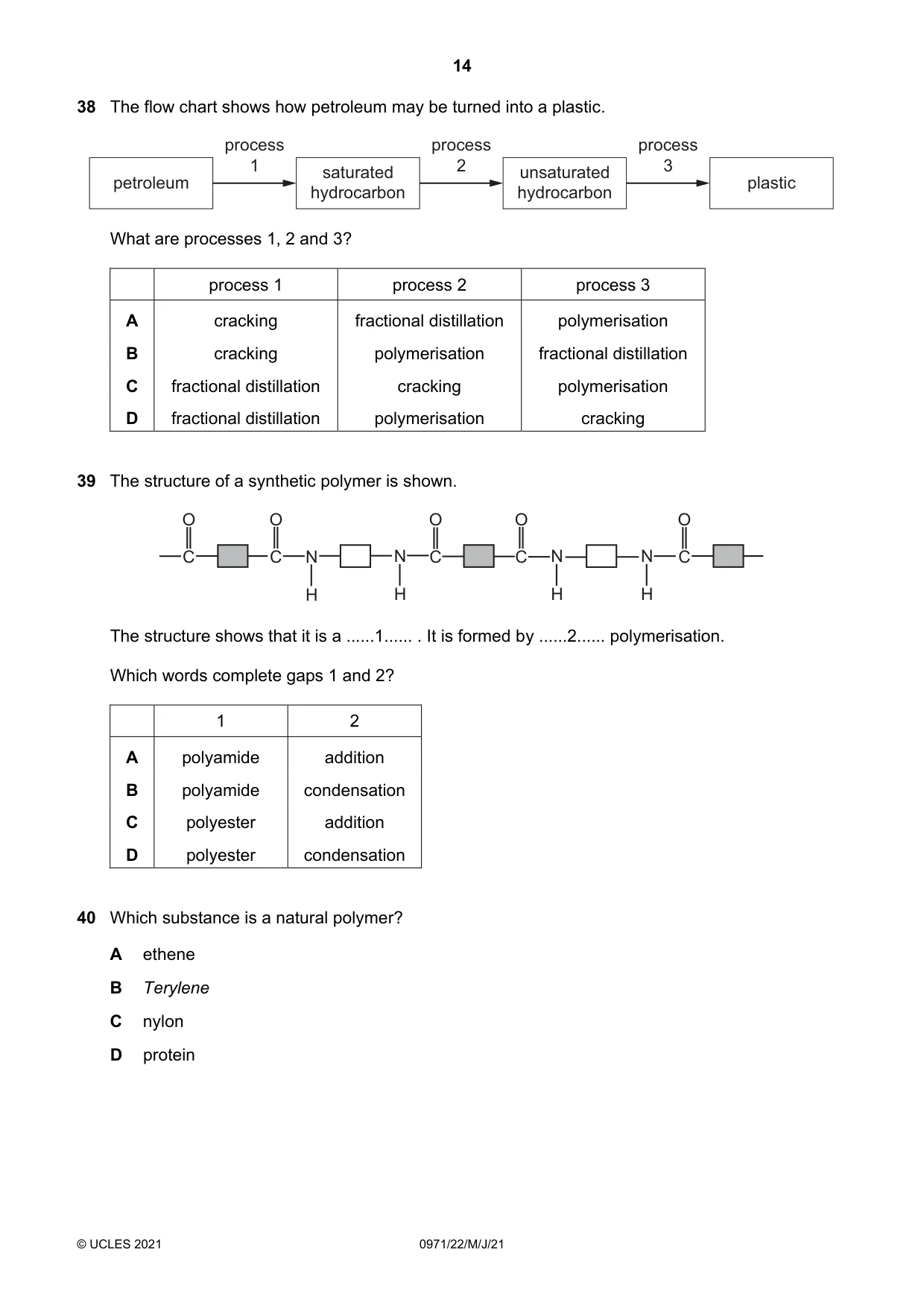
38 The flow chart shows how petroleum may be turned into a plastic. process process process 1 saturated 2 unsaturated 3 petroleum plastic hydrocarbon hydrocarbon What are processes 1, 2 and 3? process 1 process 2 process 3 A cracking fractional distillation polymerisation B cracking polymerisation fractional distillation C fractional distillation cracking polymerisation D fractional distillation polymerisation cracking
Mark scheme: C
Q39 · The structure of a synthetic polymer is shown
39 The structure of a synthetic polymer is shown. O O O O O C C N N C C N N C H H H H The structure shows that it is a ......1...... . It is formed by ......2...... polymerisation. Which words complete gaps 1 and 2? 1 2 A polyamide addition B polyamide condensation C polyester addition D polyester condensation
Mark scheme: B
Q40 · Which substance is a natural polymer?
40 Which substance is a natural polymer? A ethene B Terylene C nylon D protein
Mark scheme: D
What was in this paper
The subtopics covered by these 40 questions, and how many questions each got. Open one in a new tab to see every Cambridge question on it.
3Air quality and climate2Alkanes2Chromatography2Electrolysis2Exothermic and endothermic reactions2Extraction of metals2Rate of reaction2Reversible reactions and equilibrium2Transition elements2Alcohols1Alloys and their properties1Arrangement of elements1Atomic structure and the Periodic Table1Carboxylic acids1Diffusion1Fertilisers1Formulae1Giant covalent structures1Ions and ionic bonds1Isotopes1Oxides1Physical and chemical changes1Preparation of salts1Reactivity series1Redox1Simple molecules and covalent bonds1The mole and the Avogadro constant1Water1What you needed in this session
Cambridge’s own grade thresholds for 2021 May/June, Paper 2 · Variant 2. A higher threshold means an easier paper — the bar moves with how the cohort did.