Questions as text
Q1 · Dilute nitric acid is added to a solid, F 0971/11 May/June 2018
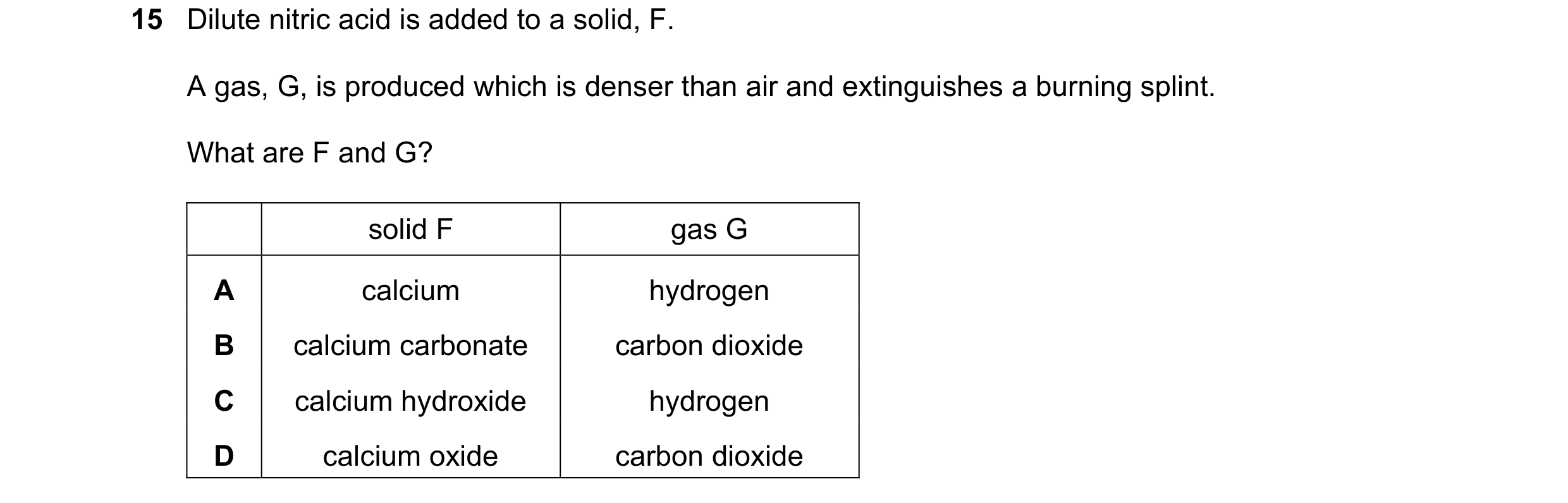
15 Dilute nitric acid is added to a solid, F. A gas, G, is produced which is denser than air and extinguishes a burning splint. What are F and G? solid F gas G A calcium hydrogen B calcium carbonate carbon dioxide C calcium hydroxide hydrogen D calcium oxide carbon dioxide
1 marks
Answer: B
This question in 0971/11 May/June 2018
Q2 · Lime is used to treat an industrial waste 0971/11 May/June 2018
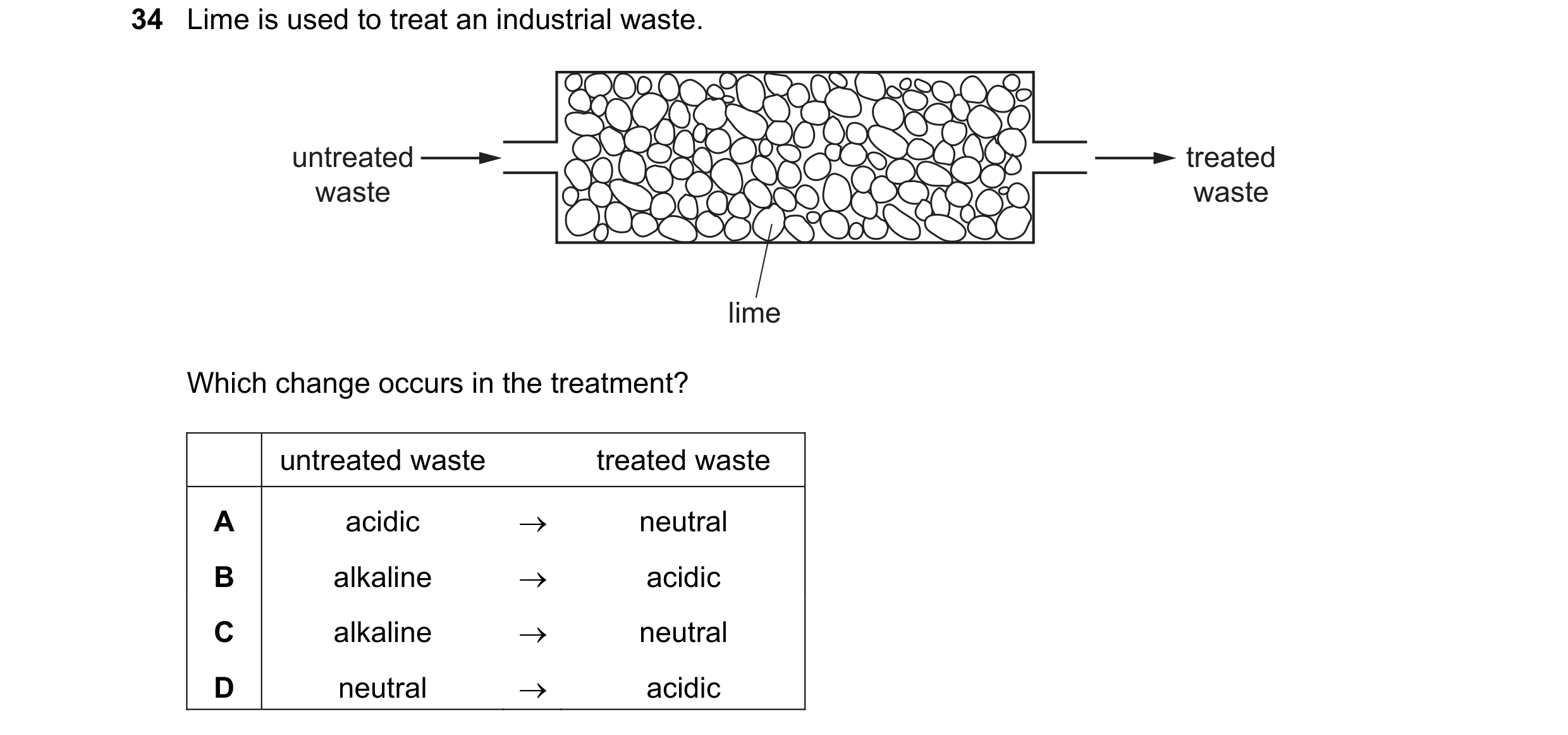
34 Lime is used to treat an industrial waste. untreated treated waste waste lime Which change occurs in the treatment? untreated waste treated waste A acidic → neutral B alkaline → acidic C alkaline → neutral D neutral → acidic
1 marks
Answer: A
This question in 0971/11 May/June 2018
Q3 · Four different solutions are separately tested with blue litmus and with methyl orange 0971/11 May/June 2019
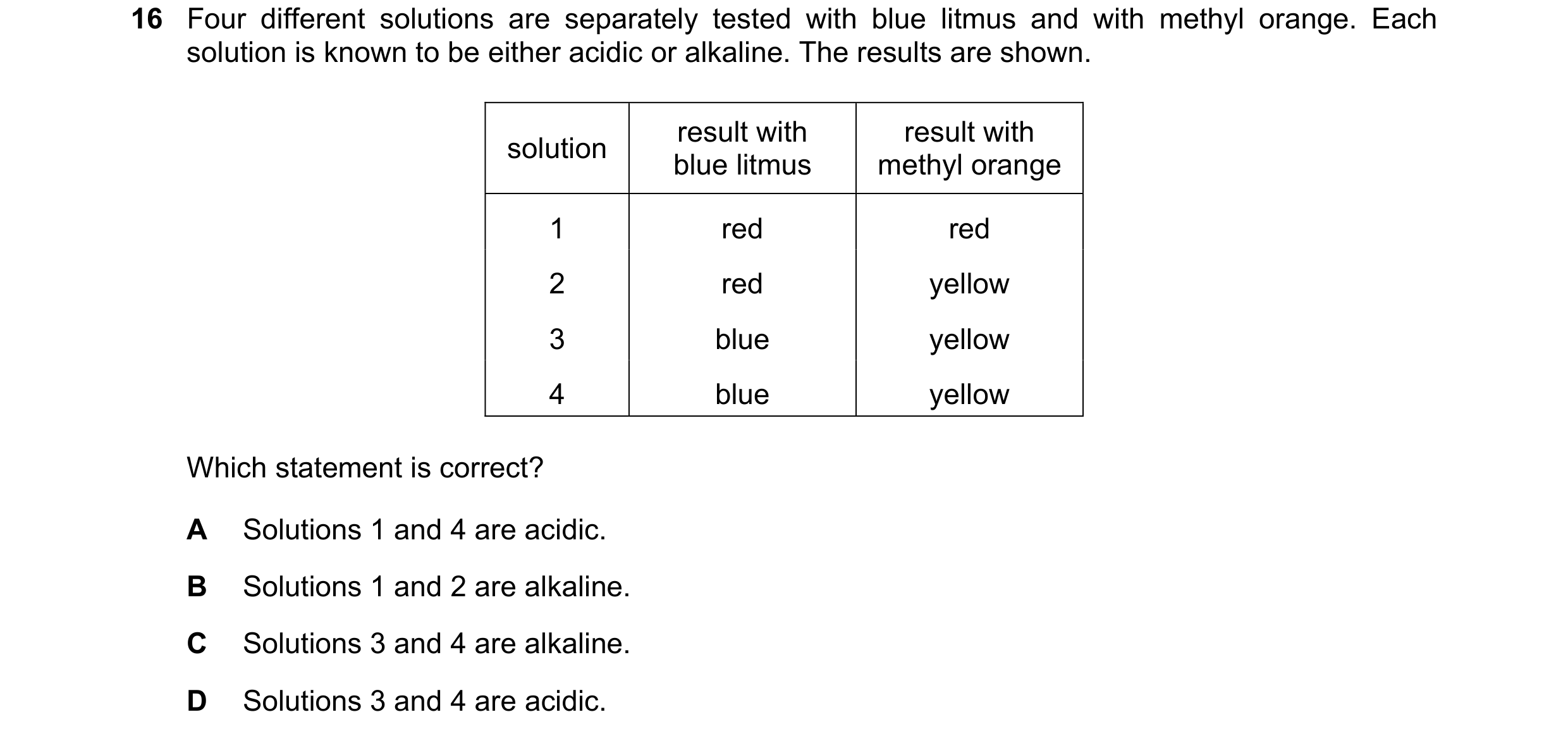
16 Four different solutions are separately tested with blue litmus and with methyl orange. Each solution is known to be either acidic or alkaline. The results are shown. result with result with solution blue litmus methyl orange 1 red red 2 red yellow 3 blue yellow 4 blue yellow Which statement is correct? A Solutions 1 and 4 are acidic. B Solutions 1 and 2 are alkaline. C Solutions 3 and 4 are alkaline. D Solutions 3 and 4 are acidic.
1 marks
Answer: C
This question in 0971/11 May/June 2019
Q4 · Which statement describes the properties of hydrochloric acid? 0971/12 Oct/Nov 2019
16 Which statement describes the properties of hydrochloric acid? A Carbon dioxide is produced when limestone reacts with hydrochloric acid. B Hydrogen is produced when sodium hydroxide reacts with hydrochloric acid. C Methyl orange turns yellow in strong hydrochloric acid. D Red litmus paper turns blue when dipped into hydrochloric acid.
1 marks
Answer: A
This question in 0971/12 Oct/Nov 2019
Q5 · Farmers add calcium oxide (lime) and ammonium salts to their fields 0971/12 Oct/Nov 2019
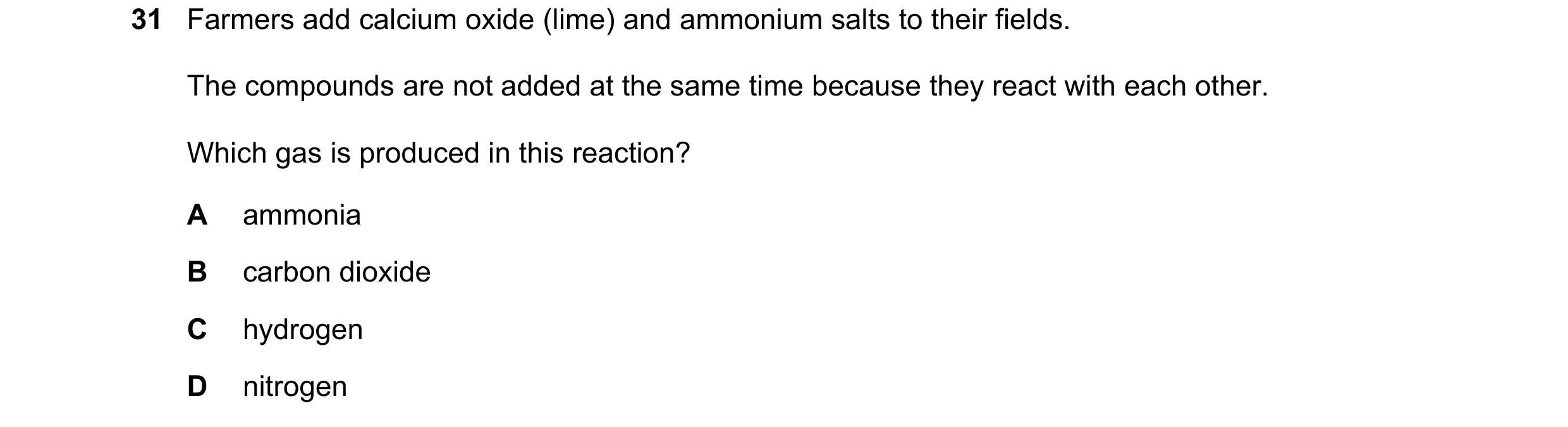
31 Farmers add calcium oxide (lime) and ammonium salts to their fields. The compounds are not added at the same time because they react with each other. Which gas is produced in this reaction? A ammonia B carbon dioxide C hydrogen D nitrogen
1 marks
Answer: A
This question in 0971/12 Oct/Nov 2019
Q6 · Which statement about an aqueous solution of ethanoic acid is correct? 0971/12 Oct/Nov 2019
39 Which statement about an aqueous solution of ethanoic acid is correct? A It reacts with magnesium to form water as one of the products. B It reacts with sodium carbonate to form carbon dioxide. C It reacts with sodium hydroxide to form hydrogen. D It turns red litmus paper blue.
1 marks
Answer: B
This question in 0971/12 Oct/Nov 2019
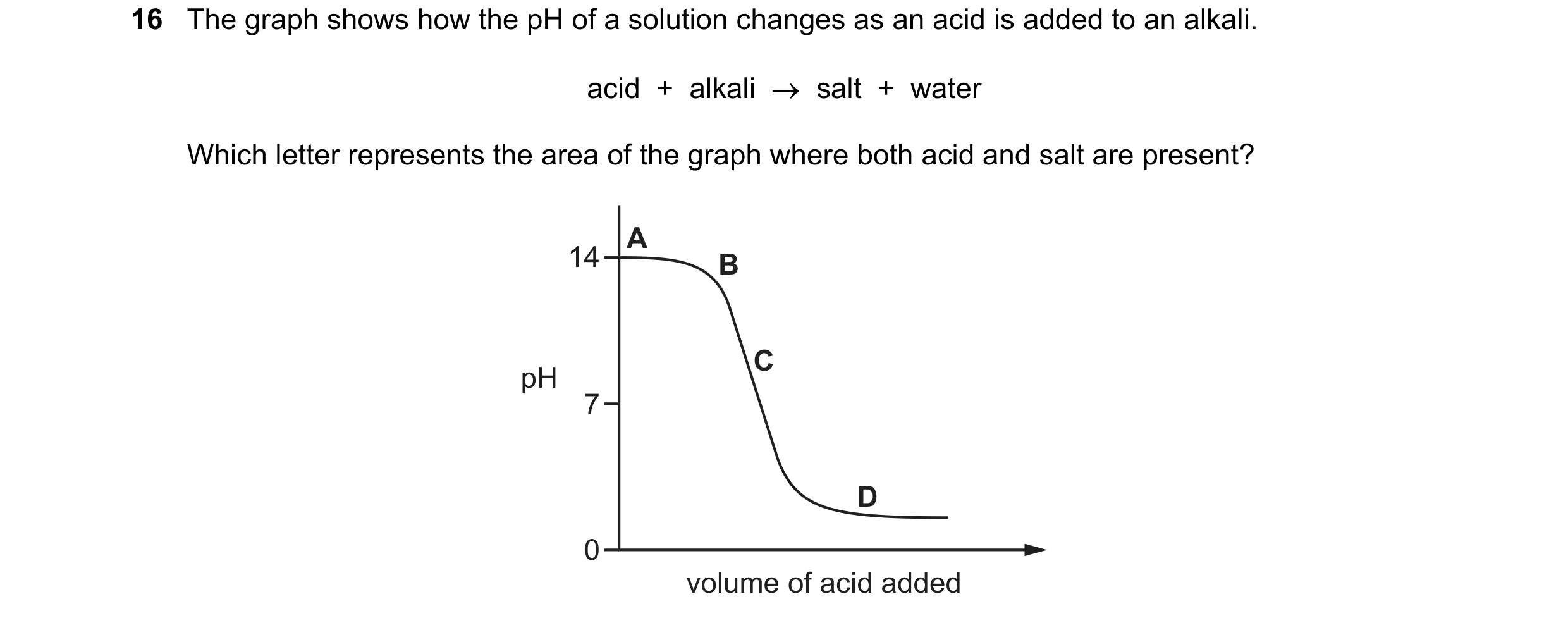
Q7 · The graph shows how the pH of a solution changes as an acid is added to an alkali 0971/11 May/June 2020
16 The graph shows how the pH of a solution changes as an acid is added to an alkali. acid + alkali → salt + water Which letter represents the area of the graph where both acid and salt are present? A 14 B C pH 7 D 0 volume of acid added
1 marks
Answer: D
This question in 0971/11 May/June 2020
Q8 · The graph shows how the pH of a solution changes as an acid is added to an alkali 0971/12 May/June 2020
16 The graph shows how the pH of a solution changes as an acid is added to an alkali. acid + alkali → salt + water Which letter represents the area of the graph where both acid and salt are present? A 14 B C pH 7 D 0 volume of acid added
1 marks
Answer: D
This question in 0971/12 May/June 2020
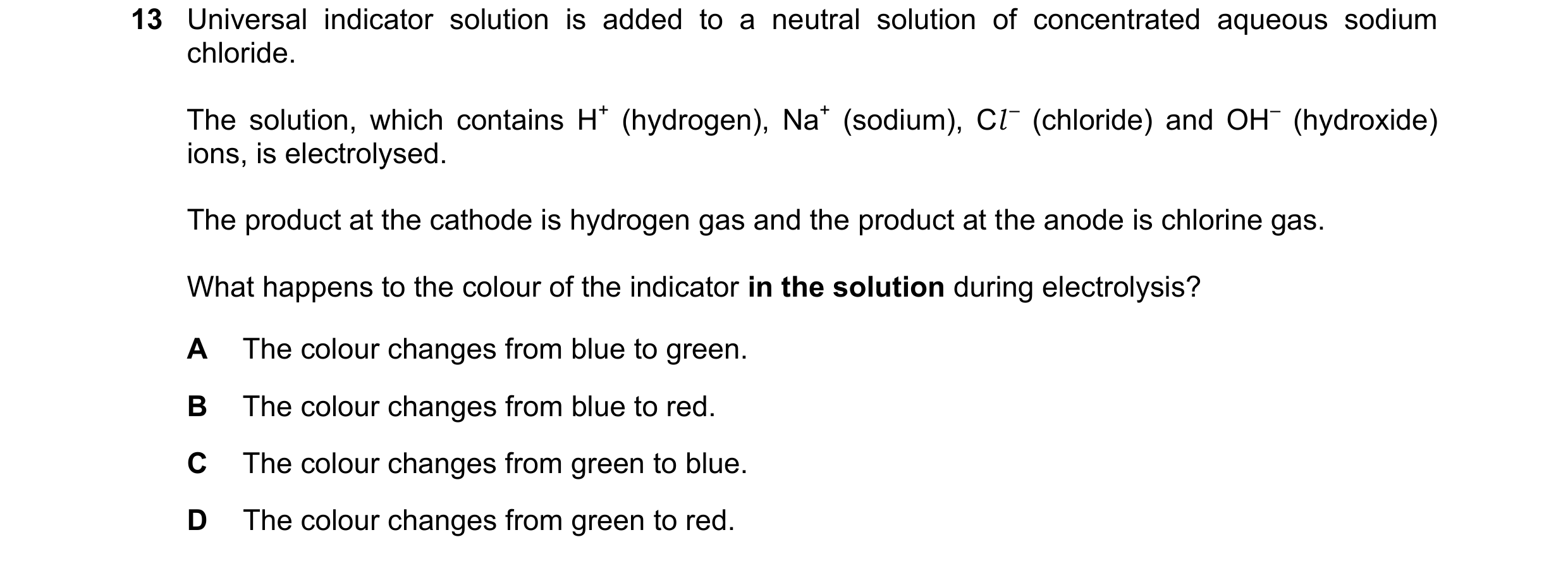
Q9 · Universal indicator solution is added to a neutral solution of concentrated aqueous… 0971/12 Oct/Nov 2020
13 Universal indicator solution is added to a neutral solution of concentrated aqueous sodium chloride. The solution, which contains H+ (hydrogen), Na+ (sodium), Cl – (chloride) and OH– (hydroxide) ions, is electrolysed. The product at the cathode is hydrogen gas and the product at the anode is chlorine gas. What happens to the colour of the indicator in the solution during electrolysis? A The colour changes from blue to green. B The colour changes from blue to red. C The colour changes from green to blue. D The colour changes from green to red.
1 marks
Answer: C
This question in 0971/12 Oct/Nov 2020
Q10 · Which statement describes a base? 0971/12 Oct/Nov 2020
21 Which statement describes a base? A It reacts with ammonium chloride to produce ammonia gas. B It reacts with calcium carbonate to produce carbon dioxide gas. C It reacts with copper to produce hydrogen gas. D It turns blue litmus red.
1 marks
Answer: A
This question in 0971/12 Oct/Nov 2020
Q11 · The structure of a compound X is shown 0971/12 Oct/Nov 2020
40 The structure of a compound X is shown. O H C O H X is in the same homologous series as ethanoic acid. Which row describes some of the properties of an aqueous solution of X? reacts with CaCO3 neutralises turns methyl to produce a gas CuO orange red A no no no B no yes no C yes yes yes D yes no yes
1 marks
Answer: C
This question in 0971/12 Oct/Nov 2020
Q12 · Three separate experiments are carried out on an aqueous solution of S 0971/11 May/June 2021
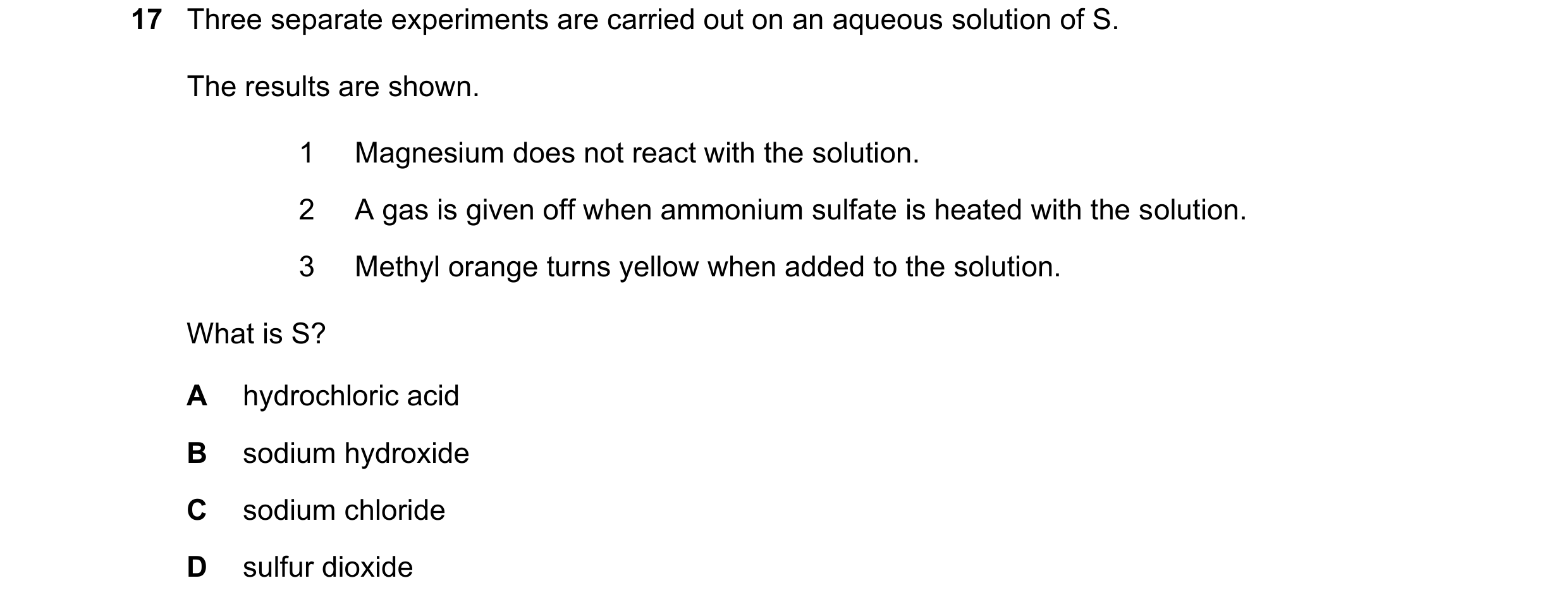
17 Three separate experiments are carried out on an aqueous solution of S. The results are shown. 1 Magnesium does not react with the solution. 2 A gas is given off when ammonium sulfate is heated with the solution. 3 Methyl orange turns yellow when added to the solution. What is S? A hydrochloric acid B sodium hydroxide C sodium chloride D sulfur dioxide
1 marks
Answer: B
This question in 0971/11 May/June 2021
Q13 · Which statements about acids and bases are correct? 0971/12 Oct/Nov 2021
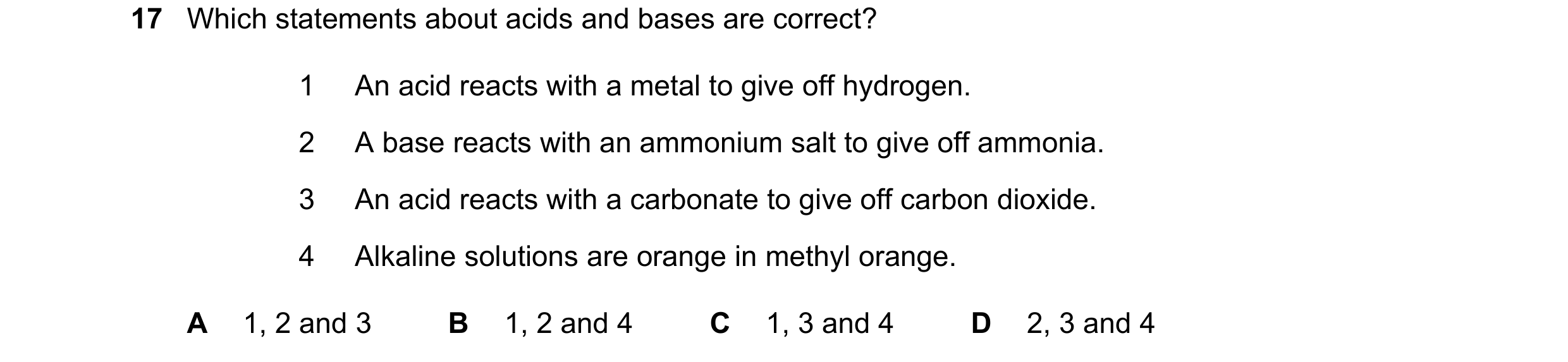
17 Which statements about acids and bases are correct? 1 An acid reacts with a metal to give off hydrogen. 2 A base reacts with an ammonium salt to give off ammonia. 3 An acid reacts with a carbonate to give off carbon dioxide. 4 Alkaline solutions are orange in methyl orange. A 1, 2 and 3 B 1, 2 and 4 C 1, 3 and 4 D 2, 3 and 4
1 marks
Answer: A
This question in 0971/12 Oct/Nov 2021
Q14 · Lime (calcium oxide) is used to treat waste water from a factory 0971/12 Oct/Nov 2021
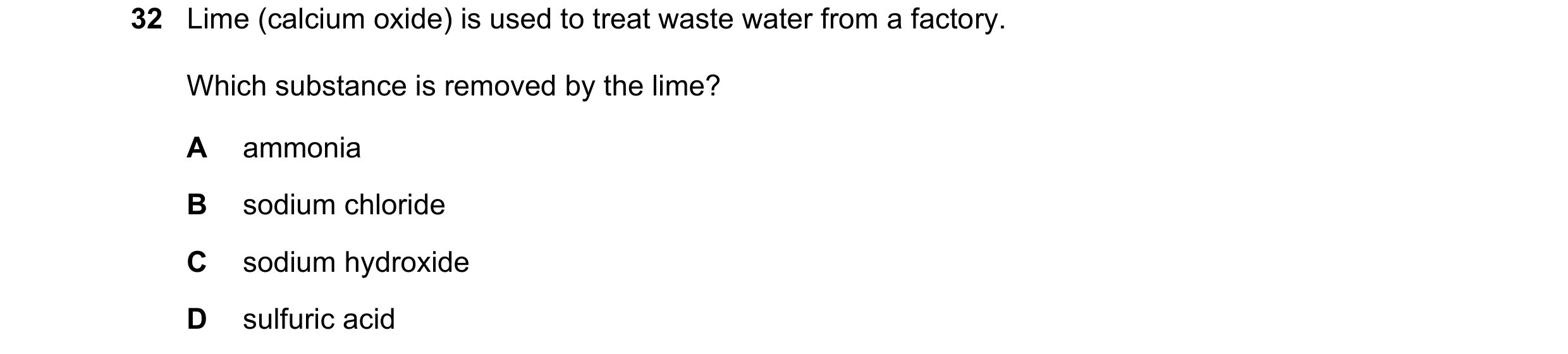
32 Lime (calcium oxide) is used to treat waste water from a factory. Which substance is removed by the lime? A ammonia B sodium chloride C sodium hydroxide D sulfuric acid
1 marks
Answer: D
This question in 0971/12 Oct/Nov 2021
Q15 · What is a property of aqueous ethanoic acid? 0971/12 Oct/Nov 2021
37 What is a property of aqueous ethanoic acid? A It changes red litmus blue. B It has a deep purple colour. C It has a pH of less than 7. D It reacts with a metal oxide to form carbon dioxide.
1 marks
Answer: C
This question in 0971/12 Oct/Nov 2021
Q16 · Which row about aqueous ethanoic acid and dilute hydrochloric acid is correct? 0971/11 May/June 2022
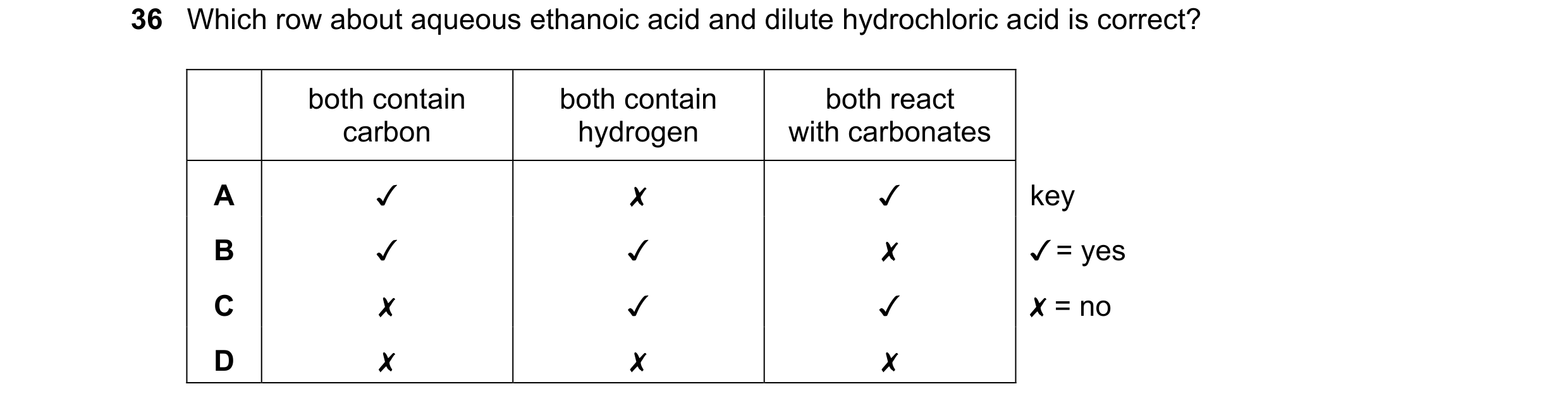
36 Which row about aqueous ethanoic acid and dilute hydrochloric acid is correct?
both contain
both contain
both react
carbon hydrogen with carbonates
A Jv x Jv key
B Jv J x /=yes
Cc x v v X=no
D x x x
1 marks
Answer: C
This question in 0971/11 May/June 2022
Q17 · Some common household substances are tested with litmus and methyl orange 0971/12 May/June 2022
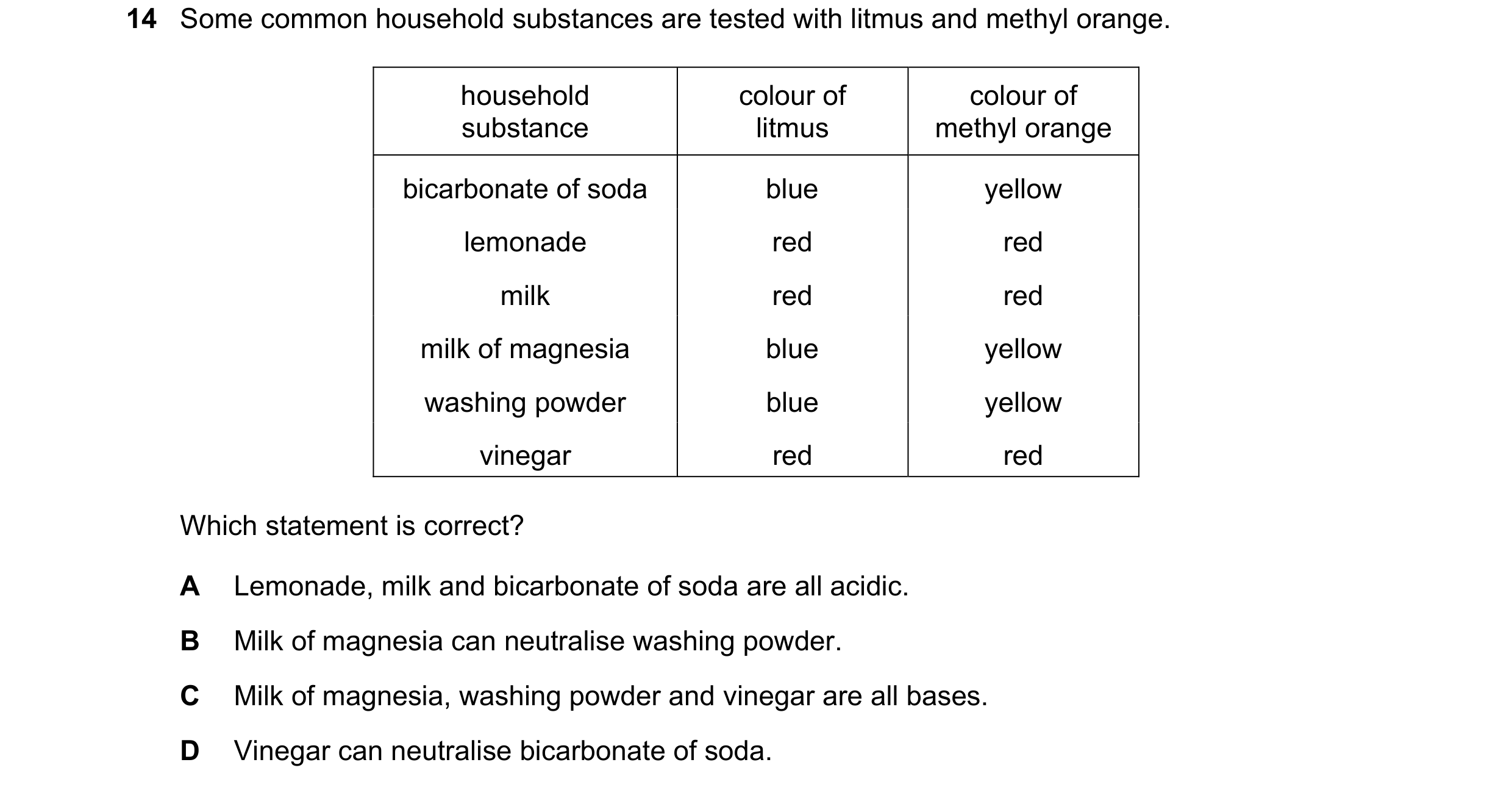
14 Some common household substances are tested with litmus and methyl orange. household colour of colour of substance litmus methyl orange bicarbonate of soda blue yellow lemonade red red milk red red milk of magnesia blue yellow washing powder blue yellow vinegar red red Which statement is correct? A Lemonade, milk and bicarbonate of soda are all acidic. B Milk of magnesia can neutralise washing powder. C Milk of magnesia, washing powder and vinegar are all bases. D Vinegar can neutralise bicarbonate of soda.
1 marks
Answer: D
This question in 0971/12 May/June 2022
Q18 · Which statements about ethanoic acid are correct? 0971/12 May/June 2022
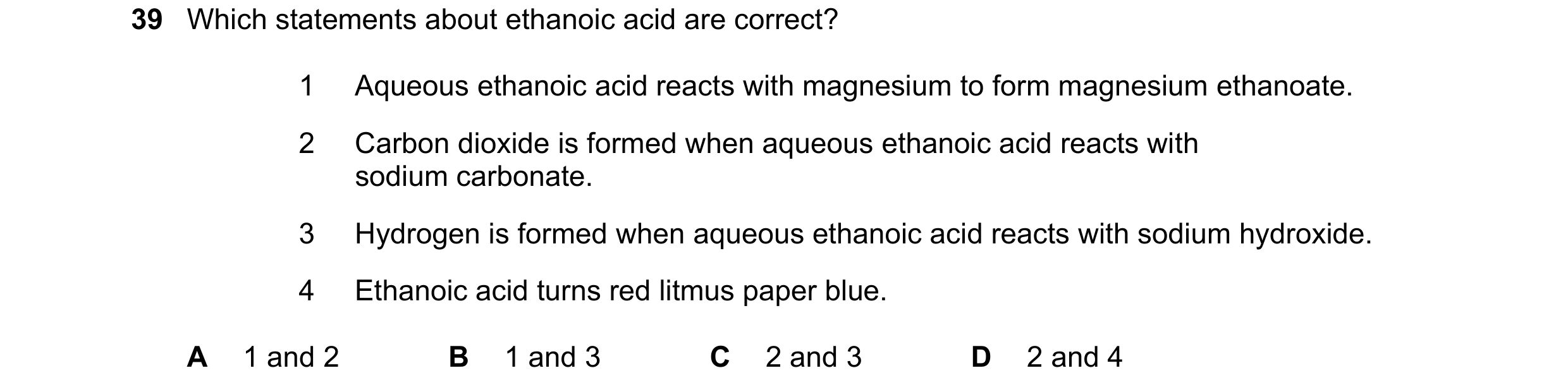
39 Which statements about ethanoic acid are correct? 1 Aqueous ethanoic acid reacts with magnesium to form magnesium ethanoate. 2 Carbon dioxide is formed when aqueous ethanoic acid reacts with sodium carbonate. 3 Hydrogen is formed when aqueous ethanoic acid reacts with sodium hydroxide. 4 Ethanoic acid turns red litmus paper blue. A 1 and 2 B 1 and 3 C 2 and 3 D 2 and 4
1 marks
Answer: A
This question in 0971/12 May/June 2022
Q19 · When an acid is added to an alkali, the temperature of the reaction mixture rises 0971/12 Oct/Nov 2022
11 When an acid is added to an alkali, the temperature of the reaction mixture rises. Which words describe this reaction? A decomposition and endothermic B decomposition and exothermic C neutralisation and endothermic D neutralisation and exothermic
1 marks
Answer: D
This question in 0971/12 Oct/Nov 2022
Q20 · Ammonium nitrate, NH4NO3, is a fertiliser and is added to fields to help crops grow 0971/12 Oct/Nov 2022
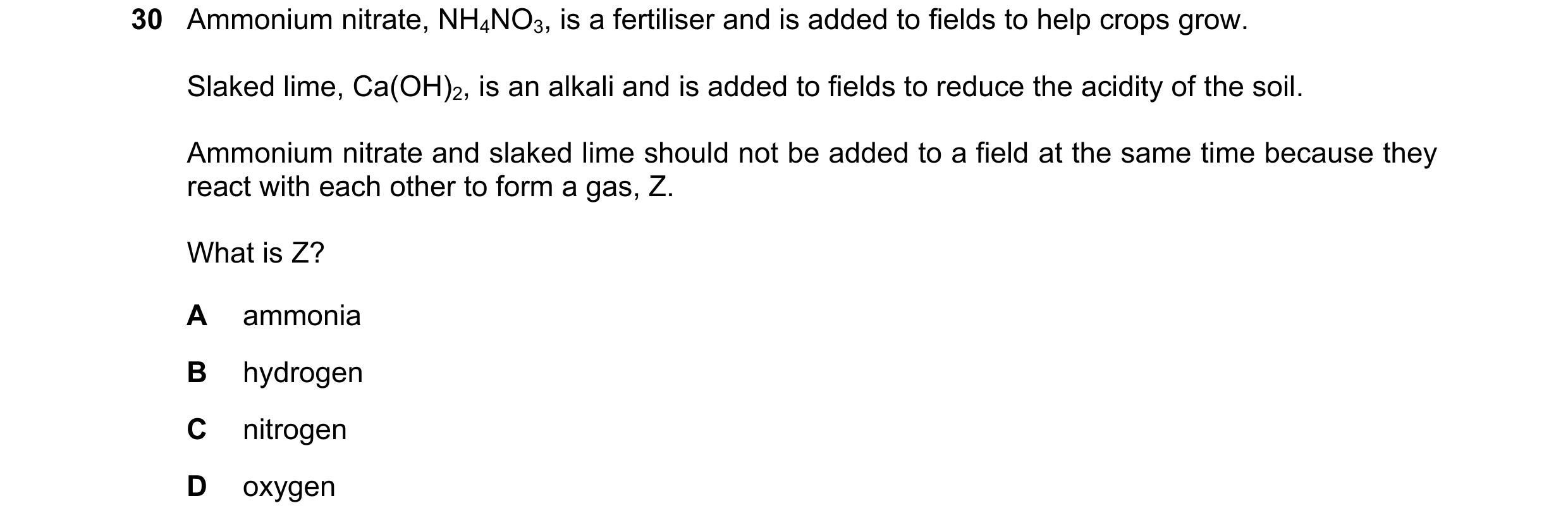
30 Ammonium nitrate, NH4NO3, is a fertiliser and is added to fields to help crops grow. Slaked lime, Ca(OH)2, is an alkali and is added to fields to reduce the acidity of the soil. Ammonium nitrate and slaked lime should not be added to a field at the same time because they react with each other to form a gas, Z. What is Z? A ammonia B hydrogen C nitrogen D oxygen
1 marks
Answer: A
This question in 0971/12 Oct/Nov 2022
Q21 · Which equation represents the neutralisation of nitric acid using sodium hydroxide? 0971/11 May/June 2023
7 Which equation represents the neutralisation of nitric acid using sodium hydroxide? A NaOH(aq) + HNO3(aq) → NaNO3(aq) + H2O(l) B NaOH(aq) + HNO3(aq) → NaNO3(l) + H2O(l) C NaOH(l) + HNO3(l) → NaNO3(l) + H2O(aq) D NaOH(l) + HNO3(l) → NaNO3(l) + H2O(l)
1 marks
Answer: A
This question in 0971/11 May/June 2023
Q22 · Sodium hydroxide forms an alkaline solution with a pH of 14 0971/11 May/June 2023
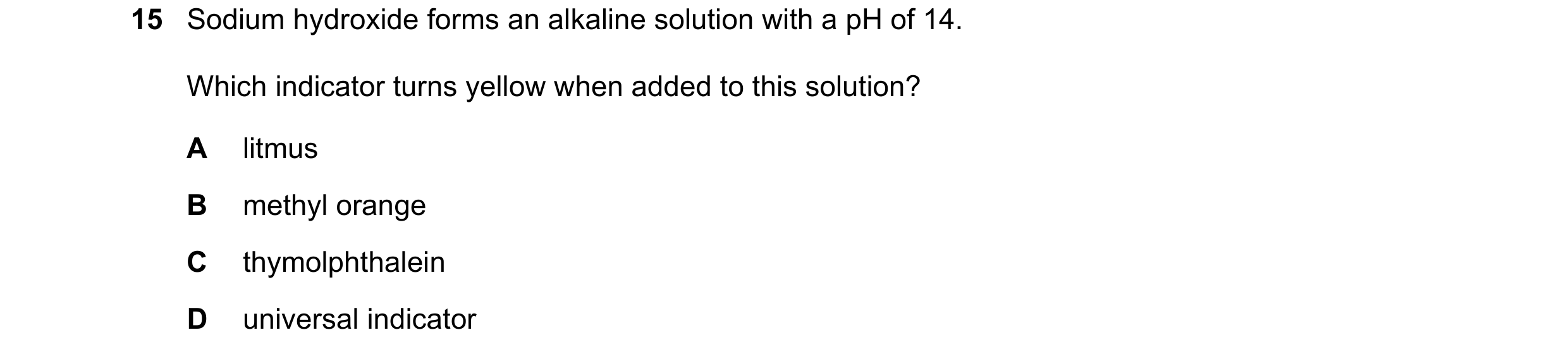
15 Sodium hydroxide forms an alkaline solution with a pH of 14. Which indicator turns yellow when added to this solution? A litmus B methyl orange C thymolphthalein D universal indicator
1 marks
Answer: B
This question in 0971/11 May/June 2023
Q23 · A farmer treats a field with calcium hydroxide to make it less acidic 0971/11 May/June 2024
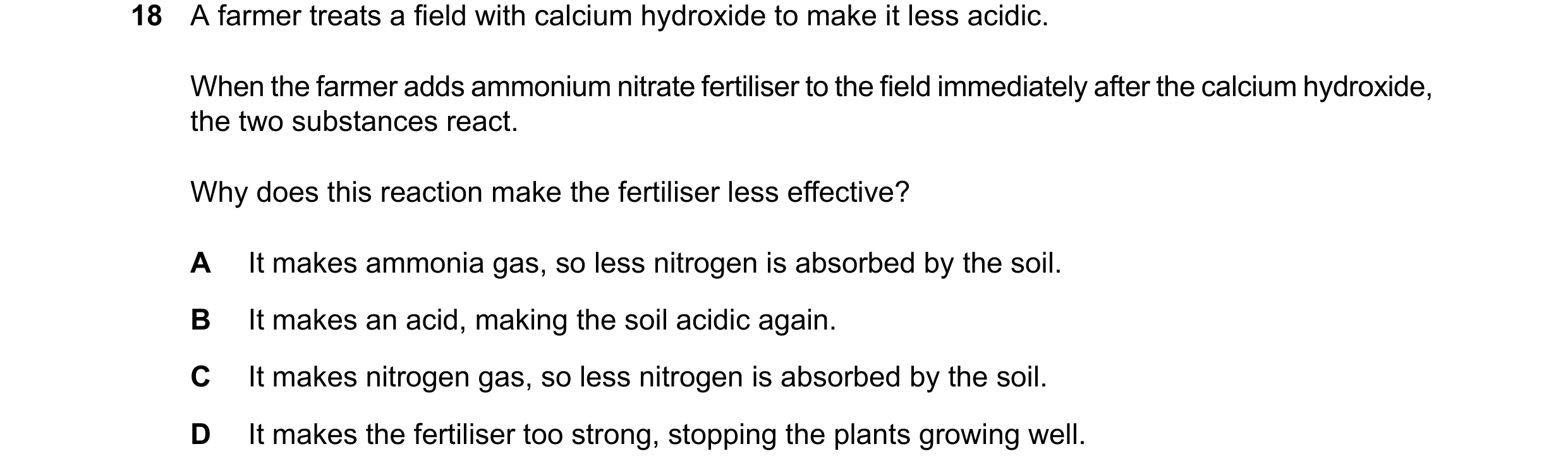
18 A farmer treats a field with calcium hydroxide to make it less acidic. When the farmer adds ammonium nitrate fertiliser to the field immediately after the calcium hydroxide, the two substances react. Why does this reaction make the fertiliser less effective? A It makes ammonia gas, so less nitrogen is absorbed by the soil. B It makes an acid, making the soil acidic again. C It makes nitrogen gas, so less nitrogen is absorbed by the soil. D It makes the fertiliser too strong, stopping the plants growing well.
1 marks
Answer: A
This question in 0971/11 May/June 2024
Q24 · Four different solutions are separately tested with blue litmus and with methyl orange 0971/12 May/June 2024
20 Four different solutions are separately tested with blue litmus and with methyl orange. Each solution is known to be either acidic or alkaline. The results are shown. result with result with solution blue litmus methyl orange 1 red red 2 red yellow 3 blue yellow 4 blue yellow Which statement is correct? A Solutions 1 and 4 are acidic. B Solutions 1 and 2 are alkaline. C Solutions 3 and 4 are acidic. D Solutions 3 and 4 are alkaline.
1 marks
Answer: D
This question in 0971/12 May/June 2024
Q25 · A student tests four solutions with universal indicator 0971/12 Oct/Nov 2024
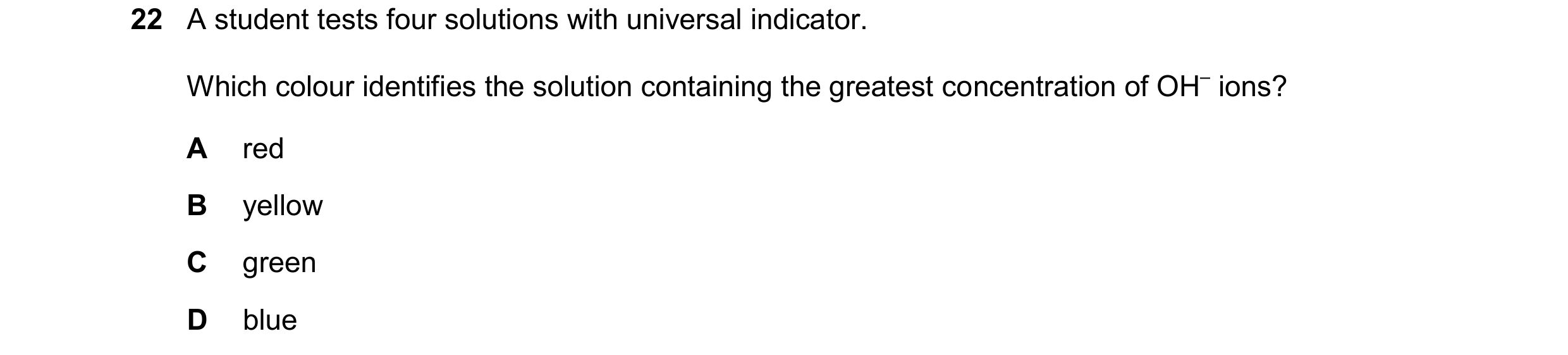
22 A student tests four solutions with universal indicator. Which colour identifies the solution containing the greatest concentration of OH– ions? A red B yellow C green D blue
1 marks
Answer: D
This question in 0971/12 Oct/Nov 2024
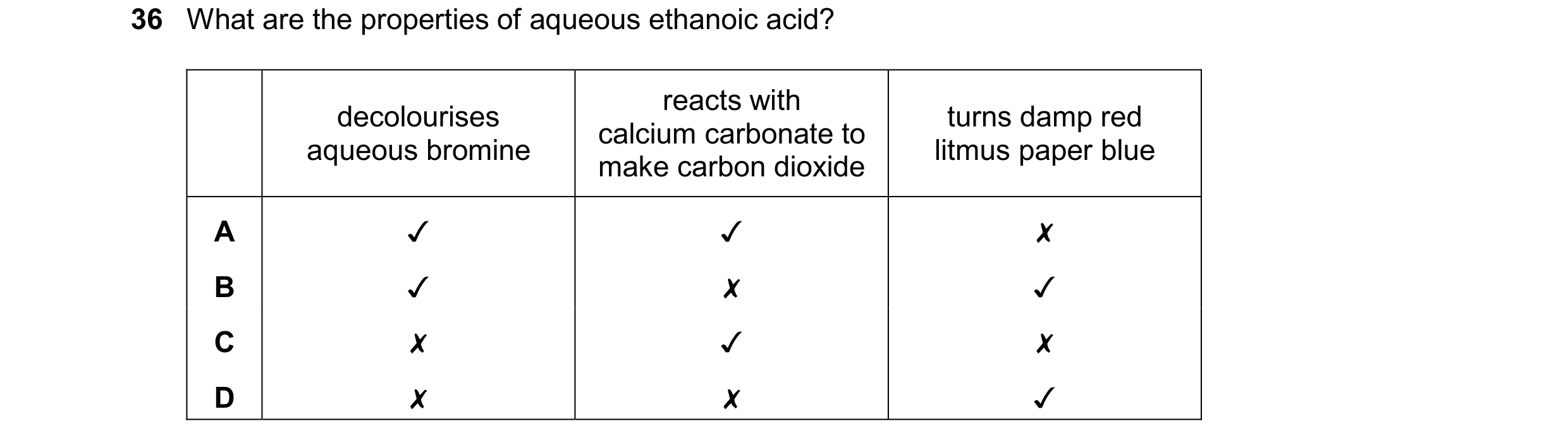
Q26 · What are the properties of aqueous ethanoic acid? 0971/12 Oct/Nov 2024
36 What are the properties of aqueous ethanoic acid?
decolourises
aqueous bromine
reacts with
calcium carbonate to
make carbon dioxide
turns damp red
litmus paper blue
v
x
v
x
\ &«& \ xX
1 marks
Answer: C
This question in 0971/12 Oct/Nov 2024
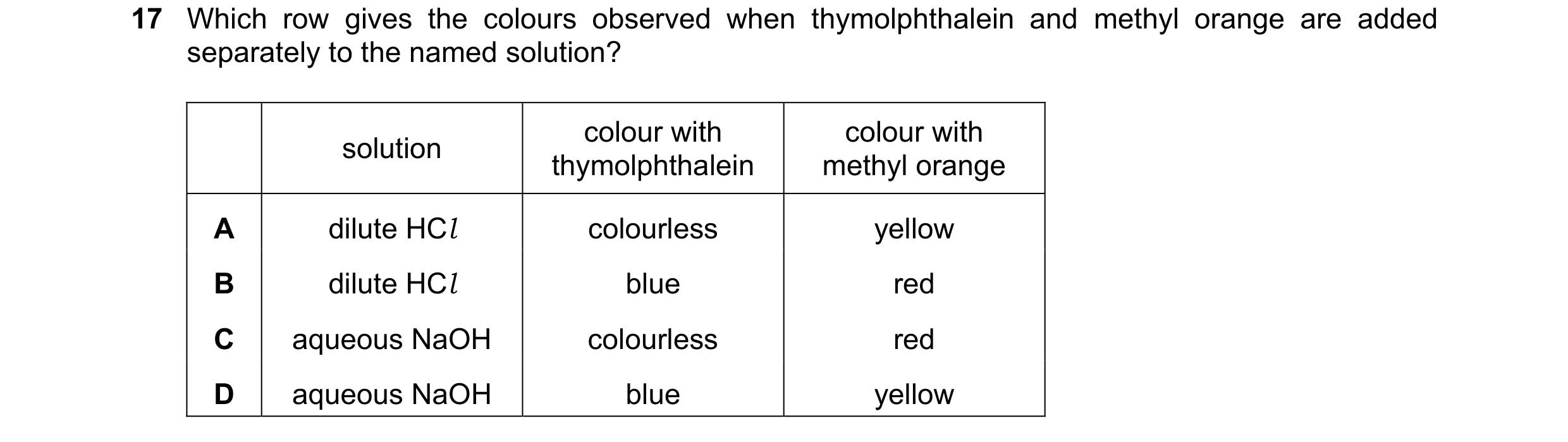
Q27 · Which row gives the colours observed when thymolphthalein and methyl orange are added… 0971/11 May/June 2025
17 Which row gives the colours observed when thymolphthalein and methyl orange are added separately to the named solution? colour with colour with solution thymolphthalein methyl orange A dilute HCl colourless yellow B dilute HCl blue red C aqueous NaOH colourless red D aqueous NaOH blue yellow
1 marks
Answer: D
This question in 0971/11 May/June 2025
Q28 · Which row describes an aqueous solution for the pH shown? 0971/12 May/June 2025
19 Which row describes an aqueous solution for the pH shown? pH description A 1 has a very high alkalinity B 5 is neutral C 9 turns universal indicator yellow D 14 contains OH– ions
1 marks
Answer: D
This question in 0971/12 May/June 2025
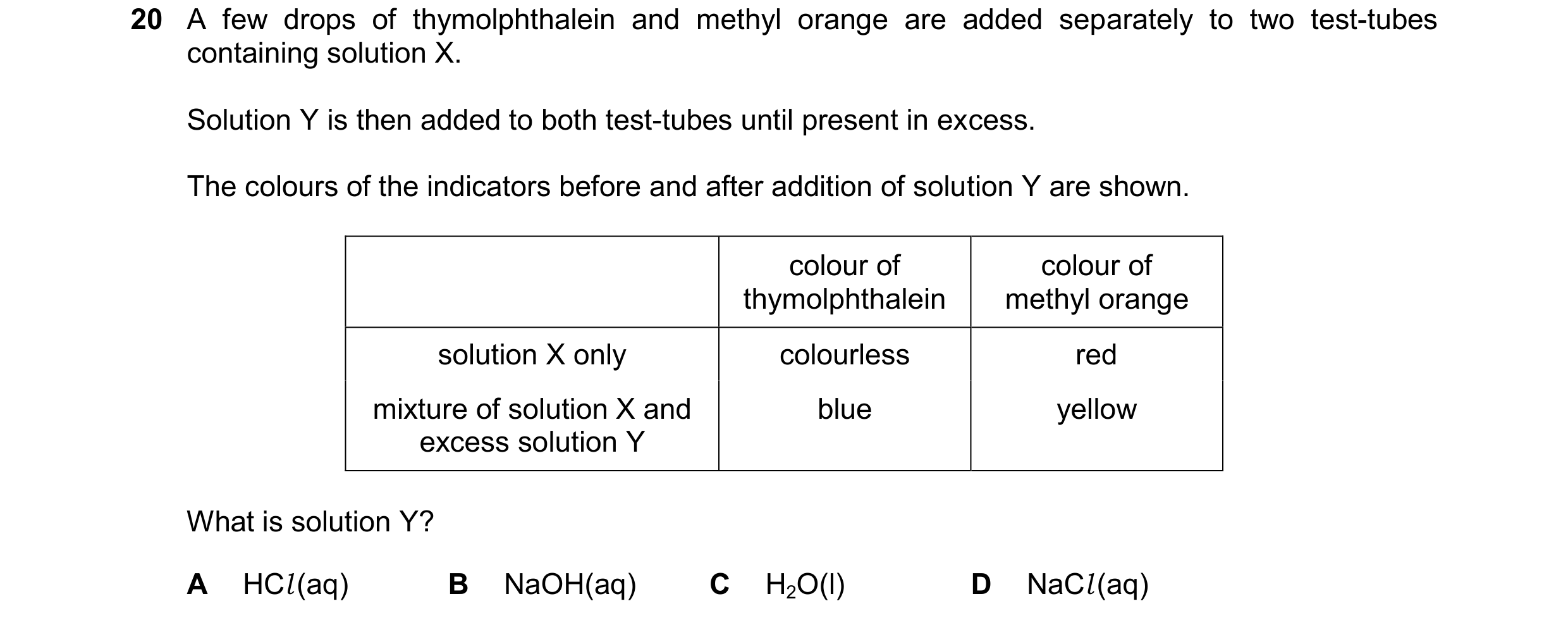
Q29 · A few drops of thymolphthalein and methyl orange are added separately to two test-tubes… 0971/12 Oct/Nov 2025
20 A few drops of thymolphthalein and methyl orange are added separately to two test-tubes containing solution X. Solution Y is then added to both test-tubes until present in excess. The colours of the indicators before and after addition of solution Y are shown. colour of colour of thymolphthalein methyl orange solution X only colourless red mixture of solution X and blue yellow excess solution Y What is solution Y? A HCl (aq) B NaOH(aq) C H2O(l) D NaCl (aq)
1 marks
Answer: B
This question in 0971/12 Oct/Nov 2025
 1 / 8
1 / 8

 2 / 8
2 / 8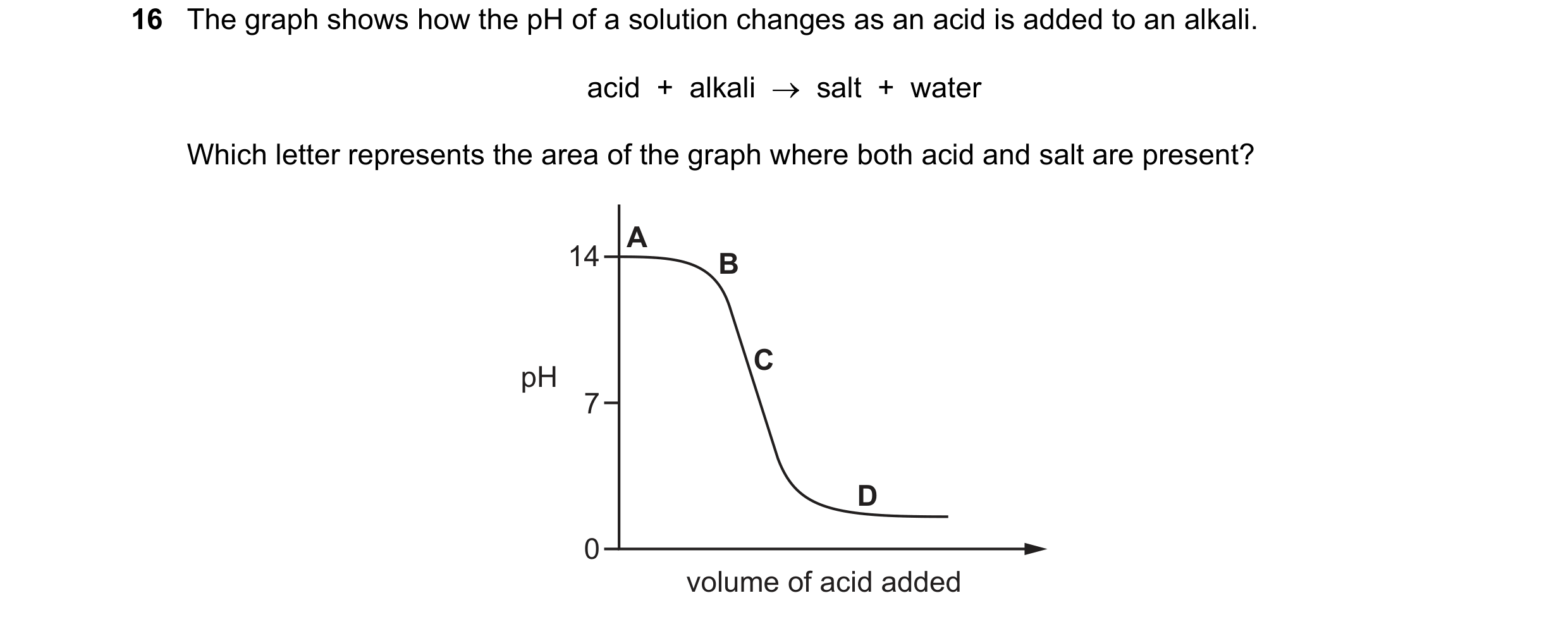
 3 / 8
3 / 8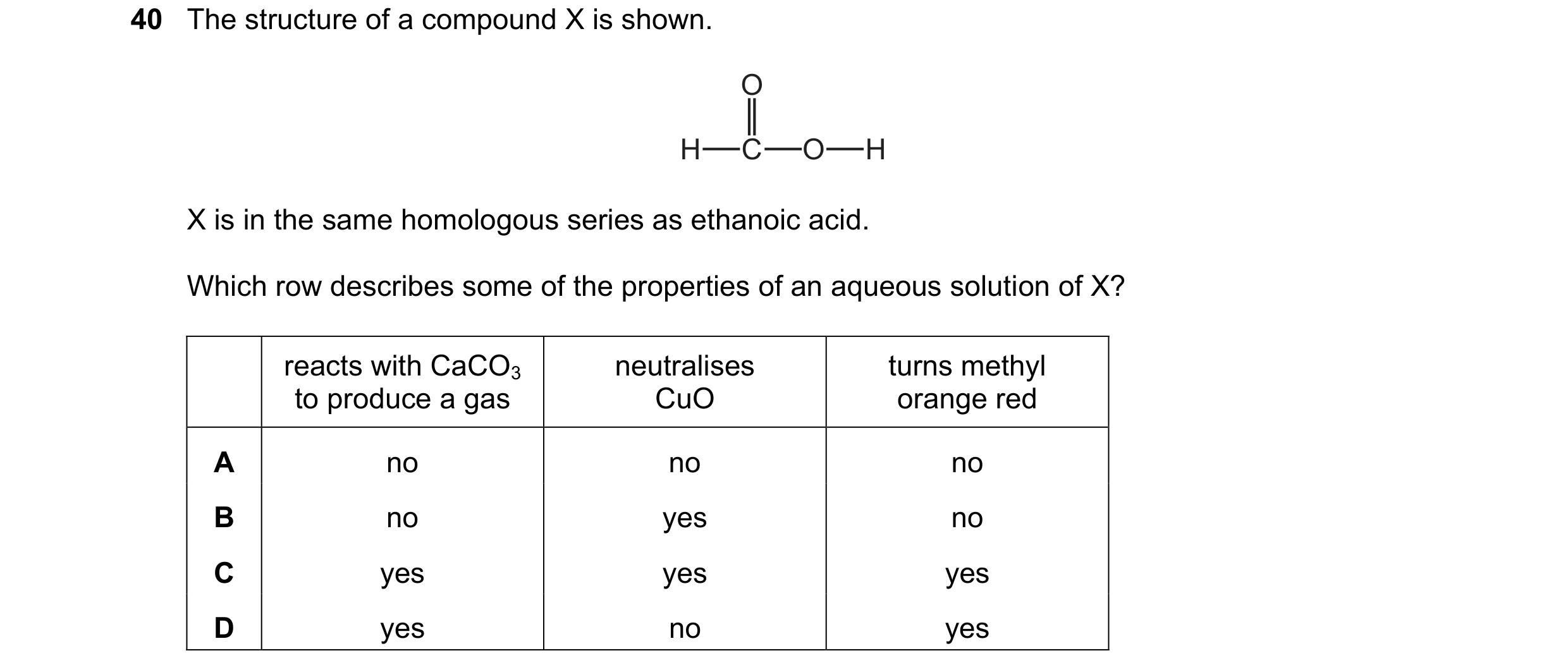
 4 / 8
4 / 8
 5 / 8
5 / 8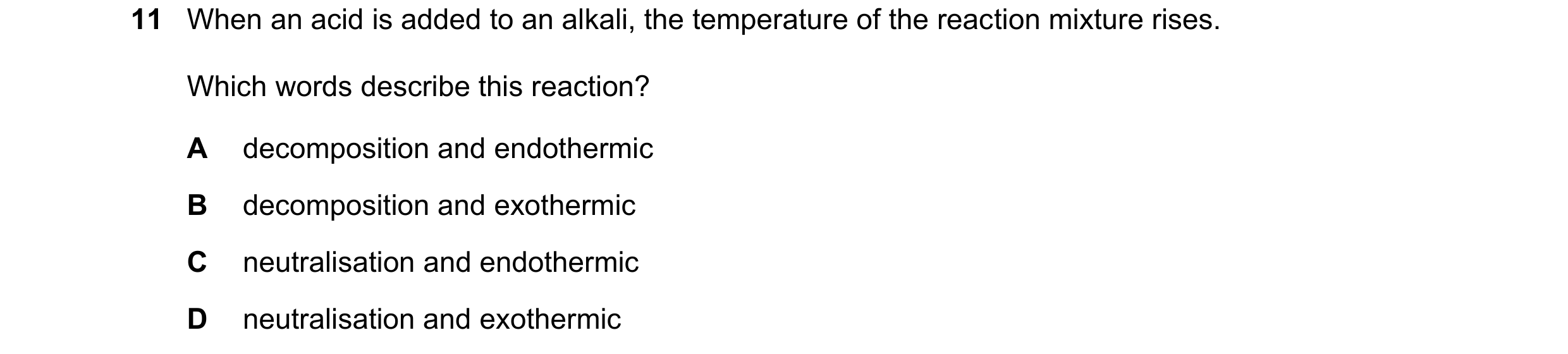

 6 / 8
6 / 8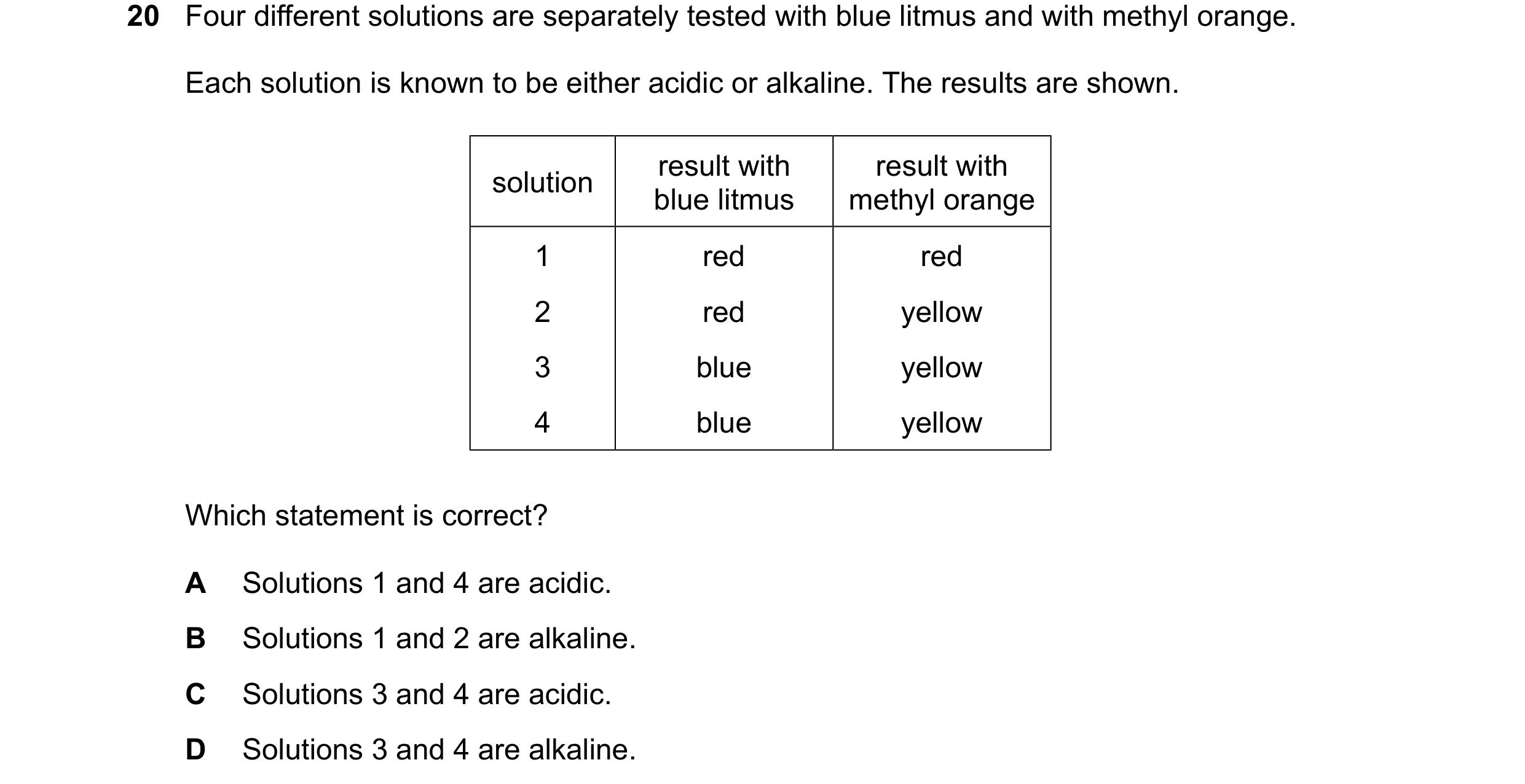
 7 / 8
7 / 8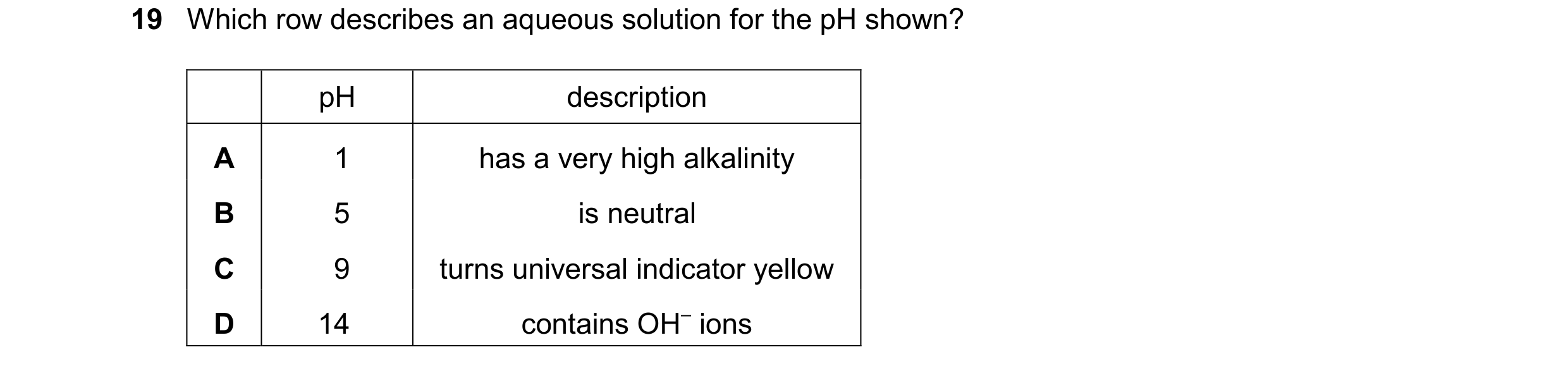
 8 / 8
8 / 8