Cambridge IGCSE Chemistry (9-1) 0971 — 2019 Oct/Nov Paper 2 · Variant 2
0971/22/O/N/19 · 40 questions · 40 marks · ≈45 min
The question paper and its mark scheme, free to read here and free to download. This is Cambridge’s own paper, exactly as it was sat.
Question paper16 pages

Mark scheme3 pages
Answers below. Sit the paper first if you are practising.
Questions as text
Q1 · The rate of diffusion of a gas depends on its molecular mass and the temperature
1 The rate of diffusion of a gas depends on its molecular mass and the temperature. Which combination of molecular mass and temperature gives the slowest rate of diffusion? molecular mass temperature A high high B high low C low high D low low
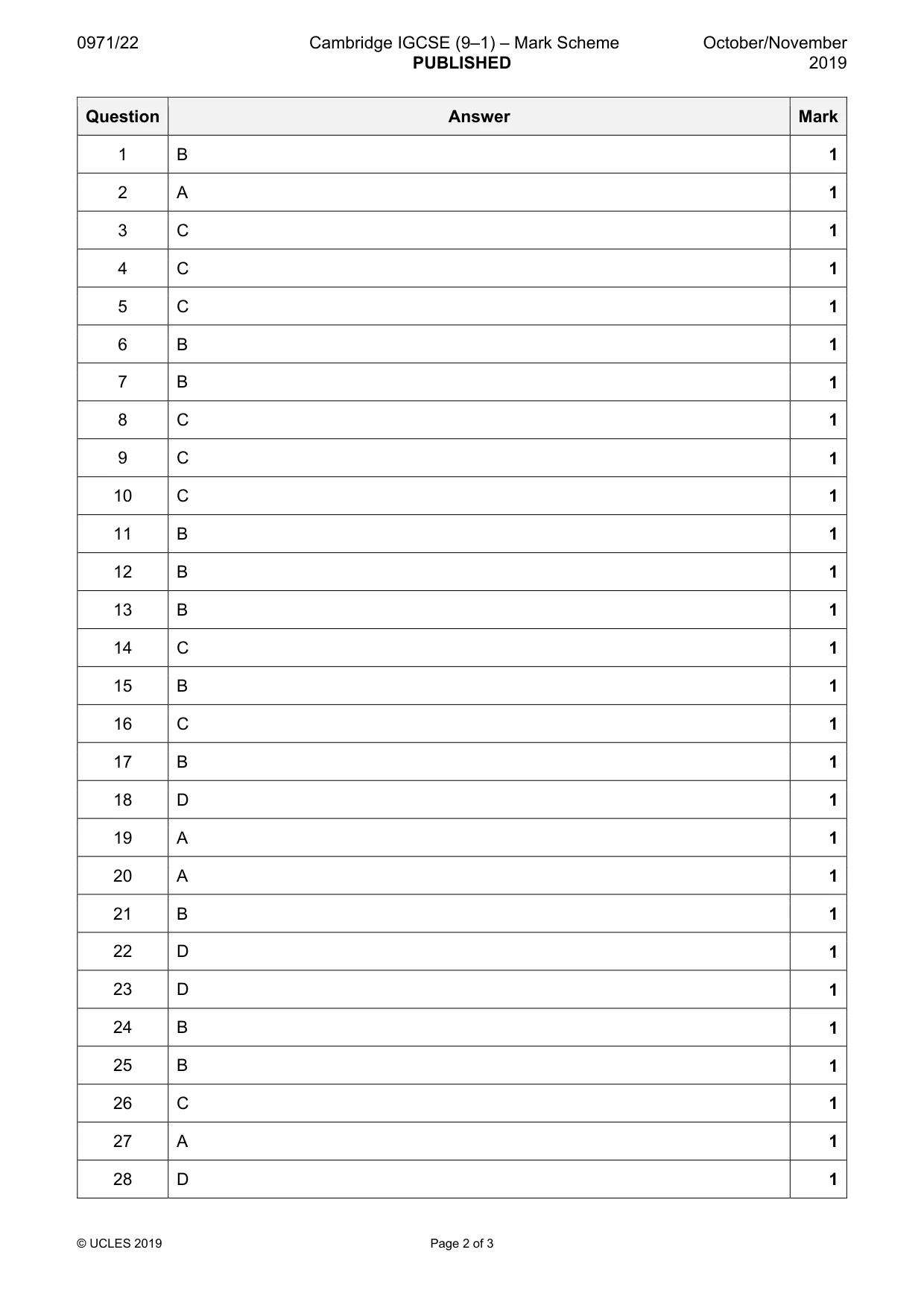
Mark scheme: B
Q2 · A student is asked to measure the time taken for 0.4 g of magnesium carbonate to react…
2 A student is asked to measure the time taken for 0.4 g of magnesium carbonate to react completely with 25.0 cm3 of dilute hydrochloric acid. Which pieces of apparatus does the student need? A balance, stop-clock, pipette B balance, stop-clock, thermometer C balance, pipette, thermometer D stop-clock, pipette, thermometer
Mark scheme: A
Q3 · Substance Q was investigated using chromatography
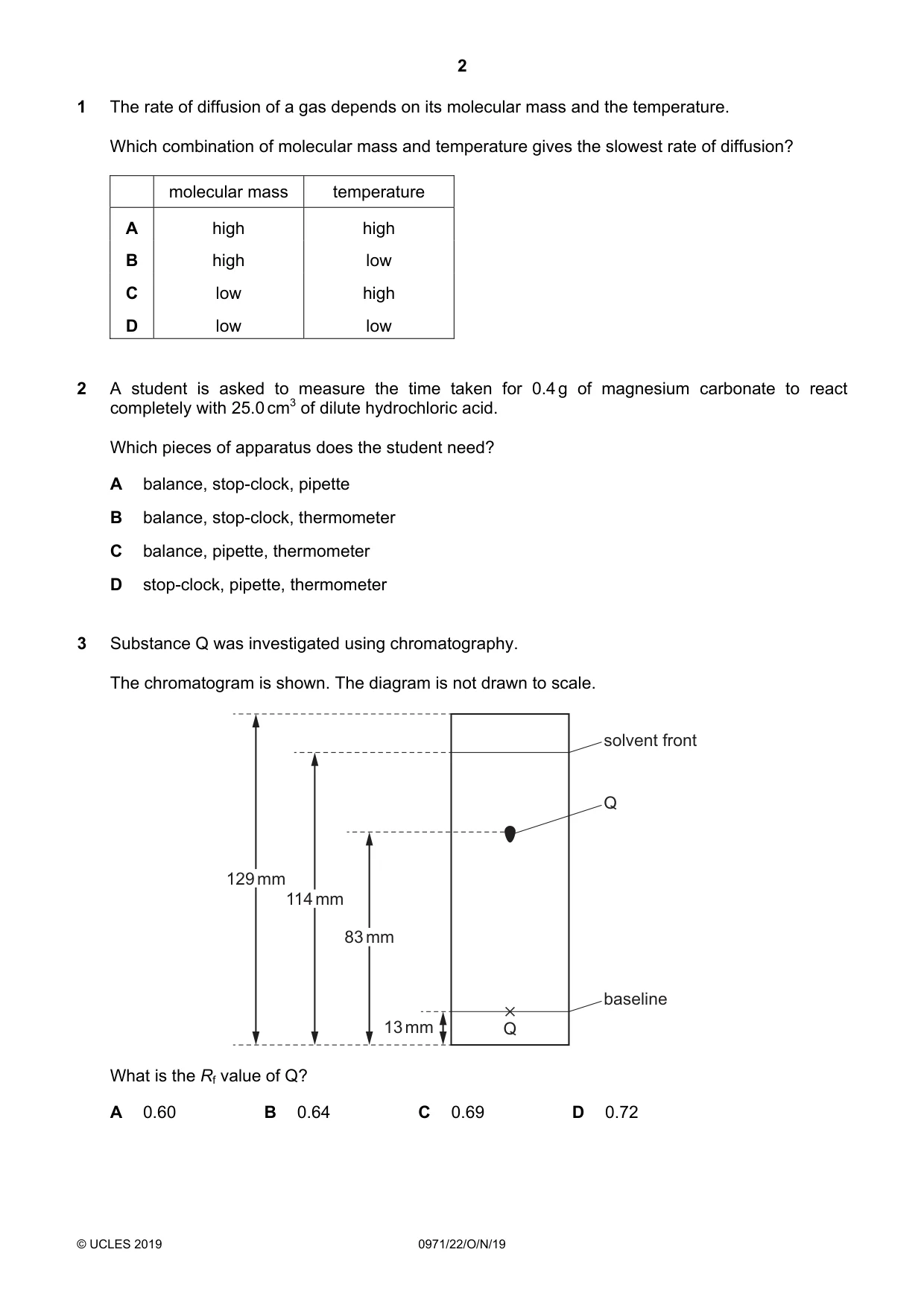
3 Substance Q was investigated using chromatography. The chromatogram is shown. The diagram is not drawn to scale. solvent front Q 129 mm 114 mm 83 mm baseline 13 mm Q What is the Rf value of Q? A 0.60 B 0.64 C 0.69 D 0.72
Mark scheme: C
Q4 · Which statement about an ionic compound is not correct?
4 Which statement about an ionic compound is not correct? A It conducts electricity when dissolved in water. B It has a high melting point due to strong attractive forces between ions. C It has a regular lattice of oppositely charged ions in a ‘sea of electrons’. D The ionic bonds are formed between metallic and non-metallic elements.
Mark scheme: C
Q5 · What is the total number of electrons in one molecule of ammonia, NH3?
5 What is the total number of electrons in one molecule of ammonia, NH3? A 6 B 8 C 10 D 11
Mark scheme: C
Q6 · Rubidium has two isotopes, 85 Rb and 87 Rb
6 Rubidium has two isotopes, 85 Rb and 87 Rb . 37 37 Which statement explains why both isotopes have the same chemical properties? A They have the same number of protons. B They have the same number of outer shell electrons. C They have different numbers of neutrons. D They have different mass numbers.
Mark scheme: B
Q7 · Which statement about the structure and properties of silicon(IV) oxide is not correct?
7 Which statement about the structure and properties of silicon(IV) oxide is not correct? A It has a giant structure similar to that of diamond. B It has a high melting point due to the strong attractive force between molecules. C There are strong covalent bonds between silicon and oxygen. D There are no free electrons, so silicon(IV) oxide does not conduct electricity.
Mark scheme: B
Q8 · Which statement describes the structure of copper?
8 Which statement describes the structure of copper? A It has a lattice of negative ions in a ‘sea of electrons’. B It has a lattice of negative ions in a ‘sea of protons’. C It has a lattice of positive ions in a ‘sea of electrons’. D It has a lattice of positive ions in a ‘sea of protons’.
Mark scheme: C
Q9 · Phosphorus reacts with oxygen to form phosphorus(III) oxide as shown
9 Phosphorus reacts with oxygen to form phosphorus(III) oxide as shown. 4P(s) + 3O2(g) → 2P2O3(s) Which mass of phosphorus(III) oxide is produced from 6.2 g of phosphorus? A 1.1 g B 5.5 g C 11.0 g D 22.0 g
Mark scheme: C
Q10 · Calcium carbonate is heated
10 Calcium carbonate is heated. Calcium oxide and carbon dioxide gas are formed. The equation for the reaction is shown. CaCO3 → CaO + CO2 225 kg of calcium carbonate is heated until there is no further change in mass. The yield of calcium oxide is 85 kg. What is the percentage yield? A 37.8% B 47.2% C 67.5% D 85.0%
Mark scheme: C
Q11 · The diagram shows a simple cell
11 The diagram shows a simple cell. voltmeter wire metal P metal Q dilute sulfuric acid Which pair of metals produces the largest voltage? metal P metal Q A magnesium iron B magnesium copper C zinc iron D zinc copper
Mark scheme: B
Q12 · What are the ionic half-equations for the electrode reactions during the electrolysis of…
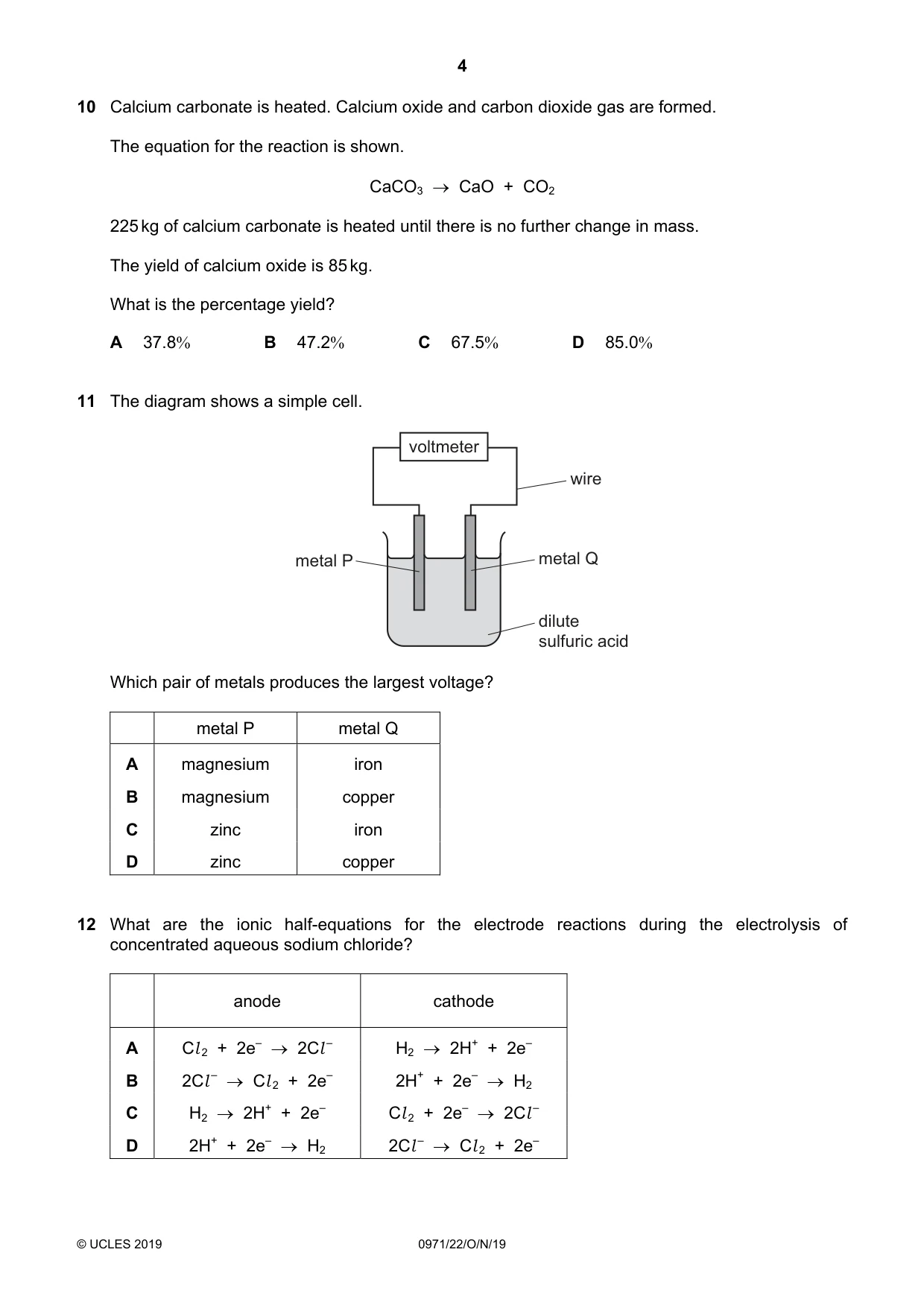
12 What are the ionic half-equations for the electrode reactions during the electrolysis of concentrated aqueous sodium chloride? anode cathode A Cl 2 + 2e– → 2Cl – H2 → 2H+ + 2e– B 2Cl – → Cl 2 + 2e– 2H+ + 2e– → H2 C H2 → 2H+ + 2e– Cl 2 + 2e– → 2Cl – D 2H+ + 2e– → H2 2Cl – → Cl 2 + 2e–
Mark scheme: B
Q13 · The temperature of the water in two beakers, X and Y, is measured as 21.5 °C
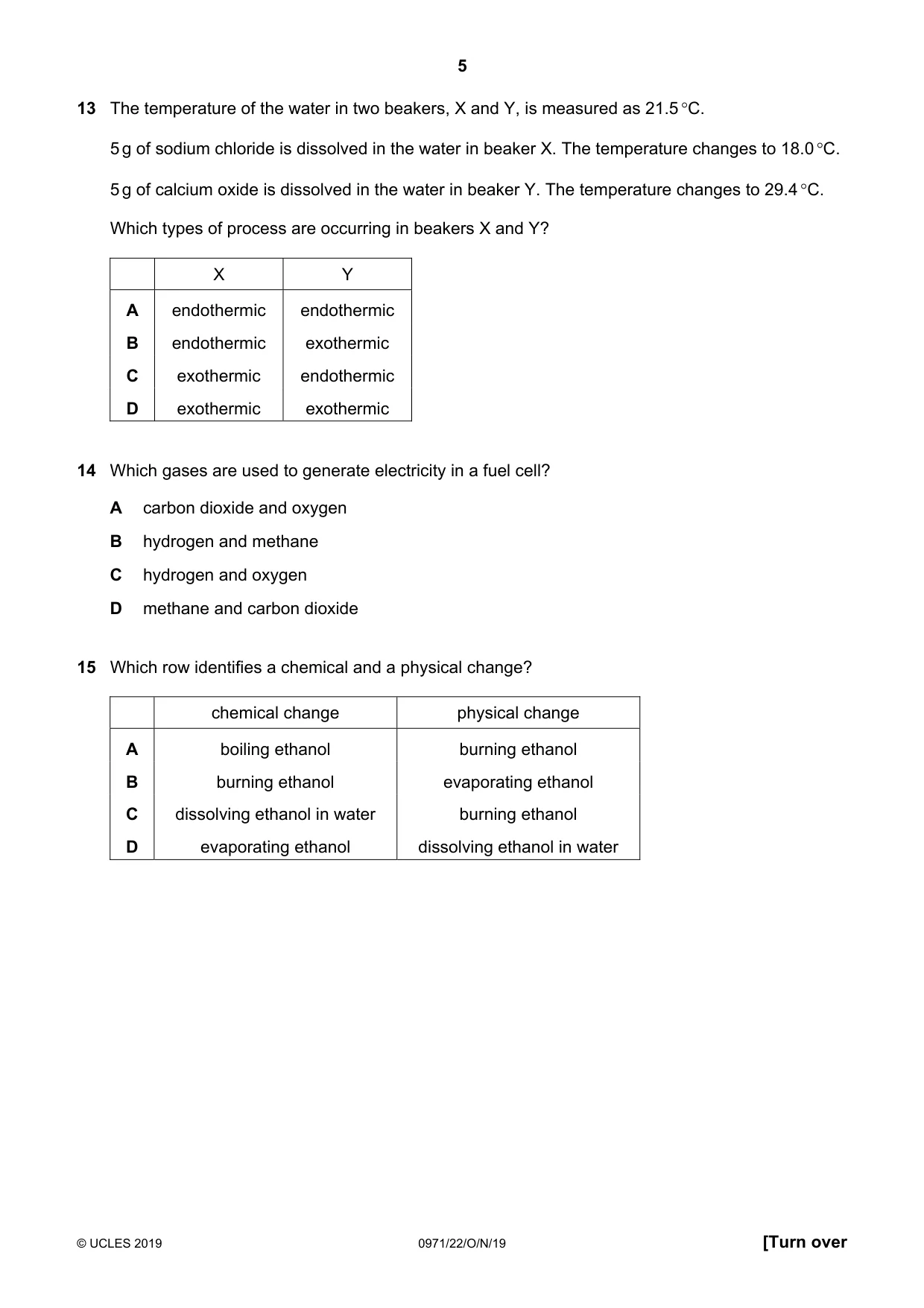
13 The temperature of the water in two beakers, X and Y, is measured as 21.5 °C. 5 g of sodium chloride is dissolved in the water in beaker X. The temperature changes to 18.0 °C. 5 g of calcium oxide is dissolved in the water in beaker Y. The temperature changes to 29.4 °C. Which types of process are occurring in beakers X and Y? X Y A endothermic endothermic B endothermic exothermic C exothermic endothermic D exothermic exothermic
Mark scheme: B
Q14 · Which gases are used to generate electricity in a fuel cell?
14 Which gases are used to generate electricity in a fuel cell? A carbon dioxide and oxygen B hydrogen and methane C hydrogen and oxygen D methane and carbon dioxide
Mark scheme: C
Q15 · Which row identifies a chemical and a physical change?
15 Which row identifies a chemical and a physical change? chemical change physical change A boiling ethanol burning ethanol B burning ethanol evaporating ethanol C dissolving ethanol in water burning ethanol D evaporating ethanol dissolving ethanol in water
Mark scheme: B
Q16 · A sample of dilute nitric acid is added to lumps of limestone in a conical flask
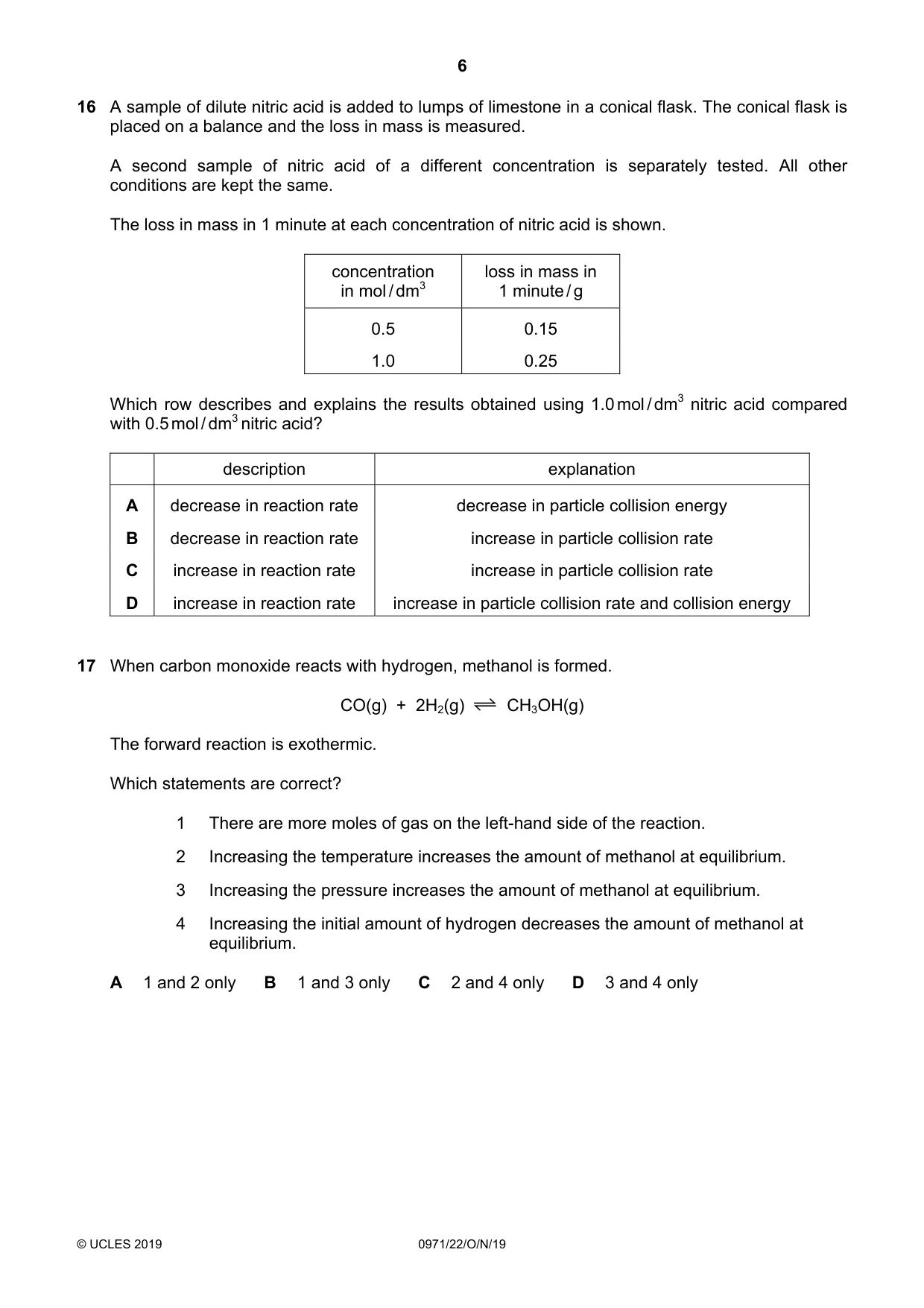
16 A sample of dilute nitric acid is added to lumps of limestone in a conical flask. The conical flask is placed on a balance and the loss in mass is measured. A second sample of nitric acid of a different concentration is separately tested. All other conditions are kept the same. The loss in mass in 1 minute at each concentration of nitric acid is shown. concentration loss in mass in in mol / dm3 1 minute / g 0.5 0.15 1.0 0.25 Which row describes and explains the results obtained using 1.0 mol / dm3 nitric acid compared with 0.5 mol / dm3 nitric acid? description explanation A decrease in reaction rate decrease in particle collision energy B decrease in reaction rate increase in particle collision rate C increase in reaction rate increase in particle collision rate D increase in reaction rate increase in particle collision rate and collision energy
Mark scheme: C
Q17 · When carbon monoxide reacts with hydrogen, methanol is formed
17 When carbon monoxide reacts with hydrogen, methanol is formed. CO(g) + 2H2(g) CH3OH(g) The forward reaction is exothermic. Which statements are correct? 1 There are more moles of gas on the left-hand side of the reaction. 2 Increasing the temperature increases the amount of methanol at equilibrium. 3 Increasing the pressure increases the amount of methanol at equilibrium. 4 Increasing the initial amount of hydrogen decreases the amount of methanol at equilibrium. A 1 and 2 only B 1 and 3 only C 2 and 4 only D 3 and 4 only
Mark scheme: B
Q18 · In the blast furnace, iron is formed when iron(III) oxide reacts with carbon monoxide in…
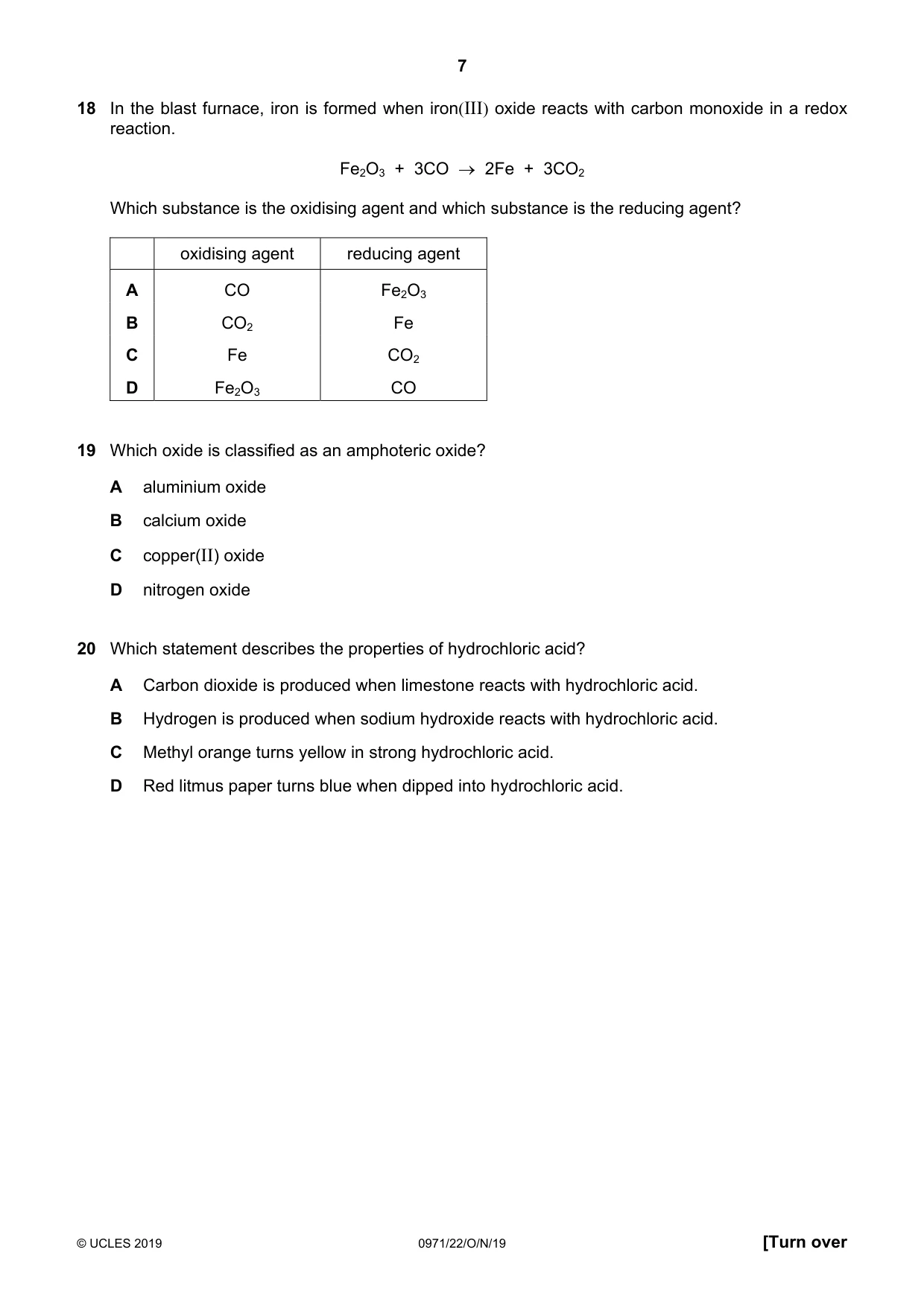
18 In the blast furnace, iron is formed when iron(III) oxide reacts with carbon monoxide in a redox reaction. Fe2O3 + 3CO → 2Fe + 3CO2 Which substance is the oxidising agent and which substance is the reducing agent? oxidising agent reducing agent A CO Fe2O3 B CO2 Fe C Fe CO2 D Fe2O3 CO
Mark scheme: D
Q19 · Which oxide is classified as an amphoteric oxide?
19 Which oxide is classified as an amphoteric oxide? A aluminium oxide B calcium oxide C copper(II) oxide D nitrogen oxide
Mark scheme: A
Q20 · Which statement describes the properties of hydrochloric acid?
20 Which statement describes the properties of hydrochloric acid? A Carbon dioxide is produced when limestone reacts with hydrochloric acid. B Hydrogen is produced when sodium hydroxide reacts with hydrochloric acid. C Methyl orange turns yellow in strong hydrochloric acid. D Red litmus paper turns blue when dipped into hydrochloric acid.
Mark scheme: A
More questions on The characteristic properties of acids and bases
Q21 · A method used to make copper(II) sulfate crystals is shown
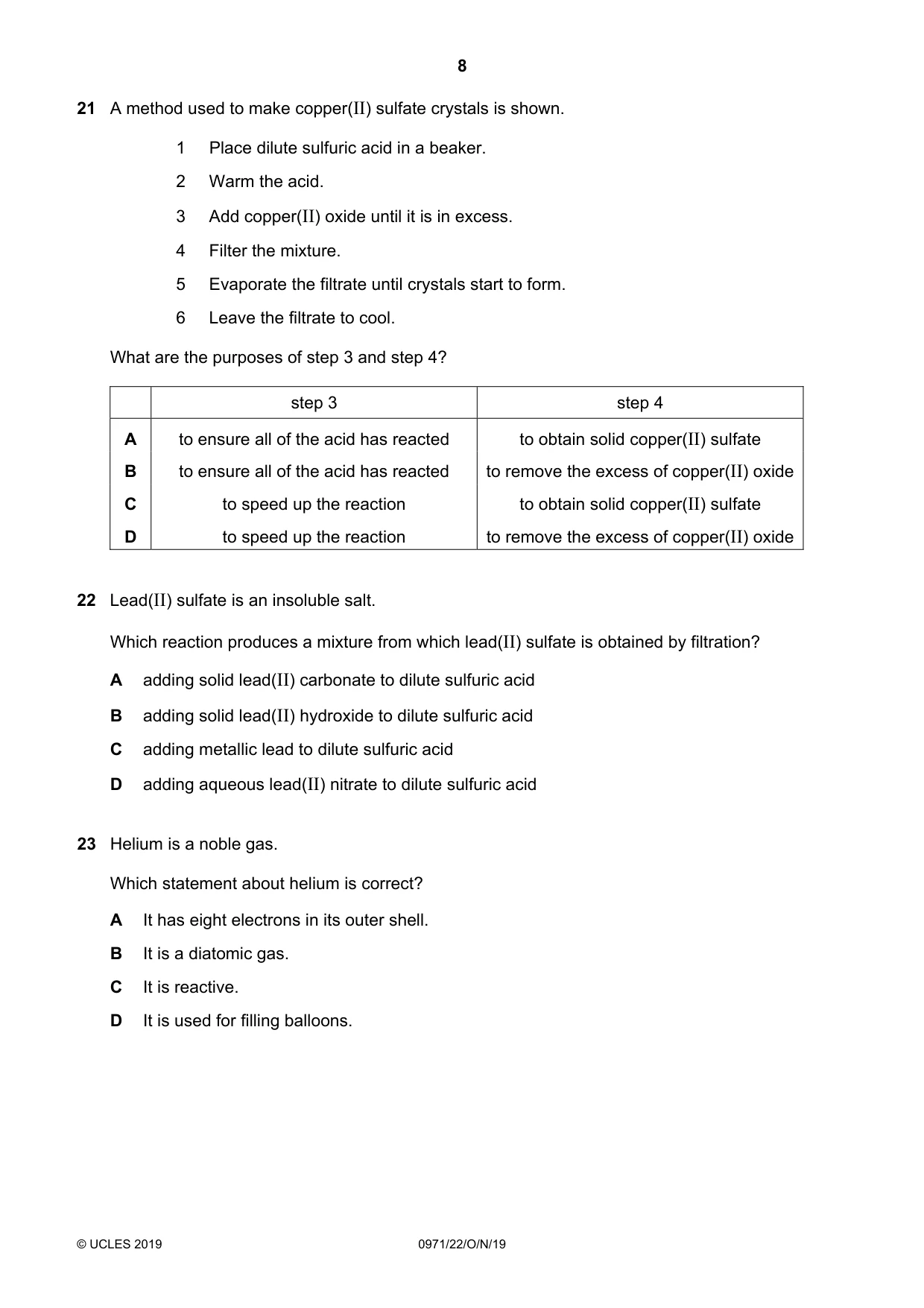
21 A method used to make copper(II) sulfate crystals is shown. 1 Place dilute sulfuric acid in a beaker. 2 Warm the acid. 3 Add copper(II) oxide until it is in excess. 4 Filter the mixture. 5 Evaporate the filtrate until crystals start to form. 6 Leave the filtrate to cool. What are the purposes of step 3 and step 4? step 3 step 4 A to ensure all of the acid has reacted to obtain solid copper(II) sulfate B to ensure all of the acid has reacted to remove the excess of copper(II) oxide C to speed up the reaction to obtain solid copper(II) sulfate D to speed up the reaction to remove the excess of copper(II) oxide
Mark scheme: B
Q22 · Lead(II) sulfate is an insoluble salt
22 Lead(II) sulfate is an insoluble salt. Which reaction produces a mixture from which lead(II) sulfate is obtained by filtration? A adding solid lead(II) carbonate to dilute sulfuric acid B adding solid lead(II) hydroxide to dilute sulfuric acid C adding metallic lead to dilute sulfuric acid D adding aqueous lead(II) nitrate to dilute sulfuric acid
Mark scheme: D
Q23 · Helium is a noble gas
23 Helium is a noble gas. Which statement about helium is correct? A It has eight electrons in its outer shell. B It is a diatomic gas. C It is reactive. D It is used for filling balloons.
Mark scheme: D
Q24 · Which pair of elements reacts together most violently?
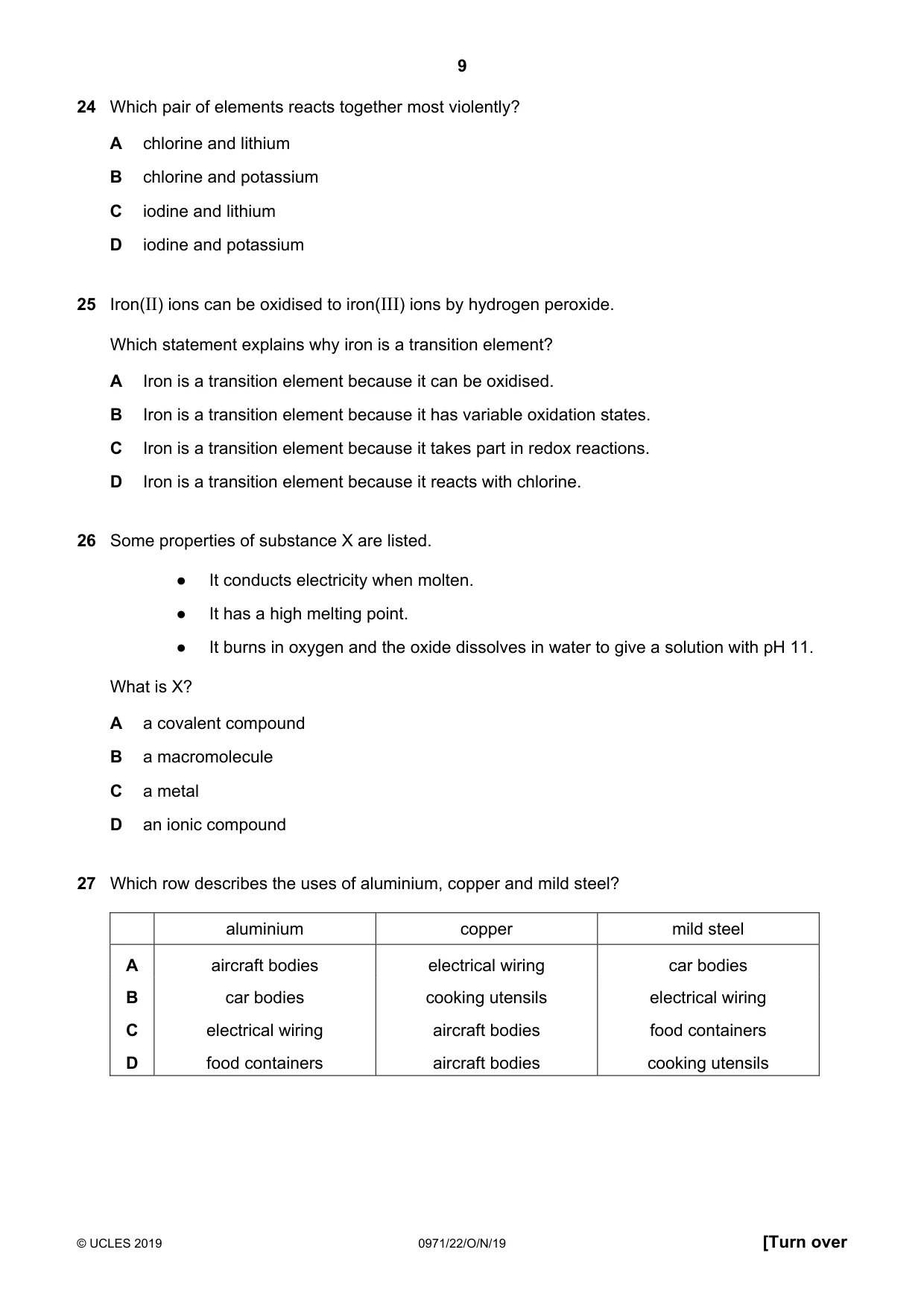
24 Which pair of elements reacts together most violently? A chlorine and lithium B chlorine and potassium C iodine and lithium D iodine and potassium
Mark scheme: B
Q25 · Iron(II) ions can be oxidised to iron(III) ions by hydrogen peroxide
25 Iron(II) ions can be oxidised to iron(III) ions by hydrogen peroxide. Which statement explains why iron is a transition element? A Iron is a transition element because it can be oxidised. B Iron is a transition element because it has variable oxidation states. C Iron is a transition element because it takes part in redox reactions. D Iron is a transition element because it reacts with chlorine.
Mark scheme: B
Q26 · Some properties of substance X are listed
26 Some properties of substance X are listed. ● It conducts electricity when molten. ● It has a high melting point. ● It burns in oxygen and the oxide dissolves in water to give a solution with pH 11. What is X? A a covalent compound B a macromolecule C a metal D an ionic compound
Mark scheme: C
Q27 · Which row describes the uses of aluminium, copper and mild steel?
27 Which row describes the uses of aluminium, copper and mild steel? aluminium copper mild steel A aircraft bodies electrical wiring car bodies B car bodies cooking utensils electrical wiring C electrical wiring aircraft bodies food containers D food containers aircraft bodies cooking utensils
Mark scheme: A
Q28 · The properties of four metals are listed
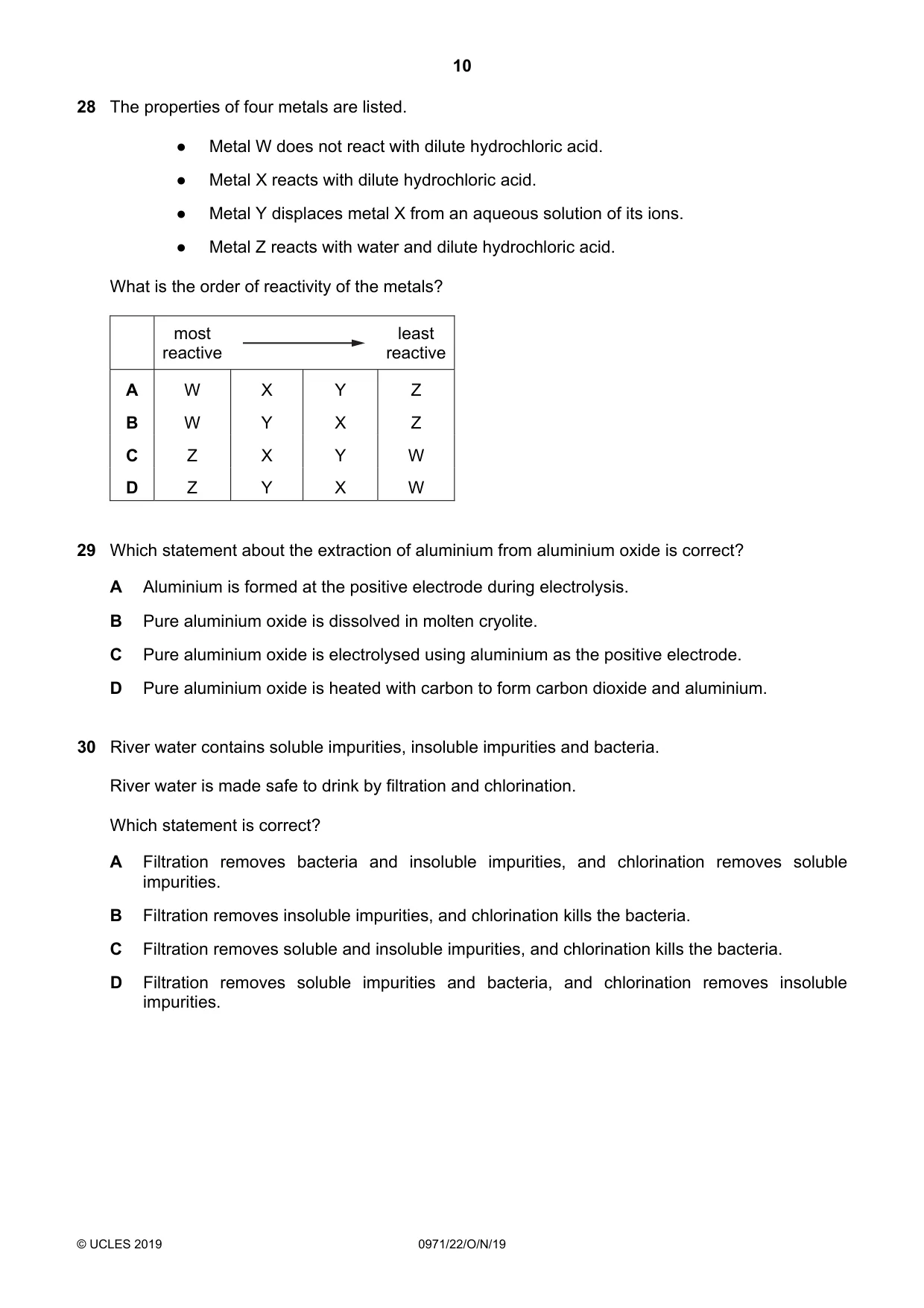
28 The properties of four metals are listed. ● Metal W does not react with dilute hydrochloric acid. ● Metal X reacts with dilute hydrochloric acid. ● Metal Y displaces metal X from an aqueous solution of its ions. ● Metal Z reacts with water and dilute hydrochloric acid. What is the order of reactivity of the metals? most least reactive reactive A W X Y Z B W Y X Z C Z X Y W D Z Y X W
Mark scheme: D
Q29 · Which statement about the extraction of aluminium from aluminium oxide is correct?
29 Which statement about the extraction of aluminium from aluminium oxide is correct? A Aluminium is formed at the positive electrode during electrolysis. B Pure aluminium oxide is dissolved in molten cryolite. C Pure aluminium oxide is electrolysed using aluminium as the positive electrode. D Pure aluminium oxide is heated with carbon to form carbon dioxide and aluminium.
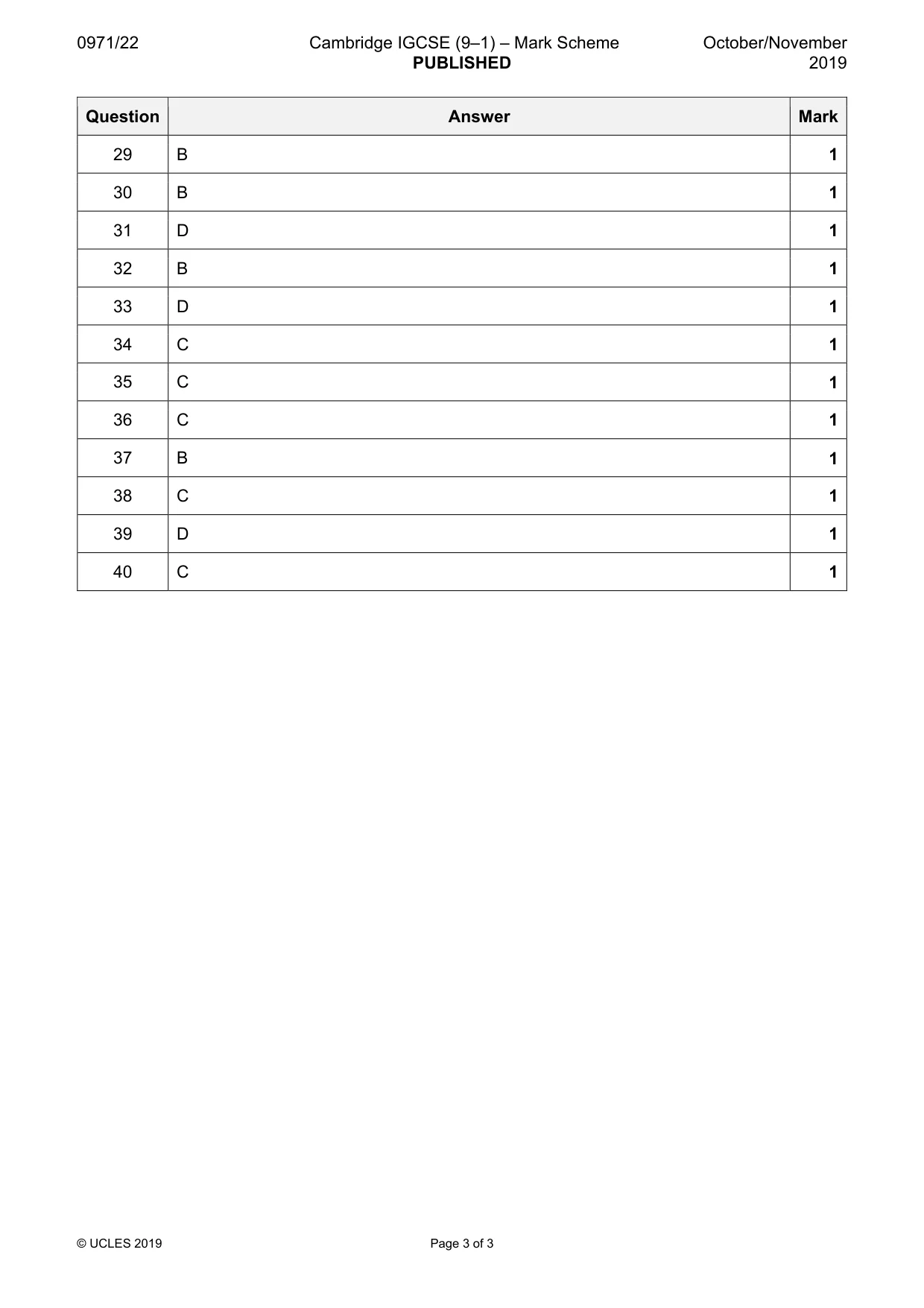
Mark scheme: B
Q30 · River water contains soluble impurities, insoluble impurities and bacteria
30 River water contains soluble impurities, insoluble impurities and bacteria. River water is made safe to drink by filtration and chlorination. Which statement is correct? A Filtration removes bacteria and insoluble impurities, and chlorination removes soluble impurities. B Filtration removes insoluble impurities, and chlorination kills the bacteria. C Filtration removes soluble and insoluble impurities, and chlorination kills the bacteria. D Filtration removes soluble impurities and bacteria, and chlorination removes insoluble impurities.
Mark scheme: B
Q31 · Which process is used to separate nitrogen and oxygen from air?
31 Which process is used to separate nitrogen and oxygen from air? A chromatography B evaporation C filtration D fractional distillation
Mark scheme: D
Q32 · The apparatus shown is set up and left for a week
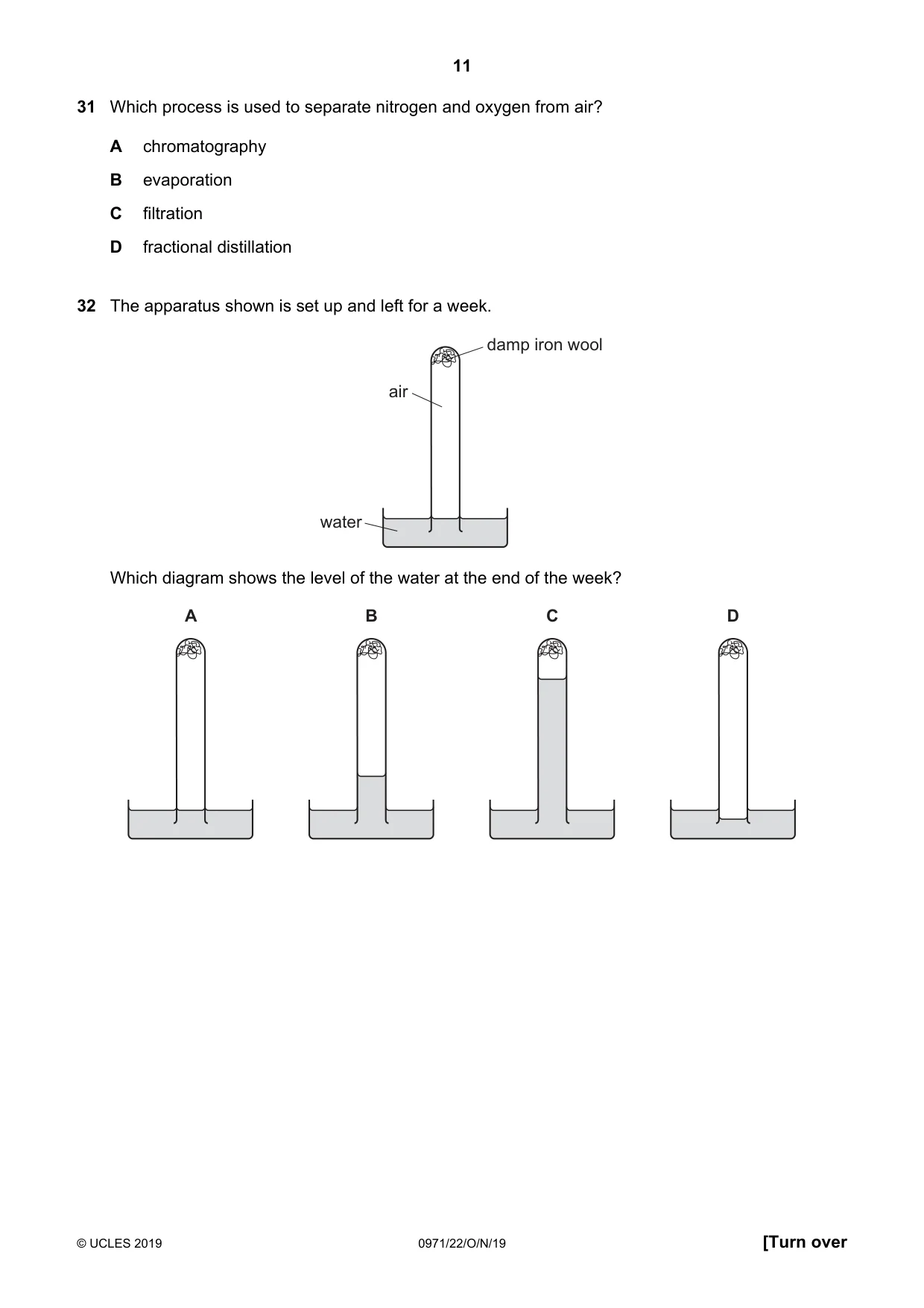
32 The apparatus shown is set up and left for a week. damp iron wool air water Which diagram shows the level of the water at the end of the week? A B C D
Mark scheme: B
Q33 · The diagram represents an outline of the carbon cycle
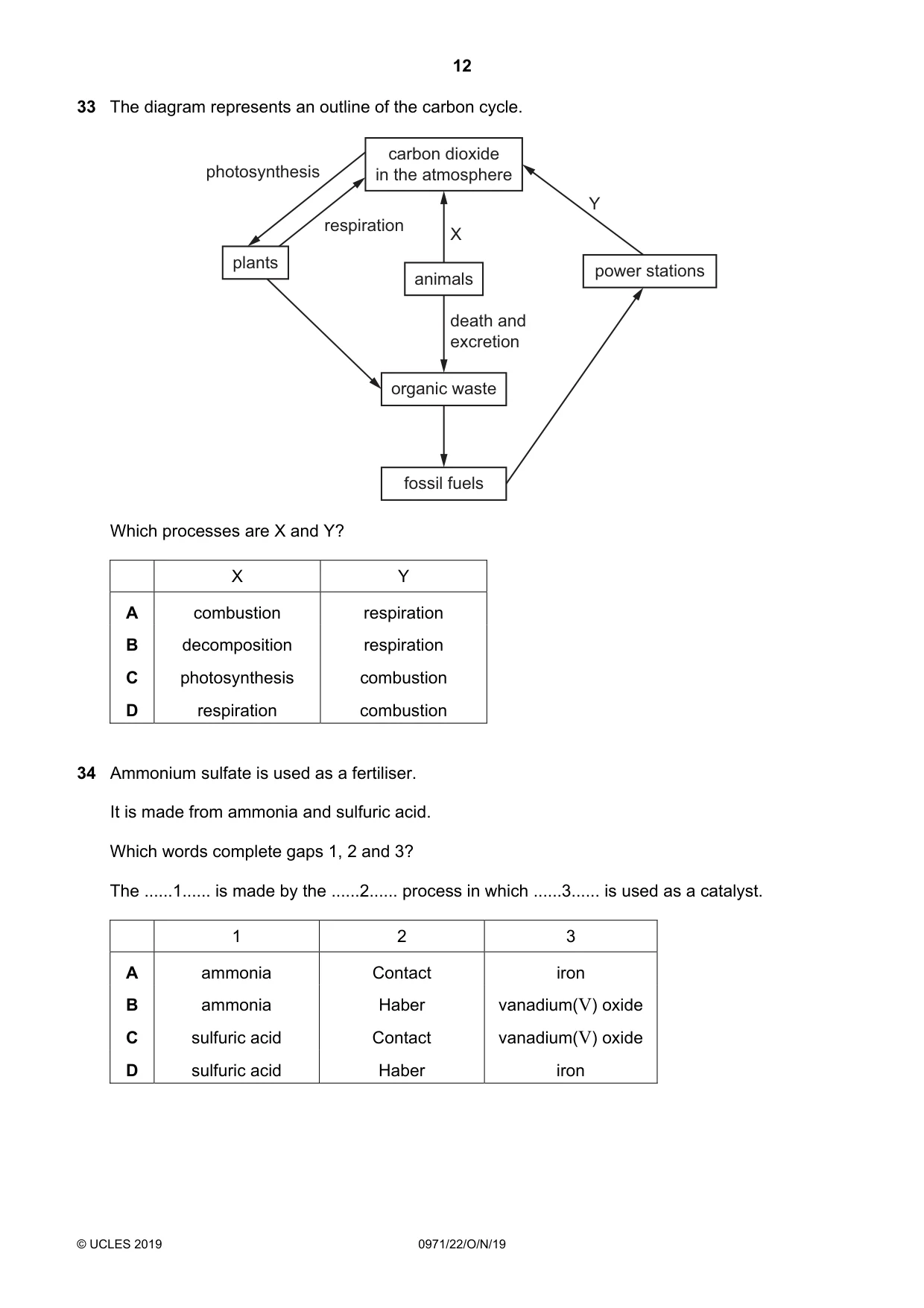
33 The diagram represents an outline of the carbon cycle. carbon dioxide photosynthesis in the atmosphere Y respiration X plants animals power stations death and excretion organic waste fossil fuels Which processes are X and Y? X Y A combustion respiration B decomposition respiration C photosynthesis combustion D respiration combustion
Mark scheme: D
Q34 · Ammonium sulfate is used as a fertiliser
34 Ammonium sulfate is used as a fertiliser. It is made from ammonia and sulfuric acid. Which words complete gaps 1, 2 and 3? The ......1...... is made by the ......2...... process in which ......3...... is used as a catalyst. 1 2 3 A ammonia Contact iron B ammonia Haber vanadium(V) oxide C sulfuric acid Contact vanadium(V) oxide D sulfuric acid Haber iron
Mark scheme: C
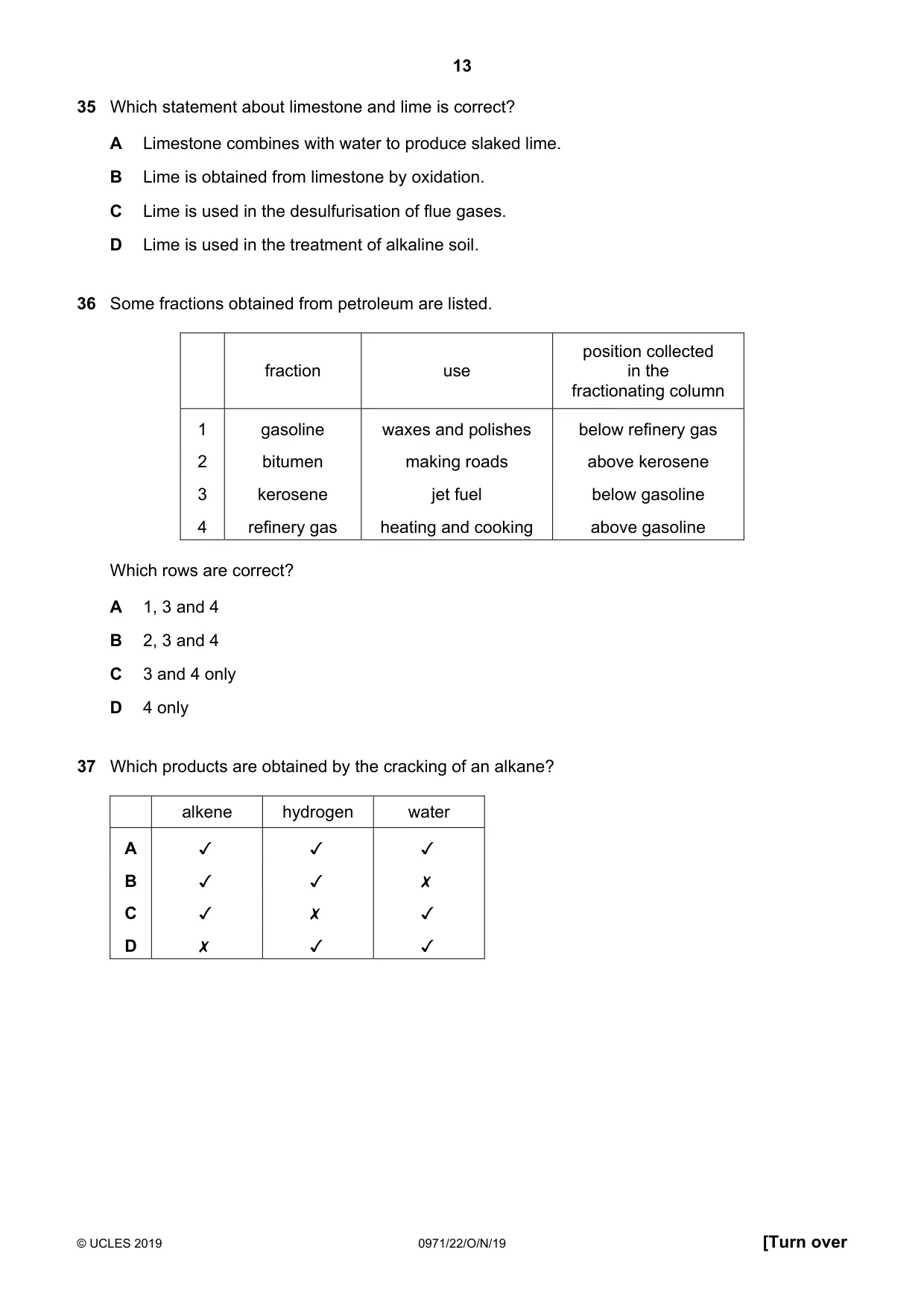
Q35 · Which statement about limestone and lime is correct?
35 Which statement about limestone and lime is correct? A Limestone combines with water to produce slaked lime. B Lime is obtained from limestone by oxidation. C Lime is used in the desulfurisation of flue gases. D Lime is used in the treatment of alkaline soil.
Mark scheme: C
Q36 · Some fractions obtained from petroleum are listed
36 Some fractions obtained from petroleum are listed. position collected fraction use in the fractionating column 1 gasoline waxes and polishes below refinery gas 2 bitumen making roads above kerosene 3 kerosene jet fuel below gasoline 4 refinery gas heating and cooking above gasoline Which rows are correct? A 1, 3 and 4 B 2, 3 and 4 C 3 and 4 only D 4 only
Mark scheme: C
Q37 · Which products are obtained by the cracking of an alkane?
37 Which products are obtained by the cracking of an alkane? alkene hydrogen water v v v 0 Oo WwW > v v x v x v x v v
Mark scheme: B
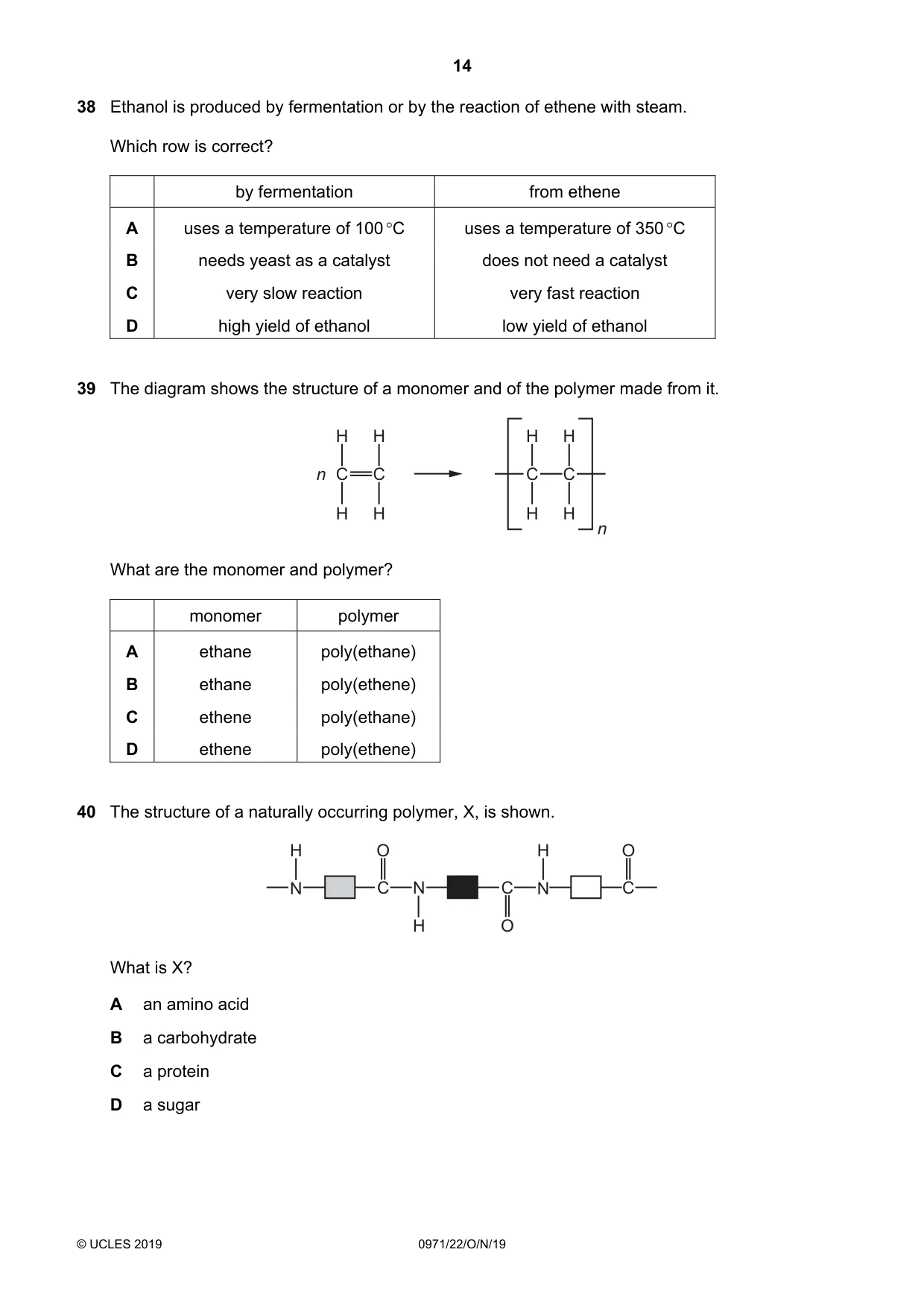
Q38 · Ethanol is produced by fermentation or by the reaction of ethene with steam
38 Ethanol is produced by fermentation or by the reaction of ethene with steam. Which row is correct? by fermentation from ethene A uses a temperature of 100 °C uses a temperature of 350 °C B needs yeast as a catalyst does not need a catalyst C very slow reaction very fast reaction D high yield of ethanol low yield of ethanol
Mark scheme: C
Q39 · The diagram shows the structure of a monomer and of the polymer made from it
39 The diagram shows the structure of a monomer and of the polymer made from it. H H H H n C C C C H H H H n What are the monomer and polymer? monomer polymer A ethane poly(ethane) B ethane poly(ethene) C ethene poly(ethane) D ethene poly(ethene)
Mark scheme: D
Q40 · The structure of a naturally occurring polymer, X, is shown
40 The structure of a naturally occurring polymer, X, is shown. H O H O N C N C N C H O What is X? A an amino acid B a carbohydrate C a protein D a sugar
Mark scheme: C
What was in this paper
The subtopics covered by these 40 questions, and how many questions each got. Open one in a new tab to see every Cambridge question on it.
2Oxides2Polymers2Preparation of salts2Reactivity series2The mole and the Avogadro constant2Air quality and climate1Alcohols1Alkenes1Chromatography1Corrosion of metals1Diffusion1Electrolysis1Exothermic and endothermic reactions1Experimental design1Extraction of metals1Fertilisers1Fuels1Giant covalent structures1Group VII properties1Hydrogen–oxygen fuel cells1Isotopes1Metallic bonding1Noble gases1Physical and chemical changes1Rate of reaction1Redox1Reversible reactions and equilibrium1Separation and purification1Simple molecules and covalent bonds1The characteristic properties of acids and bases1Transition elements1Uses of metals1Water1What you needed in this session
Cambridge’s own grade thresholds for 2019 Oct/Nov, Paper 2 · Variant 2. A higher threshold means an easier paper — the bar moves with how the cohort did.