Questions as text
Q1 · Calcium reacts with chlorine to produce calcium chloride 0971/11 May/June 2019
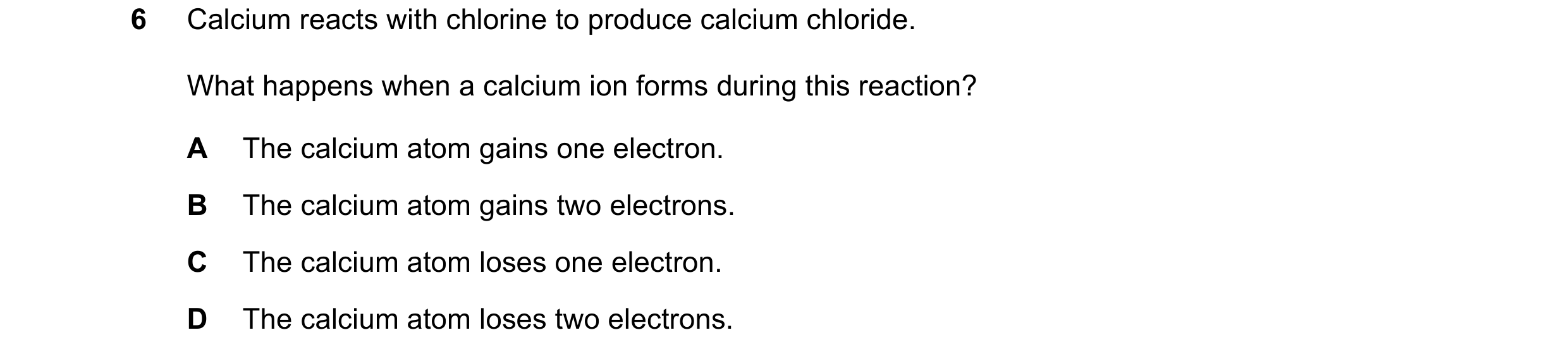
6 Calcium reacts with chlorine to produce calcium chloride. What happens when a calcium ion forms during this reaction? A The calcium atom gains one electron. B The calcium atom gains two electrons. C The calcium atom loses one electron. D The calcium atom loses two electrons.
1 marks
Answer: D
This question in 0971/11 May/June 2019
Q2 · Some properties of substance X are listed 0971/12 Oct/Nov 2019
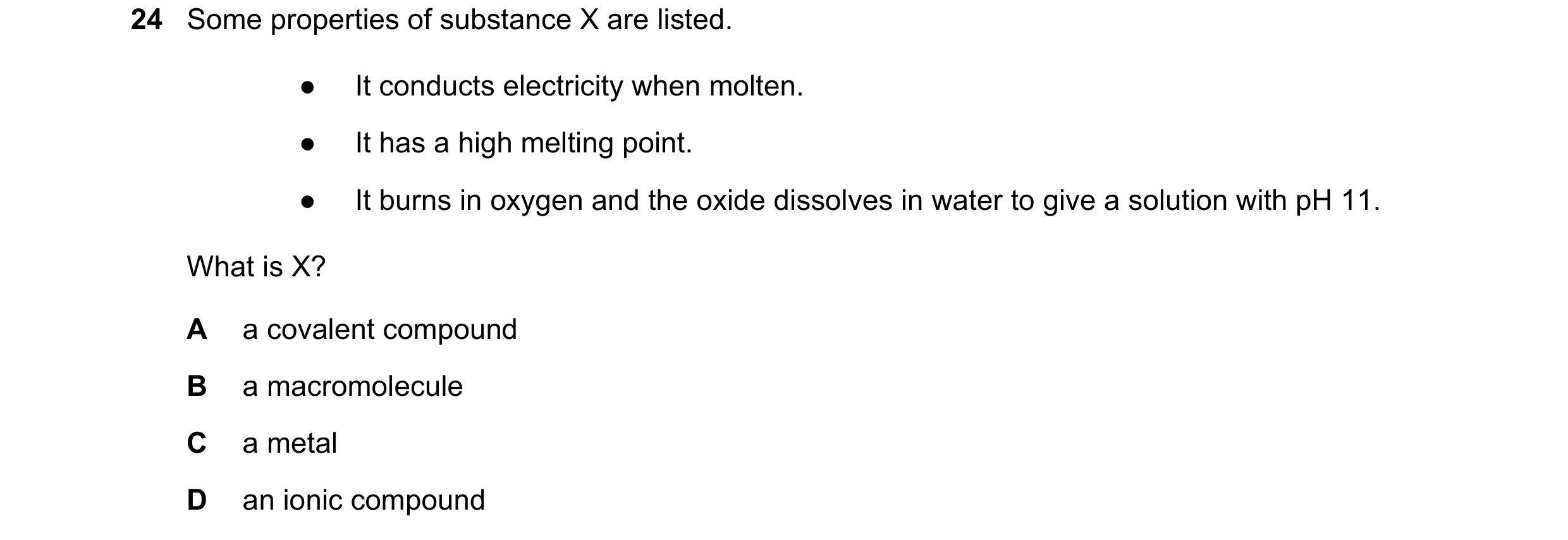
24 Some properties of substance X are listed. ● It conducts electricity when molten. ● It has a high melting point. ● It burns in oxygen and the oxide dissolves in water to give a solution with pH 11. What is X? A a covalent compound B a macromolecule C a metal D an ionic compound
1 marks
Answer: C
This question in 0971/12 Oct/Nov 2019
Q3 · Sodium is in Group I of the Periodic Table 0971/11 May/June 2020
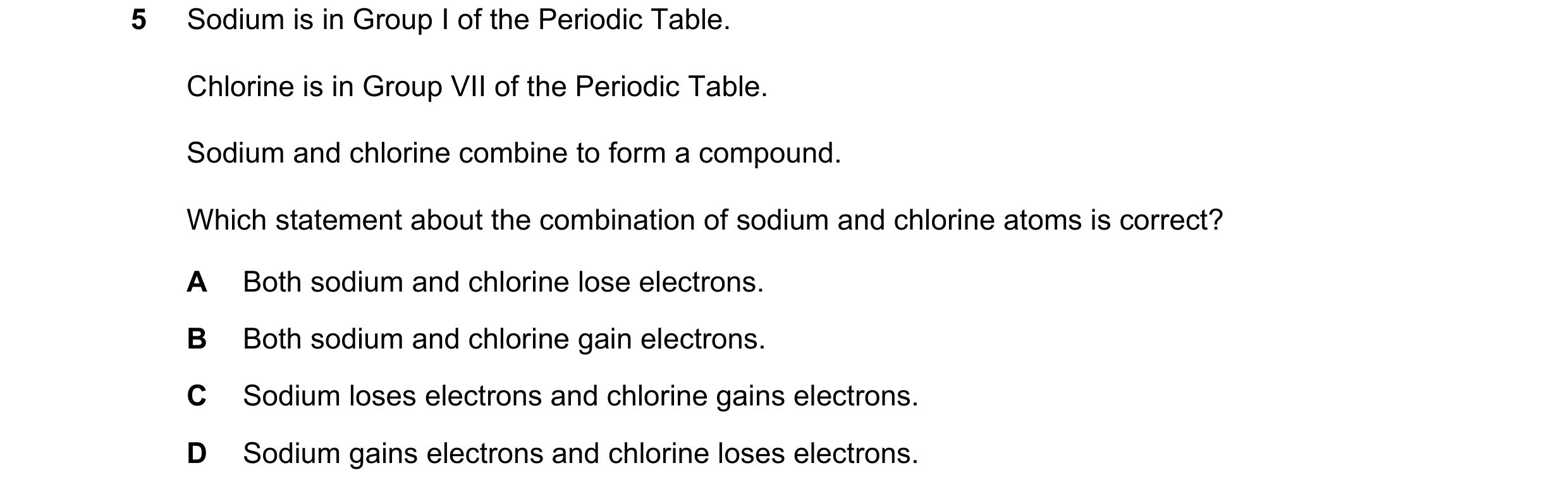
5 Sodium is in Group I of the Periodic Table. Chlorine is in Group VII of the Periodic Table. Sodium and chlorine combine to form a compound. Which statement about the combination of sodium and chlorine atoms is correct? A Both sodium and chlorine lose electrons. B Both sodium and chlorine gain electrons. C Sodium loses electrons and chlorine gains electrons. D Sodium gains electrons and chlorine loses electrons.
1 marks
Answer: C
This question in 0971/11 May/June 2020
Q4 · The Group I element sodium forms an ionic bond with the Group VII element fluorine 0971/12 May/June 2020
5 The Group I element sodium forms an ionic bond with the Group VII element fluorine. Which two ions are produced? A Na+ and F+ B Na+ and F– C Na– and F– D Na– and F+
1 marks
Answer: B
This question in 0971/12 May/June 2020
Q5 · Rubidium is in Group I of the Periodic Table and bromine is in Group VII 0971/12 Oct/Nov 2020
9 Rubidium is in Group I of the Periodic Table and bromine is in Group VII. Rubidium reacts with bromine to form an ionic compound. Which row shows the electron change taking place for rubidium and the correct formula of the rubidium ion? electron change formula of ion formed A electron gained Rb+ B electron gained Rb– C electron lost Rb+ D electron lost Rb–
1 marks
Answer: C
This question in 0971/12 Oct/Nov 2020
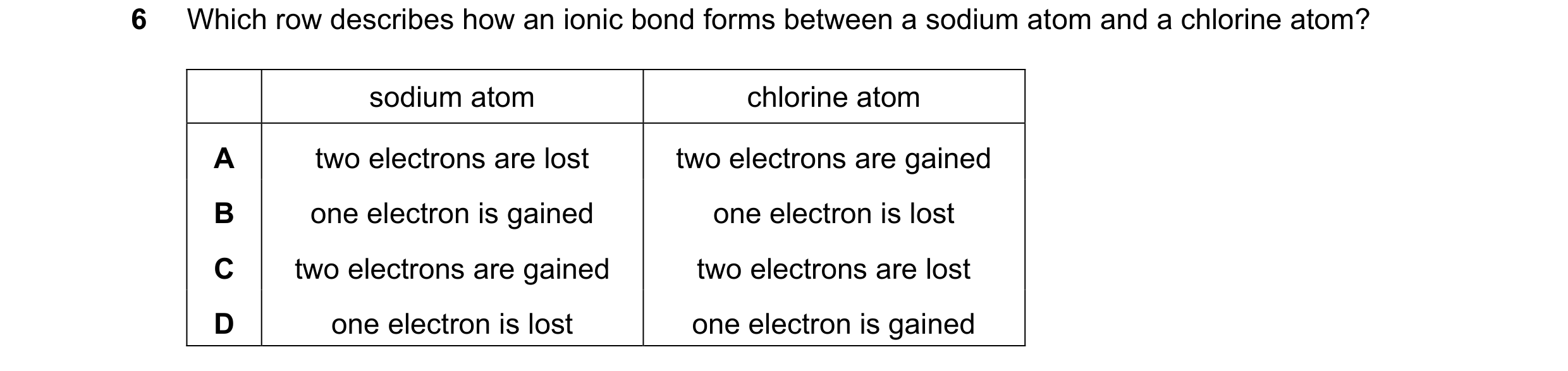
Q6 · Which row describes how an ionic bond forms between a sodium atom and a chlorine atom? 0971/11 May/June 2021
6 Which row describes how an ionic bond forms between a sodium atom and a chlorine atom? sodium atom chlorine atom A two electrons are lost two electrons are gained B one electron is gained one electron is lost C two electrons are gained two electrons are lost D one electron is lost one electron is gained
1 marks
Answer: D
This question in 0971/11 May/June 2021
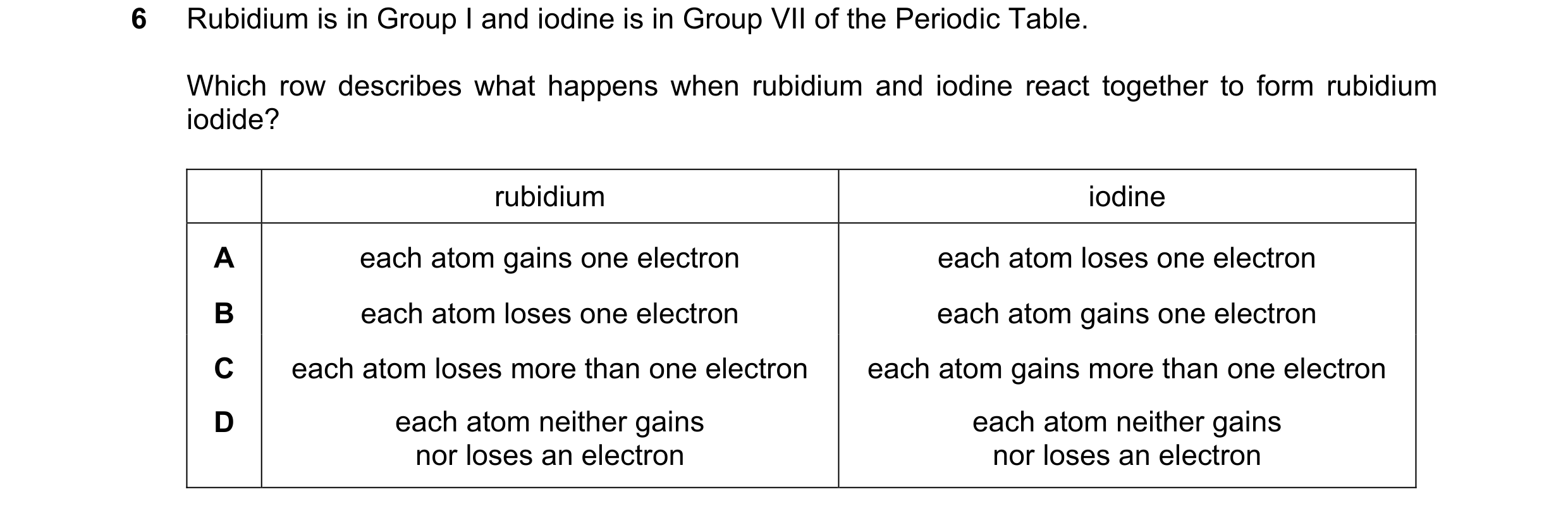
Q7 · Rubidium is in Group I and iodine is in Group VII of the Periodic Table 0971/12 Oct/Nov 2021
6 Rubidium is in Group I and iodine is in Group VII of the Periodic Table. Which row describes what happens when rubidium and iodine react together to form rubidium iodide? rubidium iodine A each atom gains one electron each atom loses one electron B each atom loses one electron each atom gains one electron C each atom loses more than one electron each atom gains more than one electron D each atom neither gains each atom neither gains nor loses an electron nor loses an electron
1 marks
Answer: B
This question in 0971/12 Oct/Nov 2021
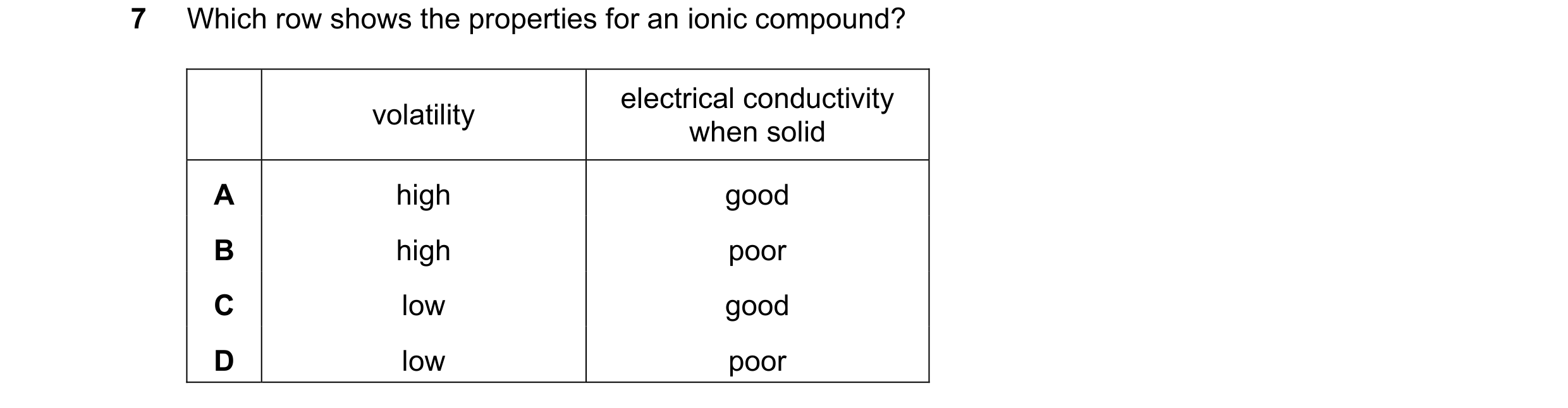
Q8 · Which row shows the properties for an ionic compound? 0971/12 Oct/Nov 2021
7 Which row shows the properties for an ionic compound? electrical conductivity volatility when solid A high good B high poor C low good D low poor
1 marks
Answer: D
This question in 0971/12 Oct/Nov 2021
Q9 · A period of the Periodic Table is shown 0971/12 Oct/Nov 2021
21 A period of the Periodic Table is shown. group I II III IV V VI VII VIII element R S T V W X Y Z The letters are not their chemical symbols. Which statement is correct? A Element R does not conduct electricity. B Elements R and Y react together to form an ionic compound. C Element Z exists as a diatomic molecule. D Element Z reacts with element T.
1 marks
Answer: B
This question in 0971/12 Oct/Nov 2021
Q10 · What happens to an atom when it becomes an ion with a charge of +1? 0971/11 May/June 2022
7 What happens to an atom when it becomes an ion with a charge of +1? A It gains an electron. B It gains a proton. C It loses an electron. D It loses a proton.
1 marks
Answer: C
This question in 0971/11 May/June 2022
Q11 · Which statement about ions and ionic bonding is correct? 0971/12 May/June 2022
6 Which statement about ions and ionic bonding is correct? A Caesium atoms gain electrons to form negatively charged caesium ions. B Ionic bonding involves sharing of pairs of electrons. C Potassium ions and chloride ions have the same number of outer-shell electrons. D Sodium ions have an equal number of protons and electrons.
1 marks
Answer: C
This question in 0971/12 May/June 2022
Q12 · Which statement about compounds is correct? 0971/12 Oct/Nov 2022
6 Which statement about compounds is correct? A Covalent compounds are less volatile than ionic compounds. B Covalent compounds conduct electricity when they are solid. C Ionic compounds conduct electricity when molten. D Ionic compounds are insoluble in water.
1 marks
Answer: C
This question in 0971/12 Oct/Nov 2022
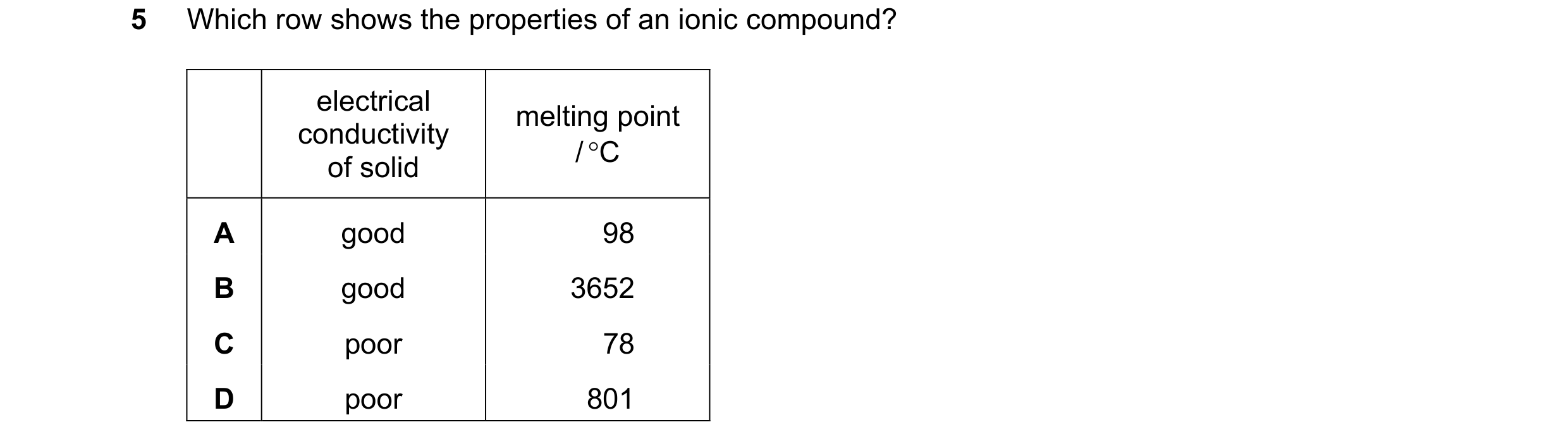
Q13 · Which row shows the properties of an ionic compound? 0971/11 May/June 2023
5 Which row shows the properties of an ionic compound? electrical melting point conductivity / °C of solid A good 98 B good 3652 C poor 78 D poor 801
1 marks
Answer: D
This question in 0971/11 May/June 2023
Q14 · The diagram represents the structure of a solid 0971/11 May/June 2023
25 The diagram represents the structure of a solid.
sodium chloride
\ \ & x
1 marks
Answer: B
This question in 0971/11 May/June 2023
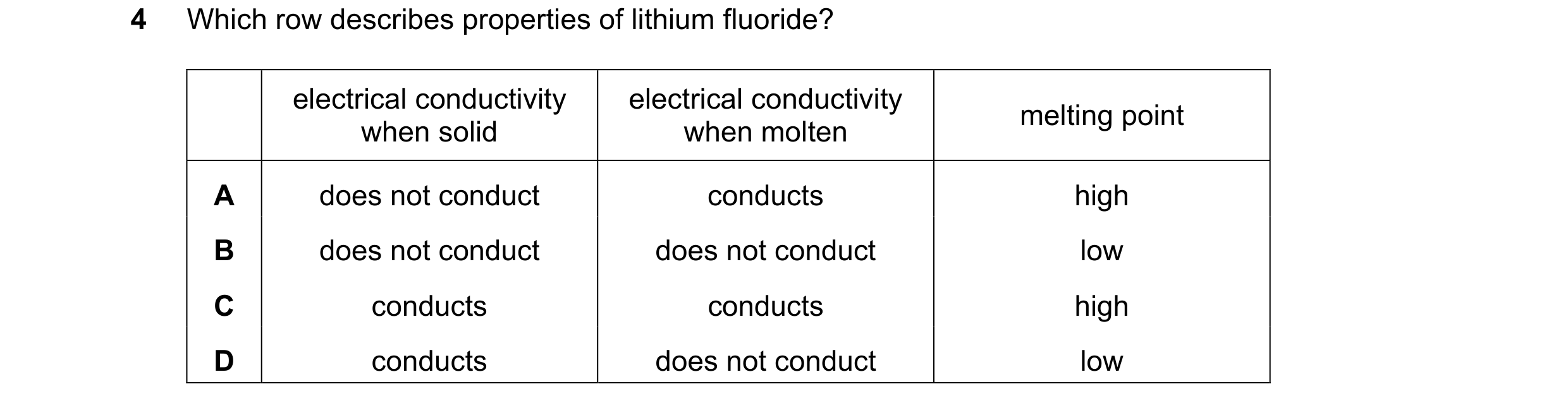
Q15 · Which row describes properties of lithium fluoride? 0971/12 May/June 2023
4 Which row describes properties of lithium fluoride? electrical conductivity electrical conductivity melting point when solid when molten A does not conduct conducts high B does not conduct does not conduct low C conducts conducts high D conducts does not conduct low
1 marks
Answer: A
This question in 0971/12 May/June 2023
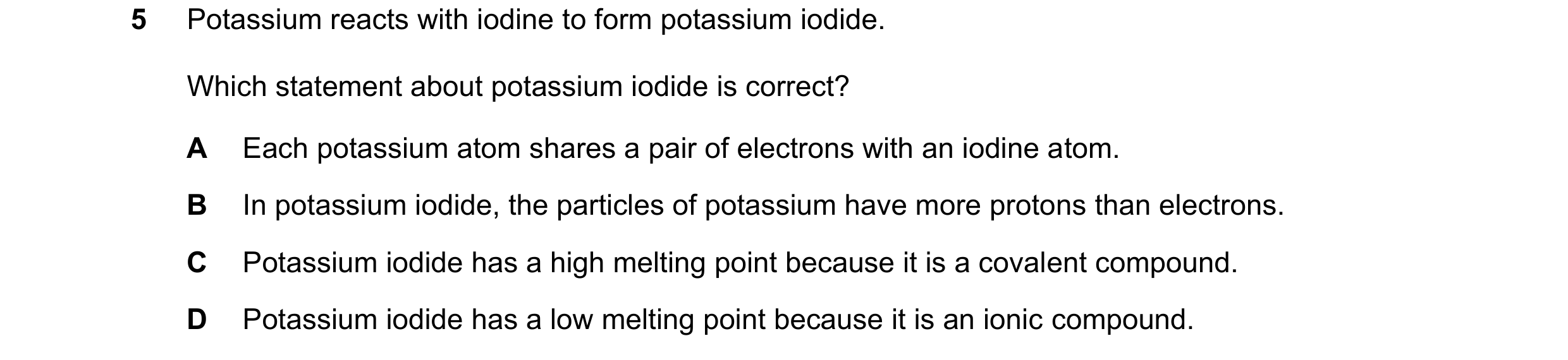
Q16 · Potassium reacts with iodine to form potassium iodide 0971/12 Oct/Nov 2023
5 Potassium reacts with iodine to form potassium iodide. Which statement about potassium iodide is correct? A Each potassium atom shares a pair of electrons with an iodine atom. B In potassium iodide, the particles of potassium have more protons than electrons. C Potassium iodide has a high melting point because it is a covalent compound. D Potassium iodide has a low melting point because it is an ionic compound.
1 marks
Answer: B
This question in 0971/12 Oct/Nov 2023
Q17 · Some properties of substances W, X, Y and Z are shown 0971/11 May/June 2024
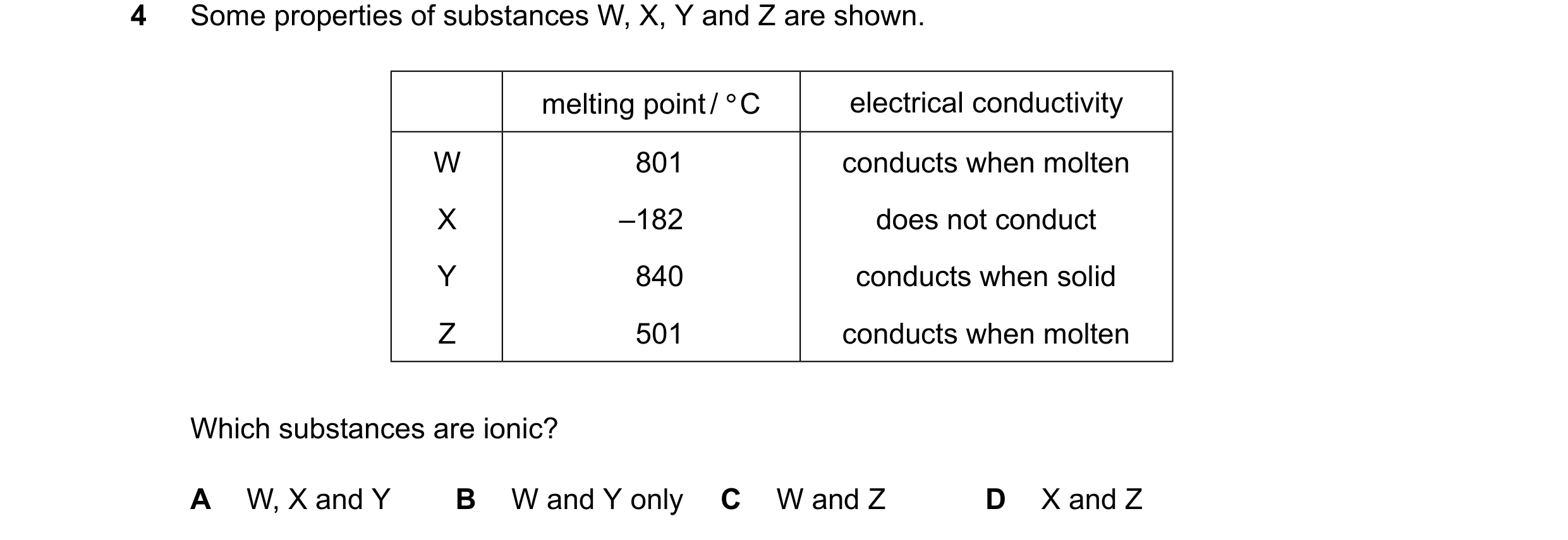
4 Some properties of substances W, X, Y and Z are shown. melting point/°C electrical conductivity W 801 conducts when molten X –182 does not conduct Y 840 conducts when solid Z 501 conducts when molten Which substances are ionic? A W, X and Y B W and Y only C W and Z D X and Z
1 marks
Answer: C
This question in 0971/11 May/June 2024
Q18 · Atoms lose or gain electrons to become ions 0971/11 May/June 2024
5 Atoms lose or gain electrons to become ions. Which row is correct? change to the atom type of ion charge on ion A loss of two electrons cation 2– B loss of one electron anion 1– C gain of three electrons anion 3– D gain of one electron cation 1–
1 marks
Answer: C
This question in 0971/11 May/June 2024
Q19 · Which statement is correct? 0971/12 May/June 2024
3 Which statement is correct? A Air is a mixture of gaseous elements only. B Alloys are formed when a metal is ionically bonded to other elements. C Carbon dioxide is a mixture of carbon and oxygen. D Potassium bromide is an ionic compound.
1 marks
Answer: D
This question in 0971/12 May/June 2024
Q20 · The electronic configurations of four atoms, W, X, Y and Z, are shown 0971/12 May/June 2024
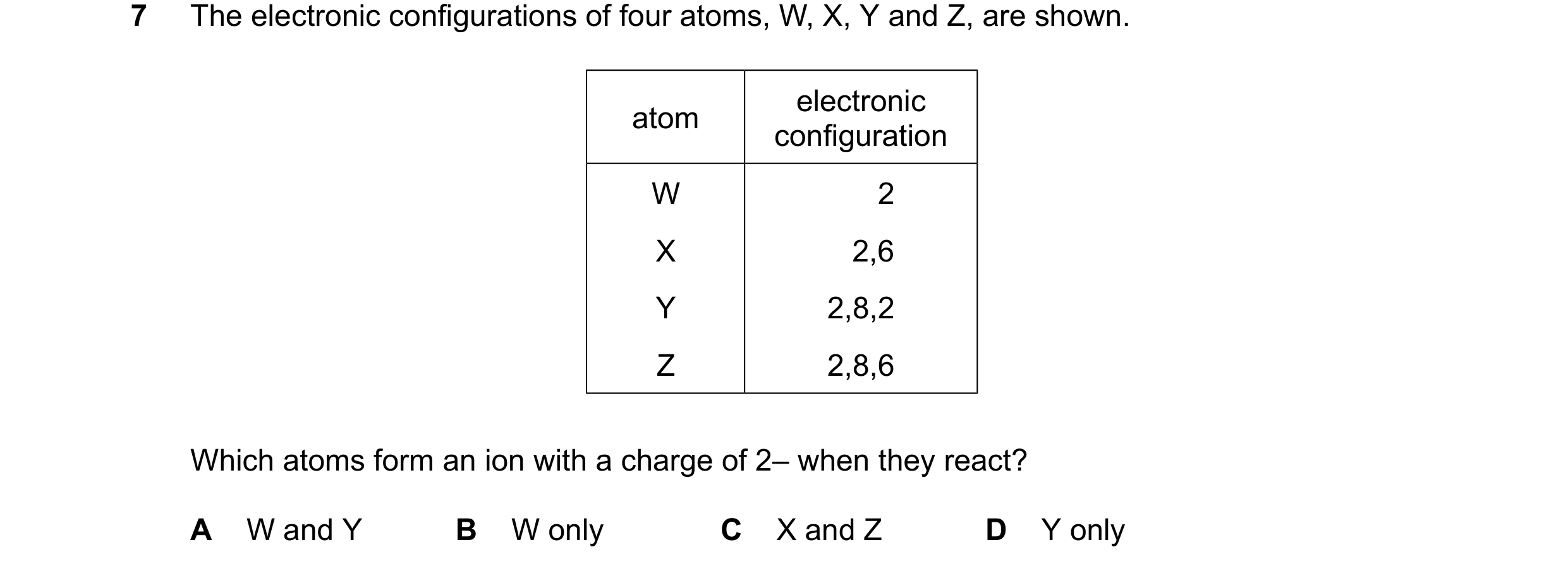
7 The electronic configurations of four atoms, W, X, Y and Z, are shown. electronic atom configuration W 2 X 2,6 Y 2,8,2 Z 2,8,6 Which atoms form an ion with a charge of 2– when they react? A W and Y B W only C X and Z D Y only
1 marks
Answer: C
This question in 0971/12 May/June 2024
Q21 · Which statements about potassium iodide are correct? 0971/11 May/June 2025
6 Which statements about potassium iodide are correct? 1 It is formed from potassium anions and iodide cations. 2 It is a good electrical conductor when molten or in aqueous solution. 3 Potassium atoms share electrons with iodine atoms. A 1 and 3 B 1 only C 2 and 3 D 2 only
1 marks
Answer: D
This question in 0971/11 May/June 2025
Q22 · When sodium chloride is formed from its elements, each chlorine atom … 1 … one … 2 … 0971/12 May/June 2025
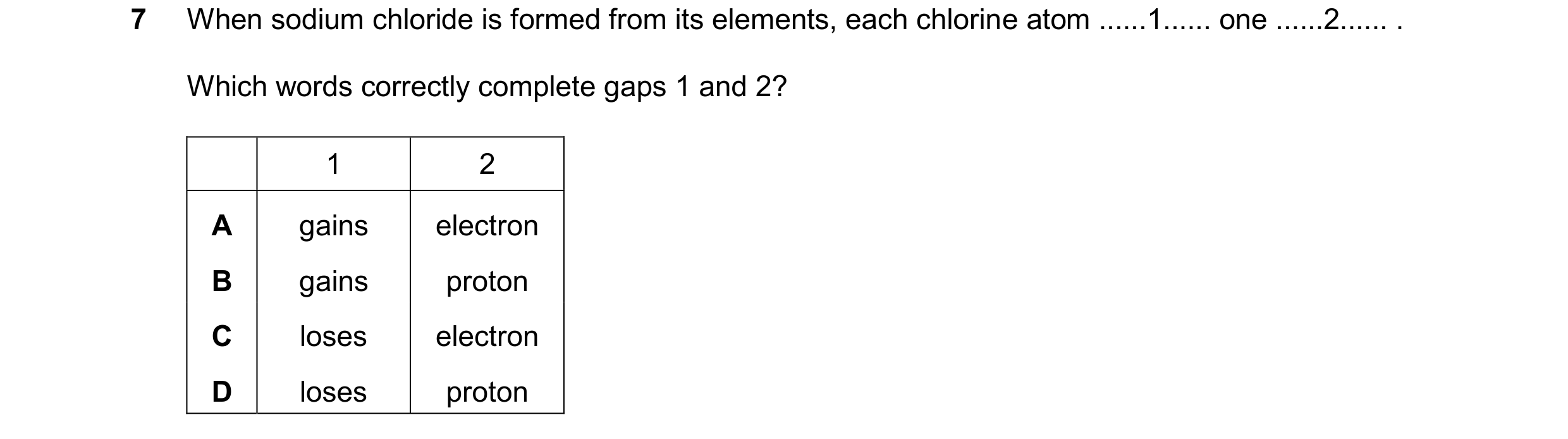
7 When sodium chloride is formed from its elements, each chlorine atom … 1 … one … 2 … . Which words correctly complete gaps 1 and 2? 1 2 A gains electron B gains proton C loses electron D loses proton
1 marks
Answer: A
This question in 0971/12 May/June 2025
Q23 · The diagram shows the electronic configuration of a particle with a nucleon number of 40 0971/12 Oct/Nov 2025
5 The diagram shows the electronic configuration of a particle with a nucleon number of 40. 40 The table shows the suggestions that three students, 1, 2 and 3, made to identify the particle. student 1 2 3 particle Ar Cl Ca2+ Which students are correct? A 1, 2 and 3 B 1 and 2 only C 1 and 3 only D 2 and 3 only
1 marks
Answer: C
This question in 0971/12 Oct/Nov 2025
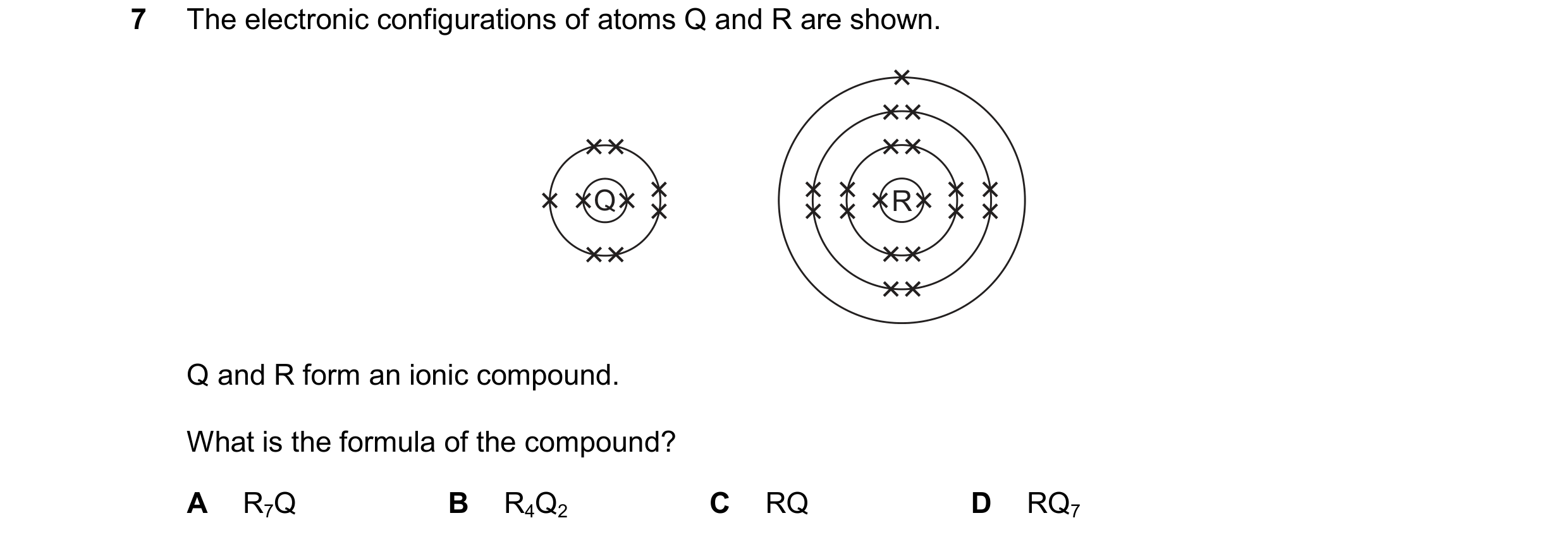
Q24 · The electronic configurations of atoms Q and R are shown 0971/12 Oct/Nov 2025
7 The electronic configurations of atoms Q and R are shown. Q R Q and R form an ionic compound. What is the formula of the compound? A R7Q B R4Q2 C RQ D RQ7
1 marks
Answer: C
This question in 0971/12 Oct/Nov 2025
 1 / 6
1 / 6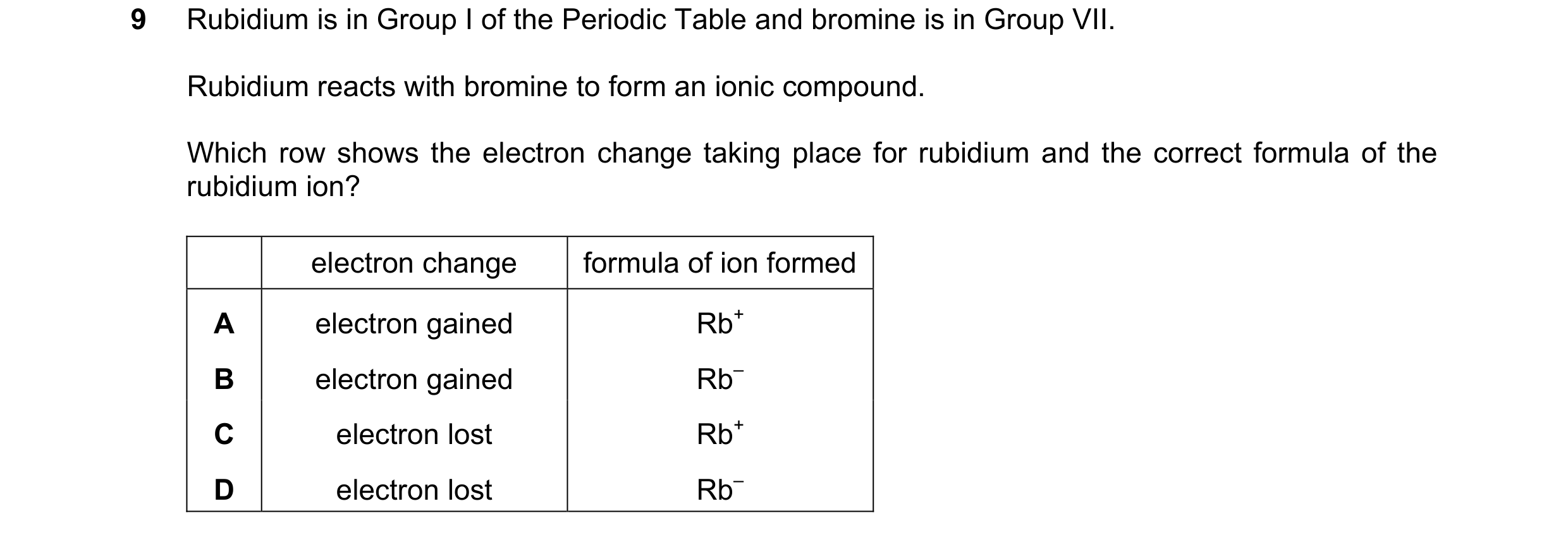
 2 / 6
2 / 6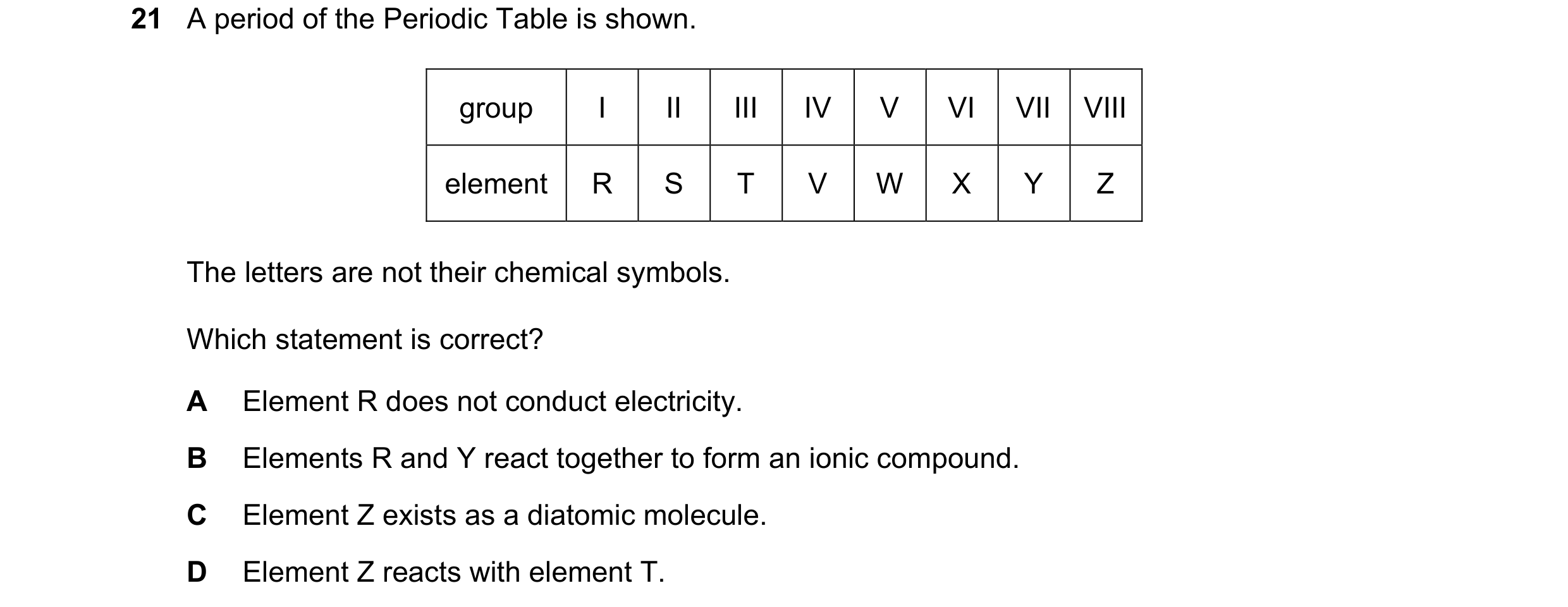



 3 / 6
3 / 6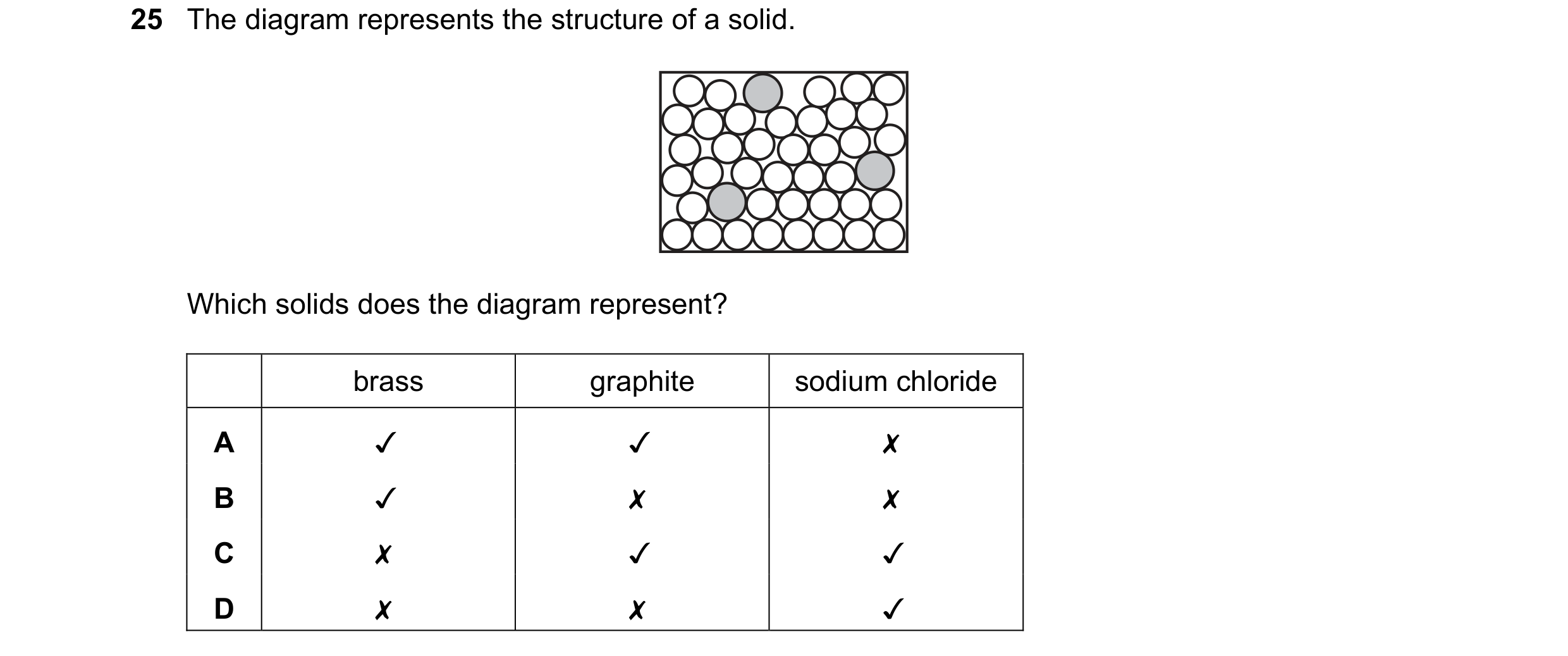
 4 / 6
4 / 6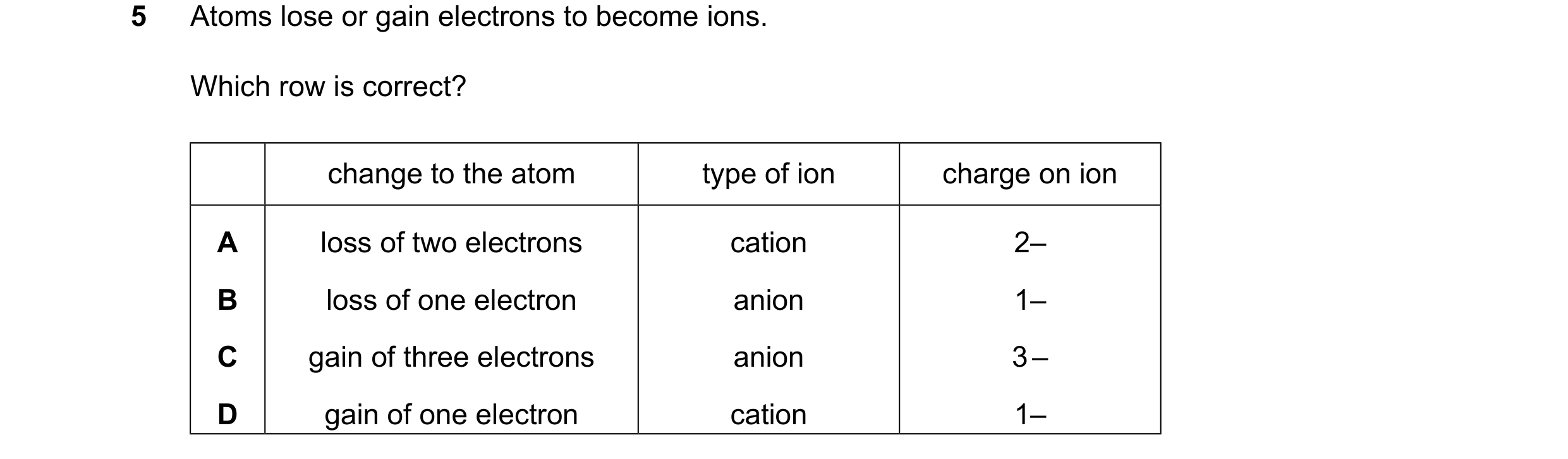


 5 / 6
5 / 6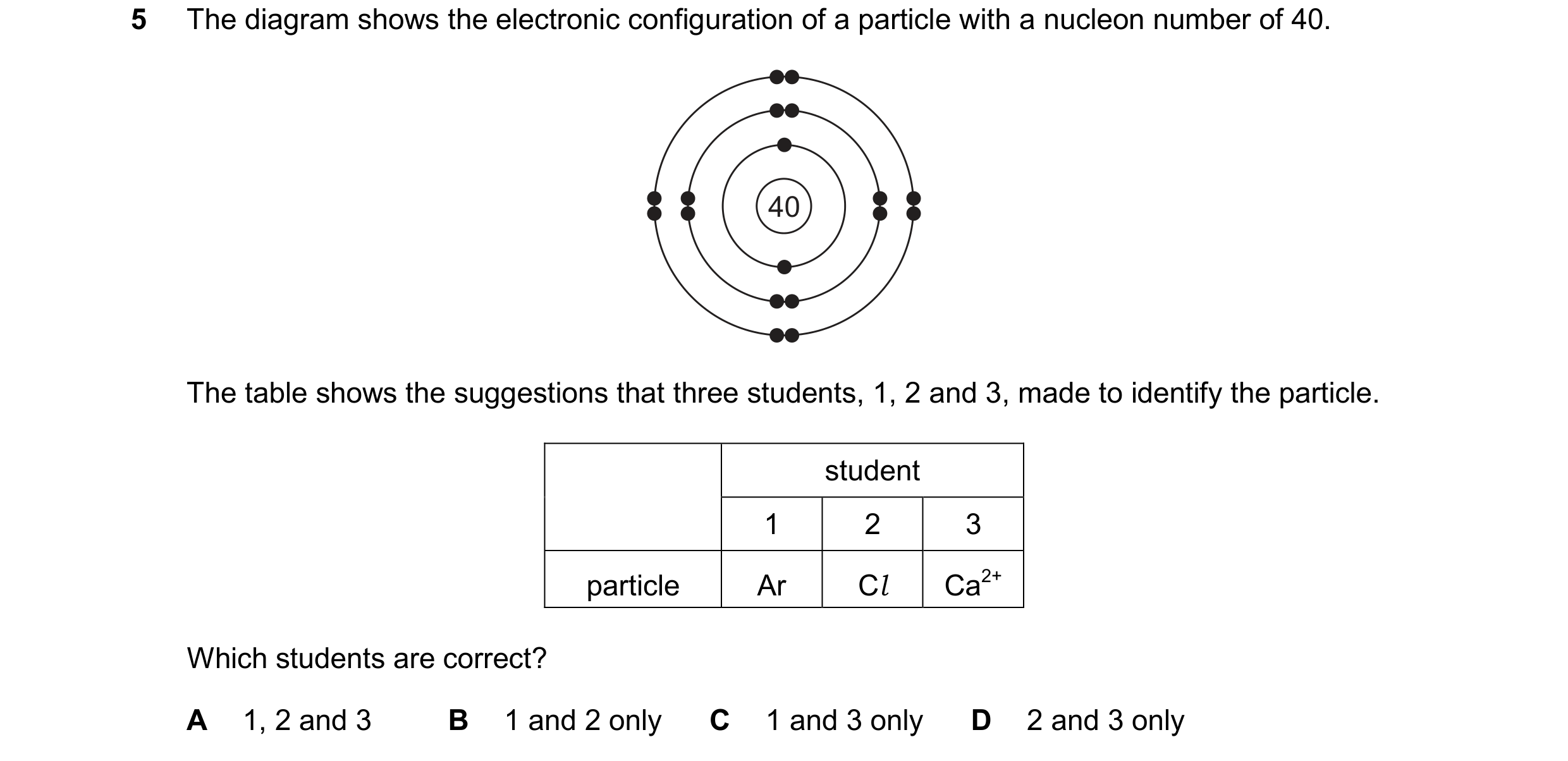
 6 / 6
6 / 6