Questions as text
Q1 · Potassium bromide and methanol are both compounds 0971/22 Oct/Nov 2018
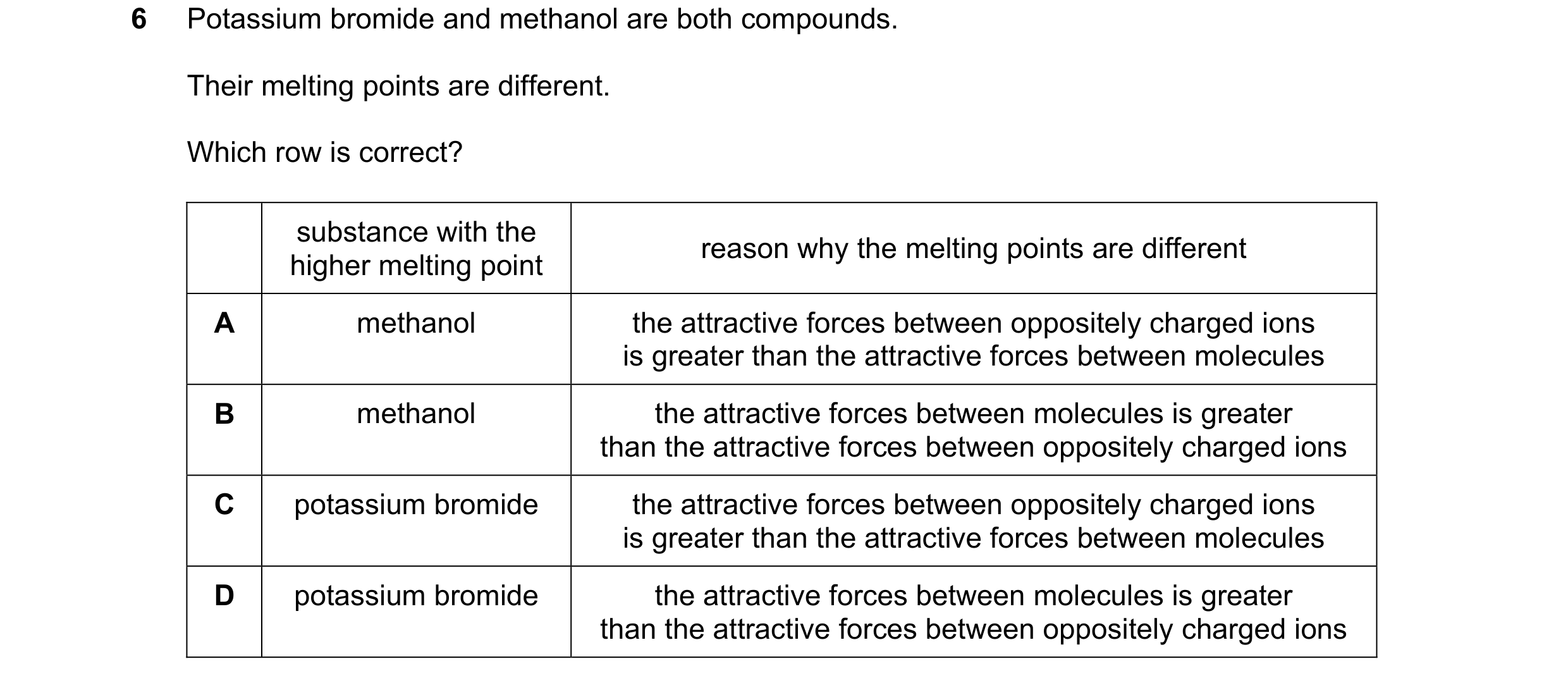
6 Potassium bromide and methanol are both compounds. Their melting points are different. Which row is correct? substance with the reason why the melting points are different higher melting point A methanol the attractive forces between oppositely charged ions is greater than the attractive forces between molecules B methanol the attractive forces between molecules is greater than the attractive forces between oppositely charged ions C potassium bromide the attractive forces between oppositely charged ions is greater than the attractive forces between molecules D potassium bromide the attractive forces between molecules is greater than the attractive forces between oppositely charged ions
1 marks
Answer: C
This question in 0971/22 Oct/Nov 2018
Q2 · The formulae of some ions are shown 0971/22 Oct/Nov 2018
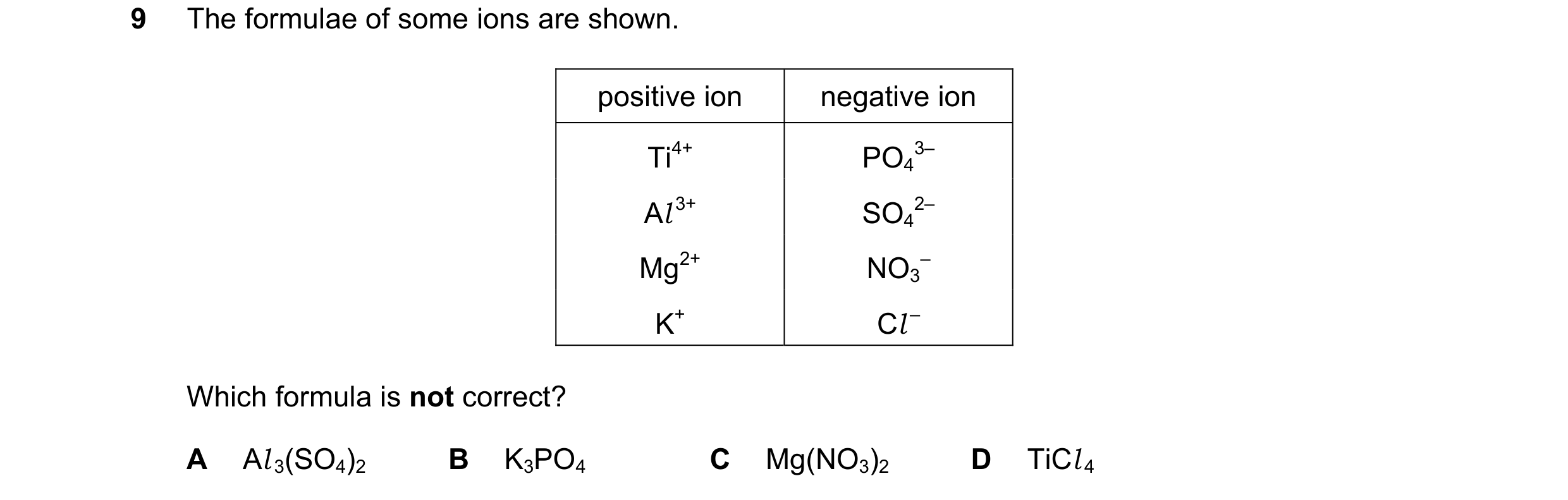
9 The formulae of some ions are shown. positive ion negative ion Ti4+ PO4 3– Al 3+ SO4 2– Mg2+ NO3 – K+ Cl – Which formula is not correct? A Al 3(SO4)2 B K3PO4 C Mg(NO3)2 D TiCl 4
1 marks
Answer: A
This question in 0971/22 Oct/Nov 2018
Q3 · Which statement describes the structure of an ionic compound? 0971/21 May/June 2019
6 Which statement describes the structure of an ionic compound? A It is a giant lattice of oppositely charged ions. B It is a giant lattice of positive ions in a ‘sea’ of electrons. C It is a giant molecule of oppositely charged ions. D It is a simple molecule of oppositely charged ions.
1 marks
Answer: A
This question in 0971/21 May/June 2019
Q4 · Which statement about an ionic compound is not correct? 0971/22 Oct/Nov 2019
4 Which statement about an ionic compound is not correct? A It conducts electricity when dissolved in water. B It has a high melting point due to strong attractive forces between ions. C It has a regular lattice of oppositely charged ions in a ‘sea of electrons’. D The ionic bonds are formed between metallic and non-metallic elements.
1 marks
Answer: C
This question in 0971/22 Oct/Nov 2019
Q5 · Some properties of substance X are listed 0971/22 Oct/Nov 2019
26 Some properties of substance X are listed. ● It conducts electricity when molten. ● It has a high melting point. ● It burns in oxygen and the oxide dissolves in water to give a solution with pH 11. What is X? A a covalent compound B a macromolecule C a metal D an ionic compound
1 marks
Answer: C
This question in 0971/22 Oct/Nov 2019
Q6 · The electronic structures of two atoms, P and Q, are shown 0971/21 May/June 2020
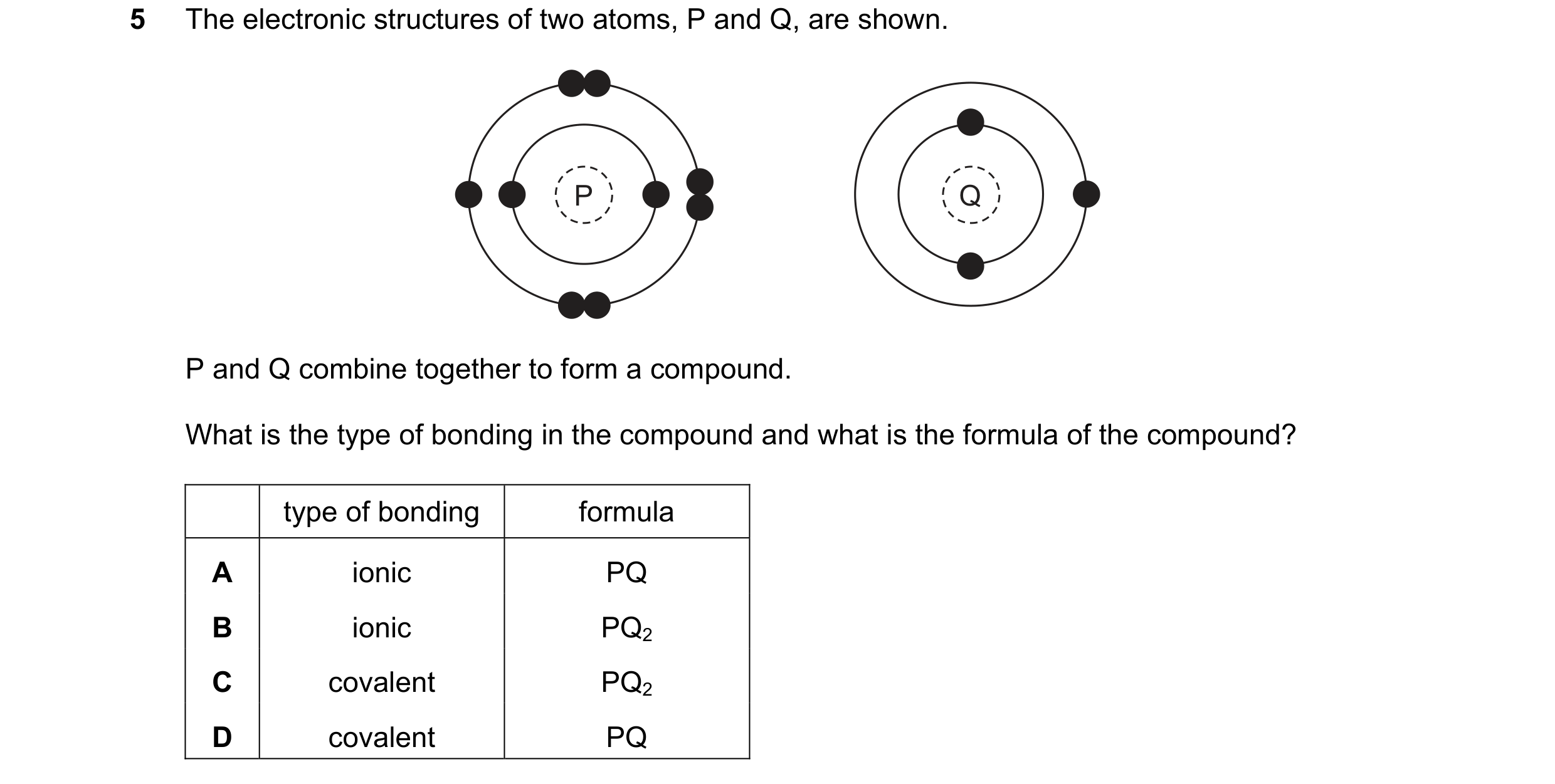
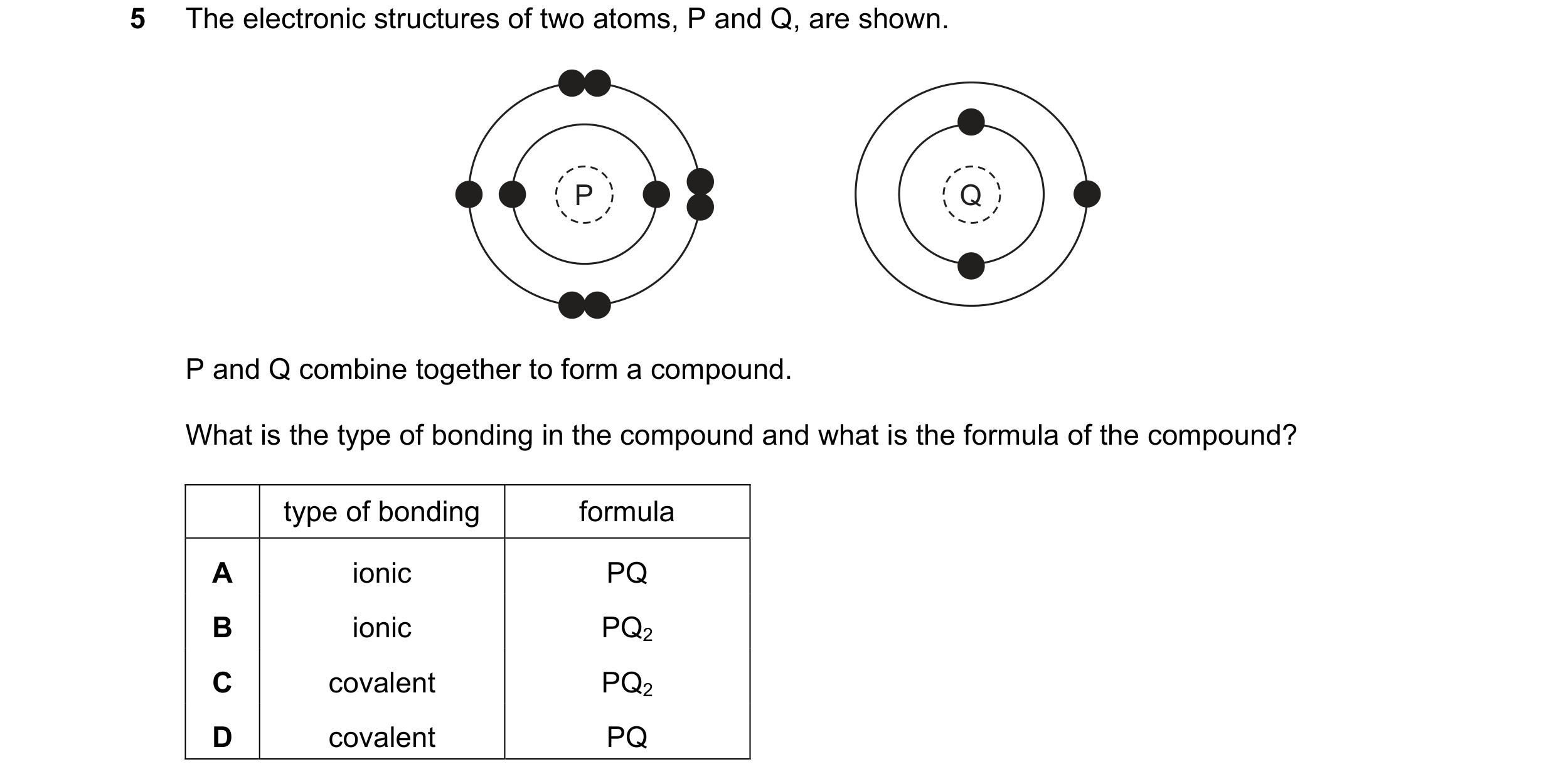
5 The electronic structures of two atoms, P and Q, are shown. P Q P and Q combine together to form a compound. What is the type of bonding in the compound and what is the formula of the compound? type of bonding formula A ionic PQ B ionic PQ2 C covalent PQ2 D covalent PQ
1 marks
Answer: A
This question in 0971/21 May/June 2020
Q7 · The electronic structures of two atoms, P and Q, are shown 0971/22 May/June 2020
5 The electronic structures of two atoms, P and Q, are shown. P Q P and Q combine together to form a compound. What is the type of bonding in the compound and what is the formula of the compound? type of bonding formula A ionic PQ B ionic PQ2 C covalent PQ2 D covalent PQ
1 marks
Answer: A
This question in 0971/22 May/June 2020
Q8 · The arrangements of the electrons in two ions formed from elements X and Y are shown 0971/22 Oct/Nov 2020
6 The arrangements of the electrons in two ions formed from elements X and Y are shown. X Y n = 20 n = 20 p = 19 p = 17 Which equation represents the reaction between elements X and Y? A X2 + 2Y 2X+ + 2Y– B X2 + 2Y 2X– + 2Y+ C 2X + Y2 2X+ + 2Y– D 2X + Y2 2X– + 2Y+
1 marks
Answer: C
This question in 0971/22 Oct/Nov 2020
Q9 · Rubidium is in Group I of the Periodic Table and bromine is in Group VII 0971/22 Oct/Nov 2020
9 Rubidium is in Group I of the Periodic Table and bromine is in Group VII. Rubidium reacts with bromine to form an ionic compound. Which row shows the electron change taking place for rubidium and the correct formula of the rubidium ion? electron change formula of ion formed A electron gained Rb+ B electron gained Rb– C electron lost Rb+ D electron lost Rb–
1 marks
Answer: C
This question in 0971/22 Oct/Nov 2020
Q10 · Two elements, P and Q, are in the same period of the Periodic Table 0971/21 May/June 2021
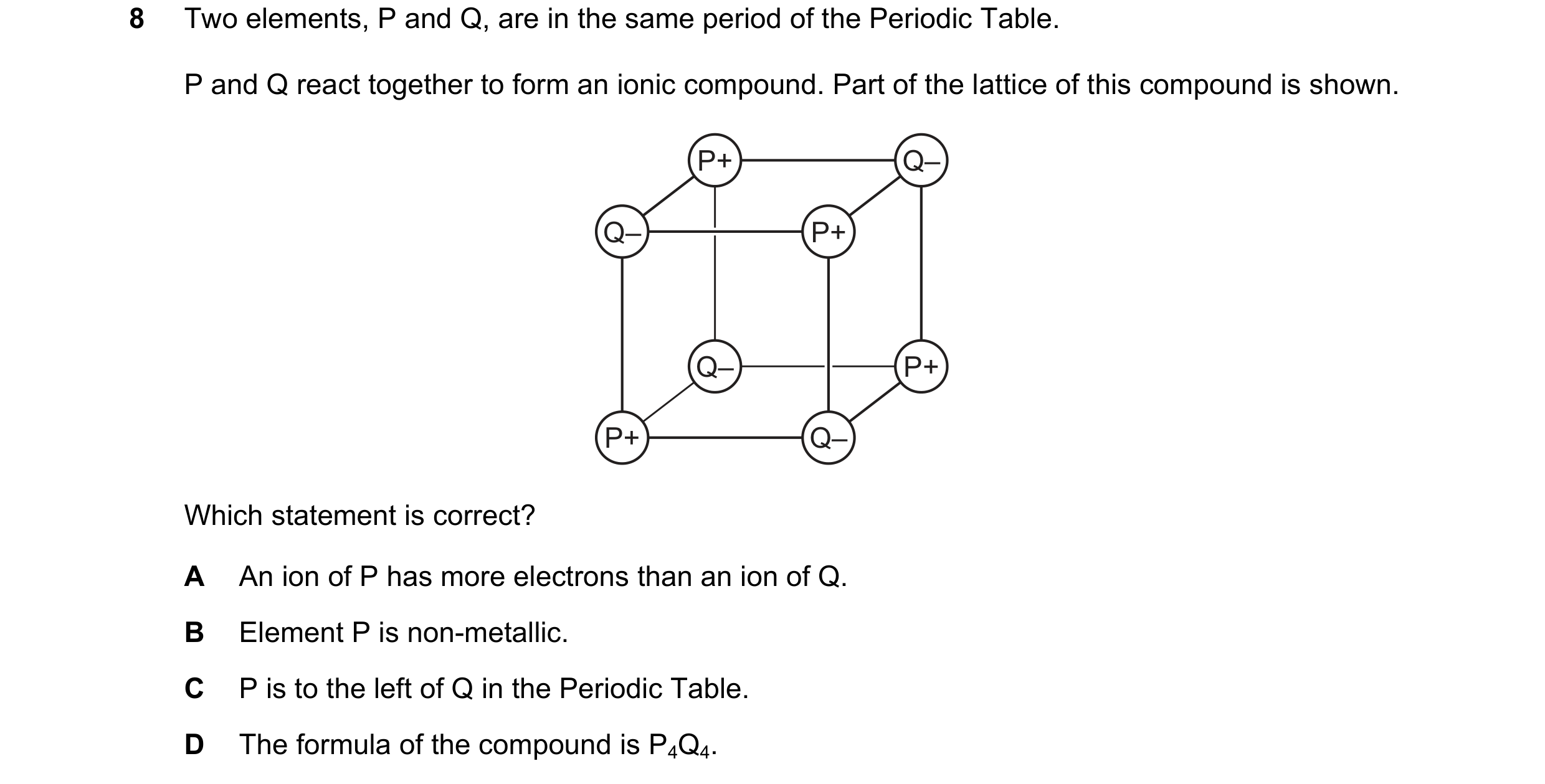
8 Two elements, P and Q, are in the same period of the Periodic Table. P and Q react together to form an ionic compound. Part of the lattice of this compound is shown. P+ Q– Q– P+ Q– P+ P+ Q– Which statement is correct? A An ion of P has more electrons than an ion of Q. B Element P is non-metallic. C P is to the left of Q in the Periodic Table. D The formula of the compound is P4Q4.
1 marks
Answer: C
This question in 0971/21 May/June 2021
Q11 · Chemical compounds formed from a Group I element and a Group VII element contain ionic… 0971/22 May/June 2021
7 Chemical compounds formed from a Group I element and a Group VII element contain ionic bonds. How are the ionic bonds formed? A Electrons are transferred from Group VII atoms to Group I atoms. B Electrons are shared between Group I atoms and Group VII atoms. C Electrons are lost by Group I atoms and Group VII atoms. D Electrons are transferred from Group I atoms to Group VII atoms.
1 marks
Answer: D
This question in 0971/22 May/June 2021
Q12 · A period of the Periodic Table is shown 0971/22 Oct/Nov 2021
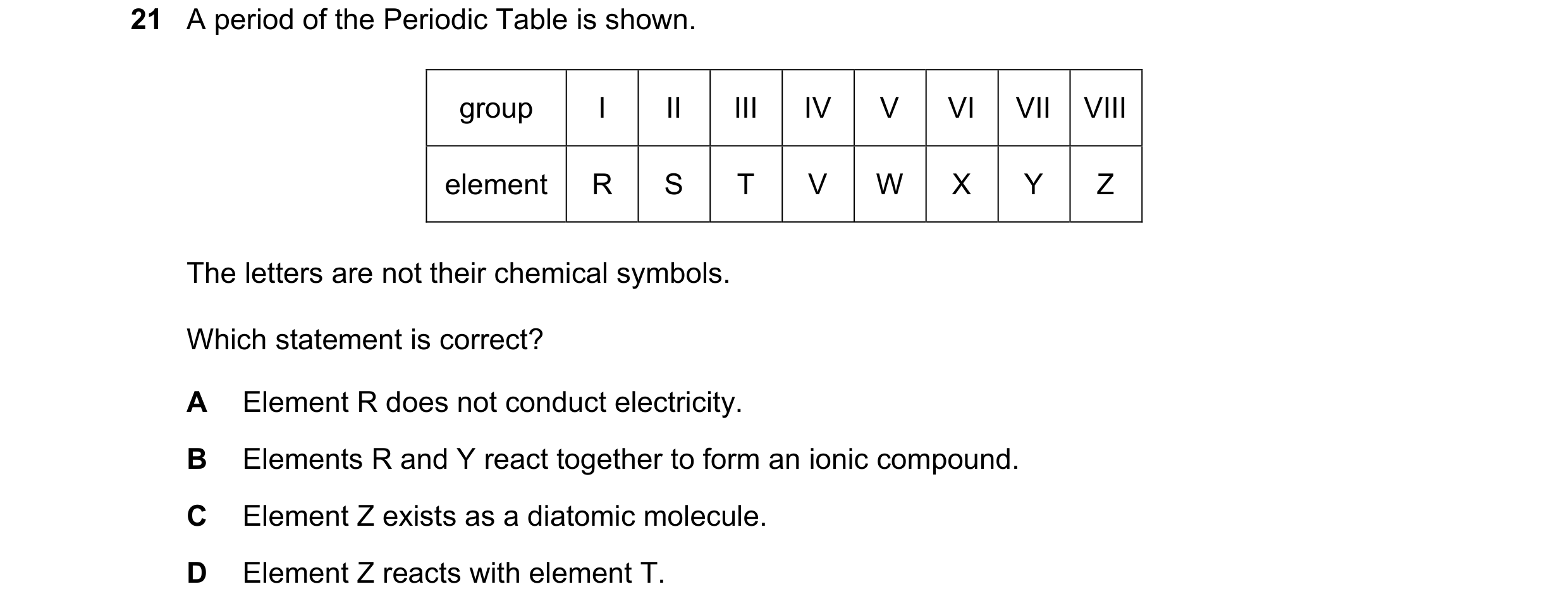
21 A period of the Periodic Table is shown. group I II III IV V VI VII VIII element R S T V W X Y Z The letters are not their chemical symbols. Which statement is correct? A Element R does not conduct electricity. B Elements R and Y react together to form an ionic compound. C Element Z exists as a diatomic molecule. D Element Z reacts with element T.
1 marks
Answer: B
This question in 0971/22 Oct/Nov 2021
Q13 · Metals and ionic compounds have similarities and differences in their structure and… 0971/21 May/June 2022
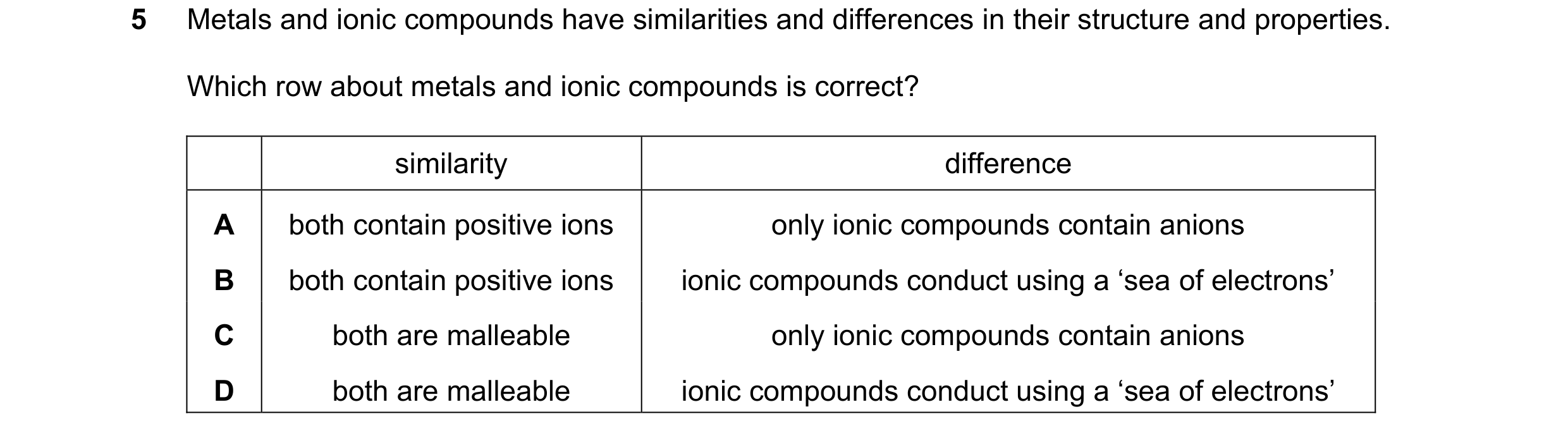
5 Metals and ionic compounds have similarities and differences in their structure and properties. Which row about metals and ionic compounds is correct? similarity difference A both contain positive ions only ionic compounds contain anions B both contain positive ions ionic compounds conduct using a ‘sea of electrons’ C both are malleable only ionic compounds contain anions D both are malleable ionic compounds conduct using a ‘sea of electrons’
1 marks
Answer: A
This question in 0971/21 May/June 2022
Q14 · The number of protons and the number of neutrons in the atoms of elements X, Y and Z are… 0971/22 May/June 2022
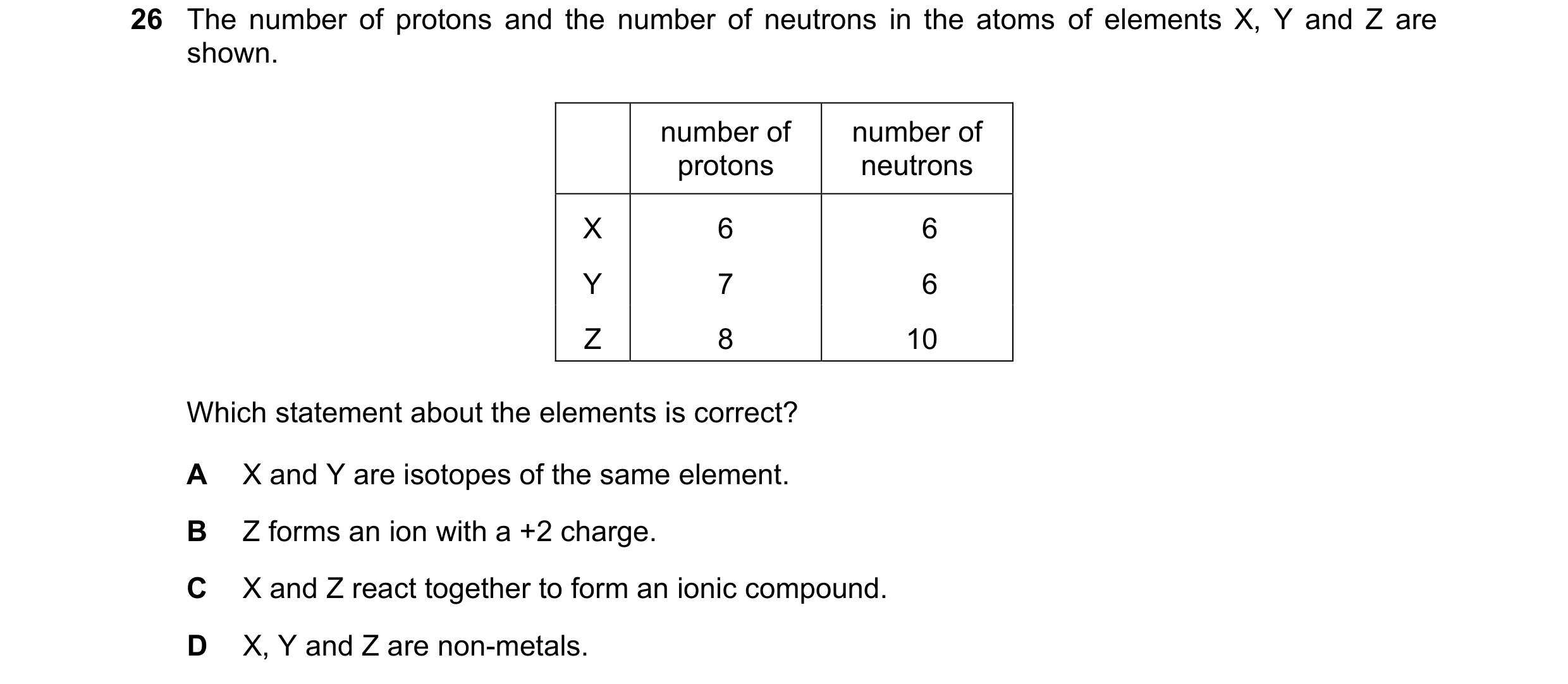
26 The number of protons and the number of neutrons in the atoms of elements X, Y and Z are shown. number of number of protons neutrons X 6 6 Y 7 6 Z 8 10 Which statement about the elements is correct? A X and Y are isotopes of the same element. B Z forms an ion with a +2 charge. C X and Z react together to form an ionic compound. D X, Y and Z are non-metals.
1 marks
Answer: D
This question in 0971/22 May/June 2022
Q15 · Which statement about solid magnesium oxide is correct? 0971/22 Oct/Nov 2022
5 Which statement about solid magnesium oxide is correct? A It is a giant structure made up of magnesium and oxygen atoms bonded covalently. B It is an electrical conductor with mobile magnesium ions and oxygen ions. C Magnesium loses electrons and these electrons move freely through a lattice. D Oxygen ions and magnesium ions are attracted to each other in a giant lattice.
1 marks
Answer: D
This question in 0971/22 Oct/Nov 2022
Q16 · Nitrogen forms a nitride ion with the formula N3– 0971/21 May/June 2023
5 Nitrogen forms a nitride ion with the formula N3–. Which particle does not have the same electronic configuration as the nitride ion? A Al 3+ B Cl – C Na+ D O2–
1 marks
Answer: B
This question in 0971/21 May/June 2023
Q17 · Q and R are elements in the same period of the Periodic Table 0971/22 May/June 2023
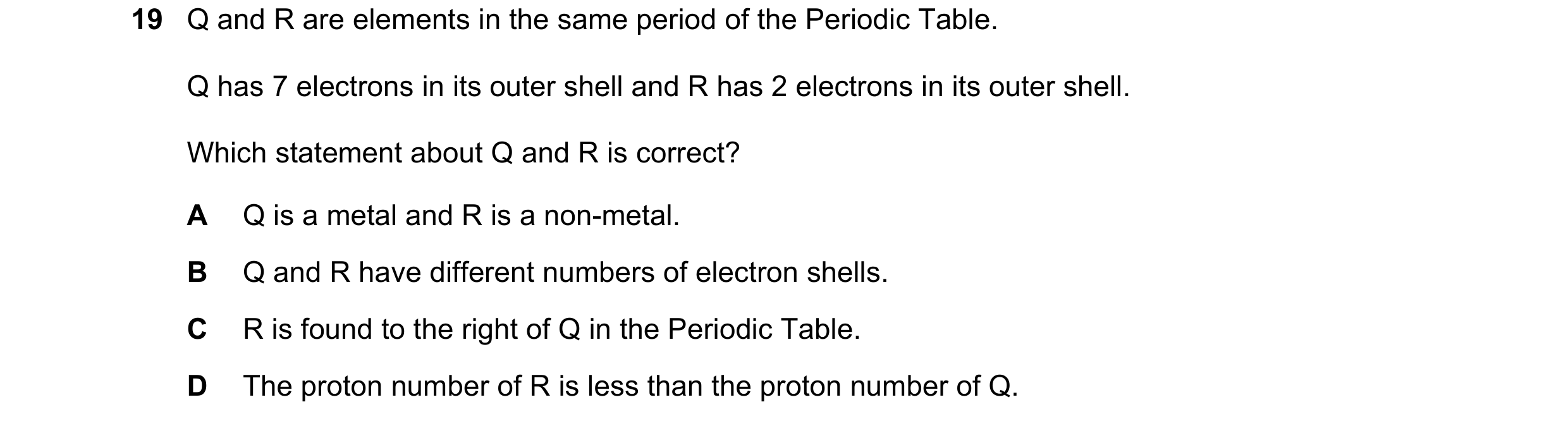
19 Q and R are elements in the same period of the Periodic Table. Q has 7 electrons in its outer shell and R has 2 electrons in its outer shell. Which statement about Q and R is correct? A Q is a metal and R is a non-metal. B Q and R have different numbers of electron shells. C R is found to the right of Q in the Periodic Table. D The proton number of R is less than the proton number of Q.
1 marks
Answer: D
This question in 0971/22 May/June 2023
Q18 · Potassium reacts with iodine to form potassium iodide 0971/22 Oct/Nov 2023
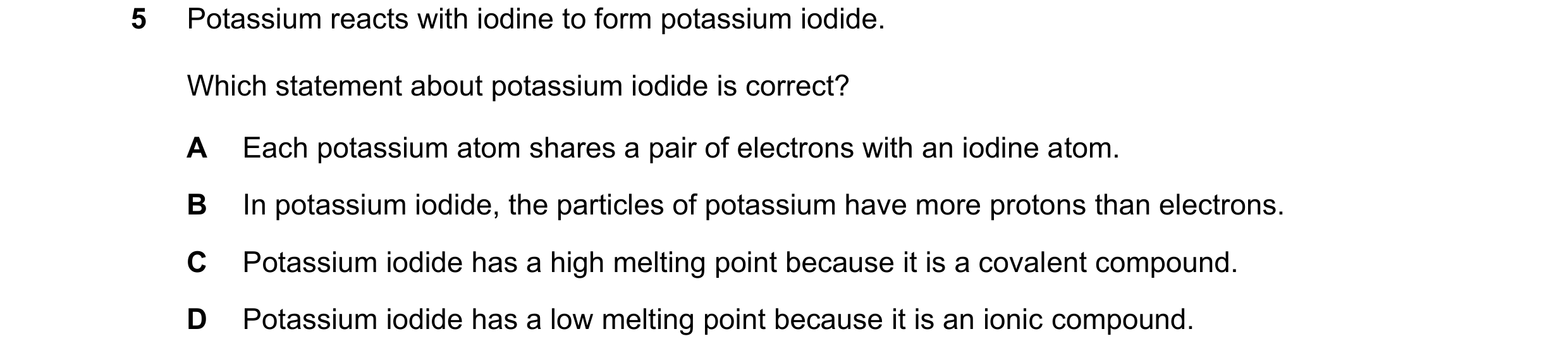
5 Potassium reacts with iodine to form potassium iodide. Which statement about potassium iodide is correct? A Each potassium atom shares a pair of electrons with an iodine atom. B In potassium iodide, the particles of potassium have more protons than electrons. C Potassium iodide has a high melting point because it is a covalent compound. D Potassium iodide has a low melting point because it is an ionic compound.
1 marks
Answer: B
This question in 0971/22 Oct/Nov 2023
Q19 · Which statements about potassium chloride are correct? 0971/21 May/June 2024
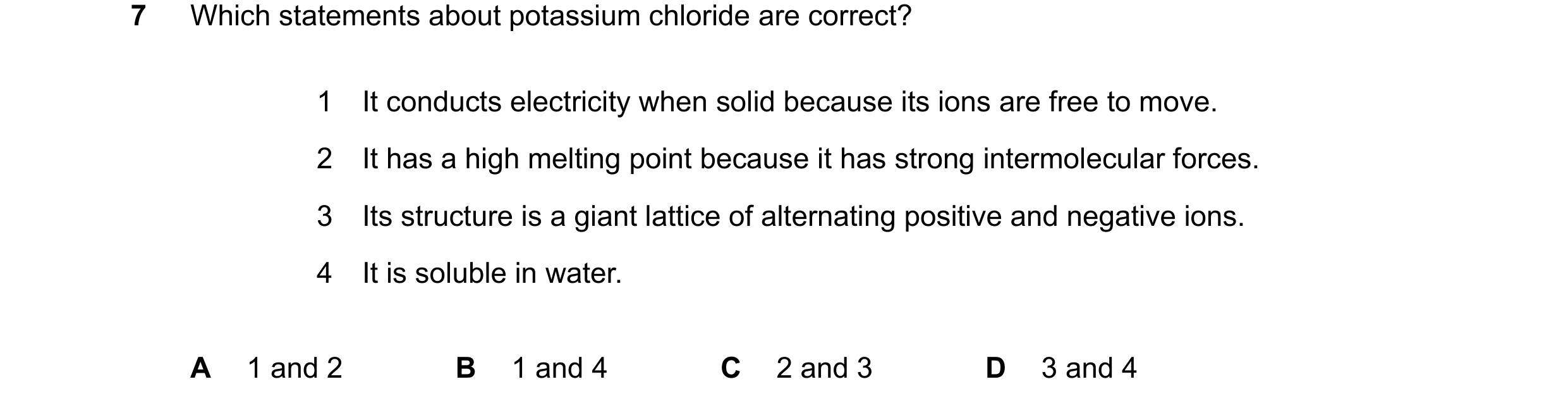
7 Which statements about potassium chloride are correct? 1 It conducts electricity when solid because its ions are free to move. 2 It has a high melting point because it has strong intermolecular forces. 3 Its structure is a giant lattice of alternating positive and negative ions. 4 It is soluble in water. A 1 and 2 B 1 and 4 C 2 and 3 D 3 and 4
1 marks
Answer: D
This question in 0971/21 May/June 2024
Q20 · Which pair of elements react to form a compound with a strong attraction between… 0971/22 Oct/Nov 2024
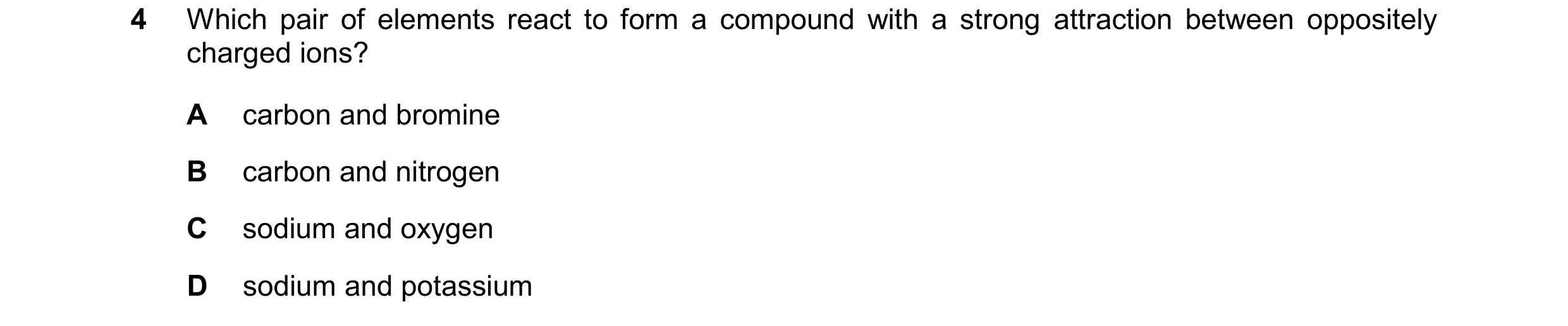
4 Which pair of elements react to form a compound with a strong attraction between oppositely charged ions? A carbon and bromine B carbon and nitrogen C sodium and oxygen D sodium and potassium
1 marks
Answer: C
This question in 0971/22 Oct/Nov 2024
Q21 · The bonding, structure and melting point of sodium chloride and sulfur dichloride are… 0971/22 Oct/Nov 2024
7 The bonding, structure and melting point of sodium chloride and sulfur dichloride are shown. compound bonding structure melting point / C sodium chloride ionic giant lattice 801 sulfur dichloride covalent simple molecular –121 Why does sulfur dichloride have a lower melting point than sodium chloride? A The covalent bonds in sulfur dichloride are weaker than the attractive forces between molecules in sodium chloride. B The covalent bonds in sulfur dichloride are weaker than the ionic bonds in sodium chloride. C The attractive forces between molecules in sulfur dichloride are weaker than the attractive forces between molecules in sodium chloride. D The attractive forces between molecules in sulfur dichloride are weaker than the ionic bonds in sodium chloride.
1 marks
Answer: D
This question in 0971/22 Oct/Nov 2024
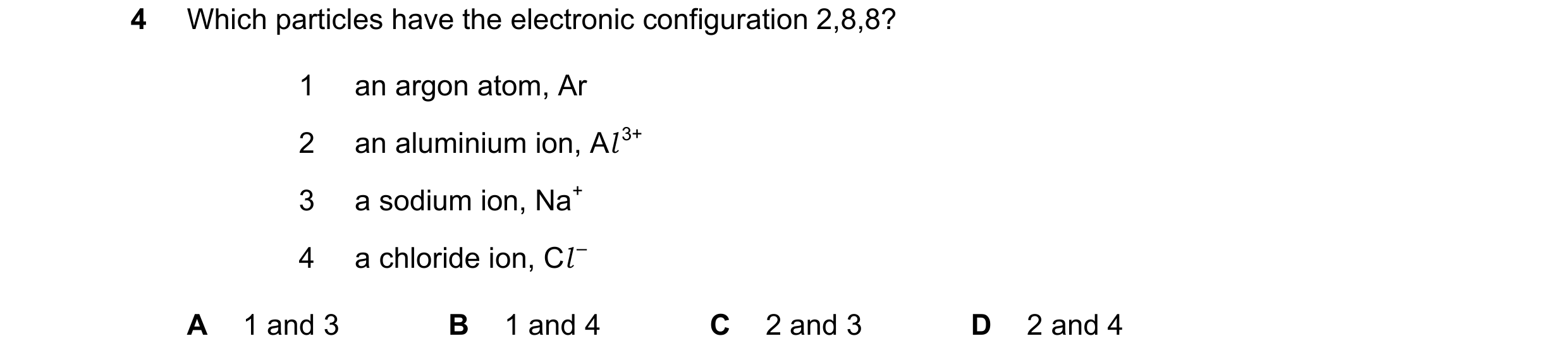
Q22 · Which particles have the electronic configuration 2,8,8? 0971/22 May/June 2025
4 Which particles have the electronic configuration 2,8,8? 1 an argon atom, Ar 2 an aluminium ion, Al 3+ 3 a sodium ion, Na+ 4 a chloride ion, Cl – A 1 and 3 B 1 and 4 C 2 and 3 D 2 and 4
1 marks
Answer: B
This question in 0971/22 May/June 2025
Q23 · Which statement describes the structure of sodium chloride? 0971/22 Oct/Nov 2025
7 Which statement describes the structure of sodium chloride? A a lattice of alternating positive and negative ions B a lattice of positive ions surrounded by a ‘sea’ of delocalised electrons C a mixture of sodium and chlorine atoms D a regular lattice of sodium and chlorine atoms
1 marks
Answer: A
This question in 0971/22 Oct/Nov 2025

 1 / 6
1 / 6
 2 / 6
2 / 6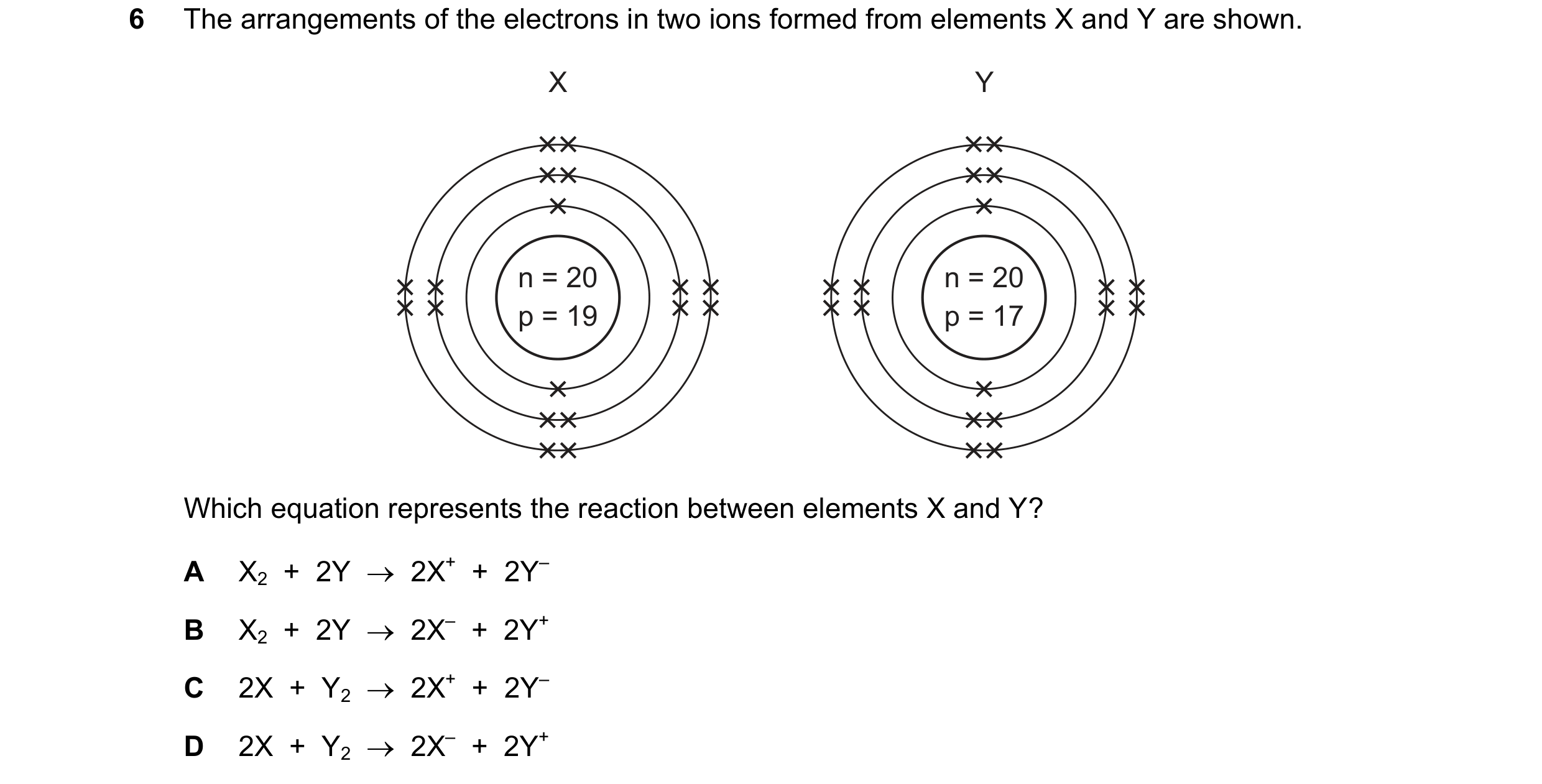
 3 / 6
3 / 6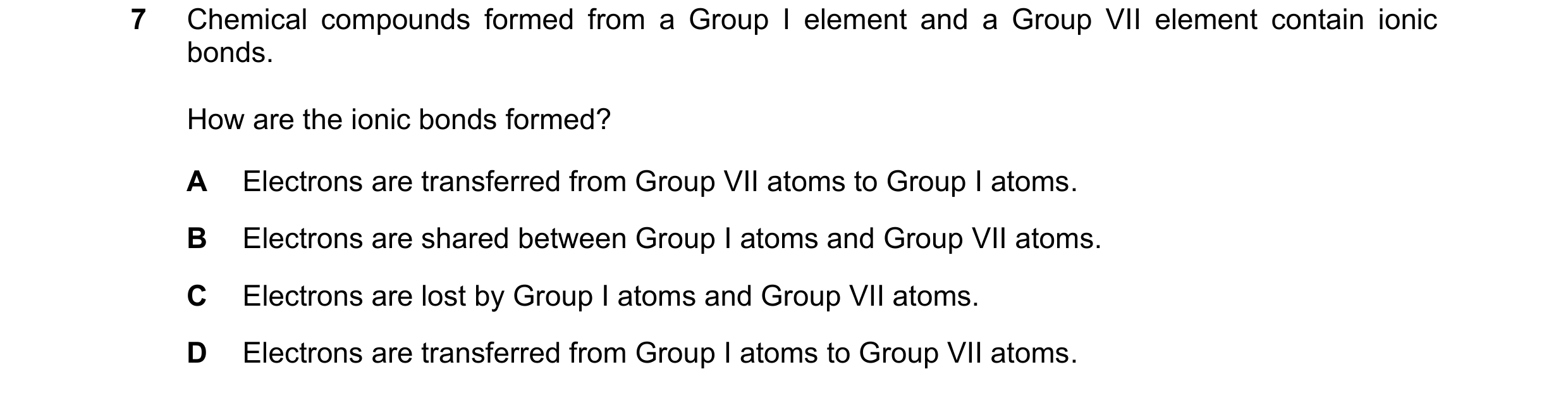
 4 / 6
4 / 6

 5 / 6
5 / 6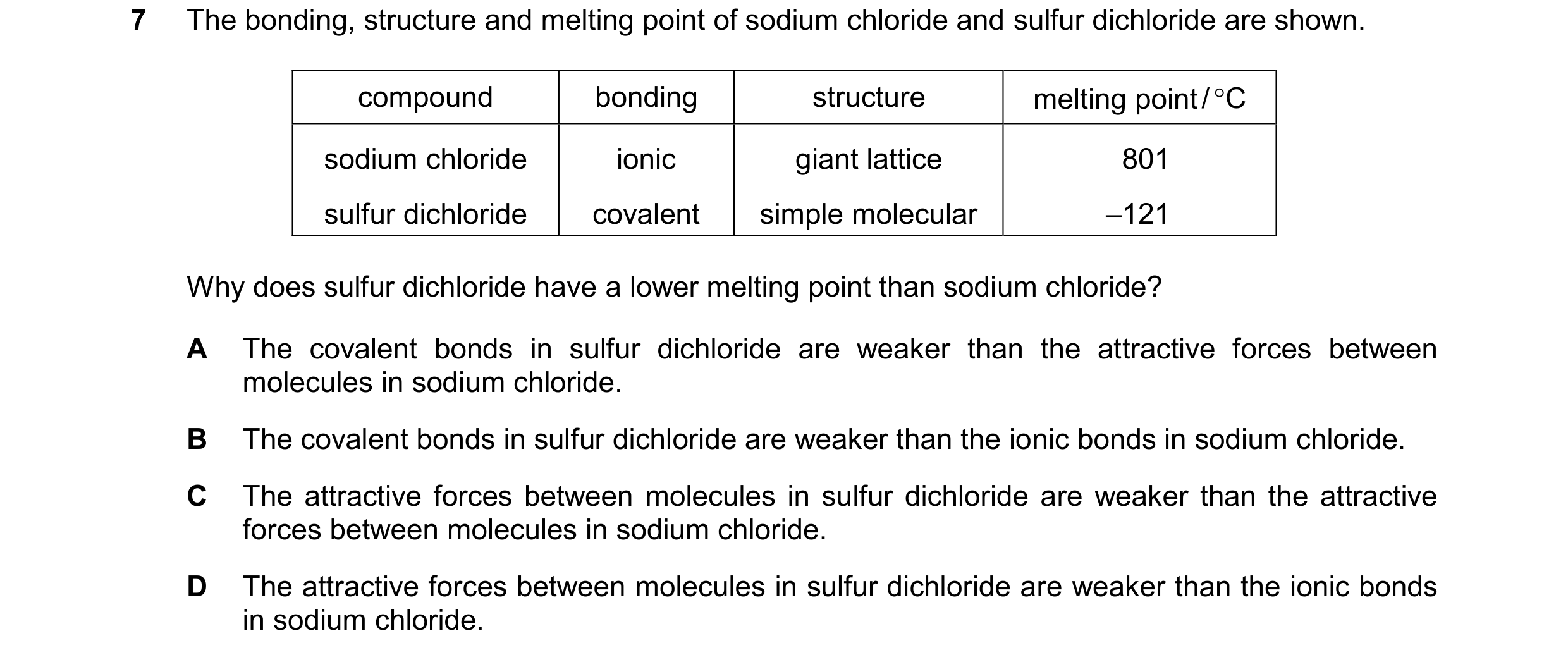
 6 / 6
6 / 6