Questions as text
Q1 · Describe what psychologists have discovered about leadership styles 9990/32 Feb/March 2018
8 (a) Describe what psychologists have discovered about leadership styles. [8] (b) Evaluate what psychologists have discovered about leadership styles, including a discussion of cultural bias. [10]
18 marks
Mark scheme: 8(a) Describe what psychologists have discovered about leadership styles. 8 Leadership style, including the following: • effectiveness: contingency theory (Fiedler, 1967) • situational leadership (Hersey and Blanchard, 1988) • styles of leader behaviour (Muczyk and Reimann, 1987) Fiedler – the effectiveness of leadership depends upon the situation, and there are numerous factors, such as the nature of the task, leader's personality, and make-up of the group being led. It states that effective leadership depends not only on the style of leading but on the control over a situation. There needs to be good leader-member relations, task with clear goals and procedures, and the ability for the leader to give rewards and punishments. Lacking these three in the right combination and context will result in leadership failure. Fiedler created the least preferred co-worker (LPC) scale, where a leader is asked what traits can be ascribed to the co- worker that the leader likes the least. Hersey and Blanchard – Leadership depends upon each individual situation, and no single leadership style can be considered the best. Tasks are different and each type of task requires a different leadership style. A good leader will be able to adapt her or his leadership to the goals or objectives to be accomplished. Goal setting, capacity to assume responsibility, education, and experience are main factors that make a leader successful. Not only is the leadership style important for a successful leader-led situation but the ability or maturity of those being led is a critical factor, as well. Leadership techniques fall out of the leader pairing her or his leadership style to the maturity level of the group. Four levels are identified from M1-M4. There are four types of leadership behaviour – telling: directive; selling: directive but more two-way communication; participating: less direction and shared decision making; and delegating: responsibility given to group members and leader shares responsibility in decision making, more of a monitoring role. Muczyk and Reimann Some leaders do not involve subordinates in decision making because they believe that it is their job to make decisions and the workers’ job to accomplish them. This is generally the case when leaders consider that they have more, or better, information than the rest of the employees and that they are capable of making lone decisions. This autocratic style of leadership should be used when employees are new and learning about their job. In this case, an autocratic leader would basically be training the employees, providing them with new knowledge and skills, and so on. They also believe that autocratic leadership should be used when fast decisions are needed and when there is no time for consulting others. Types of leaders include – directive autocrat, directive democrat, permissive autocrat and permissive democrat. Mark according to the levels of response descriptors in Table A. Other appropriate responses should also be credited. 8(b) Evaluate what psychologists have discovered about leadership styles, 10 including a discussion of cultural bias. A range of issues could be used for evaluation here. These include: • Named issue – cultural bias of theories of leadership styles. E.g. in order to assess leadership style the leader needs to be able to discuss their least preferred co-worker. This may be an issue in collectivist cultures where it would be culturally unacceptable to have a LPC as this would require the leader to question the cohesiveness of the group. In Western companies it is much more culturally acceptable to consider someone that you do not prefer. • effectiveness and appropriateness of leadership styles – Fiedler does identify which style would be appropriate for different types of organisations and Hersey and Blanchard suggest that the leader needs to adapt to the maturity level of the group there are leading (although no indication of how to adapt has been given), which is not done for the other two theories. Muczyk and Reimann identify which types of situations and employees that would be best led by the four different types of leaders. • Any appropriate evaluation issue of evidence of which leadership style theory is based (no requirement to evaluate any evidence in this response). • Reductionist nature of theory (all three are very detailed). • Individual/situational debate. – Fiedler describe the relationship between the individual (the leader) and the situation directly and discuss which type of leader would be best. Mark according to the levels of response descriptors in Table B. Other appropriate responses should also be credited.
This question in 9990/32 Feb/March 2018
Q2 · Explain what is meant by ‘adaptive leadership’ 9990/32 Oct/Nov 2018
7 (a) Explain what is meant by ‘adaptive leadership’. [2] (b) Describe two of the three levels of leadership from Scouller (2011). [4] (c) Discuss the applications of everyday life in organisations of the three levels of leadership proposed by Scouller (2011). [6]
12 marks
Mark scheme: 7(a) Explain what is meant by ‘adaptive leadership’. 2 Award 1 mark for a basic explanation of the term/concept. Award 2 marks for a detailed explanation of the term/concept. For example: Leaders have to inspire their workforce to tackle whatever challenges happen and to then make them work to the best of their ability. Leaders should adapt their style to suit the current economic market of their organisation. Other appropriate responses should also be credited. 7(b) Describe two of the three levels of leadership from Scouller (2011). 4 Award 1–2 marks for a basic answer with some understanding of the topic area. Award 3–4 marks for a detailed answer with clear understanding of the topic area. For example: Public leadership where the leader is influencing more than one individual so it is in a public setting. E.g. This could involve organising and/or delegating to the group. Private leadership is when the leader is just influencing one individual so it is in a private setting. E.g. building trust with an individual employee and helping them to set goals. Personal leadership – this is the leader’s psychological, moral and technical skills and how they are presented/utilised in the company. E.g. This could include time management and motivated the employees in the company to work harder. Other appropriate responses should also be credited. 7(c) Discuss the applications of everyday life in organisations of the three 6 levels of leadership proposed by Scouller (2011). Discussion points could include • Cultural bias – this theory is Western and therefore may not apply to more collectivist cultures. Western employees may be seen as not trustworthy and therefore need strong leadership whereas in collectivist cultures this might be less of any issue. • Does not suggest which type of leadership would be best for each company – other than stating that leaders should do all three. • Training may be required to take on the three levels. • If the three levels can be achieved, then it should bring about better leadership and therefore increased profits for the company (or any other benefit to the company – more motivated workers, etc. Mark according to the levels of response criteria below: Level 3 (5–6 marks) • Candidates will show a clear understanding of the question and will discuss at least two points regarding application. • Candidates will provide a good explanation with clear detail. Level 2 (3–4 marks) • Candidates will show an understanding of the question and will discuss one point about application in detail or two or more in less detail. • Candidates will provide a good explanation. Level 1 (1–2 marks) • Candidates will show a basic understanding of the question and will attempt a discussion. • Candidates will provide a limited explanation. Level 0 (0 marks) • No response worthy of credit. Other appropriate responses should also be credited.
This question in 9990/32 Oct/Nov 2018
Q3 · Describe what psychologists have discovered about traditional and modern theories of… 9990/32 Feb/March 2020
8 (a) Describe what psychologists have discovered about traditional and modern theories of leadership. [8] (b) Evaluate what psychologists have discovered about traditional and modern theories of leadership, including a discussion of nature versus nurture. [10]
18 marks
Mark scheme: 8(a) Describe what psychologists have discovered about traditional and 8 modern theories of leadership. Traditional and modern theories of leadership, including the following: • universalist and behavioural theories • adaptive leadership (Heifetz, 1997) • three levels of leadership (Scouller, 2011) Universalist and behavioural theories Universalist – look at the characteristics and personal qualities of great leaders. Woods (1913) proposed the ‘Great Man Theory’ arguing that leaders are born and not made. They can also be seen as transformational/ charismatic leaders who inspire and lead others. They will show a vision, self-confidence, extraordinary behaviour, etc. Behavioural – Ohio and Michigan state studies. Ohio study found two categories: initiating structure and consideration. Michigan found two types: task-oriented and relationship-oriented. Adaptive leadership (Heifetz, 1997) Leaders have to inspire their workforce to tackle whatever challenges happen and to then make them work to the best of their ability. Leaders should adapt their style to suit the current economic market of their organisation. Can include – Making changes that enable workforce to thrive, diversity encouraged, experimentation, helping others to find their inner authority, new solutions, etc. Three levels of leadership (Scouller, 2011) Public leadership where the leader is influencing more than one individual so it is in a public setting, e.g. this could involve organising and/or delegating to the group. Private leadership is when the leader is just influencing one individual so it is in a private setting, e.g. building trust with an individual employee and helping them to set goals. Personal leadership – this is the leader’s psychological, moral and technical skills and how they are presented/utilised in the company, e.g. this could include time management and motivated the employees in the company to work harder. Argues personal leadership is the most powerful of the three. Mark according to the levels of response descriptors in Table A. Other appropriate responses should also be credited. 8(b) Evaluate what psychologists have discovered about traditional and 10 modern theories of leadership, including a discussion of nature versus nurture. A range of issues could be used for evaluation here. These include: • Named issue – nature versus nurture – The great man theory believes that leaders are born and not made so supports the nature side of the debate. The other two theories believe that leaders can be adaptive and make changes in order to suit the changing needs of the organisation that they lead. Therefore they plus the behavioural theories believe leadership can be learned/nurtured. • Cultural bias of theories of leadership. • Effectiveness and appropriateness of leadership theories. • Any appropriate evaluation issue of evidence of which leadership style theory is based (no requirement to evaluate any evidence in this response). • Reductionist nature of theory • Individual/situational debate. Mark according to the levels of response descriptors in Table B. Other appropriate responses should also be credited.
This question in 9990/32 Feb/March 2020
Q4 · Identify two ‘followership’ types (Kelley, 1988) 9990/31 Oct/Nov 2020
7 (a) Identify two ‘followership’ types (Kelley, 1988). [2] (b) Describe the Leadership Practices Inventory (LPI) devised by Kouzes and Posner (1987). [4] (c) Explain one strength and one weakness of the Leadership Practices Inventory. [6]
12 marks
Mark scheme: 7(a) Identify two ‘followership’ types (Kelley, 1988). Award 1 mark for each. For example: • Alienated • Effective (‘star followers’) • Passive (‘sheep’) • Conformist (‘yes-people’) • Pragmatic Other appropriate responses should also be credited. 2 Question Answer Marks 7(b) Describe the Leadership Practices Inventory (LPI) devised by Kouzes and Posner (1987). Award 1–2 marks for a basic answer with some understanding of the topic area. Award 3–4 marks for a detailed answer with clear understanding of the topic area. For example: A method used to measure leadership in 5 distinct areas. Each area consist of 6 ‘item’ statements, making 30 in total. The areas are: 1 Model the Way, e.g. follows through on promises and commitments he/she makes. 2 Inspire a Shared Vision, e.g. talks about future trends that will influence how our work gets done. 3 Challenge the Process, e.g. seeks out challenging opportunities that test his/her own skills and abilities. 4 Enable others to Act, e.g. supports the decisions that people make on their own. 5 Encourage the Heart, e.g. gives the members of the team lots of appreciation and support for their contributions. The individual whose leadership is being assessed completes an inventory along with a number of other ‘observers’ (a range of colleagues from various parts of the organisation). For each item responses are on a 10-point scale from 1 – Almost Never to 10 – Almost Always, each number having a descriptor (e.g. fairly often, seldom). An average score for each item is calculated. This enables the individual to see how well they score on each of the 5 sections and the level of agreement between themselves and the observers. Candidates must mention/describe the scales themselves for full marks. Other appropriate responses should also be credited. 4 Question Answer Marks 7(c) Explain one strength and one weakness of the Leadership Practices Inventory. Likely strengths include: • Allows detailed assessment (multiple questions) of leadership in a number of areas. • Allows the individual to see where they need to develop their skills, e.g. Are they weak at ‘encouraging’? • Assessment is by peers, managers, and self, providing a comprehensive assessment. • Large scale on which a fine-tuned assessment can be made. • Descriptors accompany numbers on the response scale to suit those who prefer description. • Can be statistically analysed. • Strengths of quantitative data collected, etc. • Useful to be able to compare self-assessment with assessment by others such as peers. Likely weaknesses include: • Lack of qualitative data • Possibility of socially desirable responses as the individual has chosen the observers. • Not all items may be relevant to some of the observers. They may not know how to respond and that particular item is not involved in their working relationship. 6 Question Answer Marks 7(c) Mark according to the levels of response criteria below: Level 3 (5–6 marks) • Candidates will show a clear understanding of the question and will discuss one strength and one weakness. • Candidates will provide a good explanation with clear detail. Level 2 (3–4 marks) • Candidates will show an understanding of the question and will discuss one appropriate weakness in detail or one appropriate strength in detail. OR one weakness and one strength in less detail. Level 1 (1–2 marks) • Candidates will show a basic understanding of the question and will attempt a discussion of either a strength or a weakness. They could include both but just as an attempt. • Candidates will provide a limited explanation. Level 0 (0 marks) No response worthy of credit. Other appropriate responses should also be credited.
This question in 9990/31 Oct/Nov 2020
Q5 · Identify two ‘followership’ types (Kelley, 1988) 9990/33 Oct/Nov 2020
7 (a) Identify two ‘followership’ types (Kelley, 1988). [2] (b) Describe the Leadership Practices Inventory (LPI) devised by Kouzes and Posner (1987). [4] (c) Explain one strength and one weakness of the Leadership Practices Inventory. [6]
12 marks
Mark scheme: 7(a) Identify two ‘followership’ types (Kelley, 1988). Award 1 mark for each. For example: • Alienated • Effective (‘star followers’) • Passive (‘sheep’) • Conformist (‘yes-people’) • Pragmatic Other appropriate responses should also be credited. 2 Question Answer Marks 7(b) Describe the Leadership Practices Inventory (LPI) devised by Kouzes and Posner (1987). Award 1–2 marks for a basic answer with some understanding of the topic area. Award 3–4 marks for a detailed answer with clear understanding of the topic area. For example: A method used to measure leadership in 5 distinct areas. Each area consist of 6 ‘item’ statements, making 30 in total. The areas are: 1 Model the Way, e.g. follows through on promises and commitments he/she makes. 2 Inspire a Shared Vision, e.g. talks about future trends that will influence how our work gets done. 3 Challenge the Process, e.g. seeks out challenging opportunities that test his/her own skills and abilities. 4 Enable others to Act, e.g. supports the decisions that people make on their own. 5 Encourage the Heart, e.g. gives the members of the team lots of appreciation and support for their contributions. The individual whose leadership is being assessed completes an inventory along with a number of other ‘observers’ (a range of colleagues from various parts of the organisation). For each item responses are on a 10-point scale from 1 – Almost Never to 10 – Almost Always, each number having a descriptor (e.g. fairly often, seldom). An average score for each item is calculated. This enables the individual to see how well they score on each of the 5 sections and the level of agreement between themselves and the observers. Candidates must mention/describe the scales themselves for full marks. Other appropriate responses should also be credited. 4 Question Answer Marks 7(c) Explain one strength and one weakness of the Leadership Practices Inventory. Likely strengths include: • Allows detailed assessment (multiple questions) of leadership in a number of areas. • Allows the individual to see where they need to develop their skills, e.g. Are they weak at ‘encouraging’? • Assessment is by peers, managers, and self, providing a comprehensive assessment. • Large scale on which a fine-tuned assessment can be made. • Descriptors accompany numbers on the response scale to suit those who prefer description. • Can be statistically analysed. • Strengths of quantitative data collected, etc. • Useful to be able to compare self-assessment with assessment by others such as peers. Likely weaknesses include: • Lack of qualitative data • Possibility of socially desirable responses as the individual has chosen the observers. • Not all items may be relevant to some of the observers. They may not know how to respond and that particular item is not involved in their working relationship. 6 Question Answer Marks 7(c) Mark according to the levels of response criteria below: Level 3 (5–6 marks) • Candidates will show a clear understanding of the question and will discuss one strength and one weakness. • Candidates will provide a good explanation with clear detail. Level 2 (3–4 marks) • Candidates will show an understanding of the question and will discuss one appropriate weakness in detail or one appropriate strength in detail. OR one weakness and one strength in less detail. Level 1 (1–2 marks) • Candidates will show a basic understanding of the question and will attempt a discussion of either a strength or a weakness. They could include both but just as an attempt. • Candidates will provide a limited explanation. Level 0 (0 marks) No response worthy of credit. Other appropriate responses should also be credited.
This question in 9990/33 Oct/Nov 2020
Q6 · Kouzes and Posner (1987) produced the Leadership Practices Inventory (LPI) which measures… 9990/31 Oct/Nov 2021
7 (a) Kouzes and Posner (1987) produced the Leadership Practices Inventory (LPI) which measures five practices of exemplary leadership. Identify two of these practices. [2] (b) Describe the styles of leader behaviour proposed by Muczyk and Reimann (1987). [4] (c) Explain one similarity and one difference between styles of leader behaviour (Muczyk and Reimann, 1987) and situational leadership (Hersey and Blanchard, 1988). [6]
12 marks
Mark scheme: 7(a) Kouzes and Posner (1987) produced the Leadership Practices Inventory 2 (LPI) which measures five practices of exemplary leadership. Identify two of these practices. Award 1 mark for each For example • Model the way • Inspire a shared vision • Challenge the process • Enable others to act • Encourage the heart Other appropriate responses should also be credited. 7(b) Describe the styles of leader behaviour proposed by Muczyk and 4 Reimann (1987). Award 1–2 marks for a basic answer with some understanding of the topic area. Award 3–4 marks for a detailed answer with clear understanding of the topic area. For example: Styles/types of leaders include – directive autocrat, directive democrat, permissive autocrat and permissive democrat. These are the styles of leader behaviour. (2 marks max for identify styles/types) Degree of participation in decision making Low High Amount of High Directive autocrat Directive democrat leader Closely Encourages strong direction supervises and participation in makes unilateral decisions and monitors decisions closely Low Permissive Permissive democrat autocrat Invites high degree of Unilateral participation in decisions but decisions and allows allows staff to for autonomy of choose how to implementation. Seen implement these as ‘ideal’ leader (within decisions West) Other appropriate responses should also be credited. 7(c) Explain one similarity and one difference between styles of leader 6 behaviour (Muczyk and Reimann, 1987) and situational leadership (Hersey and Blanchard, 1988). Likely similarities include • Both theoretical models rather than measured dimensions so lack direct practical examples which could be said to limit usefulness • Both assert that the type/style of leadership should depend on the situation; Muczyk and Reimann state direction and participation are different dimensions that need to be considered whereas Hersey and Blanchard assert the need for leaders to adapt their leadership style • Both assert that there is no one perfect leadership style • Both require the leader to be adaptive Likely differences include • Based on different principles – situational leadership looks at telling, selling, participating and delegating; styles of leader behaviour looks at participation and direction • Styles of leader behaviour sees a distinction between making decisions and carrying them through; situational leadership does not Mark according to the levels of response criteria below: Level 3 (5–6 marks) • Candidates will show a clear understanding of the question and will explain an appropriate similarity and an appropriate difference. • Candidates will provide a good explanation with clear detail. Level 2 (3–4 marks) • Candidates will show an understanding of the question and will explain an appropriate similarity/difference in detail or both a similarity and a difference in less detail. • Candidates will provide a good explanation. Level 1 (1–2 marks) • Candidates will show a basic understanding of the question and will attempt a similarity and/or difference. This could include both but just as an attempt. • Candidates will provide a limited explanation. Level 0 (0 marks) No response worthy of credit.
This question in 9990/31 Oct/Nov 2021
Q7 · Kouzes and Posner (1987) produced the Leadership Practices Inventory (LPI) which measures… 9990/33 Oct/Nov 2021
7 (a) Kouzes and Posner (1987) produced the Leadership Practices Inventory (LPI) which measures five practices of exemplary leadership. Identify two of these practices. [2] (b) Describe the styles of leader behaviour proposed by Muczyk and Reimann (1987). [4] (c) Explain one similarity and one difference between styles of leader behaviour (Muczyk and Reimann, 1987) and situational leadership (Hersey and Blanchard, 1988). [6]
12 marks
Mark scheme: 7(a) Kouzes and Posner (1987) produced the Leadership Practices Inventory 2 (LPI) which measures five practices of exemplary leadership. Identify two of these practices. Award 1 mark for each For example • Model the way • Inspire a shared vision • Challenge the process • Enable others to act • Encourage the heart Other appropriate responses should also be credited. 7(b) Describe the styles of leader behaviour proposed by Muczyk and 4 Reimann (1987). Award 1–2 marks for a basic answer with some understanding of the topic area. Award 3–4 marks for a detailed answer with clear understanding of the topic area. For example: Styles/types of leaders include – directive autocrat, directive democrat, permissive autocrat and permissive democrat. These are the styles of leader behaviour. (2 marks max for identify styles/types) Degree of participation in decision making Low High Amount of High Directive autocrat Directive democrat leader Closely Encourages strong direction supervises and participation in makes unilateral decisions and monitors decisions closely Low Permissive Permissive democrat autocrat Invites high degree of Unilateral participation in decisions but decisions and allows allows staff to for autonomy of choose how to implementation. Seen implement these as ‘ideal’ leader (within decisions West) Other appropriate responses should also be credited. 7(c) Explain one similarity and one difference between styles of leader 6 behaviour (Muczyk and Reimann, 1987) and situational leadership (Hersey and Blanchard, 1988). Likely similarities include • Both theoretical models rather than measured dimensions so lack direct practical examples which could be said to limit usefulness • Both assert that the type/style of leadership should depend on the situation; Muczyk and Reimann state direction and participation are different dimensions that need to be considered whereas Hersey and Blanchard assert the need for leaders to adapt their leadership style • Both assert that there is no one perfect leadership style • Both require the leader to be adaptive Likely differences include • Based on different principles – situational leadership looks at telling, selling, participating and delegating; styles of leader behaviour looks at participation and direction • Styles of leader behaviour sees a distinction between making decisions and carrying them through; situational leadership does not Mark according to the levels of response criteria below: Level 3 (5–6 marks) • Candidates will show a clear understanding of the question and will explain an appropriate similarity and an appropriate difference. • Candidates will provide a good explanation with clear detail. Level 2 (3–4 marks) • Candidates will show an understanding of the question and will explain an appropriate similarity/difference in detail or both a similarity and a difference in less detail. • Candidates will provide a good explanation. Level 1 (1–2 marks) • Candidates will show a basic understanding of the question and will attempt a similarity and/or difference. This could include both but just as an attempt. • Candidates will provide a limited explanation. Level 0 (0 marks) No response worthy of credit.
This question in 9990/33 Oct/Nov 2021
Q8 · Describe what psychologists have discovered about leadership style (contingency theory… 9990/31 May/June 2022
8 (a) Describe what psychologists have discovered about leadership style (contingency theory, situational leadership, styles of leader behaviour). [8] (b) Evaluate what psychologists have discovered about leadership style (contingency theory, situational leadership, styles of leader behaviour), including a discussion about practical applications. [10]
18 marks
Mark scheme: 8(a) Describe what psychologists have discovered about leadership style (contingency theory, situational leadership, styles of leader behaviour). Leadership style, including the following: effectiveness: contingency theory (Fiedler, 1967) situational leadership (Hersey and Blanchard, 1988) styles of leader behaviour (Muczyk and Reimann, 1987) Fiedler contingency theory – the effectiveness of leadership depends upon the situation, and there are numerous factors, such as the nature of the task, leader's personality, and make-up of the group being led. It states that effective leadership depends not only on the style of leading but on the control over a situation. There needs to be good leader- member relations, task with clear goals and procedures, and the ability for the leader to mete out rewards and punishments. Lacking these three in the right combination and context will result in leadership failure. Fiedler created the least preferred co-worker (LPC) scale, where a leader is asked what traits can be ascribed to the co-worker that the leader likes the least. A low score indicates task-focused leader, and a high score indicates relationship-focused. Hersey and Blanchard situational – Leadership depends upon each individual situation, and no single leadership style can be considered the best. Tasks are different and each type of task requires a different leadership style. A good leader will be able to adapt her or his leadership to the goals or objectives to be accomplished. Goal setting, capacity to assume responsibility, education, and experience are main factors that make a leader successful. Not only is the leadership style important for a successful leader-led situation but the ability or maturity of those being led is a critical factor, as well. Leadership techniques fall out of the leader pairing her or his leadership style to the maturity level of the group. Four levels are identified from M1–M4. There are four types of leadership behaviour – telling: directive; selling: directive but more two-way communication; participating: less direction and shared decision making; and delegating: responsibility given to group members and leader shares responsibility in decision making, more of a monitoring role. Muczyk and Reimann – styles of leader behaviour Some leaders do not involve subordinates in decision making because they believe that it is their job to make decisions and the workers’ job to accomplish them. This is generally the case when leaders consider that they have the most, or the best, information than the rest of the employees and that they can make lone decisions. This autocratic style of leadership should be used when employees are new and learning about their job. In this case, an autocratic leader would basically be training the employees, providing them with new knowledge and skills, and so on. They also believe that autocratic leadership should be used when fast decisions are needed and when there is no time for consulting others. Types of leaders include – directive autocrat, directive democrat, permissive autocrat and permissive democrat. Question Answer Marks 8(a) Mark according to the levels of response descriptors in Table A. Other appropriate responses should also be credited. 8(b) Evaluate what psychologists have discovered about leadership style (contingency theory, situational leadership, styles of leader behaviour), including a discussion about practical applications. A range of issues could be used for evaluation here. These include: Named issue – practical applications including effectiveness and appropriateness of leadership styles – Less practical – Fiedler does not identify which style would be appropriate for different types of organisations so is less practical. It will just depend on the type of group/person being led which is vague for organisations trying to decide which style to suggest to management. In addition, Fiedler identifies that different leadership styles should be used in different situations which is also vague for an organisation to use. Hersey and Blanchard suggest that the leader needs to adapt to the maturity level of the group they are leading (although no indication of how to adapt has been given). However, it could be argued that there are some practical implications as organisations can be made aware of different styles (e.g. telling, selling, participating and delegating) and train their management in the style most suited to their needs. Muczyk and Reimann identify which types of situations and employees that would be best led by the four different types of leaders. Therefore, organisations can identify if employees need / are capable of participating in decision making. If there is a high need for participation, then a democratic leader is suitable. If there is a low need for participation, then an autocratic leader is more suitable. Cultural bias of theories of leadership styles Any appropriate evaluation issue of evidence of which leadership style theory is based (no requirement to evaluate any evidence in this response). Reductionist versus holistic nature of theories Individual/situational debate Mark according to the levels of response descriptors in Table B. Other appropriate responses should also be credited. 10
This question in 9990/31 May/June 2022
Q9 · Outline one universalist theory of leadership 9990/32 May/June 2022
7 (a) Outline one universalist theory of leadership. [2] (b) Describe the contingency theory of leadership proposed by Fiedler (1967). [4] (c) Explain one strength and one weakness of the contingency theory of leadership. [6]
12 marks
Mark scheme: 7(a) Outline one universalist theory of leadership. Award 1 mark for a basic explanation of the term/concept. Award 2 marks for a detailed explanation of the term/concept. For example: Great Man/Woman/Person Theory (1) leaders are born and not made. (1) Charismatic/transformational/visionary leader. (1) Excellent public speaking/high levels of confidence. (1) Other appropriate responses should also be credited. 7(b) Describe the contingency theory of leadership proposed by Fiedler (1967). Award 1–2 marks for a basic answer with some understanding of the topic area. Award 3–4 marks for a detailed answer with clear understanding of the topic area. For example: The effectiveness of leadership depends upon the situation (1), and there are numerous factors, such as the nature of the task, leader’s personality, and make-up of the group being led. (2) It states that effective leadership depends not only on the style of leading but on the control over a situation. (1) There needs to be good leader-member relations, task with clear goals and procedures, and the ability for the leader to mete out rewards and punishments. (2) Lacking these three in the right combination and context will result in leadership failure. (1) Fiedler created the least preferred co-worker (LPC) scale, where a leader is asked what traits can be ascribed to the co-worker that the leader likes the least. (1) Low score LPC – task oriented and high score LPC – relationship oriented. (2) Other appropriate responses should also be credited. 4 Question Answer Marks 7(c) Explain one strength and one weakness of the contingency theory of leadership. Likely strengths include: Practical application – Fiedler identifies that different styles of leadership will be required for different types of organisations/situations. This has a practical application – for example – a project might require a task-oriented leader and the organisation can put this type of leader in place. Effectiveness – it is possible to find out which type of leader a person is using the least preferred co-worker scale (LPC). Can determine if the leader is task focussed or relationship focussed. This can help organisations to hire the most appropriate leader for the role The LPC results can be used as a comparison for different applicants for a leadership position as it produces quantitative data. Likely weaknesses include: In order to determine the type of leader a person is (task or relationship oriented) the LPC must be completed. This could create social desirability bias where the respondent says what they think the organisation wants to hear rather than truthfully selecting the traits of their LPC. The LPC scale does not give qualitative data and therefore the type of leader the person is (task or relationship focussed) might not be accurate due to this lack of depth. This is a somewhat reductionist theory as it assumes all leaders fall into the categories of either task or relationship focussed when they could have a combination of both or can have the ability to be both types of leaders depending on the situation. 6 Question Answer Marks 7(c) Mark according to the levels of response criteria below: Level 3 (5–6 marks) Candidates will show a clear understanding of the question and will explain one strength and one weakness. Candidates will provide a good explanation with clear detail. Level 2 (3–4 marks) Candidates will show an understanding of the question and will explain one appropriate weakness in detail or one appropriate strength in detail OR one weakness and one strength in less detail. Level 1 (1–2 marks) Candidates will show a basic understanding of the question and will attempt an explanation of either a strength or a weakness. They could include both but just as an attempt. Candidates will provide a limited explanation. Level 0 (0 marks) No response worthy of credit. Other appropriate responses should also be credited. 6
This question in 9990/32 May/June 2022
Q10 · Describe what psychologists have discovered about leadership style (contingency theory… 9990/33 May/June 2022
8 (a) Describe what psychologists have discovered about leadership style (contingency theory, situational leadership, styles of leader behaviour). [8] (b) Evaluate what psychologists have discovered about leadership style (contingency theory, situational leadership, styles of leader behaviour), including a discussion about practical applications. [10]
18 marks
Mark scheme: 8(a) Describe what psychologists have discovered about leadership style (contingency theory, situational leadership, styles of leader behaviour). Leadership style, including the following: effectiveness: contingency theory (Fiedler, 1967) situational leadership (Hersey and Blanchard, 1988) styles of leader behaviour (Muczyk and Reimann, 1987) Fiedler contingency theory – the effectiveness of leadership depends upon the situation, and there are numerous factors, such as the nature of the task, leader's personality, and make-up of the group being led. It states that effective leadership depends not only on the style of leading but on the control over a situation. There needs to be good leader- member relations, task with clear goals and procedures, and the ability for the leader to mete out rewards and punishments. Lacking these three in the right combination and context will result in leadership failure. Fiedler created the least preferred co-worker (LPC) scale, where a leader is asked what traits can be ascribed to the co-worker that the leader likes the least. A low score indicates task-focused leader, and a high score indicates relationship-focused. Hersey and Blanchard situational – Leadership depends upon each individual situation, and no single leadership style can be considered the best. Tasks are different and each type of task requires a different leadership style. A good leader will be able to adapt her or his leadership to the goals or objectives to be accomplished. Goal setting, capacity to assume responsibility, education, and experience are main factors that make a leader successful. Not only is the leadership style important for a successful leader-led situation but the ability or maturity of those being led is a critical factor, as well. Leadership techniques fall out of the leader pairing her or his leadership style to the maturity level of the group. Four levels are identified from M1–M4. There are four types of leadership behaviour – telling: directive; selling: directive but more two-way communication; participating: less direction and shared decision making; and delegating: responsibility given to group members and leader shares responsibility in decision making, more of a monitoring role. Muczyk and Reimann – styles of leader behaviour Some leaders do not involve subordinates in decision making because they believe that it is their job to make decisions and the workers’ job to accomplish them. This is generally the case when leaders consider that they have the most, or the best, information than the rest of the employees and that they can make lone decisions. This autocratic style of leadership should be used when employees are new and learning about their job. In this case, an autocratic leader would basically be training the employees, providing them with new knowledge and skills, and so on. They also believe that autocratic leadership should be used when fast decisions are needed and when there is no time for consulting others. Types of leaders include – directive autocrat, directive democrat, permissive autocrat and permissive democrat. Question Answer Marks 8(a) Mark according to the levels of response descriptors in Table A. Other appropriate responses should also be credited. 8(b) Evaluate what psychologists have discovered about leadership style (contingency theory, situational leadership, styles of leader behaviour), including a discussion about practical applications. A range of issues could be used for evaluation here. These include: Named issue – practical applications including effectiveness and appropriateness of leadership styles – Less practical – Fiedler does not identify which style would be appropriate for different types of organisations so is less practical. It will just depend on the type of group/person being led which is vague for organisations trying to decide which style to suggest to management. In addition, Fiedler identifies that different leadership styles should be used in different situations which is also vague for an organisation to use. Hersey and Blanchard suggest that the leader needs to adapt to the maturity level of the group they are leading (although no indication of how to adapt has been given). However, it could be argued that there are some practical implications as organisations can be made aware of different styles (e.g. telling, selling, participating and delegating) and train their management in the style most suited to their needs. Muczyk and Reimann identify which types of situations and employees that would be best led by the four different types of leaders. Therefore, organisations can identify if employees need / are capable of participating in decision making. If there is a high need for participation, then a democratic leader is suitable. If there is a low need for participation, then an autocratic leader is more suitable. Cultural bias of theories of leadership styles Any appropriate evaluation issue of evidence of which leadership style theory is based (no requirement to evaluate any evidence in this response). Reductionist versus holistic nature of theories Individual/situational debate Mark according to the levels of response descriptors in Table B. Other appropriate responses should also be credited. 10
This question in 9990/33 May/June 2022
Q11 · Identify two qualities of good followers (Kelley, 1988) 9990/31 Oct/Nov 2023
7 (a) Identify two qualities of good followers (Kelley, 1988). [2] (b) Describe situational leadership (Hersey and Blanchard, 1988). [4] (c) Explain one strength and one weakness of situational leadership. [6]
12 marks
Mark scheme: 7(a) Identify two qualities of good followers (Kelley, 1988). 2 Followership is a role not a person, so leaders can also be good followers in different situations. Award 1 mark for each correctly identified item. Most likely answers • Self-management (ability to think critically and work independently) • Commitment (keep up morale of self and others, high energy) • Competence (possessing skills and keen to upgrade these) • Courage (uphold ethical standards, loyal, candid) Other appropriate responses should also be credited. 7(b) Describe situational leadership (Hersey and Blanchard, 4 1988). Award 1–2 marks for a basic answer with some understanding of the topic area. Award 3–4 marks for a detailed answer with clear understanding of the topic area. For example: The is no ‘one size fits all’ model for leadership.(1) There are two key concepts, leadership style of the leader and individual or group’s maturity level.(1) Effective leadership has to be relevant to the task (1) and those that are most successful can adapt their leadership style to the maturity of those being led.(1) Types of situational leadership may be directing/telling (low relationship (little support needed) but high task controls), coaching/selling (workers need structure and emotional support), supporting/participating (workers need emotional support but little direction) or delegating. (Low support needed and low control). (3) Other appropriate responses should also be credited. 7(c) Explain one strength and one weakness of situational 6 If more than one strength (and/or weakness) is given credit leadership. the best one (in each case). Likely strengths • Results in flexibility so tailored to organisation, team, and situation • Useful as it is so adaptive • Can help to develop the group (or individual) leading to hight competency and responsibility (more job satisfaction) • Holistic as takes into account a number of different factors • Generalisable to a great number of different teams and organisations Likely weaknesses • Managers would need training as not many would be able to adapt that quickly • Relies a great deal on skills and sensitivity of manager being able to recognise the need for support of both team and task, and also the ability to switch styles as appropriate • Individual differences in group – may need to support some but direct others and that could be difficult to manage. OR levels of maturity could be different within a group. • It is very general so manager would have to be able to decide which style is best • Not particularly useful in some settings (where tasks remain constant and team does not change) • Difficultly of assessment. Who is responsible for deciding the maturity of the group, for example. 7(c) Mark according to the levels of response criteria below: Level 3 (5–6 marks) • Candidates will show a clear understanding of the question and will explain one strength and one weakness. • Candidates will provide a good explanation with clear detail. Level 2 (3–4 marks) • Candidates will show an understanding of the question and will explain one appropriate weakness in detail or one appropriate strength in detail. OR one weakness and one strength in less detail. Level 1 (1–2 marks) • Candidates will show a basic understanding of the question and will attempt an explanation of either a strength or a weakness. They could include both but just as an attempt. • Candidates will provide a limited explanation. Level 0 (0 marks) No response worthy of credit. Other appropriate responses should also be credited.
This question in 9990/31 Oct/Nov 2023
Q12 · Identify two qualities of good followers (Kelley, 1988) 9990/33 Oct/Nov 2023
7 (a) Identify two qualities of good followers (Kelley, 1988). [2] (b) Describe situational leadership (Hersey and Blanchard, 1988). [4] (c) Explain one strength and one weakness of situational leadership. [6]
12 marks
Mark scheme: 7(a) Identify two qualities of good followers (Kelley, 1988). 2 Followership is a role not a person, so leaders can also be good followers in different situations. Award 1 mark for each correctly identified item. Most likely answers • Self-management (ability to think critically and work independently) • Commitment (keep up morale of self and others, high energy) • Competence (possessing skills and keen to upgrade these) • Courage (uphold ethical standards, loyal, candid) Other appropriate responses should also be credited. 7(b) Describe situational leadership (Hersey and Blanchard, 4 1988). Award 1–2 marks for a basic answer with some understanding of the topic area. Award 3–4 marks for a detailed answer with clear understanding of the topic area. For example: The is no ‘one size fits all’ model for leadership.(1) There are two key concepts, leadership style of the leader and individual or group’s maturity level.(1) Effective leadership has to be relevant to the task (1) and those that are most successful can adapt their leadership style to the maturity of those being led.(1) Types of situational leadership may be directing/telling (low relationship (little support needed) but high task controls), coaching/selling (workers need structure and emotional support), supporting/participating (workers need emotional support but little direction) or delegating. (Low support needed and low control). (3) Other appropriate responses should also be credited. 7(c) Explain one strength and one weakness of situational 6 If more than one strength (and/or weakness) is given credit leadership. the best one (in each case). Likely strengths • Results in flexibility so tailored to organisation, team, and situation • Useful as it is so adaptive • Can help to develop the group (or individual) leading to hight competency and responsibility (more job satisfaction) • Holistic as takes into account a number of different factors • Generalisable to a great number of different teams and organisations Likely weaknesses • Managers would need training as not many would be able to adapt that quickly • Relies a great deal on skills and sensitivity of manager being able to recognise the need for support of both team and task, and also the ability to switch styles as appropriate • Individual differences in group – may need to support some but direct others and that could be difficult to manage. OR levels of maturity could be different within a group. • It is very general so manager would have to be able to decide which style is best • Not particularly useful in some settings (where tasks remain constant and team does not change) • Difficultly of assessment. Who is responsible for deciding the maturity of the group, for example. 7(c) Mark according to the levels of response criteria below: Level 3 (5–6 marks) • Candidates will show a clear understanding of the question and will explain one strength and one weakness. • Candidates will provide a good explanation with clear detail. Level 2 (3–4 marks) • Candidates will show an understanding of the question and will explain one appropriate weakness in detail or one appropriate strength in detail. OR one weakness and one strength in less detail. Level 1 (1–2 marks) • Candidates will show a basic understanding of the question and will attempt an explanation of either a strength or a weakness. They could include both but just as an attempt. • Candidates will provide a limited explanation. Level 0 (0 marks) No response worthy of credit. Other appropriate responses should also be credited.
This question in 9990/33 Oct/Nov 2023
Q13 · Describe what psychologists have discovered about: • Kouzes and Posner’s Leadership… 9990/32 Feb/March 2024
16 (a) Describe what psychologists have discovered about: • Kouzes and Posner’s Leadership Practices Inventory, and • Kelley’s five followership styles. [6] (b) Evaluate what psychologists have discovered about: • Kouzes and Posner’s Leadership Practices Inventory, and • Kelley’s five followership styles, including a discussion about psychometrics. Evaluation in your answer can include strengths, weaknesses and a discussion of issues and debates. [10]
16 marks
Mark scheme: 16(a) Describe what psychologists have discovered about: 6 Award up to 4 marks where the response • Kouzes and Posner’s Leadership Practices Inventory, and has described only part of the question even • Kelley’s five followership styles. if the response otherwise meets the criteria for Use Table A: AO1 Knowledge and understanding to mark candidate responses Level 3. to this question. If no mention of LPI award max L2. Answers may include: Kouzes and Posner’s Leadership Practices Inventory including five practices Measures the extent to which a leader engages in the five practices of exemplary leadership. Six behavioural statements are given for each of these practices. Five practices = model the way, inspire the shared vision, challenge the process, enable others to act, encourage the heart. 30 specific leadership behaviours are measured on a ten-point scale. (1 – almost never, 10 – almost always). Observers also do these ratings, and this can be from manager, co-worker, etc. Total responses for each practice can range from 6–60 and the worker receives a score for each practice that they gave as well as the scores of the observers. Comparisons can be made between the employee/observer responses and over 1 million observer responses for other leaders who have taken the LPI. Finally, there are open ended questions at the end of the inventory for the observer to answer. The leader is shown these in their final report. For example, ‘What would you like to see this leader do more of?’ Kelley’s (1988) five followership styles Types include – Sheep are passive and uncritical, lacking in initiative and sense of responsibility. Yes people – dependent on the leader for inspiration. They are committed to the leader/organisation but are uncritical and conformist. Alienated followers critical and independent in their thinking but passive in carrying out their role. 16(a) Survivors (pragmatics) – adapt at surviving change. They are conservative in their views and will wait until the majority of the group support innovative ideas before giving their support. They hold the view of ‘better safe than sorry’ Effective followers (star followers) – Independent and think for themselves. Carry out their duties with energy and effectiveness. Other appropriate responses should also be credited. 16(b) Evaluate what psychologists have discovered about: 10 N v N – Kelley believes the type of follower • Kouzes and Posner’s Leadership Practices Inventory, and we are is something we are born with. • Kelley’s five followership styles, including a discussion about psychometrics. Evaluation in your answer can include strengths, weaknesses and a discussion of issues and debates. Use Table B: AO3 Analysis and evaluation to mark candidate responses to this question. A range of issues could be used for evaluation. These include: • Named issue – psychometrics – The LPI is a psychometric test • Strengths – • Reliable as standardised self-reports given to employees/managers. • Quantitative data – comparisons can be made between the five practices, compare changes over time, between employees/departments. • Useful as can make comparisons to 1 million other leaders who have taken the LPI • Weaknesses – • Can lack reliability if different employees have a different understanding of the questions asked. • Lack of validity due to social desirability • No qualitative data is collected so lacks depth and limited answers available (although the LPI also collects qualitative data) • Application to everyday life - can use the LPI to determine the type of leader an individual is and make sure that the needs of the team match the type of leader employed. Can be used in appraisals and low scores can identify areas for the leader to improve. Identify what type of follower each employee is and ensure that their job role matches their follower type as closely as possible. Can be used to recruit new employees as the best type of followers for different job roles can be identified when vacant. 16(b) • Cultural differences – Both LPI/five practices and Kelley’s types of followers were created for Western companies. For example, one of the practices is ‘enabling others to act’ which is a more westernised view of effective leadership where the leader encourages others to take responsibility for projects, find solutions, etc. This may not be suitable in countries where leaders are expected to make all of the decisions and direct their employees. Similar to this Kelley’s types of followers are a westernised view of employees working under a manager where there is an acceptance that employees will be different in terms of their behaviour and all types of followers can add value to the company. Non-western countries may value uniformity in their workers more or just be looking for one type of follower (i.e. someone who will follow instructions). • Idiographic and nomothetic – Both LPI/five practices and Kelley’s types of followers are general laws (nomothetic) about the five practices of leadership and the types of followers. However, the LPI does provide an idiographic report for the leader that is unique to them. • Self-reports – LPI is a self-report (questionnaire). Strengths – employees may be more willing to be honest as it is a questionnaire so it could be easier to express their true feelings about their leader; can discover how the employee views the leader (which would not be possible through observation). Weaknesses – although employees may be more willing to be honest, they may still give socially desirable responses, they may find it difficult to answer all of the questions as may be either unaware of the leader’s abilities in a particular area or uncertain what their opinion is (NOTE – do not credit evaluation of psychometrics twice) Other issues could include: • Nature versus nurture • Individual versus situational • Evaluation of qualitative and quantitative data • Objective/subjective data • Validity • Reliability • Reductionism versus holism. Other appropriate responses should also be credited.
This question in 9990/32 Feb/March 2024
Q14 · In a cake factory there are different jobs: • Factory workers put the finished cakes into… 9990/31 Oct/Nov 2024
15 In a cake factory there are different jobs: • Factory workers put the finished cakes into boxes. • Factory supervisors check that the factory workers put the cakes into boxes correctly. • The factory manager of the whole factory is in charge of the factory supervisors. (a) For each of the jobs below, identify one of Kelley’s five followership styles that would help them to be effective in their work. Include a reason for each answer. You must not choose the same followership style for both jobs. (i) A factory worker. [2] (ii) A factory supervisor. [2] (b) Explain one weakness of Kelley’s followership styles. [2]
6 marks
Mark scheme: 15(a) In a cake factory there are different jobs: 4 No credit for simply identifying a • Factory workers put the finished cakes into boxes. followership style • Factory supervisors check that the factory workers put the cakes into boxes correctly. Credit use of dimensions rather • The factory manager of the whole factory is in charge of the factory than specific names e.g. an supervisors. active and dependent follower is a yes-person For each of the jobs below, identify one of Kelley’s five followership styles that would help them to be effective in their work. Include a reason for each answer. Both (i) and (ii) needs to be You must not choose the same followership style for both jobs. contextualised for full marks.= (i) – putting cakes in boxes, (i) A factory worker. [2] repetitive task, supervisor (ii) A factory supervisor. [2] responsible for the worker’s task (ii) – checking correct placement For each suggestion: of cakes in boxes, managed by Award 2 marks for a description of a followership style in context factory manager, supervises Award 1 mark for a basic outline/name of a followership style factory workers. Syllabus reference: Followership style must help the • Kelley’s (1988) followership including definition of followership, two dimensions and workers be more effective in five followership styles. their job. The response needs to explain why this style would Kelley’s theory asserts that followers lie on two dimensions – active versus passive and increase effectiveness. dependent versus independent. Kelley’s followership styles include: • The ‘sheep’ (passive and dependent) – passive, lacking commitment, needing external motivation and constant supervision • The ‘yes-people’ (active and dependent)– committed to leader/task/goal/team, conformist, does not question action of leader, will defend leader • The ‘survivors’ – (in the ‘middle’ – neither active nor passive; neither dependent nor independent) – those who go with the flow and survive changes within the organisation well but with not back novel ideas until the majority of the group do. 15(a) • The ‘alienated’ – (passive and independent) – negative, will try to bring the group down by constantly questioning decisions and actions of leader. Often critical of leader and others in group but do not often voice these criticisms. • The ‘effective’ – (active and independent) those who are independent, positive, and active. They will not blindly accept leader decisions until they have evaluated them. Can succeed without the presence of a leader. Examples: A factory worker could be effective as a yes person because they do not need to question the action of the leader. (1) Their role is undemanding in putting cakes in boxes and does not require questioning the status-quo so they can simply get on with the task. (1) A factory worker could be dependent and passive and still be effective in their role as they are doing a job that is menial (putting cakes into boxes). (1) They do not need to be questioning of decisions and they are likely to be supervised by the factory supervisor as they complete tasks. (1) A factory supervisor could be a survivor because they need to have some flexibility in their role to be effective. (1) Different workers and different managers may come and go and they have to be able to continue to do their job. (1) If there is a new initiative then they may need to be able to explain it to the workers so blindly following will not be effective. (1) Other appropriate responses should also be credited. 15(b) Explain one weakness of Kelley’s followership styles. 2 No credit to cultural differences. Award 2 marks for an explanation of the weakness Award 1 mark for a basic explanation of the weakness. Weaknesses may include: • Kelley does not tell where these styles come from, whether innate or learned. This may mean that it might be difficult to assign workers with various followership styles to roles. • Kelley does not tell us if followership styles are fixed or could be changed and adapted by training and/or experience. • The theory says nothing about the qualities that a leader may have and how this may influence the followership style • Any role that has some level of complexity may require different followership to be effective • Difficulty of measuring followership styles Examples: One weakness is that it is not clear if Kelley’s followership styles are individual or situational entities. (1) This means we cannot know if it is the role that makes the follower style or the disposition of the individual. (1) As a result we cannot know if the roles are fixed to the person or the job and thus if they can be changed. (1) One weakness is that it is not clear how followership styles can be measured. (1) This makes the theory lack validity as would appear to be subjective as to which followership style someone has. (1) Other appropriate responses should also be credited.
This question in 9990/31 Oct/Nov 2024
Q15 · Ulrich manages an office where there is some conflict between the workers 9990/32 Oct/Nov 2024
13 Ulrich manages an office where there is some conflict between the workers. Ulrich has read that a more stereotypically feminine leadership style may help him to manage his workers better. Suggest how Ulrich could change his leadership style to one that is more stereotypically feminine. [4]
4 marks
Mark scheme: 13 Ulrich manages an office where there is some conflict between the 4 Context – leadership style, autocratic, workers. Ulrich has read that a more stereotypical feminine leadership democratic, feminine, masculine, task- style may help him to manage his workers better. oriented, relationship-oriented, individualized consideration Suggest how Ulrich could change his leadership style to one that is more stereotypically feminine. For 3-4 marks – needs terminology. Award 3–4 marks for a detailed answer with clear understanding of stereotypically feminine leadership style and how these could be used by Ulrich Award 1–2 marks for a basic answer of stereotypically feminine leadership style Syllabus content: Leadership style and gender, Key Study on leadership style and gender Cuadrado et al. (2008) Stereotypically feminine leadership styles (from Cuadrado et al): • Democratic • Relationship-oriented • Individualised consideration. Stereotypically masculine leadership styles: Ulrich should not be – • Autocratic • Task-orientated Example: Ulrich should try to move from an autocratic style to a democratic style (1). He could do this by sitting his workers down as a group and asking them as a whole how they believe any conflict could be handled (1). This would mean the workers would feel they have a say in the decision-making and this should mean they feel more ownership of their work (1). In addition, Ulrich should 13 move from a task-orientated to a relationship-oriented style (1). For example, by focusing on the relationships between the workers that are causing conflict rather than simply the job that needs to be done (1). The difficulties between the workers may be what is preventing the task being achieved and the resolving of relationship difficulties first could mean that the job gets done better/quicker (1). Other appropriate responses should also be credited.
This question in 9990/32 Oct/Nov 2024
Q16 · In a cake factory there are different jobs: • Factory workers put the finished cakes into… 9990/33 Oct/Nov 2024
15 In a cake factory there are different jobs: • Factory workers put the finished cakes into boxes. • Factory supervisors check that the factory workers put the cakes into boxes correctly. • The factory manager of the whole factory is in charge of the factory supervisors. (a) For each of the jobs below, identify one of Kelley’s five followership styles that would help them to be effective in their work. Include a reason for each answer. You must not choose the same followership style for both jobs. (i) A factory worker. [2] (ii) A factory supervisor. [2] (b) Explain one weakness of Kelley’s followership styles. [2]
6 marks
Mark scheme: 15(a) In a cake factory there are different jobs: 4 No credit for simply identifying a • Factory workers put the finished cakes into boxes. followership style • Factory supervisors check that the factory workers put the cakes into boxes correctly. Credit use of dimensions rather • The factory manager of the whole factory is in charge of the factory than specific names e.g. an supervisors. active and dependent follower is a yes-person For each of the jobs below, identify one of Kelley’s five followership styles that would help them to be effective in their work. Include a reason for each answer. Both (i) and (ii) needs to be You must not choose the same followership style for both jobs. contextualised for full marks.= (i) – putting cakes in boxes, (i) A factory worker. [2] repetitive task, supervisor (ii) A factory supervisor. [2] responsible for the worker’s task (ii) – checking correct placement For each suggestion: of cakes in boxes, managed by Award 2 marks for a description of a followership style in context factory manager, supervises Award 1 mark for a basic outline/name of a followership style factory workers. Syllabus reference: Followership style must help the • Kelley’s (1988) followership including definition of followership, two dimensions and workers be more effective in five followership styles. their job. The response needs to explain why this style would Kelley’s theory asserts that followers lie on two dimensions – active versus passive and increase effectiveness. dependent versus independent. Kelley’s followership styles include: • The ‘sheep’ (passive and dependent) – passive, lacking commitment, needing external motivation and constant supervision • The ‘yes-people’ (active and dependent)– committed to leader/task/goal/team, conformist, does not question action of leader, will defend leader • The ‘survivors’ – (in the ‘middle’ – neither active nor passive; neither dependent nor independent) – those who go with the flow and survive changes within the organisation well but with not back novel ideas until the majority of the group do. 15(a) • The ‘alienated’ – (passive and independent) – negative, will try to bring the group down by constantly questioning decisions and actions of leader. Often critical of leader and others in group but do not often voice these criticisms. • The ‘effective’ – (active and independent) those who are independent, positive, and active. They will not blindly accept leader decisions until they have evaluated them. Can succeed without the presence of a leader. Examples: A factory worker could be effective as a yes person because they do not need to question the action of the leader. (1) Their role is undemanding in putting cakes in boxes and does not require questioning the status-quo so they can simply get on with the task. (1) A factory worker could be dependent and passive and still be effective in their role as they are doing a job that is menial (putting cakes into boxes). (1) They do not need to be questioning of decisions and they are likely to be supervised by the factory supervisor as they complete tasks. (1) A factory supervisor could be a survivor because they need to have some flexibility in their role to be effective. (1) Different workers and different managers may come and go and they have to be able to continue to do their job. (1) If there is a new initiative then they may need to be able to explain it to the workers so blindly following will not be effective. (1) Other appropriate responses should also be credited. 15(b) Explain one weakness of Kelley’s followership styles. 2 No credit to cultural differences. Award 2 marks for an explanation of the weakness Award 1 mark for a basic explanation of the weakness. Weaknesses may include: • Kelley does not tell where these styles come from, whether innate or learned. This may mean that it might be difficult to assign workers with various followership styles to roles. • Kelley does not tell us if followership styles are fixed or could be changed and adapted by training and/or experience. • The theory says nothing about the qualities that a leader may have and how this may influence the followership style • Any role that has some level of complexity may require different followership to be effective • Difficulty of measuring followership styles Examples: One weakness is that it is not clear if Kelley’s followership styles are individual or situational entities. (1) This means we cannot know if it is the role that makes the follower style or the disposition of the individual. (1) As a result we cannot know if the roles are fixed to the person or the job and thus if they can be changed. (1) One weakness is that it is not clear how followership styles can be measured. (1) This makes the theory lack validity as would appear to be subjective as to which followership style someone has. (1) Other appropriate responses should also be credited.
This question in 9990/33 Oct/Nov 2024
Q17 · Describe what psychologists investigating traditional and modern theories of leadership… 9990/32 Feb/March 2025
16 (a) Describe what psychologists investigating traditional and modern theories of leadership have discovered about: • universalist theories of leadership, and • Heifetz’s six principles in meeting adaptive challenges. [6] (b) Evaluate what psychologists investigating traditional and modern theories of leadership have discovered about: • universalist theories of leadership, and • Heifetz’s six principles in meeting adaptive challenges, including a discussion about nature versus nurture. Evaluation in your answer can include strengths, weaknesses and a discussion of issues and debates. [10]
16 marks
Mark scheme: 16(a) Describe what psychologists investigating traditional and modern theories of 6 Award up to 4 marks where the leadership have discovered about: response has described only • universalist theories of leadership, and part of the question even if the • Heifetz’s six principles in meeting adaptive challenges. response otherwise meets the criteria for Level 3. Use Table A: AO1 Knowledge and understanding to mark candidate responses to this question. Answers may include: Universalist theories of leadership Universalist – look at the characteristics and personal qualities of great leaders. Great person theory is that leaders are born and not made. It is a trait theory and suggests that some people are born with certain qualities/traits/personality that enables them to be a leader. These qualities include persuasiveness, courage, intelligence, confidence, excellent communicator, etc. Charismatic leaders are persuasive, charming, good at public speaking, inspirational, etc. Often seen as ‘visionaries’ and persuade those in their organisation to work hard to achieve their vision for the company. Transformational leaders – have a vision that often require the workforce to implement drastic changes. This leader will have a strong vision that they are very passionate about and can motivate and persuade their workers to achieve their vision. These type of leaders are inspirational to their workforce as they may require very difficult, challenging work in order to achieve their vision. Heifetz’s six principles in meeting adaptive challenges Leaders have to inspire their workforce to tackle whatever challenges happen and to then make them work to the best of their ability. Leaders should adapt their style to suit the current economic market of their organisation. Six principles include 1 ‘Get on the balcony’ – have an overview of the whole organisation so they can see functional and dysfunctional behaviour from their workforce as they enact the organisation’s goals. Leader has to be able to move between the ‘balcony’ and the day to day running of the company. 16(a) 2 Identify the adaptive challenge – be able to identify the areas of the organisation that need to change/challenges they face and plan out these changes effectively for the workforce. 3 Regulate distress – Employers will find adapting to change difficult. Leader must find a balance between managing the stress of employees while keeping them highly motivated. Help workers to tolerate uncertainty as change occurs. 4 Maintain disciplined attention – Seek out and have a willingness to listen to contrasting viewpoints. Also support management to confront any issues so that they are dealt with. Also workers will see management confront adaptive challenges and will be able to do this as well. 5 Give the work back to the people – Value the workforce and the skills and knowledge that they possess. Enable workers at all levels to contribute to decisions, problem-solving when it is their area of expertise. 6 Protect voices of leadership from below – The leader must listen to the workforce at all levels in order to remain adaptive. Encourage employees/management to voice concerns about plans, policy, etc. The leader must facilitate this open communication. Other appropriate responses should also be credited. 16(b) Evaluate what psychologists investigating traditional and modern theories of leadership have discovered about: • universalist theories of leadership, and • Heifetz’s six principles in meeting adaptive challenges, including a discussion about nature versus nurture. Evaluation in your answer can include strengths, weaknesses and a discussion of issues and debates. Use Table B: AO3 Analysis and evaluation to mark candidate responses to this question. A range of issues could be used for evaluation. These include: • Named issue – Nature versus nurture – The great person theory believes that leaders are born and not made so supports the nature side of the debate. Charismatic/transformational leadership theory could be argued to be on the nature side of the debate similar to great person theory. The leader is born with charisma, self-confidence, charm, etc. However, it could be argued that it supports the nurture side of the debate. Transformational leaders will have learned their vision through their life experiences. It is also possible for a leader to learn to be charismatic/transformational. For example, Steve Jobs practiced being comfortable with long periods of silence and staring people in the eye which shows he wasn’t born with these skills but instead learned them. Heifetz believes that leaders need to be adaptive and make changes in order to suit the changing needs of the organisation that they lead. Therefore believe leadership can be learned/nurtured. • Application to everyday life- Adaptive leadership has practical applications as it gives clear guidance to leaders/managers in organisations about how to be more effective in their leadership. E.g. ‘Get on the balcony’, regulate distress, etc. Could argue the universalist theory is less useful as it suggests leaders are born leaders and therefore the manager of an organisation will either have this skill or she won’t. 16(b) • Individual and situational explanations – universalist theories of leadership can be seen to support individual explanations as each charismatic/transformational leader is unique with a specific vision and interpersonal skills/personality traits which enable them to be a highly effective leader. However, charismatic/transformational leaders are very able to change their behaviour based on the situation with the organisation/business world. Heifetz supports situational explanation as this theory argues that leaders must be adaptable to change. For example, they need to monitor the changing business environment, their staff, working practices, etc. and adapt their leadership style in order to be effective. However, can also be seen as supporting the individual explanation as some people may be better able to provide adaptive leadership/follow the six principles than others. • Reductionism versus holism – The great person theory is the most reductionist as it argues that great leaders are born, not made. This theory does not consider how life experiences, training, etc. can help someone to become a great leader. Charismatic/transformational theory is less reductionist as it outlines numerous traits that these type of leaders have (personality, interpersonal skills, a strong vision, etc.) although it does not offer an explanation of the origin of these traits. In contrast, Heifetz’s six principles in meeting adaptive challenges is the most holistic theory as it offers a thorough explanation of how to be an effective leader. It considers interpersonal skills, how to respond to changes in the business, how to investigate problems in the organisation, etc. However, it does not explain why some people will be more able to be adaptive than others or how someone develops these skills (or is it something they are born with) • Generalisations from findings – universalist theories and Heifetz’s six principles in meeting adaptive challenges are theoretical so there are no findings. However, there have been studies done to support these theories. Credit evaluation about generalisation from findings. EG Fuller et al. (1996) – Quantitative Review of Research on Charismatic Leadership. 16(b) Other issues could include: • Determinism versus free-will • Cultural differences • Idiographic versus nomothetic Other appropriate responses should also be credited.
This question in 9990/32 Feb/March 2025
Q18 · A manager has changed the working hours in a factory 9990/31 May/June 2025
13 A manager has changed the working hours in a factory. Some workers are tired when they arrive at work due to this change and have made mistakes on the production line. Suggest how the manager could use two of Heifetz’s six principles in meeting adaptive challenges to help the workers at the factory adjust to the change in working hours. [4]
4 marks
Mark scheme: 13 A manager has changed the working hours in a factory. 4 1 mark = identification Some workers are tired when they arrive at work due to 1 mark – how help workers to adjust to new/change in this change and have made mistakes on the production working hours/tiredness/mistakes at work. line. Suggest how the manager could use two of Heifetz’s six 1.‘Get on the balcony’ – have an overview of the whole principles in meeting adaptive challenges to help the organisation so they can see functional and dysfunctional workers at the factory adjust to the change in working behaviour from their workforce as they enact the hours. organisation’s goals. Leader has to be able to move between the ‘balcony’ and the day to day running of the For each suggestion company. Award 2 marks for a suggestion of one of Heifetz’s six principles in meeting adaptive challenges that the manager 2. Identify the adaptive challenge – be able to identify the could use to help the workers at the factory adjust to the areas of the organisation that need to change/challenges change in working hours. they face and plan out these changes effectively for the Award 1 mark for an outline of one of Heifetz’s six principles workforce. in meeting adaptive challenges that the manager could use (to help the workers at the factory adjust to the change in 3: Regulate distress – Employers will find adapting to working hours.) change difficult. Leader must find a balance between managing the stress of employees while keeping them Likely suggestions (all 2 marks) highly motivated. Help workers to tolerate uncertainty as Get on the balcony – manager could monitor the number of change occurs. mistakes made over the whole production line to see the extent of the problem. Can then identify if it is specific 4: Maintain disciplined attention – Seek out and have a workers or all/most of the workers on the production line. willingness to listen to contrasting viewpoints. Also support Regulate distress – Staff are finding these changes difficult. management to confront any issues so that they are dealt Can reassure workers that they will adjust to the new with. Also workers will see management confront adaptive working hours challenges and will be able to do this as well. Identify the adaptive challenge – plan out how to help the 5: Give the work back to the people – Value the workforce staff to better deal with the change in working hours such as and the skills and knowledge that they possess. Enable allowing some to arrive later. workers at all levels to contribute to decisions, problem- solving when it is their area of expertise. 13 Maintain disciplined attention – Listen to the viewpoints of all 6: Protect voices of leadership from below – The leader staff. Some staff may like the change in working hours but must listen to the workforce at all levels to remain adaptive. manager has not spoken to them yet OR show willingness to Encourage employees/management to voice concerns return to the old timetable if the problems with about plans, policy, etc. The leader must facilitate this open tiredness/mistakes are true for most employees. communication Give the work back to the people – manager could organise a meeting with all staff to discuss the new working hours. This will give everyone the opportunity to voice their concerns, explain how they will adjust (possibly in terms of their sleep schedules) to the new timetable. Discuss ways of reducing mistakes. Protect voices of leadership from below – Organise a meeting with staff and managers to discuss the new working hours. This could be done prior to the change. Facilitate open discussion between the workers on the production line and their managers about how to reduce mistakes/make the timetable change easier to adapt to. Other appropriate responses should also be credited.
This question in 9990/31 May/June 2025
Q19 · Outline what is meant by the nature versus nurture debate 9990/31 May/June 2025
14 (a) Outline what is meant by the nature versus nurture debate. [2] (b) Explain one reason why Scouller’s levels of leadership theory supports the nurture side of the nature versus nurture debate. [2]
4 marks
Mark scheme: 14(a) Outline what is meant by the nature versus nurture 2 If identified incorrectly but has outlined debate can award 2. debate. Award 2 marks for an outline of the term/concept in the context of the debate. Award 1 mark each for a basic outline of the term/concept. Example: The extent to which human behaviour is a result of our innate traits or our environment. (2) OR Nature is where behaviour is caused by in-born/genetic traits. (1) Nurture is where behaviour is caused by the environment/is learned. (1) Other appropriate responses should also be credited. 14(b) Explain one reason why Scouller’s levels of leadership 2 1 mark – why levels of leadership support nurture (e.g. theory supports the nurture side of the nature versus leader interacts with others and learns from it) nurture debate. 1 mark – an example of this from one or more of the levels. Award 2 marks for an explanation of one reason why (learns appropriate behaviour with individuals as opposed to Scouller’s levels of leadership supports nurture. a group (private versus public) Award 1 mark for a basic explanation of one reason why Scouller’s levels of leadership supports nurture. Explanations might include: • The leader interacts with people (publicly or privately) and learns through these interactions what leader characteristics work well with larger and/or smaller groups. • Personal leadership is where the leader reflects on their experiences leading groups/individuals and can use these experiences/learning to hone their leadership skills (therefore due to nurture). • Scouller argues that leaders can develop their presence, know-how and skill. He does not suggest this is something leaders are born with but instead can be learned through experience. • Scouller argues that the leader behaves in a certain way with groups/individuals who then respond to this behaviour in either a positive or negative way. The leader will learn from the groups’ response. Example: Scouller’s levels of leadership can be considered to be due to nurture as the leader is learning how to change their behaviour depending on the level of interaction with people (public, private or personal) (1) rather than due to their innate leadership characteristics. (1) Other appropriate responses should also be credited.
This question in 9990/31 May/June 2025
Q20 · Describe the study by Cuadrado et al 9990/32 May/June 2025
16 (a) Describe the study by Cuadrado et al. (2008) on leadership style and gender. [6] (b) Evaluate the study by Cuadrado et al., including a discussion about self‑reports. Evaluation in your answer can include strengths, weaknesses and a discussion of issues and debates. [10]
16 marks
Mark scheme: 16(a) Describe the study by Cuadrado et al. (2008) on leadership style and gender. 6 Hypothesis (1) Sample (2) Use Table A: AO1 Knowledge and understanding to mark candidate responses to this Conditions (1) question. Task detail (2) The response must describe the key study. Measures used (2) Definition of Male/female Details may include: leadership (task/autocratic vs relationship/democratic) Aim – To find out if women are evaluated less favourably than men when they manage in a (1) stereotypically masculine way. Result (2) Conclusion (1) Sample – 136 undergraduate students from National Open University of Spain, from the entire Spanish territory Essential for full marks 53% were women (mean age 27) and 47% were men (mean age 29 years). Participants were Feature of the sample in an introductory course of the 2nd year of Social Psychology and not familiar with the Task detail contents addressed in the study. The participants received course credit. Result Plus three other details Procedure – The participants were assigned randomly to each experimental condition (34 in each group), Measures used confirming group homogeneity with regard to sex. The only information provided about the 1 List of 14 adjectives (7 investigation was that it was a study of decision making. The task took about 20 minutes. positive and 7 negative) rated the Participants told to imagine they are part of an emergency service in a public health hospital. degree to which they thought these Participants asked to evaluate a supervisor (male or female, depending on the experimental adjectives were condition) of the service, who was occupying that positions for a trial period. After reading the applicable to the description of the supervisor’s behaviour, they were asked to collaborate in the evaluation supervisor, using a 7- process through an anonymous questionnaire in order to facilitate making decisions about the point Likert-type candidates. frequency category scale, ranging from 1 Four conditions with the same narrative of the supervisor’s behaviour at a meeting with staff (never) to 7 (always). about solving the problem of user satisfaction (Carlos or Lucia) • Male leader, stereotypically masculine • Male leader, stereotypically feminine • Female leader, stereotypically masculine • Female leader, stereotypically feminine 16(a) Measures used 2 Supervisor’s All asking to say how much (on 7 point scale) the participant thought the terms/questions leadership capacity- 4 applied to the supervisor items with a 7-point 14 positive and negative adjectives Likert type scale, 4 questions about leader’s capacity. ranging from 1 (totally 5 questions on leadership effectiveness of supervisor. negative/totally disagree) to 7 (totally Results positive/totally agree). When leader adopts a feminine leadership style (regardless of actual gender) they receive 3 The items presented more favourable evaluations on adjective list, leadership capacity and leadership were: How would you effectiveness. A masculine leadership style received the least favourable evaluations. Neither evaluate X’s general the male or the female leader was evaluated unfavourably when adopting gender incongruent leadership capacity? styles. X is a competent supervisor. How The mean evaluation of the leaders was similar between male and female participants on the would you evaluate adjective list, leadership capacity and in leadership effectiveness. X’s capacities and aptitudes as a Conclusion supervisor? How Both men and women should adopt a feminine leadership style as this is viewed more would you evaluate X favourably. However, the researchers do note that the description given is for a gender- as a leader or neutral workplace and these results may not be true in other workplaces which are not as supervisor? gender neutral. Leadership effectiveness Other appropriate responses should also be credited. of the supervisor. A measure of 5 items with a 7-point Likert-type scale ranging from 1 (totally negative/totally disagree) to 7 (totally positive/totally agree). The items presented were: How would you evaluate X’s general achievement as a supervisor? 16(a) X is an effective manager. X knows how to manage people effectively. X has sufficient capacity to be considered a successful leader. X does not perform his/her work as supervisor well enough. 16(b) Evaluate the study by Cuadrado et al., including a discussion about self-reports. Evaluation in your answer can include strengths, weaknesses and a discussion of issues and debates. Use Table B: AO3 Analysis and evaluation to mark candidate responses to this question. A range of issues could be used for evaluation. These include: • Named issue – Self-reports Used three self-reports with Likert rating scales all asking to say how much (on 7-point scale) the participant thought the terms/questions applied to the supervisor. 14 positive and negative adjectives 4 questions about leader’s capacity. 5 questions on leadership effectiveness of supervisor. Strengths – can find out what the participants think about the supervisor, anonymous so may be more honest (and just in one condition). Weaknesses – no opportunity to explain their answers, this self-report isn’t about a real supervisor but a verbal description so participants may not have given the same answer they would in a real scenario/if they were working with the manager. • Idiographic and nomothetic – Mainly nomothetic as a general law to suggest that a feminine leadership style will be received more favourably. Somewhat idiographic as the researchers do suggest that this might not apply to other types of work where managers are working in a field that is more associated with a specific gender. • Individual and situational explanations – Could be seen as situational as the situation of the type of leadership style is what is affecting the participants rating. Could also suggest that whether a leader adopts a masculine or feminine style will be individual to them and what they feel comfortable with and have the skills to adopt the style. • Reductionism versus holism – Somewhat reductionist as it is the gender of the leader and their style which is being presented to the participants. Leaders may very well show both masculine and feminine styles during their leadership. Also just looking at a meeting focussed on a very specific problem. 16(b) • Generalisations from findings – 136 undergraduate students from National Open University of Spain, from the entire Spanish territory • 53% were women (mean age 27) and 47% were men (mean age 29 years). Participants were in an introductory course of the 2nd year of Social Psychology and not familiar with the contents addressed in the study. The participants received course credit. • Good sample size but ethnocentric and young age group/students. Can also argue the study was done in the lab so lacked ecological validity. • Application to everyday life- suggests that leaders should adopt a more feminine leadership style. For example, encouraging workers to share their ideas and to take these into account when reaching a decision, to listen to the worker’s opinions, reduce conflict between workers, treat all workers fairly and as individuals, value the workers contribution to the company. Other issues could include: • Validity/ecological validity • Reliability • Ethics Other appropriate responses should also be credited.
This question in 9990/32 May/June 2025
Q21 · A manager has changed the working hours in a factory 9990/33 May/June 2025
13 A manager has changed the working hours in a factory. Some workers are tired when they arrive at work due to this change and have made mistakes on the production line. Suggest how the manager could use two of Heifetz’s six principles in meeting adaptive challenges to help the workers at the factory adjust to the change in working hours. [4]
4 marks
Mark scheme: 13 A manager has changed the working hours in a factory. 4 1 mark = identification Some workers are tired when they arrive at work due to 1 mark – how help workers to adjust to new/change in this change and have made mistakes on the production working hours/tiredness/mistakes at work. line. Suggest how the manager could use two of Heifetz’s six 1.‘Get on the balcony’ – have an overview of the whole principles in meeting adaptive challenges to help the organisation so they can see functional and dysfunctional workers at the factory adjust to the change in working behaviour from their workforce as they enact the hours. organisation’s goals. Leader has to be able to move between the ‘balcony’ and the day to day running of the For each suggestion company. Award 2 marks for a suggestion of one of Heifetz’s six principles in meeting adaptive challenges that the manager 2. Identify the adaptive challenge – be able to identify the could use to help the workers at the factory adjust to the areas of the organisation that need to change/challenges change in working hours. they face and plan out these changes effectively for the Award 1 mark for an outline of one of Heifetz’s six principles workforce. in meeting adaptive challenges that the manager could use (to help the workers at the factory adjust to the change in 3: Regulate distress – Employers will find adapting to working hours.) change difficult. Leader must find a balance between managing the stress of employees while keeping them Likely suggestions (all 2 marks) highly motivated. Help workers to tolerate uncertainty as Get on the balcony – manager could monitor the number of change occurs. mistakes made over the whole production line to see the extent of the problem. Can then identify if it is specific 4: Maintain disciplined attention – Seek out and have a workers or all/most of the workers on the production line. willingness to listen to contrasting viewpoints. Also support Regulate distress – Staff are finding these changes difficult. management to confront any issues so that they are dealt Can reassure workers that they will adjust to the new with. Also workers will see management confront adaptive working hours challenges and will be able to do this as well. Identify the adaptive challenge – plan out how to help the 5: Give the work back to the people – Value the workforce staff to better deal with the change in working hours such as and the skills and knowledge that they possess. Enable allowing some to arrive later. workers at all levels to contribute to decisions, problem- solving when it is their area of expertise. 13 Maintain disciplined attention – Listen to the viewpoints of all 6: Protect voices of leadership from below – The leader staff. Some staff may like the change in working hours but must listen to the workforce at all levels to remain adaptive. manager has not spoken to them yet OR show willingness to Encourage employees/management to voice concerns return to the old timetable if the problems with about plans, policy, etc. The leader must facilitate this open tiredness/mistakes are true for most employees. communication Give the work back to the people – manager could organise a meeting with all staff to discuss the new working hours. This will give everyone the opportunity to voice their concerns, explain how they will adjust (possibly in terms of their sleep schedules) to the new timetable. Discuss ways of reducing mistakes. Protect voices of leadership from below – Organise a meeting with staff and managers to discuss the new working hours. This could be done prior to the change. Facilitate open discussion between the workers on the production line and their managers about how to reduce mistakes/make the timetable change easier to adapt to. Other appropriate responses should also be credited.
This question in 9990/33 May/June 2025
Q22 · Outline what is meant by the nature versus nurture debate 9990/33 May/June 2025
14 (a) Outline what is meant by the nature versus nurture debate. [2] (b) Explain one reason why Scouller’s levels of leadership theory supports the nurture side of the nature versus nurture debate. [2]
4 marks
Mark scheme: 14(a) Outline what is meant by the nature versus nurture 2 If identified incorrectly but has outlined debate can award 2. debate. Award 2 marks for an outline of the term/concept in the context of the debate. Award 1 mark each for a basic outline of the term/concept. Example: The extent to which human behaviour is a result of our innate traits or our environment. (2) OR Nature is where behaviour is caused by in-born/genetic traits. (1) Nurture is where behaviour is caused by the environment/is learned. (1) Other appropriate responses should also be credited. 14(b) Explain one reason why Scouller’s levels of leadership 2 1 mark – why levels of leadership support nurture (e.g. theory supports the nurture side of the nature versus leader interacts with others and learns from it) nurture debate. 1 mark – an example of this from one or more of the levels. Award 2 marks for an explanation of one reason why (learns appropriate behaviour with individuals as opposed to Scouller’s levels of leadership supports nurture. a group (private versus public) Award 1 mark for a basic explanation of one reason why Scouller’s levels of leadership supports nurture. Explanations might include: • The leader interacts with people (publicly or privately) and learns through these interactions what leader characteristics work well with larger and/or smaller groups. • Personal leadership is where the leader reflects on their experiences leading groups/individuals and can use these experiences/learning to hone their leadership skills (therefore due to nurture). • Scouller argues that leaders can develop their presence, know-how and skill. He does not suggest this is something leaders are born with but instead can be learned through experience. • Scouller argues that the leader behaves in a certain way with groups/individuals who then respond to this behaviour in either a positive or negative way. The leader will learn from the groups’ response. Example: Scouller’s levels of leadership can be considered to be due to nurture as the leader is learning how to change their behaviour depending on the level of interaction with people (public, private or personal) (1) rather than due to their innate leadership characteristics. (1) Other appropriate responses should also be credited.
This question in 9990/33 May/June 2025
![Question 1: (a) Describe what psychologists have discovered about leadership styles. [8] (b) Evaluate what psychologists have discovered about leadersh…](https://img.pastlit.com/crops/ba3d9c64-bd76-453a-8df5-a53f7b912b01/q8.webp)
![Question 2: (a) Explain what is meant by ‘adaptive leadership’. [2] (b) Describe two of the three levels of leadership from Scouller (2011). [4] (c) Di…](https://img.pastlit.com/crops/3c29d4c6-f995-4018-9bf4-8406b8e7ea17/q7.webp)
![Question 3: (a) Describe what psychologists have discovered about traditional and modern theories of leadership. [8] (b) Evaluate what psychologists ha…](https://img.pastlit.com/crops/2038e619-0365-4f2b-b919-1de8d74c953d/q8.webp)
![Question 4: (a) Identify two ‘followership’ types (Kelley, 1988). [2] (b) Describe the Leadership Practices Inventory (LPI) devised by Kouzes and Posne…](https://img.pastlit.com/crops/bff6ef9b-ac44-4ea0-9f85-9d4854e7ca38/q7.webp)
![Question 5: (a) Identify two ‘followership’ types (Kelley, 1988). [2] (b) Describe the Leadership Practices Inventory (LPI) devised by Kouzes and Posne…](https://img.pastlit.com/crops/b59fd7b2-138f-475b-b96f-77dbf50cba87/q7.webp)
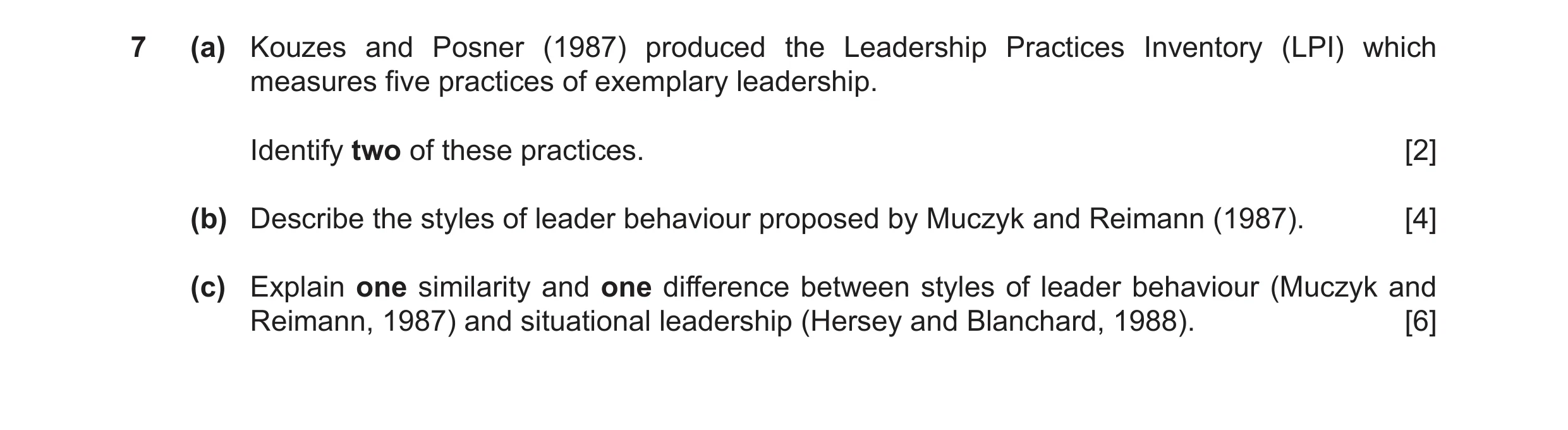 1 / 4
1 / 4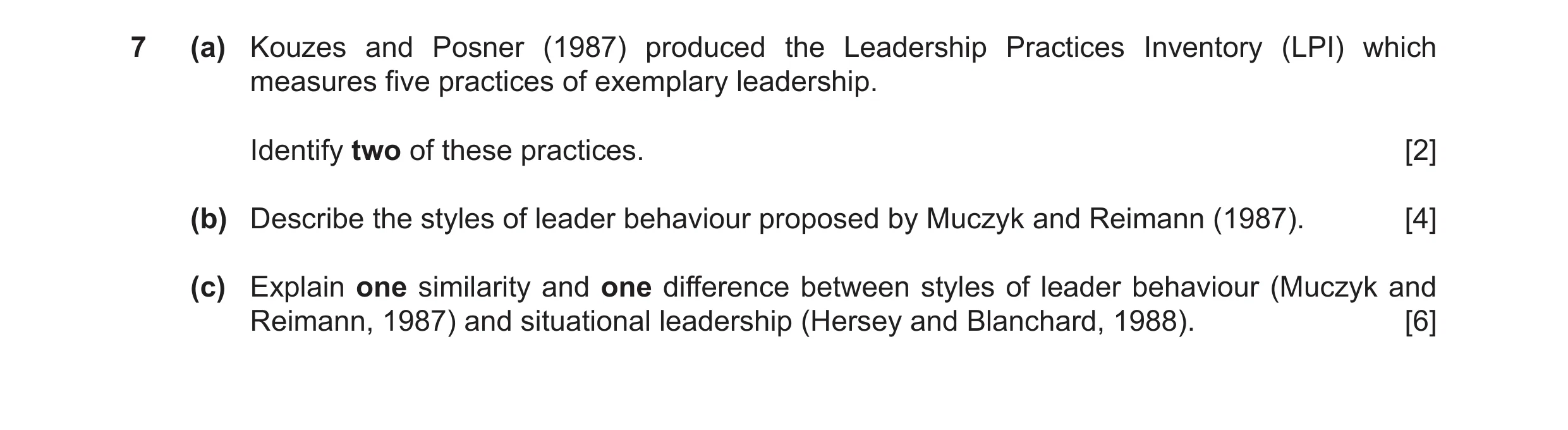

![Question 9: (a) Outline one universalist theory of leadership. [2] (b) Describe the contingency theory of leadership proposed by Fiedler (1967). [4] (c…](https://img.pastlit.com/crops/d8889f82-0b64-4ab6-910a-dc483756b634/q7.webp)

![Question 11: (a) Identify two qualities of good followers (Kelley, 1988). [2] (b) Describe situational leadership (Hersey and Blanchard, 1988). [4] (c) …](https://img.pastlit.com/crops/20d2edb4-804e-4a56-9f2c-f3265321c37c/q7.webp)
![Question 12: (a) Identify two qualities of good followers (Kelley, 1988). [2] (b) Describe situational leadership (Hersey and Blanchard, 1988). [4] (c) …](https://img.pastlit.com/crops/13012a5c-542b-44d3-ba37-20bbfdb80e5d/q7.webp) 2 / 4
2 / 4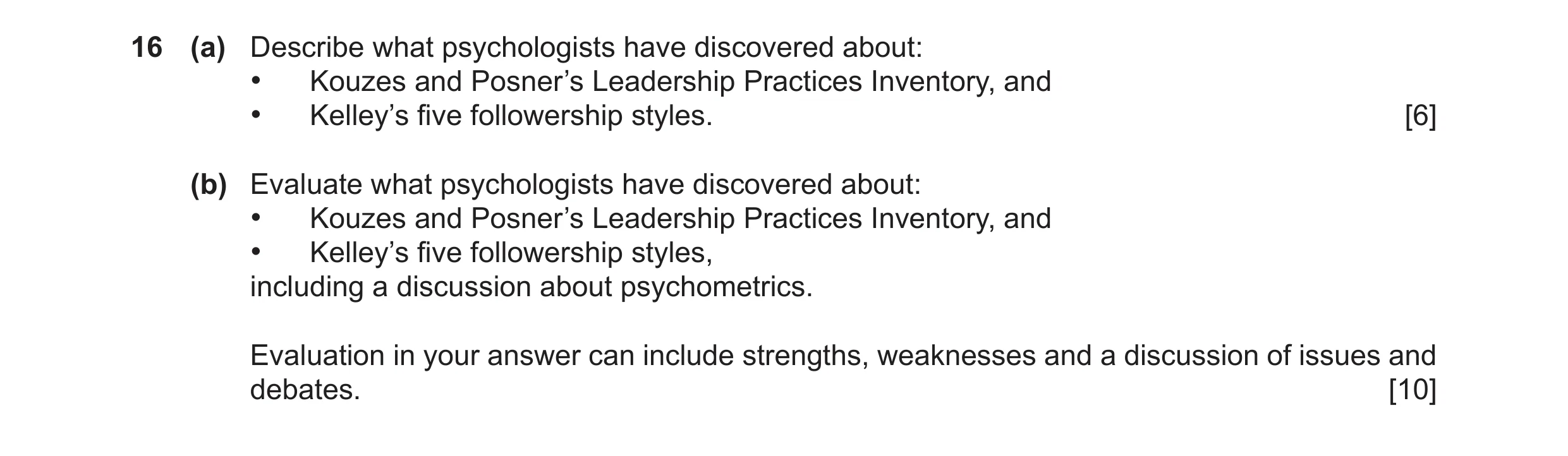
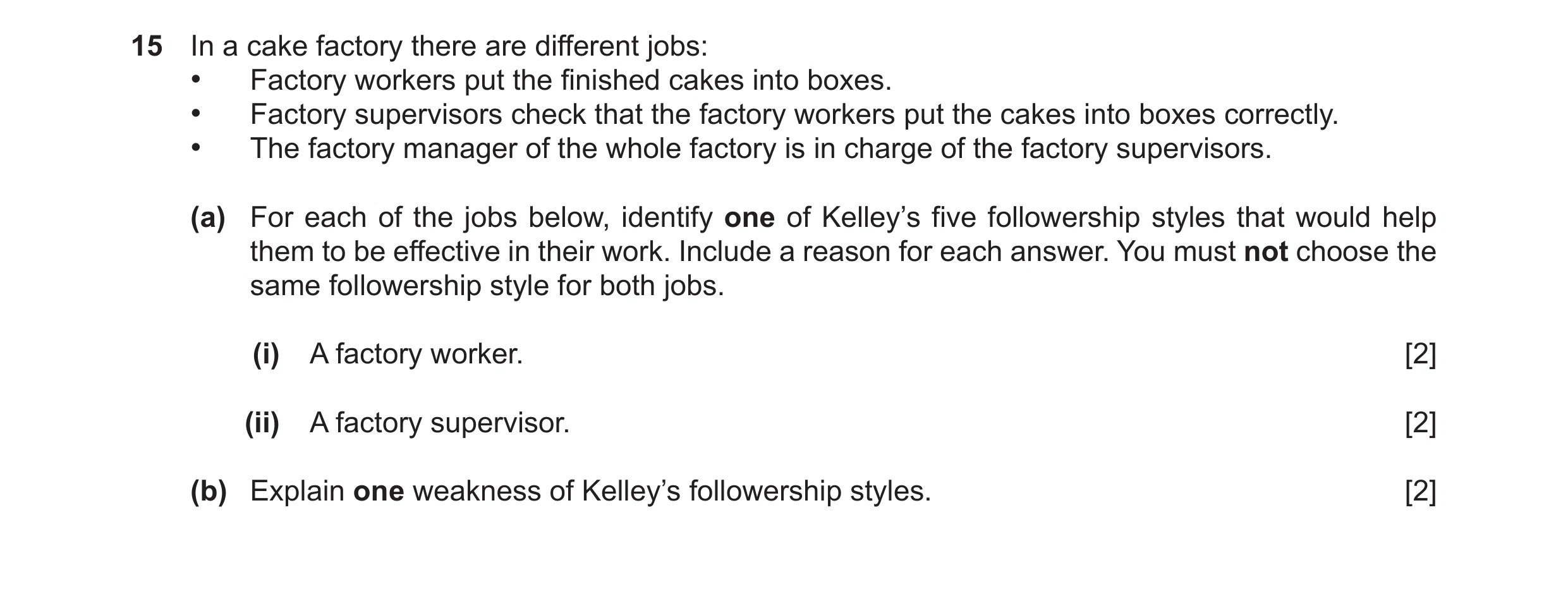

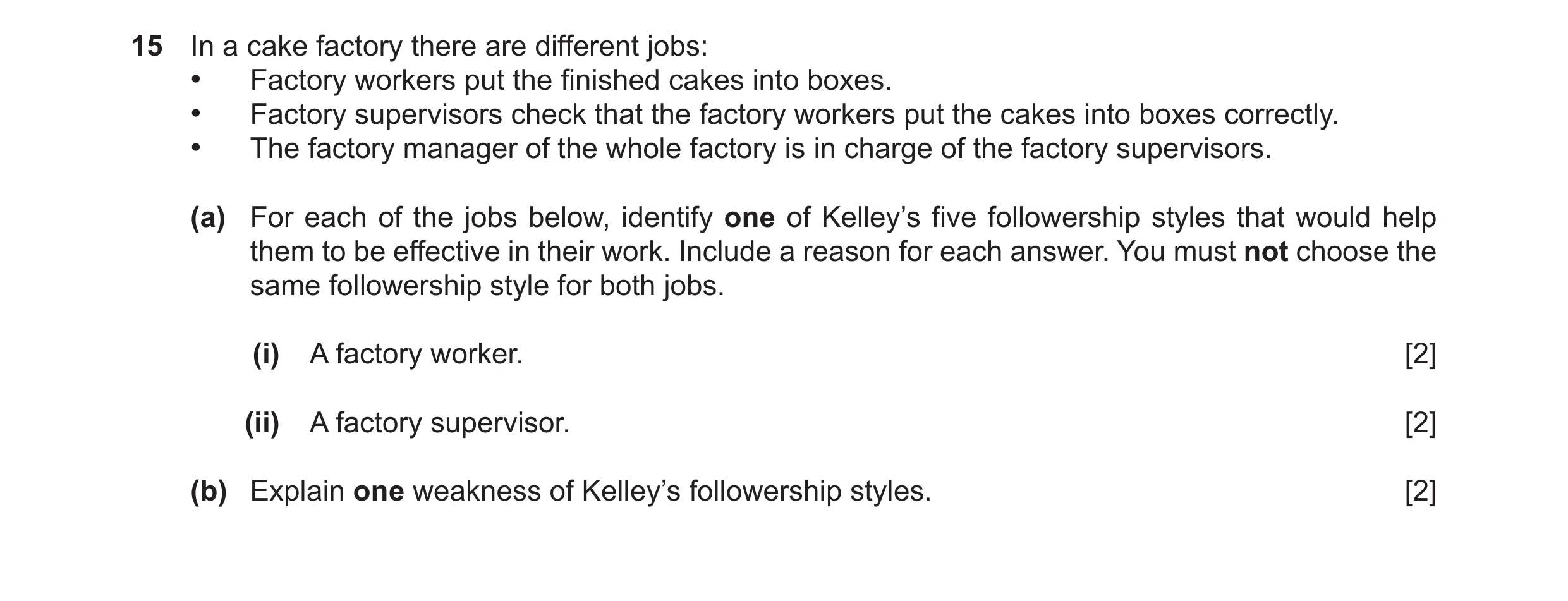 3 / 4
3 / 4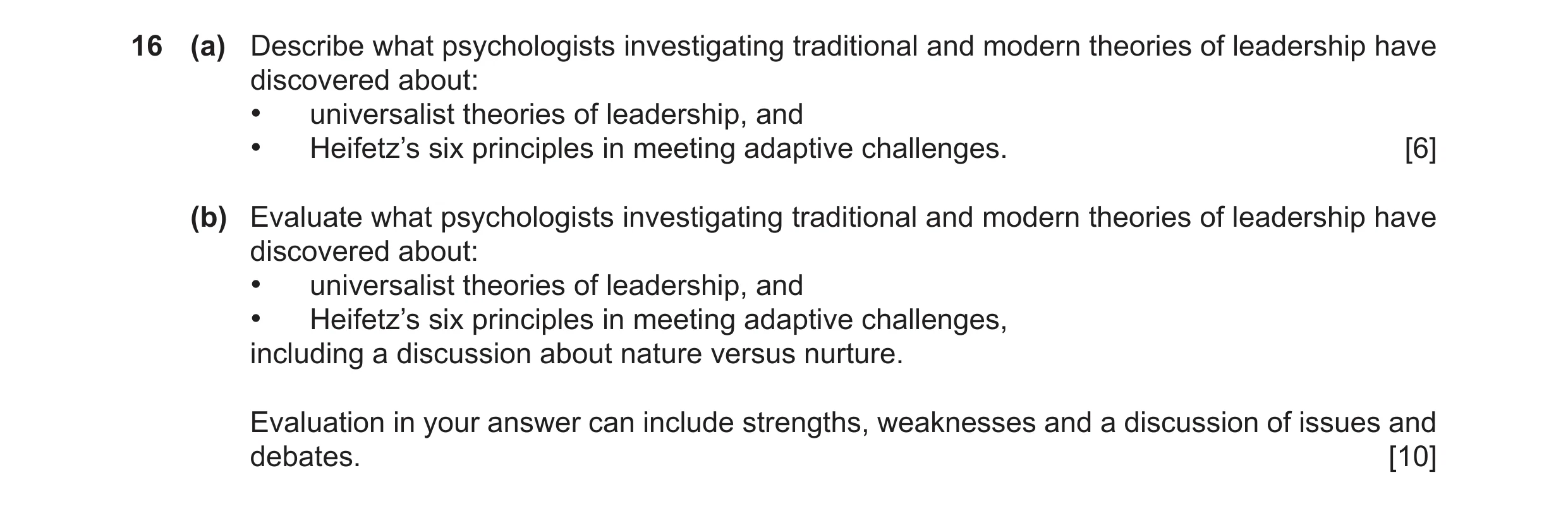

![Question 19: (a) Outline what is meant by the nature versus nurture debate. [2] (b) Explain one reason why Scouller’s levels of leadership theory suppor…](https://img.pastlit.com/crops/0936810b-6075-4b2b-b0c6-c5e08199a719/q14.webp)
![Question 20: (a) Describe the study by Cuadrado et al. (2008) on leadership style and gender. [6] (b) Evaluate the study by Cuadrado et al., including a…](https://img.pastlit.com/crops/8b219ac0-2c0f-4fbe-8859-4f5574ae4cf8/q16.webp)

![Question 22: (a) Outline what is meant by the nature versus nurture debate. [2] (b) Explain one reason why Scouller’s levels of leadership theory suppor…](https://img.pastlit.com/crops/3243291a-af55-484c-b515-1f970209370f/q14.webp) 4 / 4
4 / 4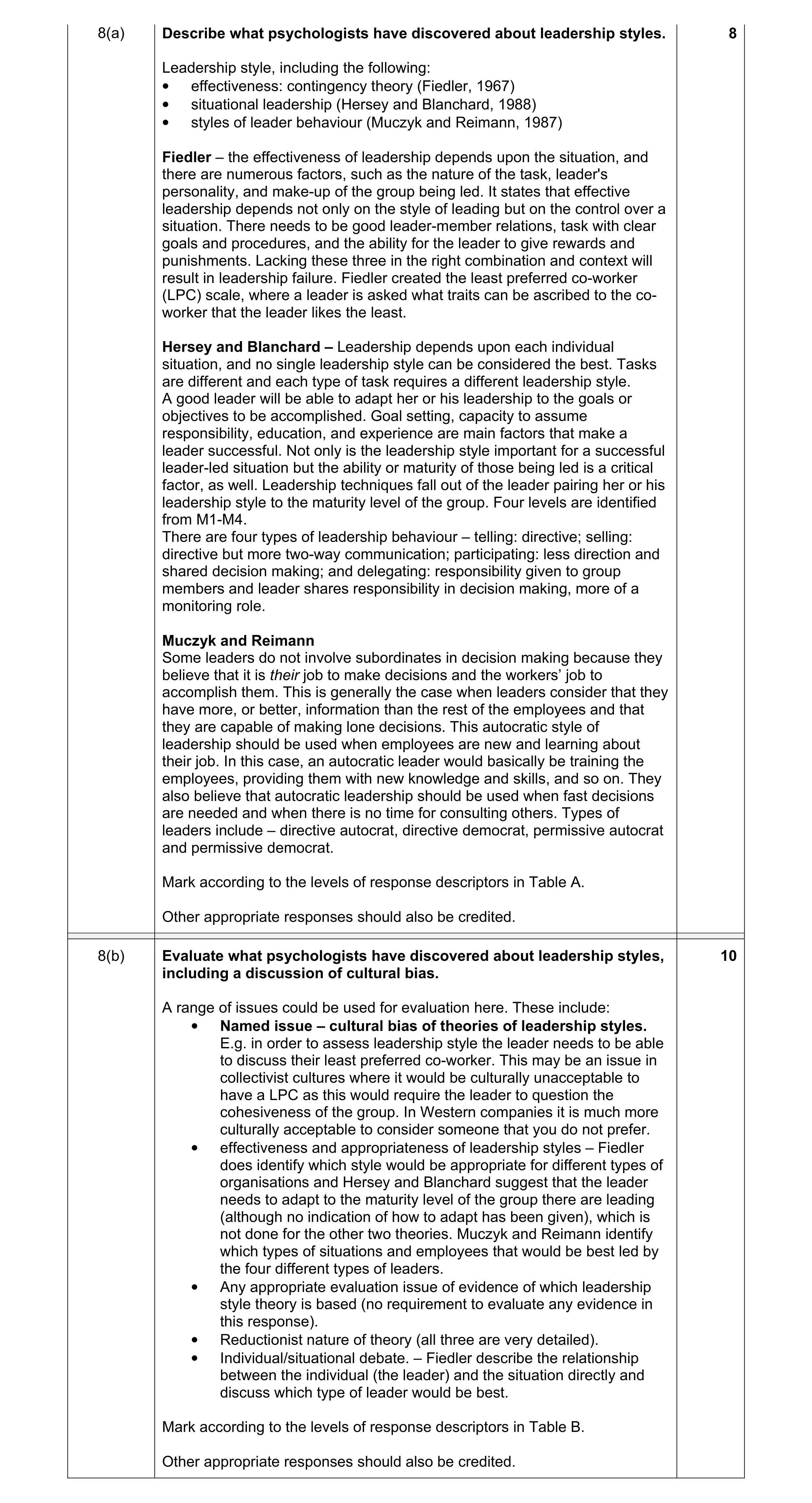 18
18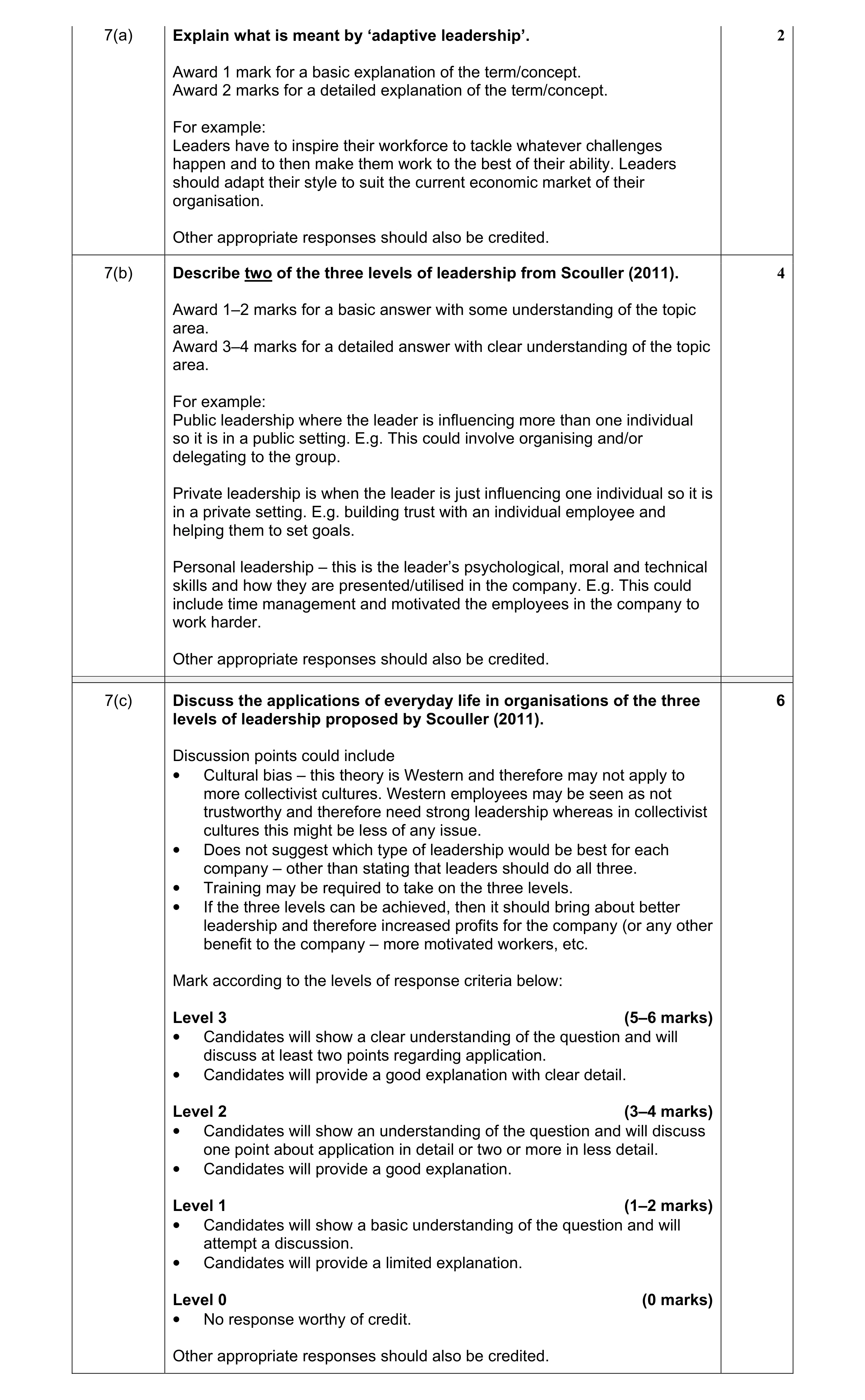 12
12 18
18 12
12 12
12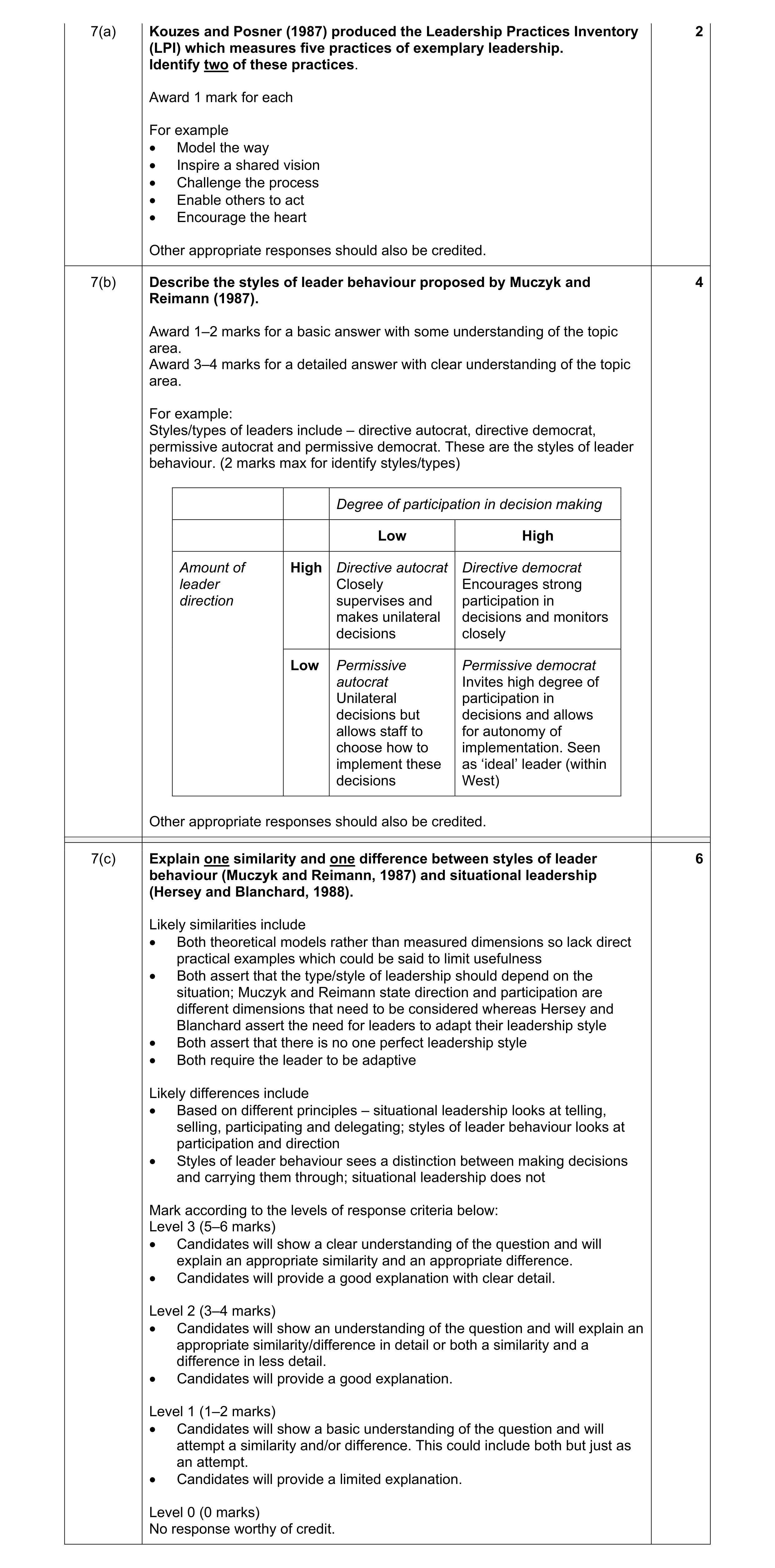 12
12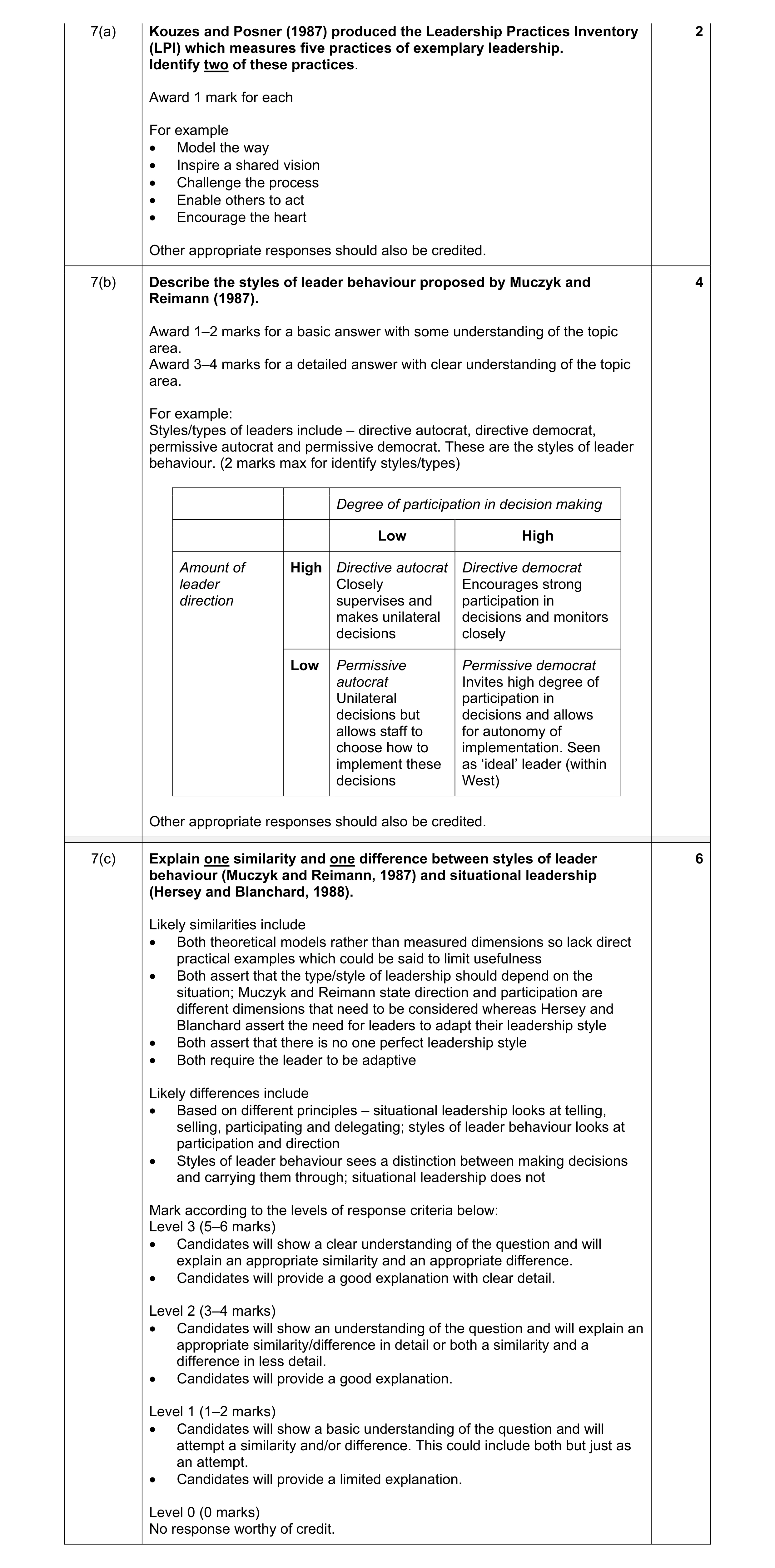 12
12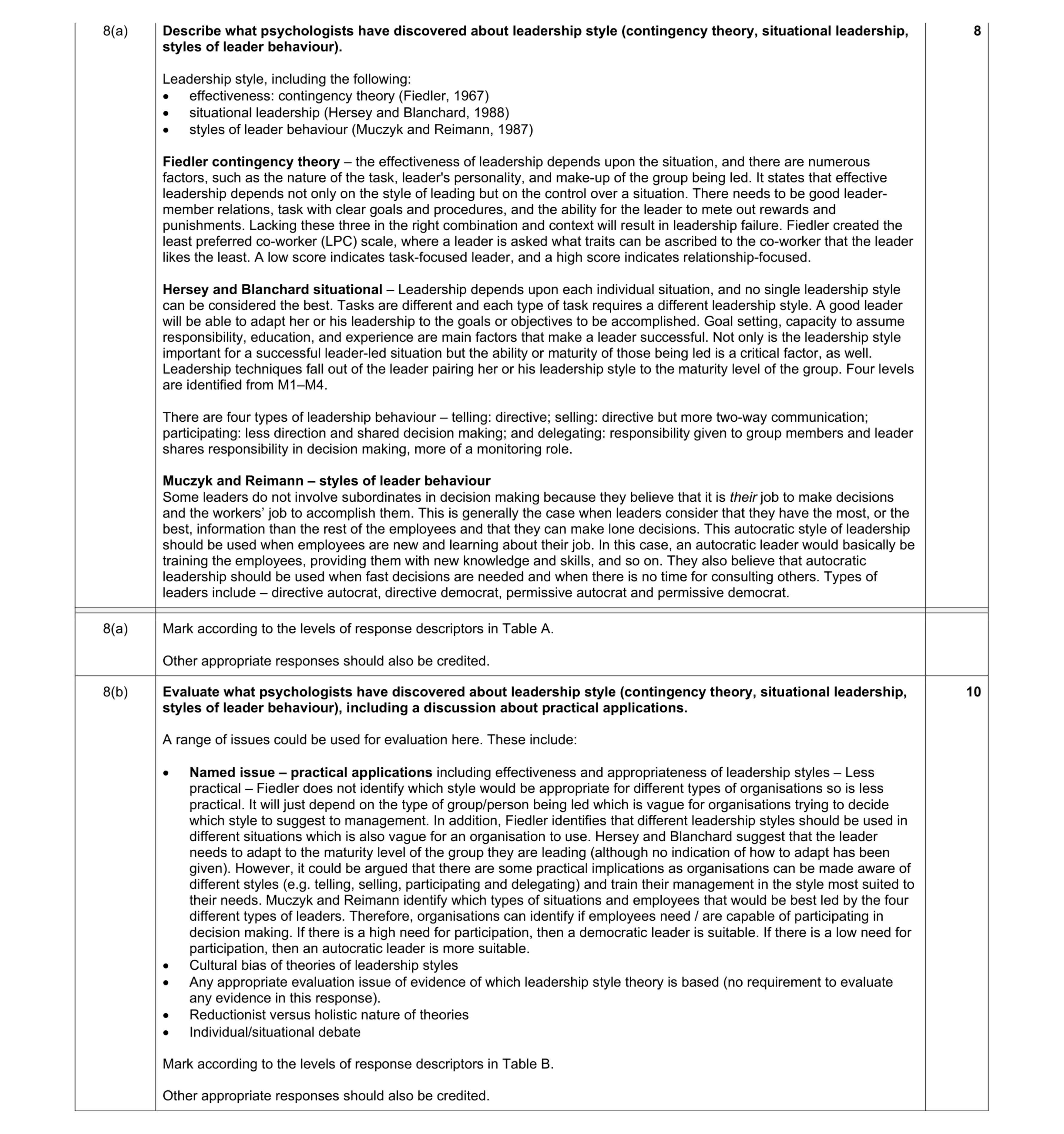 18
18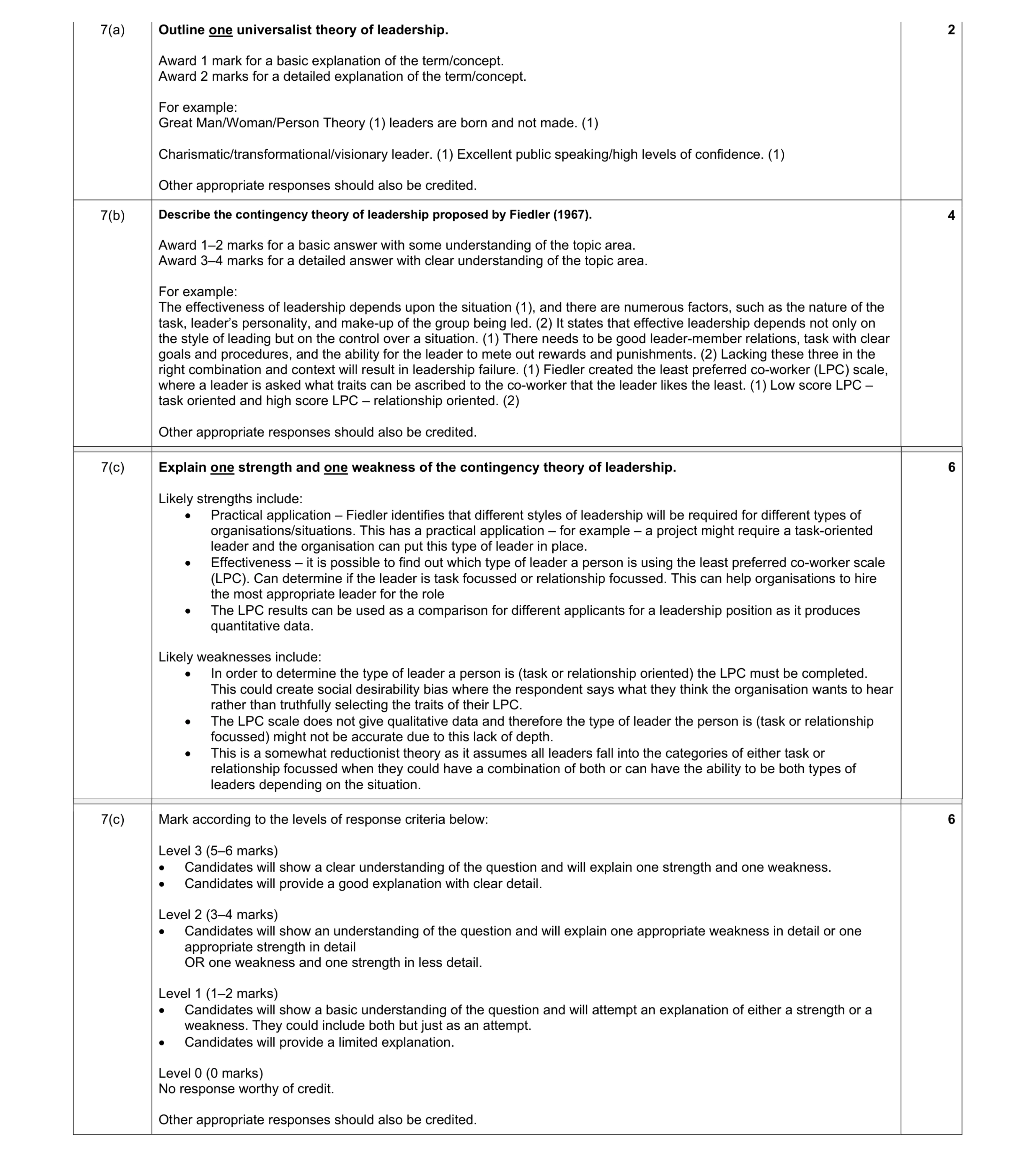 12
12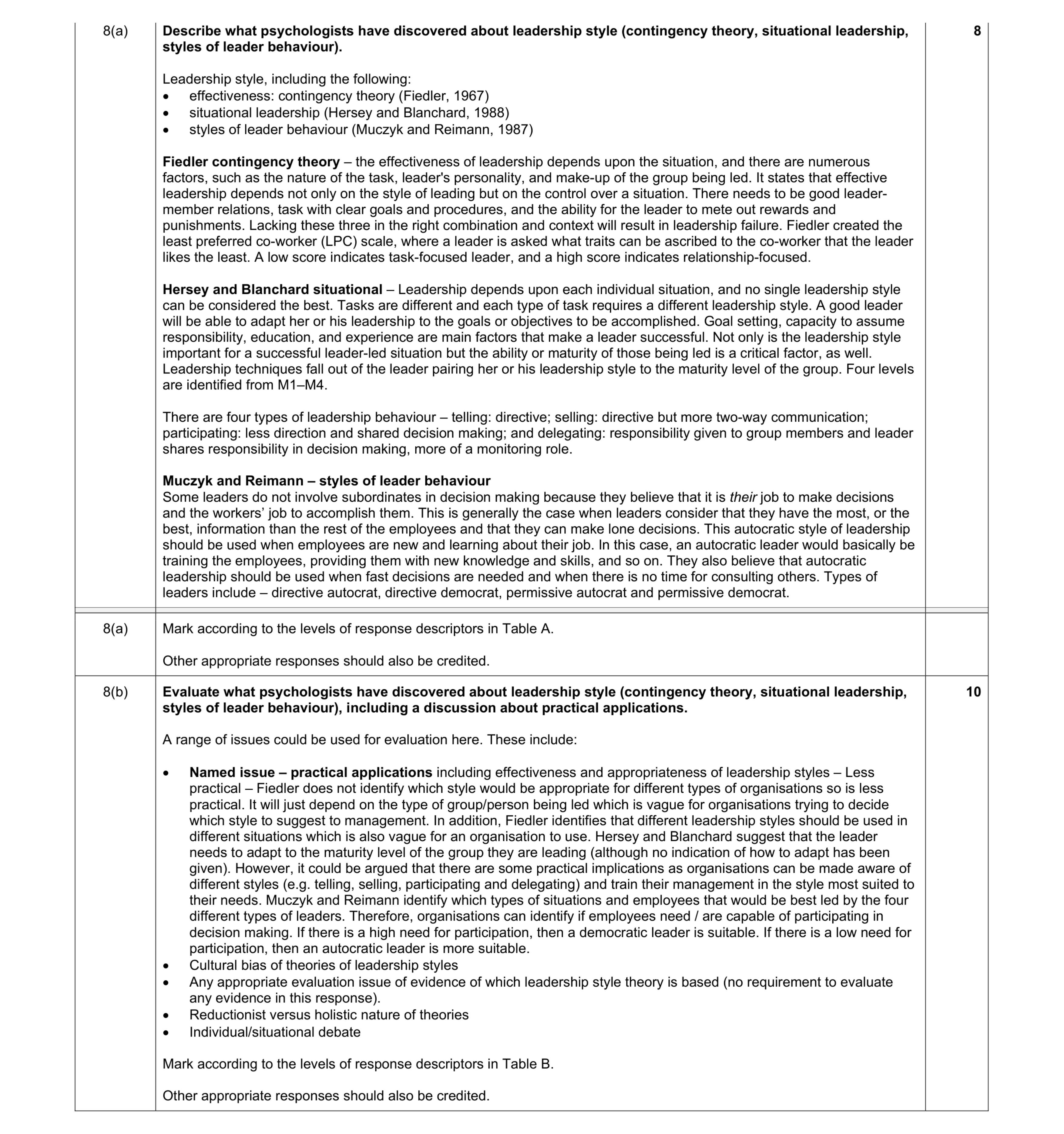 18
18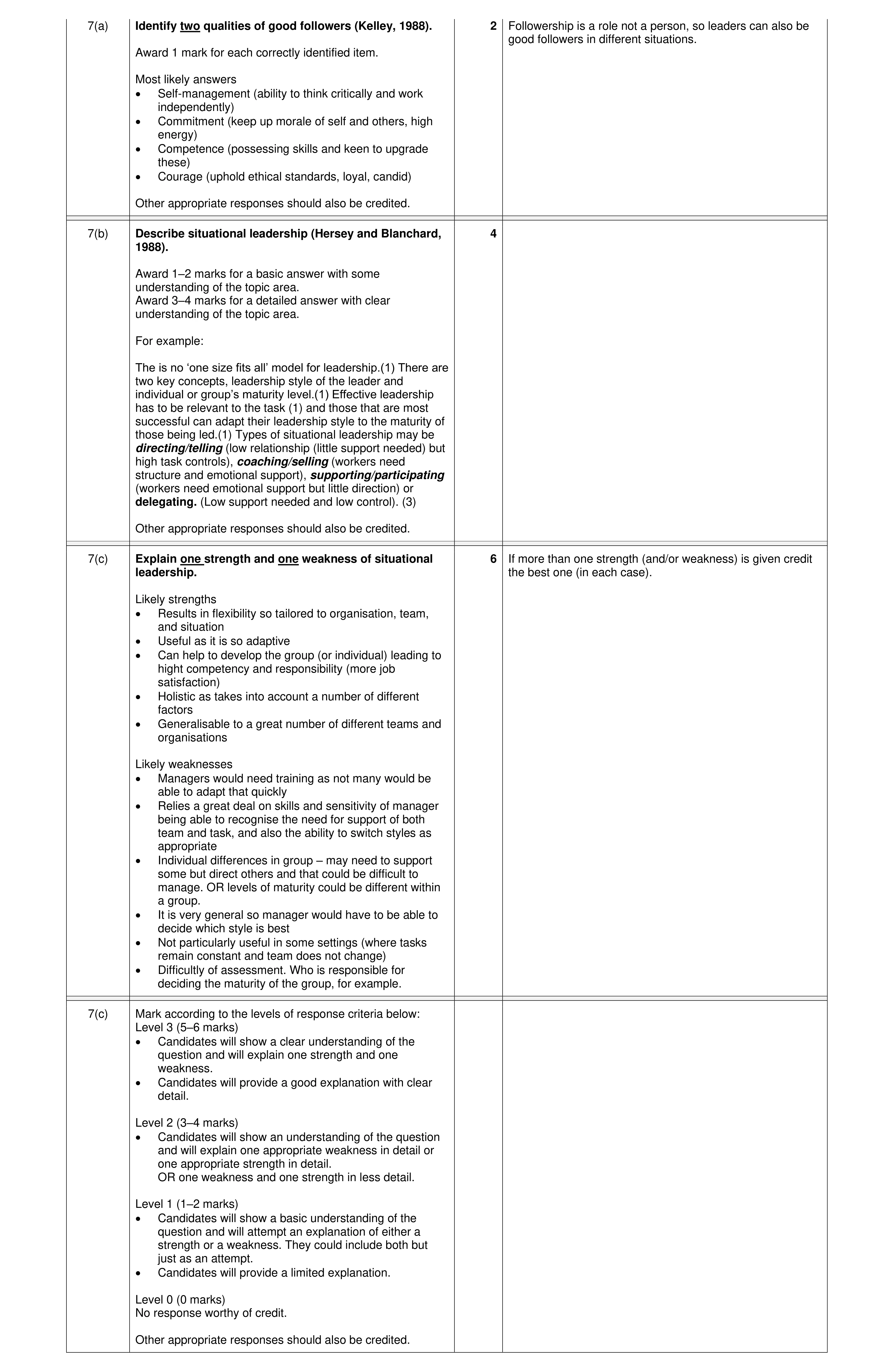 12
12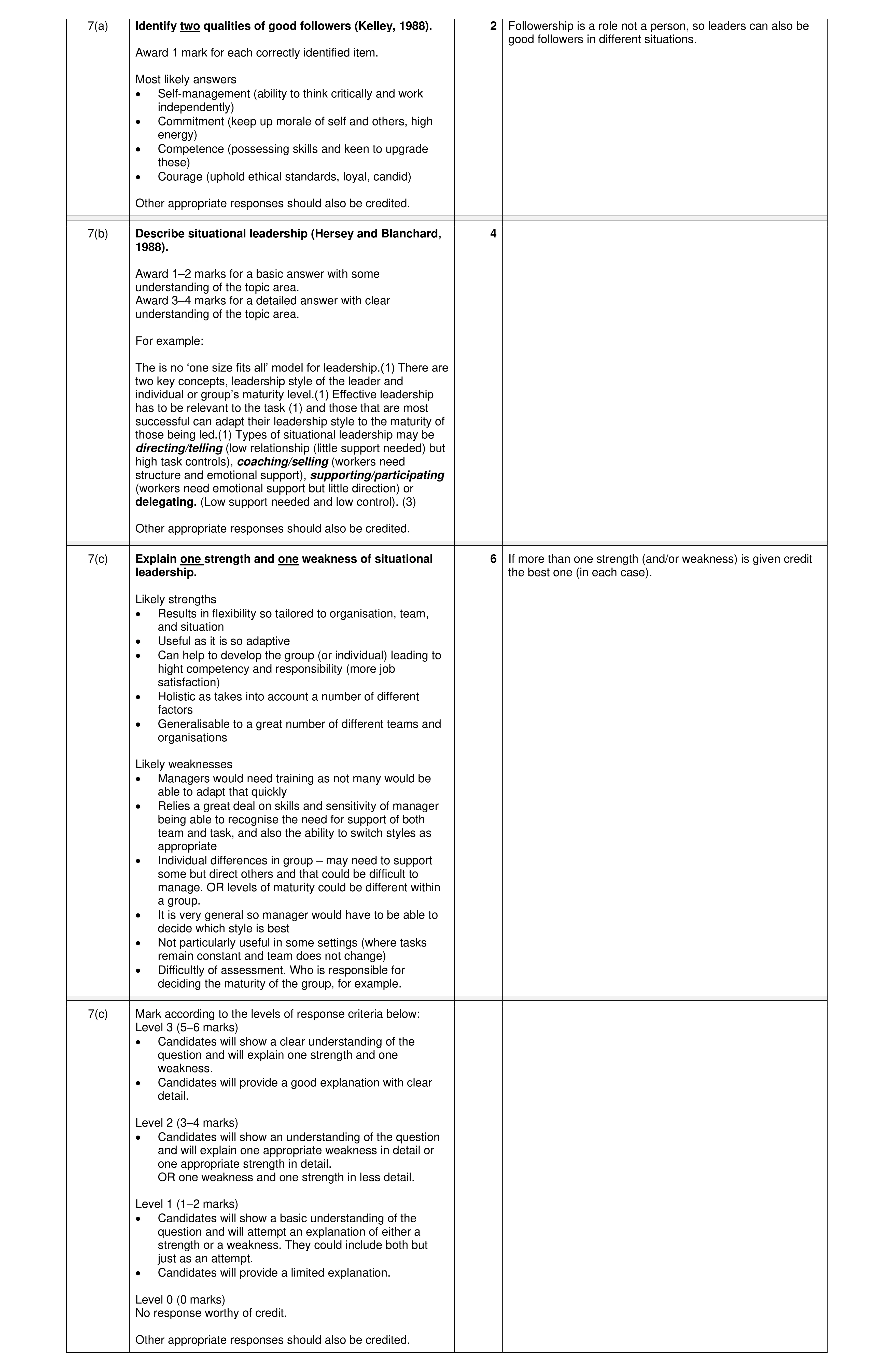 12
12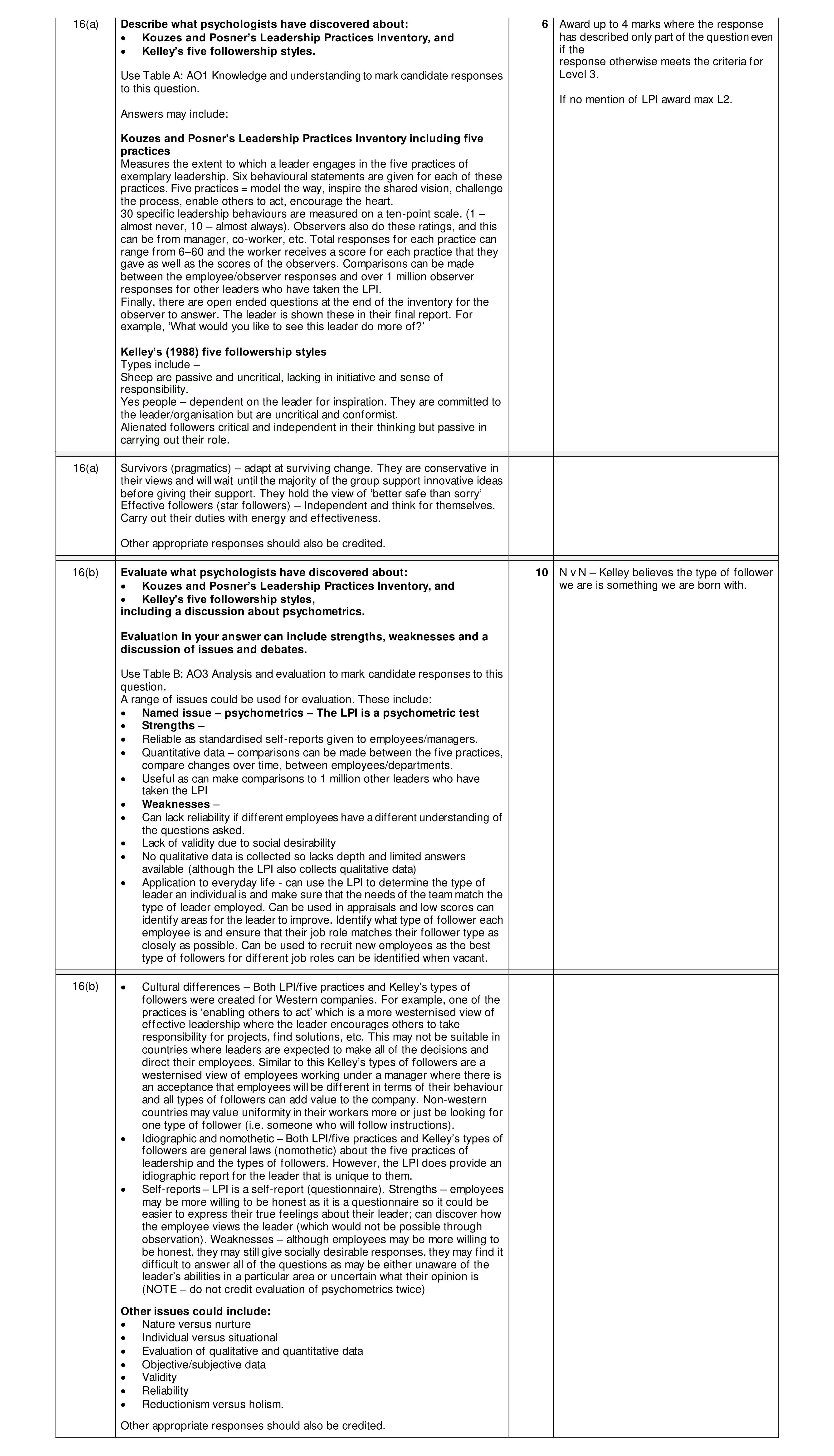 16
16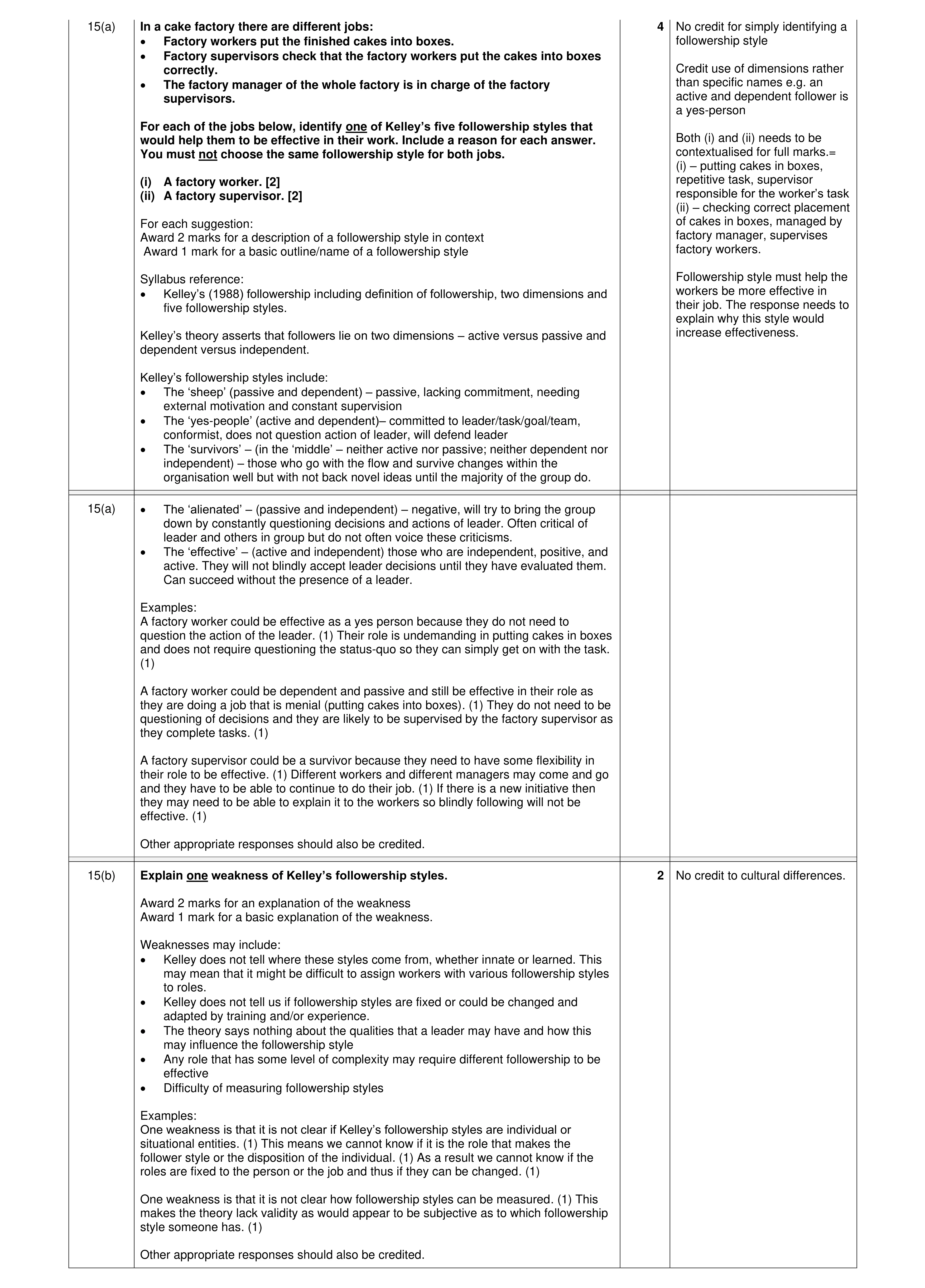 6
6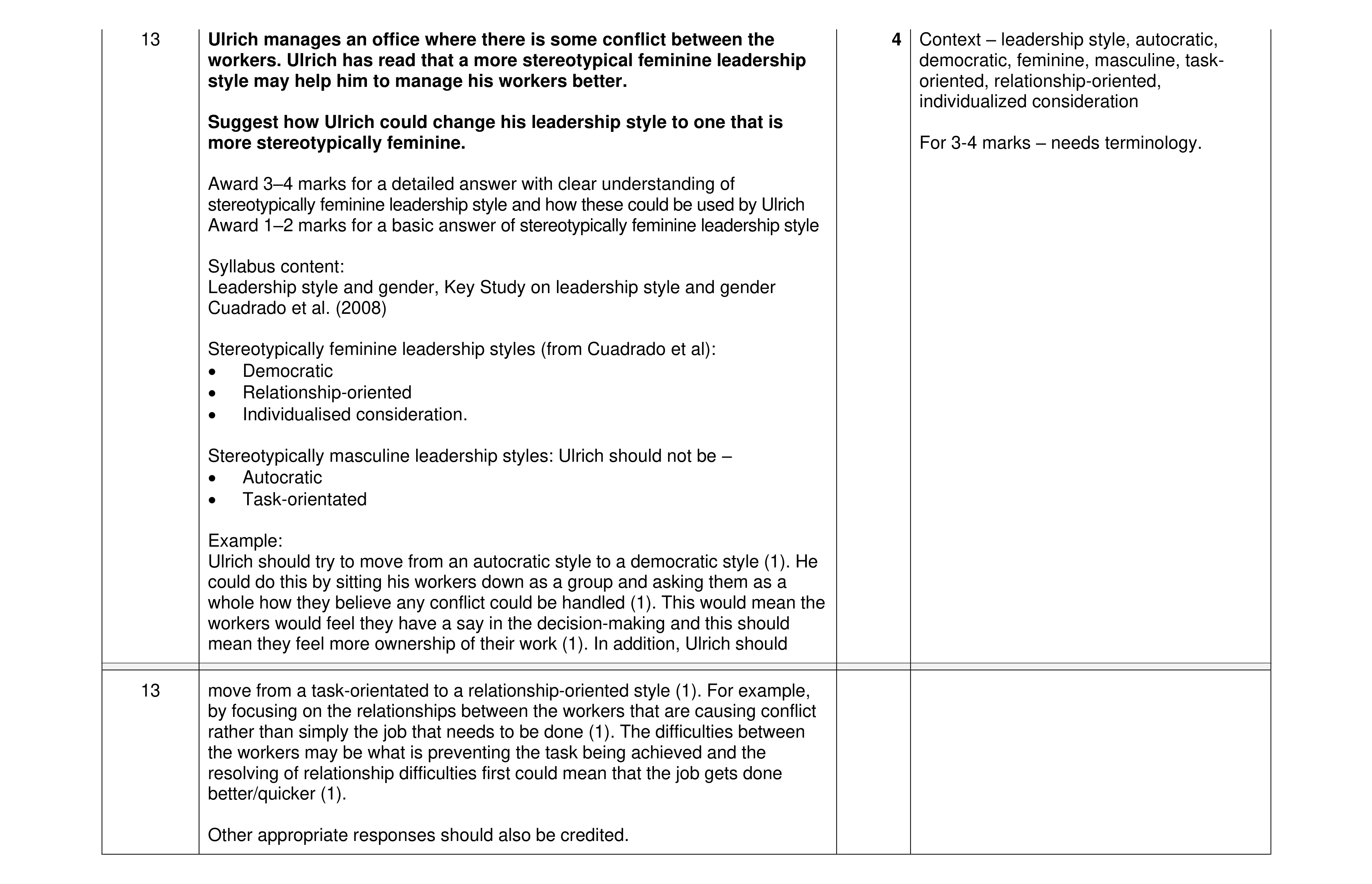 4
4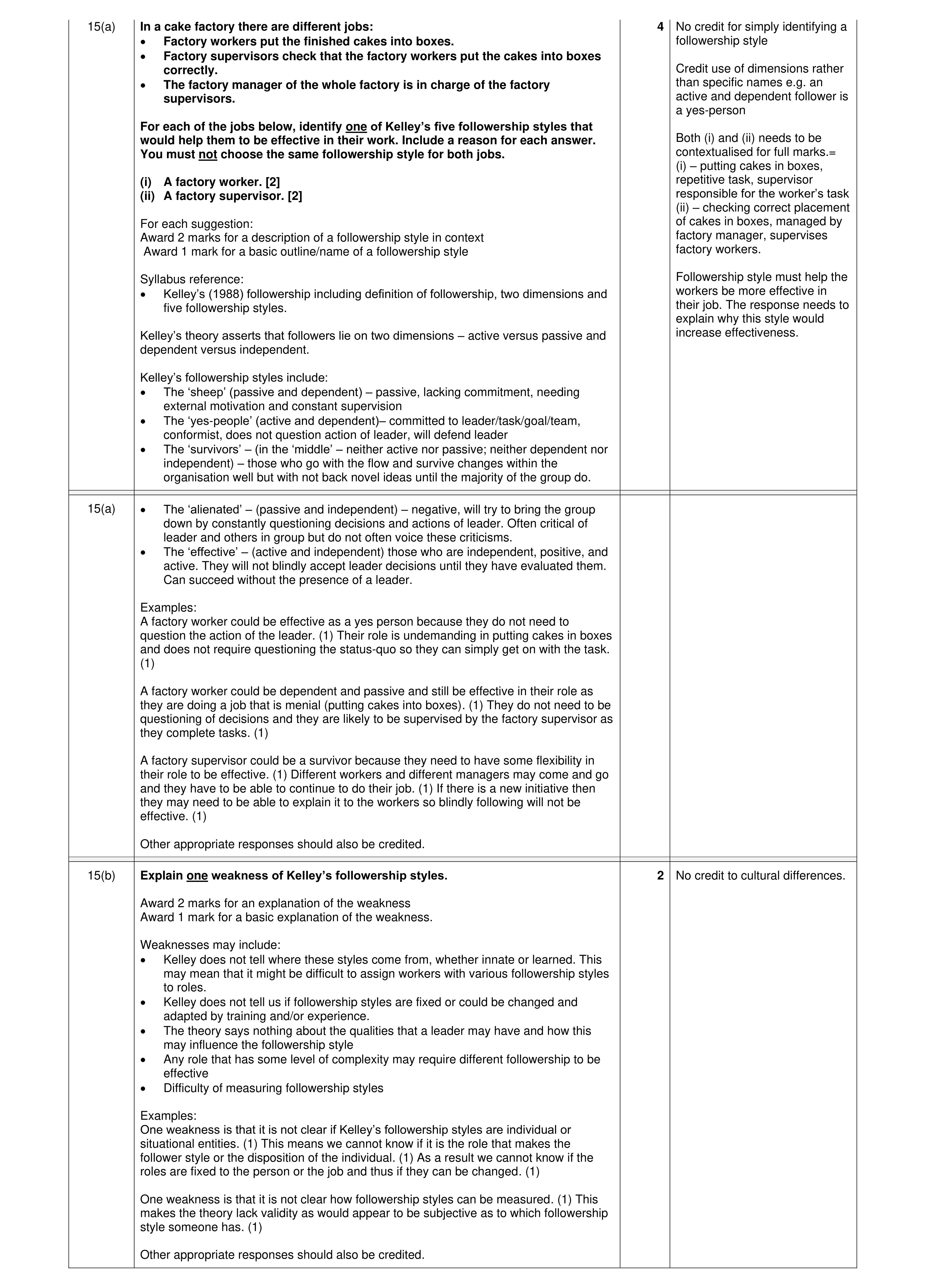 6
6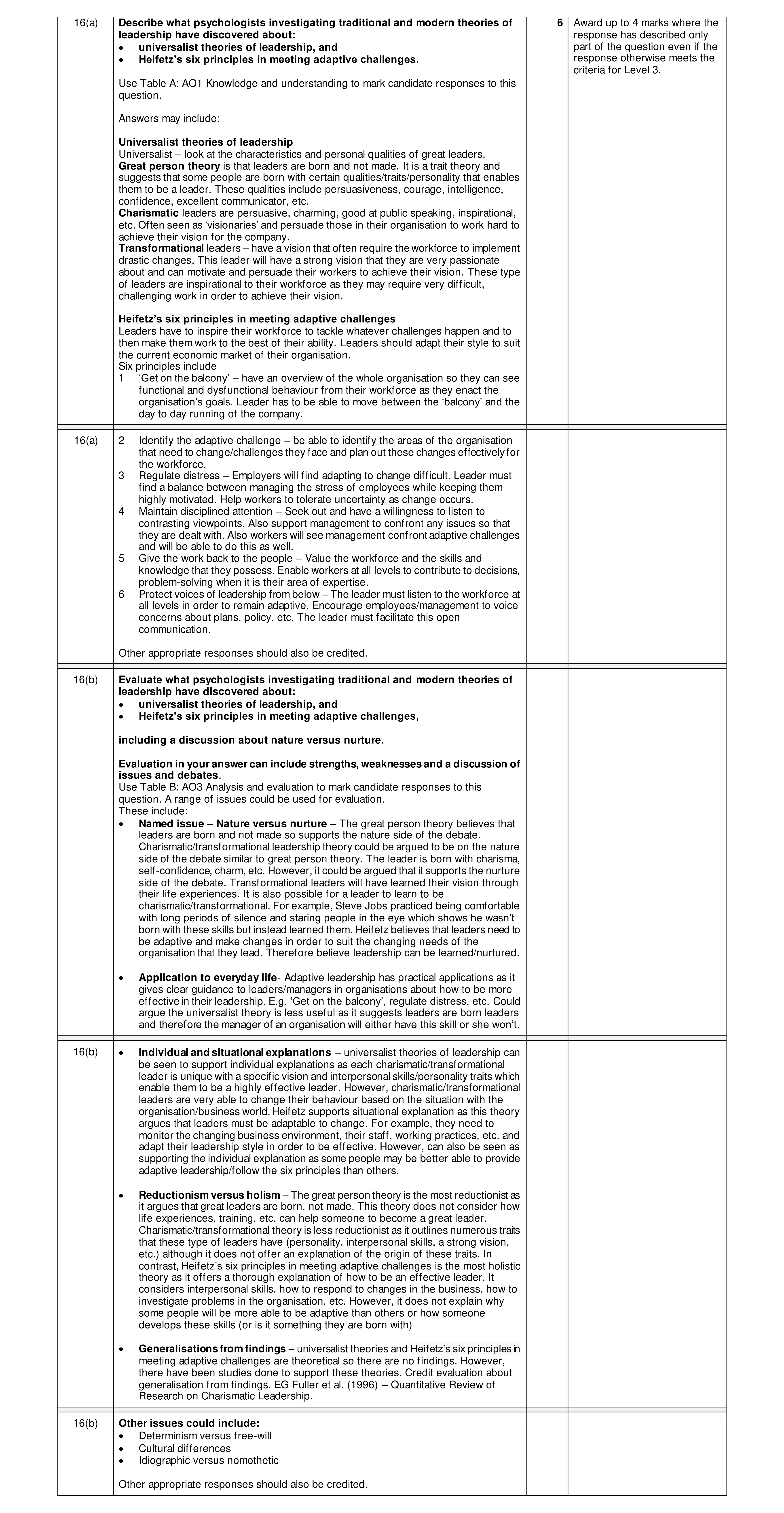 16
16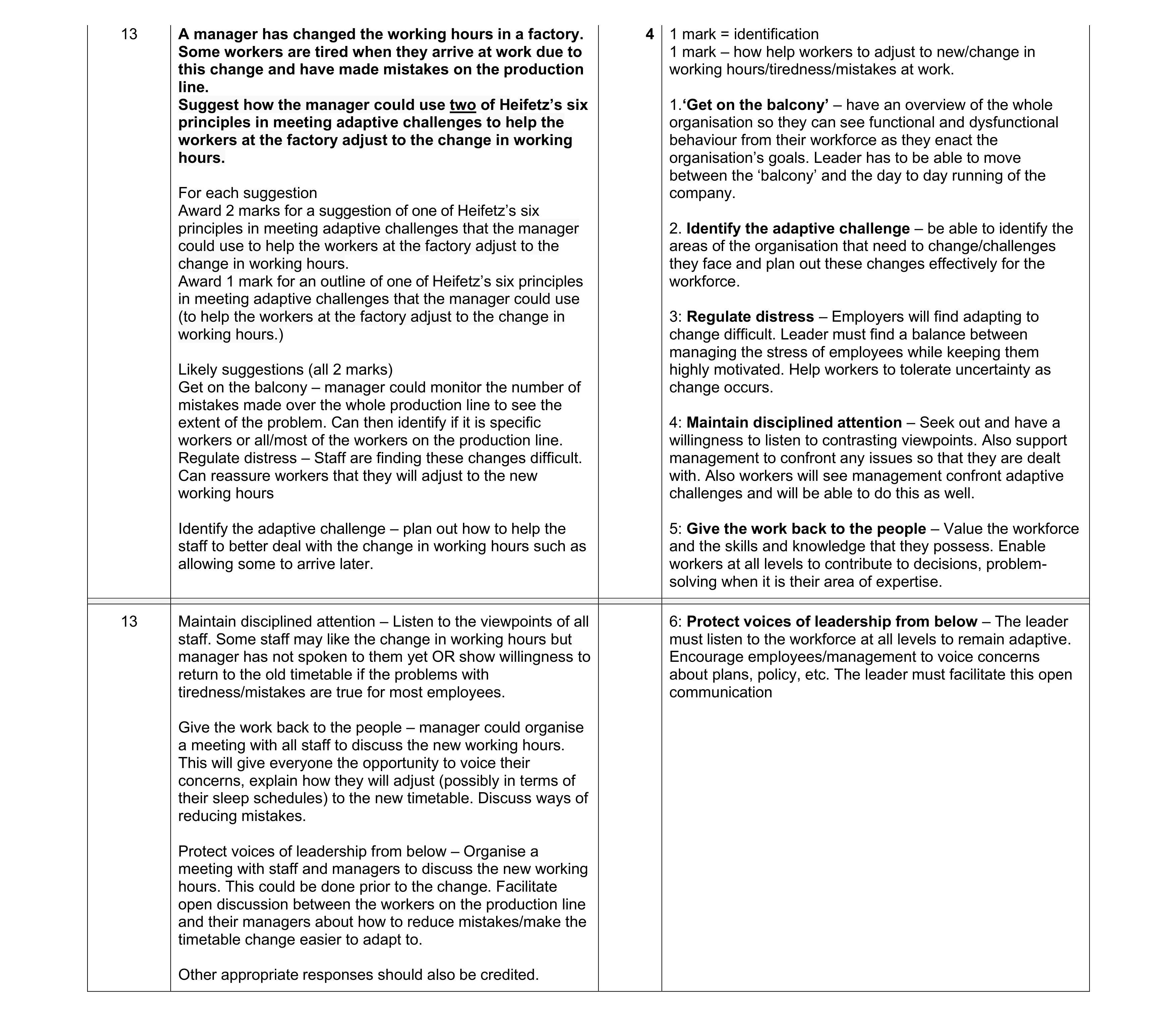 4
4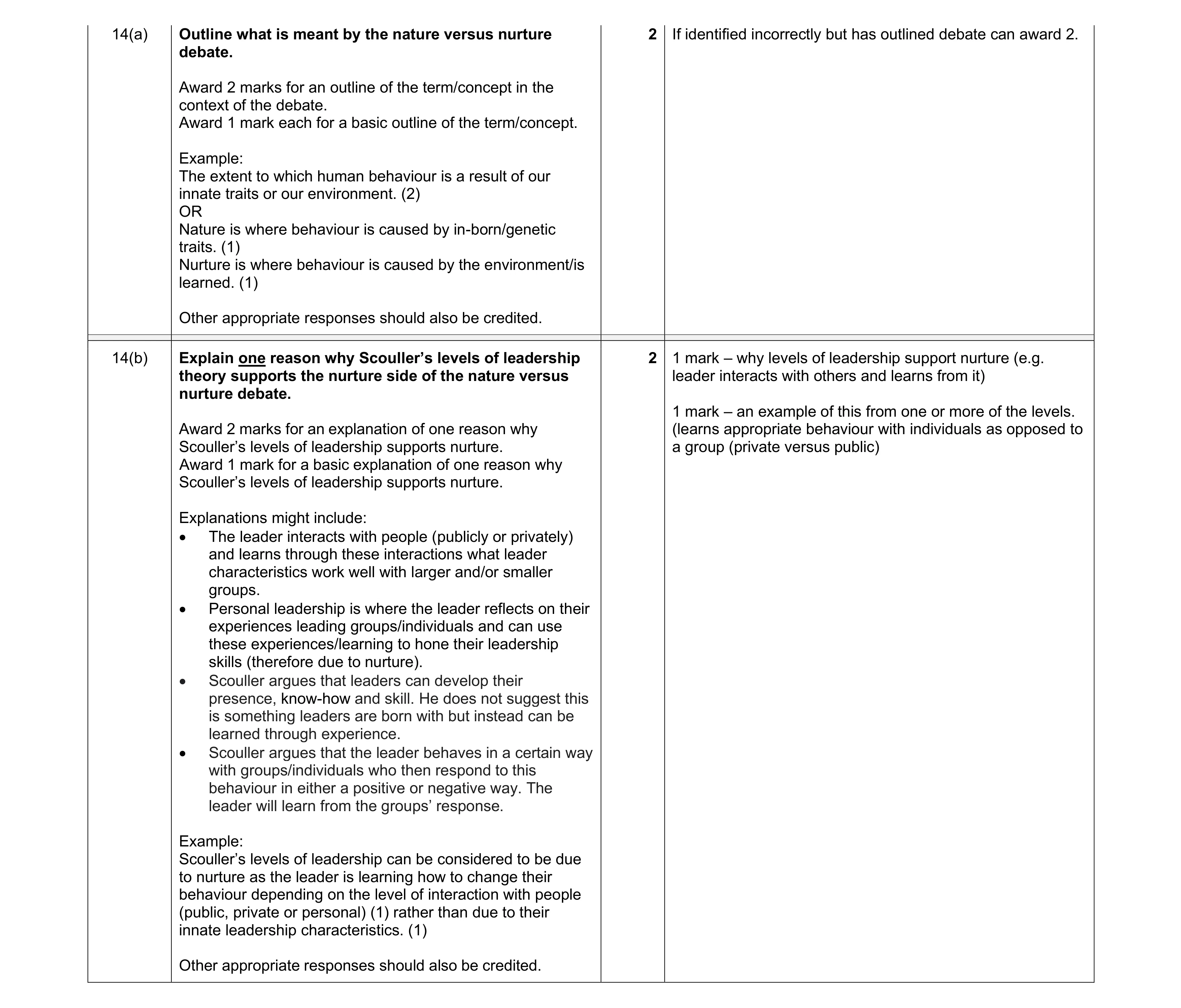 4
4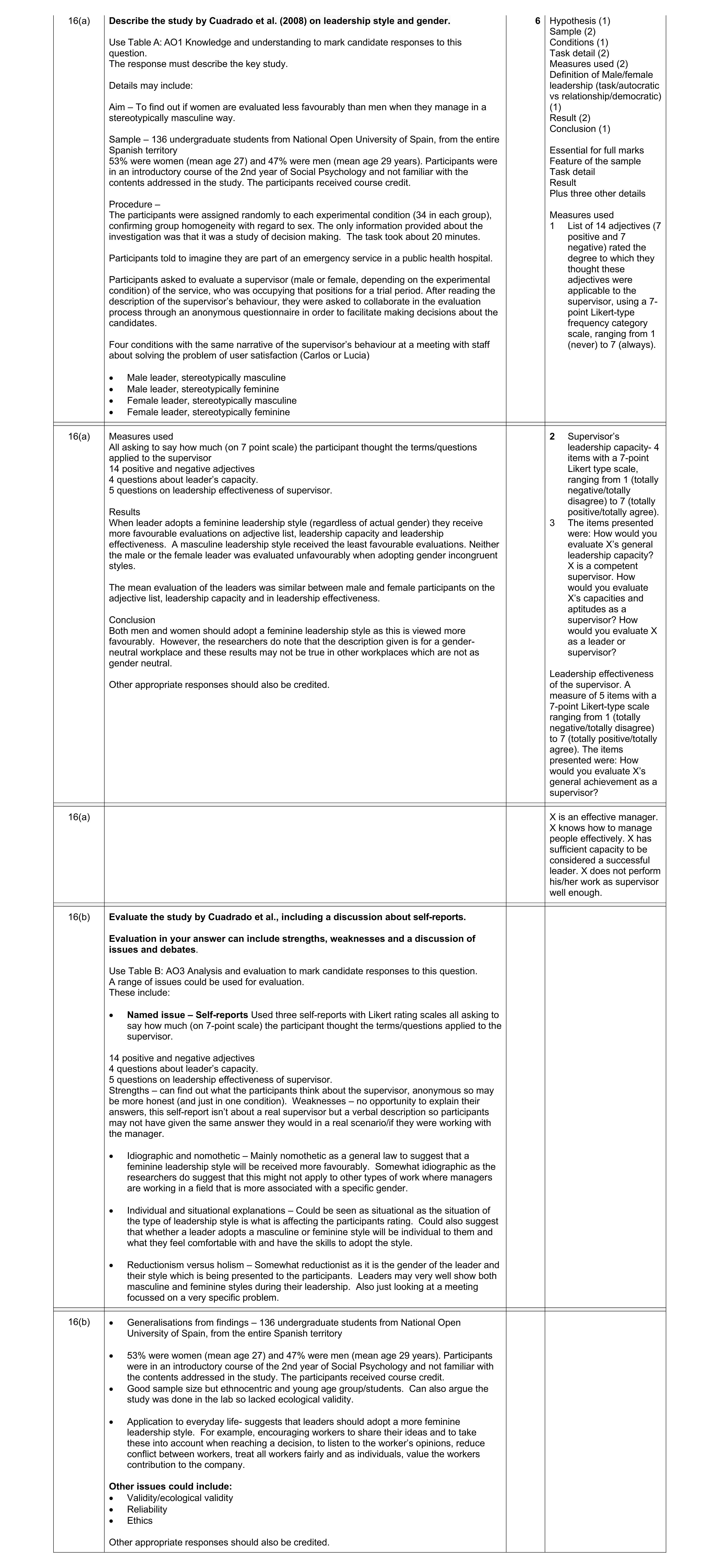 16
16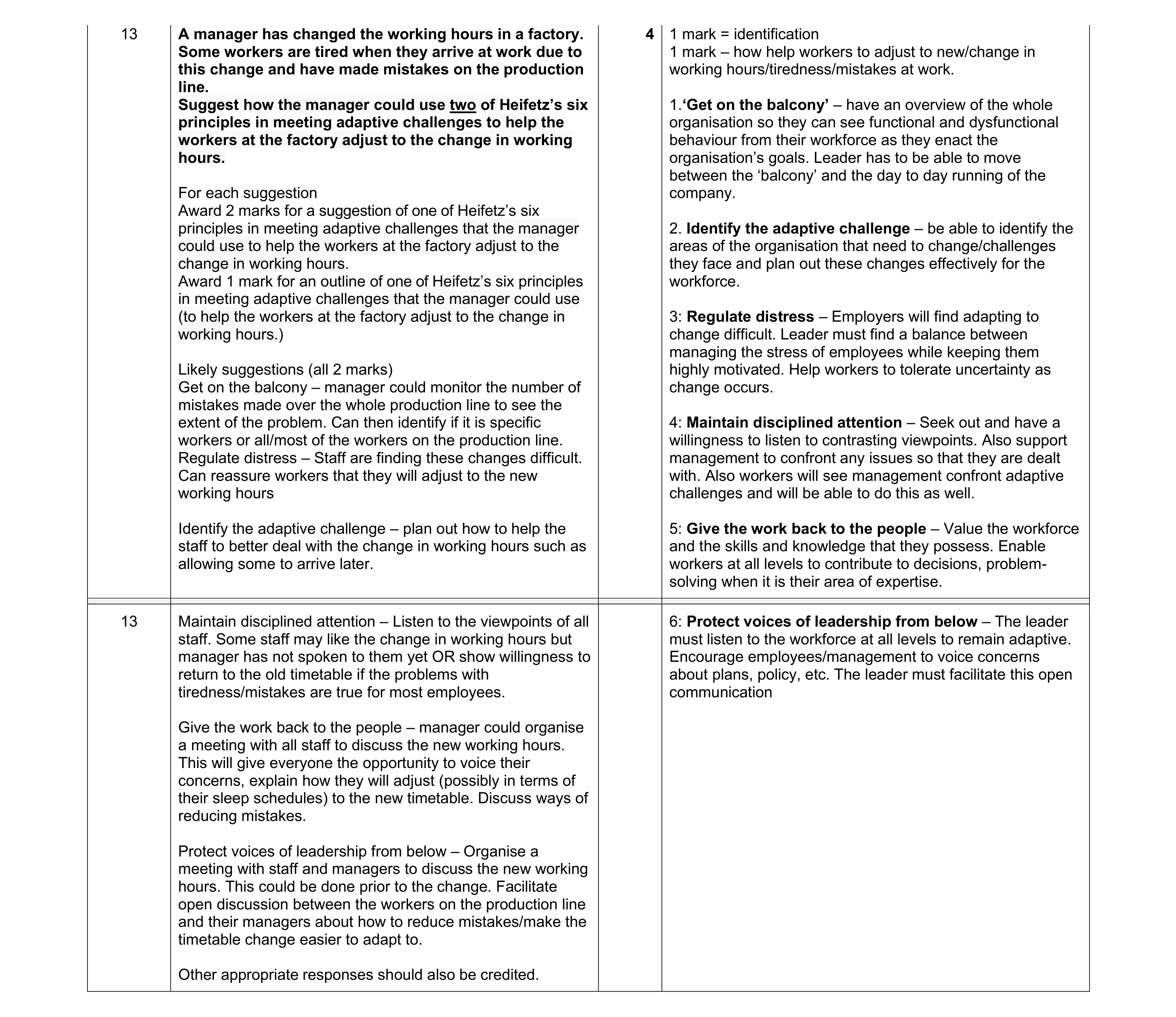 4
4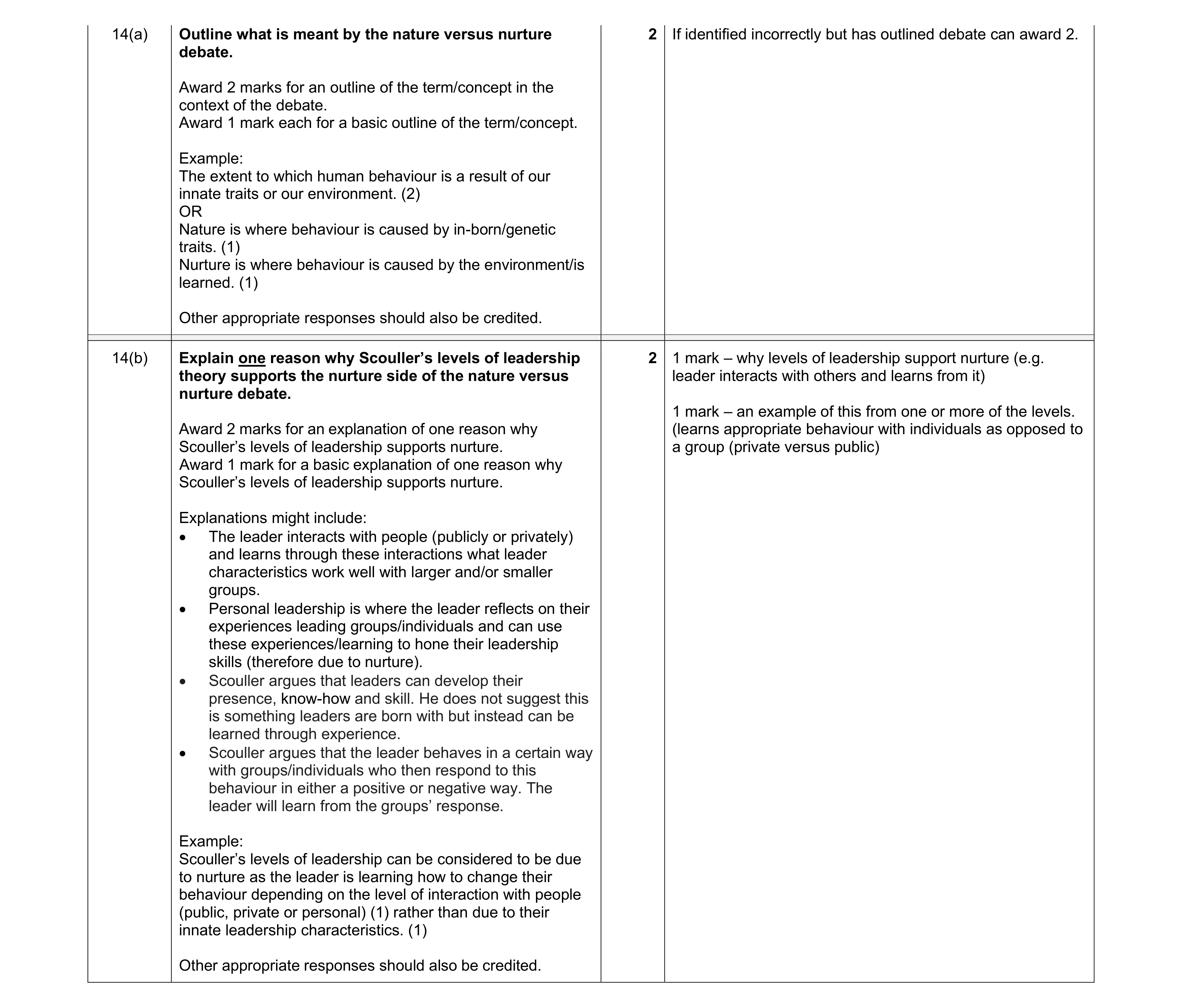 4
4