Cambridge A Level Psychology (from 2018) 9990 — 2018 Oct/Nov Paper 3 · Variant 2
9990/32/O/N/18 · 8 questions · 60 marks · ≈68 min
The question paper and its mark scheme, free to read here and free to download. This is Cambridge’s own paper, exactly as it was sat.
Question paper4 pages
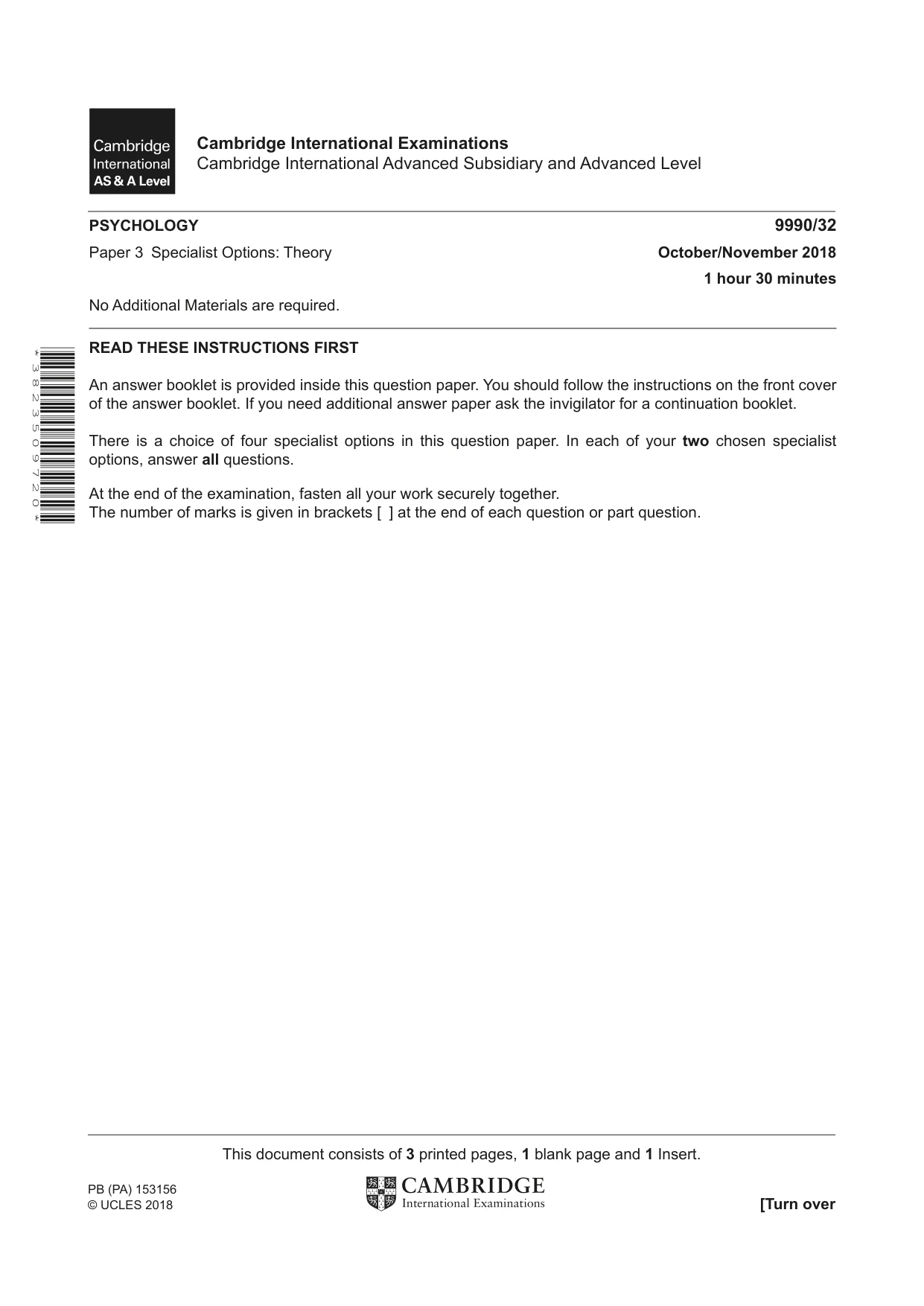
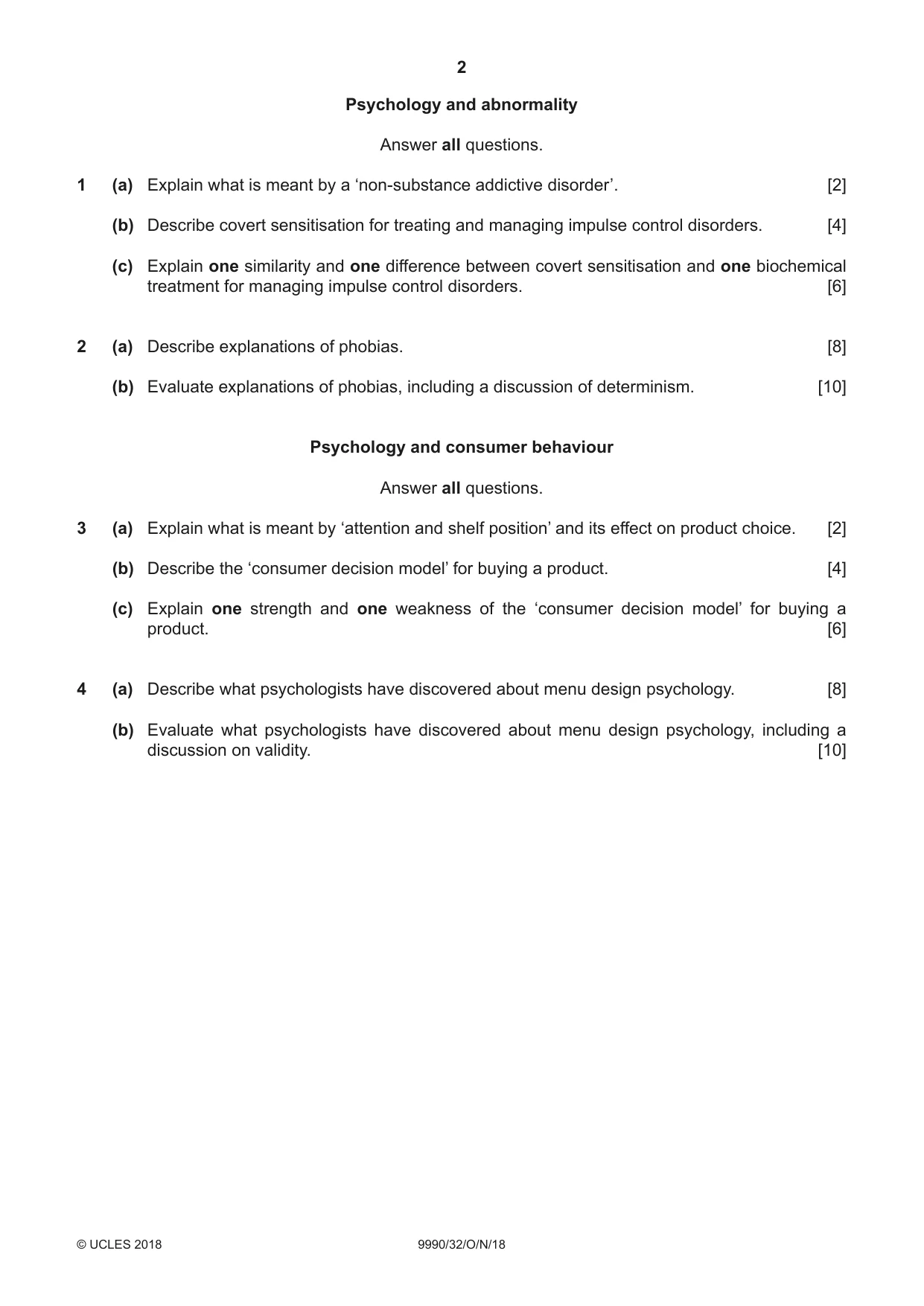
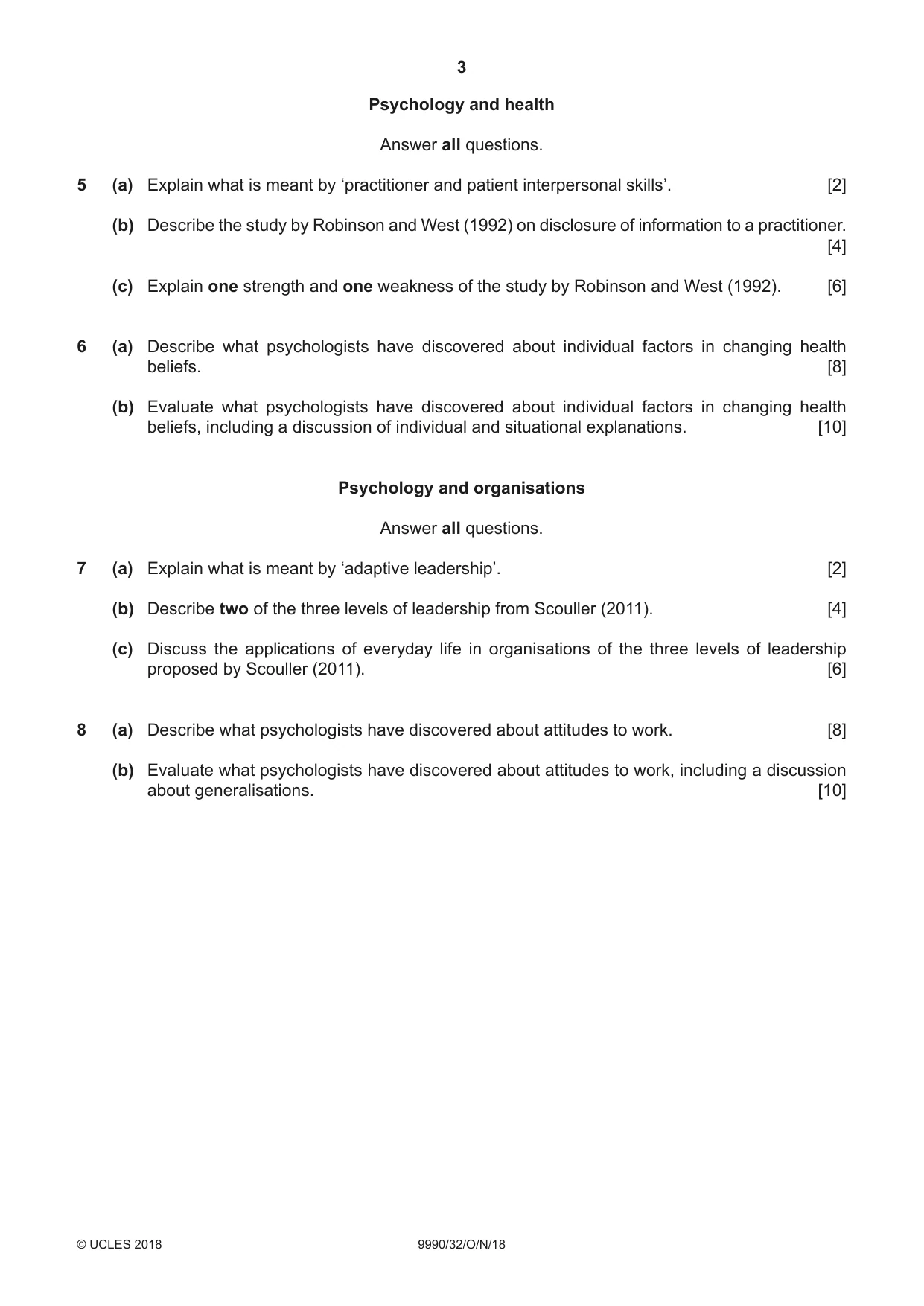

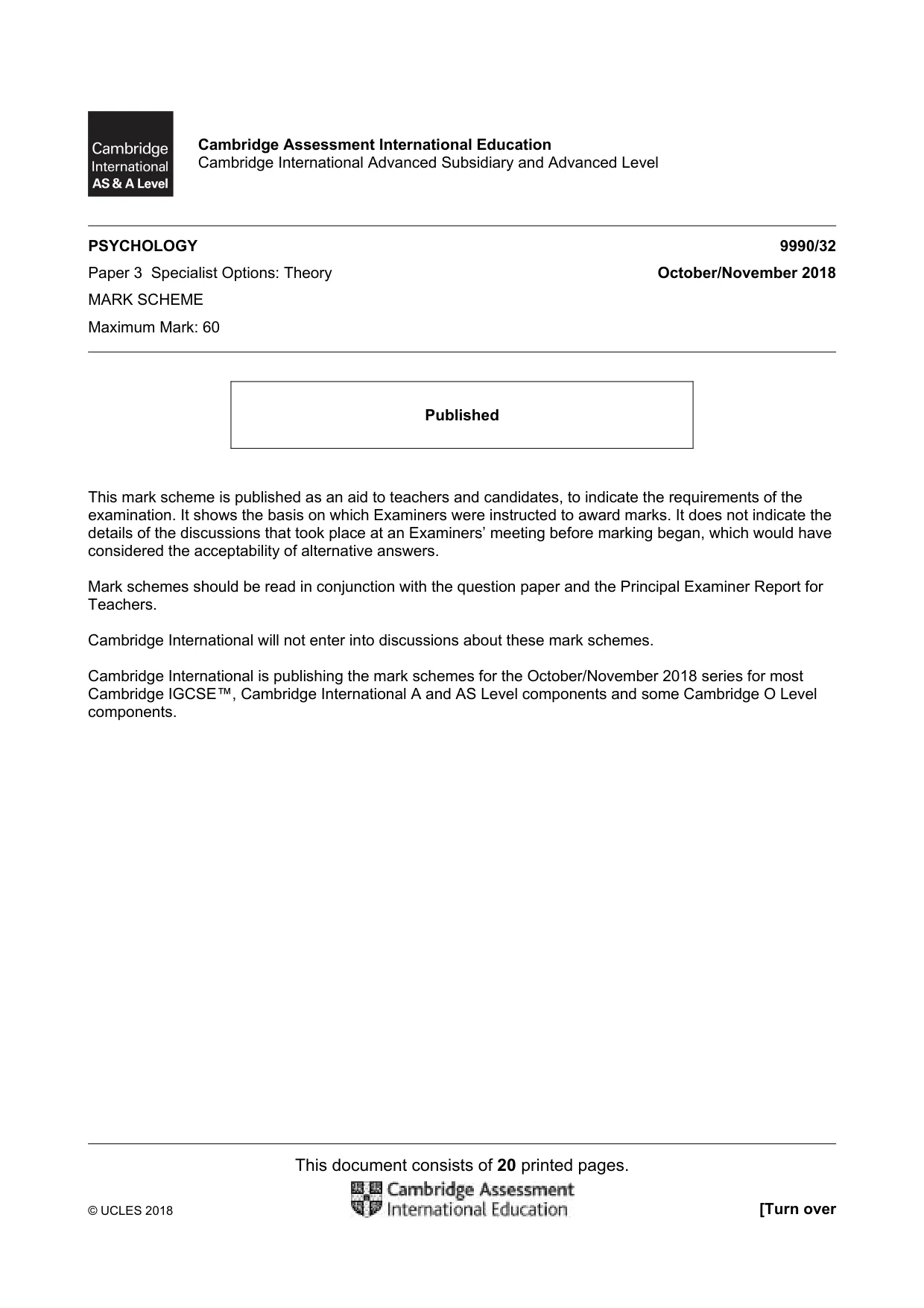
Mark scheme20 pages
Answers below. Sit the paper first if you are practising.
Questions as text
Q1 · Explain what is meant by a ‘non-substance addictive disorder’
1 (a) Explain what is meant by a ‘non-substance addictive disorder’. [2] (b) Describe covert sensitisation for treating and managing impulse control disorders. [4] (c) Explain one similarity and one difference between covert sensitisation and one biochemical treatment for managing impulse control disorders. [6]
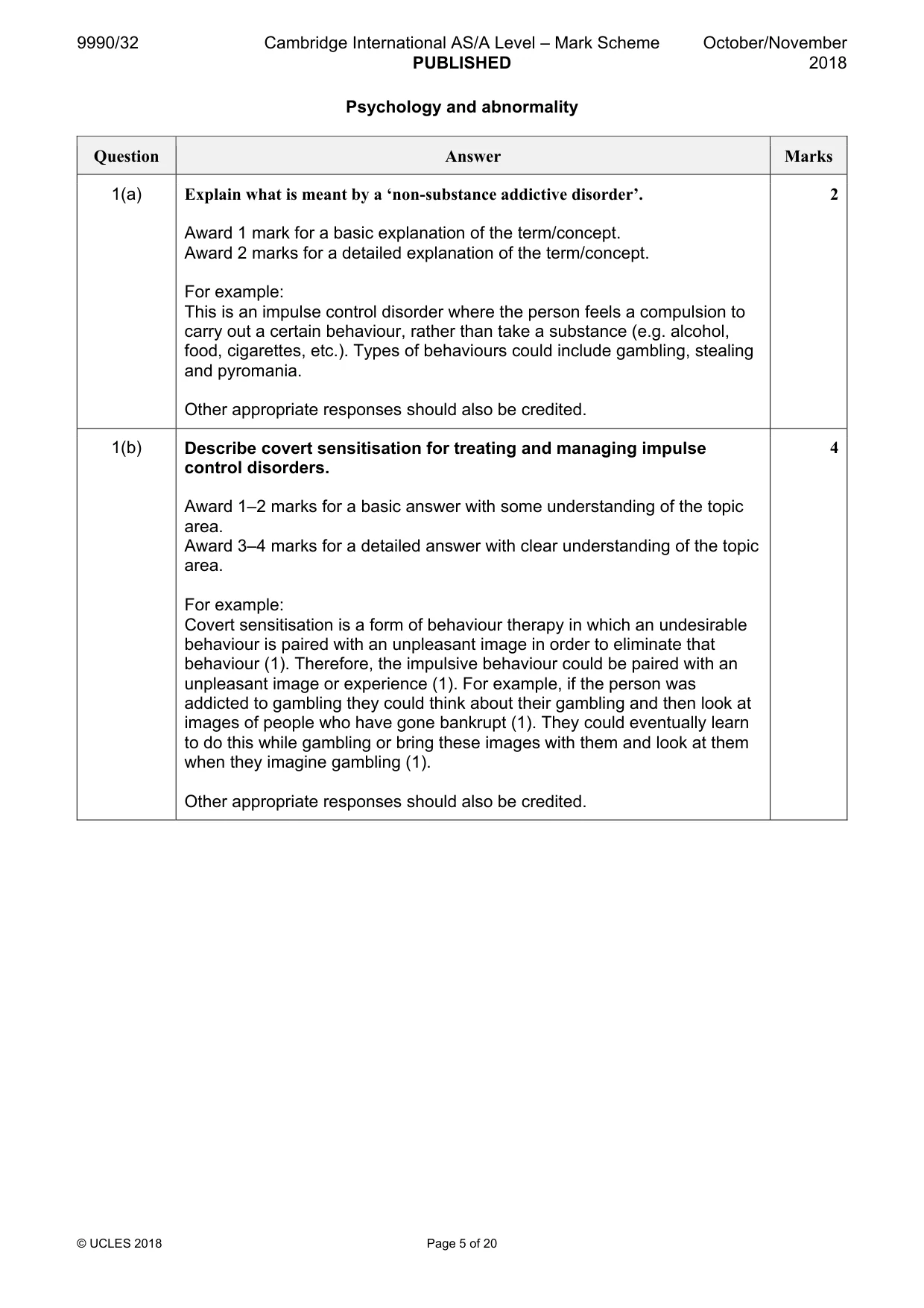
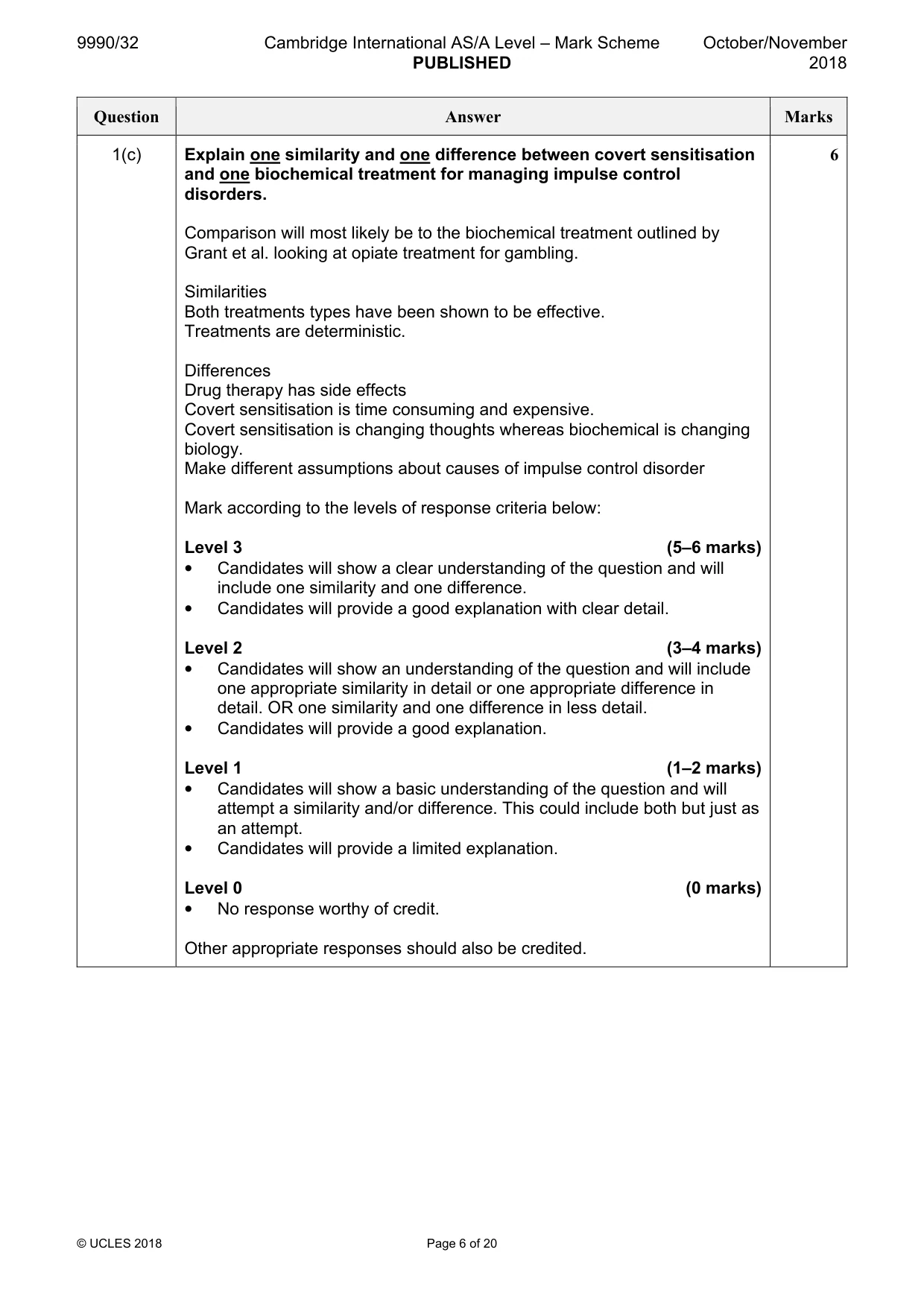
Mark scheme: Question Answer Marks 1(a) Explain what is meant by a ‘non-substance addictive disorder’. 2 Award 1 mark for a basic explanation of the term/concept. Award 2 marks for a detailed explanation of the term/concept. For example: This is an impulse control disorder where the person feels a compulsion to carry out a certain behaviour, rather than take a substance (e.g. alcohol, food, cigarettes, etc.). Types of behaviours could include gambling, stealing and pyromania. Other appropriate responses should also be credited. 1(b) Describe covert sensitisation for treating and managing impulse 4 control disorders. Award 1–2 marks for a basic answer with some understanding of the topic area. Award 3–4 marks for a detailed answer with clear understanding of the topic area. For example: Covert sensitisation is a form of behaviour therapy in which an undesirable behaviour is paired with an unpleasant image in order to eliminate that behaviour (1). Therefore, the impulsive behaviour could be paired with an unpleasant image or experience (1). For example, if the person was addicted to gambling they could think about their gambling and then look at images of people who have gone bankrupt (1). They could eventually learn to do this while gambling or bring these images with them and look at them when they imagine gambling (1). Other appropriate responses should also be credited. 1(c) Explain one similarity and one difference between covert sensitisation 6 and one biochemical treatment for managing impulse control disorders. Comparison will most likely be to the biochemical treatment outlined by Grant et al. looking at opiate treatment for gambling. Similarities Both treatments types have been shown to be effective. Treatments are deterministic. Differences Drug therapy has side effects Covert sensitisation is time consuming and expensive. Covert sensitisation is changing thoughts whereas biochemical is changing biology. Make different assumptions about causes of impulse control disorder Mark according to the levels of response criteria below: Level 3 (5–6 marks) • Candidates will show a clear understanding of the question and will include one similarity and one difference. • Candidates will provide a good explanation with clear detail. Level 2 (3–4 marks) • Candidates will show an understanding of the question and will include one appropriate similarity in detail or one appropriate difference in detail. OR one similarity and one difference in less detail. • Candidates will provide a good explanation. Level 1 (1–2 marks) • Candidates will show a basic understanding of the question and will attempt a similarity and/or difference. This could include both but just as an attempt. • Candidates will provide a limited explanation. Level 0 (0 marks) • No response worthy of credit. Other appropriate responses should also be credited.
Q2 · Describe explanations of phobias
2 (a) Describe explanations of phobias. [8] (b) Evaluate explanations of phobias, including a discussion of determinism. [10] Psychology and consumer behaviour Answer all questions.
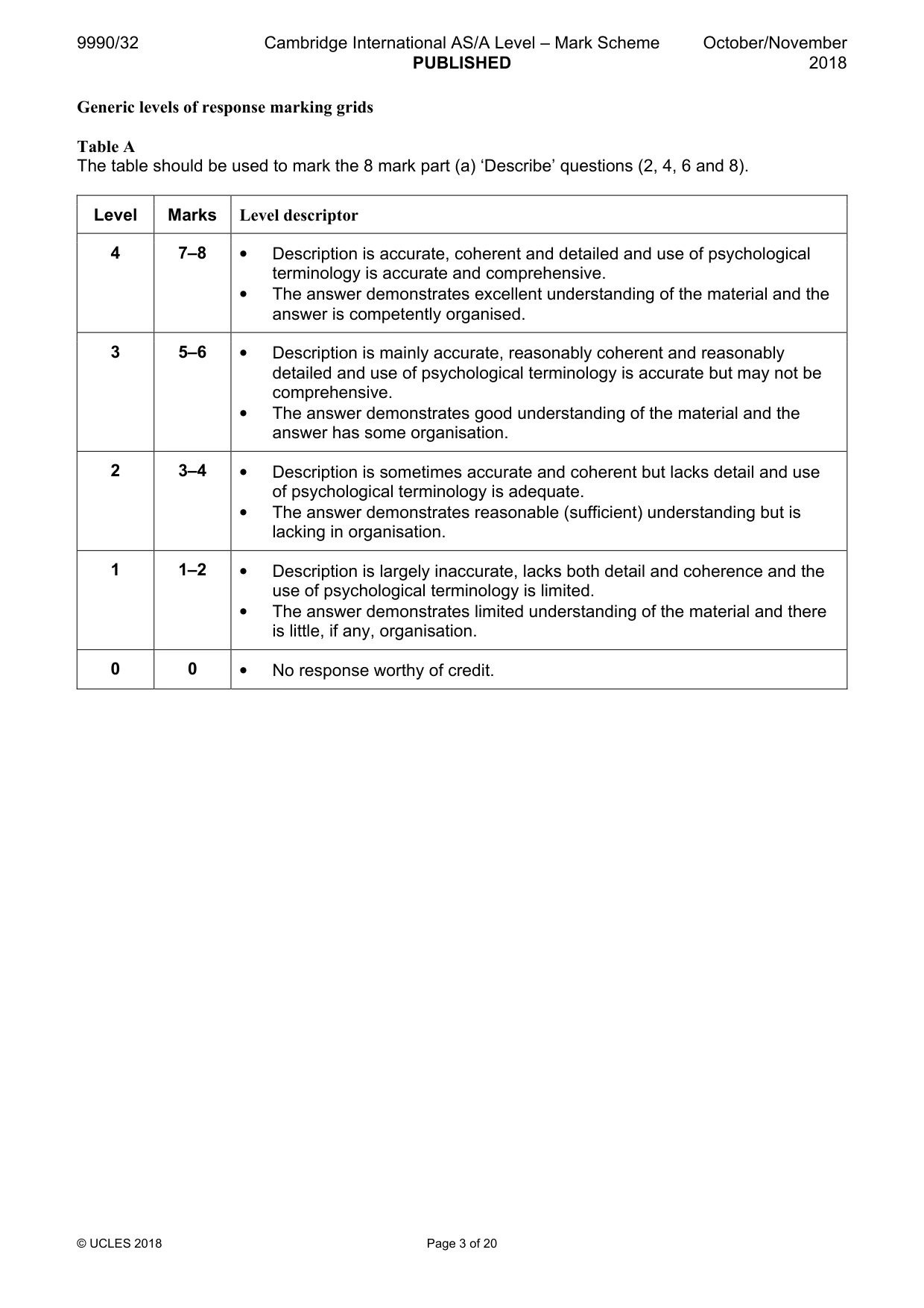
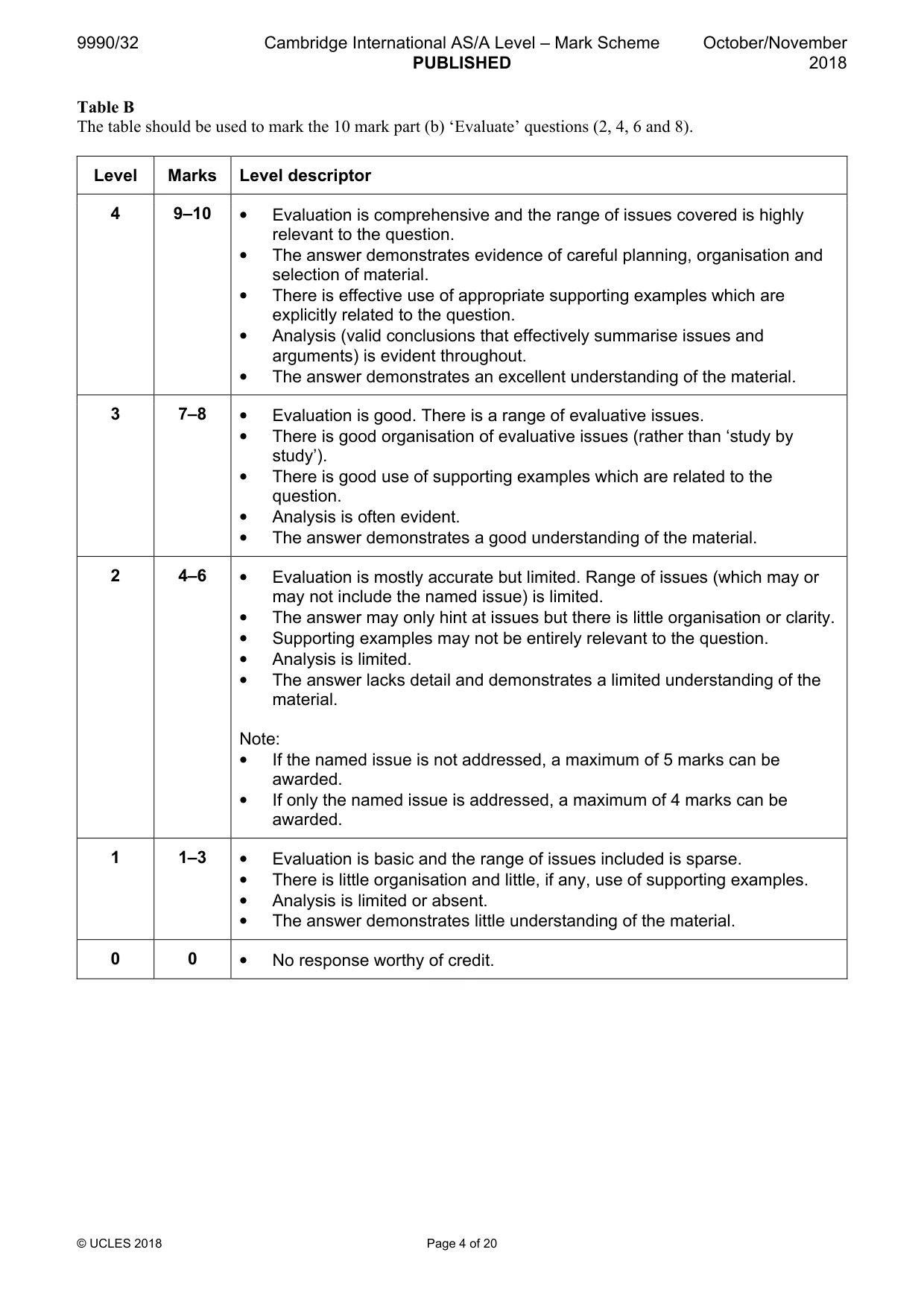
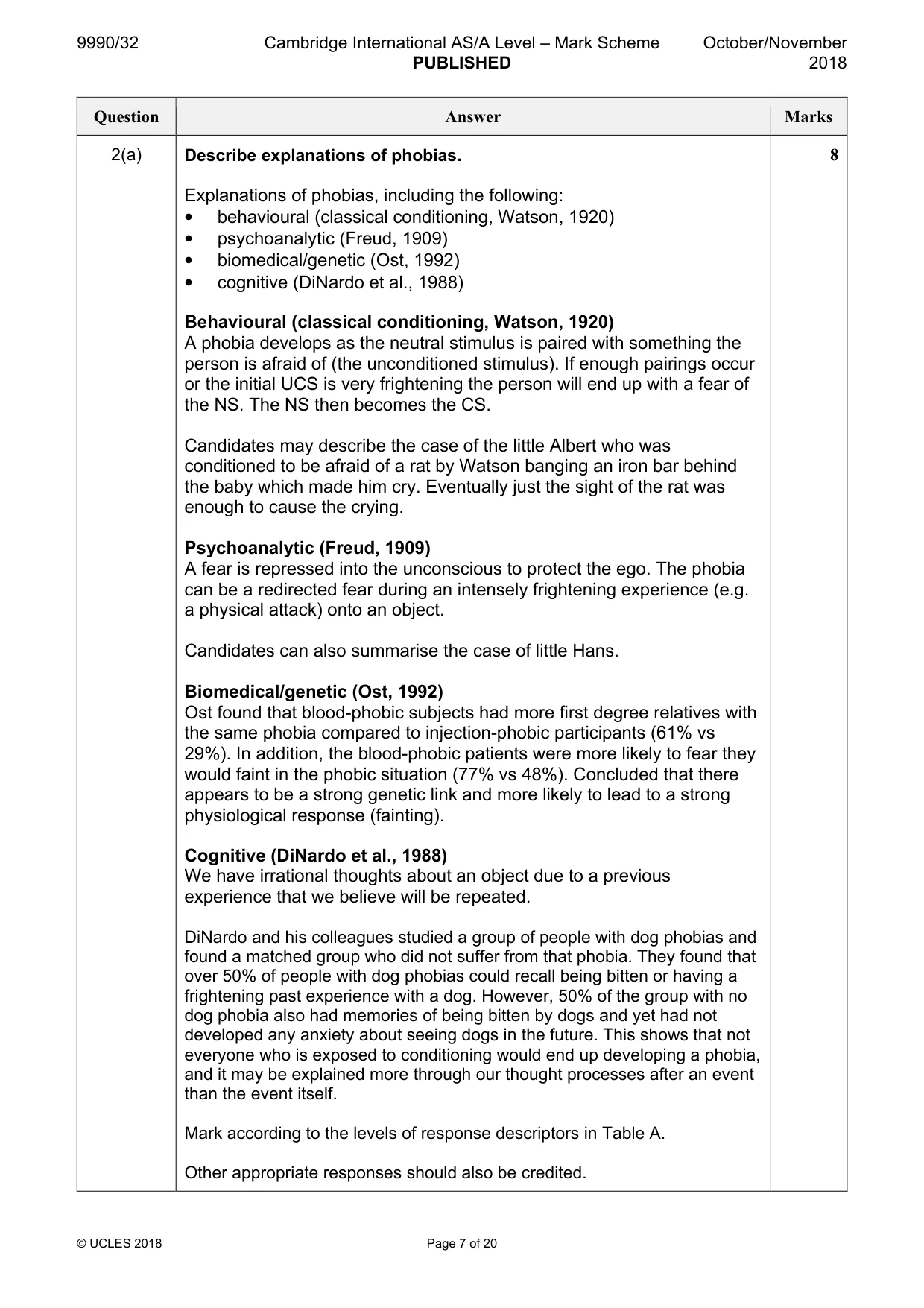
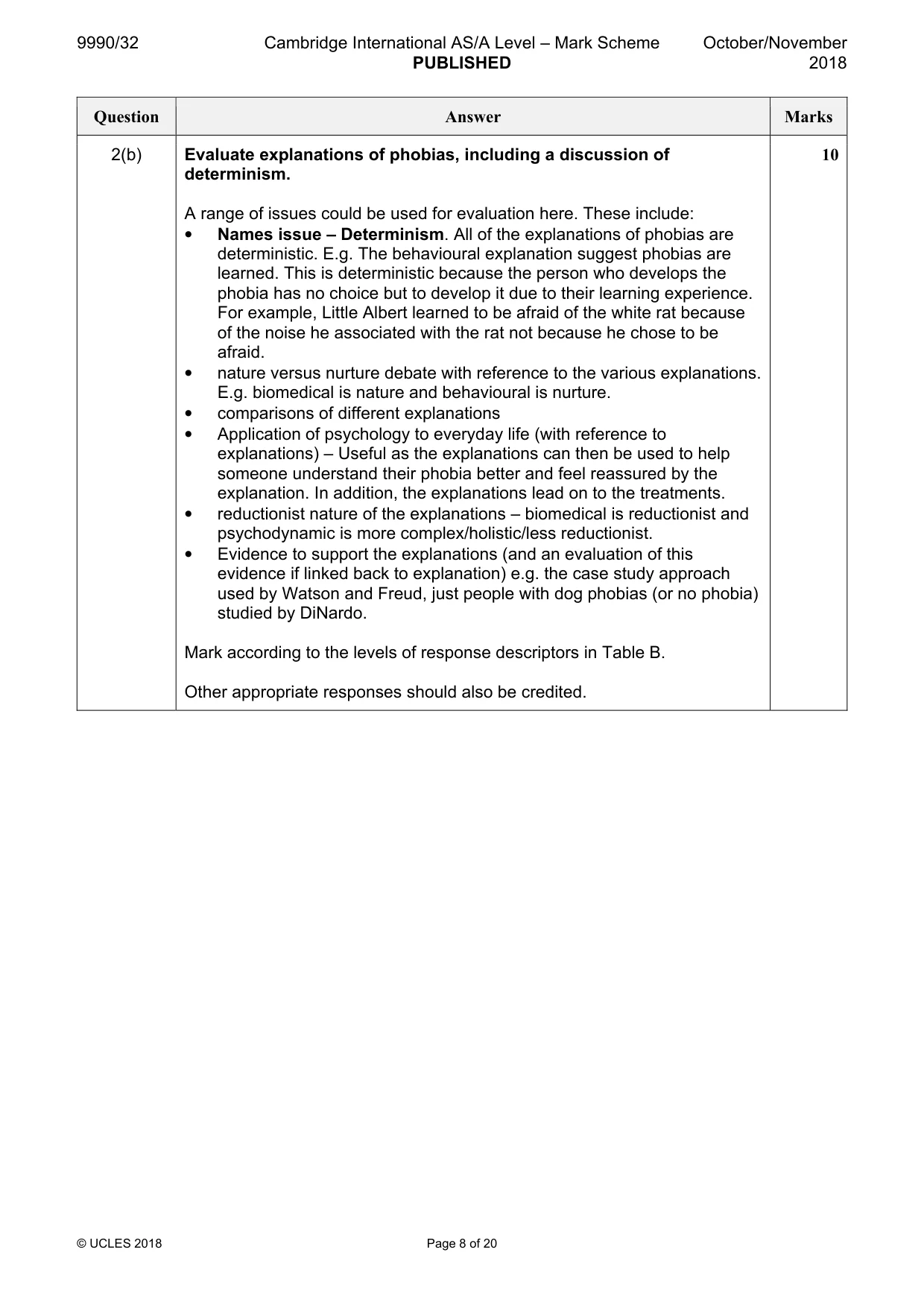
Mark scheme: 2(a) Describe explanations of phobias. 8 Explanations of phobias, including the following: • behavioural (classical conditioning, Watson, 1920) • psychoanalytic (Freud, 1909) • biomedical/genetic (Ost, 1992) • cognitive (DiNardo et al., 1988) Behavioural (classical conditioning, Watson, 1920) A phobia develops as the neutral stimulus is paired with something the person is afraid of (the unconditioned stimulus). If enough pairings occur or the initial UCS is very frightening the person will end up with a fear of the NS. The NS then becomes the CS. Candidates may describe the case of the little Albert who was conditioned to be afraid of a rat by Watson banging an iron bar behind the baby which made him cry. Eventually just the sight of the rat was enough to cause the crying. Psychoanalytic (Freud, 1909) A fear is repressed into the unconscious to protect the ego. The phobia can be a redirected fear during an intensely frightening experience (e.g. a physical attack) onto an object. Candidates can also summarise the case of little Hans. Biomedical/genetic (Ost, 1992) Ost found that blood-phobic subjects had more first degree relatives with the same phobia compared to injection-phobic participants (61% vs 29%). In addition, the blood-phobic patients were more likely to fear they would faint in the phobic situation (77% vs 48%). Concluded that there appears to be a strong genetic link and more likely to lead to a strong physiological response (fainting). Cognitive (DiNardo et al., 1988) We have irrational thoughts about an object due to a previous experience that we believe will be repeated. DiNardo and his colleagues studied a group of people with dog phobias and found a matched group who did not suffer from that phobia. They found that over 50% of people with dog phobias could recall being bitten or having a frightening past experience with a dog. However, 50% of the group with no dog phobia also had memories of being bitten by dogs and yet had not developed any anxiety about seeing dogs in the future. This shows that not everyone who is exposed to conditioning would end up developing a phobia, and it may be explained more through our thought processes after an event than the event itself. Mark according to the levels of response descriptors in Table A. Other appropriate responses should also be credited. 2(b) Evaluate explanations of phobias, including a discussion of 10 determinism. A range of issues could be used for evaluation here. These include: • Names issue – Determinism. All of the explanations of phobias are deterministic. E.g. The behavioural explanation suggest phobias are learned. This is deterministic because the person who develops the phobia has no choice but to develop it due to their learning experience. For example, Little Albert learned to be afraid of the white rat because of the noise he associated with the rat not because he chose to be afraid. • nature versus nurture debate with reference to the various explanations. E.g. biomedical is nature and behavioural is nurture. • comparisons of different explanations • Application of psychology to everyday life (with reference to explanations) – Useful as the explanations can then be used to help someone understand their phobia better and feel reassured by the explanation. In addition, the explanations lead on to the treatments. • reductionist nature of the explanations – biomedical is reductionist and psychodynamic is more complex/holistic/less reductionist. • Evidence to support the explanations (and an evaluation of this evidence if linked back to explanation) e.g. the case study approach used by Watson and Freud, just people with dog phobias (or no phobia) studied by DiNardo. Mark according to the levels of response descriptors in Table B. Other appropriate responses should also be credited. Psychology and consumer behaviour
More questions on Anxiety disorders and fear-related disorders
Q3 · Explain what is meant by ‘attention and shelf position’ and its effect on product choice
3 (a) Explain what is meant by ‘attention and shelf position’ and its effect on product choice. [2] (b) Describe the ‘consumer decision model’ for buying a product. [4] (c) Explain one strength and one weakness of the ‘consumer decision model’ for buying a product. [6]
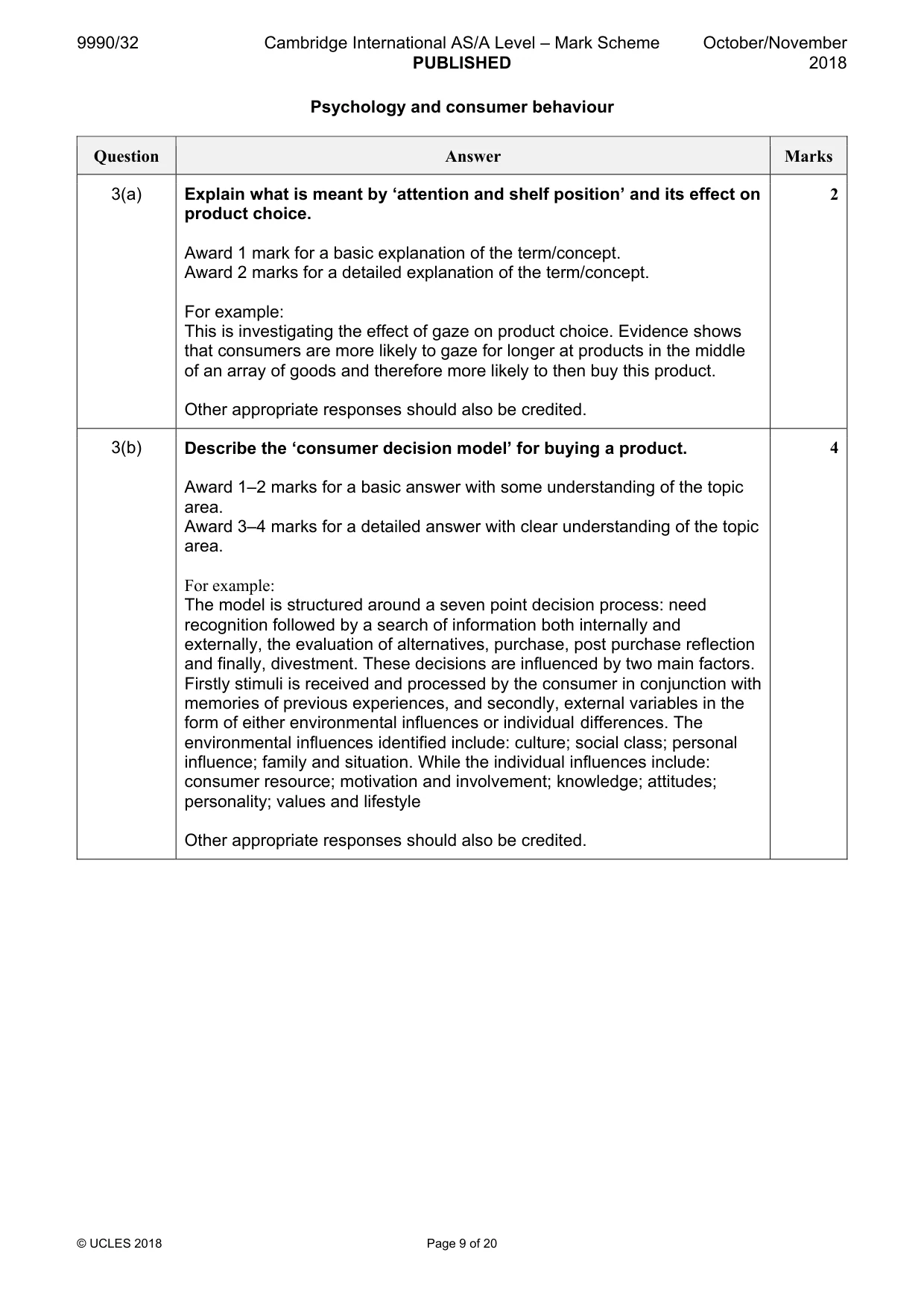
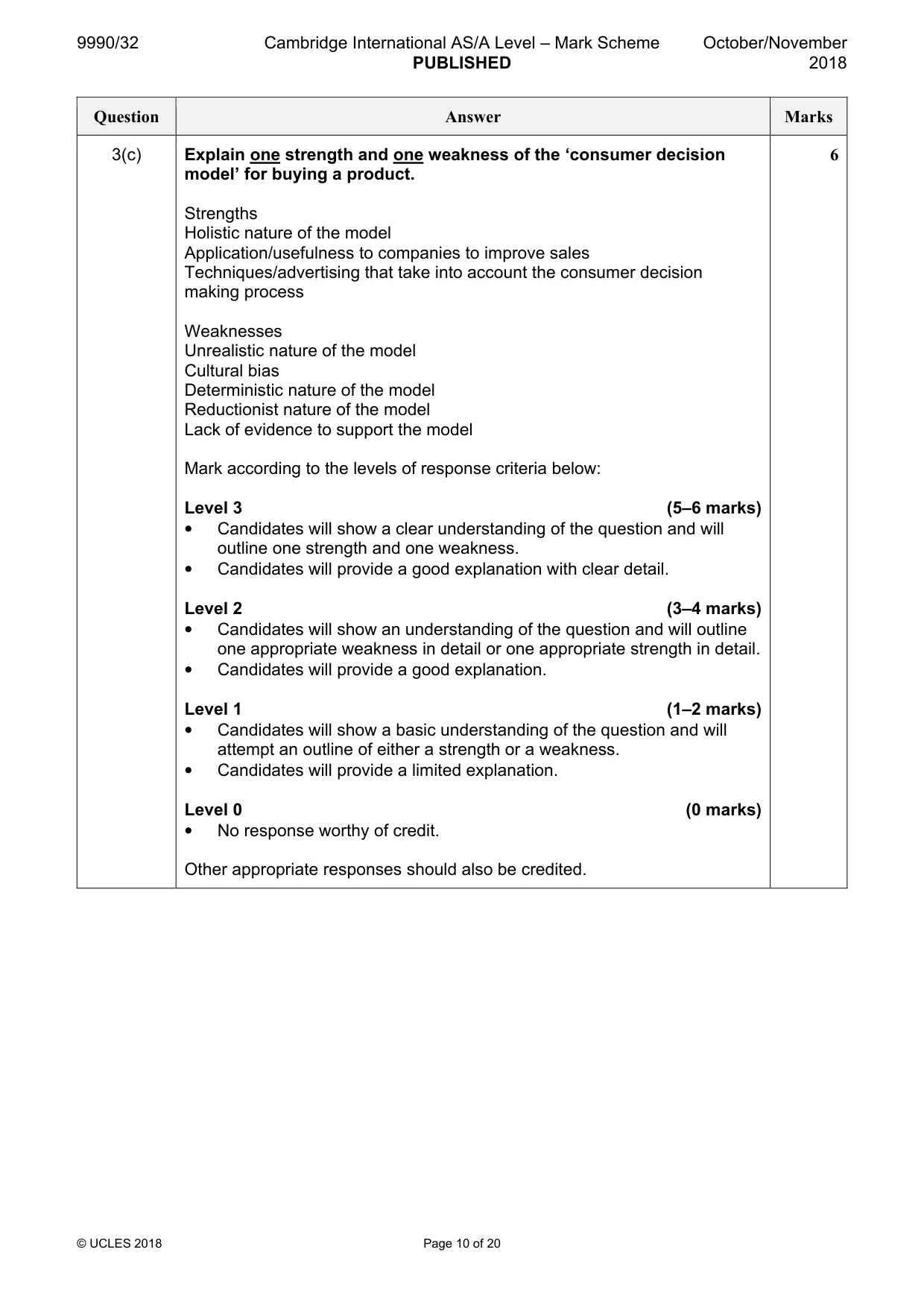
Mark scheme: 3(a) Explain what is meant by ‘attention and shelf position’ and its effect on 2 product choice. Award 1 mark for a basic explanation of the term/concept. Award 2 marks for a detailed explanation of the term/concept. For example: This is investigating the effect of gaze on product choice. Evidence shows that consumers are more likely to gaze for longer at products in the middle of an array of goods and therefore more likely to then buy this product. Other appropriate responses should also be credited. 3(b) Describe the ‘consumer decision model’ for buying a product. 4 Award 1–2 marks for a basic answer with some understanding of the topic area. Award 3–4 marks for a detailed answer with clear understanding of the topic area. For example: The model is structured around a seven point decision process: need recognition followed by a search of information both internally and externally, the evaluation of alternatives, purchase, post purchase reflection and finally, divestment. These decisions are influenced by two main factors. Firstly stimuli is received and processed by the consumer in conjunction with memories of previous experiences, and secondly, external variables in the form of either environmental influences or individual differences. The environmental influences identified include: culture; social class; personal influence; family and situation. While the individual influences include: consumer resource; motivation and involvement; knowledge; attitudes; personality; values and lifestyle Other appropriate responses should also be credited. 3(c) Explain one strength and one weakness of the ‘consumer decision 6 model’ for buying a product. Strengths Holistic nature of the model Application/usefulness to companies to improve sales Techniques/advertising that take into account the consumer decision making process Weaknesses Unrealistic nature of the model Cultural bias Deterministic nature of the model Reductionist nature of the model Lack of evidence to support the model Mark according to the levels of response criteria below: Level 3 (5–6 marks) • Candidates will show a clear understanding of the question and will outline one strength and one weakness. • Candidates will provide a good explanation with clear detail. Level 2 (3–4 marks) • Candidates will show an understanding of the question and will outline one appropriate weakness in detail or one appropriate strength in detail. • Candidates will provide a good explanation. Level 1 (1–2 marks) • Candidates will show a basic understanding of the question and will attempt an outline of either a strength or a weakness. • Candidates will provide a limited explanation. Level 0 (0 marks) • No response worthy of credit. Other appropriate responses should also be credited.
Q4 · Describe what psychologists have discovered about menu design psychology
4 (a) Describe what psychologists have discovered about menu design psychology. [8] (b) Evaluate what psychologists have discovered about menu design psychology, including a discussion on validity. [10] Psychology and health Answer all questions.
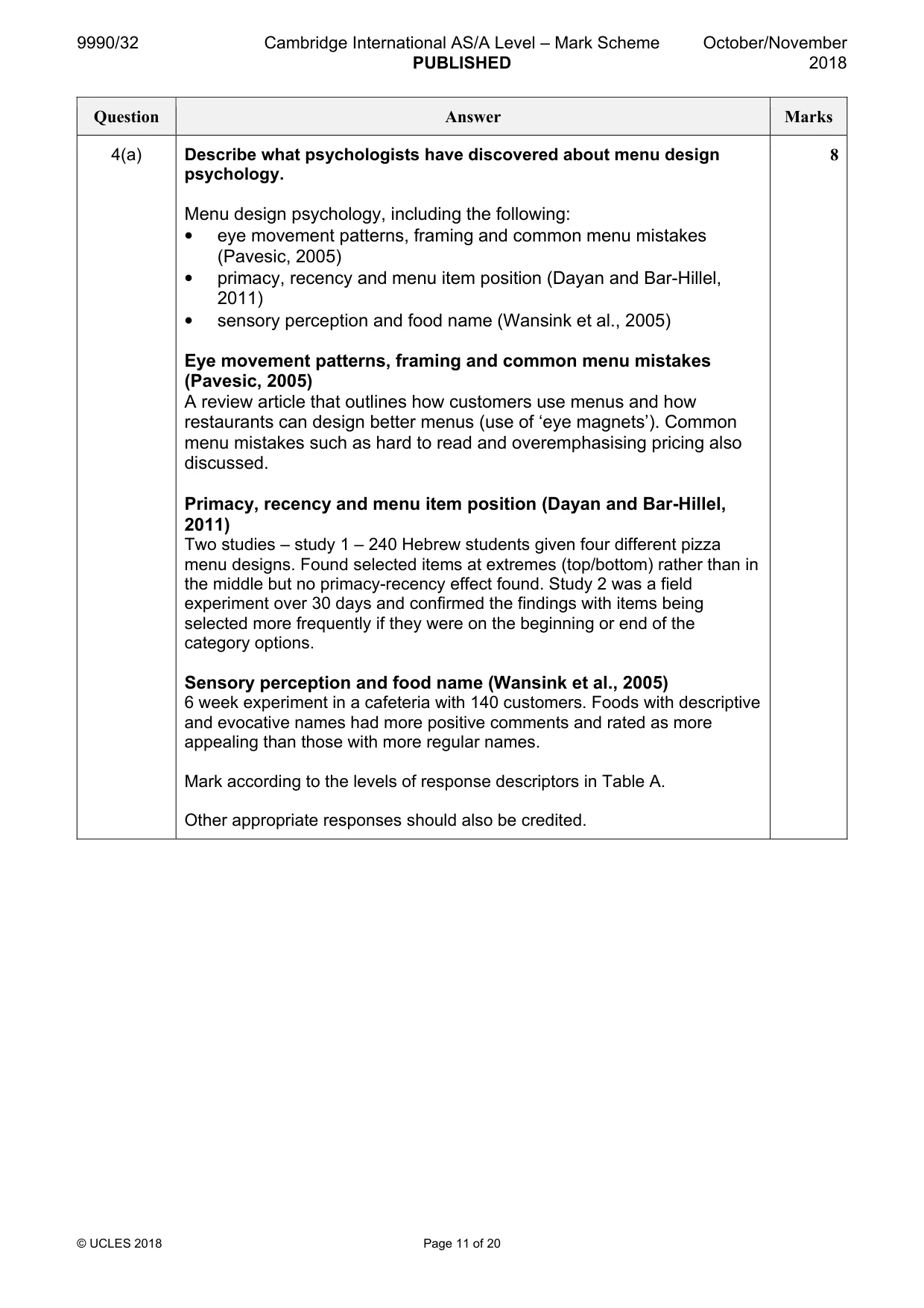
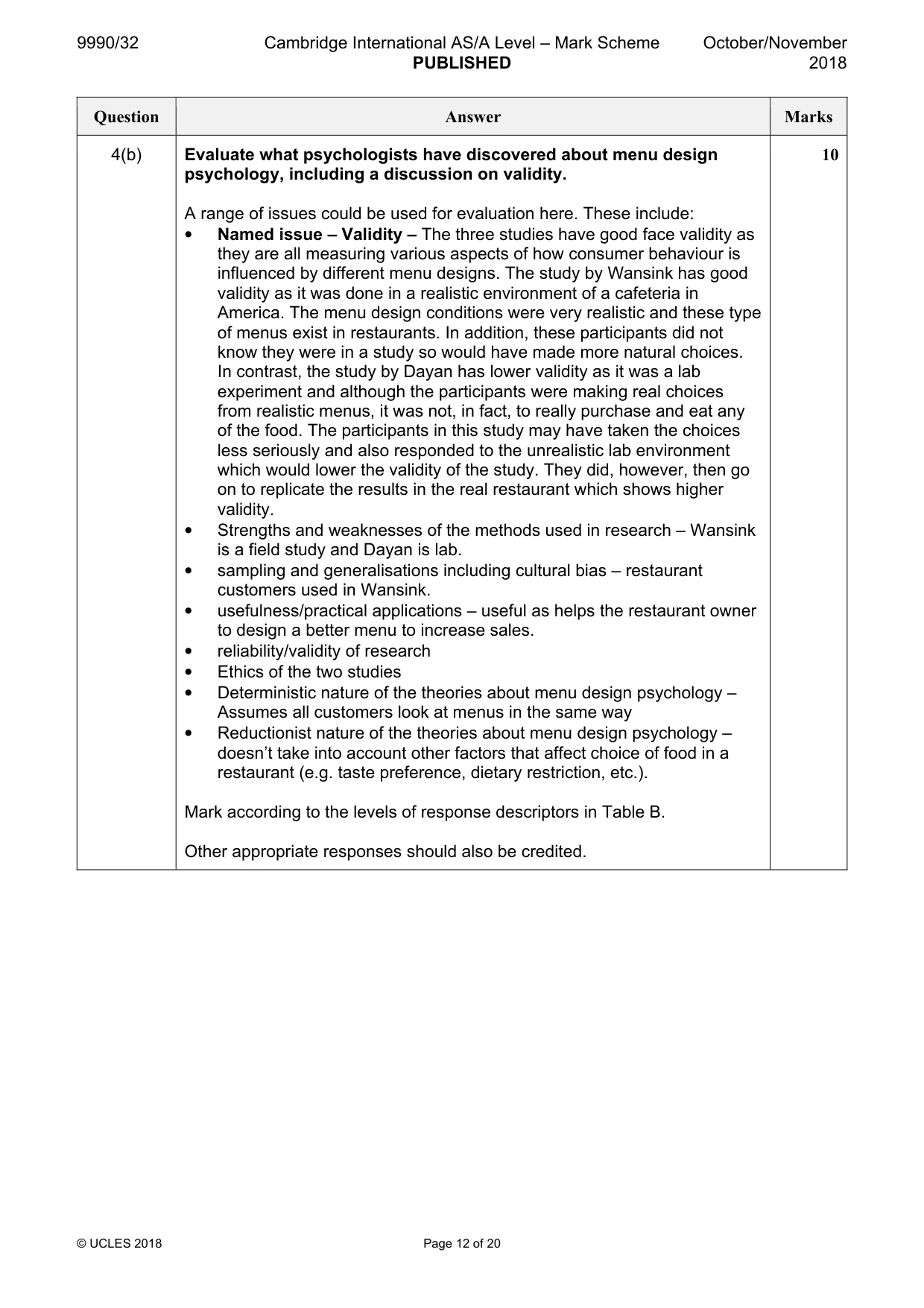
Mark scheme: 4(a) Describe what psychologists have discovered about menu design 8 psychology. Menu design psychology, including the following: • eye movement patterns, framing and common menu mistakes (Pavesic, 2005) • primacy, recency and menu item position (Dayan and Bar-Hillel, 2011) • sensory perception and food name (Wansink et al., 2005) Eye movement patterns, framing and common menu mistakes (Pavesic, 2005) A review article that outlines how customers use menus and how restaurants can design better menus (use of ‘eye magnets’). Common menu mistakes such as hard to read and overemphasising pricing also discussed. Primacy, recency and menu item position (Dayan and Bar-Hillel, 2011) Two studies – study 1 – 240 Hebrew students given four different pizza menu designs. Found selected items at extremes (top/bottom) rather than in the middle but no primacy-recency effect found. Study 2 was a field experiment over 30 days and confirmed the findings with items being selected more frequently if they were on the beginning or end of the category options. Sensory perception and food name (Wansink et al., 2005) 6 week experiment in a cafeteria with 140 customers. Foods with descriptive and evocative names had more positive comments and rated as more appealing than those with more regular names. Mark according to the levels of response descriptors in Table A. Other appropriate responses should also be credited. 4(b) Evaluate what psychologists have discovered about menu design 10 psychology, including a discussion on validity. A range of issues could be used for evaluation here. These include: • Named issue – Validity – The three studies have good face validity as they are all measuring various aspects of how consumer behaviour is influenced by different menu designs. The study by Wansink has good validity as it was done in a realistic environment of a cafeteria in America. The menu design conditions were very realistic and these type of menus exist in restaurants. In addition, these participants did not know they were in a study so would have made more natural choices. In contrast, the study by Dayan has lower validity as it was a lab experiment and although the participants were making real choices from realistic menus, it was not, in fact, to really purchase and eat any of the food. The participants in this study may have taken the choices less seriously and also responded to the unrealistic lab environment which would lower the validity of the study. They did, however, then go on to replicate the results in the real restaurant which shows higher validity. • Strengths and weaknesses of the methods used in research – Wansink is a field study and Dayan is lab. • sampling and generalisations including cultural bias – restaurant customers used in Wansink. • usefulness/practical applications – useful as helps the restaurant owner to design a better menu to increase sales. • reliability/validity of research • Ethics of the two studies • Deterministic nature of the theories about menu design psychology – Assumes all customers look at menus in the same way • Reductionist nature of the theories about menu design psychology – doesn’t take into account other factors that affect choice of food in a restaurant (e.g. taste preference, dietary restriction, etc.). Mark according to the levels of response descriptors in Table B. Other appropriate responses should also be credited. Psychology and health
Q5 · Explain what is meant by ‘practitioner and patient interpersonal skills’
5 (a) Explain what is meant by ‘practitioner and patient interpersonal skills’. [2] (b) Describe the study by Robinson and West (1992) on disclosure of information to a practitioner. [4] (c) Explain one strength and one weakness of the study by Robinson and West (1992). [6]
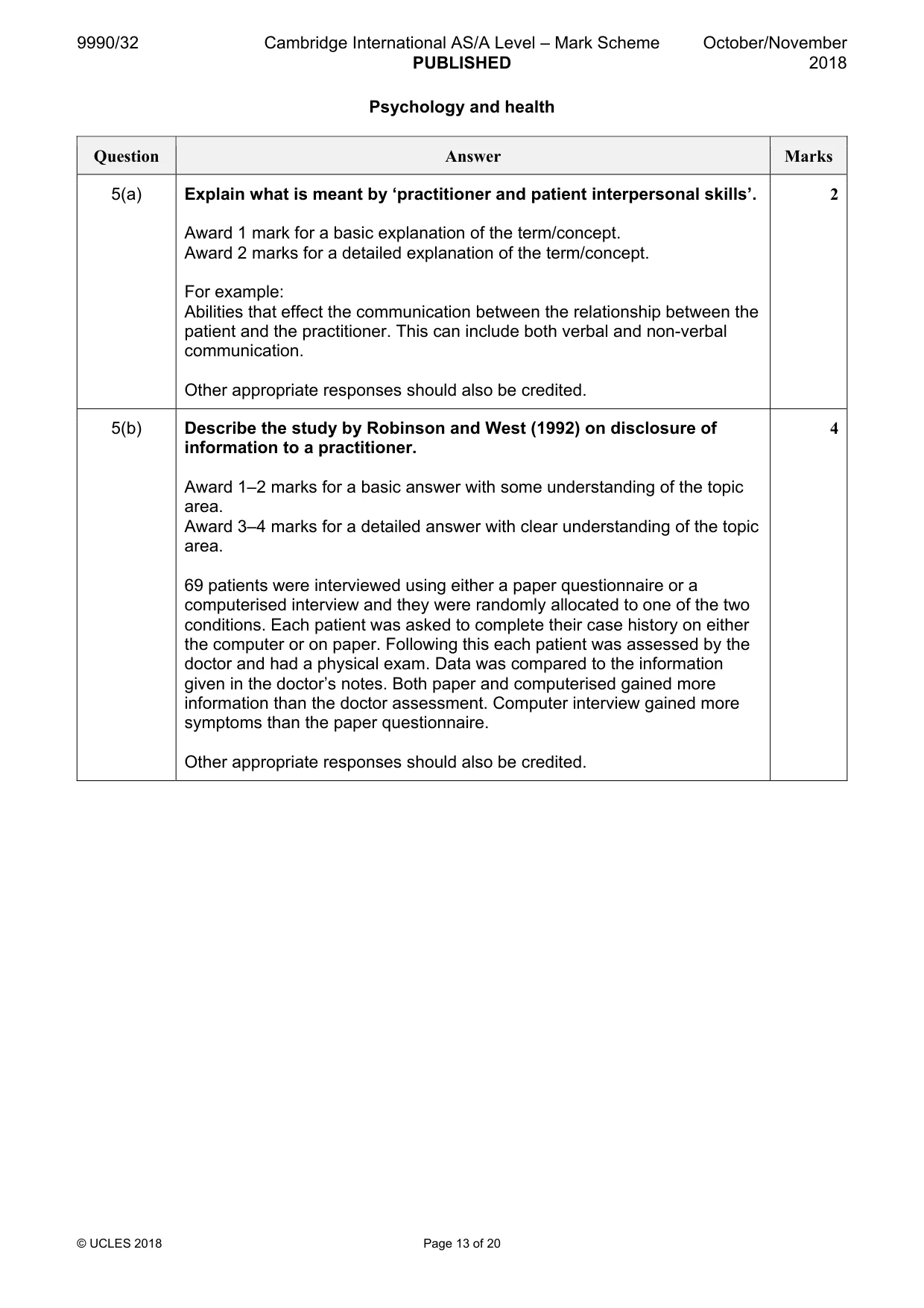
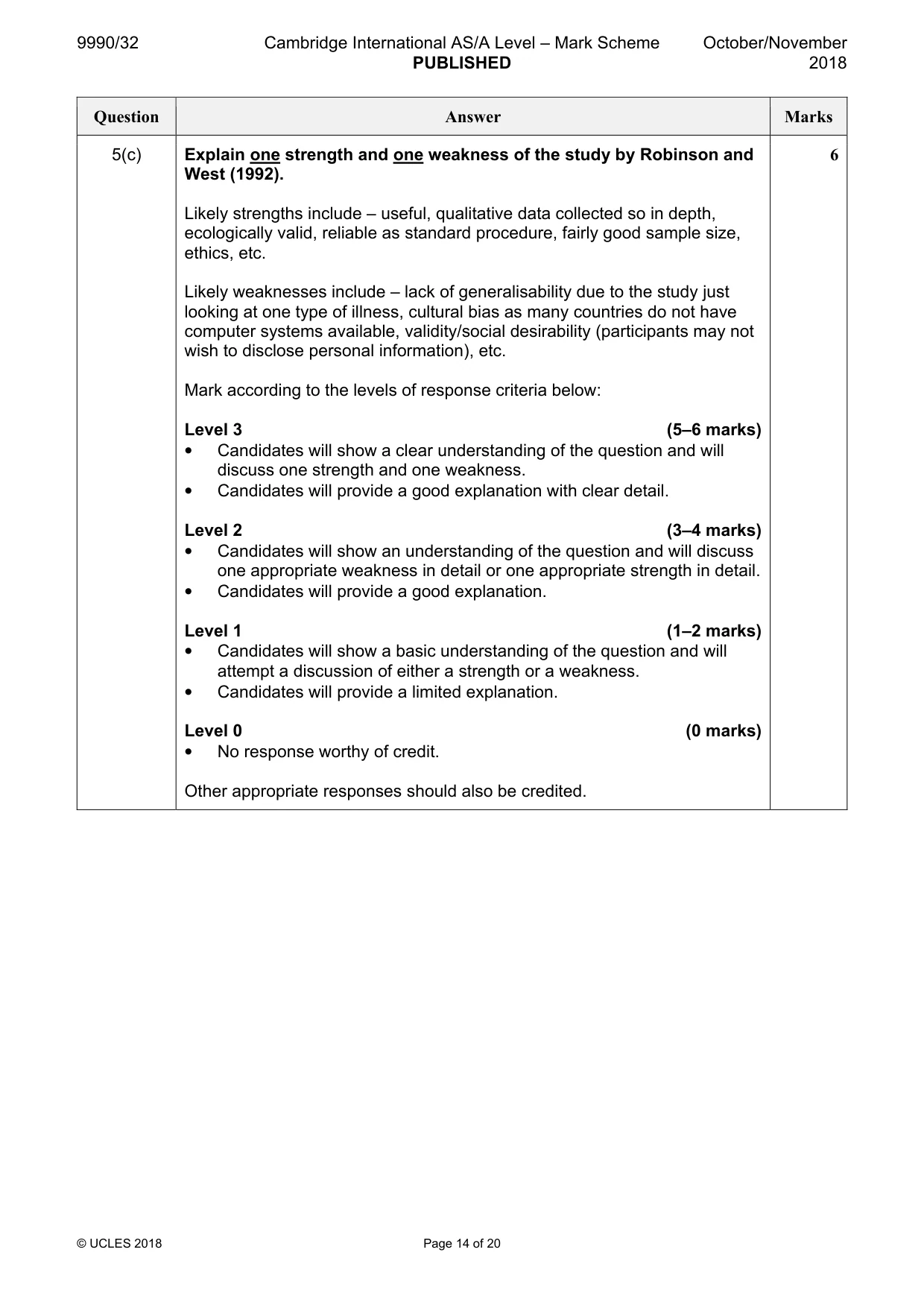
Mark scheme: 5(a) Explain what is meant by ‘practitioner and patient interpersonal skills’. 2 Award 1 mark for a basic explanation of the term/concept. Award 2 marks for a detailed explanation of the term/concept. For example: Abilities that effect the communication between the relationship between the patient and the practitioner. This can include both verbal and non-verbal communication. Other appropriate responses should also be credited. 5(b) Describe the study by Robinson and West (1992) on disclosure of 4 information to a practitioner. Award 1–2 marks for a basic answer with some understanding of the topic area. Award 3–4 marks for a detailed answer with clear understanding of the topic area. 69 patients were interviewed using either a paper questionnaire or a computerised interview and they were randomly allocated to one of the two conditions. Each patient was asked to complete their case history on either the computer or on paper. Following this each patient was assessed by the doctor and had a physical exam. Data was compared to the information given in the doctor’s notes. Both paper and computerised gained more information than the doctor assessment. Computer interview gained more symptoms than the paper questionnaire. Other appropriate responses should also be credited. 5(c) Explain one strength and one weakness of the study by Robinson and 6 West (1992). Likely strengths include – useful, qualitative data collected so in depth, ecologically valid, reliable as standard procedure, fairly good sample size, ethics, etc. Likely weaknesses include – lack of generalisability due to the study just looking at one type of illness, cultural bias as many countries do not have computer systems available, validity/social desirability (participants may not wish to disclose personal information), etc. Mark according to the levels of response criteria below: Level 3 (5–6 marks) • Candidates will show a clear understanding of the question and will discuss one strength and one weakness. • Candidates will provide a good explanation with clear detail. Level 2 (3–4 marks) • Candidates will show an understanding of the question and will discuss one appropriate weakness in detail or one appropriate strength in detail. • Candidates will provide a good explanation. Level 1 (1–2 marks) • Candidates will show a basic understanding of the question and will attempt a discussion of either a strength or a weakness. • Candidates will provide a limited explanation. Level 0 (0 marks) • No response worthy of credit. Other appropriate responses should also be credited.
Q6 · Describe what psychologists have discovered about individual factors in changing health…
6 (a) Describe what psychologists have discovered about individual factors in changing health beliefs. [8] (b) Evaluate what psychologists have discovered about individual factors in changing health beliefs, including a discussion of individual and situational explanations. [10] Psychology and organisations Answer all questions.
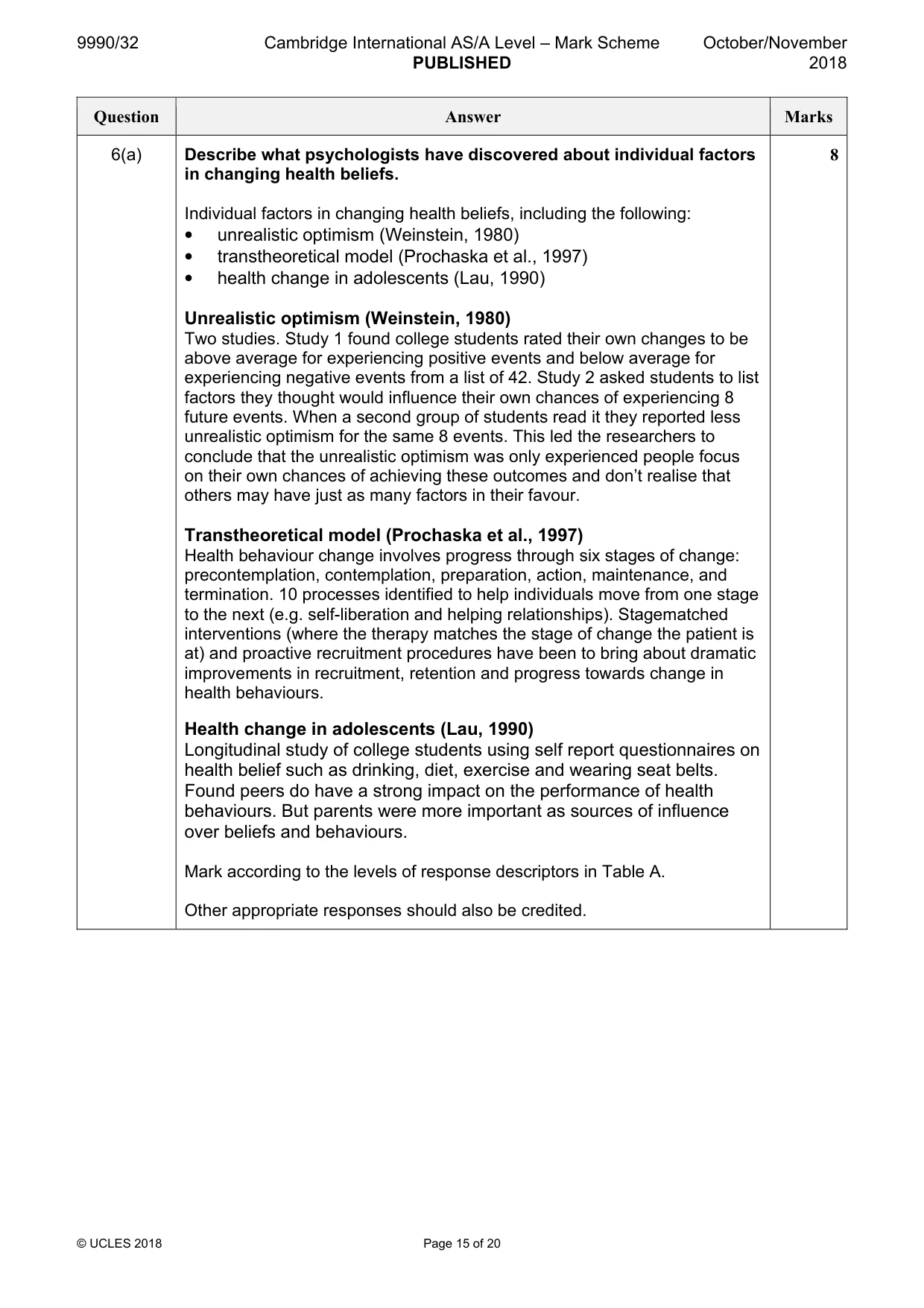
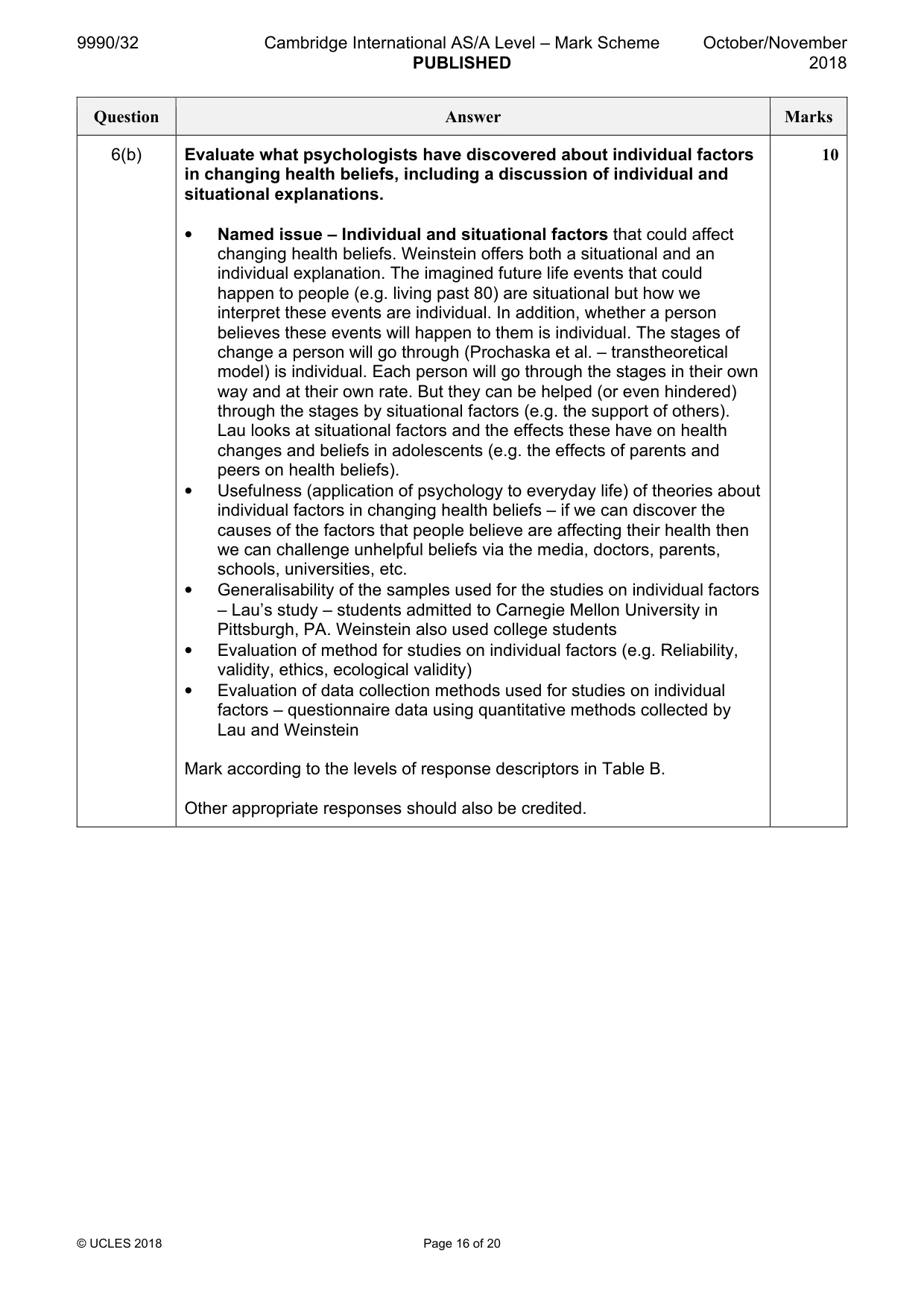
Mark scheme: 6(a) Describe what psychologists have discovered about individual factors 8 in changing health beliefs. Individual factors in changing health beliefs, including the following: • unrealistic optimism (Weinstein, 1980) • transtheoretical model (Prochaska et al., 1997) • health change in adolescents (Lau, 1990) Unrealistic optimism (Weinstein, 1980) Two studies. Study 1 found college students rated their own changes to be above average for experiencing positive events and below average for experiencing negative events from a list of 42. Study 2 asked students to list factors they thought would influence their own chances of experiencing 8 future events. When a second group of students read it they reported less unrealistic optimism for the same 8 events. This led the researchers to conclude that the unrealistic optimism was only experienced people focus on their own chances of achieving these outcomes and don’t realise that others may have just as many factors in their favour. Transtheoretical model (Prochaska et al., 1997) Health behaviour change involves progress through six stages of change: precontemplation, contemplation, preparation, action, maintenance, and termination. 10 processes identified to help individuals move from one stage to the next (e.g. self-liberation and helping relationships). Stagematched interventions (where the therapy matches the stage of change the patient is at) and proactive recruitment procedures have been to bring about dramatic improvements in recruitment, retention and progress towards change in health behaviours. Health change in adolescents (Lau, 1990) Longitudinal study of college students using self report questionnaires on health belief such as drinking, diet, exercise and wearing seat belts. Found peers do have a strong impact on the performance of health behaviours. But parents were more important as sources of influence over beliefs and behaviours. Mark according to the levels of response descriptors in Table A. Other appropriate responses should also be credited. 6(b) Evaluate what psychologists have discovered about individual factors 10 in changing health beliefs, including a discussion of individual and situational explanations. • Named issue – Individual and situational factors that could affect changing health beliefs. Weinstein offers both a situational and an individual explanation. The imagined future life events that could happen to people (e.g. living past 80) are situational but how we interpret these events are individual. In addition, whether a person believes these events will happen to them is individual. The stages of change a person will go through (Prochaska et al. – transtheoretical model) is individual. Each person will go through the stages in their own way and at their own rate. But they can be helped (or even hindered) through the stages by situational factors (e.g. the support of others). Lau looks at situational factors and the effects these have on health changes and beliefs in adolescents (e.g. the effects of parents and peers on health beliefs). • Usefulness (application of psychology to everyday life) of theories about individual factors in changing health beliefs – if we can discover the causes of the factors that people believe are affecting their health then we can challenge unhelpful beliefs via the media, doctors, parents, schools, universities, etc. • Generalisability of the samples used for the studies on individual factors – Lau’s study – students admitted to Carnegie Mellon University in Pittsburgh, PA. Weinstein also used college students • Evaluation of method for studies on individual factors (e.g. Reliability, validity, ethics, ecological validity) • Evaluation of data collection methods used for studies on individual factors – questionnaire data using quantitative methods collected by Lau and Weinstein Mark according to the levels of response descriptors in Table B. Other appropriate responses should also be credited. Psychology and organisations
More questions on 2 Health promotion in schools and worksites
Q7 · Explain what is meant by ‘adaptive leadership’
7 (a) Explain what is meant by ‘adaptive leadership’. [2] (b) Describe two of the three levels of leadership from Scouller (2011). [4] (c) Discuss the applications of everyday life in organisations of the three levels of leadership proposed by Scouller (2011). [6]
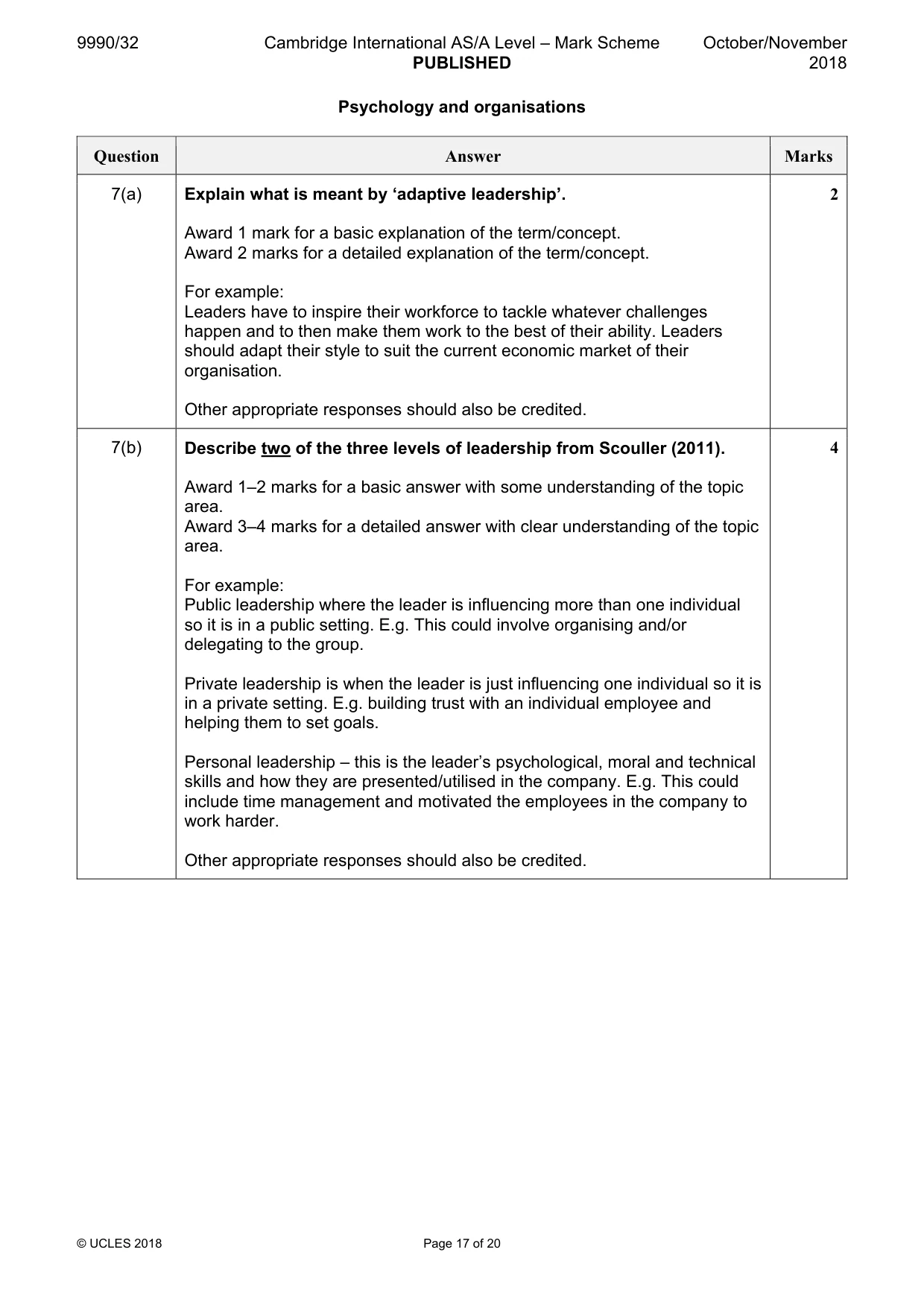
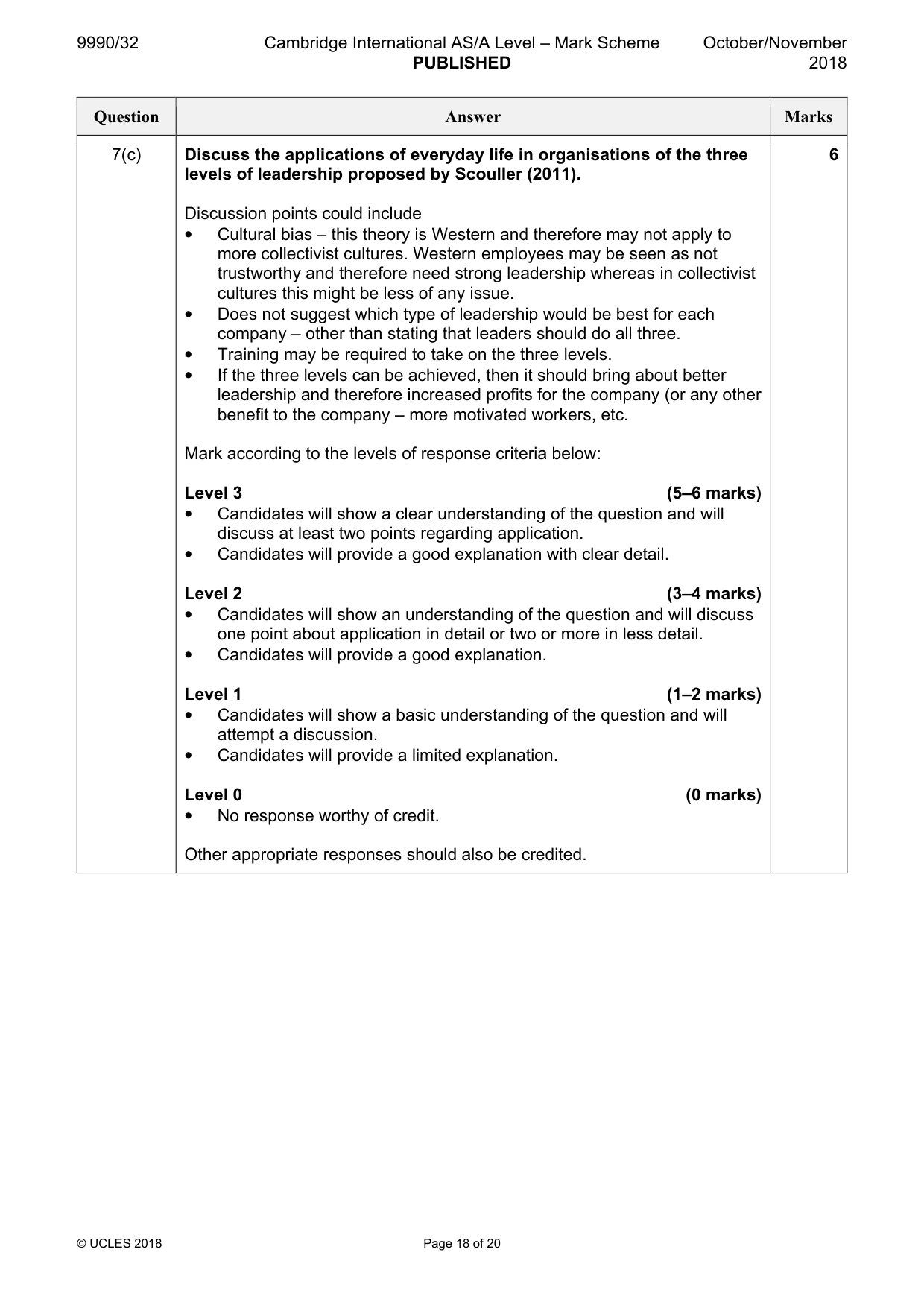
Mark scheme: 7(a) Explain what is meant by ‘adaptive leadership’. 2 Award 1 mark for a basic explanation of the term/concept. Award 2 marks for a detailed explanation of the term/concept. For example: Leaders have to inspire their workforce to tackle whatever challenges happen and to then make them work to the best of their ability. Leaders should adapt their style to suit the current economic market of their organisation. Other appropriate responses should also be credited. 7(b) Describe two of the three levels of leadership from Scouller (2011). 4 Award 1–2 marks for a basic answer with some understanding of the topic area. Award 3–4 marks for a detailed answer with clear understanding of the topic area. For example: Public leadership where the leader is influencing more than one individual so it is in a public setting. E.g. This could involve organising and/or delegating to the group. Private leadership is when the leader is just influencing one individual so it is in a private setting. E.g. building trust with an individual employee and helping them to set goals. Personal leadership – this is the leader’s psychological, moral and technical skills and how they are presented/utilised in the company. E.g. This could include time management and motivated the employees in the company to work harder. Other appropriate responses should also be credited. 7(c) Discuss the applications of everyday life in organisations of the three 6 levels of leadership proposed by Scouller (2011). Discussion points could include • Cultural bias – this theory is Western and therefore may not apply to more collectivist cultures. Western employees may be seen as not trustworthy and therefore need strong leadership whereas in collectivist cultures this might be less of any issue. • Does not suggest which type of leadership would be best for each company – other than stating that leaders should do all three. • Training may be required to take on the three levels. • If the three levels can be achieved, then it should bring about better leadership and therefore increased profits for the company (or any other benefit to the company – more motivated workers, etc. Mark according to the levels of response criteria below: Level 3 (5–6 marks) • Candidates will show a clear understanding of the question and will discuss at least two points regarding application. • Candidates will provide a good explanation with clear detail. Level 2 (3–4 marks) • Candidates will show an understanding of the question and will discuss one point about application in detail or two or more in less detail. • Candidates will provide a good explanation. Level 1 (1–2 marks) • Candidates will show a basic understanding of the question and will attempt a discussion. • Candidates will provide a limited explanation. Level 0 (0 marks) • No response worthy of credit. Other appropriate responses should also be credited.
Q8 · Describe what psychologists have discovered about attitudes to work
8 (a) Describe what psychologists have discovered about attitudes to work. [8] (b) Evaluate what psychologists have discovered about attitudes to work, including a discussion about generalisations. [10]
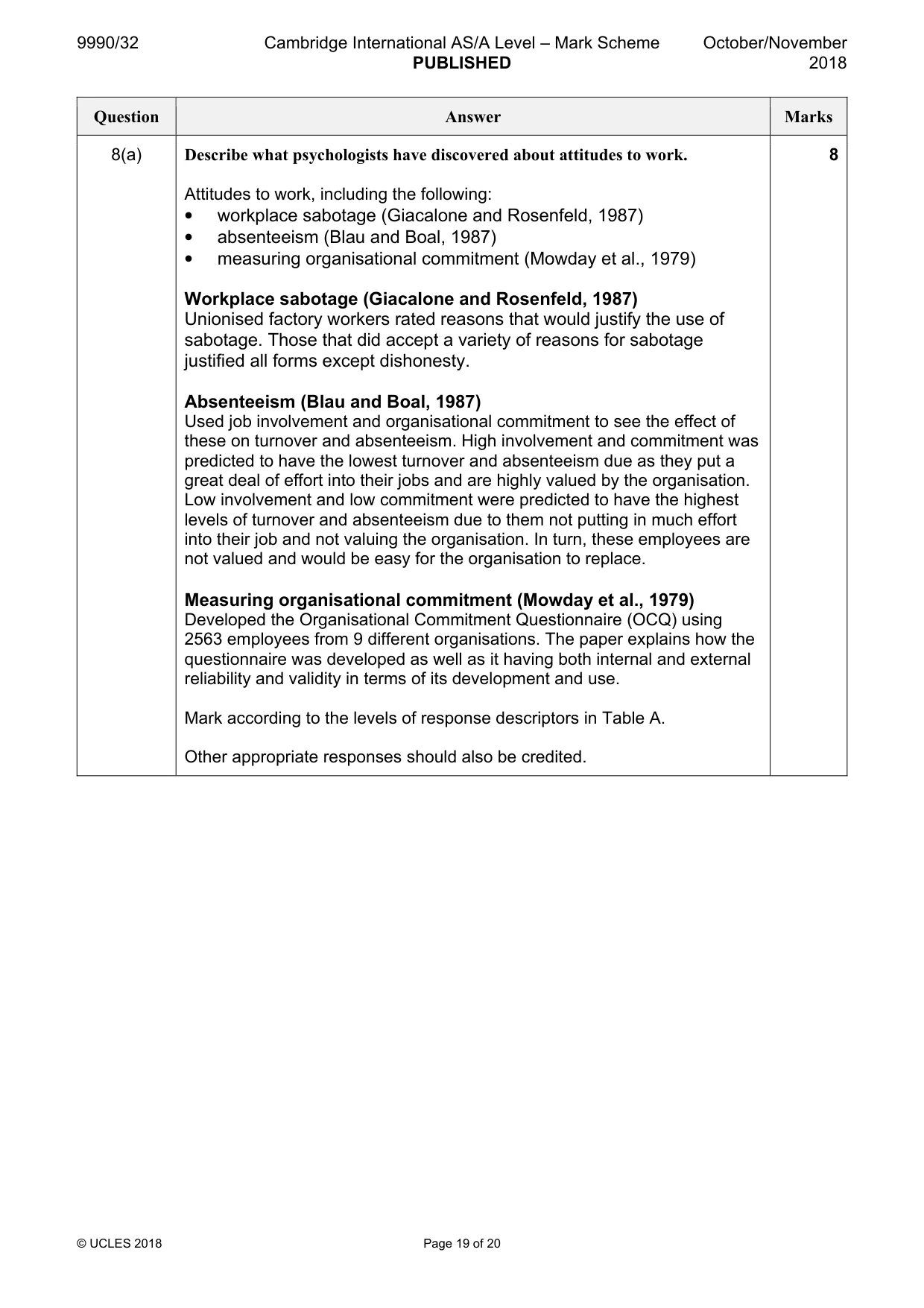
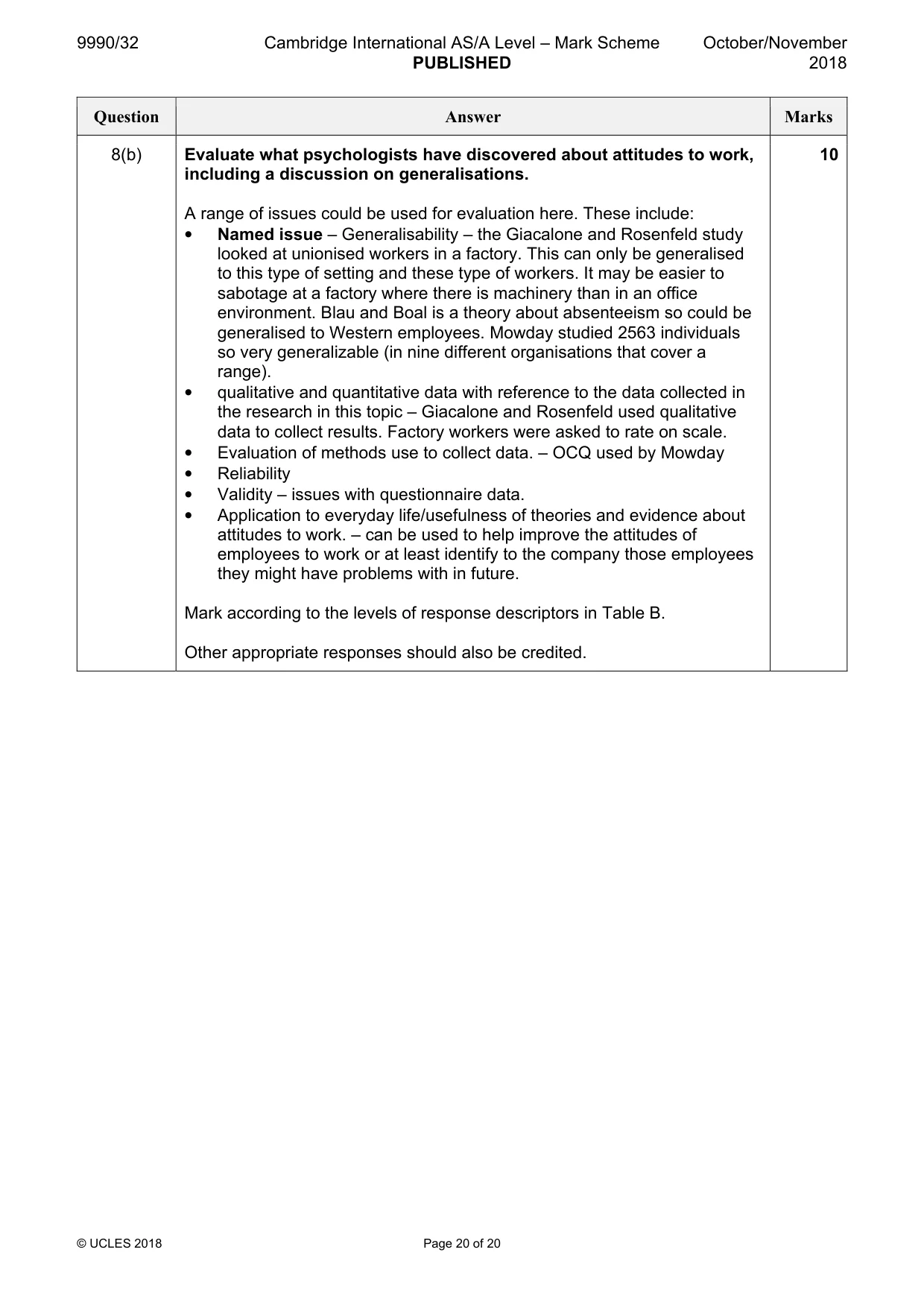
Mark scheme: 8(a) Describe what psychologists have discovered about attitudes to work. 8 Attitudes to work, including the following: • workplace sabotage (Giacalone and Rosenfeld, 1987) • absenteeism (Blau and Boal, 1987) • measuring organisational commitment (Mowday et al., 1979) Workplace sabotage (Giacalone and Rosenfeld, 1987) Unionised factory workers rated reasons that would justify the use of sabotage. Those that did accept a variety of reasons for sabotage justified all forms except dishonesty. Absenteeism (Blau and Boal, 1987) Used job involvement and organisational commitment to see the effect of these on turnover and absenteeism. High involvement and commitment was predicted to have the lowest turnover and absenteeism due as they put a great deal of effort into their jobs and are highly valued by the organisation. Low involvement and low commitment were predicted to have the highest levels of turnover and absenteeism due to them not putting in much effort into their job and not valuing the organisation. In turn, these employees are not valued and would be easy for the organisation to replace. Measuring organisational commitment (Mowday et al., 1979) Developed the Organisational Commitment Questionnaire (OCQ) using 2563 employees from 9 different organisations. The paper explains how the questionnaire was developed as well as it having both internal and external reliability and validity in terms of its development and use. Mark according to the levels of response descriptors in Table A. Other appropriate responses should also be credited. 8(b) Evaluate what psychologists have discovered about attitudes to work, 10 including a discussion on generalisations. A range of issues could be used for evaluation here. These include: • Named issue – Generalisability – the Giacalone and Rosenfeld study looked at unionised workers in a factory. This can only be generalised to this type of setting and these type of workers. It may be easier to sabotage at a factory where there is machinery than in an office environment. Blau and Boal is a theory about absenteeism so could be generalised to Western employees. Mowday studied 2563 individuals so very generalizable (in nine different organisations that cover a range). • qualitative and quantitative data with reference to the data collected in the research in this topic – Giacalone and Rosenfeld used qualitative data to collect results. Factory workers were asked to rate on scale. • Evaluation of methods use to collect data. – OCQ used by Mowday • Reliability • Validity – issues with questionnaire data. • Application to everyday life/usefulness of theories and evidence about attitudes to work. – can be used to help improve the attitudes of employees to work or at least identify to the company those employees they might have problems with in future. Mark according to the levels of response descriptors in Table B. Other appropriate responses should also be credited.
What was in this paper
The subtopics covered by these 8 questions, and how many questions each got. Open one in a new tab to see every Cambridge question on it.
What you needed in this session
Cambridge’s own grade thresholds for 2018 Oct/Nov, Paper 3 · Variant 2. A higher threshold means an easier paper — the bar moves with how the cohort did.