Cambridge A Level Psychology (from 2018) 9990 — 2018 Feb/March Paper 3 · Variant 2
9990/32/F/M/18 · 8 questions · 60 marks · ≈68 min
The question paper and its mark scheme, free to read here and free to download. This is Cambridge’s own paper, exactly as it was sat.
Question paper4 pages

Mark scheme21 pages
Answers below. Sit the paper first if you are practising.

Questions as text
Q1 · Explain what is meant by ‘learned helplessness’ (Seligman, 1988)
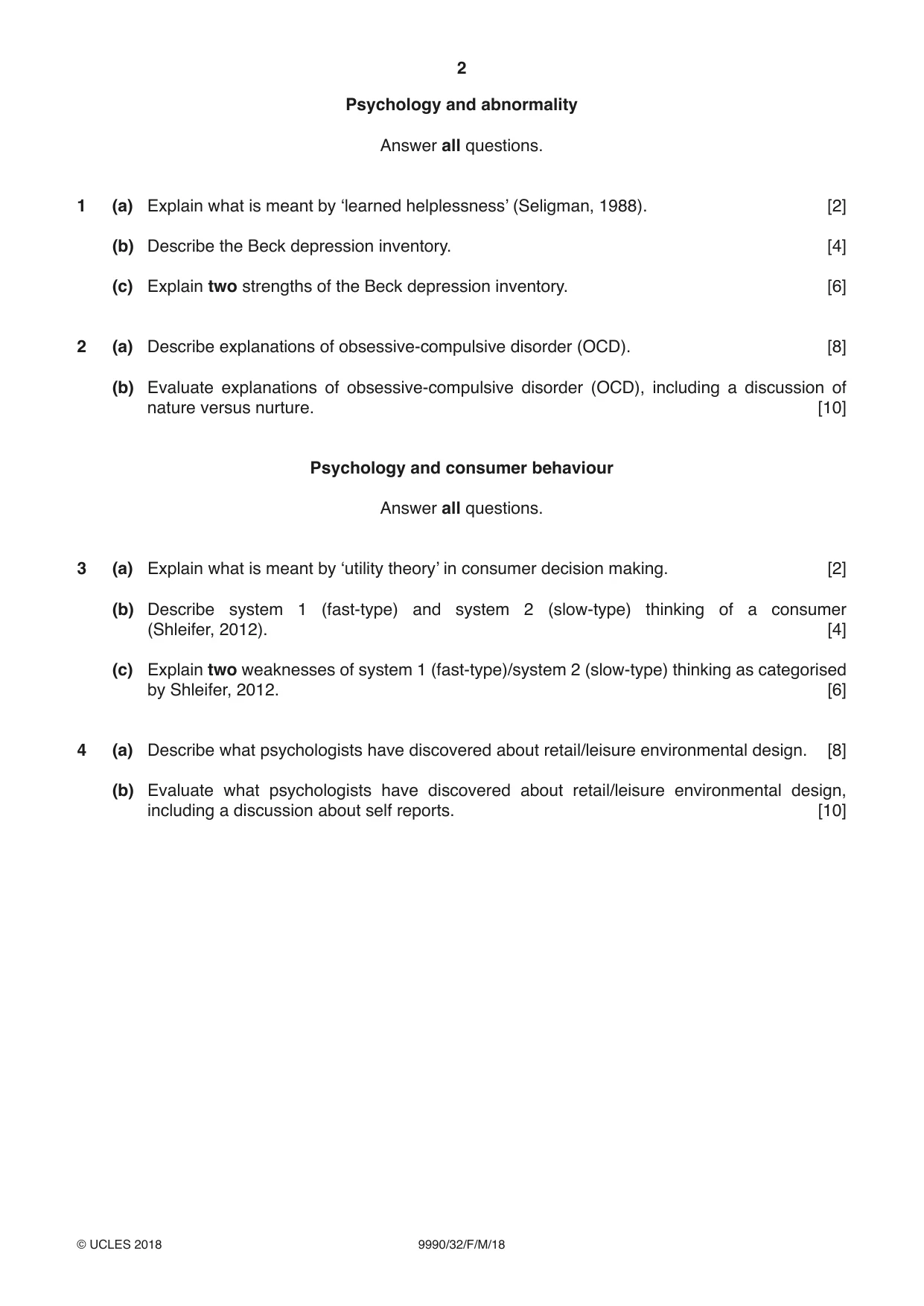
1 (a) Explain what is meant by ‘learned helplessness’ (Seligman, 1988). [2] (b) Describe the Beck depression inventory. [4] (c) Explain two strengths of the Beck depression inventory. [6]
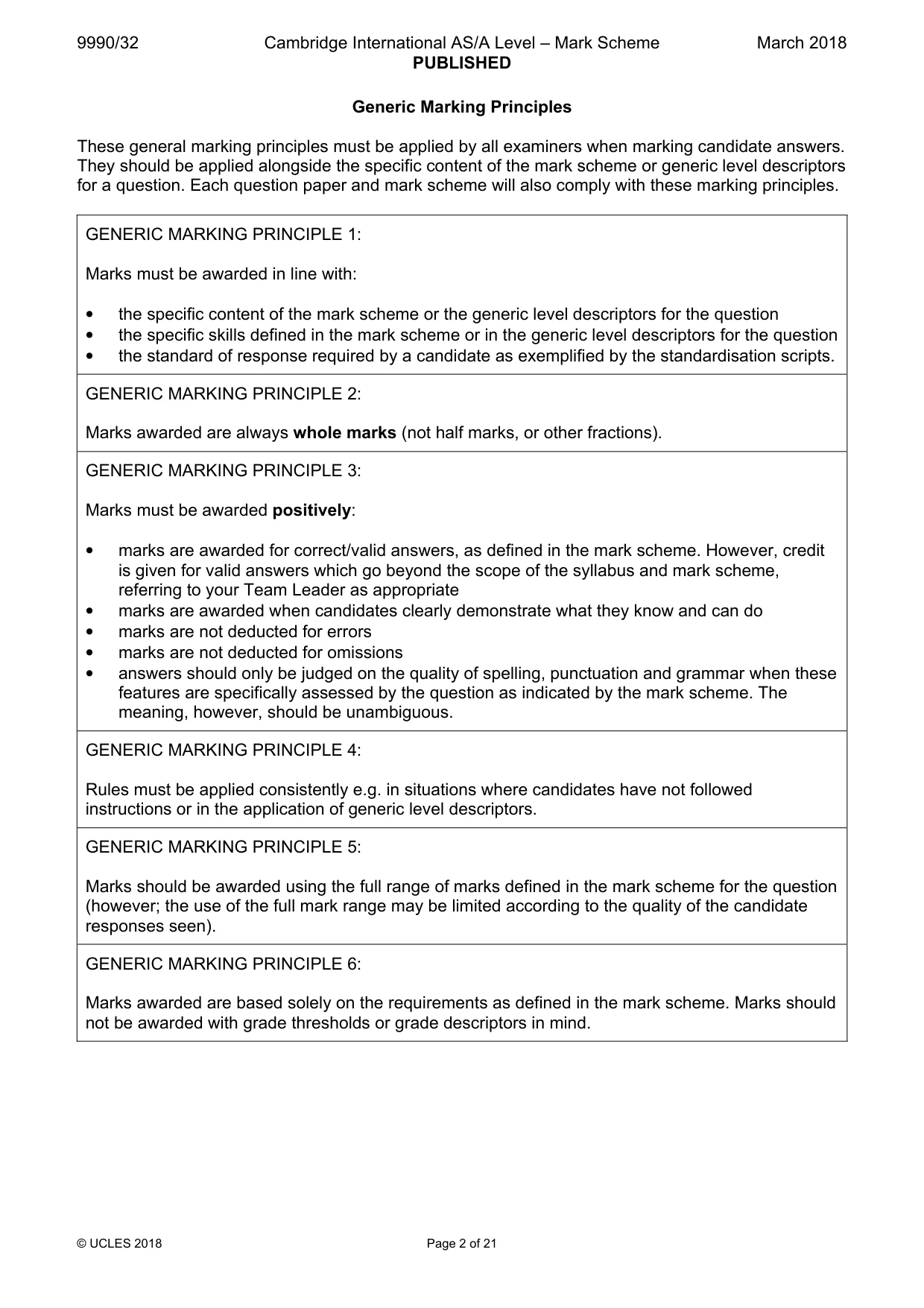
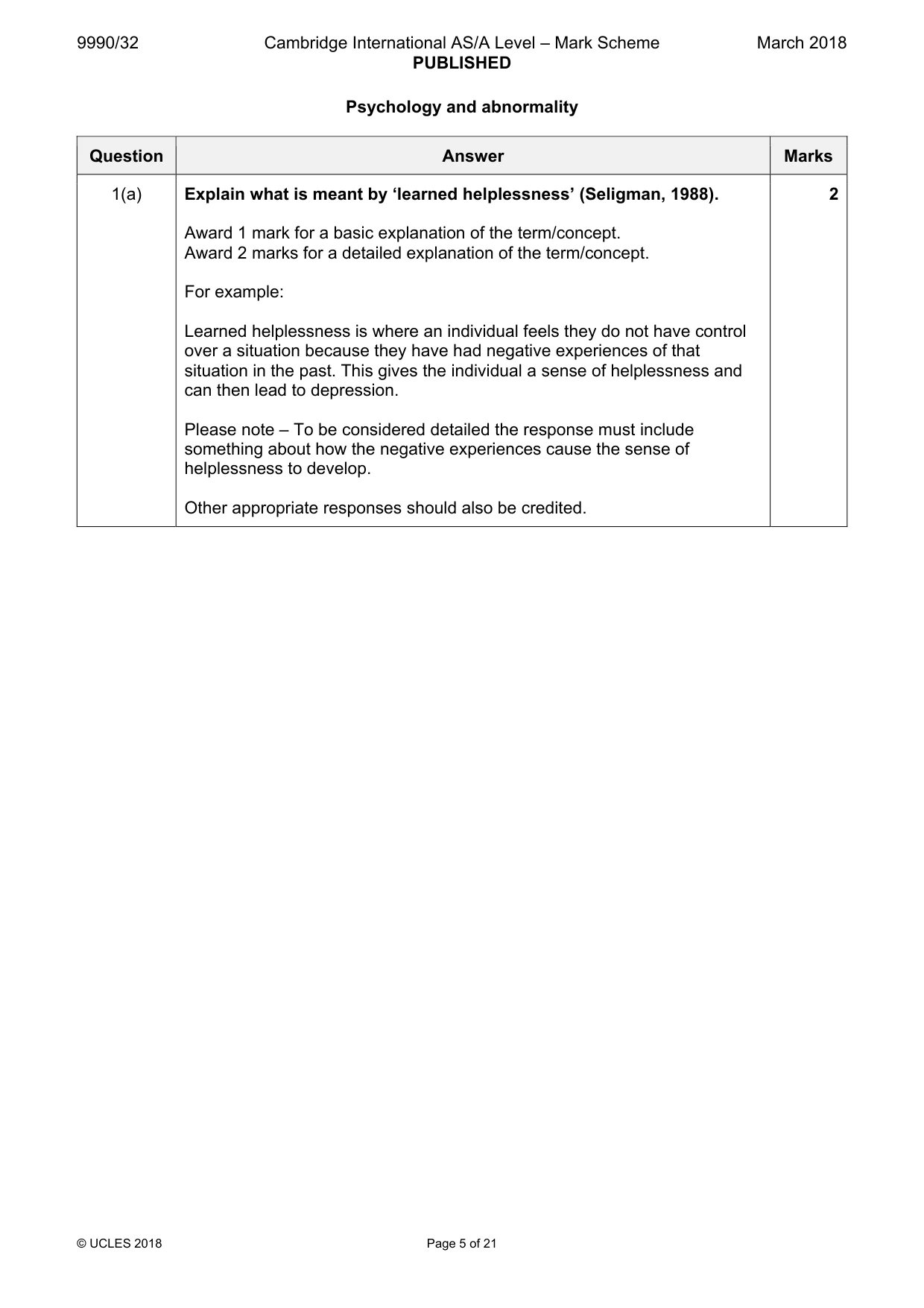
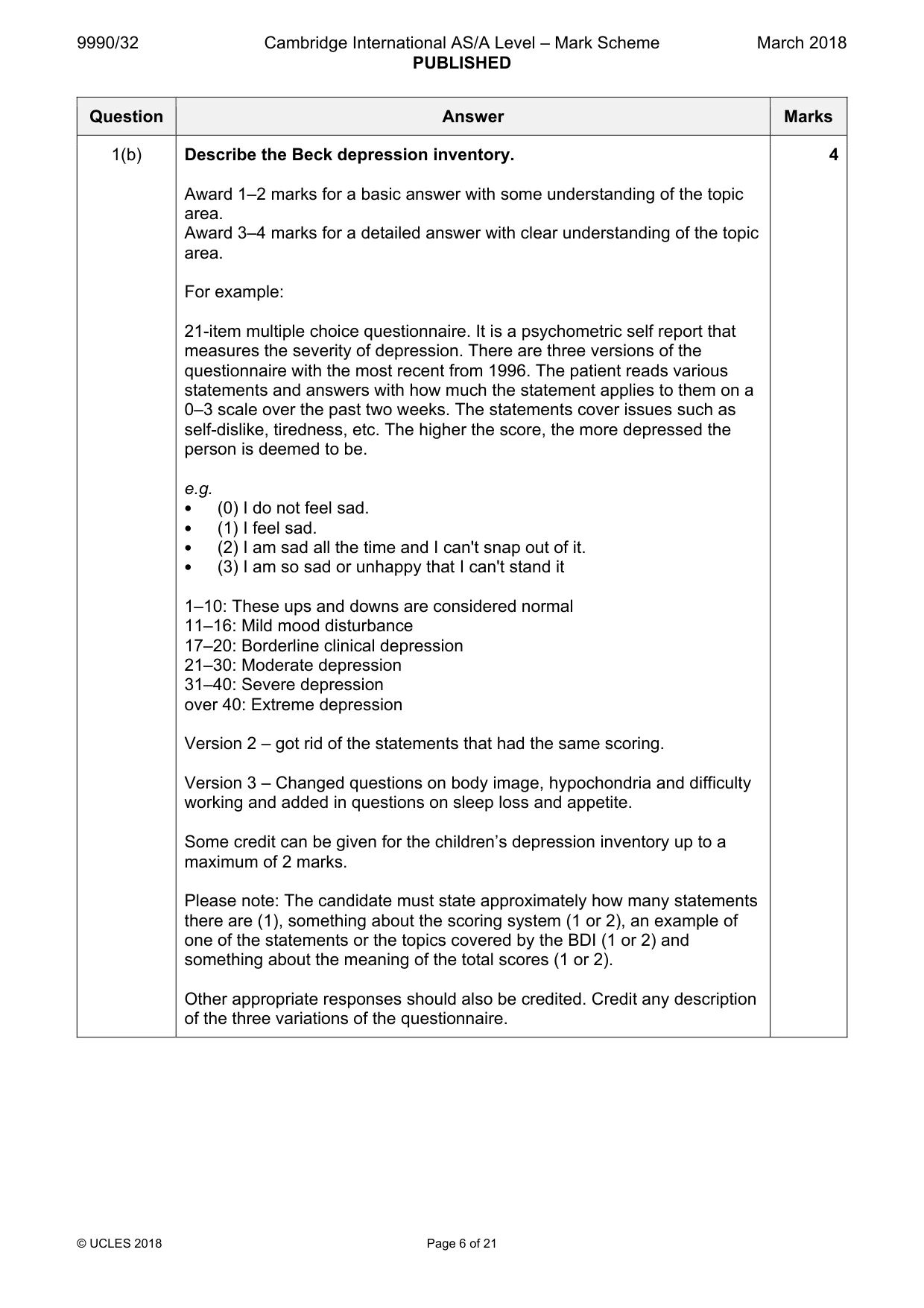
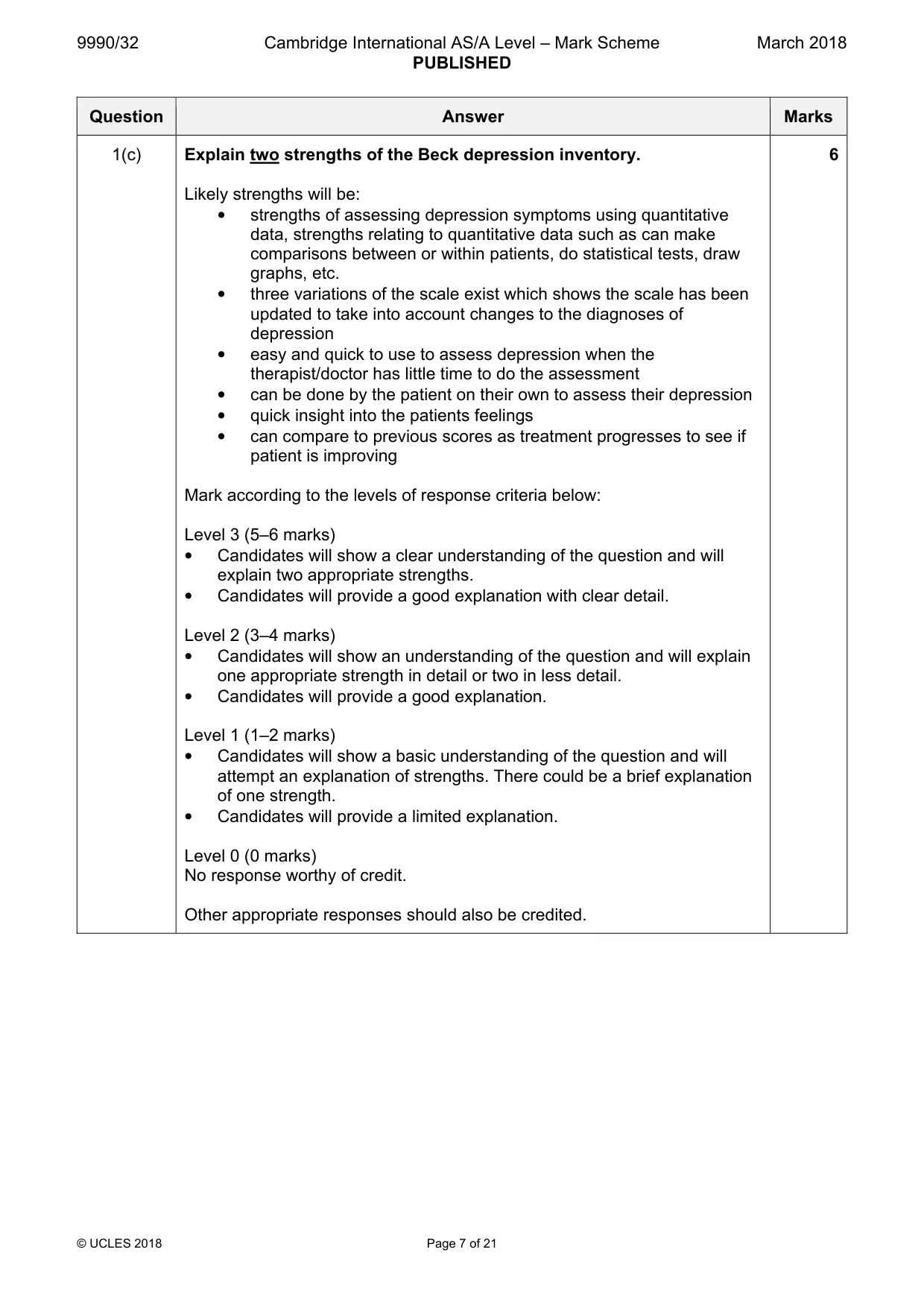
Mark scheme: Question Answer Marks 1(a) Explain what is meant by ‘learned helplessness’ (Seligman, 1988). 2 Award 1 mark for a basic explanation of the term/concept. Award 2 marks for a detailed explanation of the term/concept. For example: Learned helplessness is where an individual feels they do not have control over a situation because they have had negative experiences of that situation in the past. This gives the individual a sense of helplessness and can then lead to depression. Please note – To be considered detailed the response must include something about how the negative experiences cause the sense of helplessness to develop. Other appropriate responses should also be credited. 1(b) Describe the Beck depression inventory. 4 Award 1–2 marks for a basic answer with some understanding of the topic area. Award 3–4 marks for a detailed answer with clear understanding of the topic area. For example: 21-item multiple choice questionnaire. It is a psychometric self report that measures the severity of depression. There are three versions of the questionnaire with the most recent from 1996. The patient reads various statements and answers with how much the statement applies to them on a 0–3 scale over the past two weeks. The statements cover issues such as self-dislike, tiredness, etc. The higher the score, the more depressed the person is deemed to be. e.g. • (0) I do not feel sad. • (1) I feel sad. • (2) I am sad all the time and I can't snap out of it. • (3) I am so sad or unhappy that I can't stand it 1–10: These ups and downs are considered normal 11–16: Mild mood disturbance 17–20: Borderline clinical depression 21–30: Moderate depression 31–40: Severe depression over 40: Extreme depression Version 2 – got rid of the statements that had the same scoring. Version 3 – Changed questions on body image, hypochondria and difficulty working and added in questions on sleep loss and appetite. Some credit can be given for the children’s depression inventory up to a maximum of 2 marks. Please note: The candidate must state approximately how many statements there are (1), something about the scoring system (1 or 2), an example of one of the statements or the topics covered by the BDI (1 or 2) and something about the meaning of the total scores (1 or 2). Other appropriate responses should also be credited. Credit any description of the three variations of the questionnaire. 1(c) Explain two strengths of the Beck depression inventory. 6 Likely strengths will be: • strengths of assessing depression symptoms using quantitative data, strengths relating to quantitative data such as can make comparisons between or within patients, do statistical tests, draw graphs, etc. • three variations of the scale exist which shows the scale has been updated to take into account changes to the diagnoses of depression • easy and quick to use to assess depression when the therapist/doctor has little time to do the assessment • can be done by the patient on their own to assess their depression • quick insight into the patients feelings • can compare to previous scores as treatment progresses to see if patient is improving Mark according to the levels of response criteria below: Level 3 (5–6 marks) • Candidates will show a clear understanding of the question and will explain two appropriate strengths. • Candidates will provide a good explanation with clear detail. Level 2 (3–4 marks) • Candidates will show an understanding of the question and will explain one appropriate strength in detail or two in less detail. • Candidates will provide a good explanation. Level 1 (1–2 marks) • Candidates will show a basic understanding of the question and will attempt an explanation of strengths. There could be a brief explanation of one strength. • Candidates will provide a limited explanation. Level 0 (0 marks) No response worthy of credit. Other appropriate responses should also be credited.
More questions on Mood (affective) disorders: depressive disorder (unipolar) and bipolar disorder
Q2 · Describe explanations of obsessive-compulsive disorder (OCD)
2 (a) Describe explanations of obsessive-compulsive disorder (OCD). [8] (b) Evaluate explanations of obsessive-compulsive disorder (OCD), including a discussion of nature versus nurture. [10] Psychology and consumer behaviour Answer all questions.
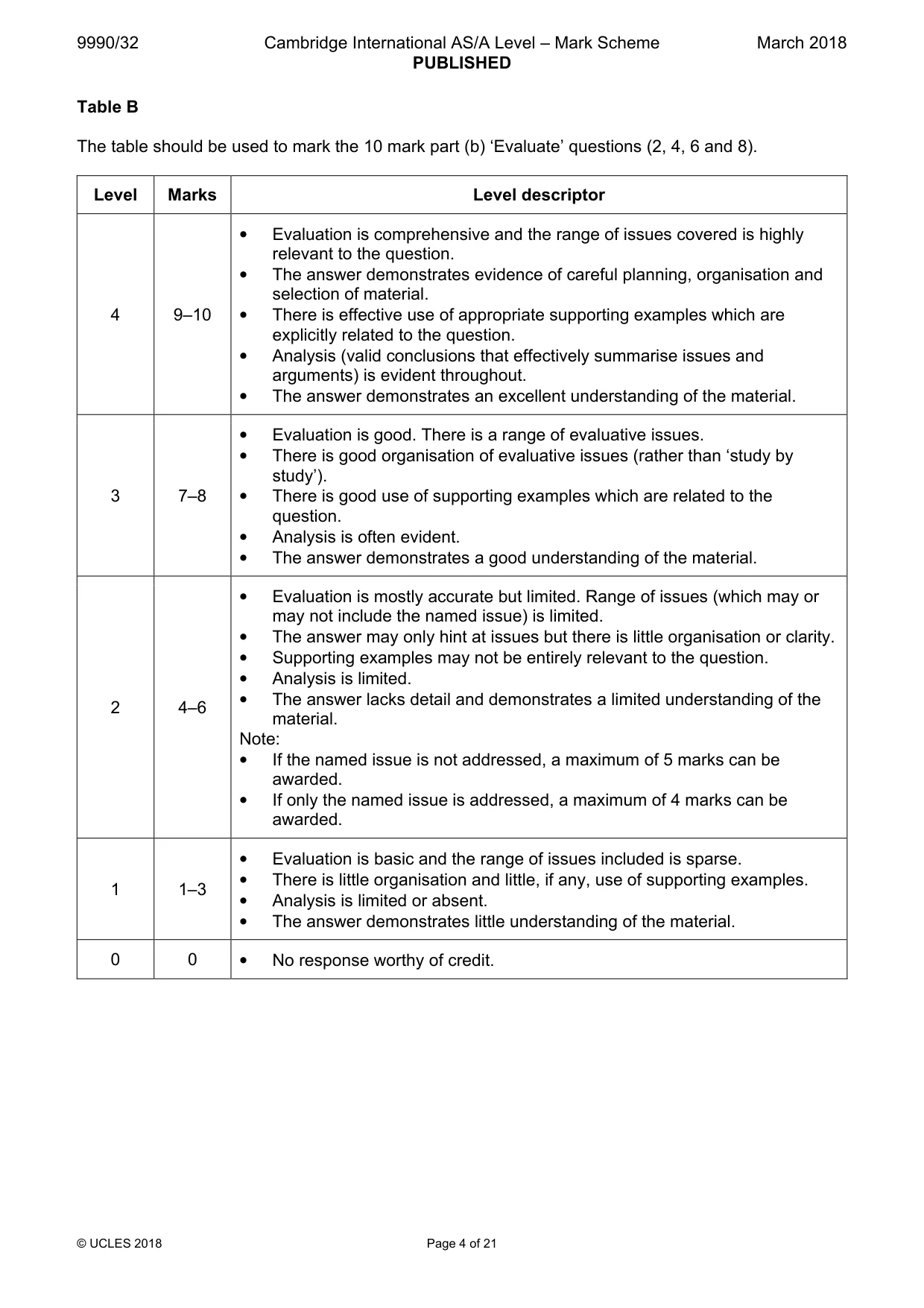
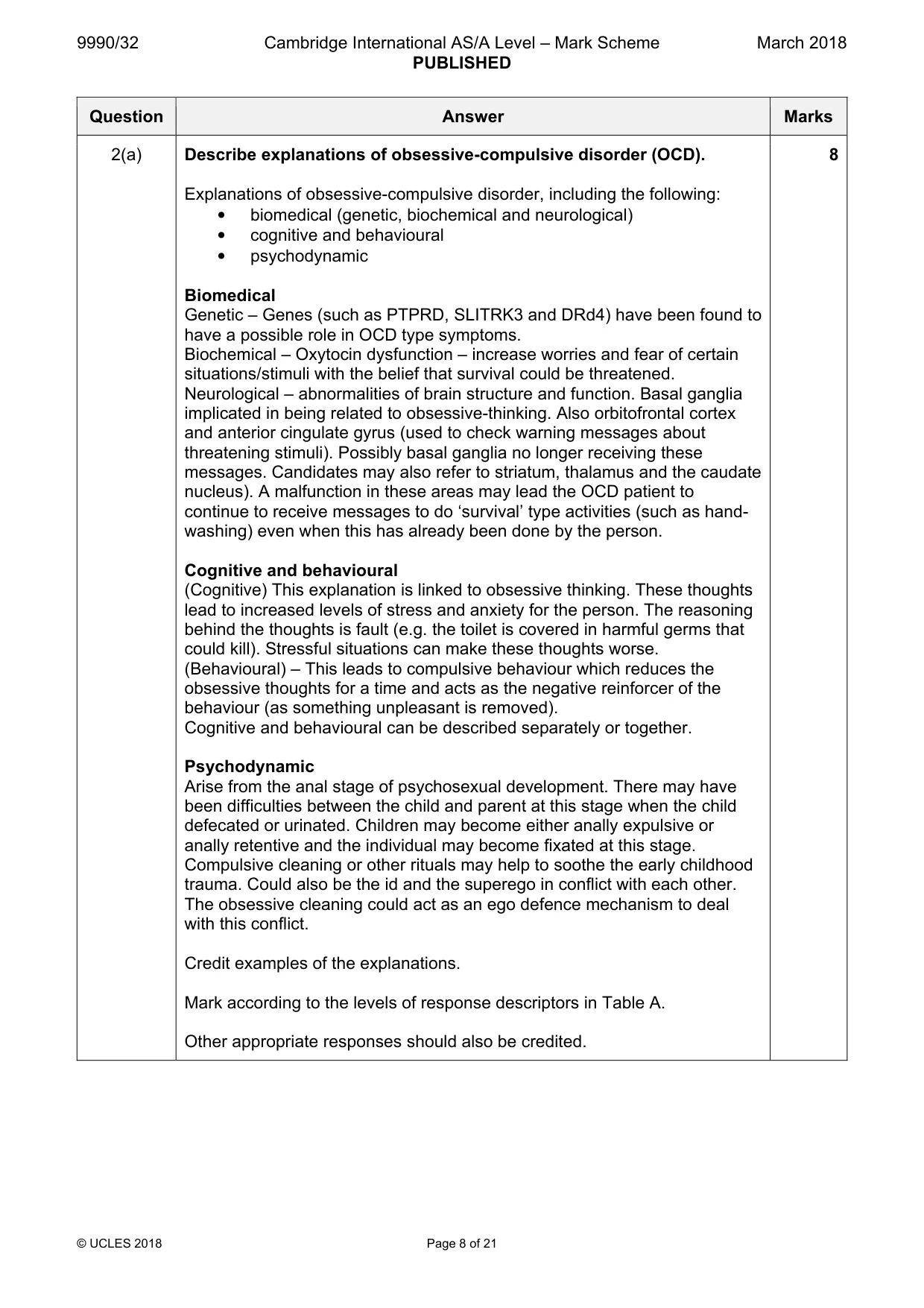
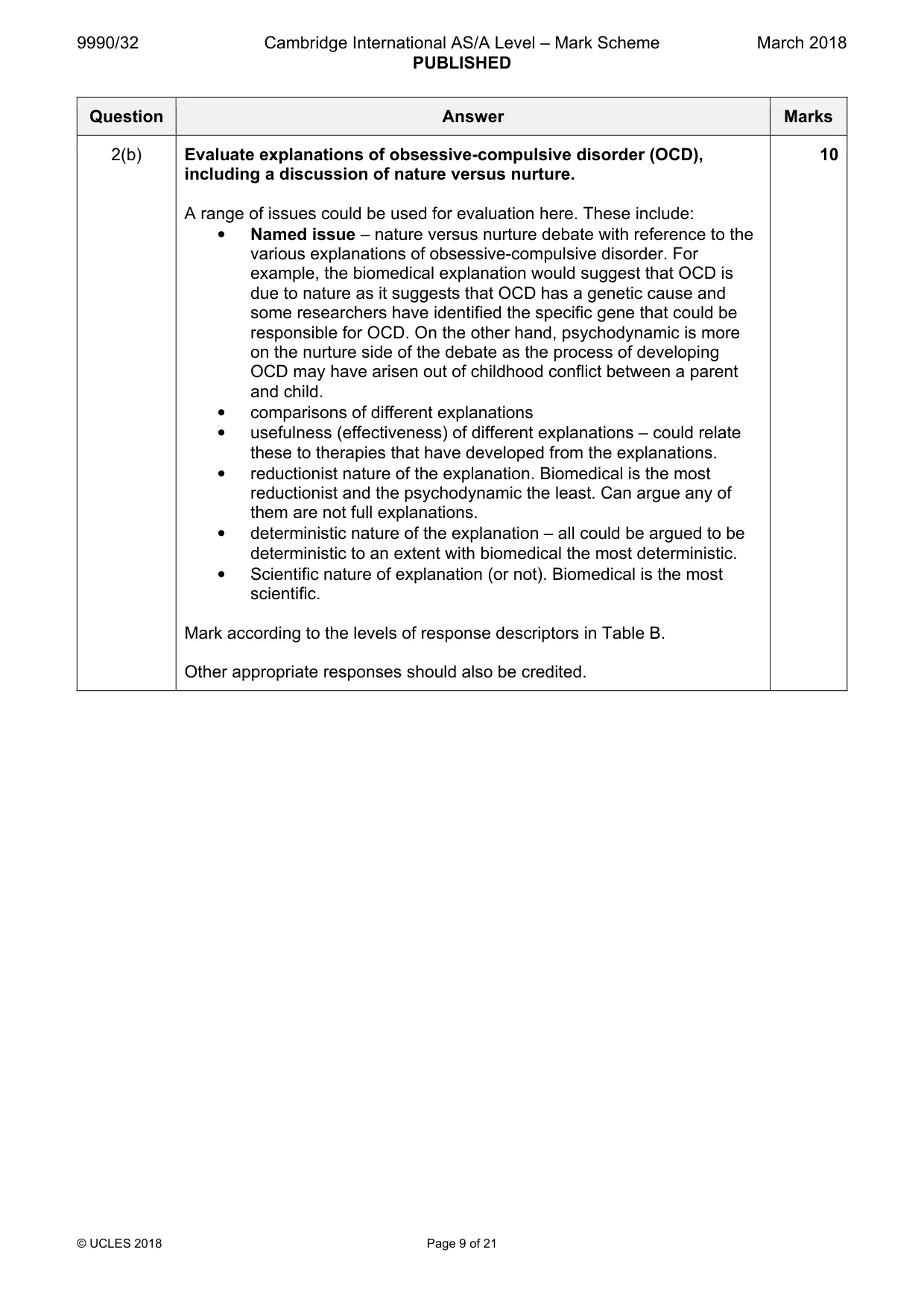
Mark scheme: 2(a) Describe explanations of obsessive-compulsive disorder (OCD). 8 Explanations of obsessive-compulsive disorder, including the following: • biomedical (genetic, biochemical and neurological) • cognitive and behavioural • psychodynamic Biomedical Genetic – Genes (such as PTPRD, SLITRK3 and DRd4) have been found to have a possible role in OCD type symptoms. Biochemical – Oxytocin dysfunction – increase worries and fear of certain situations/stimuli with the belief that survival could be threatened. Neurological – abnormalities of brain structure and function. Basal ganglia implicated in being related to obsessive-thinking. Also orbitofrontal cortex and anterior cingulate gyrus (used to check warning messages about threatening stimuli). Possibly basal ganglia no longer receiving these messages. Candidates may also refer to striatum, thalamus and the caudate nucleus). A malfunction in these areas may lead the OCD patient to continue to receive messages to do ‘survival’ type activities (such as hand- washing) even when this has already been done by the person. Cognitive and behavioural (Cognitive) This explanation is linked to obsessive thinking. These thoughts lead to increased levels of stress and anxiety for the person. The reasoning behind the thoughts is fault (e.g. the toilet is covered in harmful germs that could kill). Stressful situations can make these thoughts worse. (Behavioural) – This leads to compulsive behaviour which reduces the obsessive thoughts for a time and acts as the negative reinforcer of the behaviour (as something unpleasant is removed). Cognitive and behavioural can be described separately or together. Psychodynamic Arise from the anal stage of psychosexual development. There may have been difficulties between the child and parent at this stage when the child defecated or urinated. Children may become either anally expulsive or anally retentive and the individual may become fixated at this stage. Compulsive cleaning or other rituals may help to soothe the early childhood trauma. Could also be the id and the superego in conflict with each other. The obsessive cleaning could act as an ego defence mechanism to deal with this conflict. Credit examples of the explanations. Mark according to the levels of response descriptors in Table A. Other appropriate responses should also be credited. 2(b) Evaluate explanations of obsessive-compulsive disorder (OCD), 10 including a discussion of nature versus nurture. A range of issues could be used for evaluation here. These include: • Named issue – nature versus nurture debate with reference to the various explanations of obsessive-compulsive disorder. For example, the biomedical explanation would suggest that OCD is due to nature as it suggests that OCD has a genetic cause and some researchers have identified the specific gene that could be responsible for OCD. On the other hand, psychodynamic is more on the nurture side of the debate as the process of developing OCD may have arisen out of childhood conflict between a parent and child. • comparisons of different explanations • usefulness (effectiveness) of different explanations – could relate these to therapies that have developed from the explanations. • reductionist nature of the explanation. Biomedical is the most reductionist and the psychodynamic the least. Can argue any of them are not full explanations. • deterministic nature of the explanation – all could be argued to be deterministic to an extent with biomedical the most deterministic. • Scientific nature of explanation (or not). Biomedical is the most scientific. Mark according to the levels of response descriptors in Table B. Other appropriate responses should also be credited. Psychology and consumer behaviour
Q3 · Explain what is meant by ‘utility theory’ in consumer decision making
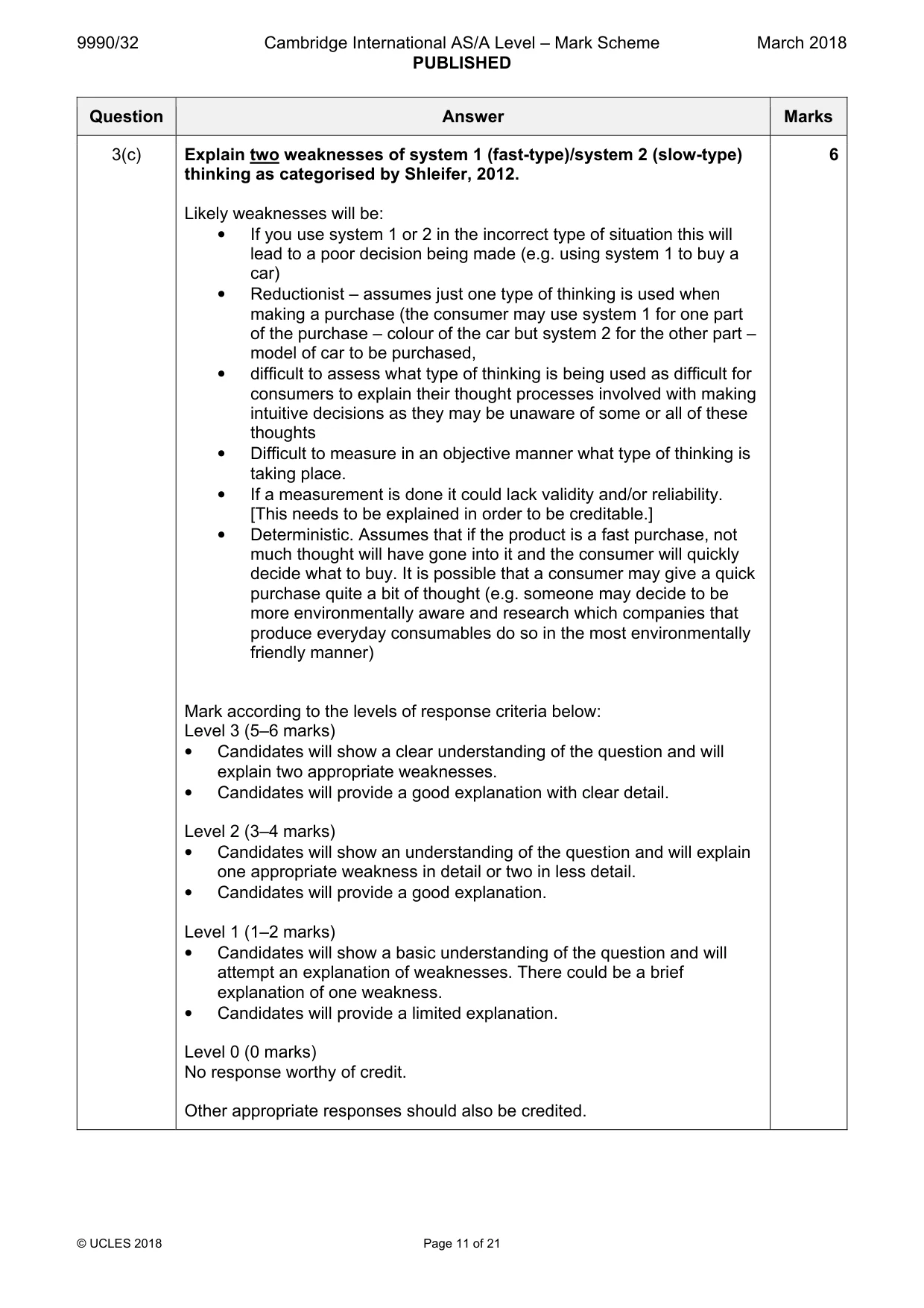
3 (a) Explain what is meant by ‘utility theory’ in consumer decision making. [2] (b) Describe system 1 (fast-type) and system 2 (slow-type) thinking of a consumer (Shleifer, 2012). [4] (c) Explain two weaknesses of system 1 (fast-type)/system 2 (slow-type) thinking as categorised by Shleifer, 2012. [6]
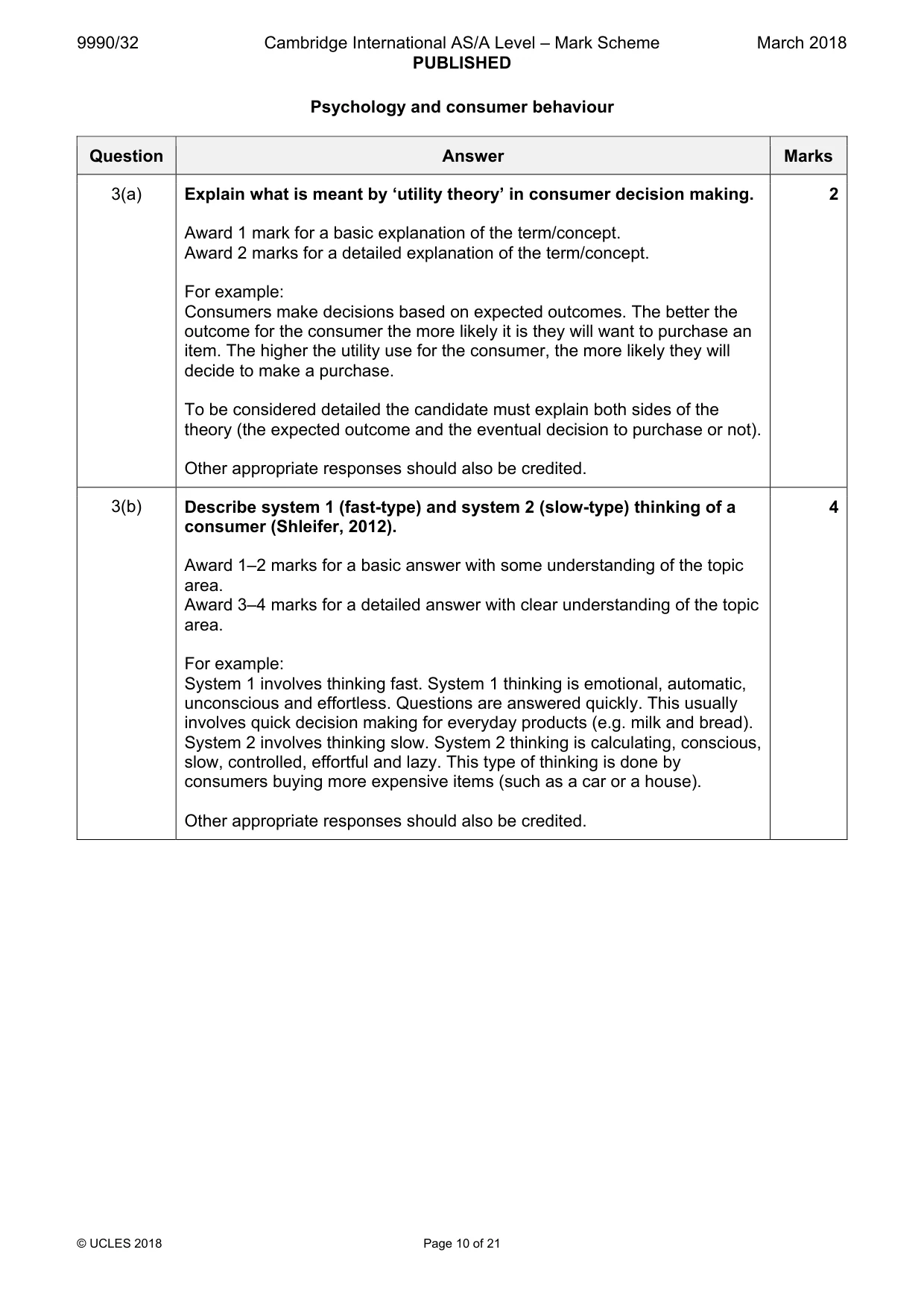
Mark scheme: 3(a) Explain what is meant by ‘utility theory’ in consumer decision making. 2 Award 1 mark for a basic explanation of the term/concept. Award 2 marks for a detailed explanation of the term/concept. For example: Consumers make decisions based on expected outcomes. The better the outcome for the consumer the more likely it is they will want to purchase an item. The higher the utility use for the consumer, the more likely they will decide to make a purchase. To be considered detailed the candidate must explain both sides of the theory (the expected outcome and the eventual decision to purchase or not). Other appropriate responses should also be credited. 3(b) Describe system 1 (fast-type) and system 2 (slow-type) thinking of a 4 consumer (Shleifer, 2012). Award 1–2 marks for a basic answer with some understanding of the topic area. Award 3–4 marks for a detailed answer with clear understanding of the topic area. For example: System 1 involves thinking fast. System 1 thinking is emotional, automatic, unconscious and effortless. Questions are answered quickly. This usually involves quick decision making for everyday products (e.g. milk and bread). System 2 involves thinking slow. System 2 thinking is calculating, conscious, slow, controlled, effortful and lazy. This type of thinking is done by consumers buying more expensive items (such as a car or a house). Other appropriate responses should also be credited. 3(c) Explain two weaknesses of system 1 (fast-type)/system 2 (slow-type) 6 thinking as categorised by Shleifer, 2012. Likely weaknesses will be: • If you use system 1 or 2 in the incorrect type of situation this will lead to a poor decision being made (e.g. using system 1 to buy a car) • Reductionist – assumes just one type of thinking is used when making a purchase (the consumer may use system 1 for one part of the purchase – colour of the car but system 2 for the other part – model of car to be purchased, • difficult to assess what type of thinking is being used as difficult for consumers to explain their thought processes involved with making intuitive decisions as they may be unaware of some or all of these thoughts • Difficult to measure in an objective manner what type of thinking is taking place. • If a measurement is done it could lack validity and/or reliability. [This needs to be explained in order to be creditable.] • Deterministic. Assumes that if the product is a fast purchase, not much thought will have gone into it and the consumer will quickly decide what to buy. It is possible that a consumer may give a quick purchase quite a bit of thought (e.g. someone may decide to be more environmentally aware and research which companies that produce everyday consumables do so in the most environmentally friendly manner) Mark according to the levels of response criteria below: Level 3 (5–6 marks) • Candidates will show a clear understanding of the question and will explain two appropriate weaknesses. • Candidates will provide a good explanation with clear detail. Level 2 (3–4 marks) • Candidates will show an understanding of the question and will explain one appropriate weakness in detail or two in less detail. • Candidates will provide a good explanation. Level 1 (1–2 marks) • Candidates will show a basic understanding of the question and will attempt an explanation of weaknesses. There could be a brief explanation of one weakness. • Candidates will provide a limited explanation. Level 0 (0 marks) No response worthy of credit. Other appropriate responses should also be credited.
Q4 · Describe what psychologists have discovered about retail/leisure environmental design
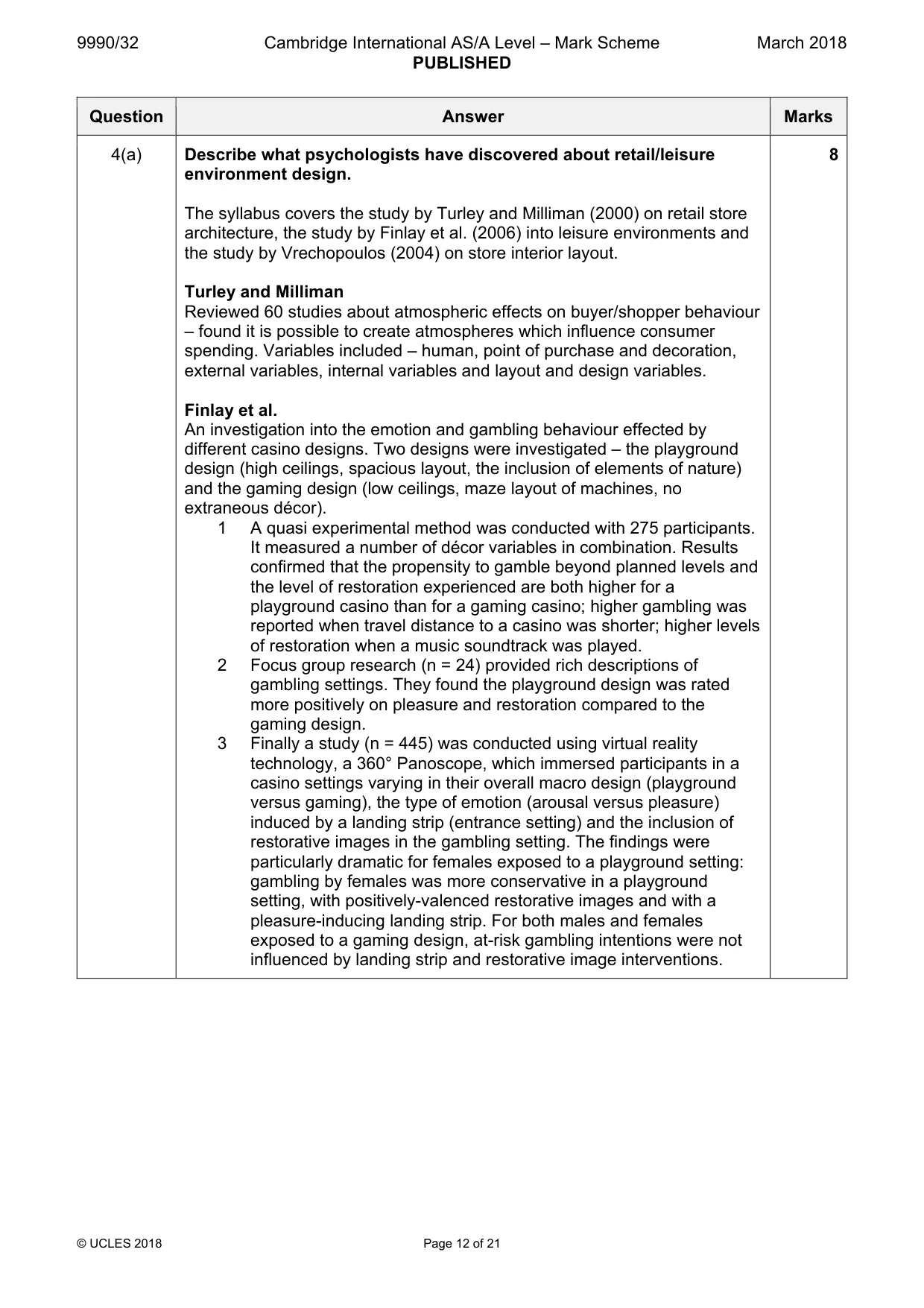
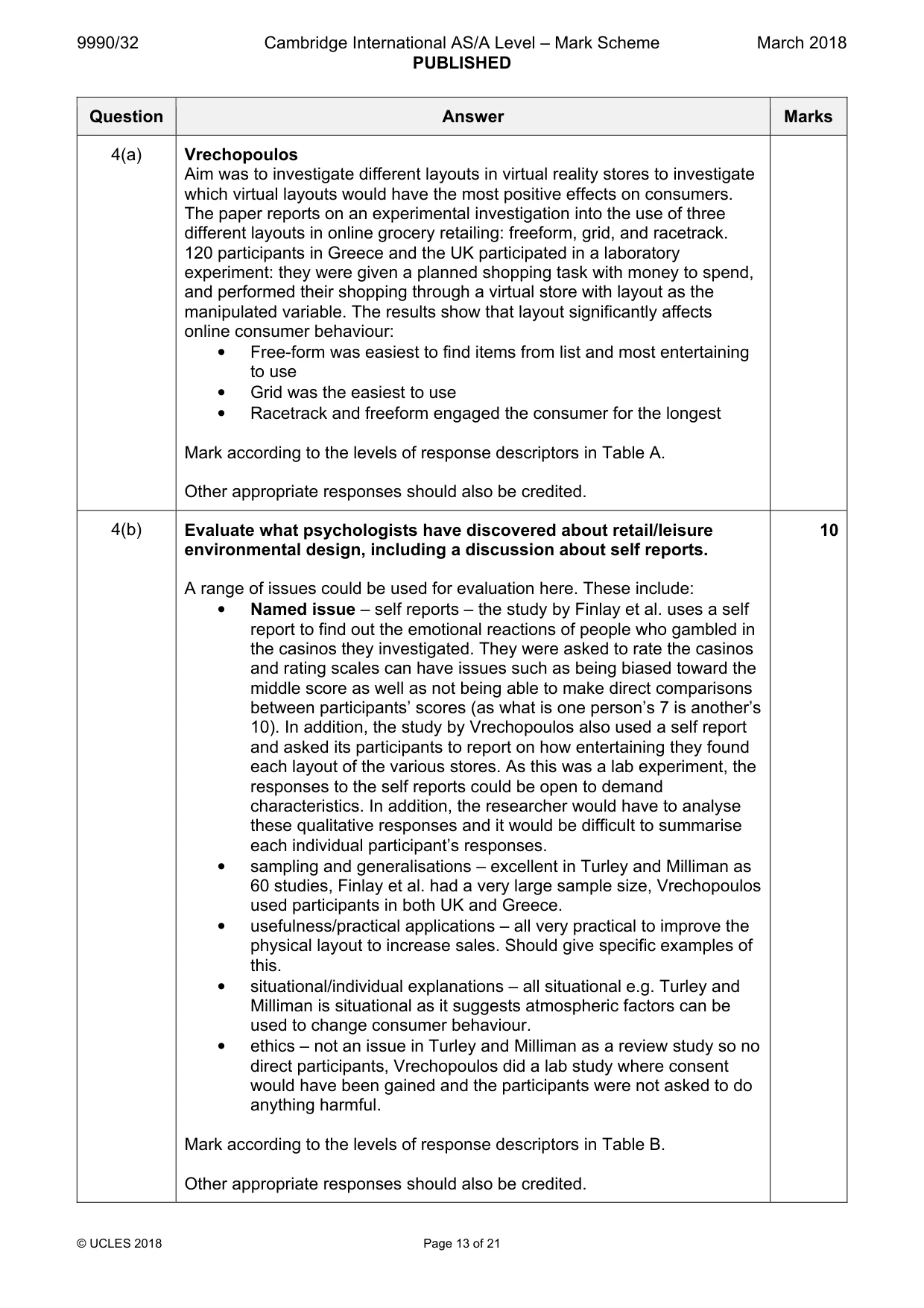
4 (a) Describe what psychologists have discovered about retail/leisure environmental design. [8] (b) Evaluate what psychologists have discovered about retail/leisure environmental design, including a discussion about self reports. [10] Psychology and health Answer all questions.
Mark scheme: 4(a) Describe what psychologists have discovered about retail/leisure 8 environment design. The syllabus covers the study by Turley and Milliman (2000) on retail store architecture, the study by Finlay et al. (2006) into leisure environments and the study by Vrechopoulos (2004) on store interior layout. Turley and Milliman Reviewed 60 studies about atmospheric effects on buyer/shopper behaviour – found it is possible to create atmospheres which influence consumer spending. Variables included – human, point of purchase and decoration, external variables, internal variables and layout and design variables. Finlay et al. An investigation into the emotion and gambling behaviour effected by different casino designs. Two designs were investigated – the playground design (high ceilings, spacious layout, the inclusion of elements of nature) and the gaming design (low ceilings, maze layout of machines, no extraneous décor). 1 A quasi experimental method was conducted with 275 participants. It measured a number of décor variables in combination. Results confirmed that the propensity to gamble beyond planned levels and the level of restoration experienced are both higher for a playground casino than for a gaming casino; higher gambling was reported when travel distance to a casino was shorter; higher levels of restoration when a music soundtrack was played. 2 Focus group research (n = 24) provided rich descriptions of gambling settings. They found the playground design was rated more positively on pleasure and restoration compared to the gaming design. 3 Finally a study (n = 445) was conducted using virtual reality technology, a 360° Panoscope, which immersed participants in a casino settings varying in their overall macro design (playground versus gaming), the type of emotion (arousal versus pleasure) induced by a landing strip (entrance setting) and the inclusion of restorative images in the gambling setting. The findings were particularly dramatic for females exposed to a playground setting: gambling by females was more conservative in a playground setting, with positively-valenced restorative images and with a pleasure-inducing landing strip. For both males and females exposed to a gaming design, at-risk gambling intentions were not influenced by landing strip and restorative image interventions. 4(a) Vrechopoulos Aim was to investigate different layouts in virtual reality stores to investigate which virtual layouts would have the most positive effects on consumers. The paper reports on an experimental investigation into the use of three different layouts in online grocery retailing: freeform, grid, and racetrack. 120 participants in Greece and the UK participated in a laboratory experiment: they were given a planned shopping task with money to spend, and performed their shopping through a virtual store with layout as the manipulated variable. The results show that layout significantly affects online consumer behaviour: • Free-form was easiest to find items from list and most entertaining to use • Grid was the easiest to use • Racetrack and freeform engaged the consumer for the longest Mark according to the levels of response descriptors in Table A. Other appropriate responses should also be credited. 4(b) Evaluate what psychologists have discovered about retail/leisure 10 environmental design, including a discussion about self reports. A range of issues could be used for evaluation here. These include: • Named issue – self reports – the study by Finlay et al. uses a self report to find out the emotional reactions of people who gambled in the casinos they investigated. They were asked to rate the casinos and rating scales can have issues such as being biased toward the middle score as well as not being able to make direct comparisons between participants’ scores (as what is one person’s 7 is another’s 10). In addition, the study by Vrechopoulos also used a self report and asked its participants to report on how entertaining they found each layout of the various stores. As this was a lab experiment, the responses to the self reports could be open to demand characteristics. In addition, the researcher would have to analyse these qualitative responses and it would be difficult to summarise each individual participant’s responses. • sampling and generalisations – excellent in Turley and Milliman as 60 studies, Finlay et al. had a very large sample size, Vrechopoulos used participants in both UK and Greece. • usefulness/practical applications – all very practical to improve the physical layout to increase sales. Should give specific examples of this. • situational/individual explanations – all situational e.g. Turley and Milliman is situational as it suggests atmospheric factors can be used to change consumer behaviour. • ethics – not an issue in Turley and Milliman as a review study so no direct participants, Vrechopoulos did a lab study where consent would have been gained and the participants were not asked to do anything harmful. Mark according to the levels of response descriptors in Table B. Other appropriate responses should also be credited. Psychology and health
Q5 · Explain what is meant by the ‘GAS model of stress’ (Selye, 1936)
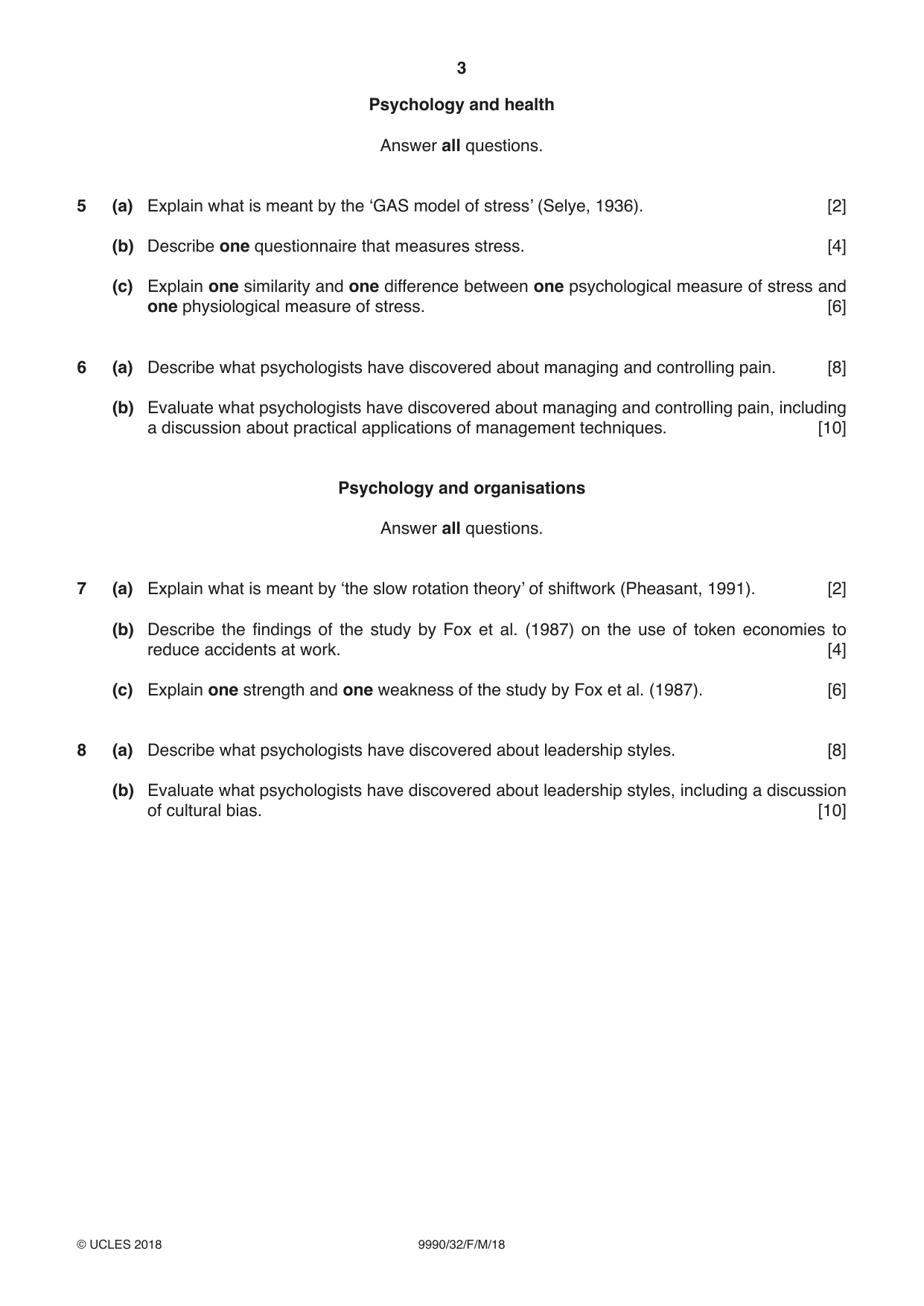
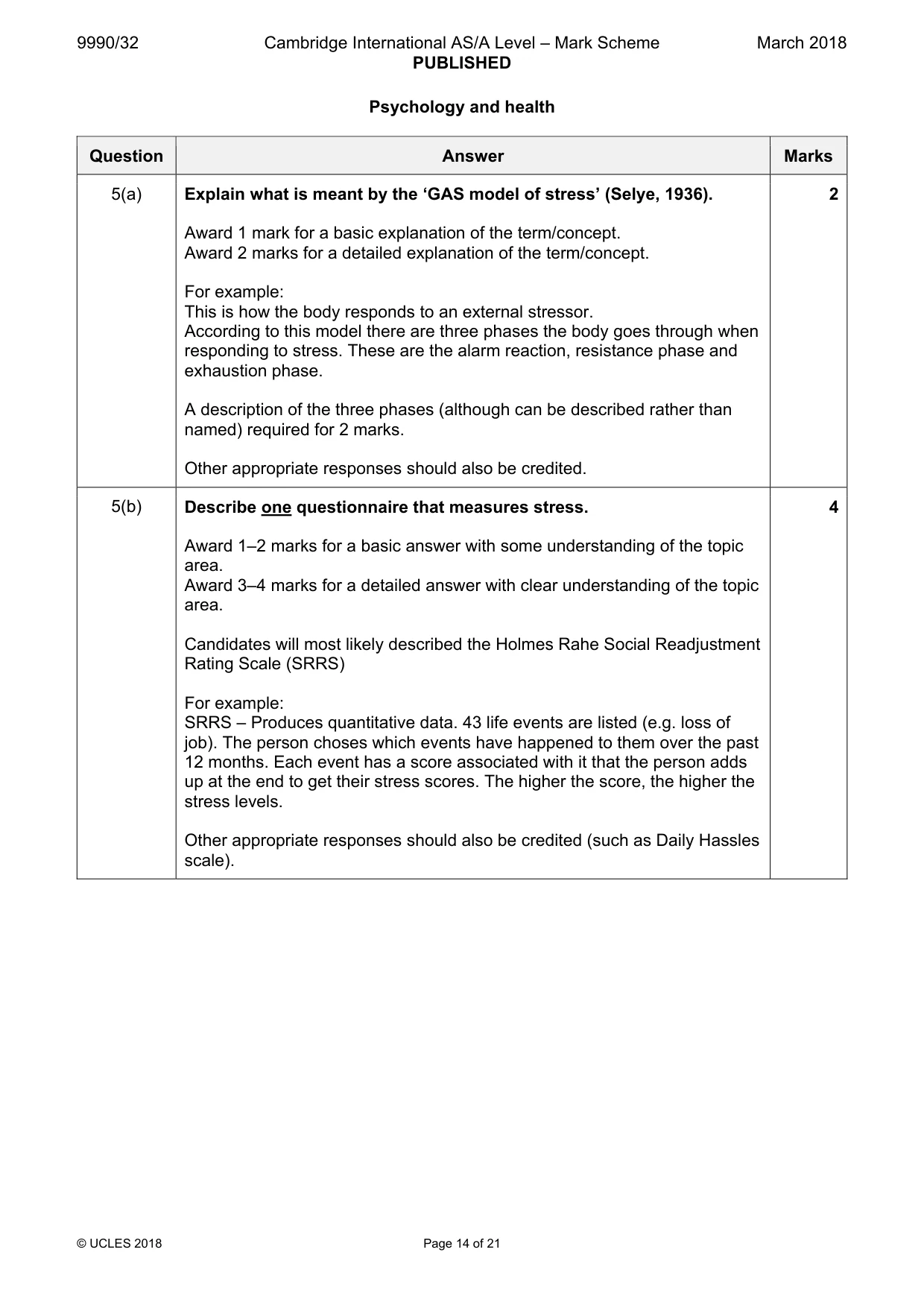
5 (a) Explain what is meant by the ‘GAS model of stress’ (Selye, 1936). [2] (b) Describe one questionnaire that measures stress. [4] (c) Explain one similarity and one difference between one psychological measure of stress and one physiological measure of stress. [6]
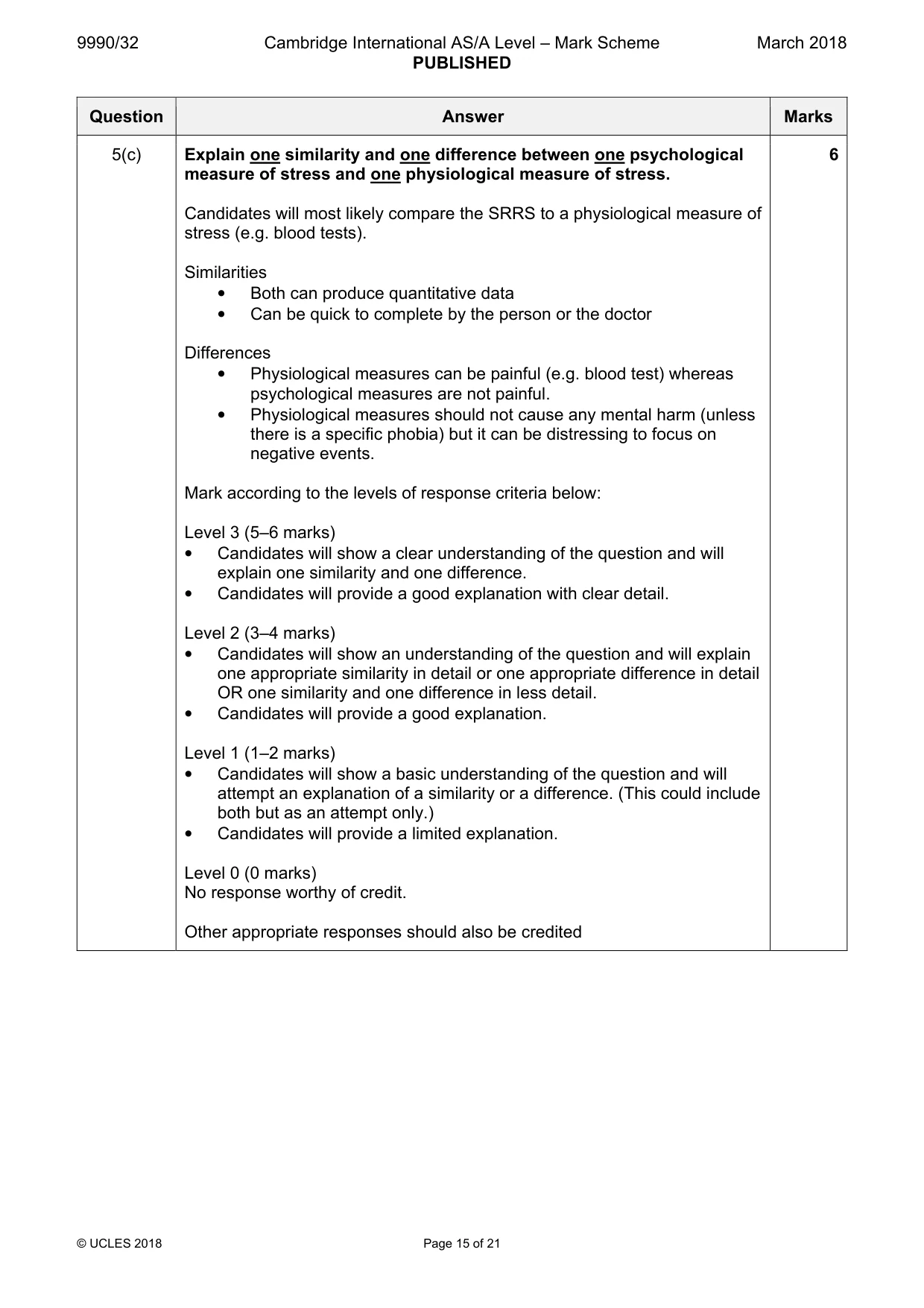
Mark scheme: 5(a) Explain what is meant by the ‘GAS model of stress’ (Selye, 1936). 2 Award 1 mark for a basic explanation of the term/concept. Award 2 marks for a detailed explanation of the term/concept. For example: This is how the body responds to an external stressor. According to this model there are three phases the body goes through when responding to stress. These are the alarm reaction, resistance phase and exhaustion phase. A description of the three phases (although can be described rather than named) required for 2 marks. Other appropriate responses should also be credited. 5(b) Describe one questionnaire that measures stress. 4 Award 1–2 marks for a basic answer with some understanding of the topic area. Award 3–4 marks for a detailed answer with clear understanding of the topic area. Candidates will most likely described the Holmes Rahe Social Readjustment Rating Scale (SRRS) For example: SRRS – Produces quantitative data. 43 life events are listed (e.g. loss of job). The person choses which events have happened to them over the past 12 months. Each event has a score associated with it that the person adds up at the end to get their stress scores. The higher the score, the higher the stress levels. Other appropriate responses should also be credited (such as Daily Hassles scale). 5(c) Explain one similarity and one difference between one psychological 6 measure of stress and one physiological measure of stress. Candidates will most likely compare the SRRS to a physiological measure of stress (e.g. blood tests). Similarities • Both can produce quantitative data • Can be quick to complete by the person or the doctor Differences • Physiological measures can be painful (e.g. blood test) whereas psychological measures are not painful. • Physiological measures should not cause any mental harm (unless there is a specific phobia) but it can be distressing to focus on negative events. Mark according to the levels of response criteria below: Level 3 (5–6 marks) • Candidates will show a clear understanding of the question and will explain one similarity and one difference. • Candidates will provide a good explanation with clear detail. Level 2 (3–4 marks) • Candidates will show an understanding of the question and will explain one appropriate similarity in detail or one appropriate difference in detail OR one similarity and one difference in less detail. • Candidates will provide a good explanation. Level 1 (1–2 marks) • Candidates will show a basic understanding of the question and will attempt an explanation of a similarity or a difference. (This could include both but as an attempt only.) • Candidates will provide a limited explanation. Level 0 (0 marks) No response worthy of credit. Other appropriate responses should also be credited
Q6 · Describe what psychologists have discovered about managing and controlling pain
6 (a) Describe what psychologists have discovered about managing and controlling pain. [8] (b) Evaluate what psychologists have discovered about managing and controlling pain, including a discussion about practical applications of management techniques. [10] Psychology and organisations Answer all questions.
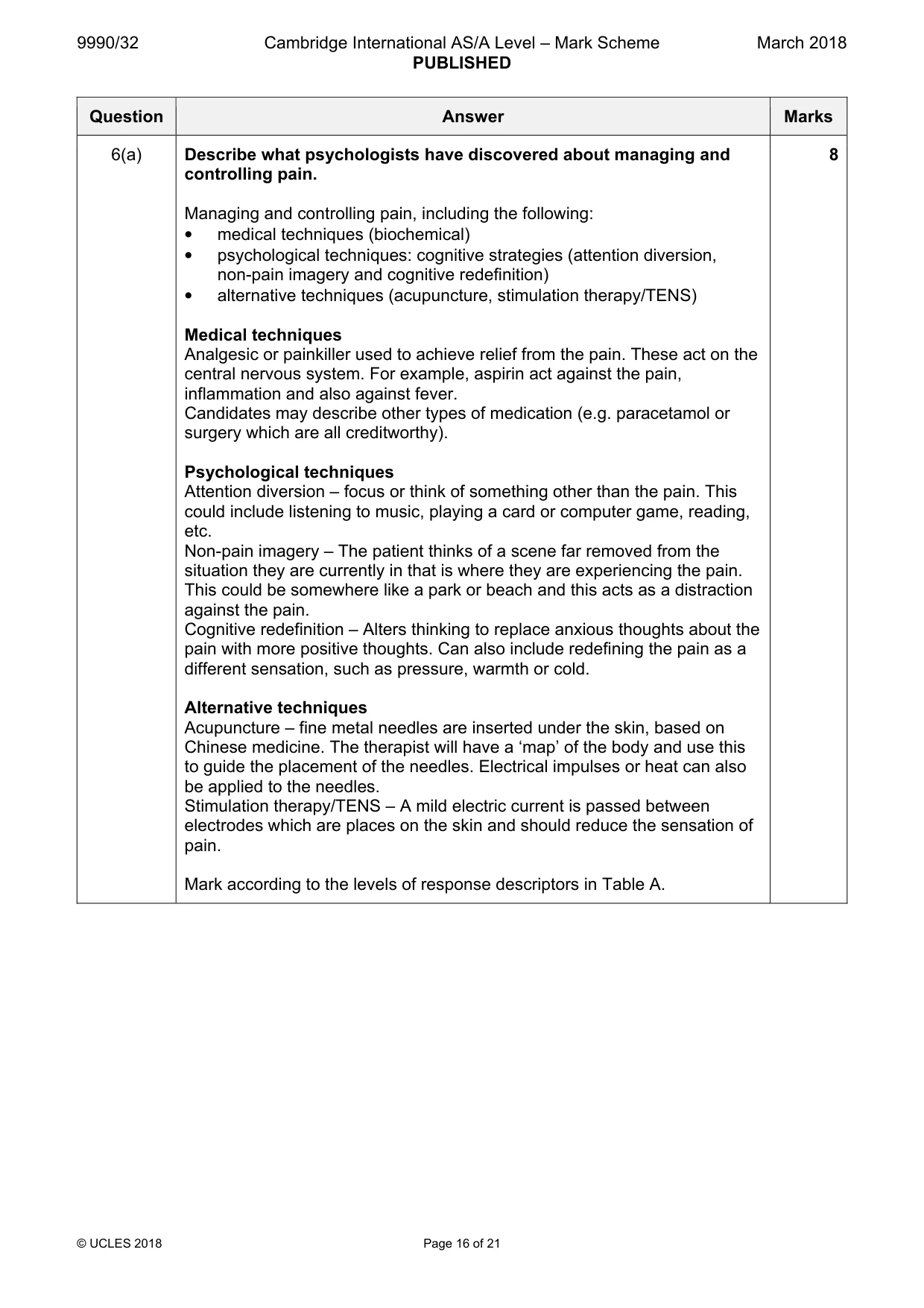
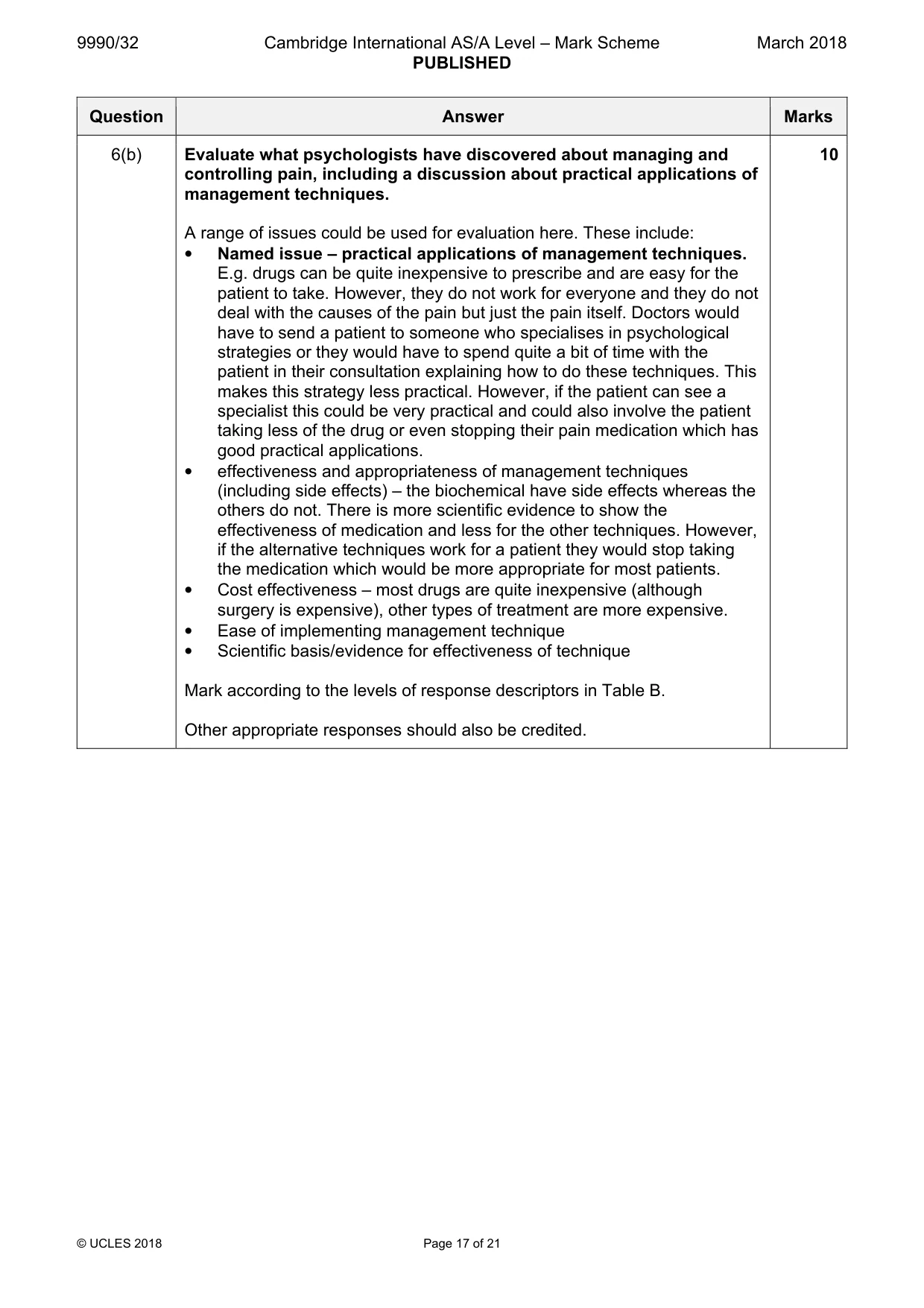
Mark scheme: 6(a) Describe what psychologists have discovered about managing and 8 controlling pain. Managing and controlling pain, including the following: • medical techniques (biochemical) • psychological techniques: cognitive strategies (attention diversion, non-pain imagery and cognitive redefinition) • alternative techniques (acupuncture, stimulation therapy/TENS) Medical techniques Analgesic or painkiller used to achieve relief from the pain. These act on the central nervous system. For example, aspirin act against the pain, inflammation and also against fever. Candidates may describe other types of medication (e.g. paracetamol or surgery which are all creditworthy). Psychological techniques Attention diversion – focus or think of something other than the pain. This could include listening to music, playing a card or computer game, reading, etc. Non-pain imagery – The patient thinks of a scene far removed from the situation they are currently in that is where they are experiencing the pain. This could be somewhere like a park or beach and this acts as a distraction against the pain. Cognitive redefinition – Alters thinking to replace anxious thoughts about the pain with more positive thoughts. Can also include redefining the pain as a different sensation, such as pressure, warmth or cold. Alternative techniques Acupuncture – fine metal needles are inserted under the skin, based on Chinese medicine. The therapist will have a ‘map’ of the body and use this to guide the placement of the needles. Electrical impulses or heat can also be applied to the needles. Stimulation therapy/TENS – A mild electric current is passed between electrodes which are places on the skin and should reduce the sensation of pain. Mark according to the levels of response descriptors in Table A. 6(b) Evaluate what psychologists have discovered about managing and 10 controlling pain, including a discussion about practical applications of management techniques. A range of issues could be used for evaluation here. These include: • Named issue – practical applications of management techniques. E.g. drugs can be quite inexpensive to prescribe and are easy for the patient to take. However, they do not work for everyone and they do not deal with the causes of the pain but just the pain itself. Doctors would have to send a patient to someone who specialises in psychological strategies or they would have to spend quite a bit of time with the patient in their consultation explaining how to do these techniques. This makes this strategy less practical. However, if the patient can see a specialist this could be very practical and could also involve the patient taking less of the drug or even stopping their pain medication which has good practical applications. • effectiveness and appropriateness of management techniques (including side effects) – the biochemical have side effects whereas the others do not. There is more scientific evidence to show the effectiveness of medication and less for the other techniques. However, if the alternative techniques work for a patient they would stop taking the medication which would be more appropriate for most patients. • Cost effectiveness – most drugs are quite inexpensive (although surgery is expensive), other types of treatment are more expensive. • Ease of implementing management technique • Scientific basis/evidence for effectiveness of technique Mark according to the levels of response descriptors in Table B. Other appropriate responses should also be credited. Psychology and organisations
Q7 · Explain what is meant by ‘the slow rotation theory’ of shiftwork (Pheasant, 1991)
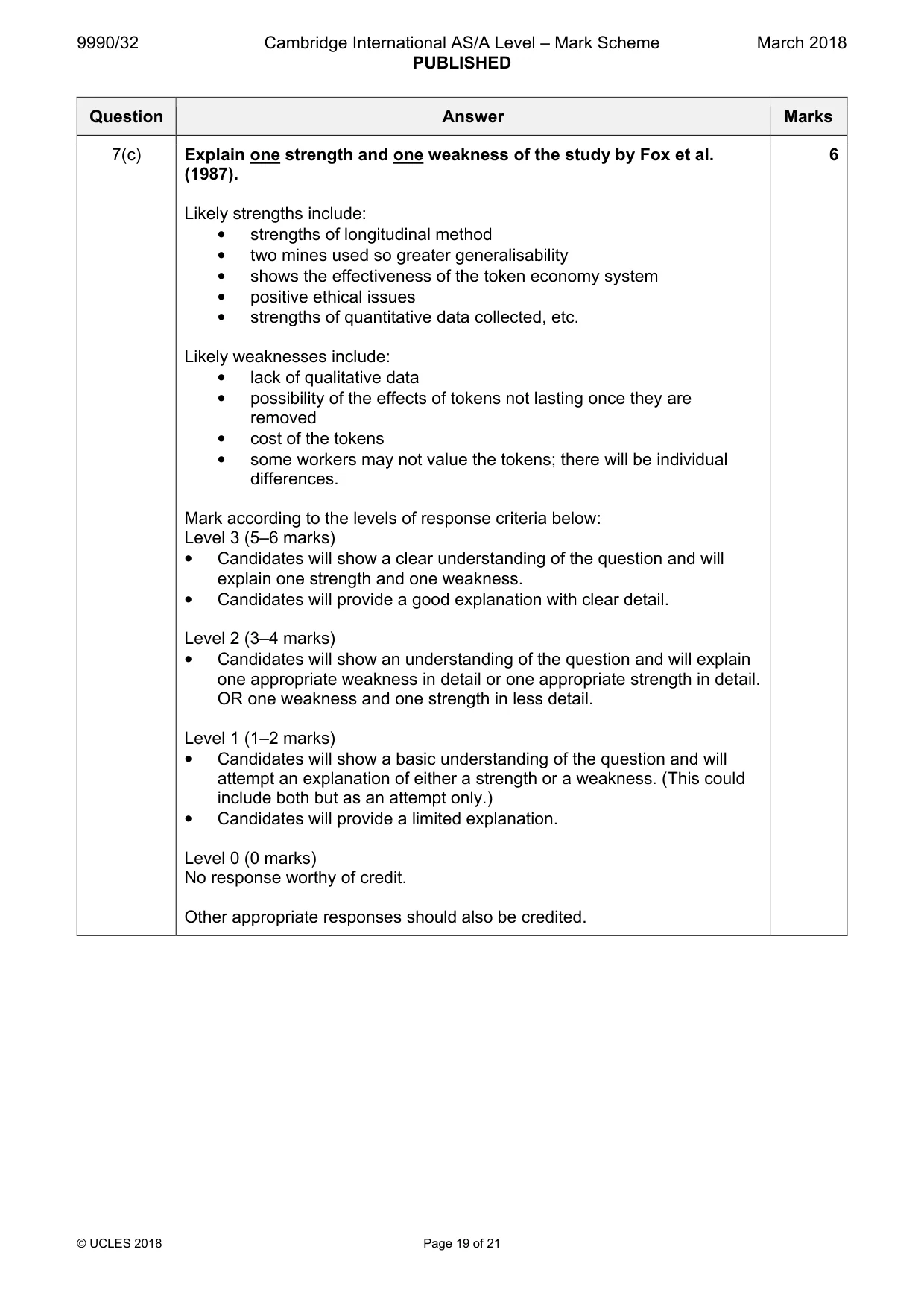
7 (a) Explain what is meant by ‘the slow rotation theory’ of shiftwork (Pheasant, 1991). [2] (b) Describe the findings of the study by Fox et al. (1987) on the use of token economies to reduce accidents at work. [4] (c) Explain one strength and one weakness of the study by Fox et al. (1987). [6]
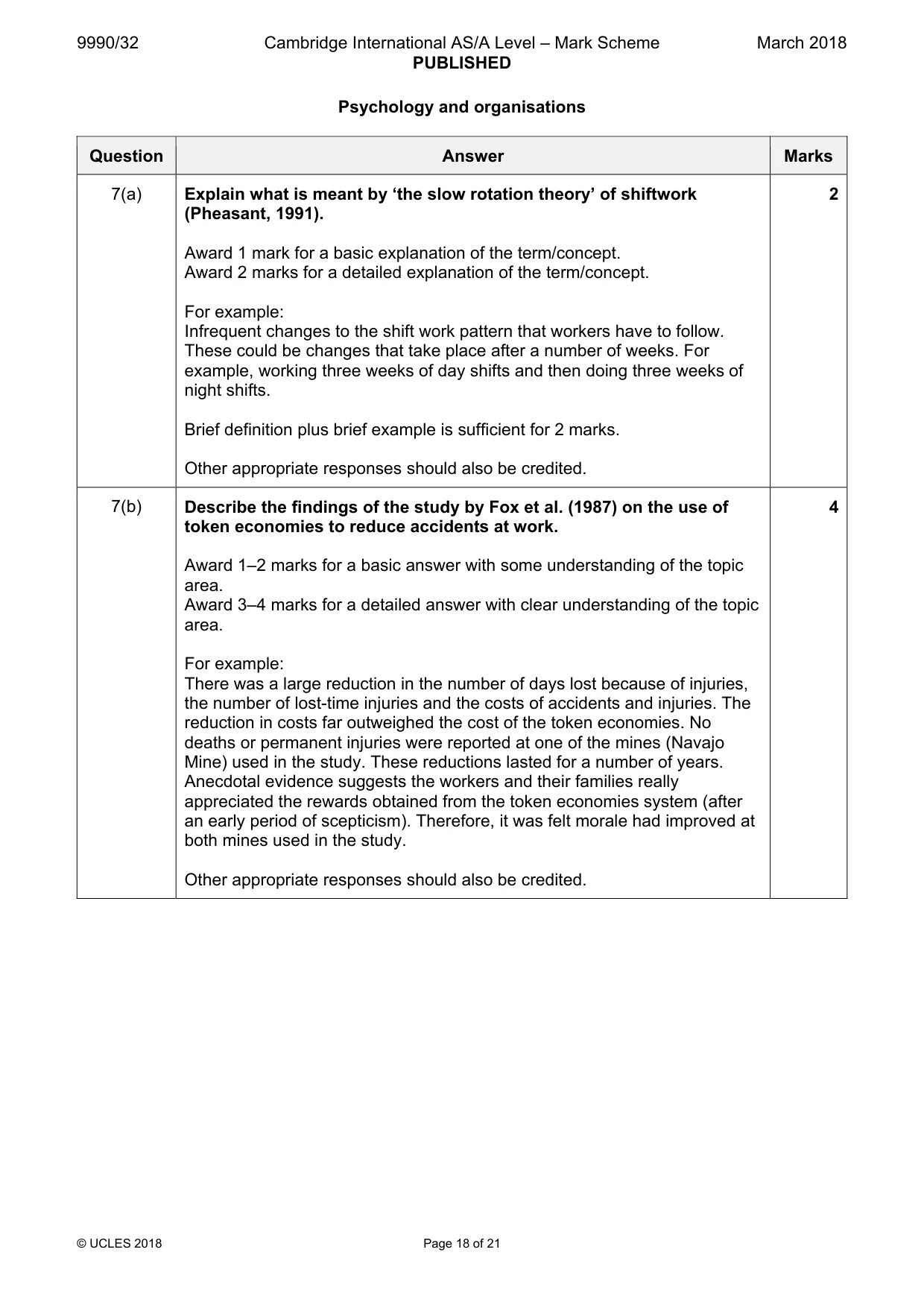
Mark scheme: 7(a) Explain what is meant by ‘the slow rotation theory’ of shiftwork 2 (Pheasant, 1991). Award 1 mark for a basic explanation of the term/concept. Award 2 marks for a detailed explanation of the term/concept. For example: Infrequent changes to the shift work pattern that workers have to follow. These could be changes that take place after a number of weeks. For example, working three weeks of day shifts and then doing three weeks of night shifts. Brief definition plus brief example is sufficient for 2 marks. Other appropriate responses should also be credited. 7(b) Describe the findings of the study by Fox et al. (1987) on the use of 4 token economies to reduce accidents at work. Award 1–2 marks for a basic answer with some understanding of the topic area. Award 3–4 marks for a detailed answer with clear understanding of the topic area. For example: There was a large reduction in the number of days lost because of injuries, the number of lost-time injuries and the costs of accidents and injuries. The reduction in costs far outweighed the cost of the token economies. No deaths or permanent injuries were reported at one of the mines (Navajo Mine) used in the study. These reductions lasted for a number of years. Anecdotal evidence suggests the workers and their families really appreciated the rewards obtained from the token economies system (after an early period of scepticism). Therefore, it was felt morale had improved at both mines used in the study. Other appropriate responses should also be credited. 7(c) Explain one strength and one weakness of the study by Fox et al. 6 (1987). Likely strengths include: • strengths of longitudinal method • two mines used so greater generalisability • shows the effectiveness of the token economy system • positive ethical issues • strengths of quantitative data collected, etc. Likely weaknesses include: • lack of qualitative data • possibility of the effects of tokens not lasting once they are removed • cost of the tokens • some workers may not value the tokens; there will be individual differences. Mark according to the levels of response criteria below: Level 3 (5–6 marks) • Candidates will show a clear understanding of the question and will explain one strength and one weakness. • Candidates will provide a good explanation with clear detail. Level 2 (3–4 marks) • Candidates will show an understanding of the question and will explain one appropriate weakness in detail or one appropriate strength in detail. OR one weakness and one strength in less detail. Level 1 (1–2 marks) • Candidates will show a basic understanding of the question and will attempt an explanation of either a strength or a weakness. (This could include both but as an attempt only.) • Candidates will provide a limited explanation. Level 0 (0 marks) No response worthy of credit. Other appropriate responses should also be credited.
Q8 · Describe what psychologists have discovered about leadership styles
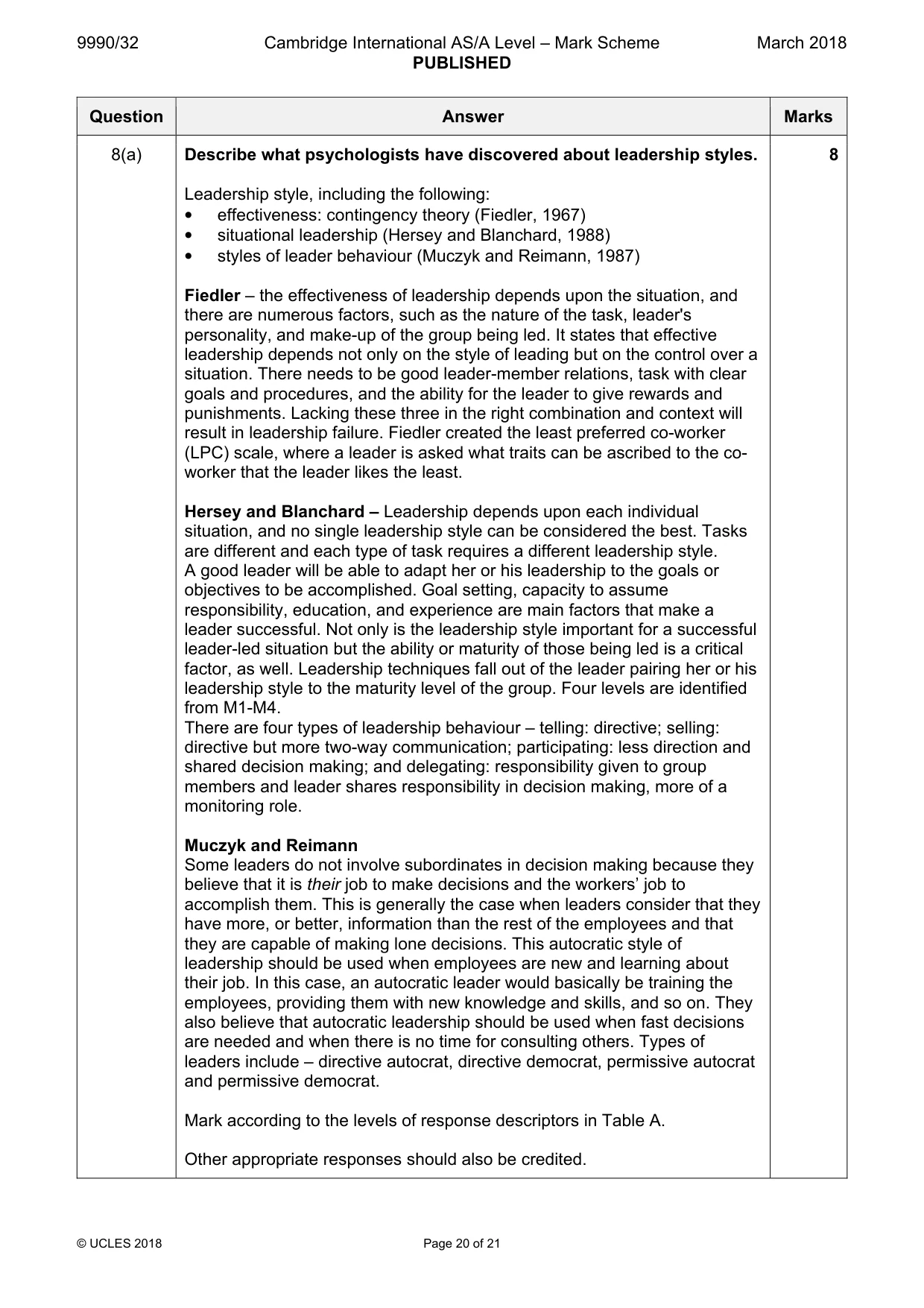
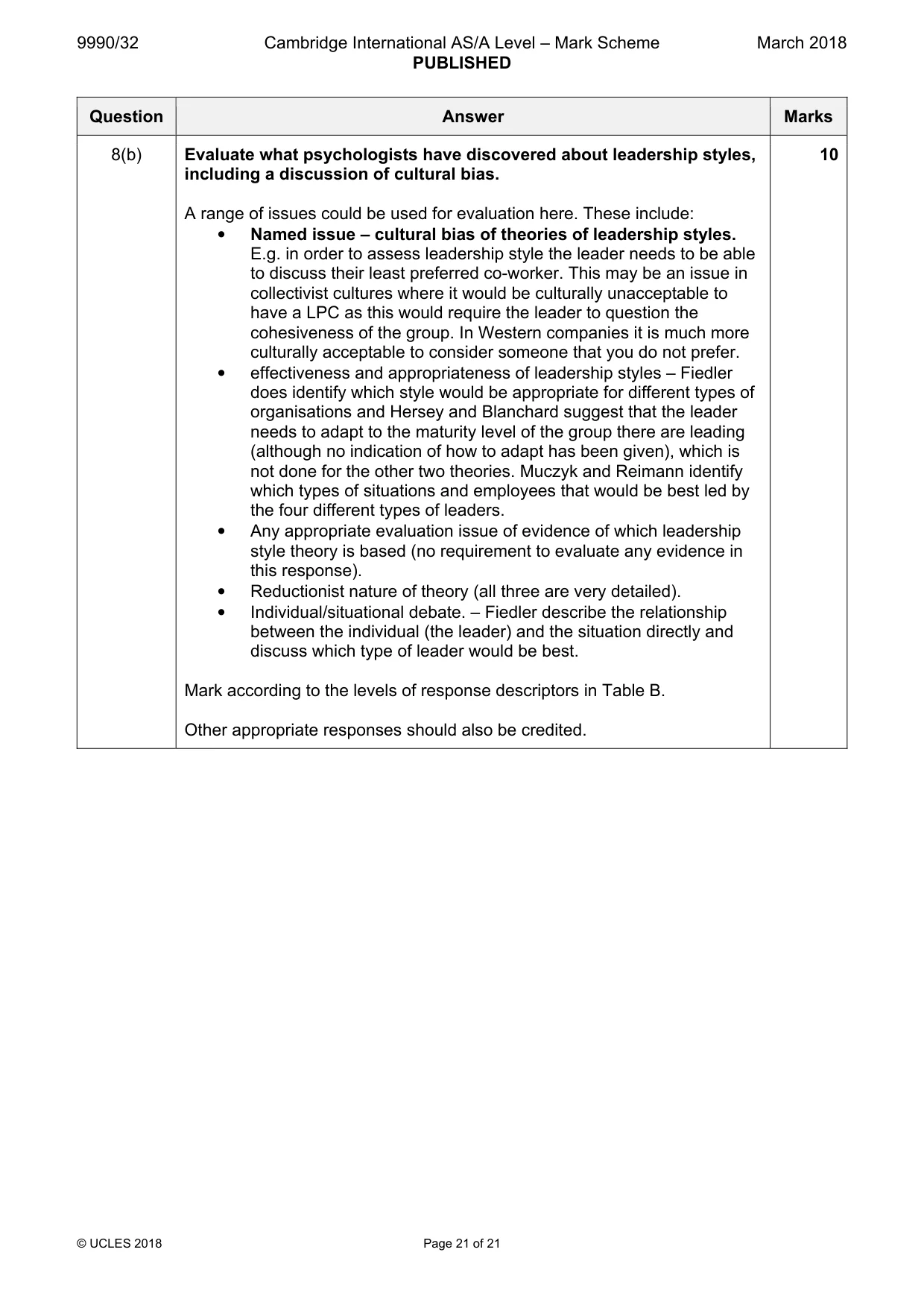
8 (a) Describe what psychologists have discovered about leadership styles. [8] (b) Evaluate what psychologists have discovered about leadership styles, including a discussion of cultural bias. [10]
Mark scheme: 8(a) Describe what psychologists have discovered about leadership styles. 8 Leadership style, including the following: • effectiveness: contingency theory (Fiedler, 1967) • situational leadership (Hersey and Blanchard, 1988) • styles of leader behaviour (Muczyk and Reimann, 1987) Fiedler – the effectiveness of leadership depends upon the situation, and there are numerous factors, such as the nature of the task, leader's personality, and make-up of the group being led. It states that effective leadership depends not only on the style of leading but on the control over a situation. There needs to be good leader-member relations, task with clear goals and procedures, and the ability for the leader to give rewards and punishments. Lacking these three in the right combination and context will result in leadership failure. Fiedler created the least preferred co-worker (LPC) scale, where a leader is asked what traits can be ascribed to the co- worker that the leader likes the least. Hersey and Blanchard – Leadership depends upon each individual situation, and no single leadership style can be considered the best. Tasks are different and each type of task requires a different leadership style. A good leader will be able to adapt her or his leadership to the goals or objectives to be accomplished. Goal setting, capacity to assume responsibility, education, and experience are main factors that make a leader successful. Not only is the leadership style important for a successful leader-led situation but the ability or maturity of those being led is a critical factor, as well. Leadership techniques fall out of the leader pairing her or his leadership style to the maturity level of the group. Four levels are identified from M1-M4. There are four types of leadership behaviour – telling: directive; selling: directive but more two-way communication; participating: less direction and shared decision making; and delegating: responsibility given to group members and leader shares responsibility in decision making, more of a monitoring role. Muczyk and Reimann Some leaders do not involve subordinates in decision making because they believe that it is their job to make decisions and the workers’ job to accomplish them. This is generally the case when leaders consider that they have more, or better, information than the rest of the employees and that they are capable of making lone decisions. This autocratic style of leadership should be used when employees are new and learning about their job. In this case, an autocratic leader would basically be training the employees, providing them with new knowledge and skills, and so on. They also believe that autocratic leadership should be used when fast decisions are needed and when there is no time for consulting others. Types of leaders include – directive autocrat, directive democrat, permissive autocrat and permissive democrat. Mark according to the levels of response descriptors in Table A. Other appropriate responses should also be credited. 8(b) Evaluate what psychologists have discovered about leadership styles, 10 including a discussion of cultural bias. A range of issues could be used for evaluation here. These include: • Named issue – cultural bias of theories of leadership styles. E.g. in order to assess leadership style the leader needs to be able to discuss their least preferred co-worker. This may be an issue in collectivist cultures where it would be culturally unacceptable to have a LPC as this would require the leader to question the cohesiveness of the group. In Western companies it is much more culturally acceptable to consider someone that you do not prefer. • effectiveness and appropriateness of leadership styles – Fiedler does identify which style would be appropriate for different types of organisations and Hersey and Blanchard suggest that the leader needs to adapt to the maturity level of the group there are leading (although no indication of how to adapt has been given), which is not done for the other two theories. Muczyk and Reimann identify which types of situations and employees that would be best led by the four different types of leaders. • Any appropriate evaluation issue of evidence of which leadership style theory is based (no requirement to evaluate any evidence in this response). • Reductionist nature of theory (all three are very detailed). • Individual/situational debate. – Fiedler describe the relationship between the individual (the leader) and the situation directly and discuss which type of leader would be best. Mark according to the levels of response descriptors in Table B. Other appropriate responses should also be credited.
What was in this paper
The subtopics covered by these 8 questions, and how many questions each got. Open one in a new tab to see every Cambridge question on it.
What you needed in this session
Cambridge’s own grade thresholds for 2018 Feb/March, Paper 3 · Variant 2. A higher threshold means an easier paper — the bar moves with how the cohort did.