Cambridge A Level Psychology (from 2018) 9990 — 2025 May/June Paper 3 · Variant 2
9990/32/M/J/25 · 16 questions · 60 marks · 90 min
The question paper and its mark scheme, free to read here and free to download. This is Cambridge’s own paper, exactly as it was sat.
Question paper8 pages
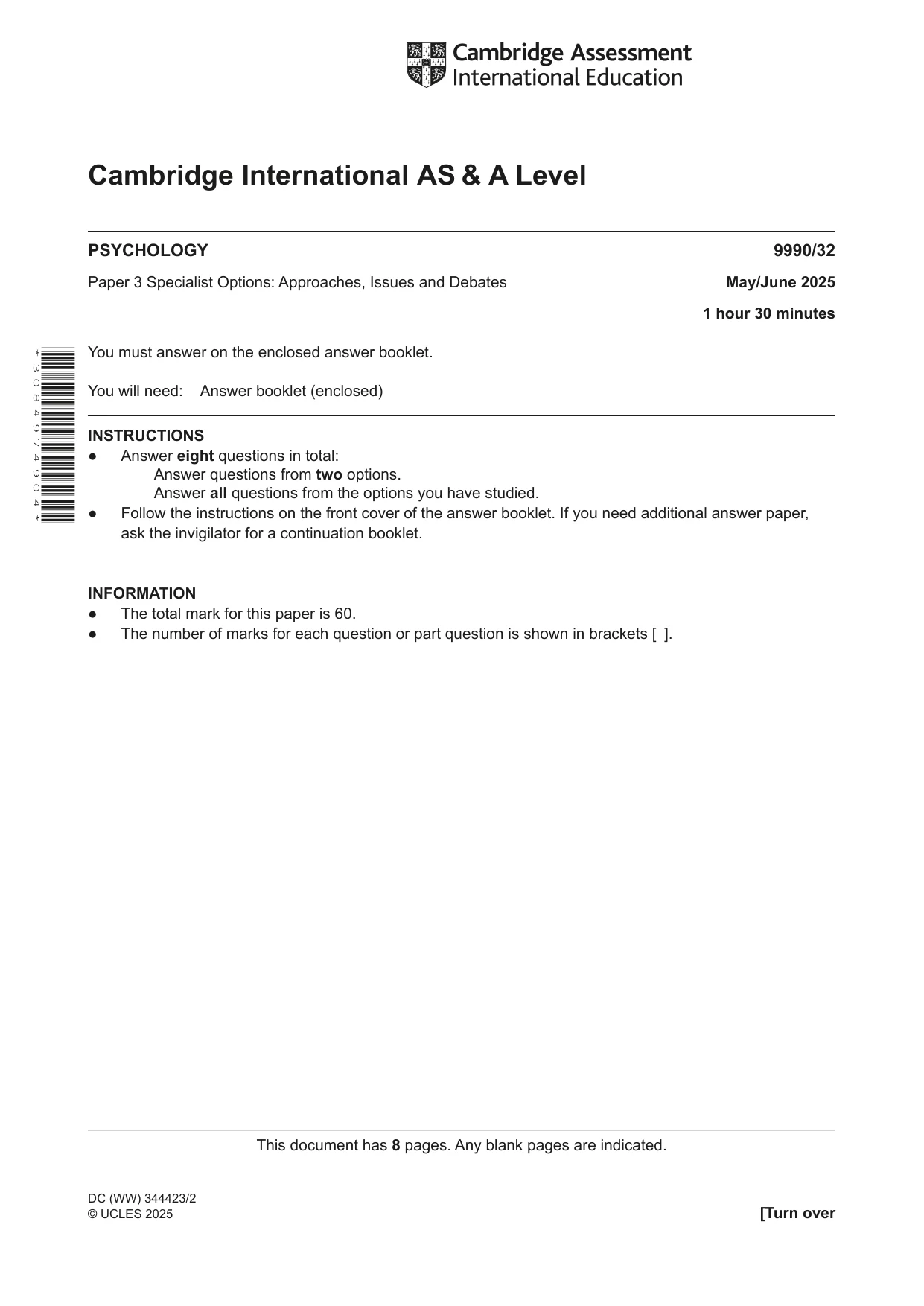
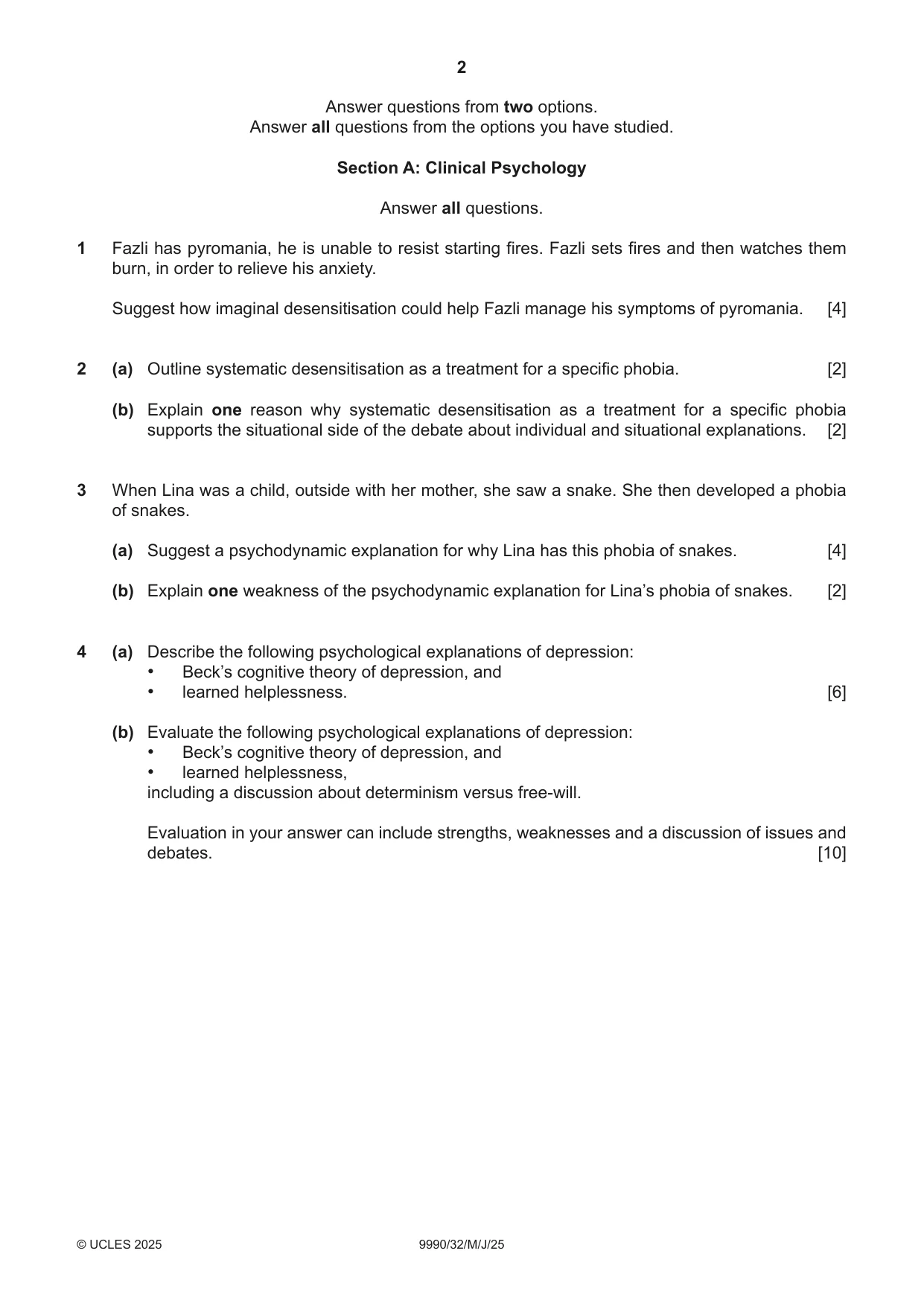
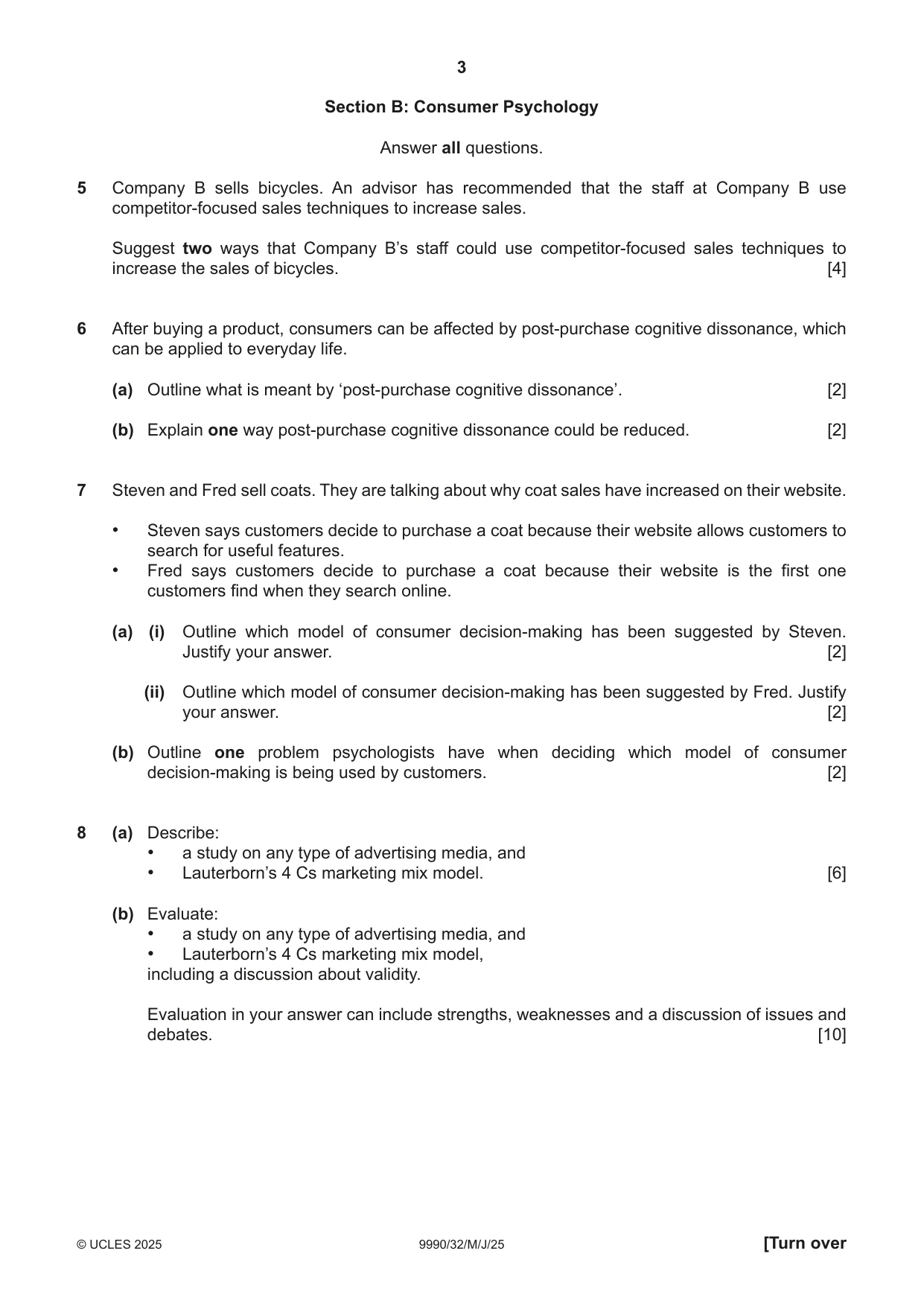

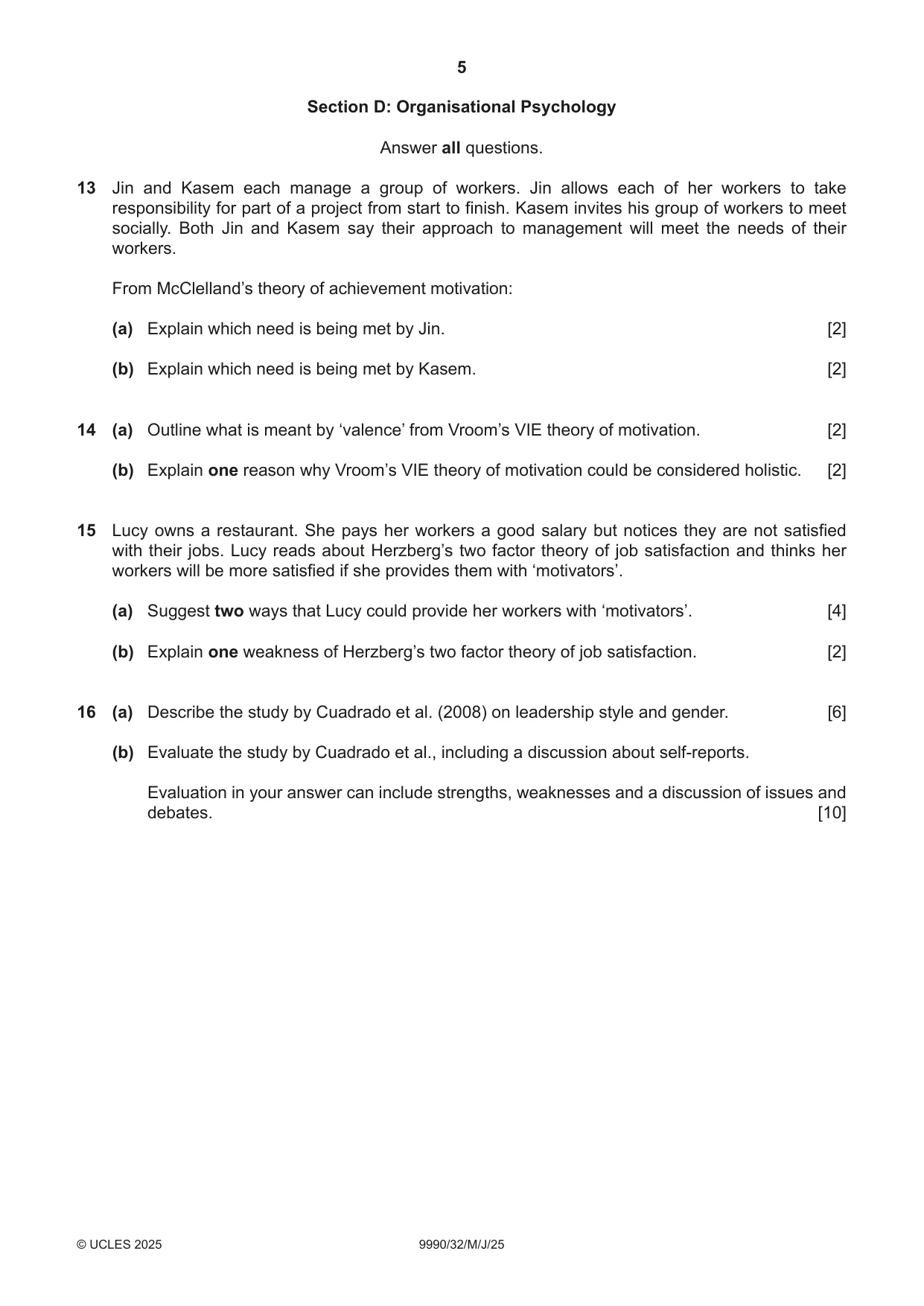



Mark scheme52 pages
Answers below. Sit the paper first if you are practising.

Questions as text
Q1 · Fazli has pyromania, he is unable to resist starting fires
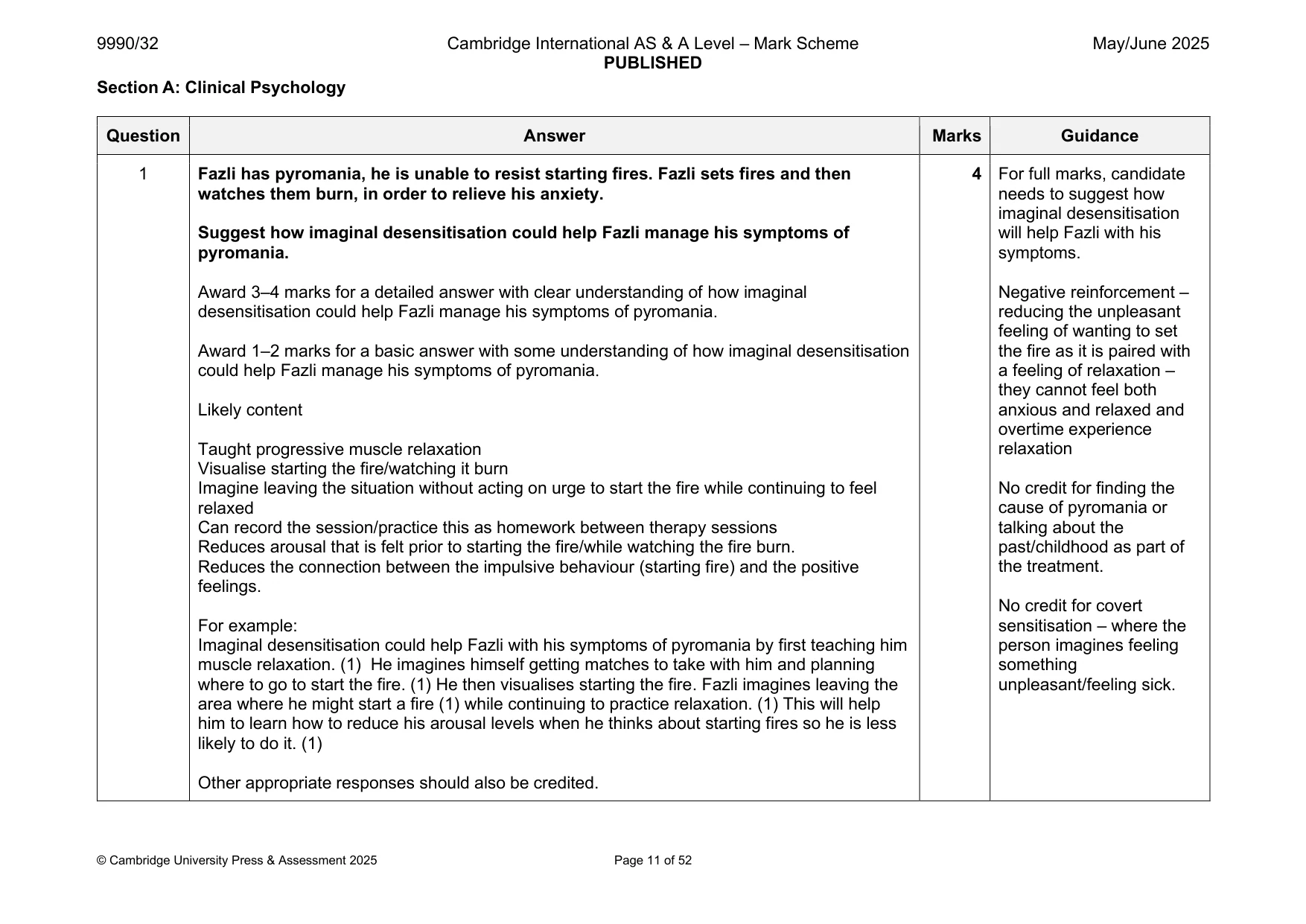
1 Fazli has pyromania, he is unable to resist starting fires. Fazli sets fires and then watches them burn, in order to relieve his anxiety. Suggest how imaginal desensitisation could help Fazli manage his symptoms of pyromania. [4]
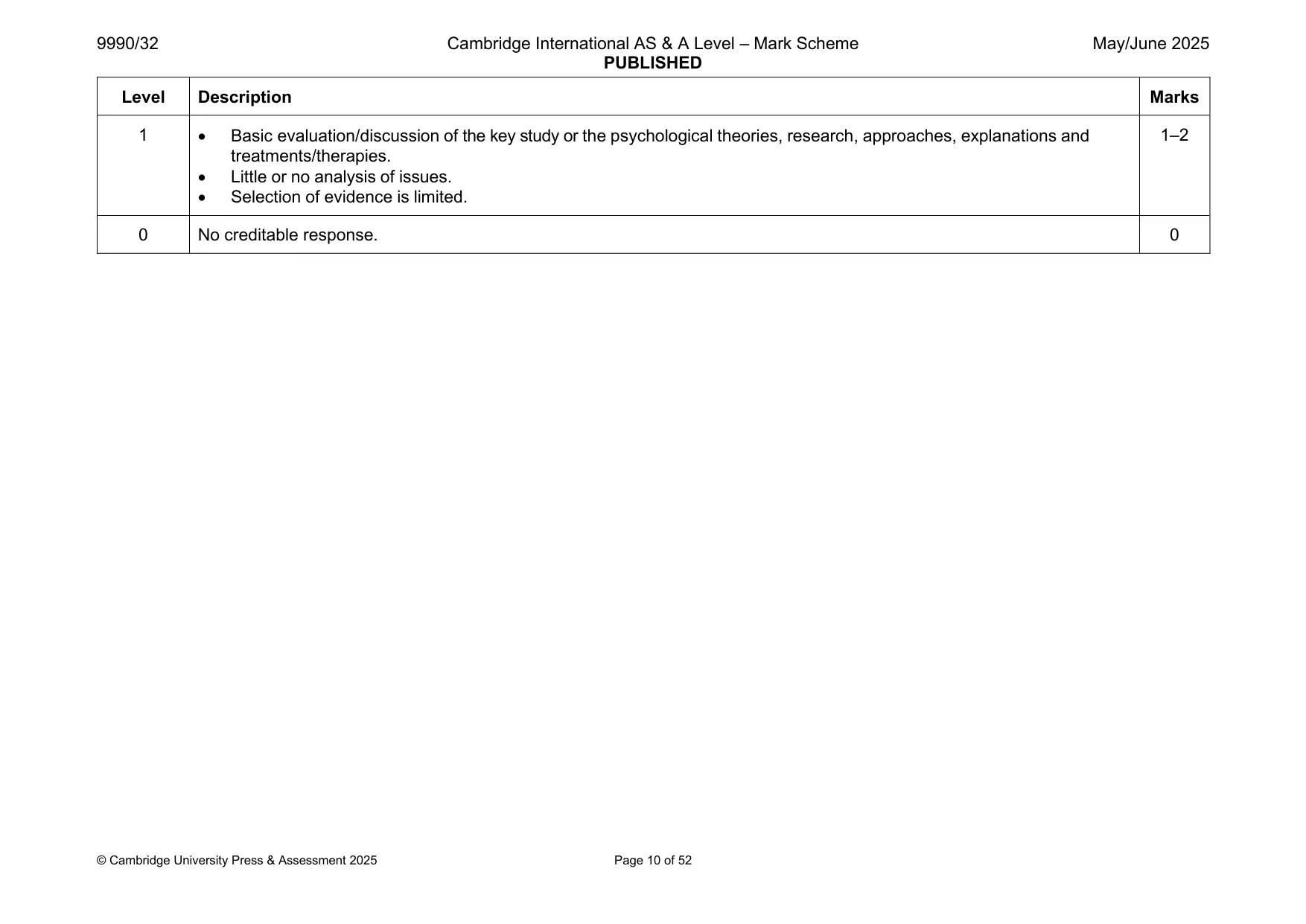
Mark scheme: Question Answer Marks Guidance 1 Fazli has pyromania, he is unable to resist starting fires. Fazli sets fires and then 4 For full marks, candidate watches them burn, in order to relieve his anxiety. needs to suggest how imaginal desensitisation Suggest how imaginal desensitisation could help Fazli manage his symptoms of will help Fazli with his pyromania. symptoms. Award 3–4 marks for a detailed answer with clear understanding of how imaginal Negative reinforcement – desensitisation could help Fazli manage his symptoms of pyromania. reducing the unpleasant feeling of wanting to set Award 1–2 marks for a basic answer with some understanding of how imaginal desensitisation the fire as it is paired with could help Fazli manage his symptoms of pyromania. a feeling of relaxation – they cannot feel both Likely content anxious and relaxed and overtime experience Taught progressive muscle relaxation relaxation Visualise starting the fire/watching it burn Imagine leaving the situation without acting on urge to start the fire while continuing to feel No credit for finding the relaxed cause of pyromania or Can record the session/practice this as homework between therapy sessions talking about the Reduces arousal that is felt prior to starting the fire/while watching the fire burn. past/childhood as part of Reduces the connection between the impulsive behaviour (starting fire) and the positive the treatment. feelings. No credit for covert For example: sensitisation – where the Imaginal desensitisation could help Fazli with his symptoms of pyromania by first teaching him person imagines feeling muscle relaxation. (1) He imagines himself getting matches to take with him and planning something where to go to start the fire. (1) He then visualises starting the fire. Fazli imagines leaving the unpleasant/feeling sick. area where he might start a fire (1) while continuing to practice relaxation. (1) This will help him to learn how to reduce his arousal levels when he thinks about starting fires so he is less likely to do it. (1) Other appropriate responses should also be credited.
Q2 · Outline systematic desensitisation as a treatment for a specific phobia
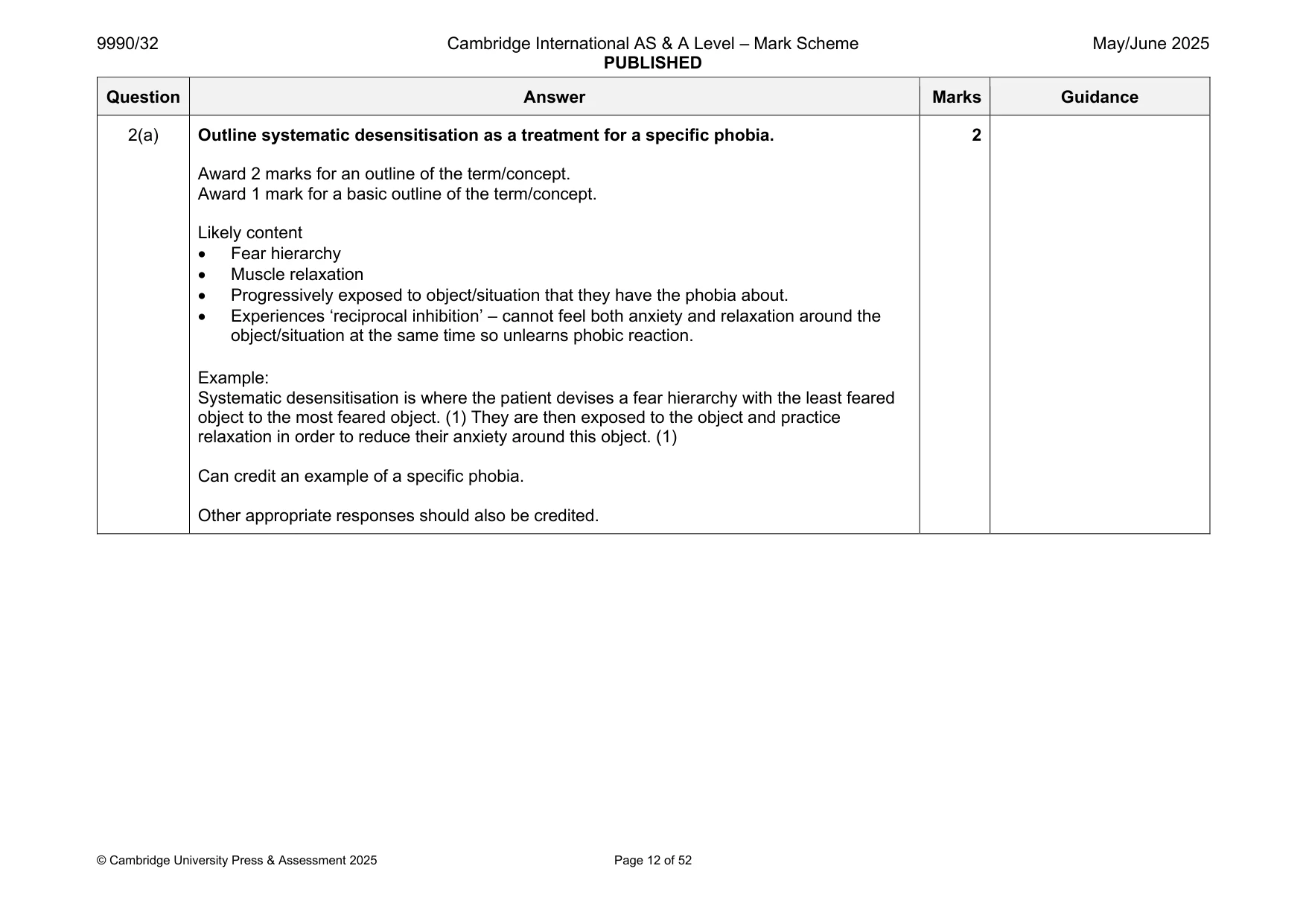
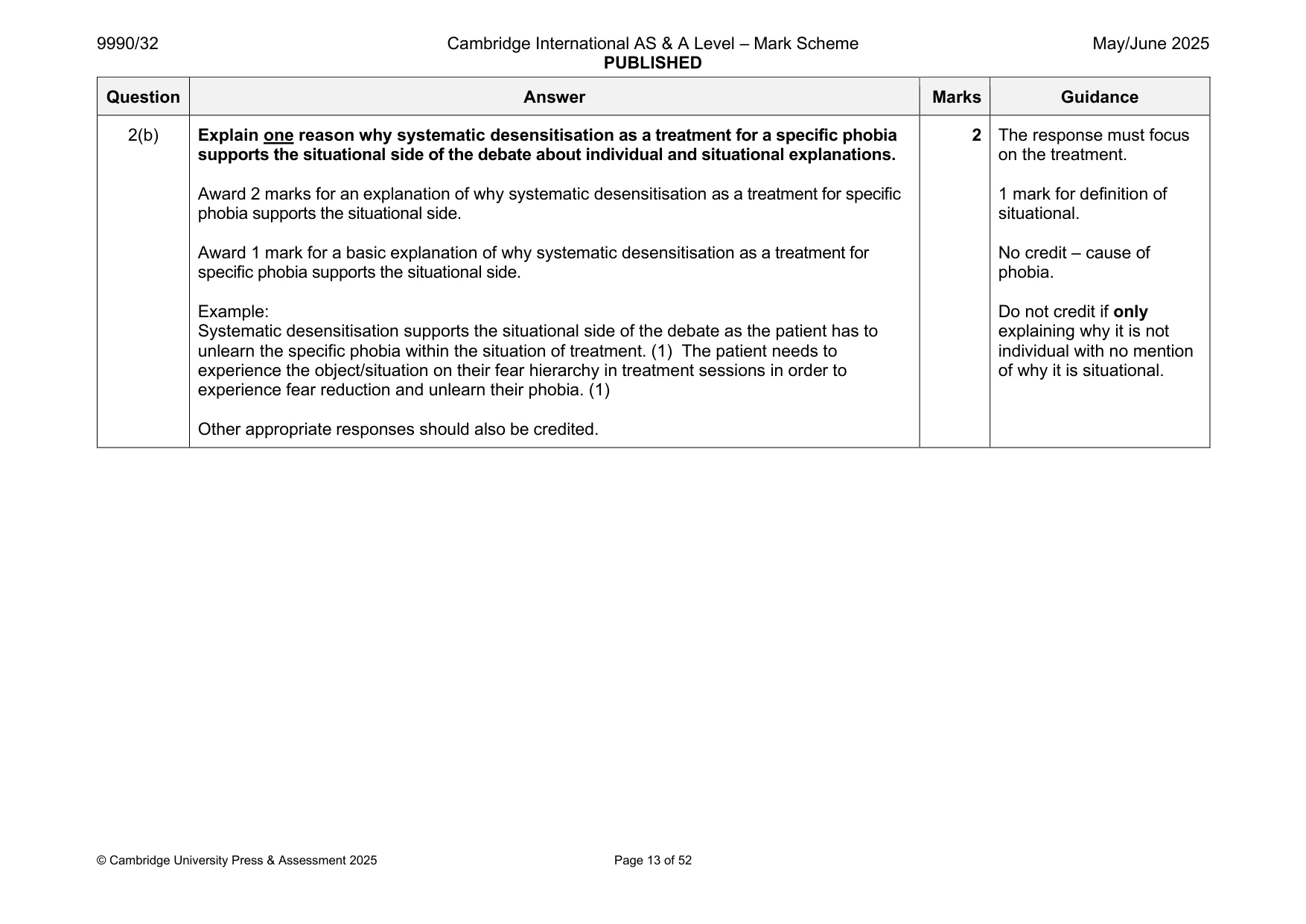
2 (a) Outline systematic desensitisation as a treatment for a specific phobia. [2] (b) Explain one reason why systematic desensitisation as a treatment for a specific phobia supports the situational side of the debate about individual and situational explanations. [2]
Mark scheme: 2(a) Outline systematic desensitisation as a treatment for a specific phobia. 2 Award 2 marks for an outline of the term/concept. Award 1 mark for a basic outline of the term/concept. Likely content • Fear hierarchy • Muscle relaxation • Progressively exposed to object/situation that they have the phobia about. • Experiences ‘reciprocal inhibition’ – cannot feel both anxiety and relaxation around the object/situation at the same time so unlearns phobic reaction. Example: Systematic desensitisation is where the patient devises a fear hierarchy with the least feared object to the most feared object. (1) They are then exposed to the object and practice relaxation in order to reduce their anxiety around this object. (1) Can credit an example of a specific phobia. Other appropriate responses should also be credited. 2(b) Explain one reason why systematic desensitisation as a treatment for a specific phobia 2 The response must focus supports the situational side of the debate about individual and situational explanations. on the treatment. Award 2 marks for an explanation of why systematic desensitisation as a treatment for specific 1 mark for definition of phobia supports the situational side. situational. Award 1 mark for a basic explanation of why systematic desensitisation as a treatment for No credit – cause of specific phobia supports the situational side. phobia. Example: Do not credit if only Systematic desensitisation supports the situational side of the debate as the patient has to explaining why it is not unlearn the specific phobia within the situation of treatment. (1) The patient needs to individual with no mention experience the object/situation on their fear hierarchy in treatment sessions in order to of why it is situational. experience fear reduction and unlearn their phobia. (1) Other appropriate responses should also be credited.
More questions on Anxiety disorders and fear-related disorders
Q3 · When Lina was a child, outside with her mother, she saw a snake
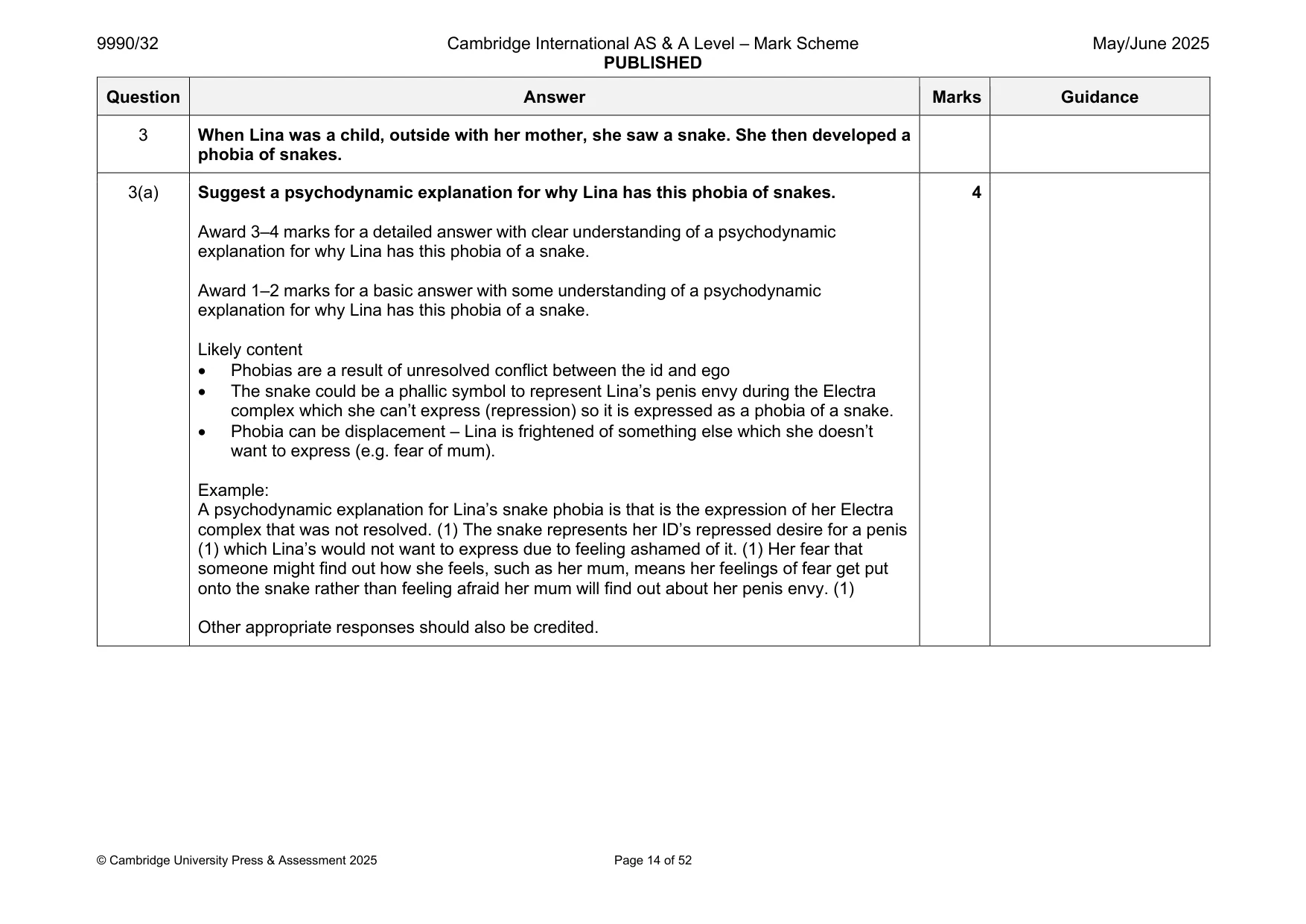
3 When Lina was a child, outside with her mother, she saw a snake. She then developed a phobia of snakes. (a) Suggest a psychodynamic explanation for why Lina has this phobia of snakes. [4] (b) Explain one weakness of the psychodynamic explanation for Lina’s phobia of snakes. [2]
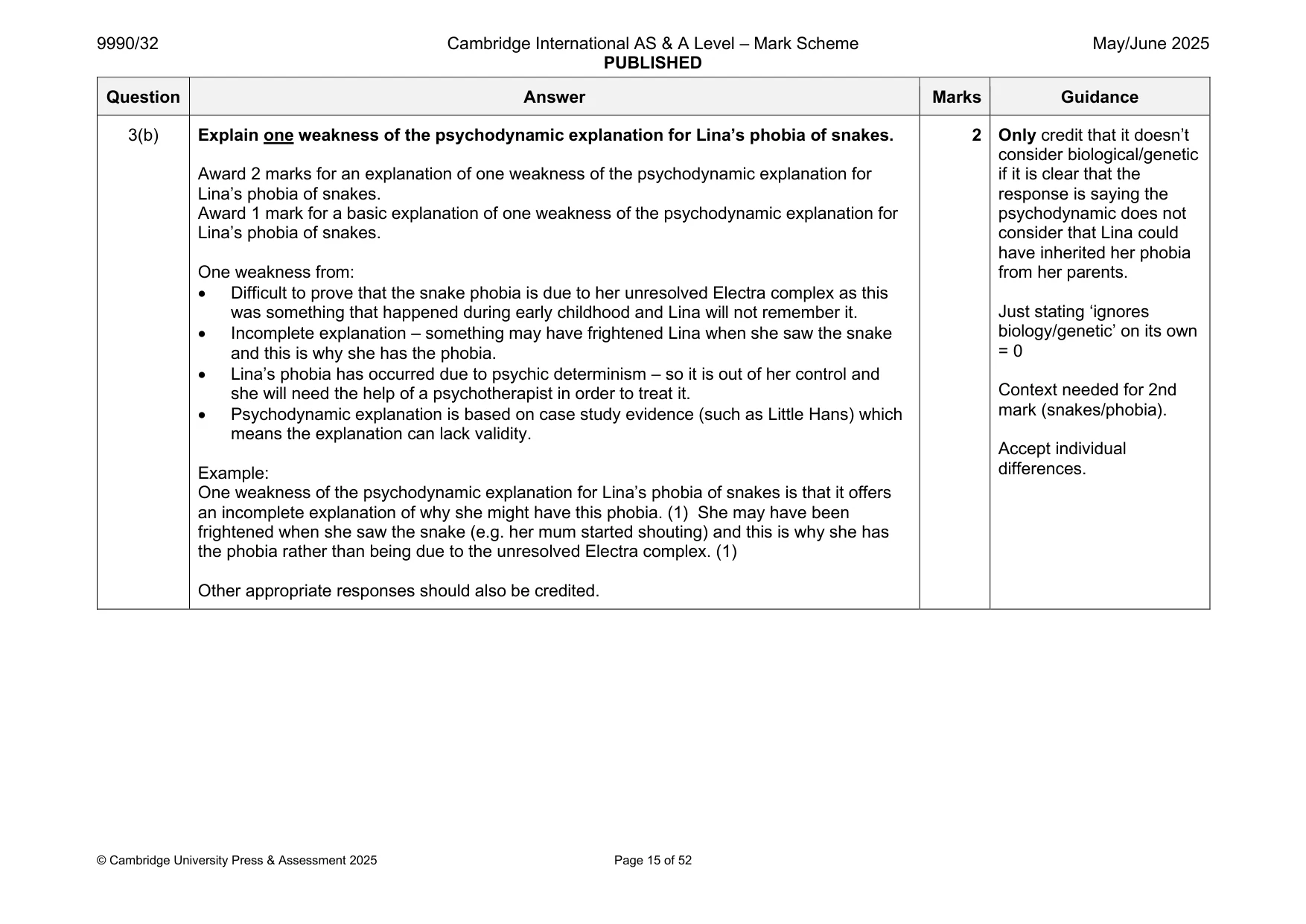
Mark scheme: 3 When Lina was a child, outside with her mother, she saw a snake. She then developed a phobia of snakes. 3(a) Suggest a psychodynamic explanation for why Lina has this phobia of snakes. 4 Award 3–4 marks for a detailed answer with clear understanding of a psychodynamic explanation for why Lina has this phobia of a snake. Award 1–2 marks for a basic answer with some understanding of a psychodynamic explanation for why Lina has this phobia of a snake. Likely content • Phobias are a result of unresolved conflict between the id and ego • The snake could be a phallic symbol to represent Lina’s penis envy during the Electra complex which she can’t express (repression) so it is expressed as a phobia of a snake. • Phobia can be displacement – Lina is frightened of something else which she doesn’t want to express (e.g. fear of mum). Example: A psychodynamic explanation for Lina’s snake phobia is that is the expression of her Electra complex that was not resolved. (1) The snake represents her ID’s repressed desire for a penis (1) which Lina’s would not want to express due to feeling ashamed of it. (1) Her fear that someone might find out how she feels, such as her mum, means her feelings of fear get put onto the snake rather than feeling afraid her mum will find out about her penis envy. (1) Other appropriate responses should also be credited. 3(b) Explain one weakness of the psychodynamic explanation for Lina’s phobia of snakes. 2 Only credit that it doesn’t consider biological/genetic Award 2 marks for an explanation of one weakness of the psychodynamic explanation for if it is clear that the Lina’s phobia of snakes. response is saying the Award 1 mark for a basic explanation of one weakness of the psychodynamic explanation for psychodynamic does not Lina’s phobia of snakes. consider that Lina could have inherited her phobia One weakness from: from her parents. • Difficult to prove that the snake phobia is due to her unresolved Electra complex as this was something that happened during early childhood and Lina will not remember it. Just stating ‘ignores • Incomplete explanation – something may have frightened Lina when she saw the snake biology/genetic’ on its own and this is why she has the phobia. = 0 • Lina’s phobia has occurred due to psychic determinism – so it is out of her control and she will need the help of a psychotherapist in order to treat it. Context needed for 2nd • Psychodynamic explanation is based on case study evidence (such as Little Hans) which mark (snakes/phobia). means the explanation can lack validity. Accept individual Example: differences. One weakness of the psychodynamic explanation for Lina’s phobia of snakes is that it offers an incomplete explanation of why she might have this phobia. (1) She may have been frightened when she saw the snake (e.g. her mum started shouting) and this is why she has the phobia rather than being due to the unresolved Electra complex. (1) Other appropriate responses should also be credited.
More questions on Anxiety disorders and fear-related disorders
Q4 · Describe the following psychological explanations of depression: • Beck’s cognitive…
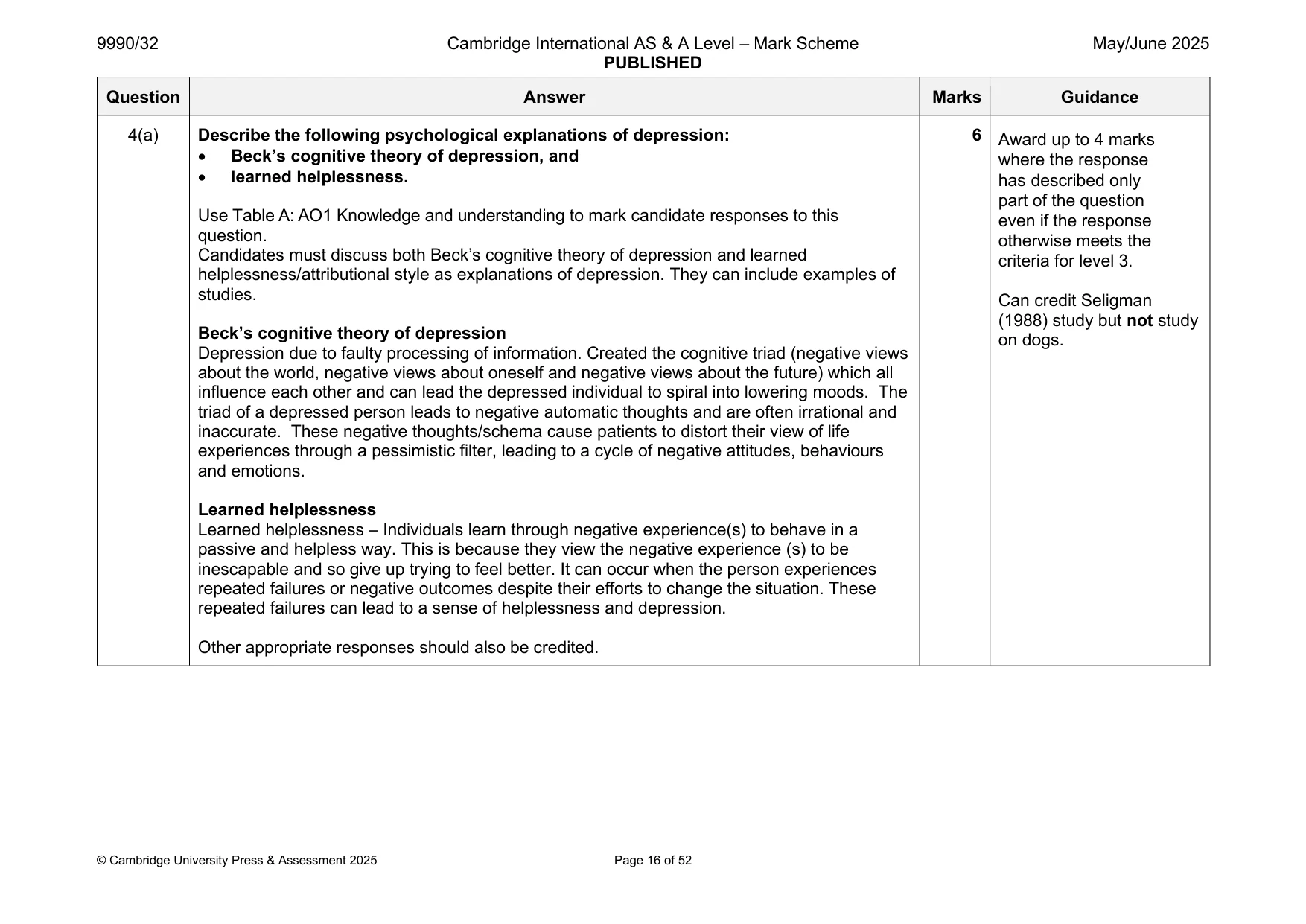
4 (a) Describe the following psychological explanations of depression: • Beck’s cognitive theory of depression, and • learned helplessness. [6] (b) Evaluate the following psychological explanations of depression: • Beck’s cognitive theory of depression, and • learned helplessness, including a discussion about determinism versus free‑will. Evaluation in your answer can include strengths, weaknesses and a discussion of issues and debates. [10]
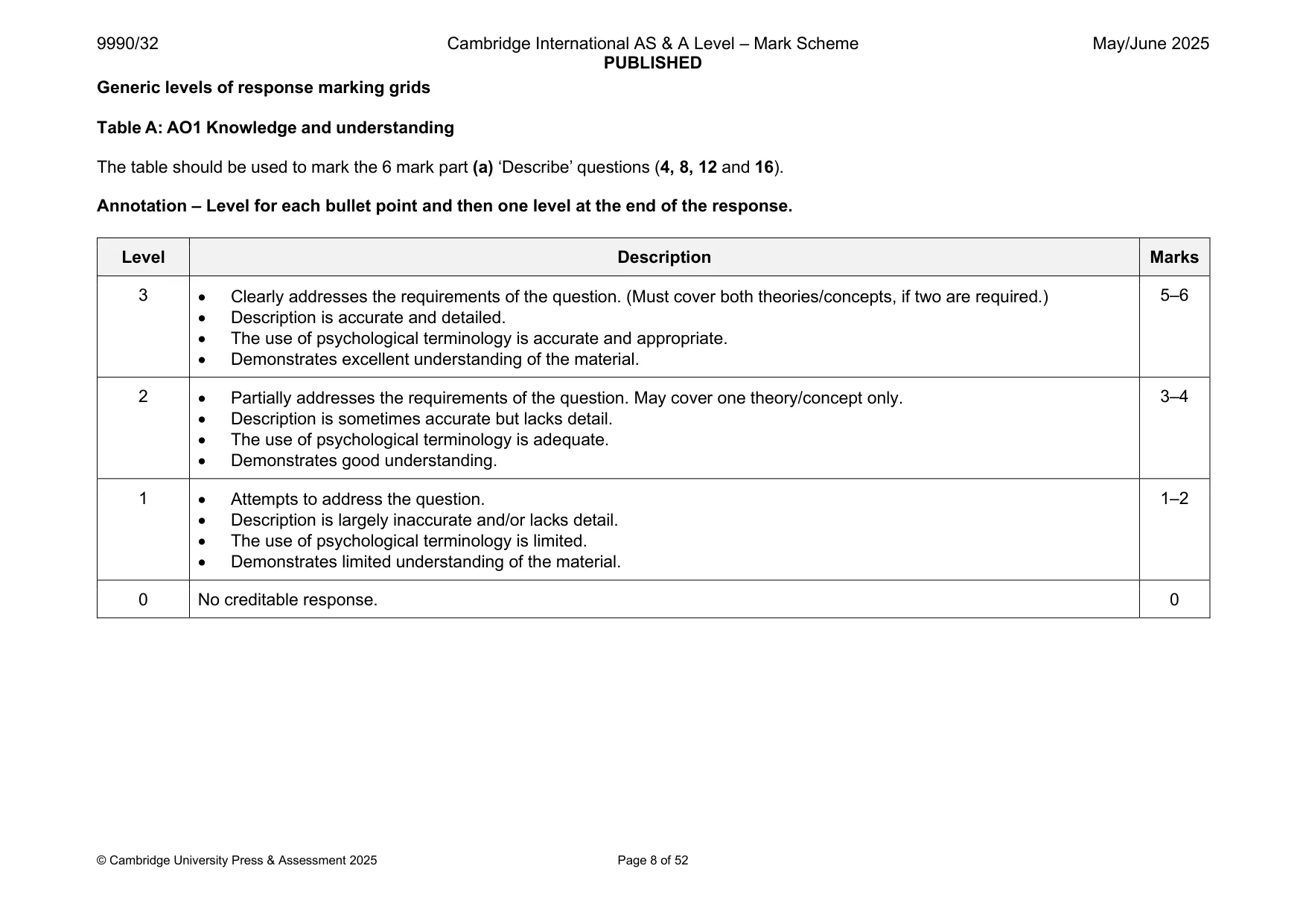
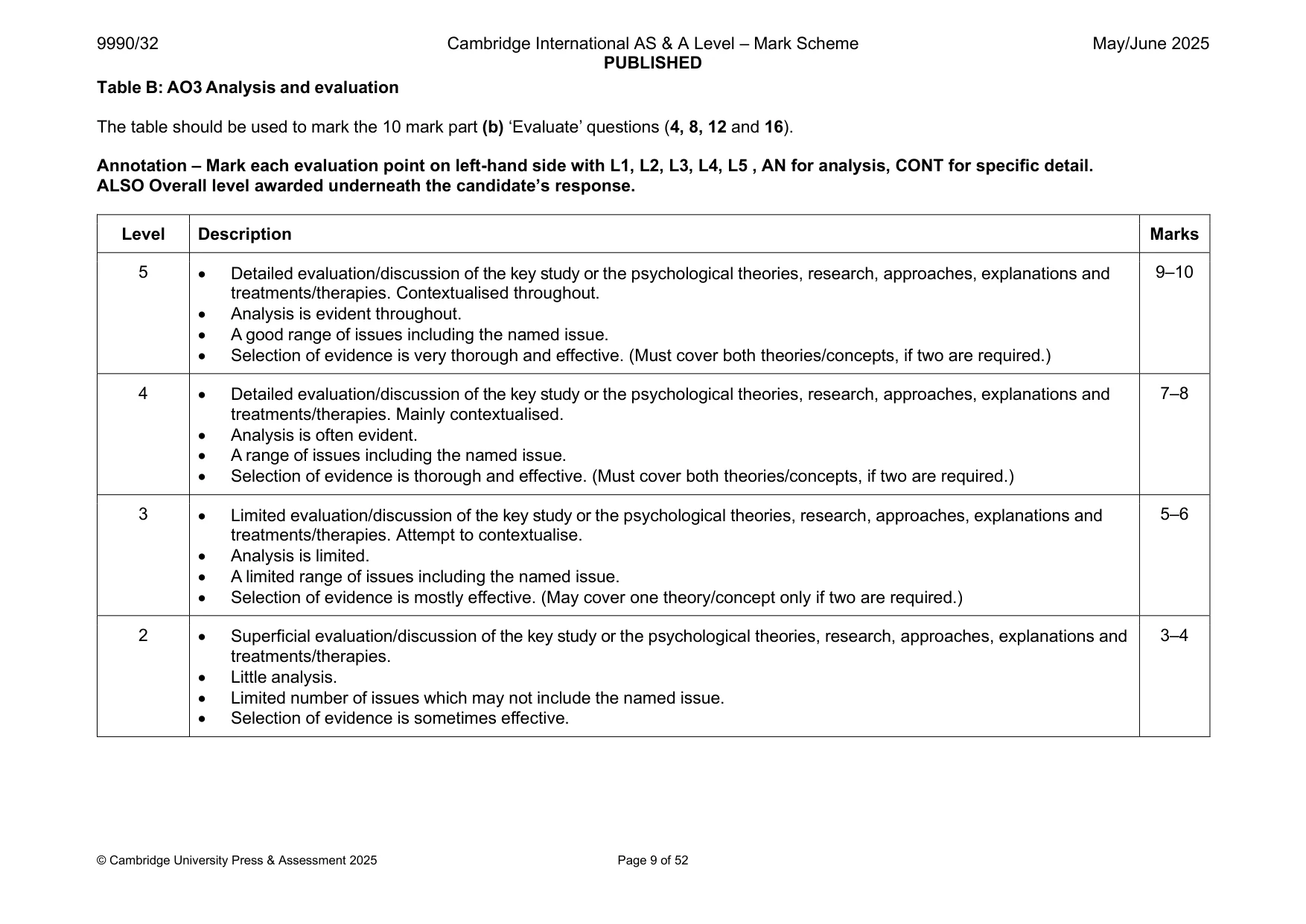
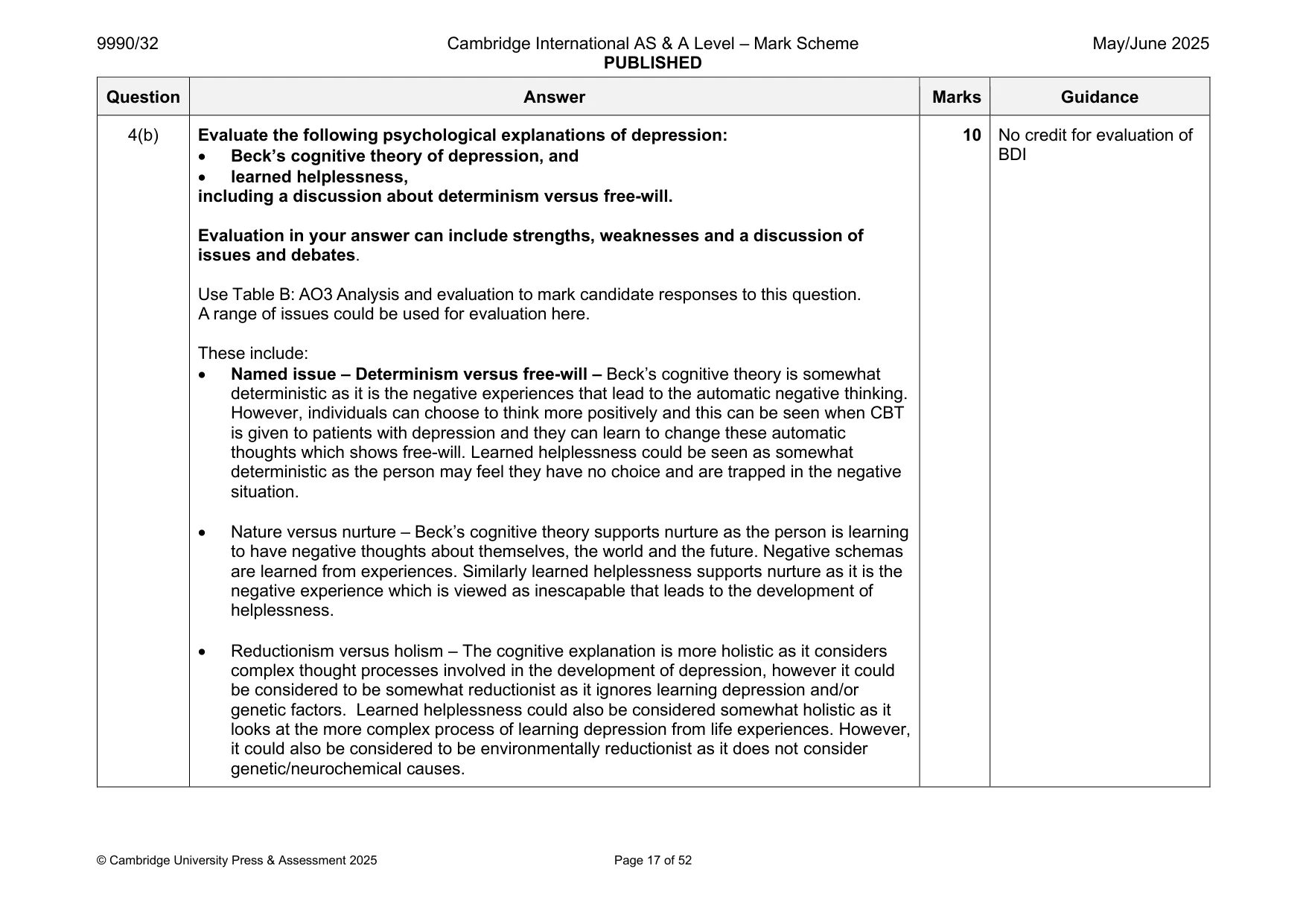
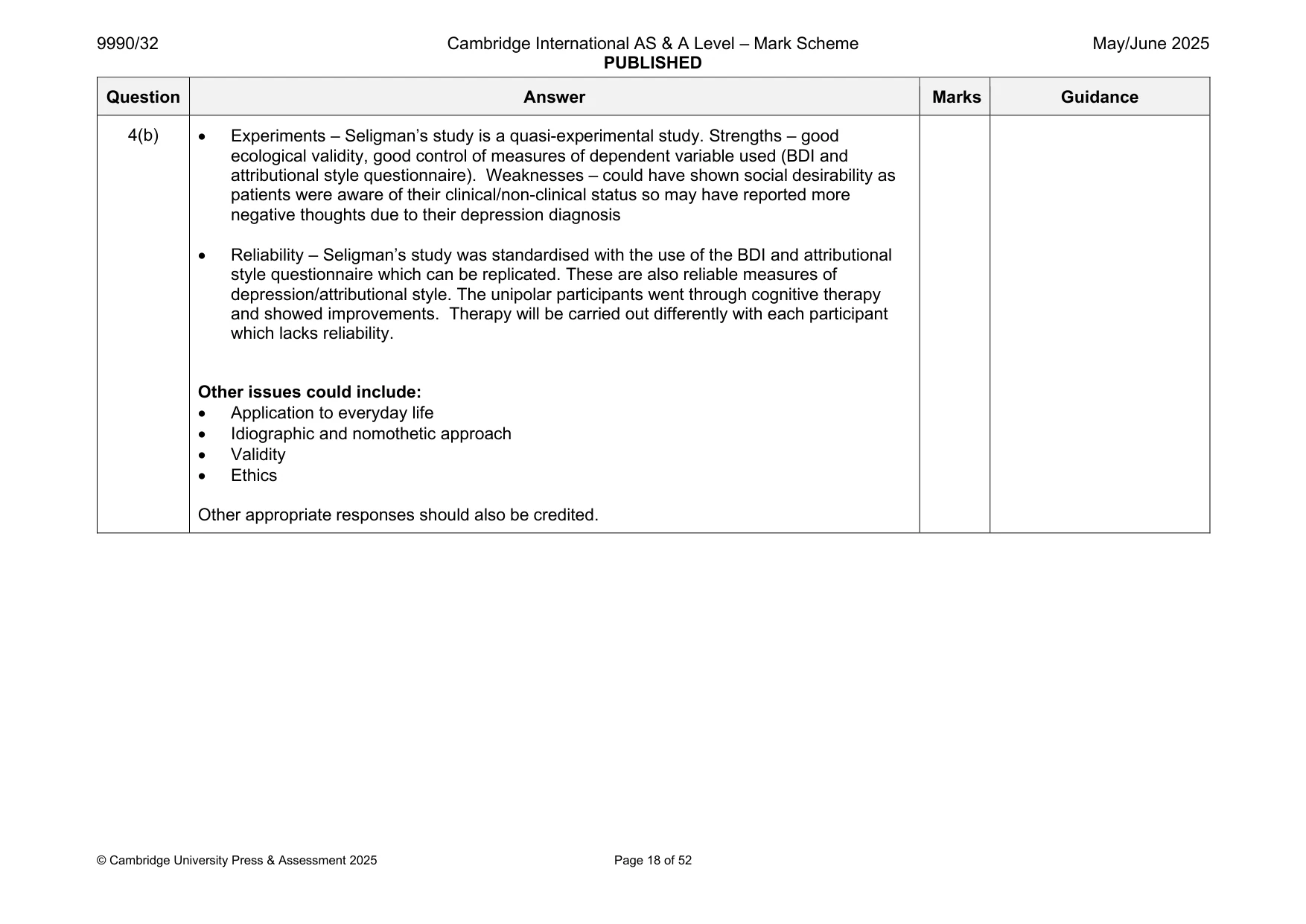
Mark scheme: 4(a) Describe the following psychological explanations of depression: 6 Award up to 4 marks • Beck’s cognitive theory of depression, and where the response • learned helplessness. has described only part of the question Use Table A: AO1 Knowledge and understanding to mark candidate responses to this even if the response question. otherwise meets the Candidates must discuss both Beck’s cognitive theory of depression and learned criteria for level 3. helplessness/attributional style as explanations of depression. They can include examples of studies. Can credit Seligman (1988) study but not study Beck’s cognitive theory of depression on dogs. Depression due to faulty processing of information. Created the cognitive triad (negative views about the world, negative views about oneself and negative views about the future) which all influence each other and can lead the depressed individual to spiral into lowering moods. The triad of a depressed person leads to negative automatic thoughts and are often irrational and inaccurate. These negative thoughts/schema cause patients to distort their view of life experiences through a pessimistic filter, leading to a cycle of negative attitudes, behaviours and emotions. Learned helplessness Learned helplessness – Individuals learn through negative experience(s) to behave in a passive and helpless way. This is because they view the negative experience (s) to be inescapable and so give up trying to feel better. It can occur when the person experiences repeated failures or negative outcomes despite their efforts to change the situation. These repeated failures can lead to a sense of helplessness and depression. Other appropriate responses should also be credited. 4(b) Evaluate the following psychological explanations of depression: 10 No credit for evaluation of • Beck’s cognitive theory of depression, and BDI • learned helplessness, including a discussion about determinism versus free-will. Evaluation in your answer can include strengths, weaknesses and a discussion of issues and debates. Use Table B: AO3 Analysis and evaluation to mark candidate responses to this question. A range of issues could be used for evaluation here. These include: • Named issue – Determinism versus free-will – Beck’s cognitive theory is somewhat deterministic as it is the negative experiences that lead to the automatic negative thinking. However, individuals can choose to think more positively and this can be seen when CBT is given to patients with depression and they can learn to change these automatic thoughts which shows free-will. Learned helplessness could be seen as somewhat deterministic as the person may feel they have no choice and are trapped in the negative situation. • Nature versus nurture – Beck’s cognitive theory supports nurture as the person is learning to have negative thoughts about themselves, the world and the future. Negative schemas are learned from experiences. Similarly learned helplessness supports nurture as it is the negative experience which is viewed as inescapable that leads to the development of helplessness. • Reductionism versus holism – The cognitive explanation is more holistic as it considers complex thought processes involved in the development of depression, however it could be considered to be somewhat reductionist as it ignores learning depression and/or genetic factors. Learned helplessness could also be considered somewhat holistic as it looks at the more complex process of learning depression from life experiences. However, it could also be considered to be environmentally reductionist as it does not consider genetic/neurochemical causes. 4(b) • Experiments – Seligman’s study is a quasi-experimental study. Strengths – good ecological validity, good control of measures of dependent variable used (BDI and attributional style questionnaire). Weaknesses – could have shown social desirability as patients were aware of their clinical/non-clinical status so may have reported more negative thoughts due to their depression diagnosis • Reliability – Seligman’s study was standardised with the use of the BDI and attributional style questionnaire which can be replicated. These are also reliable measures of depression/attributional style. The unipolar participants went through cognitive therapy and showed improvements. Therapy will be carried out differently with each participant which lacks reliability. Other issues could include: • Application to everyday life • Idiographic and nomothetic approach • Validity • Ethics Other appropriate responses should also be credited. Section B: Consumer Psychology
More questions on Mood (affective) disorders: depressive disorder (unipolar) and bipolar disorder
Q5 · Company B sells bicycles
5 Company B sells bicycles. An advisor has recommended that the staff at Company B use competitor‑focused sales techniques to increase sales. Suggest two ways that Company B’s staff could use competitor‑focused sales techniques to increase the sales of bicycles. [4]
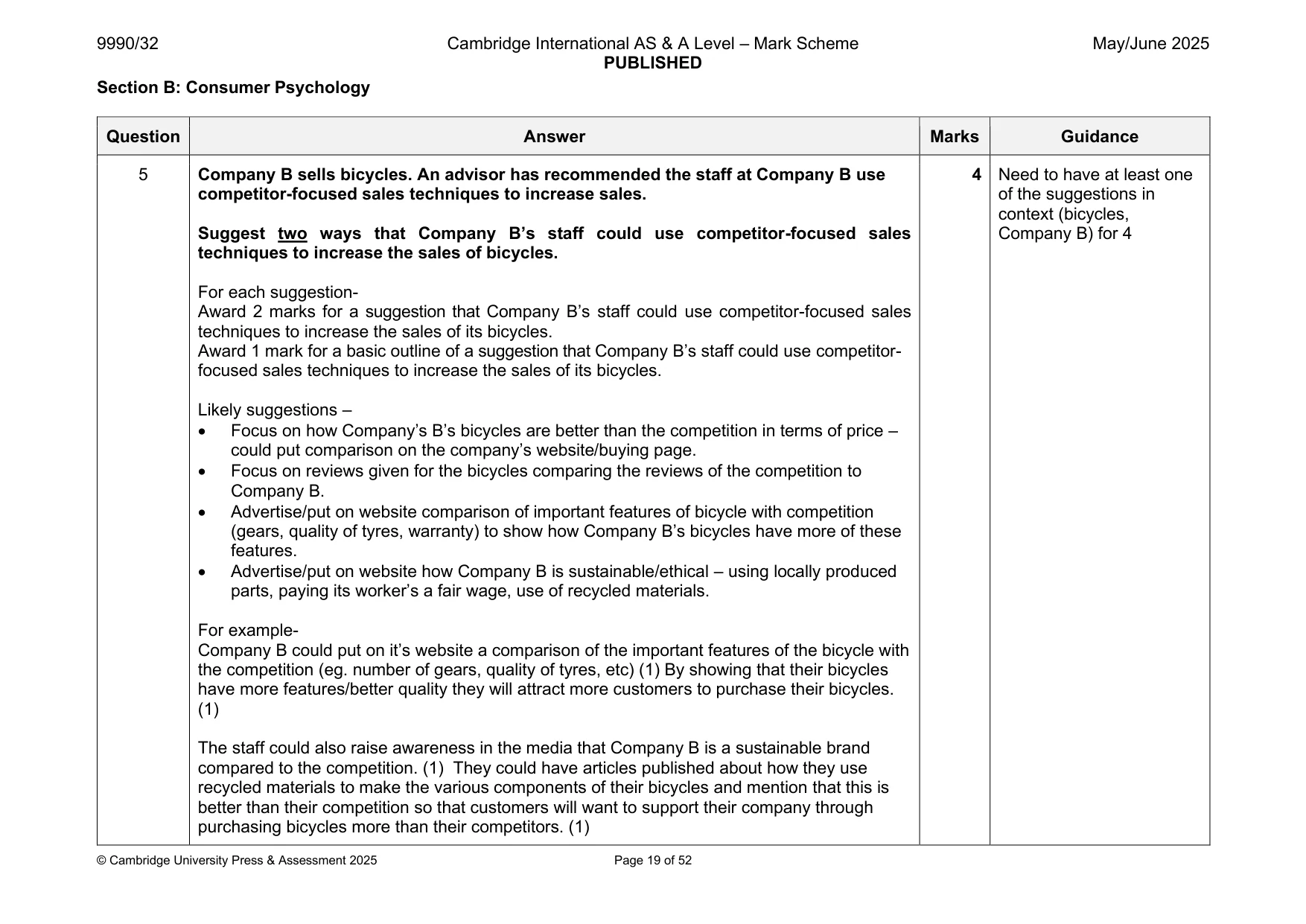
Mark scheme: 5 Company B sells bicycles. An advisor has recommended the staff at Company B use 4 Need to have at least one competitor-focused sales techniques to increase sales. of the suggestions in context (bicycles, Suggest two ways that Company B’s staff could use competitor-focused sales Company B) for 4 techniques to increase the sales of bicycles. For each suggestion- Award 2 marks for a suggestion that Company B’s staff could use competitor-focused sales techniques to increase the sales of its bicycles. Award 1 mark for a basic outline of a suggestion that Company B’s staff could use competitor- focused sales techniques to increase the sales of its bicycles. Likely suggestions – • Focus on how Company’s B’s bicycles are better than the competition in terms of price – could put comparison on the company’s website/buying page. • Focus on reviews given for the bicycles comparing the reviews of the competition to Company B. • Advertise/put on website comparison of important features of bicycle with competition (gears, quality of tyres, warranty) to show how Company B’s bicycles have more of these features. • Advertise/put on website how Company B is sustainable/ethical – using locally produced parts, paying its worker’s a fair wage, use of recycled materials. For example- Company B could put on it’s website a comparison of the important features of the bicycle with the competition (eg. number of gears, quality of tyres, etc) (1) By showing that their bicycles have more features/better quality they will attract more customers to purchase their bicycles. (1) The staff could also raise awareness in the media that Company B is a sustainable brand compared to the competition. (1) They could have articles published about how they use recycled materials to make the various components of their bicycles and mention that this is better than their competition so that customers will want to support their company through purchasing bicycles more than their competitors. (1)
Q6 · After buying a product, consumers can be affected by post‑purchase cognitive dissonance…
6 After buying a product, consumers can be affected by post‑purchase cognitive dissonance, which can be applied to everyday life. (a) Outline what is meant by ‘post‑purchase cognitive dissonance’. [2] (b) Explain one way post‑purchase cognitive dissonance could be reduced. [2]
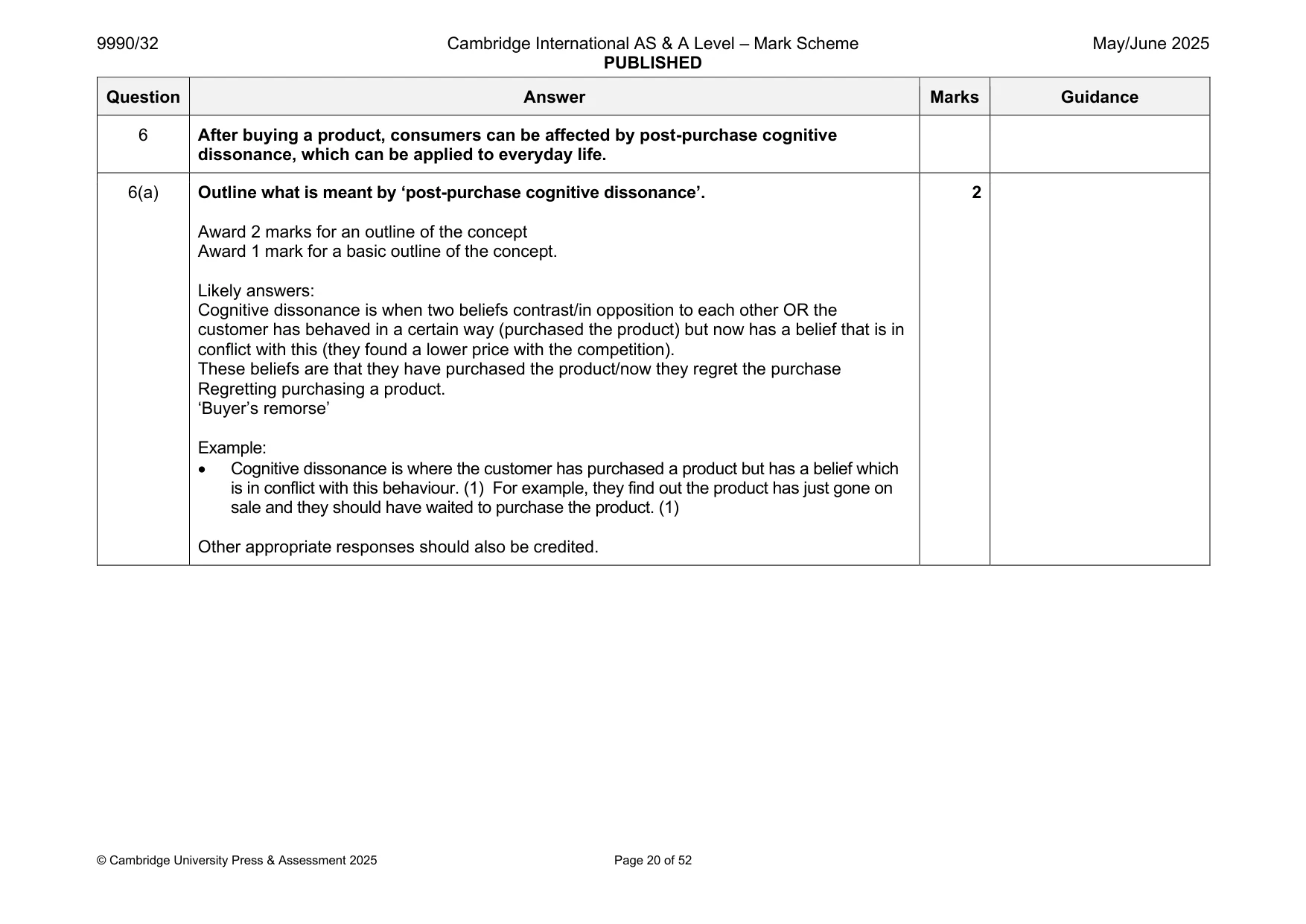
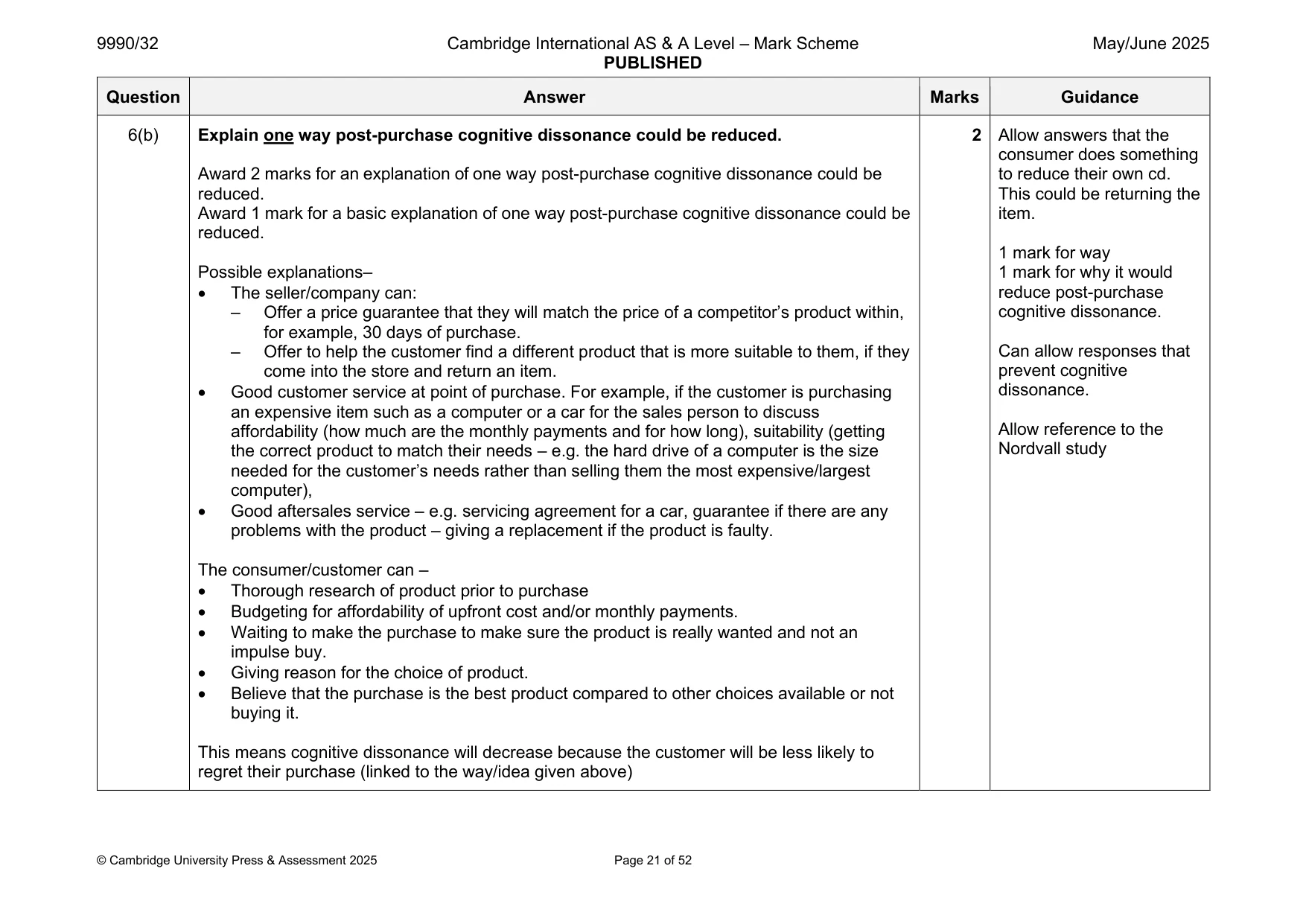
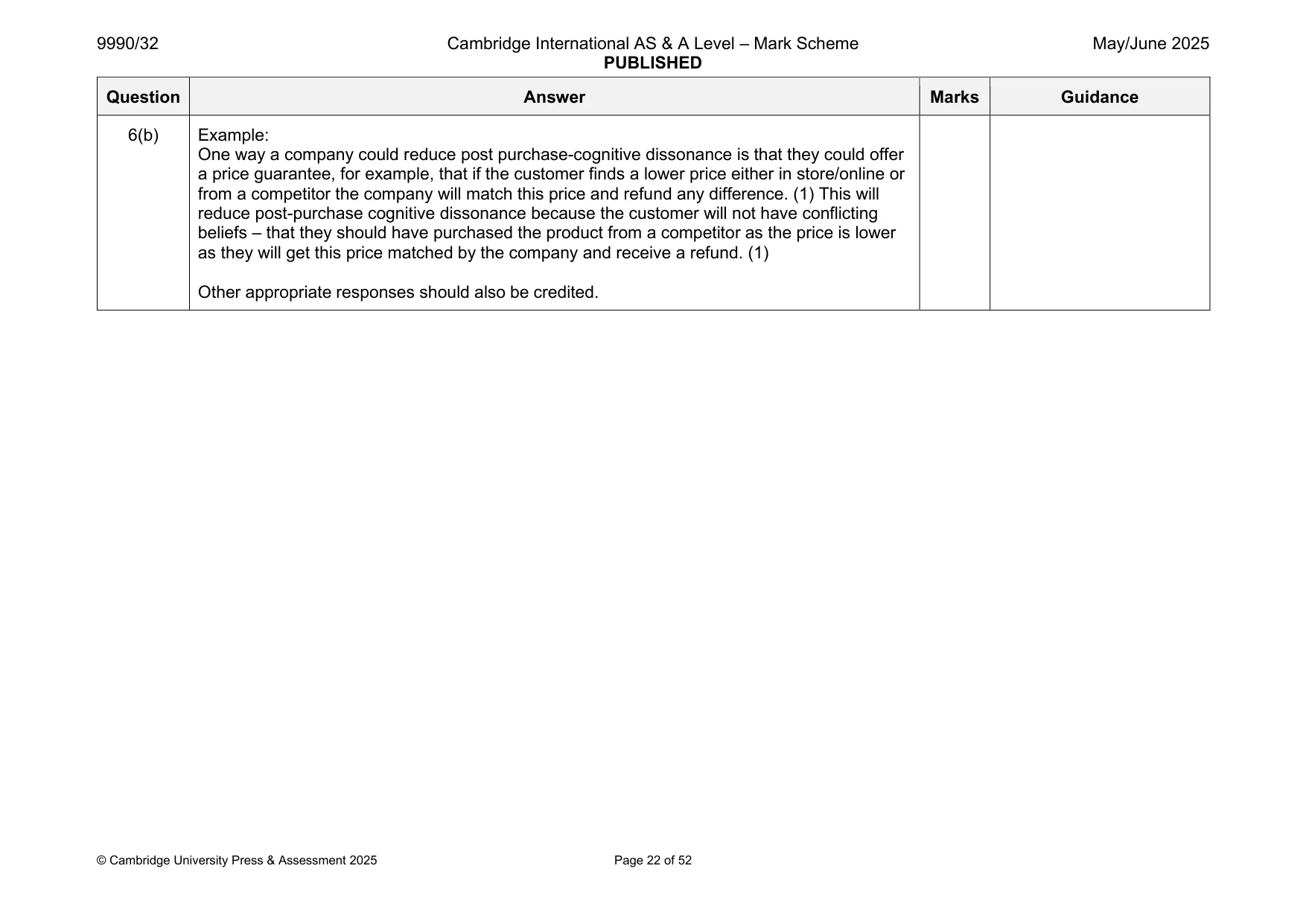
Mark scheme: 6 After buying a product, consumers can be affected by post-purchase cognitive dissonance, which can be applied to everyday life. 6(a) Outline what is meant by ‘post-purchase cognitive dissonance’. 2 Award 2 marks for an outline of the concept Award 1 mark for a basic outline of the concept. Likely answers: Cognitive dissonance is when two beliefs contrast/in opposition to each other OR the customer has behaved in a certain way (purchased the product) but now has a belief that is in conflict with this (they found a lower price with the competition). These beliefs are that they have purchased the product/now they regret the purchase Regretting purchasing a product. ‘Buyer’s remorse’ Example: • Cognitive dissonance is where the customer has purchased a product but has a belief which is in conflict with this behaviour. (1) For example, they find out the product has just gone on sale and they should have waited to purchase the product. (1) Other appropriate responses should also be credited. 6(b) Explain one way post-purchase cognitive dissonance could be reduced. 2 Allow answers that the consumer does something Award 2 marks for an explanation of one way post-purchase cognitive dissonance could be to reduce their own cd. reduced. This could be returning the Award 1 mark for a basic explanation of one way post-purchase cognitive dissonance could be item. reduced. 1 mark for way Possible explanations– 1 mark for why it would • The seller/company can: reduce post-purchase – Offer a price guarantee that they will match the price of a competitor’s product within, cognitive dissonance. for example, 30 days of purchase. – Offer to help the customer find a different product that is more suitable to them, if they Can allow responses that come into the store and return an item. prevent cognitive • Good customer service at point of purchase. For example, if the customer is purchasing dissonance. an expensive item such as a computer or a car for the sales person to discuss affordability (how much are the monthly payments and for how long), suitability (getting Allow reference to the the correct product to match their needs – e.g. the hard drive of a computer is the size Nordvall study needed for the customer’s needs rather than selling them the most expensive/largest computer), • Good aftersales service – e.g. servicing agreement for a car, guarantee if there are any problems with the product – giving a replacement if the product is faulty. The consumer/customer can – • Thorough research of product prior to purchase • Budgeting for affordability of upfront cost and/or monthly payments. • Waiting to make the purchase to make sure the product is really wanted and not an impulse buy. • Giving reason for the choice of product. • Believe that the purchase is the best product compared to other choices available or not buying it. This means cognitive dissonance will decrease because the customer will be less likely to regret their purchase (linked to the way/idea given above) 6(b) Example: One way a company could reduce post purchase-cognitive dissonance is that they could offer a price guarantee, for example, that if the customer finds a lower price either in store/online or from a competitor the company will match this price and refund any difference. (1) This will reduce post-purchase cognitive dissonance because the customer will not have conflicting beliefs – that they should have purchased the product from a competitor as the price is lower as they will get this price matched by the company and receive a refund. (1) Other appropriate responses should also be credited.
Q7 · Steven and Fred sell coats
7 Steven and Fred sell coats. They are talking about why coat sales have increased on their website. • Steven says customers decide to purchase a coat because their website allows customers to search for useful features. • Fred says customers decide to purchase a coat because their website is the first one customers find when they search online. (a) (i) Outline which model of consumer decision‑making has been suggested by Steven. Justify your answer. [2] (ii) Outline which model of consumer decision‑making has been suggested by Fred. Justify your answer. [2] (b) Outline one problem psychologists have when deciding which model of consumer decision‑making is being used by customers. [2]
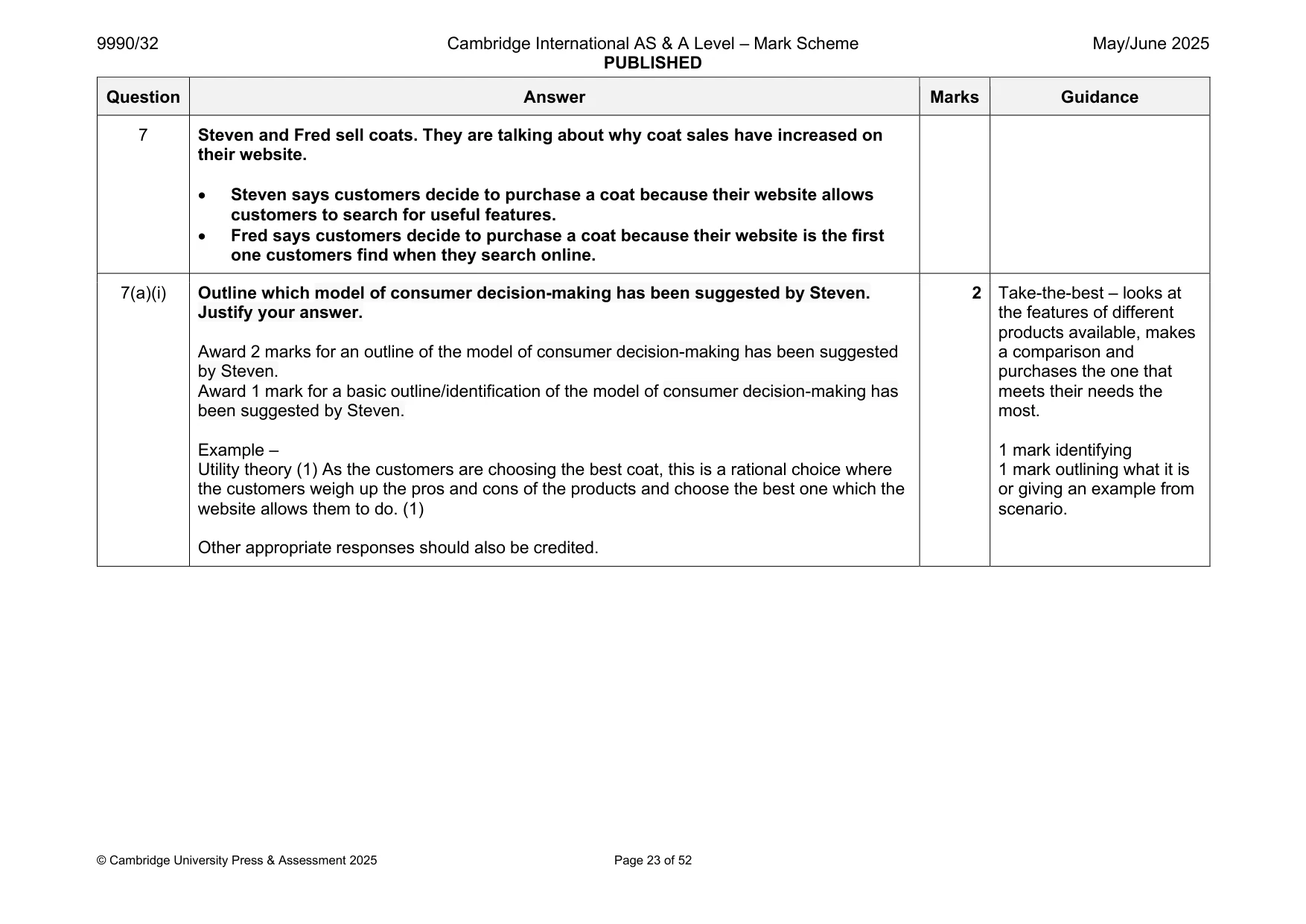
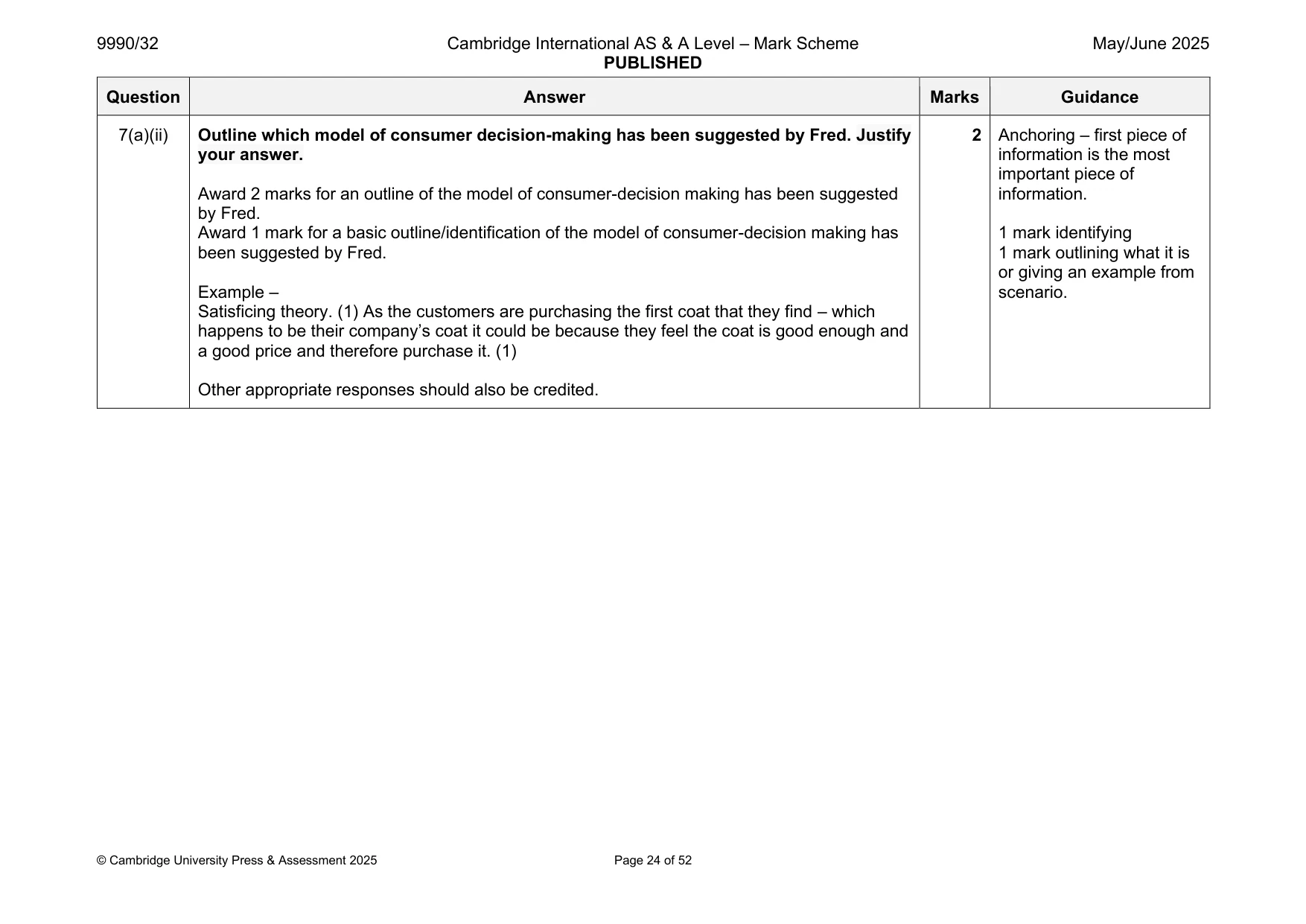
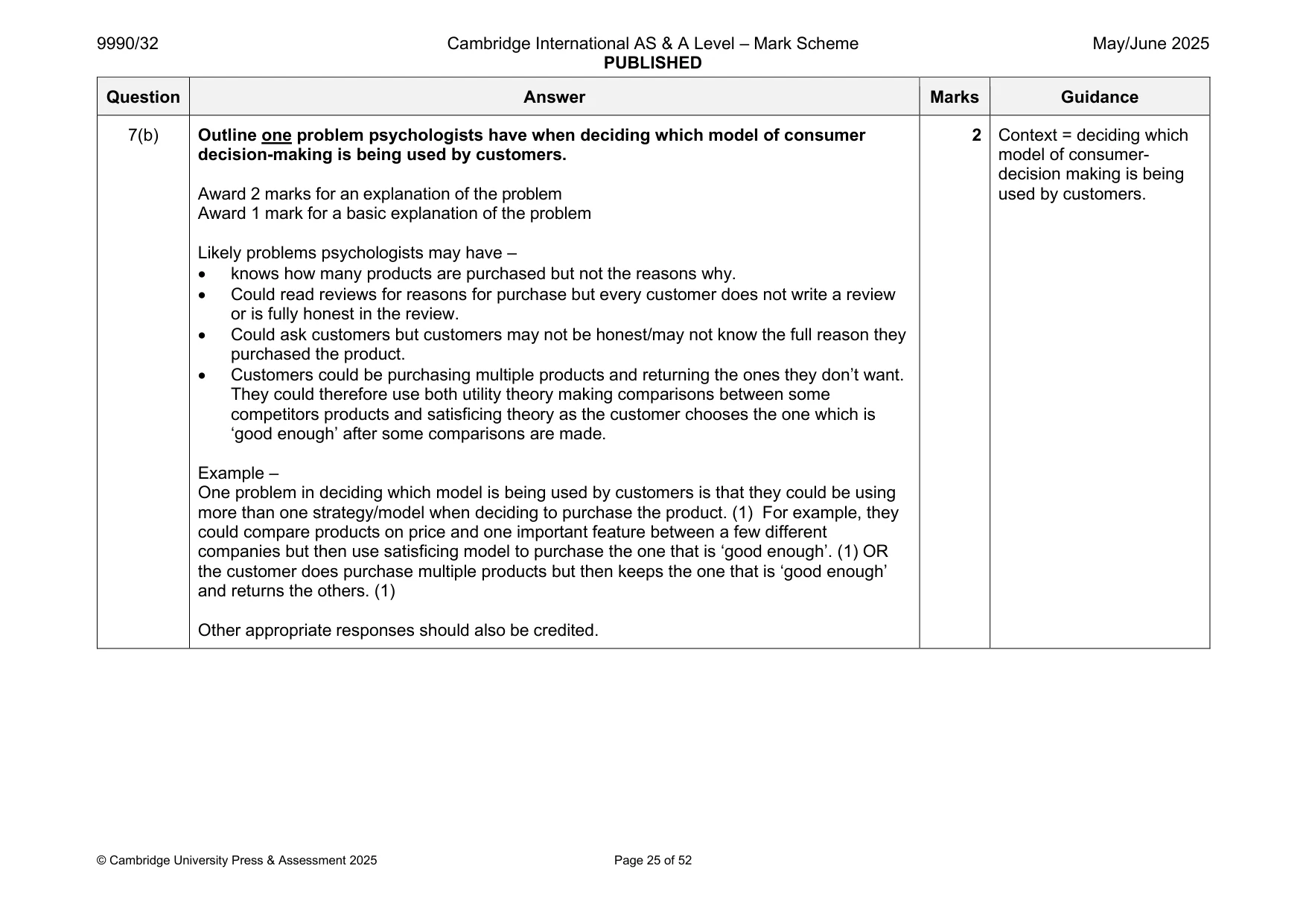
Mark scheme: 7 Steven and Fred sell coats. They are talking about why coat sales have increased on their website. • Steven says customers decide to purchase a coat because their website allows customers to search for useful features. • Fred says customers decide to purchase a coat because their website is the first one customers find when they search online. 7(a)(i) Outline which model of consumer decision-making has been suggested by Steven. 2 Take-the-best – looks at Justify your answer. the features of different products available, makes Award 2 marks for an outline of the model of consumer decision-making has been suggested a comparison and by Steven. purchases the one that Award 1 mark for a basic outline/identification of the model of consumer decision-making has meets their needs the been suggested by Steven. most. Example – 1 mark identifying Utility theory (1) As the customers are choosing the best coat, this is a rational choice where 1 mark outlining what it is the customers weigh up the pros and cons of the products and choose the best one which the or giving an example from website allows them to do. (1) scenario. Other appropriate responses should also be credited. 7(a)(ii) Outline which model of consumer decision-making has been suggested by Fred. Justify 2 Anchoring – first piece of your answer. information is the most important piece of Award 2 marks for an outline of the model of consumer-decision making has been suggested information. by Fred. Award 1 mark for a basic outline/identification of the model of consumer-decision making has 1 mark identifying been suggested by Fred. 1 mark outlining what it is or giving an example from Example – scenario. Satisficing theory. (1) As the customers are purchasing the first coat that they find – which happens to be their company’s coat it could be because they feel the coat is good enough and a good price and therefore purchase it. (1) Other appropriate responses should also be credited. 7(b) Outline one problem psychologists have when deciding which model of consumer 2 Context = deciding which decision-making is being used by customers. model of consumer- decision making is being Award 2 marks for an explanation of the problem used by customers. Award 1 mark for a basic explanation of the problem Likely problems psychologists may have – • knows how many products are purchased but not the reasons why. • Could read reviews for reasons for purchase but every customer does not write a review or is fully honest in the review. • Could ask customers but customers may not be honest/may not know the full reason they purchased the product. • Customers could be purchasing multiple products and returning the ones they don’t want. They could therefore use both utility theory making comparisons between some competitors products and satisficing theory as the customer chooses the one which is ‘good enough’ after some comparisons are made. Example – One problem in deciding which model is being used by customers is that they could be using more than one strategy/model when deciding to purchase the product. (1) For example, they could compare products on price and one important feature between a few different companies but then use satisficing model to purchase the one that is ‘good enough’. (1) OR the customer does purchase multiple products but then keeps the one that is ‘good enough’ and returns the others. (1) Other appropriate responses should also be credited.
Q8 · Describe: • a study on any type of advertising media, and • Lauterborn’s 4 Cs marketing…
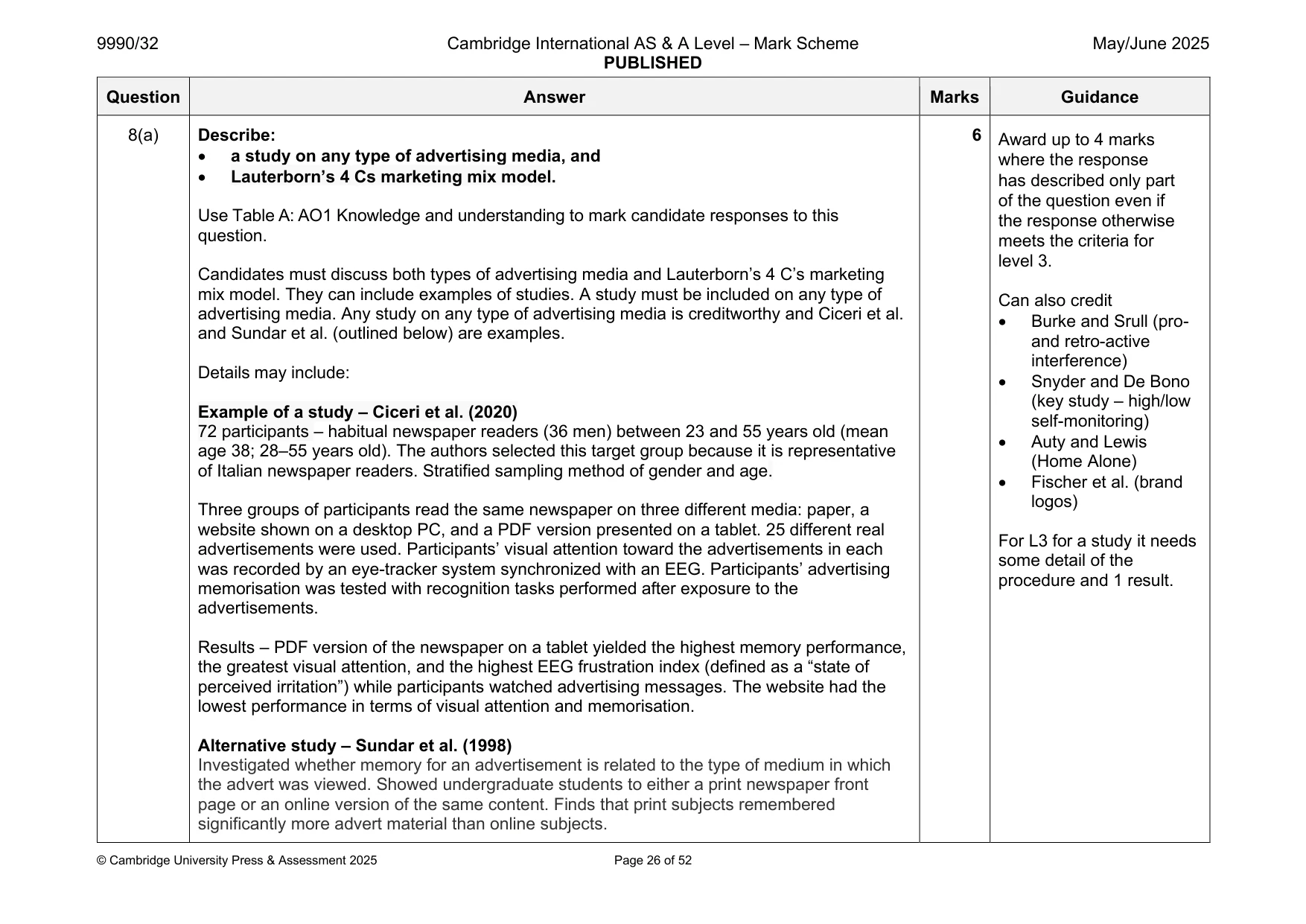
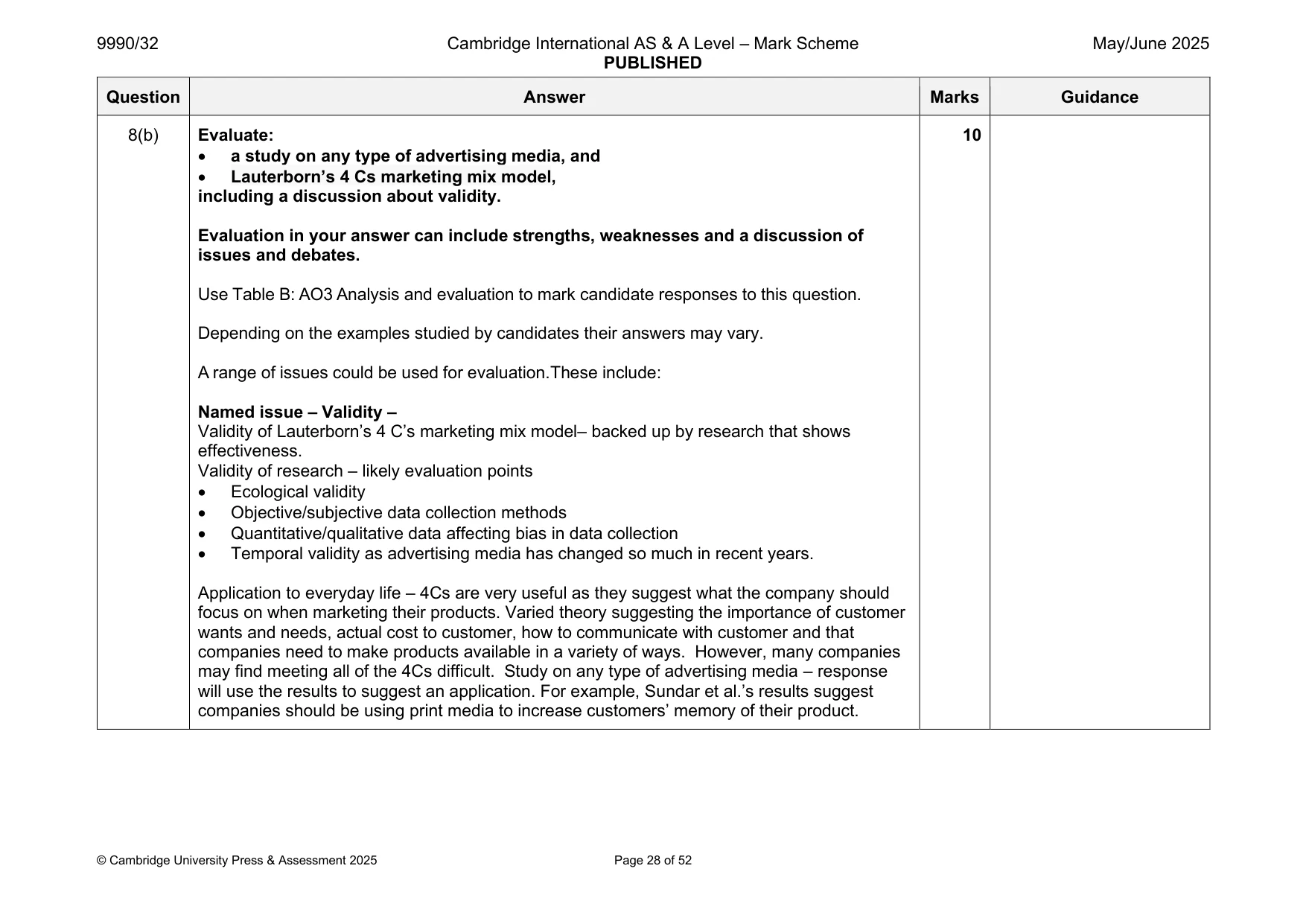
8 (a) Describe: • a study on any type of advertising media, and • Lauterborn’s 4 Cs marketing mix model. [6] (b) Evaluate: • a study on any type of advertising media, and • Lauterborn’s 4 Cs marketing mix model, including a discussion about validity. Evaluation in your answer can include strengths, weaknesses and a discussion of issues and debates. [10] Section C: Health Psychology Answer all questions.
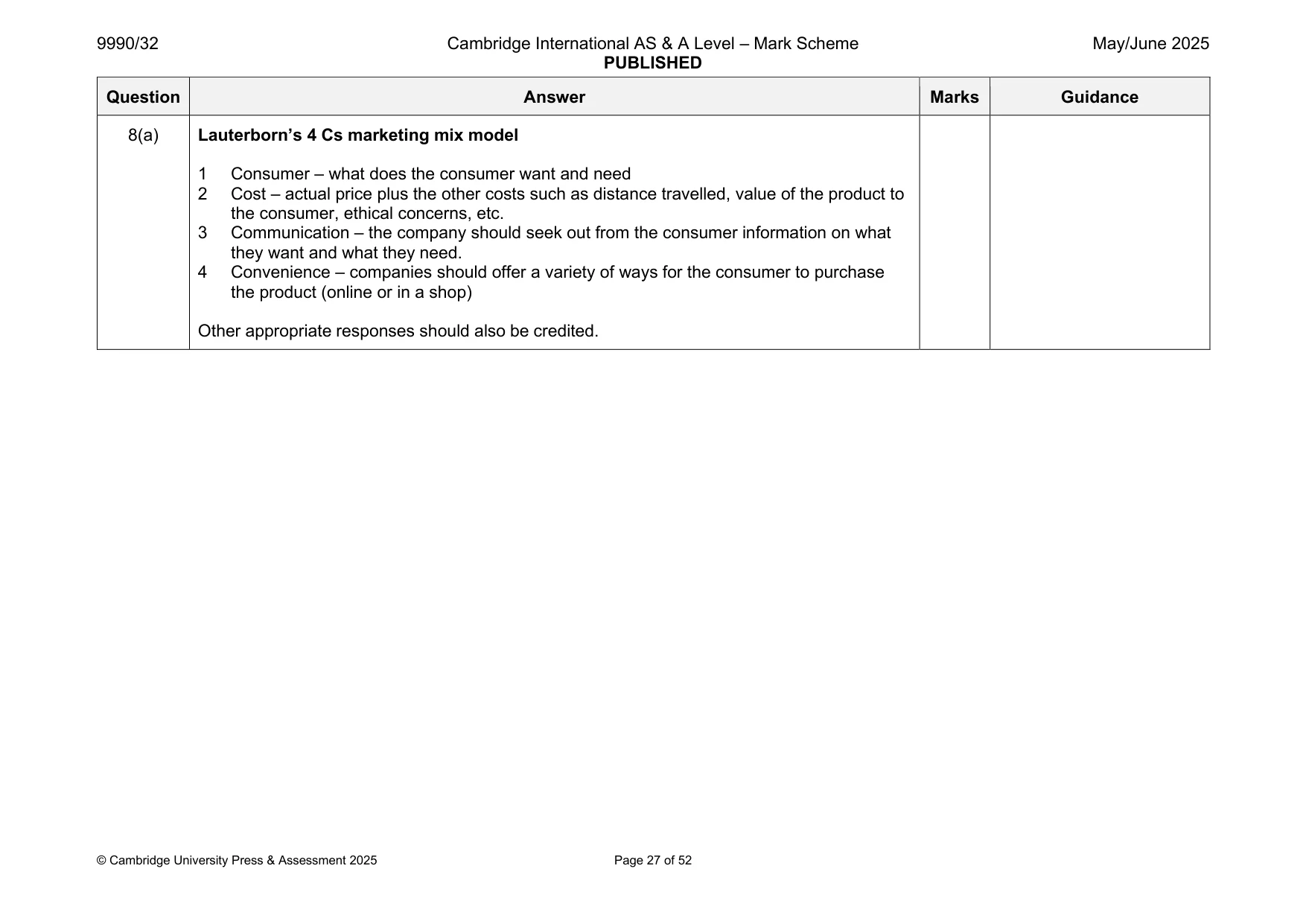
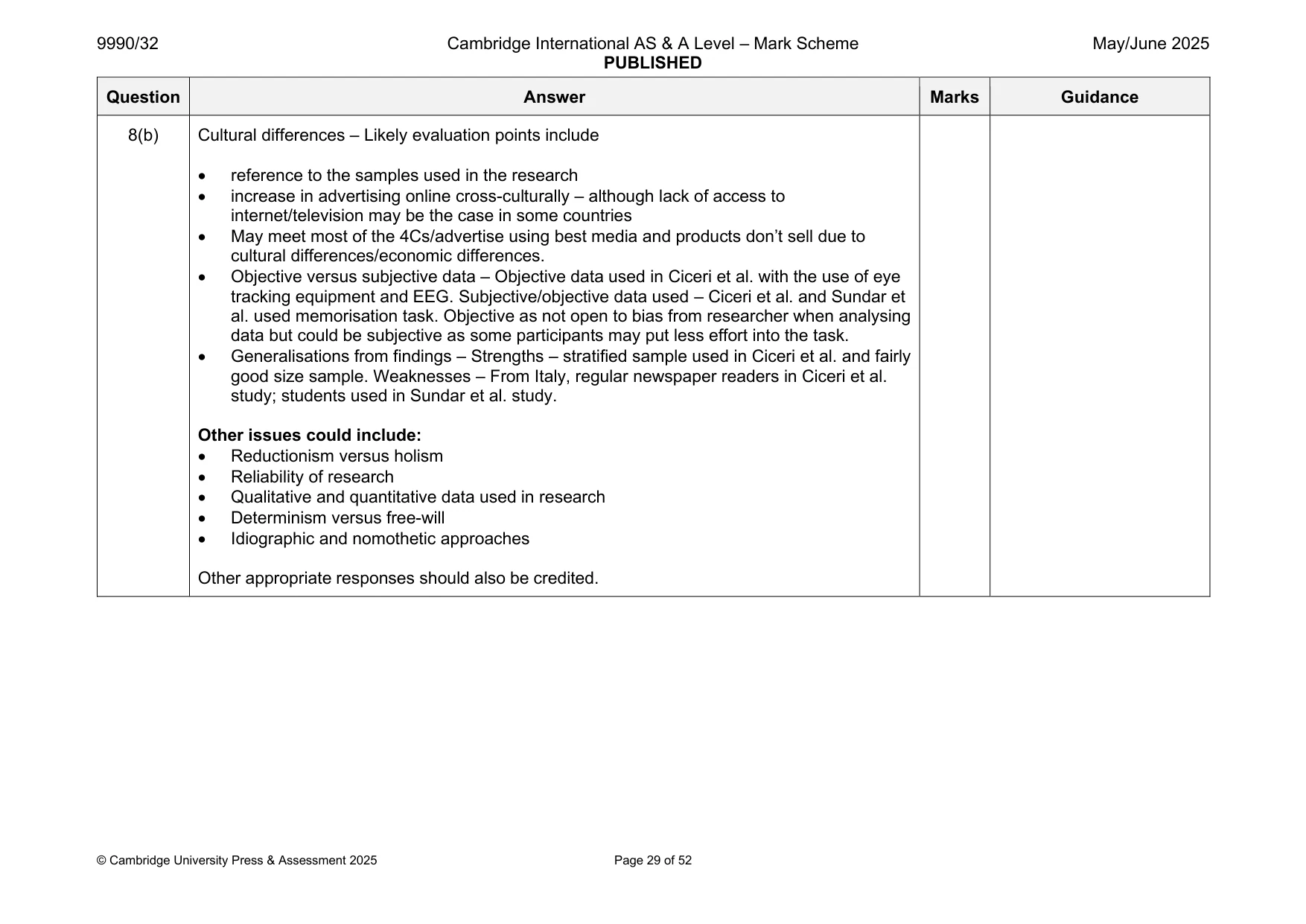
Mark scheme: 8(a) Describe: 6 Award up to 4 marks • a study on any type of advertising media, and where the response • Lauterborn’s 4 Cs marketing mix model. has described only part of the question even if Use Table A: AO1 Knowledge and understanding to mark candidate responses to this the response otherwise question. meets the criteria for level 3. Candidates must discuss both types of advertising media and Lauterborn’s 4 C’s marketing mix model. They can include examples of studies. A study must be included on any type of Can also credit advertising media. Any study on any type of advertising media is creditworthy and Ciceri et al. • Burke and Srull (pro- and Sundar et al. (outlined below) are examples. and retro-active interference) Details may include: • Snyder and De Bono (key study – high/low Example of a study – Ciceri et al. (2020) self-monitoring) 72 participants – habitual newspaper readers (36 men) between 23 and 55 years old (mean • Auty and Lewis age 38; 28–55 years old). The authors selected this target group because it is representative (Home Alone) of Italian newspaper readers. Stratified sampling method of gender and age. • Fischer et al. (brand logos) Three groups of participants read the same newspaper on three different media: paper, a website shown on a desktop PC, and a PDF version presented on a tablet. 25 different real For L3 for a study it needs advertisements were used. Participants’ visual attention toward the advertisements in each some detail of the was recorded by an eye-tracker system synchronized with an EEG. Participants’ advertising procedure and 1 result. memorisation was tested with recognition tasks performed after exposure to the advertisements. Results – PDF version of the newspaper on a tablet yielded the highest memory performance, the greatest visual attention, and the highest EEG frustration index (defined as a “state of perceived irritation”) while participants watched advertising messages. The website had the lowest performance in terms of visual attention and memorisation. Alternative study – Sundar et al. (1998) Investigated whether memory for an advertisement is related to the type of medium in which the advert was viewed. Showed undergraduate students to either a print newspaper front page or an online version of the same content. Finds that print subjects remembered significantly more advert material than online subjects. 8(a) Lauterborn’s 4 Cs marketing mix model 1 Consumer – what does the consumer want and need 2 Cost – actual price plus the other costs such as distance travelled, value of the product to the consumer, ethical concerns, etc. 3 Communication – the company should seek out from the consumer information on what they want and what they need. 4 Convenience – companies should offer a variety of ways for the consumer to purchase the product (online or in a shop) Other appropriate responses should also be credited. 8(b) Evaluate: 10 • a study on any type of advertising media, and • Lauterborn’s 4 Cs marketing mix model, including a discussion about validity. Evaluation in your answer can include strengths, weaknesses and a discussion of issues and debates. Use Table B: AO3 Analysis and evaluation to mark candidate responses to this question. Depending on the examples studied by candidates their answers may vary. A range of issues could be used for evaluation. These include: Named issue – Validity – Validity of Lauterborn’s 4 C’s marketing mix model– backed up by research that shows effectiveness. Validity of research – likely evaluation points • Ecological validity • Objective/subjective data collection methods • Quantitative/qualitative data affecting bias in data collection • Temporal validity as advertising media has changed so much in recent years. Application to everyday life – 4Cs are very useful as they suggest what the company should focus on when marketing their products. Varied theory suggesting the importance of customer wants and needs, actual cost to customer, how to communicate with customer and that companies need to make products available in a variety of ways. However, many companies may find meeting all of the 4Cs difficult. Study on any type of advertising media – response will use the results to suggest an application. For example, Sundar et al.’s results suggest companies should be using print media to increase customers’ memory of their product. 8(b) Cultural differences – Likely evaluation points include • reference to the samples used in the research • increase in advertising online cross-culturally – although lack of access to internet/television may be the case in some countries • May meet most of the 4Cs/advertise using best media and products don’t sell due to cultural differences/economic differences. • Objective versus subjective data – Objective data used in Ciceri et al. with the use of eye tracking equipment and EEG. Subjective/objective data used – Ciceri et al. and Sundar et al. used memorisation task. Objective as not open to bias from researcher when analysing data but could be subjective as some participants may put less effort into the task. • Generalisations from findings – Strengths – stratified sample used in Ciceri et al. and fairly good size sample. Weaknesses – From Italy, regular newspaper readers in Ciceri et al. study; students used in Sundar et al. study. Other issues could include: • Reductionism versus holism • Reliability of research • Qualitative and quantitative data used in research • Determinism versus free-will • Idiographic and nomothetic approaches Other appropriate responses should also be credited. Section C: Health Psychology
Q9 · Isha has been experiencing stress at work
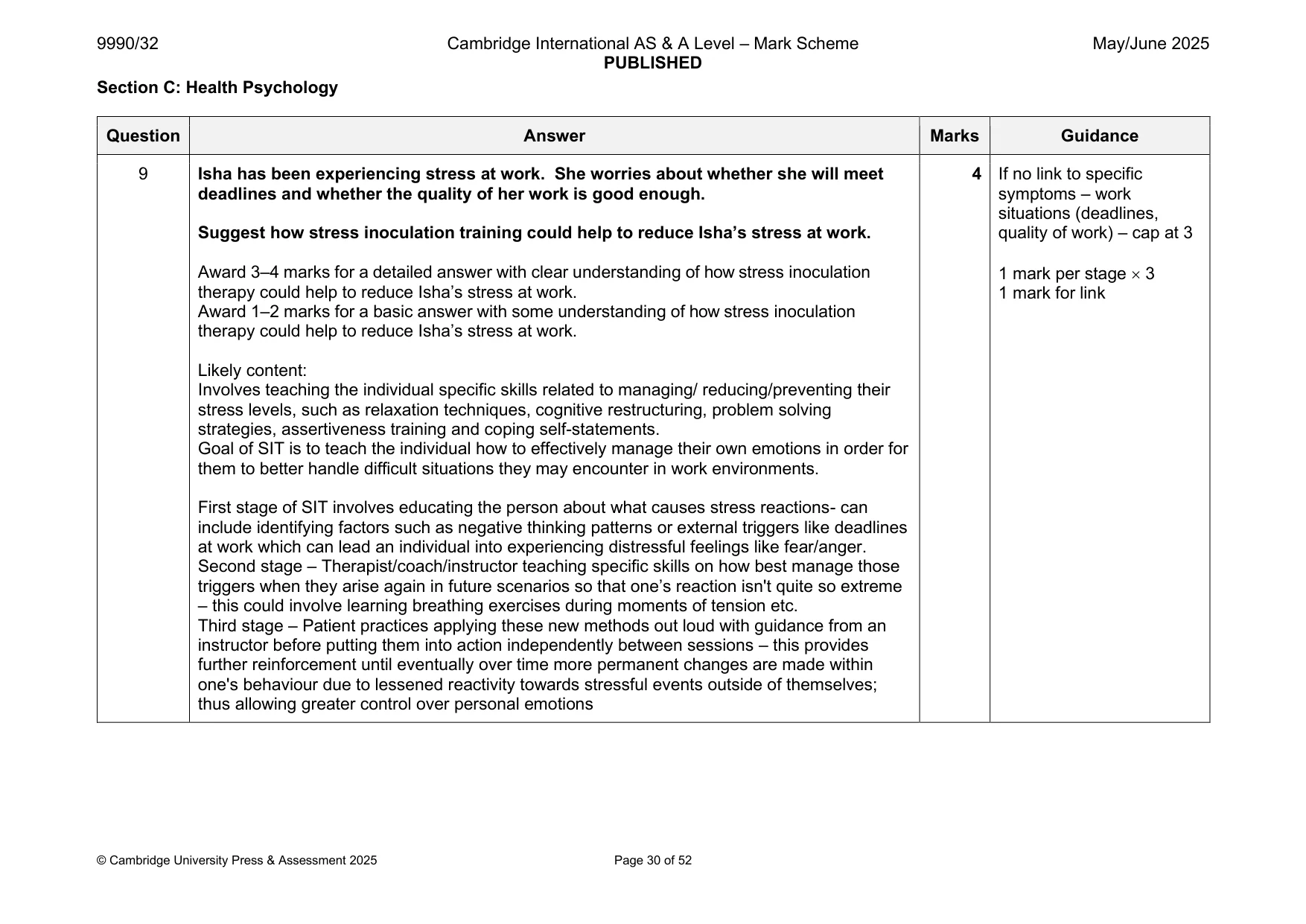
9 Isha has been experiencing stress at work. She worries about whether she will meet deadlines and whether the quality of her work is good enough. Suggest how stress inoculation training could help to reduce Isha’s stress at work. [4]
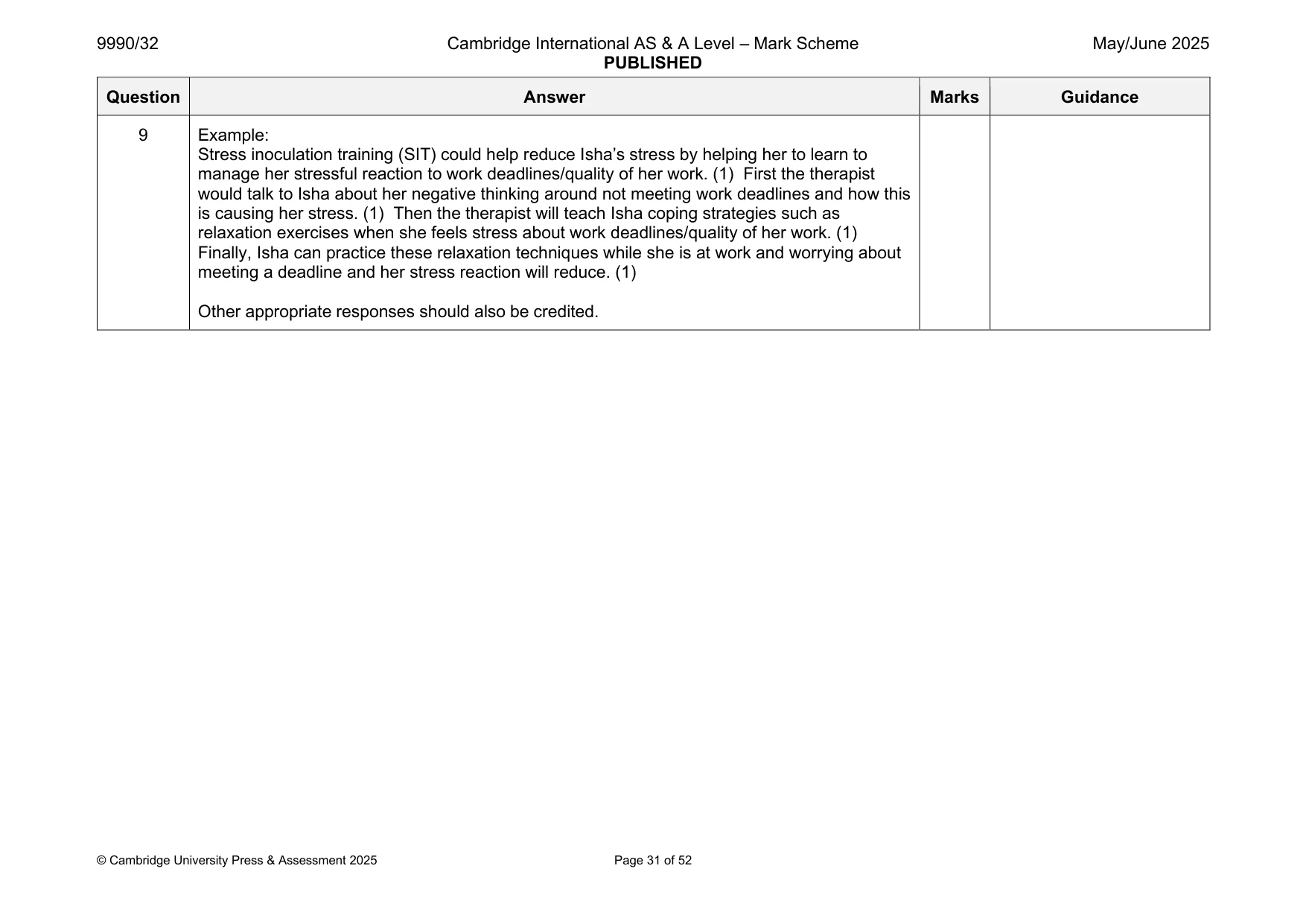
Mark scheme: 9 Isha has been experiencing stress at work. She worries about whether she will meet 4 If no link to specific deadlines and whether the quality of her work is good enough. symptoms – work situations (deadlines, Suggest how stress inoculation training could help to reduce Isha’s stress at work. quality of work) – cap at 3 Award 3–4 marks for a detailed answer with clear understanding of how stress inoculation 1 mark per stage 3 therapy could help to reduce Isha’s stress at work. 1 mark for link Award 1–2 marks for a basic answer with some understanding of how stress inoculation therapy could help to reduce Isha’s stress at work. Likely content: Involves teaching the individual specific skills related to managing/ reducing/preventing their stress levels, such as relaxation techniques, cognitive restructuring, problem solving strategies, assertiveness training and coping self-statements. Goal of SIT is to teach the individual how to effectively manage their own emotions in order for them to better handle difficult situations they may encounter in work environments. First stage of SIT involves educating the person about what causes stress reactions- can include identifying factors such as negative thinking patterns or external triggers like deadlines at work which can lead an individual into experiencing distressful feelings like fear/anger. Second stage – Therapist/coach/instructor teaching specific skills on how best manage those triggers when they arise again in future scenarios so that one’s reaction isn't quite so extreme – this could involve learning breathing exercises during moments of tension etc. Third stage – Patient practices applying these new methods out loud with guidance from an instructor before putting them into action independently between sessions – this provides further reinforcement until eventually over time more permanent changes are made within one's behaviour due to lessened reactivity towards stressful events outside of themselves; thus allowing greater control over personal emotions 9 Example: Stress inoculation training (SIT) could help reduce Isha’s stress by helping her to learn to manage her stressful reaction to work deadlines/quality of her work. (1) First the therapist would talk to Isha about her negative thinking around not meeting work deadlines and how this is causing her stress. (1) Then the therapist will teach Isha coping strategies such as relaxation exercises when she feels stress about work deadlines/quality of her work. (1) Finally, Isha can practice these relaxation techniques while she is at work and worrying about meeting a deadline and her stress reaction will reduce. (1) Other appropriate responses should also be credited.
Q10 · Outline one reason why a person could delay seeking treatment
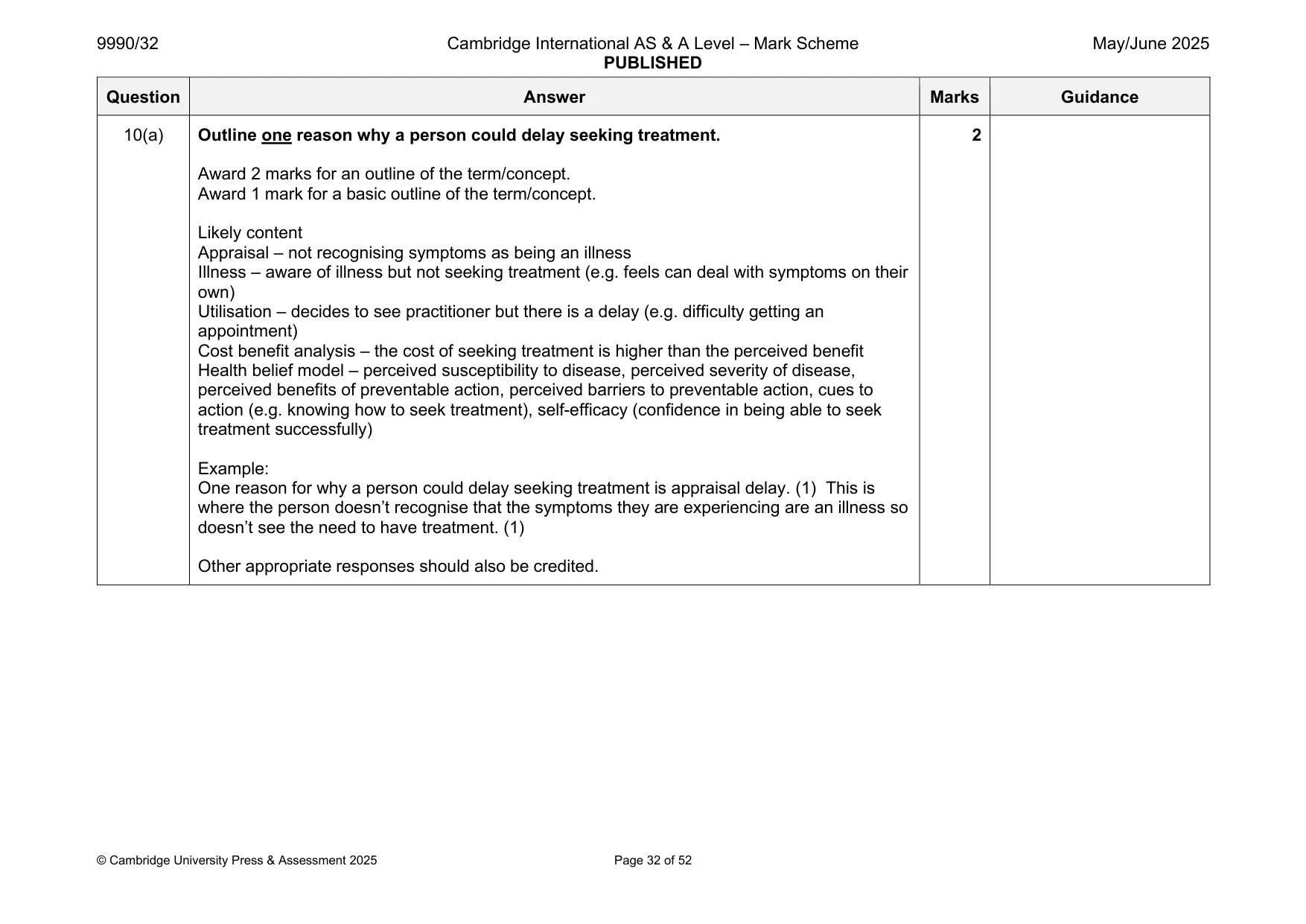
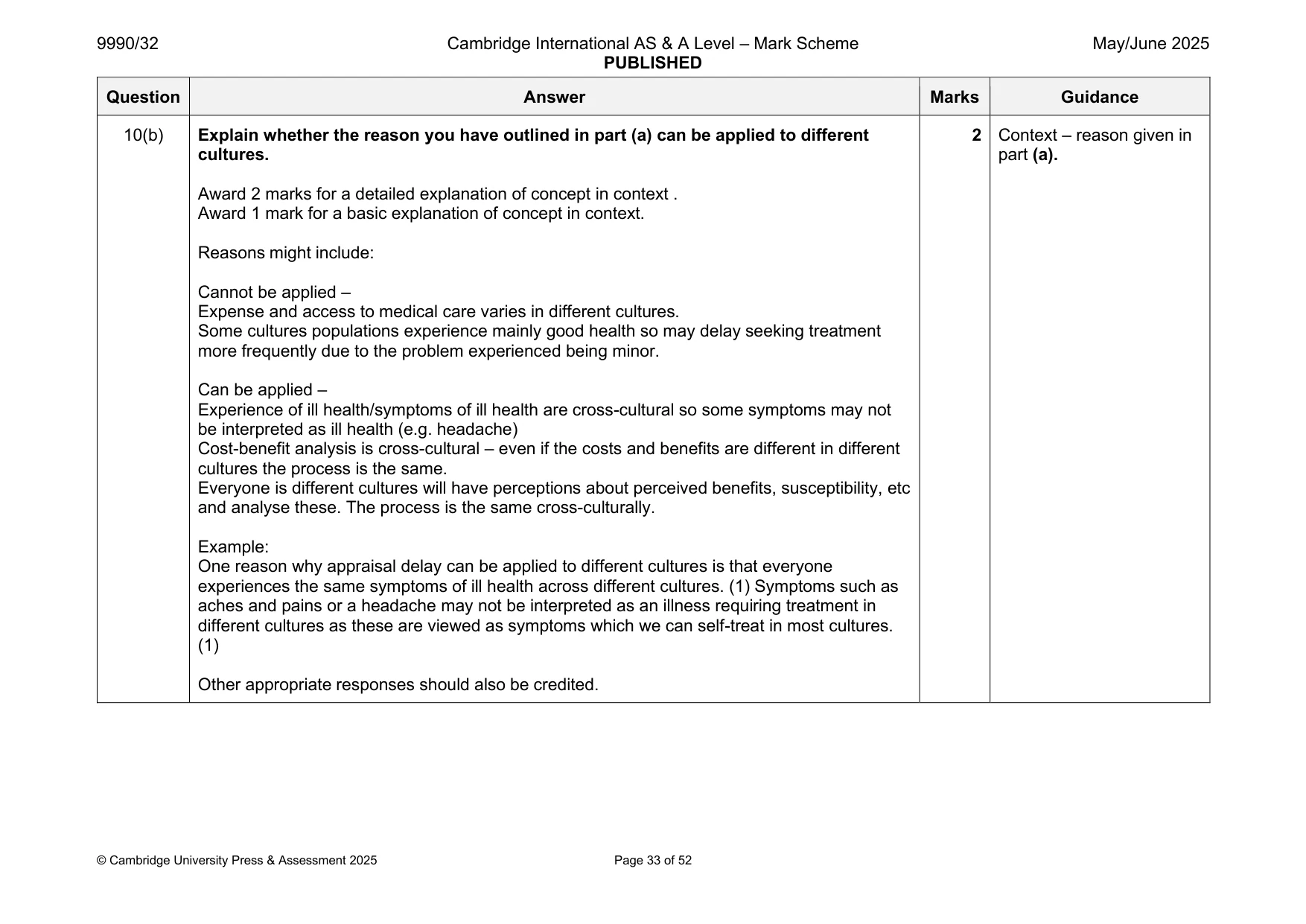
10 (a) Outline one reason why a person could delay seeking treatment. [2] (b) Explain whether the reason you have outlined in part (a) can be applied to different cultures. [2]
Mark scheme: 10(a) Outline one reason why a person could delay seeking treatment. 2 Award 2 marks for an outline of the term/concept. Award 1 mark for a basic outline of the term/concept. Likely content Appraisal – not recognising symptoms as being an illness Illness – aware of illness but not seeking treatment (e.g. feels can deal with symptoms on their own) Utilisation – decides to see practitioner but there is a delay (e.g. difficulty getting an appointment) Cost benefit analysis – the cost of seeking treatment is higher than the perceived benefit Health belief model – perceived susceptibility to disease, perceived severity of disease, perceived benefits of preventable action, perceived barriers to preventable action, cues to action (e.g. knowing how to seek treatment), self-efficacy (confidence in being able to seek treatment successfully) Example: One reason for why a person could delay seeking treatment is appraisal delay. (1) This is where the person doesn’t recognise that the symptoms they are experiencing are an illness so doesn’t see the need to have treatment. (1) Other appropriate responses should also be credited. 10(b) Explain whether the reason you have outlined in part (a) can be applied to different 2 Context – reason given in cultures. part (a). Award 2 marks for a detailed explanation of concept in context . Award 1 mark for a basic explanation of concept in context. Reasons might include: Cannot be applied – Expense and access to medical care varies in different cultures. Some cultures populations experience mainly good health so may delay seeking treatment more frequently due to the problem experienced being minor. Can be applied – Experience of ill health/symptoms of ill health are cross-cultural so some symptoms may not be interpreted as ill health (e.g. headache) Cost-benefit analysis is cross-cultural – even if the costs and benefits are different in different cultures the process is the same. Everyone is different cultures will have perceptions about perceived benefits, susceptibility, etc and analyse these. The process is the same cross-culturally. Example: One reason why appraisal delay can be applied to different cultures is that everyone experiences the same symptoms of ill health across different cultures. (1) Symptoms such as aches and pains or a headache may not be interpreted as an illness requiring treatment in different cultures as these are viewed as symptoms which we can self-treat in most cultures. (1) Other appropriate responses should also be credited.
Q11 · Dr Brown works in a hospital and when her patients are given a questionnaire to rate…
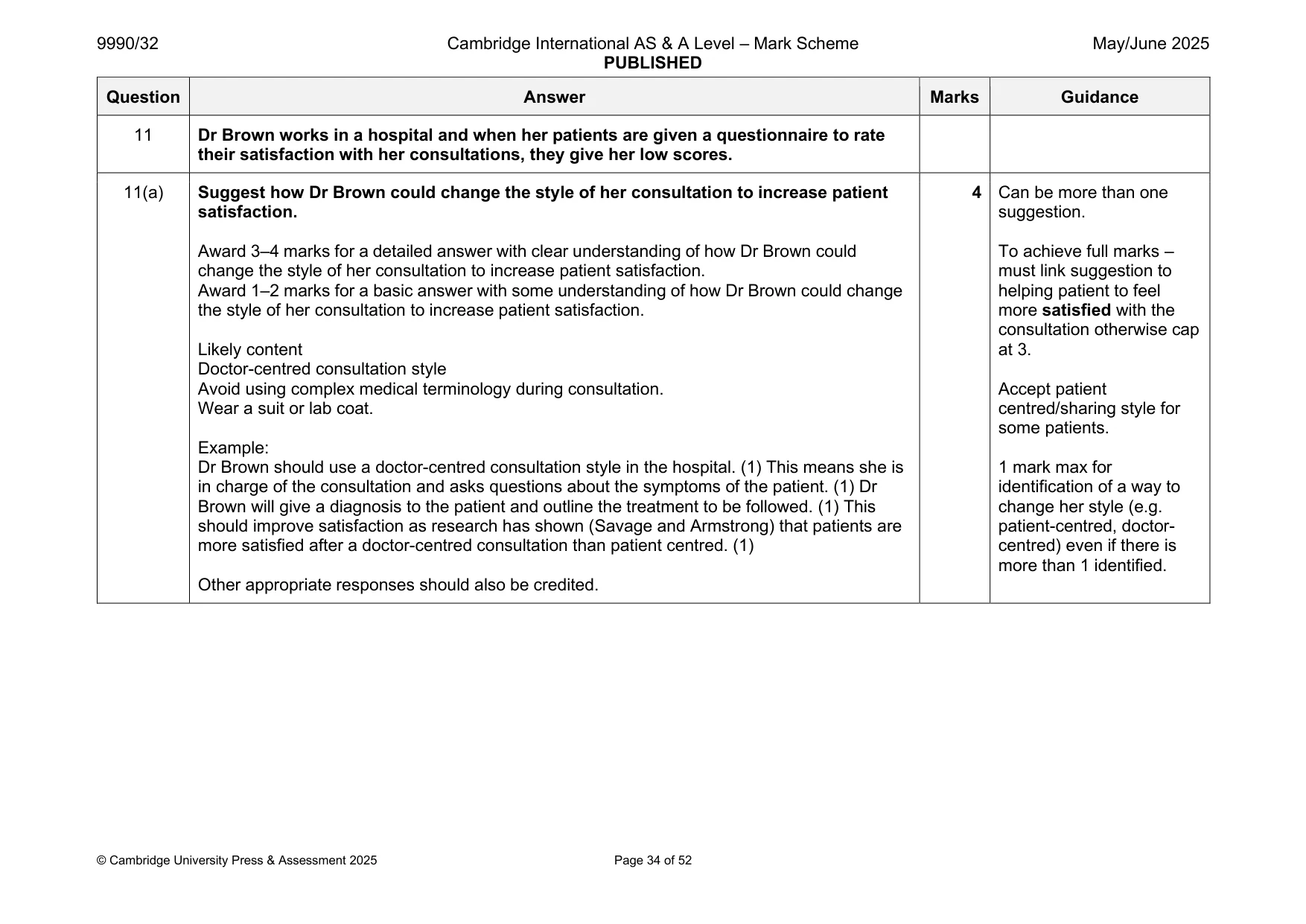
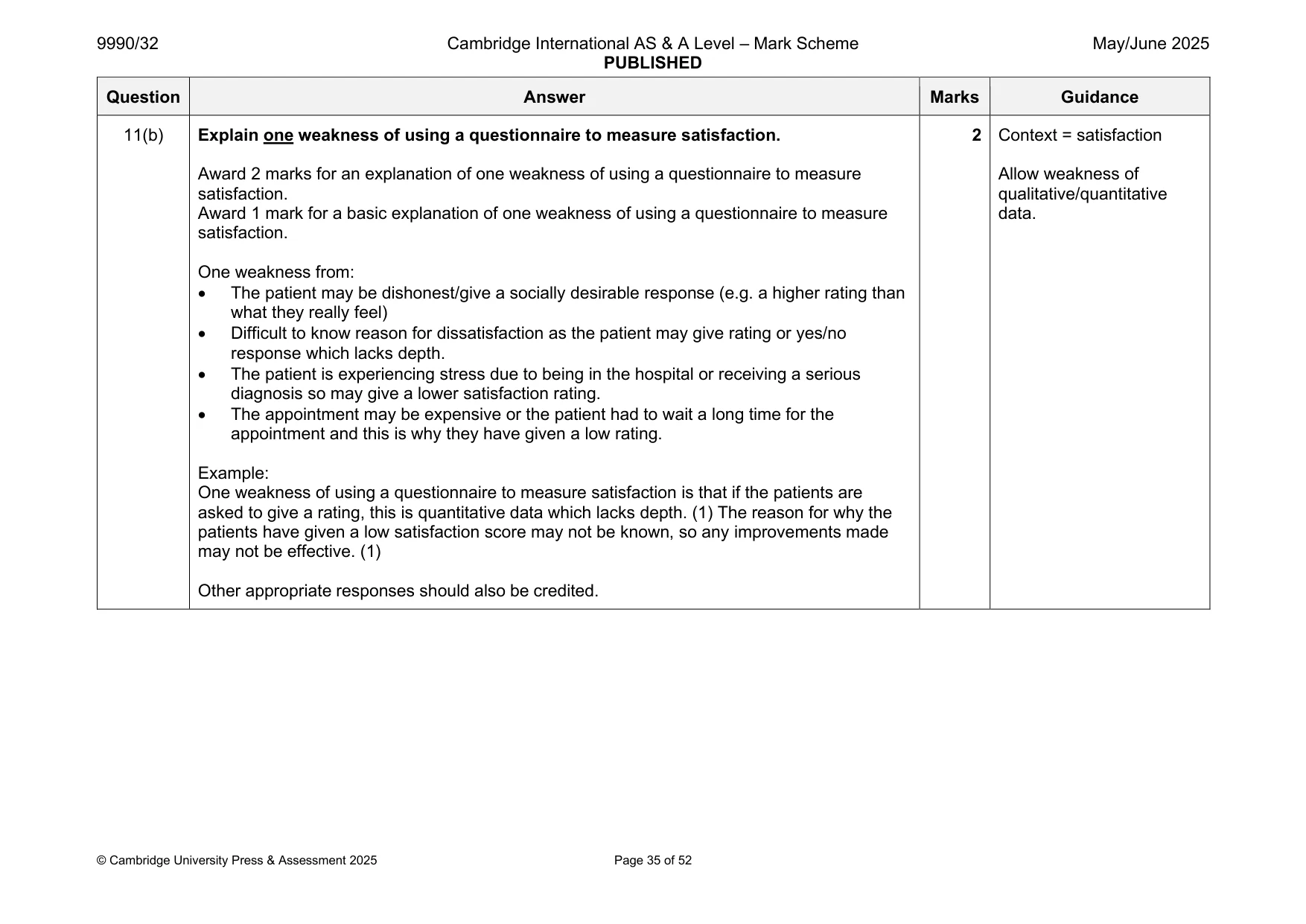
11 Dr Brown works in a hospital and when her patients are given a questionnaire to rate their satisfaction with her consultations, they give her low scores. (a) Suggest how Dr Brown could change the style of her consultation to increase patient satisfaction. [4] (b) Explain one weakness of using a questionnaire to measure satisfaction. [2]
Mark scheme: 11 Dr Brown works in a hospital and when her patients are given a questionnaire to rate their satisfaction with her consultations, they give her low scores. 11(a) Suggest how Dr Brown could change the style of her consultation to increase patient 4 Can be more than one satisfaction. suggestion. Award 3–4 marks for a detailed answer with clear understanding of how Dr Brown could To achieve full marks – change the style of her consultation to increase patient satisfaction. must link suggestion to Award 1–2 marks for a basic answer with some understanding of how Dr Brown could change helping patient to feel the style of her consultation to increase patient satisfaction. more satisfied with the consultation otherwise cap Likely content at 3. Doctor-centred consultation style Avoid using complex medical terminology during consultation. Accept patient Wear a suit or lab coat. centred/sharing style for some patients. Example: Dr Brown should use a doctor-centred consultation style in the hospital. (1) This means she is 1 mark max for in charge of the consultation and asks questions about the symptoms of the patient. (1) Dr identification of a way to Brown will give a diagnosis to the patient and outline the treatment to be followed. (1) This change her style (e.g. should improve satisfaction as research has shown (Savage and Armstrong) that patients are patient-centred, doctor- more satisfied after a doctor-centred consultation than patient centred. (1) centred) even if there is more than 1 identified. Other appropriate responses should also be credited. 11(b) Explain one weakness of using a questionnaire to measure satisfaction. 2 Context = satisfaction Award 2 marks for an explanation of one weakness of using a questionnaire to measure Allow weakness of satisfaction. qualitative/quantitative Award 1 mark for a basic explanation of one weakness of using a questionnaire to measure data. satisfaction. One weakness from: • The patient may be dishonest/give a socially desirable response (e.g. a higher rating than what they really feel) • Difficult to know reason for dissatisfaction as the patient may give rating or yes/no response which lacks depth. • The patient is experiencing stress due to being in the hospital or receiving a serious diagnosis so may give a lower satisfaction rating. • The appointment may be expensive or the patient had to wait a long time for the appointment and this is why they have given a low rating. Example: One weakness of using a questionnaire to measure satisfaction is that if the patients are asked to give a rating, this is quantitative data which lacks depth. (1) The reason for why the patients have given a low satisfaction score may not be known, so any improvements made may not be effective. (1) Other appropriate responses should also be credited.
Q12 · Describe: • a study on promoting healthy eating in schools, and • a study on promoting…
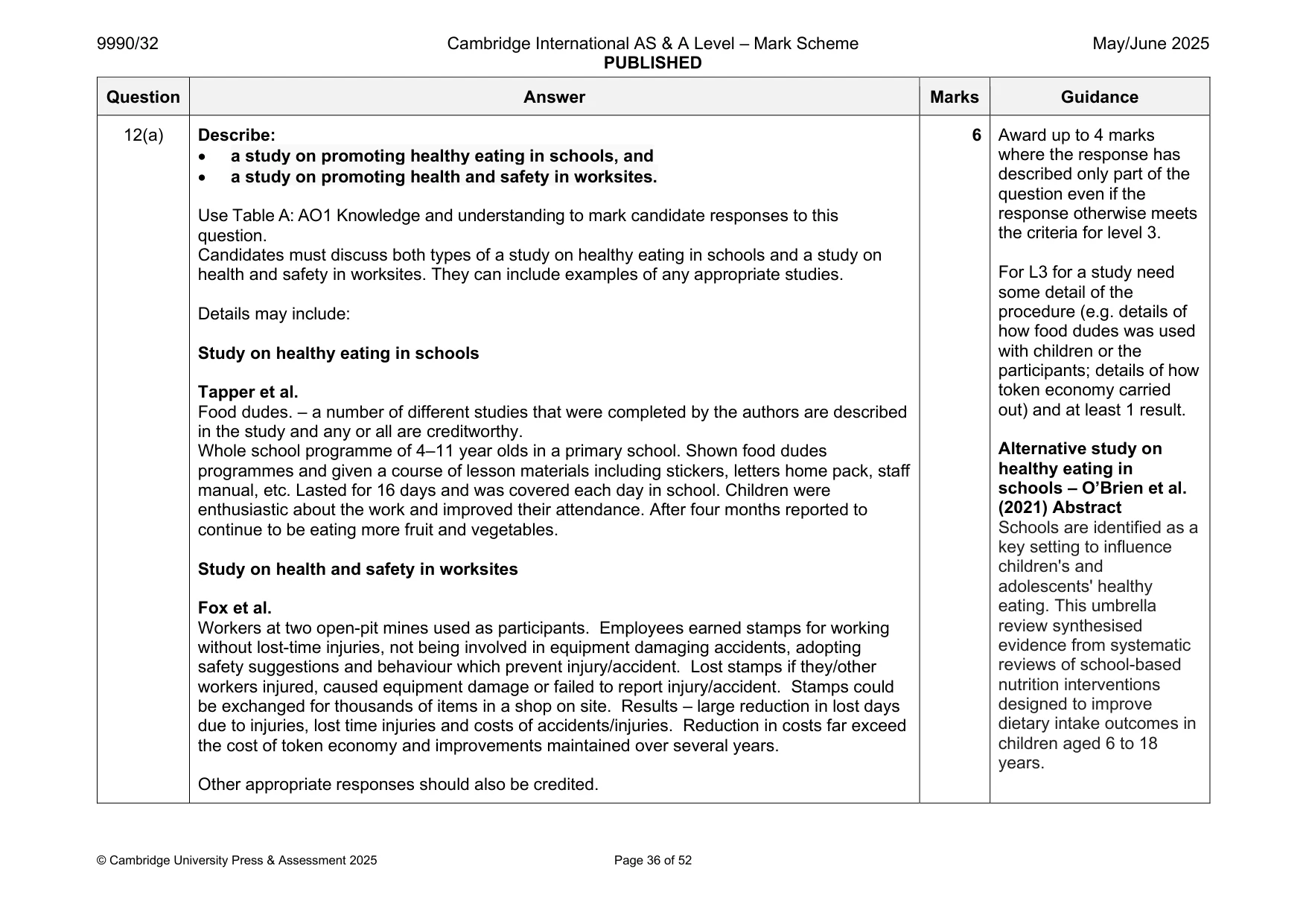
12 (a) Describe: • a study on promoting healthy eating in schools, and • a study on promoting health and safety in worksites. [6] (b) Evaluate: • a study on promoting healthy eating in schools, and • a study on promoting health and safety in worksites, including a discussion about experiments. Evaluation in your answer can include strengths, weaknesses and a discussion of issues and debates. [10] Section D: Organisational Psychology Answer all questions.
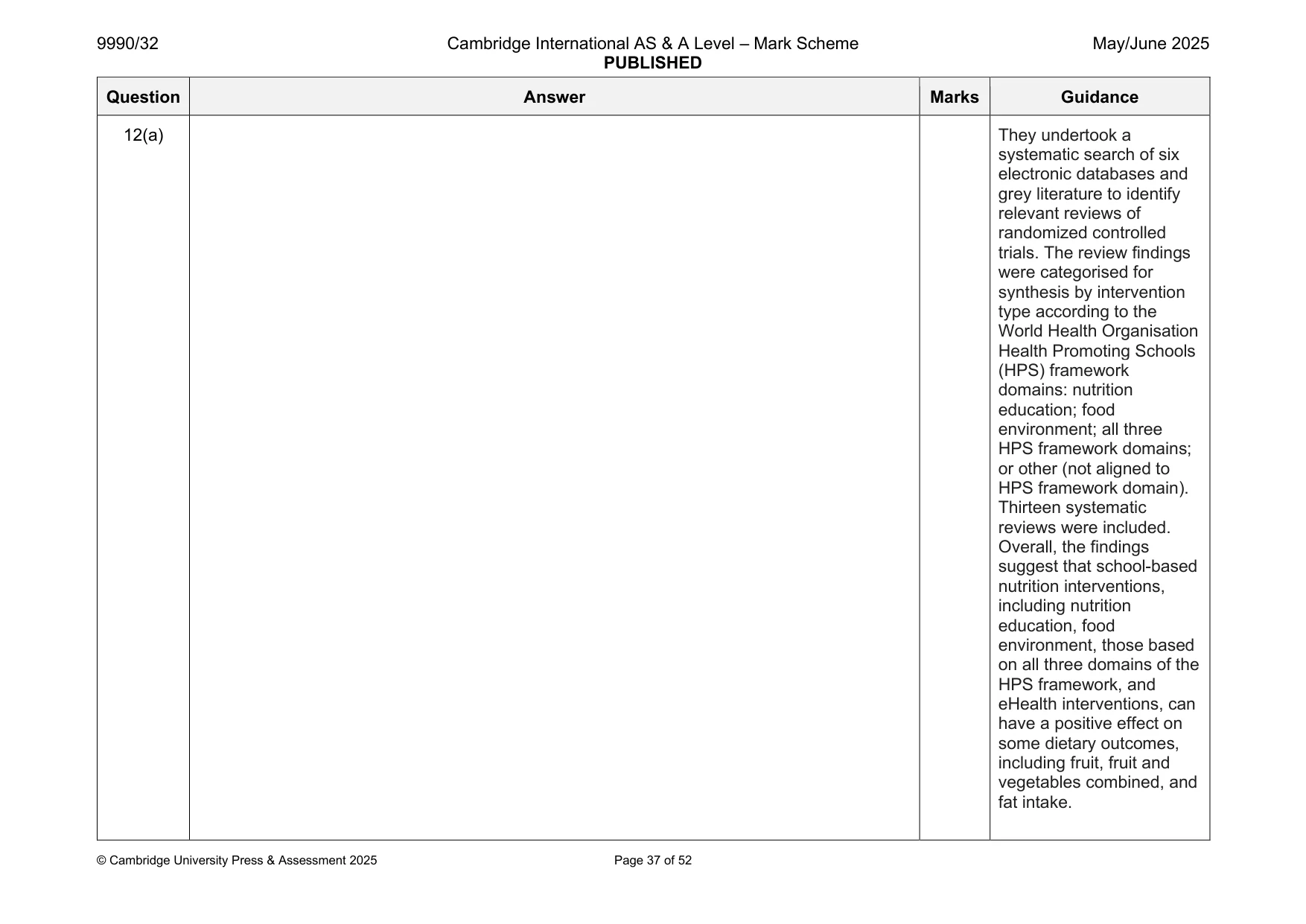
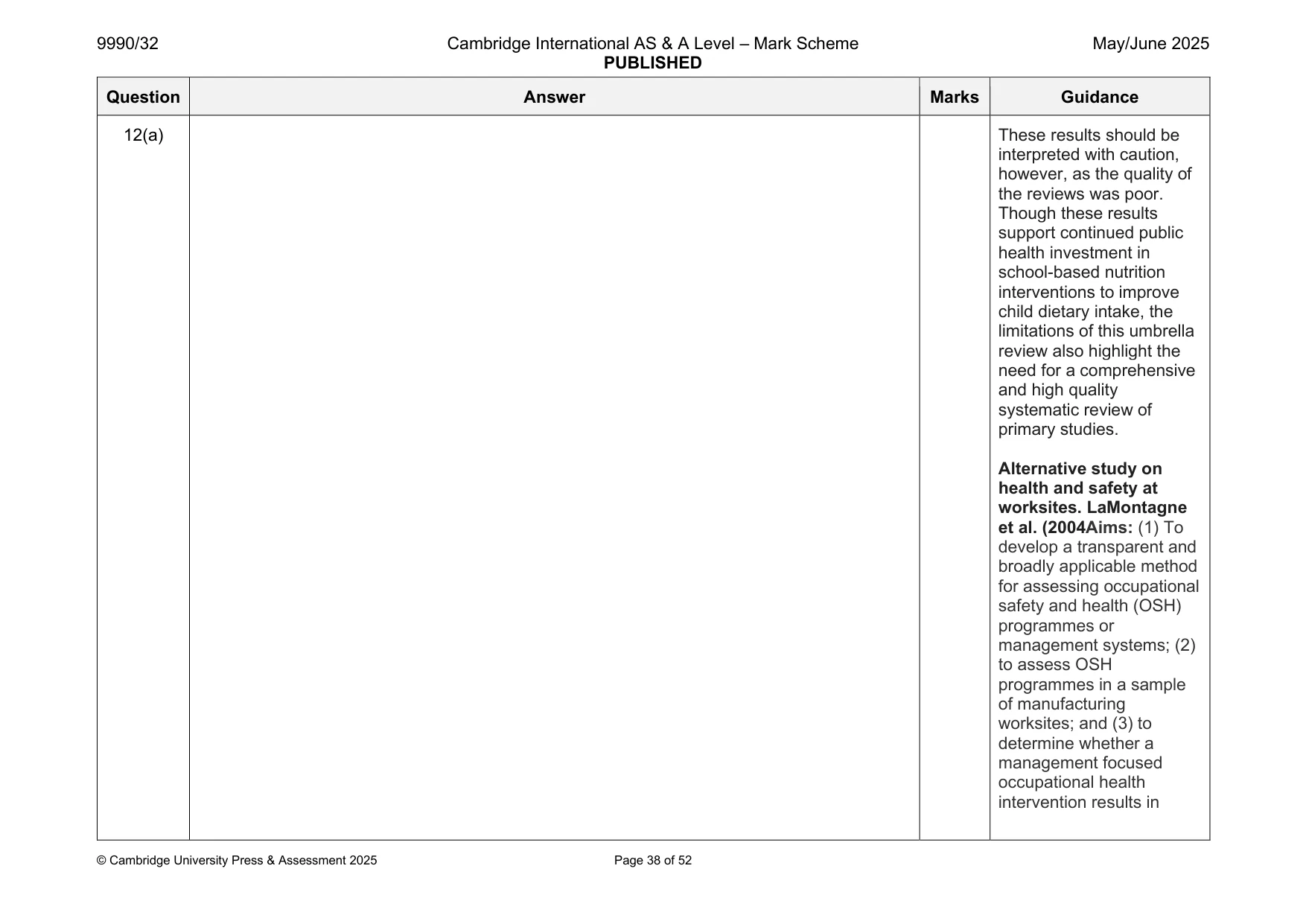
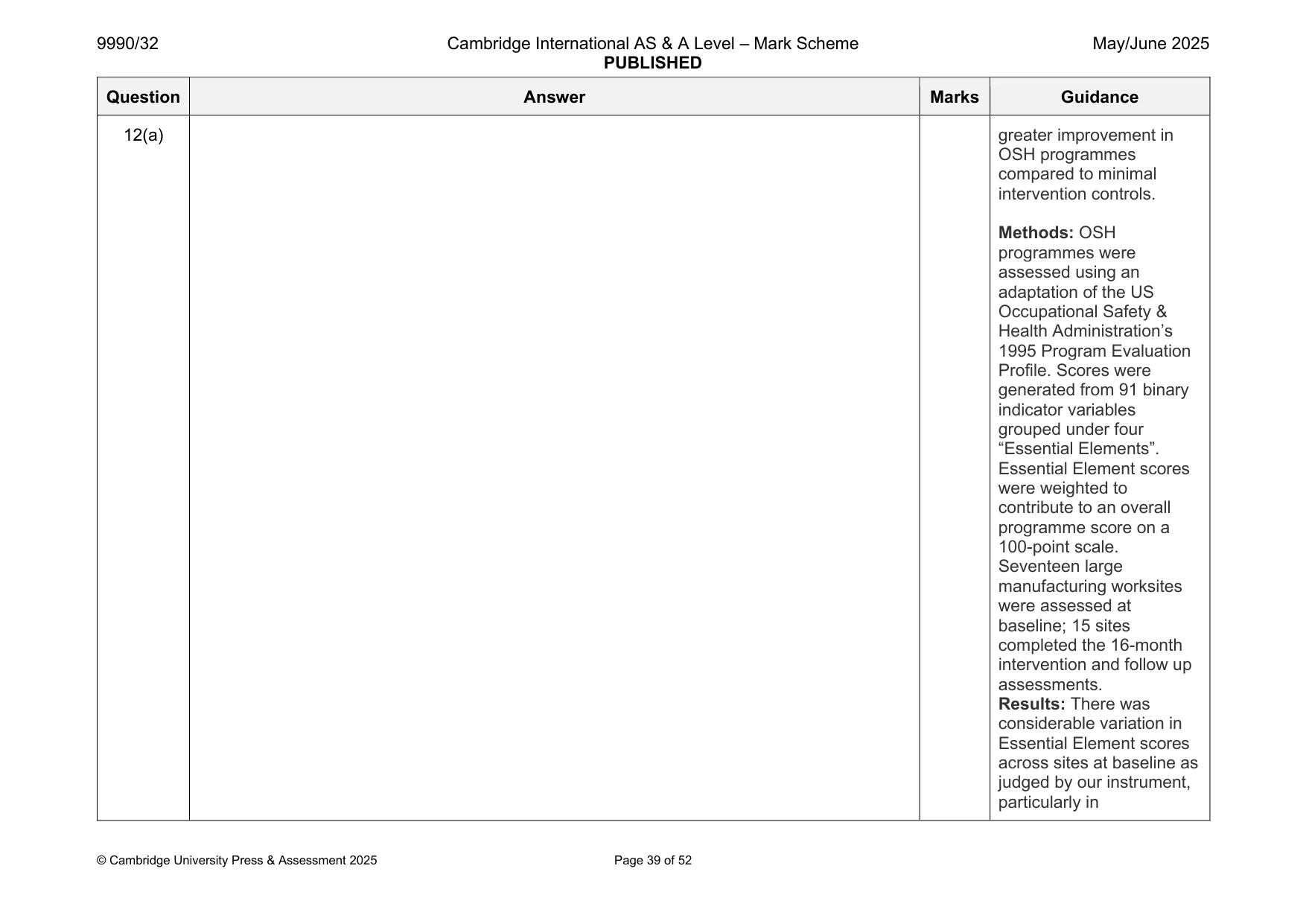
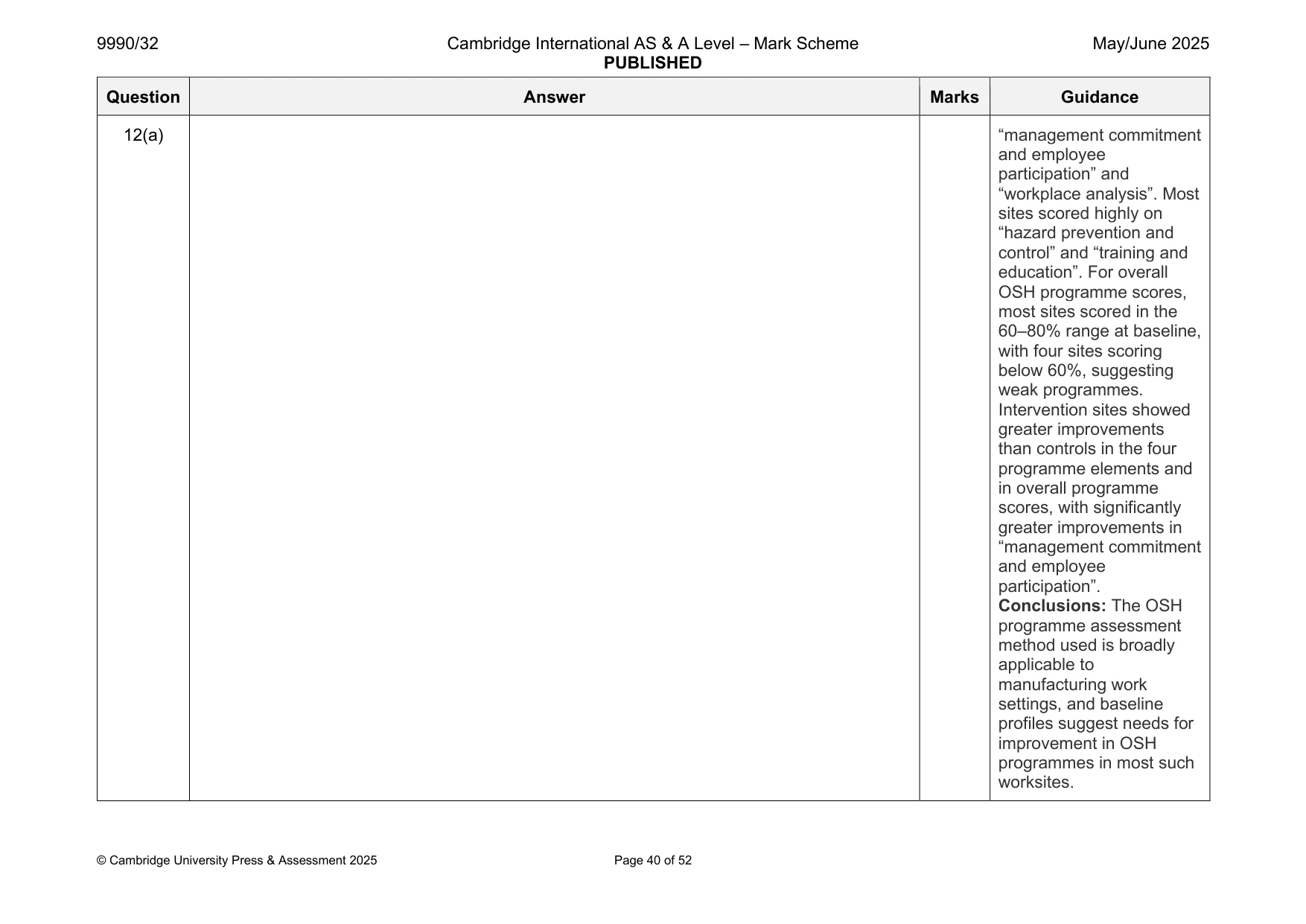
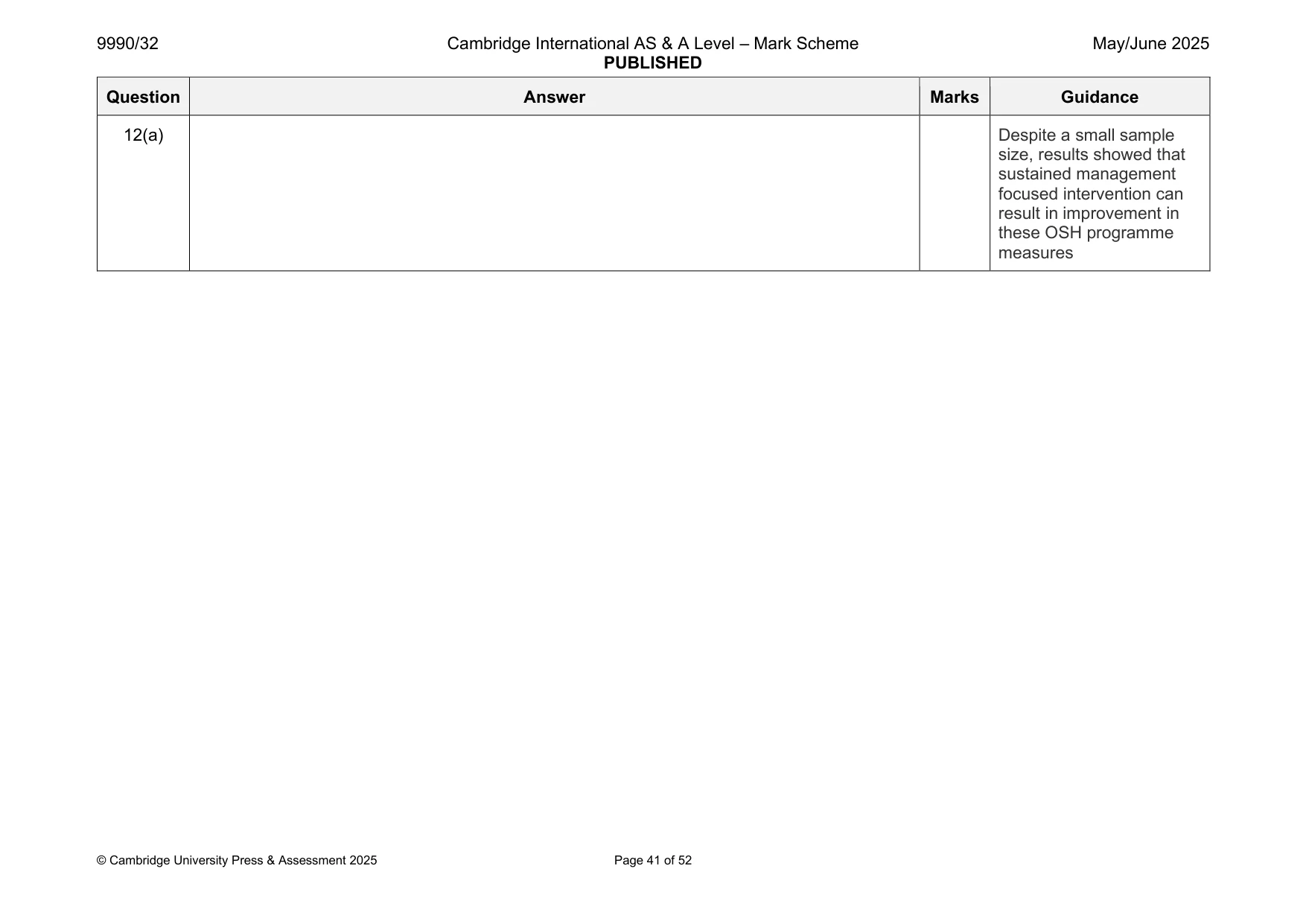
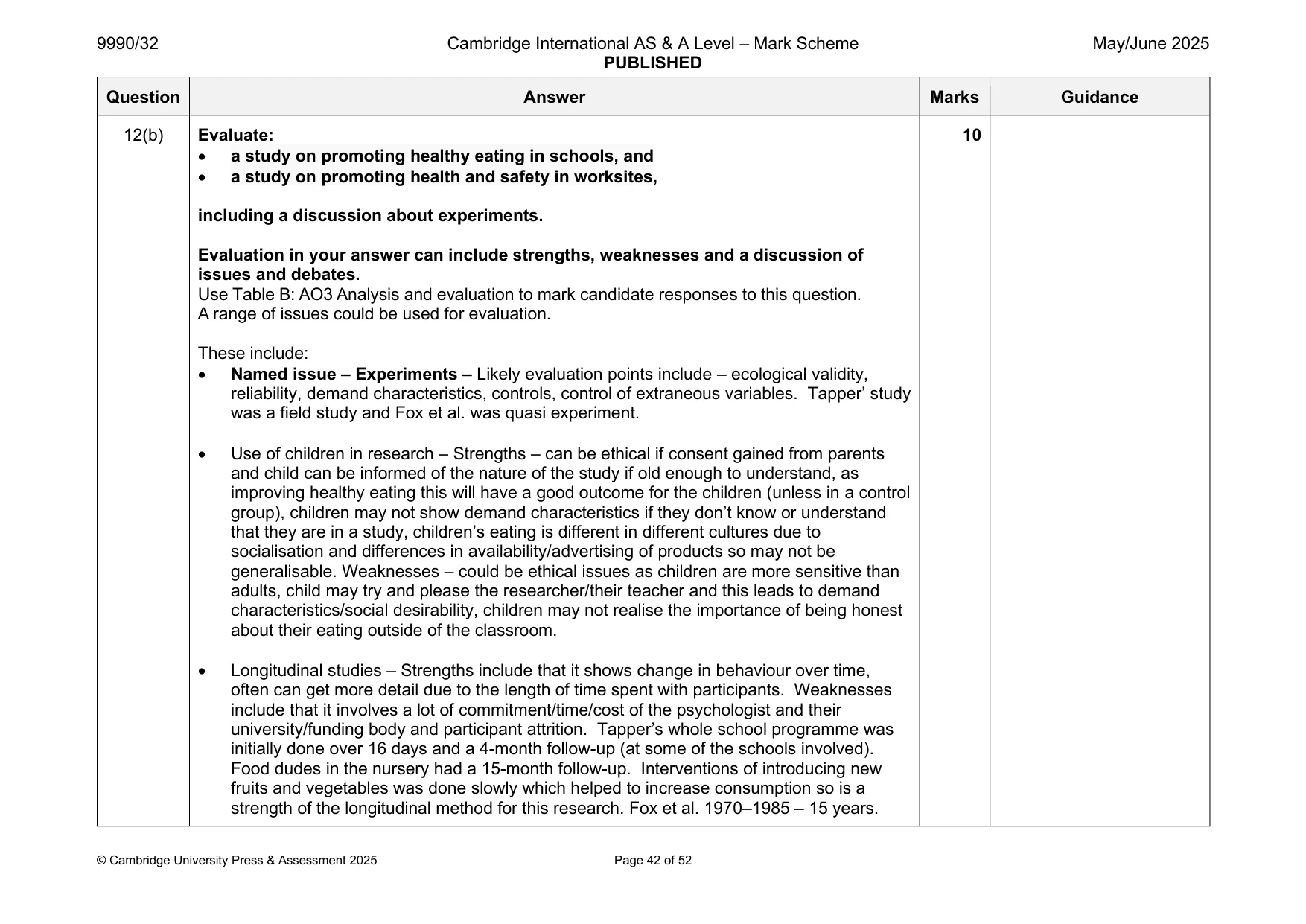
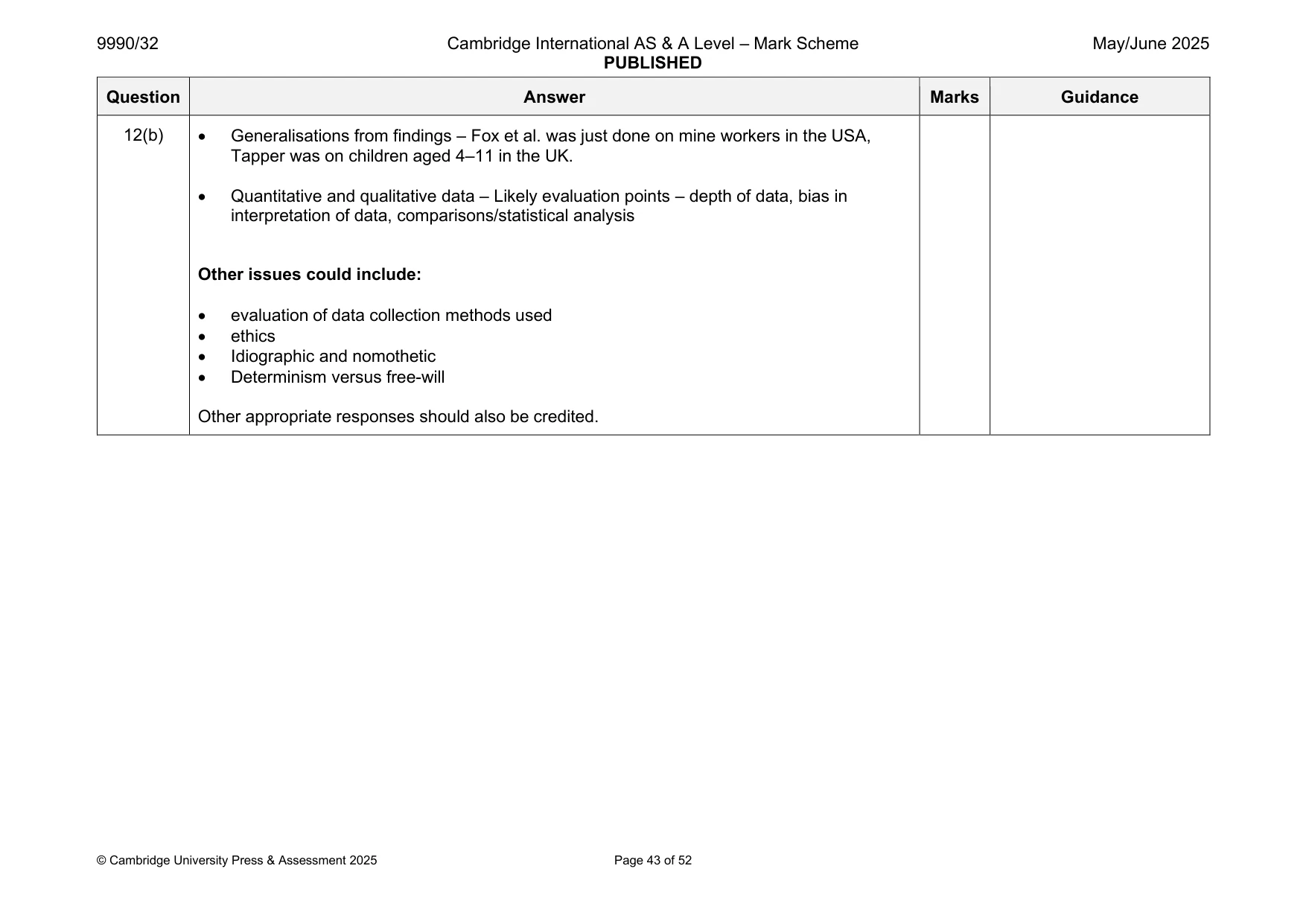
Mark scheme: 12(a) Describe: 6 Award up to 4 marks • a study on promoting healthy eating in schools, and where the response has • a study on promoting health and safety in worksites. described only part of the question even if the Use Table A: AO1 Knowledge and understanding to mark candidate responses to this response otherwise meets question. the criteria for level 3. Candidates must discuss both types of a study on healthy eating in schools and a study on health and safety in worksites. They can include examples of any appropriate studies. For L3 for a study need some detail of the Details may include: procedure (e.g. details of how food dudes was used Study on healthy eating in schools with children or the participants; details of how Tapper et al. token economy carried Food dudes. – a number of different studies that were completed by the authors are described out) and at least 1 result. in the study and any or all are creditworthy. Whole school programme of 4–11 year olds in a primary school. Shown food dudes Alternative study on programmes and given a course of lesson materials including stickers, letters home pack, staff healthy eating in manual, etc. Lasted for 16 days and was covered each day in school. Children were schools – O’Brien et al. enthusiastic about the work and improved their attendance. After four months reported to (2021) Abstract continue to be eating more fruit and vegetables. Schools are identified as a key setting to influence Study on health and safety in worksites children's and adolescents' healthy Fox et al. eating. This umbrella Workers at two open-pit mines used as participants. Employees earned stamps for working review synthesised without lost-time injuries, not being involved in equipment damaging accidents, adopting evidence from systematic safety suggestions and behaviour which prevent injury/accident. Lost stamps if they/other reviews of school-based workers injured, caused equipment damage or failed to report injury/accident. Stamps could nutrition interventions be exchanged for thousands of items in a shop on site. Results – large reduction in lost days designed to improve due to injuries, lost time injuries and costs of accidents/injuries. Reduction in costs far exceed dietary intake outcomes in the cost of token economy and improvements maintained over several years. children aged 6 to 18 years. Other appropriate responses should also be credited. 12(a) They undertook a systematic search of six electronic databases and grey literature to identify relevant reviews of randomized controlled trials. The review findings were categorised for synthesis by intervention type according to the World Health Organisation Health Promoting Schools (HPS) framework domains: nutrition education; food environment; all three HPS framework domains; or other (not aligned to HPS framework domain). Thirteen systematic reviews were included. Overall, the findings suggest that school-based nutrition interventions, including nutrition education, food environment, those based on all three domains of the HPS framework, and eHealth interventions, can have a positive effect on some dietary outcomes, including fruit, fruit and vegetables combined, and fat intake. 12(a) These results should be interpreted with caution, however, as the quality of the reviews was poor. Though these results support continued public health investment in school-based nutrition interventions to improve child dietary intake, the limitations of this umbrella review also highlight the need for a comprehensive and high quality systematic review of primary studies. Alternative study on health and safety at worksites. LaMontagne et al. (2004Aims: (1) To develop a transparent and broadly applicable method for assessing occupational safety and health (OSH) programmes or management systems; (2) to assess OSH programmes in a sample of manufacturing worksites; and (3) to determine whether a management focused occupational health intervention results in 12(a) greater improvement in OSH programmes compared to minimal intervention controls. Methods: OSH programmes were assessed using an adaptation of the US Occupational Safety & Health Administration’s 1995 Program Evaluation Profile. Scores were generated from 91 binary indicator variables grouped under four “Essential Elements”. Essential Element scores were weighted to contribute to an overall programme score on a 100-point scale. Seventeen large manufacturing worksites were assessed at baseline; 15 sites completed the 16-month intervention and follow up assessments. Results: There was considerable variation in Essential Element scores across sites at baseline as judged by our instrument, particularly in 12(a) “management commitment and employee participation” and “workplace analysis”. Most sites scored highly on “hazard prevention and control” and “training and education”. For overall OSH programme scores, most sites scored in the 60–80% range at baseline, with four sites scoring below 60%, suggesting weak programmes. Intervention sites showed greater improvements than controls in the four programme elements and in overall programme scores, with significantly greater improvements in “management commitment and employee participation”. Conclusions: The OSH programme assessment method used is broadly applicable to manufacturing work settings, and baseline profiles suggest needs for improvement in OSH programmes in most such worksites. 12(a) Despite a small sample size, results showed that sustained management focused intervention can result in improvement in these OSH programme measures 12(b) Evaluate: 10 • a study on promoting healthy eating in schools, and • a study on promoting health and safety in worksites, including a discussion about experiments. Evaluation in your answer can include strengths, weaknesses and a discussion of issues and debates. Use Table B: AO3 Analysis and evaluation to mark candidate responses to this question. A range of issues could be used for evaluation. These include: • Named issue – Experiments – Likely evaluation points include – ecological validity, reliability, demand characteristics, controls, control of extraneous variables. Tapper’ study was a field study and Fox et al. was quasi experiment. • Use of children in research – Strengths – can be ethical if consent gained from parents and child can be informed of the nature of the study if old enough to understand, as improving healthy eating this will have a good outcome for the children (unless in a control group), children may not show demand characteristics if they don’t know or understand that they are in a study, children’s eating is different in different cultures due to socialisation and differences in availability/advertising of products so may not be generalisable. Weaknesses – could be ethical issues as children are more sensitive than adults, child may try and please the researcher/their teacher and this leads to demand characteristics/social desirability, children may not realise the importance of being honest about their eating outside of the classroom. • Longitudinal studies – Strengths include that it shows change in behaviour over time, often can get more detail due to the length of time spent with participants. Weaknesses include that it involves a lot of commitment/time/cost of the psychologist and their university/funding body and participant attrition. Tapper’s whole school programme was initially done over 16 days and a 4-month follow-up (at some of the schools involved). Food dudes in the nursery had a 15-month follow-up. Interventions of introducing new fruits and vegetables was done slowly which helped to increase consumption so is a strength of the longitudinal method for this research. Fox et al. 1970–1985 – 15 years. 12(b) • Generalisations from findings – Fox et al. was just done on mine workers in the USA, Tapper was on children aged 4–11 in the UK. • Quantitative and qualitative data – Likely evaluation points – depth of data, bias in interpretation of data, comparisons/statistical analysis Other issues could include: • evaluation of data collection methods used • ethics • Idiographic and nomothetic • Determinism versus free-will Other appropriate responses should also be credited. Section D: Organisational Psychology
More questions on 2 Health promotion in schools and worksites
Q13 · Jin and Kasem each manage a group of workers
13 Jin and Kasem each manage a group of workers. Jin allows each of her workers to take responsibility for part of a project from start to finish. Kasem invites his group of workers to meet socially. Both Jin and Kasem say their approach to management will meet the needs of their workers. From McClelland’s theory of achievement motivation: (a) Explain which need is being met by Jin. [2] (b) Explain which need is being met by Kasem. [2]
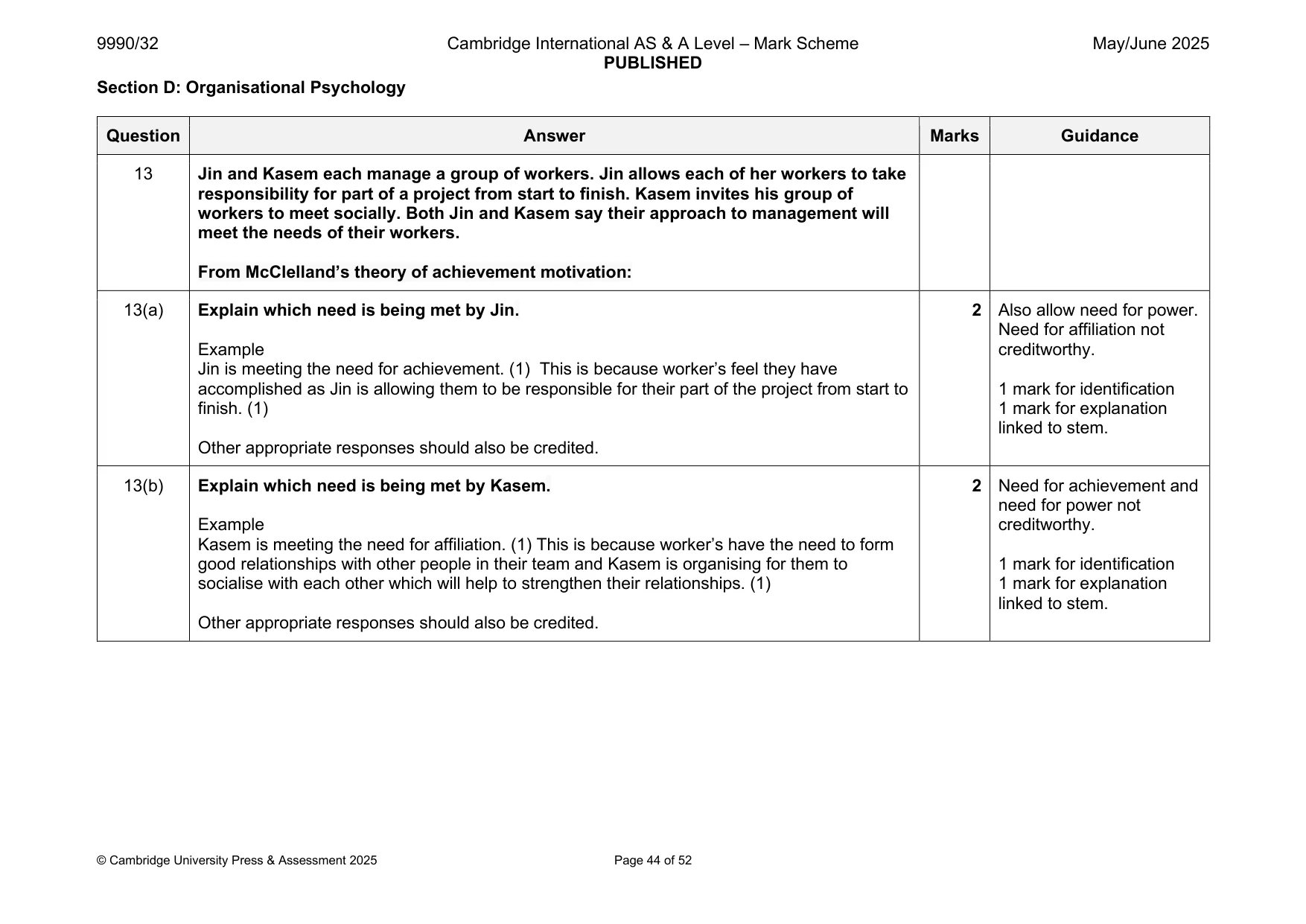
Mark scheme: 13 Jin and Kasem each manage a group of workers. Jin allows each of her workers to take responsibility for part of a project from start to finish. Kasem invites his group of workers to meet socially. Both Jin and Kasem say their approach to management will meet the needs of their workers. From McClelland’s theory of achievement motivation: 13(a) Explain which need is being met by Jin. 2 Also allow need for power. Need for affiliation not Example creditworthy. Jin is meeting the need for achievement. (1) This is because worker’s feel they have accomplished as Jin is allowing them to be responsible for their part of the project from start to 1 mark for identification finish. (1) 1 mark for explanation linked to stem. Other appropriate responses should also be credited. 13(b) Explain which need is being met by Kasem. 2 Need for achievement and need for power not Example creditworthy. Kasem is meeting the need for affiliation. (1) This is because worker’s have the need to form good relationships with other people in their team and Kasem is organising for them to 1 mark for identification socialise with each other which will help to strengthen their relationships. (1) 1 mark for explanation linked to stem. Other appropriate responses should also be credited.
Q14 · Outline what is meant by ‘valence’ from Vroom’s VIE theory of motivation
14 (a) Outline what is meant by ‘valence’ from Vroom’s VIE theory of motivation. [2] (b) Explain one reason why Vroom’s VIE theory of motivation could be considered holistic. [2]
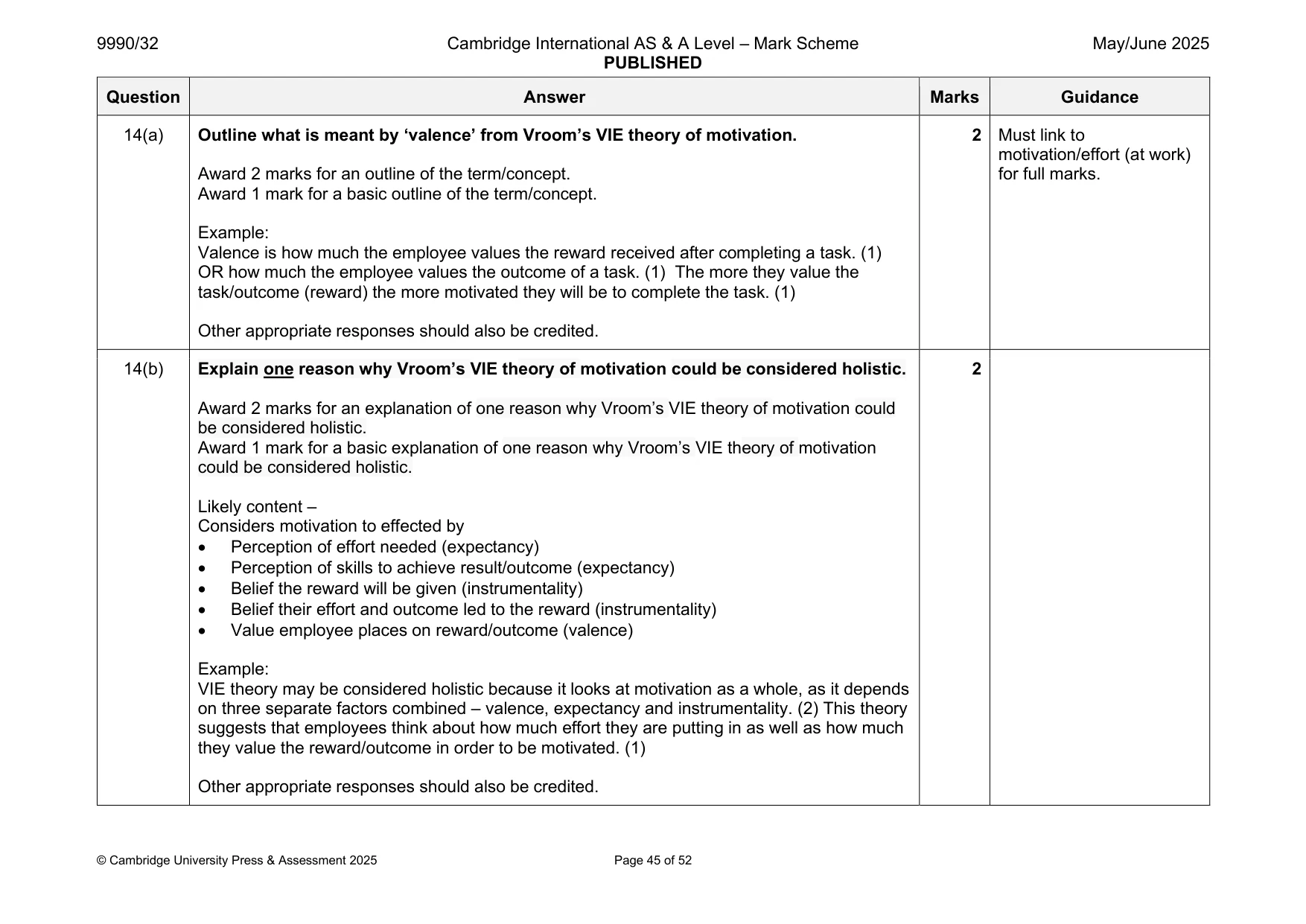
Mark scheme: 14(a) Outline what is meant by ‘valence’ from Vroom’s VIE theory of motivation. 2 Must link to motivation/effort (at work) Award 2 marks for an outline of the term/concept. for full marks. Award 1 mark for a basic outline of the term/concept. Example: Valence is how much the employee values the reward received after completing a task. (1) OR how much the employee values the outcome of a task. (1) The more they value the task/outcome (reward) the more motivated they will be to complete the task. (1) Other appropriate responses should also be credited. 14(b) Explain one reason why Vroom’s VIE theory of motivation could be considered holistic. 2 Award 2 marks for an explanation of one reason why Vroom’s VIE theory of motivation could be considered holistic. Award 1 mark for a basic explanation of one reason why Vroom’s VIE theory of motivation could be considered holistic. Likely content – Considers motivation to effected by • Perception of effort needed (expectancy) • Perception of skills to achieve result/outcome (expectancy) • Belief the reward will be given (instrumentality) • Belief their effort and outcome led to the reward (instrumentality) • Value employee places on reward/outcome (valence) Example: VIE theory may be considered holistic because it looks at motivation as a whole, as it depends on three separate factors combined – valence, expectancy and instrumentality. (2) This theory suggests that employees think about how much effort they are putting in as well as how much they value the reward/outcome in order to be motivated. (1) Other appropriate responses should also be credited.
Q15 · Lucy owns a restaurant
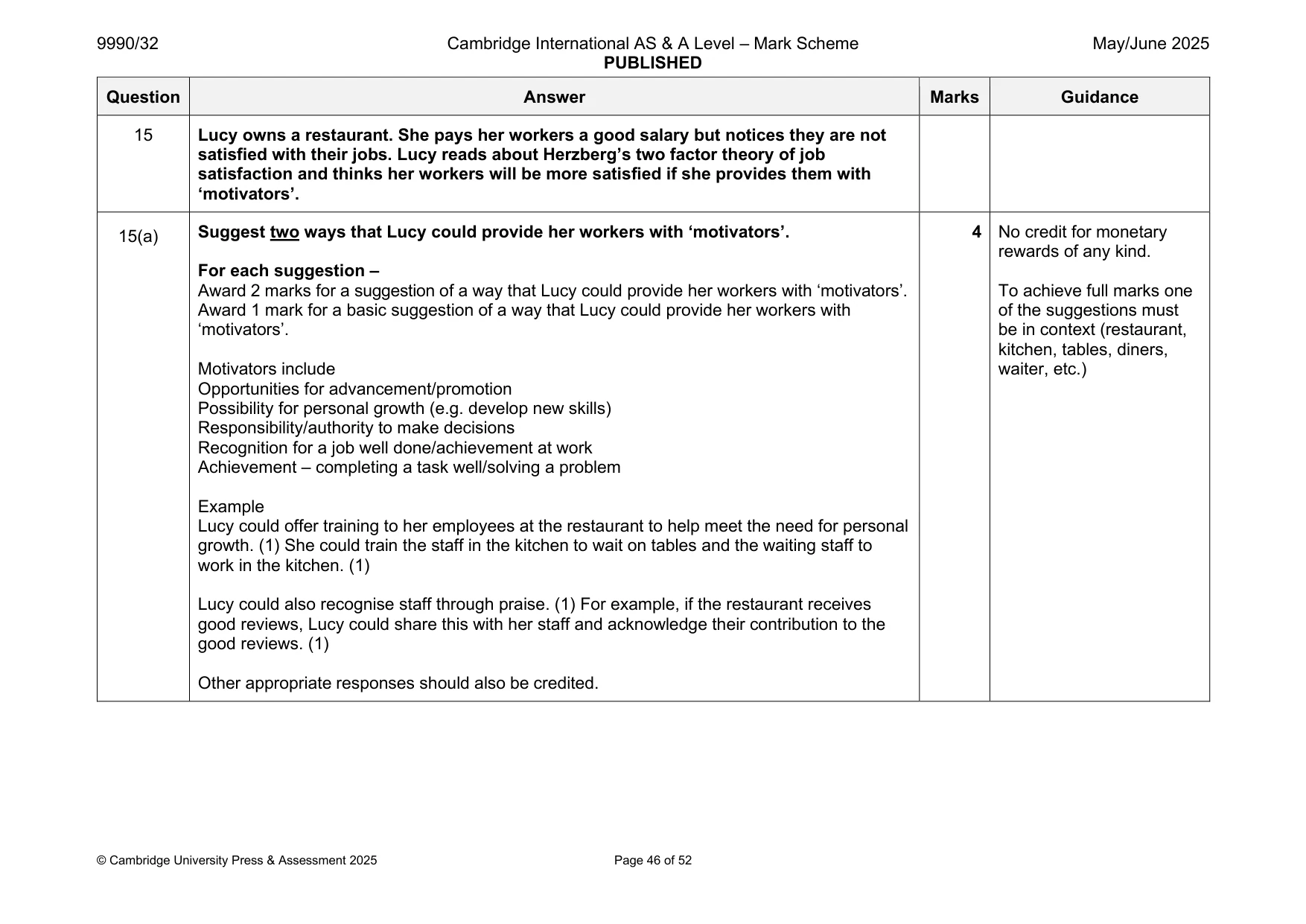
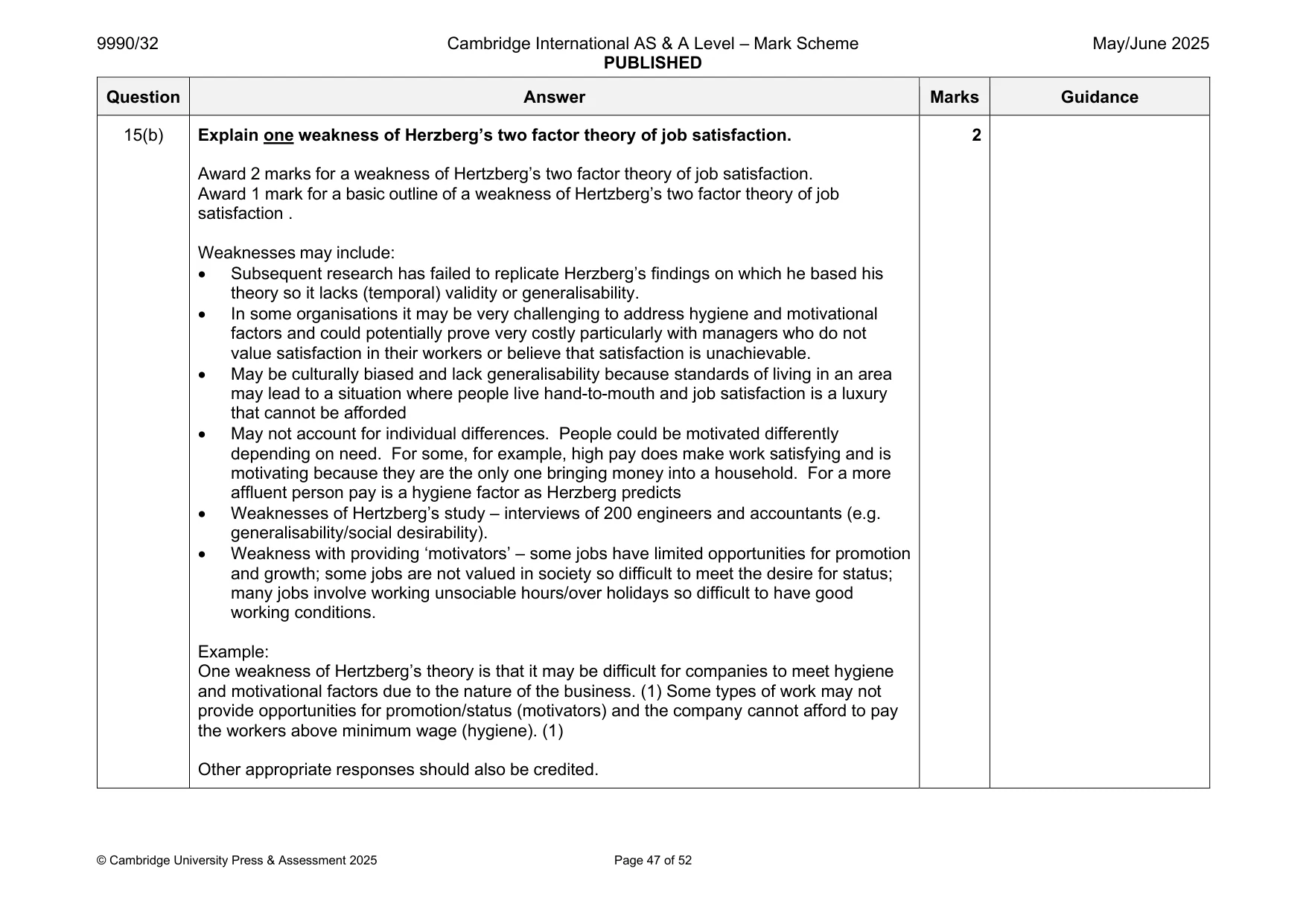
15 Lucy owns a restaurant. She pays her workers a good salary but notices they are not satisfied with their jobs. Lucy reads about Herzberg’s two factor theory of job satisfaction and thinks her workers will be more satisfied if she provides them with ‘motivators’. (a) Suggest two ways that Lucy could provide her workers with ‘motivators’. [4] (b) Explain one weakness of Herzberg’s two factor theory of job satisfaction. [2]
Mark scheme: 15 Lucy owns a restaurant. She pays her workers a good salary but notices they are not satisfied with their jobs. Lucy reads about Herzberg’s two factor theory of job satisfaction and thinks her workers will be more satisfied if she provides them with ‘motivators’. Suggest two ways that Lucy could provide her workers with ‘motivators’. 4 No credit for monetary15(a) rewards of any kind. For each suggestion – Award 2 marks for a suggestion of a way that Lucy could provide her workers with ‘motivators’. To achieve full marks one Award 1 mark for a basic suggestion of a way that Lucy could provide her workers with of the suggestions must ‘motivators’. be in context (restaurant, kitchen, tables, diners, Motivators include waiter, etc.) Opportunities for advancement/promotion Possibility for personal growth (e.g. develop new skills) Responsibility/authority to make decisions Recognition for a job well done/achievement at work Achievement – completing a task well/solving a problem Example Lucy could offer training to her employees at the restaurant to help meet the need for personal growth. (1) She could train the staff in the kitchen to wait on tables and the waiting staff to work in the kitchen. (1) Lucy could also recognise staff through praise. (1) For example, if the restaurant receives good reviews, Lucy could share this with her staff and acknowledge their contribution to the good reviews. (1) Other appropriate responses should also be credited. 15(b) Explain one weakness of Herzberg’s two factor theory of job satisfaction. 2 Award 2 marks for a weakness of Hertzberg’s two factor theory of job satisfaction. Award 1 mark for a basic outline of a weakness of Hertzberg’s two factor theory of job satisfaction . Weaknesses may include: • Subsequent research has failed to replicate Herzberg’s findings on which he based his theory so it lacks (temporal) validity or generalisability. • In some organisations it may be very challenging to address hygiene and motivational factors and could potentially prove very costly particularly with managers who do not value satisfaction in their workers or believe that satisfaction is unachievable. • May be culturally biased and lack generalisability because standards of living in an area may lead to a situation where people live hand-to-mouth and job satisfaction is a luxury that cannot be afforded • May not account for individual differences. People could be motivated differently depending on need. For some, for example, high pay does make work satisfying and is motivating because they are the only one bringing money into a household. For a more affluent person pay is a hygiene factor as Herzberg predicts • Weaknesses of Hertzberg’s study – interviews of 200 engineers and accountants (e.g. generalisability/social desirability). • Weakness with providing ‘motivators’ – some jobs have limited opportunities for promotion and growth; some jobs are not valued in society so difficult to meet the desire for status; many jobs involve working unsociable hours/over holidays so difficult to have good working conditions. Example: One weakness of Hertzberg’s theory is that it may be difficult for companies to meet hygiene and motivational factors due to the nature of the business. (1) Some types of work may not provide opportunities for promotion/status (motivators) and the company cannot afford to pay the workers above minimum wage (hygiene). (1) Other appropriate responses should also be credited.
Q16 · Describe the study by Cuadrado et al
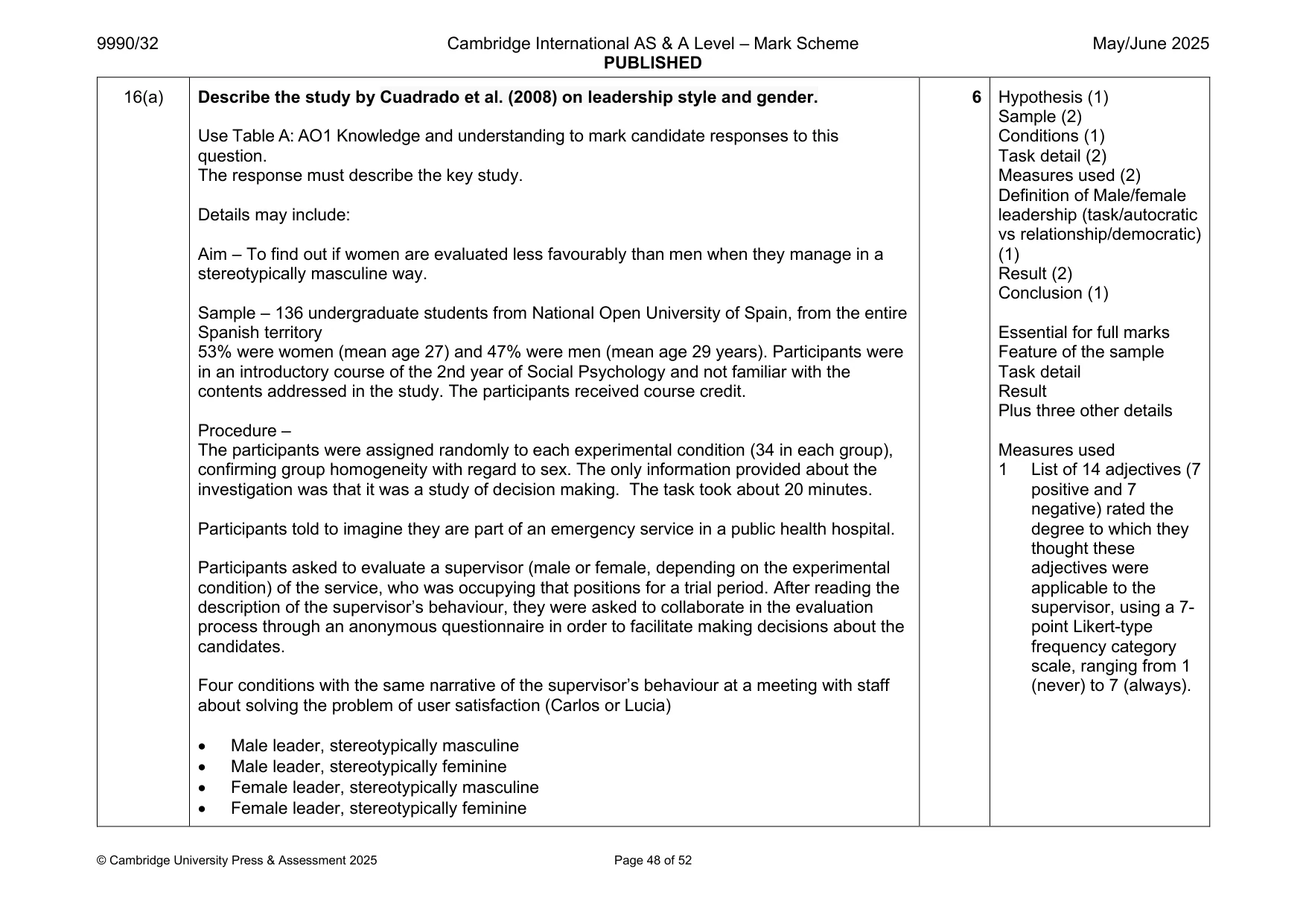
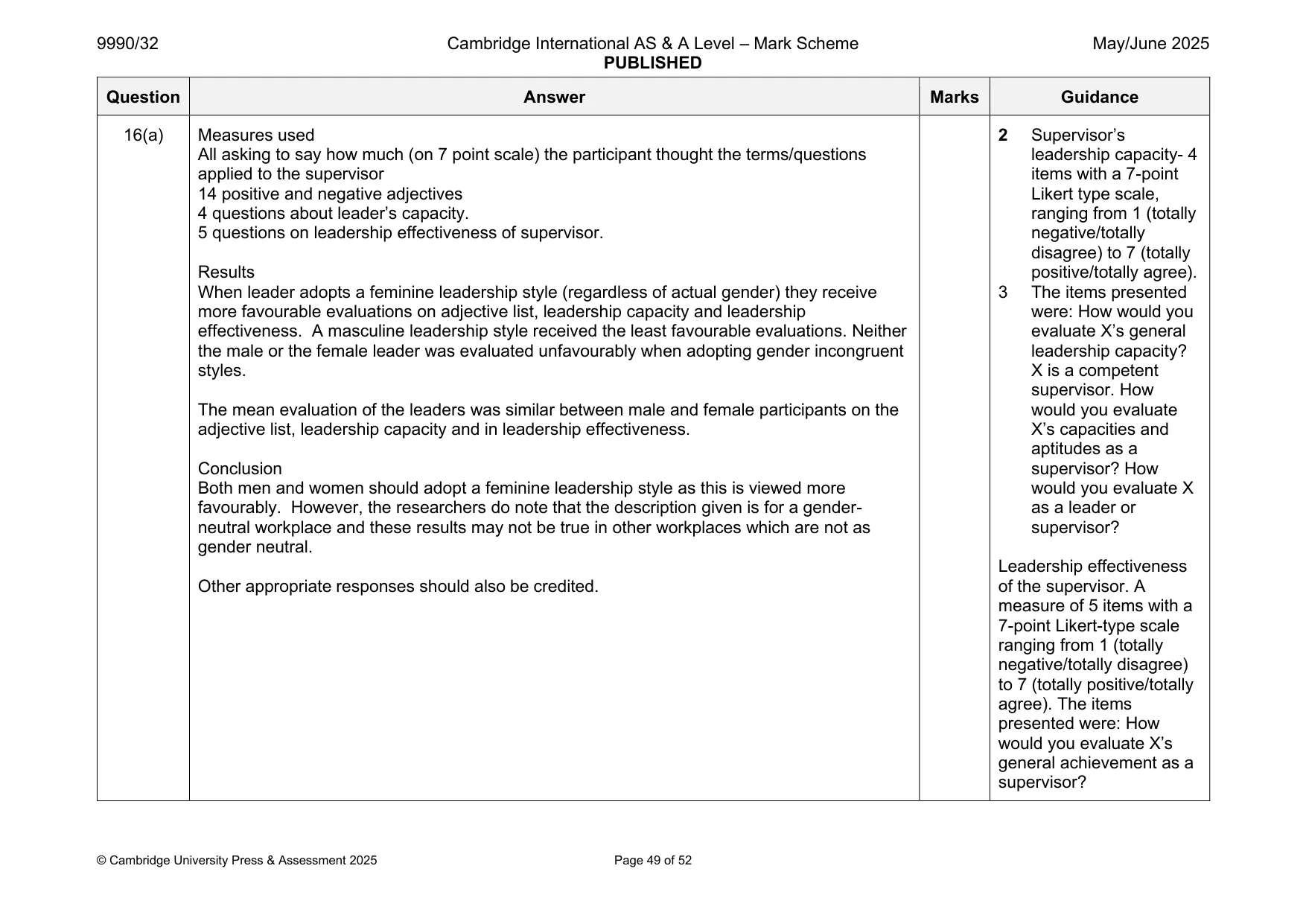
16 (a) Describe the study by Cuadrado et al. (2008) on leadership style and gender. [6] (b) Evaluate the study by Cuadrado et al., including a discussion about self‑reports. Evaluation in your answer can include strengths, weaknesses and a discussion of issues and debates. [10]
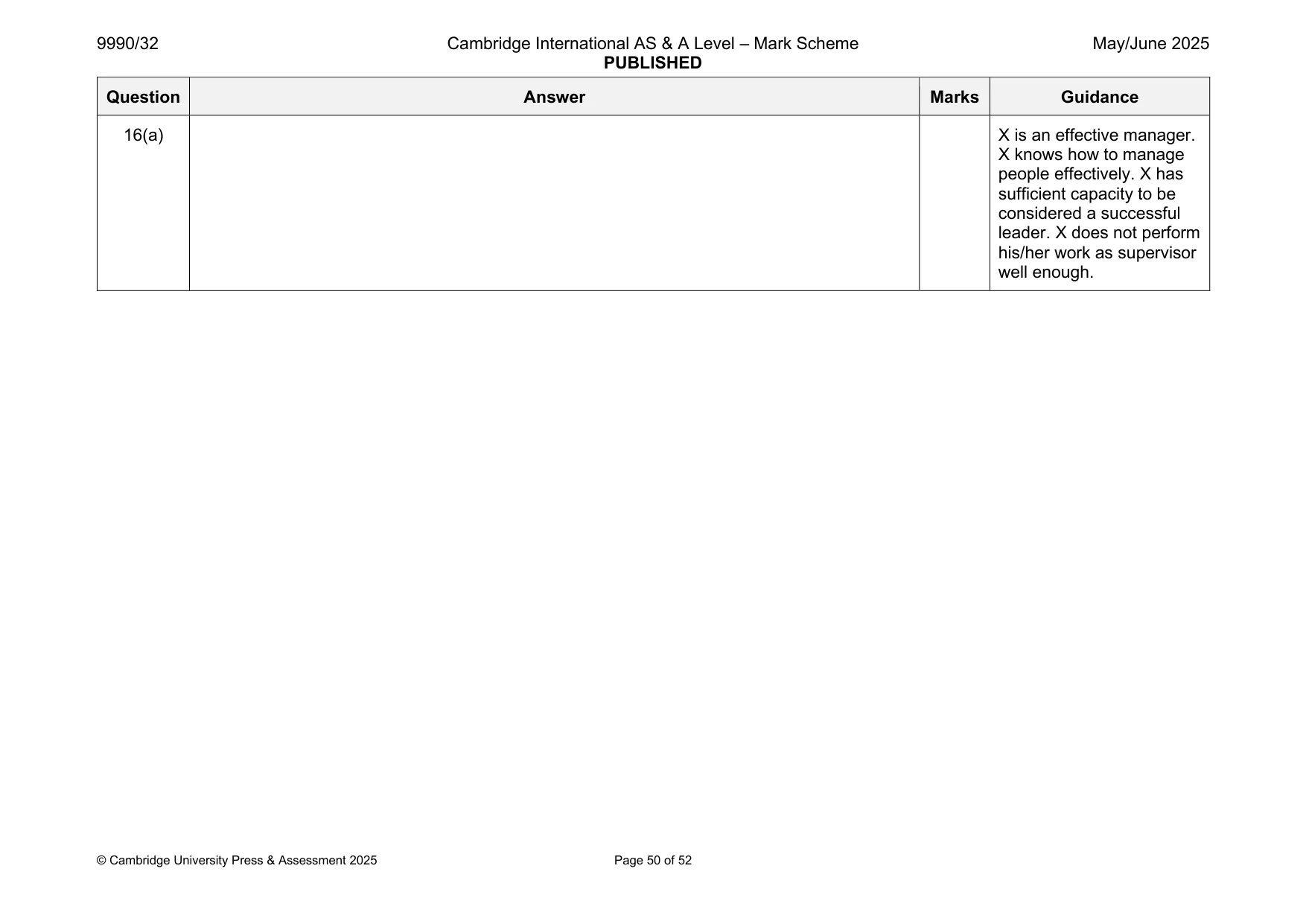
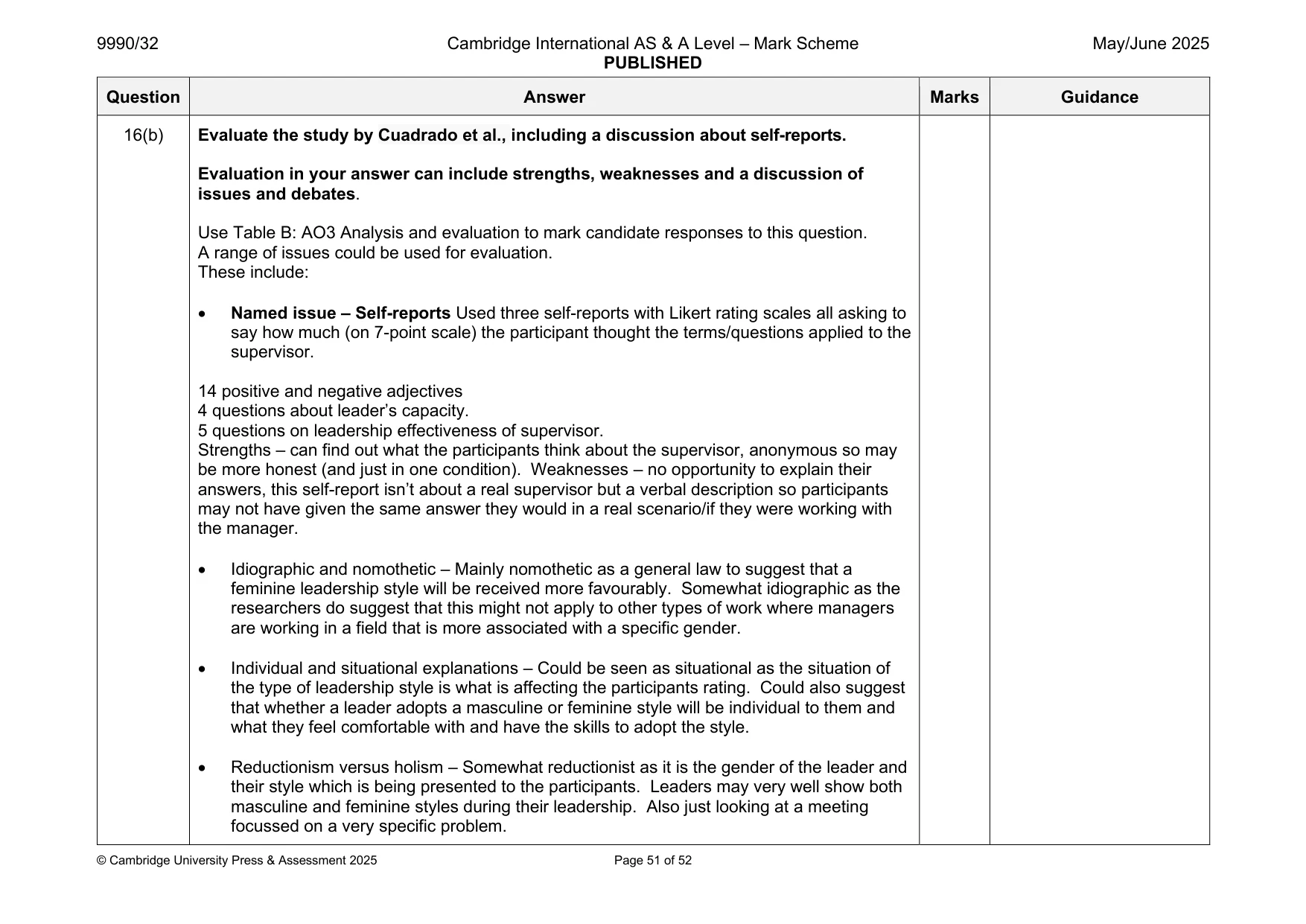
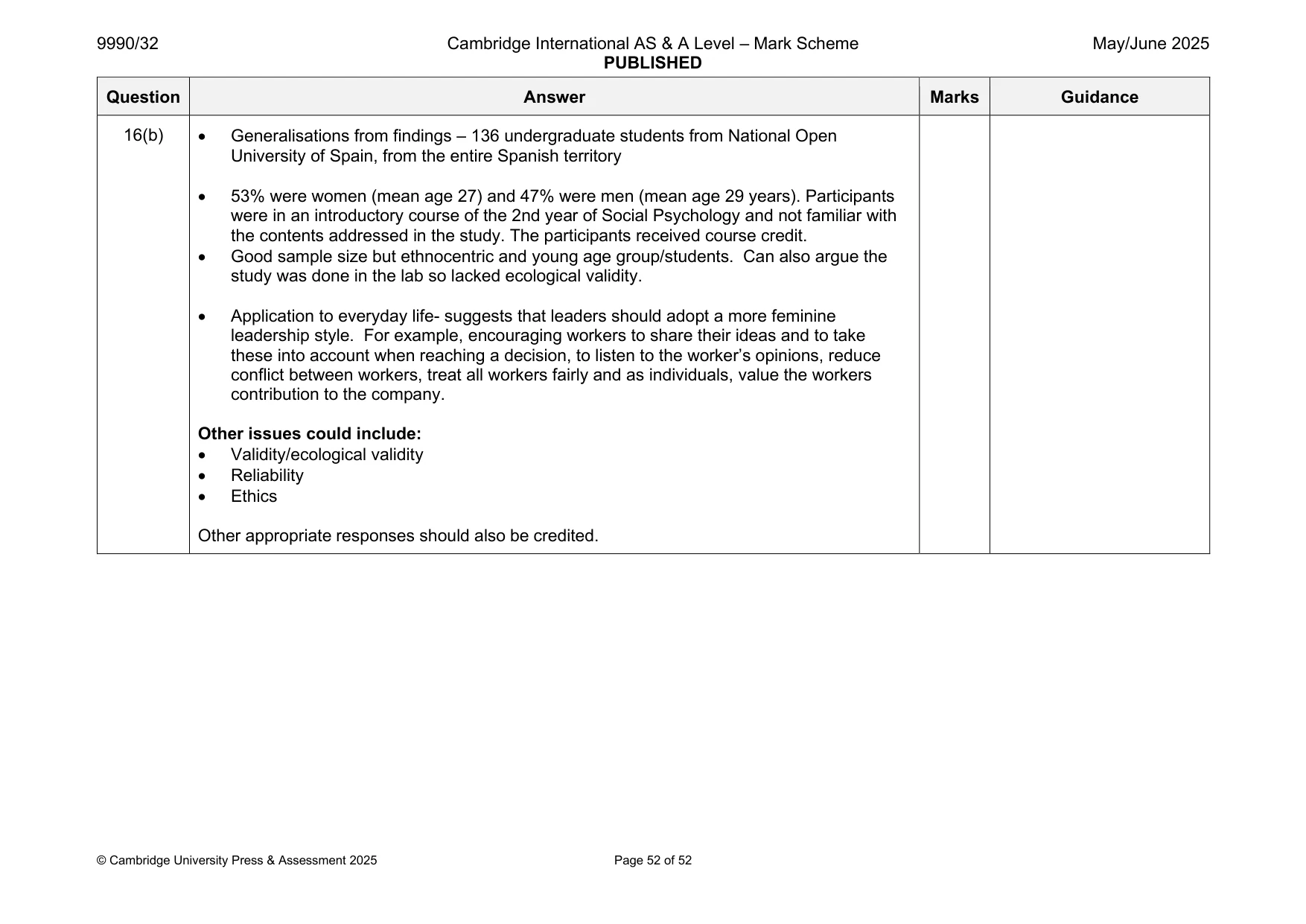
Mark scheme: 16(a) Describe the study by Cuadrado et al. (2008) on leadership style and gender. 6 Hypothesis (1) Sample (2) Use Table A: AO1 Knowledge and understanding to mark candidate responses to this Conditions (1) question. Task detail (2) The response must describe the key study. Measures used (2) Definition of Male/female Details may include: leadership (task/autocratic vs relationship/democratic) Aim – To find out if women are evaluated less favourably than men when they manage in a (1) stereotypically masculine way. Result (2) Conclusion (1) Sample – 136 undergraduate students from National Open University of Spain, from the entire Spanish territory Essential for full marks 53% were women (mean age 27) and 47% were men (mean age 29 years). Participants were Feature of the sample in an introductory course of the 2nd year of Social Psychology and not familiar with the Task detail contents addressed in the study. The participants received course credit. Result Plus three other details Procedure – The participants were assigned randomly to each experimental condition (34 in each group), Measures used confirming group homogeneity with regard to sex. The only information provided about the 1 List of 14 adjectives (7 investigation was that it was a study of decision making. The task took about 20 minutes. positive and 7 negative) rated the Participants told to imagine they are part of an emergency service in a public health hospital. degree to which they thought these Participants asked to evaluate a supervisor (male or female, depending on the experimental adjectives were condition) of the service, who was occupying that positions for a trial period. After reading the applicable to the description of the supervisor’s behaviour, they were asked to collaborate in the evaluation supervisor, using a 7- process through an anonymous questionnaire in order to facilitate making decisions about the point Likert-type candidates. frequency category scale, ranging from 1 Four conditions with the same narrative of the supervisor’s behaviour at a meeting with staff (never) to 7 (always). about solving the problem of user satisfaction (Carlos or Lucia) • Male leader, stereotypically masculine • Male leader, stereotypically feminine • Female leader, stereotypically masculine • Female leader, stereotypically feminine 16(a) Measures used 2 Supervisor’s All asking to say how much (on 7 point scale) the participant thought the terms/questions leadership capacity- 4 applied to the supervisor items with a 7-point 14 positive and negative adjectives Likert type scale, 4 questions about leader’s capacity. ranging from 1 (totally 5 questions on leadership effectiveness of supervisor. negative/totally disagree) to 7 (totally Results positive/totally agree). When leader adopts a feminine leadership style (regardless of actual gender) they receive 3 The items presented more favourable evaluations on adjective list, leadership capacity and leadership were: How would you effectiveness. A masculine leadership style received the least favourable evaluations. Neither evaluate X’s general the male or the female leader was evaluated unfavourably when adopting gender incongruent leadership capacity? styles. X is a competent supervisor. How The mean evaluation of the leaders was similar between male and female participants on the would you evaluate adjective list, leadership capacity and in leadership effectiveness. X’s capacities and aptitudes as a Conclusion supervisor? How Both men and women should adopt a feminine leadership style as this is viewed more would you evaluate X favourably. However, the researchers do note that the description given is for a gender- as a leader or neutral workplace and these results may not be true in other workplaces which are not as supervisor? gender neutral. Leadership effectiveness Other appropriate responses should also be credited. of the supervisor. A measure of 5 items with a 7-point Likert-type scale ranging from 1 (totally negative/totally disagree) to 7 (totally positive/totally agree). The items presented were: How would you evaluate X’s general achievement as a supervisor? 16(a) X is an effective manager. X knows how to manage people effectively. X has sufficient capacity to be considered a successful leader. X does not perform his/her work as supervisor well enough. 16(b) Evaluate the study by Cuadrado et al., including a discussion about self-reports. Evaluation in your answer can include strengths, weaknesses and a discussion of issues and debates. Use Table B: AO3 Analysis and evaluation to mark candidate responses to this question. A range of issues could be used for evaluation. These include: • Named issue – Self-reports Used three self-reports with Likert rating scales all asking to say how much (on 7-point scale) the participant thought the terms/questions applied to the supervisor. 14 positive and negative adjectives 4 questions about leader’s capacity. 5 questions on leadership effectiveness of supervisor. Strengths – can find out what the participants think about the supervisor, anonymous so may be more honest (and just in one condition). Weaknesses – no opportunity to explain their answers, this self-report isn’t about a real supervisor but a verbal description so participants may not have given the same answer they would in a real scenario/if they were working with the manager. • Idiographic and nomothetic – Mainly nomothetic as a general law to suggest that a feminine leadership style will be received more favourably. Somewhat idiographic as the researchers do suggest that this might not apply to other types of work where managers are working in a field that is more associated with a specific gender. • Individual and situational explanations – Could be seen as situational as the situation of the type of leadership style is what is affecting the participants rating. Could also suggest that whether a leader adopts a masculine or feminine style will be individual to them and what they feel comfortable with and have the skills to adopt the style. • Reductionism versus holism – Somewhat reductionist as it is the gender of the leader and their style which is being presented to the participants. Leaders may very well show both masculine and feminine styles during their leadership. Also just looking at a meeting focussed on a very specific problem. 16(b) • Generalisations from findings – 136 undergraduate students from National Open University of Spain, from the entire Spanish territory • 53% were women (mean age 27) and 47% were men (mean age 29 years). Participants were in an introductory course of the 2nd year of Social Psychology and not familiar with the contents addressed in the study. The participants received course credit. • Good sample size but ethnocentric and young age group/students. Can also argue the study was done in the lab so lacked ecological validity. • Application to everyday life- suggests that leaders should adopt a more feminine leadership style. For example, encouraging workers to share their ideas and to take these into account when reaching a decision, to listen to the worker’s opinions, reduce conflict between workers, treat all workers fairly and as individuals, value the workers contribution to the company. Other issues could include: • Validity/ecological validity • Reliability • Ethics Other appropriate responses should also be credited.
What was in this paper
The subtopics covered by these 16 questions, and how many questions each got. Open one in a new tab to see every Cambridge question on it.
What you needed in this session
Cambridge’s own grade thresholds for 2025 May/June, Paper 3 · Variant 2. A higher threshold means an easier paper — the bar moves with how the cohort did.