Cambridge A Level Psychology (from 2018) 9990 — 2025 May/June Paper 3 · Variant 1
9990/31/M/J/25 · 16 questions · 60 marks · 90 min
The question paper and its mark scheme, free to read here and free to download. This is Cambridge’s own paper, exactly as it was sat.
Question paper8 pages

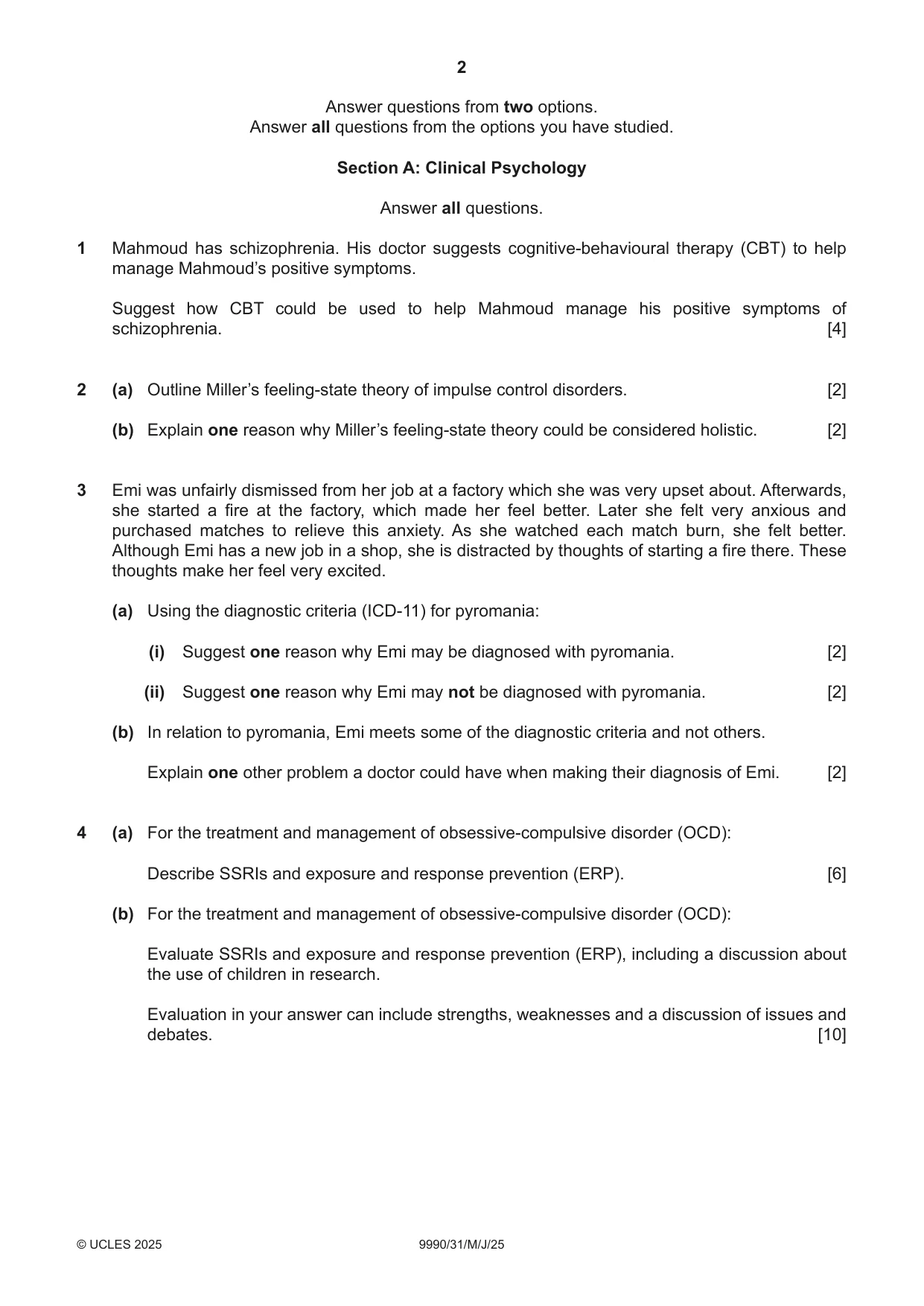
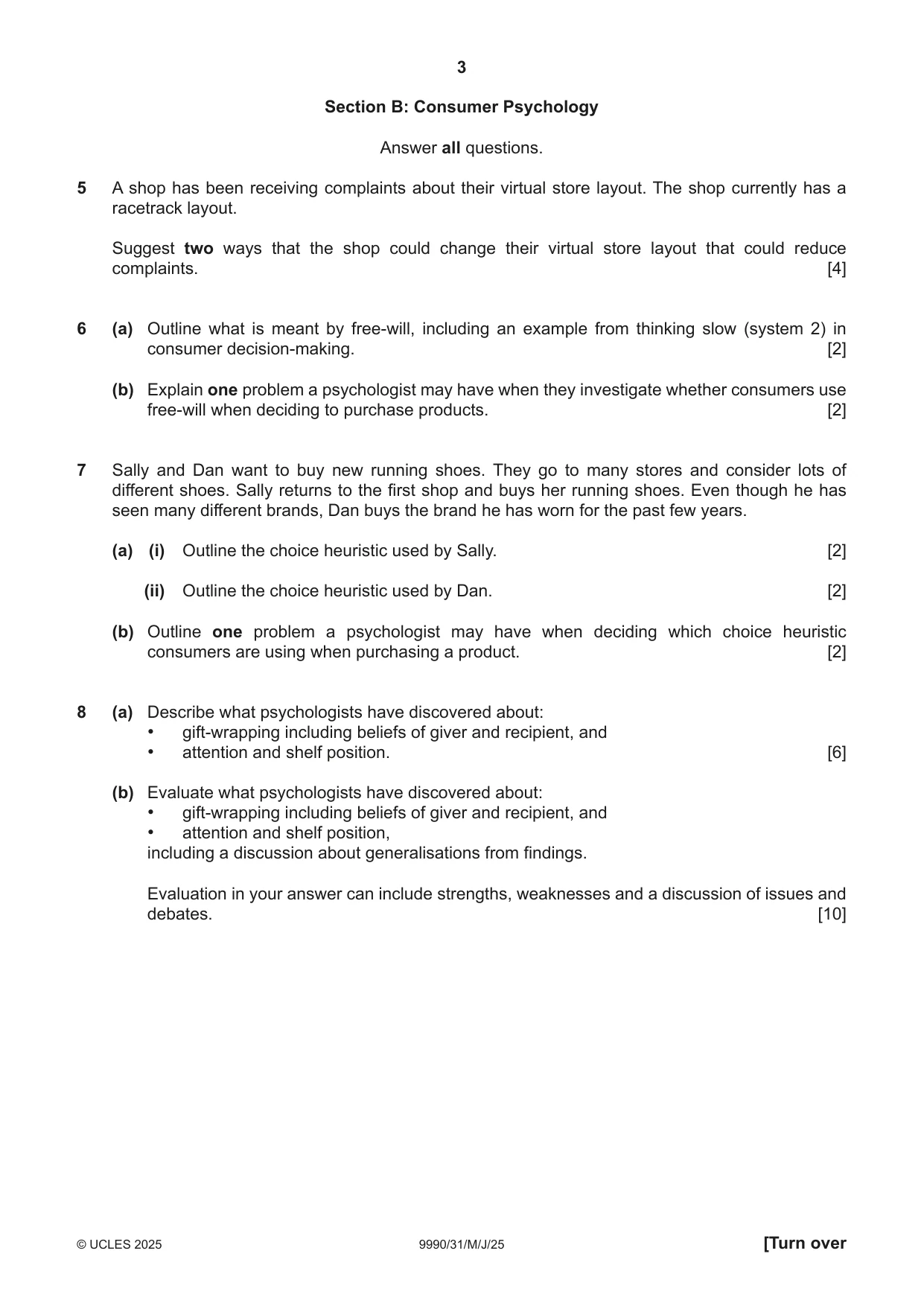
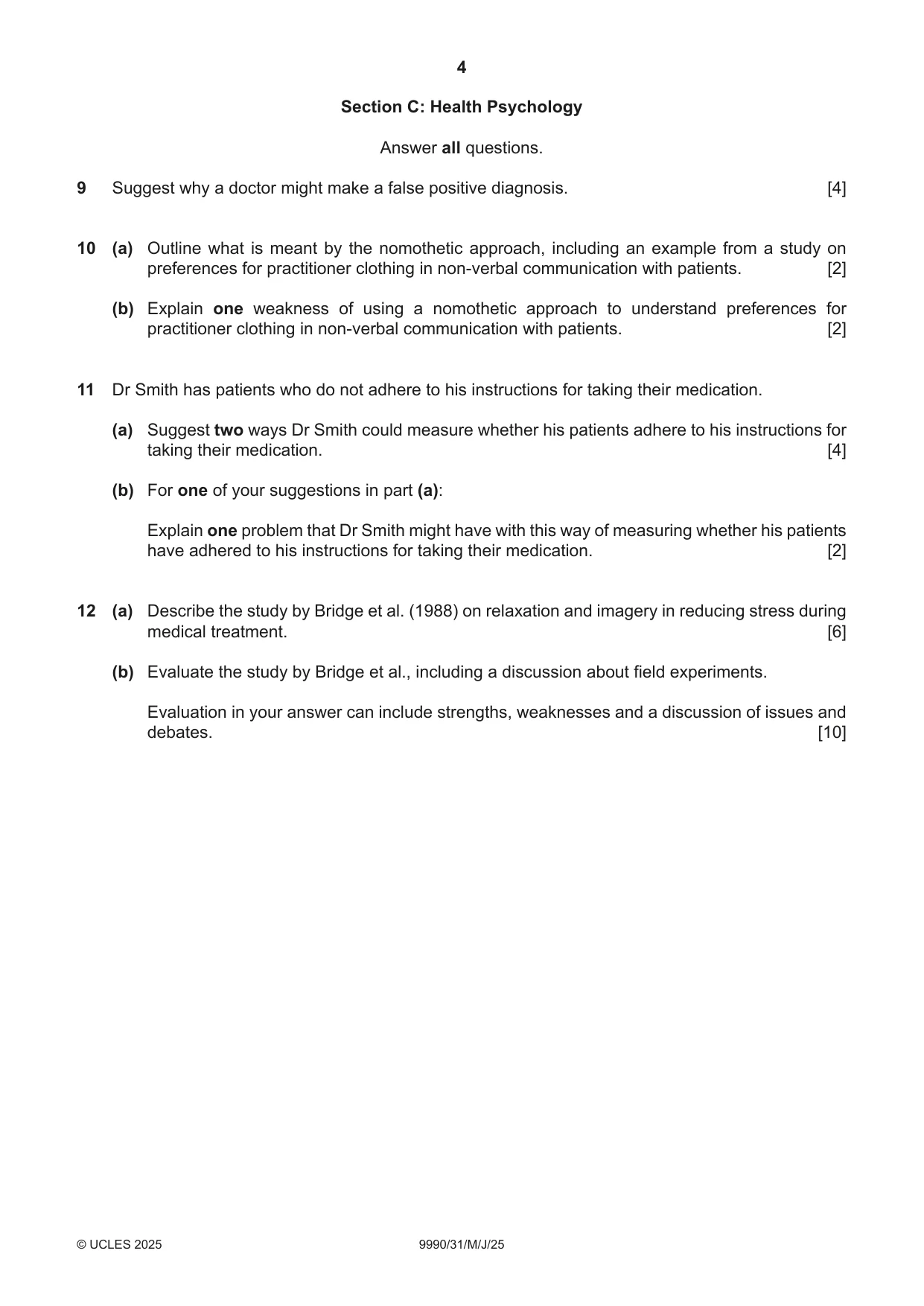
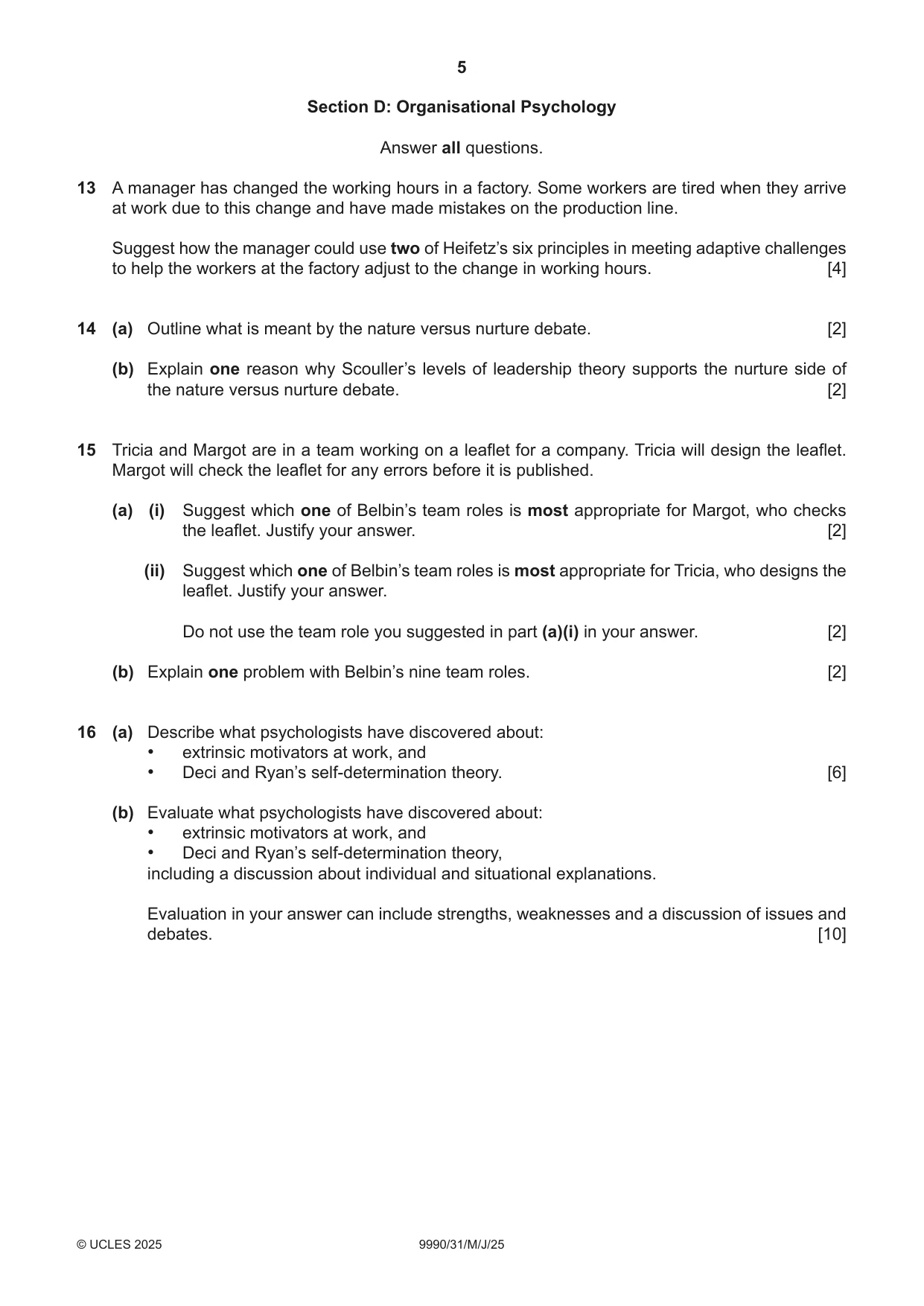



Mark scheme59 pages
Answers below. Sit the paper first if you are practising.



Questions as text
Question 1
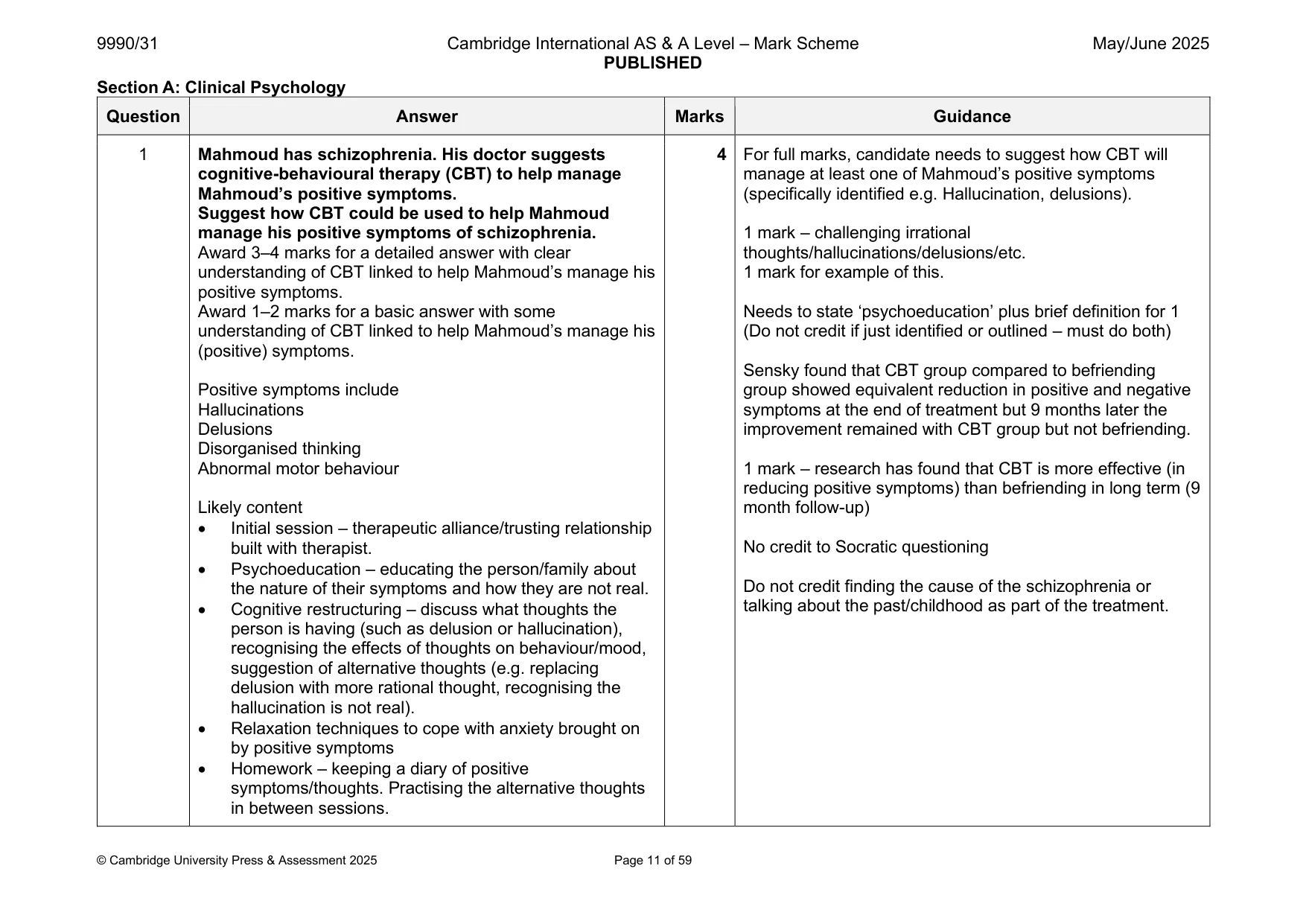
1 Mahmoud has schizophrenia. His doctor suggests cognitive-behavioural therapy (CBT) to help manage Mahmoud’s positive symptoms. Suggest how CBT could be used to help Mahmoud manage his positive symptoms of schizophrenia. [4]
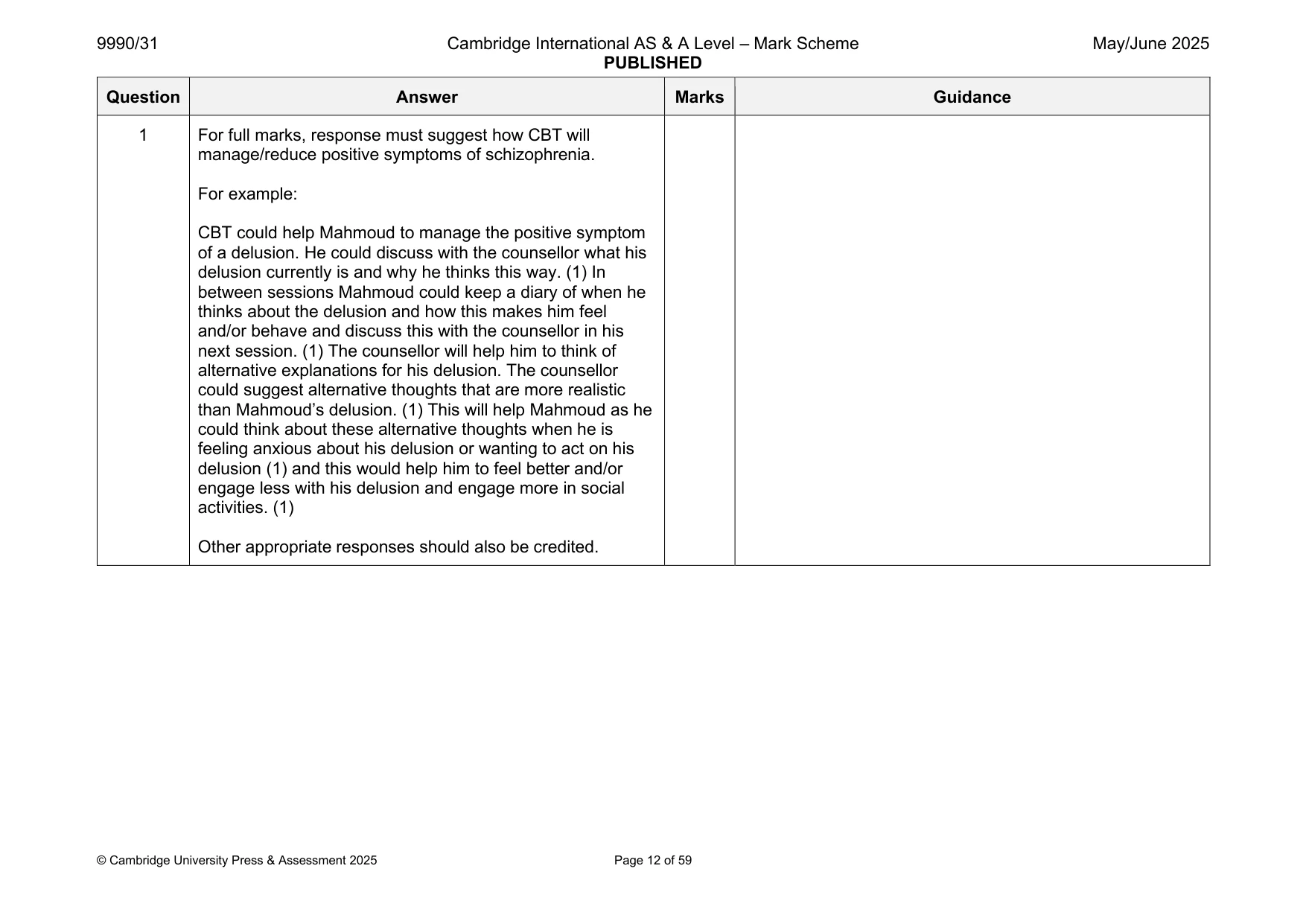
Mark scheme: Section A: Clinical Psychology Question Answer Marks Guidance 1 Mahmoud has schizophrenia. His doctor suggests 4 For full marks, candidate needs to suggest how CBT will cognitive-behavioural therapy (CBT) to help manage manage at least one of Mahmoud’s positive symptoms Mahmoud’s positive symptoms. (specifically identified e.g. Hallucination, delusions). Suggest how CBT could be used to help Mahmoud manage his positive symptoms of schizophrenia. 1 mark – challenging irrational Award 3–4 marks for a detailed answer with clear thoughts/hallucinations/delusions/etc. understanding of CBT linked to help Mahmoud’s manage his 1 mark for example of this. positive symptoms. Award 1–2 marks for a basic answer with some Needs to state ‘psychoeducation’ plus brief definition for 1 understanding of CBT linked to help Mahmoud’s manage his (Do not credit if just identified or outlined – must do both) (positive) symptoms. Sensky found that CBT group compared to befriending Positive symptoms include group showed equivalent reduction in positive and negative Hallucinations symptoms at the end of treatment but 9 months later the Delusions improvement remained with CBT group but not befriending. Disorganised thinking Abnormal motor behaviour 1 mark – research has found that CBT is more effective (in reducing positive symptoms) than befriending in long term (9 Likely content month follow-up) • Initial session – therapeutic alliance/trusting relationship built with therapist. No credit to Socratic questioning • Psychoeducation – educating the person/family about the nature of their symptoms and how they are not real. Do not credit finding the cause of the schizophrenia or • Cognitive restructuring – discuss what thoughts the talking about the past/childhood as part of the treatment. person is having (such as delusion or hallucination), recognising the effects of thoughts on behaviour/mood, suggestion of alternative thoughts (e.g. replacing delusion with more rational thought, recognising the hallucination is not real). • Relaxation techniques to cope with anxiety brought on by positive symptoms • Homework – keeping a diary of positive symptoms/thoughts. Practising the alternative thoughts in between sessions. 1 For full marks, response must suggest how CBT will manage/reduce positive symptoms of schizophrenia. For example: CBT could help Mahmoud to manage the positive symptom of a delusion. He could discuss with the counsellor what his delusion currently is and why he thinks this way. (1) In between sessions Mahmoud could keep a diary of when he thinks about the delusion and how this makes him feel and/or behave and discuss this with the counsellor in his next session. (1) The counsellor will help him to think of alternative explanations for his delusion. The counsellor could suggest alternative thoughts that are more realistic than Mahmoud’s delusion. (1) This will help Mahmoud as he could think about these alternative thoughts when he is feeling anxious about his delusion or wanting to act on his delusion (1) and this would help him to feel better and/or engage less with his delusion and engage more in social activities. (1) Other appropriate responses should also be credited.
Q2 · Outline Miller’s feeling-state theory of impulse control disorders
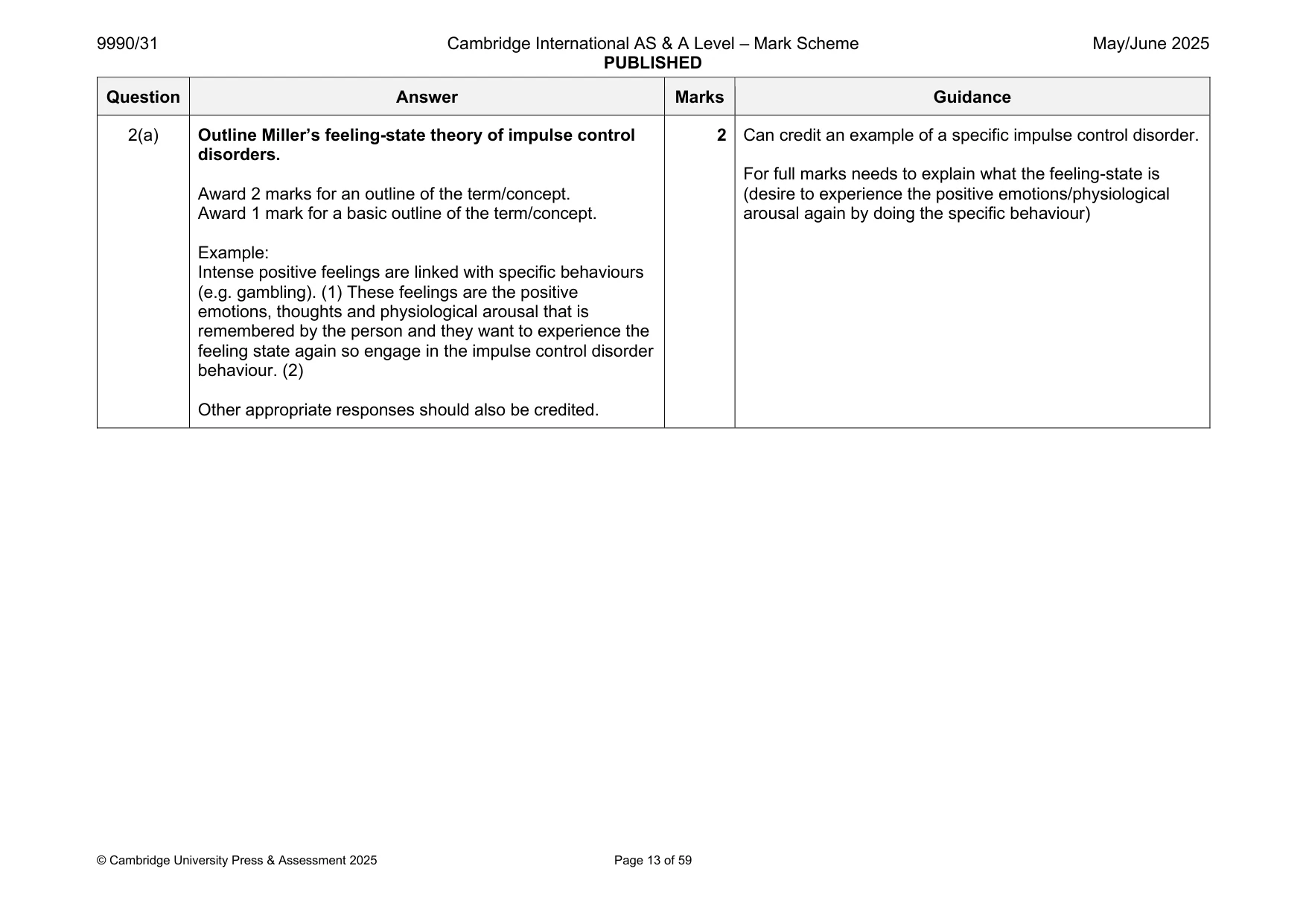
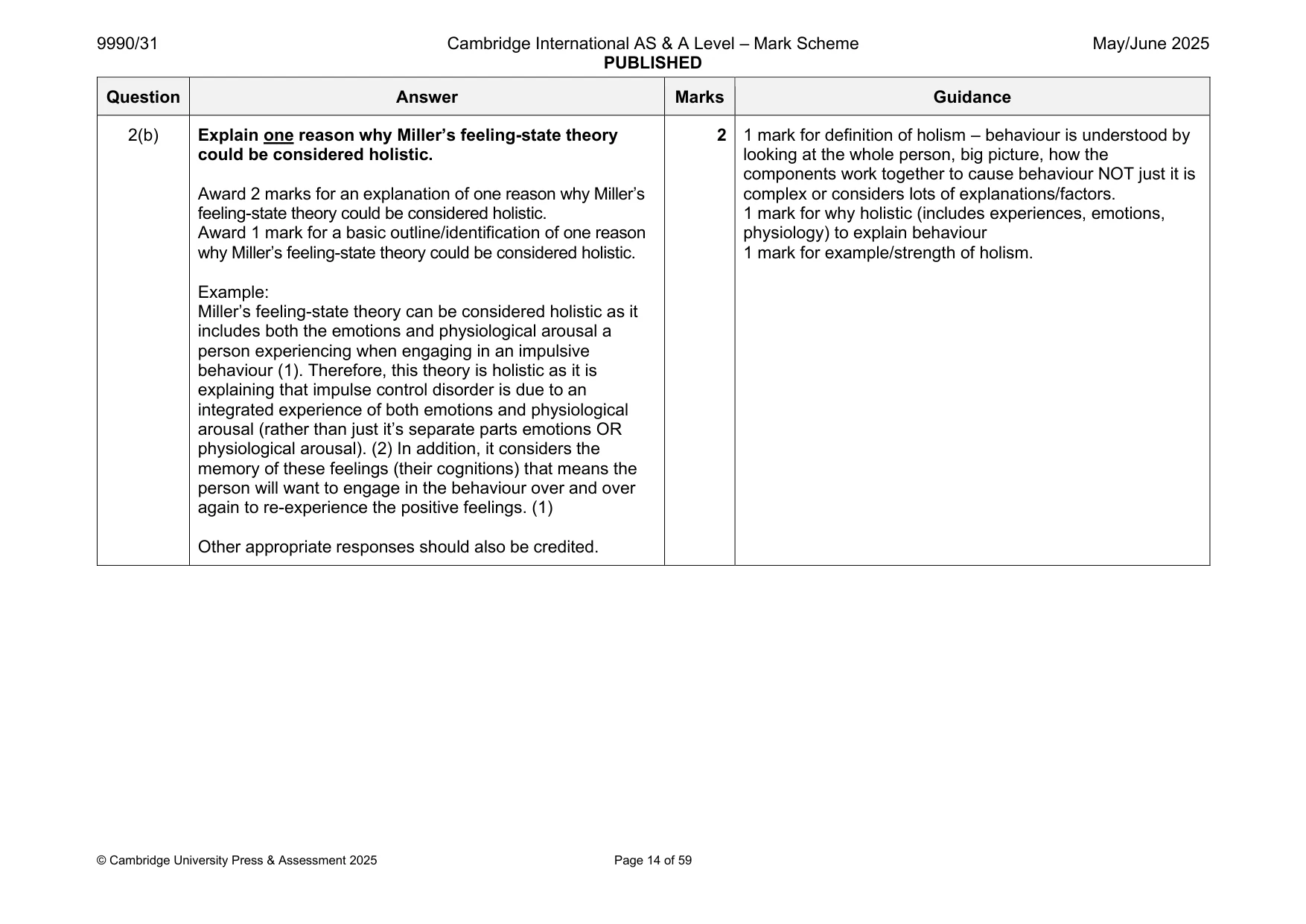
2 (a) Outline Miller’s feeling-state theory of impulse control disorders. [2] (b) Explain one reason why Miller’s feeling-state theory could be considered holistic. [2]
Mark scheme: 2(a) Outline Miller’s feeling-state theory of impulse control 2 Can credit an example of a specific impulse control disorder. disorders. For full marks needs to explain what the feeling-state is Award 2 marks for an outline of the term/concept. (desire to experience the positive emotions/physiological Award 1 mark for a basic outline of the term/concept. arousal again by doing the specific behaviour) Example: Intense positive feelings are linked with specific behaviours (e.g. gambling). (1) These feelings are the positive emotions, thoughts and physiological arousal that is remembered by the person and they want to experience the feeling state again so engage in the impulse control disorder behaviour. (2) Other appropriate responses should also be credited. 2(b) Explain one reason why Miller’s feeling-state theory 2 1 mark for definition of holism – behaviour is understood by could be considered holistic. looking at the whole person, big picture, how the components work together to cause behaviour NOT just it is Award 2 marks for an explanation of one reason why Miller’s complex or considers lots of explanations/factors. feeling-state theory could be considered holistic. 1 mark for why holistic (includes experiences, emotions, Award 1 mark for a basic outline/identification of one reason physiology) to explain behaviour why Miller’s feeling-state theory could be considered holistic. 1 mark for example/strength of holism. Example: Miller’s feeling-state theory can be considered holistic as it includes both the emotions and physiological arousal a person experiencing when engaging in an impulsive behaviour (1). Therefore, this theory is holistic as it is explaining that impulse control disorder is due to an integrated experience of both emotions and physiological arousal (rather than just it’s separate parts emotions OR physiological arousal). (2) In addition, it considers the memory of these feelings (their cognitions) that means the person will want to engage in the behaviour over and over again to re-experience the positive feelings. (1) Other appropriate responses should also be credited.
Q3 · Emi was unfairly dismissed from her job at a factory which she was very upset about
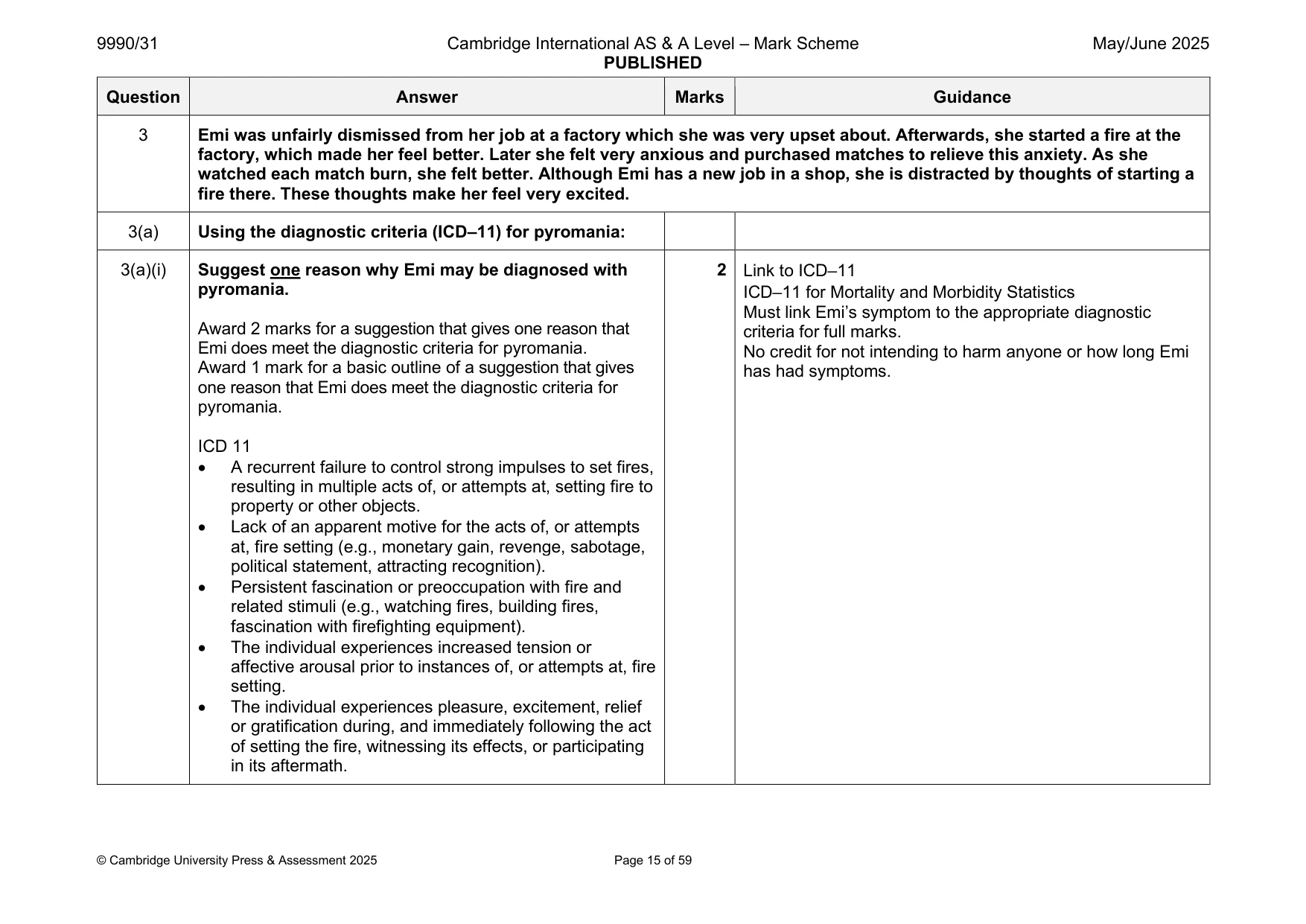
3 Emi was unfairly dismissed from her job at a factory which she was very upset about. Afterwards, she started a fire at the factory, which made her feel better. Later she felt very anxious and purchased matches to relieve this anxiety. As she watched each match burn, she felt better. Although Emi has a new job in a shop, she is distracted by thoughts of starting a fire there. These thoughts make her feel very excited. (a) Using the diagnostic criteria (ICD-11) for pyromania: (i) Suggest one reason why Emi may be diagnosed with pyromania. [2] (ii) Suggest one reason why Emi may not be diagnosed with pyromania. [2] (b) In relation to pyromania, Emi meets some of the diagnostic criteria and not others. Explain one other problem a doctor could have when making their diagnosis of Emi. [2]
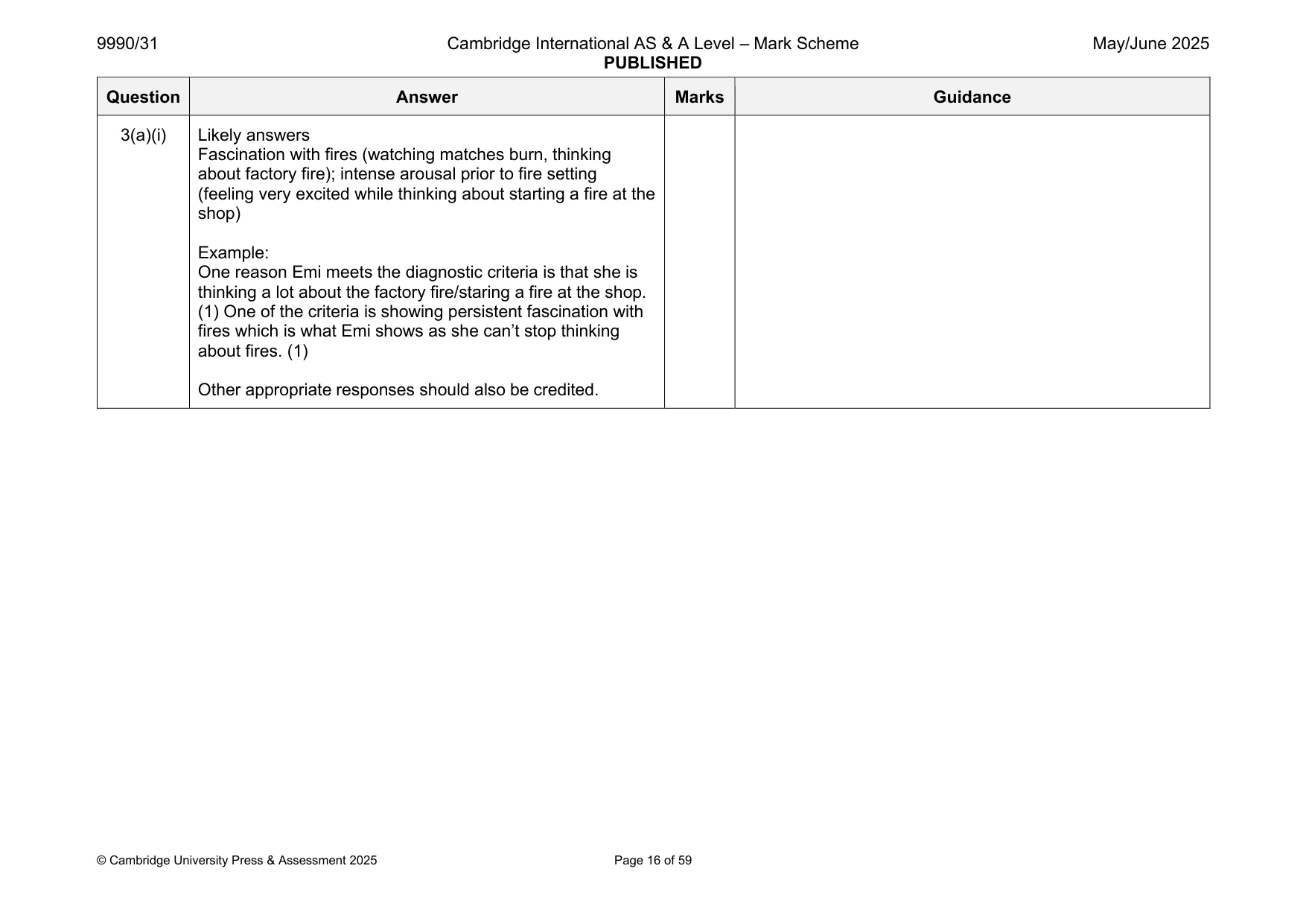
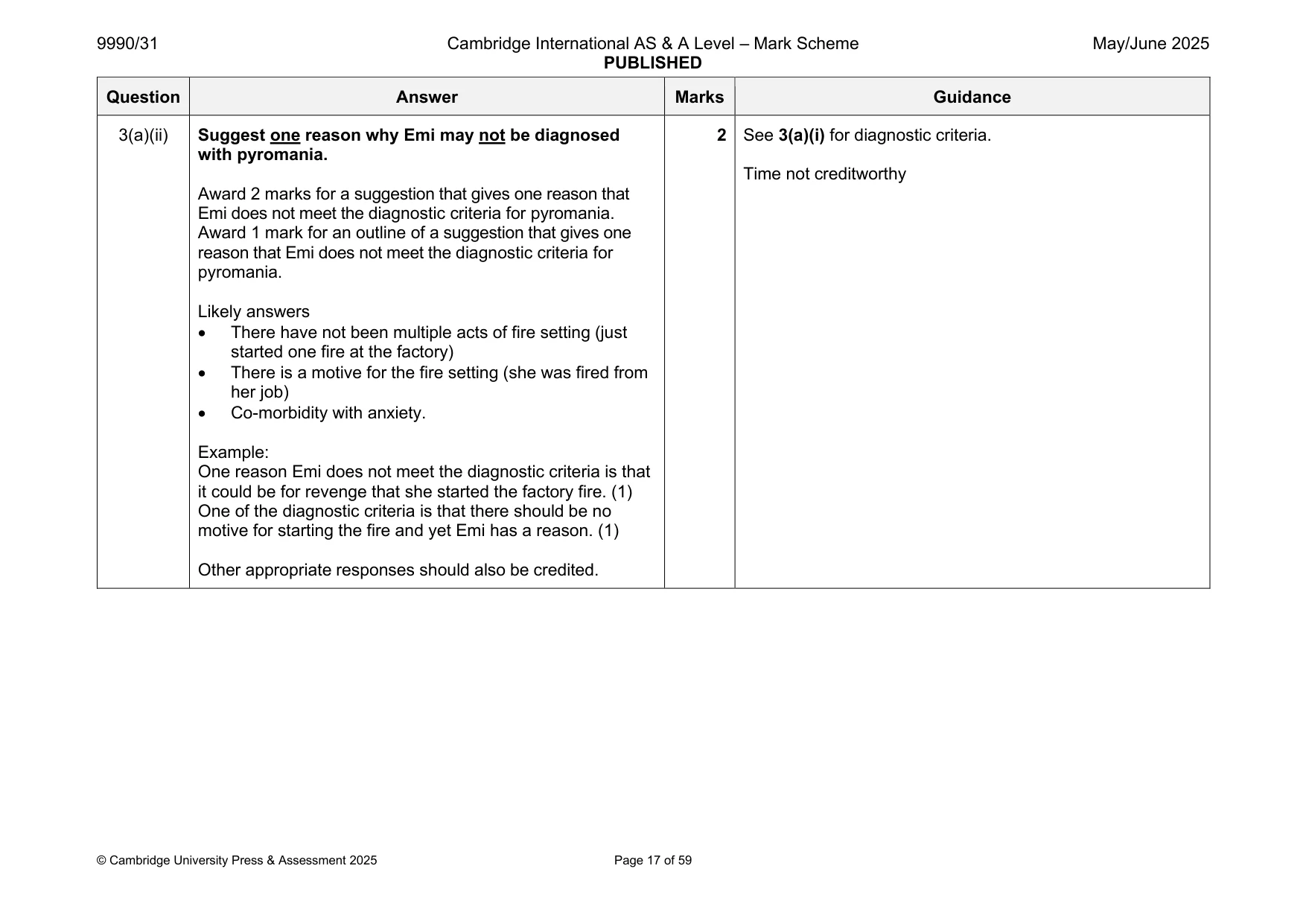
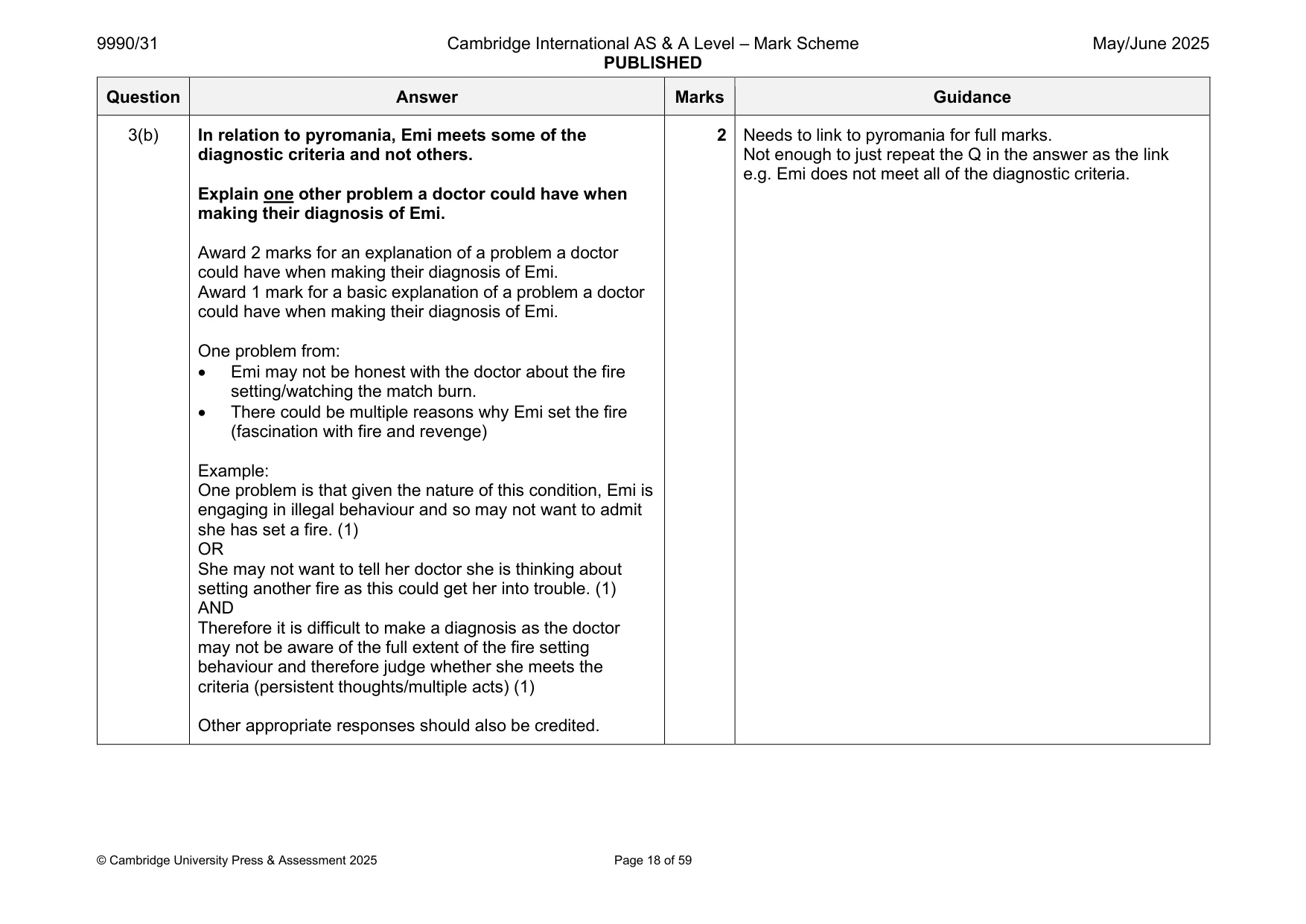
Mark scheme: 3(a) Using the diagnostic criteria (ICD–11) for pyromania: 3(a)(i) Suggest one reason why Emi may be diagnosed with 2 Link to ICD–11 pyromania. ICD–11 for Mortality and Morbidity Statistics Must link Emi’s symptom to the appropriate diagnostic Award 2 marks for a suggestion that gives one reason that criteria for full marks. Emi does meet the diagnostic criteria for pyromania. No credit for not intending to harm anyone or how long Emi Award 1 mark for a basic outline of a suggestion that gives has had symptoms. one reason that Emi does meet the diagnostic criteria for pyromania. ICD 11 • A recurrent failure to control strong impulses to set fires, resulting in multiple acts of, or attempts at, setting fire to property or other objects. • Lack of an apparent motive for the acts of, or attempts at, fire setting (e.g., monetary gain, revenge, sabotage, political statement, attracting recognition). • Persistent fascination or preoccupation with fire and related stimuli (e.g., watching fires, building fires, fascination with firefighting equipment). • The individual experiences increased tension or affective arousal prior to instances of, or attempts at, fire setting. • The individual experiences pleasure, excitement, relief or gratification during, and immediately following the act of setting the fire, witnessing its effects, or participating in its aftermath. 3(a)(i) Likely answers Fascination with fires (watching matches burn, thinking about factory fire); intense arousal prior to fire setting (feeling very excited while thinking about starting a fire at the shop) Example: One reason Emi meets the diagnostic criteria is that she is thinking a lot about the factory fire/staring a fire at the shop. (1) One of the criteria is showing persistent fascination with fires which is what Emi shows as she can’t stop thinking about fires. (1) Other appropriate responses should also be credited. 3(a)(ii) Suggest one reason why Emi may not be diagnosed 2 See 3(a)(i) for diagnostic criteria. with pyromania. Time not creditworthy Award 2 marks for a suggestion that gives one reason that Emi does not meet the diagnostic criteria for pyromania. Award 1 mark for an outline of a suggestion that gives one reason that Emi does not meet the diagnostic criteria for pyromania. Likely answers • There have not been multiple acts of fire setting (just started one fire at the factory) • There is a motive for the fire setting (she was fired from her job) • Co-morbidity with anxiety. Example: One reason Emi does not meet the diagnostic criteria is that it could be for revenge that she started the factory fire. (1) One of the diagnostic criteria is that there should be no motive for starting the fire and yet Emi has a reason. (1) Other appropriate responses should also be credited. 3(b) In relation to pyromania, Emi meets some of the 2 Needs to link to pyromania for full marks. diagnostic criteria and not others. Not enough to just repeat the Q in the answer as the link e.g. Emi does not meet all of the diagnostic criteria. Explain one other problem a doctor could have when making their diagnosis of Emi. Award 2 marks for an explanation of a problem a doctor could have when making their diagnosis of Emi. Award 1 mark for a basic explanation of a problem a doctor could have when making their diagnosis of Emi. One problem from: • Emi may not be honest with the doctor about the fire setting/watching the match burn. • There could be multiple reasons why Emi set the fire (fascination with fire and revenge) Example: One problem is that given the nature of this condition, Emi is engaging in illegal behaviour and so may not want to admit she has set a fire. (1) OR She may not want to tell her doctor she is thinking about setting another fire as this could get her into trouble. (1) AND Therefore it is difficult to make a diagnosis as the doctor may not be aware of the full extent of the fire setting behaviour and therefore judge whether she meets the criteria (persistent thoughts/multiple acts) (1) Other appropriate responses should also be credited.
Q4 · For the treatment and management of obsessive-compulsive disorder (OCD): Describe SSRIs…
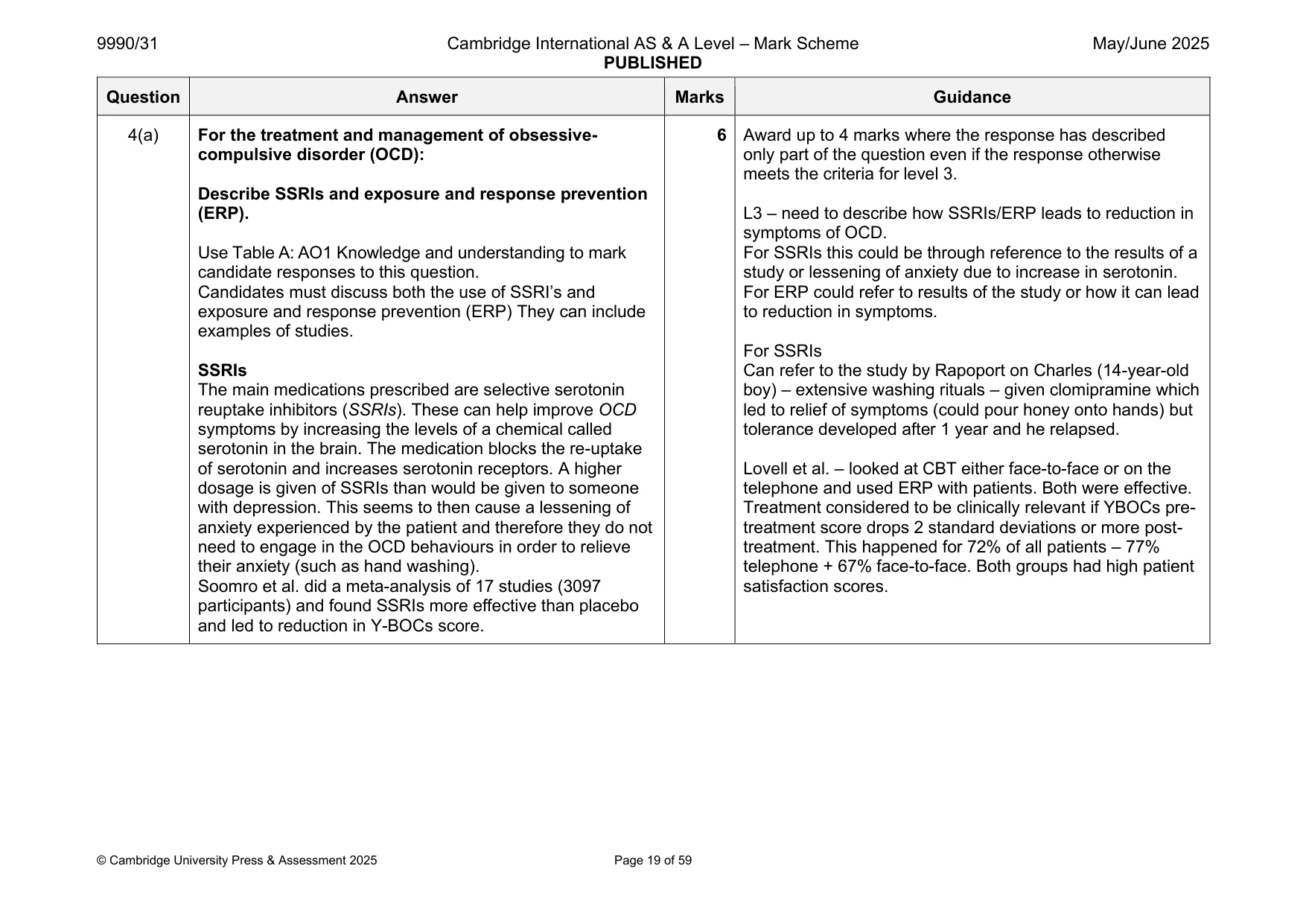
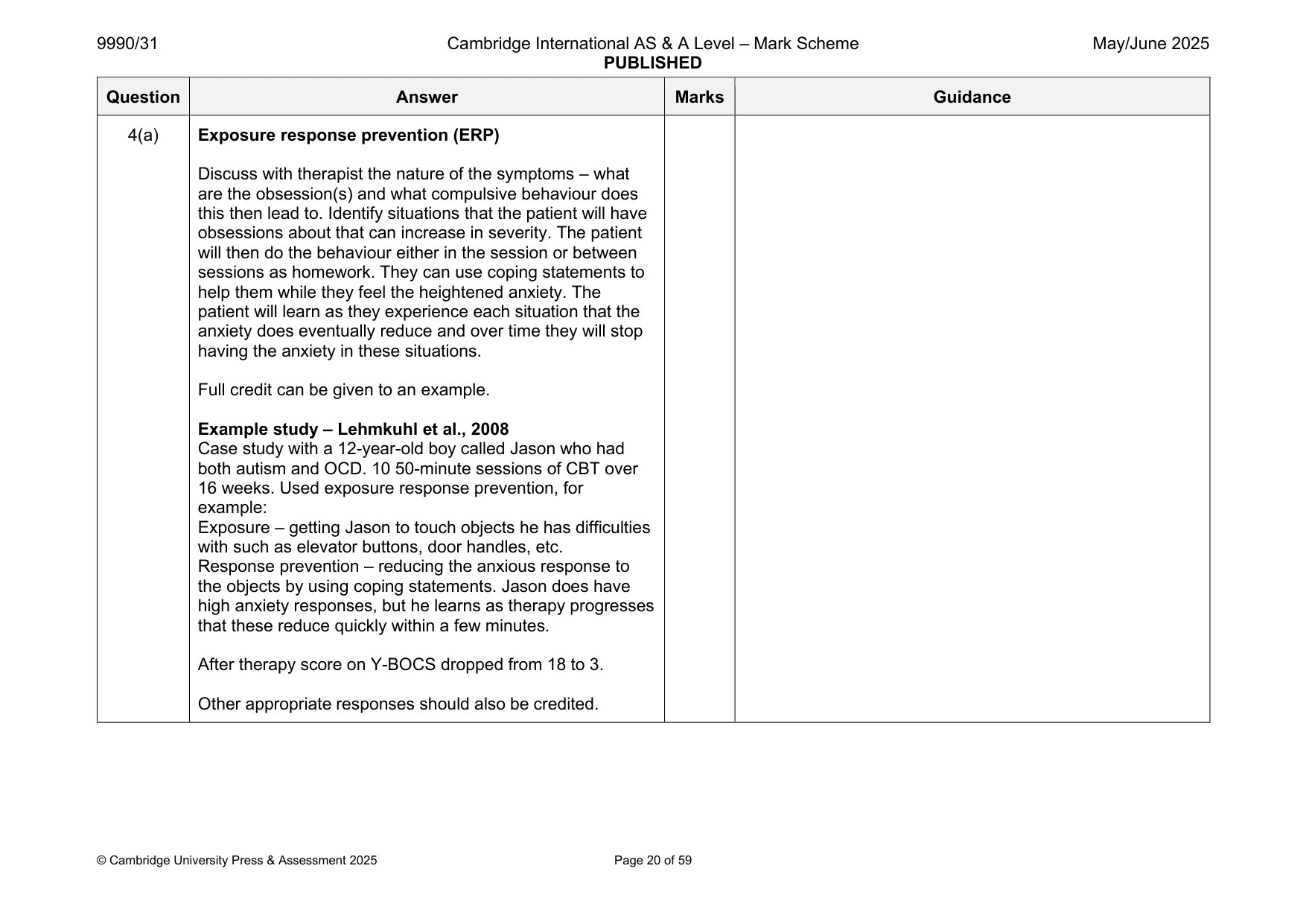
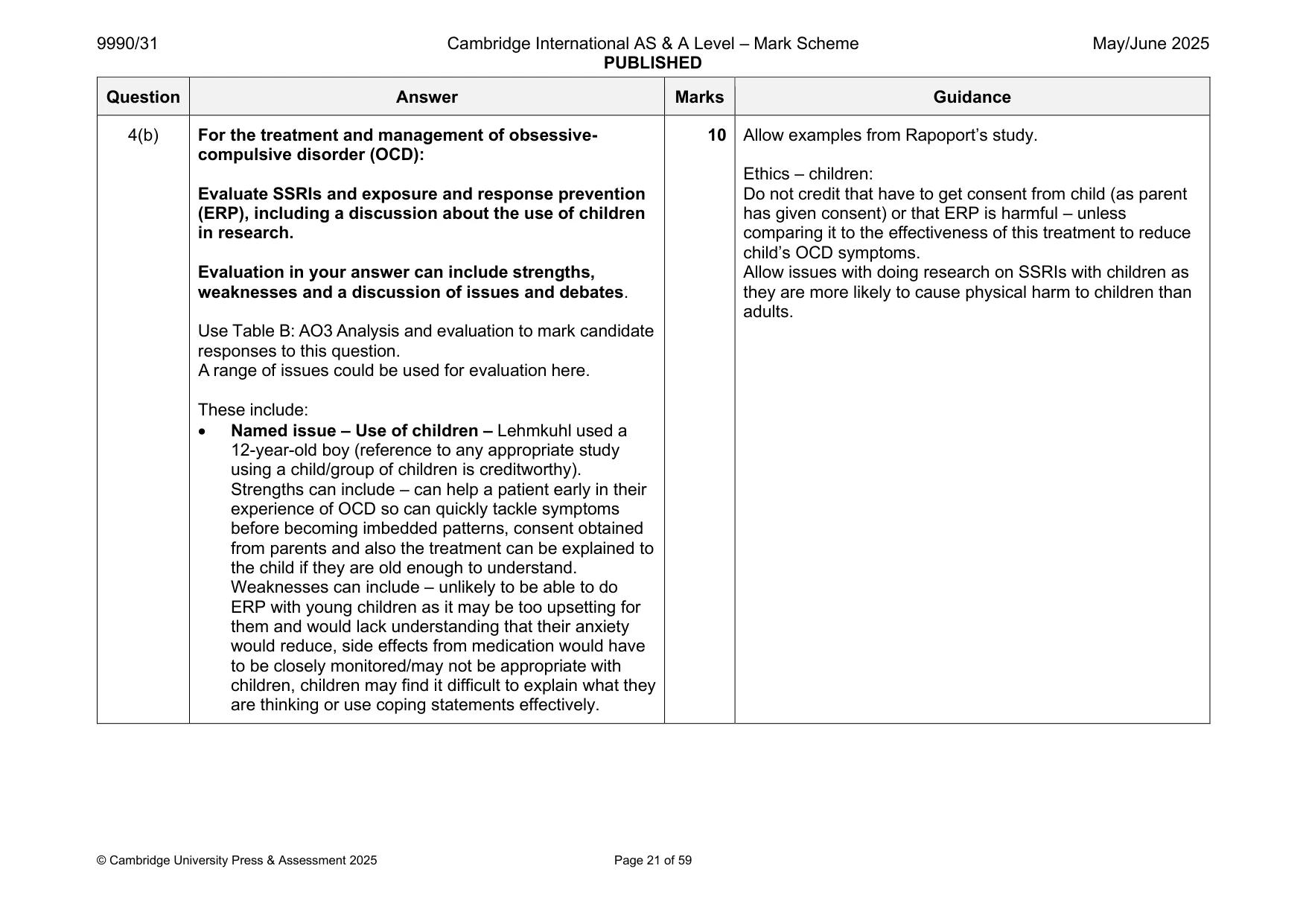
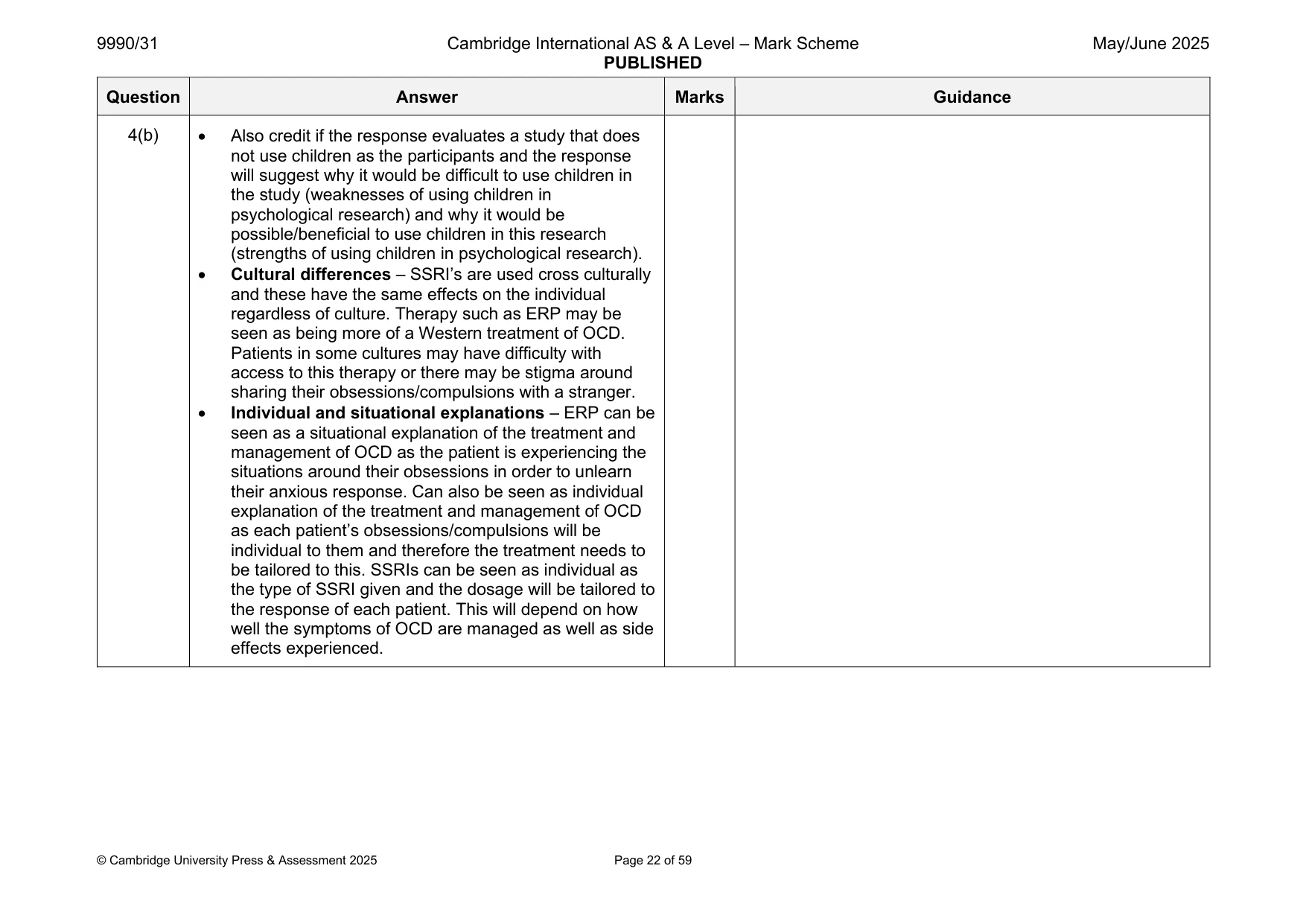
4 (a) For the treatment and management of obsessive-compulsive disorder (OCD): Describe SSRIs and exposure and response prevention (ERP). [6] (b) For the treatment and management of obsessive-compulsive disorder (OCD): Evaluate SSRIs and exposure and response prevention (ERP), including a discussion about the use of children in research. Evaluation in your answer can include strengths, weaknesses and a discussion of issues and debates. [10]
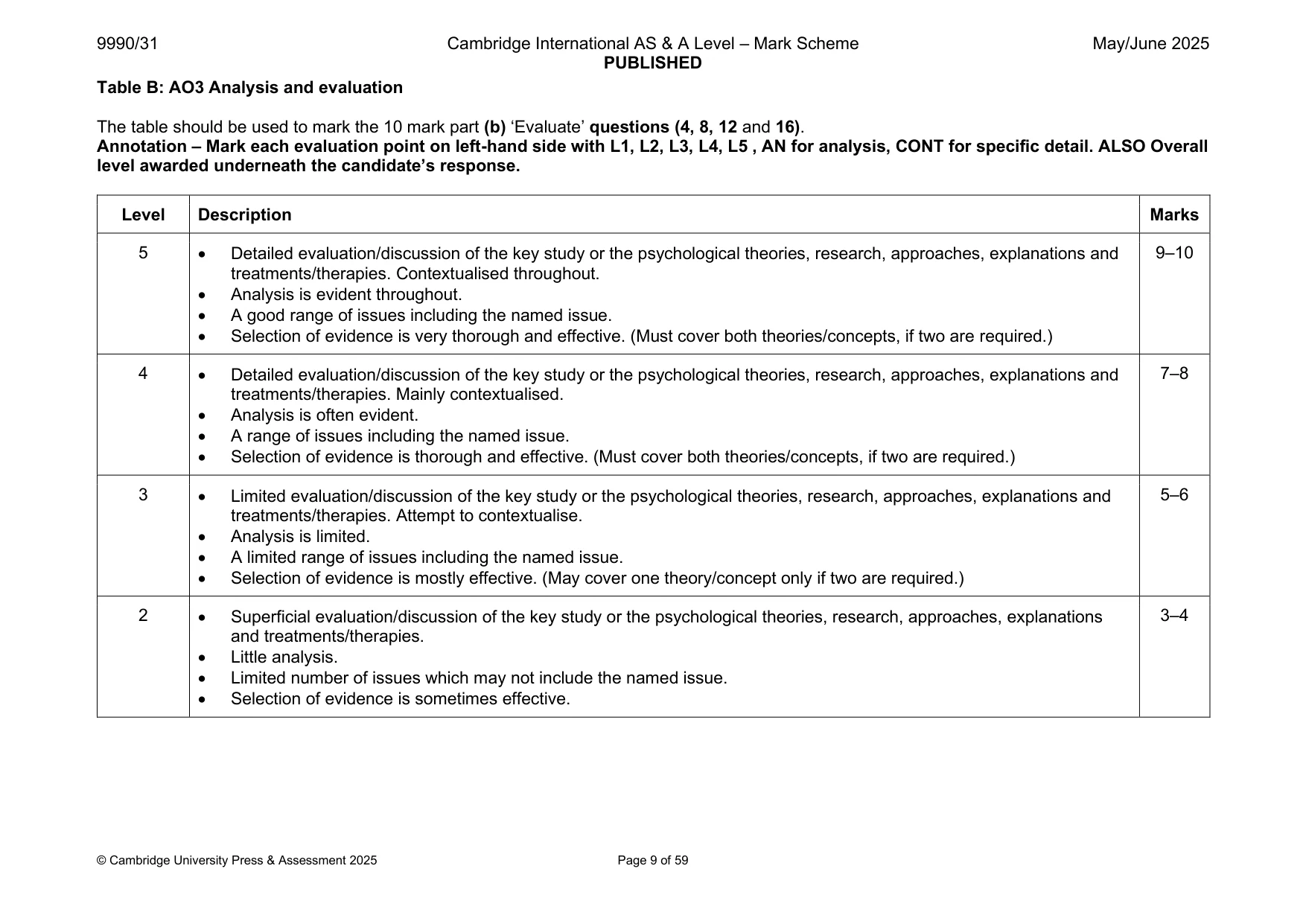
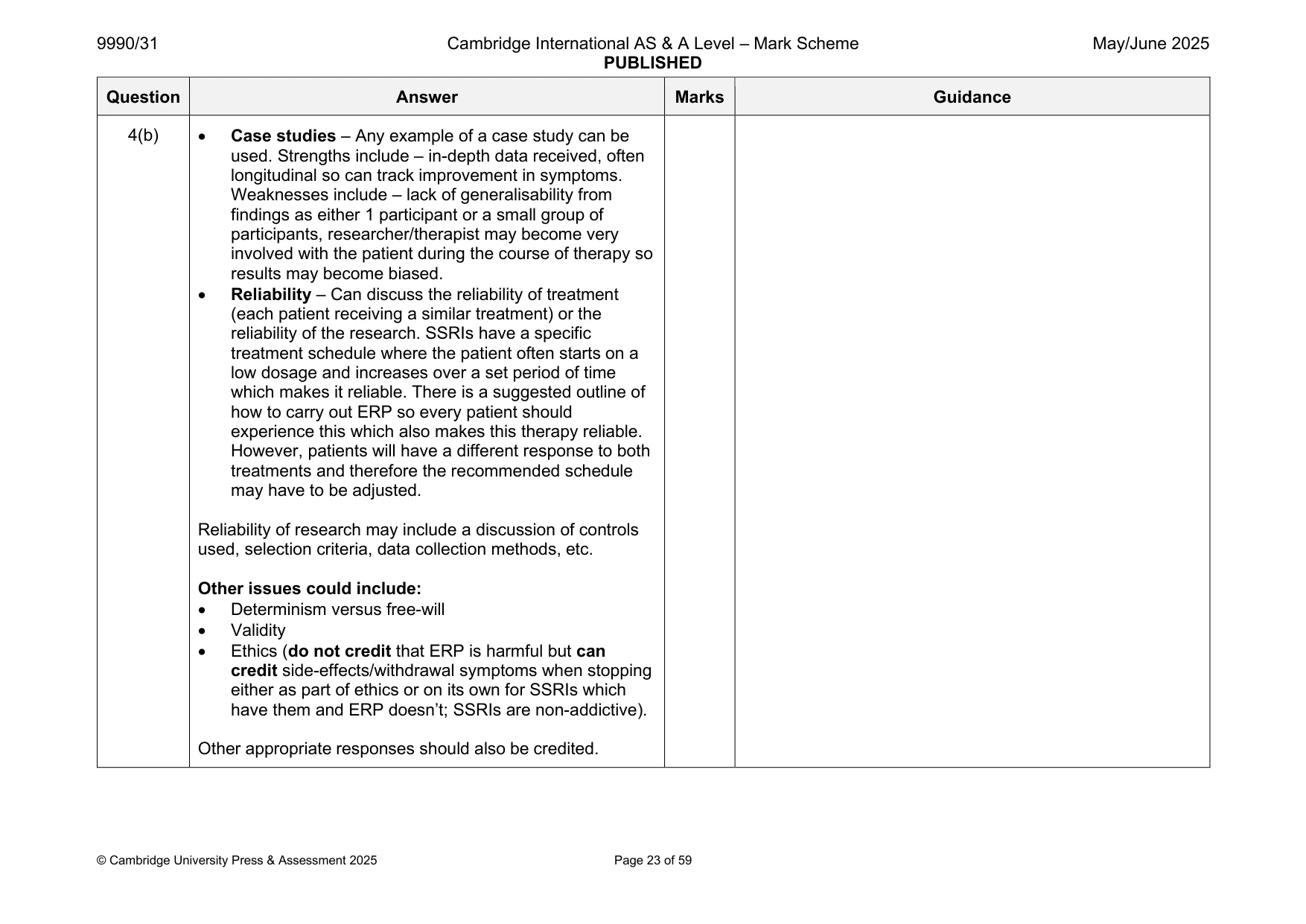
Mark scheme: 4(a) For the treatment and management of obsessive- 6 Award up to 4 marks where the response has described compulsive disorder (OCD): only part of the question even if the response otherwise meets the criteria for level 3. Describe SSRIs and exposure and response prevention (ERP). L3 – need to describe how SSRIs/ERP leads to reduction in symptoms of OCD. Use Table A: AO1 Knowledge and understanding to mark For SSRIs this could be through reference to the results of a candidate responses to this question. study or lessening of anxiety due to increase in serotonin. Candidates must discuss both the use of SSRI’s and For ERP could refer to results of the study or how it can lead exposure and response prevention (ERP) They can include to reduction in symptoms. examples of studies. For SSRIs SSRIs Can refer to the study by Rapoport on Charles (14-year-old The main medications prescribed are selective serotonin boy) – extensive washing rituals – given clomipramine which reuptake inhibitors (SSRIs). These can help improve OCD led to relief of symptoms (could pour honey onto hands) but symptoms by increasing the levels of a chemical called tolerance developed after 1 year and he relapsed. serotonin in the brain. The medication blocks the re-uptake of serotonin and increases serotonin receptors. A higher Lovell et al. – looked at CBT either face-to-face or on the dosage is given of SSRIs than would be given to someone telephone and used ERP with patients. Both were effective. with depression. This seems to then cause a lessening of Treatment considered to be clinically relevant if YBOCs pre- anxiety experienced by the patient and therefore they do not treatment score drops 2 standard deviations or more post- need to engage in the OCD behaviours in order to relieve treatment. This happened for 72% of all patients – 77% their anxiety (such as hand washing). telephone + 67% face-to-face. Both groups had high patient Soomro et al. did a meta-analysis of 17 studies (3097 satisfaction scores. participants) and found SSRIs more effective than placebo and led to reduction in Y-BOCs score. 4(a) Exposure response prevention (ERP) Discuss with therapist the nature of the symptoms – what are the obsession(s) and what compulsive behaviour does this then lead to. Identify situations that the patient will have obsessions about that can increase in severity. The patient will then do the behaviour either in the session or between sessions as homework. They can use coping statements to help them while they feel the heightened anxiety. The patient will learn as they experience each situation that the anxiety does eventually reduce and over time they will stop having the anxiety in these situations. Full credit can be given to an example. Example study – Lehmkuhl et al., 2008 Case study with a 12-year-old boy called Jason who had both autism and OCD. 10 50-minute sessions of CBT over 16 weeks. Used exposure response prevention, for example: Exposure – getting Jason to touch objects he has difficulties with such as elevator buttons, door handles, etc. Response prevention – reducing the anxious response to the objects by using coping statements. Jason does have high anxiety responses, but he learns as therapy progresses that these reduce quickly within a few minutes. After therapy score on Y-BOCS dropped from 18 to 3. Other appropriate responses should also be credited. 4(b) For the treatment and management of obsessive- 10 Allow examples from Rapoport’s study. compulsive disorder (OCD): Ethics – children: Evaluate SSRIs and exposure and response prevention Do not credit that have to get consent from child (as parent (ERP), including a discussion about the use of children has given consent) or that ERP is harmful – unless in research. comparing it to the effectiveness of this treatment to reduce child’s OCD symptoms. Evaluation in your answer can include strengths, Allow issues with doing research on SSRIs with children as weaknesses and a discussion of issues and debates. they are more likely to cause physical harm to children than adults. Use Table B: AO3 Analysis and evaluation to mark candidate responses to this question. A range of issues could be used for evaluation here. These include: • Named issue – Use of children – Lehmkuhl used a 12-year-old boy (reference to any appropriate study using a child/group of children is creditworthy). Strengths can include – can help a patient early in their experience of OCD so can quickly tackle symptoms before becoming imbedded patterns, consent obtained from parents and also the treatment can be explained to the child if they are old enough to understand. Weaknesses can include – unlikely to be able to do ERP with young children as it may be too upsetting for them and would lack understanding that their anxiety would reduce, side effects from medication would have to be closely monitored/may not be appropriate with children, children may find it difficult to explain what they are thinking or use coping statements effectively. 4(b) • Also credit if the response evaluates a study that does not use children as the participants and the response will suggest why it would be difficult to use children in the study (weaknesses of using children in psychological research) and why it would be possible/beneficial to use children in this research (strengths of using children in psychological research). • Cultural differences – SSRI’s are used cross culturally and these have the same effects on the individual regardless of culture. Therapy such as ERP may be seen as being more of a Western treatment of OCD. Patients in some cultures may have difficulty with access to this therapy or there may be stigma around sharing their obsessions/compulsions with a stranger. • Individual and situational explanations – ERP can be seen as a situational explanation of the treatment and management of OCD as the patient is experiencing the situations around their obsessions in order to unlearn their anxious response. Can also be seen as individual explanation of the treatment and management of OCD as each patient’s obsessions/compulsions will be individual to them and therefore the treatment needs to be tailored to this. SSRIs can be seen as individual as the type of SSRI given and the dosage will be tailored to the response of each patient. This will depend on how well the symptoms of OCD are managed as well as side effects experienced. 4(b) • Case studies – Any example of a case study can be used. Strengths include – in-depth data received, often longitudinal so can track improvement in symptoms. Weaknesses include – lack of generalisability from findings as either 1 participant or a small group of participants, researcher/therapist may become very involved with the patient during the course of therapy so results may become biased. • Reliability – Can discuss the reliability of treatment (each patient receiving a similar treatment) or the reliability of the research. SSRIs have a specific treatment schedule where the patient often starts on a low dosage and increases over a set period of time which makes it reliable. There is a suggested outline of how to carry out ERP so every patient should experience this which also makes this therapy reliable. However, patients will have a different response to both treatments and therefore the recommended schedule may have to be adjusted. Reliability of research may include a discussion of controls used, selection criteria, data collection methods, etc. Other issues could include: • Determinism versus free-will • Validity • Ethics (do not credit that ERP is harmful but can credit side-effects/withdrawal symptoms when stopping either as part of ethics or on its own for SSRIs which have them and ERP doesn’t; SSRIs are non-addictive). Other appropriate responses should also be credited.
Q5 · A shop has been receiving complaints about their virtual store layout
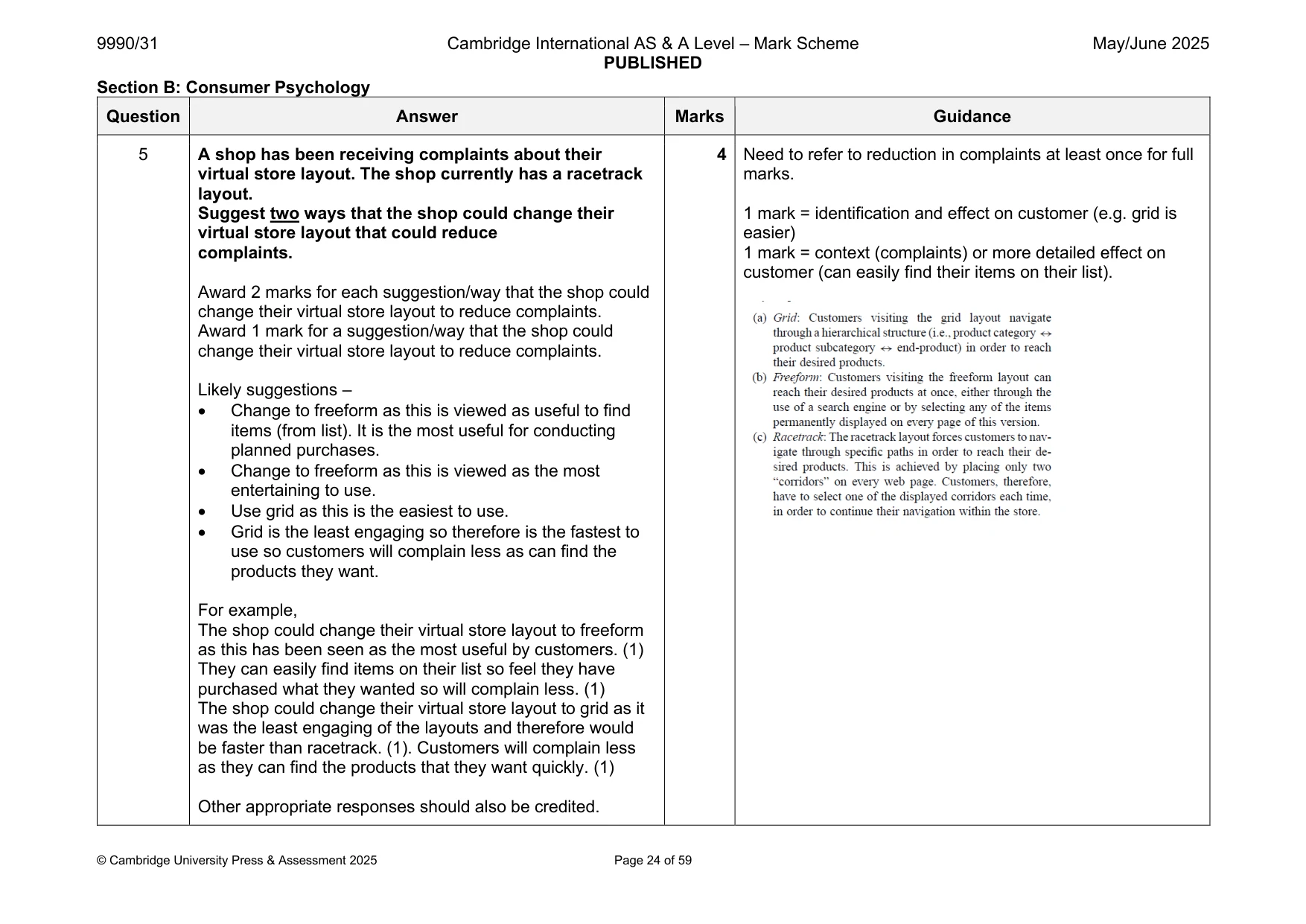
5 A shop has been receiving complaints about their virtual store layout. The shop currently has a racetrack layout. Suggest two ways that the shop could change their virtual store layout that could reduce complaints. [4]
Mark scheme: 5 A shop has been receiving complaints about their 4 Need to refer to reduction in complaints at least once for full virtual store layout. The shop currently has a racetrack marks. layout. Suggest two ways that the shop could change their 1 mark = identification and effect on customer (e.g. grid is virtual store layout that could reduce easier) complaints. 1 mark = context (complaints) or more detailed effect on customer (can easily find their items on their list). Award 2 marks for each suggestion/way that the shop could change their virtual store layout to reduce complaints. Award 1 mark for a suggestion/way that the shop could change their virtual store layout to reduce complaints. Likely suggestions – • Change to freeform as this is viewed as useful to find items (from list). It is the most useful for conducting planned purchases. • Change to freeform as this is viewed as the most entertaining to use. • Use grid as this is the easiest to use. • Grid is the least engaging so therefore is the fastest to use so customers will complain less as can find the products they want. For example, The shop could change their virtual store layout to freeform as this has been seen as the most useful by customers. (1) They can easily find items on their list so feel they have purchased what they wanted so will complain less. (1) The shop could change their virtual store layout to grid as it was the least engaging of the layouts and therefore would be faster than racetrack. (1). Customers will complain less as they can find the products that they want quickly. (1) Other appropriate responses should also be credited.
Q6 · Outline what is meant by free-will, including an example from thinking slow (system 2) in…
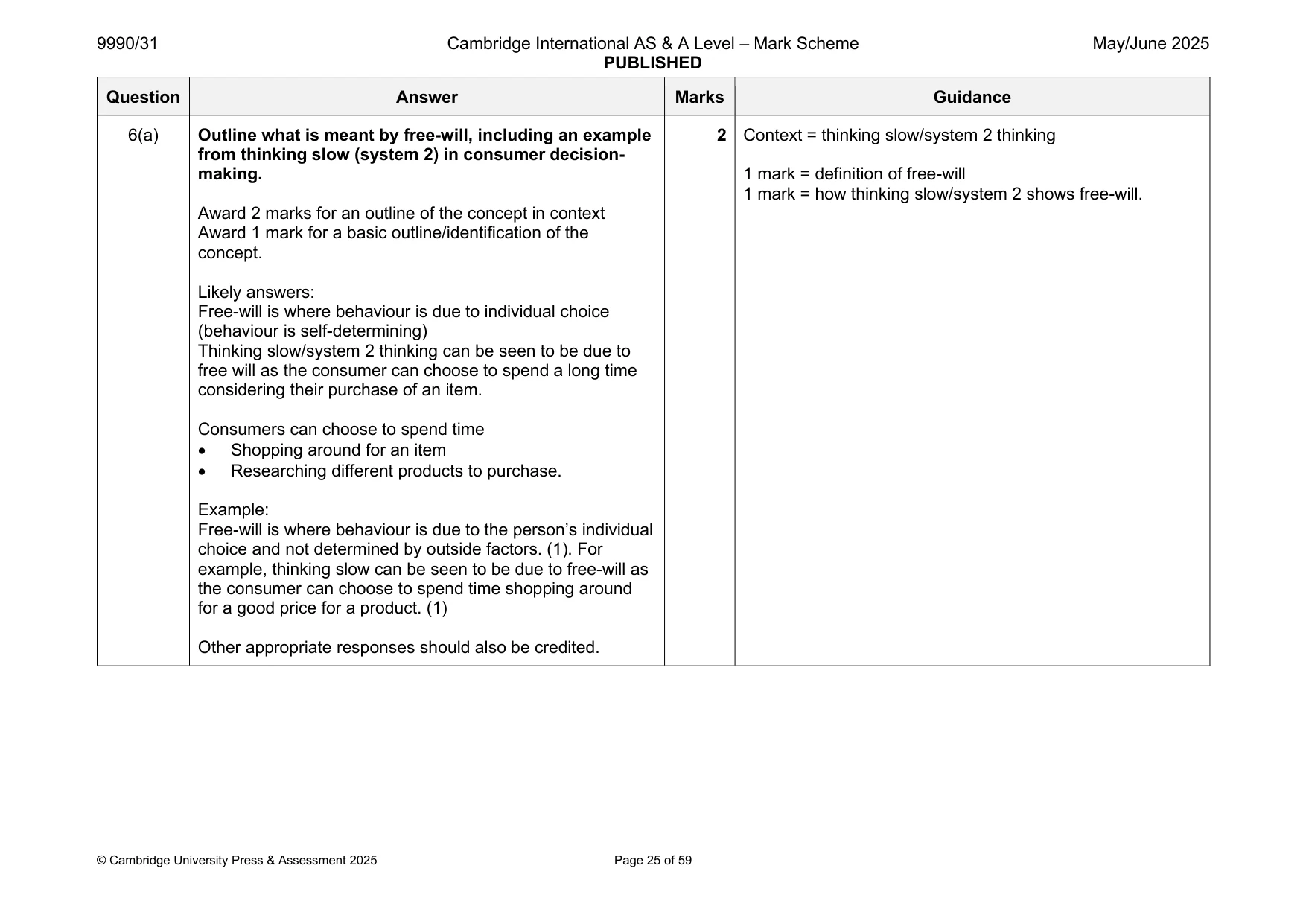
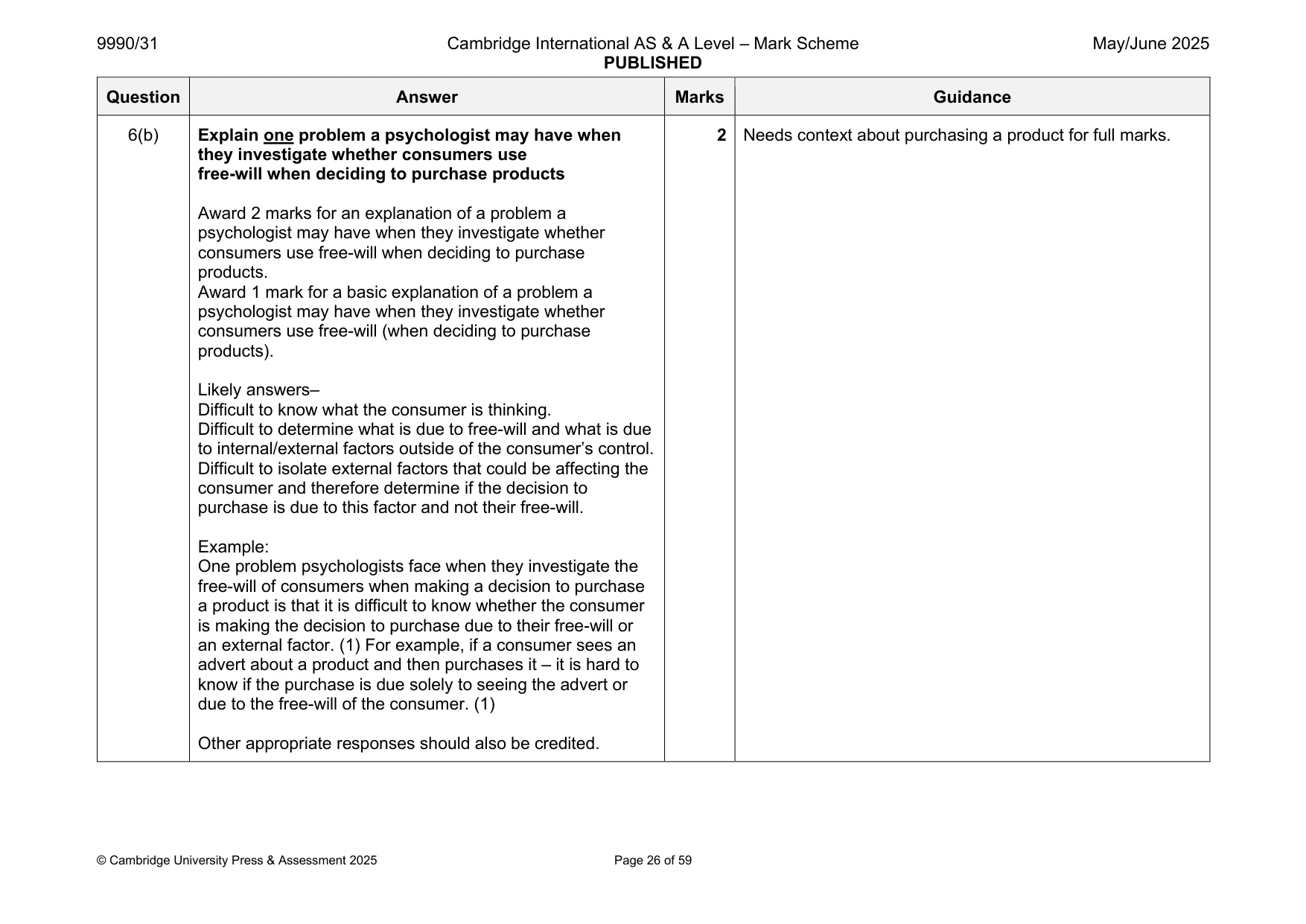
6 (a) Outline what is meant by free-will, including an example from thinking slow (system 2) in consumer decision-making. [2] (b) Explain one problem a psychologist may have when they investigate whether consumers use free-will when deciding to purchase products. [2]
Mark scheme: 6(a) Outline what is meant by free-will, including an example 2 Context = thinking slow/system 2 thinking from thinking slow (system 2) in consumer decision- making. 1 mark = definition of free-will 1 mark = how thinking slow/system 2 shows free-will. Award 2 marks for an outline of the concept in context Award 1 mark for a basic outline/identification of the concept. Likely answers: Free-will is where behaviour is due to individual choice (behaviour is self-determining) Thinking slow/system 2 thinking can be seen to be due to free will as the consumer can choose to spend a long time considering their purchase of an item. Consumers can choose to spend time • Shopping around for an item • Researching different products to purchase. Example: Free-will is where behaviour is due to the person’s individual choice and not determined by outside factors. (1). For example, thinking slow can be seen to be due to free-will as the consumer can choose to spend time shopping around for a good price for a product. (1) Other appropriate responses should also be credited. 6(b) Explain one problem a psychologist may have when 2 Needs context about purchasing a product for full marks. they investigate whether consumers use free-will when deciding to purchase products Award 2 marks for an explanation of a problem a psychologist may have when they investigate whether consumers use free-will when deciding to purchase products. Award 1 mark for a basic explanation of a problem a psychologist may have when they investigate whether consumers use free-will (when deciding to purchase products). Likely answers– Difficult to know what the consumer is thinking. Difficult to determine what is due to free-will and what is due to internal/external factors outside of the consumer’s control. Difficult to isolate external factors that could be affecting the consumer and therefore determine if the decision to purchase is due to this factor and not their free-will. Example: One problem psychologists face when they investigate the free-will of consumers when making a decision to purchase a product is that it is difficult to know whether the consumer is making the decision to purchase due to their free-will or an external factor. (1) For example, if a consumer sees an advert about a product and then purchases it – it is hard to know if the purchase is due solely to seeing the advert or due to the free-will of the consumer. (1) Other appropriate responses should also be credited.
Q7 · Sally and Dan want to buy new running shoes
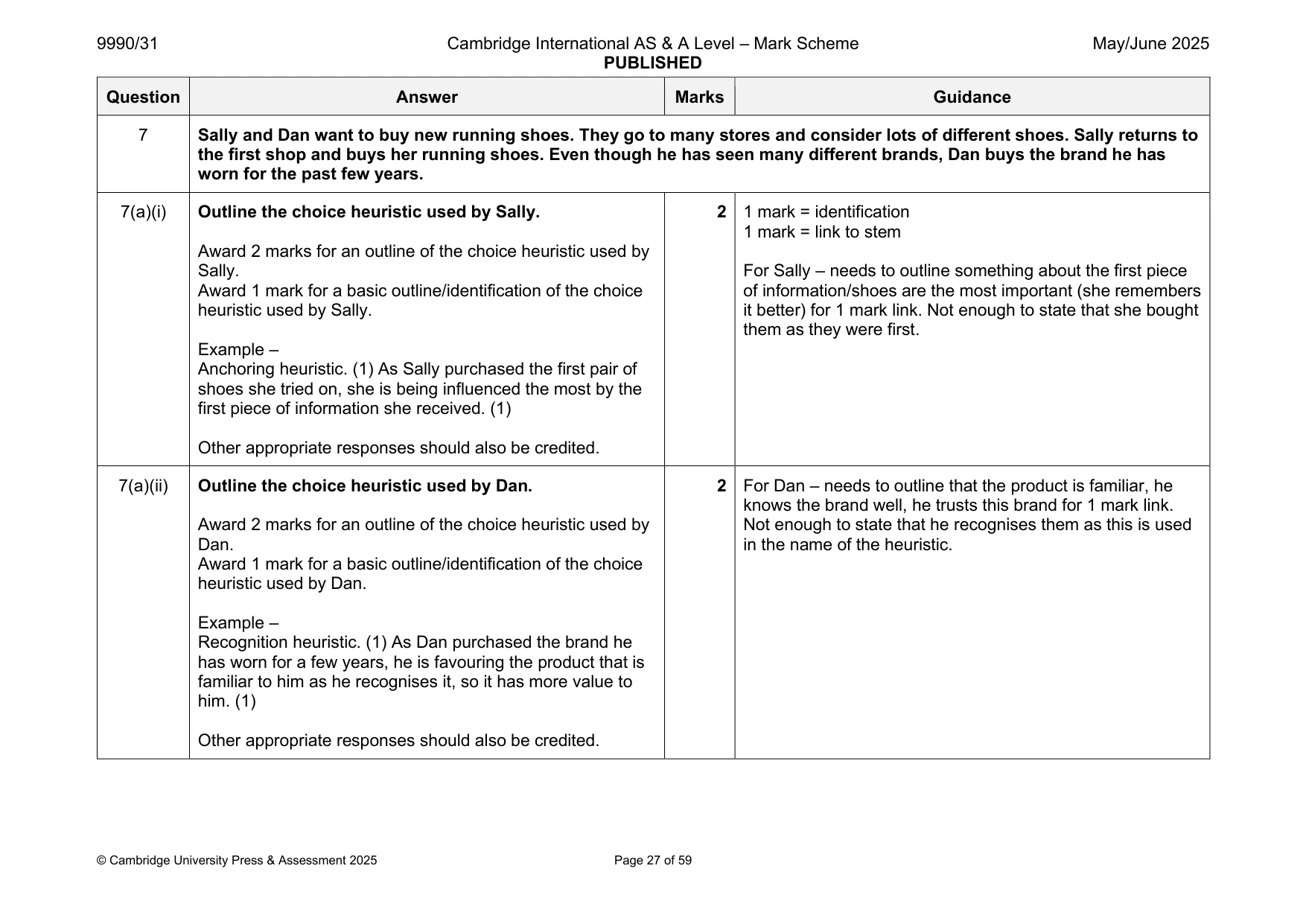
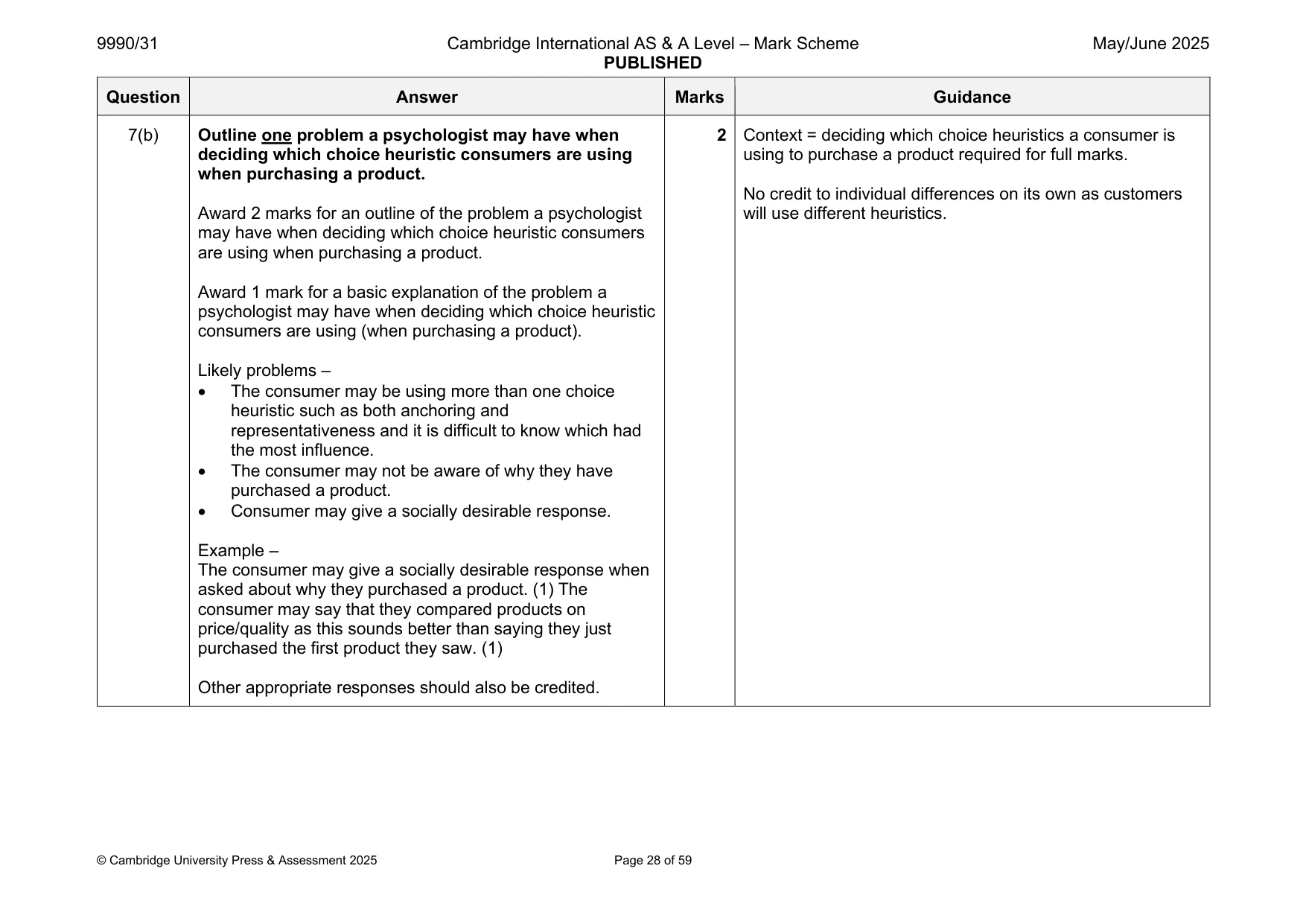
7 Sally and Dan want to buy new running shoes. They go to many stores and consider lots of different shoes. Sally returns to the first shop and buys her running shoes. Even though he has seen many different brands, Dan buys the brand he has worn for the past few years. (a) (i) Outline the choice heuristic used by Sally. [2] (ii) Outline the choice heuristic used by Dan. [2] (b) Outline one problem a psychologist may have when deciding which choice heuristic consumers are using when purchasing a product. [2]
Mark scheme: 7(a)(i) Outline the choice heuristic used by Sally. 2 1 mark = identification 1 mark = link to stem Award 2 marks for an outline of the choice heuristic used by Sally. For Sally – needs to outline something about the first piece Award 1 mark for a basic outline/identification of the choice of information/shoes are the most important (she remembers heuristic used by Sally. it better) for 1 mark link. Not enough to state that she bought them as they were first. Example – Anchoring heuristic. (1) As Sally purchased the first pair of shoes she tried on, she is being influenced the most by the first piece of information she received. (1) Other appropriate responses should also be credited. 7(a)(ii) Outline the choice heuristic used by Dan. 2 For Dan – needs to outline that the product is familiar, he knows the brand well, he trusts this brand for 1 mark link. Award 2 marks for an outline of the choice heuristic used by Not enough to state that he recognises them as this is used Dan. in the name of the heuristic. Award 1 mark for a basic outline/identification of the choice heuristic used by Dan. Example – Recognition heuristic. (1) As Dan purchased the brand he has worn for a few years, he is favouring the product that is familiar to him as he recognises it, so it has more value to him. (1) Other appropriate responses should also be credited. 7(b) Outline one problem a psychologist may have when 2 Context = deciding which choice heuristics a consumer is deciding which choice heuristic consumers are using using to purchase a product required for full marks. when purchasing a product. No credit to individual differences on its own as customers Award 2 marks for an outline of the problem a psychologist will use different heuristics. may have when deciding which choice heuristic consumers are using when purchasing a product. Award 1 mark for a basic explanation of the problem a psychologist may have when deciding which choice heuristic consumers are using (when purchasing a product). Likely problems – • The consumer may be using more than one choice heuristic such as both anchoring and representativeness and it is difficult to know which had the most influence. • The consumer may not be aware of why they have purchased a product. • Consumer may give a socially desirable response. Example – The consumer may give a socially desirable response when asked about why they purchased a product. (1) The consumer may say that they compared products on price/quality as this sounds better than saying they just purchased the first product they saw. (1) Other appropriate responses should also be credited.
Q8 · Describe what psychologists have discovered about: • gift-wrapping including beliefs of…
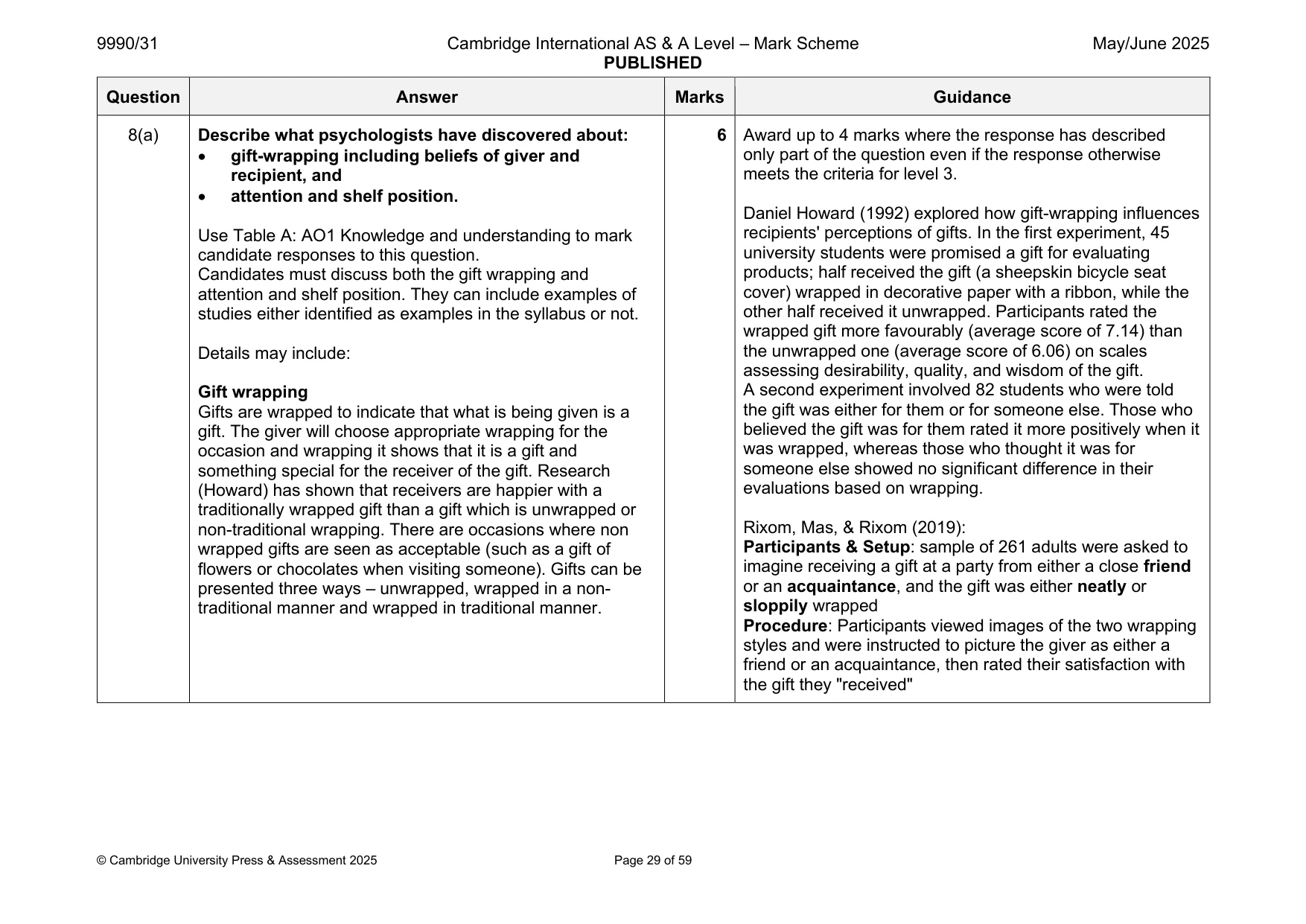
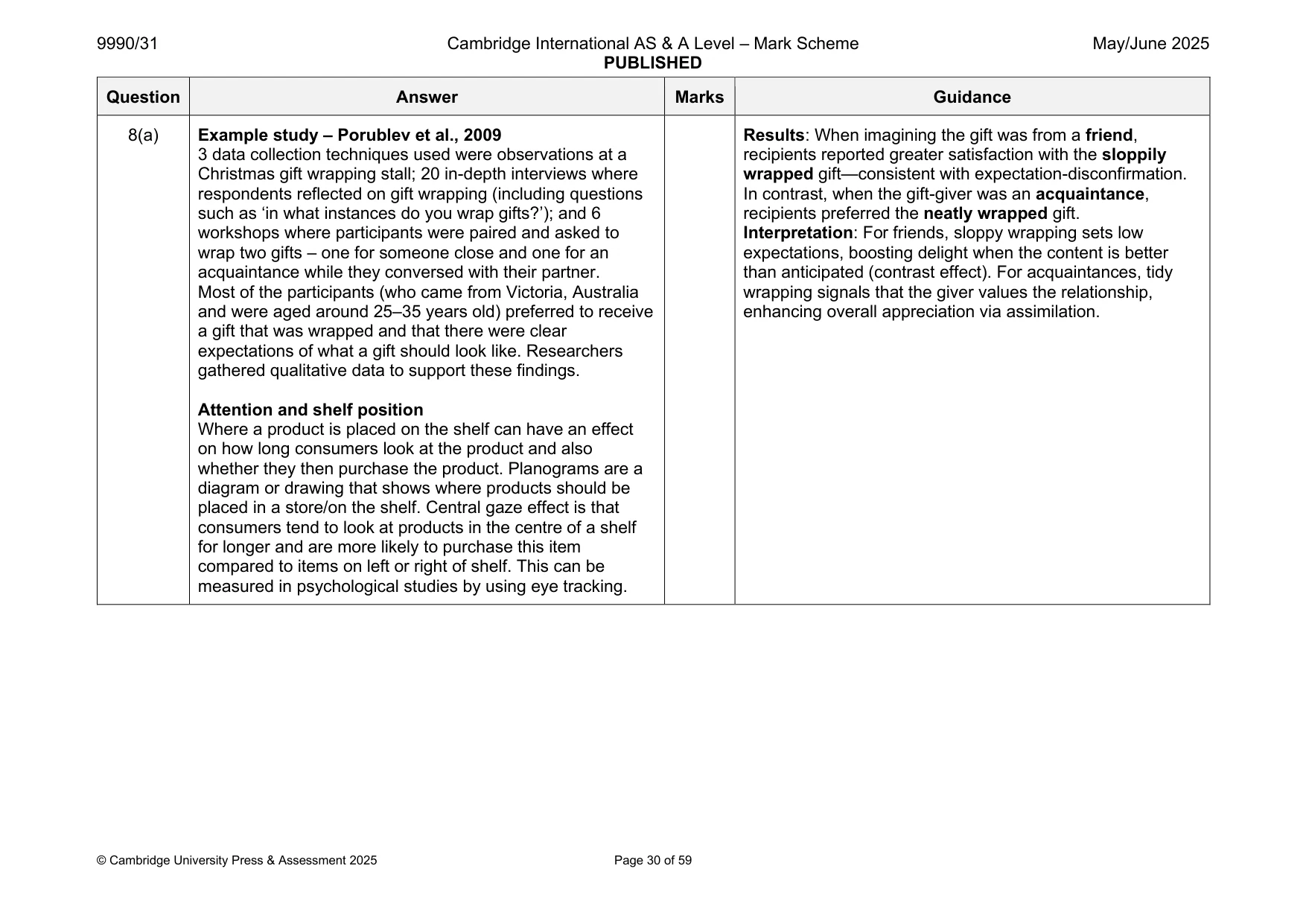
8 (a) Describe what psychologists have discovered about: • gift-wrapping including beliefs of giver and recipient, and • attention and shelf position. [6] (b) Evaluate what psychologists have discovered about: • gift-wrapping including beliefs of giver and recipient, and • attention and shelf position, including a discussion about generalisations from findings. Evaluation in your answer can include strengths, weaknesses and a discussion of issues and debates. [10] Section C: Health Psychology Answer all questions.
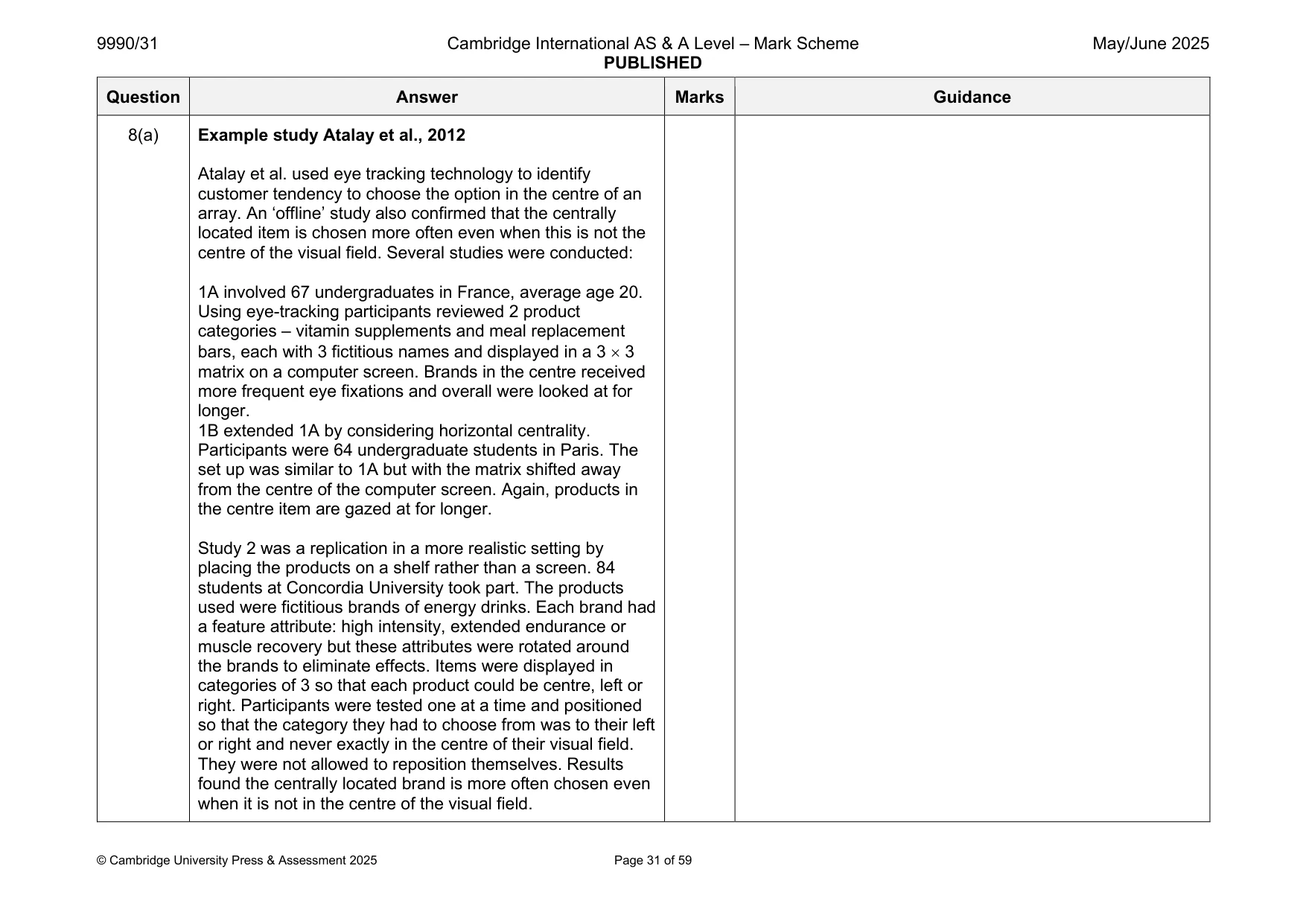
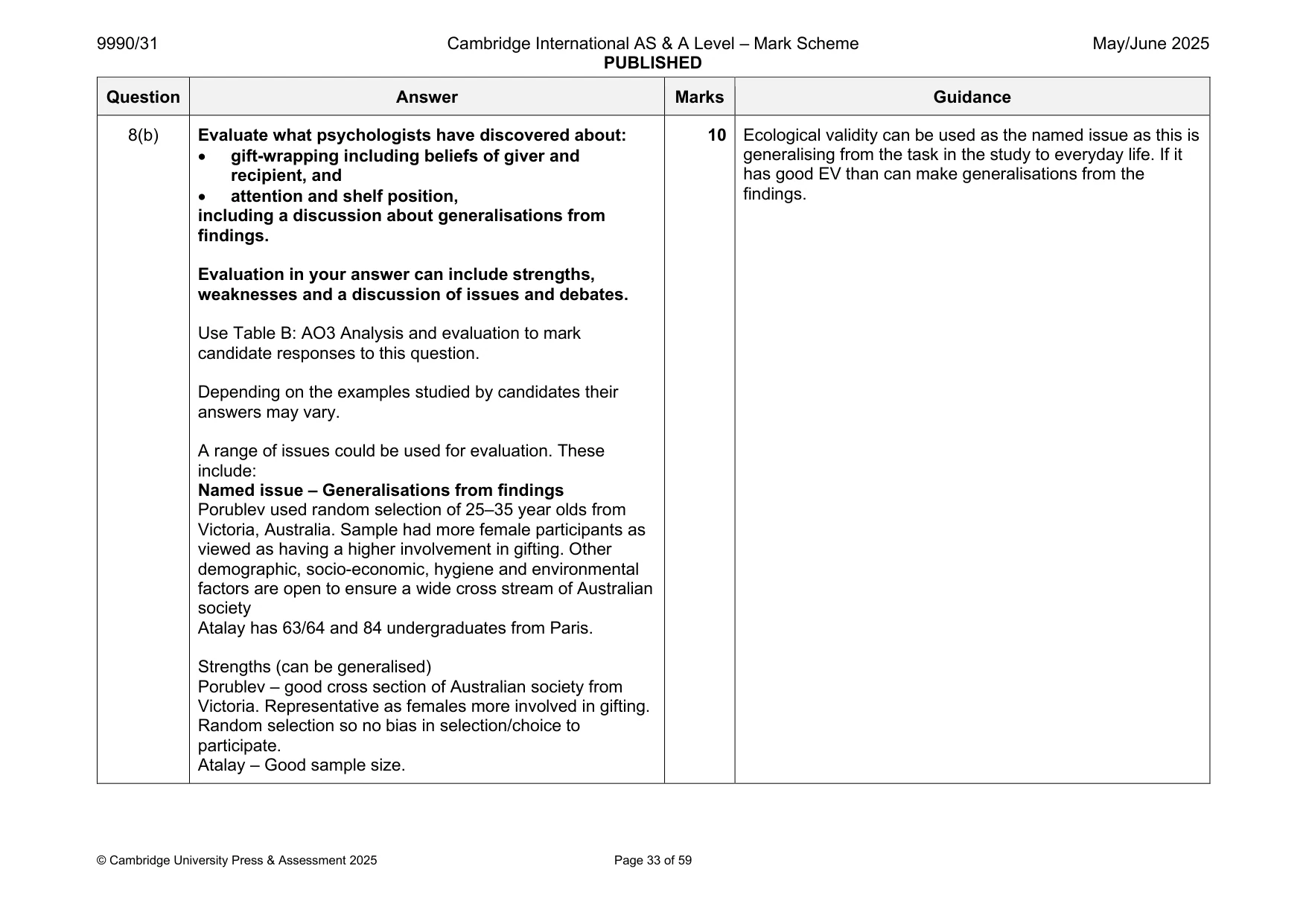
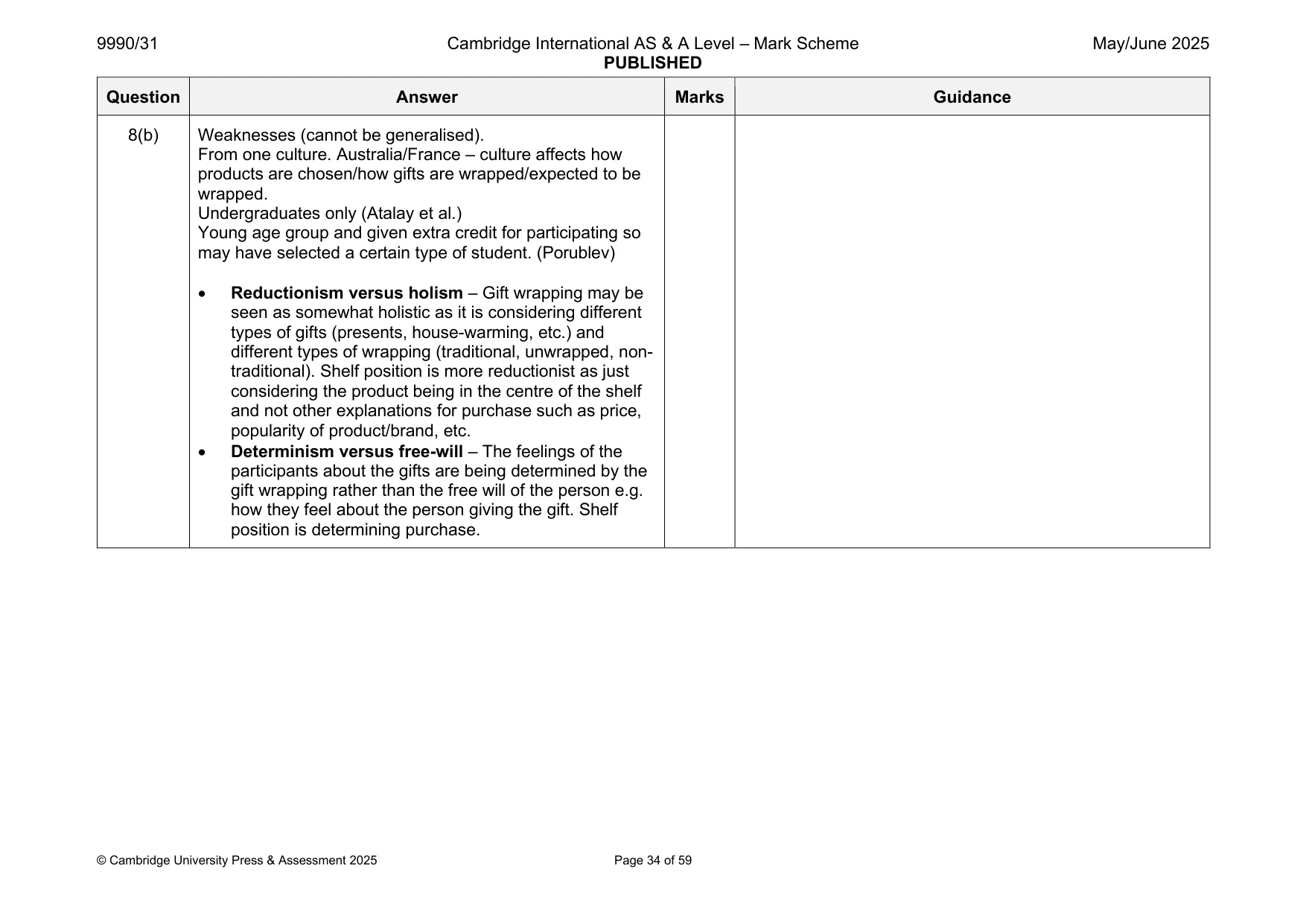
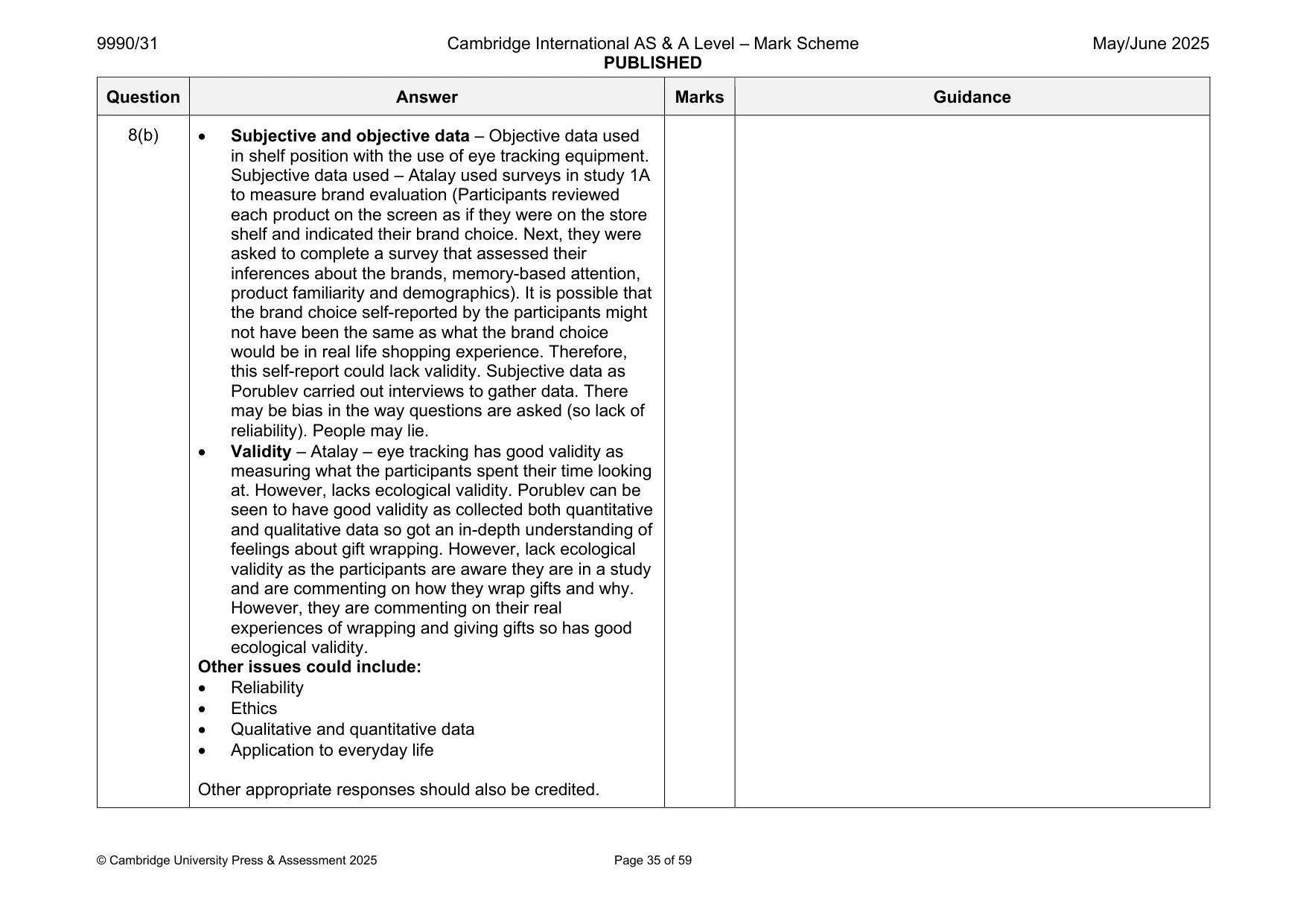
Mark scheme: 8(a) Describe what psychologists have discovered about: 6 Award up to 4 marks where the response has described • gift-wrapping including beliefs of giver and only part of the question even if the response otherwise recipient, and meets the criteria for level 3. • attention and shelf position. Daniel Howard (1992) explored how gift-wrapping influences Use Table A: AO1 Knowledge and understanding to mark recipients' perceptions of gifts. In the first experiment, 45 candidate responses to this question. university students were promised a gift for evaluating Candidates must discuss both the gift wrapping and products; half received the gift (a sheepskin bicycle seat attention and shelf position. They can include examples of cover) wrapped in decorative paper with a ribbon, while the studies either identified as examples in the syllabus or not. other half received it unwrapped. Participants rated the wrapped gift more favourably (average score of 7.14) than Details may include: the unwrapped one (average score of 6.06) on scales assessing desirability, quality, and wisdom of the gift. Gift wrapping A second experiment involved 82 students who were told Gifts are wrapped to indicate that what is being given is a the gift was either for them or for someone else. Those who gift. The giver will choose appropriate wrapping for the believed the gift was for them rated it more positively when it occasion and wrapping it shows that it is a gift and was wrapped, whereas those who thought it was for something special for the receiver of the gift. Research someone else showed no significant difference in their (Howard) has shown that receivers are happier with a evaluations based on wrapping. traditionally wrapped gift than a gift which is unwrapped or non-traditional wrapping. There are occasions where non Rixom, Mas, & Rixom (2019): wrapped gifts are seen as acceptable (such as a gift of Participants & Setup: sample of 261 adults were asked to flowers or chocolates when visiting someone). Gifts can be imagine receiving a gift at a party from either a close friend presented three ways – unwrapped, wrapped in a non- or an acquaintance, and the gift was either neatly or traditional manner and wrapped in traditional manner. sloppily wrapped Procedure: Participants viewed images of the two wrapping styles and were instructed to picture the giver as either a friend or an acquaintance, then rated their satisfaction with the gift they "received" 8(a) Example study – Porublev et al., 2009 Results: When imagining the gift was from a friend, 3 data collection techniques used were observations at a recipients reported greater satisfaction with the sloppily Christmas gift wrapping stall; 20 in-depth interviews where wrapped gift—consistent with expectation-disconfirmation. respondents reflected on gift wrapping (including questions In contrast, when the gift-giver was an acquaintance, such as ‘in what instances do you wrap gifts?’); and 6 recipients preferred the neatly wrapped gift. workshops where participants were paired and asked to Interpretation: For friends, sloppy wrapping sets low wrap two gifts – one for someone close and one for an expectations, boosting delight when the content is better acquaintance while they conversed with their partner. than anticipated (contrast effect). For acquaintances, tidy Most of the participants (who came from Victoria, Australia wrapping signals that the giver values the relationship, and were aged around 25–35 years old) preferred to receive enhancing overall appreciation via assimilation. a gift that was wrapped and that there were clear expectations of what a gift should look like. Researchers gathered qualitative data to support these findings. Attention and shelf position Where a product is placed on the shelf can have an effect on how long consumers look at the product and also whether they then purchase the product. Planograms are a diagram or drawing that shows where products should be placed in a store/on the shelf. Central gaze effect is that consumers tend to look at products in the centre of a shelf for longer and are more likely to purchase this item compared to items on left or right of shelf. This can be measured in psychological studies by using eye tracking. 8(a) Example study Atalay et al., 2012 Atalay et al. used eye tracking technology to identify customer tendency to choose the option in the centre of an array. An ‘offline’ study also confirmed that the centrally located item is chosen more often even when this is not the centre of the visual field. Several studies were conducted: 1A involved 67 undergraduates in France, average age 20. Using eye-tracking participants reviewed 2 product categories – vitamin supplements and meal replacement bars, each with 3 fictitious names and displayed in a 3 3 matrix on a computer screen. Brands in the centre received more frequent eye fixations and overall were looked at for longer. 1B extended 1A by considering horizontal centrality. Participants were 64 undergraduate students in Paris. The set up was similar to 1A but with the matrix shifted away from the centre of the computer screen. Again, products in the centre item are gazed at for longer. Study 2 was a replication in a more realistic setting by placing the products on a shelf rather than a screen. 84 students at Concordia University took part. The products used were fictitious brands of energy drinks. Each brand had a feature attribute: high intensity, extended endurance or muscle recovery but these attributes were rotated around the brands to eliminate effects. Items were displayed in categories of 3 so that each product could be centre, left or right. Participants were tested one at a time and positioned so that the category they had to choose from was to their left or right and never exactly in the centre of their visual field. They were not allowed to reposition themselves. Results found the centrally located brand is more often chosen even when it is not in the centre of the visual field. 8(a) Participants were asked to evaluate the product, and it was found that the chosen product from the centre was not always the most positively evaluated. Other appropriate responses should also be credited 8(b) Evaluate what psychologists have discovered about: 10 Ecological validity can be used as the named issue as this is • gift-wrapping including beliefs of giver and generalising from the task in the study to everyday life. If it recipient, and has good EV than can make generalisations from the • attention and shelf position, findings. including a discussion about generalisations from findings. Evaluation in your answer can include strengths, weaknesses and a discussion of issues and debates. Use Table B: AO3 Analysis and evaluation to mark candidate responses to this question. Depending on the examples studied by candidates their answers may vary. A range of issues could be used for evaluation. These include: Named issue – Generalisations from findings Porublev used random selection of 25–35 year olds from Victoria, Australia. Sample had more female participants as viewed as having a higher involvement in gifting. Other demographic, socio-economic, hygiene and environmental factors are open to ensure a wide cross stream of Australian society Atalay has 63/64 and 84 undergraduates from Paris. Strengths (can be generalised) Porublev – good cross section of Australian society from Victoria. Representative as females more involved in gifting. Random selection so no bias in selection/choice to participate. Atalay – Good sample size. 8(b) Weaknesses (cannot be generalised). From one culture. Australia/France – culture affects how products are chosen/how gifts are wrapped/expected to be wrapped. Undergraduates only (Atalay et al.) Young age group and given extra credit for participating so may have selected a certain type of student. (Porublev) • Reductionism versus holism – Gift wrapping may be seen as somewhat holistic as it is considering different types of gifts (presents, house-warming, etc.) and different types of wrapping (traditional, unwrapped, non- traditional). Shelf position is more reductionist as just considering the product being in the centre of the shelf and not other explanations for purchase such as price, popularity of product/brand, etc. • Determinism versus free-will – The feelings of the participants about the gifts are being determined by the gift wrapping rather than the free will of the person e.g. how they feel about the person giving the gift. Shelf position is determining purchase. 8(b) • Subjective and objective data – Objective data used in shelf position with the use of eye tracking equipment. Subjective data used – Atalay used surveys in study 1A to measure brand evaluation (Participants reviewed each product on the screen as if they were on the store shelf and indicated their brand choice. Next, they were asked to complete a survey that assessed their inferences about the brands, memory-based attention, product familiarity and demographics). It is possible that the brand choice self-reported by the participants might not have been the same as what the brand choice would be in real life shopping experience. Therefore, this self-report could lack validity. Subjective data as Porublev carried out interviews to gather data. There may be bias in the way questions are asked (so lack of reliability). People may lie. • Validity – Atalay – eye tracking has good validity as measuring what the participants spent their time looking at. However, lacks ecological validity. Porublev can be seen to have good validity as collected both quantitative and qualitative data so got an in-depth understanding of feelings about gift wrapping. However, lack ecological validity as the participants are aware they are in a study and are commenting on how they wrap gifts and why. However, they are commenting on their real experiences of wrapping and giving gifts so has good ecological validity. Other issues could include: • Reliability • Ethics • Qualitative and quantitative data • Application to everyday life Other appropriate responses should also be credited. Section C: Health Psychology
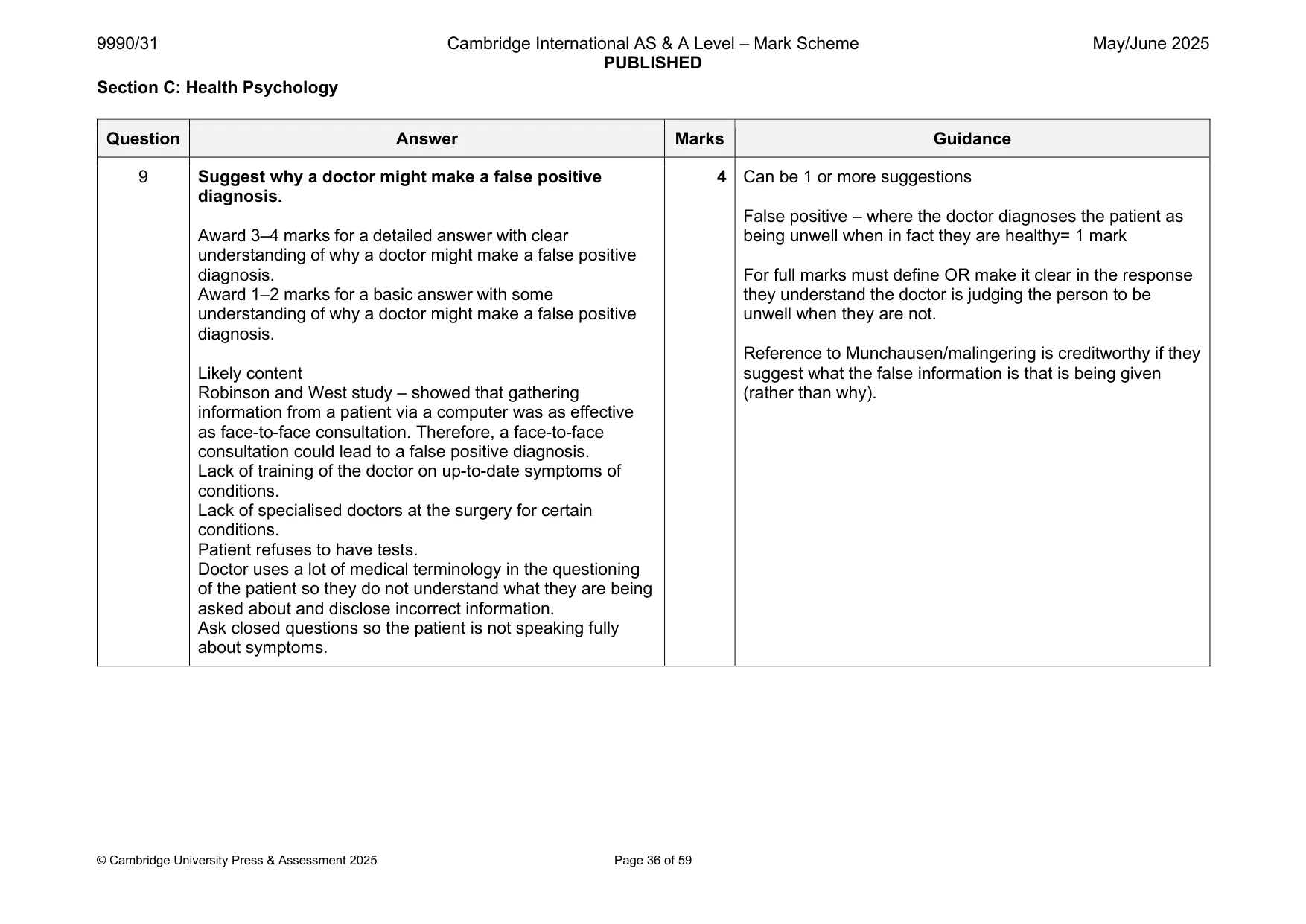
Q9 · Suggest why a doctor might make a false positive diagnosis
9 Suggest why a doctor might make a false positive diagnosis. [4]
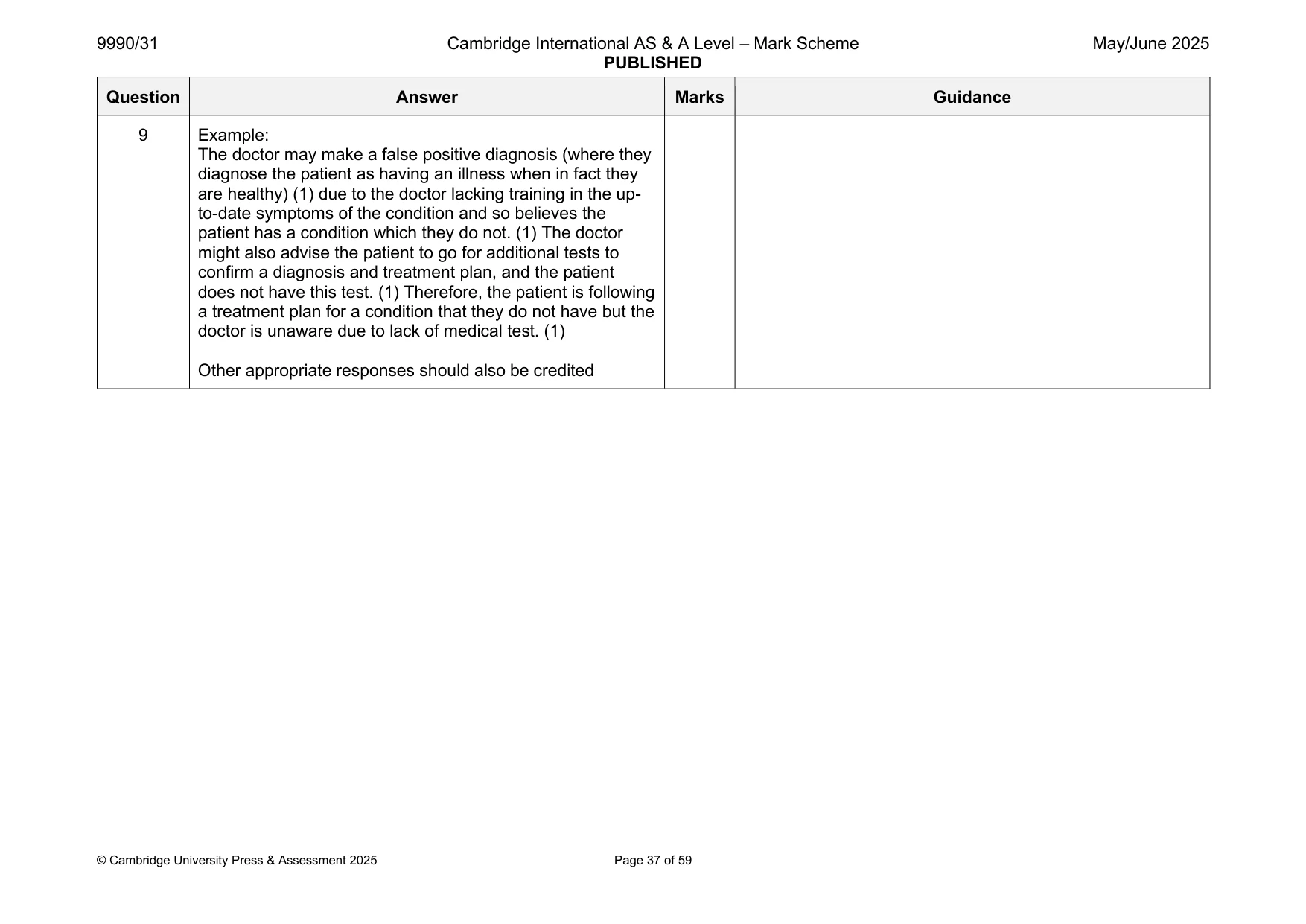
Mark scheme: 9 Suggest why a doctor might make a false positive 4 Can be 1 or more suggestions diagnosis. False positive – where the doctor diagnoses the patient as Award 3–4 marks for a detailed answer with clear being unwell when in fact they are healthy= 1 mark understanding of why a doctor might make a false positive diagnosis. For full marks must define OR make it clear in the response Award 1–2 marks for a basic answer with some they understand the doctor is judging the person to be understanding of why a doctor might make a false positive unwell when they are not. diagnosis. Reference to Munchausen/malingering is creditworthy if they Likely content suggest what the false information is that is being given Robinson and West study – showed that gathering (rather than why). information from a patient via a computer was as effective as face-to-face consultation. Therefore, a face-to-face consultation could lead to a false positive diagnosis. Lack of training of the doctor on up-to-date symptoms of conditions. Lack of specialised doctors at the surgery for certain conditions. Patient refuses to have tests. Doctor uses a lot of medical terminology in the questioning of the patient so they do not understand what they are being asked about and disclose incorrect information. Ask closed questions so the patient is not speaking fully about symptoms. 9 Example: The doctor may make a false positive diagnosis (where they diagnose the patient as having an illness when in fact they are healthy) (1) due to the doctor lacking training in the up- to-date symptoms of the condition and so believes the patient has a condition which they do not. (1) The doctor might also advise the patient to go for additional tests to confirm a diagnosis and treatment plan, and the patient does not have this test. (1) Therefore, the patient is following a treatment plan for a condition that they do not have but the doctor is unaware due to lack of medical test. (1) Other appropriate responses should also be credited
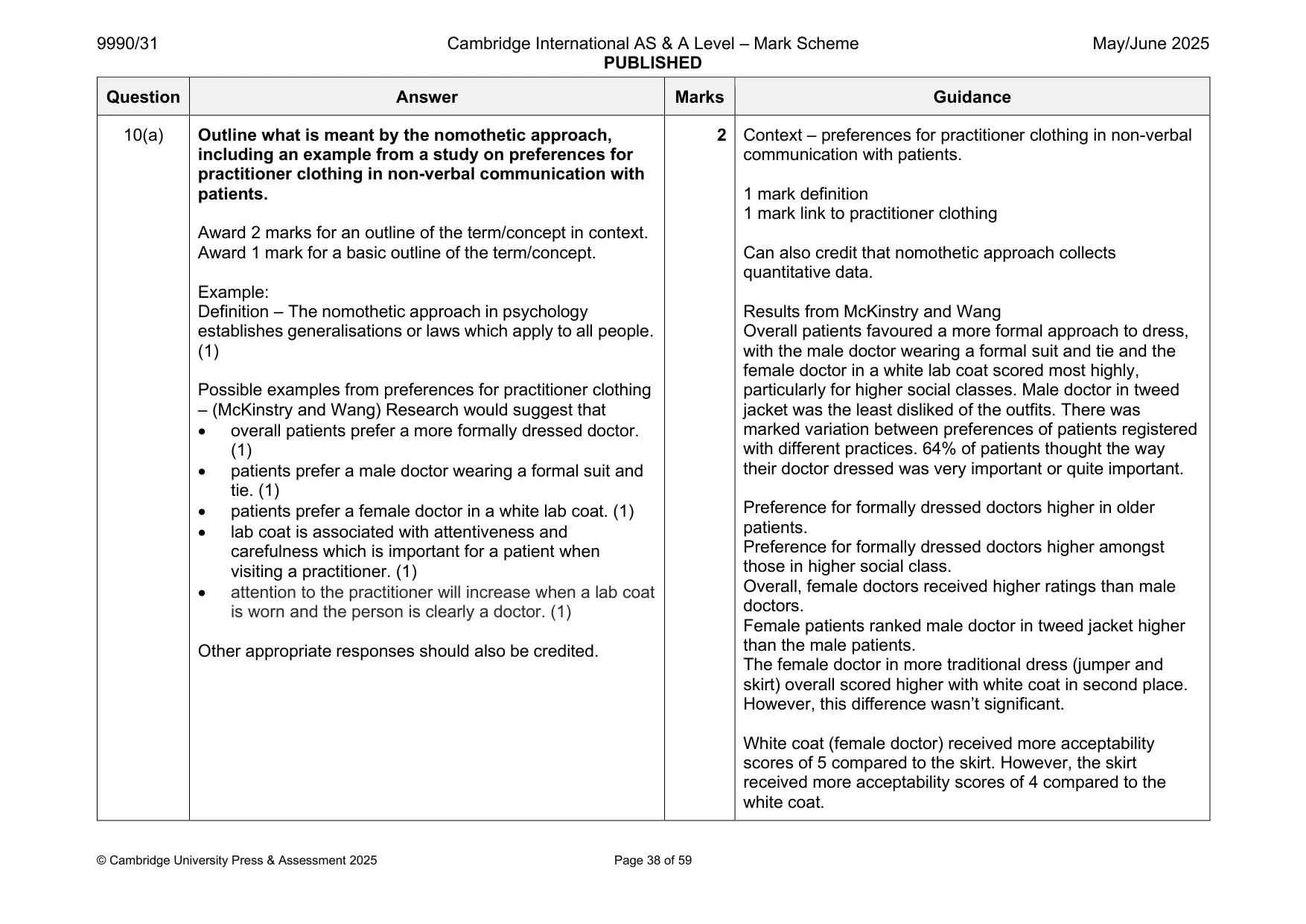
Q10 · Outline what is meant by the nomothetic approach, including an example from a study on…
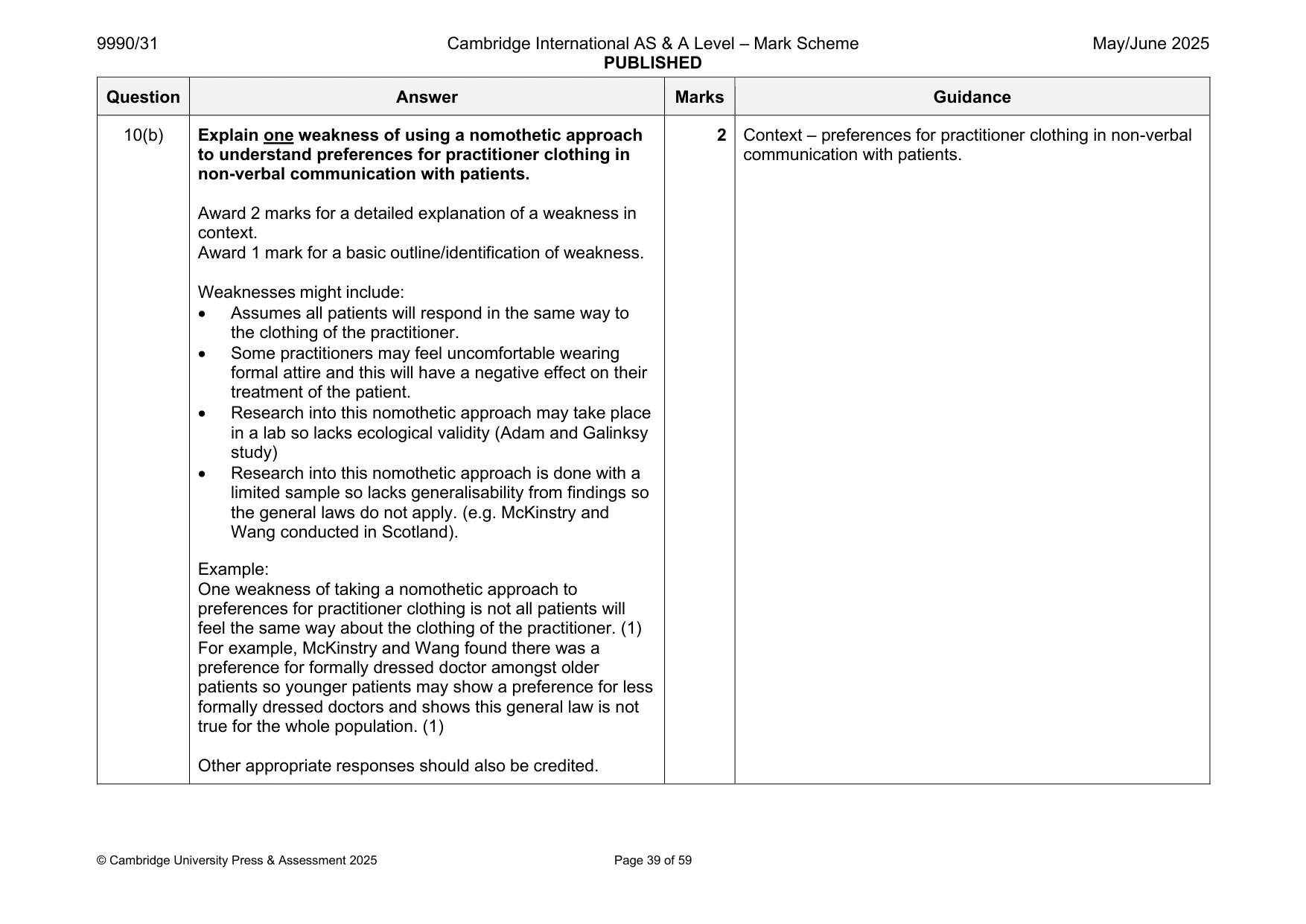
10 (a) Outline what is meant by the nomothetic approach, including an example from a study on preferences for practitioner clothing in non-verbal communication with patients. [2] (b) Explain one weakness of using a nomothetic approach to understand preferences for practitioner clothing in non-verbal communication with patients. [2]
Mark scheme: 10(a) Outline what is meant by the nomothetic approach, 2 Context – preferences for practitioner clothing in non-verbal including an example from a study on preferences for communication with patients. practitioner clothing in non-verbal communication with patients. 1 mark definition 1 mark link to practitioner clothing Award 2 marks for an outline of the term/concept in context. Award 1 mark for a basic outline of the term/concept. Can also credit that nomothetic approach collects quantitative data. Example: Definition – The nomothetic approach in psychology Results from McKinstry and Wang establishes generalisations or laws which apply to all people. Overall patients favoured a more formal approach to dress, (1) with the male doctor wearing a formal suit and tie and the female doctor in a white lab coat scored most highly, Possible examples from preferences for practitioner clothing particularly for higher social classes. Male doctor in tweed – (McKinstry and Wang) Research would suggest that jacket was the least disliked of the outfits. There was • overall patients prefer a more formally dressed doctor. marked variation between preferences of patients registered (1) with different practices. 64% of patients thought the way • patients prefer a male doctor wearing a formal suit and their doctor dressed was very important or quite important. tie. (1) • patients prefer a female doctor in a white lab coat. (1) Preference for formally dressed doctors higher in older • lab coat is associated with attentiveness and patients. carefulness which is important for a patient when Preference for formally dressed doctors higher amongst visiting a practitioner. (1) those in higher social class. • attention to the practitioner will increase when a lab coat Overall, female doctors received higher ratings than male doctors. is worn and the person is clearly a doctor. (1) Female patients ranked male doctor in tweed jacket higher than the male patients. Other appropriate responses should also be credited. The female doctor in more traditional dress (jumper and skirt) overall scored higher with white coat in second place. However, this difference wasn’t significant. White coat (female doctor) received more acceptability scores of 5 compared to the skirt. However, the skirt received more acceptability scores of 4 compared to the white coat. 10(b) Explain one weakness of using a nomothetic approach 2 Context – preferences for practitioner clothing in non-verbal to understand preferences for practitioner clothing in communication with patients. non-verbal communication with patients. Award 2 marks for a detailed explanation of a weakness in context. Award 1 mark for a basic outline/identification of weakness. Weaknesses might include: • Assumes all patients will respond in the same way to the clothing of the practitioner. • Some practitioners may feel uncomfortable wearing formal attire and this will have a negative effect on their treatment of the patient. • Research into this nomothetic approach may take place in a lab so lacks ecological validity (Adam and Galinksy study) • Research into this nomothetic approach is done with a limited sample so lacks generalisability from findings so the general laws do not apply. (e.g. McKinstry and Wang conducted in Scotland). Example: One weakness of taking a nomothetic approach to preferences for practitioner clothing is not all patients will feel the same way about the clothing of the practitioner. (1) For example, McKinstry and Wang found there was a preference for formally dressed doctor amongst older patients so younger patients may show a preference for less formally dressed doctors and shows this general law is not true for the whole population. (1) Other appropriate responses should also be credited.
Q11 · Dr Smith has patients who do not adhere to his instructions for taking their medication
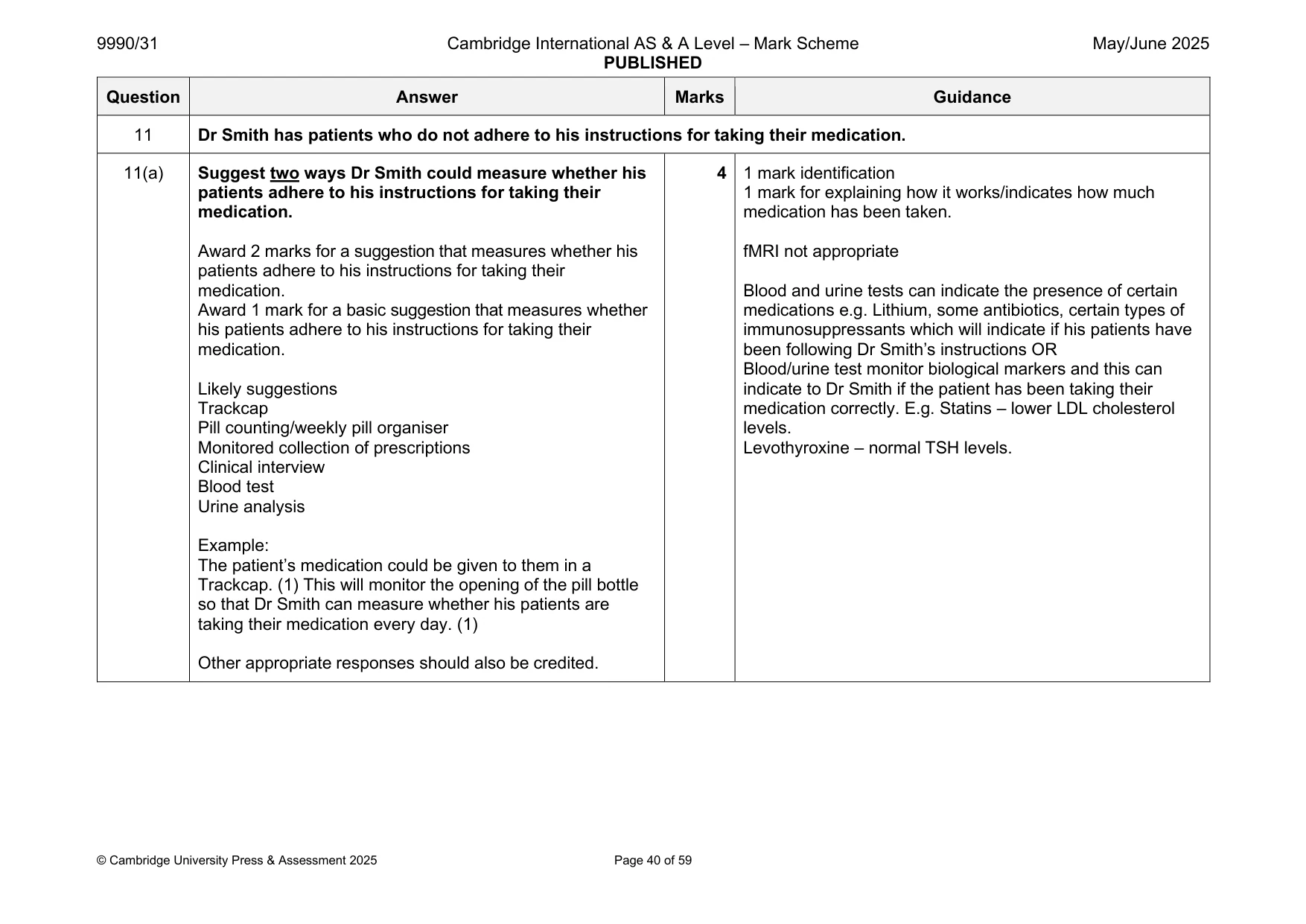
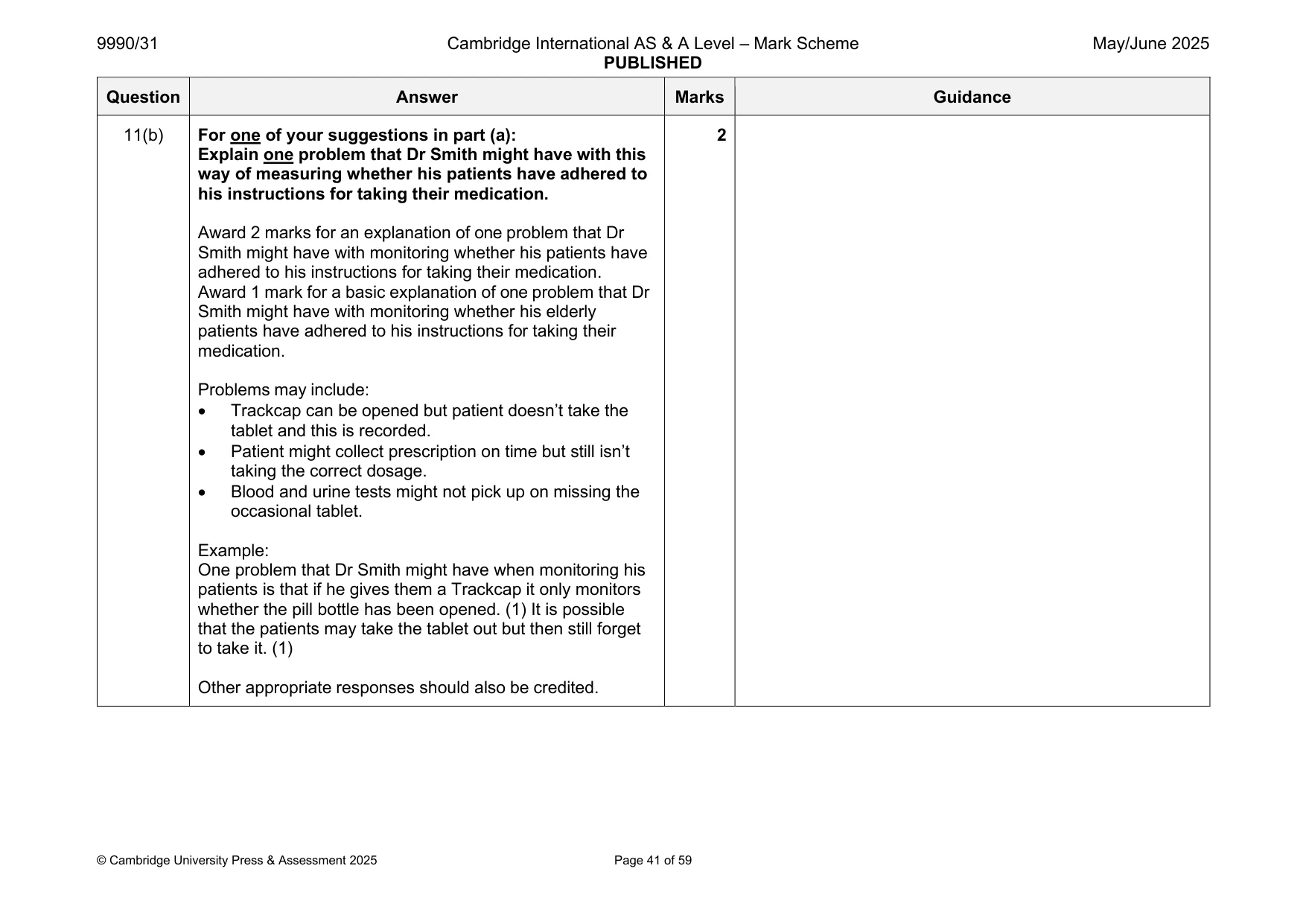
11 Dr Smith has patients who do not adhere to his instructions for taking their medication. (a) Suggest two ways Dr Smith could measure whether his patients adhere to his instructions for taking their medication. [4] (b) For one of your suggestions in part (a): Explain one problem that Dr Smith might have with this way of measuring whether his patients have adhered to his instructions for taking their medication. [2]
Mark scheme: 11(a) Suggest two ways Dr Smith could measure whether his 4 1 mark identification patients adhere to his instructions for taking their 1 mark for explaining how it works/indicates how much medication. medication has been taken. Award 2 marks for a suggestion that measures whether his fMRI not appropriate patients adhere to his instructions for taking their medication. Blood and urine tests can indicate the presence of certain Award 1 mark for a basic suggestion that measures whether medications e.g. Lithium, some antibiotics, certain types of his patients adhere to his instructions for taking their immunosuppressants which will indicate if his patients have medication. been following Dr Smith’s instructions OR Blood/urine test monitor biological markers and this can Likely suggestions indicate to Dr Smith if the patient has been taking their Trackcap medication correctly. E.g. Statins – lower LDL cholesterol Pill counting/weekly pill organiser levels. Monitored collection of prescriptions Levothyroxine – normal TSH levels. Clinical interview Blood test Urine analysis Example: The patient’s medication could be given to them in a Trackcap. (1) This will monitor the opening of the pill bottle so that Dr Smith can measure whether his patients are taking their medication every day. (1) Other appropriate responses should also be credited. 11(b) For one of your suggestions in part (a): 2 Explain one problem that Dr Smith might have with this way of measuring whether his patients have adhered to his instructions for taking their medication. Award 2 marks for an explanation of one problem that Dr Smith might have with monitoring whether his patients have adhered to his instructions for taking their medication. Award 1 mark for a basic explanation of one problem that Dr Smith might have with monitoring whether his elderly patients have adhered to his instructions for taking their medication. Problems may include: • Trackcap can be opened but patient doesn’t take the tablet and this is recorded. • Patient might collect prescription on time but still isn’t taking the correct dosage. • Blood and urine tests might not pick up on missing the occasional tablet. Example: One problem that Dr Smith might have when monitoring his patients is that if he gives them a Trackcap it only monitors whether the pill bottle has been opened. (1) It is possible that the patients may take the tablet out but then still forget to take it. (1) Other appropriate responses should also be credited.
Q12 · Describe the study by Bridge et al
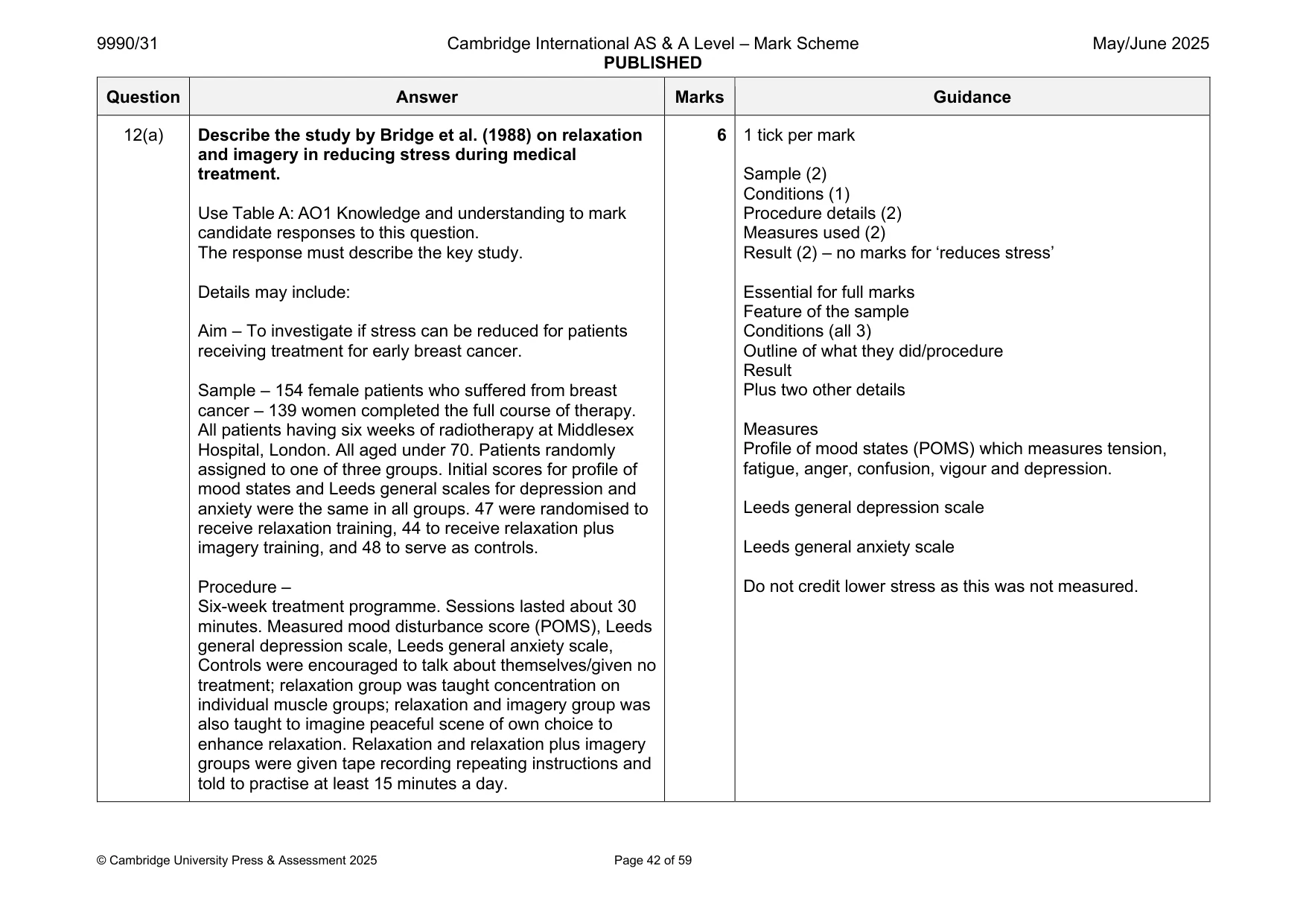
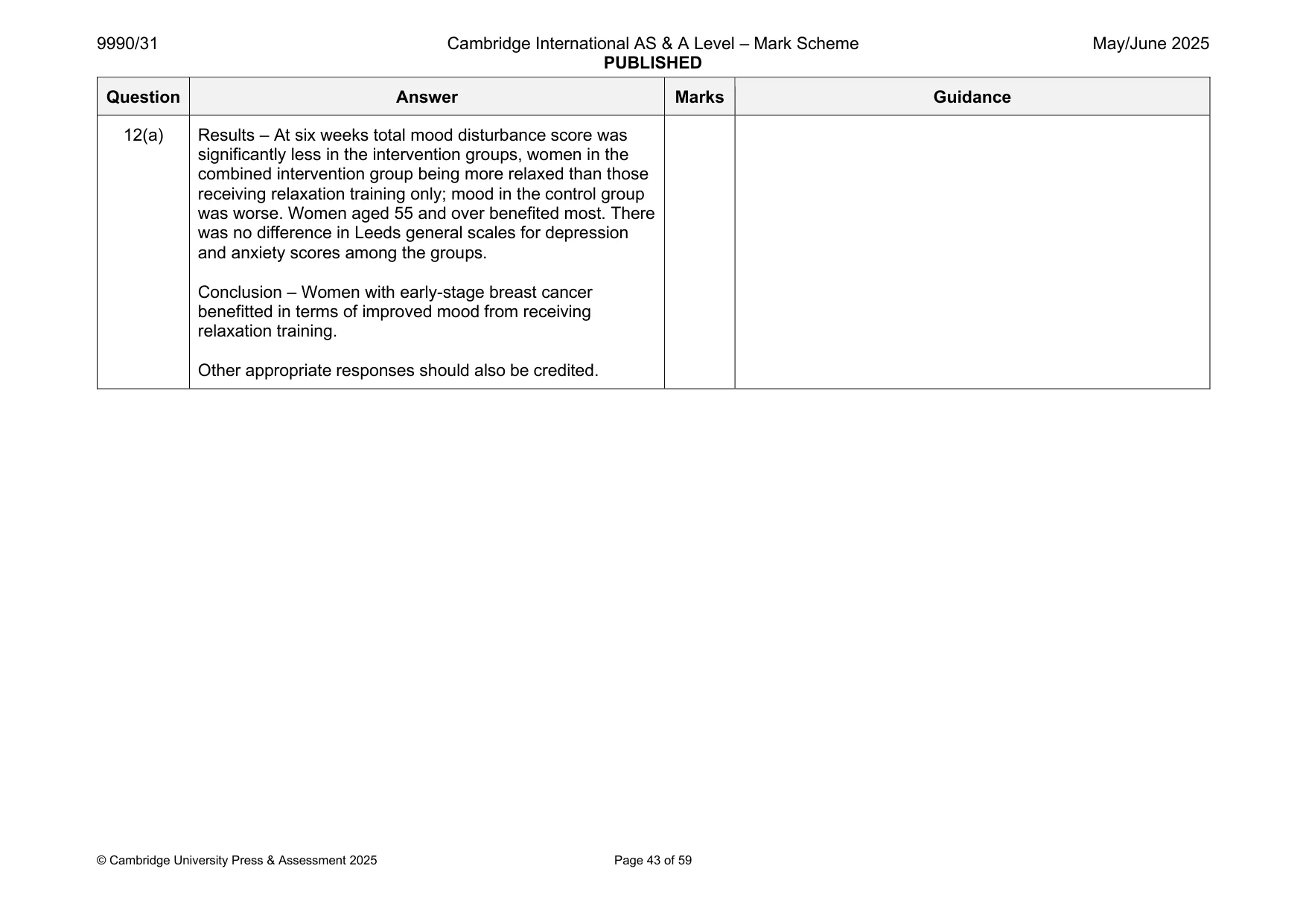
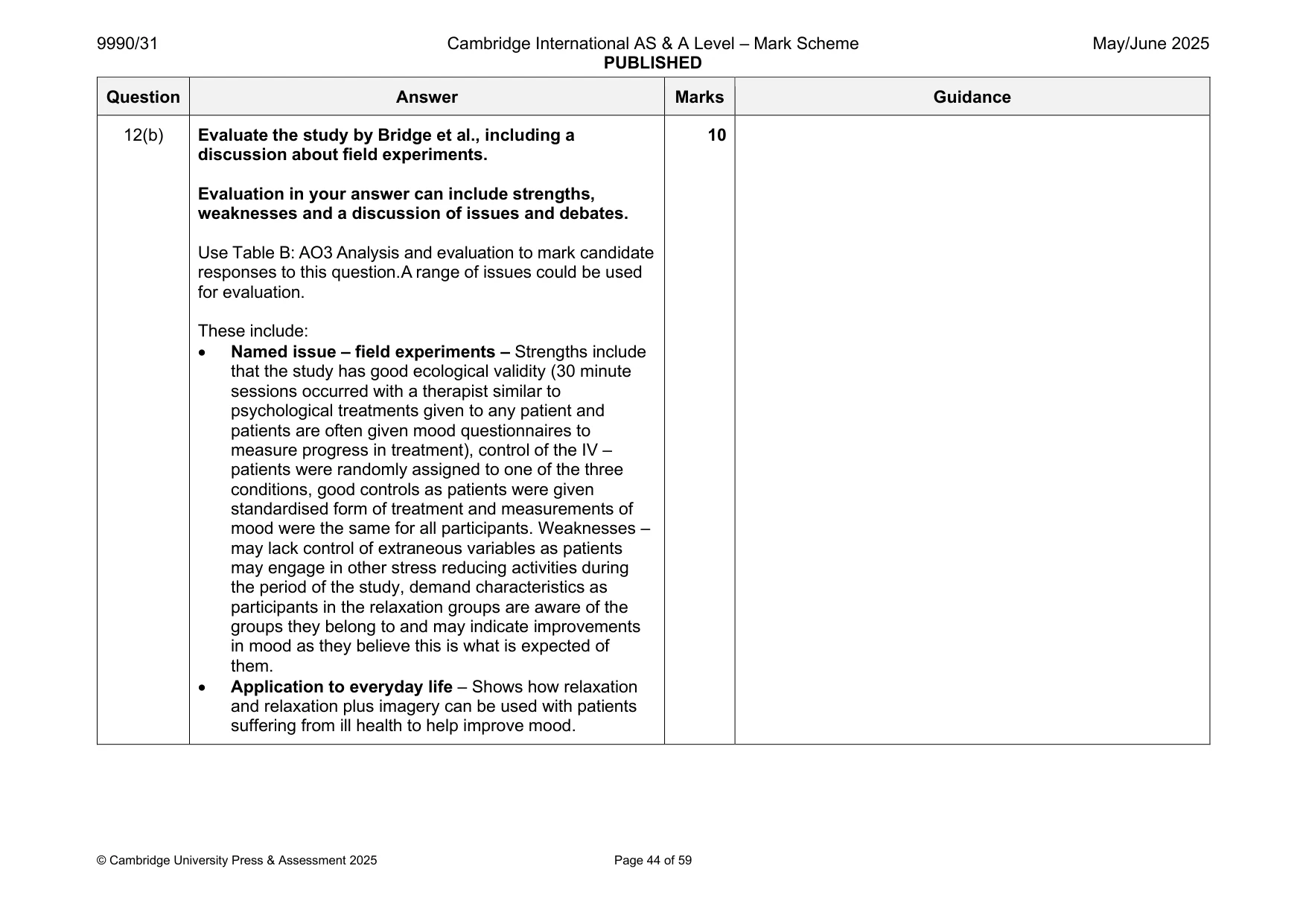
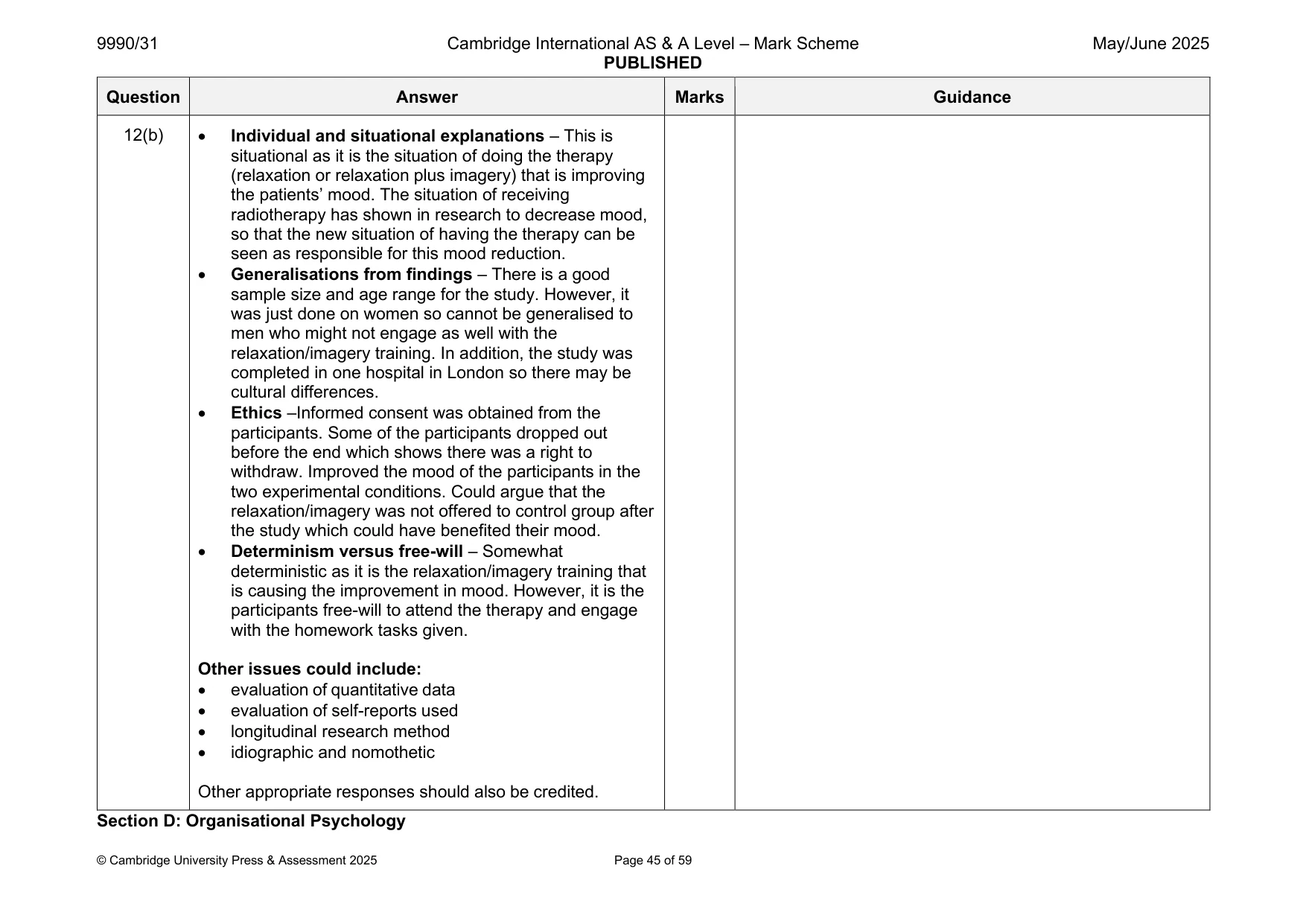
12 (a) Describe the study by Bridge et al. (1988) on relaxation and imagery in reducing stress during medical treatment. [6] (b) Evaluate the study by Bridge et al., including a discussion about field experiments. Evaluation in your answer can include strengths, weaknesses and a discussion of issues and debates. [10] Section D: Organisational Psychology Answer all questions.
Mark scheme: 12(a) Describe the study by Bridge et al. (1988) on relaxation 6 1 tick per mark and imagery in reducing stress during medical treatment. Sample (2) Conditions (1) Use Table A: AO1 Knowledge and understanding to mark Procedure details (2) candidate responses to this question. Measures used (2) The response must describe the key study. Result (2) – no marks for ‘reduces stress’ Details may include: Essential for full marks Feature of the sample Aim – To investigate if stress can be reduced for patients Conditions (all 3) receiving treatment for early breast cancer. Outline of what they did/procedure Result Sample – 154 female patients who suffered from breast Plus two other details cancer – 139 women completed the full course of therapy. All patients having six weeks of radiotherapy at Middlesex Measures Hospital, London. All aged under 70. Patients randomly Profile of mood states (POMS) which measures tension, assigned to one of three groups. Initial scores for profile of fatigue, anger, confusion, vigour and depression. mood states and Leeds general scales for depression and anxiety were the same in all groups. 47 were randomised to Leeds general depression scale receive relaxation training, 44 to receive relaxation plus imagery training, and 48 to serve as controls. Leeds general anxiety scale Procedure – Do not credit lower stress as this was not measured. Six-week treatment programme. Sessions lasted about 30 minutes. Measured mood disturbance score (POMS), Leeds general depression scale, Leeds general anxiety scale, Controls were encouraged to talk about themselves/given no treatment; relaxation group was taught concentration on individual muscle groups; relaxation and imagery group was also taught to imagine peaceful scene of own choice to enhance relaxation. Relaxation and relaxation plus imagery groups were given tape recording repeating instructions and told to practise at least 15 minutes a day. 12(a) Results – At six weeks total mood disturbance score was significantly less in the intervention groups, women in the combined intervention group being more relaxed than those receiving relaxation training only; mood in the control group was worse. Women aged 55 and over benefited most. There was no difference in Leeds general scales for depression and anxiety scores among the groups. Conclusion – Women with early-stage breast cancer benefitted in terms of improved mood from receiving relaxation training. Other appropriate responses should also be credited. 12(b) Evaluate the study by Bridge et al., including a 10 discussion about field experiments. Evaluation in your answer can include strengths, weaknesses and a discussion of issues and debates. Use Table B: AO3 Analysis and evaluation to mark candidate responses to this question. A range of issues could be used for evaluation. These include: • Named issue – field experiments – Strengths include that the study has good ecological validity (30 minute sessions occurred with a therapist similar to psychological treatments given to any patient and patients are often given mood questionnaires to measure progress in treatment), control of the IV – patients were randomly assigned to one of the three conditions, good controls as patients were given standardised form of treatment and measurements of mood were the same for all participants. Weaknesses – may lack control of extraneous variables as patients may engage in other stress reducing activities during the period of the study, demand characteristics as participants in the relaxation groups are aware of the groups they belong to and may indicate improvements in mood as they believe this is what is expected of them. • Application to everyday life – Shows how relaxation and relaxation plus imagery can be used with patients suffering from ill health to help improve mood. 12(b) • Individual and situational explanations – This is situational as it is the situation of doing the therapy (relaxation or relaxation plus imagery) that is improving the patients’ mood. The situation of receiving radiotherapy has shown in research to decrease mood, so that the new situation of having the therapy can be seen as responsible for this mood reduction. • Generalisations from findings – There is a good sample size and age range for the study. However, it was just done on women so cannot be generalised to men who might not engage as well with the relaxation/imagery training. In addition, the study was completed in one hospital in London so there may be cultural differences. • Ethics –Informed consent was obtained from the participants. Some of the participants dropped out before the end which shows there was a right to withdraw. Improved the mood of the participants in the two experimental conditions. Could argue that the relaxation/imagery was not offered to control group after the study which could have benefited their mood. • Determinism versus free-will – Somewhat deterministic as it is the relaxation/imagery training that is causing the improvement in mood. However, it is the participants free-will to attend the therapy and engage with the homework tasks given. Other issues could include: • evaluation of quantitative data • evaluation of self-reports used • longitudinal research method • idiographic and nomothetic Other appropriate responses should also be credited. Section D: Organisational Psychology
Q13 · A manager has changed the working hours in a factory
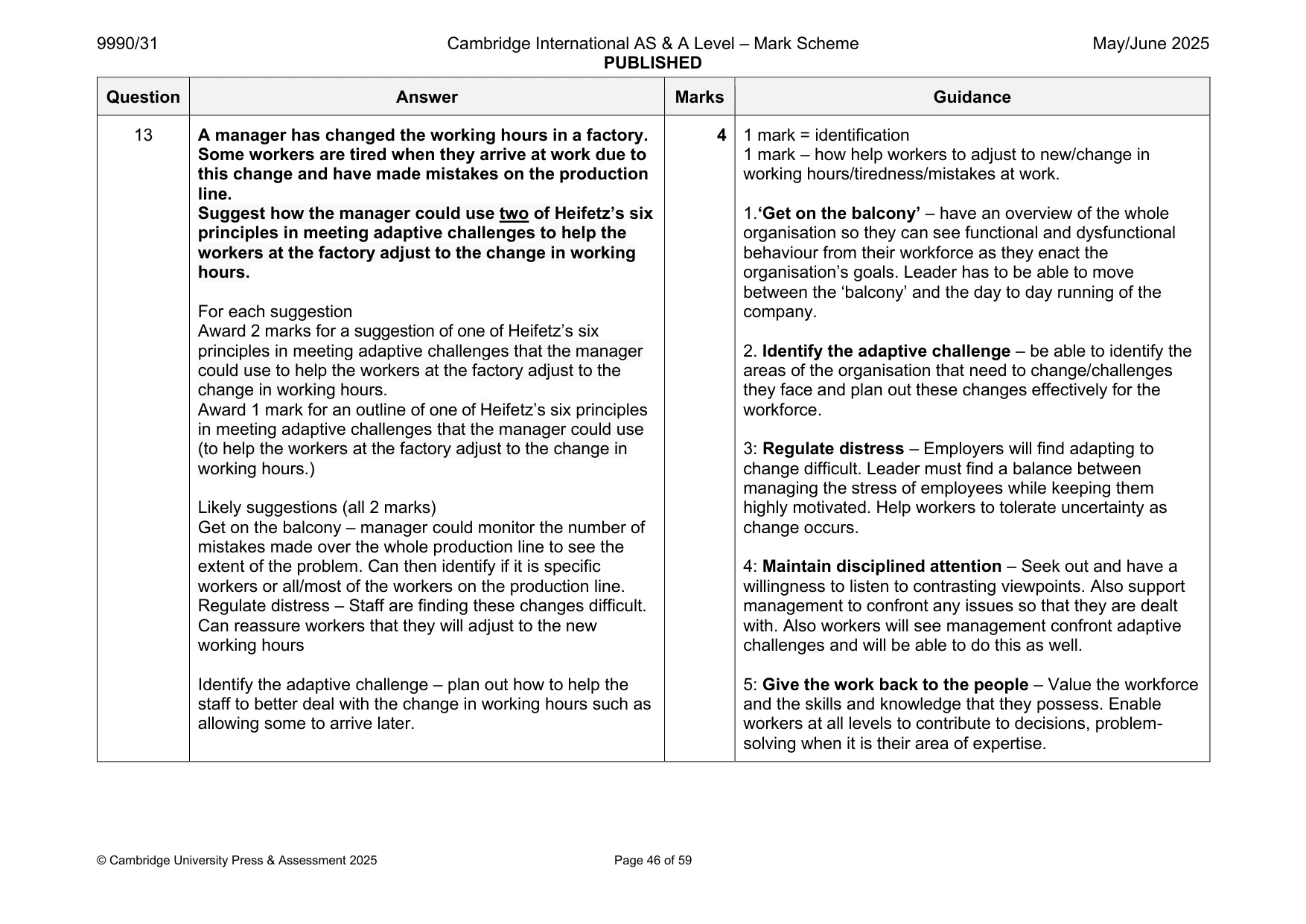
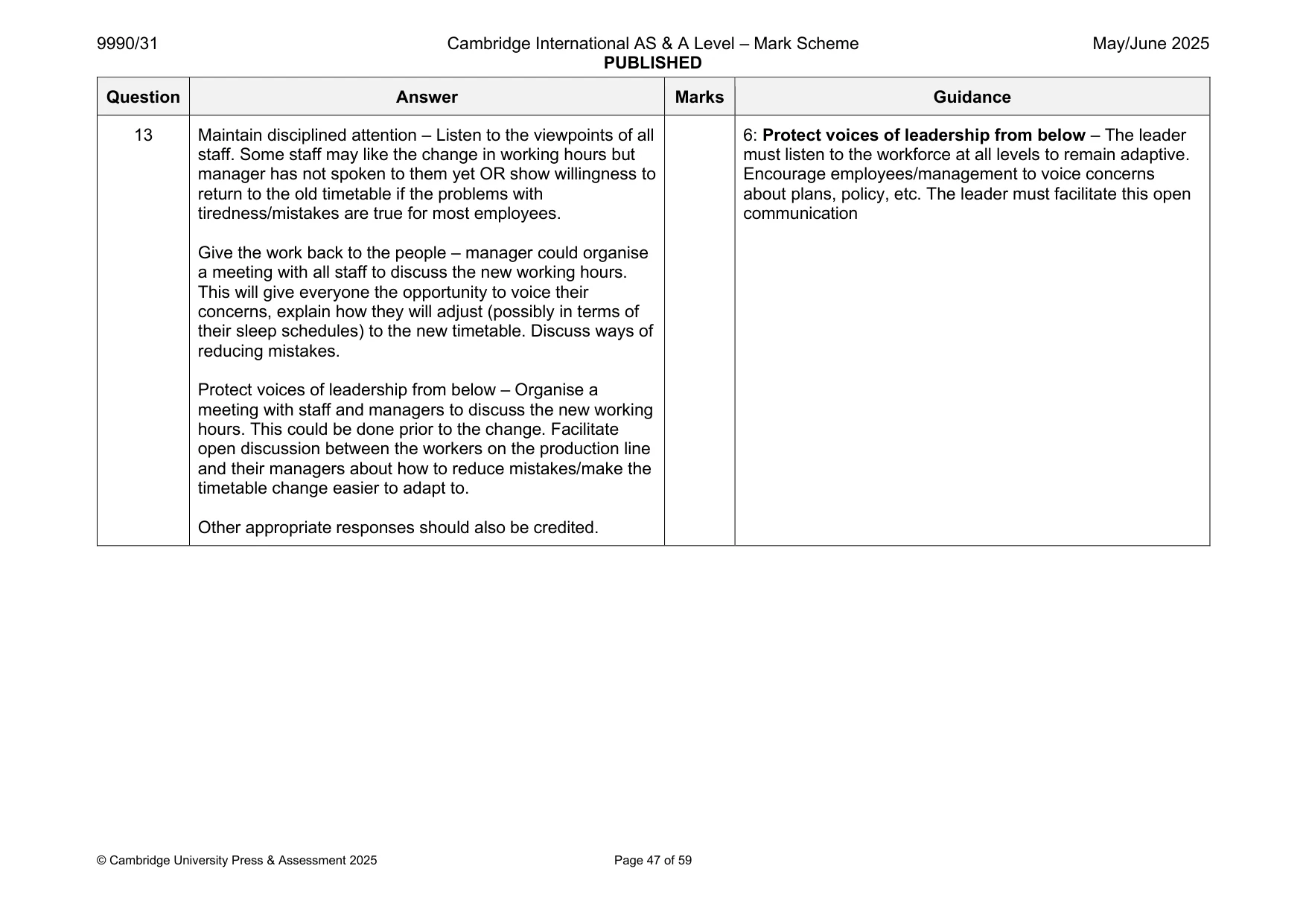
13 A manager has changed the working hours in a factory. Some workers are tired when they arrive at work due to this change and have made mistakes on the production line. Suggest how the manager could use two of Heifetz’s six principles in meeting adaptive challenges to help the workers at the factory adjust to the change in working hours. [4]
Mark scheme: 13 A manager has changed the working hours in a factory. 4 1 mark = identification Some workers are tired when they arrive at work due to 1 mark – how help workers to adjust to new/change in this change and have made mistakes on the production working hours/tiredness/mistakes at work. line. Suggest how the manager could use two of Heifetz’s six 1.‘Get on the balcony’ – have an overview of the whole principles in meeting adaptive challenges to help the organisation so they can see functional and dysfunctional workers at the factory adjust to the change in working behaviour from their workforce as they enact the hours. organisation’s goals. Leader has to be able to move between the ‘balcony’ and the day to day running of the For each suggestion company. Award 2 marks for a suggestion of one of Heifetz’s six principles in meeting adaptive challenges that the manager 2. Identify the adaptive challenge – be able to identify the could use to help the workers at the factory adjust to the areas of the organisation that need to change/challenges change in working hours. they face and plan out these changes effectively for the Award 1 mark for an outline of one of Heifetz’s six principles workforce. in meeting adaptive challenges that the manager could use (to help the workers at the factory adjust to the change in 3: Regulate distress – Employers will find adapting to working hours.) change difficult. Leader must find a balance between managing the stress of employees while keeping them Likely suggestions (all 2 marks) highly motivated. Help workers to tolerate uncertainty as Get on the balcony – manager could monitor the number of change occurs. mistakes made over the whole production line to see the extent of the problem. Can then identify if it is specific 4: Maintain disciplined attention – Seek out and have a workers or all/most of the workers on the production line. willingness to listen to contrasting viewpoints. Also support Regulate distress – Staff are finding these changes difficult. management to confront any issues so that they are dealt Can reassure workers that they will adjust to the new with. Also workers will see management confront adaptive working hours challenges and will be able to do this as well. Identify the adaptive challenge – plan out how to help the 5: Give the work back to the people – Value the workforce staff to better deal with the change in working hours such as and the skills and knowledge that they possess. Enable allowing some to arrive later. workers at all levels to contribute to decisions, problem- solving when it is their area of expertise. 13 Maintain disciplined attention – Listen to the viewpoints of all 6: Protect voices of leadership from below – The leader staff. Some staff may like the change in working hours but must listen to the workforce at all levels to remain adaptive. manager has not spoken to them yet OR show willingness to Encourage employees/management to voice concerns return to the old timetable if the problems with about plans, policy, etc. The leader must facilitate this open tiredness/mistakes are true for most employees. communication Give the work back to the people – manager could organise a meeting with all staff to discuss the new working hours. This will give everyone the opportunity to voice their concerns, explain how they will adjust (possibly in terms of their sleep schedules) to the new timetable. Discuss ways of reducing mistakes. Protect voices of leadership from below – Organise a meeting with staff and managers to discuss the new working hours. This could be done prior to the change. Facilitate open discussion between the workers on the production line and their managers about how to reduce mistakes/make the timetable change easier to adapt to. Other appropriate responses should also be credited.
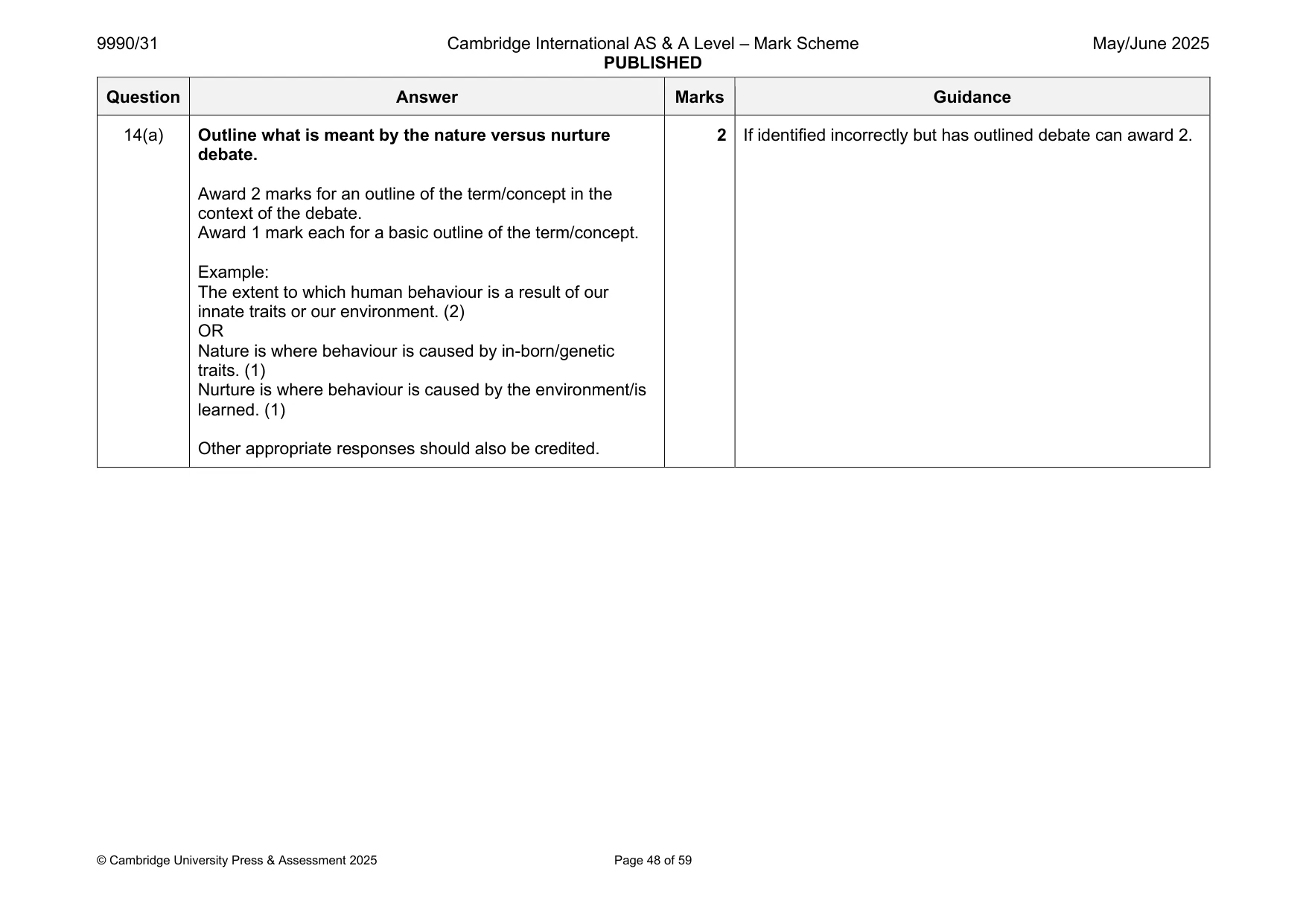
Q14 · Outline what is meant by the nature versus nurture debate
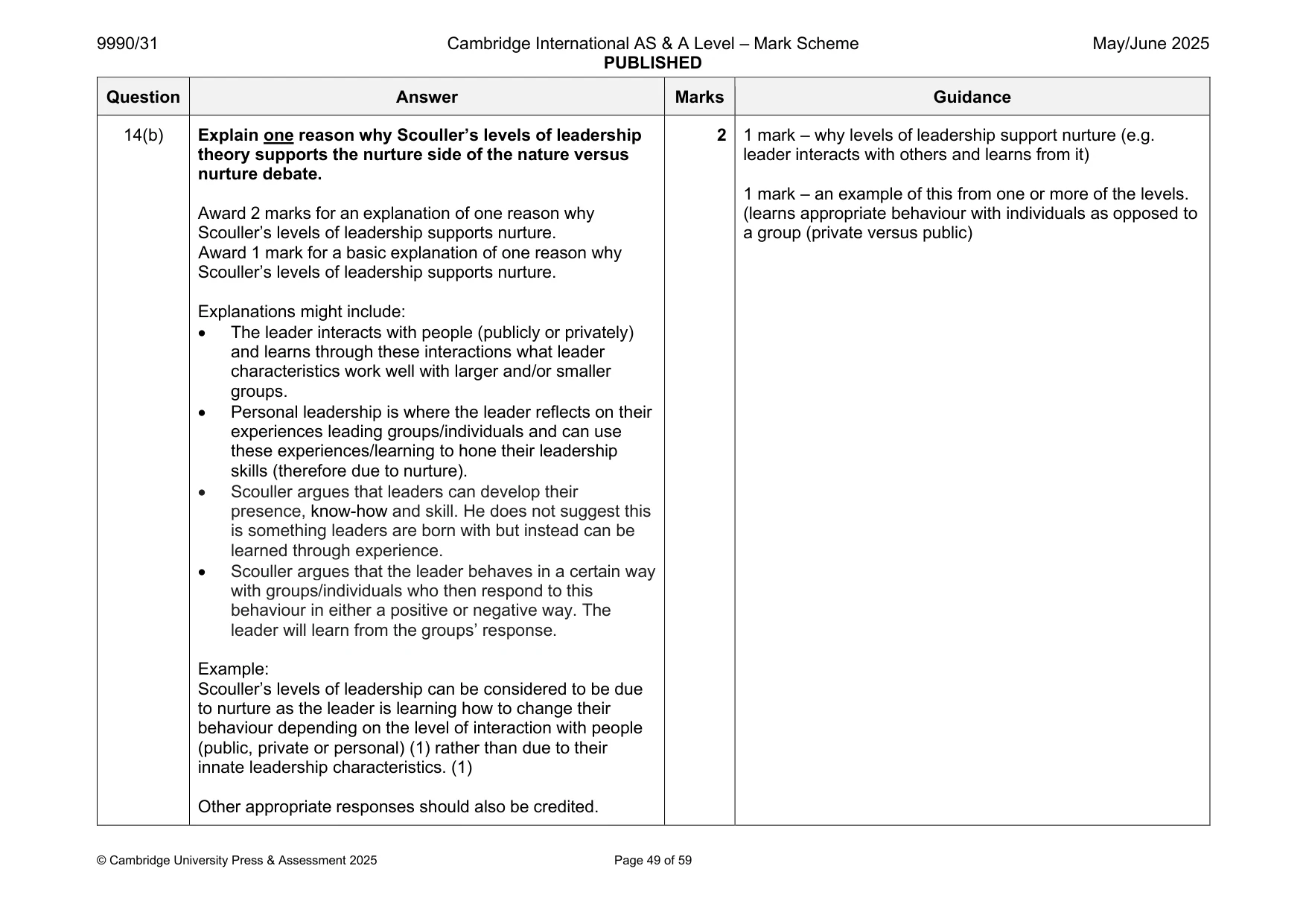
14 (a) Outline what is meant by the nature versus nurture debate. [2] (b) Explain one reason why Scouller’s levels of leadership theory supports the nurture side of the nature versus nurture debate. [2]
Mark scheme: 14(a) Outline what is meant by the nature versus nurture 2 If identified incorrectly but has outlined debate can award 2. debate. Award 2 marks for an outline of the term/concept in the context of the debate. Award 1 mark each for a basic outline of the term/concept. Example: The extent to which human behaviour is a result of our innate traits or our environment. (2) OR Nature is where behaviour is caused by in-born/genetic traits. (1) Nurture is where behaviour is caused by the environment/is learned. (1) Other appropriate responses should also be credited. 14(b) Explain one reason why Scouller’s levels of leadership 2 1 mark – why levels of leadership support nurture (e.g. theory supports the nurture side of the nature versus leader interacts with others and learns from it) nurture debate. 1 mark – an example of this from one or more of the levels. Award 2 marks for an explanation of one reason why (learns appropriate behaviour with individuals as opposed to Scouller’s levels of leadership supports nurture. a group (private versus public) Award 1 mark for a basic explanation of one reason why Scouller’s levels of leadership supports nurture. Explanations might include: • The leader interacts with people (publicly or privately) and learns through these interactions what leader characteristics work well with larger and/or smaller groups. • Personal leadership is where the leader reflects on their experiences leading groups/individuals and can use these experiences/learning to hone their leadership skills (therefore due to nurture). • Scouller argues that leaders can develop their presence, know-how and skill. He does not suggest this is something leaders are born with but instead can be learned through experience. • Scouller argues that the leader behaves in a certain way with groups/individuals who then respond to this behaviour in either a positive or negative way. The leader will learn from the groups’ response. Example: Scouller’s levels of leadership can be considered to be due to nurture as the leader is learning how to change their behaviour depending on the level of interaction with people (public, private or personal) (1) rather than due to their innate leadership characteristics. (1) Other appropriate responses should also be credited.
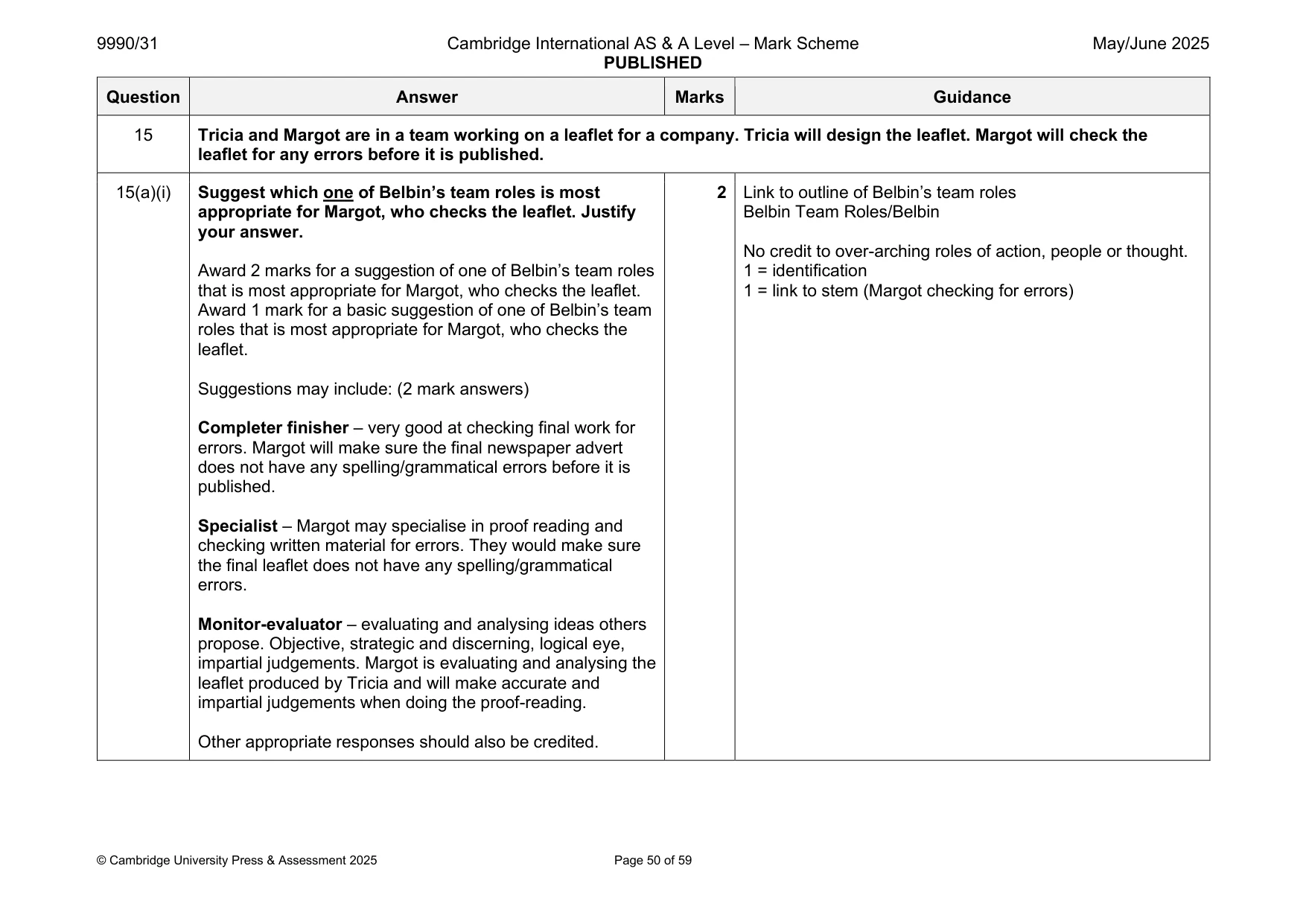
Q15 · Tricia and Margot are in a team working on a leaflet for a company
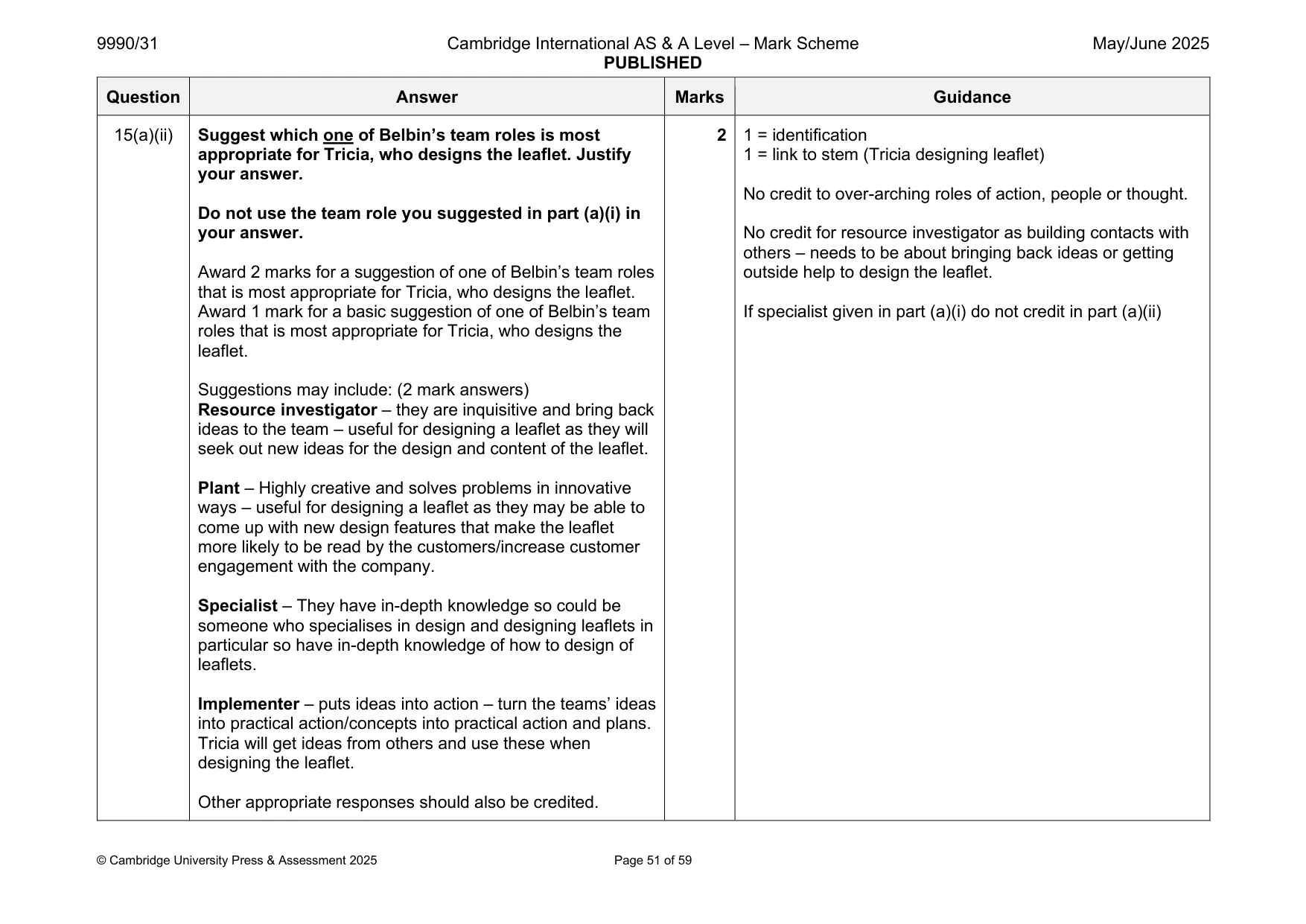
15 Tricia and Margot are in a team working on a leaflet for a company. Tricia will design the leaflet. Margot will check the leaflet for any errors before it is published. (a) (i) Suggest which one of Belbin’s team roles is most appropriate for Margot, who checks the leaflet. Justify your answer. [2] (ii) Suggest which one of Belbin’s team roles is most appropriate for Tricia, who designs the leaflet. Justify your answer. Do not use the team role you suggested in part (a)(i) in your answer. [2] (b) Explain one problem with Belbin’s nine team roles. [2]
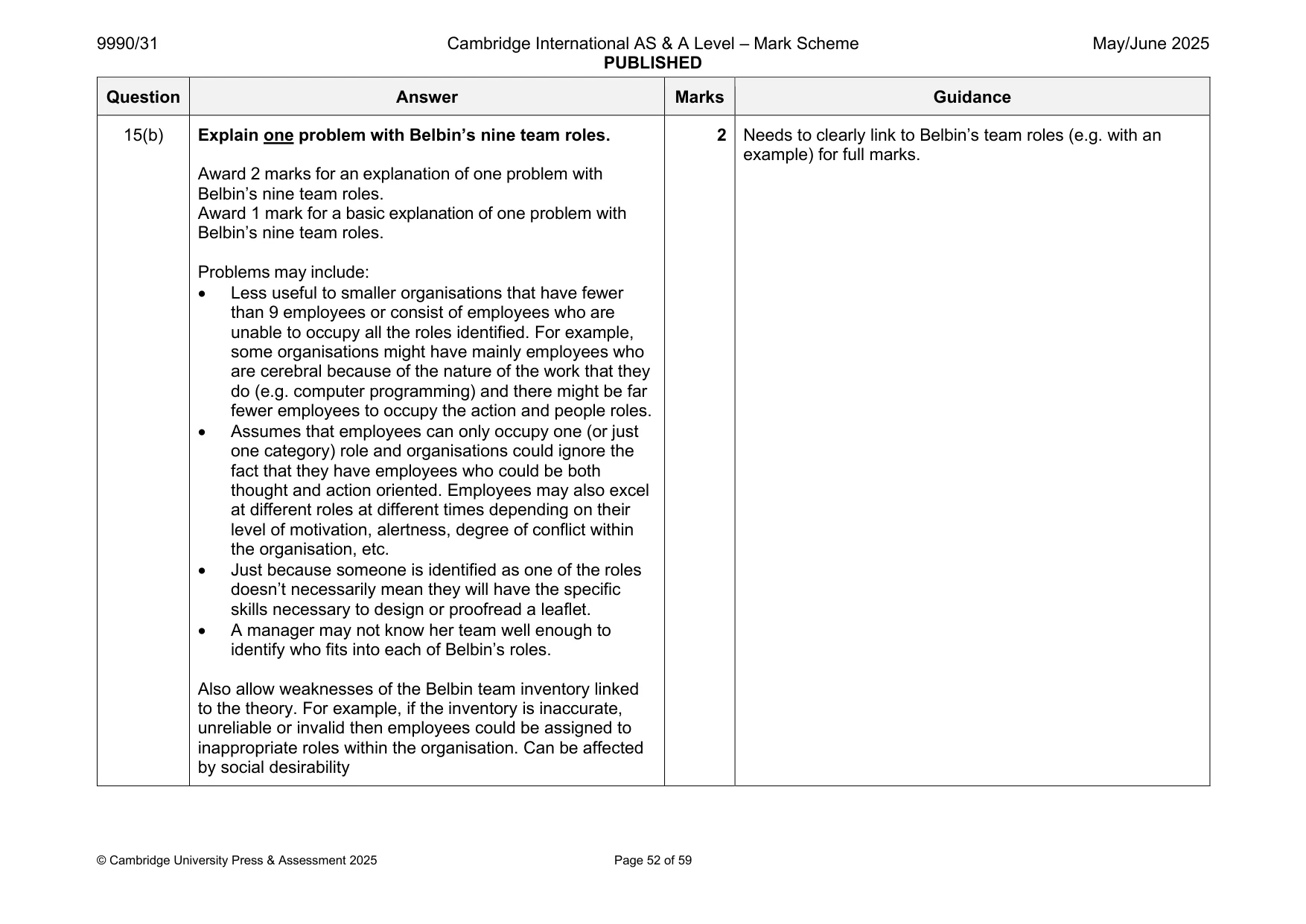
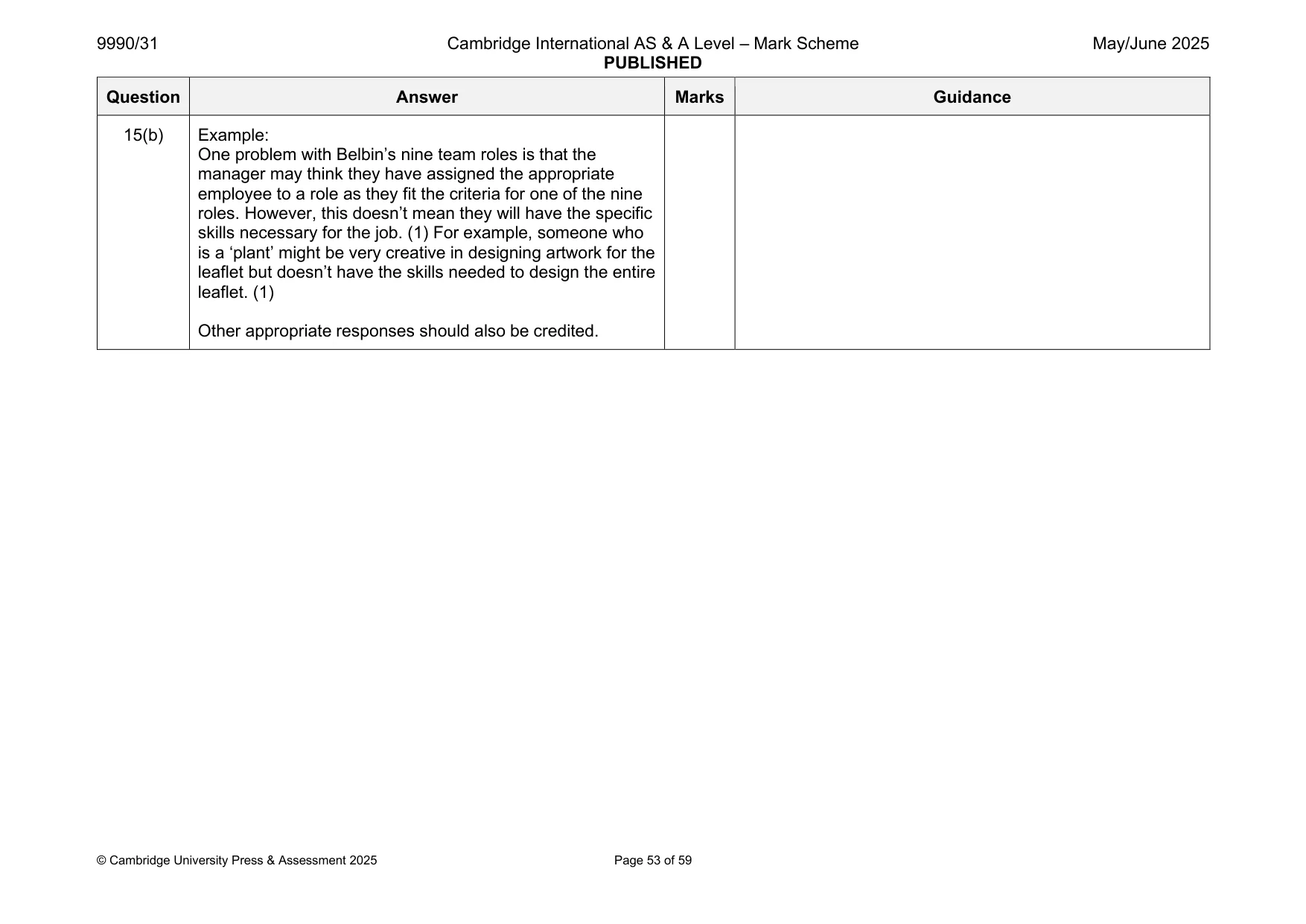
Mark scheme: 15(a)(i) Suggest which one of Belbin’s team roles is most 2 Link to outline of Belbin’s team roles appropriate for Margot, who checks the leaflet. Justify Belbin Team Roles/Belbin your answer. No credit to over-arching roles of action, people or thought. Award 2 marks for a suggestion of one of Belbin’s team roles 1 = identification that is most appropriate for Margot, who checks the leaflet. 1 = link to stem (Margot checking for errors) Award 1 mark for a basic suggestion of one of Belbin’s team roles that is most appropriate for Margot, who checks the leaflet. Suggestions may include: (2 mark answers) Completer finisher – very good at checking final work for errors. Margot will make sure the final newspaper advert does not have any spelling/grammatical errors before it is published. Specialist – Margot may specialise in proof reading and checking written material for errors. They would make sure the final leaflet does not have any spelling/grammatical errors. Monitor-evaluator – evaluating and analysing ideas others propose. Objective, strategic and discerning, logical eye, impartial judgements. Margot is evaluating and analysing the leaflet produced by Tricia and will make accurate and impartial judgements when doing the proof-reading. Other appropriate responses should also be credited. 15(a)(ii) Suggest which one of Belbin’s team roles is most 2 1 = identification appropriate for Tricia, who designs the leaflet. Justify 1 = link to stem (Tricia designing leaflet) your answer. No credit to over-arching roles of action, people or thought. Do not use the team role you suggested in part (a)(i) in your answer. No credit for resource investigator as building contacts with others – needs to be about bringing back ideas or getting Award 2 marks for a suggestion of one of Belbin’s team roles outside help to design the leaflet. that is most appropriate for Tricia, who designs the leaflet. Award 1 mark for a basic suggestion of one of Belbin’s team If specialist given in part (a)(i) do not credit in part (a)(ii) roles that is most appropriate for Tricia, who designs the leaflet. Suggestions may include: (2 mark answers) Resource investigator – they are inquisitive and bring back ideas to the team – useful for designing a leaflet as they will seek out new ideas for the design and content of the leaflet. Plant – Highly creative and solves problems in innovative ways – useful for designing a leaflet as they may be able to come up with new design features that make the leaflet more likely to be read by the customers/increase customer engagement with the company. Specialist – They have in-depth knowledge so could be someone who specialises in design and designing leaflets in particular so have in-depth knowledge of how to design of leaflets. Implementer – puts ideas into action – turn the teams’ ideas into practical action/concepts into practical action and plans. Tricia will get ideas from others and use these when designing the leaflet. Other appropriate responses should also be credited. 15(b) Explain one problem with Belbin’s nine team roles. 2 Needs to clearly link to Belbin’s team roles (e.g. with an example) for full marks. Award 2 marks for an explanation of one problem with Belbin’s nine team roles. Award 1 mark for a basic explanation of one problem with Belbin’s nine team roles. Problems may include: • Less useful to smaller organisations that have fewer than 9 employees or consist of employees who are unable to occupy all the roles identified. For example, some organisations might have mainly employees who are cerebral because of the nature of the work that they do (e.g. computer programming) and there might be far fewer employees to occupy the action and people roles. • Assumes that employees can only occupy one (or just one category) role and organisations could ignore the fact that they have employees who could be both thought and action oriented. Employees may also excel at different roles at different times depending on their level of motivation, alertness, degree of conflict within the organisation, etc. • Just because someone is identified as one of the roles doesn’t necessarily mean they will have the specific skills necessary to design or proofread a leaflet. • A manager may not know her team well enough to identify who fits into each of Belbin’s roles. Also allow weaknesses of the Belbin team inventory linked to the theory. For example, if the inventory is inaccurate, unreliable or invalid then employees could be assigned to inappropriate roles within the organisation. Can be affected by social desirability 15(b) Example: One problem with Belbin’s nine team roles is that the manager may think they have assigned the appropriate employee to a role as they fit the criteria for one of the nine roles. However, this doesn’t mean they will have the specific skills necessary for the job. (1) For example, someone who is a ‘plant’ might be very creative in designing artwork for the leaflet but doesn’t have the skills needed to design the entire leaflet. (1) Other appropriate responses should also be credited.
Q16 · Describe what psychologists have discovered about: • extrinsic motivators at work, and •…
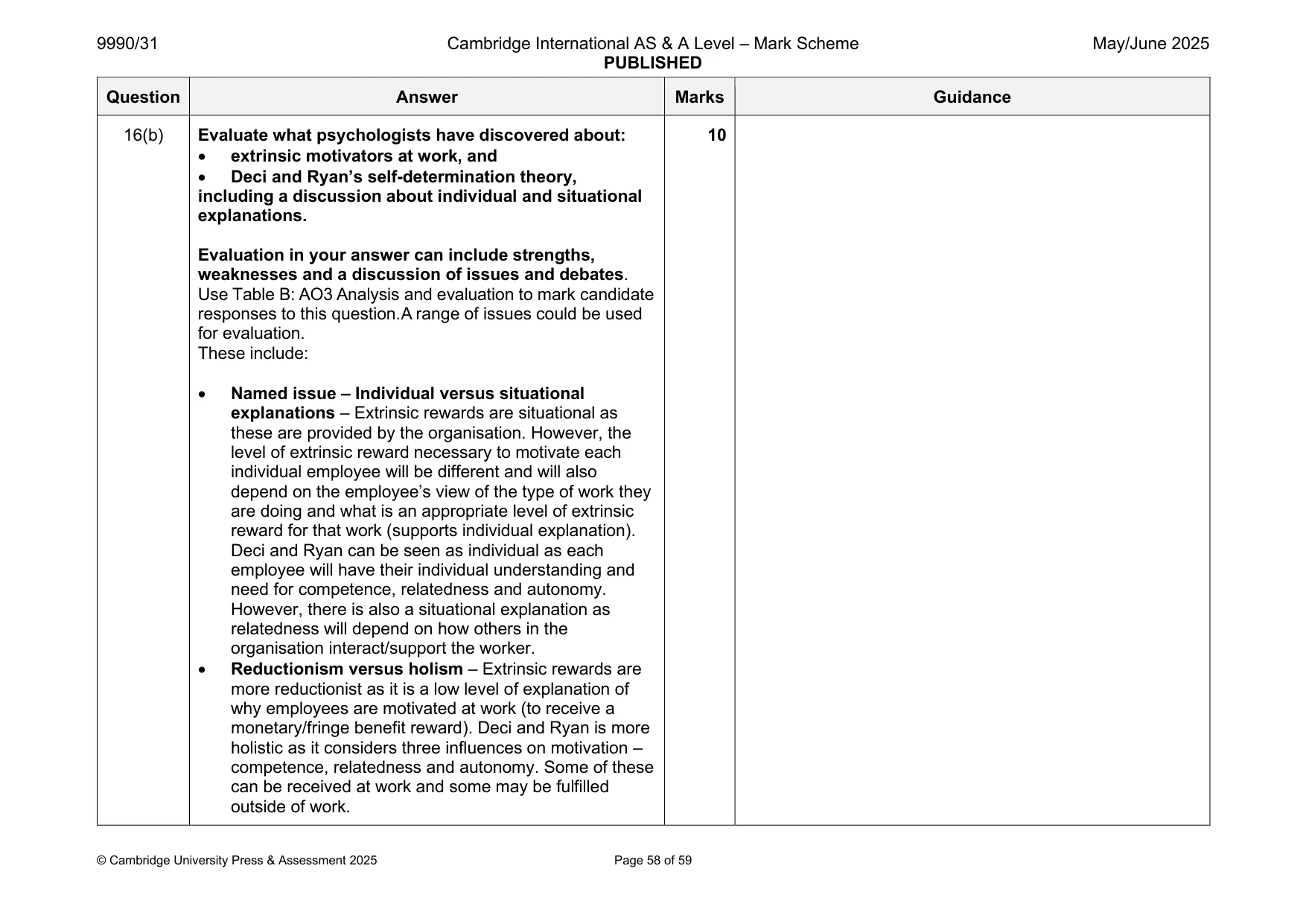
16 (a) Describe what psychologists have discovered about: • extrinsic motivators at work, and • Deci and Ryan’s self-determination theory. [6] (b) Evaluate what psychologists have discovered about: • extrinsic motivators at work, and • Deci and Ryan’s self-determination theory, including a discussion about individual and situational explanations. Evaluation in your answer can include strengths, weaknesses and a discussion of issues and debates. [10]
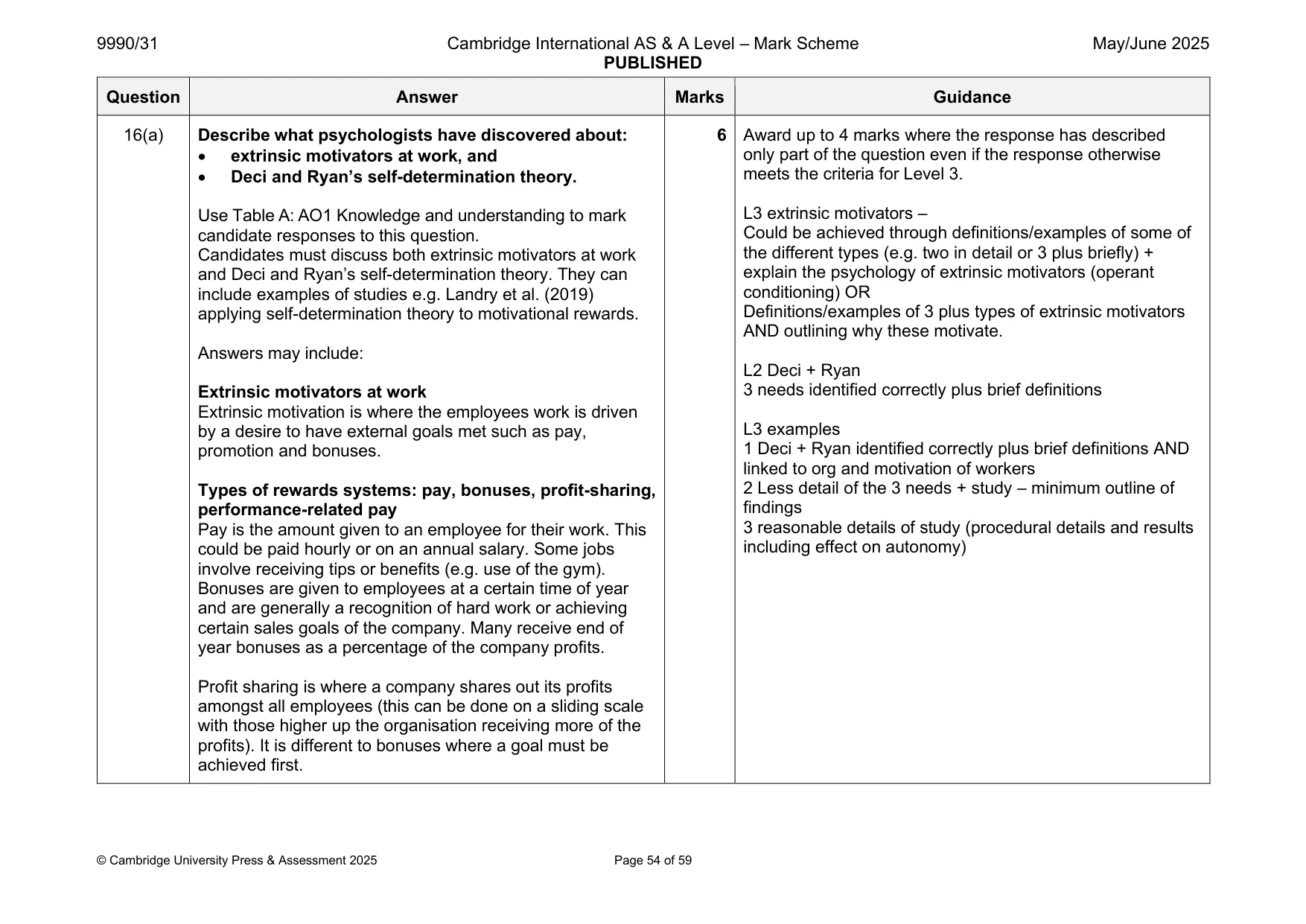
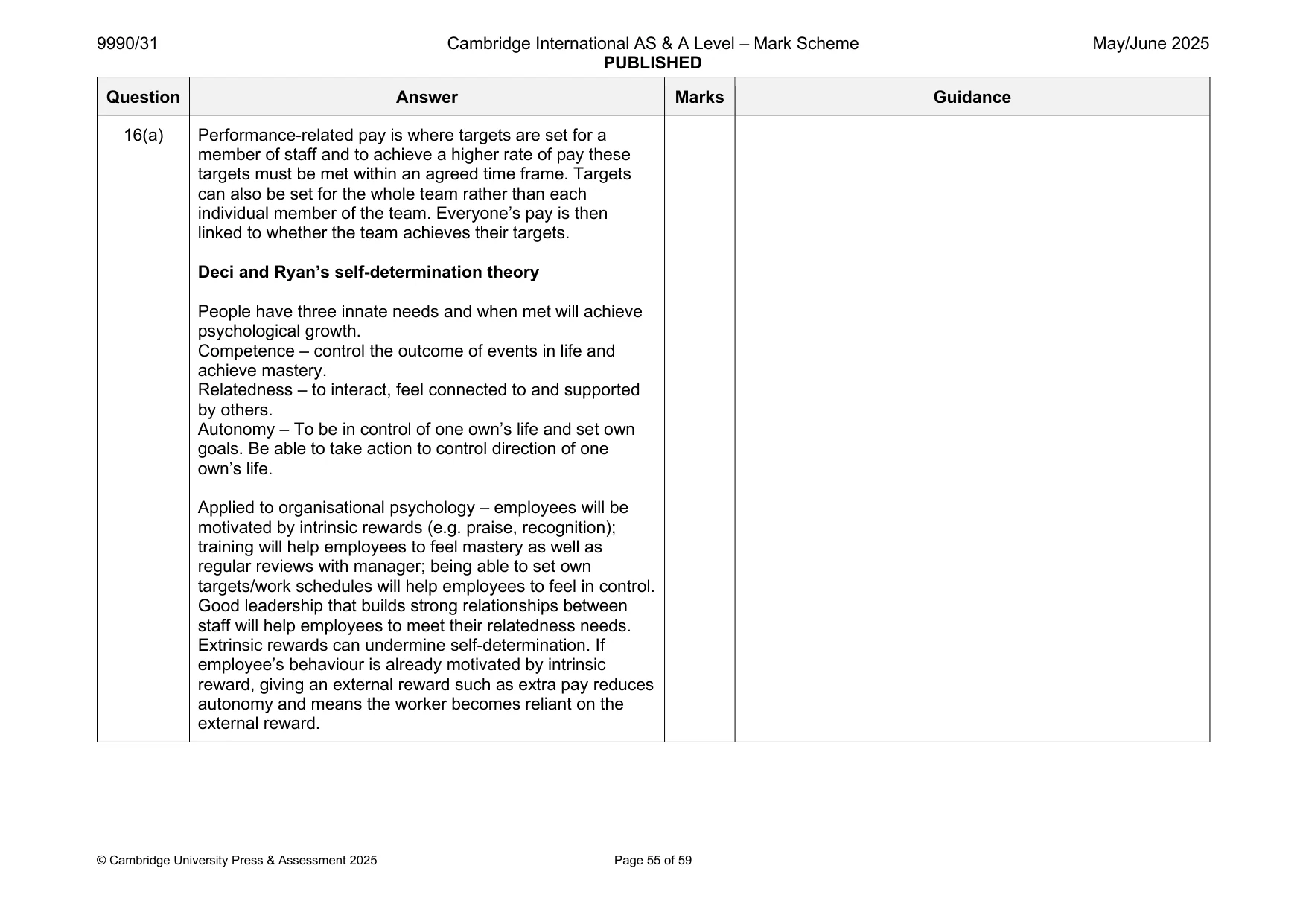
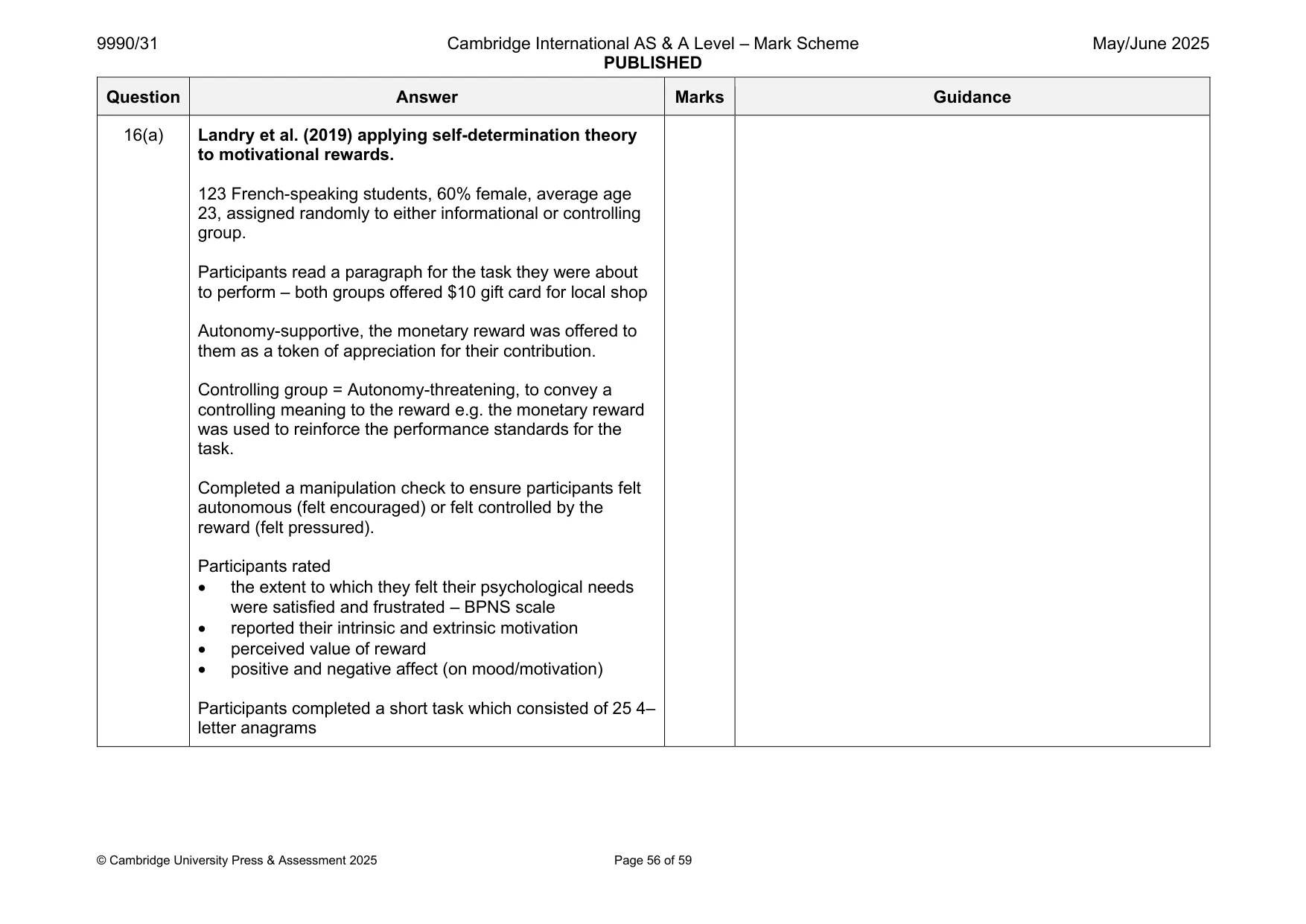
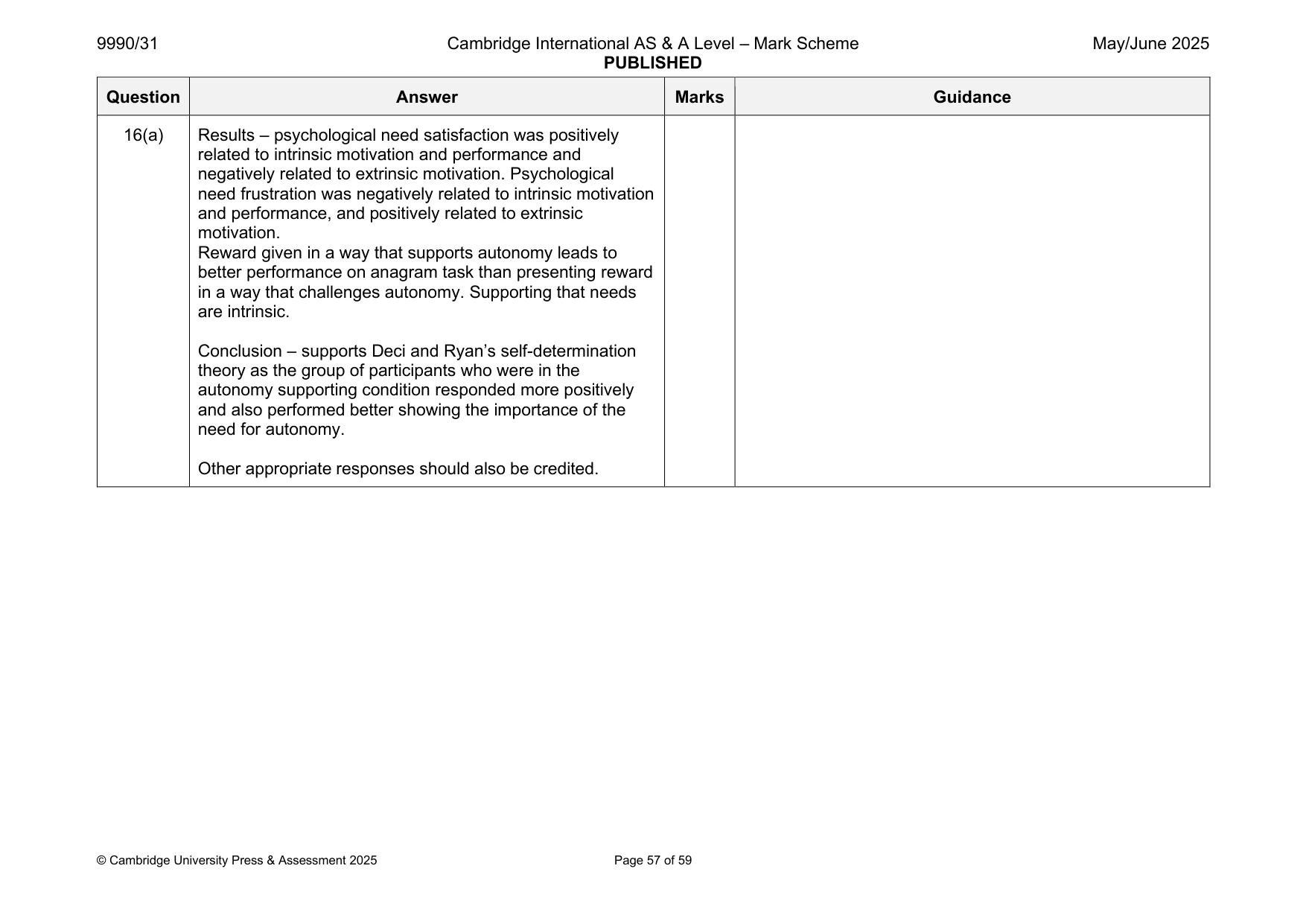
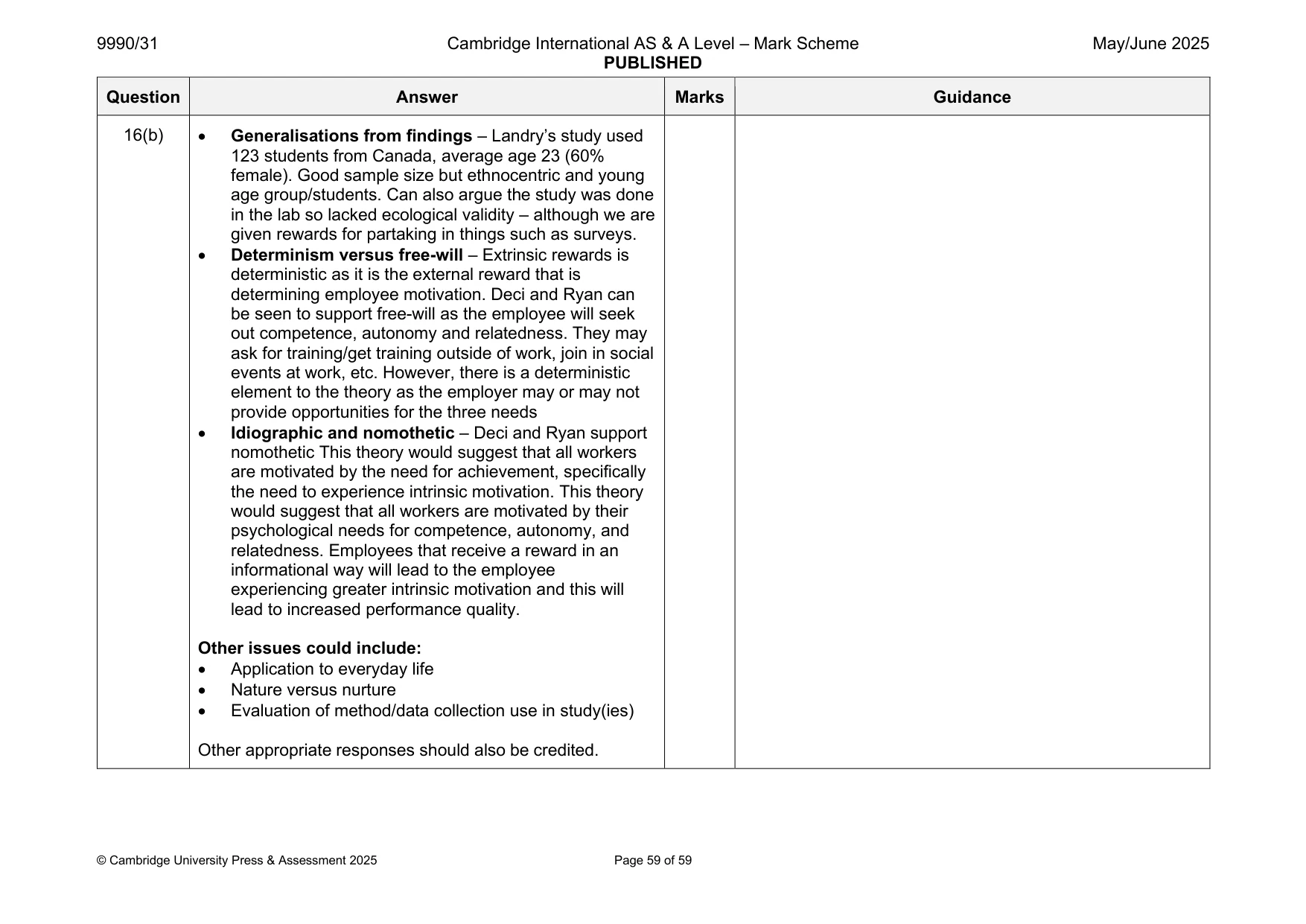
Mark scheme: 16(a) Describe what psychologists have discovered about: 6 Award up to 4 marks where the response has described • extrinsic motivators at work, and only part of the question even if the response otherwise • Deci and Ryan’s self-determination theory. meets the criteria for Level 3. Use Table A: AO1 Knowledge and understanding to mark L3 extrinsic motivators – candidate responses to this question. Could be achieved through definitions/examples of some of Candidates must discuss both extrinsic motivators at work the different types (e.g. two in detail or 3 plus briefly) + and Deci and Ryan’s self-determination theory. They can explain the psychology of extrinsic motivators (operant include examples of studies e.g. Landry et al. (2019) conditioning) OR applying self-determination theory to motivational rewards. Definitions/examples of 3 plus types of extrinsic motivators AND outlining why these motivate. Answers may include: L2 Deci + Ryan Extrinsic motivators at work 3 needs identified correctly plus brief definitions Extrinsic motivation is where the employees work is driven by a desire to have external goals met such as pay, L3 examples promotion and bonuses. 1 Deci + Ryan identified correctly plus brief definitions AND linked to org and motivation of workers Types of rewards systems: pay, bonuses, profit-sharing, 2 Less detail of the 3 needs + study – minimum outline of performance-related pay findings Pay is the amount given to an employee for their work. This 3 reasonable details of study (procedural details and results could be paid hourly or on an annual salary. Some jobs including effect on autonomy) involve receiving tips or benefits (e.g. use of the gym). Bonuses are given to employees at a certain time of year and are generally a recognition of hard work or achieving certain sales goals of the company. Many receive end of year bonuses as a percentage of the company profits. Profit sharing is where a company shares out its profits amongst all employees (this can be done on a sliding scale with those higher up the organisation receiving more of the profits). It is different to bonuses where a goal must be achieved first. 16(a) Performance-related pay is where targets are set for a member of staff and to achieve a higher rate of pay these targets must be met within an agreed time frame. Targets can also be set for the whole team rather than each individual member of the team. Everyone’s pay is then linked to whether the team achieves their targets. Deci and Ryan’s self-determination theory People have three innate needs and when met will achieve psychological growth. Competence – control the outcome of events in life and achieve mastery. Relatedness – to interact, feel connected to and supported by others. Autonomy – To be in control of one own’s life and set own goals. Be able to take action to control direction of one own’s life. Applied to organisational psychology – employees will be motivated by intrinsic rewards (e.g. praise, recognition); training will help employees to feel mastery as well as regular reviews with manager; being able to set own targets/work schedules will help employees to feel in control. Good leadership that builds strong relationships between staff will help employees to meet their relatedness needs. Extrinsic rewards can undermine self-determination. If employee’s behaviour is already motivated by intrinsic reward, giving an external reward such as extra pay reduces autonomy and means the worker becomes reliant on the external reward. 16(a) Landry et al. (2019) applying self-determination theory to motivational rewards. 123 French-speaking students, 60% female, average age 23, assigned randomly to either informational or controlling group. Participants read a paragraph for the task they were about to perform – both groups offered $10 gift card for local shop Autonomy-supportive, the monetary reward was offered to them as a token of appreciation for their contribution. Controlling group = Autonomy-threatening, to convey a controlling meaning to the reward e.g. the monetary reward was used to reinforce the performance standards for the task. Completed a manipulation check to ensure participants felt autonomous (felt encouraged) or felt controlled by the reward (felt pressured). Participants rated • the extent to which they felt their psychological needs were satisfied and frustrated – BPNS scale • reported their intrinsic and extrinsic motivation • perceived value of reward • positive and negative affect (on mood/motivation) Participants completed a short task which consisted of 25 4– letter anagrams 16(a) Results – psychological need satisfaction was positively related to intrinsic motivation and performance and negatively related to extrinsic motivation. Psychological need frustration was negatively related to intrinsic motivation and performance, and positively related to extrinsic motivation. Reward given in a way that supports autonomy leads to better performance on anagram task than presenting reward in a way that challenges autonomy. Supporting that needs are intrinsic. Conclusion – supports Deci and Ryan’s self-determination theory as the group of participants who were in the autonomy supporting condition responded more positively and also performed better showing the importance of the need for autonomy. Other appropriate responses should also be credited. 16(b) Evaluate what psychologists have discovered about: 10 • extrinsic motivators at work, and • Deci and Ryan’s self-determination theory, including a discussion about individual and situational explanations. Evaluation in your answer can include strengths, weaknesses and a discussion of issues and debates. Use Table B: AO3 Analysis and evaluation to mark candidate responses to this question. A range of issues could be used for evaluation. These include: • Named issue – Individual versus situational explanations – Extrinsic rewards are situational as these are provided by the organisation. However, the level of extrinsic reward necessary to motivate each individual employee will be different and will also depend on the employee’s view of the type of work they are doing and what is an appropriate level of extrinsic reward for that work (supports individual explanation). Deci and Ryan can be seen as individual as each employee will have their individual understanding and need for competence, relatedness and autonomy. However, there is also a situational explanation as relatedness will depend on how others in the organisation interact/support the worker. • Reductionism versus holism – Extrinsic rewards are more reductionist as it is a low level of explanation of why employees are motivated at work (to receive a monetary/fringe benefit reward). Deci and Ryan is more holistic as it considers three influences on motivation – competence, relatedness and autonomy. Some of these can be received at work and some may be fulfilled outside of work. 16(b) • Generalisations from findings – Landry’s study used 123 students from Canada, average age 23 (60% female). Good sample size but ethnocentric and young age group/students. Can also argue the study was done in the lab so lacked ecological validity – although we are given rewards for partaking in things such as surveys. • Determinism versus free-will – Extrinsic rewards is deterministic as it is the external reward that is determining employee motivation. Deci and Ryan can be seen to support free-will as the employee will seek out competence, autonomy and relatedness. They may ask for training/get training outside of work, join in social events at work, etc. However, there is a deterministic element to the theory as the employer may or may not provide opportunities for the three needs • Idiographic and nomothetic – Deci and Ryan support nomothetic This theory would suggest that all workers are motivated by the need for achievement, specifically the need to experience intrinsic motivation. This theory would suggest that all workers are motivated by their psychological needs for competence, autonomy, and relatedness. Employees that receive a reward in an informational way will lead to the employee experiencing greater intrinsic motivation and this will lead to increased performance quality. Other issues could include: • Application to everyday life • Nature versus nurture • Evaluation of method/data collection use in study(ies) Other appropriate responses should also be credited.
What was in this paper
The subtopics covered by these 16 questions, and how many questions each got. Open one in a new tab to see every Cambridge question on it.
What you needed in this session
Cambridge’s own grade thresholds for 2025 May/June, Paper 3 · Variant 1. A higher threshold means an easier paper — the bar moves with how the cohort did.