Cambridge A Level Psychology (from 2018) 9990 — 2024 Feb/March Paper 3 · Variant 2
9990/32/F/M/24 · 16 questions · 60 marks · 90 min
The question paper and its mark scheme, free to read here and free to download. This is Cambridge’s own paper, exactly as it was sat.
Question paper8 pages




Mark scheme44 pages
Answers below. Sit the paper first if you are practising.


Questions as text
Q1 · Prisha is hearing voices that seem real to her but no one else in her family can hear them
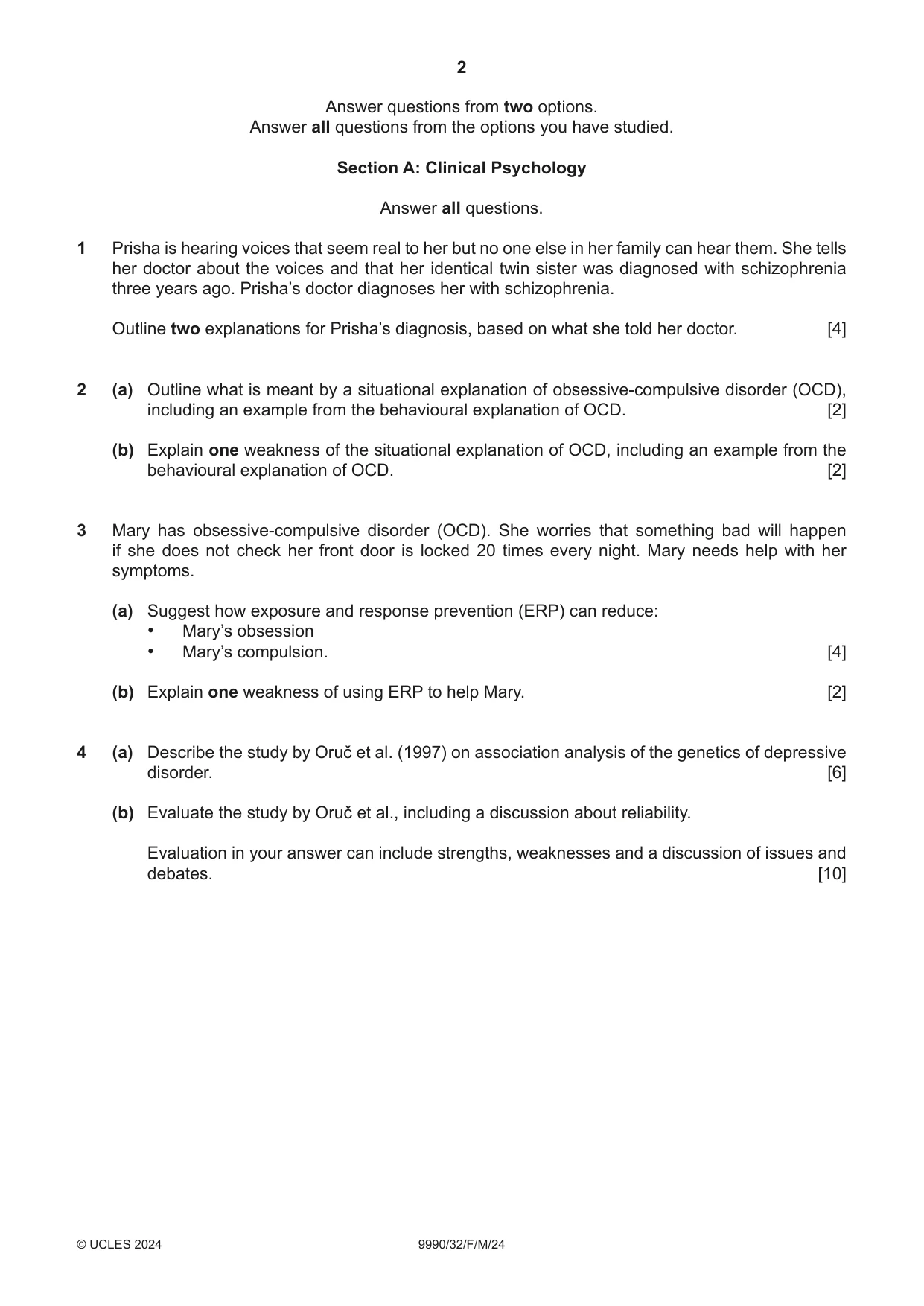
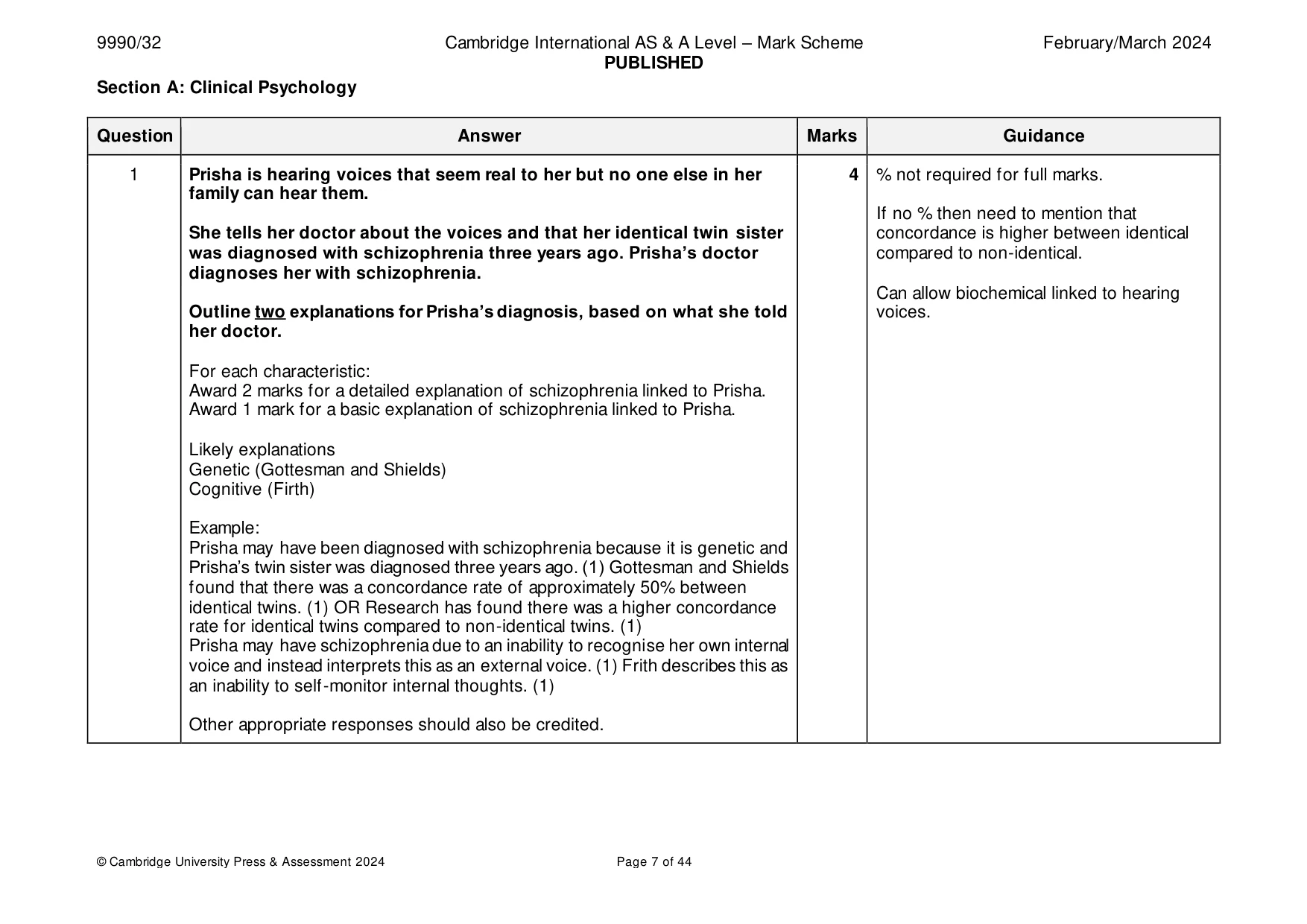
1 Prisha is hearing voices that seem real to her but no one else in her family can hear them. She tells her doctor about the voices and that her identical twin sister was diagnosed with schizophrenia three years ago. Prisha’s doctor diagnoses her with schizophrenia. Outline two explanations for Prisha’s diagnosis, based on what she told her doctor. [4]
Mark scheme: Question Answer Marks Guidance 1 Prisha is hearing voices that seem real to her but no one else in her 4 % not required for full marks. family can hear them. If no % then need to mention that She tells her doctor about the voices and that her identical twin sister concordance is higher between identical was diagnosed with schizophrenia three years ago. Prisha’s doctor compared to non-identical. diagnoses her with schizophrenia. Can allow biochemical linked to hearing Outline two explanations for Prisha’s diagnosis, based on what she told voices. her doctor. For each characteristic: Award 2 marks for a detailed explanation of schizophrenia linked to Prisha. Award 1 mark for a basic explanation of schizophrenia linked to Prisha. Likely explanations Genetic (Gottesman and Shields) Cognitive (Firth) Example: Prisha may have been diagnosed with schizophrenia because it is genetic and Prisha’s twin sister was diagnosed three years ago. (1) Gottesman and Shields found that there was a concordance rate of approximately 50% between identical twins. (1) OR Research has found there was a higher concordance rate for identical twins compared to non-identical twins. (1) Prisha may have schizophrenia due to an inability to recognise her own internal voice and instead interprets this as an external voice. (1) Frith describes this as an inability to self-monitor internal thoughts. (1) Other appropriate responses should also be credited.
Q2 · Outline what is meant by a situational explanation of obsessive-compulsive disorder…
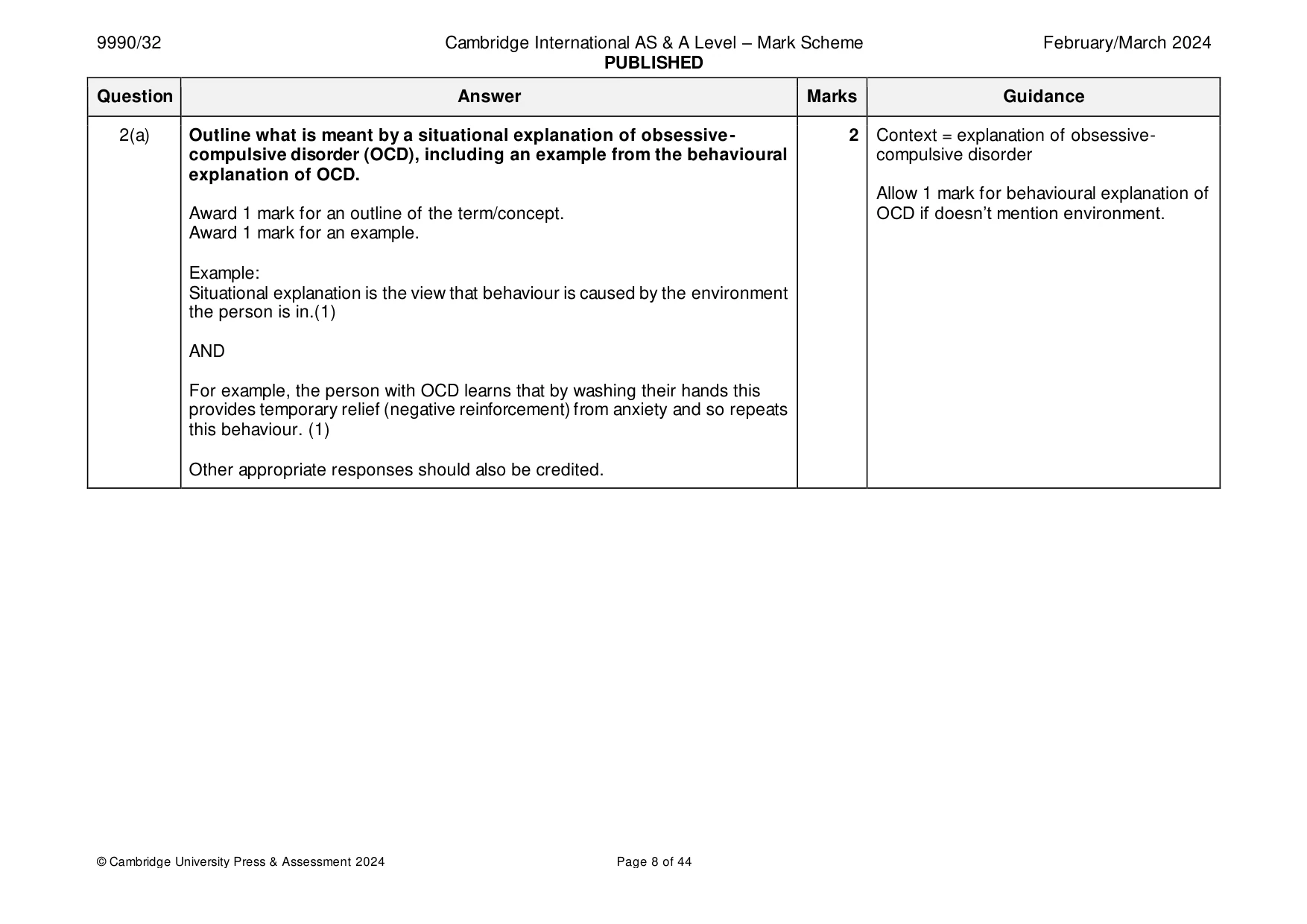
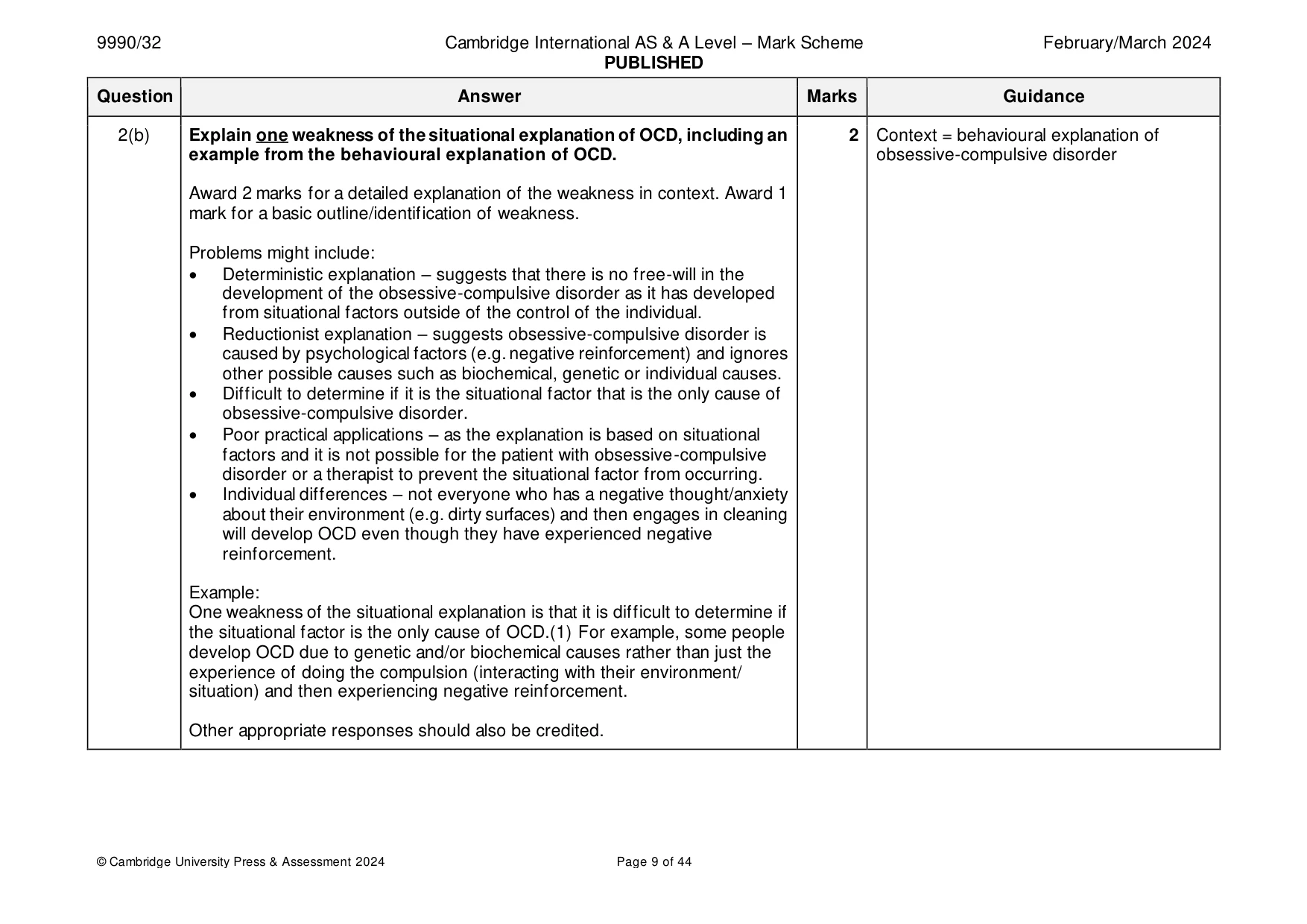
2 (a) Outline what is meant by a situational explanation of obsessive-compulsive disorder (OCD), including an example from the behavioural explanation of OCD. [2] (b) Explain one weakness of the situational explanation of OCD, including an example from the behavioural explanation of OCD. [2]
Mark scheme: 2(a) Outline what is meant by a situational explanation of obsessive- 2 Context = explanation of obsessive- compulsive disorder (OCD), including an example from the behavioural compulsive disorder explanation of OCD. Allow 1 mark for behavioural explanation of Award 1 mark for an outline of the term/concept. OCD if doesn’t mention environment. Award 1 mark for an example. Example: Situational explanation is the view that behaviour is caused by the environment the person is in.(1) AND For example, the person with OCD learns that by washing their hands this provides temporary relief (negative reinforcement) from anxiety and so repeats this behaviour. (1) Other appropriate responses should also be credited. 2(b) Explain one weakness of the situational explanation of OCD, including an 2 Context = behavioural explanation of example from the behavioural explanation of OCD. obsessive-compulsive disorder Award 2 marks for a detailed explanation of the weakness in context. Award 1 mark for a basic outline/identification of weakness. Problems might include: • Deterministic explanation – suggests that there is no free-will in the development of the obsessive-compulsive disorder as it has developed from situational factors outside of the control of the individual. • Reductionist explanation – suggests obsessive-compulsive disorder is caused by psychological factors (e.g. negative reinforcement) and ignores other possible causes such as biochemical, genetic or individual causes. • Difficult to determine if it is the situational factor that is the only cause of obsessive-compulsive disorder. • Poor practical applications – as the explanation is based on situational factors and it is not possible for the patient with obsessive-compulsive disorder or a therapist to prevent the situational factor from occurring. • Individual differences – not everyone who has a negative thought/anxiety about their environment (e.g. dirty surfaces) and then engages in cleaning will develop OCD even though they have experienced negative reinforcement. Example: One weakness of the situational explanation is that it is difficult to determine if the situational factor is the only cause of OCD.(1) For example, some people develop OCD due to genetic and/or biochemical causes rather than just the experience of doing the compulsion (interacting with their environment/ situation) and then experiencing negative reinforcement. Other appropriate responses should also be credited.
Q3 · Mary has obsessive-compulsive disorder (OCD)
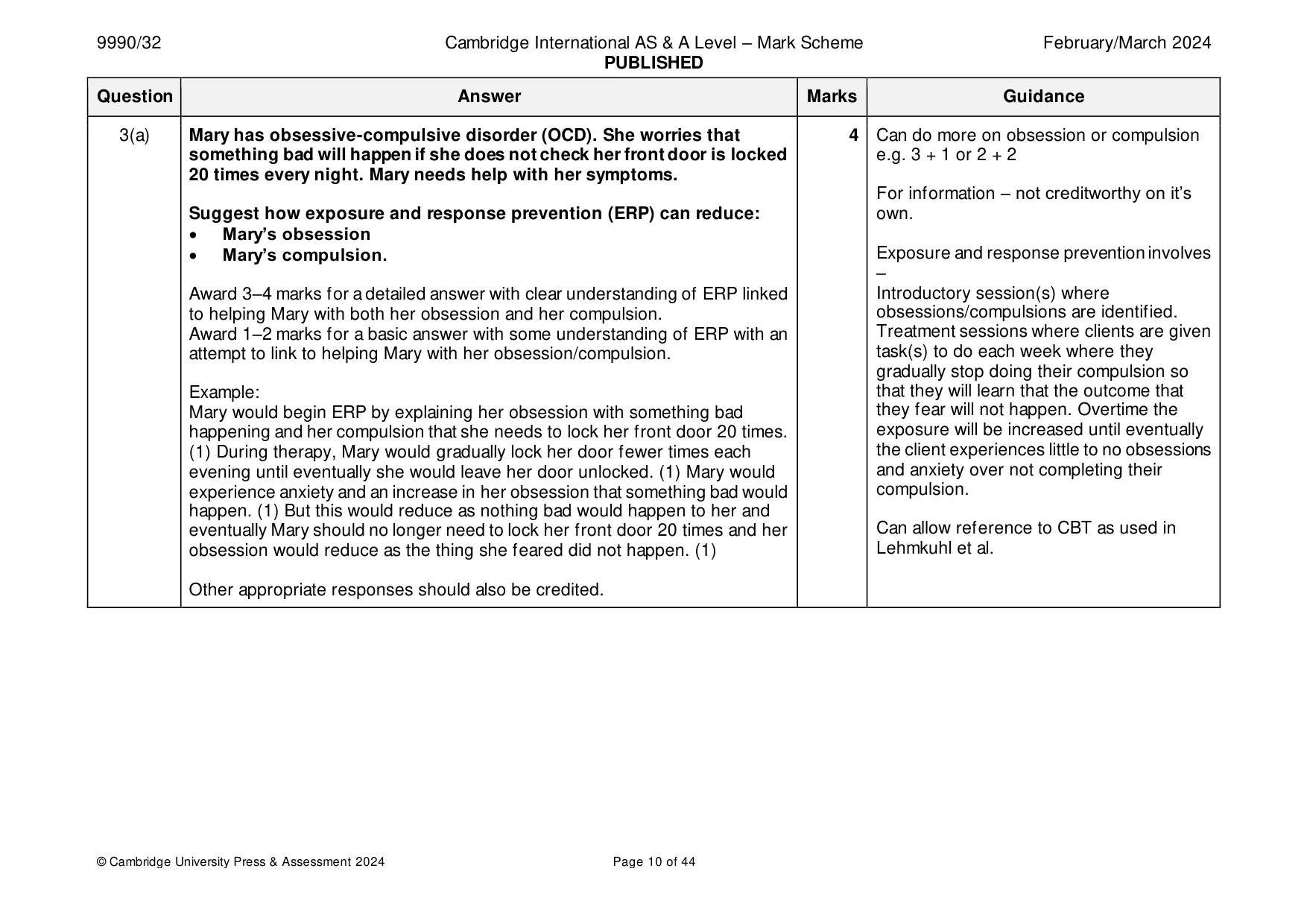
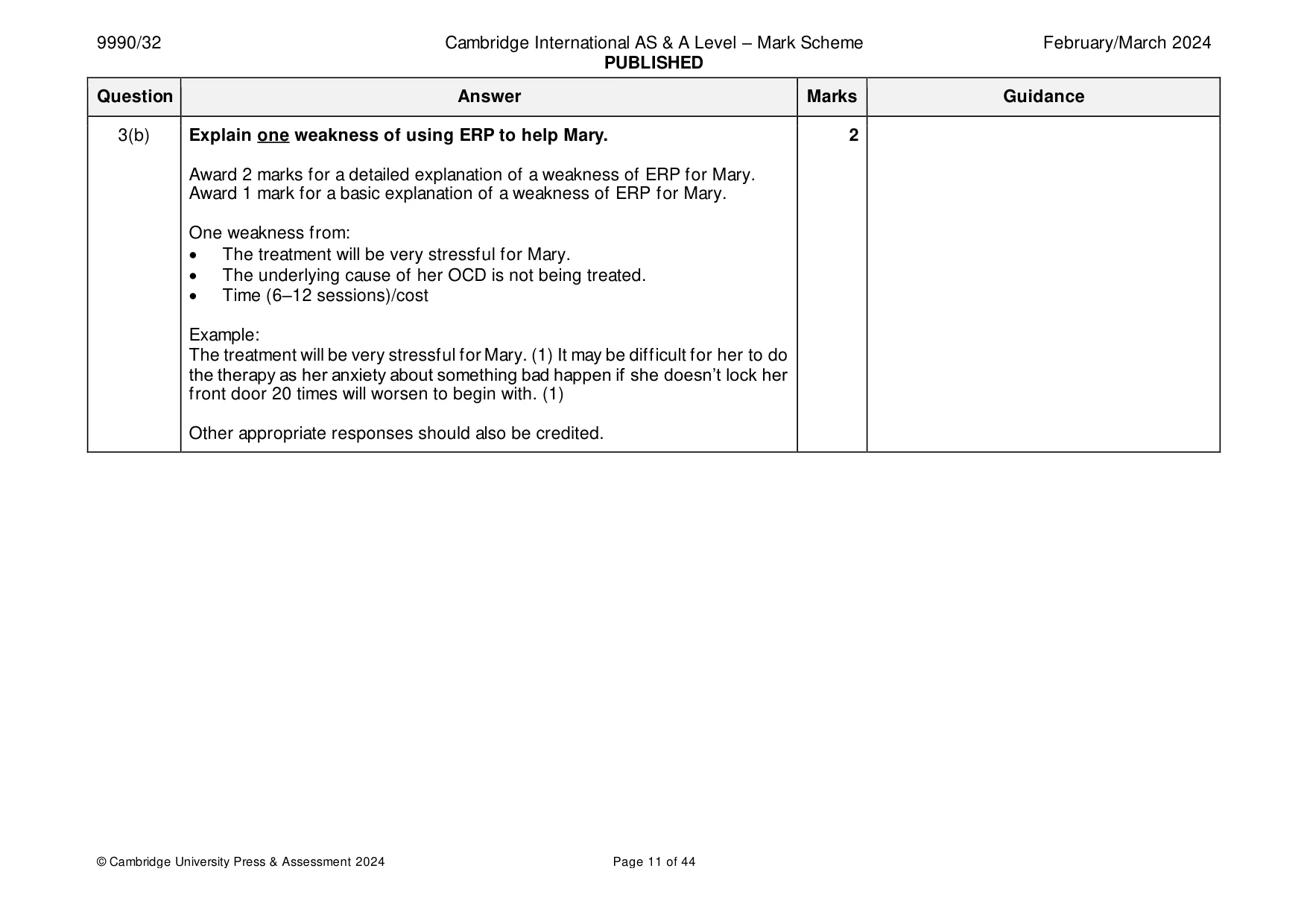
3 Mary has obsessive-compulsive disorder (OCD). She worries that something bad will happen if she does not check her front door is locked 20 times every night. Mary needs help with her symptoms. (a) Suggest how exposure and response prevention (ERP) can reduce: • Mary’s obsession • Mary’s compulsion. [4] (b) Explain one weakness of using ERP to help Mary. [2]
Mark scheme: 3(a) Mary has obsessive-compulsive disorder (OCD). She worries that 4 Can do more on obsession or compulsion something bad will happen if she does not check her front door is locked e.g. 3 + 1 or 2 + 2 20 times every night. Mary needs help with her symptoms. For information – not creditworthy on it’s Suggest how exposure and response prevention (ERP) can reduce: own. • Mary’s obsession • Mary’s compulsion. Exposure and response prevention involves – Award 3–4 marks for a detailed answer with clear understanding of ERP linked Introductory session(s) where to helping Mary with both her obsession and her compulsion. obsessions/compulsions are identified. Award 1–2 marks for a basic answer with some understanding of ERP with an Treatment sessions where clients are given attempt to link to helping Mary with her obsession/compulsion. task(s) to do each week where they gradually stop doing their compulsion so Example: that they will learn that the outcome that Mary would begin ERP by explaining her obsession with something bad they fear will not happen. Overtime the happening and her compulsion that she needs to lock her front door 20 times. exposure will be increased until eventually (1) During therapy, Mary would gradually lock her door fewer times each the client experiences little to no obsessions evening until eventually she would leave her door unlocked. (1) Mary would and anxiety over not completing their experience anxiety and an increase in her obsession that something bad would compulsion. happen. (1) But this would reduce as nothing bad would happen to her and eventually Mary should no longer need to lock her front door 20 times and her Can allow reference to CBT as used in obsession would reduce as the thing she feared did not happen. (1) Lehmkuhl et al. Other appropriate responses should also be credited. 3(b) Explain one weakness of using ERP to help Mary. 2 Award 2 marks for a detailed explanation of a weakness of ERP for Mary. Award 1 mark for a basic explanation of a weakness of ERP for Mary. One weakness from: • The treatment will be very stressful for Mary. • The underlying cause of her OCD is not being treated. • Time (6–12 sessions)/cost Example: The treatment will be very stressful for Mary. (1) It may be difficult for her to do the therapy as her anxiety about something bad happen if she doesn’t lock her front door 20 times will worsen to begin with. (1) Other appropriate responses should also be credited.
Q4 · Describe the study by Oruč et al
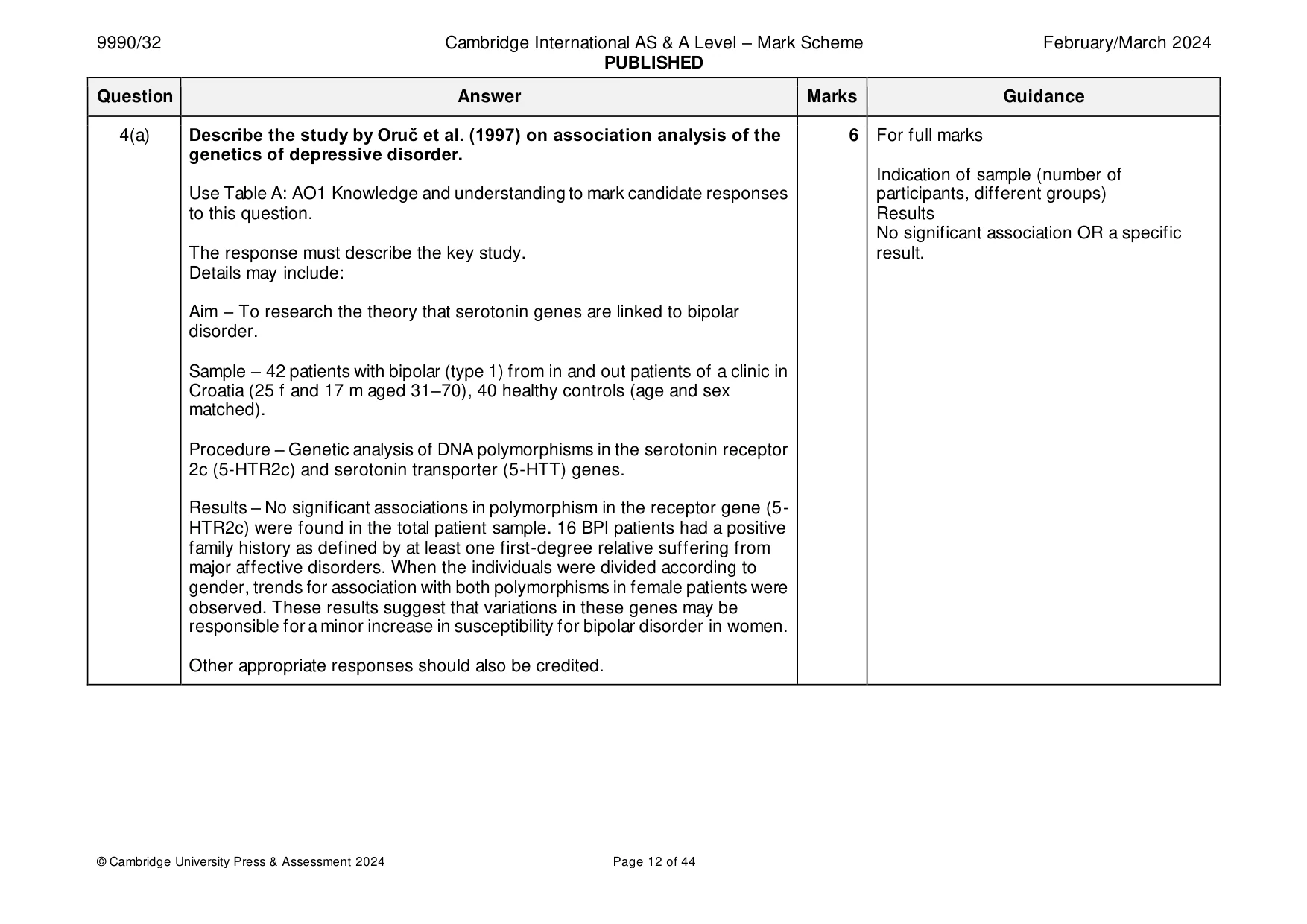
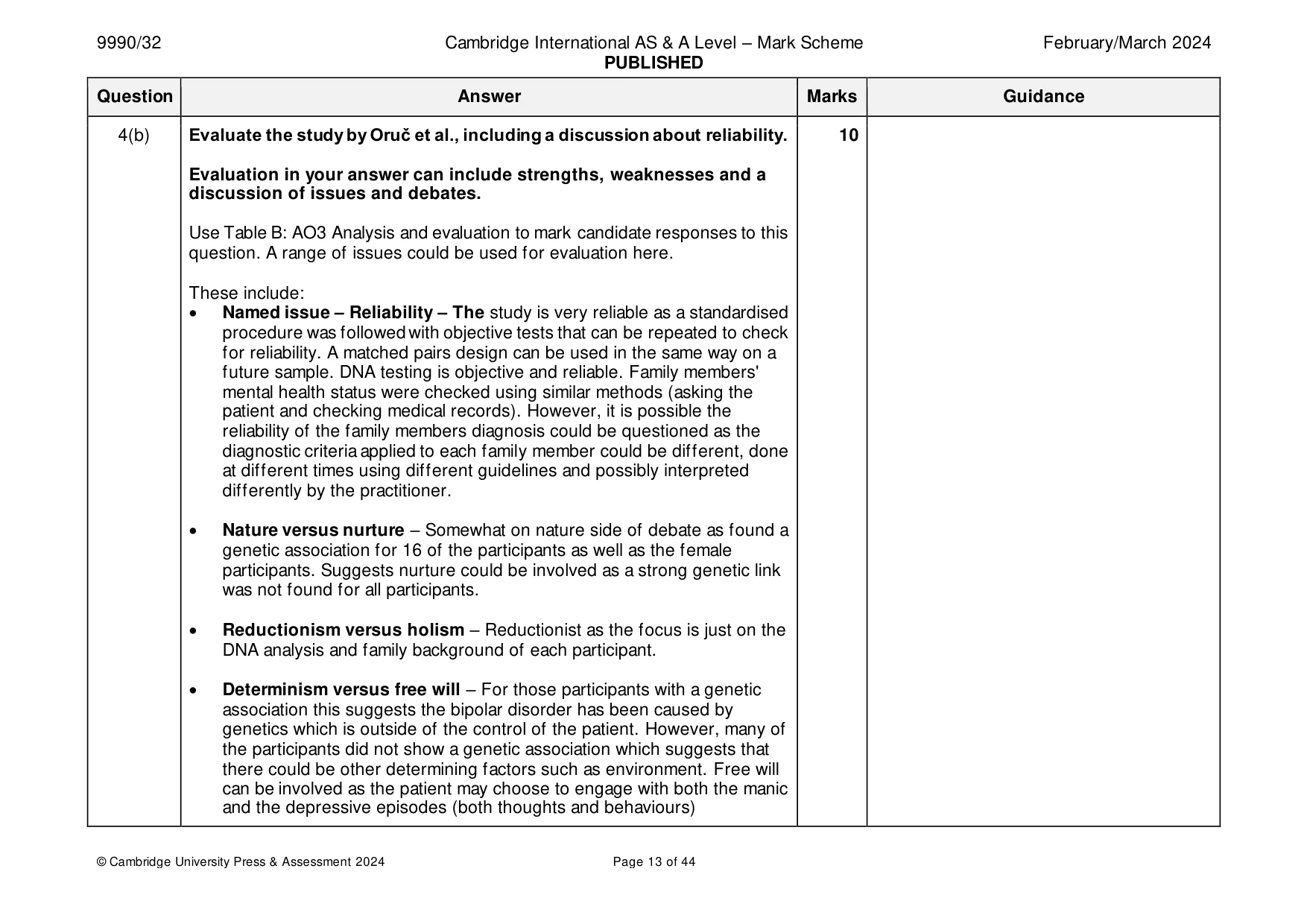
4 (a) Describe the study by Oruč et al. (1997) on association analysis of the genetics of depressive disorder. [6] (b) Evaluate the study by Oruč et al., including a discussion about reliability. Evaluation in your answer can include strengths, weaknesses and a discussion of issues and debates. [10]
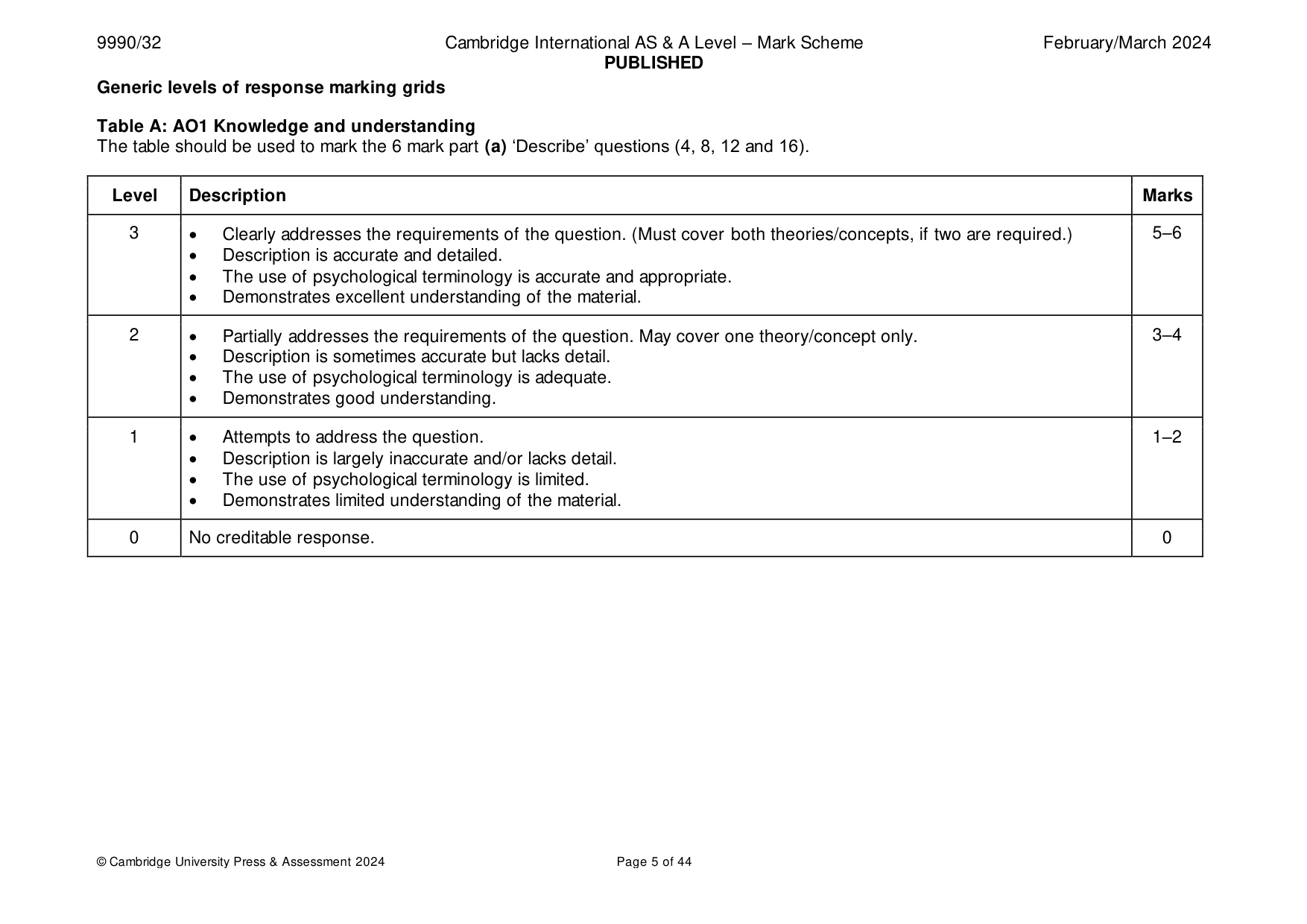
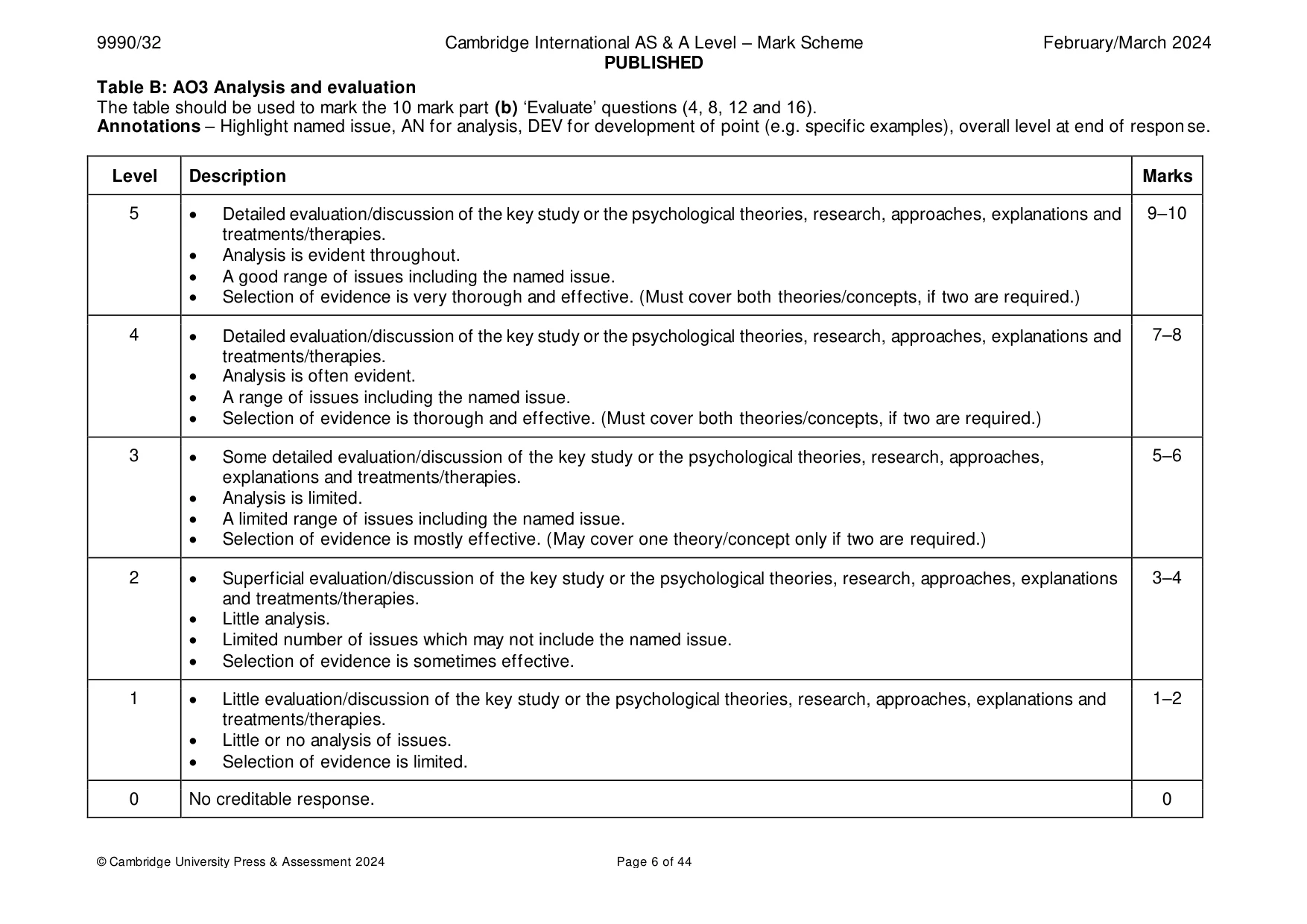
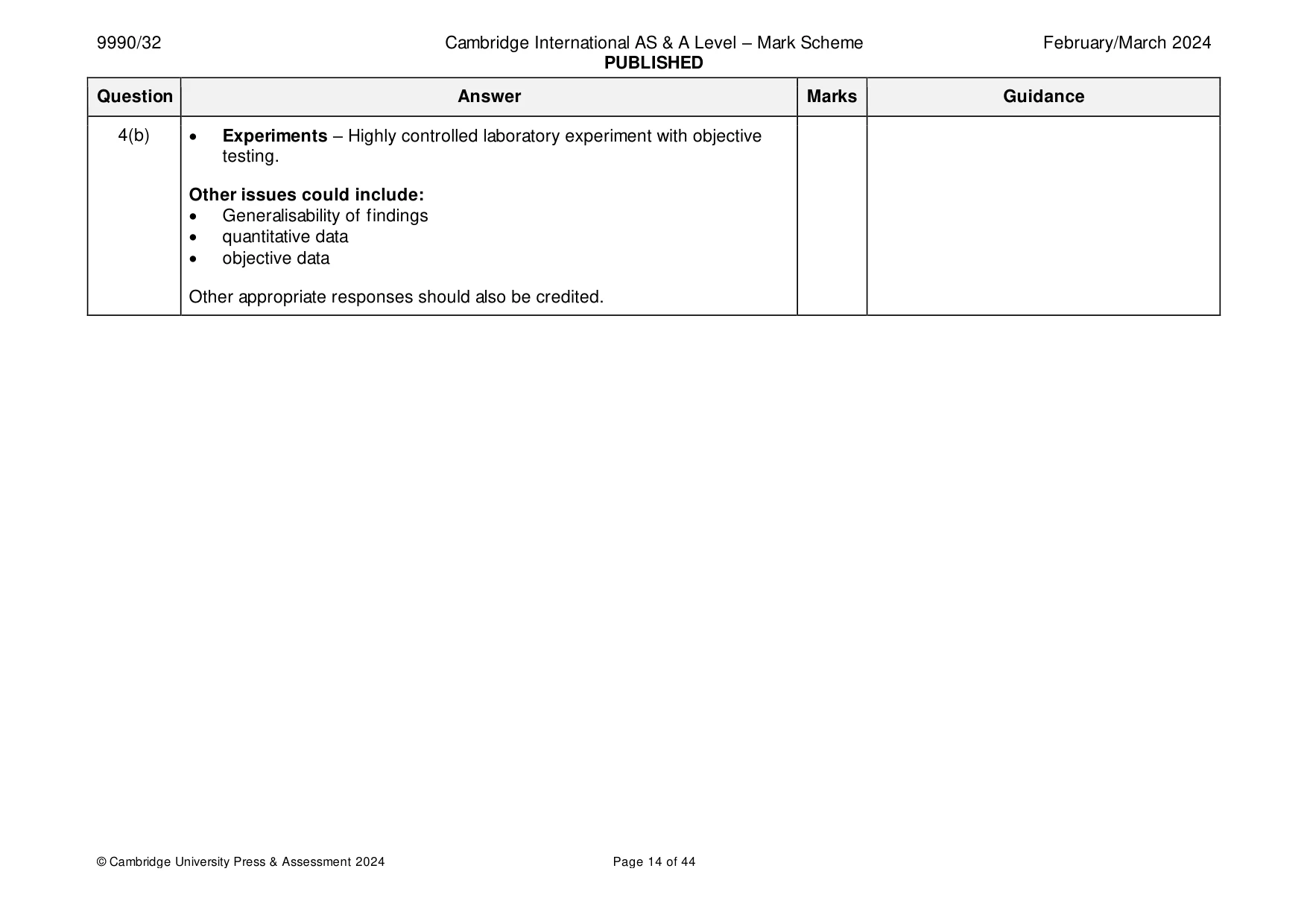
Mark scheme: 4(a) Describe the study by Oruč et al. (1997) on association analysis of the 6 For full marks genetics of depressive disorder. Indication of sample (number of Use Table A: AO1 Knowledge and understanding to mark candidate responses participants, different groups) to this question. Results No significant association OR a specific The response must describe the key study. result. Details may include: Aim – To research the theory that serotonin genes are linked to bipolar disorder. Sample – 42 patients with bipolar (type 1) from in and out patients of a clinic in Croatia (25 f and 17 m aged 31–70), 40 healthy controls (age and sex matched). Procedure – Genetic analysis of DNA polymorphisms in the serotonin receptor 2c (5-HTR2c) and serotonin transporter (5-HTT) genes. Results – No significant associations in polymorphism in the receptor gene (5- HTR2c) were found in the total patient sample. 16 BPI patients had a positive family history as defined by at least one first-degree relative suffering from major affective disorders. When the individuals were divided according to gender, trends for association with both polymorphisms in female patients were observed. These results suggest that variations in these genes may be responsible for a minor increase in susceptibility for bipolar disorder in women. Other appropriate responses should also be credited. 4(b) Evaluate the study by Oruč et al., including a discussion about reliability. 10 Evaluation in your answer can include strengths, weaknesses and a discussion of issues and debates. Use Table B: AO3 Analysis and evaluation to mark candidate responses to this question. A range of issues could be used for evaluation here. These include: • Named issue – Reliability – The study is very reliable as a standardised procedure was followed with objective tests that can be repeated to check for reliability. A matched pairs design can be used in the same way on a future sample. DNA testing is objective and reliable. Family members' mental health status were checked using similar methods (asking the patient and checking medical records). However, it is possible the reliability of the family members diagnosis could be questioned as the diagnostic criteria applied to each family member could be different, done at different times using different guidelines and possibly interpreted differently by the practitioner. • Nature versus nurture – Somewhat on nature side of debate as found a genetic association for 16 of the participants as well as the female participants. Suggests nurture could be involved as a strong genetic link was not found for all participants. • Reductionism versus holism – Reductionist as the focus is just on the DNA analysis and family background of each participant. • Determinism versus free will – For those participants with a genetic association this suggests the bipolar disorder has been caused by genetics which is outside of the control of the patient. However, many of the participants did not show a genetic association which suggests that there could be other determining factors such as environment. Free will can be involved as the patient may choose to engage with both the manic and the depressive episodes (both thoughts and behaviours) 4(b) • Experiments – Highly controlled laboratory experiment with objective testing. Other issues could include: • Generalisability of findings • quantitative data • objective data Other appropriate responses should also be credited. Section B: Consumer Psychology
More questions on Mood (affective) disorders: depressive disorder (unipolar) and bipolar disorder
Q5 · Kabir is setting up a store selling clothing in a shopping mall
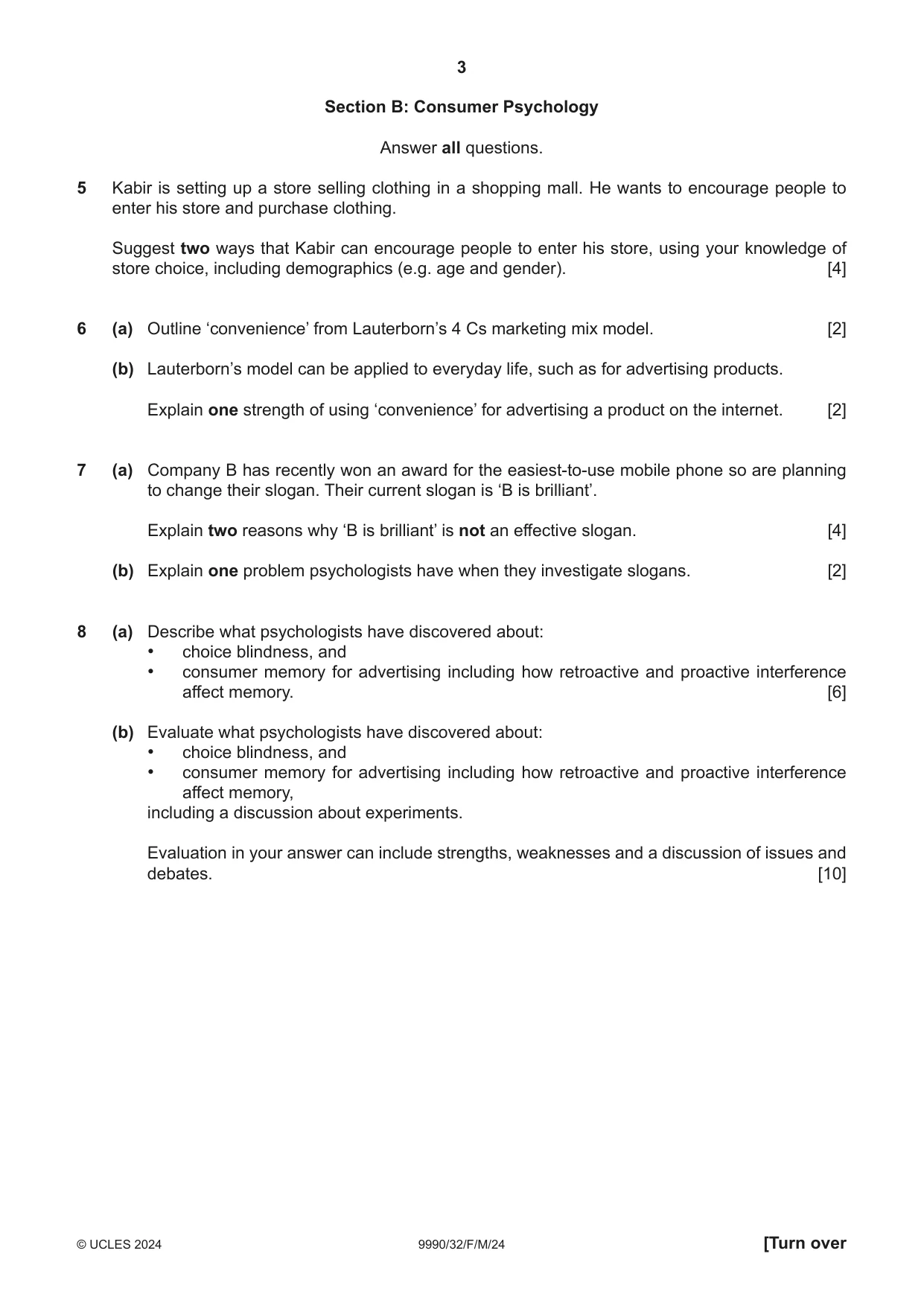
5 Kabir is setting up a store selling clothing in a shopping mall. He wants to encourage people to enter his store and purchase clothing. Suggest two ways that Kabir can encourage people to enter his store, using your knowledge of store choice, including demographics (e.g. age and gender). [4]
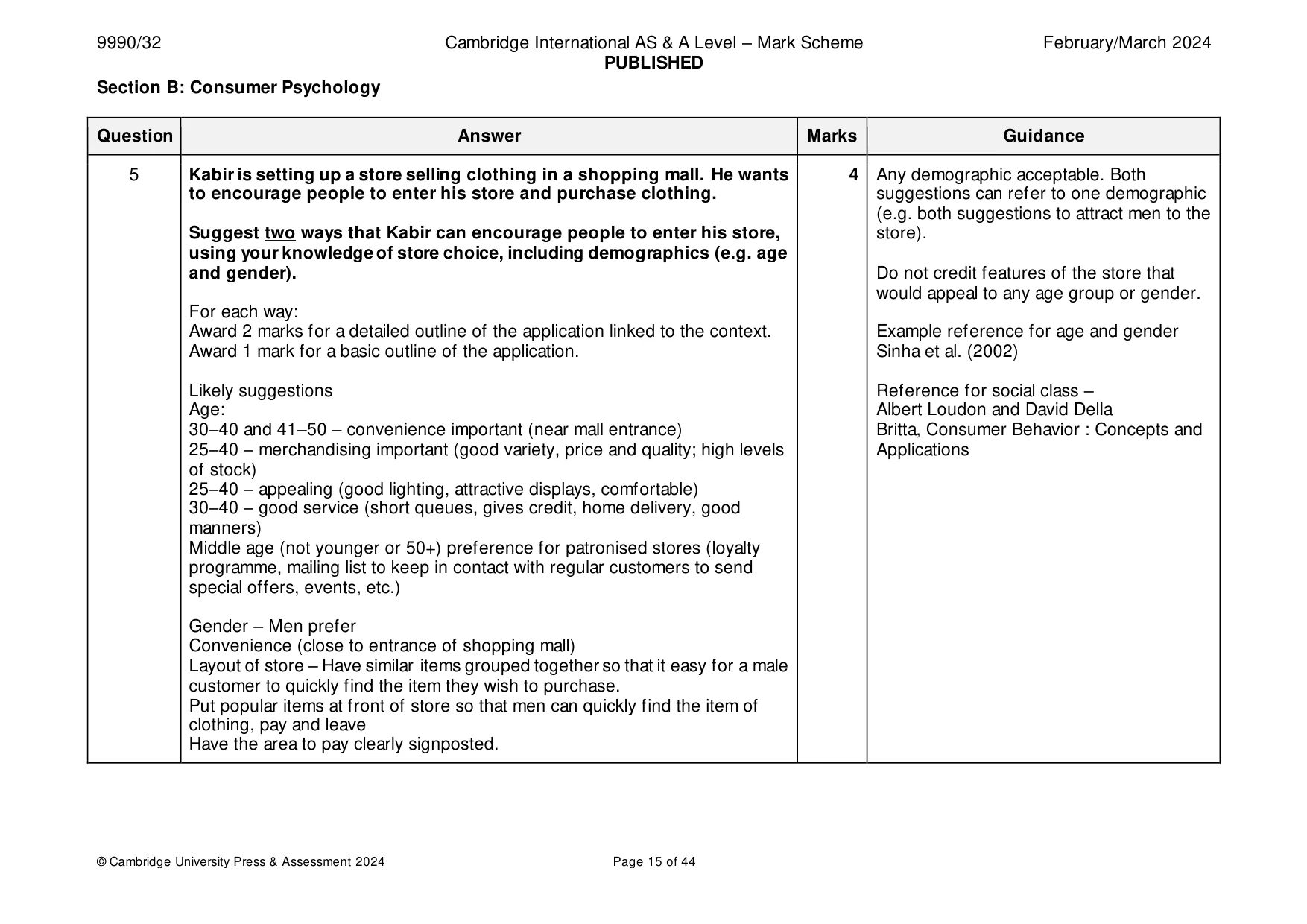
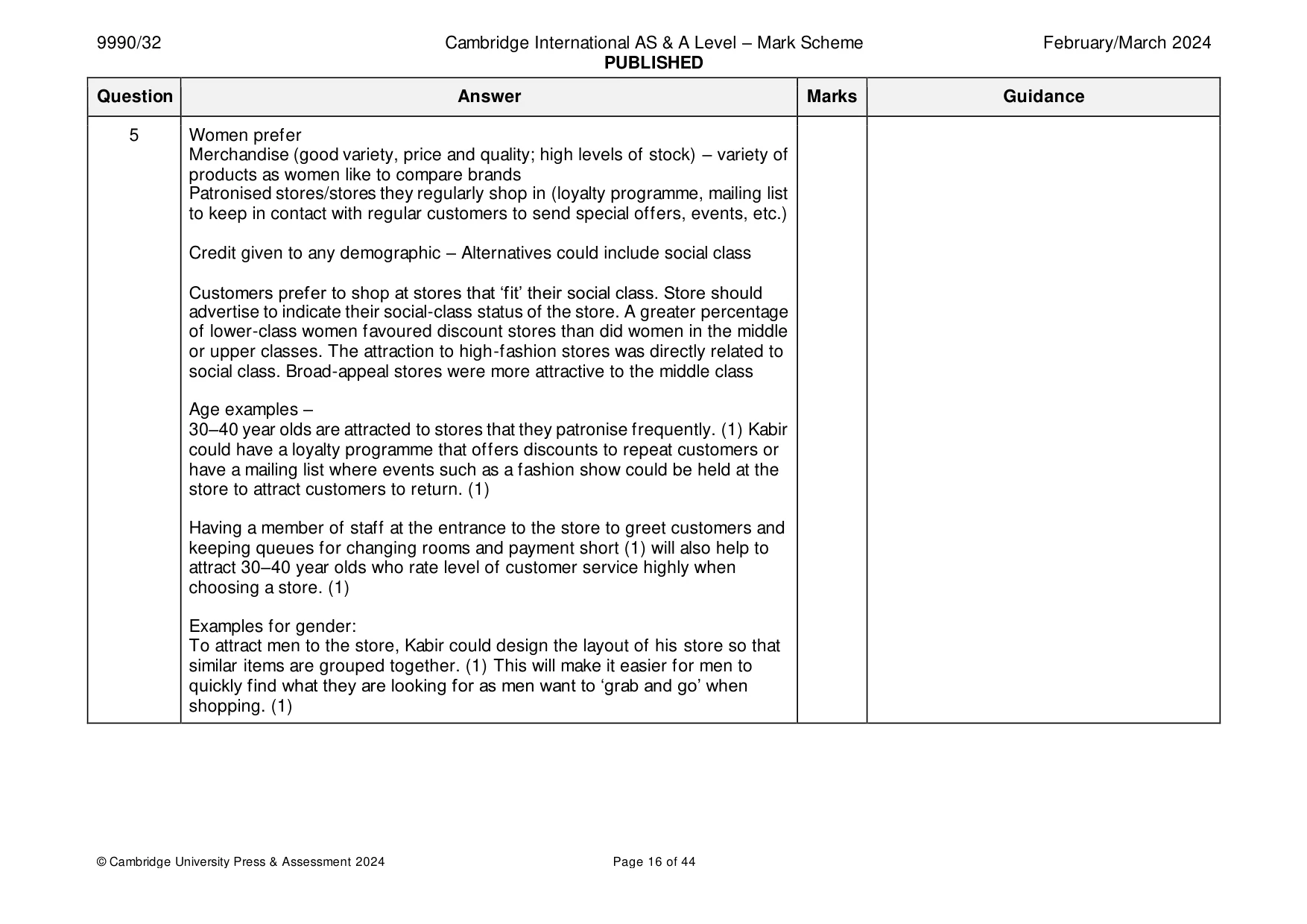
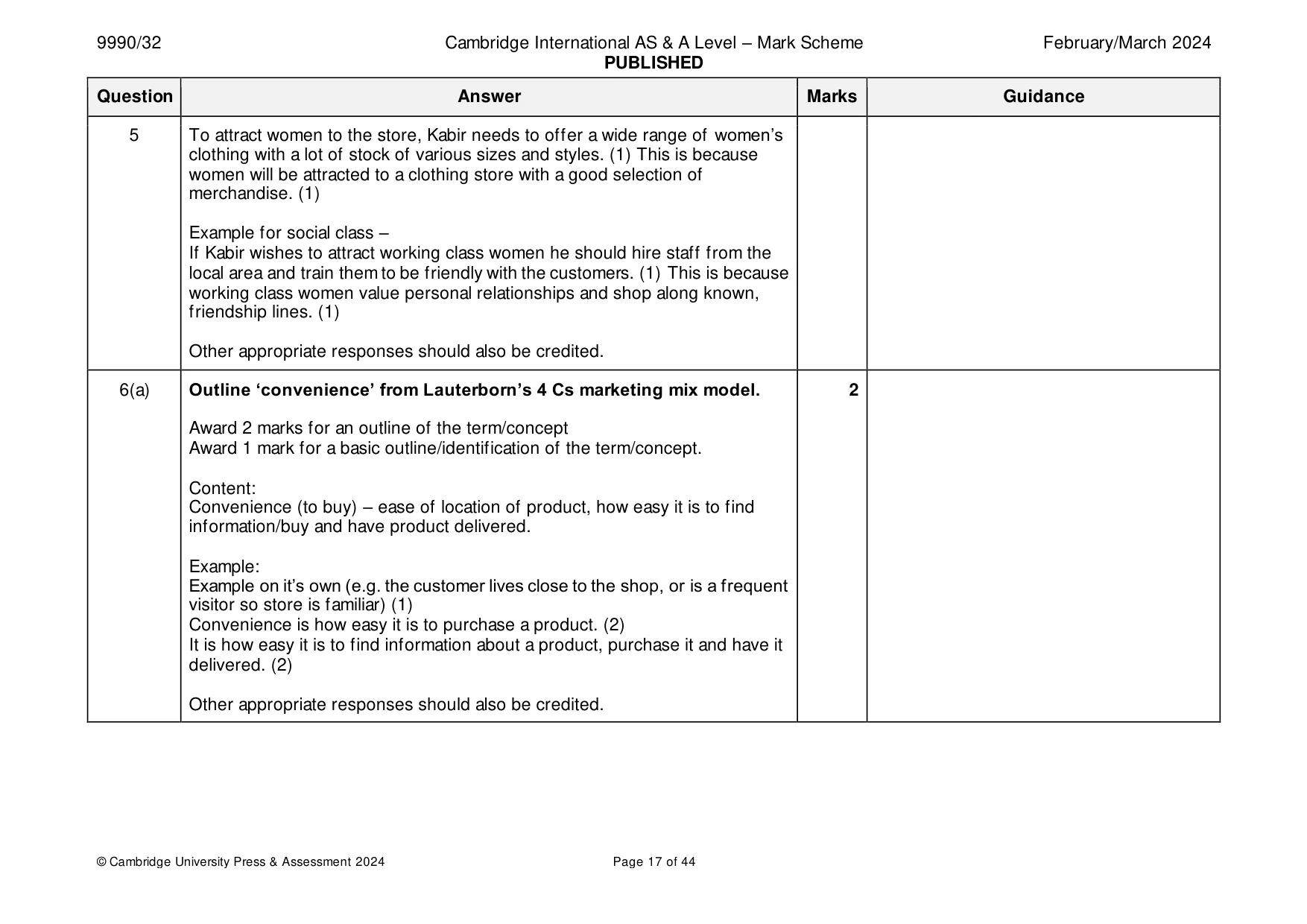
Mark scheme: 5 Kabir is setting up a store selling clothing in a shopping mall. He wants 4 Any demographic acceptable. Both to encourage people to enter his store and purchase clothing. suggestions can refer to one demographic (e.g. both suggestions to attract men to the Suggest two ways that Kabir can encourage people to enter his store, store). using your knowledge of store choice, including demographics (e.g. age and gender). Do not credit features of the store that would appeal to any age group or gender. For each way: Award 2 marks for a detailed outline of the application linked to the context. Example reference for age and gender Award 1 mark for a basic outline of the application. Sinha et al. (2002) Likely suggestions Reference for social class – Age: Albert Loudon and David Della 30–40 and 41–50 – convenience important (near mall entrance) Britta, Consumer Behavior : Concepts and 25–40 – merchandising important (good variety, price and quality; high levels Applications of stock) 25–40 – appealing (good lighting, attractive displays, comfortable) 30–40 – good service (short queues, gives credit, home delivery, good manners) Middle age (not younger or 50+) preference for patronised stores (loyalty programme, mailing list to keep in contact with regular customers to send special offers, events, etc.) Gender – Men prefer Convenience (close to entrance of shopping mall) Layout of store – Have similar items grouped together so that it easy for a male customer to quickly find the item they wish to purchase. Put popular items at front of store so that men can quickly find the item of clothing, pay and leave Have the area to pay clearly signposted. 5 Women prefer Merchandise (good variety, price and quality; high levels of stock) – variety of products as women like to compare brands Patronised stores/stores they regularly shop in (loyalty programme, mailing list to keep in contact with regular customers to send special offers, events, etc.) Credit given to any demographic – Alternatives could include social class Customers prefer to shop at stores that ‘fit’ their social class. Store should advertise to indicate their social-class status of the store. A greater percentage of lower-class women favoured discount stores than did women in the middle or upper classes. The attraction to high-fashion stores was directly related to social class. Broad-appeal stores were more attractive to the middle class Age examples – 30–40 year olds are attracted to stores that they patronise frequently. (1) Kabir could have a loyalty programme that offers discounts to repeat customers or have a mailing list where events such as a fashion show could be held at the store to attract customers to return. (1) Having a member of staff at the entrance to the store to greet customers and keeping queues for changing rooms and payment short (1) will also help to attract 30–40 year olds who rate level of customer service highly when choosing a store. (1) Examples for gender: To attract men to the store, Kabir could design the layout of his store so that similar items are grouped together. (1) This will make it easier for men to quickly find what they are looking for as men want to ‘grab and go’ when shopping. (1) 5 To attract women to the store, Kabir needs to offer a wide range of women’s clothing with a lot of stock of various sizes and styles. (1) This is because women will be attracted to a clothing store with a good selection of merchandise. (1) Example for social class – If Kabir wishes to attract working class women he should hire staff from the local area and train them to be friendly with the customers. (1) This is because working class women value personal relationships and shop along known, friendship lines. (1) Other appropriate responses should also be credited.
Q6 · Outline ‘convenience’ from Lauterborn’s 4 Cs marketing mix model
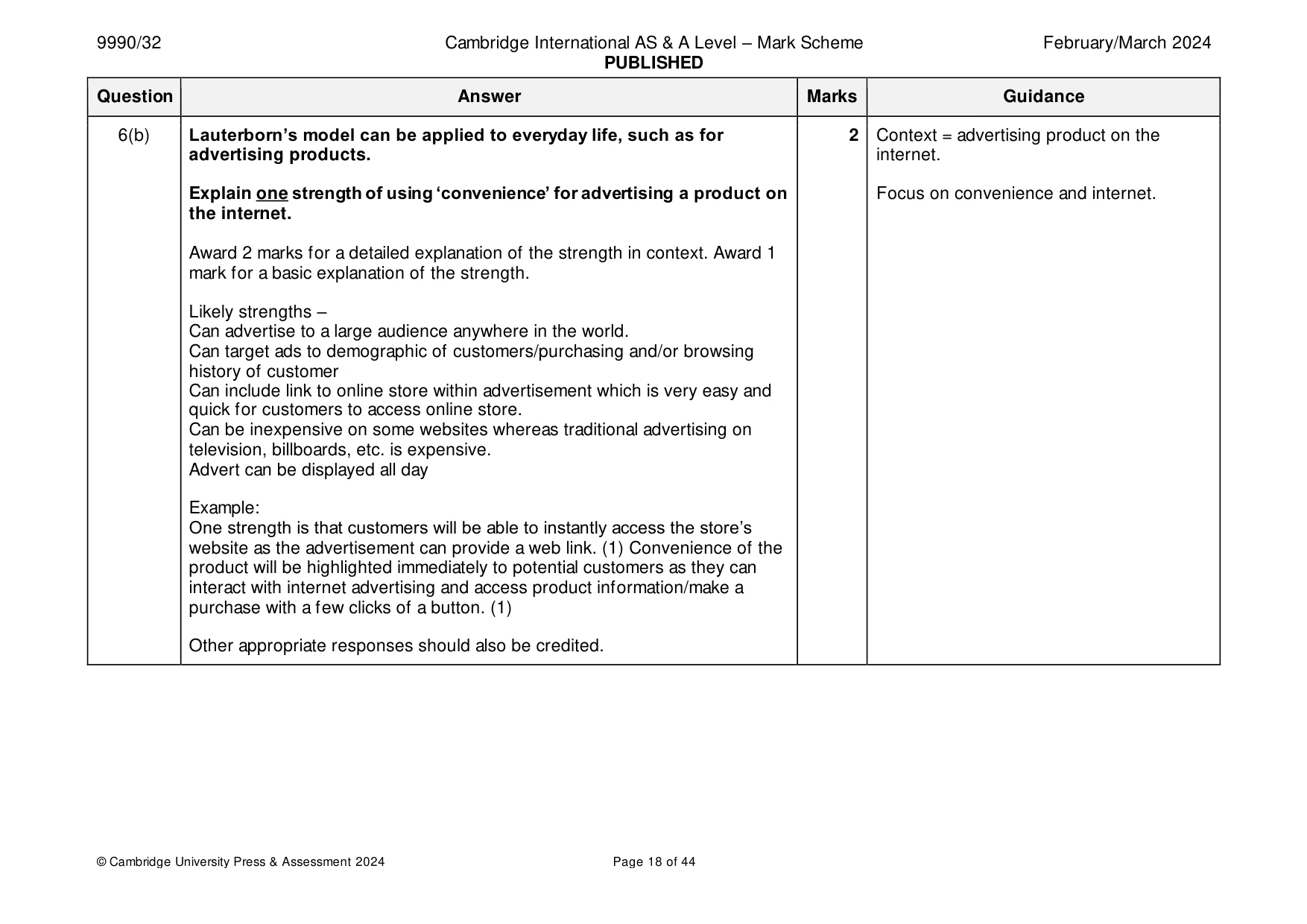
6 (a) Outline ‘convenience’ from Lauterborn’s 4 Cs marketing mix model. [2] (b) Lauterborn’s model can be applied to everyday life, such as for advertising products. Explain one strength of using ‘convenience’ for advertising a product on the internet. [2]
Mark scheme: 6(a) Outline ‘convenience’ from Lauterborn’s 4 Cs marketing mix model. 2 Award 2 marks for an outline of the term/concept Award 1 mark for a basic outline/identification of the term/concept. Content: Convenience (to buy) – ease of location of product, how easy it is to find information/buy and have product delivered. Example: Example on it’s own (e.g. the customer lives close to the shop, or is a frequent visitor so store is familiar) (1) Convenience is how easy it is to purchase a product. (2) It is how easy it is to find information about a product, purchase it and have it delivered. (2) Other appropriate responses should also be credited. 6(b) Lauterborn’s model can be applied to everyday life, such as for 2 Context = advertising product on the advertising products. internet. Explain one strength of using ‘convenience’ for advertising a product on Focus on convenience and internet. the internet. Award 2 marks for a detailed explanation of the strength in context. Award 1 mark for a basic explanation of the strength. Likely strengths – Can advertise to a large audience anywhere in the world. Can target ads to demographic of customers/purchasing and/or browsing history of customer Can include link to online store within advertisement which is very easy and quick for customers to access online store. Can be inexpensive on some websites whereas traditional advertising on television, billboards, etc. is expensive. Advert can be displayed all day Example: One strength is that customers will be able to instantly access the store’s website as the advertisement can provide a web link. (1) Convenience of the product will be highlighted immediately to potential customers as they can interact with internet advertising and access product information/make a purchase with a few clicks of a button. (1) Other appropriate responses should also be credited.
Q7 · Company B has recently won an award for the easiest-to-use mobile phone so are planning…
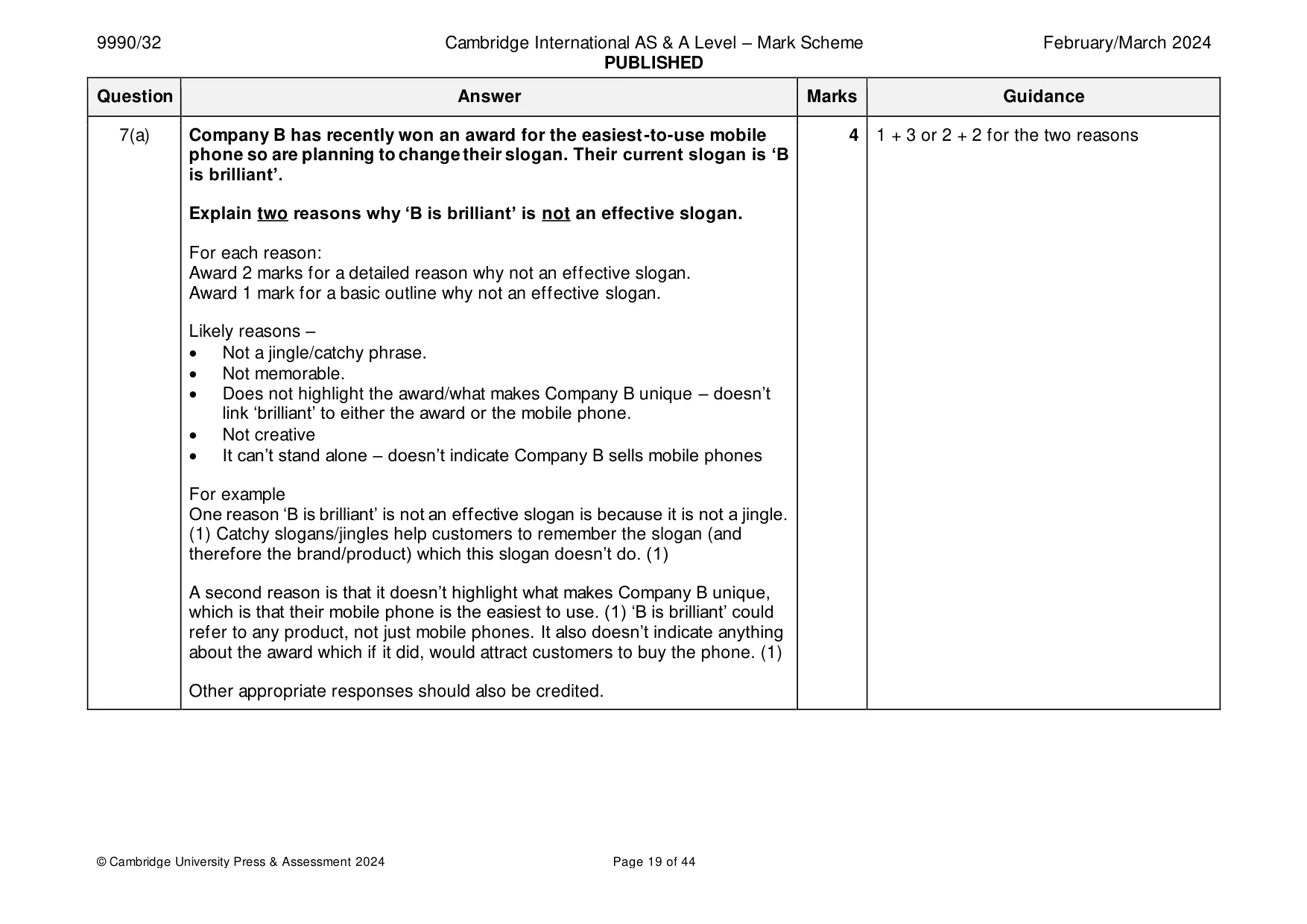
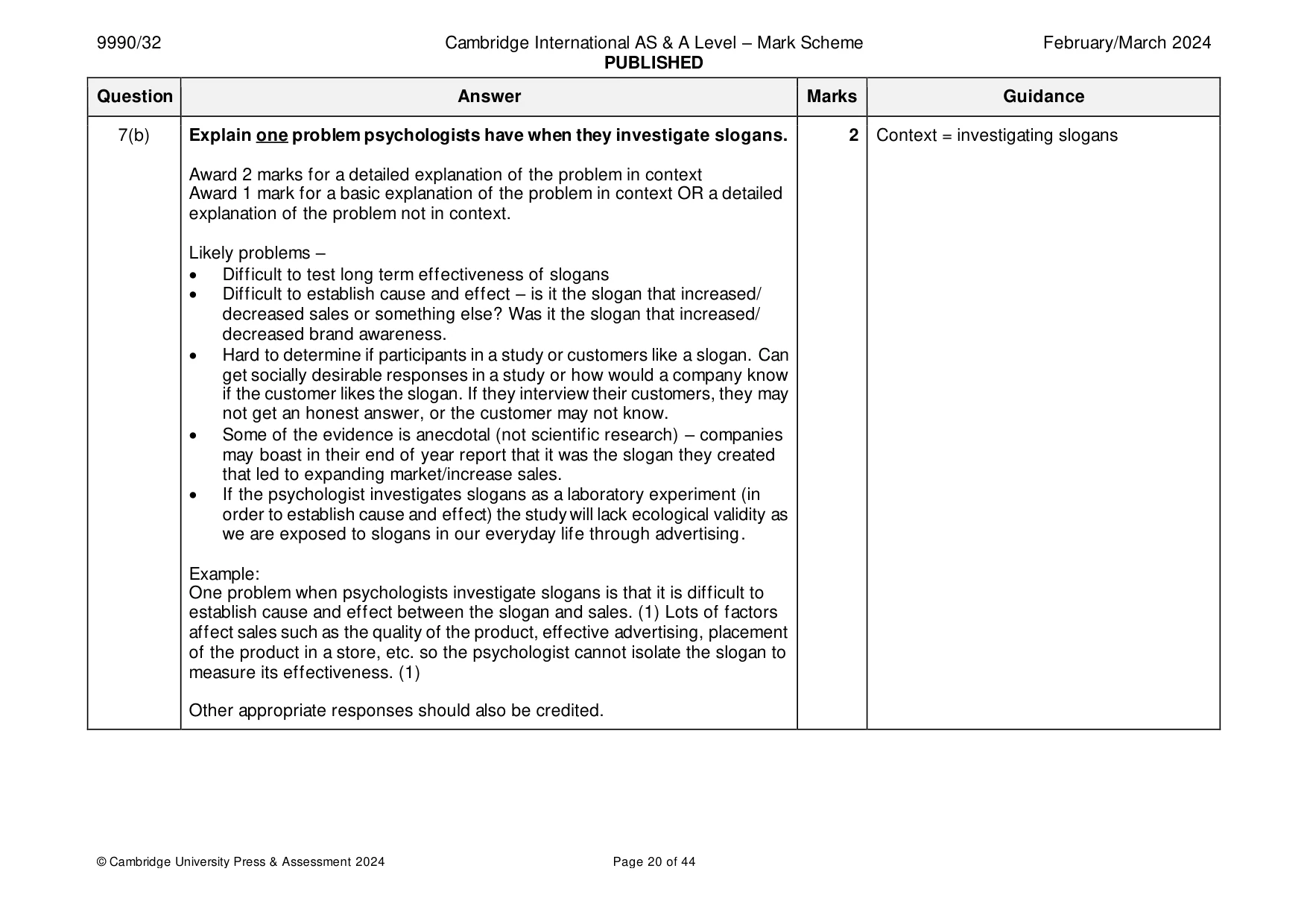
7 (a) Company B has recently won an award for the easiest-to-use mobile phone so are planning to change their slogan. Their current slogan is ‘B is brilliant’. Explain two reasons why ‘B is brilliant’ is not an effective slogan. [4] (b) Explain one problem psychologists have when they investigate slogans. [2]
Mark scheme: 7(a) Company B has recently won an award for the easiest-to-use mobile 4 1 + 3 or 2 + 2 for the two reasons phone so are planning to change their slogan. Their current slogan is ‘B is brilliant’. Explain two reasons why ‘B is brilliant’ is not an effective slogan. For each reason: Award 2 marks for a detailed reason why not an effective slogan. Award 1 mark for a basic outline why not an effective slogan. Likely reasons – • Not a jingle/catchy phrase. • Not memorable. • Does not highlight the award/what makes Company B unique – doesn’t link ‘brilliant’ to either the award or the mobile phone. • Not creative • It can’t stand alone – doesn’t indicate Company B sells mobile phones For example One reason ‘B is brilliant’ is not an effective slogan is because it is not a jingle. (1) Catchy slogans/jingles help customers to remember the slogan (and therefore the brand/product) which this slogan doesn’t do. (1) A second reason is that it doesn’t highlight what makes Company B unique, which is that their mobile phone is the easiest to use. (1) ‘B is brilliant’ could refer to any product, not just mobile phones. It also doesn’t indicate anything about the award which if it did, would attract customers to buy the phone. (1) Other appropriate responses should also be credited. 7(b) Explain one problem psychologists have when they investigate slogans. 2 Context = investigating slogans Award 2 marks for a detailed explanation of the problem in context Award 1 mark for a basic explanation of the problem in context OR a detailed explanation of the problem not in context. Likely problems – • Difficult to test long term effectiveness of slogans • Difficult to establish cause and effect – is it the slogan that increased/ decreased sales or something else? Was it the slogan that increased/ decreased brand awareness. • Hard to determine if participants in a study or customers like a slogan. Can get socially desirable responses in a study or how would a company know if the customer likes the slogan. If they interview their customers, they may not get an honest answer, or the customer may not know. • Some of the evidence is anecdotal (not scientific research) – companies may boast in their end of year report that it was the slogan they created that led to expanding market/increase sales. • If the psychologist investigates slogans as a laboratory experiment (in order to establish cause and effect) the study will lack ecological validity as we are exposed to slogans in our everyday life through advertising. Example: One problem when psychologists investigate slogans is that it is difficult to establish cause and effect between the slogan and sales. (1) Lots of factors affect sales such as the quality of the product, effective advertising, placement of the product in a store, etc. so the psychologist cannot isolate the slogan to measure its effectiveness. (1) Other appropriate responses should also be credited.
Q8 · Describe what psychologists have discovered about: • choice blindness, and • consumer…
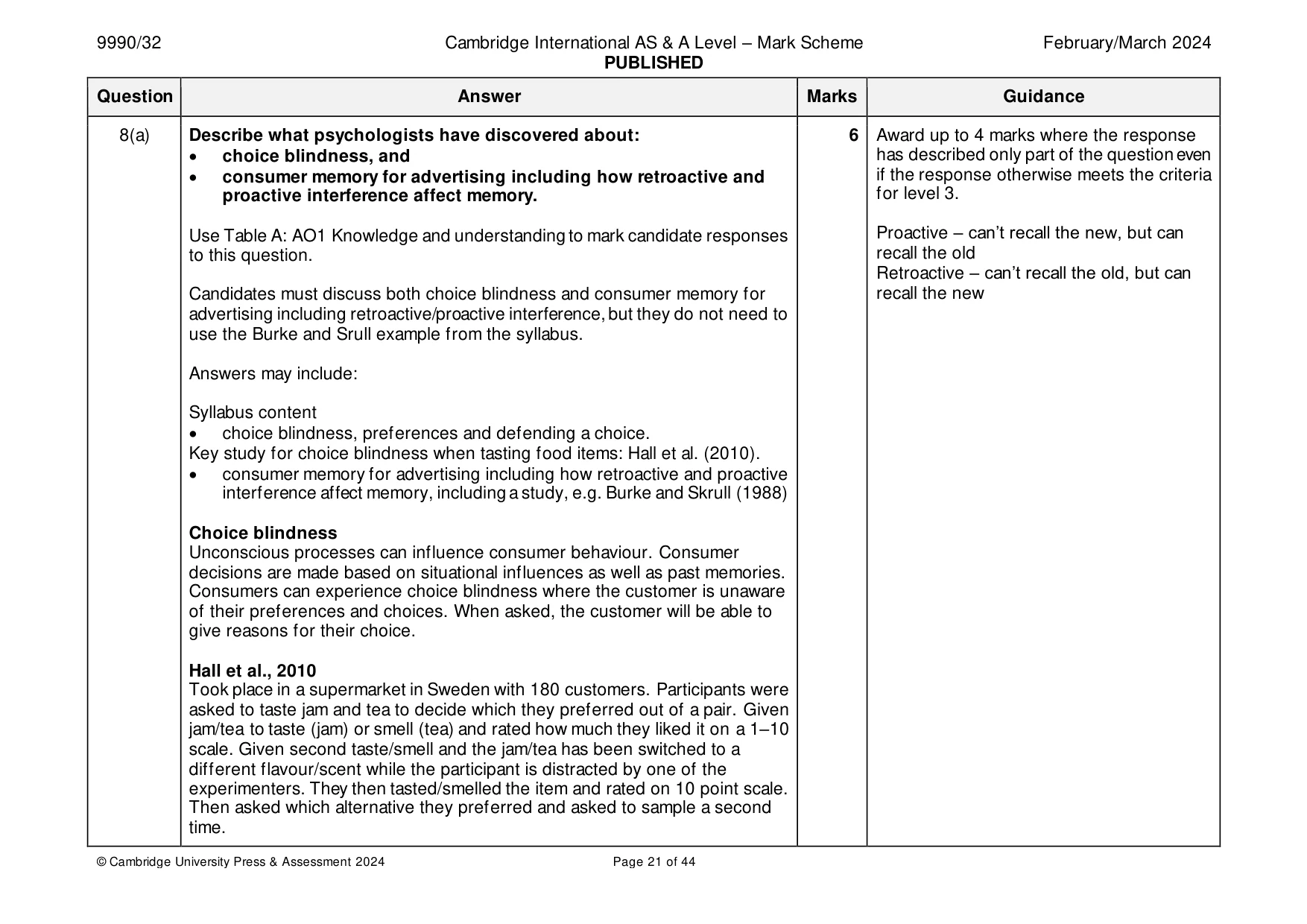
8 (a) Describe what psychologists have discovered about: • choice blindness, and • consumer memory for advertising including how retroactive and proactive interference affect memory. [6] (b) Evaluate what psychologists have discovered about: • choice blindness, and • consumer memory for advertising including how retroactive and proactive interference affect memory, including a discussion about experiments. Evaluation in your answer can include strengths, weaknesses and a discussion of issues and debates. [10] Section C: Health Psychology Answer all questions.
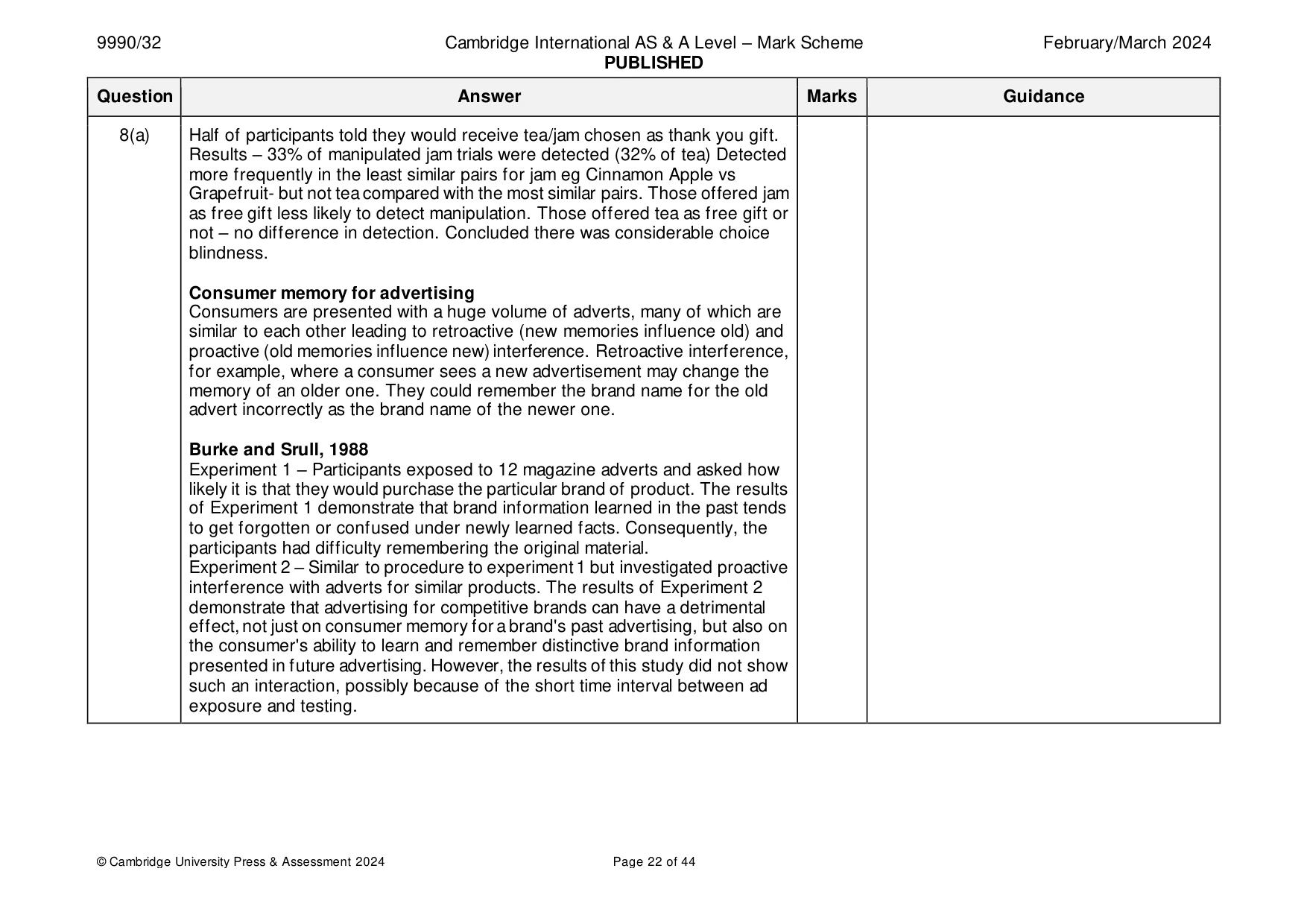
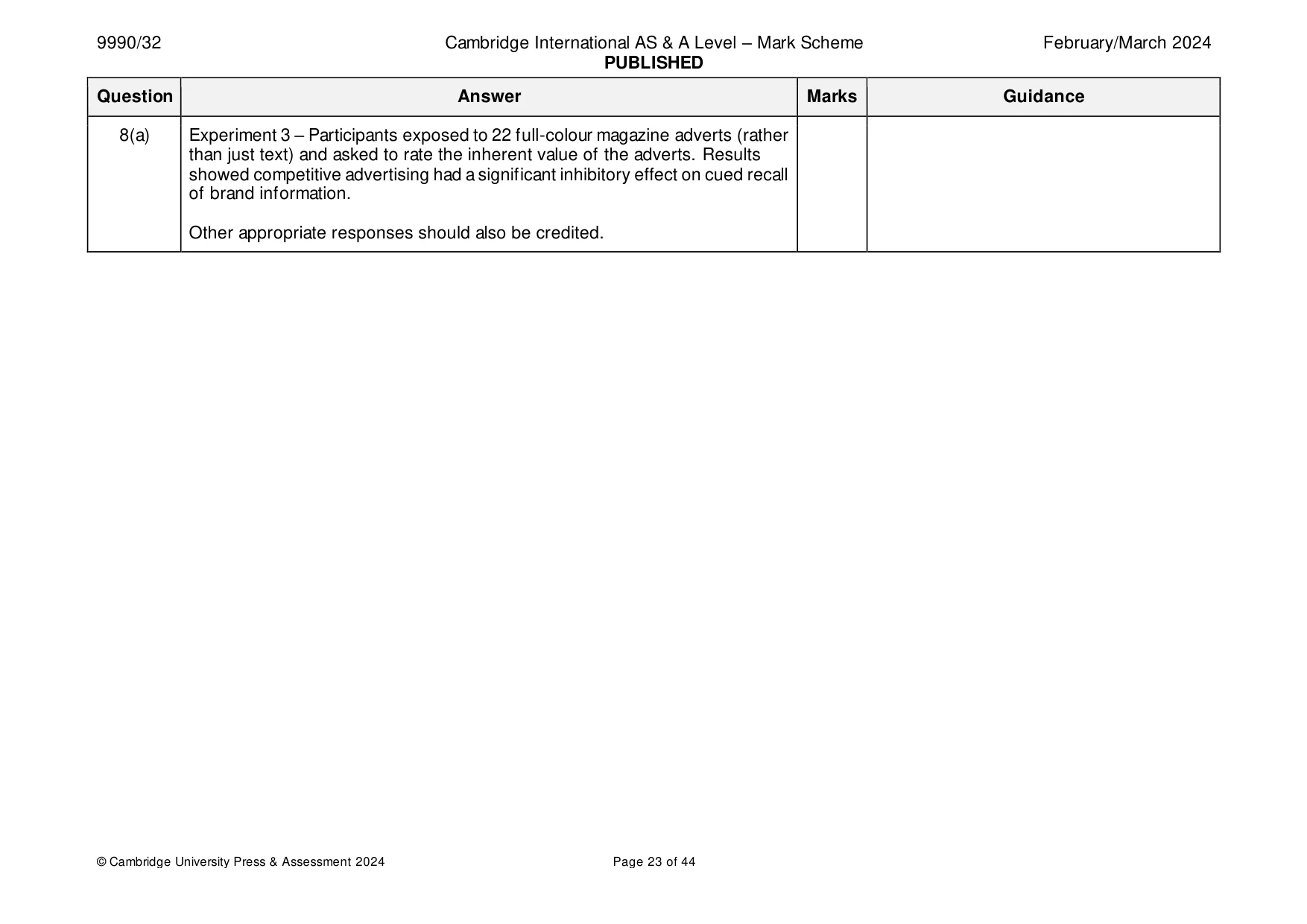
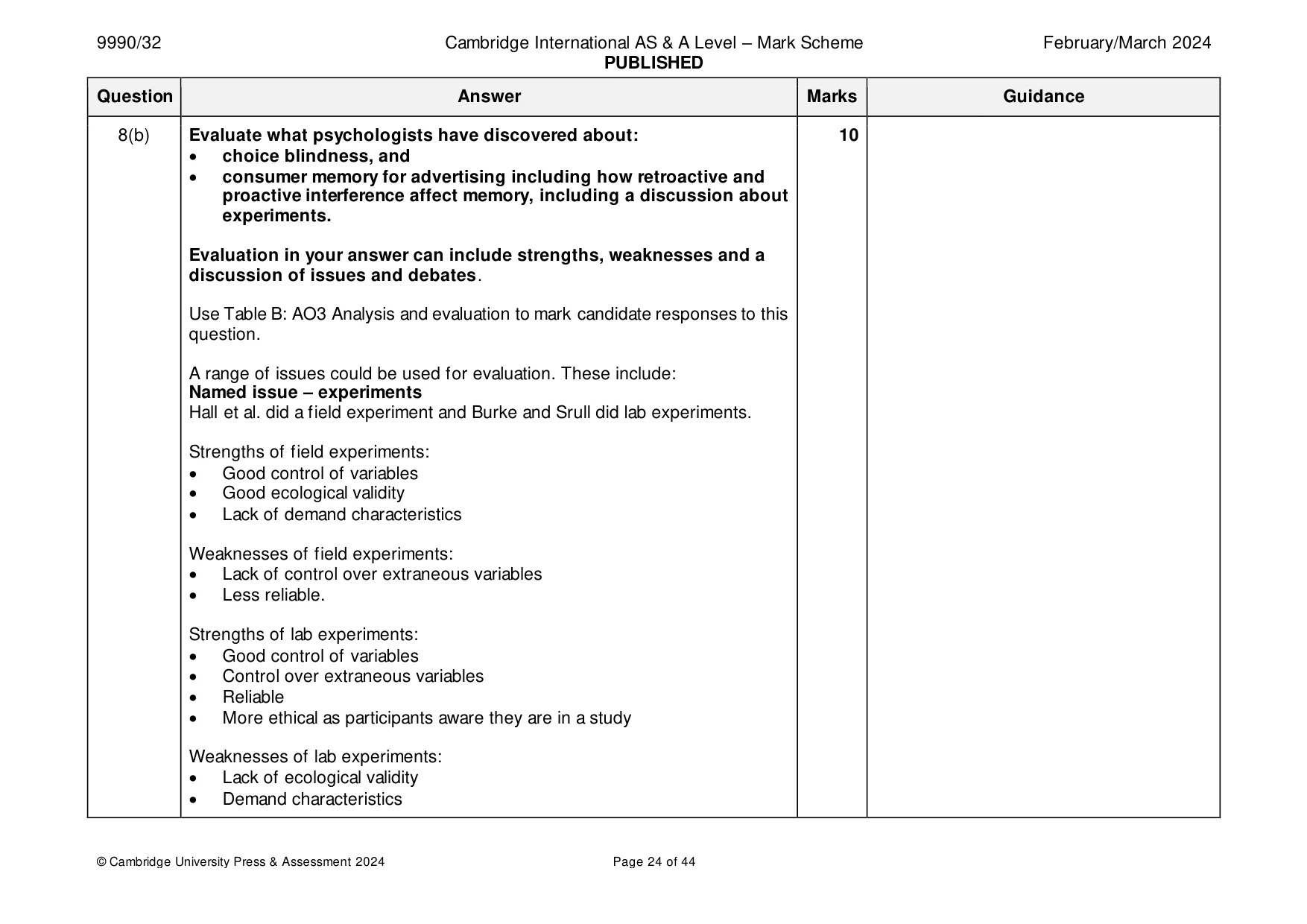
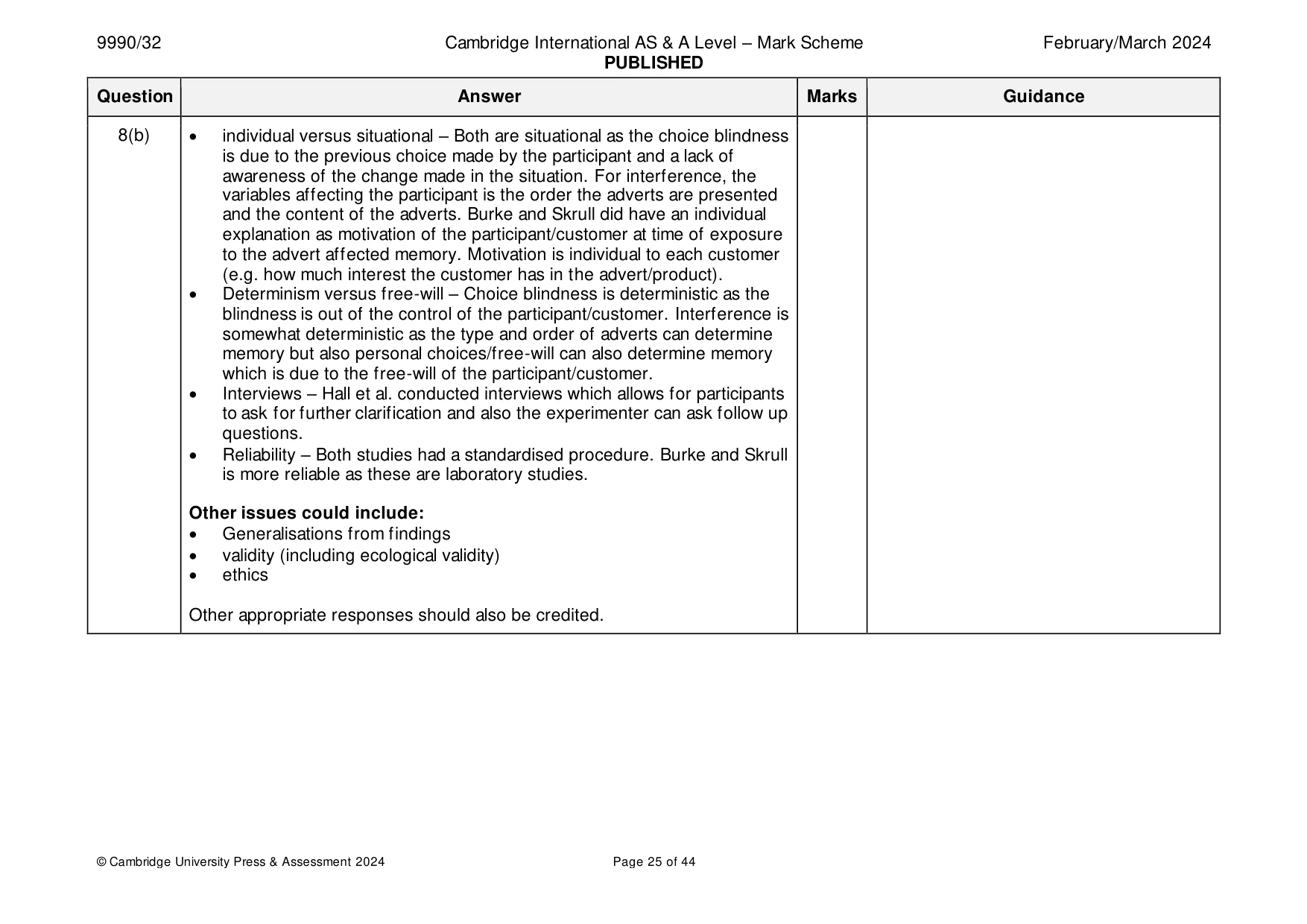
Mark scheme: 8(a) Describe what psychologists have discovered about: 6 Award up to 4 marks where the response • choice blindness, and has described only part of the question even • consumer memory for advertising including how retroactive and if the response otherwise meets the criteria proactive interference affect memory. for level 3. Use Table A: AO1 Knowledge and understanding to mark candidate responses Proactive – can’t recall the new, but can to this question. recall the old Retroactive – can’t recall the old, but can Candidates must discuss both choice blindness and consumer memory for recall the new advertising including retroactive/proactive interference, but they do not need to use the Burke and Srull example from the syllabus. Answers may include: Syllabus content • choice blindness, preferences and defending a choice. Key study for choice blindness when tasting food items: Hall et al. (2010). • consumer memory for advertising including how retroactive and proactive interference affect memory, including a study, e.g. Burke and Skrull (1988) Choice blindness Unconscious processes can influence consumer behaviour. Consumer decisions are made based on situational influences as well as past memories. Consumers can experience choice blindness where the customer is unaware of their preferences and choices. When asked, the customer will be able to give reasons for their choice. Hall et al., 2010 Took place in a supermarket in Sweden with 180 customers. Participants were asked to taste jam and tea to decide which they preferred out of a pair. Given jam/tea to taste (jam) or smell (tea) and rated how much they liked it on a 1–10 scale. Given second taste/smell and the jam/tea has been switched to a different flavour/scent while the participant is distracted by one of the experimenters. They then tasted/smelled the item and rated on 10 point scale. Then asked which alternative they preferred and asked to sample a second time. 8(a) Half of participants told they would receive tea/jam chosen as thank you gift. Results – 33% of manipulated jam trials were detected (32% of tea) Detected more frequently in the least similar pairs for jam eg Cinnamon Apple vs Grapefruit- but not tea compared with the most similar pairs. Those offered jam as free gift less likely to detect manipulation. Those offered tea as free gift or not – no difference in detection. Concluded there was considerable choice blindness. Consumer memory for advertising Consumers are presented with a huge volume of adverts, many of which are similar to each other leading to retroactive (new memories influence old) and proactive (old memories influence new) interference. Retroactive interference, for example, where a consumer sees a new advertisement may change the memory of an older one. They could remember the brand name for the old advert incorrectly as the brand name of the newer one. Burke and Srull, 1988 Experiment 1 – Participants exposed to 12 magazine adverts and asked how likely it is that they would purchase the particular brand of product. The results of Experiment 1 demonstrate that brand information learned in the past tends to get forgotten or confused under newly learned facts. Consequently, the participants had difficulty remembering the original material. Experiment 2 – Similar to procedure to experiment 1 but investigated proactive interference with adverts for similar products. The results of Experiment 2 demonstrate that advertising for competitive brands can have a detrimental effect, not just on consumer memory for a brand's past advertising, but also on the consumer's ability to learn and remember distinctive brand information presented in future advertising. However, the results of this study did not show such an interaction, possibly because of the short time interval between ad exposure and testing. 8(a) Experiment 3 – Participants exposed to 22 full-colour magazine adverts (rather than just text) and asked to rate the inherent value of the adverts. Results showed competitive advertising had a significant inhibitory effect on cued recall of brand information. Other appropriate responses should also be credited. 8(b) Evaluate what psychologists have discovered about: 10 • choice blindness, and • consumer memory for advertising including how retroactive and proactive interference affect memory, including a discussion about experiments. Evaluation in your answer can include strengths, weaknesses and a discussion of issues and debates. Use Table B: AO3 Analysis and evaluation to mark candidate responses to this question. A range of issues could be used for evaluation. These include: Named issue – experiments Hall et al. did a field experiment and Burke and Srull did lab experiments. Strengths of field experiments: • Good control of variables • Good ecological validity • Lack of demand characteristics Weaknesses of field experiments: • Lack of control over extraneous variables • Less reliable. Strengths of lab experiments: • Good control of variables • Control over extraneous variables • Reliable • More ethical as participants aware they are in a study Weaknesses of lab experiments: • Lack of ecological validity • Demand characteristics 8(b) • individual versus situational – Both are situational as the choice blindness is due to the previous choice made by the participant and a lack of awareness of the change made in the situation. For interference, the variables affecting the participant is the order the adverts are presented and the content of the adverts. Burke and Skrull did have an individual explanation as motivation of the participant/customer at time of exposure to the advert affected memory. Motivation is individual to each customer (e.g. how much interest the customer has in the advert/product). • Determinism versus free-will – Choice blindness is deterministic as the blindness is out of the control of the participant/customer. Interference is somewhat deterministic as the type and order of adverts can determine memory but also personal choices/free-will can also determine memory which is due to the free-will of the participant/customer. • Interviews – Hall et al. conducted interviews which allows for participants to ask for further clarification and also the experimenter can ask follow up questions. • Reliability – Both studies had a standardised procedure. Burke and Skrull is more reliable as these are laboratory studies. Other issues could include: • Generalisations from findings • validity (including ecological validity) • ethics Other appropriate responses should also be credited. Section C: Health Psychology
Q9 · People who experience chest pains sometimes delay seeking treatment from health services…
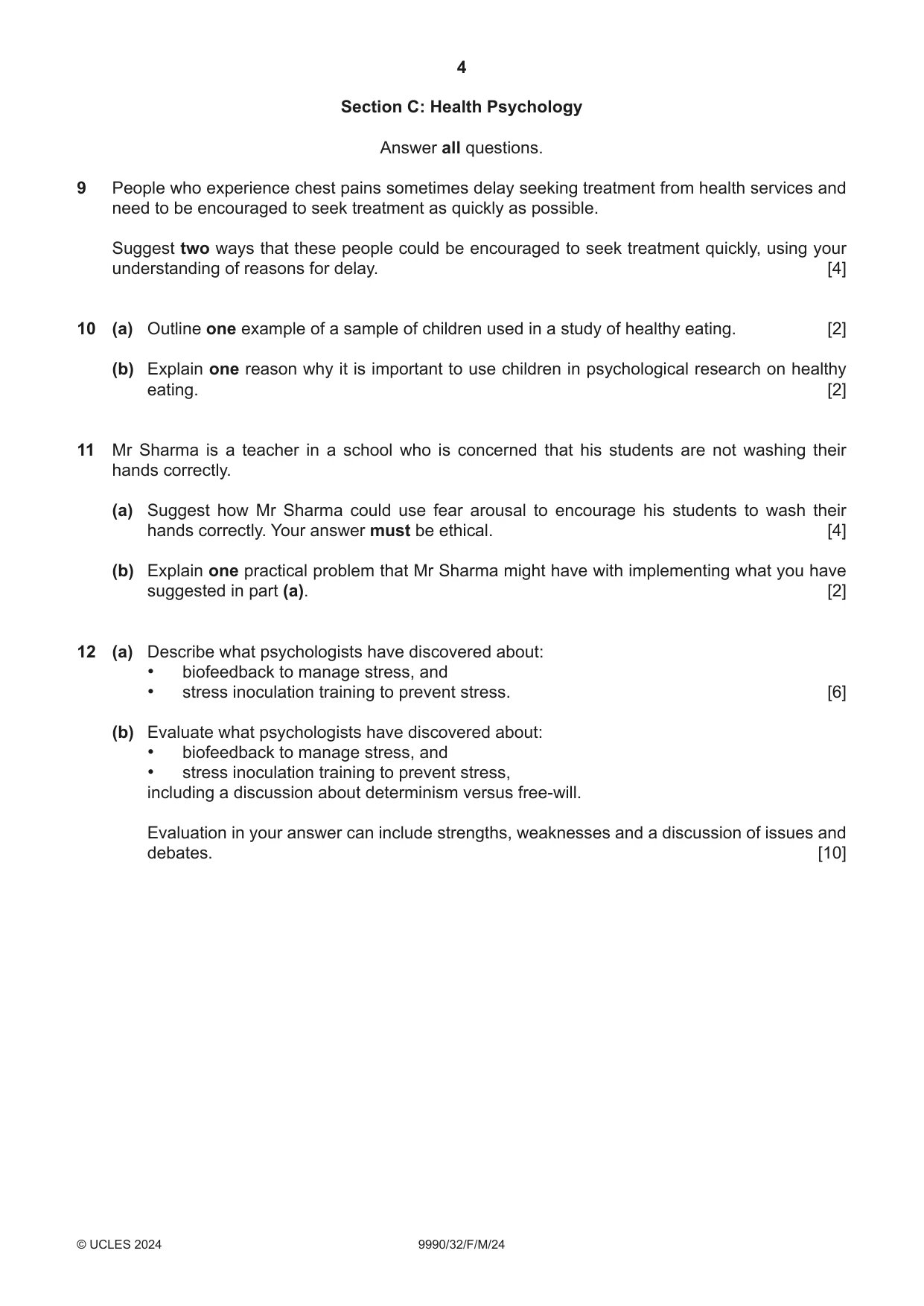
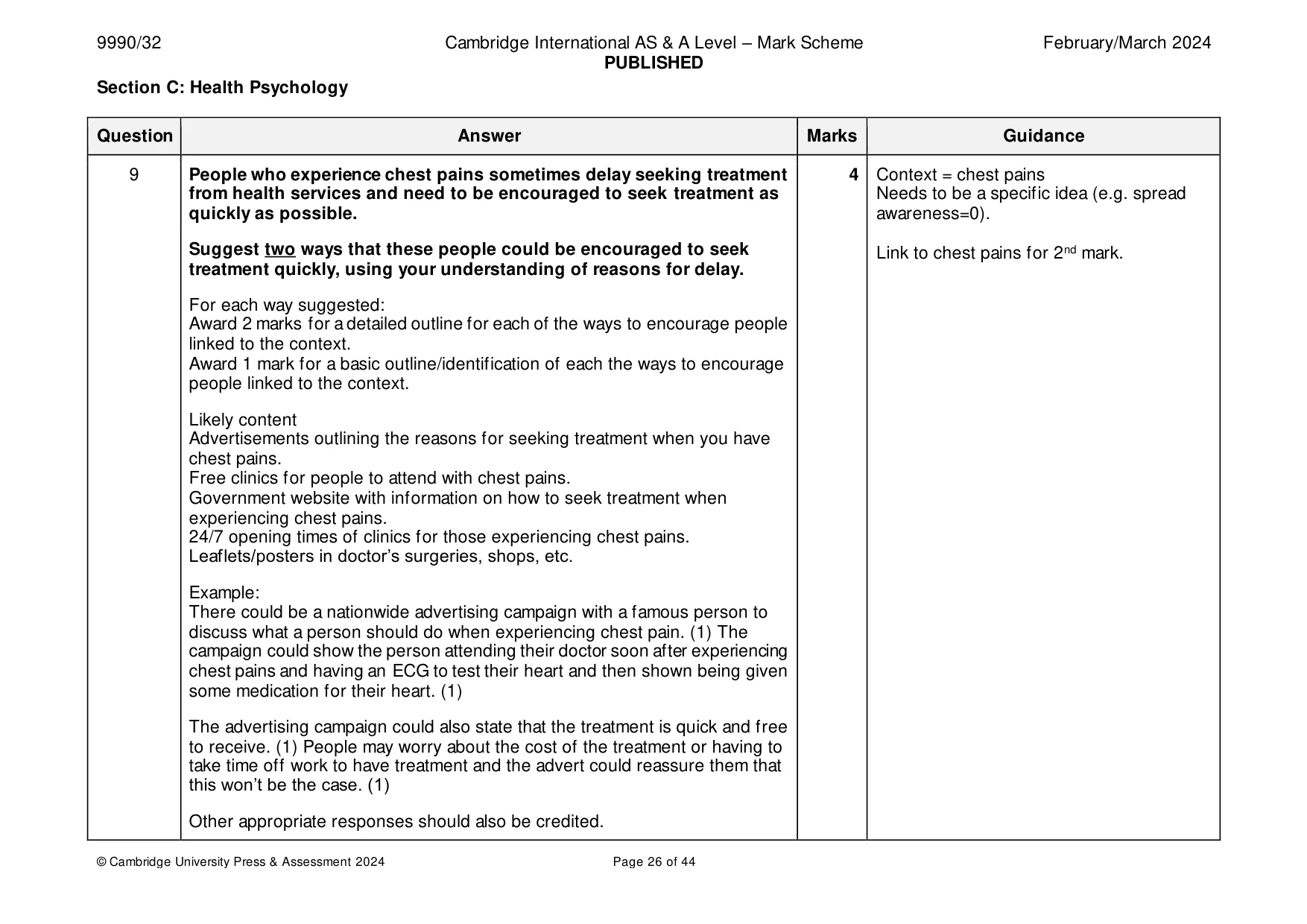
9 People who experience chest pains sometimes delay seeking treatment from health services and need to be encouraged to seek treatment as quickly as possible. Suggest two ways that these people could be encouraged to seek treatment quickly, using your understanding of reasons for delay. [4]
Mark scheme: 9 People who experience chest pains sometimes delay seeking treatment 4 Context = chest pains from health services and need to be encouraged to seek treatment as Needs to be a specific idea (e.g. spread quickly as possible. awareness=0). Suggest two ways that these people could be encouraged to seek Link to chest pains for 2nd mark. treatment quickly, using your understanding of reasons for delay. For each way suggested: Award 2 marks for a detailed outline for each of the ways to encourage people linked to the context. Award 1 mark for a basic outline/identification of each the ways to encourage people linked to the context. Likely content Advertisements outlining the reasons for seeking treatment when you have chest pains. Free clinics for people to attend with chest pains. Government website with information on how to seek treatment when experiencing chest pains. 24/7 opening times of clinics for those experiencing chest pains. Leaflets/posters in doctor’s surgeries, shops, etc. Example: There could be a nationwide advertising campaign with a famous person to discuss what a person should do when experiencing chest pain. (1) The campaign could show the person attending their doctor soon after experiencing chest pains and having an ECG to test their heart and then shown being given some medication for their heart. (1) The advertising campaign could also state that the treatment is quick and free to receive. (1) People may worry about the cost of the treatment or having to take time off work to have treatment and the advert could reassure them that this won’t be the case. (1) Other appropriate responses should also be credited.
Q10 · Outline one example of a sample of children used in a study of healthy eating
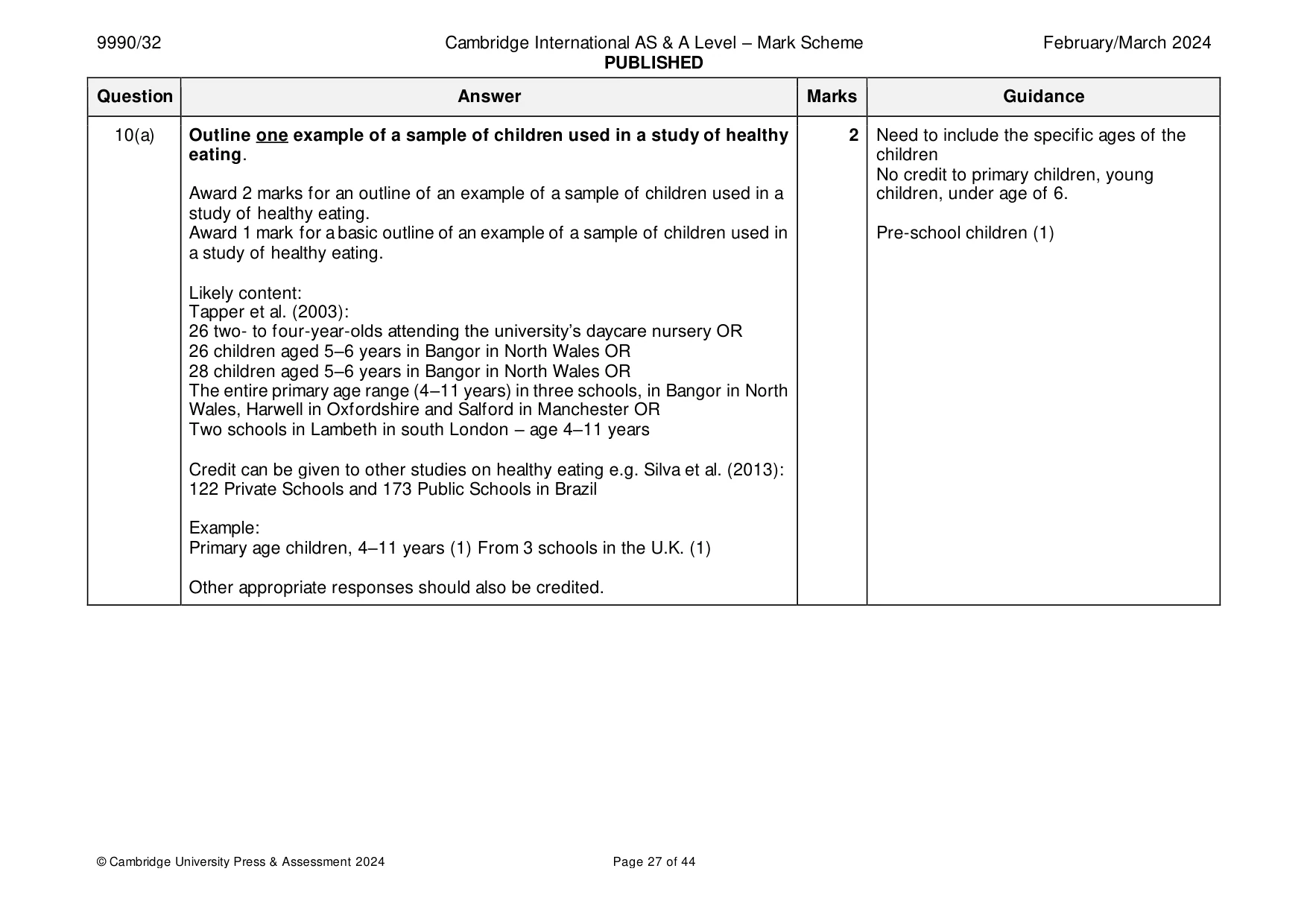
10 (a) Outline one example of a sample of children used in a study of healthy eating. [2] (b) Explain one reason why it is important to use children in psychological research on healthy eating. [2]
Mark scheme: 10(a) Outline one example of a sample of children used in a study of healthy 2 Need to include the specific ages of the eating. children No credit to primary children, young Award 2 marks for an outline of an example of a sample of children used in a children, under age of 6. study of healthy eating. Award 1 mark for a basic outline of an example of a sample of children used in Pre-school children (1) a study of healthy eating. Likely content: Tapper et al. (2003): 26 two- to four-year-olds attending the university’s daycare nursery OR 26 children aged 5–6 years in Bangor in North Wales OR 28 children aged 5–6 years in Bangor in North Wales OR The entire primary age range (4–11 years) in three schools, in Bangor in North Wales, Harwell in Oxfordshire and Salford in Manchester OR Two schools in Lambeth in south London – age 4–11 years Credit can be given to other studies on healthy eating e.g. Silva et al. (2013): 122 Private Schools and 173 Public Schools in Brazil Example: Primary age children, 4–11 years (1) From 3 schools in the U.K. (1) Other appropriate responses should also be credited. 10(b) Explain one reason why it is important to use children in psychological 2 Context = healthy eating research on healthy eating. Award 2 marks for an outline of importance of using children in psychological research on healthy eating Award 1 mark for a basic outline of importance of using children in psychological research on healthy eating OR Award 1 mark for an outline of importance of using children in psychological research with no reference to healthy eating Likely content: • Children are less influenced by demand characteristics as they may be unaware they are in a study (or lack the understanding of what this means). • Can investigate the effects of implementing a healthy eating strategy on children and follow them up when they are older to see if this has had an impact on their eating patterns in later life. • Healthy eating strategy can be implemented in a school environment where all of the children attend and can be introduced in a similar way by the teachers at the school. Example: It is important to use children in psychological research on healthy eating so that psychologists can investigate the impact of a strategy for healthy eating implemented in schools when children are young in the long term. (1) The children can be followed-up as adults to see if the healthy eating strategy is still having an impact. (1) Other appropriate responses should also be credited.
More questions on 2 Health promotion in schools and worksites
Q11 · Mr Sharma is a teacher in a school who is concerned that his students are not washing…
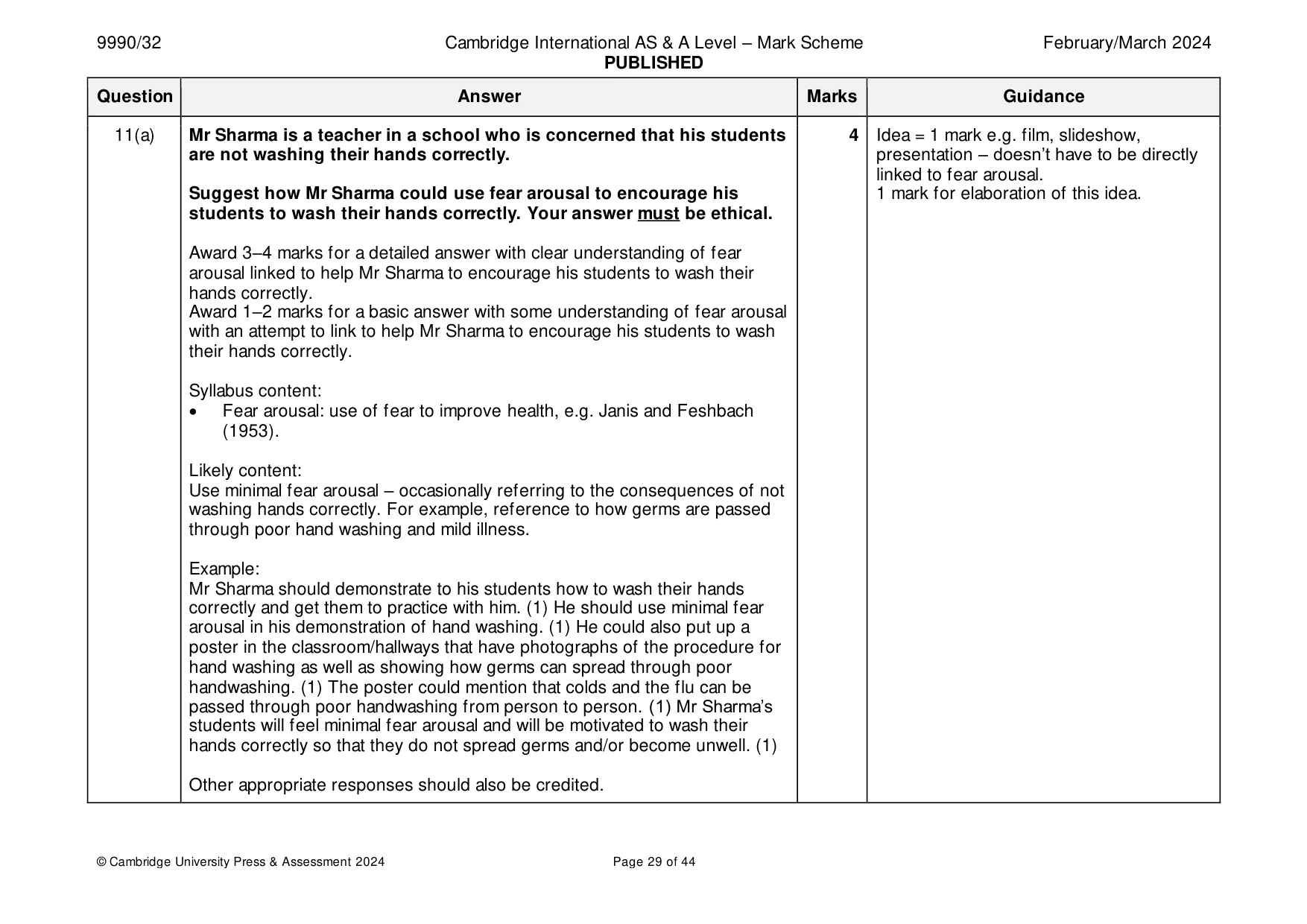
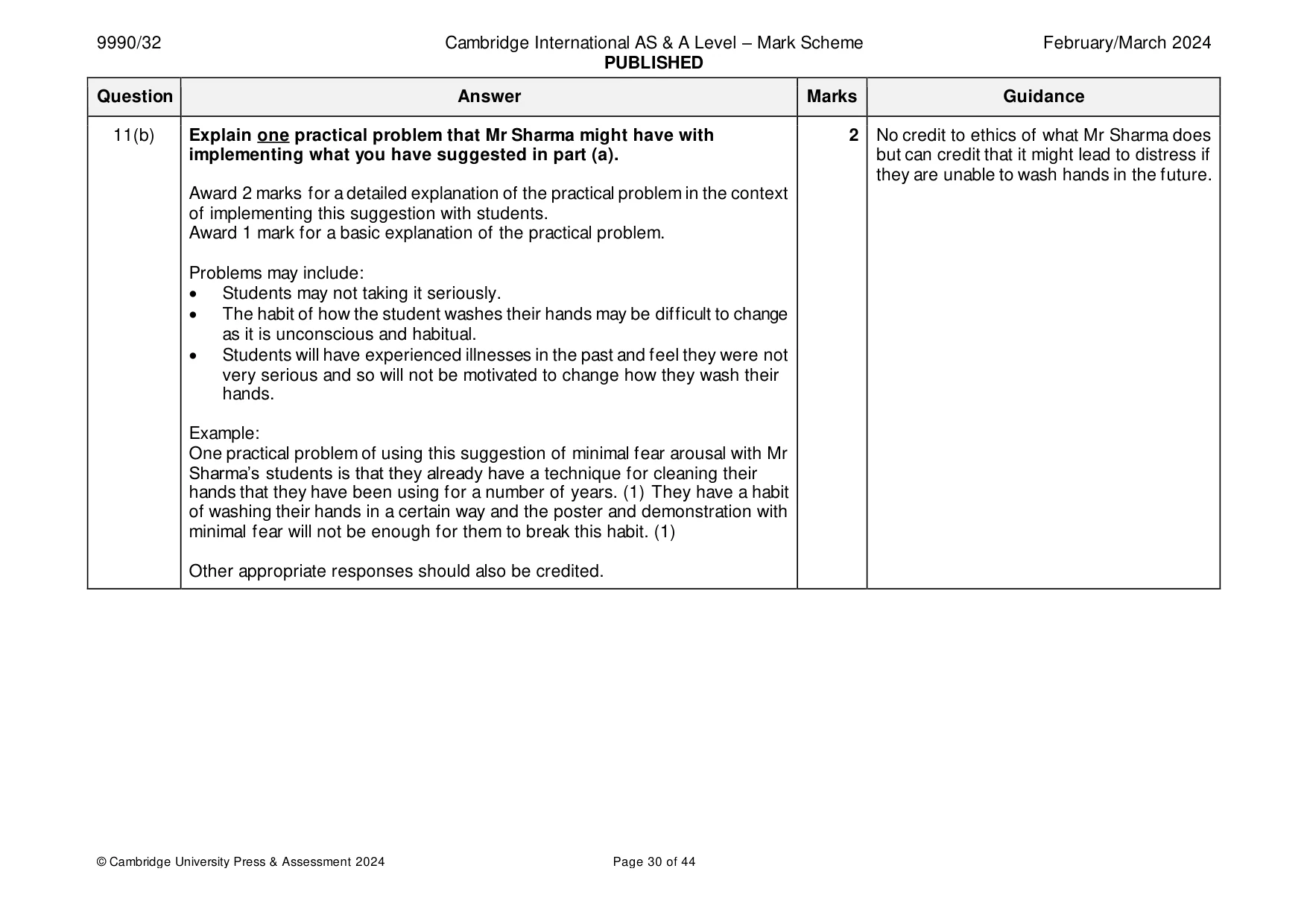
11 Mr Sharma is a teacher in a school who is concerned that his students are not washing their hands correctly. (a) Suggest how Mr Sharma could use fear arousal to encourage his students to wash their hands correctly. Your answer must be ethical. [4] (b) Explain one practical problem that Mr Sharma might have with implementing what you have suggested in part (a). [2]
Mark scheme: 11(a) Mr Sharma is a teacher in a school who is concerned that his students 4 Idea = 1 mark e.g. film, slideshow, are not washing their hands correctly. presentation – doesn’t have to be directly linked to fear arousal. Suggest how Mr Sharma could use fear arousal to encourage his 1 mark for elaboration of this idea. students to wash their hands correctly. Your answer must be ethical. Award 3–4 marks for a detailed answer with clear understanding of fear arousal linked to help Mr Sharma to encourage his students to wash their hands correctly. Award 1–2 marks for a basic answer with some understanding of fear arousal with an attempt to link to help Mr Sharma to encourage his students to wash their hands correctly. Syllabus content: • Fear arousal: use of fear to improve health, e.g. Janis and Feshbach (1953). Likely content: Use minimal fear arousal – occasionally referring to the consequences of not washing hands correctly. For example, reference to how germs are passed through poor hand washing and mild illness. Example: Mr Sharma should demonstrate to his students how to wash their hands correctly and get them to practice with him. (1) He should use minimal fear arousal in his demonstration of hand washing. (1) He could also put up a poster in the classroom/hallways that have photographs of the procedure for hand washing as well as showing how germs can spread through poor handwashing. (1) The poster could mention that colds and the flu can be passed through poor handwashing from person to person. (1) Mr Sharma’s students will feel minimal fear arousal and will be motivated to wash their hands correctly so that they do not spread germs and/or become unwell. (1) Other appropriate responses should also be credited. 11(b) Explain one practical problem that Mr Sharma might have with 2 No credit to ethics of what Mr Sharma does implementing what you have suggested in part (a). but can credit that it might lead to distress if they are unable to wash hands in the future. Award 2 marks for a detailed explanation of the practical problem in the context of implementing this suggestion with students. Award 1 mark for a basic explanation of the practical problem. Problems may include: • Students may not taking it seriously. • The habit of how the student washes their hands may be difficult to change as it is unconscious and habitual. • Students will have experienced illnesses in the past and feel they were not very serious and so will not be motivated to change how they wash their hands. Example: One practical problem of using this suggestion of minimal fear arousal with Mr Sharma’s students is that they already have a technique for cleaning their hands that they have been using for a number of years. (1) They have a habit of washing their hands in a certain way and the poster and demonstration with minimal fear will not be enough for them to break this habit. (1) Other appropriate responses should also be credited.
More questions on 2 Health promotion in schools and worksites
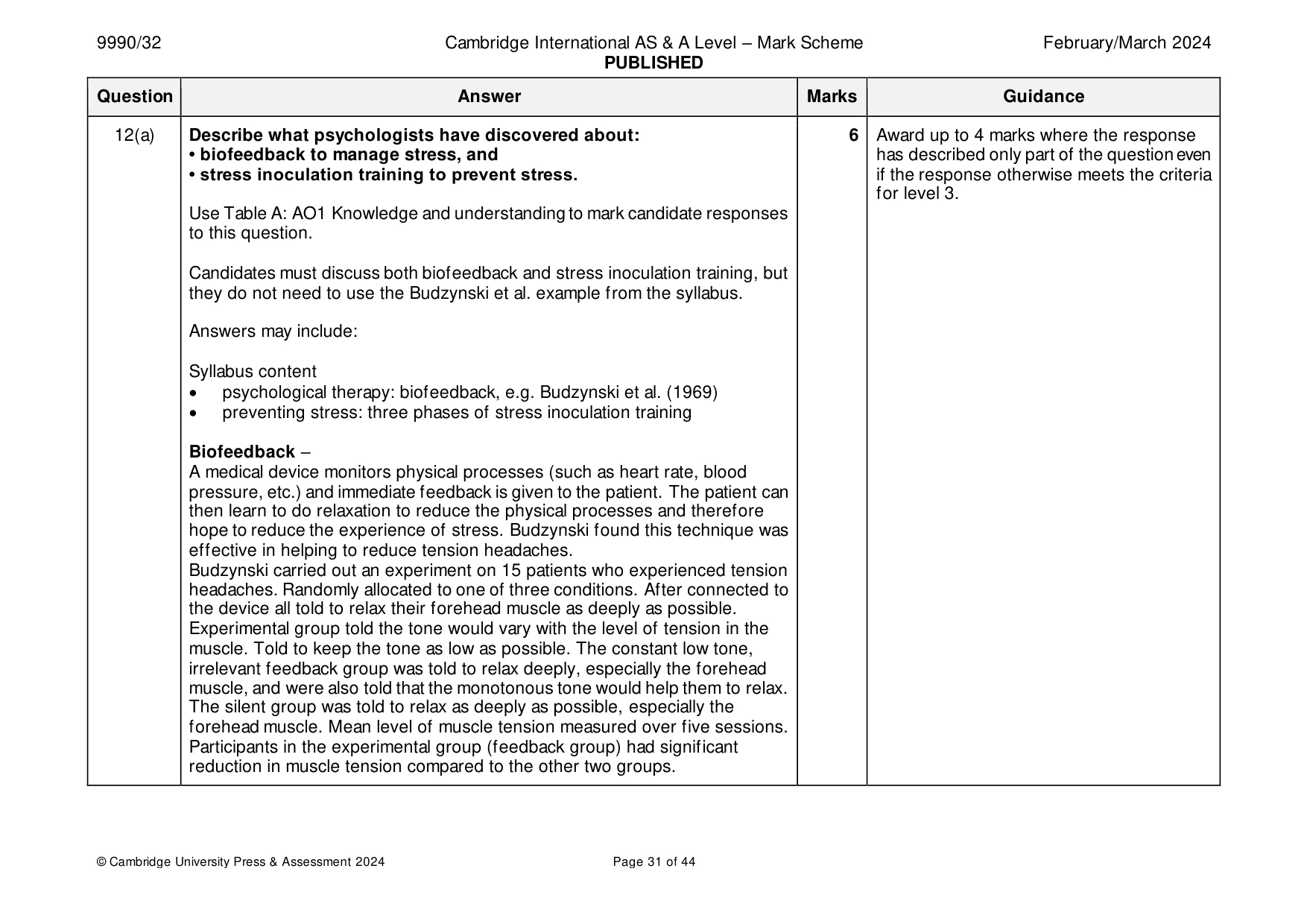
Q12 · Describe what psychologists have discovered about: • biofeedback to manage stress, and •…
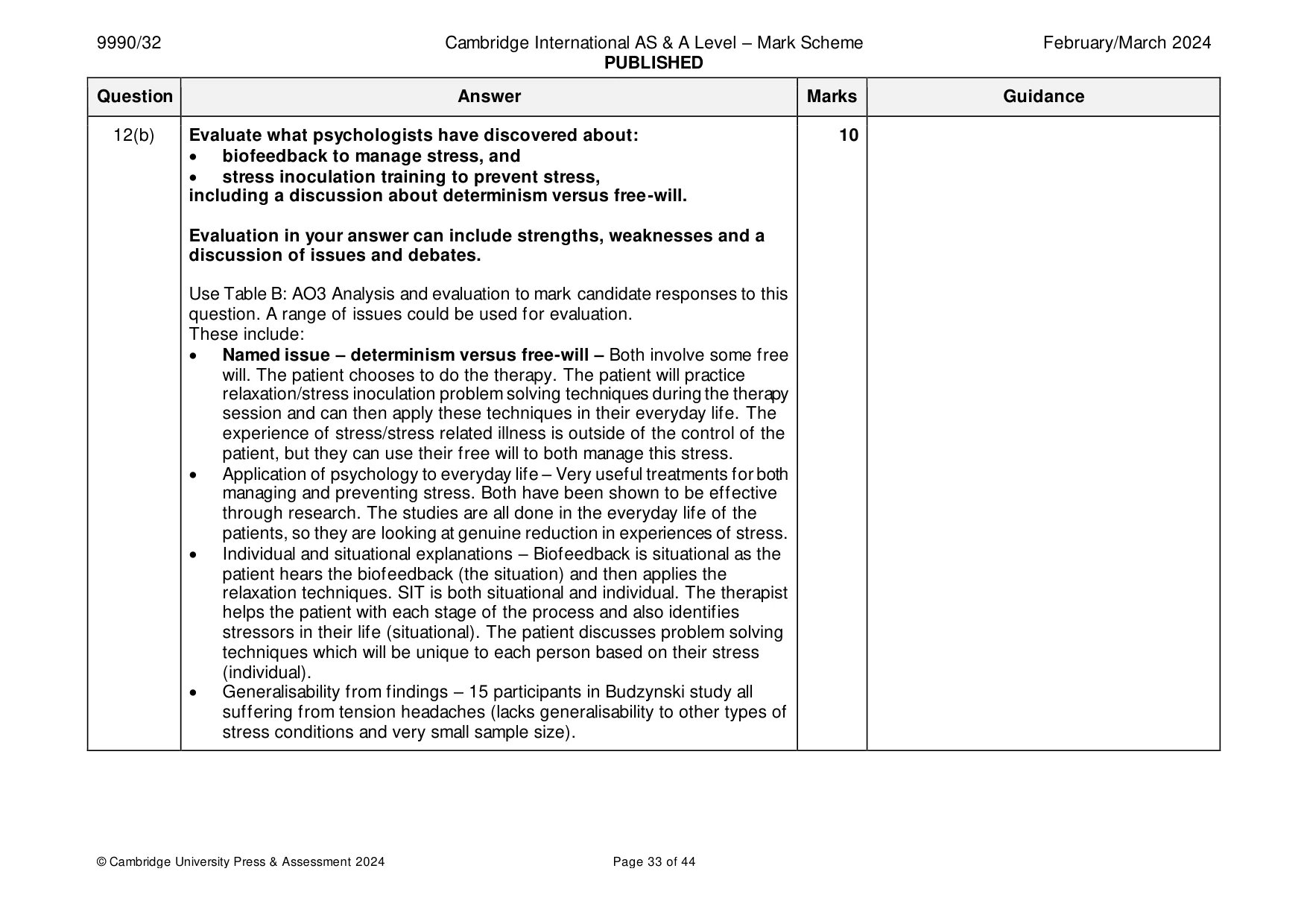
12 (a) Describe what psychologists have discovered about: • biofeedback to manage stress, and • stress inoculation training to prevent stress. [6] (b) Evaluate what psychologists have discovered about: • biofeedback to manage stress, and • stress inoculation training to prevent stress, including a discussion about determinism versus free-will. Evaluation in your answer can include strengths, weaknesses and a discussion of issues and debates. [10] Section D: Organisational Psychology Answer all questions.
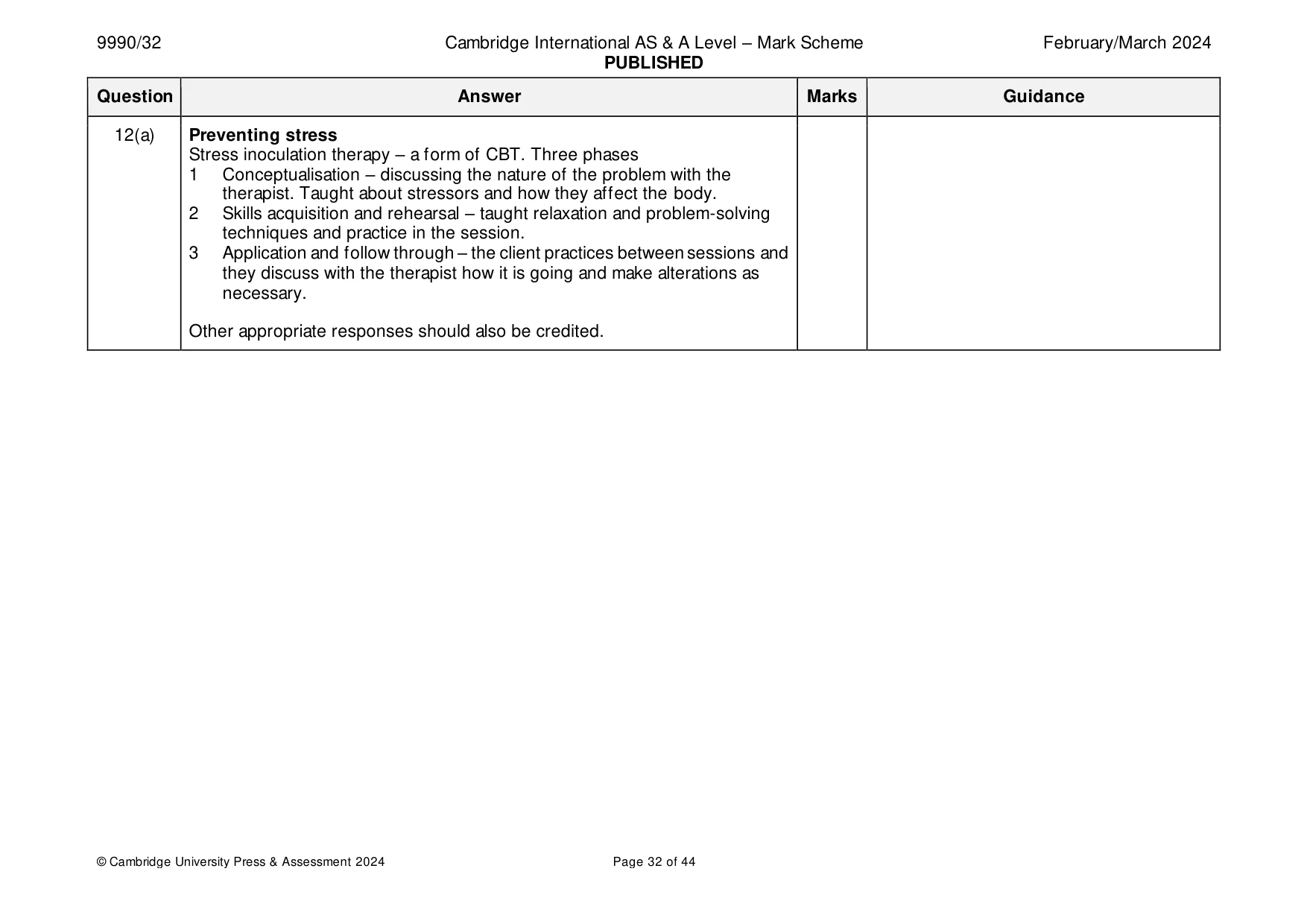
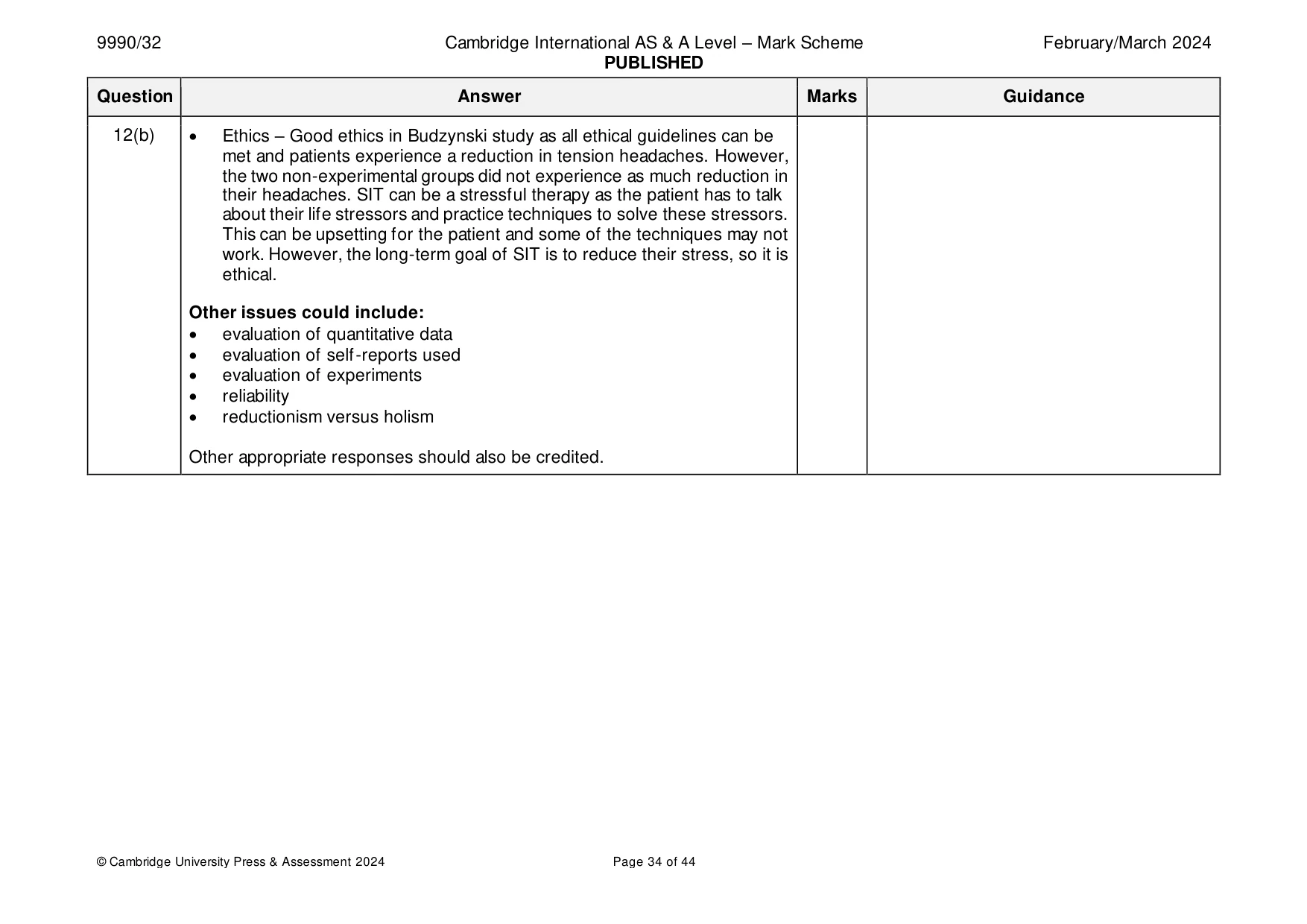
Mark scheme: 12(a) Describe what psychologists have discovered about: 6 Award up to 4 marks where the response • biofeedback to manage stress, and has described only part of the question even • stress inoculation training to prevent stress. if the response otherwise meets the criteria for level 3. Use Table A: AO1 Knowledge and understanding to mark candidate responses to this question. Candidates must discuss both biofeedback and stress inoculation training, but they do not need to use the Budzynski et al. example from the syllabus. Answers may include: Syllabus content • psychological therapy: biofeedback, e.g. Budzynski et al. (1969) • preventing stress: three phases of stress inoculation training Biofeedback – A medical device monitors physical processes (such as heart rate, blood pressure, etc.) and immediate feedback is given to the patient. The patient can then learn to do relaxation to reduce the physical processes and therefore hope to reduce the experience of stress. Budzynski found this technique was effective in helping to reduce tension headaches. Budzynski carried out an experiment on 15 patients who experienced tension headaches. Randomly allocated to one of three conditions. After connected to the device all told to relax their forehead muscle as deeply as possible. Experimental group told the tone would vary with the level of tension in the muscle. Told to keep the tone as low as possible. The constant low tone, irrelevant feedback group was told to relax deeply, especially the forehead muscle, and were also told that the monotonous tone would help them to relax. The silent group was told to relax as deeply as possible, especially the forehead muscle. Mean level of muscle tension measured over five sessions. Participants in the experimental group (feedback group) had significant reduction in muscle tension compared to the other two groups. 12(a) Preventing stress Stress inoculation therapy – a form of CBT. Three phases 1 Conceptualisation – discussing the nature of the problem with the therapist. Taught about stressors and how they affect the body. 2 Skills acquisition and rehearsal – taught relaxation and problem-solving techniques and practice in the session. 3 Application and follow through – the client practices between sessions and they discuss with the therapist how it is going and make alterations as necessary. Other appropriate responses should also be credited. 12(b) Evaluate what psychologists have discovered about: 10 • biofeedback to manage stress, and • stress inoculation training to prevent stress, including a discussion about determinism versus free-will. Evaluation in your answer can include strengths, weaknesses and a discussion of issues and debates. Use Table B: AO3 Analysis and evaluation to mark candidate responses to this question. A range of issues could be used for evaluation. These include: • Named issue – determinism versus free-will – Both involve some free will. The patient chooses to do the therapy. The patient will practice relaxation/stress inoculation problem solving techniques during the therapy session and can then apply these techniques in their everyday life. The experience of stress/stress related illness is outside of the control of the patient, but they can use their free will to both manage this stress. • Application of psychology to everyday life – Very useful treatments for both managing and preventing stress. Both have been shown to be effective through research. The studies are all done in the everyday life of the patients, so they are looking at genuine reduction in experiences of stress. • Individual and situational explanations – Biofeedback is situational as the patient hears the biofeedback (the situation) and then applies the relaxation techniques. SIT is both situational and individual. The therapist helps the patient with each stage of the process and also identifies stressors in their life (situational). The patient discusses problem solving techniques which will be unique to each person based on their stress (individual). • Generalisability from findings – 15 participants in Budzynski study all suffering from tension headaches (lacks generalisability to other types of stress conditions and very small sample size). 12(b) • Ethics – Good ethics in Budzynski study as all ethical guidelines can be met and patients experience a reduction in tension headaches. However, the two non-experimental groups did not experience as much reduction in their headaches. SIT can be a stressful therapy as the patient has to talk about their life stressors and practice techniques to solve these stressors. This can be upsetting for the patient and some of the techniques may not work. However, the long-term goal of SIT is to reduce their stress, so it is ethical. Other issues could include: • evaluation of quantitative data • evaluation of self-reports used • evaluation of experiments • reliability • reductionism versus holism Other appropriate responses should also be credited. Section D: Organisational Psychology
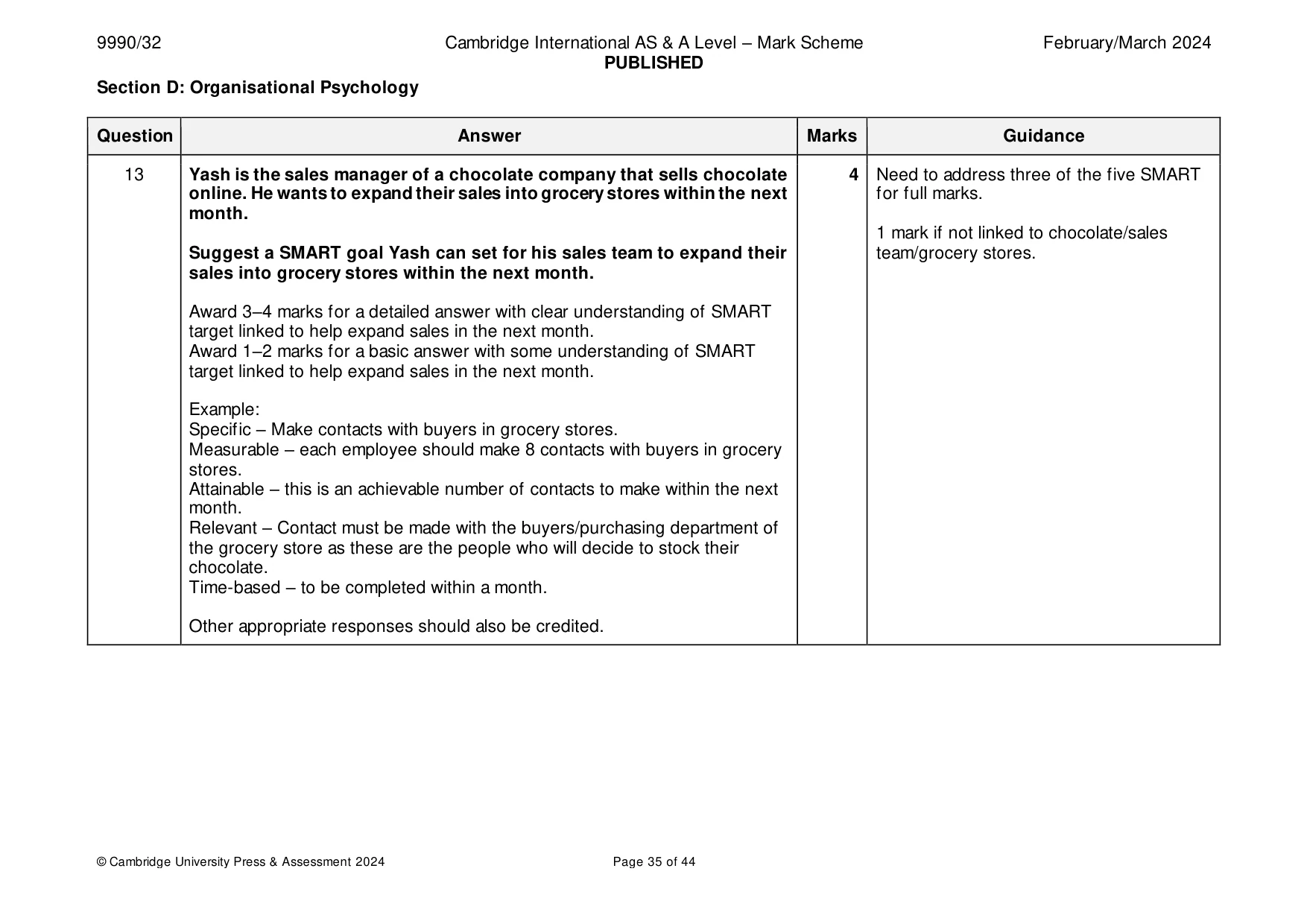
Q13 · Yash is the sales manager of a chocolate company that sells chocolate online
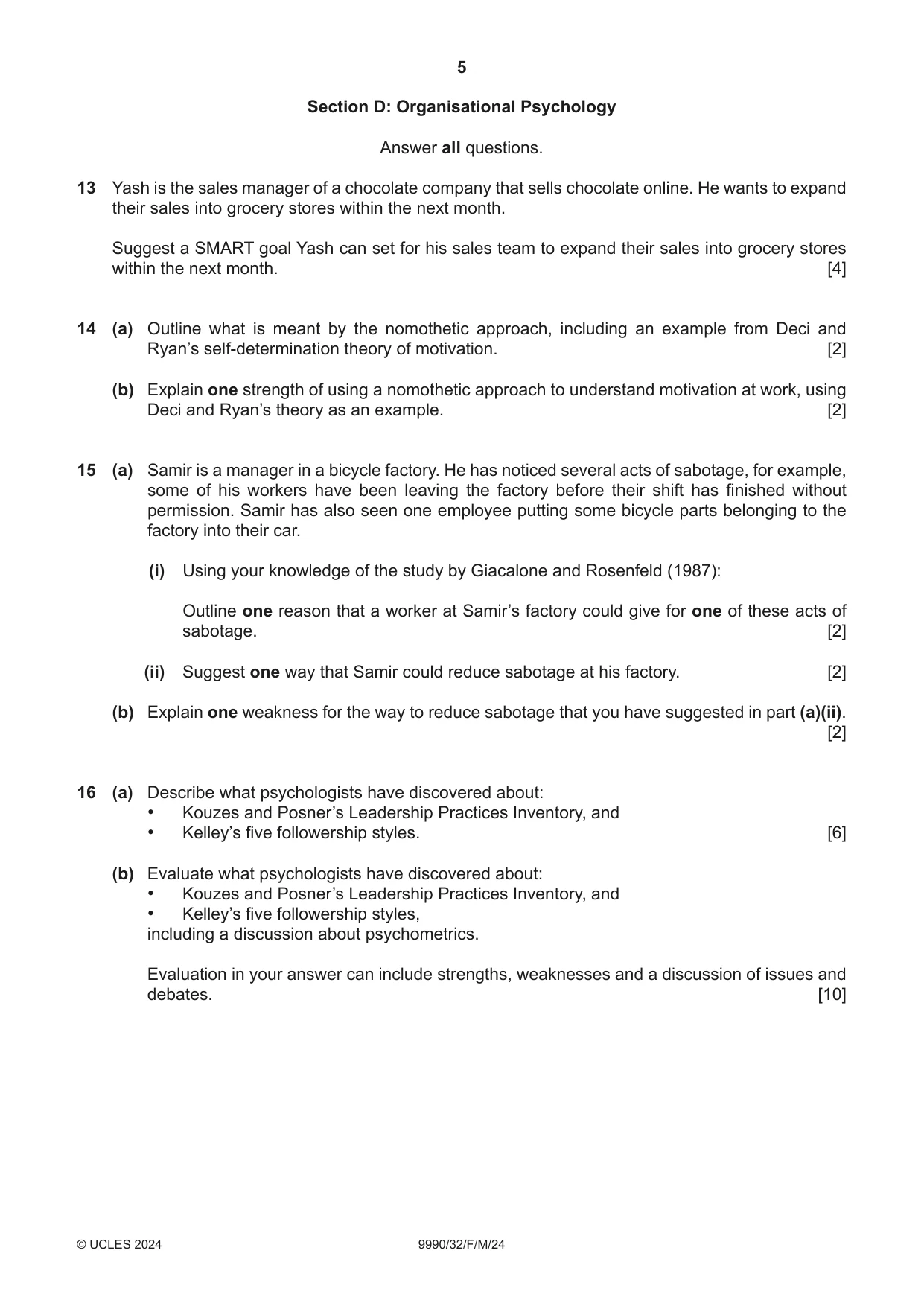
13 Yash is the sales manager of a chocolate company that sells chocolate online. He wants to expand their sales into grocery stores within the next month. Suggest a SMART goal Yash can set for his sales team to expand their sales into grocery stores within the next month. [4]
Mark scheme: 13 Yash is the sales manager of a chocolate company that sells chocolate 4 Need to address three of the five SMART online. He wants to expand their sales into grocery stores within the next for full marks. month. 1 mark if not linked to chocolate/sales Suggest a SMART goal Yash can set for his sales team to expand their team/grocery stores. sales into grocery stores within the next month. Award 3–4 marks for a detailed answer with clear understanding of SMART target linked to help expand sales in the next month. Award 1–2 marks for a basic answer with some understanding of SMART target linked to help expand sales in the next month. Example: Specific – Make contacts with buyers in grocery stores. Measurable – each employee should make 8 contacts with buyers in grocery stores. Attainable – this is an achievable number of contacts to make within the next month. Relevant – Contact must be made with the buyers/purchasing department of the grocery store as these are the people who will decide to stock their chocolate. Time-based – to be completed within a month. Other appropriate responses should also be credited.
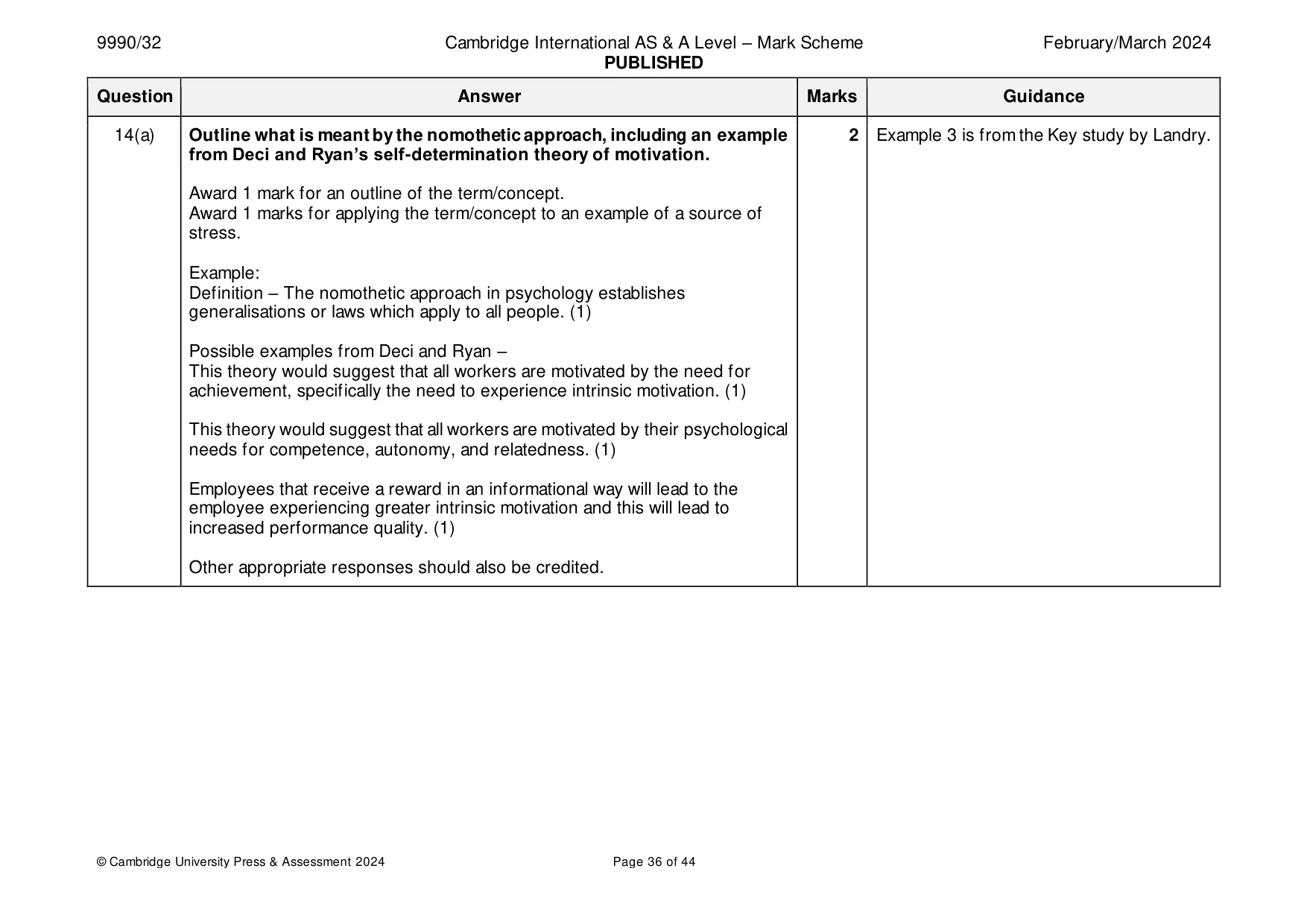
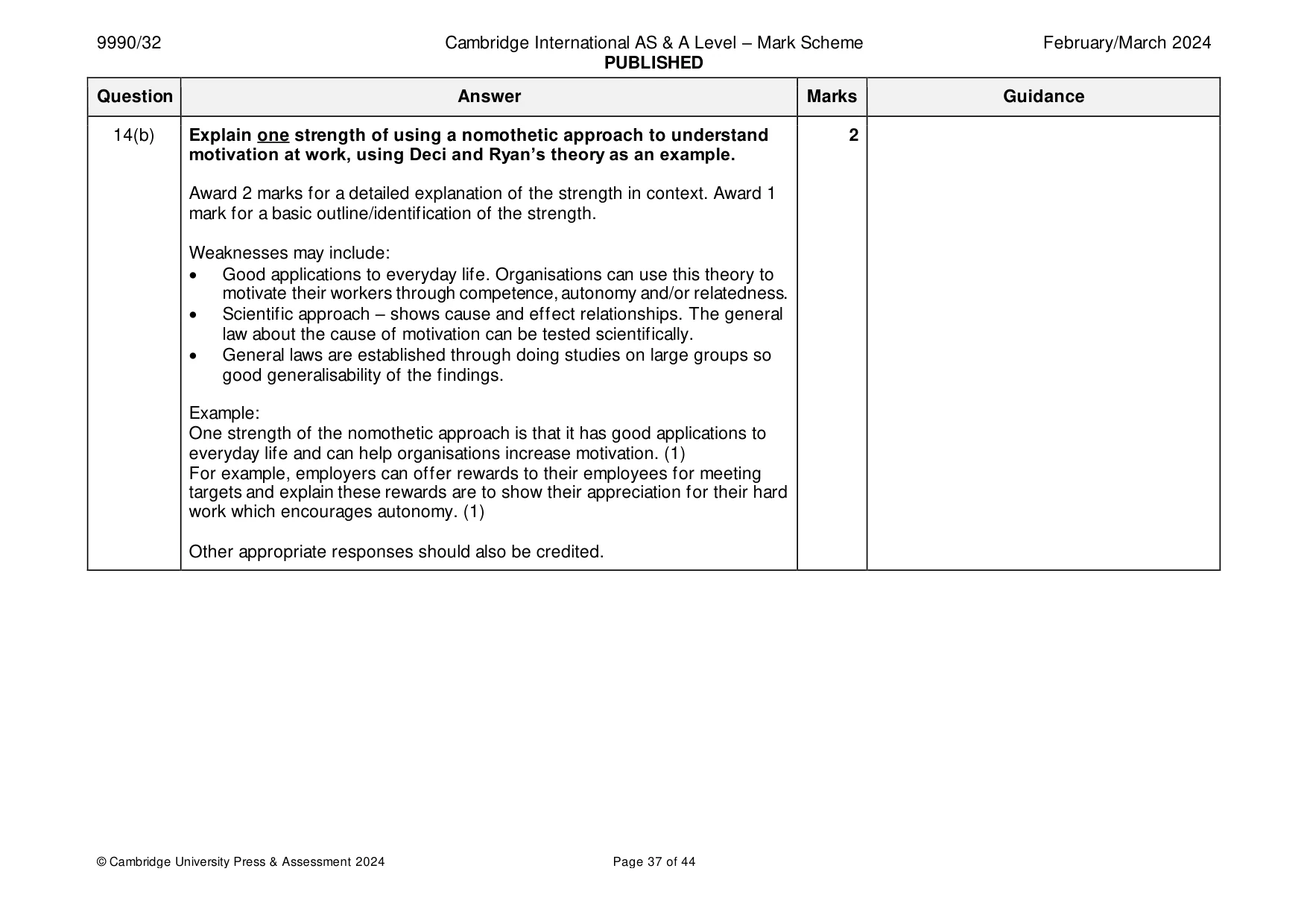
Q14 · Outline what is meant by the nomothetic approach, including an example from Deci and…
14 (a) Outline what is meant by the nomothetic approach, including an example from Deci and Ryan’s self-determination theory of motivation. [2] (b) Explain one strength of using a nomothetic approach to understand motivation at work, using Deci and Ryan’s theory as an example. [2]
Mark scheme: 14(a) Outline what is meant by the nomothetic approach, including an example 2 Example 3 is from the Key study by Landry. from Deci and Ryan’s self-determination theory of motivation. Award 1 mark for an outline of the term/concept. Award 1 marks for applying the term/concept to an example of a source of stress. Example: Definition – The nomothetic approach in psychology establishes generalisations or laws which apply to all people. (1) Possible examples from Deci and Ryan – This theory would suggest that all workers are motivated by the need for achievement, specifically the need to experience intrinsic motivation. (1) This theory would suggest that all workers are motivated by their psychological needs for competence, autonomy, and relatedness. (1) Employees that receive a reward in an informational way will lead to the employee experiencing greater intrinsic motivation and this will lead to increased performance quality. (1) Other appropriate responses should also be credited. 14(b) Explain one strength of using a nomothetic approach to understand 2 motivation at work, using Deci and Ryan’s theory as an example. Award 2 marks for a detailed explanation of the strength in context. Award 1 mark for a basic outline/identification of the strength. Weaknesses may include: • Good applications to everyday life. Organisations can use this theory to motivate their workers through competence, autonomy and/or relatedness. • Scientific approach – shows cause and effect relationships. The general law about the cause of motivation can be tested scientifically. • General laws are established through doing studies on large groups so good generalisability of the findings. Example: One strength of the nomothetic approach is that it has good applications to everyday life and can help organisations increase motivation. (1) For example, employers can offer rewards to their employees for meeting targets and explain these rewards are to show their appreciation for their hard work which encourages autonomy. (1) Other appropriate responses should also be credited.
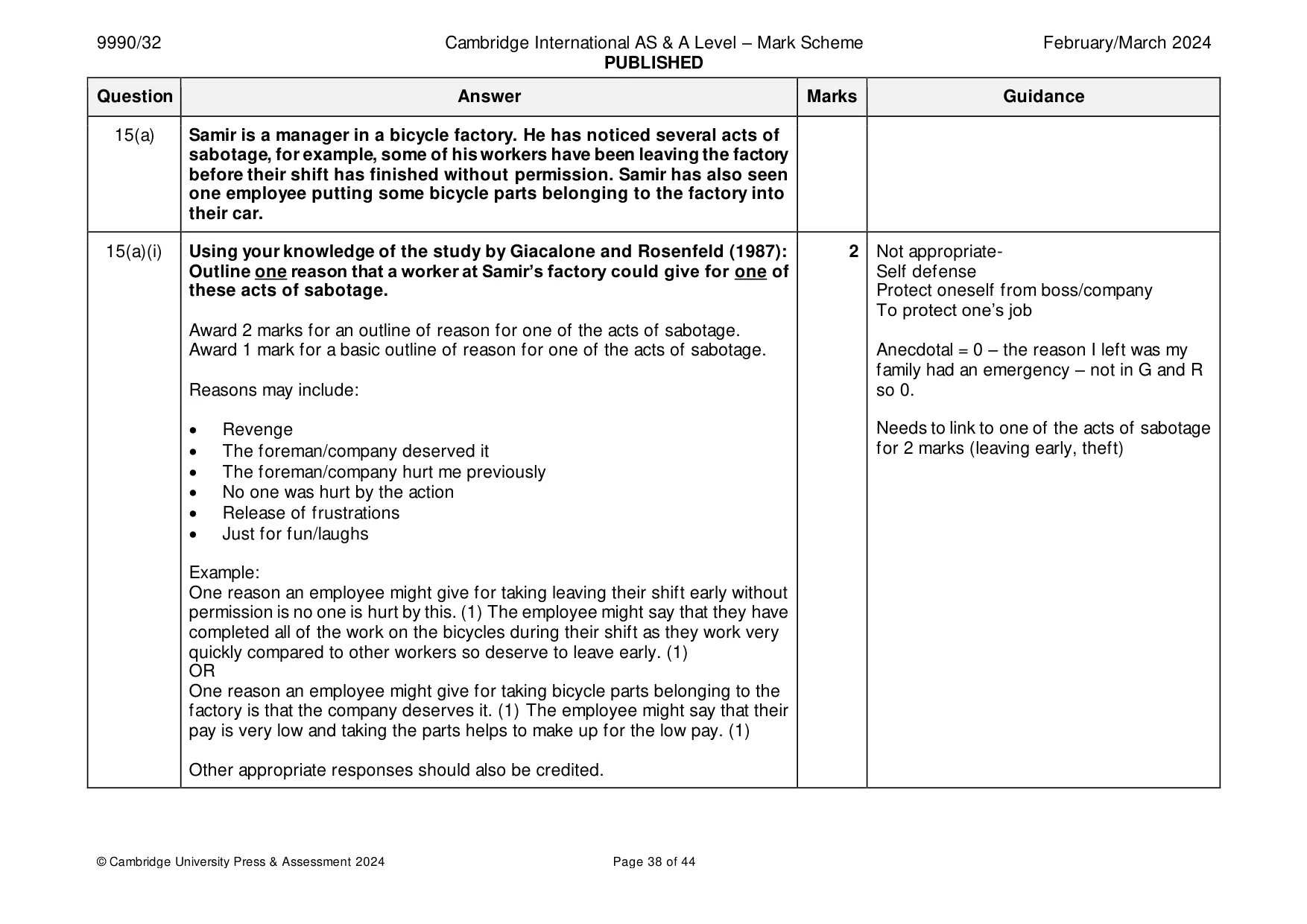
Q15 · Samir is a manager in a bicycle factory
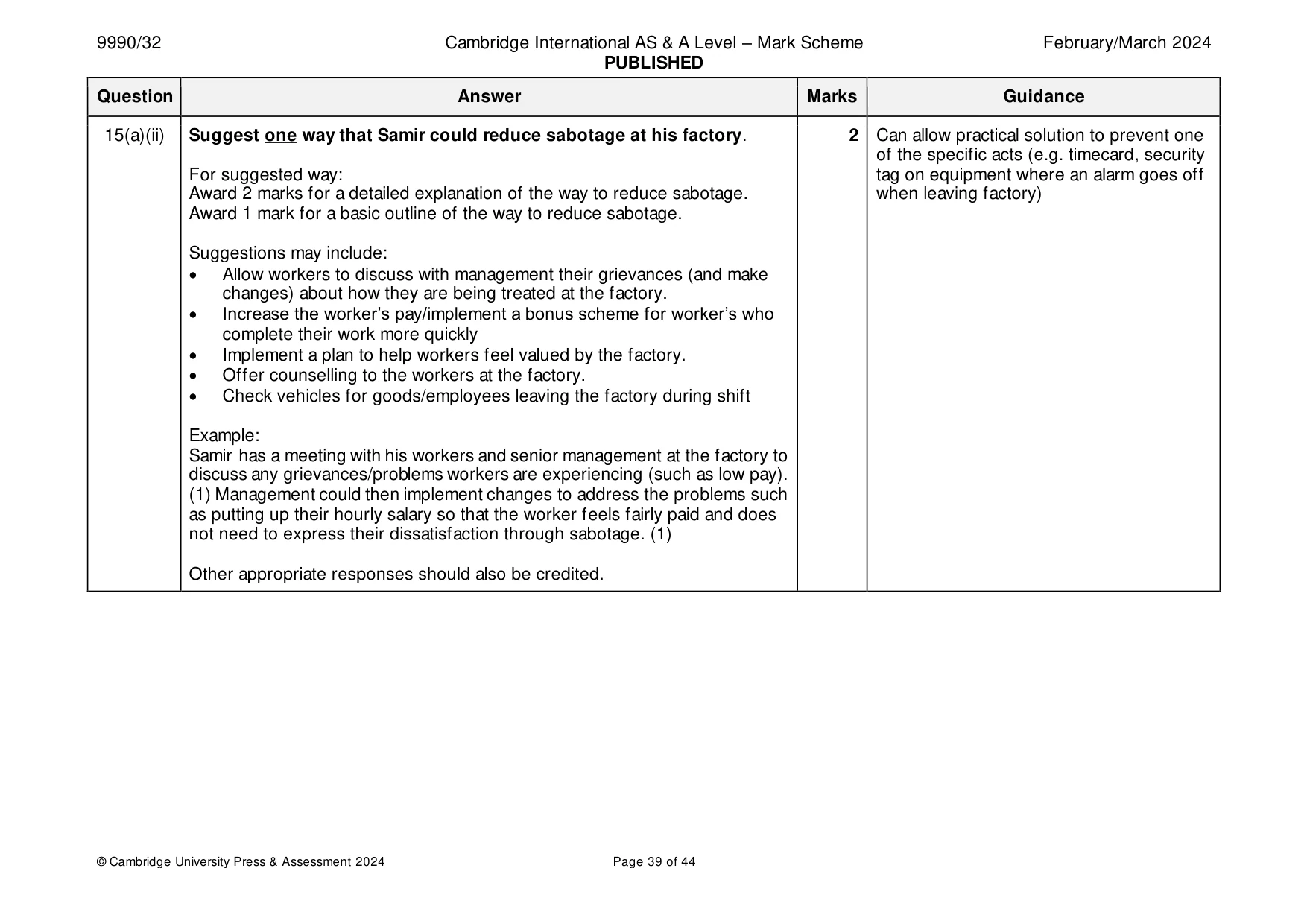
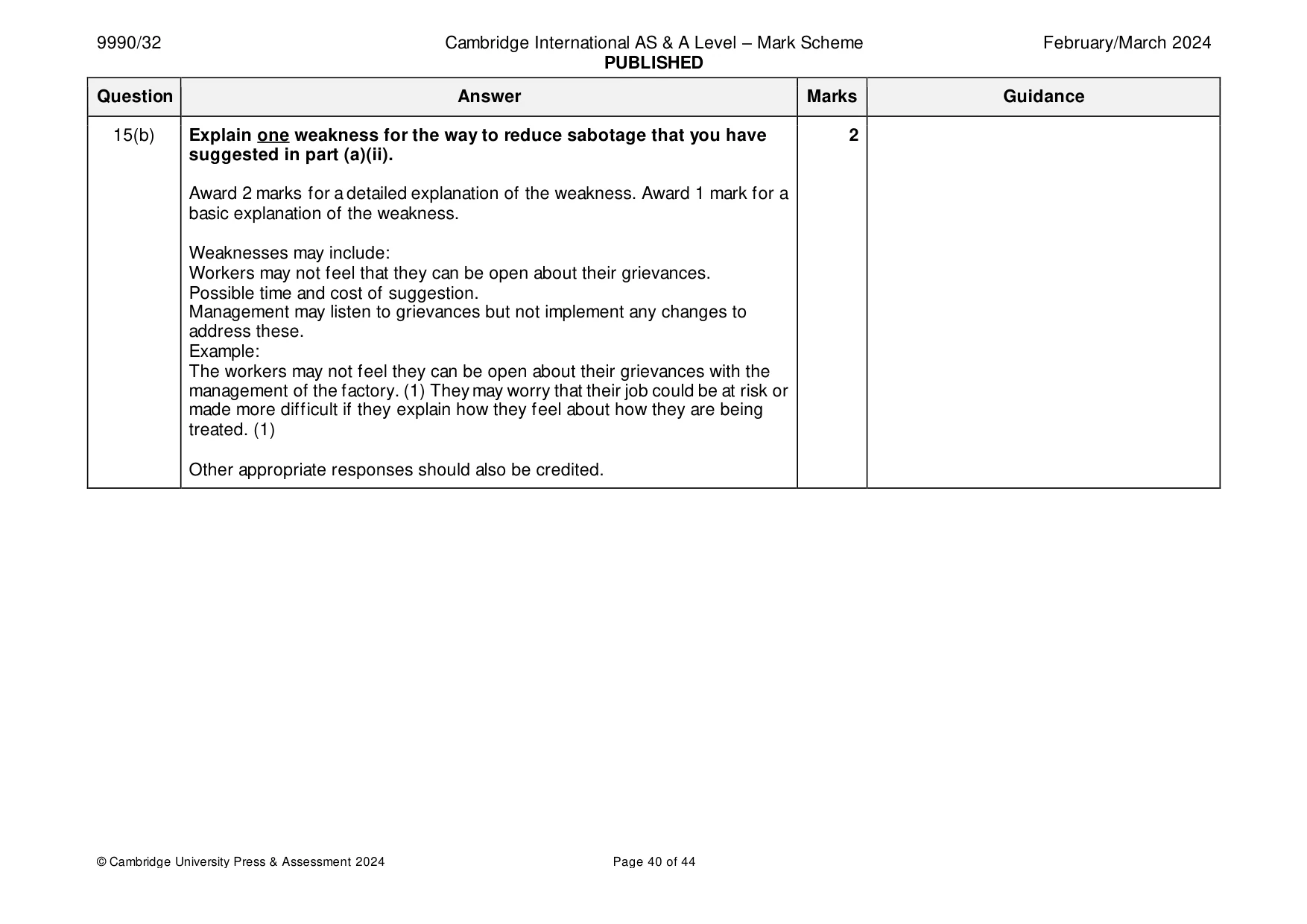
15 (a) Samir is a manager in a bicycle factory. He has noticed several acts of sabotage, for example, some of his workers have been leaving the factory before their shift has finished without permission. Samir has also seen one employee putting some bicycle parts belonging to the factory into their car. (i) Using your knowledge of the study by Giacalone and Rosenfeld (1987): Outline one reason that a worker at Samir’s factory could give for one of these acts of sabotage. [2] (ii) Suggest one way that Samir could reduce sabotage at his factory. [2] (b) Explain one weakness for the way to reduce sabotage that you have suggested in part (a)(ii). [2]
Mark scheme: 15(a) Samir is a manager in a bicycle factory. He has noticed several acts of sabotage, for example, some of his workers have been leaving the factory before their shift has finished without permission. Samir has also seen one employee putting some bicycle parts belonging to the factory into their car. 15(a)(i) Using your knowledge of the study by Giacalone and Rosenfeld (1987): 2 Not appropriate- Outline one reason that a worker at Samir’s factory could give for one of Self defense these acts of sabotage. Protect oneself from boss/company To protect one’s job Award 2 marks for an outline of reason for one of the acts of sabotage. Award 1 mark for a basic outline of reason for one of the acts of sabotage. Anecdotal = 0 – the reason I left was my family had an emergency – not in G and R Reasons may include: so 0. • Revenge Needs to link to one of the acts of sabotage • The foreman/company deserved it for 2 marks (leaving early, theft) • The foreman/company hurt me previously • No one was hurt by the action • Release of frustrations • Just for fun/laughs Example: One reason an employee might give for taking leaving their shift early without permission is no one is hurt by this. (1) The employee might say that they have completed all of the work on the bicycles during their shift as they work very quickly compared to other workers so deserve to leave early. (1) OR One reason an employee might give for taking bicycle parts belonging to the factory is that the company deserves it. (1) The employee might say that their pay is very low and taking the parts helps to make up for the low pay. (1) Other appropriate responses should also be credited. 15(a)(ii) Suggest one way that Samir could reduce sabotage at his factory. 2 Can allow practical solution to prevent one of the specific acts (e.g. timecard, security For suggested way: tag on equipment where an alarm goes off Award 2 marks for a detailed explanation of the way to reduce sabotage. when leaving factory) Award 1 mark for a basic outline of the way to reduce sabotage. Suggestions may include: • Allow workers to discuss with management their grievances (and make changes) about how they are being treated at the factory. • Increase the worker’s pay/implement a bonus scheme for worker’s who complete their work more quickly • Implement a plan to help workers feel valued by the factory. • Offer counselling to the workers at the factory. • Check vehicles for goods/employees leaving the factory during shift Example: Samir has a meeting with his workers and senior management at the factory to discuss any grievances/problems workers are experiencing (such as low pay). (1) Management could then implement changes to address the problems such as putting up their hourly salary so that the worker feels fairly paid and does not need to express their dissatisfaction through sabotage. (1) Other appropriate responses should also be credited. 15(b) Explain one weakness for the way to reduce sabotage that you have 2 suggested in part (a)(ii). Award 2 marks for a detailed explanation of the weakness. Award 1 mark for a basic explanation of the weakness. Weaknesses may include: Workers may not feel that they can be open about their grievances. Possible time and cost of suggestion. Management may listen to grievances but not implement any changes to address these. Example: The workers may not feel they can be open about their grievances with the management of the factory. (1) They may worry that their job could be at risk or made more difficult if they explain how they feel about how they are being treated. (1) Other appropriate responses should also be credited.
Q16 · Describe what psychologists have discovered about: • Kouzes and Posner’s Leadership…
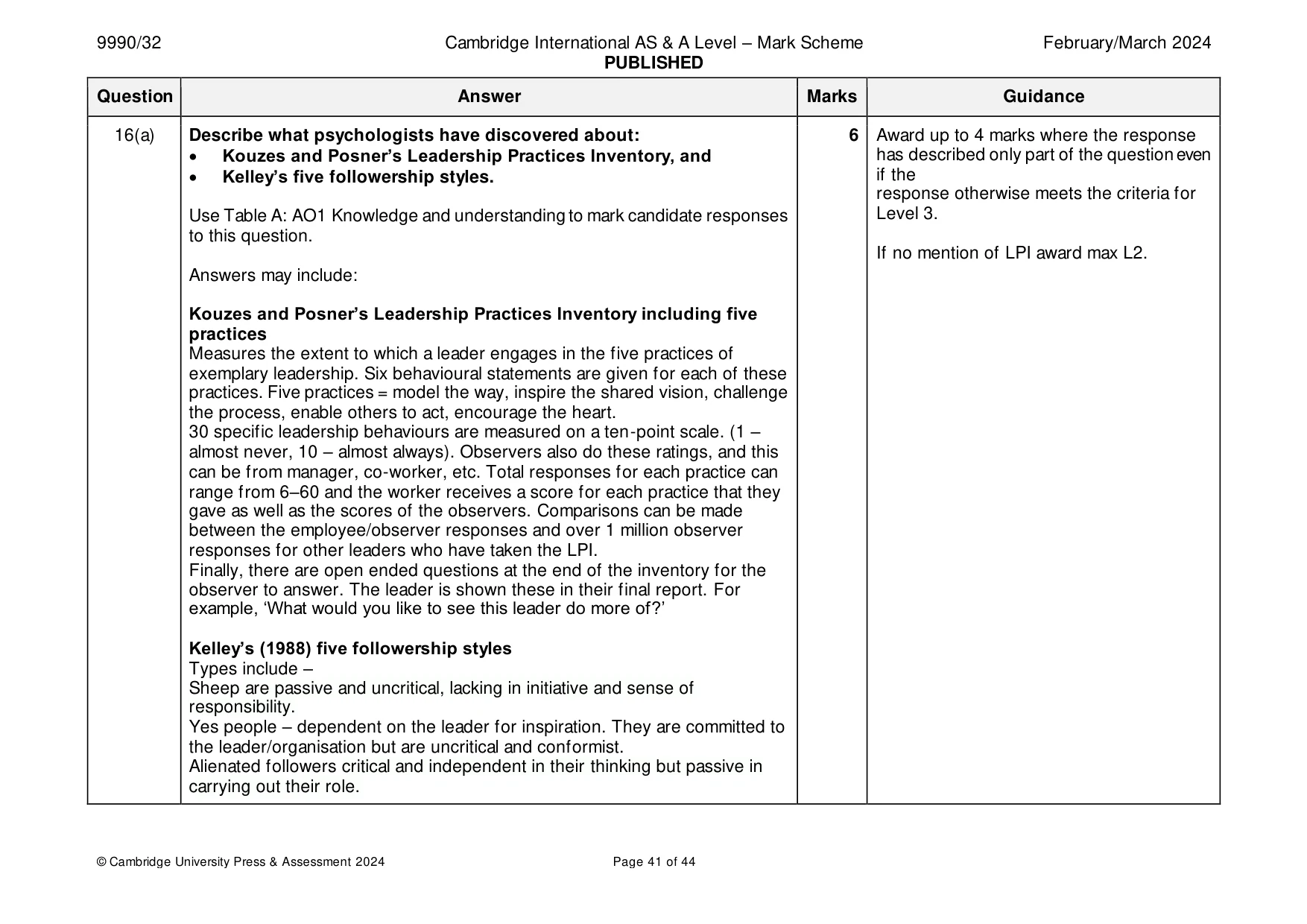
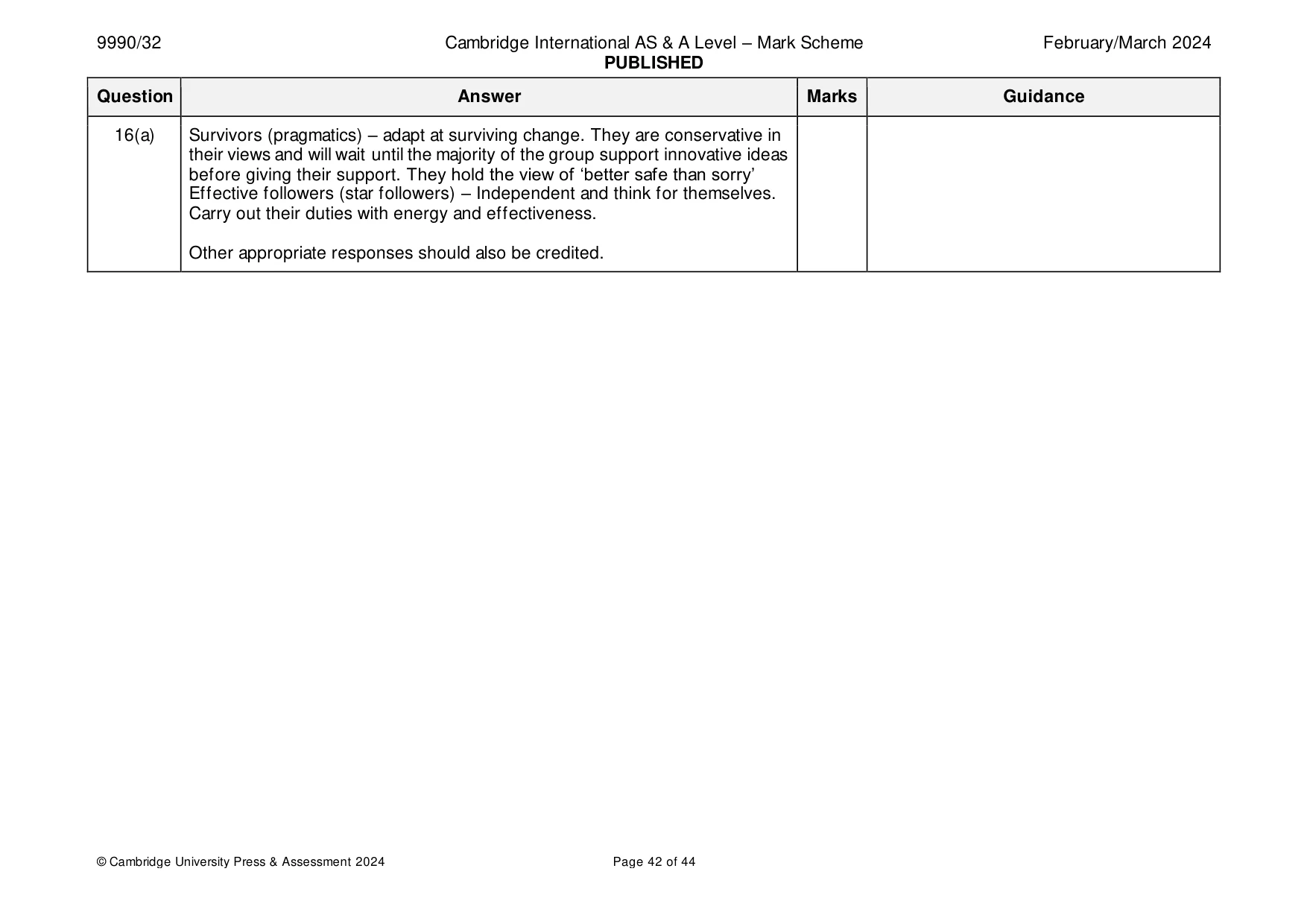
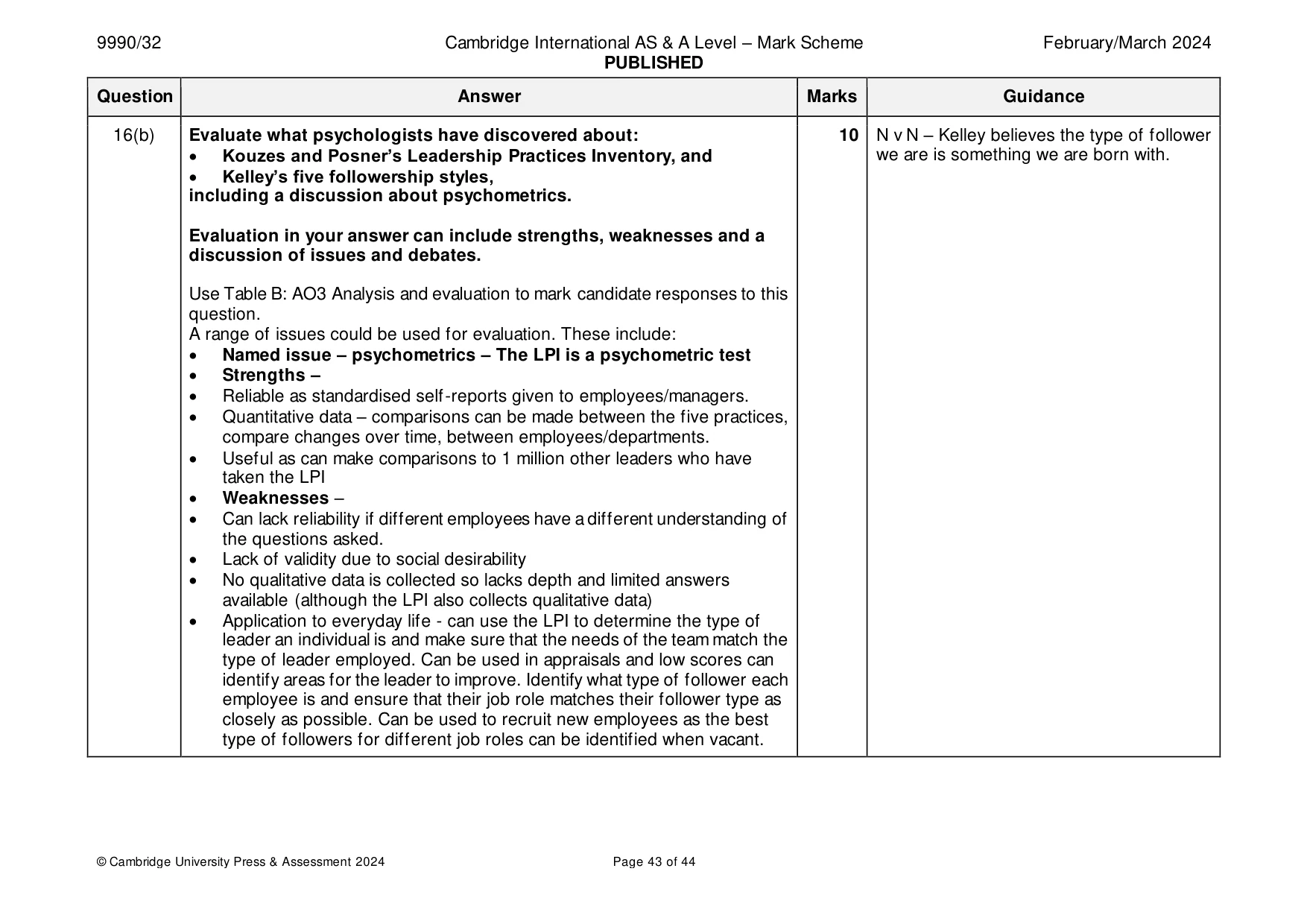
16 (a) Describe what psychologists have discovered about: • Kouzes and Posner’s Leadership Practices Inventory, and • Kelley’s five followership styles. [6] (b) Evaluate what psychologists have discovered about: • Kouzes and Posner’s Leadership Practices Inventory, and • Kelley’s five followership styles, including a discussion about psychometrics. Evaluation in your answer can include strengths, weaknesses and a discussion of issues and debates. [10]
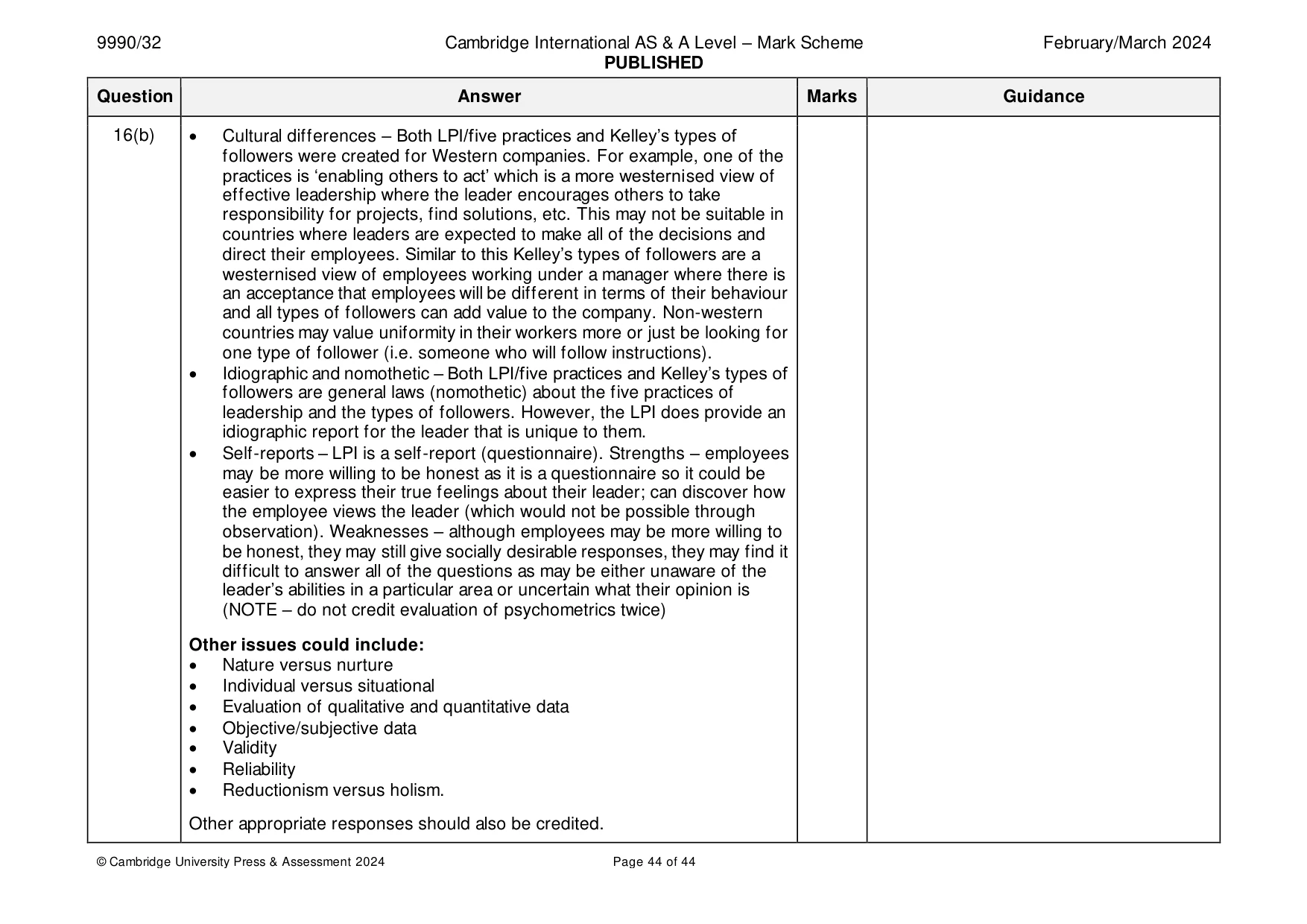
Mark scheme: 16(a) Describe what psychologists have discovered about: 6 Award up to 4 marks where the response • Kouzes and Posner’s Leadership Practices Inventory, and has described only part of the question even • Kelley’s five followership styles. if the response otherwise meets the criteria for Use Table A: AO1 Knowledge and understanding to mark candidate responses Level 3. to this question. If no mention of LPI award max L2. Answers may include: Kouzes and Posner’s Leadership Practices Inventory including five practices Measures the extent to which a leader engages in the five practices of exemplary leadership. Six behavioural statements are given for each of these practices. Five practices = model the way, inspire the shared vision, challenge the process, enable others to act, encourage the heart. 30 specific leadership behaviours are measured on a ten-point scale. (1 – almost never, 10 – almost always). Observers also do these ratings, and this can be from manager, co-worker, etc. Total responses for each practice can range from 6–60 and the worker receives a score for each practice that they gave as well as the scores of the observers. Comparisons can be made between the employee/observer responses and over 1 million observer responses for other leaders who have taken the LPI. Finally, there are open ended questions at the end of the inventory for the observer to answer. The leader is shown these in their final report. For example, ‘What would you like to see this leader do more of?’ Kelley’s (1988) five followership styles Types include – Sheep are passive and uncritical, lacking in initiative and sense of responsibility. Yes people – dependent on the leader for inspiration. They are committed to the leader/organisation but are uncritical and conformist. Alienated followers critical and independent in their thinking but passive in carrying out their role. 16(a) Survivors (pragmatics) – adapt at surviving change. They are conservative in their views and will wait until the majority of the group support innovative ideas before giving their support. They hold the view of ‘better safe than sorry’ Effective followers (star followers) – Independent and think for themselves. Carry out their duties with energy and effectiveness. Other appropriate responses should also be credited. 16(b) Evaluate what psychologists have discovered about: 10 N v N – Kelley believes the type of follower • Kouzes and Posner’s Leadership Practices Inventory, and we are is something we are born with. • Kelley’s five followership styles, including a discussion about psychometrics. Evaluation in your answer can include strengths, weaknesses and a discussion of issues and debates. Use Table B: AO3 Analysis and evaluation to mark candidate responses to this question. A range of issues could be used for evaluation. These include: • Named issue – psychometrics – The LPI is a psychometric test • Strengths – • Reliable as standardised self-reports given to employees/managers. • Quantitative data – comparisons can be made between the five practices, compare changes over time, between employees/departments. • Useful as can make comparisons to 1 million other leaders who have taken the LPI • Weaknesses – • Can lack reliability if different employees have a different understanding of the questions asked. • Lack of validity due to social desirability • No qualitative data is collected so lacks depth and limited answers available (although the LPI also collects qualitative data) • Application to everyday life - can use the LPI to determine the type of leader an individual is and make sure that the needs of the team match the type of leader employed. Can be used in appraisals and low scores can identify areas for the leader to improve. Identify what type of follower each employee is and ensure that their job role matches their follower type as closely as possible. Can be used to recruit new employees as the best type of followers for different job roles can be identified when vacant. 16(b) • Cultural differences – Both LPI/five practices and Kelley’s types of followers were created for Western companies. For example, one of the practices is ‘enabling others to act’ which is a more westernised view of effective leadership where the leader encourages others to take responsibility for projects, find solutions, etc. This may not be suitable in countries where leaders are expected to make all of the decisions and direct their employees. Similar to this Kelley’s types of followers are a westernised view of employees working under a manager where there is an acceptance that employees will be different in terms of their behaviour and all types of followers can add value to the company. Non-western countries may value uniformity in their workers more or just be looking for one type of follower (i.e. someone who will follow instructions). • Idiographic and nomothetic – Both LPI/five practices and Kelley’s types of followers are general laws (nomothetic) about the five practices of leadership and the types of followers. However, the LPI does provide an idiographic report for the leader that is unique to them. • Self-reports – LPI is a self-report (questionnaire). Strengths – employees may be more willing to be honest as it is a questionnaire so it could be easier to express their true feelings about their leader; can discover how the employee views the leader (which would not be possible through observation). Weaknesses – although employees may be more willing to be honest, they may still give socially desirable responses, they may find it difficult to answer all of the questions as may be either unaware of the leader’s abilities in a particular area or uncertain what their opinion is (NOTE – do not credit evaluation of psychometrics twice) Other issues could include: • Nature versus nurture • Individual versus situational • Evaluation of qualitative and quantitative data • Objective/subjective data • Validity • Reliability • Reductionism versus holism. Other appropriate responses should also be credited.
What was in this paper
The subtopics covered by these 16 questions, and how many questions each got. Open one in a new tab to see every Cambridge question on it.
2Motivation to work2Obsessive-compulsive disorder (OCD)23 Health and safety1Advertising1Consumer decision-making1Leadership and management1Mood (affective) disorders: depressive disorder (unipolar) and bipolar disorder1Pain1Schizophrenia1Stress1The physical environment1The product1What you needed in this session
Cambridge’s own grade thresholds for 2024 Feb/March, Paper 3 · Variant 2. A higher threshold means an easier paper — the bar moves with how the cohort did.