Cambridge A Level Psychology (from 2018) 9990 — 2025 Feb/March Paper 3 · Variant 2
9990/32/F/M/25 · 16 questions · 60 marks · 90 min
The question paper and its mark scheme, free to read here and free to download. This is Cambridge’s own paper, exactly as it was sat.
Question paper8 pages




Mark scheme50 pages
Answers below. Sit the paper first if you are practising.








Questions as text
Q1 · Rahul has obsessive-compulsive disorder (OCD) and constantly worries about his family’s…
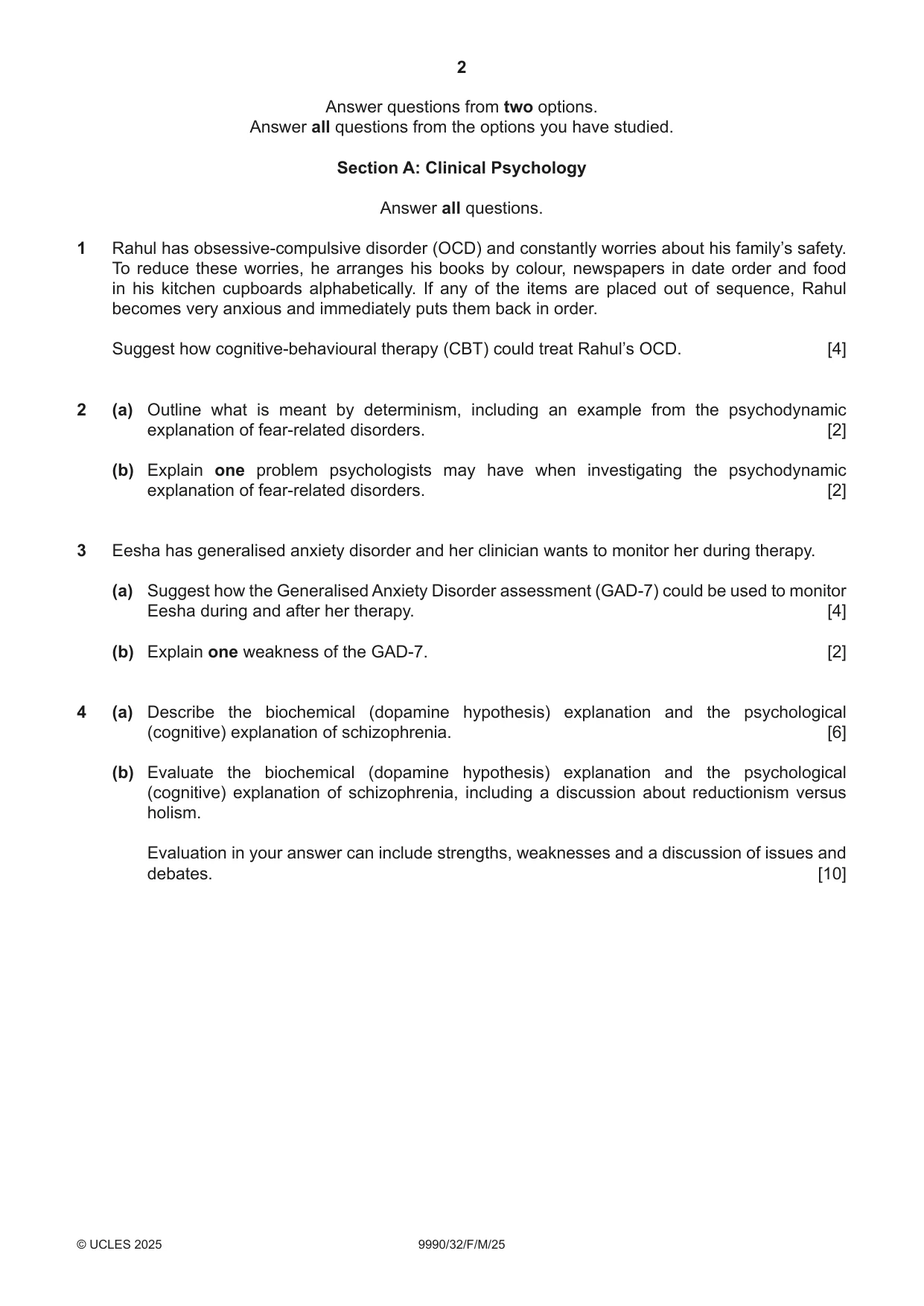
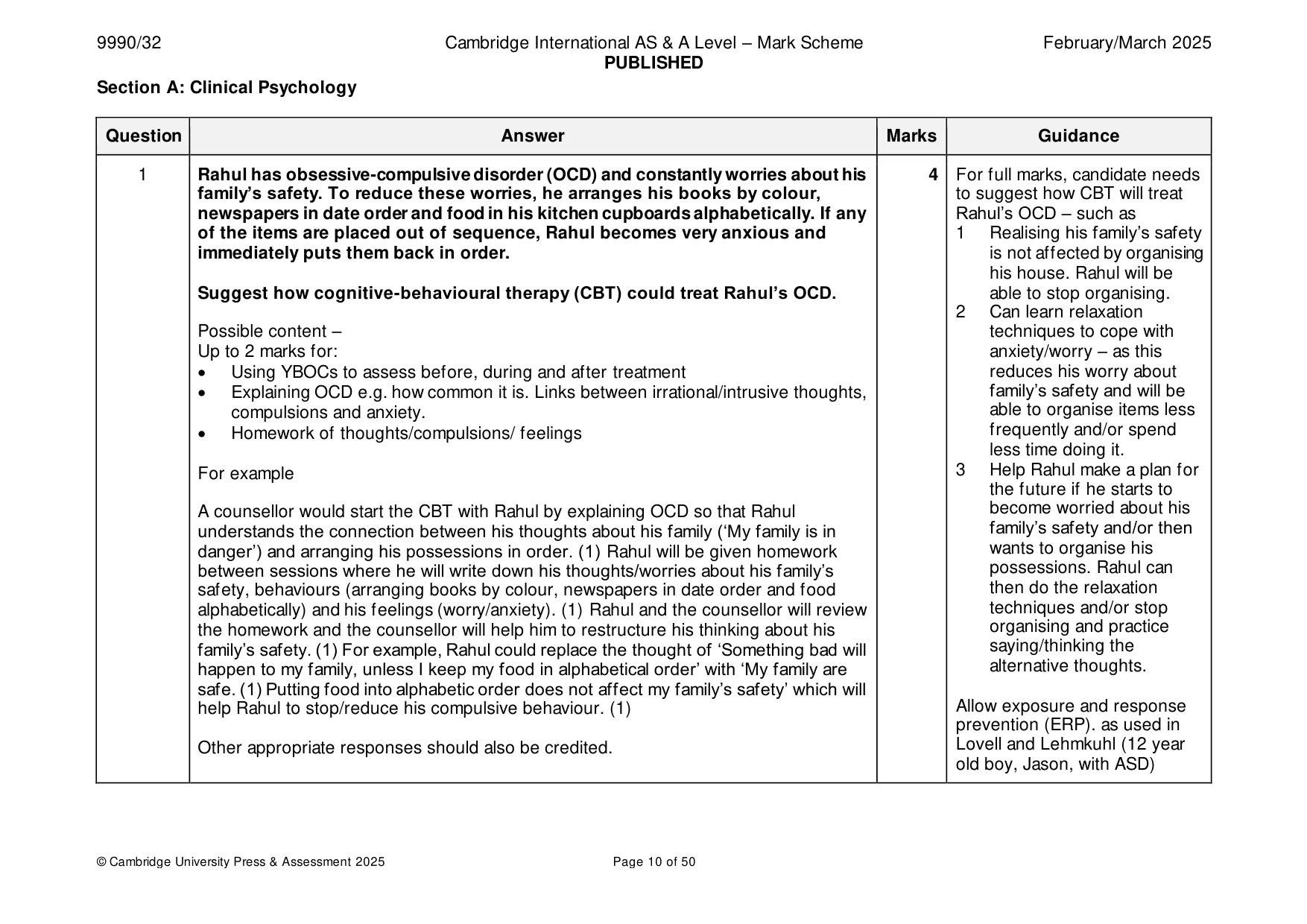
1 Rahul has obsessive-compulsive disorder (OCD) and constantly worries about his family’s safety. To reduce these worries, he arranges his books by colour, newspapers in date order and food in his kitchen cupboards alphabetically. If any of the items are placed out of sequence, Rahul becomes very anxious and immediately puts them back in order. Suggest how cognitive-behavioural therapy (CBT) could treat Rahul’s OCD. [4]
Mark scheme: Question Answer Marks Guidance 1 Rahul has obsessive-compulsive disorder (OCD) and constantly worries about his 4 For full marks, candidate needs family’s safety. To reduce these worries, he arranges his books by colour, to suggest how CBT will treat newspapers in date order and food in his kitchen cupboards alphabetically. If any Rahul’s OCD – such as of the items are placed out of sequence, Rahul becomes very anxious and 1 Realising his family’s safety immediately puts them back in order. is not affected by organising his house. Rahul will be Suggest how cognitive-behavioural therapy (CBT) could treat Rahul’s OCD. able to stop organising. 2 Can learn relaxation Possible content – techniques to cope with Up to 2 marks for: anxiety/worry – as this • Using YBOCs to assess before, during and after treatment reduces his worry about • Explaining OCD e.g. how common it is. Links between irrational/intrusive thoughts, family’s safety and will be compulsions and anxiety. able to organise items less • Homework of thoughts/compulsions/ feelings frequently and/or spend less time doing it. For example 3 Help Rahul make a plan for the future if he starts to A counsellor would start the CBT with Rahul by explaining OCD so that Rahul become worried about his understands the connection between his thoughts about his family (‘My family is in family’s safety and/or then danger’) and arranging his possessions in order. (1) Rahul will be given homework wants to organise his between sessions where he will write down his thoughts/worries about his family’s possessions. Rahul can safety, behaviours (arranging books by colour, newspapers in date order and food then do the relaxation alphabetically) and his feelings (worry/anxiety). (1) Rahul and the counsellor will review techniques and/or stop the homework and the counsellor will help him to restructure his thinking about his organising and practice family’s safety. (1) For example, Rahul could replace the thought of ‘Something bad will saying/thinking the happen to my family, unless I keep my food in alphabetical order’ with ‘My family are alternative thoughts. safe. (1) Putting food into alphabetic order does not affect my family’s safety’ which will help Rahul to stop/reduce his compulsive behaviour. (1) Allow exposure and response prevention (ERP). as used in Other appropriate responses should also be credited. Lovell and Lehmkuhl (12 year old boy, Jason, with ASD) 1 Exposed to stimuli that trigger obsessions/helped to refrain from obsessive behaviour. Can allow resisting obsessive behaviour/exposure to objects associated with obsessive behaviour No credit for finding the cause of the OCD or talking about the past/childhood. If no direct reference to Rahul’s symptoms cap at 2
Q2 · Outline what is meant by determinism, including an example from the psychodynamic…
2 (a) Outline what is meant by determinism, including an example from the psychodynamic explanation of fear-related disorders. [2] (b) Explain one problem psychologists may have when investigating the psychodynamic explanation of fear-related disorders. [2]
Mark scheme: 2(a) Outline what is meant by determinism, including an example from the 2 Example = psychodynamic psychodynamic explanation of fear-related disorders. explanation of fear- related disorders. Award 1 mark for an outline of the term/concept. Award 1 mark for an example. Example: Determinism means the individual has little or no control over the decisions that they make. (1) OR behaviour is caused/determined by external or unconscious forces. (1) AND For example, the psychodynamic explanation of phobias is deterministic as the phobia is caused by the unconscious repressing childhood conflict and displacing the fear created by the conflict onto the phobic object.(1) OR the phobia is caused by the unconscious impulses of the ID which is being denied/repressed. (1) Other appropriate responses should also be credited. 2(b) Explain one problem psychologists may have when investigating the 2 Not generalisable due to over- psychodynamic explanation of fear-related disorders. reliance on case studies.- must link to psychodynamic/fear- Award 2 marks for an explanation of the problem. related disorders. Award 1 mark for a basic outline of problem. Ethics regarding lack of consent Problems might include: from children = 0 • Fear-related disorder/phobia may have developed in early childhood so the person doesn’t remember what happened. Allow 1 mark for problems with • Psychologist may use techniques such as hypnosis to access childhood memories psychodynamic explanation of which can be inaccurate. fear-related disorders (missing • The ‘true’ cause of the fear is unconscious and difficult to access (or use hypnosis investigating part of Q). as outlined above) • Data collected is usually qualitative (through conversations with the Can credit definition within the example. therapist/psychologist) and is subjective. • The unconscious, ID, Ego, super-ego cannot be measured in a scientific way. Reference to id, ego, superego as from fear-related disorders Example: As the cause of fear-related disorders is early childhood conflict, the patient may not remember it. (1) The psychologist might use techniques such as hypnosis/dream analysis to access these memories but they are subjective ways of collecting data. (1) Other appropriate responses should also be credited.
More questions on Anxiety disorders and fear-related disorders
Q3 · Eesha has generalised anxiety disorder and her clinician wants to monitor her during…
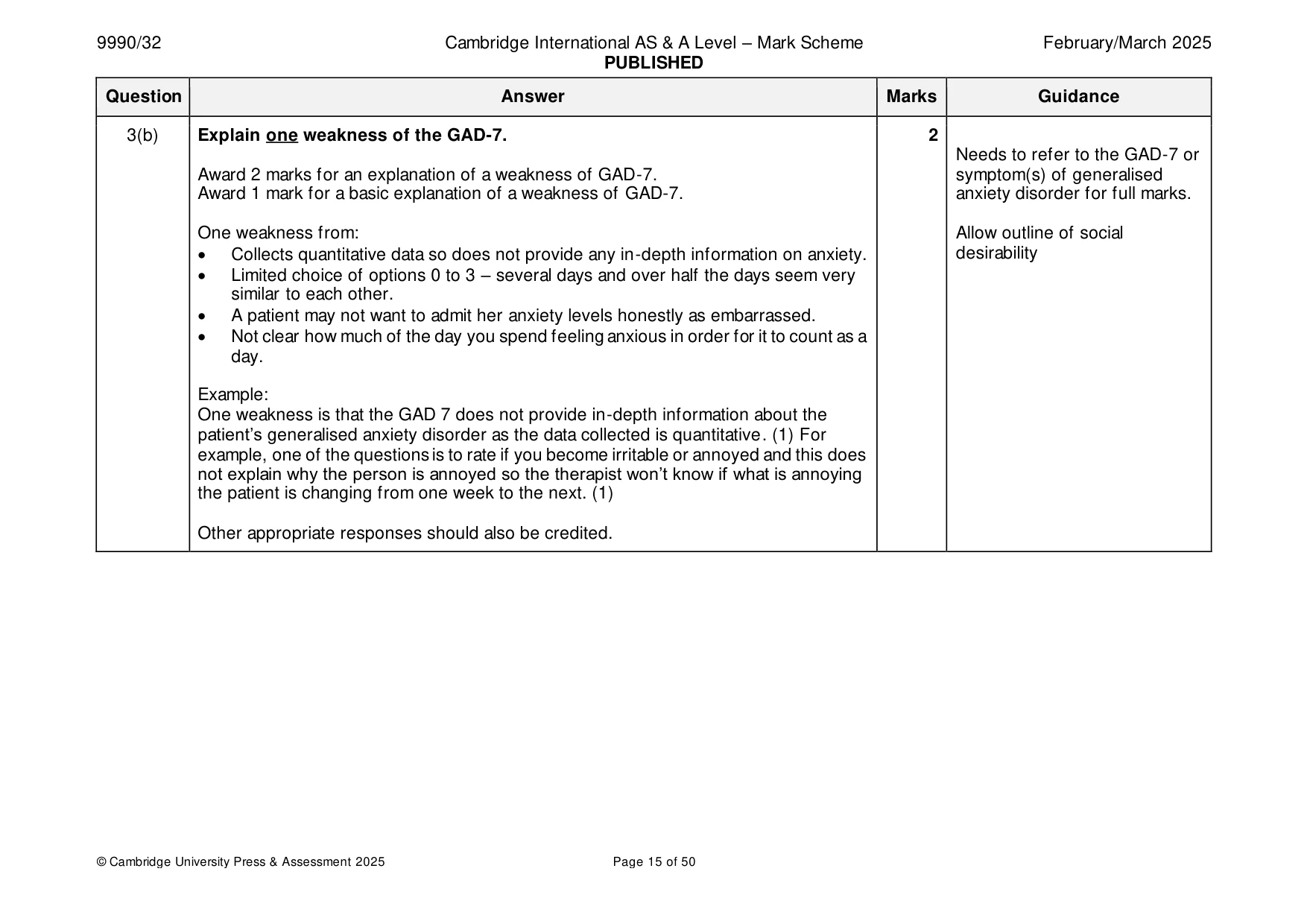
3 Eesha has generalised anxiety disorder and her clinician wants to monitor her during therapy. (a) Suggest how the Generalised Anxiety Disorder assessment (GAD-7) could be used to monitor Eesha during and after her therapy. [4] (b) Explain one weakness of the GAD-7. [2]
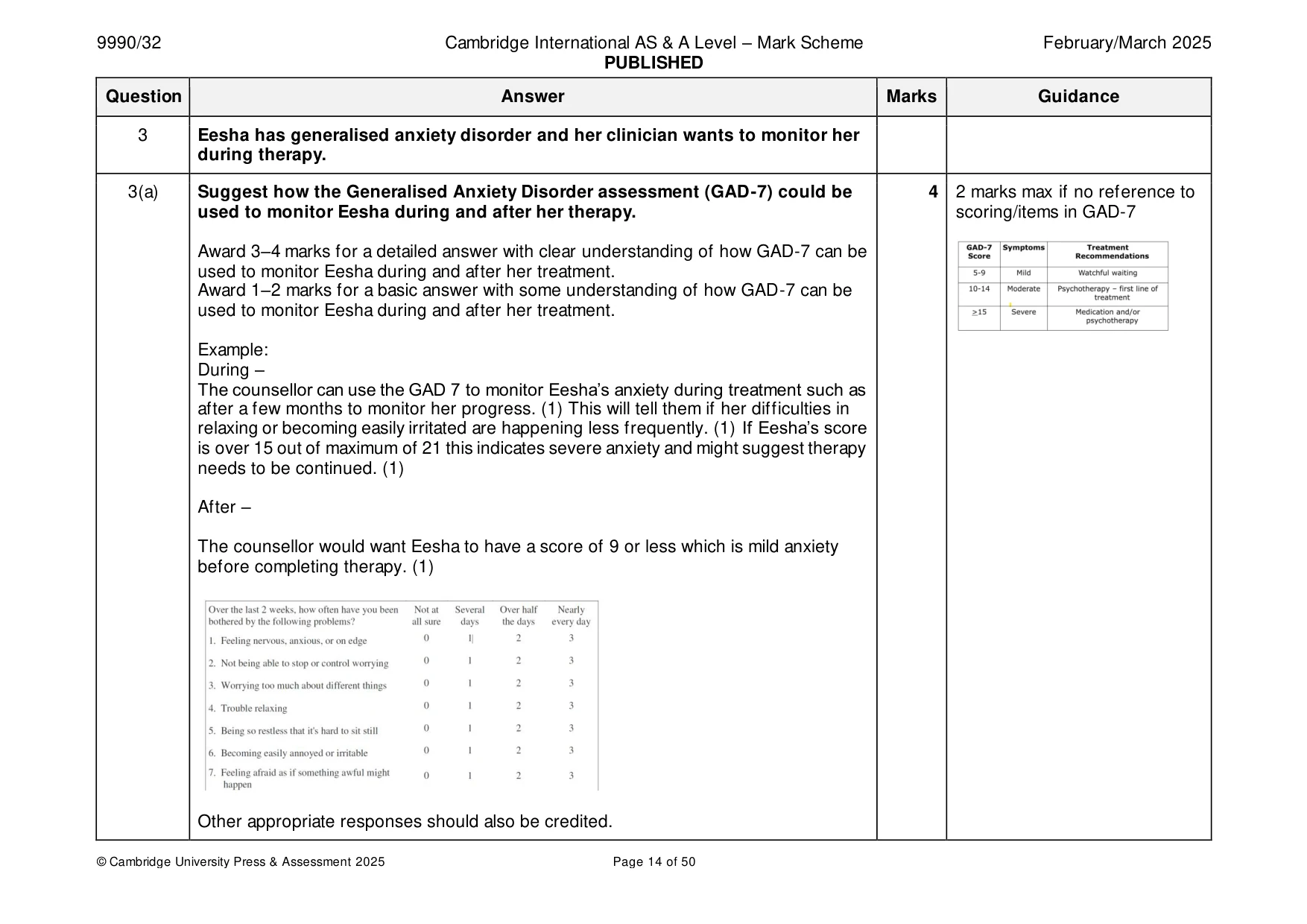
Mark scheme: 3 Eesha has generalised anxiety disorder and her clinician wants to monitor her during therapy. 3(a) Suggest how the Generalised Anxiety Disorder assessment (GAD-7) could be 4 2 marks max if no reference to used to monitor Eesha during and after her therapy. scoring/items in GAD-7 Award 3–4 marks for a detailed answer with clear understanding of how GAD-7 can be used to monitor Eesha during and after her treatment. Award 1–2 marks for a basic answer with some understanding of how GAD-7 can be used to monitor Eesha during and after her treatment. Example: During – The counsellor can use the GAD 7 to monitor Eesha’s anxiety during treatment such as after a few months to monitor her progress. (1) This will tell them if her difficulties in relaxing or becoming easily irritated are happening less frequently. (1) If Eesha’s score is over 15 out of maximum of 21 this indicates severe anxiety and might suggest therapy needs to be continued. (1) After – The counsellor would want Eesha to have a score of 9 or less which is mild anxiety before completing therapy. (1) Other appropriate responses should also be credited. 3(b) Explain one weakness of the GAD-7. 2 Needs to refer to the GAD-7 or Award 2 marks for an explanation of a weakness of GAD-7. symptom(s) of generalised Award 1 mark for a basic explanation of a weakness of GAD-7. anxiety disorder for full marks. One weakness from: Allow outline of social • Collects quantitative data so does not provide any in-depth information on anxiety. desirability • Limited choice of options 0 to 3 – several days and over half the days seem very similar to each other. • A patient may not want to admit her anxiety levels honestly as embarrassed. • Not clear how much of the day you spend feeling anxious in order for it to count as a day. Example: One weakness is that the GAD 7 does not provide in-depth information about the patient’s generalised anxiety disorder as the data collected is quantitative. (1) For example, one of the questions is to rate if you become irritable or annoyed and this does not explain why the person is annoyed so the therapist won’t know if what is annoying the patient is changing from one week to the next. (1) Other appropriate responses should also be credited.
More questions on Anxiety disorders and fear-related disorders
Q4 · Describe the biochemical (dopamine hypothesis) explanation and the psychological…
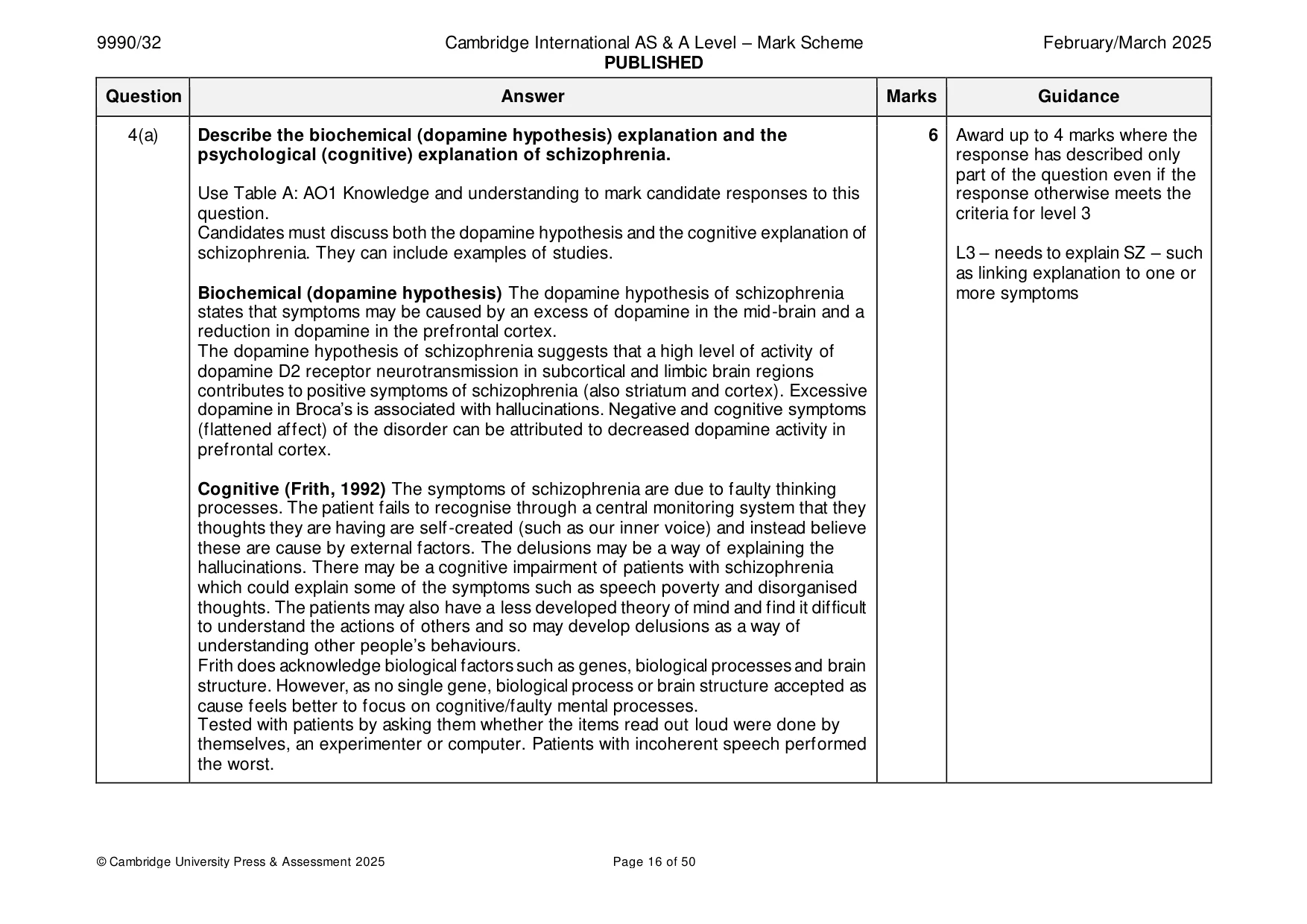
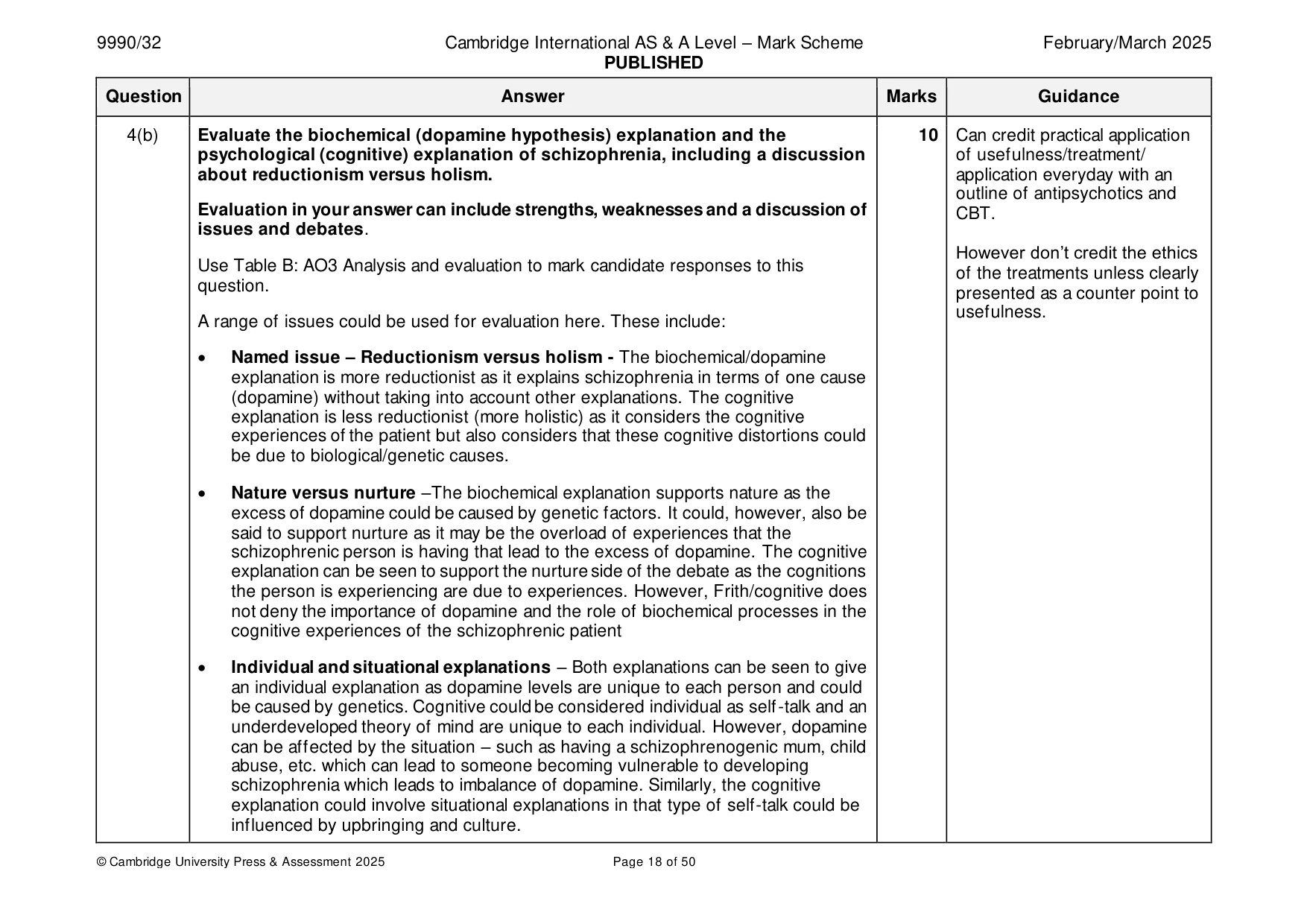
4 (a) Describe the biochemical (dopamine hypothesis) explanation and the psychological (cognitive) explanation of schizophrenia. [6] (b) Evaluate the biochemical (dopamine hypothesis) explanation and the psychological (cognitive) explanation of schizophrenia, including a discussion about reductionism versus holism. Evaluation in your answer can include strengths, weaknesses and a discussion of issues and debates. [10]
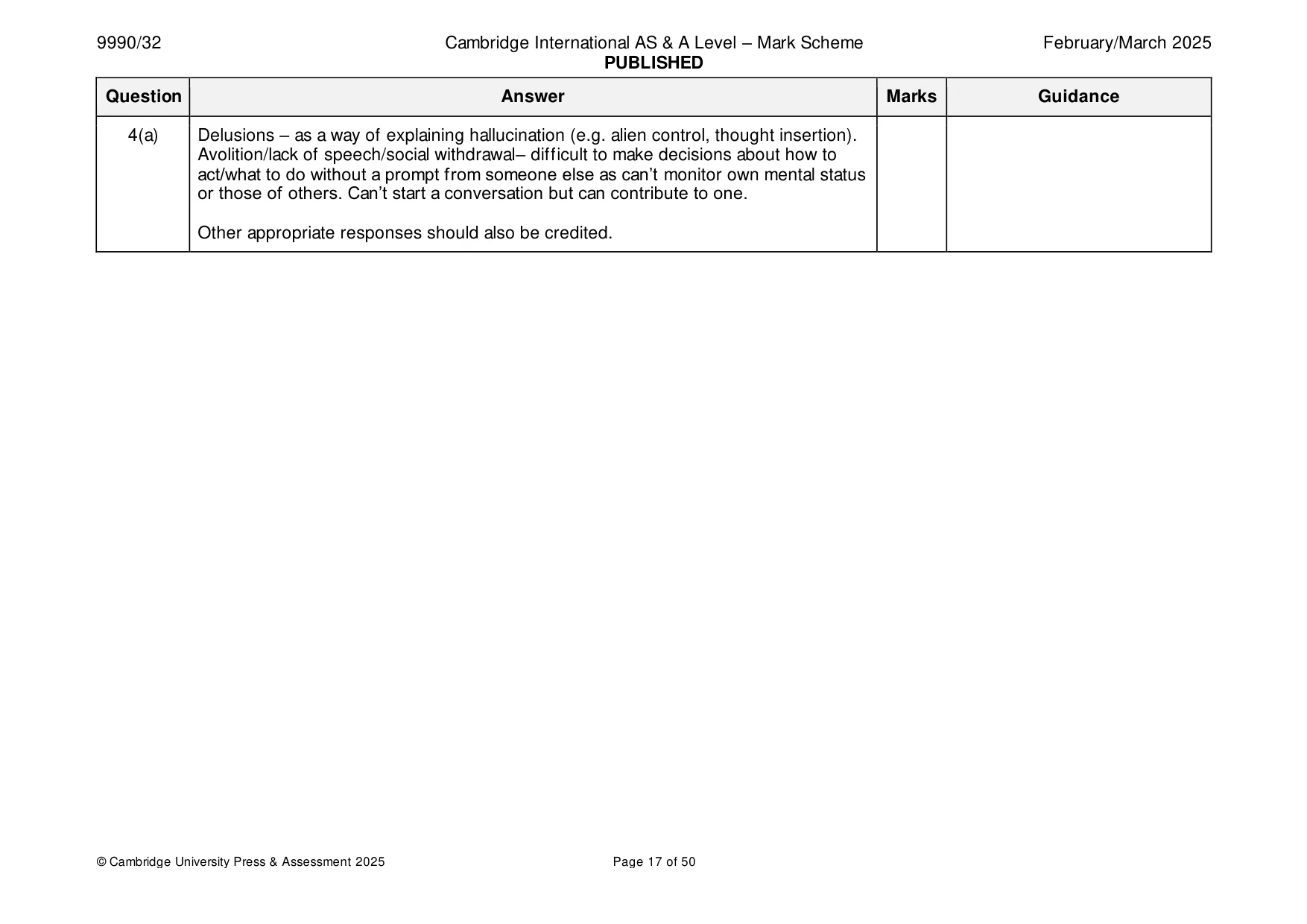
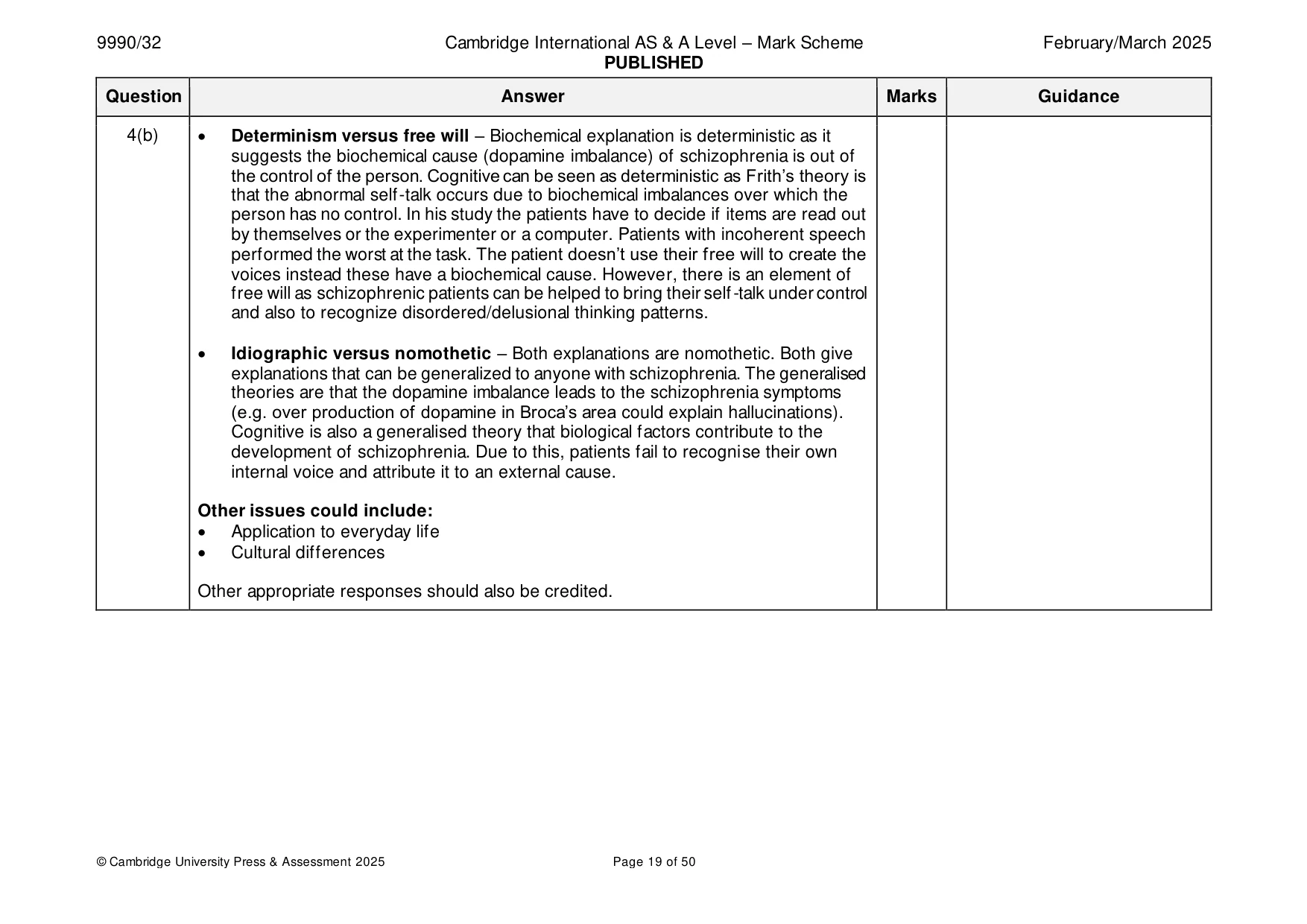
Mark scheme: 4(a) Describe the biochemical (dopamine hypothesis) explanation and the 6 Award up to 4 marks where the psychological (cognitive) explanation of schizophrenia. response has described only part of the question even if the Use Table A: AO1 Knowledge and understanding to mark candidate responses to this response otherwise meets the question. criteria for level 3 Candidates must discuss both the dopamine hypothesis and the cognitive explanation of schizophrenia. They can include examples of studies. L3 – needs to explain SZ – such as linking explanation to one or Biochemical (dopamine hypothesis) The dopamine hypothesis of schizophrenia more symptoms states that symptoms may be caused by an excess of dopamine in the mid-brain and a reduction in dopamine in the prefrontal cortex. The dopamine hypothesis of schizophrenia suggests that a high level of activity of dopamine D2 receptor neurotransmission in subcortical and limbic brain regions contributes to positive symptoms of schizophrenia (also striatum and cortex). Excessive dopamine in Broca’s is associated with hallucinations. Negative and cognitive symptoms (flattened affect) of the disorder can be attributed to decreased dopamine activity in prefrontal cortex. Cognitive (Frith, 1992) The symptoms of schizophrenia are due to faulty thinking processes. The patient fails to recognise through a central monitoring system that they thoughts they are having are self-created (such as our inner voice) and instead believe these are cause by external factors. The delusions may be a way of explaining the hallucinations. There may be a cognitive impairment of patients with schizophrenia which could explain some of the symptoms such as speech poverty and disorganised thoughts. The patients may also have a less developed theory of mind and find it difficult to understand the actions of others and so may develop delusions as a way of understanding other people’s behaviours. Frith does acknowledge biological factors such as genes, biological processes and brain structure. However, as no single gene, biological process or brain structure accepted as cause feels better to focus on cognitive/faulty mental processes. Tested with patients by asking them whether the items read out loud were done by themselves, an experimenter or computer. Patients with incoherent speech performed the worst. 4(a) Delusions – as a way of explaining hallucination (e.g. alien control, thought insertion). Avolition/lack of speech/social withdrawal– difficult to make decisions about how to act/what to do without a prompt from someone else as can’t monitor own mental status or those of others. Can’t start a conversation but can contribute to one. Other appropriate responses should also be credited. 4(b) Evaluate the biochemical (dopamine hypothesis) explanation and the 10 Can credit practical application psychological (cognitive) explanation of schizophrenia, including a discussion of usefulness/treatment/ about reductionism versus holism. application everyday with an outline of antipsychotics and Evaluation in your answer can include strengths, weaknesses and a discussion of CBT. issues and debates. However don’t credit the ethics Use Table B: AO3 Analysis and evaluation to mark candidate responses to this of the treatments unless clearly question. presented as a counter point to usefulness. A range of issues could be used for evaluation here. These include: • Named issue – Reductionism versus holism - The biochemical/dopamine explanation is more reductionist as it explains schizophrenia in terms of one cause (dopamine) without taking into account other explanations. The cognitive explanation is less reductionist (more holistic) as it considers the cognitive experiences of the patient but also considers that these cognitive distortions could be due to biological/genetic causes. • Nature versus nurture –The biochemical explanation supports nature as the excess of dopamine could be caused by genetic factors. It could, however, also be said to support nurture as it may be the overload of experiences that the schizophrenic person is having that lead to the excess of dopamine. The cognitive explanation can be seen to support the nurture side of the debate as the cognitions the person is experiencing are due to experiences. However, Frith/cognitive does not deny the importance of dopamine and the role of biochemical processes in the cognitive experiences of the schizophrenic patient • Individual and situational explanations – Both explanations can be seen to give an individual explanation as dopamine levels are unique to each person and could be caused by genetics. Cognitive could be considered individual as self-talk and an underdeveloped theory of mind are unique to each individual. However, dopamine can be affected by the situation – such as having a schizophrenogenic mum, child abuse, etc. which can lead to someone becoming vulnerable to developing schizophrenia which leads to imbalance of dopamine. Similarly, the cognitive explanation could involve situational explanations in that type of self-talk could be influenced by upbringing and culture. 4(b) • Determinism versus free will – Biochemical explanation is deterministic as it suggests the biochemical cause (dopamine imbalance) of schizophrenia is out of the control of the person. Cognitive can be seen as deterministic as Frith’s theory is that the abnormal self-talk occurs due to biochemical imbalances over which the person has no control. In his study the patients have to decide if items are read out by themselves or the experimenter or a computer. Patients with incoherent speech performed the worst at the task. The patient doesn’t use their free will to create the voices instead these have a biochemical cause. However, there is an element of free will as schizophrenic patients can be helped to bring their self-talk under control and also to recognize disordered/delusional thinking patterns. • Idiographic versus nomothetic – Both explanations are nomothetic. Both give explanations that can be generalized to anyone with schizophrenia. The generalised theories are that the dopamine imbalance leads to the schizophrenia symptoms (e.g. over production of dopamine in Broca’s area could explain hallucinations). Cognitive is also a generalised theory that biological factors contribute to the development of schizophrenia. Due to this, patients fail to recognise their own internal voice and attribute it to an external cause. Other issues could include: • Application to everyday life • Cultural differences Other appropriate responses should also be credited. Section B: Consumer Psychology
Q5 · A restaurant has a noisy kitchen, which can be heard by the customers
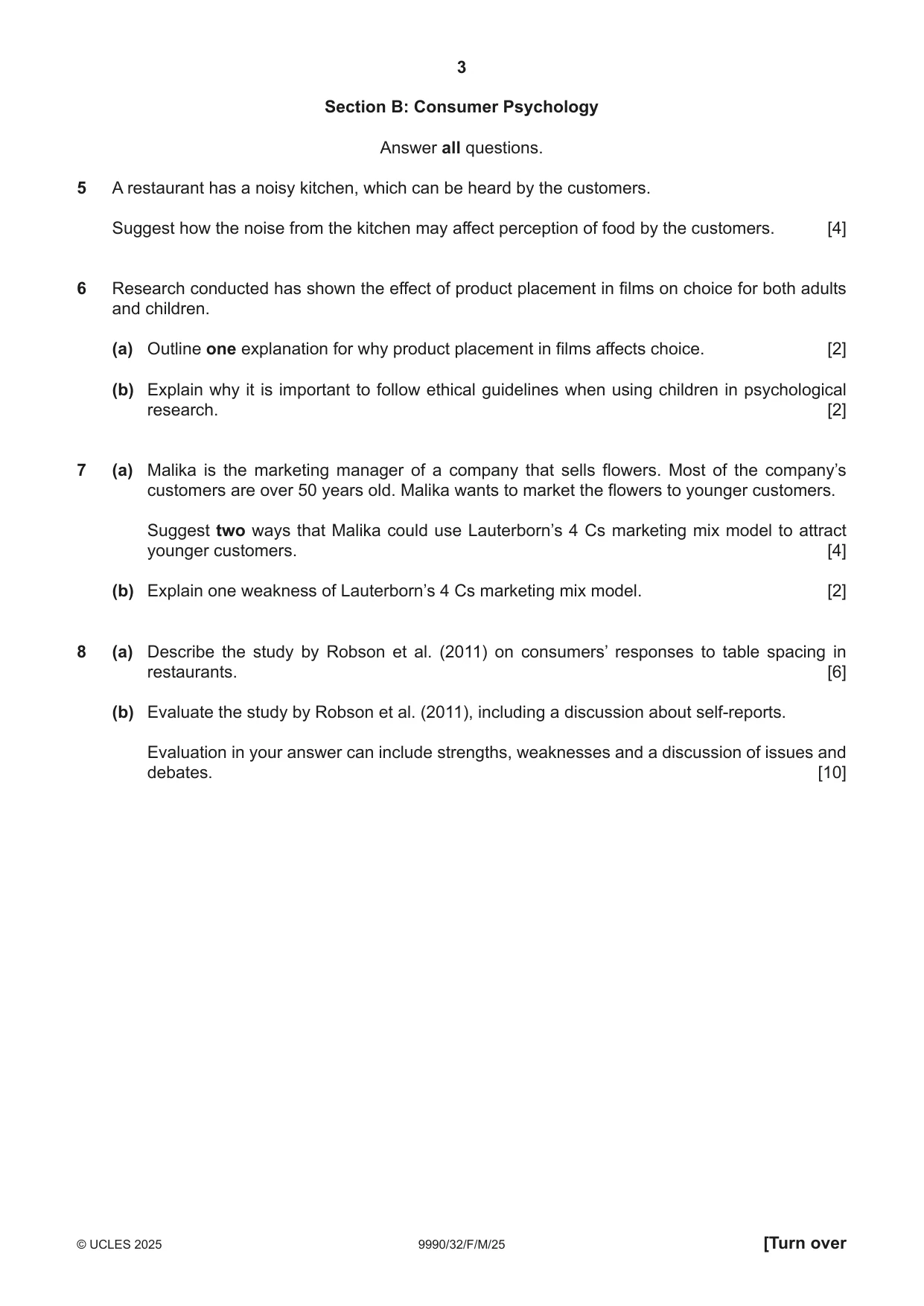
5 A restaurant has a noisy kitchen, which can be heard by the customers. Suggest how the noise from the kitchen may affect perception of food by the customers. [4]
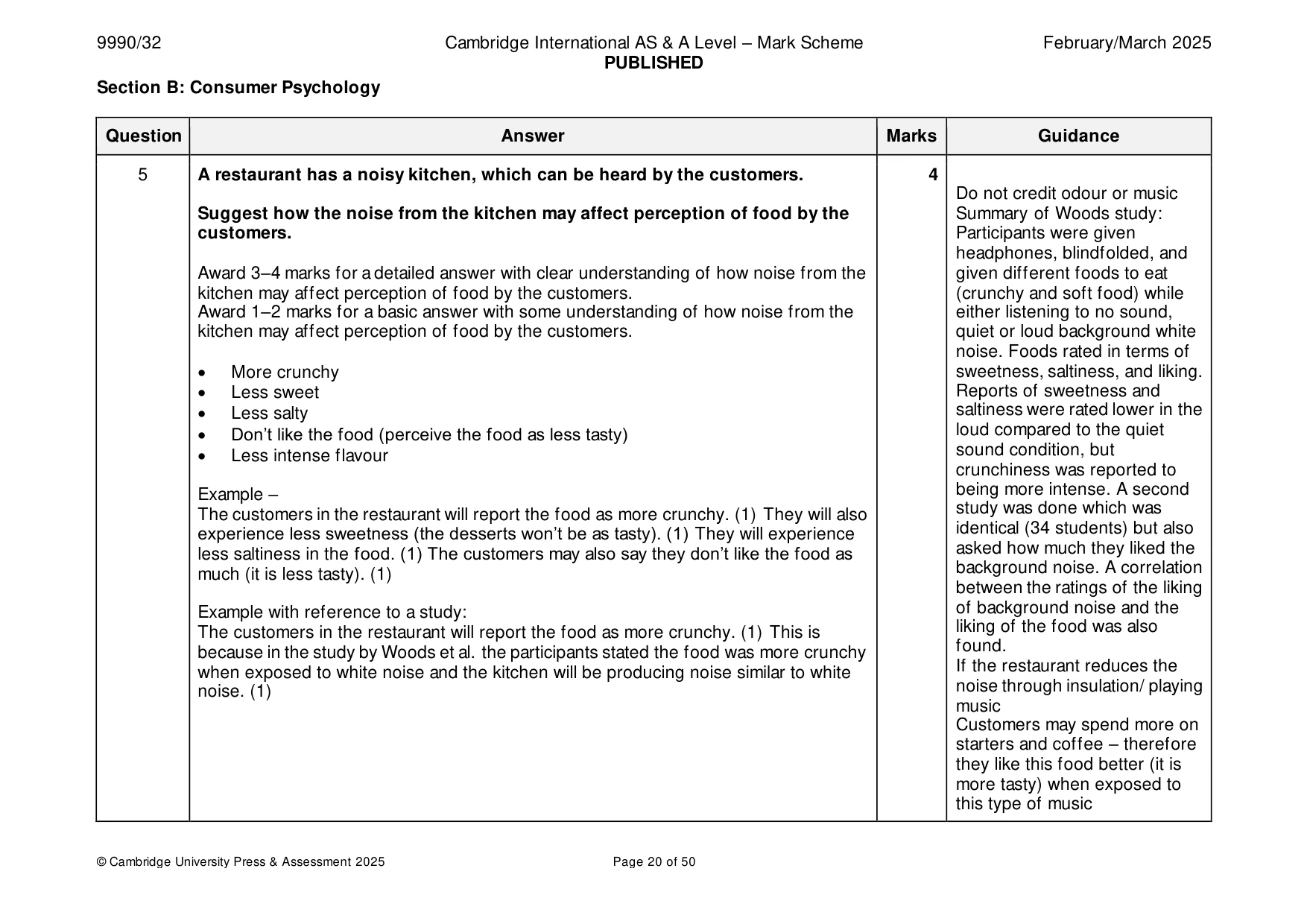
Mark scheme: 5 A restaurant has a noisy kitchen, which can be heard by the customers. 4 Do not credit odour or music Suggest how the noise from the kitchen may affect perception of food by the Summary of Woods study: customers. Participants were given headphones, blindfolded, and Award 3–4 marks for a detailed answer with clear understanding of how noise from the given different foods to eat kitchen may affect perception of food by the customers. (crunchy and soft food) while Award 1–2 marks for a basic answer with some understanding of how noise from the either listening to no sound, kitchen may affect perception of food by the customers. quiet or loud background white noise. Foods rated in terms of • More crunchy sweetness, saltiness, and liking. • Less sweet Reports of sweetness and • Less salty saltiness were rated lower in the • Don’t like the food (perceive the food as less tasty) loud compared to the quiet • Less intense flavour sound condition, but crunchiness was reported to being more intense. A second Example – study was done which was The customers in the restaurant will report the food as more crunchy. (1) They will also identical (34 students) but also experience less sweetness (the desserts won’t be as tasty). (1) They will experience asked how much they liked the less saltiness in the food. (1) The customers may also say they don’t like the food as background noise. A correlation much (it is less tasty). (1) between the ratings of the liking of background noise and the Example with reference to a study: liking of the food was also The customers in the restaurant will report the food as more crunchy. (1) This is found. because in the study by Woods et al. the participants stated the food was more crunchy If the restaurant reduces the when exposed to white noise and the kitchen will be producing noise similar to white noise through insulation/ playing noise. (1) music Customers may spend more on starters and coffee – therefore they like this food better (it is more tasty) when exposed to this type of music
Q6 · Research conducted has shown the effect of product placement in films on choice for both…
6 Research conducted has shown the effect of product placement in films on choice for both adults and children. (a) Outline one explanation for why product placement in films affects choice. [2] (b) Explain why it is important to follow ethical guidelines when using children in psychological research. [2]
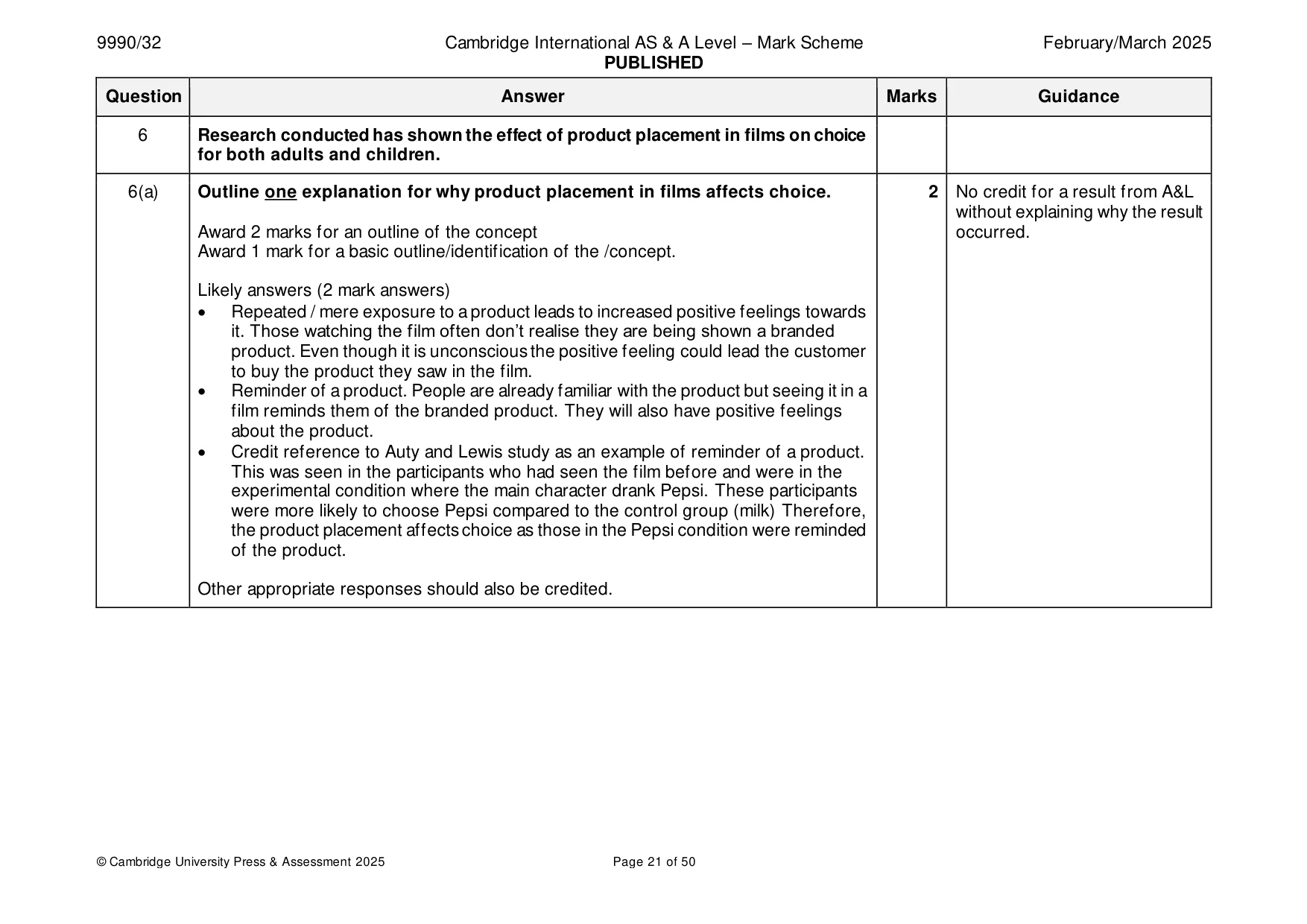
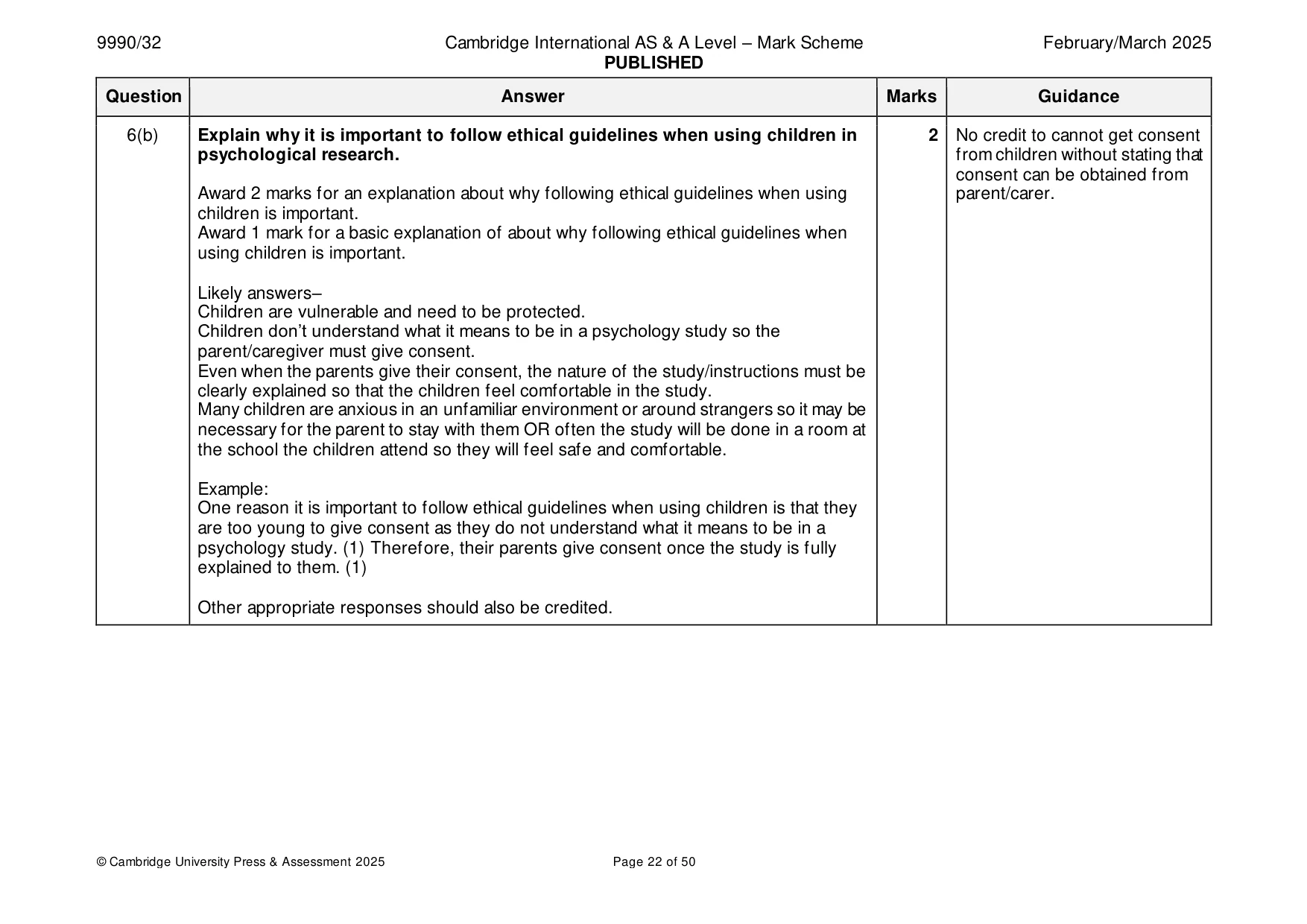
Mark scheme: 6 Research conducted has shown the effect of product placement in films on choice for both adults and children. 6(a) Outline one explanation for why product placement in films affects choice. 2 No credit for a result from A&L without explaining why the result Award 2 marks for an outline of the concept occurred. Award 1 mark for a basic outline/identification of the /concept. Likely answers (2 mark answers) • Repeated / mere exposure to a product leads to increased positive feelings towards it. Those watching the film often don’t realise they are being shown a branded product. Even though it is unconscious the positive feeling could lead the customer to buy the product they saw in the film. • Reminder of a product. People are already familiar with the product but seeing it in a film reminds them of the branded product. They will also have positive feelings about the product. • Credit reference to Auty and Lewis study as an example of reminder of a product. This was seen in the participants who had seen the film before and were in the experimental condition where the main character drank Pepsi. These participants were more likely to choose Pepsi compared to the control group (milk) Therefore, the product placement affects choice as those in the Pepsi condition were reminded of the product. Other appropriate responses should also be credited. 6(b) Explain why it is important to follow ethical guidelines when using children in 2 No credit to cannot get consent psychological research. from children without stating that consent can be obtained from Award 2 marks for an explanation about why following ethical guidelines when using parent/carer. children is important. Award 1 mark for a basic explanation of about why following ethical guidelines when using children is important. Likely answers– Children are vulnerable and need to be protected. Children don’t understand what it means to be in a psychology study so the parent/caregiver must give consent. Even when the parents give their consent, the nature of the study/instructions must be clearly explained so that the children feel comfortable in the study. Many children are anxious in an unfamiliar environment or around strangers so it may be necessary for the parent to stay with them OR often the study will be done in a room at the school the children attend so they will feel safe and comfortable. Example: One reason it is important to follow ethical guidelines when using children is that they are too young to give consent as they do not understand what it means to be in a psychology study. (1) Therefore, their parents give consent once the study is fully explained to them. (1) Other appropriate responses should also be credited.
Q7 · Malika is the marketing manager of a company that sells flowers
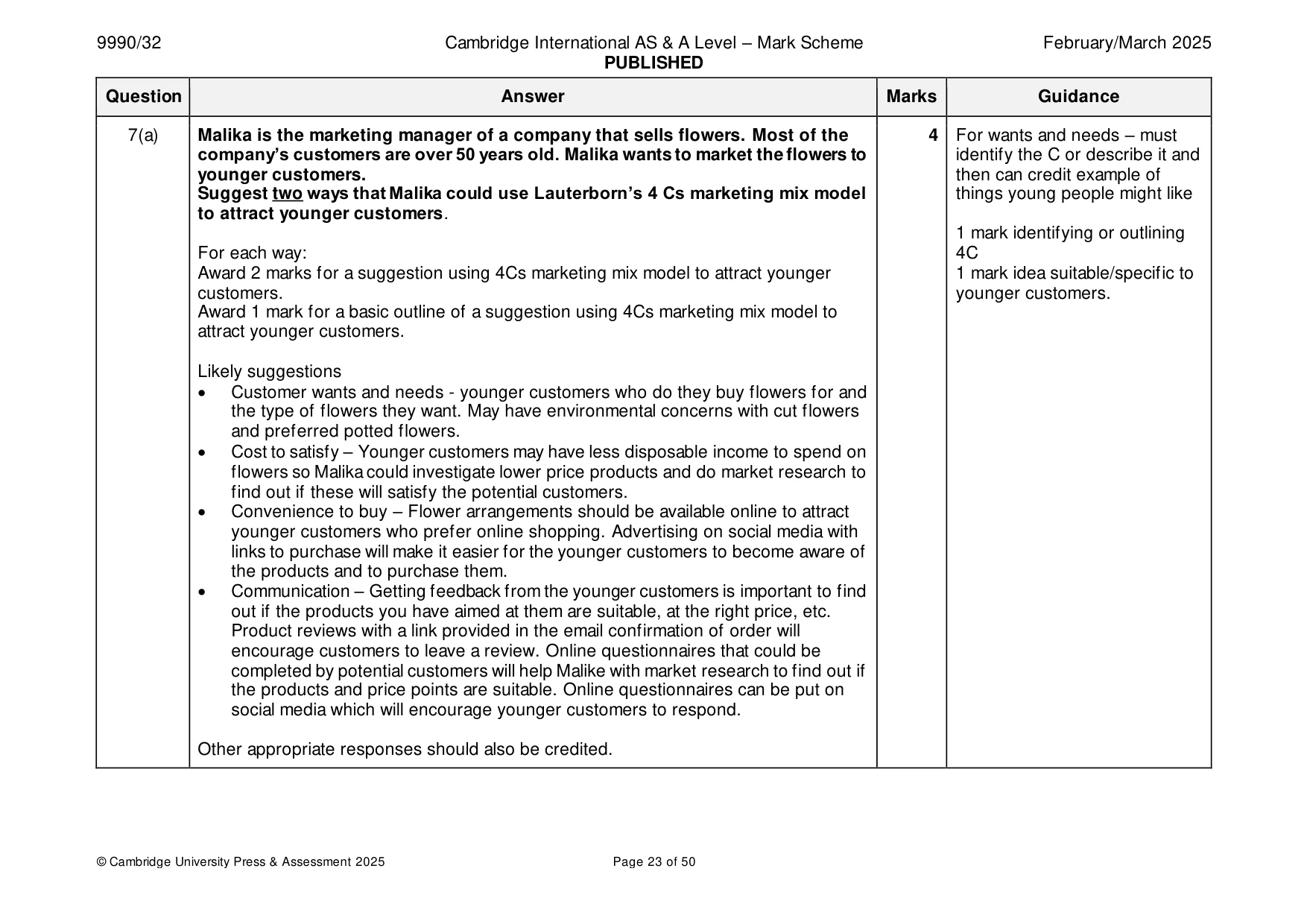
7 (a) Malika is the marketing manager of a company that sells flowers. Most of the company’s customers are over 50 years old. Malika wants to market the flowers to younger customers. Suggest two ways that Malika could use Lauterborn’s 4 Cs marketing mix model to attract younger customers. [4] (b) Explain one weakness of Lauterborn’s 4 Cs marketing mix model. [2]
Mark scheme: 7(a) Malika is the marketing manager of a company that sells flowers. Most of the 4 For wants and needs – must company’s customers are over 50 years old. Malika wants to market the flowers to identify the C or describe it and younger customers. then can credit example of Suggest two ways that Malika could use Lauterborn’s 4 Cs marketing mix model things young people might like to attract younger customers. 1 mark identifying or outlining For each way: 4C Award 2 marks for a suggestion using 4Cs marketing mix model to attract younger 1 mark idea suitable/specific to customers. younger customers. Award 1 mark for a basic outline of a suggestion using 4Cs marketing mix model to attract younger customers. Likely suggestions • Customer wants and needs - younger customers who do they buy flowers for and the type of flowers they want. May have environmental concerns with cut flowers and preferred potted flowers. • Cost to satisfy – Younger customers may have less disposable income to spend on flowers so Malika could investigate lower price products and do market research to find out if these will satisfy the potential customers. • Convenience to buy – Flower arrangements should be available online to attract younger customers who prefer online shopping. Advertising on social media with links to purchase will make it easier for the younger customers to become aware of the products and to purchase them. • Communication – Getting feedback from the younger customers is important to find out if the products you have aimed at them are suitable, at the right price, etc. Product reviews with a link provided in the email confirmation of order will encourage customers to leave a review. Online questionnaires that could be completed by potential customers will help Malike with market research to find out if the products and price points are suitable. Online questionnaires can be put on social media which will encourage younger customers to respond. Other appropriate responses should also be credited. 7(b) Explain one weakness of Lauterborn’s 4C’s marketing mix model. 2 Award 2 marks for an explanation of the weakness Award 1 mark for a basic explanation of the weakness Likely problems – (2 mark responses) • Difficult to test which part of the model has been more or less effective. If sales increase, the company won’t necessarily be able to find out if it was their convenience to buy or their communication with customers (or a factor that has nothing to do with the company’s marketing strategy such as a bad press report being released about their competitor) that led to the increased sales. • Cultural bias – model based on research mainly done in USA so it is possible there is cultural bias. Consumers in Western countries have a larger disposable income and also lots of product choice through internet shopping as well as physical stores. • Difficult for small companies to be able to create a marketing campaign, price, convenience to purchase, etc. for all of their customers. Smaller companies may not have the resources to design a high quality website or be able to communicate effectively with all of their customers. • Difficult to quantify ‘cost to satisfy’. May be hard to determine how much time it takes for a customer to purchase the product or whether customers feel uncomfortable buying the product (e.g. because of its impact on the environment). Other appropriate responses should also be credited.
Q8 · Describe the study by Robson et al
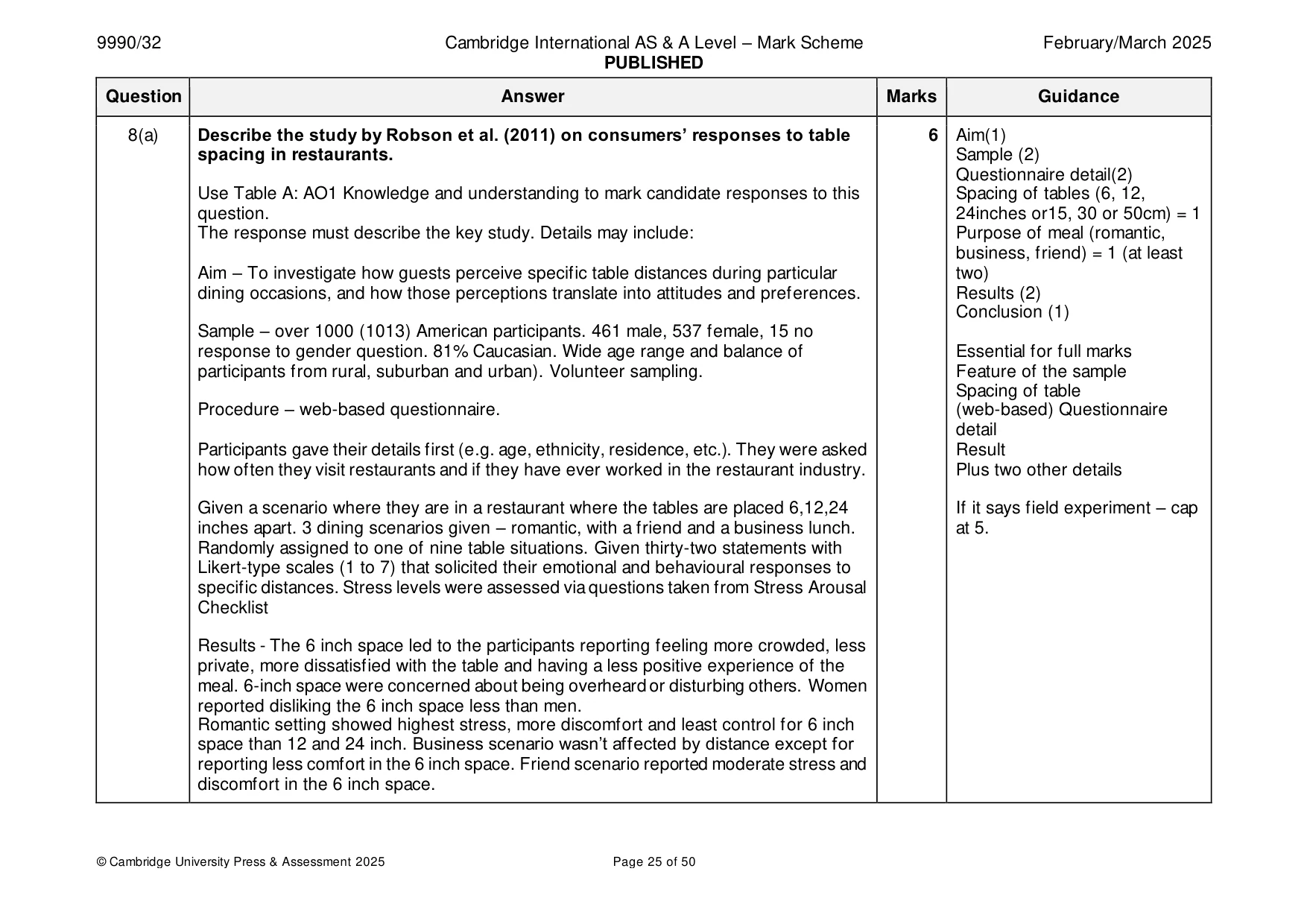
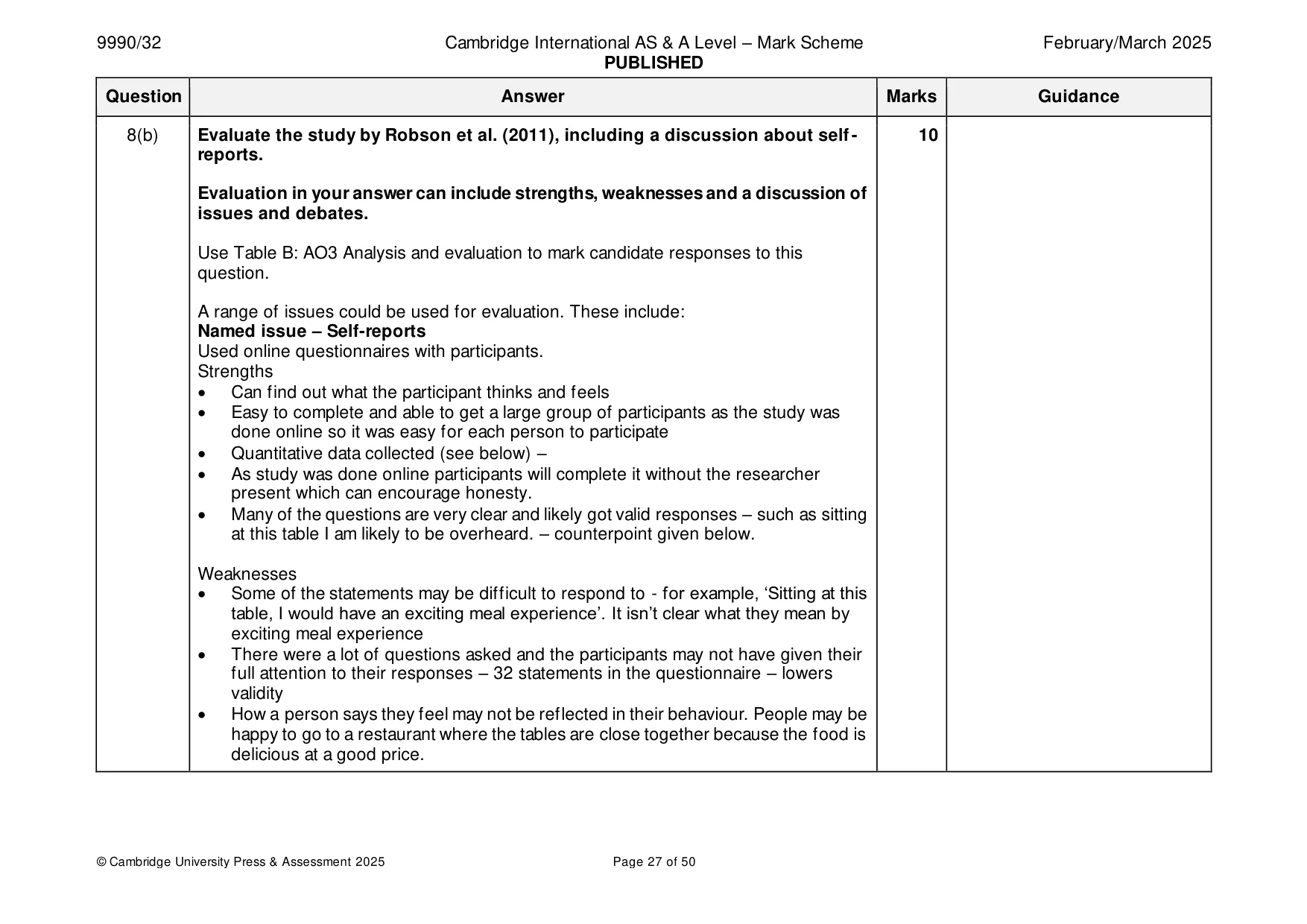
8 (a) Describe the study by Robson et al. (2011) on consumers’ responses to table spacing in restaurants. [6] (b) Evaluate the study by Robson et al. (2011), including a discussion about self-reports. Evaluation in your answer can include strengths, weaknesses and a discussion of issues and debates. [10] Section C: Health Psychology Answer all questions.
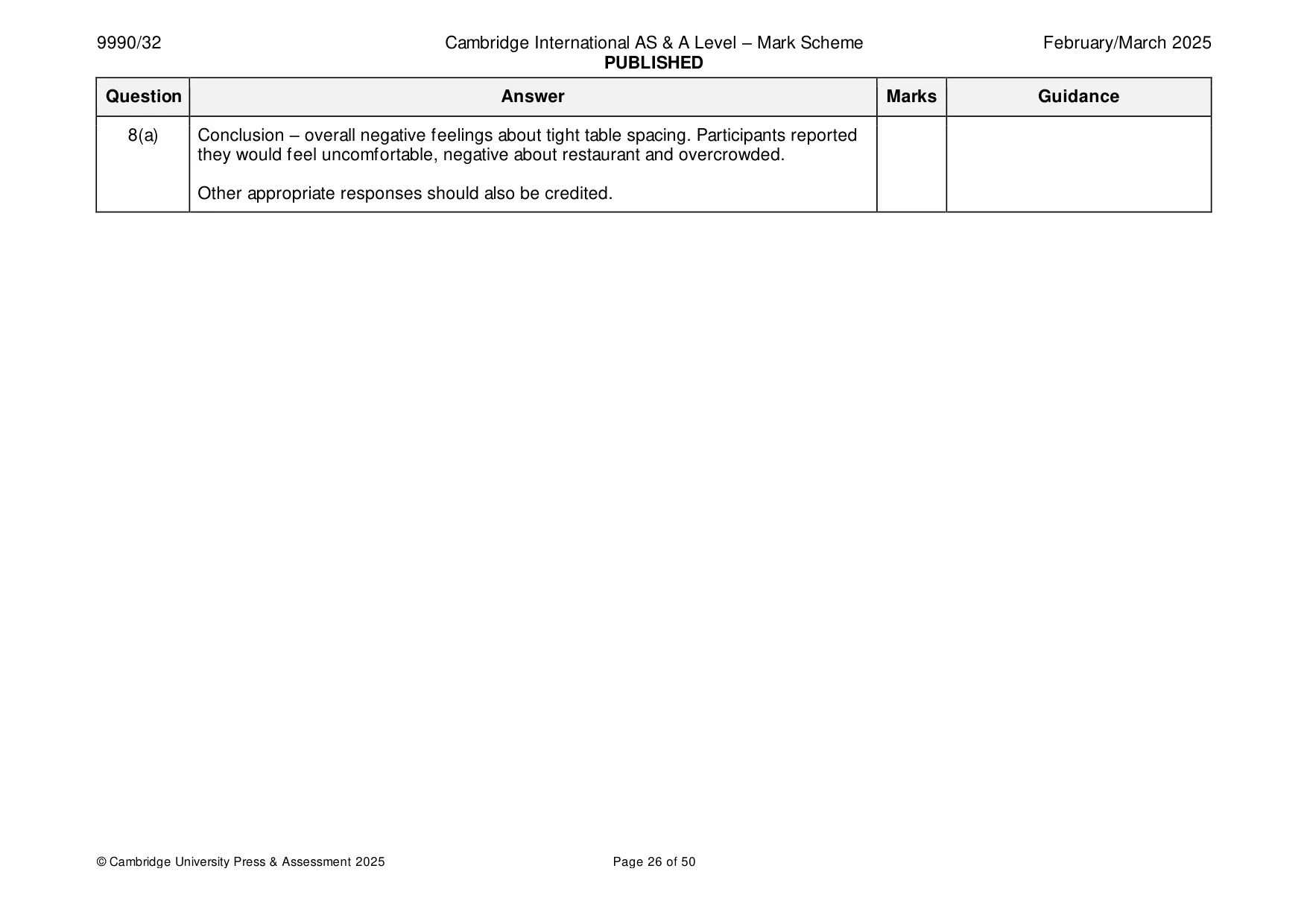
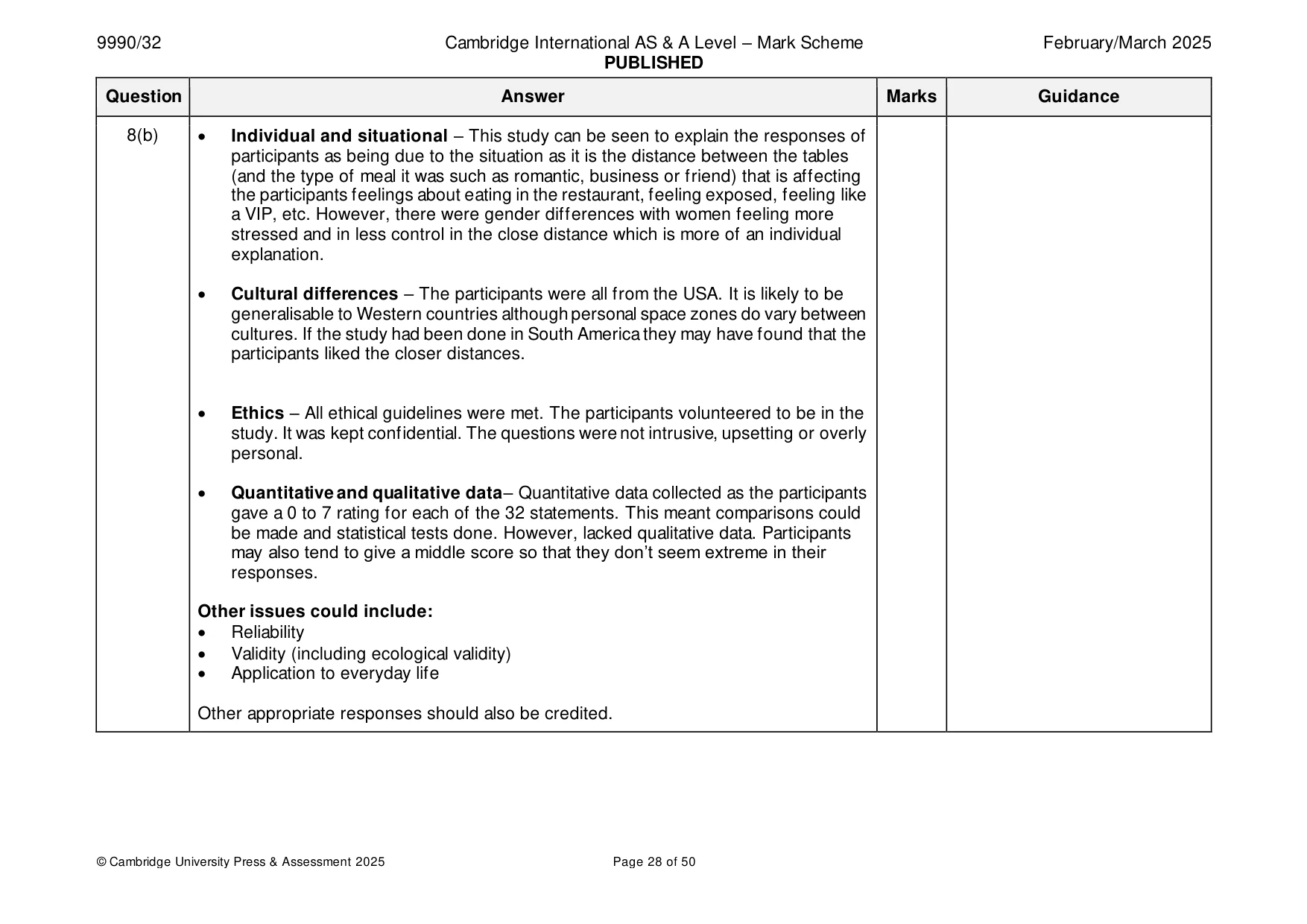
Mark scheme: 8(a) Describe the study by Robson et al. (2011) on consumers’ responses to table 6 Aim(1) spacing in restaurants. Sample (2) Questionnaire detail(2) Use Table A: AO1 Knowledge and understanding to mark candidate responses to this Spacing of tables (6, 12, question. 24inches or15, 30 or 50cm) = 1 The response must describe the key study. Details may include: Purpose of meal (romantic, business, friend) = 1 (at least Aim – To investigate how guests perceive specific table distances during particular two) dining occasions, and how those perceptions translate into attitudes and preferences. Results (2) Conclusion (1) Sample – over 1000 (1013) American participants. 461 male, 537 female, 15 no response to gender question. 81% Caucasian. Wide age range and balance of Essential for full marks participants from rural, suburban and urban). Volunteer sampling. Feature of the sample Spacing of table Procedure – web-based questionnaire. (web-based) Questionnaire detail Participants gave their details first (e.g. age, ethnicity, residence, etc.). They were asked Result how often they visit restaurants and if they have ever worked in the restaurant industry. Plus two other details Given a scenario where they are in a restaurant where the tables are placed 6,12,24 If it says field experiment – cap inches apart. 3 dining scenarios given – romantic, with a friend and a business lunch. at 5. Randomly assigned to one of nine table situations. Given thirty-two statements with Likert-type scales (1 to 7) that solicited their emotional and behavioural responses to specific distances. Stress levels were assessed via questions taken from Stress Arousal Checklist Results - The 6 inch space led to the participants reporting feeling more crowded, less private, more dissatisfied with the table and having a less positive experience of the meal. 6-inch space were concerned about being overheard or disturbing others. Women reported disliking the 6 inch space less than men. Romantic setting showed highest stress, more discomfort and least control for 6 inch space than 12 and 24 inch. Business scenario wasn’t affected by distance except for reporting less comfort in the 6 inch space. Friend scenario reported moderate stress and discomfort in the 6 inch space. 8(a) Conclusion – overall negative feelings about tight table spacing. Participants reported they would feel uncomfortable, negative about restaurant and overcrowded. Other appropriate responses should also be credited. 8(b) Evaluate the study by Robson et al. (2011), including a discussion about self- 10 reports. Evaluation in your answer can include strengths, weaknesses and a discussion of issues and debates. Use Table B: AO3 Analysis and evaluation to mark candidate responses to this question. A range of issues could be used for evaluation. These include: Named issue – Self-reports Used online questionnaires with participants. Strengths • Can find out what the participant thinks and feels • Easy to complete and able to get a large group of participants as the study was done online so it was easy for each person to participate • Quantitative data collected (see below) – • As study was done online participants will complete it without the researcher present which can encourage honesty. • Many of the questions are very clear and likely got valid responses – such as sitting at this table I am likely to be overheard. – counterpoint given below. Weaknesses • Some of the statements may be difficult to respond to - for example, ‘Sitting at this table, I would have an exciting meal experience’. It isn’t clear what they mean by exciting meal experience • There were a lot of questions asked and the participants may not have given their full attention to their responses – 32 statements in the questionnaire – lowers validity • How a person says they feel may not be reflected in their behaviour. People may be happy to go to a restaurant where the tables are close together because the food is delicious at a good price. 8(b) • Individual and situational – This study can be seen to explain the responses of participants as being due to the situation as it is the distance between the tables (and the type of meal it was such as romantic, business or friend) that is affecting the participants feelings about eating in the restaurant, feeling exposed, feeling like a VIP, etc. However, there were gender differences with women feeling more stressed and in less control in the close distance which is more of an individual explanation. • Cultural differences – The participants were all from the USA. It is likely to be generalisable to Western countries although personal space zones do vary between cultures. If the study had been done in South America they may have found that the participants liked the closer distances. • Ethics – All ethical guidelines were met. The participants volunteered to be in the study. It was kept confidential. The questions were not intrusive, upsetting or overly personal. • Quantitative and qualitative data– Quantitative data collected as the participants gave a 0 to 7 rating for each of the 32 statements. This meant comparisons could be made and statistical tests done. However, lacked qualitative data. Participants may also tend to give a middle score so that they don’t seem extreme in their responses. Other issues could include: • Reliability • Validity (including ecological validity) • Application to everyday life Other appropriate responses should also be credited. Section C: Health Psychology
Q9 · Samay has been experiencing stress at work for many years
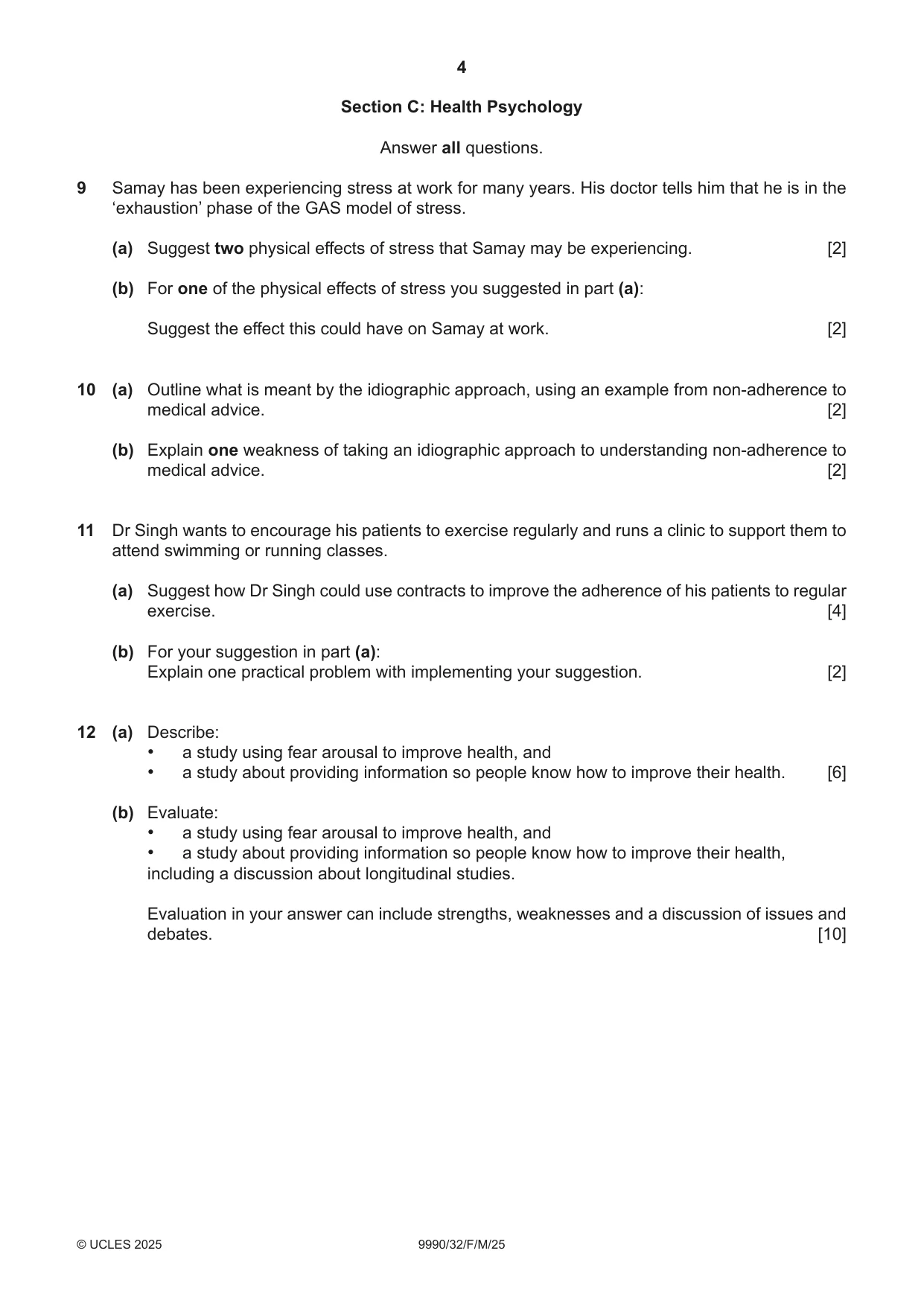
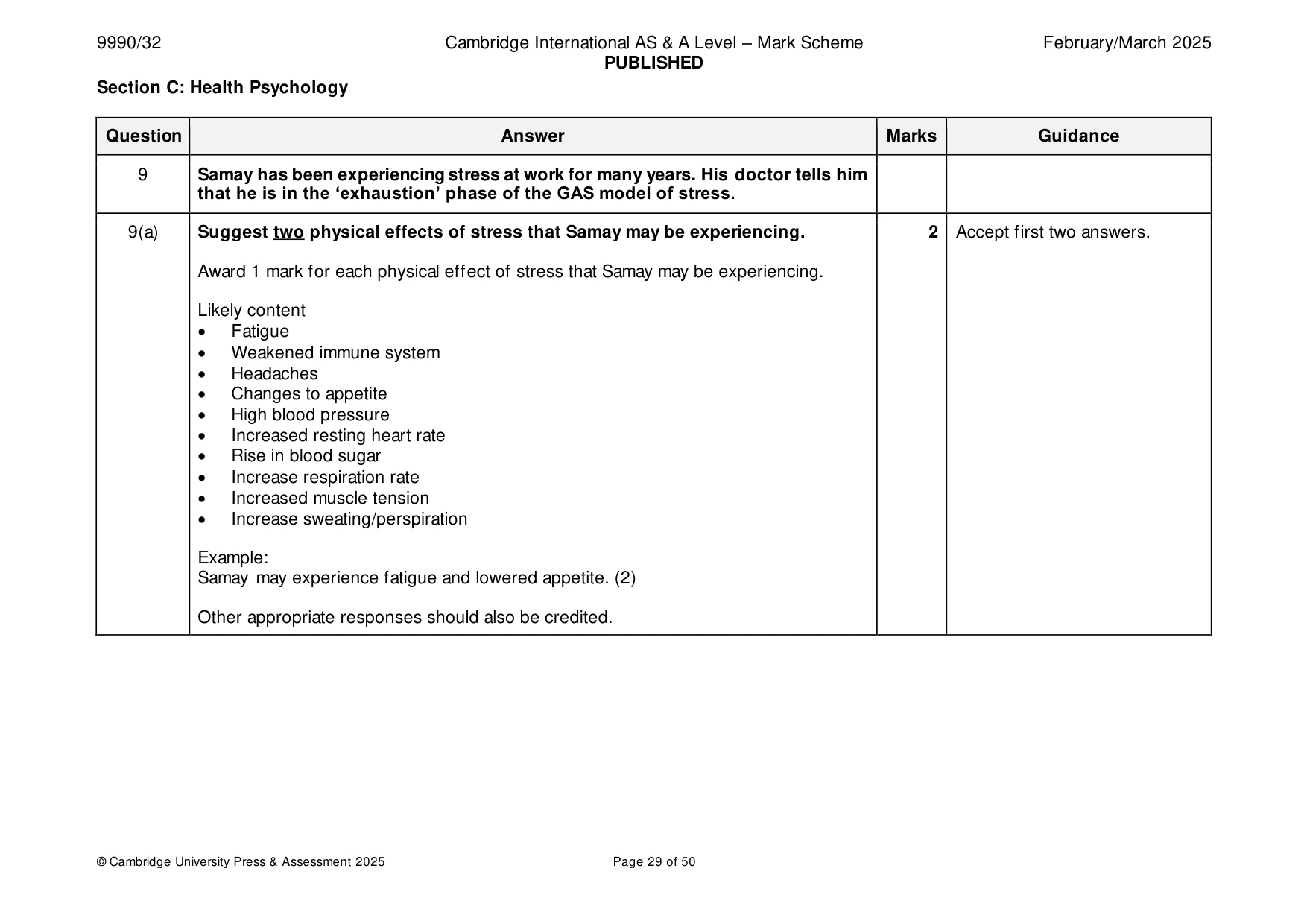
9 Samay has been experiencing stress at work for many years. His doctor tells him that he is in the ‘exhaustion’ phase of the GAS model of stress. (a) Suggest two physical effects of stress that Samay may be experiencing. [2] (b) For one of the physical effects of stress you suggested in part (a): Suggest the effect this could have on Samay at work. [2]
Mark scheme: 9 Samay has been experiencing stress at work for many years. His doctor tells him that he is in the ‘exhaustion’ phase of the GAS model of stress. 9(a) Suggest two physical effects of stress that Samay may be experiencing. 2 Accept first two answers. Award 1 mark for each physical effect of stress that Samay may be experiencing. Likely content • Fatigue • Weakened immune system • Headaches • Changes to appetite • High blood pressure • Increased resting heart rate • Rise in blood sugar • Increase respiration rate • Increased muscle tension • Increase sweating/perspiration Example: Samay may experience fatigue and lowered appetite. (2) Other appropriate responses should also be credited. 9(b) For one of the physical effects of stress you suggested in part (a): 2 Suggest the effect this could have on Samay at work. Award 2 marks for a suggestion of the effect this could have on Samay at work. Award 1 mark for a basic suggestion of the effect this could have on Samay at work. Likely content Fatigue – find it difficult to arrive at work on time, difficult to concentrate while at work due to sleepiness/lack of energy Weakened immune system so will get illnesses requiring time off work or if goes to work doesn’t work as effectively due to ill health. Headaches – may effect his ability to concentrate and make him irritable at work. Changes to appetite – if eating less may lack energy while at work. High blood pressure – may lead to increased risk of heart attack or stroke which will require significant time off work. Example If Samay is experiencing fatigue from stress he may find it difficult to arrive at work on time. (1) This may also mean he will find it difficult to concentrate on projects he is doing at work due to sleepiness/lack of energy. (1) Other appropriate responses should also be credited.
Q10 · Outline what is meant by the idiographic approach, using an example from non-adherence to…
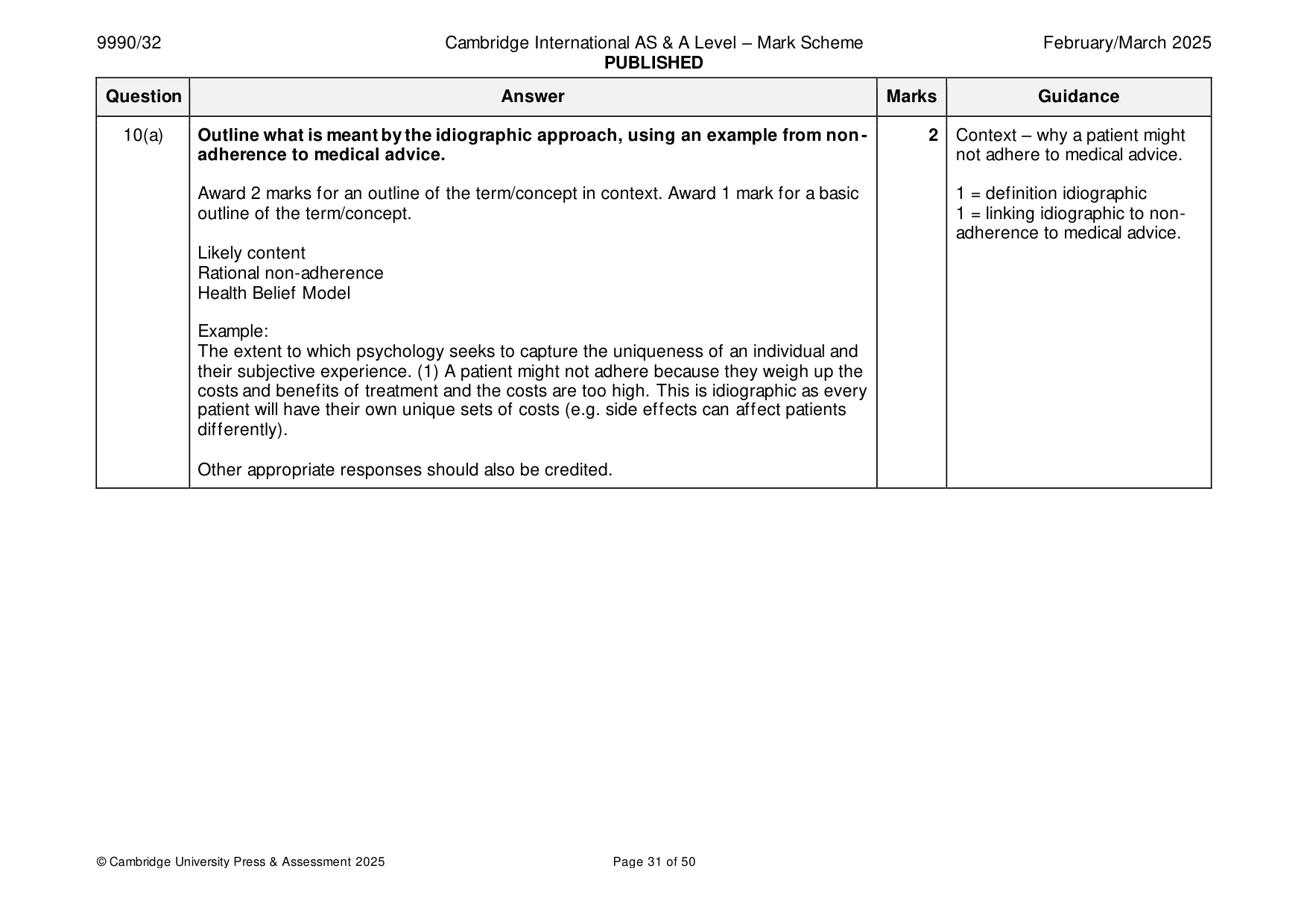
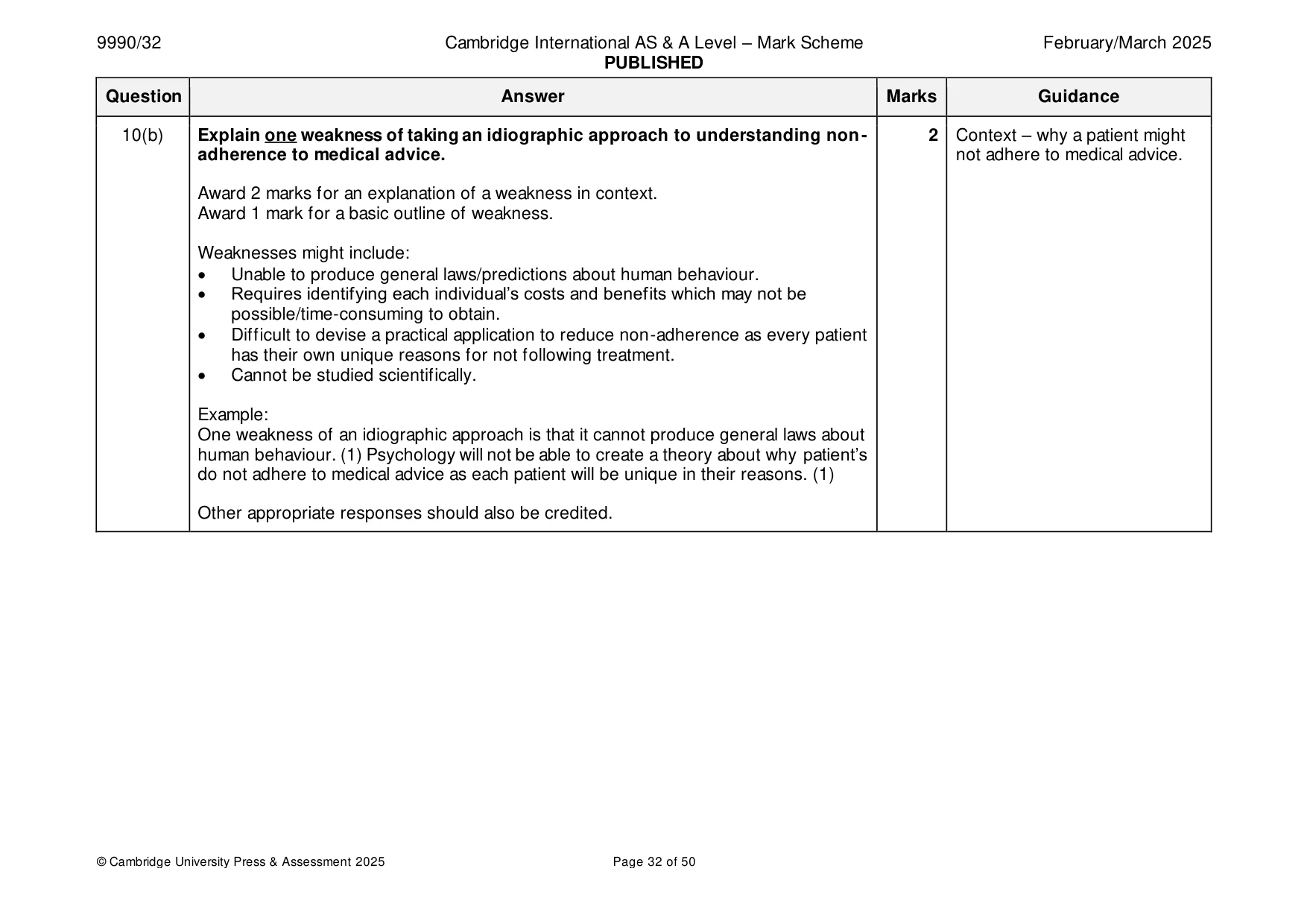
10 (a) Outline what is meant by the idiographic approach, using an example from non-adherence to medical advice. [2] (b) Explain one weakness of taking an idiographic approach to understanding non-adherence to medical advice. [2]
Mark scheme: 10(a) Outline what is meant by the idiographic approach, using an example from non- 2 Context – why a patient might adherence to medical advice. not adhere to medical advice. Award 2 marks for an outline of the term/concept in context. Award 1 mark for a basic 1 = definition idiographic outline of the term/concept. 1 = linking idiographic to non- adherence to medical advice. Likely content Rational non-adherence Health Belief Model Example: The extent to which psychology seeks to capture the uniqueness of an individual and their subjective experience. (1) A patient might not adhere because they weigh up the costs and benefits of treatment and the costs are too high. This is idiographic as every patient will have their own unique sets of costs (e.g. side effects can affect patients differently). Other appropriate responses should also be credited. 10(b) Explain one weakness of taking an idiographic approach to understanding non- 2 Context – why a patient might adherence to medical advice. not adhere to medical advice. Award 2 marks for an explanation of a weakness in context. Award 1 mark for a basic outline of weakness. Weaknesses might include: • Unable to produce general laws/predictions about human behaviour. • Requires identifying each individual’s costs and benefits which may not be possible/time-consuming to obtain. • Difficult to devise a practical application to reduce non-adherence as every patient has their own unique reasons for not following treatment. • Cannot be studied scientifically. Example: One weakness of an idiographic approach is that it cannot produce general laws about human behaviour. (1) Psychology will not be able to create a theory about why patient’s do not adhere to medical advice as each patient will be unique in their reasons. (1) Other appropriate responses should also be credited.
Q11 · Dr Singh wants to encourage his patients to exercise regularly and runs a clinic to…
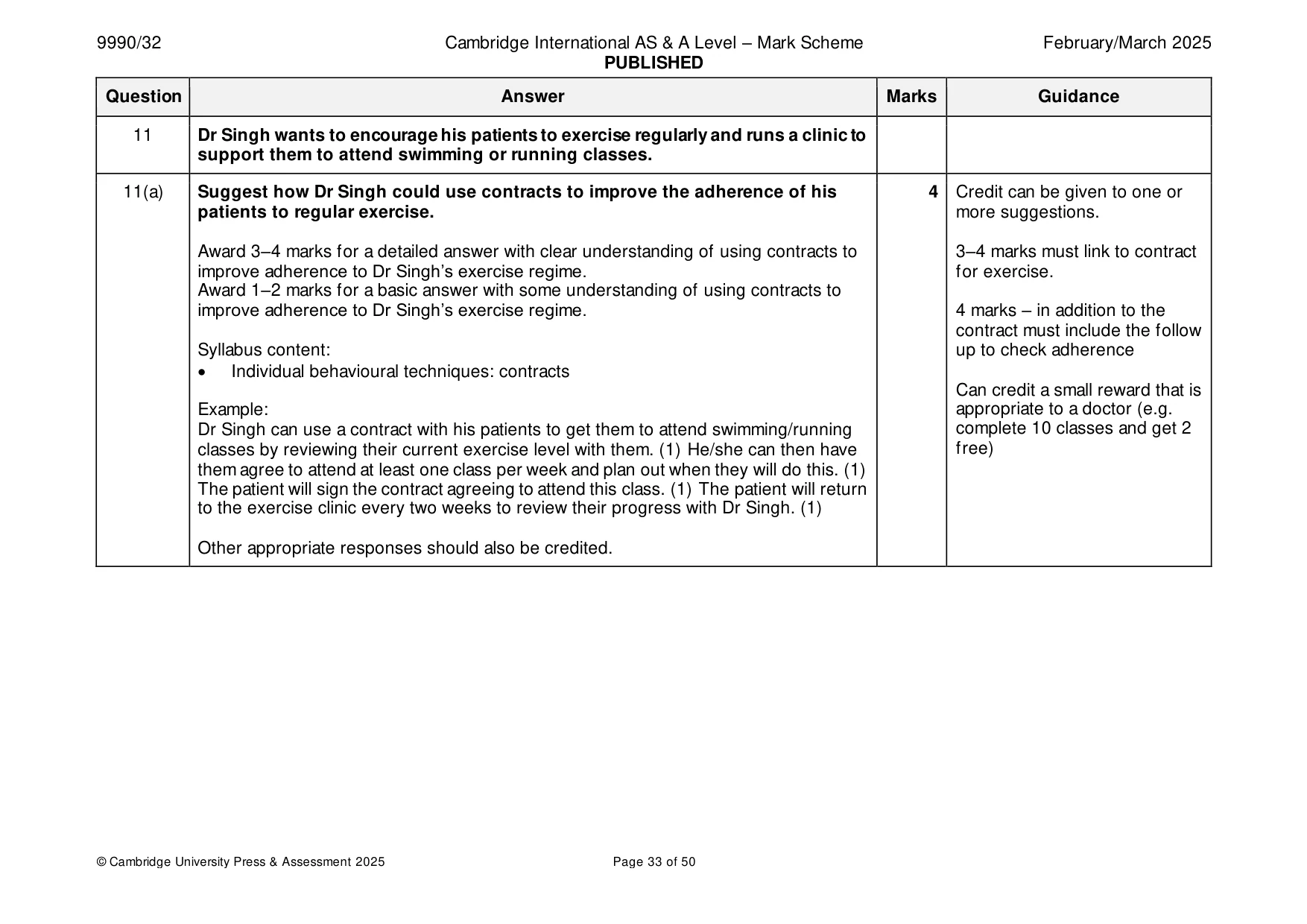
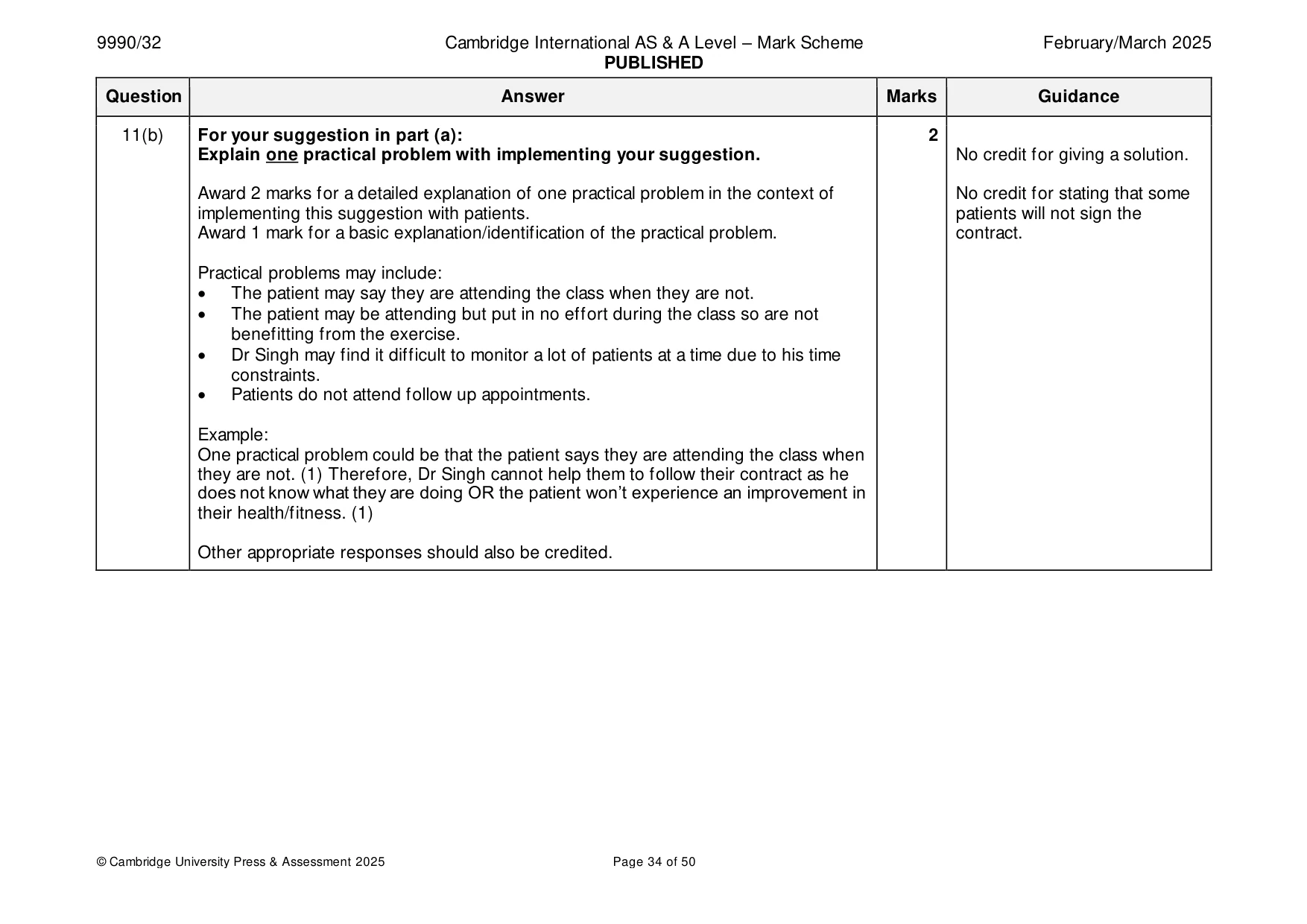
11 Dr Singh wants to encourage his patients to exercise regularly and runs a clinic to support them to attend swimming or running classes. (a) Suggest how Dr Singh could use contracts to improve the adherence of his patients to regular exercise. [4] (b) For your suggestion in part (a): Explain one practical problem with implementing your suggestion. [2]
Mark scheme: 11 Dr Singh wants to encourage his patients to exercise regularly and runs a clinic to support them to attend swimming or running classes. 11(a) Suggest how Dr Singh could use contracts to improve the adherence of his 4 Credit can be given to one or patients to regular exercise. more suggestions. Award 3–4 marks for a detailed answer with clear understanding of using contracts to 3–4 marks must link to contract improve adherence to Dr Singh’s exercise regime. for exercise. Award 1–2 marks for a basic answer with some understanding of using contracts to improve adherence to Dr Singh’s exercise regime. 4 marks – in addition to the contract must include the follow Syllabus content: up to check adherence • Individual behavioural techniques: contracts Can credit a small reward that is Example: appropriate to a doctor (e.g. Dr Singh can use a contract with his patients to get them to attend swimming/running complete 10 classes and get 2 classes by reviewing their current exercise level with them. (1) He/she can then have free) them agree to attend at least one class per week and plan out when they will do this. (1) The patient will sign the contract agreeing to attend this class. (1) The patient will return to the exercise clinic every two weeks to review their progress with Dr Singh. (1) Other appropriate responses should also be credited. 11(b) For your suggestion in part (a): 2 Explain one practical problem with implementing your suggestion. No credit for giving a solution. Award 2 marks for a detailed explanation of one practical problem in the context of No credit for stating that some implementing this suggestion with patients. patients will not sign the Award 1 mark for a basic explanation/identification of the practical problem. contract. Practical problems may include: • The patient may say they are attending the class when they are not. • The patient may be attending but put in no effort during the class so are not benefitting from the exercise. • Dr Singh may find it difficult to monitor a lot of patients at a time due to his time constraints. • Patients do not attend follow up appointments. Example: One practical problem could be that the patient says they are attending the class when they are not. (1) Therefore, Dr Singh cannot help them to follow their contract as he does not know what they are doing OR the patient won’t experience an improvement in their health/fitness. (1) Other appropriate responses should also be credited.
More questions on 2 Health promotion in schools and worksites
Q12 · Describe: • a study using fear arousal to improve health, and • a study about providing…
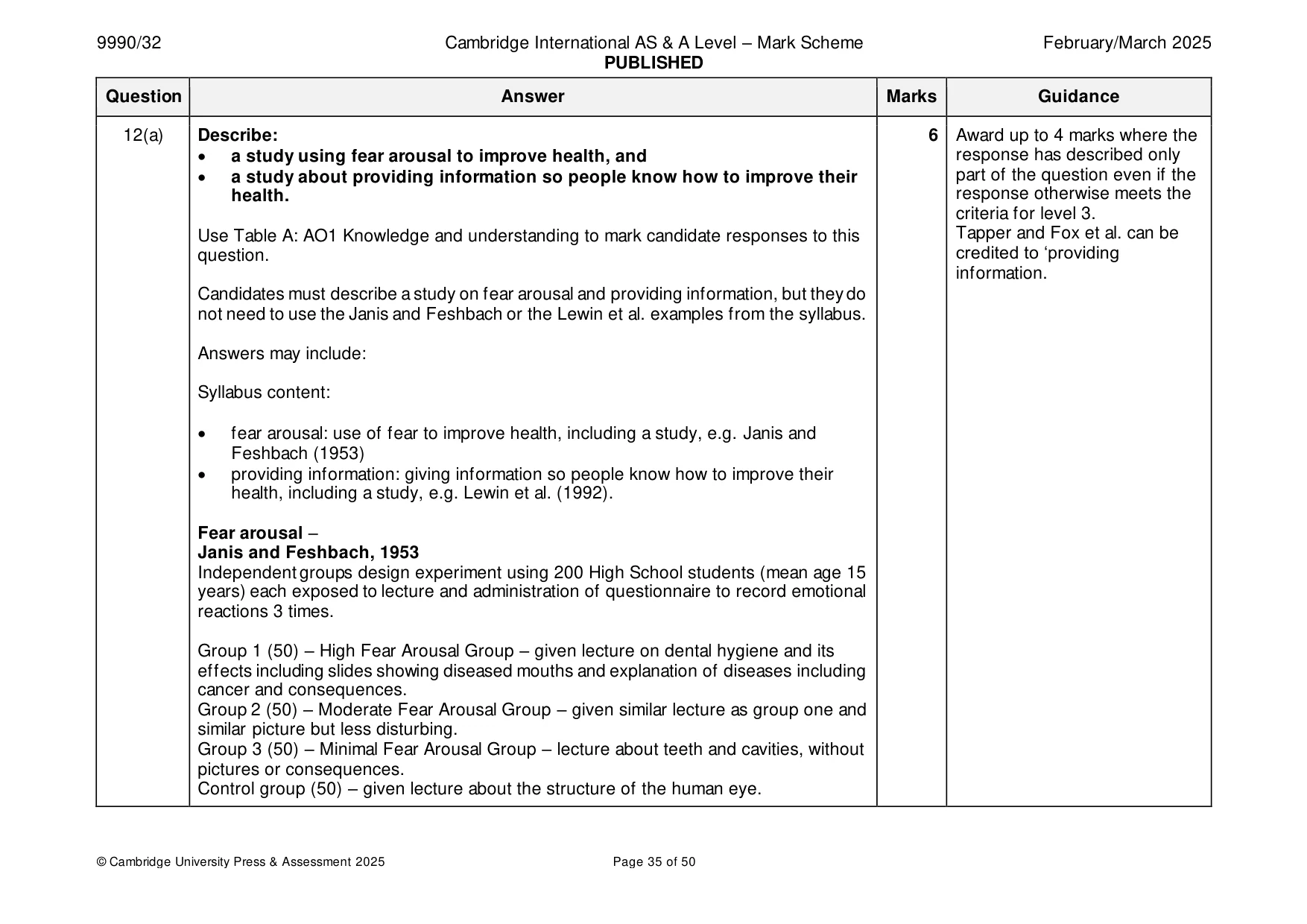
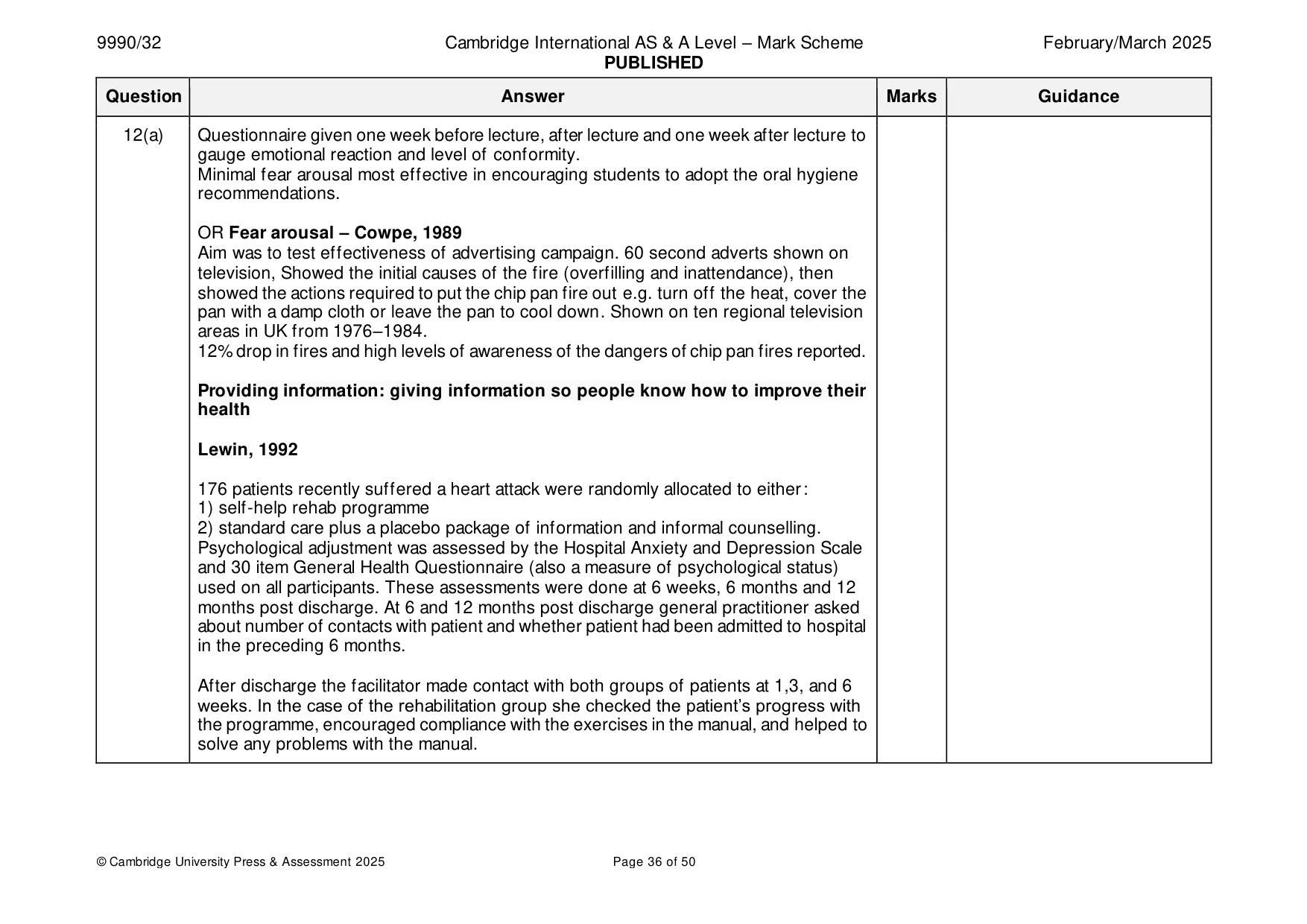
12 (a) Describe: • a study using fear arousal to improve health, and • a study about providing information so people know how to improve their health. [6] (b) Evaluate: • a study using fear arousal to improve health, and • a study about providing information so people know how to improve their health, including a discussion about longitudinal studies. Evaluation in your answer can include strengths, weaknesses and a discussion of issues and debates. [10] Section D: Organisational Psychology Answer all questions.
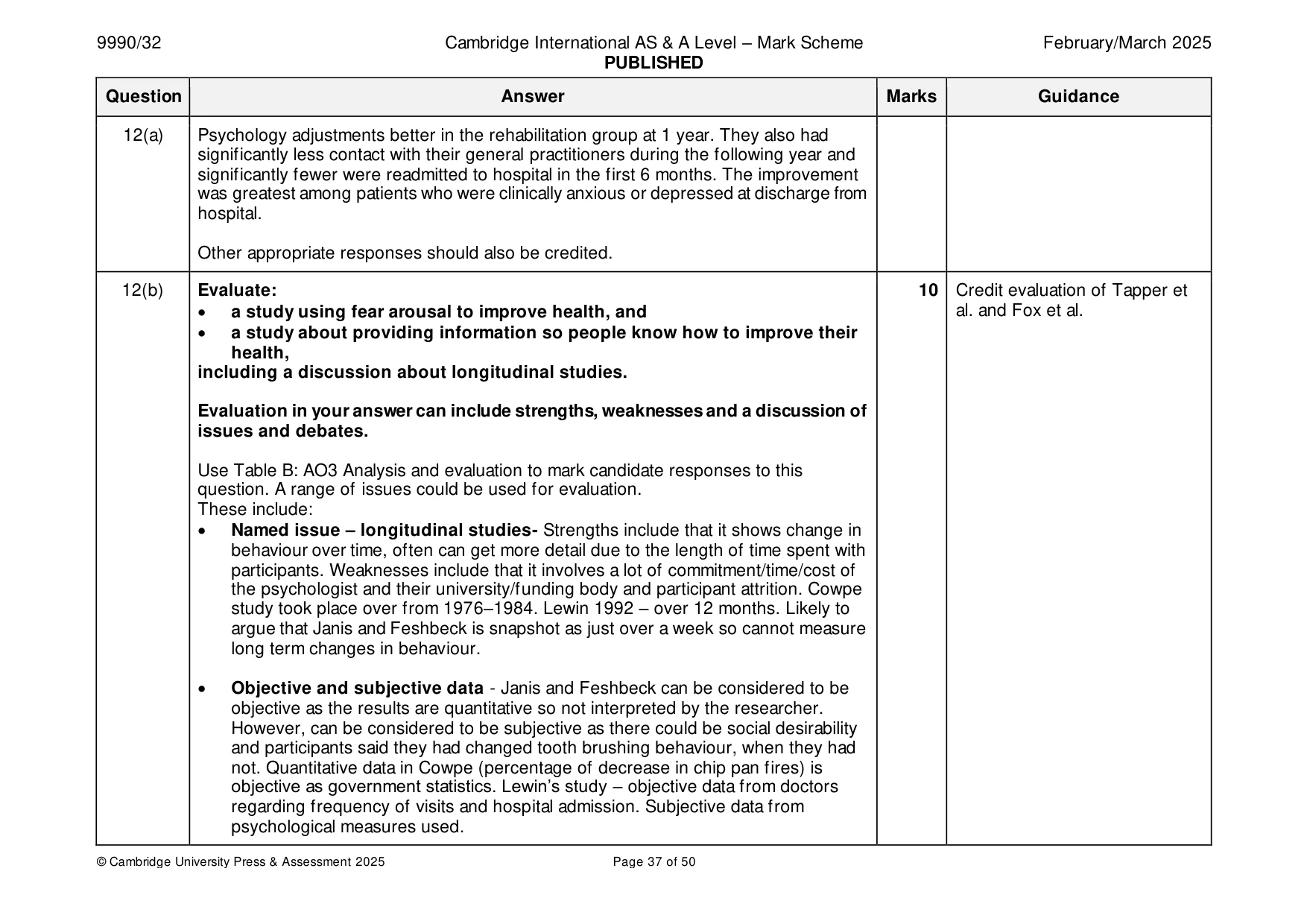
Mark scheme: 12(a) Describe: 6 Award up to 4 marks where the • a study using fear arousal to improve health, and response has described only • a study about providing information so people know how to improve their part of the question even if the health. response otherwise meets the criteria for level 3. Use Table A: AO1 Knowledge and understanding to mark candidate responses to this Tapper and Fox et al. can be question. credited to ‘providing information. Candidates must describe a study on fear arousal and providing information, but they do not need to use the Janis and Feshbach or the Lewin et al. examples from the syllabus. Answers may include: Syllabus content: • fear arousal: use of fear to improve health, including a study, e.g. Janis and Feshbach (1953) • providing information: giving information so people know how to improve their health, including a study, e.g. Lewin et al. (1992). Fear arousal – Janis and Feshbach, 1953 Independent groups design experiment using 200 High School students (mean age 15 years) each exposed to lecture and administration of questionnaire to record emotional reactions 3 times. Group 1 (50) – High Fear Arousal Group – given lecture on dental hygiene and its effects including slides showing diseased mouths and explanation of diseases including cancer and consequences. Group 2 (50) – Moderate Fear Arousal Group – given similar lecture as group one and similar picture but less disturbing. Group 3 (50) – Minimal Fear Arousal Group – lecture about teeth and cavities, without pictures or consequences. Control group (50) – given lecture about the structure of the human eye. 12(a) Questionnaire given one week before lecture, after lecture and one week after lecture to gauge emotional reaction and level of conformity. Minimal fear arousal most effective in encouraging students to adopt the oral hygiene recommendations. OR Fear arousal – Cowpe, 1989 Aim was to test effectiveness of advertising campaign. 60 second adverts shown on television, Showed the initial causes of the fire (overfilling and inattendance), then showed the actions required to put the chip pan fire out e.g. turn off the heat, cover the pan with a damp cloth or leave the pan to cool down. Shown on ten regional television areas in UK from 1976–1984. 12% drop in fires and high levels of awareness of the dangers of chip pan fires reported. Providing information: giving information so people know how to improve their health Lewin, 1992 176 patients recently suffered a heart attack were randomly allocated to either: 1) self-help rehab programme 2) standard care plus a placebo package of information and informal counselling. Psychological adjustment was assessed by the Hospital Anxiety and Depression Scale and 30 item General Health Questionnaire (also a measure of psychological status) used on all participants. These assessments were done at 6 weeks, 6 months and 12 months post discharge. At 6 and 12 months post discharge general practitioner asked about number of contacts with patient and whether patient had been admitted to hospital in the preceding 6 months. After discharge the facilitator made contact with both groups of patients at 1,3, and 6 weeks. In the case of the rehabilitation group she checked the patient’s progress with the programme, encouraged compliance with the exercises in the manual, and helped to solve any problems with the manual. 12(a) Psychology adjustments better in the rehabilitation group at 1 year. They also had significantly less contact with their general practitioners during the following year and significantly fewer were readmitted to hospital in the first 6 months. The improvement was greatest among patients who were clinically anxious or depressed at discharge from hospital. Other appropriate responses should also be credited. 12(b) Evaluate: 10 Credit evaluation of Tapper et • a study using fear arousal to improve health, and al. and Fox et al. • a study about providing information so people know how to improve their health, including a discussion about longitudinal studies. Evaluation in your answer can include strengths, weaknesses and a discussion of issues and debates. Use Table B: AO3 Analysis and evaluation to mark candidate responses to this question. A range of issues could be used for evaluation. These include: • Named issue – longitudinal studies- Strengths include that it shows change in behaviour over time, often can get more detail due to the length of time spent with participants. Weaknesses include that it involves a lot of commitment/time/cost of the psychologist and their university/funding body and participant attrition. Cowpe study took place over from 1976–1984. Lewin 1992 – over 12 months. Likely to argue that Janis and Feshbeck is snapshot as just over a week so cannot measure long term changes in behaviour. • Objective and subjective data - Janis and Feshbeck can be considered to be objective as the results are quantitative so not interpreted by the researcher. However, can be considered to be subjective as there could be social desirability and participants said they had changed tooth brushing behaviour, when they had not. Quantitative data in Cowpe (percentage of decrease in chip pan fires) is objective as government statistics. Lewin’s study – objective data from doctors regarding frequency of visits and hospital admission. Subjective data from psychological measures used. 12(b) • Individual and situational explanations – Cowpe, Lewin and Janis and Feshbeck are situational as they concluded it is the adverts (Cowpe) or the Angina plan (Lewin) or the type of fear arousal used (Janis and Feshbeck) that led to the behaviour change. Likely to mention individual explanations that could have affected behaviour such as health of patient (Lewin), whether advert was seen/paid attention to (Cowpe) and motivation to change tooth brushing behaviour (Janis and Feshbeck) • Cultural differences – Can argue that these techniques could work cross-culturally as everyone experiences these health concerns (oral health, angina, risk of fire). Could also argue that there may be cultural differences in how a different culture might respond to fear arousal and/or providing information. Some cultures might not respond well to a self-help programme and require the intervention of their practitioner. • Ethics – Psychological harm to the participants in the Janis and Feshbeck study exposed to high fear arousal. No mention made of consent in the study (participants were 15). Cowpe – no consent required as the advertisements were shown as part of a government campaign and data collected from government statistics. Consent obtained in Lewin study and no harm caused. Could argue that the self -help programme was not offered to control group after the study. Other issues could include: • evaluation of quantitative data • evaluation of self-reports used • evaluation of experiments • reliability • generalisations from findings • validity/ecological validity Other appropriate responses should also be credited. Section D: Organisational Psychology
More questions on 2 Health promotion in schools and worksites
Q13 · Jaya is the manager of a book shop
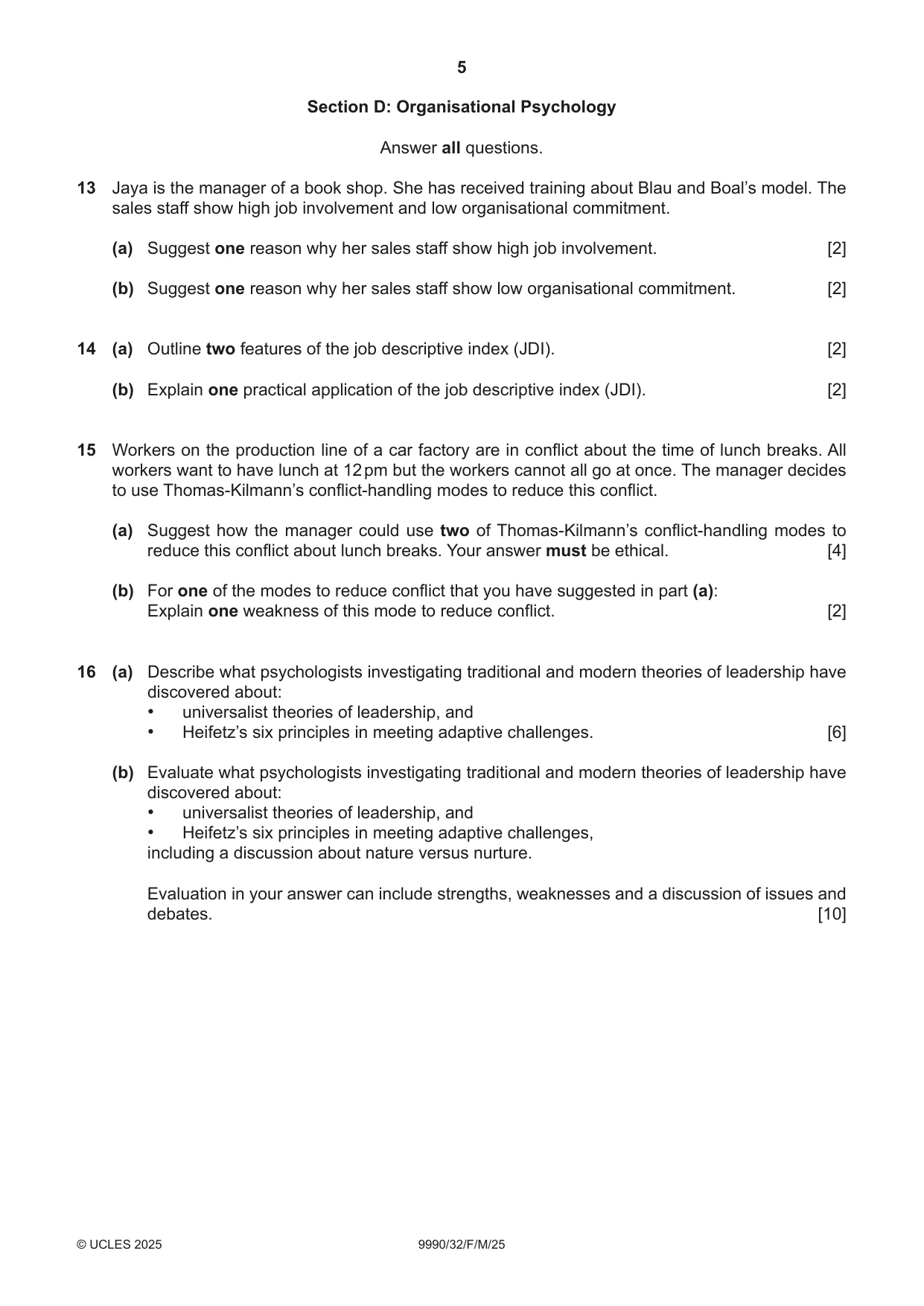
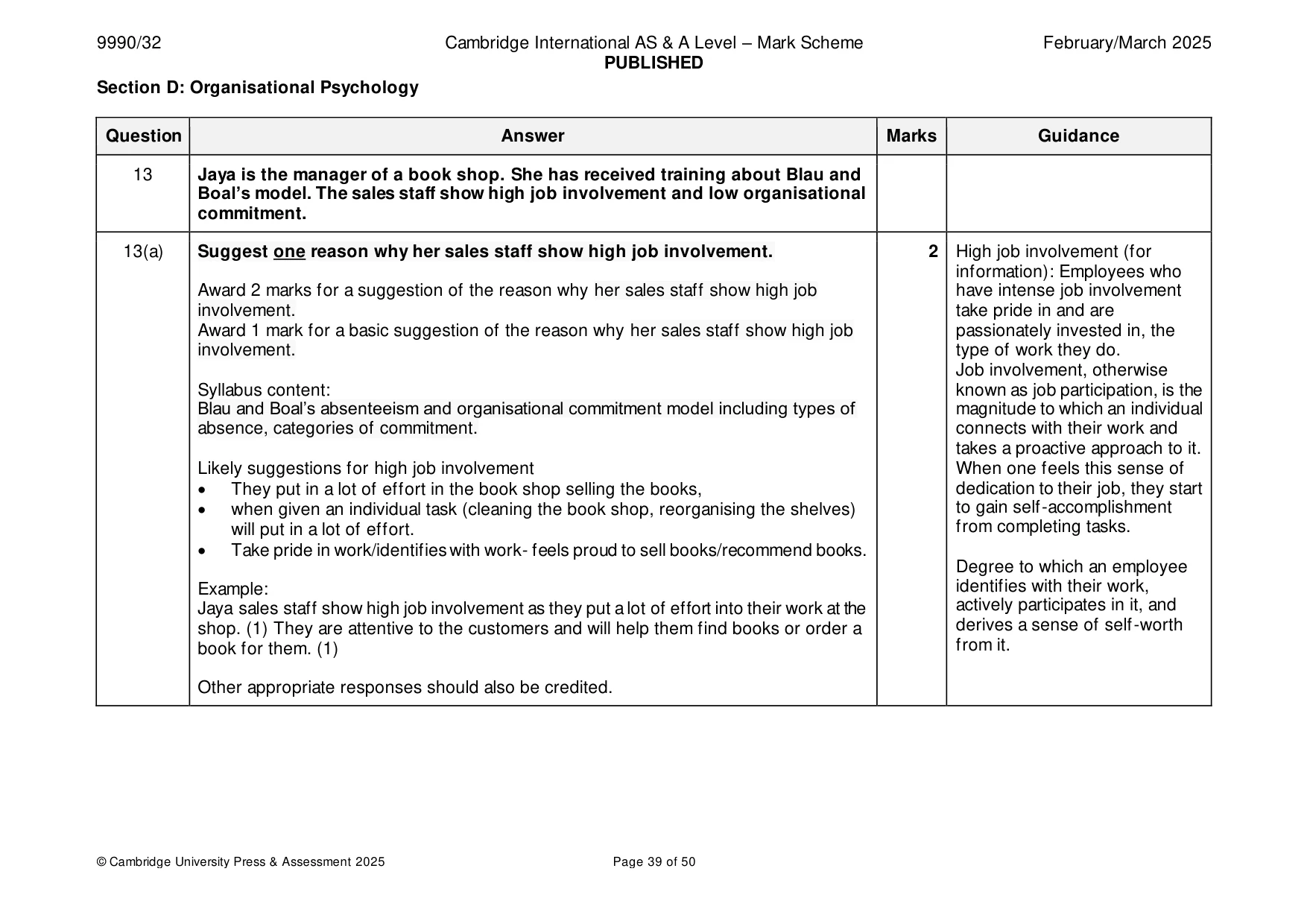
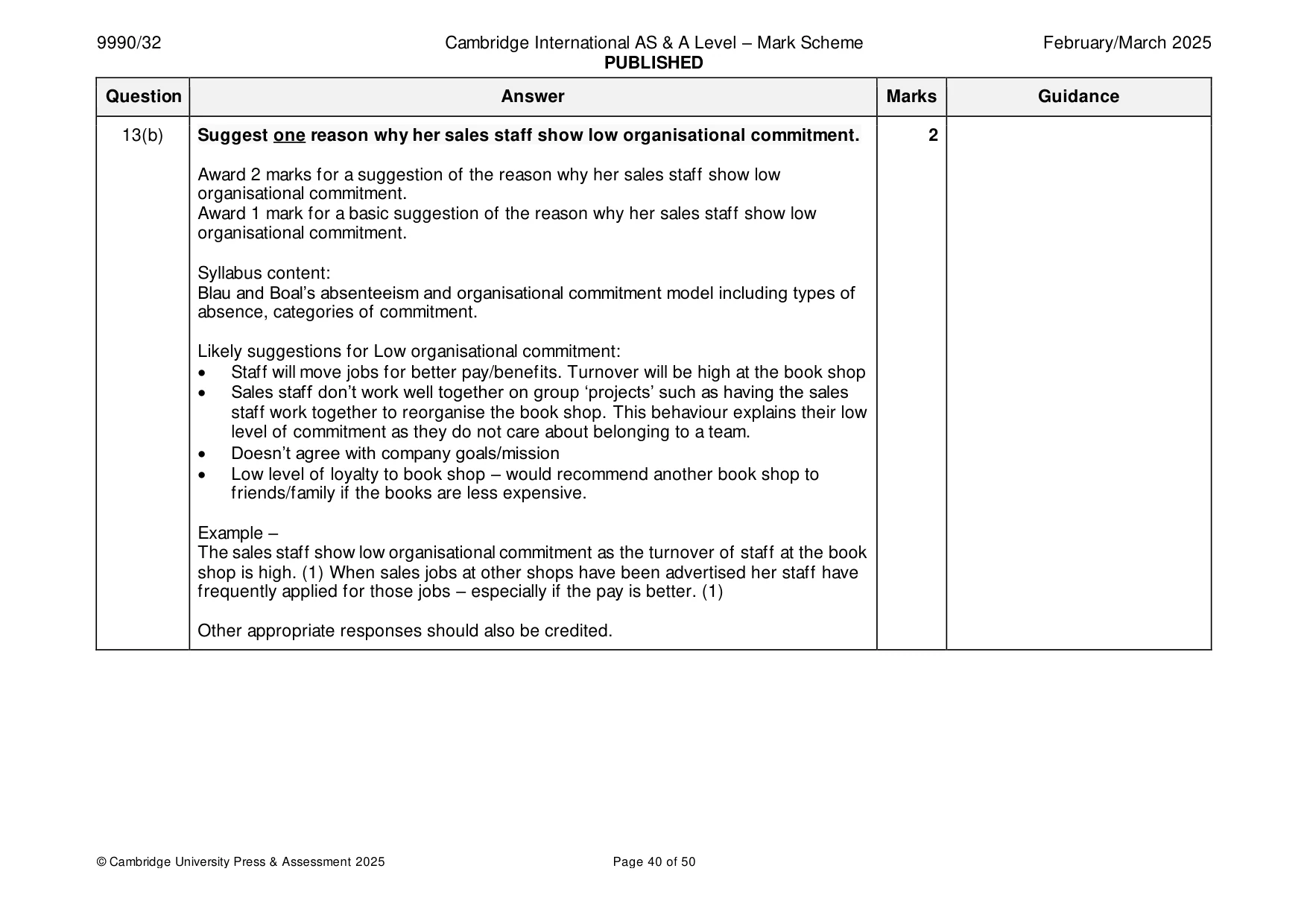
13 Jaya is the manager of a book shop. She has received training about Blau and Boal’s model. The sales staff show high job involvement and low organisational commitment. (a) Suggest one reason why her sales staff show high job involvement. [2] (b) Suggest one reason why her sales staff show low organisational commitment. [2]
Mark scheme: 13 Jaya is the manager of a book shop. She has received training about Blau and Boal’s model. The sales staff show high job involvement and low organisational commitment. 13(a) Suggest one reason why her sales staff show high job involvement. 2 High job involvement (for information): Employees who Award 2 marks for a suggestion of the reason why her sales staff show high job have intense job involvement involvement. take pride in and are Award 1 mark for a basic suggestion of the reason why her sales staff show high job passionately invested in, the involvement. type of work they do. Job involvement, otherwise Syllabus content: known as job participation, is the Blau and Boal’s absenteeism and organisational commitment model including types of magnitude to which an individual absence, categories of commitment. connects with their work and takes a proactive approach to it. Likely suggestions for high job involvement When one feels this sense of • They put in a lot of effort in the book shop selling the books, dedication to their job, they start • when given an individual task (cleaning the book shop, reorganising the shelves) to gain self-accomplishment will put in a lot of effort. from completing tasks. • Take pride in work/identifies with work- feels proud to sell books/recommend books. Degree to which an employee Example: identifies with their work, Jaya sales staff show high job involvement as they put a lot of effort into their work at the actively participates in it, and shop. (1) They are attentive to the customers and will help them find books or order a derives a sense of self-worth book for them. (1) from it. Other appropriate responses should also be credited. 13(b) Suggest one reason why her sales staff show low organisational commitment. 2 Award 2 marks for a suggestion of the reason why her sales staff show low organisational commitment. Award 1 mark for a basic suggestion of the reason why her sales staff show low organisational commitment. Syllabus content: Blau and Boal’s absenteeism and organisational commitment model including types of absence, categories of commitment. Likely suggestions for Low organisational commitment: • Staff will move jobs for better pay/benefits. Turnover will be high at the book shop • Sales staff don’t work well together on group ‘projects’ such as having the sales staff work together to reorganise the book shop. This behaviour explains their low level of commitment as they do not care about belonging to a team. • Doesn’t agree with company goals/mission • Low level of loyalty to book shop – would recommend another book shop to friends/family if the books are less expensive. Example – The sales staff show low organisational commitment as the turnover of staff at the book shop is high. (1) When sales jobs at other shops have been advertised her staff have frequently applied for those jobs – especially if the pay is better. (1) Other appropriate responses should also be credited.
Q14 · Outline two features of the job descriptive index (JDI)
14 (a) Outline two features of the job descriptive index (JDI). [2] (b) Explain one practical application of the job descriptive index (JDI). [2]
Mark scheme: 14(a) Outline two features of the job descriptive index (JDI). 2 Five aspects measured including: Award 1 mark for each feature of the job descriptive index (JDI). Experience of the work Salary Features Promotion prospects • 72 items Experience of supervision • Aspects of job satisfaction measured including supervision, opportunities for Experience of Co-workers. promotion, pay, work on present job, job in general, people at present job. • Answered either yes, no, ? (can’t decide) – if the word describes the aspect of job Credit for measures job satisfaction being measured. satisfaction/high score=high job satisfaction. Example of items on self-report • Jobs in General No credit to ‘it’s a self- • pleasant report/questionnaire’ • bad • great • waste of time • good • undesirable For example: Two features of the JDI are that it has 72 items. (1) One aspect of job satisfaction measured is opportunities for promotion. (1) Other appropriate responses should also be credited. 14(b) Explain one practical application of the job descriptive index (JDI). 2 If the application is that can identify areas of job Award 2 marks for an explanation of one practical application of the Job Descriptive dissatisfaction in employees Index (JDI). Needs something specific from Award 1 mark for an outline of one practical application of the Job Descriptive Index JDI to improve. (JDI). Practical applications include – • Identifies which aspect of job satisfaction that workers are dissatisfied with (e.g. opportunities for promotion) so that the organisation can focus on improving this aspect and therefore improving satisfaction of its workers. • Can measure job satisfaction before and after a new policy, working conditions to measure whether job satisfaction has improved. • Can identify individual workers that are dissatisfied with their jobs so that the organisation can focus on these workers to improve satisfaction. Example: One practical application is that the organisation can identify which aspect of work that its workers are dissatisfied with and focus on improving just this aspect. (1) For example, workers could be dissatisfied with opportunities for promotion but satisfied with other aspects such as supervision and their work. The organisation could provide training so that its workers gain the skills needed to get promoted. (1) Other appropriate responses should also be credited.
Q15 · Workers on the production line of a car factory are in conflict about the time of lunch…
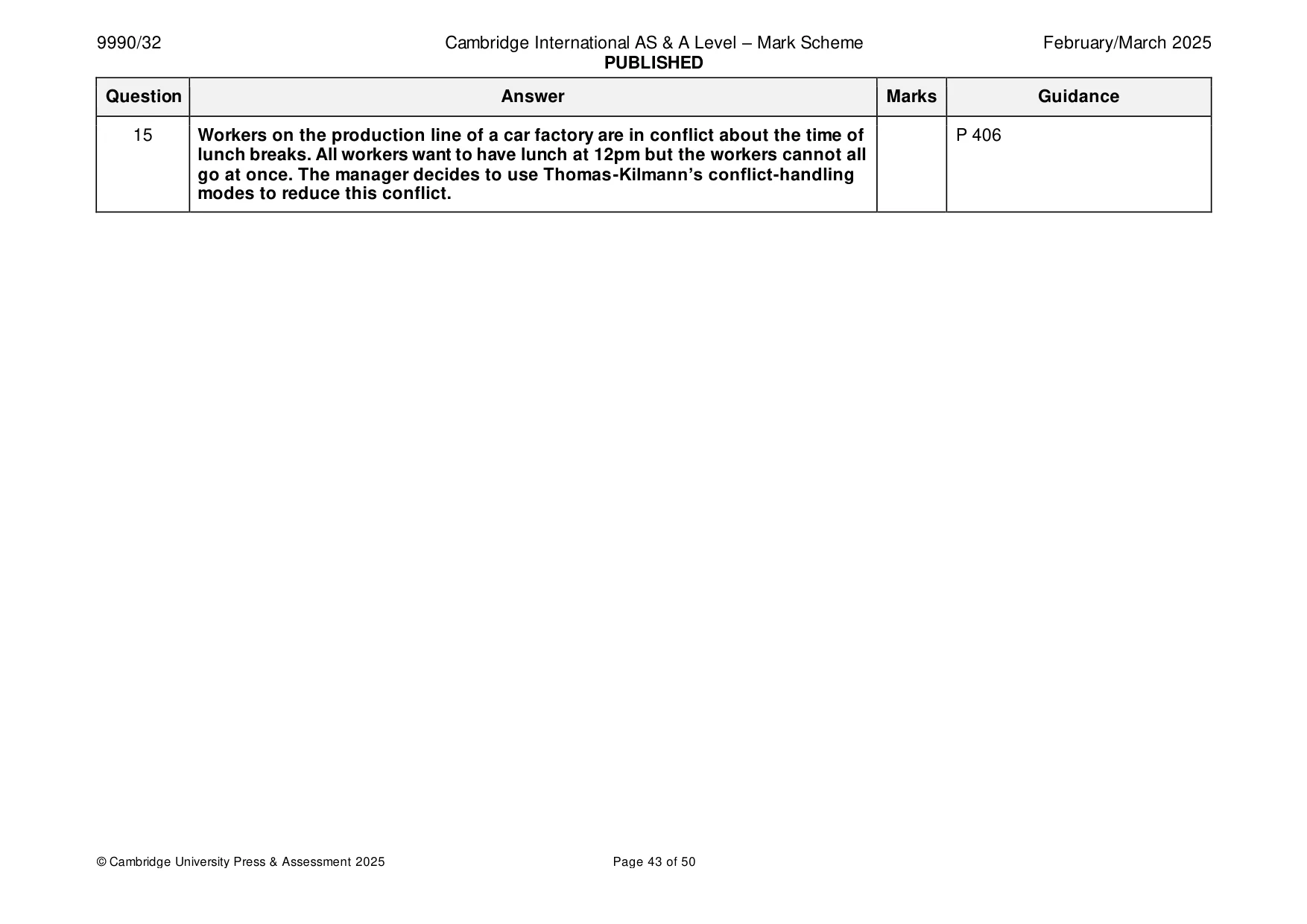
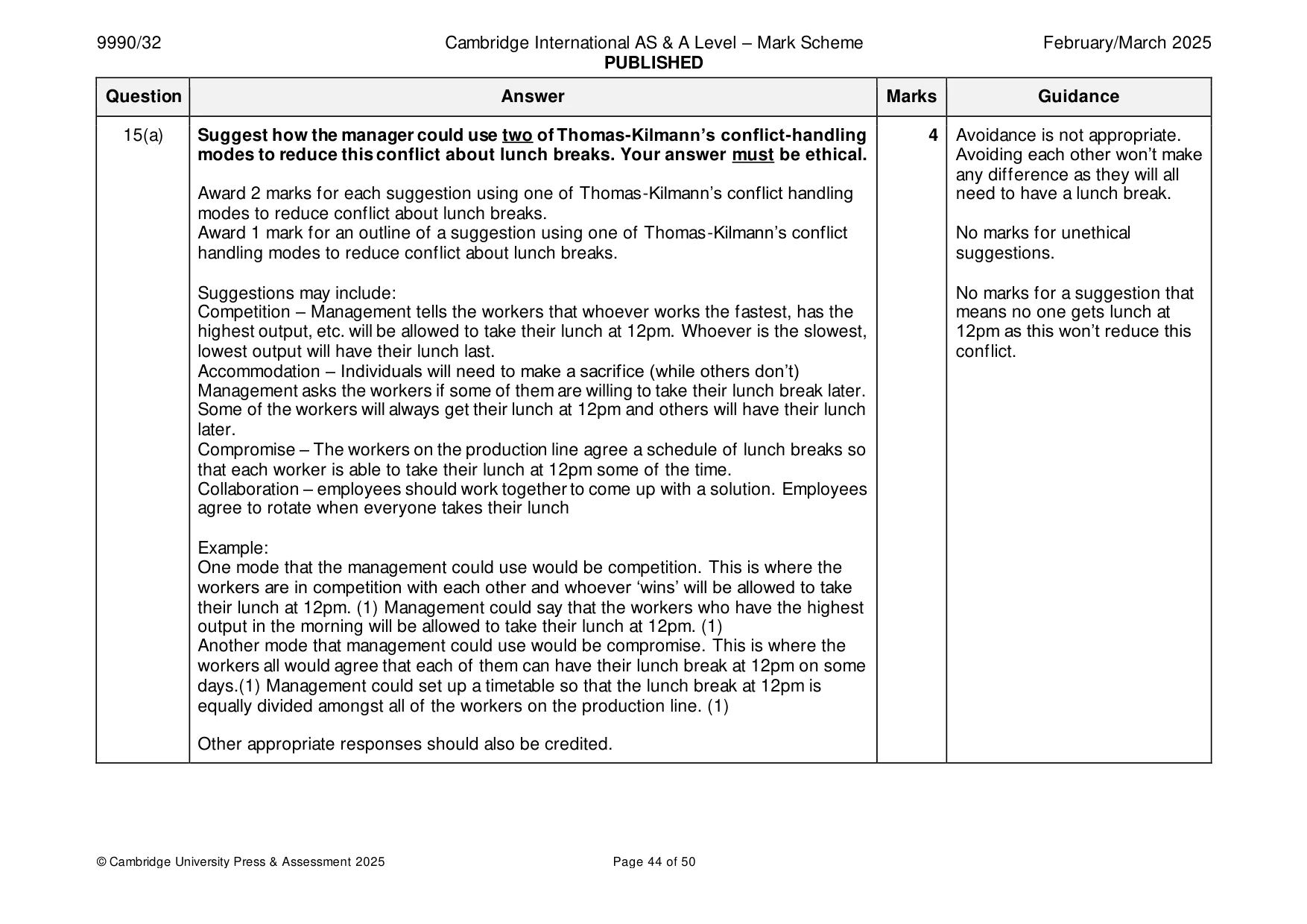
15 Workers on the production line of a car factory are in conflict about the time of lunch breaks. All workers want to have lunch at 12 pm but the workers cannot all go at once. The manager decides to use Thomas-Kilmann’s conflict-handling modes to reduce this conflict. (a) Suggest how the manager could use two of Thomas-Kilmann’s conflict-handling modes to reduce this conflict about lunch breaks. Your answer must be ethical. [4] (b) For one of the modes to reduce conflict that you have suggested in part (a): Explain one weakness of this mode to reduce conflict. [2]
Mark scheme: 15 Workers on the production line of a car factory are in conflict about the time of P 406 lunch breaks. All workers want to have lunch at 12pm but the workers cannot all go at once. The manager decides to use Thomas-Kilmann’s conflict-handling modes to reduce this conflict. 15(a) Suggest how the manager could use two of Thomas-Kilmann’s conflict-handling 4 Avoidance is not appropriate. modes to reduce this conflict about lunch breaks. Your answer must be ethical. Avoiding each other won’t make any difference as they will all Award 2 marks for each suggestion using one of Thomas-Kilmann’s conflict handling need to have a lunch break. modes to reduce conflict about lunch breaks. Award 1 mark for an outline of a suggestion using one of Thomas-Kilmann’s conflict No marks for unethical handling modes to reduce conflict about lunch breaks. suggestions. Suggestions may include: No marks for a suggestion that Competition – Management tells the workers that whoever works the fastest, has the means no one gets lunch at highest output, etc. will be allowed to take their lunch at 12pm. Whoever is the slowest, 12pm as this won’t reduce this lowest output will have their lunch last. conflict. Accommodation – Individuals will need to make a sacrifice (while others don’t) Management asks the workers if some of them are willing to take their lunch break later. Some of the workers will always get their lunch at 12pm and others will have their lunch later. Compromise – The workers on the production line agree a schedule of lunch breaks so that each worker is able to take their lunch at 12pm some of the time. Collaboration – employees should work together to come up with a solution. Employees agree to rotate when everyone takes their lunch Example: One mode that the management could use would be competition. This is where the workers are in competition with each other and whoever ‘wins’ will be allowed to take their lunch at 12pm. (1) Management could say that the workers who have the highest output in the morning will be allowed to take their lunch at 12pm. (1) Another mode that management could use would be compromise. This is where the workers all would agree that each of them can have their lunch break at 12pm on some days.(1) Management could set up a timetable so that the lunch break at 12pm is equally divided amongst all of the workers on the production line. (1) Other appropriate responses should also be credited. 15(b) For one of the modes to reduce conflict that you have suggested in part (a): 2 If part (a) achieved 0 as it did Explain one weakness of this mode to reduce conflict. not resolve problem (e.g. no one can take their lunch at 12pm) no Award 2 marks for an explanation of the weakness. credit in part (b) where the Award 1 mark for an outline of the weakness. response states that it did not work. Weaknesses may include: Competition – quality of work may be poor if workers are trying to go too quickly. Production may be slower in the afternoon as there is no reward for working quickly once you have had your lunch break. Accommodation – the workers who have the later lunch may dislike the workers who get their lunch break at 12pm and this could mean the conflict continues due to this. If no one volunteers to have a later lunch break, difficult for management to decide who should be allowed to have their break at 12pm. Compromise – Someone will have to take responsibility for making sure that the 12pm lunch break is fairly allocated to all of the workers. This will be time-consuming and may be difficult to monitor. Collaboration – May be difficult to have everyone contribute ideas for the solution. Charismatic/confident staff may have their ideas Example: One weakness of using competition to reduce the conflict about the time of the lunch break is that the quality of work in the morning may be poor (1) as the workers are working too quickly in order to ‘win’ the 12pm lunch break time. (1) Other appropriate responses should also be credited.
Q16 · Describe what psychologists investigating traditional and modern theories of leadership…
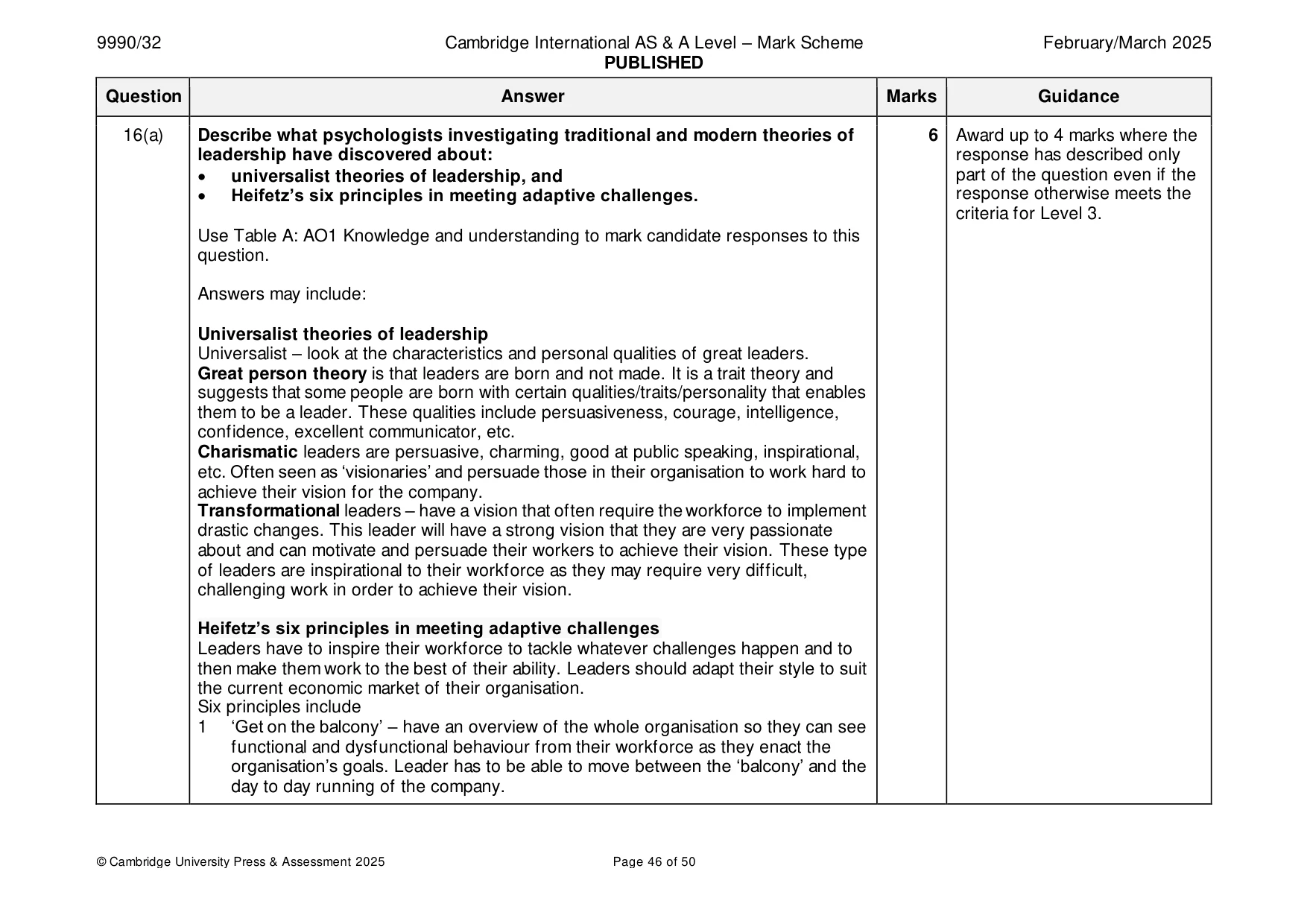
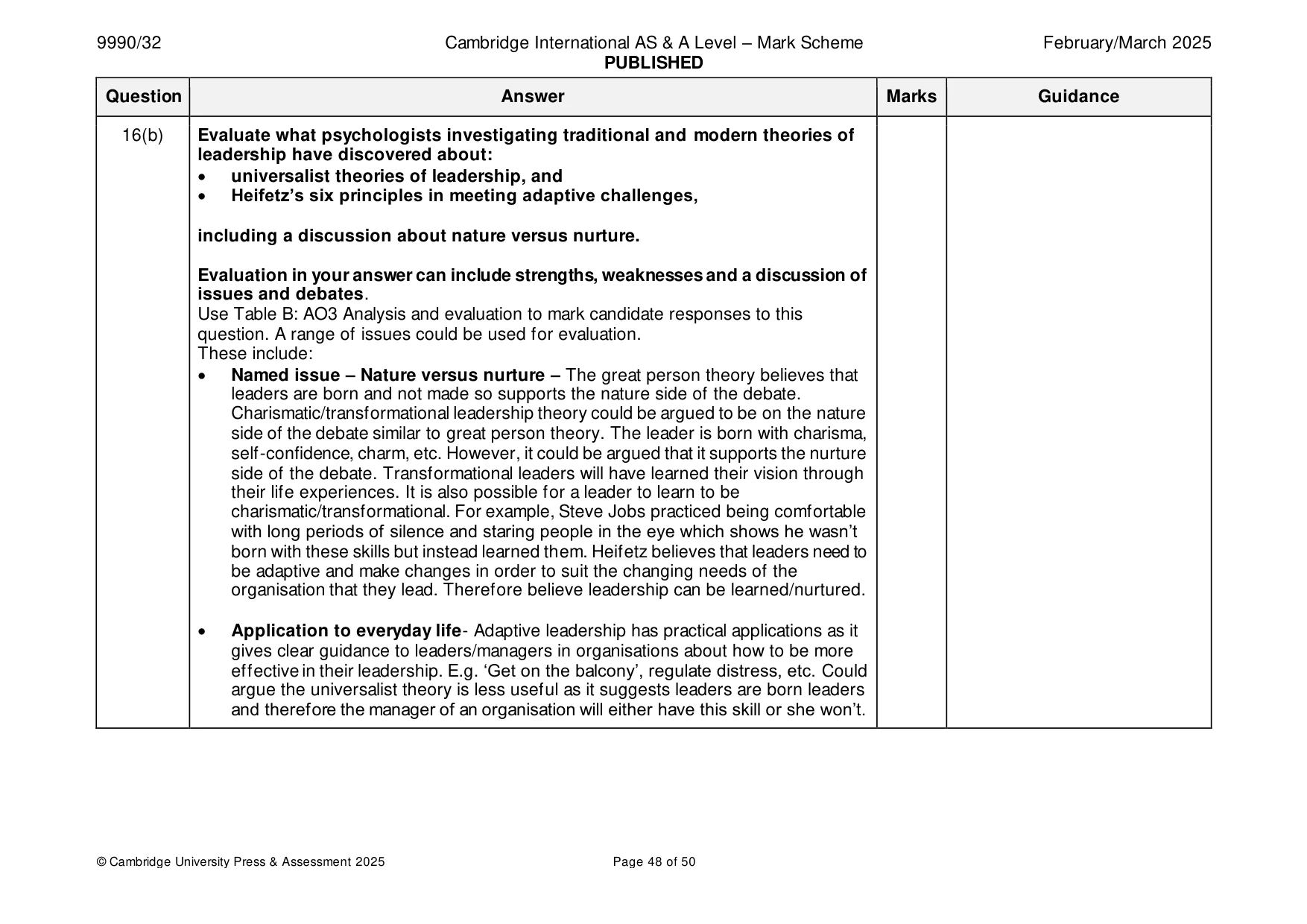
16 (a) Describe what psychologists investigating traditional and modern theories of leadership have discovered about: • universalist theories of leadership, and • Heifetz’s six principles in meeting adaptive challenges. [6] (b) Evaluate what psychologists investigating traditional and modern theories of leadership have discovered about: • universalist theories of leadership, and • Heifetz’s six principles in meeting adaptive challenges, including a discussion about nature versus nurture. Evaluation in your answer can include strengths, weaknesses and a discussion of issues and debates. [10]
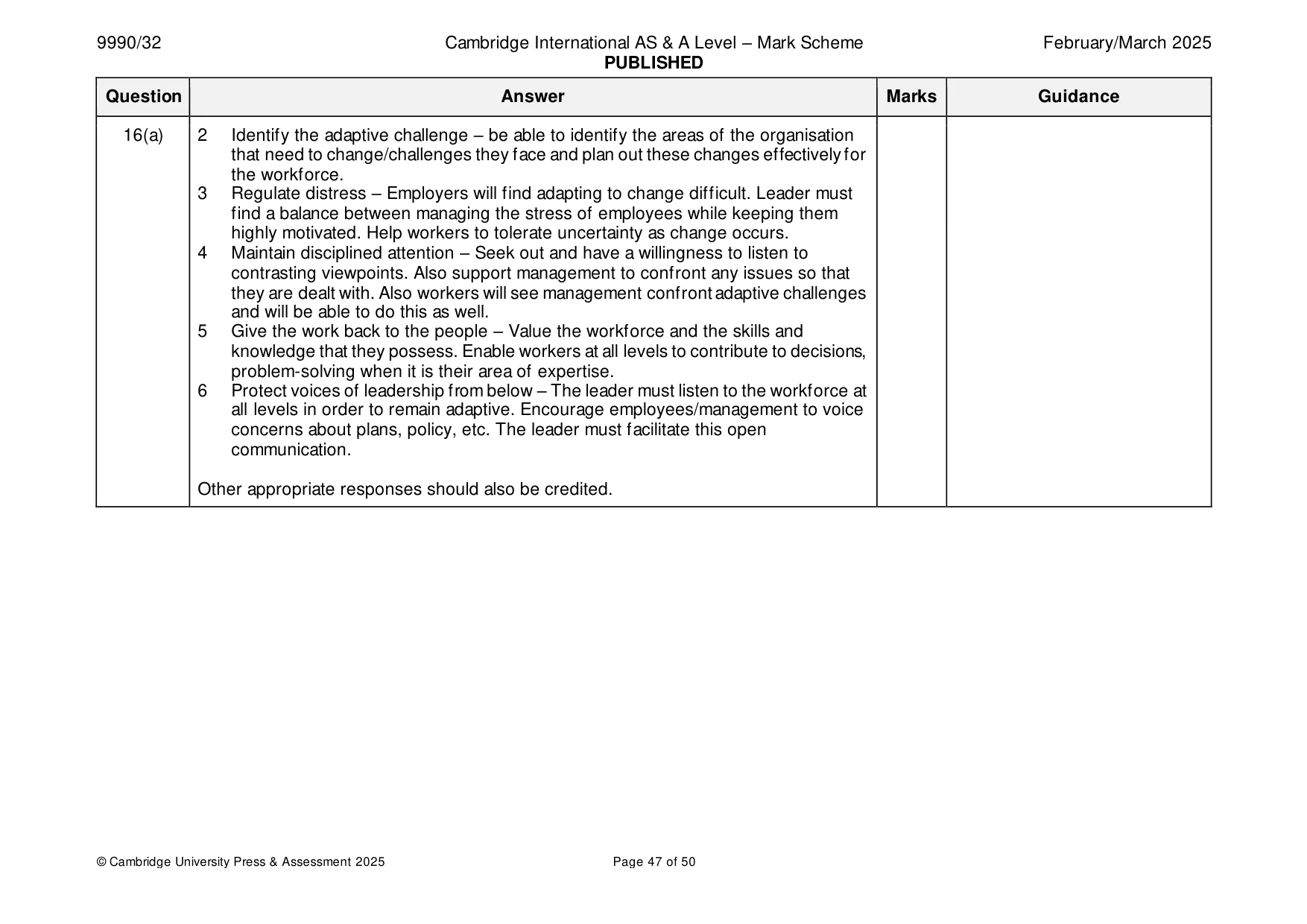
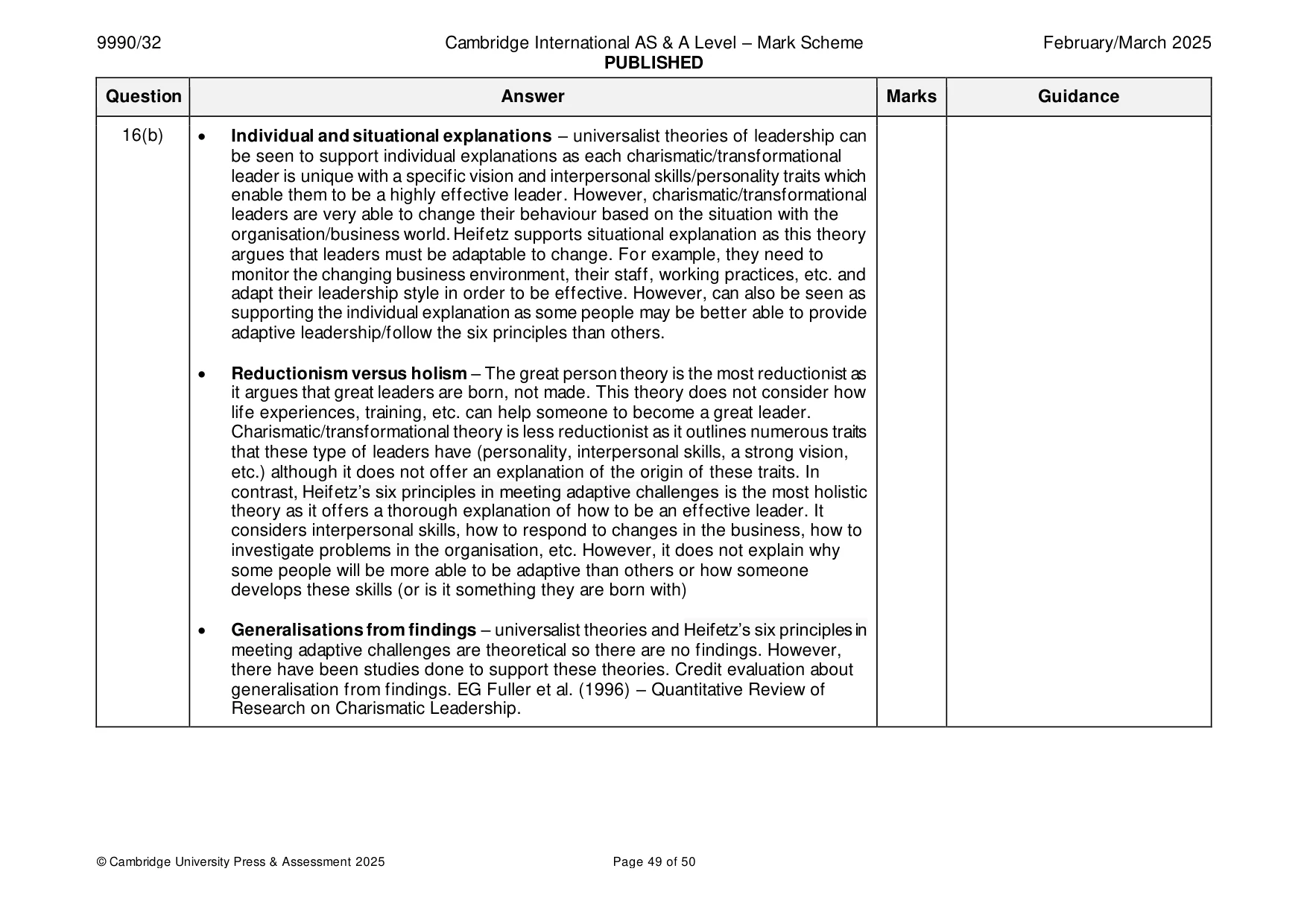
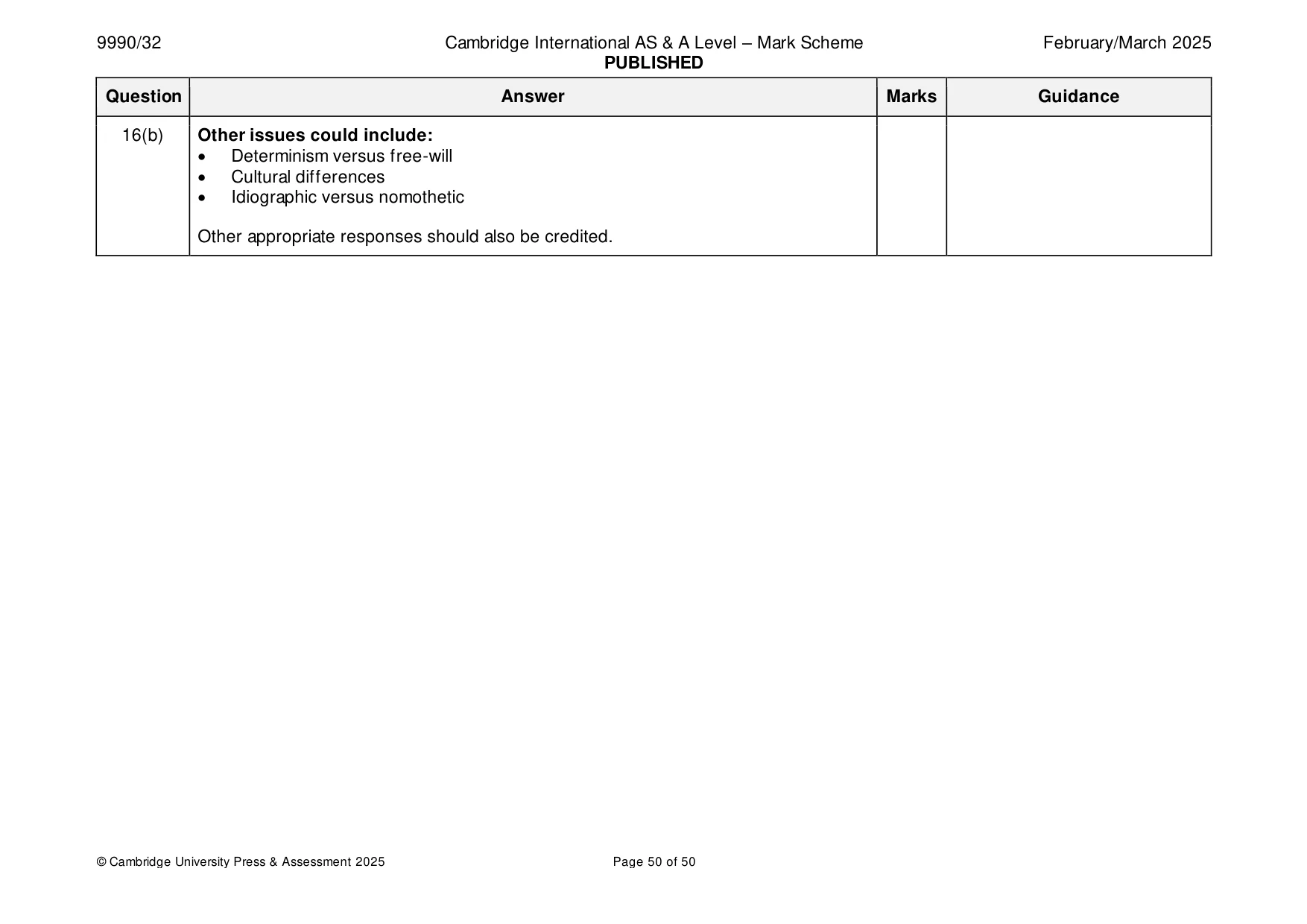
Mark scheme: 16(a) Describe what psychologists investigating traditional and modern theories of 6 Award up to 4 marks where the leadership have discovered about: response has described only • universalist theories of leadership, and part of the question even if the • Heifetz’s six principles in meeting adaptive challenges. response otherwise meets the criteria for Level 3. Use Table A: AO1 Knowledge and understanding to mark candidate responses to this question. Answers may include: Universalist theories of leadership Universalist – look at the characteristics and personal qualities of great leaders. Great person theory is that leaders are born and not made. It is a trait theory and suggests that some people are born with certain qualities/traits/personality that enables them to be a leader. These qualities include persuasiveness, courage, intelligence, confidence, excellent communicator, etc. Charismatic leaders are persuasive, charming, good at public speaking, inspirational, etc. Often seen as ‘visionaries’ and persuade those in their organisation to work hard to achieve their vision for the company. Transformational leaders – have a vision that often require the workforce to implement drastic changes. This leader will have a strong vision that they are very passionate about and can motivate and persuade their workers to achieve their vision. These type of leaders are inspirational to their workforce as they may require very difficult, challenging work in order to achieve their vision. Heifetz’s six principles in meeting adaptive challenges Leaders have to inspire their workforce to tackle whatever challenges happen and to then make them work to the best of their ability. Leaders should adapt their style to suit the current economic market of their organisation. Six principles include 1 ‘Get on the balcony’ – have an overview of the whole organisation so they can see functional and dysfunctional behaviour from their workforce as they enact the organisation’s goals. Leader has to be able to move between the ‘balcony’ and the day to day running of the company. 16(a) 2 Identify the adaptive challenge – be able to identify the areas of the organisation that need to change/challenges they face and plan out these changes effectively for the workforce. 3 Regulate distress – Employers will find adapting to change difficult. Leader must find a balance between managing the stress of employees while keeping them highly motivated. Help workers to tolerate uncertainty as change occurs. 4 Maintain disciplined attention – Seek out and have a willingness to listen to contrasting viewpoints. Also support management to confront any issues so that they are dealt with. Also workers will see management confront adaptive challenges and will be able to do this as well. 5 Give the work back to the people – Value the workforce and the skills and knowledge that they possess. Enable workers at all levels to contribute to decisions, problem-solving when it is their area of expertise. 6 Protect voices of leadership from below – The leader must listen to the workforce at all levels in order to remain adaptive. Encourage employees/management to voice concerns about plans, policy, etc. The leader must facilitate this open communication. Other appropriate responses should also be credited. 16(b) Evaluate what psychologists investigating traditional and modern theories of leadership have discovered about: • universalist theories of leadership, and • Heifetz’s six principles in meeting adaptive challenges, including a discussion about nature versus nurture. Evaluation in your answer can include strengths, weaknesses and a discussion of issues and debates. Use Table B: AO3 Analysis and evaluation to mark candidate responses to this question. A range of issues could be used for evaluation. These include: • Named issue – Nature versus nurture – The great person theory believes that leaders are born and not made so supports the nature side of the debate. Charismatic/transformational leadership theory could be argued to be on the nature side of the debate similar to great person theory. The leader is born with charisma, self-confidence, charm, etc. However, it could be argued that it supports the nurture side of the debate. Transformational leaders will have learned their vision through their life experiences. It is also possible for a leader to learn to be charismatic/transformational. For example, Steve Jobs practiced being comfortable with long periods of silence and staring people in the eye which shows he wasn’t born with these skills but instead learned them. Heifetz believes that leaders need to be adaptive and make changes in order to suit the changing needs of the organisation that they lead. Therefore believe leadership can be learned/nurtured. • Application to everyday life- Adaptive leadership has practical applications as it gives clear guidance to leaders/managers in organisations about how to be more effective in their leadership. E.g. ‘Get on the balcony’, regulate distress, etc. Could argue the universalist theory is less useful as it suggests leaders are born leaders and therefore the manager of an organisation will either have this skill or she won’t. 16(b) • Individual and situational explanations – universalist theories of leadership can be seen to support individual explanations as each charismatic/transformational leader is unique with a specific vision and interpersonal skills/personality traits which enable them to be a highly effective leader. However, charismatic/transformational leaders are very able to change their behaviour based on the situation with the organisation/business world. Heifetz supports situational explanation as this theory argues that leaders must be adaptable to change. For example, they need to monitor the changing business environment, their staff, working practices, etc. and adapt their leadership style in order to be effective. However, can also be seen as supporting the individual explanation as some people may be better able to provide adaptive leadership/follow the six principles than others. • Reductionism versus holism – The great person theory is the most reductionist as it argues that great leaders are born, not made. This theory does not consider how life experiences, training, etc. can help someone to become a great leader. Charismatic/transformational theory is less reductionist as it outlines numerous traits that these type of leaders have (personality, interpersonal skills, a strong vision, etc.) although it does not offer an explanation of the origin of these traits. In contrast, Heifetz’s six principles in meeting adaptive challenges is the most holistic theory as it offers a thorough explanation of how to be an effective leader. It considers interpersonal skills, how to respond to changes in the business, how to investigate problems in the organisation, etc. However, it does not explain why some people will be more able to be adaptive than others or how someone develops these skills (or is it something they are born with) • Generalisations from findings – universalist theories and Heifetz’s six principles in meeting adaptive challenges are theoretical so there are no findings. However, there have been studies done to support these theories. Credit evaluation about generalisation from findings. EG Fuller et al. (1996) – Quantitative Review of Research on Charismatic Leadership. 16(b) Other issues could include: • Determinism versus free-will • Cultural differences • Idiographic versus nomothetic Other appropriate responses should also be credited.
What was in this paper
The subtopics covered by these 16 questions, and how many questions each got. Open one in a new tab to see every Cambridge question on it.
What you needed in this session
Cambridge’s own grade thresholds for 2025 Feb/March, Paper 3 · Variant 2. A higher threshold means an easier paper — the bar moves with how the cohort did.