Cambridge A Level Psychology (from 2018) 9990 — 2020 Oct/Nov Paper 3 · Variant 3
9990/33/O/N/20 · 8 questions · 60 marks · ≈68 min
The question paper and its mark scheme, free to read here and free to download. This is Cambridge’s own paper, exactly as it was sat.
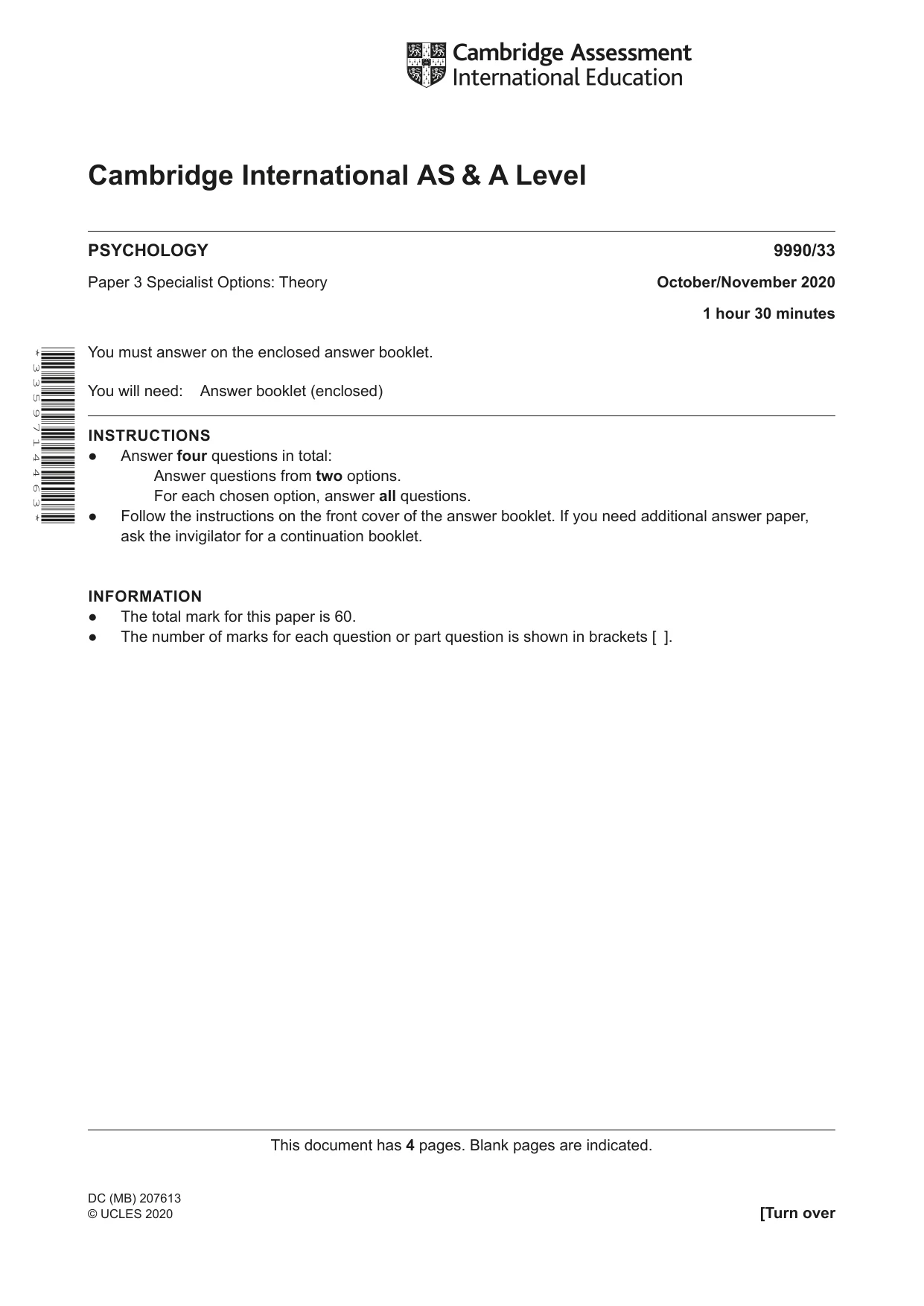
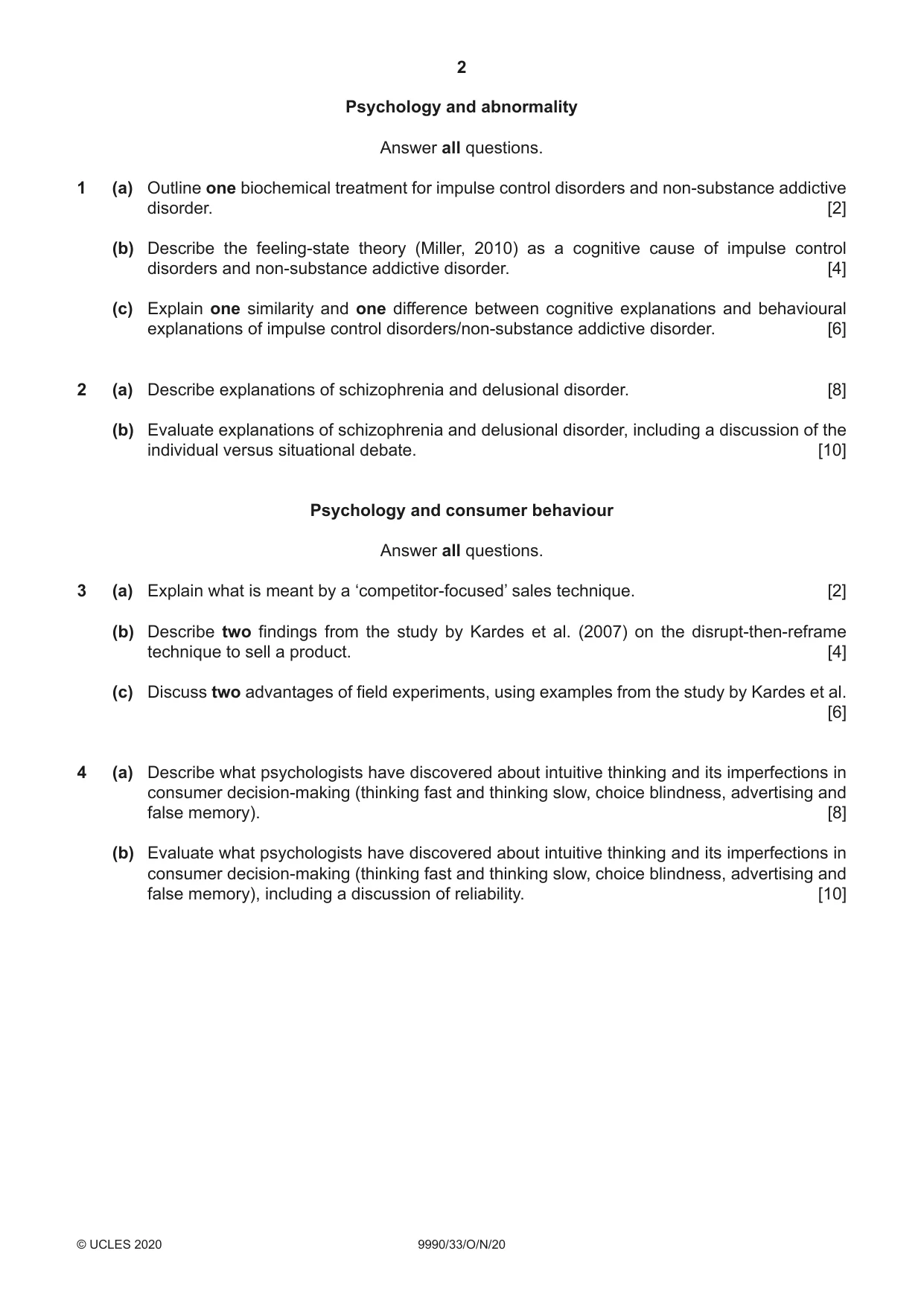
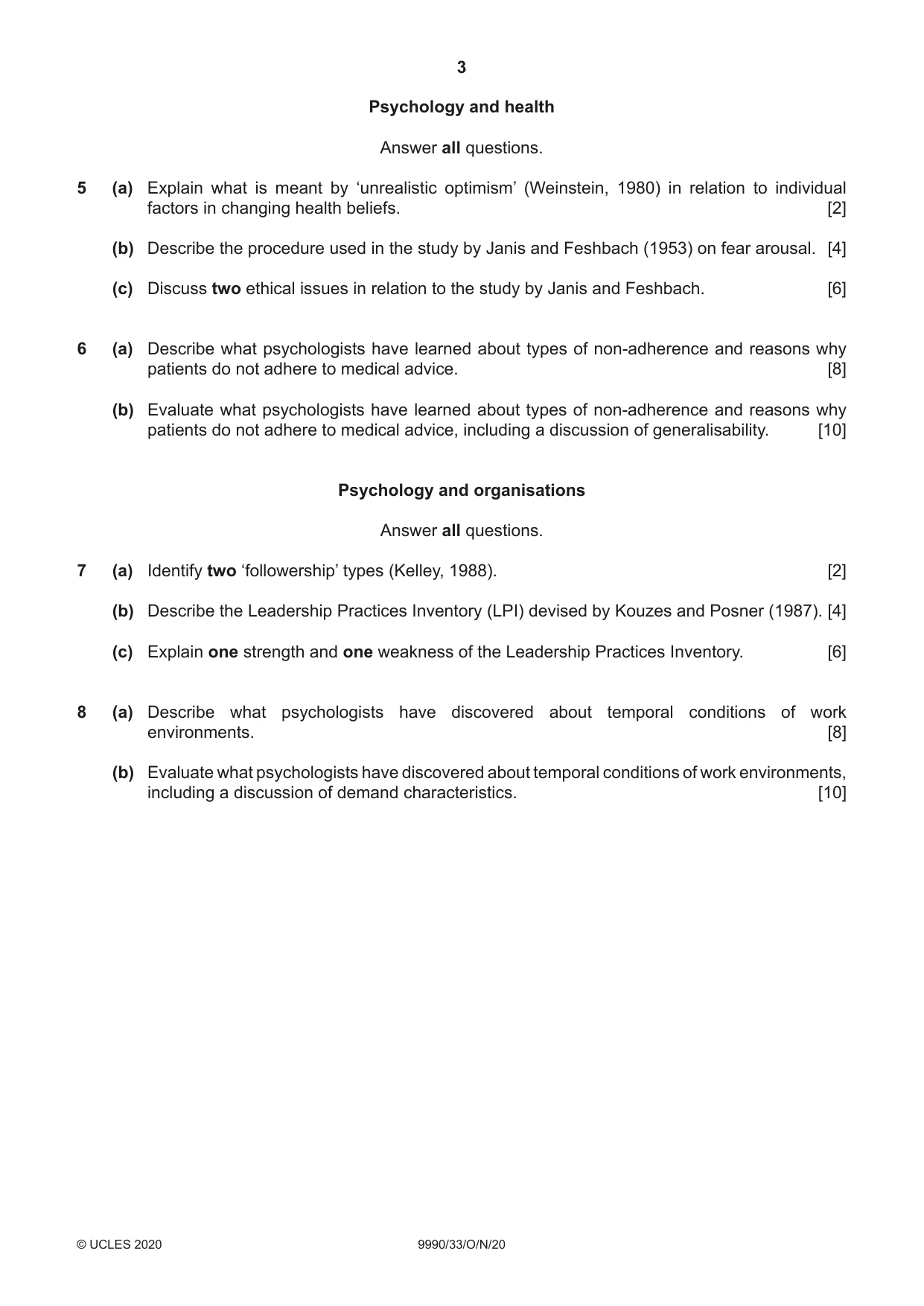
Question paper4 pages

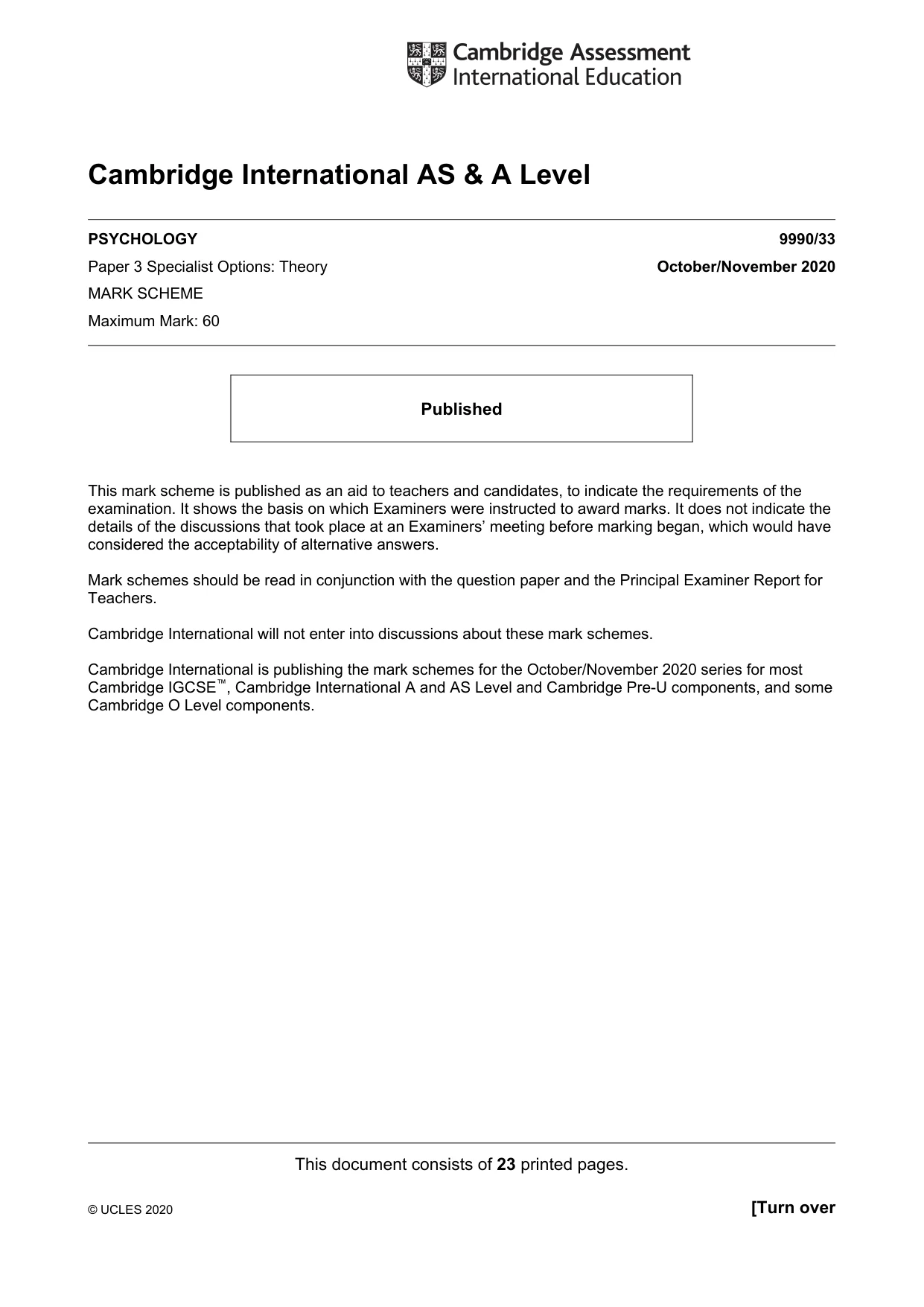
Mark scheme23 pages
Answers below. Sit the paper first if you are practising.




Questions as text
Q1 · Outline one biochemical treatment for impulse control disorders and non-substance…
1 (a) Outline one biochemical treatment for impulse control disorders and non-substance addictive disorder. [2] (b) Describe the feeling-state theory (Miller, 2010) as a cognitive cause of impulse control disorders and non-substance addictive disorder. [4] (c) Explain one similarity and one difference between cognitive explanations and behavioural explanations of impulse control disorders/non-substance addictive disorder. [6]
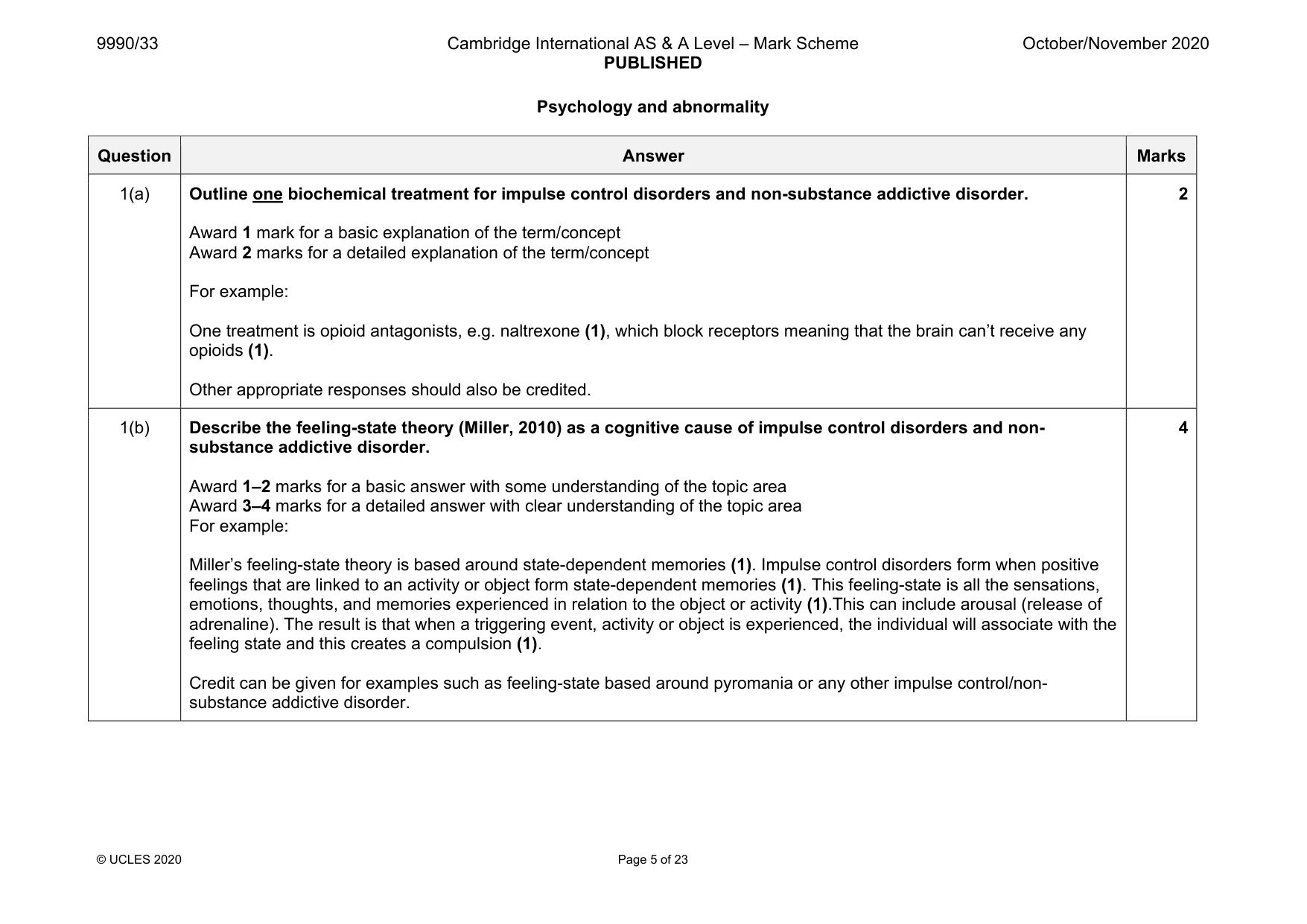
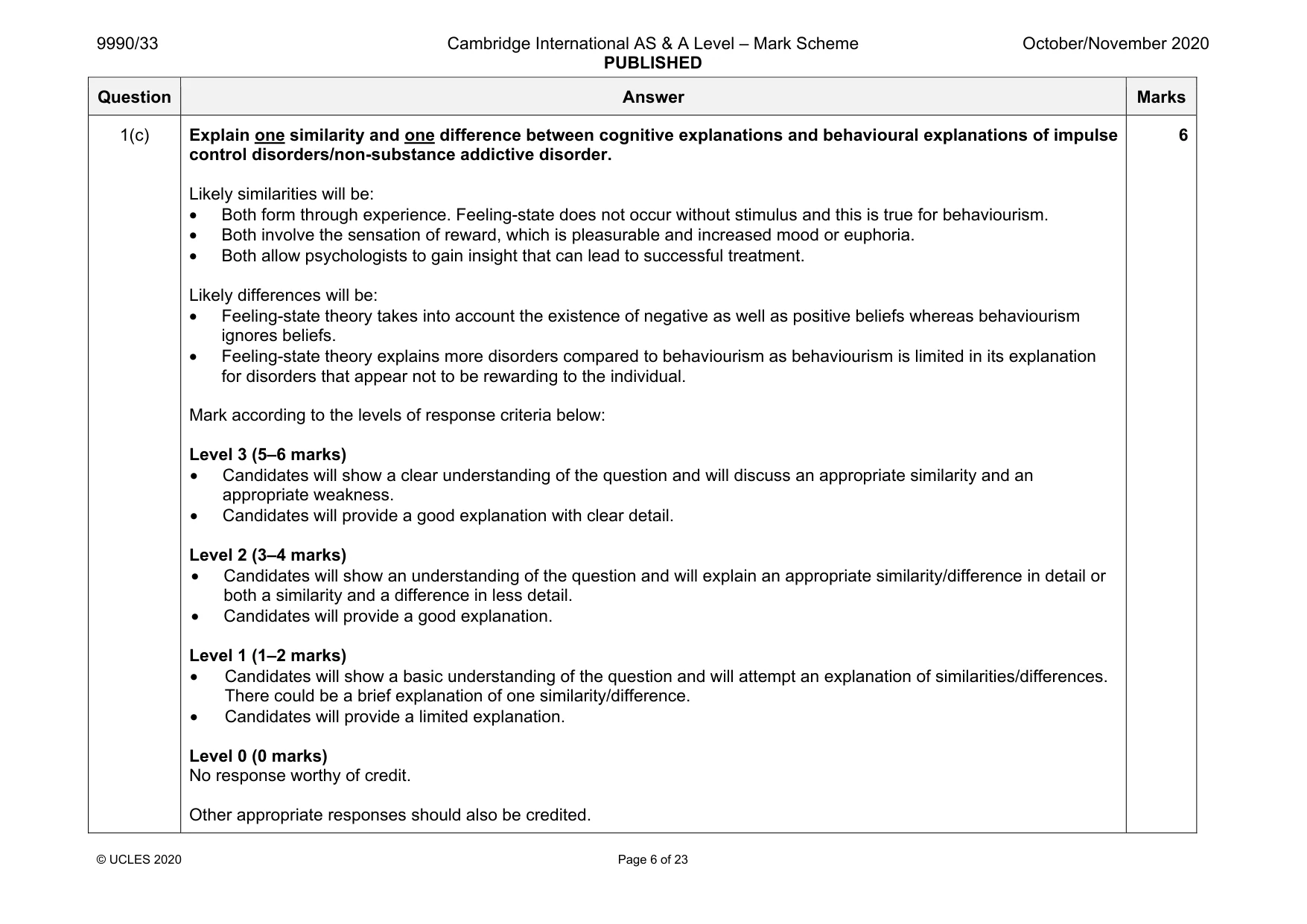
Mark scheme: 1(a) Outline one biochemical treatment for impulse control disorders and non-substance addictive disorder. Award 1 mark for a basic explanation of the term/concept Award 2 marks for a detailed explanation of the term/concept For example: One treatment is opioid antagonists, e.g. naltrexone (1), which block receptors meaning that the brain can’t receive any opioids (1). Other appropriate responses should also be credited. 1(b) Describe the feeling-state theory (Miller, 2010) as a cognitive cause of impulse control disorders and non- substance addictive disorder. Award 1–2 marks for a basic answer with some understanding of the topic area Award 3–4 marks for a detailed answer with clear understanding of the topic area For example: Miller’s feeling-state theory is based around state-dependent memories (1). Impulse control disorders form when positive feelings that are linked to an activity or object form state-dependent memories (1). This feeling-state is all the sensations, emotions, thoughts, and memories experienced in relation to the object or activity (1).This can include arousal (release of adrenaline). The result is that when a triggering event, activity or object is experienced, the individual will associate with the feeling state and this creates a compulsion (1). Credit can be given for examples such as feeling-state based around pyromania or any other impulse control/non- substance addictive disorder. 4 Question Answer Marks 1(c) Explain one similarity and one difference between cognitive explanations and behavioural explanations of impulse control disorders/non-substance addictive disorder. Likely similarities will be: • Both form through experience. Feeling-state does not occur without stimulus and this is true for behaviourism. • Both involve the sensation of reward, which is pleasurable and increased mood or euphoria. • Both allow psychologists to gain insight that can lead to successful treatment. Likely differences will be: • Feeling-state theory takes into account the existence of negative as well as positive beliefs whereas behaviourism ignores beliefs. • Feeling-state theory explains more disorders compared to behaviourism as behaviourism is limited in its explanation for disorders that appear not to be rewarding to the individual. Mark according to the levels of response criteria below: Level 3 (5–6 marks) • Candidates will show a clear understanding of the question and will discuss an appropriate similarity and an appropriate weakness. • Candidates will provide a good explanation with clear detail. Level 2 (3–4 marks) • Candidates will show an understanding of the question and will explain an appropriate similarity/difference in detail or both a similarity and a difference in less detail. • Candidates will provide a good explanation. Level 1 (1–2 marks) • Candidates will show a basic understanding of the question and will attempt an explanation of similarities/differences. There could be a brief explanation of one similarity/difference. • Candidates will provide a limited explanation. Level 0 (0 marks) No response worthy of credit. Other appropriate responses should also be credited. 6
Q2 · Describe explanations of schizophrenia and delusional disorder
2 (a) Describe explanations of schizophrenia and delusional disorder. [8] (b) Evaluate explanations of schizophrenia and delusional disorder, including a discussion of the individual versus situational debate. [10] Psychology and consumer behaviour Answer all questions.
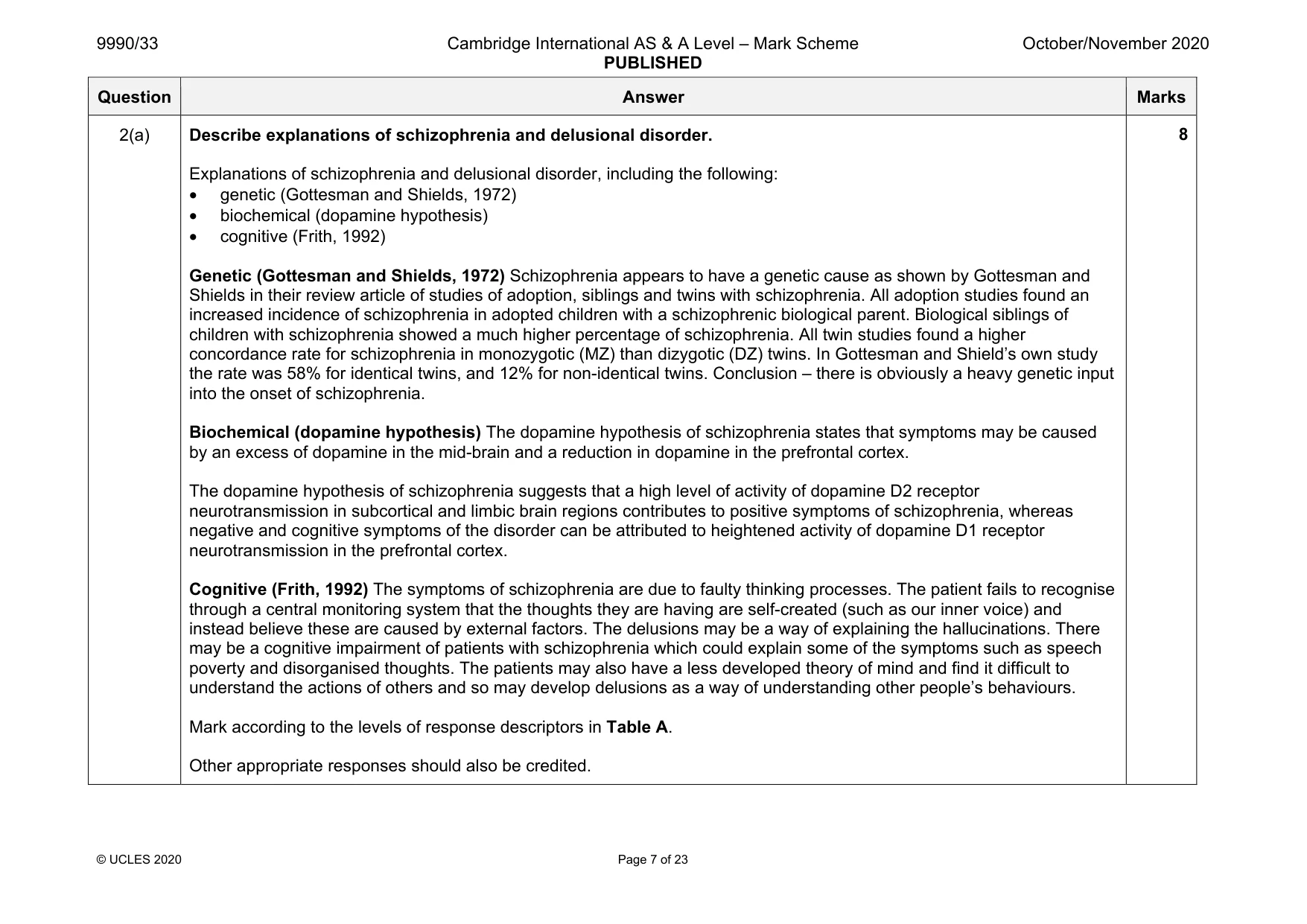
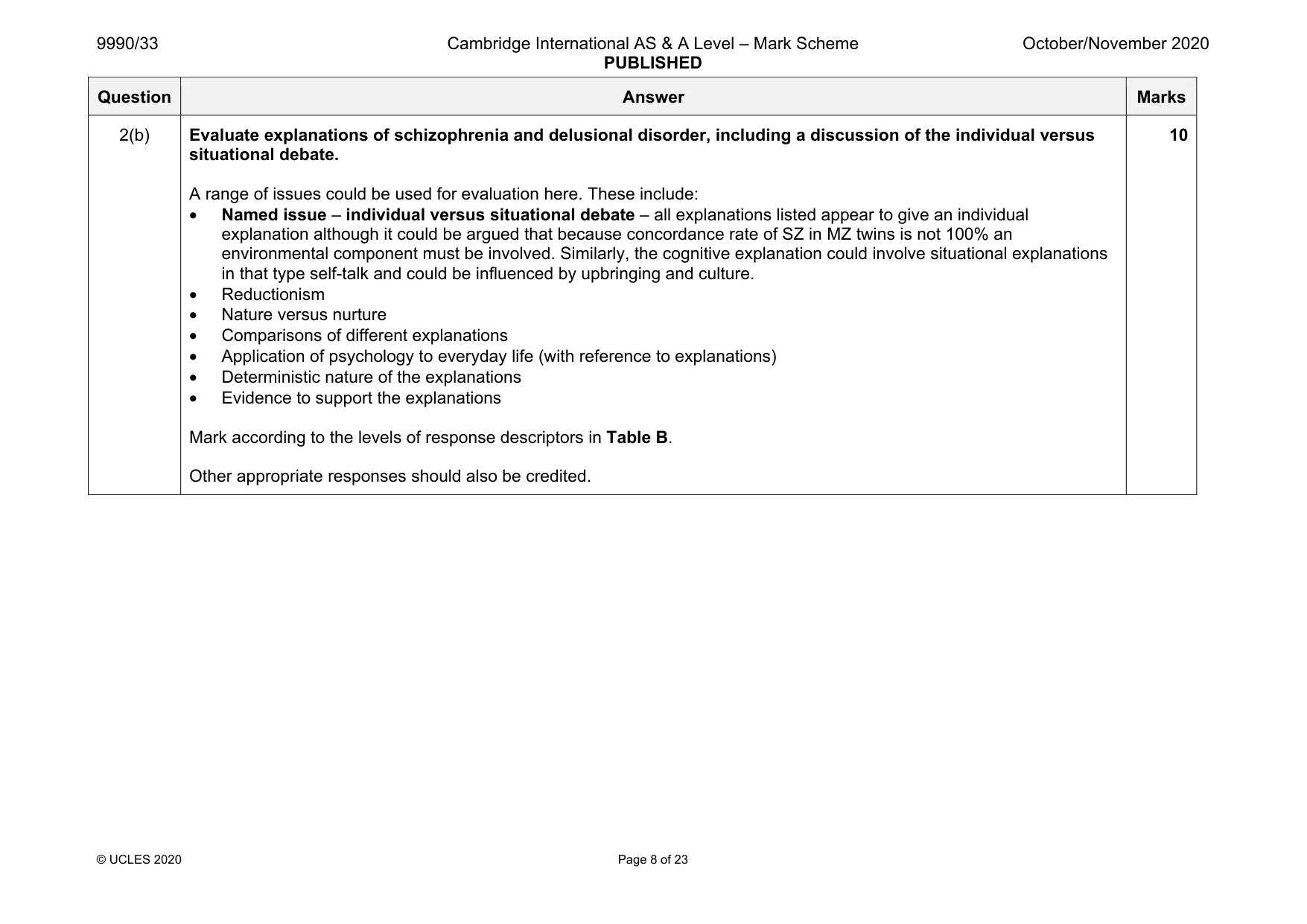
Mark scheme: 2(a) Describe explanations of schizophrenia and delusional disorder. Explanations of schizophrenia and delusional disorder, including the following: • genetic (Gottesman and Shields, 1972) • biochemical (dopamine hypothesis) • cognitive (Frith, 1992) Genetic (Gottesman and Shields, 1972) Schizophrenia appears to have a genetic cause as shown by Gottesman and Shields in their review article of studies of adoption, siblings and twins with schizophrenia. All adoption studies found an increased incidence of schizophrenia in adopted children with a schizophrenic biological parent. Biological siblings of children with schizophrenia showed a much higher percentage of schizophrenia. All twin studies found a higher concordance rate for schizophrenia in monozygotic (MZ) than dizygotic (DZ) twins. In Gottesman and Shield’s own study the rate was 58% for identical twins, and 12% for non-identical twins. Conclusion – there is obviously a heavy genetic input into the onset of schizophrenia. Biochemical (dopamine hypothesis) The dopamine hypothesis of schizophrenia states that symptoms may be caused by an excess of dopamine in the mid-brain and a reduction in dopamine in the prefrontal cortex. The dopamine hypothesis of schizophrenia suggests that a high level of activity of dopamine D2 receptor neurotransmission in subcortical and limbic brain regions contributes to positive symptoms of schizophrenia, whereas negative and cognitive symptoms of the disorder can be attributed to heightened activity of dopamine D1 receptor neurotransmission in the prefrontal cortex. Cognitive (Frith, 1992) The symptoms of schizophrenia are due to faulty thinking processes. The patient fails to recognise through a central monitoring system that the thoughts they are having are self-created (such as our inner voice) and instead believe these are caused by external factors. The delusions may be a way of explaining the hallucinations. There may be a cognitive impairment of patients with schizophrenia which could explain some of the symptoms such as speech poverty and disorganised thoughts. The patients may also have a less developed theory of mind and find it difficult to understand the actions of others and so may develop delusions as a way of understanding other people’s behaviours. Mark according to the levels of response descriptors in Table A. Other appropriate responses should also be credited. Question Answer Marks 2(b) Evaluate explanations of schizophrenia and delusional disorder, including a discussion of the individual versus situational debate. A range of issues could be used for evaluation here. These include: • Named issue – individual versus situational debate – all explanations listed appear to give an individual explanation although it could be argued that because concordance rate of SZ in MZ twins is not 100% an environmental component must be involved. Similarly, the cognitive explanation could involve situational explanations in that type self-talk and could be influenced by upbringing and culture. • Reductionism • Nature versus nurture • Comparisons of different explanations • Application of psychology to everyday life (with reference to explanations) • Deterministic nature of the explanations • Evidence to support the explanations Mark according to the levels of response descriptors in Table B. Other appropriate responses should also be credited. 10
Q3 · Explain what is meant by a ‘competitor-focused’ sales technique
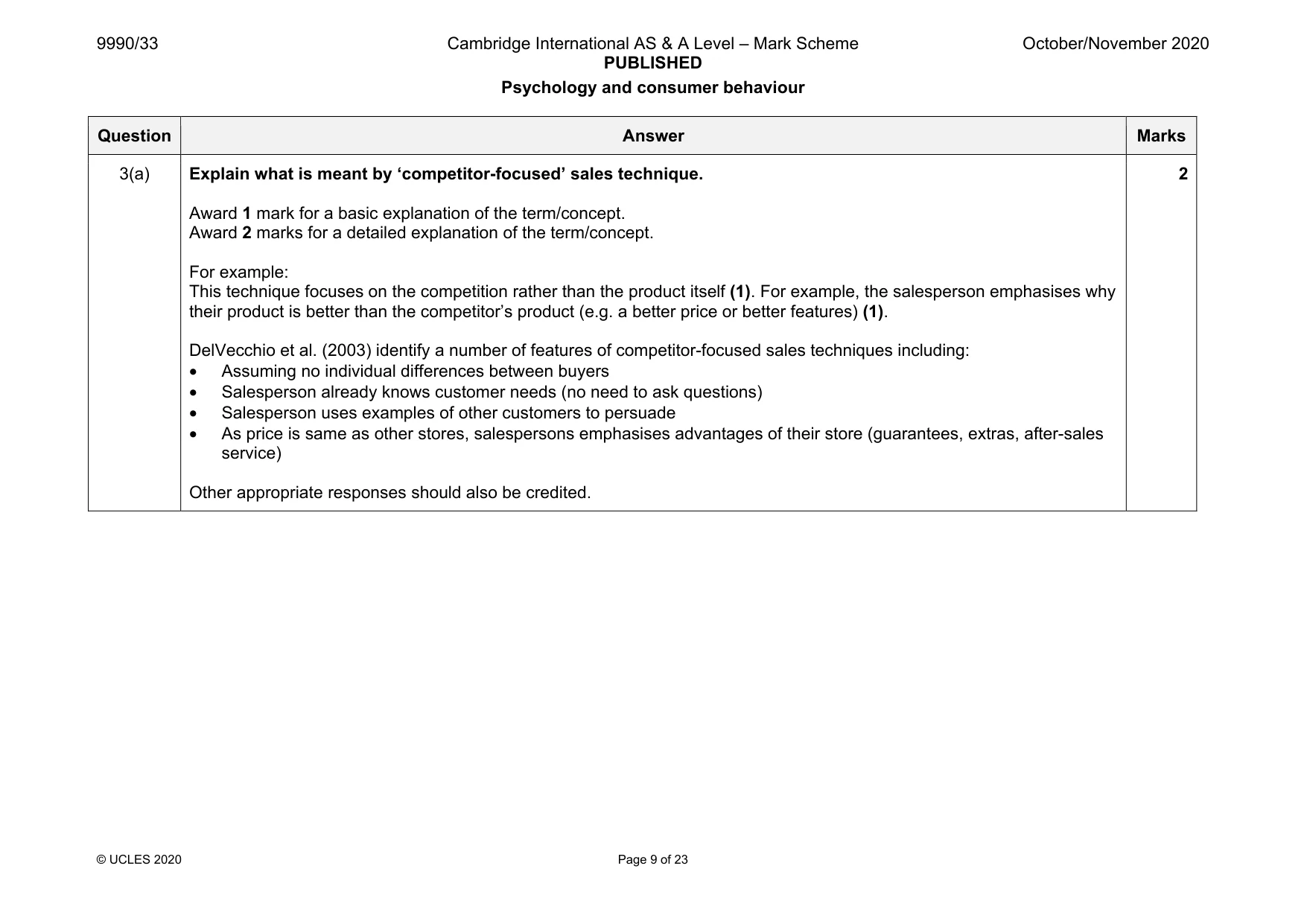
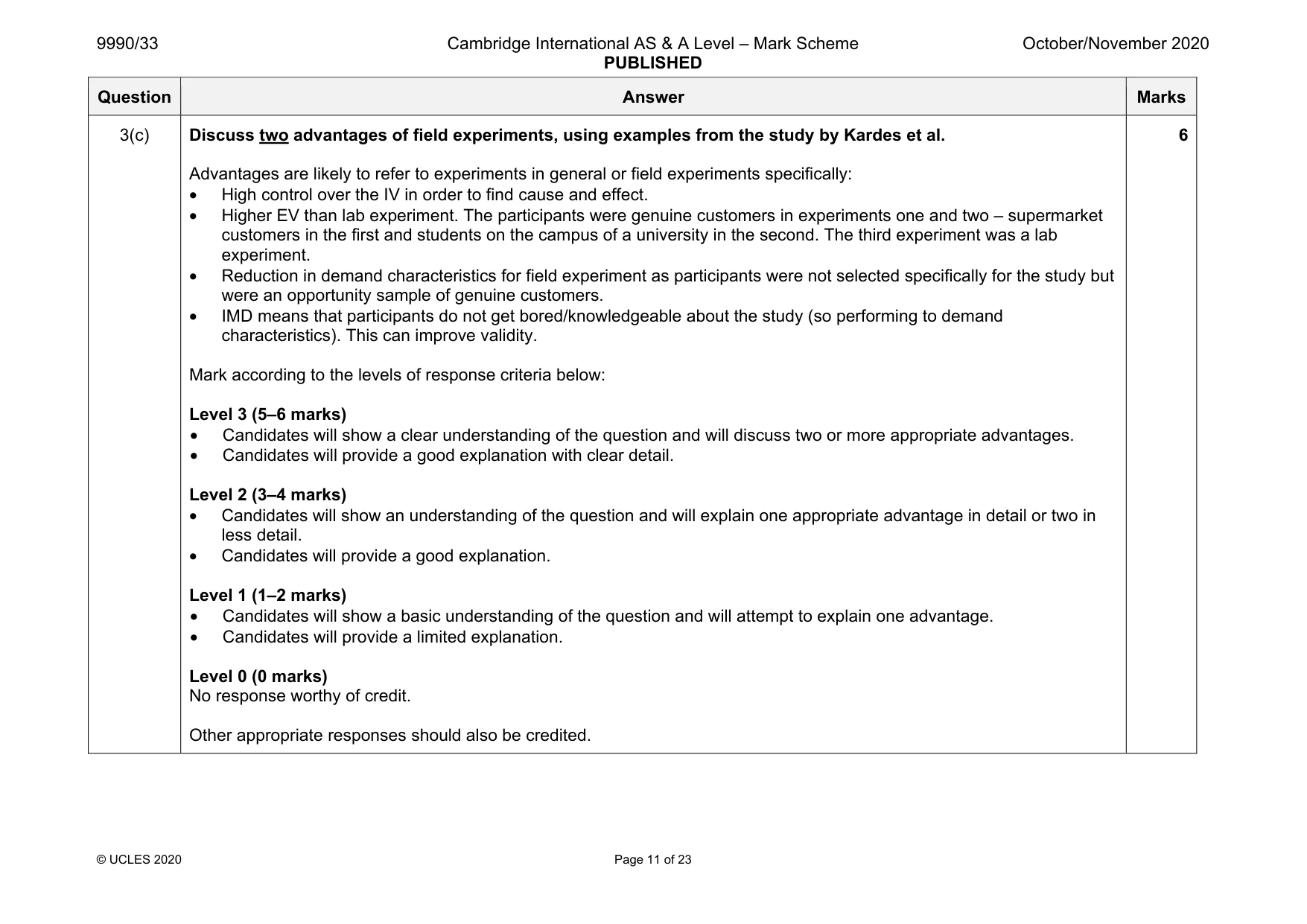
3 (a) Explain what is meant by a ‘competitor-focused’ sales technique. [2] (b) Describe two findings from the study by Kardes et al. (2007) on the disrupt-then-reframe technique to sell a product. [4] (c) Discuss two advantages of field experiments, using examples from the study by Kardes et al. [6]
Mark scheme: 3(a) Explain what is meant by ‘competitor-focused’ sales technique. Award 1 mark for a basic explanation of the term/concept. Award 2 marks for a detailed explanation of the term/concept. For example: This technique focuses on the competition rather than the product itself (1). For example, the salesperson emphasises why their product is better than the competitor’s product (e.g. a better price or better features) (1). DelVecchio et al. (2003) identify a number of features of competitor-focused sales techniques including: • Assuming no individual differences between buyers • Salesperson already knows customer needs (no need to ask questions) • Salesperson uses examples of other customers to persuade • As price is same as other stores, salespersons emphasises advantages of their store (guarantees, extras, after-sales service) Other appropriate responses should also be credited. Question Answer Marks 3(b) Describe two findings from the study by Kardes et al. (2007) on the disrupt-then-reframe technique to sell a product. Award 1–2 marks for a basic answer with some understanding of the topic area. Award 3–4 marks for a detailed answer with clear understanding of the topic area. For example: 1 First experiment – Field experiment – Overall, 54% of participants bought candy. In the disrupt-then-reframe (DTR) condition (‘the price is now 100 eurocents (2s pause)…. That’s 1 euro. It’s a bargain’) 65% of participants bought candy compared to 44% in the reframe-only condition (‘the price is now 1 euro. It’s a bargain’). 2 Second experiment – Field experiment – Overall 22% of participants agreed to join the group. Those in the DTR condition (‘You can now become a member for half a year for 300 eurocents (2s pause)….that’s 3 euro. That’s a really small investment!’) 30% of participants wanted to join compared to 13% of the reframe-only condition (‘You can now become a member for half a year for 3 euros. That’s a really small investment!’). Disrupt-then-reframe (DTR) works for both sales of goods and getting people to purchase less tangible things like group membership. 3 Third experiment – Lab experiment – When need for cognitive closure (NFCC) was low, the DTR manipulation had no effect on perceived ambiguity but when NFCC was high, DTR manipulation decreased ambiguity. When NFCC was high, more favourable attitudes towards rise in tuition costs were formed in the DTR than the reframe-only condition. Other appropriate responses should also be credited. 4 Question Answer Marks 3(c) Discuss two advantages of field experiments, using examples from the study by Kardes et al. Advantages are likely to refer to experiments in general or field experiments specifically: • High control over the IV in order to find cause and effect. • Higher EV than lab experiment. The participants were genuine customers in experiments one and two – supermarket customers in the first and students on the campus of a university in the second. The third experiment was a lab experiment. • Reduction in demand characteristics for field experiment as participants were not selected specifically for the study but were an opportunity sample of genuine customers. • IMD means that participants do not get bored/knowledgeable about the study (so performing to demand characteristics). This can improve validity. Mark according to the levels of response criteria below: Level 3 (5–6 marks) • Candidates will show a clear understanding of the question and will discuss two or more appropriate advantages. • Candidates will provide a good explanation with clear detail. Level 2 (3–4 marks) • Candidates will show an understanding of the question and will explain one appropriate advantage in detail or two in less detail. • Candidates will provide a good explanation. Level 1 (1–2 marks) • Candidates will show a basic understanding of the question and will attempt to explain one advantage. • Candidates will provide a limited explanation. Level 0 (0 marks) No response worthy of credit. Other appropriate responses should also be credited. 6
Q4 · Describe what psychologists have discovered about intuitive thinking and its…
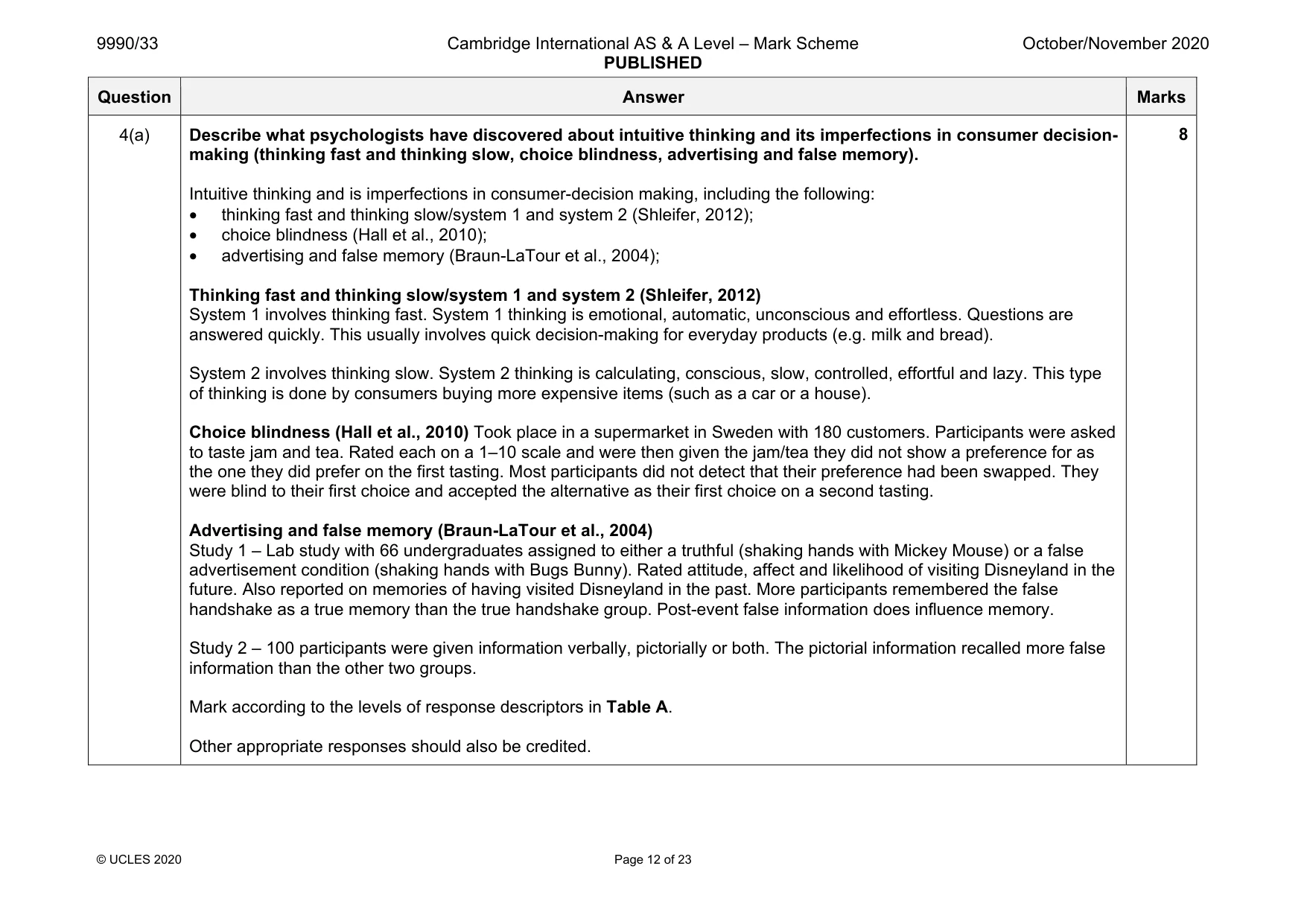
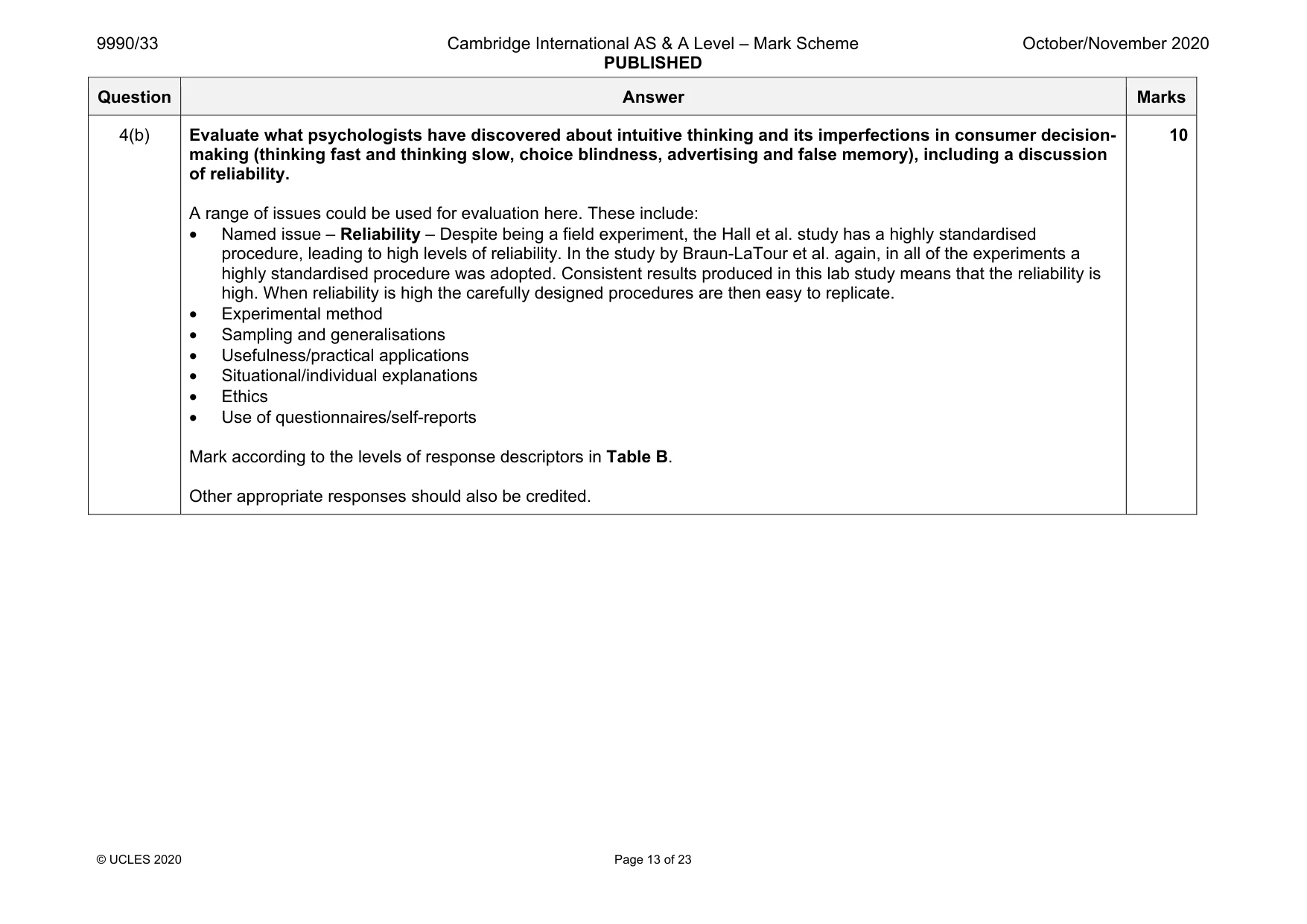
4 (a) Describe what psychologists have discovered about intuitive thinking and its imperfections in consumer decision-making (thinking fast and thinking slow, choice blindness, advertising and false memory). [8] (b) Evaluate what psychologists have discovered about intuitive thinking and its imperfections in consumer decision-making (thinking fast and thinking slow, choice blindness, advertising and false memory), including a discussion of reliability. [10] Psychology and health Answer all questions.
Mark scheme: 4(a) Describe what psychologists have discovered about intuitive thinking and its imperfections in consumer decision- making (thinking fast and thinking slow, choice blindness, advertising and false memory). Intuitive thinking and is imperfections in consumer-decision making, including the following: • thinking fast and thinking slow/system 1 and system 2 (Shleifer, 2012); • choice blindness (Hall et al., 2010); • advertising and false memory (Braun-LaTour et al., 2004); Thinking fast and thinking slow/system 1 and system 2 (Shleifer, 2012) System 1 involves thinking fast. System 1 thinking is emotional, automatic, unconscious and effortless. Questions are answered quickly. This usually involves quick decision-making for everyday products (e.g. milk and bread). System 2 involves thinking slow. System 2 thinking is calculating, conscious, slow, controlled, effortful and lazy. This type of thinking is done by consumers buying more expensive items (such as a car or a house). Choice blindness (Hall et al., 2010) Took place in a supermarket in Sweden with 180 customers. Participants were asked to taste jam and tea. Rated each on a 1–10 scale and were then given the jam/tea they did not show a preference for as the one they did prefer on the first tasting. Most participants did not detect that their preference had been swapped. They were blind to their first choice and accepted the alternative as their first choice on a second tasting. Advertising and false memory (Braun-LaTour et al., 2004) Study 1 – Lab study with 66 undergraduates assigned to either a truthful (shaking hands with Mickey Mouse) or a false advertisement condition (shaking hands with Bugs Bunny). Rated attitude, affect and likelihood of visiting Disneyland in the future. Also reported on memories of having visited Disneyland in the past. More participants remembered the false handshake as a true memory than the true handshake group. Post-event false information does influence memory. Study 2 – 100 participants were given information verbally, pictorially or both. The pictorial information recalled more false information than the other two groups. Mark according to the levels of response descriptors in Table A. Other appropriate responses should also be credited. Question Answer Marks 4(b) Evaluate what psychologists have discovered about intuitive thinking and its imperfections in consumer decision- making (thinking fast and thinking slow, choice blindness, advertising and false memory), including a discussion of reliability. A range of issues could be used for evaluation here. These include: • Named issue – Reliability – Despite being a field experiment, the Hall et al. study has a highly standardised procedure, leading to high levels of reliability. In the study by Braun-LaTour et al. again, in all of the experiments a highly standardised procedure was adopted. Consistent results produced in this lab study means that the reliability is high. When reliability is high the carefully designed procedures are then easy to replicate. • Experimental method • Sampling and generalisations • Usefulness/practical applications • Situational/individual explanations • Ethics • Use of questionnaires/self-reports Mark according to the levels of response descriptors in Table B. Other appropriate responses should also be credited. 10
Q5 · Explain what is meant by ‘unrealistic optimism’ (Weinstein, 1980) in relation to…
5 (a) Explain what is meant by ‘unrealistic optimism’ (Weinstein, 1980) in relation to individual factors in changing health beliefs. [2] (b) Describe the procedure used in the study by Janis and Feshbach (1953) on fear arousal. [4] (c) Discuss two ethical issues in relation to the study by Janis and Feshbach. [6]
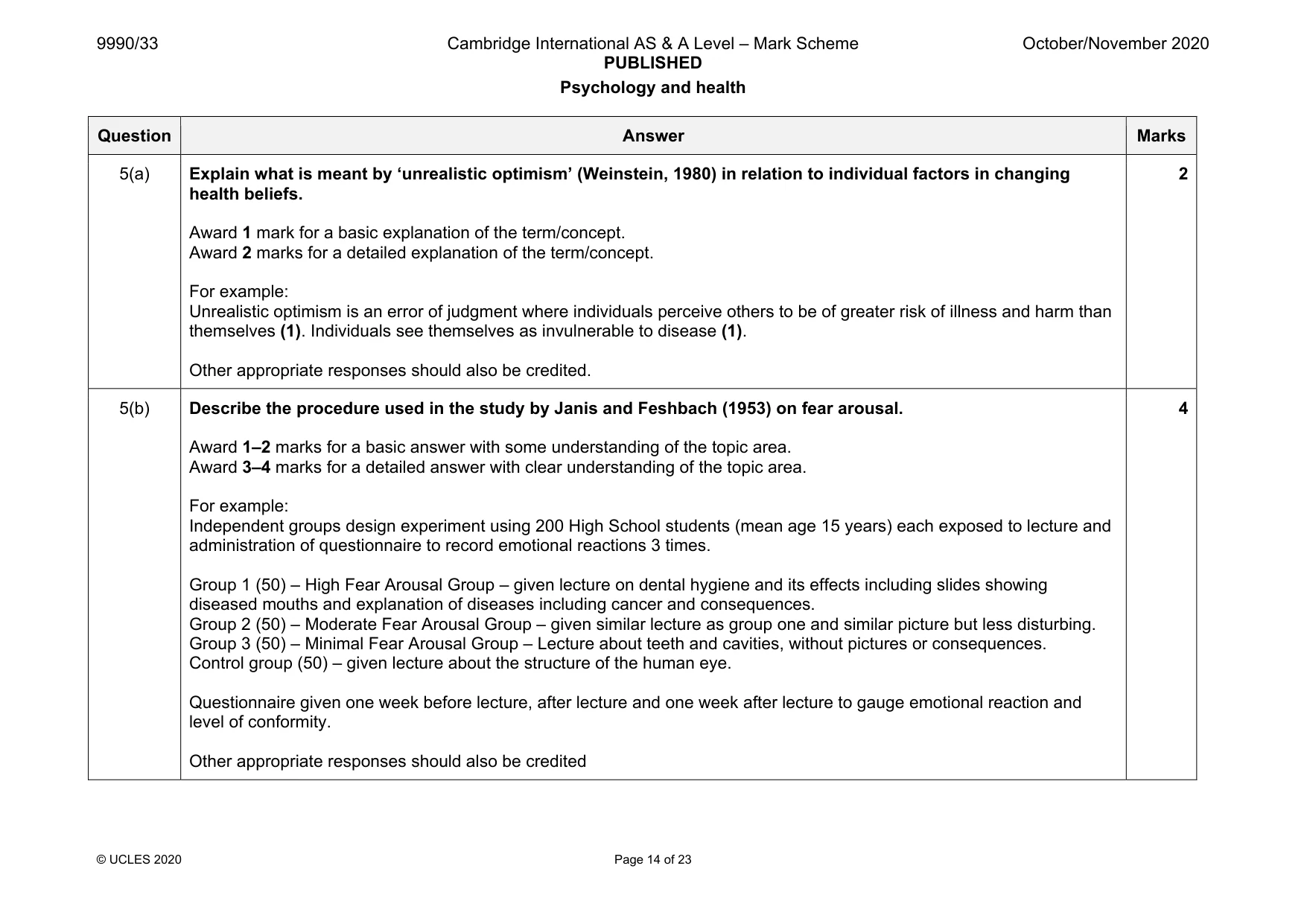
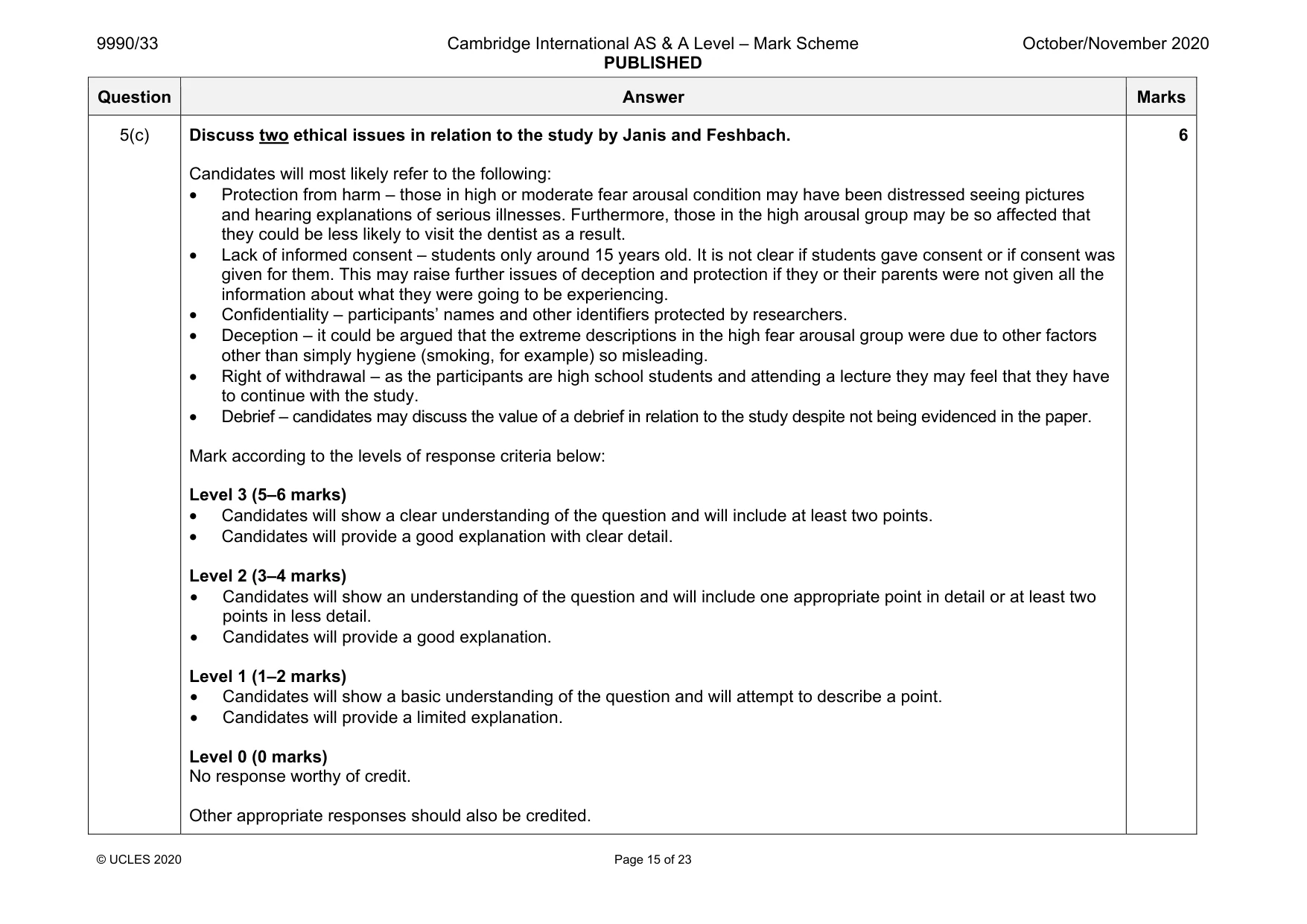
Mark scheme: 5(a) Explain what is meant by ‘unrealistic optimism’ (Weinstein, 1980) in relation to individual factors in changing health beliefs. Award 1 mark for a basic explanation of the term/concept. Award 2 marks for a detailed explanation of the term/concept. For example: Unrealistic optimism is an error of judgment where individuals perceive others to be of greater risk of illness and harm than themselves (1). Individuals see themselves as invulnerable to disease (1). Other appropriate responses should also be credited. 5(b) Describe the procedure used in the study by Janis and Feshbach (1953) on fear arousal. Award 1–2 marks for a basic answer with some understanding of the topic area. Award 3–4 marks for a detailed answer with clear understanding of the topic area. For example: Independent groups design experiment using 200 High School students (mean age 15 years) each exposed to lecture and administration of questionnaire to record emotional reactions 3 times. Group 1 (50) – High Fear Arousal Group – given lecture on dental hygiene and its effects including slides showing diseased mouths and explanation of diseases including cancer and consequences. Group 2 (50) – Moderate Fear Arousal Group – given similar lecture as group one and similar picture but less disturbing. Group 3 (50) – Minimal Fear Arousal Group – Lecture about teeth and cavities, without pictures or consequences. Control group (50) – given lecture about the structure of the human eye. Questionnaire given one week before lecture, after lecture and one week after lecture to gauge emotional reaction and level of conformity. Other appropriate responses should also be credited 4 Question Answer Marks 5(c) Discuss two ethical issues in relation to the study by Janis and Feshbach. Candidates will most likely refer to the following: • Protection from harm – those in high or moderate fear arousal condition may have been distressed seeing pictures and hearing explanations of serious illnesses. Furthermore, those in the high arousal group may be so affected that they could be less likely to visit the dentist as a result. • Lack of informed consent – students only around 15 years old. It is not clear if students gave consent or if consent was given for them. This may raise further issues of deception and protection if they or their parents were not given all the information about what they were going to be experiencing. • Confidentiality – participants’ names and other identifiers protected by researchers. • Deception – it could be argued that the extreme descriptions in the high fear arousal group were due to other factors other than simply hygiene (smoking, for example) so misleading. • Right of withdrawal – as the participants are high school students and attending a lecture they may feel that they have to continue with the study. • Debrief – candidates may discuss the value of a debrief in relation to the study despite not being evidenced in the paper. Mark according to the levels of response criteria below: Level 3 (5–6 marks) • Candidates will show a clear understanding of the question and will include at least two points. • Candidates will provide a good explanation with clear detail. Level 2 (3–4 marks) • Candidates will show an understanding of the question and will include one appropriate point in detail or at least two points in less detail. • Candidates will provide a good explanation. Level 1 (1–2 marks) • Candidates will show a basic understanding of the question and will attempt to describe a point. • Candidates will provide a limited explanation. Level 0 (0 marks) No response worthy of credit. Other appropriate responses should also be credited. 6
More questions on 2 Health promotion in schools and worksites
Q6 · Describe what psychologists have learned about types of non-adherence and reasons why…
6 (a) Describe what psychologists have learned about types of non-adherence and reasons why patients do not adhere to medical advice. [8] (b) Evaluate what psychologists have learned about types of non-adherence and reasons why patients do not adhere to medical advice, including a discussion of generalisability. [10] Psychology and organisations Answer all questions.
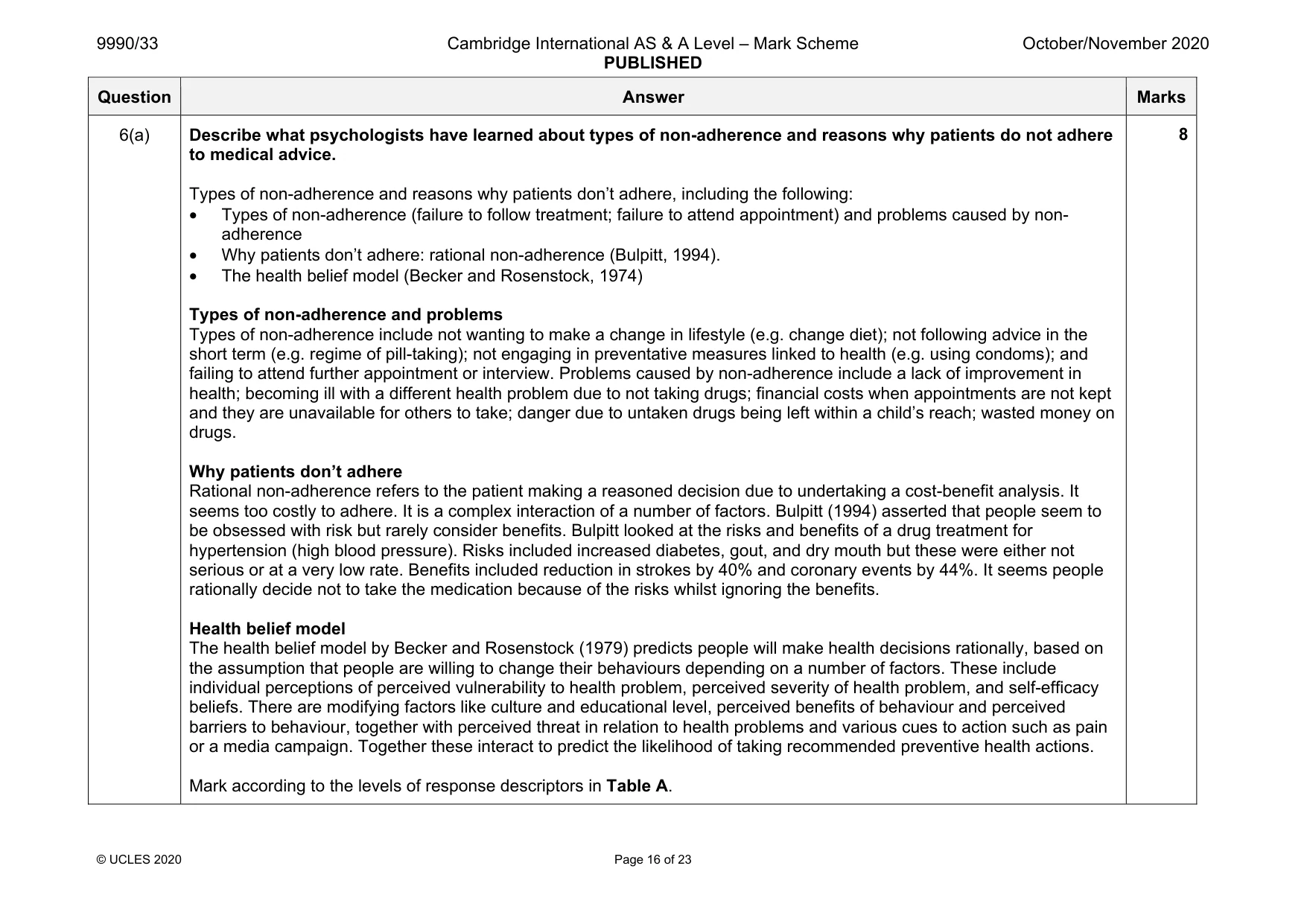
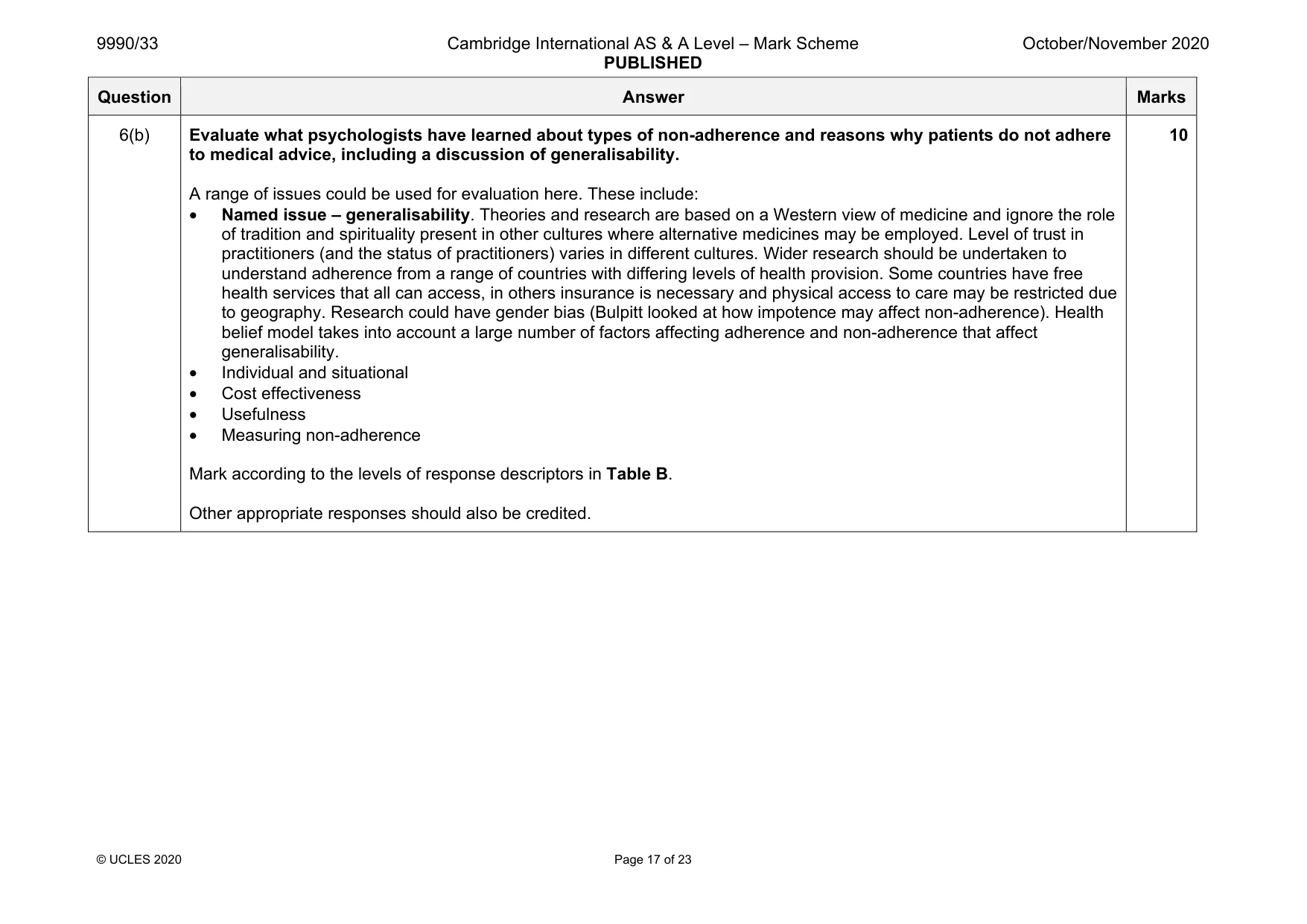
Mark scheme: 6(a) Describe what psychologists have learned about types of non-adherence and reasons why patients do not adhere to medical advice. Types of non-adherence and reasons why patients don’t adhere, including the following: • Types of non-adherence (failure to follow treatment; failure to attend appointment) and problems caused by non- adherence • Why patients don’t adhere: rational non-adherence (Bulpitt, 1994). • The health belief model (Becker and Rosenstock, 1974) Types of non-adherence and problems Types of non-adherence include not wanting to make a change in lifestyle (e.g. change diet); not following advice in the short term (e.g. regime of pill-taking); not engaging in preventative measures linked to health (e.g. using condoms); and failing to attend further appointment or interview. Problems caused by non-adherence include a lack of improvement in health; becoming ill with a different health problem due to not taking drugs; financial costs when appointments are not kept and they are unavailable for others to take; danger due to untaken drugs being left within a child’s reach; wasted money on drugs. Why patients don’t adhere Rational non-adherence refers to the patient making a reasoned decision due to undertaking a cost-benefit analysis. It seems too costly to adhere. It is a complex interaction of a number of factors. Bulpitt (1994) asserted that people seem to be obsessed with risk but rarely consider benefits. Bulpitt looked at the risks and benefits of a drug treatment for hypertension (high blood pressure). Risks included increased diabetes, gout, and dry mouth but these were either not serious or at a very low rate. Benefits included reduction in strokes by 40% and coronary events by 44%. It seems people rationally decide not to take the medication because of the risks whilst ignoring the benefits. Health belief model The health belief model by Becker and Rosenstock (1979) predicts people will make health decisions rationally, based on the assumption that people are willing to change their behaviours depending on a number of factors. These include individual perceptions of perceived vulnerability to health problem, perceived severity of health problem, and self-efficacy beliefs. There are modifying factors like culture and educational level, perceived benefits of behaviour and perceived barriers to behaviour, together with perceived threat in relation to health problems and various cues to action such as pain or a media campaign. Together these interact to predict the likelihood of taking recommended preventive health actions. Mark according to the levels of response descriptors in Table A. Question Answer Marks 6(b) Evaluate what psychologists have learned about types of non-adherence and reasons why patients do not adhere to medical advice, including a discussion of generalisability. A range of issues could be used for evaluation here. These include: • Named issue – generalisability. Theories and research are based on a Western view of medicine and ignore the role of tradition and spirituality present in other cultures where alternative medicines may be employed. Level of trust in practitioners (and the status of practitioners) varies in different cultures. Wider research should be undertaken to understand adherence from a range of countries with differing levels of health provision. Some countries have free health services that all can access, in others insurance is necessary and physical access to care may be restricted due to geography. Research could have gender bias (Bulpitt looked at how impotence may affect non-adherence). Health belief model takes into account a large number of factors affecting adherence and non-adherence that affect generalisability. • Individual and situational • Cost effectiveness • Usefulness • Measuring non-adherence Mark according to the levels of response descriptors in Table B. Other appropriate responses should also be credited. 10
Q7 · Identify two ‘followership’ types (Kelley, 1988)
7 (a) Identify two ‘followership’ types (Kelley, 1988). [2] (b) Describe the Leadership Practices Inventory (LPI) devised by Kouzes and Posner (1987). [4] (c) Explain one strength and one weakness of the Leadership Practices Inventory. [6]
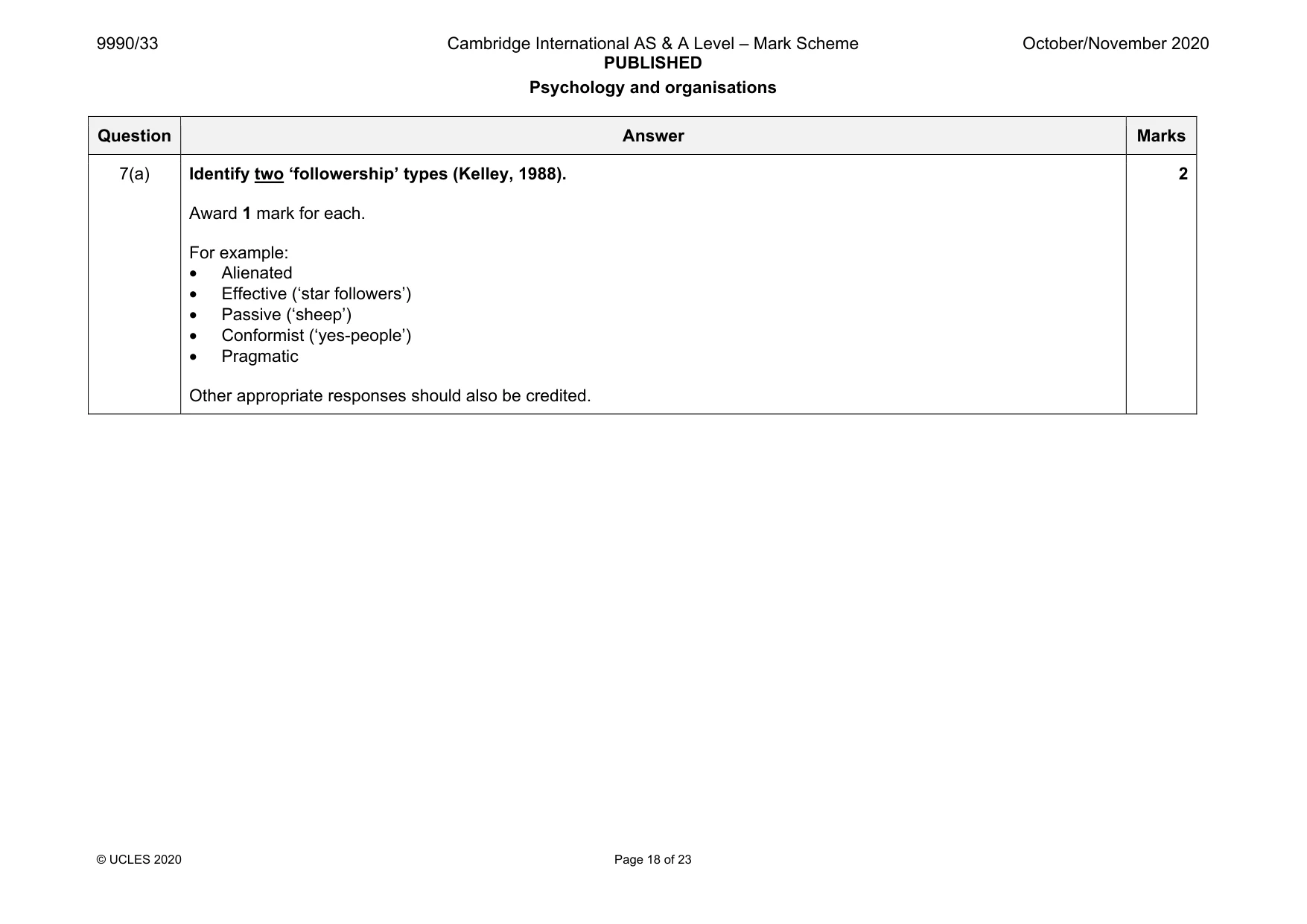
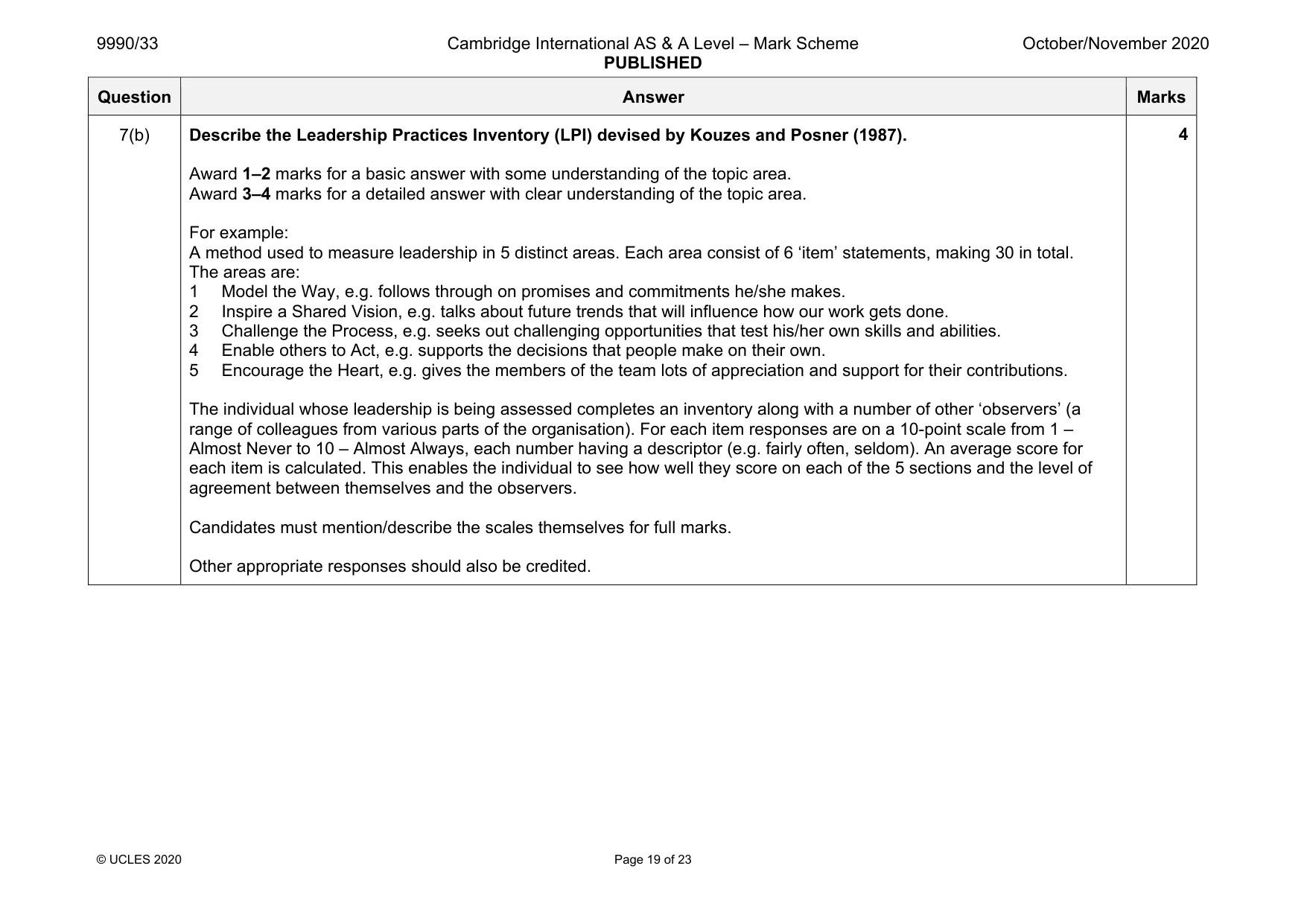
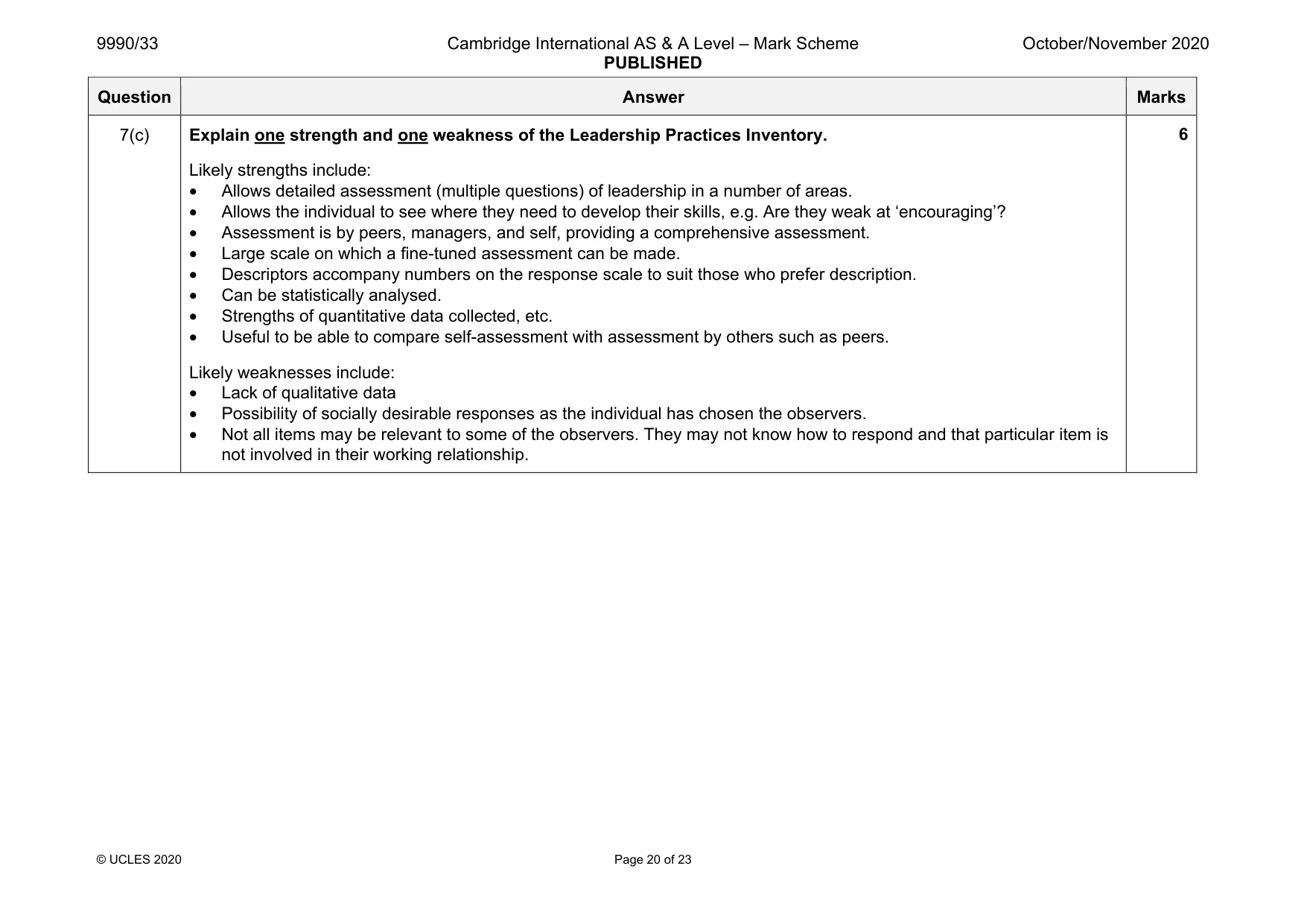
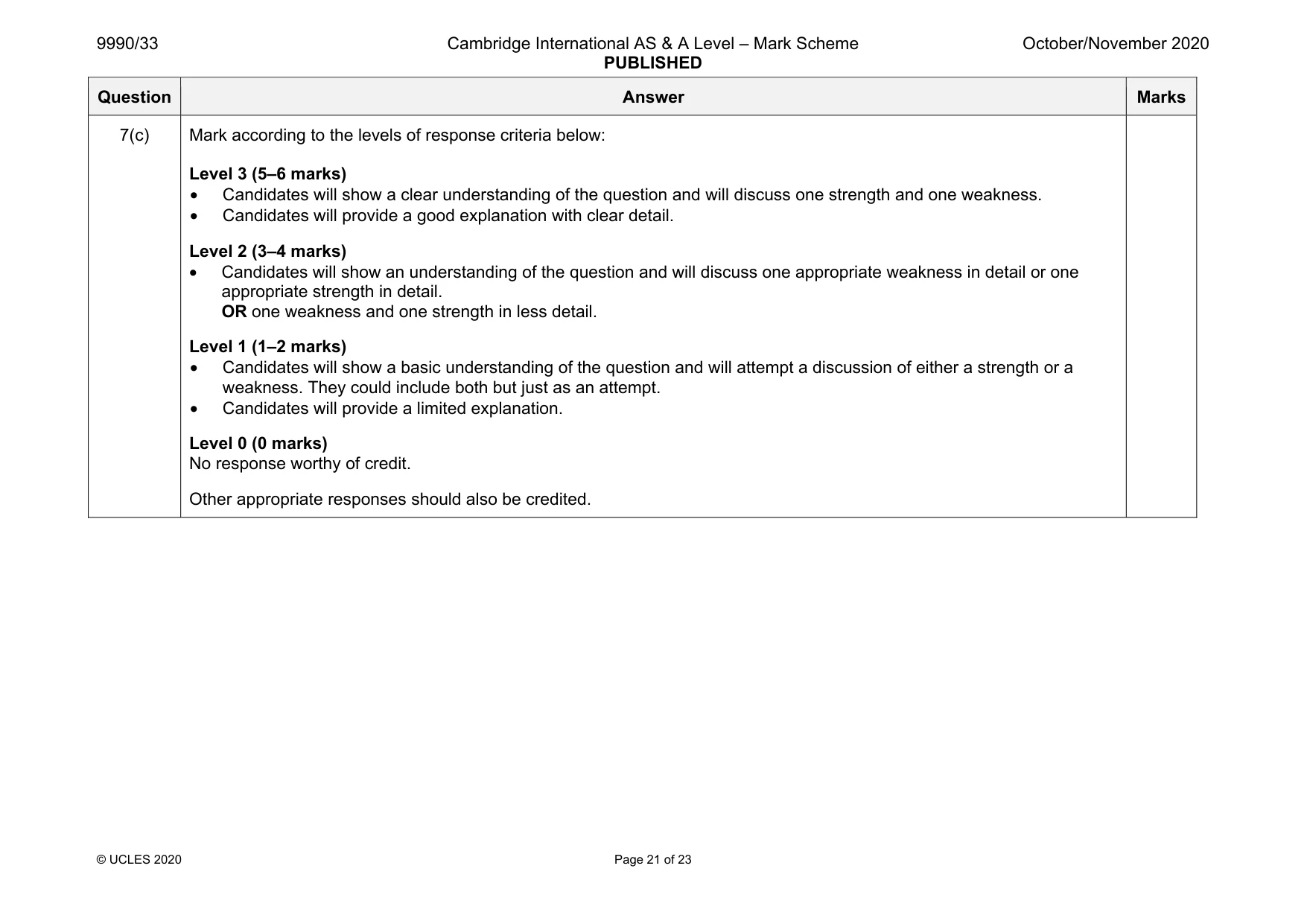
Mark scheme: 7(a) Identify two ‘followership’ types (Kelley, 1988). Award 1 mark for each. For example: • Alienated • Effective (‘star followers’) • Passive (‘sheep’) • Conformist (‘yes-people’) • Pragmatic Other appropriate responses should also be credited. 2 Question Answer Marks 7(b) Describe the Leadership Practices Inventory (LPI) devised by Kouzes and Posner (1987). Award 1–2 marks for a basic answer with some understanding of the topic area. Award 3–4 marks for a detailed answer with clear understanding of the topic area. For example: A method used to measure leadership in 5 distinct areas. Each area consist of 6 ‘item’ statements, making 30 in total. The areas are: 1 Model the Way, e.g. follows through on promises and commitments he/she makes. 2 Inspire a Shared Vision, e.g. talks about future trends that will influence how our work gets done. 3 Challenge the Process, e.g. seeks out challenging opportunities that test his/her own skills and abilities. 4 Enable others to Act, e.g. supports the decisions that people make on their own. 5 Encourage the Heart, e.g. gives the members of the team lots of appreciation and support for their contributions. The individual whose leadership is being assessed completes an inventory along with a number of other ‘observers’ (a range of colleagues from various parts of the organisation). For each item responses are on a 10-point scale from 1 – Almost Never to 10 – Almost Always, each number having a descriptor (e.g. fairly often, seldom). An average score for each item is calculated. This enables the individual to see how well they score on each of the 5 sections and the level of agreement between themselves and the observers. Candidates must mention/describe the scales themselves for full marks. Other appropriate responses should also be credited. 4 Question Answer Marks 7(c) Explain one strength and one weakness of the Leadership Practices Inventory. Likely strengths include: • Allows detailed assessment (multiple questions) of leadership in a number of areas. • Allows the individual to see where they need to develop their skills, e.g. Are they weak at ‘encouraging’? • Assessment is by peers, managers, and self, providing a comprehensive assessment. • Large scale on which a fine-tuned assessment can be made. • Descriptors accompany numbers on the response scale to suit those who prefer description. • Can be statistically analysed. • Strengths of quantitative data collected, etc. • Useful to be able to compare self-assessment with assessment by others such as peers. Likely weaknesses include: • Lack of qualitative data • Possibility of socially desirable responses as the individual has chosen the observers. • Not all items may be relevant to some of the observers. They may not know how to respond and that particular item is not involved in their working relationship. 6 Question Answer Marks 7(c) Mark according to the levels of response criteria below: Level 3 (5–6 marks) • Candidates will show a clear understanding of the question and will discuss one strength and one weakness. • Candidates will provide a good explanation with clear detail. Level 2 (3–4 marks) • Candidates will show an understanding of the question and will discuss one appropriate weakness in detail or one appropriate strength in detail. OR one weakness and one strength in less detail. Level 1 (1–2 marks) • Candidates will show a basic understanding of the question and will attempt a discussion of either a strength or a weakness. They could include both but just as an attempt. • Candidates will provide a limited explanation. Level 0 (0 marks) No response worthy of credit. Other appropriate responses should also be credited.
Q8 · Describe what psychologists have discovered about temporal conditions of work environments
8 (a) Describe what psychologists have discovered about temporal conditions of work environments. [8] (b) Evaluate what psychologists have discovered about temporal conditions of work environments, including a discussion of demand characteristics. [10]
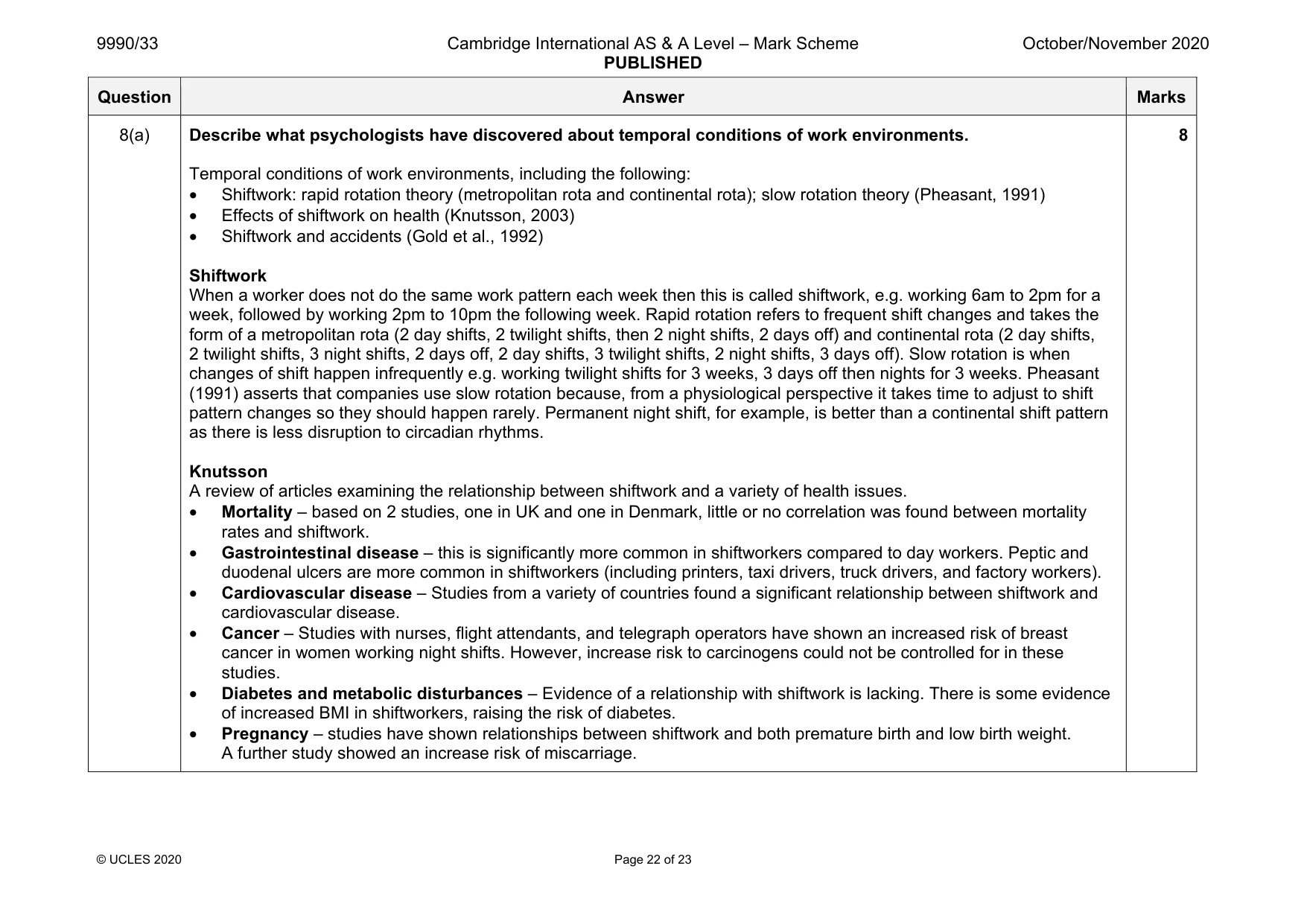
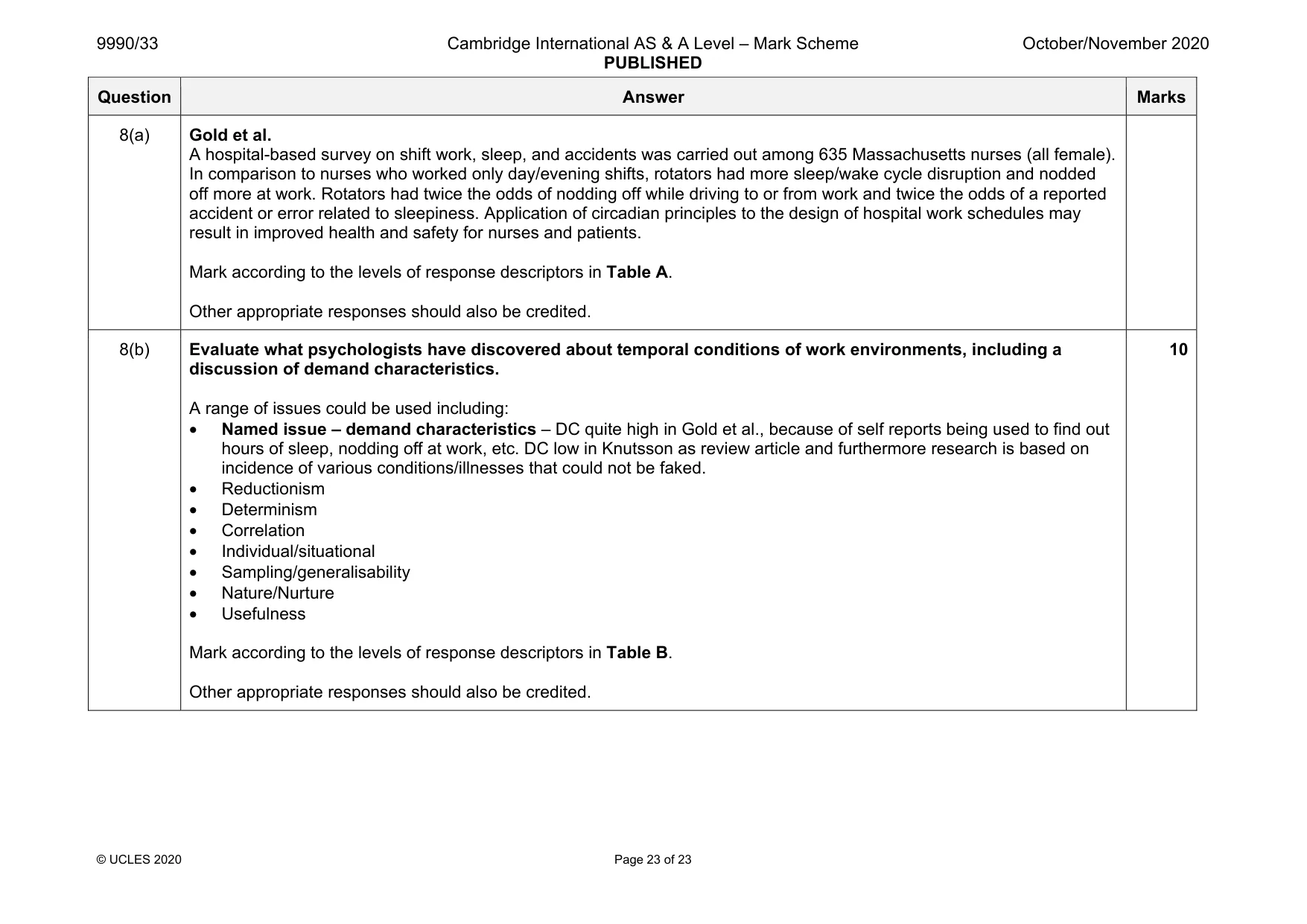
Mark scheme: 8(a) Describe what psychologists have discovered about temporal conditions of work environments. Temporal conditions of work environments, including the following: • Shiftwork: rapid rotation theory (metropolitan rota and continental rota); slow rotation theory (Pheasant, 1991) • Effects of shiftwork on health (Knutsson, 2003) • Shiftwork and accidents (Gold et al., 1992) Shiftwork When a worker does not do the same work pattern each week then this is called shiftwork, e.g. working 6am to 2pm for a week, followed by working 2pm to 10pm the following week. Rapid rotation refers to frequent shift changes and takes the form of a metropolitan rota (2 day shifts, 2 twilight shifts, then 2 night shifts, 2 days off) and continental rota (2 day shifts, 2 twilight shifts, 3 night shifts, 2 days off, 2 day shifts, 3 twilight shifts, 2 night shifts, 3 days off). Slow rotation is when changes of shift happen infrequently e.g. working twilight shifts for 3 weeks, 3 days off then nights for 3 weeks. Pheasant (1991) asserts that companies use slow rotation because, from a physiological perspective it takes time to adjust to shift pattern changes so they should happen rarely. Permanent night shift, for example, is better than a continental shift pattern as there is less disruption to circadian rhythms. Knutsson A review of articles examining the relationship between shiftwork and a variety of health issues. • Mortality – based on 2 studies, one in UK and one in Denmark, little or no correlation was found between mortality rates and shiftwork. • Gastrointestinal disease – this is significantly more common in shiftworkers compared to day workers. Peptic and duodenal ulcers are more common in shiftworkers (including printers, taxi drivers, truck drivers, and factory workers). • Cardiovascular disease – Studies from a variety of countries found a significant relationship between shiftwork and cardiovascular disease. • Cancer – Studies with nurses, flight attendants, and telegraph operators have shown an increased risk of breast cancer in women working night shifts. However, increase risk to carcinogens could not be controlled for in these studies. • Diabetes and metabolic disturbances – Evidence of a relationship with shiftwork is lacking. There is some evidence of increased BMI in shiftworkers, raising the risk of diabetes. • Pregnancy – studies have shown relationships between shiftwork and both premature birth and low birth weight. A further study showed an increase risk of miscarriage. 8 Question Answer Marks 8(a) Gold et al. A hospital-based survey on shift work, sleep, and accidents was carried out among 635 Massachusetts nurses (all female). In comparison to nurses who worked only day/evening shifts, rotators had more sleep/wake cycle disruption and nodded off more at work. Rotators had twice the odds of nodding off while driving to or from work and twice the odds of a reported accident or error related to sleepiness. Application of circadian principles to the design of hospital work schedules may result in improved health and safety for nurses and patients. Mark according to the levels of response descriptors in Table A. Other appropriate responses should also be credited. 8(b) Evaluate what psychologists have discovered about temporal conditions of work environments, including a discussion of demand characteristics. A range of issues could be used including: • Named issue – demand characteristics – DC quite high in Gold et al., because of self reports being used to find out hours of sleep, nodding off at work, etc. DC low in Knutsson as review article and furthermore research is based on incidence of various conditions/illnesses that could not be faked. • Reductionism • Determinism • Correlation • Individual/situational • Sampling/generalisability • Nature/Nurture • Usefulness Mark according to the levels of response descriptors in Table B. Other appropriate responses should also be credited. 10
What was in this paper
The subtopics covered by these 8 questions, and how many questions each got. Open one in a new tab to see every Cambridge question on it.
What you needed in this session
Cambridge’s own grade thresholds for 2020 Oct/Nov, Paper 3 · Variant 3. A higher threshold means an easier paper — the bar moves with how the cohort did.