Cambridge A Level Psychology (from 2018) 9990 — 2024 Oct/Nov Paper 3 · Variant 1
9990/31/O/N/24 · 16 questions · 60 marks · 90 min
The question paper and its mark scheme, free to read here and free to download. This is Cambridge’s own paper, exactly as it was sat.
Question paper8 pages



Mark scheme44 pages
Answers below. Sit the paper first if you are practising.
Questions as text
Q1 · Jude has a phobia of some foods
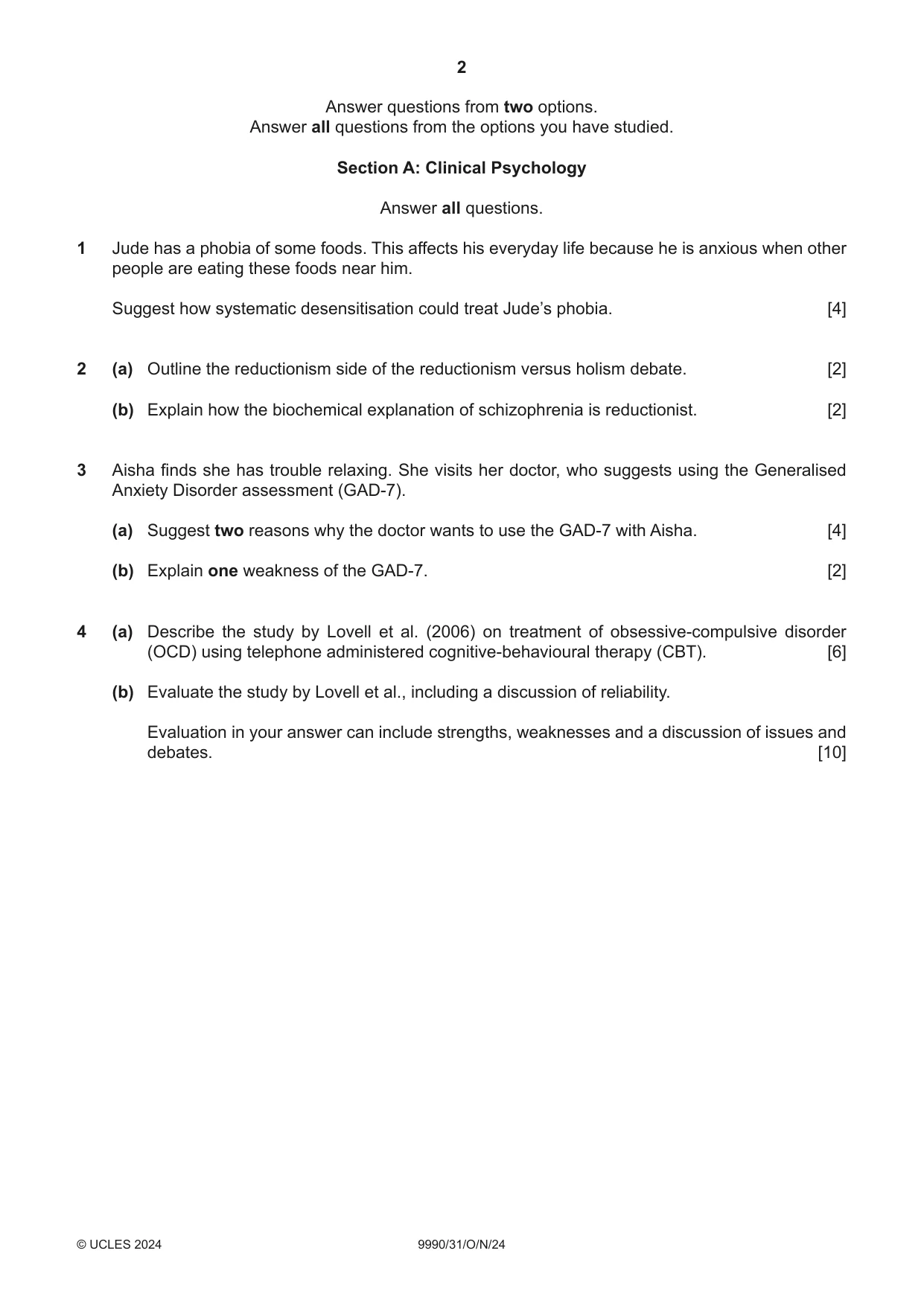
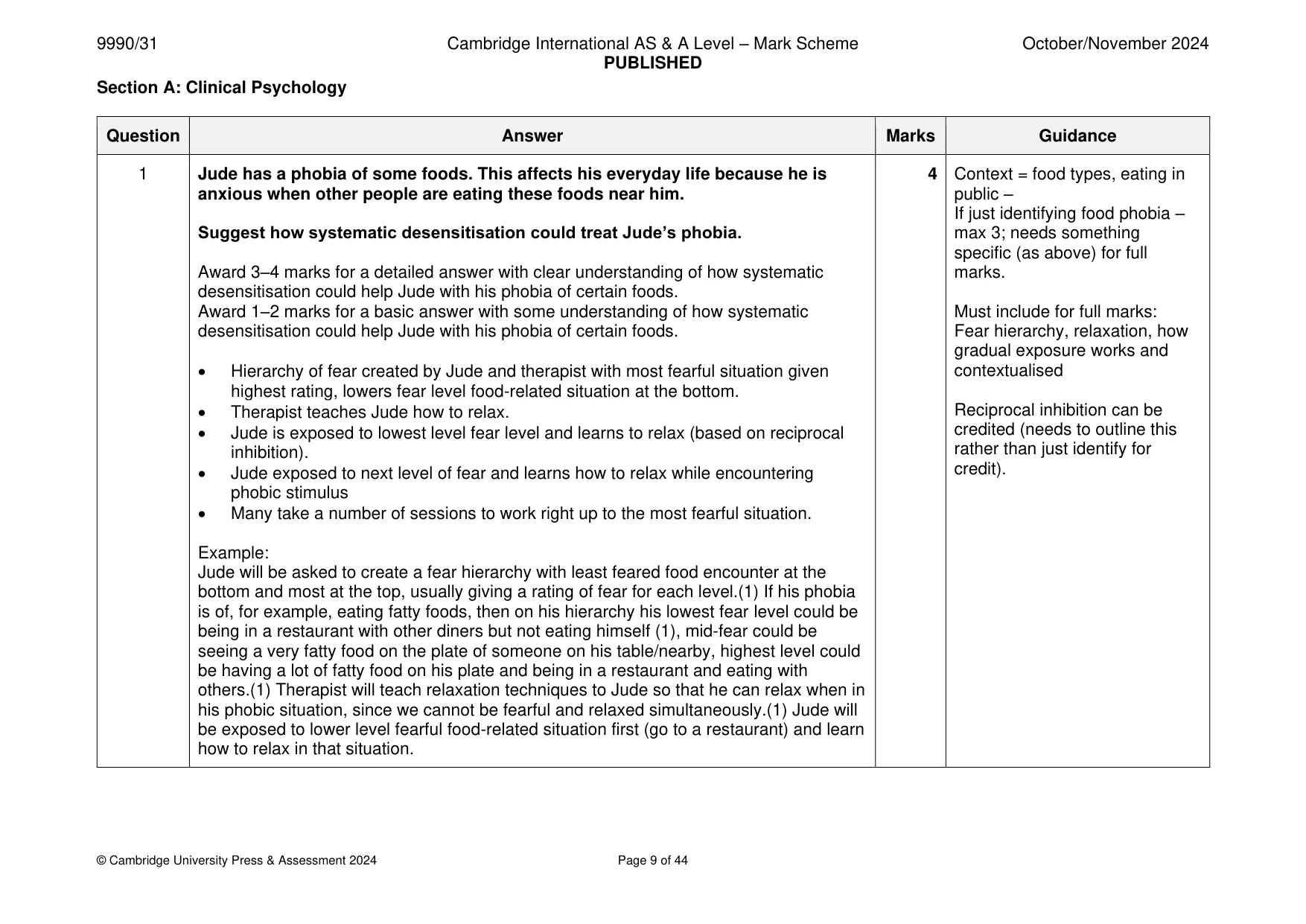
1 Jude has a phobia of some foods. This affects his everyday life because he is anxious when other people are eating these foods near him. Suggest how systematic desensitisation could treat Jude’s phobia. [4]
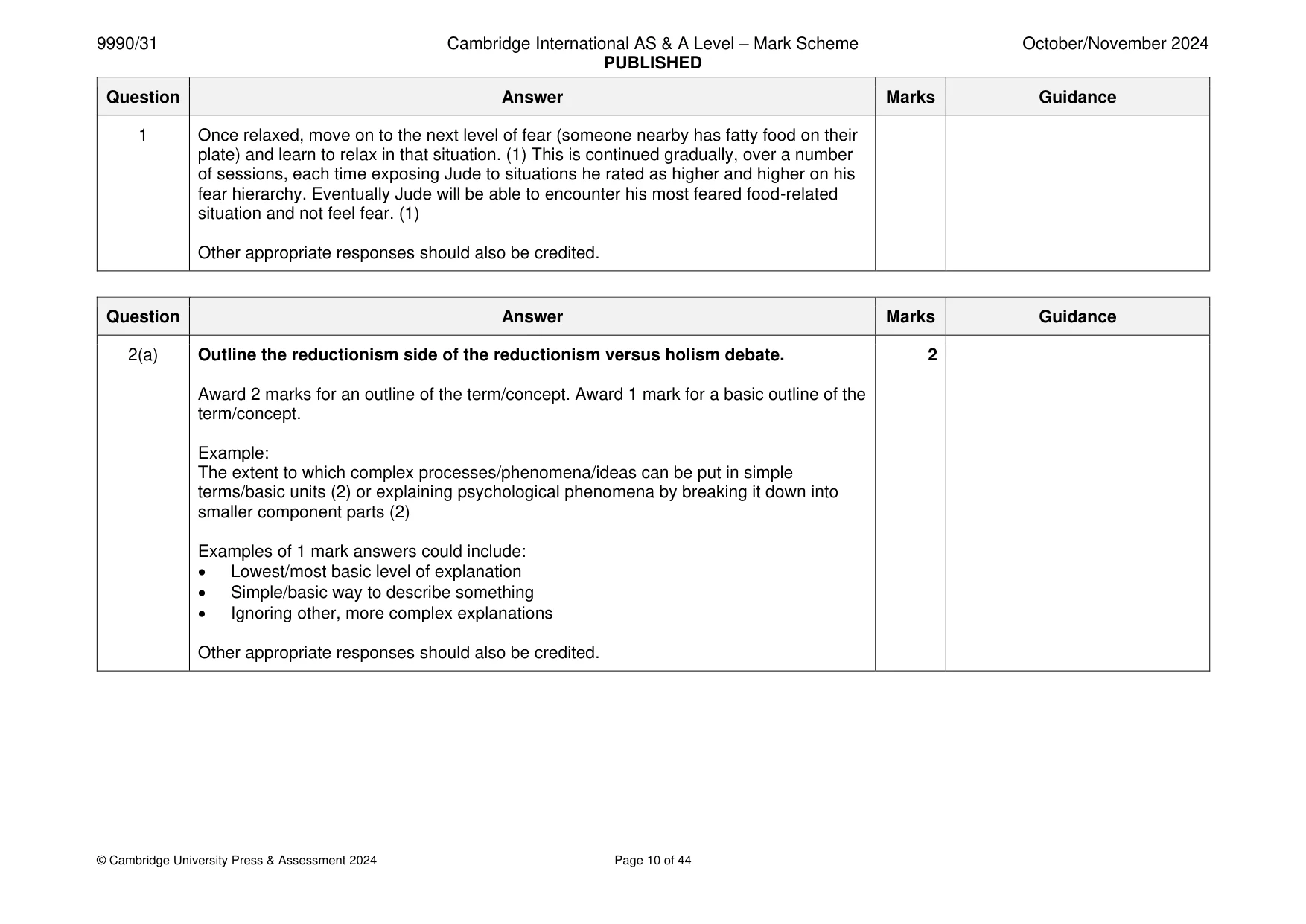
Mark scheme: Question Answer Marks Guidance 1 Jude has a phobia of some foods. This affects his everyday life because he is 4 Context = food types, eating in anxious when other people are eating these foods near him. public – If just identifying food phobia – Suggest how systematic desensitisation could treat Jude’s phobia. max 3; needs something specific (as above) for full Award 3–4 marks for a detailed answer with clear understanding of how systematic marks. desensitisation could help Jude with his phobia of certain foods. Award 1–2 marks for a basic answer with some understanding of how systematic Must include for full marks: desensitisation could help Jude with his phobia of certain foods. Fear hierarchy, relaxation, how gradual exposure works and • Hierarchy of fear created by Jude and therapist with most fearful situation given contextualised highest rating, lowers fear level food-related situation at the bottom. • Therapist teaches Jude how to relax. Reciprocal inhibition can be • Jude is exposed to lowest level fear level and learns to relax (based on reciprocal credited (needs to outline this inhibition). rather than just identify for • Jude exposed to next level of fear and learns how to relax while encountering credit). phobic stimulus • Many take a number of sessions to work right up to the most fearful situation. Example: Jude will be asked to create a fear hierarchy with least feared food encounter at the bottom and most at the top, usually giving a rating of fear for each level.(1) If his phobia is of, for example, eating fatty foods, then on his hierarchy his lowest fear level could be being in a restaurant with other diners but not eating himself (1), mid-fear could be seeing a very fatty food on the plate of someone on his table/nearby, highest level could be having a lot of fatty food on his plate and being in a restaurant and eating with others.(1) Therapist will teach relaxation techniques to Jude so that he can relax when in his phobic situation, since we cannot be fearful and relaxed simultaneously.(1) Jude will be exposed to lower level fearful food-related situation first (go to a restaurant) and learn how to relax in that situation. 1 Once relaxed, move on to the next level of fear (someone nearby has fatty food on their plate) and learn to relax in that situation. (1) This is continued gradually, over a number of sessions, each time exposing Jude to situations he rated as higher and higher on his fear hierarchy. Eventually Jude will be able to encounter his most feared food-related situation and not feel fear. (1) Other appropriate responses should also be credited.
More questions on Anxiety disorders and fear-related disorders
Q2 · Outline the reductionism side of the reductionism versus holism debate
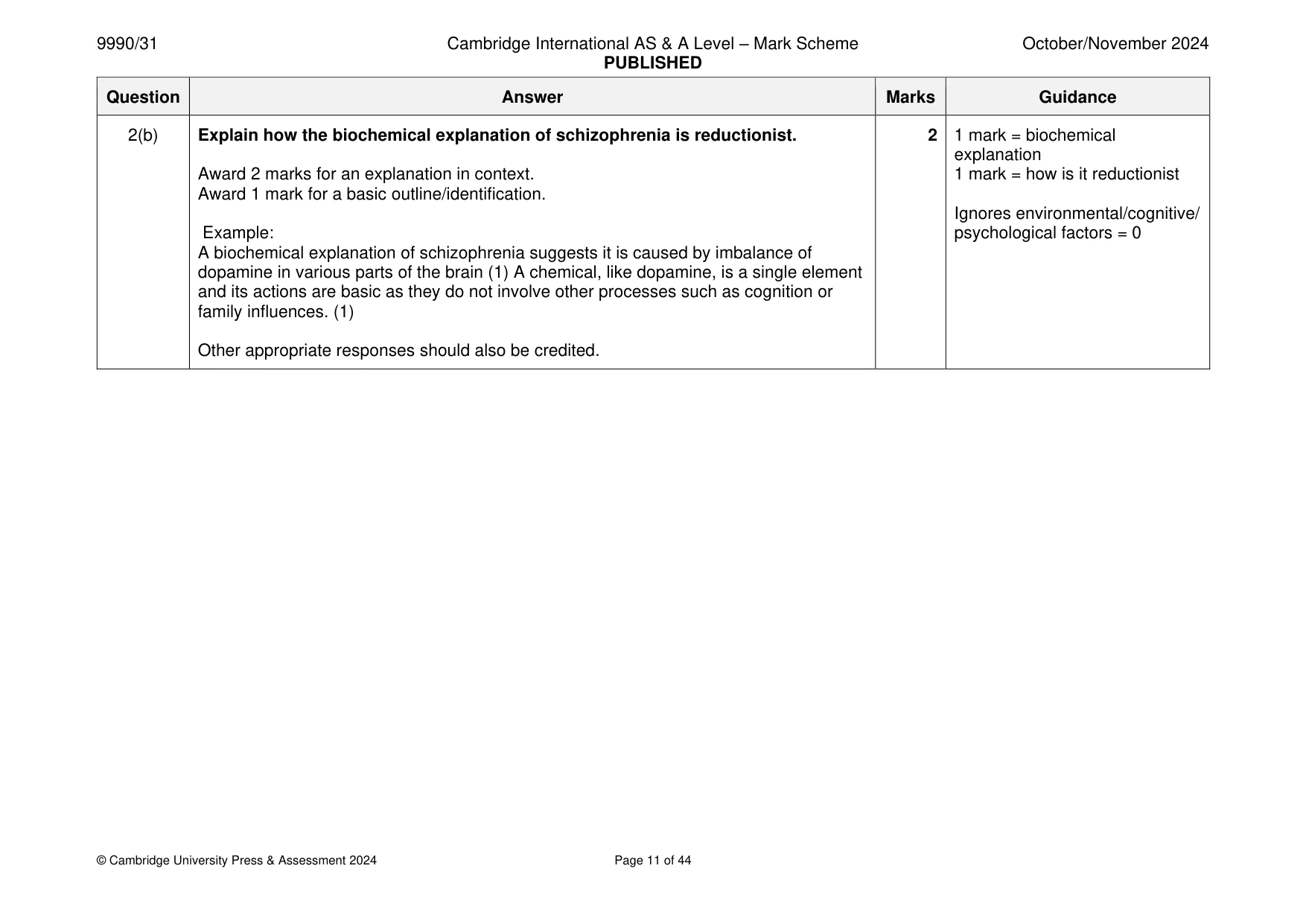
2 (a) Outline the reductionism side of the reductionism versus holism debate. [2] (b) Explain how the biochemical explanation of schizophrenia is reductionist. [2]
Mark scheme: 2(a) Outline the reductionism side of the reductionism versus holism debate. 2 Award 2 marks for an outline of the term/concept. Award 1 mark for a basic outline of the term/concept. Example: The extent to which complex processes/phenomena/ideas can be put in simple terms/basic units (2) or explaining psychological phenomena by breaking it down into smaller component parts (2) Examples of 1 mark answers could include: • Lowest/most basic level of explanation • Simple/basic way to describe something • Ignoring other, more complex explanations Other appropriate responses should also be credited. 2(b) Explain how the biochemical explanation of schizophrenia is reductionist. 2 1 mark = biochemical explanation Award 2 marks for an explanation in context. 1 mark = how is it reductionist Award 1 mark for a basic outline/identification. Ignores environmental/cognitive/ Example: psychological factors = 0 A biochemical explanation of schizophrenia suggests it is caused by imbalance of dopamine in various parts of the brain (1) A chemical, like dopamine, is a single element and its actions are basic as they do not involve other processes such as cognition or family influences. (1) Other appropriate responses should also be credited.
Q3 · Aisha finds she has trouble relaxing
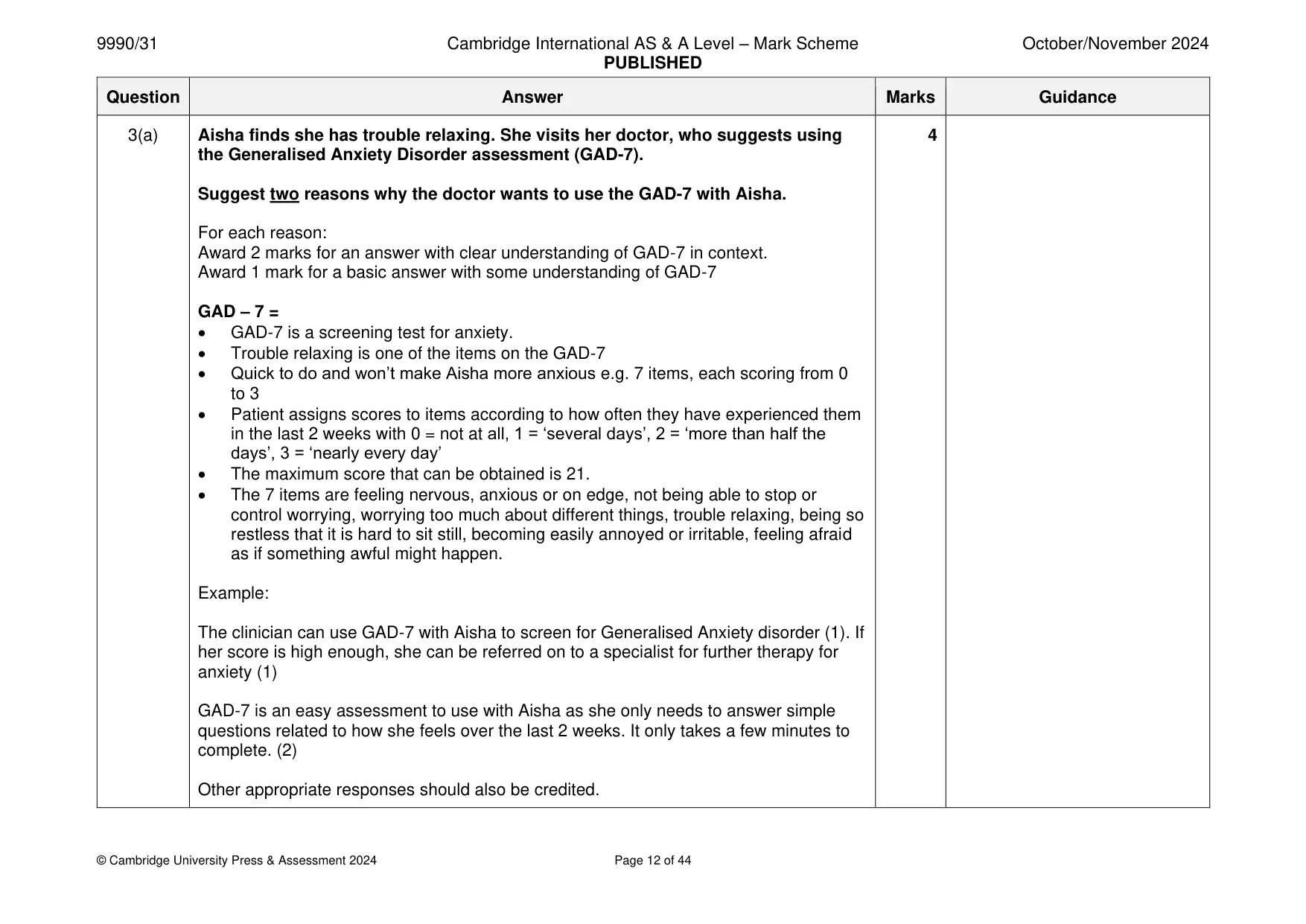
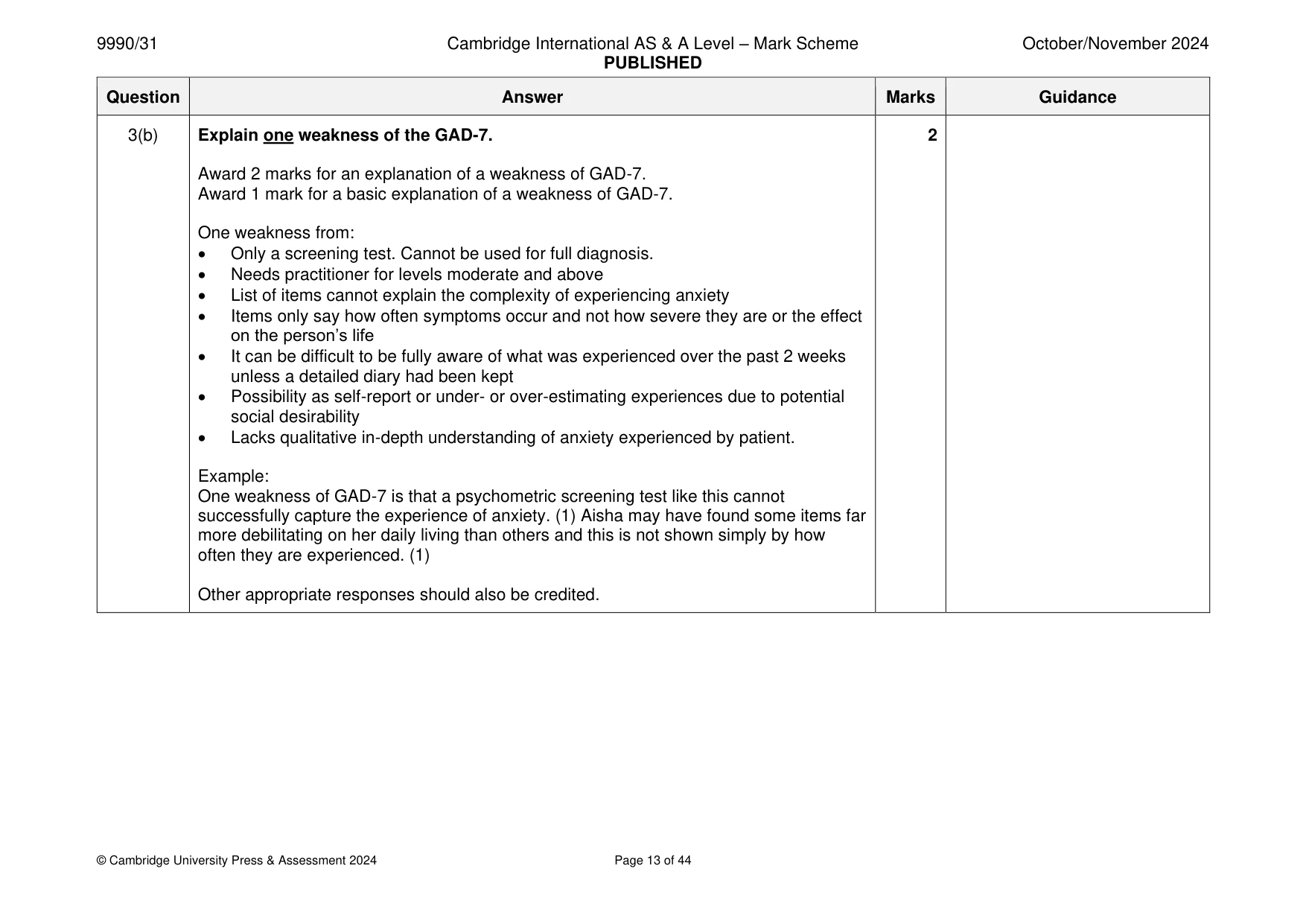
3 Aisha finds she has trouble relaxing. She visits her doctor, who suggests using the Generalised Anxiety Disorder assessment (GAD-7). (a) Suggest two reasons why the doctor wants to use the GAD-7 with Aisha. [4] (b) Explain one weakness of the GAD-7. [2]
Mark scheme: 3(a) Aisha finds she has trouble relaxing. She visits her doctor, who suggests using 4 the Generalised Anxiety Disorder assessment (GAD-7). Suggest two reasons why the doctor wants to use the GAD-7 with Aisha. For each reason: Award 2 marks for an answer with clear understanding of GAD-7 in context. Award 1 mark for a basic answer with some understanding of GAD-7 GAD – 7 = • GAD-7 is a screening test for anxiety. • Trouble relaxing is one of the items on the GAD-7 • Quick to do and won’t make Aisha more anxious e.g. 7 items, each scoring from 0 to 3 • Patient assigns scores to items according to how often they have experienced them in the last 2 weeks with 0 = not at all, 1 = ‘several days’, 2 = ‘more than half the days’, 3 = ‘nearly every day’ • The maximum score that can be obtained is 21. • The 7 items are feeling nervous, anxious or on edge, not being able to stop or control worrying, worrying too much about different things, trouble relaxing, being so restless that it is hard to sit still, becoming easily annoyed or irritable, feeling afraid as if something awful might happen. Example: The clinician can use GAD-7 with Aisha to screen for Generalised Anxiety disorder (1). If her score is high enough, she can be referred on to a specialist for further therapy for anxiety (1) GAD-7 is an easy assessment to use with Aisha as she only needs to answer simple questions related to how she feels over the last 2 weeks. It only takes a few minutes to complete. (2) Other appropriate responses should also be credited. 3(b) Explain one weakness of the GAD-7. 2 Award 2 marks for an explanation of a weakness of GAD-7. Award 1 mark for a basic explanation of a weakness of GAD-7. One weakness from: • Only a screening test. Cannot be used for full diagnosis. • Needs practitioner for levels moderate and above • List of items cannot explain the complexity of experiencing anxiety • Items only say how often symptoms occur and not how severe they are or the effect on the person’s life • It can be difficult to be fully aware of what was experienced over the past 2 weeks unless a detailed diary had been kept • Possibility as self-report or under- or over-estimating experiences due to potential social desirability • Lacks qualitative in-depth understanding of anxiety experienced by patient. Example: One weakness of GAD-7 is that a psychometric screening test like this cannot successfully capture the experience of anxiety. (1) Aisha may have found some items far more debilitating on her daily living than others and this is not shown simply by how often they are experienced. (1) Other appropriate responses should also be credited.
More questions on Anxiety disorders and fear-related disorders
Q4 · Describe the study by Lovell et al
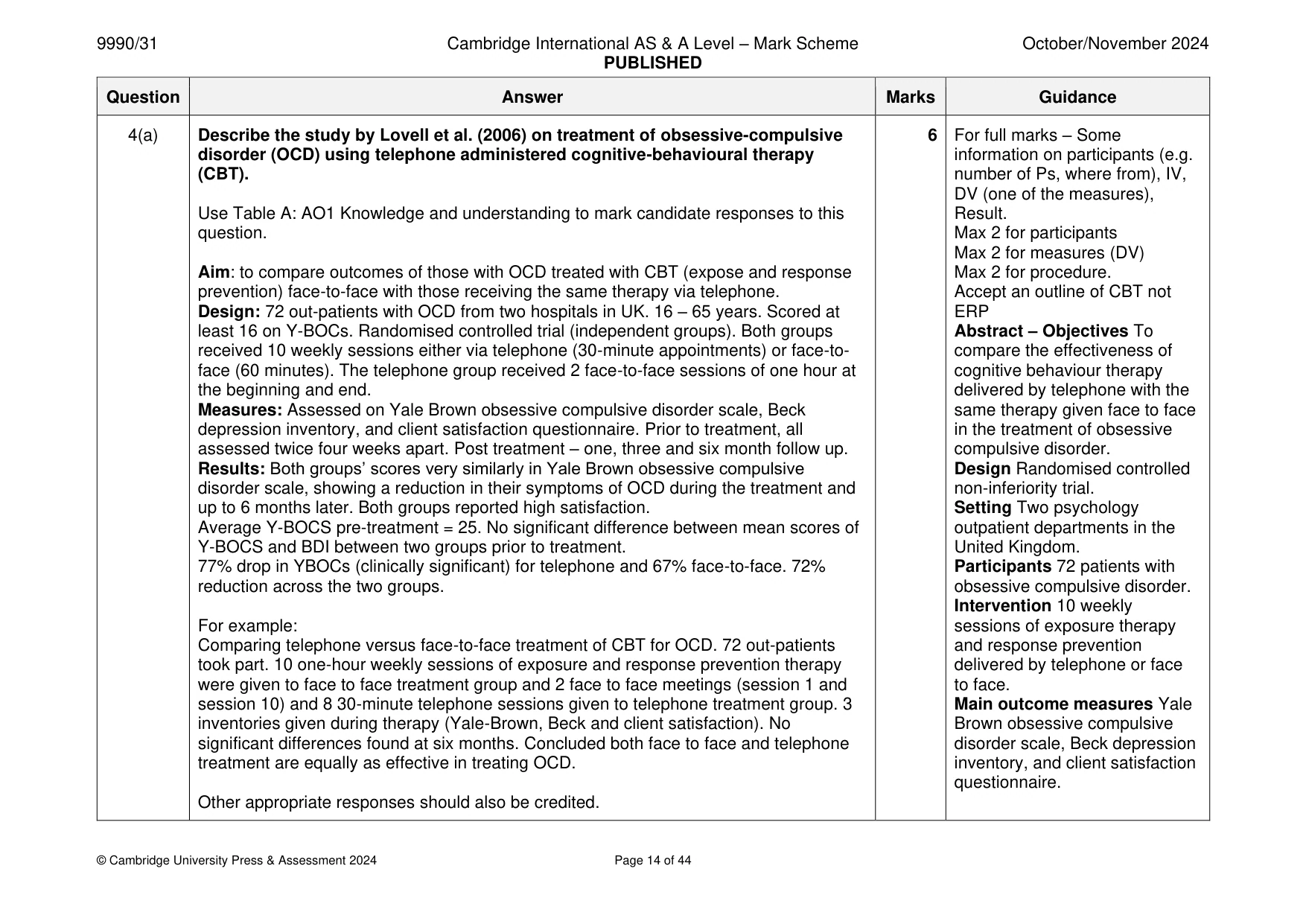
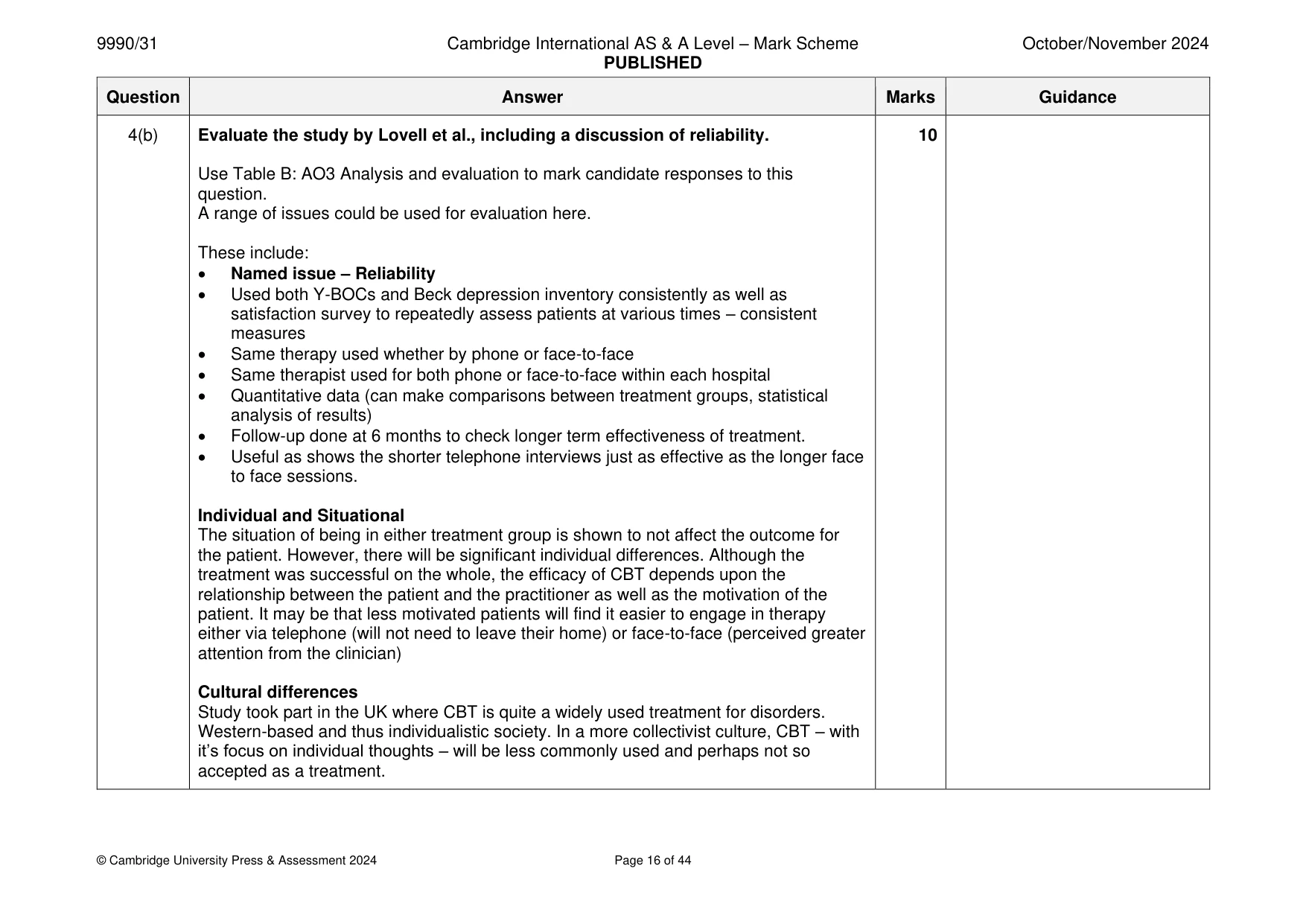
4 (a) Describe the study by Lovell et al. (2006) on treatment of obsessive-compulsive disorder (OCD) using telephone administered cognitive-behavioural therapy (CBT). [6] (b) Evaluate the study by Lovell et al., including a discussion of reliability. Evaluation in your answer can include strengths, weaknesses and a discussion of issues and debates. [10]
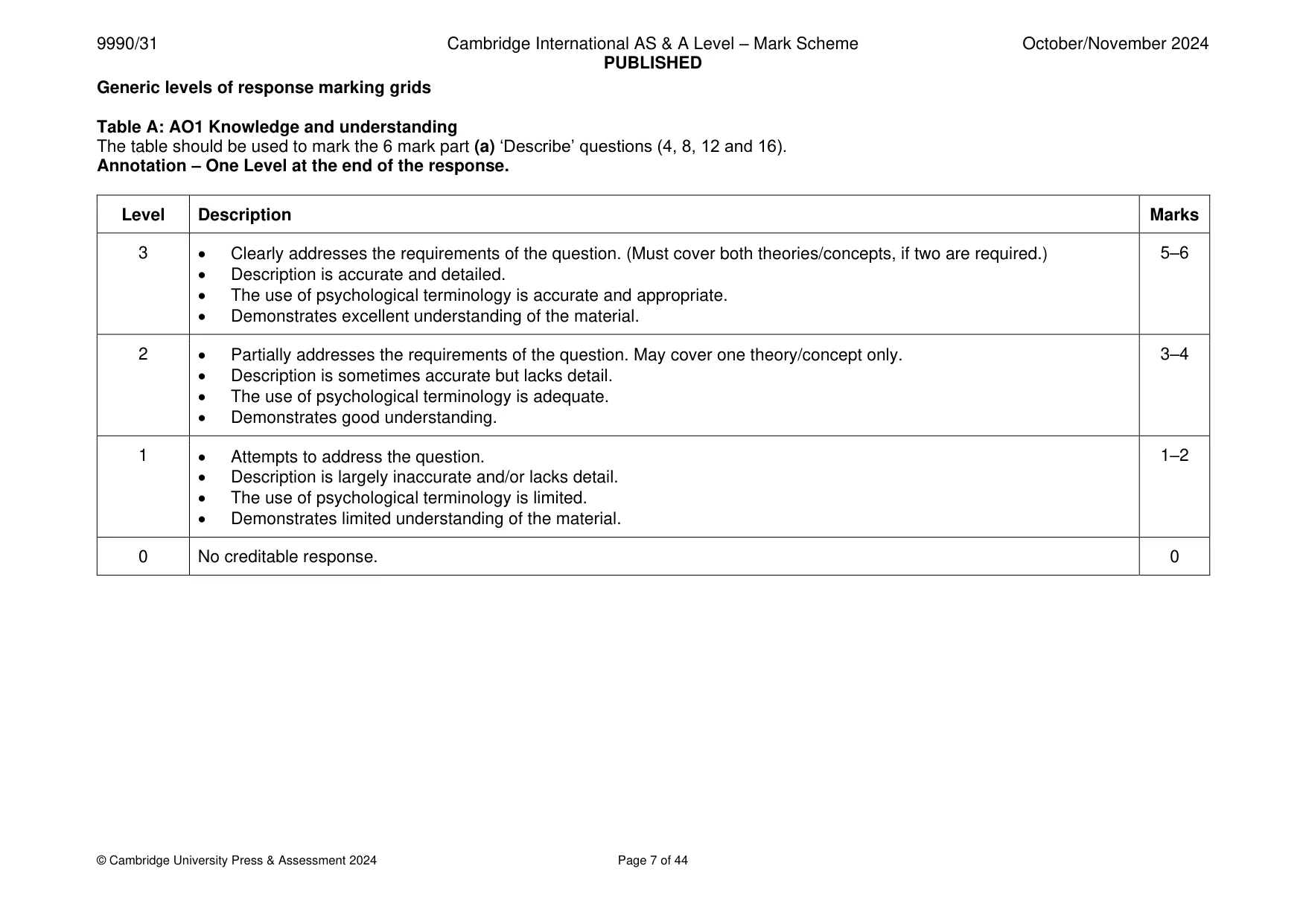
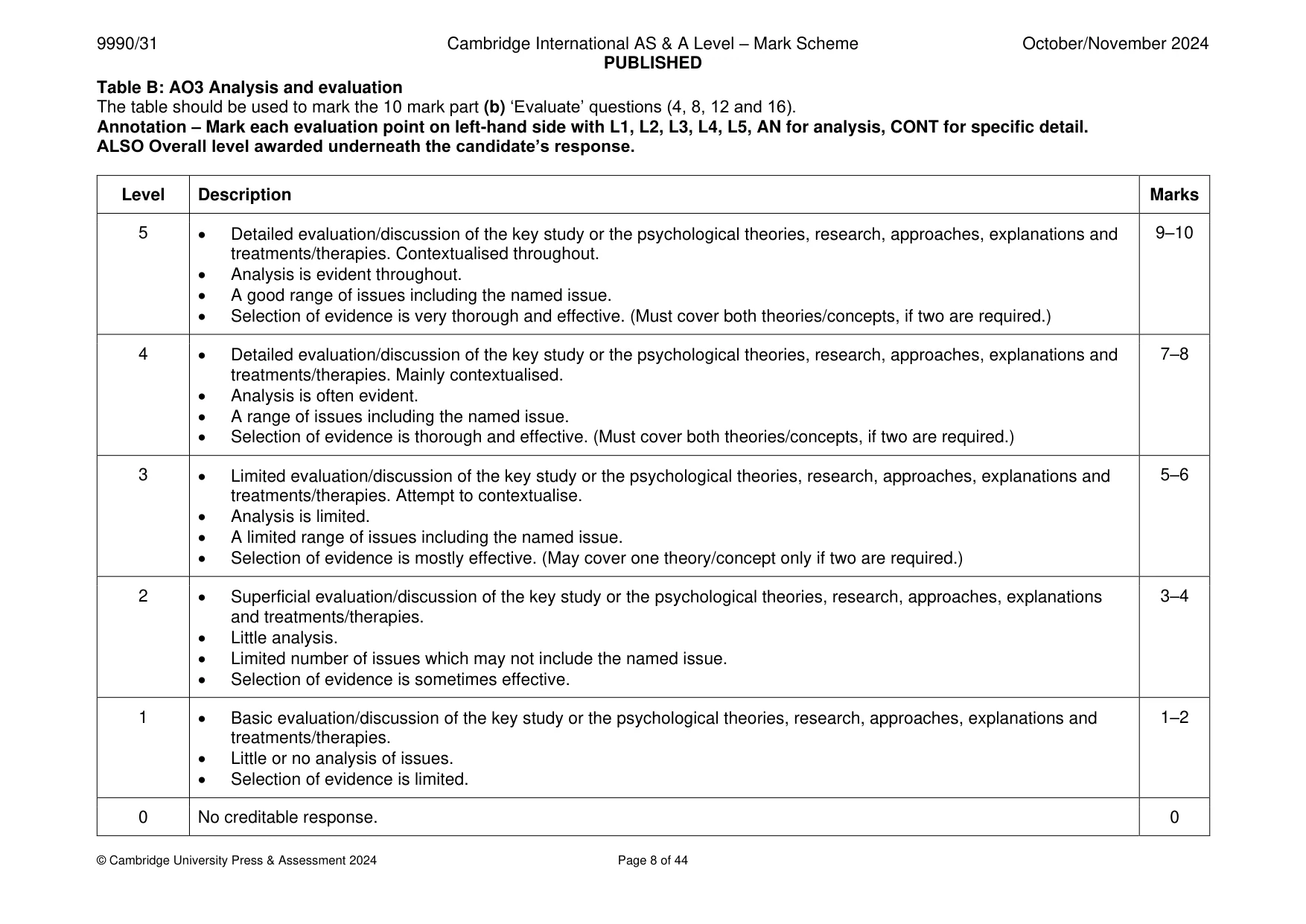
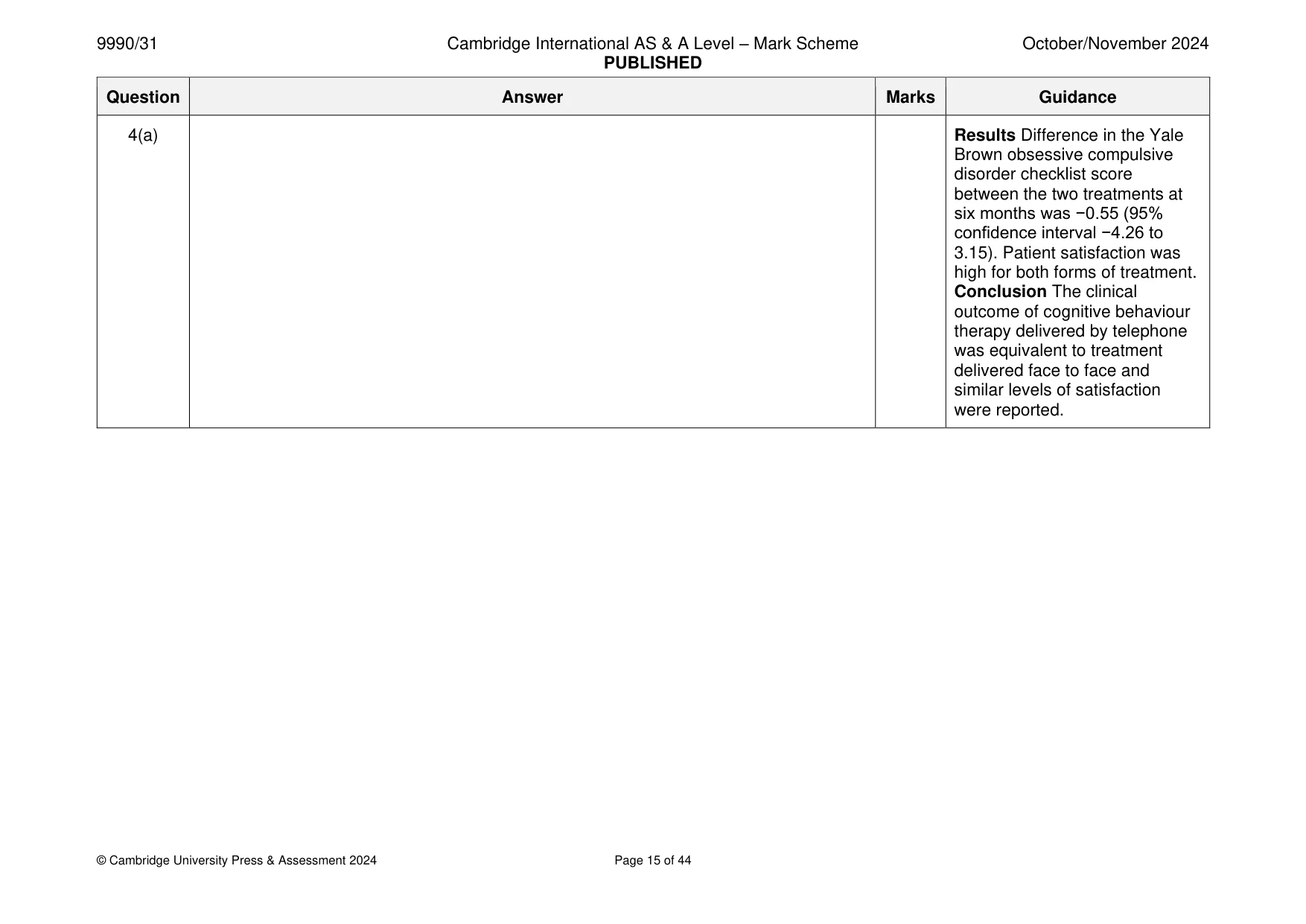
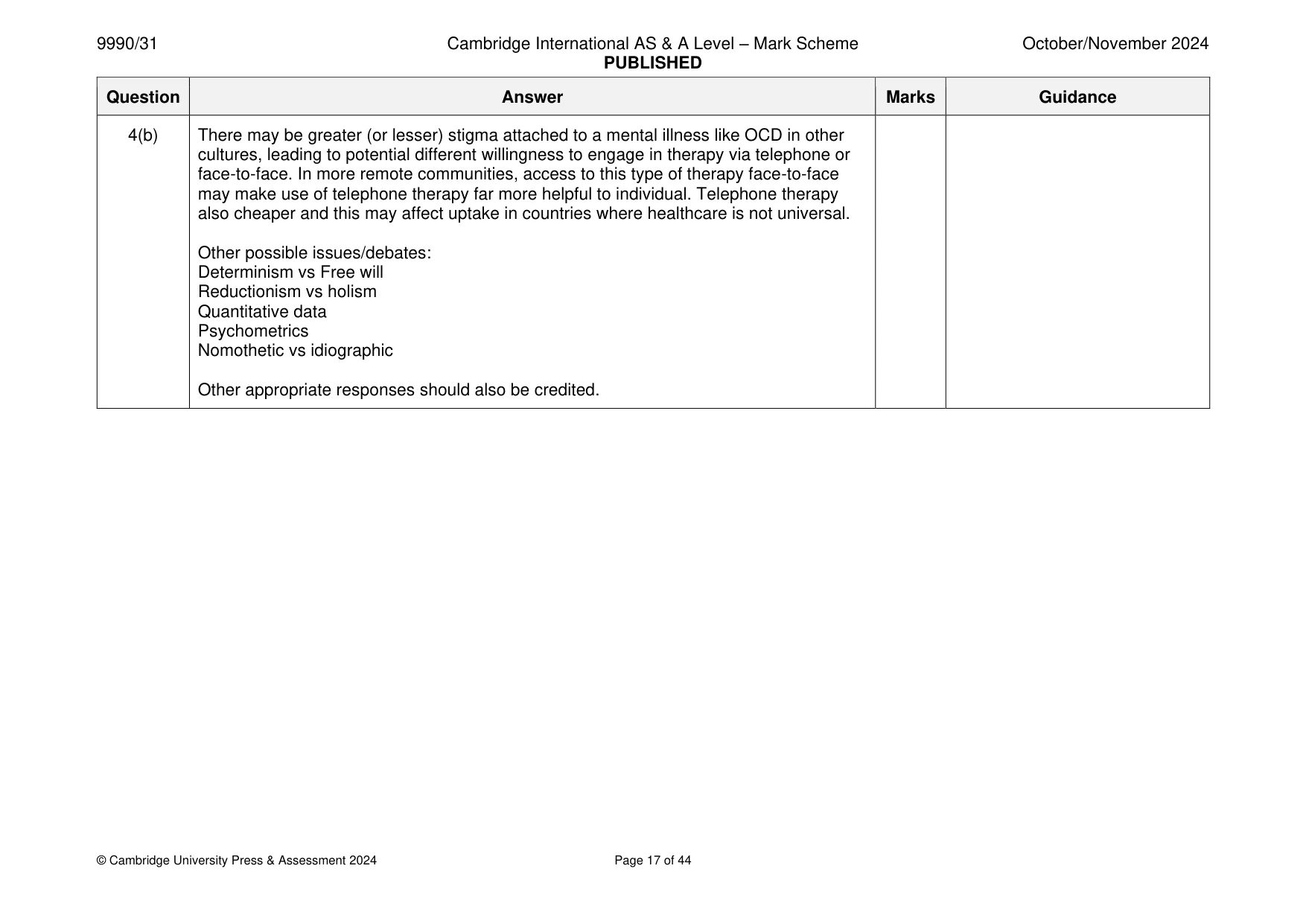
Mark scheme: 4(a) Describe the study by Lovell et al. (2006) on treatment of obsessive-compulsive 6 For full marks – Some disorder (OCD) using telephone administered cognitive-behavioural therapy information on participants (e.g. (CBT). number of Ps, where from), IV, DV (one of the measures), Use Table A: AO1 Knowledge and understanding to mark candidate responses to this Result. question. Max 2 for participants Max 2 for measures (DV) Aim: to compare outcomes of those with OCD treated with CBT (expose and response Max 2 for procedure. prevention) face-to-face with those receiving the same therapy via telephone. Accept an outline of CBT not Design: 72 out-patients with OCD from two hospitals in UK. 16 – 65 years. Scored at ERP least 16 on Y-BOCs. Randomised controlled trial (independent groups). Both groups Abstract – Objectives To received 10 weekly sessions either via telephone (30-minute appointments) or face-to- compare the effectiveness of face (60 minutes). The telephone group received 2 face-to-face sessions of one hour at cognitive behaviour therapy the beginning and end. delivered by telephone with the Measures: Assessed on Yale Brown obsessive compulsive disorder scale, Beck same therapy given face to face depression inventory, and client satisfaction questionnaire. Prior to treatment, all in the treatment of obsessive assessed twice four weeks apart. Post treatment – one, three and six month follow up. compulsive disorder. Results: Both groups’ scores very similarly in Yale Brown obsessive compulsive Design Randomised controlled disorder scale, showing a reduction in their symptoms of OCD during the treatment and non-inferiority trial. up to 6 months later. Both groups reported high satisfaction. Setting Two psychology Average Y-BOCS pre-treatment = 25. No significant difference between mean scores of outpatient departments in the Y-BOCS and BDI between two groups prior to treatment. United Kingdom. 77% drop in YBOCs (clinically significant) for telephone and 67% face-to-face. 72% Participants 72 patients with reduction across the two groups. obsessive compulsive disorder. Intervention 10 weekly For example: sessions of exposure therapy Comparing telephone versus face-to-face treatment of CBT for OCD. 72 out-patients and response prevention took part. 10 one-hour weekly sessions of exposure and response prevention therapy delivered by telephone or face were given to face to face treatment group and 2 face to face meetings (session 1 and to face. session 10) and 8 30-minute telephone sessions given to telephone treatment group. 3 Main outcome measures Yale inventories given during therapy (Yale-Brown, Beck and client satisfaction). No Brown obsessive compulsive significant differences found at six months. Concluded both face to face and telephone disorder scale, Beck depression treatment are equally as effective in treating OCD. inventory, and client satisfaction questionnaire. Other appropriate responses should also be credited. 4(a) Results Difference in the Yale Brown obsessive compulsive disorder checklist score between the two treatments at six months was −0.55 (95% confidence interval −4.26 to 3.15). Patient satisfaction was high for both forms of treatment. Conclusion The clinical outcome of cognitive behaviour therapy delivered by telephone was equivalent to treatment delivered face to face and similar levels of satisfaction were reported. 4(b) Evaluate the study by Lovell et al., including a discussion of reliability. 10 Use Table B: AO3 Analysis and evaluation to mark candidate responses to this question. A range of issues could be used for evaluation here. These include: • Named issue – Reliability • Used both Y-BOCs and Beck depression inventory consistently as well as satisfaction survey to repeatedly assess patients at various times – consistent measures • Same therapy used whether by phone or face-to-face • Same therapist used for both phone or face-to-face within each hospital • Quantitative data (can make comparisons between treatment groups, statistical analysis of results) • Follow-up done at 6 months to check longer term effectiveness of treatment. • Useful as shows the shorter telephone interviews just as effective as the longer face to face sessions. Individual and Situational The situation of being in either treatment group is shown to not affect the outcome for the patient. However, there will be significant individual differences. Although the treatment was successful on the whole, the efficacy of CBT depends upon the relationship between the patient and the practitioner as well as the motivation of the patient. It may be that less motivated patients will find it easier to engage in therapy either via telephone (will not need to leave their home) or face-to-face (perceived greater attention from the clinician) Cultural differences Study took part in the UK where CBT is quite a widely used treatment for disorders. Western-based and thus individualistic society. In a more collectivist culture, CBT – with it’s focus on individual thoughts – will be less commonly used and perhaps not so accepted as a treatment. 4(b) There may be greater (or lesser) stigma attached to a mental illness like OCD in other cultures, leading to potential different willingness to engage in therapy via telephone or face-to-face. In more remote communities, access to this type of therapy face-to-face may make use of telephone therapy far more helpful to individual. Telephone therapy also cheaper and this may affect uptake in countries where healthcare is not universal. Other possible issues/debates: Determinism vs Free will Reductionism vs holism Quantitative data Psychometrics Nomothetic vs idiographic Other appropriate responses should also be credited.
Q5 · An online grocery retailer currently uses a grid layout in its virtual store
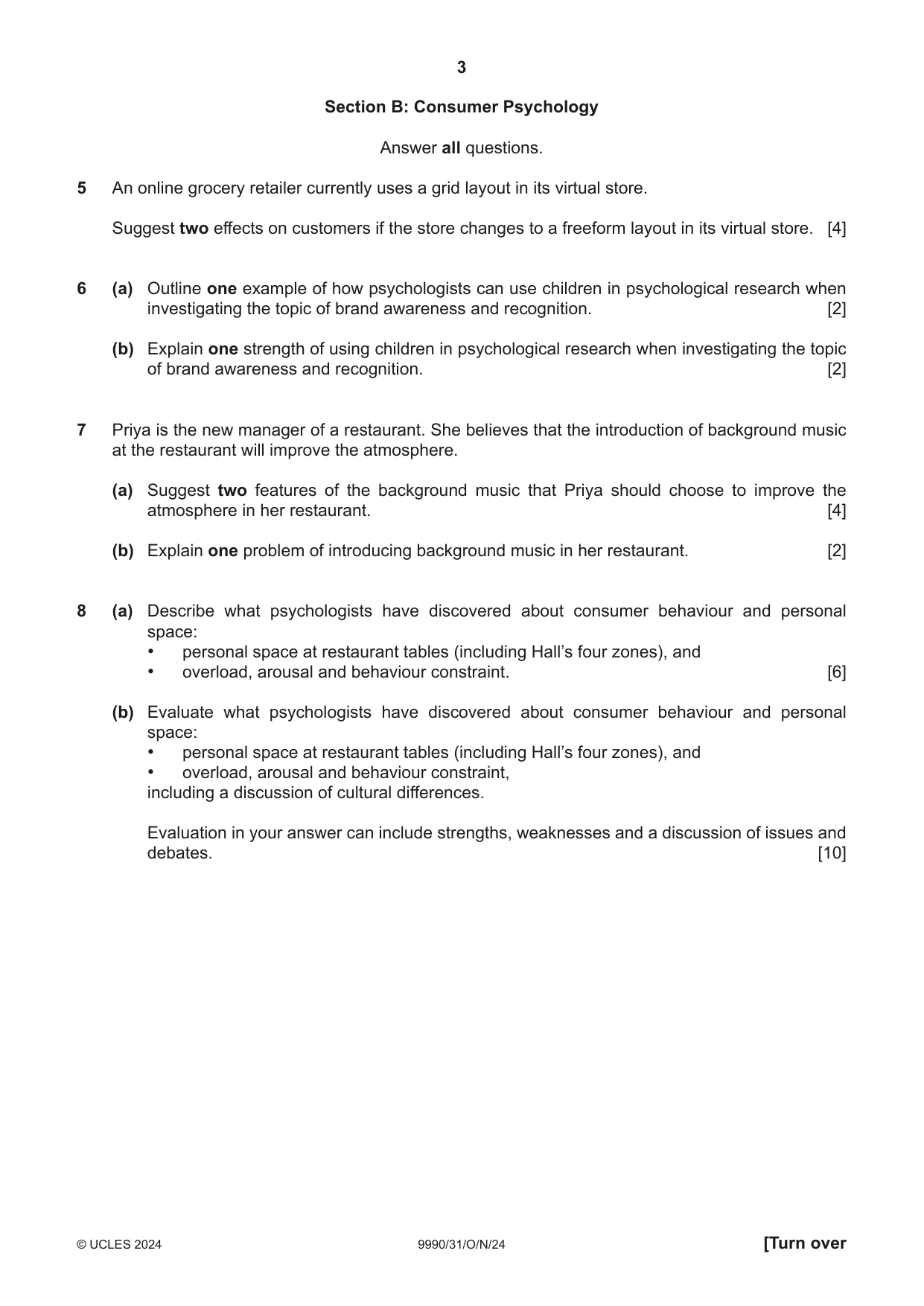
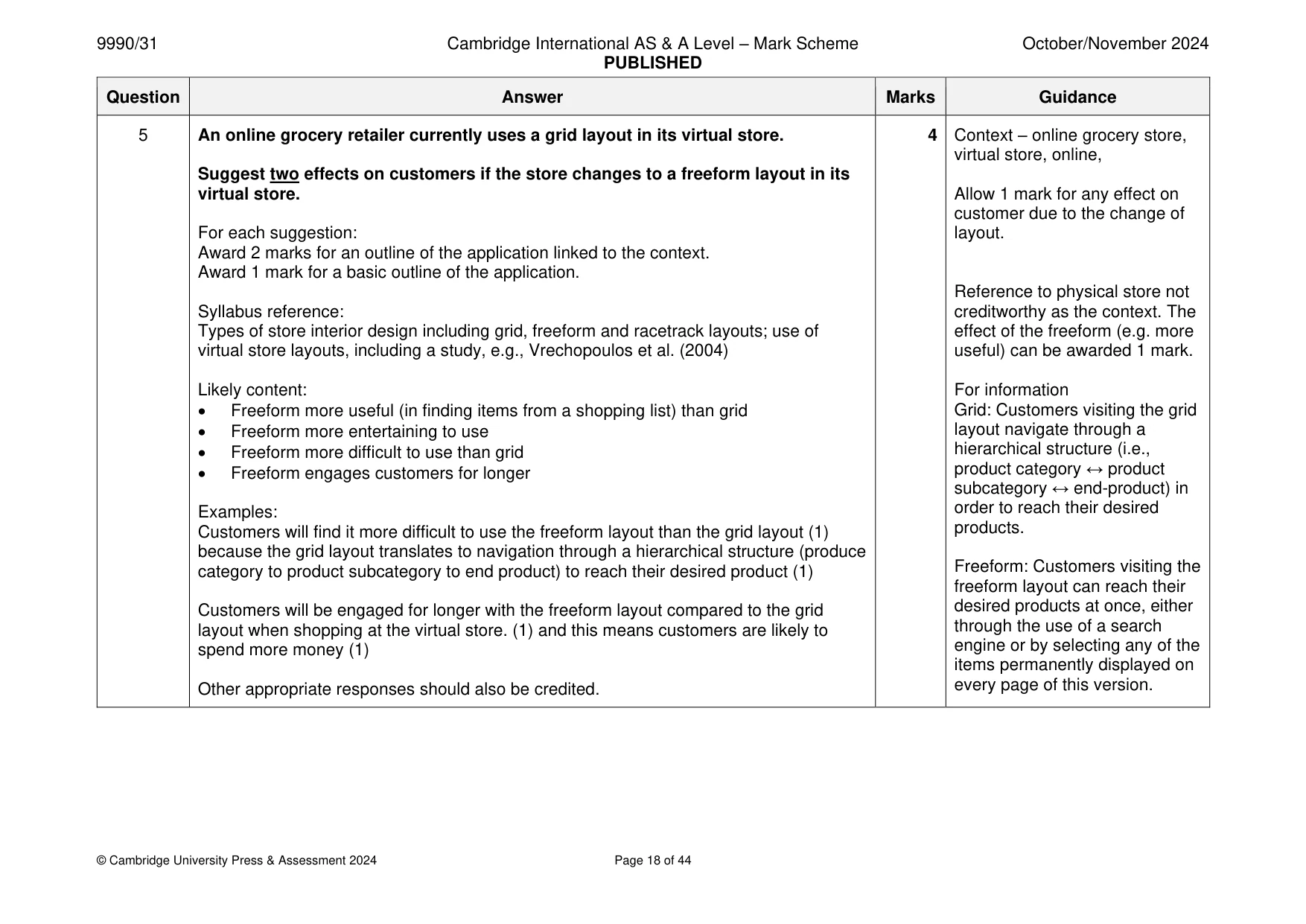
5 An online grocery retailer currently uses a grid layout in its virtual store. Suggest two effects on customers if the store changes to a freeform layout in its virtual store. [4]
Mark scheme: 5 An online grocery retailer currently uses a grid layout in its virtual store. 4 Context – online grocery store, virtual store, online, Suggest two effects on customers if the store changes to a freeform layout in its virtual store. Allow 1 mark for any effect on customer due to the change of For each suggestion: layout. Award 2 marks for an outline of the application linked to the context. Award 1 mark for a basic outline of the application. Reference to physical store not Syllabus reference: creditworthy as the context. The Types of store interior design including grid, freeform and racetrack layouts; use of effect of the freeform (e.g. more virtual store layouts, including a study, e.g., Vrechopoulos et al. (2004) useful) can be awarded 1 mark. Likely content: For information • Freeform more useful (in finding items from a shopping list) than grid Grid: Customers visiting the grid • Freeform more entertaining to use layout navigate through a • Freeform more difficult to use than grid hierarchical structure (i.e., • Freeform engages customers for longer product category ↔ product subcategory ↔ end-product) in Examples: order to reach their desired Customers will find it more difficult to use the freeform layout than the grid layout (1) products. because the grid layout translates to navigation through a hierarchical structure (produce category to product subcategory to end product) to reach their desired product (1) Freeform: Customers visiting the freeform layout can reach their Customers will be engaged for longer with the freeform layout compared to the grid desired products at once, either layout when shopping at the virtual store. (1) and this means customers are likely to through the use of a search spend more money (1) engine or by selecting any of the items permanently displayed on Other appropriate responses should also be credited. every page of this version.
Q6 · Outline one example of how psychologists can use children in psychological research when…
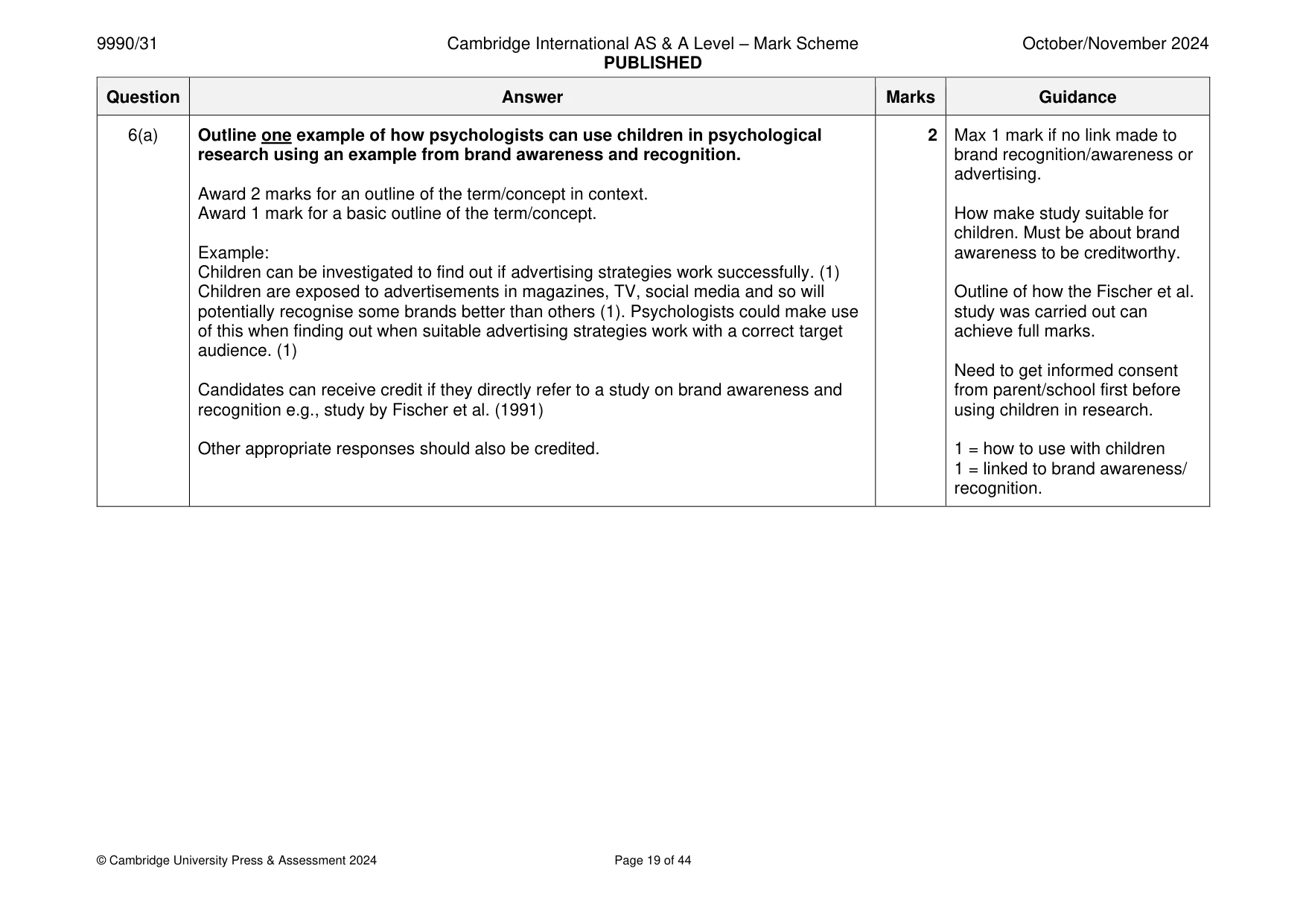
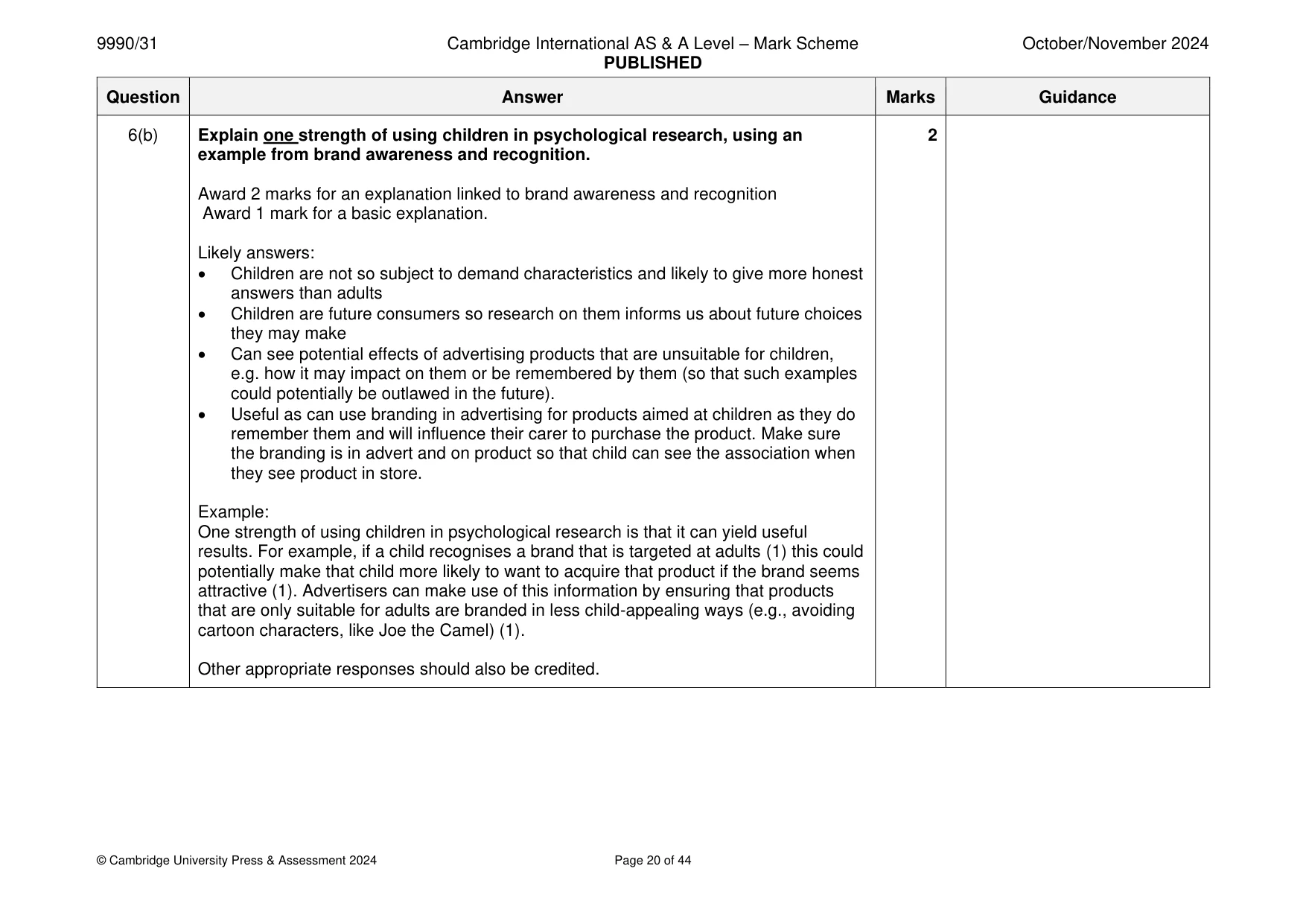
6 (a) Outline one example of how psychologists can use children in psychological research when investigating the topic of brand awareness and recognition. [2] (b) Explain one strength of using children in psychological research when investigating the topic of brand awareness and recognition. [2]
Mark scheme: 6(a) Outline one example of how psychologists can use children in psychological 2 Max 1 mark if no link made to research using an example from brand awareness and recognition. brand recognition/awareness or advertising. Award 2 marks for an outline of the term/concept in context. Award 1 mark for a basic outline of the term/concept. How make study suitable for children. Must be about brand Example: awareness to be creditworthy. Children can be investigated to find out if advertising strategies work successfully. (1) Children are exposed to advertisements in magazines, TV, social media and so will Outline of how the Fischer et al. potentially recognise some brands better than others (1). Psychologists could make use study was carried out can of this when finding out when suitable advertising strategies work with a correct target achieve full marks. audience. (1) Need to get informed consent Candidates can receive credit if they directly refer to a study on brand awareness and from parent/school first before recognition e.g., study by Fischer et al. (1991) using children in research. Other appropriate responses should also be credited. 1 = how to use with children 1 = linked to brand awareness/ recognition. 6(b) Explain one strength of using children in psychological research, using an 2 example from brand awareness and recognition. Award 2 marks for an explanation linked to brand awareness and recognition Award 1 mark for a basic explanation. Likely answers: • Children are not so subject to demand characteristics and likely to give more honest answers than adults • Children are future consumers so research on them informs us about future choices they may make • Can see potential effects of advertising products that are unsuitable for children, e.g. how it may impact on them or be remembered by them (so that such examples could potentially be outlawed in the future). • Useful as can use branding in advertising for products aimed at children as they do remember them and will influence their carer to purchase the product. Make sure the branding is in advert and on product so that child can see the association when they see product in store. Example: One strength of using children in psychological research is that it can yield useful results. For example, if a child recognises a brand that is targeted at adults (1) this could potentially make that child more likely to want to acquire that product if the brand seems attractive (1). Advertisers can make use of this information by ensuring that products that are only suitable for adults are branded in less child-appealing ways (e.g., avoiding cartoon characters, like Joe the Camel) (1). Other appropriate responses should also be credited.
Q7 · Priya is the new manager of a restaurant
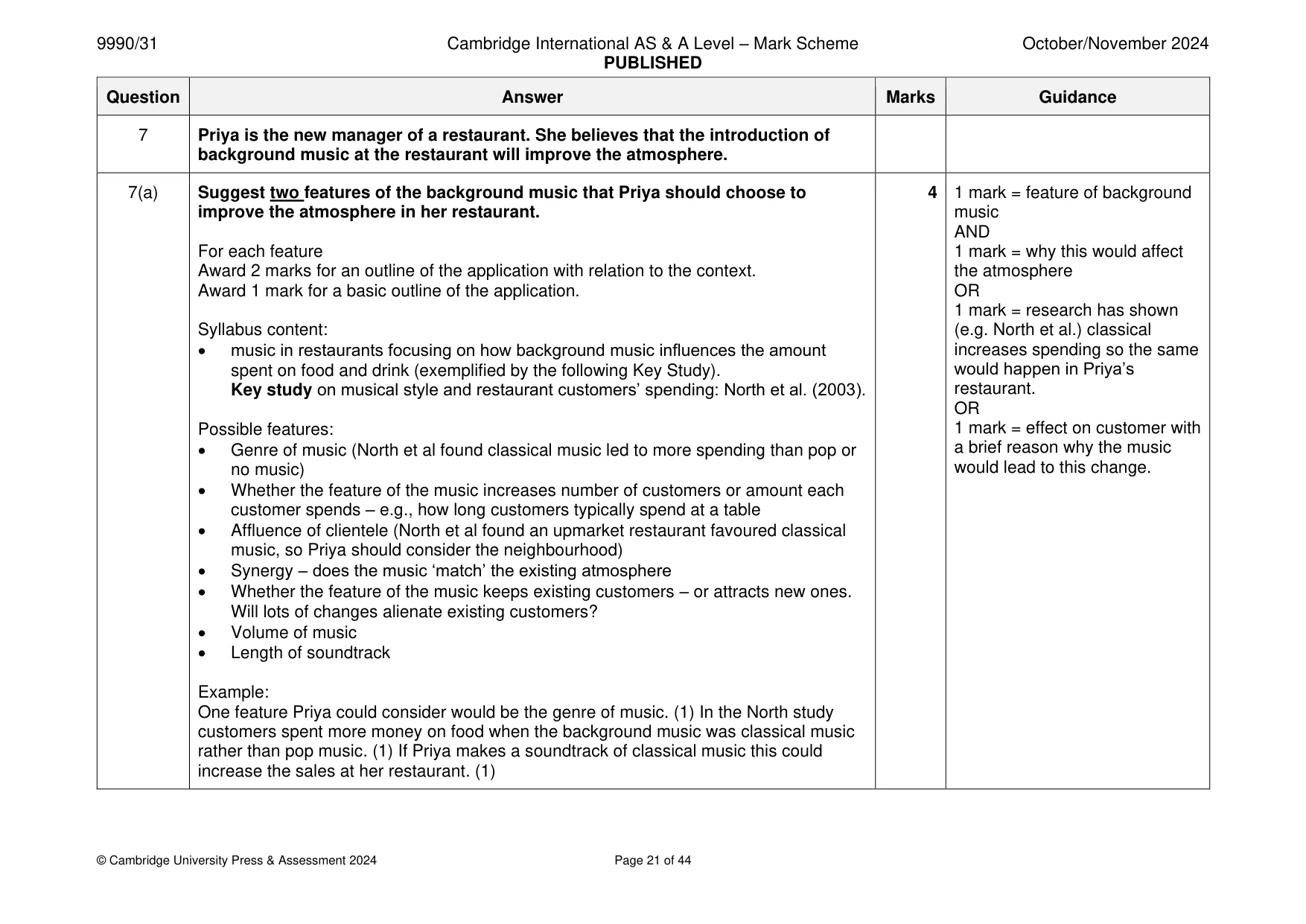
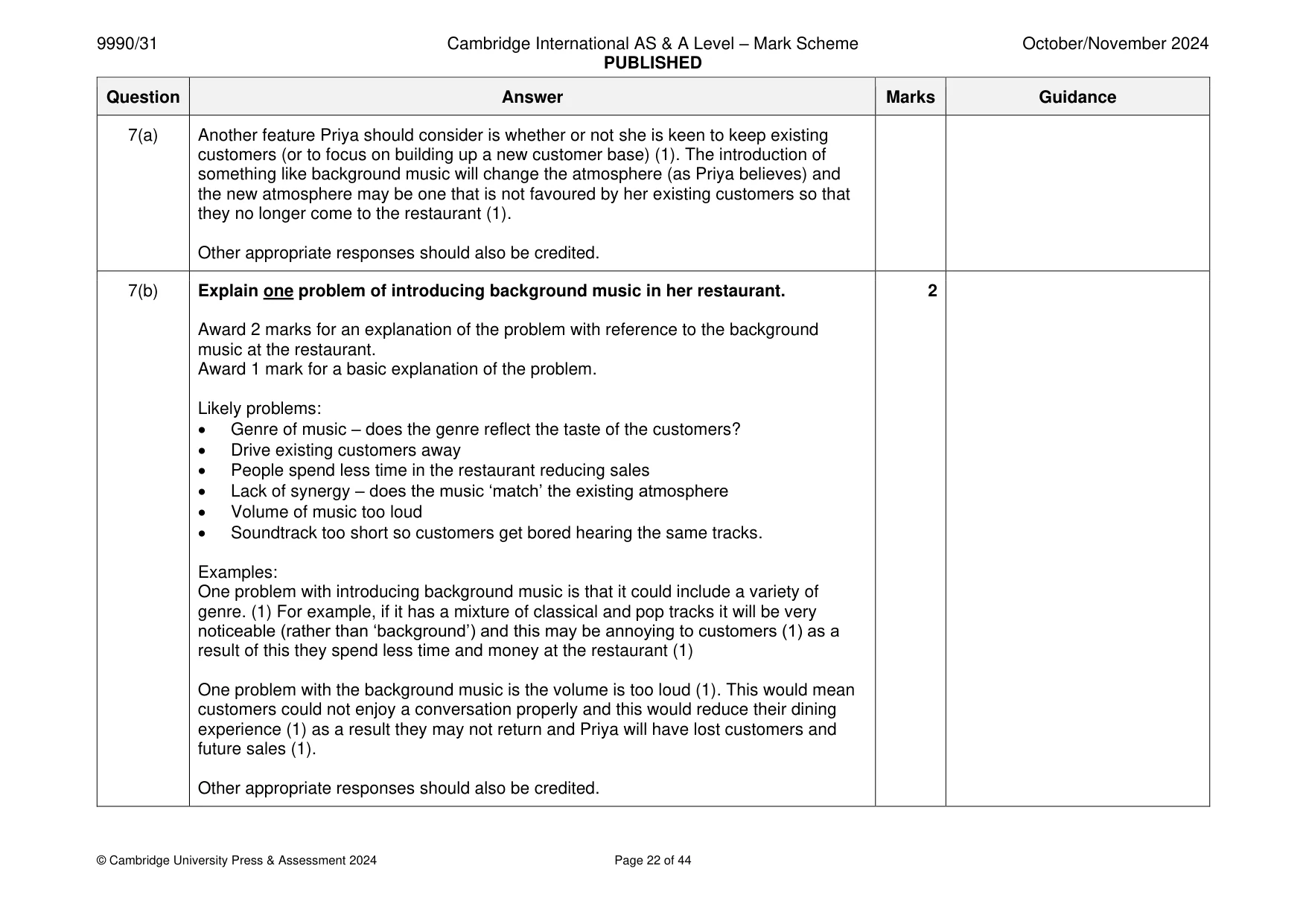
7 Priya is the new manager of a restaurant. She believes that the introduction of background music at the restaurant will improve the atmosphere. (a) Suggest two features of the background music that Priya should choose to improve the atmosphere in her restaurant. [4] (b) Explain one problem of introducing background music in her restaurant. [2]
Mark scheme: 7 Priya is the new manager of a restaurant. She believes that the introduction of background music at the restaurant will improve the atmosphere. 7(a) Suggest two features of the background music that Priya should choose to 4 1 mark = feature of background improve the atmosphere in her restaurant. music AND For each feature 1 mark = why this would affect Award 2 marks for an outline of the application with relation to the context. the atmosphere Award 1 mark for a basic outline of the application. OR 1 mark = research has shown Syllabus content: (e.g. North et al.) classical • music in restaurants focusing on how background music influences the amount increases spending so the same spent on food and drink (exemplified by the following Key Study). would happen in Priya’s Key study on musical style and restaurant customers’ spending: North et al. (2003). restaurant. OR Possible features: 1 mark = effect on customer with • Genre of music (North et al found classical music led to more spending than pop or a brief reason why the music no music) would lead to this change. • Whether the feature of the music increases number of customers or amount each customer spends – e.g., how long customers typically spend at a table • Affluence of clientele (North et al found an upmarket restaurant favoured classical music, so Priya should consider the neighbourhood) • Synergy – does the music ‘match’ the existing atmosphere • Whether the feature of the music keeps existing customers – or attracts new ones. Will lots of changes alienate existing customers? • Volume of music • Length of soundtrack Example: One feature Priya could consider would be the genre of music. (1) In the North study customers spent more money on food when the background music was classical music rather than pop music. (1) If Priya makes a soundtrack of classical music this could increase the sales at her restaurant. (1) 7(a) Another feature Priya should consider is whether or not she is keen to keep existing customers (or to focus on building up a new customer base) (1). The introduction of something like background music will change the atmosphere (as Priya believes) and the new atmosphere may be one that is not favoured by her existing customers so that they no longer come to the restaurant (1). Other appropriate responses should also be credited. 7(b) Explain one problem of introducing background music in her restaurant. 2 Award 2 marks for an explanation of the problem with reference to the background music at the restaurant. Award 1 mark for a basic explanation of the problem. Likely problems: • Genre of music – does the genre reflect the taste of the customers? • Drive existing customers away • People spend less time in the restaurant reducing sales • Lack of synergy – does the music ‘match’ the existing atmosphere • Volume of music too loud • Soundtrack too short so customers get bored hearing the same tracks. Examples: One problem with introducing background music is that it could include a variety of genre. (1) For example, if it has a mixture of classical and pop tracks it will be very noticeable (rather than ‘background’) and this may be annoying to customers (1) as a result of this they spend less time and money at the restaurant (1) One problem with the background music is the volume is too loud (1). This would mean customers could not enjoy a conversation properly and this would reduce their dining experience (1) as a result they may not return and Priya will have lost customers and future sales (1). Other appropriate responses should also be credited.
Q8 · Describe what psychologists have discovered about consumer behaviour and personal space…
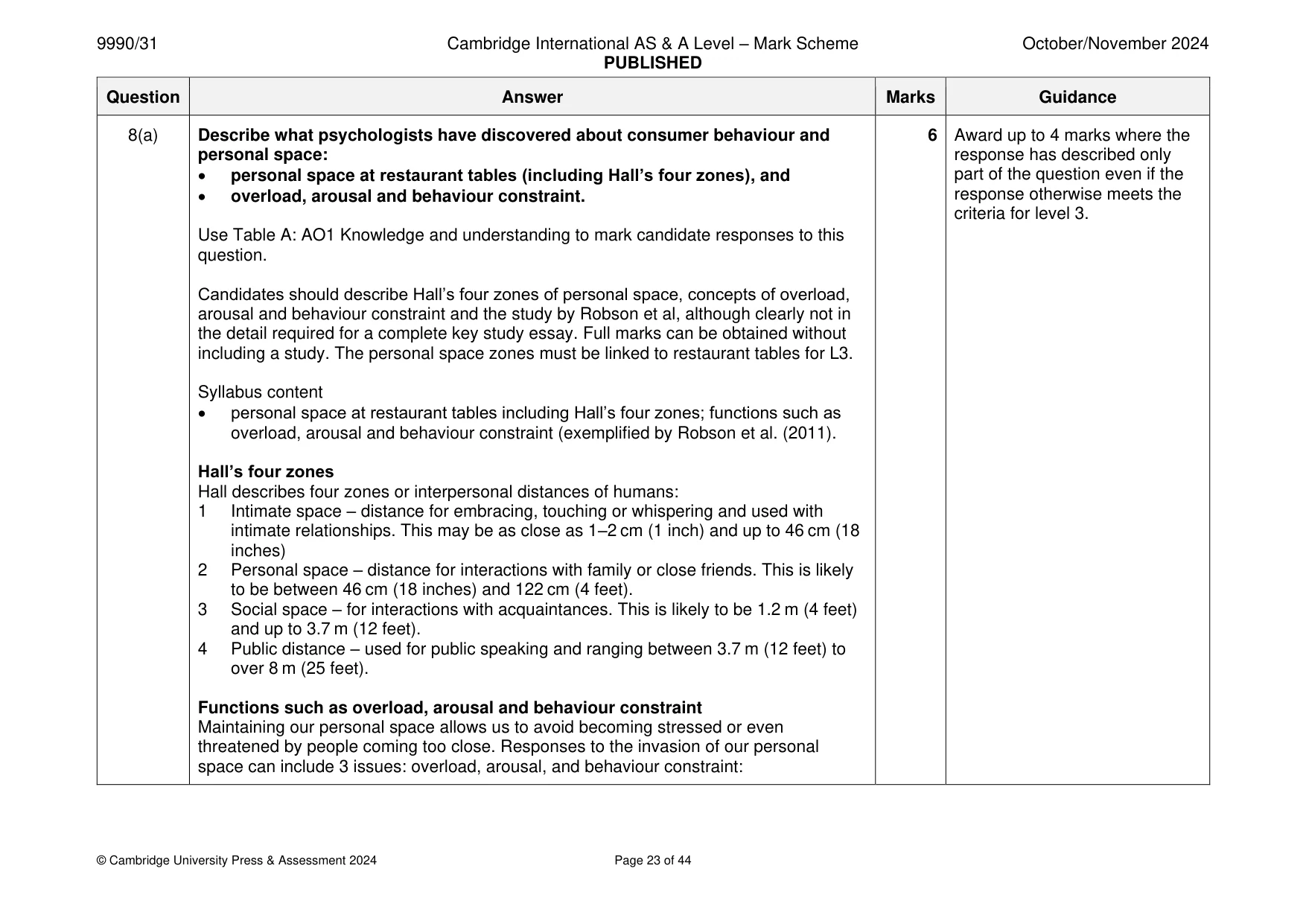
8 (a) Describe what psychologists have discovered about consumer behaviour and personal space: • personal space at restaurant tables (including Hall’s four zones), and • overload, arousal and behaviour constraint. [6] (b) Evaluate what psychologists have discovered about consumer behaviour and personal space: • personal space at restaurant tables (including Hall’s four zones), and • overload, arousal and behaviour constraint, including a discussion of cultural differences. Evaluation in your answer can include strengths, weaknesses and a discussion of issues and debates. [10] Section C: Health Psychology Answer all questions.
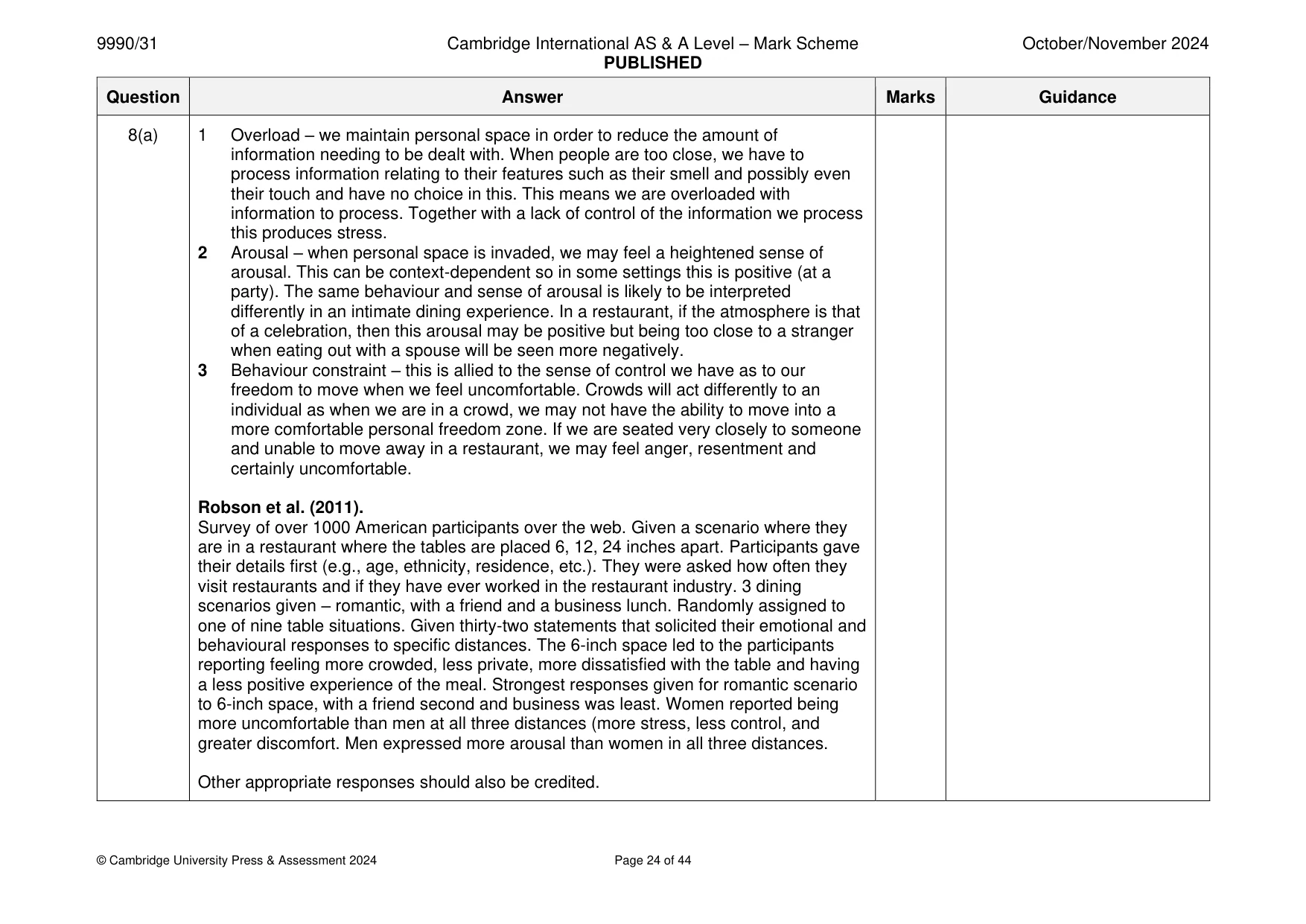
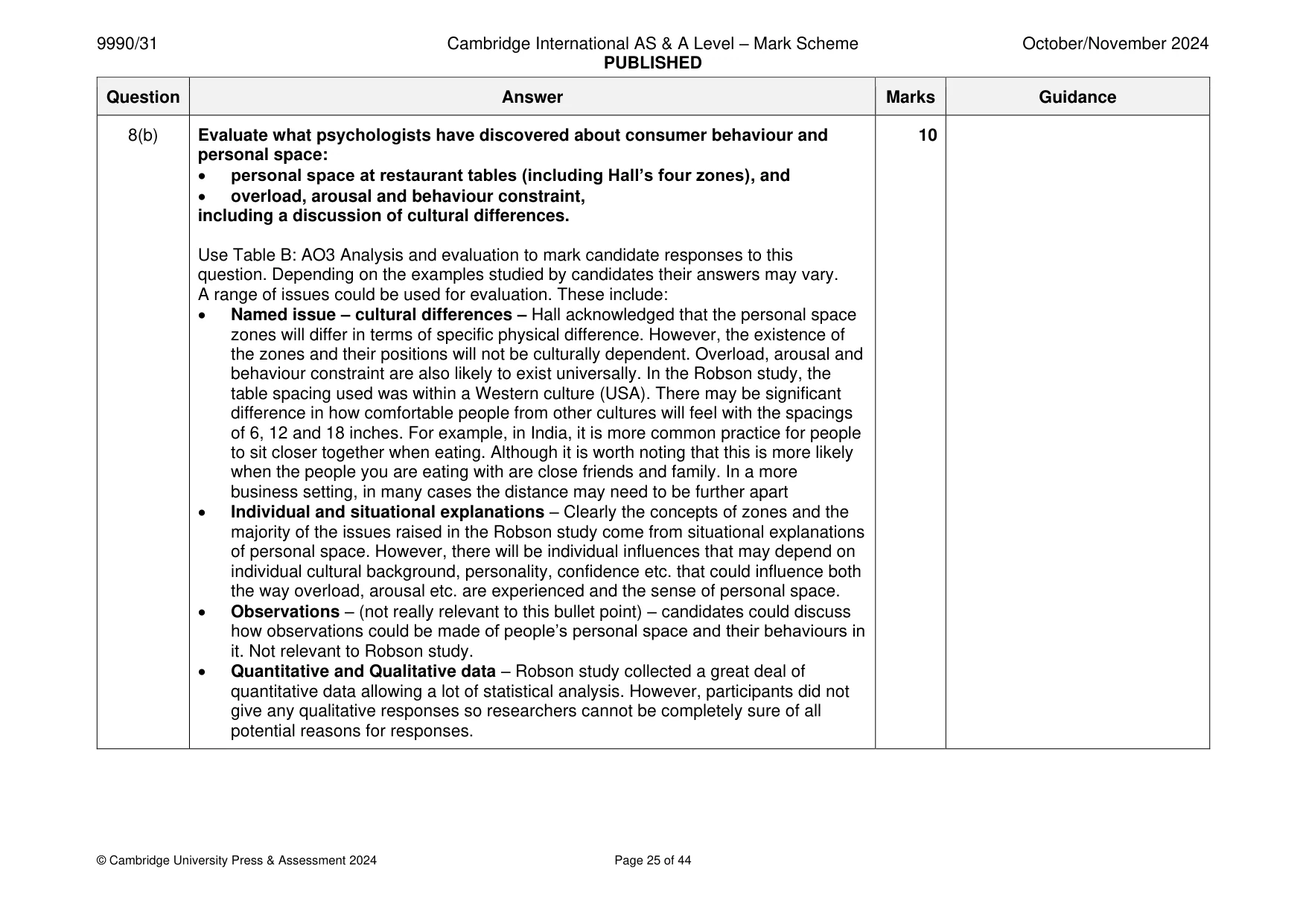
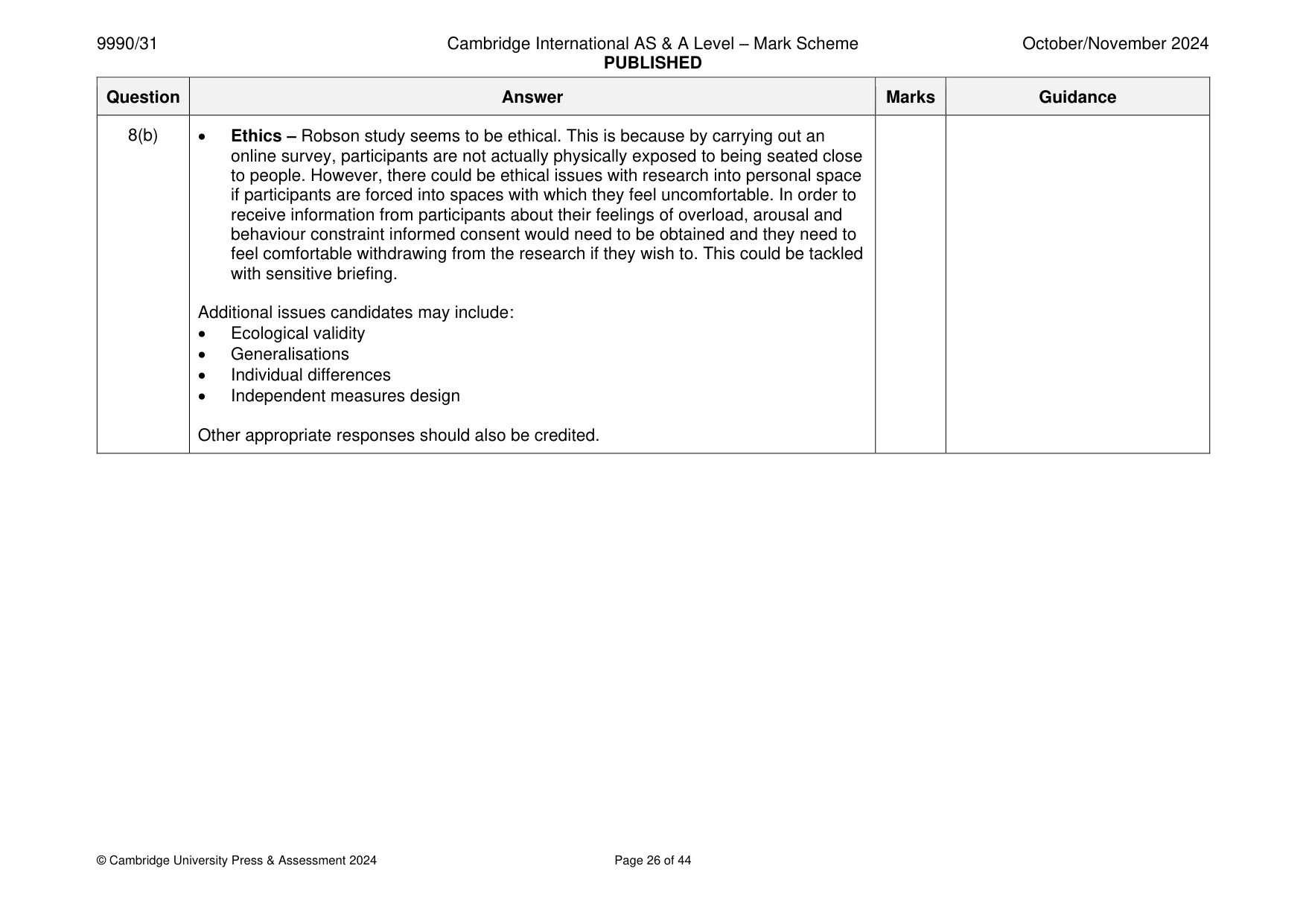
Mark scheme: 8(a) Describe what psychologists have discovered about consumer behaviour and 6 Award up to 4 marks where the personal space: response has described only • personal space at restaurant tables (including Hall’s four zones), and part of the question even if the • overload, arousal and behaviour constraint. response otherwise meets the criteria for level 3. Use Table A: AO1 Knowledge and understanding to mark candidate responses to this question. Candidates should describe Hall’s four zones of personal space, concepts of overload, arousal and behaviour constraint and the study by Robson et al, although clearly not in the detail required for a complete key study essay. Full marks can be obtained without including a study. The personal space zones must be linked to restaurant tables for L3. Syllabus content • personal space at restaurant tables including Hall’s four zones; functions such as overload, arousal and behaviour constraint (exemplified by Robson et al. (2011). Hall’s four zones Hall describes four zones or interpersonal distances of humans: 1 Intimate space – distance for embracing, touching or whispering and used with intimate relationships. This may be as close as 1–2 cm (1 inch) and up to 46 cm (18 inches) 2 Personal space – distance for interactions with family or close friends. This is likely to be between 46 cm (18 inches) and 122 cm (4 feet). 3 Social space – for interactions with acquaintances. This is likely to be 1.2 m (4 feet) and up to 3.7 m (12 feet). 4 Public distance – used for public speaking and ranging between 3.7 m (12 feet) to over 8 m (25 feet). Functions such as overload, arousal and behaviour constraint Maintaining our personal space allows us to avoid becoming stressed or even threatened by people coming too close. Responses to the invasion of our personal space can include 3 issues: overload, arousal, and behaviour constraint: 8(a) 1 Overload – we maintain personal space in order to reduce the amount of information needing to be dealt with. When people are too close, we have to process information relating to their features such as their smell and possibly even their touch and have no choice in this. This means we are overloaded with information to process. Together with a lack of control of the information we process this produces stress. 2 Arousal – when personal space is invaded, we may feel a heightened sense of arousal. This can be context-dependent so in some settings this is positive (at a party). The same behaviour and sense of arousal is likely to be interpreted differently in an intimate dining experience. In a restaurant, if the atmosphere is that of a celebration, then this arousal may be positive but being too close to a stranger when eating out with a spouse will be seen more negatively. 3 Behaviour constraint – this is allied to the sense of control we have as to our freedom to move when we feel uncomfortable. Crowds will act differently to an individual as when we are in a crowd, we may not have the ability to move into a more comfortable personal freedom zone. If we are seated very closely to someone and unable to move away in a restaurant, we may feel anger, resentment and certainly uncomfortable. Robson et al. (2011). Survey of over 1000 American participants over the web. Given a scenario where they are in a restaurant where the tables are placed 6, 12, 24 inches apart. Participants gave their details first (e.g., age, ethnicity, residence, etc.). They were asked how often they visit restaurants and if they have ever worked in the restaurant industry. 3 dining scenarios given – romantic, with a friend and a business lunch. Randomly assigned to one of nine table situations. Given thirty-two statements that solicited their emotional and behavioural responses to specific distances. The 6-inch space led to the participants reporting feeling more crowded, less private, more dissatisfied with the table and having a less positive experience of the meal. Strongest responses given for romantic scenario to 6-inch space, with a friend second and business was least. Women reported being more uncomfortable than men at all three distances (more stress, less control, and greater discomfort. Men expressed more arousal than women in all three distances. Other appropriate responses should also be credited. 8(b) Evaluate what psychologists have discovered about consumer behaviour and 10 personal space: • personal space at restaurant tables (including Hall’s four zones), and • overload, arousal and behaviour constraint, including a discussion of cultural differences. Use Table B: AO3 Analysis and evaluation to mark candidate responses to this question. Depending on the examples studied by candidates their answers may vary. A range of issues could be used for evaluation. These include: • Named issue – cultural differences – Hall acknowledged that the personal space zones will differ in terms of specific physical difference. However, the existence of the zones and their positions will not be culturally dependent. Overload, arousal and behaviour constraint are also likely to exist universally. In the Robson study, the table spacing used was within a Western culture (USA). There may be significant difference in how comfortable people from other cultures will feel with the spacings of 6, 12 and 18 inches. For example, in India, it is more common practice for people to sit closer together when eating. Although it is worth noting that this is more likely when the people you are eating with are close friends and family. In a more business setting, in many cases the distance may need to be further apart • Individual and situational explanations – Clearly the concepts of zones and the majority of the issues raised in the Robson study come from situational explanations of personal space. However, there will be individual influences that may depend on individual cultural background, personality, confidence etc. that could influence both the way overload, arousal etc. are experienced and the sense of personal space. • Observations – (not really relevant to this bullet point) – candidates could discuss how observations could be made of people’s personal space and their behaviours in it. Not relevant to Robson study. • Quantitative and Qualitative data – Robson study collected a great deal of quantitative data allowing a lot of statistical analysis. However, participants did not give any qualitative responses so researchers cannot be completely sure of all potential reasons for responses. 8(b) • Ethics – Robson study seems to be ethical. This is because by carrying out an online survey, participants are not actually physically exposed to being seated close to people. However, there could be ethical issues with research into personal space if participants are forced into spaces with which they feel uncomfortable. In order to receive information from participants about their feelings of overload, arousal and behaviour constraint informed consent would need to be obtained and they need to feel comfortable withdrawing from the research if they wish to. This could be tackled with sensitive briefing. Additional issues candidates may include: • Ecological validity • Generalisations • Individual differences • Independent measures design Other appropriate responses should also be credited. Section C: Health Psychology
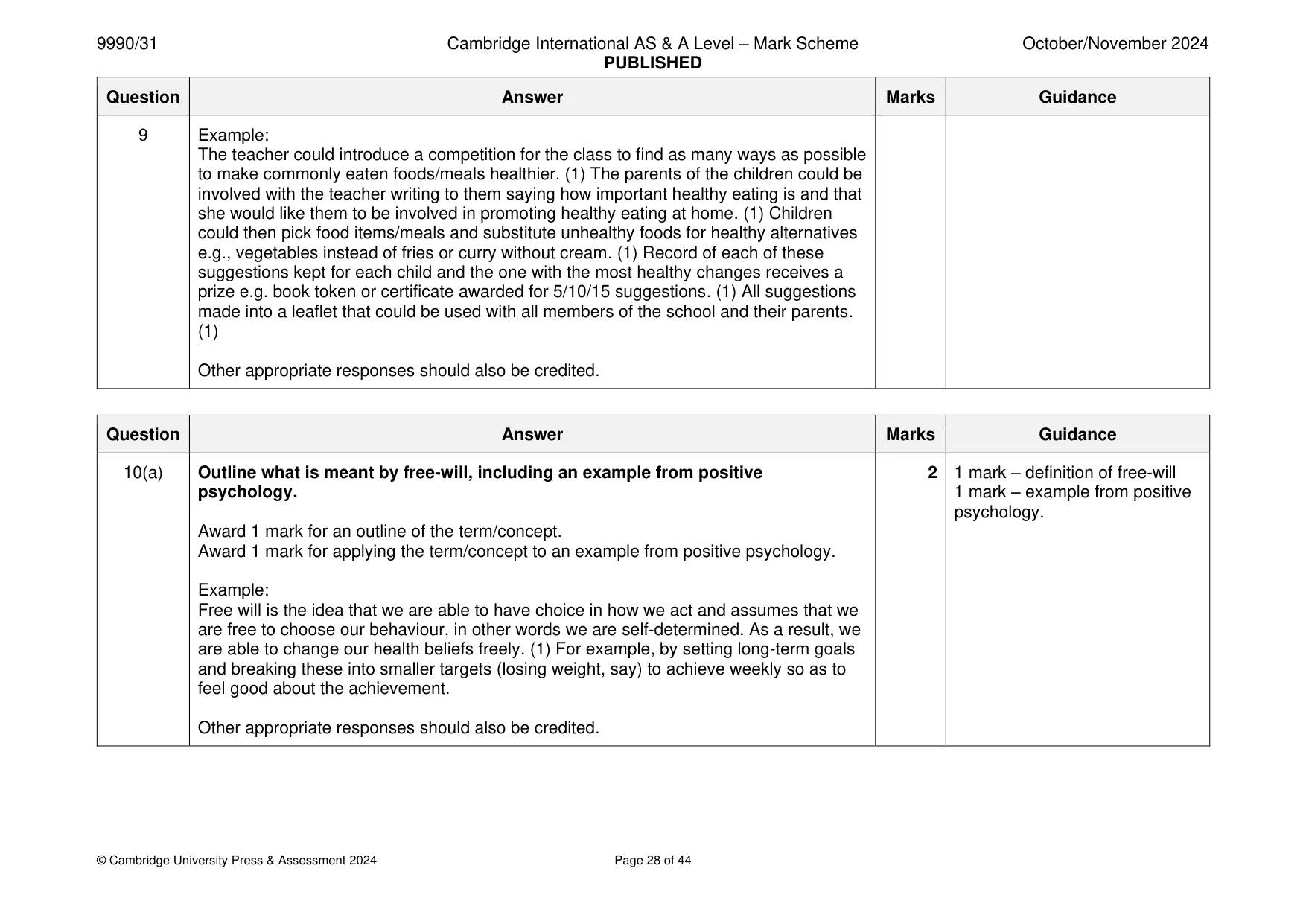
Q9 · A teacher sees one class of 11-year-olds eating too much unhealthy food
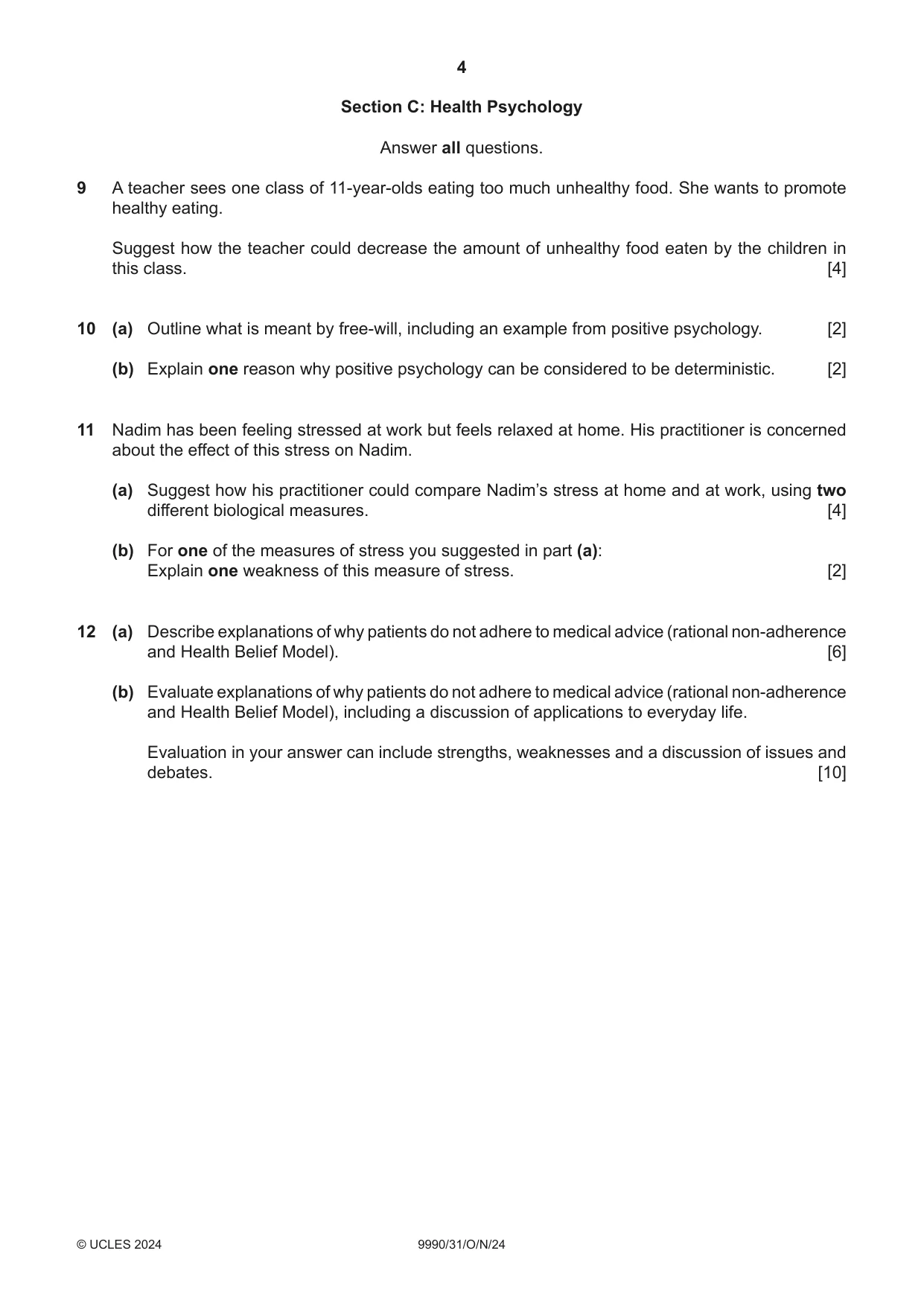
9 A teacher sees one class of 11-year-olds eating too much unhealthy food. She wants to promote healthy eating. Suggest how the teacher could decrease the amount of unhealthy food eaten by the children in this class. [4]
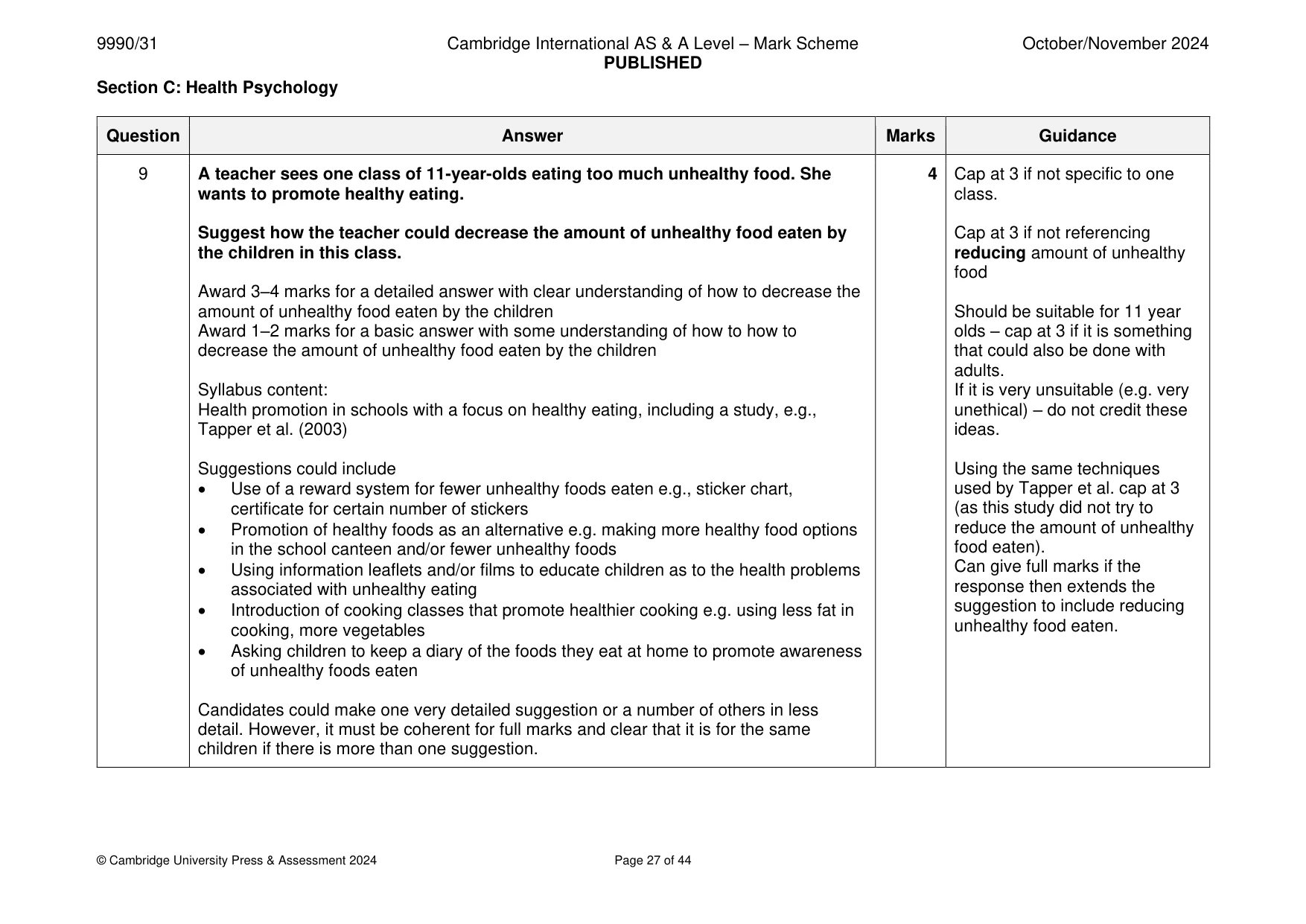
Mark scheme: 9 A teacher sees one class of 11-year-olds eating too much unhealthy food. She 4 Cap at 3 if not specific to one wants to promote healthy eating. class. Suggest how the teacher could decrease the amount of unhealthy food eaten by Cap at 3 if not referencing the children in this class. reducing amount of unhealthy food Award 3–4 marks for a detailed answer with clear understanding of how to decrease the amount of unhealthy food eaten by the children Should be suitable for 11 year Award 1–2 marks for a basic answer with some understanding of how to how to olds – cap at 3 if it is something decrease the amount of unhealthy food eaten by the children that could also be done with adults. Syllabus content: If it is very unsuitable (e.g. very Health promotion in schools with a focus on healthy eating, including a study, e.g., unethical) – do not credit these Tapper et al. (2003) ideas. Suggestions could include Using the same techniques • Use of a reward system for fewer unhealthy foods eaten e.g., sticker chart, used by Tapper et al. cap at 3 certificate for certain number of stickers (as this study did not try to • Promotion of healthy foods as an alternative e.g. making more healthy food options reduce the amount of unhealthy in the school canteen and/or fewer unhealthy foods food eaten). • Using information leaflets and/or films to educate children as to the health problems Can give full marks if the associated with unhealthy eating response then extends the • Introduction of cooking classes that promote healthier cooking e.g. using less fat in suggestion to include reducing cooking, more vegetables unhealthy food eaten. • Asking children to keep a diary of the foods they eat at home to promote awareness of unhealthy foods eaten Candidates could make one very detailed suggestion or a number of others in less detail. However, it must be coherent for full marks and clear that it is for the same children if there is more than one suggestion. 9 Example: The teacher could introduce a competition for the class to find as many ways as possible to make commonly eaten foods/meals healthier. (1) The parents of the children could be involved with the teacher writing to them saying how important healthy eating is and that she would like them to be involved in promoting healthy eating at home. (1) Children could then pick food items/meals and substitute unhealthy foods for healthy alternatives e.g., vegetables instead of fries or curry without cream. (1) Record of each of these suggestions kept for each child and the one with the most healthy changes receives a prize e.g. book token or certificate awarded for 5/10/15 suggestions. (1) All suggestions made into a leaflet that could be used with all members of the school and their parents. (1) Other appropriate responses should also be credited.
More questions on 2 Health promotion in schools and worksites
Q10 · Outline what is meant by free-will, including an example from positive psychology
10 (a) Outline what is meant by free-will, including an example from positive psychology. [2] (b) Explain one reason why positive psychology can be considered to be deterministic. [2]
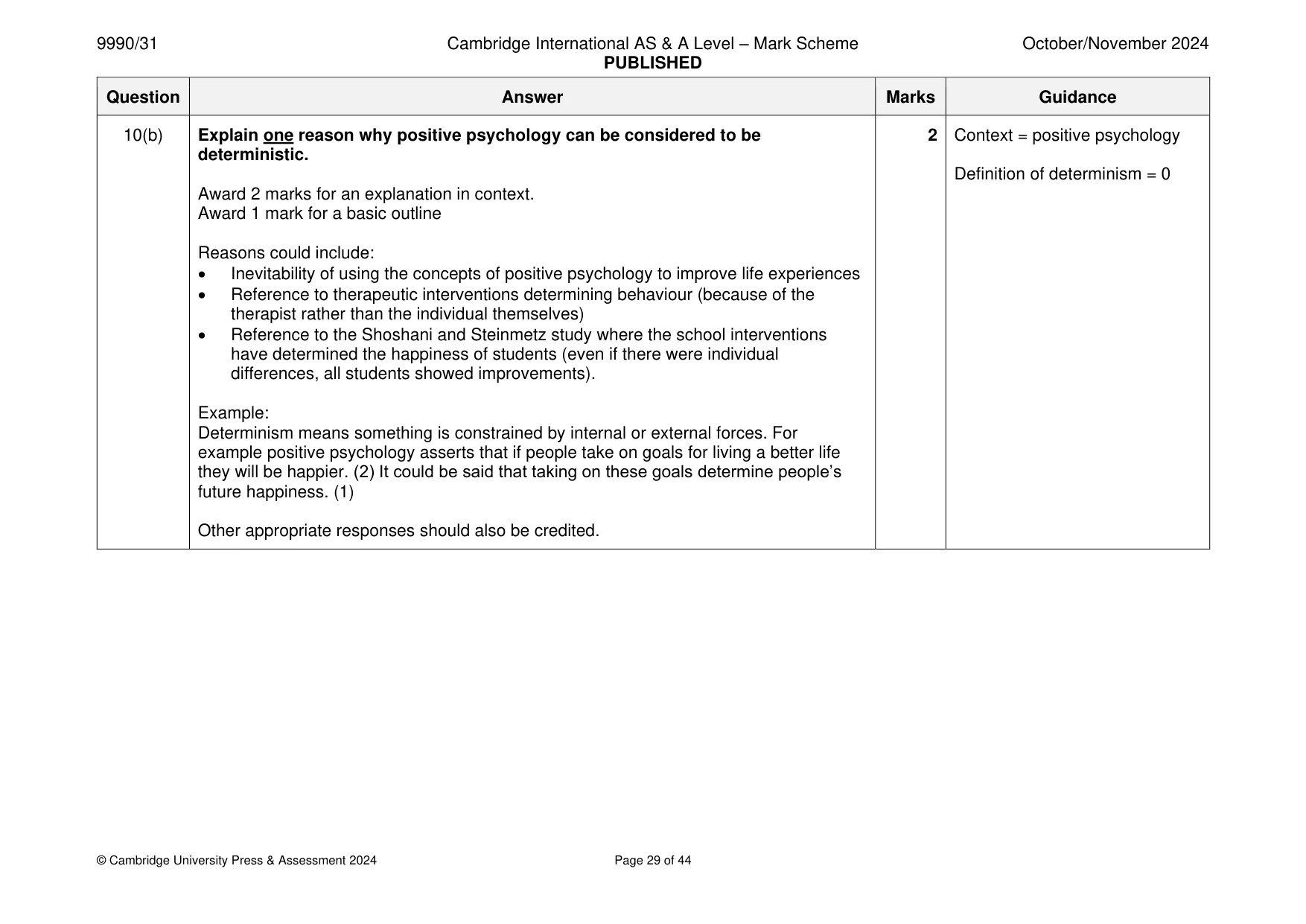
Mark scheme: 10(a) Outline what is meant by free-will, including an example from positive 2 1 mark – definition of free-will psychology. 1 mark – example from positive psychology. Award 1 mark for an outline of the term/concept. Award 1 mark for applying the term/concept to an example from positive psychology. Example: Free will is the idea that we are able to have choice in how we act and assumes that we are free to choose our behaviour, in other words we are self-determined. As a result, we are able to change our health beliefs freely. (1) For example, by setting long-term goals and breaking these into smaller targets (losing weight, say) to achieve weekly so as to feel good about the achievement. Other appropriate responses should also be credited. 10(b) Explain one reason why positive psychology can be considered to be 2 Context = positive psychology deterministic. Definition of determinism = 0 Award 2 marks for an explanation in context. Award 1 mark for a basic outline Reasons could include: • Inevitability of using the concepts of positive psychology to improve life experiences • Reference to therapeutic interventions determining behaviour (because of the therapist rather than the individual themselves) • Reference to the Shoshani and Steinmetz study where the school interventions have determined the happiness of students (even if there were individual differences, all students showed improvements). Example: Determinism means something is constrained by internal or external forces. For example positive psychology asserts that if people take on goals for living a better life they will be happier. (2) It could be said that taking on these goals determine people’s future happiness. (1) Other appropriate responses should also be credited.
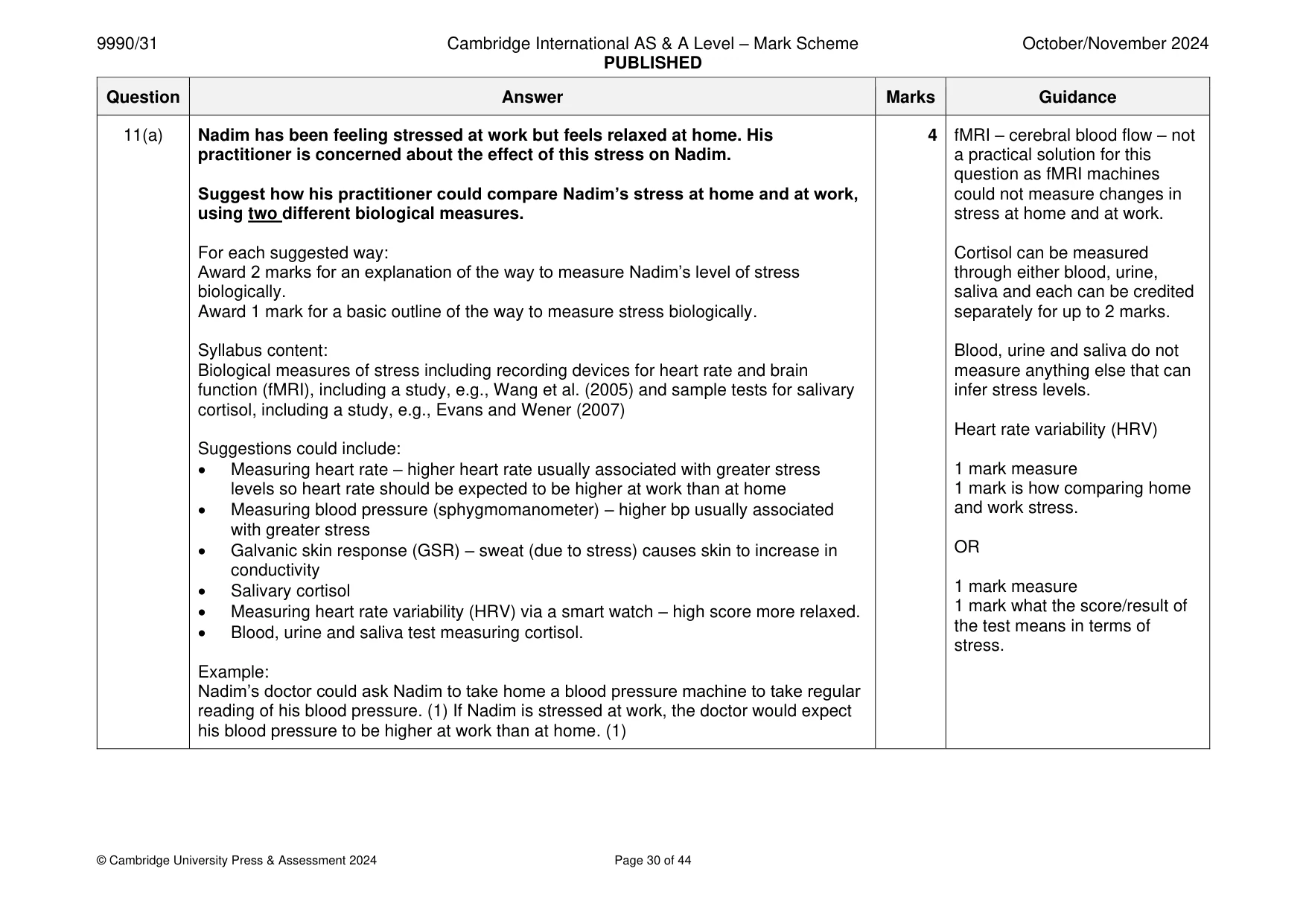
Q11 · Nadim has been feeling stressed at work but feels relaxed at home
11 Nadim has been feeling stressed at work but feels relaxed at home. His practitioner is concerned about the effect of this stress on Nadim. (a) Suggest how his practitioner could compare Nadim’s stress at home and at work, using two different biological measures. [4] (b) For one of the measures of stress you suggested in part (a): Explain one weakness of this measure of stress. [2]
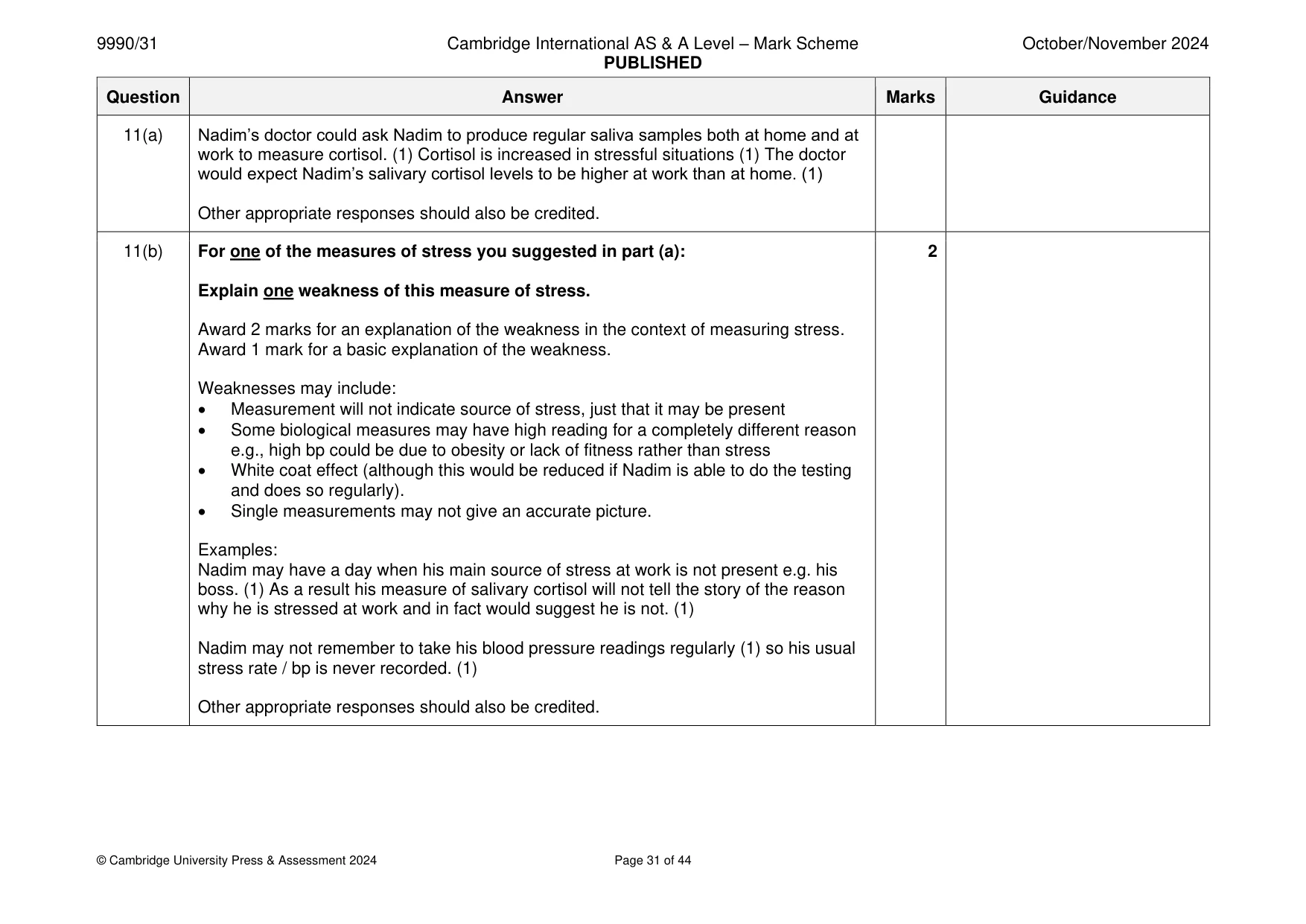
Mark scheme: 11(a) Nadim has been feeling stressed at work but feels relaxed at home. His 4 fMRI – cerebral blood flow – not practitioner is concerned about the effect of this stress on Nadim. a practical solution for this question as fMRI machines Suggest how his practitioner could compare Nadim’s stress at home and at work, could not measure changes in using two different biological measures. stress at home and at work. For each suggested way: Cortisol can be measured Award 2 marks for an explanation of the way to measure Nadim’s level of stress through either blood, urine, biologically. saliva and each can be credited Award 1 mark for a basic outline of the way to measure stress biologically. separately for up to 2 marks. Syllabus content: Blood, urine and saliva do not Biological measures of stress including recording devices for heart rate and brain measure anything else that can function (fMRI), including a study, e.g., Wang et al. (2005) and sample tests for salivary infer stress levels. cortisol, including a study, e.g., Evans and Wener (2007) Heart rate variability (HRV) Suggestions could include: • Measuring heart rate – higher heart rate usually associated with greater stress 1 mark measure levels so heart rate should be expected to be higher at work than at home 1 mark is how comparing home • Measuring blood pressure (sphygmomanometer) – higher bp usually associated and work stress. with greater stress • Galvanic skin response (GSR) – sweat (due to stress) causes skin to increase in OR conductivity • Salivary cortisol 1 mark measure • Measuring heart rate variability (HRV) via a smart watch – high score more relaxed. 1 mark what the score/result of the test means in terms of • Blood, urine and saliva test measuring cortisol. stress. Example: Nadim’s doctor could ask Nadim to take home a blood pressure machine to take regular reading of his blood pressure. (1) If Nadim is stressed at work, the doctor would expect his blood pressure to be higher at work than at home. (1) 11(a) Nadim’s doctor could ask Nadim to produce regular saliva samples both at home and at work to measure cortisol. (1) Cortisol is increased in stressful situations (1) The doctor would expect Nadim’s salivary cortisol levels to be higher at work than at home. (1) Other appropriate responses should also be credited. 11(b) For one of the measures of stress you suggested in part (a): 2 Explain one weakness of this measure of stress. Award 2 marks for an explanation of the weakness in the context of measuring stress. Award 1 mark for a basic explanation of the weakness. Weaknesses may include: • Measurement will not indicate source of stress, just that it may be present • Some biological measures may have high reading for a completely different reason e.g., high bp could be due to obesity or lack of fitness rather than stress • White coat effect (although this would be reduced if Nadim is able to do the testing and does so regularly). • Single measurements may not give an accurate picture. Examples: Nadim may have a day when his main source of stress at work is not present e.g. his boss. (1) As a result his measure of salivary cortisol will not tell the story of the reason why he is stressed at work and in fact would suggest he is not. (1) Nadim may not remember to take his blood pressure readings regularly (1) so his usual stress rate / bp is never recorded. (1) Other appropriate responses should also be credited.
Q12 · Describe explanations of why patients do not adhere to medical advice (rational…
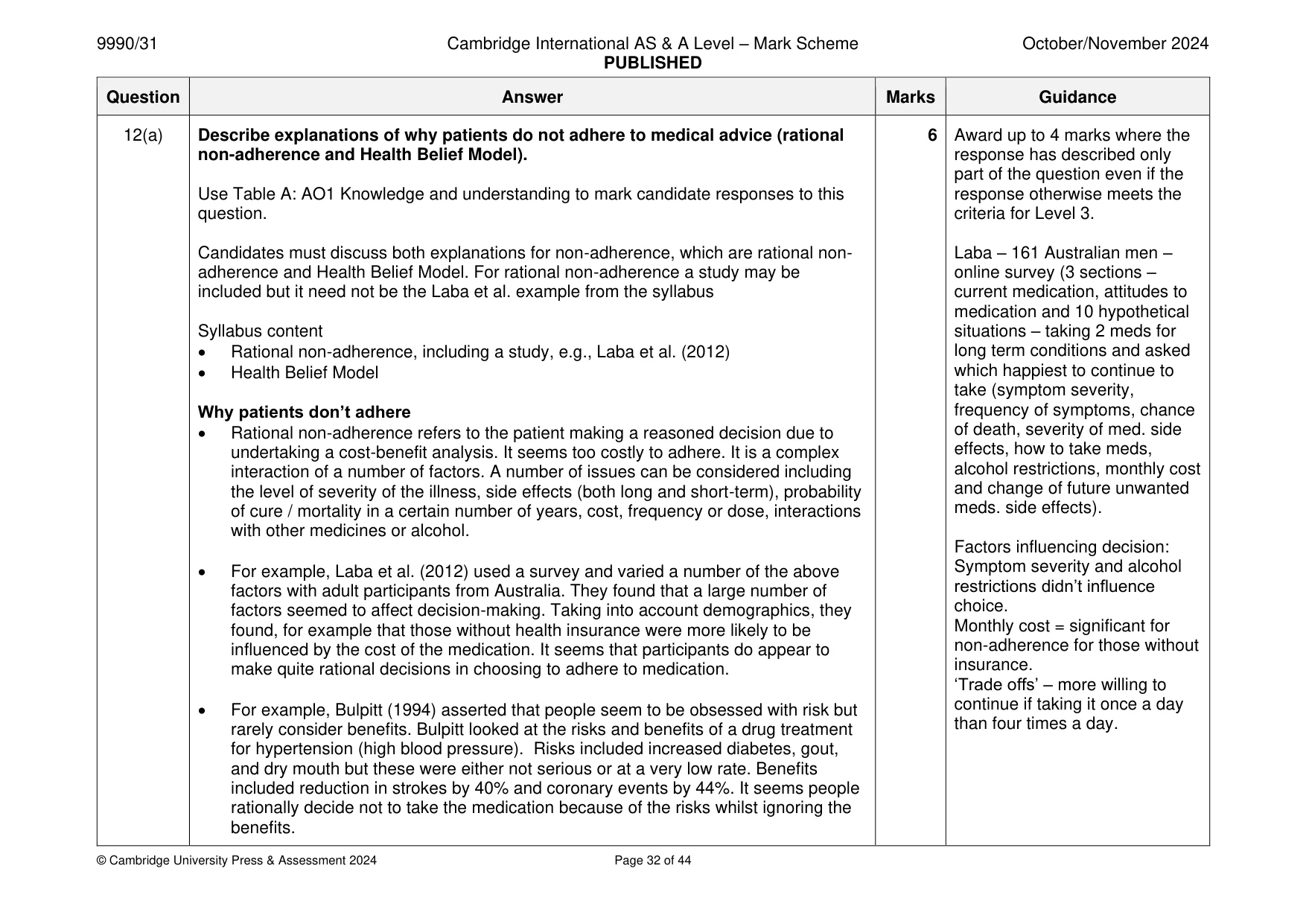
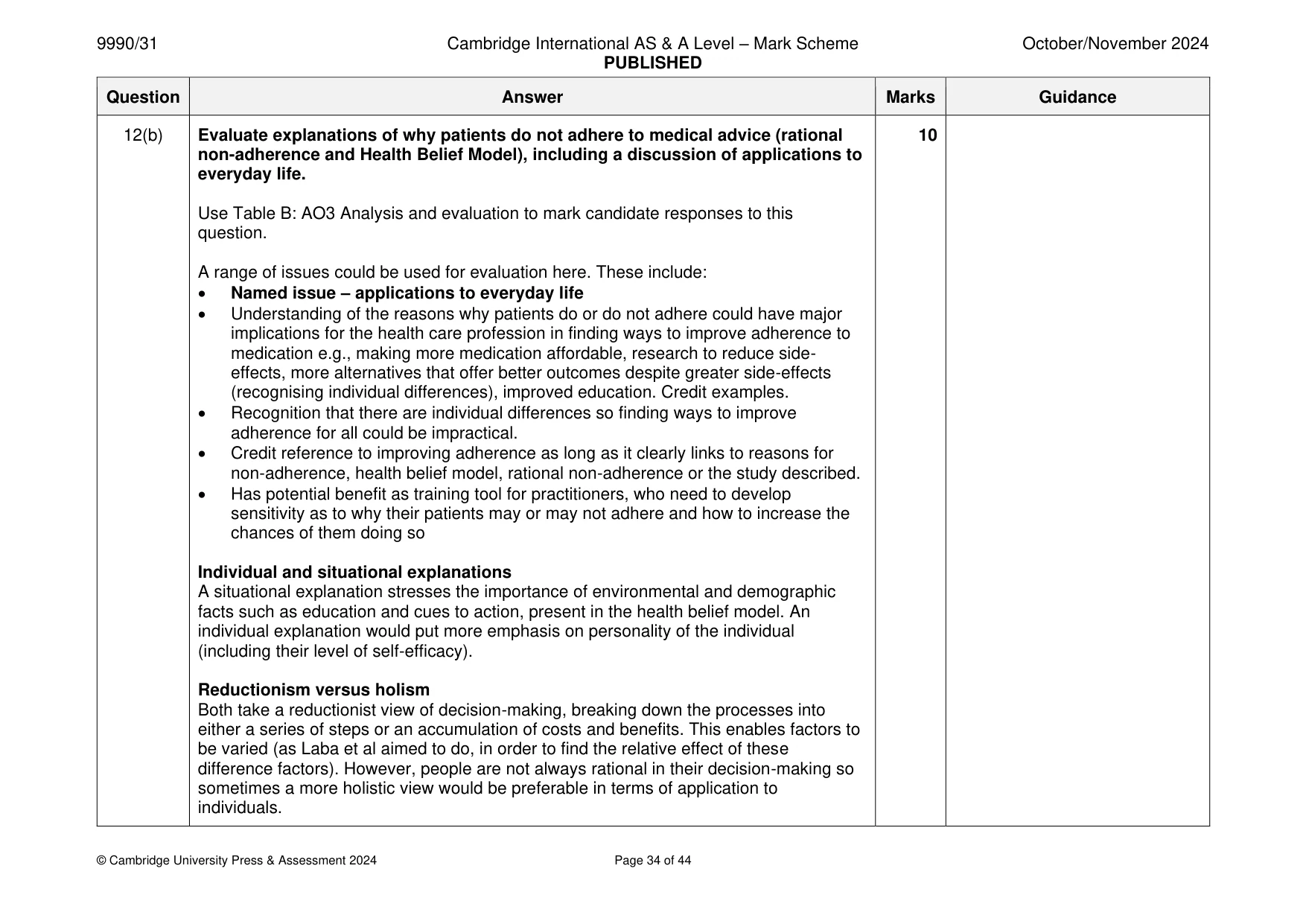
12 (a) Describe explanations of why patients do not adhere to medical advice (rational non-adherence and Health Belief Model). [6] (b) Evaluate explanations of why patients do not adhere to medical advice (rational non-adherence and Health Belief Model), including a discussion of applications to everyday life. Evaluation in your answer can include strengths, weaknesses and a discussion of issues and debates. [10] Section D: Organisational Psychology Answer all questions.
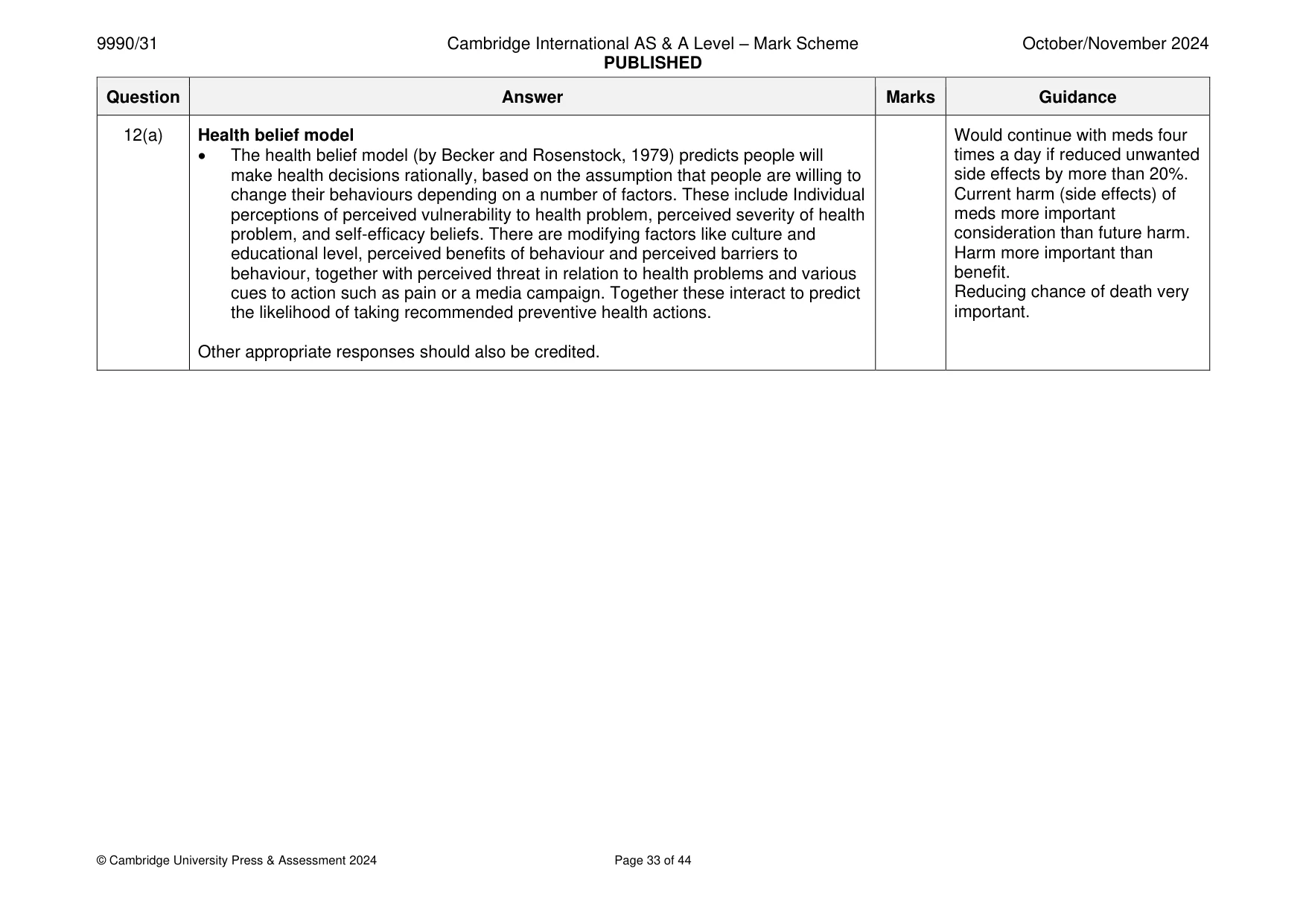
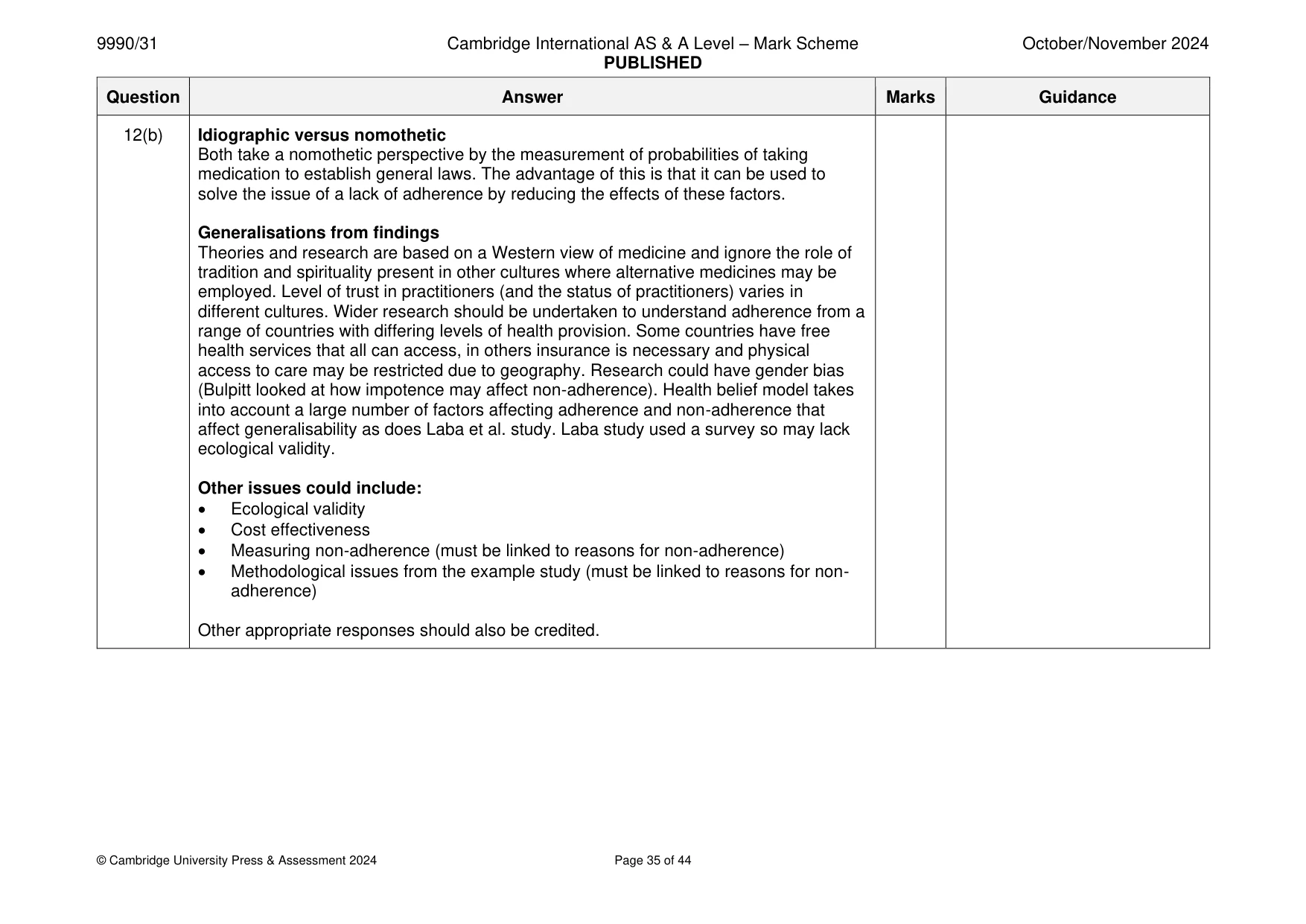
Mark scheme: 12(a) Describe explanations of why patients do not adhere to medical advice (rational 6 Award up to 4 marks where the non-adherence and Health Belief Model). response has described only part of the question even if the Use Table A: AO1 Knowledge and understanding to mark candidate responses to this response otherwise meets the question. criteria for Level 3. Candidates must discuss both explanations for non-adherence, which are rational non- Laba – 161 Australian men – adherence and Health Belief Model. For rational non-adherence a study may be online survey (3 sections – included but it need not be the Laba et al. example from the syllabus current medication, attitudes to medication and 10 hypothetical Syllabus content situations – taking 2 meds for • Rational non-adherence, including a study, e.g., Laba et al. (2012) long term conditions and asked • Health Belief Model which happiest to continue to take (symptom severity, Why patients don’t adhere frequency of symptoms, chance • Rational non-adherence refers to the patient making a reasoned decision due to of death, severity of med. side undertaking a cost-benefit analysis. It seems too costly to adhere. It is a complex effects, how to take meds, interaction of a number of factors. A number of issues can be considered including alcohol restrictions, monthly cost the level of severity of the illness, side effects (both long and short-term), probability and change of future unwanted of cure / mortality in a certain number of years, cost, frequency or dose, interactions meds. side effects). with other medicines or alcohol. Factors influencing decision: • For example, Laba et al. (2012) used a survey and varied a number of the above Symptom severity and alcohol factors with adult participants from Australia. They found that a large number of restrictions didn’t influence factors seemed to affect decision-making. Taking into account demographics, they choice. found, for example that those without health insurance were more likely to be Monthly cost = significant for influenced by the cost of the medication. It seems that participants do appear to non-adherence for those without make quite rational decisions in choosing to adhere to medication. insurance. ‘Trade offs’ – more willing to • For example, Bulpitt (1994) asserted that people seem to be obsessed with risk but continue if taking it once a day than four times a day. rarely consider benefits. Bulpitt looked at the risks and benefits of a drug treatment for hypertension (high blood pressure). Risks included increased diabetes, gout, and dry mouth but these were either not serious or at a very low rate. Benefits included reduction in strokes by 40% and coronary events by 44%. It seems people rationally decide not to take the medication because of the risks whilst ignoring the benefits. 12(a) Health belief model Would continue with meds four • The health belief model (by Becker and Rosenstock, 1979) predicts people will times a day if reduced unwanted make health decisions rationally, based on the assumption that people are willing to side effects by more than 20%. change their behaviours depending on a number of factors. These include Individual Current harm (side effects) of perceptions of perceived vulnerability to health problem, perceived severity of health meds more important problem, and self-efficacy beliefs. There are modifying factors like culture and consideration than future harm. educational level, perceived benefits of behaviour and perceived barriers to Harm more important than behaviour, together with perceived threat in relation to health problems and various benefit. cues to action such as pain or a media campaign. Together these interact to predict Reducing chance of death very the likelihood of taking recommended preventive health actions. important. Other appropriate responses should also be credited. 12(b) Evaluate explanations of why patients do not adhere to medical advice (rational 10 non-adherence and Health Belief Model), including a discussion of applications to everyday life. Use Table B: AO3 Analysis and evaluation to mark candidate responses to this question. A range of issues could be used for evaluation here. These include: • Named issue – applications to everyday life • Understanding of the reasons why patients do or do not adhere could have major implications for the health care profession in finding ways to improve adherence to medication e.g., making more medication affordable, research to reduce side- effects, more alternatives that offer better outcomes despite greater side-effects (recognising individual differences), improved education. Credit examples. • Recognition that there are individual differences so finding ways to improve adherence for all could be impractical. • Credit reference to improving adherence as long as it clearly links to reasons for non-adherence, health belief model, rational non-adherence or the study described. • Has potential benefit as training tool for practitioners, who need to develop sensitivity as to why their patients may or may not adhere and how to increase the chances of them doing so Individual and situational explanations A situational explanation stresses the importance of environmental and demographic facts such as education and cues to action, present in the health belief model. An individual explanation would put more emphasis on personality of the individual (including their level of self-efficacy). Reductionism versus holism Both take a reductionist view of decision-making, breaking down the processes into either a series of steps or an accumulation of costs and benefits. This enables factors to be varied (as Laba et al aimed to do, in order to find the relative effect of these difference factors). However, people are not always rational in their decision-making so sometimes a more holistic view would be preferable in terms of application to individuals. 12(b) Idiographic versus nomothetic Both take a nomothetic perspective by the measurement of probabilities of taking medication to establish general laws. The advantage of this is that it can be used to solve the issue of a lack of adherence by reducing the effects of these factors. Generalisations from findings Theories and research are based on a Western view of medicine and ignore the role of tradition and spirituality present in other cultures where alternative medicines may be employed. Level of trust in practitioners (and the status of practitioners) varies in different cultures. Wider research should be undertaken to understand adherence from a range of countries with differing levels of health provision. Some countries have free health services that all can access, in others insurance is necessary and physical access to care may be restricted due to geography. Research could have gender bias (Bulpitt looked at how impotence may affect non-adherence). Health belief model takes into account a large number of factors affecting adherence and non-adherence that affect generalisability as does Laba et al. study. Laba study used a survey so may lack ecological validity. Other issues could include: • Ecological validity • Cost effectiveness • Measuring non-adherence (must be linked to reasons for non-adherence) • Methodological issues from the example study (must be linked to reasons for non- adherence) Other appropriate responses should also be credited. Section D: Organisational Psychology
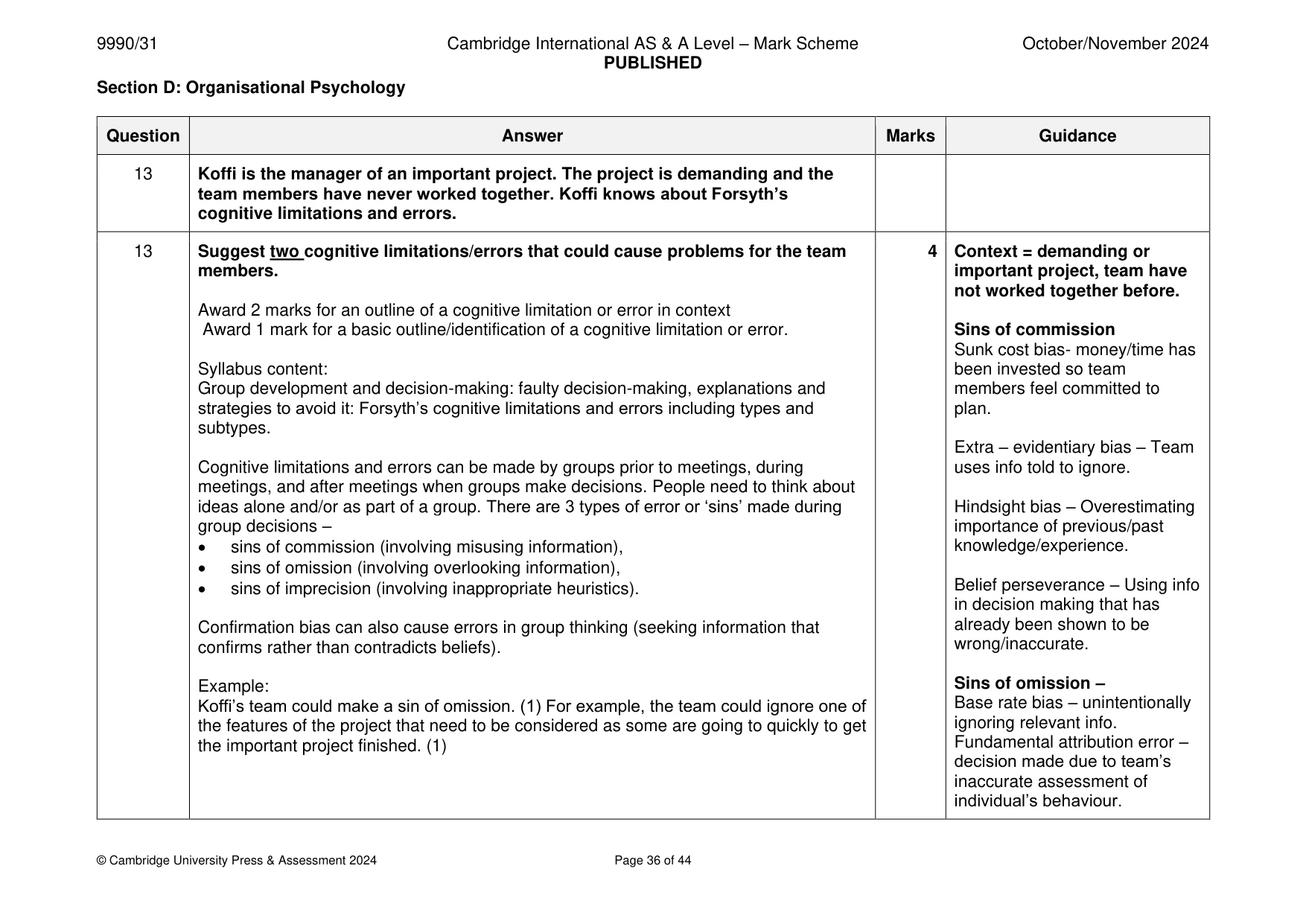
Q13 · Koffi is the manager of an important project
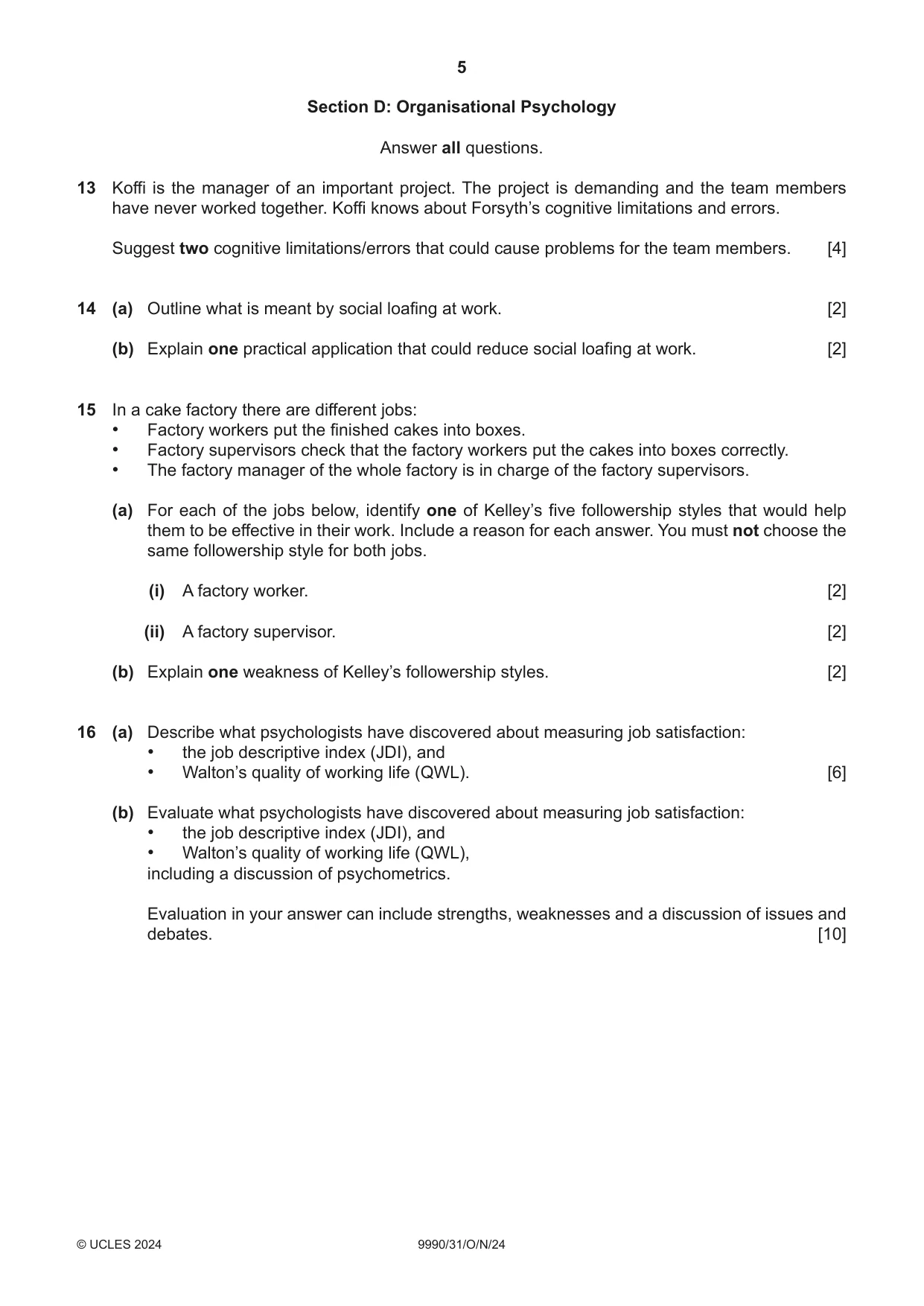
13 Koffi is the manager of an important project. The project is demanding and the team members have never worked together. Koffi knows about Forsyth’s cognitive limitations and errors. Suggest two cognitive limitations/errors that could cause problems for the team members. [4]
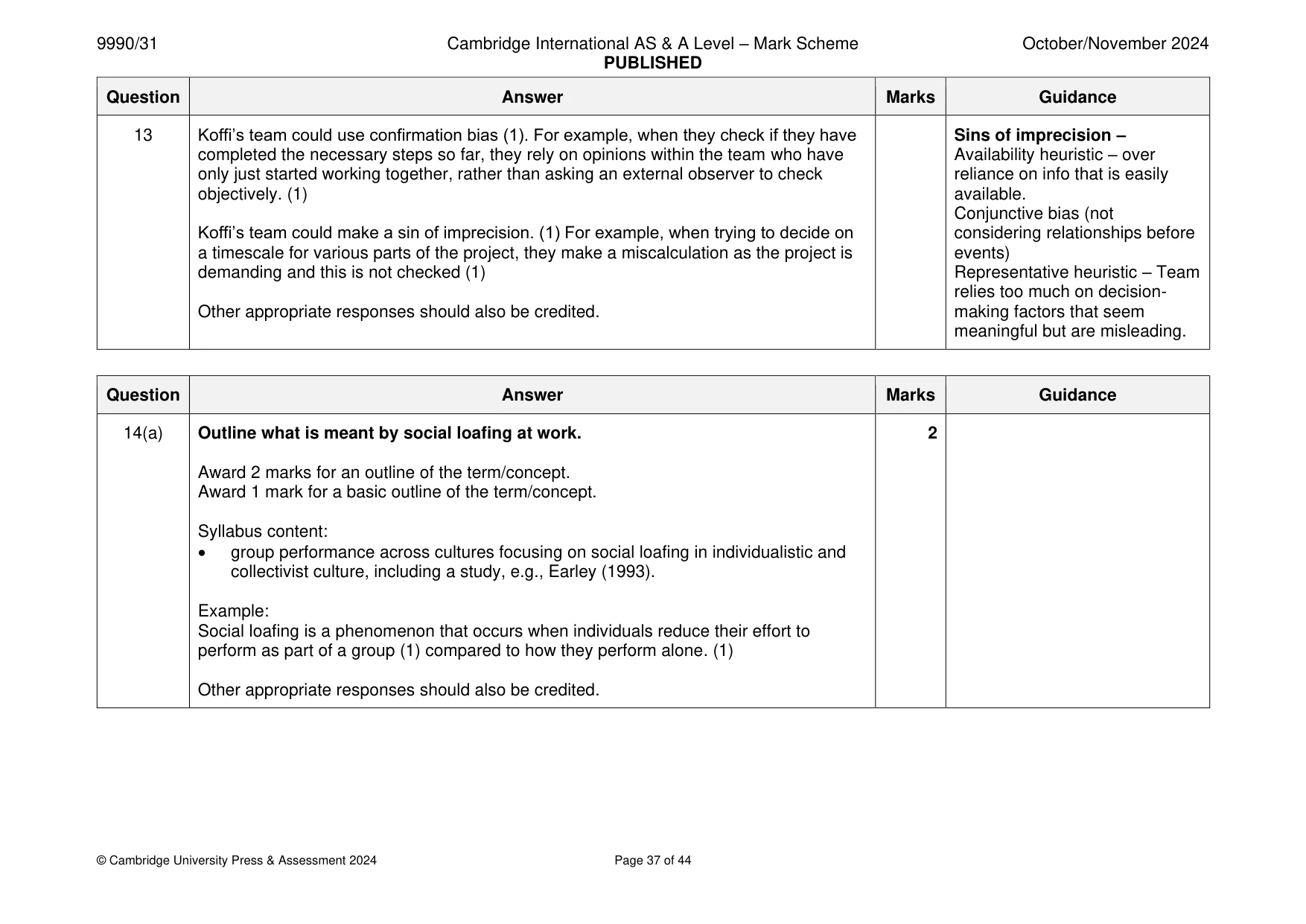
Mark scheme: 13 Koffi is the manager of an important project. The project is demanding and the team members have never worked together. Koffi knows about Forsyth’s cognitive limitations and errors. 13 Suggest two cognitive limitations/errors that could cause problems for the team 4 Context = demanding or members. important project, team have not worked together before. Award 2 marks for an outline of a cognitive limitation or error in context Award 1 mark for a basic outline/identification of a cognitive limitation or error. Sins of commission Sunk cost bias- money/time has Syllabus content: been invested so team Group development and decision-making: faulty decision-making, explanations and members feel committed to strategies to avoid it: Forsyth’s cognitive limitations and errors including types and plan. subtypes. Extra – evidentiary bias – Team Cognitive limitations and errors can be made by groups prior to meetings, during uses info told to ignore. meetings, and after meetings when groups make decisions. People need to think about ideas alone and/or as part of a group. There are 3 types of error or ‘sins’ made during Hindsight bias – Overestimating group decisions – importance of previous/past • sins of commission (involving misusing information), knowledge/experience. • sins of omission (involving overlooking information), • sins of imprecision (involving inappropriate heuristics). Belief perseverance – Using info in decision making that has Confirmation bias can also cause errors in group thinking (seeking information that already been shown to be confirms rather than contradicts beliefs). wrong/inaccurate. Example: Sins of omission – Koffi’s team could make a sin of omission. (1) For example, the team could ignore one of Base rate bias – unintentionally the features of the project that need to be considered as some are going to quickly to get ignoring relevant info. the important project finished. (1) Fundamental attribution error – decision made due to team’s inaccurate assessment of individual’s behaviour. 13 Koffi’s team could use confirmation bias (1). For example, when they check if they have Sins of imprecision – completed the necessary steps so far, they rely on opinions within the team who have Availability heuristic – over only just started working together, rather than asking an external observer to check reliance on info that is easily objectively. (1) available. Conjunctive bias (not Koffi’s team could make a sin of imprecision. (1) For example, when trying to decide on considering relationships before a timescale for various parts of the project, they make a miscalculation as the project is events) demanding and this is not checked (1) Representative heuristic – Team relies too much on decision- Other appropriate responses should also be credited. making factors that seem meaningful but are misleading.
Q14 · Outline what is meant by social loafing at work
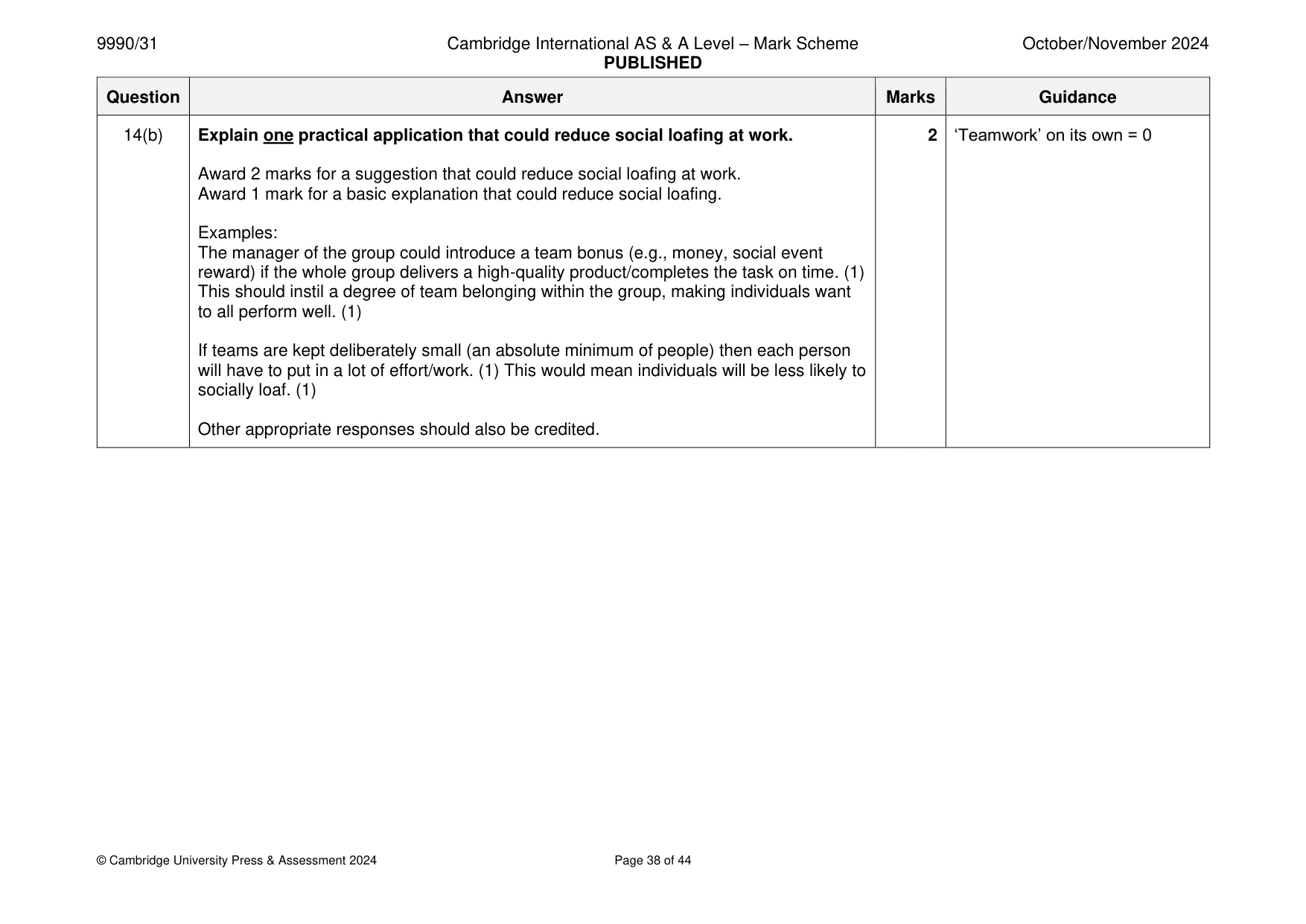
14 (a) Outline what is meant by social loafing at work. [2] (b) Explain one practical application that could reduce social loafing at work. [2]
Mark scheme: 14(a) Outline what is meant by social loafing at work. 2 Award 2 marks for an outline of the term/concept. Award 1 mark for a basic outline of the term/concept. Syllabus content: • group performance across cultures focusing on social loafing in individualistic and collectivist culture, including a study, e.g., Earley (1993). Example: Social loafing is a phenomenon that occurs when individuals reduce their effort to perform as part of a group (1) compared to how they perform alone. (1) Other appropriate responses should also be credited. 14(b) Explain one practical application that could reduce social loafing at work. 2 ‘Teamwork’ on its own = 0 Award 2 marks for a suggestion that could reduce social loafing at work. Award 1 mark for a basic explanation that could reduce social loafing. Examples: The manager of the group could introduce a team bonus (e.g., money, social event reward) if the whole group delivers a high-quality product/completes the task on time. (1) This should instil a degree of team belonging within the group, making individuals want to all perform well. (1) If teams are kept deliberately small (an absolute minimum of people) then each person will have to put in a lot of effort/work. (1) This would mean individuals will be less likely to socially loaf. (1) Other appropriate responses should also be credited.
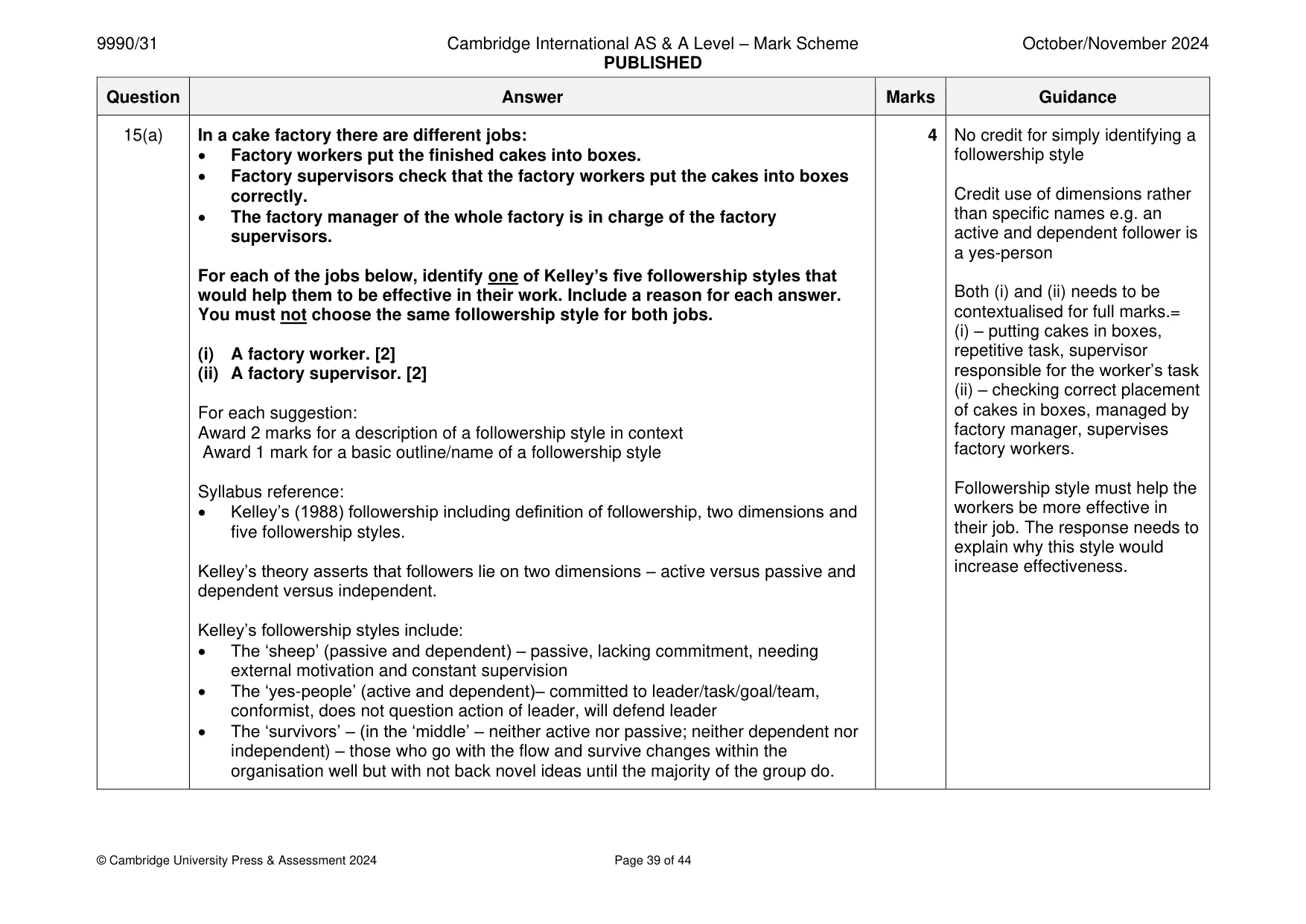
Q15 · In a cake factory there are different jobs: • Factory workers put the finished cakes into…
15 In a cake factory there are different jobs: • Factory workers put the finished cakes into boxes. • Factory supervisors check that the factory workers put the cakes into boxes correctly. • The factory manager of the whole factory is in charge of the factory supervisors. (a) For each of the jobs below, identify one of Kelley’s five followership styles that would help them to be effective in their work. Include a reason for each answer. You must not choose the same followership style for both jobs. (i) A factory worker. [2] (ii) A factory supervisor. [2] (b) Explain one weakness of Kelley’s followership styles. [2]
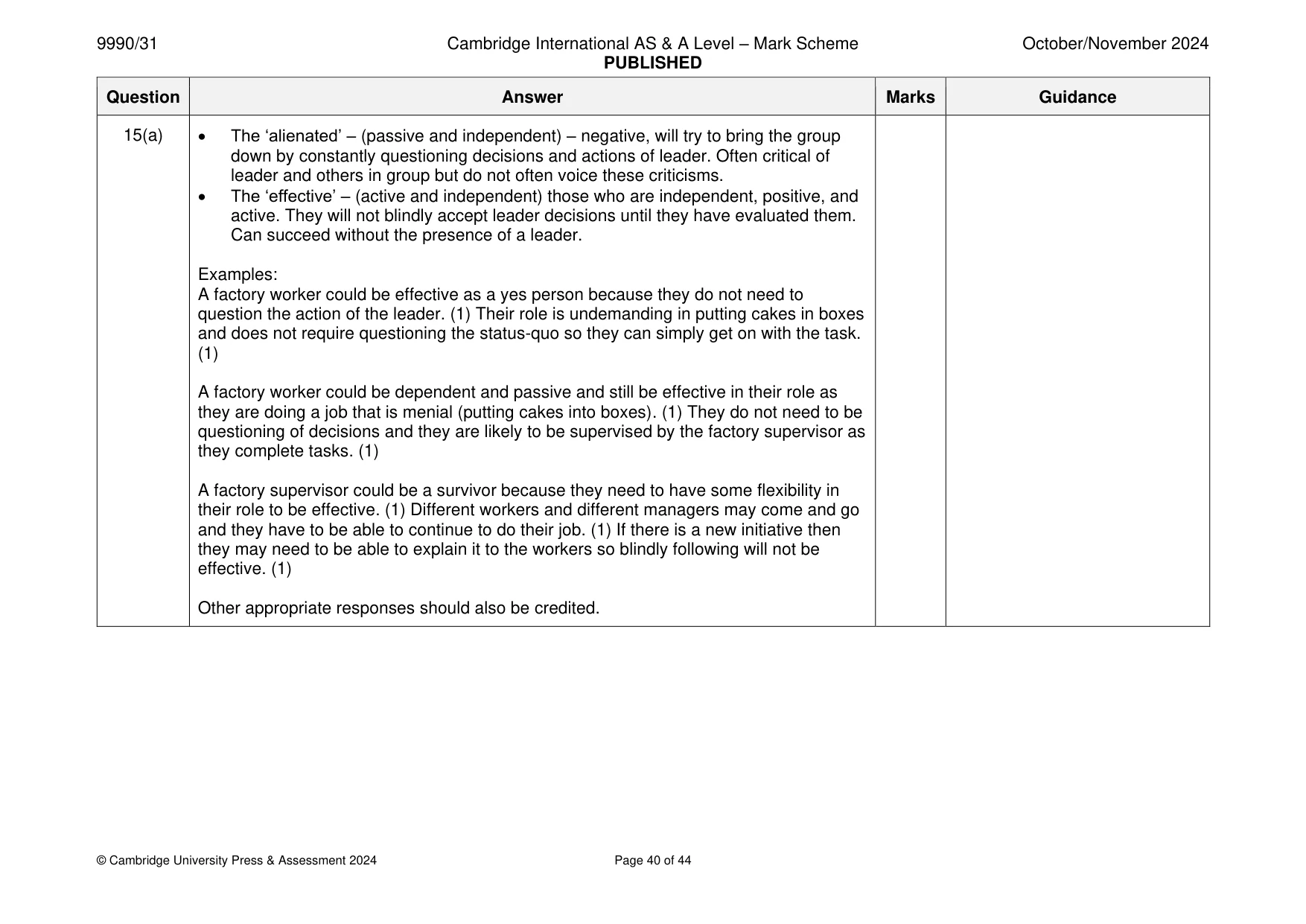
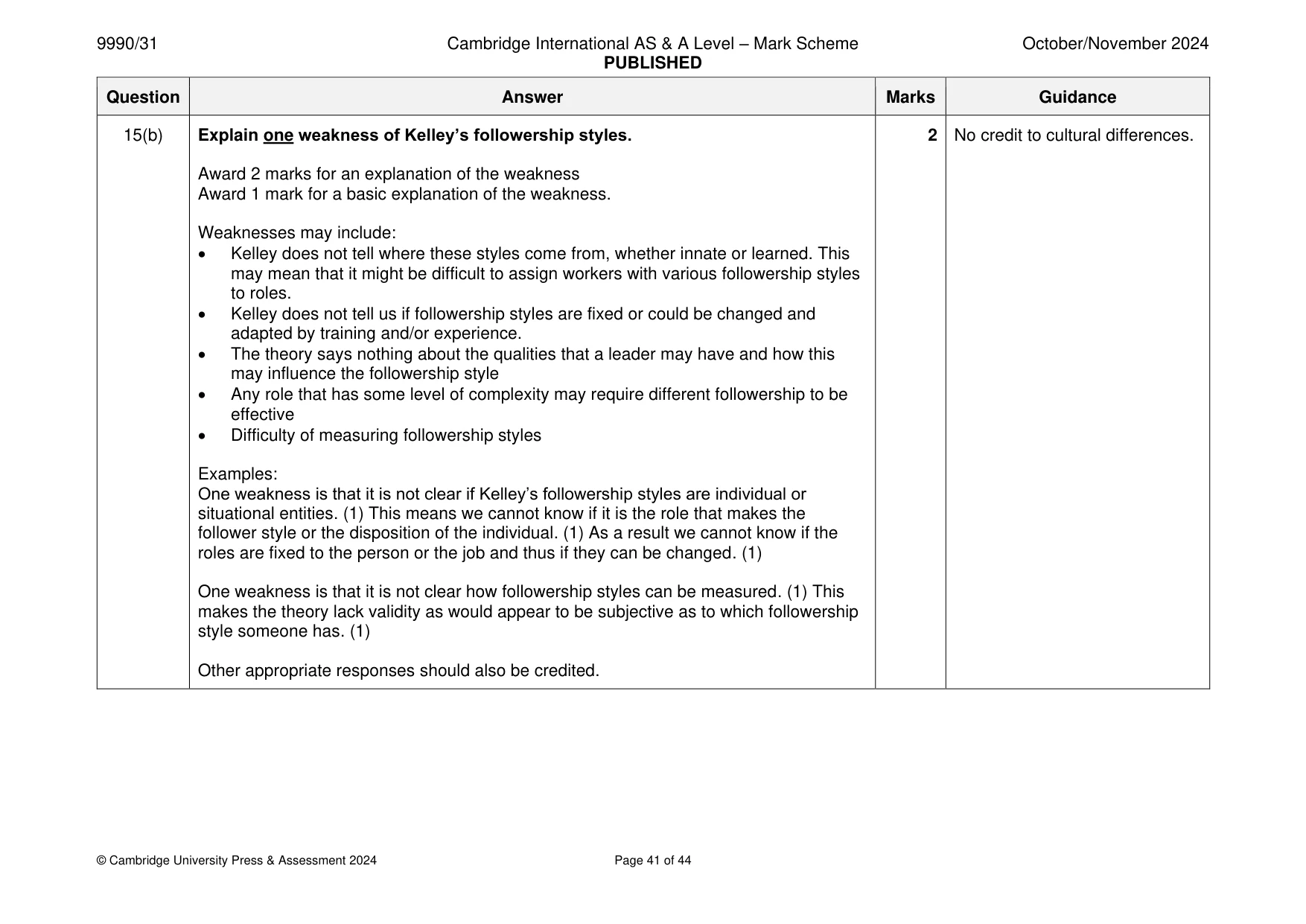
Mark scheme: 15(a) In a cake factory there are different jobs: 4 No credit for simply identifying a • Factory workers put the finished cakes into boxes. followership style • Factory supervisors check that the factory workers put the cakes into boxes correctly. Credit use of dimensions rather • The factory manager of the whole factory is in charge of the factory than specific names e.g. an supervisors. active and dependent follower is a yes-person For each of the jobs below, identify one of Kelley’s five followership styles that would help them to be effective in their work. Include a reason for each answer. Both (i) and (ii) needs to be You must not choose the same followership style for both jobs. contextualised for full marks.= (i) – putting cakes in boxes, (i) A factory worker. [2] repetitive task, supervisor (ii) A factory supervisor. [2] responsible for the worker’s task (ii) – checking correct placement For each suggestion: of cakes in boxes, managed by Award 2 marks for a description of a followership style in context factory manager, supervises Award 1 mark for a basic outline/name of a followership style factory workers. Syllabus reference: Followership style must help the • Kelley’s (1988) followership including definition of followership, two dimensions and workers be more effective in five followership styles. their job. The response needs to explain why this style would Kelley’s theory asserts that followers lie on two dimensions – active versus passive and increase effectiveness. dependent versus independent. Kelley’s followership styles include: • The ‘sheep’ (passive and dependent) – passive, lacking commitment, needing external motivation and constant supervision • The ‘yes-people’ (active and dependent)– committed to leader/task/goal/team, conformist, does not question action of leader, will defend leader • The ‘survivors’ – (in the ‘middle’ – neither active nor passive; neither dependent nor independent) – those who go with the flow and survive changes within the organisation well but with not back novel ideas until the majority of the group do. 15(a) • The ‘alienated’ – (passive and independent) – negative, will try to bring the group down by constantly questioning decisions and actions of leader. Often critical of leader and others in group but do not often voice these criticisms. • The ‘effective’ – (active and independent) those who are independent, positive, and active. They will not blindly accept leader decisions until they have evaluated them. Can succeed without the presence of a leader. Examples: A factory worker could be effective as a yes person because they do not need to question the action of the leader. (1) Their role is undemanding in putting cakes in boxes and does not require questioning the status-quo so they can simply get on with the task. (1) A factory worker could be dependent and passive and still be effective in their role as they are doing a job that is menial (putting cakes into boxes). (1) They do not need to be questioning of decisions and they are likely to be supervised by the factory supervisor as they complete tasks. (1) A factory supervisor could be a survivor because they need to have some flexibility in their role to be effective. (1) Different workers and different managers may come and go and they have to be able to continue to do their job. (1) If there is a new initiative then they may need to be able to explain it to the workers so blindly following will not be effective. (1) Other appropriate responses should also be credited. 15(b) Explain one weakness of Kelley’s followership styles. 2 No credit to cultural differences. Award 2 marks for an explanation of the weakness Award 1 mark for a basic explanation of the weakness. Weaknesses may include: • Kelley does not tell where these styles come from, whether innate or learned. This may mean that it might be difficult to assign workers with various followership styles to roles. • Kelley does not tell us if followership styles are fixed or could be changed and adapted by training and/or experience. • The theory says nothing about the qualities that a leader may have and how this may influence the followership style • Any role that has some level of complexity may require different followership to be effective • Difficulty of measuring followership styles Examples: One weakness is that it is not clear if Kelley’s followership styles are individual or situational entities. (1) This means we cannot know if it is the role that makes the follower style or the disposition of the individual. (1) As a result we cannot know if the roles are fixed to the person or the job and thus if they can be changed. (1) One weakness is that it is not clear how followership styles can be measured. (1) This makes the theory lack validity as would appear to be subjective as to which followership style someone has. (1) Other appropriate responses should also be credited.
Q16 · Describe what psychologists have discovered about measuring job satisfaction: • the job…
16 (a) Describe what psychologists have discovered about measuring job satisfaction: • the job descriptive index (JDI), and • Walton’s quality of working life (QWL). [6] (b) Evaluate what psychologists have discovered about measuring job satisfaction: • the job descriptive index (JDI), and • Walton’s quality of working life (QWL), including a discussion of psychometrics. Evaluation in your answer can include strengths, weaknesses and a discussion of issues and debates. [10]
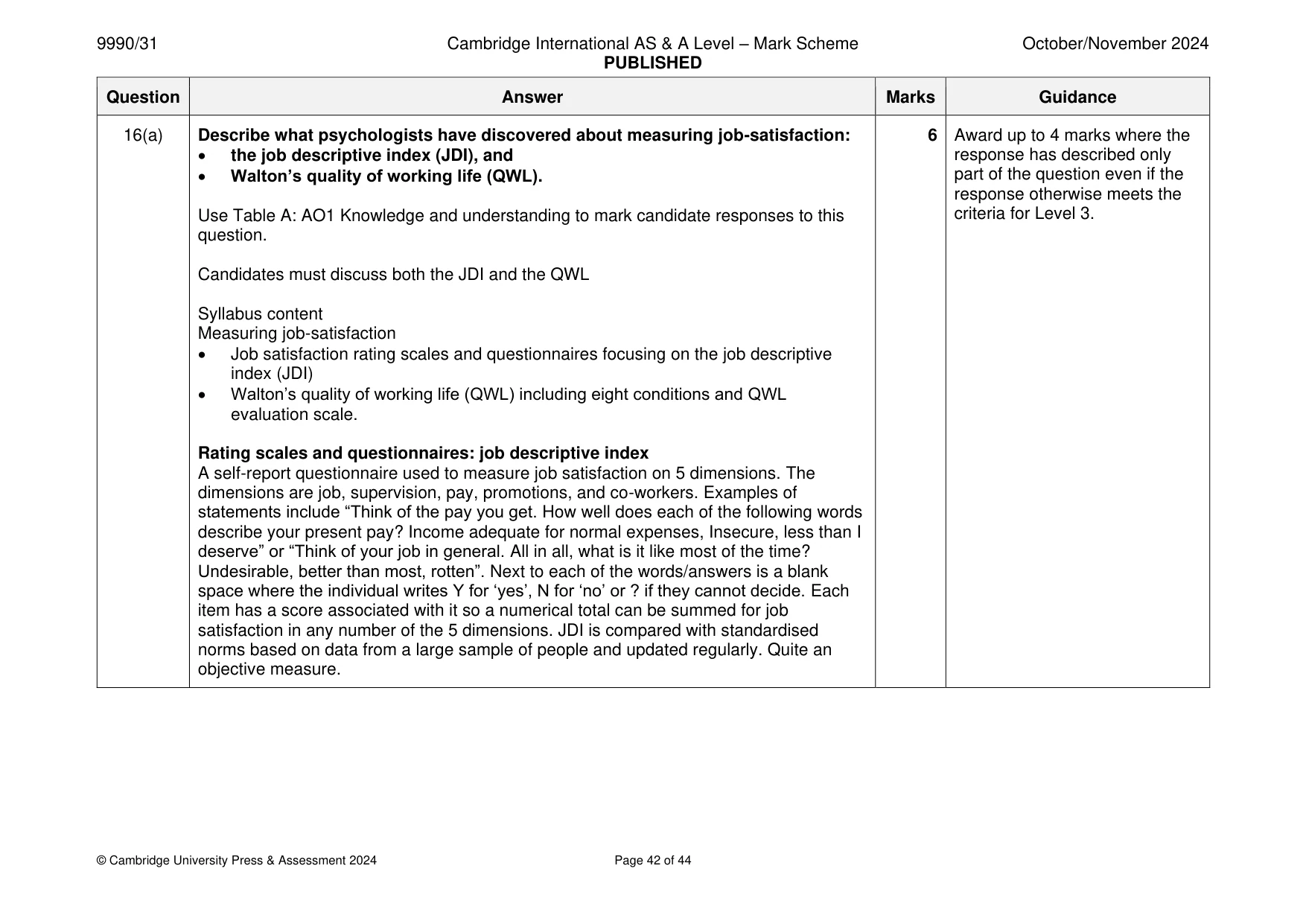
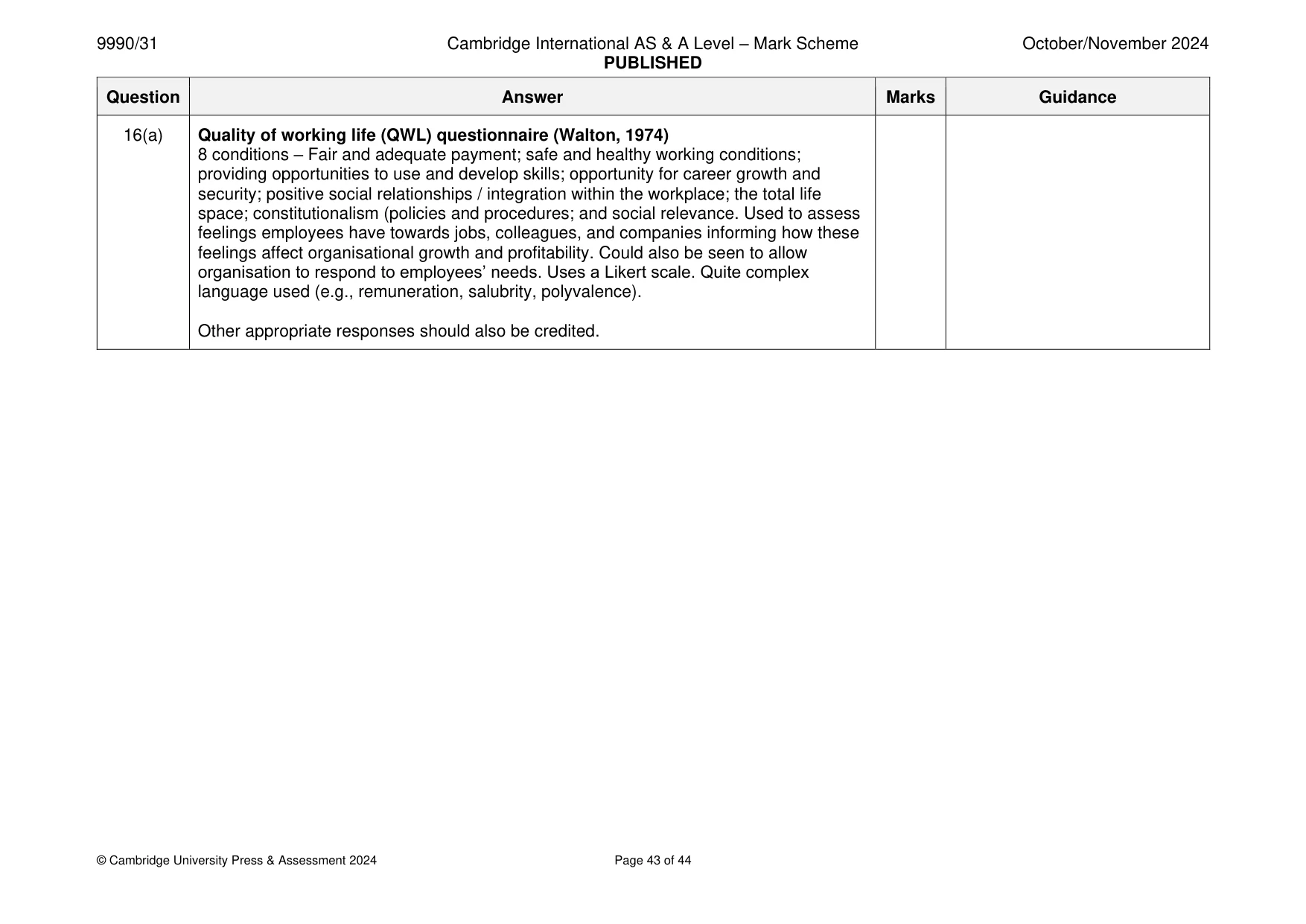
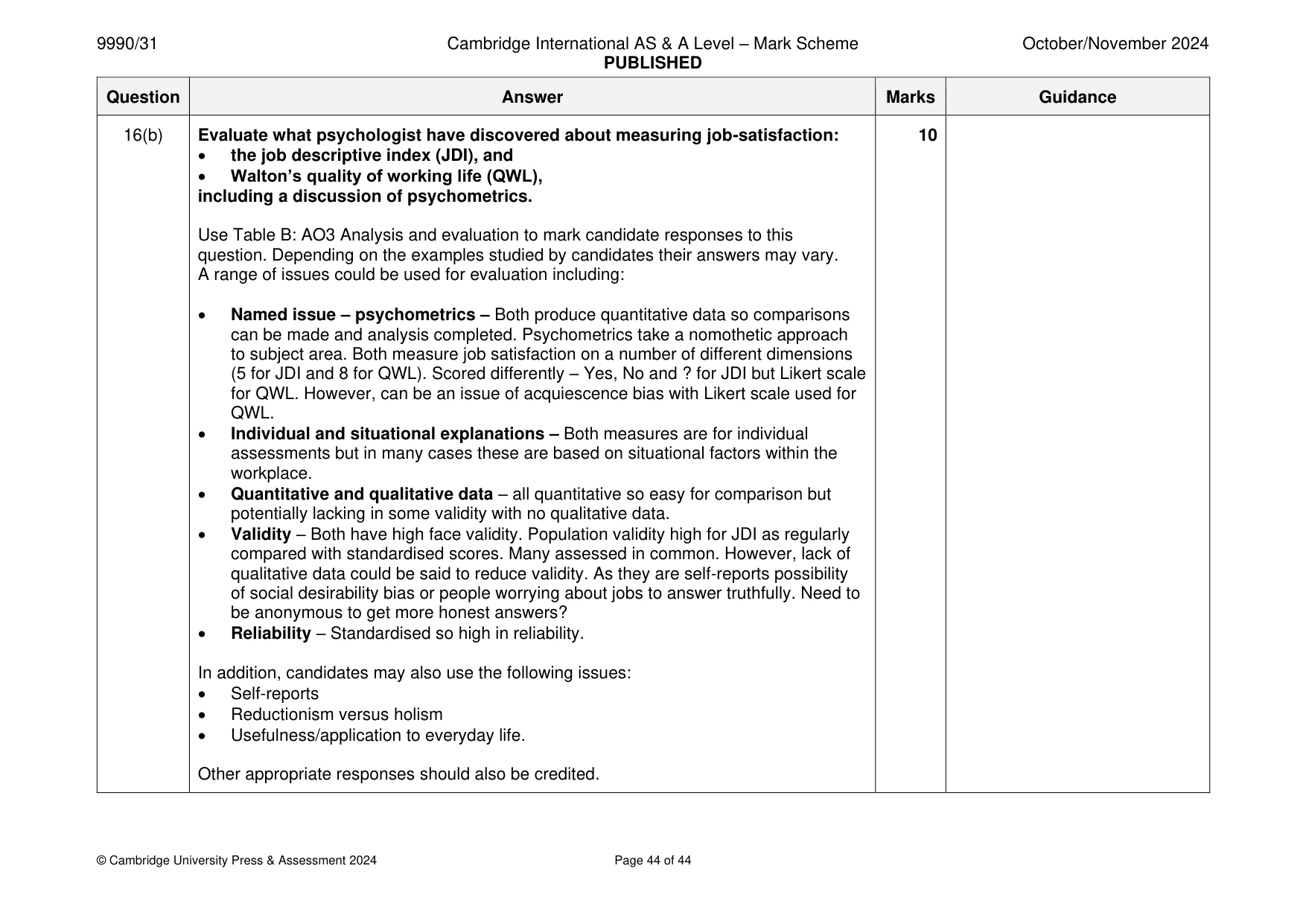
Mark scheme: 16(a) Describe what psychologists have discovered about measuring job-satisfaction: 6 Award up to 4 marks where the • the job descriptive index (JDI), and response has described only • Walton’s quality of working life (QWL). part of the question even if the response otherwise meets the Use Table A: AO1 Knowledge and understanding to mark candidate responses to this criteria for Level 3. question. Candidates must discuss both the JDI and the QWL Syllabus content Measuring job-satisfaction • Job satisfaction rating scales and questionnaires focusing on the job descriptive index (JDI) • Walton’s quality of working life (QWL) including eight conditions and QWL evaluation scale. Rating scales and questionnaires: job descriptive index A self-report questionnaire used to measure job satisfaction on 5 dimensions. The dimensions are job, supervision, pay, promotions, and co-workers. Examples of statements include “Think of the pay you get. How well does each of the following words describe your present pay? Income adequate for normal expenses, Insecure, less than I deserve” or “Think of your job in general. All in all, what is it like most of the time? Undesirable, better than most, rotten”. Next to each of the words/answers is a blank space where the individual writes Y for ‘yes’, N for ‘no’ or ? if they cannot decide. Each item has a score associated with it so a numerical total can be summed for job satisfaction in any number of the 5 dimensions. JDI is compared with standardised norms based on data from a large sample of people and updated regularly. Quite an objective measure. 16(a) Quality of working life (QWL) questionnaire (Walton, 1974) 8 conditions – Fair and adequate payment; safe and healthy working conditions; providing opportunities to use and develop skills; opportunity for career growth and security; positive social relationships / integration within the workplace; the total life space; constitutionalism (policies and procedures; and social relevance. Used to assess feelings employees have towards jobs, colleagues, and companies informing how these feelings affect organisational growth and profitability. Could also be seen to allow organisation to respond to employees’ needs. Uses a Likert scale. Quite complex language used (e.g., remuneration, salubrity, polyvalence). Other appropriate responses should also be credited. 16(b) Evaluate what psychologist have discovered about measuring job-satisfaction: 10 • the job descriptive index (JDI), and • Walton’s quality of working life (QWL), including a discussion of psychometrics. Use Table B: AO3 Analysis and evaluation to mark candidate responses to this question. Depending on the examples studied by candidates their answers may vary. A range of issues could be used for evaluation including: • Named issue – psychometrics – Both produce quantitative data so comparisons can be made and analysis completed. Psychometrics take a nomothetic approach to subject area. Both measure job satisfaction on a number of different dimensions (5 for JDI and 8 for QWL). Scored differently – Yes, No and ? for JDI but Likert scale for QWL. However, can be an issue of acquiescence bias with Likert scale used for QWL. • Individual and situational explanations – Both measures are for individual assessments but in many cases these are based on situational factors within the workplace. • Quantitative and qualitative data – all quantitative so easy for comparison but potentially lacking in some validity with no qualitative data. • Validity – Both have high face validity. Population validity high for JDI as regularly compared with standardised scores. Many assessed in common. However, lack of qualitative data could be said to reduce validity. As they are self-reports possibility of social desirability bias or people worrying about jobs to answer truthfully. Need to be anonymous to get more honest answers? • Reliability – Standardised so high in reliability. In addition, candidates may also use the following issues: • Self-reports • Reductionism versus holism • Usefulness/application to everyday life. Other appropriate responses should also be credited.
What was in this paper
The subtopics covered by these 16 questions, and how many questions each got. Open one in a new tab to see every Cambridge question on it.
What you needed in this session
Cambridge’s own grade thresholds for 2024 Oct/Nov, Paper 3 · Variant 1. A higher threshold means an easier paper — the bar moves with how the cohort did.