Cambridge A Level Psychology (from 2018) 9990 — 2022 May/June Paper 3 · Variant 2
9990/32/M/J/22 · 8 questions · 60 marks · ≈68 min
The question paper and its mark scheme, free to read here and free to download. This is Cambridge’s own paper, exactly as it was sat.
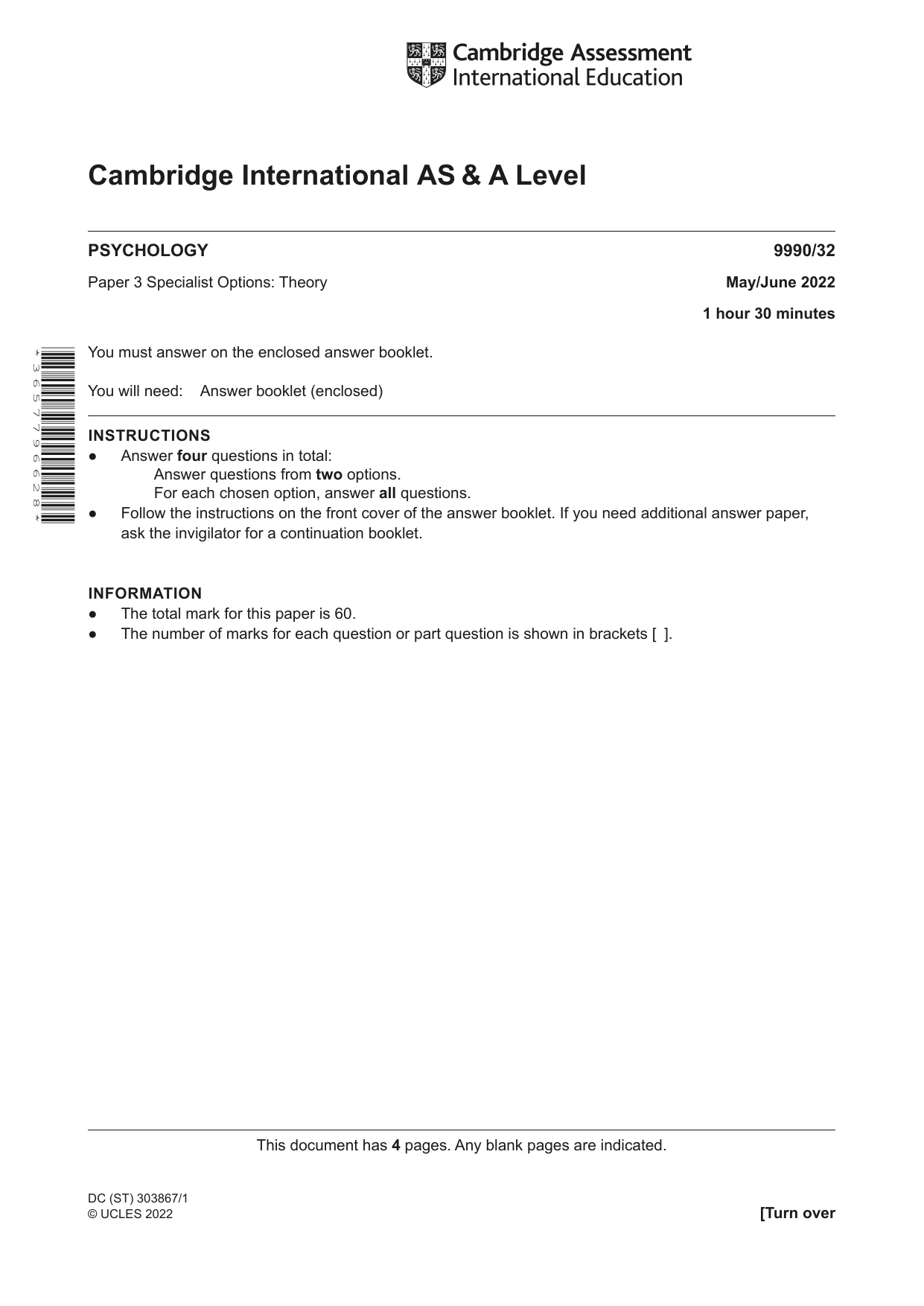
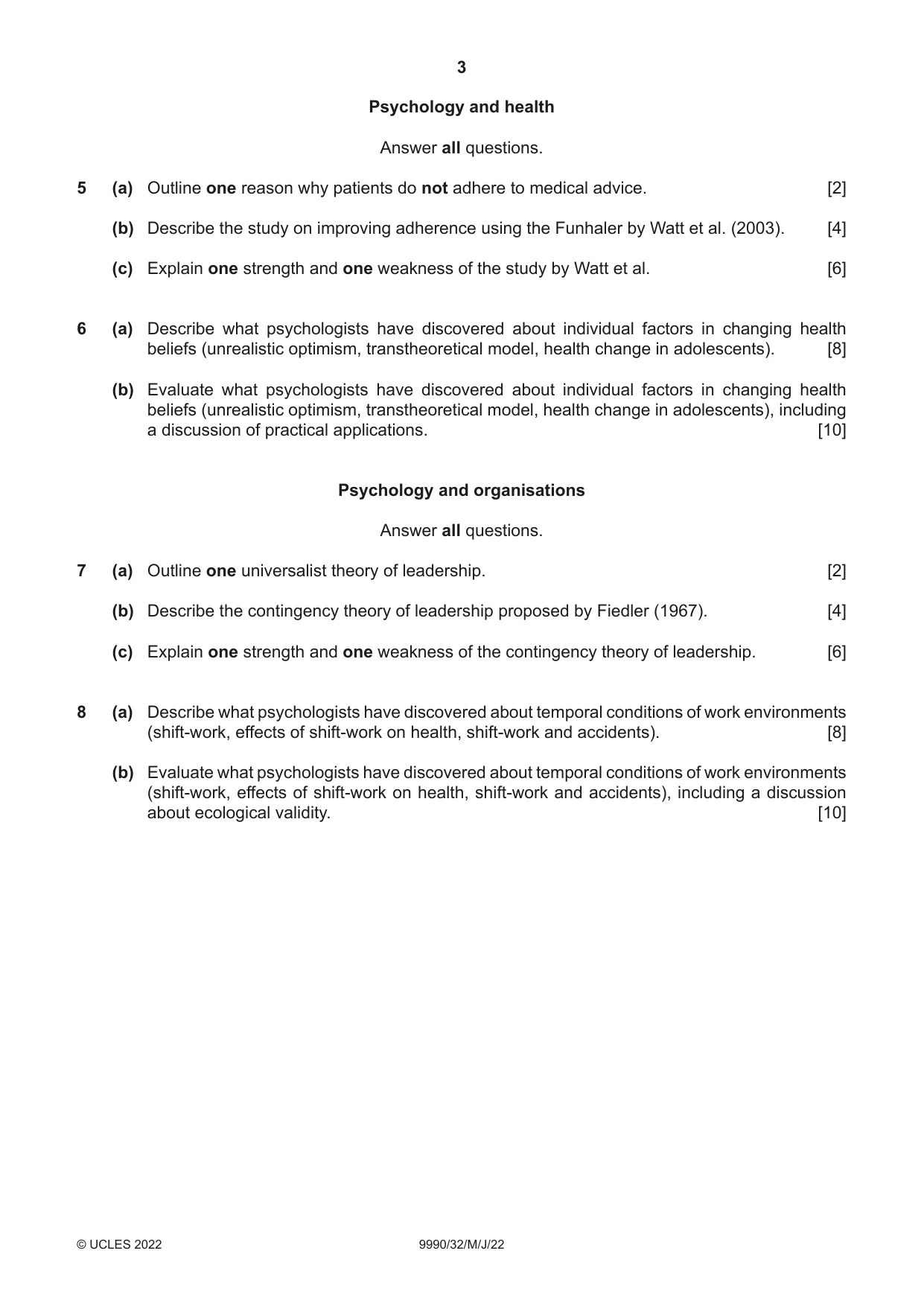
Question paper4 pages


Mark scheme29 pages
Answers below. Sit the paper first if you are practising.

Questions as text
Q1 · Explain what is meant by ‘blood phobia’
1 (a) Explain what is meant by ‘blood phobia’. [2] (b) Describe features of the blood injection phobia inventory (BIPI). [4] (c) Explain one similarity and one difference between the BIPI and the Generalised Anxiety Disorder assessment (GAD-7). [6]
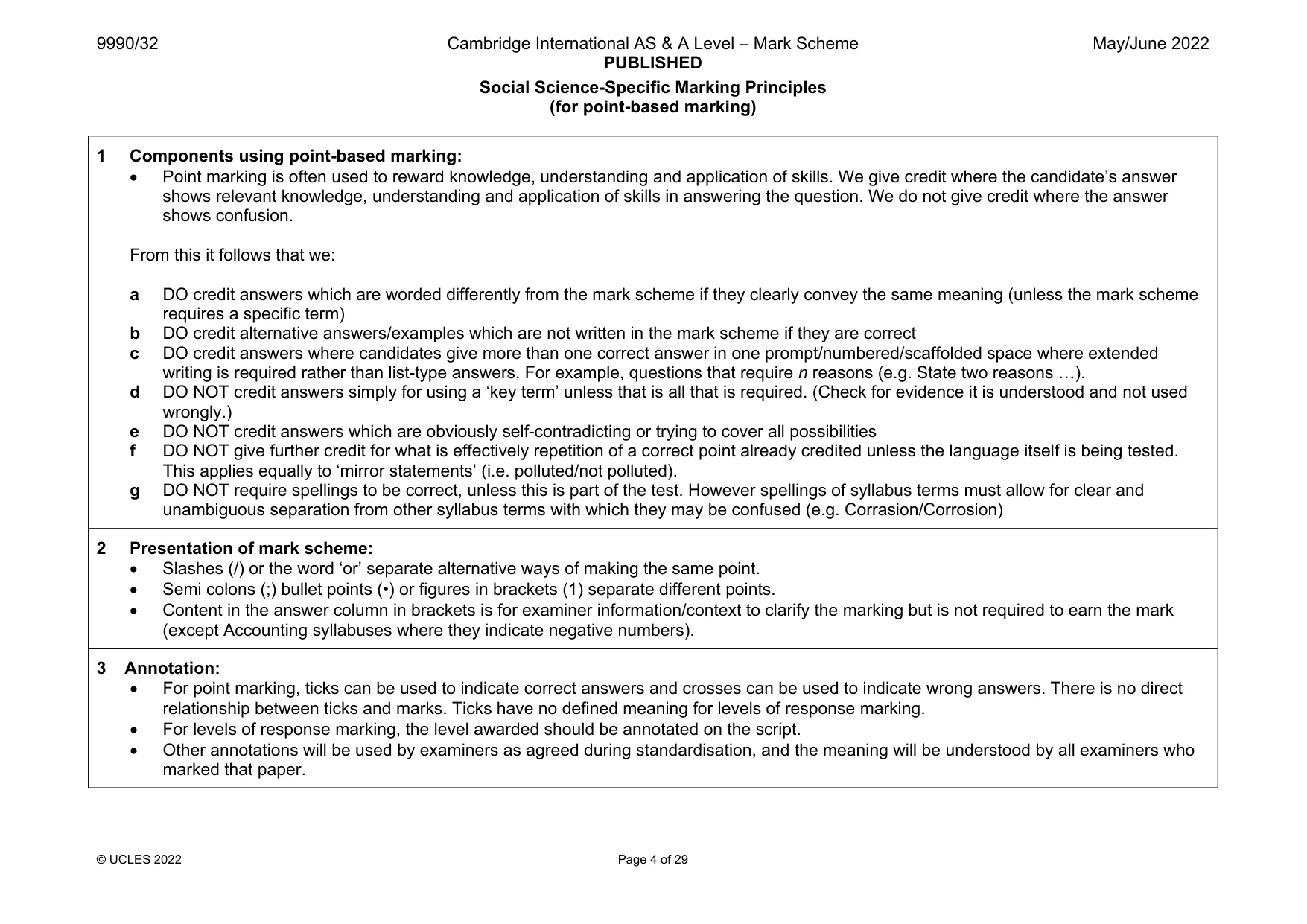
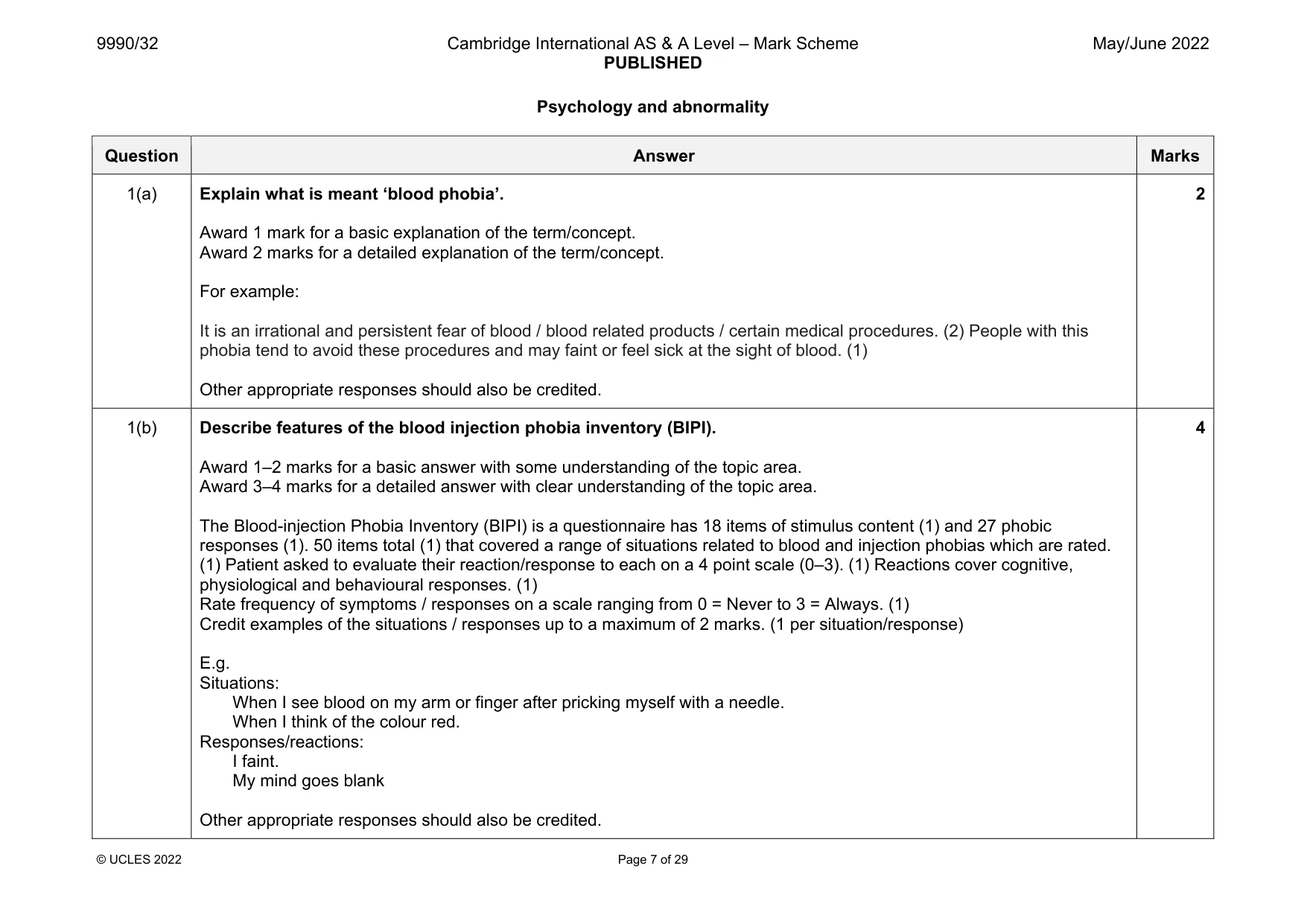
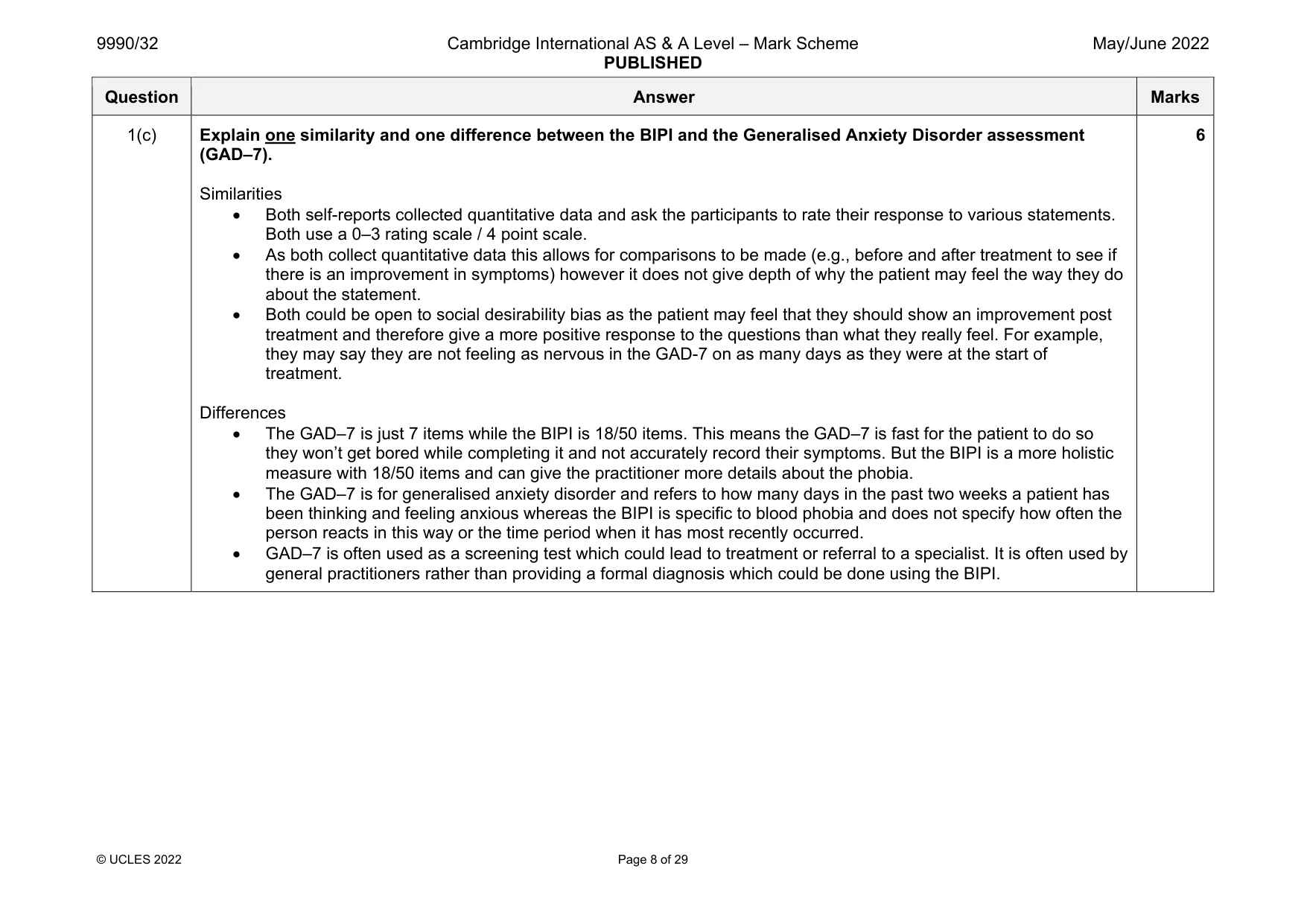
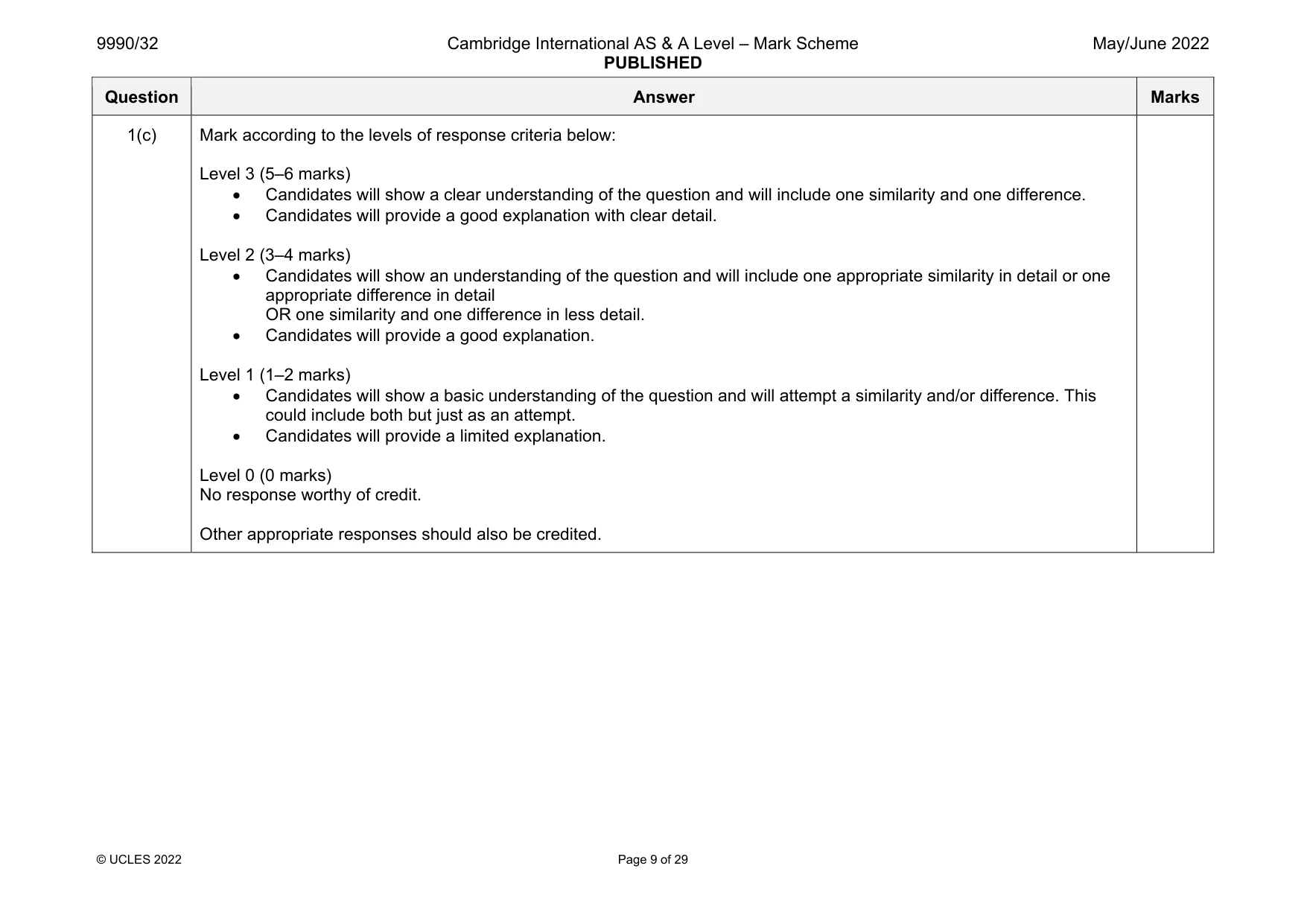
Mark scheme: 1(a) Explain what is meant ‘blood phobia’. Award 1 mark for a basic explanation of the term/concept. Award 2 marks for a detailed explanation of the term/concept. For example: It is an irrational and persistent fear of blood / blood related products / certain medical procedures. (2) People with this phobia tend to avoid these procedures and may faint or feel sick at the sight of blood. (1) Other appropriate responses should also be credited. 2 1(b) Describe features of the blood injection phobia inventory (BIPI). Award 1–2 marks for a basic answer with some understanding of the topic area. Award 3–4 marks for a detailed answer with clear understanding of the topic area. The Blood-injection Phobia Inventory (BIPI) is a questionnaire has 18 items of stimulus content (1) and 27 phobic responses (1). 50 items total (1) that covered a range of situations related to blood and injection phobias which are rated. (1) Patient asked to evaluate their reaction/response to each on a 4 point scale (0–3). (1) Reactions cover cognitive, physiological and behavioural responses. (1) Rate frequency of symptoms / responses on a scale ranging from 0 = Never to 3 = Always. (1) Credit examples of the situations / responses up to a maximum of 2 marks. (1 per situation/response) E.g. Situations: When I see blood on my arm or finger after pricking myself with a needle. When I think of the colour red. Responses/reactions: I faint. My mind goes blank Other appropriate responses should also be credited. 4 Question Answer Marks 1(c) Explain one similarity and one difference between the BIPI and the Generalised Anxiety Disorder assessment (GAD–7). Similarities Both self-reports collected quantitative data and ask the participants to rate their response to various statements. Both use a 0–3 rating scale / 4 point scale. As both collect quantitative data this allows for comparisons to be made (e.g., before and after treatment to see if there is an improvement in symptoms) however it does not give depth of why the patient may feel the way they do about the statement. Both could be open to social desirability bias as the patient may feel that they should show an improvement post treatment and therefore give a more positive response to the questions than what they really feel. For example, they may say they are not feeling as nervous in the GAD-7 on as many days as they were at the start of treatment. Differences The GAD–7 is just 7 items while the BIPI is 18/50 items. This means the GAD–7 is fast for the patient to do so they won’t get bored while completing it and not accurately record their symptoms. But the BIPI is a more holistic measure with 18/50 items and can give the practitioner more details about the phobia. The GAD–7 is for generalised anxiety disorder and refers to how many days in the past two weeks a patient has been thinking and feeling anxious whereas the BIPI is specific to blood phobia and does not specify how often the person reacts in this way or the time period when it has most recently occurred. GAD–7 is often used as a screening test which could lead to treatment or referral to a specialist. It is often used by general practitioners rather than providing a formal diagnosis which could be done using the BIPI. 6 Question Answer Marks 1(c) Mark according to the levels of response criteria below: Level 3 (5–6 marks) Candidates will show a clear understanding of the question and will include one similarity and one difference. Candidates will provide a good explanation with clear detail. Level 2 (3–4 marks) Candidates will show an understanding of the question and will include one appropriate similarity in detail or one appropriate difference in detail OR one similarity and one difference in less detail. Candidates will provide a good explanation. Level 1 (1–2 marks) Candidates will show a basic understanding of the question and will attempt a similarity and/or difference. This could include both but just as an attempt. Candidates will provide a limited explanation. Level 0 (0 marks) No response worthy of credit. Other appropriate responses should also be credited.
More questions on Anxiety disorders and fear-related disorders
Q2 · Describe the characteristics of impulse control disorders and non-substance addictive…
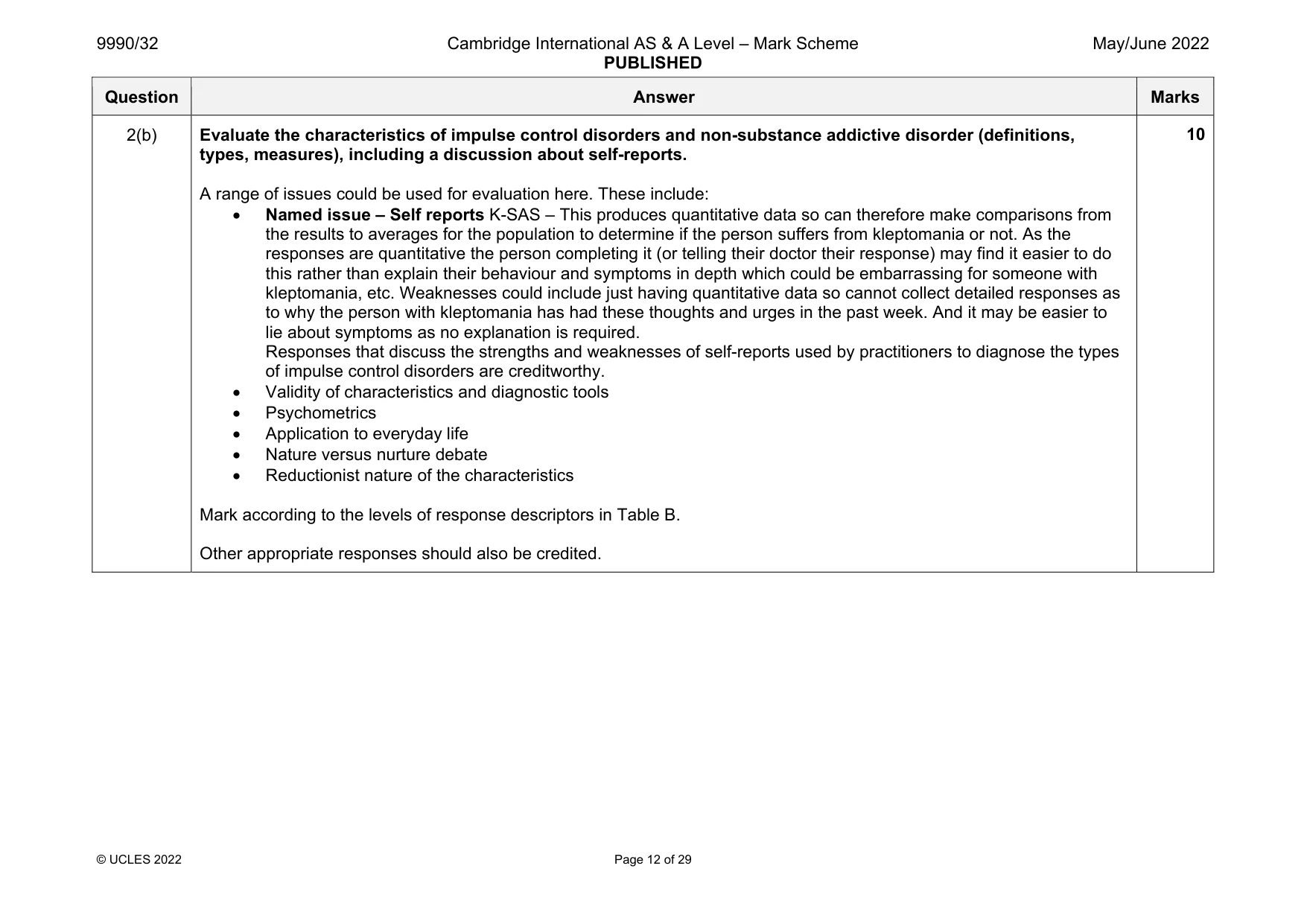
2 (a) Describe the characteristics of impulse control disorders and non-substance addictive disorder (definitions, types, measures). [8] (b) Evaluate the characteristics of impulse control disorders and non-substance addictive disorder (definitions, types, measures), including a discussion about self-reports. [10] Psychology and consumer behaviour Answer all questions.
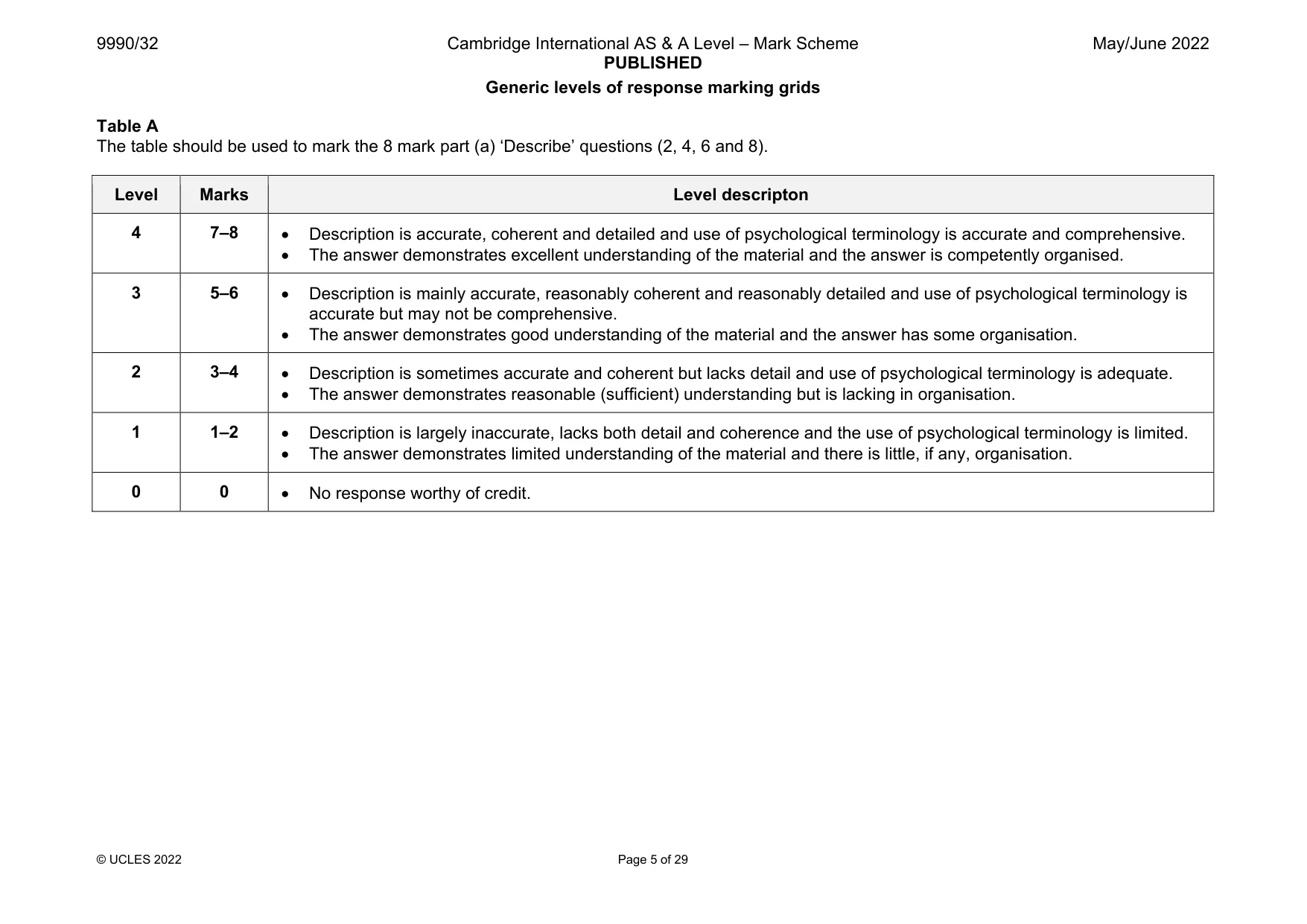
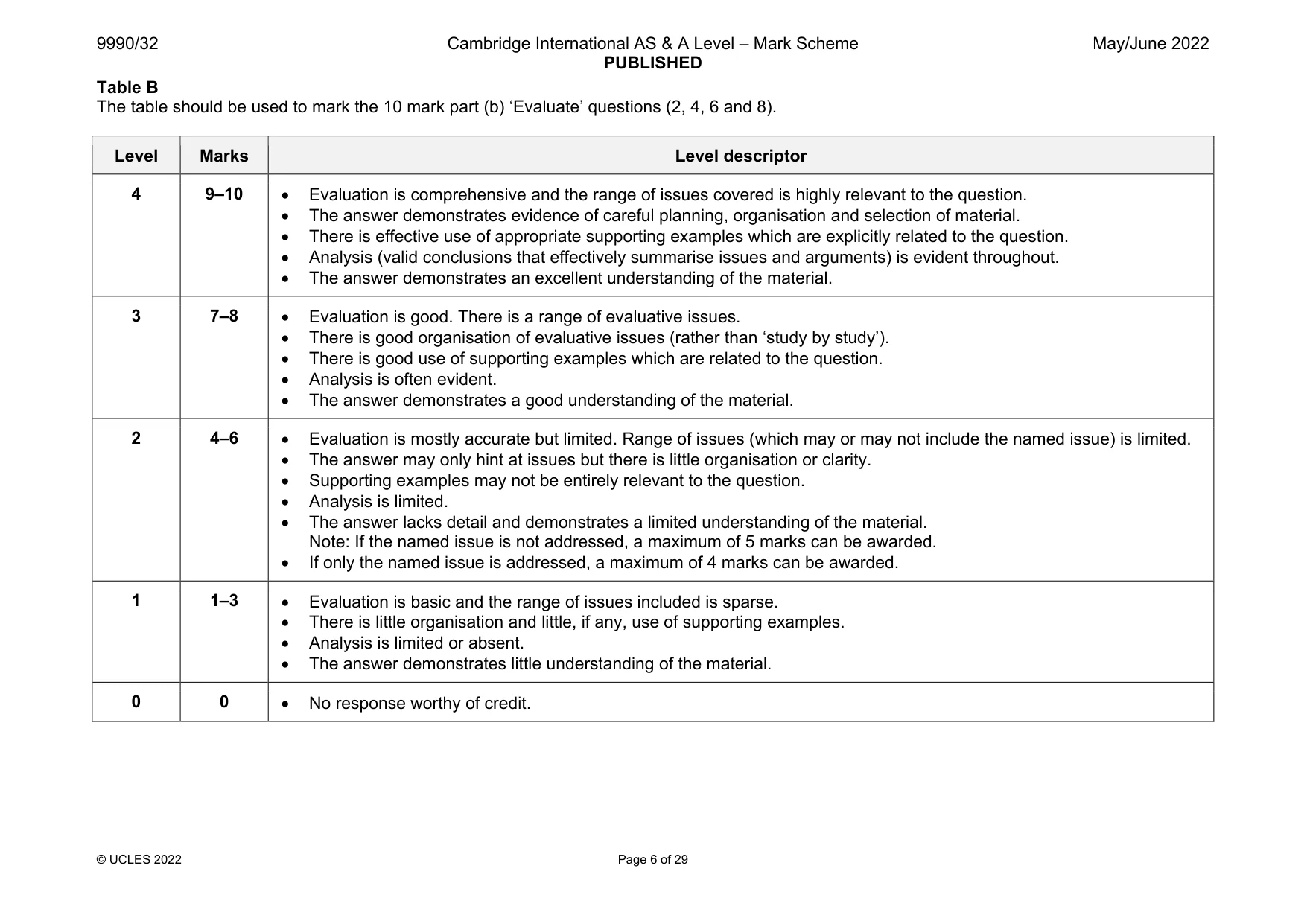
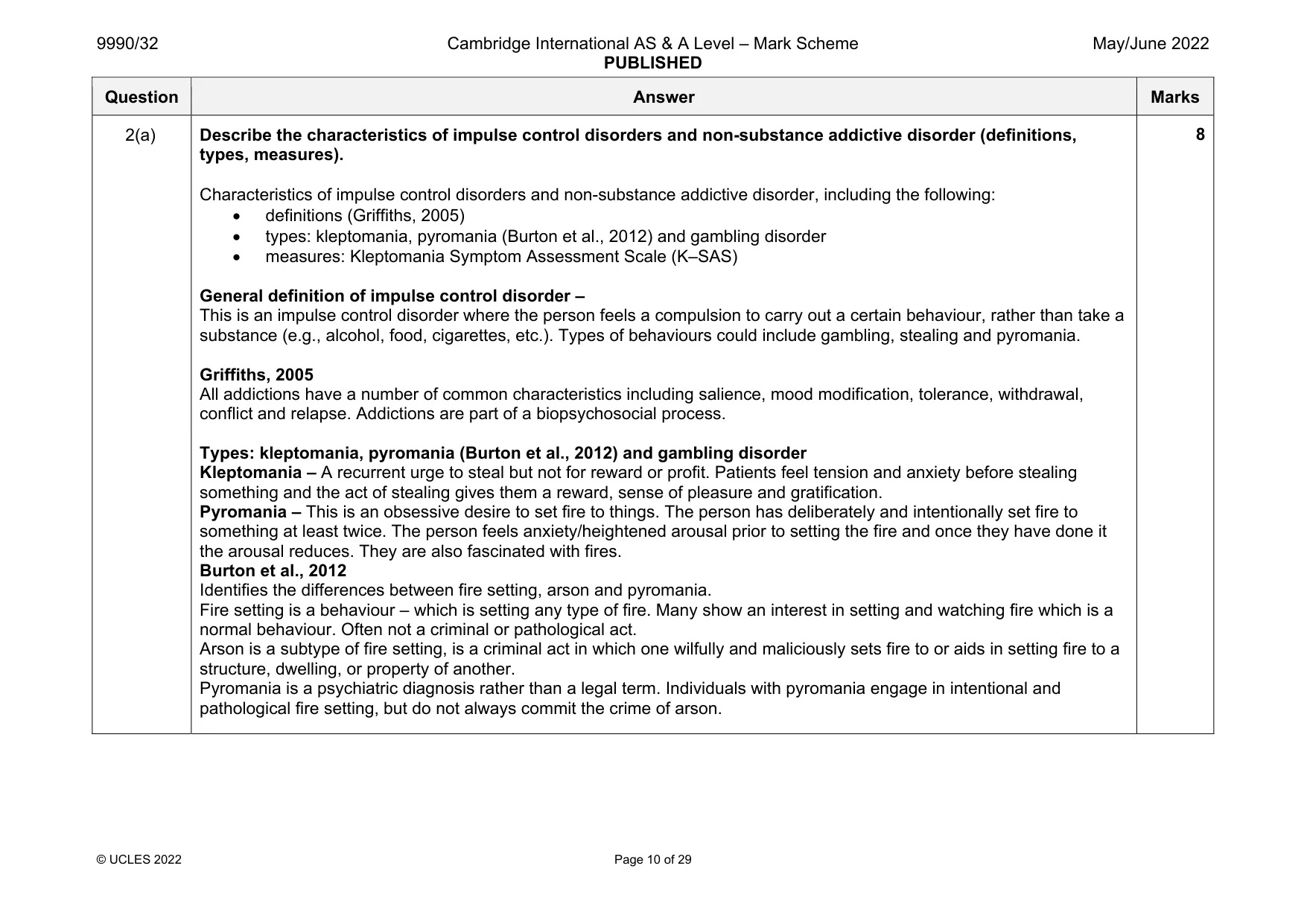
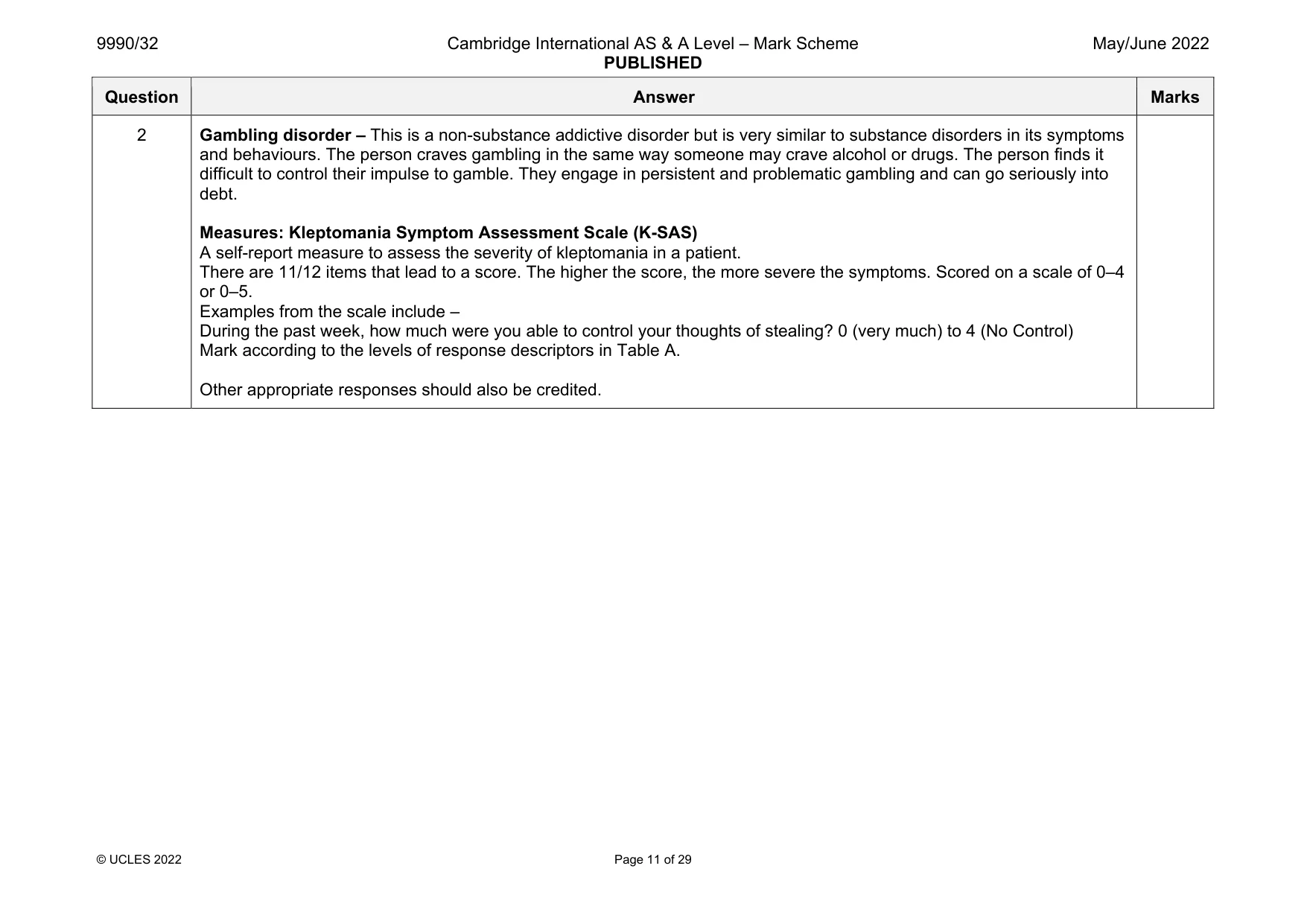
Mark scheme: 2(a) Describe the characteristics of impulse control disorders and non-substance addictive disorder (definitions, types, measures). Characteristics of impulse control disorders and non-substance addictive disorder, including the following: definitions (Griffiths, 2005) types: kleptomania, pyromania (Burton et al., 2012) and gambling disorder measures: Kleptomania Symptom Assessment Scale (K–SAS) General definition of impulse control disorder – This is an impulse control disorder where the person feels a compulsion to carry out a certain behaviour, rather than take a substance (e.g., alcohol, food, cigarettes, etc.). Types of behaviours could include gambling, stealing and pyromania. Griffiths, 2005 All addictions have a number of common characteristics including salience, mood modification, tolerance, withdrawal, conflict and relapse. Addictions are part of a biopsychosocial process. Types: kleptomania, pyromania (Burton et al., 2012) and gambling disorder Kleptomania – A recurrent urge to steal but not for reward or profit. Patients feel tension and anxiety before stealing something and the act of stealing gives them a reward, sense of pleasure and gratification. Pyromania – This is an obsessive desire to set fire to things. The person has deliberately and intentionally set fire to something at least twice. The person feels anxiety/heightened arousal prior to setting the fire and once they have done it the arousal reduces. They are also fascinated with fires. Burton et al., 2012 Identifies the differences between fire setting, arson and pyromania. Fire setting is a behaviour – which is setting any type of fire. Many show an interest in setting and watching fire which is a normal behaviour. Often not a criminal or pathological act. Arson is a subtype of fire setting, is a criminal act in which one wilfully and maliciously sets fire to or aids in setting fire to a structure, dwelling, or property of another. Pyromania is a psychiatric diagnosis rather than a legal term. Individuals with pyromania engage in intentional and pathological fire setting, but do not always commit the crime of arson. Question Answer Marks 2 Gambling disorder – This is a non-substance addictive disorder but is very similar to substance disorders in its symptoms and behaviours. The person craves gambling in the same way someone may crave alcohol or drugs. The person finds it difficult to control their impulse to gamble. They engage in persistent and problematic gambling and can go seriously into debt. Measures: Kleptomania Symptom Assessment Scale (K-SAS) A self-report measure to assess the severity of kleptomania in a patient. There are 11/12 items that lead to a score. The higher the score, the more severe the symptoms. Scored on a scale of 0–4 or 0–5. Examples from the scale include – During the past week, how much were you able to control your thoughts of stealing? 0 (very much) to 4 (No Control) Mark according to the levels of response descriptors in Table A. Other appropriate responses should also be credited. Question Answer Marks 2(b) Evaluate the characteristics of impulse control disorders and non-substance addictive disorder (definitions, types, measures), including a discussion about self-reports. A range of issues could be used for evaluation here. These include: Named issue – Self reports K-SAS – This produces quantitative data so can therefore make comparisons from the results to averages for the population to determine if the person suffers from kleptomania or not. As the responses are quantitative the person completing it (or telling their doctor their response) may find it easier to do this rather than explain their behaviour and symptoms in depth which could be embarrassing for someone with kleptomania, etc. Weaknesses could include just having quantitative data so cannot collect detailed responses as to why the person with kleptomania has had these thoughts and urges in the past week. And it may be easier to lie about symptoms as no explanation is required. Responses that discuss the strengths and weaknesses of self-reports used by practitioners to diagnose the types of impulse control disorders are creditworthy. Validity of characteristics and diagnostic tools Psychometrics Application to everyday life Nature versus nurture debate Reductionist nature of the characteristics Mark according to the levels of response descriptors in Table B. Other appropriate responses should also be credited. 10
Q3 · Identify two of the virtual store layouts in the study by Vrechopoulos (2004) on the…
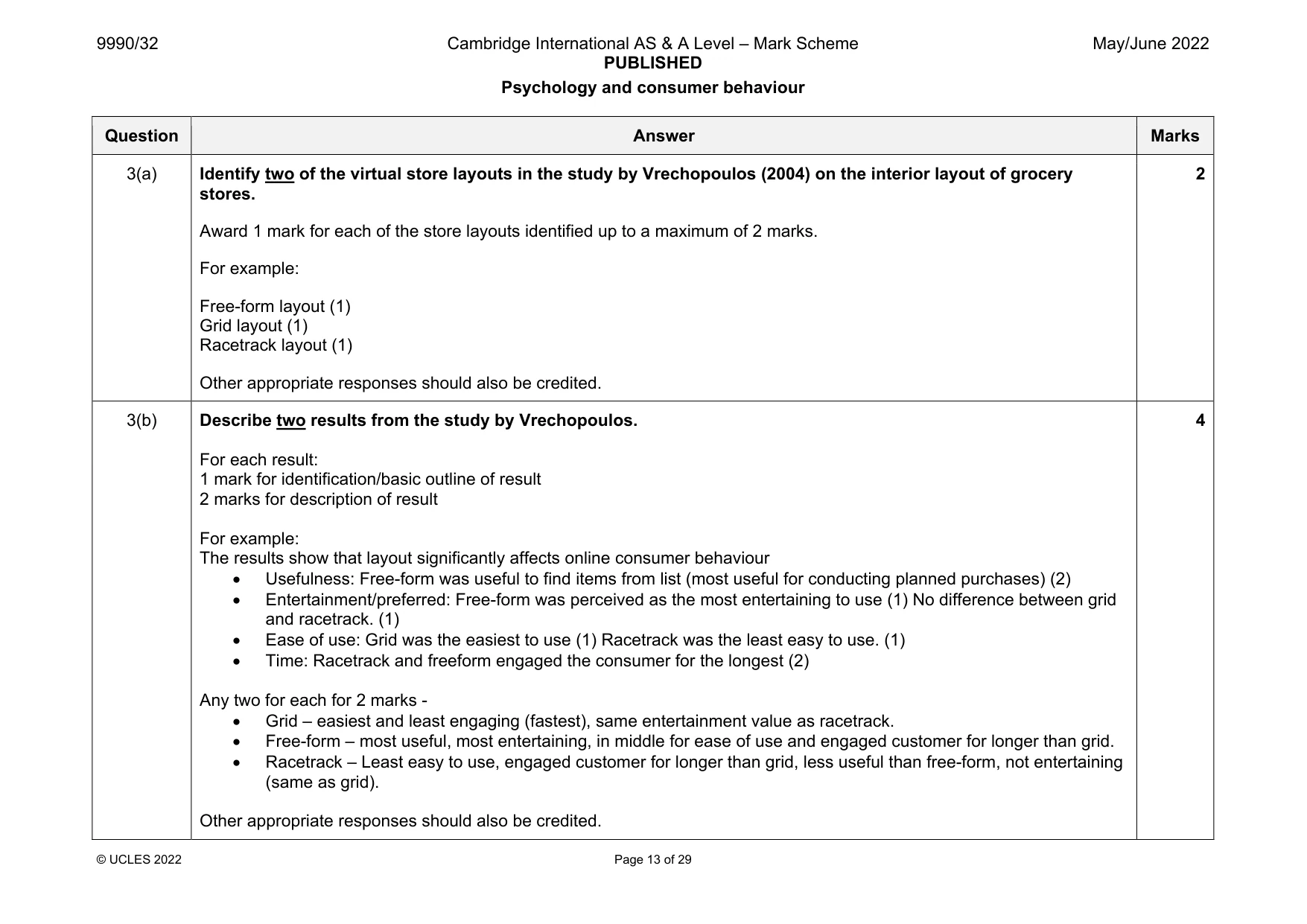
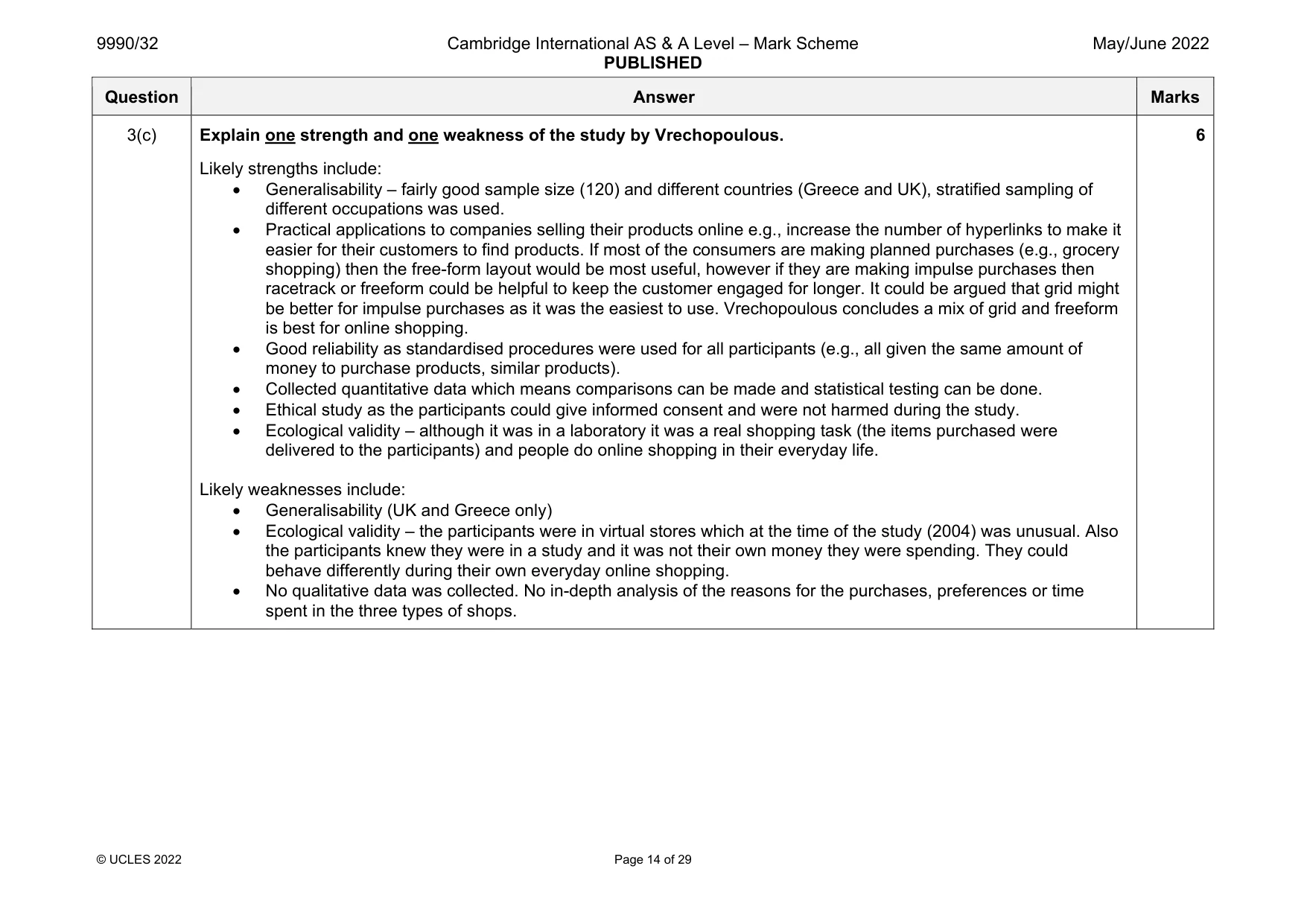
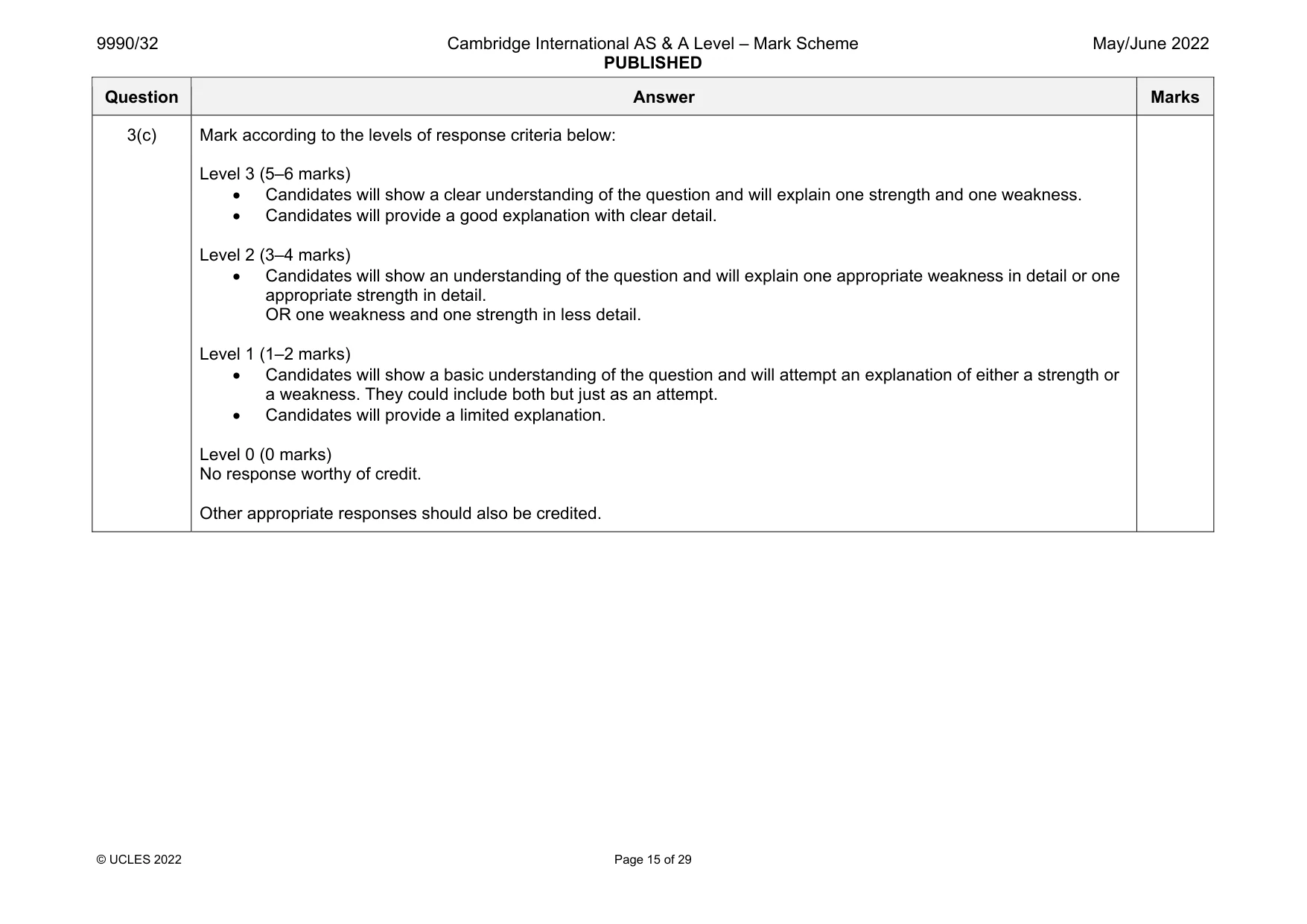
3 (a) Identify two of the virtual store layouts in the study by Vrechopoulos (2004) on the interior layout of grocery stores. [2] (b) Describe two results from the study by Vrechopoulos. [4] (c) Explain one strength and one weakness of the study by Vrechopoulos. [6]
Mark scheme: 3(a) Identify two of the virtual store layouts in the study by Vrechopoulos (2004) on the interior layout of grocery stores. Award 1 mark for each of the store layouts identified up to a maximum of 2 marks. For example: Free-form layout (1) Grid layout (1) Racetrack layout (1) Other appropriate responses should also be credited. 3(b) Describe two results from the study by Vrechopoulos. For each result: 1 mark for identification/basic outline of result 2 marks for description of result For example: The results show that layout significantly affects online consumer behaviour Usefulness: Free-form was useful to find items from list (most useful for conducting planned purchases) (2) Entertainment/preferred: Free-form was perceived as the most entertaining to use (1) No difference between grid and racetrack. (1) Ease of use: Grid was the easiest to use (1) Racetrack was the least easy to use. (1) Time: Racetrack and freeform engaged the consumer for the longest (2) Any two for each for 2 marks - Grid – easiest and least engaging (fastest), same entertainment value as racetrack. Free-form – most useful, most entertaining, in middle for ease of use and engaged customer for longer than grid. Racetrack – Least easy to use, engaged customer for longer than grid, less useful than free-form, not entertaining (same as grid). Other appropriate responses should also be credited. 4 Question Answer Marks 3(c) Explain one strength and one weakness of the study by Vrechopoulous. Likely strengths include: Generalisability – fairly good sample size (120) and different countries (Greece and UK), stratified sampling of different occupations was used. Practical applications to companies selling their products online e.g., increase the number of hyperlinks to make it easier for their customers to find products. If most of the consumers are making planned purchases (e.g., grocery shopping) then the free-form layout would be most useful, however if they are making impulse purchases then racetrack or freeform could be helpful to keep the customer engaged for longer. It could be argued that grid might be better for impulse purchases as it was the easiest to use. Vrechopoulous concludes a mix of grid and freeform is best for online shopping. Good reliability as standardised procedures were used for all participants (e.g., all given the same amount of money to purchase products, similar products). Collected quantitative data which means comparisons can be made and statistical testing can be done. Ethical study as the participants could give informed consent and were not harmed during the study. Ecological validity – although it was in a laboratory it was a real shopping task (the items purchased were delivered to the participants) and people do online shopping in their everyday life. Likely weaknesses include: Generalisability (UK and Greece only) Ecological validity – the participants were in virtual stores which at the time of the study (2004) was unusual. Also the participants knew they were in a study and it was not their own money they were spending. They could behave differently during their own everyday online shopping. No qualitative data was collected. No in-depth analysis of the reasons for the purchases, preferences or time spent in the three types of shops. 6 Question Answer Marks 3(c) Mark according to the levels of response criteria below: Level 3 (5–6 marks) Candidates will show a clear understanding of the question and will explain one strength and one weakness. Candidates will provide a good explanation with clear detail. Level 2 (3–4 marks) Candidates will show an understanding of the question and will explain one appropriate weakness in detail or one appropriate strength in detail. OR one weakness and one strength in less detail. Level 1 (1–2 marks) Candidates will show a basic understanding of the question and will attempt an explanation of either a strength or a weakness. They could include both but just as an attempt. Candidates will provide a limited explanation. Level 0 (0 marks) No response worthy of credit. Other appropriate responses should also be credited.
Q4 · Describe what psychologists have discovered about choice heuristics in consumer…
4 (a) Describe what psychologists have discovered about choice heuristics in consumer decision-making (availability/representativeness, anchoring and purchase quantity decisions, pre-cognitive decisions). [8] (b) Evaluate what psychologists have discovered about choice heuristics in consumer decision-making (availability/representativeness, anchoring and purchase quantity decisions, pre-cognitive decisions), including a discussion about generalisability. [10] Psychology and health Answer all questions.
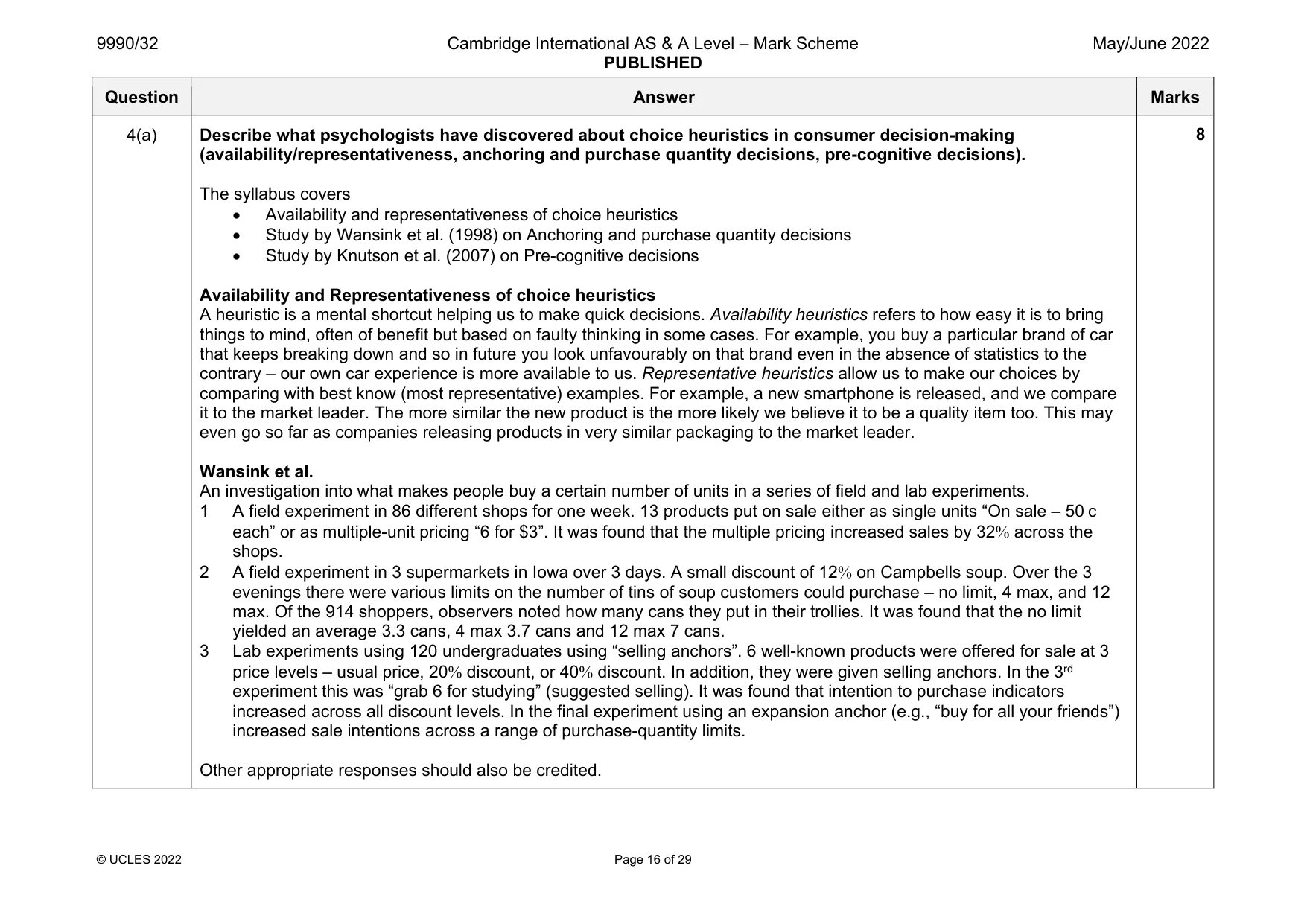
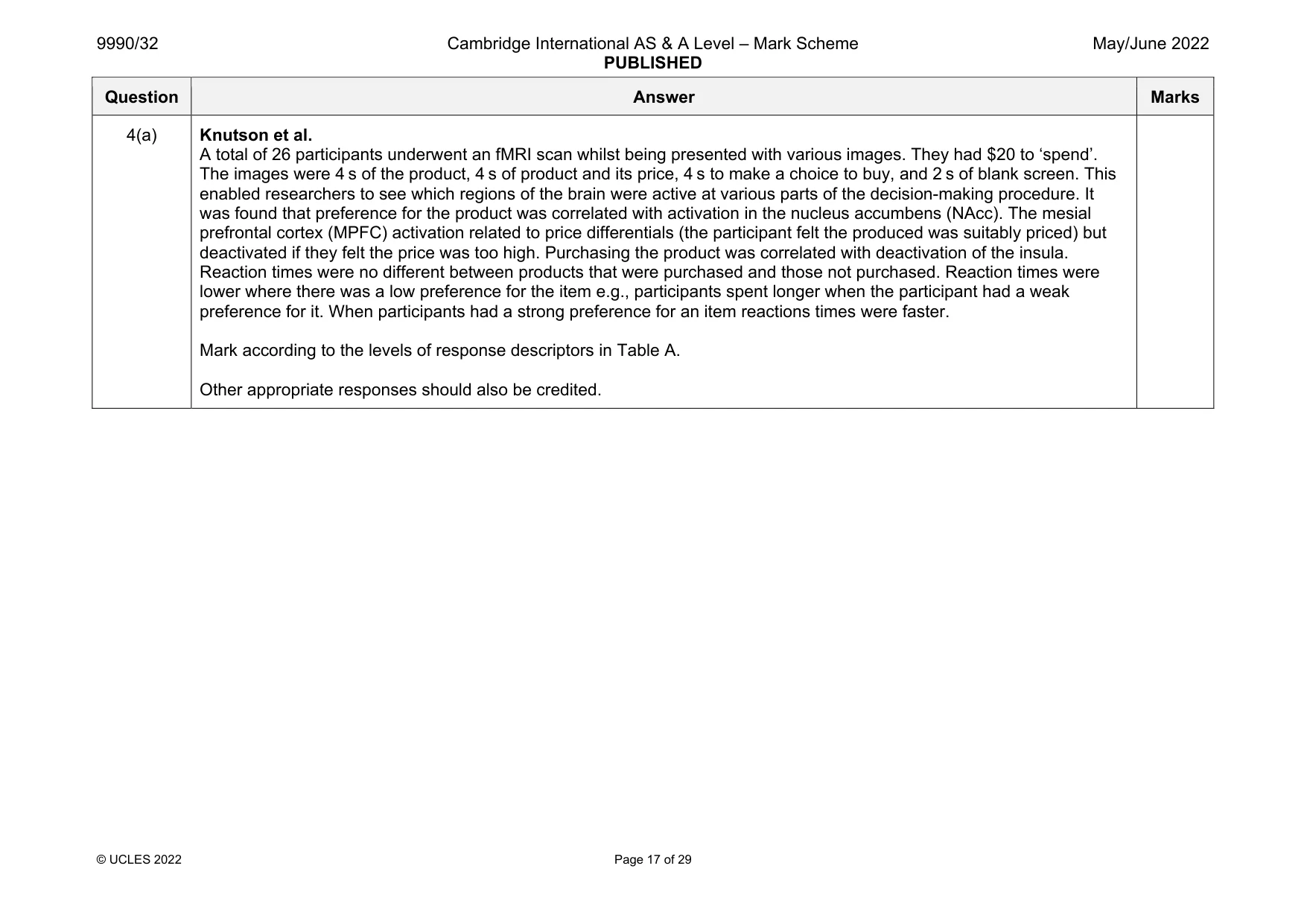
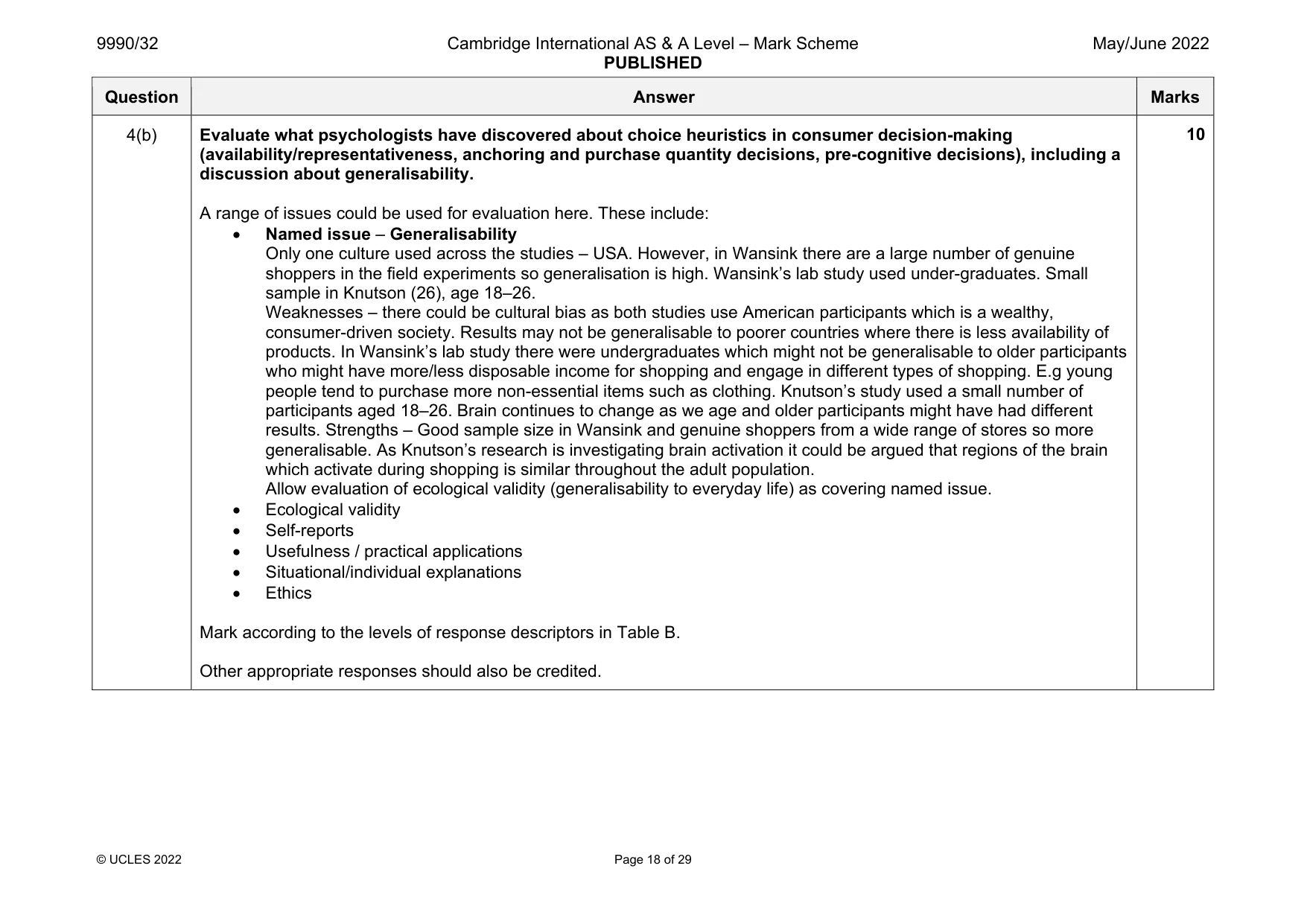
Mark scheme: 4(a) Describe what psychologists have discovered about choice heuristics in consumer decision-making (availability/representativeness, anchoring and purchase quantity decisions, pre-cognitive decisions). The syllabus covers Availability and representativeness of choice heuristics Study by Wansink et al. (1998) on Anchoring and purchase quantity decisions Study by Knutson et al. (2007) on Pre-cognitive decisions Availability and Representativeness of choice heuristics A heuristic is a mental shortcut helping us to make quick decisions. Availability heuristics refers to how easy it is to bring things to mind, often of benefit but based on faulty thinking in some cases. For example, you buy a particular brand of car that keeps breaking down and so in future you look unfavourably on that brand even in the absence of statistics to the contrary – our own car experience is more available to us. Representative heuristics allow us to make our choices by comparing with best know (most representative) examples. For example, a new smartphone is released, and we compare it to the market leader. The more similar the new product is the more likely we believe it to be a quality item too. This may even go so far as companies releasing products in very similar packaging to the market leader. Wansink et al. An investigation into what makes people buy a certain number of units in a series of field and lab experiments. 1 A field experiment in 86 different shops for one week. 13 products put on sale either as single units “On sale – 50 c each” or as multiple-unit pricing “6 for $3”. It was found that the multiple pricing increased sales by 32 across the shops. 2 A field experiment in 3 supermarkets in Iowa over 3 days. A small discount of 12 on Campbells soup. Over the 3 evenings there were various limits on the number of tins of soup customers could purchase – no limit, 4 max, and 12 max. Of the 914 shoppers, observers noted how many cans they put in their trollies. It was found that the no limit yielded an average 3.3 cans, 4 max 3.7 cans and 12 max 7 cans. 3 Lab experiments using 120 undergraduates using “selling anchors”. 6 well-known products were offered for sale at 3 price levels – usual price, 20 discount, or 40 discount. In addition, they were given selling anchors. In the 3rd experiment this was “grab 6 for studying” (suggested selling). It was found that intention to purchase indicators increased across all discount levels. In the final experiment using an expansion anchor (e.g., “buy for all your friends”) increased sale intentions across a range of purchase-quantity limits. Other appropriate responses should also be credited. Question Answer Marks 4(a) Knutson et al. A total of 26 participants underwent an fMRI scan whilst being presented with various images. They had $20 to ‘spend’. The images were 4 s of the product, 4 s of product and its price, 4 s to make a choice to buy, and 2 s of blank screen. This enabled researchers to see which regions of the brain were active at various parts of the decision-making procedure. It was found that preference for the product was correlated with activation in the nucleus accumbens (NAcc). The mesial prefrontal cortex (MPFC) activation related to price differentials (the participant felt the produced was suitably priced) but deactivated if they felt the price was too high. Purchasing the product was correlated with deactivation of the insula. Reaction times were no different between products that were purchased and those not purchased. Reaction times were lower where there was a low preference for the item e.g., participants spent longer when the participant had a weak preference for it. When participants had a strong preference for an item reactions times were faster. Mark according to the levels of response descriptors in Table A. Other appropriate responses should also be credited. Question Answer Marks 4(b) Evaluate what psychologists have discovered about choice heuristics in consumer decision-making (availability/representativeness, anchoring and purchase quantity decisions, pre-cognitive decisions), including a discussion about generalisability. A range of issues could be used for evaluation here. These include: Named issue – Generalisability Only one culture used across the studies – USA. However, in Wansink there are a large number of genuine shoppers in the field experiments so generalisation is high. Wansink’s lab study used under-graduates. Small sample in Knutson (26), age 18–26. Weaknesses – there could be cultural bias as both studies use American participants which is a wealthy, consumer-driven society. Results may not be generalisable to poorer countries where there is less availability of products. In Wansink’s lab study there were undergraduates which might not be generalisable to older participants who might have more/less disposable income for shopping and engage in different types of shopping. E.g young people tend to purchase more non-essential items such as clothing. Knutson’s study used a small number of participants aged 18–26. Brain continues to change as we age and older participants might have had different results. Strengths – Good sample size in Wansink and genuine shoppers from a wide range of stores so more generalisable. As Knutson’s research is investigating brain activation it could be argued that regions of the brain which activate during shopping is similar throughout the adult population. Allow evaluation of ecological validity (generalisability to everyday life) as covering named issue. Ecological validity Self-reports Usefulness / practical applications Situational/individual explanations Ethics Mark according to the levels of response descriptors in Table B. Other appropriate responses should also be credited. 10
Q5 · Outline one reason why patients do not adhere to medical advice
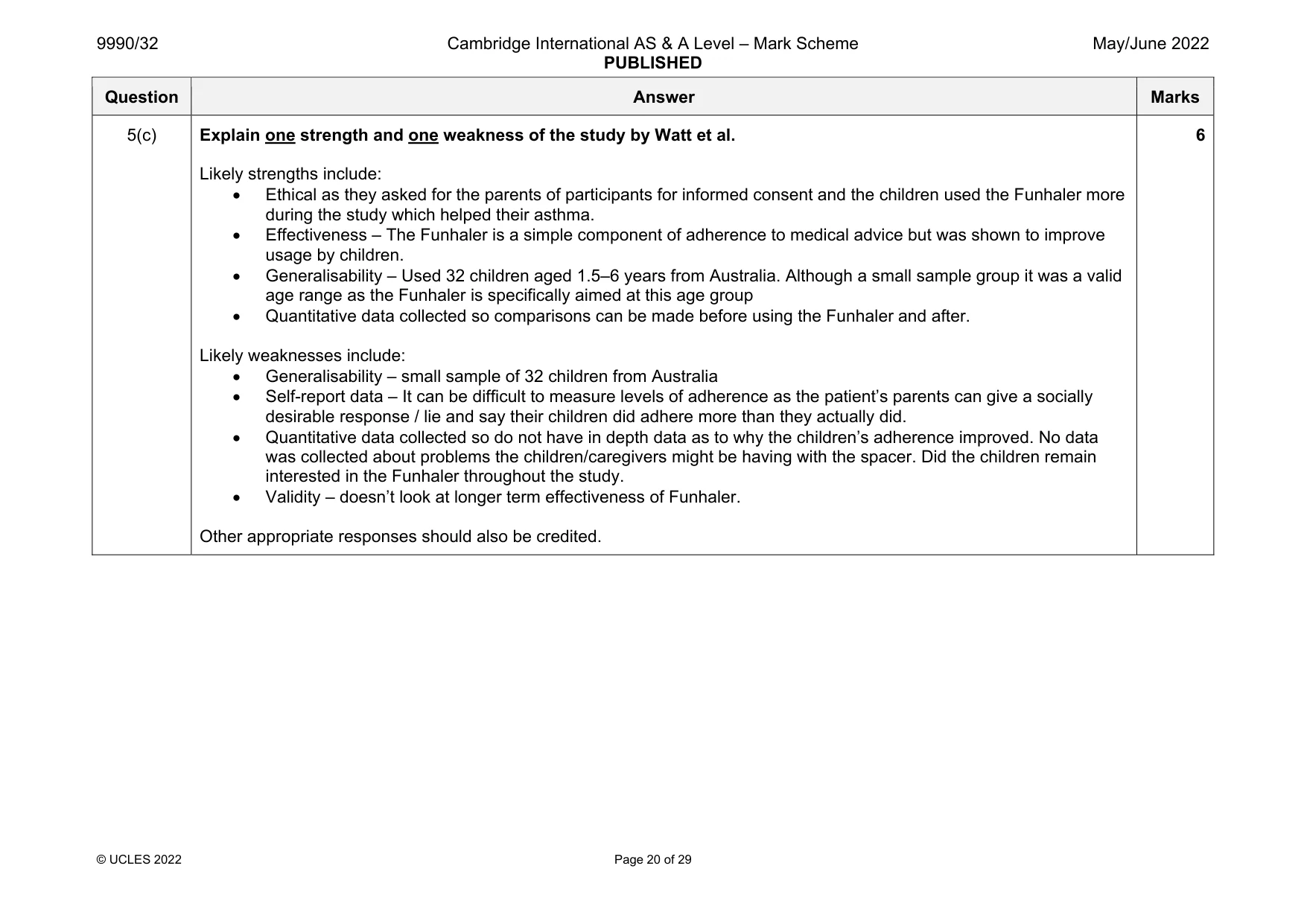
5 (a) Outline one reason why patients do not adhere to medical advice. [2] (b) Describe the study on improving adherence using the Funhaler by Watt et al. (2003). [4] (c) Explain one strength and one weakness of the study by Watt et al. [6]
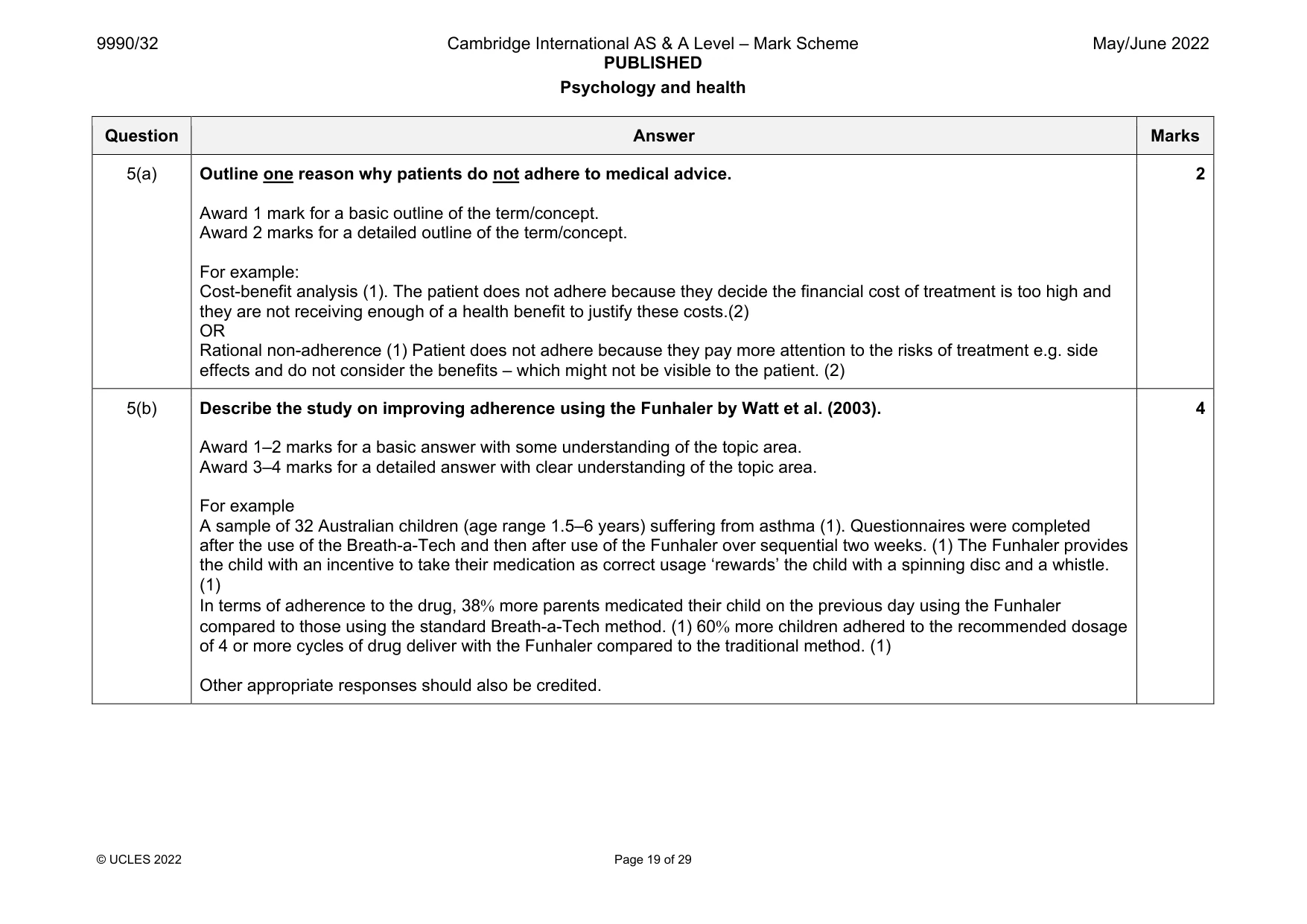
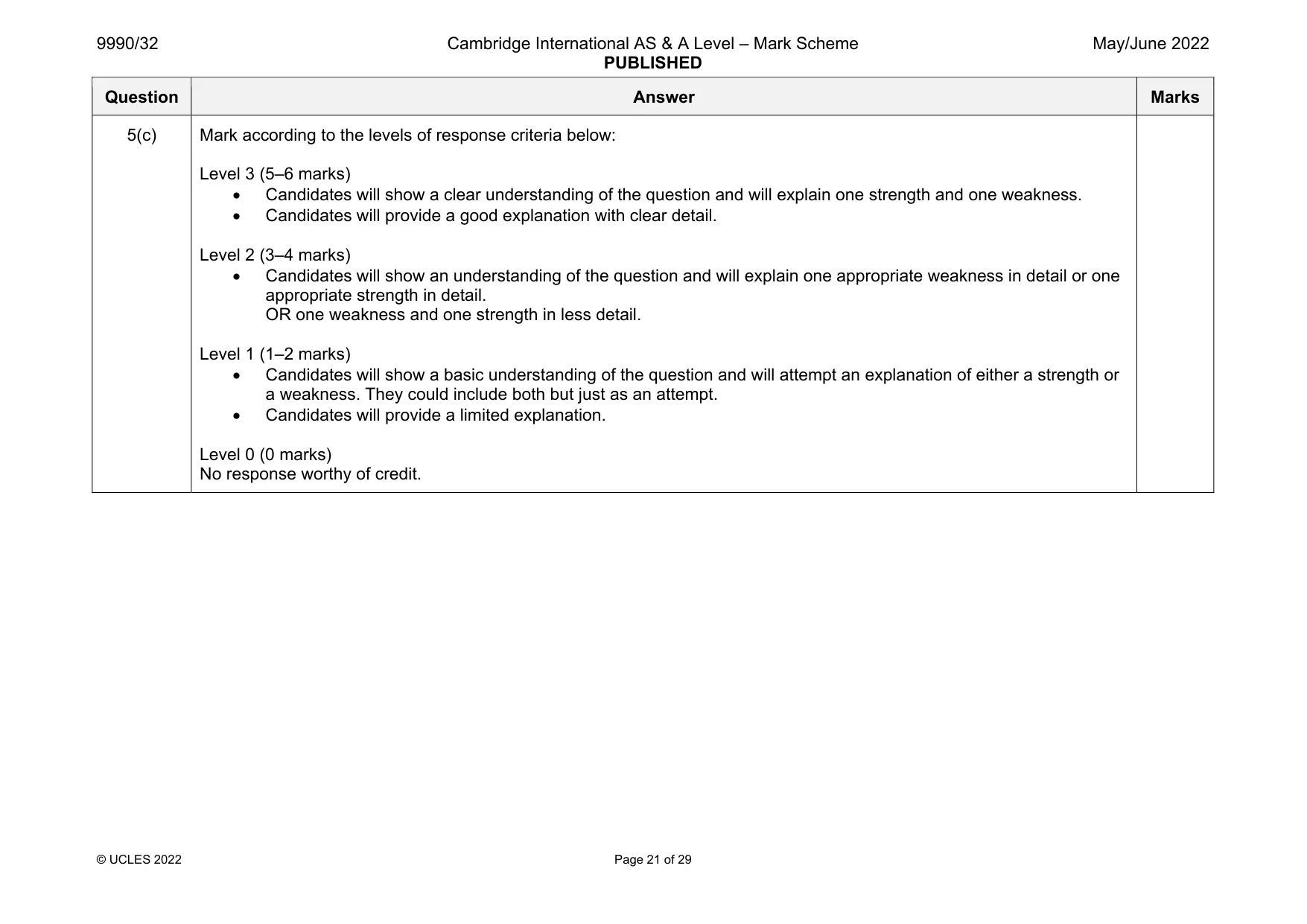
Mark scheme: 5(a) Outline one reason why patients do not adhere to medical advice. Award 1 mark for a basic outline of the term/concept. Award 2 marks for a detailed outline of the term/concept. For example: Cost-benefit analysis (1). The patient does not adhere because they decide the financial cost of treatment is too high and they are not receiving enough of a health benefit to justify these costs.(2) OR Rational non-adherence (1) Patient does not adhere because they pay more attention to the risks of treatment e.g. side effects and do not consider the benefits – which might not be visible to the patient. (2) 2 5(b) Describe the study on improving adherence using the Funhaler by Watt et al. (2003). Award 1–2 marks for a basic answer with some understanding of the topic area. Award 3–4 marks for a detailed answer with clear understanding of the topic area. For example A sample of 32 Australian children (age range 1.5–6 years) suffering from asthma (1). Questionnaires were completed after the use of the Breath-a-Tech and then after use of the Funhaler over sequential two weeks. (1) The Funhaler provides the child with an incentive to take their medication as correct usage ‘rewards’ the child with a spinning disc and a whistle. (1) In terms of adherence to the drug, 38 more parents medicated their child on the previous day using the Funhaler compared to those using the standard Breath-a-Tech method. (1) 60 more children adhered to the recommended dosage of 4 or more cycles of drug deliver with the Funhaler compared to the traditional method. (1) Other appropriate responses should also be credited. 4 Question Answer Marks 5(c) Explain one strength and one weakness of the study by Watt et al. Likely strengths include: Ethical as they asked for the parents of participants for informed consent and the children used the Funhaler more during the study which helped their asthma. Effectiveness – The Funhaler is a simple component of adherence to medical advice but was shown to improve usage by children. Generalisability – Used 32 children aged 1.5–6 years from Australia. Although a small sample group it was a valid age range as the Funhaler is specifically aimed at this age group Quantitative data collected so comparisons can be made before using the Funhaler and after. Likely weaknesses include: Generalisability – small sample of 32 children from Australia Self-report data – It can be difficult to measure levels of adherence as the patient’s parents can give a socially desirable response / lie and say their children did adhere more than they actually did. Quantitative data collected so do not have in depth data as to why the children’s adherence improved. No data was collected about problems the children/caregivers might be having with the spacer. Did the children remain interested in the Funhaler throughout the study. Validity – doesn’t look at longer term effectiveness of Funhaler. Other appropriate responses should also be credited. 6 Question Answer Marks 5(c) Mark according to the levels of response criteria below: Level 3 (5–6 marks) Candidates will show a clear understanding of the question and will explain one strength and one weakness. Candidates will provide a good explanation with clear detail. Level 2 (3–4 marks) Candidates will show an understanding of the question and will explain one appropriate weakness in detail or one appropriate strength in detail. OR one weakness and one strength in less detail. Level 1 (1–2 marks) Candidates will show a basic understanding of the question and will attempt an explanation of either a strength or a weakness. They could include both but just as an attempt. Candidates will provide a limited explanation. Level 0 (0 marks) No response worthy of credit.
Q6 · Describe what psychologists have discovered about individual factors in changing health…
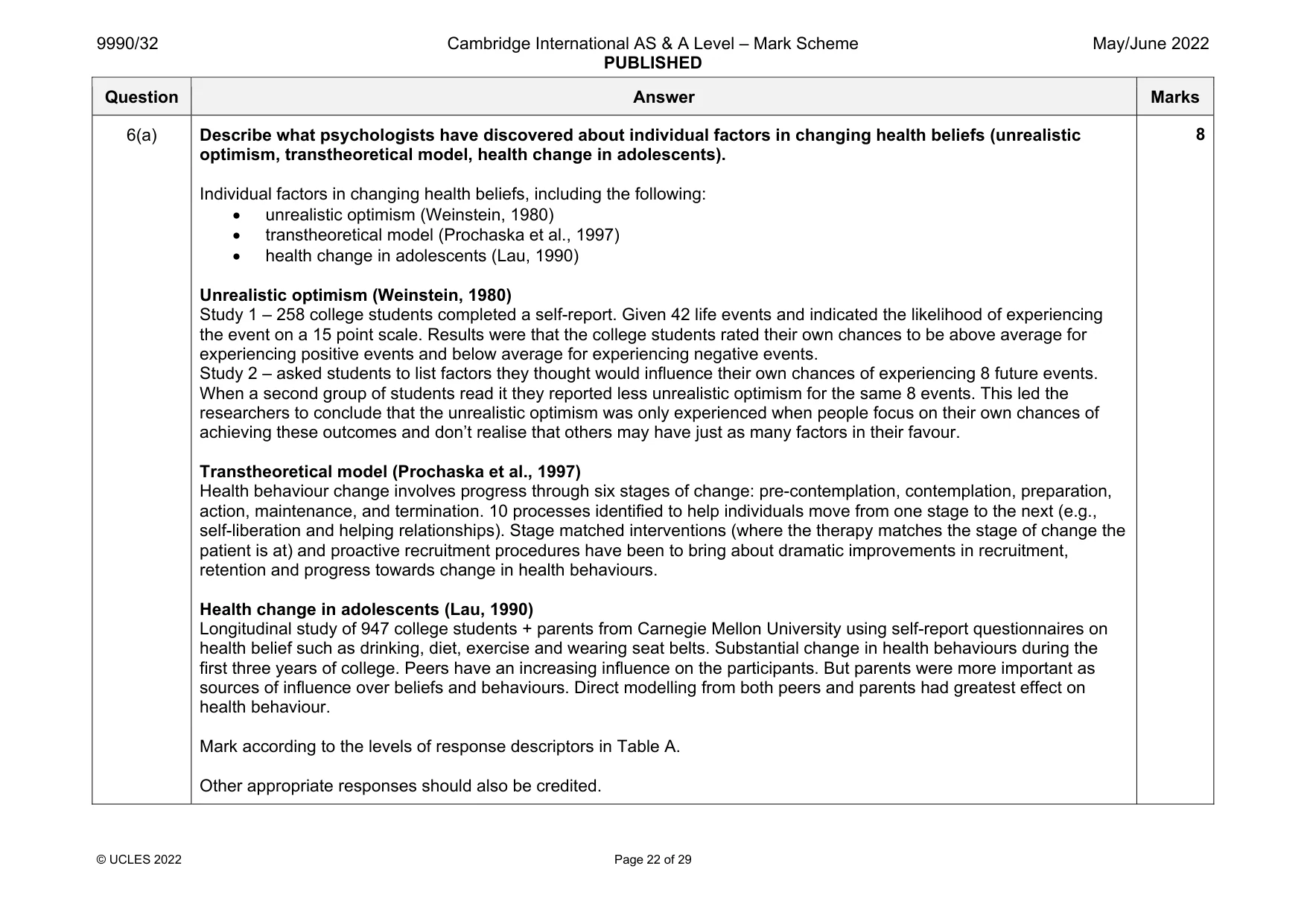
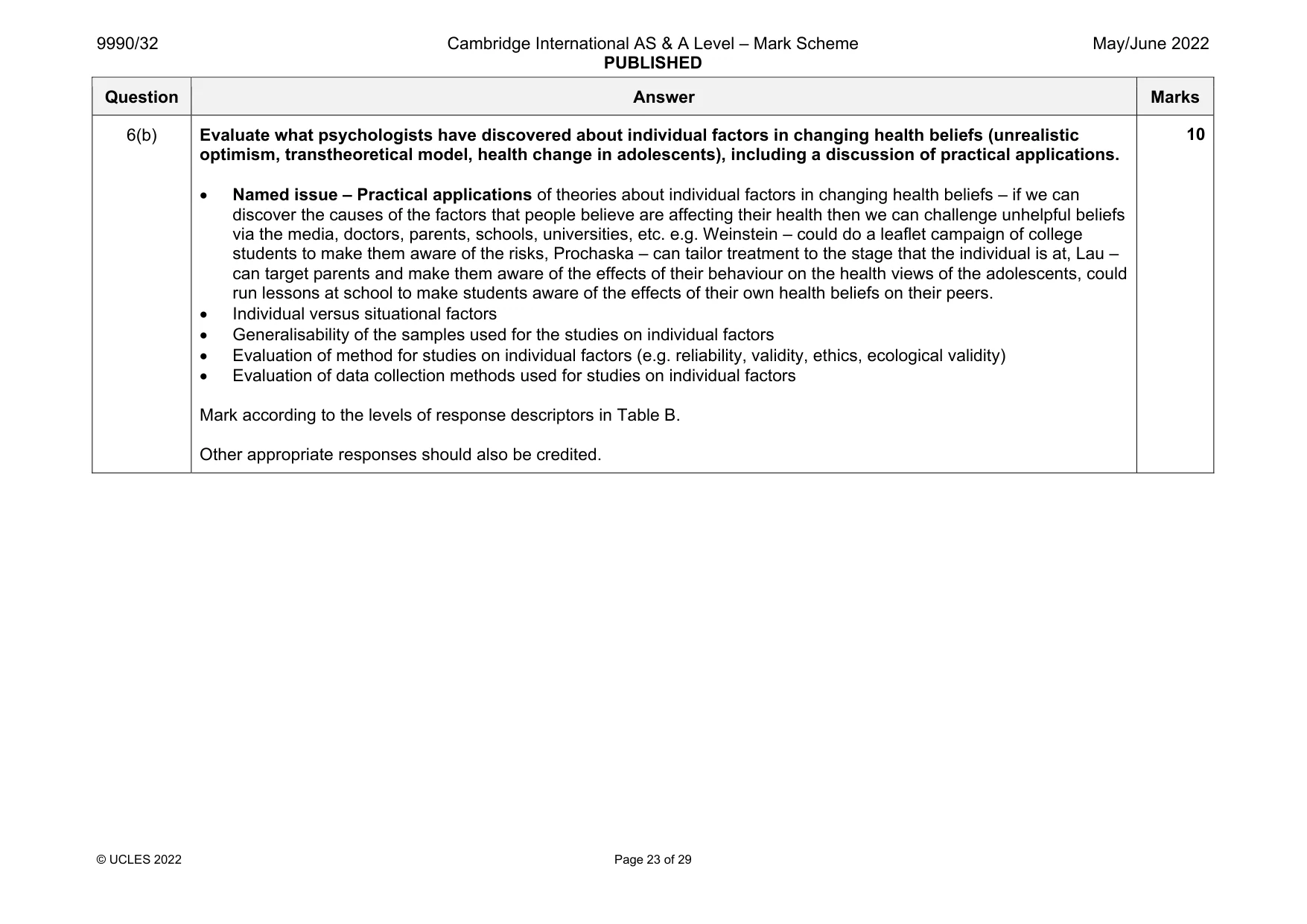
6 (a) Describe what psychologists have discovered about individual factors in changing health beliefs (unrealistic optimism, transtheoretical model, health change in adolescents). [8] (b) Evaluate what psychologists have discovered about individual factors in changing health beliefs (unrealistic optimism, transtheoretical model, health change in adolescents), including a discussion of practical applications. [10] Psychology and organisations Answer all questions.
Mark scheme: 6(a) Describe what psychologists have discovered about individual factors in changing health beliefs (unrealistic optimism, transtheoretical model, health change in adolescents). Individual factors in changing health beliefs, including the following: unrealistic optimism (Weinstein, 1980) transtheoretical model (Prochaska et al., 1997) health change in adolescents (Lau, 1990) Unrealistic optimism (Weinstein, 1980) Study 1 – 258 college students completed a self-report. Given 42 life events and indicated the likelihood of experiencing the event on a 15 point scale. Results were that the college students rated their own chances to be above average for experiencing positive events and below average for experiencing negative events. Study 2 – asked students to list factors they thought would influence their own chances of experiencing 8 future events. When a second group of students read it they reported less unrealistic optimism for the same 8 events. This led the researchers to conclude that the unrealistic optimism was only experienced when people focus on their own chances of achieving these outcomes and don’t realise that others may have just as many factors in their favour. Transtheoretical model (Prochaska et al., 1997) Health behaviour change involves progress through six stages of change: pre-contemplation, contemplation, preparation, action, maintenance, and termination. 10 processes identified to help individuals move from one stage to the next (e.g., self-liberation and helping relationships). Stage matched interventions (where the therapy matches the stage of change the patient is at) and proactive recruitment procedures have been to bring about dramatic improvements in recruitment, retention and progress towards change in health behaviours. Health change in adolescents (Lau, 1990) Longitudinal study of 947 college students + parents from Carnegie Mellon University using self-report questionnaires on health belief such as drinking, diet, exercise and wearing seat belts. Substantial change in health behaviours during the first three years of college. Peers have an increasing influence on the participants. But parents were more important as sources of influence over beliefs and behaviours. Direct modelling from both peers and parents had greatest effect on health behaviour. Mark according to the levels of response descriptors in Table A. Other appropriate responses should also be credited. Question Answer Marks 6(b) Evaluate what psychologists have discovered about individual factors in changing health beliefs (unrealistic optimism, transtheoretical model, health change in adolescents), including a discussion of practical applications. Named issue – Practical applications of theories about individual factors in changing health beliefs – if we can discover the causes of the factors that people believe are affecting their health then we can challenge unhelpful beliefs via the media, doctors, parents, schools, universities, etc. e.g. Weinstein – could do a leaflet campaign of college students to make them aware of the risks, Prochaska – can tailor treatment to the stage that the individual is at, Lau – can target parents and make them aware of the effects of their behaviour on the health views of the adolescents, could run lessons at school to make students aware of the effects of their own health beliefs on their peers. Individual versus situational factors Generalisability of the samples used for the studies on individual factors Evaluation of method for studies on individual factors (e.g. reliability, validity, ethics, ecological validity) Evaluation of data collection methods used for studies on individual factors Mark according to the levels of response descriptors in Table B. Other appropriate responses should also be credited. 10
More questions on 2 Health promotion in schools and worksites
Q7 · Outline one universalist theory of leadership
7 (a) Outline one universalist theory of leadership. [2] (b) Describe the contingency theory of leadership proposed by Fiedler (1967). [4] (c) Explain one strength and one weakness of the contingency theory of leadership. [6]
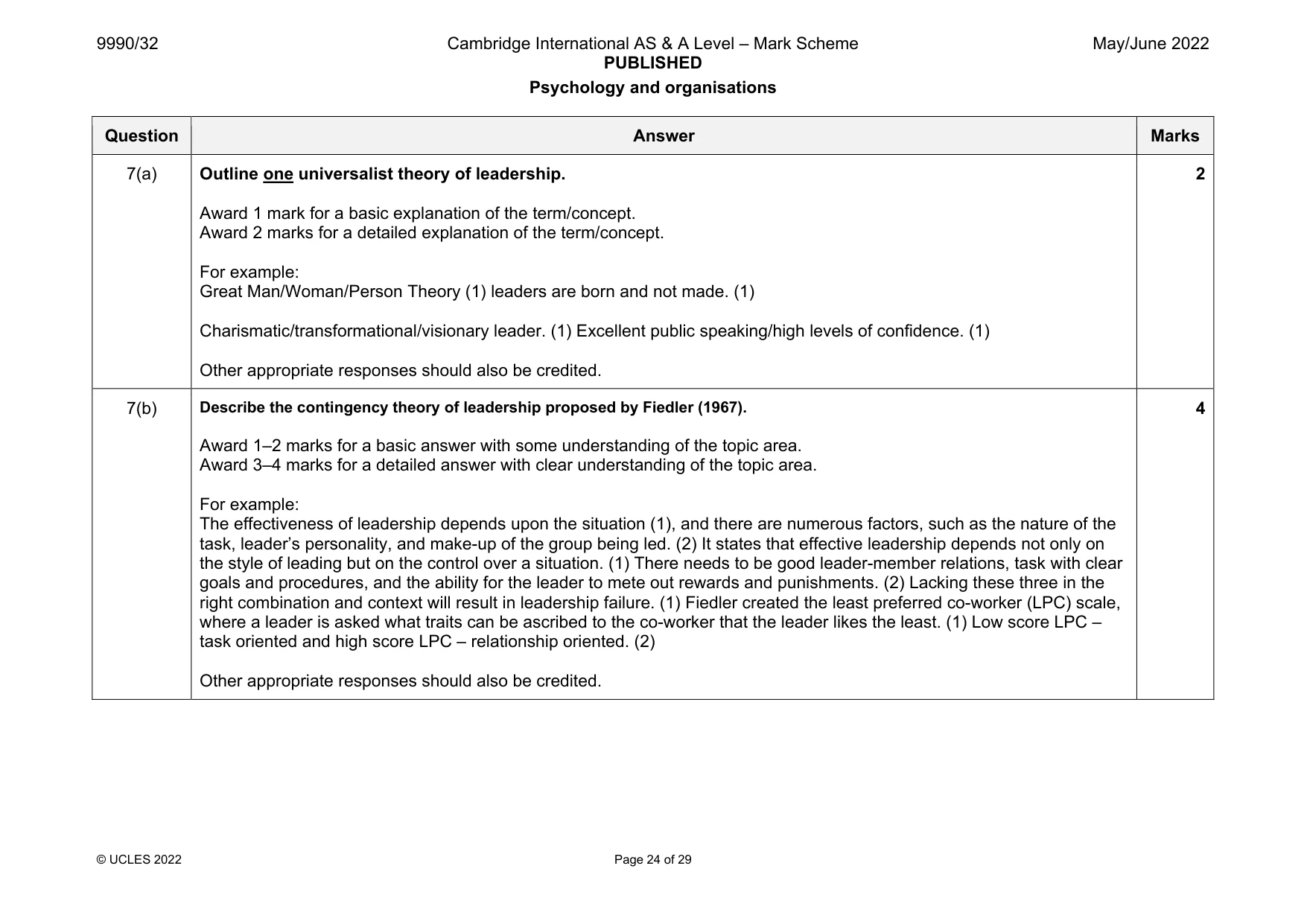
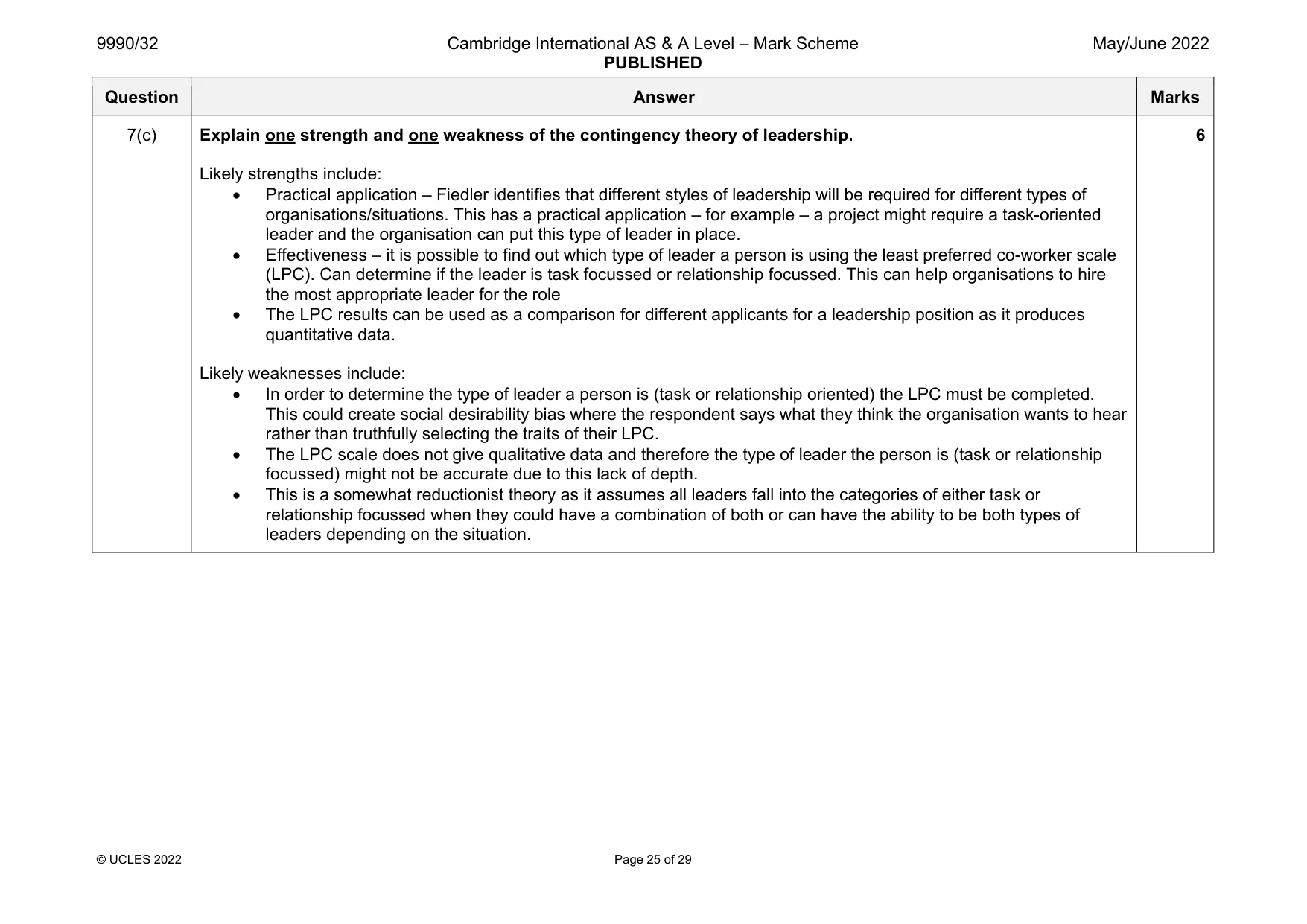
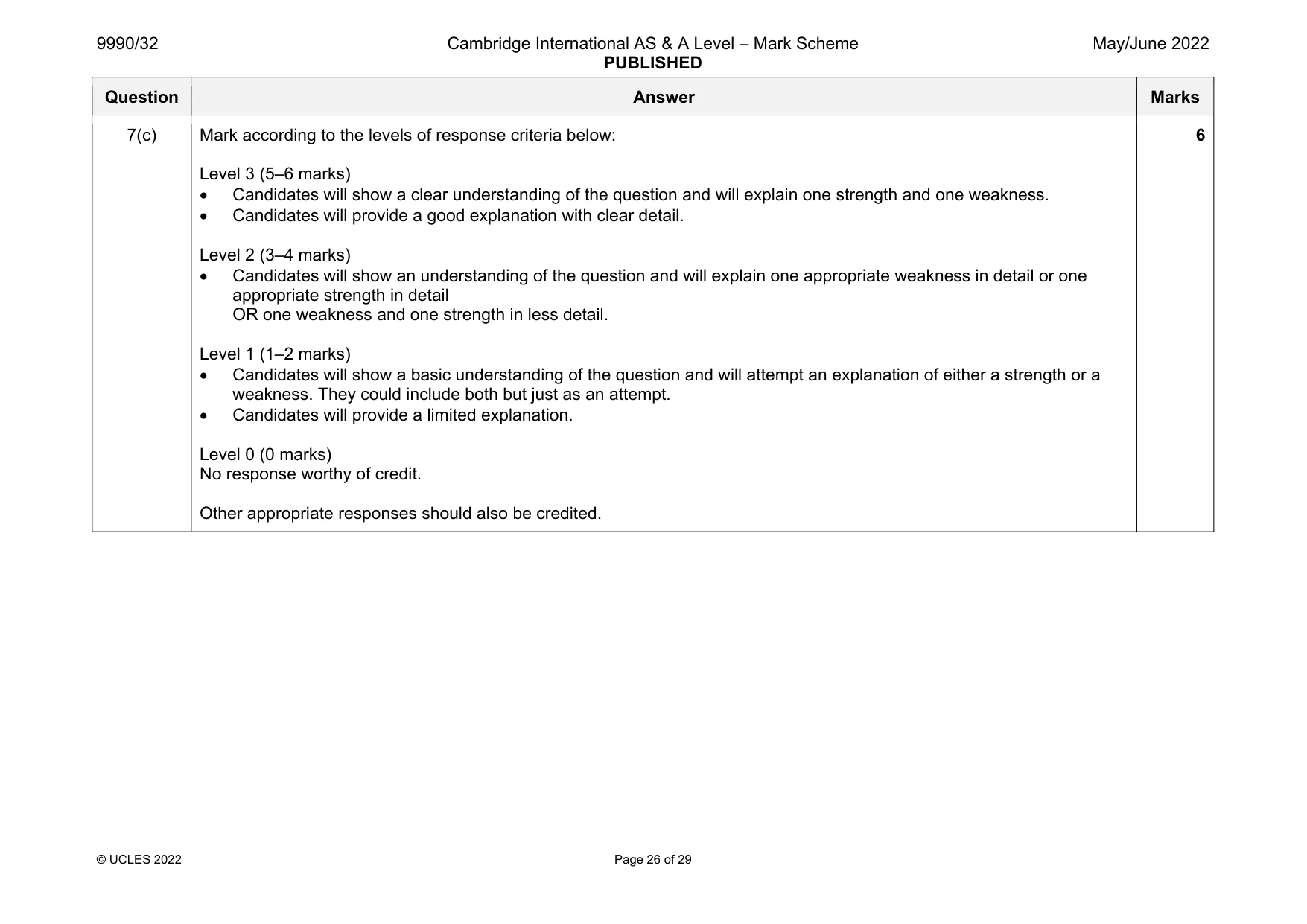
Mark scheme: 7(a) Outline one universalist theory of leadership. Award 1 mark for a basic explanation of the term/concept. Award 2 marks for a detailed explanation of the term/concept. For example: Great Man/Woman/Person Theory (1) leaders are born and not made. (1) Charismatic/transformational/visionary leader. (1) Excellent public speaking/high levels of confidence. (1) Other appropriate responses should also be credited. 7(b) Describe the contingency theory of leadership proposed by Fiedler (1967). Award 1–2 marks for a basic answer with some understanding of the topic area. Award 3–4 marks for a detailed answer with clear understanding of the topic area. For example: The effectiveness of leadership depends upon the situation (1), and there are numerous factors, such as the nature of the task, leader’s personality, and make-up of the group being led. (2) It states that effective leadership depends not only on the style of leading but on the control over a situation. (1) There needs to be good leader-member relations, task with clear goals and procedures, and the ability for the leader to mete out rewards and punishments. (2) Lacking these three in the right combination and context will result in leadership failure. (1) Fiedler created the least preferred co-worker (LPC) scale, where a leader is asked what traits can be ascribed to the co-worker that the leader likes the least. (1) Low score LPC – task oriented and high score LPC – relationship oriented. (2) Other appropriate responses should also be credited. 4 Question Answer Marks 7(c) Explain one strength and one weakness of the contingency theory of leadership. Likely strengths include: Practical application – Fiedler identifies that different styles of leadership will be required for different types of organisations/situations. This has a practical application – for example – a project might require a task-oriented leader and the organisation can put this type of leader in place. Effectiveness – it is possible to find out which type of leader a person is using the least preferred co-worker scale (LPC). Can determine if the leader is task focussed or relationship focussed. This can help organisations to hire the most appropriate leader for the role The LPC results can be used as a comparison for different applicants for a leadership position as it produces quantitative data. Likely weaknesses include: In order to determine the type of leader a person is (task or relationship oriented) the LPC must be completed. This could create social desirability bias where the respondent says what they think the organisation wants to hear rather than truthfully selecting the traits of their LPC. The LPC scale does not give qualitative data and therefore the type of leader the person is (task or relationship focussed) might not be accurate due to this lack of depth. This is a somewhat reductionist theory as it assumes all leaders fall into the categories of either task or relationship focussed when they could have a combination of both or can have the ability to be both types of leaders depending on the situation. 6 Question Answer Marks 7(c) Mark according to the levels of response criteria below: Level 3 (5–6 marks) Candidates will show a clear understanding of the question and will explain one strength and one weakness. Candidates will provide a good explanation with clear detail. Level 2 (3–4 marks) Candidates will show an understanding of the question and will explain one appropriate weakness in detail or one appropriate strength in detail OR one weakness and one strength in less detail. Level 1 (1–2 marks) Candidates will show a basic understanding of the question and will attempt an explanation of either a strength or a weakness. They could include both but just as an attempt. Candidates will provide a limited explanation. Level 0 (0 marks) No response worthy of credit. Other appropriate responses should also be credited. 6
Q8 · Describe what psychologists have discovered about temporal conditions of work…
8 (a) Describe what psychologists have discovered about temporal conditions of work environments (shift-work, effects of shift-work on health, shift-work and accidents). [8] (b) Evaluate what psychologists have discovered about temporal conditions of work environments (shift-work, effects of shift-work on health, shift-work and accidents), including a discussion about ecological validity. [10]
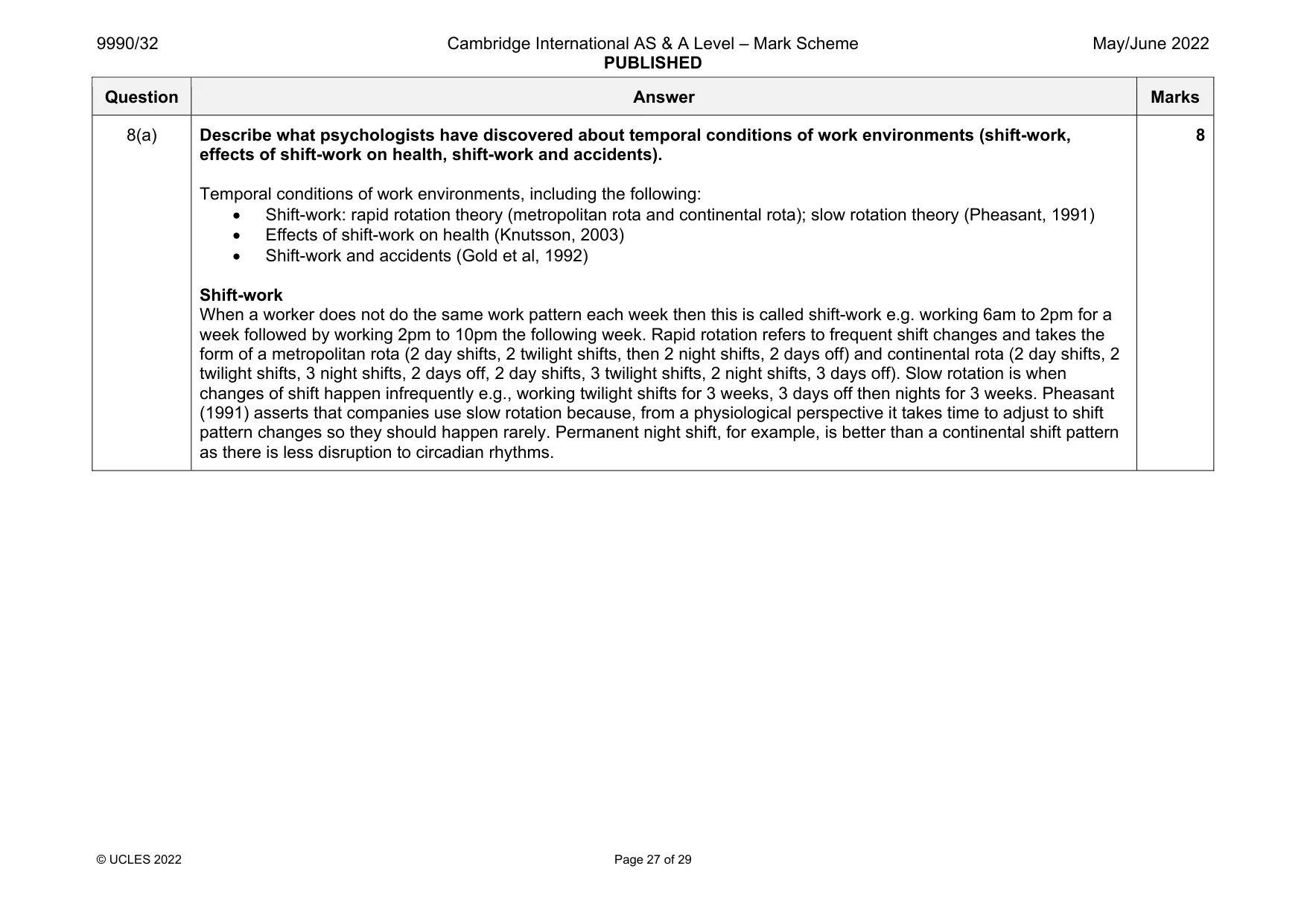
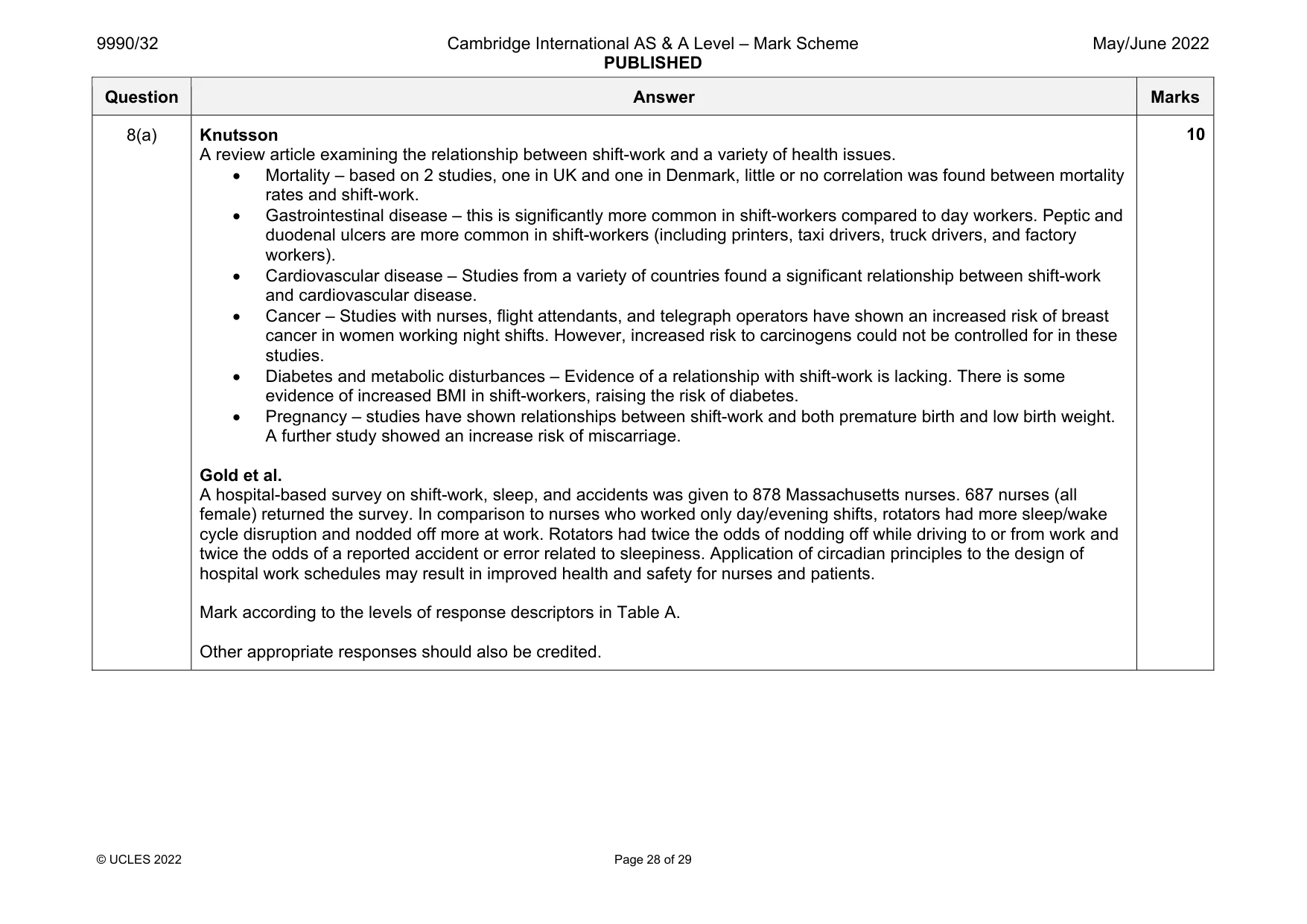
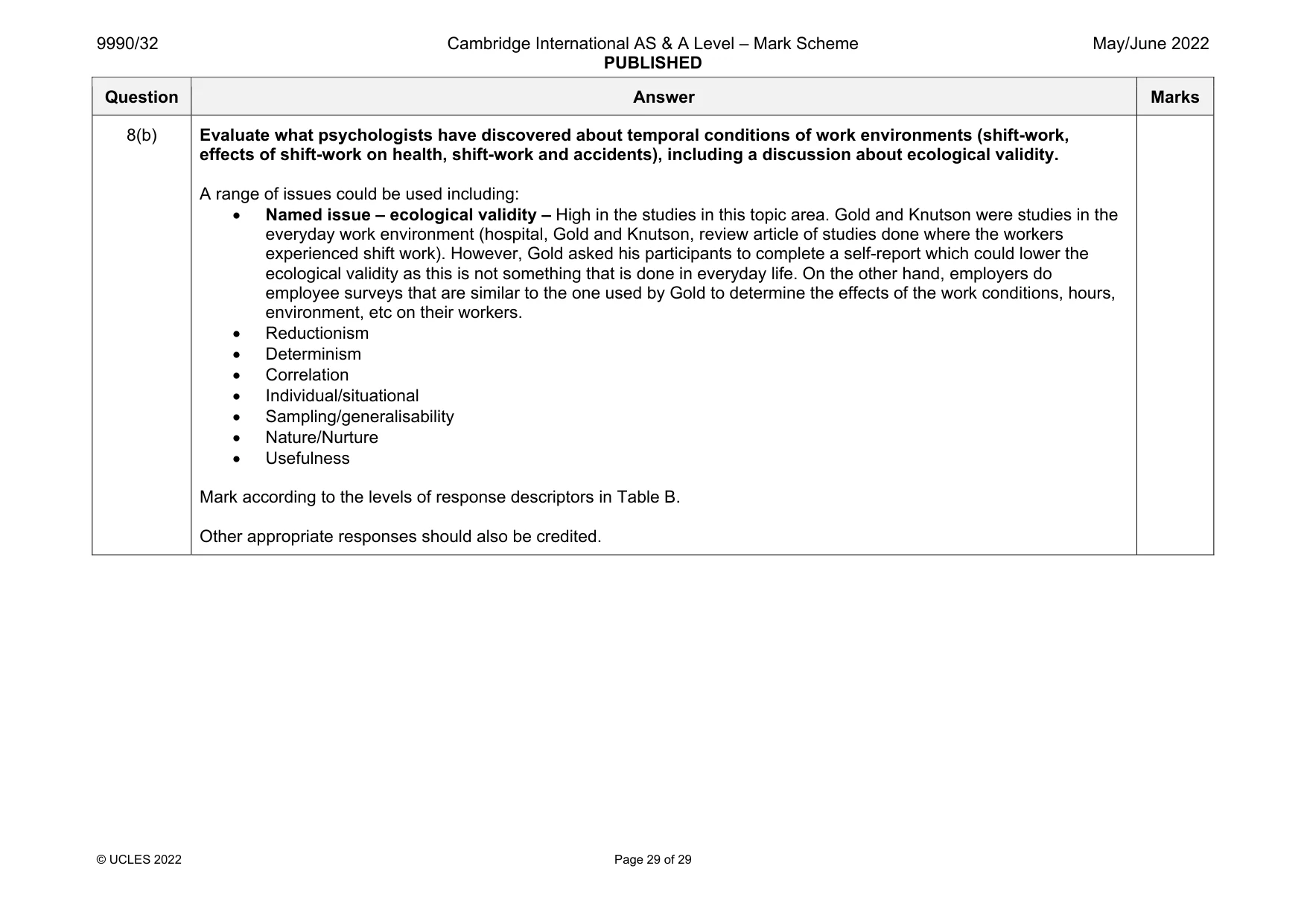
Mark scheme: 8(a) Describe what psychologists have discovered about temporal conditions of work environments (shift-work, effects of shift-work on health, shift-work and accidents). Temporal conditions of work environments, including the following: Shift-work: rapid rotation theory (metropolitan rota and continental rota); slow rotation theory (Pheasant, 1991) Effects of shift-work on health (Knutsson, 2003) Shift-work and accidents (Gold et al, 1992) Shift-work When a worker does not do the same work pattern each week then this is called shift-work e.g. working 6am to 2pm for a week followed by working 2pm to 10pm the following week. Rapid rotation refers to frequent shift changes and takes the form of a metropolitan rota (2 day shifts, 2 twilight shifts, then 2 night shifts, 2 days off) and continental rota (2 day shifts, 2 twilight shifts, 3 night shifts, 2 days off, 2 day shifts, 3 twilight shifts, 2 night shifts, 3 days off). Slow rotation is when changes of shift happen infrequently e.g., working twilight shifts for 3 weeks, 3 days off then nights for 3 weeks. Pheasant (1991) asserts that companies use slow rotation because, from a physiological perspective it takes time to adjust to shift pattern changes so they should happen rarely. Permanent night shift, for example, is better than a continental shift pattern as there is less disruption to circadian rhythms. 8 Question Answer Marks 8(a) Knutsson A review article examining the relationship between shift-work and a variety of health issues. Mortality – based on 2 studies, one in UK and one in Denmark, little or no correlation was found between mortality rates and shift-work. Gastrointestinal disease – this is significantly more common in shift-workers compared to day workers. Peptic and duodenal ulcers are more common in shift-workers (including printers, taxi drivers, truck drivers, and factory workers). Cardiovascular disease – Studies from a variety of countries found a significant relationship between shift-work and cardiovascular disease. Cancer – Studies with nurses, flight attendants, and telegraph operators have shown an increased risk of breast cancer in women working night shifts. However, increased risk to carcinogens could not be controlled for in these studies. Diabetes and metabolic disturbances – Evidence of a relationship with shift-work is lacking. There is some evidence of increased BMI in shift-workers, raising the risk of diabetes. Pregnancy – studies have shown relationships between shift-work and both premature birth and low birth weight. A further study showed an increase risk of miscarriage. Gold et al. A hospital-based survey on shift-work, sleep, and accidents was given to 878 Massachusetts nurses. 687 nurses (all female) returned the survey. In comparison to nurses who worked only day/evening shifts, rotators had more sleep/wake cycle disruption and nodded off more at work. Rotators had twice the odds of nodding off while driving to or from work and twice the odds of a reported accident or error related to sleepiness. Application of circadian principles to the design of hospital work schedules may result in improved health and safety for nurses and patients. Mark according to the levels of response descriptors in Table A. Other appropriate responses should also be credited. 10 Question Answer Marks 8(b) Evaluate what psychologists have discovered about temporal conditions of work environments (shift-work, effects of shift-work on health, shift-work and accidents), including a discussion about ecological validity. A range of issues could be used including: Named issue – ecological validity – High in the studies in this topic area. Gold and Knutson were studies in the everyday work environment (hospital, Gold and Knutson, review article of studies done where the workers experienced shift work). However, Gold asked his participants to complete a self-report which could lower the ecological validity as this is not something that is done in everyday life. On the other hand, employers do employee surveys that are similar to the one used by Gold to determine the effects of the work conditions, hours, environment, etc on their workers. Reductionism Determinism Correlation Individual/situational Sampling/generalisability Nature/Nurture Usefulness Mark according to the levels of response descriptors in Table B. Other appropriate responses should also be credited.
What was in this paper
The subtopics covered by these 8 questions, and how many questions each got. Open one in a new tab to see every Cambridge question on it.
What you needed in this session
Cambridge’s own grade thresholds for 2022 May/June, Paper 3 · Variant 2. A higher threshold means an easier paper — the bar moves with how the cohort did.