Cambridge A Level Psychology (from 2018) 9990 — 2022 May/June Paper 3 · Variant 1
9990/31/M/J/22 · 8 questions · 60 marks · ≈68 min
The question paper and its mark scheme, free to read here and free to download. This is Cambridge’s own paper, exactly as it was sat.
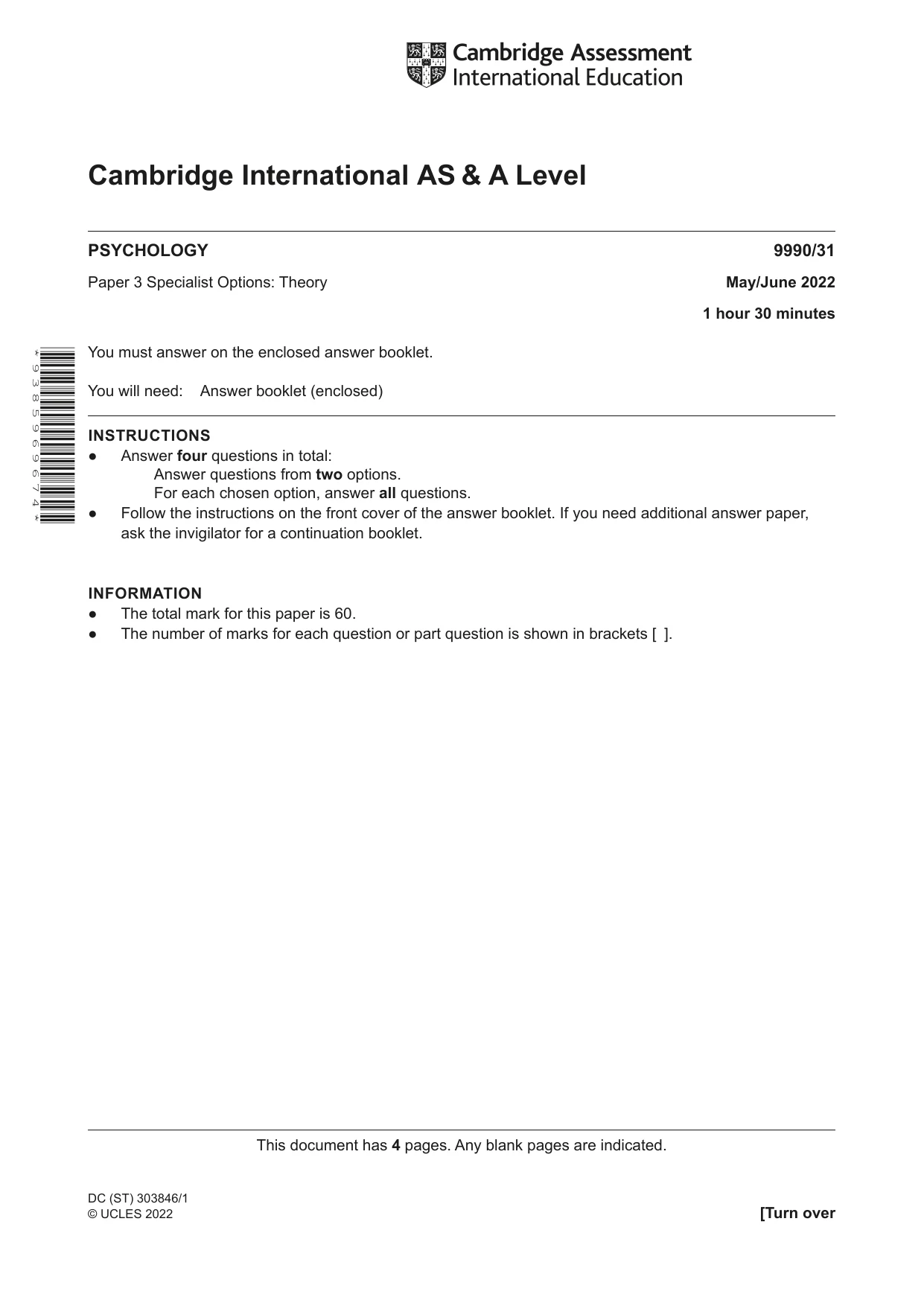
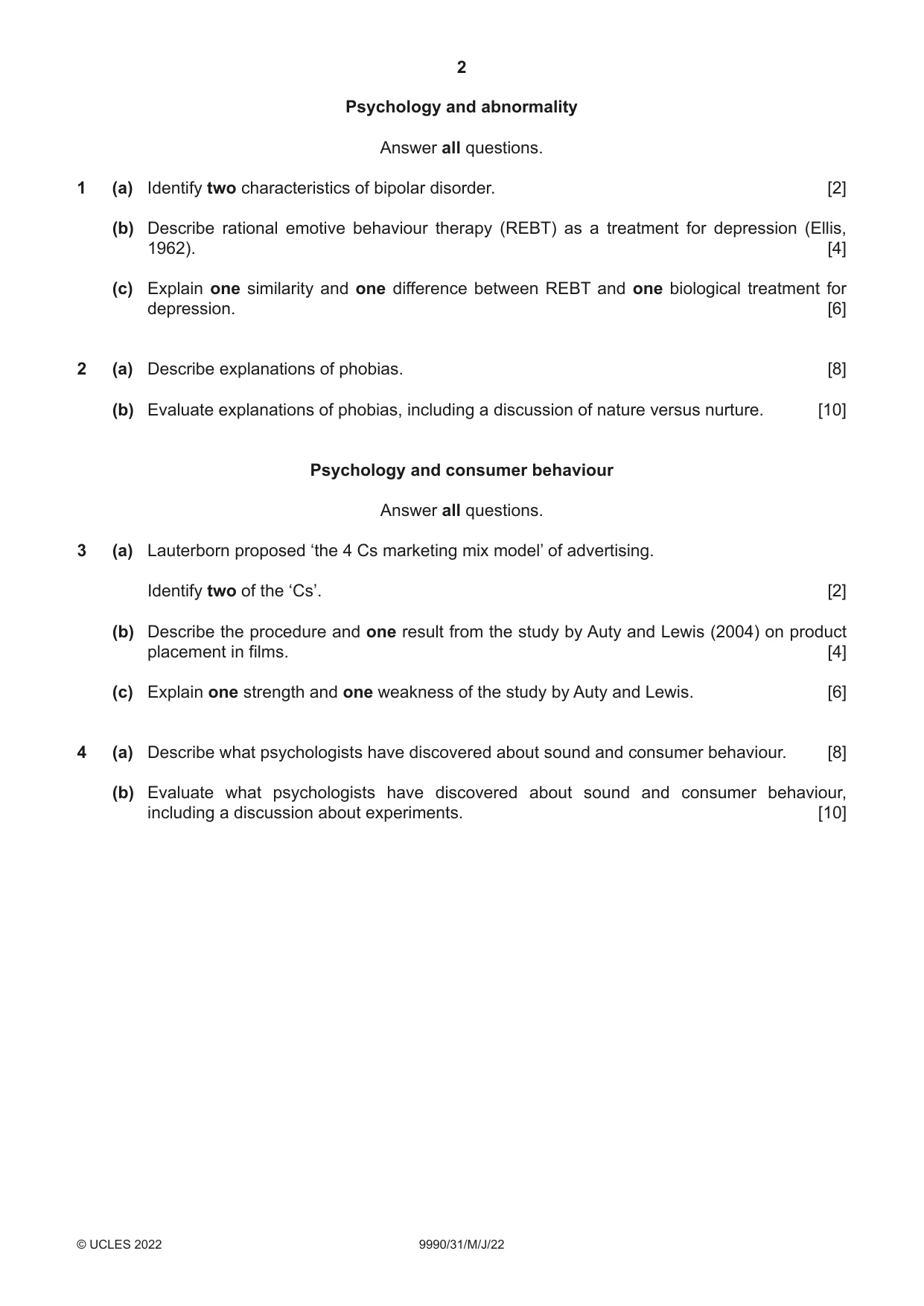
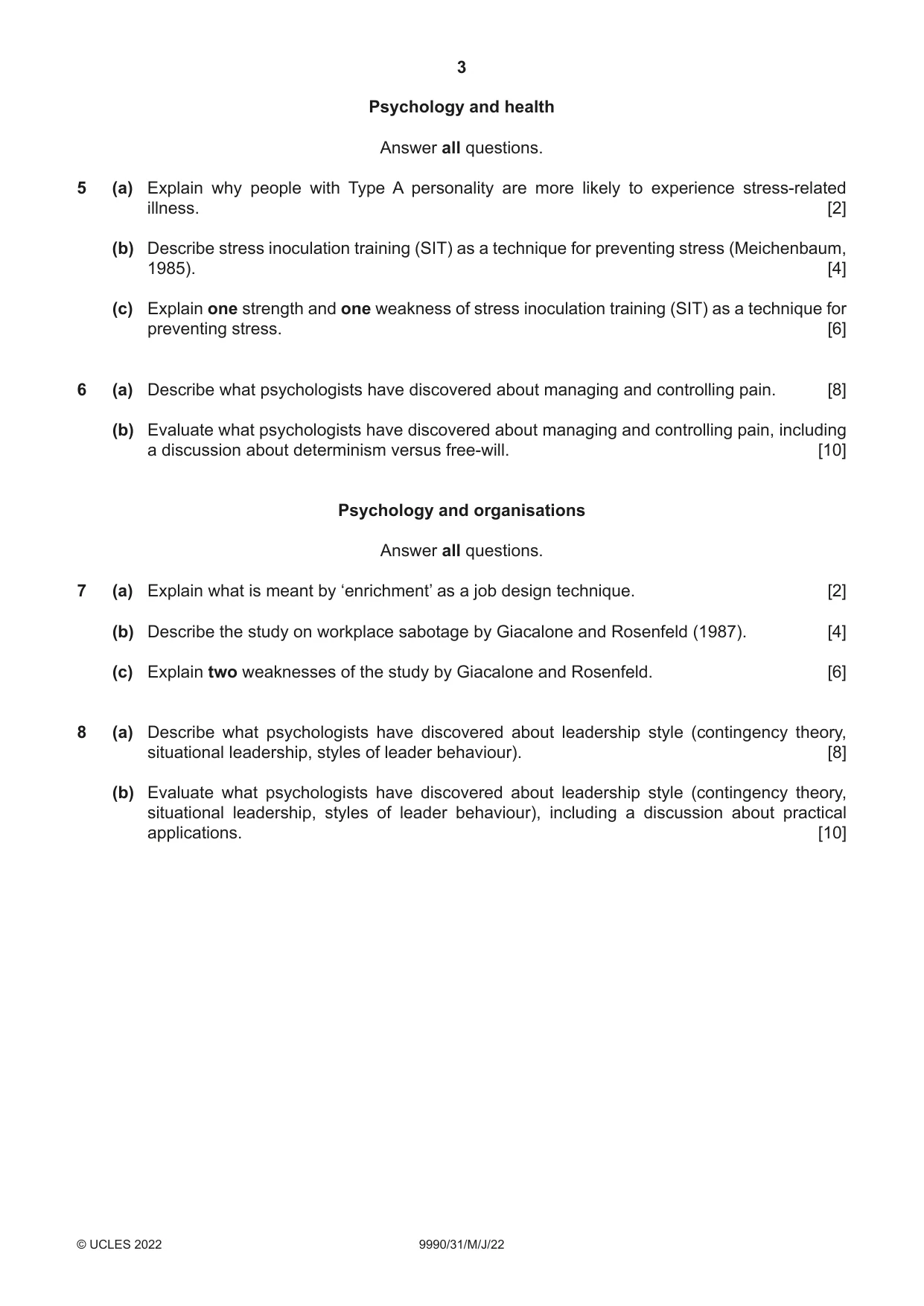
Question paper4 pages

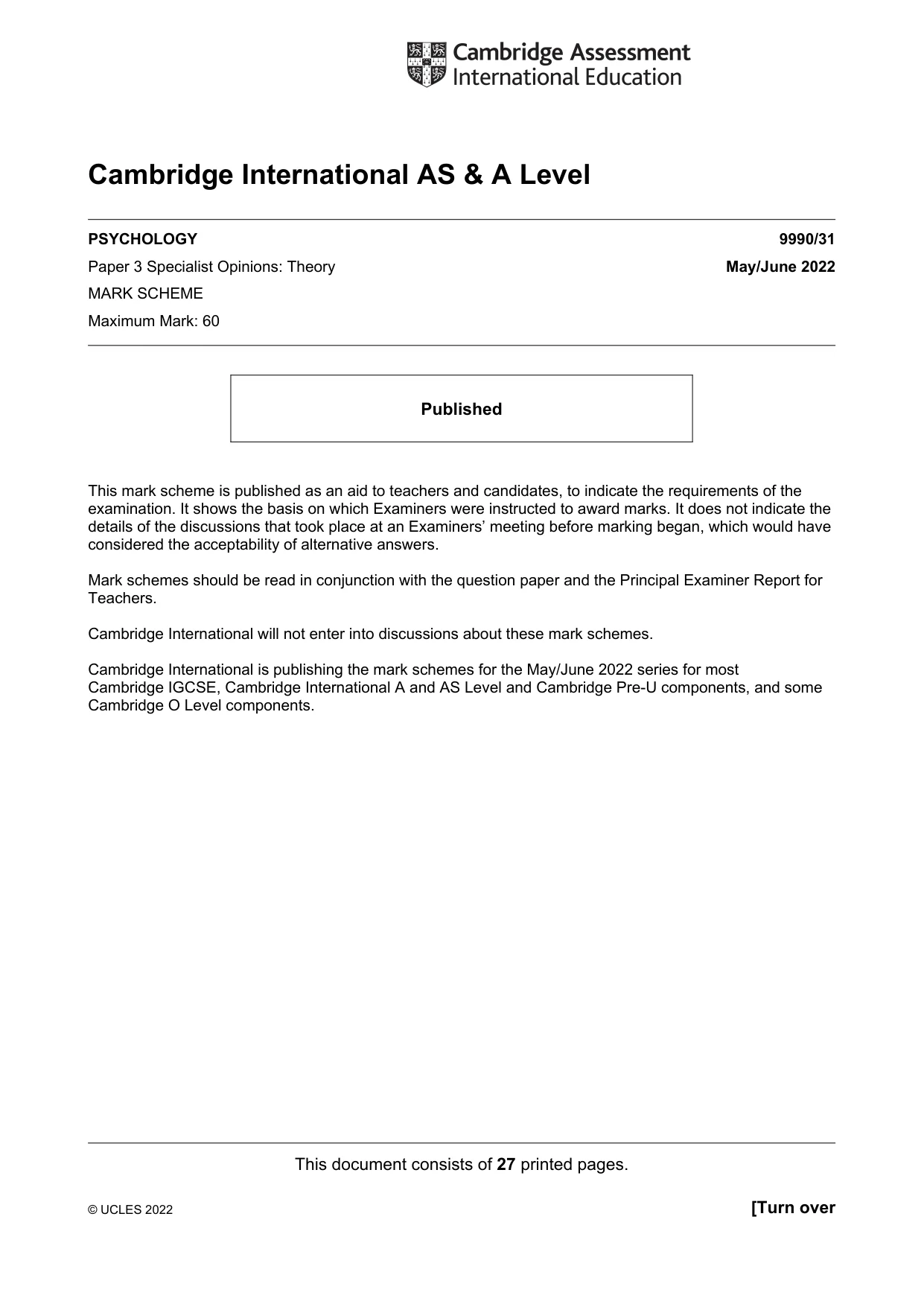
Mark scheme27 pages
Answers below. Sit the paper first if you are practising.
Questions as text
Q1 · Identify two characteristics of bipolar disorder
1 (a) Identify two characteristics of bipolar disorder. [2] (b) Describe rational emotive behaviour therapy (REBT) as a treatment for depression (Ellis, 1962). [4] (c) Explain one similarity and one difference between REBT and one biological treatment for depression. [6]
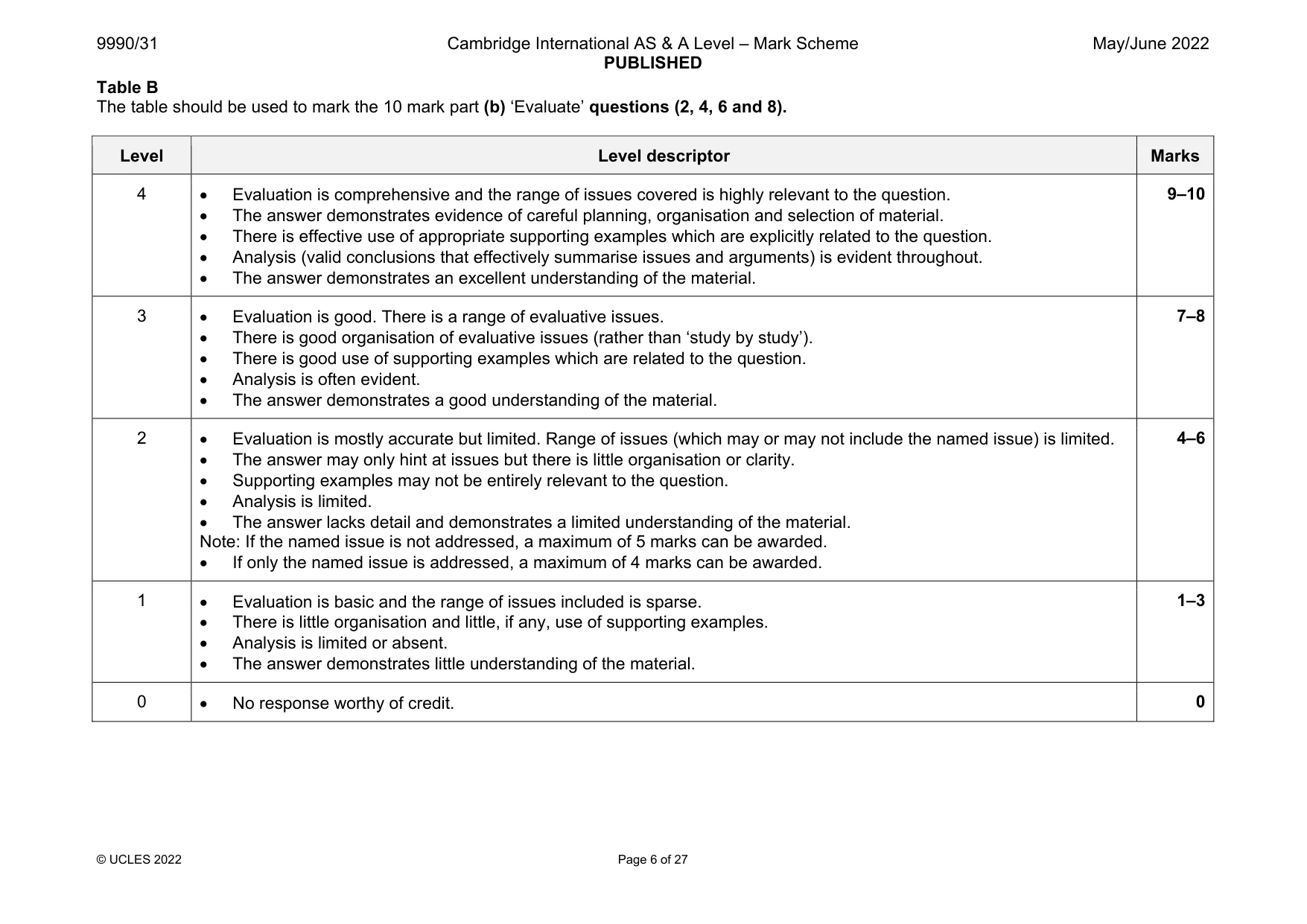
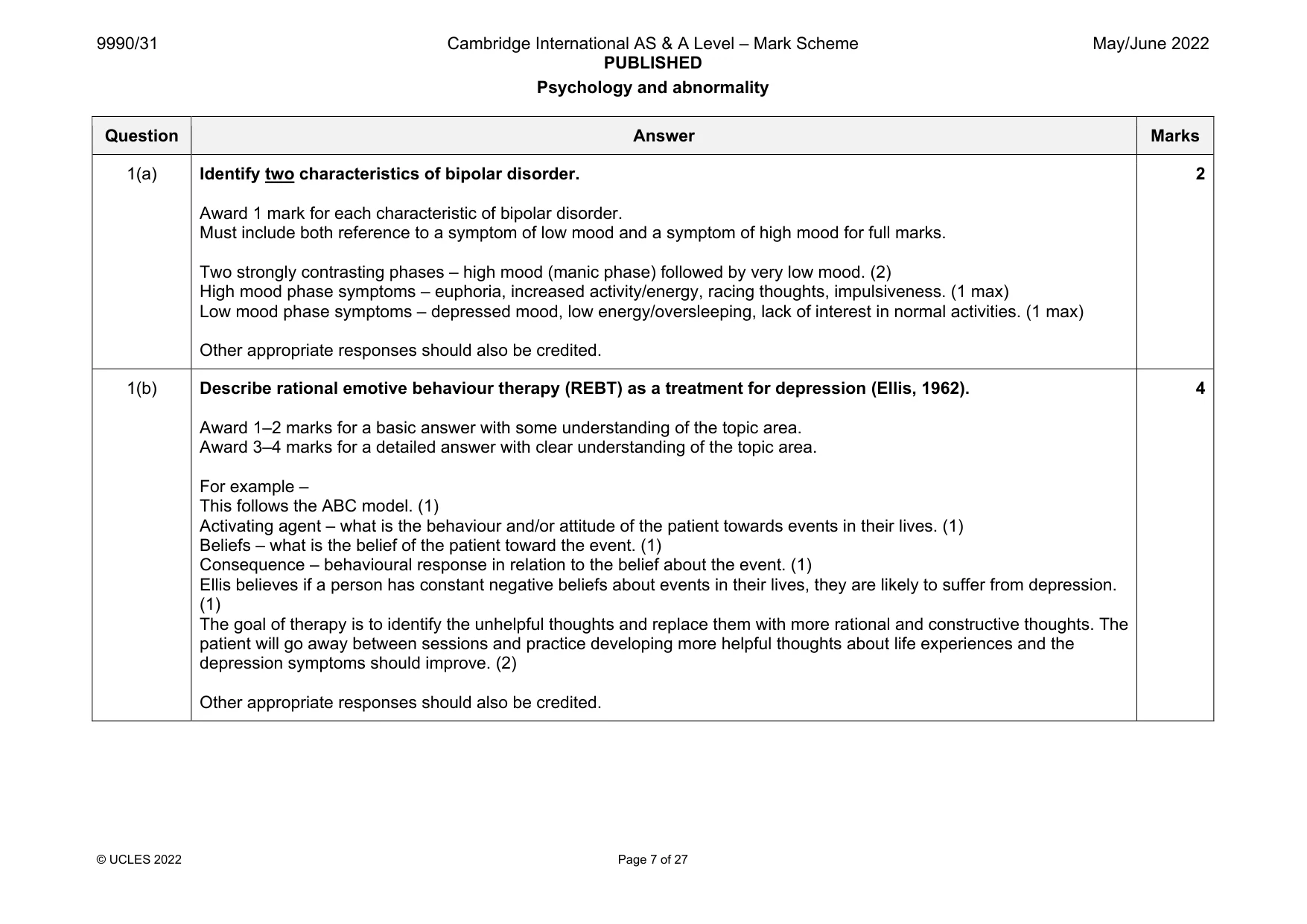
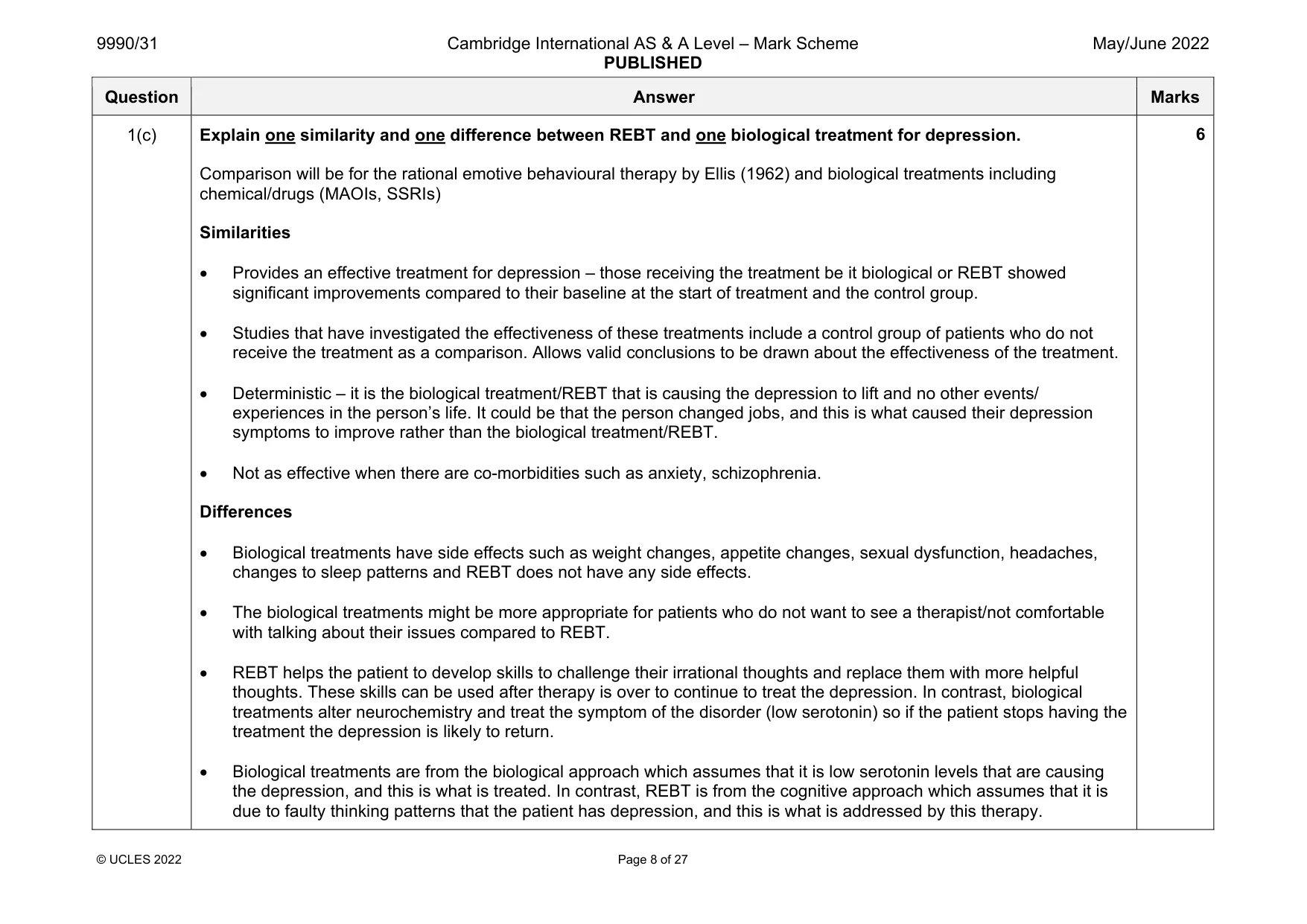
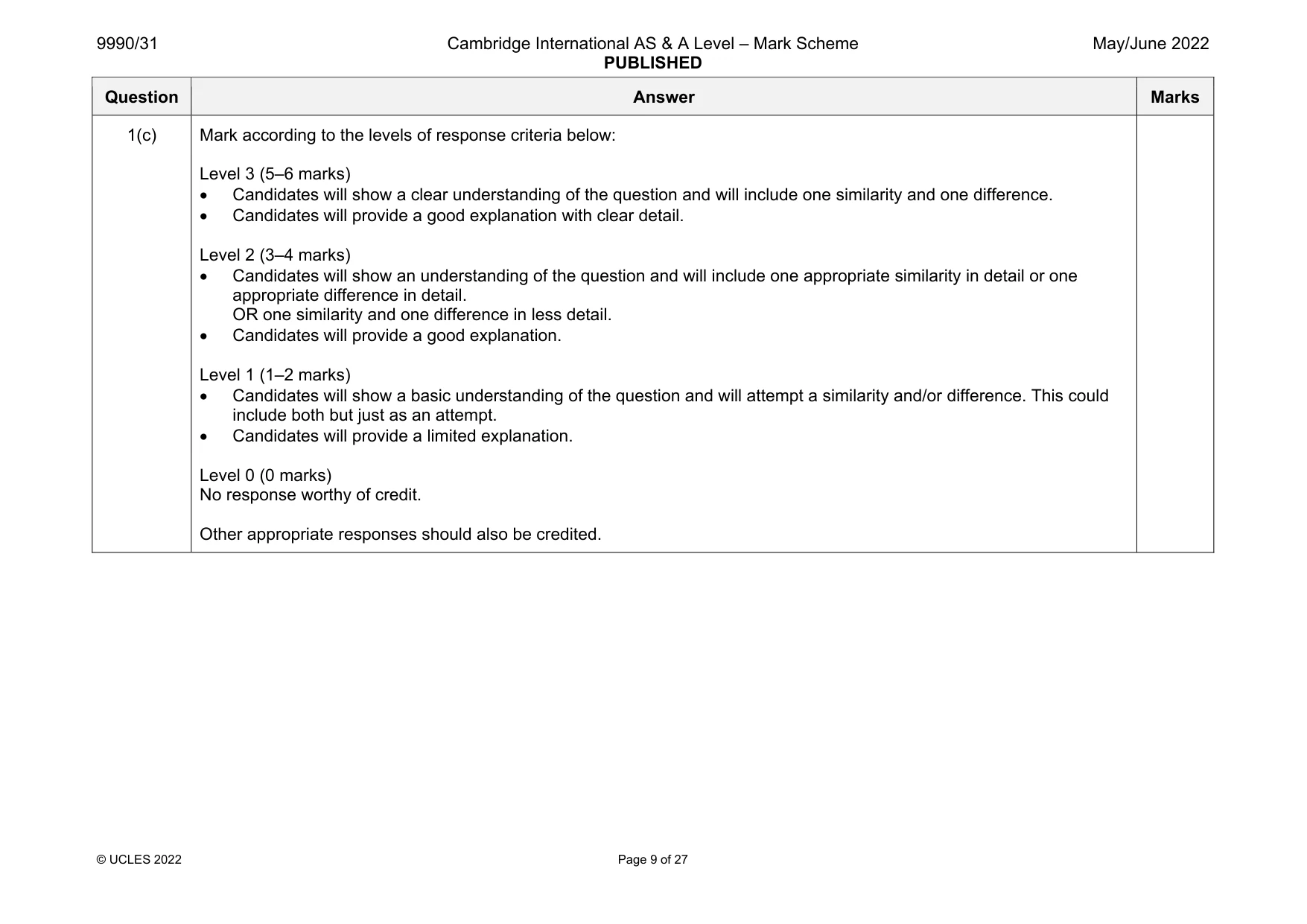
Mark scheme: 1(a) Identify two characteristics of bipolar disorder. Award 1 mark for each characteristic of bipolar disorder. Must include both reference to a symptom of low mood and a symptom of high mood for full marks. Two strongly contrasting phases – high mood (manic phase) followed by very low mood. (2) High mood phase symptoms – euphoria, increased activity/energy, racing thoughts, impulsiveness. (1 max) Low mood phase symptoms – depressed mood, low energy/oversleeping, lack of interest in normal activities. (1 max) Other appropriate responses should also be credited. 1(b) Describe rational emotive behaviour therapy (REBT) as a treatment for depression (Ellis, 1962). Award 1–2 marks for a basic answer with some understanding of the topic area. Award 3–4 marks for a detailed answer with clear understanding of the topic area. For example – This follows the ABC model. (1) Activating agent – what is the behaviour and/or attitude of the patient towards events in their lives. (1) Beliefs – what is the belief of the patient toward the event. (1) Consequence – behavioural response in relation to the belief about the event. (1) Ellis believes if a person has constant negative beliefs about events in their lives, they are likely to suffer from depression. (1) The goal of therapy is to identify the unhelpful thoughts and replace them with more rational and constructive thoughts. The patient will go away between sessions and practice developing more helpful thoughts about life experiences and the depression symptoms should improve. (2) Other appropriate responses should also be credited. 4 Question Answer Marks 1(c) Explain one similarity and one difference between REBT and one biological treatment for depression. Comparison will be for the rational emotive behavioural therapy by Ellis (1962) and biological treatments including chemical/drugs (MAOIs, SSRIs) Similarities Provides an effective treatment for depression – those receiving the treatment be it biological or REBT showed significant improvements compared to their baseline at the start of treatment and the control group. Studies that have investigated the effectiveness of these treatments include a control group of patients who do not receive the treatment as a comparison. Allows valid conclusions to be drawn about the effectiveness of the treatment. Deterministic – it is the biological treatment/REBT that is causing the depression to lift and no other events/ experiences in the person’s life. It could be that the person changed jobs, and this is what caused their depression symptoms to improve rather than the biological treatment/REBT. Not as effective when there are co-morbidities such as anxiety, schizophrenia. Differences Biological treatments have side effects such as weight changes, appetite changes, sexual dysfunction, headaches, changes to sleep patterns and REBT does not have any side effects. The biological treatments might be more appropriate for patients who do not want to see a therapist/not comfortable with talking about their issues compared to REBT. REBT helps the patient to develop skills to challenge their irrational thoughts and replace them with more helpful thoughts. These skills can be used after therapy is over to continue to treat the depression. In contrast, biological treatments alter neurochemistry and treat the symptom of the disorder (low serotonin) so if the patient stops having the treatment the depression is likely to return. Biological treatments are from the biological approach which assumes that it is low serotonin levels that are causing the depression, and this is what is treated. In contrast, REBT is from the cognitive approach which assumes that it is due to faulty thinking patterns that the patient has depression, and this is what is addressed by this therapy. 6 Question Answer Marks 1(c) Mark according to the levels of response criteria below: Level 3 (5–6 marks) Candidates will show a clear understanding of the question and will include one similarity and one difference. Candidates will provide a good explanation with clear detail. Level 2 (3–4 marks) Candidates will show an understanding of the question and will include one appropriate similarity in detail or one appropriate difference in detail. OR one similarity and one difference in less detail. Candidates will provide a good explanation. Level 1 (1–2 marks) Candidates will show a basic understanding of the question and will attempt a similarity and/or difference. This could include both but just as an attempt. Candidates will provide a limited explanation. Level 0 (0 marks) No response worthy of credit. Other appropriate responses should also be credited.
More questions on Mood (affective) disorders: depressive disorder (unipolar) and bipolar disorder
Q2 · Describe explanations of phobias
2 (a) Describe explanations of phobias. [8] (b) Evaluate explanations of phobias, including a discussion of nature versus nurture. [10] Psychology and consumer behaviour Answer all questions.
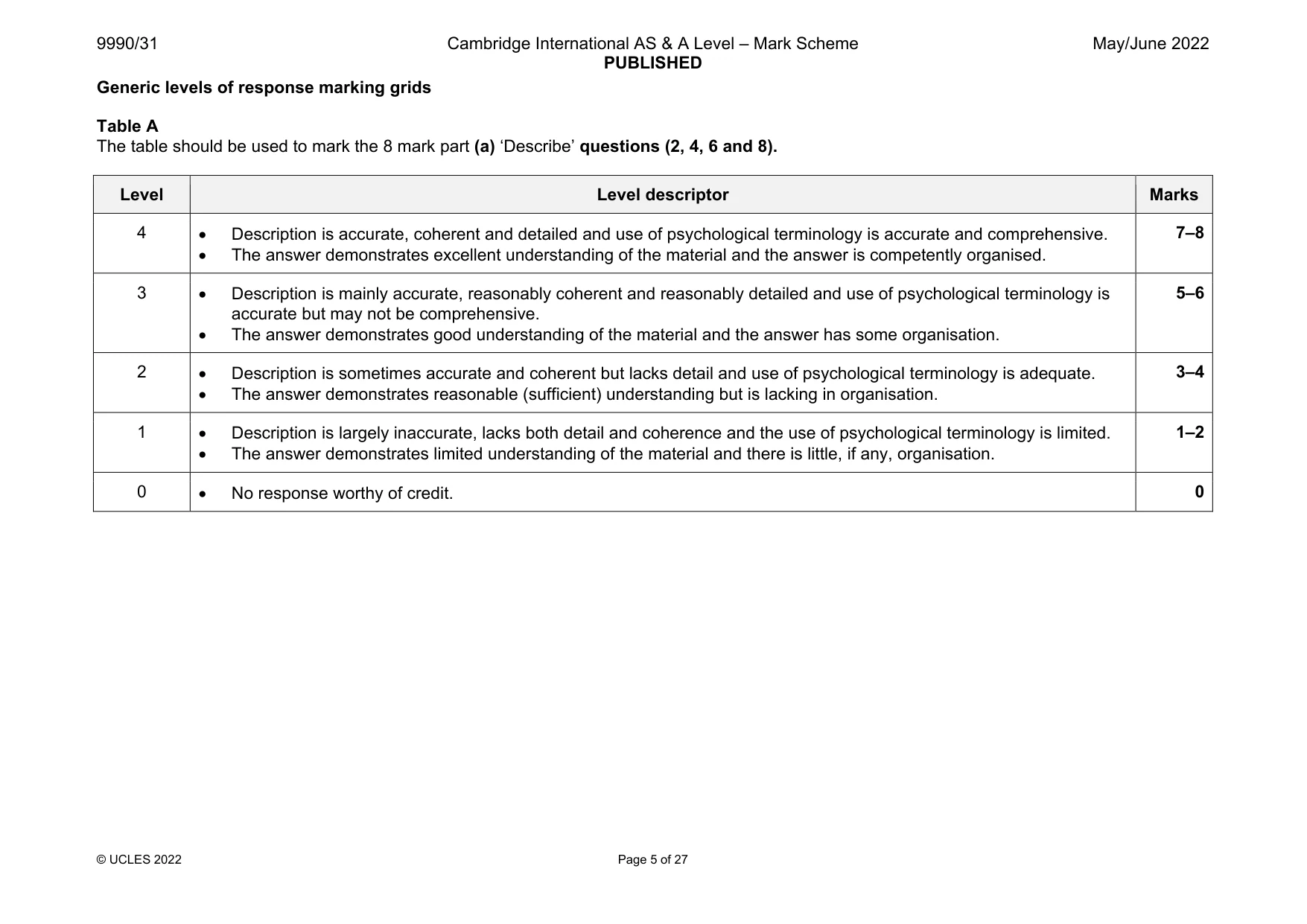
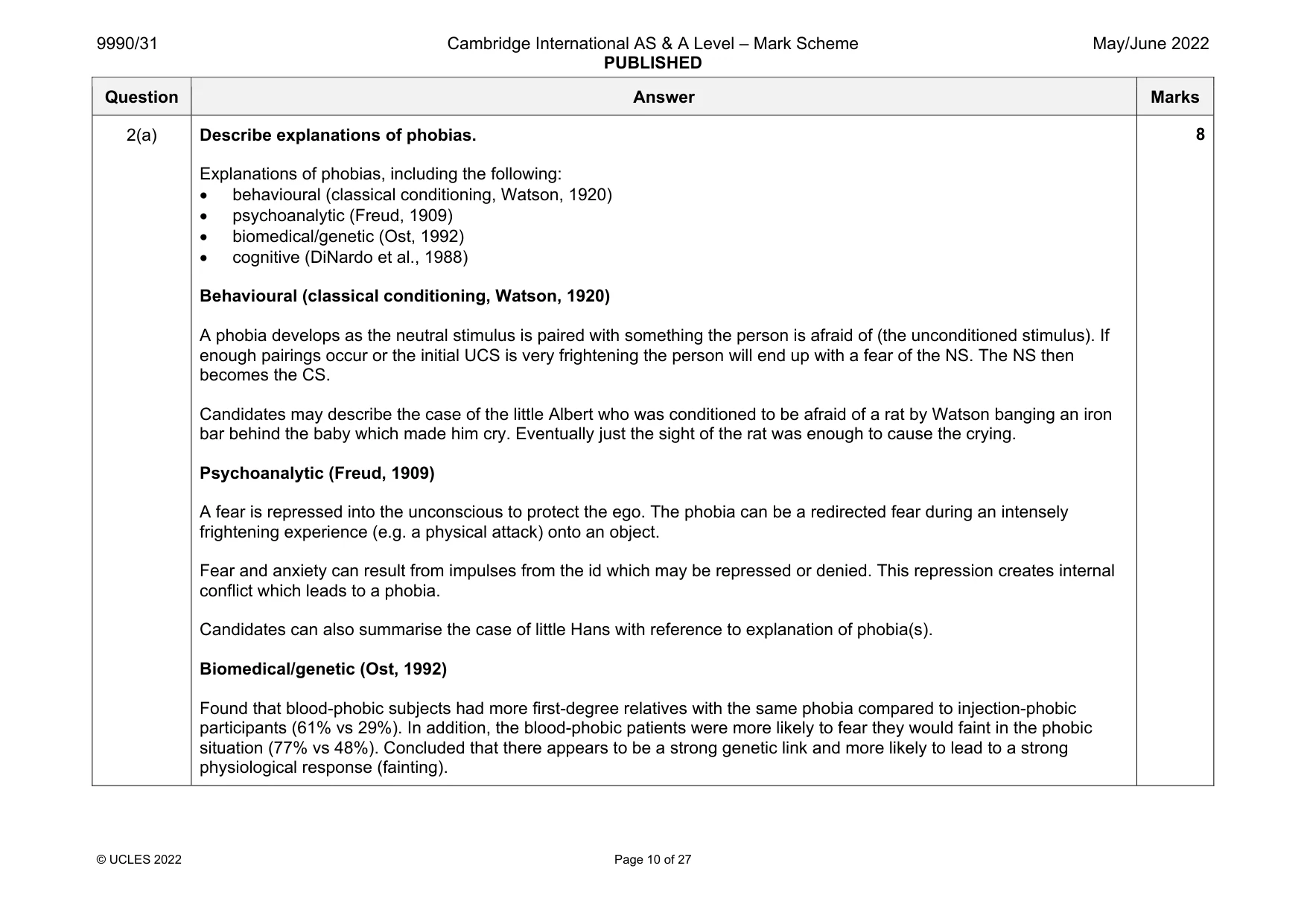
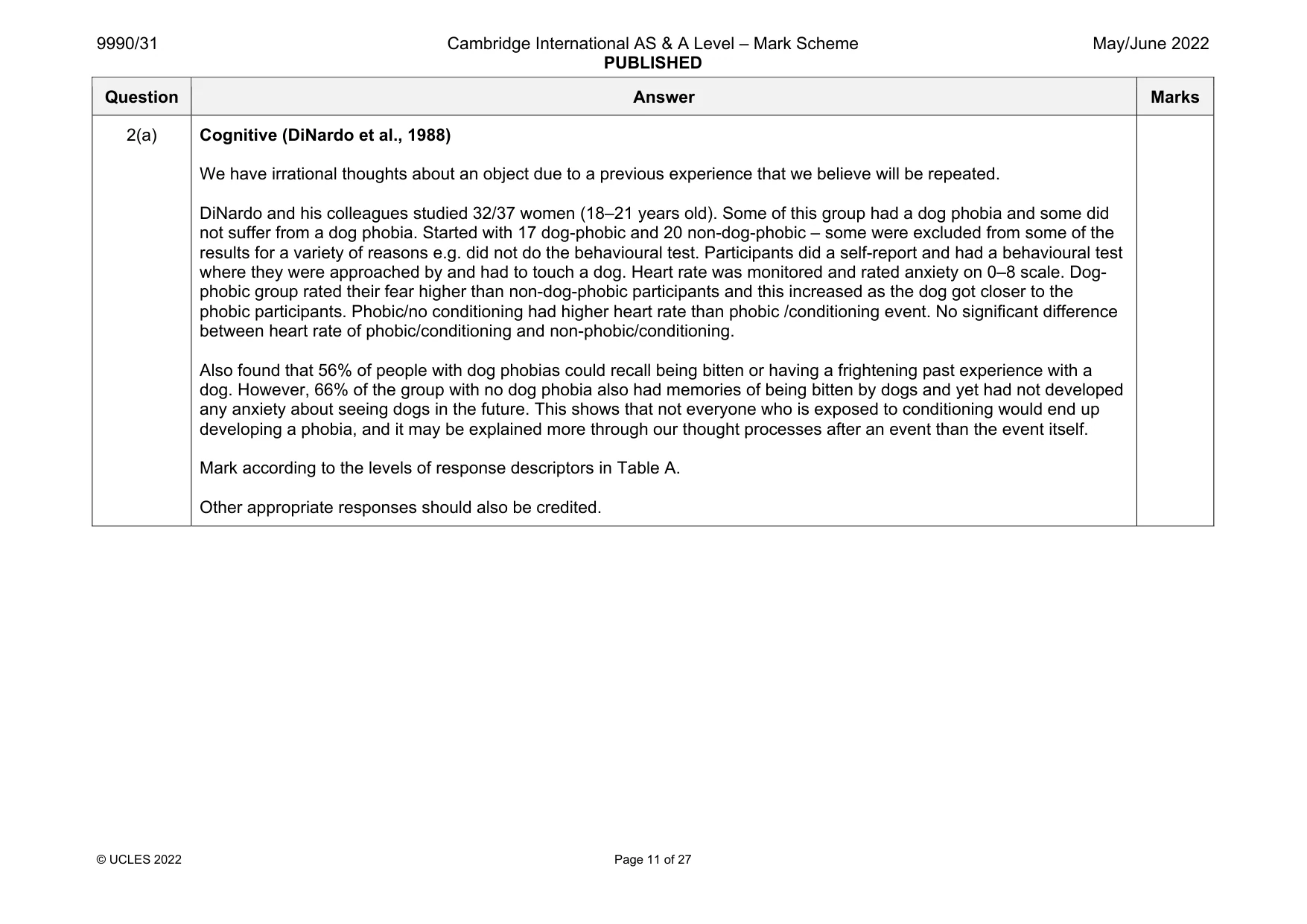
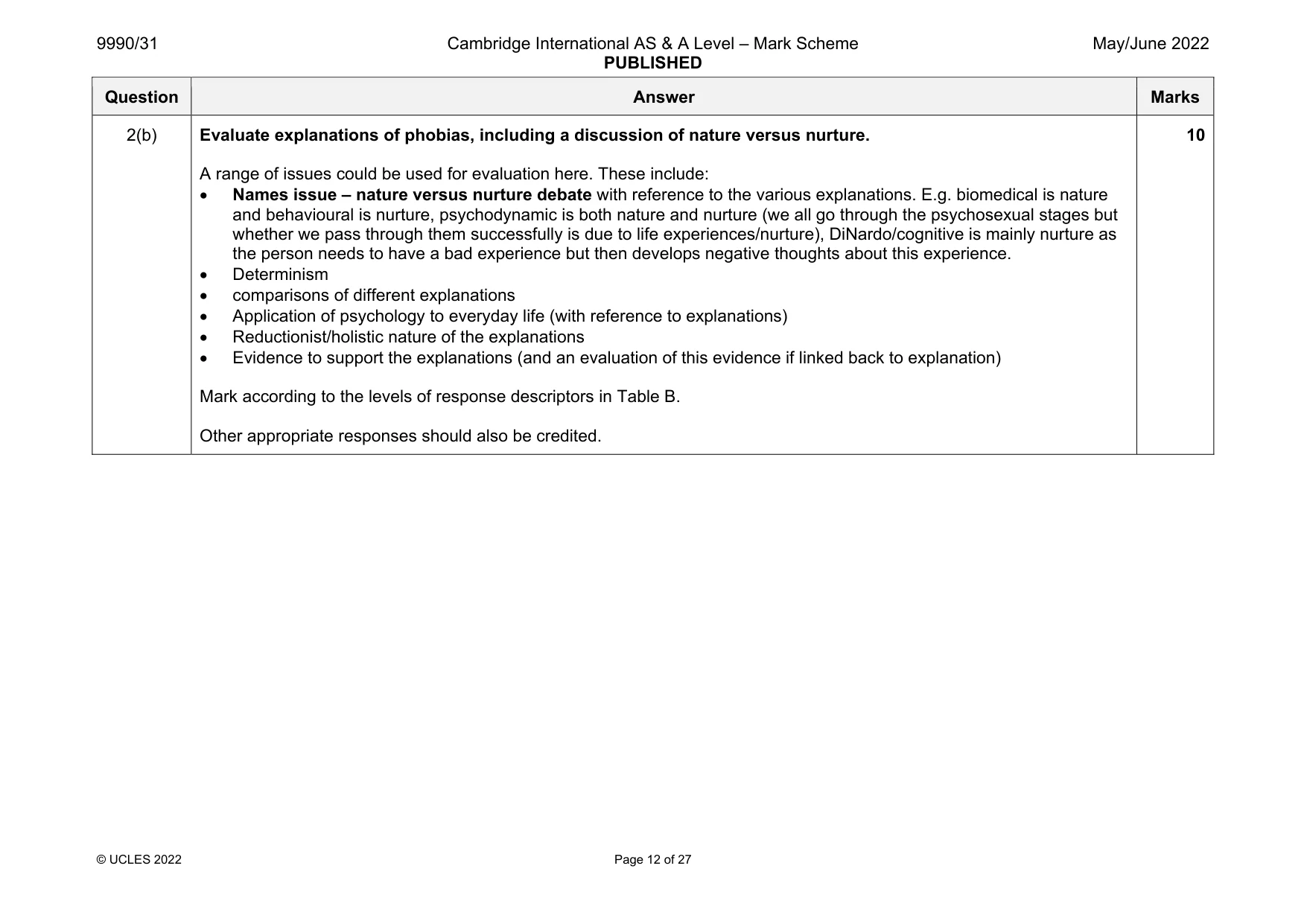
Mark scheme: 2(a) Describe explanations of phobias. Explanations of phobias, including the following: behavioural (classical conditioning, Watson, 1920) psychoanalytic (Freud, 1909) biomedical/genetic (Ost, 1992) cognitive (DiNardo et al., 1988) Behavioural (classical conditioning, Watson, 1920) A phobia develops as the neutral stimulus is paired with something the person is afraid of (the unconditioned stimulus). If enough pairings occur or the initial UCS is very frightening the person will end up with a fear of the NS. The NS then becomes the CS. Candidates may describe the case of the little Albert who was conditioned to be afraid of a rat by Watson banging an iron bar behind the baby which made him cry. Eventually just the sight of the rat was enough to cause the crying. Psychoanalytic (Freud, 1909) A fear is repressed into the unconscious to protect the ego. The phobia can be a redirected fear during an intensely frightening experience (e.g. a physical attack) onto an object. Fear and anxiety can result from impulses from the id which may be repressed or denied. This repression creates internal conflict which leads to a phobia. Candidates can also summarise the case of little Hans with reference to explanation of phobia(s). Biomedical/genetic (Ost, 1992) Found that blood-phobic subjects had more first-degree relatives with the same phobia compared to injection-phobic participants (61% vs 29%). In addition, the blood-phobic patients were more likely to fear they would faint in the phobic situation (77% vs 48%). Concluded that there appears to be a strong genetic link and more likely to lead to a strong physiological response (fainting). Question Answer Marks 2(a) Cognitive (DiNardo et al., 1988) We have irrational thoughts about an object due to a previous experience that we believe will be repeated. DiNardo and his colleagues studied 32/37 women (18–21 years old). Some of this group had a dog phobia and some did not suffer from a dog phobia. Started with 17 dog-phobic and 20 non-dog-phobic – some were excluded from some of the results for a variety of reasons e.g. did not do the behavioural test. Participants did a self-report and had a behavioural test where they were approached by and had to touch a dog. Heart rate was monitored and rated anxiety on 0–8 scale. Dog- phobic group rated their fear higher than non-dog-phobic participants and this increased as the dog got closer to the phobic participants. Phobic/no conditioning had higher heart rate than phobic /conditioning event. No significant difference between heart rate of phobic/conditioning and non-phobic/conditioning. Also found that 56% of people with dog phobias could recall being bitten or having a frightening past experience with a dog. However, 66% of the group with no dog phobia also had memories of being bitten by dogs and yet had not developed any anxiety about seeing dogs in the future. This shows that not everyone who is exposed to conditioning would end up developing a phobia, and it may be explained more through our thought processes after an event than the event itself. Mark according to the levels of response descriptors in Table A. Other appropriate responses should also be credited. Question Answer Marks 2(b) Evaluate explanations of phobias, including a discussion of nature versus nurture. A range of issues could be used for evaluation here. These include: Names issue – nature versus nurture debate with reference to the various explanations. E.g. biomedical is nature and behavioural is nurture, psychodynamic is both nature and nurture (we all go through the psychosexual stages but whether we pass through them successfully is due to life experiences/nurture), DiNardo/cognitive is mainly nurture as the person needs to have a bad experience but then develops negative thoughts about this experience. Determinism comparisons of different explanations Application of psychology to everyday life (with reference to explanations) Reductionist/holistic nature of the explanations Evidence to support the explanations (and an evaluation of this evidence if linked back to explanation) Mark according to the levels of response descriptors in Table B. Other appropriate responses should also be credited. 10
More questions on Anxiety disorders and fear-related disorders
Q3 · Lauterborn proposed ‘the 4 Cs marketing mix model’ of advertising
3 (a) Lauterborn proposed ‘the 4 Cs marketing mix model’ of advertising. Identify two of the ‘Cs’. [2] (b) Describe the procedure and one result from the study by Auty and Lewis (2004) on product placement in films. [4] (c) Explain one strength and one weakness of the study by Auty and Lewis. [6]
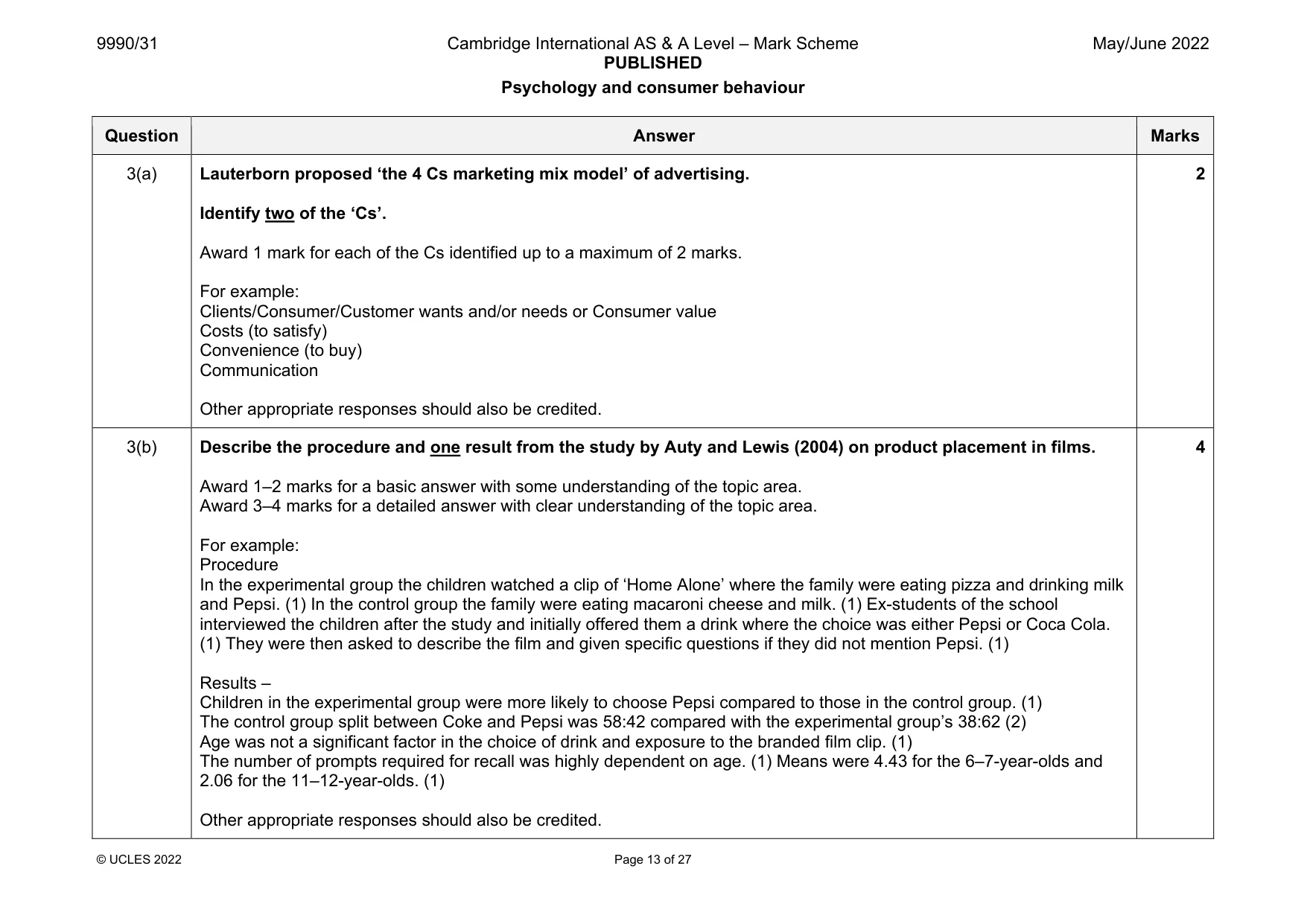
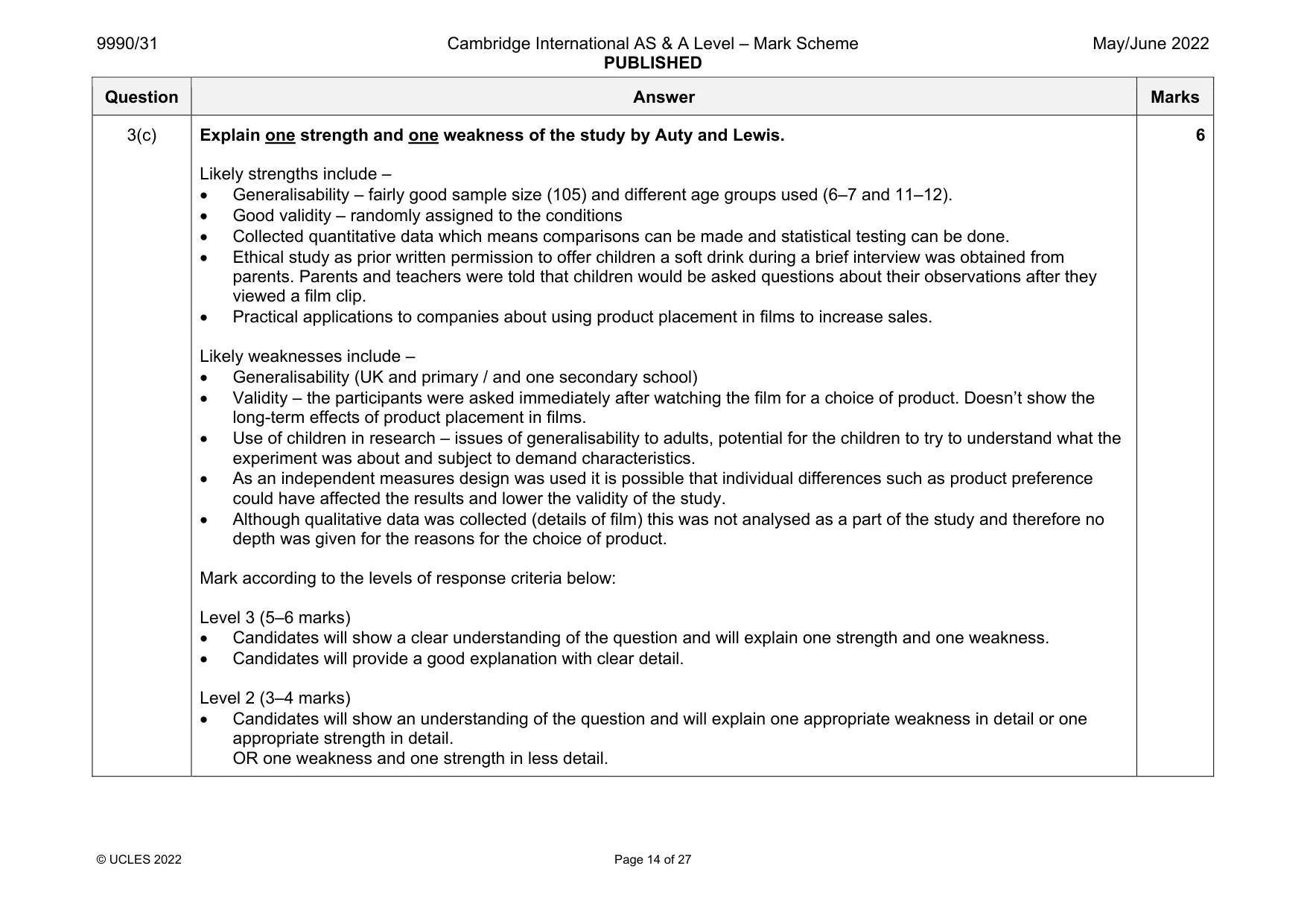
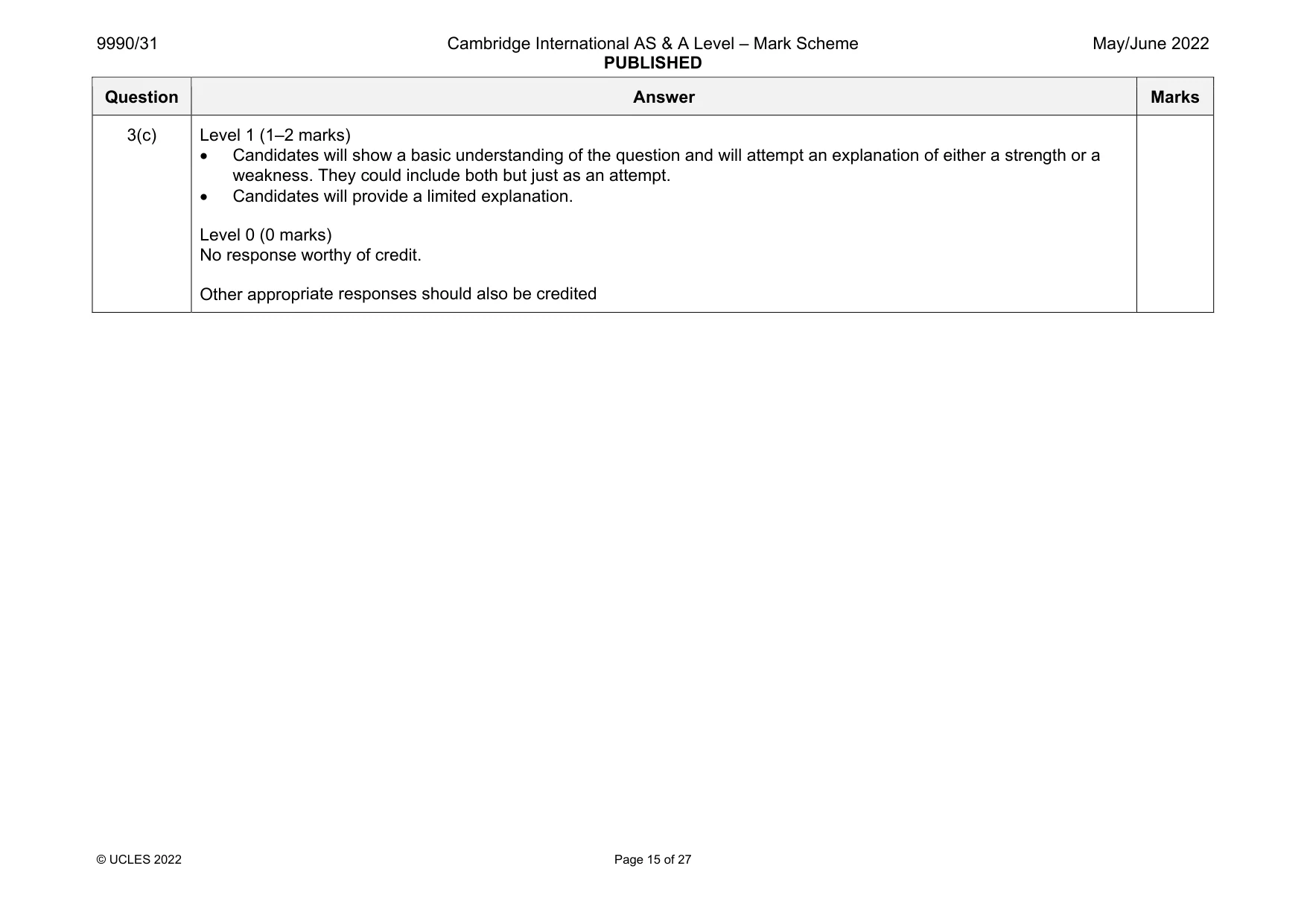
Mark scheme: 3(a) Lauterborn proposed ‘the 4 Cs marketing mix model’ of advertising. Identify two of the ‘Cs’. Award 1 mark for each of the Cs identified up to a maximum of 2 marks. For example: Clients/Consumer/Customer wants and/or needs or Consumer value Costs (to satisfy) Convenience (to buy) Communication Other appropriate responses should also be credited. 3(b) Describe the procedure and one result from the study by Auty and Lewis (2004) on product placement in films. Award 1–2 marks for a basic answer with some understanding of the topic area. Award 3–4 marks for a detailed answer with clear understanding of the topic area. For example: Procedure In the experimental group the children watched a clip of ‘Home Alone’ where the family were eating pizza and drinking milk and Pepsi. (1) In the control group the family were eating macaroni cheese and milk. (1) Ex-students of the school interviewed the children after the study and initially offered them a drink where the choice was either Pepsi or Coca Cola. (1) They were then asked to describe the film and given specific questions if they did not mention Pepsi. (1) Results – Children in the experimental group were more likely to choose Pepsi compared to those in the control group. (1) The control group split between Coke and Pepsi was 58:42 compared with the experimental group’s 38:62 (2) Age was not a significant factor in the choice of drink and exposure to the branded film clip. (1) The number of prompts required for recall was highly dependent on age. (1) Means were 4.43 for the 6–7-year-olds and 2.06 for the 11–12-year-olds. (1) Other appropriate responses should also be credited. 4 Question Answer Marks 3(c) Explain one strength and one weakness of the study by Auty and Lewis. Likely strengths include – Generalisability – fairly good sample size (105) and different age groups used (6–7 and 11–12). Good validity – randomly assigned to the conditions Collected quantitative data which means comparisons can be made and statistical testing can be done. Ethical study as prior written permission to offer children a soft drink during a brief interview was obtained from parents. Parents and teachers were told that children would be asked questions about their observations after they viewed a film clip. Practical applications to companies about using product placement in films to increase sales. Likely weaknesses include – Generalisability (UK and primary / and one secondary school) Validity – the participants were asked immediately after watching the film for a choice of product. Doesn’t show the long-term effects of product placement in films. Use of children in research – issues of generalisability to adults, potential for the children to try to understand what the experiment was about and subject to demand characteristics. As an independent measures design was used it is possible that individual differences such as product preference could have affected the results and lower the validity of the study. Although qualitative data was collected (details of film) this was not analysed as a part of the study and therefore no depth was given for the reasons for the choice of product. Mark according to the levels of response criteria below: Level 3 (5–6 marks) Candidates will show a clear understanding of the question and will explain one strength and one weakness. Candidates will provide a good explanation with clear detail. Level 2 (3–4 marks) Candidates will show an understanding of the question and will explain one appropriate weakness in detail or one appropriate strength in detail. OR one weakness and one strength in less detail. 6 Question Answer Marks 3(c) Level 1 (1–2 marks) Candidates will show a basic understanding of the question and will attempt an explanation of either a strength or a weakness. They could include both but just as an attempt. Candidates will provide a limited explanation. Level 0 (0 marks) No response worthy of credit. Other appropriate responses should also be credited
Q4 · Describe what psychologists have discovered about sound and consumer behaviour
4 (a) Describe what psychologists have discovered about sound and consumer behaviour. [8] (b) Evaluate what psychologists have discovered about sound and consumer behaviour, including a discussion about experiments. [10] Psychology and health Answer all questions.
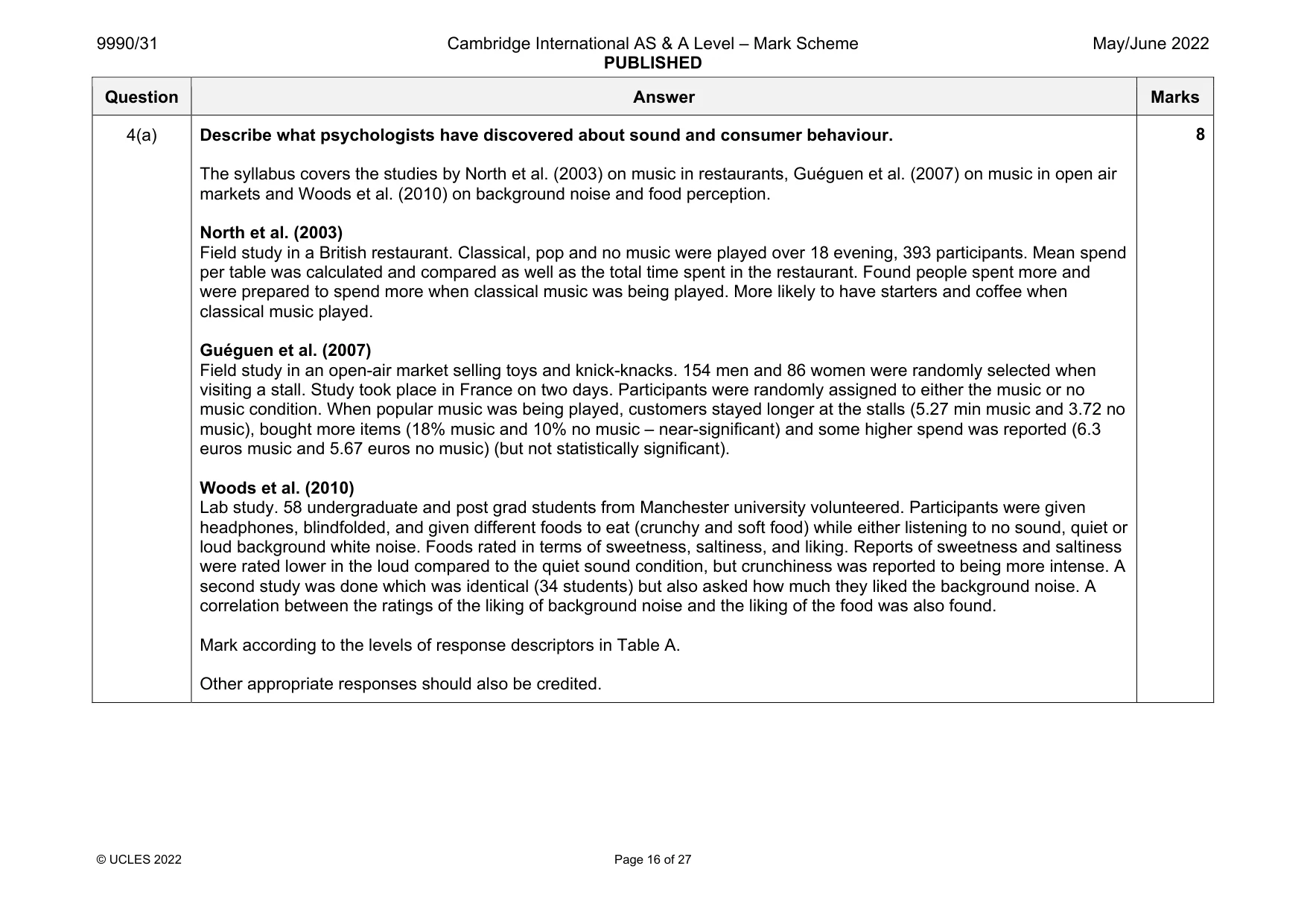
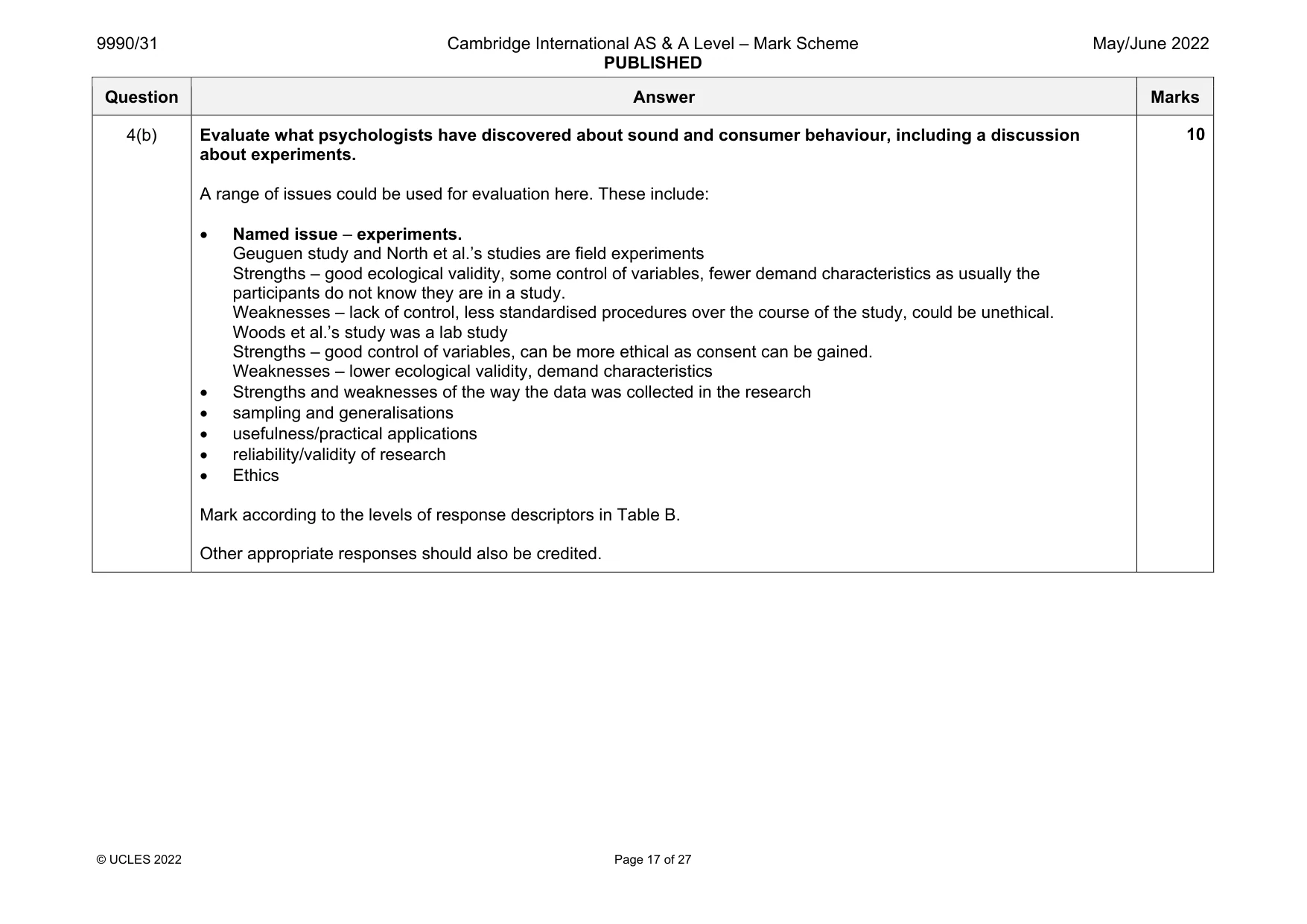
Mark scheme: 4(a) Describe what psychologists have discovered about sound and consumer behaviour. The syllabus covers the studies by North et al. (2003) on music in restaurants, Guéguen et al. (2007) on music in open air markets and Woods et al. (2010) on background noise and food perception. North et al. (2003) Field study in a British restaurant. Classical, pop and no music were played over 18 evening, 393 participants. Mean spend per table was calculated and compared as well as the total time spent in the restaurant. Found people spent more and were prepared to spend more when classical music was being played. More likely to have starters and coffee when classical music played. Guéguen et al. (2007) Field study in an open-air market selling toys and knick-knacks. 154 men and 86 women were randomly selected when visiting a stall. Study took place in France on two days. Participants were randomly assigned to either the music or no music condition. When popular music was being played, customers stayed longer at the stalls (5.27 min music and 3.72 no music), bought more items (18% music and 10% no music – near-significant) and some higher spend was reported (6.3 euros music and 5.67 euros no music) (but not statistically significant). Woods et al. (2010) Lab study. 58 undergraduate and post grad students from Manchester university volunteered. Participants were given headphones, blindfolded, and given different foods to eat (crunchy and soft food) while either listening to no sound, quiet or loud background white noise. Foods rated in terms of sweetness, saltiness, and liking. Reports of sweetness and saltiness were rated lower in the loud compared to the quiet sound condition, but crunchiness was reported to being more intense. A second study was done which was identical (34 students) but also asked how much they liked the background noise. A correlation between the ratings of the liking of background noise and the liking of the food was also found. Mark according to the levels of response descriptors in Table A. Other appropriate responses should also be credited. Question Answer Marks 4(b) Evaluate what psychologists have discovered about sound and consumer behaviour, including a discussion about experiments. A range of issues could be used for evaluation here. These include: Named issue – experiments. Geuguen study and North et al.’s studies are field experiments Strengths – good ecological validity, some control of variables, fewer demand characteristics as usually the participants do not know they are in a study. Weaknesses – lack of control, less standardised procedures over the course of the study, could be unethical. Woods et al.’s study was a lab study Strengths – good control of variables, can be more ethical as consent can be gained. Weaknesses – lower ecological validity, demand characteristics Strengths and weaknesses of the way the data was collected in the research sampling and generalisations usefulness/practical applications reliability/validity of research Ethics Mark according to the levels of response descriptors in Table B. Other appropriate responses should also be credited. 10
Q5 · Explain why people with Type A personality are more likely to experience stress-related…
5 (a) Explain why people with Type A personality are more likely to experience stress-related illness. [2] (b) Describe stress inoculation training (SIT) as a technique for preventing stress (Meichenbaum, 1985). [4] (c) Explain one strength and one weakness of stress inoculation training (SIT) as a technique for preventing stress. [6]
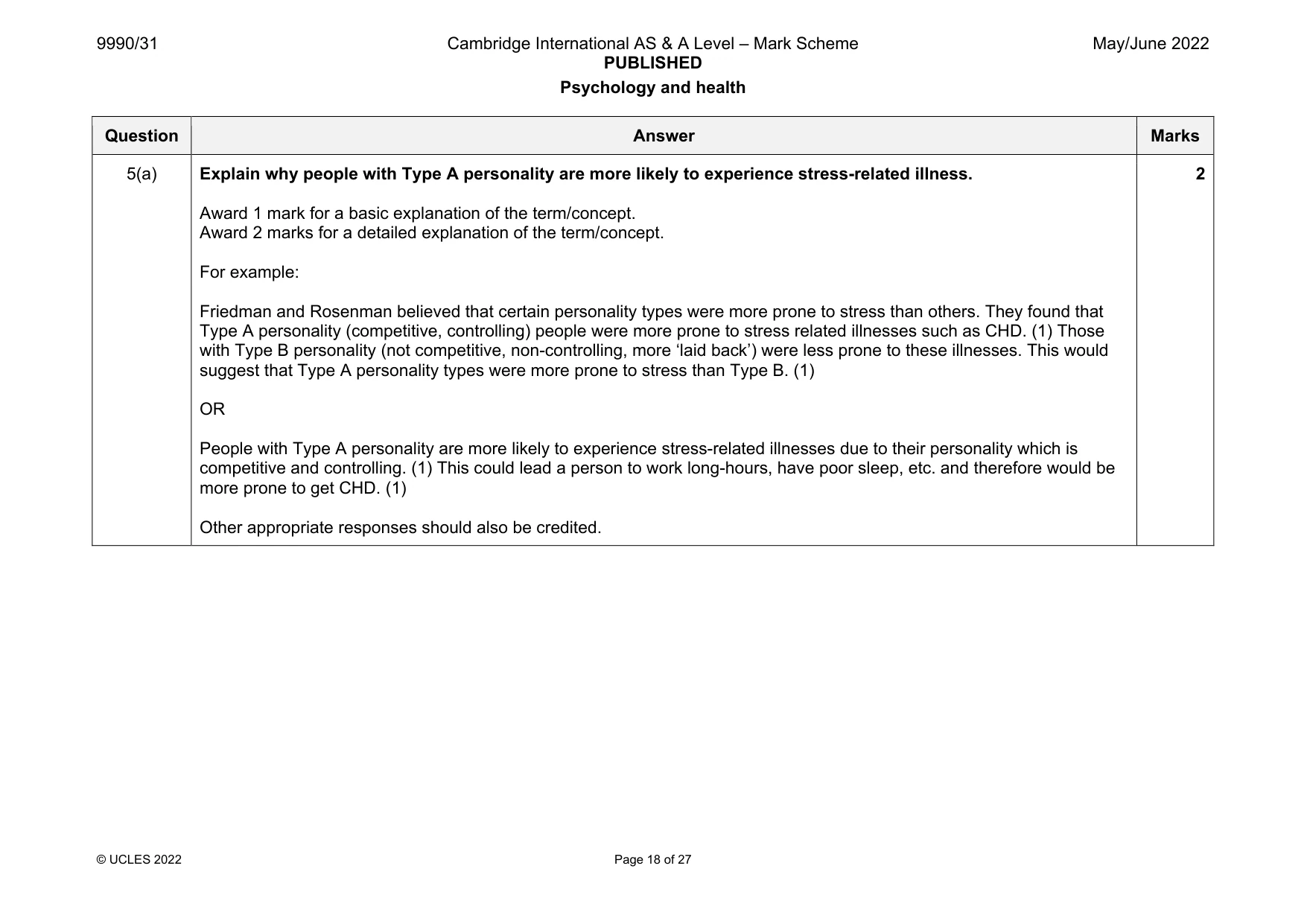
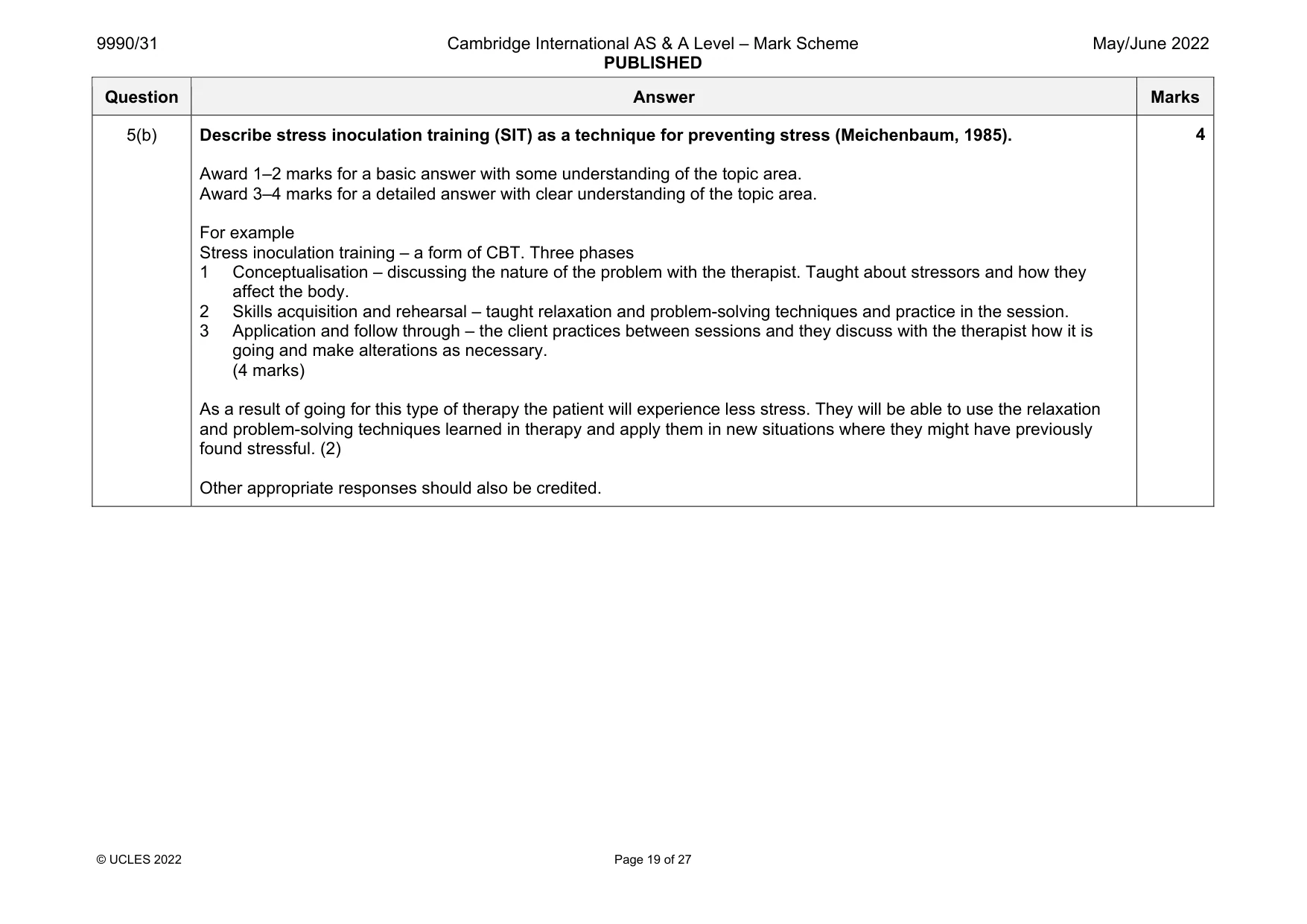
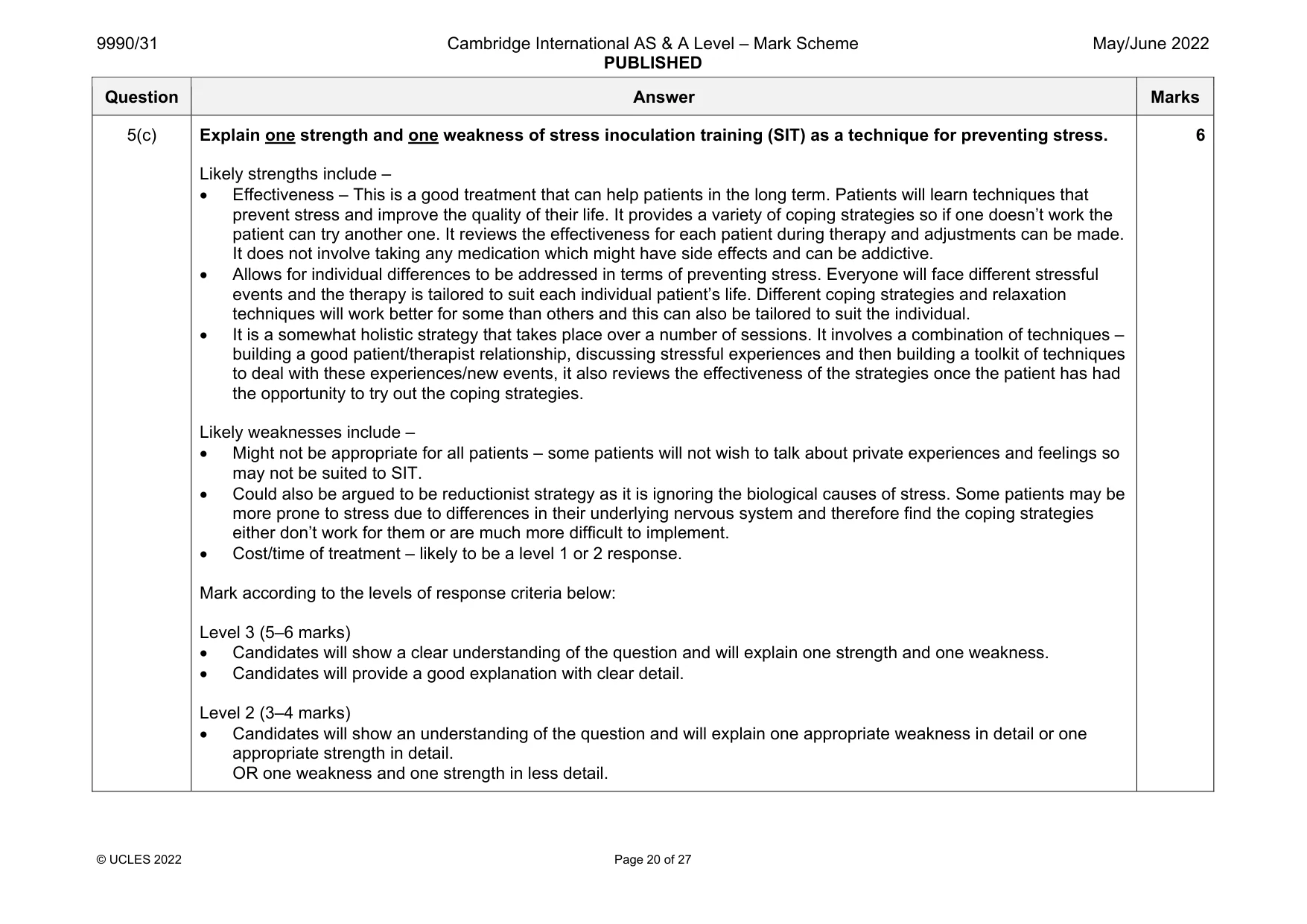
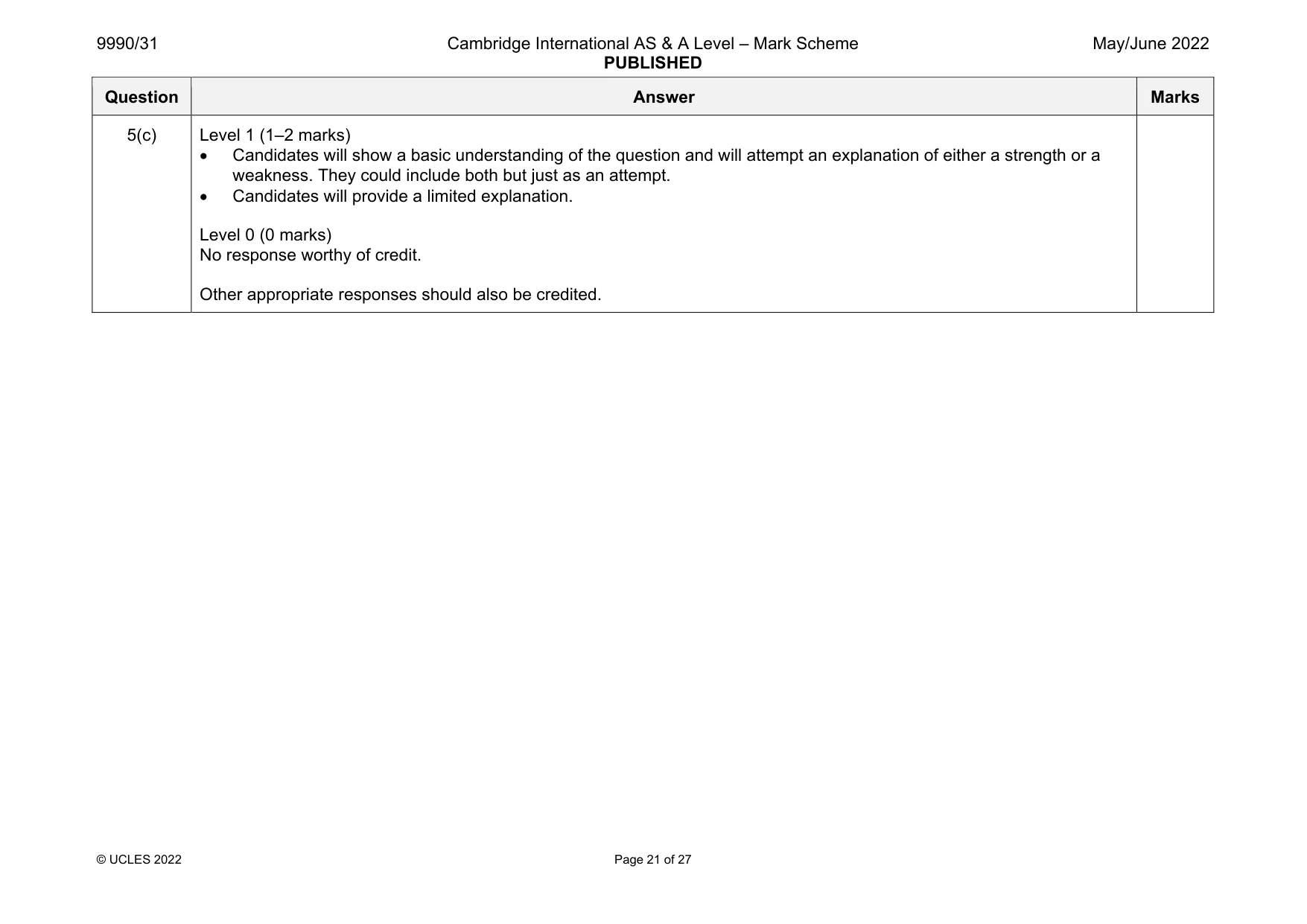
Mark scheme: 5(a) Explain why people with Type A personality are more likely to experience stress-related illness. Award 1 mark for a basic explanation of the term/concept. Award 2 marks for a detailed explanation of the term/concept. For example: Friedman and Rosenman believed that certain personality types were more prone to stress than others. They found that Type A personality (competitive, controlling) people were more prone to stress related illnesses such as CHD. (1) Those with Type B personality (not competitive, non-controlling, more ‘laid back’) were less prone to these illnesses. This would suggest that Type A personality types were more prone to stress than Type B. (1) OR People with Type A personality are more likely to experience stress-related illnesses due to their personality which is competitive and controlling. (1) This could lead a person to work long-hours, have poor sleep, etc. and therefore would be more prone to get CHD. (1) Other appropriate responses should also be credited. Question Answer Marks 5(b) Describe stress inoculation training (SIT) as a technique for preventing stress (Meichenbaum, 1985). Award 1–2 marks for a basic answer with some understanding of the topic area. Award 3–4 marks for a detailed answer with clear understanding of the topic area. For example Stress inoculation training – a form of CBT. Three phases 1 Conceptualisation – discussing the nature of the problem with the therapist. Taught about stressors and how they affect the body. 2 Skills acquisition and rehearsal – taught relaxation and problem-solving techniques and practice in the session. 3 Application and follow through – the client practices between sessions and they discuss with the therapist how it is going and make alterations as necessary. (4 marks) As a result of going for this type of therapy the patient will experience less stress. They will be able to use the relaxation and problem-solving techniques learned in therapy and apply them in new situations where they might have previously found stressful. (2) Other appropriate responses should also be credited. 4 Question Answer Marks 5(c) Explain one strength and one weakness of stress inoculation training (SIT) as a technique for preventing stress. Likely strengths include – Effectiveness – This is a good treatment that can help patients in the long term. Patients will learn techniques that prevent stress and improve the quality of their life. It provides a variety of coping strategies so if one doesn’t work the patient can try another one. It reviews the effectiveness for each patient during therapy and adjustments can be made. It does not involve taking any medication which might have side effects and can be addictive. Allows for individual differences to be addressed in terms of preventing stress. Everyone will face different stressful events and the therapy is tailored to suit each individual patient’s life. Different coping strategies and relaxation techniques will work better for some than others and this can also be tailored to suit the individual. It is a somewhat holistic strategy that takes place over a number of sessions. It involves a combination of techniques – building a good patient/therapist relationship, discussing stressful experiences and then building a toolkit of techniques to deal with these experiences/new events, it also reviews the effectiveness of the strategies once the patient has had the opportunity to try out the coping strategies. Likely weaknesses include – Might not be appropriate for all patients – some patients will not wish to talk about private experiences and feelings so may not be suited to SIT. Could also be argued to be reductionist strategy as it is ignoring the biological causes of stress. Some patients may be more prone to stress due to differences in their underlying nervous system and therefore find the coping strategies either don’t work for them or are much more difficult to implement. Cost/time of treatment – likely to be a level 1 or 2 response. Mark according to the levels of response criteria below: Level 3 (5–6 marks) Candidates will show a clear understanding of the question and will explain one strength and one weakness. Candidates will provide a good explanation with clear detail. Level 2 (3–4 marks) Candidates will show an understanding of the question and will explain one appropriate weakness in detail or one appropriate strength in detail. OR one weakness and one strength in less detail. 6 Question Answer Marks 5(c) Level 1 (1–2 marks) Candidates will show a basic understanding of the question and will attempt an explanation of either a strength or a weakness. They could include both but just as an attempt. Candidates will provide a limited explanation. Level 0 (0 marks) No response worthy of credit. Other appropriate responses should also be credited.
Q6 · Describe what psychologists have discovered about managing and controlling pain
6 (a) Describe what psychologists have discovered about managing and controlling pain. [8] (b) Evaluate what psychologists have discovered about managing and controlling pain, including a discussion about determinism versus free-will. [10] Psychology and organisations Answer all questions.
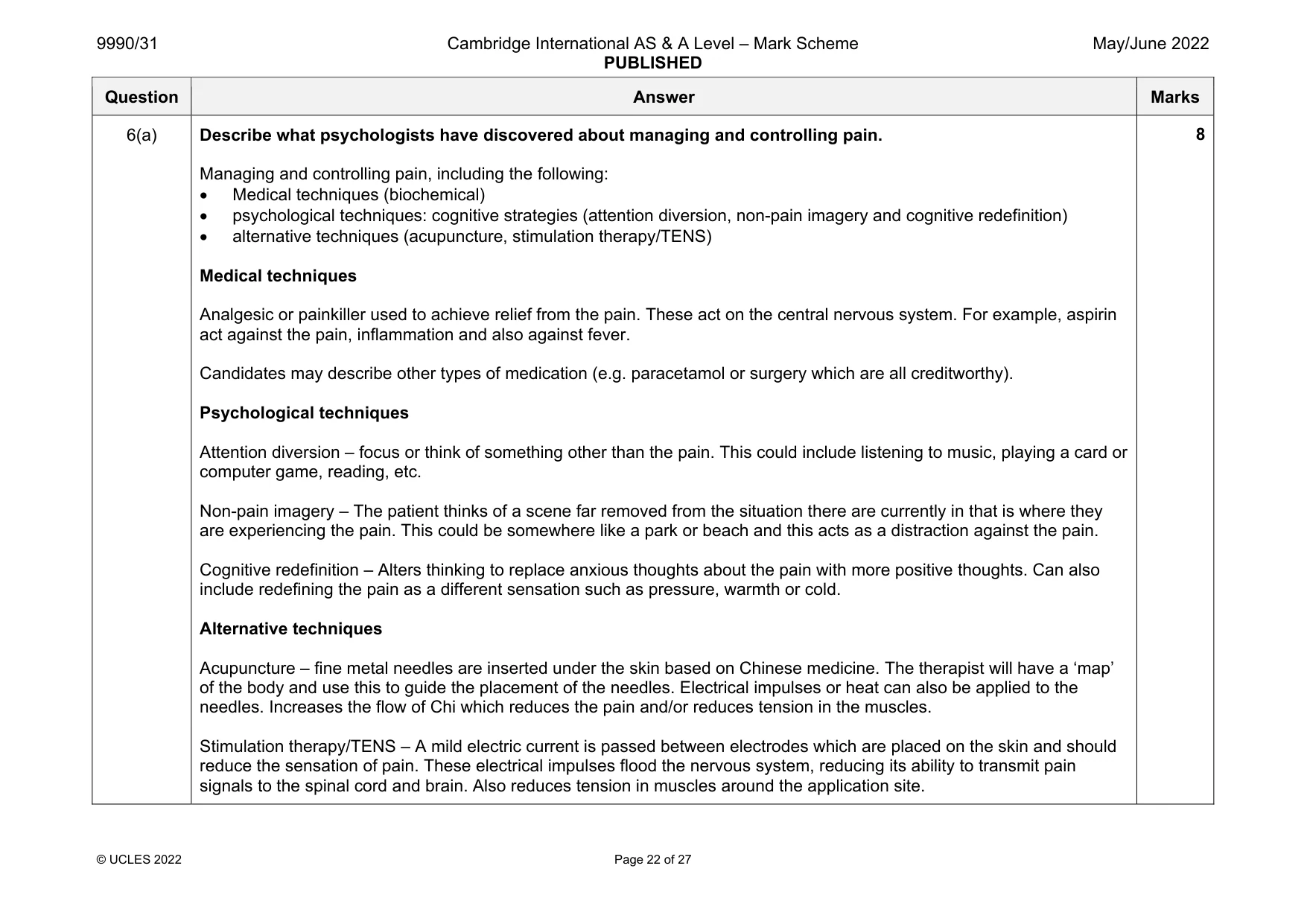
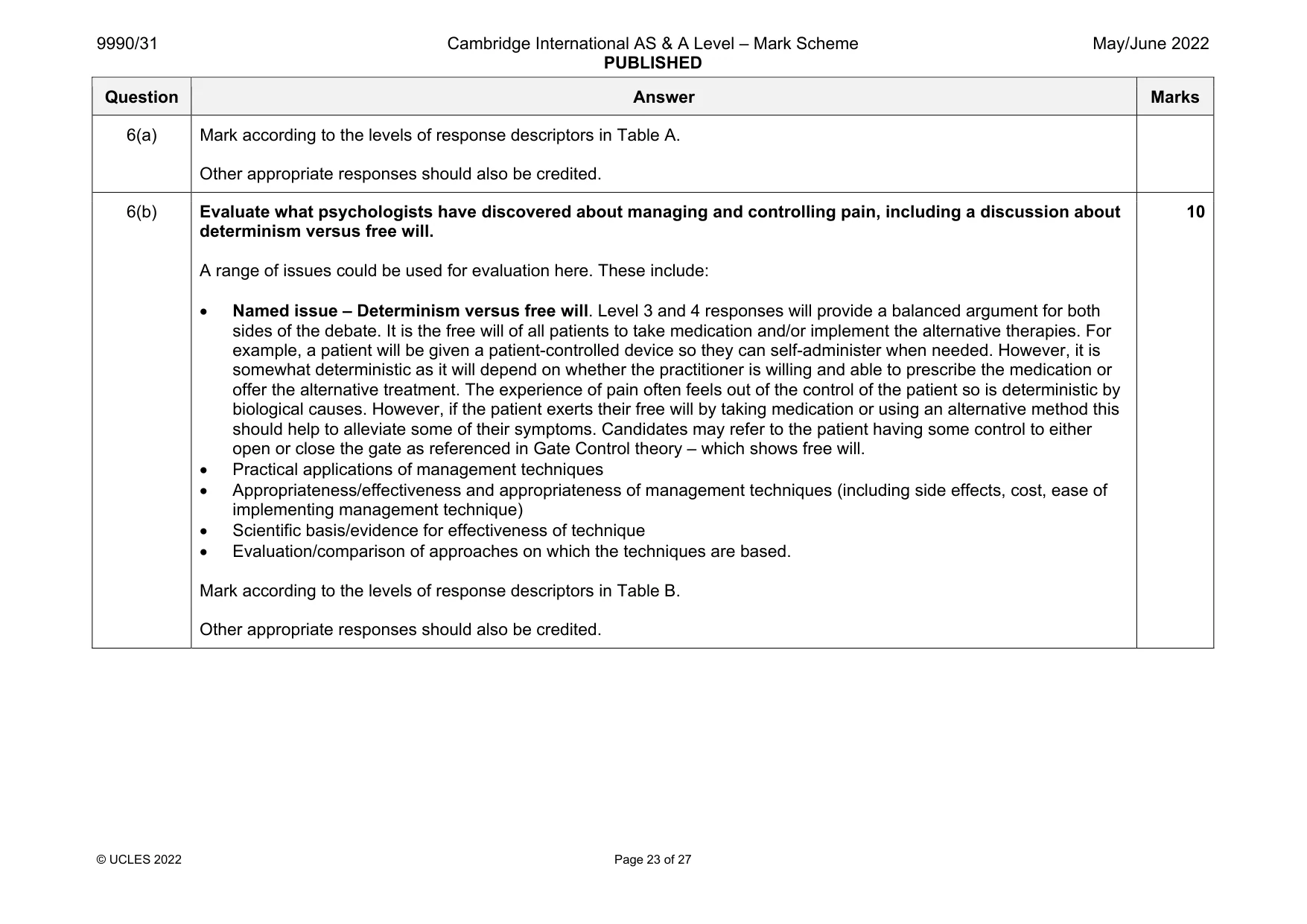
Mark scheme: 6(a) Describe what psychologists have discovered about managing and controlling pain. Managing and controlling pain, including the following: Medical techniques (biochemical) psychological techniques: cognitive strategies (attention diversion, non-pain imagery and cognitive redefinition) alternative techniques (acupuncture, stimulation therapy/TENS) Medical techniques Analgesic or painkiller used to achieve relief from the pain. These act on the central nervous system. For example, aspirin act against the pain, inflammation and also against fever. Candidates may describe other types of medication (e.g. paracetamol or surgery which are all creditworthy). Psychological techniques Attention diversion – focus or think of something other than the pain. This could include listening to music, playing a card or computer game, reading, etc. Non-pain imagery – The patient thinks of a scene far removed from the situation there are currently in that is where they are experiencing the pain. This could be somewhere like a park or beach and this acts as a distraction against the pain. Cognitive redefinition – Alters thinking to replace anxious thoughts about the pain with more positive thoughts. Can also include redefining the pain as a different sensation such as pressure, warmth or cold. Alternative techniques Acupuncture – fine metal needles are inserted under the skin based on Chinese medicine. The therapist will have a ‘map’ of the body and use this to guide the placement of the needles. Electrical impulses or heat can also be applied to the needles. Increases the flow of Chi which reduces the pain and/or reduces tension in the muscles. Stimulation therapy/TENS – A mild electric current is passed between electrodes which are placed on the skin and should reduce the sensation of pain. These electrical impulses flood the nervous system, reducing its ability to transmit pain signals to the spinal cord and brain. Also reduces tension in muscles around the application site. Question Answer Marks 6(a) Mark according to the levels of response descriptors in Table A. Other appropriate responses should also be credited. 6(b) Evaluate what psychologists have discovered about managing and controlling pain, including a discussion about determinism versus free will. A range of issues could be used for evaluation here. These include: Named issue – Determinism versus free will. Level 3 and 4 responses will provide a balanced argument for both sides of the debate. It is the free will of all patients to take medication and/or implement the alternative therapies. For example, a patient will be given a patient-controlled device so they can self-administer when needed. However, it is somewhat deterministic as it will depend on whether the practitioner is willing and able to prescribe the medication or offer the alternative treatment. The experience of pain often feels out of the control of the patient so is deterministic by biological causes. However, if the patient exerts their free will by taking medication or using an alternative method this should help to alleviate some of their symptoms. Candidates may refer to the patient having some control to either open or close the gate as referenced in Gate Control theory – which shows free will. Practical applications of management techniques Appropriateness/effectiveness and appropriateness of management techniques (including side effects, cost, ease of implementing management technique) Scientific basis/evidence for effectiveness of technique Evaluation/comparison of approaches on which the techniques are based. Mark according to the levels of response descriptors in Table B. Other appropriate responses should also be credited. 10
Q7 · Explain what is meant by ‘enrichment’ as a job design technique
7 (a) Explain what is meant by ‘enrichment’ as a job design technique. [2] (b) Describe the study on workplace sabotage by Giacalone and Rosenfeld (1987). [4] (c) Explain two weaknesses of the study by Giacalone and Rosenfeld. [6]
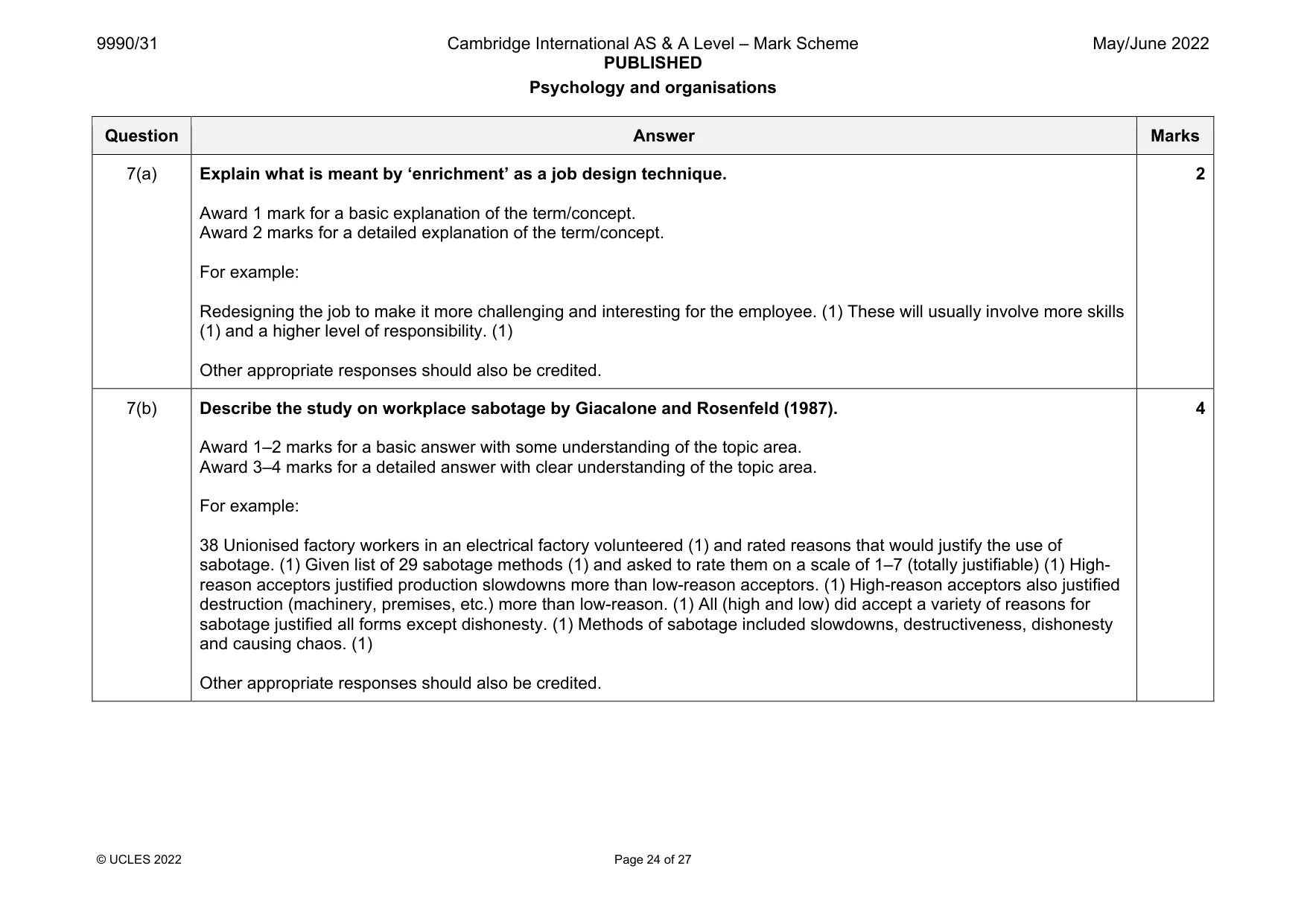
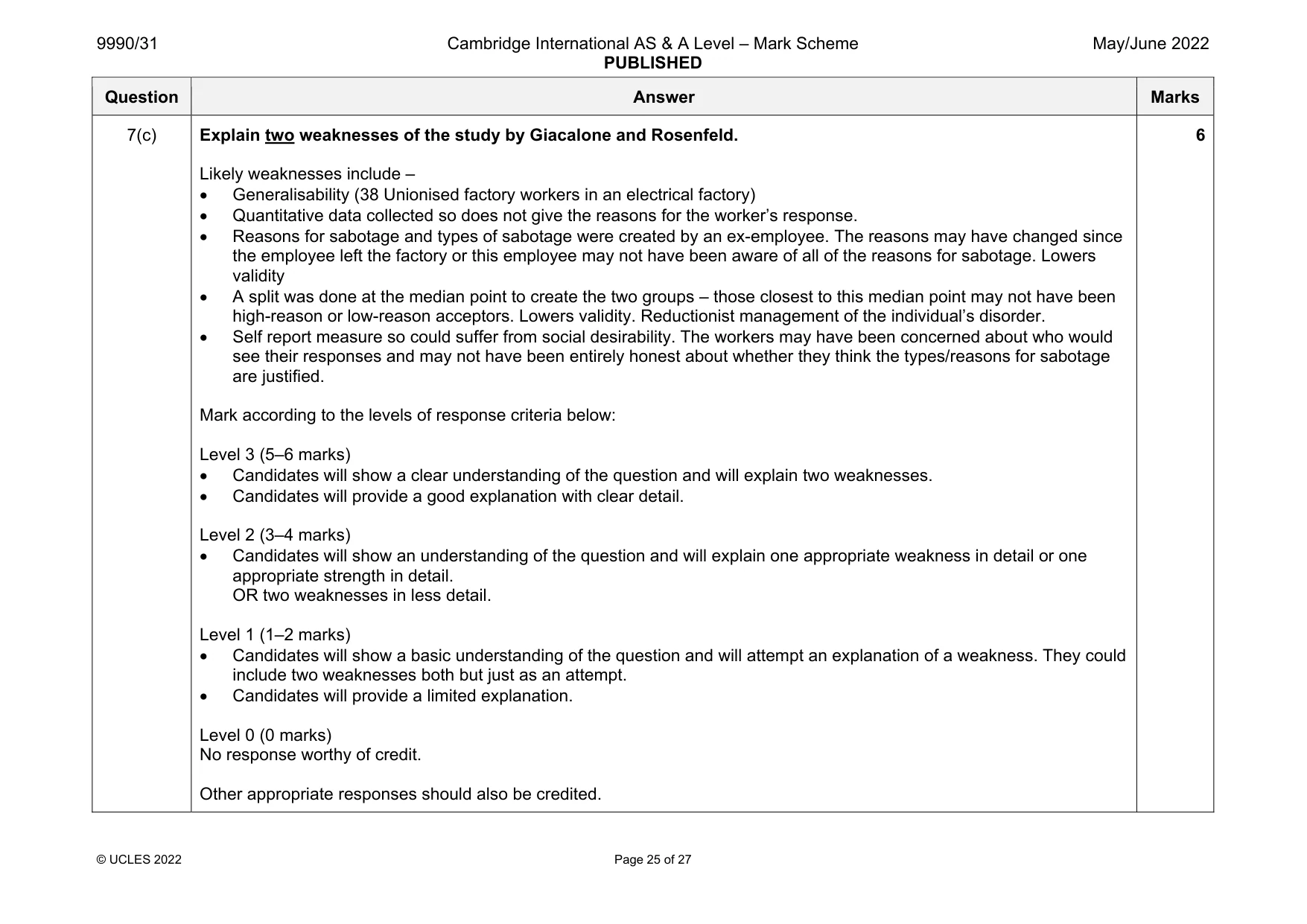
Mark scheme: 7(a) Explain what is meant by ‘enrichment’ as a job design technique. Award 1 mark for a basic explanation of the term/concept. Award 2 marks for a detailed explanation of the term/concept. For example: Redesigning the job to make it more challenging and interesting for the employee. (1) These will usually involve more skills (1) and a higher level of responsibility. (1) Other appropriate responses should also be credited. 7(b) Describe the study on workplace sabotage by Giacalone and Rosenfeld (1987). Award 1–2 marks for a basic answer with some understanding of the topic area. Award 3–4 marks for a detailed answer with clear understanding of the topic area. For example: 38 Unionised factory workers in an electrical factory volunteered (1) and rated reasons that would justify the use of sabotage. (1) Given list of 29 sabotage methods (1) and asked to rate them on a scale of 1–7 (totally justifiable) (1) High- reason acceptors justified production slowdowns more than low-reason acceptors. (1) High-reason acceptors also justified destruction (machinery, premises, etc.) more than low-reason. (1) All (high and low) did accept a variety of reasons for sabotage justified all forms except dishonesty. (1) Methods of sabotage included slowdowns, destructiveness, dishonesty and causing chaos. (1) Other appropriate responses should also be credited. 4 Question Answer Marks 7(c) Explain two weaknesses of the study by Giacalone and Rosenfeld. Likely weaknesses include – Generalisability (38 Unionised factory workers in an electrical factory) Quantitative data collected so does not give the reasons for the worker’s response. Reasons for sabotage and types of sabotage were created by an ex-employee. The reasons may have changed since the employee left the factory or this employee may not have been aware of all of the reasons for sabotage. Lowers validity A split was done at the median point to create the two groups – those closest to this median point may not have been high-reason or low-reason acceptors. Lowers validity. Reductionist management of the individual’s disorder. Self report measure so could suffer from social desirability. The workers may have been concerned about who would see their responses and may not have been entirely honest about whether they think the types/reasons for sabotage are justified. Mark according to the levels of response criteria below: Level 3 (5–6 marks) Candidates will show a clear understanding of the question and will explain two weaknesses. Candidates will provide a good explanation with clear detail. Level 2 (3–4 marks) Candidates will show an understanding of the question and will explain one appropriate weakness in detail or one appropriate strength in detail. OR two weaknesses in less detail. Level 1 (1–2 marks) Candidates will show a basic understanding of the question and will attempt an explanation of a weakness. They could include two weaknesses both but just as an attempt. Candidates will provide a limited explanation. Level 0 (0 marks) No response worthy of credit. Other appropriate responses should also be credited. 6
Q8 · Describe what psychologists have discovered about leadership style (contingency theory…
8 (a) Describe what psychologists have discovered about leadership style (contingency theory, situational leadership, styles of leader behaviour). [8] (b) Evaluate what psychologists have discovered about leadership style (contingency theory, situational leadership, styles of leader behaviour), including a discussion about practical applications. [10]
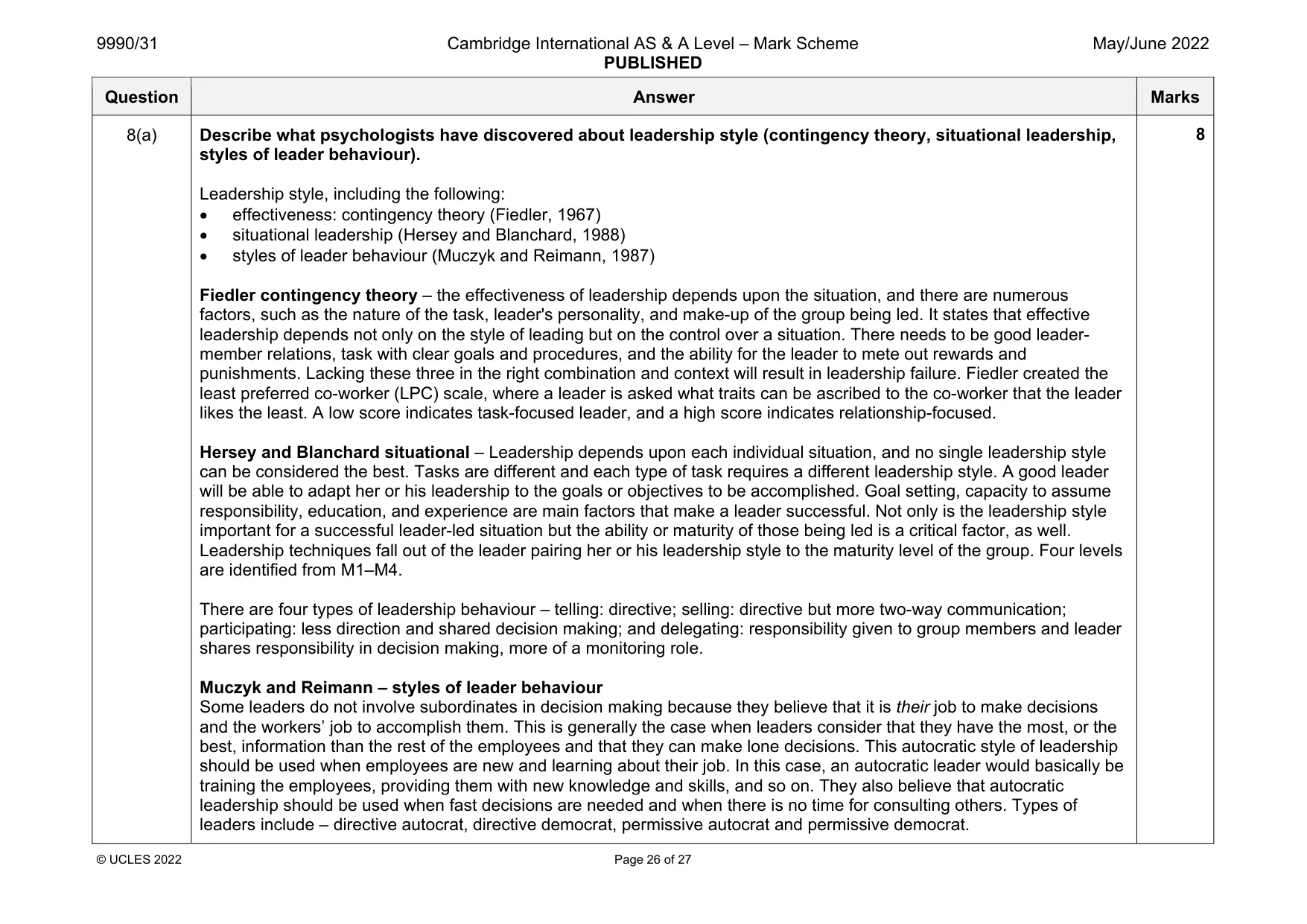
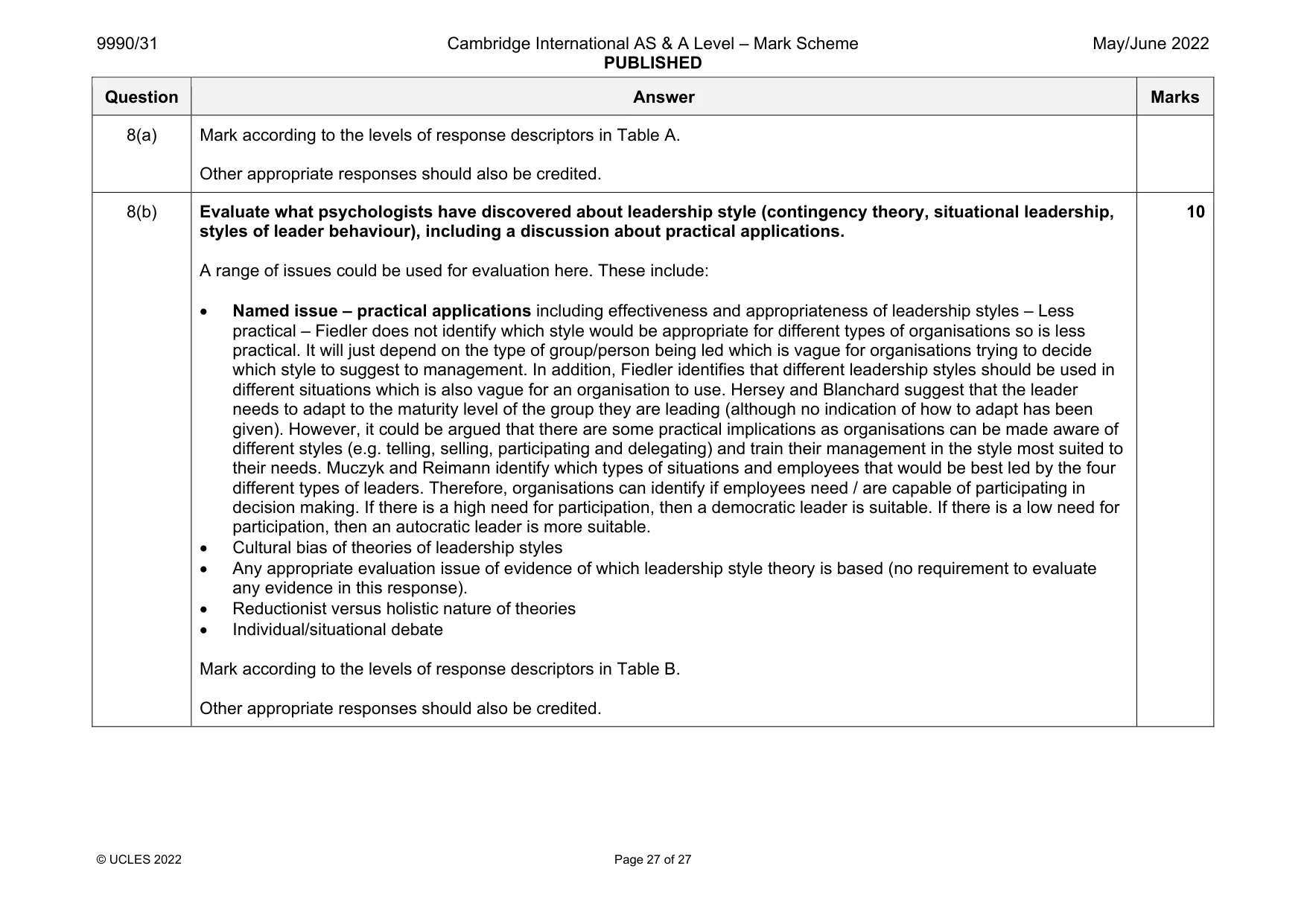
Mark scheme: 8(a) Describe what psychologists have discovered about leadership style (contingency theory, situational leadership, styles of leader behaviour). Leadership style, including the following: effectiveness: contingency theory (Fiedler, 1967) situational leadership (Hersey and Blanchard, 1988) styles of leader behaviour (Muczyk and Reimann, 1987) Fiedler contingency theory – the effectiveness of leadership depends upon the situation, and there are numerous factors, such as the nature of the task, leader's personality, and make-up of the group being led. It states that effective leadership depends not only on the style of leading but on the control over a situation. There needs to be good leader- member relations, task with clear goals and procedures, and the ability for the leader to mete out rewards and punishments. Lacking these three in the right combination and context will result in leadership failure. Fiedler created the least preferred co-worker (LPC) scale, where a leader is asked what traits can be ascribed to the co-worker that the leader likes the least. A low score indicates task-focused leader, and a high score indicates relationship-focused. Hersey and Blanchard situational – Leadership depends upon each individual situation, and no single leadership style can be considered the best. Tasks are different and each type of task requires a different leadership style. A good leader will be able to adapt her or his leadership to the goals or objectives to be accomplished. Goal setting, capacity to assume responsibility, education, and experience are main factors that make a leader successful. Not only is the leadership style important for a successful leader-led situation but the ability or maturity of those being led is a critical factor, as well. Leadership techniques fall out of the leader pairing her or his leadership style to the maturity level of the group. Four levels are identified from M1–M4. There are four types of leadership behaviour – telling: directive; selling: directive but more two-way communication; participating: less direction and shared decision making; and delegating: responsibility given to group members and leader shares responsibility in decision making, more of a monitoring role. Muczyk and Reimann – styles of leader behaviour Some leaders do not involve subordinates in decision making because they believe that it is their job to make decisions and the workers’ job to accomplish them. This is generally the case when leaders consider that they have the most, or the best, information than the rest of the employees and that they can make lone decisions. This autocratic style of leadership should be used when employees are new and learning about their job. In this case, an autocratic leader would basically be training the employees, providing them with new knowledge and skills, and so on. They also believe that autocratic leadership should be used when fast decisions are needed and when there is no time for consulting others. Types of leaders include – directive autocrat, directive democrat, permissive autocrat and permissive democrat. Question Answer Marks 8(a) Mark according to the levels of response descriptors in Table A. Other appropriate responses should also be credited. 8(b) Evaluate what psychologists have discovered about leadership style (contingency theory, situational leadership, styles of leader behaviour), including a discussion about practical applications. A range of issues could be used for evaluation here. These include: Named issue – practical applications including effectiveness and appropriateness of leadership styles – Less practical – Fiedler does not identify which style would be appropriate for different types of organisations so is less practical. It will just depend on the type of group/person being led which is vague for organisations trying to decide which style to suggest to management. In addition, Fiedler identifies that different leadership styles should be used in different situations which is also vague for an organisation to use. Hersey and Blanchard suggest that the leader needs to adapt to the maturity level of the group they are leading (although no indication of how to adapt has been given). However, it could be argued that there are some practical implications as organisations can be made aware of different styles (e.g. telling, selling, participating and delegating) and train their management in the style most suited to their needs. Muczyk and Reimann identify which types of situations and employees that would be best led by the four different types of leaders. Therefore, organisations can identify if employees need / are capable of participating in decision making. If there is a high need for participation, then a democratic leader is suitable. If there is a low need for participation, then an autocratic leader is more suitable. Cultural bias of theories of leadership styles Any appropriate evaluation issue of evidence of which leadership style theory is based (no requirement to evaluate any evidence in this response). Reductionist versus holistic nature of theories Individual/situational debate Mark according to the levels of response descriptors in Table B. Other appropriate responses should also be credited. 10
What was in this paper
The subtopics covered by these 8 questions, and how many questions each got. Open one in a new tab to see every Cambridge question on it.
What you needed in this session
Cambridge’s own grade thresholds for 2022 May/June, Paper 3 · Variant 1. A higher threshold means an easier paper — the bar moves with how the cohort did.