Cambridge A Level Psychology (from 2018) 9990 — 2023 Oct/Nov Paper 3 · Variant 1
9990/31/O/N/23 · 8 questions · 60 marks · ≈68 min
The question paper and its mark scheme, free to read here and free to download. This is Cambridge’s own paper, exactly as it was sat.
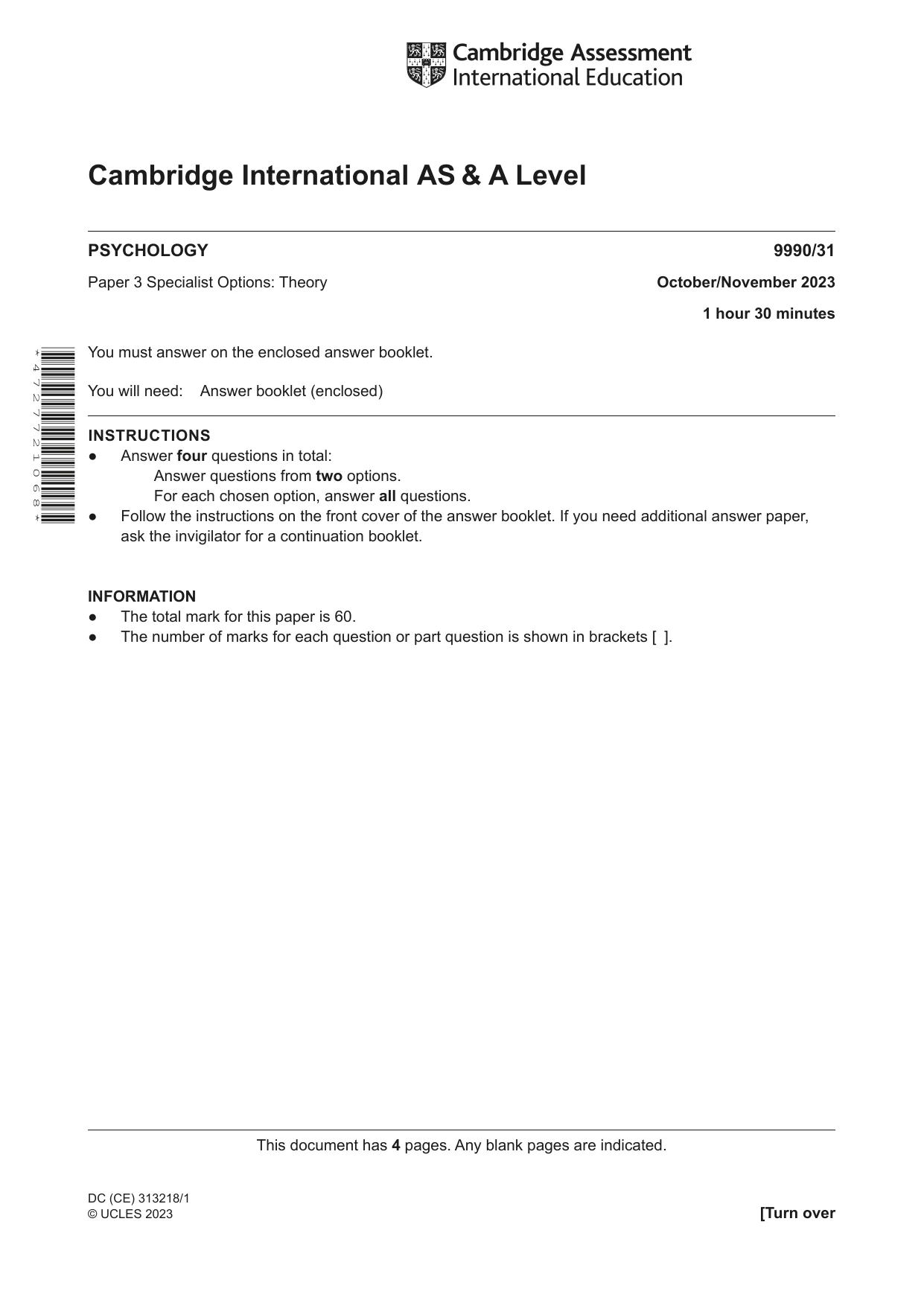
Question paper4 pages

Mark scheme41 pages
Answers below. Sit the paper first if you are practising.


Questions as text
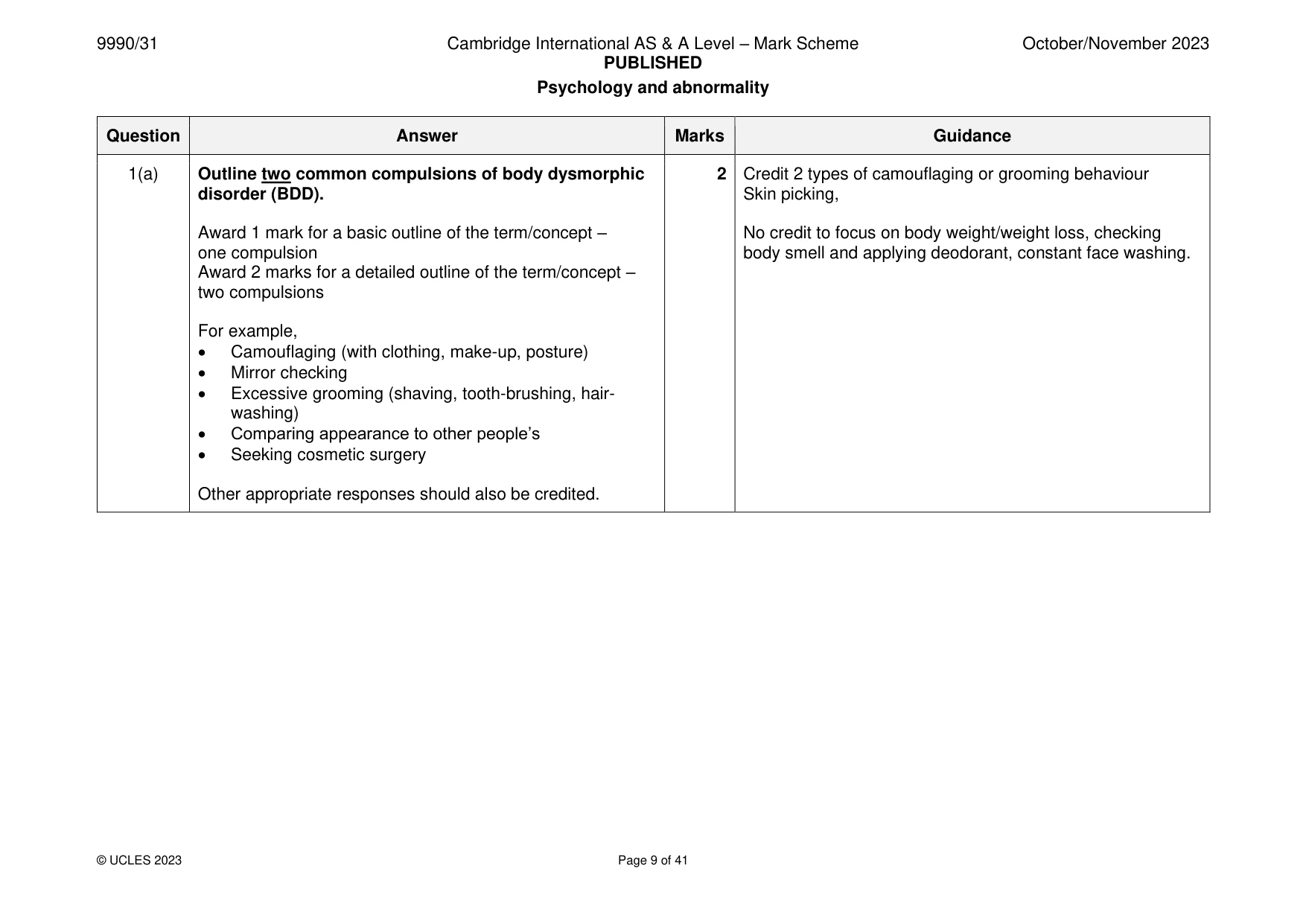
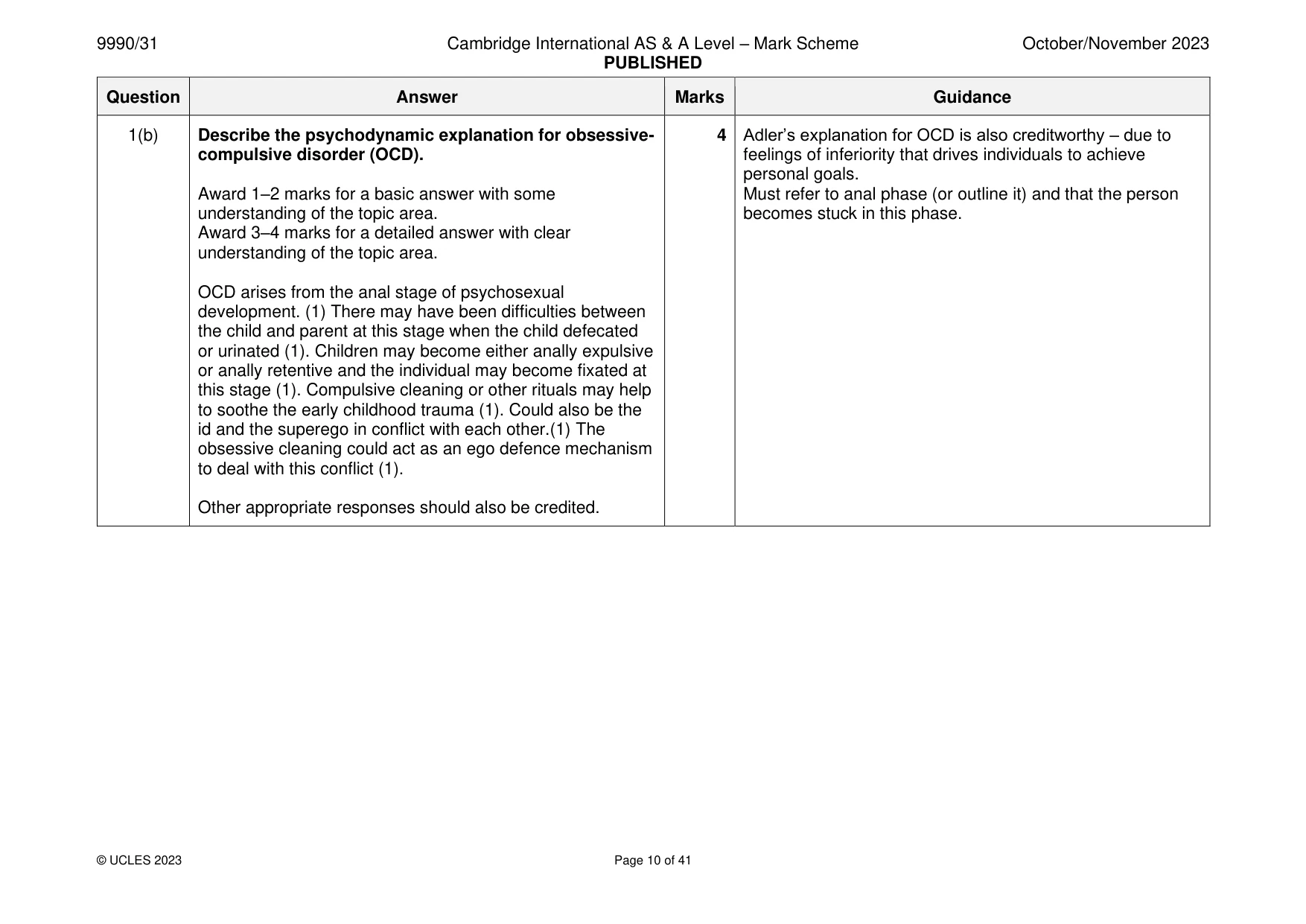
Q1 · Outline two common compulsions of body dysmorphic disorder (BDD)
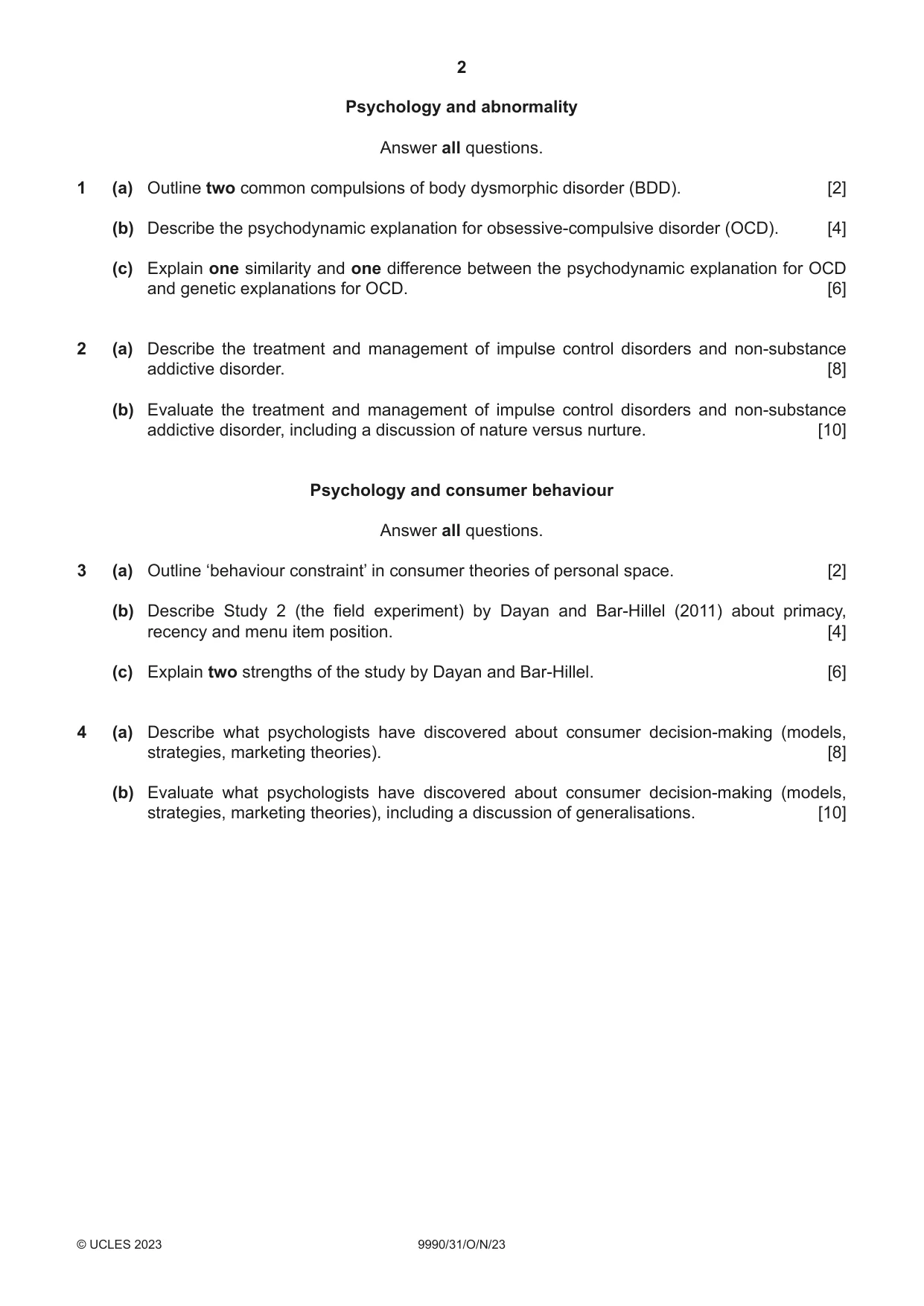
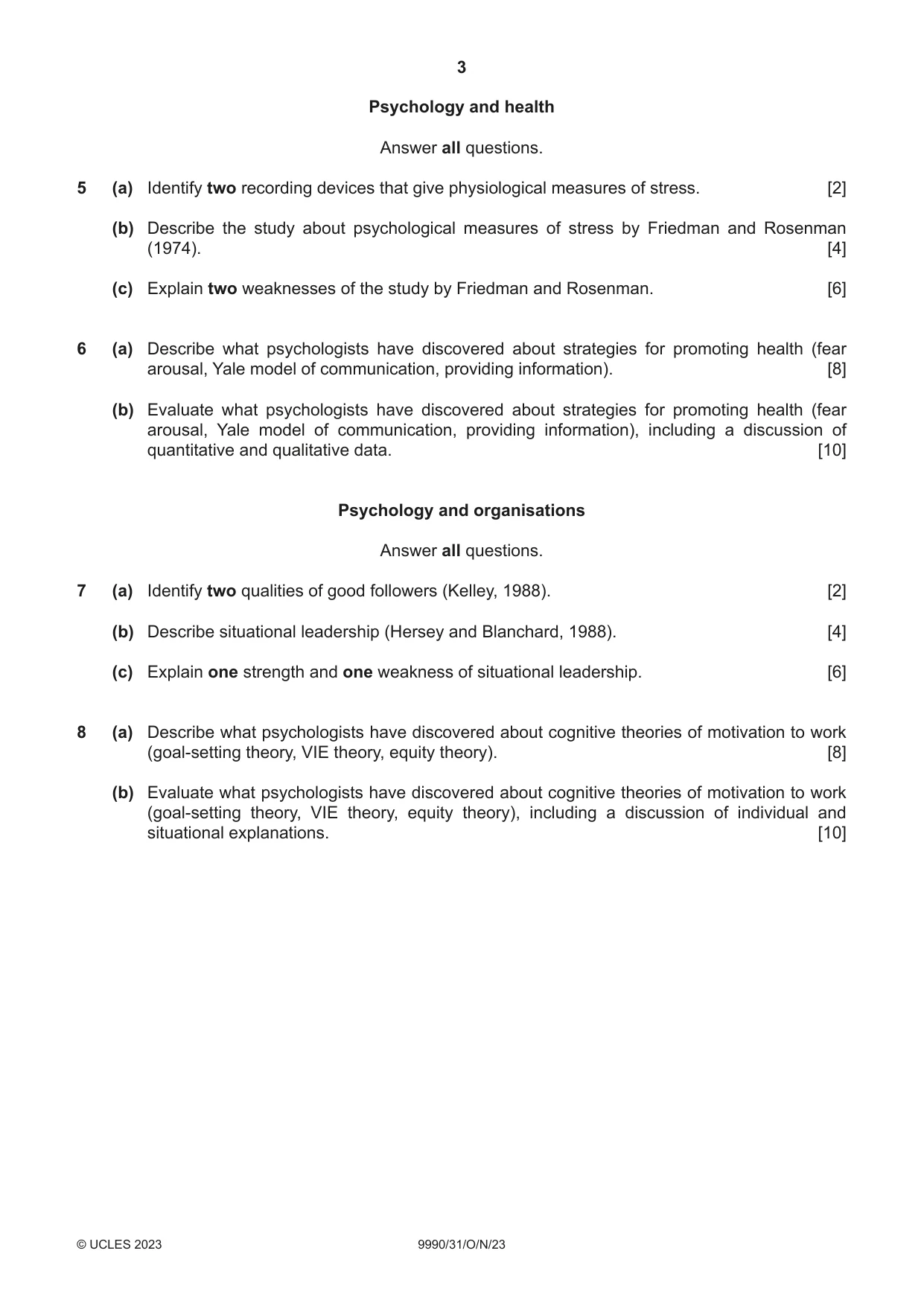
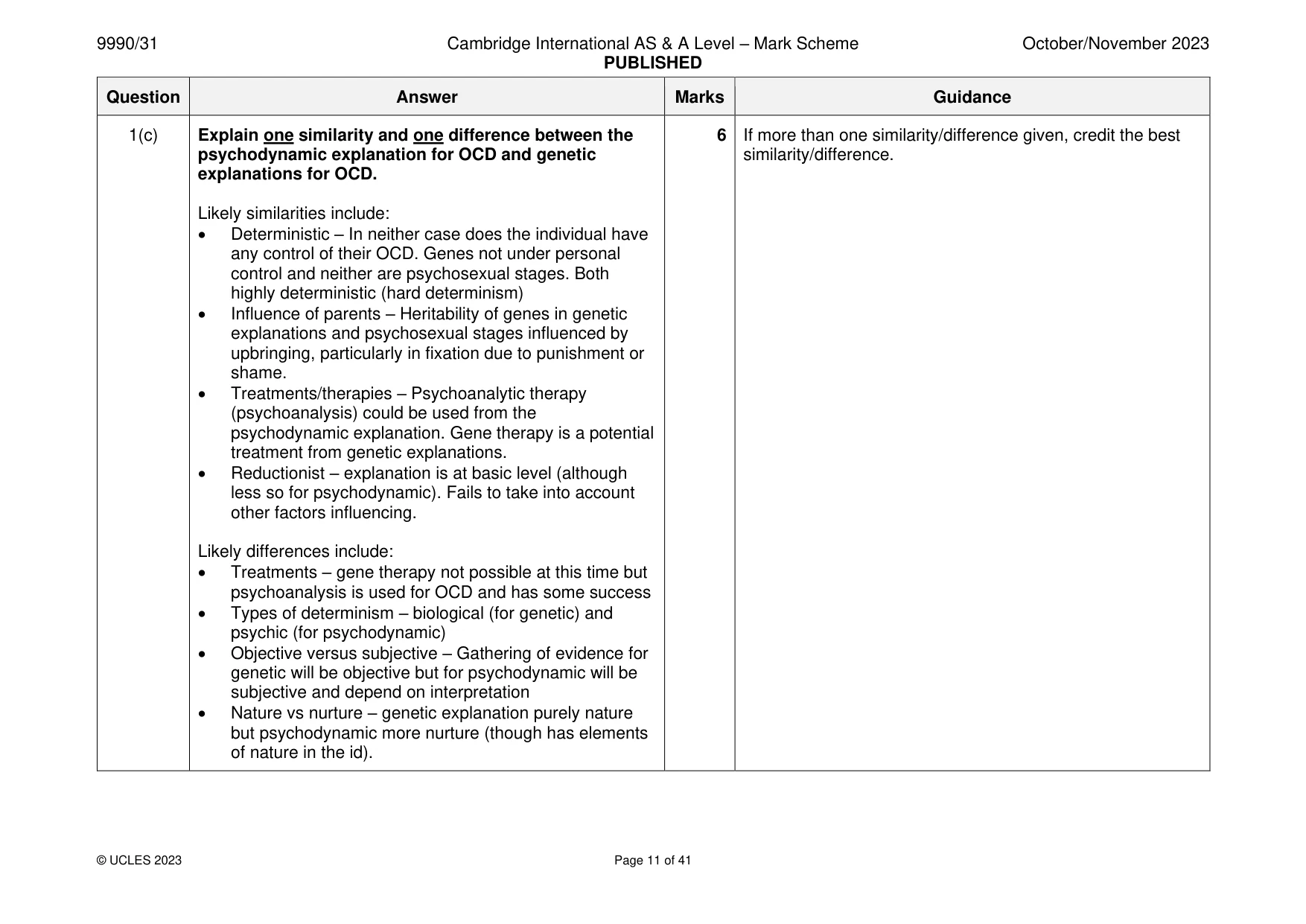
1 (a) Outline two common compulsions of body dysmorphic disorder (BDD). [2] (b) Describe the psychodynamic explanation for obsessive-compulsive disorder (OCD). [4] (c) Explain one similarity and one difference between the psychodynamic explanation for OCD and genetic explanations for OCD. [6]
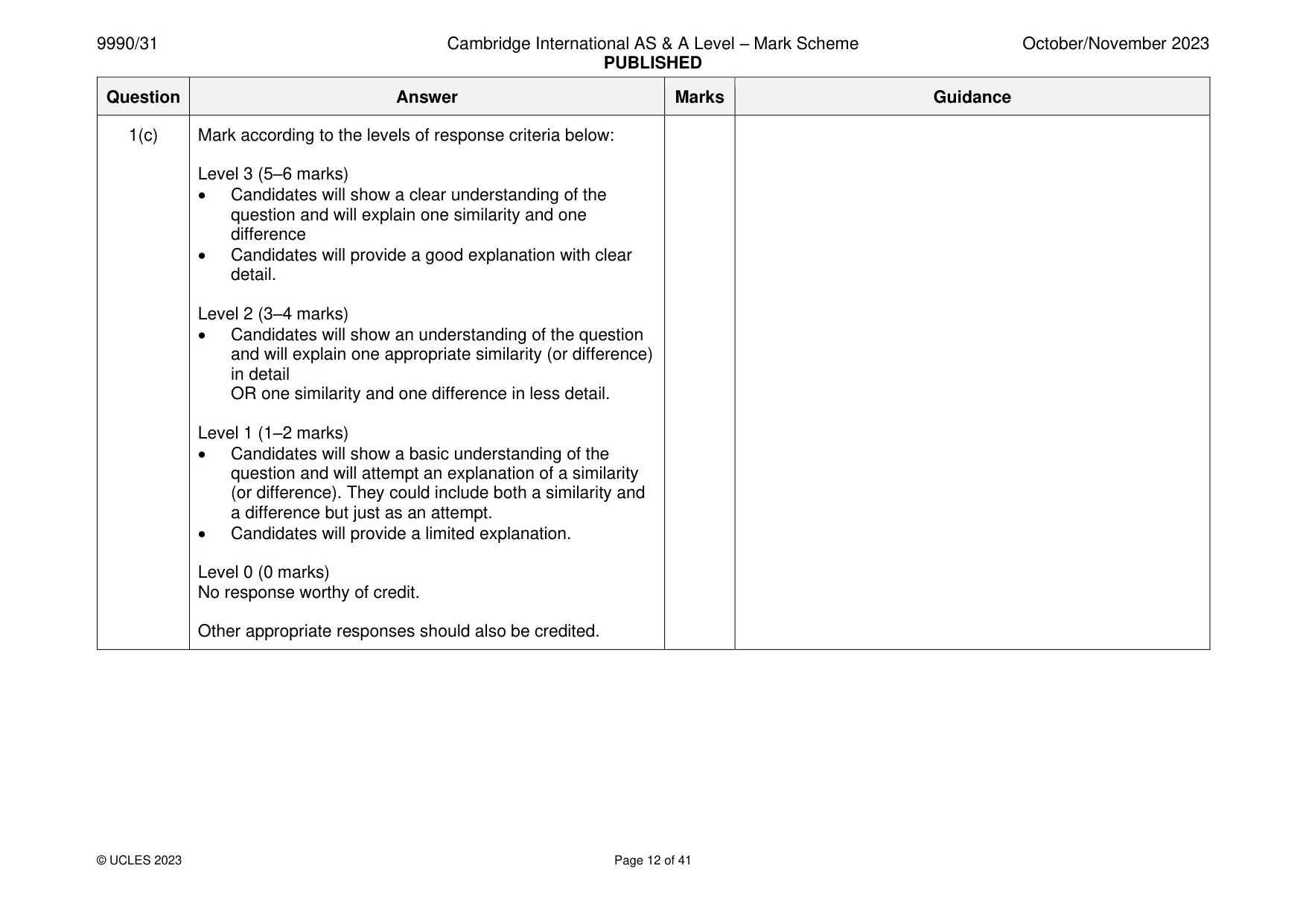
Mark scheme: Question Answer Marks Guidance 1(a) Outline two common compulsions of body dysmorphic 2 Credit 2 types of camouflaging or grooming behaviour disorder (BDD). Skin picking, Award 1 mark for a basic outline of the term/concept – No credit to focus on body weight/weight loss, checking one compulsion body smell and applying deodorant, constant face washing. Award 2 marks for a detailed outline of the term/concept – two compulsions For example, • Camouflaging (with clothing, make-up, posture) • Mirror checking • Excessive grooming (shaving, tooth-brushing, hair- washing) • Comparing appearance to other people’s • Seeking cosmetic surgery Other appropriate responses should also be credited. 1(b) Describe the psychodynamic explanation for obsessive- 4 Adler’s explanation for OCD is also creditworthy – due to compulsive disorder (OCD). feelings of inferiority that drives individuals to achieve personal goals. Award 1–2 marks for a basic answer with some Must refer to anal phase (or outline it) and that the person understanding of the topic area. becomes stuck in this phase. Award 3–4 marks for a detailed answer with clear understanding of the topic area. OCD arises from the anal stage of psychosexual development. (1) There may have been difficulties between the child and parent at this stage when the child defecated or urinated (1). Children may become either anally expulsive or anally retentive and the individual may become fixated at this stage (1). Compulsive cleaning or other rituals may help to soothe the early childhood trauma (1). Could also be the id and the superego in conflict with each other.(1) The obsessive cleaning could act as an ego defence mechanism to deal with this conflict (1). Other appropriate responses should also be credited. 1(c) Explain one similarity and one difference between the 6 If more than one similarity/difference given, credit the best psychodynamic explanation for OCD and genetic similarity/difference. explanations for OCD. Likely similarities include: • Deterministic – In neither case does the individual have any control of their OCD. Genes not under personal control and neither are psychosexual stages. Both highly deterministic (hard determinism) • Influence of parents – Heritability of genes in genetic explanations and psychosexual stages influenced by upbringing, particularly in fixation due to punishment or shame. • Treatments/therapies – Psychoanalytic therapy (psychoanalysis) could be used from the psychodynamic explanation. Gene therapy is a potential treatment from genetic explanations. • Reductionist – explanation is at basic level (although less so for psychodynamic). Fails to take into account other factors influencing. Likely differences include: • Treatments – gene therapy not possible at this time but psychoanalysis is used for OCD and has some success • Types of determinism – biological (for genetic) and psychic (for psychodynamic) • Objective versus subjective – Gathering of evidence for genetic will be objective but for psychodynamic will be subjective and depend on interpretation • Nature vs nurture – genetic explanation purely nature but psychodynamic more nurture (though has elements of nature in the id). 1(c) Mark according to the levels of response criteria below: Level 3 (5–6 marks) • Candidates will show a clear understanding of the question and will explain one similarity and one difference • Candidates will provide a good explanation with clear detail. Level 2 (3–4 marks) • Candidates will show an understanding of the question and will explain one appropriate similarity (or difference) in detail OR one similarity and one difference in less detail. Level 1 (1–2 marks) • Candidates will show a basic understanding of the question and will attempt an explanation of a similarity (or difference). They could include both a similarity and a difference but just as an attempt. • Candidates will provide a limited explanation. Level 0 (0 marks) No response worthy of credit. Other appropriate responses should also be credited.
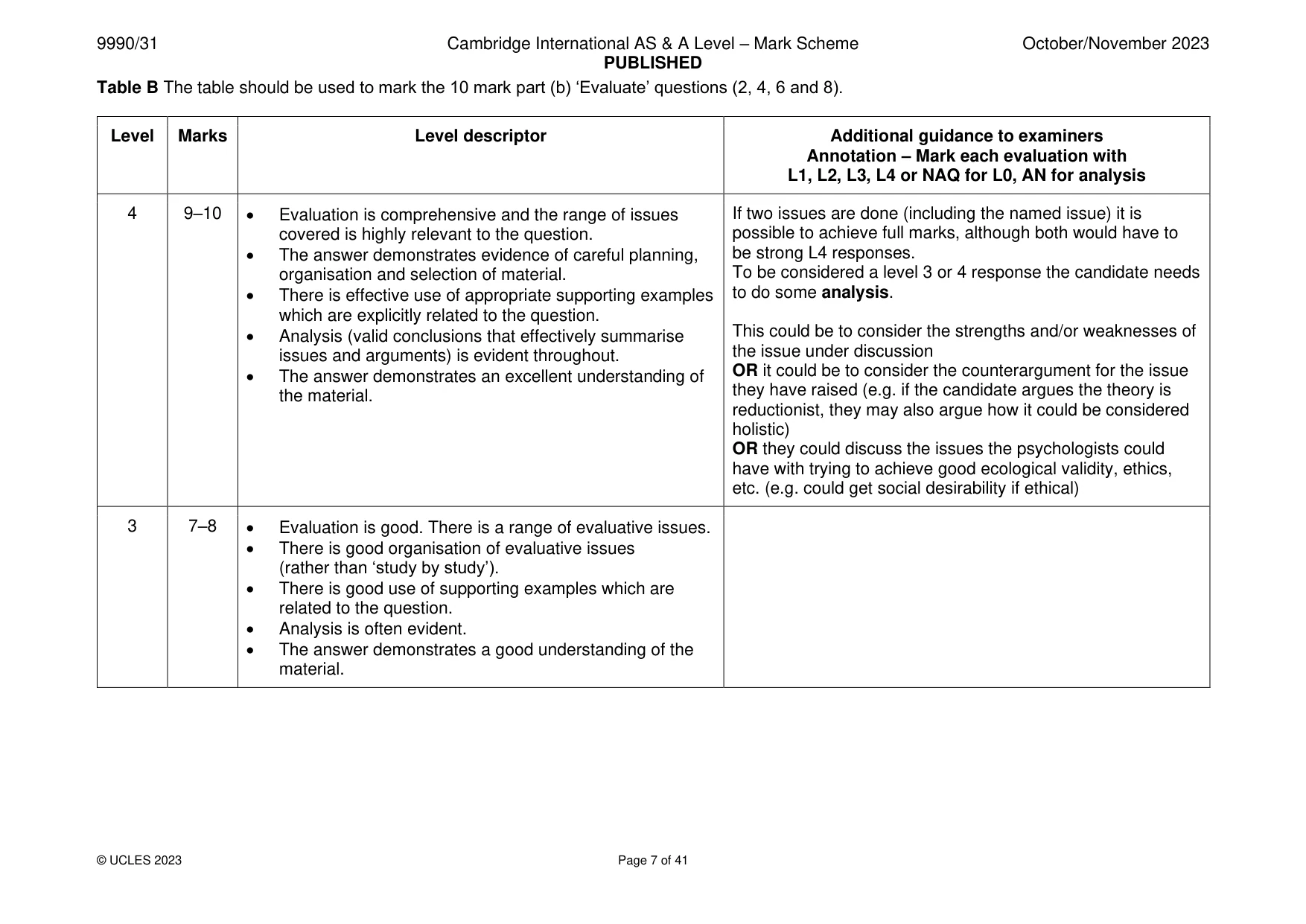
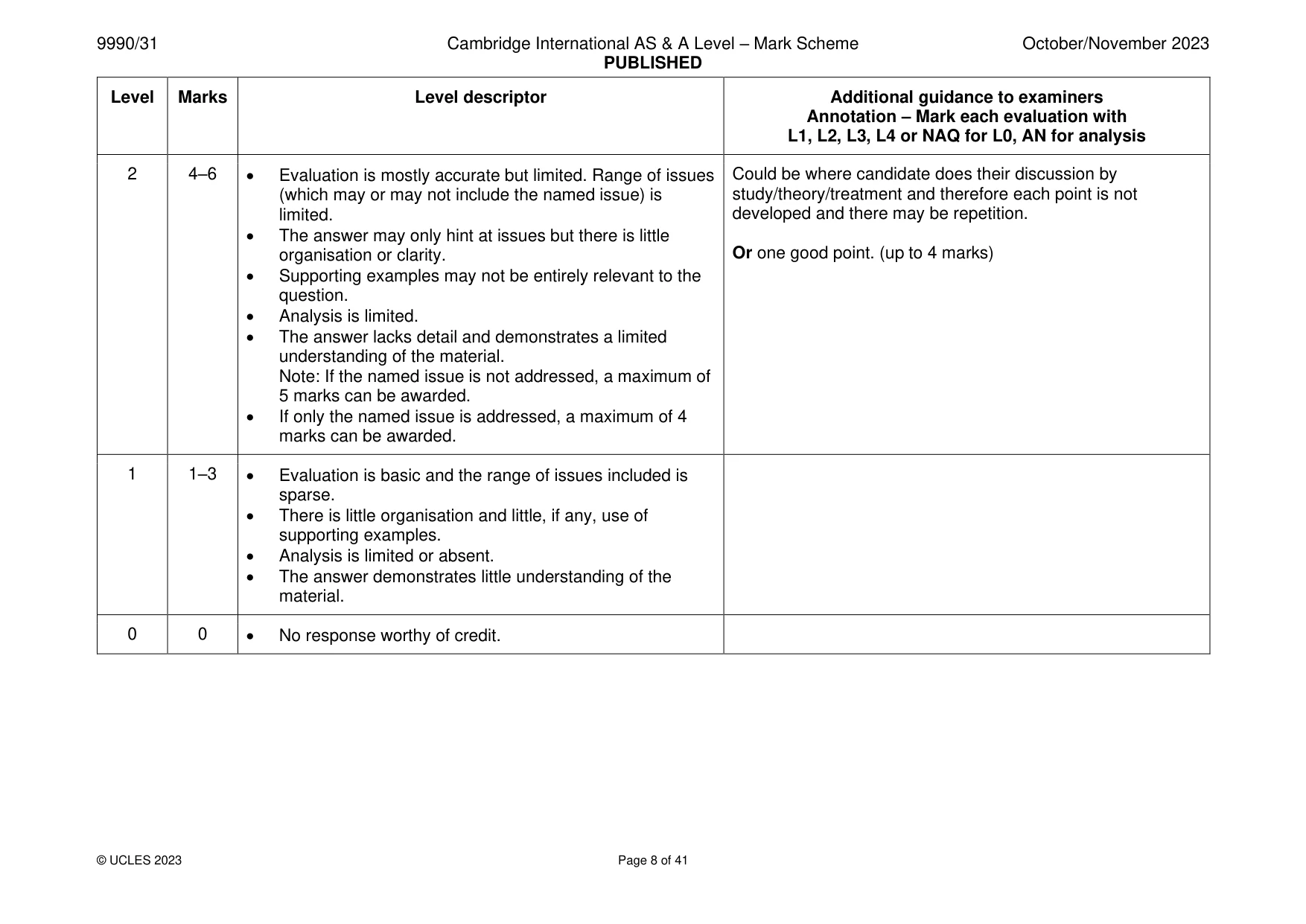
Q2 · Describe the treatment and management of impulse control disorders and non-substance…
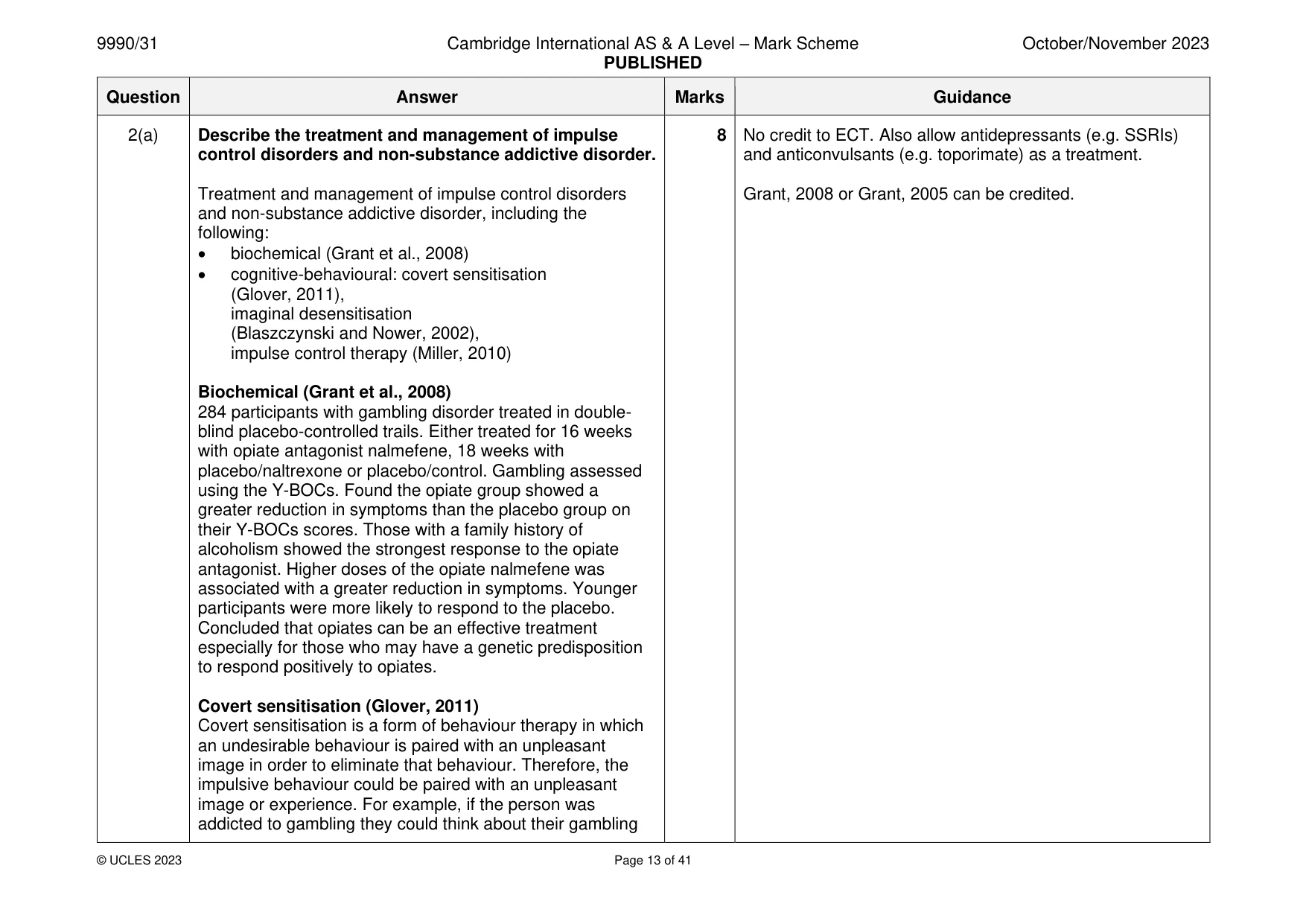
2 (a) Describe the treatment and management of impulse control disorders and non-substance addictive disorder. [8] (b) Evaluate the treatment and management of impulse control disorders and non-substance addictive disorder, including a discussion of nature versus nurture. [10] Psychology and consumer behaviour Answer all questions.
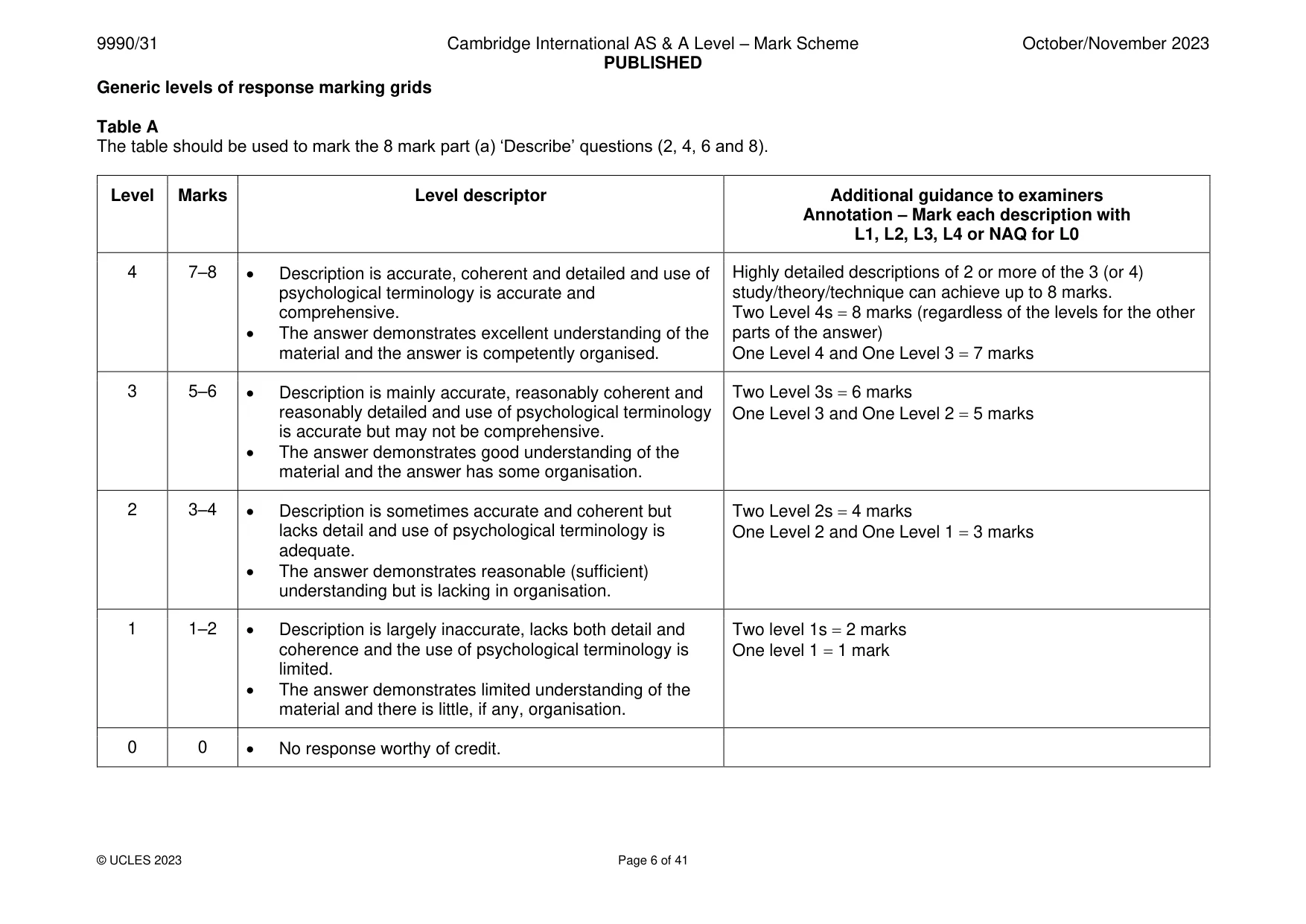
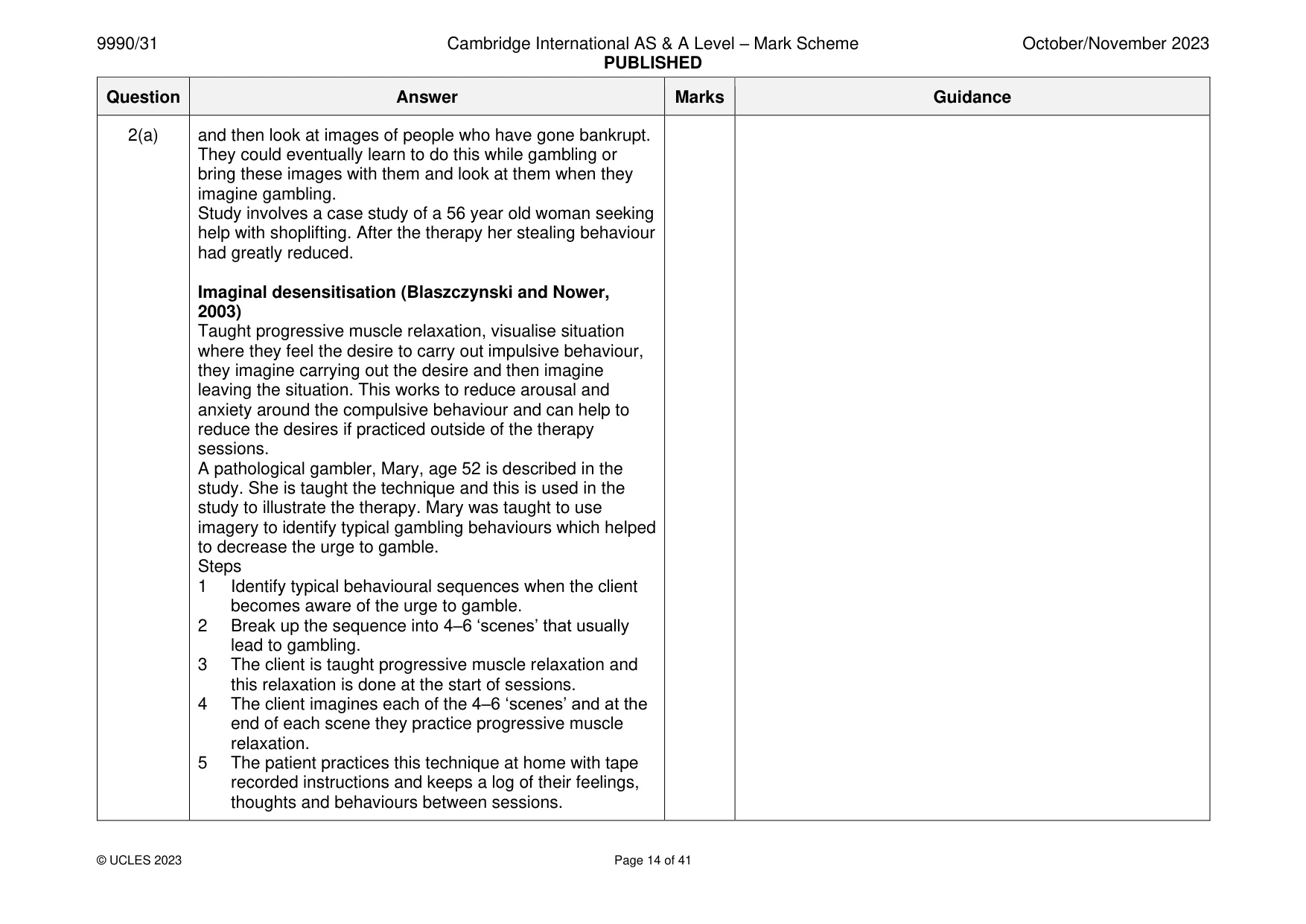
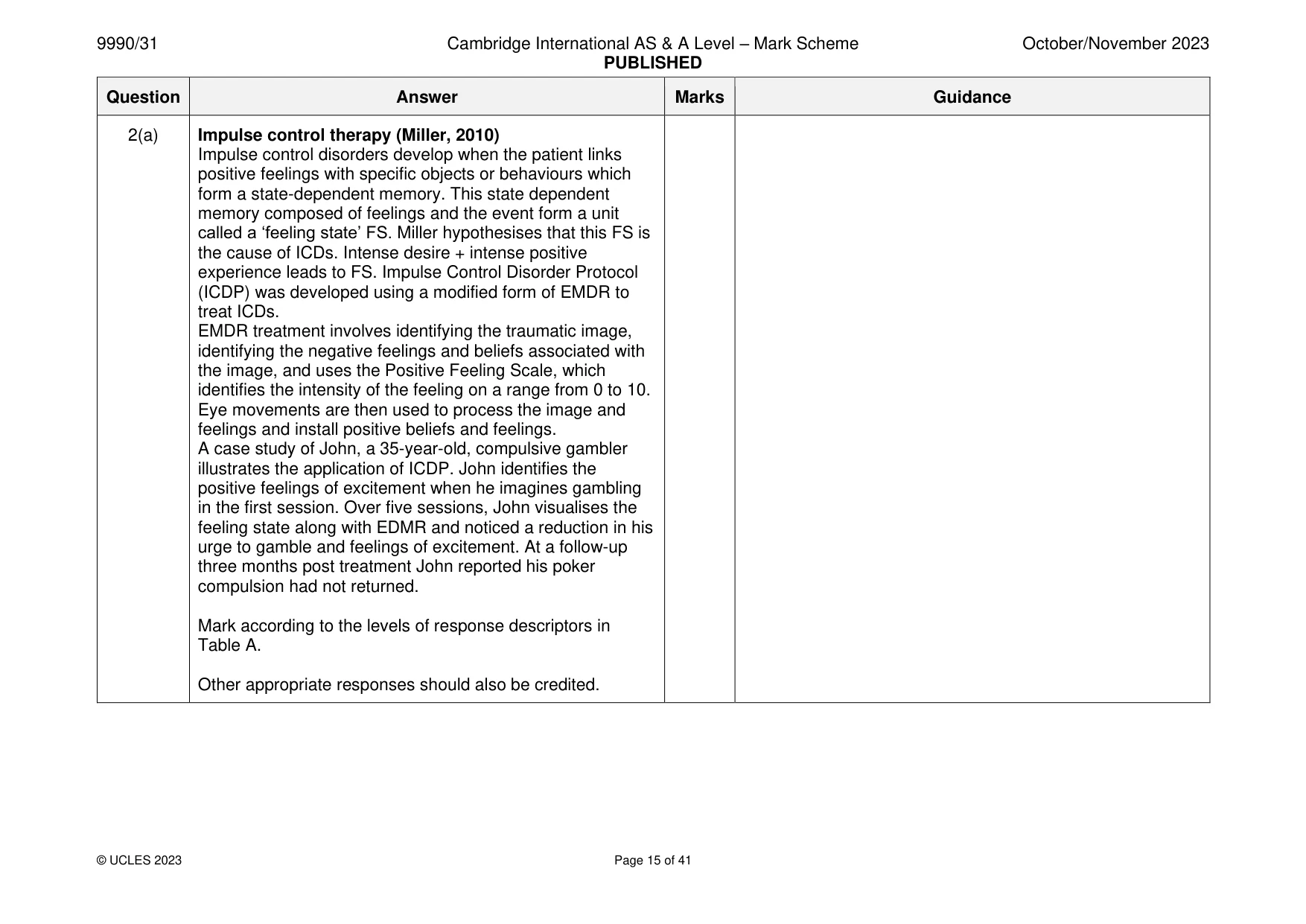
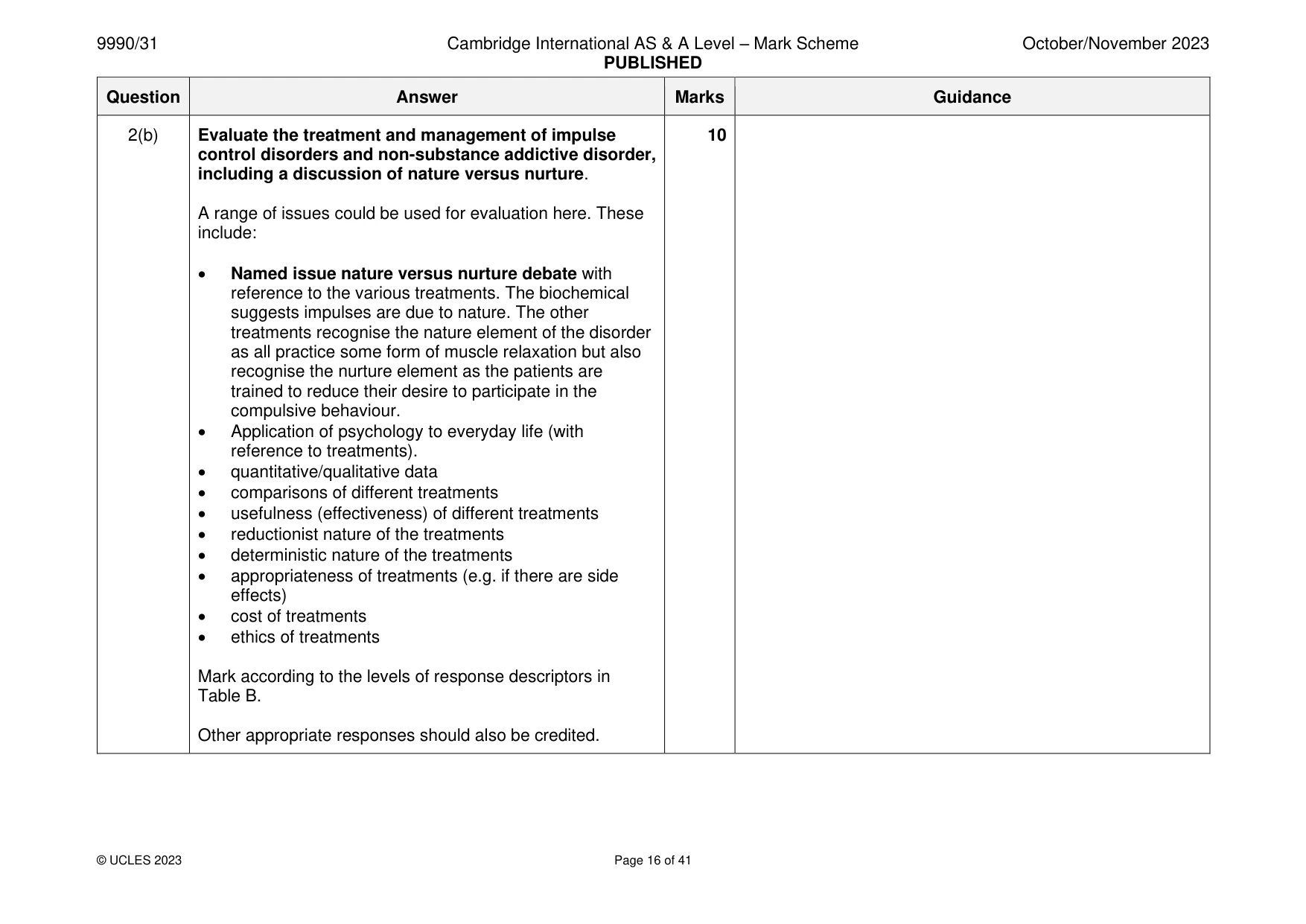
Mark scheme: 2(a) Describe the treatment and management of impulse 8 No credit to ECT. Also allow antidepressants (e.g. SSRIs) control disorders and non-substance addictive disorder. and anticonvulsants (e.g. toporimate) as a treatment. Treatment and management of impulse control disorders Grant, 2008 or Grant, 2005 can be credited. and non-substance addictive disorder, including the following: • biochemical (Grant et al., 2008) • cognitive-behavioural: covert sensitisation (Glover, 2011), imaginal desensitisation (Blaszczynski and Nower, 2002), impulse control therapy (Miller, 2010) Biochemical (Grant et al., 2008) 284 participants with gambling disorder treated in double- blind placebo-controlled trails. Either treated for 16 weeks with opiate antagonist nalmefene, 18 weeks with placebo/naltrexone or placebo/control. Gambling assessed using the Y-BOCs. Found the opiate group showed a greater reduction in symptoms than the placebo group on their Y-BOCs scores. Those with a family history of alcoholism showed the strongest response to the opiate antagonist. Higher doses of the opiate nalmefene was associated with a greater reduction in symptoms. Younger participants were more likely to respond to the placebo. Concluded that opiates can be an effective treatment especially for those who may have a genetic predisposition to respond positively to opiates. Covert sensitisation (Glover, 2011) Covert sensitisation is a form of behaviour therapy in which an undesirable behaviour is paired with an unpleasant image in order to eliminate that behaviour. Therefore, the impulsive behaviour could be paired with an unpleasant image or experience. For example, if the person was addicted to gambling they could think about their gambling 2(a) and then look at images of people who have gone bankrupt. They could eventually learn to do this while gambling or bring these images with them and look at them when they imagine gambling. Study involves a case study of a 56 year old woman seeking help with shoplifting. After the therapy her stealing behaviour had greatly reduced. Imaginal desensitisation (Blaszczynski and Nower, 2003) Taught progressive muscle relaxation, visualise situation where they feel the desire to carry out impulsive behaviour, they imagine carrying out the desire and then imagine leaving the situation. This works to reduce arousal and anxiety around the compulsive behaviour and can help to reduce the desires if practiced outside of the therapy sessions. A pathological gambler, Mary, age 52 is described in the study. She is taught the technique and this is used in the study to illustrate the therapy. Mary was taught to use imagery to identify typical gambling behaviours which helped to decrease the urge to gamble. Steps 1 Identify typical behavioural sequences when the client becomes aware of the urge to gamble. 2 Break up the sequence into 4–6 ‘scenes’ that usually lead to gambling. 3 The client is taught progressive muscle relaxation and this relaxation is done at the start of sessions. 4 The client imagines each of the 4–6 ‘scenes’ and at the end of each scene they practice progressive muscle relaxation. 5 The patient practices this technique at home with tape recorded instructions and keeps a log of their feelings, thoughts and behaviours between sessions. 2(a) Impulse control therapy (Miller, 2010) Impulse control disorders develop when the patient links positive feelings with specific objects or behaviours which form a state-dependent memory. This state dependent memory composed of feelings and the event form a unit called a ‘feeling state’ FS. Miller hypothesises that this FS is the cause of ICDs. Intense desire + intense positive experience leads to FS. Impulse Control Disorder Protocol (ICDP) was developed using a modified form of EMDR to treat ICDs. EMDR treatment involves identifying the traumatic image, identifying the negative feelings and beliefs associated with the image, and uses the Positive Feeling Scale, which identifies the intensity of the feeling on a range from 0 to 10. Eye movements are then used to process the image and feelings and install positive beliefs and feelings. A case study of John, a 35-year-old, compulsive gambler illustrates the application of ICDP. John identifies the positive feelings of excitement when he imagines gambling in the first session. Over five sessions, John visualises the feeling state along with EDMR and noticed a reduction in his urge to gamble and feelings of excitement. At a follow-up three months post treatment John reported his poker compulsion had not returned. Mark according to the levels of response descriptors in Table A. Other appropriate responses should also be credited. 2(b) Evaluate the treatment and management of impulse 10 control disorders and non-substance addictive disorder, including a discussion of nature versus nurture. A range of issues could be used for evaluation here. These include: • Named issue nature versus nurture debate with reference to the various treatments. The biochemical suggests impulses are due to nature. The other treatments recognise the nature element of the disorder as all practice some form of muscle relaxation but also recognise the nurture element as the patients are trained to reduce their desire to participate in the compulsive behaviour. • Application of psychology to everyday life (with reference to treatments). • quantitative/qualitative data • comparisons of different treatments • usefulness (effectiveness) of different treatments • reductionist nature of the treatments • deterministic nature of the treatments • appropriateness of treatments (e.g. if there are side effects) • cost of treatments • ethics of treatments Mark according to the levels of response descriptors in Table B. Other appropriate responses should also be credited.
Q3 · Outline ‘behaviour constraint’ in consumer theories of personal space
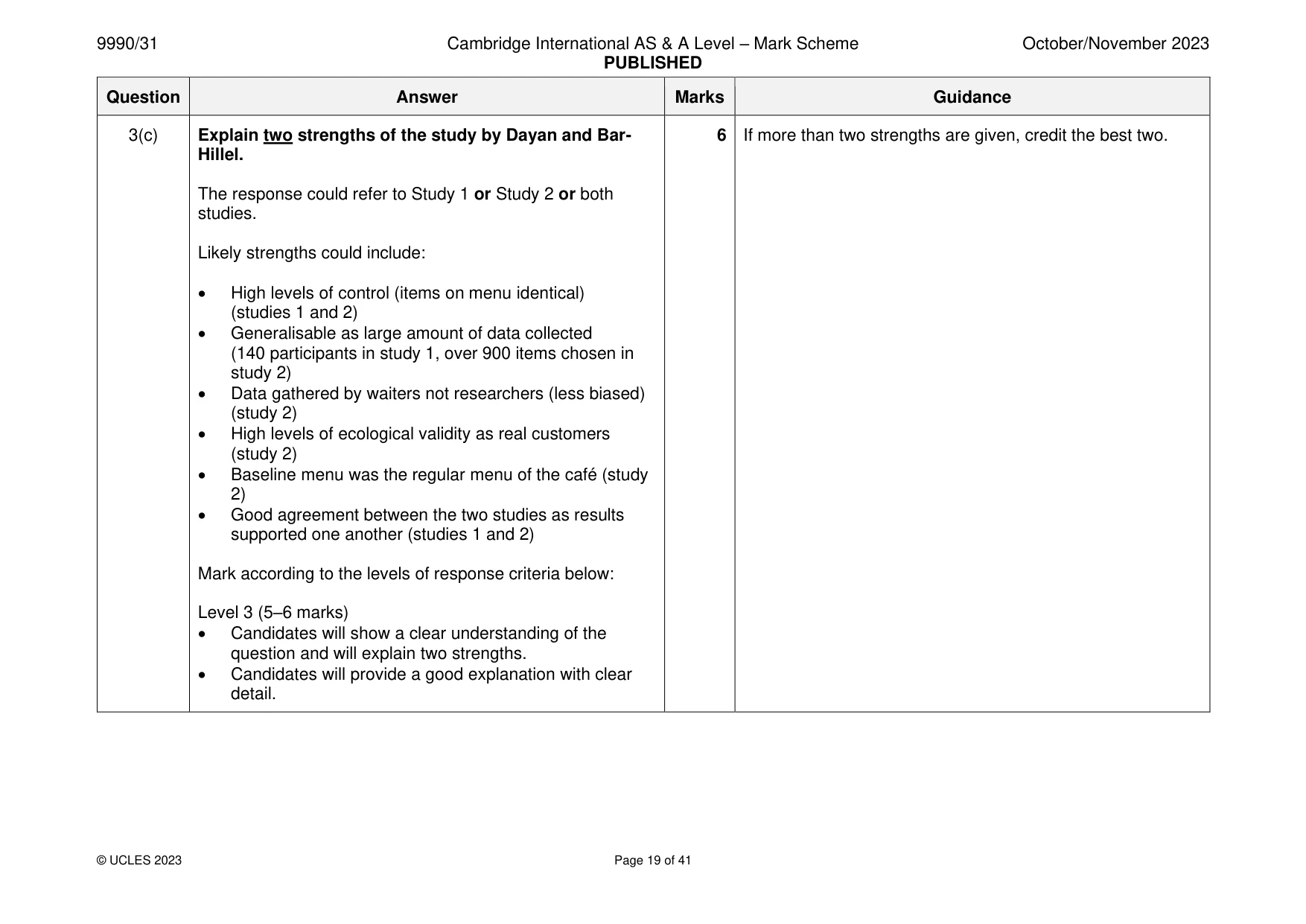
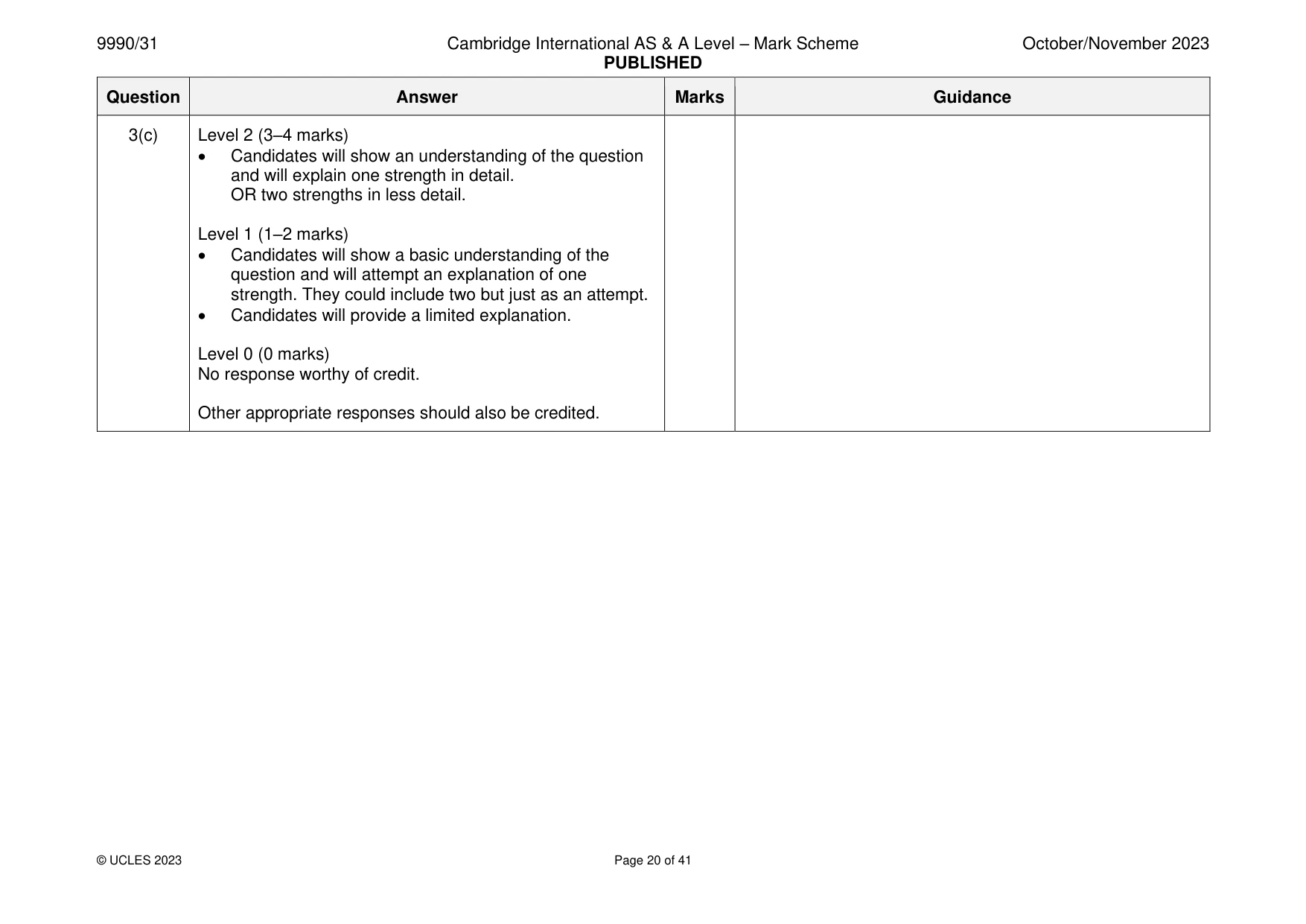
3 (a) Outline ‘behaviour constraint’ in consumer theories of personal space. [2] (b) Describe Study 2 (the field experiment) by Dayan and Bar-Hillel (2011) about primacy, recency and menu item position. [4] (c) Explain two strengths of the study by Dayan and Bar-Hillel. [6]
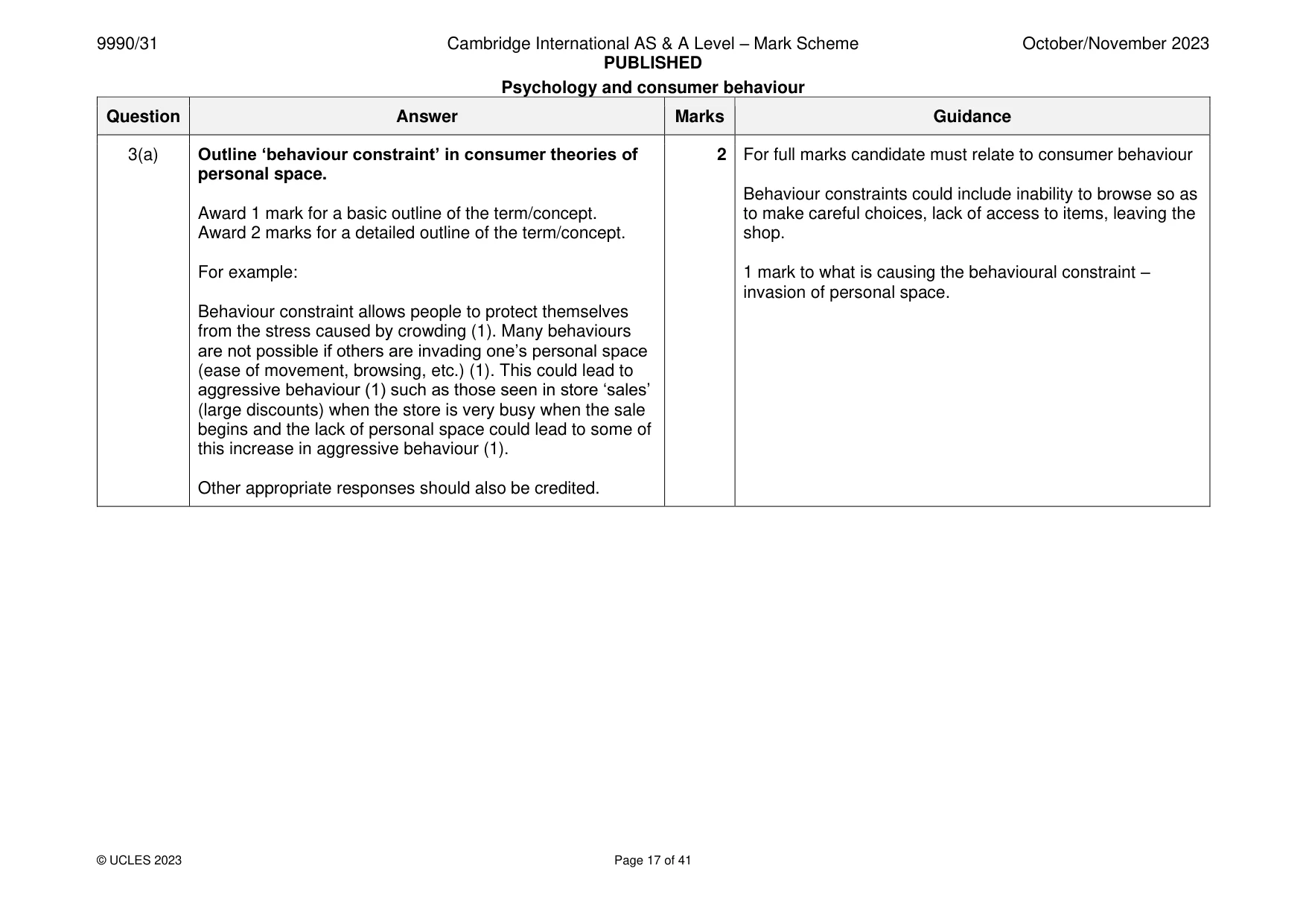
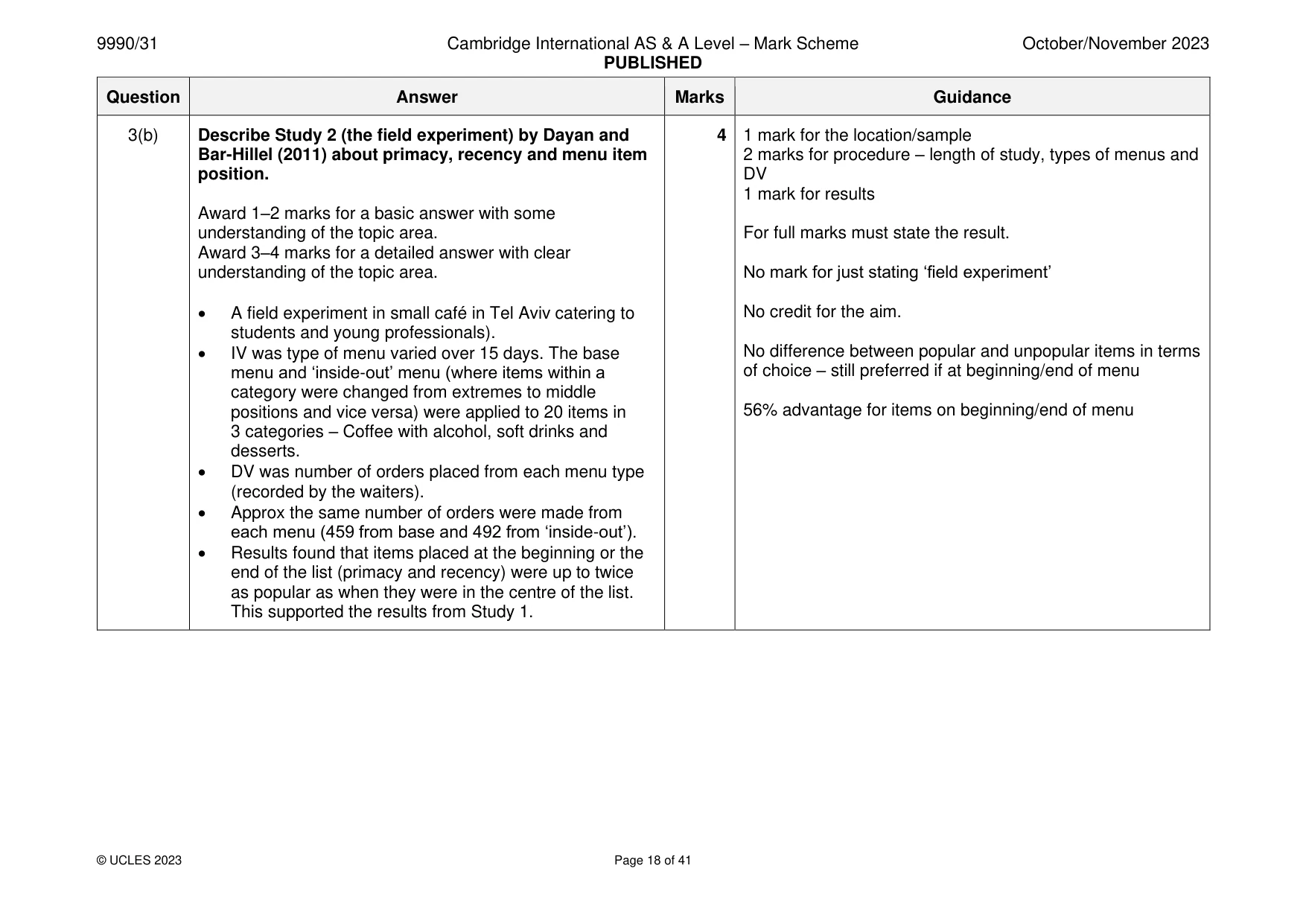
Mark scheme: 3(a) Outline ‘behaviour constraint’ in consumer theories of 2 For full marks candidate must relate to consumer behaviour personal space. Behaviour constraints could include inability to browse so as Award 1 mark for a basic outline of the term/concept. to make careful choices, lack of access to items, leaving the Award 2 marks for a detailed outline of the term/concept. shop. For example: 1 mark to what is causing the behavioural constraint – invasion of personal space. Behaviour constraint allows people to protect themselves from the stress caused by crowding (1). Many behaviours are not possible if others are invading one’s personal space (ease of movement, browsing, etc.) (1). This could lead to aggressive behaviour (1) such as those seen in store ‘sales’ (large discounts) when the store is very busy when the sale begins and the lack of personal space could lead to some of this increase in aggressive behaviour (1). Other appropriate responses should also be credited. 3(b) Describe Study 2 (the field experiment) by Dayan and 4 1 mark for the location/sample Bar-Hillel (2011) about primacy, recency and menu item 2 marks for procedure – length of study, types of menus and position. DV 1 mark for results Award 1–2 marks for a basic answer with some understanding of the topic area. For full marks must state the result. Award 3–4 marks for a detailed answer with clear understanding of the topic area. No mark for just stating ‘field experiment’ • A field experiment in small café in Tel Aviv catering to No credit for the aim. students and young professionals). • IV was type of menu varied over 15 days. The base No difference between popular and unpopular items in terms menu and ‘inside-out’ menu (where items within a of choice – still preferred if at beginning/end of menu category were changed from extremes to middle positions and vice versa) were applied to 20 items in 56% advantage for items on beginning/end of menu 3 categories – Coffee with alcohol, soft drinks and desserts. • DV was number of orders placed from each menu type (recorded by the waiters). • Approx the same number of orders were made from each menu (459 from base and 492 from ‘inside-out’). • Results found that items placed at the beginning or the end of the list (primacy and recency) were up to twice as popular as when they were in the centre of the list. This supported the results from Study 1. 3(c) Explain two strengths of the study by Dayan and Bar- 6 If more than two strengths are given, credit the best two. Hillel. The response could refer to Study 1 or Study 2 or both studies. Likely strengths could include: • High levels of control (items on menu identical) (studies 1 and 2) • Generalisable as large amount of data collected (140 participants in study 1, over 900 items chosen in study 2) • Data gathered by waiters not researchers (less biased) (study 2) • High levels of ecological validity as real customers (study 2) • Baseline menu was the regular menu of the café (study 2) • Good agreement between the two studies as results supported one another (studies 1 and 2) Mark according to the levels of response criteria below: Level 3 (5–6 marks) • Candidates will show a clear understanding of the question and will explain two strengths. • Candidates will provide a good explanation with clear detail. 3(c) Level 2 (3–4 marks) • Candidates will show an understanding of the question and will explain one strength in detail. OR two strengths in less detail. Level 1 (1–2 marks) • Candidates will show a basic understanding of the question and will attempt an explanation of one strength. They could include two but just as an attempt. • Candidates will provide a limited explanation. Level 0 (0 marks) No response worthy of credit. Other appropriate responses should also be credited.
Q4 · Describe what psychologists have discovered about consumer decision-making (models…
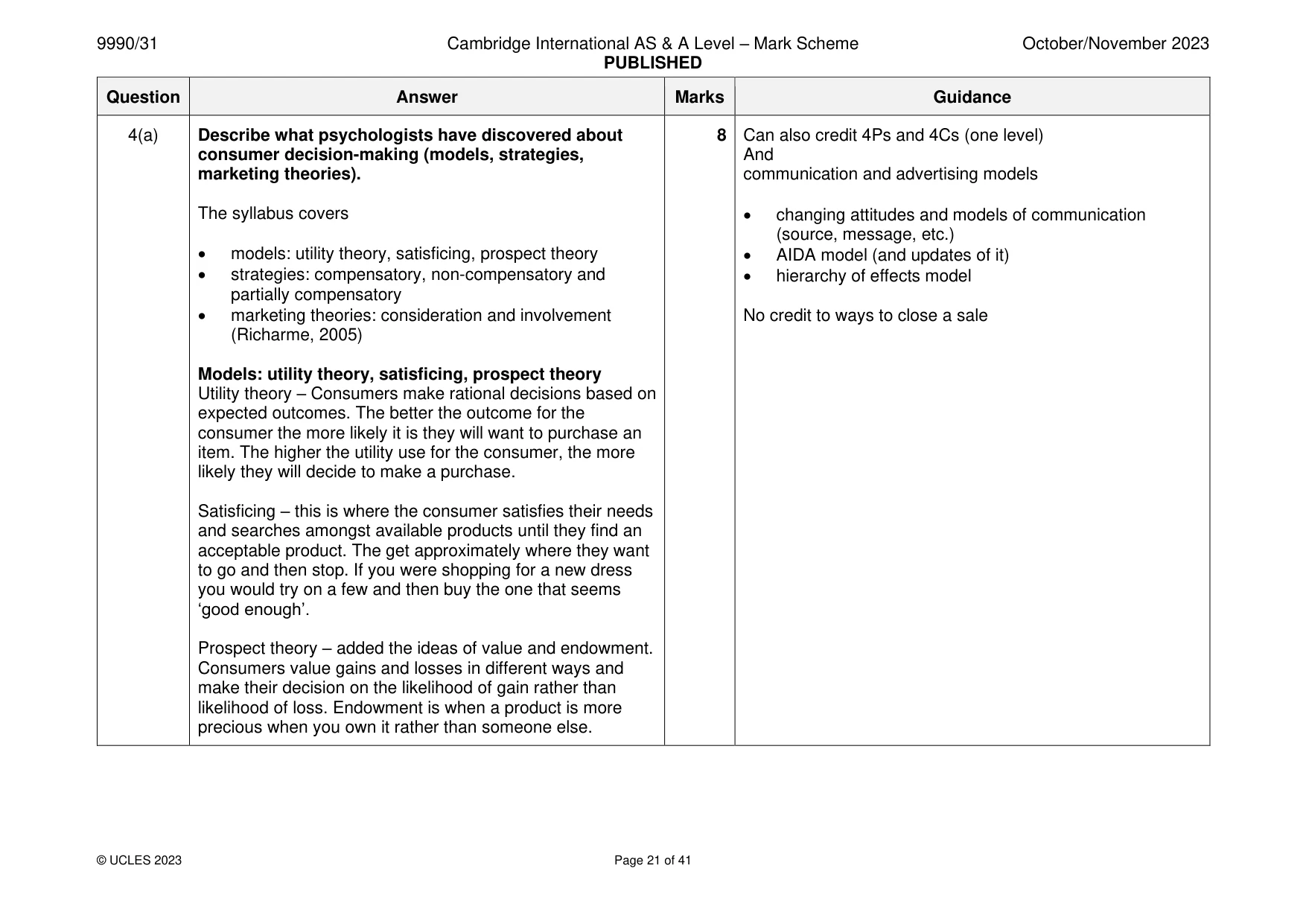
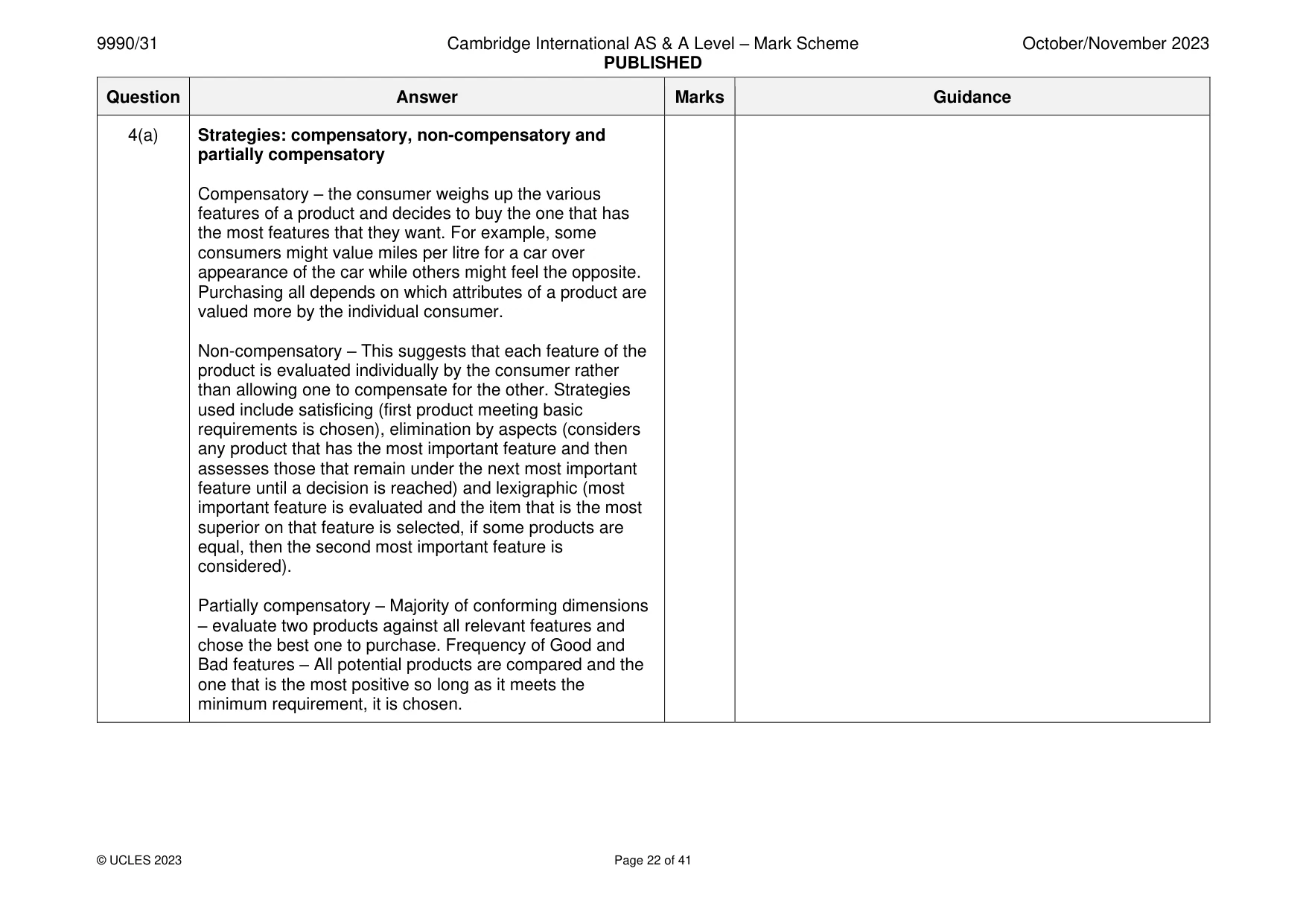
4 (a) Describe what psychologists have discovered about consumer decision-making (models, strategies, marketing theories). [8] (b) Evaluate what psychologists have discovered about consumer decision-making (models, strategies, marketing theories), including a discussion of generalisations. [10] Psychology and health Answer all questions.
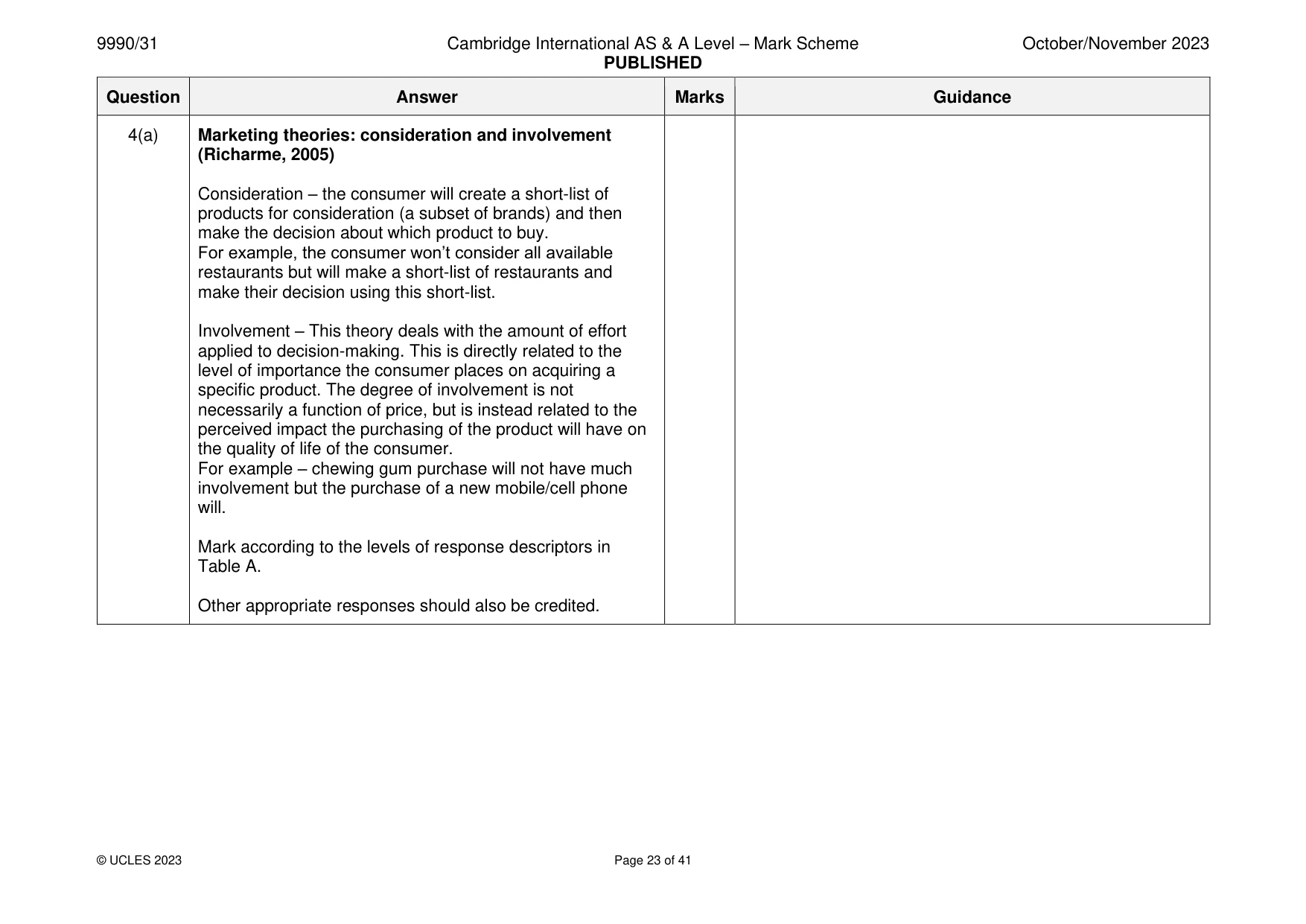
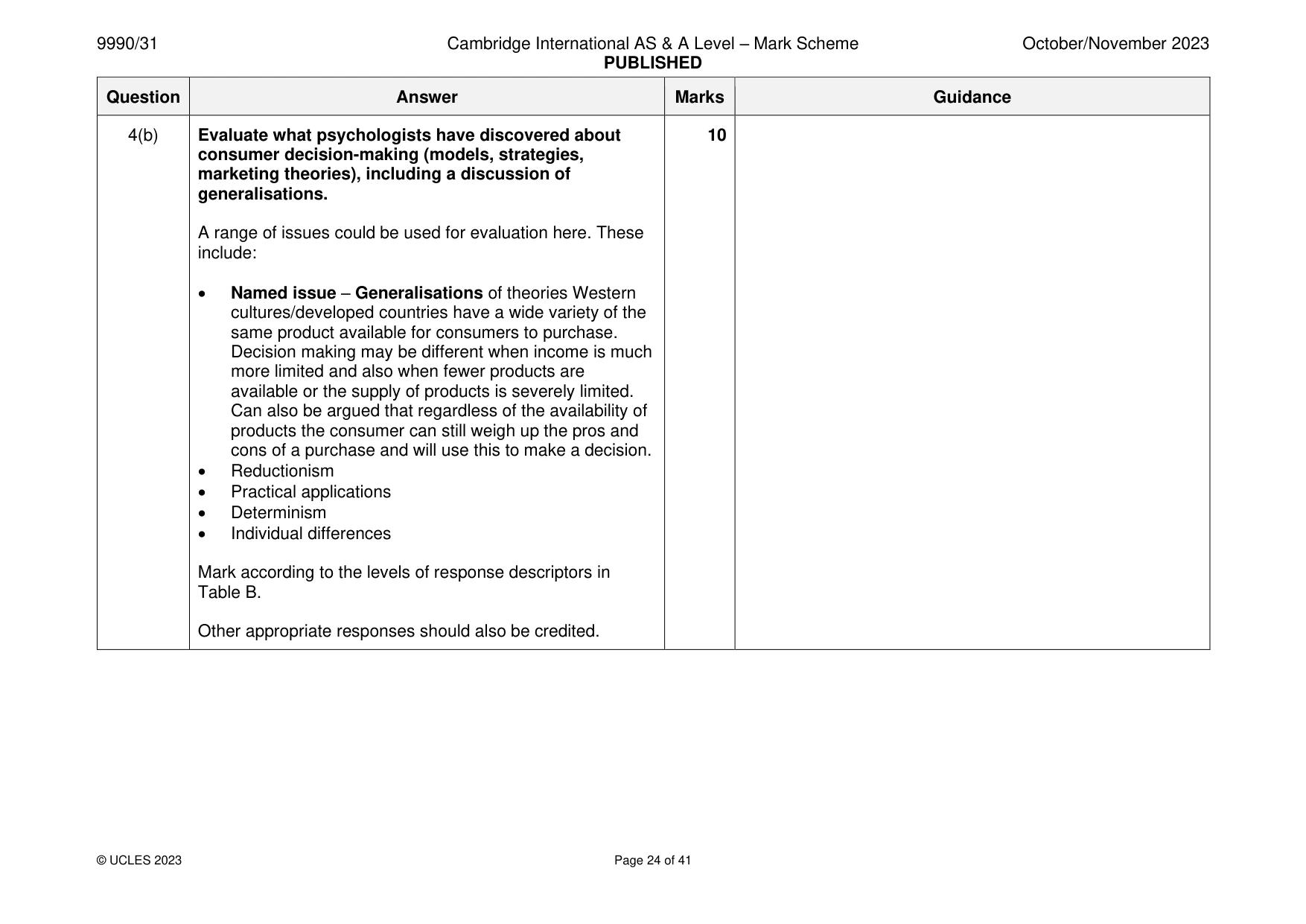
Mark scheme: 4(a) Describe what psychologists have discovered about 8 Can also credit 4Ps and 4Cs (one level) consumer decision-making (models, strategies, And marketing theories). communication and advertising models The syllabus covers • changing attitudes and models of communication (source, message, etc.) • models: utility theory, satisficing, prospect theory • AIDA model (and updates of it) • strategies: compensatory, non-compensatory and • hierarchy of effects model partially compensatory • marketing theories: consideration and involvement No credit to ways to close a sale (Richarme, 2005) Models: utility theory, satisficing, prospect theory Utility theory – Consumers make rational decisions based on expected outcomes. The better the outcome for the consumer the more likely it is they will want to purchase an item. The higher the utility use for the consumer, the more likely they will decide to make a purchase. Satisficing – this is where the consumer satisfies their needs and searches amongst available products until they find an acceptable product. The get approximately where they want to go and then stop. If you were shopping for a new dress you would try on a few and then buy the one that seems ‘good enough’. Prospect theory – added the ideas of value and endowment. Consumers value gains and losses in different ways and make their decision on the likelihood of gain rather than likelihood of loss. Endowment is when a product is more precious when you own it rather than someone else. 4(a) Strategies: compensatory, non-compensatory and partially compensatory Compensatory – the consumer weighs up the various features of a product and decides to buy the one that has the most features that they want. For example, some consumers might value miles per litre for a car over appearance of the car while others might feel the opposite. Purchasing all depends on which attributes of a product are valued more by the individual consumer. Non-compensatory – This suggests that each feature of the product is evaluated individually by the consumer rather than allowing one to compensate for the other. Strategies used include satisficing (first product meeting basic requirements is chosen), elimination by aspects (considers any product that has the most important feature and then assesses those that remain under the next most important feature until a decision is reached) and lexigraphic (most important feature is evaluated and the item that is the most superior on that feature is selected, if some products are equal, then the second most important feature is considered). Partially compensatory – Majority of conforming dimensions – evaluate two products against all relevant features and chose the best one to purchase. Frequency of Good and Bad features – All potential products are compared and the one that is the most positive so long as it meets the minimum requirement, it is chosen. 4(a) Marketing theories: consideration and involvement (Richarme, 2005) Consideration – the consumer will create a short-list of products for consideration (a subset of brands) and then make the decision about which product to buy. For example, the consumer won’t consider all available restaurants but will make a short-list of restaurants and make their decision using this short-list. Involvement – This theory deals with the amount of effort applied to decision-making. This is directly related to the level of importance the consumer places on acquiring a specific product. The degree of involvement is not necessarily a function of price, but is instead related to the perceived impact the purchasing of the product will have on the quality of life of the consumer. For example – chewing gum purchase will not have much involvement but the purchase of a new mobile/cell phone will. Mark according to the levels of response descriptors in Table A. Other appropriate responses should also be credited. 4(b) Evaluate what psychologists have discovered about 10 consumer decision-making (models, strategies, marketing theories), including a discussion of generalisations. A range of issues could be used for evaluation here. These include: • Named issue – Generalisations of theories Western cultures/developed countries have a wide variety of the same product available for consumers to purchase. Decision making may be different when income is much more limited and also when fewer products are available or the supply of products is severely limited. Can also be argued that regardless of the availability of products the consumer can still weigh up the pros and cons of a purchase and will use this to make a decision. • Reductionism • Practical applications • Determinism • Individual differences Mark according to the levels of response descriptors in Table B. Other appropriate responses should also be credited. Psychology and health
Q5 · Identify two recording devices that give physiological measures of stress
5 (a) Identify two recording devices that give physiological measures of stress. [2] (b) Describe the study about psychological measures of stress by Friedman and Rosenman (1974). [4] (c) Explain two weaknesses of the study by Friedman and Rosenman. [6]
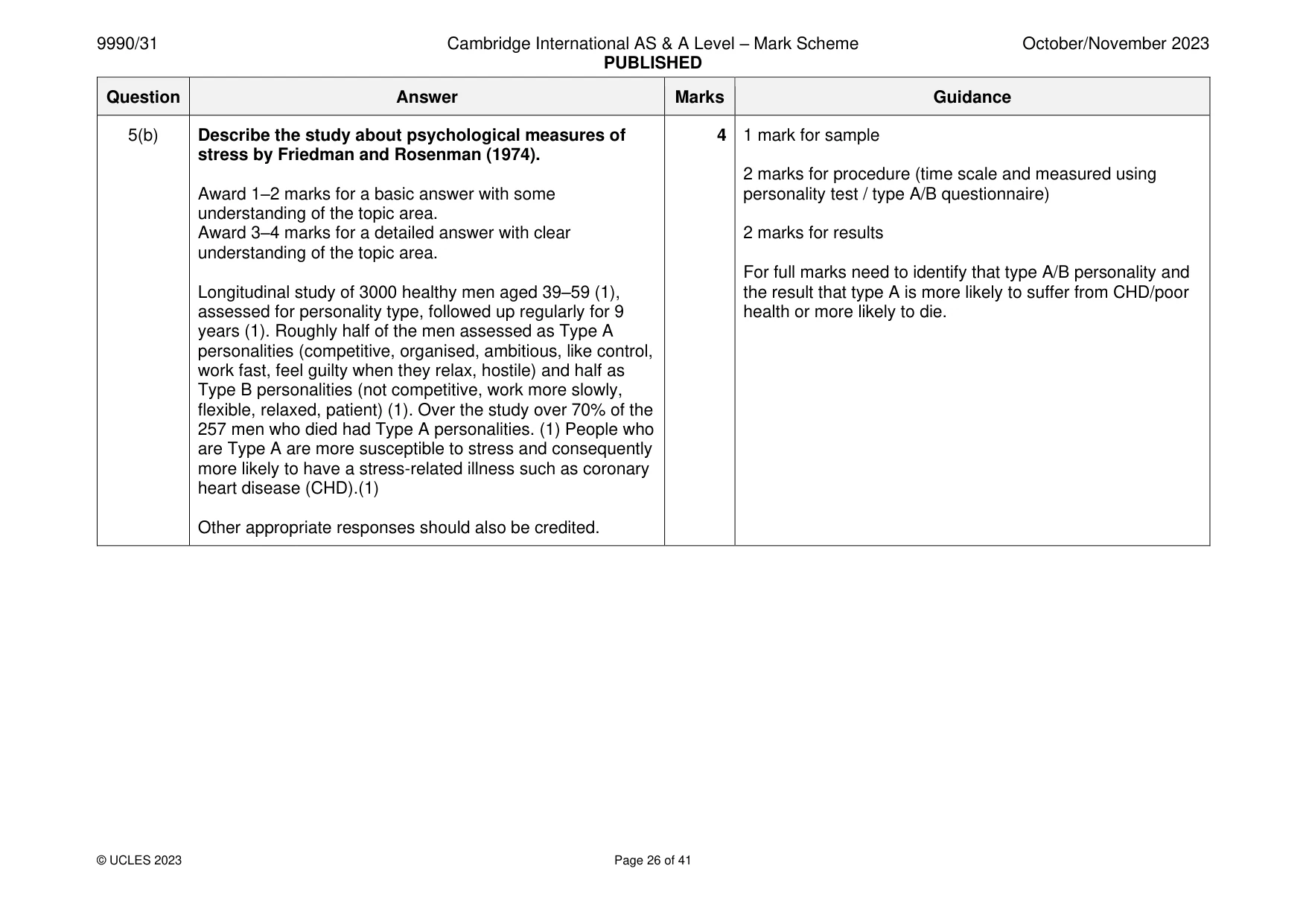
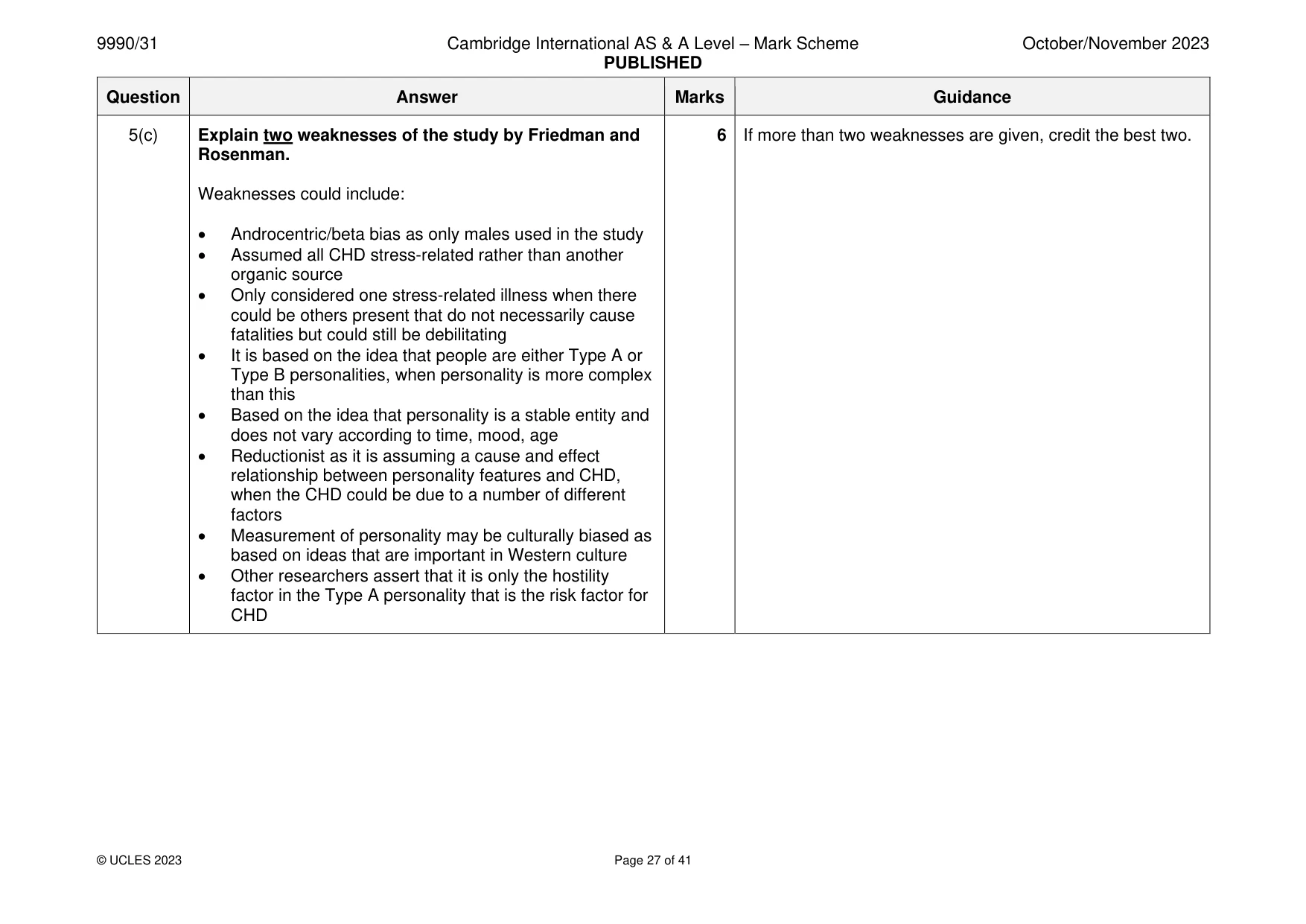
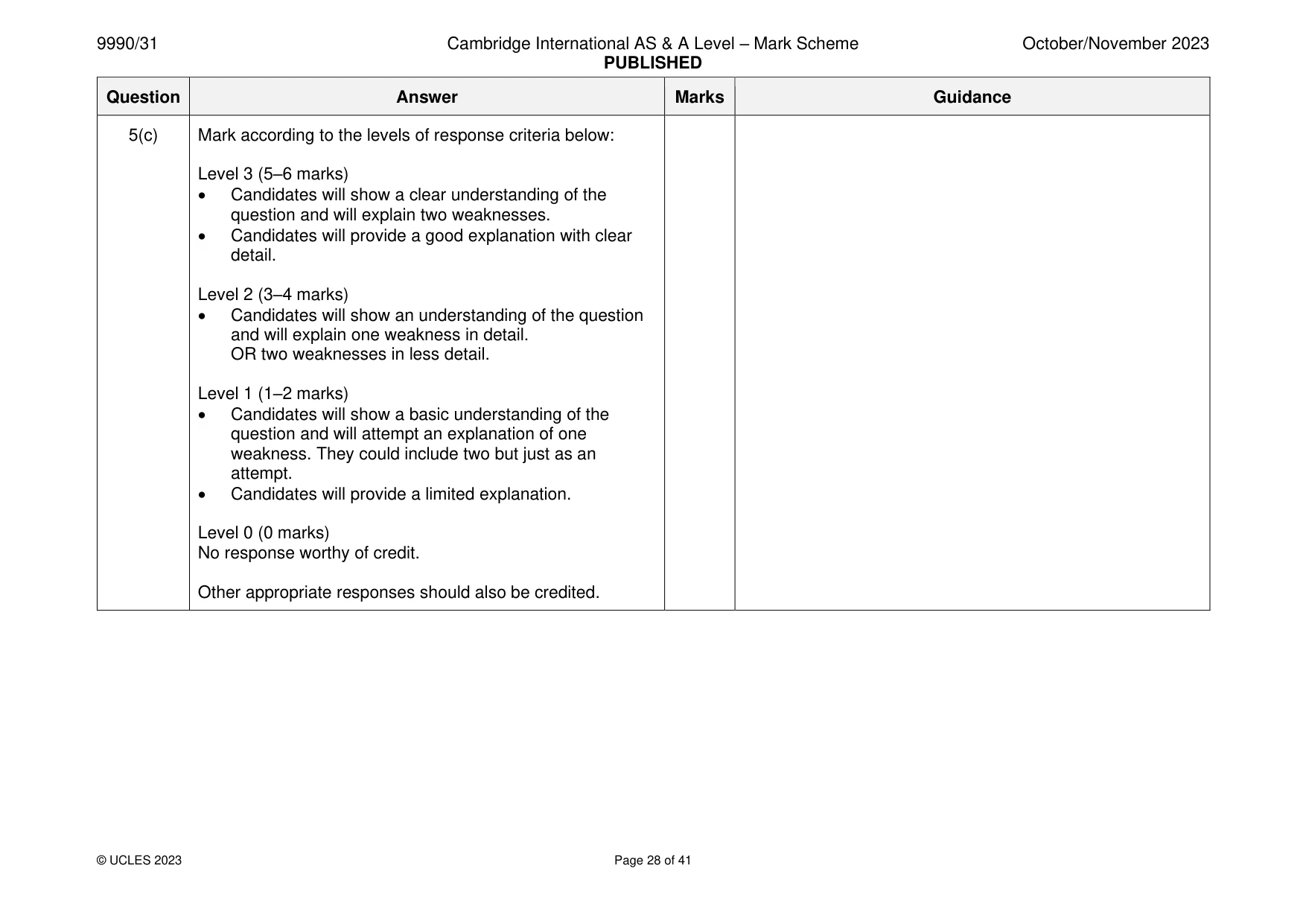
Mark scheme: 5(a) Identify two recording devices that give physiological 2 Credit either identifying or describing what the recording measures of stress. device measures. Award 1 mark for each correctly identified item. Credit PET scan, EMG/sEMG Do not credit urine Most likely answers • Functional magnetic resonance imaging (fMRI) • Sphygmomanometer (to measure blood pressure) • Galvanic skin response apparatus (measures electrical conductivity of skin, due to increased sweating) • Heart rate monitors (including wearables e.g. Fitbit, Apple watch) • Electrocardiogram (ECG) Other appropriate responses should also be credited. 5(b) Describe the study about psychological measures of 4 1 mark for sample stress by Friedman and Rosenman (1974). 2 marks for procedure (time scale and measured using Award 1–2 marks for a basic answer with some personality test / type A/B questionnaire) understanding of the topic area. Award 3–4 marks for a detailed answer with clear 2 marks for results understanding of the topic area. For full marks need to identify that type A/B personality and Longitudinal study of 3000 healthy men aged 39–59 (1), the result that type A is more likely to suffer from CHD/poor assessed for personality type, followed up regularly for 9 health or more likely to die. years (1). Roughly half of the men assessed as Type A personalities (competitive, organised, ambitious, like control, work fast, feel guilty when they relax, hostile) and half as Type B personalities (not competitive, work more slowly, flexible, relaxed, patient) (1). Over the study over 70% of the 257 men who died had Type A personalities. (1) People who are Type A are more susceptible to stress and consequently more likely to have a stress-related illness such as coronary heart disease (CHD).(1) Other appropriate responses should also be credited. 5(c) Explain two weaknesses of the study by Friedman and 6 If more than two weaknesses are given, credit the best two. Rosenman. Weaknesses could include: • Androcentric/beta bias as only males used in the study • Assumed all CHD stress-related rather than another organic source • Only considered one stress-related illness when there could be others present that do not necessarily cause fatalities but could still be debilitating • It is based on the idea that people are either Type A or Type B personalities, when personality is more complex than this • Based on the idea that personality is a stable entity and does not vary according to time, mood, age • Reductionist as it is assuming a cause and effect relationship between personality features and CHD, when the CHD could be due to a number of different factors • Measurement of personality may be culturally biased as based on ideas that are important in Western culture • Other researchers assert that it is only the hostility factor in the Type A personality that is the risk factor for CHD 5(c) Mark according to the levels of response criteria below: Level 3 (5–6 marks) • Candidates will show a clear understanding of the question and will explain two weaknesses. • Candidates will provide a good explanation with clear detail. Level 2 (3–4 marks) • Candidates will show an understanding of the question and will explain one weakness in detail. OR two weaknesses in less detail. Level 1 (1–2 marks) • Candidates will show a basic understanding of the question and will attempt an explanation of one weakness. They could include two but just as an attempt. • Candidates will provide a limited explanation. Level 0 (0 marks) No response worthy of credit. Other appropriate responses should also be credited.
Q6 · Describe what psychologists have discovered about strategies for promoting health (fear…
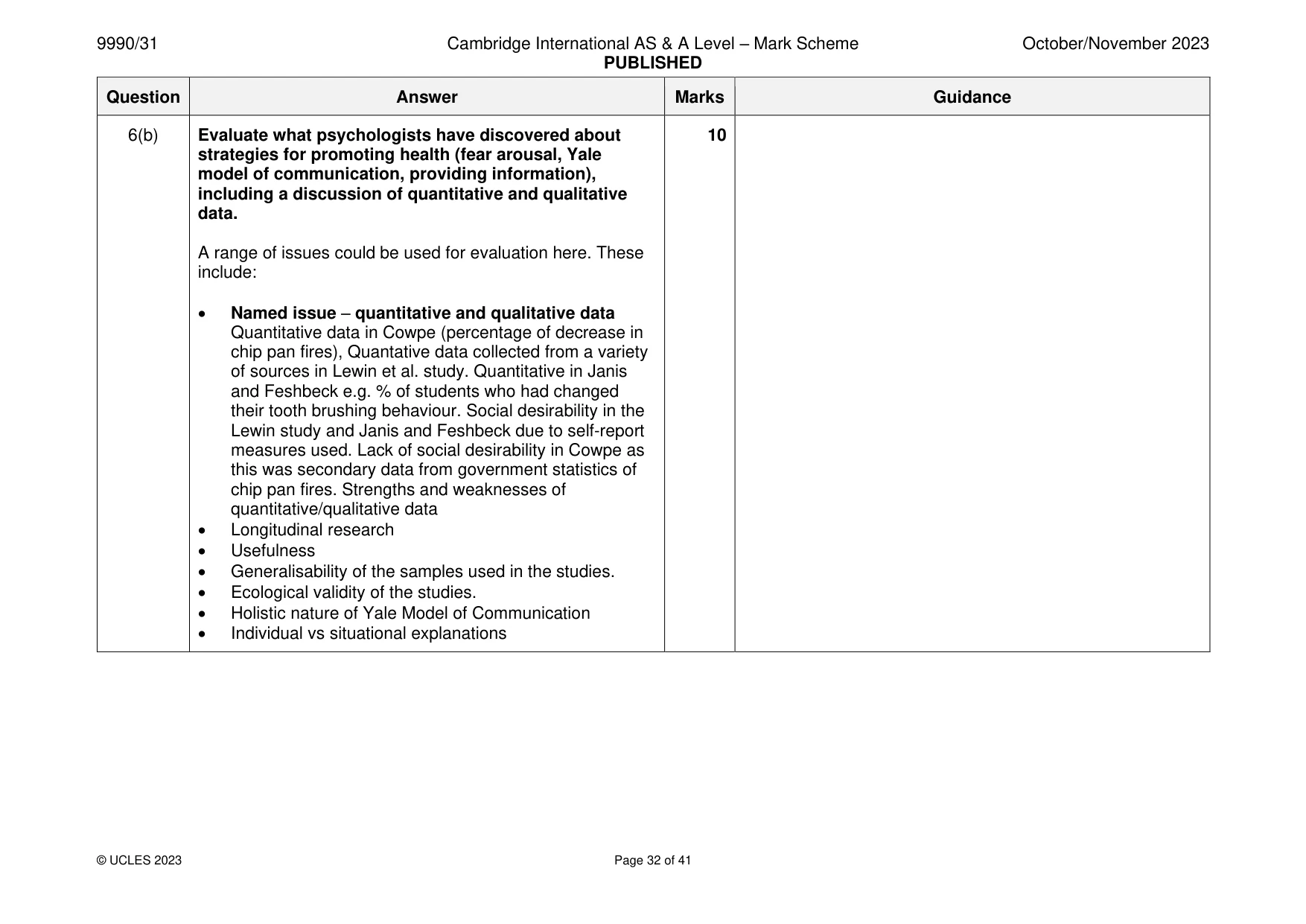
6 (a) Describe what psychologists have discovered about strategies for promoting health (fear arousal, Yale model of communication, providing information). [8] (b) Evaluate what psychologists have discovered about strategies for promoting health (fear arousal, Yale model of communication, providing information), including a discussion of quantitative and qualitative data. [10] Psychology and organisations Answer all questions.
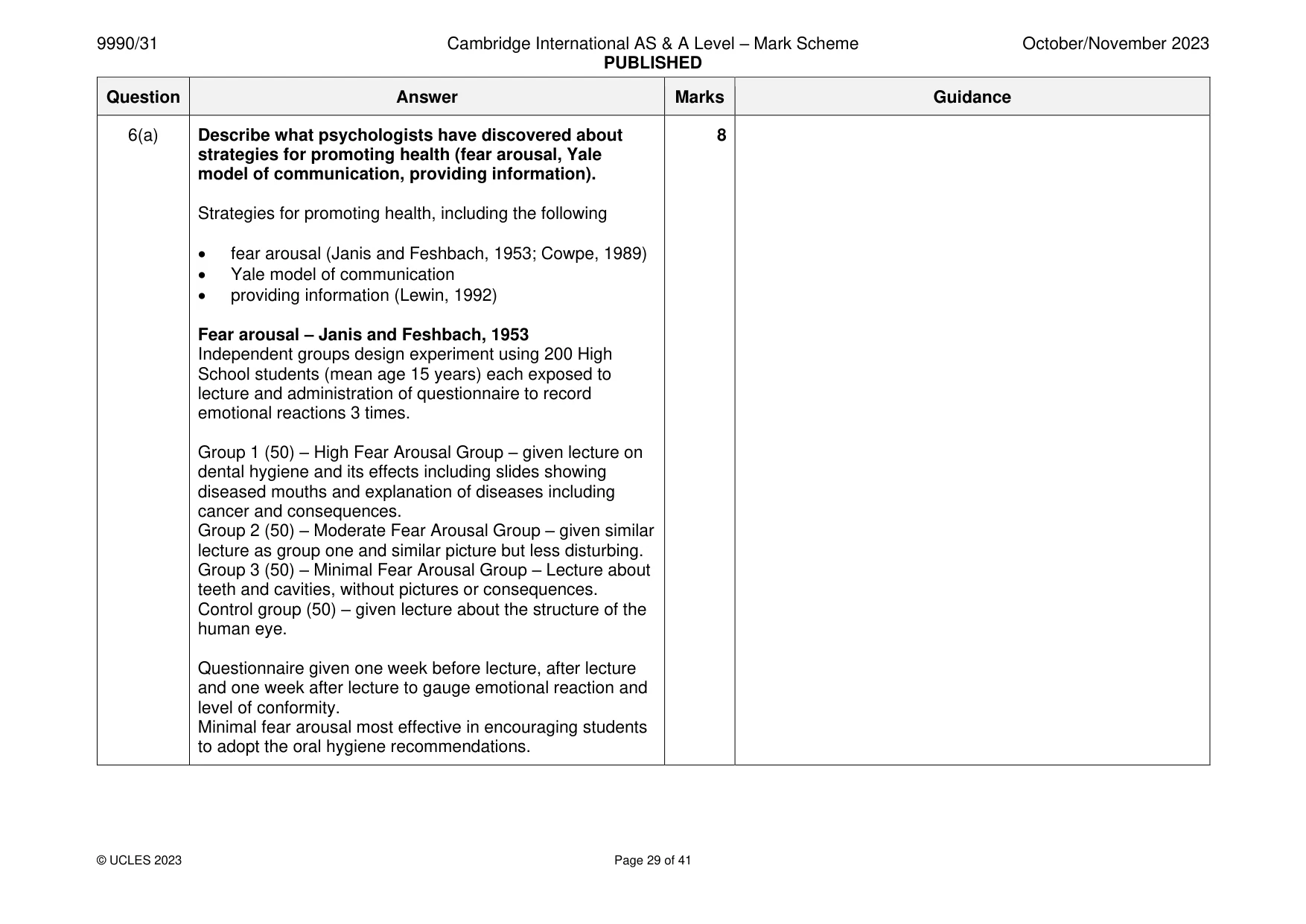
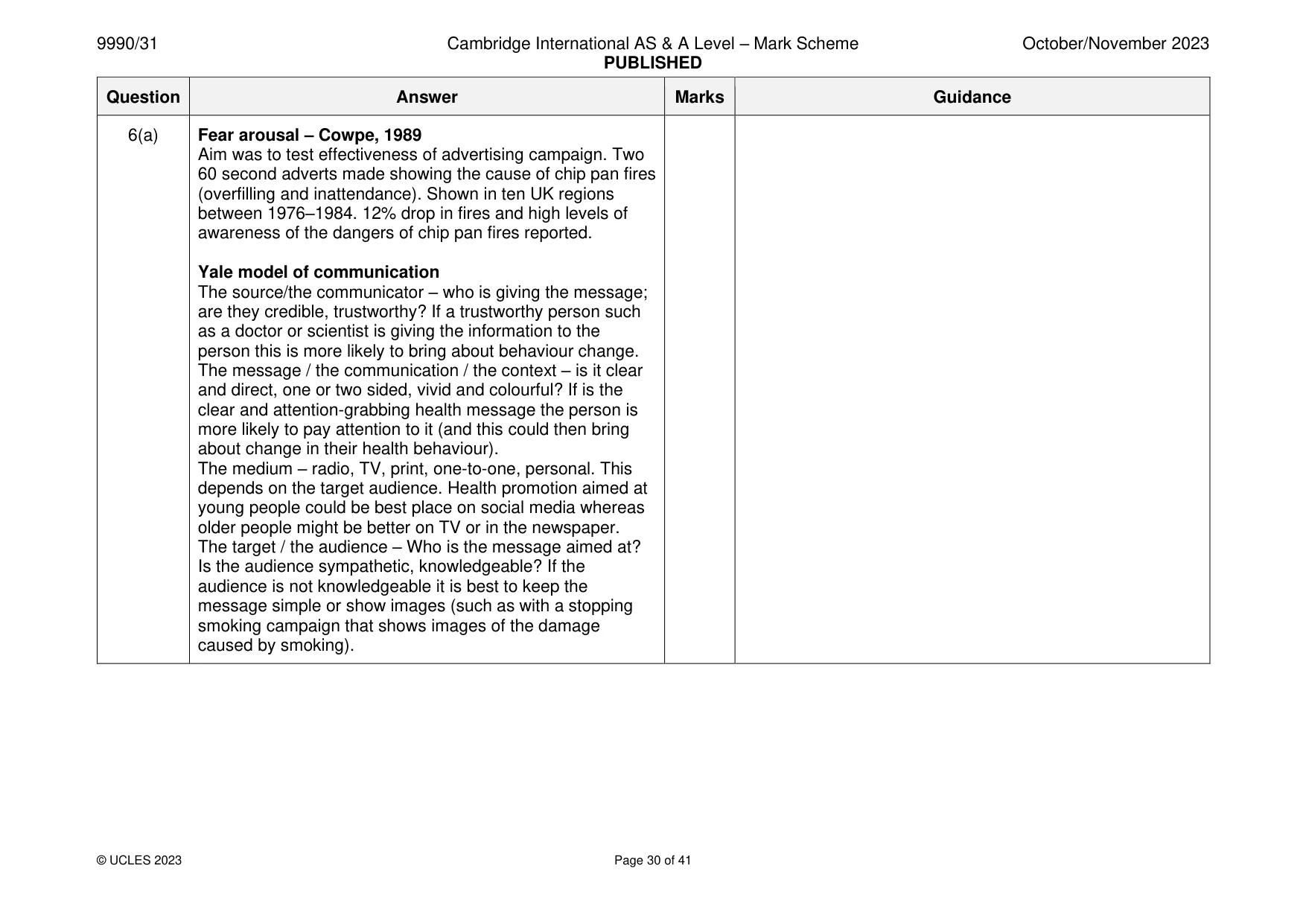
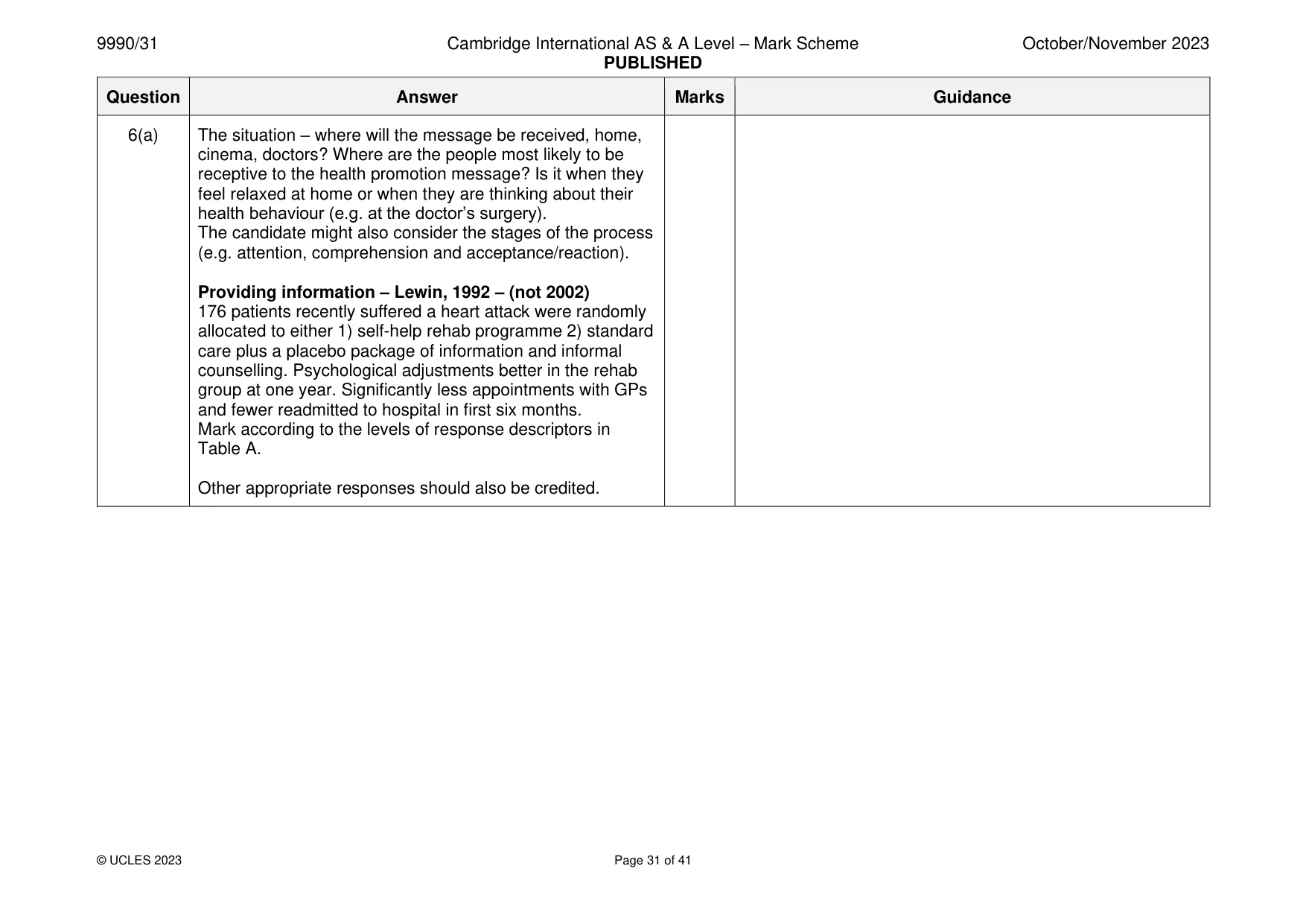
Mark scheme: 6(a) Describe what psychologists have discovered about 8 strategies for promoting health (fear arousal, Yale model of communication, providing information). Strategies for promoting health, including the following • fear arousal (Janis and Feshbach, 1953; Cowpe, 1989) • Yale model of communication • providing information (Lewin, 1992) Fear arousal – Janis and Feshbach, 1953 Independent groups design experiment using 200 High School students (mean age 15 years) each exposed to lecture and administration of questionnaire to record emotional reactions 3 times. Group 1 (50) – High Fear Arousal Group – given lecture on dental hygiene and its effects including slides showing diseased mouths and explanation of diseases including cancer and consequences. Group 2 (50) – Moderate Fear Arousal Group – given similar lecture as group one and similar picture but less disturbing. Group 3 (50) – Minimal Fear Arousal Group – Lecture about teeth and cavities, without pictures or consequences. Control group (50) – given lecture about the structure of the human eye. Questionnaire given one week before lecture, after lecture and one week after lecture to gauge emotional reaction and level of conformity. Minimal fear arousal most effective in encouraging students to adopt the oral hygiene recommendations. 6(a) Fear arousal – Cowpe, 1989 Aim was to test effectiveness of advertising campaign. Two 60 second adverts made showing the cause of chip pan fires (overfilling and inattendance). Shown in ten UK regions between 1976–1984. 12% drop in fires and high levels of awareness of the dangers of chip pan fires reported. Yale model of communication The source/the communicator – who is giving the message; are they credible, trustworthy? If a trustworthy person such as a doctor or scientist is giving the information to the person this is more likely to bring about behaviour change. The message / the communication / the context – is it clear and direct, one or two sided, vivid and colourful? If is the clear and attention-grabbing health message the person is more likely to pay attention to it (and this could then bring about change in their health behaviour). The medium – radio, TV, print, one-to-one, personal. This depends on the target audience. Health promotion aimed at young people could be best place on social media whereas older people might be better on TV or in the newspaper. The target / the audience – Who is the message aimed at? Is the audience sympathetic, knowledgeable? If the audience is not knowledgeable it is best to keep the message simple or show images (such as with a stopping smoking campaign that shows images of the damage caused by smoking). 6(a) The situation – where will the message be received, home, cinema, doctors? Where are the people most likely to be receptive to the health promotion message? Is it when they feel relaxed at home or when they are thinking about their health behaviour (e.g. at the doctor’s surgery). The candidate might also consider the stages of the process (e.g. attention, comprehension and acceptance/reaction). Providing information – Lewin, 1992 – (not 2002) 176 patients recently suffered a heart attack were randomly allocated to either 1) self-help rehab programme 2) standard care plus a placebo package of information and informal counselling. Psychological adjustments better in the rehab group at one year. Significantly less appointments with GPs and fewer readmitted to hospital in first six months. Mark according to the levels of response descriptors in Table A. Other appropriate responses should also be credited. 6(b) Evaluate what psychologists have discovered about 10 strategies for promoting health (fear arousal, Yale model of communication, providing information), including a discussion of quantitative and qualitative data. A range of issues could be used for evaluation here. These include: • Named issue – quantitative and qualitative data Quantitative data in Cowpe (percentage of decrease in chip pan fires), Quantative data collected from a variety of sources in Lewin et al. study. Quantitative in Janis and Feshbeck e.g. % of students who had changed their tooth brushing behaviour. Social desirability in the Lewin study and Janis and Feshbeck due to self-report measures used. Lack of social desirability in Cowpe as this was secondary data from government statistics of chip pan fires. Strengths and weaknesses of quantitative/qualitative data • Longitudinal research • Usefulness • Generalisability of the samples used in the studies. • Ecological validity of the studies. • Holistic nature of Yale Model of Communication • Individual vs situational explanations
More questions on 2 Health promotion in schools and worksites
Q7 · Identify two qualities of good followers (Kelley, 1988)
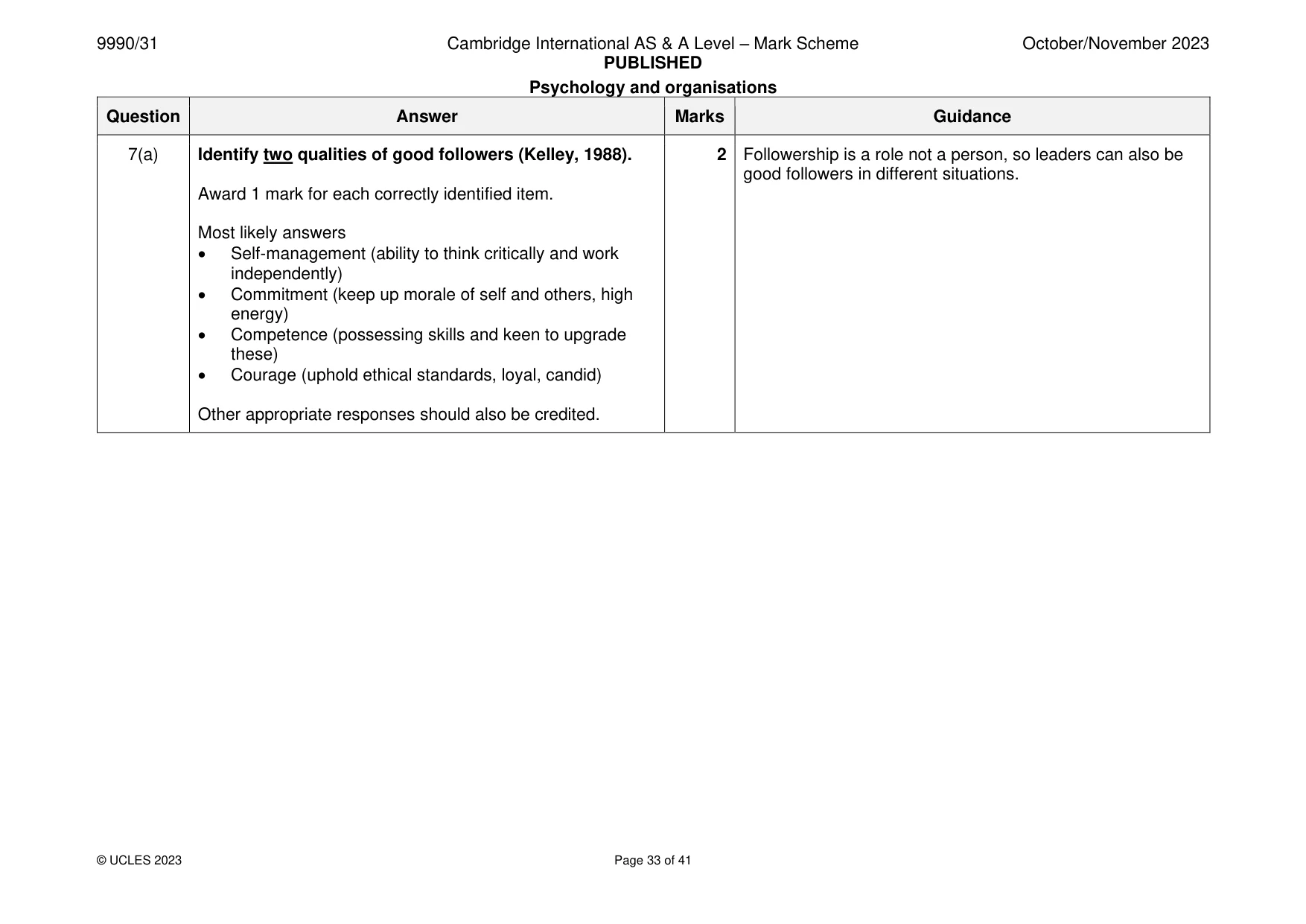
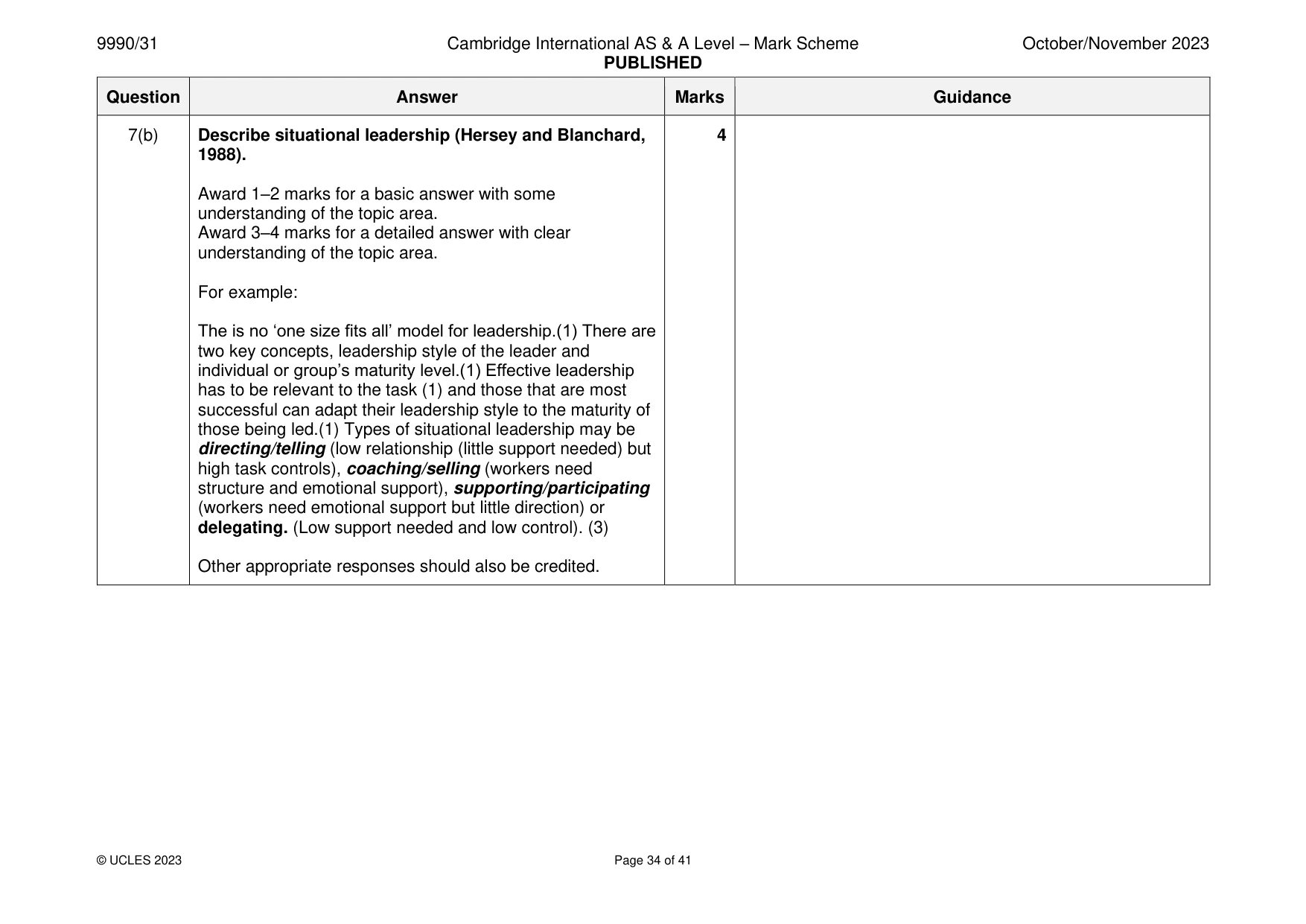
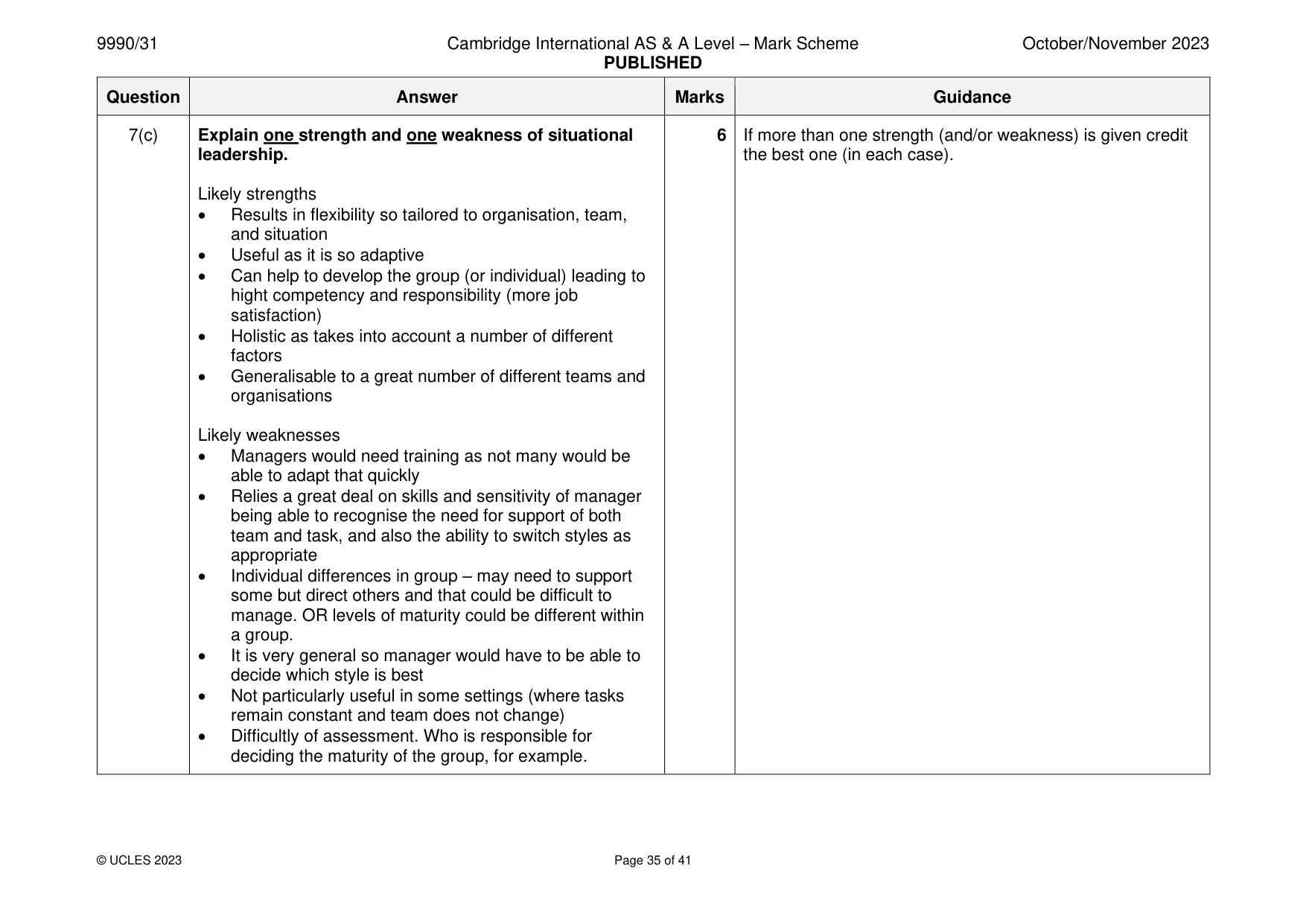
7 (a) Identify two qualities of good followers (Kelley, 1988). [2] (b) Describe situational leadership (Hersey and Blanchard, 1988). [4] (c) Explain one strength and one weakness of situational leadership. [6]
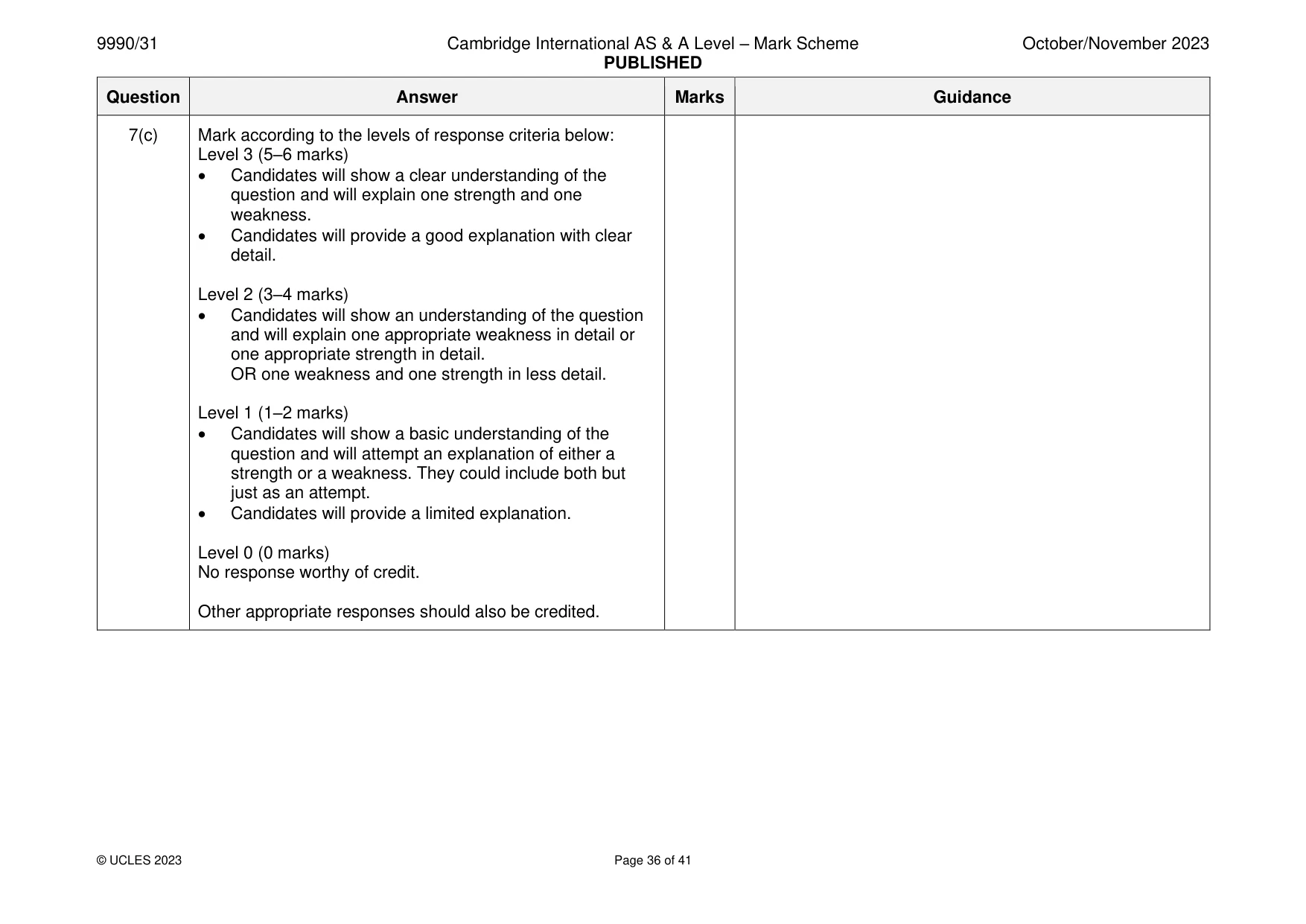
Mark scheme: 7(a) Identify two qualities of good followers (Kelley, 1988). 2 Followership is a role not a person, so leaders can also be good followers in different situations. Award 1 mark for each correctly identified item. Most likely answers • Self-management (ability to think critically and work independently) • Commitment (keep up morale of self and others, high energy) • Competence (possessing skills and keen to upgrade these) • Courage (uphold ethical standards, loyal, candid) Other appropriate responses should also be credited. 7(b) Describe situational leadership (Hersey and Blanchard, 4 1988). Award 1–2 marks for a basic answer with some understanding of the topic area. Award 3–4 marks for a detailed answer with clear understanding of the topic area. For example: The is no ‘one size fits all’ model for leadership.(1) There are two key concepts, leadership style of the leader and individual or group’s maturity level.(1) Effective leadership has to be relevant to the task (1) and those that are most successful can adapt their leadership style to the maturity of those being led.(1) Types of situational leadership may be directing/telling (low relationship (little support needed) but high task controls), coaching/selling (workers need structure and emotional support), supporting/participating (workers need emotional support but little direction) or delegating. (Low support needed and low control). (3) Other appropriate responses should also be credited. 7(c) Explain one strength and one weakness of situational 6 If more than one strength (and/or weakness) is given credit leadership. the best one (in each case). Likely strengths • Results in flexibility so tailored to organisation, team, and situation • Useful as it is so adaptive • Can help to develop the group (or individual) leading to hight competency and responsibility (more job satisfaction) • Holistic as takes into account a number of different factors • Generalisable to a great number of different teams and organisations Likely weaknesses • Managers would need training as not many would be able to adapt that quickly • Relies a great deal on skills and sensitivity of manager being able to recognise the need for support of both team and task, and also the ability to switch styles as appropriate • Individual differences in group – may need to support some but direct others and that could be difficult to manage. OR levels of maturity could be different within a group. • It is very general so manager would have to be able to decide which style is best • Not particularly useful in some settings (where tasks remain constant and team does not change) • Difficultly of assessment. Who is responsible for deciding the maturity of the group, for example. 7(c) Mark according to the levels of response criteria below: Level 3 (5–6 marks) • Candidates will show a clear understanding of the question and will explain one strength and one weakness. • Candidates will provide a good explanation with clear detail. Level 2 (3–4 marks) • Candidates will show an understanding of the question and will explain one appropriate weakness in detail or one appropriate strength in detail. OR one weakness and one strength in less detail. Level 1 (1–2 marks) • Candidates will show a basic understanding of the question and will attempt an explanation of either a strength or a weakness. They could include both but just as an attempt. • Candidates will provide a limited explanation. Level 0 (0 marks) No response worthy of credit. Other appropriate responses should also be credited.
Q8 · Describe what psychologists have discovered about cognitive theories of motivation to…
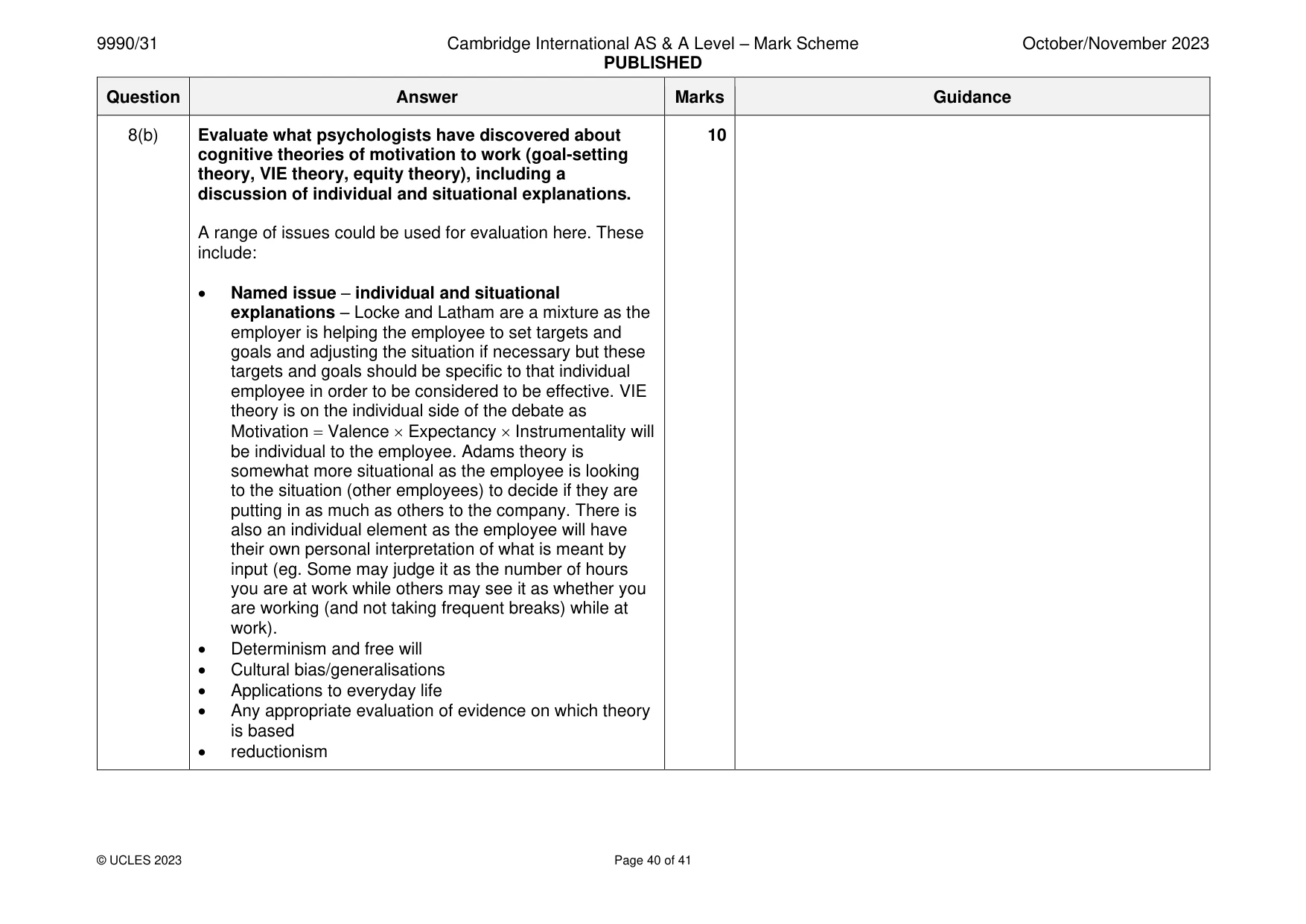
8 (a) Describe what psychologists have discovered about cognitive theories of motivation to work (goal-setting theory, VIE theory, equity theory). [8] (b) Evaluate what psychologists have discovered about cognitive theories of motivation to work (goal-setting theory, VIE theory, equity theory), including a discussion of individual and situational explanations. [10]
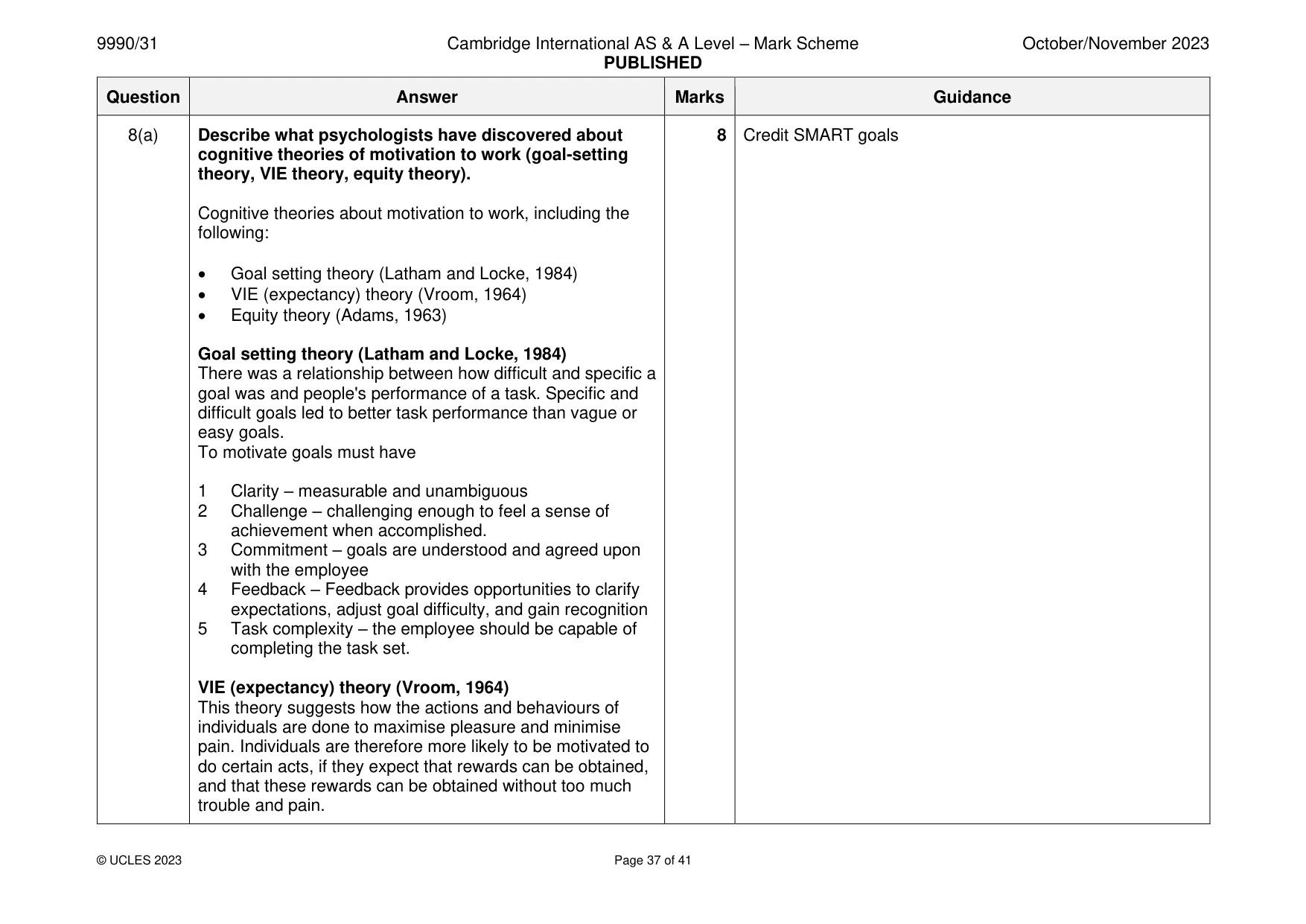
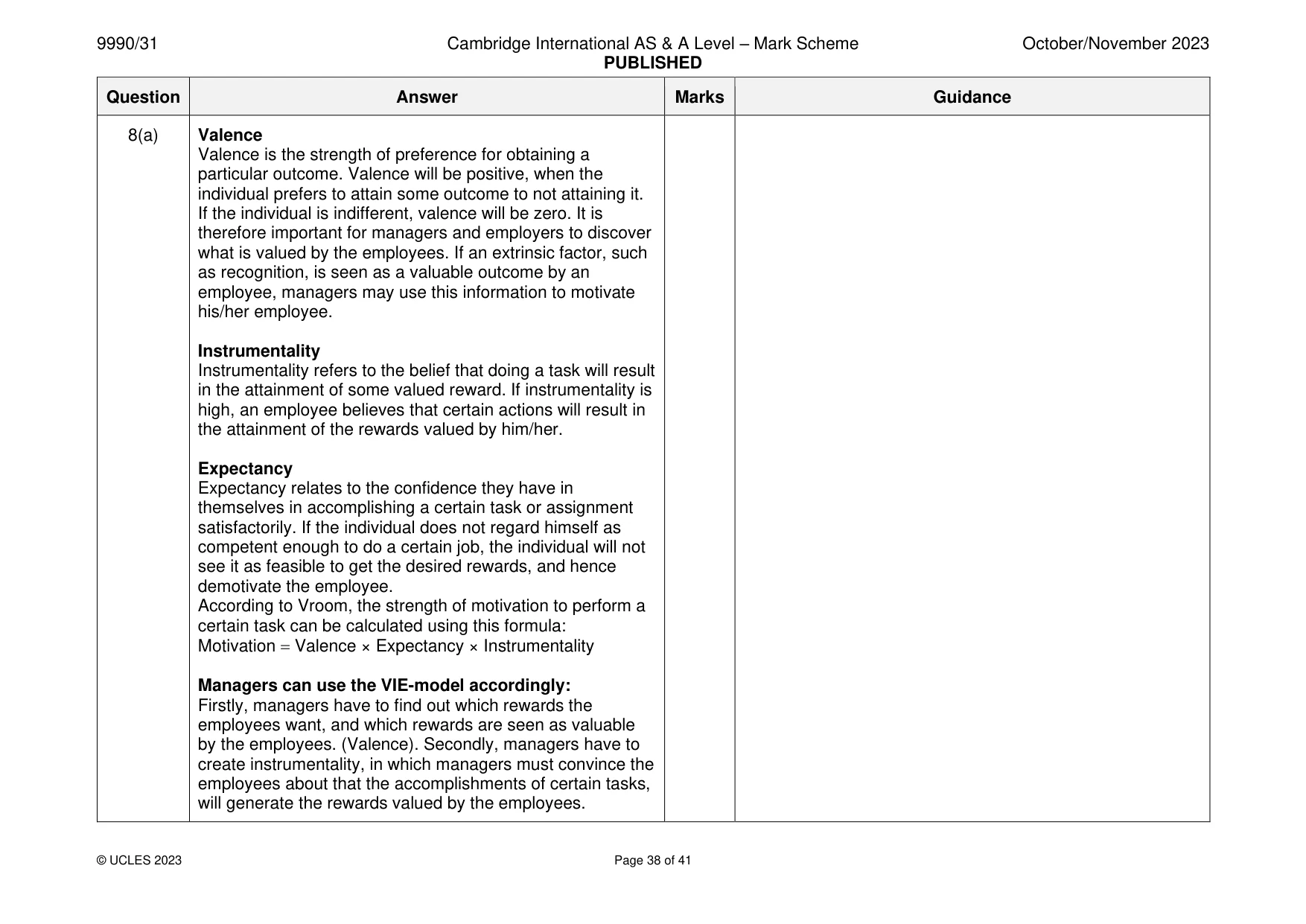
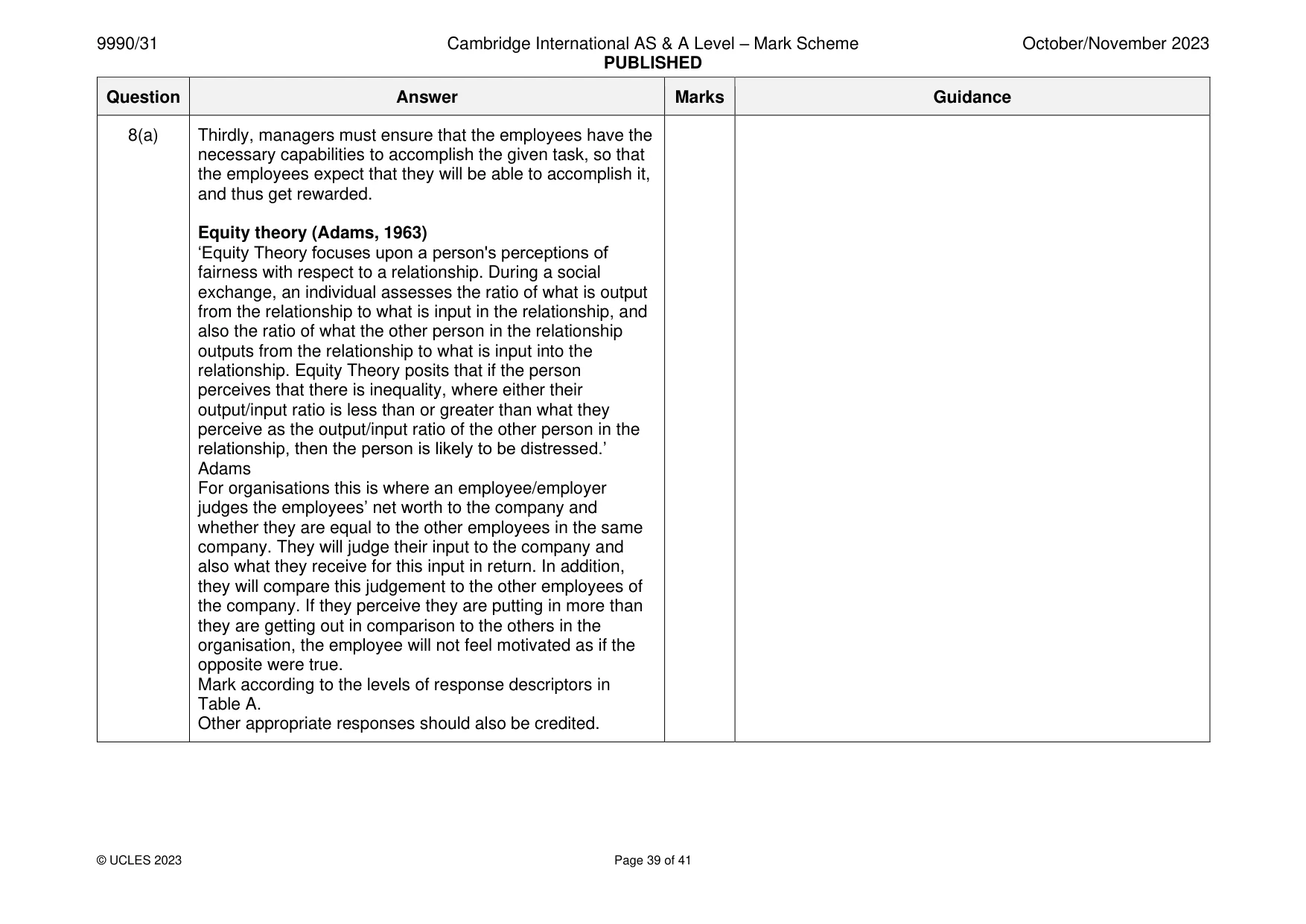
Mark scheme: 8(a) Describe what psychologists have discovered about 8 Credit SMART goals cognitive theories of motivation to work (goal-setting theory, VIE theory, equity theory). Cognitive theories about motivation to work, including the following: • Goal setting theory (Latham and Locke, 1984) • VIE (expectancy) theory (Vroom, 1964) • Equity theory (Adams, 1963) Goal setting theory (Latham and Locke, 1984) There was a relationship between how difficult and specific a goal was and people's performance of a task. Specific and difficult goals led to better task performance than vague or easy goals. To motivate goals must have 1 Clarity – measurable and unambiguous 2 Challenge – challenging enough to feel a sense of achievement when accomplished. 3 Commitment – goals are understood and agreed upon with the employee 4 Feedback – Feedback provides opportunities to clarify expectations, adjust goal difficulty, and gain recognition 5 Task complexity – the employee should be capable of completing the task set. VIE (expectancy) theory (Vroom, 1964) This theory suggests how the actions and behaviours of individuals are done to maximise pleasure and minimise pain. Individuals are therefore more likely to be motivated to do certain acts, if they expect that rewards can be obtained, and that these rewards can be obtained without too much trouble and pain. 8(a) Valence Valence is the strength of preference for obtaining a particular outcome. Valence will be positive, when the individual prefers to attain some outcome to not attaining it. If the individual is indifferent, valence will be zero. It is therefore important for managers and employers to discover what is valued by the employees. If an extrinsic factor, such as recognition, is seen as a valuable outcome by an employee, managers may use this information to motivate his/her employee. Instrumentality Instrumentality refers to the belief that doing a task will result in the attainment of some valued reward. If instrumentality is high, an employee believes that certain actions will result in the attainment of the rewards valued by him/her. Expectancy Expectancy relates to the confidence they have in themselves in accomplishing a certain task or assignment satisfactorily. If the individual does not regard himself as competent enough to do a certain job, the individual will not see it as feasible to get the desired rewards, and hence demotivate the employee. According to Vroom, the strength of motivation to perform a certain task can be calculated using this formula: Motivation = Valence × Expectancy × Instrumentality Managers can use the VIE-model accordingly: Firstly, managers have to find out which rewards the employees want, and which rewards are seen as valuable by the employees. (Valence). Secondly, managers have to create instrumentality, in which managers must convince the employees about that the accomplishments of certain tasks, will generate the rewards valued by the employees. 8(a) Thirdly, managers must ensure that the employees have the necessary capabilities to accomplish the given task, so that the employees expect that they will be able to accomplish it, and thus get rewarded. Equity theory (Adams, 1963) ‘Equity Theory focuses upon a person's perceptions of fairness with respect to a relationship. During a social exchange, an individual assesses the ratio of what is output from the relationship to what is input in the relationship, and also the ratio of what the other person in the relationship outputs from the relationship to what is input into the relationship. Equity Theory posits that if the person perceives that there is inequality, where either their output/input ratio is less than or greater than what they perceive as the output/input ratio of the other person in the relationship, then the person is likely to be distressed.’ Adams For organisations this is where an employee/employer judges the employees’ net worth to the company and whether they are equal to the other employees in the same company. They will judge their input to the company and also what they receive for this input in return. In addition, they will compare this judgement to the other employees of the company. If they perceive they are putting in more than they are getting out in comparison to the others in the organisation, the employee will not feel motivated as if the opposite were true. Mark according to the levels of response descriptors in Table A. Other appropriate responses should also be credited. 8(b) Evaluate what psychologists have discovered about 10 cognitive theories of motivation to work (goal-setting theory, VIE theory, equity theory), including a discussion of individual and situational explanations. A range of issues could be used for evaluation here. These include: • Named issue – individual and situational explanations – Locke and Latham are a mixture as the employer is helping the employee to set targets and goals and adjusting the situation if necessary but these targets and goals should be specific to that individual employee in order to be considered to be effective. VIE theory is on the individual side of the debate as Motivation = Valence Expectancy Instrumentality will be individual to the employee. Adams theory is somewhat more situational as the employee is looking to the situation (other employees) to decide if they are putting in as much as others to the company. There is also an individual element as the employee will have their own personal interpretation of what is meant by input (eg. Some may judge it as the number of hours you are at work while others may see it as whether you are working (and not taking frequent breaks) while at work). • Determinism and free will • Cultural bias/generalisations • Applications to everyday life • Any appropriate evaluation of evidence on which theory is based • reductionism 8(b) Mark according to the levels of response descriptors in Table B. Other appropriate responses should also be credited.
What was in this paper
The subtopics covered by these 8 questions, and how many questions each got. Open one in a new tab to see every Cambridge question on it.
What you needed in this session
Cambridge’s own grade thresholds for 2023 Oct/Nov, Paper 3 · Variant 1. A higher threshold means an easier paper — the bar moves with how the cohort did.