Cambridge A Level Psychology (from 2018) 9990 — 2020 Feb/March Paper 3 · Variant 2
9990/32/F/M/20 · 8 questions · 60 marks · ≈68 min
The question paper and its mark scheme, free to read here and free to download. This is Cambridge’s own paper, exactly as it was sat.
Question paper4 pages


Mark scheme22 pages
Answers below. Sit the paper first if you are practising.




Questions as text
Q1 · Outline one cause of impulse control disorders or non-substance addictive disorder
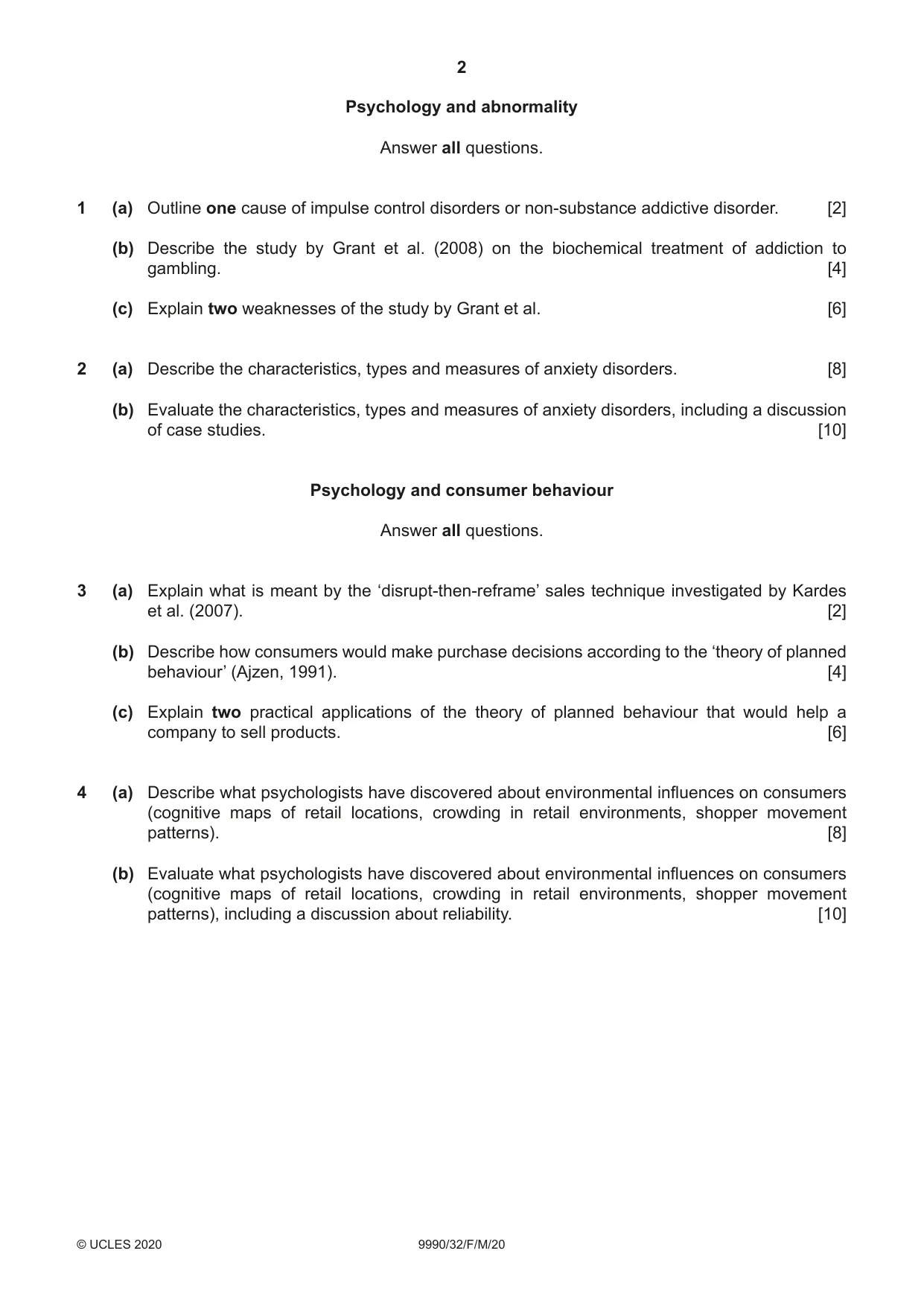
1 (a) Outline one cause of impulse control disorders or non-substance addictive disorder. [2] (b) Describe the study by Grant et al. (2008) on the biochemical treatment of addiction to gambling. [4] (c) Explain two weaknesses of the study by Grant et al. [6]
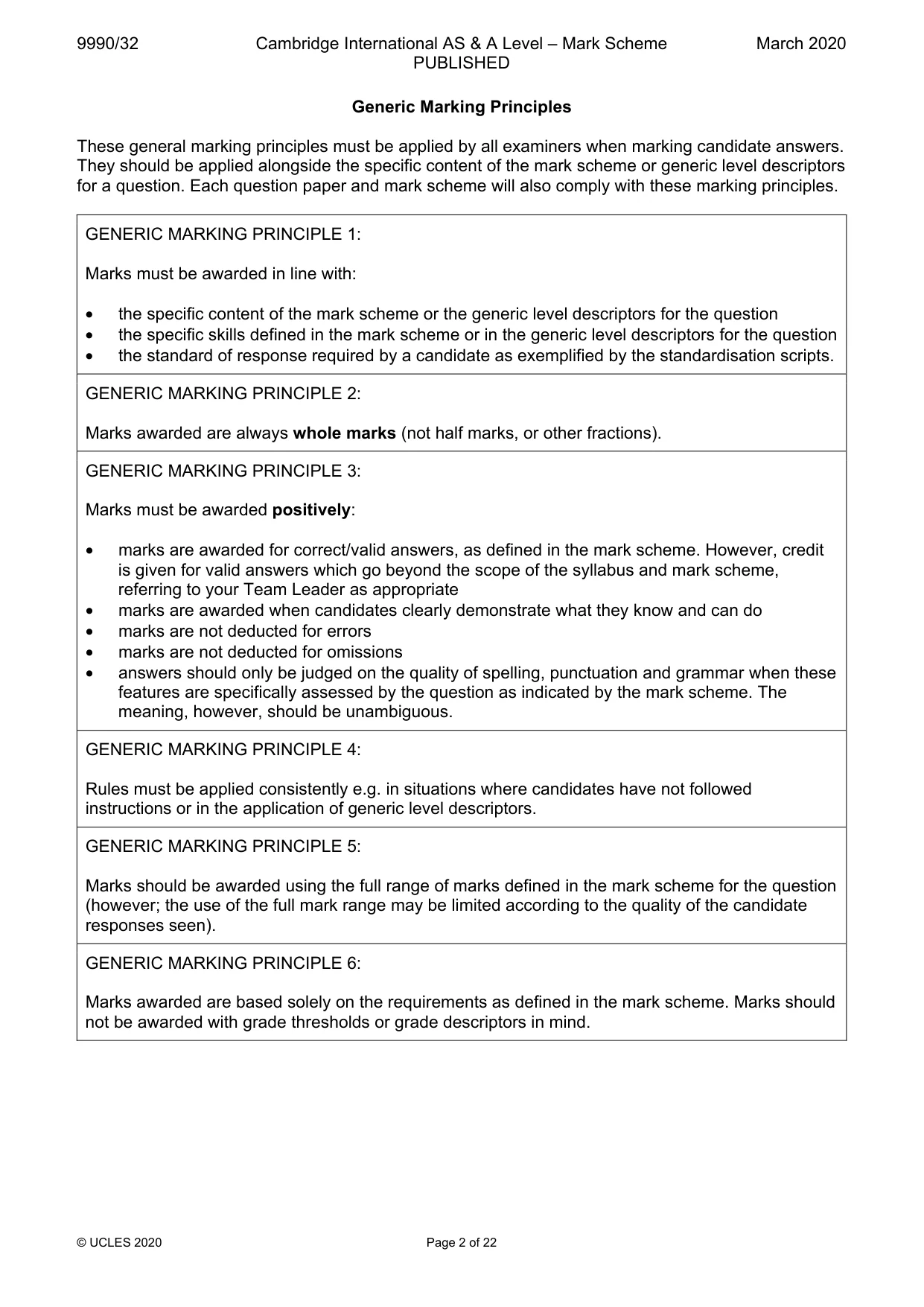
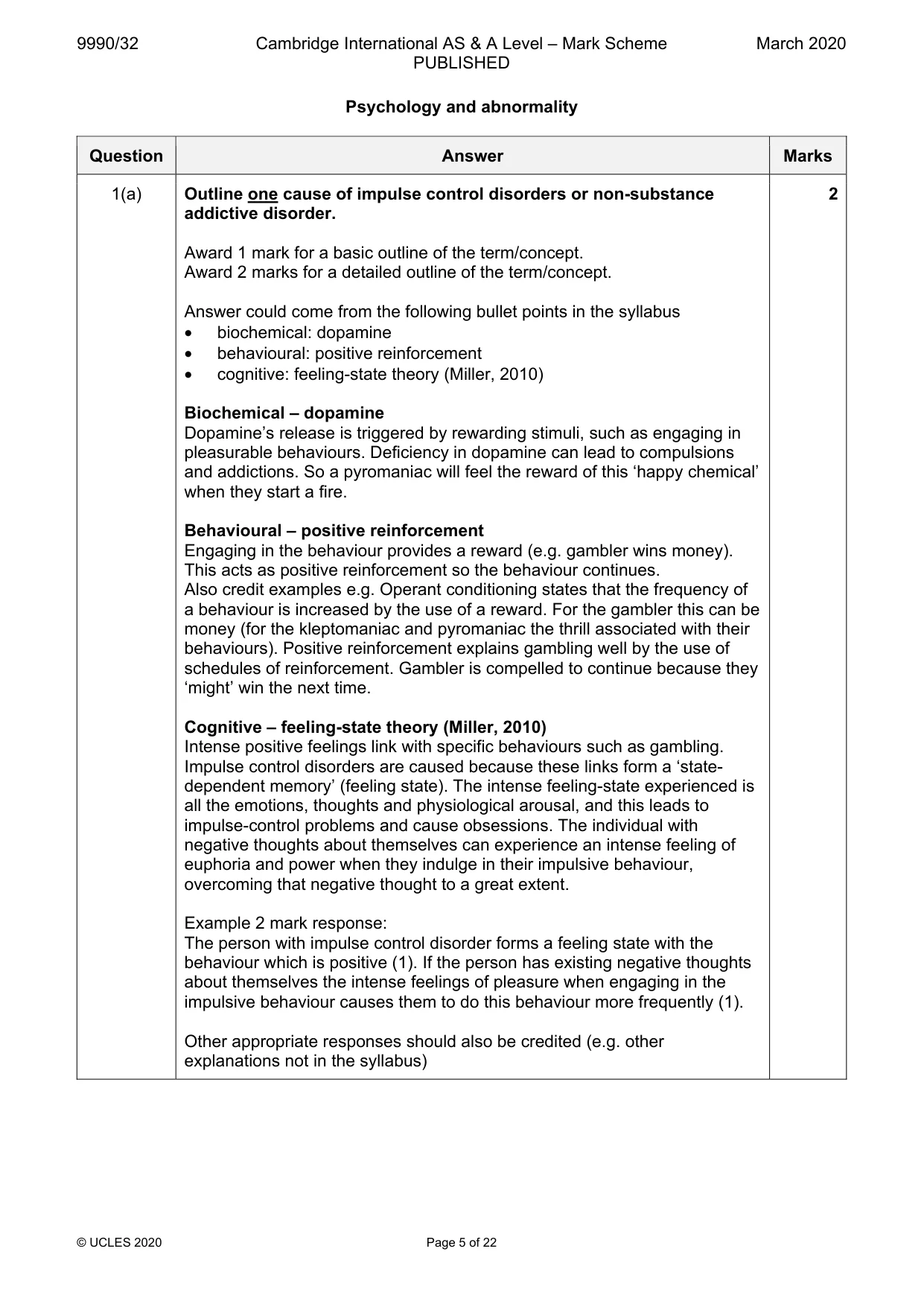
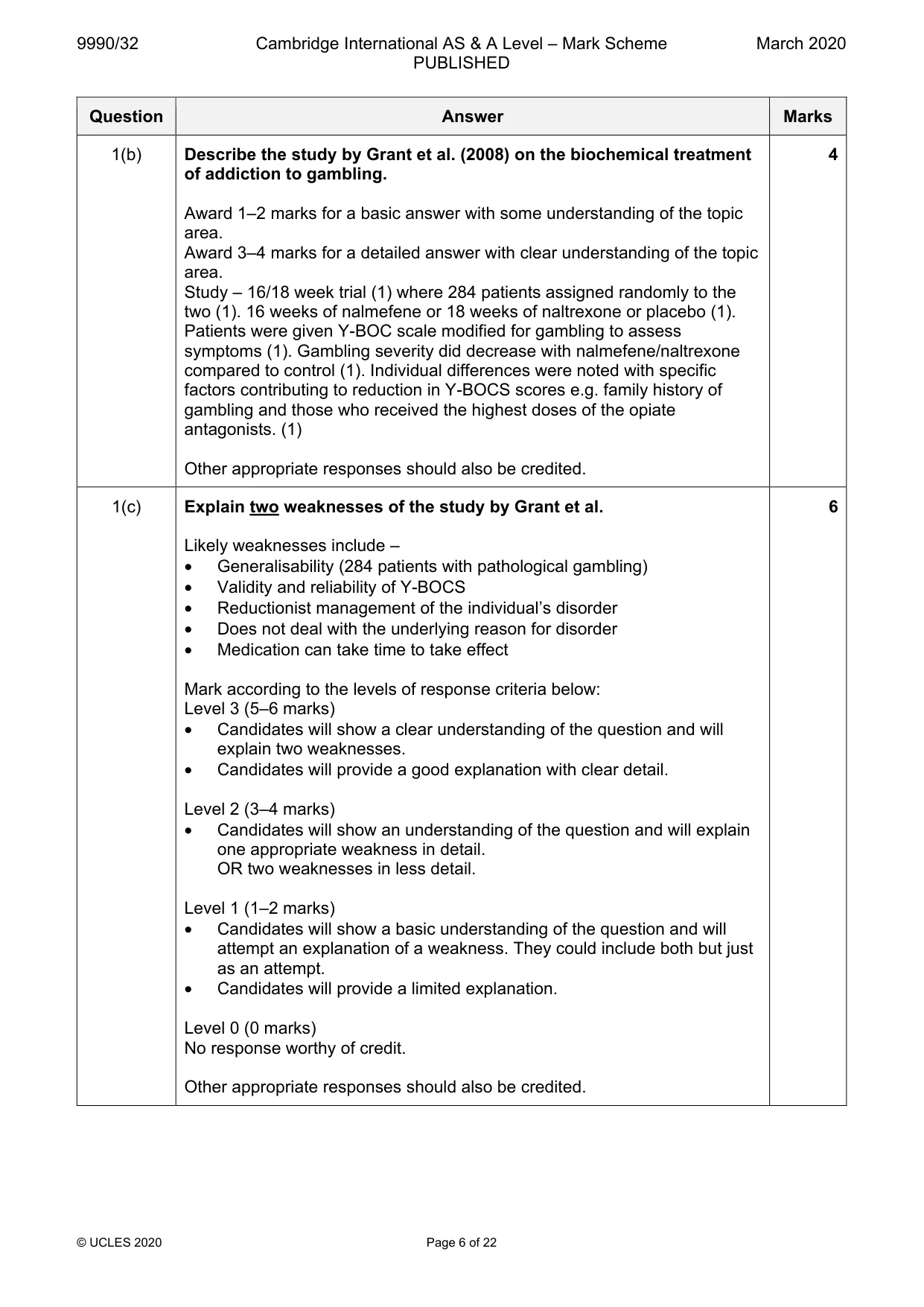
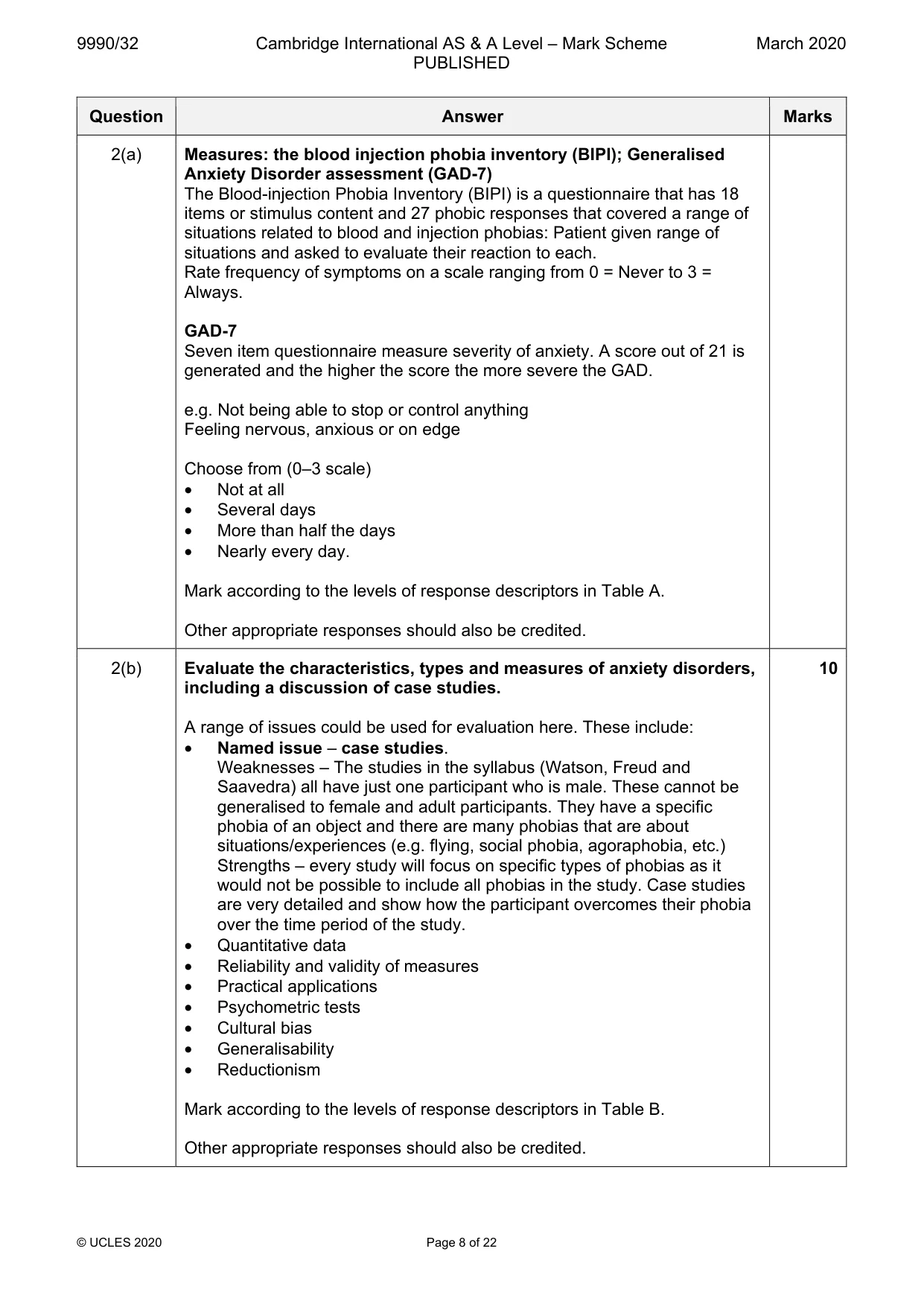
Mark scheme: Question Answer Marks 1(a) Outline one cause of impulse control disorders or non-substance 2 addictive disorder. Award 1 mark for a basic outline of the term/concept. Award 2 marks for a detailed outline of the term/concept. Answer could come from the following bullet points in the syllabus • biochemical: dopamine • behavioural: positive reinforcement • cognitive: feeling-state theory (Miller, 2010) Biochemical – dopamine Dopamine’s release is triggered by rewarding stimuli, such as engaging in pleasurable behaviours. Deficiency in dopamine can lead to compulsions and addictions. So a pyromaniac will feel the reward of this ‘happy chemical’ when they start a fire. Behavioural – positive reinforcement Engaging in the behaviour provides a reward (e.g. gambler wins money). This acts as positive reinforcement so the behaviour continues. Also credit examples e.g. Operant conditioning states that the frequency of a behaviour is increased by the use of a reward. For the gambler this can be money (for the kleptomaniac and pyromaniac the thrill associated with their behaviours). Positive reinforcement explains gambling well by the use of schedules of reinforcement. Gambler is compelled to continue because they ‘might’ win the next time. Cognitive – feeling-state theory (Miller, 2010) Intense positive feelings link with specific behaviours such as gambling. Impulse control disorders are caused because these links form a ‘state- dependent memory’ (feeling state). The intense feeling-state experienced is all the emotions, thoughts and physiological arousal, and this leads to impulse-control problems and cause obsessions. The individual with negative thoughts about themselves can experience an intense feeling of euphoria and power when they indulge in their impulsive behaviour, overcoming that negative thought to a great extent. Example 2 mark response: The person with impulse control disorder forms a feeling state with the behaviour which is positive (1). If the person has existing negative thoughts about themselves the intense feelings of pleasure when engaging in the impulsive behaviour causes them to do this behaviour more frequently (1). Other appropriate responses should also be credited (e.g. other explanations not in the syllabus) 1(b) Describe the study by Grant et al. (2008) on the biochemical treatment 4 of addiction to gambling. Award 1–2 marks for a basic answer with some understanding of the topic area. Award 3–4 marks for a detailed answer with clear understanding of the topic area. Study – 16/18 week trial (1) where 284 patients assigned randomly to the two (1). 16 weeks of nalmefene or 18 weeks of naltrexone or placebo (1). Patients were given Y-BOC scale modified for gambling to assess symptoms (1). Gambling severity did decrease with nalmefene/naltrexone compared to control (1). Individual differences were noted with specific factors contributing to reduction in Y-BOCS scores e.g. family history of gambling and those who received the highest doses of the opiate antagonists. (1) Other appropriate responses should also be credited. 1(c) Explain two weaknesses of the study by Grant et al. 6 Likely weaknesses include – • Generalisability (284 patients with pathological gambling) • Validity and reliability of Y-BOCS • Reductionist management of the individual’s disorder • Does not deal with the underlying reason for disorder • Medication can take time to take effect Mark according to the levels of response criteria below: Level 3 (5–6 marks) • Candidates will show a clear understanding of the question and will explain two weaknesses. • Candidates will provide a good explanation with clear detail. Level 2 (3–4 marks) • Candidates will show an understanding of the question and will explain one appropriate weakness in detail. OR two weaknesses in less detail. Level 1 (1–2 marks) • Candidates will show a basic understanding of the question and will attempt an explanation of a weakness. They could include both but just as an attempt. • Candidates will provide a limited explanation. Level 0 (0 marks) No response worthy of credit. Other appropriate responses should also be credited.
Q2 · Describe the characteristics, types and measures of anxiety disorders
2 (a) Describe the characteristics, types and measures of anxiety disorders. [8] (b) Evaluate the characteristics, types and measures of anxiety disorders, including a discussion of case studies. [10] Psychology and consumer behaviour Answer all questions.
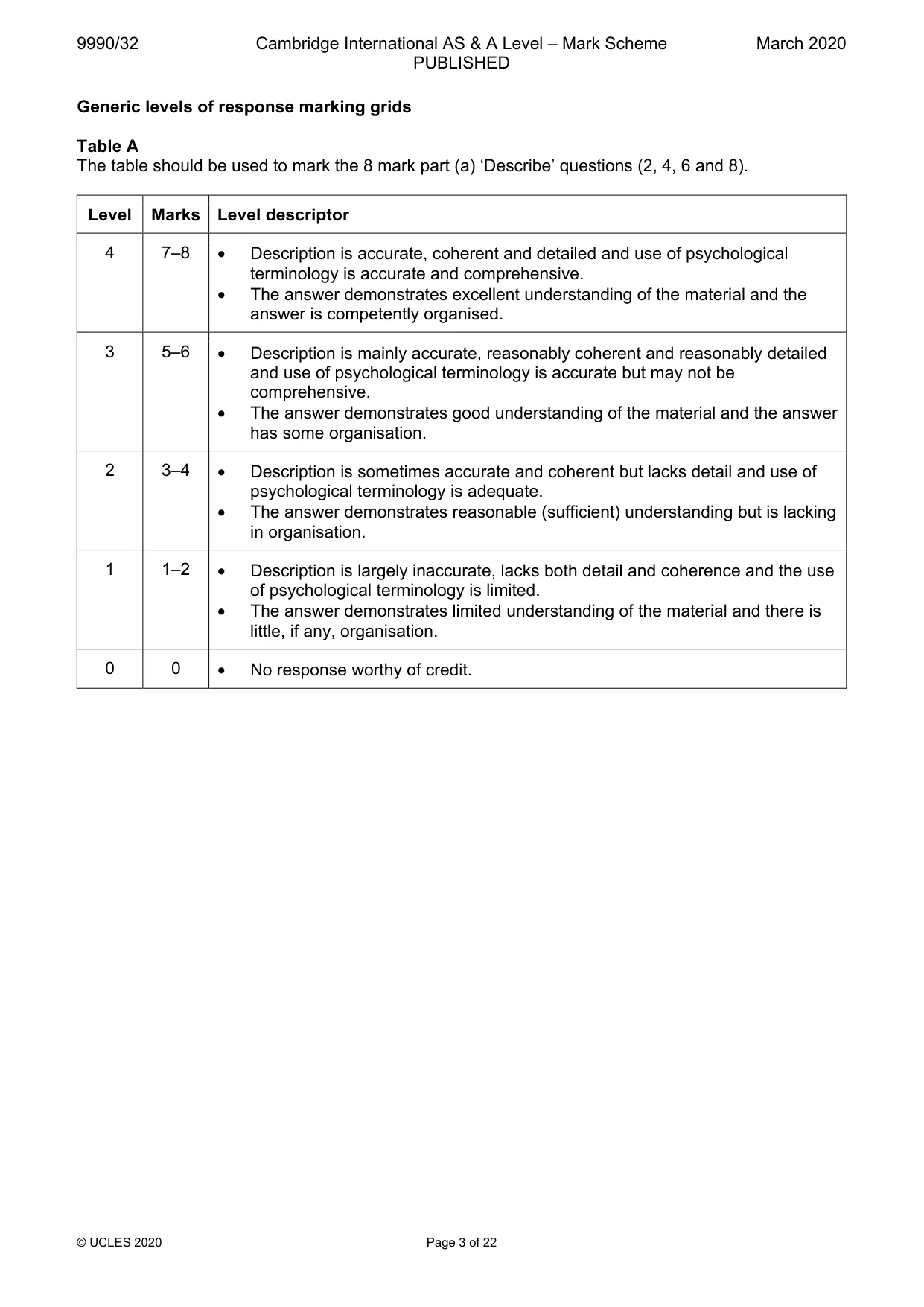
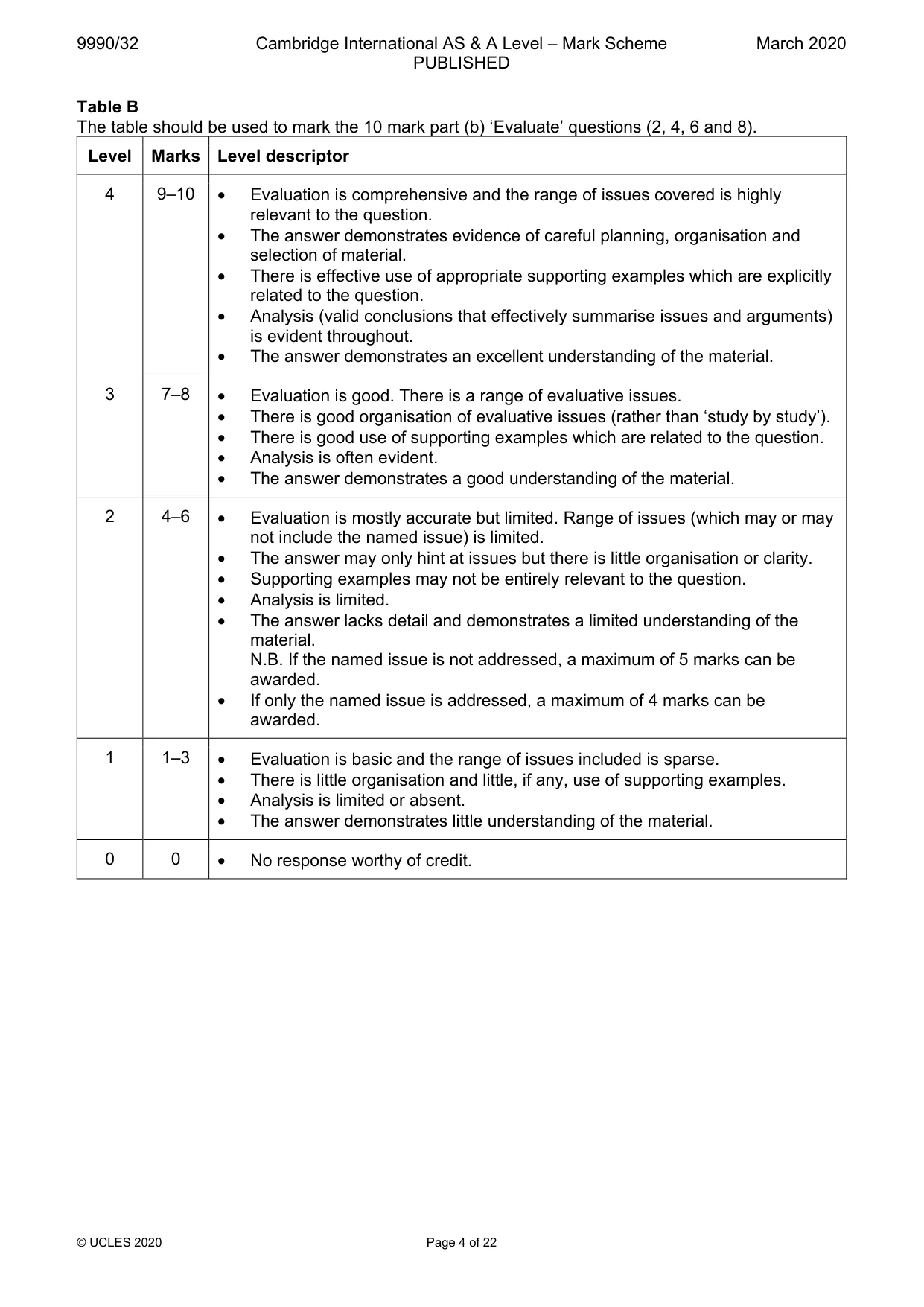
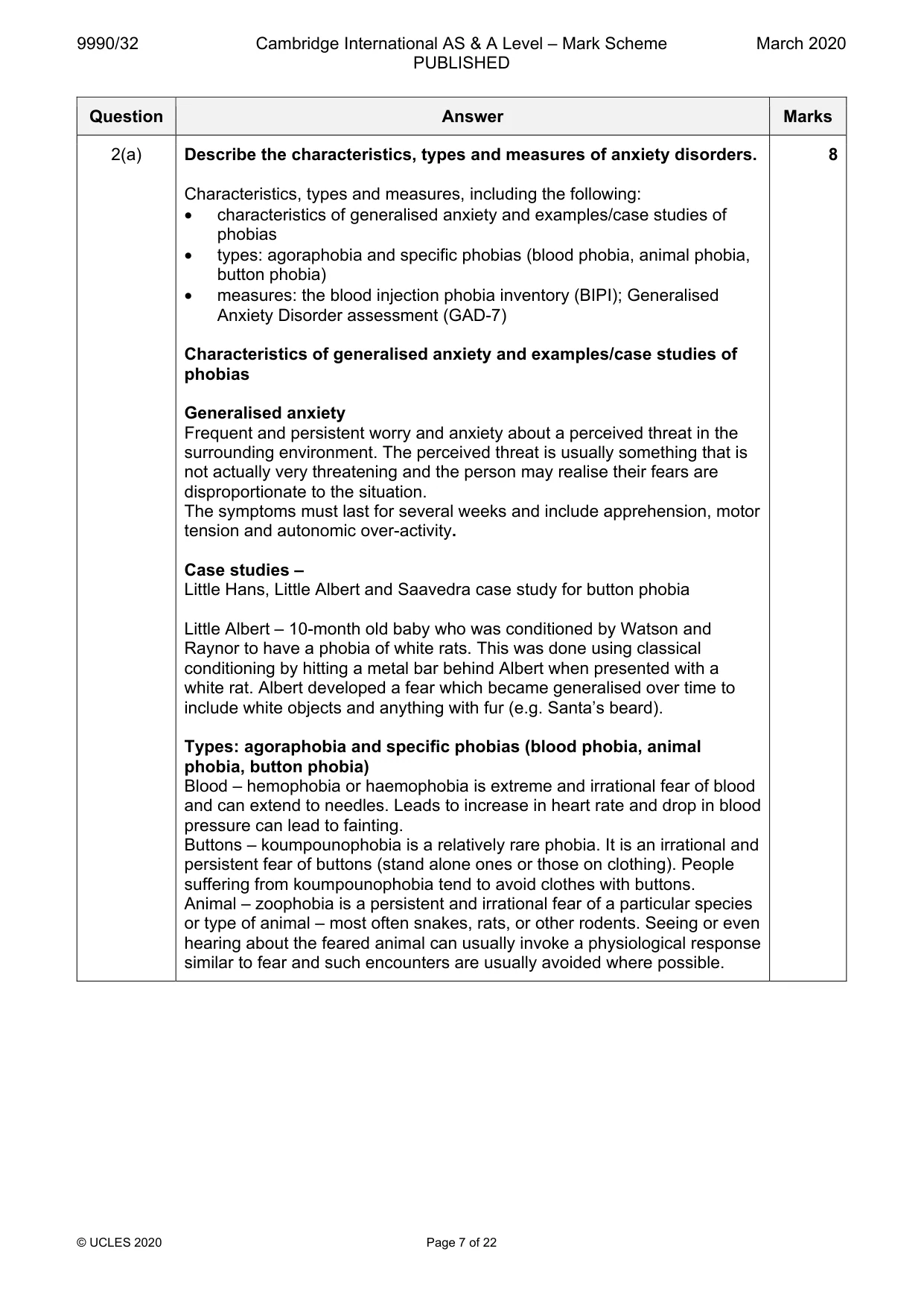
Mark scheme: 2(a) Describe the characteristics, types and measures of anxiety disorders. 8 Characteristics, types and measures, including the following: • characteristics of generalised anxiety and examples/case studies of phobias • types: agoraphobia and specific phobias (blood phobia, animal phobia, button phobia) • measures: the blood injection phobia inventory (BIPI); Generalised Anxiety Disorder assessment (GAD-7) Characteristics of generalised anxiety and examples/case studies of phobias Generalised anxiety Frequent and persistent worry and anxiety about a perceived threat in the surrounding environment. The perceived threat is usually something that is not actually very threatening and the person may realise their fears are disproportionate to the situation. The symptoms must last for several weeks and include apprehension, motor tension and autonomic over-activity. Case studies – Little Hans, Little Albert and Saavedra case study for button phobia Little Albert – 10-month old baby who was conditioned by Watson and Raynor to have a phobia of white rats. This was done using classical conditioning by hitting a metal bar behind Albert when presented with a white rat. Albert developed a fear which became generalised over time to include white objects and anything with fur (e.g. Santa’s beard). Types: agoraphobia and specific phobias (blood phobia, animal phobia, button phobia) Blood – hemophobia or haemophobia is extreme and irrational fear of blood and can extend to needles. Leads to increase in heart rate and drop in blood pressure can lead to fainting. Buttons – koumpounophobia is a relatively rare phobia. It is an irrational and persistent fear of buttons (stand alone ones or those on clothing). People suffering from koumpounophobia tend to avoid clothes with buttons. Animal – zoophobia is a persistent and irrational fear of a particular species or type of animal – most often snakes, rats, or other rodents. Seeing or even hearing about the feared animal can usually invoke a physiological response similar to fear and such encounters are usually avoided where possible. 2(a) Measures: the blood injection phobia inventory (BIPI); Generalised Anxiety Disorder assessment (GAD-7) The Blood-injection Phobia Inventory (BIPI) is a questionnaire that has 18 items or stimulus content and 27 phobic responses that covered a range of situations related to blood and injection phobias: Patient given range of situations and asked to evaluate their reaction to each. Rate frequency of symptoms on a scale ranging from 0 = Never to 3 = Always. GAD-7 Seven item questionnaire measure severity of anxiety. A score out of 21 is generated and the higher the score the more severe the GAD. e.g. Not being able to stop or control anything Feeling nervous, anxious or on edge Choose from (0–3 scale) • Not at all • Several days • More than half the days • Nearly every day. Mark according to the levels of response descriptors in Table A. Other appropriate responses should also be credited. 2(b) Evaluate the characteristics, types and measures of anxiety disorders, 10 including a discussion of case studies. A range of issues could be used for evaluation here. These include: • Named issue – case studies. Weaknesses – The studies in the syllabus (Watson, Freud and Saavedra) all have just one participant who is male. These cannot be generalised to female and adult participants. They have a specific phobia of an object and there are many phobias that are about situations/experiences (e.g. flying, social phobia, agoraphobia, etc.) Strengths – every study will focus on specific types of phobias as it would not be possible to include all phobias in the study. Case studies are very detailed and show how the participant overcomes their phobia over the time period of the study. • Quantitative data • Reliability and validity of measures • Practical applications • Psychometric tests • Cultural bias • Generalisability • Reductionism Mark according to the levels of response descriptors in Table B. Other appropriate responses should also be credited. Psychology and consumer behaviour
More questions on Anxiety disorders and fear-related disorders
Q3 · Explain what is meant by the ‘disrupt-then-reframe’ sales technique investigated by…
3 (a) Explain what is meant by the ‘disrupt-then-reframe’ sales technique investigated by Kardes et al. (2007). [2] (b) Describe how consumers would make purchase decisions according to the ‘theory of planned behaviour’ (Ajzen, 1991). [4] (c) Explain two practical applications of the theory of planned behaviour that would help a company to sell products. [6]
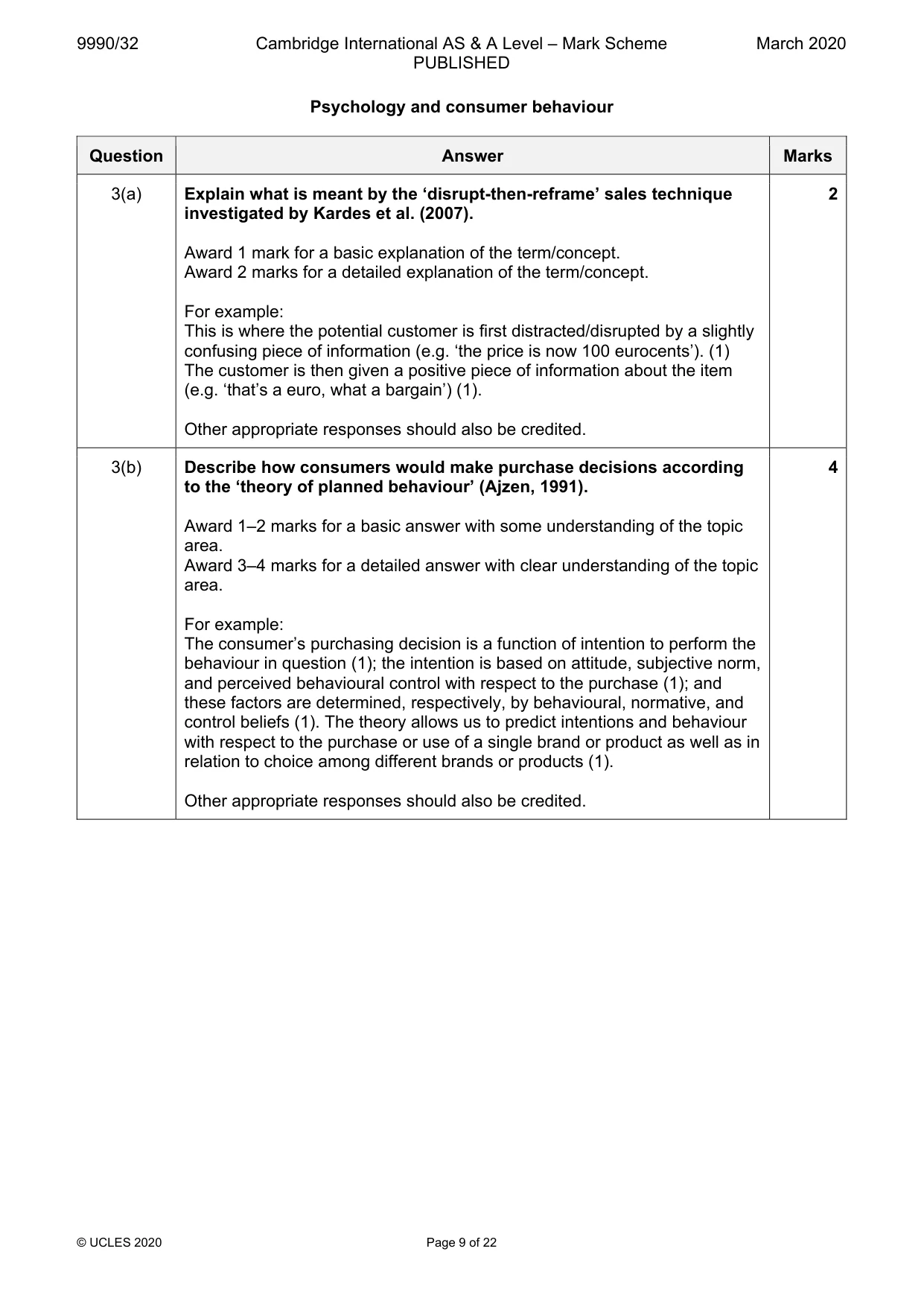
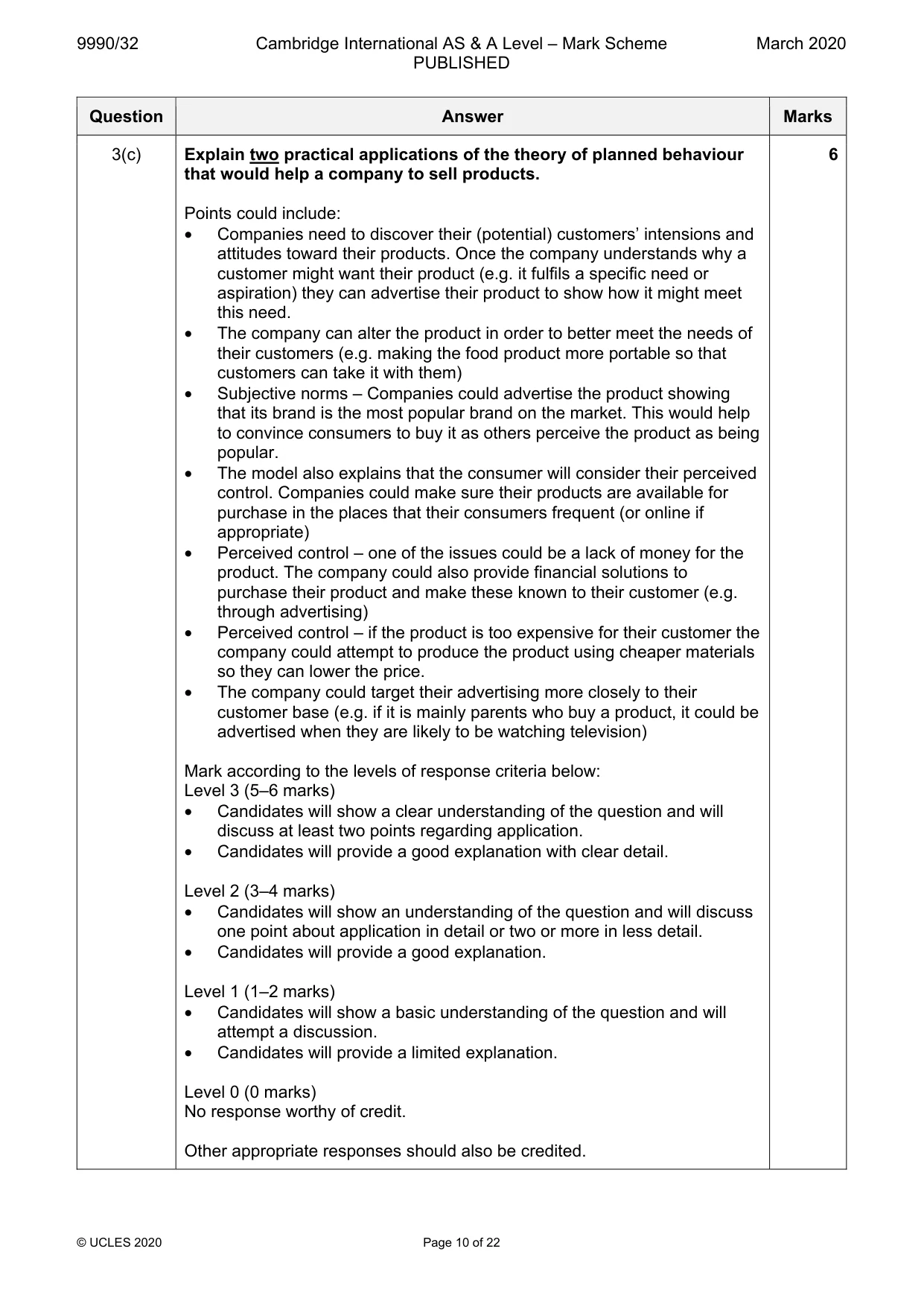
Mark scheme: 3(a) Explain what is meant by the ‘disrupt-then-reframe’ sales technique 2 investigated by Kardes et al. (2007). Award 1 mark for a basic explanation of the term/concept. Award 2 marks for a detailed explanation of the term/concept. For example: This is where the potential customer is first distracted/disrupted by a slightly confusing piece of information (e.g. ‘the price is now 100 eurocents’). (1) The customer is then given a positive piece of information about the item (e.g. ‘that’s a euro, what a bargain’) (1). Other appropriate responses should also be credited. 3(b) Describe how consumers would make purchase decisions according 4 to the ‘theory of planned behaviour’ (Ajzen, 1991). Award 1–2 marks for a basic answer with some understanding of the topic area. Award 3–4 marks for a detailed answer with clear understanding of the topic area. For example: The consumer’s purchasing decision is a function of intention to perform the behaviour in question (1); the intention is based on attitude, subjective norm, and perceived behavioural control with respect to the purchase (1); and these factors are determined, respectively, by behavioural, normative, and control beliefs (1). The theory allows us to predict intentions and behaviour with respect to the purchase or use of a single brand or product as well as in relation to choice among different brands or products (1). Other appropriate responses should also be credited. 3(c) Explain two practical applications of the theory of planned behaviour 6 that would help a company to sell products. Points could include: • Companies need to discover their (potential) customers’ intensions and attitudes toward their products. Once the company understands why a customer might want their product (e.g. it fulfils a specific need or aspiration) they can advertise their product to show how it might meet this need. • The company can alter the product in order to better meet the needs of their customers (e.g. making the food product more portable so that customers can take it with them) • Subjective norms – Companies could advertise the product showing that its brand is the most popular brand on the market. This would help to convince consumers to buy it as others perceive the product as being popular. • The model also explains that the consumer will consider their perceived control. Companies could make sure their products are available for purchase in the places that their consumers frequent (or online if appropriate) • Perceived control – one of the issues could be a lack of money for the product. The company could also provide financial solutions to purchase their product and make these known to their customer (e.g. through advertising) • Perceived control – if the product is too expensive for their customer the company could attempt to produce the product using cheaper materials so they can lower the price. • The company could target their advertising more closely to their customer base (e.g. if it is mainly parents who buy a product, it could be advertised when they are likely to be watching television) Mark according to the levels of response criteria below: Level 3 (5–6 marks) • Candidates will show a clear understanding of the question and will discuss at least two points regarding application. • Candidates will provide a good explanation with clear detail. Level 2 (3–4 marks) • Candidates will show an understanding of the question and will discuss one point about application in detail or two or more in less detail. • Candidates will provide a good explanation. Level 1 (1–2 marks) • Candidates will show a basic understanding of the question and will attempt a discussion. • Candidates will provide a limited explanation. Level 0 (0 marks) No response worthy of credit. Other appropriate responses should also be credited.
Q4 · Describe what psychologists have discovered about environmental influences on consumers…
4 (a) Describe what psychologists have discovered about environmental influences on consumers (cognitive maps of retail locations, crowding in retail environments, shopper movement patterns). [8] (b) Evaluate what psychologists have discovered about environmental influences on consumers (cognitive maps of retail locations, crowding in retail environments, shopper movement patterns), including a discussion about reliability. [10] Psychology and health Answer all questions.
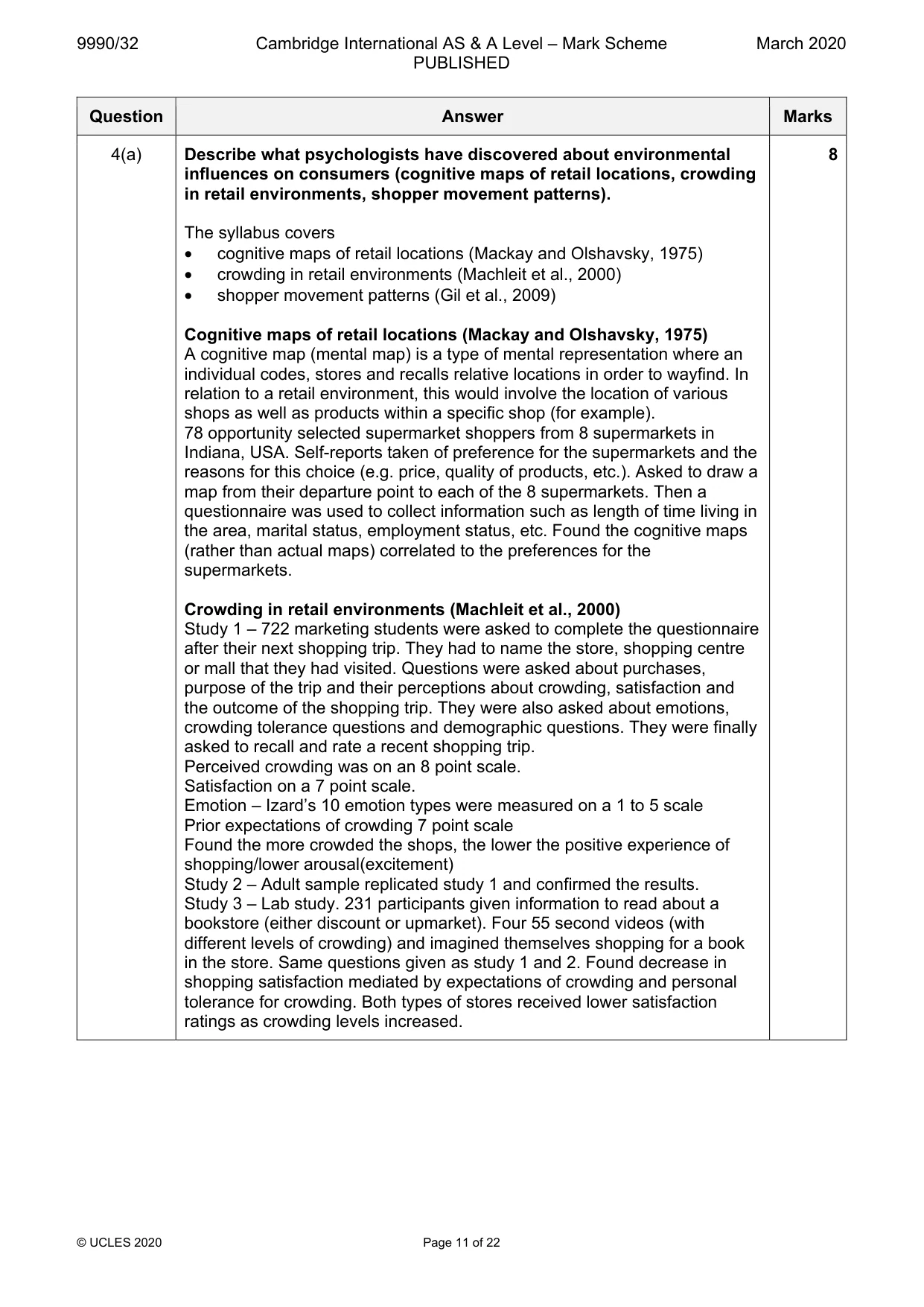
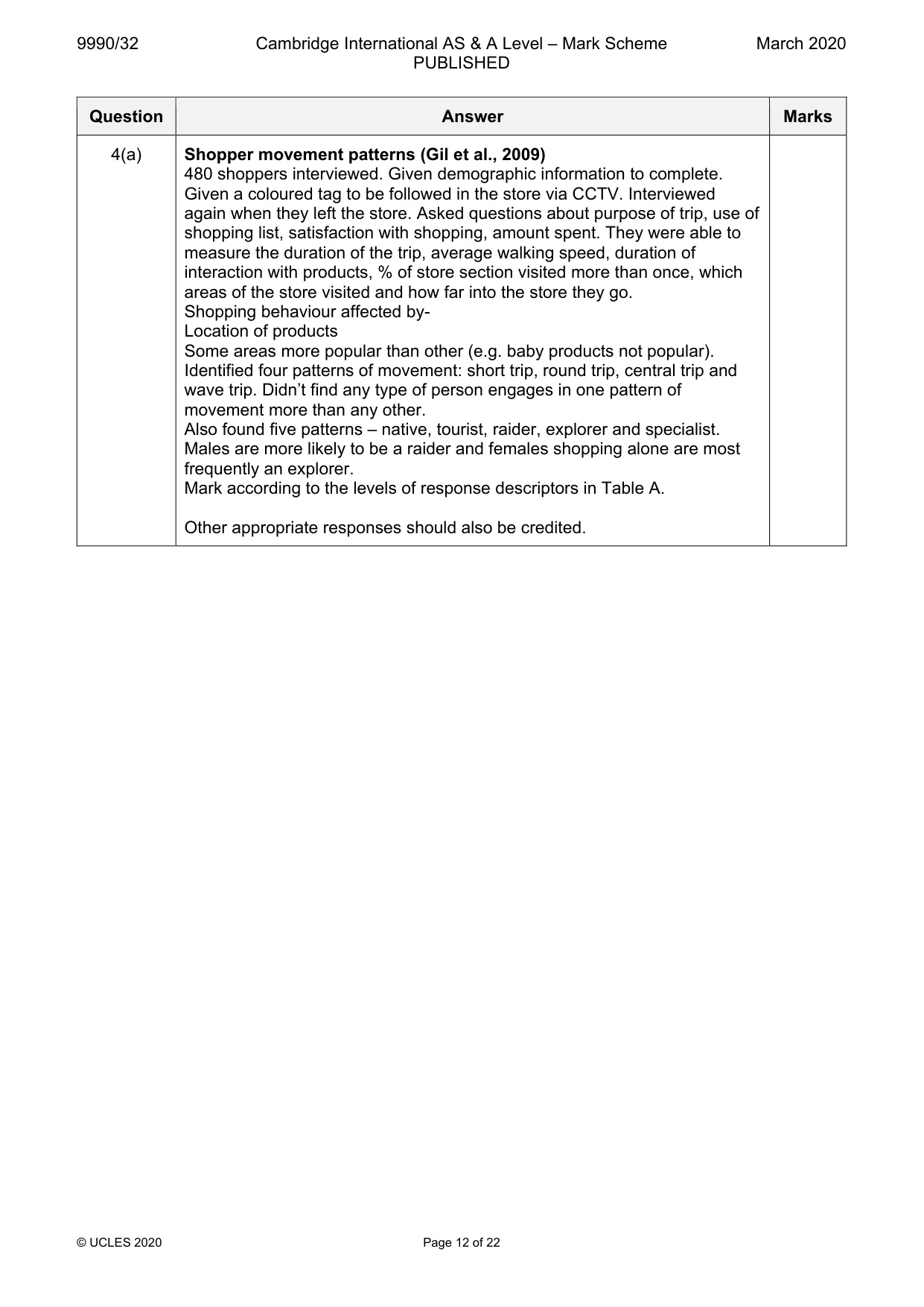
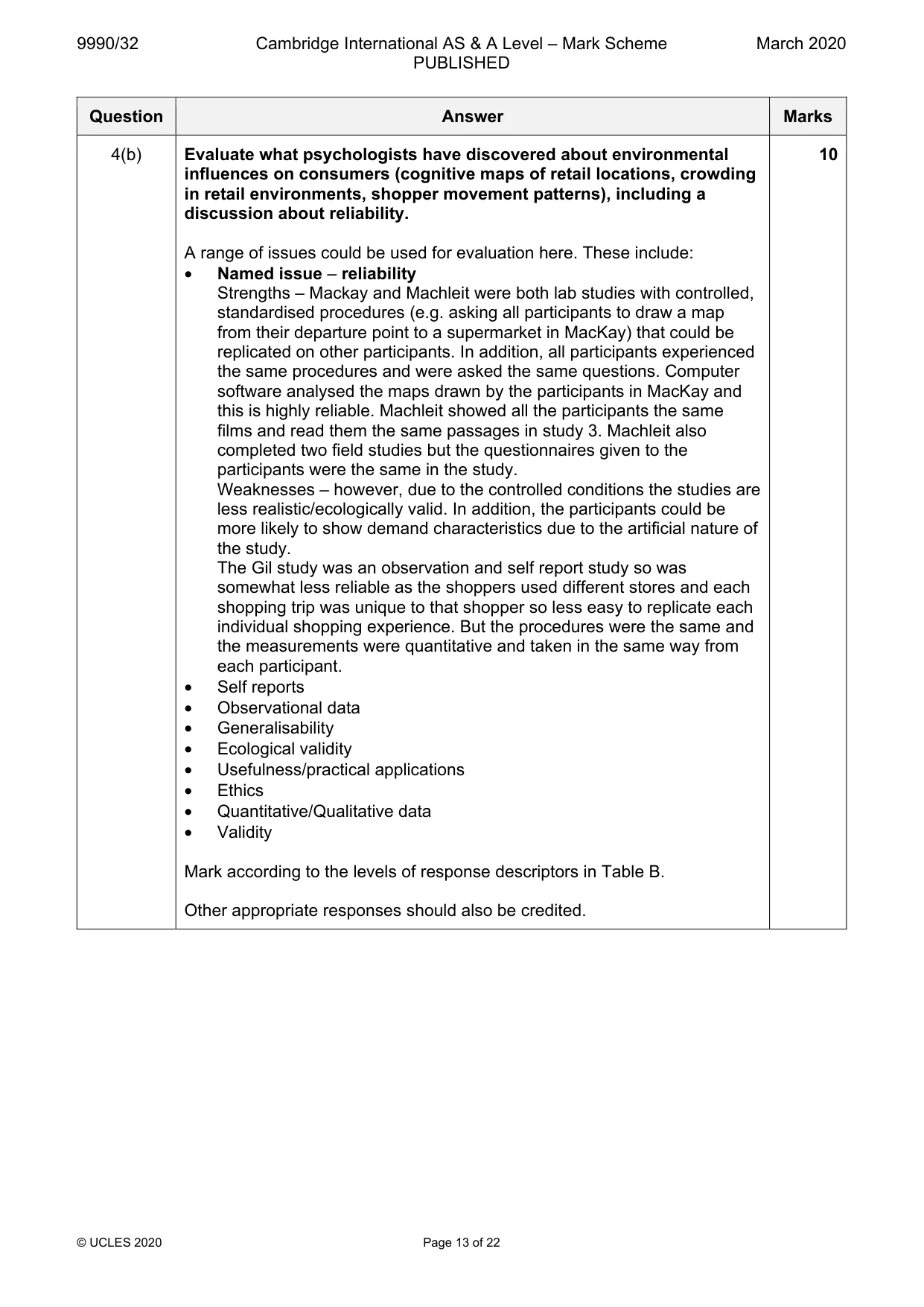
Mark scheme: 4(a) Describe what psychologists have discovered about environmental 8 influences on consumers (cognitive maps of retail locations, crowding in retail environments, shopper movement patterns). The syllabus covers • cognitive maps of retail locations (Mackay and Olshavsky, 1975) • crowding in retail environments (Machleit et al., 2000) • shopper movement patterns (Gil et al., 2009) Cognitive maps of retail locations (Mackay and Olshavsky, 1975) A cognitive map (mental map) is a type of mental representation where an individual codes, stores and recalls relative locations in order to wayfind. In relation to a retail environment, this would involve the location of various shops as well as products within a specific shop (for example). 78 opportunity selected supermarket shoppers from 8 supermarkets in Indiana, USA. Self-reports taken of preference for the supermarkets and the reasons for this choice (e.g. price, quality of products, etc.). Asked to draw a map from their departure point to each of the 8 supermarkets. Then a questionnaire was used to collect information such as length of time living in the area, marital status, employment status, etc. Found the cognitive maps (rather than actual maps) correlated to the preferences for the supermarkets. Crowding in retail environments (Machleit et al., 2000) Study 1 – 722 marketing students were asked to complete the questionnaire after their next shopping trip. They had to name the store, shopping centre or mall that they had visited. Questions were asked about purchases, purpose of the trip and their perceptions about crowding, satisfaction and the outcome of the shopping trip. They were also asked about emotions, crowding tolerance questions and demographic questions. They were finally asked to recall and rate a recent shopping trip. Perceived crowding was on an 8 point scale. Satisfaction on a 7 point scale. Emotion – Izard’s 10 emotion types were measured on a 1 to 5 scale Prior expectations of crowding 7 point scale Found the more crowded the shops, the lower the positive experience of shopping/lower arousal(excitement) Study 2 – Adult sample replicated study 1 and confirmed the results. Study 3 – Lab study. 231 participants given information to read about a bookstore (either discount or upmarket). Four 55 second videos (with different levels of crowding) and imagined themselves shopping for a book in the store. Same questions given as study 1 and 2. Found decrease in shopping satisfaction mediated by expectations of crowding and personal tolerance for crowding. Both types of stores received lower satisfaction ratings as crowding levels increased. 4(a) Shopper movement patterns (Gil et al., 2009) 480 shoppers interviewed. Given demographic information to complete. Given a coloured tag to be followed in the store via CCTV. Interviewed again when they left the store. Asked questions about purpose of trip, use of shopping list, satisfaction with shopping, amount spent. They were able to measure the duration of the trip, average walking speed, duration of interaction with products, % of store section visited more than once, which areas of the store visited and how far into the store they go. Shopping behaviour affected by- Location of products Some areas more popular than other (e.g. baby products not popular). Identified four patterns of movement: short trip, round trip, central trip and wave trip. Didn’t find any type of person engages in one pattern of movement more than any other. Also found five patterns – native, tourist, raider, explorer and specialist. Males are more likely to be a raider and females shopping alone are most frequently an explorer. Mark according to the levels of response descriptors in Table A. Other appropriate responses should also be credited. 4(b) Evaluate what psychologists have discovered about environmental 10 influences on consumers (cognitive maps of retail locations, crowding in retail environments, shopper movement patterns), including a discussion about reliability. A range of issues could be used for evaluation here. These include: • Named issue – reliability Strengths – Mackay and Machleit were both lab studies with controlled, standardised procedures (e.g. asking all participants to draw a map from their departure point to a supermarket in MacKay) that could be replicated on other participants. In addition, all participants experienced the same procedures and were asked the same questions. Computer software analysed the maps drawn by the participants in MacKay and this is highly reliable. Machleit showed all the participants the same films and read them the same passages in study 3. Machleit also completed two field studies but the questionnaires given to the participants were the same in the study. Weaknesses – however, due to the controlled conditions the studies are less realistic/ecologically valid. In addition, the participants could be more likely to show demand characteristics due to the artificial nature of the study. The Gil study was an observation and self report study so was somewhat less reliable as the shoppers used different stores and each shopping trip was unique to that shopper so less easy to replicate each individual shopping experience. But the procedures were the same and the measurements were quantitative and taken in the same way from each participant. • Self reports • Observational data • Generalisability • Ecological validity • Usefulness/practical applications • Ethics • Quantitative/Qualitative data • Validity Mark according to the levels of response descriptors in Table B. Other appropriate responses should also be credited. Psychology and health
Q5 · Outline how Fox et al
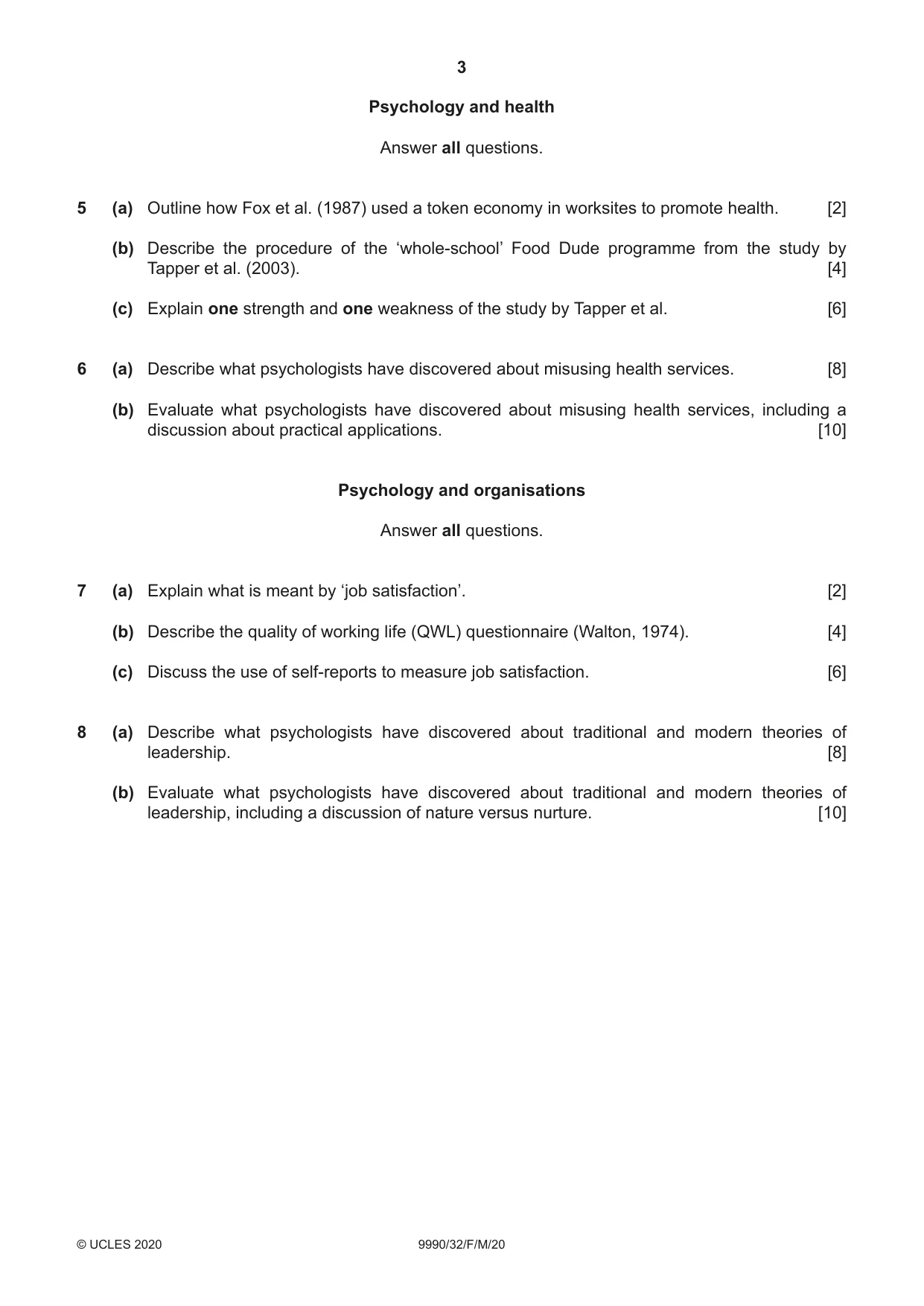
5 (a) Outline how Fox et al. (1987) used a token economy in worksites to promote health. [2] (b) Describe the procedure of the ‘whole-school’ Food Dude programme from the study by Tapper et al. (2003). [4] (c) Explain one strength and one weakness of the study by Tapper et al. [6]
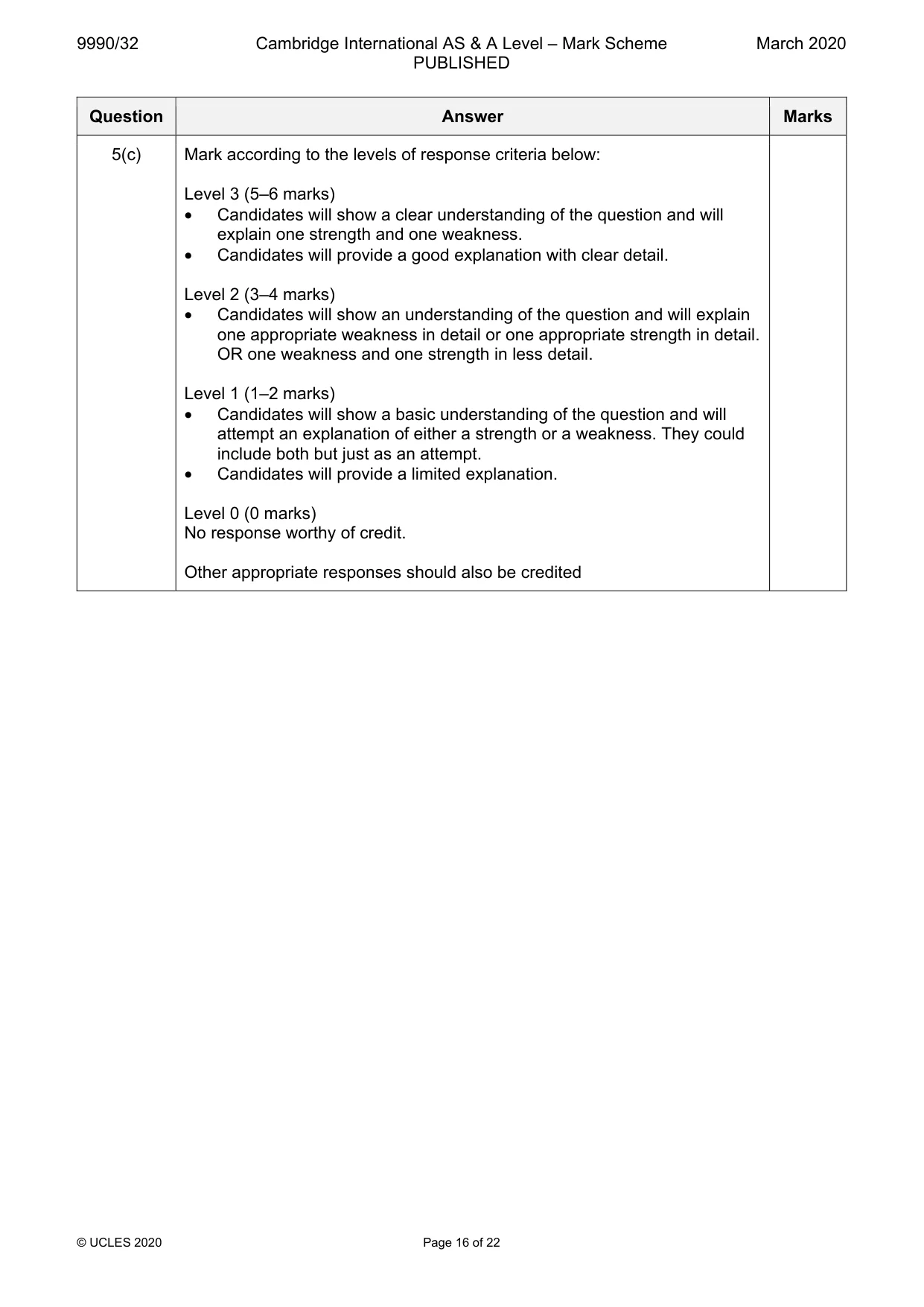
Mark scheme: 5(a) Outline how Fox et al. (1987) used a token economy in worksites to 2 promote health. Award 1 mark for a basic outline of the term/concept. Award 2 marks for a detailed outline of the term/concept. For example: Fox et al. gave stamps for no lost-time injury (1). Stamps could be exchanged for items at redemption stores (1) Other appropriate responses should also be credited. 5(b) Describe the procedure of the ‘whole-school’ Food Dude programme 4 from the study by Tapper et al. (2003). Award 1–2 marks for a basic answer with some understanding of the topic area. Award 3–4 marks for a detailed answer with clear understanding of the topic area. For example: Children aged 4–11 watched the Food Dudes programme in lessons (1). They received rewards such as a Food Dudes sticker if they ate fruit and vegetables put out in front of them (1). They receive a Food Dude sticker for tasting a food (1), or a sticker and a small prize for eating a whole portion (1). The intervention phase was followed by a maintenance phase during which there are no videos and the letters and rewards became more intermittent (1). Additional content: Self reports were done with some of the parents to evaluate how many fruit and vegetables were consumed at home (1). Also credit the control group used during the later phases of the study where they just monitored consumption of fruit and vegetables when given extra fruit and vegetables that were delivered to the school during the duration of the study (1). Qualitative data was collected from both parents and teachers (1). Other appropriate responses should also be credited. 5(c) Explain one strength and one weakness of the study by Tapper et al. 6 Likely strengths include: • Wide age range of children studied (5–6 years, 2–4 years, 4–11 years) • Different types of studies done (e.g. some at home and some at school – nursery and primary school) • Both qualitative (e.g. enjoyment of the programme, enthusiasm for curriculum work, etc. and quantitative (number of fruit and vegetables eaten both at home and at school) data collected. Increases validity as can make comparisons as well as having detailed information on how the children responded to the programme. • Collected data from the teachers and parents which helps improve validity. • Highly ethical study as consent obtained from the parents and the school (and improved fruit and vegetable consumption which is a very good outcome for the children involved) • Provided training and all of the necessary equipment including the food to the schools • Good practical applications to be used in other schools. • Schools from a variety of locations in the UK (e.g. North Wales, Manchester, Oxfordshire, London) which improves generalisability. Likely weaknesses include: • Generalisability (UK) • Just based in primary schools so not sure if this would work with secondary school children or adults. • Could be an expensive programme to introduce in all schools so is less practical. • Social desirability and demand characteristics were possible as the participants may have told the researchers that the fruit and vegetable consumption increased when in fact either it had not or the participant/teacher/parent was not sure about the actual consumption. 5(c) Mark according to the levels of response criteria below: Level 3 (5–6 marks) • Candidates will show a clear understanding of the question and will explain one strength and one weakness. • Candidates will provide a good explanation with clear detail. Level 2 (3–4 marks) • Candidates will show an understanding of the question and will explain one appropriate weakness in detail or one appropriate strength in detail. OR one weakness and one strength in less detail. Level 1 (1–2 marks) • Candidates will show a basic understanding of the question and will attempt an explanation of either a strength or a weakness. They could include both but just as an attempt. • Candidates will provide a limited explanation. Level 0 (0 marks) No response worthy of credit. Other appropriate responses should also be credited
More questions on 2 Health promotion in schools and worksites
Q6 · Describe what psychologists have discovered about misusing health services
6 (a) Describe what psychologists have discovered about misusing health services. [8] (b) Evaluate what psychologists have discovered about misusing health services, including a discussion about practical applications. [10] Psychology and organisations Answer all questions.
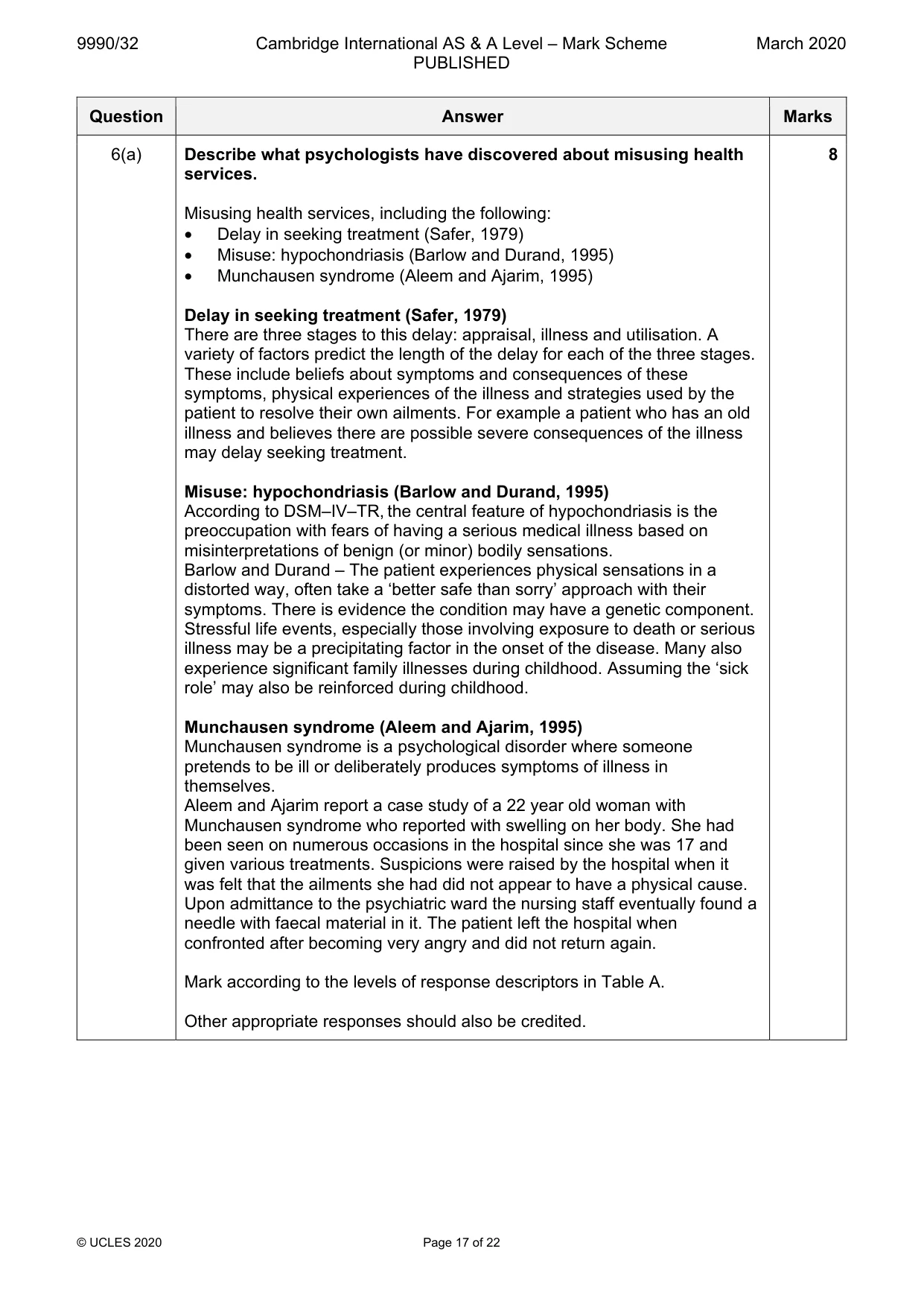
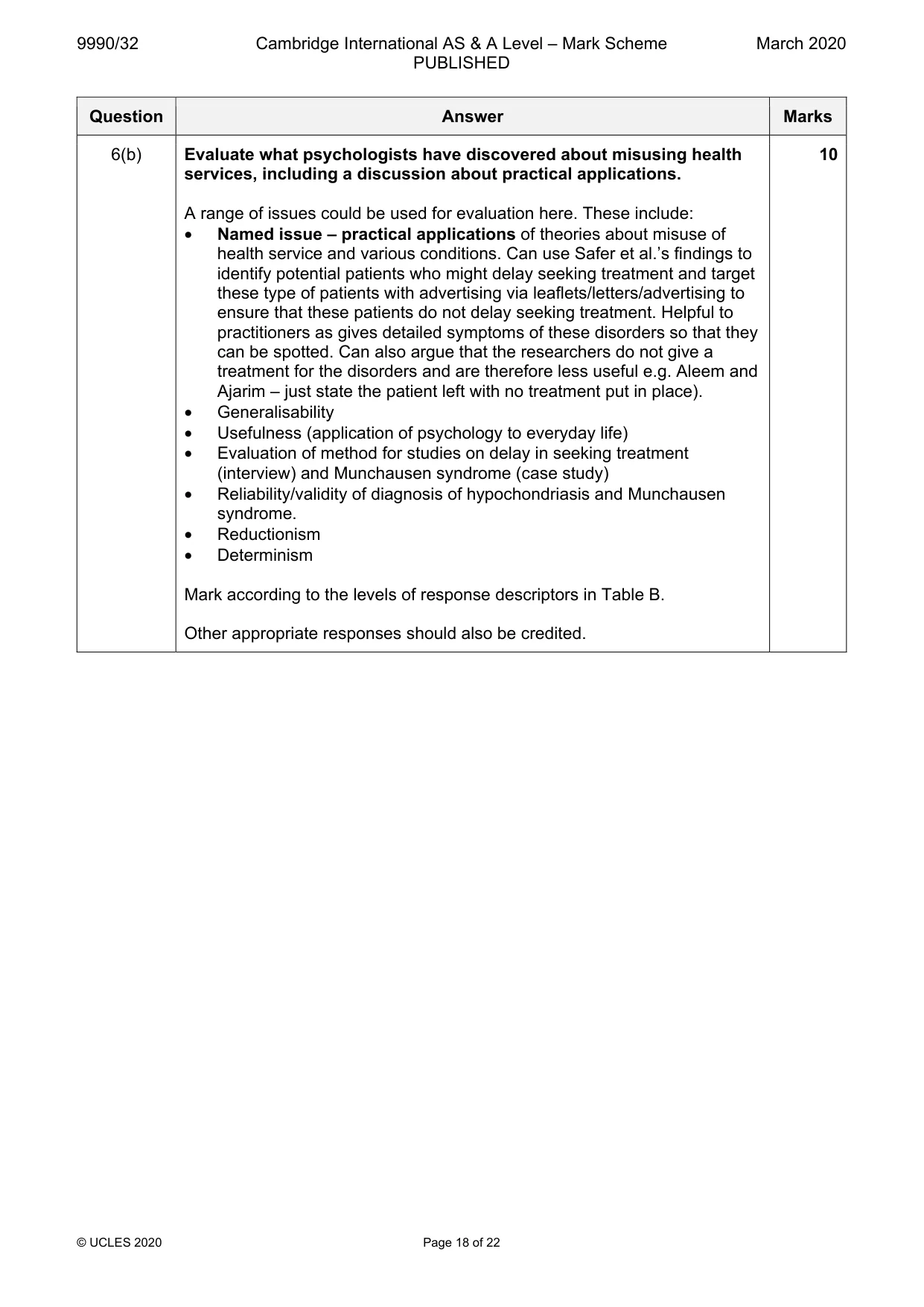
Mark scheme: 6(a) Describe what psychologists have discovered about misusing health 8 services. Misusing health services, including the following: • Delay in seeking treatment (Safer, 1979) • Misuse: hypochondriasis (Barlow and Durand, 1995) • Munchausen syndrome (Aleem and Ajarim, 1995) Delay in seeking treatment (Safer, 1979) There are three stages to this delay: appraisal, illness and utilisation. A variety of factors predict the length of the delay for each of the three stages. These include beliefs about symptoms and consequences of these symptoms, physical experiences of the illness and strategies used by the patient to resolve their own ailments. For example a patient who has an old illness and believes there are possible severe consequences of the illness may delay seeking treatment. Misuse: hypochondriasis (Barlow and Durand, 1995) According to DSM–IV–TR, the central feature of hypochondriasis is the preoccupation with fears of having a serious medical illness based on misinterpretations of benign (or minor) bodily sensations. Barlow and Durand – The patient experiences physical sensations in a distorted way, often take a ‘better safe than sorry’ approach with their symptoms. There is evidence the condition may have a genetic component. Stressful life events, especially those involving exposure to death or serious illness may be a precipitating factor in the onset of the disease. Many also experience significant family illnesses during childhood. Assuming the ‘sick role’ may also be reinforced during childhood. Munchausen syndrome (Aleem and Ajarim, 1995) Munchausen syndrome is a psychological disorder where someone pretends to be ill or deliberately produces symptoms of illness in themselves. Aleem and Ajarim report a case study of a 22 year old woman with Munchausen syndrome who reported with swelling on her body. She had been seen on numerous occasions in the hospital since she was 17 and given various treatments. Suspicions were raised by the hospital when it was felt that the ailments she had did not appear to have a physical cause. Upon admittance to the psychiatric ward the nursing staff eventually found a needle with faecal material in it. The patient left the hospital when confronted after becoming very angry and did not return again. Mark according to the levels of response descriptors in Table A. Other appropriate responses should also be credited. 6(b) Evaluate what psychologists have discovered about misusing health 10 services, including a discussion about practical applications. A range of issues could be used for evaluation here. These include: • Named issue – practical applications of theories about misuse of health service and various conditions. Can use Safer et al.’s findings to identify potential patients who might delay seeking treatment and target these type of patients with advertising via leaflets/letters/advertising to ensure that these patients do not delay seeking treatment. Helpful to practitioners as gives detailed symptoms of these disorders so that they can be spotted. Can also argue that the researchers do not give a treatment for the disorders and are therefore less useful e.g. Aleem and Ajarim – just state the patient left with no treatment put in place). • Generalisability • Usefulness (application of psychology to everyday life) • Evaluation of method for studies on delay in seeking treatment (interview) and Munchausen syndrome (case study) • Reliability/validity of diagnosis of hypochondriasis and Munchausen syndrome. • Reductionism • Determinism Mark according to the levels of response descriptors in Table B. Other appropriate responses should also be credited. Psychology and organisations
Q7 · Explain what is meant by ‘job satisfaction’
7 (a) Explain what is meant by ‘job satisfaction’. [2] (b) Describe the quality of working life (QWL) questionnaire (Walton, 1974). [4] (c) Discuss the use of self-reports to measure job satisfaction. [6]
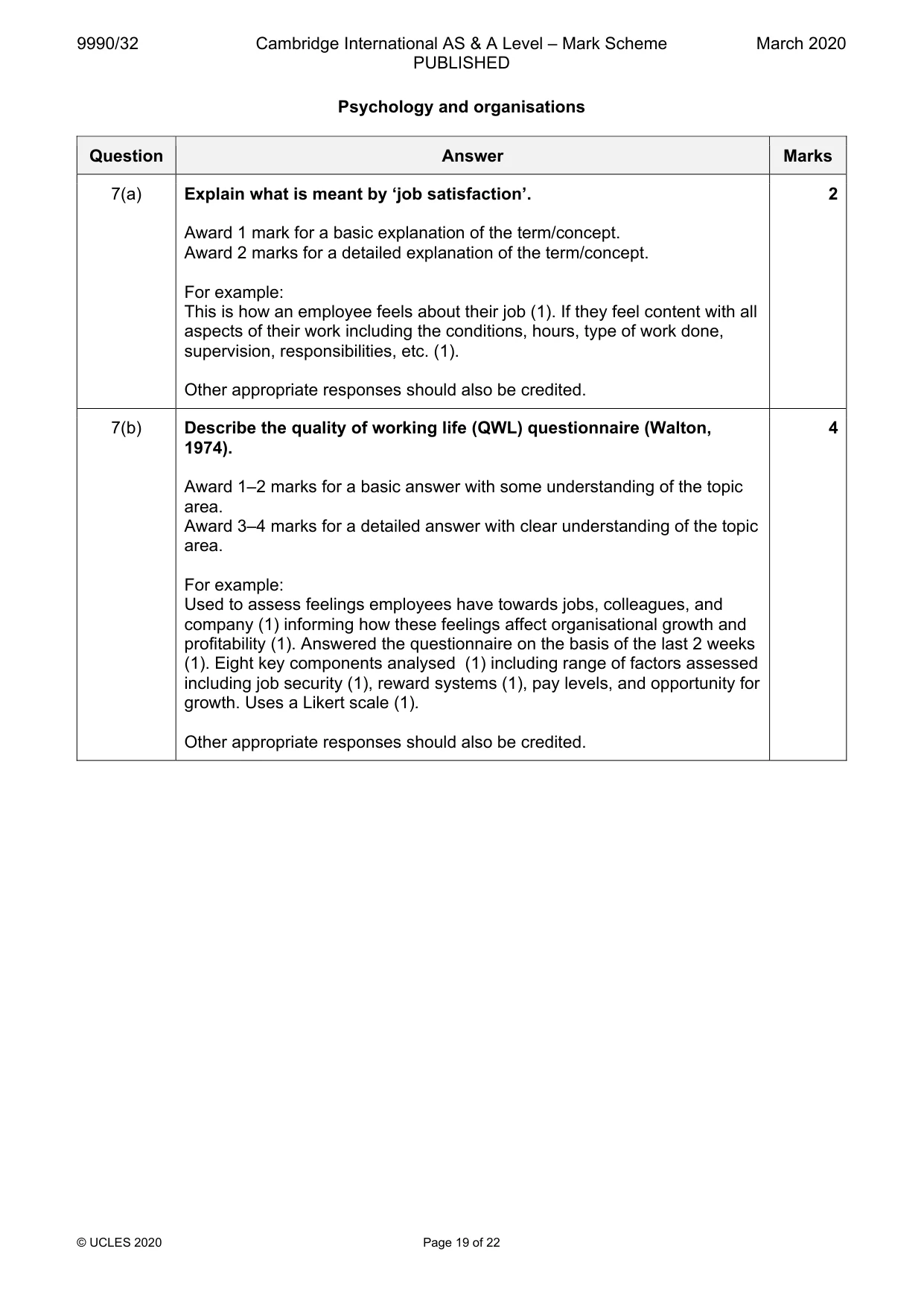
Mark scheme: 7(a) Explain what is meant by ‘job satisfaction’. 2 Award 1 mark for a basic explanation of the term/concept. Award 2 marks for a detailed explanation of the term/concept. For example: This is how an employee feels about their job (1). If they feel content with all aspects of their work including the conditions, hours, type of work done, supervision, responsibilities, etc. (1). Other appropriate responses should also be credited. 7(b) Describe the quality of working life (QWL) questionnaire (Walton, 4 1974). Award 1–2 marks for a basic answer with some understanding of the topic area. Award 3–4 marks for a detailed answer with clear understanding of the topic area. For example: Used to assess feelings employees have towards jobs, colleagues, and company (1) informing how these feelings affect organisational growth and profitability (1). Answered the questionnaire on the basis of the last 2 weeks (1). Eight key components analysed (1) including range of factors assessed including job security (1), reward systems (1), pay levels, and opportunity for growth. Uses a Likert scale (1). Other appropriate responses should also be credited. 7(c) Discuss the use of self-reports to measure job satisfaction. 6 Discussion points could include • All give quantitative data, so easy to complete and make comparisons between groups of workers/individuals. • Problems of social desirability bias. Language issue in QWL so inaccessible to some employees. Problems of acquiescence bias with Likert scale. Concern about job future if participants answer ‘wrongly’. • Holistic approach as questionnaires ask a number of questions about different areas of work that could affect job satisfaction. • Social desirability as the employee may want their employer to think they are satisfied with their job in order to avoid ‘getting into trouble’. • Reliability – as MSQ and JDI are self-report measures these can be replicated. • Validity – Both test a wide variety of measures of satisfaction at work and are more likely to be valid. • Practical applications to the organisation as can be used to measure satisfaction of various workers to make comparisons. Could be used after changes have been made to an organisation to improve satisfaction to compare the scores to see if the change has worked and satisfaction has increased. Mark according to the levels of response criteria below: Level 3 (5–6 marks) • Candidates will show a clear understanding of the question and will discuss at least two points regarding self-reports. • Candidates will provide a good explanation with clear detail. Level 2 (3–4 marks) • Candidates will show an understanding of the question and will discuss one point about self-reports in detail or two or more in less detail. • Candidates will provide a good explanation. Level 1 (1–2 marks) • Candidates will show a basic understanding of the question and will attempt a discussion. • Candidates will provide a limited explanation. Level 0 (0 marks) No response worthy of credit. Other appropriate responses should also be credited.
Q8 · Describe what psychologists have discovered about traditional and modern theories of…
8 (a) Describe what psychologists have discovered about traditional and modern theories of leadership. [8] (b) Evaluate what psychologists have discovered about traditional and modern theories of leadership, including a discussion of nature versus nurture. [10]
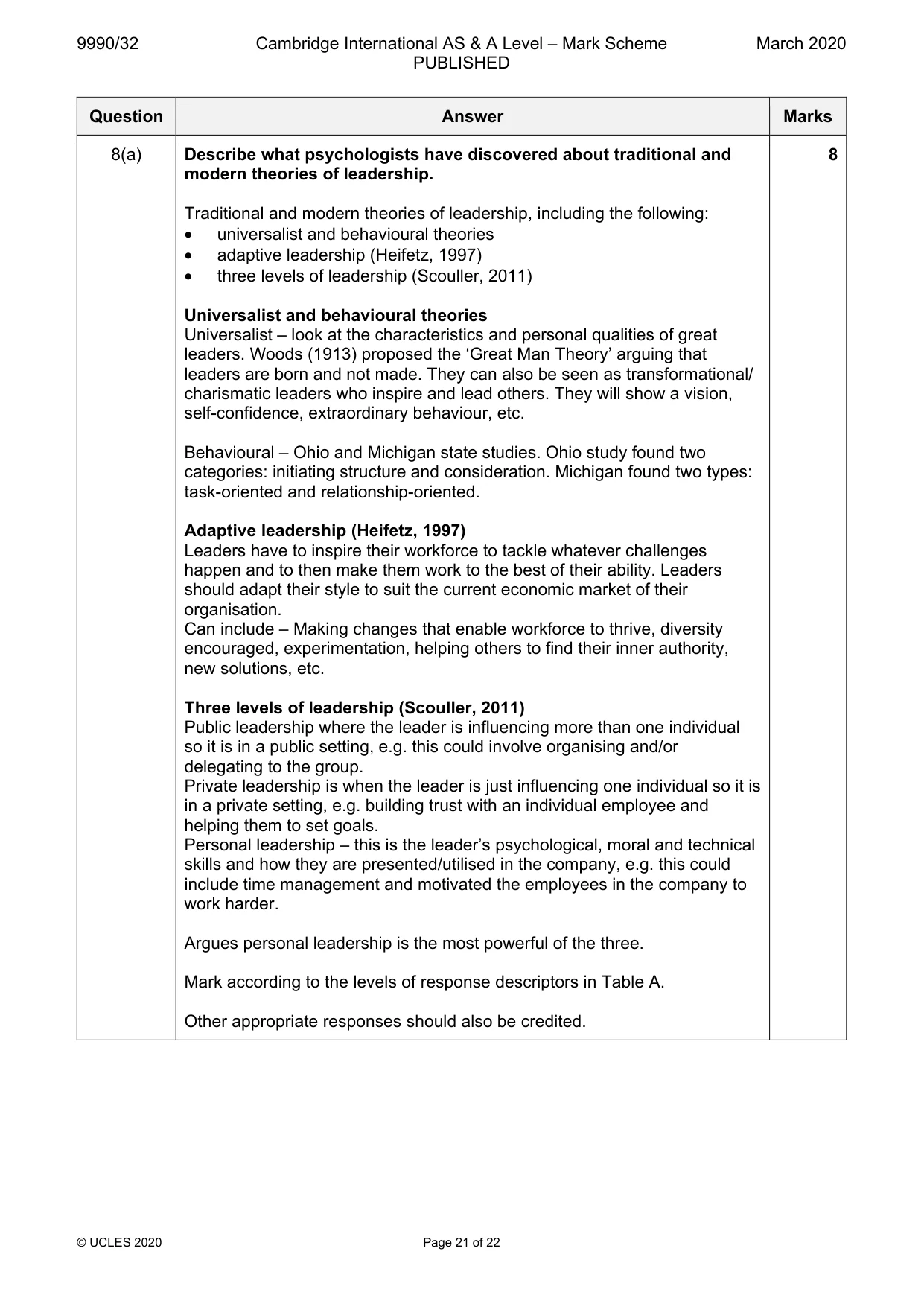
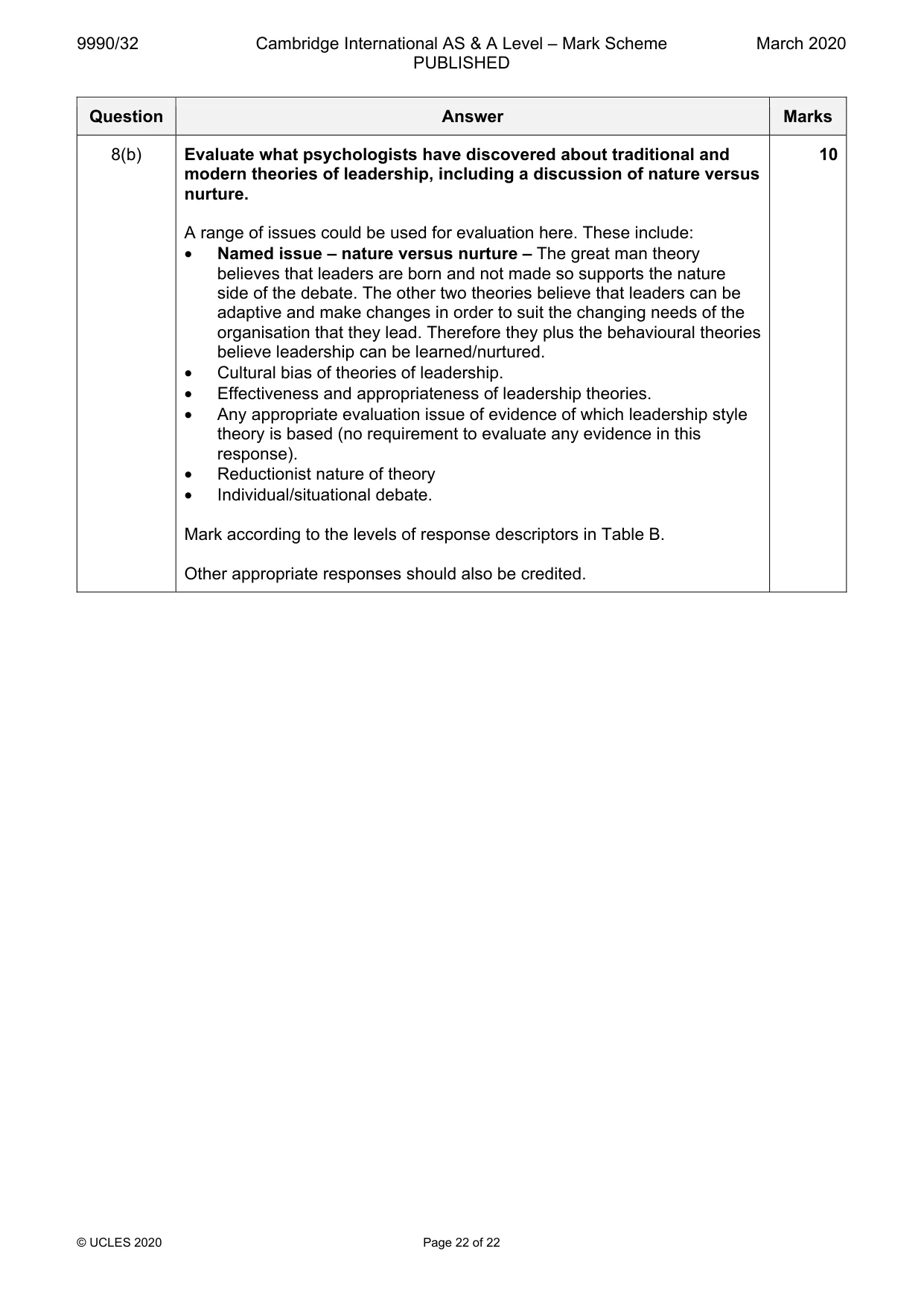
Mark scheme: 8(a) Describe what psychologists have discovered about traditional and 8 modern theories of leadership. Traditional and modern theories of leadership, including the following: • universalist and behavioural theories • adaptive leadership (Heifetz, 1997) • three levels of leadership (Scouller, 2011) Universalist and behavioural theories Universalist – look at the characteristics and personal qualities of great leaders. Woods (1913) proposed the ‘Great Man Theory’ arguing that leaders are born and not made. They can also be seen as transformational/ charismatic leaders who inspire and lead others. They will show a vision, self-confidence, extraordinary behaviour, etc. Behavioural – Ohio and Michigan state studies. Ohio study found two categories: initiating structure and consideration. Michigan found two types: task-oriented and relationship-oriented. Adaptive leadership (Heifetz, 1997) Leaders have to inspire their workforce to tackle whatever challenges happen and to then make them work to the best of their ability. Leaders should adapt their style to suit the current economic market of their organisation. Can include – Making changes that enable workforce to thrive, diversity encouraged, experimentation, helping others to find their inner authority, new solutions, etc. Three levels of leadership (Scouller, 2011) Public leadership where the leader is influencing more than one individual so it is in a public setting, e.g. this could involve organising and/or delegating to the group. Private leadership is when the leader is just influencing one individual so it is in a private setting, e.g. building trust with an individual employee and helping them to set goals. Personal leadership – this is the leader’s psychological, moral and technical skills and how they are presented/utilised in the company, e.g. this could include time management and motivated the employees in the company to work harder. Argues personal leadership is the most powerful of the three. Mark according to the levels of response descriptors in Table A. Other appropriate responses should also be credited. 8(b) Evaluate what psychologists have discovered about traditional and 10 modern theories of leadership, including a discussion of nature versus nurture. A range of issues could be used for evaluation here. These include: • Named issue – nature versus nurture – The great man theory believes that leaders are born and not made so supports the nature side of the debate. The other two theories believe that leaders can be adaptive and make changes in order to suit the changing needs of the organisation that they lead. Therefore they plus the behavioural theories believe leadership can be learned/nurtured. • Cultural bias of theories of leadership. • Effectiveness and appropriateness of leadership theories. • Any appropriate evaluation issue of evidence of which leadership style theory is based (no requirement to evaluate any evidence in this response). • Reductionist nature of theory • Individual/situational debate. Mark according to the levels of response descriptors in Table B. Other appropriate responses should also be credited.
What was in this paper
The subtopics covered by these 8 questions, and how many questions each got. Open one in a new tab to see every Cambridge question on it.
What you needed in this session
Cambridge’s own grade thresholds for 2020 Feb/March, Paper 3 · Variant 2. A higher threshold means an easier paper — the bar moves with how the cohort did.