Cambridge A Level Psychology (from 2018) 9990 — 2024 Oct/Nov Paper 3 · Variant 2
9990/32/O/N/24 · 16 questions · 60 marks · 90 min
The question paper and its mark scheme, free to read here and free to download. This is Cambridge’s own paper, exactly as it was sat.
Question paper8 pages
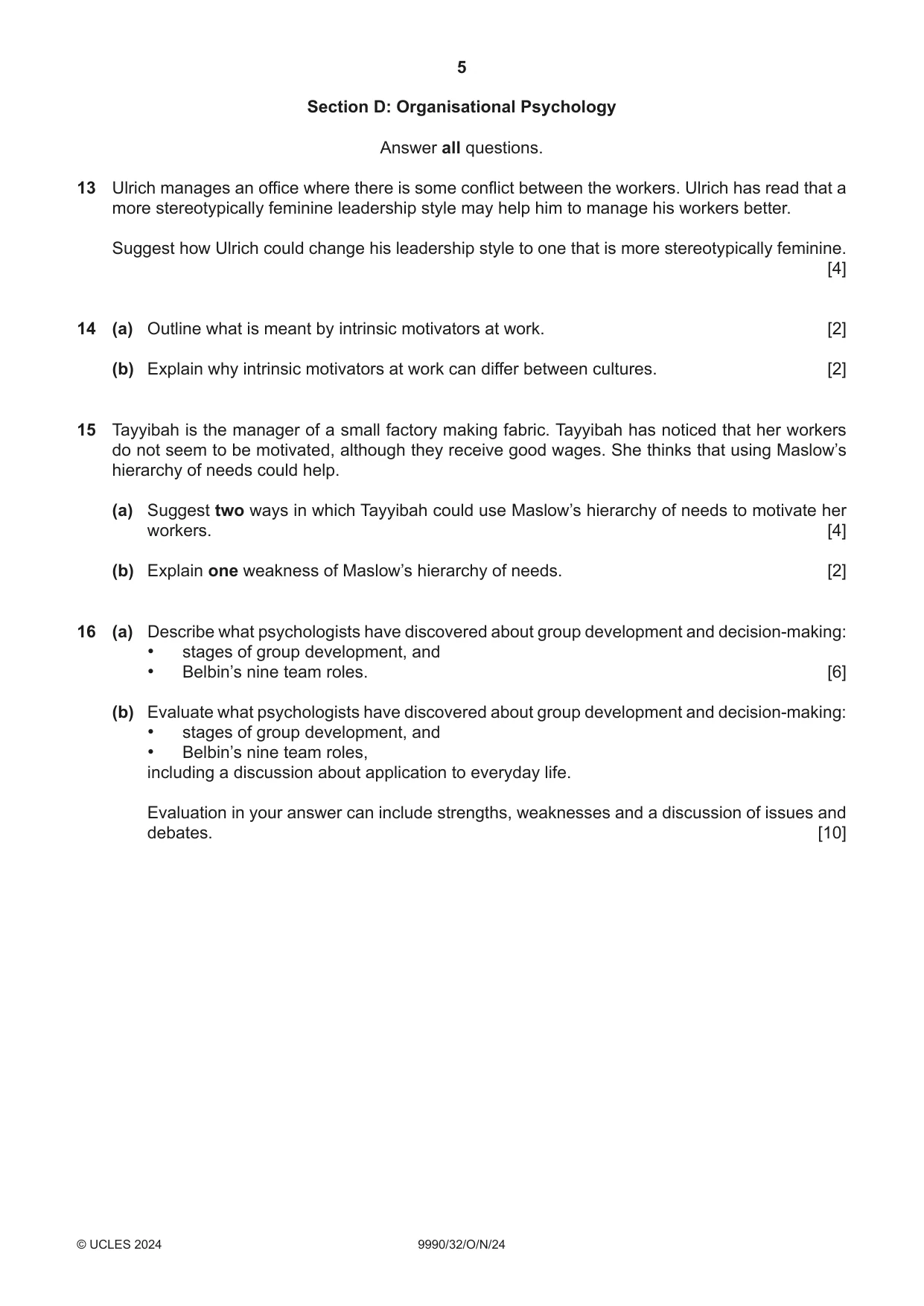



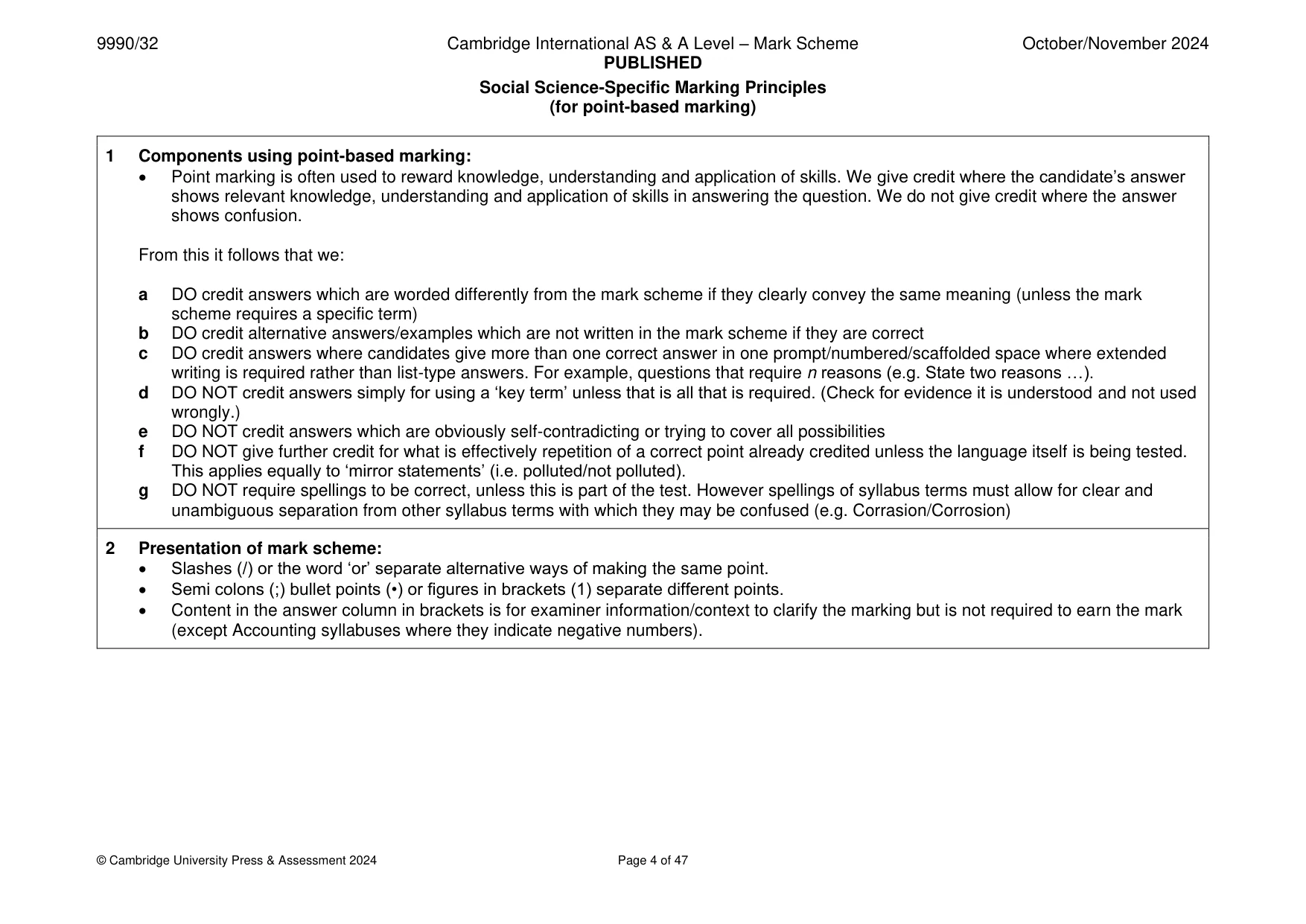
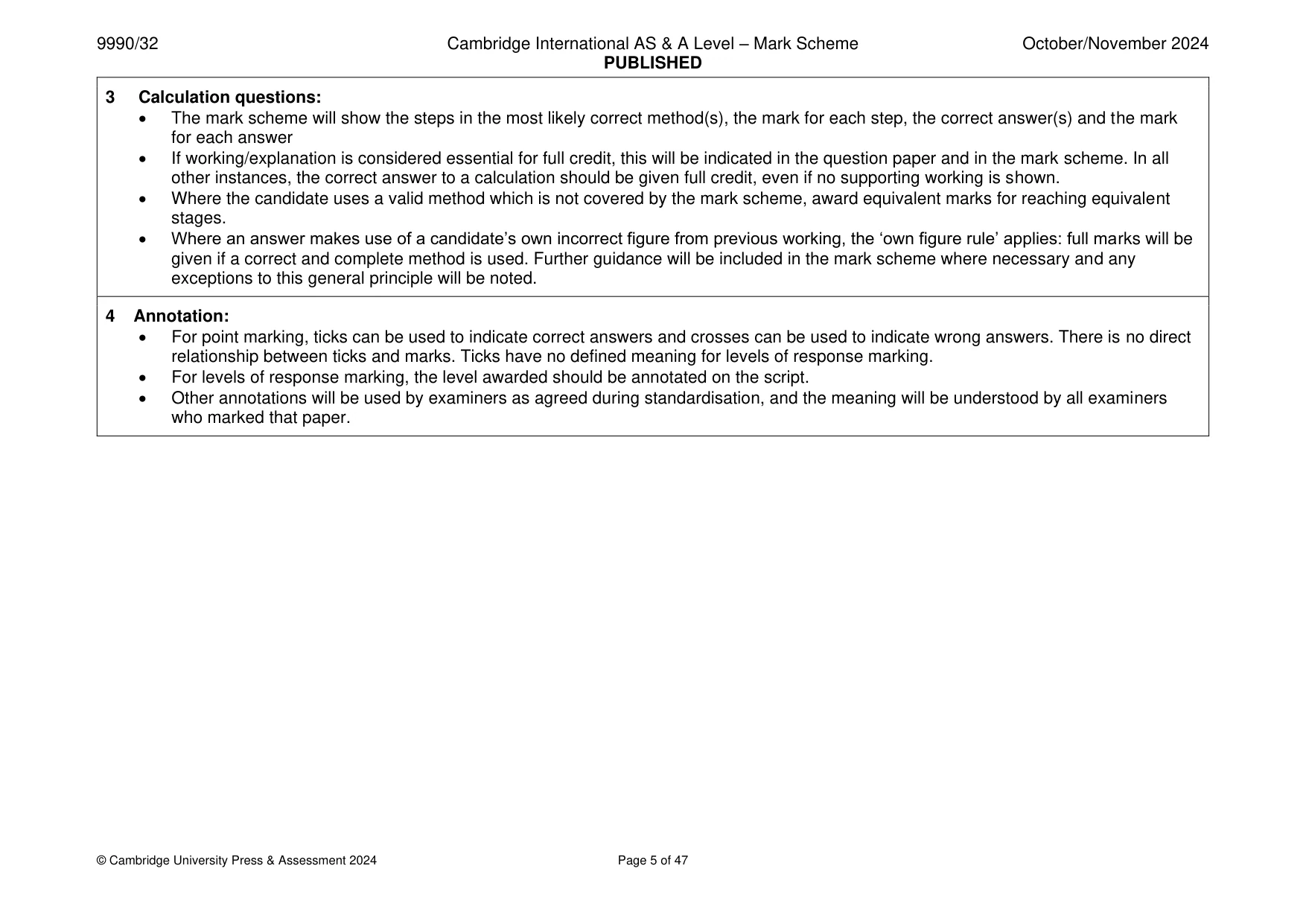
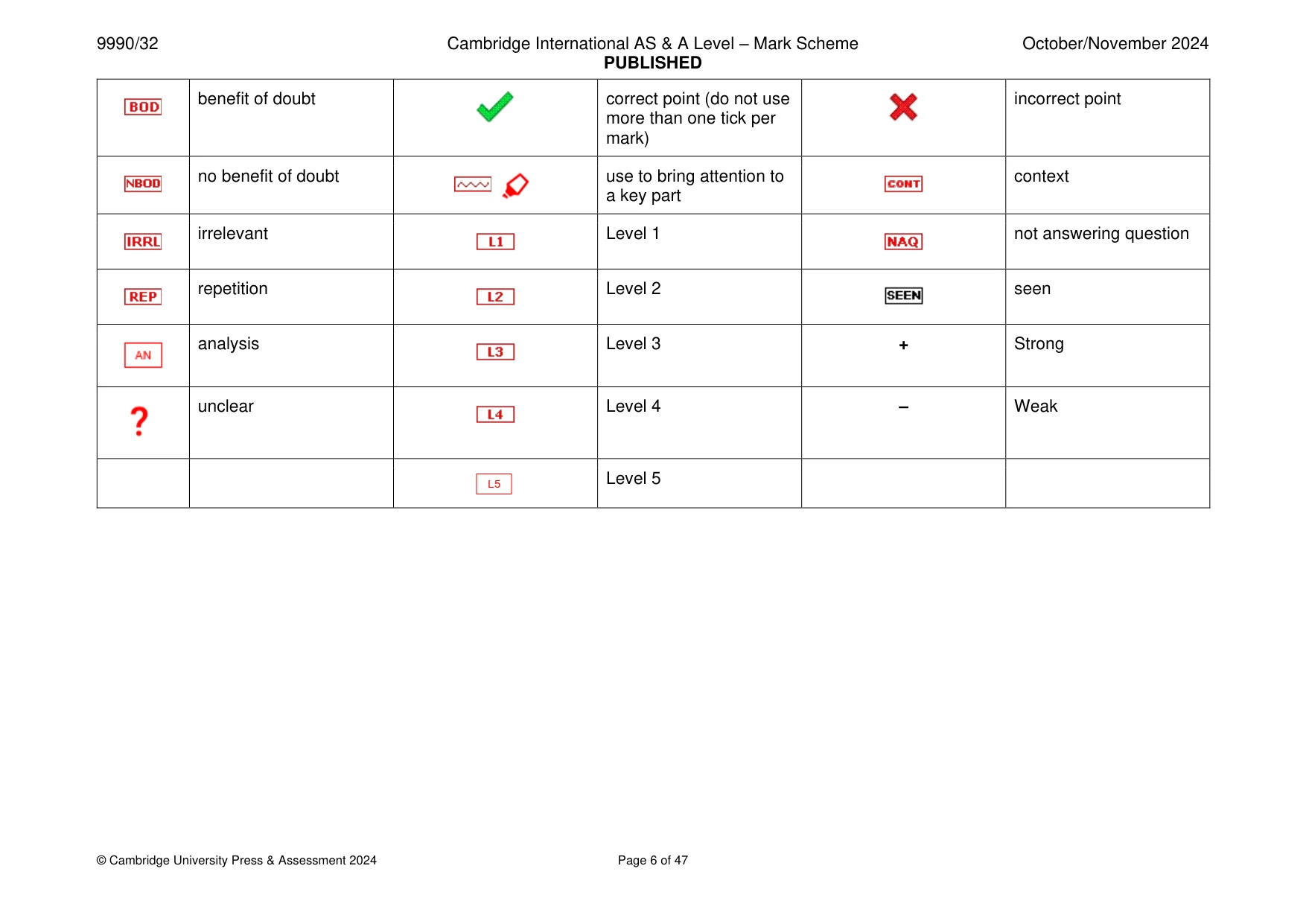
Mark scheme47 pages
Answers below. Sit the paper first if you are practising.



Questions as text
Q1 · Manjit has been diagnosed with schizophrenia
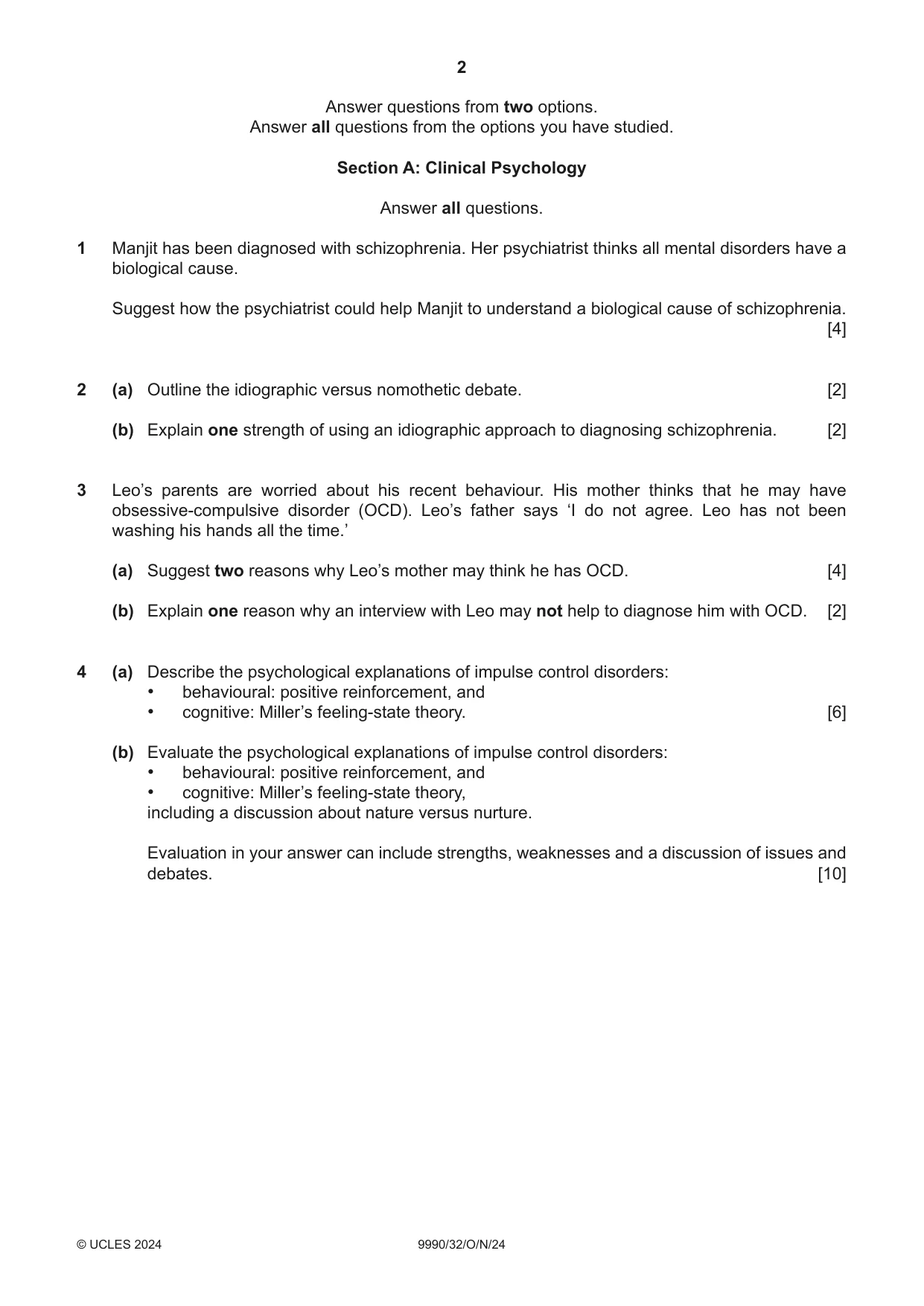
1 Manjit has been diagnosed with schizophrenia. Her psychiatrist thinks all mental disorders have a biological cause. Suggest how the psychiatrist could help Manjit to understand a biological cause of schizophrenia. [4]
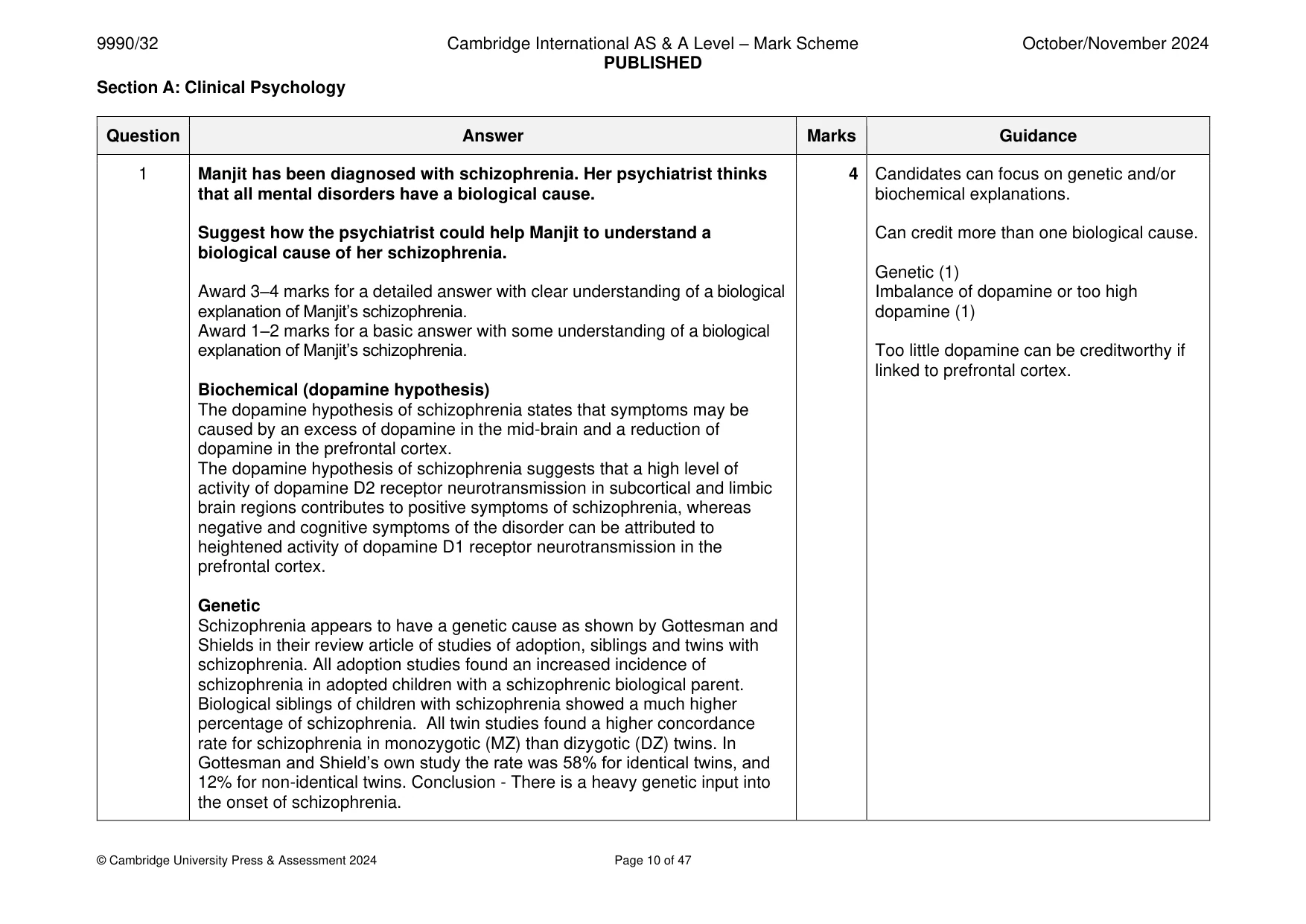
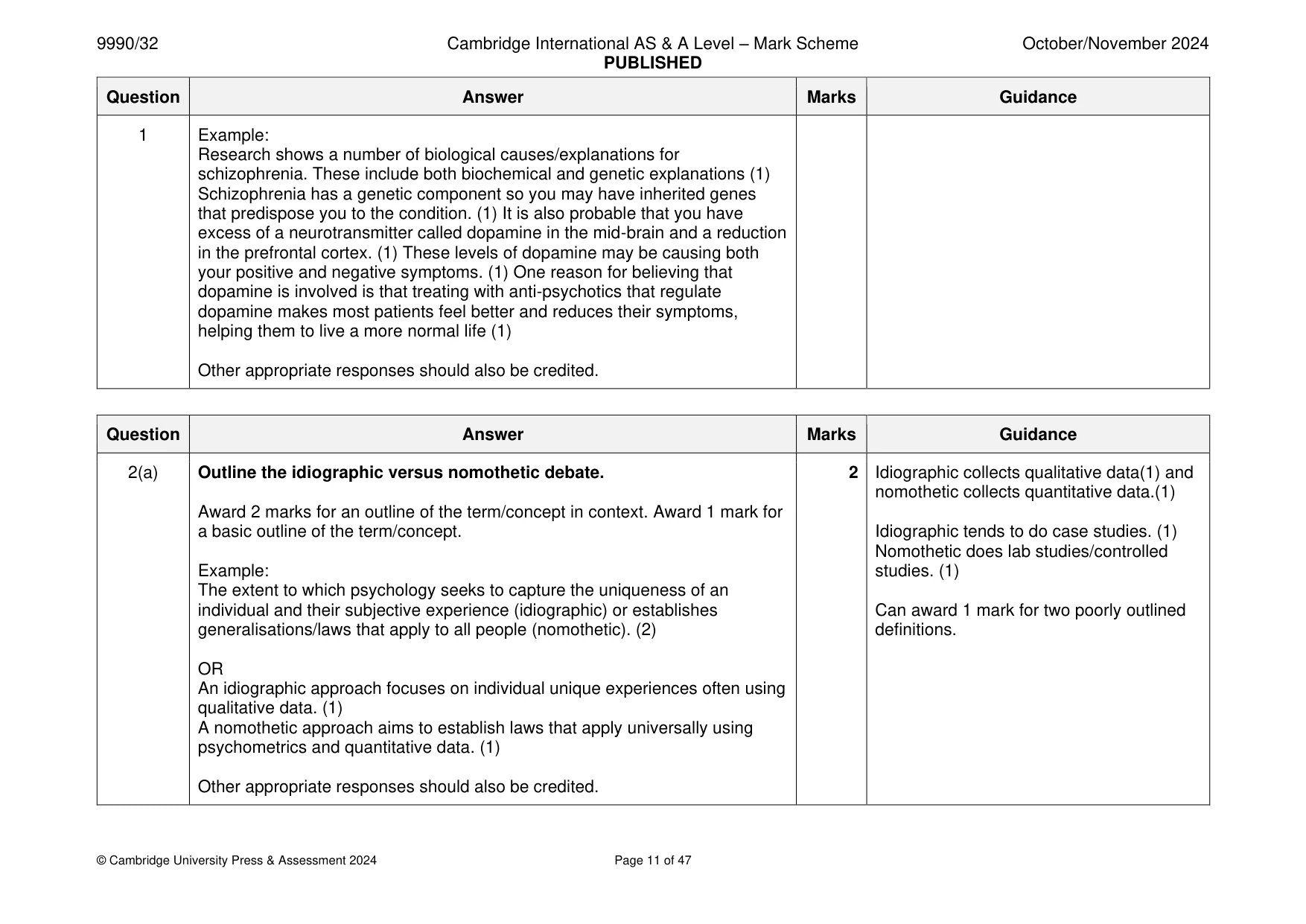
Mark scheme: Question Answer Marks Guidance 1 Manjit has been diagnosed with schizophrenia. Her psychiatrist thinks 4 Candidates can focus on genetic and/or that all mental disorders have a biological cause. biochemical explanations. Suggest how the psychiatrist could help Manjit to understand a Can credit more than one biological cause. biological cause of her schizophrenia. Genetic (1) Award 3–4 marks for a detailed answer with clear understanding of a biological Imbalance of dopamine or too high explanation of Manjit’s schizophrenia. dopamine (1) Award 1–2 marks for a basic answer with some understanding of a biological explanation of Manjit’s schizophrenia. Too little dopamine can be creditworthy if linked to prefrontal cortex. Biochemical (dopamine hypothesis) The dopamine hypothesis of schizophrenia states that symptoms may be caused by an excess of dopamine in the mid-brain and a reduction of dopamine in the prefrontal cortex. The dopamine hypothesis of schizophrenia suggests that a high level of activity of dopamine D2 receptor neurotransmission in subcortical and limbic brain regions contributes to positive symptoms of schizophrenia, whereas negative and cognitive symptoms of the disorder can be attributed to heightened activity of dopamine D1 receptor neurotransmission in the prefrontal cortex. Genetic Schizophrenia appears to have a genetic cause as shown by Gottesman and Shields in their review article of studies of adoption, siblings and twins with schizophrenia. All adoption studies found an increased incidence of schizophrenia in adopted children with a schizophrenic biological parent. Biological siblings of children with schizophrenia showed a much higher percentage of schizophrenia. All twin studies found a higher concordance rate for schizophrenia in monozygotic (MZ) than dizygotic (DZ) twins. In Gottesman and Shield’s own study the rate was 58% for identical twins, and 12% for non-identical twins. Conclusion - There is a heavy genetic input into the onset of schizophrenia. 1 Example: Research shows a number of biological causes/explanations for schizophrenia. These include both biochemical and genetic explanations (1) Schizophrenia has a genetic component so you may have inherited genes that predispose you to the condition. (1) It is also probable that you have excess of a neurotransmitter called dopamine in the mid-brain and a reduction in the prefrontal cortex. (1) These levels of dopamine may be causing both your positive and negative symptoms. (1) One reason for believing that dopamine is involved is that treating with anti-psychotics that regulate dopamine makes most patients feel better and reduces their symptoms, helping them to live a more normal life (1) Other appropriate responses should also be credited.
Q2 · Outline the idiographic versus nomothetic debate
2 (a) Outline the idiographic versus nomothetic debate. [2] (b) Explain one strength of using an idiographic approach to diagnosing schizophrenia. [2]
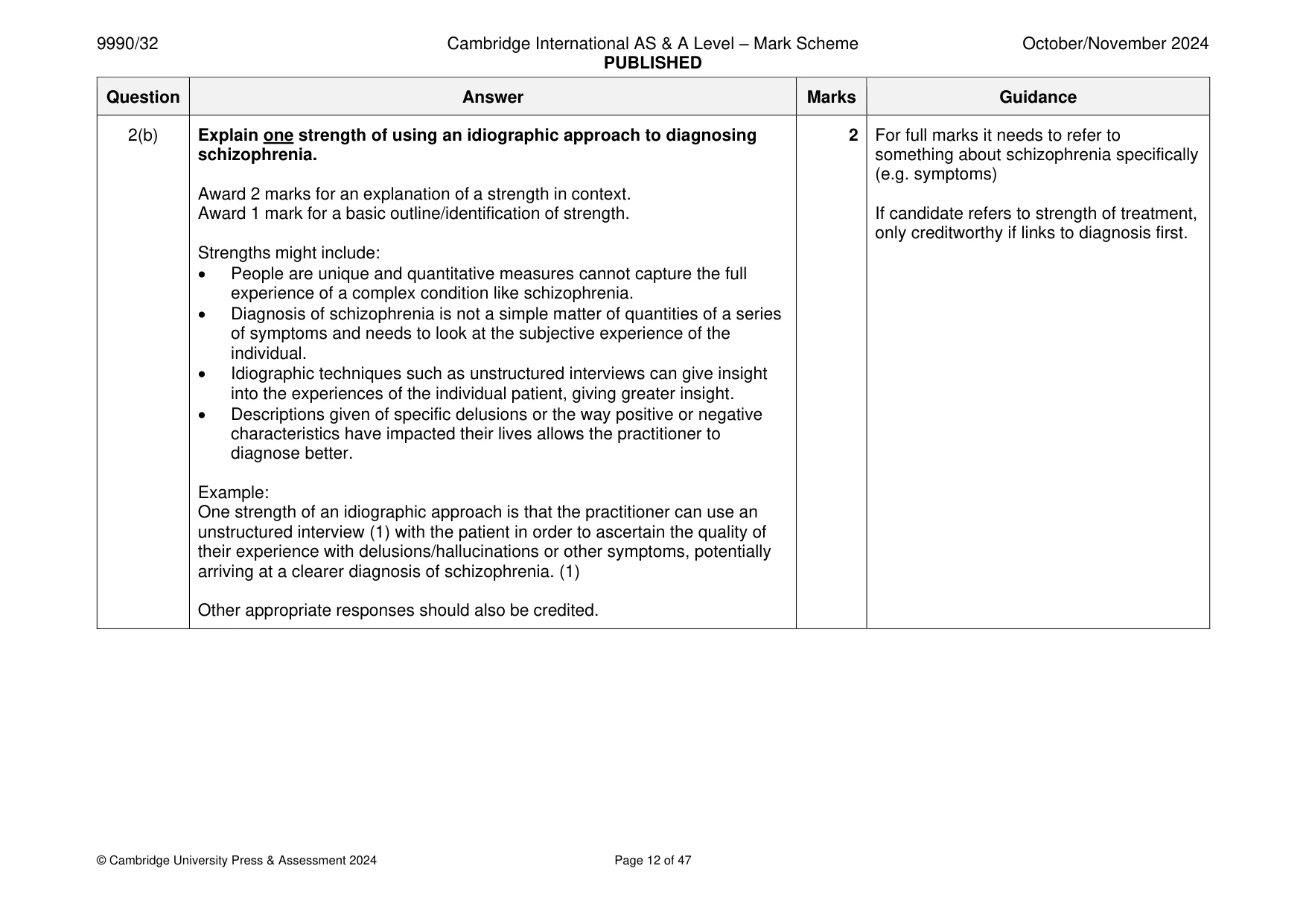
Mark scheme: 2(a) Outline the idiographic versus nomothetic debate. 2 Idiographic collects qualitative data(1) and nomothetic collects quantitative data.(1) Award 2 marks for an outline of the term/concept in context. Award 1 mark for a basic outline of the term/concept. Idiographic tends to do case studies. (1) Nomothetic does lab studies/controlled Example: studies. (1) The extent to which psychology seeks to capture the uniqueness of an individual and their subjective experience (idiographic) or establishes Can award 1 mark for two poorly outlined generalisations/laws that apply to all people (nomothetic). (2) definitions. OR An idiographic approach focuses on individual unique experiences often using qualitative data. (1) A nomothetic approach aims to establish laws that apply universally using psychometrics and quantitative data. (1) Other appropriate responses should also be credited. 2(b) Explain one strength of using an idiographic approach to diagnosing 2 For full marks it needs to refer to schizophrenia. something about schizophrenia specifically (e.g. symptoms) Award 2 marks for an explanation of a strength in context. Award 1 mark for a basic outline/identification of strength. If candidate refers to strength of treatment, only creditworthy if links to diagnosis first. Strengths might include: • People are unique and quantitative measures cannot capture the full experience of a complex condition like schizophrenia. • Diagnosis of schizophrenia is not a simple matter of quantities of a series of symptoms and needs to look at the subjective experience of the individual. • Idiographic techniques such as unstructured interviews can give insight into the experiences of the individual patient, giving greater insight. • Descriptions given of specific delusions or the way positive or negative characteristics have impacted their lives allows the practitioner to diagnose better. Example: One strength of an idiographic approach is that the practitioner can use an unstructured interview (1) with the patient in order to ascertain the quality of their experience with delusions/hallucinations or other symptoms, potentially arriving at a clearer diagnosis of schizophrenia. (1) Other appropriate responses should also be credited.
Q3 · Leo’s parents are worried about his recent behaviour
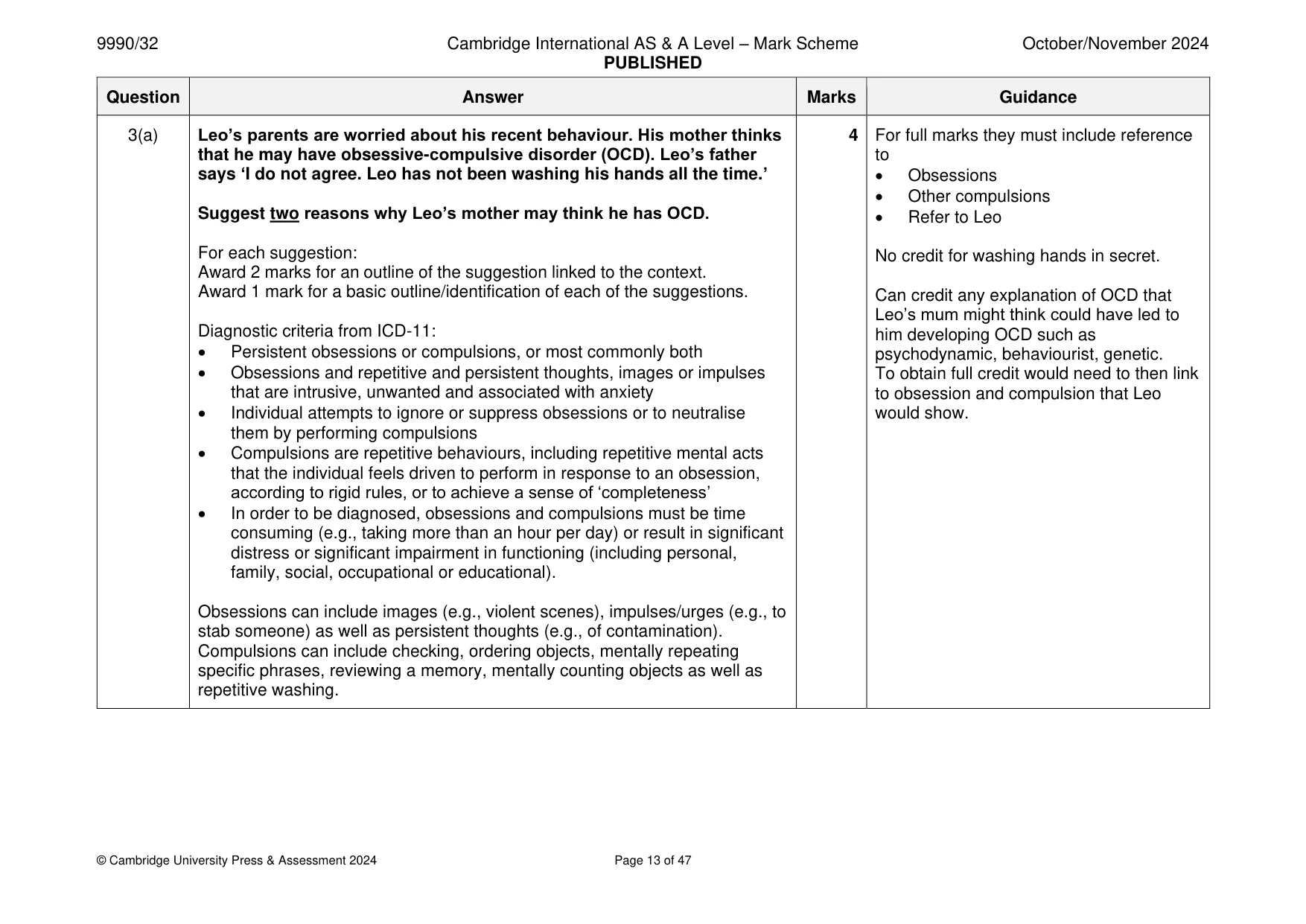
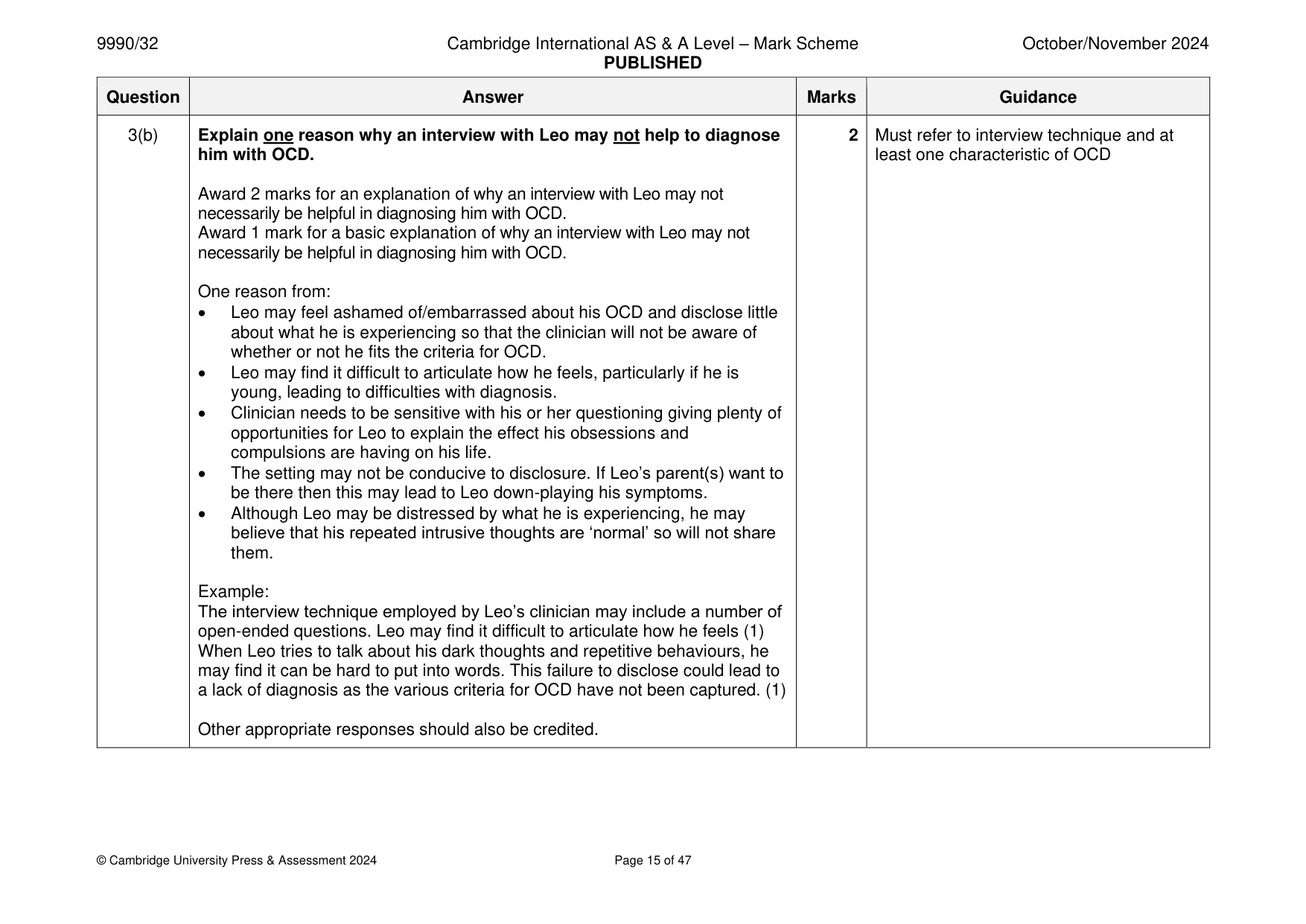
3 Leo’s parents are worried about his recent behaviour. His mother thinks that he may have obsessive‑compulsive disorder (OCD). Leo’s father says ‘I do not agree. Leo has not been washing his hands all the time.’ (a) Suggest two reasons why Leo’s mother may think he has OCD. [4] (b) Explain one reason why an interview with Leo may not help to diagnose him with OCD. [2]
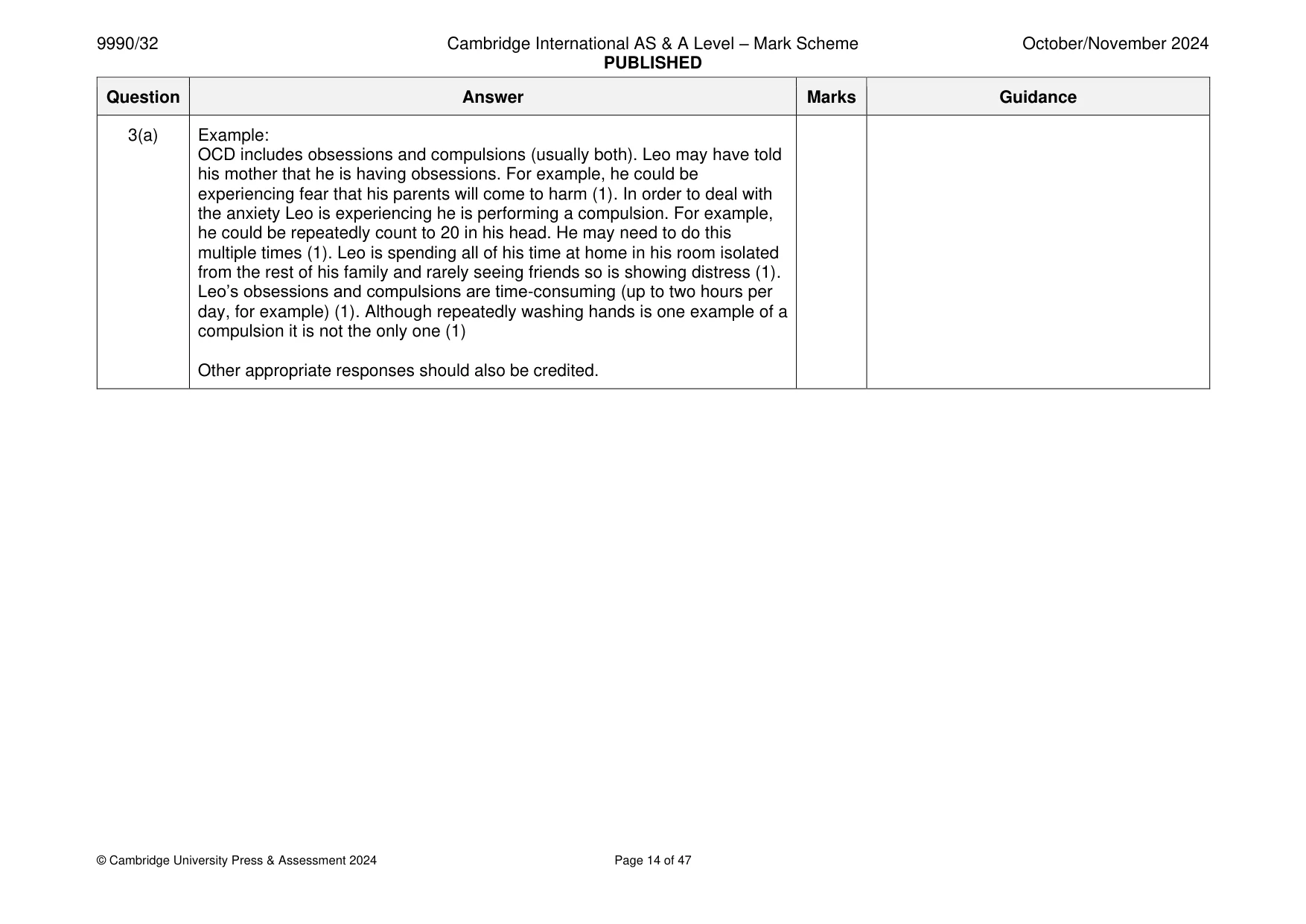
Mark scheme: 3(a) Leo’s parents are worried about his recent behaviour. His mother thinks 4 For full marks they must include reference that he may have obsessive-compulsive disorder (OCD). Leo’s father to says ‘I do not agree. Leo has not been washing his hands all the time.’ • Obsessions • Other compulsions Suggest two reasons why Leo’s mother may think he has OCD. • Refer to Leo For each suggestion: No credit for washing hands in secret. Award 2 marks for an outline of the suggestion linked to the context. Award 1 mark for a basic outline/identification of each of the suggestions. Can credit any explanation of OCD that Leo’s mum might think could have led to Diagnostic criteria from ICD-11: him developing OCD such as • Persistent obsessions or compulsions, or most commonly both psychodynamic, behaviourist, genetic. • Obsessions and repetitive and persistent thoughts, images or impulses To obtain full credit would need to then link that are intrusive, unwanted and associated with anxiety to obsession and compulsion that Leo • Individual attempts to ignore or suppress obsessions or to neutralise would show. them by performing compulsions • Compulsions are repetitive behaviours, including repetitive mental acts that the individual feels driven to perform in response to an obsession, according to rigid rules, or to achieve a sense of ‘completeness’ • In order to be diagnosed, obsessions and compulsions must be time consuming (e.g., taking more than an hour per day) or result in significant distress or significant impairment in functioning (including personal, family, social, occupational or educational). Obsessions can include images (e.g., violent scenes), impulses/urges (e.g., to stab someone) as well as persistent thoughts (e.g., of contamination). Compulsions can include checking, ordering objects, mentally repeating specific phrases, reviewing a memory, mentally counting objects as well as repetitive washing. 3(a) Example: OCD includes obsessions and compulsions (usually both). Leo may have told his mother that he is having obsessions. For example, he could be experiencing fear that his parents will come to harm (1). In order to deal with the anxiety Leo is experiencing he is performing a compulsion. For example, he could be repeatedly count to 20 in his head. He may need to do this multiple times (1). Leo is spending all of his time at home in his room isolated from the rest of his family and rarely seeing friends so is showing distress (1). Leo’s obsessions and compulsions are time-consuming (up to two hours per day, for example) (1). Although repeatedly washing hands is one example of a compulsion it is not the only one (1) Other appropriate responses should also be credited. 3(b) Explain one reason why an interview with Leo may not help to diagnose 2 Must refer to interview technique and at him with OCD. least one characteristic of OCD Award 2 marks for an explanation of why an interview with Leo may not necessarily be helpful in diagnosing him with OCD. Award 1 mark for a basic explanation of why an interview with Leo may not necessarily be helpful in diagnosing him with OCD. One reason from: • Leo may feel ashamed of/embarrassed about his OCD and disclose little about what he is experiencing so that the clinician will not be aware of whether or not he fits the criteria for OCD. • Leo may find it difficult to articulate how he feels, particularly if he is young, leading to difficulties with diagnosis. • Clinician needs to be sensitive with his or her questioning giving plenty of opportunities for Leo to explain the effect his obsessions and compulsions are having on his life. • The setting may not be conducive to disclosure. If Leo’s parent(s) want to be there then this may lead to Leo down-playing his symptoms. • Although Leo may be distressed by what he is experiencing, he may believe that his repeated intrusive thoughts are ‘normal’ so will not share them. Example: The interview technique employed by Leo’s clinician may include a number of open-ended questions. Leo may find it difficult to articulate how he feels (1) When Leo tries to talk about his dark thoughts and repetitive behaviours, he may find it can be hard to put into words. This failure to disclose could lead to a lack of diagnosis as the various criteria for OCD have not been captured. (1) Other appropriate responses should also be credited.
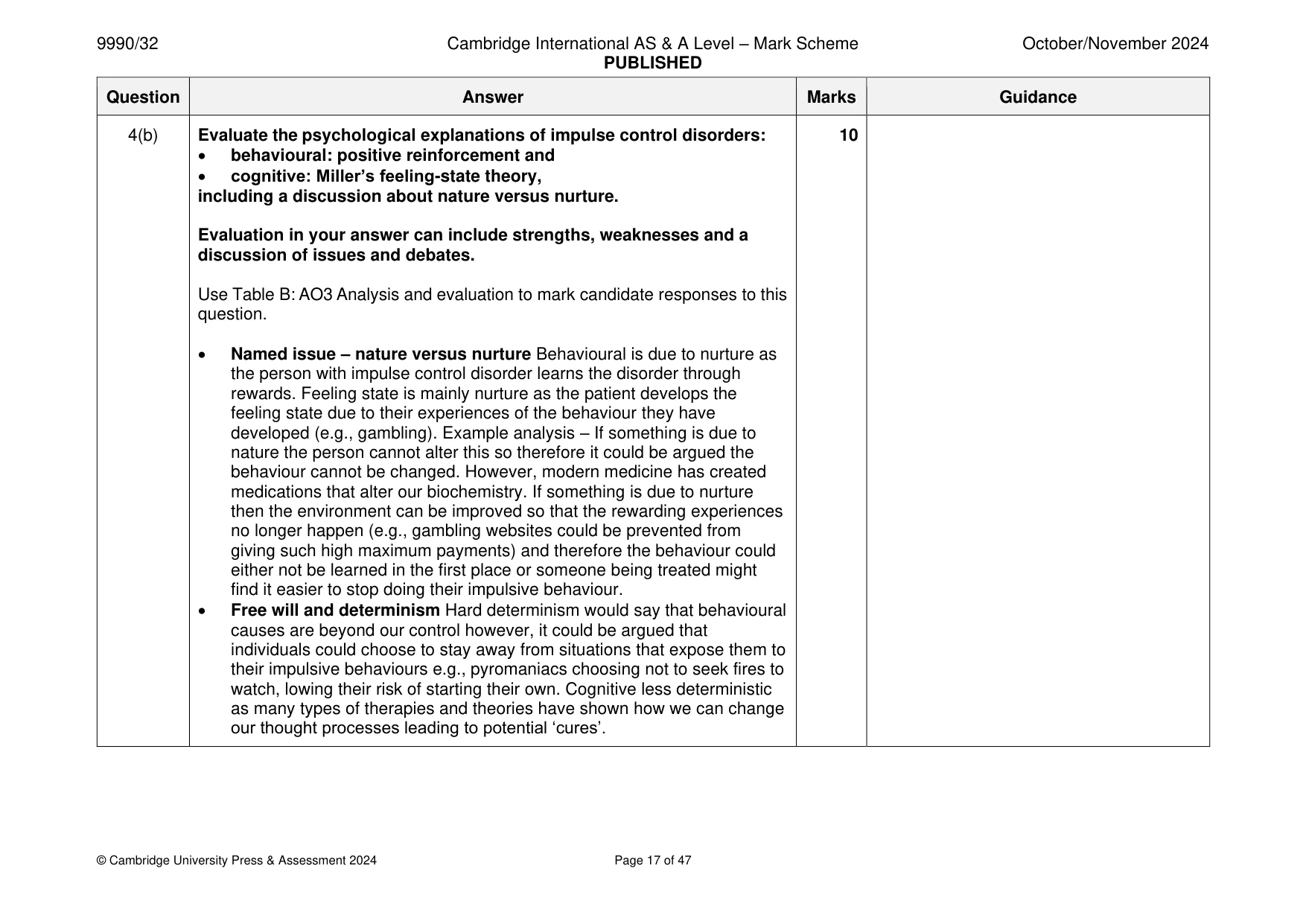
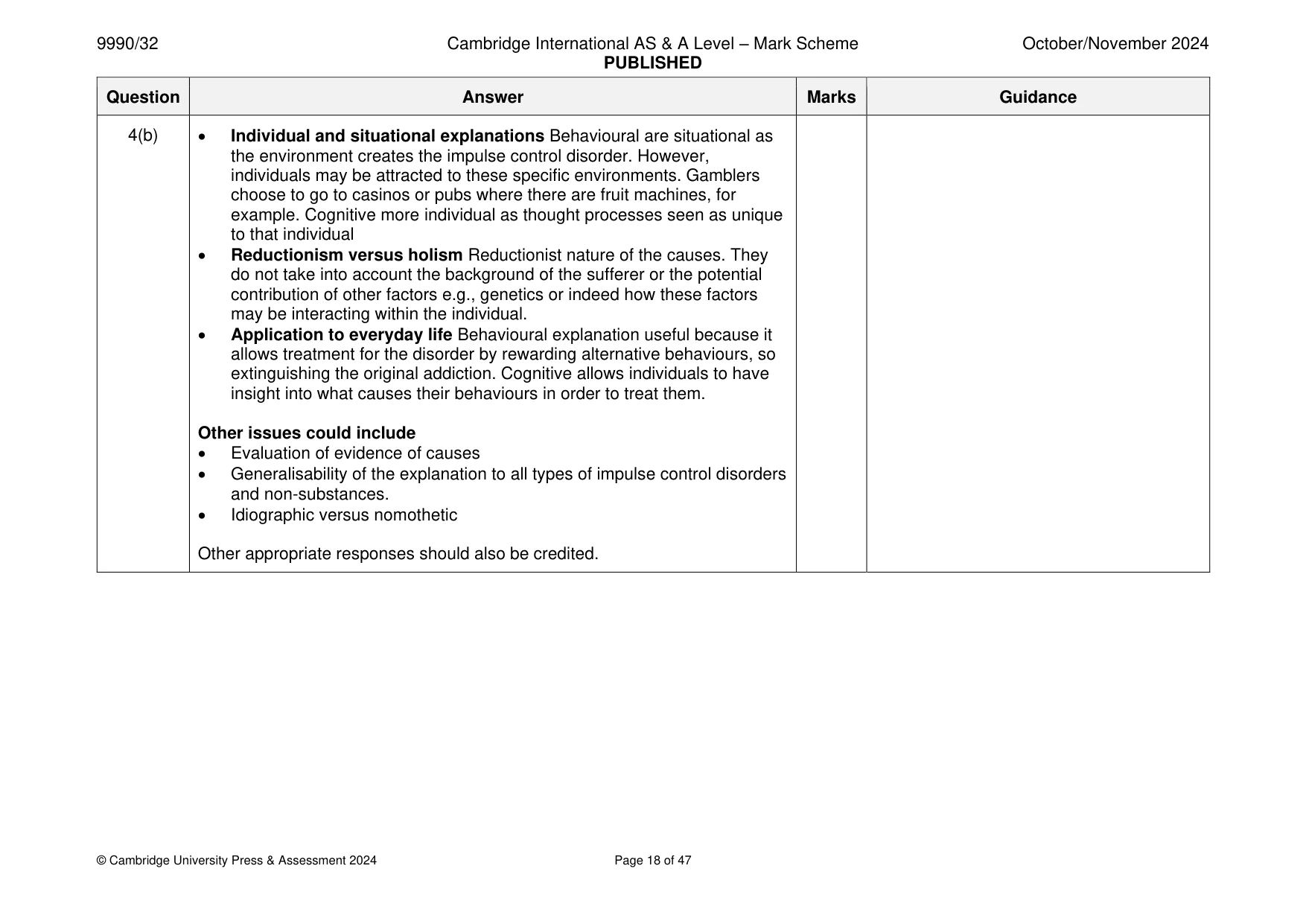
Q4 · Describe the psychological explanations of impulse control disorders: • behavioural…
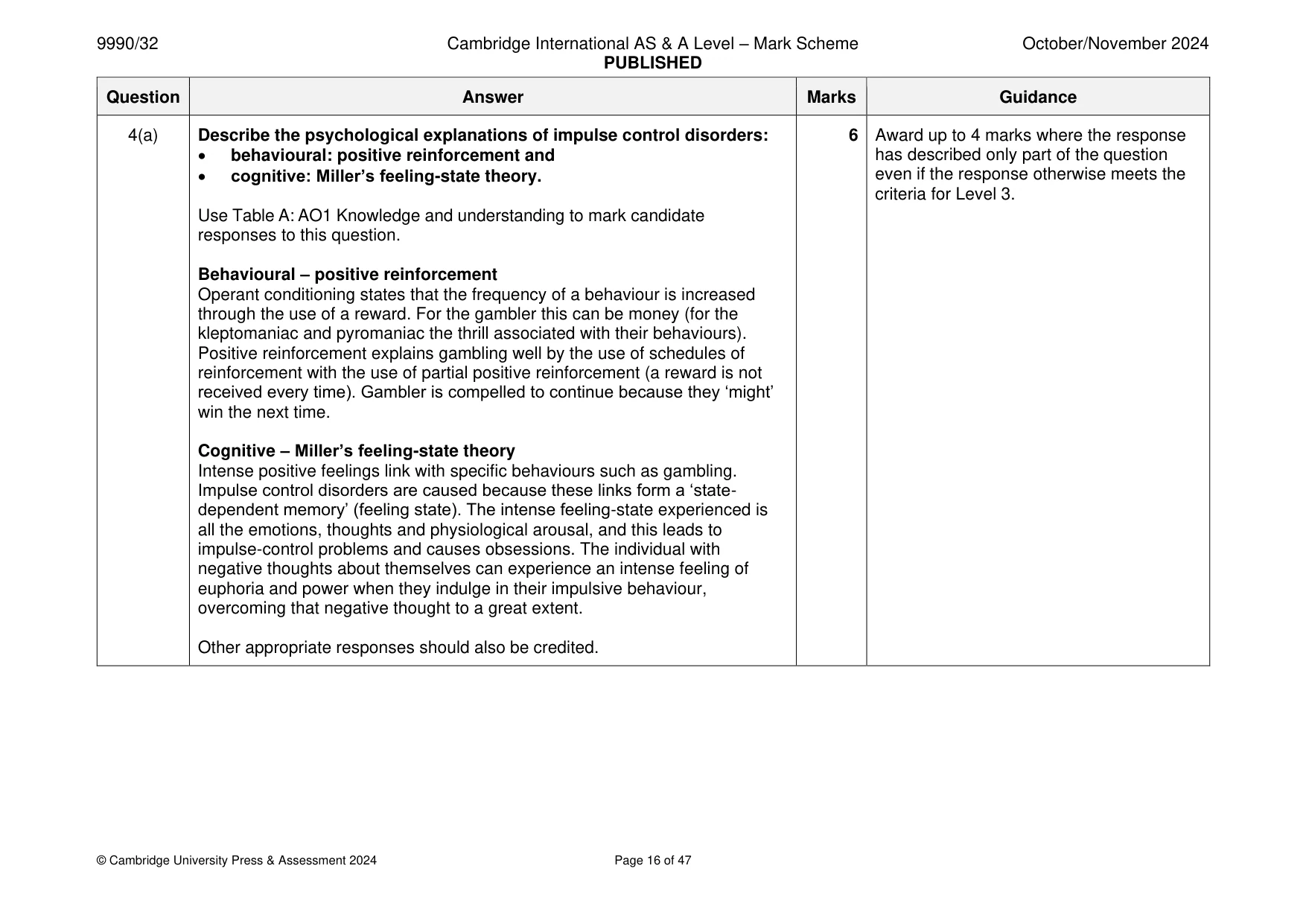
4 (a) Describe the psychological explanations of impulse control disorders: • behavioural: positive reinforcement, and • cognitive: Miller’s feeling‑state theory. [6] (b) Evaluate the psychological explanations of impulse control disorders: • behavioural: positive reinforcement, and • cognitive: Miller’s feeling‑state theory, including a discussion about nature versus nurture. Evaluation in your answer can include strengths, weaknesses and a discussion of issues and debates. [10]
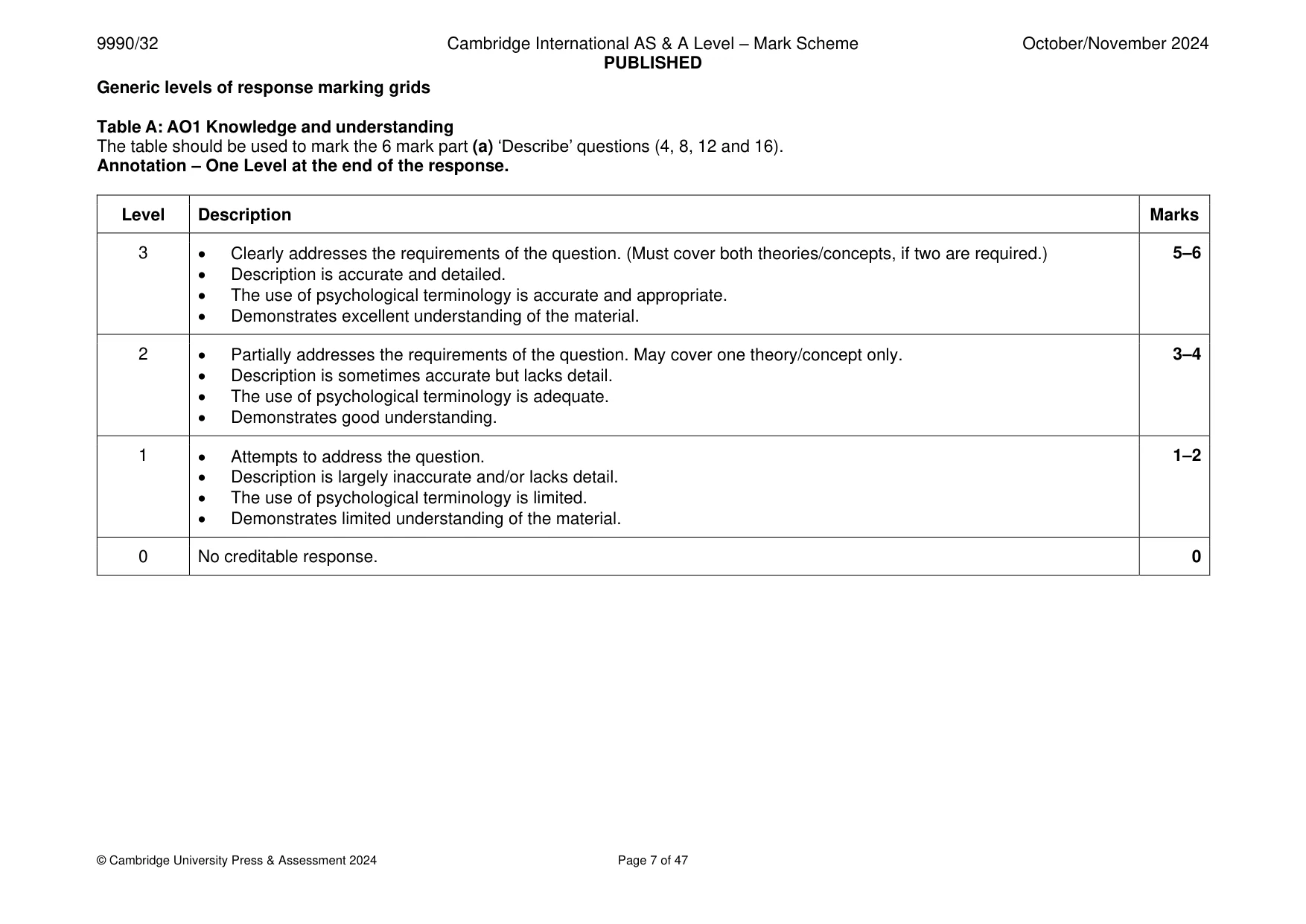
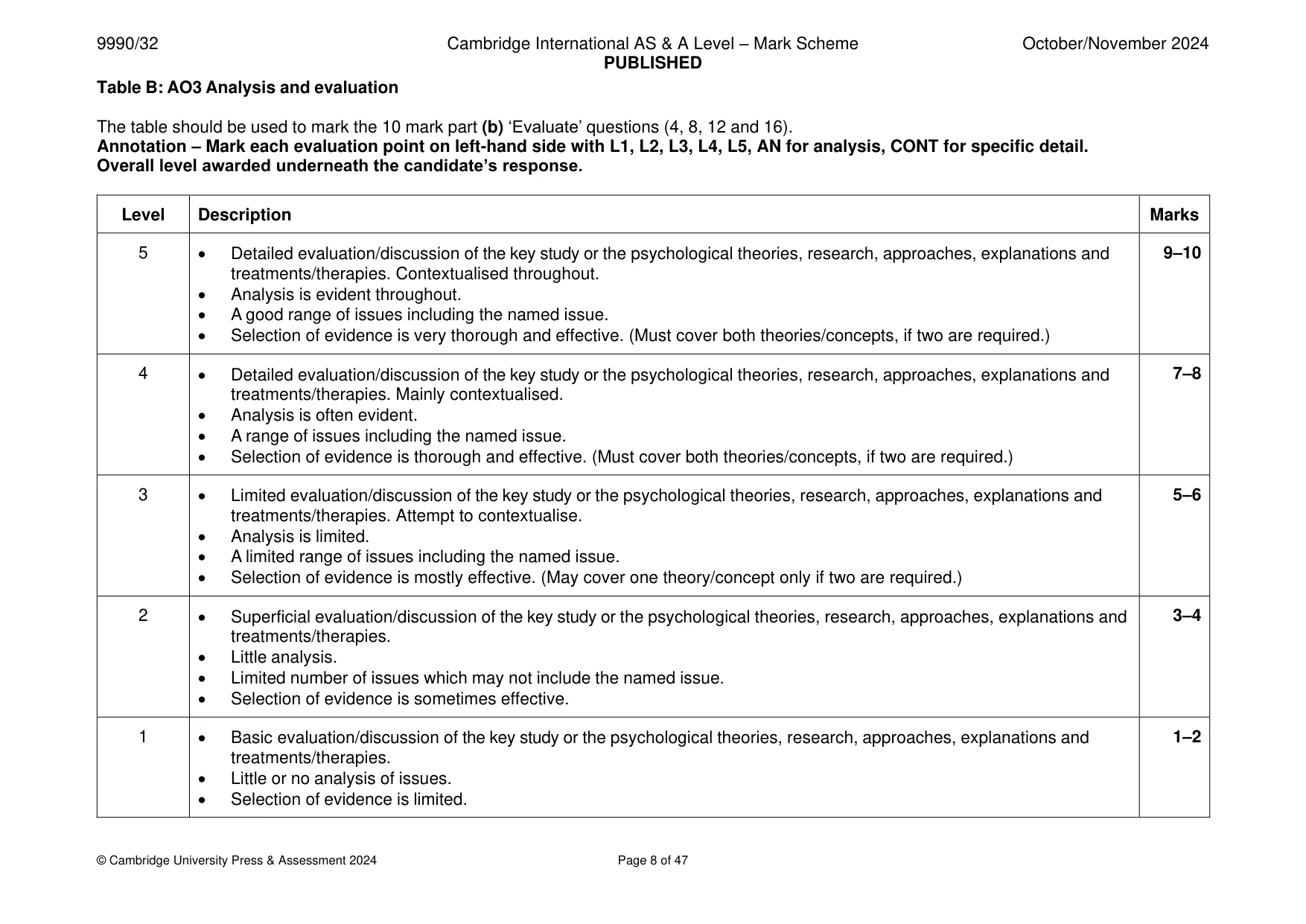
Mark scheme: 4(a) Describe the psychological explanations of impulse control disorders: 6 Award up to 4 marks where the response • behavioural: positive reinforcement and has described only part of the question • cognitive: Miller’s feeling-state theory. even if the response otherwise meets the criteria for Level 3. Use Table A: AO1 Knowledge and understanding to mark candidate responses to this question. Behavioural – positive reinforcement Operant conditioning states that the frequency of a behaviour is increased through the use of a reward. For the gambler this can be money (for the kleptomaniac and pyromaniac the thrill associated with their behaviours). Positive reinforcement explains gambling well by the use of schedules of reinforcement with the use of partial positive reinforcement (a reward is not received every time). Gambler is compelled to continue because they ‘might’ win the next time. Cognitive – Miller’s feeling-state theory Intense positive feelings link with specific behaviours such as gambling. Impulse control disorders are caused because these links form a ‘state- dependent memory’ (feeling state). The intense feeling-state experienced is all the emotions, thoughts and physiological arousal, and this leads to impulse-control problems and causes obsessions. The individual with negative thoughts about themselves can experience an intense feeling of euphoria and power when they indulge in their impulsive behaviour, overcoming that negative thought to a great extent. Other appropriate responses should also be credited. 4(b) Evaluate the psychological explanations of impulse control disorders: 10 • behavioural: positive reinforcement and • cognitive: Miller’s feeling-state theory, including a discussion about nature versus nurture. Evaluation in your answer can include strengths, weaknesses and a discussion of issues and debates. Use Table B: AO3 Analysis and evaluation to mark candidate responses to this question. • Named issue – nature versus nurture Behavioural is due to nurture as the person with impulse control disorder learns the disorder through rewards. Feeling state is mainly nurture as the patient develops the feeling state due to their experiences of the behaviour they have developed (e.g., gambling). Example analysis – If something is due to nature the person cannot alter this so therefore it could be argued the behaviour cannot be changed. However, modern medicine has created medications that alter our biochemistry. If something is due to nurture then the environment can be improved so that the rewarding experiences no longer happen (e.g., gambling websites could be prevented from giving such high maximum payments) and therefore the behaviour could either not be learned in the first place or someone being treated might find it easier to stop doing their impulsive behaviour. • Free will and determinism Hard determinism would say that behavioural causes are beyond our control however, it could be argued that individuals could choose to stay away from situations that expose them to their impulsive behaviours e.g., pyromaniacs choosing not to seek fires to watch, lowing their risk of starting their own. Cognitive less deterministic as many types of therapies and theories have shown how we can change our thought processes leading to potential ‘cures’. 4(b) • Individual and situational explanations Behavioural are situational as the environment creates the impulse control disorder. However, individuals may be attracted to these specific environments. Gamblers choose to go to casinos or pubs where there are fruit machines, for example. Cognitive more individual as thought processes seen as unique to that individual • Reductionism versus holism Reductionist nature of the causes. They do not take into account the background of the sufferer or the potential contribution of other factors e.g., genetics or indeed how these factors may be interacting within the individual. • Application to everyday life Behavioural explanation useful because it allows treatment for the disorder by rewarding alternative behaviours, so extinguishing the original addiction. Cognitive allows individuals to have insight into what causes their behaviours in order to treat them. Other issues could include • Evaluation of evidence of causes • Generalisability of the explanation to all types of impulse control disorders and non-substances. • Idiographic versus nomothetic Other appropriate responses should also be credited. Section B: Consumer Psychology
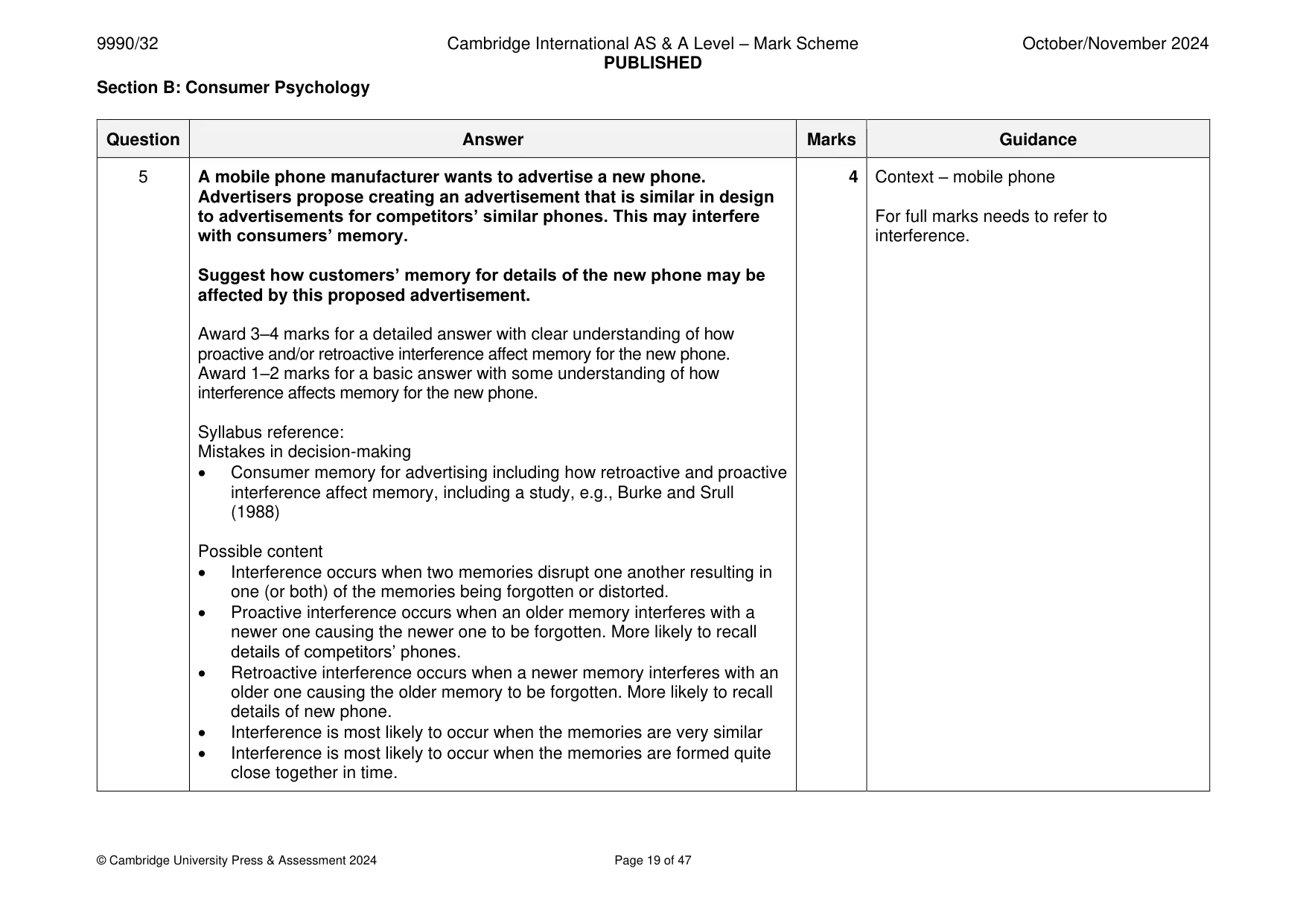
Q5 · A mobile phone manufacturer wants to advertise a new phone
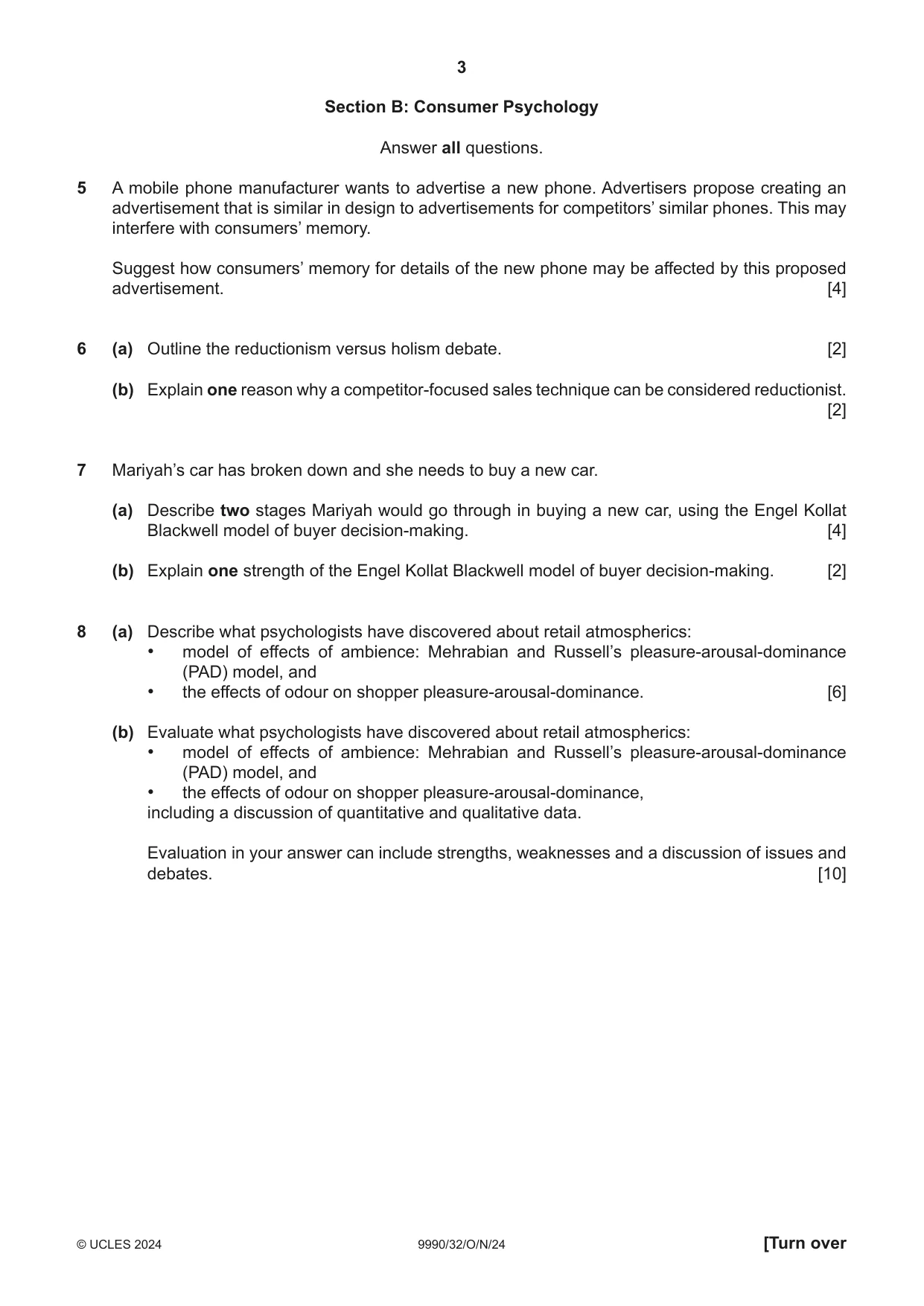
5 A mobile phone manufacturer wants to advertise a new phone. Advertisers propose creating an advertisement that is similar in design to advertisements for competitors’ similar phones. This may interfere with consumers’ memory. Suggest how consumers’ memory for details of the new phone may be affected by this proposed advertisement. [4]
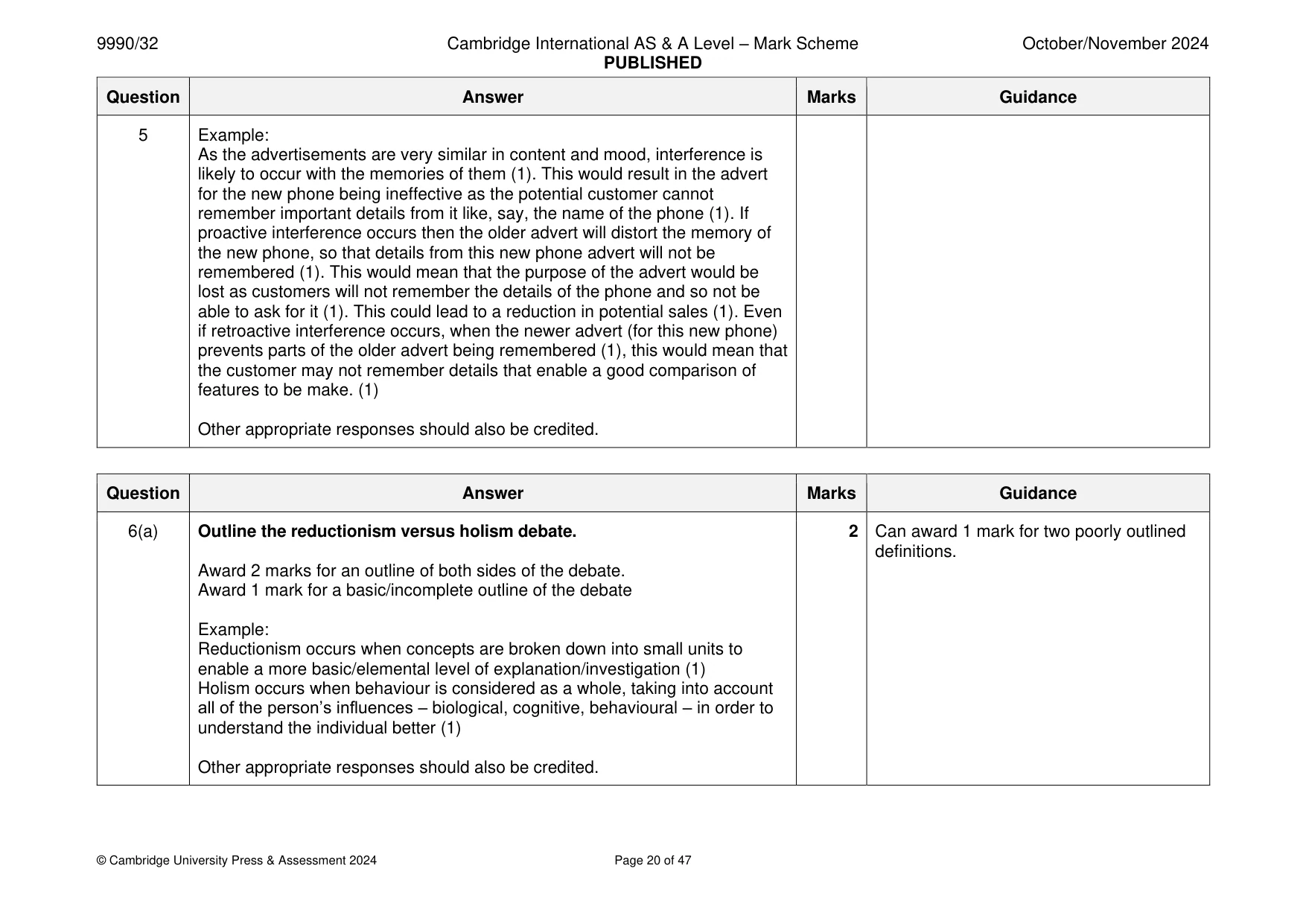
Mark scheme: 5 A mobile phone manufacturer wants to advertise a new phone. 4 Context – mobile phone Advertisers propose creating an advertisement that is similar in design to advertisements for competitors’ similar phones. This may interfere For full marks needs to refer to with consumers’ memory. interference. Suggest how customers’ memory for details of the new phone may be affected by this proposed advertisement. Award 3–4 marks for a detailed answer with clear understanding of how proactive and/or retroactive interference affect memory for the new phone. Award 1–2 marks for a basic answer with some understanding of how interference affects memory for the new phone. Syllabus reference: Mistakes in decision-making • Consumer memory for advertising including how retroactive and proactive interference affect memory, including a study, e.g., Burke and Srull (1988) Possible content • Interference occurs when two memories disrupt one another resulting in one (or both) of the memories being forgotten or distorted. • Proactive interference occurs when an older memory interferes with a newer one causing the newer one to be forgotten. More likely to recall details of competitors’ phones. • Retroactive interference occurs when a newer memory interferes with an older one causing the older memory to be forgotten. More likely to recall details of new phone. • Interference is most likely to occur when the memories are very similar • Interference is most likely to occur when the memories are formed quite close together in time. 5 Example: As the advertisements are very similar in content and mood, interference is likely to occur with the memories of them (1). This would result in the advert for the new phone being ineffective as the potential customer cannot remember important details from it like, say, the name of the phone (1). If proactive interference occurs then the older advert will distort the memory of the new phone, so that details from this new phone advert will not be remembered (1). This would mean that the purpose of the advert would be lost as customers will not remember the details of the phone and so not be able to ask for it (1). This could lead to a reduction in potential sales (1). Even if retroactive interference occurs, when the newer advert (for this new phone) prevents parts of the older advert being remembered (1), this would mean that the customer may not remember details that enable a good comparison of features to be make. (1) Other appropriate responses should also be credited.
Q6 · Outline the reductionism versus holism debate
6 (a) Outline the reductionism versus holism debate. [2] (b) Explain one reason why a competitor‑focused sales technique can be considered reductionist. [2]
Mark scheme: 6(a) Outline the reductionism versus holism debate. 2 Can award 1 mark for two poorly outlined definitions. Award 2 marks for an outline of both sides of the debate. Award 1 mark for a basic/incomplete outline of the debate Example: Reductionism occurs when concepts are broken down into small units to enable a more basic/elemental level of explanation/investigation (1) Holism occurs when behaviour is considered as a whole, taking into account all of the person’s influences – biological, cognitive, behavioural – in order to understand the individual better (1) Other appropriate responses should also be credited. 6(b) Explain one reason why a competitor-focused sales technique can be 2 1 mark = definition of competitor-focused considered reductionist. sales technique 1 mark = why reductionist Award 2 marks for an explanation in context. Award 1 mark for a basic explanation. Syllabus reference: Selling the product: Sales techniques focusing on customer-focused, competitor-focused, product-focused techniques including effect of each on buyer-seller relationship. Competitor-focused sales are those which draw comparisons with other products or sellers (best price or customer service). Example: A competitor-focused sales technique ignores the quality of the product and the specific needs of the individual customer and instead focuses primarily on comparing itself to other competitors’ products, which is a reductionist idea (1). This means that by changing the way they make comparisons, companies can investigate the best way to increase sales (1). The ability to change just one variable is a scientific approach, which is thus reductionist (1). Other appropriate responses should also be credited.
Q7 · Mariyah’s car has broken down and she needs to buy a new car
7 Mariyah’s car has broken down and she needs to buy a new car. (a) Describe two stages Mariyah would go through in buying a new car, using the Engel Kollat Blackwell model of buyer decision‑making. [4] (b) Explain one strength of the Engel Kollat Blackwell model of buyer decision‑making. [2]
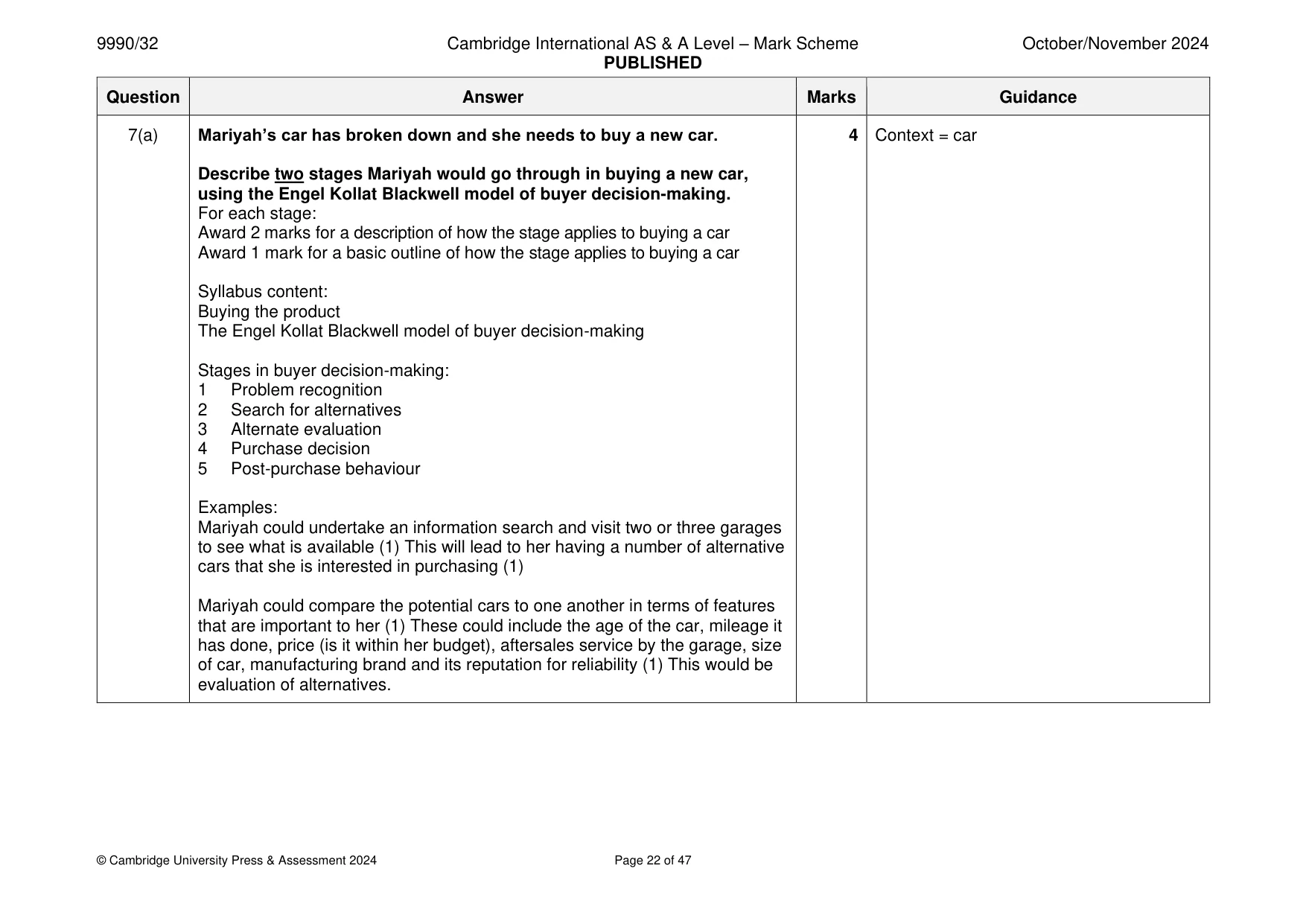
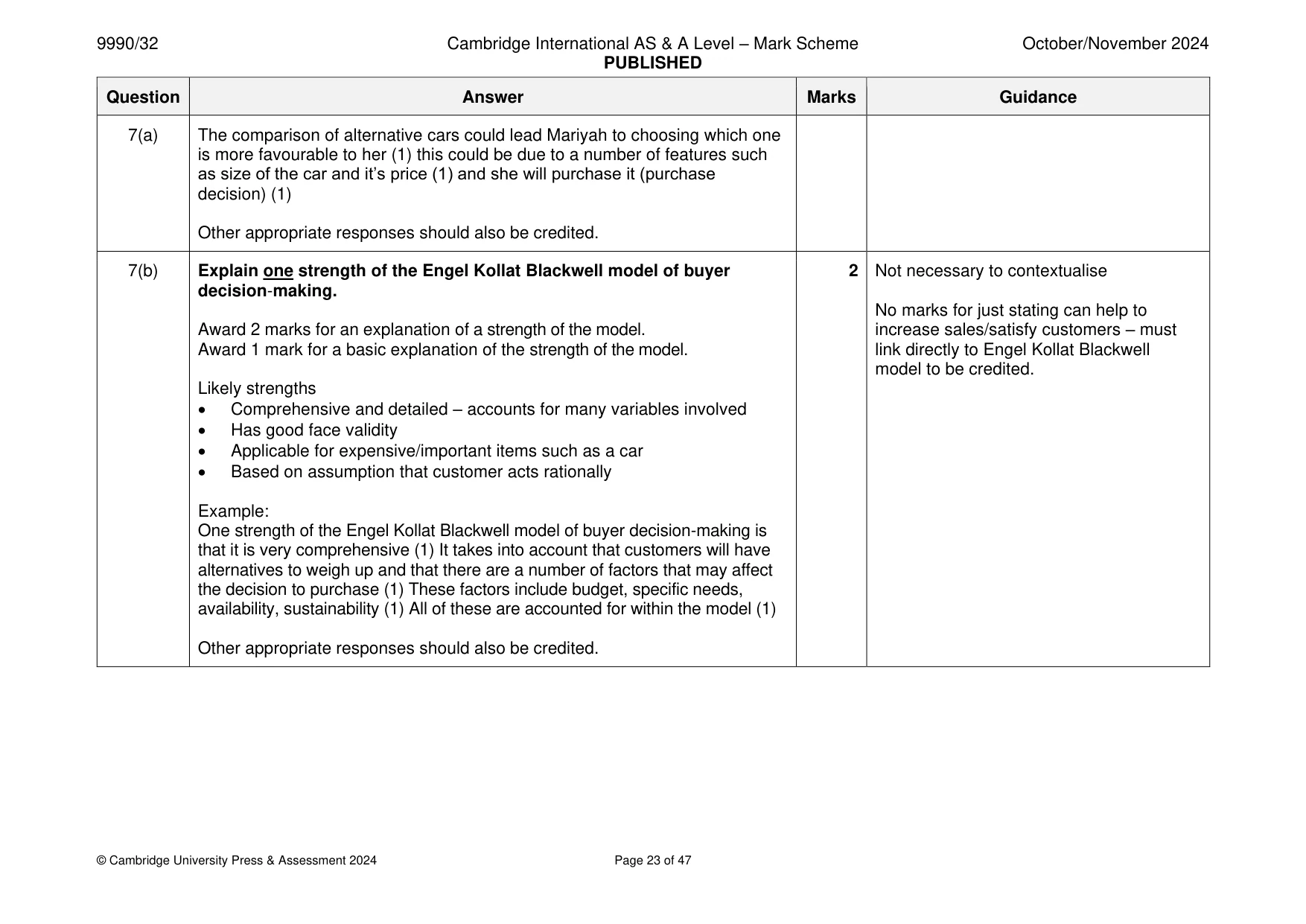
Mark scheme: 7(a) Mariyah’s car has broken down and she needs to buy a new car. 4 Context = car Describe two stages Mariyah would go through in buying a new car, using the Engel Kollat Blackwell model of buyer decision-making. For each stage: Award 2 marks for a description of how the stage applies to buying a car Award 1 mark for a basic outline of how the stage applies to buying a car Syllabus content: Buying the product The Engel Kollat Blackwell model of buyer decision-making Stages in buyer decision-making: 1 Problem recognition 2 Search for alternatives 3 Alternate evaluation 4 Purchase decision 5 Post-purchase behaviour Examples: Mariyah could undertake an information search and visit two or three garages to see what is available (1) This will lead to her having a number of alternative cars that she is interested in purchasing (1) Mariyah could compare the potential cars to one another in terms of features that are important to her (1) These could include the age of the car, mileage it has done, price (is it within her budget), aftersales service by the garage, size of car, manufacturing brand and its reputation for reliability (1) This would be evaluation of alternatives. 7(a) The comparison of alternative cars could lead Mariyah to choosing which one is more favourable to her (1) this could be due to a number of features such as size of the car and it’s price (1) and she will purchase it (purchase decision) (1) Other appropriate responses should also be credited. 7(b) Explain one strength of the Engel Kollat Blackwell model of buyer 2 Not necessary to contextualise decision-making. No marks for just stating can help to Award 2 marks for an explanation of a strength of the model. increase sales/satisfy customers – must Award 1 mark for a basic explanation of the strength of the model. link directly to Engel Kollat Blackwell model to be credited. Likely strengths • Comprehensive and detailed – accounts for many variables involved • Has good face validity • Applicable for expensive/important items such as a car • Based on assumption that customer acts rationally Example: One strength of the Engel Kollat Blackwell model of buyer decision-making is that it is very comprehensive (1) It takes into account that customers will have alternatives to weigh up and that there are a number of factors that may affect the decision to purchase (1) These factors include budget, specific needs, availability, sustainability (1) All of these are accounted for within the model (1) Other appropriate responses should also be credited.
Q8 · Describe what psychologists have discovered about retail atmospherics: • model of effects…
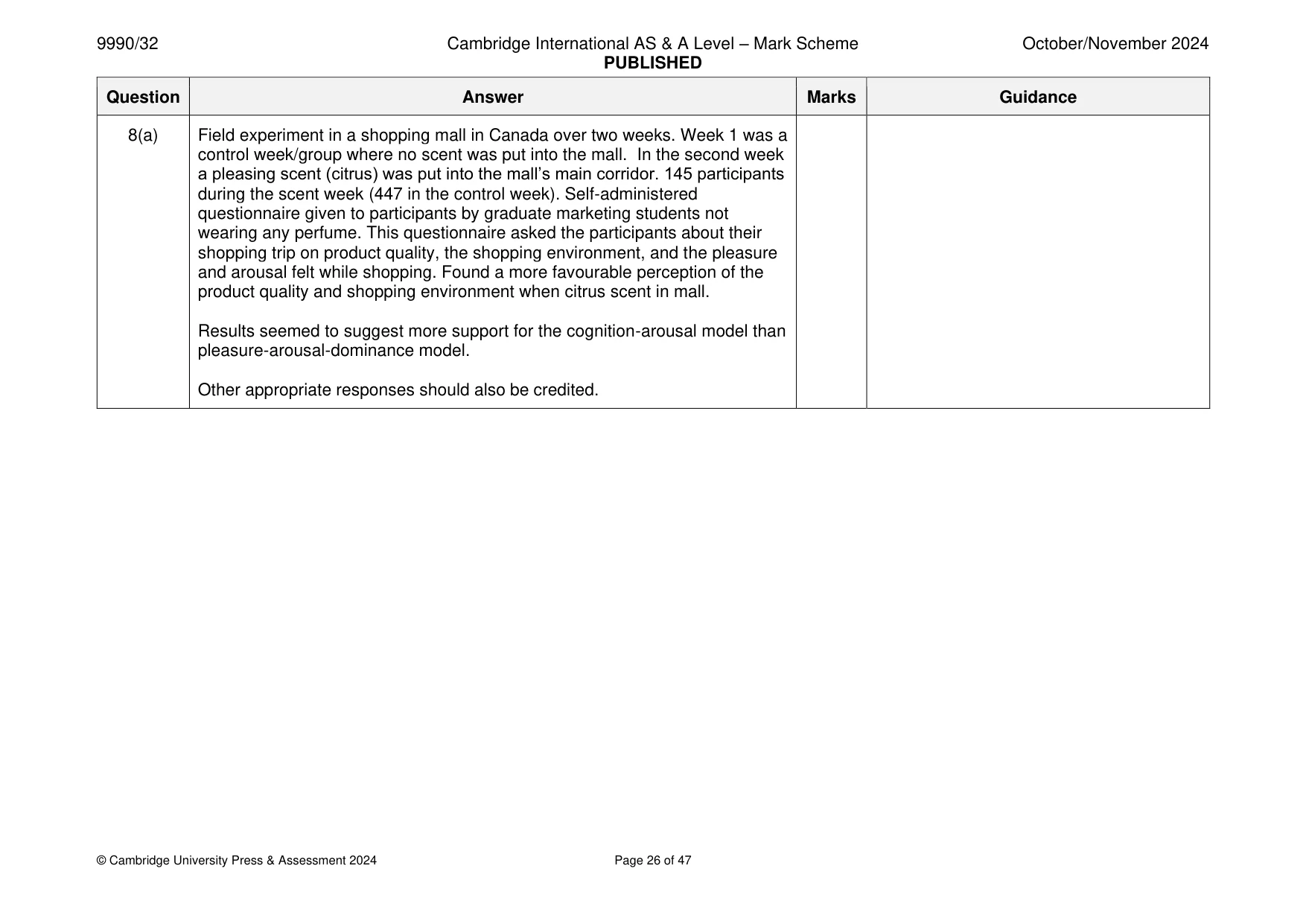
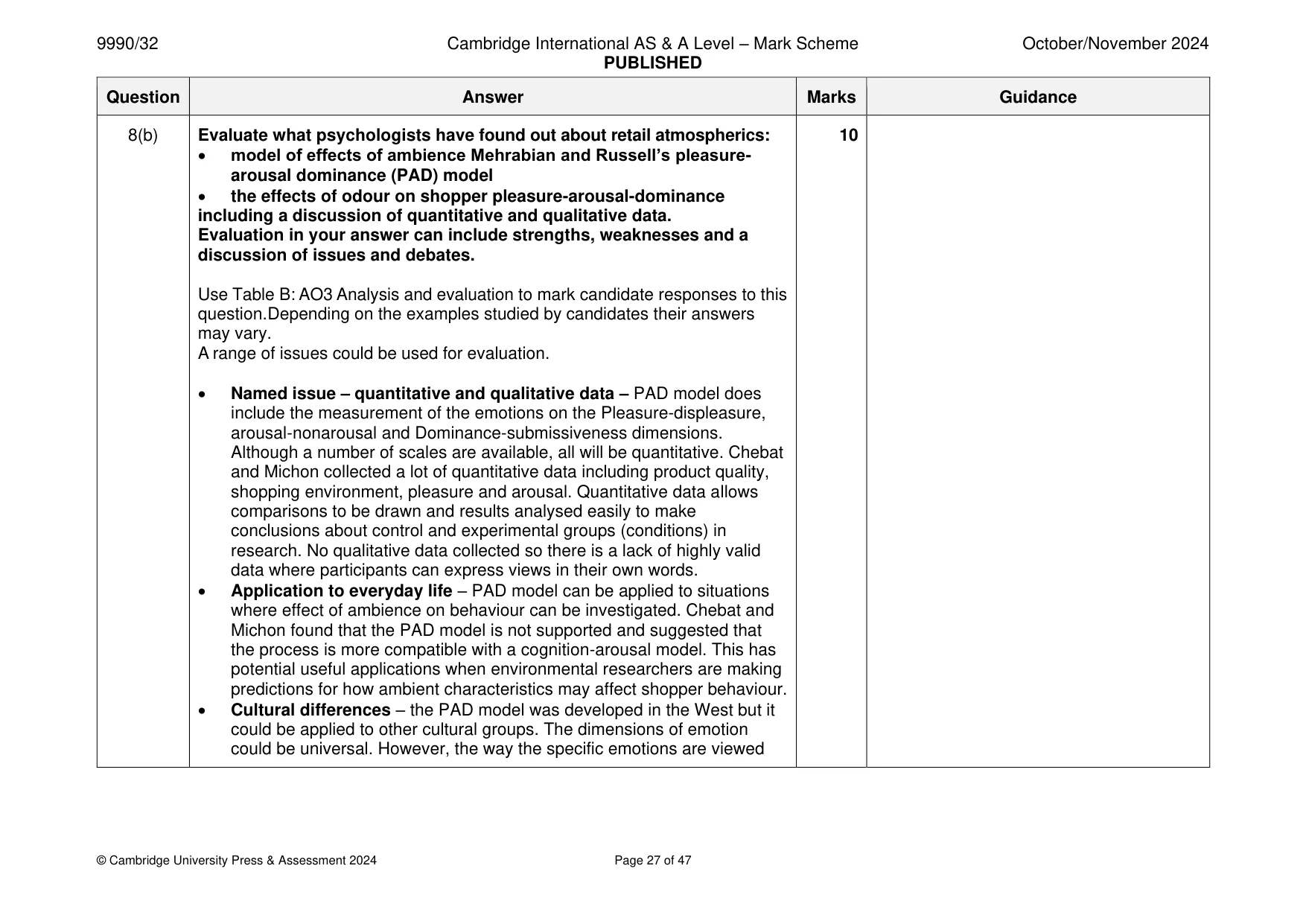
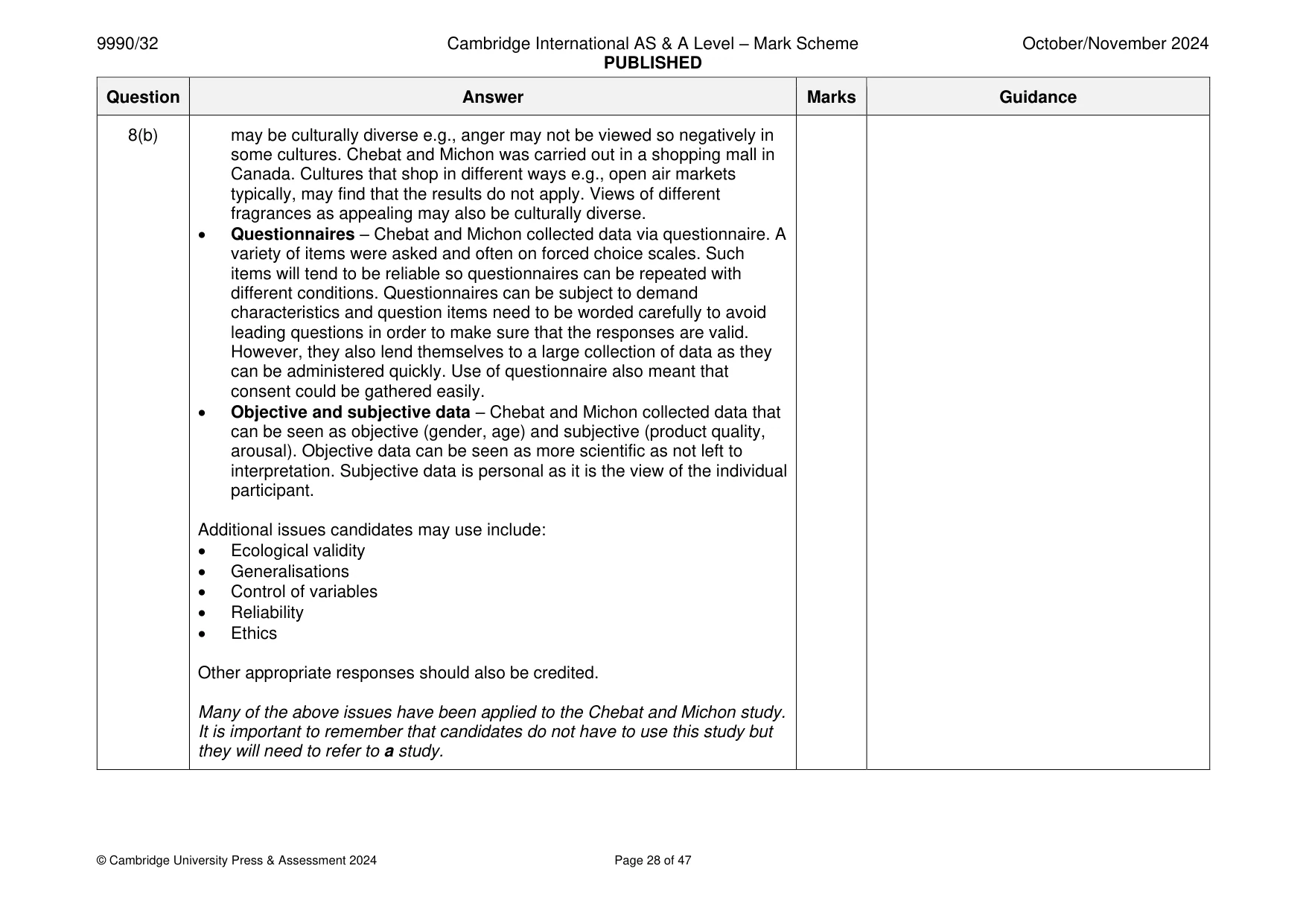
8 (a) Describe what psychologists have discovered about retail atmospherics: • model of effects of ambience: Mehrabian and Russell’s pleasure‑arousal‑dominance (PAD) model, and • the effects of odour on shopper pleasure‑arousal‑dominance. [6] (b) Evaluate what psychologists have discovered about retail atmospherics: • model of effects of ambience: Mehrabian and Russell’s pleasure‑arousal‑dominance (PAD) model, and • the effects of odour on shopper pleasure‑arousal‑dominance, including a discussion of quantitative and qualitative data. Evaluation in your answer can include strengths, weaknesses and a discussion of issues and debates. [10] Section C: Health Psychology Answer all questions.
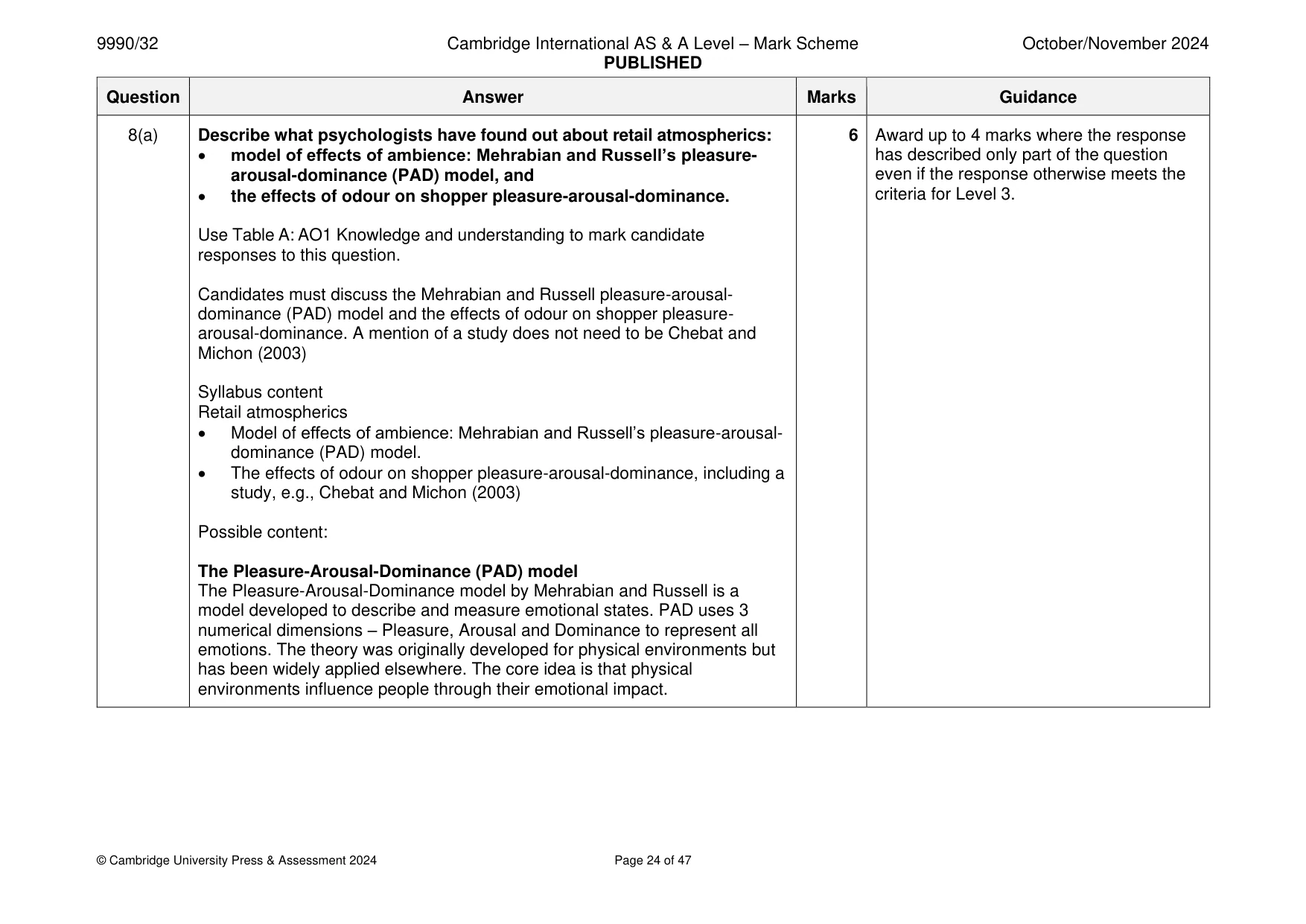
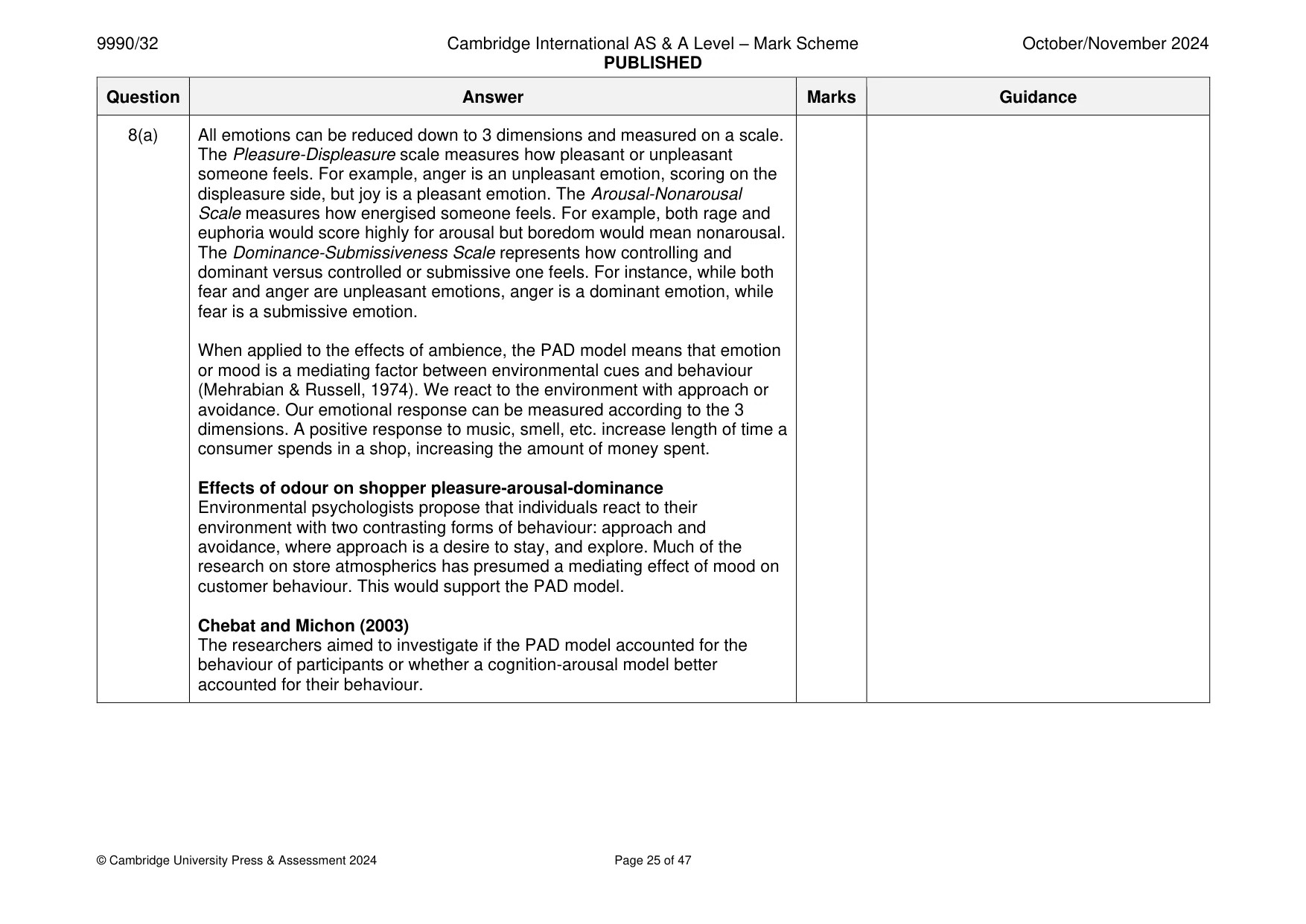
Mark scheme: 8(a) Describe what psychologists have found out about retail atmospherics: 6 Award up to 4 marks where the response • model of effects of ambience: Mehrabian and Russell’s pleasure- has described only part of the question arousal-dominance (PAD) model, and even if the response otherwise meets the • the effects of odour on shopper pleasure-arousal-dominance. criteria for Level 3. Use Table A: AO1 Knowledge and understanding to mark candidate responses to this question. Candidates must discuss the Mehrabian and Russell pleasure-arousal- dominance (PAD) model and the effects of odour on shopper pleasure- arousal-dominance. A mention of a study does not need to be Chebat and Michon (2003) Syllabus content Retail atmospherics • Model of effects of ambience: Mehrabian and Russell’s pleasure-arousal- dominance (PAD) model. • The effects of odour on shopper pleasure-arousal-dominance, including a study, e.g., Chebat and Michon (2003) Possible content: The Pleasure-Arousal-Dominance (PAD) model The Pleasure-Arousal-Dominance model by Mehrabian and Russell is a model developed to describe and measure emotional states. PAD uses 3 numerical dimensions – Pleasure, Arousal and Dominance to represent all emotions. The theory was originally developed for physical environments but has been widely applied elsewhere. The core idea is that physical environments influence people through their emotional impact. 8(a) All emotions can be reduced down to 3 dimensions and measured on a scale. The Pleasure-Displeasure scale measures how pleasant or unpleasant someone feels. For example, anger is an unpleasant emotion, scoring on the displeasure side, but joy is a pleasant emotion. The Arousal-Nonarousal Scale measures how energised someone feels. For example, both rage and euphoria would score highly for arousal but boredom would mean nonarousal. The Dominance-Submissiveness Scale represents how controlling and dominant versus controlled or submissive one feels. For instance, while both fear and anger are unpleasant emotions, anger is a dominant emotion, while fear is a submissive emotion. When applied to the effects of ambience, the PAD model means that emotion or mood is a mediating factor between environmental cues and behaviour (Mehrabian & Russell, 1974). We react to the environment with approach or avoidance. Our emotional response can be measured according to the 3 dimensions. A positive response to music, smell, etc. increase length of time a consumer spends in a shop, increasing the amount of money spent. Effects of odour on shopper pleasure-arousal-dominance Environmental psychologists propose that individuals react to their environment with two contrasting forms of behaviour: approach and avoidance, where approach is a desire to stay, and explore. Much of the research on store atmospherics has presumed a mediating effect of mood on customer behaviour. This would support the PAD model. Chebat and Michon (2003) The researchers aimed to investigate if the PAD model accounted for the behaviour of participants or whether a cognition-arousal model better accounted for their behaviour. 8(a) Field experiment in a shopping mall in Canada over two weeks. Week 1 was a control week/group where no scent was put into the mall. In the second week a pleasing scent (citrus) was put into the mall’s main corridor. 145 participants during the scent week (447 in the control week). Self-administered questionnaire given to participants by graduate marketing students not wearing any perfume. This questionnaire asked the participants about their shopping trip on product quality, the shopping environment, and the pleasure and arousal felt while shopping. Found a more favourable perception of the product quality and shopping environment when citrus scent in mall. Results seemed to suggest more support for the cognition-arousal model than pleasure-arousal-dominance model. Other appropriate responses should also be credited. 8(b) Evaluate what psychologists have found out about retail atmospherics: 10 • model of effects of ambience Mehrabian and Russell’s pleasure- arousal dominance (PAD) model • the effects of odour on shopper pleasure-arousal-dominance including a discussion of quantitative and qualitative data. Evaluation in your answer can include strengths, weaknesses and a discussion of issues and debates. Use Table B: AO3 Analysis and evaluation to mark candidate responses to this question. Depending on the examples studied by candidates their answers may vary. A range of issues could be used for evaluation. • Named issue – quantitative and qualitative data – PAD model does include the measurement of the emotions on the Pleasure-displeasure, arousal-nonarousal and Dominance-submissiveness dimensions. Although a number of scales are available, all will be quantitative. Chebat and Michon collected a lot of quantitative data including product quality, shopping environment, pleasure and arousal. Quantitative data allows comparisons to be drawn and results analysed easily to make conclusions about control and experimental groups (conditions) in research. No qualitative data collected so there is a lack of highly valid data where participants can express views in their own words. • Application to everyday life – PAD model can be applied to situations where effect of ambience on behaviour can be investigated. Chebat and Michon found that the PAD model is not supported and suggested that the process is more compatible with a cognition-arousal model. This has potential useful applications when environmental researchers are making predictions for how ambient characteristics may affect shopper behaviour. • Cultural differences – the PAD model was developed in the West but it could be applied to other cultural groups. The dimensions of emotion could be universal. However, the way the specific emotions are viewed 8(b) may be culturally diverse e.g., anger may not be viewed so negatively in some cultures. Chebat and Michon was carried out in a shopping mall in Canada. Cultures that shop in different ways e.g., open air markets typically, may find that the results do not apply. Views of different fragrances as appealing may also be culturally diverse. • Questionnaires – Chebat and Michon collected data via questionnaire. A variety of items were asked and often on forced choice scales. Such items will tend to be reliable so questionnaires can be repeated with different conditions. Questionnaires can be subject to demand characteristics and question items need to be worded carefully to avoid leading questions in order to make sure that the responses are valid. However, they also lend themselves to a large collection of data as they can be administered quickly. Use of questionnaire also meant that consent could be gathered easily. • Objective and subjective data – Chebat and Michon collected data that can be seen as objective (gender, age) and subjective (product quality, arousal). Objective data can be seen as more scientific as not left to interpretation. Subjective data is personal as it is the view of the individual participant. Additional issues candidates may use include: • Ecological validity • Generalisations • Control of variables • Reliability • Ethics Other appropriate responses should also be credited. Many of the above issues have been applied to the Chebat and Michon study. It is important to remember that candidates do not have to use this study but they will need to refer to a study. Section C: Health Psychology
Q9 · Camilla’s father is told by his doctor that he needs to take pills every day
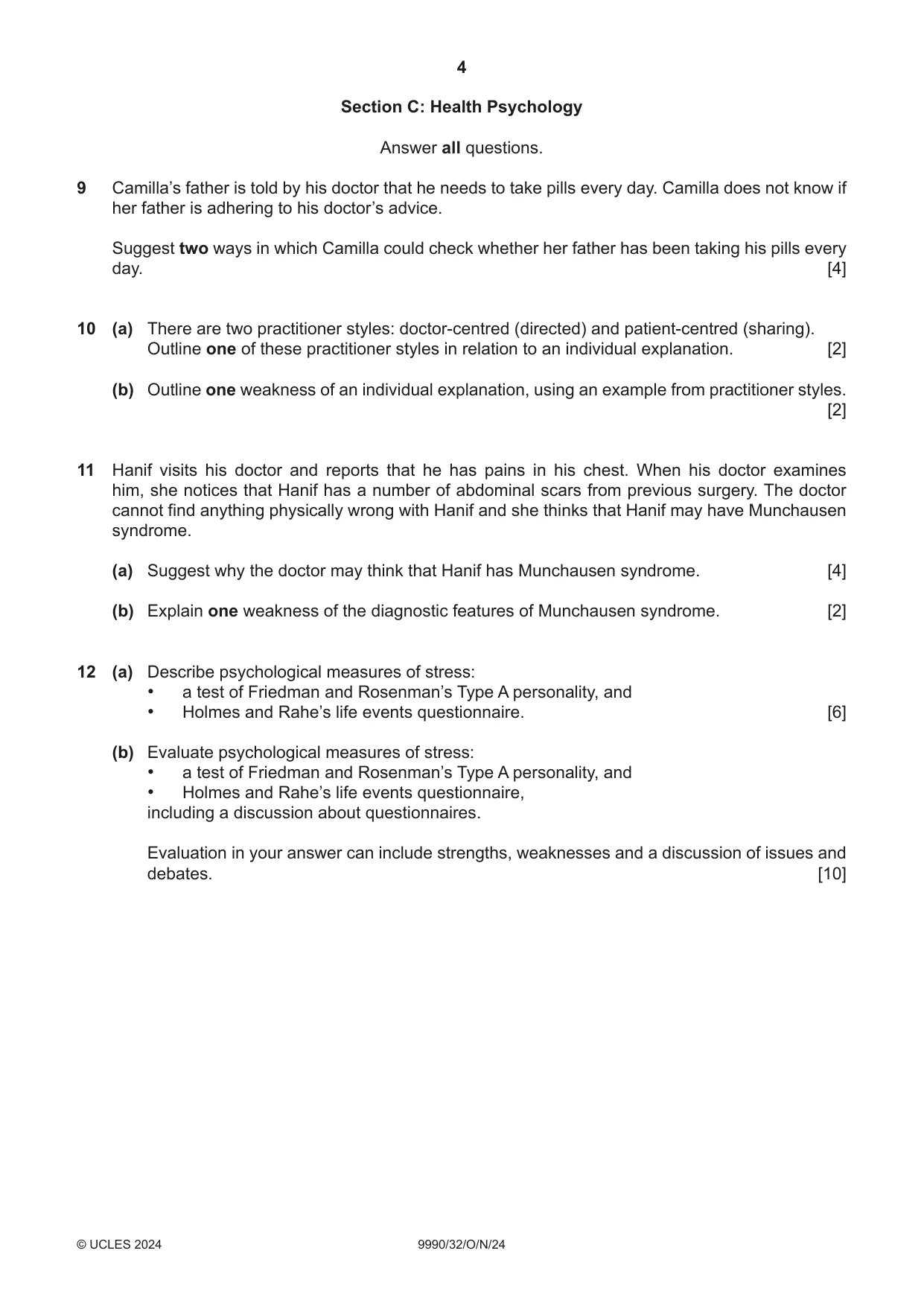
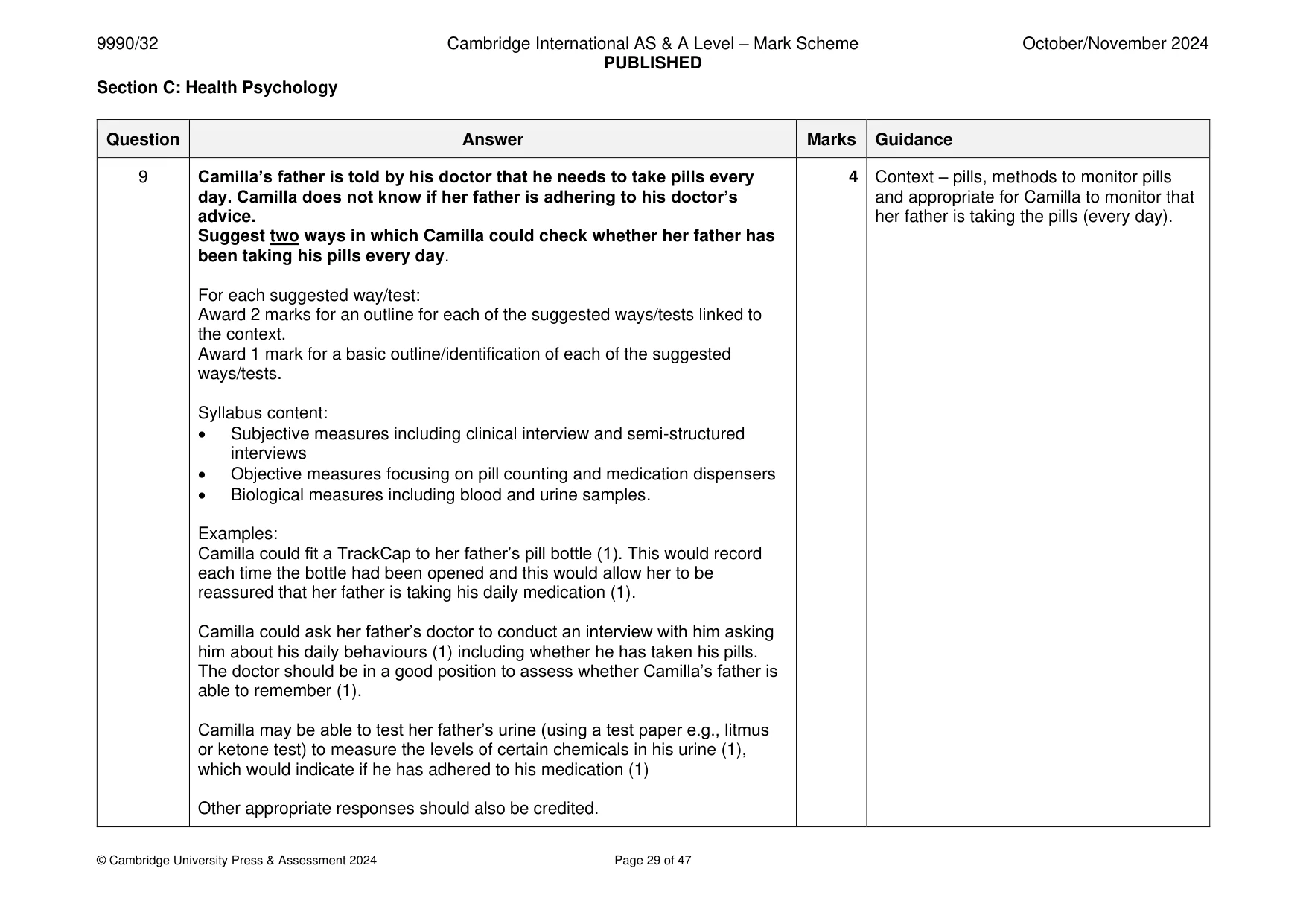
9 Camilla’s father is told by his doctor that he needs to take pills every day. Camilla does not know if her father is adhering to his doctor’s advice. Suggest two ways in which Camilla could check whether her father has been taking his pills every day. [4]
Mark scheme: 9 Camilla’s father is told by his doctor that he needs to take pills every 4 Context – pills, methods to monitor pills day. Camilla does not know if her father is adhering to his doctor’s and appropriate for Camilla to monitor that advice. her father is taking the pills (every day). Suggest two ways in which Camilla could check whether her father has been taking his pills every day. For each suggested way/test: Award 2 marks for an outline for each of the suggested ways/tests linked to the context. Award 1 mark for a basic outline/identification of each of the suggested ways/tests. Syllabus content: • Subjective measures including clinical interview and semi-structured interviews • Objective measures focusing on pill counting and medication dispensers • Biological measures including blood and urine samples. Examples: Camilla could fit a TrackCap to her father’s pill bottle (1). This would record each time the bottle had been opened and this would allow her to be reassured that her father is taking his daily medication (1). Camilla could ask her father’s doctor to conduct an interview with him asking him about his daily behaviours (1) including whether he has taken his pills. The doctor should be in a good position to assess whether Camilla’s father is able to remember (1). Camilla may be able to test her father’s urine (using a test paper e.g., litmus or ketone test) to measure the levels of certain chemicals in his urine (1), which would indicate if he has adhered to his medication (1) Other appropriate responses should also be credited.
Q10 · There are two practitioner styles: doctor‑centred (directed) and patient‑centred (sharing)
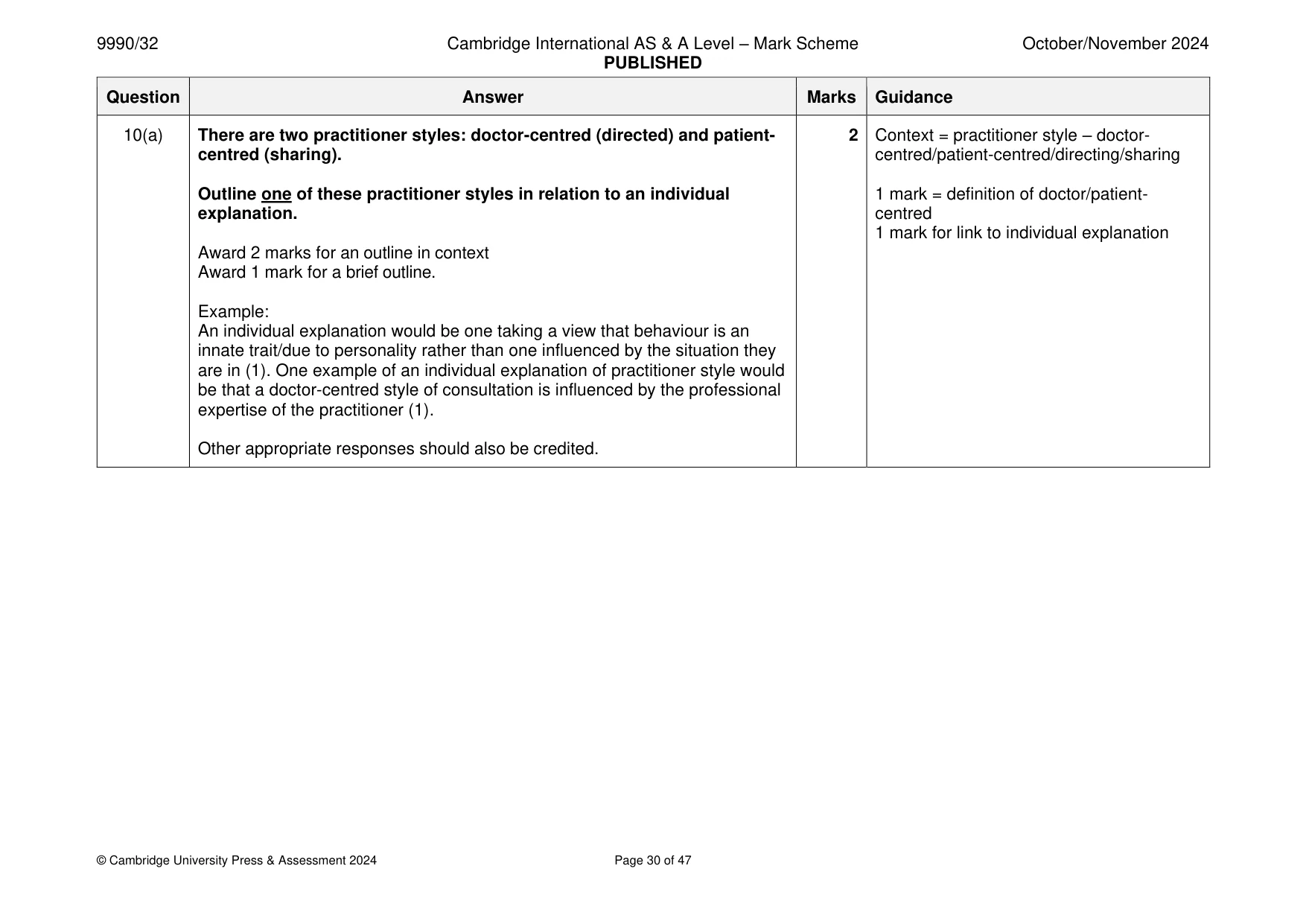
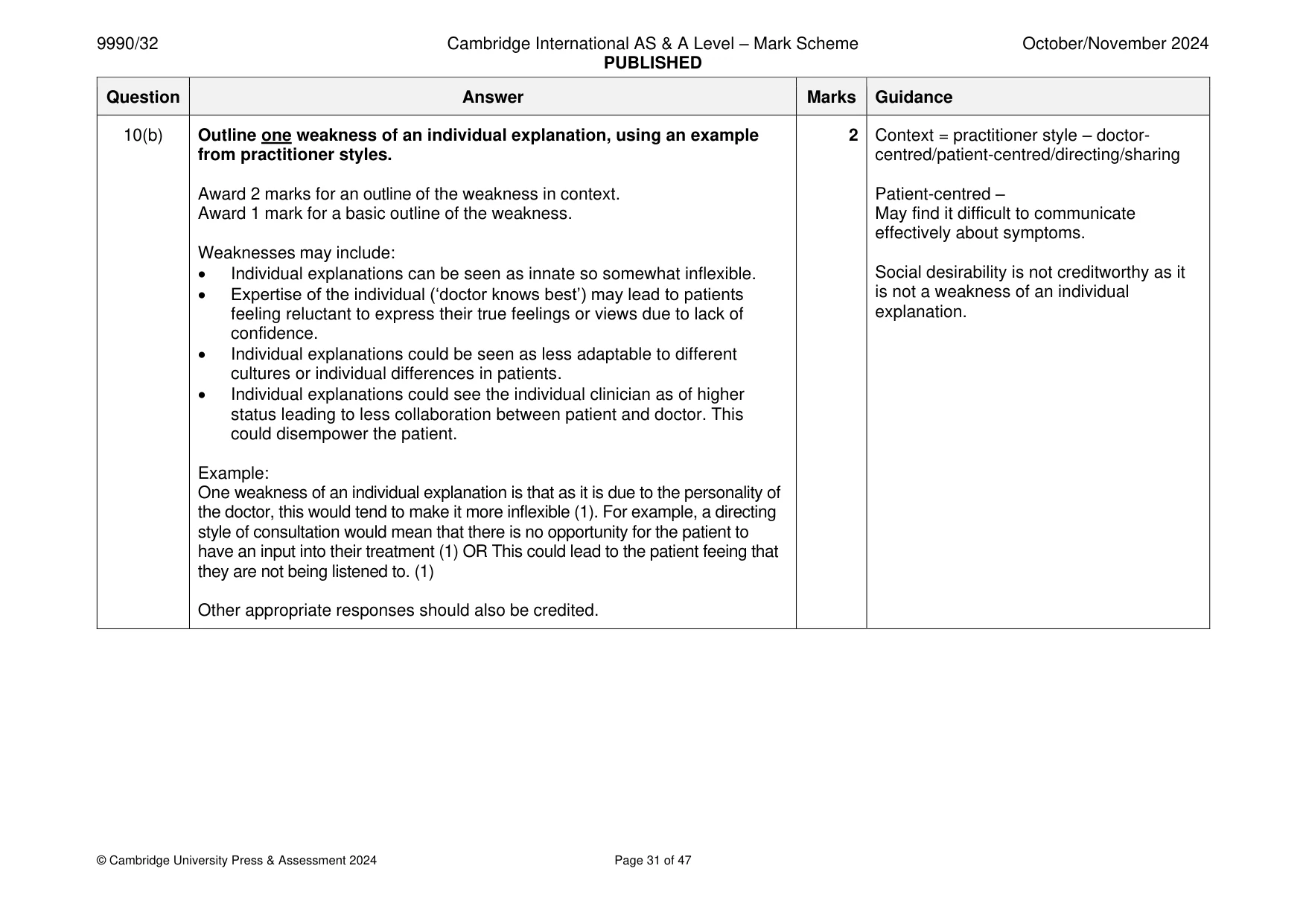
10 (a) There are two practitioner styles: doctor‑centred (directed) and patient‑centred (sharing). Outline one of these practitioner styles in relation to an individual explanation. [2] (b) Outline one weakness of an individual explanation, using an example from practitioner styles. [2]
Mark scheme: 10(a) There are two practitioner styles: doctor-centred (directed) and patient- 2 Context = practitioner style – doctor- centred (sharing). centred/patient-centred/directing/sharing Outline one of these practitioner styles in relation to an individual 1 mark = definition of doctor/patient- explanation. centred 1 mark for link to individual explanation Award 2 marks for an outline in context Award 1 mark for a brief outline. Example: An individual explanation would be one taking a view that behaviour is an innate trait/due to personality rather than one influenced by the situation they are in (1). One example of an individual explanation of practitioner style would be that a doctor-centred style of consultation is influenced by the professional expertise of the practitioner (1). Other appropriate responses should also be credited. 10(b) Outline one weakness of an individual explanation, using an example 2 Context = practitioner style – doctor- from practitioner styles. centred/patient-centred/directing/sharing Award 2 marks for an outline of the weakness in context. Patient-centred – Award 1 mark for a basic outline of the weakness. May find it difficult to communicate effectively about symptoms. Weaknesses may include: • Individual explanations can be seen as innate so somewhat inflexible. Social desirability is not creditworthy as it • Expertise of the individual (‘doctor knows best’) may lead to patients is not a weakness of an individual feeling reluctant to express their true feelings or views due to lack of explanation. confidence. • Individual explanations could be seen as less adaptable to different cultures or individual differences in patients. • Individual explanations could see the individual clinician as of higher status leading to less collaboration between patient and doctor. This could disempower the patient. Example: One weakness of an individual explanation is that as it is due to the personality of the doctor, this would tend to make it more inflexible (1). For example, a directing style of consultation would mean that there is no opportunity for the patient to have an input into their treatment (1) OR This could lead to the patient feeing that they are not being listened to. (1) Other appropriate responses should also be credited.
Q11 · Hanif visits his doctor and reports that he has pains in his chest
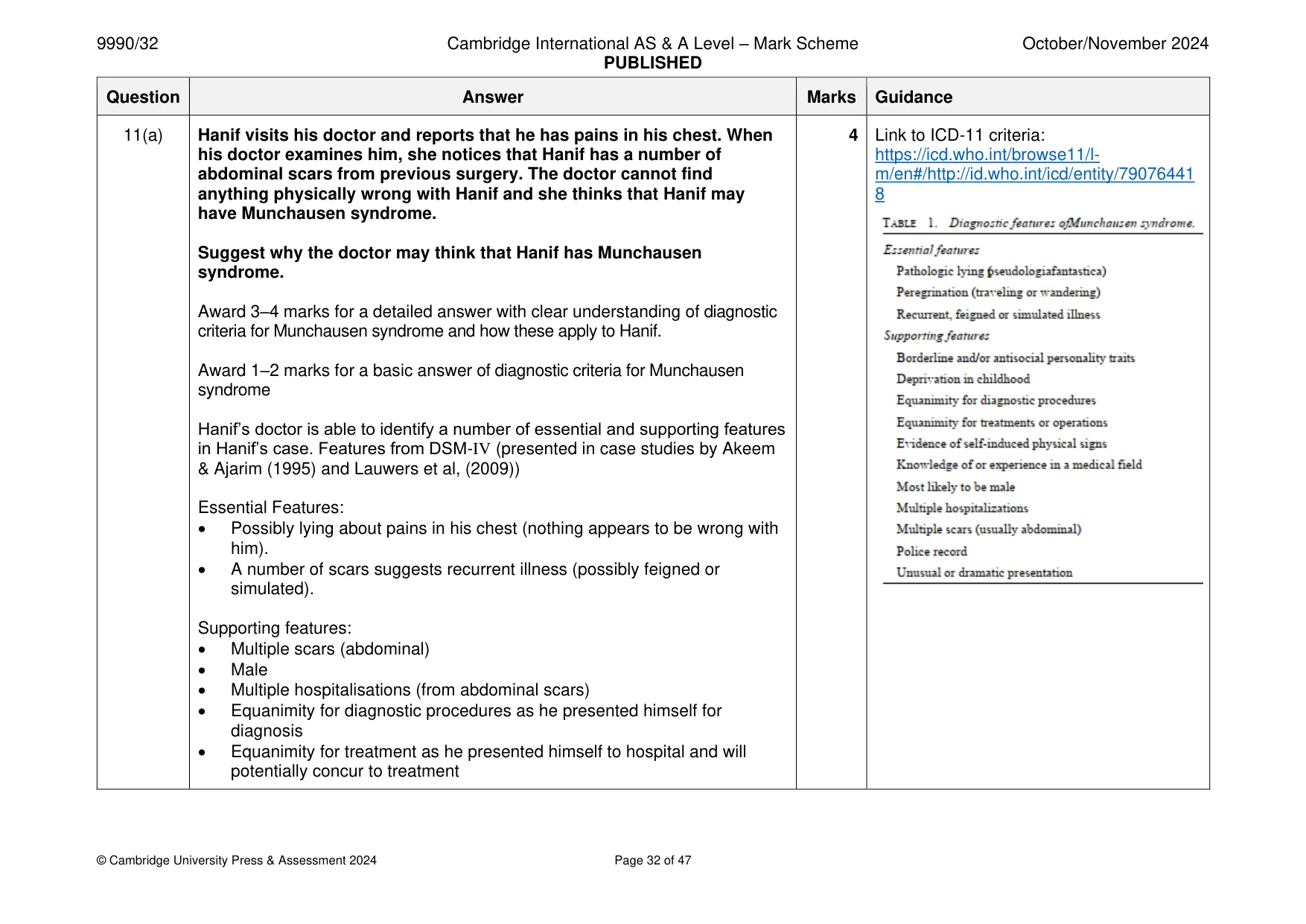
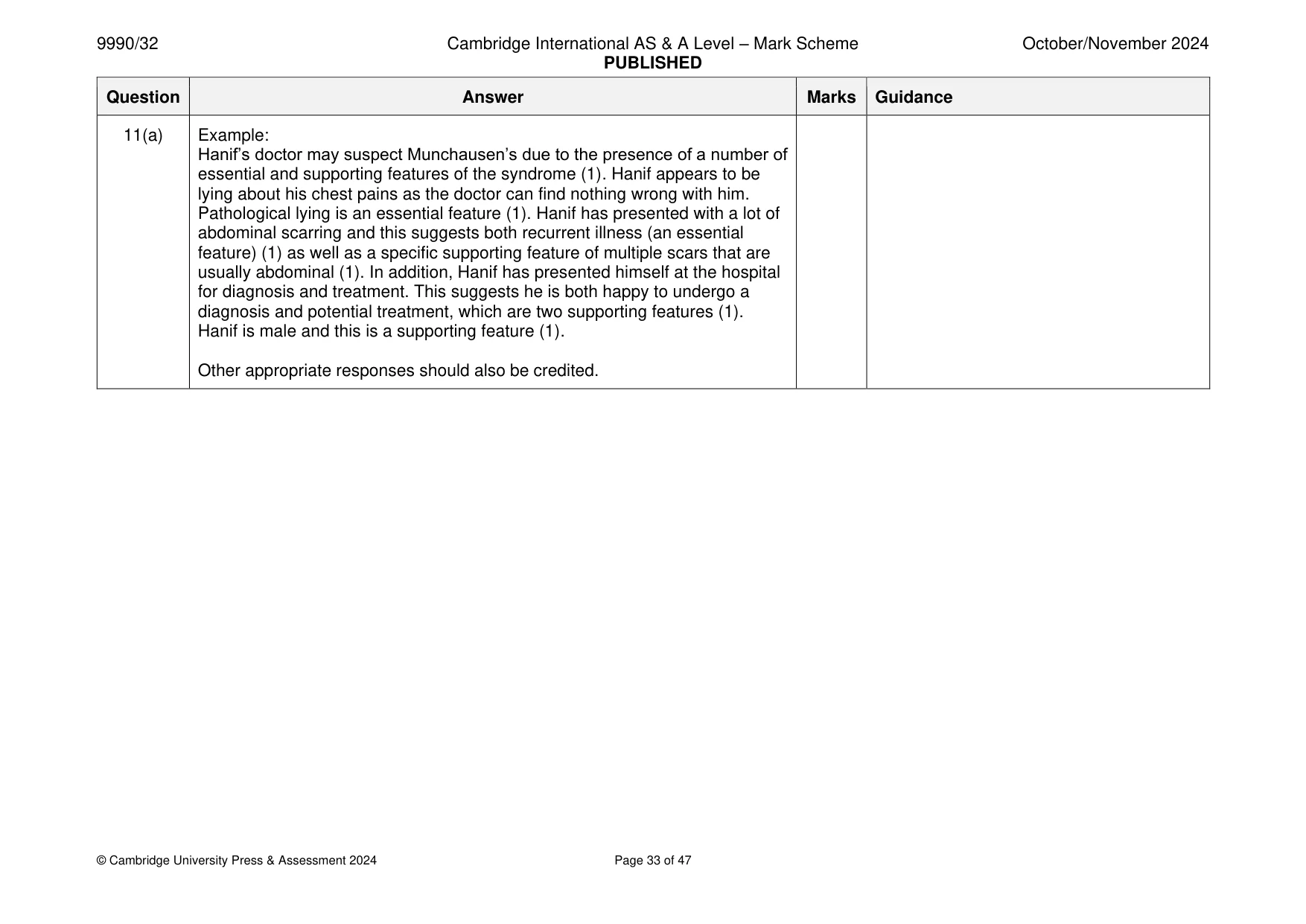
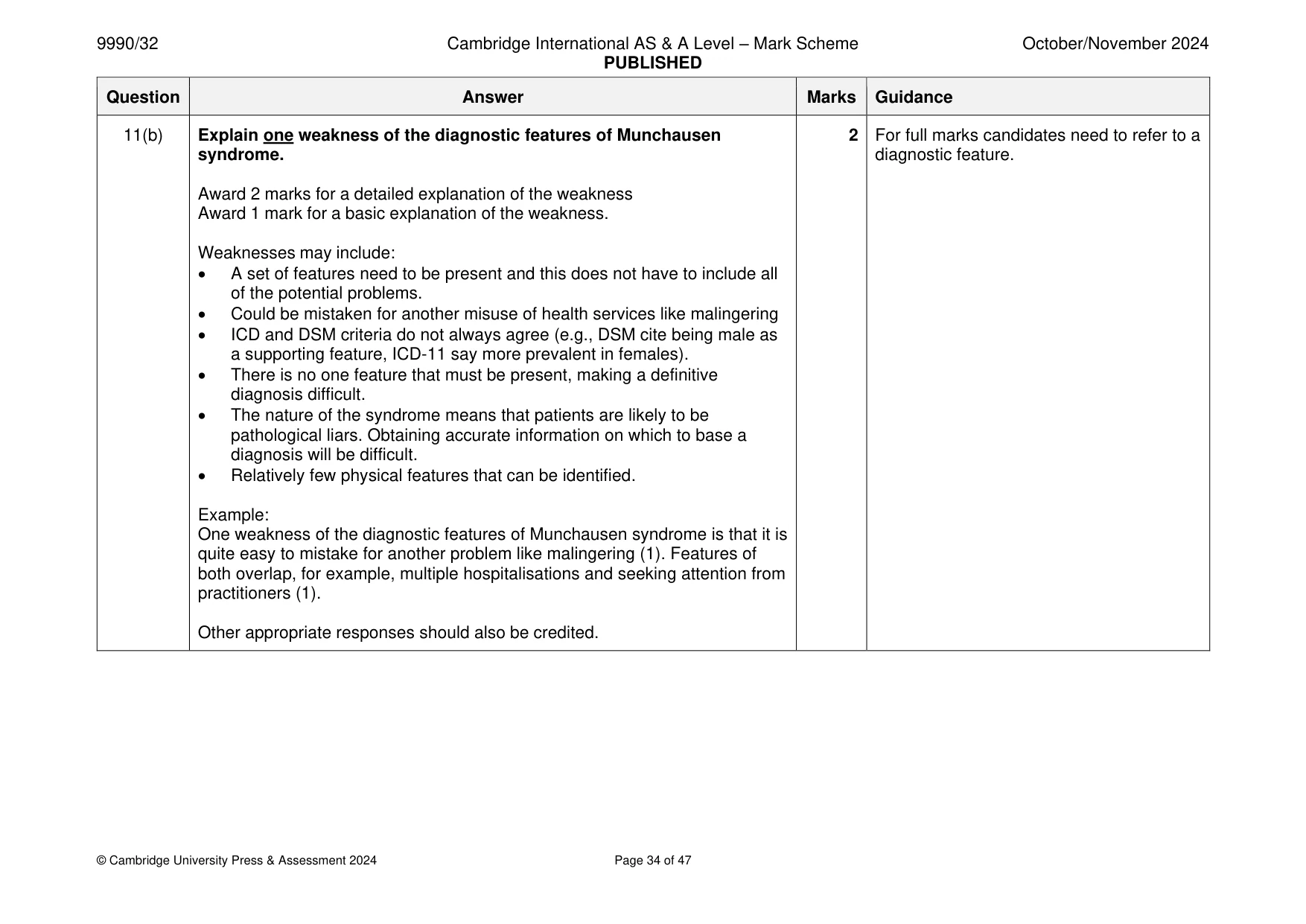
11 Hanif visits his doctor and reports that he has pains in his chest. When his doctor examines him, she notices that Hanif has a number of abdominal scars from previous surgery. The doctor cannot find anything physically wrong with Hanif and she thinks that Hanif may have Munchausen syndrome. (a) Suggest why the doctor may think that Hanif has Munchausen syndrome. [4] (b) Explain one weakness of the diagnostic features of Munchausen syndrome. [2]
Mark scheme: 11(a) Hanif visits his doctor and reports that he has pains in his chest. When 4 Link to ICD-11 criteria: his doctor examines him, she notices that Hanif has a number of https://icd.who.int/browse11/l- abdominal scars from previous surgery. The doctor cannot find m/en#/http://id.who.int/icd/entity/79076441 anything physically wrong with Hanif and she thinks that Hanif may 8 have Munchausen syndrome. Suggest why the doctor may think that Hanif has Munchausen syndrome. Award 3–4 marks for a detailed answer with clear understanding of diagnostic criteria for Munchausen syndrome and how these apply to Hanif. Award 1–2 marks for a basic answer of diagnostic criteria for Munchausen syndrome Hanif’s doctor is able to identify a number of essential and supporting features in Hanif’s case. Features from DSM-IV (presented in case studies by Akeem & Ajarim (1995) and Lauwers et al, (2009)) Essential Features: • Possibly lying about pains in his chest (nothing appears to be wrong with him). • A number of scars suggests recurrent illness (possibly feigned or simulated). Supporting features: • Multiple scars (abdominal) • Male • Multiple hospitalisations (from abdominal scars) • Equanimity for diagnostic procedures as he presented himself for diagnosis • Equanimity for treatment as he presented himself to hospital and will potentially concur to treatment 11(a) Example: Hanif’s doctor may suspect Munchausen’s due to the presence of a number of essential and supporting features of the syndrome (1). Hanif appears to be lying about his chest pains as the doctor can find nothing wrong with him. Pathological lying is an essential feature (1). Hanif has presented with a lot of abdominal scarring and this suggests both recurrent illness (an essential feature) (1) as well as a specific supporting feature of multiple scars that are usually abdominal (1). In addition, Hanif has presented himself at the hospital for diagnosis and treatment. This suggests he is both happy to undergo a diagnosis and potential treatment, which are two supporting features (1). Hanif is male and this is a supporting feature (1). Other appropriate responses should also be credited. 11(b) Explain one weakness of the diagnostic features of Munchausen 2 For full marks candidates need to refer to a syndrome. diagnostic feature. Award 2 marks for a detailed explanation of the weakness Award 1 mark for a basic explanation of the weakness. Weaknesses may include: • A set of features need to be present and this does not have to include all of the potential problems. • Could be mistaken for another misuse of health services like malingering • ICD and DSM criteria do not always agree (e.g., DSM cite being male as a supporting feature, ICD-11 say more prevalent in females). • There is no one feature that must be present, making a definitive diagnosis difficult. • The nature of the syndrome means that patients are likely to be pathological liars. Obtaining accurate information on which to base a diagnosis will be difficult. • Relatively few physical features that can be identified. Example: One weakness of the diagnostic features of Munchausen syndrome is that it is quite easy to mistake for another problem like malingering (1). Features of both overlap, for example, multiple hospitalisations and seeking attention from practitioners (1). Other appropriate responses should also be credited.
Q12 · Describe psychological measures of stress: • a test of Friedman and Rosenman’s Type A…
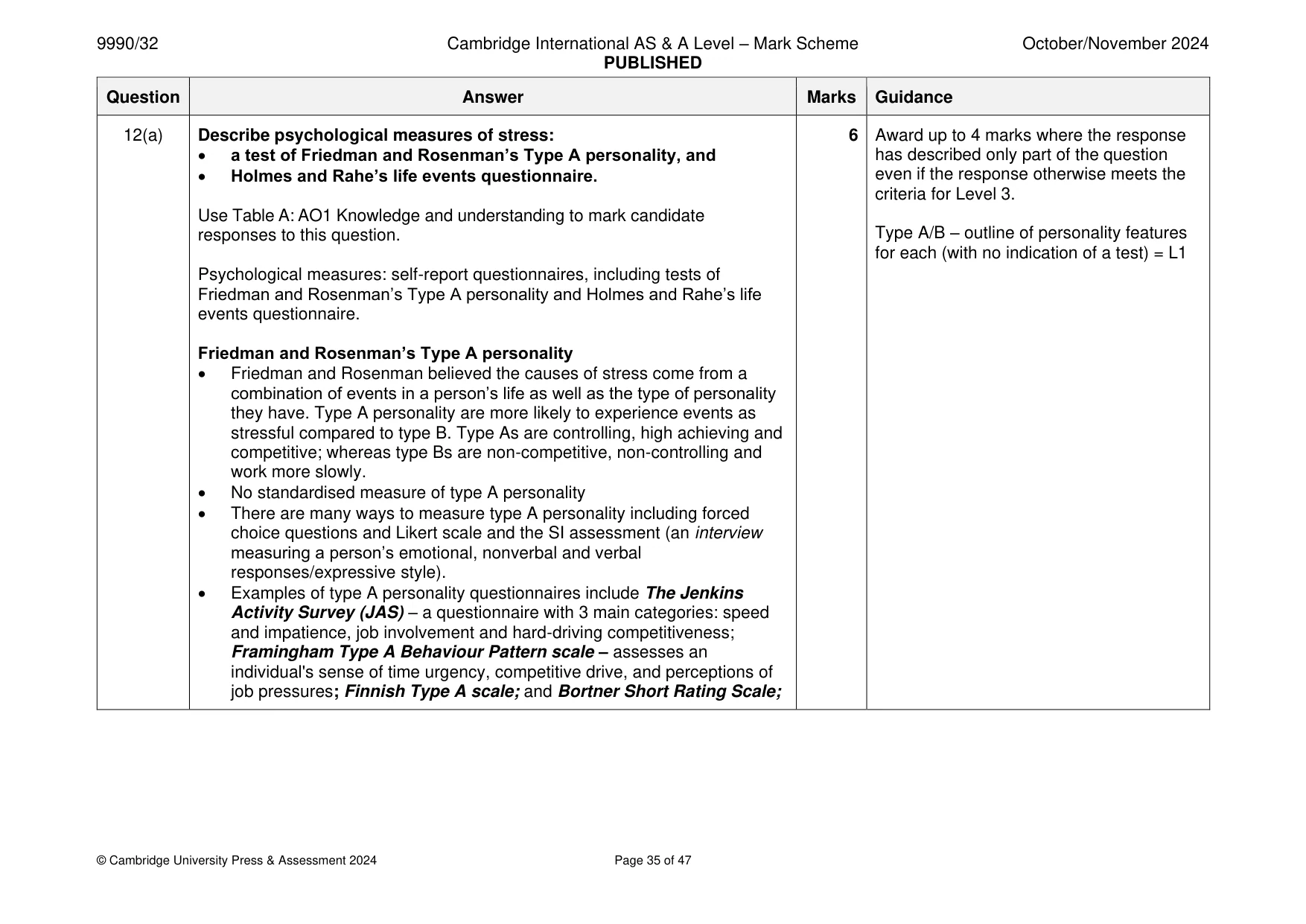
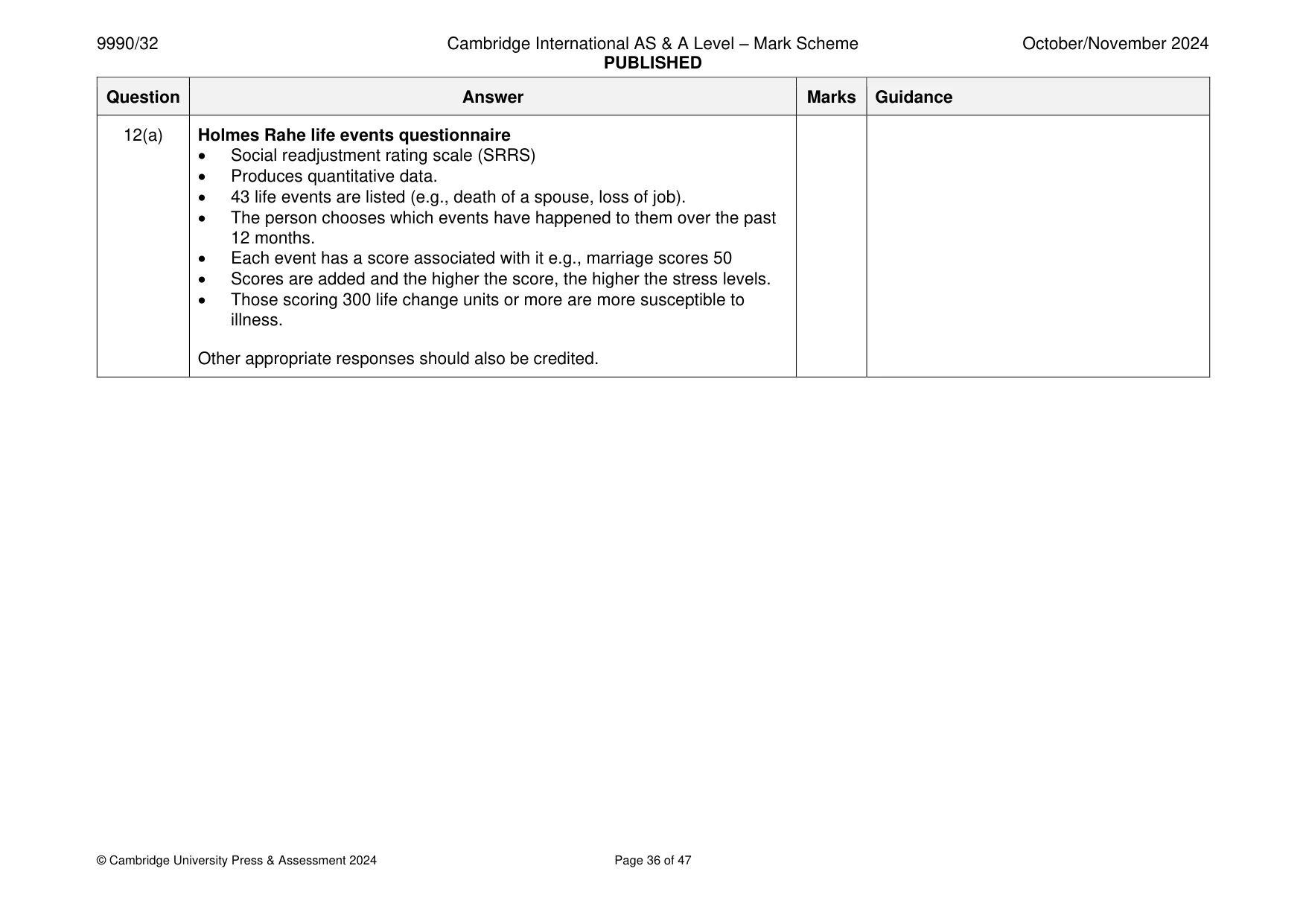
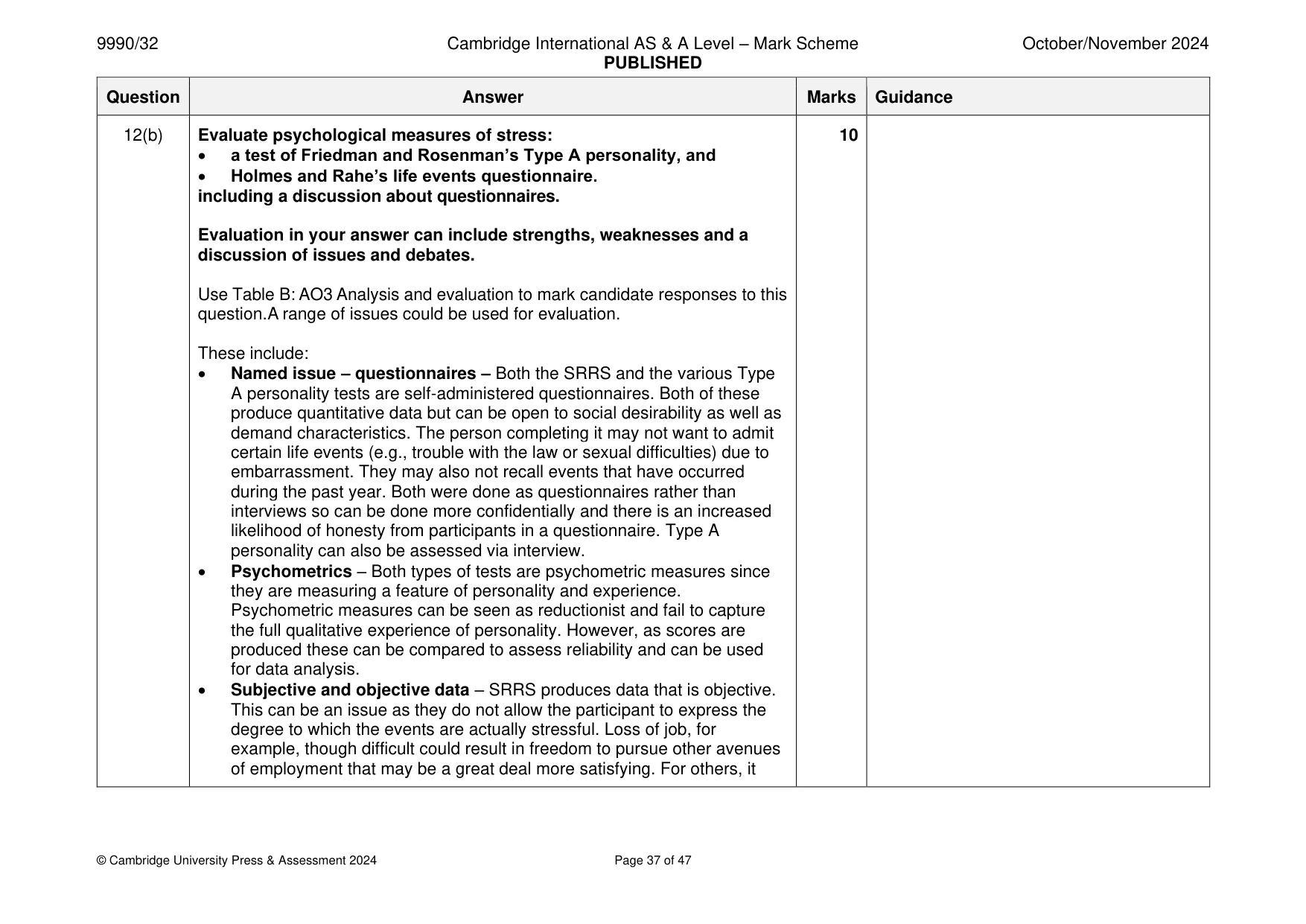
12 (a) Describe psychological measures of stress: • a test of Friedman and Rosenman’s Type A personality, and • Holmes and Rahe’s life events questionnaire. [6] (b) Evaluate psychological measures of stress: • a test of Friedman and Rosenman’s Type A personality, and • Holmes and Rahe’s life events questionnaire, including a discussion about questionnaires. Evaluation in your answer can include strengths, weaknesses and a discussion of issues and debates. [10] Section D: Organisational Psychology Answer all questions.
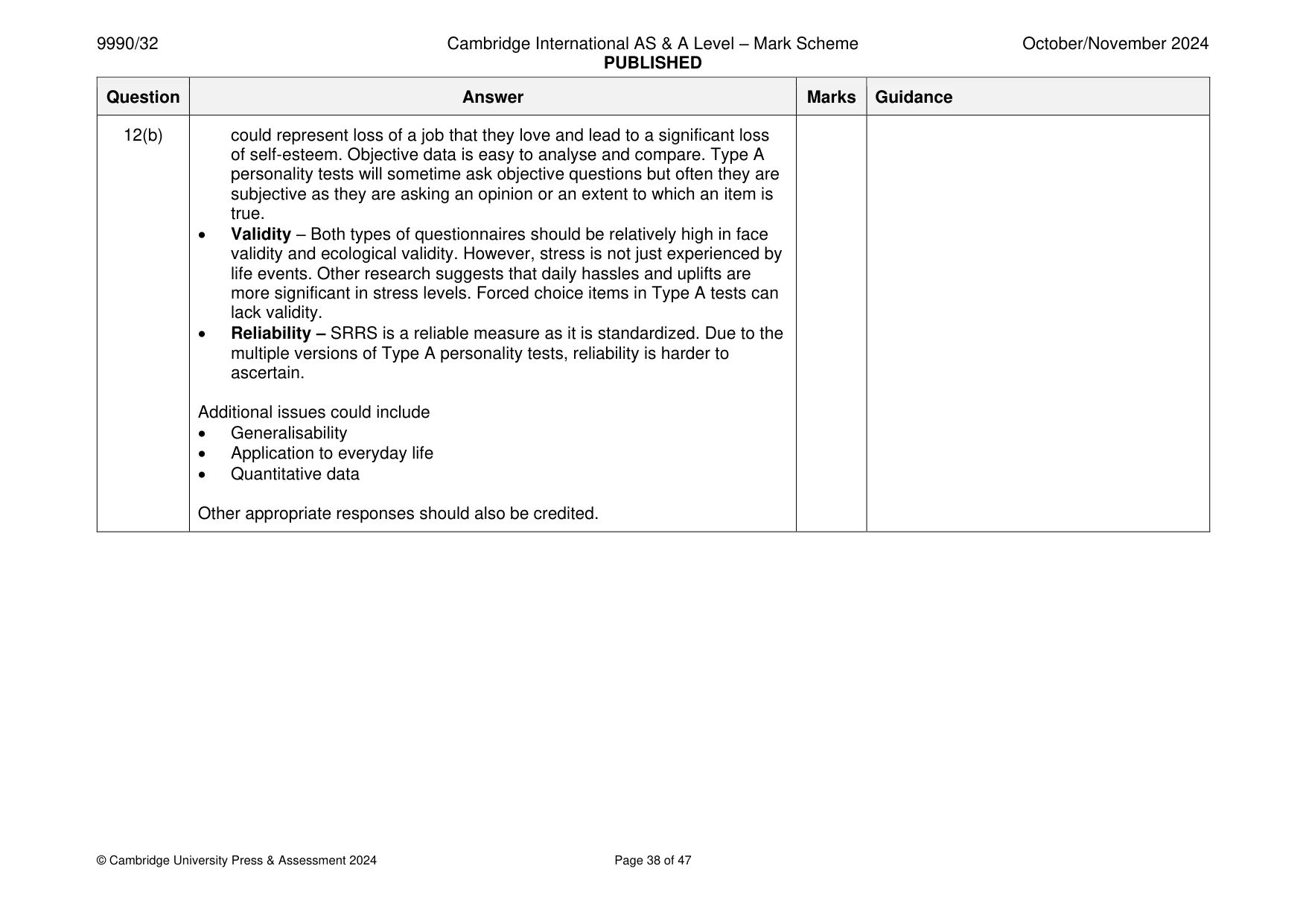
Mark scheme: 12(a) Describe psychological measures of stress: 6 Award up to 4 marks where the response • a test of Friedman and Rosenman’s Type A personality, and has described only part of the question • Holmes and Rahe’s life events questionnaire. even if the response otherwise meets the criteria for Level 3. Use Table A: AO1 Knowledge and understanding to mark candidate responses to this question. Type A/B – outline of personality features for each (with no indication of a test) = L1 Psychological measures: self-report questionnaires, including tests of Friedman and Rosenman’s Type A personality and Holmes and Rahe’s life events questionnaire. Friedman and Rosenman’s Type A personality • Friedman and Rosenman believed the causes of stress come from a combination of events in a person’s life as well as the type of personality they have. Type A personality are more likely to experience events as stressful compared to type B. Type As are controlling, high achieving and competitive; whereas type Bs are non-competitive, non-controlling and work more slowly. • No standardised measure of type A personality • There are many ways to measure type A personality including forced choice questions and Likert scale and the SI assessment (an interview measuring a person’s emotional, nonverbal and verbal responses/expressive style). • Examples of type A personality questionnaires include The Jenkins Activity Survey (JAS) – a questionnaire with 3 main categories: speed and impatience, job involvement and hard-driving competitiveness; Framingham Type A Behaviour Pattern scale – assesses an individual's sense of time urgency, competitive drive, and perceptions of job pressures; Finnish Type A scale; and Bortner Short Rating Scale; 12(a) Holmes Rahe life events questionnaire • Social readjustment rating scale (SRRS) • Produces quantitative data. • 43 life events are listed (e.g., death of a spouse, loss of job). • The person chooses which events have happened to them over the past 12 months. • Each event has a score associated with it e.g., marriage scores 50 • Scores are added and the higher the score, the higher the stress levels. • Those scoring 300 life change units or more are more susceptible to illness. Other appropriate responses should also be credited. 12(b) Evaluate psychological measures of stress: 10 • a test of Friedman and Rosenman’s Type A personality, and • Holmes and Rahe’s life events questionnaire. including a discussion about questionnaires. Evaluation in your answer can include strengths, weaknesses and a discussion of issues and debates. Use Table B: AO3 Analysis and evaluation to mark candidate responses to this question. A range of issues could be used for evaluation. These include: • Named issue – questionnaires – Both the SRRS and the various Type A personality tests are self-administered questionnaires. Both of these produce quantitative data but can be open to social desirability as well as demand characteristics. The person completing it may not want to admit certain life events (e.g., trouble with the law or sexual difficulties) due to embarrassment. They may also not recall events that have occurred during the past year. Both were done as questionnaires rather than interviews so can be done more confidentially and there is an increased likelihood of honesty from participants in a questionnaire. Type A personality can also be assessed via interview. • Psychometrics – Both types of tests are psychometric measures since they are measuring a feature of personality and experience. Psychometric measures can be seen as reductionist and fail to capture the full qualitative experience of personality. However, as scores are produced these can be compared to assess reliability and can be used for data analysis. • Subjective and objective data – SRRS produces data that is objective. This can be an issue as they do not allow the participant to express the degree to which the events are actually stressful. Loss of job, for example, though difficult could result in freedom to pursue other avenues of employment that may be a great deal more satisfying. For others, it 12(b) could represent loss of a job that they love and lead to a significant loss of self-esteem. Objective data is easy to analyse and compare. Type A personality tests will sometime ask objective questions but often they are subjective as they are asking an opinion or an extent to which an item is true. • Validity – Both types of questionnaires should be relatively high in face validity and ecological validity. However, stress is not just experienced by life events. Other research suggests that daily hassles and uplifts are more significant in stress levels. Forced choice items in Type A tests can lack validity. • Reliability – SRRS is a reliable measure as it is standardized. Due to the multiple versions of Type A personality tests, reliability is harder to ascertain. Additional issues could include • Generalisability • Application to everyday life • Quantitative data Other appropriate responses should also be credited. Section D: Organisational Psychology
Q13 · Ulrich manages an office where there is some conflict between the workers
13 Ulrich manages an office where there is some conflict between the workers. Ulrich has read that a more stereotypically feminine leadership style may help him to manage his workers better. Suggest how Ulrich could change his leadership style to one that is more stereotypically feminine. [4]
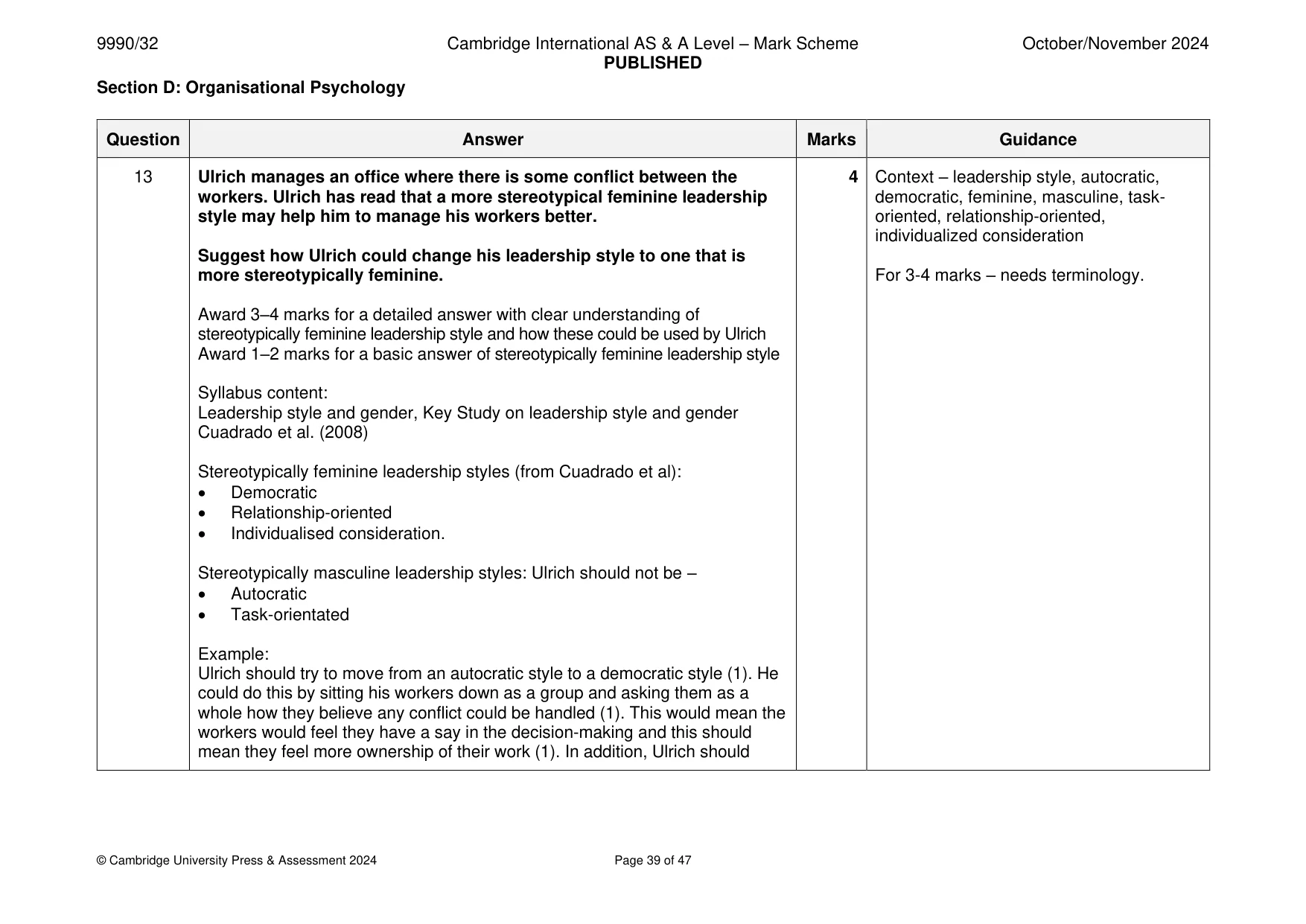
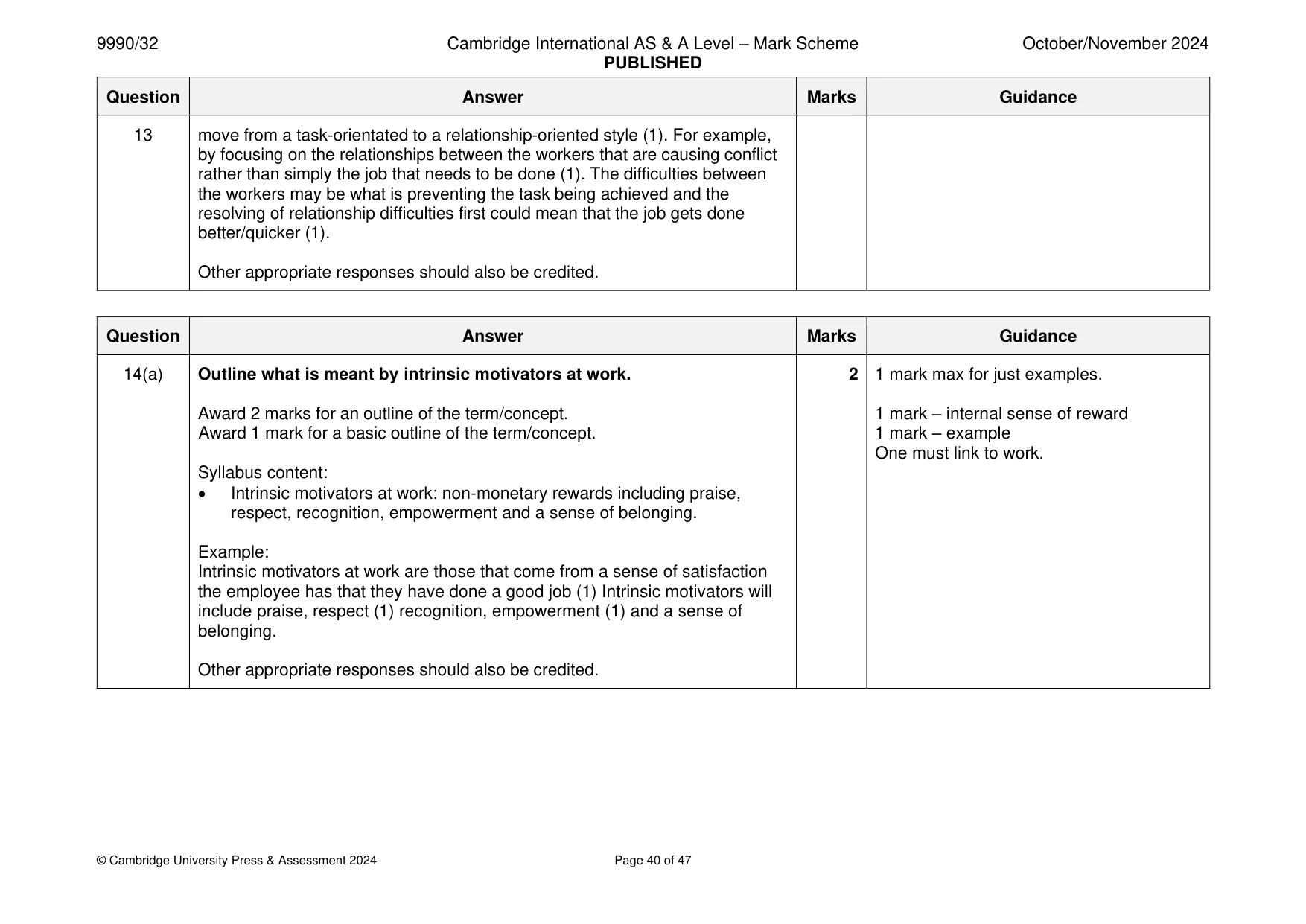
Mark scheme: 13 Ulrich manages an office where there is some conflict between the 4 Context – leadership style, autocratic, workers. Ulrich has read that a more stereotypical feminine leadership democratic, feminine, masculine, task- style may help him to manage his workers better. oriented, relationship-oriented, individualized consideration Suggest how Ulrich could change his leadership style to one that is more stereotypically feminine. For 3-4 marks – needs terminology. Award 3–4 marks for a detailed answer with clear understanding of stereotypically feminine leadership style and how these could be used by Ulrich Award 1–2 marks for a basic answer of stereotypically feminine leadership style Syllabus content: Leadership style and gender, Key Study on leadership style and gender Cuadrado et al. (2008) Stereotypically feminine leadership styles (from Cuadrado et al): • Democratic • Relationship-oriented • Individualised consideration. Stereotypically masculine leadership styles: Ulrich should not be – • Autocratic • Task-orientated Example: Ulrich should try to move from an autocratic style to a democratic style (1). He could do this by sitting his workers down as a group and asking them as a whole how they believe any conflict could be handled (1). This would mean the workers would feel they have a say in the decision-making and this should mean they feel more ownership of their work (1). In addition, Ulrich should 13 move from a task-orientated to a relationship-oriented style (1). For example, by focusing on the relationships between the workers that are causing conflict rather than simply the job that needs to be done (1). The difficulties between the workers may be what is preventing the task being achieved and the resolving of relationship difficulties first could mean that the job gets done better/quicker (1). Other appropriate responses should also be credited.
Q14 · Outline what is meant by intrinsic motivators at work
14 (a) Outline what is meant by intrinsic motivators at work. [2] (b) Explain why intrinsic motivators at work can differ between cultures. [2]
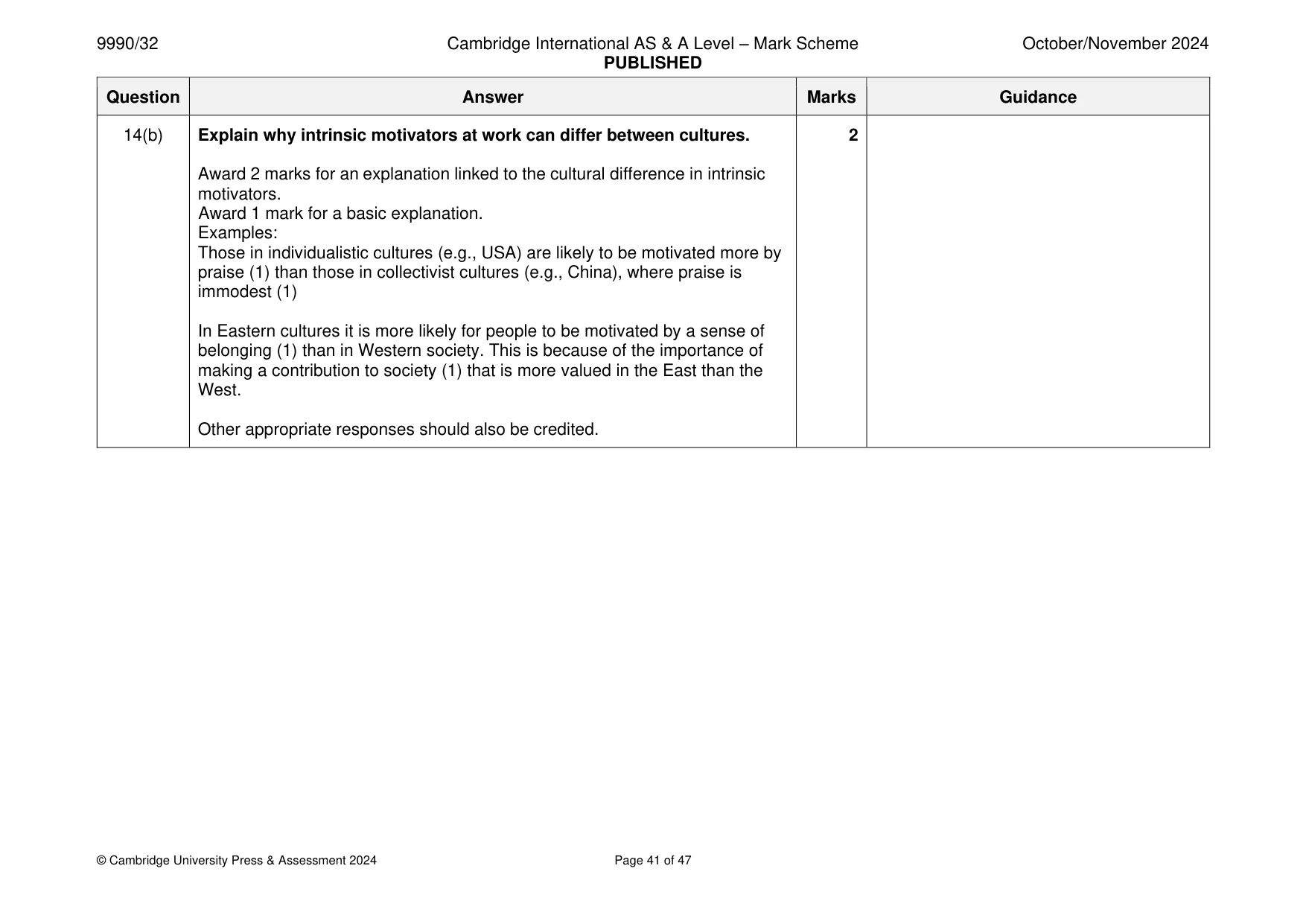
Mark scheme: 14(a) Outline what is meant by intrinsic motivators at work. 2 1 mark max for just examples. Award 2 marks for an outline of the term/concept. 1 mark – internal sense of reward Award 1 mark for a basic outline of the term/concept. 1 mark – example One must link to work. Syllabus content: • Intrinsic motivators at work: non-monetary rewards including praise, respect, recognition, empowerment and a sense of belonging. Example: Intrinsic motivators at work are those that come from a sense of satisfaction the employee has that they have done a good job (1) Intrinsic motivators will include praise, respect (1) recognition, empowerment (1) and a sense of belonging. Other appropriate responses should also be credited. 14(b) Explain why intrinsic motivators at work can differ between cultures. 2 Award 2 marks for an explanation linked to the cultural difference in intrinsic motivators. Award 1 mark for a basic explanation. Examples: Those in individualistic cultures (e.g., USA) are likely to be motivated more by praise (1) than those in collectivist cultures (e.g., China), where praise is immodest (1) In Eastern cultures it is more likely for people to be motivated by a sense of belonging (1) than in Western society. This is because of the importance of making a contribution to society (1) that is more valued in the East than the West. Other appropriate responses should also be credited.
Q15 · Tayyibah is the manager of a small factory making fabric
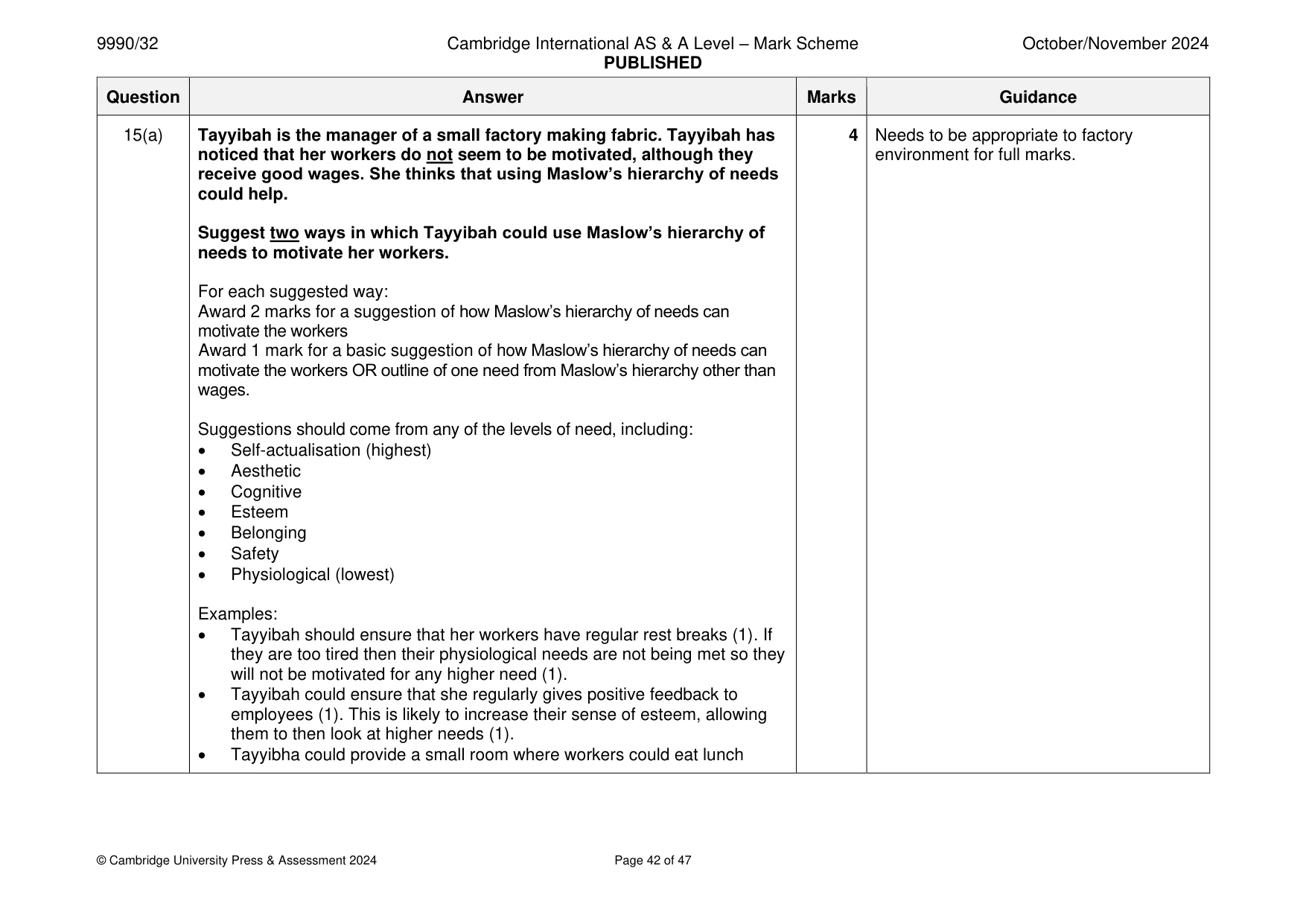
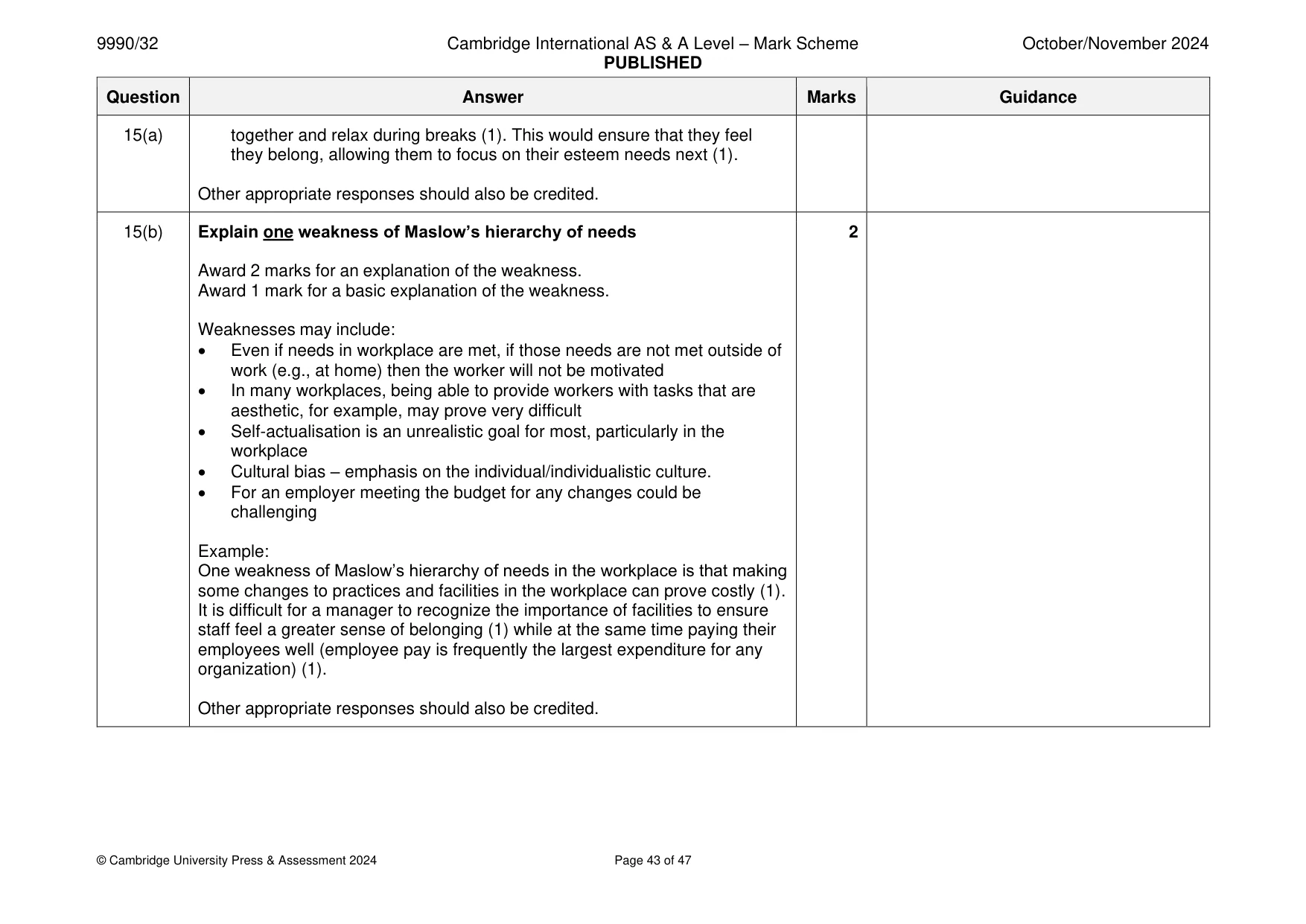
15 Tayyibah is the manager of a small factory making fabric. Tayyibah has noticed that her workers do not seem to be motivated, although they receive good wages. She thinks that using Maslow’s hierarchy of needs could help. (a) Suggest two ways in which Tayyibah could use Maslow’s hierarchy of needs to motivate her workers. [4] (b) Explain one weakness of Maslow’s hierarchy of needs. [2]
Mark scheme: 15(a) Tayyibah is the manager of a small factory making fabric. Tayyibah has 4 Needs to be appropriate to factory noticed that her workers do not seem to be motivated, although they environment for full marks. receive good wages. She thinks that using Maslow’s hierarchy of needs could help. Suggest two ways in which Tayyibah could use Maslow’s hierarchy of needs to motivate her workers. For each suggested way: Award 2 marks for a suggestion of how Maslow’s hierarchy of needs can motivate the workers Award 1 mark for a basic suggestion of how Maslow’s hierarchy of needs can motivate the workers OR outline of one need from Maslow’s hierarchy other than wages. Suggestions should come from any of the levels of need, including: • Self-actualisation (highest) • Aesthetic • Cognitive • Esteem • Belonging • Safety • Physiological (lowest) Examples: • Tayyibah should ensure that her workers have regular rest breaks (1). If they are too tired then their physiological needs are not being met so they will not be motivated for any higher need (1). • Tayyibah could ensure that she regularly gives positive feedback to employees (1). This is likely to increase their sense of esteem, allowing them to then look at higher needs (1). • Tayyibha could provide a small room where workers could eat lunch 15(a) together and relax during breaks (1). This would ensure that they feel they belong, allowing them to focus on their esteem needs next (1). Other appropriate responses should also be credited. 15(b) Explain one weakness of Maslow’s hierarchy of needs 2 Award 2 marks for an explanation of the weakness. Award 1 mark for a basic explanation of the weakness. Weaknesses may include: • Even if needs in workplace are met, if those needs are not met outside of work (e.g., at home) then the worker will not be motivated • In many workplaces, being able to provide workers with tasks that are aesthetic, for example, may prove very difficult • Self-actualisation is an unrealistic goal for most, particularly in the workplace • Cultural bias – emphasis on the individual/individualistic culture. • For an employer meeting the budget for any changes could be challenging Example: One weakness of Maslow’s hierarchy of needs in the workplace is that making some changes to practices and facilities in the workplace can prove costly (1). It is difficult for a manager to recognize the importance of facilities to ensure staff feel a greater sense of belonging (1) while at the same time paying their employees well (employee pay is frequently the largest expenditure for any organization) (1). Other appropriate responses should also be credited.
Q16 · Describe what psychologists have discovered about group development and decision‑making…
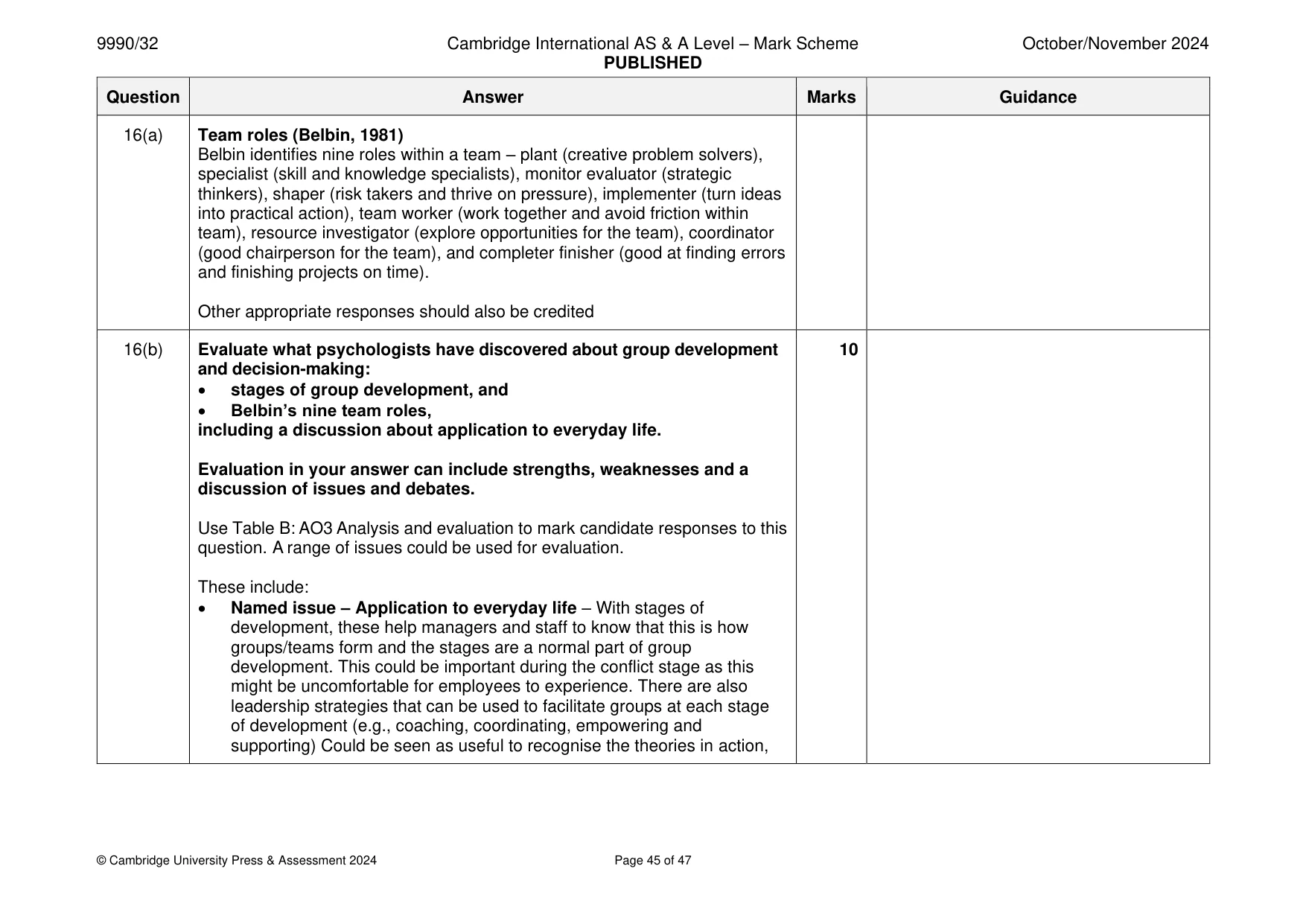
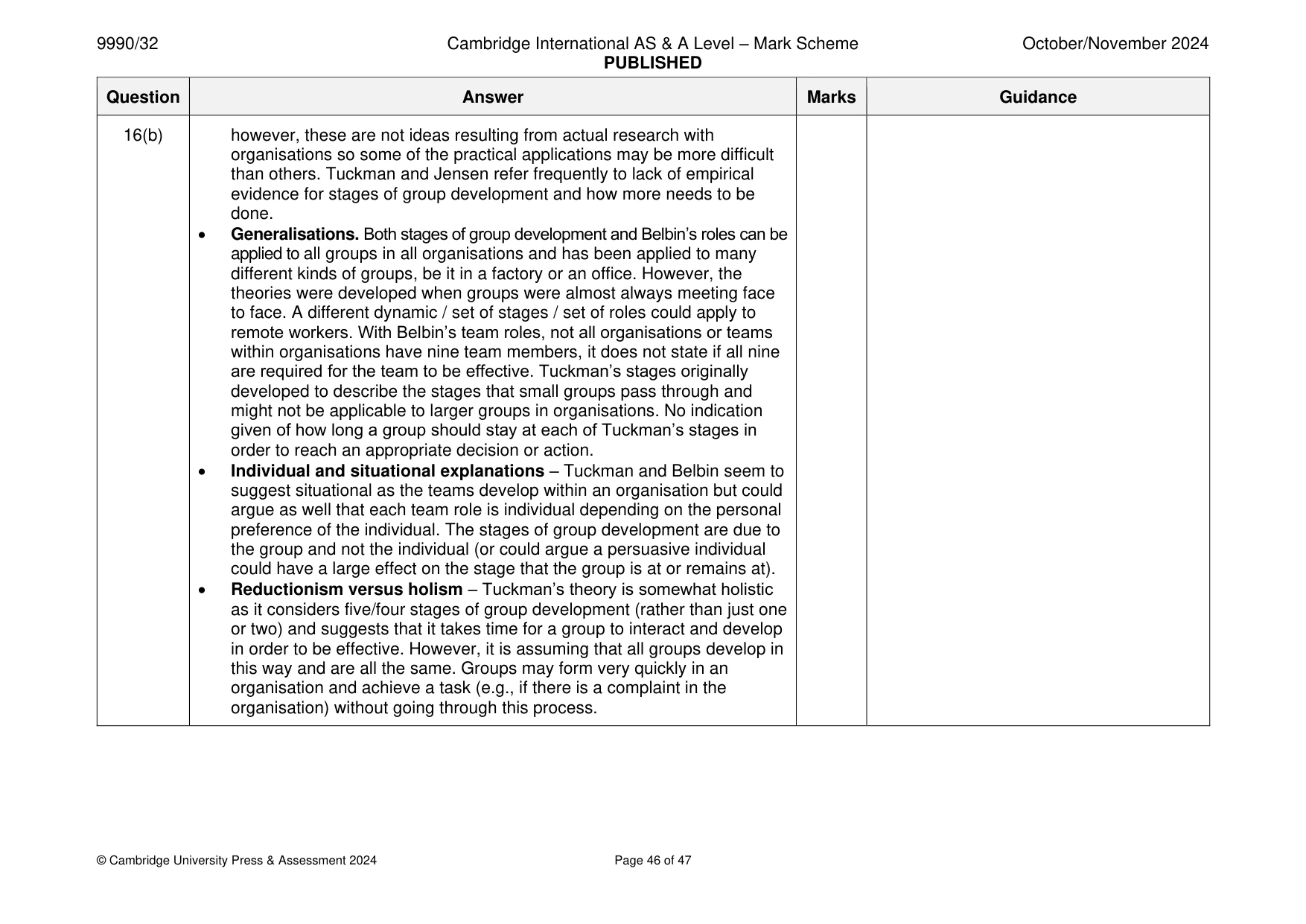
16 (a) Describe what psychologists have discovered about group development and decision‑making: • stages of group development, and • Belbin’s nine team roles. [6] (b) Evaluate what psychologists have discovered about group development and decision‑making: • stages of group development, and • Belbin’s nine team roles, including a discussion about application to everyday life. Evaluation in your answer can include strengths, weaknesses and a discussion of issues and debates. [10]
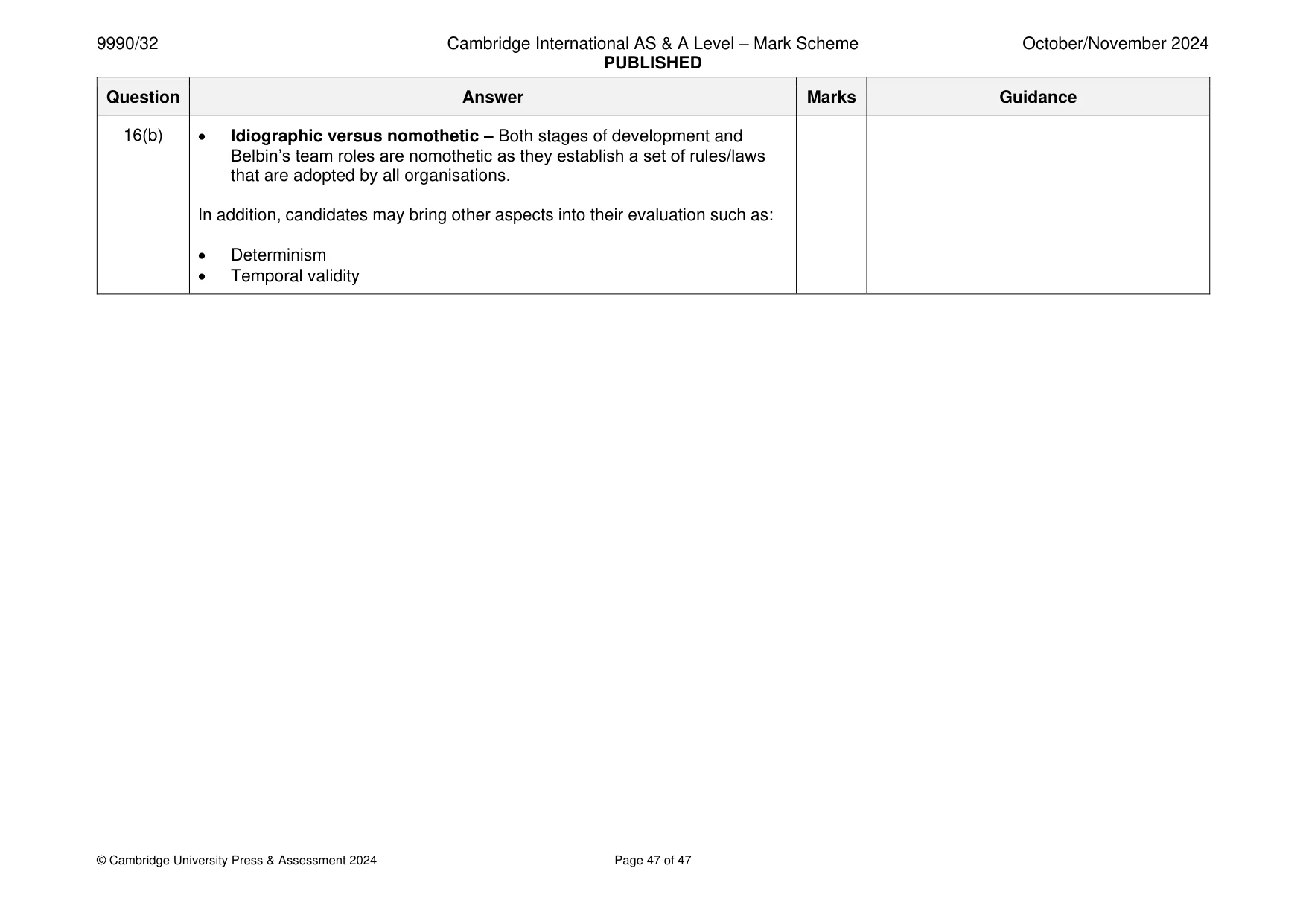
Mark scheme: 16(a) Describe what psychologists have discovered about group development 6 Award up to 4 marks where the response and decision-making: has described only part of the question • stages of group development, and even if the response otherwise meets the • Belbin’s nine team roles. criteria for Level 3. Use Table A: AO1 Knowledge and understanding to mark candidate responses to this question. Candidates must discuss both stages of group development and Belbin’s nine team roles but they need not refer to the study by Tuckman and Jensen named in the syllabus. Group development Tuckman and Jensen noted five stages – forming, storming, norming, performing and adjourning Tuckman also proposed a four-stage development procedure for a group – orientation to the task, intra-group conflict, development of group cohesion and functional role-relatedness (group begins to tackle the task at hand). Stages – Forming – the group/ground rules are established; other group members are strangers. Storming – conflict occurs as the group members establish their place in the group. Conflict may occur between the leader and the other group members. Norming – the members begin to feel a part of the group/team and each person’s role within the team is clear. Performing – the group has a clear vision and purpose and there is a focus on shared goal achievement. Adjourning – the group disbands due to the completion of a project or it could be where an existing group reviews their progress over the past year/6 months. The group recognises how much they have achieved and each person’s contribution to the shared tasks. 16(a) Team roles (Belbin, 1981) Belbin identifies nine roles within a team – plant (creative problem solvers), specialist (skill and knowledge specialists), monitor evaluator (strategic thinkers), shaper (risk takers and thrive on pressure), implementer (turn ideas into practical action), team worker (work together and avoid friction within team), resource investigator (explore opportunities for the team), coordinator (good chairperson for the team), and completer finisher (good at finding errors and finishing projects on time). Other appropriate responses should also be credited 16(b) Evaluate what psychologists have discovered about group development 10 and decision-making: • stages of group development, and • Belbin’s nine team roles, including a discussion about application to everyday life. Evaluation in your answer can include strengths, weaknesses and a discussion of issues and debates. Use Table B: AO3 Analysis and evaluation to mark candidate responses to this question. A range of issues could be used for evaluation. These include: • Named issue – Application to everyday life – With stages of development, these help managers and staff to know that this is how groups/teams form and the stages are a normal part of group development. This could be important during the conflict stage as this might be uncomfortable for employees to experience. There are also leadership strategies that can be used to facilitate groups at each stage of development (e.g., coaching, coordinating, empowering and supporting) Could be seen as useful to recognise the theories in action, 16(b) however, these are not ideas resulting from actual research with organisations so some of the practical applications may be more difficult than others. Tuckman and Jensen refer frequently to lack of empirical evidence for stages of group development and how more needs to be done. • Generalisations. Both stages of group development and Belbin’s roles can be applied to all groups in all organisations and has been applied to many different kinds of groups, be it in a factory or an office. However, the theories were developed when groups were almost always meeting face to face. A different dynamic / set of stages / set of roles could apply to remote workers. With Belbin’s team roles, not all organisations or teams within organisations have nine team members, it does not state if all nine are required for the team to be effective. Tuckman’s stages originally developed to describe the stages that small groups pass through and might not be applicable to larger groups in organisations. No indication given of how long a group should stay at each of Tuckman’s stages in order to reach an appropriate decision or action. • Individual and situational explanations – Tuckman and Belbin seem to suggest situational as the teams develop within an organisation but could argue as well that each team role is individual depending on the personal preference of the individual. The stages of group development are due to the group and not the individual (or could argue a persuasive individual could have a large effect on the stage that the group is at or remains at). • Reductionism versus holism – Tuckman’s theory is somewhat holistic as it considers five/four stages of group development (rather than just one or two) and suggests that it takes time for a group to interact and develop in order to be effective. However, it is assuming that all groups develop in this way and are all the same. Groups may form very quickly in an organisation and achieve a task (e.g., if there is a complaint in the organisation) without going through this process. 16(b) • Idiographic versus nomothetic – Both stages of development and Belbin’s team roles are nomothetic as they establish a set of rules/laws that are adopted by all organisations. In addition, candidates may bring other aspects into their evaluation such as: • Determinism • Temporal validity
What was in this paper
The subtopics covered by these 16 questions, and how many questions each got. Open one in a new tab to see every Cambridge question on it.
What you needed in this session
Cambridge’s own grade thresholds for 2024 Oct/Nov, Paper 3 · Variant 2. A higher threshold means an easier paper — the bar moves with how the cohort did.