Cambridge A Level Psychology (from 2018) 9990 — 2021 Oct/Nov Paper 3 · Variant 1
9990/31/O/N/21 · 8 questions · 60 marks · ≈68 min
The question paper and its mark scheme, free to read here and free to download. This is Cambridge’s own paper, exactly as it was sat.
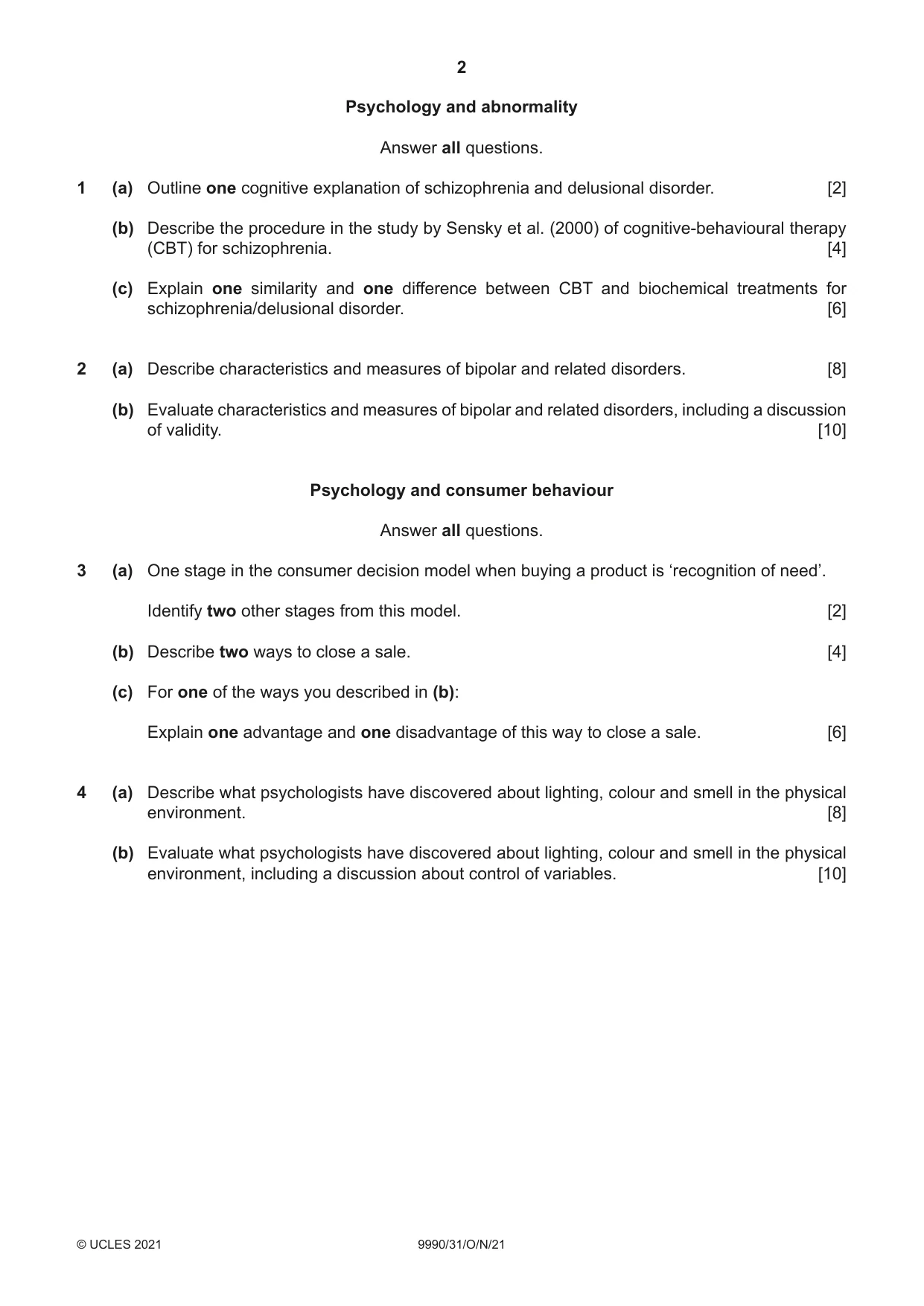
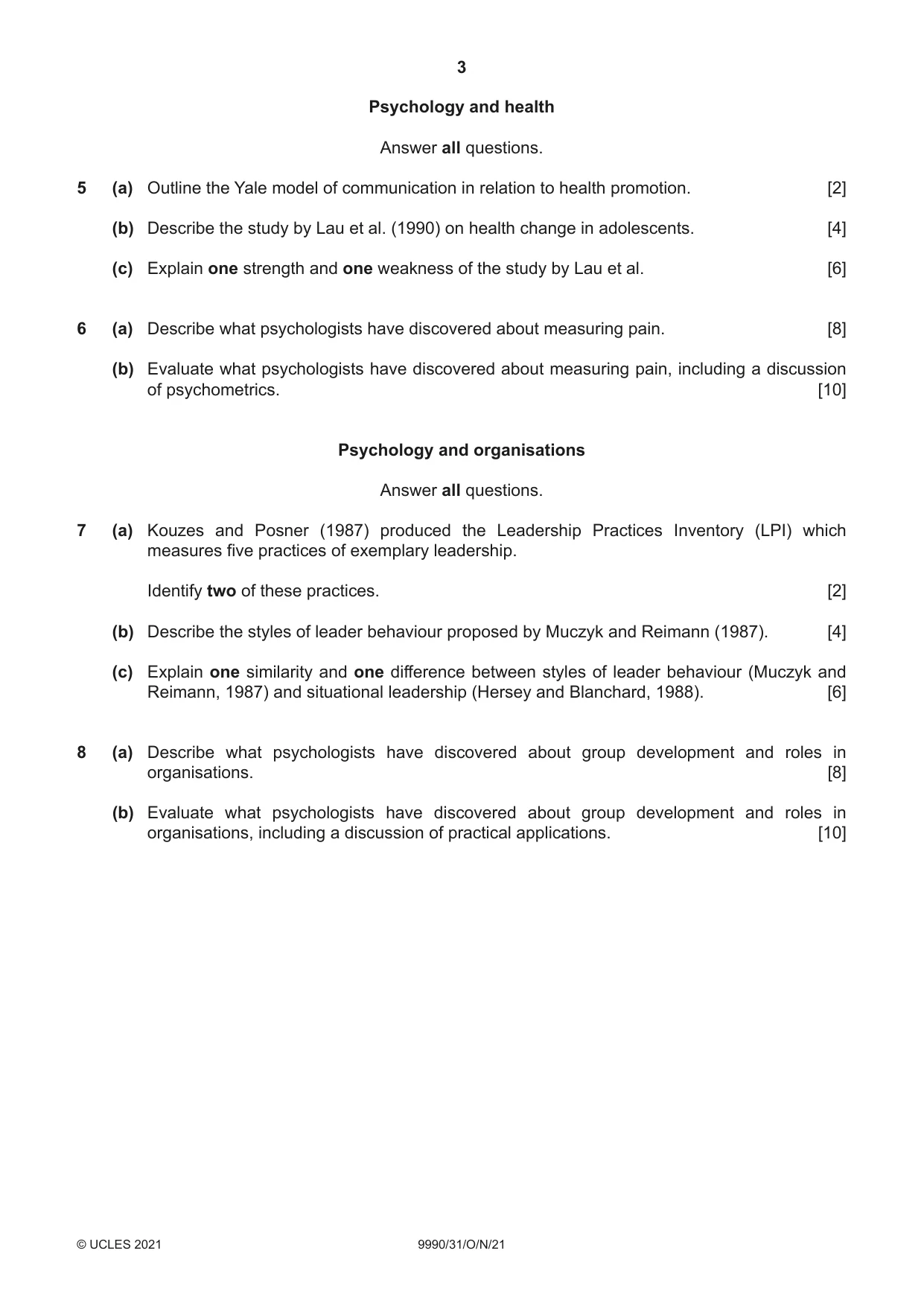
Question paper4 pages

Mark scheme21 pages
Answers below. Sit the paper first if you are practising.
Questions as text
Q1 · Outline one cognitive explanation of schizophrenia and delusional disorder
1 (a) Outline one cognitive explanation of schizophrenia and delusional disorder. [2] (b) Describe the procedure in the study by Sensky et al. (2000) of cognitive-behavioural therapy (CBT) for schizophrenia. [4] (c) Explain one similarity and one difference between CBT and biochemical treatments for schizophrenia/delusional disorder. [6]
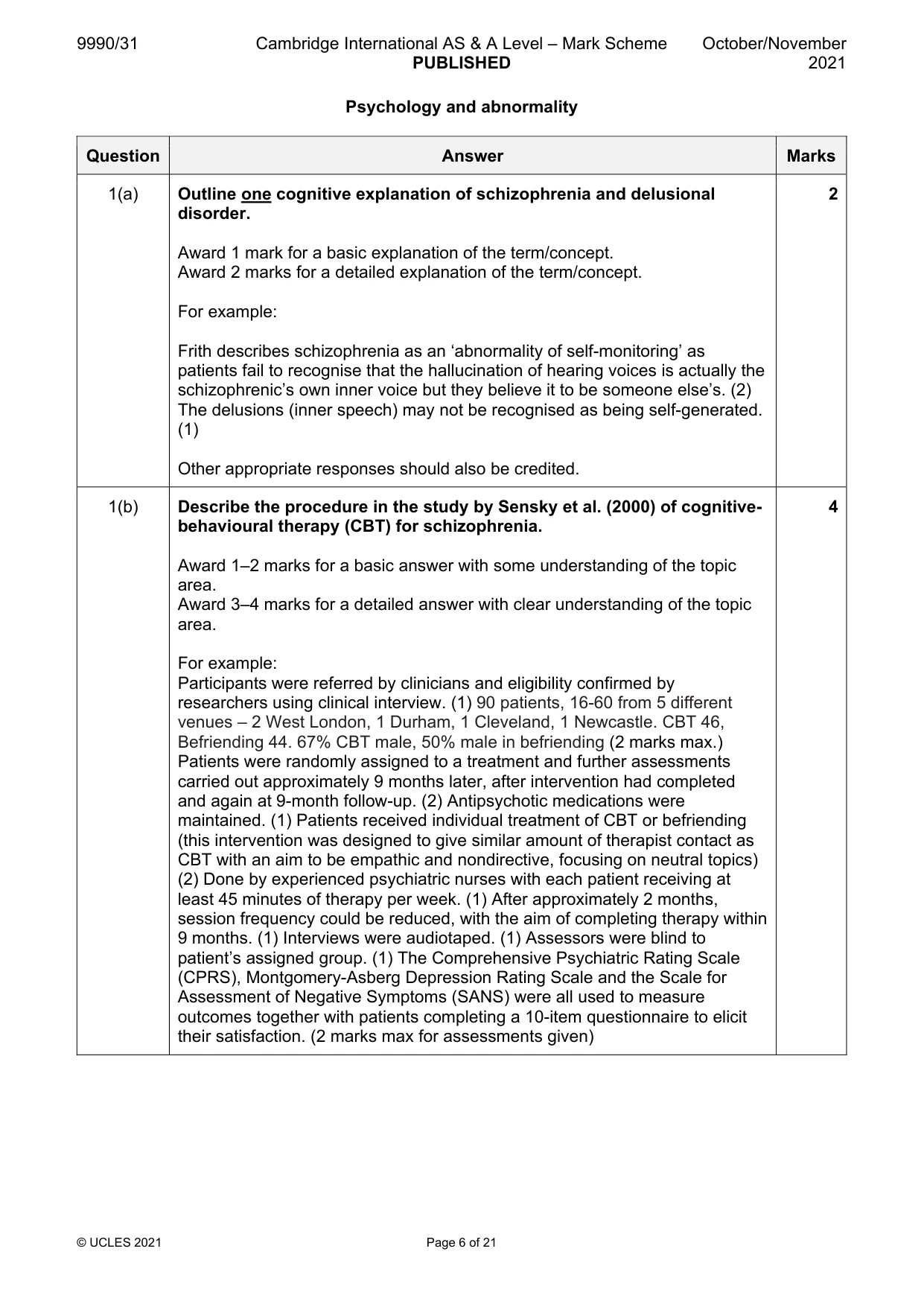
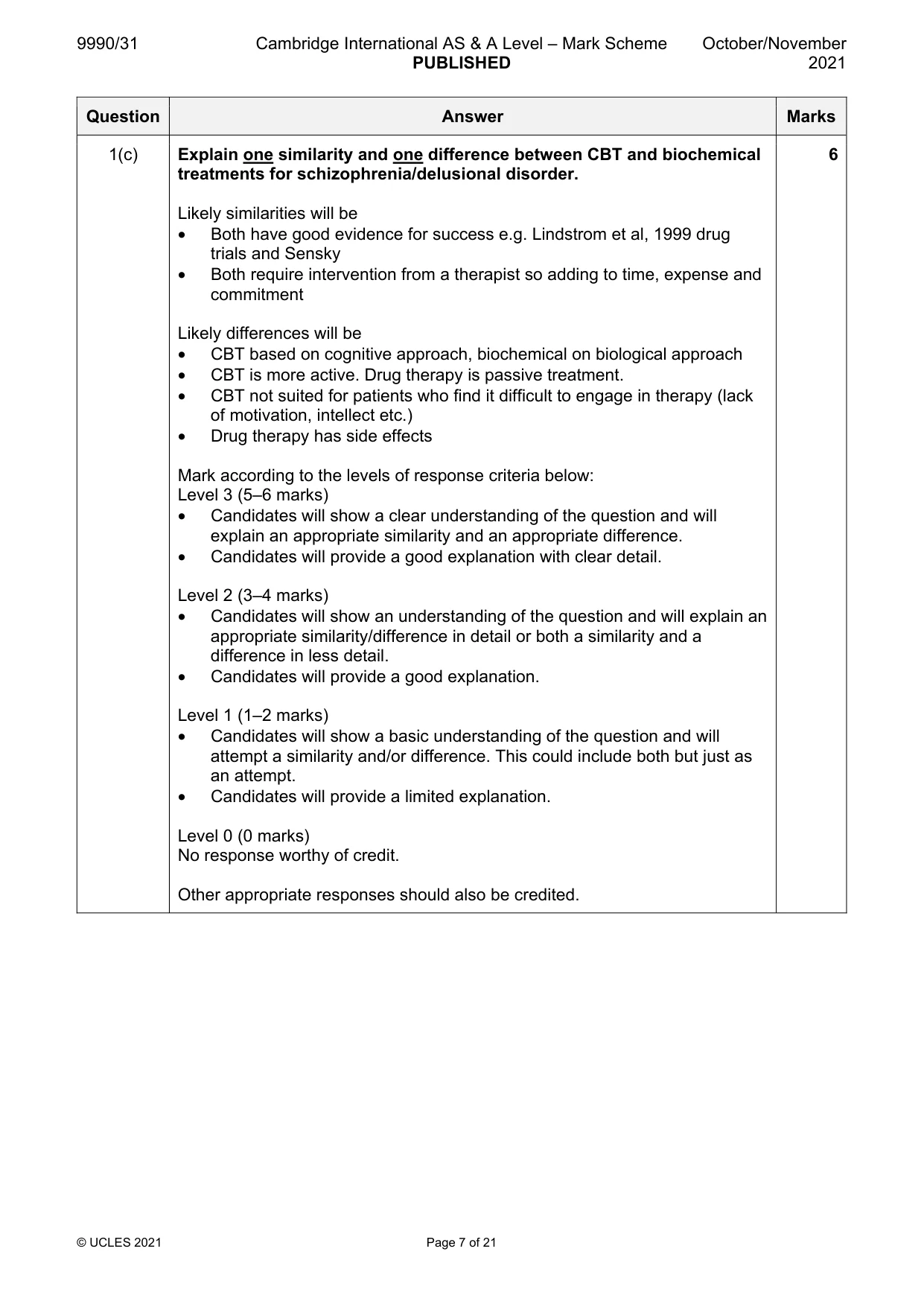
Mark scheme: Question Answer Marks 1(a) Outline one cognitive explanation of schizophrenia and delusional 2 disorder. Award 1 mark for a basic explanation of the term/concept. Award 2 marks for a detailed explanation of the term/concept. For example: Frith describes schizophrenia as an ‘abnormality of self-monitoring’ as patients fail to recognise that the hallucination of hearing voices is actually the schizophrenic’s own inner voice but they believe it to be someone else’s. (2) The delusions (inner speech) may not be recognised as being self-generated. (1) Other appropriate responses should also be credited. 1(b) Describe the procedure in the study by Sensky et al. (2000) of cognitive- 4 behavioural therapy (CBT) for schizophrenia. Award 1–2 marks for a basic answer with some understanding of the topic area. Award 3–4 marks for a detailed answer with clear understanding of the topic area. For example: Participants were referred by clinicians and eligibility confirmed by researchers using clinical interview. (1) 90 patients, 16-60 from 5 different venues – 2 West London, 1 Durham, 1 Cleveland, 1 Newcastle. CBT 46, Befriending 44. 67% CBT male, 50% male in befriending (2 marks max.) Patients were randomly assigned to a treatment and further assessments carried out approximately 9 months later, after intervention had completed and again at 9-month follow-up. (2) Antipsychotic medications were maintained. (1) Patients received individual treatment of CBT or befriending (this intervention was designed to give similar amount of therapist contact as CBT with an aim to be empathic and nondirective, focusing on neutral topics) (2) Done by experienced psychiatric nurses with each patient receiving at least 45 minutes of therapy per week. (1) After approximately 2 months, session frequency could be reduced, with the aim of completing therapy within 9 months. (1) Interviews were audiotaped. (1) Assessors were blind to patient’s assigned group. (1) The Comprehensive Psychiatric Rating Scale (CPRS), Montgomery-Asberg Depression Rating Scale and the Scale for Assessment of Negative Symptoms (SANS) were all used to measure outcomes together with patients completing a 10-item questionnaire to elicit their satisfaction. (2 marks max for assessments given) 1(c) Explain one similarity and one difference between CBT and biochemical 6 treatments for schizophrenia/delusional disorder. Likely similarities will be • Both have good evidence for success e.g. Lindstrom et al, 1999 drug trials and Sensky • Both require intervention from a therapist so adding to time, expense and commitment Likely differences will be • CBT based on cognitive approach, biochemical on biological approach • CBT is more active. Drug therapy is passive treatment. • CBT not suited for patients who find it difficult to engage in therapy (lack of motivation, intellect etc.) • Drug therapy has side effects Mark according to the levels of response criteria below: Level 3 (5–6 marks) • Candidates will show a clear understanding of the question and will explain an appropriate similarity and an appropriate difference. • Candidates will provide a good explanation with clear detail. Level 2 (3–4 marks) • Candidates will show an understanding of the question and will explain an appropriate similarity/difference in detail or both a similarity and a difference in less detail. • Candidates will provide a good explanation. Level 1 (1–2 marks) • Candidates will show a basic understanding of the question and will attempt a similarity and/or difference. This could include both but just as an attempt. • Candidates will provide a limited explanation. Level 0 (0 marks) No response worthy of credit. Other appropriate responses should also be credited.
Q2 · Describe characteristics and measures of bipolar and related disorders
2 (a) Describe characteristics and measures of bipolar and related disorders. [8] (b) Evaluate characteristics and measures of bipolar and related disorders, including a discussion of validity. [10] Psychology and consumer behaviour Answer all questions.
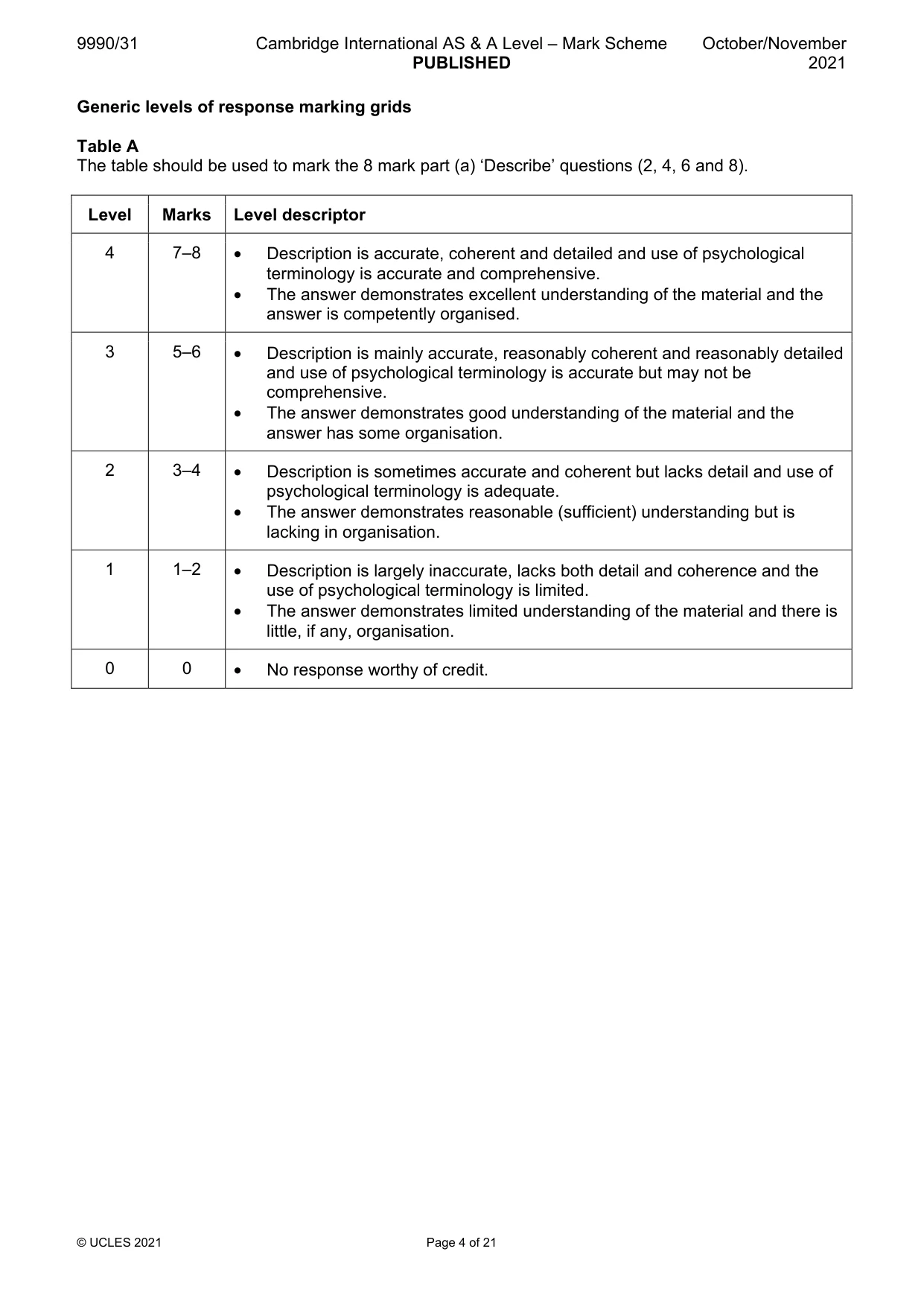
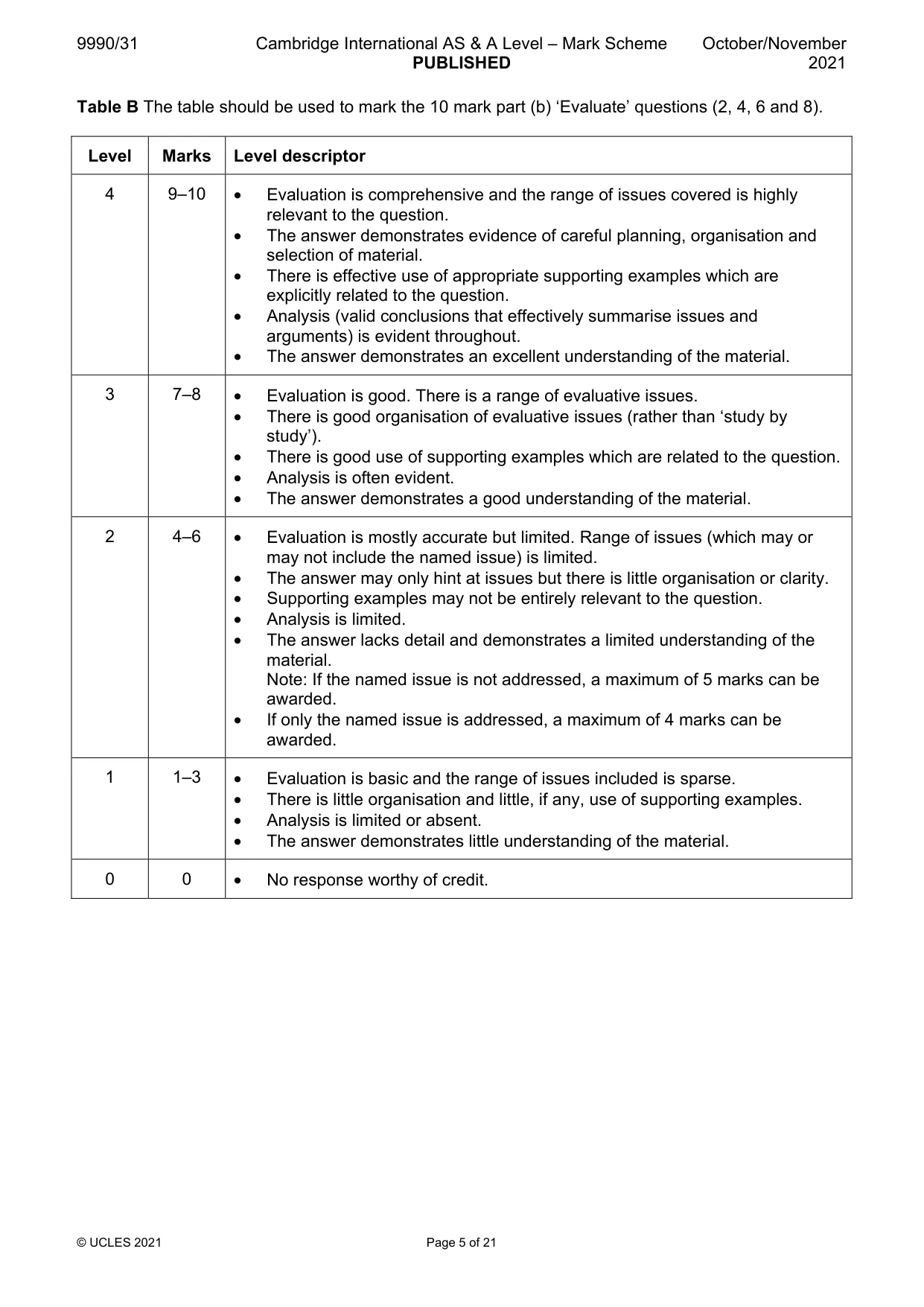
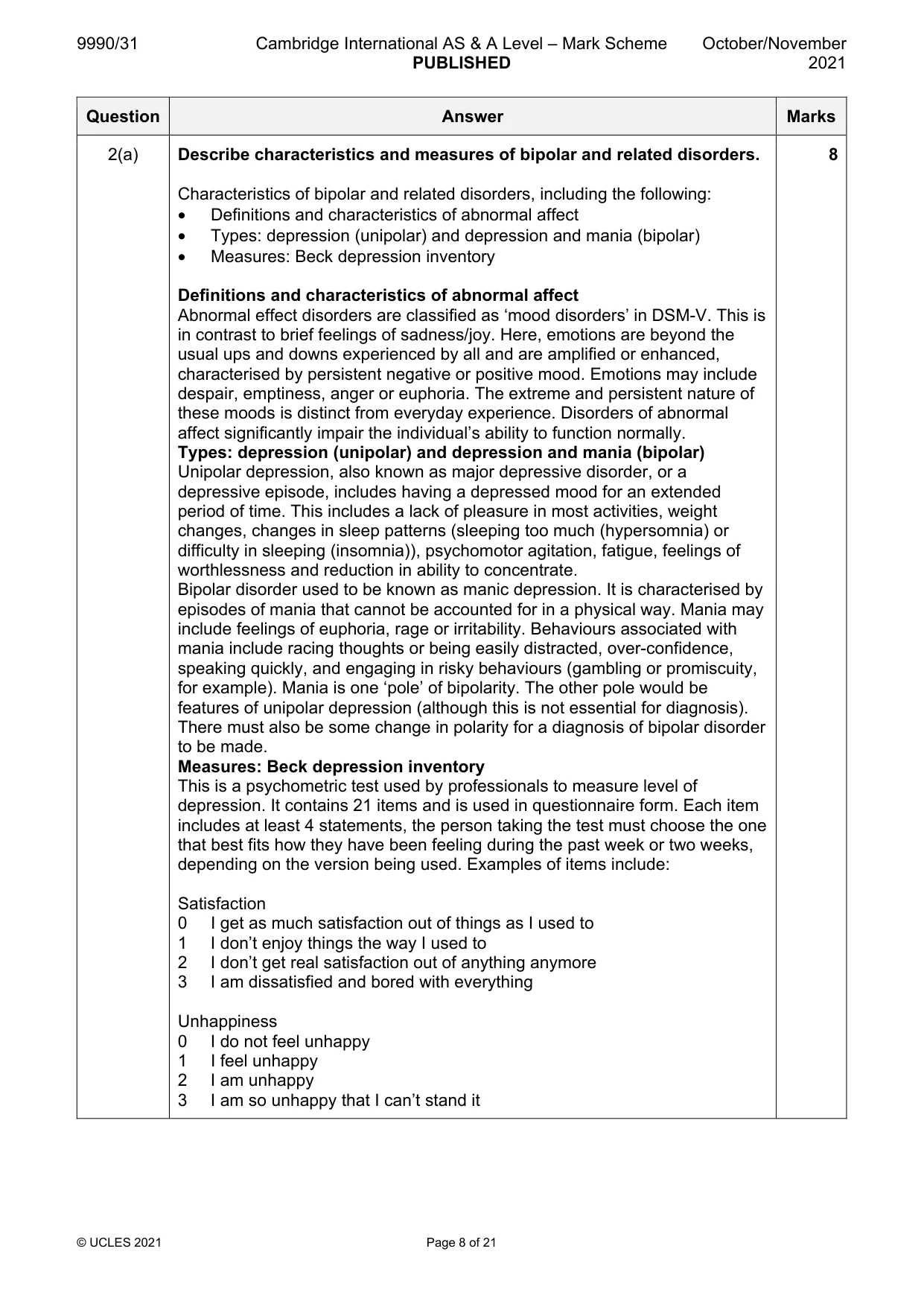
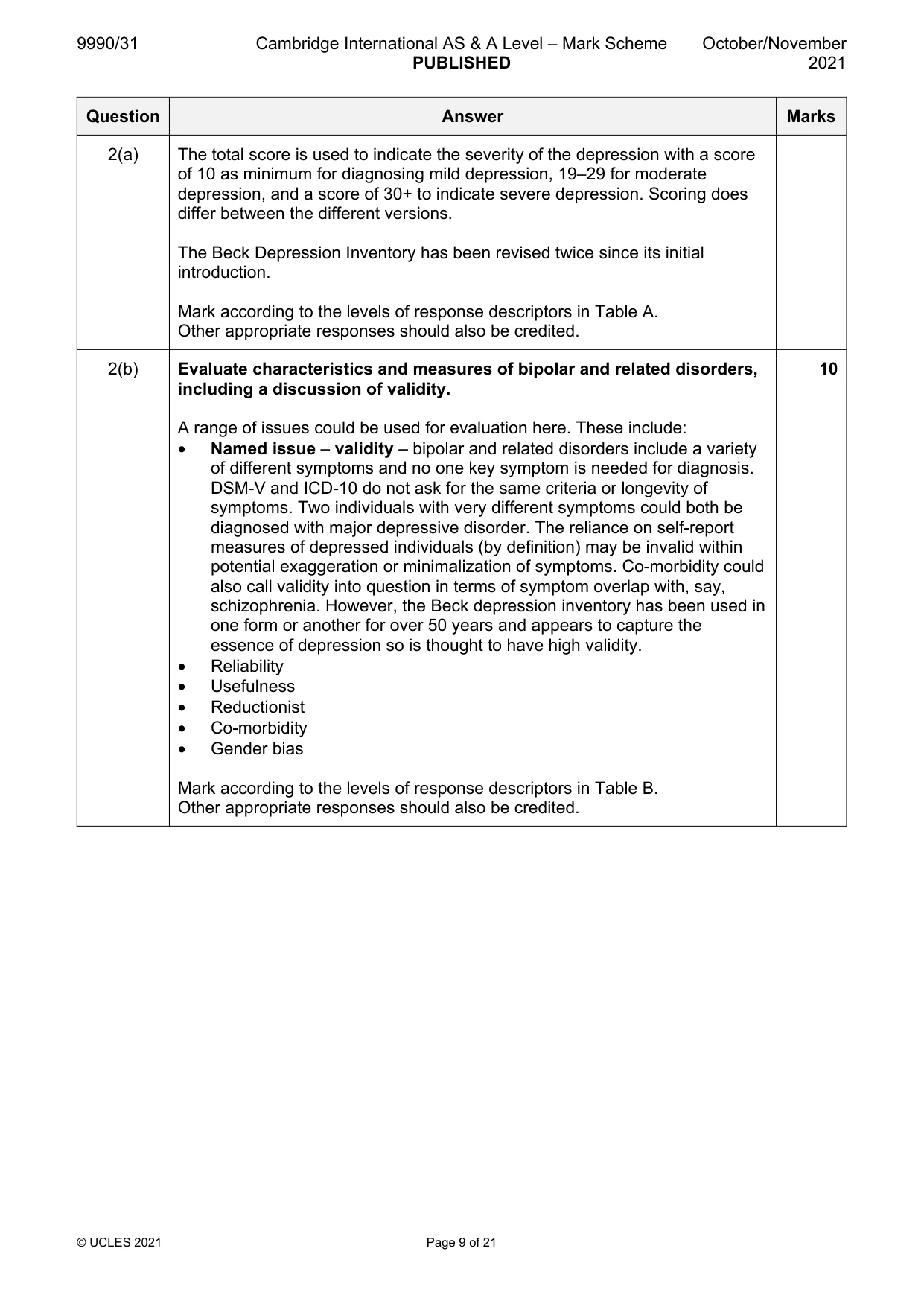
Mark scheme: 2(a) Describe characteristics and measures of bipolar and related disorders. 8 Characteristics of bipolar and related disorders, including the following: • Definitions and characteristics of abnormal affect • Types: depression (unipolar) and depression and mania (bipolar) • Measures: Beck depression inventory Definitions and characteristics of abnormal affect Abnormal effect disorders are classified as ‘mood disorders’ in DSM-V. This is in contrast to brief feelings of sadness/joy. Here, emotions are beyond the usual ups and downs experienced by all and are amplified or enhanced, characterised by persistent negative or positive mood. Emotions may include despair, emptiness, anger or euphoria. The extreme and persistent nature of these moods is distinct from everyday experience. Disorders of abnormal affect significantly impair the individual’s ability to function normally. Types: depression (unipolar) and depression and mania (bipolar) Unipolar depression, also known as major depressive disorder, or a depressive episode, includes having a depressed mood for an extended period of time. This includes a lack of pleasure in most activities, weight changes, changes in sleep patterns (sleeping too much (hypersomnia) or difficulty in sleeping (insomnia)), psychomotor agitation, fatigue, feelings of worthlessness and reduction in ability to concentrate. Bipolar disorder used to be known as manic depression. It is characterised by episodes of mania that cannot be accounted for in a physical way. Mania may include feelings of euphoria, rage or irritability. Behaviours associated with mania include racing thoughts or being easily distracted, over-confidence, speaking quickly, and engaging in risky behaviours (gambling or promiscuity, for example). Mania is one ‘pole’ of bipolarity. The other pole would be features of unipolar depression (although this is not essential for diagnosis). There must also be some change in polarity for a diagnosis of bipolar disorder to be made. Measures: Beck depression inventory This is a psychometric test used by professionals to measure level of depression. It contains 21 items and is used in questionnaire form. Each item includes at least 4 statements, the person taking the test must choose the one that best fits how they have been feeling during the past week or two weeks, depending on the version being used. Examples of items include: Satisfaction 0 I get as much satisfaction out of things as I used to 1 I don’t enjoy things the way I used to 2 I don’t get real satisfaction out of anything anymore 3 I am dissatisfied and bored with everything Unhappiness 0 I do not feel unhappy 1 I feel unhappy 2 I am unhappy 3 I am so unhappy that I can’t stand it 2(a) The total score is used to indicate the severity of the depression with a score of 10 as minimum for diagnosing mild depression, 19–29 for moderate depression, and a score of 30+ to indicate severe depression. Scoring does differ between the different versions. The Beck Depression Inventory has been revised twice since its initial introduction. Mark according to the levels of response descriptors in Table A. Other appropriate responses should also be credited. 2(b) Evaluate characteristics and measures of bipolar and related disorders, 10 including a discussion of validity. A range of issues could be used for evaluation here. These include: • Named issue – validity – bipolar and related disorders include a variety of different symptoms and no one key symptom is needed for diagnosis. DSM-V and ICD-10 do not ask for the same criteria or longevity of symptoms. Two individuals with very different symptoms could both be diagnosed with major depressive disorder. The reliance on self-report measures of depressed individuals (by definition) may be invalid within potential exaggeration or minimalization of symptoms. Co-morbidity could also call validity into question in terms of symptom overlap with, say, schizophrenia. However, the Beck depression inventory has been used in one form or another for over 50 years and appears to capture the essence of depression so is thought to have high validity. • Reliability • Usefulness • Reductionist • Co-morbidity • Gender bias Mark according to the levels of response descriptors in Table B. Other appropriate responses should also be credited. Psychology and consumer behaviour
More questions on Mood (affective) disorders: depressive disorder (unipolar) and bipolar disorder
Q3 · One stage in the consumer decision model when buying a product is ‘recognition of need’
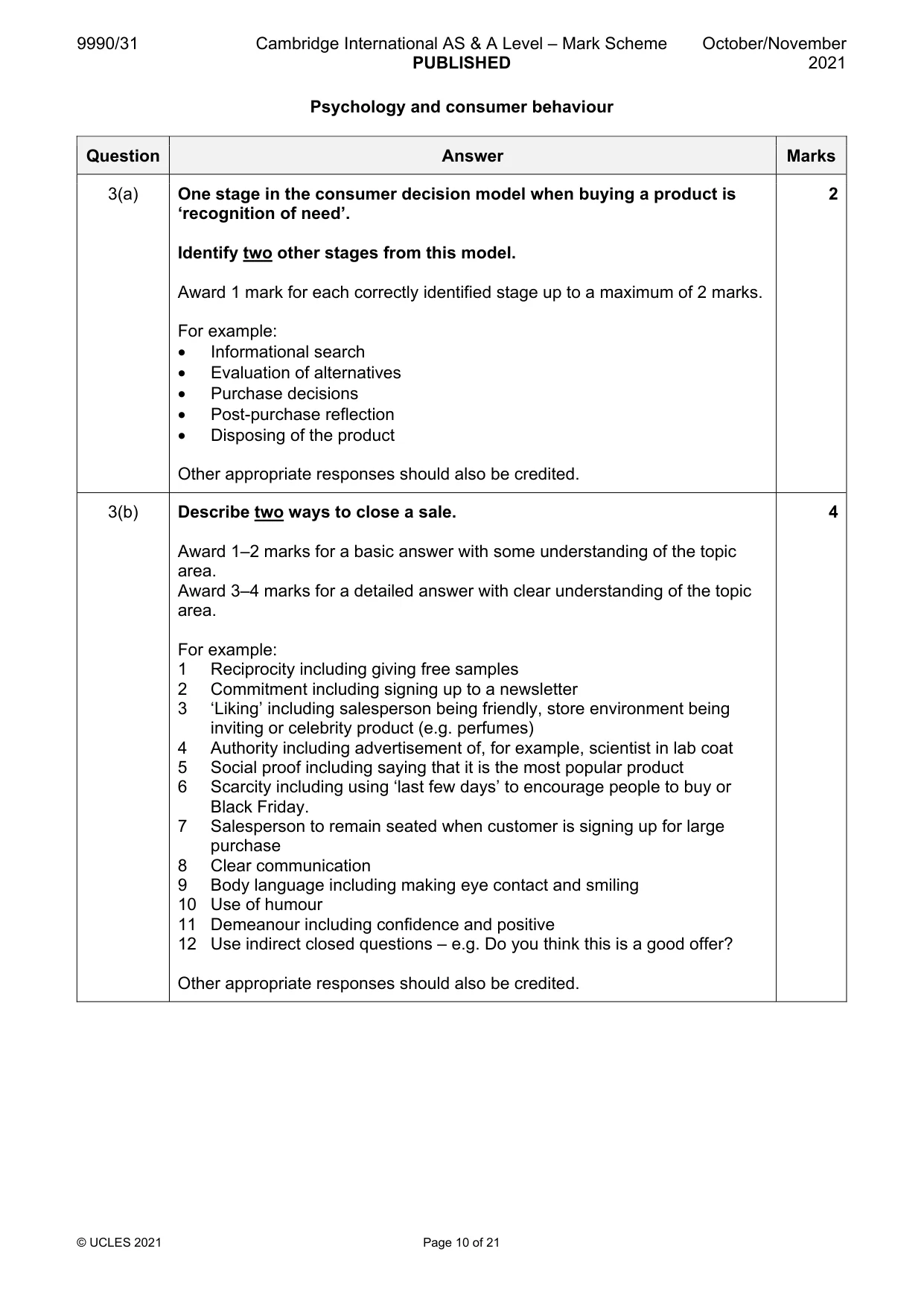
3 (a) One stage in the consumer decision model when buying a product is ‘recognition of need’. Identify two other stages from this model. [2] (b) Describe two ways to close a sale. [4] (c) For one of the ways you described in (b): Explain one advantage and one disadvantage of this way to close a sale. [6]
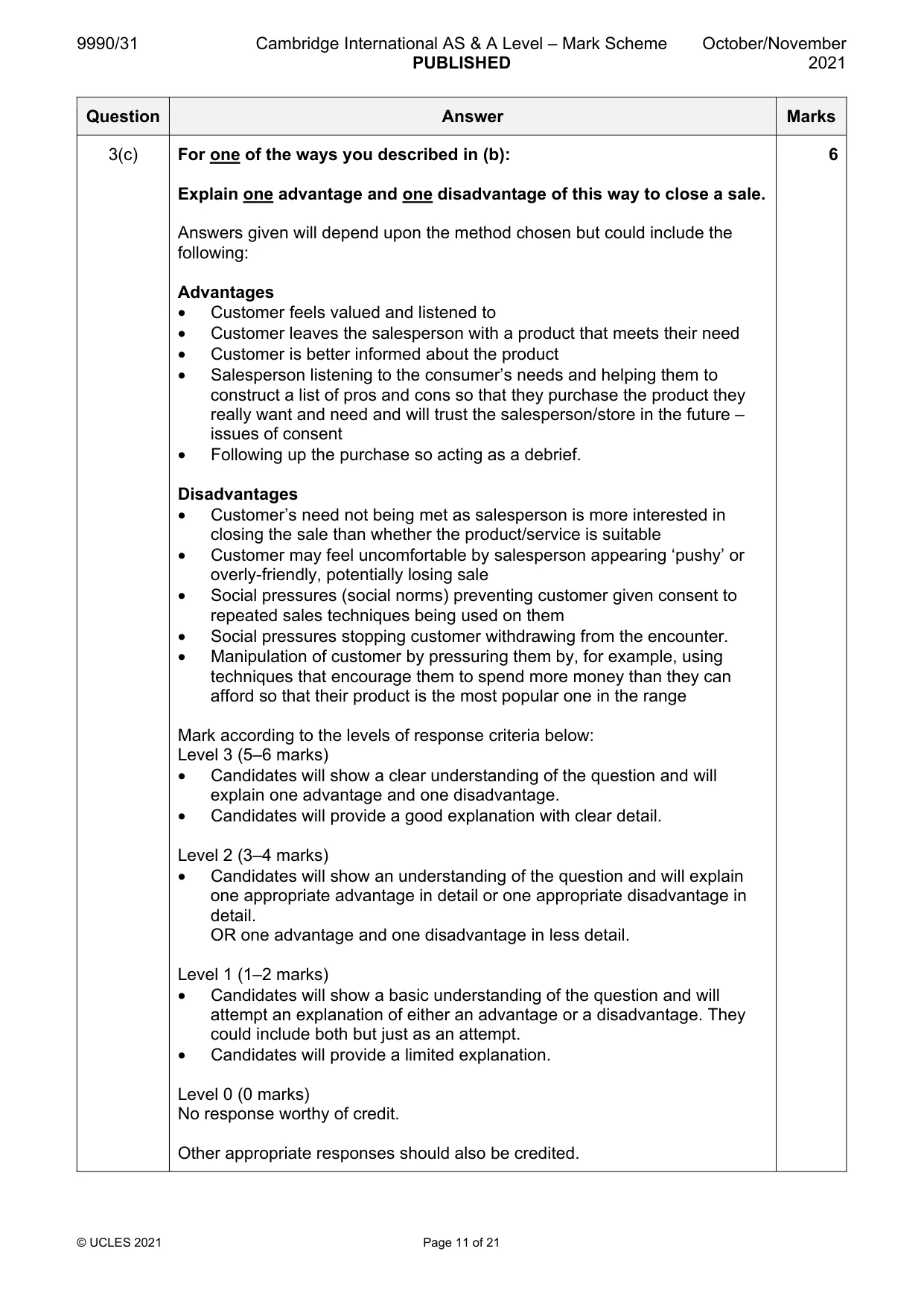
Mark scheme: 3(a) One stage in the consumer decision model when buying a product is 2 ‘recognition of need’. Identify two other stages from this model. Award 1 mark for each correctly identified stage up to a maximum of 2 marks. For example: • Informational search • Evaluation of alternatives • Purchase decisions • Post-purchase reflection • Disposing of the product Other appropriate responses should also be credited. 3(b) Describe two ways to close a sale. 4 Award 1–2 marks for a basic answer with some understanding of the topic area. Award 3–4 marks for a detailed answer with clear understanding of the topic area. For example: 1 Reciprocity including giving free samples 2 Commitment including signing up to a newsletter 3 ‘Liking’ including salesperson being friendly, store environment being inviting or celebrity product (e.g. perfumes) 4 Authority including advertisement of, for example, scientist in lab coat 5 Social proof including saying that it is the most popular product 6 Scarcity including using ‘last few days’ to encourage people to buy or Black Friday. 7 Salesperson to remain seated when customer is signing up for large purchase 8 Clear communication 9 Body language including making eye contact and smiling 10 Use of humour 11 Demeanour including confidence and positive 12 Use indirect closed questions – e.g. Do you think this is a good offer? Other appropriate responses should also be credited. 3(c) For one of the ways you described in (b): 6 Explain one advantage and one disadvantage of this way to close a sale. Answers given will depend upon the method chosen but could include the following: Advantages • Customer feels valued and listened to • Customer leaves the salesperson with a product that meets their need • Customer is better informed about the product • Salesperson listening to the consumer’s needs and helping them to construct a list of pros and cons so that they purchase the product they really want and need and will trust the salesperson/store in the future – issues of consent • Following up the purchase so acting as a debrief. Disadvantages • Customer’s need not being met as salesperson is more interested in closing the sale than whether the product/service is suitable • Customer may feel uncomfortable by salesperson appearing ‘pushy’ or overly-friendly, potentially losing sale • Social pressures (social norms) preventing customer given consent to repeated sales techniques being used on them • Social pressures stopping customer withdrawing from the encounter. • Manipulation of customer by pressuring them by, for example, using techniques that encourage them to spend more money than they can afford so that their product is the most popular one in the range Mark according to the levels of response criteria below: Level 3 (5–6 marks) • Candidates will show a clear understanding of the question and will explain one advantage and one disadvantage. • Candidates will provide a good explanation with clear detail. Level 2 (3–4 marks) • Candidates will show an understanding of the question and will explain one appropriate advantage in detail or one appropriate disadvantage in detail. OR one advantage and one disadvantage in less detail. Level 1 (1–2 marks) • Candidates will show a basic understanding of the question and will attempt an explanation of either an advantage or a disadvantage. They could include both but just as an attempt. • Candidates will provide a limited explanation. Level 0 (0 marks) No response worthy of credit. Other appropriate responses should also be credited.
Q4 · Describe what psychologists have discovered about lighting, colour and smell in the…
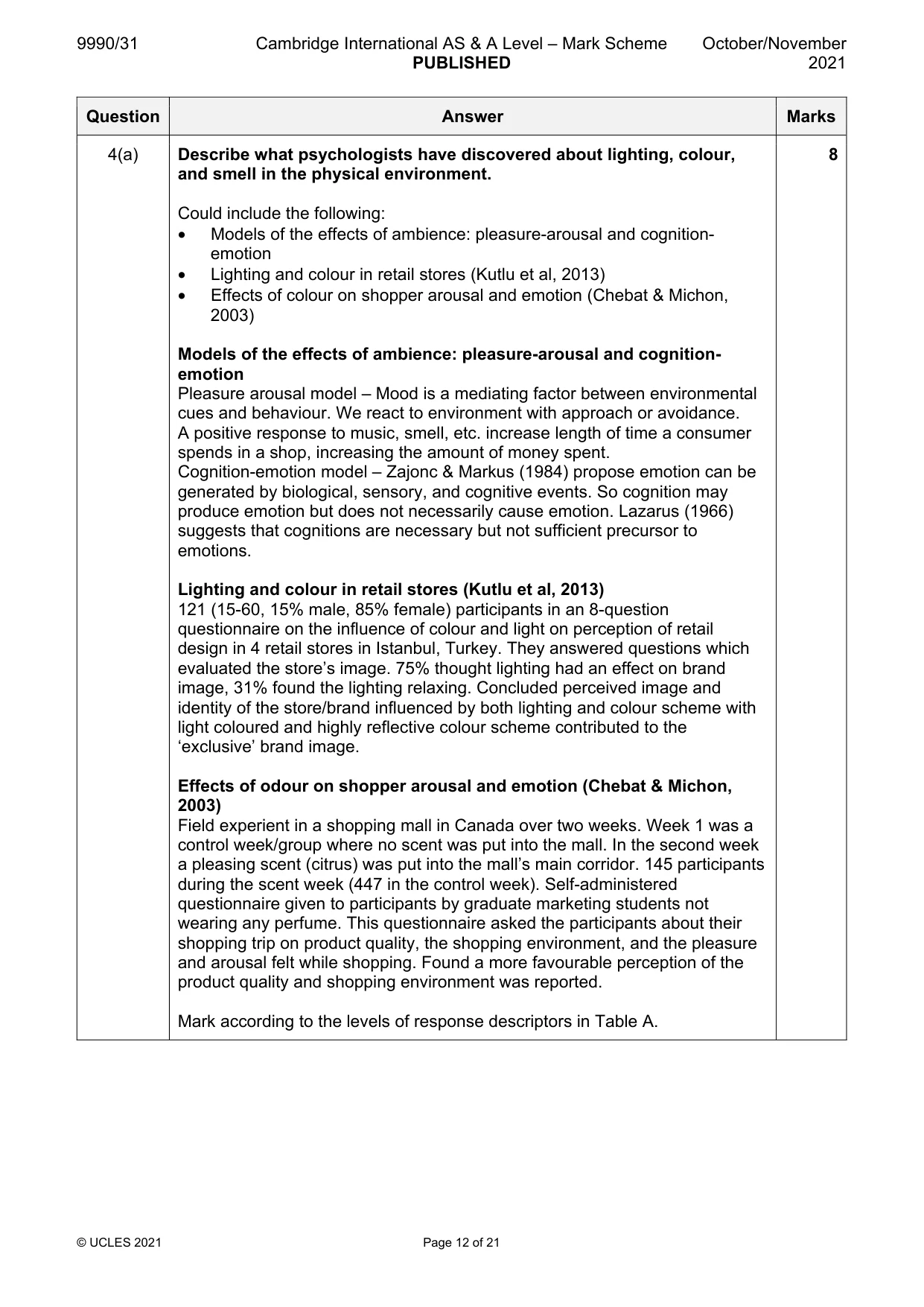
4 (a) Describe what psychologists have discovered about lighting, colour and smell in the physical environment. [8] (b) Evaluate what psychologists have discovered about lighting, colour and smell in the physical environment, including a discussion about control of variables. [10] Psychology and health Answer all questions.
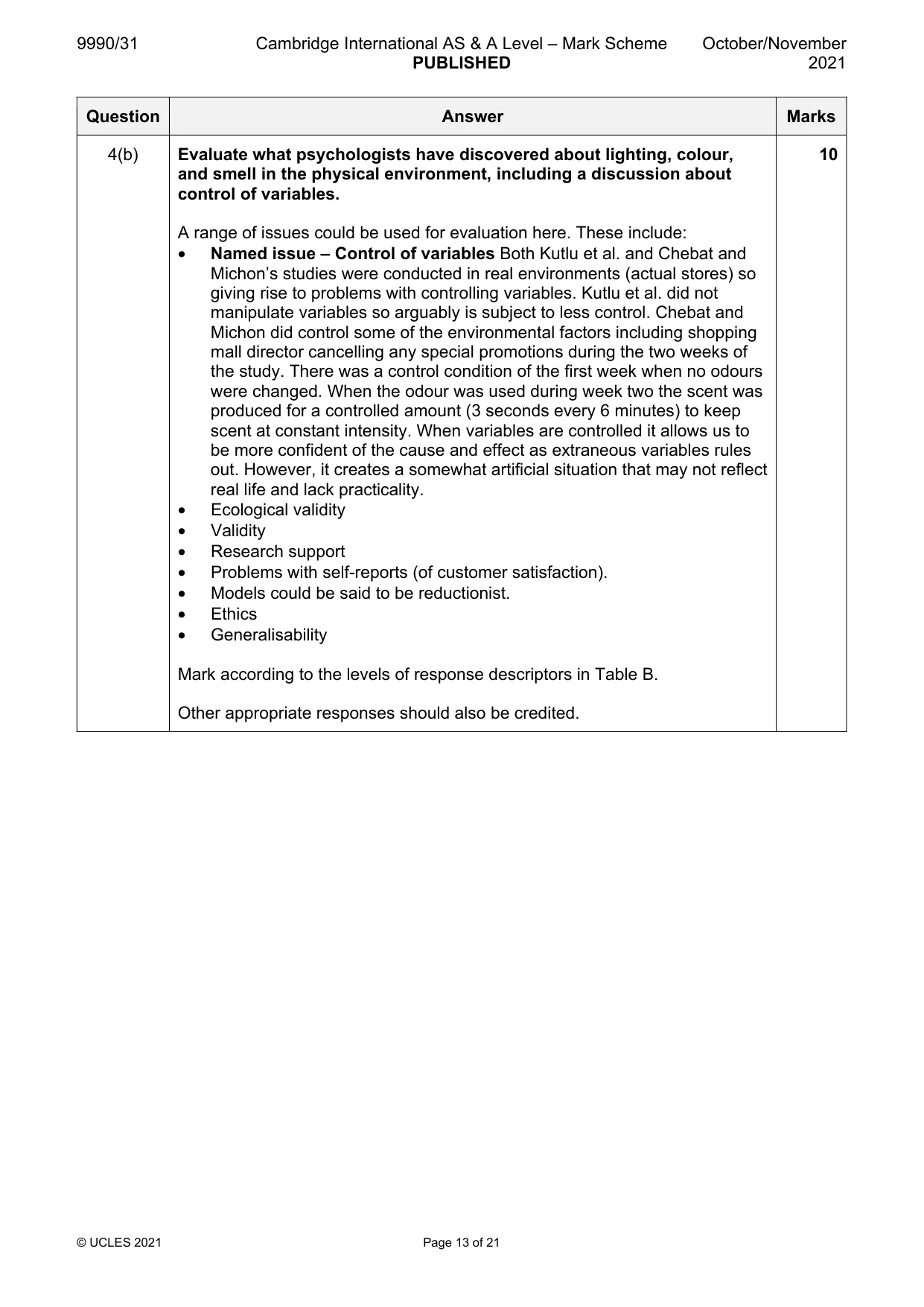
Mark scheme: 4(a) Describe what psychologists have discovered about lighting, colour, 8 and smell in the physical environment. Could include the following: • Models of the effects of ambience: pleasure-arousal and cognition- emotion • Lighting and colour in retail stores (Kutlu et al, 2013) • Effects of colour on shopper arousal and emotion (Chebat & Michon, 2003) Models of the effects of ambience: pleasure-arousal and cognition- emotion Pleasure arousal model – Mood is a mediating factor between environmental cues and behaviour. We react to environment with approach or avoidance. A positive response to music, smell, etc. increase length of time a consumer spends in a shop, increasing the amount of money spent. Cognition-emotion model – Zajonc & Markus (1984) propose emotion can be generated by biological, sensory, and cognitive events. So cognition may produce emotion but does not necessarily cause emotion. Lazarus (1966) suggests that cognitions are necessary but not sufficient precursor to emotions. Lighting and colour in retail stores (Kutlu et al, 2013) 121 (15-60, 15% male, 85% female) participants in an 8-question questionnaire on the influence of colour and light on perception of retail design in 4 retail stores in Istanbul, Turkey. They answered questions which evaluated the store’s image. 75% thought lighting had an effect on brand image, 31% found the lighting relaxing. Concluded perceived image and identity of the store/brand influenced by both lighting and colour scheme with light coloured and highly reflective colour scheme contributed to the ‘exclusive’ brand image. Effects of odour on shopper arousal and emotion (Chebat & Michon, 2003) Field experient in a shopping mall in Canada over two weeks. Week 1 was a control week/group where no scent was put into the mall. In the second week a pleasing scent (citrus) was put into the mall’s main corridor. 145 participants during the scent week (447 in the control week). Self-administered questionnaire given to participants by graduate marketing students not wearing any perfume. This questionnaire asked the participants about their shopping trip on product quality, the shopping environment, and the pleasure and arousal felt while shopping. Found a more favourable perception of the product quality and shopping environment was reported. Mark according to the levels of response descriptors in Table A. 4(b) Evaluate what psychologists have discovered about lighting, colour, 10 and smell in the physical environment, including a discussion about control of variables. A range of issues could be used for evaluation here. These include: • Named issue – Control of variables Both Kutlu et al. and Chebat and Michon’s studies were conducted in real environments (actual stores) so giving rise to problems with controlling variables. Kutlu et al. did not manipulate variables so arguably is subject to less control. Chebat and Michon did control some of the environmental factors including shopping mall director cancelling any special promotions during the two weeks of the study. There was a control condition of the first week when no odours were changed. When the odour was used during week two the scent was produced for a controlled amount (3 seconds every 6 minutes) to keep scent at constant intensity. When variables are controlled it allows us to be more confident of the cause and effect as extraneous variables rules out. However, it creates a somewhat artificial situation that may not reflect real life and lack practicality. • Ecological validity • Validity • Research support • Problems with self-reports (of customer satisfaction). • Models could be said to be reductionist. • Ethics • Generalisability Mark according to the levels of response descriptors in Table B. Other appropriate responses should also be credited. Psychology and health
Q5 · Outline the Yale model of communication in relation to health promotion
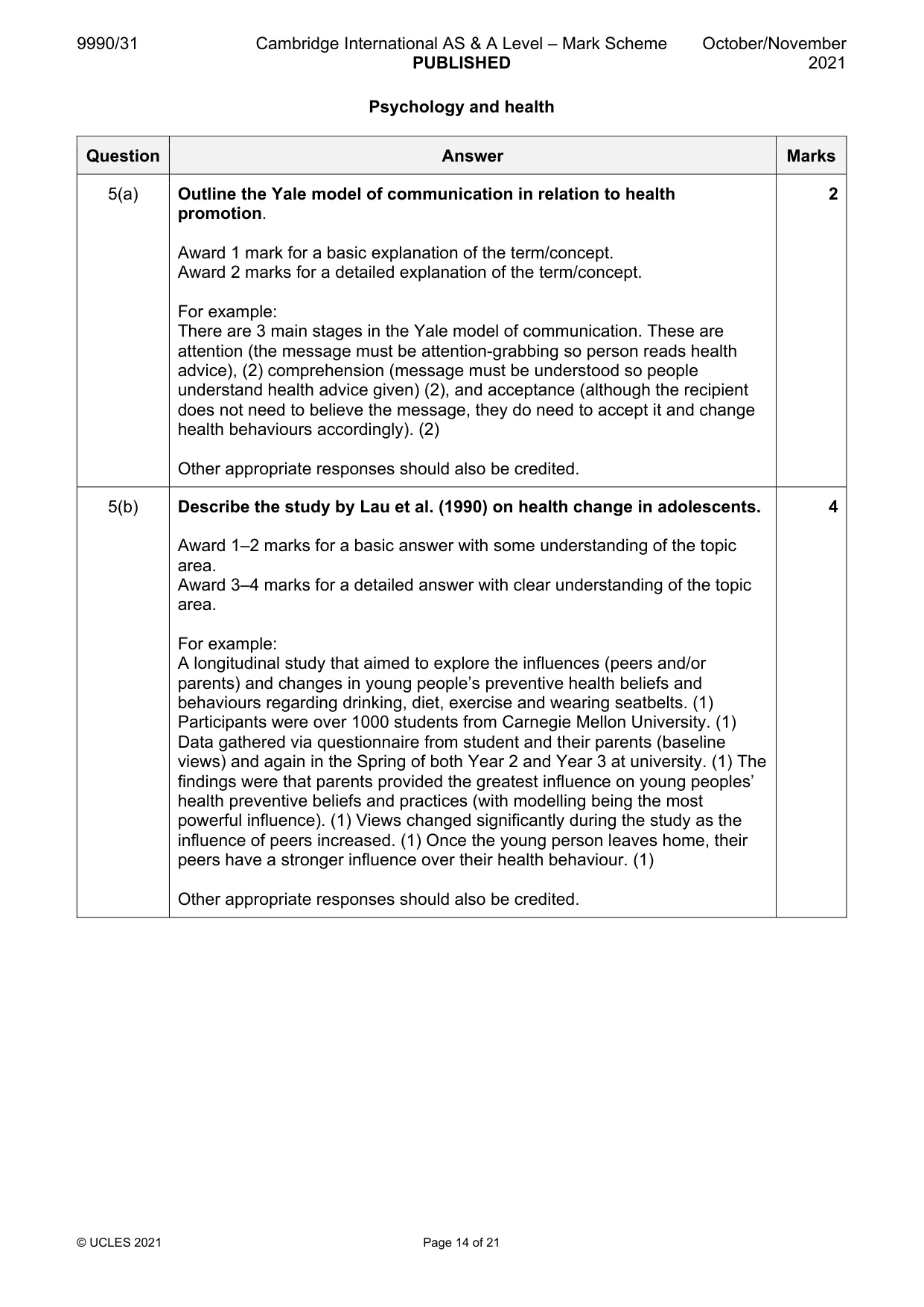
5 (a) Outline the Yale model of communication in relation to health promotion. [2] (b) Describe the study by Lau et al. (1990) on health change in adolescents. [4] (c) Explain one strength and one weakness of the study by Lau et al. [6]
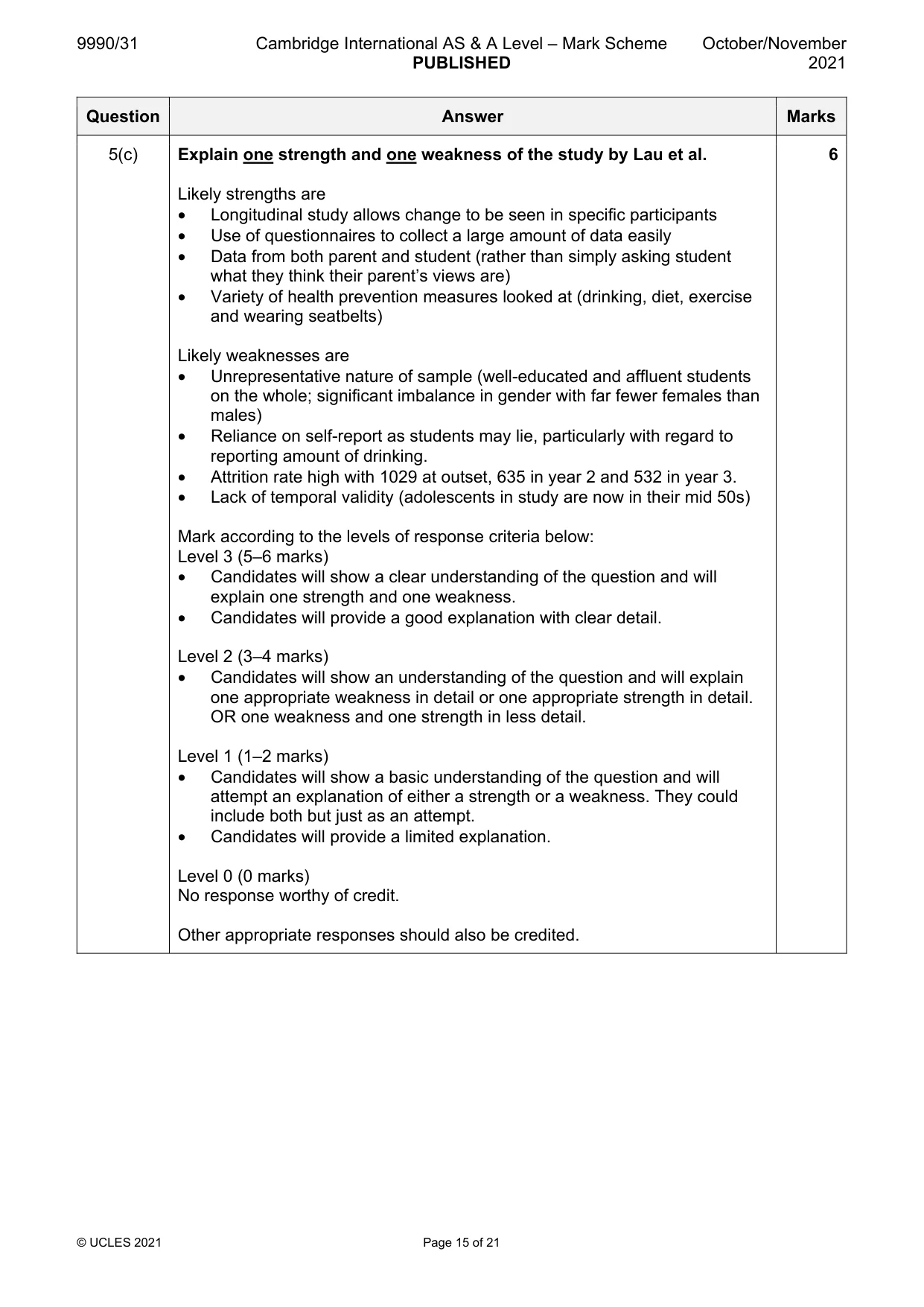
Mark scheme: 5(a) Outline the Yale model of communication in relation to health 2 promotion. Award 1 mark for a basic explanation of the term/concept. Award 2 marks for a detailed explanation of the term/concept. For example: There are 3 main stages in the Yale model of communication. These are attention (the message must be attention-grabbing so person reads health advice), (2) comprehension (message must be understood so people understand health advice given) (2), and acceptance (although the recipient does not need to believe the message, they do need to accept it and change health behaviours accordingly). (2) Other appropriate responses should also be credited. 5(b) Describe the study by Lau et al. (1990) on health change in adolescents. 4 Award 1–2 marks for a basic answer with some understanding of the topic area. Award 3–4 marks for a detailed answer with clear understanding of the topic area. For example: A longitudinal study that aimed to explore the influences (peers and/or parents) and changes in young people’s preventive health beliefs and behaviours regarding drinking, diet, exercise and wearing seatbelts. (1) Participants were over 1000 students from Carnegie Mellon University. (1) Data gathered via questionnaire from student and their parents (baseline views) and again in the Spring of both Year 2 and Year 3 at university. (1) The findings were that parents provided the greatest influence on young peoples’ health preventive beliefs and practices (with modelling being the most powerful influence). (1) Views changed significantly during the study as the influence of peers increased. (1) Once the young person leaves home, their peers have a stronger influence over their health behaviour. (1) Other appropriate responses should also be credited. 5(c) Explain one strength and one weakness of the study by Lau et al. 6 Likely strengths are • Longitudinal study allows change to be seen in specific participants • Use of questionnaires to collect a large amount of data easily • Data from both parent and student (rather than simply asking student what they think their parent’s views are) • Variety of health prevention measures looked at (drinking, diet, exercise and wearing seatbelts) Likely weaknesses are • Unrepresentative nature of sample (well-educated and affluent students on the whole; significant imbalance in gender with far fewer females than males) • Reliance on self-report as students may lie, particularly with regard to reporting amount of drinking. • Attrition rate high with 1029 at outset, 635 in year 2 and 532 in year 3. • Lack of temporal validity (adolescents in study are now in their mid 50s) Mark according to the levels of response criteria below: Level 3 (5–6 marks) • Candidates will show a clear understanding of the question and will explain one strength and one weakness. • Candidates will provide a good explanation with clear detail. Level 2 (3–4 marks) • Candidates will show an understanding of the question and will explain one appropriate weakness in detail or one appropriate strength in detail. OR one weakness and one strength in less detail. Level 1 (1–2 marks) • Candidates will show a basic understanding of the question and will attempt an explanation of either a strength or a weakness. They could include both but just as an attempt. • Candidates will provide a limited explanation. Level 0 (0 marks) No response worthy of credit. Other appropriate responses should also be credited.
More questions on 2 Health promotion in schools and worksites
Q6 · Describe what psychologists have discovered about measuring pain
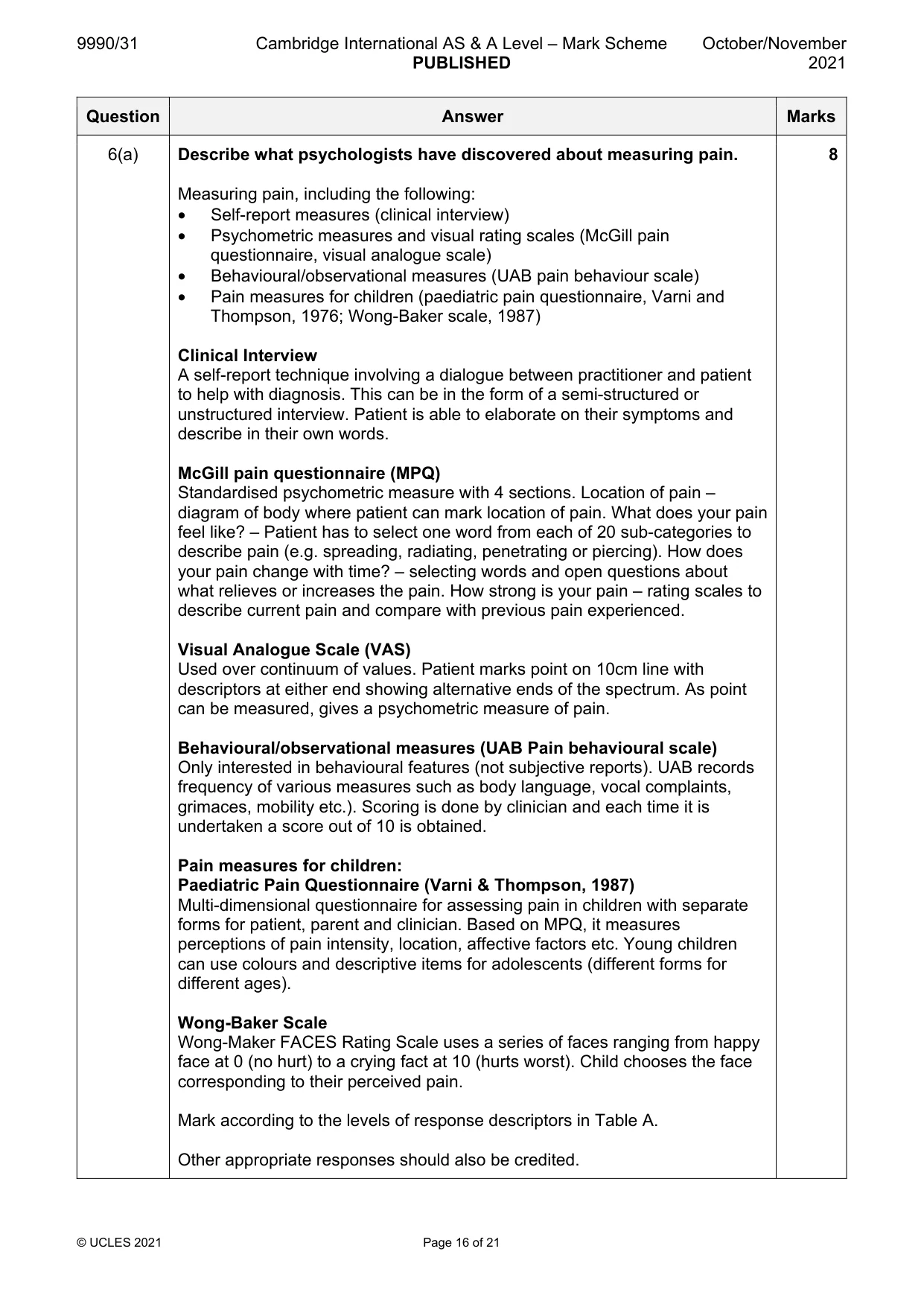
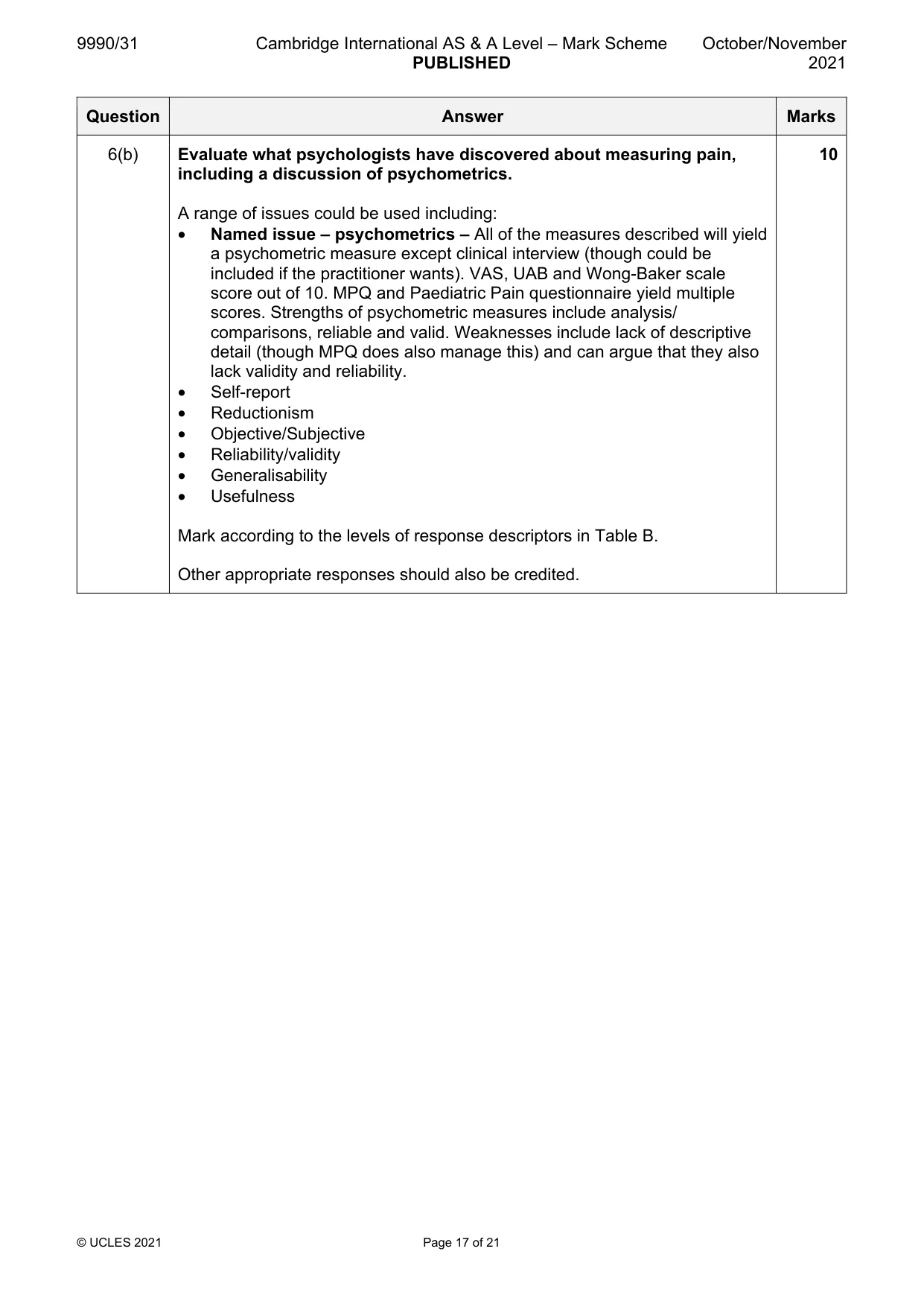
6 (a) Describe what psychologists have discovered about measuring pain. [8] (b) Evaluate what psychologists have discovered about measuring pain, including a discussion of psychometrics. [10] Psychology and organisations Answer all questions.
Mark scheme: 6(a) Describe what psychologists have discovered about measuring pain. 8 Measuring pain, including the following: • Self-report measures (clinical interview) • Psychometric measures and visual rating scales (McGill pain questionnaire, visual analogue scale) • Behavioural/observational measures (UAB pain behaviour scale) • Pain measures for children (paediatric pain questionnaire, Varni and Thompson, 1976; Wong-Baker scale, 1987) Clinical Interview A self-report technique involving a dialogue between practitioner and patient to help with diagnosis. This can be in the form of a semi-structured or unstructured interview. Patient is able to elaborate on their symptoms and describe in their own words. McGill pain questionnaire (MPQ) Standardised psychometric measure with 4 sections. Location of pain – diagram of body where patient can mark location of pain. What does your pain feel like? – Patient has to select one word from each of 20 sub-categories to describe pain (e.g. spreading, radiating, penetrating or piercing). How does your pain change with time? – selecting words and open questions about what relieves or increases the pain. How strong is your pain – rating scales to describe current pain and compare with previous pain experienced. Visual Analogue Scale (VAS) Used over continuum of values. Patient marks point on 10cm line with descriptors at either end showing alternative ends of the spectrum. As point can be measured, gives a psychometric measure of pain. Behavioural/observational measures (UAB Pain behavioural scale) Only interested in behavioural features (not subjective reports). UAB records frequency of various measures such as body language, vocal complaints, grimaces, mobility etc.). Scoring is done by clinician and each time it is undertaken a score out of 10 is obtained. Pain measures for children: Paediatric Pain Questionnaire (Varni & Thompson, 1987) Multi-dimensional questionnaire for assessing pain in children with separate forms for patient, parent and clinician. Based on MPQ, it measures perceptions of pain intensity, location, affective factors etc. Young children can use colours and descriptive items for adolescents (different forms for different ages). Wong-Baker Scale Wong-Maker FACES Rating Scale uses a series of faces ranging from happy face at 0 (no hurt) to a crying fact at 10 (hurts worst). Child chooses the face corresponding to their perceived pain. Mark according to the levels of response descriptors in Table A. Other appropriate responses should also be credited. 6(b) Evaluate what psychologists have discovered about measuring pain, 10 including a discussion of psychometrics. A range of issues could be used including: • Named issue – psychometrics – All of the measures described will yield a psychometric measure except clinical interview (though could be included if the practitioner wants). VAS, UAB and Wong-Baker scale score out of 10. MPQ and Paediatric Pain questionnaire yield multiple scores. Strengths of psychometric measures include analysis/ comparisons, reliable and valid. Weaknesses include lack of descriptive detail (though MPQ does also manage this) and can argue that they also lack validity and reliability. • Self-report • Reductionism • Objective/Subjective • Reliability/validity • Generalisability • Usefulness Mark according to the levels of response descriptors in Table B. Other appropriate responses should also be credited. Psychology and organisations
Q7 · Kouzes and Posner (1987) produced the Leadership Practices Inventory (LPI) which measures…
7 (a) Kouzes and Posner (1987) produced the Leadership Practices Inventory (LPI) which measures five practices of exemplary leadership. Identify two of these practices. [2] (b) Describe the styles of leader behaviour proposed by Muczyk and Reimann (1987). [4] (c) Explain one similarity and one difference between styles of leader behaviour (Muczyk and Reimann, 1987) and situational leadership (Hersey and Blanchard, 1988). [6]
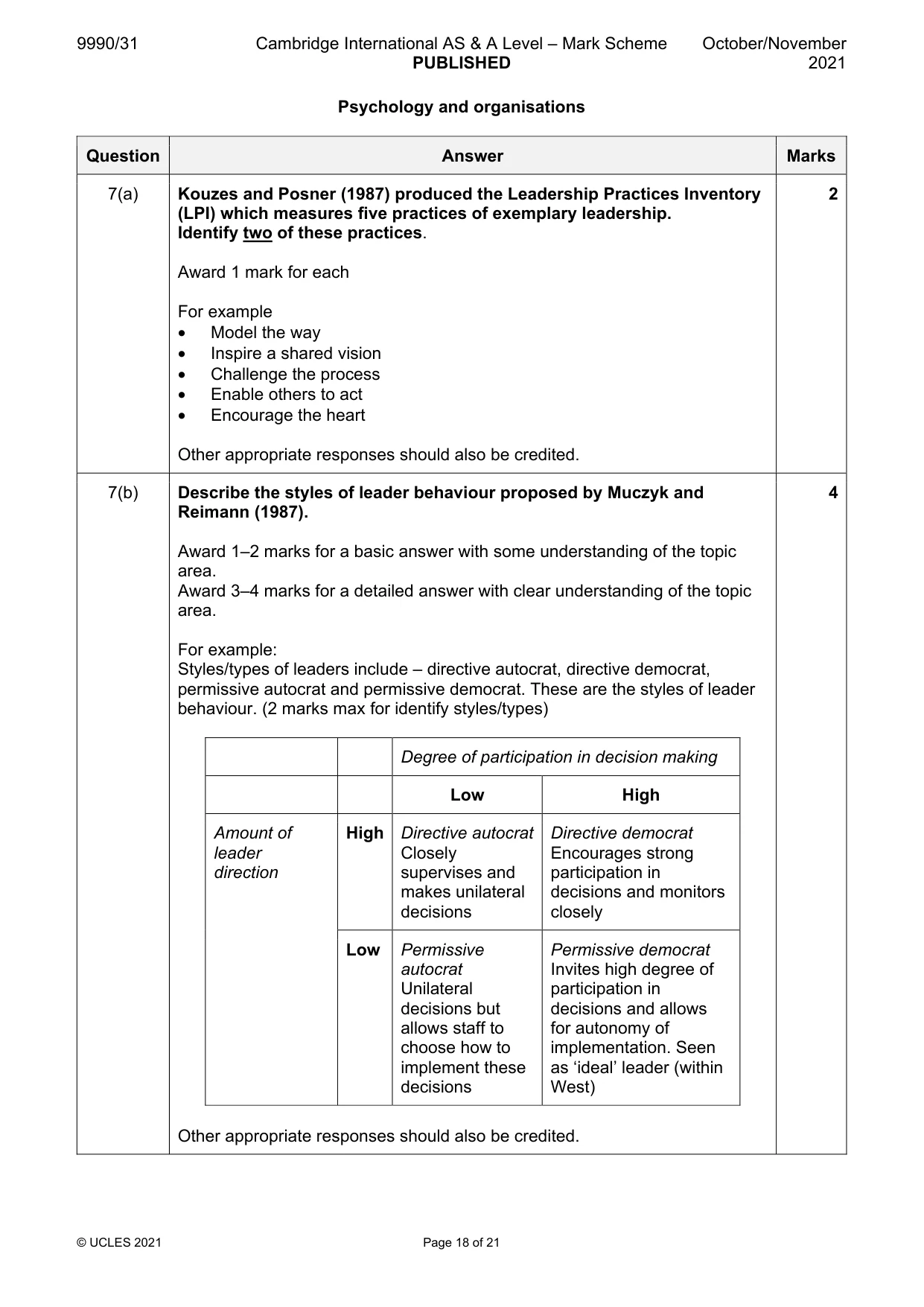
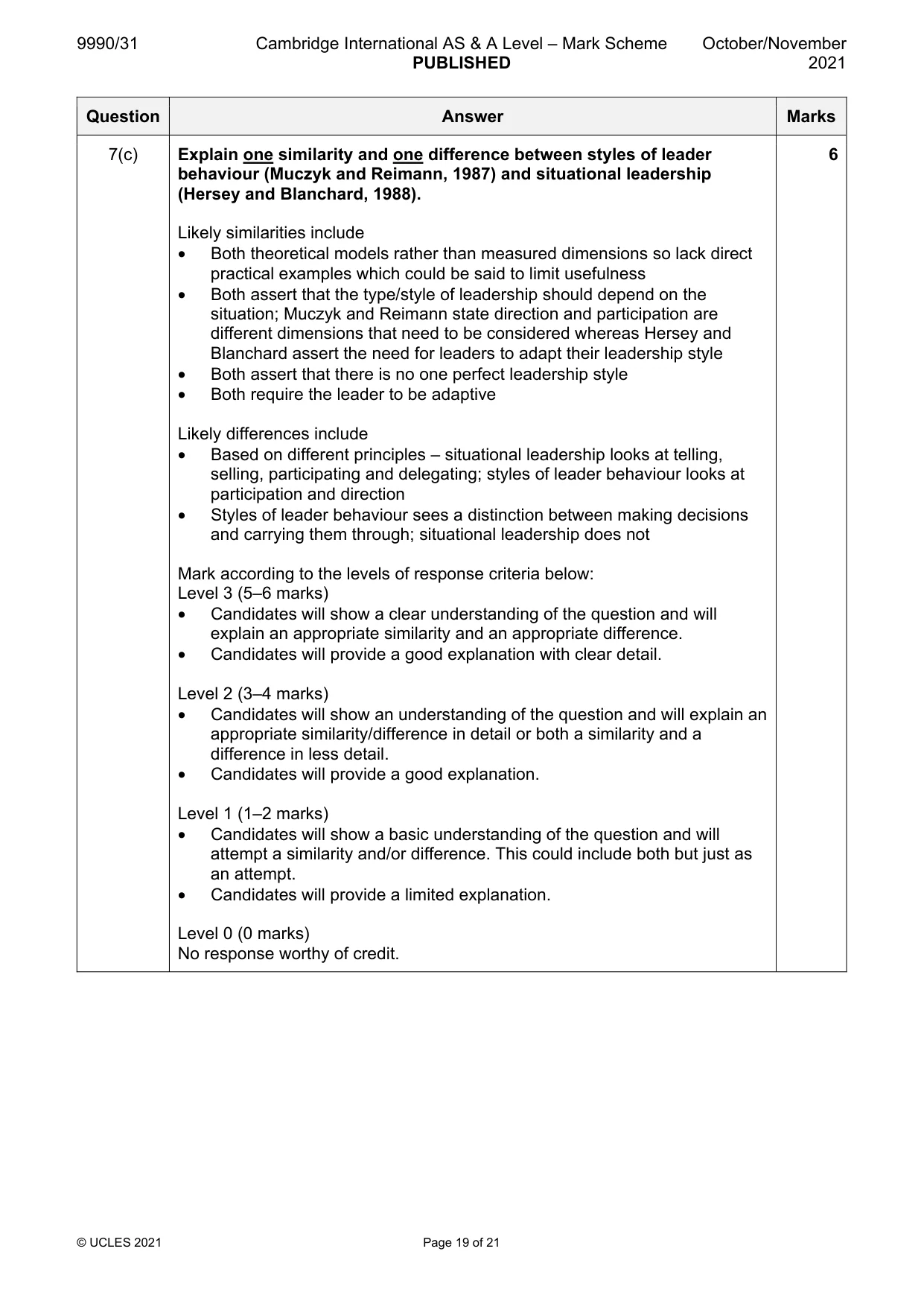
Mark scheme: 7(a) Kouzes and Posner (1987) produced the Leadership Practices Inventory 2 (LPI) which measures five practices of exemplary leadership. Identify two of these practices. Award 1 mark for each For example • Model the way • Inspire a shared vision • Challenge the process • Enable others to act • Encourage the heart Other appropriate responses should also be credited. 7(b) Describe the styles of leader behaviour proposed by Muczyk and 4 Reimann (1987). Award 1–2 marks for a basic answer with some understanding of the topic area. Award 3–4 marks for a detailed answer with clear understanding of the topic area. For example: Styles/types of leaders include – directive autocrat, directive democrat, permissive autocrat and permissive democrat. These are the styles of leader behaviour. (2 marks max for identify styles/types) Degree of participation in decision making Low High Amount of High Directive autocrat Directive democrat leader Closely Encourages strong direction supervises and participation in makes unilateral decisions and monitors decisions closely Low Permissive Permissive democrat autocrat Invites high degree of Unilateral participation in decisions but decisions and allows allows staff to for autonomy of choose how to implementation. Seen implement these as ‘ideal’ leader (within decisions West) Other appropriate responses should also be credited. 7(c) Explain one similarity and one difference between styles of leader 6 behaviour (Muczyk and Reimann, 1987) and situational leadership (Hersey and Blanchard, 1988). Likely similarities include • Both theoretical models rather than measured dimensions so lack direct practical examples which could be said to limit usefulness • Both assert that the type/style of leadership should depend on the situation; Muczyk and Reimann state direction and participation are different dimensions that need to be considered whereas Hersey and Blanchard assert the need for leaders to adapt their leadership style • Both assert that there is no one perfect leadership style • Both require the leader to be adaptive Likely differences include • Based on different principles – situational leadership looks at telling, selling, participating and delegating; styles of leader behaviour looks at participation and direction • Styles of leader behaviour sees a distinction between making decisions and carrying them through; situational leadership does not Mark according to the levels of response criteria below: Level 3 (5–6 marks) • Candidates will show a clear understanding of the question and will explain an appropriate similarity and an appropriate difference. • Candidates will provide a good explanation with clear detail. Level 2 (3–4 marks) • Candidates will show an understanding of the question and will explain an appropriate similarity/difference in detail or both a similarity and a difference in less detail. • Candidates will provide a good explanation. Level 1 (1–2 marks) • Candidates will show a basic understanding of the question and will attempt a similarity and/or difference. This could include both but just as an attempt. • Candidates will provide a limited explanation. Level 0 (0 marks) No response worthy of credit.
Q8 · Describe what psychologists have discovered about group development and roles in…
8 (a) Describe what psychologists have discovered about group development and roles in organisations. [8] (b) Evaluate what psychologists have discovered about group development and roles in organisations, including a discussion of practical applications. [10]
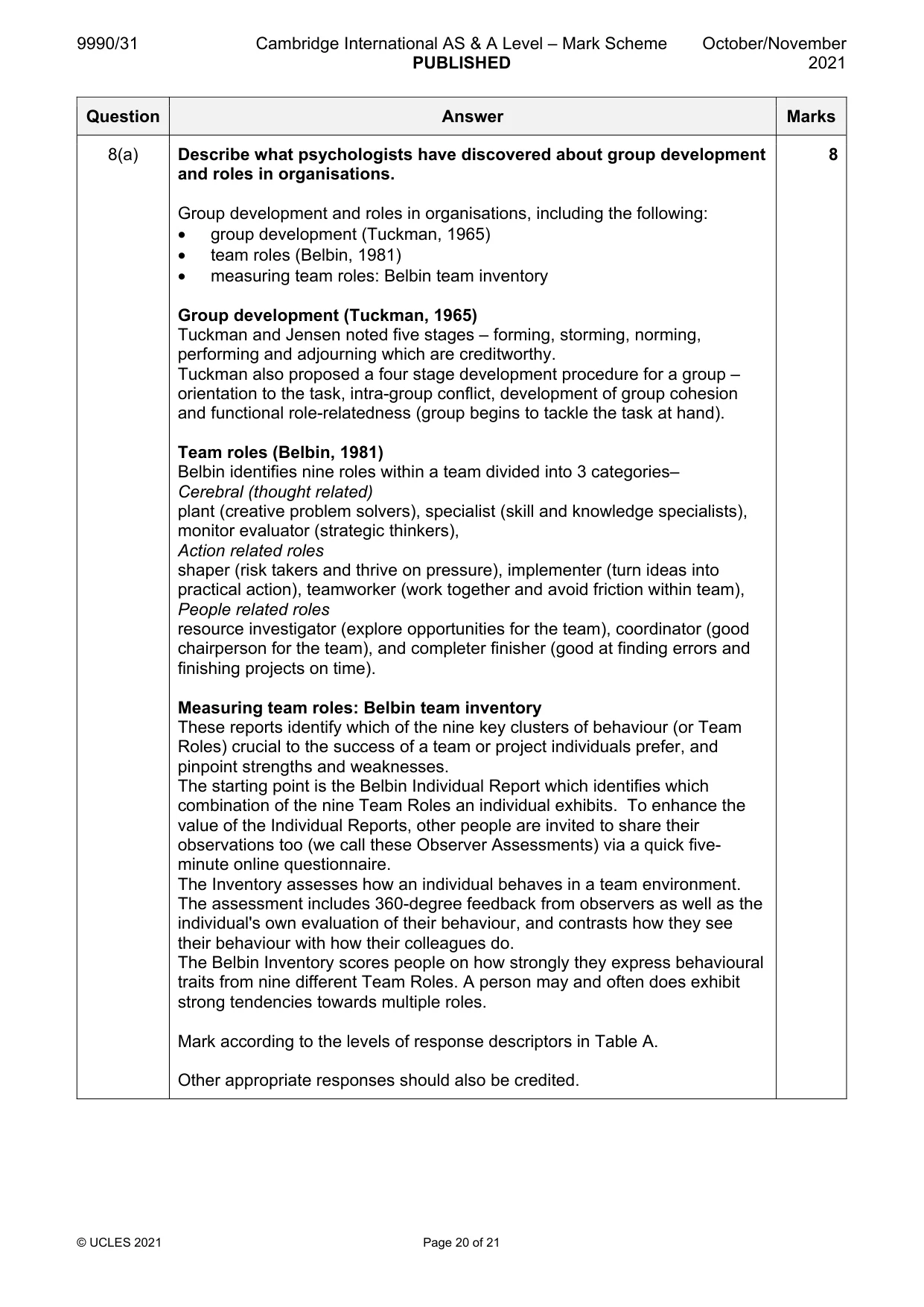
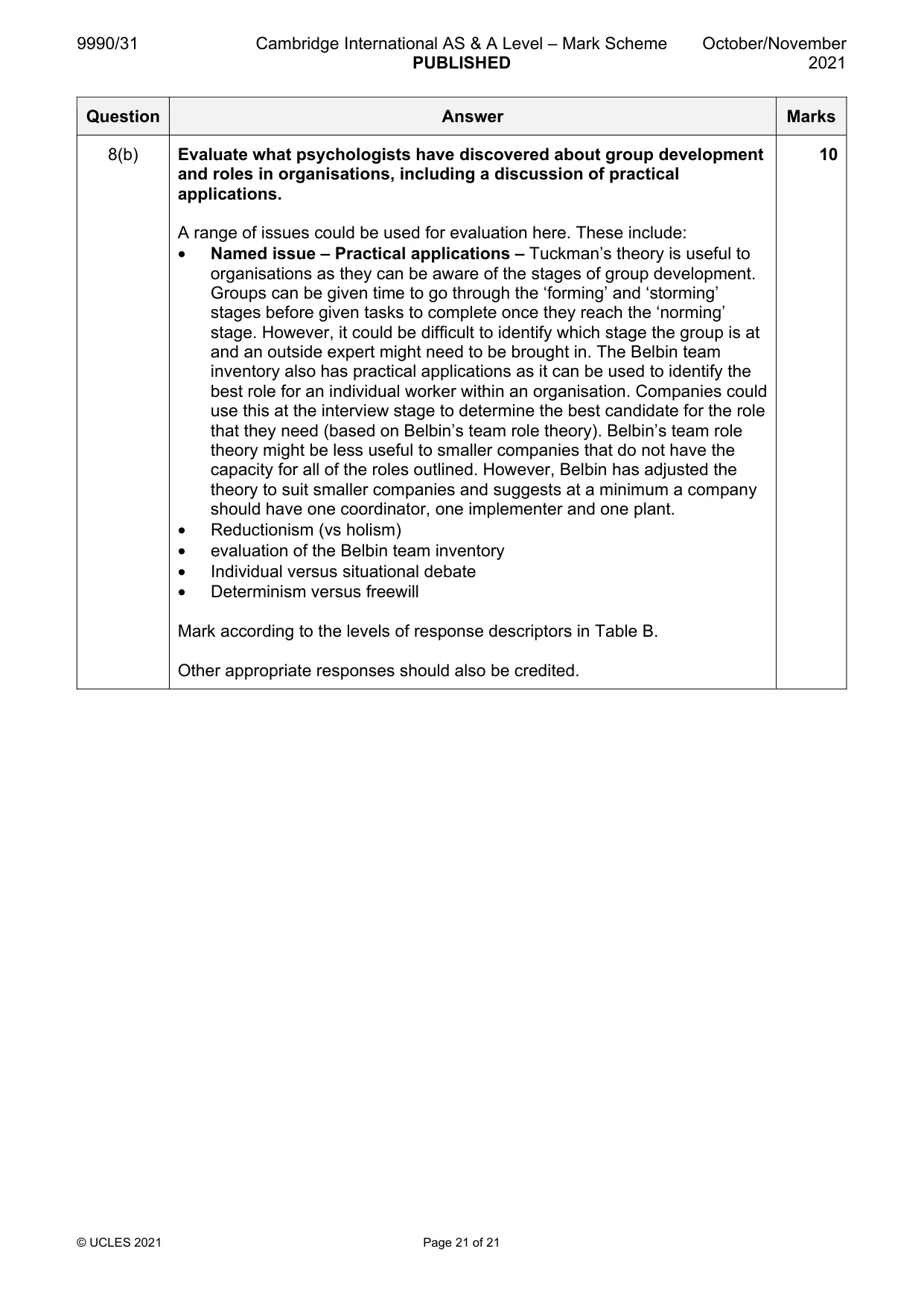
Mark scheme: 8(a) Describe what psychologists have discovered about group development 8 and roles in organisations. Group development and roles in organisations, including the following: • group development (Tuckman, 1965) • team roles (Belbin, 1981) • measuring team roles: Belbin team inventory Group development (Tuckman, 1965) Tuckman and Jensen noted five stages – forming, storming, norming, performing and adjourning which are creditworthy. Tuckman also proposed a four stage development procedure for a group – orientation to the task, intra-group conflict, development of group cohesion and functional role-relatedness (group begins to tackle the task at hand). Team roles (Belbin, 1981) Belbin identifies nine roles within a team divided into 3 categories– Cerebral (thought related) plant (creative problem solvers), specialist (skill and knowledge specialists), monitor evaluator (strategic thinkers), Action related roles shaper (risk takers and thrive on pressure), implementer (turn ideas into practical action), teamworker (work together and avoid friction within team), People related roles resource investigator (explore opportunities for the team), coordinator (good chairperson for the team), and completer finisher (good at finding errors and finishing projects on time). Measuring team roles: Belbin team inventory These reports identify which of the nine key clusters of behaviour (or Team Roles) crucial to the success of a team or project individuals prefer, and pinpoint strengths and weaknesses. The starting point is the Belbin Individual Report which identifies which combination of the nine Team Roles an individual exhibits. To enhance the value of the Individual Reports, other people are invited to share their observations too (we call these Observer Assessments) via a quick five- minute online questionnaire. The Inventory assesses how an individual behaves in a team environment. The assessment includes 360-degree feedback from observers as well as the individual's own evaluation of their behaviour, and contrasts how they see their behaviour with how their colleagues do. The Belbin Inventory scores people on how strongly they express behavioural traits from nine different Team Roles. A person may and often does exhibit strong tendencies towards multiple roles. Mark according to the levels of response descriptors in Table A. Other appropriate responses should also be credited. 8(b) Evaluate what psychologists have discovered about group development 10 and roles in organisations, including a discussion of practical applications. A range of issues could be used for evaluation here. These include: • Named issue – Practical applications – Tuckman’s theory is useful to organisations as they can be aware of the stages of group development. Groups can be given time to go through the ‘forming’ and ‘storming’ stages before given tasks to complete once they reach the ‘norming’ stage. However, it could be difficult to identify which stage the group is at and an outside expert might need to be brought in. The Belbin team inventory also has practical applications as it can be used to identify the best role for an individual worker within an organisation. Companies could use this at the interview stage to determine the best candidate for the role that they need (based on Belbin’s team role theory). Belbin’s team role theory might be less useful to smaller companies that do not have the capacity for all of the roles outlined. However, Belbin has adjusted the theory to suit smaller companies and suggests at a minimum a company should have one coordinator, one implementer and one plant. • Reductionism (vs holism) • evaluation of the Belbin team inventory • Individual versus situational debate • Determinism versus freewill Mark according to the levels of response descriptors in Table B. Other appropriate responses should also be credited.
What was in this paper
The subtopics covered by these 8 questions, and how many questions each got. Open one in a new tab to see every Cambridge question on it.
What you needed in this session
Cambridge’s own grade thresholds for 2021 Oct/Nov, Paper 3 · Variant 1. A higher threshold means an easier paper — the bar moves with how the cohort did.