Questions as text
Q1 · Joe the Camel most easily recognised by children According to Paul Fischer, young… 9990/42 Feb/March 2018
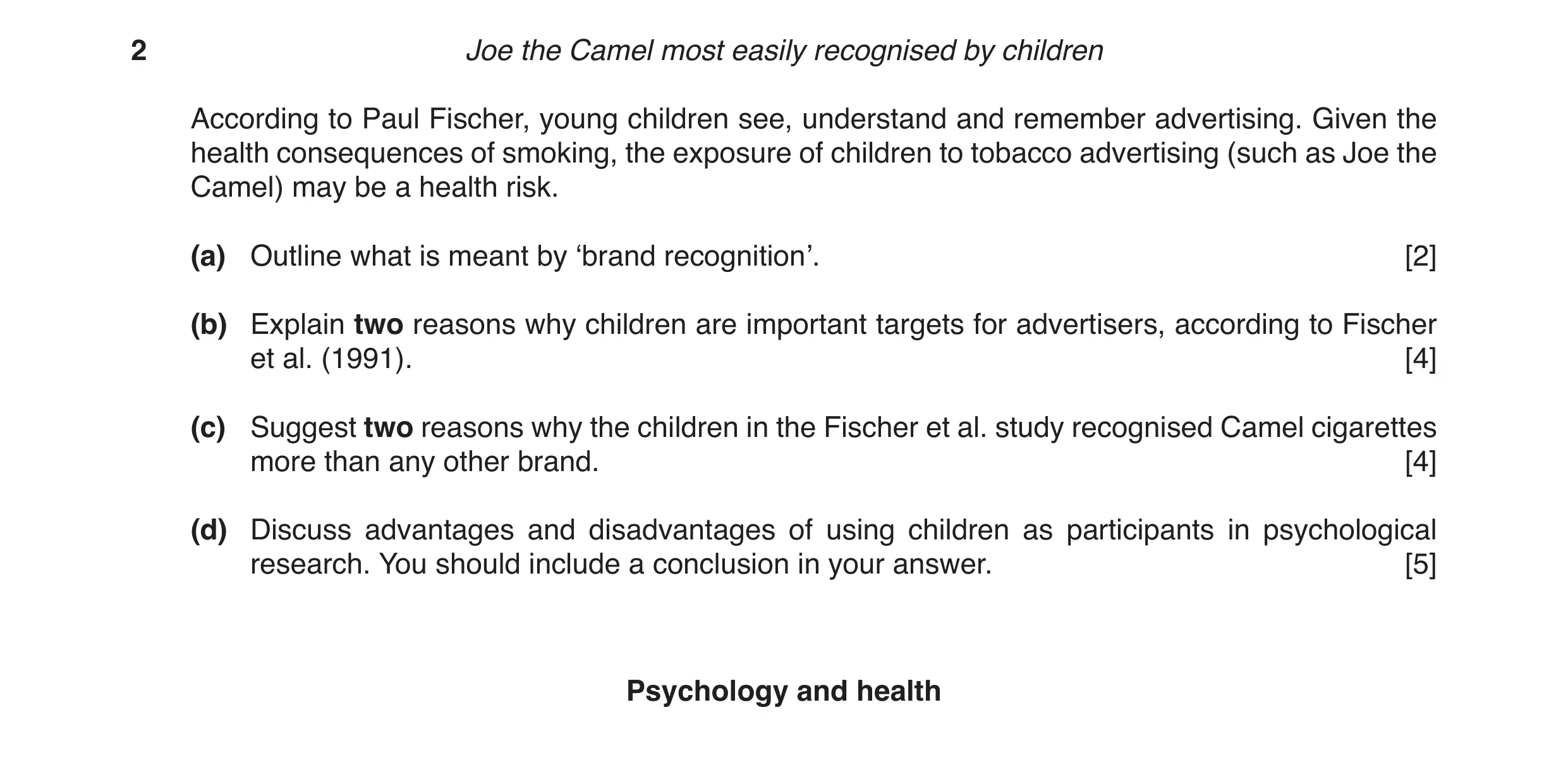
2 Joe the Camel most easily recognised by children According to Paul Fischer, young children see, understand and remember advertising. Given the health consequences of smoking, the exposure of children to tobacco advertising (such as Joe the Camel) may be a health risk. (a) Outline what is meant by ‘brand recognition’. [2] (b) Explain two reasons why children are important targets for advertisers, according to Fischer et al. (1991). [4] (c) Suggest two reasons why the children in the Fischer et al. study recognised Camel cigarettes more than any other brand. [4] (d) Discuss advantages and disadvantages of using children as participants in psychological research. You should include a conclusion in your answer. [5] Psychology and health
15 marks
Mark scheme: 2(a) Outline what is meant by ‘brand recognition’. 2 Marks: 1 mark for basic answer e.g. identification. +1 mark for elaboration/example. Most likely answer (other appropriate responses to be credited): The extent to which people are able to identify a brand by its attributes such as a logo, slogan or colour. 2(b) Explain two reasons why children are important targets for 4 advertisers, according to Fischer et al. (1991). Marks: Question always requires two ‘things’ • 1 mark basic answer. 2 marks elaboration, twice. • Max 2 marks if only ‘one’ is answered. Most likely answer (other appropriate responses to be credited): • Children are major consumers from a young age: food, toys and games, etc. • Children influence household decisions, maybe what a family will eat, where a family will go, etc. • Children are consumers of the future, and brand awareness in children may transfer to adulthood. 2(c) Suggest two reasons why the children in the Fischer et al. study 4 recognised Camel cigarettes more than any other brand. Marks: 1 mark basic answer. 2 marks elaboration, twice. Most likely answer (other appropriate responses to be credited): • Joe the camel is a cartoon character and so is more child friendly; • Joe the camel suggests the package contents are for children rather than adults; • following Bandura et al. (1961) children observe adults with cigarettes and although they may not copy an adult smoking they will imitate ‘smoking behaviours’ to be like an adult. This is made worse when associated with a cartoon character. 2(d) Discuss advantages and disadvantages of using children as 5 participants in psychological research. You should include a conclusion in your answer. Question always plural of each argument. Question always requires conclusion. • 1 mark for each for/against argument up to 4 max. • 1 mark for conclusion. Note: If three (or more) arguments for one side, best two credited. If one argument only, max 2 marks. Most likely answer (other appropriate responses to be credited): Advantages • children are young and naïve and so are more likely to behave naturally, even in laboratory experiments. • children will not question what is happening. • children are consumers so studies involving children are as appropriate as adults as participants. Disadvantages • children may not understand complex instructions and if they do« • they may not be able to explain what they are thinking or how they feel. • children may not exercise the right to withdraw; they may not understand a debriefing. • children may be psychologically harmed by a study which may not be evident for many years. Conclusion: (a decision reached by reasoning) any appropriate conclusion drawn from the discussion that has been presented. Marks: 1 mark if appropriate. 0 marks if the conclusion repeats what has already been stated. Section A: Stimulus question psychology and health
This question in 9990/42 Feb/March 2018
Q2 · ‘Consumer decision-making is poor when shopping because advertising produces false… 9990/41 Oct/Nov 2018
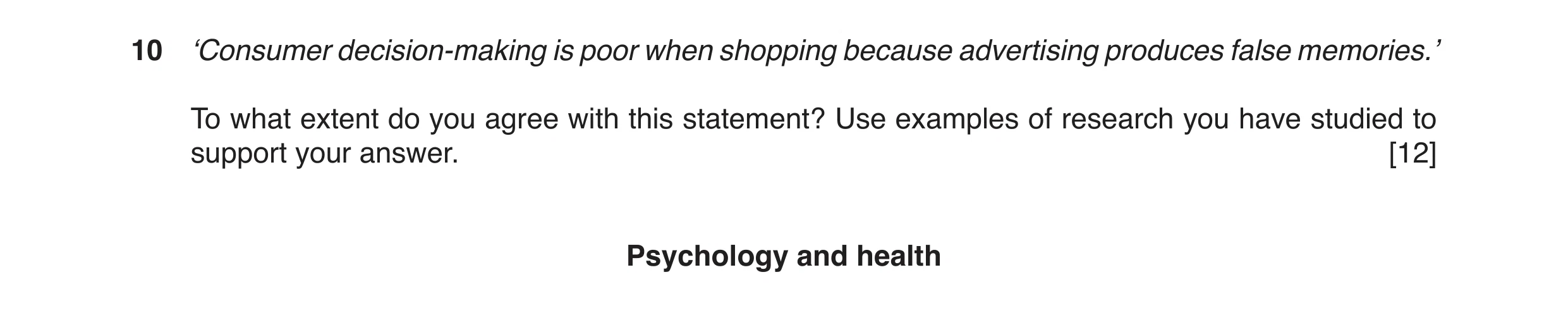
10 ‘Consumer decision-making is poor when shopping because advertising produces false memories.’ To what extent do you agree with this statement? Use examples of research you have studied to support your answer. [12] Psychology and health
12 marks
Mark scheme: 10 ‘Consumer decision-making is poor when shopping because 12 advertising produces false memories.’ To what extent do you agree with this statement? Use examples of research you have studied to support your answer. Marks: use generic levels of response in table C. Syllabus: intuitive thinking and its imperfections: advertising and false memory (Braun-LaTour et al., 2004) Most likely (any other appropriate responses should be credited): For: • Advertising experiences have the potential for malleability and manipulation; Wells: ‘Advertising helps consumers interpret these experiences. It suggests what should be noticed. It provides cues and clues to help consumers understand and appreciate their feelings. And in this way it can change the nature of the response’. • recent research suggests that advertising received after an experience can exert an impact by influencing how that experience is remembered (Braun 1999). • Reconstructive memory is a reconstruction by which we give meaning to our experiences, influenced both by what we knew before and what we learned afterwards; that such related information may combine together so that when a past experience is recalled, the advertising information may infiltrate that memory. • Evidence from Study 1 Braun-LaTour et al., 2004: We expected that the false information would change what consumers remembered about their experience at Disney. Note: experiments 2 and 3 explore specifics of what aids/hinders the creation of false memories. Against: • Memories, whether created falsely or not, are just one source that may influence a consumer decision, whether good or bad. For example, an item that is being offered at half price may be purchased simply because of the reduced cost. • Advertising may produce false memories, but are those memories ‘bad’ ones? A false memory may have associated a product with feeling good and a person purchases that product to help them feel good. There is a false memory but the decision-making isn’t poor.
This question in 9990/41 Oct/Nov 2018
Q3 · Design a study to investigate whether slogans linked to a brand are recalled… 9990/42 Oct/Nov 2018
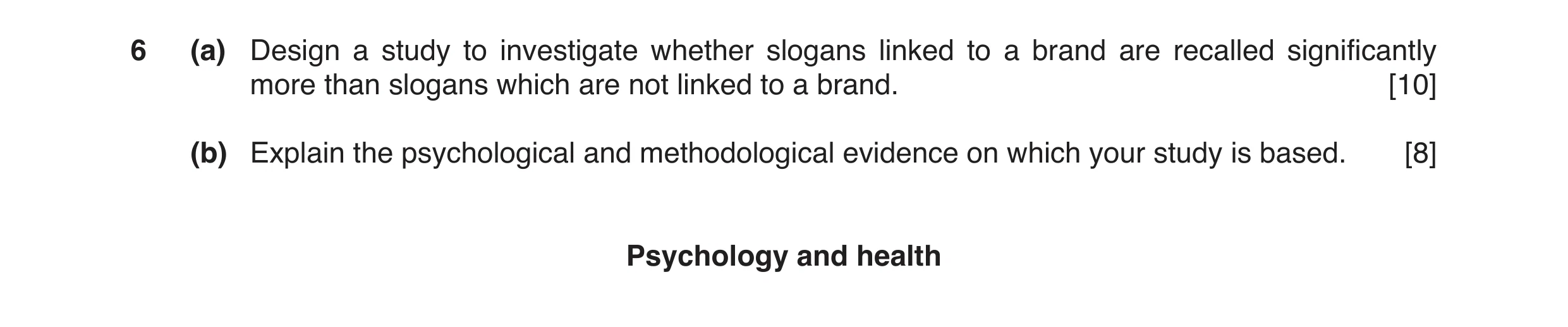
6 (a) Design a study to investigate whether slogans linked to a brand are recalled significantly more than slogans which are not linked to a brand. [10] (b) Explain the psychological and methodological evidence on which your study is based. [8] Psychology and health
18 marks
Mark scheme: 6(a) Design a study to investigate whether slogans linked to a brand are 10 recalled significantly more than slogans which are not linked to a brand. Marks: use generic levels of response ‘Design a study’ question part (a). Additional: Candidates should design the study showing evidence of design features appropriate to the named method. The named method is: any appropriate method. Typical features: • Experiments: type, IV, DV, controls, experimental design. • Observations: type, setting, response categories, sampling frame, number of observers. • Questionnaires/Interviews: type, setting, example questions. Scoring/rating scale, analysis of responses. • Typical features of research methodology: sampling technique and sample, type of data, ethics, reliability, validity, data analysis. 6(b) Explain the psychological and methodological evidence on which your 8 study is based. Marks: use generic levels of response ‘Design a study’ question part (b). Note: If only methodological or psychological explanation is provided max 5 marks. Candidates are expected to explain the reasons for the suggested design in part (a). Explanation should be both psychological and methodological. Psychological to include appropriate theory or research. Additional: candidates are expected to justify their decisions or evidence presented regarding the design made in answer to question part (a). Syllabus: advertising applications: effective slogans (Kohli et al., 2007). Psychological: Kohli et al (2007): slogans enhance a brand's image, aid in its recognition and recall, and help create brand differentiation in consumers' minds. There is little agreement as to what constitutes a successful slogan. As such, although marketing managers use slogans extensively, they are often at a loss when it comes to creating them. In turn, this leads to ineffective use of slogans and, ultimately, the possibility of a surprisingly poor linkage between a brand and its slogan, even among the most well-known brands. Based on our investigation, we propose in this article a series of guidelines for the strategy behind slogans, and on creation and utilization of effective slogans. Methodological: explanation of method using typical features as above.
This question in 9990/42 Oct/Nov 2018
Q4 · ‘Researching the effect of advertising on children is not useful.’ To what extent do you… 9990/42 Oct/Nov 2018
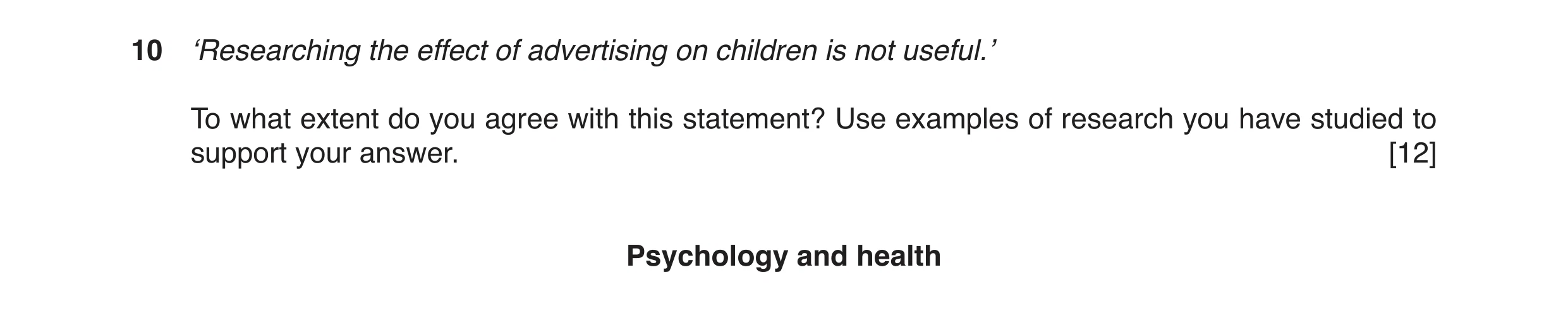
10 ‘Researching the effect of advertising on children is not useful.’ To what extent do you agree with this statement? Use examples of research you have studied to support your answer. [12] Psychology and health
12 marks
Mark scheme: 10 ‘Researching the effect of advertising on children is not useful.’ 12 To what extent do you agree with this statement? Use examples of research you have studied to support your answer. Marks: use generic levels of response in table C. Syllabus: types of advertising and advertising techniques: product placement in films (Auty and Lewis, 2004) Most likely (any other appropriate responses should be credited): useful: • Children are more likely to be influenced they are young, malleable and naïve. • Children observe and imitate: a film character using a product is likely to be imitated by children. • Studies have shown that children identify with products and cartoon characters (and others) that are associated with products (e.g. M&M’s ‘creatures’). • Children are major consumers, they eat food and drink, and advertising e.g. ‘Ronald McDonald’ leads children to eat burgers which may well continue long into adulthood. not useful: • Children are not major consumers; they do not purchase houses, cars, major goods or food for the family. Advertising for children has little effect on major household purchases. • Children are at an early stage in life and they will grow, change and develop in very different ways; children are not miniature adults, they are very different. • What applies to children today will not apply tomorrow. Technology, for example, is ever changing so advertising to children a product today will have little effect when they become adults ten or more years later.
This question in 9990/42 Oct/Nov 2018
Q5 · ‘The AIDA model, which identifies the stages of the advertising process, applies to all… 9990/41 May/June 2019
10 ‘The AIDA model, which identifies the stages of the advertising process, applies to all cultures.’ To what extent do you agree with this statement? Use examples of research you have studied to support your answer. [12] Psychology and health
12 marks
Mark scheme: 10 ‘The AIDA model, which identifies the stages of the advertising 12 process, applies to all cultures.’ To what extent do you agree with this statement? Use examples of research you have studied to support your answer. Marks: use generic levels of response in table C. Syllabus: AIDA model (and updates of it) AIDA model = stages of consumer decision-making. Gain Attention, hold Interest, arouse Desire and achieve Action Most likely (any other appropriate responses should be credited): Does: • The model identifies stages, but not specifics of any stage (i.e. how it might vary across cultures). • The model identifies cognitive decision-making (get Attention, maintain Interest, create Desire and Action results) which applies to all people. • The model is holist rather than reductionist and it can be applied in different ways / adapted by different cultures. • The model is over 100 years old, and as it (and variations of it) are going strong it must have appeal. Does not: • The model is based on consumerism and consumerism is very different in some cultures (e.g. cultures where there is no television, shopping mall, etc.) • There are always individual differences (e.g. as there are different types of shopper) and so there will also be cultural differences • The model is based on western culture (it began in the USA) and material wealth. Some cultures are less materialistic.
This question in 9990/41 May/June 2019
Q6 · A study by Snyder and DeBono (1985) used students to investigate how high self-monitors… 9990/42 May/June 2019
2 A study by Snyder and DeBono (1985) used students to investigate how high self-monitors and low self-monitors evaluated different types of advertisements. Their results appear in Table 2.1, in which there is a maximum score of 12. Higher scores indicate greater favourability towards image- oriented advertisements and lower scores indicate greater favourability towards product-quality- orientated advertisements. Table 2.1 Product Canadian Club Barclay Irish Mocha whisky cigarettes Mint coffee High 6.84 5.00 7.40 Self-monitoring category Low 4.88 3.68 6.08 (a) Explain what the results in Table 2.1 indicate about how high self-monitors and low self- monitors respond to different types of advertising. [2] (b) Give two differences between the ‘soft-sell’ approach and the ‘hard-sell’ approach. [4] (c) Suggest how the validity of the stimulus materials (advertisements) used in the study could have been assessed. [4] (d) Discuss the strengths and weaknesses of using students in studies of consumer behaviour. You should include a conclusion in your answer. [5] Psychology and health
15 marks
Mark scheme: 2(a) Explain what the results in Table 2.1 indicate about how high self- 2 monitors and low self-monitors respond to different types of advertising. Most likely answer (other appropriate responses to be credited): • high self monitors favour image-oriented advertisements; low self monitors favour product-quality-oriented advertisements (as can be seen by looking at the rows in the table). • A wide range of answers is possible, so credit anything that is based on the table. Example below: Marks: 1 mark e.g. both prefer Irish mocha mint coffee 2 marks both prefer Irish mocha mint coffee with numbers to support (e.g. 7.40 and 6.08). Note: any appropriate analysis receives credit. Note: re-writing question scores 0 marks. 2(b) Give two differences between the ‘soft-sell’ and the ‘hard-sell’ 4 approach. Hard-sell = product (low self monitors); soft-sell = images and packaging (high self-monitors). Quote from study (reorganised into differences): • Soft-sell: create ads that appeal to the images associated with the use of the product, images that one may gain and project by using the product. Hard-sell: different ads, ones that focus on claims about the intrinsic merit, inherent quality, and functional value of the product itself. • Soft-sell: how a product is packaged by its advertising is as important as the product itself. Therefore, they tend to create advertisements that are very striking in their visual appeal; they pay particular attention to the finer details of form and color. Typically, the copy associated with these ads emphasizes the image of the product or, more specifically, the images associated with the use of the product. Hard-sell: For these advertisers, it's the "matter, not the manner" that counts. • Soft-sell: These image-oriented ads rarely, if ever, make any explicit mention of the quality of the product, and, indeed, little emphasis is placed on the product itself. Hard-sell: ads tell the consumer how good the product is, how well it works, or, with things to eat and drink, how good they taste. Marks: 1 mark basic answer. 2 marks detail/elaboration ×2. Note: descriptions of each max 1 mark each. Perfect answer ‘x’ does this; ‘y’ does that. 2(c) Suggest how the validity of the stimulus materials (advertisements) 4 used in the study could have been assessed. Most likely answer (other appropriate responses to be credited): Quote from study: As a check on the effectiveness of the manipulation, we presented 10 judges with the three sets of advertisements and, after every set, asked them, "Which ad do you think is directed at concerns about product quality?" and "Which ad do you think is directed at concerns about product image?" All of the judges correctly classified all of the advertisements into the image/product category. Marks: 1–2 marks basic answer. 3–4 marks elaboration. 2(d) Discuss the strengths and weaknesses of using students in studies of 5 consumer behaviour. You should include a conclusion in your answer. Marks: Question requires discussion; always plural of each argument, and always requires conclusion. 1 mark for each advantage/disadvantage (however detailed) and related to the question up to 4 max. 2 marks max for two strengths/weaknesses unrelated to the question. 1 mark for conclusion. Most likely answer (other appropriate responses to be credited): Strengths • students are consumers just like any other person. • students are readily available and in relatively large numbers • students may cost less: no travel expenses; course credits for ‘payment’ less advertising costs. Weaknesses • students are less representative: are younger, less experienced, may not have worked, are more academic. • students are often WEIRD – Westernised, Educated, from Industrialised, Rich Democracies. • students may not have a choice – have to participate • students may know about the research and so unconsciously alter answers to fit aims of study Conclusion: any appropriate conclusion drawn from the discussion that has been presented. 1 mark if appropriate. A conclusion is a ‘decision reached by reasoning’ and so a summary of points already made scores 0 marks.
This question in 9990/42 May/June 2019
Q7 · ‘The AIDA model, which identifies the stages of the advertising process, applies to all… 9990/43 May/June 2019
10 ‘The AIDA model, which identifies the stages of the advertising process, applies to all cultures.’ To what extent do you agree with this statement? Use examples of research you have studied to support your answer. [12] Psychology and health
12 marks
Mark scheme: 10 ‘The AIDA model, which identifies the stages of the advertising 12 process, applies to all cultures.’ To what extent do you agree with this statement? Use examples of research you have studied to support your answer. Marks: use generic levels of response in table C. Syllabus: AIDA model (and updates of it) AIDA model = stages of consumer decision-making. Gain Attention, hold Interest, arouse Desire and achieve Action Most likely (any other appropriate responses should be credited): Does: • The model identifies stages, but not specifics of any stage (i.e. how it might vary across cultures). • The model identifies cognitive decision-making (get Attention, maintain Interest, create Desire and Action results) which applies to all people. • The model is holist rather than reductionist and it can be applied in different ways / adapted by different cultures. • The model is over 100 years old, and as it (and variations of it) are going strong it must have appeal. Does not: • The model is based on consumerism and consumerism is very different in some cultures (e.g. cultures where there is no television, shopping mall, etc.) • There are always individual differences (e.g. as there are different types of shopper) and so there will also be cultural differences • The model is based on western culture (it began in the USA) and material wealth. Some cultures are less materialistic.
This question in 9990/43 May/June 2019
Q8 · ‘Studies of consumer personality are irrelevant; there are no individual differences in… 9990/42 Feb/March 2021
10 ‘Studies of consumer personality are irrelevant; there are no individual differences in the effectiveness of advertising.’ To what extent do you agree with this statement? Use examples of research you have studied to support your answer. [12] Psychology and health
12 marks
Mark scheme: 10 ‘Studies of consumer personality are irrelevant. There are no 12 individual differences in the effectiveness of advertising.’ To what extent do you agree with this statement? Use examples of research you have studied to support your answer. Marks: use generic levels of response in table C. Syllabus: advertising applications advertising & consumer personality (Snyder & DeBono, 1985) Most likely (any other appropriate responses should be credited): Individual differences: • different personalities are attracted to different things • Snyder and DeBono (1985) distinguished between high and low self- monitors with each type perceiving different things • there may be a difference in introverts and extraverts, systemisers and empathisers or any other personality distinction. No individual differences: • there are general principles which will appeal to everyone. The term ‘sale’ suggests discounts; $4.99 is less than $5.00, etc. • people are more influenced by other variables, such as choice heuristics e.g. anchoring • people’s brains work in the same way as discovered by Knutson (brain region study)
This question in 9990/42 Feb/March 2021
Q9 · Product placement can be used in different ways, in media such as films 9990/41 Oct/Nov 2021
6 Product placement can be used in different ways, in media such as films. (a) Design a study to investigate which of three chocolate products placed in a film in different ways will be noticed most by participants. [10] (b) Explain the psychological and methodological evidence on which your study is based. [8] Psychology and health
18 marks
Mark scheme: 6(a) Product placement can be used in different ways, in media such as 10 films. Design a study to investigate which of three chocolate products placed in a film in different ways will be noticed most by participants. Marks: use generic levels of response Design a study question part (a). Additional: Candidates should design the study showing evidence of design features appropriate to the named method. The named method: any appropriate method. Specific features: • Experiments: type, IV, DV, controls, experimental design. • Observations: type, setting, response categories, sampling frame, number of observers. • Questionnaires/Interviews: type, setting, example questions. Scoring/rating scale, analysis of responses. General features of research methodology: sampling technique & sample, type of data, ethics, reliability, validity, data analysis. 6(b) Explain the psychological and methodological evidence on which your 8 study is based. Marks: use generic levels of response ‘Design a study’ question part (b). Note: If only methodological or psychological explanation is provided max 5 marks Candidates are expected to explain the reasons for the suggested design in part (a). Explanation should be both psychological and methodological. Psychological to include appropriate theory or research. Additional: candidates are expected to justify their decisions or evidence presented regarding the design made in answer to question part (a). Syllabus: product placement in films (Auty and Lewis, 2004) Psychological: Product placement is where a branded product is given a prominent position in a scene in a programme or film. The study by Auty and Lewis is relevant because they studied children and placement of drinks. Methodological: explanation of method using general and specific features as above.
This question in 9990/41 Oct/Nov 2021
Q10 · Product placement can be used in different ways, in media such as films 9990/43 Oct/Nov 2021
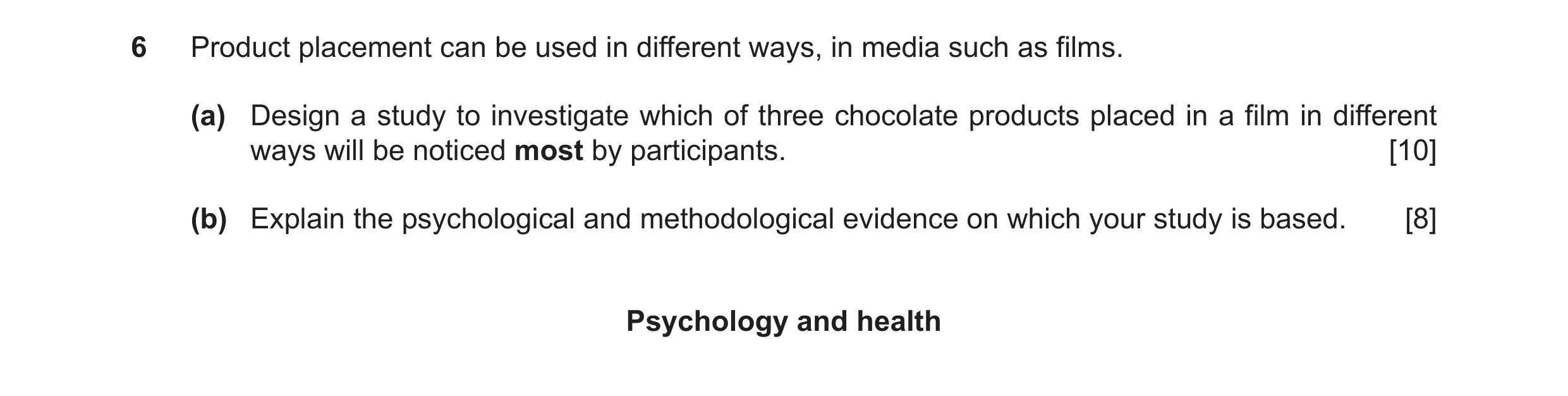
6 Product placement can be used in different ways, in media such as films. (a) Design a study to investigate which of three chocolate products placed in a film in different ways will be noticed most by participants. [10] (b) Explain the psychological and methodological evidence on which your study is based. [8] Psychology and health
18 marks
Mark scheme: 6(a) Product placement can be used in different ways, in media such as 10 films. Design a study to investigate which of three chocolate products placed in a film in different ways will be noticed most by participants. Marks: use generic levels of response Design a study question part (a). Additional: Candidates should design the study showing evidence of design features appropriate to the named method. The named method: any appropriate method. Specific features: • Experiments: type, IV, DV, controls, experimental design. • Observations: type, setting, response categories, sampling frame, number of observers. • Questionnaires/Interviews: type, setting, example questions. Scoring/rating scale, analysis of responses. General features of research methodology: sampling technique & sample, type of data, ethics, reliability, validity, data analysis. 6(b) Explain the psychological and methodological evidence on which your 8 study is based. Marks: use generic levels of response ‘Design a study’ question part (b). Note: If only methodological or psychological explanation is provided max 5 marks Candidates are expected to explain the reasons for the suggested design in part (a). Explanation should be both psychological and methodological. Psychological to include appropriate theory or research. Additional: candidates are expected to justify their decisions or evidence presented regarding the design made in answer to question part (a). Syllabus: product placement in films (Auty and Lewis, 2004) Psychological: Product placement is where a branded product is given a prominent position in a scene in a programme or film. The study by Auty and Lewis is relevant because they studied children and placement of drinks. Methodological: explanation of method using general and specific features as above.
This question in 9990/43 Oct/Nov 2021
Q11 · ‘In all advertising media, there is only one effective way to advertise a product, for… 9990/42 May/June 2022
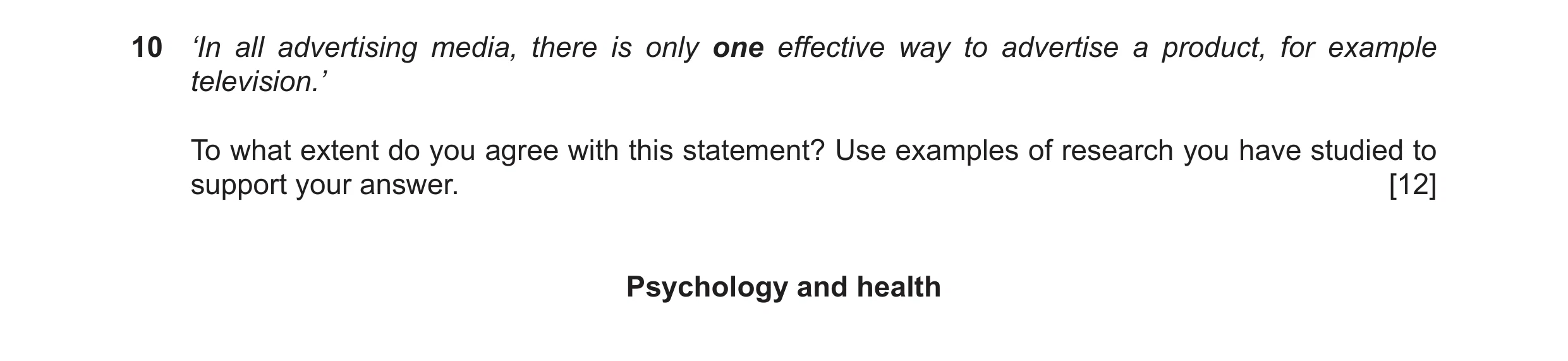
10 ‘In all advertising media, there is only one effective way to advertise a product, for example television.’ To what extent do you agree with this statement? Use examples of research you have studied to support your answer. [12] Psychology and health
12 marks
Mark scheme: 10 ‘In all advertising media, there is only one effective way to advertise a 12 product, for example television.’ To what extent do you agree with this statement? Use examples of research you have studied to support your answer. Marks: use generic levels of response in table C. Syllabus: advertising media (e.g. television, etc.); persuasive techniques Most likely (any other appropriate responses should be credited): Advantages: Large numbers of most populations watch television Television advertising can be focused (specific to one region or channel) or it can be general (to everyone) Television advertising is the ‘perfect’ medium: not just a picture or words in a newspaper or poster). It has impact; can use ‘celebrities’ (see Yale model of communication) Disadvantages: Some people may not have access to a television Some people might not watch the channel the advert is on (watching streaming television) Some people may not watch television advertising Other forms of advertising may be better suited than TV, such as radio Other forms of advertising might be specific (in a magazine; poster on student campus. Note: candidates can choose any medium, question has television as example.
This question in 9990/42 May/June 2022
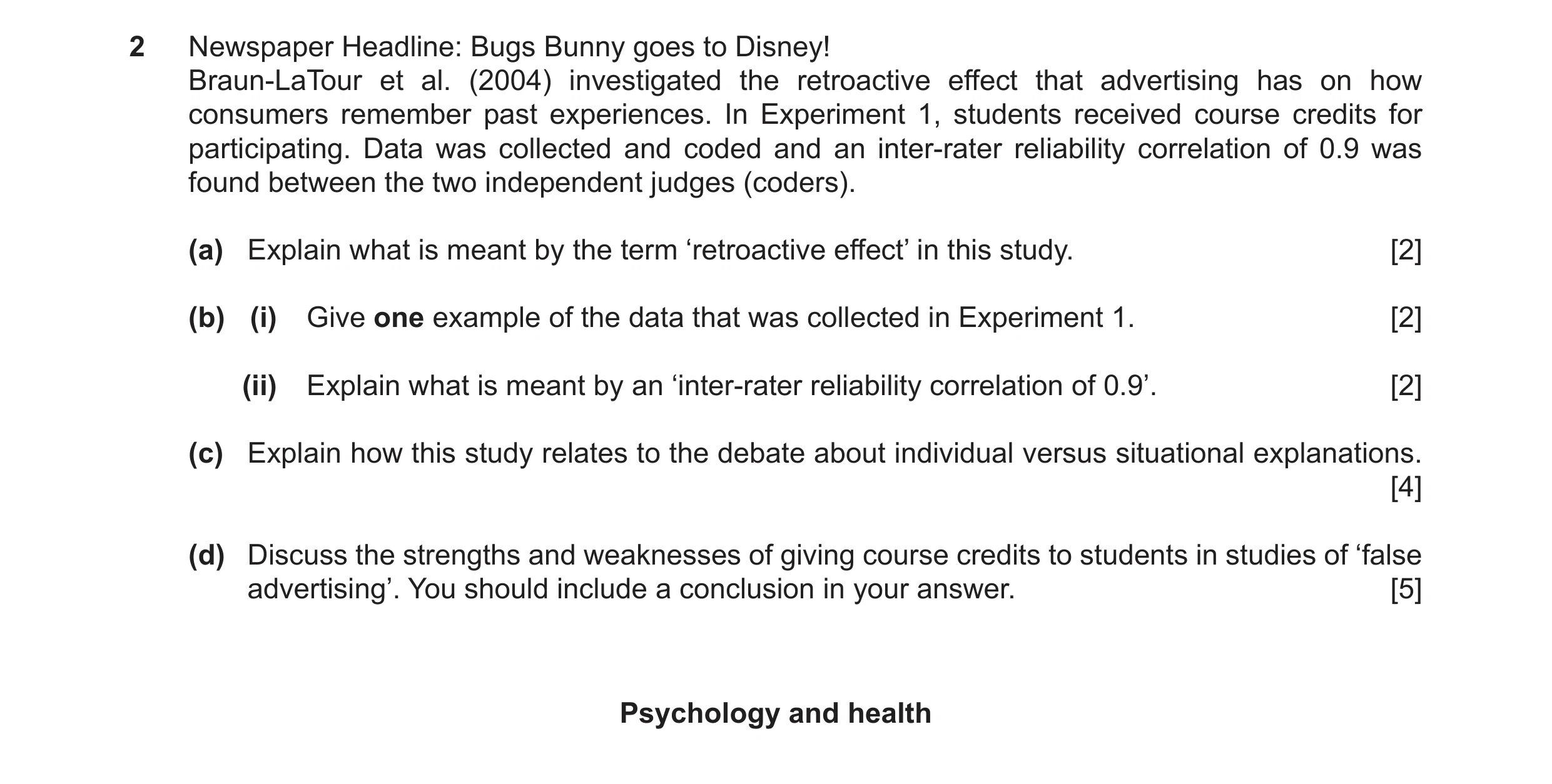
Q12 · Newspaper Headline: Bugs Bunny goes to Disney! 9990/41 Oct/Nov 2022
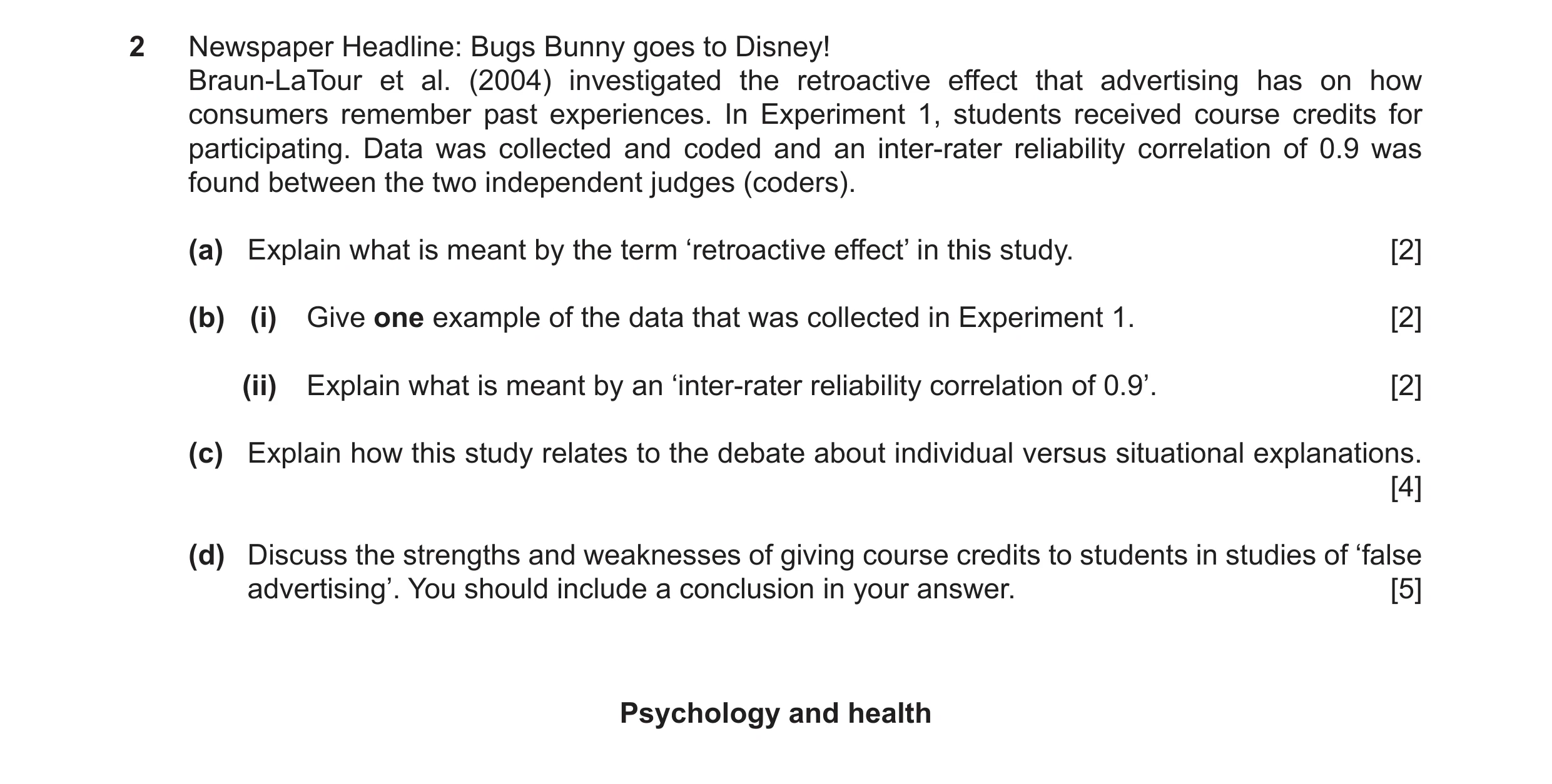
2 Newspaper Headline: Bugs Bunny goes to Disney! Braun‑LaTour et al. (2004) investigated the retroactive effect that advertising has on how consumers remember past experiences. In Experiment 1, students received course credits for participating. Data was collected and coded and an inter‑rater reliability correlation of 0.9 was found between the two independent judges (coders). (a) Explain what is meant by the term ‘retroactive effect’ in this study. [2] (b) (i) Give one example of the data that was collected in Experiment 1. [2] (ii) Explain what is meant by an ‘inter‑rater reliability correlation of 0.9’. [2] (c) Explain how this study relates to the debate about individual versus situational explanations. [4] (d) Discuss the strengths and weaknesses of giving course credits to students in studies of ‘false advertising’. You should include a conclusion in your answer. [5] Psychology and health
15 marks
Mark scheme: 2 Newspaper Headline: Bugs Bunny goes to Disney! Braun-LaTour et al. (2004) investigated the retroactive effect that advertising has on how consumers remember past experiences. In Experiment 1, students received course credits for participating. Data was collected and coded and an inter-rater reliability correlation of 0.9 was found between the two independent judges (coders). 2(a) Explain what is meant by the term ‘retroactive effect’ in this study. 2 Most likely answer (other appropriate responses to be credited): Retroactive interference is where new information interferes with the old (or existing) information in memory. Retroactive effect in this study is that new information (advertising) influences and changes the memory of an event (that people shook hands with Bugs Bunny at a Disney theme park). Marks: 1 mark for description of term description, +1 mark for relating to this study. 2(b)(i) Give one example of the data that was collected in Experiment 1. 2 Quotes from study: Two independent judges coded respondents’ reactions to the ads and the recall statements of their Disney experience. Specifically, they • coded the number of words participants used in response to the ad • whether their reactions to the ad were personal or concentrated on critiquing ad elements • and whether or not they noticed that Bugs Bunny did not belong in a Disney ad For the memory measures, they • coded the number of words in the recall statement and • how many items that had appeared in the ad were mentioned as being part of the participants’ own memory Marks: 1 mark basic answer (e.g. ‘recall of statements’), 2 marks detailed answer/elaboration or example. Note: credit ‘how many participants could remember’ (1 mark) ‘Bugs Bunny at Disneyland’ (+1 mark). 2(b)(ii) Explain what is meant by an ‘inter-rater reliability correlation of 0.9’. 2 Answer can include a number of components: Awareness of what inter-rater reliability is; what reliability is; how this was achieved; what the 0.9 correlation means in relation to inter-rater reliability. Marks: 1 mark basic answer (what it is), 2 marks detailed answer/ elaboration (0.9 is a ‘strong’ correlation). 2(c) Explain how this study relates to the debate about individual versus 4 situational explanations. Most likely answer (other appropriate responses to be credited): • Situational: the past experience of visiting Disneyland and whether they had seen certain characters there, such as Bugs Bunny • Individual: the false memory (cognitive process) that was created in the mind of the participant Marks: 1 mark identifying +1 mark for explanation or example from study 2. 2(d) Discuss the strengths and weaknesses of giving course credits to 5 students in studies of ‘false advertising’. You should include a conclusion in your answer. Most likely answer (other appropriate responses to be credited, such as eye movement patterns): Strengths: • students will do anything for course credits (or being paid) • having an incentive is more likely to lead to them staying for the whole study rather than withdrawing • participants know they are taking part in a study (so give consent but not informed consent) • they are more likely to participate with enthusiasm and be attentive Weaknesses: • they know they are taking part in a study • they are less likely to withdraw, even though they may wish to • they are more likely to respond to try to please the experimenter • perhaps only participating for money not for ‘furthering of scientific knowledge’ Conclusion: any appropriate conclusion drawn from the discussion that has been presented. 1 mark if appropriate. A conclusion is a ‘decision reached by reasoning’ and so a summary of points already made scores 0 marks. Marks: Question requires discussion; always plural of each argument, and always requires conclusion. 1 mark for each strength/weakness (however detailed) and related to the question up to 4 max. 2 marks max for two strengths/weaknesses unrelated to the question. 1 mark for conclusion.
This question in 9990/41 Oct/Nov 2022
Q13 · ‘Children should never be used as participants in studies of advertising.’ To what extent… 9990/41 Oct/Nov 2022
10 ‘Children should never be used as participants in studies of advertising.’ To what extent do you agree with this statement? Use examples of research you have studied to support your answer. [12] Psychology and health
12 marks
Mark scheme: 10 ‘Children should never be used as participants in studies of 12 advertising’. To what extent do you agree with this statement? Use examples of research you have studied to support your answer. Marks: use generic levels of response in table C. Syllabus: Issue: children in psychological research; brand recognition in children (Fischer et al., 1991); product placement in films (Auty and Lewis, 2004). Most likely (any other appropriate responses should be credited): Should be used: • children are young and naïve and so are more likely to behave naturally, even in laboratory experiments • children will not question what is happening • children are consumers so studies involving children are as appropriate as adults as participants Should never be used: • children may not understand complex instructions and if they do… • they may not be able to explain what they are thinking or how they feel • children may not exercise the right to withdraw; they may not understand a debriefing • children may be psychologically harmed by a study which may not be evident for many years
This question in 9990/41 Oct/Nov 2022
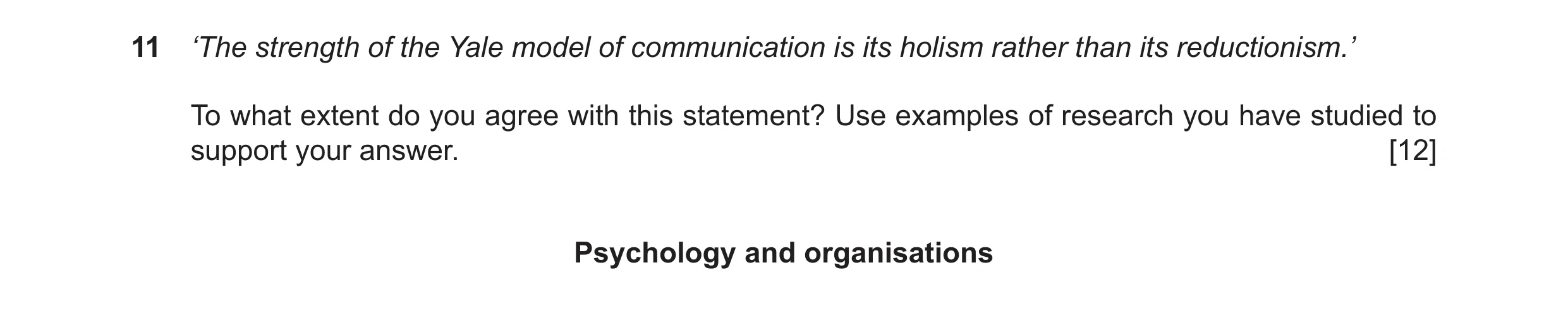
Q14 · ‘The strength of the Yale model of communication is its holism rather than its… 9990/42 Oct/Nov 2022
11 ‘The strength of the Yale model of communication is its holism rather than its reductionism.’ To what extent do you agree with this statement? Use examples of research you have studied to support your answer. [12] Psychology and organisations
12 marks
Mark scheme: 11 ‘The strength of the Yale model of communication is its holism rather 12 than its reductionism.’ To what extent do you agree with this statement? Use examples of research you have studied to support your answer. Marks: use generic levels of response in table C. Syllabus: Yale model of communication Most likely (any other appropriate responses should be credited): Reductionist: • model is broken down into several components (source, message, medium, audience and situation) • breaking down allows each factor to be studied in more detail (e.g. isolating IV and controlling other factors) • different factors should be broken down because they are different. Not reductionist: • breaking down into individual aspects may lose sight of overall model (communication) • breaking down may not lead to a consideration of how each factor is inter-related with the others • other models do not break down into individual features.
This question in 9990/42 Oct/Nov 2022
Q15 · Newspaper Headline: Bugs Bunny goes to Disney! 9990/43 Oct/Nov 2022
2 Newspaper Headline: Bugs Bunny goes to Disney! Braun‑LaTour et al. (2004) investigated the retroactive effect that advertising has on how consumers remember past experiences. In Experiment 1, students received course credits for participating. Data was collected and coded and an inter‑rater reliability correlation of 0.9 was found between the two independent judges (coders). (a) Explain what is meant by the term ‘retroactive effect’ in this study. [2] (b) (i) Give one example of the data that was collected in Experiment 1. [2] (ii) Explain what is meant by an ‘inter‑rater reliability correlation of 0.9’. [2] (c) Explain how this study relates to the debate about individual versus situational explanations. [4] (d) Discuss the strengths and weaknesses of giving course credits to students in studies of ‘false advertising’. You should include a conclusion in your answer. [5] Psychology and health
15 marks
Mark scheme: 2 Newspaper Headline: Bugs Bunny goes to Disney! Braun-LaTour et al. (2004) investigated the retroactive effect that advertising has on how consumers remember past experiences. In Experiment 1, students received course credits for participating. Data was collected and coded and an inter-rater reliability correlation of 0.9 was found between the two independent judges (coders). 2(a) Explain what is meant by the term ‘retroactive effect’ in this study. 2 Most likely answer (other appropriate responses to be credited): Retroactive interference is where new information interferes with the old (or existing) information in memory. Retroactive effect in this study is that new information (advertising) influences and changes the memory of an event (that people shook hands with Bugs Bunny at a Disney theme park). Marks: 1 mark for description of term description, +1 mark for relating to this study. 2(b)(i) Give one example of the data that was collected in Experiment 1. 2 Quotes from study: Two independent judges coded respondents’ reactions to the ads and the recall statements of their Disney experience. Specifically, they • coded the number of words participants used in response to the ad • whether their reactions to the ad were personal or concentrated on critiquing ad elements • and whether or not they noticed that Bugs Bunny did not belong in a Disney ad For the memory measures, they • coded the number of words in the recall statement and • how many items that had appeared in the ad were mentioned as being part of the participants’ own memory Marks: 1 mark basic answer (e.g. ‘recall of statements’), 2 marks detailed answer/elaboration or example. Note: credit ‘how many participants could remember’ (1 mark) ‘Bugs Bunny at Disneyland’ (+1 mark). 2(b)(ii) Explain what is meant by an ‘inter-rater reliability correlation of 0.9’. 2 Answer can include a number of components: Awareness of what inter-rater reliability is; what reliability is; how this was achieved; what the 0.9 correlation means in relation to inter-rater reliability. Marks: 1 mark basic answer (what it is), 2 marks detailed answer/ elaboration (0.9 is a ‘strong’ correlation). 2(c) Explain how this study relates to the debate about individual versus 4 situational explanations. Most likely answer (other appropriate responses to be credited): • Situational: the past experience of visiting Disneyland and whether they had seen certain characters there, such as Bugs Bunny • Individual: the false memory (cognitive process) that was created in the mind of the participant Marks: 1 mark identifying +1 mark for explanation or example from study 2. 2(d) Discuss the strengths and weaknesses of giving course credits to 5 students in studies of ‘false advertising’. You should include a conclusion in your answer. Most likely answer (other appropriate responses to be credited, such as eye movement patterns): Strengths: • students will do anything for course credits (or being paid) • having an incentive is more likely to lead to them staying for the whole study rather than withdrawing • participants know they are taking part in a study (so give consent but not informed consent) • they are more likely to participate with enthusiasm and be attentive Weaknesses: • they know they are taking part in a study • they are less likely to withdraw, even though they may wish to • they are more likely to respond to try to please the experimenter • perhaps only participating for money not for ‘furthering of scientific knowledge’ Conclusion: any appropriate conclusion drawn from the discussion that has been presented. 1 mark if appropriate. A conclusion is a ‘decision reached by reasoning’ and so a summary of points already made scores 0 marks. Marks: Question requires discussion; always plural of each argument, and always requires conclusion. 1 mark for each strength/weakness (however detailed) and related to the question up to 4 max. 2 marks max for two strengths/weaknesses unrelated to the question. 1 mark for conclusion.
This question in 9990/43 Oct/Nov 2022
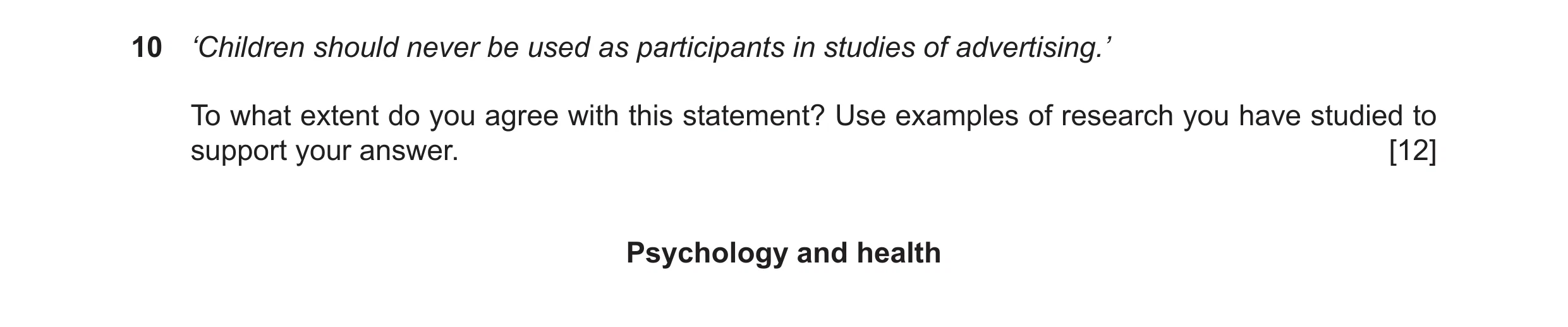
Q16 · ‘Children should never be used as participants in studies of advertising.’ To what extent… 9990/43 Oct/Nov 2022
10 ‘Children should never be used as participants in studies of advertising.’ To what extent do you agree with this statement? Use examples of research you have studied to support your answer. [12] Psychology and health
12 marks
Mark scheme: 10 ‘Children should never be used as participants in studies of 12 advertising’. To what extent do you agree with this statement? Use examples of research you have studied to support your answer. Marks: use generic levels of response in table C. Syllabus: Issue: children in psychological research; brand recognition in children (Fischer et al., 1991); product placement in films (Auty and Lewis, 2004). Most likely (any other appropriate responses should be credited): Should be used: • children are young and naïve and so are more likely to behave naturally, even in laboratory experiments • children will not question what is happening • children are consumers so studies involving children are as appropriate as adults as participants Should never be used: • children may not understand complex instructions and if they do… • they may not be able to explain what they are thinking or how they feel • children may not exercise the right to withdraw; they may not understand a debriefing • children may be psychologically harmed by a study which may not be evident for many years
This question in 9990/43 Oct/Nov 2022
Q17 · Advertising can be made more effective using a slogan 9990/42 May/June 2023
6 Advertising can be made more effective using a slogan. Two kinds of slogans are ‘jingle slogans’ (slogans with music) and ‘non-jingle slogans’ (slogans without music). (a) Design a study to investigate whether jingle slogans are recalled significantly more than non-jingle slogans. [10] (b) Explain the psychological and methodological evidence on which your study is based. [8] Psychology and health
18 marks
Mark scheme: 6(a) Advertising can be made more effective using a slogan. Two kinds of 10 slogans are 'jingle slogans' (slogans with music) and 'non-jingle slogans’ (slogans without music). Design a study to investigate whether jingle slogans are recalled significantly more than non-jingle slogans. Marks: use generic levels of response Design a study question part (a). Additional: Candidates should design the study showing evidence of design features appropriate to the named method. The named method is: any appropriate method Specific features: Experiments: type, IV, DV, controls, experimental design. Observations: type, setting, response categories, sampling frame, number of observers. Questionnaires/Interviews: type, setting, example questions. Scoring/rating scale, analysis of responses. General features of research methodology: sampling technique and sample, type of data, ethics, reliability, validity, data analysis 6(b) Explain the psychological and methodological evidence on which your 8 study is based. Marks: use generic levels of response ‘Design a study’ question part (b). Note: If only methodological or psychological explanation is provided max 5 marks Candidates are expected to explain the reasons for the suggested design in part (a). Explanation should be both psychological and methodological. Psychological to include appropriate theory or research. Additional: candidates are expected to justify their decisions or evidence presented regarding the design made in answer to question part (a). Syllabus: advertising applications: effective slogans (Kohli et al., 2007) Psychological: Kohli et al (2007) suggest that good slogans: should be ‘positioned’ clearly linked to the brand: the slogan should be linked with everything to do with the product, not just the packaging. Please repeat that: the slogan should be consistent across all advertising. Jingle, jangle: jingles can be easy to remember initially, so they should be used. Use at the outset: slogans are fundamental It’s okay to be creative: don’t keep it simple, be creative; make sure the audience ‘gets it’ Methodological: explanation of method using general and specific features as above.
This question in 9990/42 May/June 2023
Q18 · From the key study by Snyder and DeBono (1985) on consumer personality and advertising… 9990/42 May/June 2024
3 From the key study by Snyder and DeBono (1985) on consumer personality and advertising: (a) Describe the procedure of study 3. [4] (b) Suggest how one ethical guideline was broken in study 3. [2] (c) Explain one strength and one weakness of using a telephone interview to investigate ‘consumer personality and advertising’. [4]
10 marks
Mark scheme: 3(a) Describe the procedure of study 3. 4 Syllabus: 2.5.2 Key study on consumer personality and advertising: Snyder and DeBono (1985), focus on study 3, specifics of methodology for study 1 and study 2 will not be needed. Award 4 marks for a detailed explanation decreasing to 1 mark for a partial explanation. Definitive answer: participant called using telephone explanation of reason for study (shampoo) one of two messages randomly allocated (i) image message or (ii) quality message two questions asked (i) willingness to use shampoo 5-point scale (definitely not to definitely yes) (ii) willingness to try shampoo in percentages 0% not at all to 100% definitely willing. NOTE: 0 marks for sample/sampling technique or assessing self-monitoring score 3(b) Suggest how one ethical guideline was broken in study 3. 2 Award 2 marks for an appropriate suggestion and applied to study with detail / elaboration / example. Award 1 mark for an appropriate suggestion but not applied. Answers may include: no deception was broken (1) the researchers (i) gave a false name, (ii) claimed that they were working for a marketing research firm, (iii) claimed they were researching a shampoo no full informed consent (1) because the researchers claimed the study was about shampoo, when it wasn’t (2). NOTE: there is no harm; a debrief was given “researchers answered any questions they had”; there is no mention about right to withdraw, so no evidence that this guideline was broken. 3(c) Explain one strength and one weakness of using a telephone interview 4 to investigate ‘consumer personality and advertising’. Up to 2 marks for each strength and up to 2 marks for each weakness: Award 2 marks for an appropriate strength/weakness stated and applied as required by the question with detail / elaboration / example. Award 1 mark for an appropriate strength/weakness stated but not applied. Answers may include: Strengths: an interview is with a person themselves so they know about their needs (1) so they can answer questions about themselves, and their advertising likes and dislikes (2) using a telephone means that a potentially representative sample can be contacted (1) and so the advertising preferences of a diverse sample of participants can be investigated (2). Weaknesses: questions need to be short/rating scales simple (1) so full analysis/gathering extensive data about personality or advertising preferences will not be possible (2) the drop-out rate for telephone interviews is quite high (1) and so what is said about their personality or advertising preferences may not be detailed or may not be complete (2) cannot see non-verbal responses to questions (1) which may provide useful information about personality or advertising preferences (2). Other appropriate responses to be credited.
This question in 9990/42 May/June 2024
Q19 · EEG (electroencephalogram) as a technique has been used to investigate how people respond… 9990/42 Oct/Nov 2024
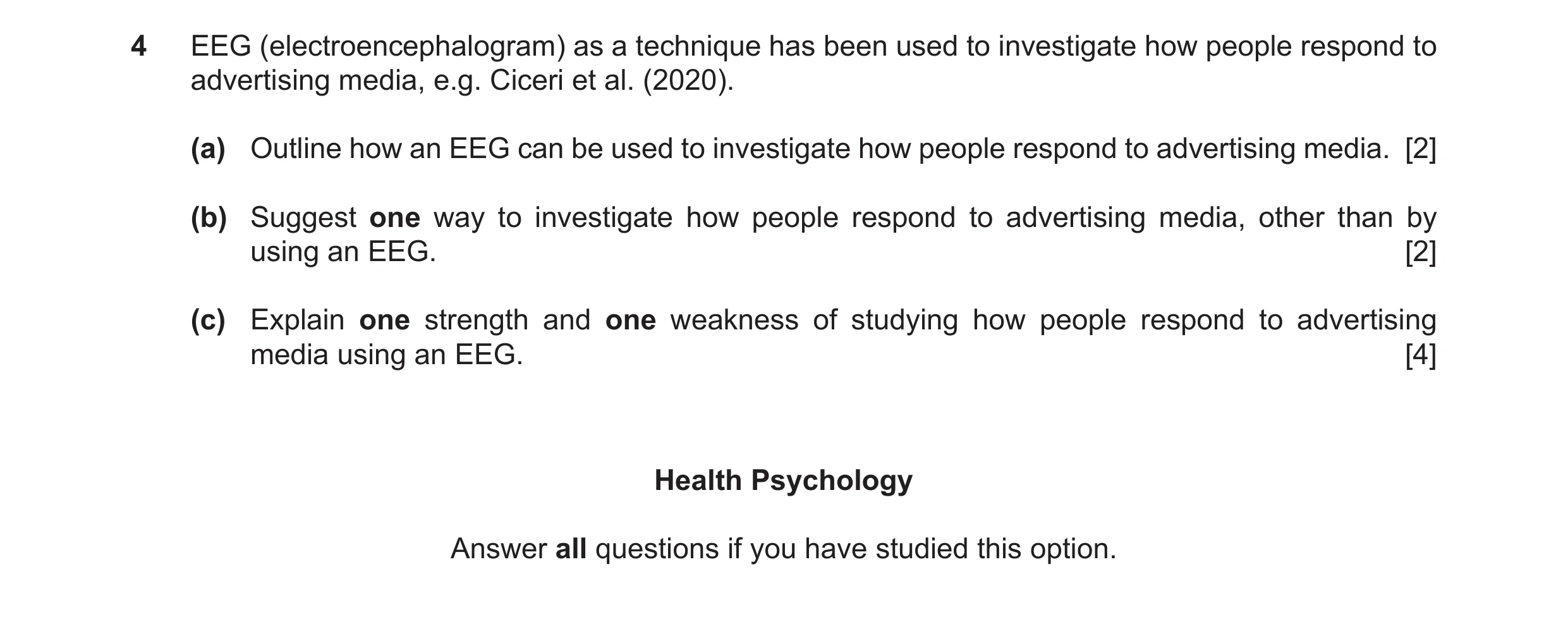
4 EEG (electroencephalogram) as a technique has been used to investigate how people respond to advertising media, e.g. Ciceri et al. (2020). (a) Outline how an EEG can be used to investigate how people respond to advertising media. [2] (b) Suggest one way to investigate how people respond to advertising media, other than by using an EEG. [2] (c) Explain one strength and one weakness of studying how people respond to advertising media using an EEG. [4] Health Psychology Answer all questions if you have studied this option.
8 marks
Mark scheme: 4 EEG (electroencephalogram) as a technique has been used to investigate how people respond to advertising media, e.g. Ciceri et al. (2020). 4(a) Outline how an EEG can be used to investigate how people respond to 2 advertising media. Syllabus: 2.5.1 advertising media including types of advertising media: printed, television, internet and smartphone; use of eye-tracking and EEG, including a study, e.g. Ciceri et al. (2020). Marks: Award 2 marks for a detailed explanation. Award 1 mark for a partial explanation. Answers may include (other appropriate responses to be credited). • a stimulus presented to the participant (on a screen or through a VR) • different types of advertisement are presented (or whatever advertising stimulus is being studied) • the Emotiv EPOC+ headset (or any EEG) to record electrical activity • different activity results from different stimuli/type of advert being presented. 4(b) Suggest one way to investigate how people respond to advertising 2 media, other than by using an EEG. Marks: Award 2 marks for an appropriate suggestion stated and applied to study with detail / elaboration / example. Award 1 mark for an appropriate suggestion identified but not applied. Answers may include (other appropriate responses to be credited). • the use of eye-tracking is possible (1 mark) [this is also included in the Ciceri et al. study] so advertising media is presented and what a participant looks at is recorded (2 marks). • a questionnaire (or interview) (inc format & technique) can be used (1 mark) to ask participants questions about an advertisement they have seen (2 marks) • an fMRI can be used (1 mark) [The study by Knutson et al. (2007), no longer on syllabus, but may be used] to study neural predictors of purchases (2 marks). 4(c) Explain one strength and one weakness of studying how people 4 respond to advertising media using an EEG. Marks: up to 2 marks for each strength and up to 2 marks for each weakness: Award 2 marks for an appropriate strength/weakness stated and applied as required by the question with detail / elaboration / example. Award 1 mark for an appropriate strength/weakness stated but not applied. Answers may include (other appropriate responses to be credited): Strengths • ‘brain wave’ data is objective (1 mark) if an evoked potential is recorded in response to some advertisement, then it is fact (2 marks) • the data is valid (measures what it claims) (1 mark) because the DV can be directly recorded in response to the advertising stimulus (2 marks) Weaknesses • the equipment may not be 100% accurate; may miss some potentials (1 mark) and so data in response to an advertising stimulus may be false (2 marks) • the EEG headset may be uncomfortable for participants to wear (1 mark) and so may distract them from the task resulting in confounding (2 marks)
This question in 9990/42 Oct/Nov 2024
Q20 · From the key study by Snyder and DeBono (1985) on consumer personality and advertising… 9990/42 Oct/Nov 2025
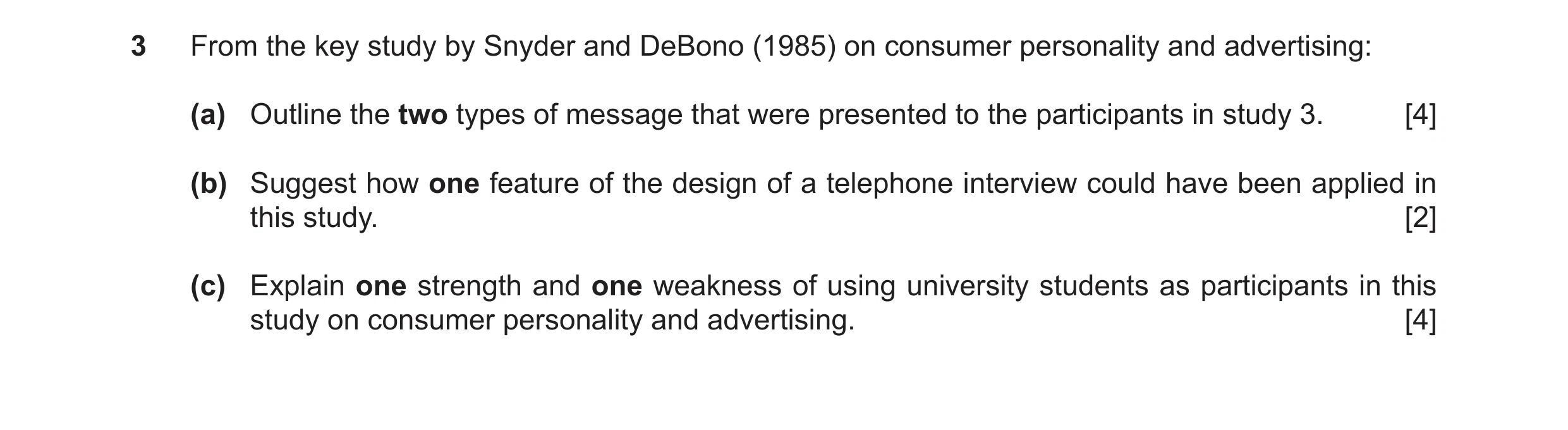
3 From the key study by Snyder and DeBono (1985) on consumer personality and advertising: (a) Outline the two types of message that were presented to the participants in study 3. [4] (b) Suggest how one feature of the design of a telephone interview could have been applied in this study. [2] (c) Explain one strength and one weakness of using university students as participants in this study on consumer personality and advertising. [4]
10 marks
Mark scheme: 3 From the key study by Snyder and DeBono (1985) on consumer personality and advertising: 3(a) Outline the two types of message that were presented to the participants 4 in study 3. Syllabus: 2.5.2 Key study on consumer personality and advertising: Snyder and DeBono (1985), focus on study 3, specifics of methodology for study 1 and study 2 will not be needed. Marks: Award 2 marks for a detailed outline (identification plus detail) 2 Award 1 mark for a partial outline (identification and basic sentence) 2 Award 1 mark for correct identification of both terms. 0 marks for identification of only one. Definitive answers: • image message: appearance (‘the image associated with the use’) The results of tests have indicated this brand usually rates about average in how it cleans your hair, it consistently rates above average in how good it makes your hair look. • quality message: quality (‘the claim about the quality of the product’) The results of tests have indicated this brand usually rates about average in how good it makes your hair look, it consistently rates above average in how clean it gets your hair. 3(b) Suggest how one feature of the design of a telephone interview could 2 have been applied in this study. Marks: Award 2 marks for an appropriate suggestion and applied to study with detail / elaboration / example. Award 1 mark for an appropriate suggestion identified but not applied. Answers may include (other appropriate responses to be credited): • questions should be as simple as possible (as nothing is written/seen) (1 mark) participants were asked ‘how much they’d like to try the shampoo?’ (2 marks) • the number of questions is minimal (1 mark) only one main question was asked e.g. as above (2 marks) • the time taken to complete the questionnaire should be short (e.g. 20 mins for total interview) (1 mark) only one main question was asked (2 marks) • answers to questions should be uncomplicated, otherwise people forget what the first answer is (1 mark) participants used a five-point scale from ‘definitely not’ to ‘definitely, yes’ (+1 mark) or asked a percentage (+1 mark) 3(c) Explain one strength and one weakness of using university students as 4 participants in this study on consumer personality and advertising. Marks: Up to 2 marks for each strength and up to 2 marks for each weakness. Award 2 marks for an appropriate strength/weakness stated and applied as required by the question with detail / elaboration / example. Award 1 mark for an appropriate strength/weakness stated but not applied. Answers may include (other appropriate responses to be credited): Strengths: • students may be readily available; sample is standardised as all participants are students (1 mark) and students are consumers and have a personality just like any other age group (2 marks) • conducting a study on students can be a pilot study to test for strengths/weaknesses (1 mark) before rolling it out to people of all ages to investigate consumer personality and advertising (2 marks) Weaknesses: • students may respond to demand characteristics because they know they are participating in a study (1 mark) about consumer personality and advertising (2 marks). • students may have very little or no experience in ‘real’ work environments (1 mark) and so any results may not be generalised to ‘real’ people (2 marks).
This question in 9990/42 Oct/Nov 2025
 1 / 5
1 / 5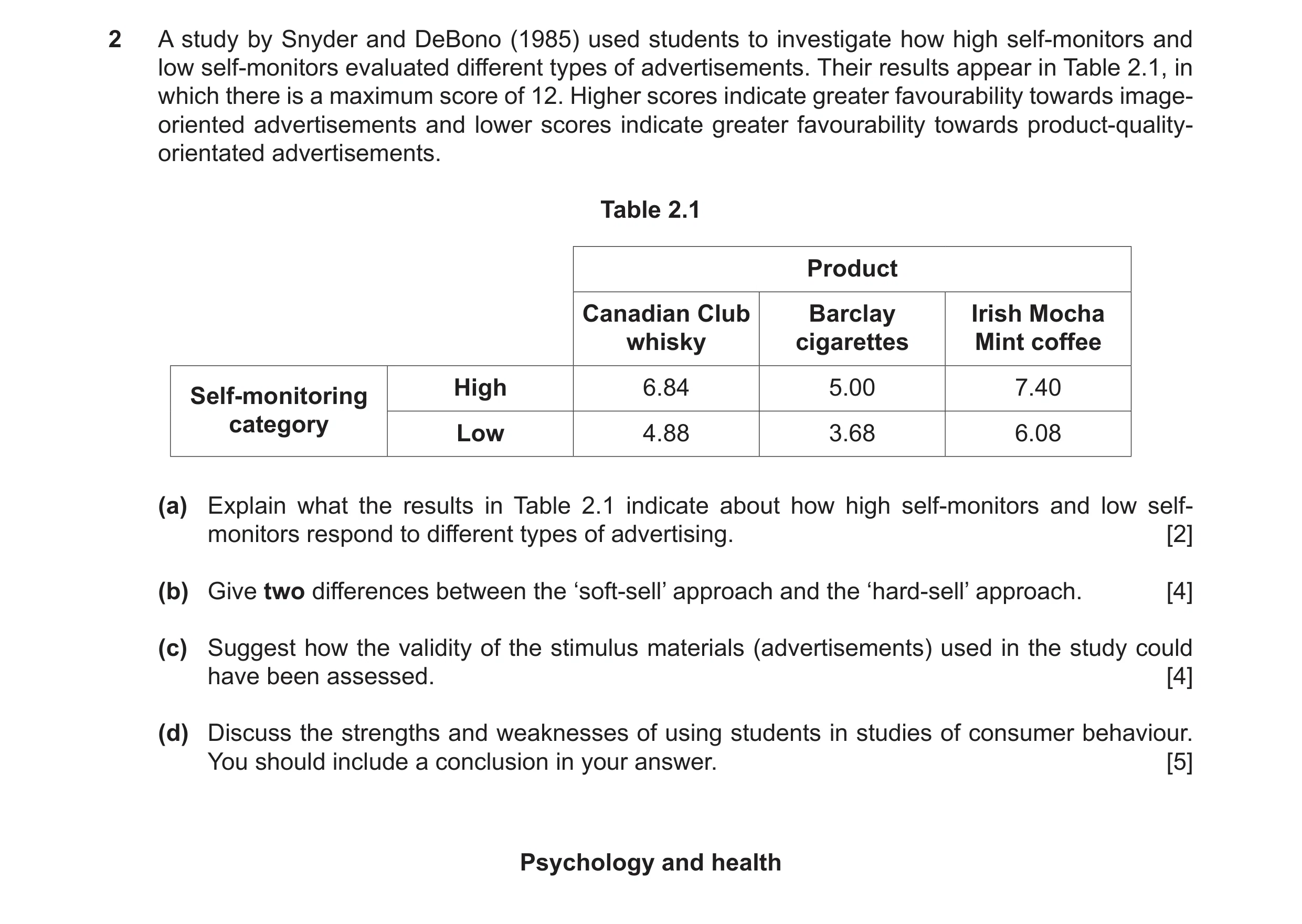
 2 / 5
2 / 5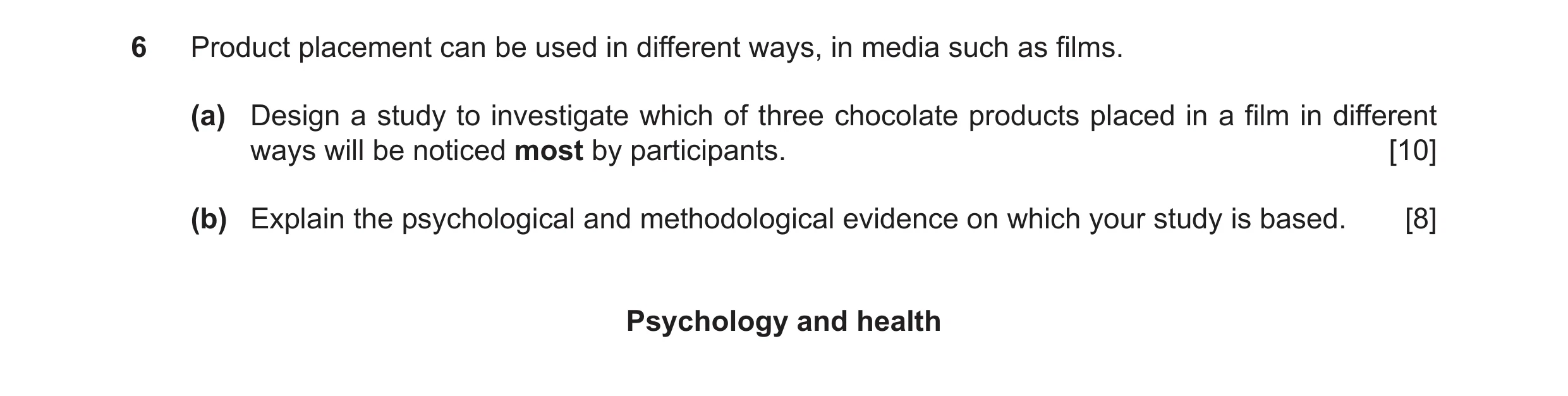
 3 / 5
3 / 5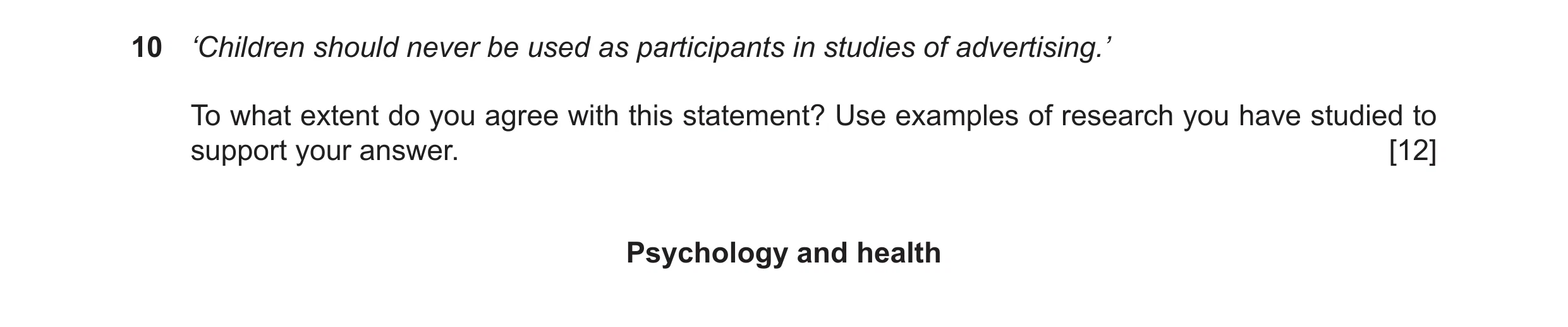
 4 / 5
4 / 5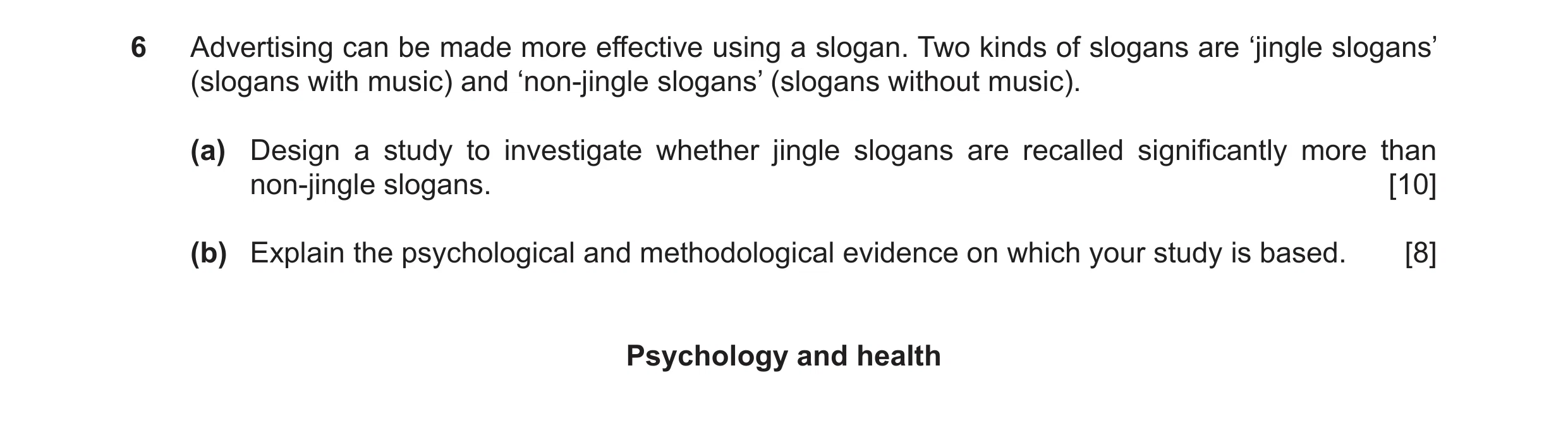
![Question 18: From the key study by Snyder and DeBono (1985) on consumer personality and advertising: (a) Describe the procedure of study 3. [4] (b) Sugg…](https://img.pastlit.com/crops/2bd78365-8336-4ddc-b058-d1ebca4953dd/q3.webp)
 5 / 5
5 / 5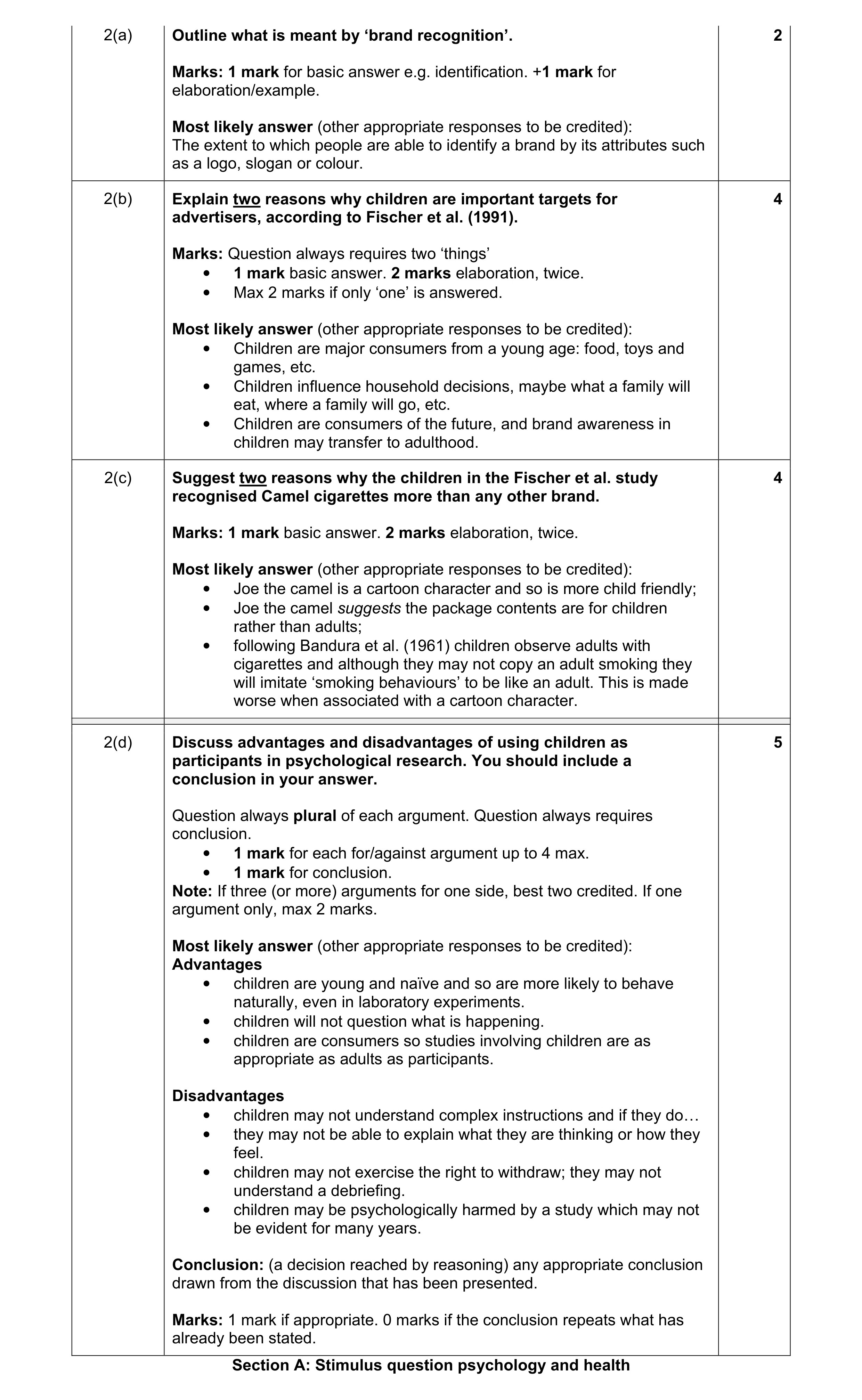 15
15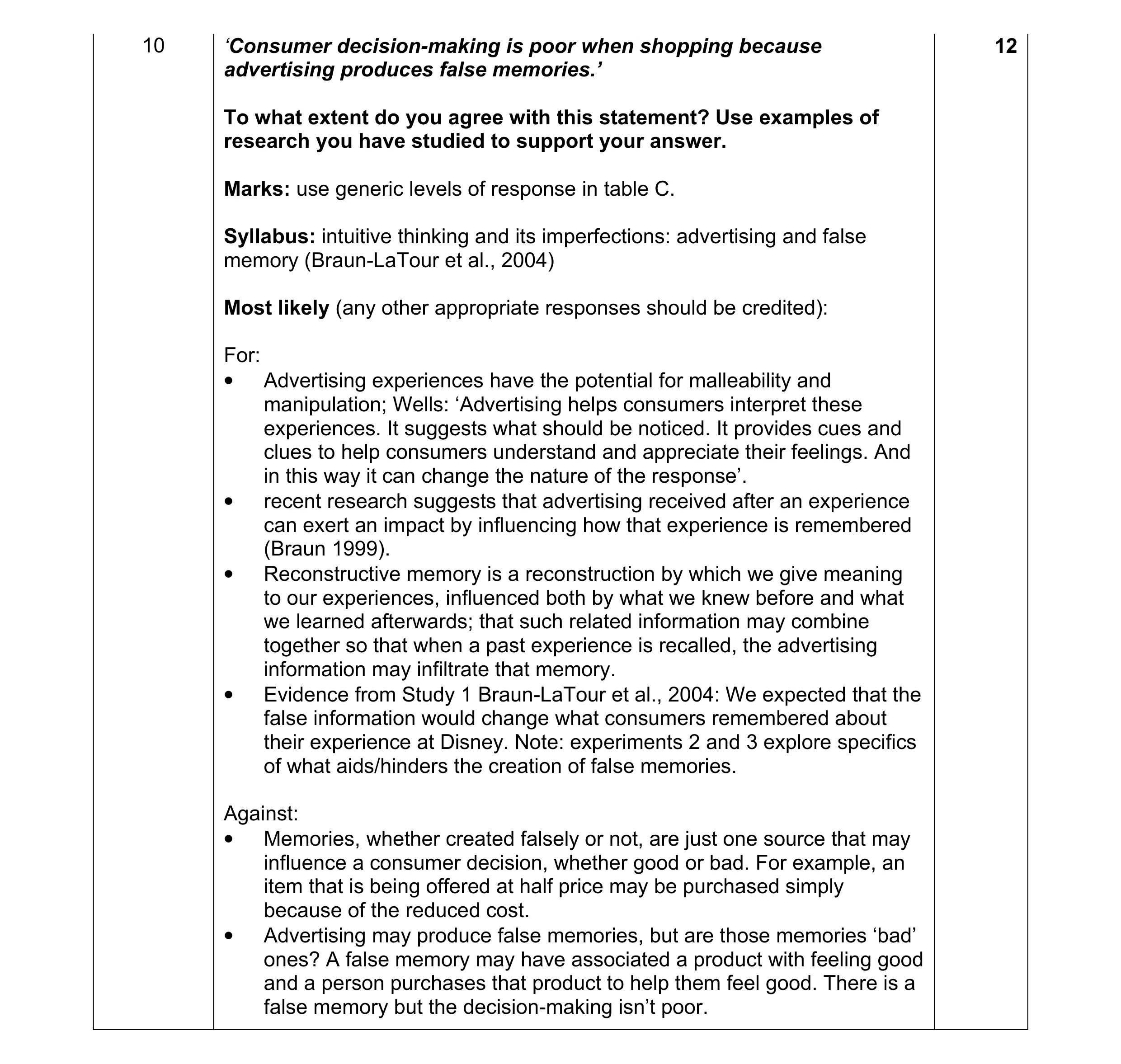 12
12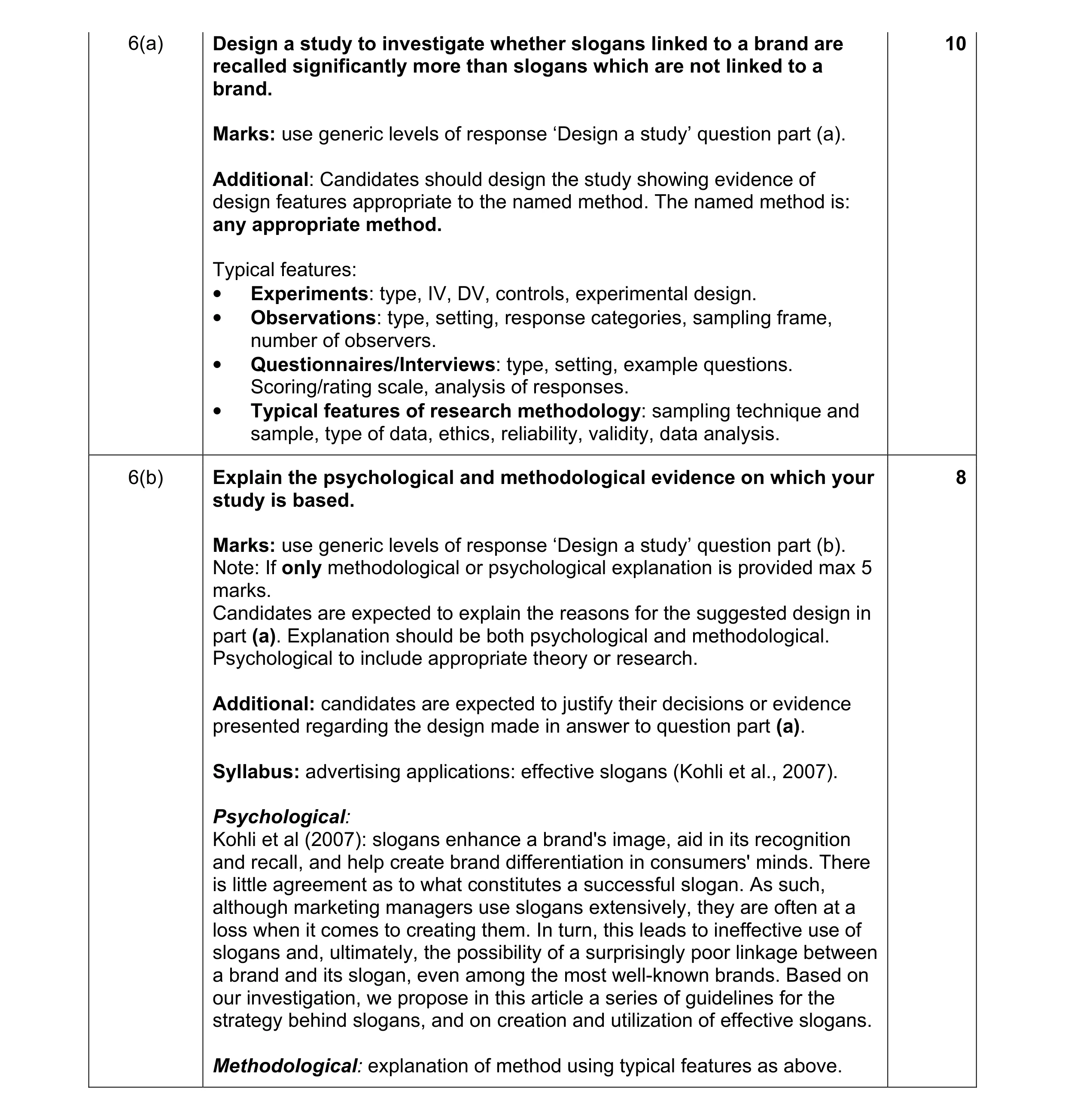 18
18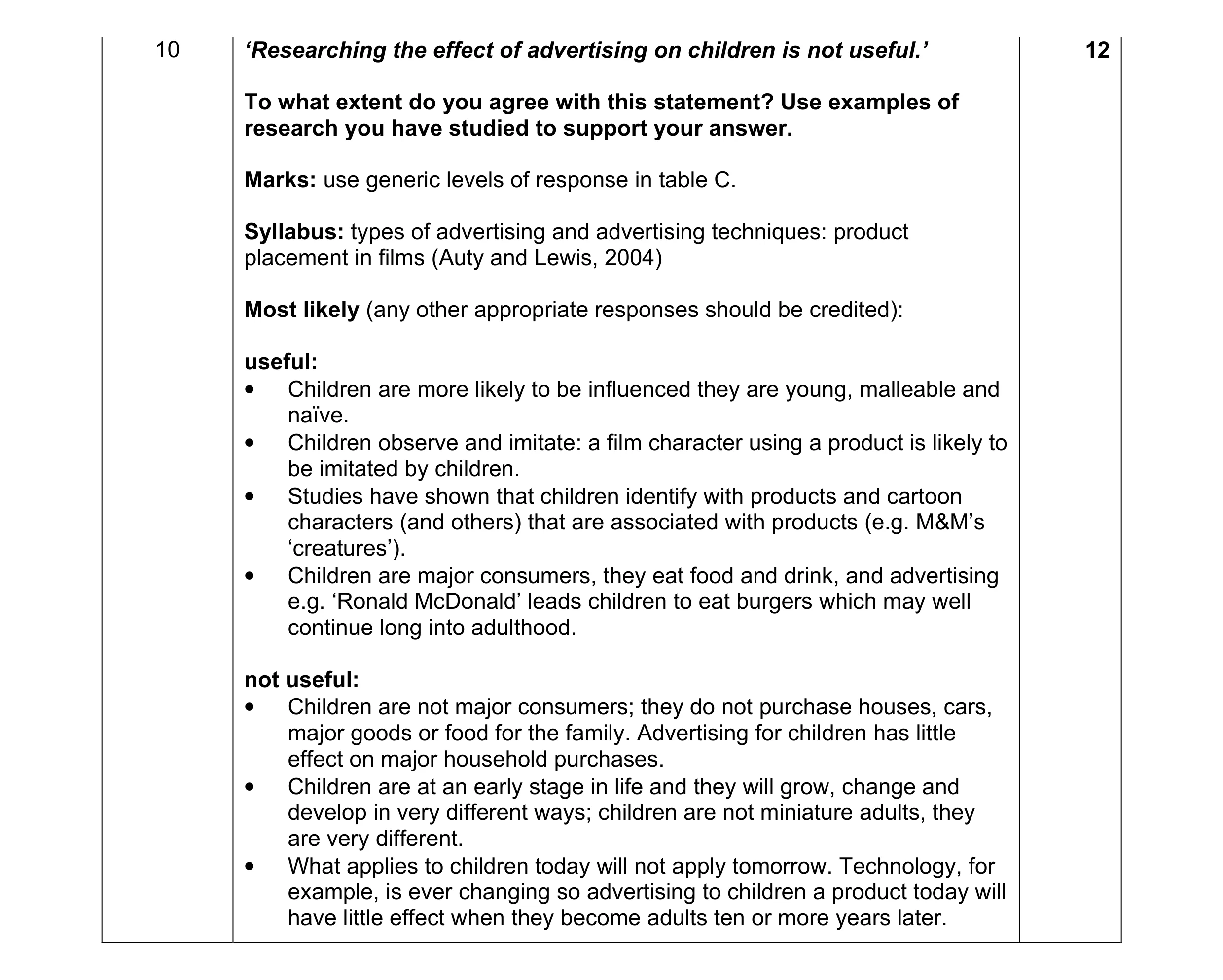 12
12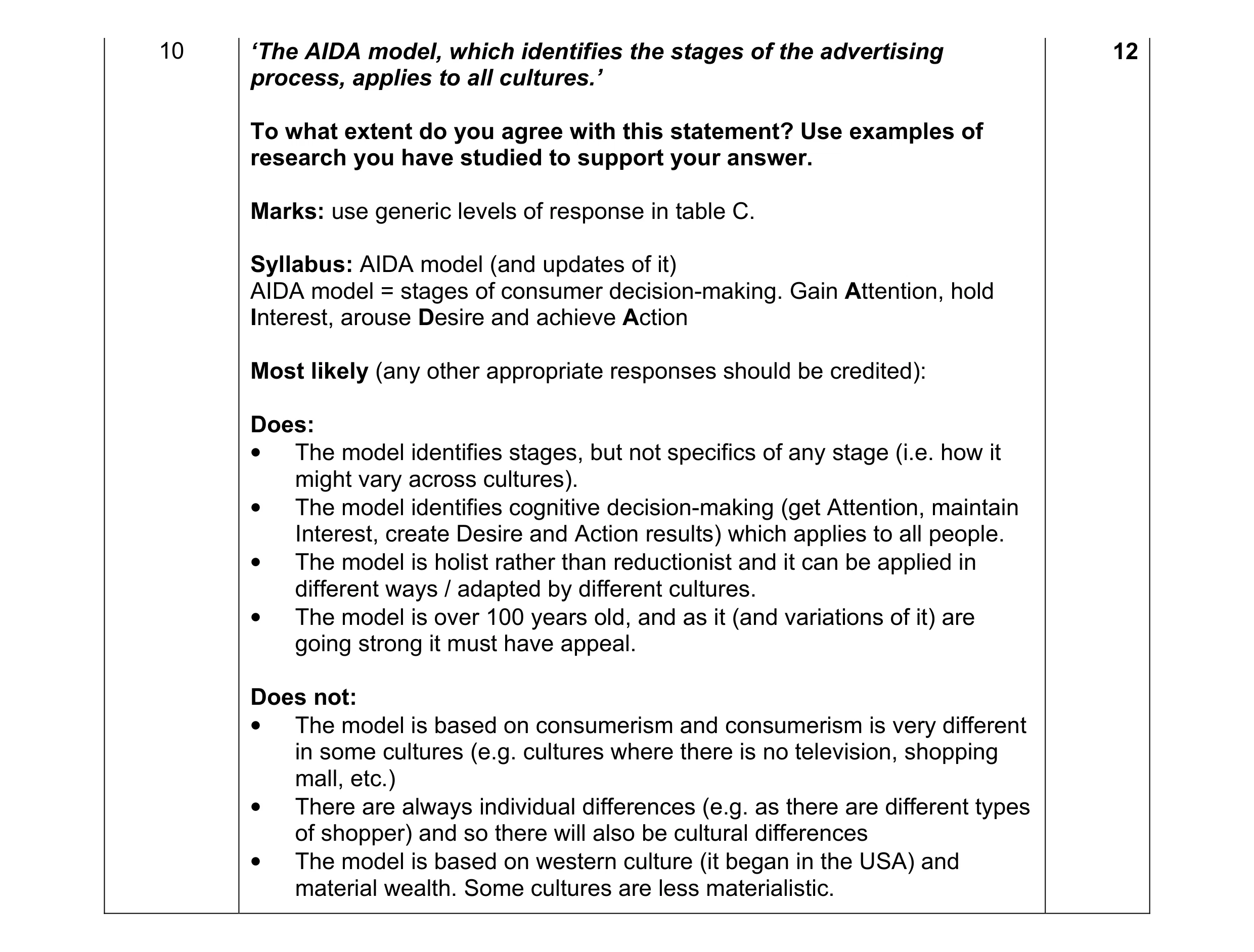 12
12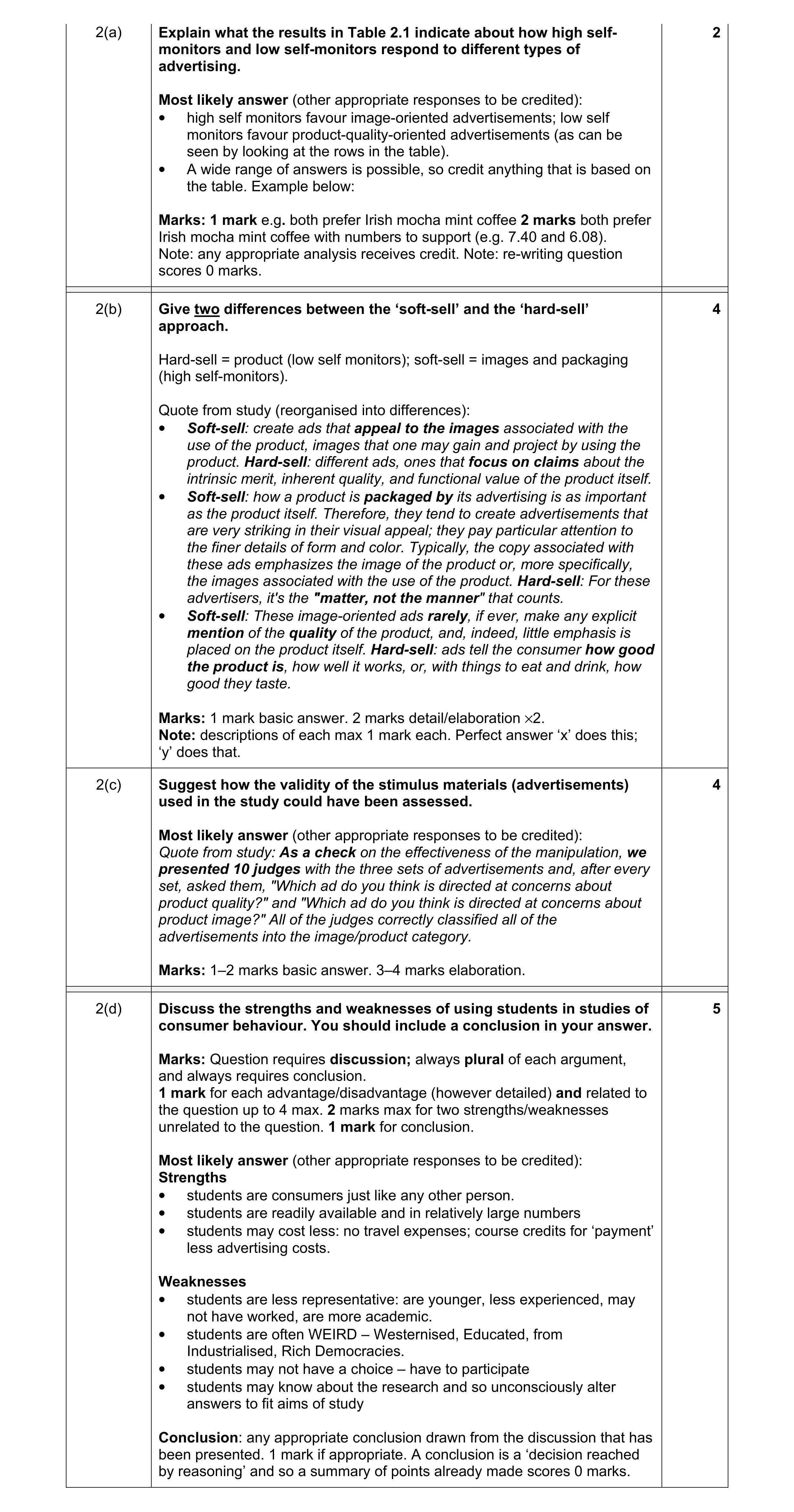 15
15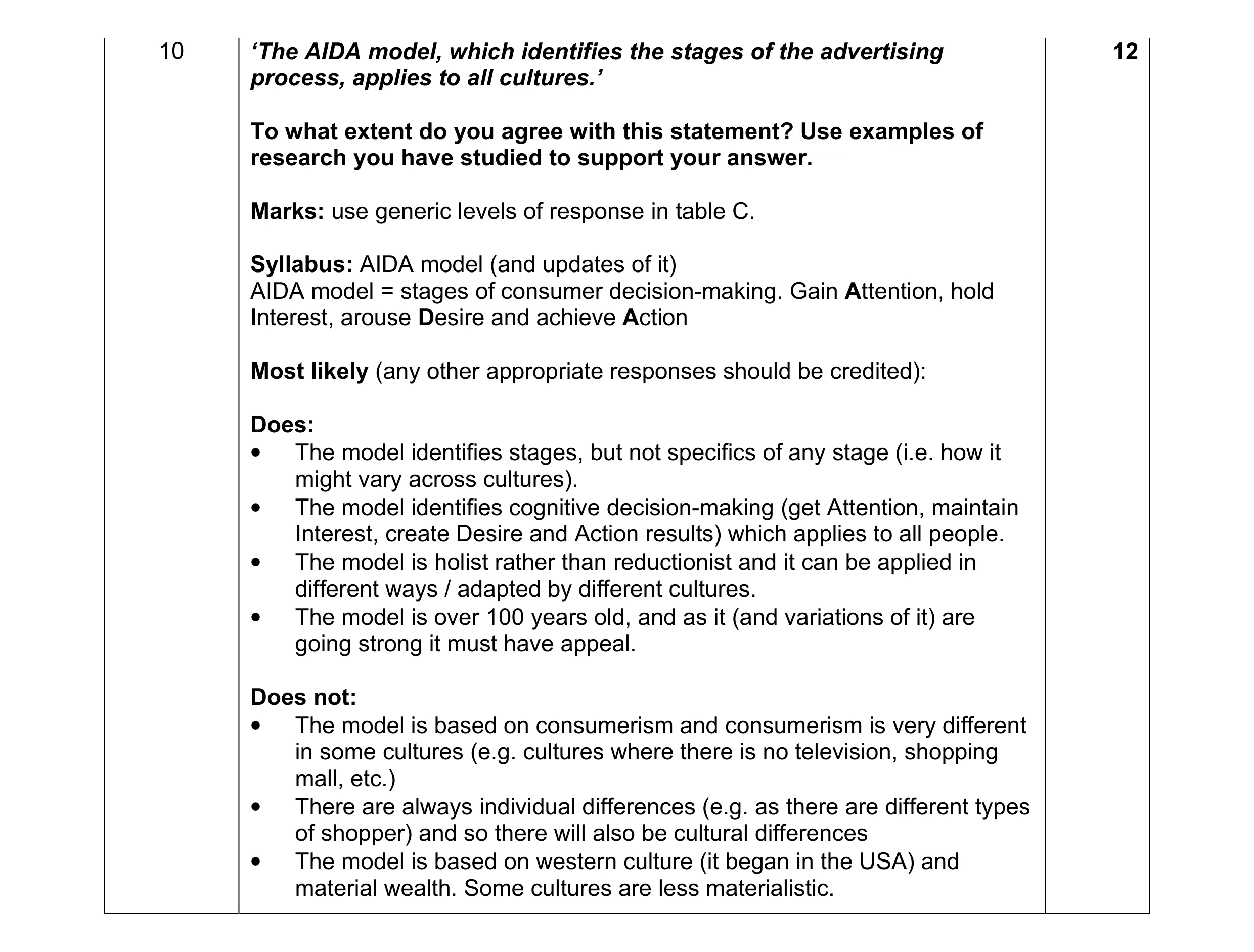 12
12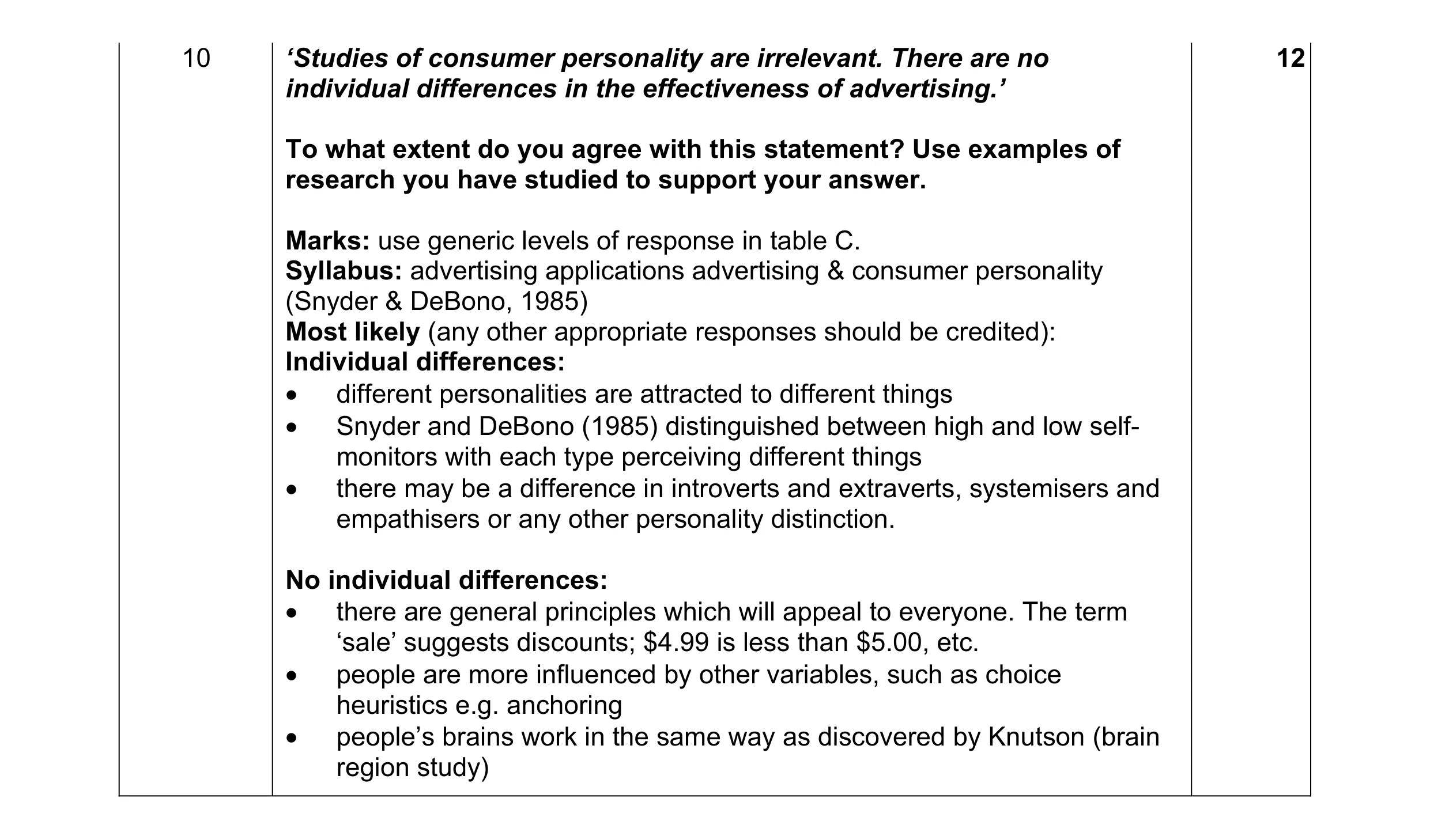 12
12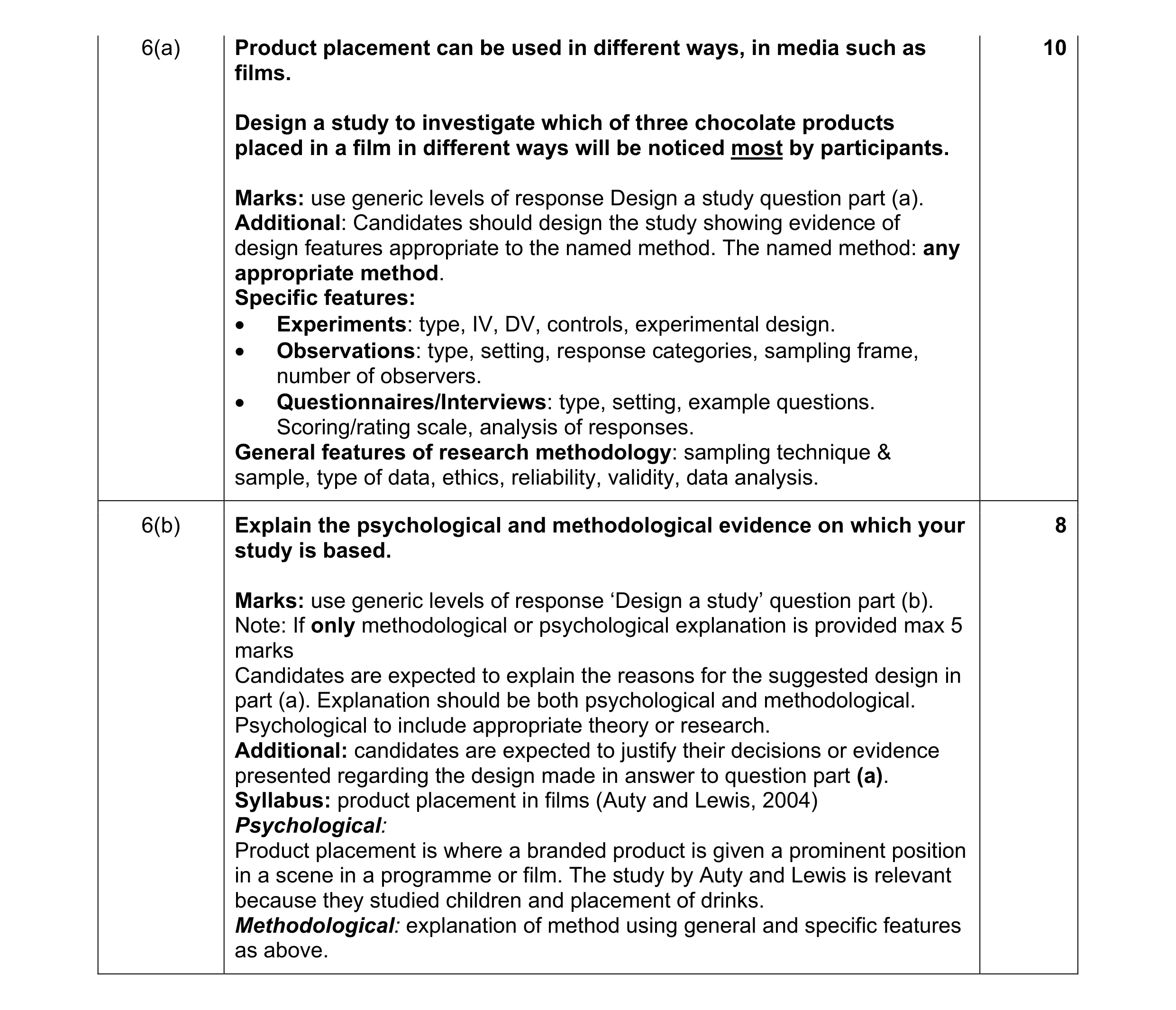 18
18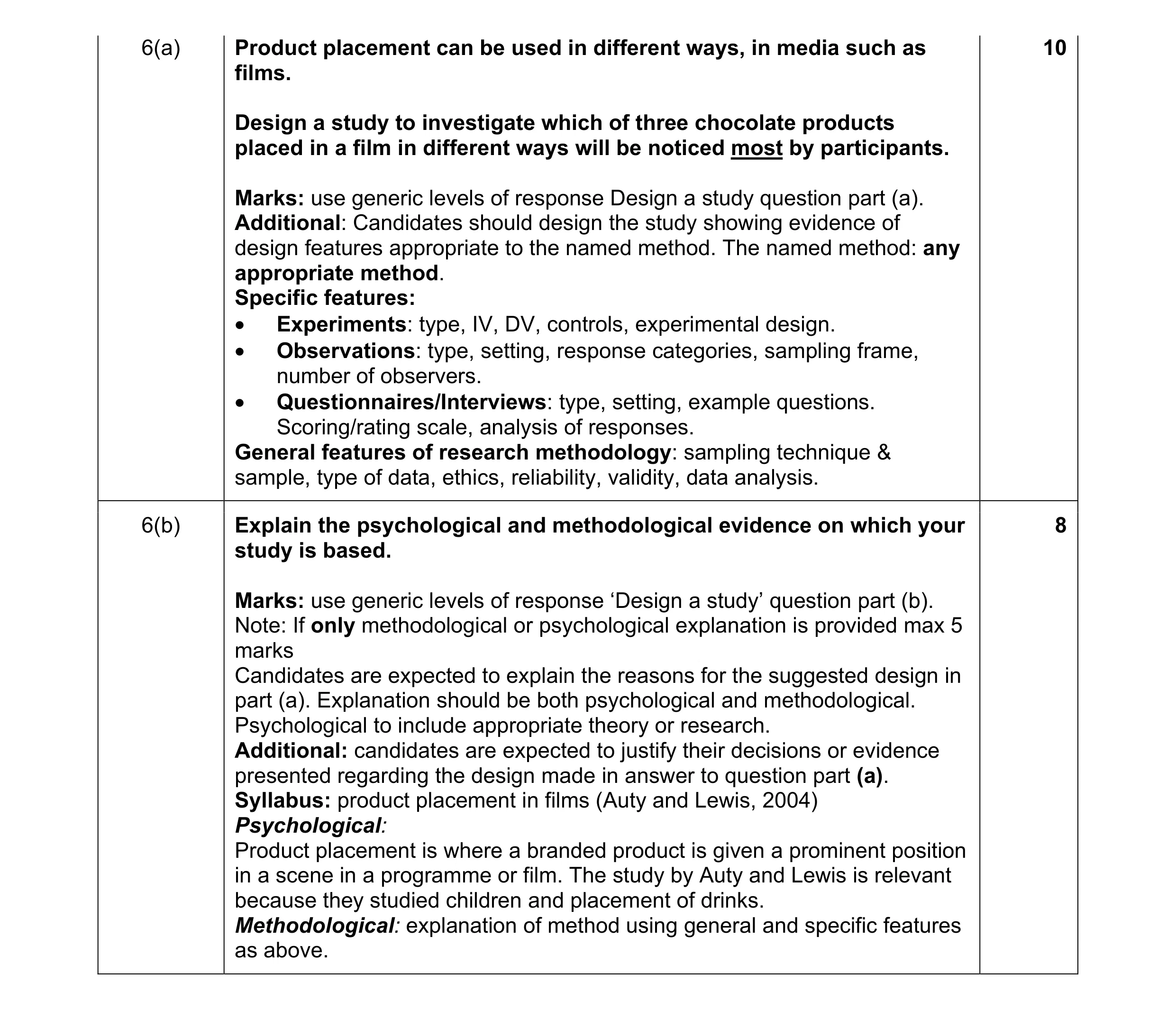 18
18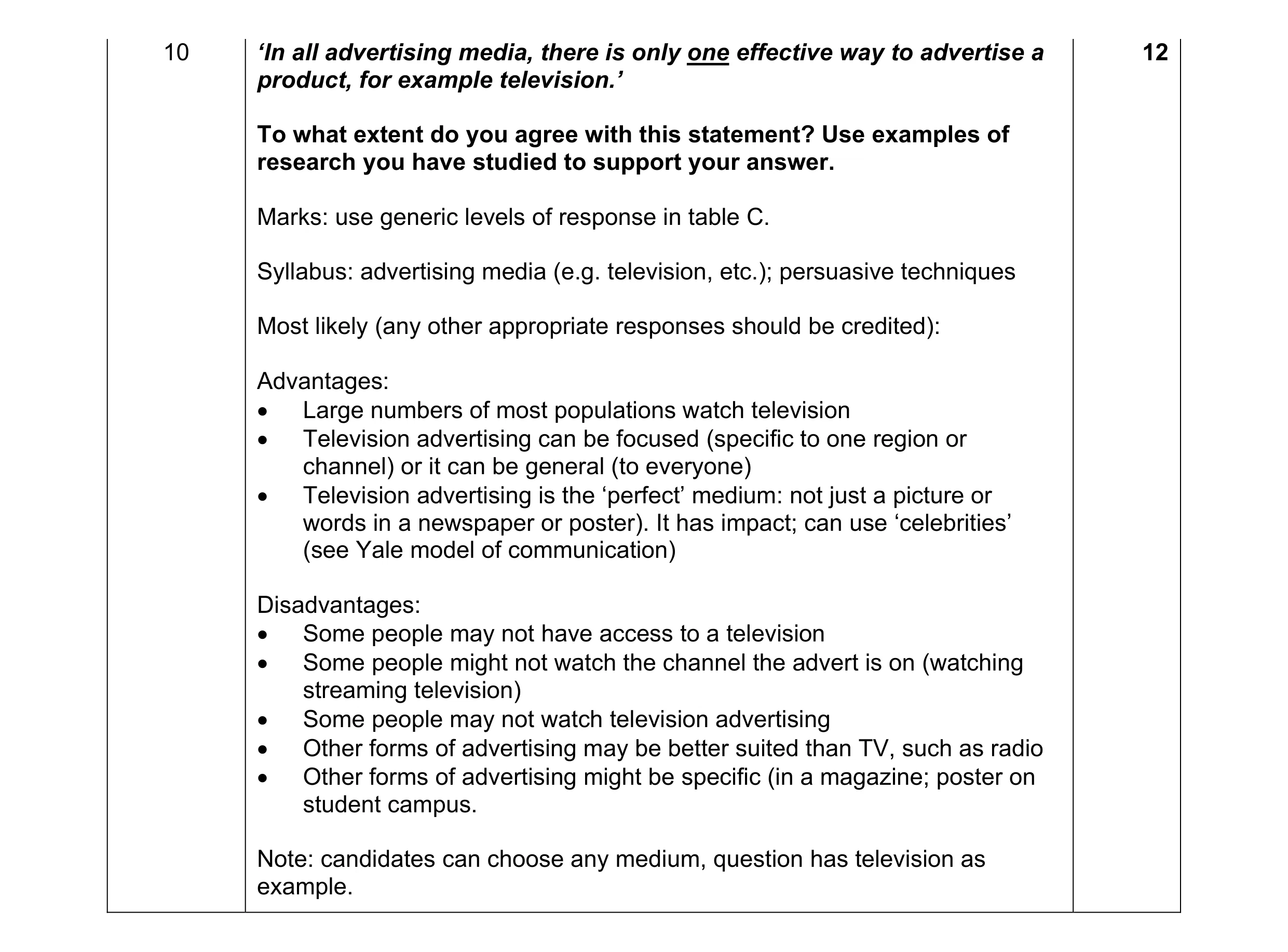 12
12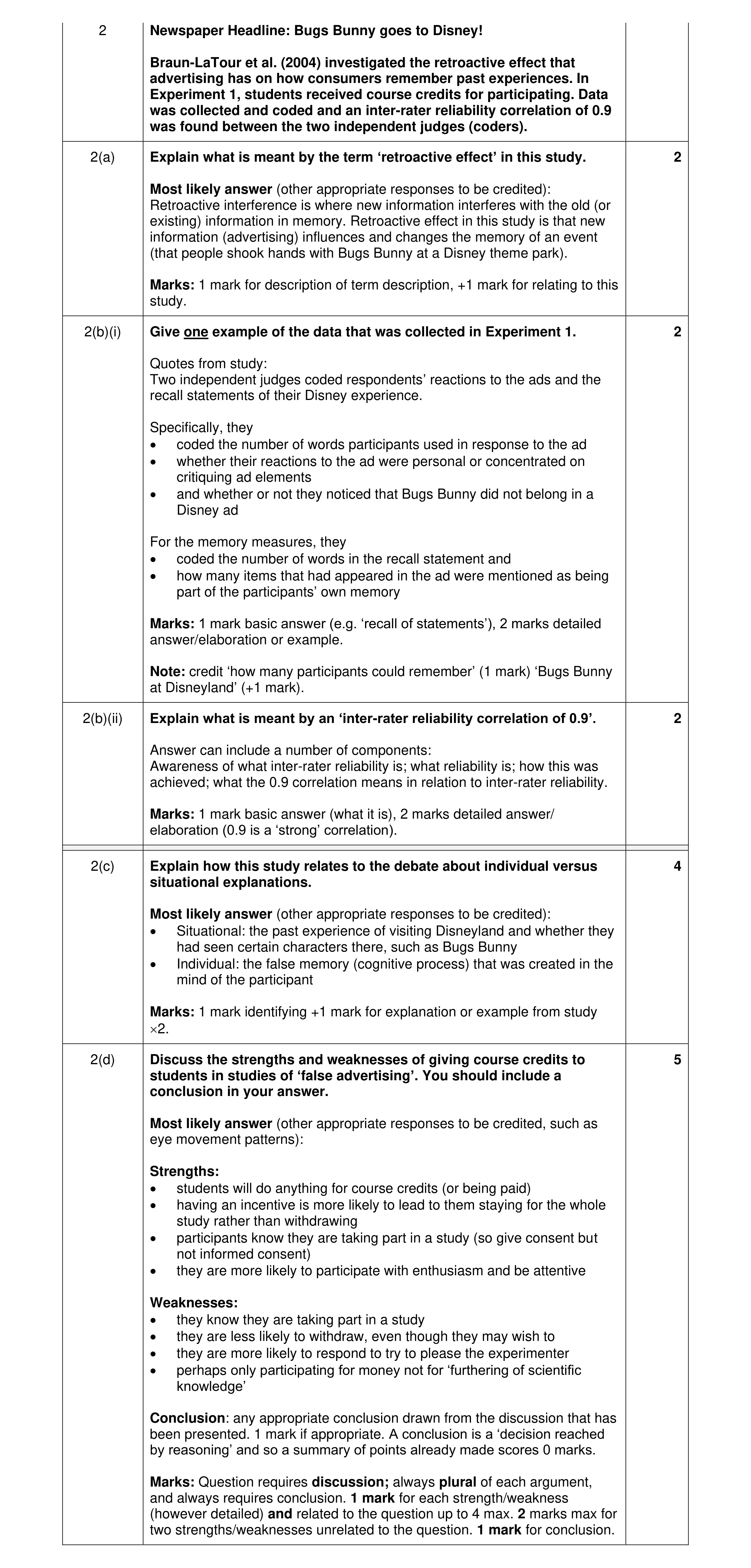 15
15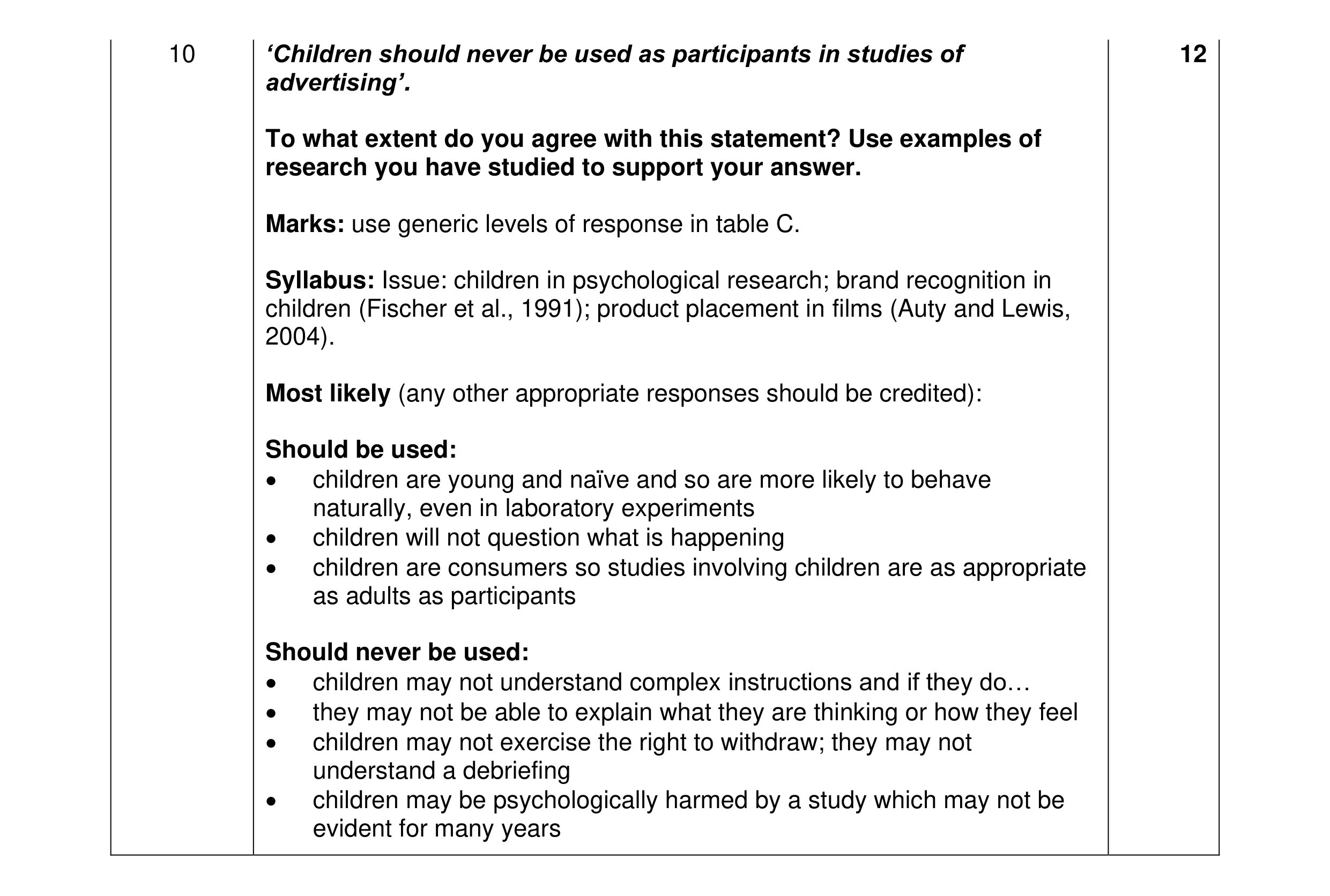 12
12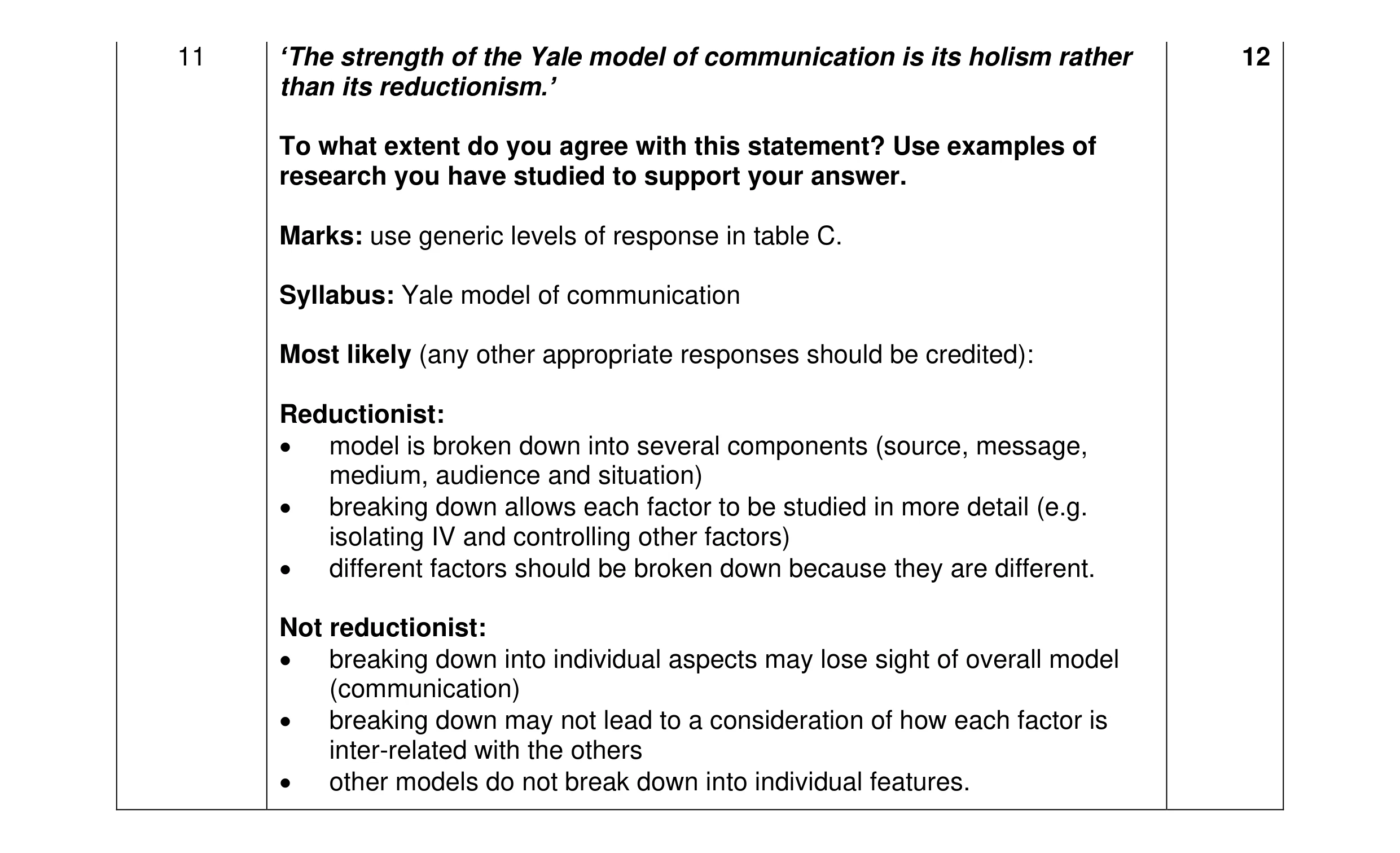 12
12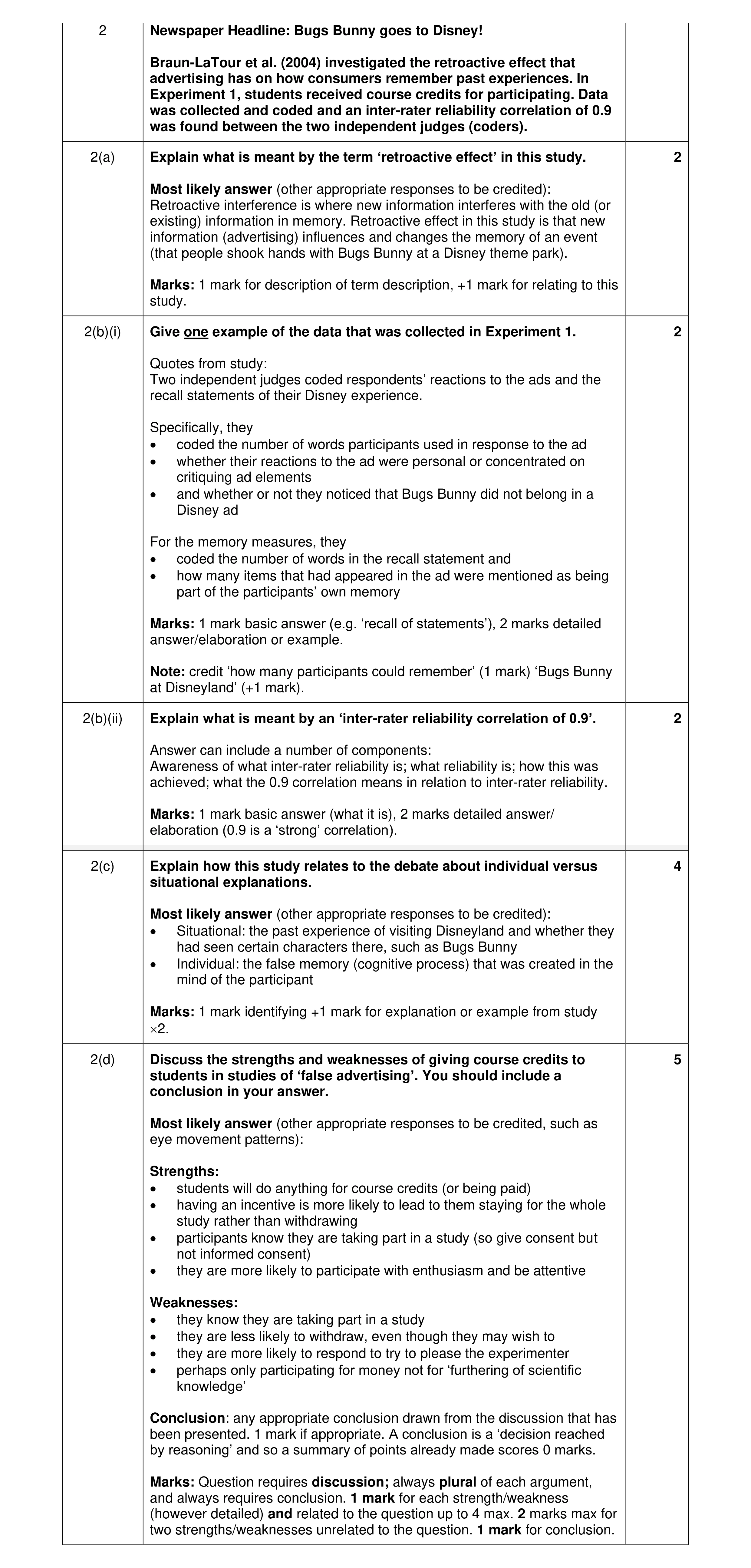 15
15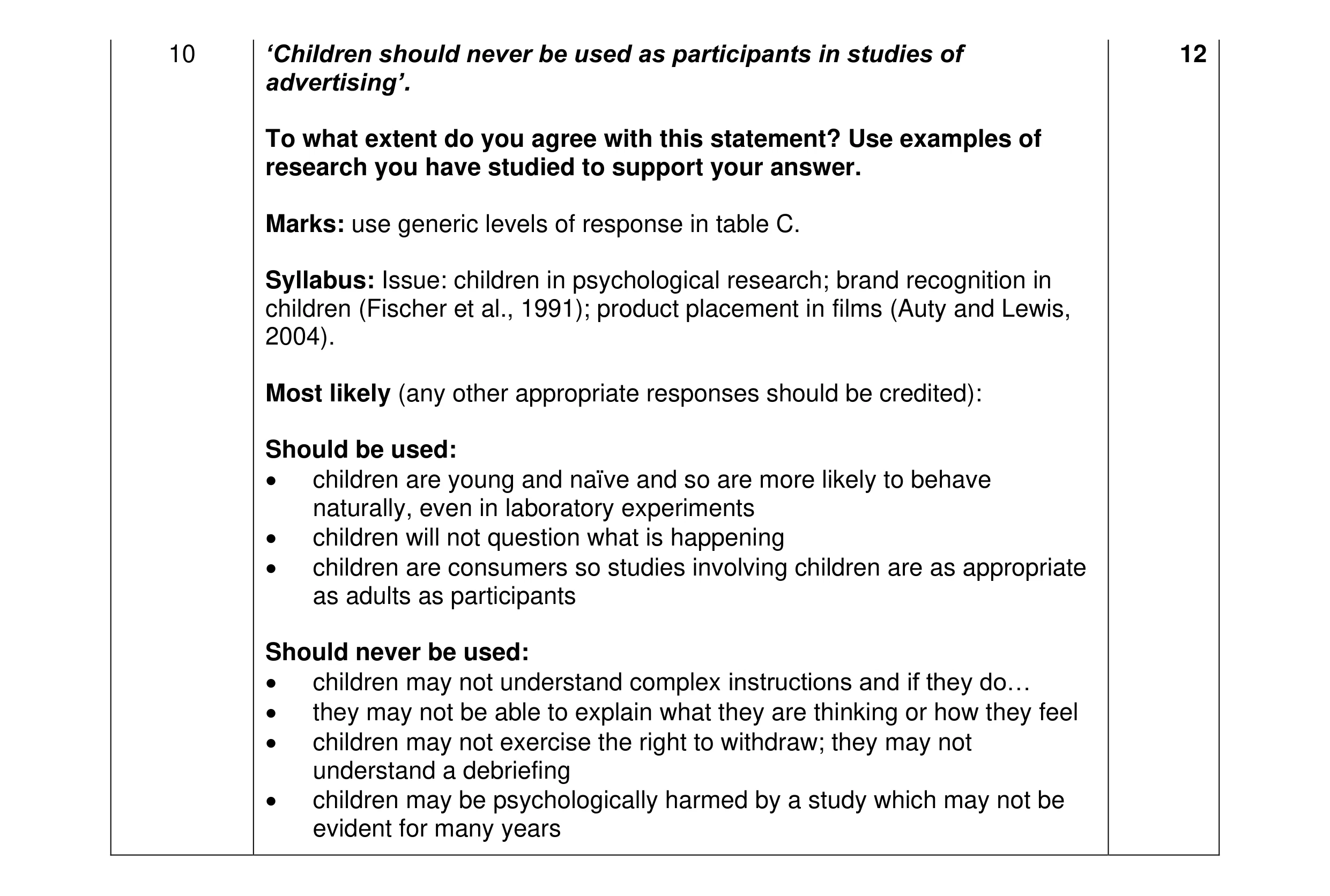 12
12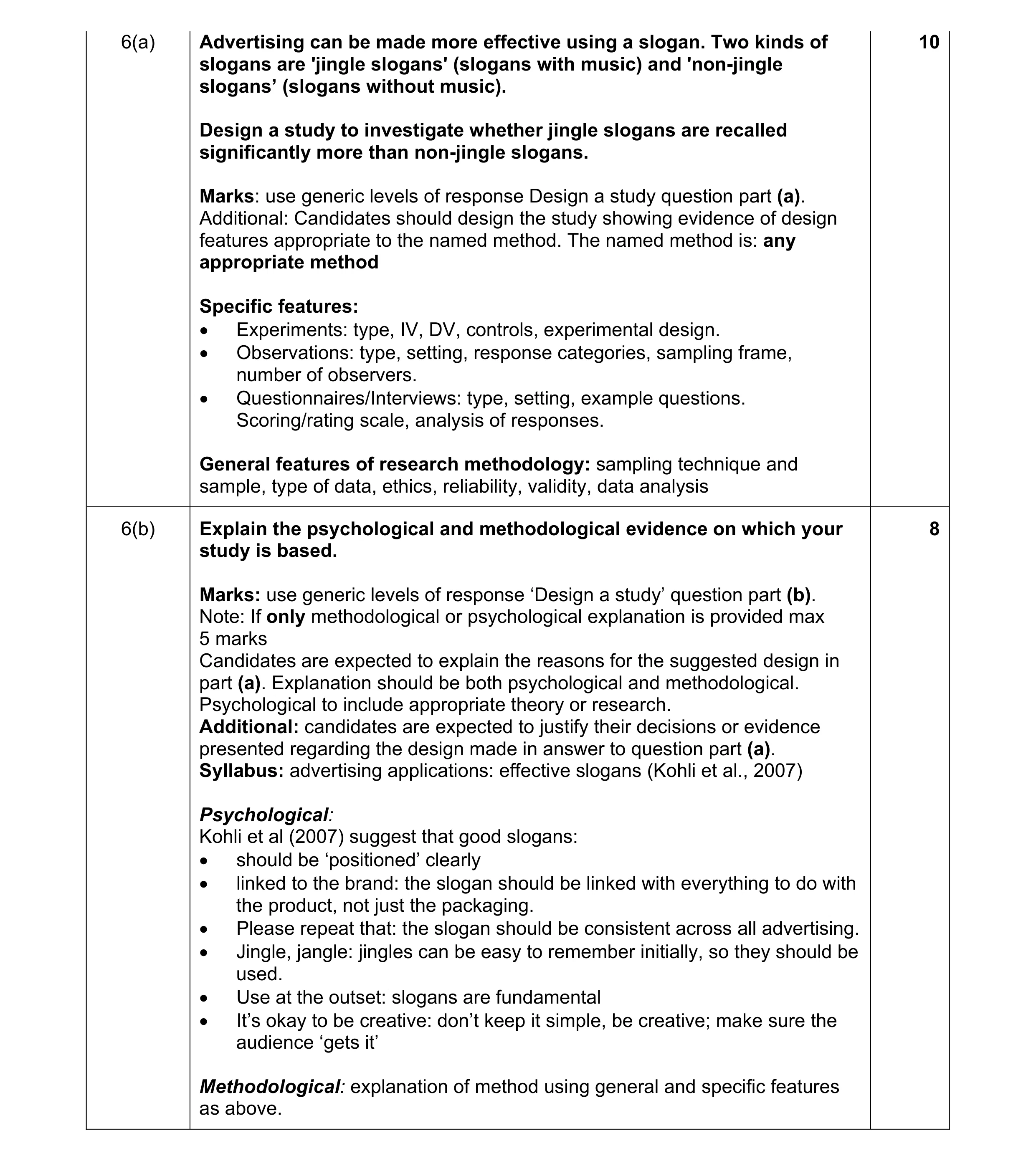 18
18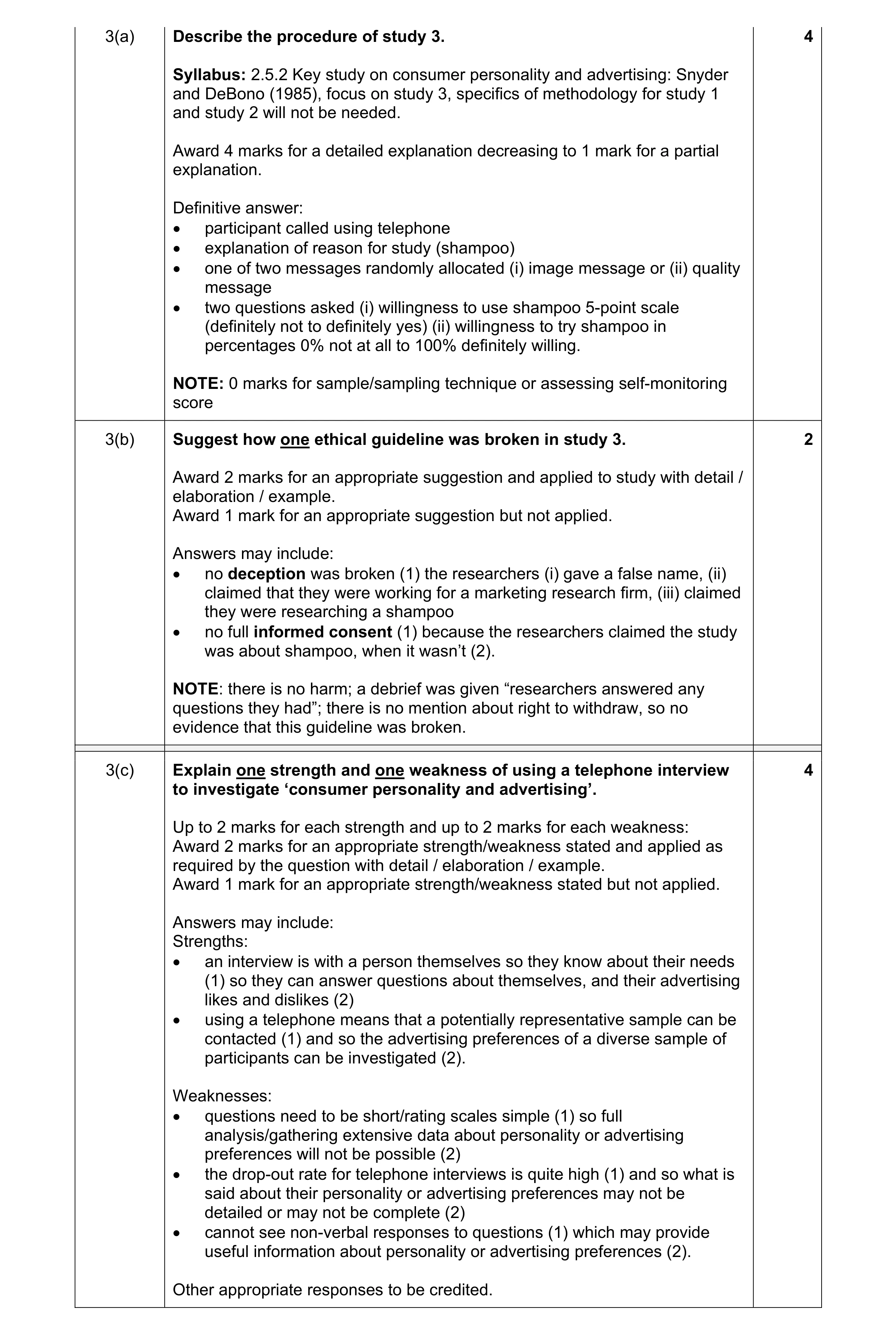 10
10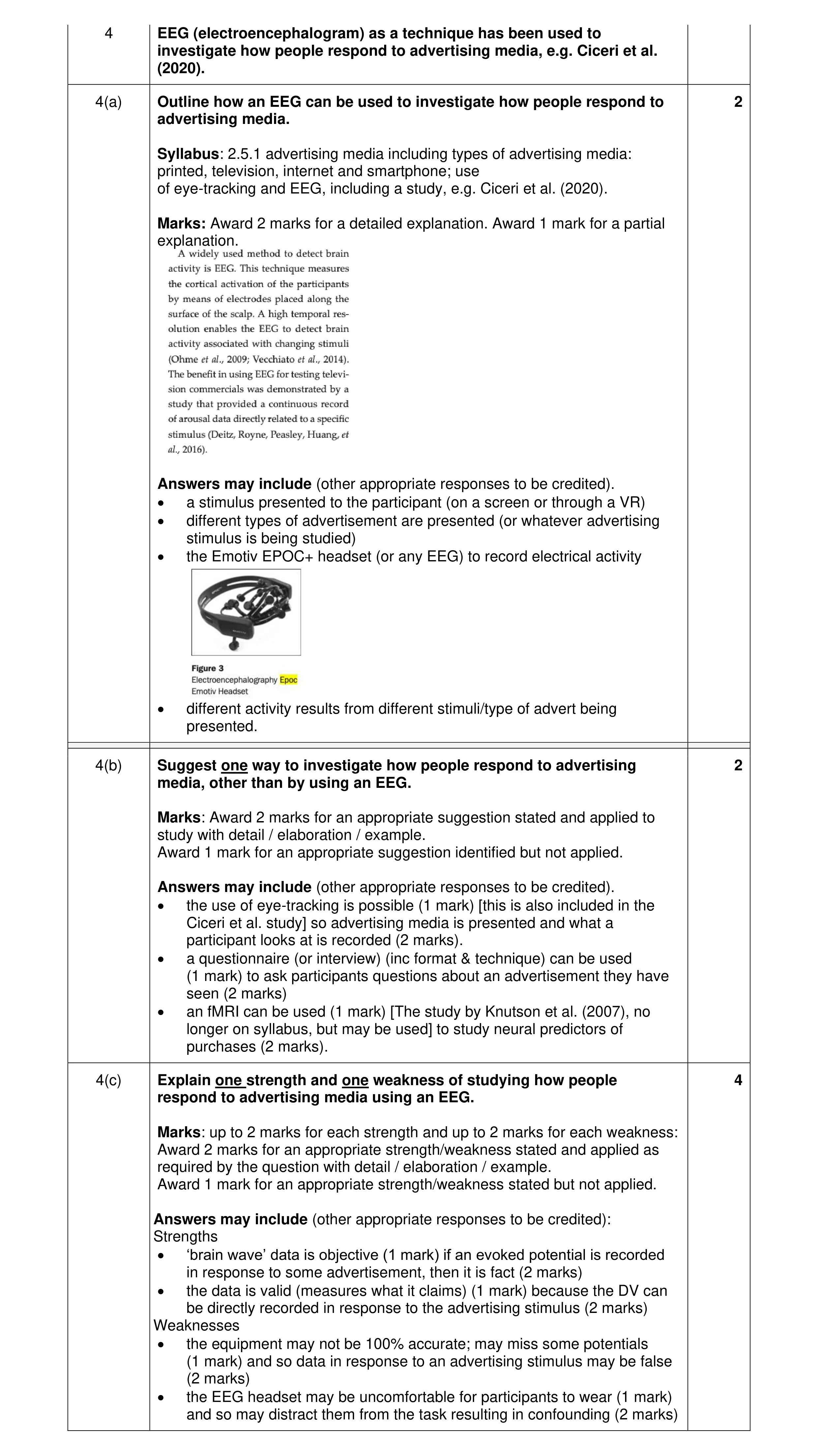 8
8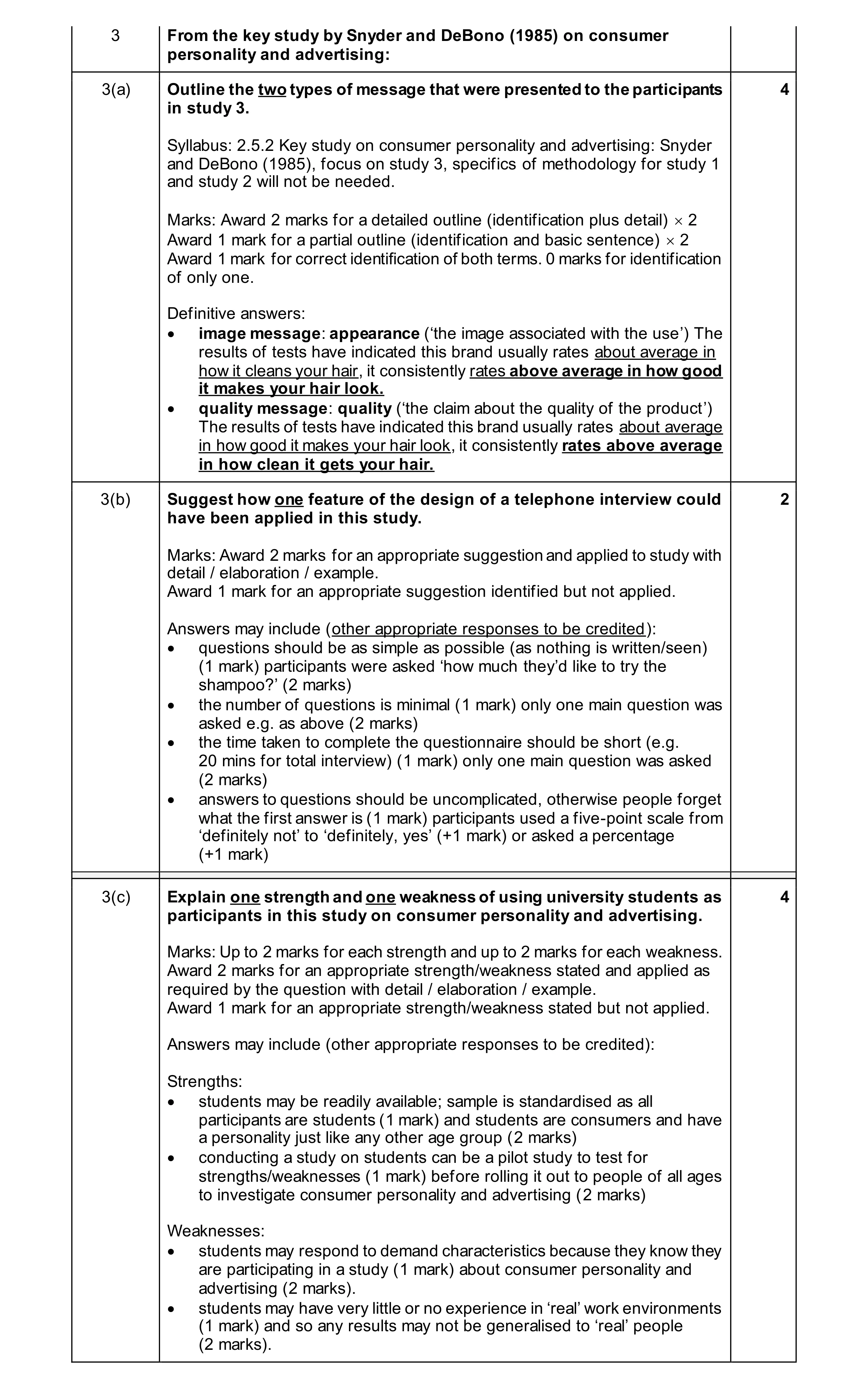 10
10