Questions as text
Q1 · Describe what psychologists have discovered about types of advertising and advertising… 9990/32 May/June 2018
4 (a) Describe what psychologists have discovered about types of advertising and advertising techniques. [8] (b) Evaluate what psychologists have discovered about types of advertising and advertising techniques, including a discussion on the use of children in psychological research. [10] Psychology and health Answer all questions.
18 marks
Mark scheme: 4(a) Describe what psychologists have discovered about types of 8 advertising and advertising techniques. Types of advertising and advertising techniques, including the following: • advertising media (e.g. television, etc.); persuasive techniques • marketing mix models: The 4 Ps (McCarthy), The 4 Cs (Lauterborn) • product placement in films (Auty and Lewis, 2004) Advertising media (e.g. television, etc.) Could include reference and description of radio, magazine, television and online advertising. persuasive techniques e.g. central route where the message is personally relevant to the consumer (e.g. information on products for children when the consumer has a child) or peripheral route is where the message is not personally relevant so the message needs to be stronger (e.g. buying a new product because experts have suggested it is effective). Yale model of communication could be described here. Marketing mix models: The 4 Ps (McCarthy), The 4 Cs (Lauterborn) The 4 Ps form a marketing tool that can be used by advertisers. 1 Product – the physical product or service. 2 Price – Price of the product – must be appropriate based on market forces (e.g. what the consumer is prepared to pay and prices of other similar products. 3 Place – location where the product/service is sold and way product is distributed. 4 Promotion – the advertising of the product be it in the media, sales promotion or cold calling. 4 Cs 1 Consumer – what does the consumer want and need 2 Cost – actual price plus the other costs such as distance travelled, value of the product to the consumer, ethical concerns, etc. 3 Communication – the company should seek out from the consumer information on what they want and what they need. 4 Convenience – companies should offer a variety of ways for the consumer to purchase the product (online or in a shop). Product placement in films (Auty and Lewis, 2004) 105 students from UK were randomly assigned to one of two groups: In the experimental group the children watched a clip of ‘Home Alone’ where the family were eating pizza and drinking milk and Pepsi. In the control group the family were eating macaroni cheese and milk. Ex students of the school interviewed the children after the study and initially offered them a drink where the choice was either Pepsi or CocaCola. They were then asked to describe the film and given specific questions if they did not mention Pepsi. The results found product placement did have an effect and the children were more likely to choose Pepsi after seeing the clip. Mark according to the levels of response descriptors in Table A. Other appropriate responses should also be credited. 4(b) Evaluate what psychologists have discovered about types of 10 advertising and advertising techniques, including a discussion on the use of children in psychological research. A range of issues could be used for evaluation here. These include: • Named issue – use of children in psychological research – Auty and Lewis study used children in their research. This is a positive part of their research as it is often children who pester their parents to buy fizzy drinks so it is a useful study. The researchers also sought parental consent and the older children most likely felt comfortable in the study and more willing to say if they wished to leave as they were 11–12 years old. The 6–7 year olds may have felt more uncomfortable or found it less easy to say if they wished to leave the study as given their age they may have felt more intimidated. Both groups of children may have tried to figure out the aim of the study and were eager to please the researchers and selected the Pepsi for that reason alone. • Strengths and weaknesses of the methods used in research investigating advertising. – Auty and Lewis used a lab study • sampling and generalisations – Auty and Lewis used children from the UK to do their study • usefulness/practical applications – the theories about 4 Ps and 4 Cs are very useful as they suggest what the company should focus on when marketing their products. In addition, persuasive techniques can help to sell a product. The Auty and Lewis study shows the product placement can work and is worth the investment of a company. • reductionist nature of the theories – the theories are fairly complex explanations of what is involved in trying to market a product. Include many factors such as price, consumer needs and wants, etc. • Ethics – study was done on young children. • Deterministic nature of the theories – suggests that with the right persuasion/marketing mix the consumer can be convinced to buy a product. Does recognise the free will of the consumer. • Comparison of 4 Cs and 4 Ps Differences 4 Cs more focussed on the consumer than the 4 Ps. Specific comparisons e.g. place is replaced by convenience to buy in 4 Cs as consumers buy their products in many different places including the internet. Similarities Holistic nature of the two models Lack of evidence to back up the two models. Effectiveness of the two models in improving advertising (and therefore sales) for companies. Mark according to the levels of response descriptors in Table B. Other appropriate responses should also be credited.
This question in 9990/32 May/June 2018
Q2 · Explain what is meant by a ‘model of communication’ with reference to advertising 9990/31 Oct/Nov 2018
3 (a) Explain what is meant by a ‘model of communication’ with reference to advertising. [2] (b) Describe McCarthy’s ‘4 Ps marketing mix’ model of advertising. [4] (c) Explain one similarity and one difference between McCarthy’s 4 Ps marketing mix model of advertising and Lauterborn’s 4 Cs marketing mix model of advertising. [6]
12 marks
Mark scheme: 3(a) Explain what is meant by a ‘model of communication’ with reference to 2 advertising. Award 1 mark for a basic explanation of the term/concept. Award 2 marks for a detailed explanation of the term/concept. For example: Yale model of communication AIDA model DAGMAR model Hierarchy of effects model General definition – A model of communication with reference to advertising is where the advert will try to persuade the consumer to purchase the item. The models of communication focus on different things advertisers might focus on in order to persuade such as the message itself or the target customer. Other appropriate responses should also be credited. 3(b) Describe McCarthy’s ‘4 Ps marketing mix’ model of advertising. 4 Award 1–2 marks for a basic answer with some understanding of the topic area. Award 3–4 marks for a detailed answer with clear understanding of the topic area. For example: The 4 Ps form a marketing tool that can be used by advertisers. 1 Product – the physical product or service 2 Price – Price of the product – must be appropriate based on market forces (e.g. what the consumer is prepared to pay and prices of other similar products 3 Place – location where the product/service is sold and way product is distributed. 4 Promotion – the advertising of the product be it in the media, sales promotion or cold calling. Other appropriate responses should also be credited. 3(c) Explain one similarity and one difference between McCarthy’s 4 Ps 6 marketing mix model of advertising and Lauterborn’s 4 Cs marketing mix model of advertising. Differences – 4 Cs more focussed on the consumer than the 4 Ps. Specific comparisons e.g. place is replaced by convenience to buy in 4 Cs as consumers buy their products in many different places including the internet. Similarities Holistic nature of the two models Effectiveness of the two models in improving advertising (and therefore sales) for companies. Mark according to the levels of response criteria below: Level 3 (5–6 marks) • Candidates will show a clear understanding of the question and will include one similarity and one difference. • Candidates will provide a good explanation with clear detail. Level 2 (3–4 marks) • Candidates will show an understanding of the question and will include one appropriate similarity in detail or one appropriate difference in detail. OR one similarity and one difference in less detail. • Candidates will provide a good explanation. Level 1 (1–2 marks) • Candidates will show a basic understanding of the question and will attempt a similarity and/or difference. This could include both but just as an attempt. • Candidates will provide a limited explanation. Level 0 (0 marks) • No response worthy of credit. Other appropriate responses should also be credited.
This question in 9990/31 Oct/Nov 2018
Q3 · Escribe what psychologists have discovered about communication and advertising models 9990/31 Oct/Nov 2019
4 (a) escribe what psychologists have discovered about communication and advertising models. [8] (b) Evaluate what psychologists have discovered about communication and advertising models, including a discussion about applications to everyday life. [10] Psychology and health Answer all questions.
18 marks
Mark scheme: 4(a) Describe what psychologists have discovered about communication 8 and advertising models. Communication and advertising models, including the following: • Changing attitudes and models of communication (source, message, etc.) • AIDA model (and updates of it) • Hierarchy of effects model Changing attitudes and models of communication (source, message, etc.) This model explains how advertisements attempt to change and influence consumers so that they purchase their product. Source – where the message is coming from and how trustworthy and credible this source is to the consumer. It could be presented by an expert or by a celebrity. Message – how the information in the advertisement is presented to the consumer e.g. is it a one or a two-sided argument. Audience – what type of consumers may purchase the product. The advertisement needs to be tailored to them, e.g. If it is young or old consumers. Credit can also be given to the Yale Model of Communication linked to advertising (attention, comprehension and acceptance). AIDA model (and updates of it) Behavioural model of advertising. Four stages including: Attention (or awareness) – must attract the attention of the consumer. Interest – to make the advertisement get the viewers to want to know more about the product. Desire – to maintain or increase a feeling of need for the product. Action – for the consumer to go out and purchase the product. Updates – CAB model (Cognition, Affect and Behaviour); TIREA scale (Thought, Interest, Risk, Engagement and Action); REAN model (Reach, Engage, Activate and Nurture); NAITDASE (Need, Attention and Interest, Trust, Desire and Action of purchase); DAGMAR (Defining Advertising Goals for Measured Advertising Results). Hierarchy of effects model Six stages: Awareness – Becomes aware of the product through advertising. Knowledge – Information about the product that the consumer needs to become aware of (simple for some products such as food and more complex for other products such as a car). Liking – Makes sure the consumer likes the product and also more than similar products. Preference – Similar to liking. Likes the product more than the competitions. Conviction – Strengthens desire to purchase (e.g. through a discount or free offer) Purchase – Go and buy the product. Mark according to the levels of response descriptors in Table A. Other appropriate responses should also be credited. 4(b) Evaluate what psychologists have discovered about communication 10 and advertising models, including a discussion about applications to everyday life. A range of issues could be used for evaluation here. These include: • Named issue – applications to everyday life – there are some practical applications about what to consider when advertising a product (e.g. to give a special offer to new consumers for the Hierarchy of effects model and use a persuasive person in the advertisement in the models of communication). • Reductionism • The models are theoretical and require evidence to back up the point. In order to be applicable to consumer behaviour this evidence must be about consumers and also test consumers in a wide variety of business environments. • Determinism. • Ethnocentric to the West. Mark according to the levels of response descriptors in Table B. Other appropriate responses should also be credited. Psychology and health
This question in 9990/31 Oct/Nov 2019
Q4 · Describe what psychologists have discovered about communication and advertising models 9990/32 Oct/Nov 2019
4 (a) Describe what psychologists have discovered about communication and advertising models. [8] (b) Evaluate what psychologists have discovered about communication and advertising models, including a discussion about applications to everyday life. [10] Psychology and health Answer all questions.
18 marks
Mark scheme: 4(a) Describe what psychologists have discovered about communication 8 and advertising models. Communication and advertising models, including the following: • Changing attitudes and models of communication (source, message, etc.) • AIDA model (and updates of it) • Hierarchy of effects model Changing attitudes and models of communication (source, message, etc.) This model explains how advertisements attempt to change and influence consumers so that they purchase their product. Source – where the message is coming from and how trustworthy and credible this source is to the consumer. It could be presented by an expert or by a celebrity. Message – how the information in the advertisement is presented to the consumer e.g. is it a one or a two-sided argument. Audience – what type of consumers may purchase the product. The advertisement needs to be tailored to them, e.g. If it is young or old consumers. Credit can also be given to the Yale Model of Communication linked to advertising (attention, comprehension and acceptance). AIDA model (and updates of it) Behavioural model of advertising. Four stages including: Attention (or awareness) – must attract the attention of the consumer. Interest – to make the advertisement get the viewers to want to know more about the product. Desire – to maintain or increase a feeling of need for the product. Action – for the consumer to go out and purchase the product. Updates – CAB model (Cognition, Affect and Behaviour); TIREA scale (Thought, Interest, Risk, Engagement and Action); REAN model (Reach, Engage, Activate and Nurture); NAITDASE (Need, Attention and Interest, Trust, Desire and Action of purchase); DAGMAR (Defining Advertising Goals for Measured Advertising Results). Hierarchy of effects model Six stages: Awareness – Becomes aware of the product through advertising. Knowledge – Information about the product that the consumer needs to become aware of (simple for some products such as food and more complex for other products such as a car). Liking – Makes sure the consumer likes the product and also more than similar products. Preference – Similar to liking. Likes the product more than the competitions. Conviction – Strengthens desire to purchase (e.g. through a discount or free offer) Purchase – Go and buy the product. Mark according to the levels of response descriptors in Table A. Other appropriate responses should also be credited. 4(b) Evaluate what psychologists have discovered about communication 10 and advertising models, including a discussion about applications to everyday life. A range of issues could be used for evaluation here. These include: • Named issue – applications to everyday life – there are some practical applications about what to consider when advertising a product (e.g. to give a special offer to new consumers for the Hierarchy of effects model and use a persuasive person in the advertisement in the models of communication). • Reductionism • The models are theoretical and require evidence to back up the point. In order to be applicable to consumer behaviour this evidence must be about consumers and also test consumers in a wide variety of business environments. • Determinism. • Ethnocentric to the West. Mark according to the levels of response descriptors in Table B. Other appropriate responses should also be credited. Psychology and health
This question in 9990/32 Oct/Nov 2019
Q5 · Describe what psychologists have discovered about communication and advertising models 9990/33 Oct/Nov 2019
4 (a) Describe what psychologists have discovered about communication and advertising models. [8] (b) Evaluate what psychologists have discovered about communication and advertising models, including a discussion about applications to everyday life. [10] Psychology and health Answer all questions.
18 marks
Mark scheme: 4(a) Describe what psychologists have discovered about communication 8 and advertising models. Communication and advertising models, including the following: • Changing attitudes and models of communication (source, message, etc.) • AIDA model (and updates of it) • Hierarchy of effects model Changing attitudes and models of communication (source, message, etc.) This model explains how advertisements attempt to change and influence consumers so that they purchase their product. Source – where the message is coming from and how trustworthy and credible this source is to the consumer. It could be presented by an expert or by a celebrity. Message – how the information in the advertisement is presented to the consumer e.g. is it a one or a two-sided argument. Audience – what type of consumers may purchase the product. The advertisement needs to be tailored to them, e.g. If it is young or old consumers. Credit can also be given to the Yale Model of Communication linked to advertising (attention, comprehension and acceptance). AIDA model (and updates of it) Behavioural model of advertising. Four stages including: Attention (or awareness) – must attract the attention of the consumer. Interest – to make the advertisement get the viewers to want to know more about the product. Desire – to maintain or increase a feeling of need for the product. Action – for the consumer to go out and purchase the product. Updates – CAB model (Cognition, Affect and Behaviour); TIREA scale (Thought, Interest, Risk, Engagement and Action); REAN model (Reach, Engage, Activate and Nurture); NAITDASE (Need, Attention and Interest, Trust, Desire and Action of purchase); DAGMAR (Defining Advertising Goals for Measured Advertising Results). Hierarchy of effects model Six stages: Awareness – Becomes aware of the product through advertising. Knowledge – Information about the product that the consumer needs to become aware of (simple for some products such as food and more complex for other products such as a car). Liking – Makes sure the consumer likes the product and also more than similar products. Preference – Similar to liking. Likes the product more than the competitions. Conviction – Strengthens desire to purchase (e.g. through a discount or free offer) Purchase – Go and buy the product. Mark according to the levels of response descriptors in Table A. Other appropriate responses should also be credited. 4(b) Evaluate what psychologists have discovered about communication 10 and advertising models, including a discussion about applications to everyday life. A range of issues could be used for evaluation here. These include: • Named issue – applications to everyday life – there are some practical applications about what to consider when advertising a product (e.g. to give a special offer to new consumers for the Hierarchy of effects model and use a persuasive person in the advertisement in the models of communication). • Reductionism • The models are theoretical and require evidence to back up the point. In order to be applicable to consumer behaviour this evidence must be about consumers and also test consumers in a wide variety of business environments. • Determinism. • Ethnocentric to the West. Mark according to the levels of response descriptors in Table B. Other appropriate responses should also be credited. Psychology and health
This question in 9990/33 Oct/Nov 2019
Q6 · Outline the AIDA model of advertising 9990/32 Oct/Nov 2021
3 (a) Outline the AIDA model of advertising. [2] (b) Describe the study by Kohli et al. (2007) on effective slogans. [4] (c) Explain two strengths of the study by Kohli et al. [6]
12 marks
Mark scheme: 3(a) Outline the AIDA model of advertising. 2 Award 1 mark for a basic explanation of the term/concept. Award 2 marks for a detailed explanation of the term/concept. For example: The AIDA model is used in advertising to describe how a customer may be affected by an advertisement. (1) A is attention (or awareness), I is interest, D is desire, and A is Action. (1 – if linked to advertising/marketing 2) This means an advert should attract attention, hold interest, increase desire and influence future actions. (2) It is often shown as a ‘funnel’. (1) Other appropriate responses should also be credited. 3(b) Describe the study by Kohli et al. (2007) on effective slogans. 4 Award 1–2 marks for a basic answer with some understanding of the topic area. Award 3–4 marks for a detailed answer with clear understanding of the topic area. For example: The study by Kohli et al. is a review article of effective slogans. (1) The researchers describe how slogans can change for products (Pepsi has changed its slogan many times) whilst logos tend to remain the same. (1) Slogans aim to enhance brand awareness and help brand image. (1) The researchers make 7 recommendations for successful slogans: 1 Keep your eye on the horizon – look at where the brand is going. Some slogans stand the test of time better than others. 2 Every slogan is a brand positioning tool, and it should position the brand in a clear manner. 3 Link the slogan to the brand – surprisingly few slogans include the brand name in their slogan. 4 Please repeat that – over many different ads the slogan must remain the same. 5 Jingle, jangle – jingles enhance memorability (though should be used judiciously). 6 Use slogans at the outset 7 It’s okay to be creative – simple slogans are not always best and those with syntactic or semantic complexity trigger deeper processing and may be recalled better. Up to 3 marks for any of the 7 recommendations. Other appropriate responses should also be credited. 3(c) Explain two strengths of the study by Kohli et al. 6 Likely strengths will be: • Review article so pulls together a great deal of research to form one comprehensive body of findings • Useful as it offers advice on how companies can create better slogans • Generalisable – the article references a large number of different slogans for a huge variety of products from medicines to car brands • High (temporal) validity – a recent article and research is very current. However, findings from the past are referenced too. Mark according to the levels of response criteria below: Level 3 (5–6 marks) • Candidates will show a clear understanding of the question and will explain two appropriate strengths in detail. • Candidates will provide a good explanation with clear detail. Level 2 (3–4 marks) • Candidates will show an understanding of the question and will explain one appropriate strength in detail or two strengths in less detail. • Candidates will provide a good explanation. Level 1 (1–2 marks) • Candidates will show a basic understanding of the question and will attempt an explanation of a strength. They could include two strengths but just as an attempt. • Candidates will provide a limited explanation. Level 0 (0 marks) No response worthy of credit. Other appropriate responses should also be credited.
This question in 9990/32 Oct/Nov 2021
Q7 · Describe what psychologists have discovered about advertising applications (brand… 9990/32 Feb/March 2022
4 (a) Describe what psychologists have discovered about advertising applications (brand recognition in children, advertising and consumer personality, effective slogans). [8] (b) Evaluate what psychologists have discovered about advertising applications (brand recognition in children, advertising and consumer personality, effective slogans), including a discussion on the use of children in psychological research. [10] Psychology and health Answer all questions.
18 marks
Mark scheme: 4(a) Describe what psychologists have discovered about advertising applications (brand recognition in children, advertising and consumer personality, effective slogans). Advertising applications, including the following: • brand recognition in children (Fischer et al., 1991) • advertising and consumer personality (Snyder and DeBono, 1985) • effective slogans (Kohli et al., 2007) Brand recognition in children (Fischer et al., 1991) 229 children (3-6 years old) from Georgia, USA attending pre-school were tested. Matched logos with one of 23 products pictured on a game board. 22 logos tested including children’s, adult’s and those of two cigarette brands. Found children had high rates of logo recognition. Recognition rates were highest for the Disney Channel and Old Joe (cartoon character promoting Camel cigarettes). Concluded that very young children see, understand and remember advertising. Given serious health consequences of smoking exposure to tobacco advertising may represent a health risk. Advertising and consumer personality (Snyder and DeBono, 1985) Study 1 50 male and female participants from University of Minnesota were used and presented with 3 sets of magazine advertisements advertising whiskey, cigarettes and coffee. The two advertisements for each product were identical in all respects except for one: the written message or slogan associated with the picture. One slogan was an appeal to the image associated with the use of the product; the other slogan was a claim about the product's quality. After each set, participants filled out a 12-item questionnaire on which they were to make evaluative comparisons between the two advertisements in the set. For example, the questionnaire asked "Overall, which ad do you think is better?" "Which one appeals to you more?" "Which ad do you think would be more successful?" Prior to the study the participants had been classified as either high self- monitoring or low self-monitoring. They found that high self-monitoring individuals reacted more favourably than low self- monitoring individuals to the image-oriented advertisements and low self-monitoring individuals responded more favourably than high self-monitoring individuals to the product-quality-oriented advertisements. Question Answer Marks 4(a) Study 2 40 male and female participants from University of Minnesota – half were high self-monitoring and half were low. The experimenter informed participants, scheduled in groups of 3 to 4 and assigned randomly to one of two conditions, that as part of an ongoing research program on advertising, they would respond to a number of advertisements that presently were being pretested. The experimenter then presented participants in one condition with three image-oriented advertisements, and those in the other condition with three product-quality-oriented advertisements (which in each case were the same three ads developed for Study 1, presented sequentially in a counterbalanced order). After viewing each ad, participants filled out a questionnaire, the critical item of which was "How much would you be willing to pay for this product?" To avoid extreme responses on this question, the experimenter gave participants ranges from which they could select their prices. They found that high self-monitoring individuals were willing to pay more for the products if they were advertised with an image orientation than if they were advertised with a quality orientation, and low self-monitoring individuals were willing to pay more for the products if they were advertised with claims about their quality than if they were advertised with appeals to their images. Study 3 40 male and female participants from University of Minnesota – half were high self-monitoring and half were low. Participants were contacted by telephone by an experimenter blind to their self-monitoring score and offered them the opportunity to try out a new shampoo. They told them either a quality message or an image message. The participants then indicated whether they would be willing to try the shampoo on a verbal scale – definitely not to definitely yes. They also responded to the following question – with 0% indicating not at all and 100% indicating definitely willing, what percentage do you think best describes your willingness to try this shampoo? They found that high self-monitoring individuals invoked considerations of the images associated with a product (choosing, in this case, to use the shampoo that would make their hair look good, even if it meant that their great-looking hair would be less than perfectly clean) and low self-monitoring individuals responded to attributes of the product's quality in performing its defining function (choosing, in this case, to use the shampoo that would get their hair very clean, even if their very clean hair would have a less-than-beautiful look). Question Answer Marks 4(a) Effective slogans (Kohli et al., 2007) A review article of effective slogans. The researchers describe how slogans can change for products (Pepsi has changed its slogan many times) whilst logos tend to remain the same. Slogans aim to enhance brand awareness and help brand image. The researchers make 7 recommendations for successful slogans: 1 Keep your eye on the horizon – look at where the brand is going. Some slogans stand the test of time better than others. 2 Every slogan is a brand positioning tool, and it should position the brand in a clear manner. 3 Link the slogan to the brand – surprisingly few slogans include the brand name in their slogan. 4 Please repeat that – over many different ads the slogan must remain the same. 5 Jingle, jangle – jingles enhance memorability (though should be used judiciously). 6 Use slogans at the outset 7 It’s okay to be creative – simple slogans are not always best and those with syntactic or semantic complexity trigger deeper processing and may be recalled better. Mark according to the levels of response descriptors in Table A. Other appropriate responses should also be credited. Question Answer Marks 4(b) Evaluate what psychologists have discovered about advertising applications (brand recognition in children, advertising and consumer personality, effective slogans), including a discussion on the use of children in psychological research. A range of issues could be used for evaluation here. These include: • Named issue – use of children (in Fischer et al.) + Can indicate issues regarding exposure of advertising of cigarettes to young children as the study found the children remembered this advertising. ± can be ethical when the parents of children are asked for consent (and signed a consent form) and the study is not harmful. In this study, the participants played a game which is not harmful and the parents gave consent. Could be considered unethical as the children were shown tobacco brand logos, although this is just an image and the researchers were not trying to advertise cigarettes to the children. ± Children can have low levels of concentration in psychological research, although Fischer et al. took this in account by having the children do a game for their study. ± Language/communication issues. This was overcome in the Fischer et al. study as the children just had to do matching. But this does mean the children could not explain their responses. It may have been a lucky guess. – Can’t generalise to adults. Although the children may recognise the brand it does not mean this recognition will continue into adulthood. • Self-reports • Generalisability • Ecological validity • Usefulness/practical applications • Ethics • Quantitative data • Reliability Mark according to the levels of response descriptors in Table B. Other appropriate responses should also be credited. 10
This question in 9990/32 Feb/March 2022
Q8 · Describe what psychologists have discovered about types of advertising and advertising… 9990/32 Feb/March 2023
4 (a) Describe what psychologists have discovered about types of advertising and advertising techniques (advertising media, marketing mix models, product placement in films). [8] (b) Evaluate what psychologists have discovered about types of advertising and advertising techniques (advertising media, marketing mix models, product placement in films), including a discussion on practical applications. [10] Psychology and health Answer all questions.
18 marks
Mark scheme: 4(a) Describe what psychologists have discovered about types of 8 advertising and advertising techniques (advertising media, marketing mix models, product placement in films). Types of advertising and advertising techniques, including the following: • advertising media (e.g. television, etc.); persuasive techniques • marketing mix models: The 4 Ps (McCarthy), The 4 Cs (Lauterborn) • product placement in films (Auty and Lewis, 2004) Advertising media (e.g. television, etc.) Could include reference/description/examples of radio, magazine, television and online advertising. Persuasive techniques e.g. central route is where the message is personally relevant to the consumer (e.g. information on products for children when the consumer has a child) or peripheral route is where the message is not personally relevant so the message needs to be stronger (e.g. Buying a new product because experts have suggested it is effective). Yale model of communication could be described here (with links made to advertising) Marketing mix models: The 4 Ps (McCarthy) The 4 Ps form a marketing tool that can be used by advertisers. 1 Product – the physical product or service 2 Price – Price of the product – must be appropriate based on market forces (e.g. what the consumer is prepared to pay and prices of other similar products 3 Place – location where the product/service is sold and way product is distributed. 4 Promotion. The advertising of the product be it in the media, sales promotion or cold calling. The 4 Cs (Lauterborn) 1 Consumer – what does the consumer want and need 2 Cost – actual price plus the other costs such as distance travelled, value of the product to the consumer, ethical concerns, etc. 3 Communication – the company should seek out from the consumer information on what they want and what they need. 4 Convenience – companies should offer a variety of ways for the consumer to purchase the product (online or in a shop) Product placement in films (Auty and Lewis, 2004) 105 students from UK were randomly assigned to one of two groups: In the experimental group the children watched a clip of ‘Home Alone’ where the family were eating pizza and drinking milk and Pepsi. In the control group the family were eating macaroni cheese and milk. Ex-students of the school interviewed the children after the study and initially offered them a drink where the choice was either Pepsi or Coca Cola. They were then asked to describe the film and given specific questions if they did not mention Pepsi. 4(a) The results found product placement did have an effect and the children were more likely to choose Pepsi after seeing the clip. Control group Coca Cola 58: Pepsi 42 and experimental group Coca Cola 38: Pepsi 62 – (compared to market share in UK as 75:25). 6–7 year olds (limited processors) and 11–12 year olds (cued processors). No difference in age group in ability to recall Pepsi or in choice of drink – younger group required more prompts. Mark according to the levels of response descriptors in Table A. Other appropriate responses should also be credited. 4(b) Evaluate what psychologists have discovered about types of 10 advertising and advertising techniques (advertising media, marketing mix models, product placement in films), including a discussion on practical applications. A range of issues could be used for evaluation here. These include: • Named issue – Practical applications – Theories about 4 Ps and 4 Cs are very useful as they suggest what the company should focus on when marketing their products. However, the 4 Ps theory, for example, does not explain which of the 4 Ps is more important for different types of products. For example, expensive products such as a cell/mobile phone the price may be more important whereas a staple product such as milk the price may not be as important and location may be more important. In addition, persuasive techniques can help to sell a product although advertising can be expensive for a company. The Auty and Lewis study shows the product placement can work and is worth the investment of a company although there may be regulations in some countries preventing product placement in the media. • Use of children in psychological research • Strengths and weaknesses of methods used in research • Generalisability • Reductionist versus holistic nature of theories • Ethics of research • Determinism versus free will nature of theories • Comparison of 4 Cs and 4 Ps Mark according to the levels of response descriptors in Table B. Other appropriate responses should also be credited. Psychology and health
This question in 9990/32 Feb/March 2023
Q9 · Describe communication and advertising models (changing attitudes and models of… 9990/32 Oct/Nov 2023
4 (a) Describe communication and advertising models (changing attitudes and models of communication, AIDA model, hierarchy of effects model). [8] (b) Evaluate communication and advertising models (changing attitudes and models of communication, AIDA model, hierarchy of effects model), including a discussion of reductionism versus holism. [10] Psychology and health Answer all questions.
18 marks
Mark scheme: 4(a) Describe communication and advertising models 8 (changing attitudes and models of communication, AIDA model, hierarchy of effects model). • Changing attitudes and models of communication (source, message, etc.) • AIDA model (and updates of it) • Hierarchy of effects model Changing attitudes and models of communication (source, message, etc.) This model explains how advertisements attempt to change and influence consumers so they purchase their product. • Source – where the message is coming from and how trustworthy and credible this source is to the consumer. − It could be presented by an expert or by a celebrity. If celebrity is used too many times they may lose their trustworthiness. − If advertising something that could make a person more attractive then the attractiveness of the ‘source’ should be high. − Someone similar to the target customers is more persuasive. − Men more credible than women. 4(a) • Message – how the information in the advertisement is presented to the consumer − Two-sided argument is better when the product is familiar e.g. comparison made to competition. One- sided argument when product unfamiliar. Customers can view one-sided argument as more truthful. − Have to be careful with level of persuasiveness in advert and can lower sales if the advert seems to be trying too hard. − Repetition is good and helps aid recall • Audience/receiver – what type of consumers may purchase the product. The advertisement needs to be tailored to them. − If it is young or old consumers. − does the customers all have a similar set of attitudes (difficult if customers all have different sets of attitudes) − women easier to persuade than men. − Difficult to change someone with very high / very low self-esteem and easier for moderate self-esteem. Credit can also be given to the Yale Model of Communication so long as it is linked to advertising. (attention, comprehension and acceptance) AIDA model (and updates of it) Behavioural model of advertising. Four stages including • Attention (or awareness) – must attract the attention of the consumer. • Interest – to make the advertisement get the viewers to want to know more about the product. • Desire – to maintain or increase a feeling of need for the product. • Action – for the consumer to go out and purchase the product. 4(a) Updates – CAB model (Cognition, Affect and Behaviour); TIREA scale (Thought, Interest, Risk, Engagement and Action); REAN model (Reach, Engage, Activate and Nurture); NAITDASE (Need, Attention and Interest, Trust, Desire and Action of purchase); DAGMAR (Defining Advertising Goals for Measured Advertising Results) Hierarchy of effects model Six stages – • Awareness – becomes aware of the product through advertising. • Knowledge – Information about the product that the consumer needs to become aware of (simple for some products such as food and more complex for other products such as a car) • Liking – Makes sure the consumer likes the product and also more than similar products. • Preference – similar to liking. Likes the product more than the competitions. • Conviction – Strengthens desire to purchase (e.g. through a discount or free offer) • Purchase – Go and buy the product. Mark according to the levels of response descriptors in Table A. Other appropriate responses should also be credited. 4(b) Evaluate what psychologists have discovered about 10 communication and advertising models (changing attitudes and models of communication, AIDA model, hierarchy of effects model), including a discussion of reductionism versus holism. A range of issues could be used for evaluation here. These include: • Named issue – Reductionism versus holism – These models do offer some complex explanations of the effects of advertising on consumer decision to purchase a product. For example, the models of communication do recognise that the company has to consider many aspects of the advertising medium and message (not just the content of the advertisement). This could include things such as the medium to consider where is best to advertise to potential and existing consumers. The hierarchy of affects model and the AIDA model are also fairly complex as they do suggest there are a number of different stages that consumers pass through when seeing an advertisement and then eventually going and buying the product. Do also credit any argument that the models are more simplistic so long as it is well argued by the candidate with some examples of what might be missing from the model (e.g. how much disposable income the consumer might have to go and purchase the product) 4(b) • Applications to everyday life • Cultural bias • Reductionism • Theoretical/lack of research support • Determinism • Individual differences Mark according to the levels of response descriptors in Table B. Other appropriate responses should also be credited. Psychology and health
This question in 9990/32 Oct/Nov 2023
Q10 · Company B has recently won an award for the easiest-to-use mobile phone so are planning… 9990/32 Feb/March 2024
7 (a) Company B has recently won an award for the easiest-to-use mobile phone so are planning to change their slogan. Their current slogan is ‘B is brilliant’. Explain two reasons why ‘B is brilliant’ is not an effective slogan. [4] (b) Explain one problem psychologists have when they investigate slogans. [2]
6 marks
Mark scheme: 7(a) Company B has recently won an award for the easiest-to-use mobile 4 1 + 3 or 2 + 2 for the two reasons phone so are planning to change their slogan. Their current slogan is ‘B is brilliant’. Explain two reasons why ‘B is brilliant’ is not an effective slogan. For each reason: Award 2 marks for a detailed reason why not an effective slogan. Award 1 mark for a basic outline why not an effective slogan. Likely reasons – • Not a jingle/catchy phrase. • Not memorable. • Does not highlight the award/what makes Company B unique – doesn’t link ‘brilliant’ to either the award or the mobile phone. • Not creative • It can’t stand alone – doesn’t indicate Company B sells mobile phones For example One reason ‘B is brilliant’ is not an effective slogan is because it is not a jingle. (1) Catchy slogans/jingles help customers to remember the slogan (and therefore the brand/product) which this slogan doesn’t do. (1) A second reason is that it doesn’t highlight what makes Company B unique, which is that their mobile phone is the easiest to use. (1) ‘B is brilliant’ could refer to any product, not just mobile phones. It also doesn’t indicate anything about the award which if it did, would attract customers to buy the phone. (1) Other appropriate responses should also be credited. 7(b) Explain one problem psychologists have when they investigate slogans. 2 Context = investigating slogans Award 2 marks for a detailed explanation of the problem in context Award 1 mark for a basic explanation of the problem in context OR a detailed explanation of the problem not in context. Likely problems – • Difficult to test long term effectiveness of slogans • Difficult to establish cause and effect – is it the slogan that increased/ decreased sales or something else? Was it the slogan that increased/ decreased brand awareness. • Hard to determine if participants in a study or customers like a slogan. Can get socially desirable responses in a study or how would a company know if the customer likes the slogan. If they interview their customers, they may not get an honest answer, or the customer may not know. • Some of the evidence is anecdotal (not scientific research) – companies may boast in their end of year report that it was the slogan they created that led to expanding market/increase sales. • If the psychologist investigates slogans as a laboratory experiment (in order to establish cause and effect) the study will lack ecological validity as we are exposed to slogans in our everyday life through advertising. Example: One problem when psychologists investigate slogans is that it is difficult to establish cause and effect between the slogan and sales. (1) Lots of factors affect sales such as the quality of the product, effective advertising, placement of the product in a store, etc. so the psychologist cannot isolate the slogan to measure its effectiveness. (1) Other appropriate responses should also be credited.
This question in 9990/32 Feb/March 2024
Q11 · Snyder and DeBono (1985) found that high self-monitors and low self-monitors have… 9990/31 May/June 2024
5 Snyder and DeBono (1985) found that high self-monitors and low self-monitors have different preferences for advertising strategies. This finding could be used for advertising winter coats. (a) Suggest one advertising strategy for winter coats that would appeal to high self-monitors. [2] (b) Suggest one advertising strategy for winter coats that would appeal to low self-monitors. [2]
4 marks
Mark scheme: 5(a) Suggest one advertising strategy for winter coats that would appeal to high self-monitors. For the suggestion: Award 2 marks for an outline of the application linked to the context. Award 1 mark for a basic outline of the application. Likely content: High self-monitors prefer advertisements that appeal to image/soft sell. Advertisement for coats - Image – emphasis on how fashionable the coat is; aspirational setting e.g. going into a high-quality restaurant; worn by a celebrity or influencer that customers aspire to be like; emphasis on how the winter coat will make the customer feel good about themselves. Identify high self-monitors prefer image with a brief outline of the advertising strategy for the winter coats linked to the strategy. OR A more detailed outline of the specifics of the advertisement with a clear link to image. Two examples in mark scheme. Question Answer Marks Guidance 5(a) Examples: The advertising strategy needs to appeal to high self- monitors by focusing on an appeal to the coat’s image. (1) For example, the advertisement could show a group of people wearing winter coats walking to an aspirational event such the opening of an art gallery. (1) To appeal to image the advertisement could show a group of people walking in the snow at night with the streetlights causing the snow to shimmer (high visual appeal). (1) At the end of the advertisement the group of people will walk into an art gallery which is a place that potential customers may aspire to attend so the advert will appeal to them. (1) Other appropriate responses should also be credited. Question Answer Marks Guidance 5(b) Suggest one advertising strategy for winter coats that would appeal to low self-monitors. For the suggestion: Award 2 marks for an outline of the application linked to the context. Award 1 mark for a basic outline of the application. Likely content: Low self-monitors prefer advertisements that appeal to quality/hard sell. Quality – emphasis on very high standard of material the coat is made from; hard-wearing and long lasting; versatile to be used in many different settings (e.g. going out for dinner, taking a long walk in the countryside); worth investigating in a high-quality coat that will last for many years. Example: The advertising strategy needs to appeal to low self- monitors by focusing on the quality of the coat. (1) The advertisement could show someone purchasing a winter coat and have a sequence of short clips that show the person wearing the coat over several years which would highlight how hard-wearing and good quality the coat is. (1) 2 Two ways to achieve full marks. Identify low self-monitors prefer quality with a brief outline of the advertising strategy for the winter coats linked to the strategy. OR A more detailed outline of the specifics of the advertisement with a clear link to quality. Two examples in mark scheme. Question Answer Marks Guidance 5(b) To appeal to quality the advertisement could show a woman purchasing the winter coat and then show her putting the coat away at the end of the winter. It would then show the woman getting this coat out of storage at the start of every winter for a few years. The advertisement could make it clear that years have passed by showing the woman looking older. This highlights that the coat is hard-wearing and is worth the money. (2) Other appropriate responses should also be credited.
This question in 9990/31 May/June 2024
Q12 · Snyder and DeBono (1985) found that high self-monitors and low self-monitors have… 9990/33 May/June 2024
5 Snyder and DeBono (1985) found that high self-monitors and low self-monitors have different preferences for advertising strategies. This finding could be used for advertising winter coats. (a) Suggest one advertising strategy for winter coats that would appeal to high self-monitors. [2] (b) Suggest one advertising strategy for winter coats that would appeal to low self-monitors. [2]
4 marks
Mark scheme: 5(a) Suggest one advertising strategy for winter coats that would appeal to high self-monitors. For the suggestion: Award 2 marks for an outline of the application linked to the context. Award 1 mark for a basic outline of the application. Likely content: High self-monitors prefer advertisements that appeal to image/soft sell. Advertisement for coats - Image – emphasis on how fashionable the coat is; aspirational setting e.g. going into a high-quality restaurant; worn by a celebrity or influencer that customers aspire to be like; emphasis on how the winter coat will make the customer feel good about themselves. Identify high self-monitors prefer image with a brief outline of the advertising strategy for the winter coats linked to the strategy. OR A more detailed outline of the specifics of the advertisement with a clear link to image. Two examples in mark scheme. Question Answer Marks Guidance 5(a) Examples: The advertising strategy needs to appeal to high self- monitors by focusing on an appeal to the coat’s image. (1) For example, the advertisement could show a group of people wearing winter coats walking to an aspirational event such the opening of an art gallery. (1) To appeal to image the advertisement could show a group of people walking in the snow at night with the streetlights causing the snow to shimmer (high visual appeal). (1) At the end of the advertisement the group of people will walk into an art gallery which is a place that potential customers may aspire to attend so the advert will appeal to them. (1) Other appropriate responses should also be credited. Question Answer Marks Guidance 5(b) Suggest one advertising strategy for winter coats that would appeal to low self-monitors. For the suggestion: Award 2 marks for an outline of the application linked to the context. Award 1 mark for a basic outline of the application. Likely content: Low self-monitors prefer advertisements that appeal to quality/hard sell. Quality – emphasis on very high standard of material the coat is made from; hard-wearing and long lasting; versatile to be used in many different settings (e.g. going out for dinner, taking a long walk in the countryside); worth investigating in a high-quality coat that will last for many years. Example: The advertising strategy needs to appeal to low self- monitors by focusing on the quality of the coat. (1) The advertisement could show someone purchasing a winter coat and have a sequence of short clips that show the person wearing the coat over several years which would highlight how hard-wearing and good quality the coat is. (1) 2 Two ways to achieve full marks. Identify low self-monitors prefer quality with a brief outline of the advertising strategy for the winter coats linked to the strategy. OR A more detailed outline of the specifics of the advertisement with a clear link to quality. Two examples in mark scheme. Question Answer Marks Guidance 5(b) To appeal to quality the advertisement could show a woman purchasing the winter coat and then show her putting the coat away at the end of the winter. It would then show the woman getting this coat out of storage at the start of every winter for a few years. The advertisement could make it clear that years have passed by showing the woman looking older. This highlights that the coat is hard-wearing and is worth the money. (2) Other appropriate responses should also be credited.
This question in 9990/33 May/June 2024
Q13 · A mobile phone manufacturer wants to advertise a new phone 9990/32 Oct/Nov 2024
5 A mobile phone manufacturer wants to advertise a new phone. Advertisers propose creating an advertisement that is similar in design to advertisements for competitors’ similar phones. This may interfere with consumers’ memory. Suggest how consumers’ memory for details of the new phone may be affected by this proposed advertisement. [4]
4 marks
Mark scheme: 5 A mobile phone manufacturer wants to advertise a new phone. 4 Context – mobile phone Advertisers propose creating an advertisement that is similar in design to advertisements for competitors’ similar phones. This may interfere For full marks needs to refer to with consumers’ memory. interference. Suggest how customers’ memory for details of the new phone may be affected by this proposed advertisement. Award 3–4 marks for a detailed answer with clear understanding of how proactive and/or retroactive interference affect memory for the new phone. Award 1–2 marks for a basic answer with some understanding of how interference affects memory for the new phone. Syllabus reference: Mistakes in decision-making • Consumer memory for advertising including how retroactive and proactive interference affect memory, including a study, e.g., Burke and Srull (1988) Possible content • Interference occurs when two memories disrupt one another resulting in one (or both) of the memories being forgotten or distorted. • Proactive interference occurs when an older memory interferes with a newer one causing the newer one to be forgotten. More likely to recall details of competitors’ phones. • Retroactive interference occurs when a newer memory interferes with an older one causing the older memory to be forgotten. More likely to recall details of new phone. • Interference is most likely to occur when the memories are very similar • Interference is most likely to occur when the memories are formed quite close together in time. 5 Example: As the advertisements are very similar in content and mood, interference is likely to occur with the memories of them (1). This would result in the advert for the new phone being ineffective as the potential customer cannot remember important details from it like, say, the name of the phone (1). If proactive interference occurs then the older advert will distort the memory of the new phone, so that details from this new phone advert will not be remembered (1). This would mean that the purpose of the advert would be lost as customers will not remember the details of the phone and so not be able to ask for it (1). This could lead to a reduction in potential sales (1). Even if retroactive interference occurs, when the newer advert (for this new phone) prevents parts of the older advert being remembered (1), this would mean that the customer may not remember details that enable a good comparison of features to be make. (1) Other appropriate responses should also be credited.
This question in 9990/32 Oct/Nov 2024
Q14 · Describe: • a study on any type of advertising media, and • Lauterborn’s 4 Cs marketing… 9990/32 May/June 2025
8 (a) Describe: • a study on any type of advertising media, and • Lauterborn’s 4 Cs marketing mix model. [6] (b) Evaluate: • a study on any type of advertising media, and • Lauterborn’s 4 Cs marketing mix model, including a discussion about validity. Evaluation in your answer can include strengths, weaknesses and a discussion of issues and debates. [10] Section C: Health Psychology Answer all questions.
16 marks
Mark scheme: 8(a) Describe: 6 Award up to 4 marks • a study on any type of advertising media, and where the response • Lauterborn’s 4 Cs marketing mix model. has described only part of the question even if Use Table A: AO1 Knowledge and understanding to mark candidate responses to this the response otherwise question. meets the criteria for level 3. Candidates must discuss both types of advertising media and Lauterborn’s 4 C’s marketing mix model. They can include examples of studies. A study must be included on any type of Can also credit advertising media. Any study on any type of advertising media is creditworthy and Ciceri et al. • Burke and Srull (pro- and Sundar et al. (outlined below) are examples. and retro-active interference) Details may include: • Snyder and De Bono (key study – high/low Example of a study – Ciceri et al. (2020) self-monitoring) 72 participants – habitual newspaper readers (36 men) between 23 and 55 years old (mean • Auty and Lewis age 38; 28–55 years old). The authors selected this target group because it is representative (Home Alone) of Italian newspaper readers. Stratified sampling method of gender and age. • Fischer et al. (brand logos) Three groups of participants read the same newspaper on three different media: paper, a website shown on a desktop PC, and a PDF version presented on a tablet. 25 different real For L3 for a study it needs advertisements were used. Participants’ visual attention toward the advertisements in each some detail of the was recorded by an eye-tracker system synchronized with an EEG. Participants’ advertising procedure and 1 result. memorisation was tested with recognition tasks performed after exposure to the advertisements. Results – PDF version of the newspaper on a tablet yielded the highest memory performance, the greatest visual attention, and the highest EEG frustration index (defined as a “state of perceived irritation”) while participants watched advertising messages. The website had the lowest performance in terms of visual attention and memorisation. Alternative study – Sundar et al. (1998) Investigated whether memory for an advertisement is related to the type of medium in which the advert was viewed. Showed undergraduate students to either a print newspaper front page or an online version of the same content. Finds that print subjects remembered significantly more advert material than online subjects. 8(a) Lauterborn’s 4 Cs marketing mix model 1 Consumer – what does the consumer want and need 2 Cost – actual price plus the other costs such as distance travelled, value of the product to the consumer, ethical concerns, etc. 3 Communication – the company should seek out from the consumer information on what they want and what they need. 4 Convenience – companies should offer a variety of ways for the consumer to purchase the product (online or in a shop) Other appropriate responses should also be credited. 8(b) Evaluate: 10 • a study on any type of advertising media, and • Lauterborn’s 4 Cs marketing mix model, including a discussion about validity. Evaluation in your answer can include strengths, weaknesses and a discussion of issues and debates. Use Table B: AO3 Analysis and evaluation to mark candidate responses to this question. Depending on the examples studied by candidates their answers may vary. A range of issues could be used for evaluation. These include: Named issue – Validity – Validity of Lauterborn’s 4 C’s marketing mix model– backed up by research that shows effectiveness. Validity of research – likely evaluation points • Ecological validity • Objective/subjective data collection methods • Quantitative/qualitative data affecting bias in data collection • Temporal validity as advertising media has changed so much in recent years. Application to everyday life – 4Cs are very useful as they suggest what the company should focus on when marketing their products. Varied theory suggesting the importance of customer wants and needs, actual cost to customer, how to communicate with customer and that companies need to make products available in a variety of ways. However, many companies may find meeting all of the 4Cs difficult. Study on any type of advertising media – response will use the results to suggest an application. For example, Sundar et al.’s results suggest companies should be using print media to increase customers’ memory of their product. 8(b) Cultural differences – Likely evaluation points include • reference to the samples used in the research • increase in advertising online cross-culturally – although lack of access to internet/television may be the case in some countries • May meet most of the 4Cs/advertise using best media and products don’t sell due to cultural differences/economic differences. • Objective versus subjective data – Objective data used in Ciceri et al. with the use of eye tracking equipment and EEG. Subjective/objective data used – Ciceri et al. and Sundar et al. used memorisation task. Objective as not open to bias from researcher when analysing data but could be subjective as some participants may put less effort into the task. • Generalisations from findings – Strengths – stratified sample used in Ciceri et al. and fairly good size sample. Weaknesses – From Italy, regular newspaper readers in Ciceri et al. study; students used in Sundar et al. study. Other issues could include: • Reductionism versus holism • Reliability of research • Qualitative and quantitative data used in research • Determinism versus free-will • Idiographic and nomothetic approaches Other appropriate responses should also be credited. Section C: Health Psychology
This question in 9990/32 May/June 2025
Q15 · Describe what psychologists have discovered about types of advertising and advertising… 9990/31 Oct/Nov 2025
8 (a) Describe what psychologists have discovered about types of advertising and advertising techniques: • the Yale model of communication, and • a study about types of advertising media. [6] (b) Evaluate what psychologists have discovered about types of advertising and advertising techniques: • the Yale model of communication, and • a study about types of advertising media, including a discussion of objective and subjective data. Evaluation in your answer can include strengths, weaknesses and a discussion of issues and debates. [10] Section C: Health Psychology Answer all questions.
16 marks
Mark scheme: 8(a) Describe what psychologists have discovered about types of advertising and advertising 6 Annotations: techniques: Add the levels to get the • The Yale model of communication, and mark awarded e.g. L1 and • A study about types of advertising media. L2 = 3 marks, L1 and L3 = 4 marks, L3 and L3 = 6 marks Use Table A: AO1 Knowledge and understanding to mark candidate responses to this question. Plus, overall level at the Syllabus content bottom of the response as • the Yale model of communication including five features. follows: • advertising media including types of advertising media: printed, television, internet and 1 or 2 marks = L1 3 or 4 marks = L2 smartphone; use of eye-tracking and EEG, including a study, e.g. Ciceri et al. (2020) 5 or 6 marks = L3 For each bullet point awarded L1 to L3 depending on detail and accuracy The Yale model of communication (including 5 features) 1 Source of message – a message is more credible if coming from an expert or someone trustworthy. 2 Content of message – the aim of the message should be clear. A message where both sides of an argument are given is more effective in leading to attitude change than a one- sided argument. Use of statistics is likely to convince an audience too. 3 Channel or mode of delivery – this often depends on the audience. Whether written, verbal, TV, social media is more effective may depend on, for example, the age of the audience. 4 The audience – age can affect chances of being persuaded – younger people are more easily persuaded than the elderly; less educated are more likely to rely on an expert and so be persuaded. 5 Effect the message has – if the audience has paid attention and the message is persuasive enough it may lead to a change in attitudes of beliefs. The most effective messages lead to behaviour changes and not just changes in thoughts and opinions. A study about types of advertising media Ciceri et al. (2019) • Three different media were used – website displayed on a laptop, printed paper edition, and PDF file to be viewed on a tablet. 8(a) • 25 static adverts were included in each version. • All displayed the same ‘mock’ newspaper. • 72 participants • Participants were asked to read the newspaper at own pace while eye tracking and EEG measurements taken. EEG designed to measure level of frustration felt by participants when seeing adverts. • Distraction task followed for an hour and then recognition (memory) task where participants were shown 50 adverts (25 of the ones in the newspaper) and asked to say whether they had seen each advert. • Eye tracking results showed significant difference in fixation time on adverts. Most time spent on tablet and least on website. • Eye tracking findings supported by the recognition task, where more accurate recall found for those viewing tablet and least for those viewing website. • EEG results showed participants were less frustrated viewing adverts on tablet and paper but more so on the website. This could be due to acceptance that adverts are part of a newspaper but advertising on internet is irritating. • Overall, the results for the tablet and paper were not significantly different Alternative study – Sundar et al. (1998) Investigated whether memory for an advertisement is related to the type of medium in which the advert was viewed. Showed undergraduate students either a print newspaper front page or an online version of the same content. Finds that print subjects remembered significantly more advert material than online subjects. To achieve L3 for the study about types of advertising media details of the procedure (types of advertising and details of task/measurement) at least one result must be included. Other appropriate responses should also be credited. 8(b) Evaluate what psychologists have discovered about types of advertising and advertising 10 For each evaluation techniques: point/issue/strength/weakness • The Yale model of communication, and /paragraph assess each and • A study about types of advertising media. record level on left hand side. including a discussion of objective and subjective data. Use AN for analysis and Use Table B: AO3 Analysis and evaluation to mark candidate responses to this question. CONT for specific detail. Depending on the examples studied by candidates their answers may vary. A range of issues could be used for evaluation. These include: Overall level awarded underneath the candidate’s • Named issue – objective and subjective data – The Ciceri et al study collected a lot of response as follows – ‘best fit’ objective data in results of the recognition task (numerical), eye tracking and EEG. EEG from individual points e.g. if all results were meant to measure frustration (with adverts) and it could be discussed as to L2 award L2 regardless of whether this is a reasonable way to measure this factor. Advantages of objective data is that how many, e.g. 6 L2 = 4 it is less open to bias and more reliable, however may fail to give the whole picture as marks. participants were not giving their own interpretations for findings. For the Yale model of communication, it could be argued that some of the five features have a subjective element If 1 L4 and 2 L3 award L4 (but such as what constitutes old/young in terms of effect on ability to change attitudes. give 7 rather than 8 marks). • Application to everyday life – Yale model of communication applies readily to everyday If only 2 points but different levels not usually sufficient for life. Candidates could be developing some good examples here and analyse the degree to the higher level overall, which Yale model works. A study of advertising media should also apply to everyday life. e.g. 1 L1 and 1 L2 = L1 (2 For example, in the Ciceri study, being aware that people happily accept adverts in PDFs and paper newspapers but not websites could be used to inform advertisers how to use marks). media intelligently, particularly for certain audiences. Perhaps leaflets that can be e.g. 1 L2 and 1 L3 = L2 (4 marks). downloaded that contain adverts could be used rather than websites. Advertising should occur little on websites. • Cultural differences – Yale model of communication does lend itself well to cultural differences, as almost all of the 5 aspects have a cultural dimension. However, it could be seen as limited as it was developed in the West. Ciceri study was carried out in the West, but use of advertising is ubiquitous. 8(b) • Generalisations from findings – see cultural differences for generalising to different groups. In terms of ecological validity, Yale model is designed to apply widely in the real world. With the study, it could be that ecological validity may be low. With the Ciceri study participants wore eye tracking glasses and had EEGs taken that could potentially interfere with results. All measures were very controlled. However, despite it being a lab experiment the materials used were such that could occur in everyday life. • Validity – See generalisations from findings for ecological validity. Temporal validity should be reasonably high as Ciceri study is recent and uses media that are increasingly common. Yale model, despite being developed initially in 1953 to help understand wartime propaganda, was further refined in 1996 to look at attitude changes and face validity appears to be high. Additional issues candidates may include • Experiments – controls, design • Individual and situational explanations • Determinism Other appropriate responses should also be credited. Section C: Health Psychology
This question in 9990/31 Oct/Nov 2025
Q16 · Describe what psychologists have discovered about types of advertising and advertising… 9990/33 Oct/Nov 2025
8 (a) Describe what psychologists have discovered about types of advertising and advertising techniques: • the Yale model of communication, and • a study about types of advertising media. [6] (b) Evaluate what psychologists have discovered about types of advertising and advertising techniques: • the Yale model of communication, and • a study about types of advertising media, including a discussion of objective and subjective data. Evaluation in your answer can include strengths, weaknesses and a discussion of issues and debates. [10] Section C: Health Psychology Answer all questions.
16 marks
Mark scheme: 8(a) Describe what psychologists have discovered about types of advertising and advertising 6 Annotations: techniques: Add the levels to get the • The Yale model of communication, and mark awarded e.g. L1 and • A study about types of advertising media. L2 = 3 marks, L1 and L3 = 4 marks, L3 and L3 = 6 marks Use Table A: AO1 Knowledge and understanding to mark candidate responses to this question. Plus, overall level at the Syllabus content bottom of the response as • the Yale model of communication including five features. follows: • advertising media including types of advertising media: printed, television, internet and 1 or 2 marks = L1 3 or 4 marks = L2 smartphone; use of eye-tracking and EEG, including a study, e.g. Ciceri et al. (2020) 5 or 6 marks = L3 For each bullet point awarded L1 to L3 depending on detail and accuracy The Yale model of communication (including 5 features) 1 Source of message – a message is more credible if coming from an expert or someone trustworthy. 2 Content of message – the aim of the message should be clear. A message where both sides of an argument are given is more effective in leading to attitude change than a one- sided argument. Use of statistics is likely to convince an audience too. 3 Channel or mode of delivery – this often depends on the audience. Whether written, verbal, TV, social media is more effective may depend on, for example, the age of the audience. 4 The audience – age can affect chances of being persuaded – younger people are more easily persuaded than the elderly; less educated are more likely to rely on an expert and so be persuaded. 5 Effect the message has – if the audience has paid attention and the message is persuasive enough it may lead to a change in attitudes of beliefs. The most effective messages lead to behaviour changes and not just changes in thoughts and opinions. A study about types of advertising media Ciceri et al. (2019) • Three different media were used – website displayed on a laptop, printed paper edition, and PDF file to be viewed on a tablet. 8(a) • 25 static adverts were included in each version. • All displayed the same ‘mock’ newspaper. • 72 participants • Participants were asked to read the newspaper at own pace while eye tracking and EEG measurements taken. EEG designed to measure level of frustration felt by participants when seeing adverts. • Distraction task followed for an hour and then recognition (memory) task where participants were shown 50 adverts (25 of the ones in the newspaper) and asked to say whether they had seen each advert. • Eye tracking results showed significant difference in fixation time on adverts. Most time spent on tablet and least on website. • Eye tracking findings supported by the recognition task, where more accurate recall found for those viewing tablet and least for those viewing website. • EEG results showed participants were less frustrated viewing adverts on tablet and paper but more so on the website. This could be due to acceptance that adverts are part of a newspaper but advertising on internet is irritating. • Overall, the results for the tablet and paper were not significantly different Alternative study – Sundar et al. (1998) Investigated whether memory for an advertisement is related to the type of medium in which the advert was viewed. Showed undergraduate students either a print newspaper front page or an online version of the same content. Finds that print subjects remembered significantly more advert material than online subjects. To achieve L3 for the study about types of advertising media details of the procedure (types of advertising and details of task/measurement) at least one result must be included. Other appropriate responses should also be credited. 8(b) Evaluate what psychologists have discovered about types of advertising and advertising 10 For each evaluation techniques: point/issue/strength/weakness • The Yale model of communication, and /paragraph assess each and • A study about types of advertising media. record level on left hand side. including a discussion of objective and subjective data. Use AN for analysis and Use Table B: AO3 Analysis and evaluation to mark candidate responses to this question. CONT for specific detail. Depending on the examples studied by candidates their answers may vary. A range of issues could be used for evaluation. These include: Overall level awarded underneath the candidate’s • Named issue – objective and subjective data – The Ciceri et al study collected a lot of response as follows – ‘best fit’ objective data in results of the recognition task (numerical), eye tracking and EEG. EEG from individual points e.g. if all results were meant to measure frustration (with adverts) and it could be discussed as to L2 award L2 regardless of whether this is a reasonable way to measure this factor. Advantages of objective data is that how many, e.g. 6 L2 = 4 it is less open to bias and more reliable, however may fail to give the whole picture as marks. participants were not giving their own interpretations for findings. For the Yale model of communication, it could be argued that some of the five features have a subjective element If 1 L4 and 2 L3 award L4 (but such as what constitutes old/young in terms of effect on ability to change attitudes. give 7 rather than 8 marks). • Application to everyday life – Yale model of communication applies readily to everyday If only 2 points but different levels not usually sufficient for life. Candidates could be developing some good examples here and analyse the degree to the higher level overall, which Yale model works. A study of advertising media should also apply to everyday life. e.g. 1 L1 and 1 L2 = L1 (2 For example, in the Ciceri study, being aware that people happily accept adverts in PDFs and paper newspapers but not websites could be used to inform advertisers how to use marks). media intelligently, particularly for certain audiences. Perhaps leaflets that can be e.g. 1 L2 and 1 L3 = L2 (4 marks). downloaded that contain adverts could be used rather than websites. Advertising should occur little on websites. • Cultural differences – Yale model of communication does lend itself well to cultural differences, as almost all of the 5 aspects have a cultural dimension. However, it could be seen as limited as it was developed in the West. Ciceri study was carried out in the West, but use of advertising is ubiquitous. 8(b) • Generalisations from findings – see cultural differences for generalising to different groups. In terms of ecological validity, Yale model is designed to apply widely in the real world. With the study, it could be that ecological validity may be low. With the Ciceri study participants wore eye tracking glasses and had EEGs taken that could potentially interfere with results. All measures were very controlled. However, despite it being a lab experiment the materials used were such that could occur in everyday life. • Validity – See generalisations from findings for ecological validity. Temporal validity should be reasonably high as Ciceri study is recent and uses media that are increasingly common. Yale model, despite being developed initially in 1953 to help understand wartime propaganda, was further refined in 1996 to look at attitude changes and face validity appears to be high. Additional issues candidates may include • Experiments – controls, design • Individual and situational explanations • Determinism Other appropriate responses should also be credited. Section C: Health Psychology
This question in 9990/33 Oct/Nov 2025
![Question 1: (a) Describe what psychologists have discovered about types of advertising and advertising techniques. [8] (b) Evaluate what psychologists …](https://img.pastlit.com/crops/705a3e9e-198f-4515-838b-6245e8cf46df/q4.webp)
![Question 2: (a) Explain what is meant by a ‘model of communication’ with reference to advertising. [2] (b) Describe McCarthy’s ‘4 Ps marketing mix’ mod…](https://img.pastlit.com/crops/62730e4c-5a1b-4b06-9ee3-d43b07cd82dc/q3.webp)
![Question 3: (a) escribe what psychologists have discovered about communication and advertising models. [8] (b) Evaluate what psychologists have discove…](https://img.pastlit.com/crops/1bc7412b-5971-4418-ba9c-ca2ebf58cd56/q4.webp)
![Question 4: (a) Describe what psychologists have discovered about communication and advertising models. [8] (b) Evaluate what psychologists have discov…](https://img.pastlit.com/crops/f06d084c-dc4a-4a2b-a19f-83c4e6d34f37/q4.webp) 1 / 4
1 / 4![Question 5: (a) Describe what psychologists have discovered about communication and advertising models. [8] (b) Evaluate what psychologists have discov…](https://img.pastlit.com/crops/aba1a7ed-7ac2-4fc3-8e0b-e6dde8e1bedd/q4.webp)
![Question 6: (a) Outline the AIDA model of advertising. [2] (b) Describe the study by Kohli et al. (2007) on effective slogans. [4] (c) Explain two stre…](https://img.pastlit.com/crops/0bba3915-f998-4157-aa3f-6c02e605fdde/q3.webp)
 2 / 4
2 / 4
 3 / 4
3 / 4![Question 14: (a) Describe: • a study on any type of advertising media, and • Lauterborn’s 4 Cs marketing mix model. [6] (b) Evaluate: • a study on any t…](https://img.pastlit.com/crops/8b219ac0-2c0f-4fbe-8859-4f5574ae4cf8/q8.webp)
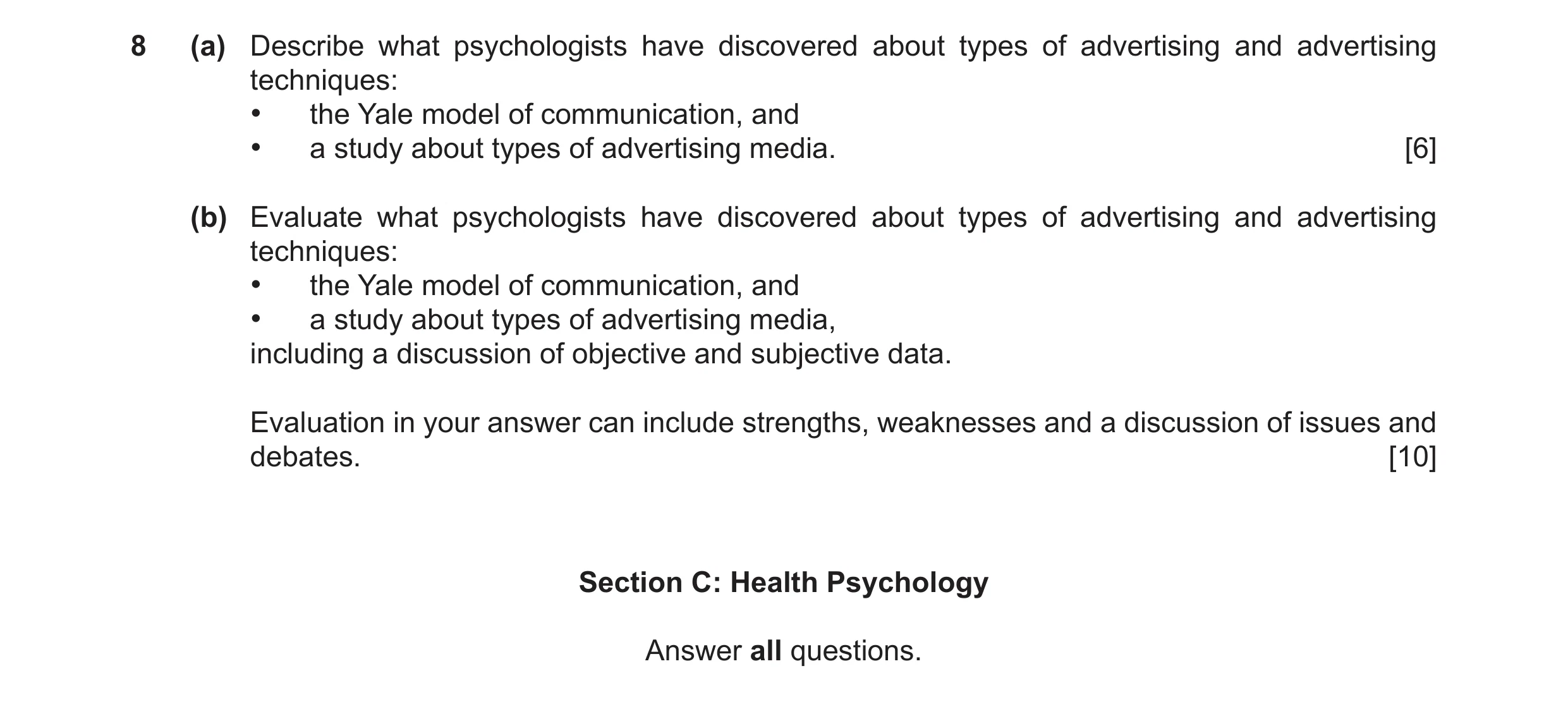 4 / 4
4 / 4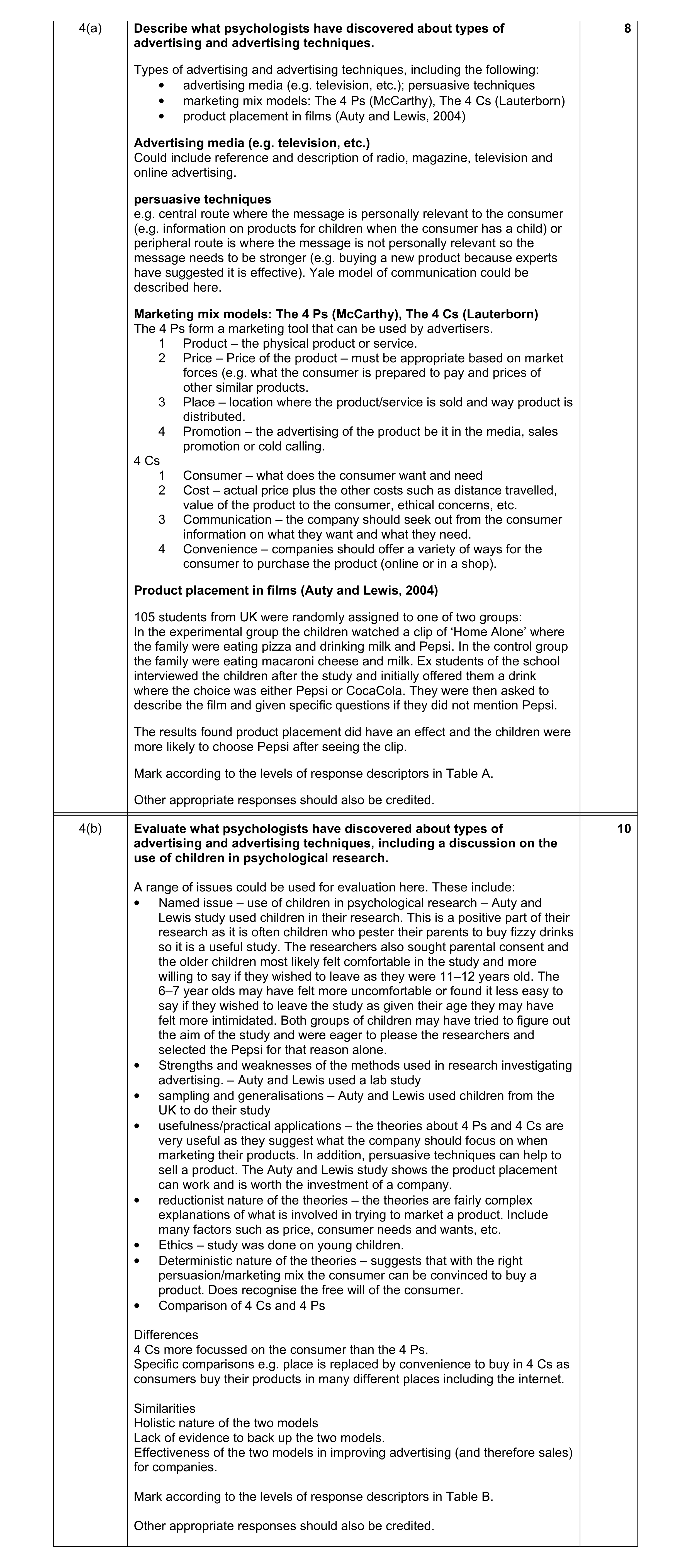 18
18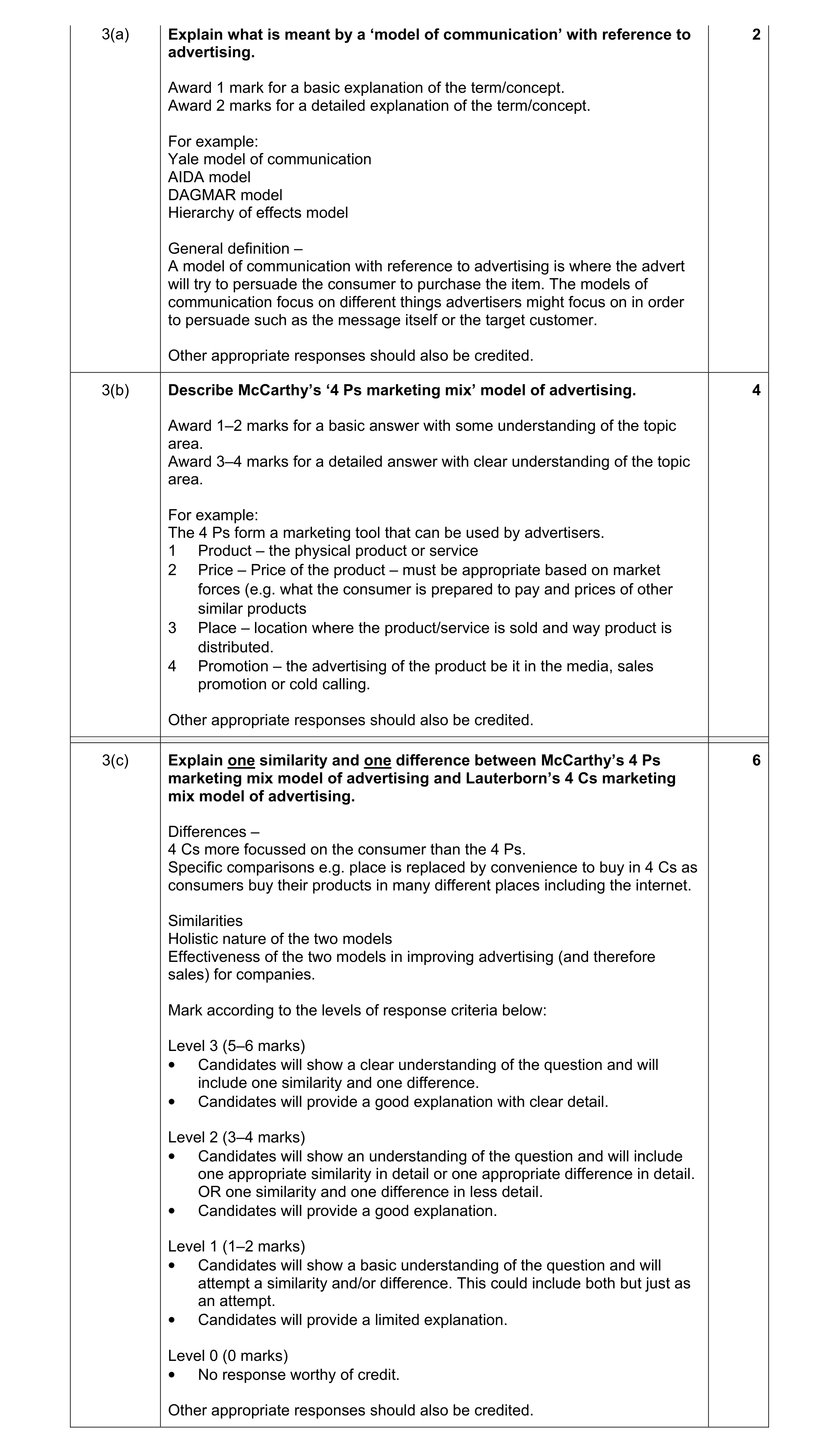 12
12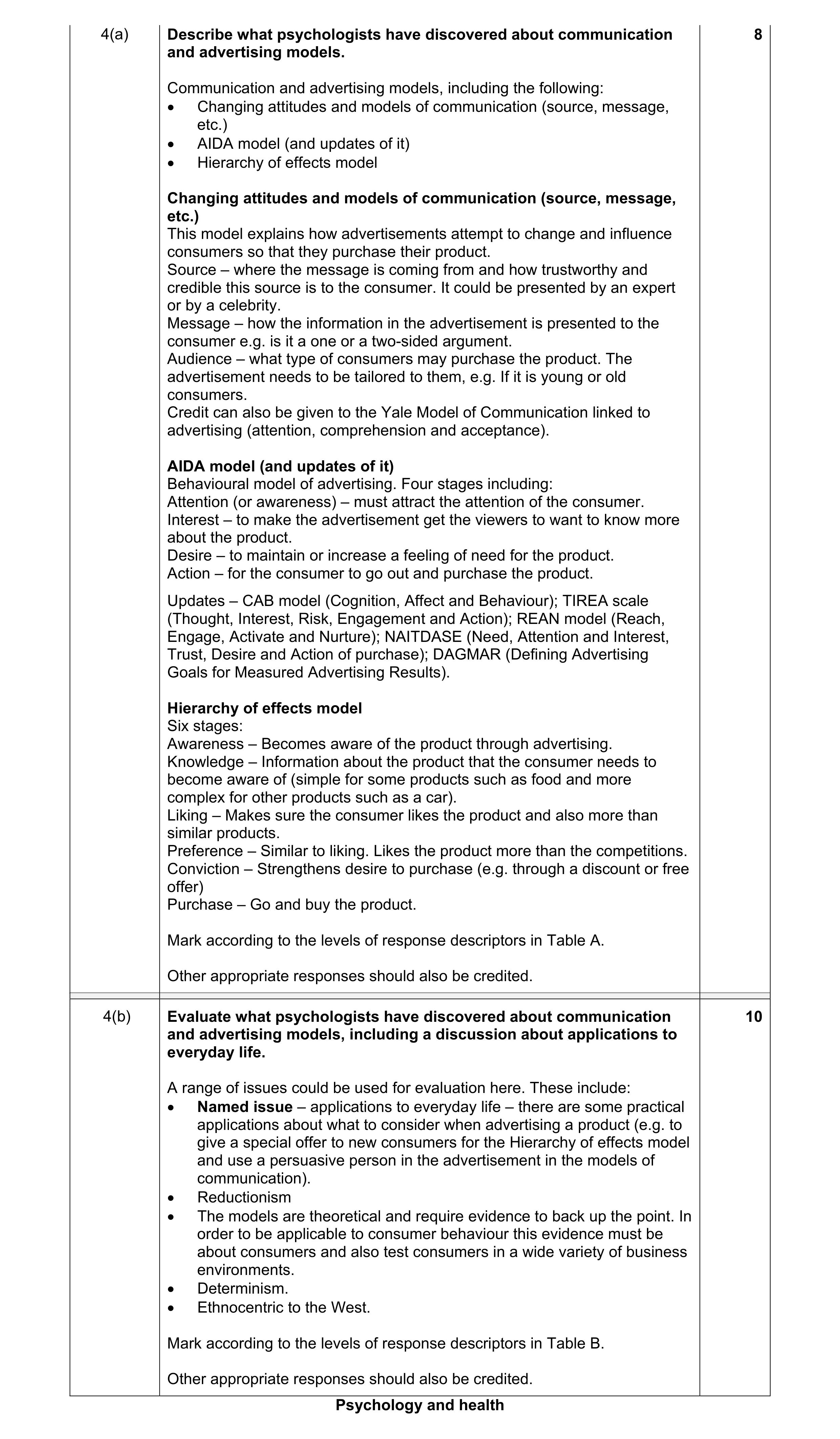 18
18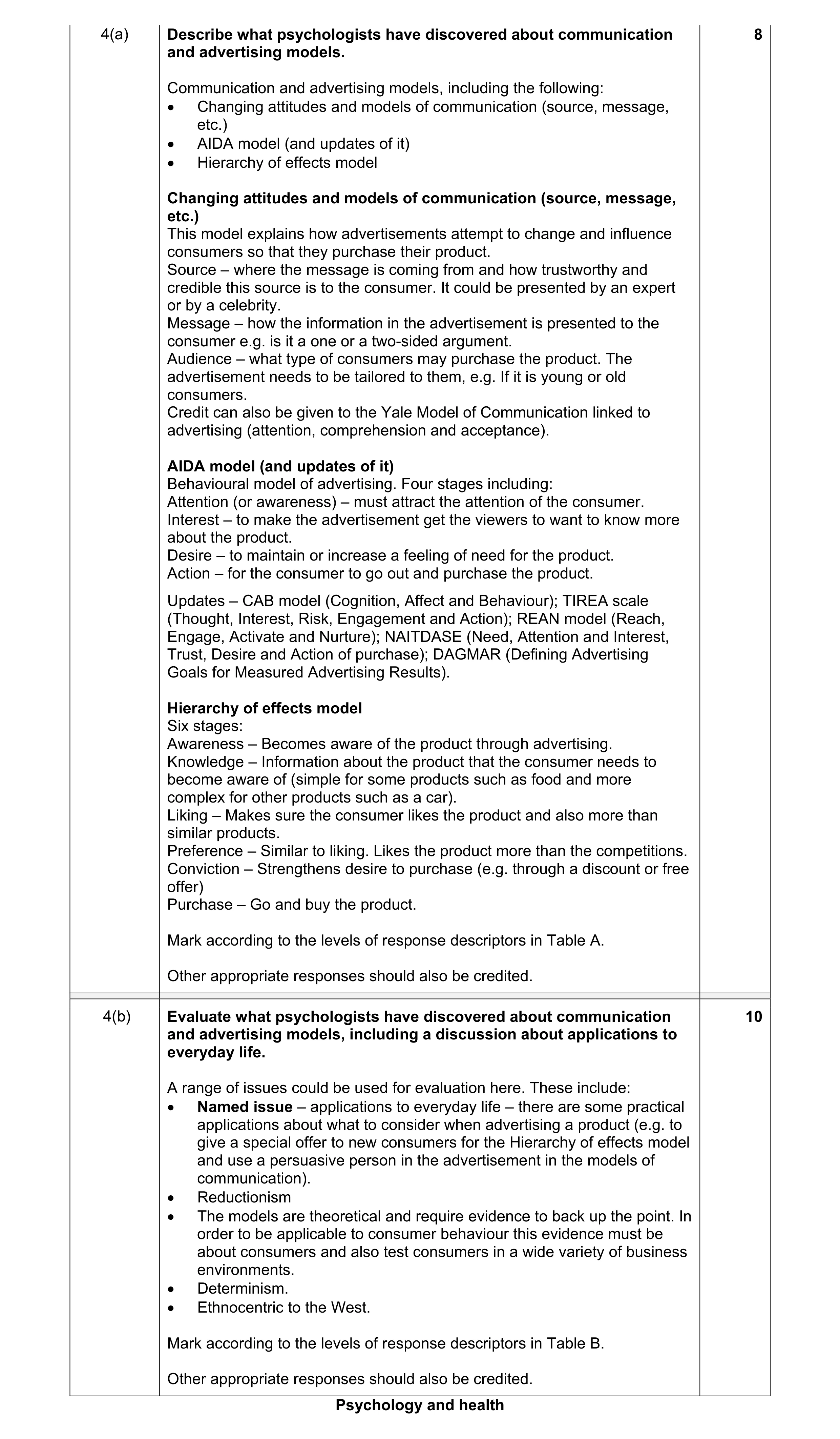 18
18 18
18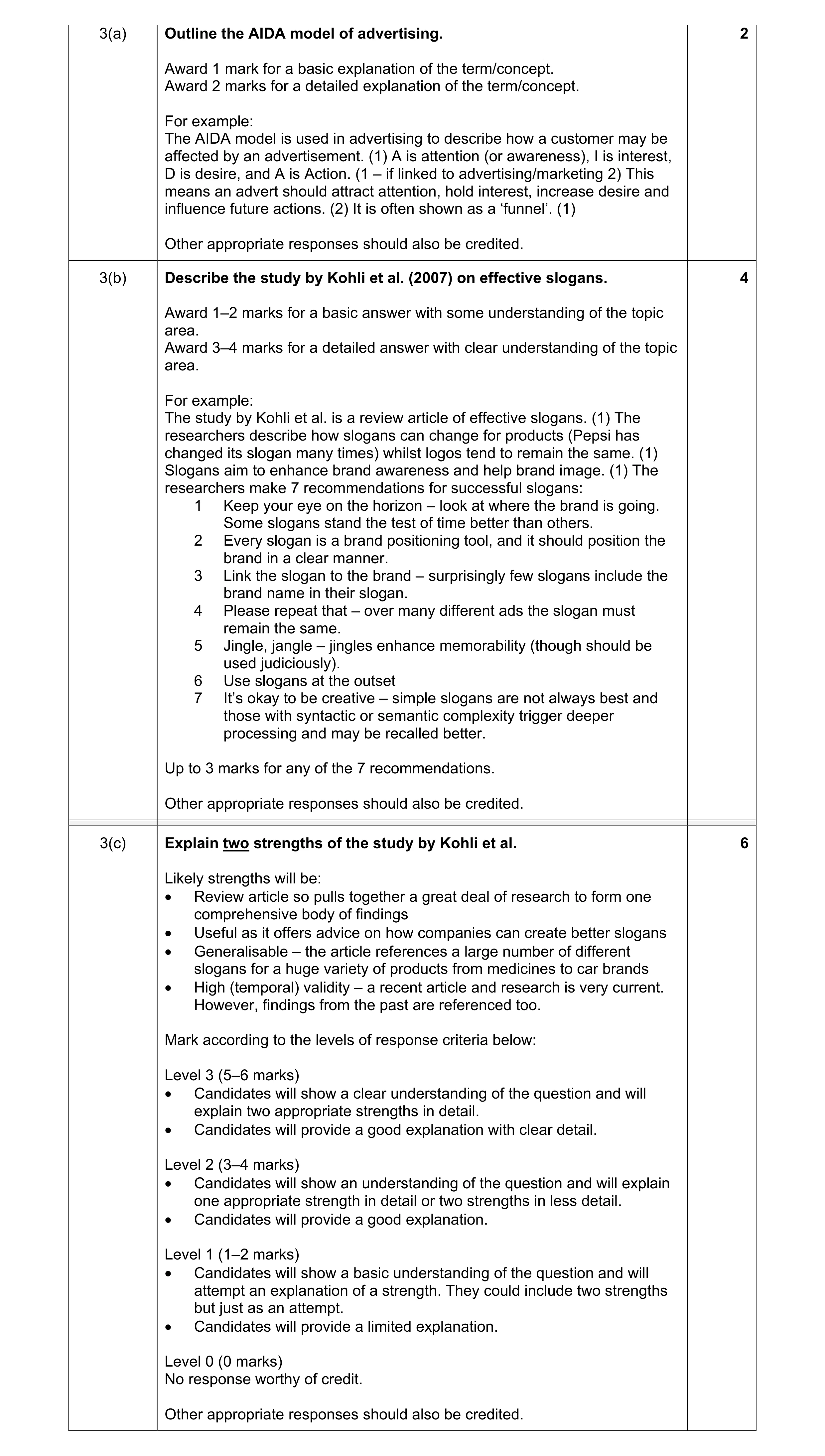 12
12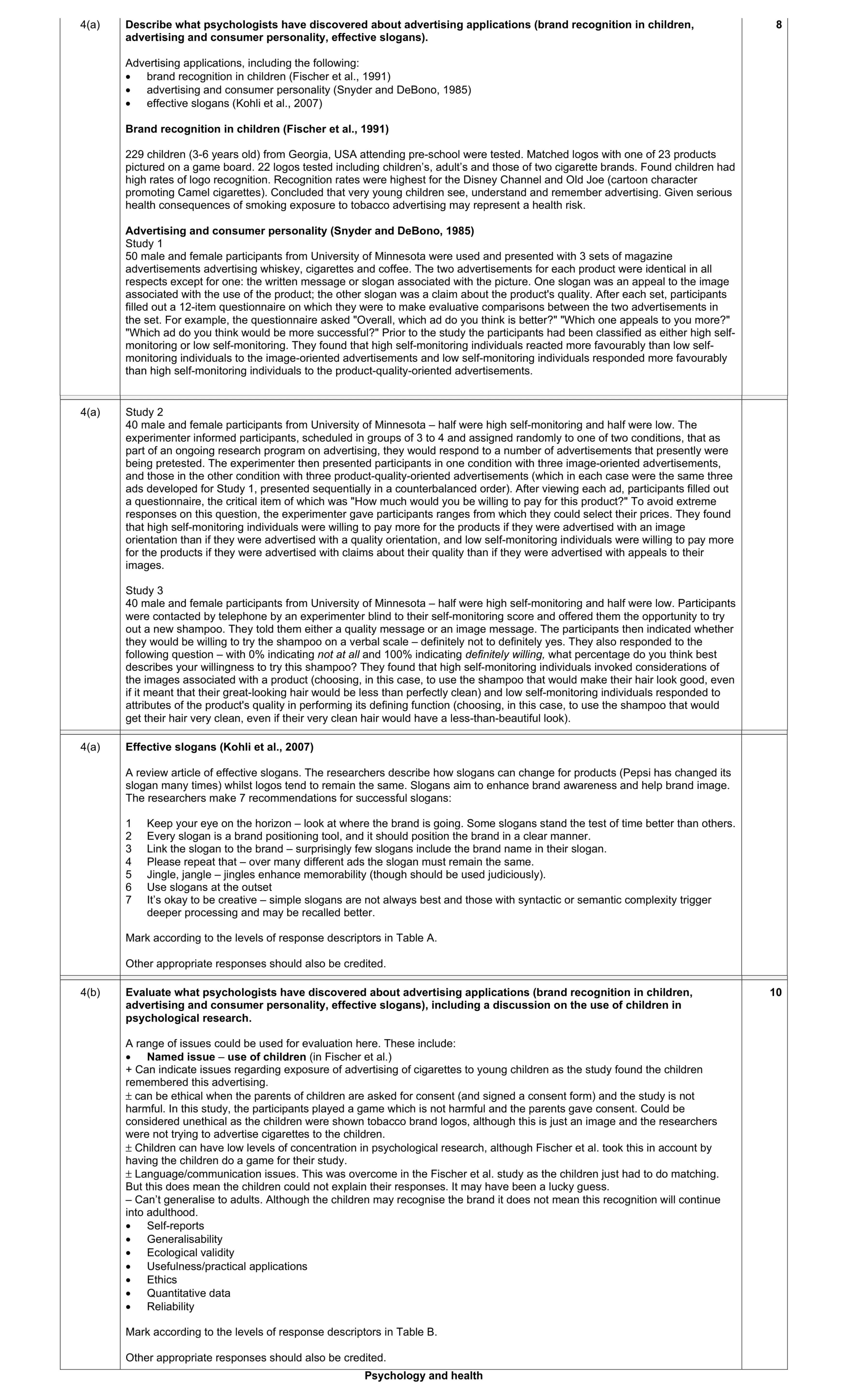 18
18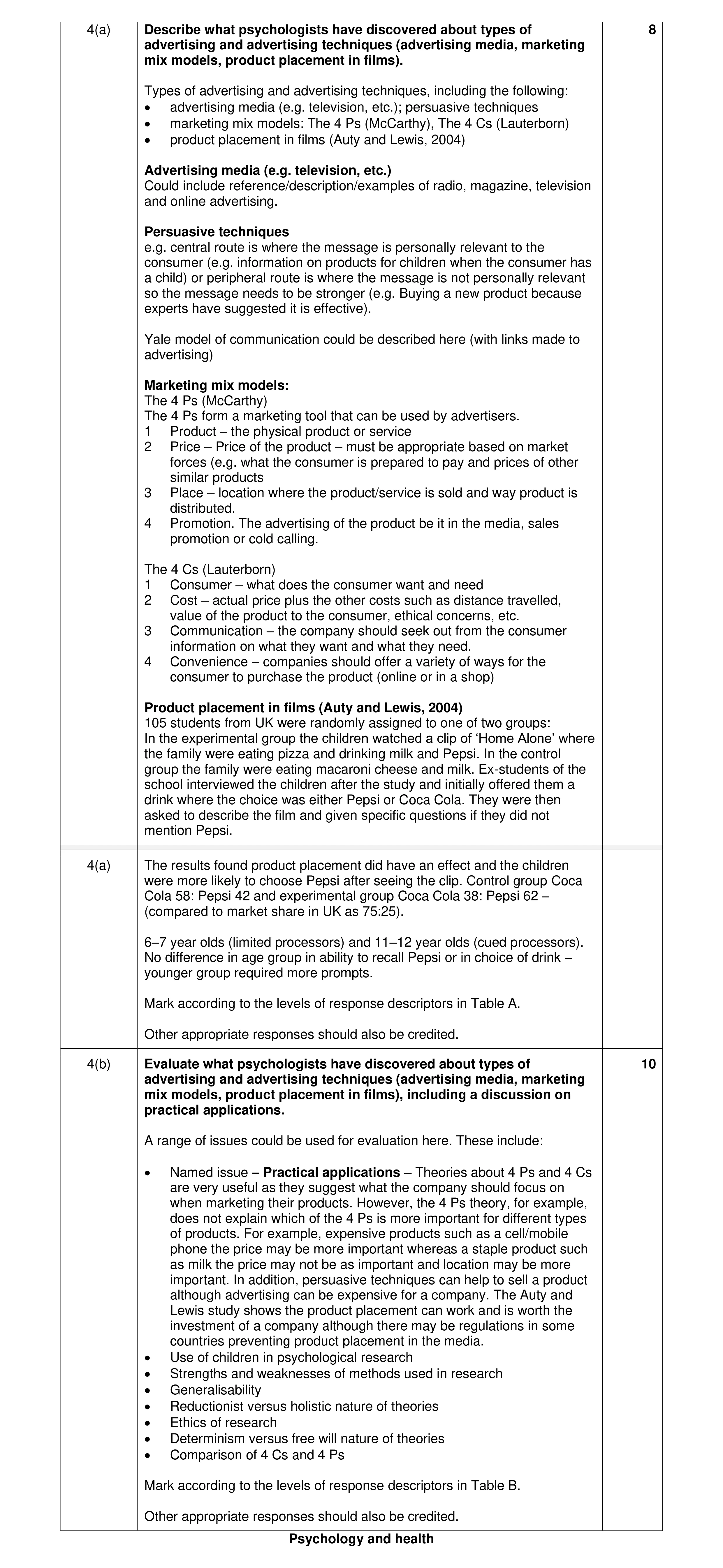 18
18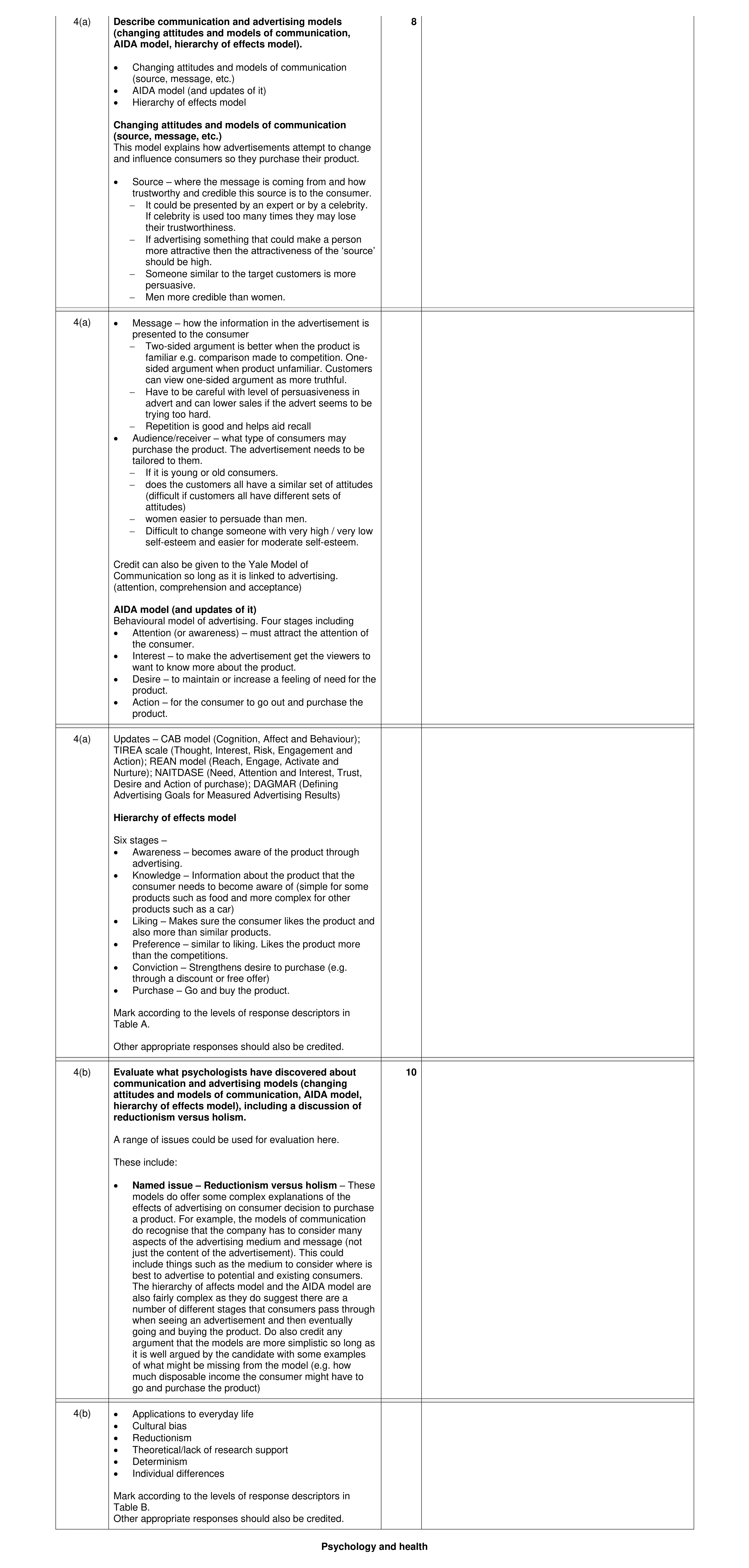 18
18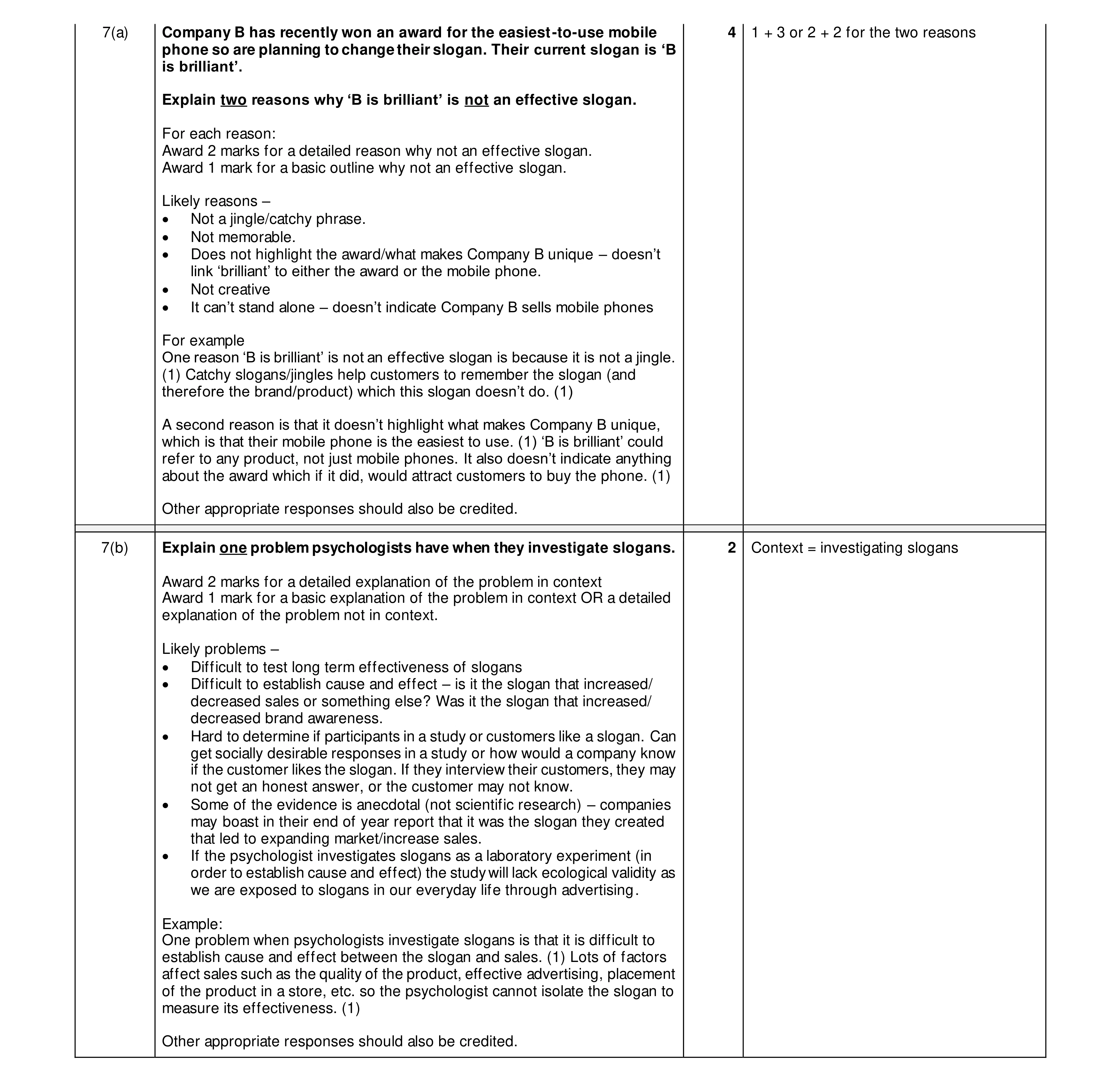 6
6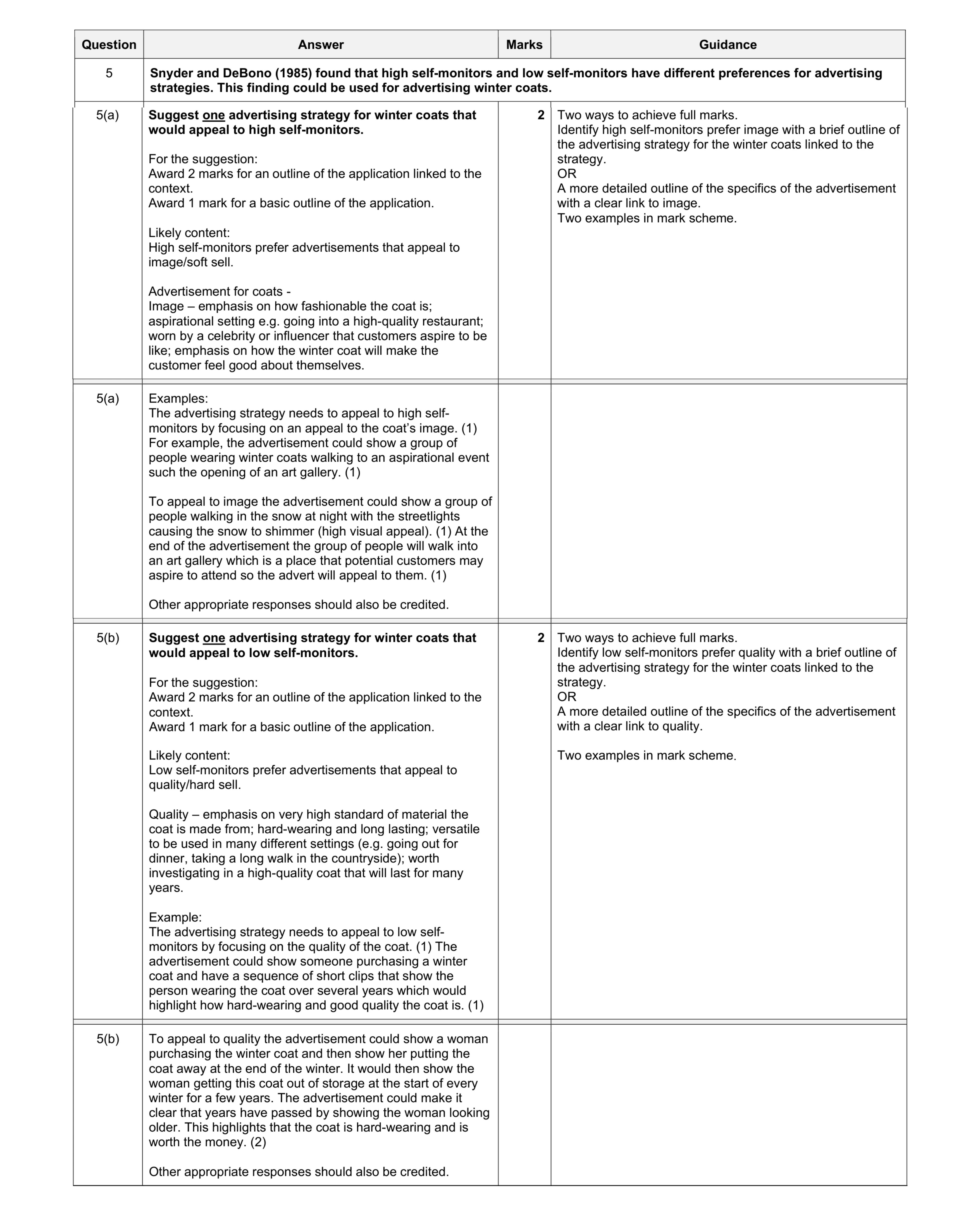 4
4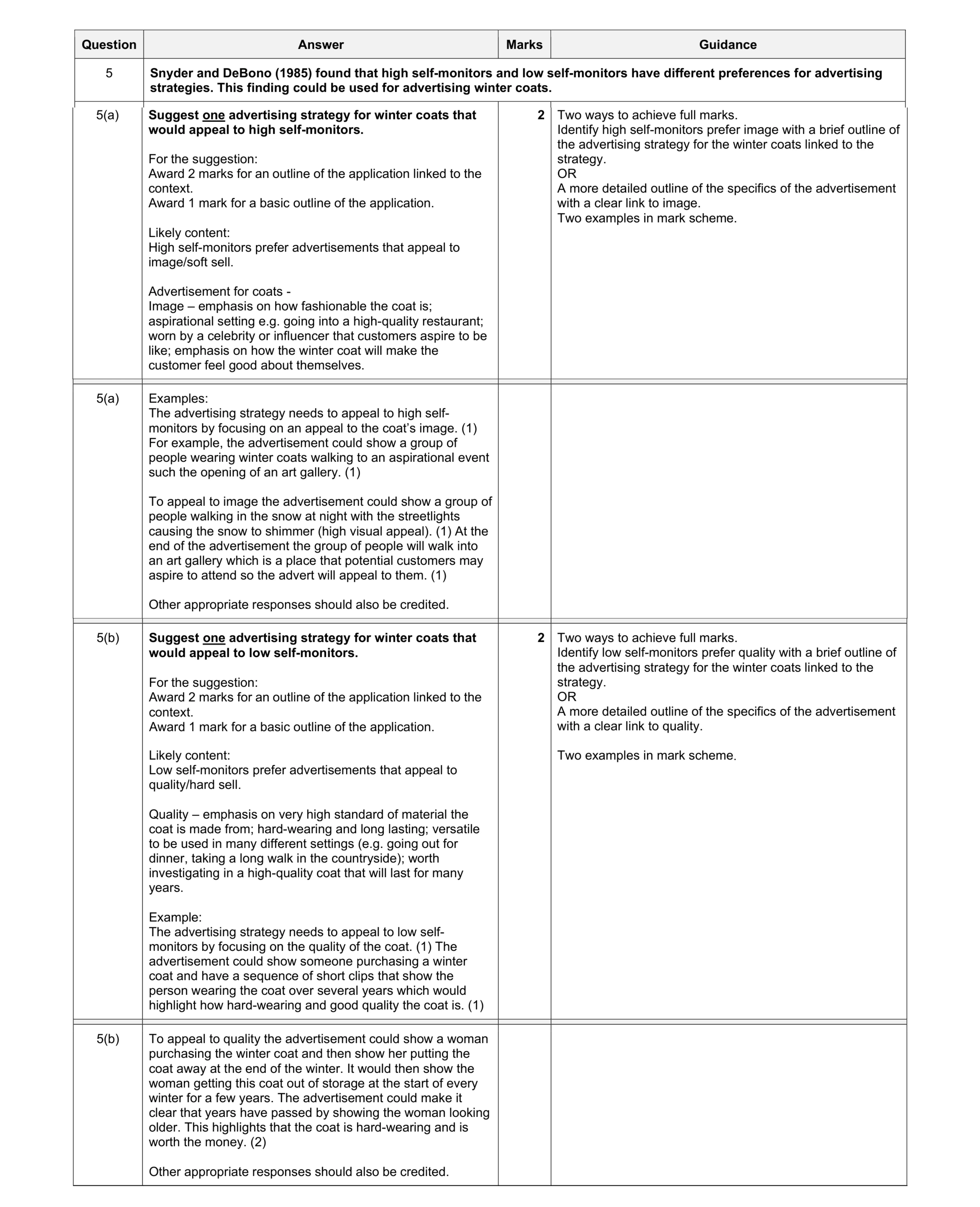 4
4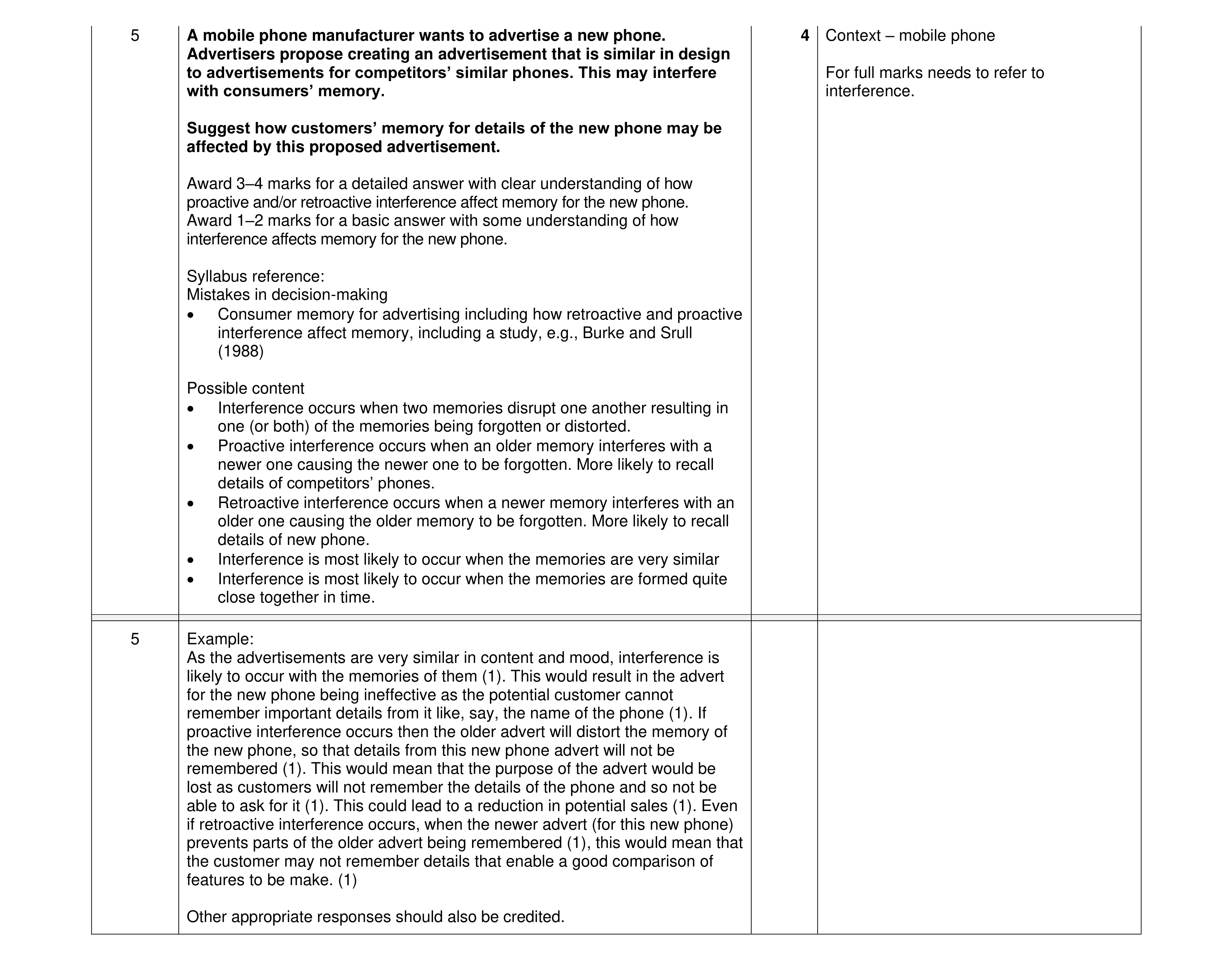 4
4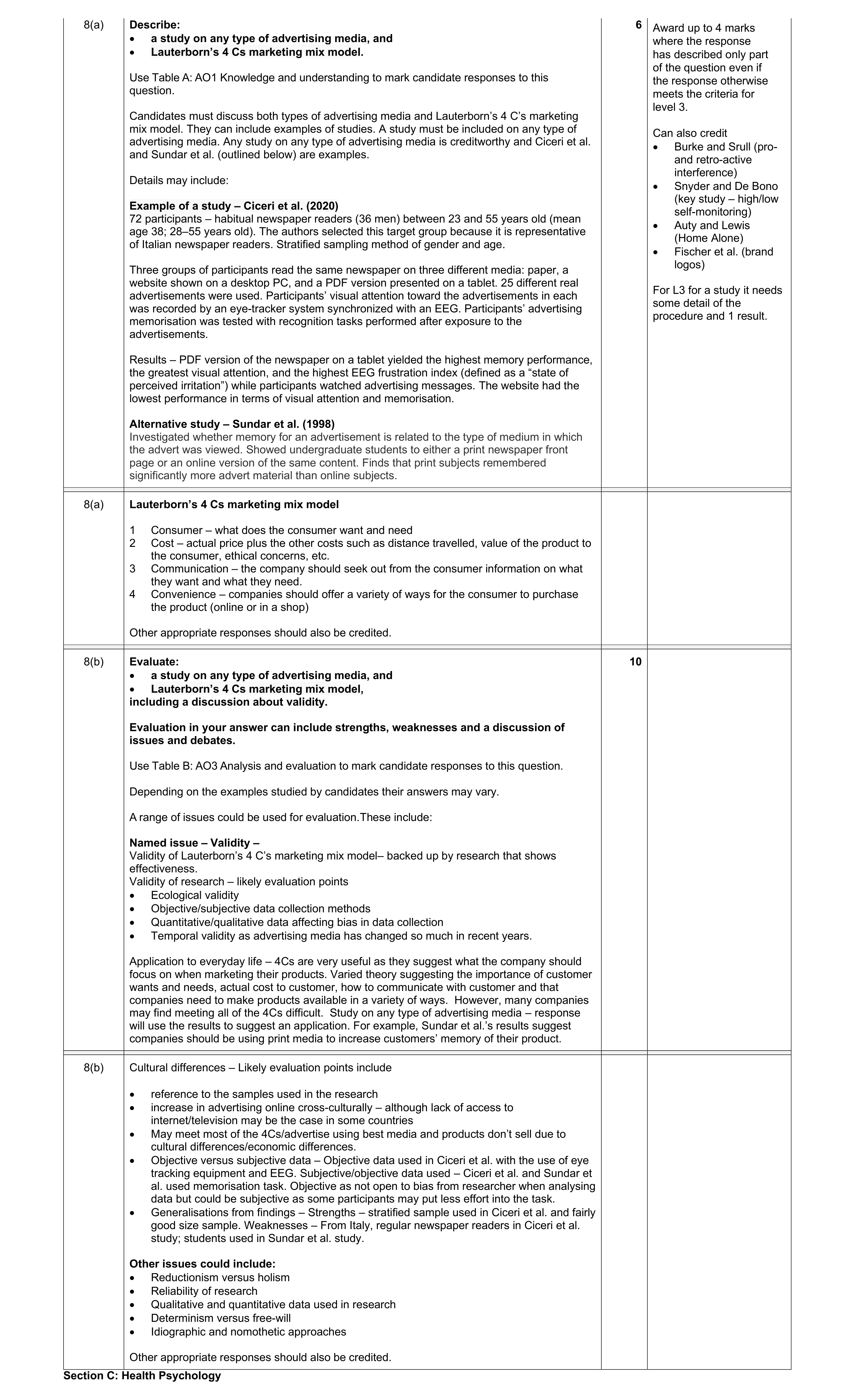 16
16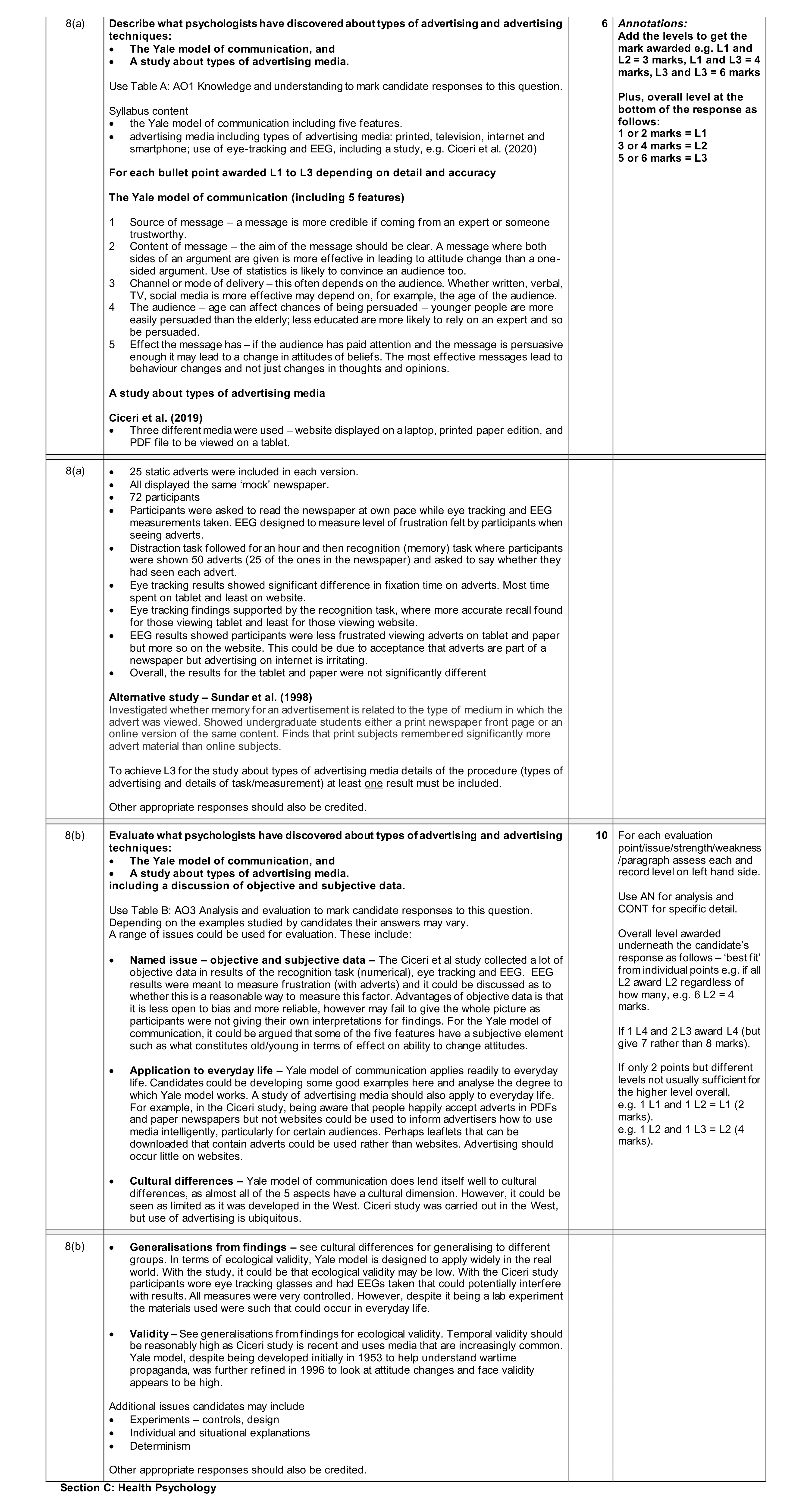 16
16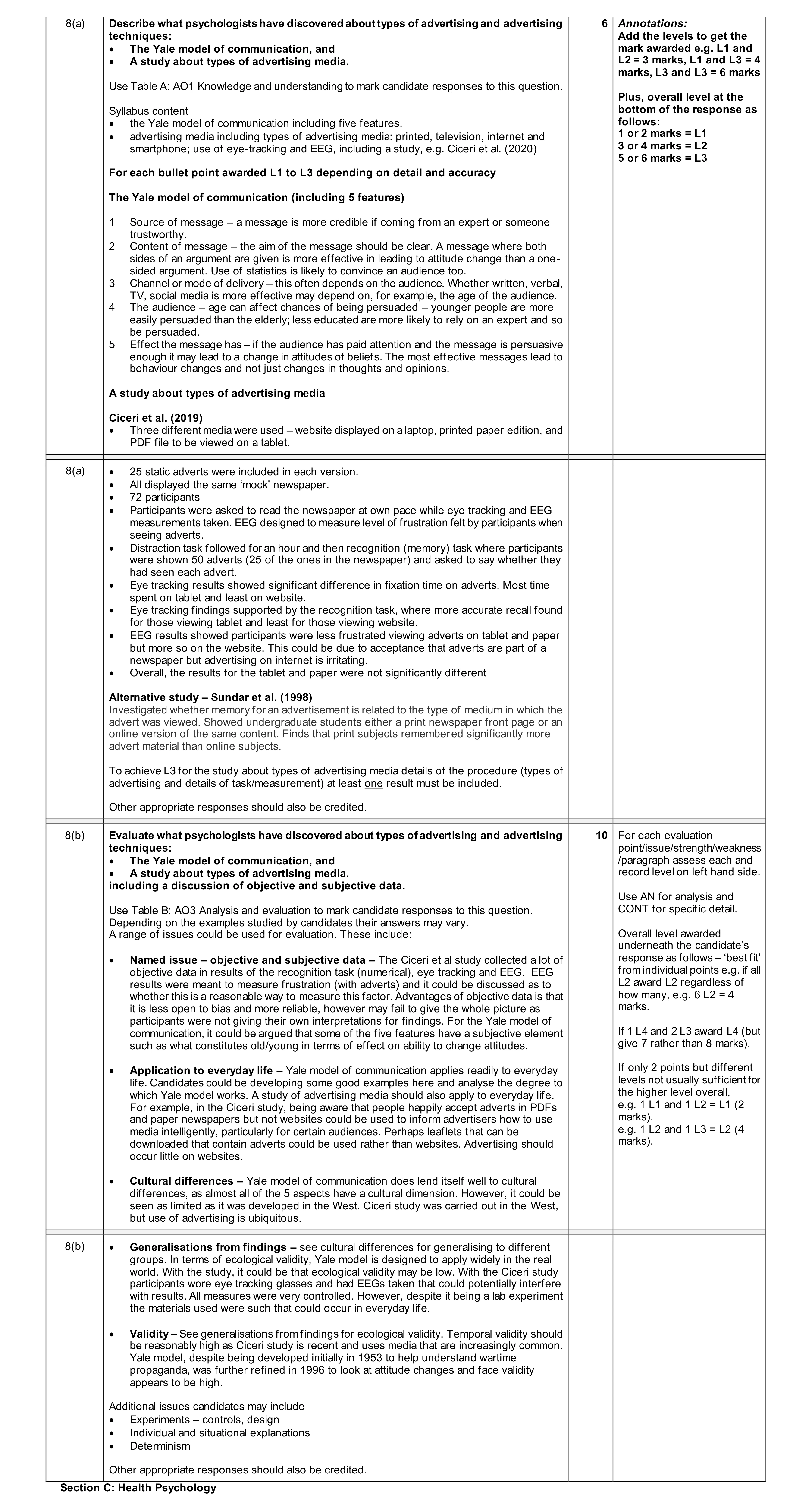 16
16