Questions as text
Q1 · State (i) what may be deduced from the difference in the temperatures of two objects, … …… 9702/41 Oct/Nov 2017
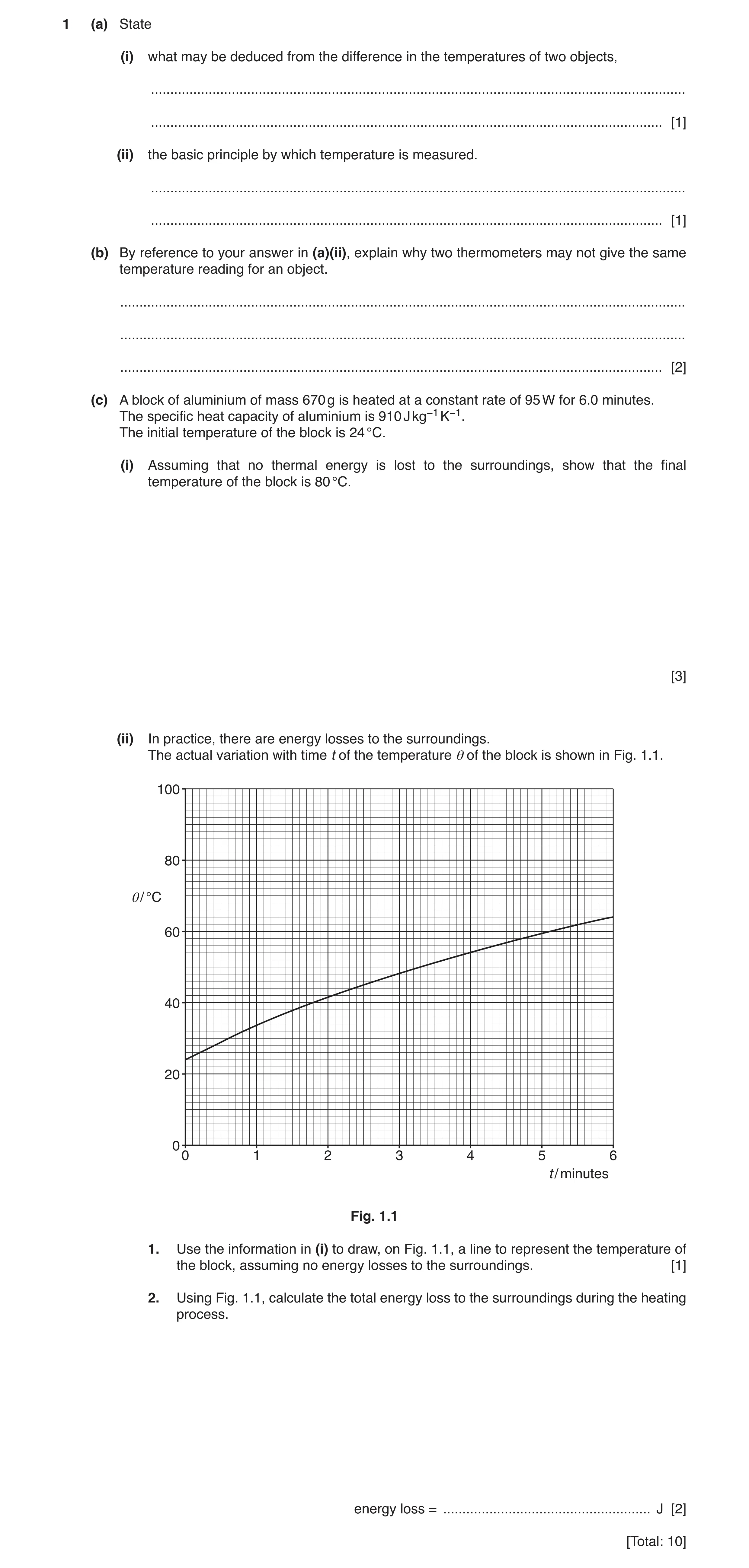
1 (a) State (i) what may be deduced from the difference in the temperatures of two objects, … … [1] (ii) the basic principle by which temperature is measured. … … [1] (b) By reference to your answer in (a)(ii), explain why two thermometers may not give the same temperature reading for an object. … … … [2] (c) A block of aluminium of mass 670 g is heated at a constant rate of 95 W for 6.0 minutes. The specific heat capacity of aluminium is 910 J kg−1 K−1. The initial temperature of the block is 24 °C. (i) Assuming that no thermal energy is lost to the surroundings, show that the final temperature of the block is 80 °C. [3] (ii) In practice, there are energy losses to the surroundings. The actual variation with time t of the temperature θ of the block is shown in Fig. 1.1. 100 80 θ/ °C 60 40 20 0 0 1 2 3 4 5 6 t / minutes Fig. 1.1 1. Use the information in (i) to draw, on Fig. 1.1, a line to represent the temperature of the block, assuming no energy losses to the surroundings. [1] 2. Using Fig. 1.1, calculate the total energy loss to the surroundings during the heating process. energy loss = … J [2] [Total: 10]
10 marks
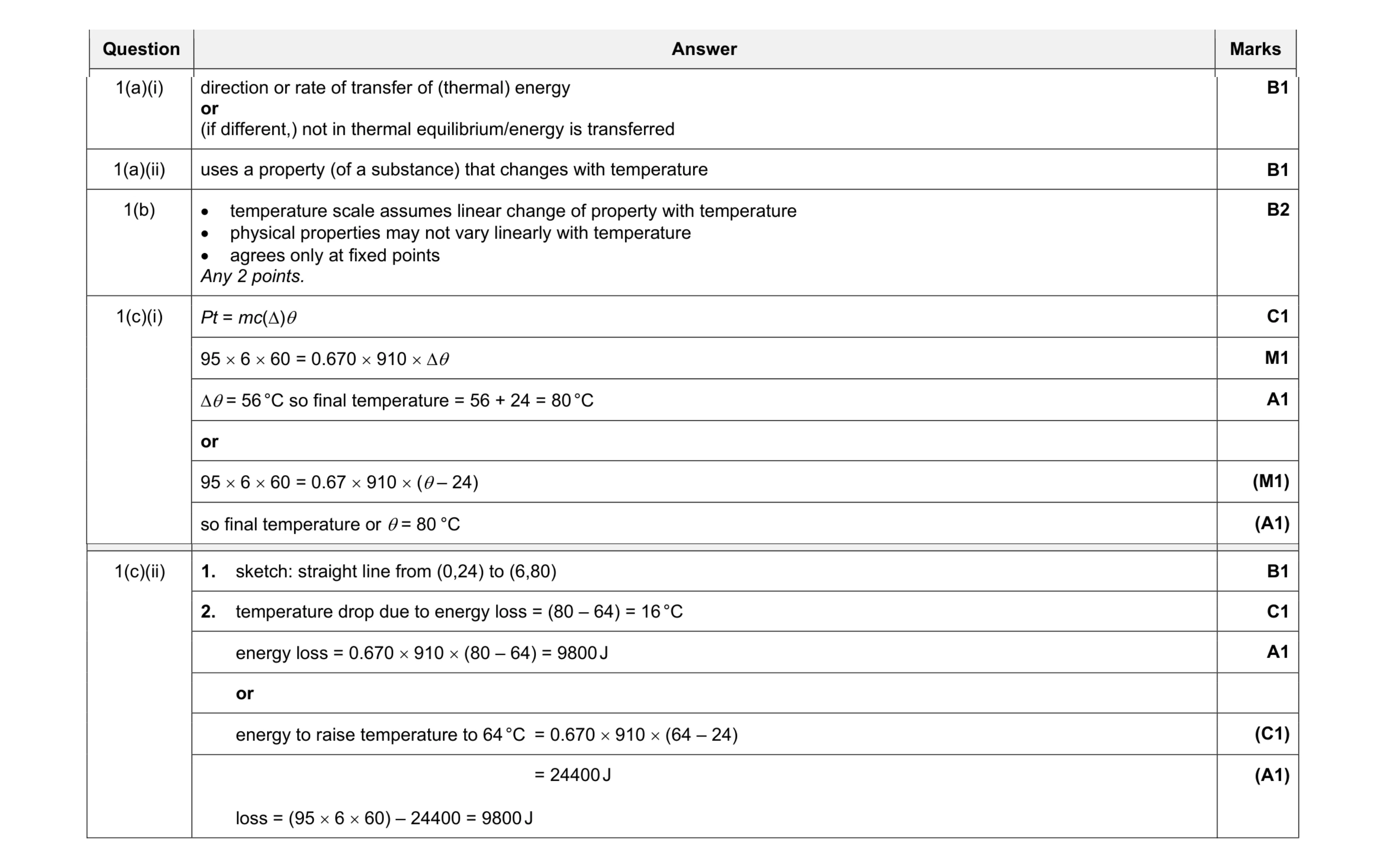
Mark scheme: 1(a)(i) direction or rate of transfer of (thermal) energy or (if different,) not in thermal equilibrium/energy is transferred B1 1(a)(ii) uses a property (of a substance) that changes with temperature B1 1(b) • temperature scale assumes linear change of property with temperature • physical properties may not vary linearly with temperature • agrees only at fixed points Any 2 points. B2 1(c)(i) Pt = mc(∆)θ C1 95 × 6 × 60 = 0.670 × 910 × ∆θ M1 ∆θ = 56 °C so final temperature = 56 + 24 = 80 °C A1 or 95 × 6 × 60 = 0.67 × 910 × (θ – 24) (M1) so final temperature or θ = 80 °C (A1) Question Answer Marks 1(c)(ii) 1. sketch: straight line from (0,24) to (6,80) B1 2. temperature drop due to energy loss = (80 – 64) = 16 °C C1 energy loss = 0.670 × 910 × (80 – 64) = 9800 J A1 or energy to raise temperature to 64 °C = 0.670 × 910 × (64 – 24) (C1) = 24400 J loss = (95 × 6 × 60) – 24400 = 9800 J (A1)
This question in 9702/41 Oct/Nov 2017
Q2 · State what is meant by specific latent heat 9702/42 Oct/Nov 2017
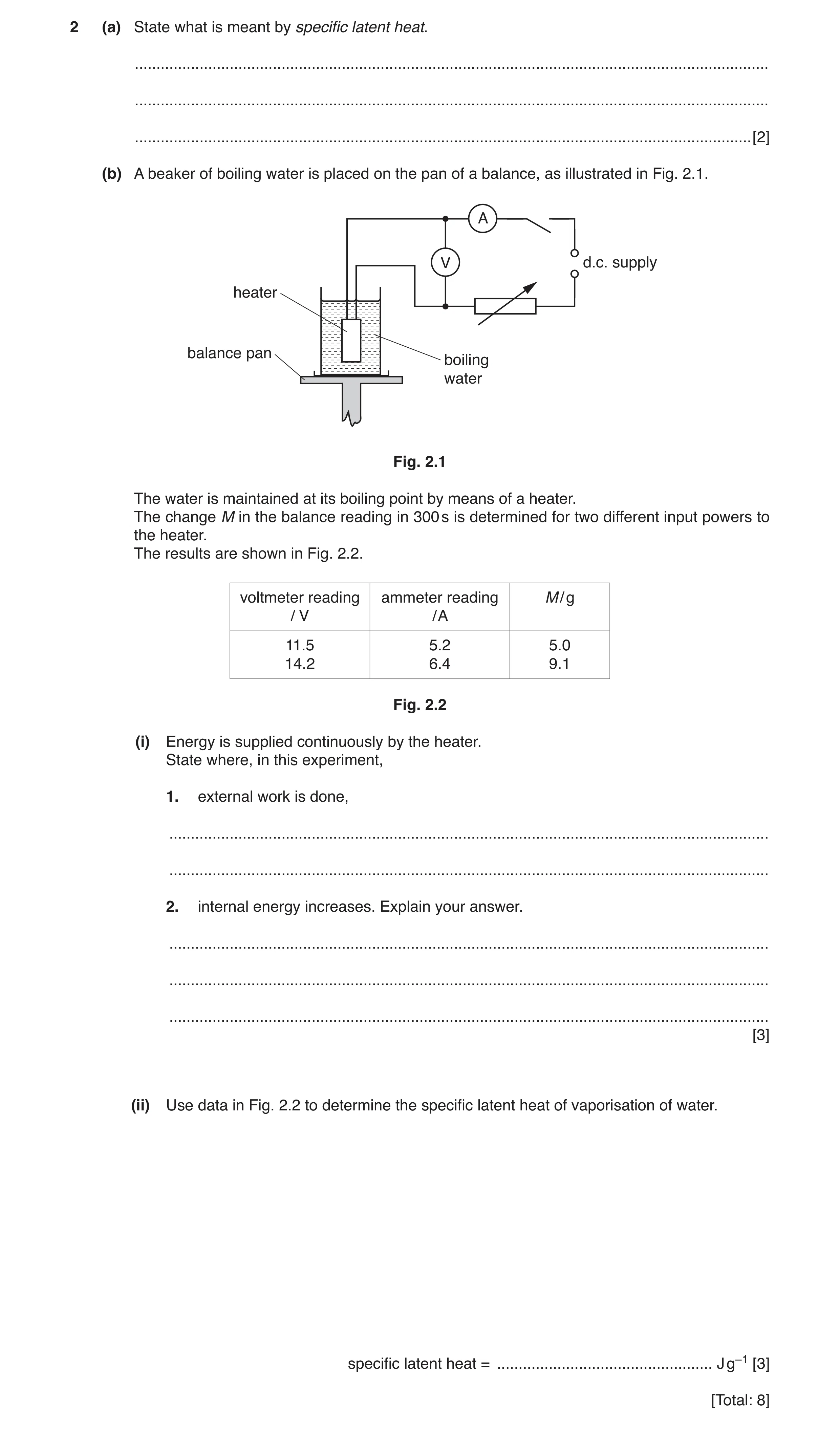
2 (a) State what is meant by specific latent heat. … … … [2] (b) A beaker of boiling water is placed on the pan of a balance, as illustrated in Fig. 2.1. A V d.c. supply heater balance pan boiling water Fig. 2.1 The water is maintained at its boiling point by means of a heater. The change M in the balance reading in 300 s is determined for two different input powers to the heater. The results are shown in Fig. 2.2. voltmeter reading ammeter reading M / g / V / A 11.5 5.2 5.0 14.2 6.4 9.1 Fig. 2.2 (i) Energy is supplied continuously by the heater. State where, in this experiment, 1. external work is done, … … 2. internal energy increases. Explain your answer. … … … [3] (ii) Use data in Fig. 2.2 to determine the specific latent heat of vaporisation of water. specific latent heat = … J g–1 [3] [Total: 8]
8 marks
Mark scheme: 2(a) (thermal) energy per (unit) mass (to cause change of state) B1 (energy required to cause/released in) change of state at constant temperature B1 2(b)(i) 1. (work done on/against) the atmosphere B1 2. water as it turns from liquid to vapour M1 as potential energy of molecules increases A1 or surroundings as its temperature rises (M1) as energy is lost/transferred to surroundings (A1) 2(b)(ii) VI – h = M / t × L (where h = power loss) or L = (VIt – Q) / M (where Q = energy loss) C1 (14.2 × 6.4) – (11.5 × 5.2) = (9.1 – 5.0) × L / 300 or L = [(14.2 × 6.4) – (11.5 × 5.2)] × 300 / (9.1 – 5.0) C1 L = 2300 J g–1 A1
This question in 9702/42 Oct/Nov 2017
Q3 · State (i) what may be deduced from the difference in the temperatures of two objects, … …… 9702/43 Oct/Nov 2017
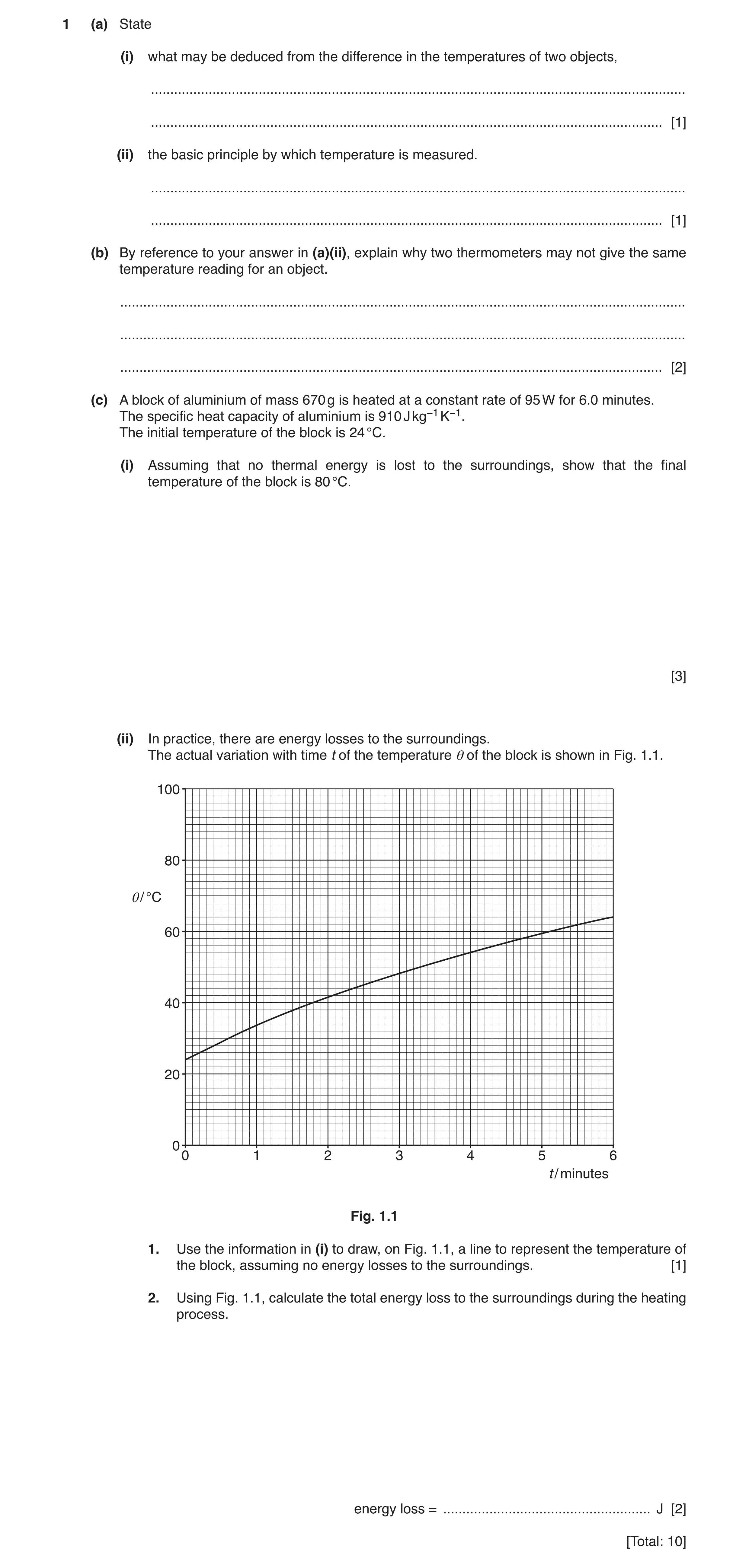
1 (a) State (i) what may be deduced from the difference in the temperatures of two objects, … … [1] (ii) the basic principle by which temperature is measured. … … [1] (b) By reference to your answer in (a)(ii), explain why two thermometers may not give the same temperature reading for an object. … … … [2] (c) A block of aluminium of mass 670 g is heated at a constant rate of 95 W for 6.0 minutes. The specific heat capacity of aluminium is 910 J kg−1 K−1. The initial temperature of the block is 24 °C. (i) Assuming that no thermal energy is lost to the surroundings, show that the final temperature of the block is 80 °C. [3] (ii) In practice, there are energy losses to the surroundings. The actual variation with time t of the temperature θ of the block is shown in Fig. 1.1. 100 80 θ/ °C 60 40 20 0 0 1 2 3 4 5 6 t / minutes Fig. 1.1 1. Use the information in (i) to draw, on Fig. 1.1, a line to represent the temperature of the block, assuming no energy losses to the surroundings. [1] 2. Using Fig. 1.1, calculate the total energy loss to the surroundings during the heating process. energy loss = … J [2] [Total: 10]
10 marks
Mark scheme: 1(a)(i) direction or rate of transfer of (thermal) energy or (if different,) not in thermal equilibrium/energy is transferred B1 1(a)(ii) uses a property (of a substance) that changes with temperature B1 1(b) • temperature scale assumes linear change of property with temperature • physical properties may not vary linearly with temperature • agrees only at fixed points Any 2 points. B2 1(c)(i) Pt = mc(∆)θ C1 95 × 6 × 60 = 0.670 × 910 × ∆θ M1 ∆θ = 56 °C so final temperature = 56 + 24 = 80 °C A1 or 95 × 6 × 60 = 0.67 × 910 × (θ – 24) (M1) so final temperature or θ = 80 °C (A1) Question Answer Marks 1(c)(ii) 1. sketch: straight line from (0,24) to (6,80) B1 2. temperature drop due to energy loss = (80 – 64) = 16 °C C1 energy loss = 0.670 × 910 × (80 – 64) = 9800 J A1 or energy to raise temperature to 64 °C = 0.670 × 910 × (64 – 24) (C1) = 24400 J loss = (95 × 6 × 60) – 24400 = 9800 J (A1)
This question in 9702/43 Oct/Nov 2017
Q4 · During melting, a solid becomes liquid with little or no change in volume 9702/42 May/June 2018
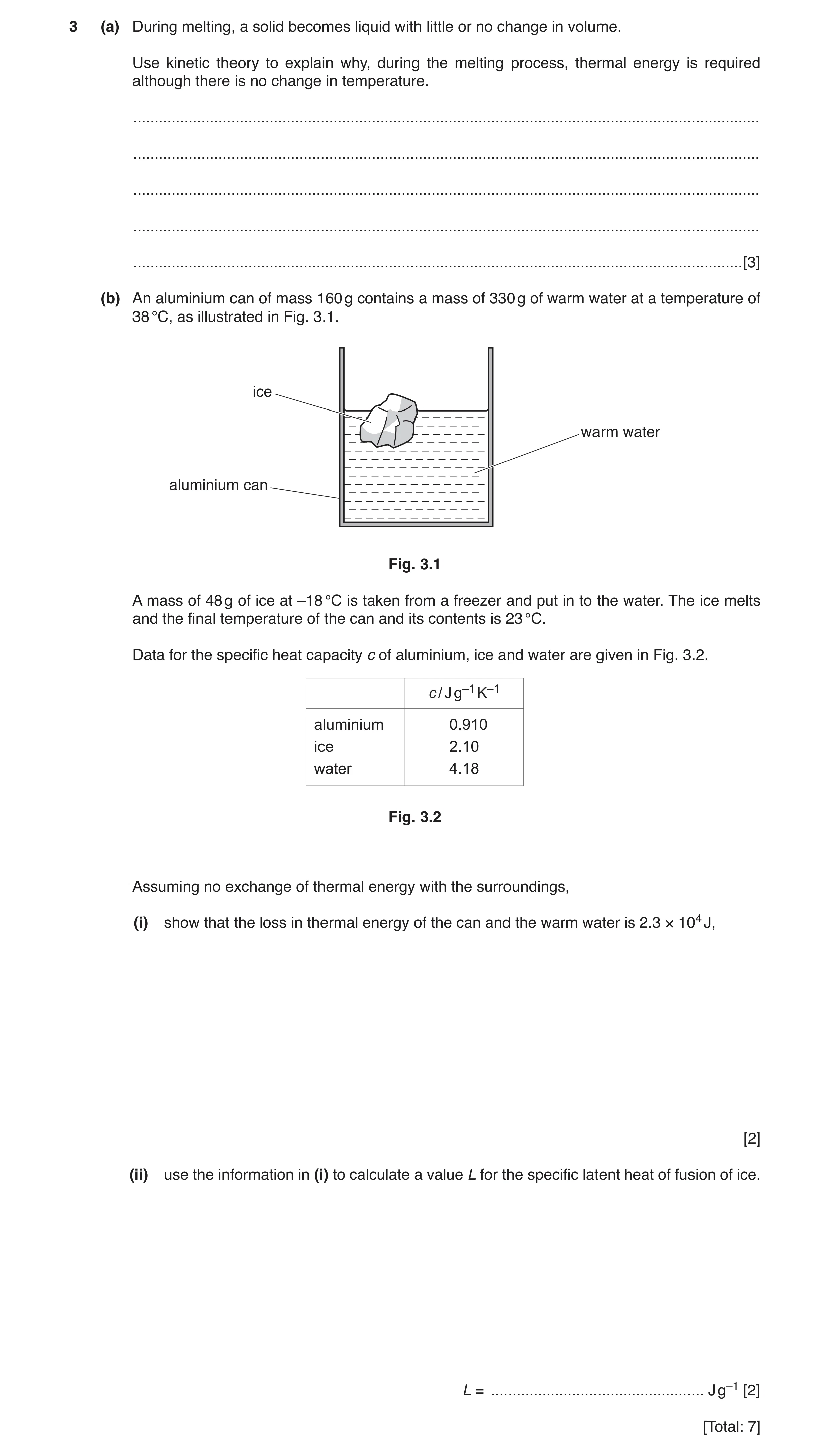
3 (a) During melting, a solid becomes liquid with little or no change in volume. Use kinetic theory to explain why, during the melting process, thermal energy is required although there is no change in temperature. … … … … … [3] (b) An aluminium can of mass 160 g contains a mass of 330 g of warm water at a temperature of 38 °C, as illustrated in Fig. 3.1. ice warm water aluminium can Fig. 3.1 A mass of 48 g of ice at –18 °C is taken from a freezer and put in to the water. The ice melts and the final temperature of the can and its contents is 23 °C. Data for the specific heat capacity c of aluminium, ice and water are given in Fig. 3.2. c / J g–1 K–1 aluminium 0.910 ice 2.10 water 4.18 Fig. 3.2 Assuming no exchange of thermal energy with the surroundings, (i) show that the loss in thermal energy of the can and the warm water is 2.3 × 10⁴ J, [2] (ii) use the information in (i) to calculate a value L for the specific latent heat of fusion of ice. L = … J g–1 [2] [Total: 7]
7 marks
Mark scheme: 3(a) (during melting,) bonds between atoms/molecules are broken B1 potential energy of atoms/molecules is increased B1 no/little work done so required input of energy is thermal B1 3(b)(i) (∆Q =) mc∆θ C1 loss = (160 × 0.910 × 15) + (330 × 4.18 × 15) = 2.3 × 10⁴ J A1 3(b)(ii) 2.3 × 104 = (48 × 2.10 × 18) + 48L + (48 × 4.18 × 23) C1 48L = 1.66 × 10⁴ L = 350 J g–1 A1
This question in 9702/42 May/June 2018
Q5 · Define specific latent heat of fusion 9702/42 Oct/Nov 2018
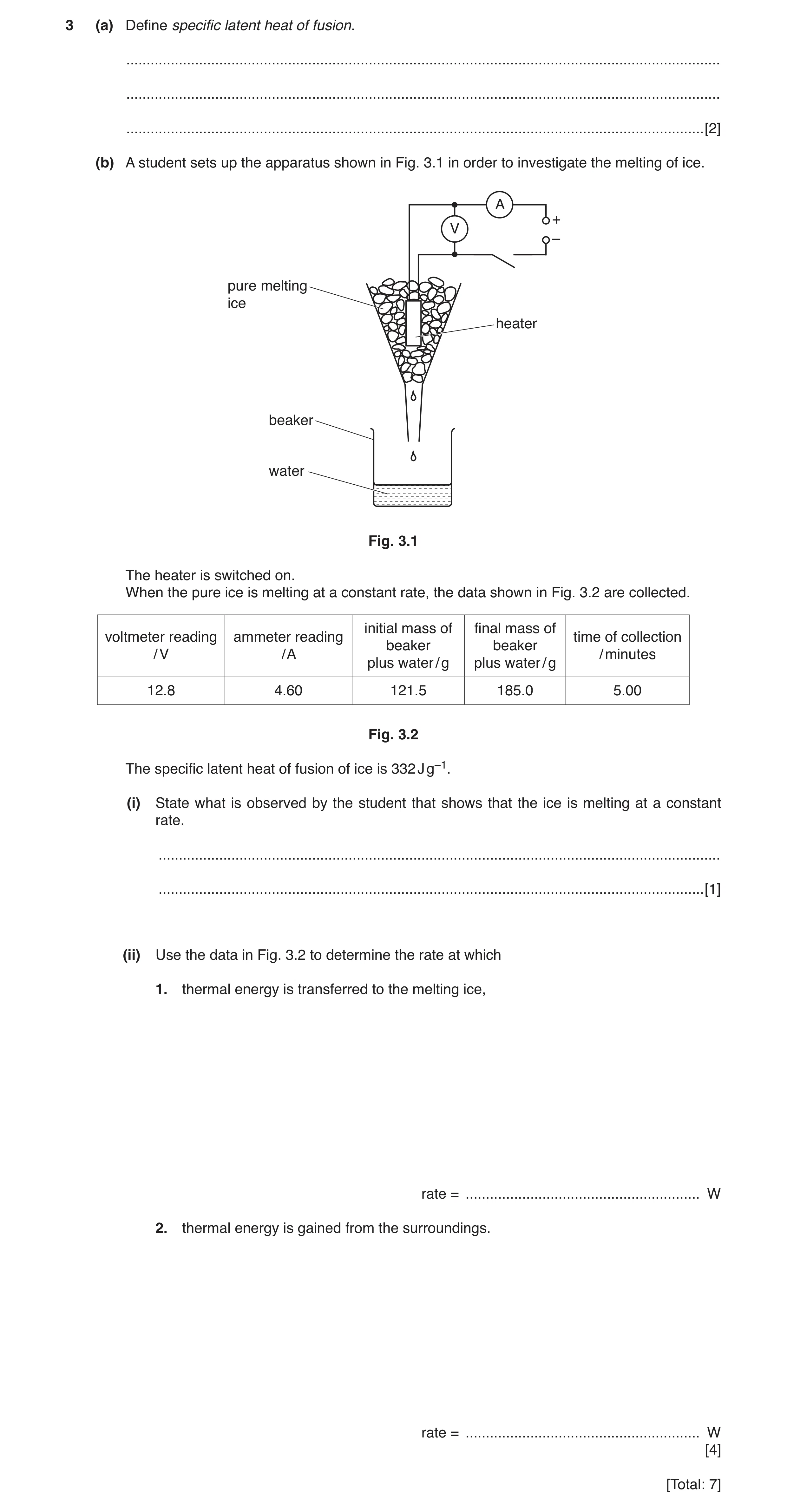
3 (a) Define specific latent heat of fusion. … … … [2] (b) A student sets up the apparatus shown in Fig. 3.1 in order to investigate the melting of ice. A + V – pure melting ice heater beaker water Fig. 3.1 The heater is switched on. When the pure ice is melting at a constant rate, the data shown in Fig. 3.2 are collected. initial mass of final mass of voltmeter reading ammeter reading time of collection beaker beaker / V / A / minutes plus water / g plus water / g 12.8 4.60 121.5 185.0 5.00 Fig. 3.2 The specific latent heat of fusion of ice is 332 J g–1. (i) State what is observed by the student that shows that the ice is melting at a constant rate. … … [1] (ii) Use the data in Fig. 3.2 to determine the rate at which 1. thermal energy is transferred to the melting ice, rate = … W 2. thermal energy is gained from the surroundings. rate = … W [4] [Total: 7]
7 marks
Mark scheme: 3(a) (thermal) energy per unit mass (to cause change of state) B1 (energy transfer during) change of state between solid and liquid at constant temperature B1 3(b)(i) Any one from: • rate of increase in mass (of beaker and water) is constant • level of water rises at a constant rate • volume of water (in beaker) increases at a constant rate • constant time between drops • constant rate of dripping B1 3(b)(ii) (electrical power supplied =) 12.8 × 4.60 (= 58.9 W) C1 (rate of transfer to ice =) [(185.0 – 121.5) × 332] / [5.00 × 60] (= 70.3 W) C1 1. rate = 70.3 W A1 2. rate = 70.3 – 58.9 = 11.4 W A1
This question in 9702/42 Oct/Nov 2018
Q6 · State what is meant by specific latent heat 9702/41 Oct/Nov 2019
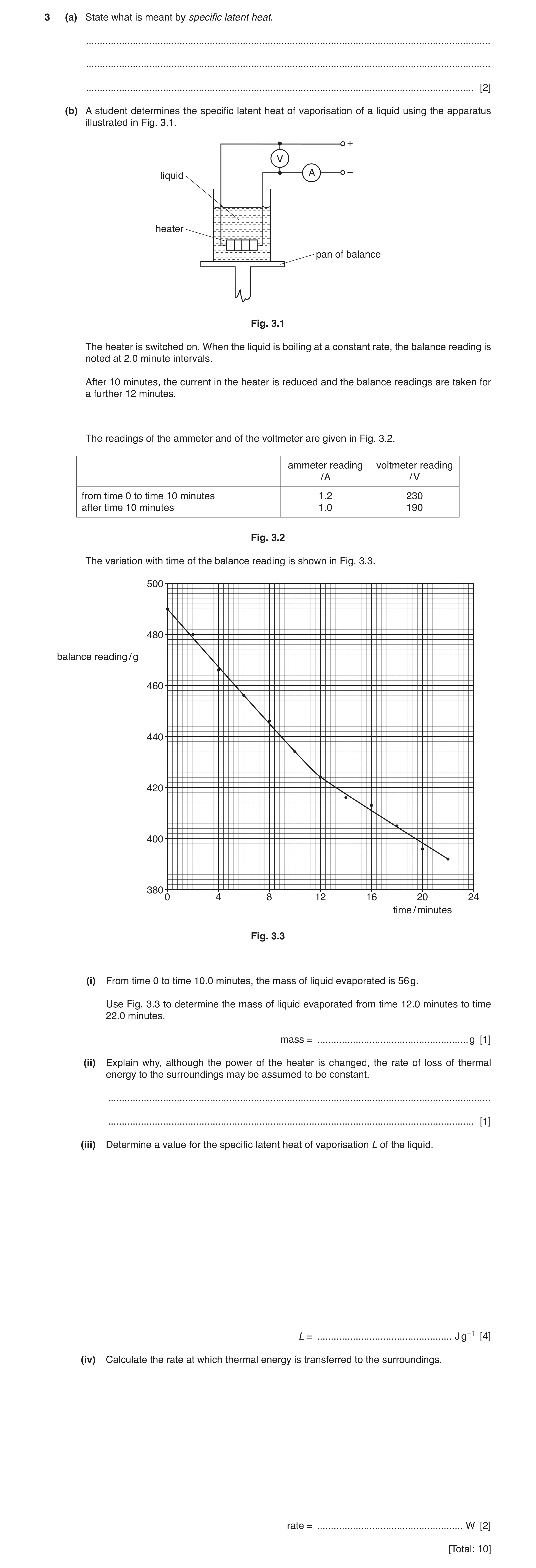
3 (a) State what is meant by specific latent heat. … … … [2] (b) A student determines the specific latent heat of vaporisation of a liquid using the apparatus illustrated in Fig. 3.1. + V liquid A – heater pan of balance Fig. 3.1 The heater is switched on. When the liquid is boiling at a constant rate, the balance reading is noted at 2.0 minute intervals. After 10 minutes, the current in the heater is reduced and the balance readings are taken for a further 12 minutes. The readings of the ammeter and of the voltmeter are given in Fig. 3.2. ammeter reading voltmeter reading / A / V from time 0 to time 10 minutes 1.2 230 after time 10 minutes 1.0 190 Fig. 3.2 The variation with time of the balance reading is shown in Fig. 3.3. 500 480 balance reading / g 460 440 420 400 380 0 4 8 12 16 20 24 time / minutes Fig. 3.3 (i) From time 0 to time 10.0 minutes, the mass of liquid evaporated is 56 g. Use Fig. 3.3 to determine the mass of liquid evaporated from time 12.0 minutes to time 22.0 minutes. mass = … g [1] (ii) Explain why, although the power of the heater is changed, the rate of loss of thermal energy to the surroundings may be assumed to be constant. … … [1] (iii) Determine a value for the specific latent heat of vaporisation L of the liquid. L = … J g–1 [4] (iv) Calculate the rate at which thermal energy is transferred to the surroundings. rate = … W [2] [Total: 10]
10 marks
Mark scheme: 3(a) (thermal) energy per (unit) mass (to change state) B1 (heat transfer during) change of state at constant temperature B1 3(b)(i) 32 g A1 3(b)(ii) temperature difference (between liquid and surroundings) does not change B1 3(b)(iii) VIt = mL C1 230 × 1.2 × 60 × 10 = (56 × L) + H or 190 × 1.0 × 60 × 10 = (32 × L) + H C1 86 × 600 = (56 – 32) × L C1 or 230 × 1.2 = (56 × L) / (60 × 10) + P or 190 × 1.0 = (32 × L) / (60 × 10) + P (C1) 276 – 190 = (24 × L) / 600 (C1) L = 2200 J g–1 A1 Question Answer Marks 3(b)(iv) 230 × 1.2 × 600 = (56 × 2150) + H or 190 × 1.0 × 600 = (32 × 2150) + H C1 H = 45 200 rate = 45 200 / 600 = 75 W A1 or 230 × 1.2 = (56 × 2150) / (60 × 10) + P or 190 × 1.0 = (32 × 2150) / (60 × 10) + P (C1) rate (= P) = 75 W (A1)
This question in 9702/41 Oct/Nov 2019
Q7 · State what is meant by specific latent heat 9702/42 Oct/Nov 2019
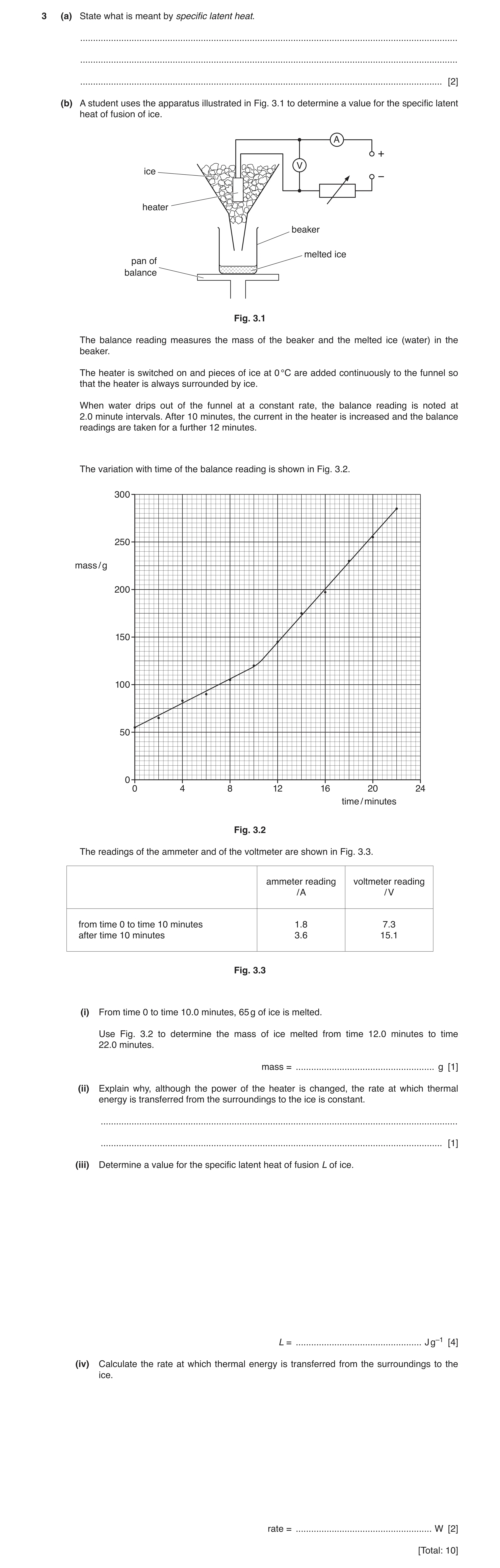
3 (a) State what is meant by specific latent heat. … … … [2] (b) A student uses the apparatus illustrated in Fig. 3.1 to determine a value for the specific latent heat of fusion of ice. A V ice heater beaker melted ice pan of balance Fig. 3.1 The balance reading measures the mass of the beaker and the melted ice (water) in the beaker. The heater is switched on and pieces of ice at 0 °C are added continuously to the funnel so that the heater is always surrounded by ice. When water drips out of the funnel at a constant rate, the balance reading is noted at 2.0 minute intervals. After 10 minutes, the current in the heater is increased and the balance readings are taken for a further 12 minutes. The variation with time of the balance reading is shown in Fig. 3.2. 300 250 mass / g 200 150 100 50 0 0 4 8 12 16 20 24 time / minutes Fig. 3.2 The readings of the ammeter and of the voltmeter are shown in Fig. 3.3. ammeter reading voltmeter reading / A / V from time 0 to time 10 minutes 1.8 7.3 after time 10 minutes 3.6 15.1 Fig. 3.3 (i) From time 0 to time 10.0 minutes, 65 g of ice is melted. Use Fig. 3.2 to determine the mass of ice melted from time 12.0 minutes to time 22.0 minutes. mass = … g [1] (ii) Explain why, although the power of the heater is changed, the rate at which thermal energy is transferred from the surroundings to the ice is constant. … … [1] (iii) Determine a value for the specific latent heat of fusion L of ice. L = … J g–1 [4] (iv) Calculate the rate at which thermal energy is transferred from the surroundings to the ice. rate = … W [2] [Total: 10]
10 marks
Mark scheme: 3(a) (thermal) energy per unit mass (to change state) B1 change of state without any change of temperature B1 3(b)(i) 140 g A1 3(b)(ii) temperature difference (between apparatus and surroundings) does not change B1 3(b)(iii) VIt = mL C1 ({15.1 × 3.6} + R) × 600 = 140 × L or ({7.3 × 1.8} + R) × 600 = 65 × L C1 41.22 × 600 = 75 × L C1 L = 330 J g–1 A1 3(b)(iv) 15.1 × 3.6 × 600 = (140 × 330) – H or 7.3 × 1.8 × 600 = (65 × 330) – H C1 H = 13 600 rate of gain = 13 600 / 600 = 23 W A1
This question in 9702/42 Oct/Nov 2019
Q8 · State what is meant by specific latent heat 9702/43 Oct/Nov 2019
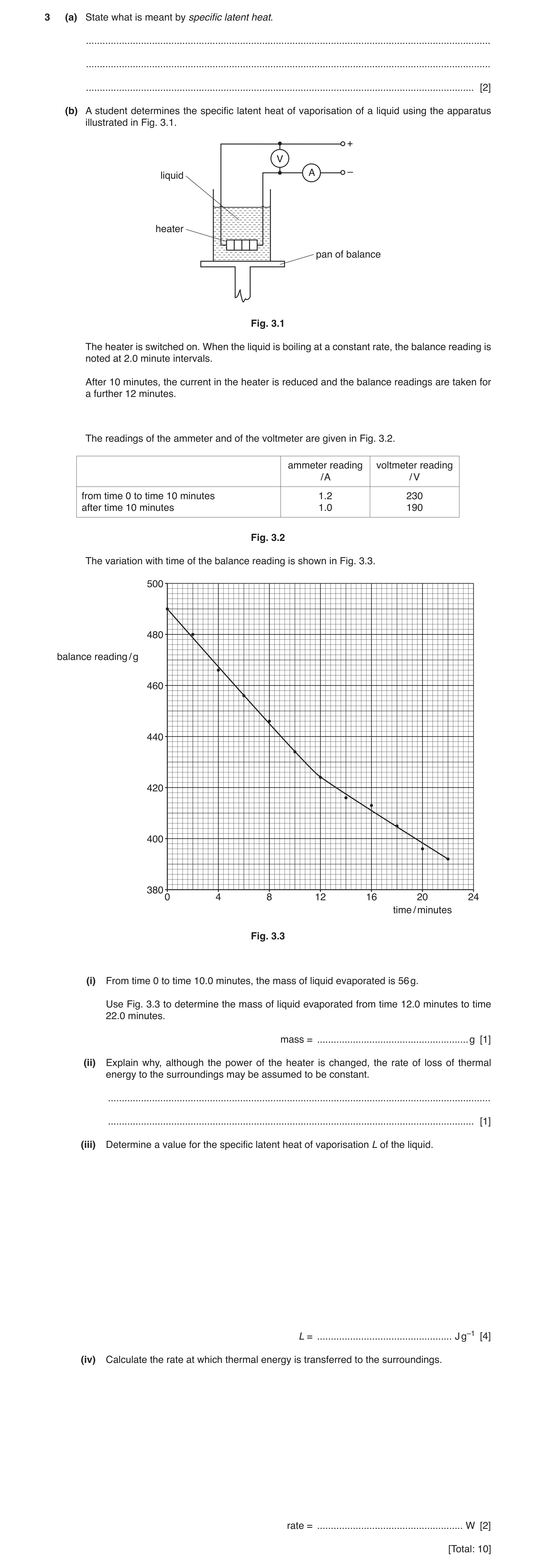
3 (a) State what is meant by specific latent heat. … … … [2] (b) A student determines the specific latent heat of vaporisation of a liquid using the apparatus illustrated in Fig. 3.1. + V liquid A – heater pan of balance Fig. 3.1 The heater is switched on. When the liquid is boiling at a constant rate, the balance reading is noted at 2.0 minute intervals. After 10 minutes, the current in the heater is reduced and the balance readings are taken for a further 12 minutes. The readings of the ammeter and of the voltmeter are given in Fig. 3.2. ammeter reading voltmeter reading / A / V from time 0 to time 10 minutes 1.2 230 after time 10 minutes 1.0 190 Fig. 3.2 The variation with time of the balance reading is shown in Fig. 3.3. 500 480 balance reading / g 460 440 420 400 380 0 4 8 12 16 20 24 time / minutes Fig. 3.3 (i) From time 0 to time 10.0 minutes, the mass of liquid evaporated is 56 g. Use Fig. 3.3 to determine the mass of liquid evaporated from time 12.0 minutes to time 22.0 minutes. mass = … g [1] (ii) Explain why, although the power of the heater is changed, the rate of loss of thermal energy to the surroundings may be assumed to be constant. … … [1] (iii) Determine a value for the specific latent heat of vaporisation L of the liquid. L = … J g–1 [4] (iv) Calculate the rate at which thermal energy is transferred to the surroundings. rate = … W [2] [Total: 10]
10 marks
Mark scheme: 3(a) (thermal) energy per (unit) mass (to change state) B1 (heat transfer during) change of state at constant temperature B1 3(b)(i) 32 g A1 3(b)(ii) temperature difference (between liquid and surroundings) does not change B1 3(b)(iii) VIt = mL C1 230 × 1.2 × 60 × 10 = (56 × L) + H or 190 × 1.0 × 60 × 10 = (32 × L) + H C1 86 × 600 = (56 – 32) × L C1 or 230 × 1.2 = (56 × L) / (60 × 10) + P or 190 × 1.0 = (32 × L) / (60 × 10) + P (C1) 276 – 190 = (24 × L) / 600 (C1) L = 2200 J g–1 A1 Question Answer Marks 3(b)(iv) 230 × 1.2 × 600 = (56 × 2150) + H or 190 × 1.0 × 600 = (32 × 2150) + H C1 H = 45 200 rate = 45 200 / 600 = 75 W A1 or 230 × 1.2 = (56 × 2150) / (60 × 10) + P or 190 × 1.0 = (32 × 2150) / (60 × 10) + P (C1) rate (= P) = 75 W (A1)
This question in 9702/43 Oct/Nov 2019
Q9 · A large container of volume 85 m3 is filled with 110 kg of an ideal gas 9702/42 Feb/March 2020
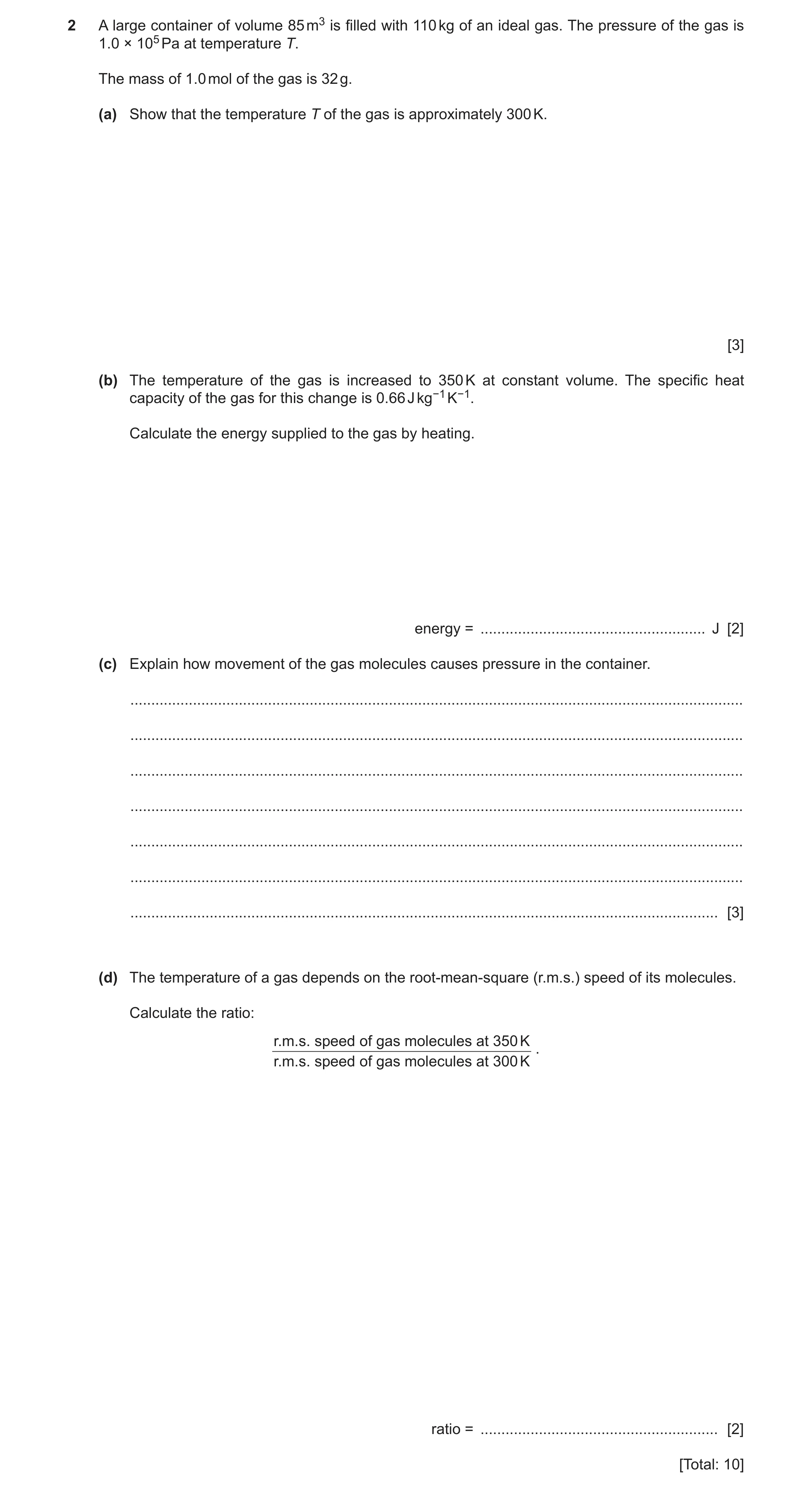
2 A large container of volume 85 m3 is filled with 110 kg of an ideal gas. The pressure of the gas is 1.0 × 10⁵ Pa at temperature T. The mass of 1.0 mol of the gas is 32 g. (a) Show that the temperature T of the gas is approximately 300 K. [3] (b) The temperature of the gas is increased to 350 K at constant volume. The specific heat capacity of the gas for this change is 0.66 J kg−1 K−1. Calculate the energy supplied to the gas by heating. energy = … J [2] (c) Explain how movement of the gas molecules causes pressure in the container. … … … … … … … [3] (d) The temperature of a gas depends on the root-mean-square (r.m.s.) speed of its molecules. Calculate the ratio: r.m.s. speed of gas molecules at 350 K . r.m.s. speed of gas molecules at 300 K ratio = … [2] [Total: 10]
10 marks
Mark scheme: 2(a) n = 110 / 0.032 or 110000 / 32 or 3440 C1 pV = nRT C1 T = (1.0 × 105 × 85) / (8.31 × (110 / 0.032)) = 300 K A1 2(b) E = mcΔθ = 110 × 0.66 × 50 C1 = 3600 J A1 2(c) Any 3 from: • molecule collides with wall • momentum of molecule changes during collision (with wall) • force on molecule so force on wall • many forces act over surface area of container exerting a pressure B3 2(d) KE ∝ T v ∝ √T C1 ratio = √(350 / 300) = 1.1 A1
This question in 9702/42 Feb/March 2020
Q10 · Using a simple kinetic model of matter, describe the structure of a solid 9702/42 Feb/March 2021
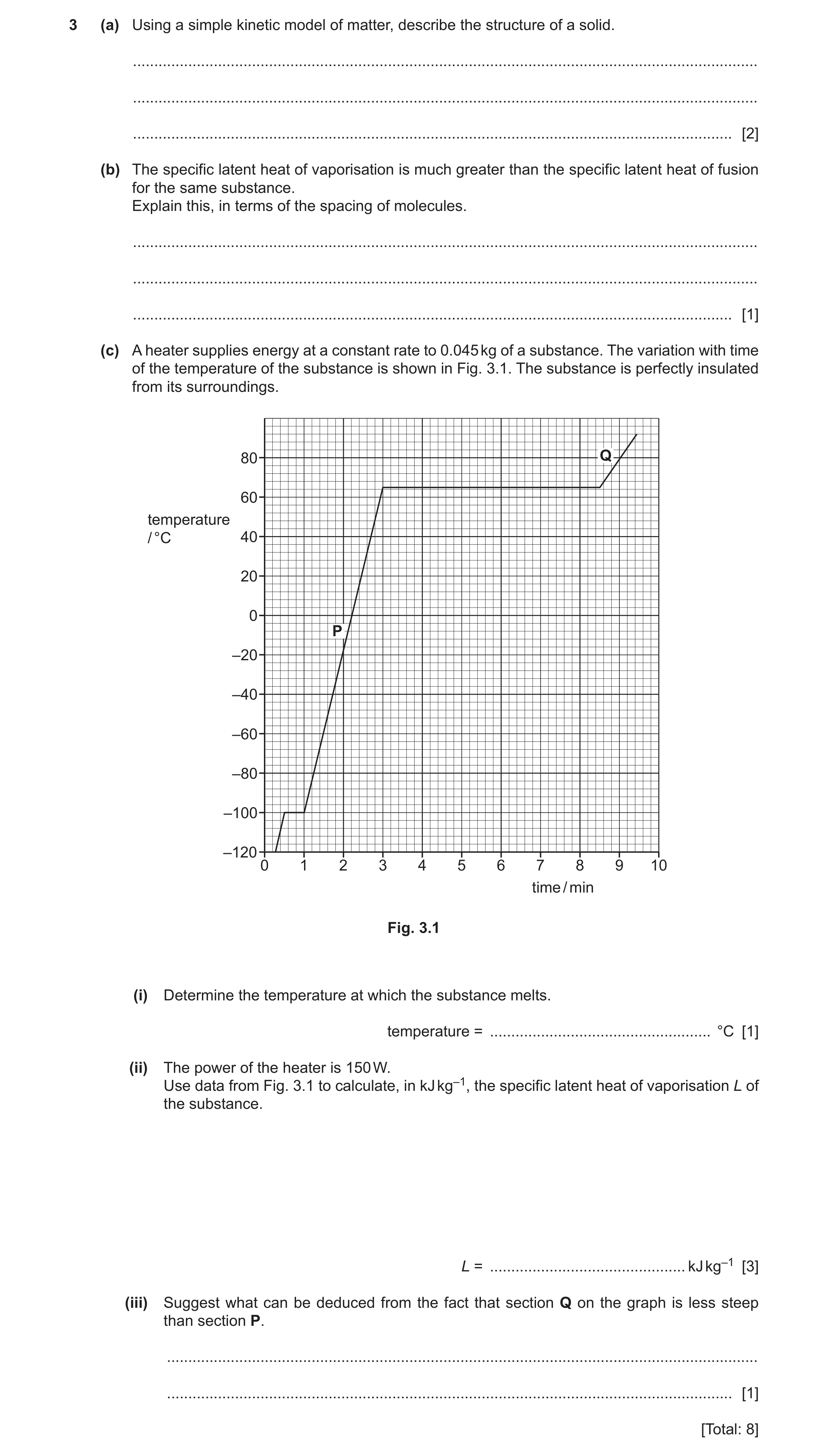
3 (a) Using a simple kinetic model of matter, describe the structure of a solid. … … … [2] (b) The specific latent heat of vaporisation is much greater than the specific latent heat of fusion for the same substance. Explain this, in terms of the spacing of molecules. … … … [1] (c) A heater supplies energy at a constant rate to 0.045 kg of a substance. The variation with time of the temperature of the substance is shown in Fig. 3.1. The substance is perfectly insulated from its surroundings. 80 Q 60 temperature / °C 40 20 0 P –20 –40 –60 –80 –100 –120 0 1 2 3 4 5 6 7 8 9 10 time / min Fig. 3.1 (i) Determine the temperature at which the substance melts. temperature = … °C [1] (ii) The power of the heater is 150 W. Use data from Fig. 3.1 to calculate, in kJ kg–1, the specific latent heat of vaporisation L of the substance. L = … kJ kg–1 [3] (iii) Suggest what can be deduced from the fact that section Q on the graph is less steep than section P. … … [1] [Total: 8]
8 marks
Mark scheme: 3(a) Any 2 from: • particles / atoms / molecules / ions (very) close together / touching • regular, repeating pattern • vibrate about a fixed point B2 3(b) (much) greater increase in spacing of molecules (for vaporisation compared with fusion) B1 3(c)(i) –100 °C B1 Question Answer Marks 3(c)(ii) time = 8.5 – 3.0 = 5.5 min C1 Pt = mL energy = power × time = 150 × 5.5 × 60 = 49 500 J E L m = 49 500 0.045 = C1 1 1100 kJ kg − = A1 3(c)(iii) gas has a higher specific heat capacity (than liquid) B1
This question in 9702/42 Feb/March 2021
Q11 · Define specific heat capacity 9702/41 Oct/Nov 2021
3 (a) Define specific heat capacity. … … … [2] (b) A sealed container of fixed volume V contains N molecules, each of mass m, of an ideal gas at pressure p. (i) State an expression, in terms of V, N, p and the Boltzmann constant k, for the thermodynamic temperature T of the gas. … [1] (ii) Show that the mean translational kinetic energy EK of a molecule of the gas is given by 3 EK = kT. 2 [2] (iii) Explain why the internal energy of the gas is equal to the total kinetic energy of the molecules. … … … [2] (c) The gas in (b) is supplied with thermal energy Q. (i) Explain, with reference to the first law of thermodynamics, why the increase in internal energy of the gas is Q. … … … [2] (ii) Use the expression in (b)(ii) and the information in (c)(i) to show that the specific heat capacity c of the gas is given by 3k c = . 2m [2] (d) The container in (b) is now replaced with one that does not have a fixed volume. Instead, the gas is able to expand, so that the pressure of the gas remains constant as thermal energy is supplied. Suggest, with a reason, how the specific heat capacity of the gas would now compare with the value in (c)(ii). … … … … [2] [Total: 13]
13 marks
Mark scheme: 3(a) (thermal) energy per unit mass (to cause temperature change) B1 (thermal) energy per unit change in temperature B1 3(b)(i) (T =) pV / Nk B1 3(b)(ii) (pV =) NkT = ⅓Nm<c2> or pV = NkT and pV = ⅓Nm<c2> M1 leading to ½m<c2> = (3/2)kT and ½m<c2> = EK A1 3(b)(iii) internal energy = ΣEK (of molecules) + ΣEP (of molecules) or no forces between molecules B1 potential energy of molecules is zero B1 3(c)(i) increase in internal energy = Q + work done B1 constant volume so no work done B1 3(c)(ii) c = Q / NmΔT C1 = [N × (3/2)kΔT] / (NmΔT) = 3k / 2m A1 3(d) (as it expands) gas does work (against the atmosphere/external pressure) B1 for same temperature rise) more (thermal) energy needed, so larger specific heat capacity B1
This question in 9702/41 Oct/Nov 2021
Q12 · Define specific heat capacity 9702/43 Oct/Nov 2021
3 (a) Define specific heat capacity. … … … [2] (b) A sealed container of fixed volume V contains N molecules, each of mass m, of an ideal gas at pressure p. (i) State an expression, in terms of V, N, p and the Boltzmann constant k, for the thermodynamic temperature T of the gas. … [1] (ii) Show that the mean translational kinetic energy EK of a molecule of the gas is given by 3 EK = kT. 2 [2] (iii) Explain why the internal energy of the gas is equal to the total kinetic energy of the molecules. … … … [2] (c) The gas in (b) is supplied with thermal energy Q. (i) Explain, with reference to the first law of thermodynamics, why the increase in internal energy of the gas is Q. … … … [2] (ii) Use the expression in (b)(ii) and the information in (c)(i) to show that the specific heat capacity c of the gas is given by 3k c = . 2m [2] (d) The container in (b) is now replaced with one that does not have a fixed volume. Instead, the gas is able to expand, so that the pressure of the gas remains constant as thermal energy is supplied. Suggest, with a reason, how the specific heat capacity of the gas would now compare with the value in (c)(ii). … … … … [2] [Total: 13]
13 marks
Mark scheme: 3(a) (thermal) energy per unit mass (to cause temperature change) B1 (thermal) energy per unit change in temperature B1 3(b)(i) (T =) pV / Nk B1 3(b)(ii) (pV =) NkT = ⅓Nm<c2> or pV = NkT and pV = ⅓Nm<c2> M1 leading to ½m<c2> = (3/2)kT and ½m<c2> = EK A1 3(b)(iii) internal energy = ΣEK (of molecules) + ΣEP (of molecules) or no forces between molecules B1 potential energy of molecules is zero B1 3(c)(i) increase in internal energy = Q + work done B1 constant volume so no work done B1 3(c)(ii) c = Q / NmΔT C1 = [N × (3/2)kΔT] / (NmΔT) = 3k / 2m A1 3(d) (as it expands) gas does work (against the atmosphere/external pressure) B1 for same temperature rise) more (thermal) energy needed, so larger specific heat capacity B1
This question in 9702/43 Oct/Nov 2021
Q13 · Define specific latent heat of vaporisation 9702/42 May/June 2022
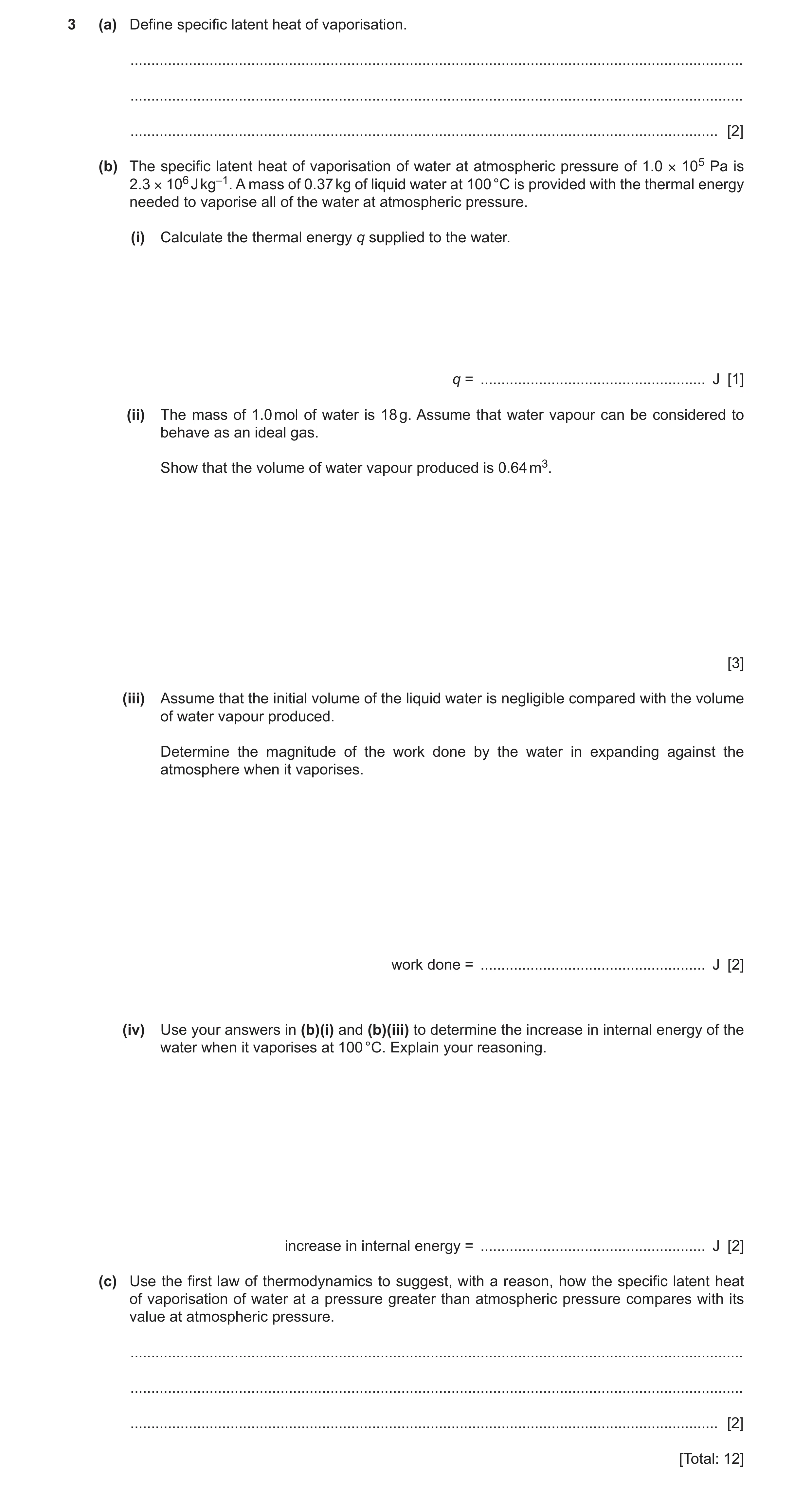
3 (a) Define specific latent heat of vaporisation. … … … [2] (b) The specific latent heat of vaporisation of water at atmospheric pressure of 1.0 × 10⁵ Pa is 2.3 × 10⁶ J kg–1. A mass of 0.37 kg of liquid water at 100 °C is provided with the thermal energy needed to vaporise all of the water at atmospheric pressure. (i) Calculate the thermal energy q supplied to the water. q = … J [1] (ii) The mass of 1.0 mol of water is 18 g. Assume that water vapour can be considered to behave as an ideal gas. Show that the volume of water vapour produced is 0.64 m3. [3] (iii) Assume that the initial volume of the liquid water is negligible compared with the volume of water vapour produced. Determine the magnitude of the work done by the water in expanding against the atmosphere when it vaporises. work done = … J [2] (iv) Use your answers in (b)(i) and (b)(iii) to determine the increase in internal energy of the water when it vaporises at 100 °C. Explain your reasoning. increase in internal energy = … J [2] (c) Use the first law of thermodynamics to suggest, with a reason, how the specific latent heat of vaporisation of water at a pressure greater than atmospheric pressure compares with its value at atmospheric pressure. … … … [2] [Total: 12]
12 marks
Mark scheme: 3(a) (thermal) energy per unit mass B1 energy to change state between liquid and gas at constant temperature B1 3(b)(i) q = mL = 0.37 2.3 106 = 8.5 105 J A1 3(b)(ii) pV = nRT and T = 373 K C1 n = 370 / 18 C1 V = [(370 / 18) 8.31 373] / (1.0 105) = 0.64 m3 A1 3(b)(iii) w = pV C1 = 1.0 105 0.64 = 6.4 104 J A1 3(b)(iv) (water does work against atmosphere so) work done on water is negative B1 increase in internal energy = (8.5 – 0.64) 105 = 7.9 105 J A1 3(c) valid reasoning of how work done by water is affected M1 correct use of first law to draw conclusion about effect on specific latent heat that is consistent with work done A1
This question in 9702/42 May/June 2022
Q14 · A laboratory thermometer that is calibrated to measure temperature in degrees Celsius 9702/41 Oct/Nov 2022
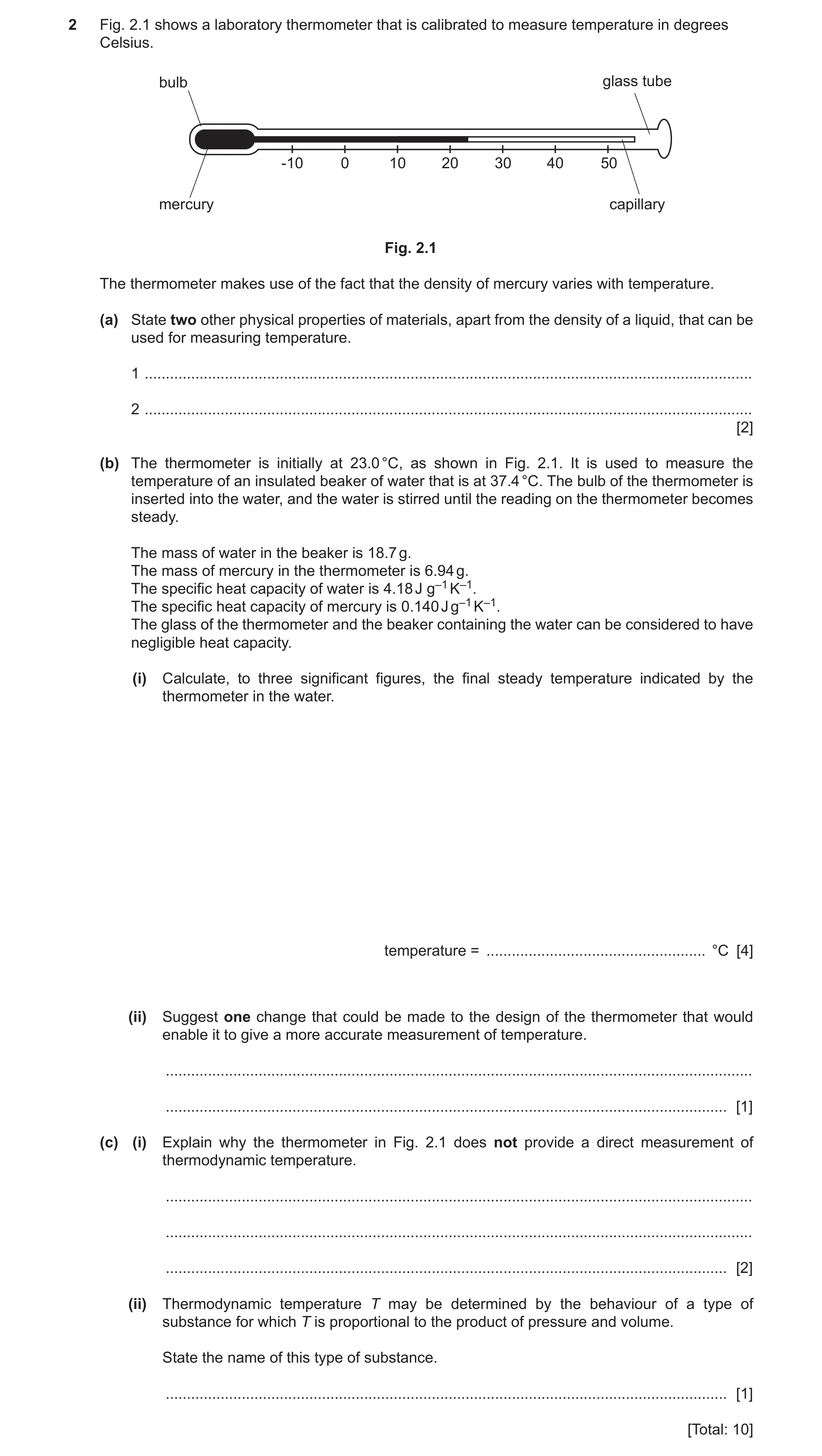
2 Fig. 2.1 shows a laboratory thermometer that is calibrated to measure temperature in degrees Celsius. bulb glass tube -10 0 10 20 30 40 50 mercury capillary Fig. 2.1 The thermometer makes use of the fact that the density of mercury varies with temperature. (a) State two other physical properties of materials, apart from the density of a liquid, that can be used for measuring temperature. 1 … 2 … [2] (b) The thermometer is initially at 23.0 °C, as shown in Fig. 2.1. It is used to measure the temperature of an insulated beaker of water that is at 37.4 °C. The bulb of the thermometer is inserted into the water, and the water is stirred until the reading on the thermometer becomes steady. The mass of water in the beaker is 18.7 g. The mass of mercury in the thermometer is 6.94 g. The specific heat capacity of water is 4.18 J g–1 K–1. The specific heat capacity of mercury is 0.140 J g–1 K–1. The glass of the thermometer and the beaker containing the water can be considered to have negligible heat capacity. (i) Calculate, to three significant figures, the final steady temperature indicated by the thermometer in the water. temperature = … °C [4] (ii) Suggest one change that could be made to the design of the thermometer that would enable it to give a more accurate measurement of temperature. … … [1] (c) (i) Explain why the thermometer in Fig. 2.1 does not provide a direct measurement of thermodynamic temperature. … … … [2] (ii) Thermodynamic temperature T may be determined by the behaviour of a type of substance for which T is proportional to the product of pressure and volume. State the name of this type of substance. … [1] [Total: 10]
10 marks
Mark scheme: 2(a) • resistance of a metal B2 • volume of a gas at constant pressure • e.m.f. of a thermocouple Any two points, 1 mark each 2(b)(i) Q = mcT C1 evidence of realisation that Q lost by water = Q gained by mercury C1 18.7 4.18 (37.4 – T) = 6.94 0.140 (T – 23.0) C1 T = 37.2 °C A1 2(b)(ii) use a liquid with a lower (specific) heat capacity (than mercury) B1 or use a smaller mass of mercury 2(c)(i) depends on properties of a real substance B1 0 °C is not absolute zero B1 2(c)(ii) ideal gas B1
This question in 9702/41 Oct/Nov 2022
Q15 · Define specific heat capacity 9702/42 Oct/Nov 2022
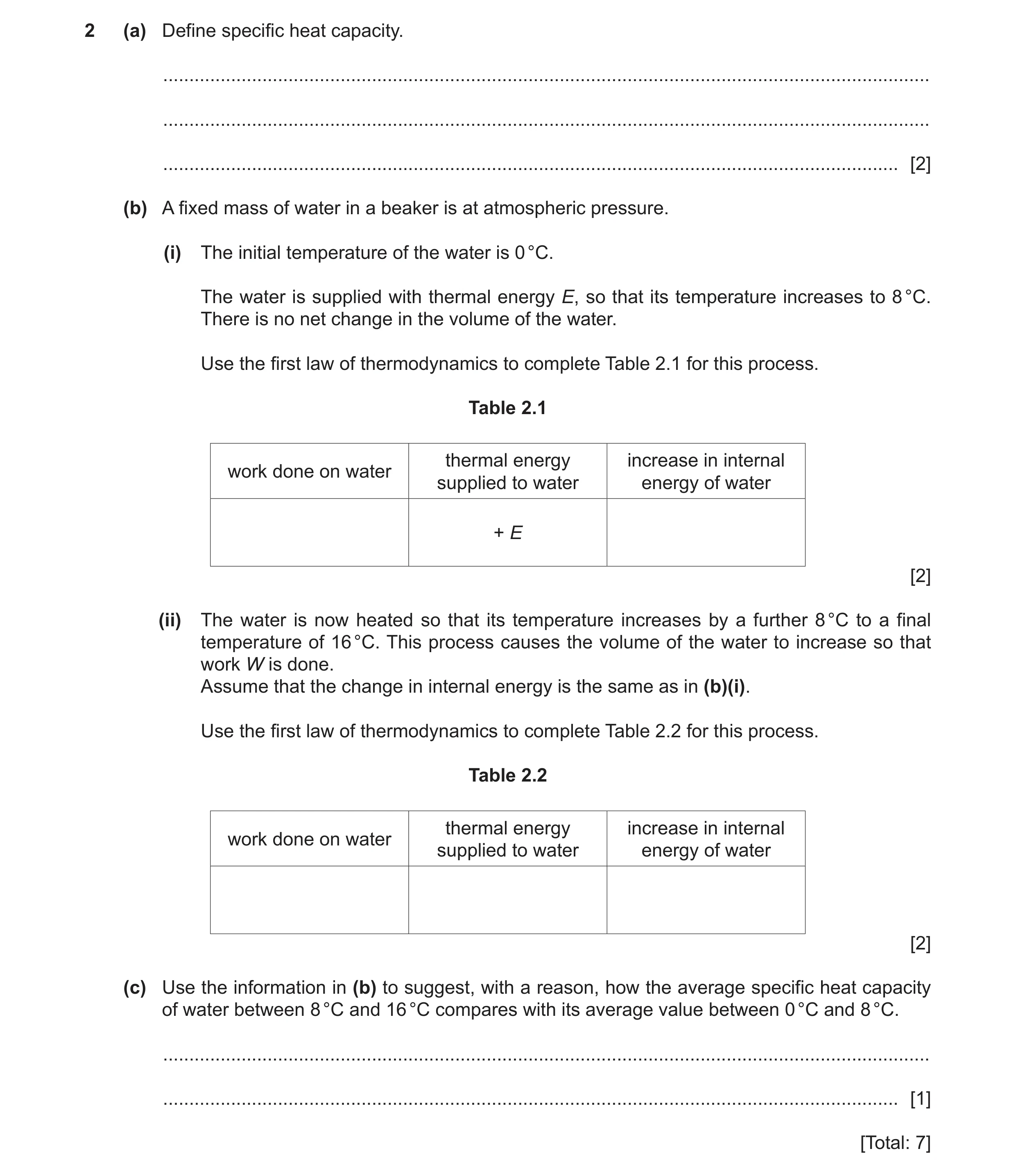
2 (a) Define specific heat capacity. … … … [2] (b) A fixed mass of water in a beaker is at atmospheric pressure. (i) The initial temperature of the water is 0 °C. The water is supplied with thermal energy E, so that its temperature increases to 8 °C. There is no net change in the volume of the water. Use the first law of thermodynamics to complete Table 2.1 for this process. Table 2.1 thermal energy increase in internal work done on water supplied to water energy of water + E [2] (ii) The water is now heated so that its temperature increases by a further 8 °C to a final temperature of 16 °C. This process causes the volume of the water to increase so that work W is done. Assume that the change in internal energy is the same as in (b)(i). Use the first law of thermodynamics to complete Table 2.2 for this process. Table 2.2 thermal energy increase in internal work done on water supplied to water energy of water [2] (c) Use the information in (b) to suggest, with a reason, how the average specific heat capacity of water between 8 °C and 16 °C compares with its average value between 0 °C and 8 °C. … … [1] [Total: 7]
7 marks
Mark scheme: 2(a) (thermal) energy per unit mass (to cause temperature change) B1 (thermal) energy per unit change in temperature B1 2(b)(i) work done correct (0) B1 increase in internal energy correct (+E) B1 2(b)(ii) work done correct (–W) and increase in internal energy same as (b)(i) B1 thermal energy correct so that it adds to work done to give increase in internal energy B1 2(c) more thermal energy needed so specific heat capacity is greater B1
This question in 9702/42 Oct/Nov 2022
Q16 · A laboratory thermometer that is calibrated to measure temperature in degrees Celsius 9702/43 Oct/Nov 2022
2 Fig. 2.1 shows a laboratory thermometer that is calibrated to measure temperature in degrees Celsius. bulb glass tube -10 0 10 20 30 40 50 mercury capillary Fig. 2.1 The thermometer makes use of the fact that the density of mercury varies with temperature. (a) State two other physical properties of materials, apart from the density of a liquid, that can be used for measuring temperature. 1 … 2 … [2] (b) The thermometer is initially at 23.0 °C, as shown in Fig. 2.1. It is used to measure the temperature of an insulated beaker of water that is at 37.4 °C. The bulb of the thermometer is inserted into the water, and the water is stirred until the reading on the thermometer becomes steady. The mass of water in the beaker is 18.7 g. The mass of mercury in the thermometer is 6.94 g. The specific heat capacity of water is 4.18 J g–1 K–1. The specific heat capacity of mercury is 0.140 J g–1 K–1. The glass of the thermometer and the beaker containing the water can be considered to have negligible heat capacity. (i) Calculate, to three significant figures, the final steady temperature indicated by the thermometer in the water. temperature = … °C [4] (ii) Suggest one change that could be made to the design of the thermometer that would enable it to give a more accurate measurement of temperature. … … [1] (c) (i) Explain why the thermometer in Fig. 2.1 does not provide a direct measurement of thermodynamic temperature. … … … [2] (ii) Thermodynamic temperature T may be determined by the behaviour of a type of substance for which T is proportional to the product of pressure and volume. State the name of this type of substance. … [1] [Total: 10]
10 marks
Mark scheme: 2(a) • resistance of a metal B2 • volume of a gas at constant pressure • e.m.f. of a thermocouple Any two points, 1 mark each 2(b)(i) Q = mcT C1 evidence of realisation that Q lost by water = Q gained by mercury C1 18.7 4.18 (37.4 – T) = 6.94 0.140 (T – 23.0) C1 T = 37.2 °C A1 2(b)(ii) use a liquid with a lower (specific) heat capacity (than mercury) B1 or use a smaller mass of mercury 2(c)(i) depends on properties of a real substance B1 0 °C is not absolute zero B1 2(c)(ii) ideal gas B1
This question in 9702/43 Oct/Nov 2022
Q17 · State what is meant by an ideal gas 9702/42 Feb/March 2023
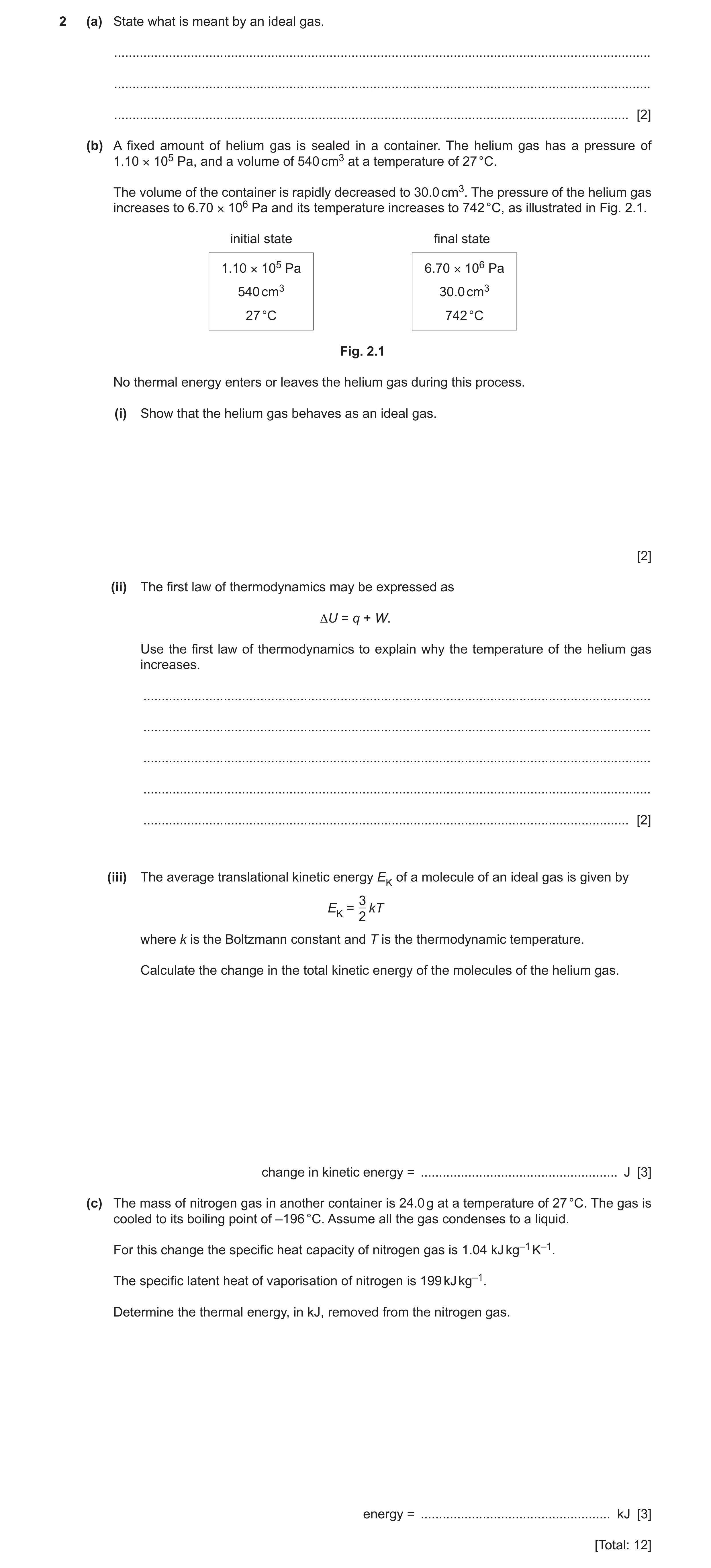
2 (a) State what is meant by an ideal gas. … … … [2] (b) A fixed amount of helium gas is sealed in a container. The helium gas has a pressure of 1.10 × 10⁵ Pa, and a volume of 540 cm3 at a temperature of 27 °C. The volume of the container is rapidly decreased to 30.0 cm3. The pressure of the helium gas increases to 6.70 × 10⁶ Pa and its temperature increases to 742 °C, as illustrated in Fig. 2.1. initial state final state 1.10 × 10⁵ Pa 6.70 × 10⁶ Pa 540 cm3 30.0 cm3 27 °C 742 °C Fig. 2.1 No thermal energy enters or leaves the helium gas during this process. (i) Show that the helium gas behaves as an ideal gas. [2] (ii) The first law of thermodynamics may be expressed as ΔU = q + W. Use the first law of thermodynamics to explain why the temperature of the helium gas increases. … … … … … [2] (iii) The average translational kinetic energy EK of a molecule of an ideal gas is given by 3 EK = kT 2 where k is the Boltzmann constant and T is the thermodynamic temperature. Calculate the change in the total kinetic energy of the molecules of the helium gas. change in kinetic energy = … J [3] (c) The mass of nitrogen gas in another container is 24.0 g at a temperature of 27 °C. The gas is cooled to its boiling point of –196 °C. Assume all the gas condenses to a liquid. For this change the specific heat capacity of nitrogen gas is 1.04 kJ kg–1 K–1. The specific latent heat of vaporisation of nitrogen is 199 kJ kg–1. Determine the thermal energy, in kJ, removed from the nitrogen gas. energy = … kJ [3] [Total: 12]
12 marks
Mark scheme: 2(a) gas for which pV T M1 where T is thermodynamic temperature A1 2(b)(i) evidence of two temperature conversions between C and K B1 two calculations shown, one for each state e.g. A1 1.10 105 540 10 −6 6.70 10 6 30 10 −6 = 0.198 and = 0.198 ( 273 + 27 ) ( 273 + 742 ) 2(b)(ii) work is done on the gas M1 internal energy increases (so temperature increases) A1 2(b)(iii) pV = NkT e.g. C1 1.10 10 5 540 10 −6 N = 1.38 10 −23 300 = 1.435 1022 Ek = (3 / 2) kTN 1.10 10 5 540 10 −6 C1 = (3 / 2) 1.38 1023 (742 – 27) 1.38 10 −23 300 = 212 J A1 2(c) E = mc and E = mL C1 = (27 + 196) or 223 C1 E = 0.0240 1.04 (27 + 196) + 0.0240 199 A1 = 10.3 kJ
This question in 9702/42 Feb/March 2023
Q18 · State the reason why two objects that are at the same temperature are described as being… 9702/41 May/June 2023
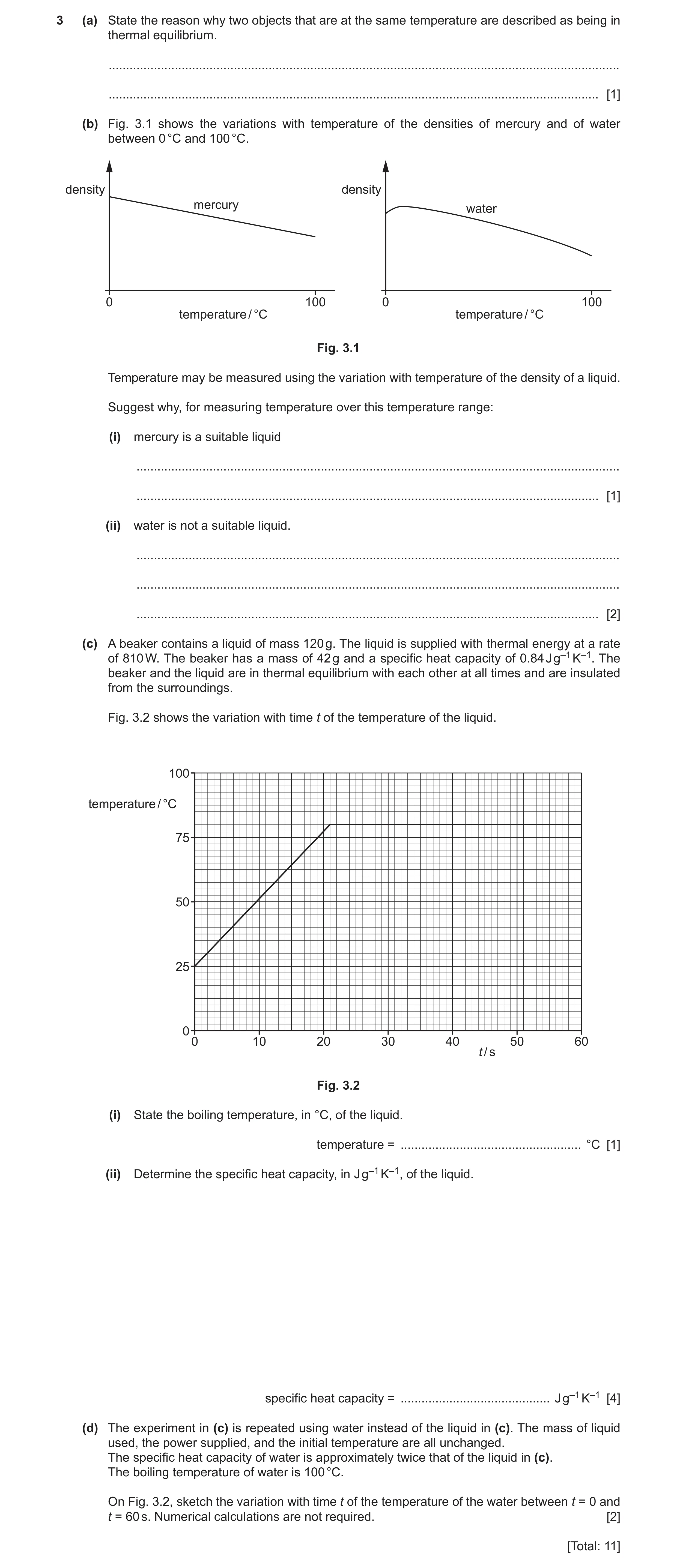
3 (a) State the reason why two objects that are at the same temperature are described as being in thermal equilibrium. … … [1] (b) Fig. 3.1 shows the variations with temperature of the densities of mercury and of water between 0 °C and 100 °C. density density mercury water 0 100 0 100 temperature / °C temperature / °C Fig. 3.1 Temperature may be measured using the variation with temperature of the density of a liquid. Suggest why, for measuring temperature over this temperature range: (i) mercury is a suitable liquid … … [1] (ii) water is not a suitable liquid. … … … [2] (c) A beaker contains a liquid of mass 120 g. The liquid is supplied with thermal energy at a rate of 810 W. The beaker has a mass of 42 g and a specific heat capacity of 0.84 J g–1 K–1. The beaker and the liquid are in thermal equilibrium with each other at all times and are insulated from the surroundings. Fig. 3.2 shows the variation with time t of the temperature of the liquid. 100 temperature / °C 75 50 25 0 0 10 20 30 40 50 60 t / s Fig. 3.2 (i) State the boiling temperature, in °C, of the liquid. temperature = … °C [1] (ii) Determine the specific heat capacity, in J g–1 K–1, of the liquid. specific heat capacity = … J g–1 K–1 [4] (d) The experiment in (c) is repeated using water instead of the liquid in (c). The mass of liquid used, the power supplied, and the initial temperature are all unchanged. The specific heat capacity of water is approximately twice that of the liquid in (c). The boiling temperature of water is 100 °C. On Fig. 3.2, sketch the variation with time t of the temperature of the water between t = 0 and t = 60 s. Numerical calculations are not required. [2] [Total: 11]
11 marks
Mark scheme: 3(a) no net thermal energy is transferred (between them) B1 3(b)(i) variation (of density with temperature) is linear or each temperature has a unique value of density B1 3(b)(ii) variation (of density with temperature) is not linear region where the density does not vary with temperature different temperatures have the same density Any two points, 1 mark each B2 3(c)(i) boiling point = 80 °C A1 3(c)(ii) Q = Pt and t = 21 s (thermal energy supplied = 810 21 = 17000 J) C1 c = Q / m C1 thermal energy absorbed by beaker = 42 0.84 (80 – 25) ( = 1940 J) C1 s.h.c. of liquid = [(810 21) – (42 0.84 (80 – 25))] / [120 (80 – 25)] = 2.3 J g–1 K–1 A1 3(d) sketch: straight diagonal line from 25 °C to 100 °C and then horizontal at 100 °C B1 straight diagonal line starting at 25 °C with gradient approximately half that of the original line B1
This question in 9702/41 May/June 2023
Q19 · State the reason why two objects that are at the same temperature are described as being… 9702/43 May/June 2023
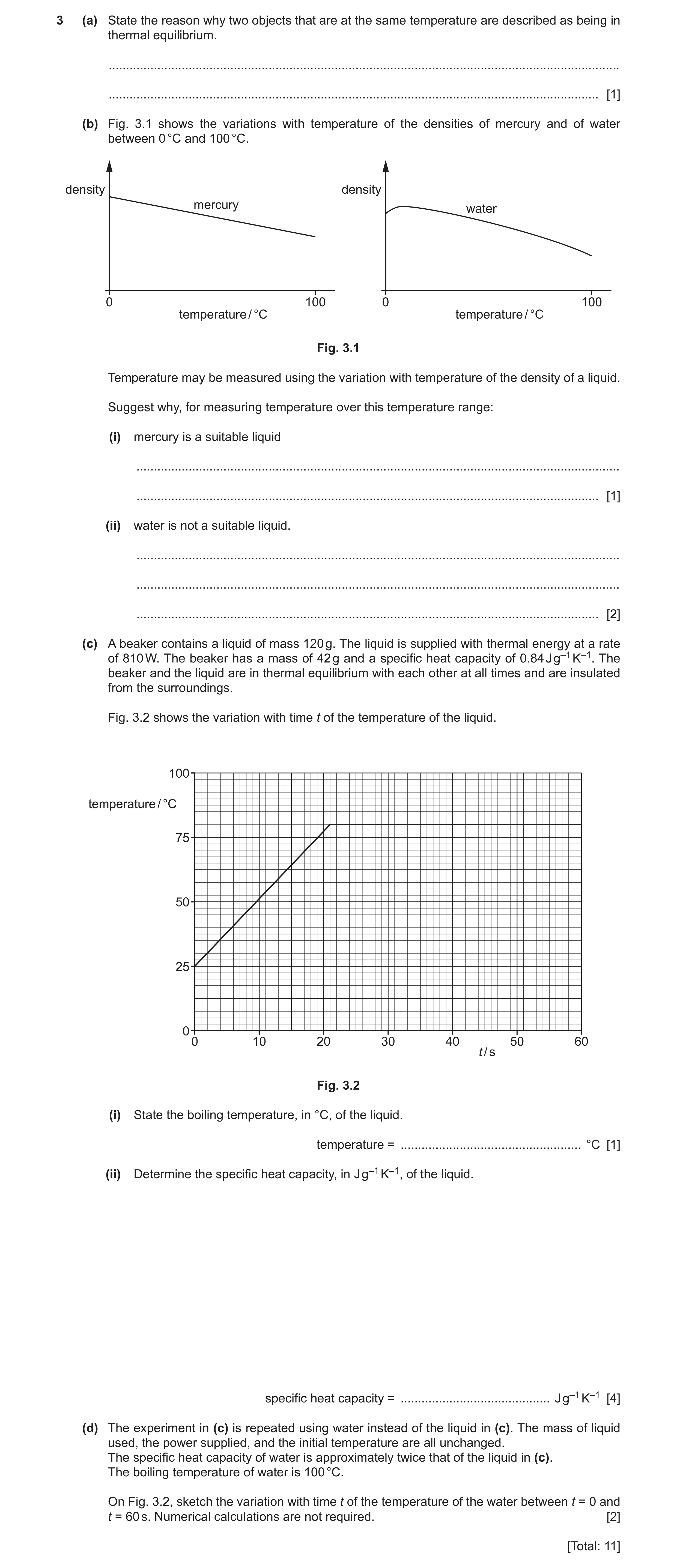
3 (a) State the reason why two objects that are at the same temperature are described as being in thermal equilibrium. … … [1] (b) Fig. 3.1 shows the variations with temperature of the densities of mercury and of water between 0 °C and 100 °C. density density mercury water 0 100 0 100 temperature / °C temperature / °C Fig. 3.1 Temperature may be measured using the variation with temperature of the density of a liquid. Suggest why, for measuring temperature over this temperature range: (i) mercury is a suitable liquid … … [1] (ii) water is not a suitable liquid. … … … [2] (c) A beaker contains a liquid of mass 120 g. The liquid is supplied with thermal energy at a rate of 810 W. The beaker has a mass of 42 g and a specific heat capacity of 0.84 J g–1 K–1. The beaker and the liquid are in thermal equilibrium with each other at all times and are insulated from the surroundings. Fig. 3.2 shows the variation with time t of the temperature of the liquid. 100 temperature / °C 75 50 25 0 0 10 20 30 40 50 60 t / s Fig. 3.2 (i) State the boiling temperature, in °C, of the liquid. temperature = … °C [1] (ii) Determine the specific heat capacity, in J g–1 K–1, of the liquid. specific heat capacity = … J g–1 K–1 [4] (d) The experiment in (c) is repeated using water instead of the liquid in (c). The mass of liquid used, the power supplied, and the initial temperature are all unchanged. The specific heat capacity of water is approximately twice that of the liquid in (c). The boiling temperature of water is 100 °C. On Fig. 3.2, sketch the variation with time t of the temperature of the water between t = 0 and t = 60 s. Numerical calculations are not required. [2] [Total: 11]
11 marks
Mark scheme: 3(a) no net thermal energy is transferred (between them) B1 3(b)(i) variation (of density with temperature) is linear or each temperature has a unique value of density B1 3(b)(ii) variation (of density with temperature) is not linear region where the density does not vary with temperature different temperatures have the same density Any two points, 1 mark each B2 3(c)(i) boiling point = 80 °C A1 3(c)(ii) Q = Pt and t = 21 s (thermal energy supplied = 810 21 = 17000 J) C1 c = Q / m C1 thermal energy absorbed by beaker = 42 0.84 (80 – 25) ( = 1940 J) C1 s.h.c. of liquid = [(810 21) – (42 0.84 (80 – 25))] / [120 (80 – 25)] = 2.3 J g–1 K–1 A1 3(d) sketch: straight diagonal line from 25 °C to 100 °C and then horizontal at 100 °C B1 straight diagonal line starting at 25 °C with gradient approximately half that of the original line B1
This question in 9702/43 May/June 2023
Q20 · Define specific heat capacity 9702/41 Oct/Nov 2023
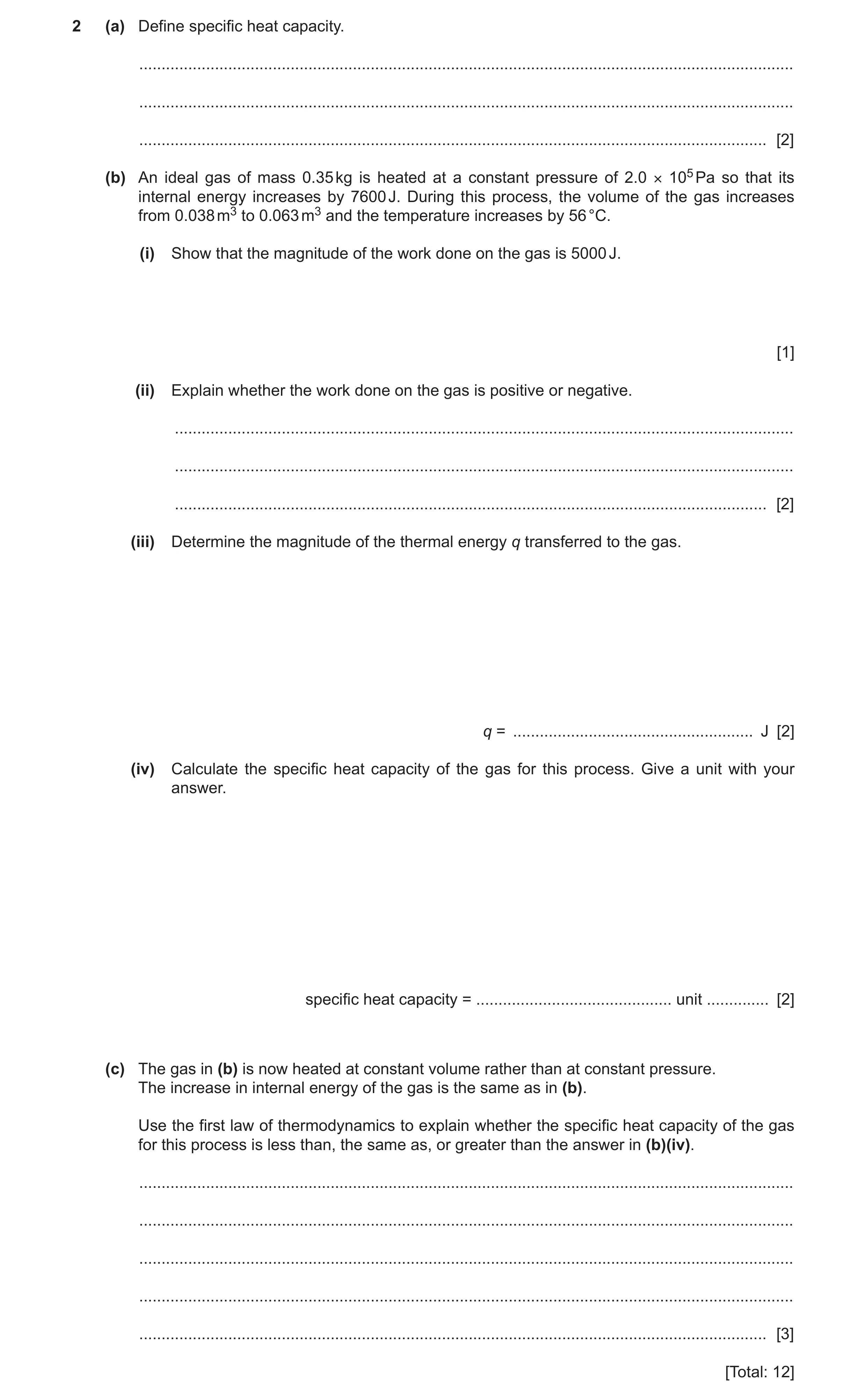
2 (a) Define specific heat capacity. … … … [2] (b) An ideal gas of mass 0.35 kg is heated at a constant pressure of 2.0 × 10⁵ Pa so that its internal energy increases by 7600 J. During this process, the volume of the gas increases from 0.038 m3 to 0.063 m3 and the temperature increases by 56 °C. (i) Show that the magnitude of the work done on the gas is 5000 J. [1] (ii) Explain whether the work done on the gas is positive or negative. … … … [2] (iii) Determine the magnitude of the thermal energy q transferred to the gas. q = … J [2] (iv) Calculate the specific heat capacity of the gas for this process. Give a unit with your answer. specific heat capacity = … unit … [2] (c) The gas in (b) is now heated at constant volume rather than at constant pressure. The increase in internal energy of the gas is the same as in (b). Use the first law of thermodynamics to explain whether the specific heat capacity of the gas for this process is less than, the same as, or greater than the answer in (b)(iv). … … … … … [3] [Total: 12]
12 marks
Mark scheme: 2(a) (thermal) energy per unit mass (to change temperature) B1 (thermal) energy per unit change in temperature B1 2(b)(i) work done = pV A1 = (2.0 105) (0.063 – 0.038) = 5000 J 2(b)(ii) gas is expanding (against external pressure) B1 gas does work / work is done by gas, so (work done on gas is) negative B1 2(b)(iii) U = q + W C1 7600 = q + (–5000) A1 q = 12 600 J 2(b)(iv) specific heat capacity = q / mT C1 = 12600 / (0.35 56) = 640 J kg–1 K–1 A1 2(c) same gain in internal energy so same temperature rise B1 no change in volume so no work done B1 or no work done so less thermal energy needed (for same change in internal energy) less thermal energy needed (for same temperature change) so lower specific heat capacity B1
This question in 9702/41 Oct/Nov 2023
Q21 · Define specific heat capacity 9702/43 Oct/Nov 2023
2 (a) Define specific heat capacity. … … … [2] (b) An ideal gas of mass 0.35 kg is heated at a constant pressure of 2.0 × 10⁵ Pa so that its internal energy increases by 7600 J. During this process, the volume of the gas increases from 0.038 m3 to 0.063 m3 and the temperature increases by 56 °C. (i) Show that the magnitude of the work done on the gas is 5000 J. [1] (ii) Explain whether the work done on the gas is positive or negative. … … … [2] (iii) Determine the magnitude of the thermal energy q transferred to the gas. q = … J [2] (iv) Calculate the specific heat capacity of the gas for this process. Give a unit with your answer. specific heat capacity = … unit … [2] (c) The gas in (b) is now heated at constant volume rather than at constant pressure. The increase in internal energy of the gas is the same as in (b). Use the first law of thermodynamics to explain whether the specific heat capacity of the gas for this process is less than, the same as, or greater than the answer in (b)(iv). … … … … … [3] [Total: 12]
12 marks
Mark scheme: 2(a) (thermal) energy per unit mass (to change temperature) B1 (thermal) energy per unit change in temperature B1 2(b)(i) work done = pV A1 = (2.0 105) (0.063 – 0.038) = 5000 J 2(b)(ii) gas is expanding (against external pressure) B1 gas does work / work is done by gas, so (work done on gas is) negative B1 2(b)(iii) U = q + W C1 7600 = q + (–5000) A1 q = 12 600 J 2(b)(iv) specific heat capacity = q / mT C1 = 12600 / (0.35 56) = 640 J kg–1 K–1 A1 2(c) same gain in internal energy so same temperature rise B1 no change in volume so no work done B1 or no work done so less thermal energy needed (for same change in internal energy) less thermal energy needed (for same temperature change) so lower specific heat capacity B1
This question in 9702/43 Oct/Nov 2023
Q22 · Define specific heat capacity 9702/41 Oct/Nov 2024
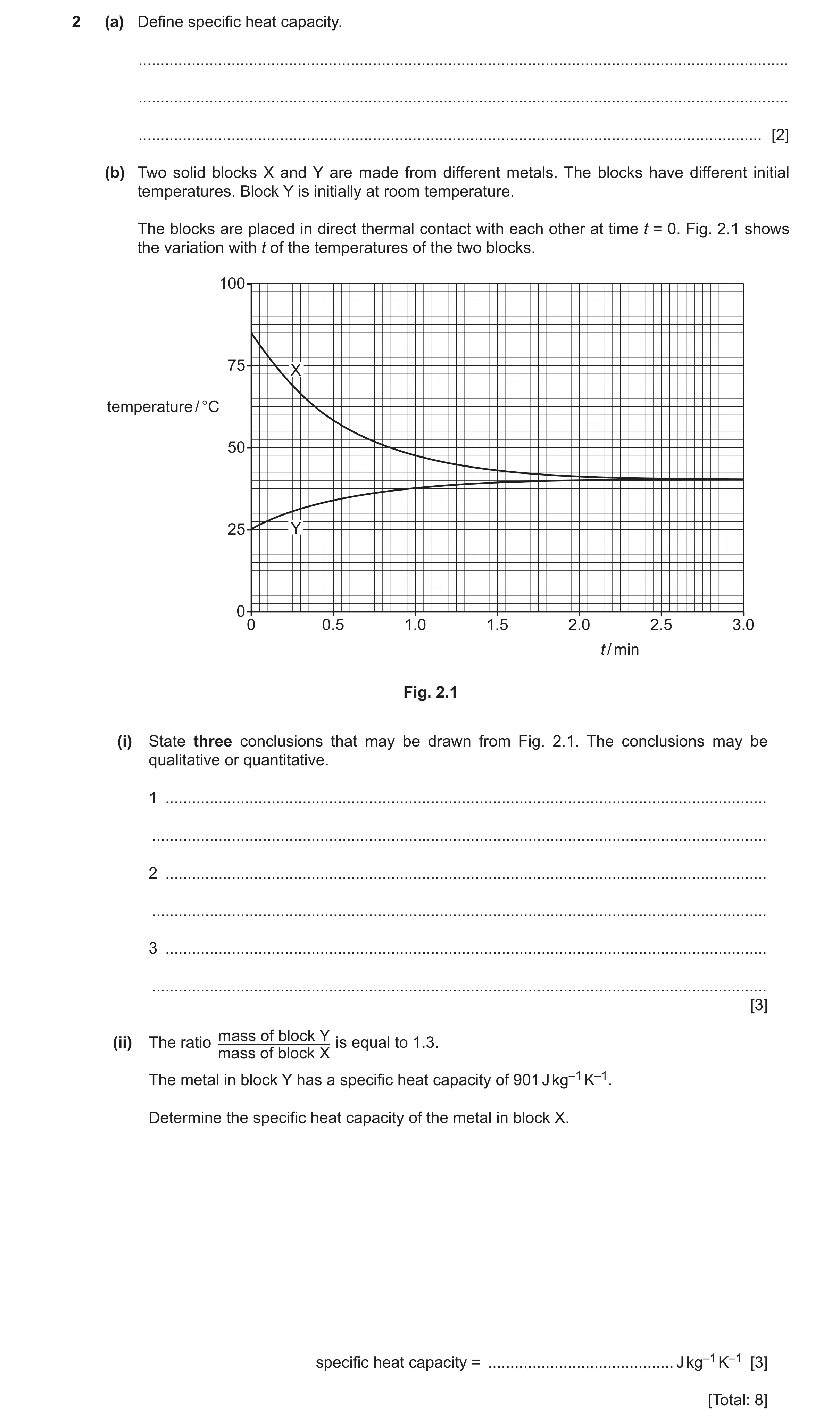
2 (a) Define specific heat capacity. … … … [2] (b) Two solid blocks X and Y are made from different metals. The blocks have different initial temperatures. Block Y is initially at room temperature. The blocks are placed in direct thermal contact with each other at time t = 0. Fig. 2.1 shows the variation with t of the temperatures of the two blocks. 100 75 X temperature / °C 50 25 Y 0 0 0.5 1.0 1.5 2.0 2.5 3.0 t / min Fig. 2.1 (i) State three conclusions that may be drawn from Fig. 2.1. The conclusions may be qualitative or quantitative. 1 … … 2 … … 3 … … [3] mass of block Y(ii) The ratio is equal to 1.3. mass of block X The metal in block Y has a specific heat capacity of 901 J kg–1 K–1. Determine the specific heat capacity of the metal in block X. specific heat capacity = … J kg–1 K–1 [3] [Total: 8]
8 marks
Mark scheme: 2(a) (thermal) energy per unit mass (to change temperature) B1 (thermal) energy per unit change in temperature B1 2(b)(i) Any three bulleted points from: B3 • the blocks end up in thermal equilibrium • heat capacity of Y is larger than heat capacity of X • no heat loss to the surroundings Up to 2 points from these six: • initial temperature of X = 85 °C • initial temperature of Y = 25 °C • the temperature change of X = 45 °C • the temperature change of Y = 15 °C • the temperature change in X is three times that in Y • final temperature of both = 40 °C 2(b)(ii) = 45 °C for X and 15 °C for Y C1 mc 45 = 1.3 m 901 15 C1 c = 390 J kg K–1 A1
This question in 9702/41 Oct/Nov 2024
Q23 · Define specific latent heat 9702/42 Oct/Nov 2024
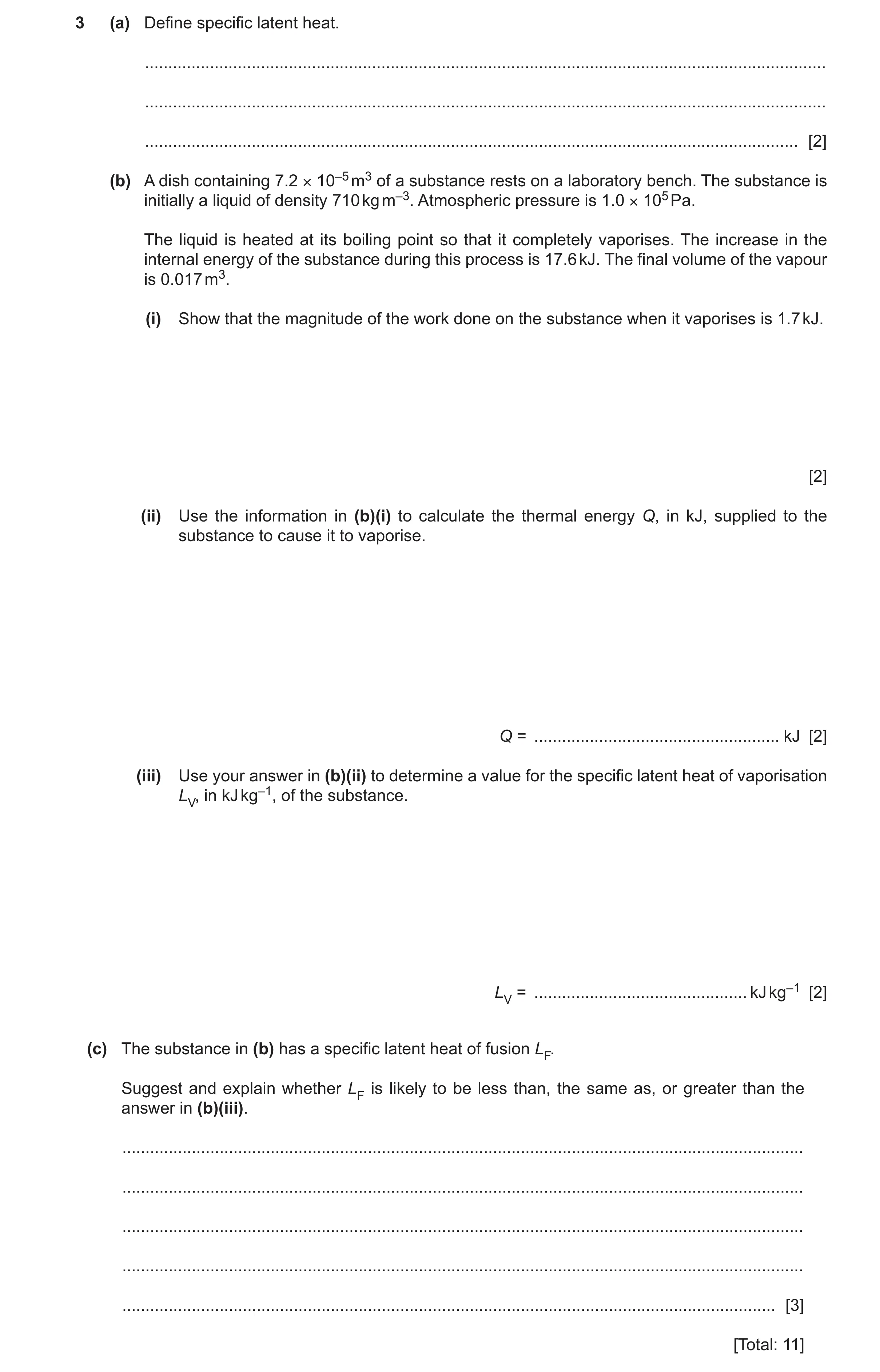
3 (a) Define specific latent heat. … … … [2] (b) A dish containing 7.2 × 10⁻⁵ m3 of a substance rests on a laboratory bench. The substance is initially a liquid of density 710 kg m–3. Atmospheric pressure is 1.0 × 10⁵ Pa. The liquid is heated at its boiling point so that it completely vaporises. The increase in the internal energy of the substance during this process is 17.6 kJ. The final volume of the vapour is 0.017 m3. (i) Show that the magnitude of the work done on the substance when it vaporises is 1.7 kJ. [2] (ii) Use the information in (b)(i) to calculate the thermal energy Q, in kJ, supplied to the substance to cause it to vaporise. Q = … kJ [2] (iii) Use your answer in (b)(ii) to determine a value for the specific latent heat of vaporisation LV, in kJ kg–1, of the substance. LV = … kJ kg–1 [2] (c) The substance in (b) has a specific latent heat of fusion LF. Suggest and explain whether LF is likely to be less than, the same as, or greater than the answer in (b)(iii). … … … … … [3] [Total: 11]
11 marks
Mark scheme: 3(a) (thermal) energy per unit mass (to cause change of state) B1 (thermal) energy to change state at constant temperature B1 3(b)(i) W = pV C1 = 1.0 105 0.017 = 1700 J = 1.7 kJ A1 3(b)(ii) U = Q + W C1 Q = 17.6 + 1.7 A1 = 19.3 kJ 3(b)(iii) mass = 710 7.2 10–5 C1 ( = 0.051 kg) L = 19.3 / 0.051 A1 = 380 kJ kg–1 3(c) fusion involves (much) smaller volume change (than vaporisation) B1 smaller change in intermolecular spacing so smaller change in internal energy B1 negligible work done (by substance during fusion) so LF is less (than LV) B1
This question in 9702/42 Oct/Nov 2024
Q24 · Define specific heat capacity 9702/43 Oct/Nov 2024
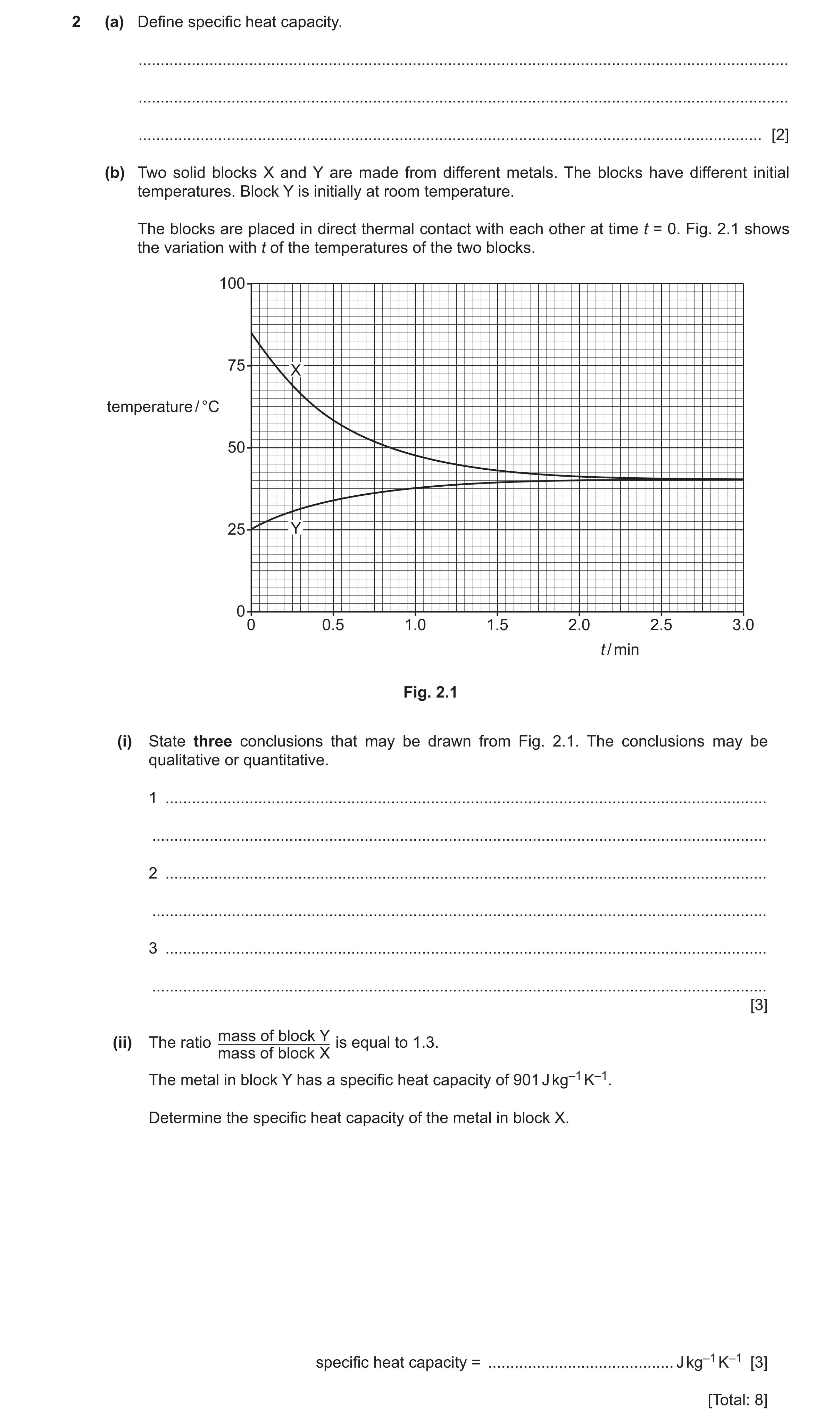
2 (a) Define specific heat capacity. … … … [2] (b) Two solid blocks X and Y are made from different metals. The blocks have different initial temperatures. Block Y is initially at room temperature. The blocks are placed in direct thermal contact with each other at time t = 0. Fig. 2.1 shows the variation with t of the temperatures of the two blocks. 100 75 X temperature / °C 50 25 Y 0 0 0.5 1.0 1.5 2.0 2.5 3.0 t / min Fig. 2.1 (i) State three conclusions that may be drawn from Fig. 2.1. The conclusions may be qualitative or quantitative. 1 … … 2 … … 3 … … [3] mass of block Y(ii) The ratio is equal to 1.3. mass of block X The metal in block Y has a specific heat capacity of 901 J kg–1 K–1. Determine the specific heat capacity of the metal in block X. specific heat capacity = … J kg–1 K–1 [3] [Total: 8]
8 marks
Mark scheme: 2(a) (thermal) energy per unit mass (to change temperature) B1 (thermal) energy per unit change in temperature B1 2(b)(i) Any three bulleted points from: B3 • the blocks end up in thermal equilibrium • heat capacity of Y is larger than heat capacity of X • no heat loss to the surroundings Up to 2 points from these six: • initial temperature of X = 85 °C • initial temperature of Y = 25 °C • the temperature change of X = 45 °C • the temperature change of Y = 15 °C • the temperature change in X is three times that in Y • final temperature of both = 40 °C 2(b)(ii) = 45 °C for X and 15 °C for Y C1 mc 45 = 1.3 m 901 15 C1 c = 390 J kg K–1 A1
This question in 9702/43 Oct/Nov 2024
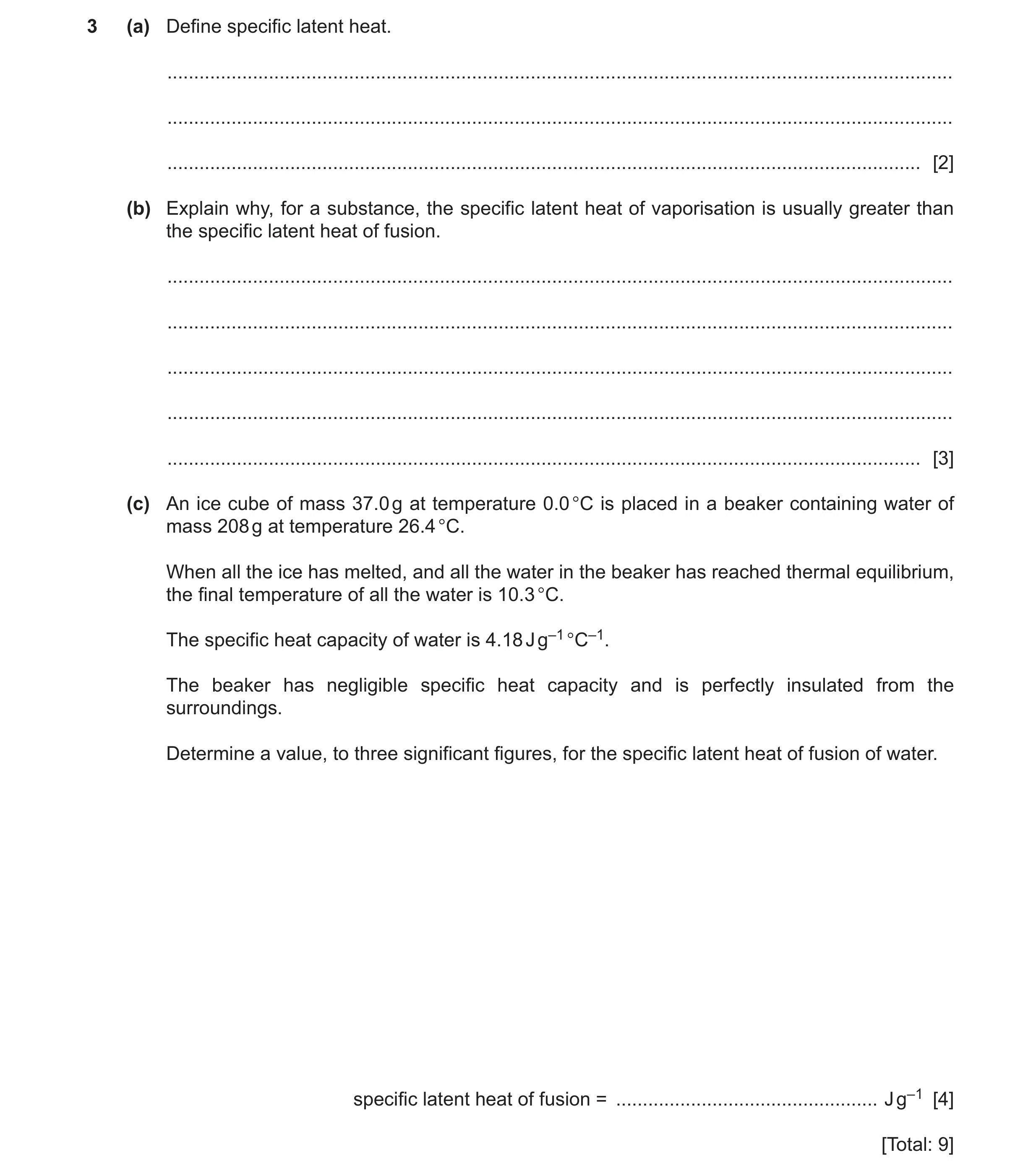
Q25 · Define specific latent heat 9702/41 May/June 2025
3 (a) Define specific latent heat. … … … [2] (b) Explain why, for a substance, the specific latent heat of vaporisation is usually greater than the specific latent heat of fusion. … … … … … [3] (c) An ice cube of mass 37.0 g at temperature 0.0 °C is placed in a beaker containing water of mass 208 g at temperature 26.4 °C. When all the ice has melted, and all the water in the beaker has reached thermal equilibrium, the final temperature of all the water is 10.3 °C. The specific heat capacity of water is 4.18 J g–1 °C–1. The beaker has negligible specific heat capacity and is perfectly insulated from the surroundings. Determine a value, to three significant figures, for the specific latent heat of fusion of water. specific latent heat of fusion = … J g–1 [4] [Total: 9]
9 marks
Mark scheme: 3(a) (thermal) energy per unit mass (to cause state change) B1 (thermal) energy to change state at constant temperature B1 3(b) (for vaporisation): B1 involves greater change in volume (of substance) or involves greater increase in separation of molecules more work has to be done by molecules (to separate) M1 or greater increase in potential energy of molecules kinetic energy of molecules unchanged, so more thermal energy needed A1 3(c) Q = mc and Q = mL C1 for the water = 26.4 – 10.3 C1 (37.0 × L) + (37.0 × 4.18 × 10.3) = (208 × 4.18 × 16.1) C1 L = 335 J g–1 A1
This question in 9702/41 May/June 2025
Q26 · Define specific heat capacity 9702/42 May/June 2025
3 (a) Define specific heat capacity. … … … [2] (b) A block of aluminium has a volume of 3.612 × 10⁻³ m3 at a temperature of 0 °C. Aluminium has a density of 2.700 × 10³ kg m–3 at 0 °C. It has a density of 2.620 × 10³ kg m–3 at 500 °C. The block is heated so that its temperature increases from 0 °C to 500 °C at an atmospheric pressure of 1.01 × 10⁵ Pa. The increase in internal energy of the block is 4.38 MJ. (i) Calculate the mass of the block. mass = … kg [2] (ii) Show that the volume of the block at a temperature of 500 °C is 3.722 × 10⁻³ m3. [1] (iii) Use the information in (b)(ii) to determine the magnitude of the work done on the block when its temperature is raised from 0 °C to 500 °C. work done = … J [2] (iv) Explain whether the work done on the block is positive or negative. … … … [2] (v) Use the first law of thermodynamics to determine, to three significant figures, a value for the specific heat capacity of aluminium. Explain your reasoning. Give a unit with your answer. specific heat capacity = … unit … [3] (c) Without further calculation, suggest with a reason how doubling the pressure in (b) is likely to affect the answer in (b)(v). … … … [1] [Total: 13]
13 marks
Mark scheme: 3(a) (thermal) energy per unit mass (to cause temperature change) B1 (thermal) energy per unit change in temperature B1 3(b)(i) density = mass / volume C1 mass = 2.700 × 103 × 3.612 × 10–3 A1 = 9.752 kg 3(b)(ii) volume = 3.612 × 10–3 × (2.700 / 2.620) = 3.722 × 10⁻³ m3 A1 or volume = 9.752 / (2.620 × 10³) = 3.722 × 10⁻³ m3 3(b)(iii) W = pV C1 = 1.01 × 105 × (3.722 – 3.612) × 10–3 A1 = 11.1 J 3(b)(iv) volume (of block) increases B1 work is done against the atmosphere so work done (on block) is negative B1 3(b)(v) thermal energy = (4.38 × 10⁶) + 11.1 B1 specific heat capacity = (4.38 × 10⁶) / (9.75 × 500) C1 = 898 J kg–1 °C–1 A1 3(c) work done is negligible compared with (change in) internal energy so (answer in (b)(v) would be) unchanged B1
This question in 9702/42 May/June 2025
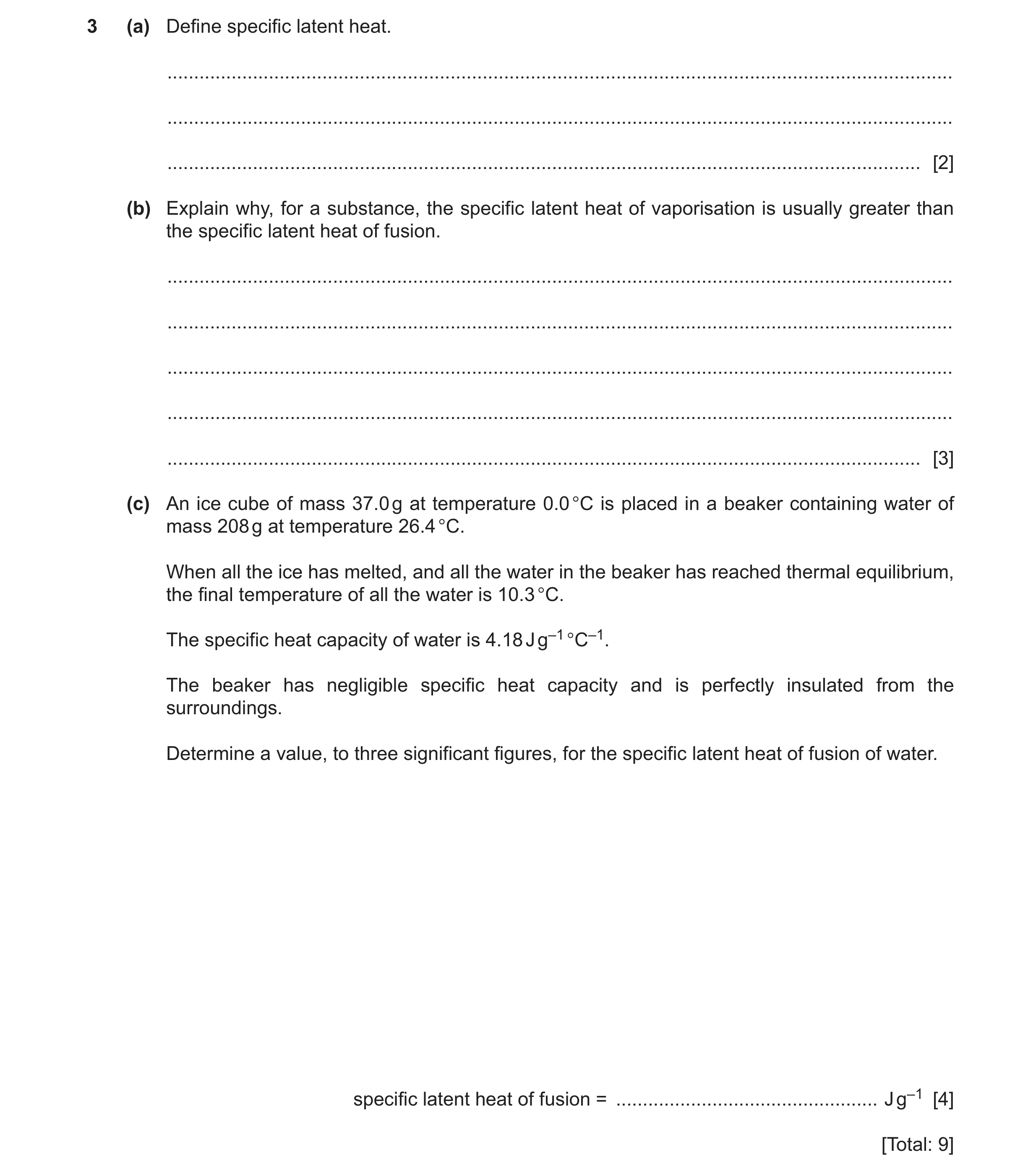
Q27 · Define specific latent heat 9702/43 May/June 2025
3 (a) Define specific latent heat. … … … [2] (b) Explain why, for a substance, the specific latent heat of vaporisation is usually greater than the specific latent heat of fusion. … … … … … [3] (c) An ice cube of mass 37.0 g at temperature 0.0 °C is placed in a beaker containing water of mass 208 g at temperature 26.4 °C. When all the ice has melted, and all the water in the beaker has reached thermal equilibrium, the final temperature of all the water is 10.3 °C. The specific heat capacity of water is 4.18 J g–1 °C–1. The beaker has negligible specific heat capacity and is perfectly insulated from the surroundings. Determine a value, to three significant figures, for the specific latent heat of fusion of water. specific latent heat of fusion = … J g–1 [4] [Total: 9]
9 marks
Mark scheme: 3(a) (thermal) energy per unit mass (to cause state change) B1 (thermal) energy to change state at constant temperature B1 3(b) (for vaporisation): B1 involves greater change in volume (of substance) or involves greater increase in separation of molecules more work has to be done by molecules (to separate) M1 or greater increase in potential energy of molecules kinetic energy of molecules unchanged, so more thermal energy needed A1 3(c) Q = mc and Q = mL C1 for the water = 26.4 – 10.3 C1 (37.0 × L) + (37.0 × 4.18 × 10.3) = (208 × 4.18 × 16.1) C1 L = 335 J g–1 A1
This question in 9702/43 May/June 2025
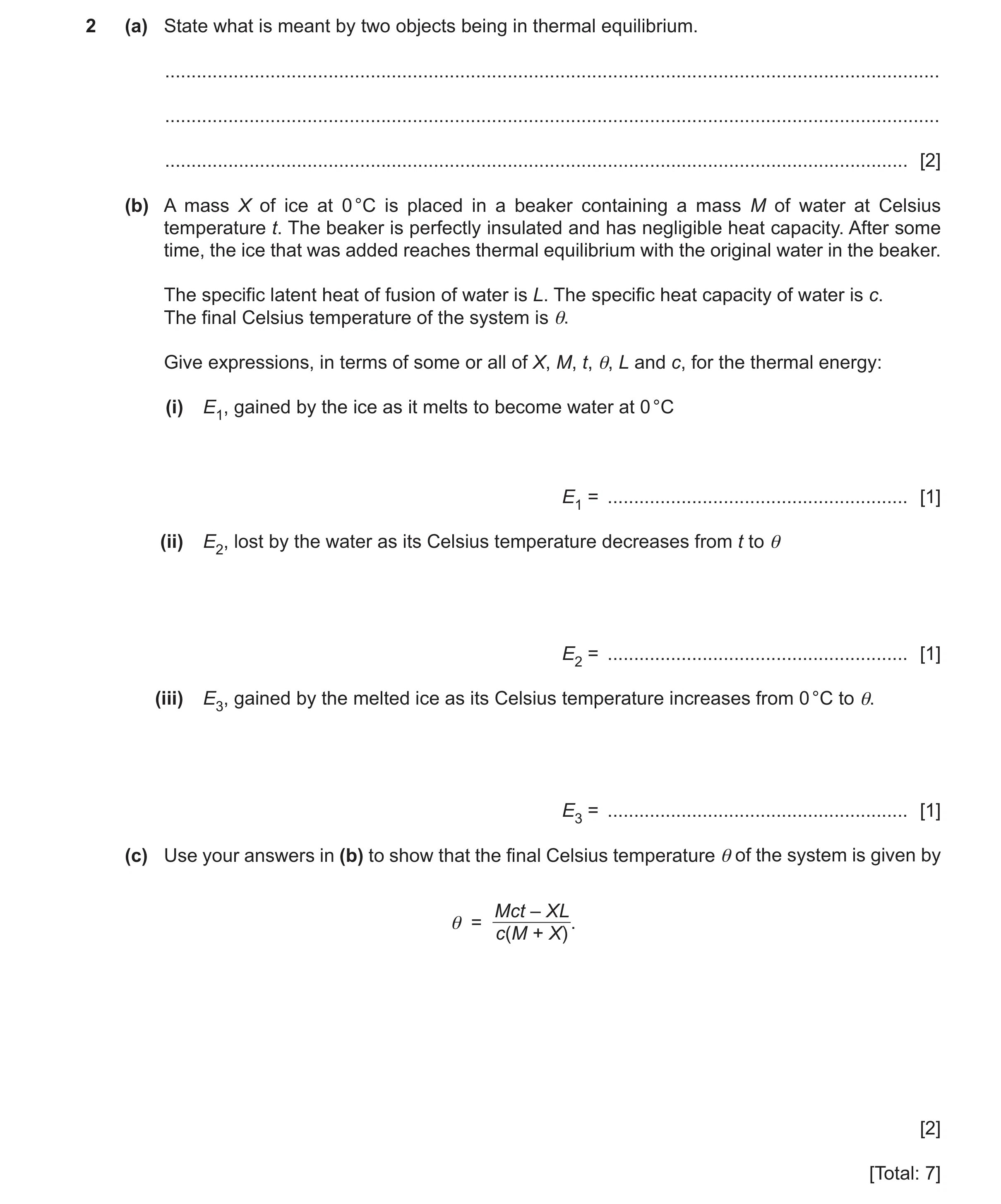
Q28 · State what is meant by two objects being in thermal equilibrium 9702/44 May/June 2025
2 (a) State what is meant by two objects being in thermal equilibrium. … … … [2] (b) A mass X of ice at 0 °C is placed in a beaker containing a mass M of water at Celsius temperature t. The beaker is perfectly insulated and has negligible heat capacity. After some time, the ice that was added reaches thermal equilibrium with the original water in the beaker. The specific latent heat of fusion of water is L. The specific heat capacity of water is c. The final Celsius temperature of the system is θ. Give expressions, in terms of some or all of X, M, t, θ, L and c, for the thermal energy: (i) E1, gained by the ice as it melts to become water at 0 °C E1 = … [1] (ii) E2, lost by the water as its Celsius temperature decreases from t to θ E2 = … [1] (iii) E3, gained by the melted ice as its Celsius temperature increases from 0 °C to θ. E3 = … [1] (c) Use your answers in (b) to show that the final Celsius temperature θ of the system is given by Mct – XL θ = . c(M + X) [2] [Total: 7]
7 marks
Mark scheme: 2(a) same temperature (as each other) B1 no net transfer of thermal energy (between them) B1 2(b)(i) E1 = XL B1 2(b)(ii) E2 = Mc(t – ) A1 2(b)(iii) E3 = Xc B1 2(c) E2 = E1 + E3 C1 Mc(t – ) = XL + Xc A1 and completion of algebra to reach = (Mct – XL) / c(M + X)
This question in 9702/44 May/June 2025
 25 / 43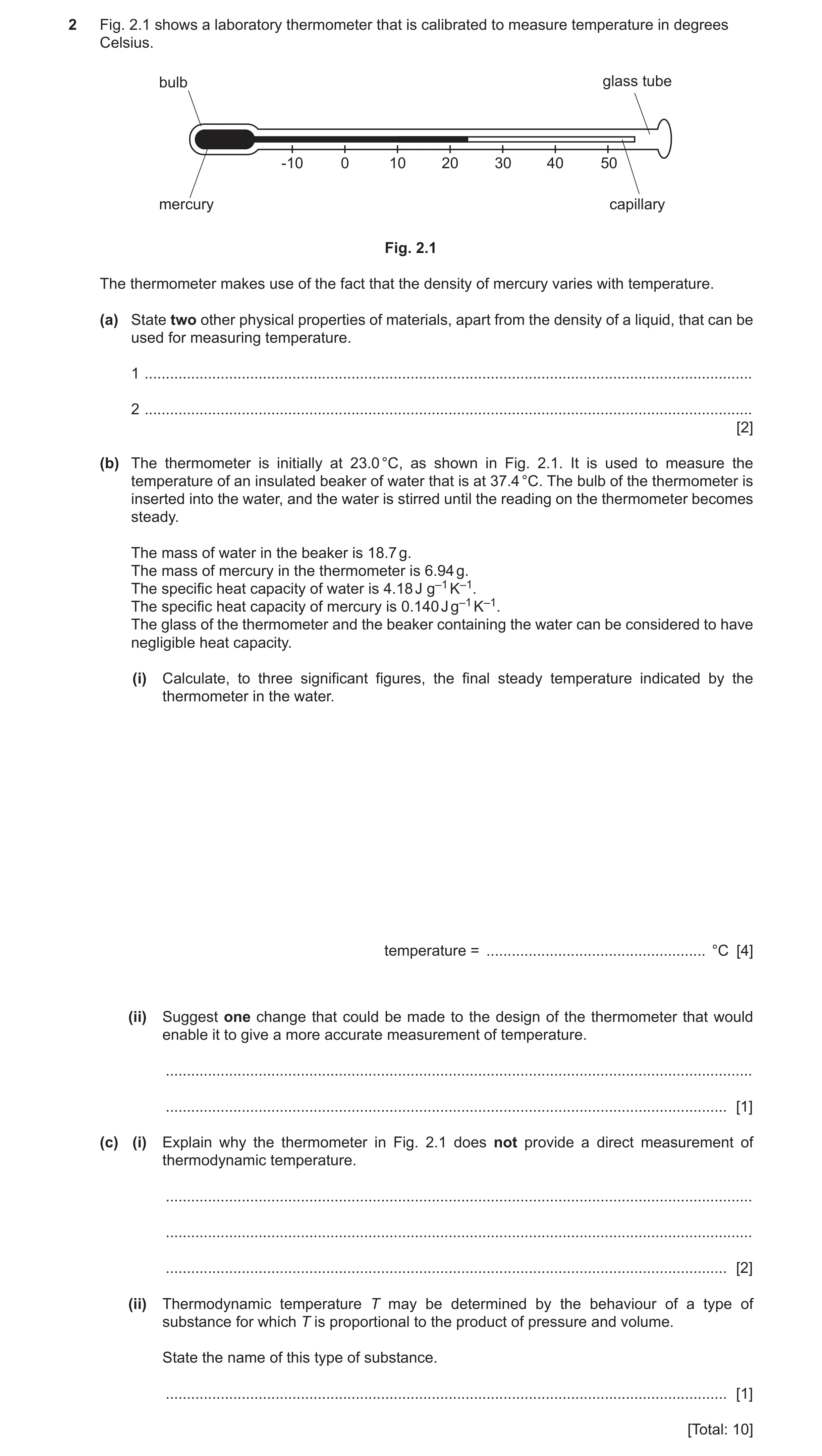
 39 / 43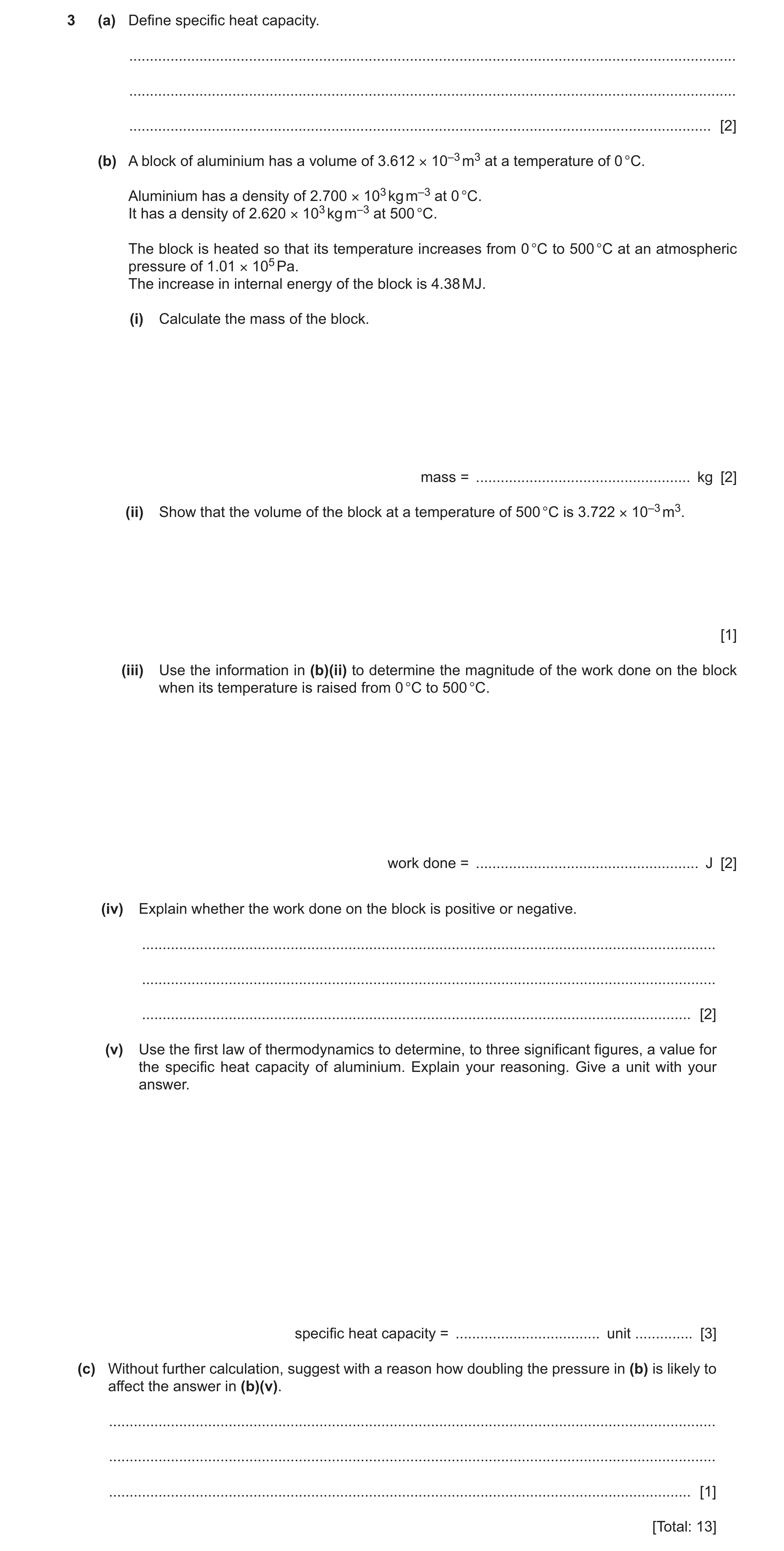
 42 / 43
 43 / 43
 10
10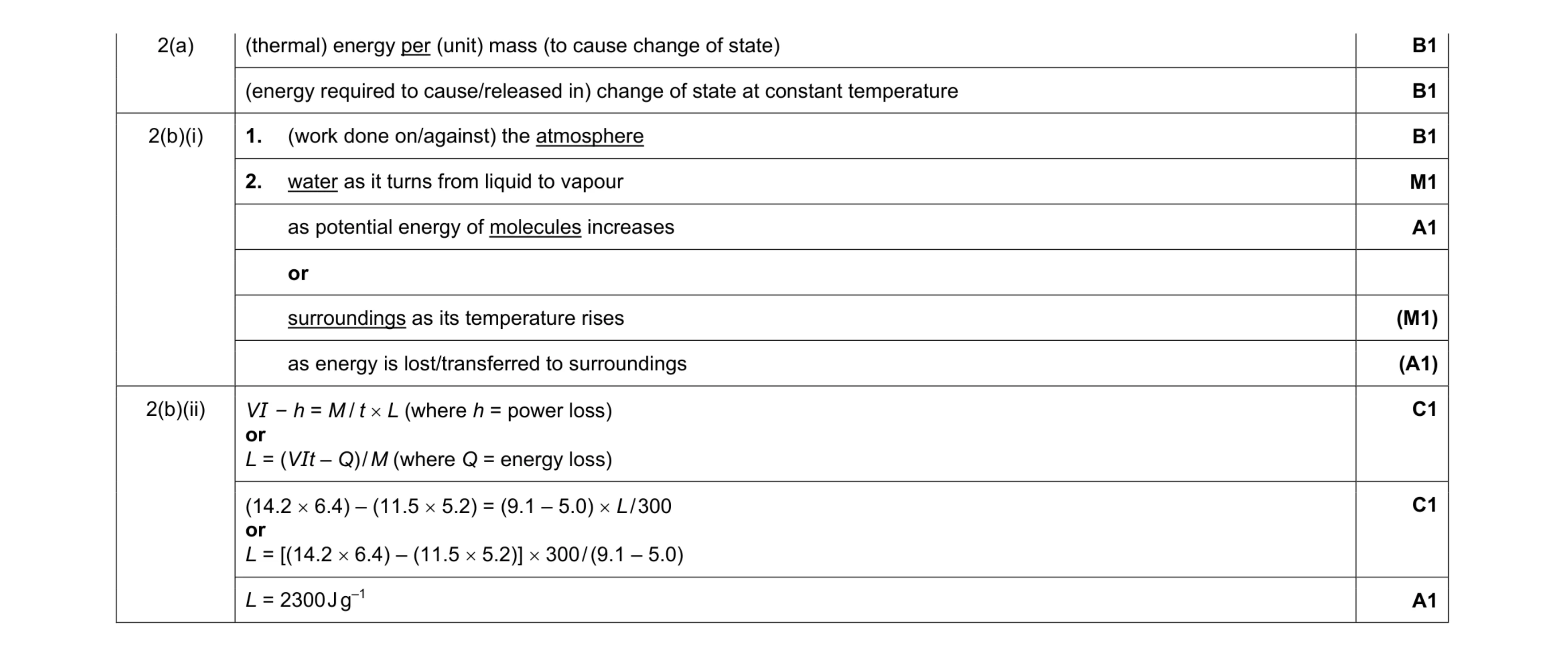 8
8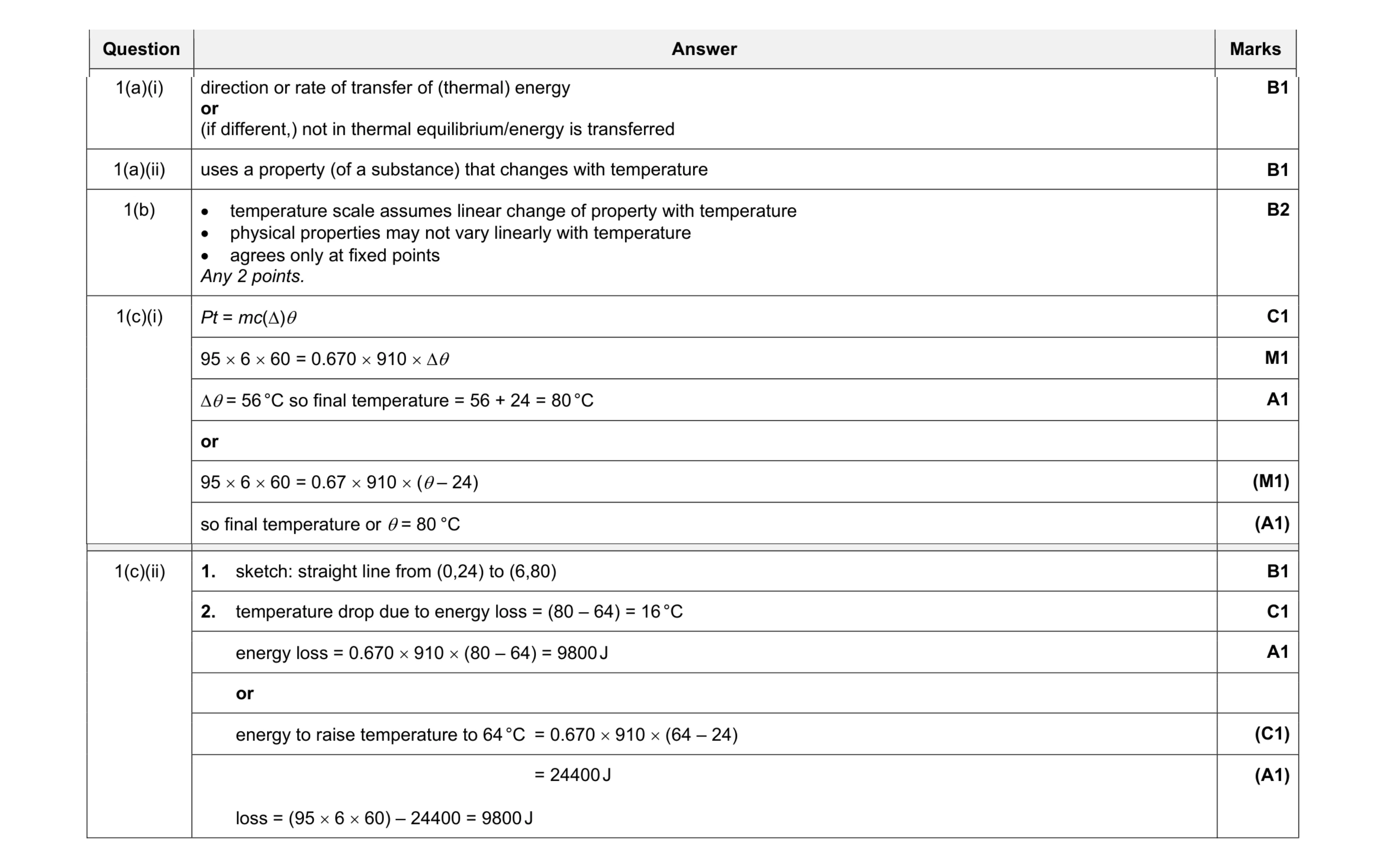 10
10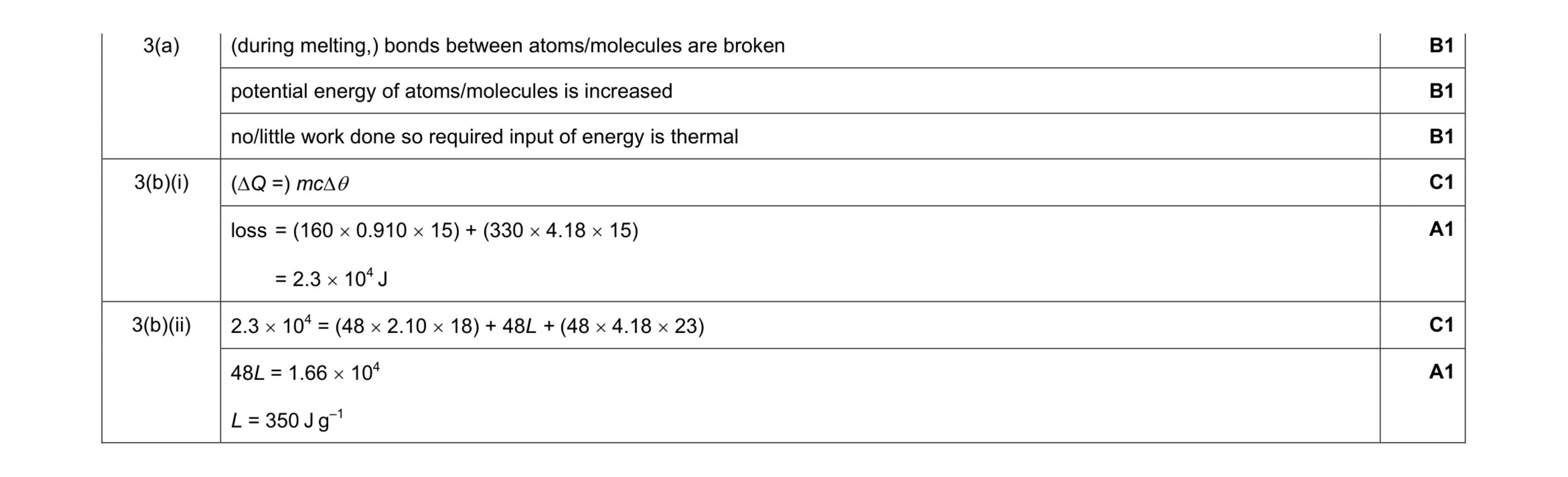 7
7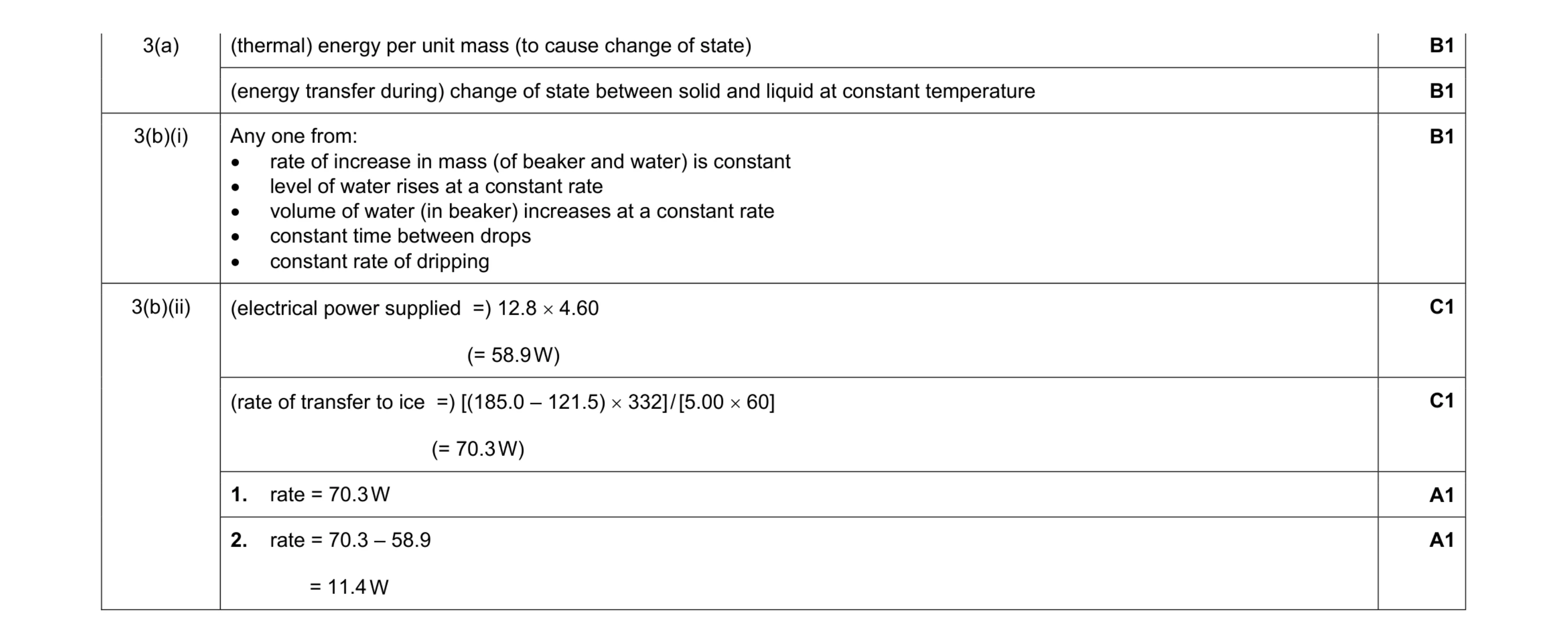 7
7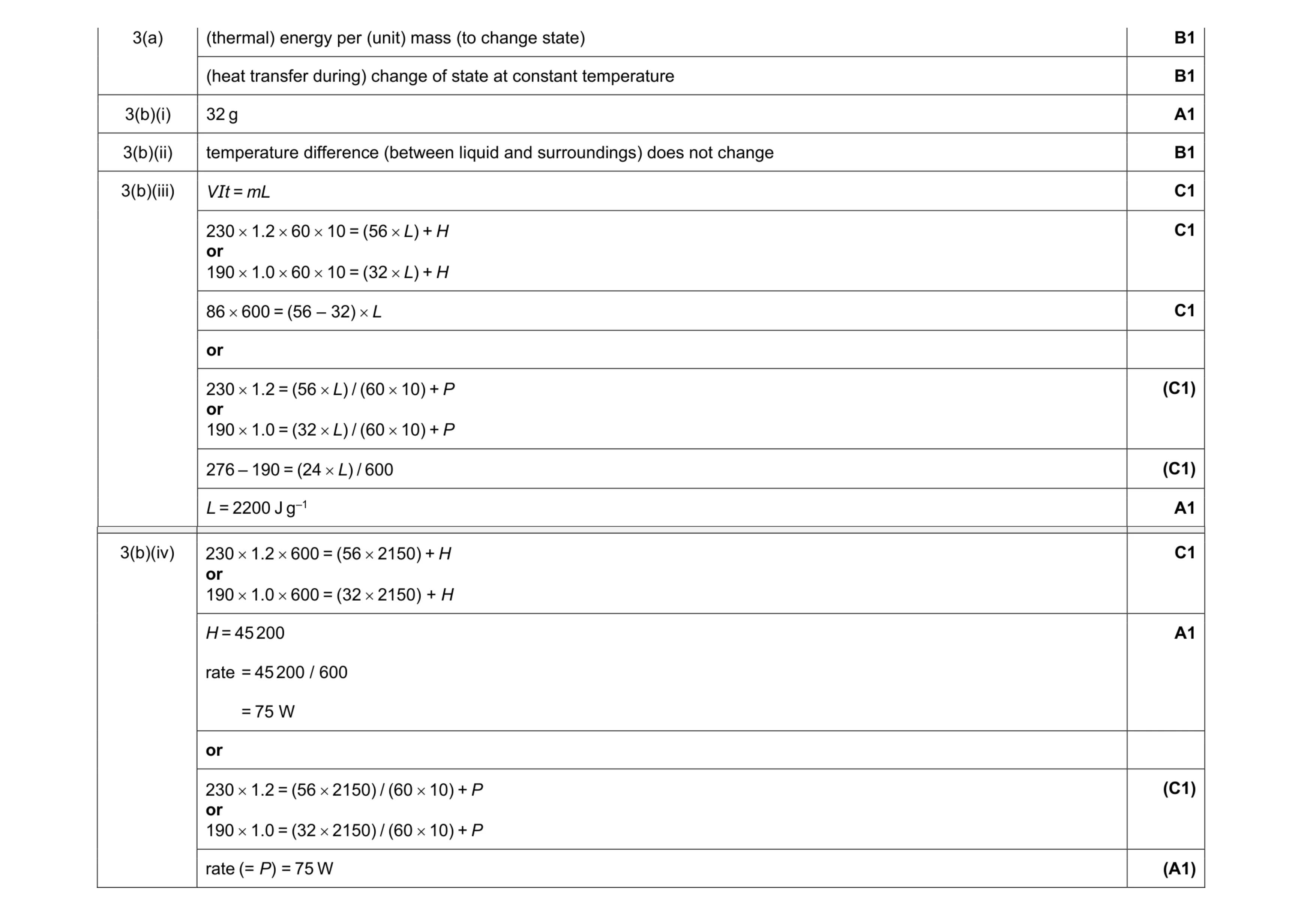 10
10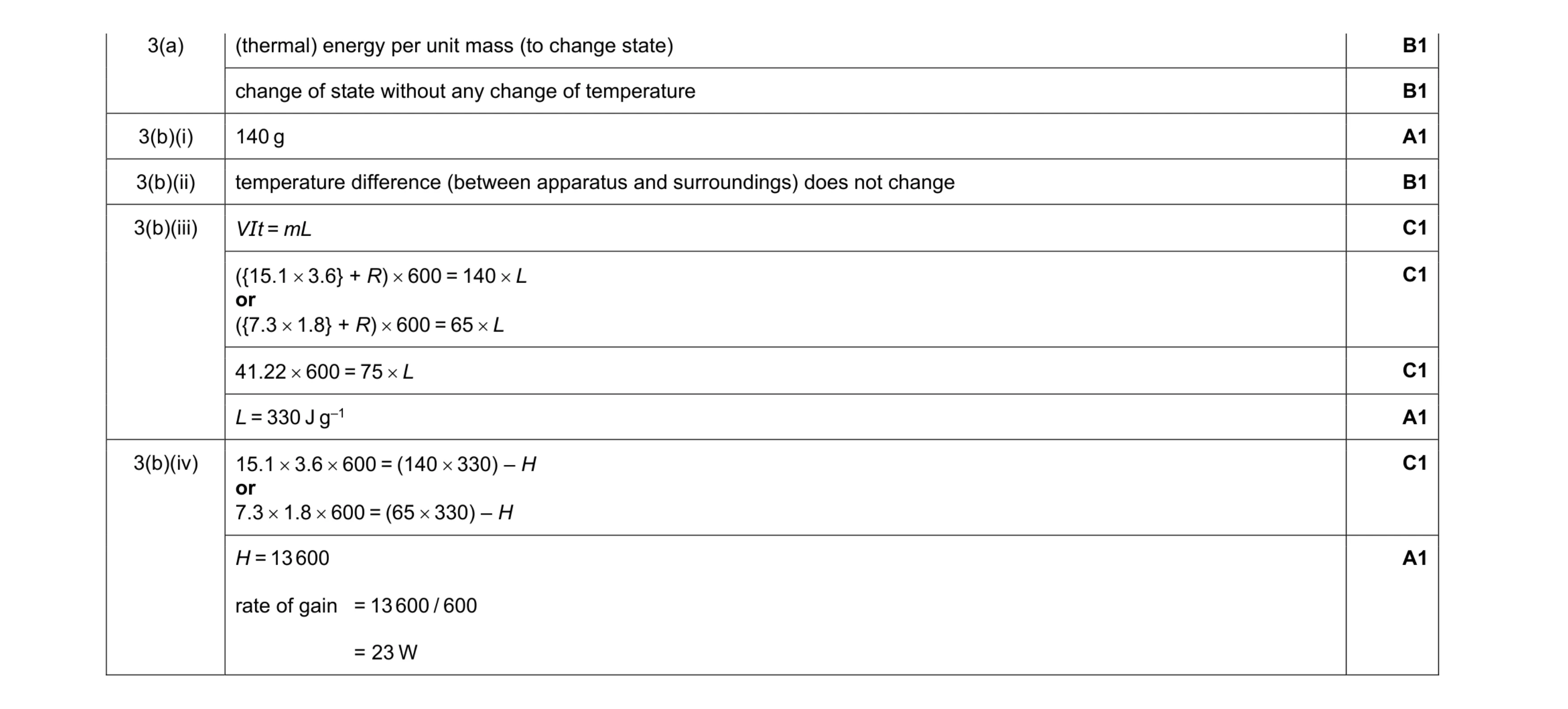 10
10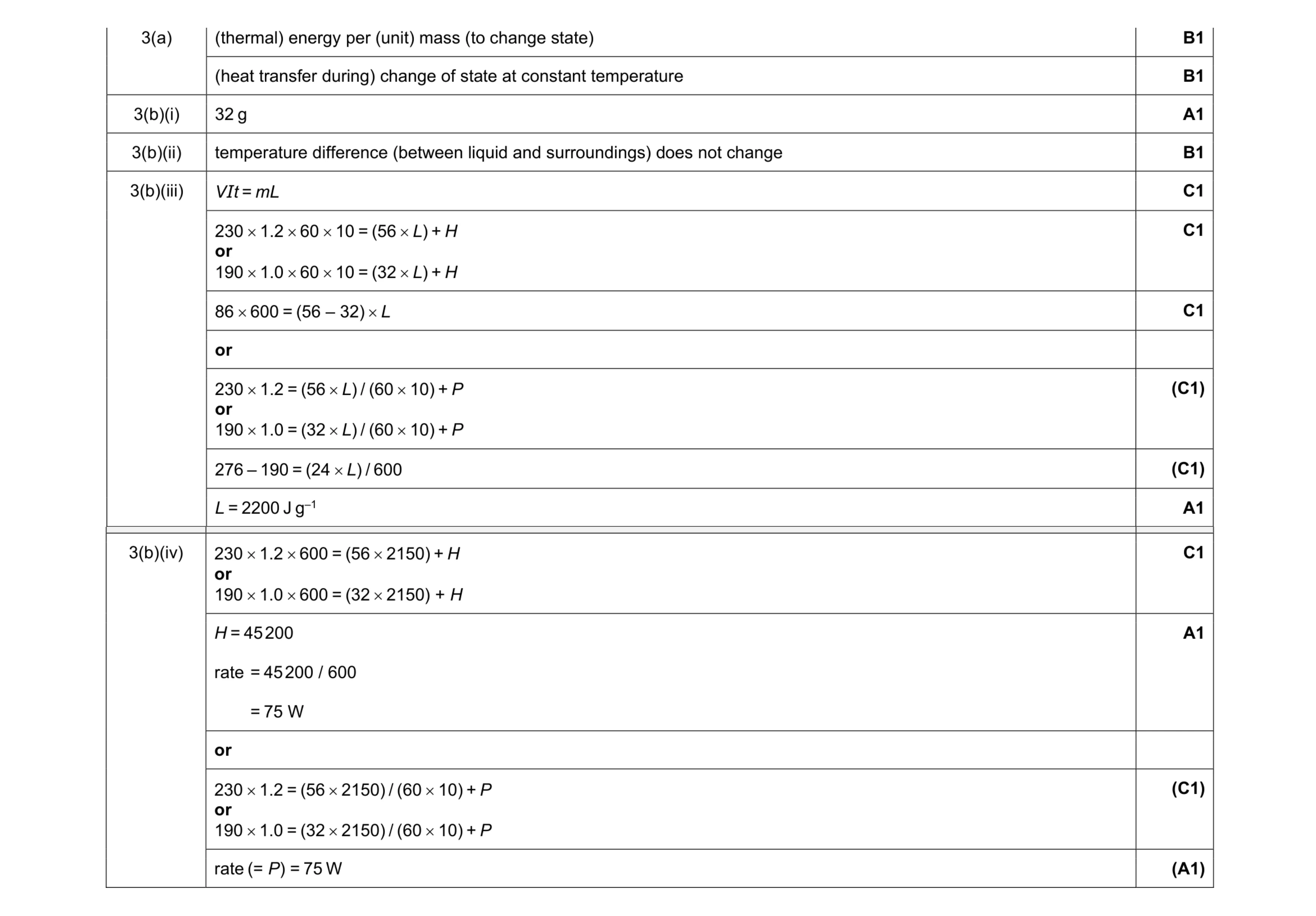 10
10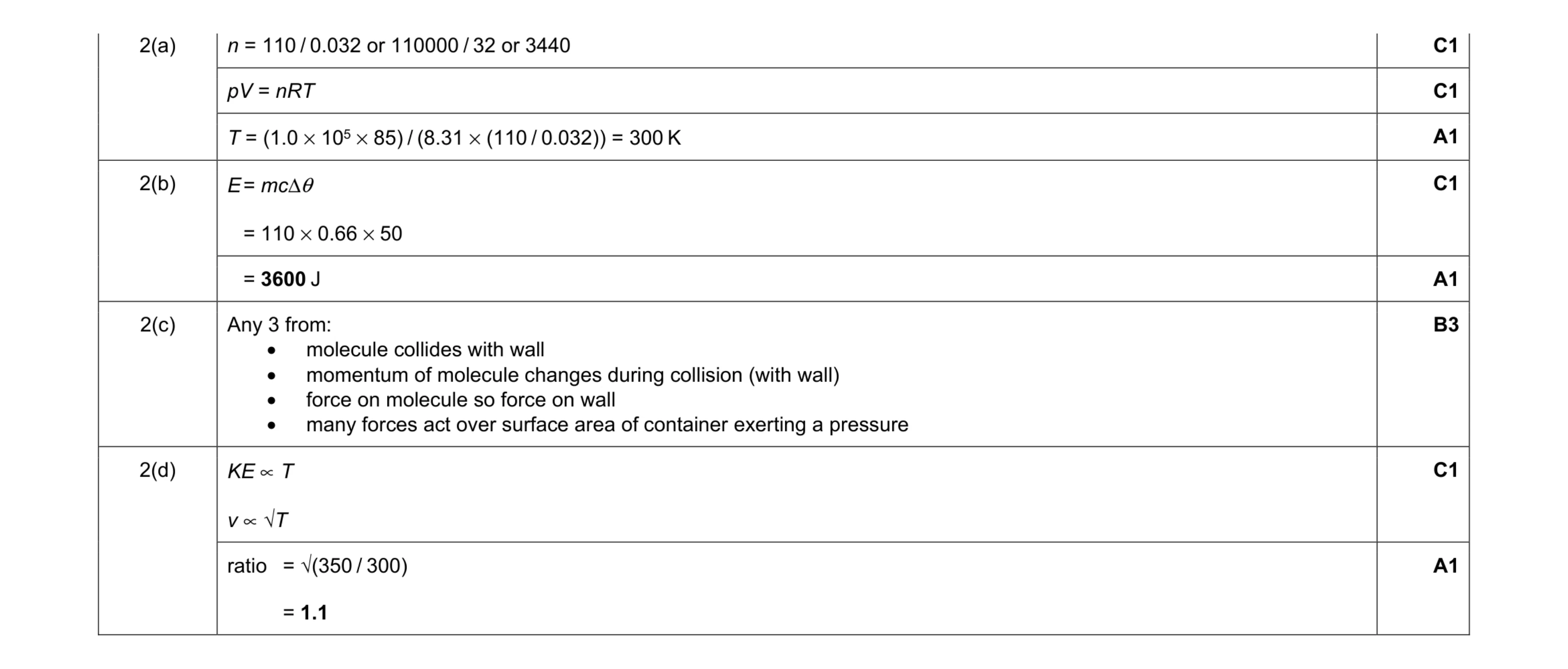 10
10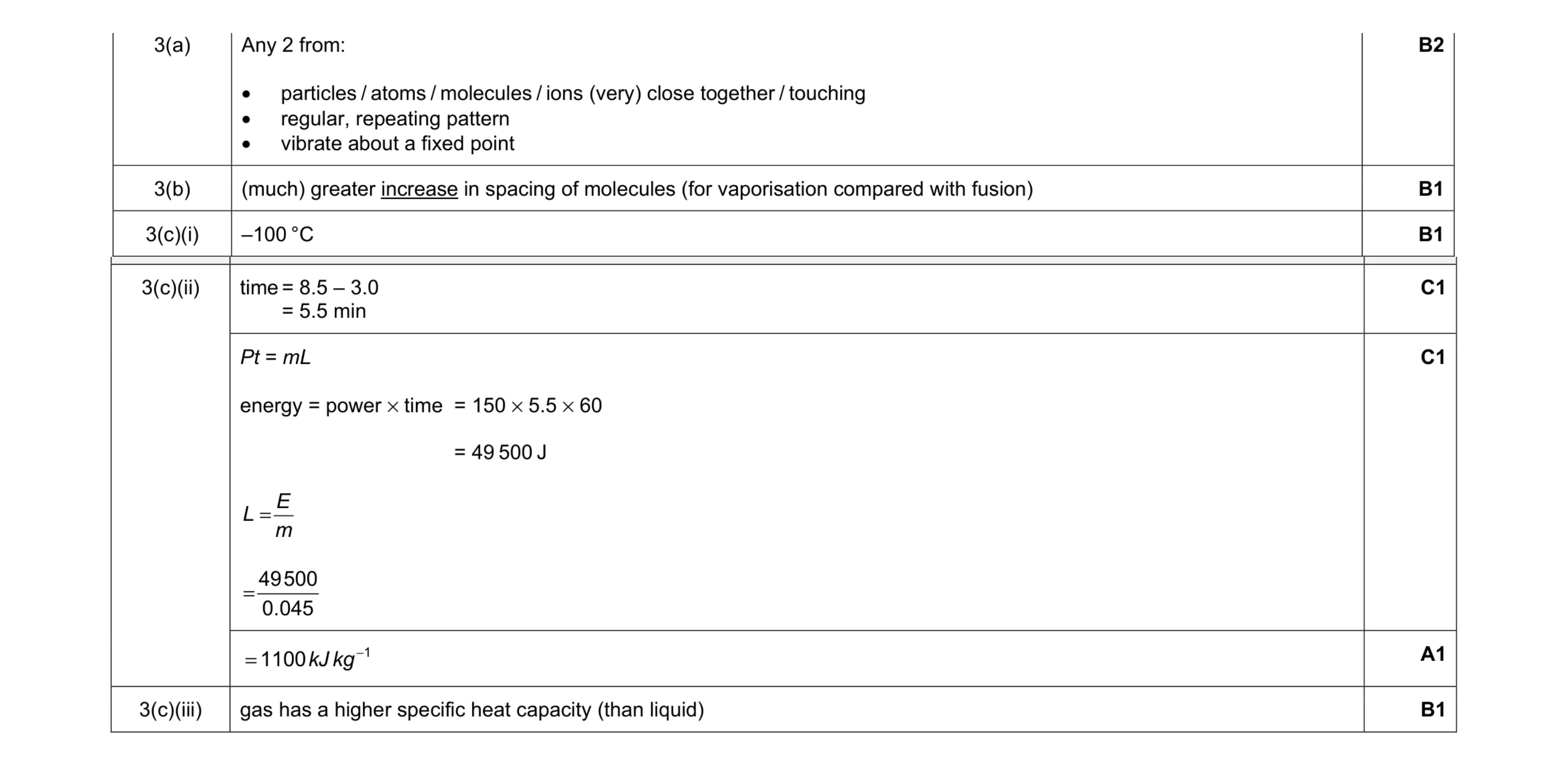 8
8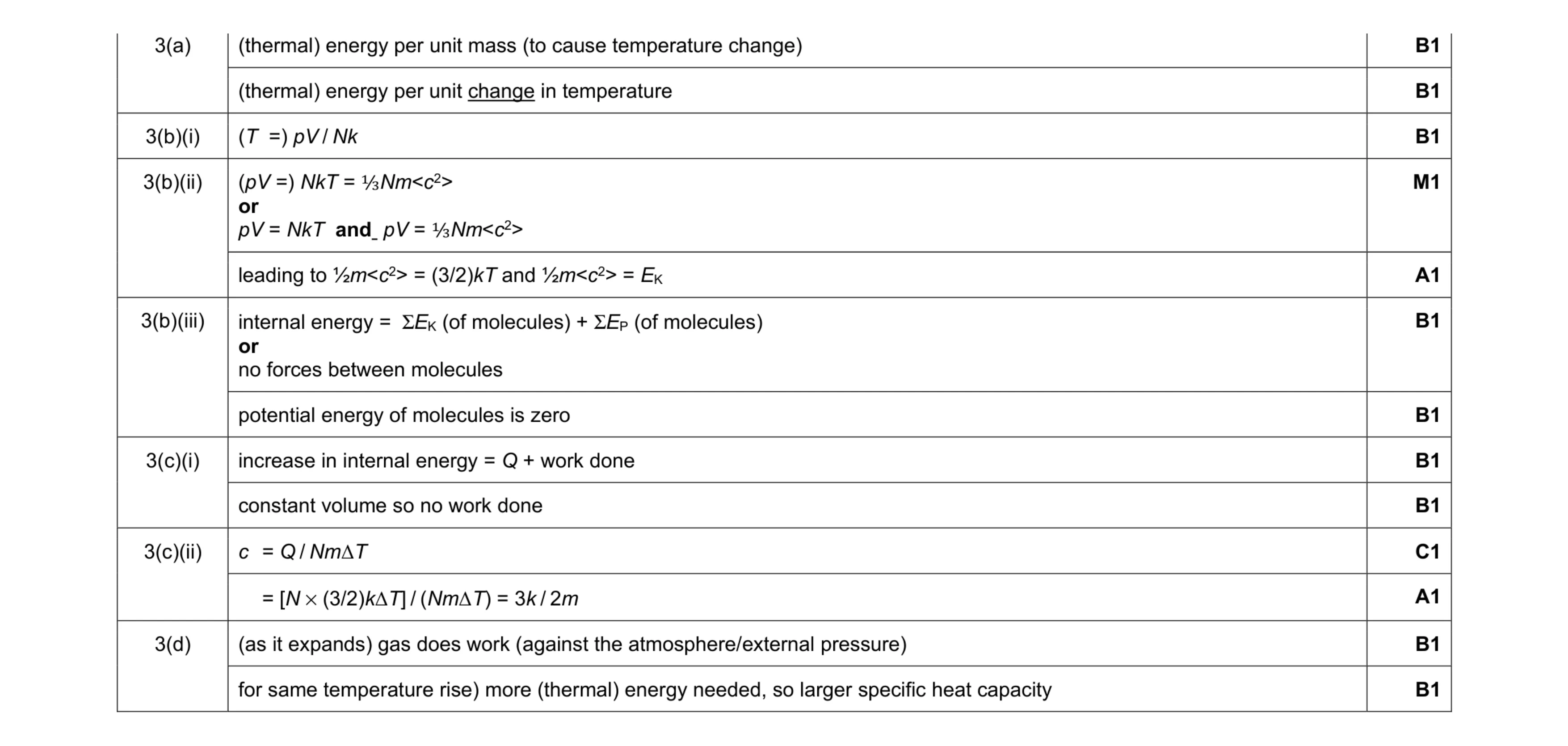 13
13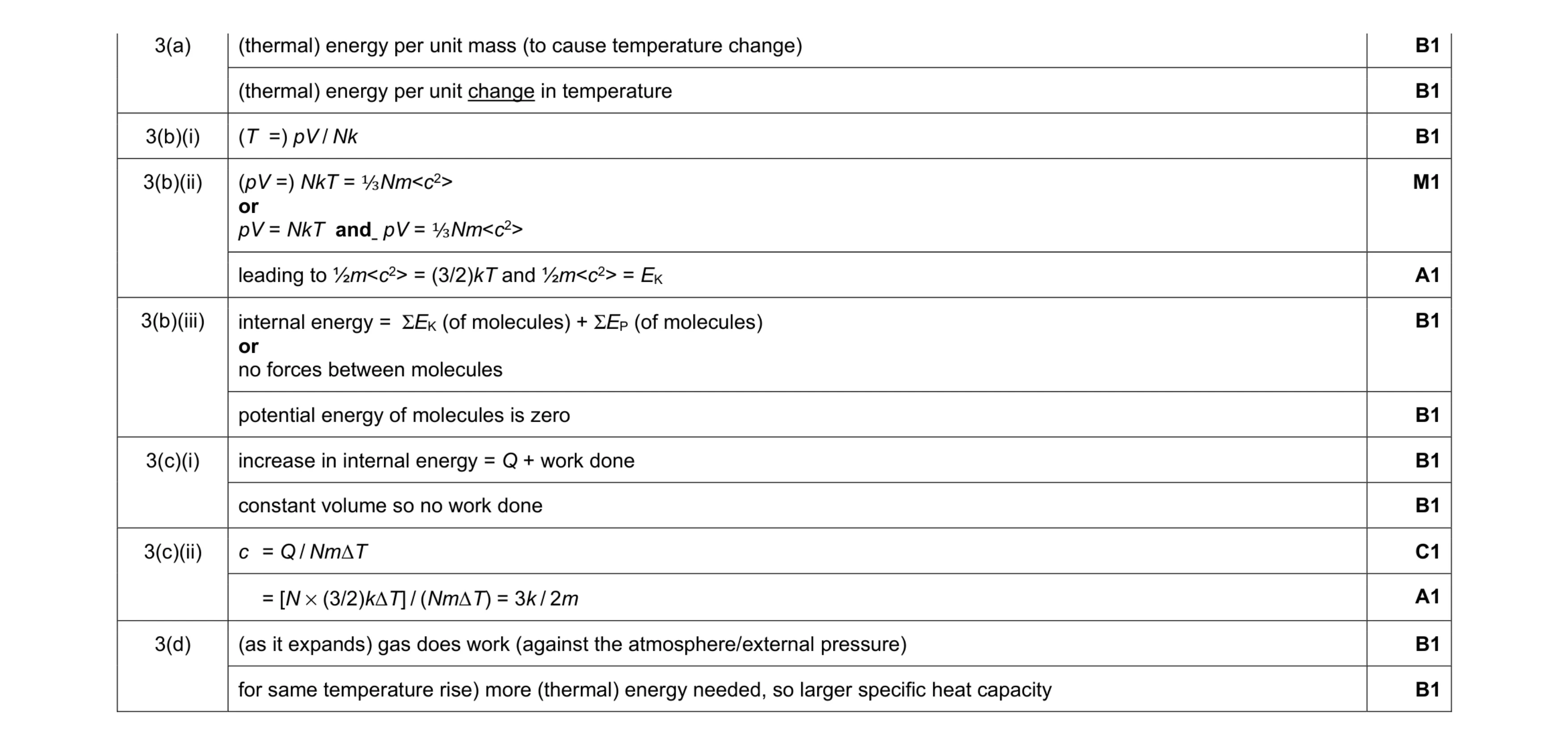 13
13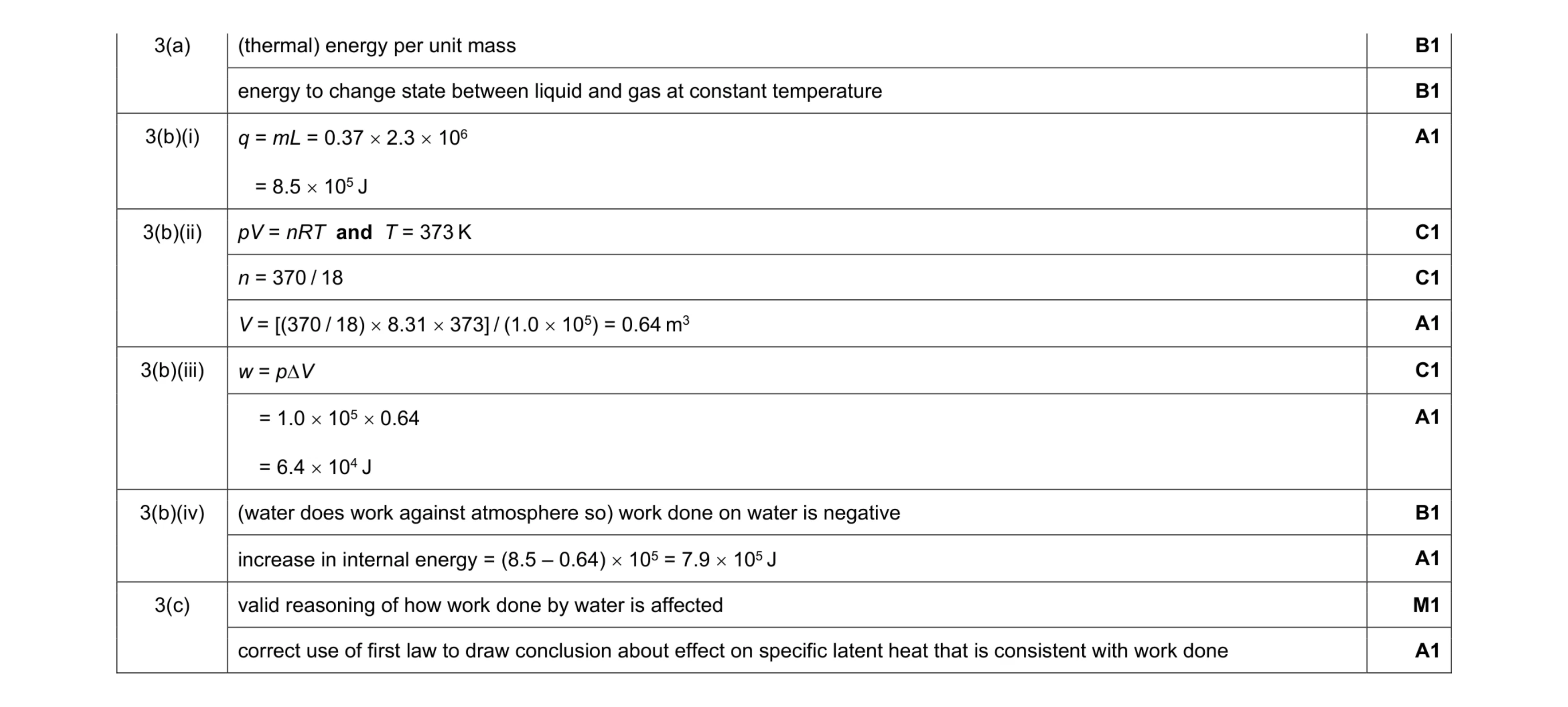 12
12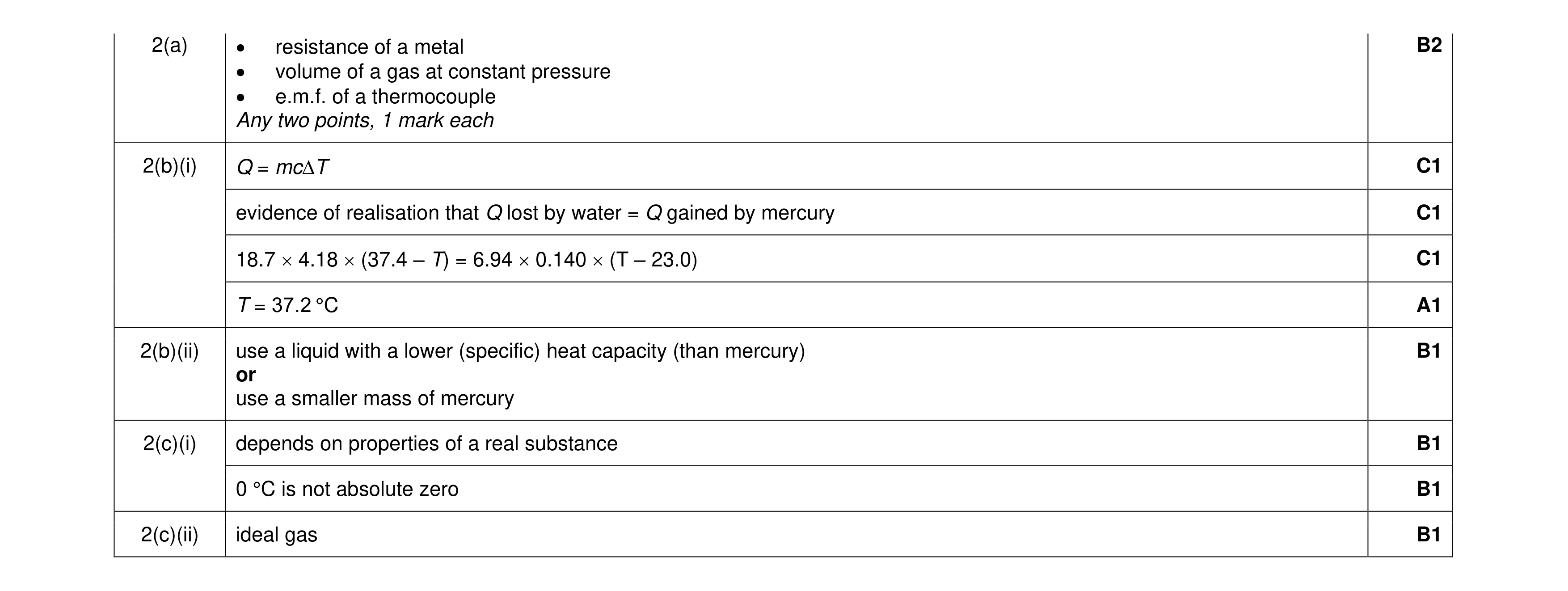 10
10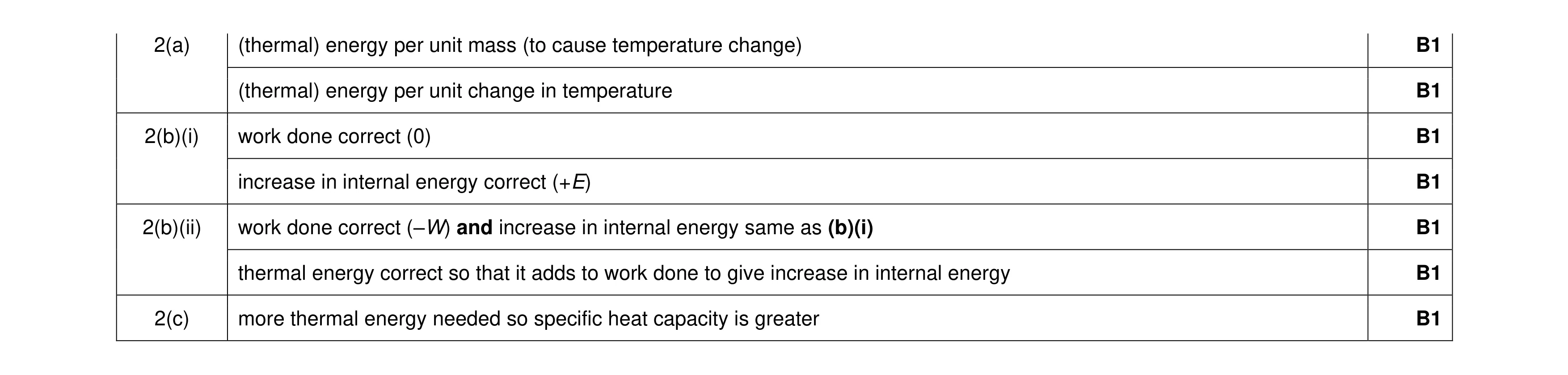 7
7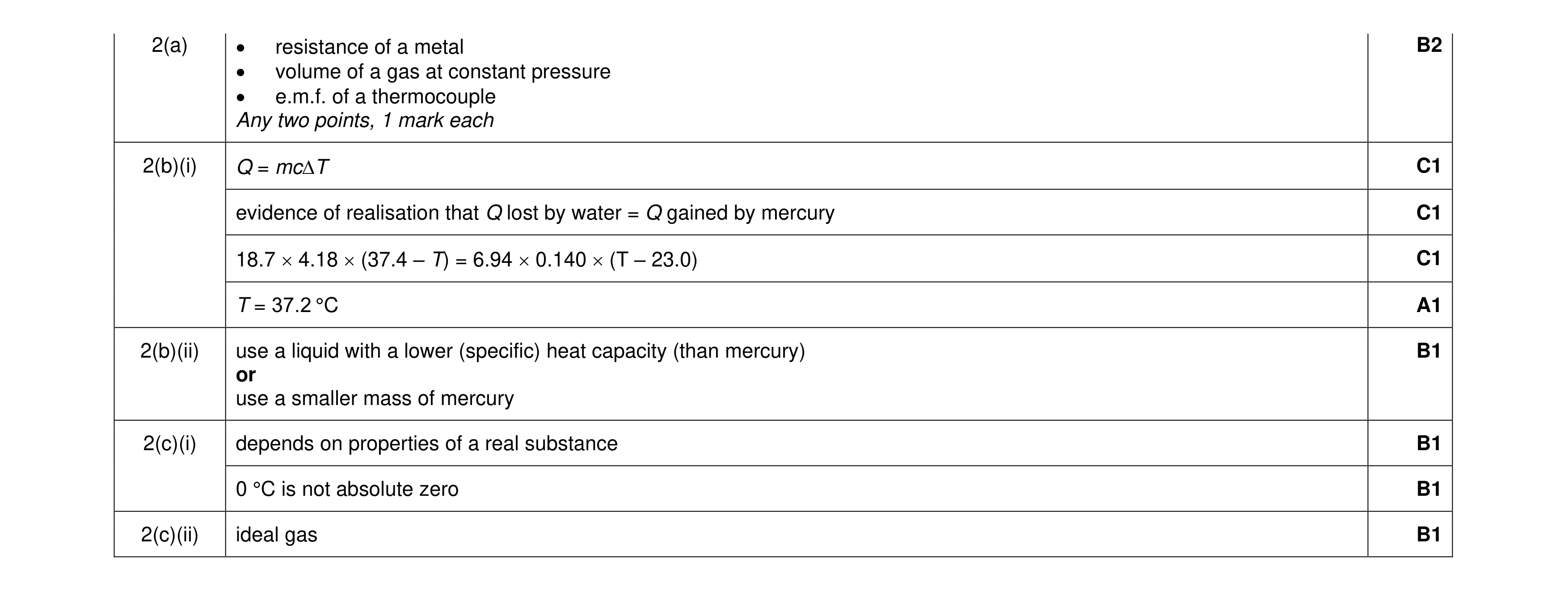 10
10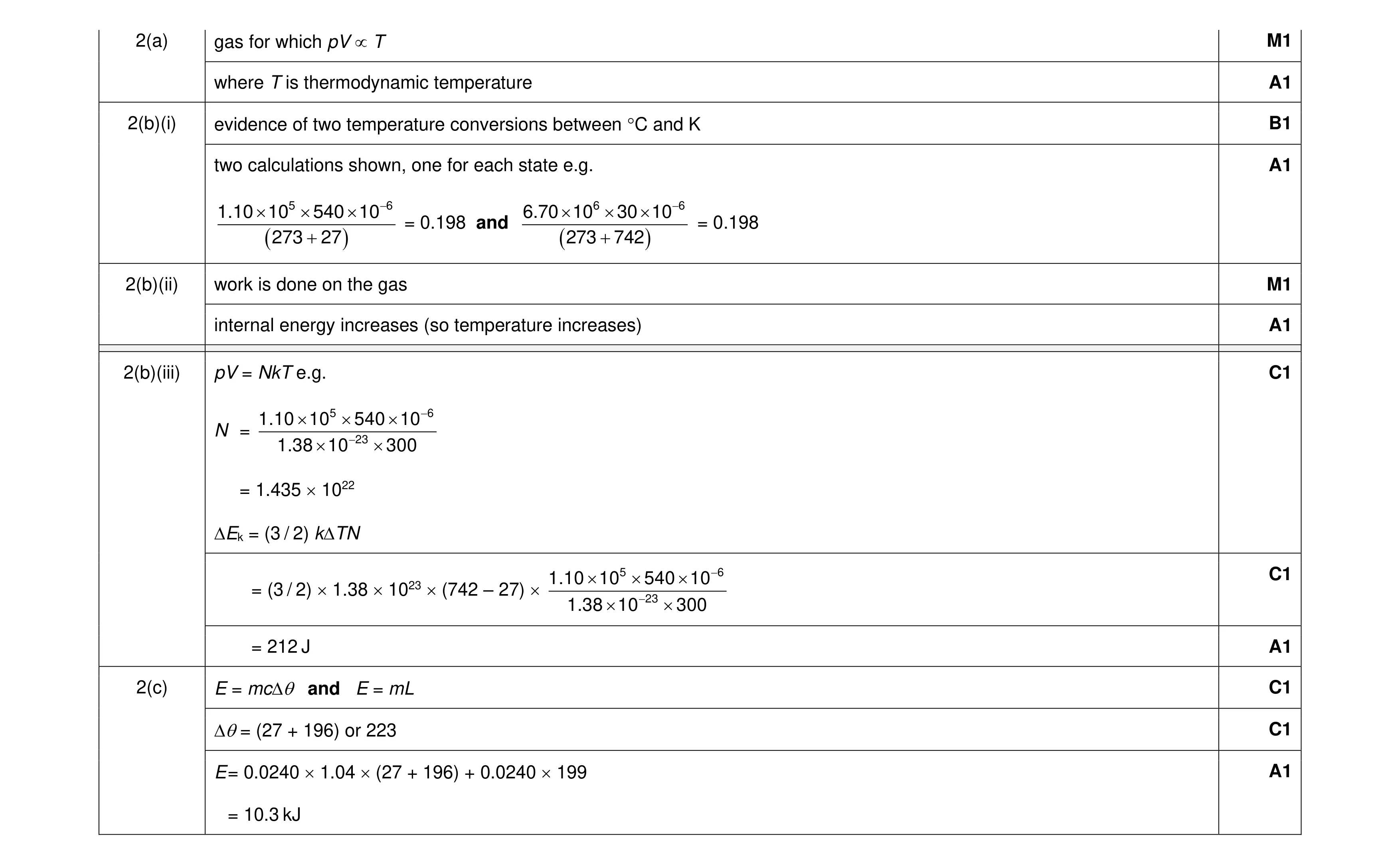 12
12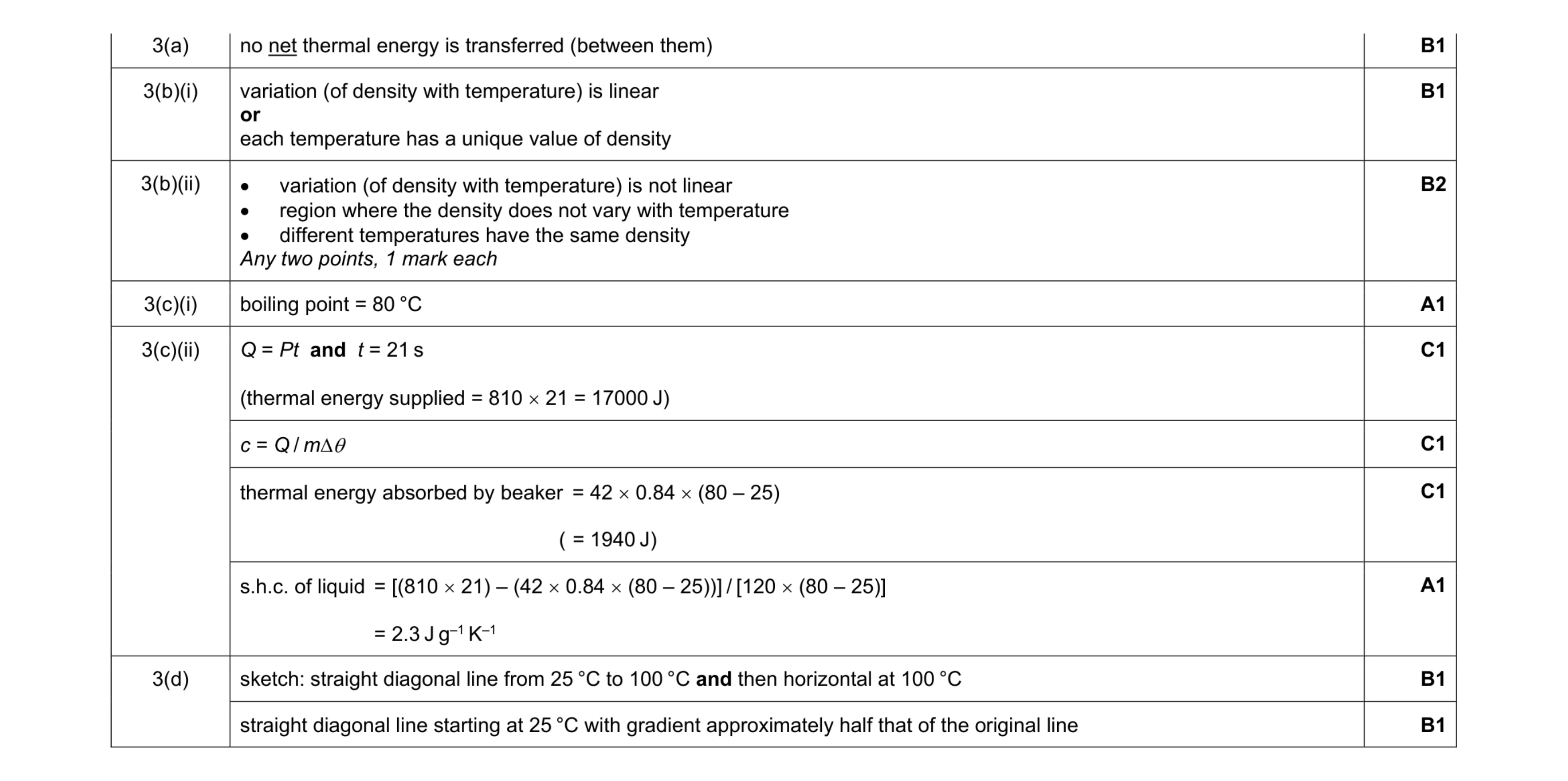 11
11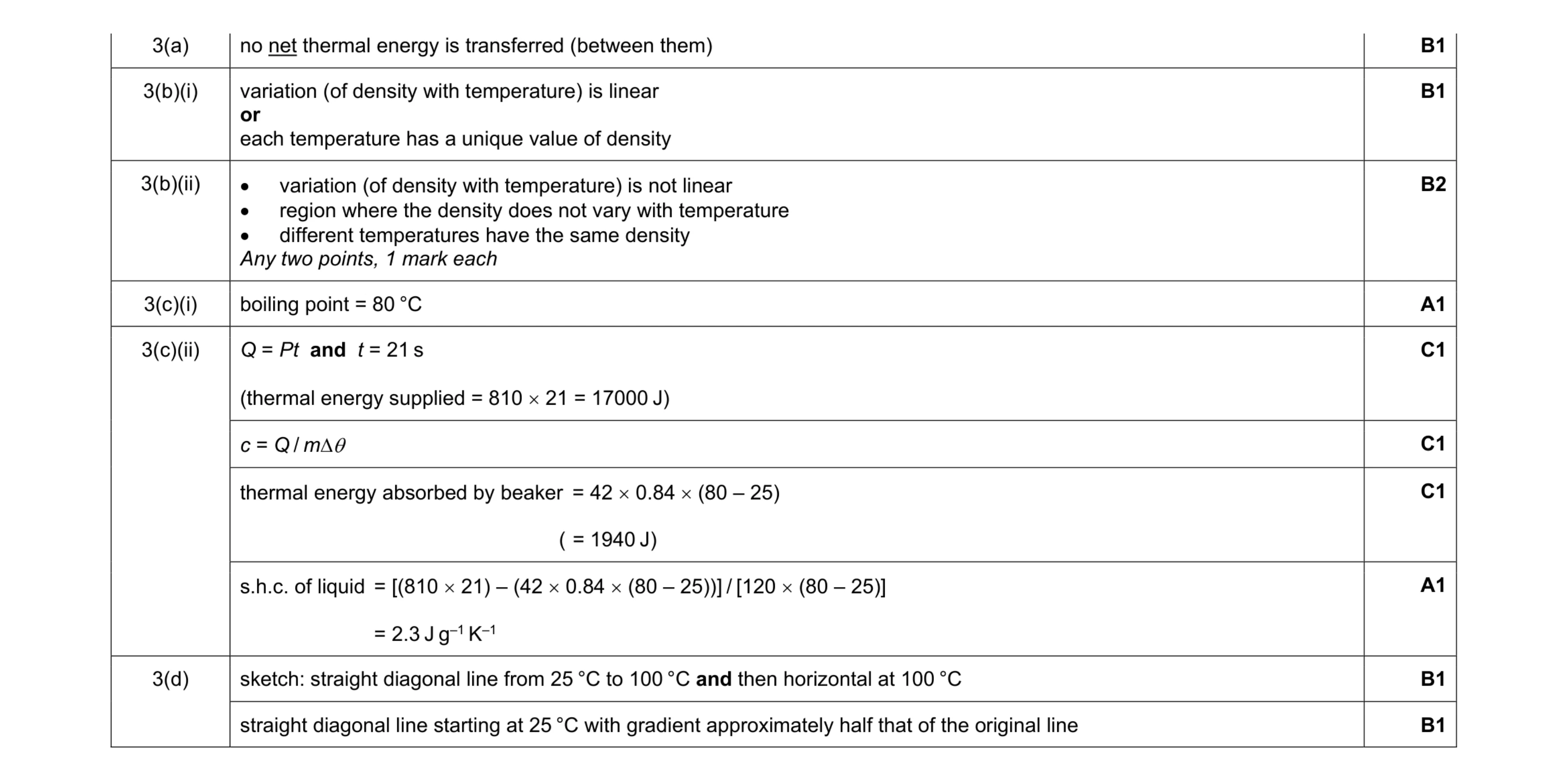 11
11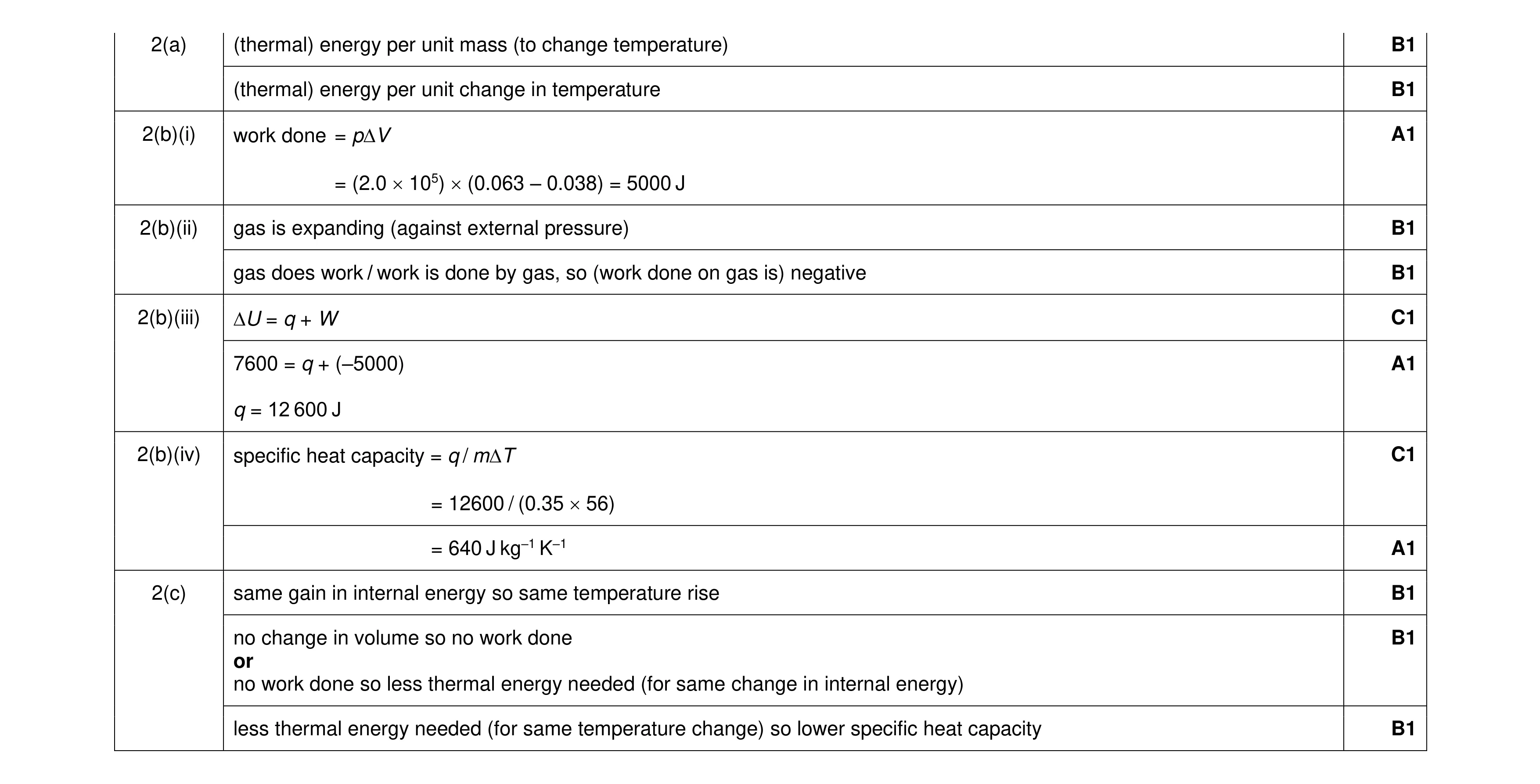 12
12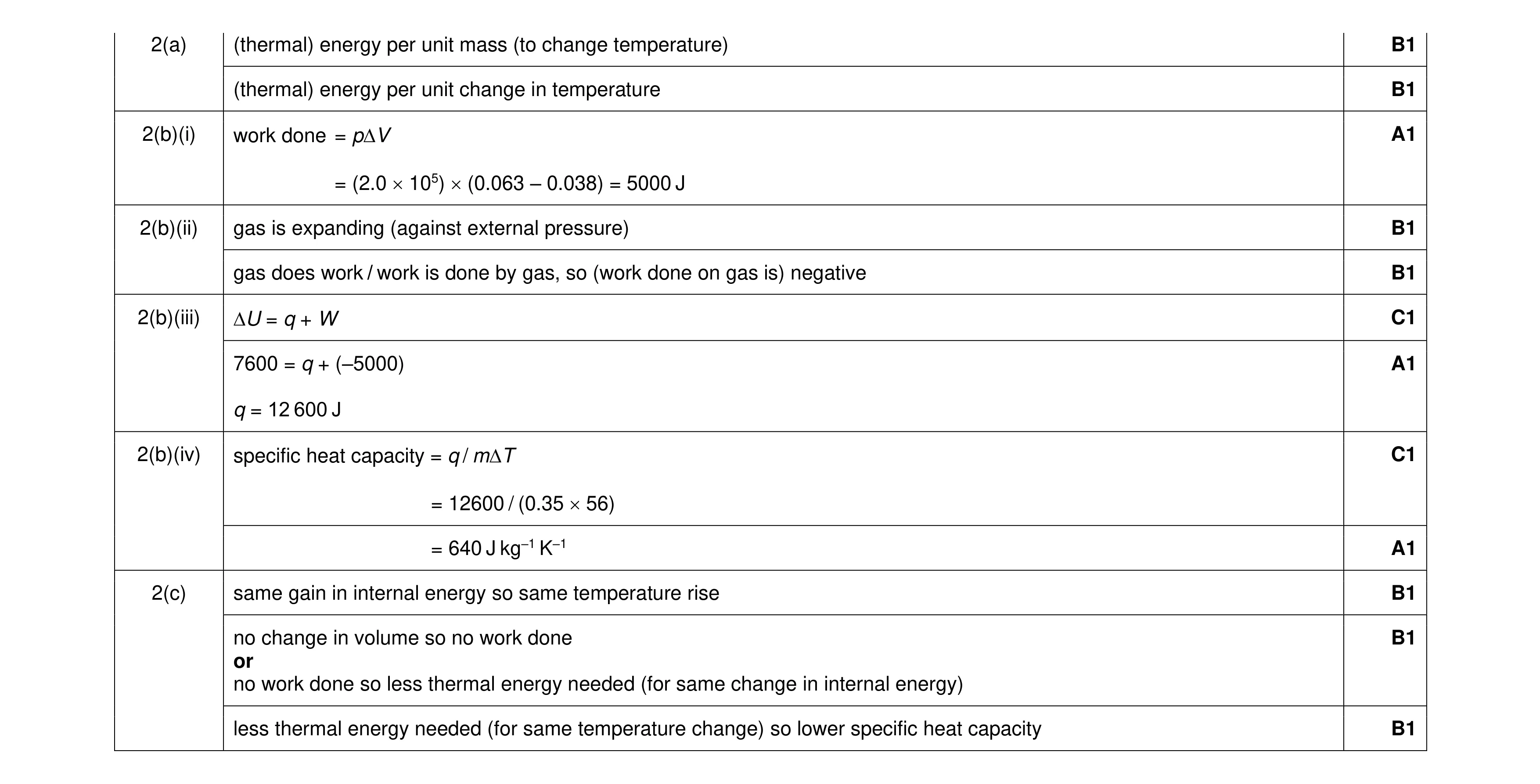 12
12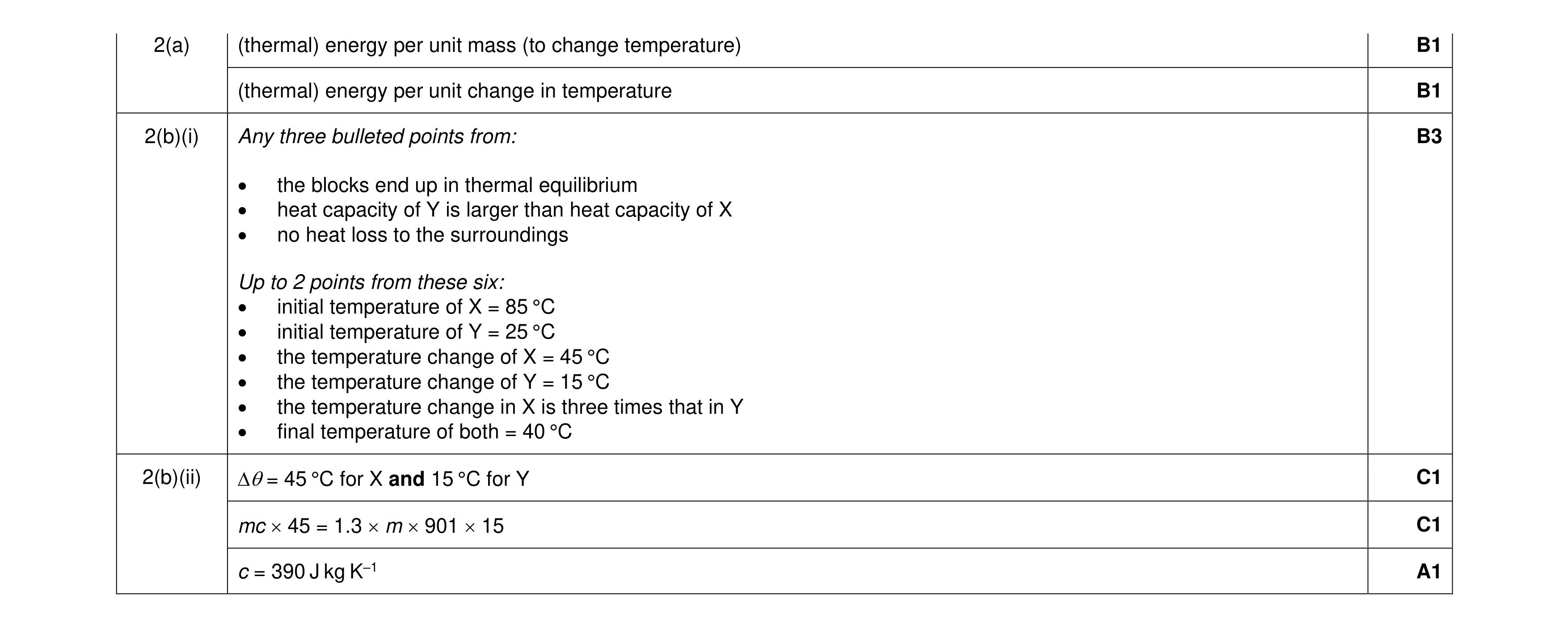 8
8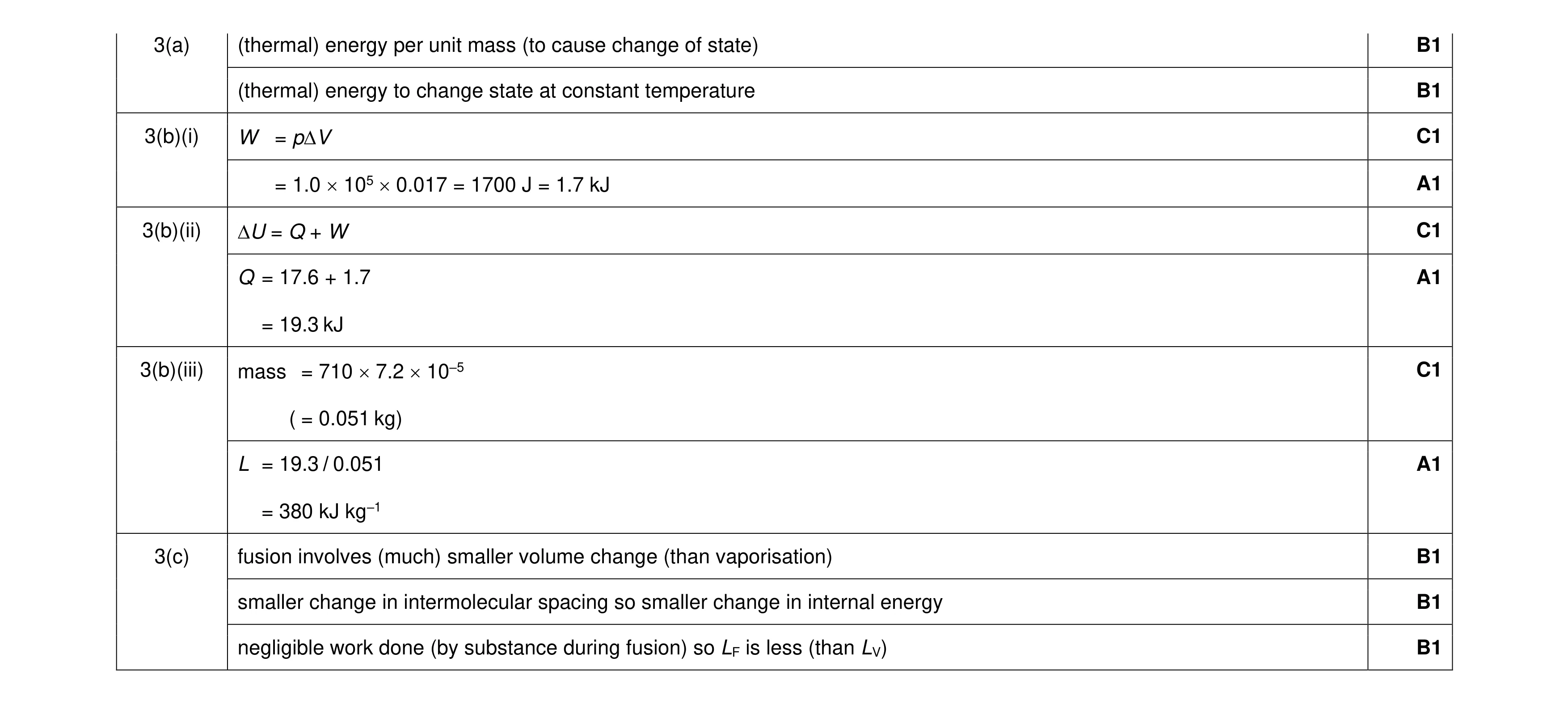 11
11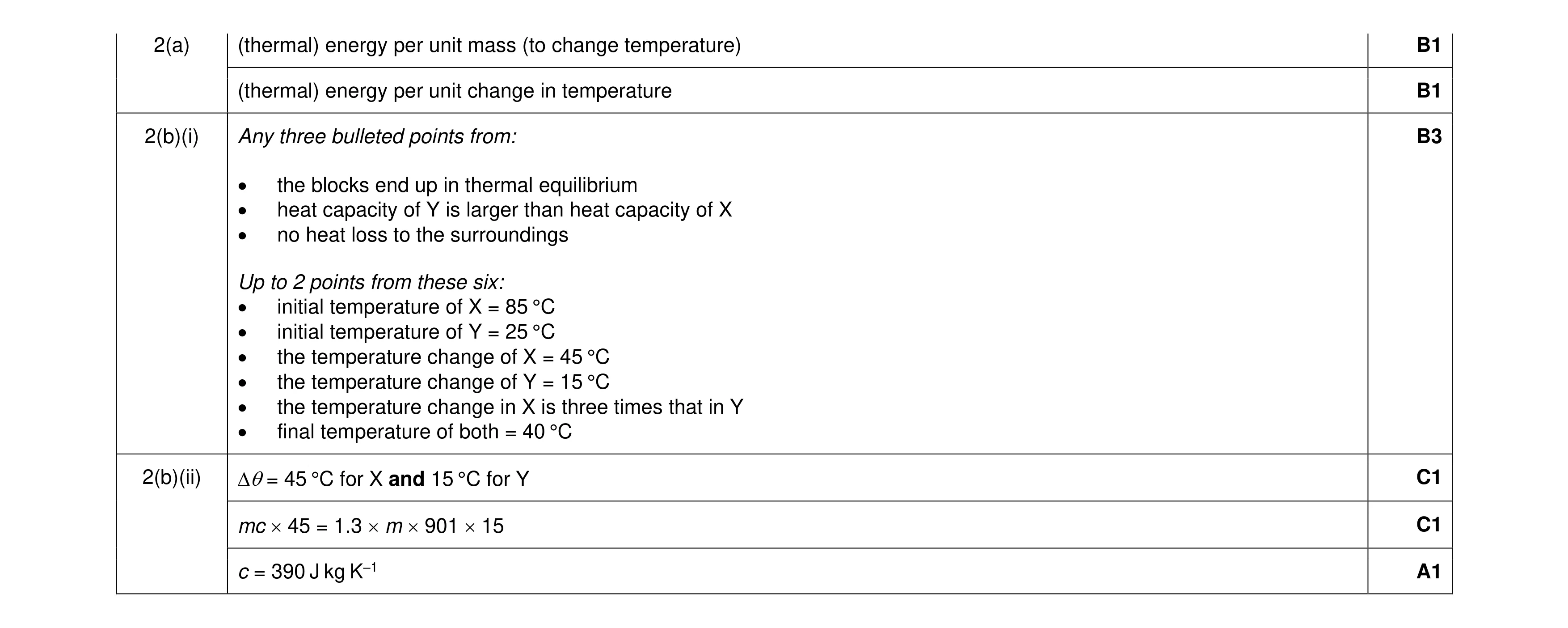 8
8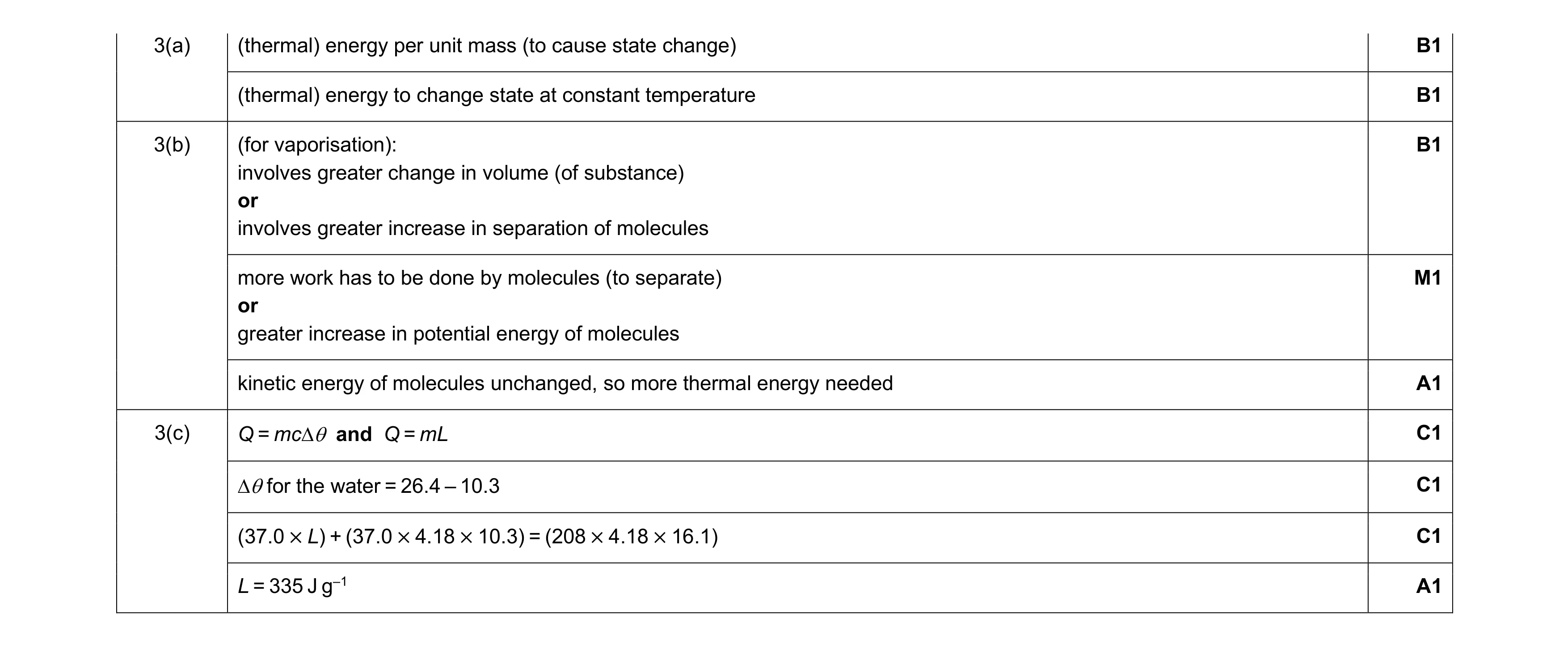 9
9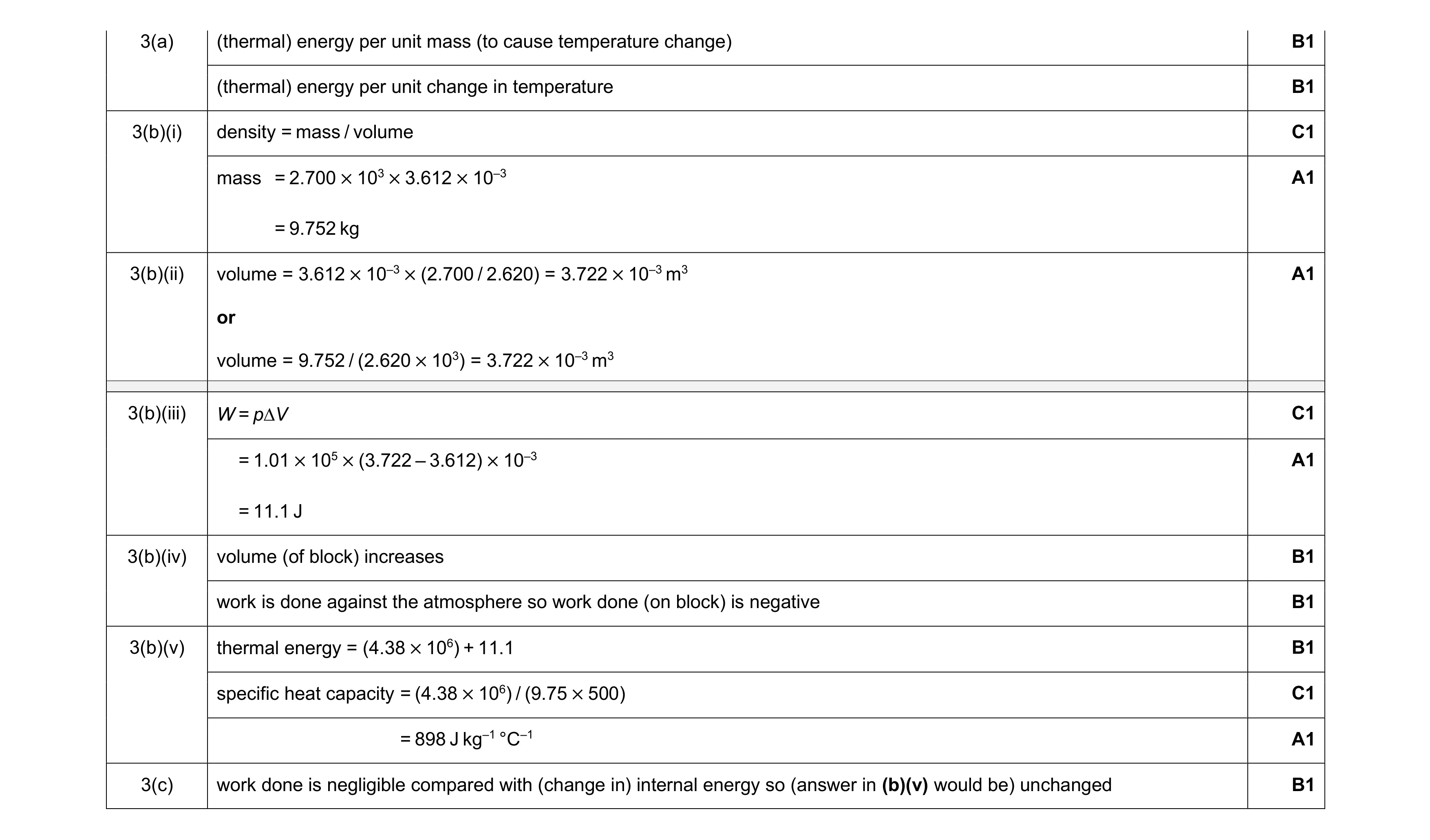 13
13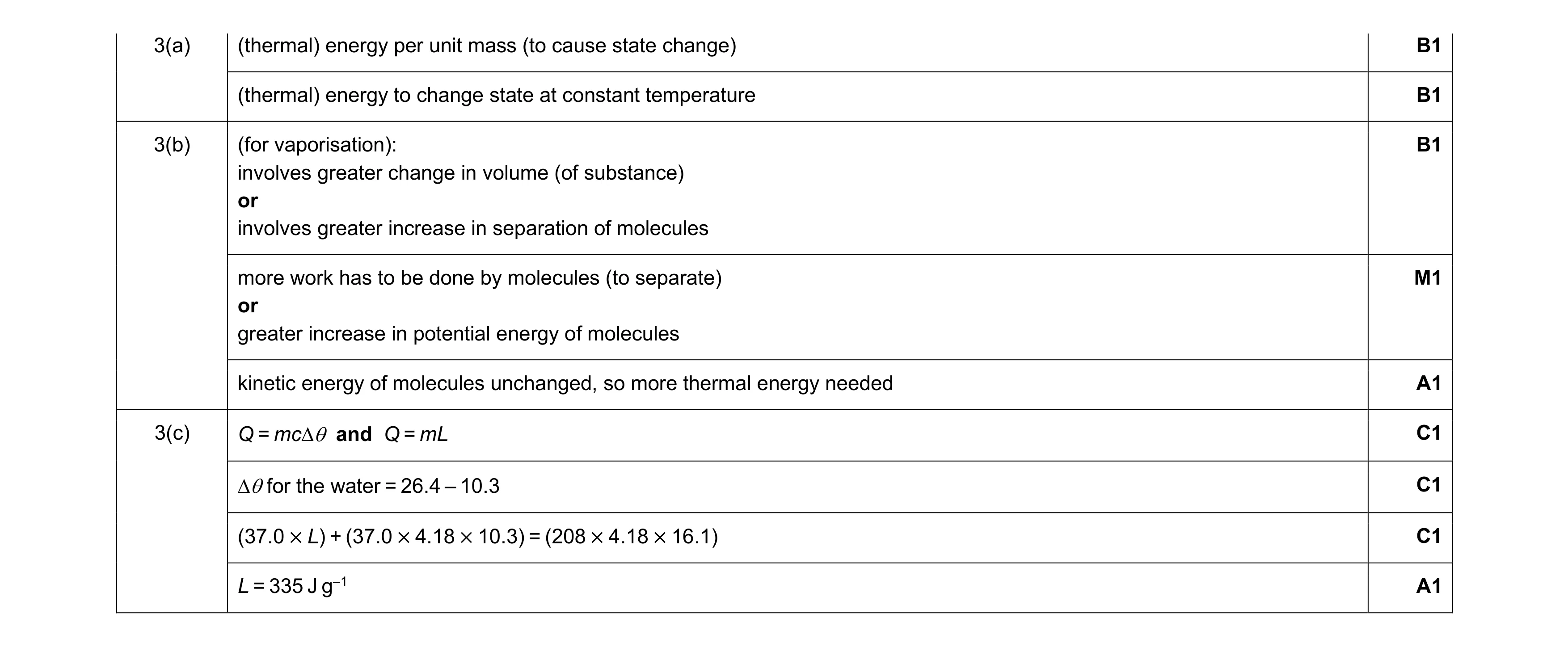 9
9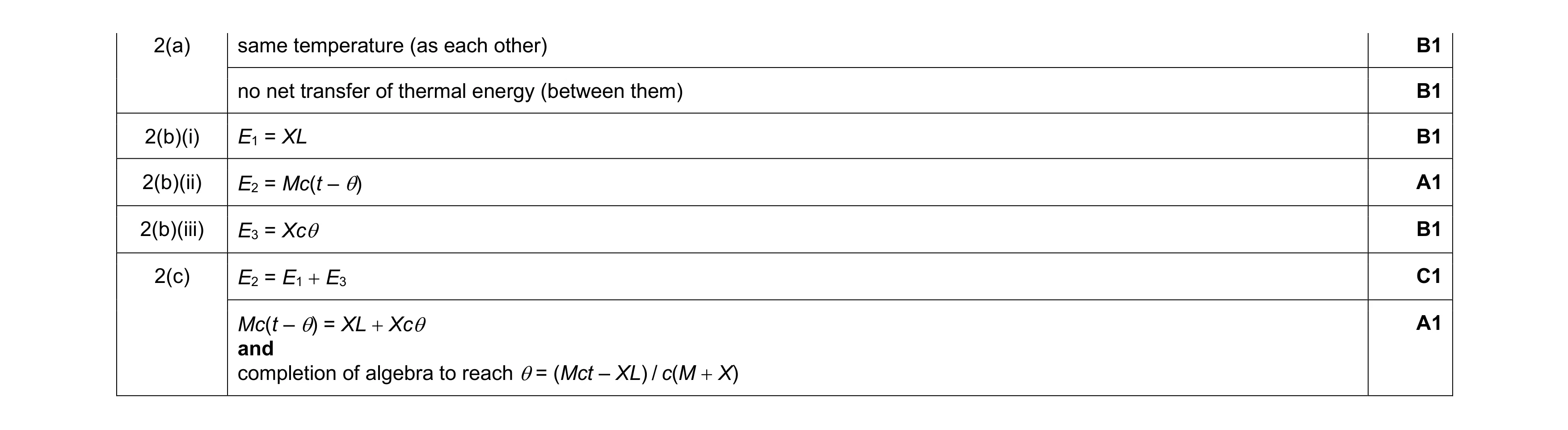 7
7