Questions as text
Q1 · Which statement applies to the boiling but not to the evaporation of a liquid? 9702/11 Oct/Nov 2004
19 Which statement applies to the boiling but not to the evaporation of a liquid? A All the bonds between molecules in the liquid are broken. B At normal atmospheric pressure, the process occurs at one temperature only. C Energy must be provided for the process to happen. D The separation of the molecules increases greatly.
1 marks
Answer: B
This question in 9702/11 Oct/Nov 2004
Q2 · Water can exist in three states: solid, liquid or vapour 9702/11 May/June 2009
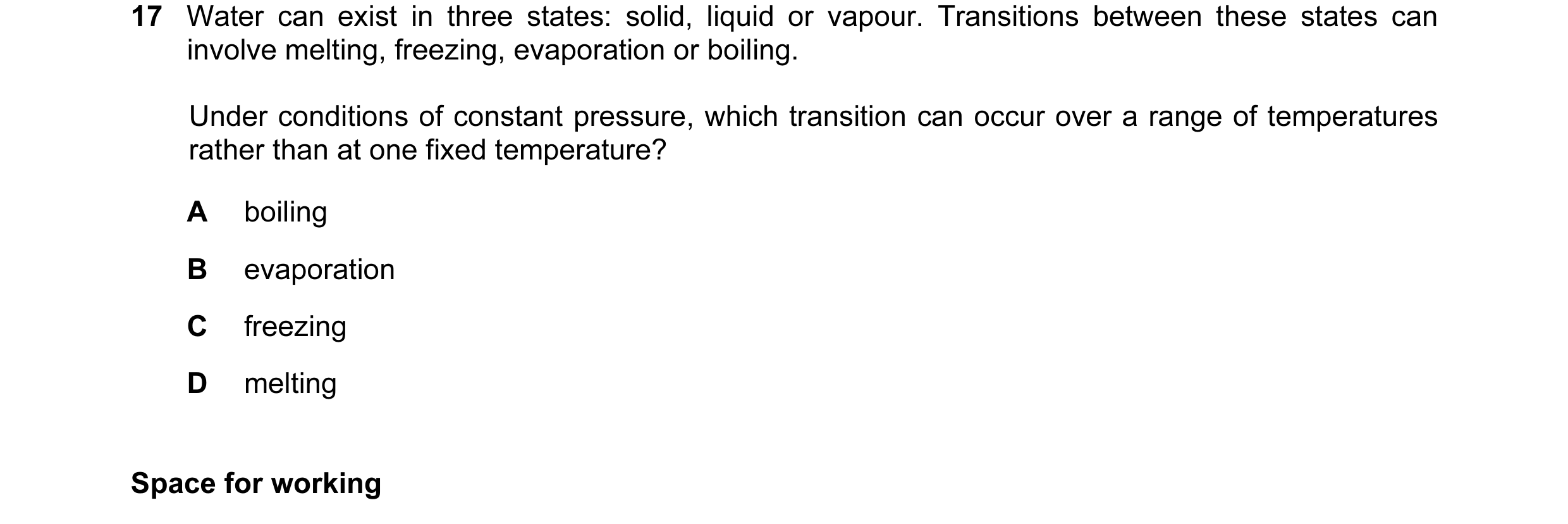
17 Water can exist in three states: solid, liquid or vapour. Transitions between these states can involve melting, freezing, evaporation or boiling. Under conditions of constant pressure, which transition can occur over a range of temperatures rather than at one fixed temperature? A boiling B evaporation C freezing D melting Space for working
1 marks
Answer: B
This question in 9702/11 May/June 2009
Q3 · Which process does not require energy to be supplied? 9702/11 May/June 2011
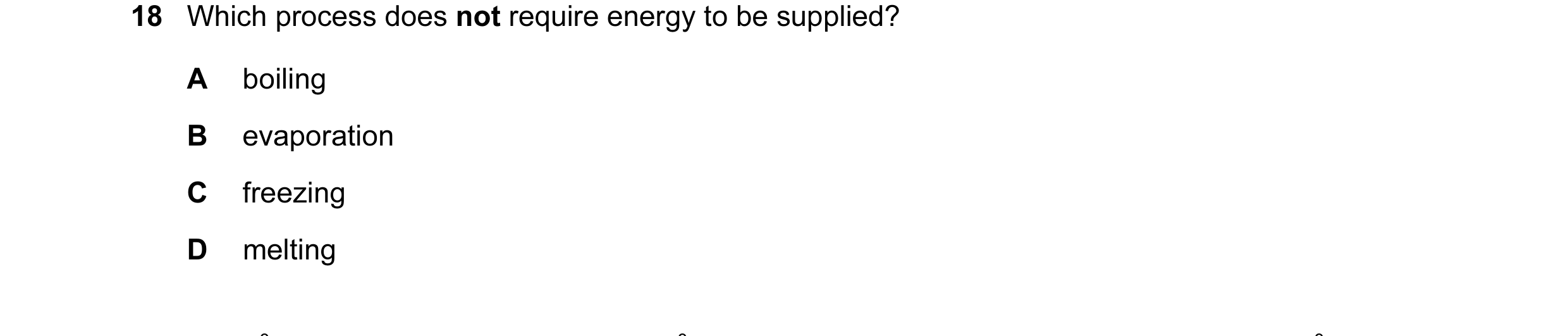
18 Which process does not require energy to be supplied? A boiling B evaporation C freezing D melting
1 marks
Answer: C
This question in 9702/11 May/June 2011
Q4 · Which process does not require energy to be supplied? 9702/13 May/June 2011
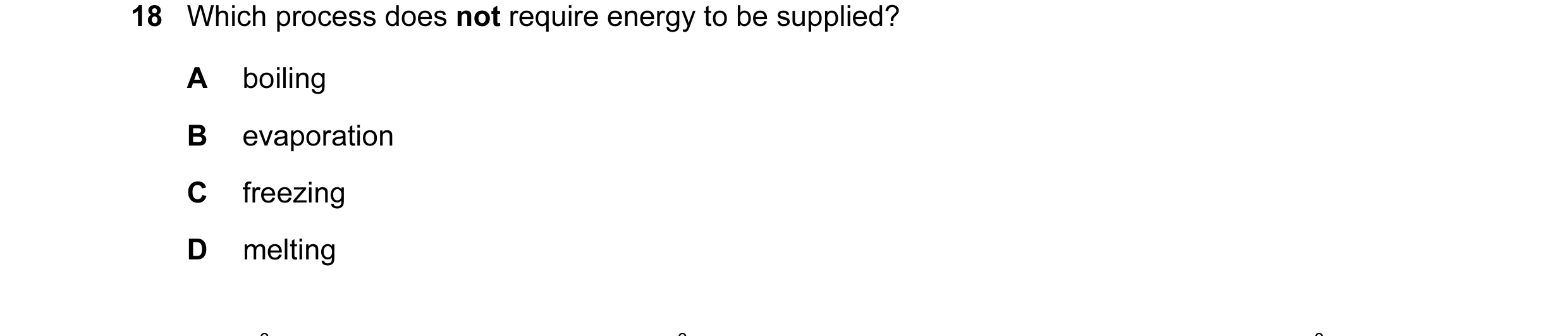
18 Which process does not require energy to be supplied? A boiling B evaporation C freezing D melting
1 marks
Answer: C
This question in 9702/13 May/June 2011
Q5 · Which row correctly states the characteristics of the process of evaporation? 9702/11 May/June 2013
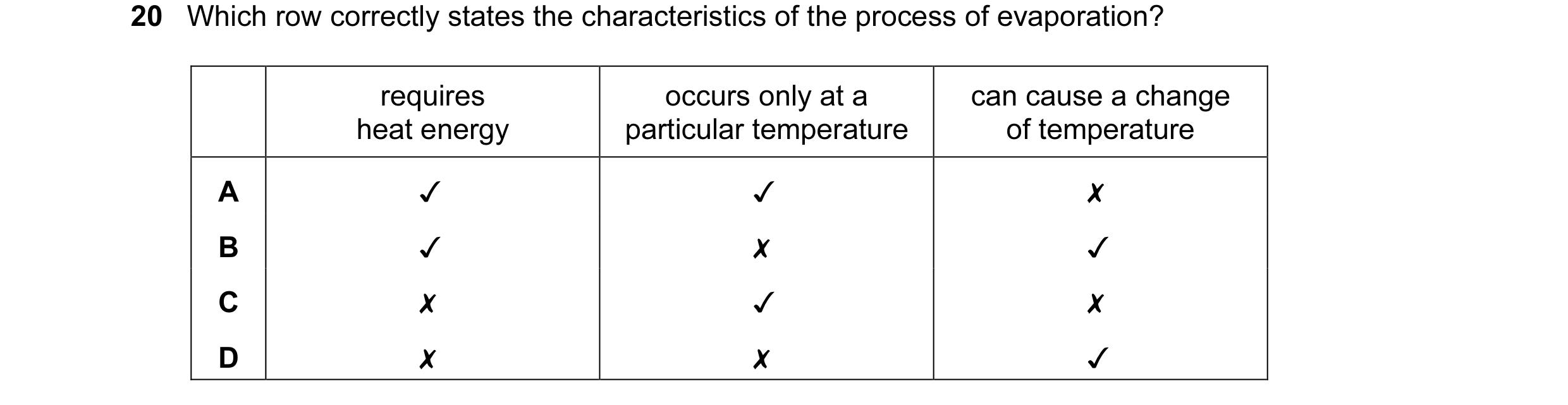
20 Which row correctly states the characteristics of the process of evaporation?
requires occurs only ata can cause a change
heat energy particular temperature of temperature
A v v x
B v x v
Cc x v x
D x x v
1 marks
Answer: B
This question in 9702/11 May/June 2013
Q6 · Which statement about boiling and evaporation is correct? 9702/11 May/June 2014
17 Which statement about boiling and evaporation is correct? A Boiling can only occur at the surface of a liquid. B Evaporation can only occur at a fixed temperature. C Only boiling involves a change of phase. D When some of a liquid evaporates, the rest of the liquid becomes cooler. Space for working
1 marks
Answer: D
This question in 9702/11 May/June 2014
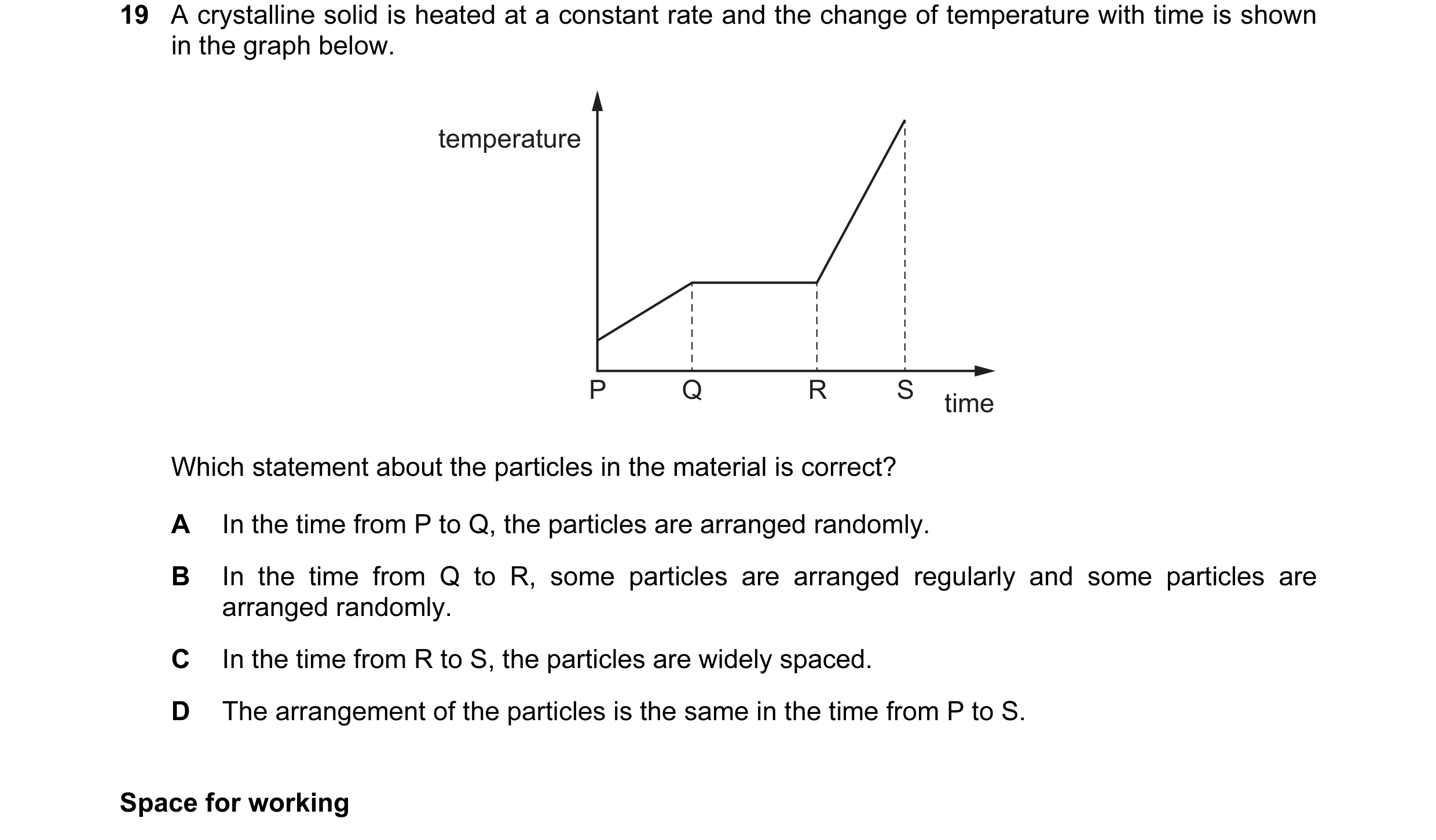
Q7 · A crystalline solid is heated at a constant rate and the change of temperature with time… 9702/11 May/June 2014
19 A crystalline solid is heated at a constant rate and the change of temperature with time is shown in the graph below. temperature P Q R S time Which statement about the particles in the material is correct? A In the time from P to Q, the particles are arranged randomly. B In the time from Q to R, some particles are arranged regularly and some particles are arranged randomly. C In the time from R to S, the particles are widely spaced. D The arrangement of the particles is the same in the time from P to S. Space for working
1 marks
Answer: B
This question in 9702/11 May/June 2014
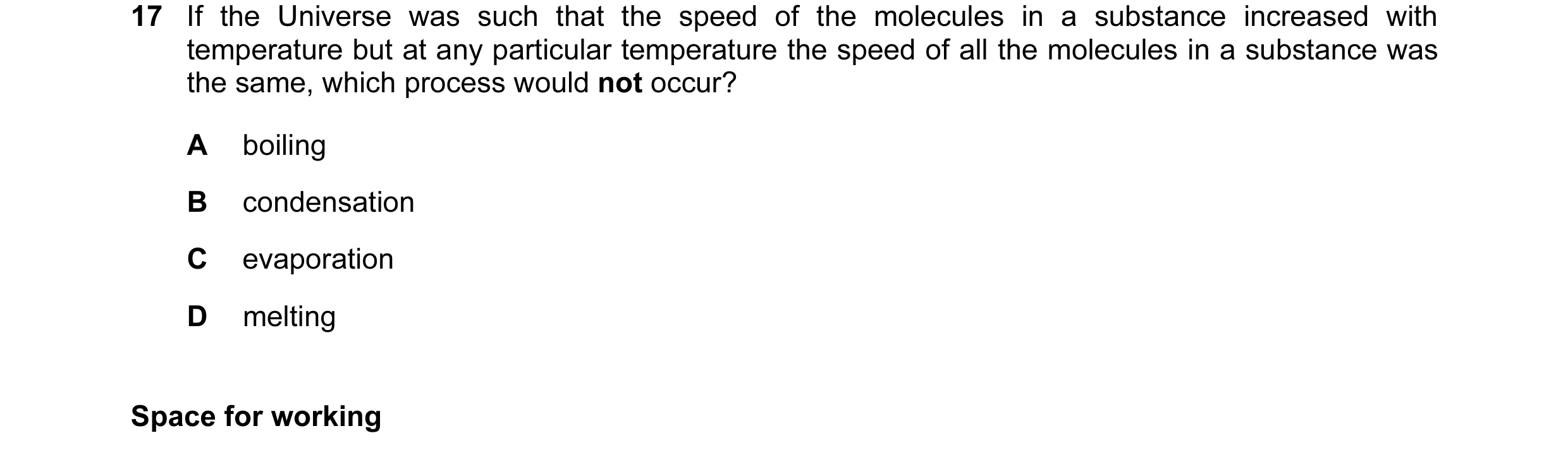
Q8 · If the Universe was such that the speed of the molecules in a substance increased with… 9702/12 May/June 2014
17 If the Universe was such that the speed of the molecules in a substance increased with temperature but at any particular temperature the speed of all the molecules in a substance was the same, which process would not occur? A boiling B condensation C evaporation D melting Space for working
1 marks
Answer: C
This question in 9702/12 May/June 2014
Q9 · The unit of specific heat capacity is J kg–1 K–1 9702/13 May/June 2014
2 The unit of specific heat capacity is J kg–1 K–1. What is its equivalent in terms of SI base units? A kg–1 m2 K–1 B m s–1 K–1 C m s–2 K–1 D m2 s–2 K–1
1 marks
Answer: D
This question in 9702/13 May/June 2014
Q10 · Which process does not require energy to be supplied? 9702/13 May/June 2014
20 Which process does not require energy to be supplied? A boiling B evaporation C freezing D melting Space for working
1 marks
Answer: C
This question in 9702/13 May/June 2014
Q11 · At temperatures close to 0 K, the specific heat capacity c of a particular solid is given… 9702/11 Oct/Nov 2015
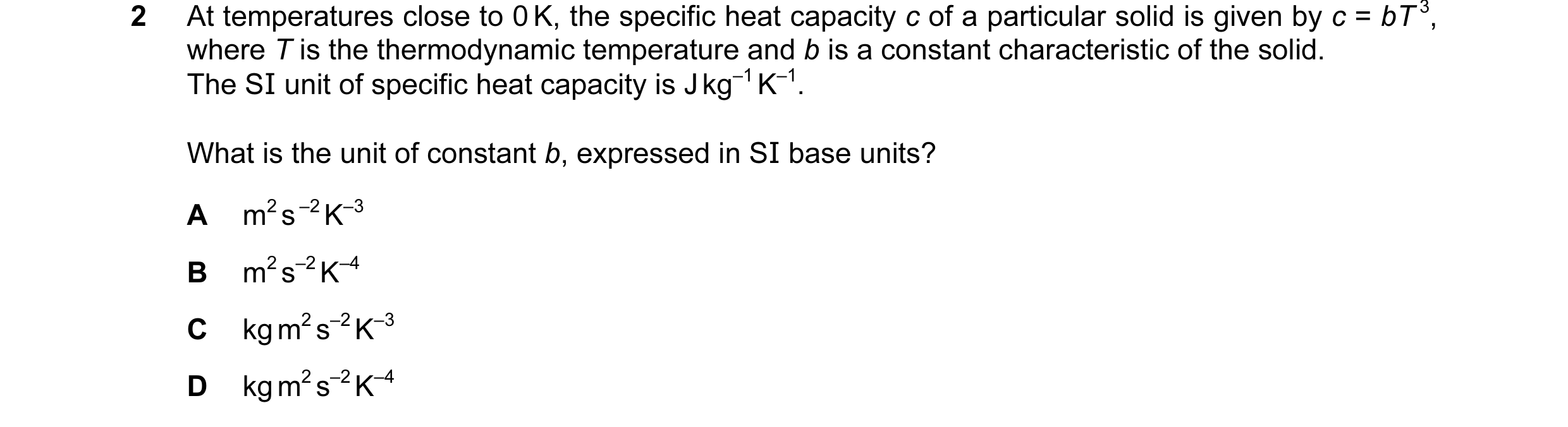
2 At temperatures close to 0 K, the specific heat capacity c of a particular solid is given by c = bT 3, where T is the thermodynamic temperature and b is a constant characteristic of the solid. The SI unit of specific heat capacity is J kg–1 K–1. What is the unit of constant b, expressed in SI base units? A m2 s –2 K–3 B m2 s–2 K–4 C kg m2 s–2 K–3 D kg m2 s–2 K–4
1 marks
Answer: B
This question in 9702/11 Oct/Nov 2015
Q12 · The table summarises some descriptions of evaporation 9702/12 Oct/Nov 2015
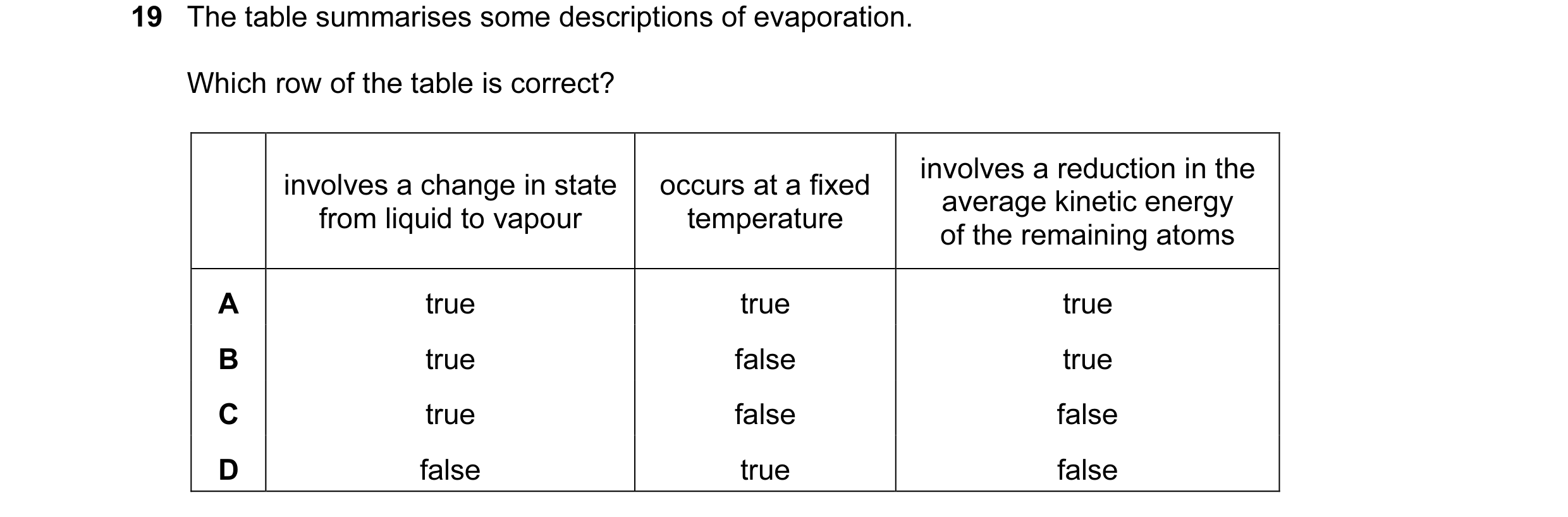
19 The table summarises some descriptions of evaporation. Which row of the table is correct? involves a reduction in the involves a change in state occurs at a fixed average kinetic energy from liquid to vapour temperature of the remaining atoms A true true true B true false true C true false false D false true false
1 marks
Answer: B
This question in 9702/12 Oct/Nov 2015
Q13 · The SI unit of specific heat capacity is J kg–1 K–1 9702/12 Feb/March 2016
3 The SI unit of specific heat capacity is J kg–1 K–1. What is the unit of specific heat capacity expressed in SI base units? A m s–2 K–1 B kg m s–1 K–1 C m2 s–2 K–1 D kg m2 s–1 K–1
1 marks
Answer: C
This question in 9702/12 Feb/March 2016
Q14 · At temperatures close to 0 K, the specific heat capacity c of a particular solid is given… 9702/12 Feb/March 2019
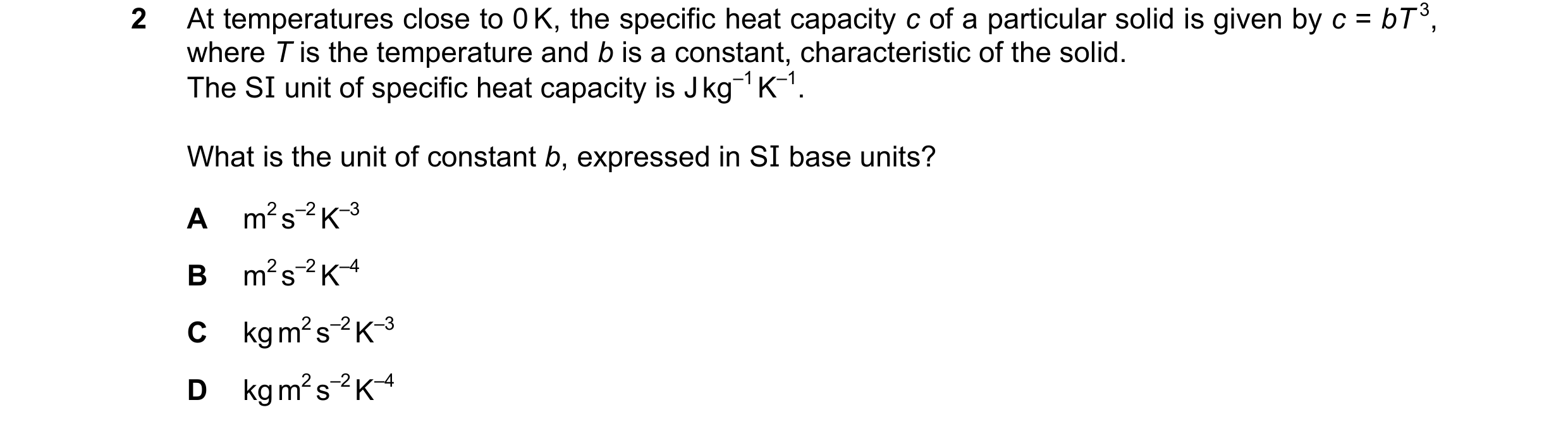
2 At temperatures close to 0 K, the specific heat capacity c of a particular solid is given by c = bT 3, where T is the temperature and b is a constant, characteristic of the solid. The SI unit of specific heat capacity is J kg–1 K–1. What is the unit of constant b, expressed in SI base units? A m2 s–2 K–3 B m2 s–2 K–4 C kg m2 s–2 K–3 D kg m2 s–2 K–4
1 marks
Answer: B
This question in 9702/12 Feb/March 2019

 1 / 3
1 / 3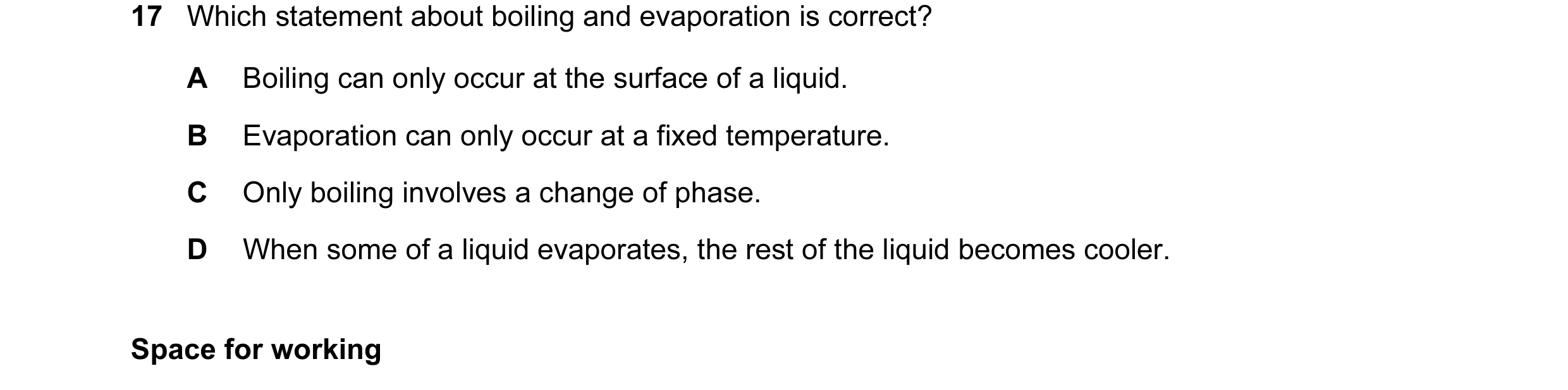
 2 / 3
2 / 3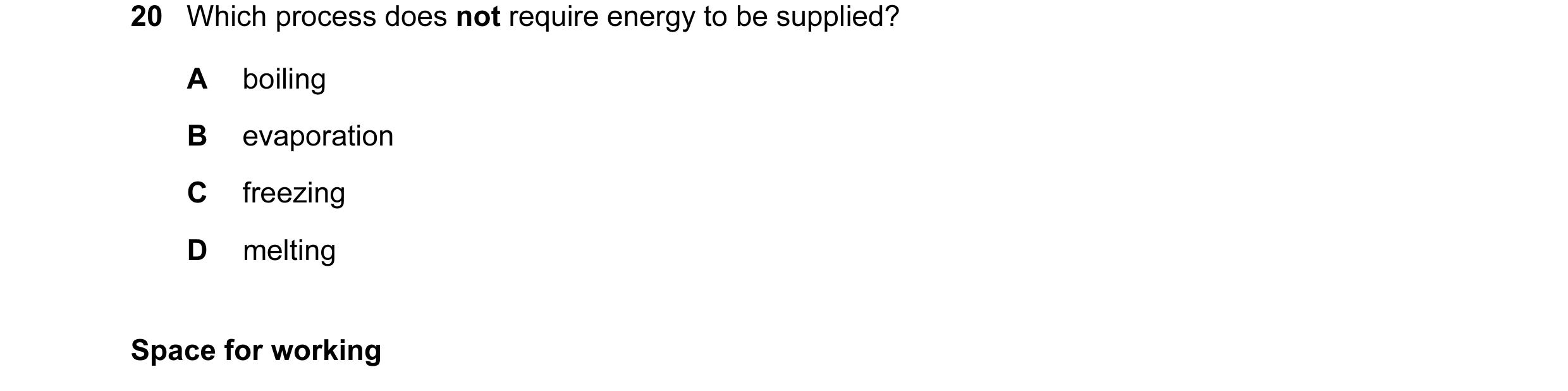

 3 / 3
3 / 3