Questions as text
Q1 · The League of Nations and international relations in the 1920s (a) Explain why the League… 9489/22 Feb/March 2021
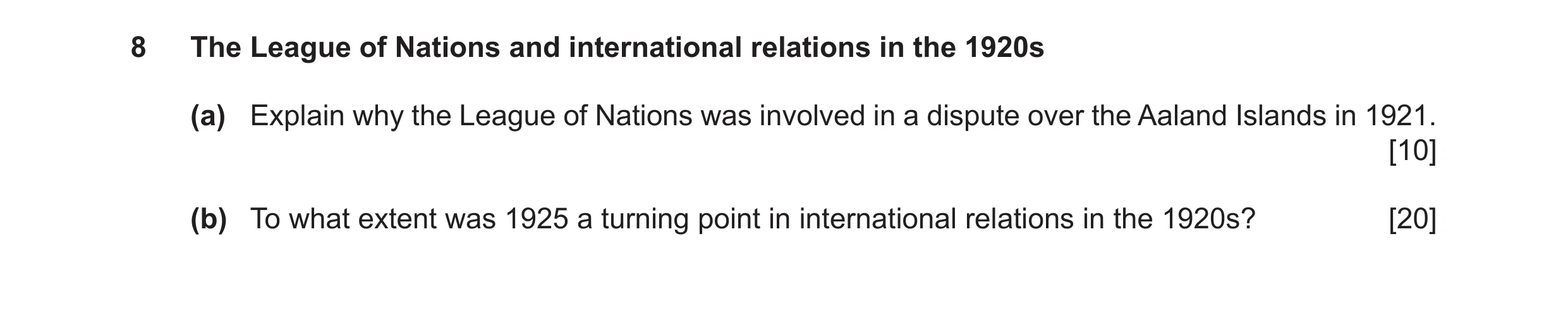
8 The League of Nations and international relations in the 1920s (a) Explain why the League of Nations was involved in a dispute over the Aaland Islands in 1921. [10] (b) To what extent was 1925 a turning point in international relations in the 1920s? [20]
30 marks
Mark scheme: 8(a) Explain why the League of Nations was involved in a dispute over the 10 Aaland Islands in 1921. Finland had only recently become completely independent from Russia and was in a state of change and internal conflict • The Aaland Islands lay in the Gulf of Bothnia between Finland and Sweden. • The Islands had been part of Finland since its separation from Sweden in 1809 and transfer to Russia control. • In December 1917 Finland declared its full independence from Russia. • The residents of Aaland Islands were almost entirely Swedish. • As an issue of self-determination they asked to become part of Sweden so the matter was referred to the League. Accept other valid responses. 8(b) To what extent was 1925 a turning point in international relations in the 20 1920s? In 1925 the Locarno Pact was signed and so responses will need to consider whether this was a significant landmark in international relations or whether it in fact changed very little. It confirmed the western borders of Germany with France and Belgium. This was supported by other signatories GB and Italy. It stabilised relations between France and Germany. it was followed by French Treaties with Poland and Czechoslovakia and followed up by Kellogg Briand Pact. It was agreed that allied troops should leave Rhineland in 1930, five years ahead of schedule. Germany was admitted to the League of Nations in 1926. The ‘Spirit of Locarno’ was created. It did not actually change anything simple formalised arrangements already made in the provisions of the Treaty of Versailles. It provided no real guarantees for Poland and Czechoslovakia, just an agreement to negotiate over border issues. Poland and Czechoslovakia received no guarantees from GB. Better relations were really a result of better economic circumstances following the Dawes Plan of 1924. Improvement of Franco– German relations owed more to efforts of Gustav Stresemann. Accept other valid responses.
This question in 9489/22 Feb/March 2021
Q2 · The League of Nations and international relations in the 1920s (a) Explain why the League… 9489/22 May/June 2021
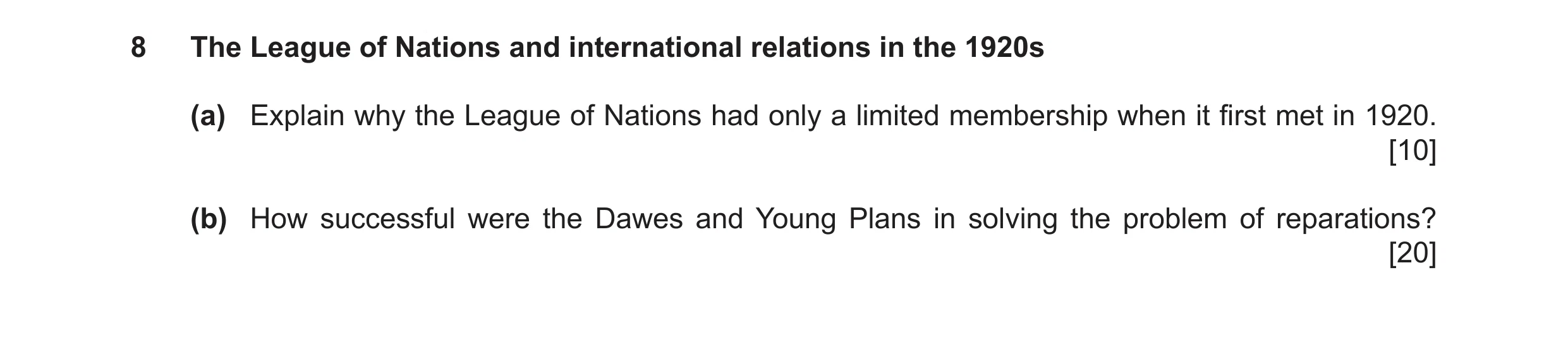
8 The League of Nations and international relations in the 1920s (a) Explain why the League of Nations had only a limited membership when it first met in 1920. [10] (b) How successful were the Dawes and Young Plans in solving the problem of reparations? [20]
30 marks
Mark scheme: 8(a) Explain why the League of Nations had only a limited membership 10 when it first met in 1920. • Countries that had lost in the war were not invited to join, i.e., Germany, Austria, and Turkey. • Russia had abandoned its alliance with France and Britain and was in the midst of a Civil War, so it was not invited to the League of Nations’ founding conference in Versailles. • Eastern European states had only just been created as independent units and were still organising their internal affairs. • Because most of Africa was still under European control, Liberia was the only independent African state. • Much of the Middle East and South East Asia was still under European control. Accept any other valid responses. 8(b) How successful were the Dawes and Young Plans in solving the 20 problem of reparations? Most candidates will likely write about the two plans separately, though the explanation of overall successes and failures can be combined. Dawes Plan The removal of French and Belgian troop from Ruhr led to a reduction of international tensions. It ended hyper-inflation with a new currency. It restructured reparations payments and the Reichsbank. Separately, but vital to success, the US agreed to large loans to Weimar. However, the Dawes Plan was a short term measure, hence the need for Young. It left Germany vulnerable to fluctuations in the US economy. Young Plan The Young Plan reduced the overall reparations bill and set up a long-term repayments plan. To handle payments, it established the Bank for International Settlements. However, the Wall Street Crash and the subsequent Great Depression destroyed Germany’s ability to pay. Once he was established in power, Hitler repudiated all reparations debts. Overall, both plans worked well in the short term and offered the possibility of a longer-term solution. However, economic and political circumstances derailed their plans. Accept any other valid responses.
This question in 9489/22 May/June 2021
Q3 · The League of Nations and international relations in the 1920s (a) Explain why the French… 9489/23 May/June 2021
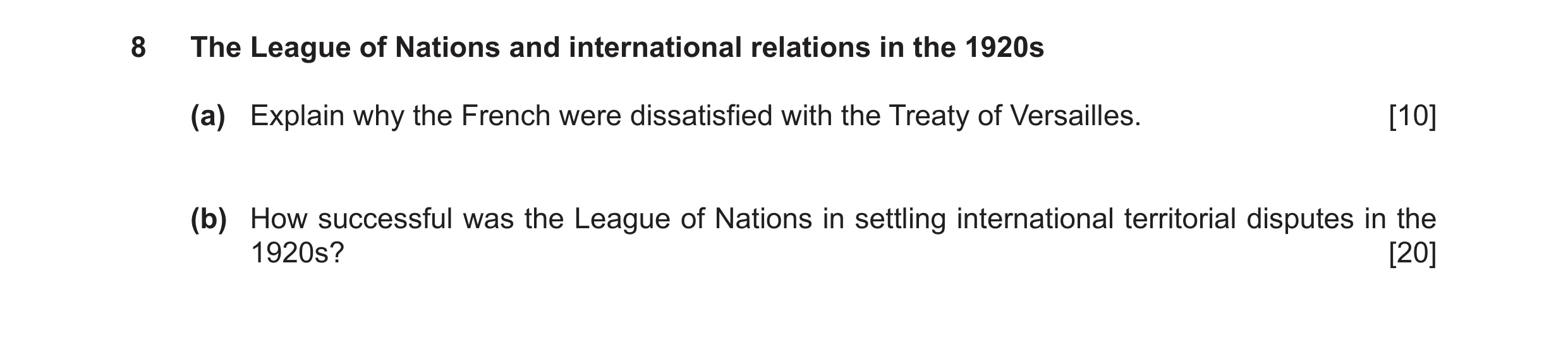
8 The League of Nations and international relations in the 1920s (a) Explain why the French were dissatisfied with the Treaty of Versailles. [10] (b) How successful was the League of Nations in settling international territorial disputes in the 1920s? [20]
30 marks
Mark scheme: 8(a) Explain why the French were dissatisfied with the Treaty of Versailles. 10 The key to this response is an understanding of French expectations at the Versailles negotiations which were based on revanche and reparation • The French wanted Germany permanently disabled, preferably broken up into smaller states; this did not happen • The French wanted key areas like the Rhineland and the Saar coalfields but though the Rhineland was demilitarised and the Saar was placed under French/British control for 15 years. this was less than expected • They did not gain full control of German colonies which were placed under League of Nations mandate • The reparation figure that was eventually agreed was less than the French wanted • Failure of USA to ratify ToV left France feeling abandoned by its allies. Accept other valid responses. 8(b) How successful was the League of Nations in settling international 20 disputes in the 1920s? The League of Nations (LoN) mediated in the Aaland islands dispute between Sweden and Finland 1920. Resolved the Upper Silesia coalfield dispute between Poland and Germany 1922. It settled the issue of Memel (1920). Settled the Greco-Bulgarian border dispute 1925.Introduced the Slavery Convention 1926. Continued to work throughout the 1920s for an international disarmament conference with a preparatory commission set up in 1925. However, the LoN could not prevent Polish seizure of Vilnius region from Lithuania 1921. Mussolini would not back down over the Corfu crisis (though not strictly a LoN issue the murdered Italians were working on behalf of the League). All attempts to agree measures for disarmament as proposed in the Versailles Settlement failed though the League did set up a preparatory commission in 1925 to move towards an international conference on this (which did meet in 1933 but was a failure). The ILO failed to get international agreement on 48 hour working week. Responses need not cover all of the above but will need to present a reasonable balance between examples of success and failure and better responses will need to make a reasoned judgement of the level of success. Accept other valid responses.
This question in 9489/23 May/June 2021
Q4 · The League of Nations and international relations in the 1920s (a) Explain why… 9489/22 Oct/Nov 2021
8 The League of Nations and international relations in the 1920s (a) Explain why Franco–German relations improved after 1924. [10] (b) How important were the Agencies in the work of the League of Nations in the 1920s? [20]
30 marks
Mark scheme: 8(a) Explain why Franco‒German relations improved after 1924. 10 In the aftermath of the occupation of the Ruhr, numerous factors led to improvement: • The Dawes Plan settled the issue of reparations, at least in the short term. • A new currency in Germany stabilised economy and improved economy. • A positive relationship between Gustav Stresemann and Aristide Briand. • The Locarno treaty confirming western borders of Germany with France (and Belgium) and led to German admission into the League of Nations. Accept any other valid responses. 8(b) How important were the Agencies in the work of the League of Nations 20 in the 1920s? Responses will need to try to establish a comparison between the work of the Agencies and the work of the main organs of the League. Agencies of the League The Court of International Justice made judgements on shipping and fisheries issues, but no powers of enforcement. The Health Committee made limited progress in fight against Malaria and Leprosy. The ILO improved working conditions in many countries but failed to get full international agreement of 48 hour working week. In 1920, the Refugees Committee returned half a million prisoners of war home and provided support for thousands of Turkish refugees in 1922. The Mandates Commission established mandatory controls over former German and Turkish territories (but in effect just gave control to the victorious nations of WW). The Slavery Commission and Slavery Convention 1926 successfully campaigned for freedom of 200 000 slaves in Sierra Leonne and Burma. Organs of the League There were successes in settling disputes peacefully in the Aaland Islands, Silesia Coalfields dispute and Greco-Bulgarian border dispute, etc. These should be measured against failures in the Poland-Lithuania conflict over Vilnius, Corfu crisis, etc. Many key decisions were made in the ‘Conference of Ambassadors’ (representatives of main powers) and were simply rubber-stamped by the League. The Secretariat was constantly understaffed and as a result were often unable to function. Accept any other valid responses.
This question in 9489/22 Oct/Nov 2021
Q5 · The League of Nations and international relations in the 1920s (a) Explain why the League… 9489/23 Oct/Nov 2021
8 The League of Nations and international relations in the 1920s (a) Explain why the League of Nations was involved in Eastern Europe in the 1920s. [10] (b) How successful was the Washington Naval Conference of 1921–22? [20]
30 marks
Mark scheme: 8(a) Explain why the League of Nations was involved in Eastern Europe in 10 the 1920s. There are a number of reasons to be considered here largely arising from the Versailles Settlement and the role envisaged for the League within the terms of those Treaties. This question is not about success of the League, just its involvement, so it is just as valid to identify involvements that did not have successful outcomes as those that did. Specific areas on involvement might include: • Specific territories; Aaland Islands, Vilnius. • Border issues; Greece/Bulgaria, Corfu incident. • Economic issues: Upper Silesian coalfield, Austrian government bankruptcy. • Humanitarian issues; prisoners of war and refugees. Accept any other valid responses. 8(b) How successful was the Washington Naval Conference of 1921‒22? 20 Successes are largely going to be about what was agreed at the Conference, whilst alternative perspective will need to look at why not all signatories were happy with the outcome and/or found loopholes in the restrictions. Three separate agreements were signed; the Four Power Pact, the Five Power Naval Limitations Agreement and the Nine Power Pact. A Four Power Pact established a process for settling territorial dispute in the Pacific between US, GB, Japan and France. The Five Power Treaty established relative strengths of, and limitations on, the five main naval powers 5:3:1.67 – US/GB: Japan: France/Italy. The Nine Power Pact affirmed China’s independence and agree the equal trading rights of the signatory nations (5 plus Portugal, the Netherlands and Belgium). It led to a significant reduction in the number of capital ships of the major powers; some were scrapped, and planned building was cancelled. The United States continued an active building programme by replacing obsolete battleships with technically more advanced models. Some part-built new ships were converted into aircraft carriers. In the late 1920s there was a mini naval race in building heavy cruisers which were limited in size but not in number by the Treaty. The four-power pact lacked clarity and never really worked The Five-Power Treaty was set for 10 years and was abandoned when Japan demanded parity with US and GB in 1935. The Nine Power Pact was abandoned by the Japanese when they invaded Manchuria. Accept any other valid responses.
This question in 9489/23 Oct/Nov 2021
Q6 · The League of Nations and international relations in the 1920s (a) Explain why Poland, as… 9489/22 Feb/March 2022
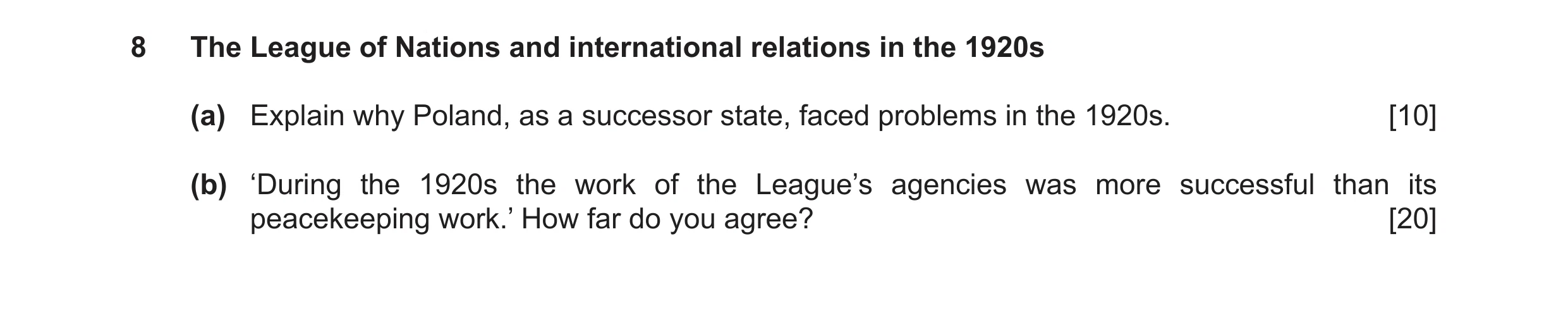
8 The League of Nations and international relations in the 1920s (a) Explain why Poland, as a successor state, faced problems in the 1920s. [10] (b) ‘During the 1920s the work of the League’s agencies was more successful than its peacekeeping work.’ How far do you agree? [20]
30 marks
Mark scheme: 8(a) Explain why Poland, as a successor state, faced political and economic 10 problems in the 1920s. Indicative content Poland had not existed as an independent state for over 120 years and its territory had been divided between 3 empires, Russia Germany and Austria: • No tradition of democratic government and few people with relevant experience. • Range of nationalities; over one third of population was not Polish • Disputes over borders (Polish Russian War). • Lack of coherent economic and transport structure. • Silesian coalfield dispute with Germany not solved until 1923. • Political chaos led to military coup in 1926 by General Pilsudski. • Problem of Danzig. Accept any other valid responses. 8(b) ‘During the 1920s the work of the League’s agencies was more 20 successful than its peacekeeping work.’ How far do you agree? Indicative content There were successes and failures in both areas and a strong response will consider the balance of successes and failures between the different parts of the organisation. Agencies Half a million PoW’s were returned home. Provided food and shelter for Turkish refugees (1922). It approved a Slavery Convention (1926) and freed over 200 000 slaves. Worked on improving the treatment of malaria and leprosy. BUT ILO plan for 48-hour week failed to get approval. Peacekeeping The League settled Aaland islands dispute and Silesian coalfields dispute. Ended Greco-Bulgarian War. Economic experts were sent to Austria in 1923 when the government went bankrupt. BUT failed to end Polish invasion of Lithuania in 1921. Was ignored by Mussolini when it ordered him to withdraw from Corfu. Failed to make any progress towards disarmament, though planning did continue for an international conference in the 1930s. Any reasoned judgement on relative success should be rewarded appropriately. Accept any other valid responses.
This question in 9489/22 Feb/March 2022
Q7 · The League of Nations and international relations in the 1920s (a) Explain why the League… 9489/21 May/June 2022
8 The League of Nations and international relations in the 1920s (a) Explain why the League of Nations had limited success in the 1920s. [10] (b) ‘The peace settlement of 1919–20 succeeded in creating stability in Eastern Europe.’ How far do you agree with this statement? [20]
30 marks
Mark scheme: 8(a) Explain why the League of Nations had limited success in the 1920s. 10 Indicative content The answer to this question is expected to focus on the intrinsic structural weaknesses of the League: It was initially seen as a ‘club’ for the victors – the defeated powers were only slowly admitted. (Austria was allowed to join in 1920, Hungary in 1922 and Germany in 1926, but Turkey and the USSR were not admitted until the 1930s). It was an integral part of the Treaty of Versailles which increased its unpopularity with the defeated nations. USA never joined. This denied the League access to American political, economic and military influence. The League came about through American diplomacy, so its absence raised questions about the League’s legitimacy. It did not have any powers to enforce its decisions, e.g., Polish invasion of Lithuania. Mussolini/Corfu incident. All decisions had to be unanimous. If this was not achieved, then nothing could be done. Accept any other valid responses. 8(b) ‘The peace settlement of 1919–20 succeeded in creating political and 20 economic stability in Eastern Europe.’ How far do you agree with this statement? Indicative content The weight of the argument will tend to be on the disagree side but there are positives to be identified in order to create a balanced judgement. Sufficient to reach the higher levels of the mark scheme: Disagree: Issue of minorities – new borders left most states with significant minorities (e.g., in Poland around one third were non-Polish including Germans, Ukrainians, Jews and Belarussians who were increasingly hostile to perceived discrimination against them). There was a lack of democratic tradition and experienced leadership which created instability, e.g., in Poland political instability led to coup by General Pilsudski in 1926. States had previously been part of larger Empires with integrated economic structures. New boundaries created artificial economic divisions, e.g., Austria was left with limited industrial resources that led to bankruptcy in 1922 when Austrian economy was placed under League supervision. The attempt to apply Wilson’s self-determination principle led to displaced persons, refugees and fresh conflicts, e.g., Poland/Russia, Greece/Bulgaria. Agree: With some minor adjustments the boundaries created were largely stable. Some countries established sound economies and successful governments, e.g., Czechoslovakia. It resolved many pre-war issues in the Balkans with the creation of Yugoslavia. Some minor issues were solved by negotiation, e.g., Silesian Coalfields dispute was dealt with by the LoN. In the 1920s the settlement of the Danzig issue seemed to be working; it was only in the thirties that it became an increasing problem. Accept any other valid responses.
This question in 9489/21 May/June 2022
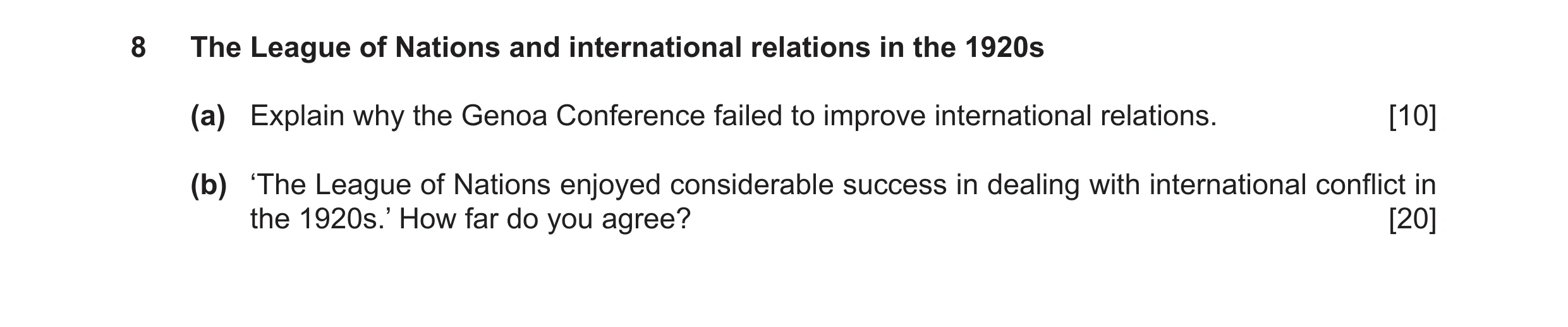
Q8 · The League of Nations and international relations in the 1920s (a) Explain why the Genoa… 9489/22 May/June 2022
8 The League of Nations and international relations in the 1920s (a) Explain why the Genoa Conference failed to improve international relations. [10] (b) ‘The League of Nations enjoyed considerable success in dealing with international conflict in the 1920s.’ How far do you agree? [20]
30 marks
Mark scheme: 8(a) Explain why the Genoa Conference failed to improve international 10 relations. Indicative content Russia and Germany remained isolated, France aggrieved and Britain powerless because: Russia and Germany signed the Treaty of Rapallo and withdrew from the conference. The major powers at first agreed on a package of aid to Russia, but the Allies could not agree on the final plan and nothing was offered. The issue of German reparations went nowhere after Poincaré (France) threatened to invade Germany if it failed to keep up reparation payments. Lloyd George was increasingly under heavy attacks from the London newspapers. He offered a final series of linked financial proposals, but nothing was approved. France and Belgium withdrew, and the final draft proposal to Russia was signed only by Britain, of the major world powers. Russia in turn rejected this final document. Absence of the US reduced confidence in any possible compromises without US guaranteed backing. Accept any other valid responses. 8(b) The League of Nations enjoyed considerable success in dealing with 20 international conflict in the 1920s.’ How far do you agree? Indicative content The essential requirement of this question is a balanced analysis and overall judgement about the successes and failures of the League in the 1920s. Successes might include: The League took home half a million prisoners of war from World War One. In 1921 Sweden and Finland accepted the League's arbitration to give the Aaland Islands to Finland. In 1922 the League set up camps and fed Turkish refugees. The League sent economics experts to help Austria when its government went bankrupt in 1923. Greece obeyed the League's orders to pull out of Bulgaria in 1925. Failures might refer to: The Poles in 1921 invaded Vilna (the capital of Lithuania). The League ordered Poland to withdraw. Poland refused and the League could do nothing. In 1923 Mussolini ignored the League's orders to pull out of Corfu, and made Greece pay money to Italy. Attempt to promote disarmament talks failed to make any progress in the 1920s. In 1928, 65 countries signed the Kellogg/Briand Pact, a treaty to end war – but then they just ignored it. Accept any other valid responses.
This question in 9489/22 May/June 2022
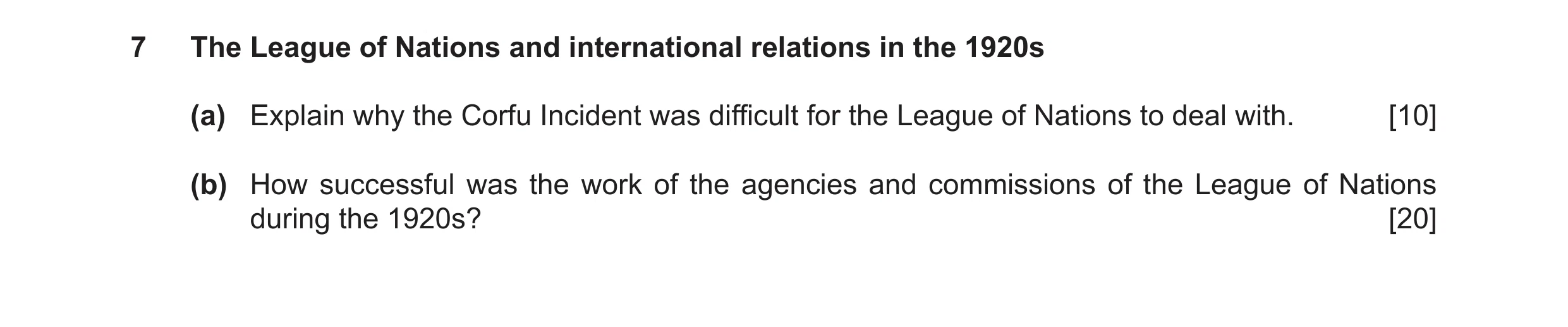
Q9 · The League of Nations and international relations in the 1920s (a) Explain why the Corfu… 9489/22 Feb/March 2023
7 The League of Nations and international relations in the 1920s (a) Explain why the Corfu Incident was difficult for the League of Nations to deal with. [10] (b) How successful was the work of the agencies and commissions of the League of Nations during the 1920s? [20]
30 marks
Mark scheme: 7(a) Explain why the Corfu Incident was difficult for the League of Nations 10 to deal with. Indicative content • Overall failure – the decision made by the League to agree to the terms put forward by Italy showed an unwillingness to stand up to bullying tactics of a big country against a weaker one. • Demonstrated that it was difficult for the League to deal with an incident involving one of its more powerful members. • Demonstrated that without military force the League had little power. • League lacked a mechanism for negotiations and most of them were delegated to the Conference of Ambassadors • Projected the view that the League was not able to control or influence the more powerful nations. Accept any other valid responses. 7(b) How successful was the work of the agencies and commissions of the 20 League in the 1920s? Indicative content Candidates need to consider the successes and limitations of several (but not necessarily all) of the agencies and committees attached to the League. The major ones include: The ILO, although having the same members as the League and being subject to the budget control of the Assembly, was an autonomous organisation with its own Governing Body, its own General Conference, and its own Secretariat. Its constitution differed from that of the League: representation had been accorded not only to governments but also to representatives of employers' and workers' organisations. The ILO successfully restricted the addition of lead to paint. It convinced several countries to adopt an eight-hour working day and forty-eight-hour working week but failed to get this proposal universally accepted. It also campaigned to end child labour, increase the rights of women in the workplace, and make shipowners liable for accidents involving seamen with some success but again not universally. The Slavery Commission sought to eradicate slavery and slave trading across the world and fought forced prostitution. Its main success was through pressing the governments who administered mandated countries to end slavery in those countries. The League secured a commitment from Ethiopia to end slavery as a condition of membership in 1923 and worked with Liberia to abolish forced labour and intertribal slavery. Records were kept to control slavery, prostitution, and the trafficking of women and children. Partly as a result of pressure brought by the League of Nations, Afghanistan abolished slavery in 1923, Iraq in 1924, Nepal in 1926, Transjordan and Persia in 1929. Overall, the League succeeded in freeing over 200 000 slaves. The Commission for Refugees was established on 27 June 1921 to look after the interests of refugees, including overseeing their repatriation and, when necessary, resettlement. At the end of the First World War, there were two to three million ex-prisoners of war from various nations dispersed. Throughout Russia, within two years of the commission's foundation, it had helped 425 000 of them return home. It established camps in Turkey in 1922 to aid the country with an ongoing refugee crisis, helping to prevent the spread of cholera, smallpox and dysentery as well as feeding the refugees in the camps. It also established the Nansen passport as a means of identification for stateless people. The Disarmament Committee. Attempts to reach agreement in 1923 failed due to French refusal to accept limitations. A separate commission was set up in 1926 in the ‘spirit of Locarno’ to plan a further conference – did not take place until 1932 and ended in failure. The Mandate Commission. Received annual reports on mandated territories. Responsible for overseeing administration of mandates. Accept any other valid responses.
This question in 9489/22 Feb/March 2023
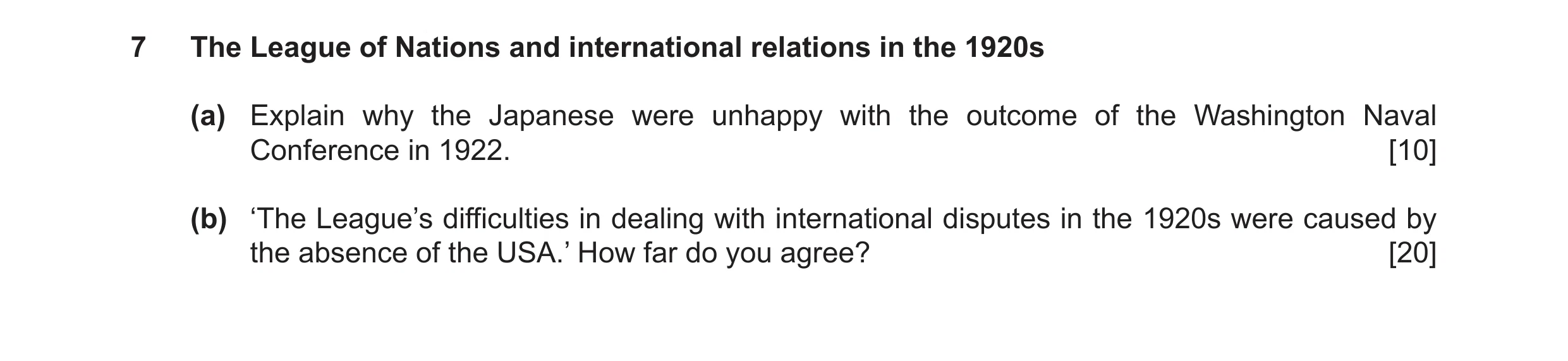
Q10 · The League of Nations and international relations in the 1920s (a) Explain why the… 9489/23 May/June 2023
7 The League of Nations and international relations in the 1920s (a) Explain why the Japanese were unhappy with the outcome of the Washington Naval Conference in 1922. [10] (b) ‘The League’s difficulties in dealing with international disputes in the 1920s were caused by the absence of the USA.’ How far do you agree? [20]
30 marks
Mark scheme: 7(a) Explain why the Japanese were unhappy with the outcome of the 10 Washington Naval Conference in 1922. Indicative content At the Washington Naval Conference Japan had to accept a lower allocation of capital ships than USA and Britain. In the Nine Power Treaty had to agree to withdraw its troops from Shandong Province which had been under German control but was captured by the Japanese in the First World War. At the Treaty of Versailles, it had been granted to the Japanese, but they were now forced to give it up. Japan had to withdraw troops from Siberia where it had been part of the international force opposing the Bolshevik Revolution and had established a foothold. In the long run these concessions fuelled the feeling that western powers were treating Japan as an inferior nation. Accept any other valid responses. 7(b) ‘The League’s difficulties in dealing with international disputes in the 20 1920s were caused by the absence of the USA.’ How far do you agree? Indicative content Discussion about the importance of the USA’s absence might include how the idea of the League had been heavily promoted by Woodrow Wilson and it was on his insistence that it was incorporated into all the Treaties that ended the war, so the absence of the US left a big gap in the League structure from the very start. Without the backing of the USA the British were less willing to back the French who in turn became increasingly antagonistic toward the Germans over the issue of reparations leading to the Ruhr Crisis. Without the US the only significant powers were GB and France who were not in a position to enforce any significant actions in cases of international conflict. Major conferences in which the US were involved happened outside the League thus reducing its significance in international affairs (e.g., Washington Naval Conference, Locarno etc.). Discussion of other factors might consider how, even without the loss of the US, the structure of the League was cumbersome and slow to respond to any significant incidents. One of the big early tests of the League was the Corfu Incident where Mussolini openly defied the League and the outcome seemed to demonstrate that ‘big power’ interests would be favoured over those of smaller nations. The league was always weakened by the fact that it had no military capacity to respond to conflicts and countries could just ignore its mediation e.g., in the issue of Vilnius the League mediators awarded Vilnius to Lithuania. Accept any other valid responses.
This question in 9489/23 May/June 2023
Q11 · The League of Nations and international relations in the 1920s (a) Explain why Germany… 9489/21 Oct/Nov 2023
7 The League of Nations and international relations in the 1920s (a) Explain why Germany suffered an economic crisis in the early 1920s. [10] (b) ‘The structure of the League was the main reason for its weakness in the 1920s.’ How far do you agree? [20]
30 marks
Mark scheme: 7(a) Explain why Germany suffered an economic crisis in the early 1920s. 10 Indicative content • The Reparations Bill imposed following the Versailles Treaty placed an unmanageable burden on the Weimar government. • Germany suffered from infrastructure and economic disruption following the war which made recovery difficult. • There was a general post-war depression which further impacted the German recovery. • Franco–Belgian invasion of the Ruhr led to a breakdown of the production as workers went on strike. • To support the workers the government began printing money to pay their wages and this accelerated the hyper-inflation in 1923 leading to the total collapse of the currency. Accept any other valid responses. 7(b) ‘The structure of the League was the main reason for its weakness in the 20 1920s.’ How far do you agree? Indicative content Discussion of the weaknesses of structure might consider how one of the main defects of the League was that all decisions of the council had to be unanimous. As the states were divided among groups, it was not possible to deicide matters unanimously. The unanimity principal incorporated with the covenant proved to be detrimental to the working of the League. The Council of the League was not so competent as to settle amicably the disputes among the members. Another important defect of the league was with regard to the constitutional amendment of the covenant. It provided that if any amendment of the covenant was not acceptable to a member-states, it would cease to be its member. This provision was fatal to the organization, as many member- states ceased to be member. There was also provision under the covenant of the League for the withdrawal of membership. They could withdraw from the League after two years notice. This provision provides fatal. In the beginning, membership increased, but in time, the membership was reduced to thirty-two only. Yet another important defect was that it could not completely prohibit war. The Covenant allowed members to resort to war under certain situations. It provided that the member-states were firstly under the obligation to settle their disputes through arbitration, judicial settlement, or inquiry by the council. If the problem was not solved through these methods, the members could resort to war after a lapse of three months. It meant that war was not completely prohibited under the Covenant. Discussion of other weaknesses may consider the non-participation of United States of America in the League was another important weakness of the organisation. Hence, league of nations remained an organisation limited to European countries only. The League could also not check big powers from attacking and exploiting small states. This was clear as early as the Corfu incident when Mussolini defied the League to extract additional concession from Greece. The League did not have any means of enforcing its decisions and it failed miserably to perform its primary functions of maintaining international peace and security which one of the foremost functions and objects of the League, e.g. Poland-Lithuania conflict over Vilna. The treaty also excluded the losing state in First World War from membership and even though they were all later admitted it was inevitably seen as a tool of the victorious states. Accept any other valid responses.
This question in 9489/21 Oct/Nov 2023
Q12 · The League of Nations and international relations in the 1920s (a) Explain why the USA… 9489/22 Oct/Nov 2023
7 The League of Nations and international relations in the 1920s (a) Explain why the USA did not join the League of Nations in 1920. [10] (b) To what extent did the Ruhr crisis lead to a change in relations between France and Germany? [20]
30 marks
Mark scheme: 7(a) Explain why the USA did not join the League of Nations in 1920. 10 Indicative content • It was the brainchild of democratic President Wilson but was strongly opposed by Republicans and others within the US. • Republicans controlled Congress and voted against acceptance of the Versailles Peace Treaties, which was seen as too punitive and because of concern about this causing internal conflict between different groups of European immigrants. • The establishment of the League was an integral part of the Treaties so rejecting them also meant rejecting the League of Nations. • Americans were afraid that it would allow foreign powers to interfere in US internal affairs. • There was concern about what it would cost the US. Accept any other valid responses. 7(b) To what extent did the Ruhr crisis lead to a change in relations between 20 France and Germany? Arguments supporting the statement may consider how, in the aftermath of the war, France sought to control any future development of Germany by enforcing the punitive clauses of the Treaty of Versailles. Germanys search for support can be seen in the signing of the Rapallo Pact with Russia and France’s in the creation of the Little Entente (1921). This policy culminated in the occupation the Ruhr. The universal condemnation of this action led to a change of policy to seeking collective security in international agreements. The first step towards this was the Dawes Plan to help resolve the issue of payment of reparations. Following this the Locarno Treaties provided a reconciliation of border issues with Germany as well as international support in the event of any challenge to this agreement. As a result of this Stresemann and Briand were awarded the Nobel Prize for Peace in 1926. The positive relationship between these two formed the basis of a period of improved relationship between the two countries and it was followed by the Kellogg Briand Pact or of 1928 which confirmed international commitment to disarmament, providing further reassurance to France and confirming a more positive relationship. Arguments challenging the statement may consider how French policy immediately after the war was determined by the French desire for revenge and punishment and their need for assurances that Germany would never again be a threat to French security. In a sense this remained the underlying driving force behind French policy towards Germany. All the actions and agreements of the 1920s, whilst they improved the immediate nature of relationship between them, did not change the nature of the underlying relationship which was one of distrust and potential conflict. This was the basis of agreements like the Little Entente, the Locarno Treaties and even the Kellogg-Briand Pact, all of which gave France further guarantees of support in the event of future conflict with Germany. The Wall Street Crash and the death of Stresemann in 1929 revealed just how fragile the better relationship actually was. Accept any other valid responses.
This question in 9489/22 Oct/Nov 2023
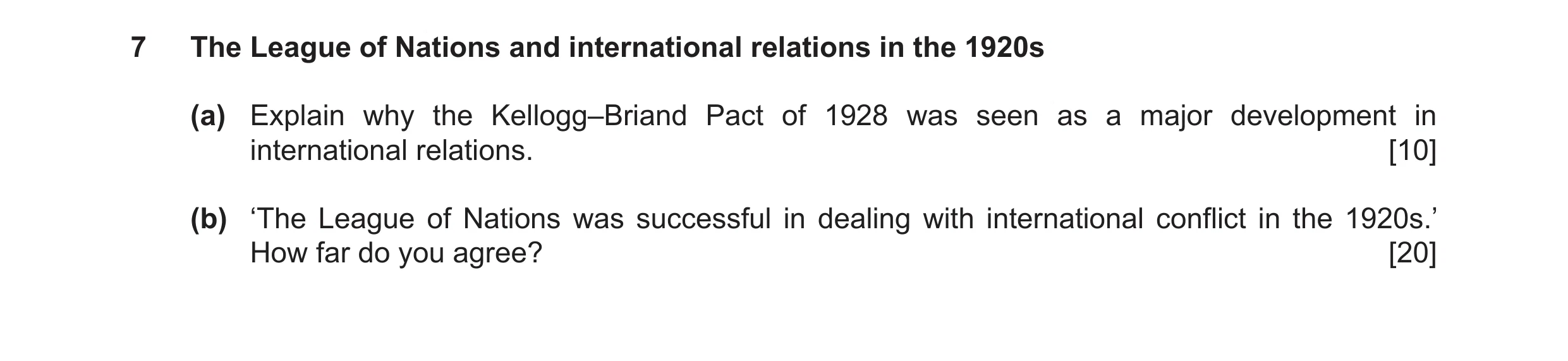
Q13 · The League of Nations and international relations in the 1920s (a) Explain why the… 9489/23 Oct/Nov 2023
7 The League of Nations and international relations in the 1920s (a) Explain why the Kellogg–Briand Pact of 1928 was seen as a major development in international relations. [10] (b) ‘The League of Nations was successful in dealing with international conflict in the 1920s.’ How far do you agree? [20]
30 marks
Mark scheme: 7(a) Explain why the Kellogg–Briand Pact of 1928 was seen as a major 10 development in international relations. Indicative content • French foreign minister, Aristide Briand hoped to tie the United States into a system of protective alliances against possible German aggression. • American ‘outlawry of war’ movement supported Kellogg proposal for multilateral treaty marking US re-engagement in international agreements. • multilateral agreement attempting to eliminate war as an instrument of national policy. • It was the most grandiose of a series of peacekeeping efforts after the First World War. • It was eventually signed by virtually all independent nations and marked a high point in the disarmament movement. Accept any other valid responses. 7(b) ‘The League of Nations was successful in dealing with international 20 conflict in the 1920s.’ How far do you agree? Indicative content Discussion of successes might include how the League took home half a million prisoners of war from World War One. In 1921 Sweden and Finland accepted the League's arbitration to give the Aaland Islands to Finland. In 1922 the League set up camps and fed Turkish refugees. The League sent economics experts to help Austria when its government went bankrupt in 1923. Greece obeyed the League's orders to pull out of Bulgaria in 1925. Discussion considering the failures of the League of Nations might refer to: The Poles in 1921 invaded Vilna (the capital of Lithuania). The League ordered Poland to withdraw. Poland refused and the League could do nothing. In 1923 Mussolini ignored the League's orders to pull out of Corfu, and made Greece pay money to Italy. Attempt to promote disarmament talks failed to make any progress in the 1920s. in 1928, 65 countries signed the Kellogg Briand Pact, a treaty to end war – but then they just ignored it. Accept any other valid responses.
This question in 9489/23 Oct/Nov 2023
Q14 · The League of Nations and international relations in the 1920s (a) Explain why the USA… 9489/22 Feb/March 2025
8 The League of Nations and international relations in the 1920s (a) Explain why the USA did not join the League of Nations. [10] (b) ‘The Treaty of Sèvres created more problems than it solved.’ How far do you agree? [20]
30 marks
Mark scheme: 8(a) Explain why the USA did not join the League of Nations. 10 The League of Nations was part of Woodrow Wilson’s 14 points and its acceptance was written into all the treaties that emerged from the Paris Peace Conference. • However, Wilson failed to convince his fellow Americans that this was a good idea as many felt that America should not have got involved in the war in the first place and feared that these treaties tied the US into continuing involvement in European affairs. • The Republicans who opposed Wilson’s plan, won the congressional elections on a platform of opposition to the treaties so the Senate rejected ratification of the peace treaties which also involved rejecting membership of the League. • Many Americans feared that the terms of the peace treaties contained the seeds of a future conflict and did not want the US to become entangled in that through signing the treaties and joining the League. • Some Americans also feared that the conditions of membership of the League would allow other countries to interfere in US affairs. Accept any other valid responses. 8(b) ‘The Treaty of Sèvres created more problems than it solved.’ How far do 20 you agree? The treaty appeared initially to deal with the main issues of the Middle East and gave the allies considerable control over the area and of the Straits in particular. However internal division in Turkey led to the repudiation of the treaty and ultimately to its replacement in 1922. Successes • Ended the war between the Allies and the Ottoman Empire • Removed a large section of the Empire in Asia and North Africa and theoretically created independent states in the Middle East recognising the role played by Arab leaders in the area in bringing about the defeat of the Ottoman Empire. However, it placed them under the control of the League of Nations until they could develop self-governing capacity. In practice this meant that Britain and France were granted mandates to control these areas. • Recognised British control of Egypt. • Proposed an independent state of Armenia to end the Armenian genocide which had begun in 1915/16. Problems • The treaty was signed in Sèvres by the Ottoman government but immediately repudiated by the Grand National Assembly led by Kemal Ataturk. • The signatories of the Treaty were stripped of their nationality. • Civil War broke out which ended in the final demise of the Ottoman Sultanate. • The partition of the Empire and Civil War created a substantial refugee crisis which required League of Nations intervention. • The Armenian crisis remained unresolved. • A revised Treaty had to be revised with the new Republican government at Lausanne in Switzerland in 1922 which was substantially different from the Treaty of Sèvres Accept any other valid responses.
This question in 9489/22 Feb/March 2025
Q15 · The League of Nations and international relations in the 1920s (a) Explain why France and… 9489/21 May/June 2025
8 The League of Nations and international relations in the 1920s (a) Explain why France and Belgium took control of the Ruhr in 1923. [10] (b) ‘The League of Nations carried out its work successfully in the 1920s.’ How far do you agree? [20]
30 marks
Mark scheme: 8(a) Explain why France and Belgium took control of the Ruhr in 1923. 10 Indicative content • In 1920 the figure of German reparations payments was finally fixed at £6.6 billion. This was clearly going to cause problems for Germany given the devastated state of the German economy. • In 1921 and 22 Germany faced soaring inflation resulting in the total collapse of the economy and was unable to make reparations payments. A situation unacceptable to the French who were determined to make Germany pay for the war. • The French were able to persuade the Belgians, who had suffered even more from German occupation than the French, to join them and in January 1923 they invaded the main industrial area of western Germany in order to seize coal and timber in lieu of payment. Deprived of any substantial armed forces by the treaty of Versailles, the Germans were unable to prevent the invasion but did resort to passive resistance. • France aimed to keep the German economy weak as revenge for the previous invasion during the Franco-Prussian War, and the destruction caused in the First World War. Accept any other valid responses. 8(b) ‘The League of Nations carried out its work successfully in the 1920s.’ 20 How far do you agree? Indicative content Note: If candidates choose to focus solely on peace and security aspects of the work of the League for this question, then that is acceptable and should not be penalised. However, the question does allow for consideration of the wider achievements of the League in areas like, for example, mandates, refugees health, working conditions. In support of carrying out its work successfully, discussion may consider the League’s actions regarding the Teschen coalfield conflict, (1920), the Aaland Islands dispute (1921). They may also discuss the allocation of land in Upper Silesia to Poland and Germany (1921), the Yugoslav/Albanian border dispute (1921), or the issues of Memel (1923) and Mosul (1924). However, in all these cases candidates might consider how far the two sides in the disputes were really satisfied with the outcome. The League also established a series of agencies and commissions to deal with a whole range of other issues like the Slavery Commission, the Commission for Refugees, the Disarmament Commission, the Mandate Commission, and the International Labour Organisation. Again, these met with some level of success in all cases but there may still be a question to be answered about how far they fulfilled expectations. Discussion that challenges the idea of success may include how the absence of US was the first failure of expectations as the negotiators in Versailles had anticipated the US playing a powerful and central role in the maintenance of international peace and security. It may also consider the Polish seizure of Vilna (1920), the Italian invasion of Corfu (1923), Treaty of Riga (1921) and Invasion of the Ruhr (1923–4). The failures of specific agencies might also be considered like the failure to get agreement on minimum working hours. Accept any other valid responses.
This question in 9489/21 May/June 2025
Q16 · The League of Nations and international relations in the 1920s (a) Explain why the Corfu… 9489/21 Oct/Nov 2025
8 The League of Nations and international relations in the 1920s (a) Explain why the Corfu crisis was a failure for the League. [10] (b) ‘During the 1920s, relations between the USSR and other European nations were unfriendly.’ How far do you agree? [20]
30 marks
Mark scheme: 8(a) Explain why the Corfu crisis was a failure for the League. 10 Indicative content In 1923 following the death of several Italian officials monitoring the disputed border between Greece and Albania, Mussolini demanded compensation and occupied the Greek island of Corfu. Greece appealed to the League for help. • Italy had no real justification for seizing Corfu - it was simply aggression by a stronger power against a weaker one. This was exactly the sort of event the League was supposed to prevent. • The League had no effective mechanism for dealing with the issue and had to rely on the Conference of Ambassadors. • Britain and France, the leading powers of the League, did not want to alienate Italy and so gave way to Mussolini’s demands. • The League was seen as unable to defend smaller countries against aggressive action by one of the major powers. Accept any other valid responses. 8(b) ‘During the 1920s, relations between the USSR and other European 20 nations were unfriendly.’ How far do you agree? Indicative content The sudden withdrawal of the Russians from the First World War via the Treaty of Brest Litovsk alienated the Bolsheviks from Russia’s former allies and precipitated direct allied involvement in the Russian Civil War on the side of the Whites. After the end of the war this support was withdrawn but with the end of the Civil War, Russia remained isolated from the western powers. Discussion of unfriendly relations might include Russia’s exclusion from the Versailles peace talks. Though they had been part of the Triple Entente, the collapse of the monarchy and the Bolshevik withdrawal from the war meant the other allies considered Russia had no place at the conference. Russia was also not invited to join the League of Nations when it was established in 1920. The Tsarist government also had substantial loans from the French in particular and the Bolshevik government’s refusal to accept responsibility for repaying these kept them isolated. This was the reason why they left the Genoa conference in 1922. Despite one of the areas it was concerned with was the borders of eastern Europe, the Soviet Union was not invited to join the Locarno Conference or sign any of the subsequent treaties. Both France and Britain also remained suspicious of Soviet attempts to spread revolution to western Europe and Britain thought that the Soviets were trying to stir up problems in their empire, especially in the Indian subcontinent. Challenge to the statement might consider how better relations were shown in actions such as the Rapallo Pact. After the failure of the Genoa Conference the two ‘excluded’ powers came together in economic and military co- operation, some of which was kept secret, but which allowed Germany to begin some military reconstruction and gave the Soviet Union access to banking and financial services. This agreement was renewed and extended for a further five years in the Treaty of Berlin in 1926. In 1921 Britain was one of the first to open diplomatic relations and signed a Trade Treaty with the Soviet Union, but despite further trade agreement relations were periodically suspended. France and Italy also restored diplomatic relations in 1924 though they remained suspicious of motives. The French were particularly concerned about the implications of the Treaty of Berlin. The Russians were amongst the original signatories of the Kellogg Briand Pact which aimed to outlaw war between its signatories, and which came into effect on July 24th, 1929. However, there was no mechanism for enforcing the promises. Accept any other valid responses.
This question in 9489/21 Oct/Nov 2025
Q17 · The League of Nations and international relations in the 1920s (a) Explain why the work… 9489/22 Oct/Nov 2025
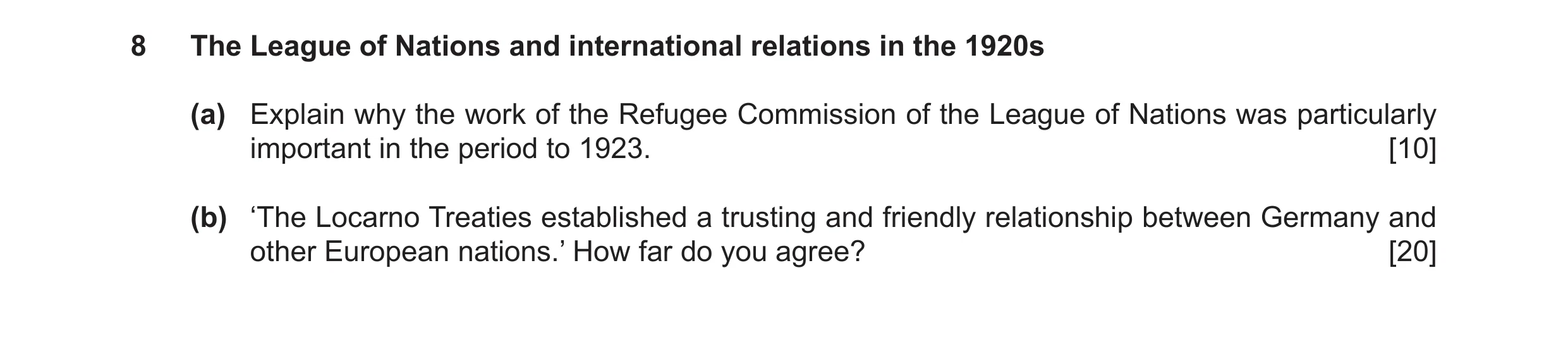
8 The League of Nations and international relations in the 1920s (a) Explain why the work of the Refugee Commission of the League of Nations was particularly important in the period to 1923. [10] (b) ‘The Locarno Treaties established a trusting and friendly relationship between Germany and other European nations.’ How far do you agree? [20]
30 marks
Mark scheme: 8(a) Explain why the work of the Refugee Commission of the League of 10 Nations was particularly important in the period to 1923. Indicative content Following the end of the war there was considerable disruption to the population, both civilian and military, across many European borders. • The redrawing of national boundaries and creation of a series of successor states left many people in countries where they did not want to be so after the settlement thousands of refugees were on the move and in need of help. • The end of the war left over half a million prisoners of war stranded in Russia and the commission, under the leadership of Fridtjof Nansen, organised their repatriation and resettlement • In 1922 the Commission introduced the Nansen passport, the first internationally recognised passport for stateless refugees, to help ease the continuing refugee crisis. • In 1923 the outbreak of violence in Turkey created almost one and a half million refugees that the commission helped to rehouse and settle in surrounding regions. Accept any other valid responses 8(b) ‘The Locarno Treaties established a trusting and friendly relationship 20 between Germany and other European nations.’ How far do you agree? Indicative content The treaty began a period of positive relations between France and Germany. It settled the borders between Germany and France and Belgium. The Germans accepted the borders established after Versailles as the permanent boundaries with their western neighbours which involved accepting the permanent loss of Alsace and Lorraine as well as Malmedy and Eupen. Britain and Italy provided a Treaty of Mutual Guarantee of support if there was ever any attempt to change these borders. This marked a growing willingness by Mussolini to play a positive role in the in improving international relations. The treaties gave the French a greater degree of security which they had been looking for ever since the end of the war. It marked a move towards fully re-integrating Germany into the international community and as a result Germany was admitted to membership of the League of Nations. Stresemann and Briand were awarded the Nobel Peace Prize for their efforts in bringing about the settlement. However, it can be argued that the meeting was just culmination of changes taking place over recent years. Following the Ruhr Crisis, the Dawes Plan eased the reparations burden on Germany, and a measure of calm and co- operation was restored to European relations. This calmness was enhanced by the positive relationship between Stresemann and Briand who actively promoted the meeting at Locarno. The Locarno Treaty also did not resolve any issues regarding Germany’s eastern borders and Poland was unhappy with the outcome of the conference. The Polish corridor and the status of Danzig remained as unresolved issues as far as Germany was concerned. The League of Nations was struggling to address the disarmament issue, though planning for a conference continued. Germany was still the only major power to have disarmed and that had been forced by the treaty of Versailles so was a continuing source of resentment. The Kellogg Briand Pact sounded promising but had no ‘teeth’. The Wall Street Crash also threw Europe into economic chaos and destroyed ‘the Spirit of Locarno’. Accept any other valid responses
This question in 9489/22 Oct/Nov 2025
![Question 4: The League of Nations and international relations in the 1920s (a) Explain why Franco–German relations improved after 1924. [10] (b) How im…](https://img.pastlit.com/crops/7b934edf-2381-45da-a7bc-e9de705ac1d2/q8.webp)

 1 / 3
1 / 3![Question 7: The League of Nations and international relations in the 1920s (a) Explain why the League of Nations had limited success in the 1920s. [10]…](https://img.pastlit.com/crops/0632145a-fdbe-4ced-ad0e-98806fbd3a40/q8.webp)
![Question 11: The League of Nations and international relations in the 1920s (a) Explain why Germany suffered an economic crisis in the early 1920s. [10]…](https://img.pastlit.com/crops/4a6fbc05-ebbe-451a-9492-81fbb9cb1648/q7.webp) 2 / 3
2 / 3![Question 12: The League of Nations and international relations in the 1920s (a) Explain why the USA did not join the League of Nations in 1920. [10] (b)…](https://img.pastlit.com/crops/1c0289c9-3e5f-4d38-a85a-0247ebc67c41/q7.webp)
![Question 14: The League of Nations and international relations in the 1920s (a) Explain why the USA did not join the League of Nations. [10] (b) ‘The Tr…](https://img.pastlit.com/crops/e770a01d-6907-4b7f-a733-2f53128fb283/q8.webp)
![Question 15: The League of Nations and international relations in the 1920s (a) Explain why France and Belgium took control of the Ruhr in 1923. [10] (b…](https://img.pastlit.com/crops/437c8215-73eb-4aff-b91b-9fe5da52cbf3/q8.webp)
![Question 16: The League of Nations and international relations in the 1920s (a) Explain why the Corfu crisis was a failure for the League. [10] (b) ‘Dur…](https://img.pastlit.com/crops/d36e5e01-5f31-44db-8a06-5ba1e1926efd/q8.webp)
 3 / 3
3 / 3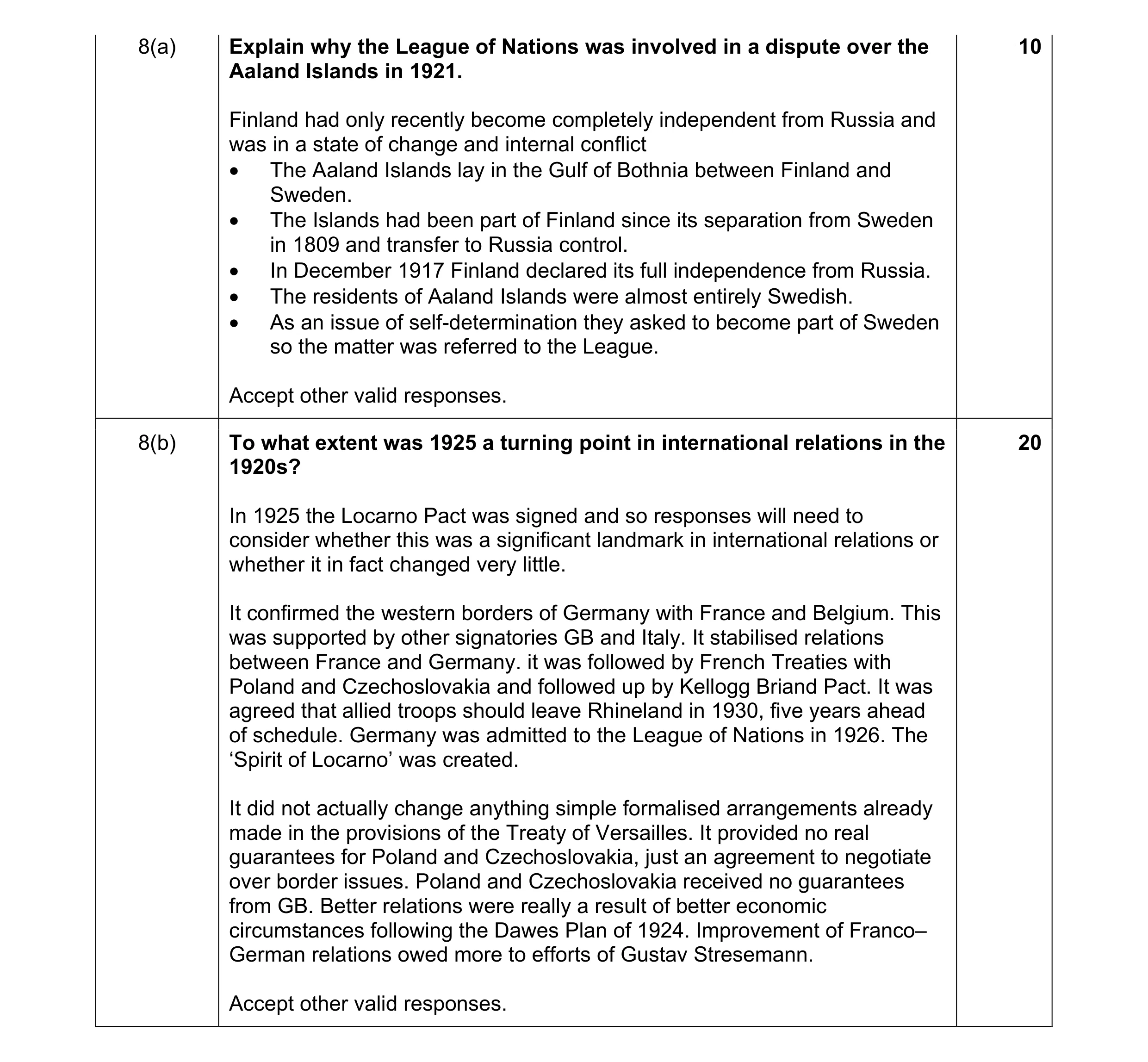 30
30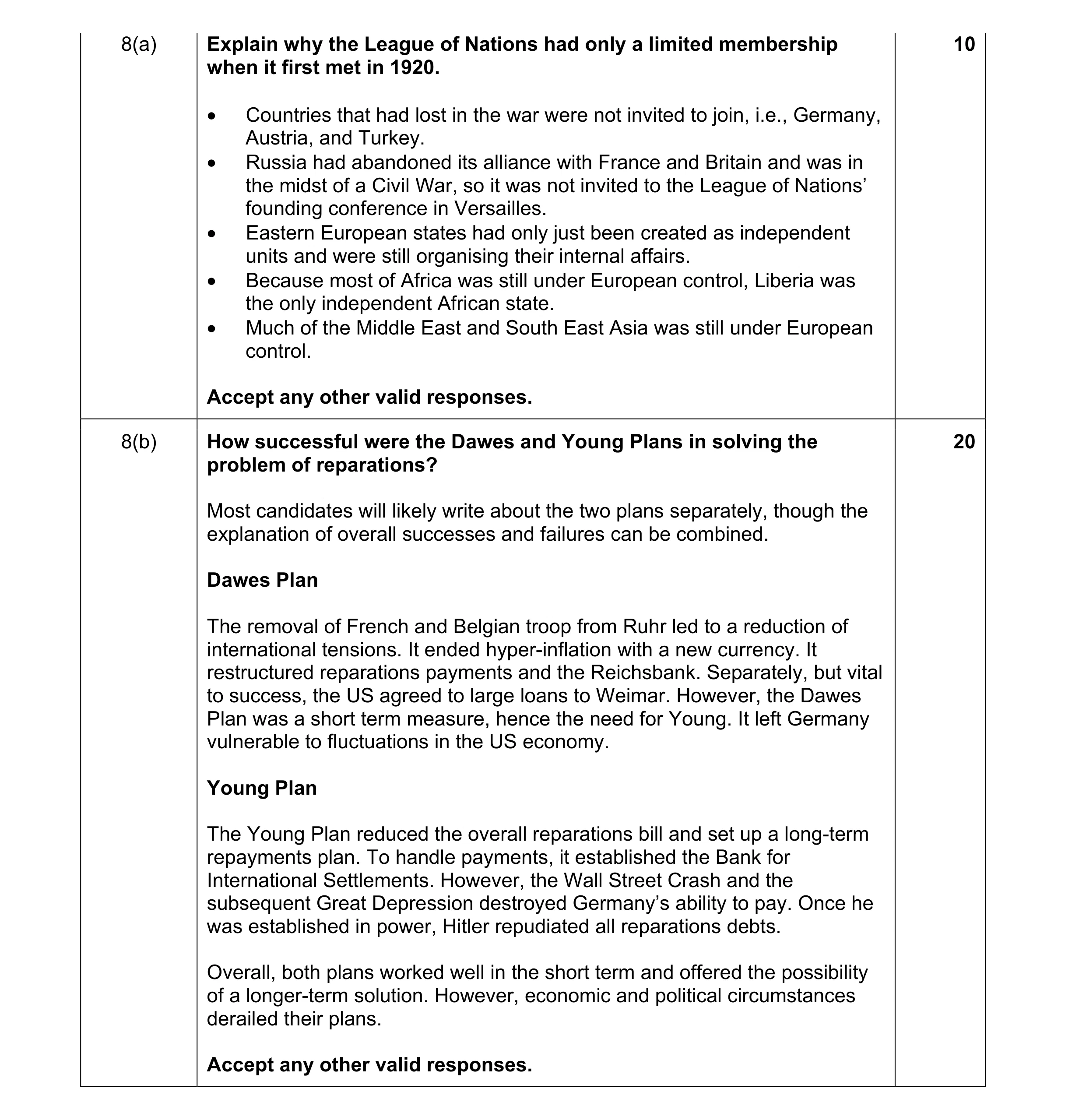 30
30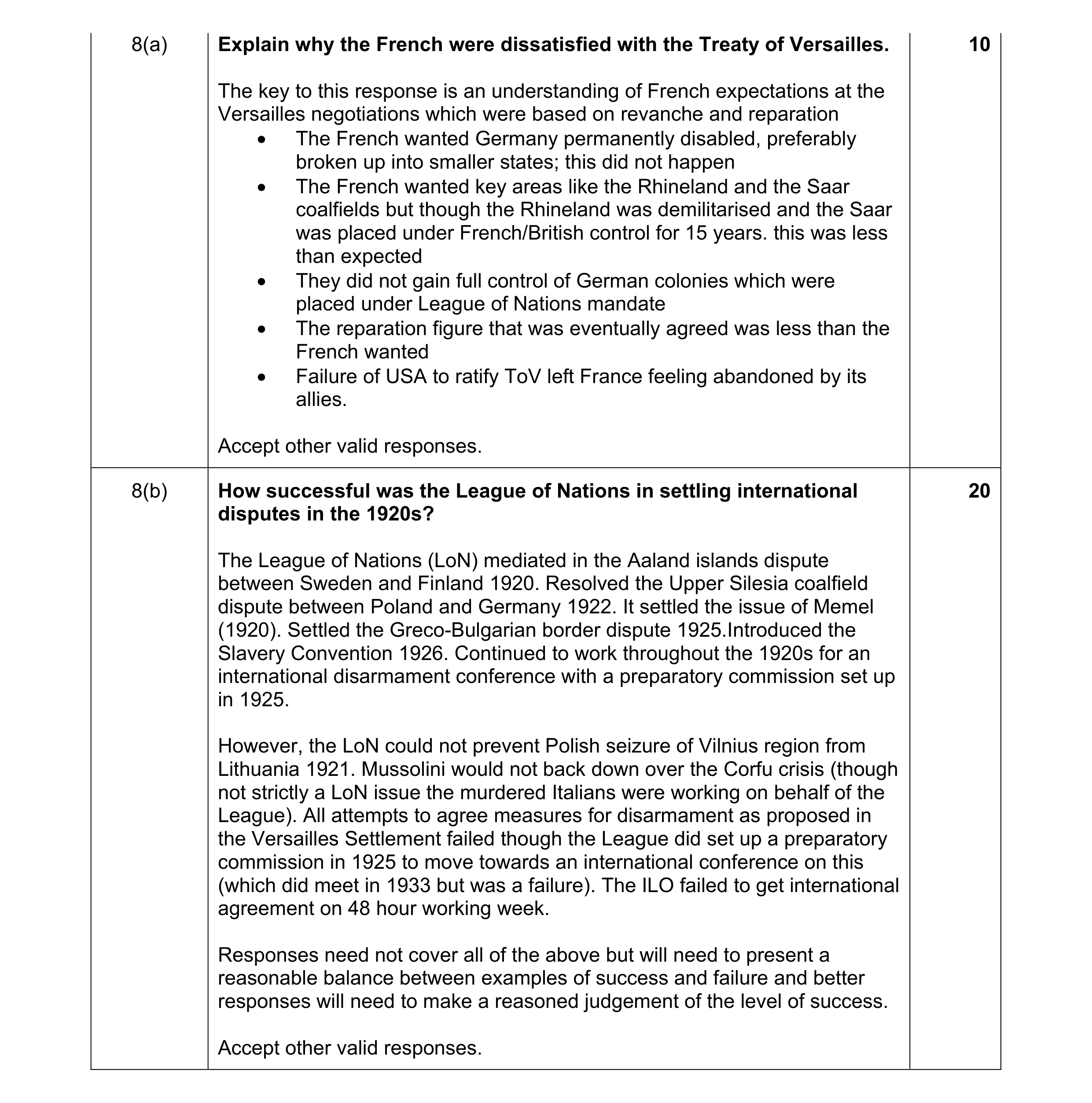 30
30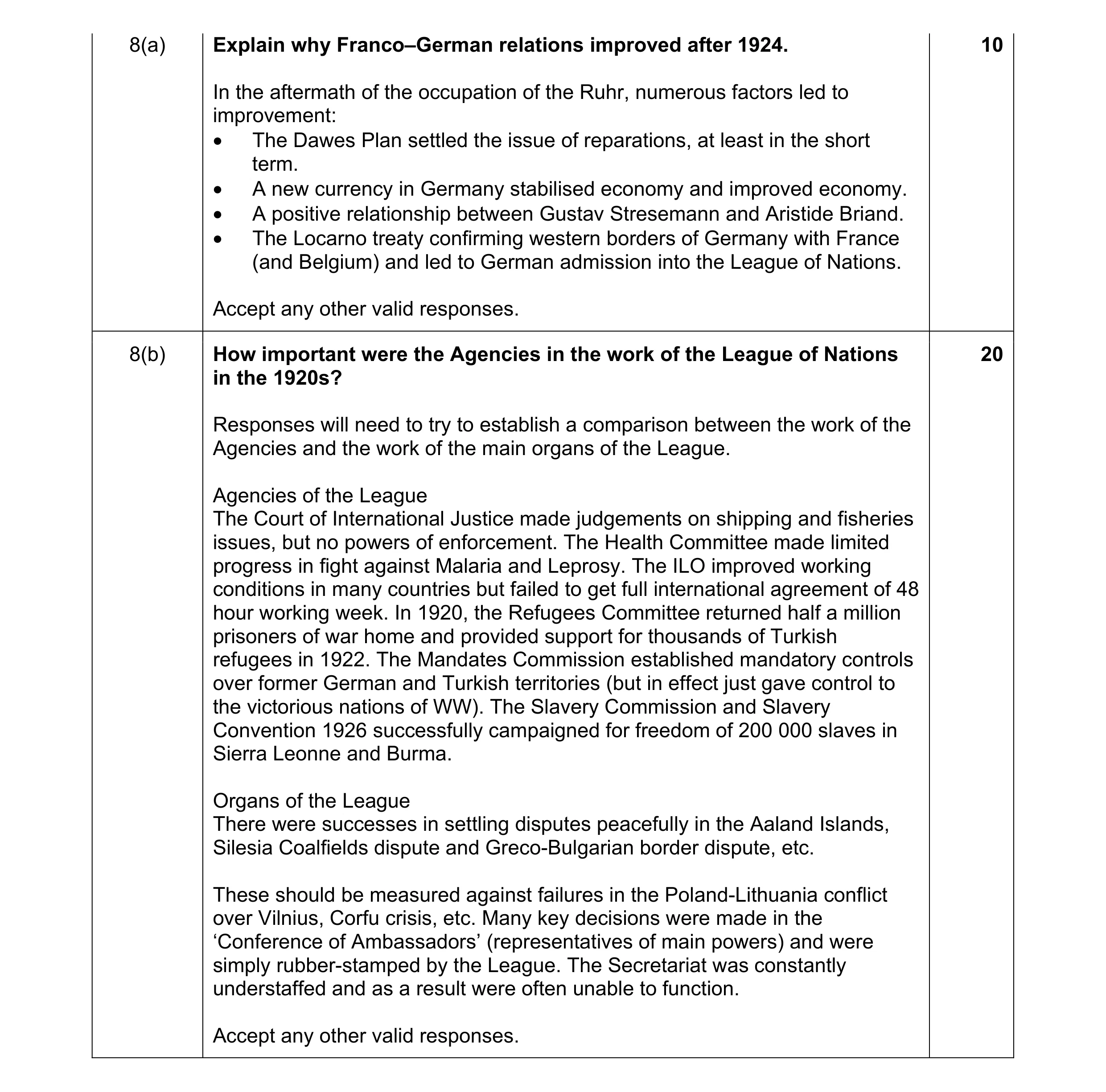 30
30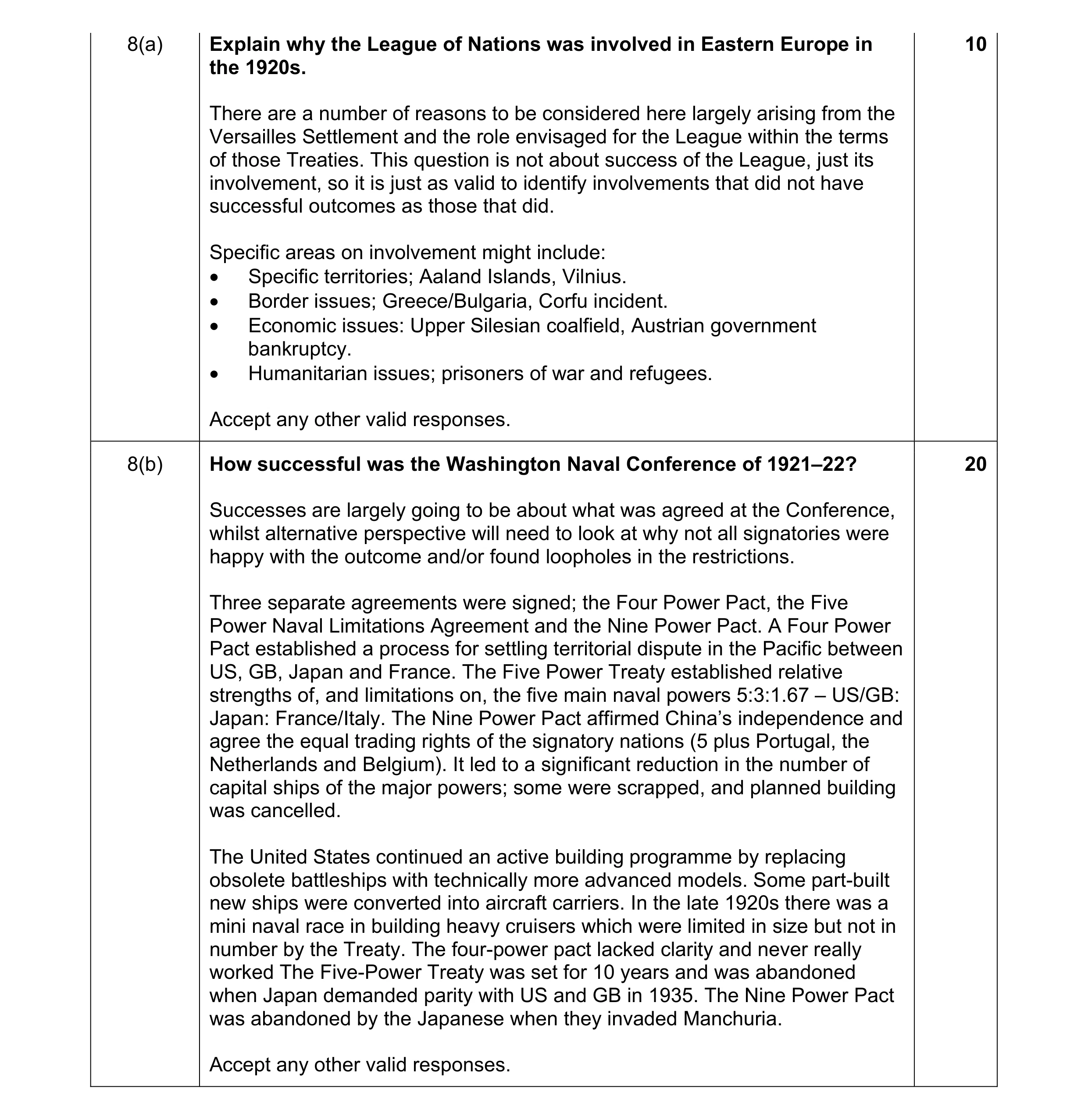 30
30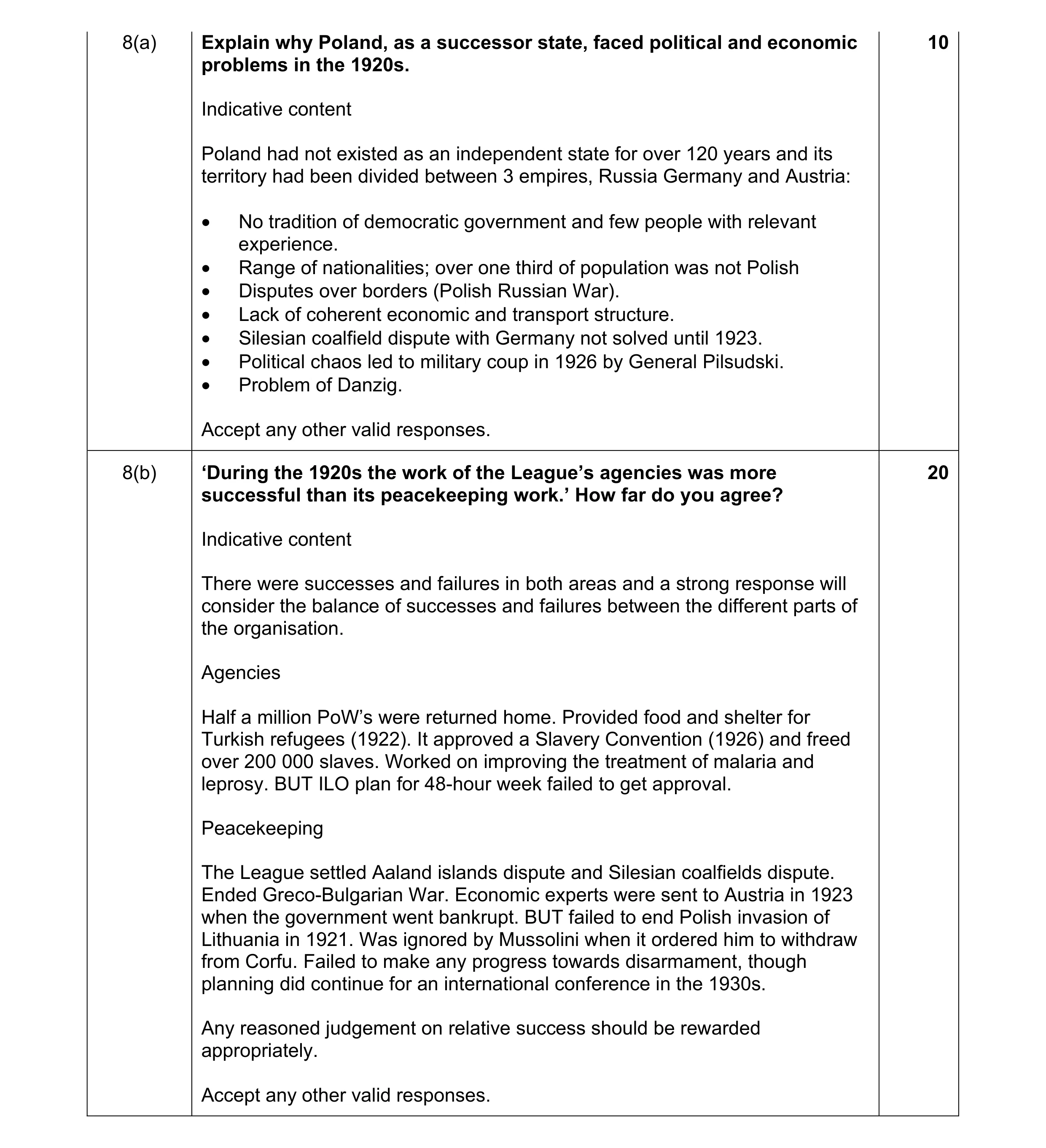 30
30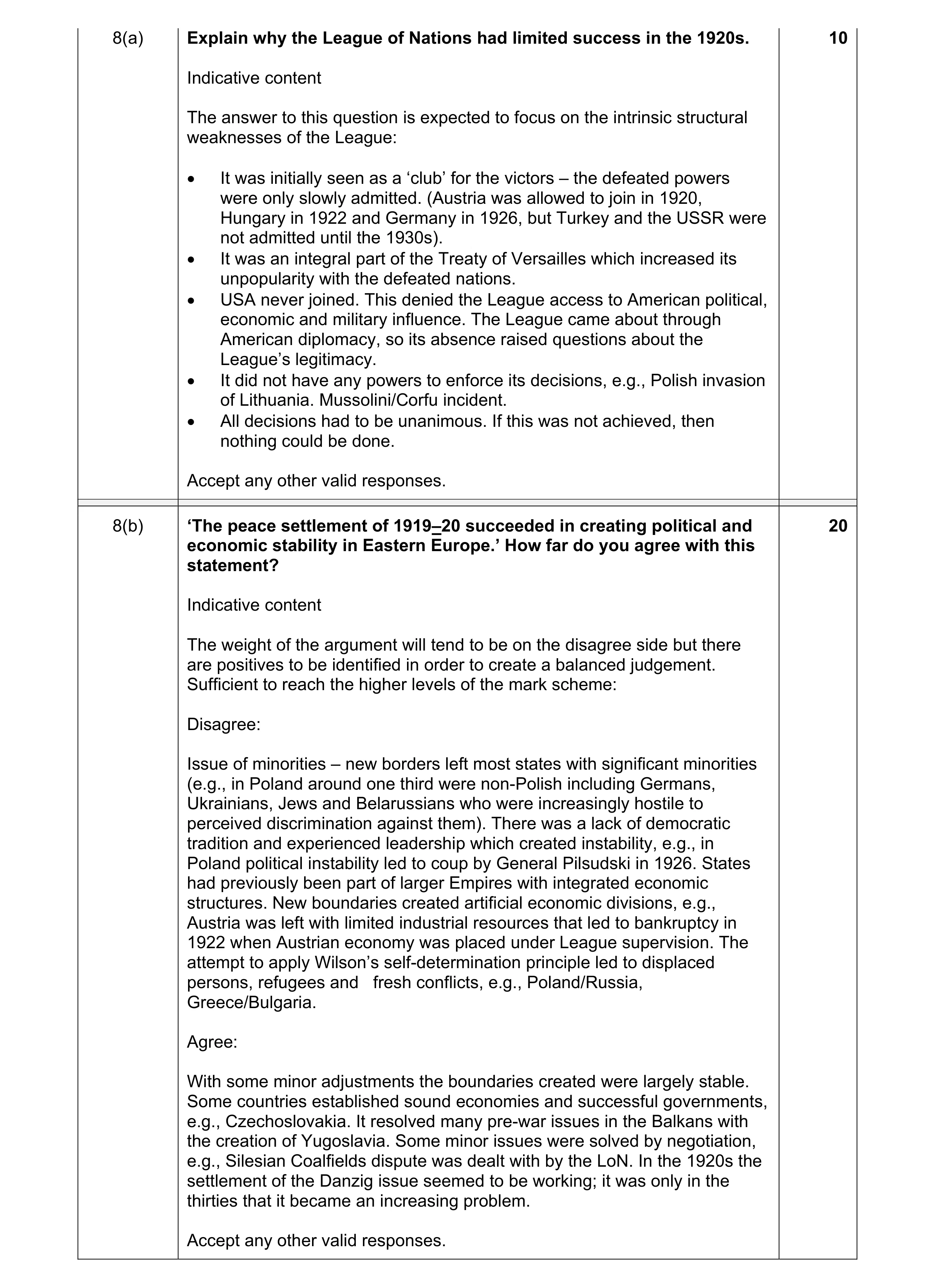 30
30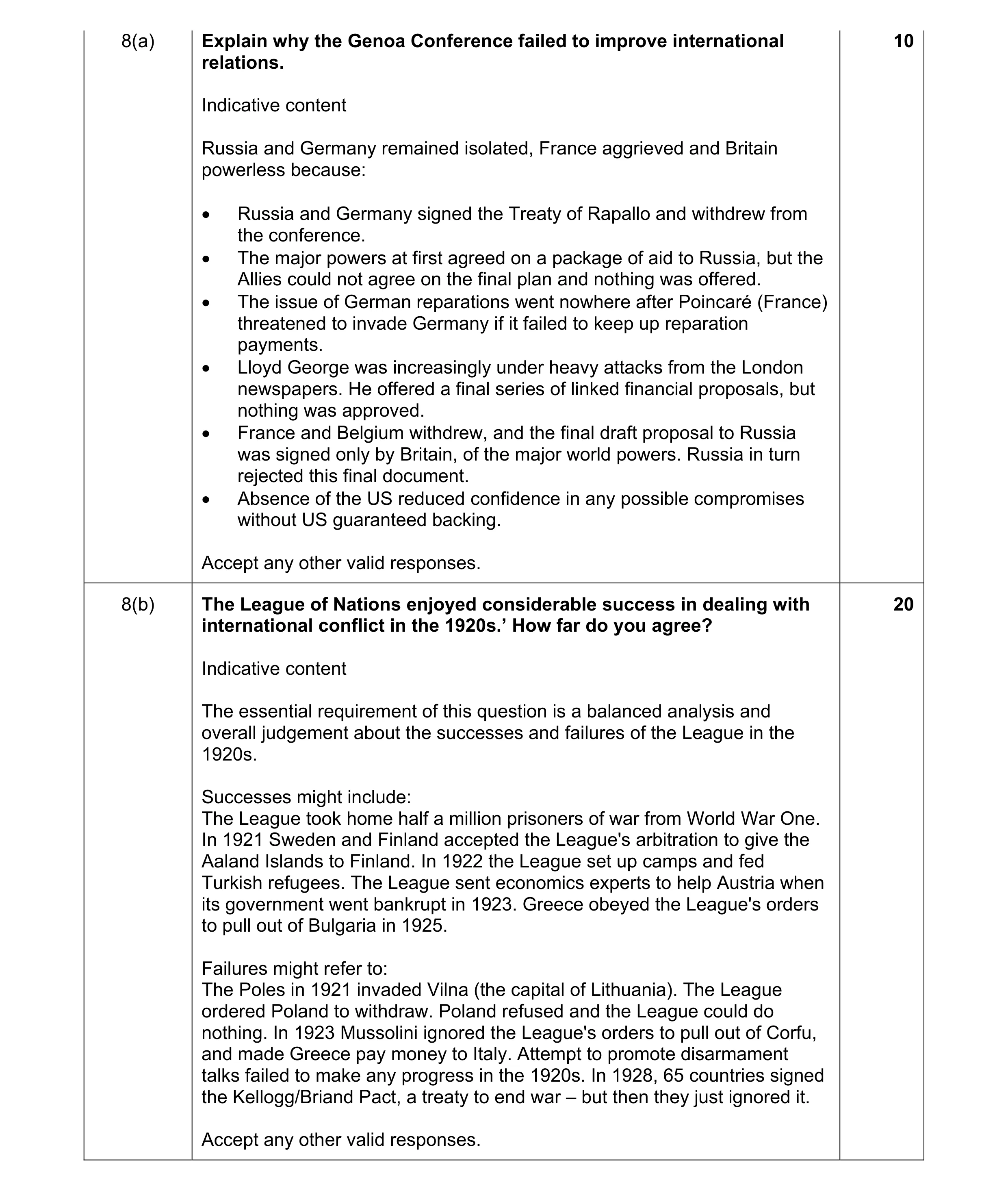 30
30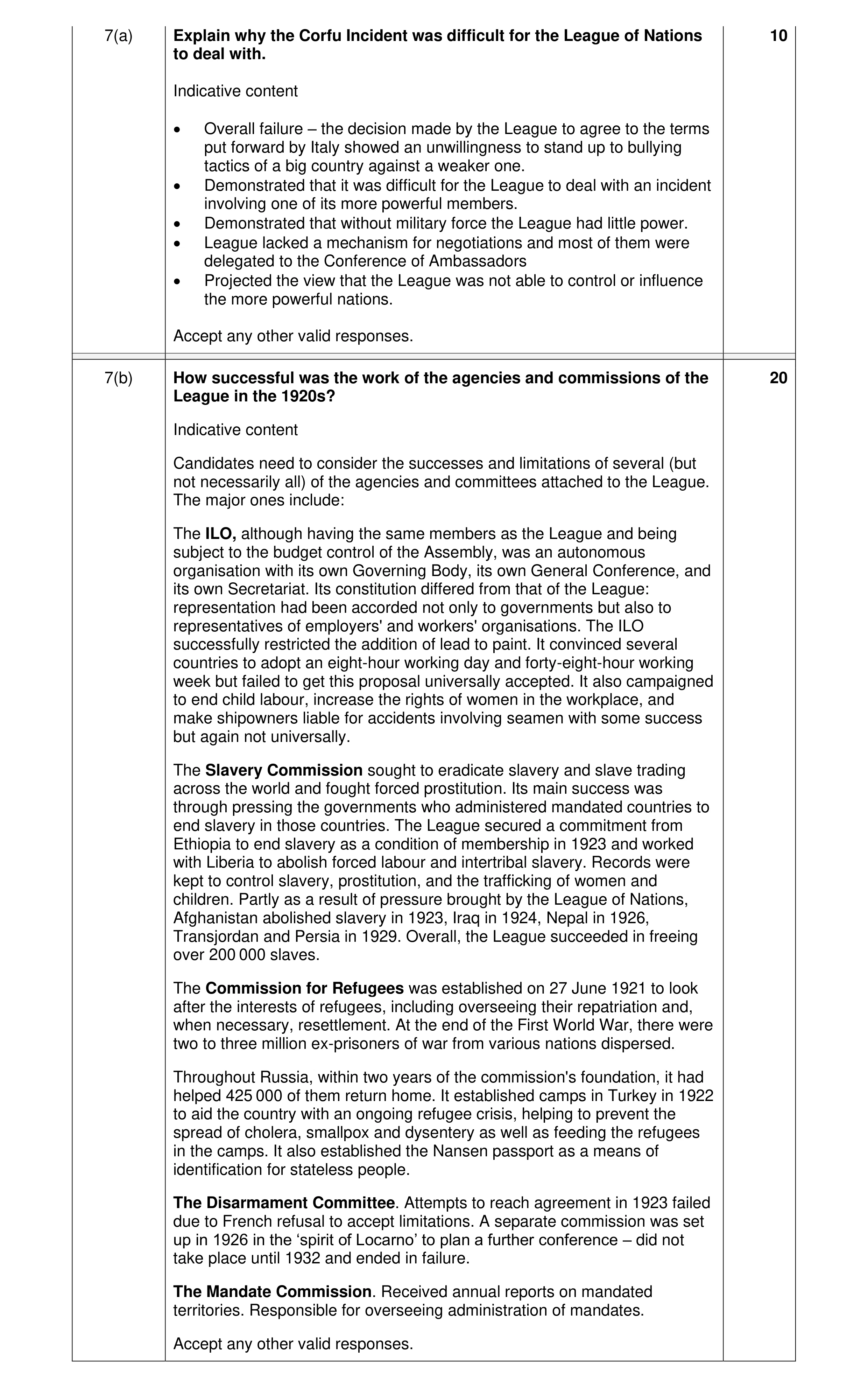 30
30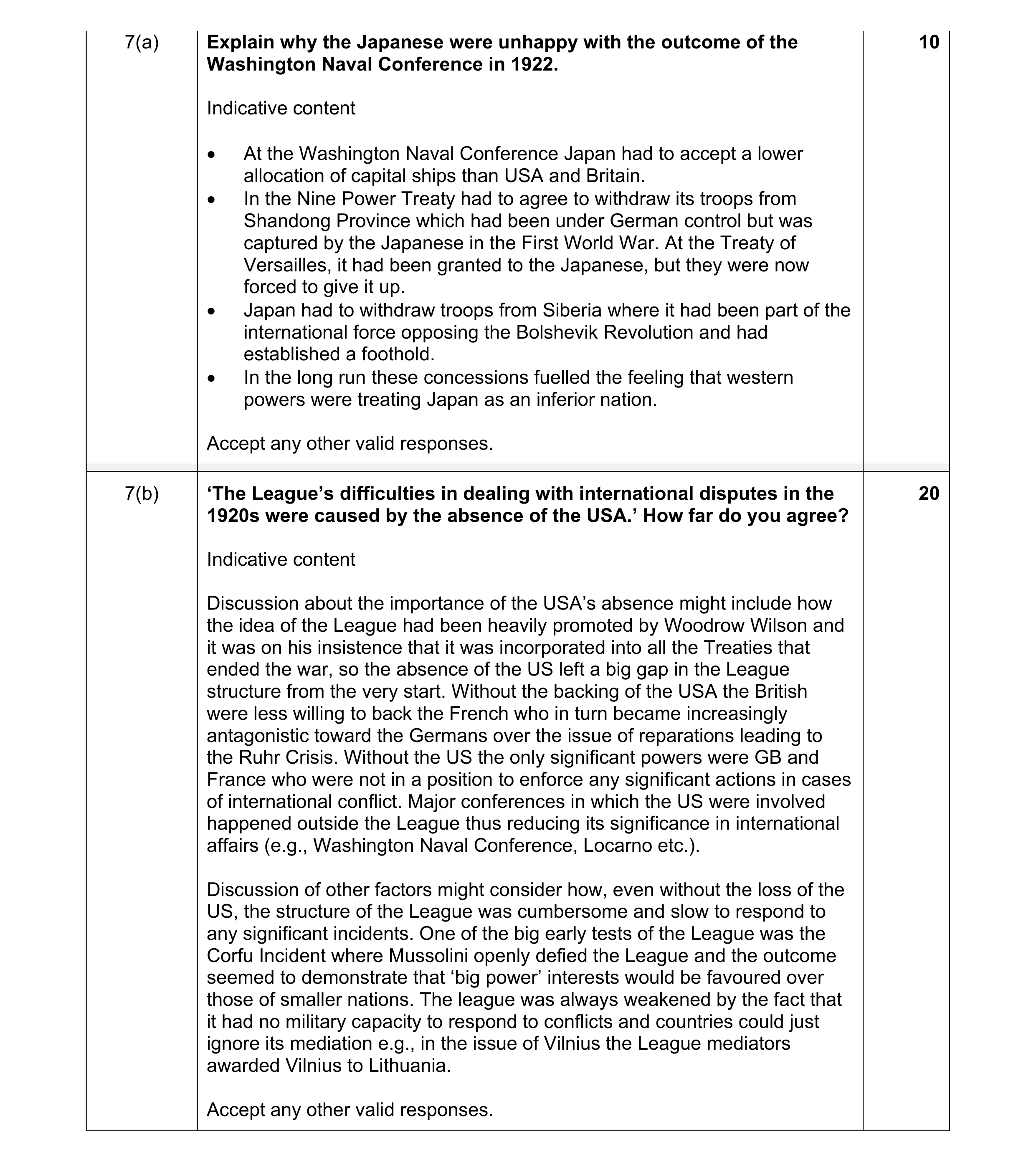 30
30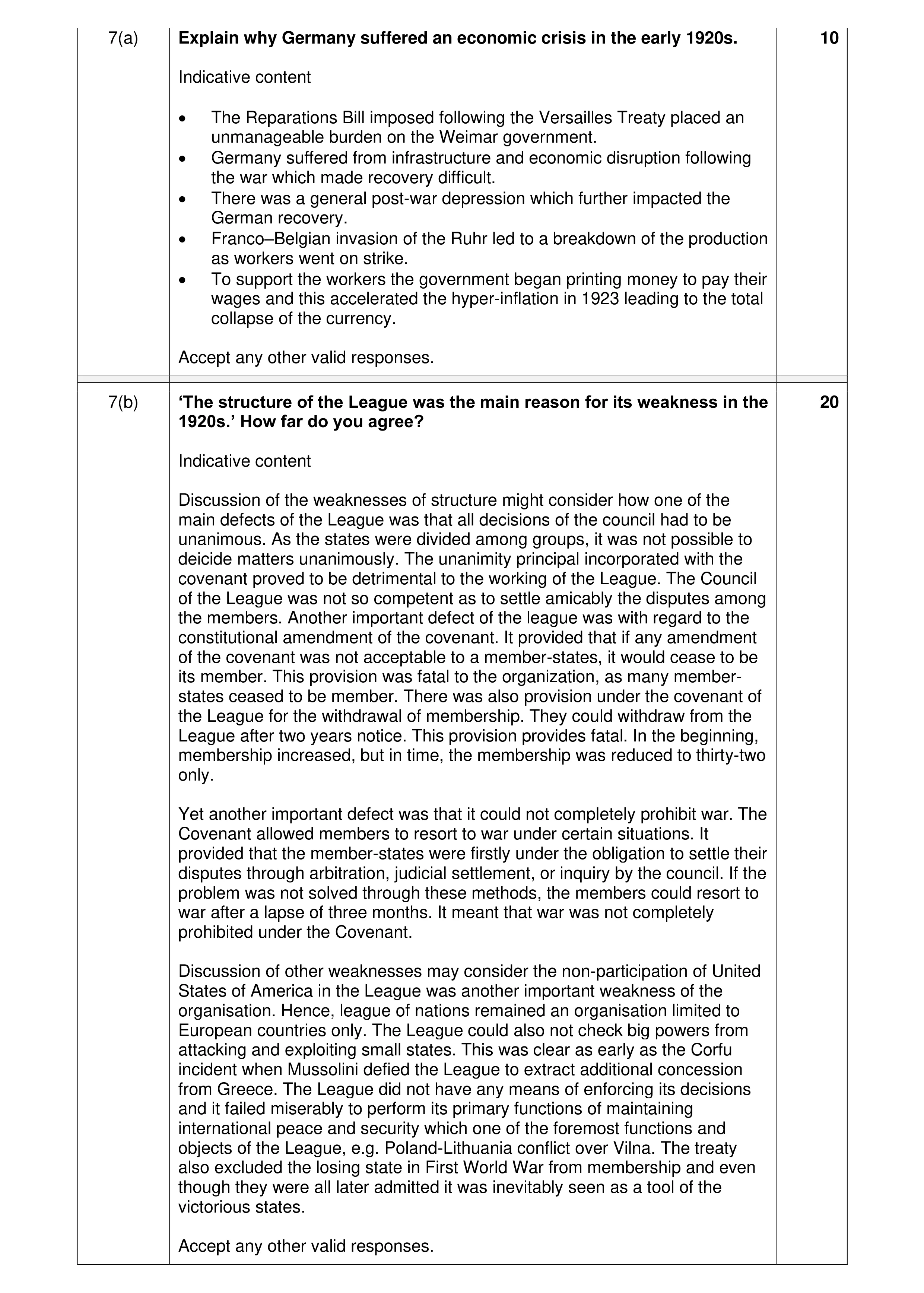 30
30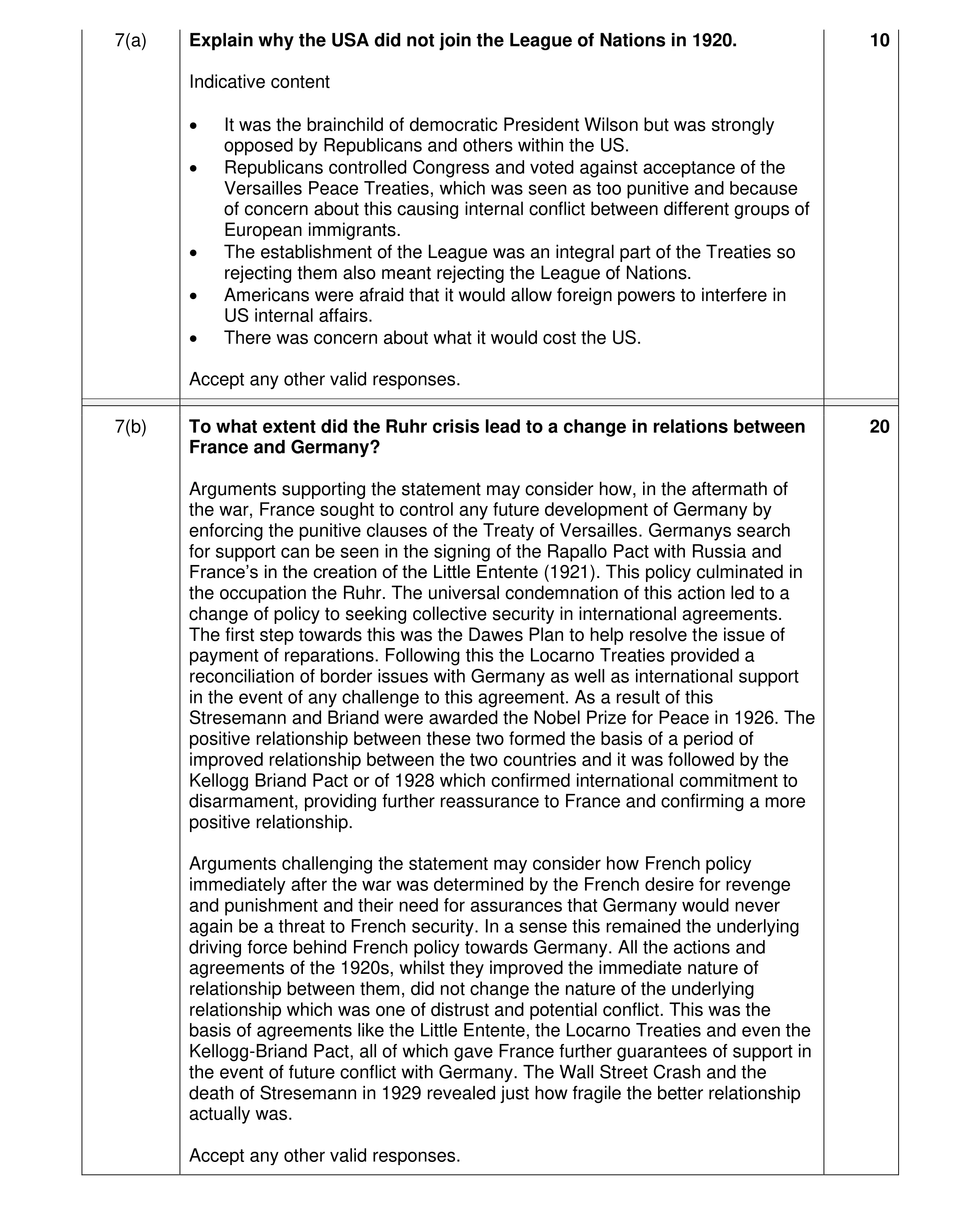 30
30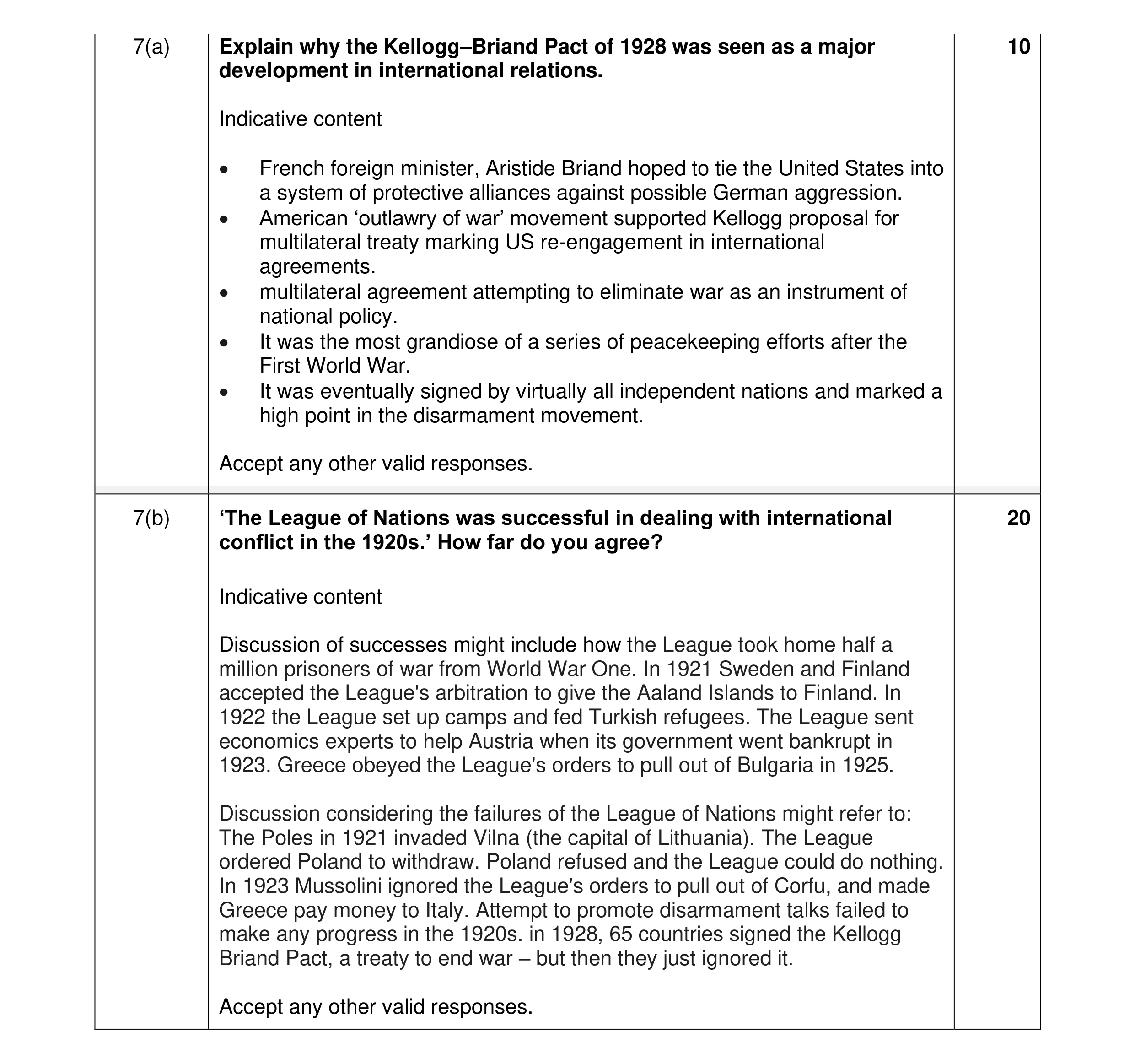 30
30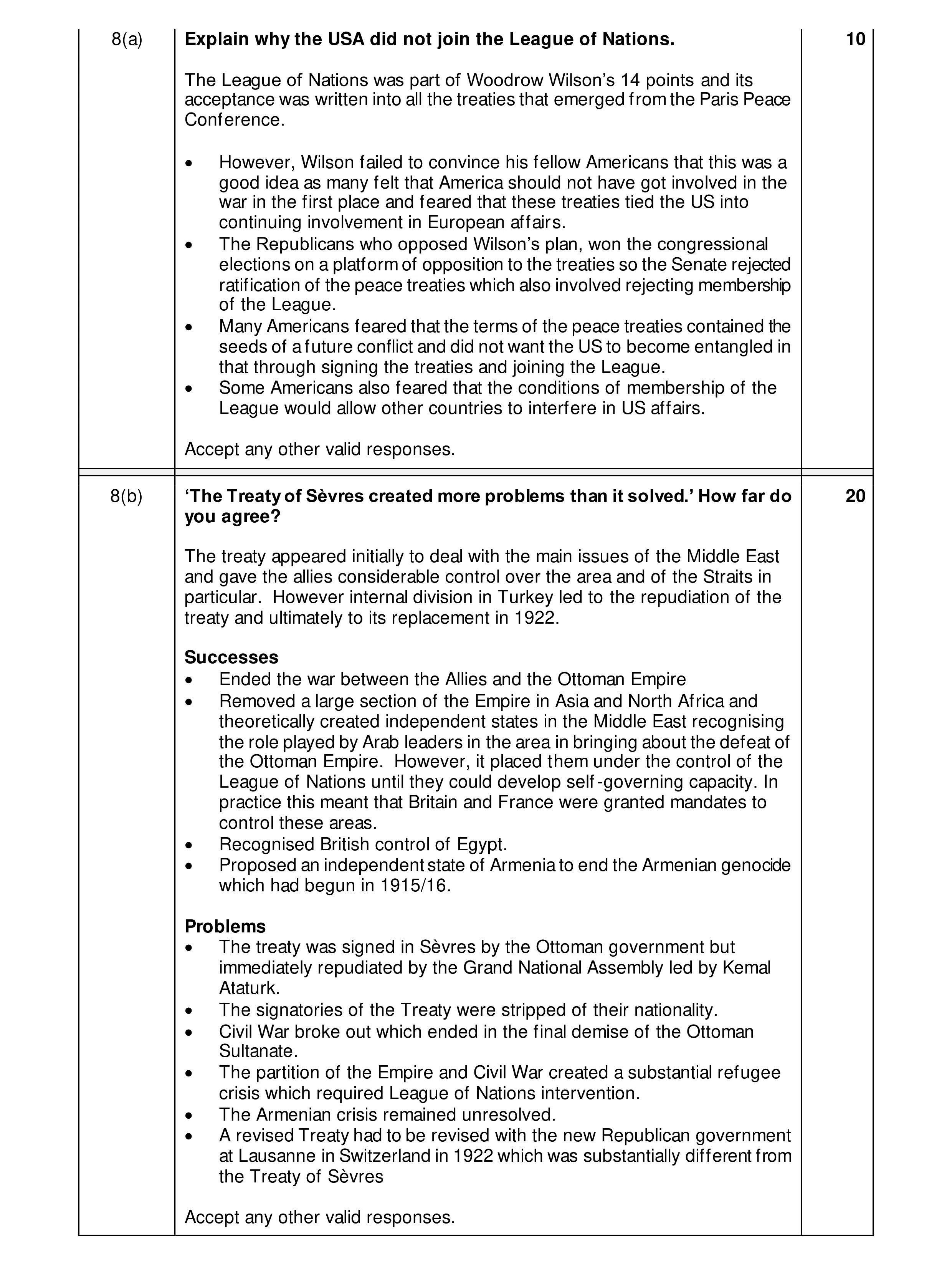 30
30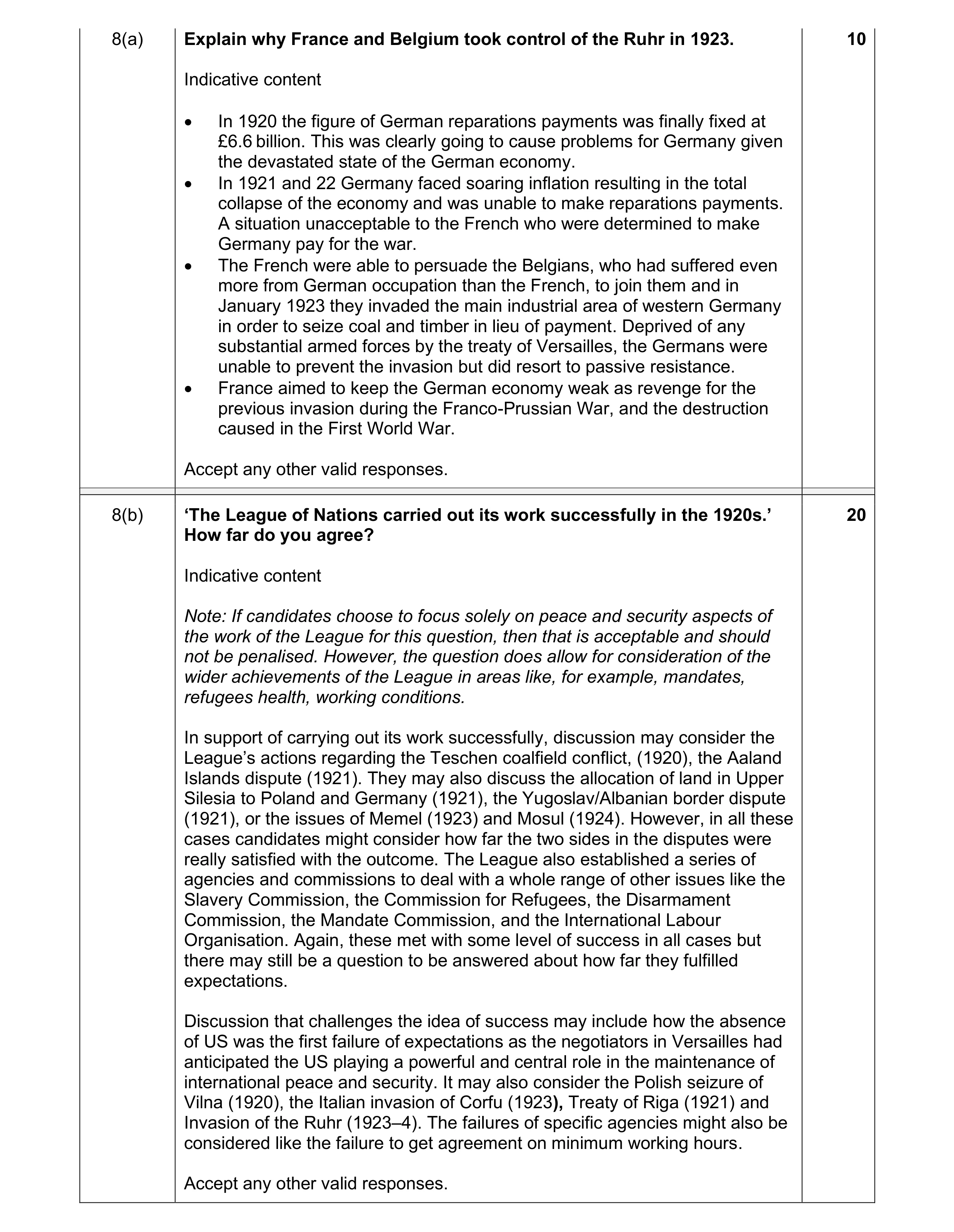 30
30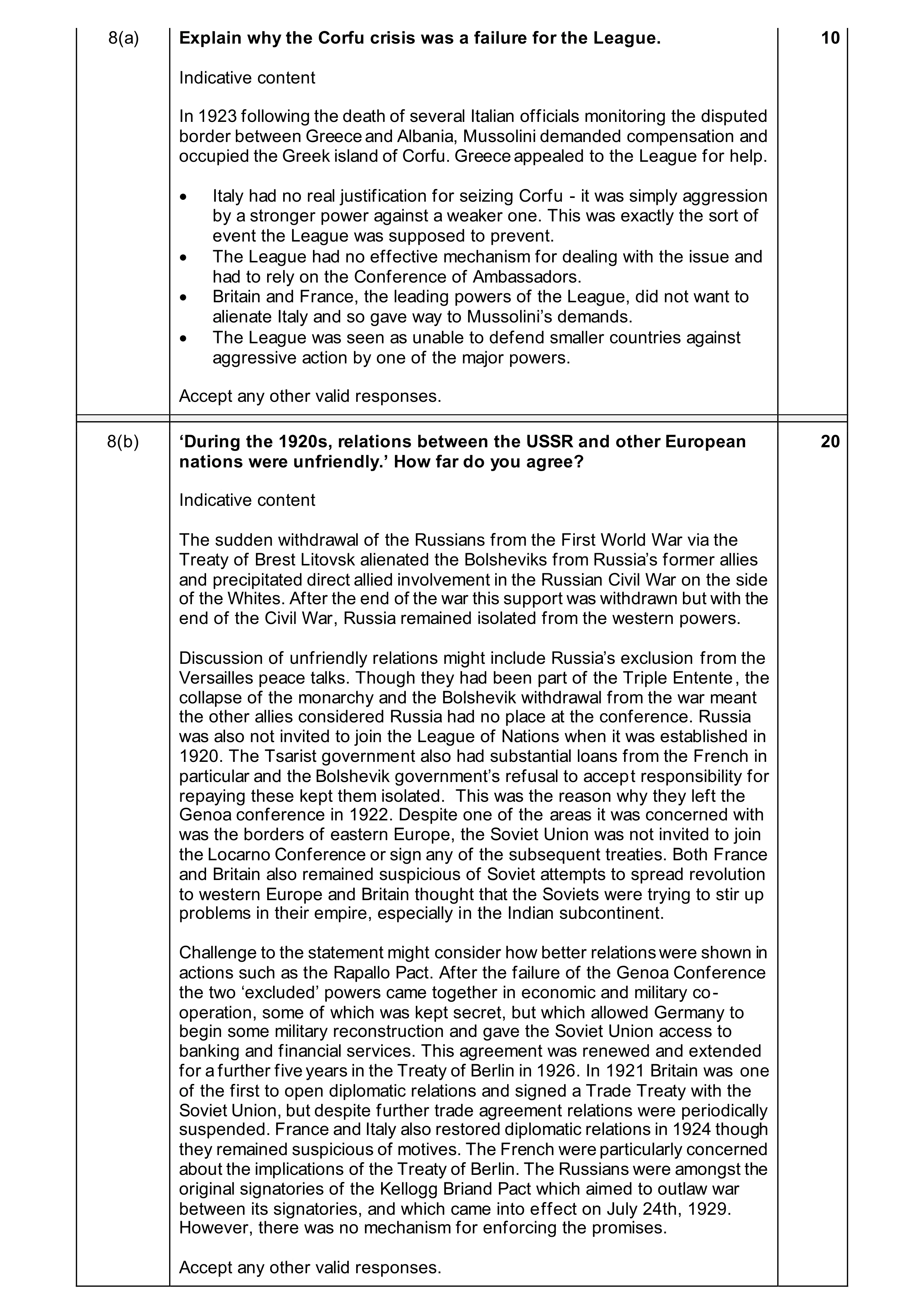 30
30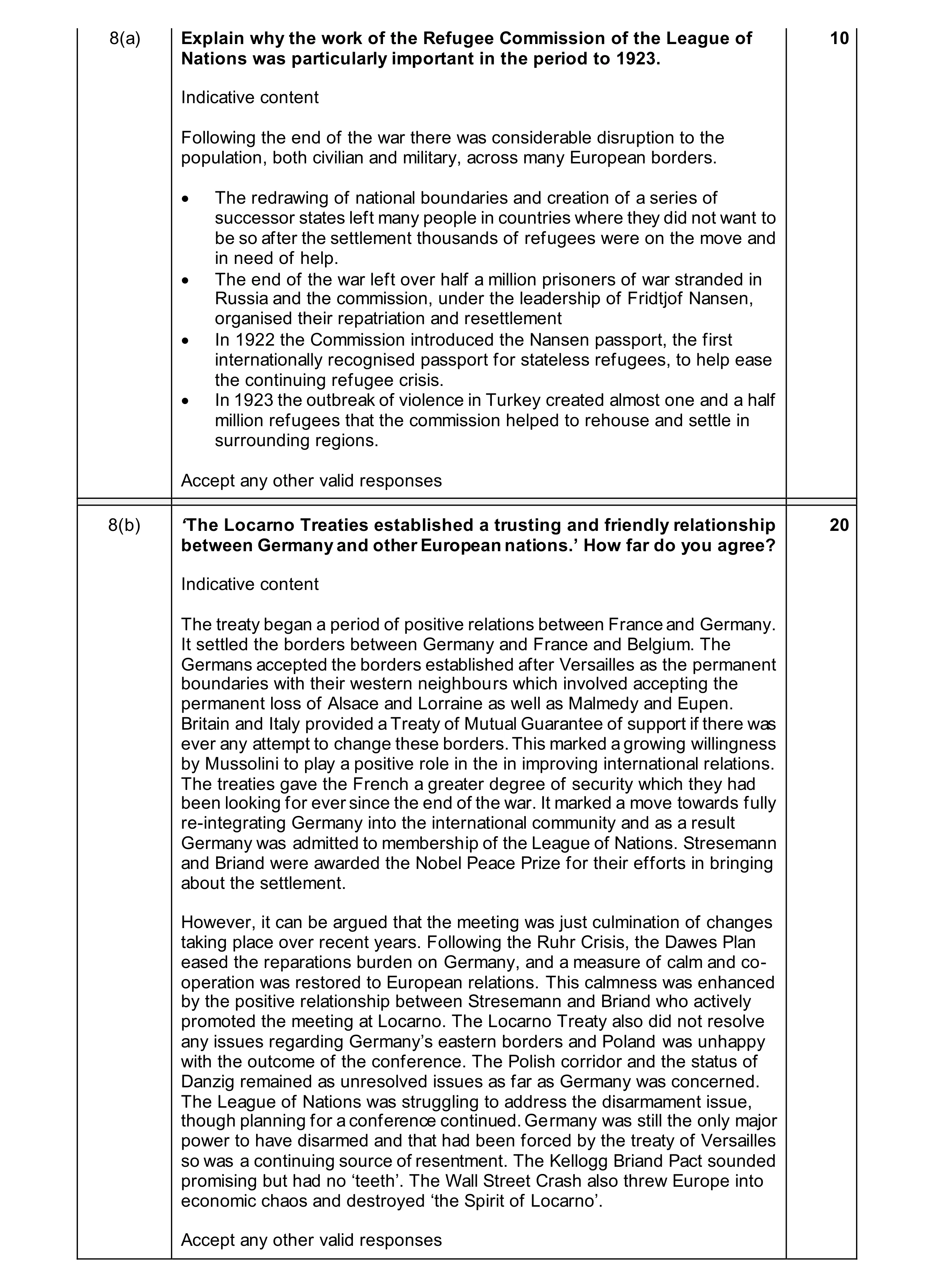 30
30