Cambridge A Level History 9489 — 2023 Oct/Nov Paper 2 · Variant 1
9489/21/O/N/23 · 9 questions · 60 marks · ≈68 min
The question paper and its mark scheme, free to read here and free to download. This is Cambridge’s own paper, exactly as it was sat.
Question paper4 pages
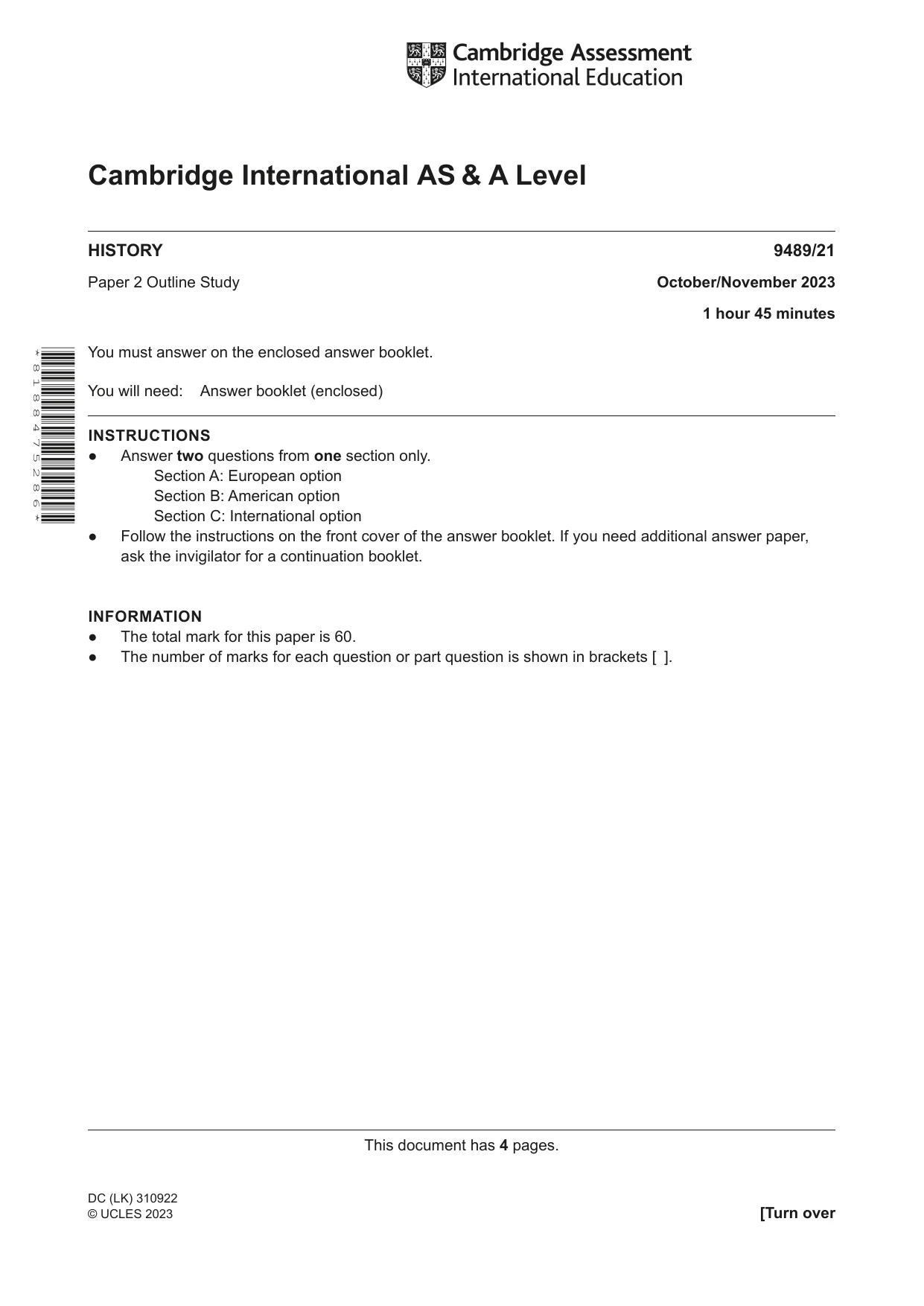
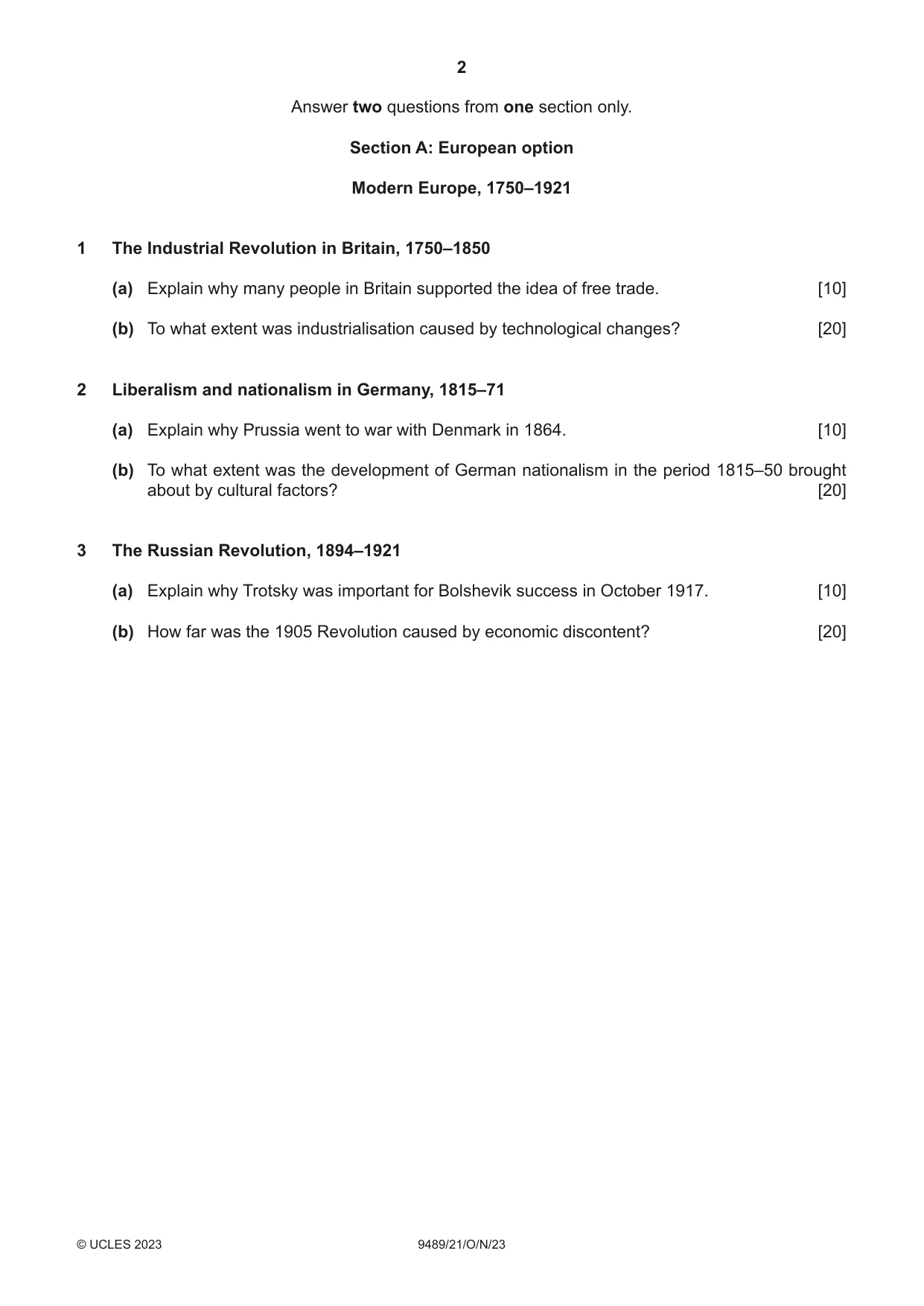
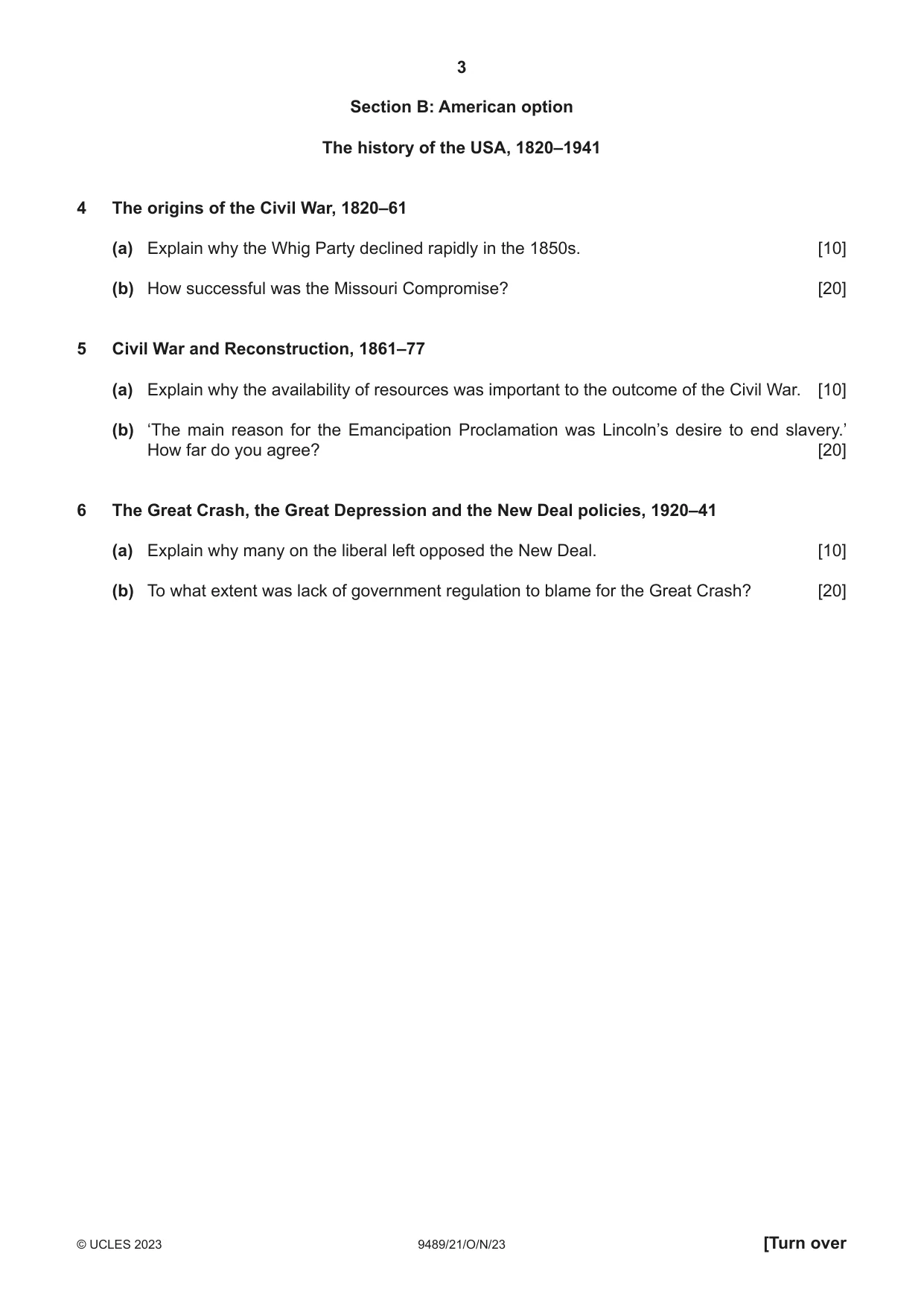
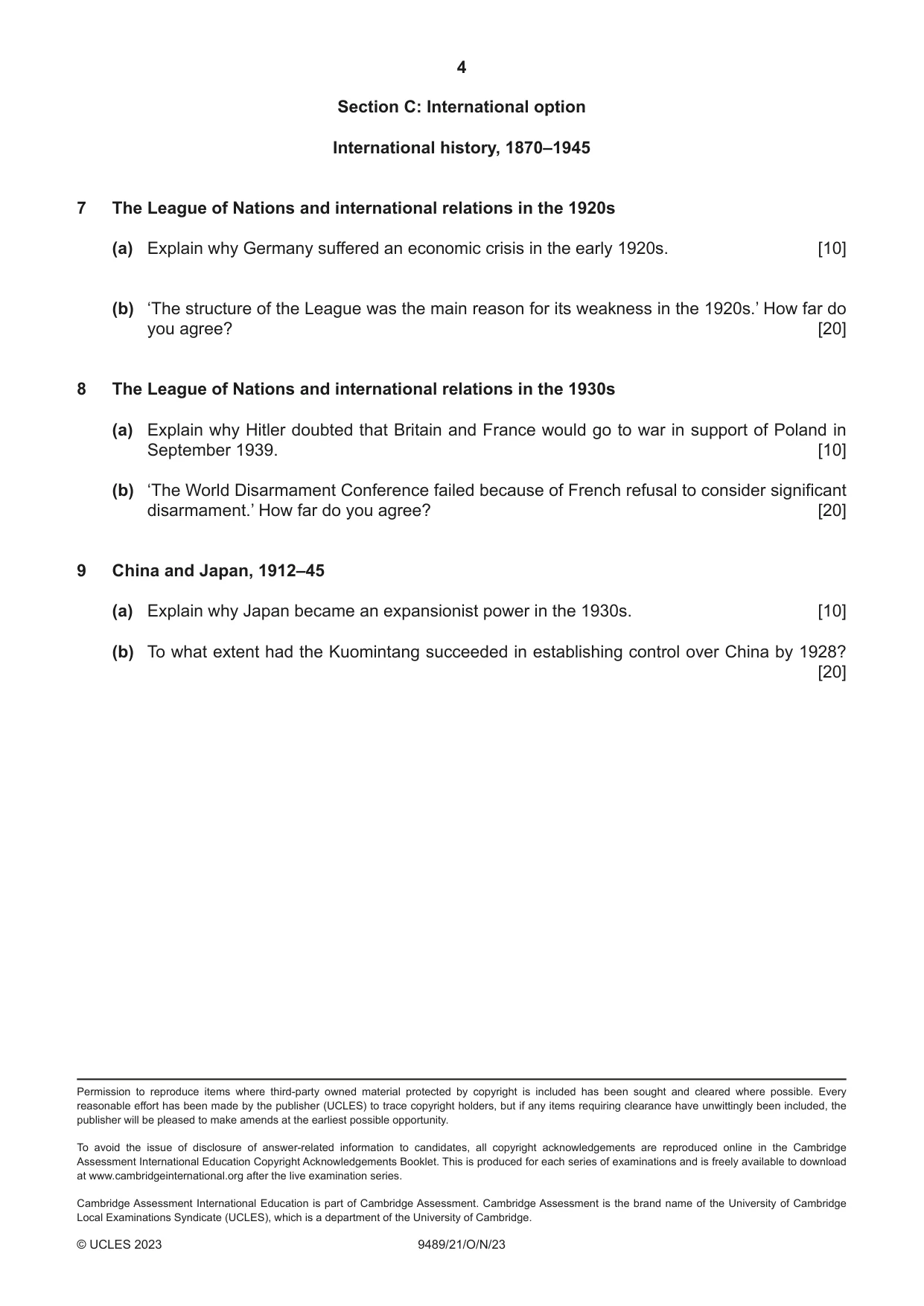
Mark scheme23 pages
Answers below. Sit the paper first if you are practising.

Questions as text
Q1 · The Industrial Revolution in Britain, 1750–1850 (a) Explain why many people in Britain…
1 The Industrial Revolution in Britain, 1750–1850 (a) Explain why many people in Britain supported the idea of free trade. [10] (b) To what extent was industrialisation caused by technological changes? [20]
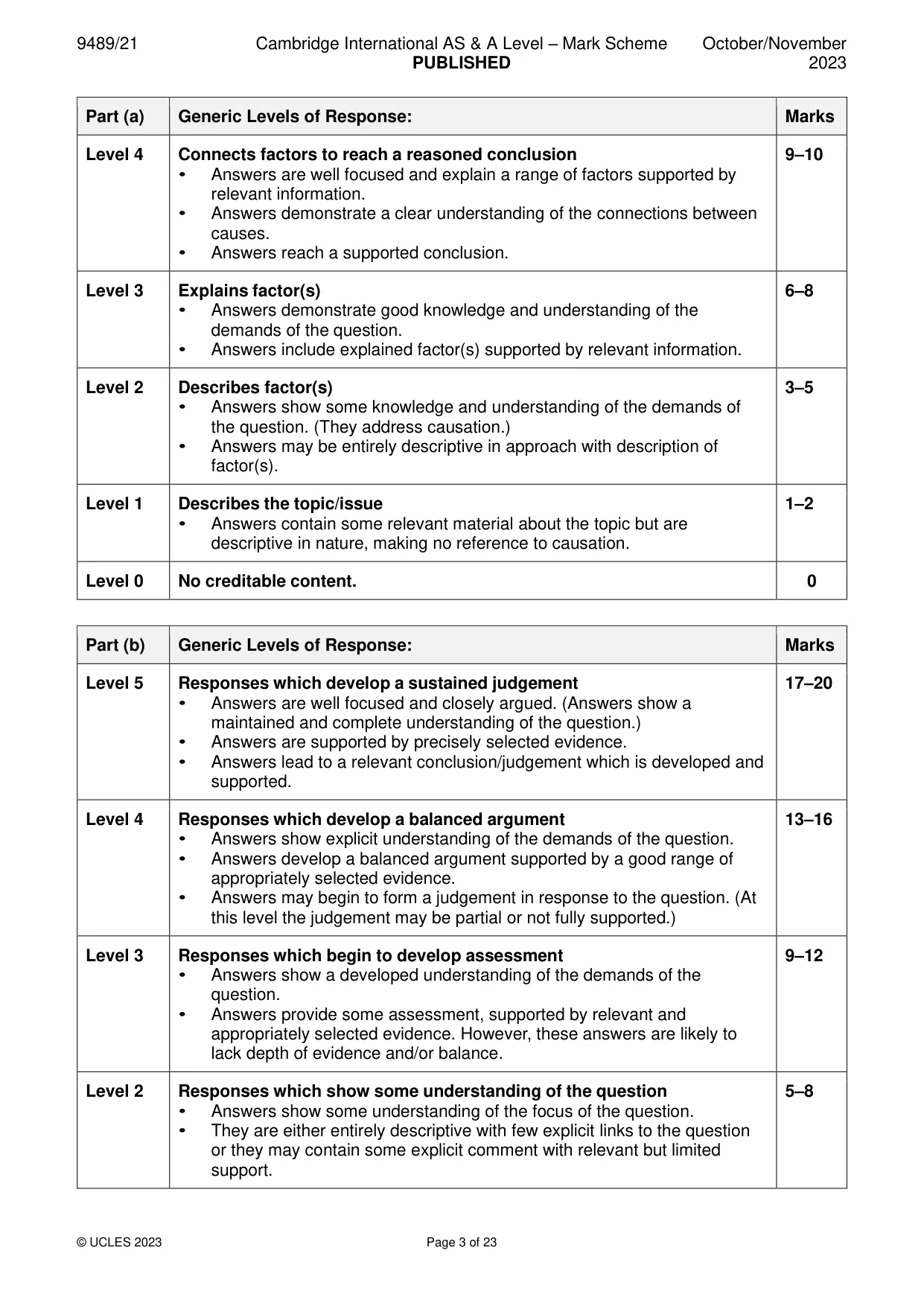
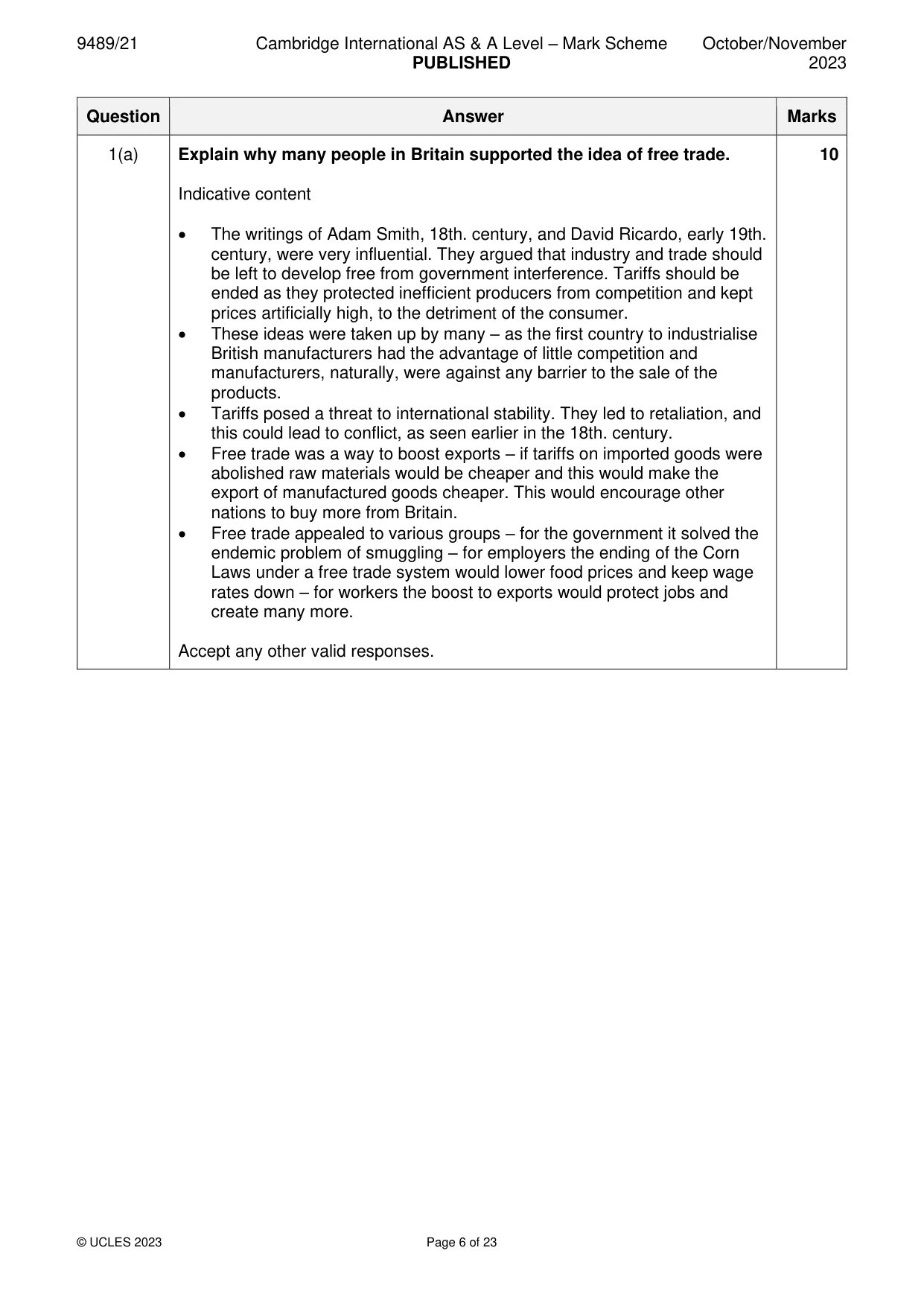
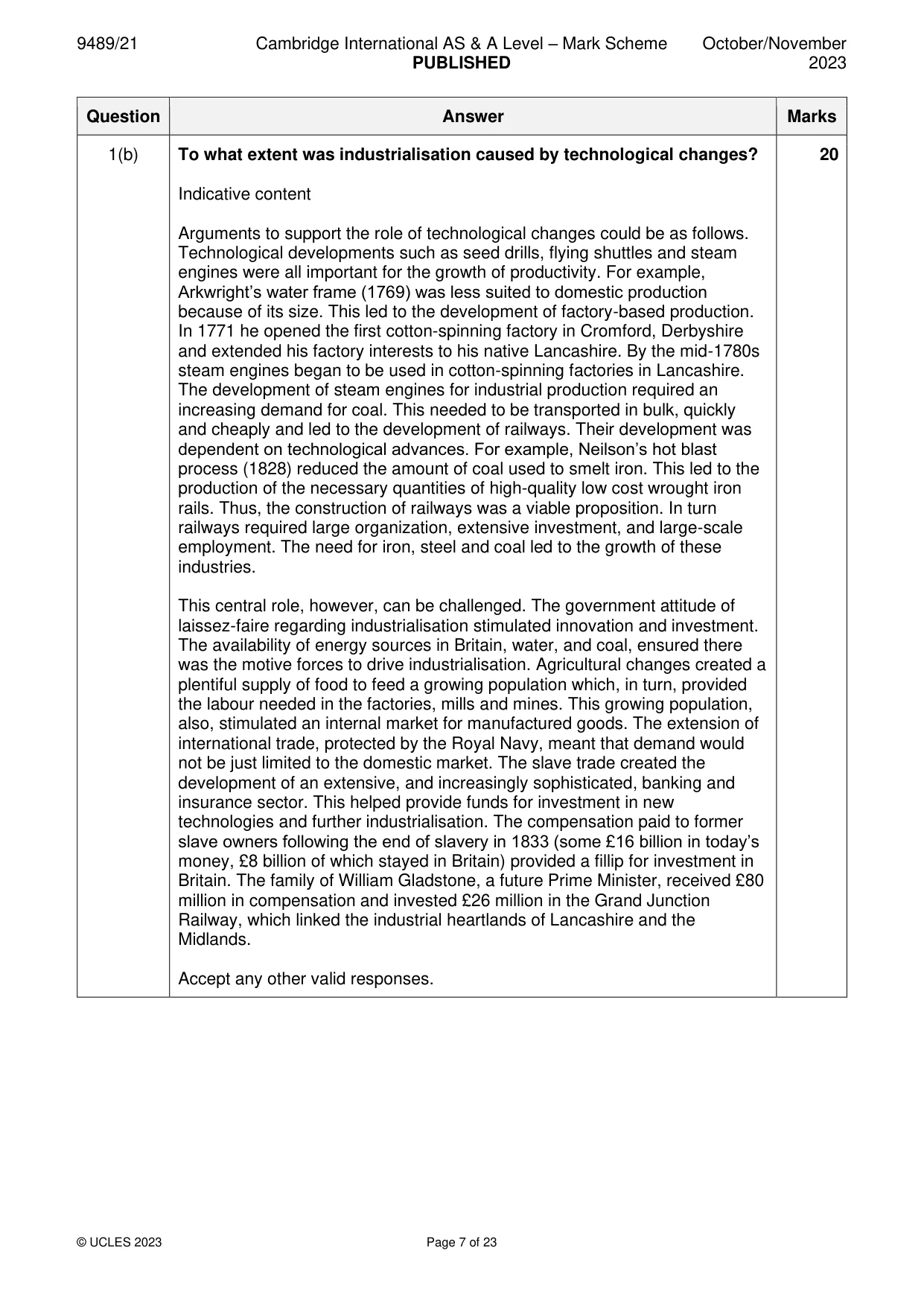
Mark scheme: Question Answer Marks 1(a) Explain why many people in Britain supported the idea of free trade. 10 Indicative content • The writings of Adam Smith, 18th. century, and David Ricardo, early 19th. century, were very influential. They argued that industry and trade should be left to develop free from government interference. Tariffs should be ended as they protected inefficient producers from competition and kept prices artificially high, to the detriment of the consumer. • These ideas were taken up by many – as the first country to industrialise British manufacturers had the advantage of little competition and manufacturers, naturally, were against any barrier to the sale of the products. • Tariffs posed a threat to international stability. They led to retaliation, and this could lead to conflict, as seen earlier in the 18th. century. • Free trade was a way to boost exports – if tariffs on imported goods were abolished raw materials would be cheaper and this would make the export of manufactured goods cheaper. This would encourage other nations to buy more from Britain. • Free trade appealed to various groups – for the government it solved the endemic problem of smuggling – for employers the ending of the Corn Laws under a free trade system would lower food prices and keep wage rates down – for workers the boost to exports would protect jobs and create many more. Accept any other valid responses. 1(b) To what extent was industrialisation caused by technological changes? 20 Indicative content Arguments to support the role of technological changes could be as follows. Technological developments such as seed drills, flying shuttles and steam engines were all important for the growth of productivity. For example, Arkwright’s water frame (1769) was less suited to domestic production because of its size. This led to the development of factory-based production. In 1771 he opened the first cotton-spinning factory in Cromford, Derbyshire and extended his factory interests to his native Lancashire. By the mid-1780s steam engines began to be used in cotton-spinning factories in Lancashire. The development of steam engines for industrial production required an increasing demand for coal. This needed to be transported in bulk, quickly and cheaply and led to the development of railways. Their development was dependent on technological advances. For example, Neilson’s hot blast process (1828) reduced the amount of coal used to smelt iron. This led to the production of the necessary quantities of high-quality low cost wrought iron rails. Thus, the construction of railways was a viable proposition. In turn railways required large organization, extensive investment, and large-scale employment. The need for iron, steel and coal led to the growth of these industries. This central role, however, can be challenged. The government attitude of laissez-faire regarding industrialisation stimulated innovation and investment. The availability of energy sources in Britain, water, and coal, ensured there was the motive forces to drive industrialisation. Agricultural changes created a plentiful supply of food to feed a growing population which, in turn, provided the labour needed in the factories, mills and mines. This growing population, also, stimulated an internal market for manufactured goods. The extension of international trade, protected by the Royal Navy, meant that demand would not be just limited to the domestic market. The slave trade created the development of an extensive, and increasingly sophisticated, banking and insurance sector. This helped provide funds for investment in new technologies and further industrialisation. The compensation paid to former slave owners following the end of slavery in 1833 (some £16 billion in today’s money, £8 billion of which stayed in Britain) provided a fillip for investment in Britain. The family of William Gladstone, a future Prime Minister, received £80 million in compensation and invested £26 million in the Grand Junction Railway, which linked the industrial heartlands of Lancashire and the Midlands. Accept any other valid responses.
More questions on Why was there rapid industrialisation after 1870?
Q2 · Liberalism and nationalism in Germany, 1815–71 (a) Explain why Prussia went to war with…
2 Liberalism and nationalism in Germany, 1815–71 (a) Explain why Prussia went to war with Denmark in 1864. [10] (b) To what extent was the development of German nationalism in the period 1815–50 brought about by cultural factors? [20]
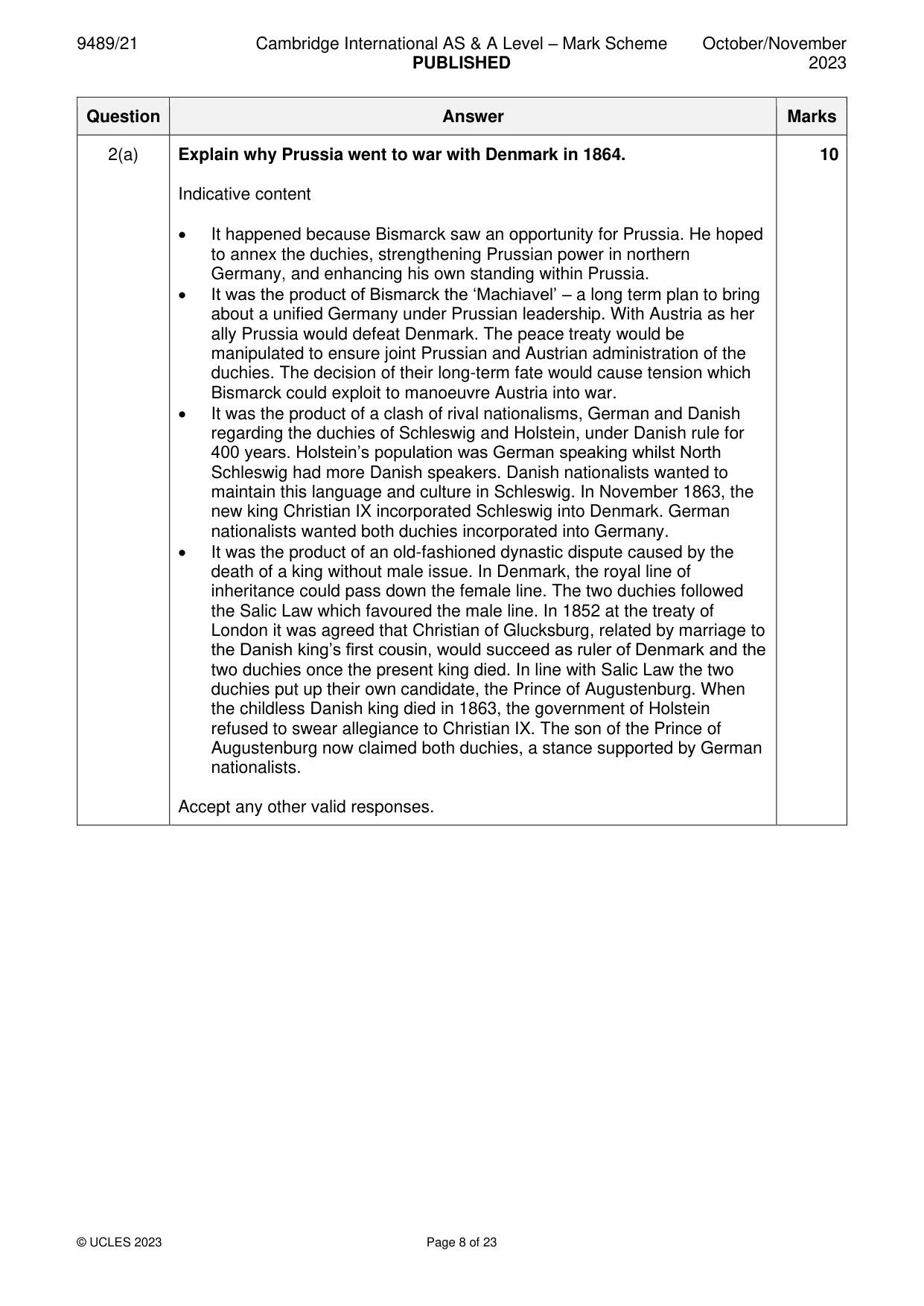
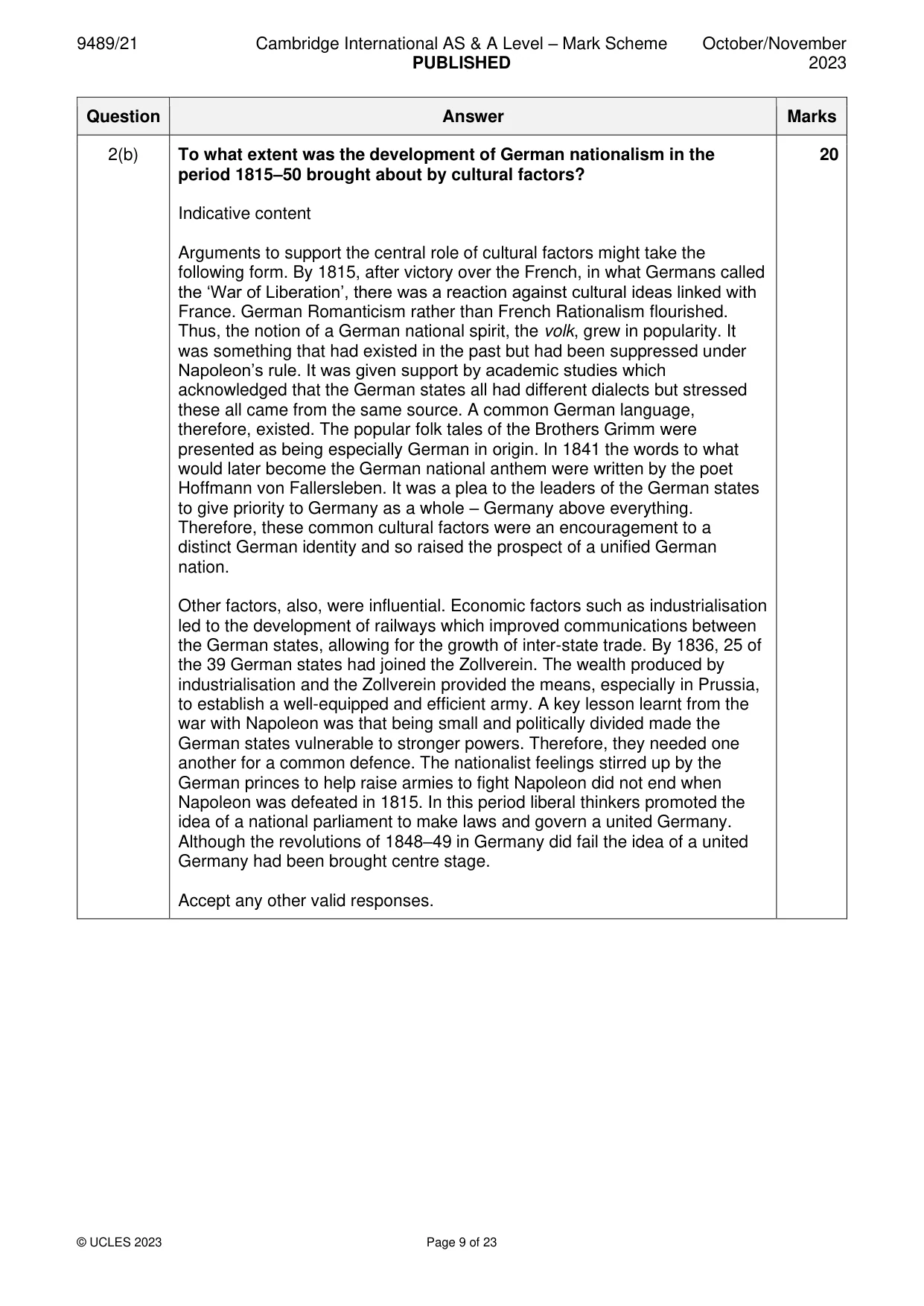
Mark scheme: 2(a) Explain why Prussia went to war with Denmark in 1864. 10 Indicative content • It happened because Bismarck saw an opportunity for Prussia. He hoped to annex the duchies, strengthening Prussian power in northern Germany, and enhancing his own standing within Prussia. • It was the product of Bismarck the ‘Machiavel’ – a long term plan to bring about a unified Germany under Prussian leadership. With Austria as her ally Prussia would defeat Denmark. The peace treaty would be manipulated to ensure joint Prussian and Austrian administration of the duchies. The decision of their long-term fate would cause tension which Bismarck could exploit to manoeuvre Austria into war. • It was the product of a clash of rival nationalisms, German and Danish regarding the duchies of Schleswig and Holstein, under Danish rule for 400 years. Holstein’s population was German speaking whilst North Schleswig had more Danish speakers. Danish nationalists wanted to maintain this language and culture in Schleswig. In November 1863, the new king Christian IX incorporated Schleswig into Denmark. German nationalists wanted both duchies incorporated into Germany. • It was the product of an old-fashioned dynastic dispute caused by the death of a king without male issue. In Denmark, the royal line of inheritance could pass down the female line. The two duchies followed the Salic Law which favoured the male line. In 1852 at the treaty of London it was agreed that Christian of Glucksburg, related by marriage to the Danish king’s first cousin, would succeed as ruler of Denmark and the two duchies once the present king died. In line with Salic Law the two duchies put up their own candidate, the Prince of Augustenburg. When the childless Danish king died in 1863, the government of Holstein refused to swear allegiance to Christian IX. The son of the Prince of Augustenburg now claimed both duchies, a stance supported by German nationalists. Accept any other valid responses. 2(b) To what extent was the development of German nationalism in the 20 period 1815–50 brought about by cultural factors? Indicative content Arguments to support the central role of cultural factors might take the following form. By 1815, after victory over the French, in what Germans called the ‘War of Liberation’, there was a reaction against cultural ideas linked with France. German Romanticism rather than French Rationalism flourished. Thus, the notion of a German national spirit, the volk, grew in popularity. It was something that had existed in the past but had been suppressed under Napoleon’s rule. It was given support by academic studies which acknowledged that the German states all had different dialects but stressed these all came from the same source. A common German language, therefore, existed. The popular folk tales of the Brothers Grimm were presented as being especially German in origin. In 1841 the words to what would later become the German national anthem were written by the poet Hoffmann von Fallersleben. It was a plea to the leaders of the German states to give priority to Germany as a whole – Germany above everything. Therefore, these common cultural factors were an encouragement to a distinct German identity and so raised the prospect of a unified German nation. Other factors, also, were influential. Economic factors such as industrialisation led to the development of railways which improved communications between the German states, allowing for the growth of inter-state trade. By 1836, 25 of the 39 German states had joined the Zollverein. The wealth produced by industrialisation and the Zollverein provided the means, especially in Prussia, to establish a well-equipped and efficient army. A key lesson learnt from the war with Napoleon was that being small and politically divided made the German states vulnerable to stronger powers. Therefore, they needed one another for a common defence. The nationalist feelings stirred up by the German princes to help raise armies to fight Napoleon did not end when Napoleon was defeated in 1815. In this period liberal thinkers promoted the idea of a national parliament to make laws and govern a united Germany. Although the revolutions of 1848–49 in Germany did fail the idea of a united Germany had been brought centre stage. Accept any other valid responses.
More questions on What were the causes of the Revolutions of 1848?
Q3 · The Russian Revolution, 1894–1921 (a) Explain why Trotsky was important for Bolshevik…
3 The Russian Revolution, 1894–1921 (a) Explain why Trotsky was important for Bolshevik success in October 1917. [10] (b) How far was the 1905 Revolution caused by economic discontent? [20]
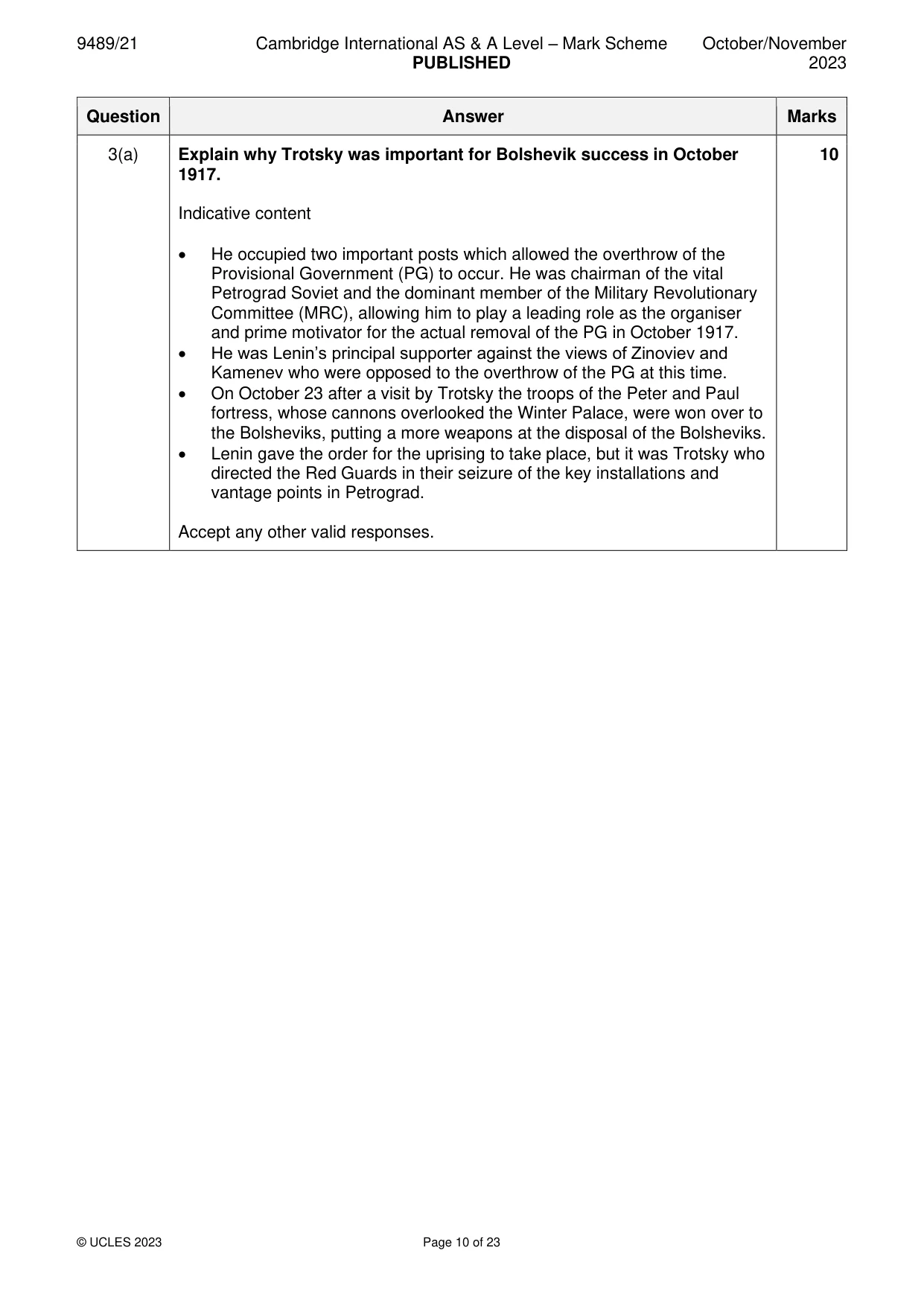
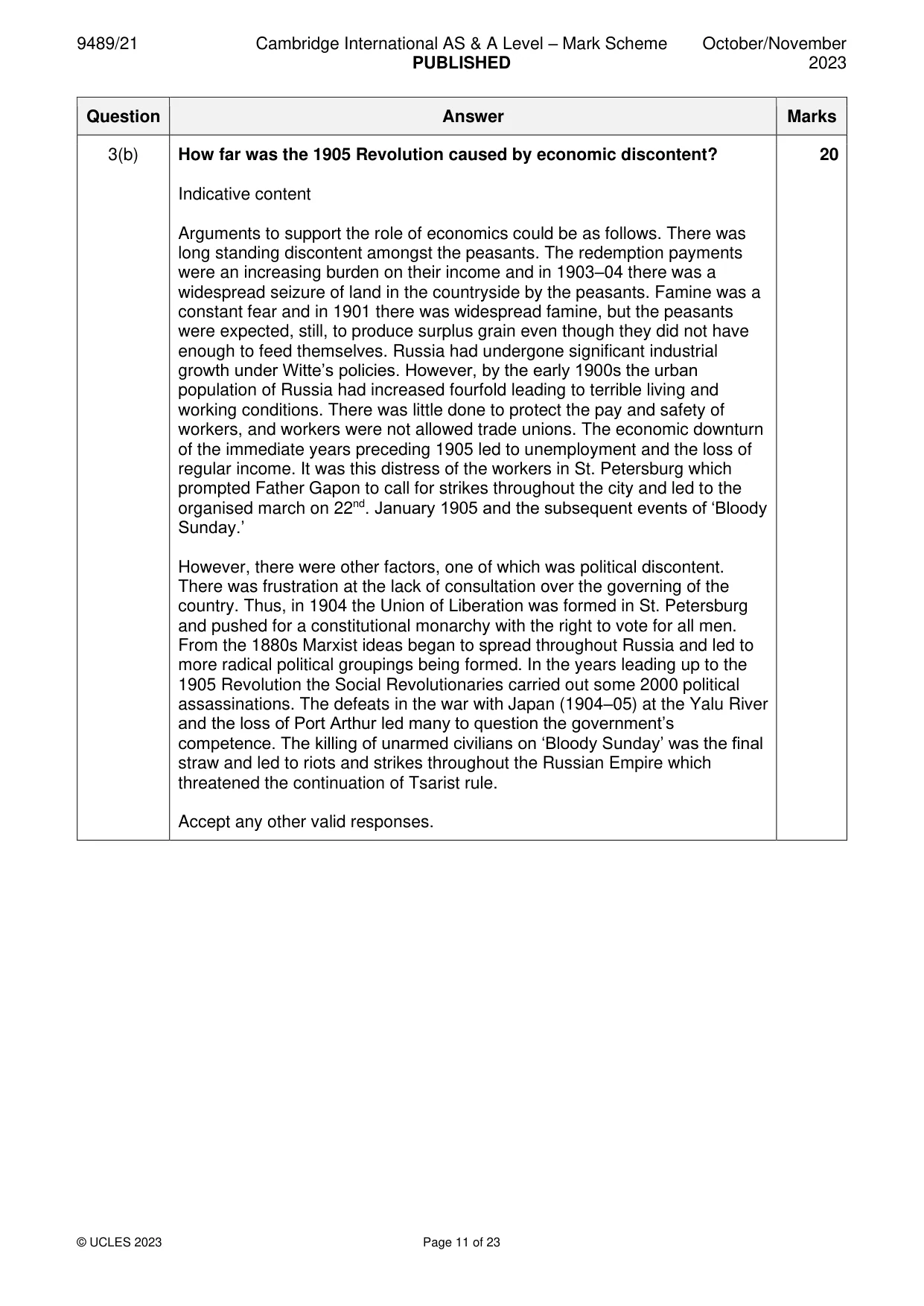
Mark scheme: 3(a) Explain why Trotsky was important for Bolshevik success in October 10 1917. Indicative content • He occupied two important posts which allowed the overthrow of the Provisional Government (PG) to occur. He was chairman of the vital Petrograd Soviet and the dominant member of the Military Revolutionary Committee (MRC), allowing him to play a leading role as the organiser and prime motivator for the actual removal of the PG in October 1917. • He was Lenin’s principal supporter against the views of Zinoviev and Kamenev who were opposed to the overthrow of the PG at this time. • On October 23 after a visit by Trotsky the troops of the Peter and Paul fortress, whose cannons overlooked the Winter Palace, were won over to the Bolsheviks, putting a more weapons at the disposal of the Bolsheviks. • Lenin gave the order for the uprising to take place, but it was Trotsky who directed the Red Guards in their seizure of the key installations and vantage points in Petrograd. Accept any other valid responses. 3(b) How far was the 1905 Revolution caused by economic discontent? 20 Indicative content Arguments to support the role of economics could be as follows. There was long standing discontent amongst the peasants. The redemption payments were an increasing burden on their income and in 1903–04 there was a widespread seizure of land in the countryside by the peasants. Famine was a constant fear and in 1901 there was widespread famine, but the peasants were expected, still, to produce surplus grain even though they did not have enough to feed themselves. Russia had undergone significant industrial growth under Witte’s policies. However, by the early 1900s the urban population of Russia had increased fourfold leading to terrible living and working conditions. There was little done to protect the pay and safety of workers, and workers were not allowed trade unions. The economic downturn of the immediate years preceding 1905 led to unemployment and the loss of regular income. It was this distress of the workers in St. Petersburg which prompted Father Gapon to call for strikes throughout the city and led to the organised march on 22nd. January 1905 and the subsequent events of ‘Bloody Sunday.’ However, there were other factors, one of which was political discontent. There was frustration at the lack of consultation over the governing of the country. Thus, in 1904 the Union of Liberation was formed in St. Petersburg and pushed for a constitutional monarchy with the right to vote for all men. From the 1880s Marxist ideas began to spread throughout Russia and led to more radical political groupings being formed. In the years leading up to the 1905 Revolution the Social Revolutionaries carried out some 2000 political assassinations. The defeats in the war with Japan (1904–05) at the Yalu River and the loss of Port Arthur led many to question the government’s competence. The killing of unarmed civilians on ‘Bloody Sunday’ was the final straw and led to riots and strikes throughout the Russian Empire which threatened the continuation of Tsarist rule. Accept any other valid responses.
More questions on What were the causes and outcomes of the 1905 Revolution up to 1914?
Q4 · The origins of the Civil War, 1820–61 (a) Explain why the Whig Party declined rapidly in…
4 The origins of the Civil War, 1820–61 (a) Explain why the Whig Party declined rapidly in the 1850s. [10] (b) How successful was the Missouri Compromise? [20]
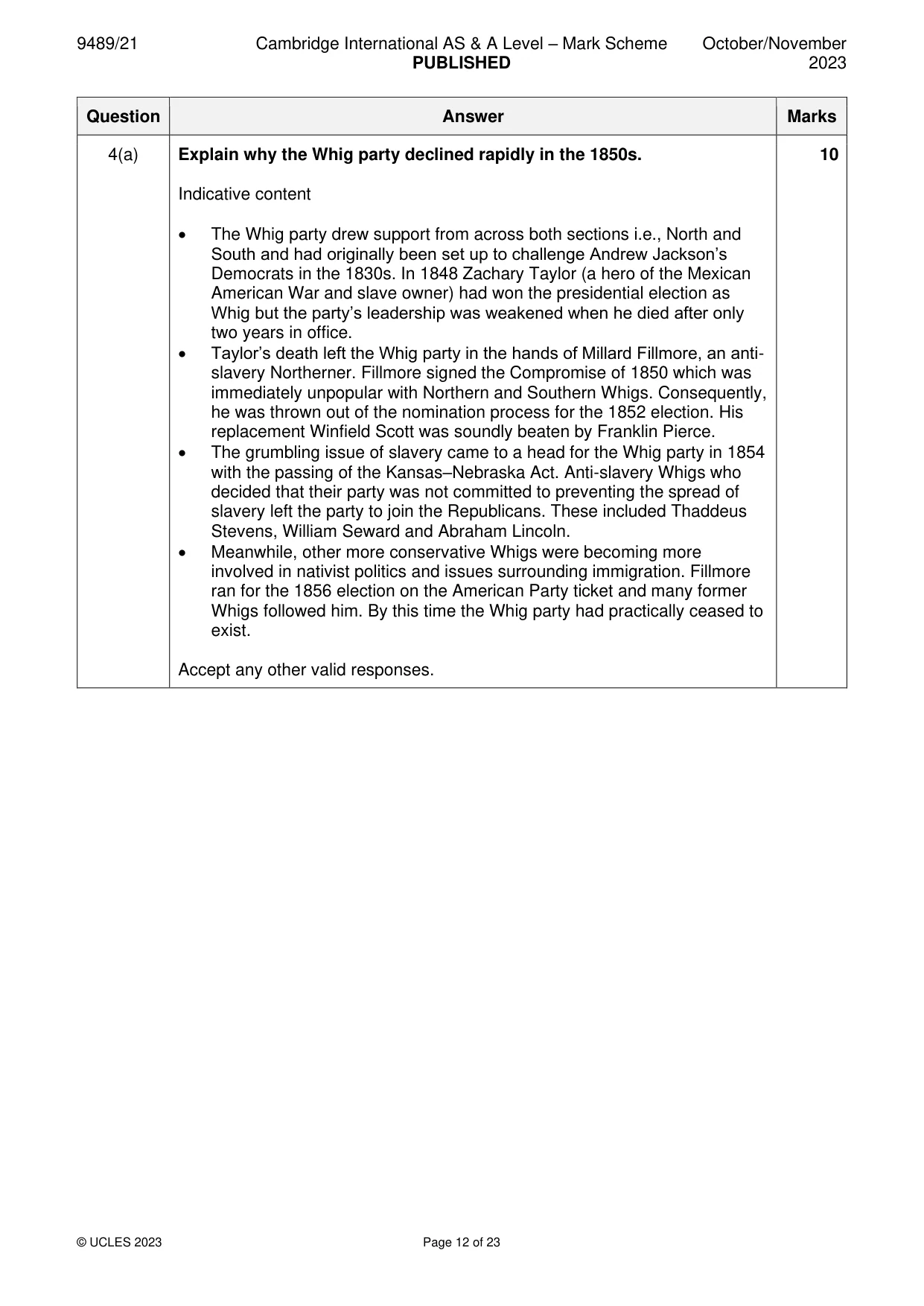
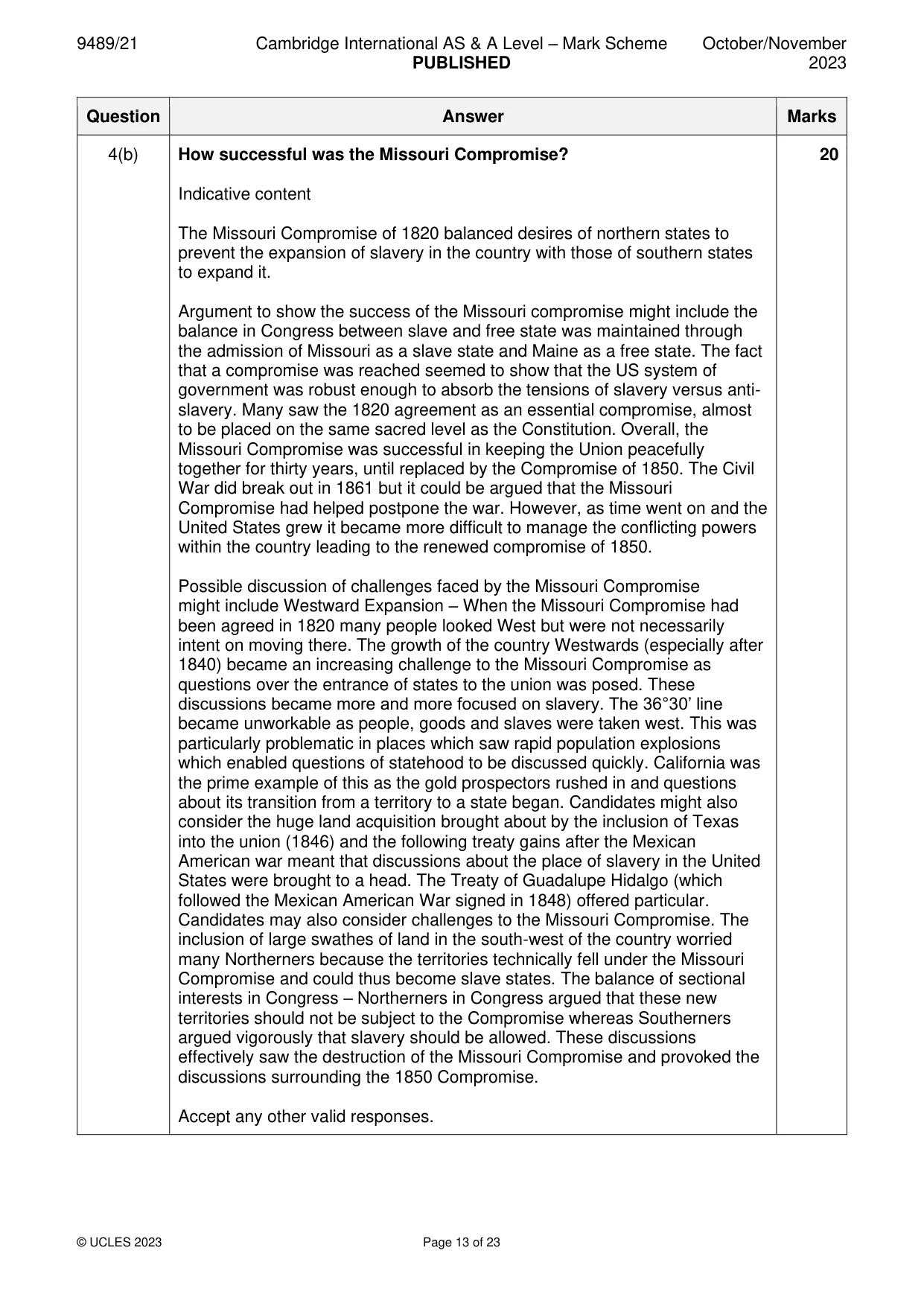
Mark scheme: 4(a) Explain why the Whig party declined rapidly in the 1850s. 10 Indicative content • The Whig party drew support from across both sections i.e., North and South and had originally been set up to challenge Andrew Jackson’s Democrats in the 1830s. In 1848 Zachary Taylor (a hero of the Mexican American War and slave owner) had won the presidential election as Whig but the party’s leadership was weakened when he died after only two years in office. • Taylor’s death left the Whig party in the hands of Millard Fillmore, an anti- slavery Northerner. Fillmore signed the Compromise of 1850 which was immediately unpopular with Northern and Southern Whigs. Consequently, he was thrown out of the nomination process for the 1852 election. His replacement Winfield Scott was soundly beaten by Franklin Pierce. • The grumbling issue of slavery came to a head for the Whig party in 1854 with the passing of the Kansas–Nebraska Act. Anti-slavery Whigs who decided that their party was not committed to preventing the spread of slavery left the party to join the Republicans. These included Thaddeus Stevens, William Seward and Abraham Lincoln. • Meanwhile, other more conservative Whigs were becoming more involved in nativist politics and issues surrounding immigration. Fillmore ran for the 1856 election on the American Party ticket and many former Whigs followed him. By this time the Whig party had practically ceased to exist. Accept any other valid responses. 4(b) How successful was the Missouri Compromise? 20 Indicative content The Missouri Compromise of 1820 balanced desires of northern states to prevent the expansion of slavery in the country with those of southern states to expand it. Argument to show the success of the Missouri compromise might include the balance in Congress between slave and free state was maintained through the admission of Missouri as a slave state and Maine as a free state. The fact that a compromise was reached seemed to show that the US system of government was robust enough to absorb the tensions of slavery versus anti- slavery. Many saw the 1820 agreement as an essential compromise, almost to be placed on the same sacred level as the Constitution. Overall, the Missouri Compromise was successful in keeping the Union peacefully together for thirty years, until replaced by the Compromise of 1850. The Civil War did break out in 1861 but it could be argued that the Missouri Compromise had helped postpone the war. However, as time went on and the United States grew it became more difficult to manage the conflicting powers within the country leading to the renewed compromise of 1850. Possible discussion of challenges faced by the Missouri Compromise might include Westward Expansion – When the Missouri Compromise had been agreed in 1820 many people looked West but were not necessarily intent on moving there. The growth of the country Westwards (especially after 1840) became an increasing challenge to the Missouri Compromise as questions over the entrance of states to the union was posed. These discussions became more and more focused on slavery. The 36°30’ line became unworkable as people, goods and slaves were taken west. This was particularly problematic in places which saw rapid population explosions which enabled questions of statehood to be discussed quickly. California was the prime example of this as the gold prospectors rushed in and questions about its transition from a territory to a state began. Candidates might also consider the huge land acquisition brought about by the inclusion of Texas into the union (1846) and the following treaty gains after the Mexican American war meant that discussions about the place of slavery in the United States were brought to a head. The Treaty of Guadalupe Hidalgo (which followed the Mexican American War signed in 1848) offered particular. Candidates may also consider challenges to the Missouri Compromise. The inclusion of large swathes of land in the south-west of the country worried many Northerners because the territories technically fell under the Missouri Compromise and could thus become slave states. The balance of sectional interests in Congress – Northerners in Congress argued that these new territories should not be subject to the Compromise whereas Southerners argued vigorously that slavery should be allowed. These discussions effectively saw the destruction of the Missouri Compromise and provoked the discussions surrounding the 1850 Compromise. Accept any other valid responses.
More questions on Why was there increasing tension between the North and the South before 1860?
Q5 · Civil War and Reconstruction, 1861–77 (a) Explain why the availability of resources was…
5 Civil War and Reconstruction, 1861–77 (a) Explain why the availability of resources was important to the outcome of the Civil War. [10] (b) ‘The main reason for the Emancipation Proclamation was Lincoln’s desire to end slavery.’ How far do you agree? [20]
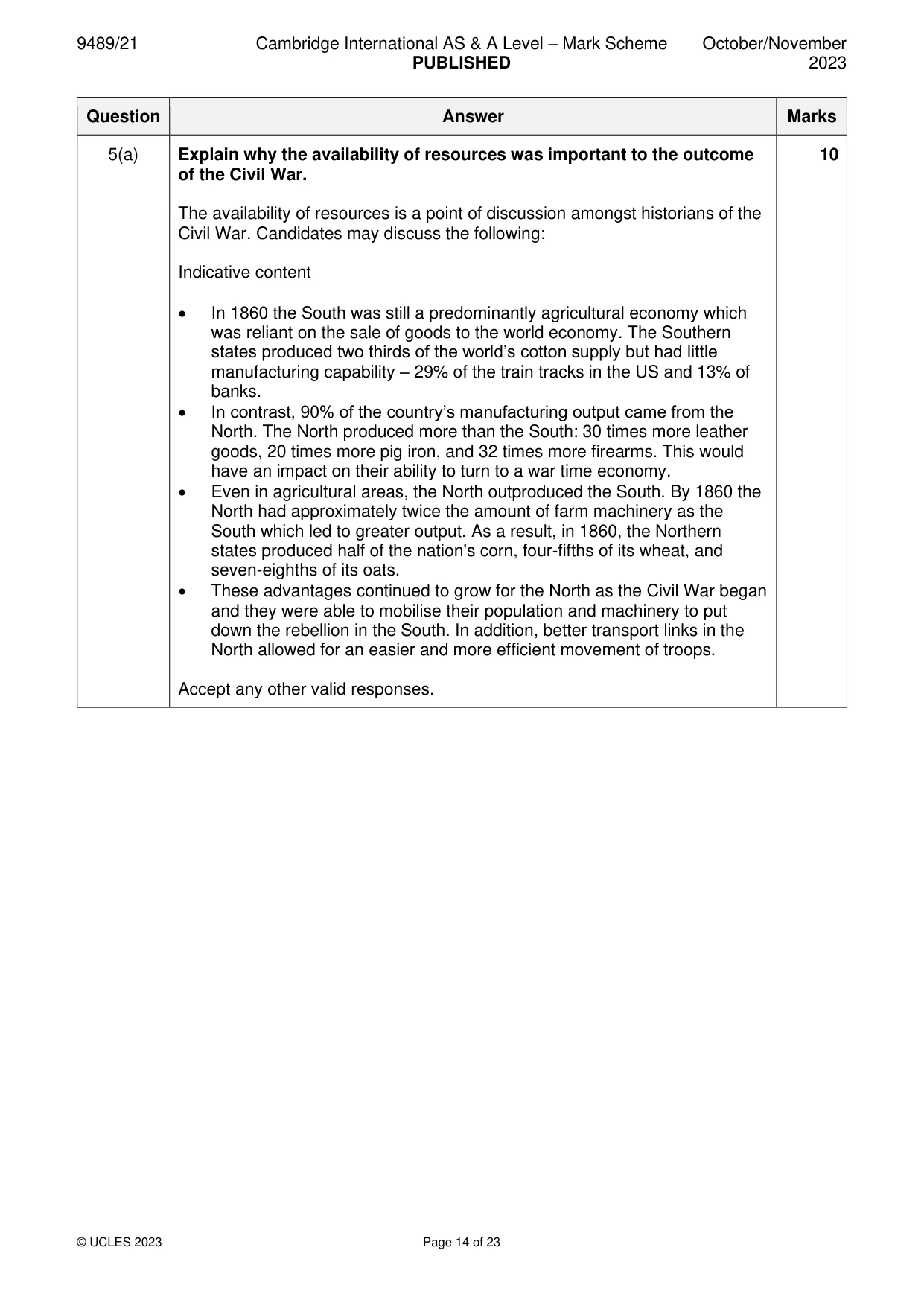
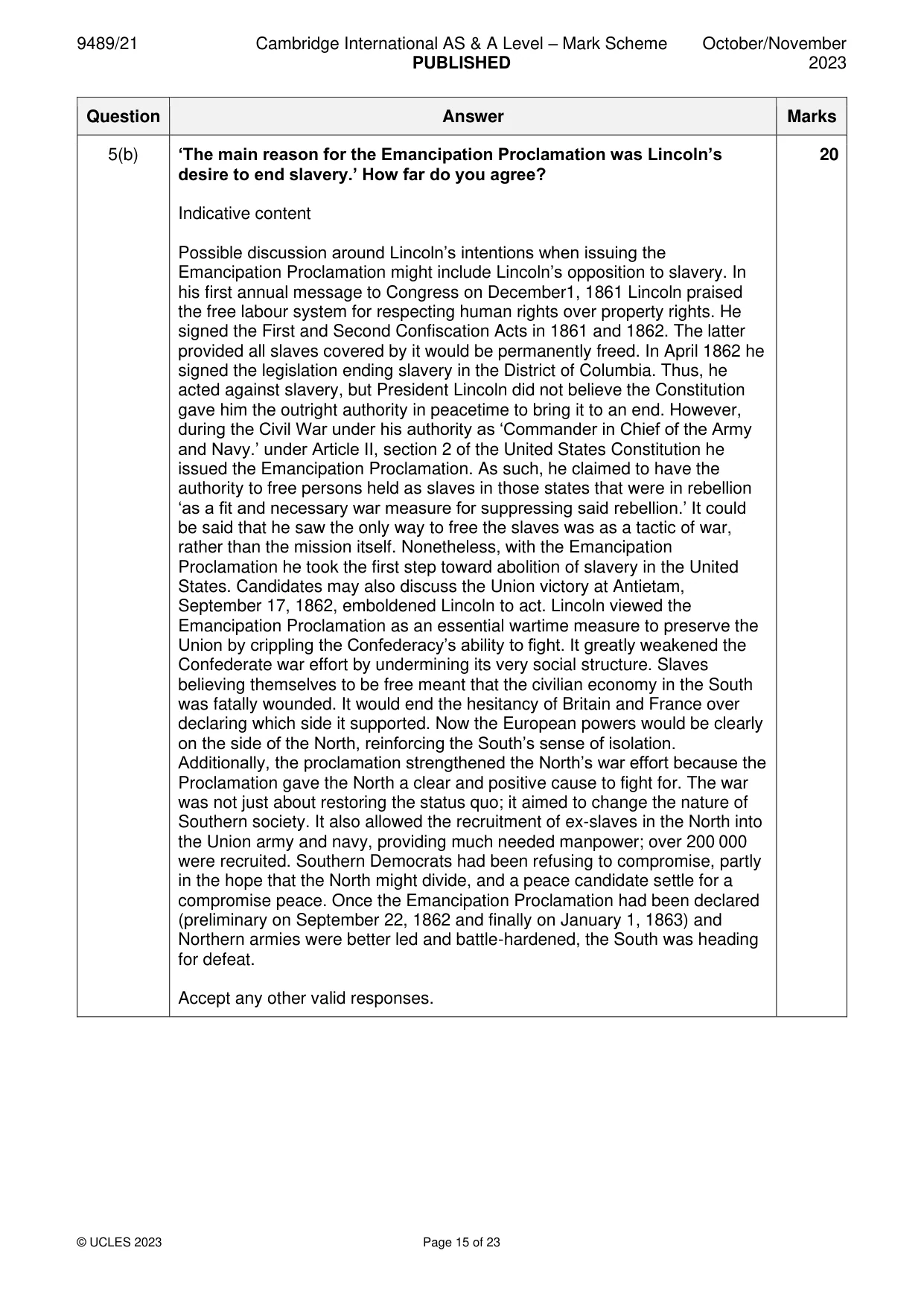
Mark scheme: 5(a) Explain why the availability of resources was important to the outcome 10 of the Civil War. The availability of resources is a point of discussion amongst historians of the Civil War. Candidates may discuss the following: Indicative content • In 1860 the South was still a predominantly agricultural economy which was reliant on the sale of goods to the world economy. The Southern states produced two thirds of the world’s cotton supply but had little manufacturing capability – 29% of the train tracks in the US and 13% of banks. • In contrast, 90% of the country’s manufacturing output came from the North. The North produced more than the South: 30 times more leather goods, 20 times more pig iron, and 32 times more firearms. This would have an impact on their ability to turn to a war time economy. • Even in agricultural areas, the North outproduced the South. By 1860 the North had approximately twice the amount of farm machinery as the South which led to greater output. As a result, in 1860, the Northern states produced half of the nation's corn, four-fifths of its wheat, and seven-eighths of its oats. • These advantages continued to grow for the North as the Civil War began and they were able to mobilise their population and machinery to put down the rebellion in the South. In addition, better transport links in the North allowed for an easier and more efficient movement of troops. Accept any other valid responses. 5(b) ‘The main reason for the Emancipation Proclamation was Lincoln’s 20 desire to end slavery.’ How far do you agree? Indicative content Possible discussion around Lincoln’s intentions when issuing the Emancipation Proclamation might include Lincoln’s opposition to slavery. In his first annual message to Congress on December1, 1861 Lincoln praised the free labour system for respecting human rights over property rights. He signed the First and Second Confiscation Acts in 1861 and 1862. The latter provided all slaves covered by it would be permanently freed. In April 1862 he signed the legislation ending slavery in the District of Columbia. Thus, he acted against slavery, but President Lincoln did not believe the Constitution gave him the outright authority in peacetime to bring it to an end. However, during the Civil War under his authority as ‘Commander in Chief of the Army and Navy.’ under Article II, section 2 of the United States Constitution he issued the Emancipation Proclamation. As such, he claimed to have the authority to free persons held as slaves in those states that were in rebellion ‘as a fit and necessary war measure for suppressing said rebellion.’ It could be said that he saw the only way to free the slaves was as a tactic of war, rather than the mission itself. Nonetheless, with the Emancipation Proclamation he took the first step toward abolition of slavery in the United States. Candidates may also discuss the Union victory at Antietam, September 17, 1862, emboldened Lincoln to act. Lincoln viewed the Emancipation Proclamation as an essential wartime measure to preserve the Union by crippling the Confederacy’s ability to fight. It greatly weakened the Confederate war effort by undermining its very social structure. Slaves believing themselves to be free meant that the civilian economy in the South was fatally wounded. It would end the hesitancy of Britain and France over declaring which side it supported. Now the European powers would be clearly on the side of the North, reinforcing the South’s sense of isolation. Additionally, the proclamation strengthened the North’s war effort because the Proclamation gave the North a clear and positive cause to fight for. The war was not just about restoring the status quo; it aimed to change the nature of Southern society. It also allowed the recruitment of ex-slaves in the North into the Union army and navy, providing much needed manpower; over 200 000 were recruited. Southern Democrats had been refusing to compromise, partly in the hope that the North might divide, and a peace candidate settle for a compromise peace. Once the Emancipation Proclamation had been declared (preliminary on September 22, 1862 and finally on January 1, 1863) and Northern armies were better led and battle-hardened, the South was heading for defeat. Accept any other valid responses.
Q6 · The Great Crash, the Great Depression and the New Deal policies, 1920–41 (a) Explain why…
6 The Great Crash, the Great Depression and the New Deal policies, 1920–41 (a) Explain why many on the liberal left opposed the New Deal. [10] (b) To what extent was lack of government regulation to blame for the Great Crash? [20] Section C: International option International history, 1870–1945
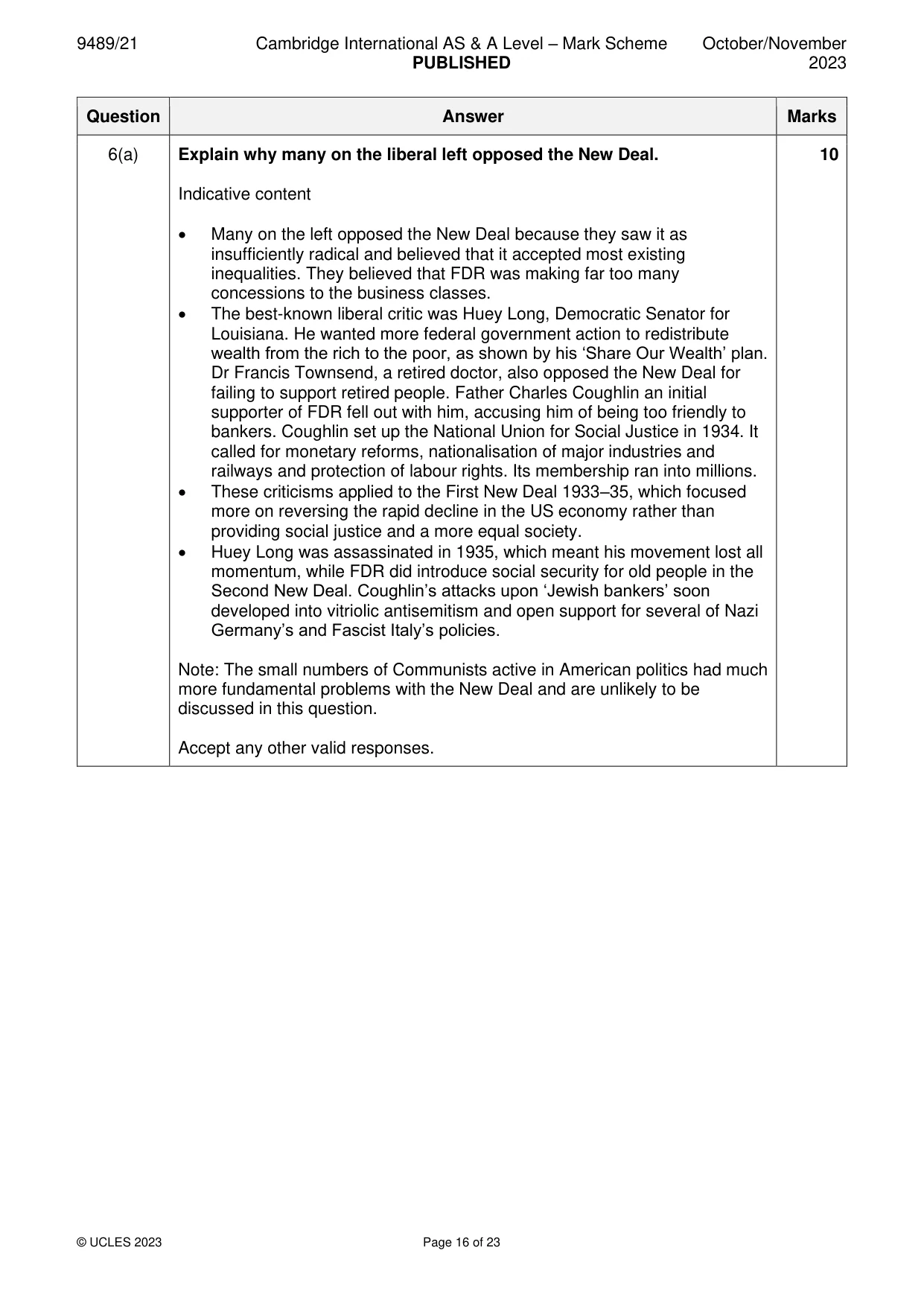
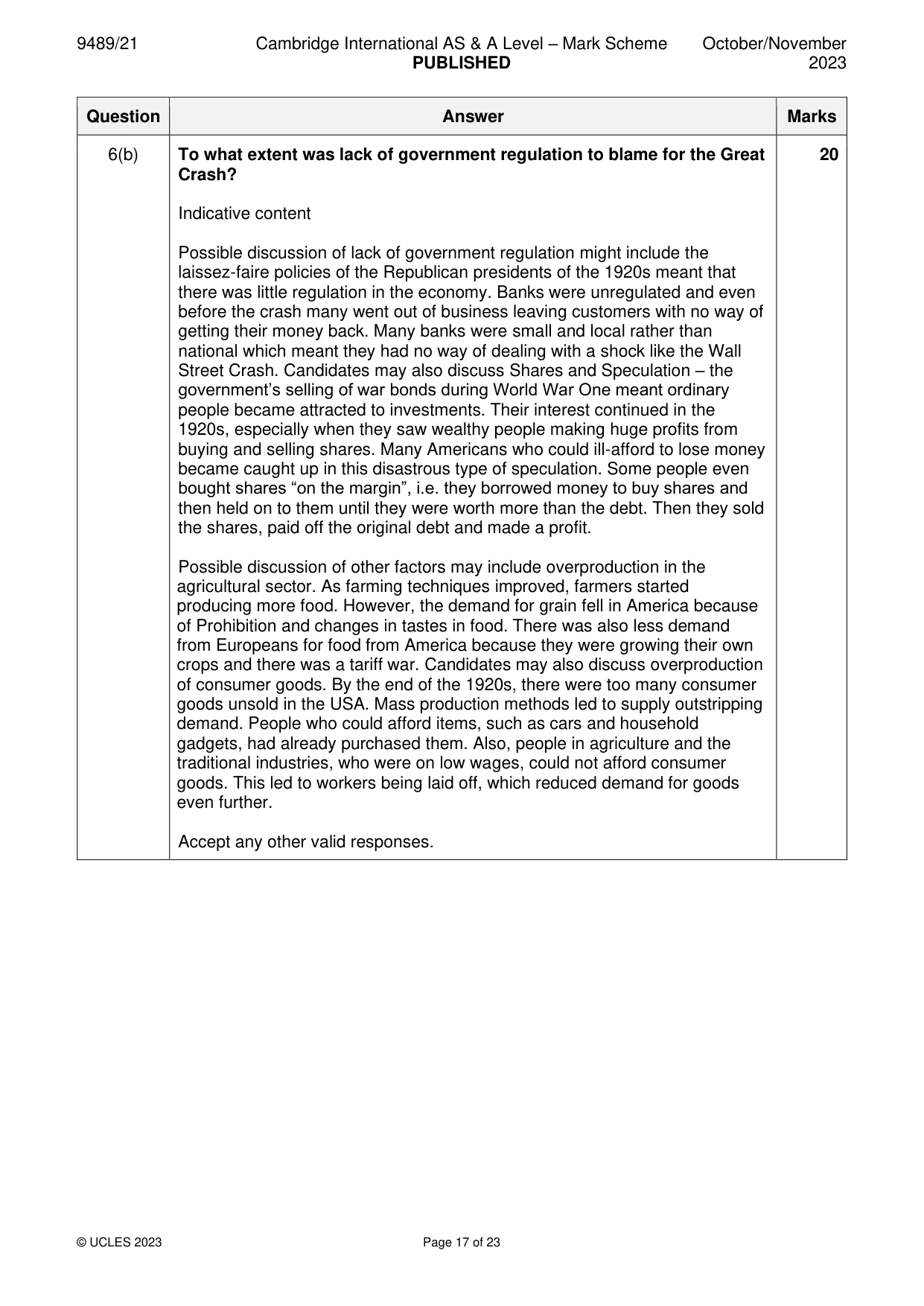
Mark scheme: 6(a) Explain why many on the liberal left opposed the New Deal. 10 Indicative content • Many on the left opposed the New Deal because they saw it as insufficiently radical and believed that it accepted most existing inequalities. They believed that FDR was making far too many concessions to the business classes. • The best-known liberal critic was Huey Long, Democratic Senator for Louisiana. He wanted more federal government action to redistribute wealth from the rich to the poor, as shown by his ‘Share Our Wealth’ plan. Dr Francis Townsend, a retired doctor, also opposed the New Deal for failing to support retired people. Father Charles Coughlin an initial supporter of FDR fell out with him, accusing him of being too friendly to bankers. Coughlin set up the National Union for Social Justice in 1934. It called for monetary reforms, nationalisation of major industries and railways and protection of labour rights. Its membership ran into millions. • These criticisms applied to the First New Deal 1933–35, which focused more on reversing the rapid decline in the US economy rather than providing social justice and a more equal society. • Huey Long was assassinated in 1935, which meant his movement lost all momentum, while FDR did introduce social security for old people in the Second New Deal. Coughlin’s attacks upon ‘Jewish bankers’ soon developed into vitriolic antisemitism and open support for several of Nazi Germany’s and Fascist Italy’s policies. Note: The small numbers of Communists active in American politics had much more fundamental problems with the New Deal and are unlikely to be discussed in this question. Accept any other valid responses. 6(b) To what extent was lack of government regulation to blame for the Great 20 Crash? Indicative content Possible discussion of lack of government regulation might include the laissez-faire policies of the Republican presidents of the 1920s meant that there was little regulation in the economy. Banks were unregulated and even before the crash many went out of business leaving customers with no way of getting their money back. Many banks were small and local rather than national which meant they had no way of dealing with a shock like the Wall Street Crash. Candidates may also discuss Shares and Speculation – the government’s selling of war bonds during World War One meant ordinary people became attracted to investments. Their interest continued in the 1920s, especially when they saw wealthy people making huge profits from buying and selling shares. Many Americans who could ill-afford to lose money became caught up in this disastrous type of speculation. Some people even bought shares “on the margin”, i.e. they borrowed money to buy shares and then held on to them until they were worth more than the debt. Then they sold the shares, paid off the original debt and made a profit. Possible discussion of other factors may include overproduction in the agricultural sector. As farming techniques improved, farmers started producing more food. However, the demand for grain fell in America because of Prohibition and changes in tastes in food. There was also less demand from Europeans for food from America because they were growing their own crops and there was a tariff war. Candidates may also discuss overproduction of consumer goods. By the end of the 1920s, there were too many consumer goods unsold in the USA. Mass production methods led to supply outstripping demand. People who could afford items, such as cars and household gadgets, had already purchased them. Also, people in agriculture and the traditional industries, who were on low wages, could not afford consumer goods. This led to workers being laid off, which reduced demand for goods even further. Accept any other valid responses.
More questions on What were the causes of the Great Crash and the Great Depression?
Q7 · The League of Nations and international relations in the 1920s (a) Explain why Germany…
7 The League of Nations and international relations in the 1920s (a) Explain why Germany suffered an economic crisis in the early 1920s. [10] (b) ‘The structure of the League was the main reason for its weakness in the 1920s.’ How far do you agree? [20]
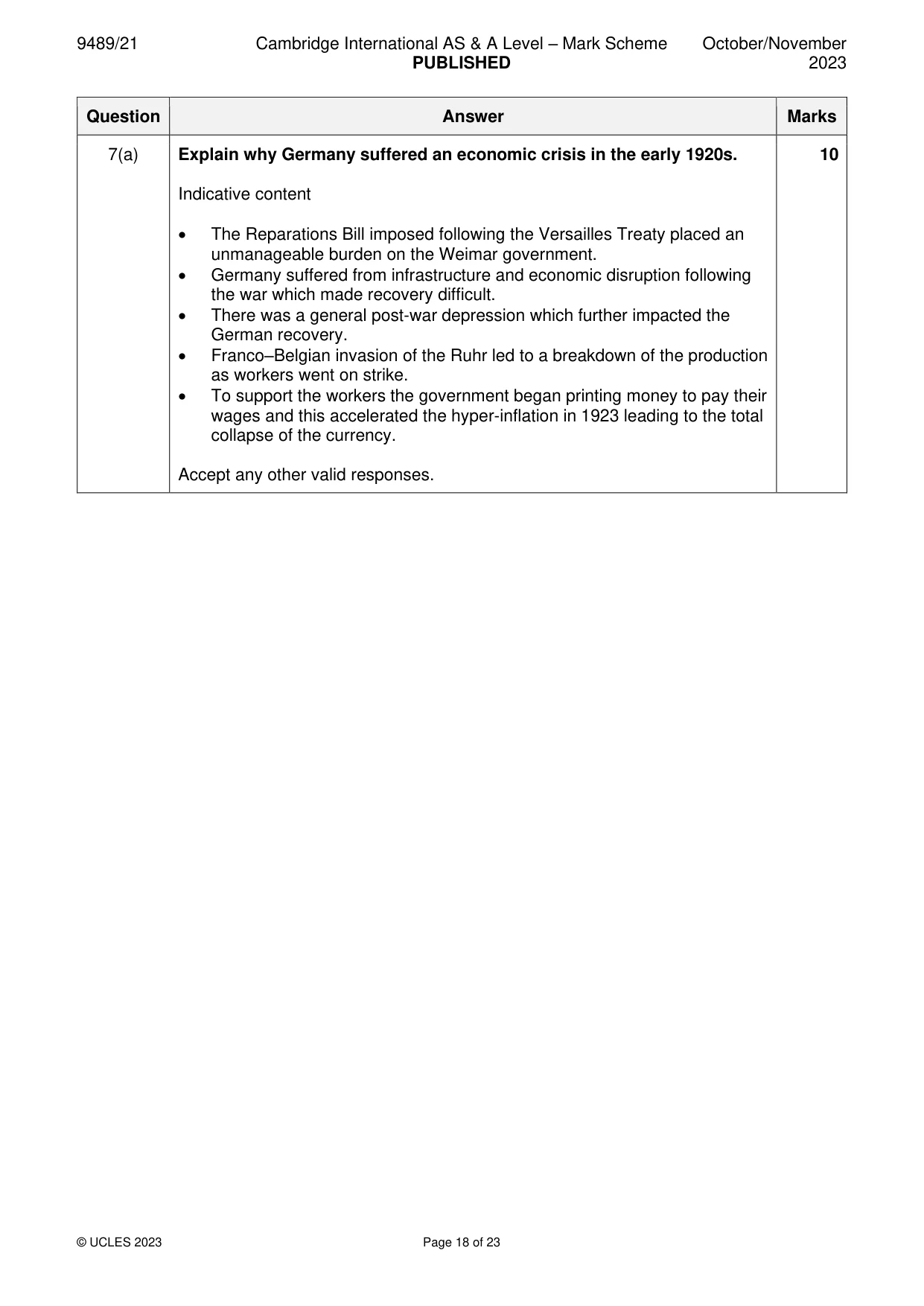
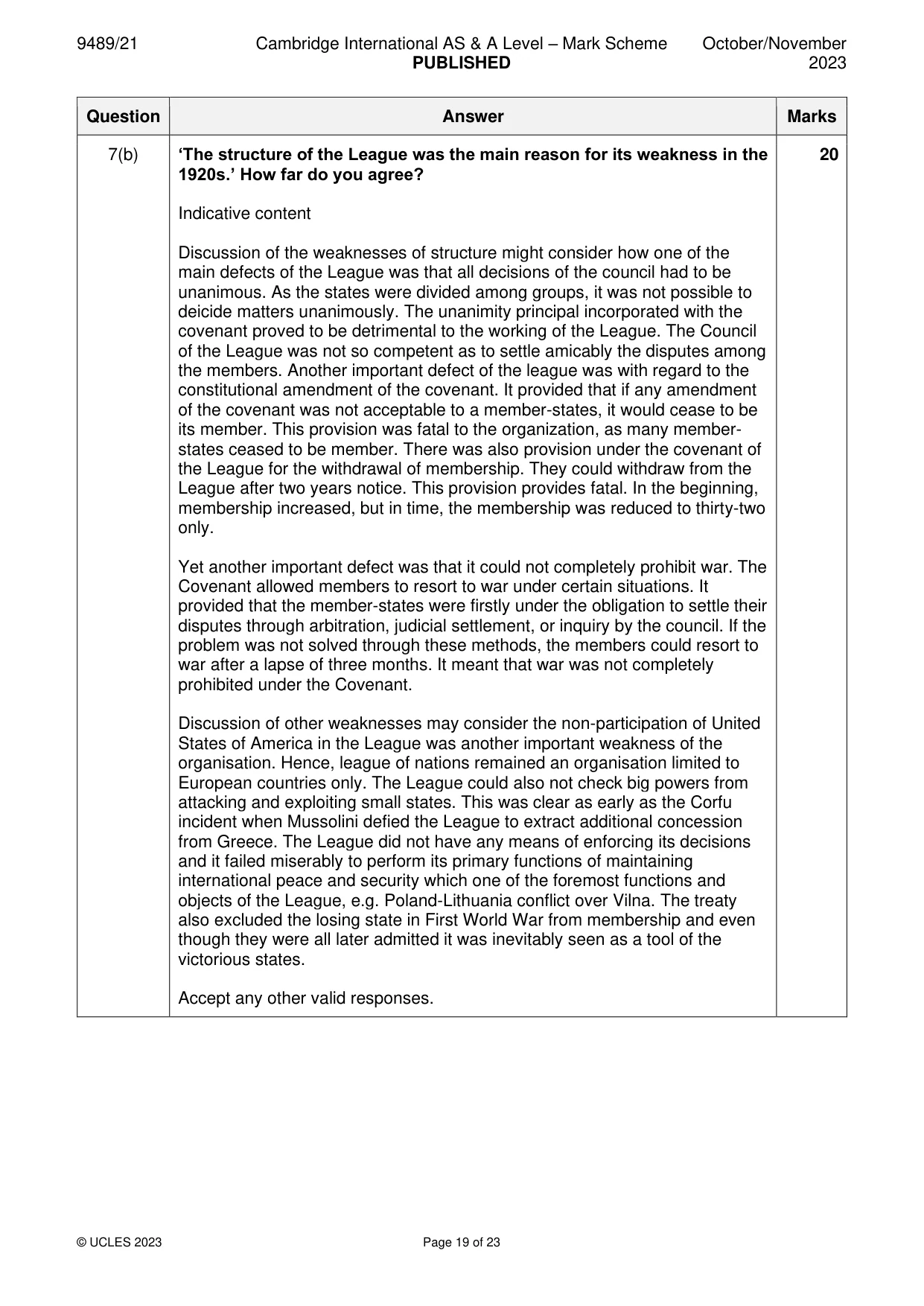
Mark scheme: 7(a) Explain why Germany suffered an economic crisis in the early 1920s. 10 Indicative content • The Reparations Bill imposed following the Versailles Treaty placed an unmanageable burden on the Weimar government. • Germany suffered from infrastructure and economic disruption following the war which made recovery difficult. • There was a general post-war depression which further impacted the German recovery. • Franco–Belgian invasion of the Ruhr led to a breakdown of the production as workers went on strike. • To support the workers the government began printing money to pay their wages and this accelerated the hyper-inflation in 1923 leading to the total collapse of the currency. Accept any other valid responses. 7(b) ‘The structure of the League was the main reason for its weakness in the 20 1920s.’ How far do you agree? Indicative content Discussion of the weaknesses of structure might consider how one of the main defects of the League was that all decisions of the council had to be unanimous. As the states were divided among groups, it was not possible to deicide matters unanimously. The unanimity principal incorporated with the covenant proved to be detrimental to the working of the League. The Council of the League was not so competent as to settle amicably the disputes among the members. Another important defect of the league was with regard to the constitutional amendment of the covenant. It provided that if any amendment of the covenant was not acceptable to a member-states, it would cease to be its member. This provision was fatal to the organization, as many member- states ceased to be member. There was also provision under the covenant of the League for the withdrawal of membership. They could withdraw from the League after two years notice. This provision provides fatal. In the beginning, membership increased, but in time, the membership was reduced to thirty-two only. Yet another important defect was that it could not completely prohibit war. The Covenant allowed members to resort to war under certain situations. It provided that the member-states were firstly under the obligation to settle their disputes through arbitration, judicial settlement, or inquiry by the council. If the problem was not solved through these methods, the members could resort to war after a lapse of three months. It meant that war was not completely prohibited under the Covenant. Discussion of other weaknesses may consider the non-participation of United States of America in the League was another important weakness of the organisation. Hence, league of nations remained an organisation limited to European countries only. The League could also not check big powers from attacking and exploiting small states. This was clear as early as the Corfu incident when Mussolini defied the League to extract additional concession from Greece. The League did not have any means of enforcing its decisions and it failed miserably to perform its primary functions of maintaining international peace and security which one of the foremost functions and objects of the League, e.g. Poland-Lithuania conflict over Vilna. The treaty also excluded the losing state in First World War from membership and even though they were all later admitted it was inevitably seen as a tool of the victorious states. Accept any other valid responses.
Q8 · The League of Nations and international relations in the 1930s (a) Explain why Hitler…
8 The League of Nations and international relations in the 1930s (a) Explain why Hitler doubted that Britain and France would go to war in support of Poland in September 1939. [10] (b) ‘The World Disarmament Conference failed because of French refusal to consider significant disarmament.’ How far do you agree? [20]
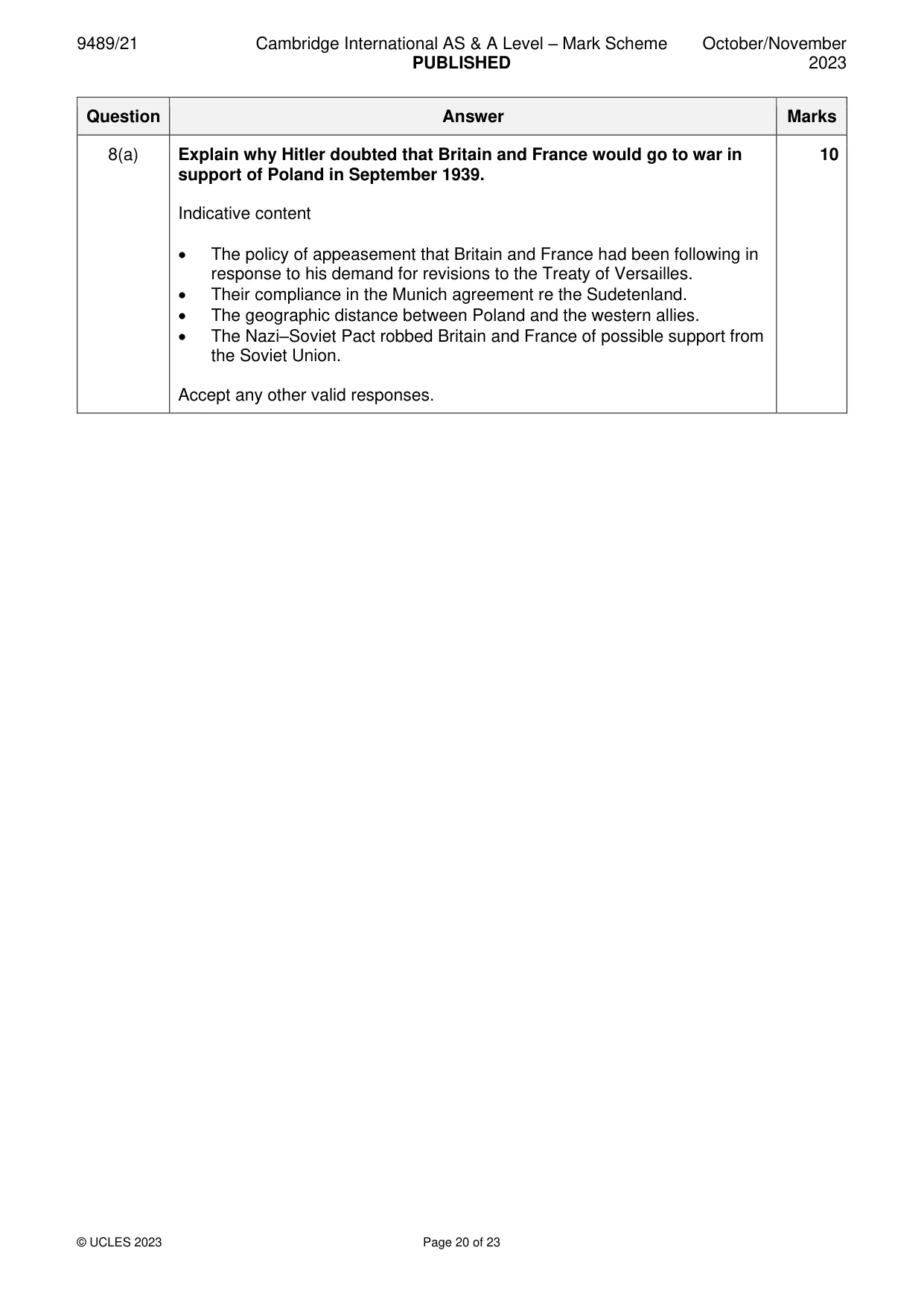
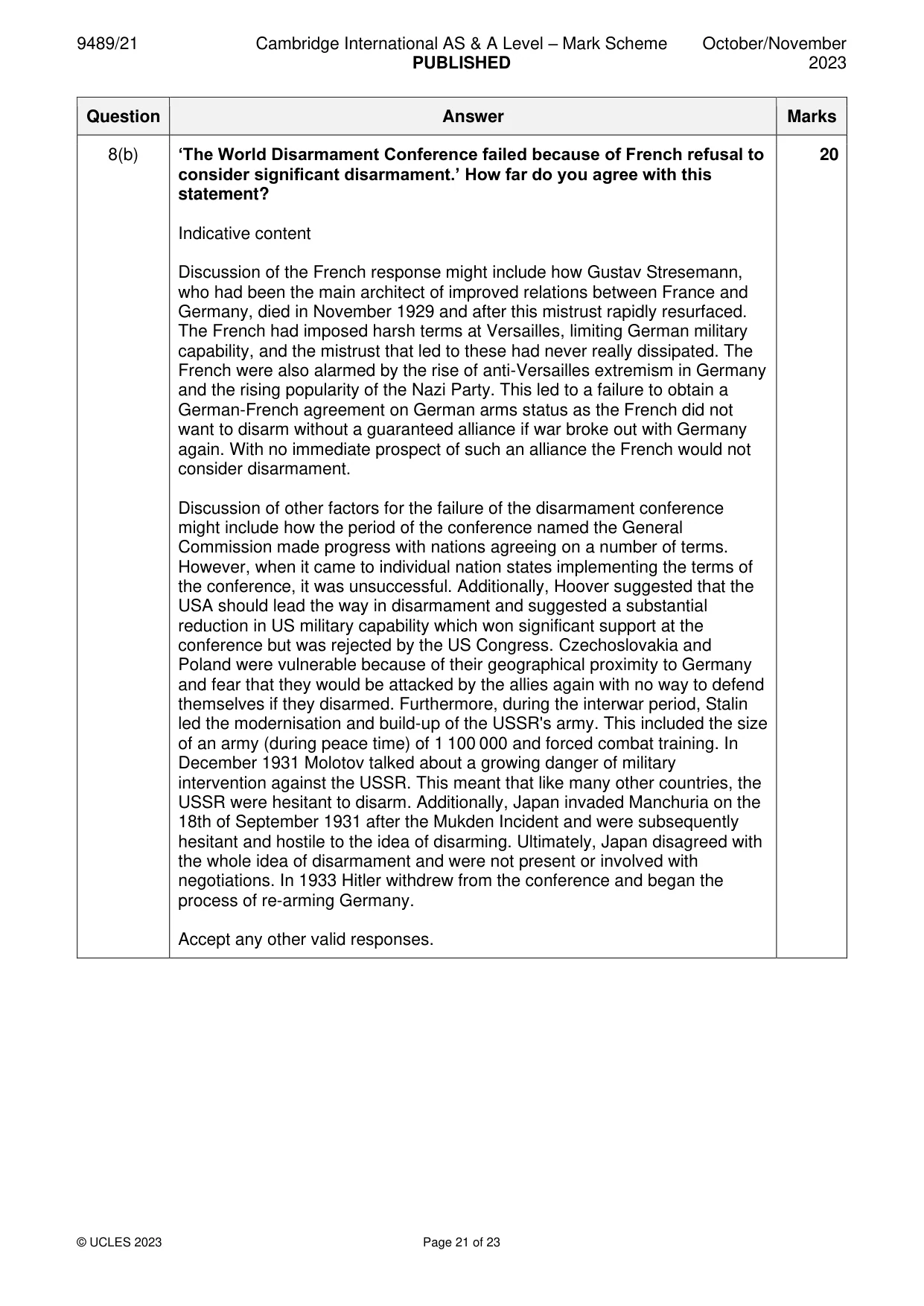
Mark scheme: 8(a) Explain why Hitler doubted that Britain and France would go to war in 10 support of Poland in September 1939. Indicative content • The policy of appeasement that Britain and France had been following in response to his demand for revisions to the Treaty of Versailles. • Their compliance in the Munich agreement re the Sudetenland. • The geographic distance between Poland and the western allies. • The Nazi–Soviet Pact robbed Britain and France of possible support from the Soviet Union. Accept any other valid responses. 8(b) ‘The World Disarmament Conference failed because of French refusal to 20 consider significant disarmament.’ How far do you agree with this statement? Indicative content Discussion of the French response might include how Gustav Stresemann, who had been the main architect of improved relations between France and Germany, died in November 1929 and after this mistrust rapidly resurfaced. The French had imposed harsh terms at Versailles, limiting German military capability, and the mistrust that led to these had never really dissipated. The French were also alarmed by the rise of anti-Versailles extremism in Germany and the rising popularity of the Nazi Party. This led to a failure to obtain a German-French agreement on German arms status as the French did not want to disarm without a guaranteed alliance if war broke out with Germany again. With no immediate prospect of such an alliance the French would not consider disarmament. Discussion of other factors for the failure of the disarmament conference might include how the period of the conference named the General Commission made progress with nations agreeing on a number of terms. However, when it came to individual nation states implementing the terms of the conference, it was unsuccessful. Additionally, Hoover suggested that the USA should lead the way in disarmament and suggested a substantial reduction in US military capability which won significant support at the conference but was rejected by the US Congress. Czechoslovakia and Poland were vulnerable because of their geographical proximity to Germany and fear that they would be attacked by the allies again with no way to defend themselves if they disarmed. Furthermore, during the interwar period, Stalin led the modernisation and build-up of the USSR's army. This included the size of an army (during peace time) of 1 100 000 and forced combat training. In December 1931 Molotov talked about a growing danger of military intervention against the USSR. This meant that like many other countries, the USSR were hesitant to disarm. Additionally, Japan invaded Manchuria on the 18th of September 1931 after the Mukden Incident and were subsequently hesitant and hostile to the idea of disarming. Ultimately, Japan disagreed with the whole idea of disarmament and were not present or involved with negotiations. In 1933 Hitler withdrew from the conference and began the process of re-arming Germany. Accept any other valid responses.
More questions on Why did the League of Nations fail to keep the peace in the 1930s?
Q9 · China and Japan, 1912–45 (a) Explain why Japan became an expansionist power in the 1930s
9 China and Japan, 1912–45 (a) Explain why Japan became an expansionist power in the 1930s. [10] (b) To what extent had the Kuomintang succeeded in establishing control over China by 1928? [20]
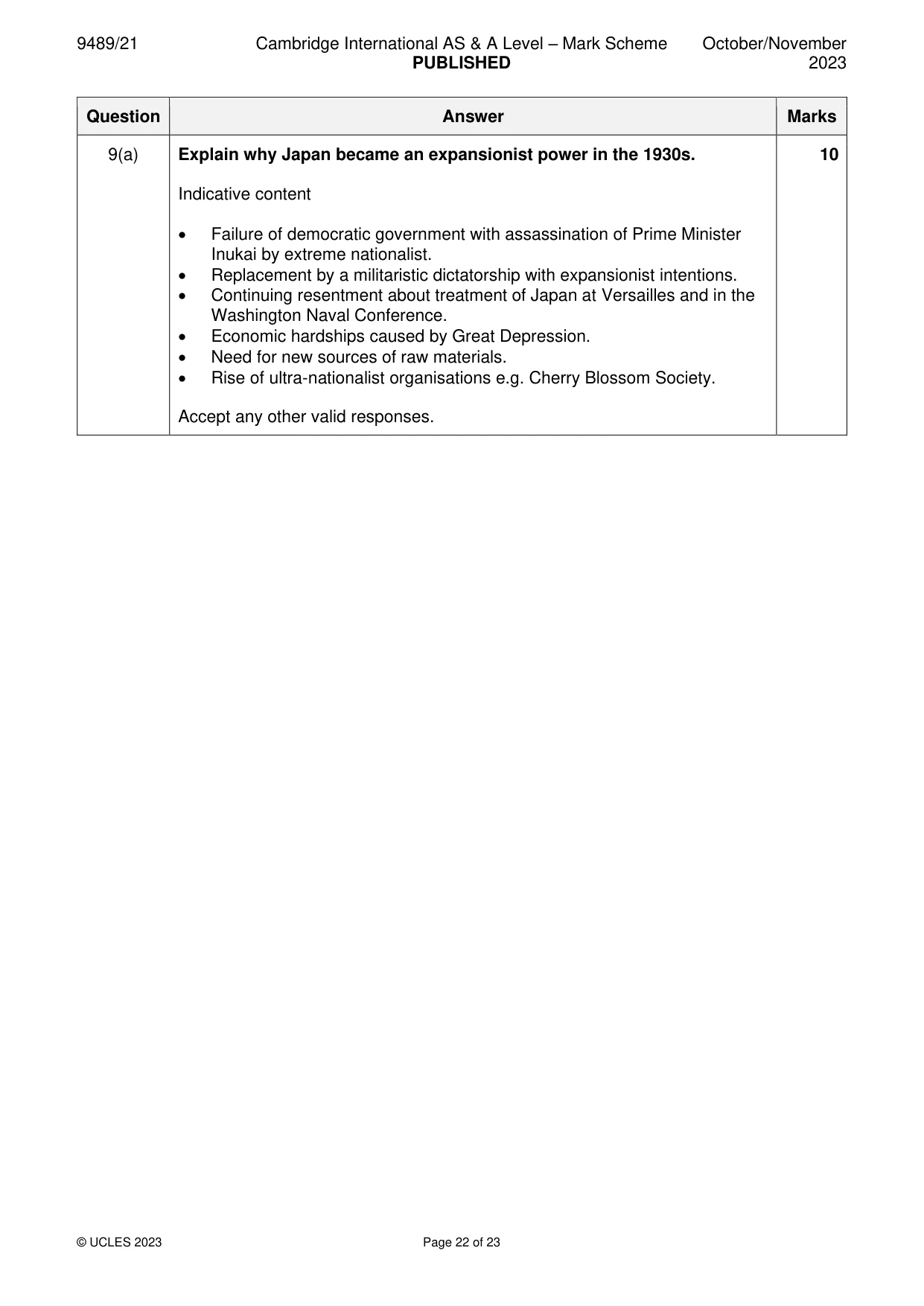
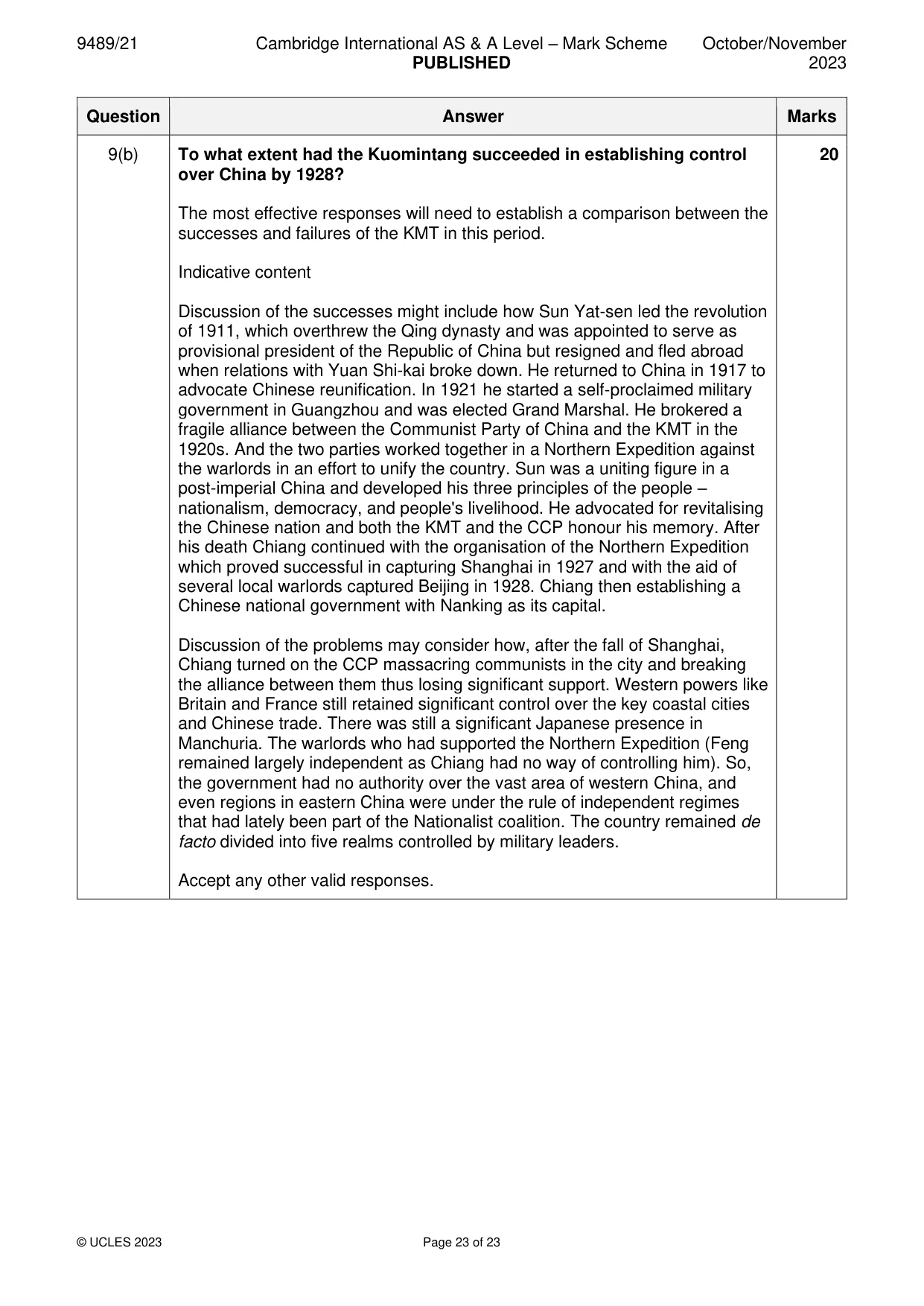
Mark scheme: 9(a) Explain why Japan became an expansionist power in the 1930s. 10 Indicative content • Failure of democratic government with assassination of Prime Minister Inukai by extreme nationalist. • Replacement by a militaristic dictatorship with expansionist intentions. • Continuing resentment about treatment of Japan at Versailles and in the Washington Naval Conference. • Economic hardships caused by Great Depression. • Need for new sources of raw materials. • Rise of ultra-nationalist organisations e.g. Cherry Blossom Society. Accept any other valid responses. 9(b) To what extent had the Kuomintang succeeded in establishing control 20 over China by 1928? The most effective responses will need to establish a comparison between the successes and failures of the KMT in this period. Indicative content Discussion of the successes might include how Sun Yat-sen led the revolution of 1911, which overthrew the Qing dynasty and was appointed to serve as provisional president of the Republic of China but resigned and fled abroad when relations with Yuan Shi-kai broke down. He returned to China in 1917 to advocate Chinese reunification. In 1921 he started a self-proclaimed military government in Guangzhou and was elected Grand Marshal. He brokered a fragile alliance between the Communist Party of China and the KMT in the 1920s. And the two parties worked together in a Northern Expedition against the warlords in an effort to unify the country. Sun was a uniting figure in a post-imperial China and developed his three principles of the people – nationalism, democracy, and people's livelihood. He advocated for revitalising the Chinese nation and both the KMT and the CCP honour his memory. After his death Chiang continued with the organisation of the Northern Expedition which proved successful in capturing Shanghai in 1927 and with the aid of several local warlords captured Beijing in 1928. Chiang then establishing a Chinese national government with Nanking as its capital. Discussion of the problems may consider how, after the fall of Shanghai, Chiang turned on the CCP massacring communists in the city and breaking the alliance between them thus losing significant support. Western powers like Britain and France still retained significant control over the key coastal cities and Chinese trade. There was still a significant Japanese presence in Manchuria. The warlords who had supported the Northern Expedition (Feng remained largely independent as Chiang had no way of controlling him). So, the government had no authority over the vast area of western China, and even regions in eastern China were under the rule of independent regimes that had lately been part of the Nationalist coalition. The country remained de facto divided into five realms controlled by military leaders. Accept any other valid responses.
More questions on Why did Japan emerge as a world power and what was the impact on international
What was in this paper
The subtopics covered by these 9 questions, and how many questions each got. Open one in a new tab to see every Cambridge question on it.
1What were the causes of the Great Crash and the Great Depression?1What were the causes of the Revolutions of 1848?1Why did Japan emerge as a world power and what was the impact on international1Why did the Civil War last four years?1Why did the League of Nations fail to keep the peace in the 1930s?1Why was the League of Nations created and what challenges did it face in the 1920s?1Why was there increasing tension between the North and the South before 1860?1Why was there rapid industrialisation after 1870?1What you needed in this session
Cambridge’s own grade thresholds for 2023 Oct/Nov, Paper 2 · Variant 1. A higher threshold means an easier paper — the bar moves with how the cohort did.