Cambridge A Level History 9489 — 2022 May/June Paper 2 · Variant 2
9489/22/M/J/22 · 9 questions · 60 marks · ≈68 min
The question paper and its mark scheme, free to read here and free to download. This is Cambridge’s own paper, exactly as it was sat.
Question paper4 pages
Mark scheme16 pages
Answers below. Sit the paper first if you are practising.
Questions as text
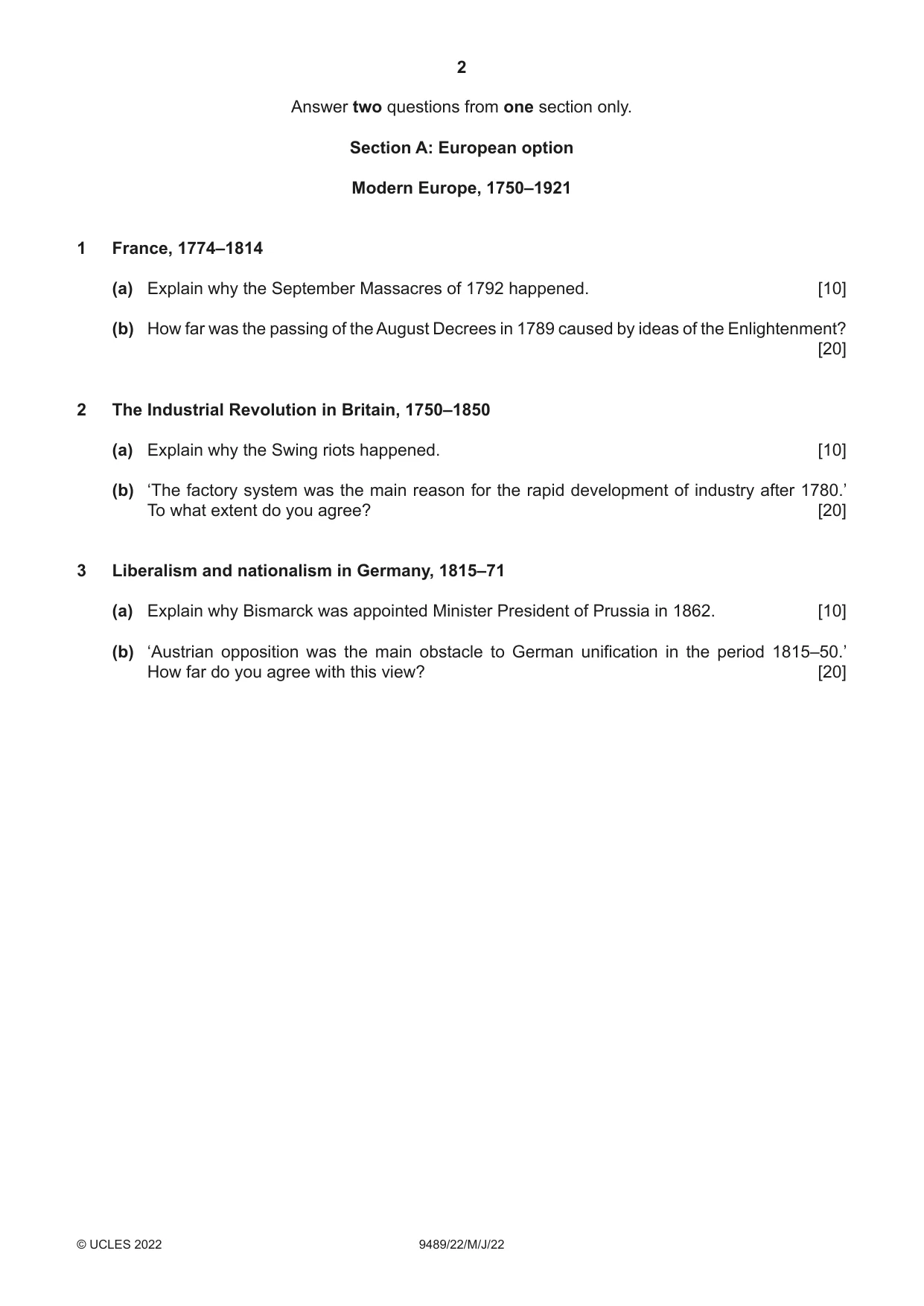
Q1 · France, 1774–1814 (a) Explain why the September Massacres of 1792 happened
1 France, 1774–1814 (a) Explain why the September Massacres of 1792 happened. [10] (b) How far was the passing of the August Decrees in 1789 caused by ideas of the Enlightenment? [20]
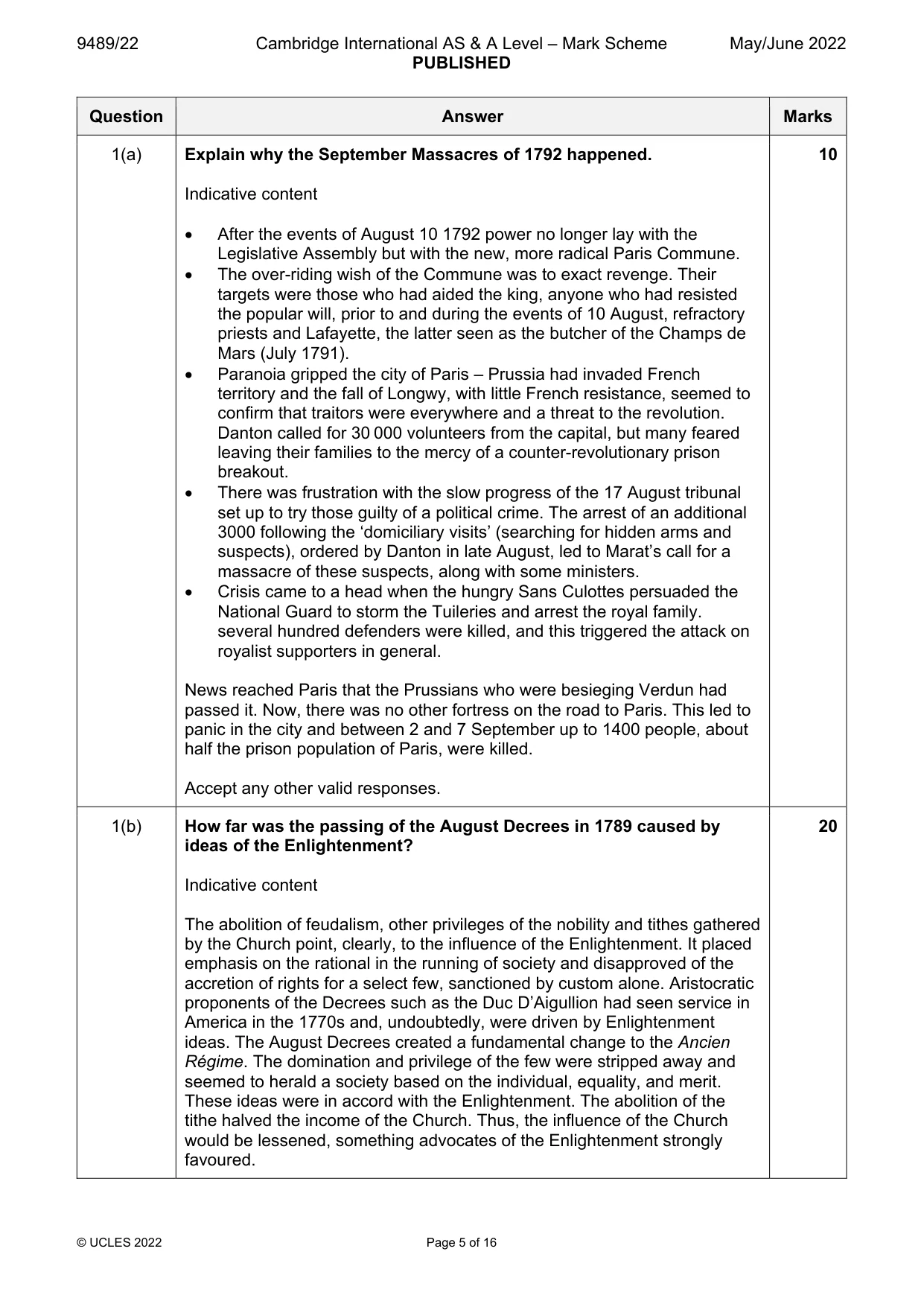
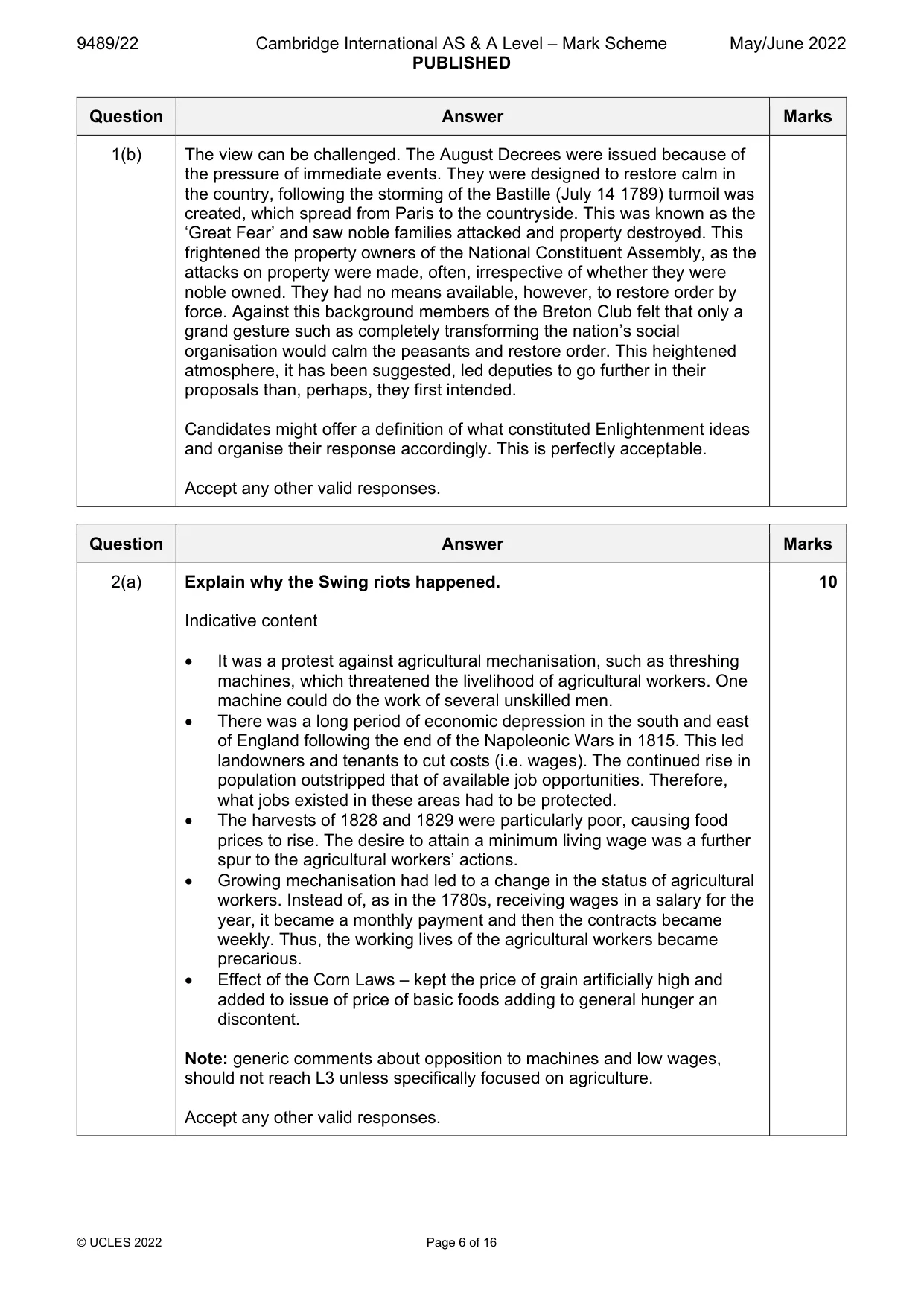
Mark scheme: Question Answer Marks 1(a) Explain why the September Massacres of 1792 happened. 10 Indicative content After the events of August 10 1792 power no longer lay with the Legislative Assembly but with the new, more radical Paris Commune. The over-riding wish of the Commune was to exact revenge. Their targets were those who had aided the king, anyone who had resisted the popular will, prior to and during the events of 10 August, refractory priests and Lafayette, the latter seen as the butcher of the Champs de Mars (July 1791). Paranoia gripped the city of Paris – Prussia had invaded French territory and the fall of Longwy, with little French resistance, seemed to confirm that traitors were everywhere and a threat to the revolution. Danton called for 30 000 volunteers from the capital, but many feared leaving their families to the mercy of a counter-revolutionary prison breakout. There was frustration with the slow progress of the 17 August tribunal set up to try those guilty of a political crime. The arrest of an additional 3000 following the ‘domiciliary visits’ (searching for hidden arms and suspects), ordered by Danton in late August, led to Marat’s call for a massacre of these suspects, along with some ministers. Crisis came to a head when the hungry Sans Culottes persuaded the National Guard to storm the Tuileries and arrest the royal family. several hundred defenders were killed, and this triggered the attack on royalist supporters in general. News reached Paris that the Prussians who were besieging Verdun had passed it. Now, there was no other fortress on the road to Paris. This led to panic in the city and between 2 and 7 September up to 1400 people, about half the prison population of Paris, were killed. Accept any other valid responses. 1(b) How far was the passing of the August Decrees in 1789 caused by 20 ideas of the Enlightenment? Indicative content The abolition of feudalism, other privileges of the nobility and tithes gathered by the Church point, clearly, to the influence of the Enlightenment. It placed emphasis on the rational in the running of society and disapproved of the accretion of rights for a select few, sanctioned by custom alone. Aristocratic proponents of the Decrees such as the Duc D’Aigullion had seen service in America in the 1770s and, undoubtedly, were driven by Enlightenment ideas. The August Decrees created a fundamental change to the Ancien Régime. The domination and privilege of the few were stripped away and seemed to herald a society based on the individual, equality, and merit. These ideas were in accord with the Enlightenment. The abolition of the tithe halved the income of the Church. Thus, the influence of the Church would be lessened, something advocates of the Enlightenment strongly favoured. 1(b) The view can be challenged. The August Decrees were issued because of the pressure of immediate events. They were designed to restore calm in the country, following the storming of the Bastille (July 14 1789) turmoil was created, which spread from Paris to the countryside. This was known as the ‘Great Fear’ and saw noble families attacked and property destroyed. This frightened the property owners of the National Constituent Assembly, as the attacks on property were made, often, irrespective of whether they were noble owned. They had no means available, however, to restore order by force. Against this background members of the Breton Club felt that only a grand gesture such as completely transforming the nation’s social organisation would calm the peasants and restore order. This heightened atmosphere, it has been suggested, led deputies to go further in their proposals than, perhaps, they first intended. Candidates might offer a definition of what constituted Enlightenment ideas and organise their response accordingly. This is perfectly acceptable. Accept any other valid responses.
More questions on What were the causes and immediate consequences of the 1789 Revolution?
Q2 · The Industrial Revolution in Britain, 1750–1850 (a) Explain why the Swing riots happened
2 The Industrial Revolution in Britain, 1750–1850 (a) Explain why the Swing riots happened. [10] (b) ‘The factory system was the main reason for the rapid development of industry after 1780.’ To what extent do you agree? [20]
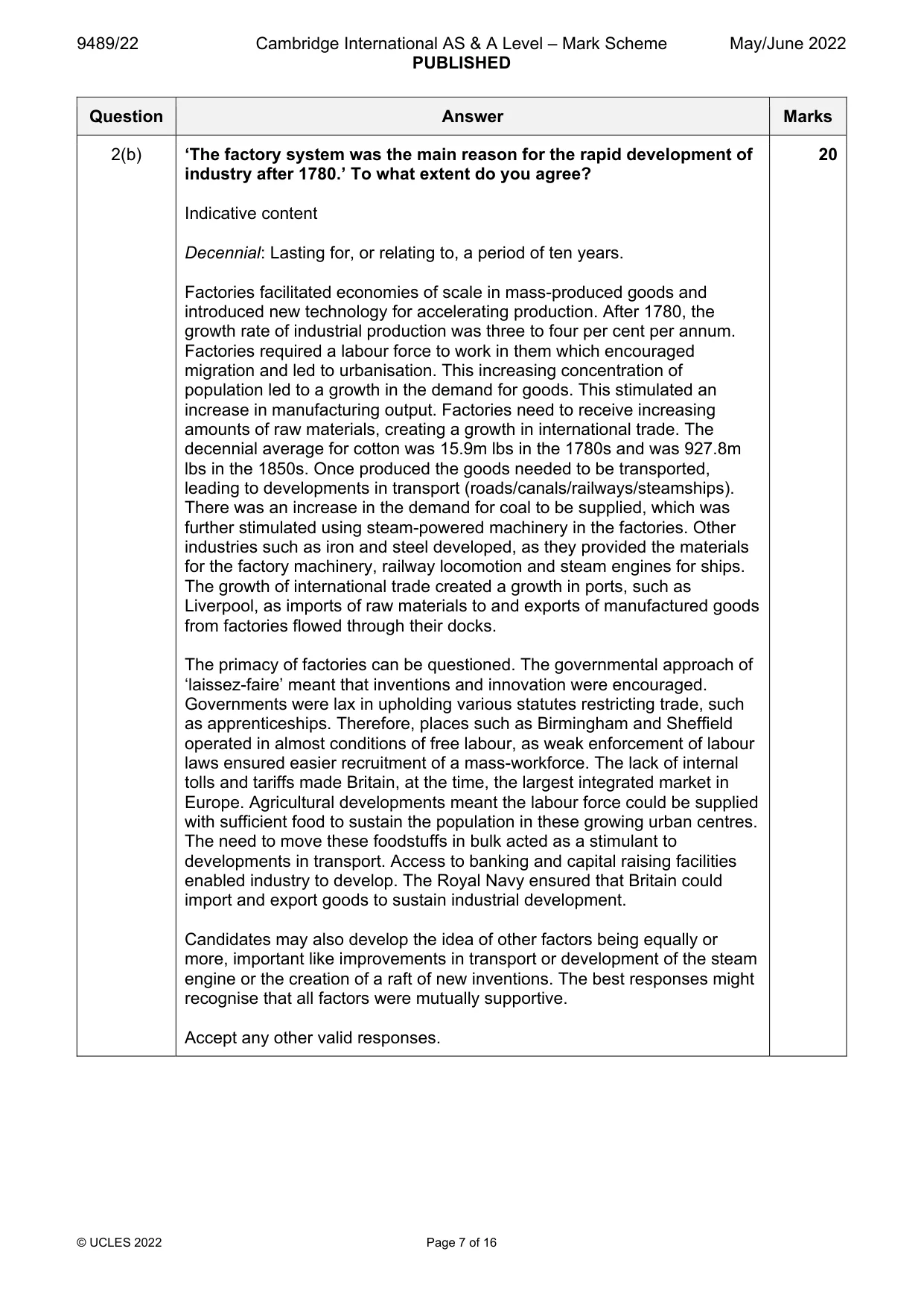
Mark scheme: 2(a) Explain why the Swing riots happened. 10 Indicative content It was a protest against agricultural mechanisation, such as threshing machines, which threatened the livelihood of agricultural workers. One machine could do the work of several unskilled men. There was a long period of economic depression in the south and east of England following the end of the Napoleonic Wars in 1815. This led landowners and tenants to cut costs (i.e. wages). The continued rise in population outstripped that of available job opportunities. Therefore, what jobs existed in these areas had to be protected. The harvests of 1828 and 1829 were particularly poor, causing food prices to rise. The desire to attain a minimum living wage was a further spur to the agricultural workers’ actions. Growing mechanisation had led to a change in the status of agricultural workers. Instead of, as in the 1780s, receiving wages in a salary for the year, it became a monthly payment and then the contracts became weekly. Thus, the working lives of the agricultural workers became precarious. Effect of the Corn Laws – kept the price of grain artificially high and added to issue of price of basic foods adding to general hunger an discontent. Note: generic comments about opposition to machines and low wages, should not reach L3 unless specifically focused on agriculture. Accept any other valid responses. 2(b) ‘The factory system was the main reason for the rapid development of 20 industry after 1780.’ To what extent do you agree? Indicative content Decennial: Lasting for, or relating to, a period of ten years. Factories facilitated economies of scale in mass-produced goods and introduced new technology for accelerating production. After 1780, the growth rate of industrial production was three to four per cent per annum. Factories required a labour force to work in them which encouraged migration and led to urbanisation. This increasing concentration of population led to a growth in the demand for goods. This stimulated an increase in manufacturing output. Factories need to receive increasing amounts of raw materials, creating a growth in international trade. The decennial average for cotton was 15.9m lbs in the 1780s and was 927.8m lbs in the 1850s. Once produced the goods needed to be transported, leading to developments in transport (roads/canals/railways/steamships). There was an increase in the demand for coal to be supplied, which was further stimulated using steam-powered machinery in the factories. Other industries such as iron and steel developed, as they provided the materials for the factory machinery, railway locomotion and steam engines for ships. The growth of international trade created a growth in ports, such as Liverpool, as imports of raw materials to and exports of manufactured goods from factories flowed through their docks. The primacy of factories can be questioned. The governmental approach of ‘laissez-faire’ meant that inventions and innovation were encouraged. Governments were lax in upholding various statutes restricting trade, such as apprenticeships. Therefore, places such as Birmingham and Sheffield operated in almost conditions of free labour, as weak enforcement of labour laws ensured easier recruitment of a mass-workforce. The lack of internal tolls and tariffs made Britain, at the time, the largest integrated market in Europe. Agricultural developments meant the labour force could be supplied with sufficient food to sustain the population in these growing urban centres. The need to move these foodstuffs in bulk acted as a stimulant to developments in transport. Access to banking and capital raising facilities enabled industry to develop. The Royal Navy ensured that Britain could import and export goods to sustain industrial development. Candidates may also develop the idea of other factors being equally or more, important like improvements in transport or development of the steam engine or the creation of a raft of new inventions. The best responses might recognise that all factors were mutually supportive. Accept any other valid responses.
More questions on Why was there rapid industrialisation after 1870?
Q3 · Liberalism and nationalism in Germany, 1815–71 (a) Explain why Bismarck was appointed…
3 Liberalism and nationalism in Germany, 1815–71 (a) Explain why Bismarck was appointed Minister President of Prussia in 1862. [10] (b) ‘Austrian opposition was the main obstacle to German unification in the period 1815–50.’ How far do you agree with this view? [20]
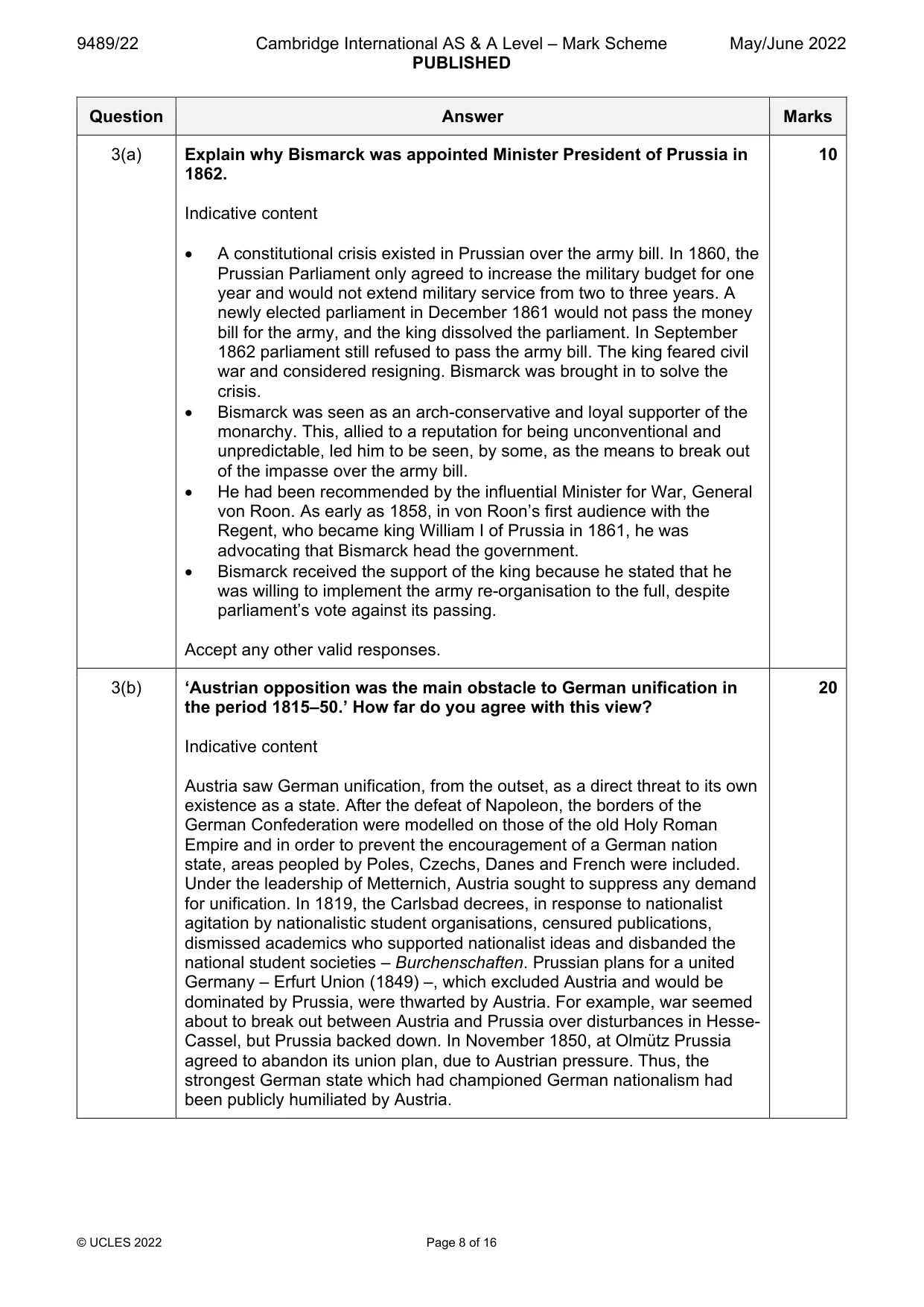
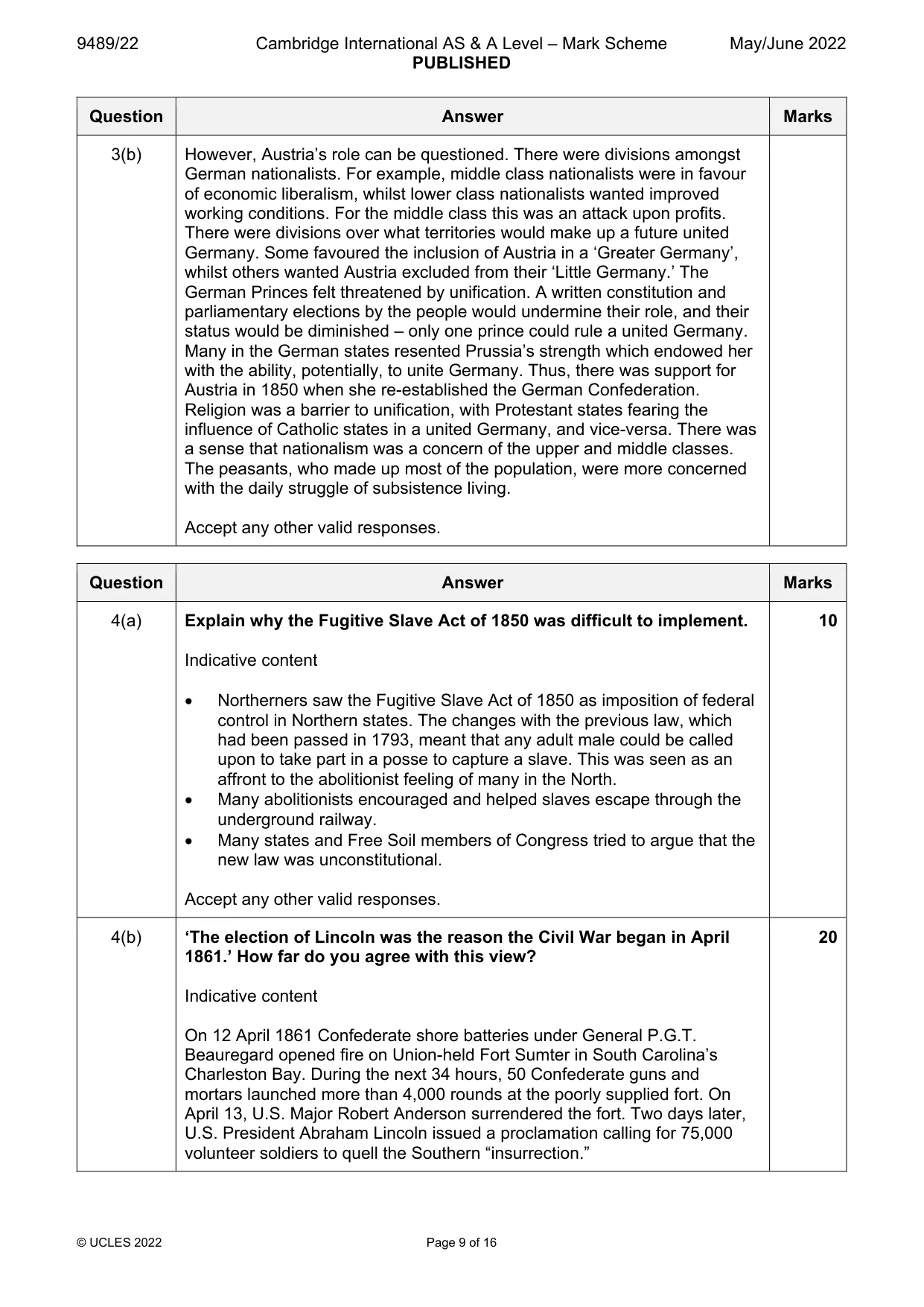
Mark scheme: 3(a) Explain why Bismarck was appointed Minister President of Prussia in 10 1862. Indicative content A constitutional crisis existed in Prussian over the army bill. In 1860, the Prussian Parliament only agreed to increase the military budget for one year and would not extend military service from two to three years. A newly elected parliament in December 1861 would not pass the money bill for the army, and the king dissolved the parliament. In September 1862 parliament still refused to pass the army bill. The king feared civil war and considered resigning. Bismarck was brought in to solve the crisis. Bismarck was seen as an arch-conservative and loyal supporter of the monarchy. This, allied to a reputation for being unconventional and unpredictable, led him to be seen, by some, as the means to break out of the impasse over the army bill. He had been recommended by the influential Minister for War, General von Roon. As early as 1858, in von Roon’s first audience with the Regent, who became king William I of Prussia in 1861, he was advocating that Bismarck head the government. Bismarck received the support of the king because he stated that he was willing to implement the army re-organisation to the full, despite parliament’s vote against its passing. Accept any other valid responses. 3(b) ‘Austrian opposition was the main obstacle to German unification in 20 the period 1815–50.’ How far do you agree with this view? Indicative content Austria saw German unification, from the outset, as a direct threat to its own existence as a state. After the defeat of Napoleon, the borders of the German Confederation were modelled on those of the old Holy Roman Empire and in order to prevent the encouragement of a German nation state, areas peopled by Poles, Czechs, Danes and French were included. Under the leadership of Metternich, Austria sought to suppress any demand for unification. In 1819, the Carlsbad decrees, in response to nationalist agitation by nationalistic student organisations, censured publications, dismissed academics who supported nationalist ideas and disbanded the national student societies – Burchenschaften. Prussian plans for a united Germany – Erfurt Union (1849) –, which excluded Austria and would be dominated by Prussia, were thwarted by Austria. For example, war seemed about to break out between Austria and Prussia over disturbances in Hesse- Cassel, but Prussia backed down. In November 1850, at Olmütz Prussia agreed to abandon its union plan, due to Austrian pressure. Thus, the strongest German state which had championed German nationalism had been publicly humiliated by Austria. 3(b) However, Austria’s role can be questioned. There were divisions amongst German nationalists. For example, middle class nationalists were in favour of economic liberalism, whilst lower class nationalists wanted improved working conditions. For the middle class this was an attack upon profits. There were divisions over what territories would make up a future united Germany. Some favoured the inclusion of Austria in a ‘Greater Germany’, whilst others wanted Austria excluded from their ‘Little Germany.’ The German Princes felt threatened by unification. A written constitution and parliamentary elections by the people would undermine their role, and their status would be diminished – only one prince could rule a united Germany. Many in the German states resented Prussia’s strength which endowed her with the ability, potentially, to unite Germany. Thus, there was support for Austria in 1850 when she re-established the German Confederation. Religion was a barrier to unification, with Protestant states fearing the influence of Catholic states in a united Germany, and vice-versa. There was a sense that nationalism was a concern of the upper and middle classes. The peasants, who made up most of the population, were more concerned with the daily struggle of subsistence living. Accept any other valid responses.
More questions on What were the causes of the Revolutions of 1848?
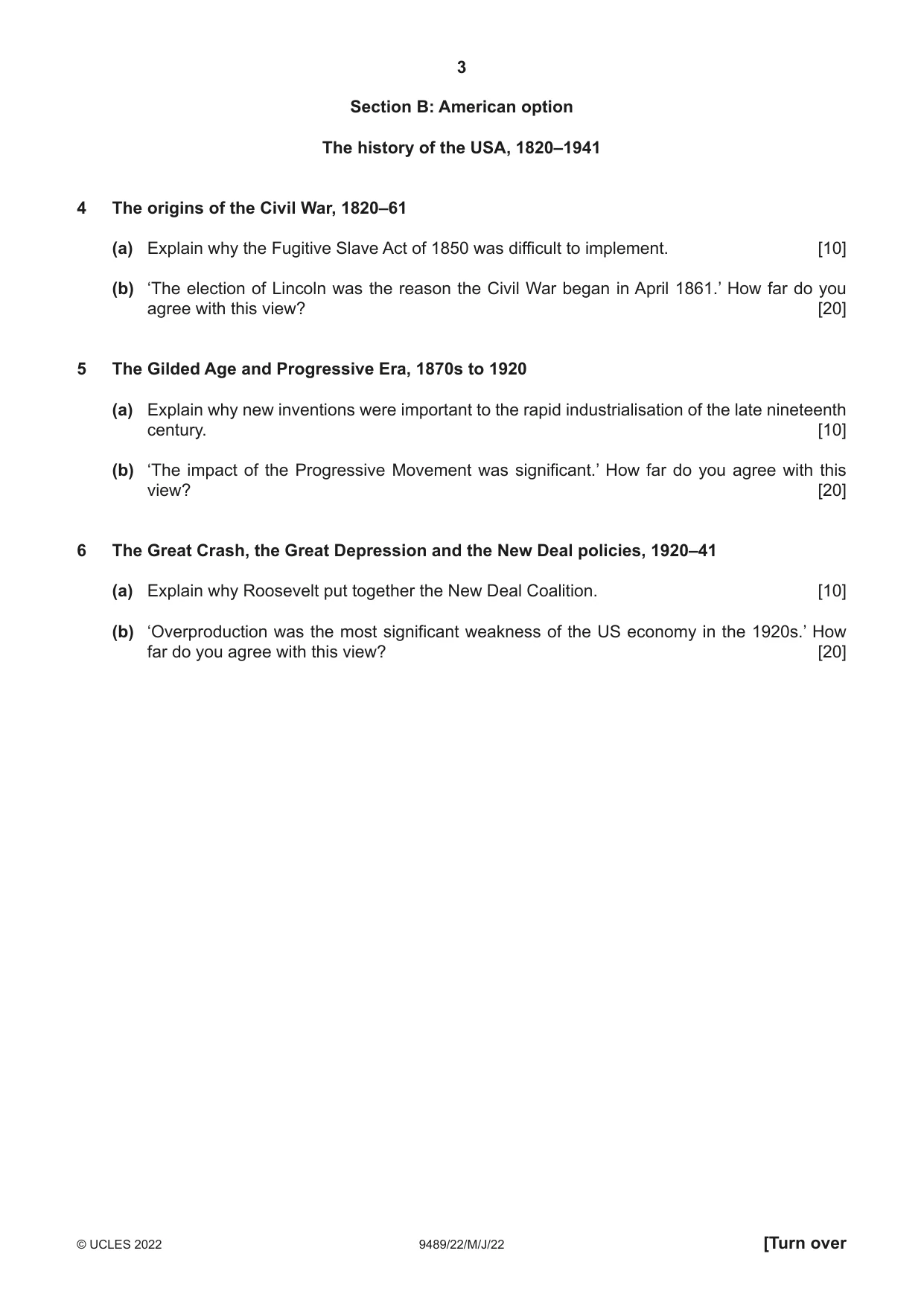
Q4 · The origins of the Civil War, 1820–61 (a) Explain why the Fugitive Slave Act of 1850 was…
4 The origins of the Civil War, 1820–61 (a) Explain why the Fugitive Slave Act of 1850 was difficult to implement. [10] (b) ‘The election of Lincoln was the reason the Civil War began in April 1861.’ How far do you agree with this view? [20]
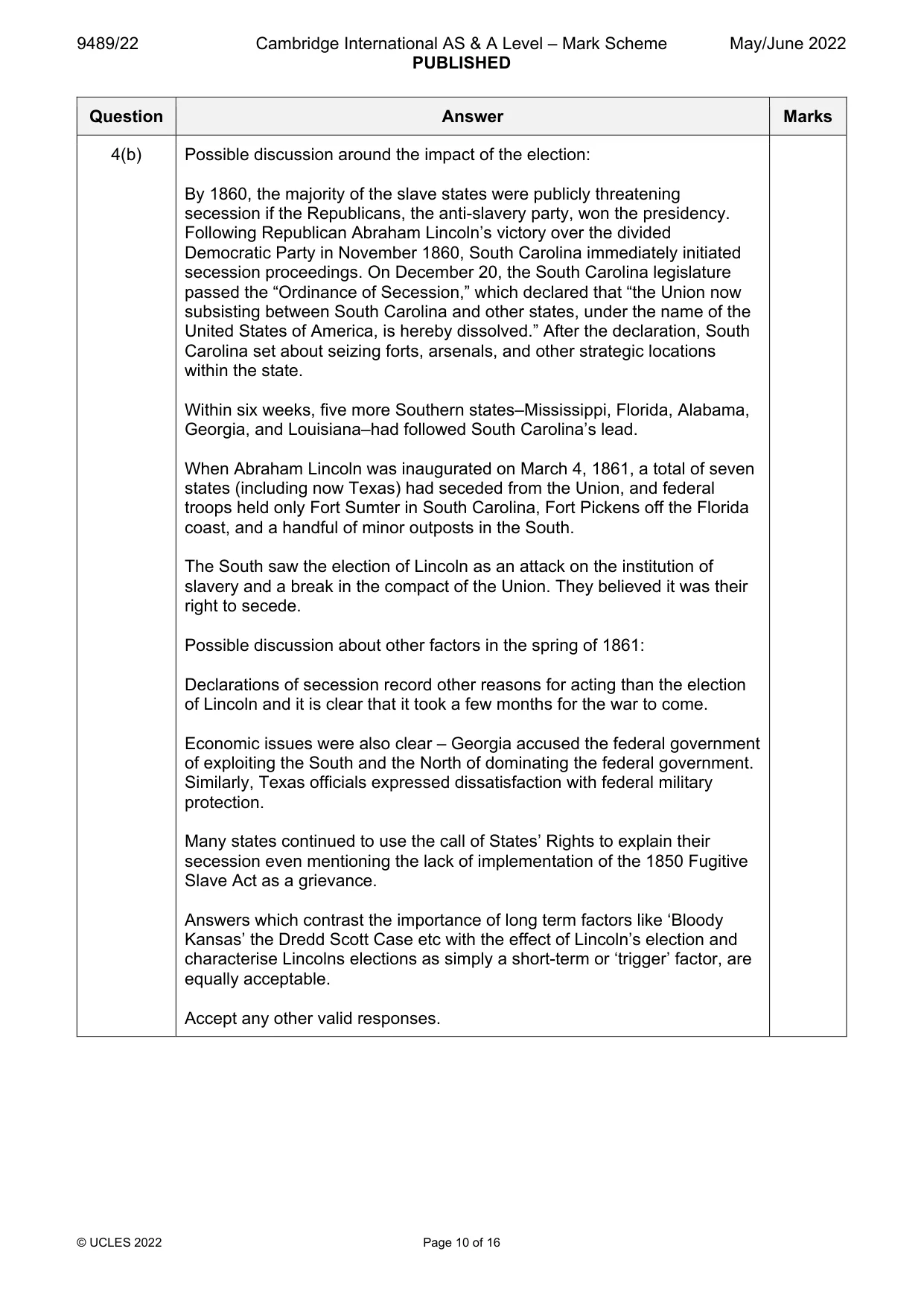
Mark scheme: 4(a) Explain why the Fugitive Slave Act of 1850 was difficult to implement. 10 Indicative content Northerners saw the Fugitive Slave Act of 1850 as imposition of federal control in Northern states. The changes with the previous law, which had been passed in 1793, meant that any adult male could be called upon to take part in a posse to capture a slave. This was seen as an affront to the abolitionist feeling of many in the North. Many abolitionists encouraged and helped slaves escape through the underground railway. Many states and Free Soil members of Congress tried to argue that the new law was unconstitutional. Accept any other valid responses. 4(b) ‘The election of Lincoln was the reason the Civil War began in April 20 1861.’ How far do you agree with this view? Indicative content On 12 April 1861 Confederate shore batteries under General P.G.T. Beauregard opened fire on Union-held Fort Sumter in South Carolina’s Charleston Bay. During the next 34 hours, 50 Confederate guns and mortars launched more than 4,000 rounds at the poorly supplied fort. On April 13, U.S. Major Robert Anderson surrendered the fort. Two days later, U.S. President Abraham Lincoln issued a proclamation calling for 75,000 volunteer soldiers to quell the Southern “insurrection.” 4(b) Possible discussion around the impact of the election: By 1860, the majority of the slave states were publicly threatening secession if the Republicans, the anti-slavery party, won the presidency. Following Republican Abraham Lincoln’s victory over the divided Democratic Party in November 1860, South Carolina immediately initiated secession proceedings. On December 20, the South Carolina legislature passed the “Ordinance of Secession,” which declared that “the Union now subsisting between South Carolina and other states, under the name of the United States of America, is hereby dissolved.” After the declaration, South Carolina set about seizing forts, arsenals, and other strategic locations within the state. Within six weeks, five more Southern states–Mississippi, Florida, Alabama, Georgia, and Louisiana–had followed South Carolina’s lead. When Abraham Lincoln was inaugurated on March 4, 1861, a total of seven states (including now Texas) had seceded from the Union, and federal troops held only Fort Sumter in South Carolina, Fort Pickens off the Florida coast, and a handful of minor outposts in the South. The South saw the election of Lincoln as an attack on the institution of slavery and a break in the compact of the Union. They believed it was their right to secede. Possible discussion about other factors in the spring of 1861: Declarations of secession record other reasons for acting than the election of Lincoln and it is clear that it took a few months for the war to come. Economic issues were also clear – Georgia accused the federal government of exploiting the South and the North of dominating the federal government. Similarly, Texas officials expressed dissatisfaction with federal military protection. Many states continued to use the call of States’ Rights to explain their secession even mentioning the lack of implementation of the 1850 Fugitive Slave Act as a grievance. Answers which contrast the importance of long term factors like ‘Bloody Kansas’ the Dredd Scott Case etc with the effect of Lincoln’s election and characterise Lincolns elections as simply a short-term or ‘trigger’ factor, are equally acceptable. Accept any other valid responses.
More questions on Why did the Civil War break out in April 1861?
Q5 · The Gilded Age and Progressive Era, 1870s to 1920 (a) Explain why new inventions were…
5 The Gilded Age and Progressive Era, 1870s to 1920 (a) Explain why new inventions were important to the rapid industrialisation of the late nineteenth century. [10] (b) ‘The impact of the Progressive Movement was significant.’ How far do you agree with this view? [20]
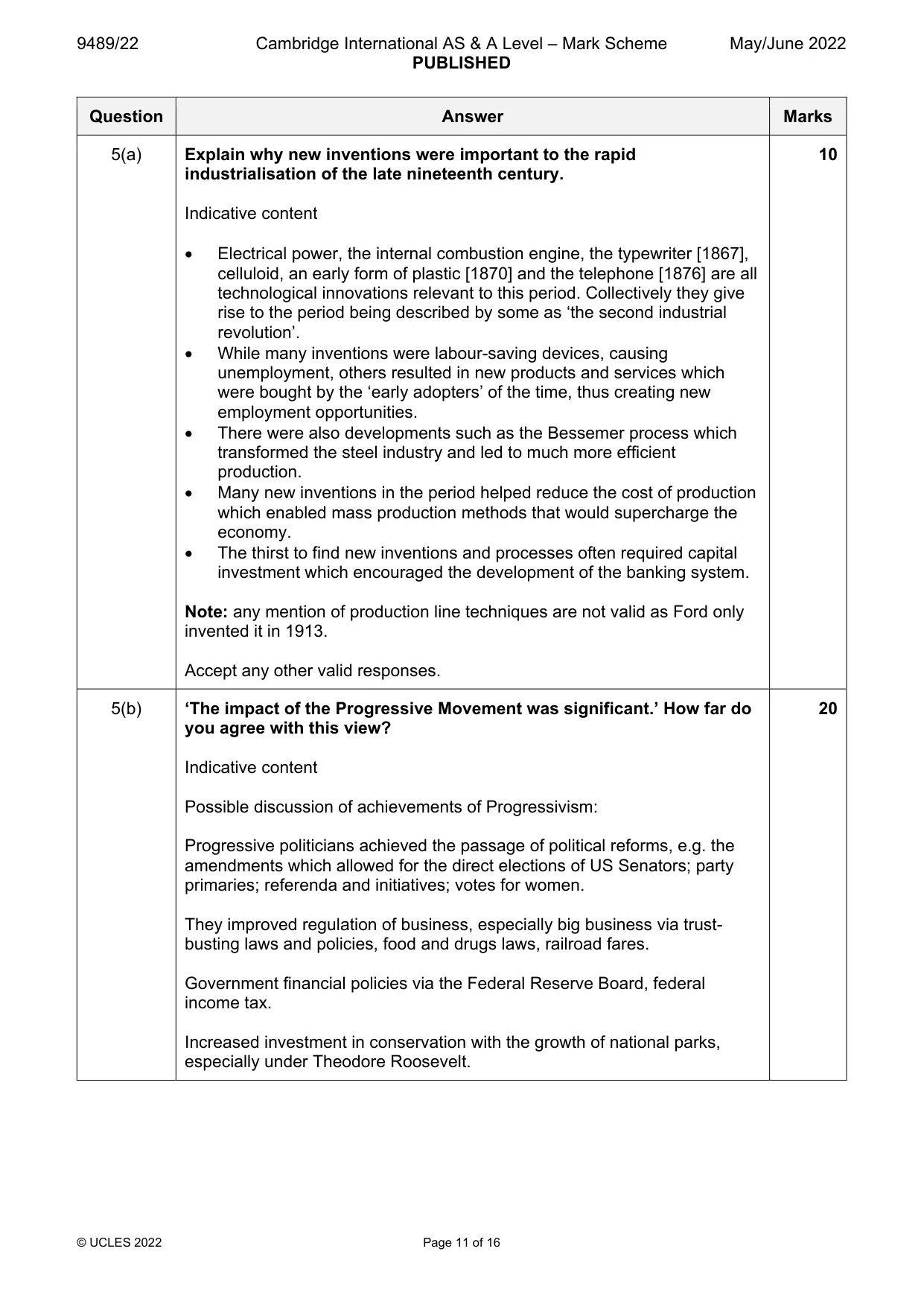
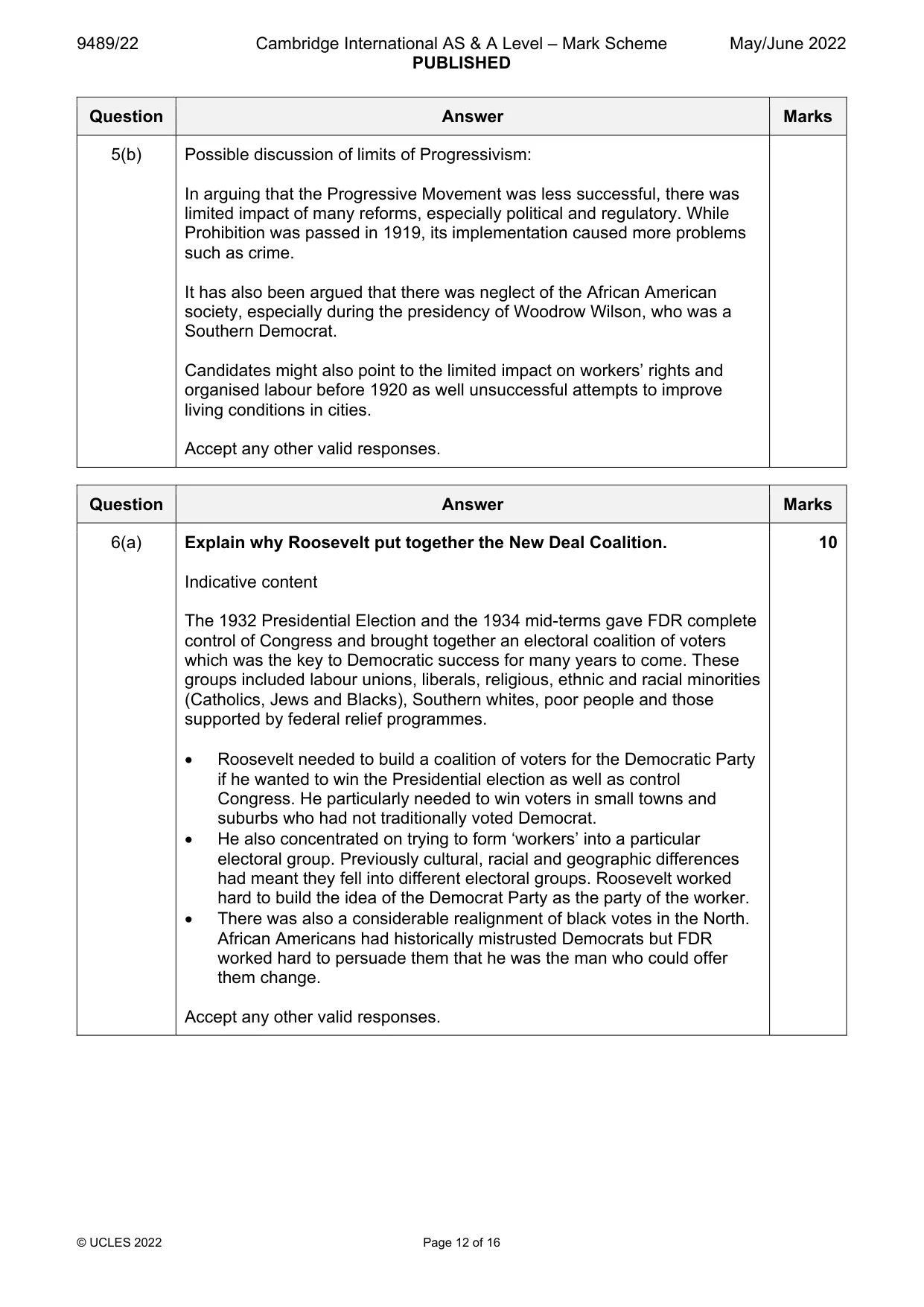
Mark scheme: 5(a) Explain why new inventions were important to the rapid 10 industrialisation of the late nineteenth century. Indicative content Electrical power, the internal combustion engine, the typewriter [1867], celluloid, an early form of plastic [1870] and the telephone [1876] are all technological innovations relevant to this period. Collectively they give rise to the period being described by some as ‘the second industrial revolution’. While many inventions were labour-saving devices, causing unemployment, others resulted in new products and services which were bought by the ‘early adopters’ of the time, thus creating new employment opportunities. There were also developments such as the Bessemer process which transformed the steel industry and led to much more efficient production. Many new inventions in the period helped reduce the cost of production which enabled mass production methods that would supercharge the economy. The thirst to find new inventions and processes often required capital investment which encouraged the development of the banking system. Note: any mention of production line techniques are not valid as Ford only invented it in 1913. Accept any other valid responses. 5(b) ‘The impact of the Progressive Movement was significant.’ How far do 20 you agree with this view? Indicative content Possible discussion of achievements of Progressivism: Progressive politicians achieved the passage of political reforms, e.g. the amendments which allowed for the direct elections of US Senators; party primaries; referenda and initiatives; votes for women. They improved regulation of business, especially big business via trust- busting laws and policies, food and drugs laws, railroad fares. Government financial policies via the Federal Reserve Board, federal income tax. Increased investment in conservation with the growth of national parks, especially under Theodore Roosevelt. 5(b) Possible discussion of limits of Progressivism: In arguing that the Progressive Movement was less successful, there was limited impact of many reforms, especially political and regulatory. While Prohibition was passed in 1919, its implementation caused more problems such as crime. It has also been argued that there was neglect of the African American society, especially during the presidency of Woodrow Wilson, who was a Southern Democrat. Candidates might also point to the limited impact on workers’ rights and organised labour before 1920 as well unsuccessful attempts to improve living conditions in cities. Accept any other valid responses.
More questions on How successful was the Progressive Movement from 1890 to 1920?
Q6 · The Great Crash, the Great Depression and the New Deal policies, 1920–41 (a) Explain why…
6 The Great Crash, the Great Depression and the New Deal policies, 1920–41 (a) Explain why Roosevelt put together the New Deal Coalition. [10] (b) ‘Overproduction was the most significant weakness of the US economy in the 1920s.’ How far do you agree with this view? [20] Section C: International option International history, 1870–1945
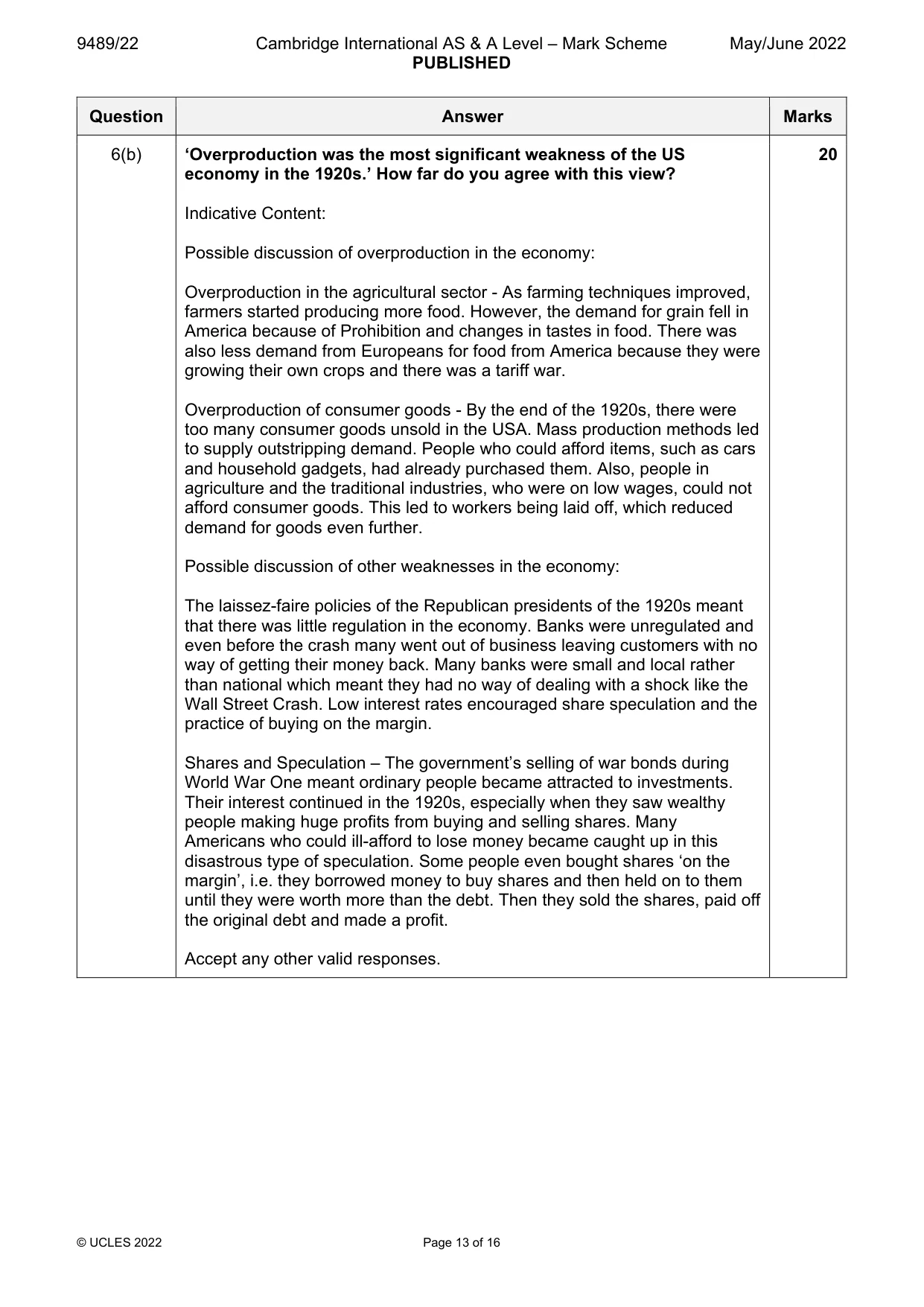
Mark scheme: 6(a) Explain why Roosevelt put together the New Deal Coalition. 10 Indicative content The 1932 Presidential Election and the 1934 mid-terms gave FDR complete control of Congress and brought together an electoral coalition of voters which was the key to Democratic success for many years to come. These groups included labour unions, liberals, religious, ethnic and racial minorities (Catholics, Jews and Blacks), Southern whites, poor people and those supported by federal relief programmes. Roosevelt needed to build a coalition of voters for the Democratic Party if he wanted to win the Presidential election as well as control Congress. He particularly needed to win voters in small towns and suburbs who had not traditionally voted Democrat. He also concentrated on trying to form ‘workers’ into a particular electoral group. Previously cultural, racial and geographic differences had meant they fell into different electoral groups. Roosevelt worked hard to build the idea of the Democrat Party as the party of the worker. There was also a considerable realignment of black votes in the North. African Americans had historically mistrusted Democrats but FDR worked hard to persuade them that he was the man who could offer them change. Accept any other valid responses. 6(b) ‘Overproduction was the most significant weakness of the US 20 economy in the 1920s.’ How far do you agree with this view? Indicative Content: Possible discussion of overproduction in the economy: Overproduction in the agricultural sector - As farming techniques improved, farmers started producing more food. However, the demand for grain fell in America because of Prohibition and changes in tastes in food. There was also less demand from Europeans for food from America because they were growing their own crops and there was a tariff war. Overproduction of consumer goods - By the end of the 1920s, there were too many consumer goods unsold in the USA. Mass production methods led to supply outstripping demand. People who could afford items, such as cars and household gadgets, had already purchased them. Also, people in agriculture and the traditional industries, who were on low wages, could not afford consumer goods. This led to workers being laid off, which reduced demand for goods even further. Possible discussion of other weaknesses in the economy: The laissez-faire policies of the Republican presidents of the 1920s meant that there was little regulation in the economy. Banks were unregulated and even before the crash many went out of business leaving customers with no way of getting their money back. Many banks were small and local rather than national which meant they had no way of dealing with a shock like the Wall Street Crash. Low interest rates encouraged share speculation and the practice of buying on the margin. Shares and Speculation – The government’s selling of war bonds during World War One meant ordinary people became attracted to investments. Their interest continued in the 1920s, especially when they saw wealthy people making huge profits from buying and selling shares. Many Americans who could ill-afford to lose money became caught up in this disastrous type of speculation. Some people even bought shares ‘on the margin’, i.e. they borrowed money to buy shares and then held on to them until they were worth more than the debt. Then they sold the shares, paid off the original debt and made a profit. Accept any other valid responses.
More questions on What were the causes of the Great Crash and the Great Depression?
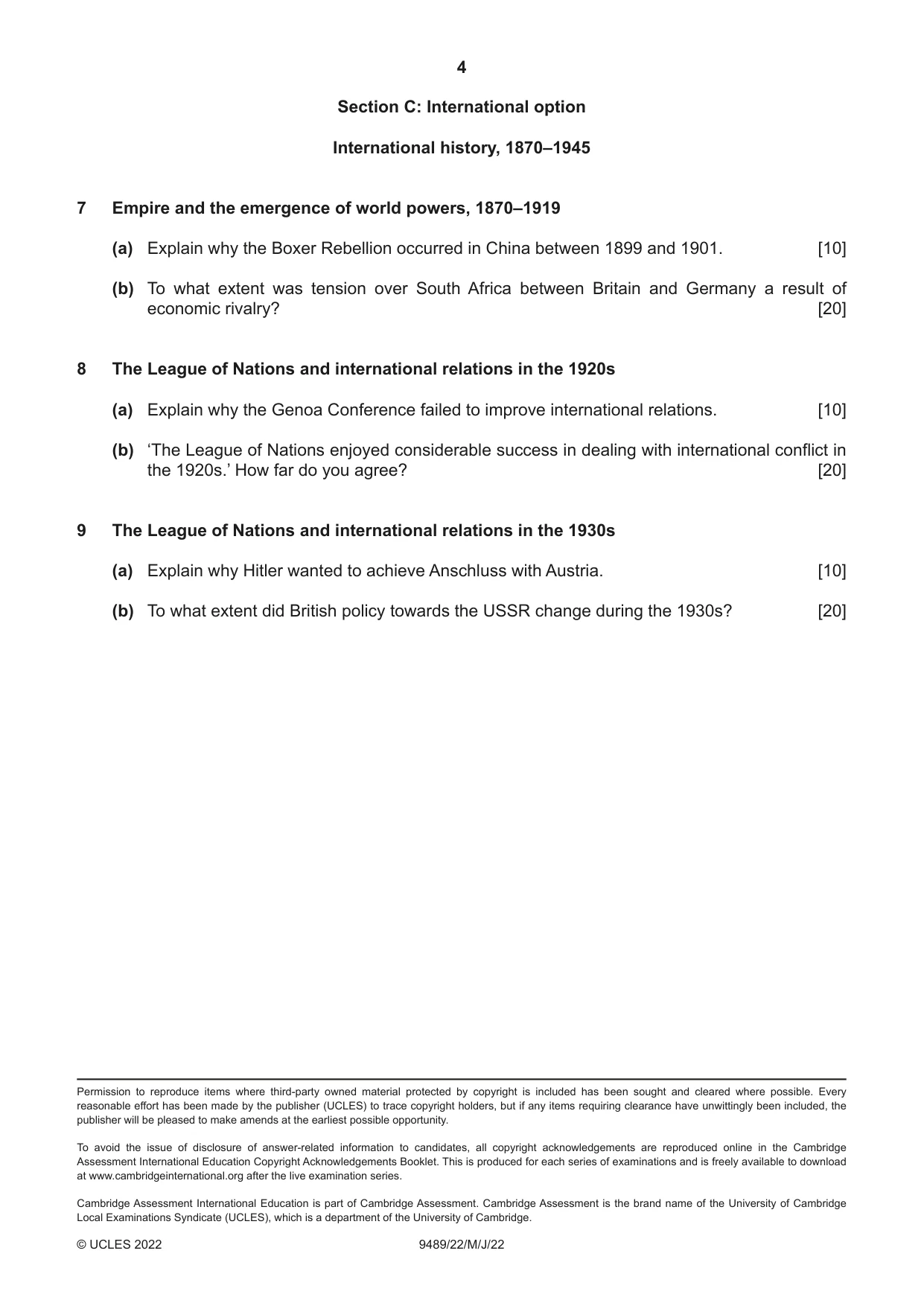
Q7 · Empire and the emergence of world powers, 1870–1919 (a) Explain why the Boxer Rebellion…
7 Empire and the emergence of world powers, 1870–1919 (a) Explain why the Boxer Rebellion occurred in China between 1899 and 1901. [10] (b) To what extent was tension over South Africa between Britain and Germany a result of economic rivalry? [20]
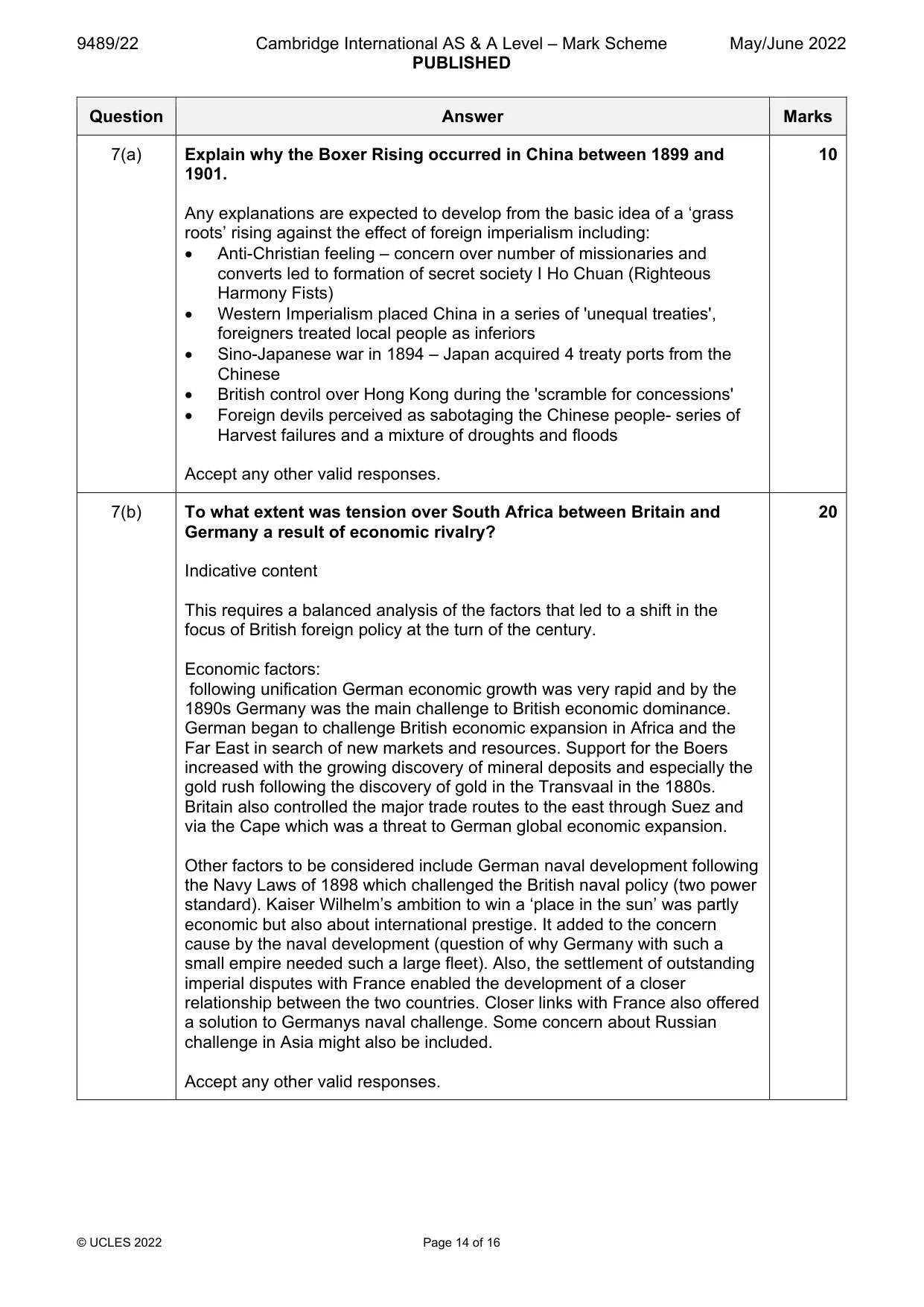
Mark scheme: 7(a) Explain why the Boxer Rising occurred in China between 1899 and 10 1901. Any explanations are expected to develop from the basic idea of a ‘grass roots’ rising against the effect of foreign imperialism including: Anti-Christian feeling – concern over number of missionaries and converts led to formation of secret society I Ho Chuan (Righteous Harmony Fists) Western Imperialism placed China in a series of 'unequal treaties', foreigners treated local people as inferiors Sino-Japanese war in 1894 – Japan acquired 4 treaty ports from the Chinese British control over Hong Kong during the 'scramble for concessions' Foreign devils perceived as sabotaging the Chinese people- series of Harvest failures and a mixture of droughts and floods Accept any other valid responses. 7(b) To what extent was tension over South Africa between Britain and 20 Germany a result of economic rivalry? Indicative content This requires a balanced analysis of the factors that led to a shift in the focus of British foreign policy at the turn of the century. Economic factors: following unification German economic growth was very rapid and by the 1890s Germany was the main challenge to British economic dominance. German began to challenge British economic expansion in Africa and the Far East in search of new markets and resources. Support for the Boers increased with the growing discovery of mineral deposits and especially the gold rush following the discovery of gold in the Transvaal in the 1880s. Britain also controlled the major trade routes to the east through Suez and via the Cape which was a threat to German global economic expansion. Other factors to be considered include German naval development following the Navy Laws of 1898 which challenged the British naval policy (two power standard). Kaiser Wilhelm’s ambition to win a ‘place in the sun’ was partly economic but also about international prestige. It added to the concern cause by the naval development (question of why Germany with such a small empire needed such a large fleet). Also, the settlement of outstanding imperial disputes with France enabled the development of a closer relationship between the two countries. Closer links with France also offered a solution to Germanys naval challenge. Some concern about Russian challenge in Asia might also be included. Accept any other valid responses.
More questions on What was the impact of imperial expansion on international relations?
Q8 · The League of Nations and international relations in the 1920s (a) Explain why the Genoa…
8 The League of Nations and international relations in the 1920s (a) Explain why the Genoa Conference failed to improve international relations. [10] (b) ‘The League of Nations enjoyed considerable success in dealing with international conflict in the 1920s.’ How far do you agree? [20]
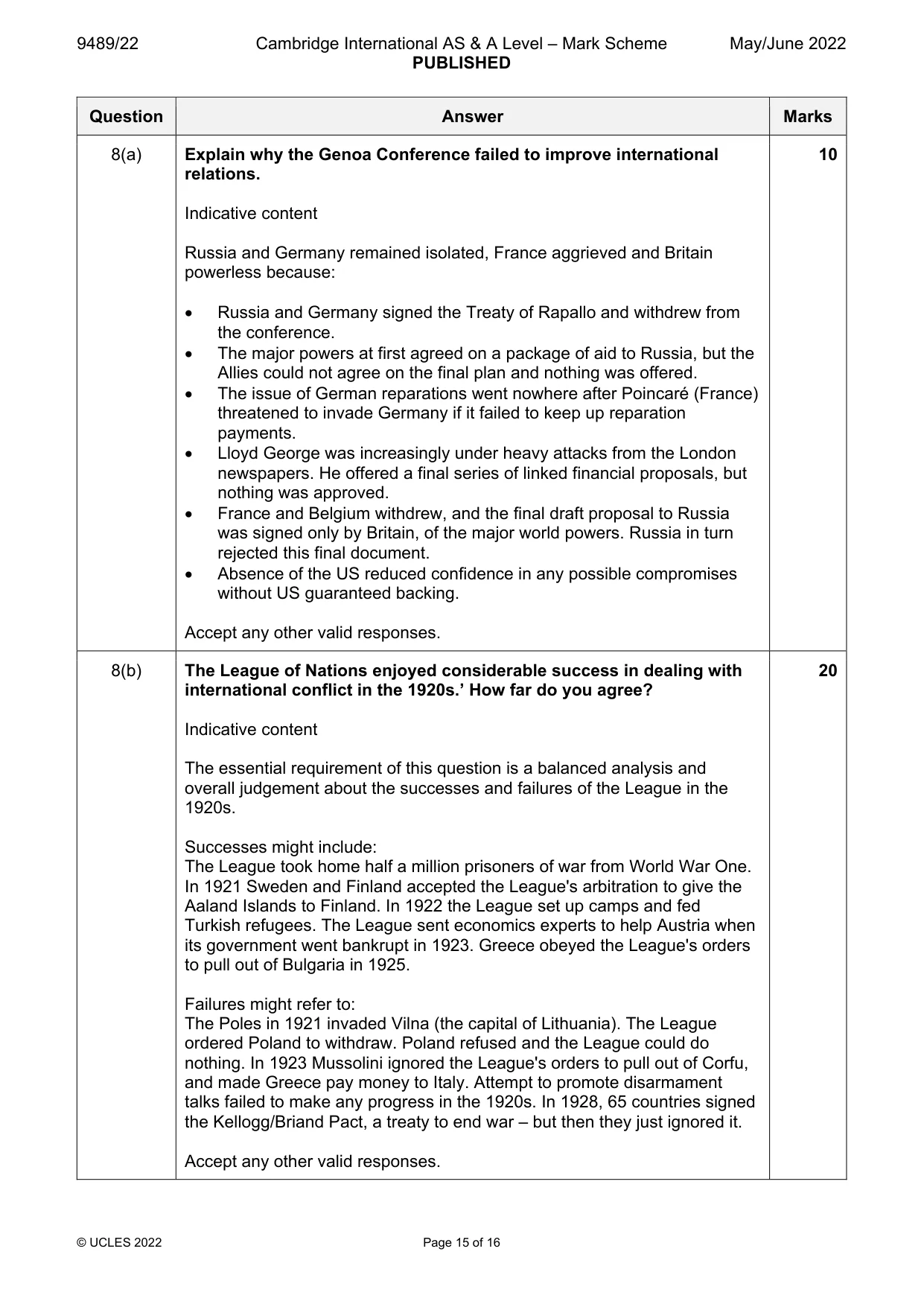
Mark scheme: 8(a) Explain why the Genoa Conference failed to improve international 10 relations. Indicative content Russia and Germany remained isolated, France aggrieved and Britain powerless because: Russia and Germany signed the Treaty of Rapallo and withdrew from the conference. The major powers at first agreed on a package of aid to Russia, but the Allies could not agree on the final plan and nothing was offered. The issue of German reparations went nowhere after Poincaré (France) threatened to invade Germany if it failed to keep up reparation payments. Lloyd George was increasingly under heavy attacks from the London newspapers. He offered a final series of linked financial proposals, but nothing was approved. France and Belgium withdrew, and the final draft proposal to Russia was signed only by Britain, of the major world powers. Russia in turn rejected this final document. Absence of the US reduced confidence in any possible compromises without US guaranteed backing. Accept any other valid responses. 8(b) The League of Nations enjoyed considerable success in dealing with 20 international conflict in the 1920s.’ How far do you agree? Indicative content The essential requirement of this question is a balanced analysis and overall judgement about the successes and failures of the League in the 1920s. Successes might include: The League took home half a million prisoners of war from World War One. In 1921 Sweden and Finland accepted the League's arbitration to give the Aaland Islands to Finland. In 1922 the League set up camps and fed Turkish refugees. The League sent economics experts to help Austria when its government went bankrupt in 1923. Greece obeyed the League's orders to pull out of Bulgaria in 1925. Failures might refer to: The Poles in 1921 invaded Vilna (the capital of Lithuania). The League ordered Poland to withdraw. Poland refused and the League could do nothing. In 1923 Mussolini ignored the League's orders to pull out of Corfu, and made Greece pay money to Italy. Attempt to promote disarmament talks failed to make any progress in the 1920s. In 1928, 65 countries signed the Kellogg/Briand Pact, a treaty to end war – but then they just ignored it. Accept any other valid responses.
Q9 · The League of Nations and international relations in the 1930s (a) Explain why Hitler…
9 The League of Nations and international relations in the 1930s (a) Explain why Hitler wanted to achieve Anschluss with Austria. [10] (b) To what extent did British policy towards the USSR change during the 1930s? [20]
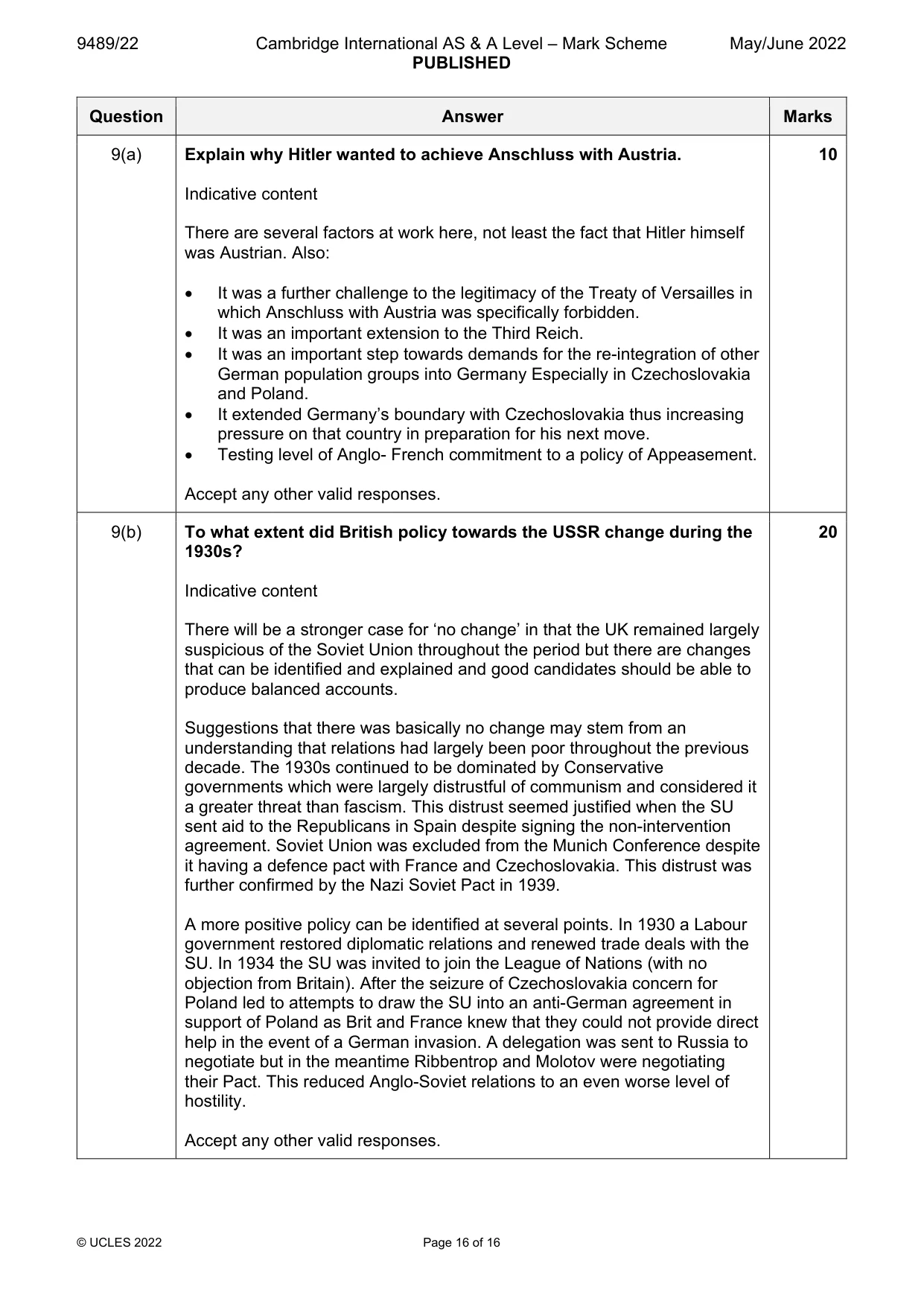
Mark scheme: 9(a) Explain why Hitler wanted to achieve Anschluss with Austria. 10 Indicative content There are several factors at work here, not least the fact that Hitler himself was Austrian. Also: It was a further challenge to the legitimacy of the Treaty of Versailles in which Anschluss with Austria was specifically forbidden. It was an important extension to the Third Reich. It was an important step towards demands for the re-integration of other German population groups into Germany Especially in Czechoslovakia and Poland. It extended Germany’s boundary with Czechoslovakia thus increasing pressure on that country in preparation for his next move. Testing level of Anglo- French commitment to a policy of Appeasement. Accept any other valid responses. 9(b) To what extent did British policy towards the USSR change during the 20 1930s? Indicative content There will be a stronger case for ‘no change’ in that the UK remained largely suspicious of the Soviet Union throughout the period but there are changes that can be identified and explained and good candidates should be able to produce balanced accounts. Suggestions that there was basically no change may stem from an understanding that relations had largely been poor throughout the previous decade. The 1930s continued to be dominated by Conservative governments which were largely distrustful of communism and considered it a greater threat than fascism. This distrust seemed justified when the SU sent aid to the Republicans in Spain despite signing the non-intervention agreement. Soviet Union was excluded from the Munich Conference despite it having a defence pact with France and Czechoslovakia. This distrust was further confirmed by the Nazi Soviet Pact in 1939. A more positive policy can be identified at several points. In 1930 a Labour government restored diplomatic relations and renewed trade deals with the SU. In 1934 the SU was invited to join the League of Nations (with no objection from Britain). After the seizure of Czechoslovakia concern for Poland led to attempts to draw the SU into an anti-German agreement in support of Poland as Brit and France knew that they could not provide direct help in the event of a German invasion. A delegation was sent to Russia to negotiate but in the meantime Ribbentrop and Molotov were negotiating their Pact. This reduced Anglo-Soviet relations to an even worse level of hostility. Accept any other valid responses.
More questions on Why, and with what effects, did Britain and France pursue a policy of appeasement?
What was in this paper
The subtopics covered by these 9 questions, and how many questions each got. Open one in a new tab to see every Cambridge question on it.
1What was the impact of imperial expansion on international relations?1What were the causes and immediate consequences of the 1789 Revolution?1What were the causes of the Great Crash and the Great Depression?1What were the causes of the Revolutions of 1848?1Why did the Civil War break out in April 1861?1Why was the League of Nations created and what challenges did it face in the 1920s?1Why was there rapid industrialisation after 1870?1Why, and with what effects, did Britain and France pursue a policy of appeasement?1What you needed in this session
Cambridge’s own grade thresholds for 2022 May/June, Paper 2 · Variant 2. A higher threshold means an easier paper — the bar moves with how the cohort did.