Questions as text
Q1 · Analyse the reasons why France was unable to maintain colonial control in Southeast Asia… 9489/41 May/June 2021
10 Analyse the reasons why France was unable to maintain colonial control in Southeast Asia in the period 1945–54. [30]
30 marks
Mark scheme: 10 Analyse the reasons why France was unable to maintain colonial 30 control in Southeast Asia in the period 1945–1954. With the surrender of Japan in August 1945, the French were determined to resume their colonial rule in Indochina. By 1954, however, Vietnam, Cambodia, and Laos had all gained independence from the French, with Vietnam hosting most of the independence struggle. While the French’s weakness was an important factor, other factors such as the defeat of Japan, which provided the opportunity and impetus for Indochina to seek independence, nationalist sentiment, the Viet Minh’s determination, and their victory on the battlefield all contributed to the French losing control. In July 1941, Japanese forces had invaded French Indochina to gain access to its raw materials. In September 1941, the Vichy government agreed to allow a Japanese occupation force into Indochina while remaining the official rulers. However, in March 1945, the Japanese took direct control of Indochina and imprisoned the Vichy French. The Japanese made no attempt to impose direct control over the civilian administration, and they persuaded the Vietnamese emperor, Bao Dai, to cooperate with Japan and declare Vietnam independent from France, but it was independence in name only; the same situation existed in Laos and Cambodia. The defeat of Japan provided the Vietnamese with the opportunity they had been waiting for; it left the French and the Vietnamese competing for control, but the French were weakened by their war efforts. The war had further reinforced nationalist sentiments. Ho Chi Minh formed the Viet Minh in China in May 1941 as a resistance movement and a coalition of nationalist groups seeking independence. In 1943, members of the Viet Minh, led by General Giap, began to infiltrate Vietnam to launch guerrilla operations against the Japanese. With the Japanese defeated and the French weakened, Ho filled the power vacuum; he offered the Vietnamese their independence from all foreign control. The August Revolution was immediately launched by the Viet Minh. The threat of famine in Vietnam united the country behind the Viet Minh under the slogan ‘Vietnam for the Vietnamese’; up to 20% of the population had already starved to death because of Japan’s seizure of their resources. The Viet Minh took control of Hanoi on 17th August 1945, and Saigon and Cochinchina on 25th August 1945. Ho Chi Minh proclaimed Vietnamese independence from France in Hanoi on 2nd September 1945. However, in 1946, Ho accepted a French proposal that allowed Vietnam to exist as an autonomous state within the French Union but fighting broke out when the French tried to re-establish colonial rule. Failure of negotiations led to the First Indochinese War. The French claimed to be fighting an anti- communist war and obtained supplies from the US, which was concerned about the extension of communist influence in the area, but the US did not commit forces to aid the French. The Viet Minh received support from the communist governments of China and the Soviet Union. Vietnam’s fight for independence became part of the Cold War. After seven years of war the French pulled out of the region. On 7th May 1954, the French-held garrison at Dien Bien Phu in Vietnam fell after a four-month siege led by Ho Chi Minh. In 1954, the US, France, and the Soviet Union produced the Geneva Accords which required France to grant Indochina complete independence. Vietnam would be temporarily divided along the 17th parallel until July 1956.
This question in 9489/41 May/June 2021
Q2 · ‘The Gold Coast achieved independence because of Nkrumah’s leadership.’ Discuss this view 9489/42 May/June 2021
11 ‘The Gold Coast achieved independence because of Nkrumah’s leadership.’ Discuss this view. [30]
30 marks
Mark scheme: 11 ‘The Gold Coast achieved independence because of Nkrumah’s 30 leadership’. Discuss this view. Nkrumah played a vital role in bringing about independence for Ghana, but other factors in the post-war world made imperial powers take decolonisation more seriously. The formation of the United Nations spread ideas of national sovereignty and self-determination. African nationalists and the global mood supporting political freedom and self-government also played their part. The experiences of African servicemen in the war emphasised to them how the Europeans had been hypocritical claiming to be a superior civilisation and this helped to arouse mass feeling against, racism, oppression and colonial rule. About 65 000 soldiers from the Gold Coast had fought alongside the British in the Second World War and had returned home to poverty and unemployment; this spurred them on to support the independence movement. In 1947, the United Gold Coast Convention (UGCC) was established. In 1947, Nkrumah returned to the Gold Coast from London to become the secretary of the UGCC. It was a movement that mainly drew its support from the middle-class and tended to pursue conservative policies. However, within two years, Nkrumah had established the more radical Convention People’s Party (CPP), which adopted the slogan ‘Self-Government Now’, and had widespread support from different sectors of society wanting to end British rule including army veterans and small traders. In 1950, Nkrumah called on the people of the Gold Coast to support self-determination and published the party pamphlet ‘What I mean by Positive Action’. Positive action involved using non-violent civil disobedience and rolling industrial strike action to challenge the British Empire. Nkrumah was imprisoned for sedition and was given a three-year sentence. However, in 1951, the CPP continued to contest the elections and won a landslide victory. Subsequently, Nkrumah was released early from prison, and in 1952, became the Prime Minister of the Gold Coast. In 1951, the CPP adopted a 5-year plan of rapid industrialisation, attempting to radically improve access to basic health, tackling literacy through implementing free primary education, and developing institutions of higher learning. Two thirds of its investment were to come from the export of surplus cocoa production and tax collection, with the remaining third from international finance loans and private sector business investment. 11 In 1952, Nkrumah met the visiting Colonial Secretary who indicated that Britain would favour independence if the chiefs could also express their view. In 1953, a White Paper on a new constitution was published which was accepted by the assembly and British public, so was enforced in April 1954. It provided for an assembly of 104 members, all directly elected, with an all-African cabinet responsible for the internal governing of the colony. In the election on 15th June 1954, the CPP won 71 seats with the regional Northern People's Party forming the official opposition. Several opposition groups formed the National Liberation Movement which demanded a federal instead of a unitary government, and for an upper house of parliament where chiefs could act as a counter to the CPP majority in the assembly. The British did not want to leave the question of how an independent Gold Coast should be governed unanswered, and it was agreed that another election would be held in June 1956 and, if the CPP gained a reasonable majority, a date would be set for independence. On 3rd August, the assembly voted for independence, and under the name Nkrumah, had proposed Ghana Independence Day would be 6th March 1957.
This question in 9489/42 May/June 2021
Q3 · ‘China became involved in Africa to protect its own interests.’ Evaluate this view 9489/43 May/June 2021
11 ‘China became involved in Africa to protect its own interests.’ Evaluate this view. [30]
30 marks
Mark scheme: 11 China’s involvement in Africa was motivated entirely by its own selfish 30 interests.’ Evaluate this view. China saw itself as a third force in Africa and an alternative to the US and the Soviet Union during the Cold War years. However, it was not until the 1960s that China’s African activities increased. It saw Africa as a continent where it could achieve its political and ideological objectives. It had seen how Taiwan had managed to ensure its seat in the United Nations with African support and it hoped to be able to replace Taiwan. Africa also became a battleground as a result of the Sino-Soviet split as China aimed to exclude the Soviet Union from Africa. The Cultural Revolution caused China to stop many activities in Africa, but during the 1970s, these resumed which was due to its deteriorating relationship with the Soviet Union. China sought support from Africa and devised the theory of the three worlds which Deng put before the UN in April 1974. The First World was the US and the Soviet Union, the second was Canada, Europe, Japan and Oceania and the third was the developing countries in Africa, Asia and Latin America. Mao placed China in the latter. China was hoping for an international united front against the superpowers, especially the Soviet Union. With African support, China replaced Taiwan in the United Nations in 1971. China’s involvement in Africa went beyond self-interest. China was committed fully to the revolutionary struggle. It supported Africa’s aims of removing colonial control and attaining full independence. Zhou Enlai spoke about Third World unity which he believed was essential to combat imperialism and colonialism. China placed itself in the Third World and it began a major aid campaign, and in 1967 agreed to build the Tanzania- Zambia Railway. Nevertheless, China also considered its own interests and by the mid-1960s, it had chosen to switch aid to liberation movements that rivalled the Soviet-backed organisations. In South Africa, China supported the largely ineffective Pan African Congress (PAC) while the Soviet Union supported the African National Council (ANC). Preferring to support active guerrilla armies which would raise its prestige, China focused most of its aid on the Zimbabwe African National Union (ZANU) in Rhodesia, while Moscow supported the Zimbabwe African People’s Union (ZAPU). ZAPU was expected to come out on top in the independence struggle, but ZANU’s was victorious and Robert Mugabe became President maintaining relations with China. In Angola, China supported UNITA, while the Soviet Union supported the MPLA and in Mozambique, China support the Mozambique Liberation Front (FRELIMO) providing military training for FRELIMO fighters. When Mozambique became independent in 1975, it immediately recognized Beijing. China granted an interest-free loan of $56 million and sent in medical teams. In the 1980s, there was a thawing of Sino-Soviet tensions, and in 1983, China announced a new policy in which all liberation organisations were to be treated equally without discrimination. In 1989, China began to explore renewing economic ties with South Africa. In 1992, Mandela visited China and he thanked China for its role in the anti-Apartheid struggle. In the 1980s, China adopted a new political and economic approach towards Africa. Premier Zhao Ziyang visited 11 African countries in 1982–83. China wanted a foreign policy without any attachment to a big power governed by the ‘Five Principles of Peaceful Co-existence’. It continued to share a common struggle with the Third World against colonialism and imperialism, but its emphasis was on mutual benefit.
This question in 9489/43 May/June 2021
Q4 · Assess why the governments of newly independent African nations faced so many social… 9489/42 Feb/March 2022
11 Assess why the governments of newly independent African nations faced so many social challenges. [30]
30 marks
Mark scheme: 11 Assess why the governments of newly independent African nations 30 faced so many social challenges. The newly independent governments were eager to provide their people with a better life but many of the political and economic issues that they faced after becoming independent had a negative impact on their ability to overcome the problems. In addition, they also inherited problems from the colonial governments. The borders of the states that the new governments assumed control of were European-drawn borders within which there were many different ethnic groups; Nigeria, for example, had 160 different groups. Swaziland was almost entirely occupied by a single ethnic group within which there were many sub-divisions. Language and religious beliefs also created divisions. Few targeted specific groups to improve their standard of living. In Botswana, for example, the Bushman Development Programme was extended to all people in remote areas; wealthier people could also receive subsidies. The new states had to deal with the fact that infrastructure was undeveloped, rates of numeracy and literacy were already low, and the labour force lacked skills. Many of the states were not economically viable and thus they struggled to deal with the social challenges they inherited. Thus, while decolonisation was regarded as an opportunity for development, the countries found that they lacked capital and technical expertise. However, many undertook ambitious projects including roadbuilding, establishing schools, and health services. But corrupt governments often led to projects benefiting government elites and their supporters. New governments were inexperienced and were most concerned with remaining in power. By the 1970s Sub-Saharan Africa had become associated with economic stagnation and persistent poverty. Coups and civil wars disrupted social development. Mozambique, for example, was entrenched in a long civil war up to the 1990s. All social change was limited by the rapid growth in population which contributed to massive migration to the urban areas. Cities like Lagos, Accra, Abidjan, Freetown, Dakar, and many others grew rapidly. These cities spread without planning and developed vast slums. Consequently, these migrants formed the urban underclass. Education rates were low because of the lack of proper schooling facilities and unequal opportunity for education across countries. The post-independence urban-based growth pattern can be seen from Mozambique to Ghana to Tanzania. In many African countries the rich urban and poor rural divide compounded political, ethnic, and religious divisions. Unemployment became a problem with youths being the greatest victims. In West African countries there were many young people who were unskilled, jobless, and alienated. They lived in slum conditions in the expanding cities of the sub-region and constituted potential material for mob action in times of political and economic crises. Another serious impediment to development in West Africa has been diseases such as like malaria and yellow fever. There was also the problem of drought in the Sahel countries, which began in the late 1960s. Drought was caused mainly by the expansion of the Sahara Desert and human activities. 11 Long periods of drought badly hit Senegal, Mali, Mauritania, Burkina Faso, Niger, and northern Nigeria. With little or no rain sometimes for years, crops and animals perished. Drought led to famine. Many people died of malnutrition, lack of resistance to diseases, and hunger. Coping with the drought situation diverted considerable portions of the already meagre resources West African countries to drought relief.
This question in 9489/42 Feb/March 2022
Q5 · ‘The legacy of colonial powers caused the greatest difficulty in establishing stable… 9489/41 May/June 2022
11 ‘The legacy of colonial powers caused the greatest difficulty in establishing stable governments in newly independent African nations.’ Discuss this view. [30]
30 marks
Mark scheme: 11 ‘The legacy of colonial powers caused the greatest difficulty in 30 establishing stable governments in newly independent African nations.’ Discuss this view. The European powers had created colonies made up of different religious and ethnic groups in which many different languages were spoken and had adopted the practice of divide and rule. Thus, every new state contained many conflicting interests including competing power bases and ethnic groups. However, for the newly independent states to be successful, they needed a government that could create national unity. A major concern following independence was that these countries would face the problem of disintegration and they wanted to ensure the sovereignty and security of their new nation-state. Countries inherited a weak political system, and the governments did not have the capacity to rule effectively; the colonial powers left behind constitutions with multi-party democracies based on their own particular systems but countries were often ill-prepared to sustain this democracy which provided the opportunity for a one-party state to emerge or for military take-overs. Nearly all of the African countries that gained their independence in the 1960s started out with multi-party systems but by 1970 half of them had military governments. Some counties were deeply divided. Nigeria, for example had a three-way divide with the Muslim north, Ibo east and Yoruba south. In 1967 civil war erupted with Biafra being declared an independent state. The forces of President Gowan took three years to defeat the Biafran forces. New nationalist governments had come to power promising to bring about improvements in the areas of education, health care, housing, and employment prospects but the under-developed economic systems they inherited made it difficult to keep these promises leading to political unrest. The new nations were aware of the need to share power, but this was not a sufficient basis for building a democracy. Many leaders were most concerned with maintaining their own power; this was often done through extensive patronage which led to inefficiency. Corruption became widespread in some countries as government officials used their position to benefit themselves and their family. The political parties themselves often did not represent the interests of the new nations as a whole. Many leaders became intolerant of other parties and resorted to autocratic rule. Governments frequently used limited resources on specific groups of people in an attempt to gain support of that group often favouring the ethnic or language group of the political elite leading to increasing ethnic tensions. In Ghana in 1963 Kwame Nkrumah pushed through a constitutional amendment that made Ghana a one-party state making himself president for life. Rather than promote inclusive politics, one-party rule fostered the politics of exclusion leading to the marginalisation of whole groups and regions. In February 1966, Nkrumah’ government was overthrown in a violent coup d'état led by the national military and police forces. 11 Political repression including the arbitrary use of power, ethnic conflicts, economic mismanagement, and corruption have sometimes been cited by the army for their intervention. The 1966 coup in Upper Volta is one example. There were also many factors beyond their control that made it difficult for African leaders to establish stable governments. Social and economic problems created much tension and unrest with inevitable political consequences. Falling commodity prices on the world markets, for example for agricultural and mineral products; mounting debts from borrowing money; weak currencies; drought and famine in east and southern Africa all had political consequences.
This question in 9489/41 May/June 2022
Q6 · Analyse how far Pan-Africanism was affected by Cold War politics 9489/42 May/June 2022
11 Analyse how far Pan-Africanism was affected by Cold War politics. [30]
30 marks
Mark scheme: 11 Analyse how far Pan-Africanism was affected by Cold War politics. 30 Cold War tensions led to superpower involvement in areas of Africa undermining the ability of Pan-Africanism to realise its goals. However, despite some success, it also limited its own achievement. In the post-colonial era, Pan-Africanism became a broad-based mass movement in Africa and enjoyed its greatest successes as an international liberation movement in the first two decades after the war. President Nkrumah of Ghana dominated Pan-Africanism at this time, establishing a series of conferences hosted in Accra between 1958–1960 where the basic tenets of Pan-Africanism were established: the attainment of political independence; assistance to national liberation movements; diplomatic unity between independent African states at the United Nations; and non- alignment. In 1959, Nkrumah, Presidents Touré of Guinea and Tubman of Liberia signed the Sanniquellie Declaration outlining the doctrines for the achievement of the unification of independent Africa. However, Nkrumah’s call for political and economic union gained little consent. Disagreements gave rise to two rival factions within the movement: the Casablanca and Monrovian Blocs. In 1963 32 African states met and established the Organisation of African Unity (OAU). It undertook a number of important ventures, such as aiding liberation movements to overthrow colonial regimes, combating racism and apartheid and resolving boundary disputes among members. The intention to eradicate colonialism from Africa was perhaps the organisation’s most successful venture. However, the vision of a United States of Africa was not fully supported; many felt that Nkrumah’s grand vision would undermine sovereignty and territorial integrity. Against the backdrop of the Cold War, the OAU faced considerable challenges to fulfilling its objectives. Its respect for sovereignty and territorial integrity allowed emerging dictatorships and political instability. Coups took place in Mali, Nigeria and the DRC which established military dictatorships and set African states on a path to perpetual civil war. The OAU had no authority to remove illegitimate governments was described as a club for dictators. For example, Amin was Chairman of the OAU at a time of brutal reprisals and massacres. The only direct attempt at mediation was in 1981–82 in the civil war in Chad. It was unsuccessful. It also failed to resolve long-running civil wars like those in Nigeria and Angola. Many countries became dependent on economic aid with conditions attached, meaning that they could not be non- aligned. Technical assistance as well as guidance with defence and military issues were also needed. Newly independent nations such as Angola and Mozambique enabled Cold War proxy battles between the US and the Soviet Union. The desire to free Africa of all foreign interference was the rationale behind the establishment of the OAU, but it often proved difficult to avoid, with the continued need for economic assistance. In addition, African countries had different political systems and disparities in wealth which made a united front difficult. Although Africa gradually won the right to settle its own conflicts, this did not lead the great powers to refrain from all intervention.
This question in 9489/42 May/June 2022
Q7 · Analyse the reasons why the Dutch were unable to reestablish colonial control in… 9489/43 May/June 2022
10 Analyse the reasons why the Dutch were unable to reestablish colonial control in Indonesia by 1949. [30]
30 marks
Mark scheme: 10 Analyse the reasons why the Dutch were unable to reestablish colonial 30 control in Indonesia by 1949. The Indonesian War of Independence 1945–49, was an armed conflict and diplomatic struggle between Indonesia and the Netherlands. Indonesian nationalism and movements supporting independence from Dutch colonialism, such as Budi Utomo, the Indonesian National Party Sarekat Islam, and the Indonesian Communist Party joined the Dutch Volksraad hoping that Indonesia would be granted self-rule. Others demanded self- government; the most well-known of these leaders were Sukarno and Mohammad Hatta, two nationalists. Japan's occupation of Indonesia from 1942–1945 was to be a crucial factor in the revolution. The Japanese created new Indonesian institutions and encouraged nationalism; they elevated political leaders like Sukarno. Although on the brink of losing the war, the Japanese wanted to help Indonesian nationalists prepare for self- government. Sukarno and Hatta proclaimed Indonesian independence on 17 August 1945. The job of re-occupying Indonesia fell to the British; their main task was to disarm the Japanese troops and return them to Japan. The British did not want to become involved in trying to overturn Sukarno’s government, but they continued with their reoccupation of Indonesia throughout 1945. The Battle of Surabaya was the heaviest single battle of the revolution and became a national symbol of Indonesian resistance. Defeat in the battle galvanised the nation in support of independence and helped gain international attention. It also convinced Britain to become neutral in the revolution. Most Dutch politicians did not take the unilateral declaration of Indonesian independence seriously as it was issued by those who had collaborated with Japan. The Dutch, following their liberation from the Germans wanted Sukarno and the other nationalist leaders removed as quickly as possible. However, the Netherlands’ harbours had been destroyed in the war, they had only a few ships and lacked finance to buy petrol, but the Dutch were determined to restore the pre-war situation. This Dutch stubbornness led to Indonesia becoming the scene of a four-year war of decolonisation. Dutch weakness was also exacerbated because of lack of support from the British and also by the UN. In 1946 Sjahrir, the new Prime Minister, held peace talks with the Dutch who offered to set up a Commonwealth of Indonesia with a degree of self-government under the Dutch monarchy. The terms were rejected. A further conference was held at Linggadjati in August 1946. This set up the United States of Indonesia but many groups within Indonesia rejected it. The Dutch then sent troops to Java, Madura and Sumatra. At this stage the UN intervened. They wanted to stop the fighting and to prevent the Dutch from suppressing the rights of the Indonesians. The UN ordered a cease-fire and set up a Committee of Good Offices to settle the dispute. A conference was held at Renville in January 1948 but again the agreement made was not adhered to. The Dutch sent in troops, captured the capital and imprisoned Sukarno, Hatta and Sjahrir. 10 The UN passed a resolution calling on the Dutch to withdraw. The Dutch only obeyed the resolution after the United States decided to support the UN resolution by threatening to cut off Marshall Aid to the Netherlands. The United States favoured Sukarno and Indonesian Independence hoping to keep independent Indonesia out of communist hands. US pressure on the Dutch resulted in the transfer of sovereignty to the nationalist government of Indonesia in 1949 with the exclusion of the Dutch part of New Guinea.
This question in 9489/43 May/June 2022
Q8 · Evaluate Azikiwe’s role in achieving Nigerian independence 9489/43 May/June 2022
11 Evaluate Azikiwe’s role in achieving Nigerian independence. [30]
30 marks
Mark scheme: 11 Evaluate Azikiwe’s role in achieving Nigerian independence. 30 Azikiwe (Zik) was a passionate nationalist and a powerful orator who exposed the evils of colonialism and gained recognition as a national hero. In 1937 he founded the ‘West African Pilot’, a newspaper which he used to promote Nigerian nationalism. He started the first press conglomerate, Zik’s Press Ltd, and his chain of newspapers generated strong opposition against British colonial rule. The anti-colonial stance of these newspapers contributed to a large extent, to the eventual independence of Nigeria in 1960. Azikiwe also entered the arena of politics. In 1944 he co-founded the National Council of Nigeria and the Cameroons (NCNC) with Herbert Macaulay; he assumed leadership of the party on Macaulay’s death in 1946; it was founded to bring together the diverse groups in Nigeria. He became a major force in the independence movement. In 1948 Sir John Macpherson became Governor and he introduced constitutional reform in 1951. The elective principle was applied throughout the country, and Nigeria became divided into Northern, Eastern and Western regions, each with its own house of assembly. Azikiwe held a number of elected public offices. He was elected into the Western Nigerian House of Assembly in 1952 and he was about to head the Western Regional government when some Yoruba members of his party defected in support of a fellow Yoruba, Obafemi Awolowo, the founder of the Action Group, a rival political party. This forced him to leave Lagos and return to the Eastern region. Many believed that this marked the beginning of ethnic politics in Nigeria with the Action Group for the Yoruba, Northern people’s Congress for Hausa-Fulani and NCNC for the Igbo. A delegation of Nigerian political parties went to London in 1953 to review the constitution; the outcome was the Lyttleton Constitution 1954. In response to Azikiwe and other nationalists, this created a fully federal system. Azikiwe became premier of the Eastern Region from 1954–59. His political stance at this time clearly favoured his Ibo tribe in the Eastern region. After Obafemi Awolowo, formed the Action Group in the West, Azikiwe aligned himself with Abubakar Tafaw Balewa, who had gained control of the Northern People’s Congress. Balewa began to lead a new national regime in 1957. Azikiwe’s alliance with Balewa helped him be named president of the senate in 1959, then governor-general in 1960 while Balewa became prime minister. Azikiwe’s leadership and initiative played a major role in bringing about Nigerian independence. However, the Second World War also had a tremendous impact on the acceleration of constitutional change in Nigeria. It helped to create a different climate of opinion in Nigeria as soldiers returned from the war demanding new and vigorous leadership. People from all walks of life became committed to the anti-colonial movement including the youth, market women, educated people, and farmers. In the post-war years British policy as one of ‘creative abdication of power’ changed from one of divide and rule to unite and decolonise. Political leaders resorted to the use of political parties and the media to mobilise millions of Nigerians against the continuation of British rule. 11 Azikiwe and the NCNC advocated ‘one country, one God, one destiny’ but were unable to win country-wide support; it was left to the British to hold Nigeria together as one state. The granting of Ghana’s independence in 1957 spurred the Nigerian leaders to pursue their demands at the Constitutional Conference which had been resumed in London. From 1957 there was a federal prime minister and the eastern and western regions were granted internal self-government followed by the Northern Region in 1959.
This question in 9489/43 May/June 2022
Q9 · Assess the extent to which nationalist movements contributed to African nations gaining… 9489/42 Oct/Nov 2022
11 Assess the extent to which nationalist movements contributed to African nations gaining their independence. [30]
30 marks
Mark scheme: 11 Assess the extent to which nationalist movements contributed to 30 African nations gaining their independence. Indicative content During the 1950s and 1960s, when Africans began to seriously resist colonial rule, Africa underwent a major transformation and each colony eventually gained its freedom. In Africa, nationalism became a central focus for calls for the unification of Africa. Nationalist movements attempted to transform conceptions of African identity from a focus on isolated ethnicities to a racial identification, or an identity based on the territorial state created by colonial rulers. By 1950, most African colonies had some organised national movement; most of these were in the form of political parties that led the demand for independence. These movements were more broad-based in their appeal. Political parties emerged in the period between the two World Wars and they represented national movements. They helped to organise national movements across Africa. Popular parties included the Kenyan African National Union (KANU) in Kenya and the Convention People’s Party in Ghana. In general, these political parties were led by charismatic nationalist figures like Nkrumah, Kenyatta and Azikiwe. They were all keen advocates of national independence. In the 1950s and 1960s, struggles by African Americans in the United States for constitutional rights intensified. African national movements and the Civil Rights Movement in the United States mutually affected each other. In 1957, Martin Luther King visited Ghana at the invitation of the Prime Minister Kwame Nkrumah to witness the official replacement of the Union Jack with the new Ghana flag. Another Civil Rights leader, Malcolm X, travelled widely in Africa. He met with all the prominent African leaders of the time, including Nkrumah. Pan-Africanism also influenced the nationalist leaders like Kaunda, Haile Selassie, Nkrumah and Azikiwe. The fifth Pan-African Congress held in Manchester in 1945 supported strongly the African struggle for independence. Nkrumah argued that African workers and peasants needed to reclaim their independence advocating the use of force if necessary. Nkrumah's hatred of colonial rule, enthusiasm for independence, and the ideal of a United States of Africa made him popular throughout the continent. Azikiwe was a prominent Pan-Africanist; he rejected Nkrumah's united Africa, and advocated the use of colonial boundaries to define nations. For him, a united Africa meant cooperation, but not an actual unification of the continent. He abandoned his Pan-Africanist ideals. Returning veterans from the Second World War expected more freedom and dignity and supported nationalism. The formation of the UN also popularised notions of national sovereignty. Weakened economically and militarily from their participation in the Second World War, European colonial powers became less able to repress the national movements that were growing across the African continent. They, therefore, became more open to the idea of granting independence. In some colonies the calls for independence led to armed confrontations between nationalist insurgent groups and colonial armies. In Kenya, the Mau Mau uprising carried on guerrilla warfare against the colonial government for most of the 1950s. In most colonies, however, national movements used a combination of armed resistance and constitutional protest to fight for independence. Armed struggle was often used only as a strategy of last resort, when other more peaceful means of protest had proven futile or were repressed. In sub- Saharan Africa, the Gold Coast (Ghana) was the first to gain independence in 1957. Fourteen African countries gained independence in the year 1960. By 1966, most African countries had attained independence.
This question in 9489/42 Oct/Nov 2022
Q10 · Evaluate the strength of the opposition to the re-establishment of British colonial… 9489/42 Feb/March 2023
10 Evaluate the strength of the opposition to the re-establishment of British colonial control in Malaya after 1945. [30]
30 marks
Mark scheme: 10 Evaluate the strength of the opposition to the re-establishment of 30 British colonial rule in Malaya after 1945. With the end of the Japanese occupation, the British returned to Malaya; they published the Malayan Union Constitution in January 1946. Singapore was to become a separate British colony while Penang and Malacca were to join the nine Malay states to form the Malayan Union; citizenship would no longer be restricted to natives which, together with the lack of consultation, aroused much opposition. In March 1946, Dato Onn bin Jaafar became the first president of the United Malays National Organisation (UMNO) and began a policy of non-co-operation with the British proposals. The British, fearing more violent action, relented. The Federation of Malaya was formed on 1 February 1948. The most significant change was qualification for citizenship; all citizens had to have an adequate knowledge of Malay or English, agree to reside permanently in the Federation and swear an oath of allegiance to it. Malaya had achieved a degree of self-government, but the Federation was still under the control of Britain. The Malayan Communist Party (MCP) would no longer accept British rule and began an armed uprising against the British. The communist threat proved to be a protracted one lasting from June 1948 until July 1960. Chin Peng took over the leadership of the MCP in 1947 aiming to forcibly drive the British from Malaya and establish the Communist Republic of Malaya. Strike action, anti-British demonstrations and a guerrilla army were used to disrupt the economy by attacking tin mines, rubber plantations and government buildings. This resulted in the declaration of a State of Emergency by Sir Edward Gent on 19 June 1948; the MCP was declared to be illegal. The MCP used terror tactics and created fear and hatred in the people. However, Sir Harold Briggs, Director of Operations in Malaya, drew up the Briggs Plan which aimed to stop the contact between the jungle farmer and the communists. He established ‘new villages’, settlements surrounded by barbed wire and protected by troops, and introduced ‘Operation Starvation’; the people were issued with ration cards making it difficult for the communists to maintain their food supplies. The MCP abandoned its terror tactics but targeted leading enemy figures instead. In October 1951, Sir Henry Gurney, the High Commissioner was murdered. By 1954 the communists were becoming weaker, and parts of Malaya were free of communism. Gurney’s replacement, General Sir Gerald Templer, used psychological warfare to win ’the hearts and minds’ of the people. He tried to unite the different races by urging racial unity. He gave rewards for killing, capturing, or informing on communists. In 1955 Tunku Abdul Rahman, the Chief Minister, offered amnesty to communists who surrendered but the Baling Talks in 1955 failed to establish peace. Chin Peng offered to negotiate in 1957 but his offer was rejected as he refused to disband the MCP. 10 Britain stuck to its promise of 1948 that independence would be granted in Malaya after a period of preparation; Templer called elections in 1952 for local governments and town councils. UMNO and the Malayan Chinese Association (MCA) stood together as an alliance. The British then agreed to set up a Legislative Council with 52 elected members and in the 1955 elections the Alliance won a landslide majority. Rahman flew to London on the Merdeka Mission and the British government agreed that independence should be granted on 31 August 1957.
This question in 9489/42 Feb/March 2023
Q11 · Analyse the reasons why improving education was a challenge for newly independent African… 9489/41 May/June 2023
11 Analyse the reasons why improving education was a challenge for newly independent African nations. [30]
30 marks
Mark scheme: 11 Analyse the reasons why improving education was a challenge for 30 newly independent African nations. Colonial powers imposed their own education system on the local population and no colonial government up to the end of World War II adopted an educational policy aimed to develop full social, economic and political responsibility in its African communities. After World War II, the British implemented an educational programme in Africa to prepare their colonies for self-government and eventual independence. From 1945 to 1959 the number of primary, intermediate and secondary schools for natives in Kenya, for example, rose from around 2,250 to over 4,700, and the number of children in school rose from 200 000 to over 600 000 In the same period, school attendance in Nigeria, Tanganyika and Uganda more than trebled. In French territories the number of children enrolled in school in Cameroon, French West Africa, French Equatorial Africa, Madagascar and Togoland rose from 450 000 in 1945 to 1.3 million in 1958. However, despite increased enrolment in schools there were very low literacy levels in most of the newly independent countries. The new nations were prepared to invest heavily in schools. This desire to fund education attracted the attention of donors, such as UNESCO, as most African governments could not afford the enormous funding needed to make education accessible for the majority of their population. Appointing staff to institutes for health education, for vocational training and for public administration was suggested and helping African students to study abroad. Educational facilities were also needed. Angola, Cameroon, Ethiopia, Mozambique, Nyasaland, Sierra Leone, Somalia and Tanganyika all had illiteracy rates of more than 90%. A shortage of trained teachers faced all the countries. More than 70% of the 90 000 teachers in Nigeria had no teacher training. More than half of the 15 000 primary school teachers in Ghana did not meet minimum qualifications. The new African nations clearly realised that industrialisation, natural resource development, general economic advancement, universal suffrage and other goals could not be attained without a well-planned educational programme to produce skilled workers, technicians, administrators and government leaders. For many Africans, higher education was a prime goal of national development, and they increasingly stressed their need for vocational schools and science education. The education expansion of the 1960s slowed down in the 1970s and 80s because of economic decline; governments cut spending, which led to a halt to further expansion and reduced supply of teaching materials. There were also issues over what should be taught to ensure the curriculum was relevant for the new nations. The African countries followed the education systems and practices of the former colonial powers. Frequently, the language of instruction even at primary level was that of the former colonial power. This resulted in a mismatch between the world of work and the world of education. Most children failed to complete the courses in which they were enrolled especially in countries like Ghana, Nigeria and Sierra Leone. Reasons for the large number of dropouts included overcrowding, removal of children by parents who needed their labour and inability to pay the small fees that mission schools charged. 11 The real test of progress was in the proportion of the pupils who progressed into the upper-primary classes. Most African children and their parents expected their primary schooling to qualify them for something better than manual work. In most African cities, unemployed youths were attempting to find white-collar jobs for which they were not qualified.
This question in 9489/41 May/June 2023
Q12 · Evaluate how far the attitudes of colonial powers contributed to African nations gaining… 9489/43 May/June 2023
11 Evaluate how far the attitudes of colonial powers contributed to African nations gaining their independence. [30]
30 marks
Mark scheme: 11 Evaluate how far the attitudes of colonial powers contributed to 30 African nations gaining their independence. It can be argued that the Second World War caused Africa’s decolonisation, but attitudes of the colonial powers did not change immediately. This can be seen through the policies of Clement Attlee’s Labour government who wanted to make the colonies produce more money to help Britain pay its war debts and rebuild itself; the British were still committed to their African Empire. This sort of approach was also adopted by the French when they established an investment fund (FIDES) whose goal was to try and economically develop France’s African colonies. Under Attlee, taxes were increased, and various projects were implemented such as the Ground Nut Scheme in Tanganyika. After the war the governments of both Britain and France required their colonial administrations to draw up comprehensive development plans. Some of the British colonies had built up considerable reserves from the high prices commanded by their produce during the war and immediate post-war years, and they themselves were able to provide much of the money needed. However, the failed Suez Crisis in 1956 humiliated the imperial powers and showed their colonies that they were no longer great powers and highlighted to the British government that they were no longer the superpowers they once were. This victory of nationalism over imperialism followed a swift European withdrawal from Africa. This coupled with the fact that the colonies were no longer making as much money compared with previous years and the prospect of joining a growing European marketplace just made the declining Empire less desirable. In Britain the new conservative government in 1959 allowed a deliberate speeding up of the move towards independence. In 1960 Macmillan acknowledged the end of the British Empire recognising that ‘winds of change’ were blowing through Africa, ‘whether we like it or not’. Maintaining colonies was no longer viable. By the late 1940s both the French and the British territories possessed an educated, politicised class, which felt frustrated that it had made no appreciable progress in securing any real participation in the system of political control. In fact, anything approaching effective African participation seemed more remote than ever. Implementation of the development programmes led to a noticeable increase in the number of Europeans employed by the colonial regimes and their associated economic enterprises. On the other hand, because many Africans had served with, and received educational and technical training with, the British and French armies, the war had led to a great widening of both African experience and skills. During the 1950s and 1960s, when Africans began to seriously resist colonial rule, Africa underwent a major transformation, and each colony eventually gained its freedom. In Africa, nationalism became a central focus for calls for the unification of Africa. Nationalist movements attempted to transform conceptions of African identity from a focus on isolated ethnicities to a racial identification, or an identity based on the territorial state created by colonial rulers. By 1950, most African colonies had some organised national movement; most of these were in the form of political parties that led the demand for independence. 11 These movements were more broad-based in their appeal. Political parties helped to organise national movements across Africa. Popular parties included the Kenyan African National Union (KANU) in Kenya and the Convention People’s Party in Ghana. In general, these political parties were led by charismatic nationalist figures like Nkrumah, Kenyatta and Azikiwe. They were all keen advocates of national independence.
This question in 9489/43 May/June 2023
Q13 · Analyse the effects of dependence on ex-colonial trading partners on newly independent… 9489/42 Oct/Nov 2023
11 Analyse the effects of dependence on ex-colonial trading partners on newly independent African nations. [30]
30 marks
Mark scheme: 11 Analyse the effects of dependence on ex-colonial trading partners on 30 newly independent African nations. The European countries that colonised Africa grudgingly granted the colonies independence due to internal and external pressures. However, these European countries still wanted to influence the politics, economy, and culture of their former colonies, often in alliance with the rulers. When colonialism ended, the new African states who were weak both politically and economically were vulnerable to interference from the West. Under colonialism their economic systems were tied to a narrow export base with a weak industrial sector. In Africa industry was not developed outside of agriculture and extraction, and workers were restricted to the lowest-paid, most unskilled work which continued after independence. In 1967, 90% of Africa’s exports were comprised of raw materials such as oil, copper, cotton, coffee, and cocoa. The growth of cash crops meant that food had to be imported, while industrial development was held back because manufacturing and the processing of raw materials happened exclusively overseas. Africans’ wages were kept very low, and the profits from the exploitation of African labourers went directly to European bankers and trading companies. Most West African countries continued to concentrate on the production and marketing of one or two cash crops: groundnuts in Senegal and Gambia; cocoa and palm kernels in Sierra Leone; palm oil and cocoa in Guinea, Côte d’Ivoire and Ghana; and palm oil and kernels and cotton in Nigeria. West African economies were also structured to be permanently dependent on Western nations. They were consigned the role of primary producers for processing in the West. The terms of trade in the Western-controlled international market discriminated against African nations who were unable to earn enough to develop their economies after independence. The weakness of postcolonial nations was a result of colonialism; states had limited control over territory and regimes that relied on ethnic divisions, a centralised authority, and patronage systems inherited from colonial rule. The first Presidents of independent postcolonial nations, Kwame Nkrumah of Ghana and Sekou Touré of Guinea were strongly against this practice. They wanted their countries to cut off the ties of colonialism completely. However, when Touré decided to reduce his country’s ties with France, the French practically destroyed Guinea. They damaged public infrastructure and took away to France whatever valuable property they could lay hands on. They also later refused to allow Guinea access to the common currency used across their former colonies. Nkrumah coined the term neo-colonialism to refer to the indirect political, economic, and social control of African nations by their former colonial overlords. Some West African leaders tried to remove vestiges of colonialism by joining the Non-Aligned Movement (NAM). The NAM was formed by countries who did not want to be directly involved with the intense Cold War rivalry between the post-war superpowers, the USSR, and the United States. Nkrumah turned to Eastern countries in the Soviet Bloc for assistance. In this way, he became closely aligned to the Soviet Bloc. The USA did not like Nkrumah’s close ties with the Soviet Bloc, because the Americans wanted West African countries and many others in Africa and elsewhere to be under the US influence. The United States and, in some cases, the USSR, found an opening to replace the influence of these countries’ former colonial masters.
This question in 9489/42 Oct/Nov 2023
Q14 · Analyse the significance of Senghor’s role in gaining independence for Senegal 9489/43 Oct/Nov 2023
11 Analyse the significance of Senghor’s role in gaining independence for Senegal. [30]
30 marks
Mark scheme: 11 Analyse the significance of Senghor’s role in gaining independence for 30 Senegal. Léopold Sédar Senghor was a philosophical leader who led Senegal to independence and laid the foundations for a stable state. Senghor and Mamadou Dia formed the Bloc Démocratique Sénégalais (BDS) which came to power in 1948. His formation of the party resulted partly from a protest against what he considered France’s lack of consideration for the interests of Africa. Senghor’s friends in Senegal helped gather support for the new party. The BDS principles were to ‘ensure equitable, democratic participation by all major regional, ethnic, and economic interests’. In 1951, it won both Senegalese seats in the French National Assembly and, in 1952, 43 of the 50 seats in Senegal's Territorial Assembly. Senghor and Mamadou Dia secured overwhelming majorities at the parliamentary elections in 1956 and launched a campaign to unite all Senegalese parties. In April 1958 the Union Progressiste Sénégalaise (UPS) was formed. The UPS won all 80 seats in the elections to the Senegal legislature in 1959. African socialism, was the political doctrine that would become the platform for Senghor’s UPS party. Senghor and Mamadou Dia, emphasised the creation of a socialist society grounded on a combination of modern economic planning and traditional African communitarian values. They wanted to preserve the economic and technical advantages of colonial rule and reject the colonial system’s flaws. Senghor’s African socialism for Senegal differed from conventional Marxism; it encouraged spiritual freedom and rejected implicit Marxist atheism which were more acceptable to the country’s Muslim religious leaders than Marxist ideology. However, independence as a nation state was not Senghor’s first choice. As problems with France’s African colonies escalated with the revolt in Algeria in 1955, Senghor was appointed by the French government to investigate the problems of overseas territories. He urged France to allow African states to form in loose confederations. France granted internal autonomy to its African territories under the provisions of the Loi-cadre of 1956 which was seen by the French government as an alternative to political independence. But the collapse of the Fourth Republic shortly afterwards put in jeopardy France’s plans to keep its black African colonies under French control. When Charles De Gaulle offered Senghor the opportunity to take immediate independence in the 1958 referendum that established the Fifth Republic, he, together with all the other leaders of French Africa apart from Touré in Guinea, refused. Instead, he campaigned successfully to persuade the Senegalese to vote against immediate independence, arguing that this was the best way of retaining French development funds. Less than two years later, when the international tide against colonialism and the political and economic costs to France of maintaining colonial rule convinced De Gaulle to move rapidly to grant independence to black Africa, Senghor chose to retain close political, military, and cultural links with France and supported efforts to create a West African Federation consisting of Senegal, the French Sudan, Upper Volta, and Dahomey, called the Mali Federation. 11 The latter two countries soon withdrew after the first constitution was drafted and a second constitution for the Mali Federation, including only Senegal and Sudan, was drafted in June 1959. The Federation gained independence a year later. The new federal constitution altered the balance of power to fit the two-state system, creating a dual executive at Senegal’s insistence. However, disagreements led to Senegal’s withdrawal. Senegal then drafted its own constitution, and Senghor was elected its first president in 1960.
This question in 9489/43 Oct/Nov 2023
Q15 · ‘Kenyatta’s leadership was the main reason Kenya was able to gain its independence.’… 9489/42 May/June 2024
11 ‘Kenyatta’s leadership was the main reason Kenya was able to gain its independence.’ Discuss. [30]
30 marks
Mark scheme: 11 ‘Kenyatta’s leadership was the main reason Kenya was able to gain its 30 independence.’ Discuss. Discussion of Kenyatta’s leadership and his role in attaining independence might be weighed up against the Mau Mau uprising and the attitude of the British government in order to reach a judgement. In1946 Kenyatta had become the leader of the Kenya African Union (KAU). He appealed to all Kenyans to unite behind the KAU to gain recognition for their rights and liberties. In 1952, the colonial government declared a state of emergency and arrested many Kenyan independence leaders, including moderates, like Jomo Kenyatta. He was raised to the status of an icon in the struggle for independence during his imprisonment. With the slogan ‘Kenyatta and independence’ being chanted at political meetings, the figure of Jomo Kenyatta came to represent independence; he symbolised the country’s liberation and the ending of the repression which had begun in 1952. Kenyatta’s release was central to the negotiations put together in London in January 1960. The two African representatives demanded his release as a prerequisite to any discussion. The general elections of February 1961 resulted in a victory for the Kenya African National Union (KANU), heir to the KAU, founded in May 1960. Their elected members refused to form a government as long as Kenyatta remained in prison. He was released on 14 August 1961 and was appointed prime minister on 1 June 1963. As head of state, Kenyatta created an image of himself as father of the nation. Kenyatta was accorded hero status on his release from prison in 1961. He represented order against the threat of corruption declaring in 1962 that Kenya was determined to have ‘independence in peace’ and he became regarded as a shield against radical nationalists. Many argue that the Mau Mau uprising in Kenya was the catalyst for decolonisation as it showed that colonial control could only be maintained through extreme force. The Mau Mau were a militant nationalist movement of primarily Kikuyu people, also known as the Kenya Land and Freedom Army. Mau Mau members carried out violent attacks against colonial leaders and white settlers as well as targeting those among the African population who refused to join their ranks. The moral and financial cost of colonisation concerned British voters, and the Mau Mau revolt brought those issues to a head. In 1952, the colonial government had declared a state of emergency in the colony in order to eradicate the Mau Mau organisation which was defeated in 1956 with great brutality. As the British government feared both international criticism if they kept using force in Kenya and voters’ objections to the high costs of maintaining the colony, it began to consider granting Kenya independence. The rebellion persuaded them that social, political and agrarian reforms were necessary. In 1957, the British allowed the first direct elections of native leaders to the Legislative Council and, by 1960, Africans were a majority in the council. Kenya became independent on 12 December 1963.
This question in 9489/42 May/June 2024
Q16 · Assess the extent to which the economic challenges of the newly independent African… 9489/41 Oct/Nov 2024
11 Assess the extent to which the economic challenges of the newly independent African nations were a legacy of colonial rule. [30]
30 marks
Mark scheme: 11 Assess the extent to which the economic challenges of the newly 30 independent African nations were a legacy of colonial rule. A major legacy from the colonial powers was lack of infrastructure. Roads and railways had been built but not to provide national infrastructures. They were invariably intended to facilitate the export of raw materials. Many, like the Ugandan Railroad, ran straight to the coastline. These nations also lacked the manufacturing infrastructure to add value to their raw materials. Many African countries were rich in cash crops and minerals but were unable to process them. During the colonial period most West African countries, for example, focused on the production and marketing of one or two cash crops. They were primary producers with processing taking place in the West. They were still dependent on the ex-colonial powers; they had gained political, not economic independence. They were also dependent on Western economies for much of their energy; they did not have the refineries needed to refine their crude oil. The economic development and education of local people had been kept low deliberately and, as a result, there was enormous socio-economic deprivation and the lack of a skilled workforce. African states had inherited economies which were not suited to producing enough food to feed their own populations. However, other economic challenges arose after independence which were related to poor political leadership and corruption. As many states abandoned party politics for dictatorships, money was diverted to the military to ensure that rulers retained their power. Corruption also played its part with the elite using the nation’s resources for their own benefit such as presidential homes and hotels. A small percentage became very rich while the state ownership of industry often reduced the incentive to invest. Neo-colonialism was a problem as ex-colonial powers continued to dominate, and their economies were still being exploited rather than developed. Many countries were dependent upon one product; for example, Zambia was mainly dependent upon copper and was badly hit when world prices fell. The failure of African leaders to change the system they inherited led to economic difficulties. Some leaders, like Nkrumah, tried to overcome their dependence by undertaking building projects, like the Volta River hydroelectric dam project but its construction put Ghana heavily into debt. Other countries also had huge external and domestic debts. Some problems arose because of the decline in average rainfall and countries faced droughts and famines.
This question in 9489/41 Oct/Nov 2024
Q17 · Analyse why the People’s Republic of China became increasingly involved with Africa… 9489/42 Oct/Nov 2024
11 Analyse why the People’s Republic of China became increasingly involved with Africa during the Cold War. [30]
30 marks
Mark scheme: 11 Analyse why the People’s Republic of China became increasingly 30 involved with Africa during the Cold War. The PRC’s first serious involvement in Africa was when it used the Asian- African Conference at Bandung in 1955 to speak out against colonialism and imperialism in Africa. The PRC increasingly spoke against US imperialism as a dangerous enemy of African independence. It did not want either superpower to have influence in Africa. The Cold War loomed large in the PRC’s policies towards Africa throughout the 1950s and 1960s. It saw itself as a third force in Africa and an alternative to the USA and the USSR during the Cold War years. It regarded Africa as a continent where it could achieve its political and ideological objectives. With African support, the PRC joined the United Nations in 1971. As a result of the Sino-Soviet split the PRC aimed to exclude the USSR from Africa and increase its own influence there. For example, by the mid-1960s it had switched aid to liberation movements that rivalled the Soviet-backed organisations. It focused the majority of its aid on ZANU in Rhodesia while Moscow supported the ZAPU. ZANU was victorious and Mugabe became President and maintained relations with the PRC. In Mozambique the PRC supported the FRELIMO and provided military training for FRELIMO fighters. When Mozambique became independent in 1975, it immediately recognised Beijing. The PRC granted it an interest-free loan of $56 million. The PRC devised the theory of the three worlds which Deng put before the UN in April 1974. The First World was the USA and the USSR, the second was Canada, Europe, Japan and Oceania and the third was the developing countries in Africa, Asia and Latin America. Mao placed the PRC in the latter. The PRC hoped for an international united front against the superpowers. It was committed fully to the revolutionary struggle to remove colonial control and attain full independence. Zhou Enlai spoke about Third World unity, essential to combat imperialism and colonialism. The PRC began a major aid campaign and in 1967 agreed to build the Tanzania-Zambia Railway. In the 1980s there was a thawing of Sino-Soviet tensions and in 1983 the PRC announced a policy where all liberation organisations were to be treated equally without discrimination. It adopted a new political and economic approach towards Africa. Premier Zhao Ziyang visited 11 African countries in 1982–83. The PRC wanted a foreign policy without any attachment to a big power governed by the ‘Five Principles of Peaceful Co-existence’. It continued to share a common struggle with the Third World against colonialism and imperialism.
This question in 9489/42 Oct/Nov 2024
Q18 · ‘The People’s Republic of China’s support for nationalist movements in Africa was mainly… 9489/41 May/June 2025
11 ‘The People’s Republic of China’s support for nationalist movements in Africa was mainly motivated by its rivalry with the USSR.’ Discuss this view. [30]
30 marks
Mark scheme: 11 ‘The People’s Republic of China’s support for nationalist movements in 30 Africa was mainly motivated by its rivalry with the USSR.’ Discuss this view. Responses should consider the Sino-Soviet split alongside the People’s Republic of China’s (PRC) own ideological and political aims in Africa. They might weigh this up against the PRC’s commitment to removing colonial control, opposition to the neo-colonialism of the USSR as well as the USA and the effect of Cold War tensions. Young African nationalists were keen to safeguard the sovereignty of emerging nations against Cold War politics. The PRC declared both the USSR and the US-led Western powers neo-colonialists and was opposed to them fighting their Cold War battles in Africa. While the USA was the primary focus of the PRC’s hostility in the 1960s, it believed that the USSR took over as the country working hardest to dominate world power. Africa also became a Cold War battleground as a result of the Sino-Soviet split as the PRC aimed to exclude the USSR from Africa. By the mid-1960s the PRC had chosen to switch aid to liberation movements that rivalled the Soviet-backed ones. In South Africa the Chinese supported the Pan-African Congress while the USSR supported the African National Council. The majority of its aid was focused on the Zimbabwe African National Union (ZANU) while Moscow supported the Zimbabwe African People’s Union. ZANU was victorious and Robert Mugabe became President and maintained relations with the PRC. In Angola the PRC supported UNITA while the USSR supported the MPLA and in Mozambique China supported the Mozambique Liberation Front (FRELIMO). However, the PRC was committed fully to supporting Africa’s aims of removing colonial control and attaining full independence. The 1955 Bandung Conference marked the PRC’s first serious involvement in Africa. Zhou Enlai spoke about Third World unity as essential to combat imperialism and colonialism. The PRC placed itself in the Third World and it began a major aid campaign. In 1967 it agreed to build the Tanzania-Zambia Railway. By 1977 $1.9 billion worth of aid had been given to Africa. However, during the Deng era, the PRC prioritised internal economic modernisation. It continued to share a common struggle with the Third World against colonialism and imperialism, but its emphasis changed; it was to be on mutual benefit with joint projects and ventures. To the PRC Africa was also a continent where it could achieve its own political and ideological objectives. It had devised the theory of the three worlds which Deng put before the UN in April 1974. The First World was the USA and the USSR, the second was Canada, Europe, Japan and Oceania and the third was the developing countries in Africa, Asia and Latin America. Mao placed the PRC in the latter. The PRC was hoping for an international united front against the superpowers, especially the USSR. During the 1970s the PRC made a huge effort to gain diplomatic recognition, and, by the end of 1975, 37 African states recognised the PRC, and, with African support, the PRC had become a permanent member of the UN Security Council in 1971.
This question in 9489/41 May/June 2025
Q19 · ‘Mass support for nationalist movements was the main reason African nations gained their… 9489/42 May/June 2025
11 ‘Mass support for nationalist movements was the main reason African nations gained their independence after 1950.’ Discuss this view. [30]
30 marks
Mark scheme: 11 ‘Mass support for nationalist movements was the main reason African 30 nations gained their independence after 1950.’ Discuss this view. Support for nationalism increased as returning veterans from the Second World War expected more freedom and dignity. In Africa, nationalism became a central focus for calls for the unification of Africa. Nationalist movements attempted to transform conceptions of African identity from a focus on isolated ethnicities to a racial identification, or an identity based on the territorial state created by colonial rulers. By 1950, most African colonies had some organised nationalist movement; most of these were in the form of political parties that led the demand for independence; they were more broad-based in their appeal. Political parties helped to organise nationalist movements across Africa. Popular parties included the Kenyan African National Union (KANU) and in Ghana the Convention People’s Party. In general, these political parties were led by charismatic nationalist figures like Nkrumah, Kenyatta and Azikiwe. They were all keen advocates of national independence. Pan-Africanism also influenced nationalist leaders like Kaunda, Haile Selassie, Nkrumah and Azikiwe. It enjoyed its greatest successes as an international liberation movement in the first two decades after the war. The fifth Pan-African Congress held in Manchester in 1945 supported strongly the African struggle for independence. Nkrumah argued that African workers and peasants needed to reclaim their independence advocating the use of force if necessary. Nkrumah's hatred of colonial rule, enthusiasm for independence, and the ideal of a United States of Africa made him popular throughout the continent. Changing attitudes of the colonial powers also helped to bring about independence. Their attitudes did not change immediately. This can be seen, for example, through the policies of Attlee’s Labour government who wanted to make the colonies produce more money to help Britain pay its war debts and rebuild itself. However, the failed Suez Crisis in 1956 humiliated the imperial powers and showed their colonies and the British government that they were not the superpowers they once were. This victory of nationalism over imperialism followed a swift European withdrawal from Africa. In Britain in1960 Macmillan acknowledged the end of the British Empire recognising that ‘winds of change’ were blowing through Africa, ‘whether we like it or not’. European colonial powers also became less able to repress the nationalist movements that were growing across the African continent. They, therefore, became more open to the idea of granting independence. In some colonies the calls for independence led to armed confrontations between nationalist insurgent groups and colonial armies. In Kenya, the Mau Mau uprising carried on guerrilla warfare against the colonial government for most of the 1950s.
This question in 9489/42 May/June 2025
Q20 · Analyse the challenges facing agricultural development in the newly independent African… 9489/43 May/June 2025
11 Analyse the challenges facing agricultural development in the newly independent African nations. [30]
30 marks
Mark scheme: 11 Analyse the challenges facing agricultural development in the newly 30 independent African nations. Responses are likely to consider the legacy of the colonial powers and the challenge of reforming agriculture. They might also consider how economic problems in general impacted agriculture as well as how political and social issues held back economic change. African states had inherited economies from the colonial rulers which were not suited to producing enough food to feed their own populations. Agriculture under-performed after independence. Many African leaders failed to change the system they inherited. There was little effort to develop commercial farming skills or to develop infrastructure essential for farmers to transition from subsistence to commercial farming. Agricultural development was still based on a Western economic and political ideology, rather than African solutions for African conditions. The challenge facing the nations was to move from what the developed world dictated to what Africa needed, which was to develop its people and production base. Under the colonial powers the nations grew cash crops like coffee, cocoa, rubber, tobacco and tea and food production was low. They prevented the diversification and development of agricultural and marketing systems focused on local development and regional markets. In 1966–73, 15 of the 32 countries still depended on a single commodity for 50% or more of their export revenues such as cotton in Mali, Chad and Benin. Urban centres with their larger population had more ability to influence policy. Governments were more concerned with satisfying the urban demand for cheap food than supporting rural development and infrastructure. Food prices were often fixed below market value to secure cheap food for cities or export crops taxed heavily to increase government revenue. They prevented agricultural intensification from creating economic development and food security. Decline in average rainfall led to droughts and famines in some countries. However, the African nations faced challenges across the economy which also impacted on agriculture. In most parts of Africa, colonialism had left the new countries with no industrialisation and poor regional economies. They had not been prepared for economic independence. While there was a strong focus on economic development to raise living standards and create food security through investment in manufacturing and mechanisation of agriculture, there was little understanding of this process, such as the development of skills, transport infrastructure and marketing structures. The economic development and education of local people had been kept low deliberately resulting in enormous socio-economic deprivation and the lack of a skilled workforce. Other problems that arose were related to poor political leadership and corruption. In addition, neo-colonialism also became a problem as colonial powers continued to dominate, and their economies were still being exploited rather than developed. It was the failure of African leaders to change the system they inherited and to overcome problems that also led to economic difficulties. As many states abandoned party politics for dictatorships, money was diverted to the military to ensure that rulers retained their power.
This question in 9489/43 May/June 2025
Q21 · Analyse the extent to which social divisions created challenges for the newly independent… 9489/42 Oct/Nov 2025
11 Analyse the extent to which social divisions created challenges for the newly independent African nations between 1950 and 1992. [30]
30 marks
Mark scheme: 11 Analyse the extent to which social divisions created challenges for the 30 newly independent African nations between 1950 and 1992. Responses might argue that the newly independent countries inherited divided societies and the challenges associated with them. However, they might also consider the urban-rural divide and the social challenges brought about by poor economic conditions and ineffective leadership. The borders of the states that the new governments assumed control of were European-drawn borders within which there were many different ethnic groups; Nigeria, for example, had 160 different groups. Swaziland was almost entirely occupied by a single ethnic group within which there were many sub- divisions. Language and religious beliefs also created divisions. Colonial policies that privileged one group over another or allocated land and political rights by tribe exacerbated these divisions. Immediately after decolonisation, the new African states agreed to keep these borders. Their leaders were left with the challenge of forging a sense of national identity at a time when those seeking a stake in the new country were often playing to individuals' regional or ethnic loyalties. The rich urban and poor rural divide compounded political, ethnic and religious divisions in many countries. Unemployment became a problem, especially among youths. In West African countries many young people were unskilled, jobless and alienated. They lived in appalling slums in the ex- panding cities of the sub-region. Social change was also limited by the rapid growth in population which contributed to massive migration to the urban areas. Cities like Lagos, Accra, Abidjan, Freetown, Dakar and many others grew rapidly. These cities spread without planning and developed vast slums. Consequently, these migrants formed the urban underclass. Education rates were low because of the lack of proper schooling facilities and unequal opportunity. The newly independent governments were eager to provide their people with a better life but many of the political and economic issues that they faced exacerbated social challenges. They inherited infrastructure that was undeveloped; rates of numeracy and literacy were already low and the labour force lacked skills. Many of the states were not economically viable and thus they struggled to deal with the social challenges they inherited. Diseases like malaria and yellow fever were another serious impediment to development in West Africa. There was also the problem of drought in the Sahel countries, which began in the late 1960s. Long periods of drought badly hit Senegal, Mali, Mauritania, Burkina Faso, Niger and northern Nigeria. Drought led to famine. Many died of malnutrition, disease and hunger. New governments were inexperienced and were most concerned with remaining in power. By the 1970s Sub-Saharan Africa was associated with economic stagnation and persistent poverty. Coups and civil wars disrupted social development. Mozambique, for example, was entrenched in a long civil war.
This question in 9489/42 Oct/Nov 2025
Q22 · ‘Popular support was the main reason why Nkrumah was able to lead the Gold Coast to… 9489/43 Oct/Nov 2025
11 ‘Popular support was the main reason why Nkrumah was able to lead the Gold Coast to independence.’ Discuss this view. [30]
30 marks
Mark scheme: 11 ‘Popular support was the main reason why Nkrumah was able to lead 30 the Gold Coast to independence.’ Discuss this view. Responses might consider how popular support for independence increased after the Second World War and Nkrumah was able to harness this support. However, they might weigh this up against his enthusiasm, determination and skill to lead the Gold Coast to independence as well as consider the role played by Britain. The 1946 Gold Coast constitution gave Africans a majority for the first time on the Legislative Council. Experiences of African servicemen in the war made them realise that Europeans had been hypocritical claiming to be a superior civilisation. This aroused mass feeling against colonial rule and spurred them on to support independence after returning home to poverty and unemployment. Nkrumah was prepared to make independence a reality for them. The colony's first true political party was founded in August 1947, the United Gold Coast Convention (UGCC) which sought self-government. Nkrumah was asked to run the party, and branches were established throughout the colony. The people felt the colonial government was doing nothing to address their grievances. A demonstration took place on 28 February 1948 in Accra, there was gunfire from the British and riots spread throughout the country. The UGCC was blamed; Nkrumah and other leaders were imprisoned and then released in April 1948. Nkrumah's popularity was increased with his founding of the Accra Evening News. He left the UGCC and in June 1949 the Convention People's Party (CPP) was formed with widespread support from those who wanted to see the end of British rule. In 1950 the party pamphlet ‘What I mean by Positive Action’ was published. This involved using non-violent civil disobedience to challenge the British Empire. Nkrumah was imprisoned for sedition and given a three-year sentence. The CPP continued to contest the elections and won a landslide victory in 1951. Nkrumah was released early from prison and in 1952 became the Prime Minister of the Gold Coast. However, Britain began to take decolonisation more seriously. Nkrumah met with the colonial secretary who indicated that Britain would look favourably on further progress towards independence so long as the chiefs could also express their view. In 1953 the constitutional proposals were accepted by the assembly and by the British; they came into force in April 1954. They provided for a directly elected assembly of 104 members with an all-African cabinet responsible for the internal affairs. In the June 1954 election, the CPP won 71 seats. Opposition groups who formed the National Liberation Movement wanted a federal government and an upper house of parliament where traditional leaders could act as a counter to the CPP. The British agreed to hold an election in June 1956 and agreed, if the CPP gained a reasonable majority, a date would be set for independence. On 3 August the assembly voted for independence under the name Nkrumah had proposed, Ghana. In September, the Colonial Office announced Independence Day would be 6 March 1957.
This question in 9489/43 Oct/Nov 2025
![Question 1: Analyse the reasons why France was unable to maintain colonial control in Southeast Asia in the period 1945–54. [30]](https://img.pastlit.com/crops/203deb20-462a-4127-9091-d9dc60db5f9d/q10.webp)
![Question 2: ‘The Gold Coast achieved independence because of Nkrumah’s leadership.’ Discuss this view. [30]](https://img.pastlit.com/crops/27cc7add-1fda-4183-8878-9d8ed6399411/q11.webp)
![Question 3: ‘China became involved in Africa to protect its own interests.’ Evaluate this view. [30]](https://img.pastlit.com/crops/5d5af204-39ae-45b1-9d8b-46c00cdfcfb3/q11.webp)
![Question 4: Assess why the governments of newly independent African nations faced so many social challenges. [30]](https://img.pastlit.com/crops/be090d48-a06b-44e5-98ea-9f1307ae03ef/q11.webp)

![Question 6: Analyse how far Pan-Africanism was affected by Cold War politics. [30]](https://img.pastlit.com/crops/d124fec5-2c17-4aa0-8666-d9907ad91717/q11.webp)
![Question 7: Analyse the reasons why the Dutch were unable to reestablish colonial control in Indonesia by 1949. [30]](https://img.pastlit.com/crops/d7fe6fa7-c02a-4c14-898f-c9b58ddad0da/q10.webp)
![Question 8: Evaluate Azikiwe’s role in achieving Nigerian independence. [30]](https://img.pastlit.com/crops/d7fe6fa7-c02a-4c14-898f-c9b58ddad0da/q11.webp)
![Question 9: Assess the extent to which nationalist movements contributed to African nations gaining their independence. [30]](https://img.pastlit.com/crops/3fd09b96-2dd6-4af5-a596-eb657beec32d/q11.webp)
![Question 10: Evaluate the strength of the opposition to the re-establishment of British colonial control in Malaya after 1945. [30]](https://img.pastlit.com/crops/8468a86d-d25c-44c2-bbba-0d92c802c57e/q10.webp) 1 / 3
1 / 3![Question 11: Analyse the reasons why improving education was a challenge for newly independent African nations. [30]](https://img.pastlit.com/crops/9a41763f-5b61-48aa-a1cb-0d4e0ed785e3/q11.webp)
![Question 12: Evaluate how far the attitudes of colonial powers contributed to African nations gaining their independence. [30]](https://img.pastlit.com/crops/68c70623-55be-4a25-b929-2242be7ea5e3/q11.webp)
![Question 13: Analyse the effects of dependence on ex-colonial trading partners on newly independent African nations. [30]](https://img.pastlit.com/crops/67914094-ddff-4842-9dee-6c65146669e9/q11.webp)
![Question 14: Analyse the significance of Senghor’s role in gaining independence for Senegal. [30]](https://img.pastlit.com/crops/6772bdf6-831b-4612-a297-7bbabd20e2d7/q11.webp)
![Question 15: ‘Kenyatta’s leadership was the main reason Kenya was able to gain its independence.’ Discuss. [30]](https://img.pastlit.com/crops/38a691fa-fa16-49dd-a73b-2ee6792db946/q11.webp)
![Question 16: Assess the extent to which the economic challenges of the newly independent African nations were a legacy of colonial rule. [30]](https://img.pastlit.com/crops/f6187812-7f6c-4e66-b74a-7a4ca993a0a4/q11.webp)
![Question 17: Analyse why the People’s Republic of China became increasingly involved with Africa during the Cold War. [30]](https://img.pastlit.com/crops/24db16d7-863b-4f30-ad97-efe5236f743c/q11.webp)

![Question 19: ‘Mass support for nationalist movements was the main reason African nations gained their independence after 1950.’ Discuss this view. [30]](https://img.pastlit.com/crops/78846cd6-e6fa-4e18-8e27-47abbb61a53f/q11.webp) 2 / 3
2 / 3![Question 20: Analyse the challenges facing agricultural development in the newly independent African nations. [30]](https://img.pastlit.com/crops/77fd4149-11bf-46bd-830f-c19a0ab13150/q11.webp)
![Question 21: Analyse the extent to which social divisions created challenges for the newly independent African nations between 1950 and 1992. [30]](https://img.pastlit.com/crops/d9a1dfa7-e72d-45e1-894d-c697206f166c/q11.webp)
![Question 22: ‘Popular support was the main reason why Nkrumah was able to lead the Gold Coast to independence.’ Discuss this view. [30]](https://img.pastlit.com/crops/0fdfaa7f-8a26-469f-a282-4971fee6da14/q11.webp) 3 / 3
3 / 3 30
30 30
30 30
30 30
30 30
30 30
30 30
30 30
30 30
30 30
30 30
30 30
30 30
30 30
30 30
30 30
30 30
30 30
30 30
30 30
30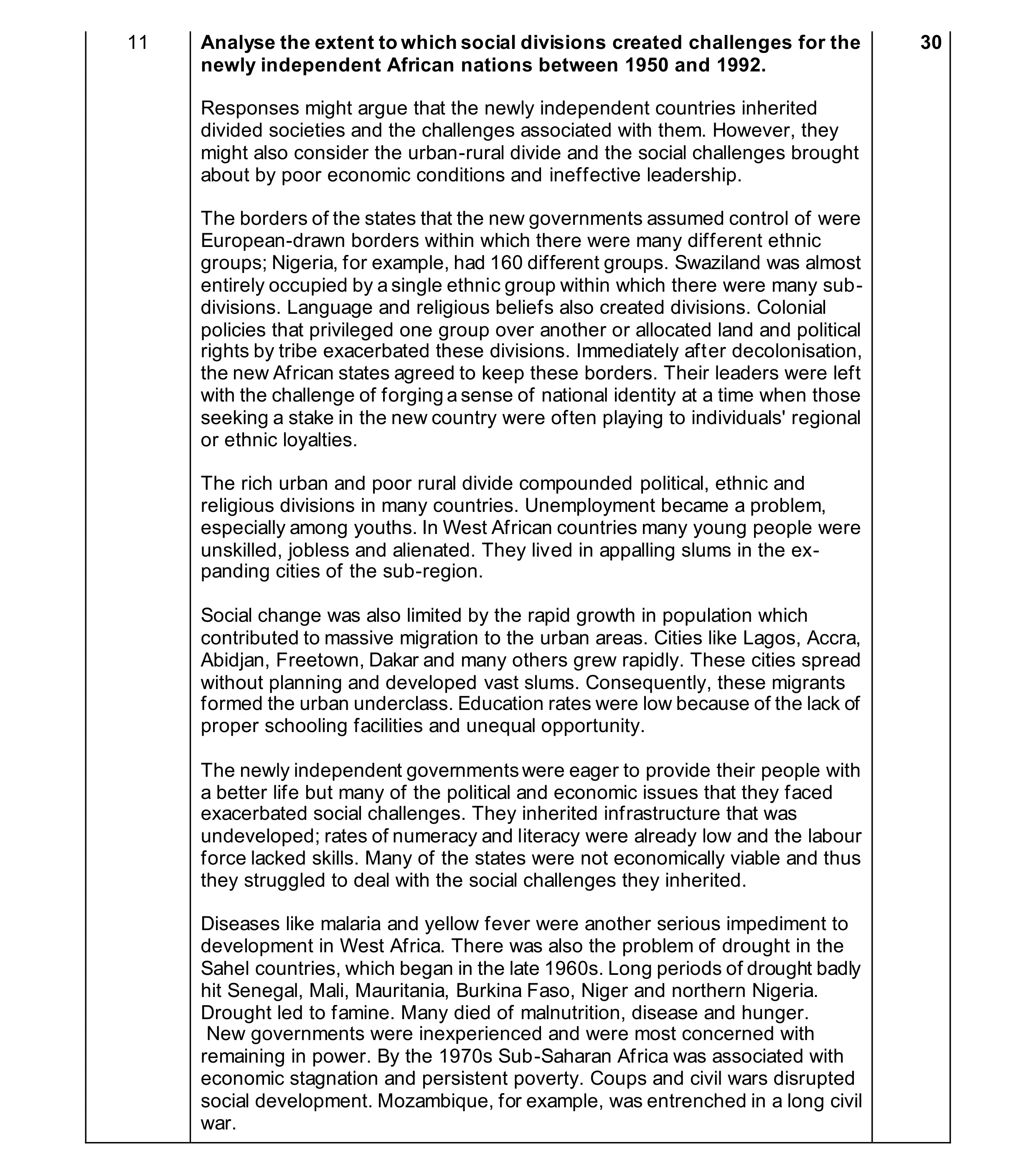 30
30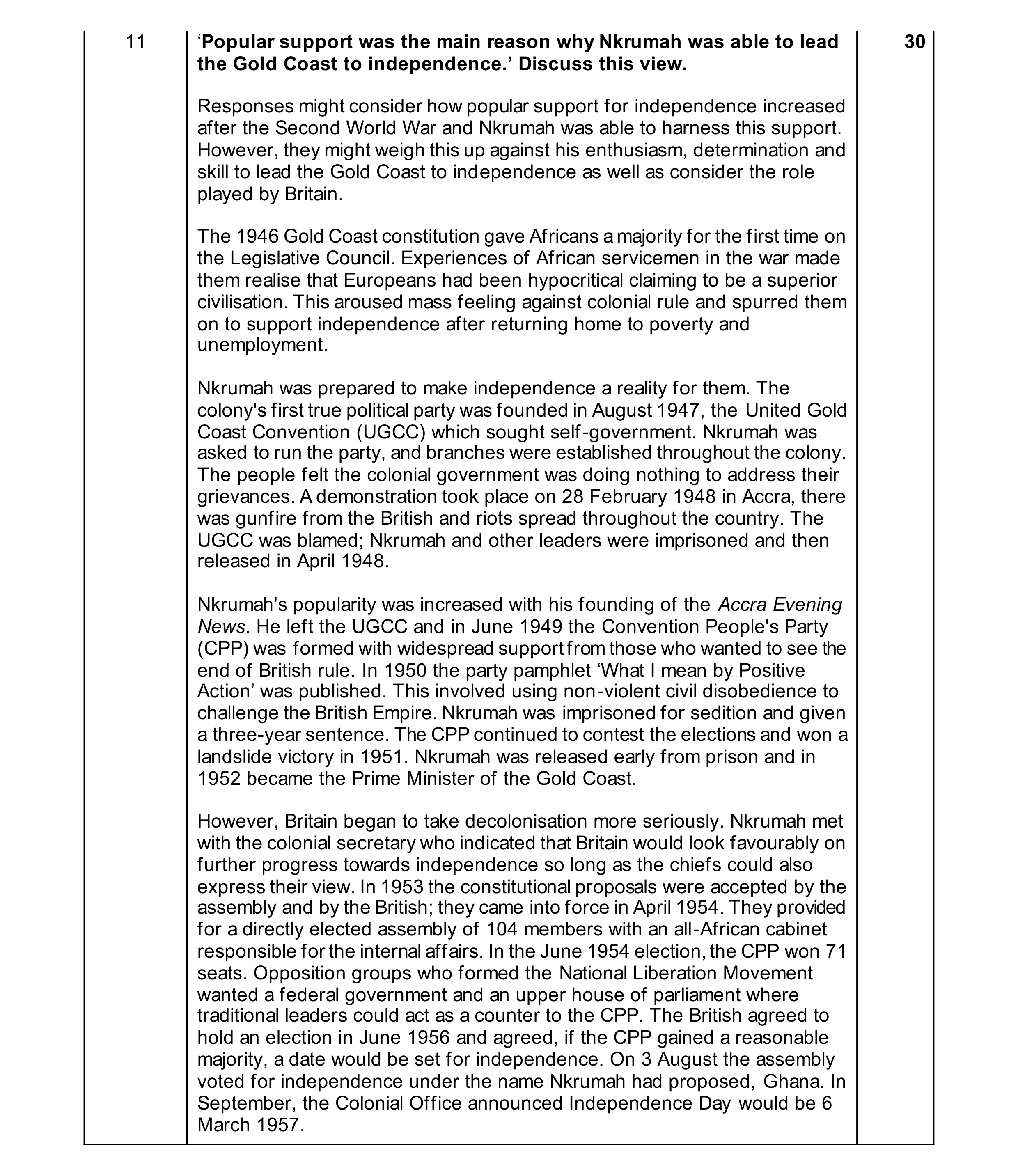 30
30