Questions as text
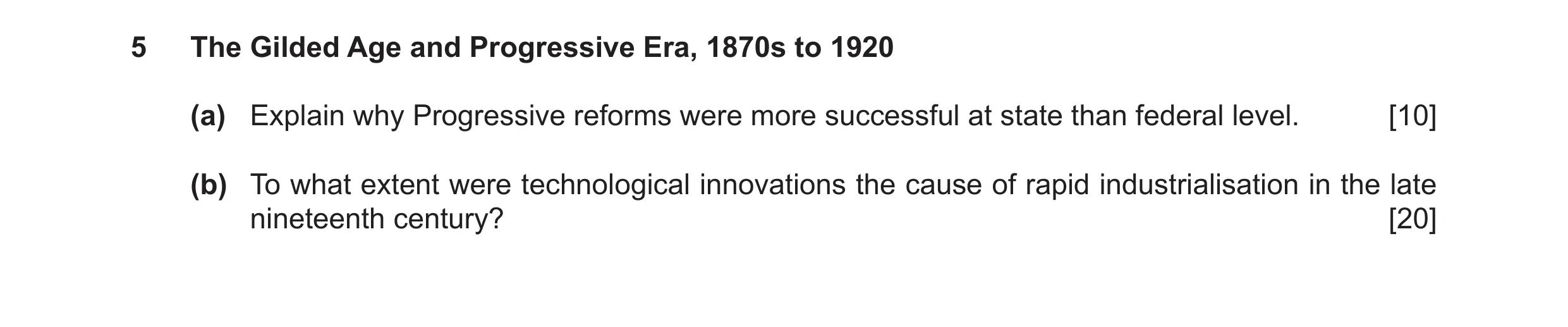
Q1 · The Gilded Age and Progressive Era, 1870s to 1920 (a) Explain why Progressive reforms… 9489/22 Feb/March 2021
5 The Gilded Age and Progressive Era, 1870s to 1920 (a) Explain why Progressive reforms were more successful at state than federal level. [10] (b) To what extent were technological innovations the cause of rapid industrialisation in the late nineteenth century? [20]
30 marks
Mark scheme: 5(a) Explain why Progressive reforms were more successful at state than 10 federal level. Although there were some federal successes of the Progressive era (i.e. the 16th, 17th, 18th and 19th amendments to the Constitution) it was often at state and local level where Progressive governors were able to use their power to introduce radical reforms which were often blocked by Congress. There are a number of examples which could be used to discuss why the success of Progressive ideas was greater at a state level: Wisconsin In his home state of Wisconsin Robert M La Follette developed the ideas of Progressivism. He believed that good government occurred when voters had control of institutions rather than special interest groups. This meant that he wanted ordinary people to have power rather than big businesses. He believed that specialists in fields such as law and economics should be involved in running the government. He also worked with the state university to establish a ‘laboratory of democracy’. In Wisconsin he supported direct primary elections which meant that voters had the right to choose their own candidates for office. After 1906 when La Follette became a Senator he tried to take these ideas with him to national politics, but he was not always successful. California Between 1910 and 1914, under Governor Hiram Johnson’s political leadership the California legislature expanded state government first by breaking the economic and political power of the Southern Pacific Railroad (SP). The reform legislature passed the Stetson-Eshelman Act, which increased the state Railroad Commission’s authority and power to fix passenger and freight rates; thus ending Southern Pacific Railroad’s (SP) crushing monopolistic practices. With the Public Utilities Act and the creation of the Public Utility Commission (PUC), the agency’s commissioners had the authority over the railroads as well as all public utilities. Johnson was also interested in education and called for teacher pensions, free textbooks for public school children, the creation of a comprehensive curriculum, and mandatory kindergartens Accept other valid responses. 5(b) To what extent were technological innovations the cause of rapid 20 industrialisation in the late nineteenth century? Candidates may discuss a number of technological inventions of the period e.g. electrical power, the internal combustion engine, the typewriter [1867], celluloid, an early form of plastic [1870] and the telephone [1876] – these ideas should be linked to how they encouraged industrialisation in a period which is often labelled as the ‘Second Industrial Revolution’. This may include discussion of new working practices, labour saving devices and increased consumer spending. However, other factors were also important. On the supply side, these included the availability of resources, especially financial. Capital came either from American banks or the City of London in sufficient quantities. Also relevant was the individualistic, entrepreneurial culture of the USA which ensured competition between the inventors of the new technologies, e.g. incandescent light bulbs and electricity supply. The US system of patents also encouraged innovation because, unusually, it granted patents to improvements to inventions as well as the initial invention. This encouraged many to adapt new products to gain patent rights. Finally, the high tariff walls of the era protected developing industries. On the demand side, the growing population of the USA provided a large mass market which was not available to America’s industrial competitors. from a series of factors, one of which was the new technologies of the time. Accept other valid responses.
This question in 9489/22 Feb/March 2021
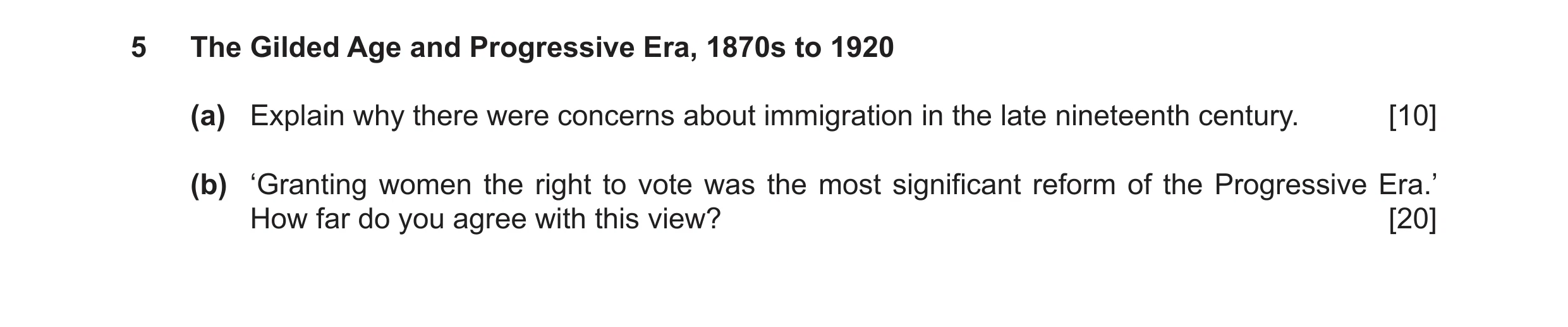
Q2 · The Gilded Age and Progressive Era, 1870s to 1920 (a) Explain why there were concerns… 9489/22 May/June 2021
5 The Gilded Age and Progressive Era, 1870s to 1920 (a) Explain why there were concerns about immigration in the late nineteenth century. [10] (b) ‘Granting women the right to vote was the most significant reform of the Progressive Era.’ How far do you agree with this view? [20]
30 marks
Mark scheme: 5(a) Explain why there were concerns about immigration in the late 10 nineteenth century. • Many of the new immigrants which arrived in the United States were not WASPs. Instead they came from Catholic countries in the South and East of Europe or were Jews from Russia. Nativist groups expressed concern about the impact of new religions and cultures as a result. • As a result of the new immigration, areas of large cities (such as New York) that were predominantly populated by one ethnic group, e.g., Little Italy in New York, grew. This often led to overcrowding and rapid changes in the appearance and feel of neighborhoods, both of which elicited negative reactions. • Drunkenness and alcoholism were another social problem that resulted from mass immigration. Thus, the Anti-Saloon League was formed. • Development of Boss system and growth of political corruption. Accept any other valid responses. 5(b) ‘Granting women the right to vote was the most significant reform of 20 the Progressive Era.’ How far do you agree with this view? Candidates should include some discussion of what they consider ‘significant’ to mean within the parameters of this question. While some saw female suffrage as radical at the time, and it was undoubtedly the result of a long campaign, it could be argued that the amendment itself brought relatively little change to the US. In fact, all of the Progressive Era amendments (16–19) could be argued in this way, with the exception of the 18th Amendment, which prohibited alcohol. In addition to the constitutional changes, candidates could consider the political and social changes made by Progressive thinkers and politicians in specific states. The work of Robert M. La Folette in Wisconsin and Hiram Johnson in California show what Progressive governors with local support can accomplish. Accept any other valid responses.
This question in 9489/22 May/June 2021
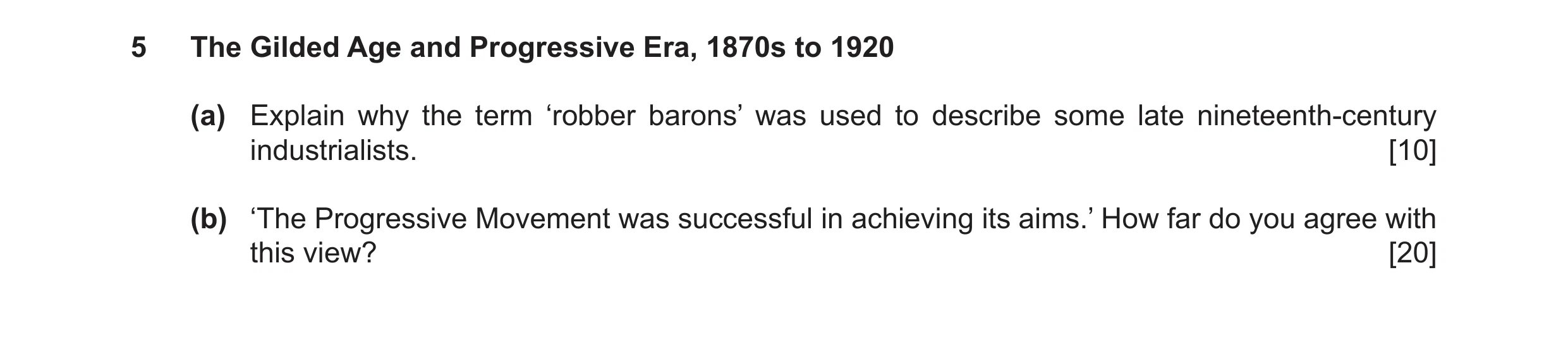
Q3 · The Gilded Age and Progressive Era, 1870s to 1920 (a) Explain why the term ‘robber… 9489/22 Oct/Nov 2021
5 The Gilded Age and Progressive Era, 1870s to 1920 (a) Explain why the term ‘robber barons’ was used to describe some late nineteenth-century industrialists. [10] (b) ‘The Progressive Movement was successful in achieving its aims.’ How far do you agree with this view? [20]
30 marks
Mark scheme: 5(a) Explain why the term ‘robber barons’ was used to describe some late 10 nineteenth-century industrialists. Well known industrialists of the era who were called robber barons included Andrew Carnegie (steel), Jay Gould (railroads), J P Morgan (finance), J D Rockefeller (oil) and Cornelius Vanderbilt (railroads), though there were others. Reasons why they were given this title included: • The belief that they had gained their great wealth and power by using methods which were illegal, immoral and unjust, for example, bribery, share dealings and manipulation. • The belief that these men and their methods were a major cause of the growing inequalities of the Gilded Age, as they exploited the efforts of the workers. • The power of the image of robber barons was used by those keen to criticise the very wealthy few, for example, by liberal journalists and historians. Accept any other valid responses. 5(b) ‘The Progressive Movement was successful in achieving its aims.’ How 20 far do you agree with this view? • The Progressive Movement was a broad-based series of groups and individuals who wanted to reform the worst aspects of modern life to uphold the best features of US life. The three Presidents of this era, two Republican, Theodore Roosevelt and Robert Taft, and one Democrat, Woodrow Wilson, can all be labelled as Progressives. Their reforms were political (to give the people more power), economic (to regulate and control the worst elements of US capitalism) and moral (Prohibition). • In arguing that the Progressive Movement was successful, they achieved the passage of political reforms such as direct elections for US Senators, party primaries, referenda and initiatives and votes for women. Also, they improved regulation of business, especially big business via trust-busting laws and policies, food and drugs laws and railroad fares; government financial policies through the Federal Reserve Board, federal income tax. There was increased investment in conservation with the growth of national parks, especially under Theodore Roosevelt. • In arguing that the Progressive Movement was less successful, many reforms, particularly political and regulatory, had a limited impact. Prohibition was passed in 1919, but its implementation caused more problems, such as crime. It has also been argued that there was neglect of the African American society, especially during the presidency of Woodrow Wilson, who was a Southern Democrat. Candidates may discuss the more pronounced successes of Progressive ideas in states which were led by Progressive governors, for example, Robert M La Folette in Wisconsin and Hiram Johnson in California. Accept any other valid responses.
This question in 9489/22 Oct/Nov 2021
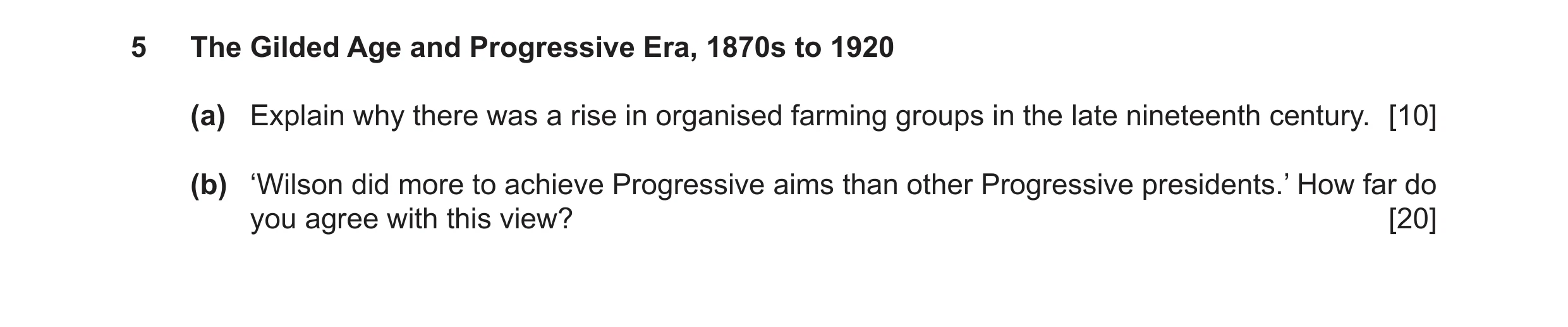
Q4 · The Gilded Age and Progressive Era, 1870s to 1920 (a) Explain why there was a rise in… 9489/23 Oct/Nov 2021
5 The Gilded Age and Progressive Era, 1870s to 1920 (a) Explain why there was a rise in organised farming groups in the late nineteenth century. [10] (b) ‘Wilson did more to achieve Progressive aims than other Progressive presidents.’ How far do you agree with this view? [20]
30 marks
Mark scheme: 5(a) Explain why there was a rise in organised farming groups in the late 10 nineteenth century. The main farming associations of the time were the Granger Movement in the early 1870s, the Greenback Movement a few years later and the Populist movement of the 1890s. The centre of these movements was the Mid-west. These associations were formed to represent farmers’ concerns over a range of issues. • Volatile prices were a serious problem: the prices of farm produce could vary greatly from year to year meaning that farmers had to borrow to buy materials and equipment before receiving income from sales. • Thus, they were opposed to the power of commercial banks and of railroad companies, which farmers believed overcharged. Therefore, they aimed to regulate the railroads – with some success. • The deflationary policy associated with the withdrawal of the US paper currency, the greenback dollar, and the refusal to expand silver-based money, i.e. bimetallism also caused problems. • There were also social reasons for the popularity of these groups as the meetings and organisations meant that the isolation which characterised the life of many farmers was ameliorated. Accept other valid responses. 5(b) ‘Wilson did more to achieve Progressive aims than other Progressive 20 presidents.’ How far do you agree with this view? Discussion of Wilson’s achievements in Progressive policies: • Wilson’s ‘New Freedom’ initiative of 1912 was directed against ‘the Triple Wall of Privilege’: tariffs, which protected big business; banks, which harmed small businesses; trusts, which were anti-competitive and anti- consumer. • Thus, in 1913, Wilson manipulated public opinion to make Congress pass the Underwood-Simmons bill, which cut tariffs to levels not seen since the 1850s, he introduced the Federal Reserve banking system and the Federal Trade Commission, and he supported the Clayton Anti-Trust Act of 1914. • Wilson even continued Teddy Roosevelt’s conservation policies, establishing more national parks. In his second term he also supported votes for women, another Progressive cause. • There may be some discussion over whether Wilson was actually a Progressive – Wilson’s progressive domestic policy of his first term is often overlooked in favour of the more dramatic foreign policy of his second term. The war caused some of his policies to become less progressive, for example the Espionage and Sedition Act of 1917. He did nothing for racial minorities and was actually a supporter of the KKK. Progressive policies of other Presidents: • Teddy Roosevelt: The Square Deal consisted of conservation, control of corporations and consumer protection. Among many other reforms, he established five national parks, set up the Department of Commerce and Labour, introduced ‘trust-busting’ policies and persuaded Congress to pass the Pure Food and Drugs Act. He aimed to reduce the power of sectional interests, whether business, labour or party political. • William Taft: Taft filed twice the number of antitrust suits as Roosevelt, and the Supreme Court upheld the breakup of Standard Oil under the Sherman Antitrust Act (1911) during his administration. Through the Mann‐Elkins Act (1910), the authority of the ICC was again expanded to cover regulation of telephone, telegraph, and cable companies. Taft actively supported both the Sixteenth and Seventeenth Amendments (which provided for the federal income tax and direct election of senators, respectively) and established new agencies, such as the Bureau of Mines, which set standards of mine safety, and the Federal Children's Bureau. Accept any other valid responses.
This question in 9489/23 Oct/Nov 2021
Q5 · The Gilded Age and Progressive Era, 1870s to 1920 (a) Explain why the railroad network… 9489/22 Feb/March 2022
5 The Gilded Age and Progressive Era, 1870s to 1920 (a) Explain why the railroad network grew quickly in the late nineteenth century. [10] (b) ‘Women’s suffrage was the most important achievement of the Progressive Movement.’ How far do you agree? [20]
30 marks
Mark scheme: 5(a) Explain why the railroad network grew quickly in the late nineteenth 10 century. Indicative content In 1865 there were 35 000 miles of track, by 1890 166 000 miles, nearly a fivefold increase. The reasons for this rapid growth include: • The growth of private investment, by investors rich and poor, especially via joint-stock companies. Business tycoons such as Cornelius Vanderbilt played a major role in the expansion – he laid out the entire network of railroads in New York after shifting his attention from his maritime business to railroads. • There were also public subsidies, mainly in terms of land grants: some 130m acres by 1870. Four out of five transcontinental railroads were built with the assistance of the federal government. • Expanding markets in a continental economy created a need to move goods, especially foodstuffs, as quickly as possible. In 1872 Aaron Montgomery Ward started the first mail order catalogue business which used railroads to transport goods all across the country. Most expansion was in the Midwest and the northeast. Accept any other valid responses. 5(b) ‘Women’s suffrage was the most important achievement of the 20 Progressive Movement.’ How far do you agree? Indicative content Possible discussion of female emancipation: The passing of the 19th amendment which gave women the right to vote was clearly a success for the suffrage campaign which had been active since 1848. The fact that women had the right to vote by 1920 was a major success and not necessarily one that could have been predicted even earlier in the decade when Wilson was reluctant to take on the cause nationally. Candidates might discuss how much of a success it really was in terms of changing the lives of women in a social and economic sense. Other areas of discussion for success/limitations of the Progressive movement: • During the Progressive Era there were three other amendments to the Constitution which arguably were significant achievements for the Progressive agenda. The 16th amendment authorised direct income tax and was the first amendment in more than forty years. It was a victory for those progressives who spent years trying to break up monopolies and corruption in business across the United States. The 17th amendment established direct elections to the Senate which underlined Progressive commitment to direct democracy. The 18th was arguably the most significant as it imposed prohibition on the country. This was the result of a long fight for temperance that many progressives had been involved in. • Candidates may also discuss the successes for Progressive ideas that were seen in states such as Wisconsin and California under Progressive governors. Accept any other valid responses.
This question in 9489/22 Feb/March 2022
Q6 · The Gilded Age and Progressive Era, 1870s to 1920 (a) Explain why new inventions were… 9489/22 May/June 2022
5 The Gilded Age and Progressive Era, 1870s to 1920 (a) Explain why new inventions were important to the rapid industrialisation of the late nineteenth century. [10] (b) ‘The impact of the Progressive Movement was significant.’ How far do you agree with this view? [20]
30 marks
Mark scheme: 5(a) Explain why new inventions were important to the rapid 10 industrialisation of the late nineteenth century. Indicative content Electrical power, the internal combustion engine, the typewriter [1867], celluloid, an early form of plastic [1870] and the telephone [1876] are all technological innovations relevant to this period. Collectively they give rise to the period being described by some as ‘the second industrial revolution’. While many inventions were labour-saving devices, causing unemployment, others resulted in new products and services which were bought by the ‘early adopters’ of the time, thus creating new employment opportunities. There were also developments such as the Bessemer process which transformed the steel industry and led to much more efficient production. Many new inventions in the period helped reduce the cost of production which enabled mass production methods that would supercharge the economy. The thirst to find new inventions and processes often required capital investment which encouraged the development of the banking system. Note: any mention of production line techniques are not valid as Ford only invented it in 1913. Accept any other valid responses. 5(b) ‘The impact of the Progressive Movement was significant.’ How far do 20 you agree with this view? Indicative content Possible discussion of achievements of Progressivism: Progressive politicians achieved the passage of political reforms, e.g. the amendments which allowed for the direct elections of US Senators; party primaries; referenda and initiatives; votes for women. They improved regulation of business, especially big business via trust- busting laws and policies, food and drugs laws, railroad fares. Government financial policies via the Federal Reserve Board, federal income tax. Increased investment in conservation with the growth of national parks, especially under Theodore Roosevelt. 5(b) Possible discussion of limits of Progressivism: In arguing that the Progressive Movement was less successful, there was limited impact of many reforms, especially political and regulatory. While Prohibition was passed in 1919, its implementation caused more problems such as crime. It has also been argued that there was neglect of the African American society, especially during the presidency of Woodrow Wilson, who was a Southern Democrat. Candidates might also point to the limited impact on workers’ rights and organised labour before 1920 as well unsuccessful attempts to improve living conditions in cities. Accept any other valid responses.
This question in 9489/22 May/June 2022
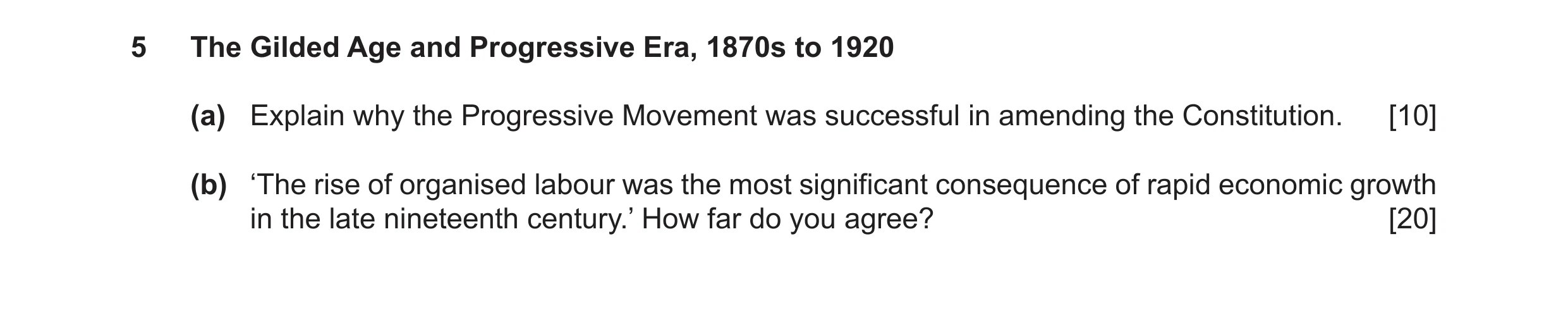
Q7 · The Gilded Age and Progressive Era, 1870s to 1920 (a) Explain why the Progressive… 9489/23 May/June 2022
5 The Gilded Age and Progressive Era, 1870s to 1920 (a) Explain why the Progressive Movement was successful in amending the Constitution. [10] (b) ‘The rise of organised labour was the most significant consequence of rapid economic growth in the late nineteenth century.’ How far do you agree? [20]
30 marks
Mark scheme: 5(a) Explain why the Progressive Movement was successful in amending 10 the Constitution. Indicative content The four amendments were: a federal income tax; direct election of US Senators; prohibition; votes for women. These amendments implemented reforms long proposed by Progressives – even prohibition, it can be argued. The number of amendments achieved in such a short time was unusual, and a sign of the movement’s strength. The complex process of amending the US constitution required a broad base of support, led by Progressives, and Progressive movement was at its peak of influence in the 1910s, whether under the Republicans, i.e. Taft, or Democrats, i.e. Wilson. Two amendments occurred only because of the wartime context: the eighteenth, prohibition and nineteenth, votes for women. Accept any other valid responses. 5(b) ‘The rise of organised labour was the most significant consequence of 20 rapid economic growth in the late nineteenth century.’ How far do you agree? Indicative content Possible discussions around organised labour: Urban Unions – With the rapid expansion of cities and industrialisation in Northern cities many workers found themselves working in very poor conditions. Unions such as the Knights of Labor formed to help workers have a collective voice; they also allowed black and female workers to join. They argued for an eight-hour working day rather than the long shifts which some workers were being forced into. They also ran campaigns to end child labour as this led to many injuries and deaths amongst children working in factories. Other unions such as The American Federation of Labor founded in 1886 mainly supported skilled people in craft unions. Farming associations - The main farming associations of the time were the Granger Movement in the early 1870s, the Greenback Movement a few years later and the Populist movement of the 1890s. The centre of these movements was the Mid-west. These associations were formed to represent farmers’ concerns over a range of issues: Volatile prices were a serious problem: the prices of farm produce could vary greatly from year to year meaning that farmers had to borrow to buy materials and equipment before receiving income from sales. Thus, they were opposed to the power of commercial banks and of railroad companies, which farmers believed overcharged. Therefore, they aimed to regulate the railroads – with some success. The deflationary policy associated with the withdrawal of the US paper currency, the greenback dollar, and the refusal to expand silver-based money, i.e. bimetallism also caused problems. Possible discussions of other impacts of rapid industrialisation: Immigration – Between 1865 and 1900, some 13 million people emigrated to America, mostly from Europe. By 1900, one third of Americans were immigrants or children of immigrants. In some major cities the figures reached 70%. The peak was reached in the 1880s, a decade when the economy boomed. Candidates might discuss the impact of this immigration on cultural and economic conditions within cities and link it to the idea of economic prosperity waiting for immigrants arriving in the United States. Living conditions – Candidates may discuss the impact of rapid industrialisation on living conditions in major cities such as New York, Chicago or Pittsburgh. The impact of growing cities saw problems involving housing supply, sanitation and ill health. This was a major impact of rapid industrialisation and can of course be linked to other factors. 5(b) Development of Trusts and associated unfair practices – links to corruption in government Rise of Robber Barons domination of production and use of extreme measures to control labour and frustrate rise of organised labour Accept any other valid responses.
This question in 9489/23 May/June 2022
Q8 · The Industrial Revolution in Britain, 1750–1850 (a) Explain why developments in textile… 9489/21 Oct/Nov 2022
2 The Industrial Revolution in Britain, 1750–1850 (a) Explain why developments in textile machinery increased industrialisation after 1780. [10] (b) How far was Chartism’s failure caused by opposition from government? [20]
30 marks
Mark scheme: 2(a) Explain why developments in textile machinery increased 10 industrialisation after 1780. Indicative content • By the mid-1780s steam engines began to be applied to the spinning factories in Lancashire. By the early nineteenth century a Crompton’s ‘Mule’ had been developed made of metal and by 1825 Richard Roberts’ ‘self-acting mule’ (automatic) was operating. The de- centralised cottage industries were replaced by centralised factory jobs, driving production and urbanisation. • There was a growing demand for coal, leading to increased coal production. • The need to receive raw materials in bulk (18m lbs of cotton in 1786) in order to produce manufactured goods in bulk led to changes in transportation – canals/railways. • In 1784-86, 43% of all textiles manufactured were exported, rising in 1844-46 to 66%. This stimulated the growth of ports and international trade. • Profits produced in the industry were not just re-invested, stimulating continued development, but invested in other industrial areas (iron/steel) further encouraging industrialisation. Accept any other valid responses. 2(b) How far was Chartism’s failure caused by opposition from 20 government? Indicative content Both main political parties were opposed to further political reform. In 1839, the House of Commons rejected a National Petition, 235 votes to 46, a second petition, in 1842, 287 votes 40 and in 1848, refused the presentation of a third petition. The government had powerful weapons at its disposal which thwarted Chartism’s aims. The railways were used to transport troops speedily to anywhere there were disturbances (e.g. Newport). Almost all local magistrates supported the government’s opposition, and in 1839 534 Chartists were sent to prison. After 1839 the newly emerging urban police forces were a further weapon to be used against the Chartists. The government employed less confrontational tactics, nonetheless still effective, to deprive Chartism of mass support. New factory reforms were enacted, trade revived and a factor behind the repeal of the Corn Laws was Peel’s belief it would give working people cheaper bread, removing a major source of resentment informing Chartism. The view can be challenged. The Chartists made significant mistakes. For example, a petition with six points did not leave much room for compromise if it was rejected. There was division, also, amongst the leadership over how best to proceed to achieve political change to better the living and working conditions of working people. Some favoured ‘moral force’ – the power of argument and persuasion – others believed in ‘physical force’ – reason had failed, so violence was needed to bring about change. The 1832 Reform Act had reduced the likelihood of an alliance between the middle and lower classes. In 1848 when a Chartist convention was held in London the middle- classes rallied in great numbers to the call to defend the capital. Accept any other valid responses.
This question in 9489/21 Oct/Nov 2022
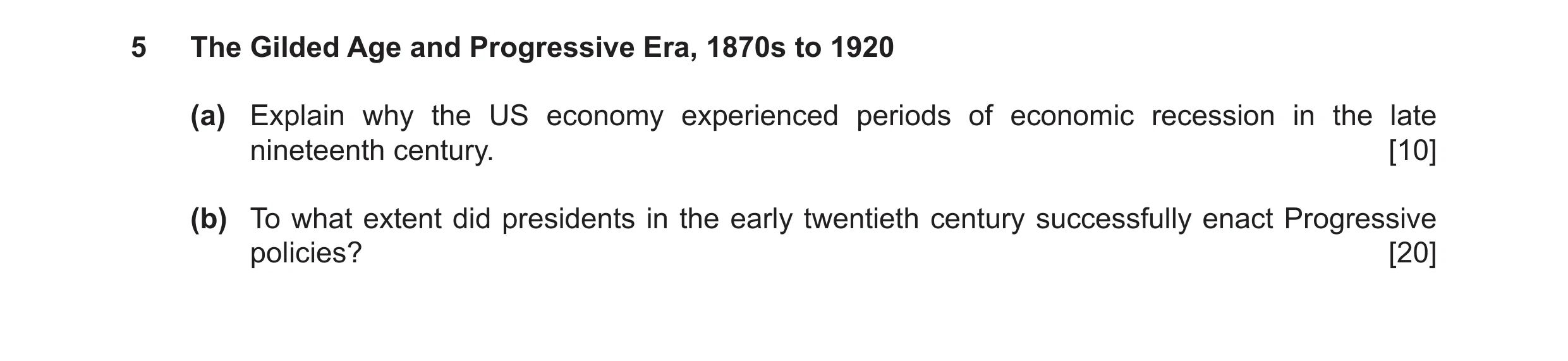
Q9 · The Gilded Age and Progressive Era, 1870s to 1920 (a) Explain why the US economy… 9489/21 Oct/Nov 2022
5 The Gilded Age and Progressive Era, 1870s to 1920 (a) Explain why the US economy experienced periods of economic recession in the late nineteenth century. [10] (b) To what extent did presidents in the early twentieth century successfully enact Progressive policies? [20]
30 marks
Mark scheme: 5(a) Explain why the US economy experienced periods of economic 10 recession in the late nineteenth century. Indicative content • Cyclical financial panics occurred in the last third of the nineteenth century as a result of railroad speculation, fluctuating food prices and an unbalanced credit heavy economy. There are two main examples in this period which candidates may discuss the causes of: • The Panic of 1873. The investment firm of Jay Cooke and Company went bankrupt in September 1873 as a result of rampant speculation in railroads. The stock market dropped sharply and caused numerous businesses to fail. The depression that followed caused approximately 3 million Americans to lose their jobs. The collapse in food prices impacted America's farm economy, causing great poverty in rural America. The depression lasted for five years, until 1878. • The Panic of 1893. The depression set off by the Panic of 1893 was the greatest depression America had known and was only surpassed by the Great Depression of the 1930s. In early May 1893, the New York stock market dropped sharply, and in late June panic selling caused the stock market to crash. A severe credit crisis resulted, and more than 16 000 businesses had failed by the end of 1893. Included in the failed businesses were 156 railroads and nearly 500 banks. Unemployment spread until one in six American men lost their jobs. The depression inspired ‘Coxey's Army’, a march on Washington of unemployed men. The protesters demanded that the government provide public works jobs. Their leader, Jacob Coxey, was imprisoned for 20 days. Accept any other valid responses. 5(b) To what extent did presidents in the early twentieth century 20 successfully enact Progressive policies? Indicative content Candidates will discuss the ideas and actions of Theodore Roosevelt, Taft and Wilson. The discussion can take place in relation to ideas of Progressivism as set up by the candidate and also in comparison to each other. Discussion of Theodore Roosevelt as a Progressive President: Presidency, from 1901 to 1909. His legislative achievements have been described as ‘modest but historic’. They include railroad regulation, meat inspections and the Pure Food and Drug Act although an uncooperative Congress meant little radical legislation could be passed. More significant was TR’s use of the Presidency to act progressively. He ordered the prosecution of the Northern Securities Company, a railroad trust. The Supreme Court ordered the trust to be dissolved. TR became known as the ‘trust buster’. He intervened in the anthracite coal miners’ strike of 1902 not by sending in troops to break the strike, as had been the norm before, but to urge the two sides to talk to each other. Theodore Roosevelt certainly called himself a Progressive, especially in the 1912 presidential election. His conservation initiatives, setting up national parks for the benefit of all, can also be seen as Progressive. The main limitation of TR’s Progressivism concerns civil rights, especially of Blacks facing Jim Crow laws in the South, but there the Democratic Party was too strong. Discussion of Taft as a Progressive President: Taft filed twice the number of antitrust suits as Roosevelt, and the Supreme Court upheld the breakup of Standard Oil under the Sherman Antitrust Act (1911) during his administration. Through the Mann‐Elkins Act (1910), the authority of the ICC was again expanded to cover regulation of telephone, telegraph, and cable companies. Taft actively supported both the Sixteenth and Seventeenth Amendments (which provided for the federal income tax and direct election of senators, respectively) and established new agencies, such as the Bureau of Mines, which set standards of mine safety, and the Federal Children's Bureau. Discussion of Wilson as a Progressive President: Woodrow Wilson’s ‘New Freedom’ initiative of 1912 was directed against ‘the Triple Wall of Privilege’: tariffs, which protected big business; banks, which harmed small businesses; trusts, which were anti-competitive and anti-consumer. Thus, in 1913, Wilson manipulated public opinion to make Congress pass the Underwood-Simmons bill, which cut tariffs to levels not seen since the 1850s, he introduced the Federal Reserve banking system and the Federal Trade Commission and he supported the Clayton Anti-Trust Act of 1914. Wilson even continued Teddy Roosevelt’s conservation policies, establishing more national parks. In his second term he also supported votes for women, another Progressive cause. Accept any other valid responses.
This question in 9489/21 Oct/Nov 2022
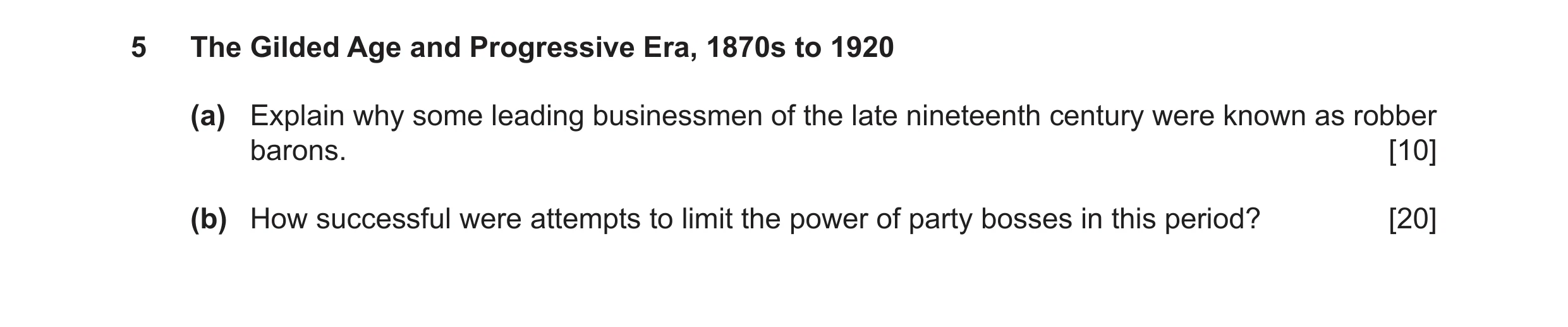
Q10 · The Gilded Age and Progressive Era, 1870s to 1920 (a) Explain why some leading… 9489/23 Oct/Nov 2022
5 The Gilded Age and Progressive Era, 1870s to 1920 (a) Explain why some leading businessmen of the late nineteenth century were known as robber barons. [10] (b) How successful were attempts to limit the power of party bosses in this period? [20]
30 marks
Mark scheme: 5(a) Explain why some leading businessmen of the late nineteenth century 10 were known as robber barons. Indicative content Well known industrialists of the era who were called robber barons included Andrew Carnegie [steel], Jay Gould [railroads], J P Morgan [finance], J D Rockefeller [oil] and Cornelius Vanderbilt [railroads], though there were others. They were commonly known as robber barons because: • There was a belief that they had gained their great wealth and power by using methods which were illegal or immoral, e.g. bribery, share dealings and manipulation, and were unjust • The belief that these men and their methods were a major cause of the growing inequalities of the Gilded Age, as they exploited the efforts of the workers i.e. they were akin to the feudal overlords of the past in the way that they treated and controlled ordinary workers • The power of the image of robber barons was used by those keen to criticise the very wealthy few, e.g. by liberal journalists and progressive reformers Accept any other valid responses. 5(b) How successful were attempts to limit the power of party bosses in 20 this period? Indicative content By 1890 virtually every sizable city had a political boss or was in the process of developing one. The most notorious political boss of the age was Boss Tweed of New York's Tammany Hall. For twelve years, Tweed ruled New York. He gave generously to the poor and authorised the handouts of Christmas turkeys and winter coal to prospective supporters. In the process he fleeced the public out of millions of taxpayers’ money, which went into the coffers of Tweed and his associates. They were difficult to deal with as they retained the support of the poor people who vastly outnumbered the rest. Possible discussion around limiting the power of Party Bosses: • Party bosses were not completely unaccountable as was seen with Tweed above who went to jail for his actions and the foundation of a professional civil service in the late 19th century went some way to improving corruption in some cities. One example of progressive reform was the rise of the city manager system, in which paid, professional engineers ran the day-to-day affairs of city governments under guidelines established by elected city councils • Progressives repeatedly warned that illegal voting was corrupting the political system. It especially identified big-city bosses, working with saloon keepers and precinct workers, as the culprits in stuffing the ballot box. The solution to purifying the vote included prohibition, voter registration requirements and literacy tests • Progressive journalists and politicians often started their careers by campaigning against party bosses and this did go some way to limiting their power. In the North, Progressives argued that the average citizen should have more control over his government. The Oregon System of ‘Initiative, Referendum, and Recall’ was exported to many states Possible discussion around lack of success: • It was difficult to unpick the system – To the urban poor the boss ran a kind of welfare state. For example, he helped the unemployed find jobs and he provided free coal and baskets of food to tide a widow over an emergency. Bosses often began as saloonkeepers, because the saloon was a natural meeting place in poorer neighbourhoods in the days before Prohibition. To maintain power, a boss had to keep his constituents happy. Most political bosses appealed to the newest, most desperate part of the growing population, the immigrants. Individuals who were leaders in local neighbourhoods were sometimes rewarded city jobs in return for the loyalty of their constituents 5(b) • It is clear that the model of machine politics survived in many cities into the twentieth century, despite efforts, local and national, to limit the negative aspects of the spoils system, i.e. ‘jobs – and contracts – for the boys’. Specifically, Tammany Hall remained a power in the life of New York City way beyond the years of Boss tweed’s dominance. This shows that it was difficult for reformers to make any real change Accept any other valid responses.
This question in 9489/23 Oct/Nov 2022
Q11 · The Gilded Age and Progressive Era, 1870s to 1920 (a) Explain why there was concern about… 9489/22 Feb/March 2024
6 The Gilded Age and Progressive Era, 1870s to 1920 (a) Explain why there was concern about the growth of trusts in the late nineteenth century. [10] (b) ‘The Progressive Movement failed to improve the lives of ordinary Americans.’ How far do you agree? [20] Section C: International option International history, 1870–1945
30 marks
Mark scheme: 6(a) Explain why there was concern about the growth of trusts in the late 10 nineteenth century. Indicative content Trusts became the focus of concern for various groups which argued that: • Private greed came before public good. • The ‘small man’ suffered from higher prices and/or restricted supply. • This applied to farmers, in particular, as they paid higher railroad prices when oil companies were given reduced rates. • Their practices ran counter to American values of individualism and the free market economy. • Their practices were well publicised by several ‘muckraking’ journalists, especially Henry Demarest Lloyd in the 1880s and Ida Tarbell. Accept any other valid responses. 6(b) ‘The Progressive movement failed to improve the lives of ordinary 20 Americans.’ How far do you agree? Indicative content Possible discussion of limits of Progressivism might include the idea that in arguing that the Progressive Movement was less successful, there was limited impact of many reforms, especially political and regulatory. While Prohibition was passed in 1919, its implementation caused more problems such as crime. It has also been argued that there was neglect of the African American society, especially during the presidency of Woodrow Wilson, who was a Southern Democrat. Candidates might also point to the limited impact on workers’ rights and organised labour before 1920 as well unsuccessful attempts to improve living conditions in cities. Possible discussion of achievements of Progressivism might include the idea that Progressive politicians achieved the passage of political reforms, e.g. the amendments which allowed for the direct elections of US Senators; party primaries; referenda and initiatives; votes for women. They also improved regulation of business, especially big business via trust-busting laws and policies, food and drugs laws, railroad fares. Progressives also improved Government financial policies via the Federal Reserve Board, federal income tax. They also increased investment in conservation with the growth of national parks, especially under Theodore Roosevelt. Accept any other valid responses.
This question in 9489/22 Feb/March 2024
Q12 · The Gilded Age and Progressive Era, 1870s to 1920 (a) Explain why there was an economic… 9489/21 Oct/Nov 2024
6 The Gilded Age and Progressive Era, 1870s to 1920 (a) Explain why there was an economic panic in 1873. [10] (b) ‘The 19th Amendment was the most significant reform of the Progressive era.’ How far do you agree? [20] Section C: International option International history, 1870–1945
30 marks
Mark scheme: 6(a) Explain why there was an economic panic in 1873. 10 Indicative content • The newly unified country of Germany changed the way it used gold and silver in its banking system which caused a financial crisis in Europe. This resulted in a drop in demand for American farm products. • Financial problems in Europe meant that many investors began to sell off the railroad bonds they had bought. These bonds had helped to build railroads across the United States and as they flooded the market railroad companies went bankrupt (89 out of 364). • One of the biggest banks in New York, Jay Cooke and company, went bankrupt as a result of their heavy reliance on railroad bonds. • Jay Cooke and co. falling began a run on the bank as people panicked about the safety of their money. This panic soon spread across the country with at least 100 banks failing. Accept any other valid responses. 6(b) ‘The 19th Amendment was the most significant reform of the 20 Progressive era.’ How far do you agree? Indicative content Possible discussion of the 19th amendment might include the passing of the 19th amendment which gave women the right to vote was clearly a success for the suffrage campaign which had been active since 1848. That women had the right to vote by 1920 was a major success and not necessarily one that could have been predicted even earlier in the decade when Wilson was reluctant to take on the cause nationally. Candidates might discuss how much of a success it really was in terms of changing the lives of women in a social and economic sense. Other areas of discussion for reforms of the Progressive movement might include the Progressive Era when there were three other amendments to the Constitution which arguably were significant achievements for the Progressive agenda. The 16th amendment authorised direct income tax and was the first amendment in more than forty years. It was a victory for those progressives who spent years trying to break up monopolies and corruption in business across the United States. The 17th amendment established direct elections to the Senate which underlined Progressive commitment to direct democracy. The 18th was arguably the most significant as it imposed prohibition on the country. This was the result of a long fight for temperance that many Progressives had been involved in. Accept any other valid responses.
This question in 9489/21 Oct/Nov 2024
Q13 · The Gilded Age and Progressive Era, 1870s to 1920 (a) Explain why Progressive presidents… 9489/22 Oct/Nov 2024
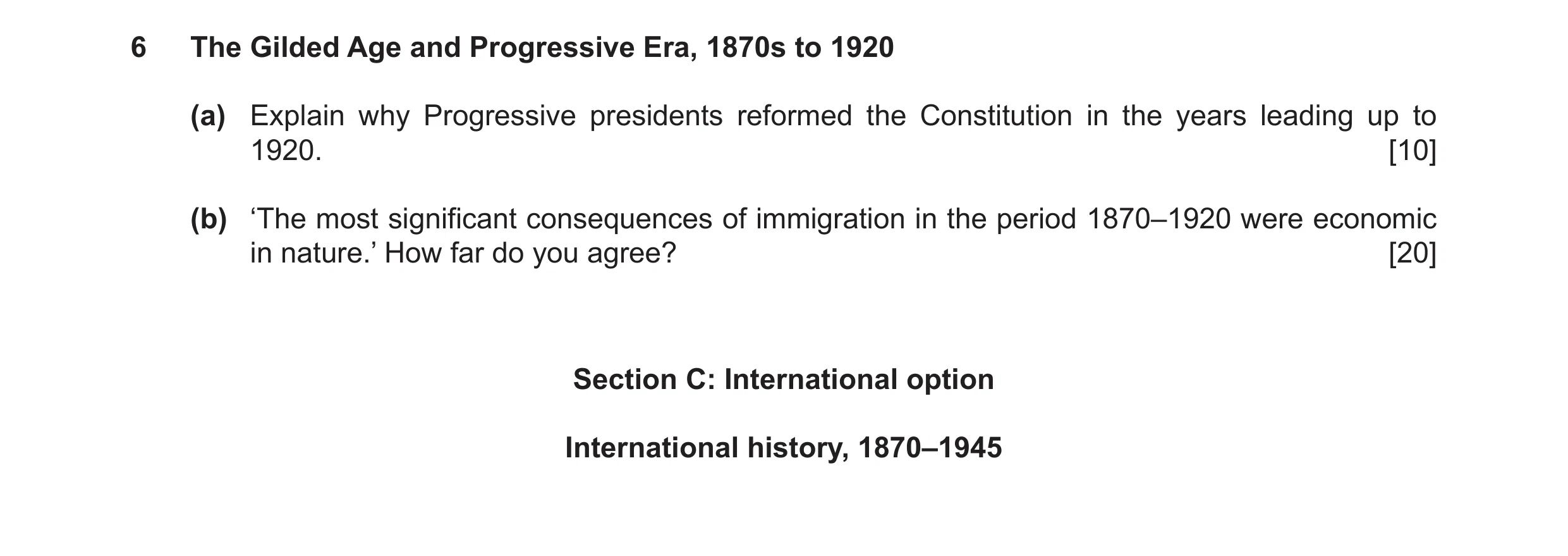
6 The Gilded Age and Progressive Era, 1870s to 1920 (a) Explain why Progressive presidents reformed the Constitution in the years leading up to 1920. [10] (b) ‘The most significant consequences of immigration in the period 1870–1920 were economic in nature.’ How far do you agree? [20] Section C: International option International history, 1870–1945
30 marks
Mark scheme: 6(a) Explain why Progressive presidents reformed the constitution in the 10 years leading up to 1920. Indicative content There were 4 amendments to the Constitution which took place during the Progressive Era: • The 16th Amendment introduced a system of income tax based on what individuals earned and replaced the system of apportionment which calculated tax based on state populations. • The 17th Amendment allowed for direct elections of US senators this allowed people to have a more immediate say on who their representatives were. • The 18th Amendment prohibited the sale of intoxicating liquors. • The 19th Amendment allowed for women’s suffrage. These four amendments give candidates chance to discuss the various policy positions of the Progressive movement in the early 20th century: • The 16th amendment was aimed at equalising the tax system as farmers in rural states often struggled to pay their share of tax when it was calculated by apportionment. • The 17th amendment offers the chance to discuss the commitment by many Progressives both at state and federal level to making democratic decisions more accessible to the ‘common man’. • The 18th amendment highlights the close relationship which had existed between Progressives and the temperance movement; whilst women’s suffrage could be used to discuss both the social and political aims of Progressive thinkers. Accept any other valid responses. 6(b) ‘The most significant consequences of immigration in the period 1870– 20 1920 were economic in nature.’ How far do you agree? Indicative content Possible areas for discussion about economic consequences might include how there were economic benefits including both a plentiful supply of labour and growing markets for many goods and services. The influx of migrants brought new skills and new ideas which led to some of the new inventions which encouraged industrial growth. However, there was also a downward pressure on wages and thus living standards of the urban working class. These pressures also weakened the position of labour unions and were used by business leaders and party bosses to manipulate labour markets. Possible areas for discussion about other consequences might include social problems such as overcrowded slum areas of many cities, especially in the industrial northeast. This led to high mortality rates. The overcrowded slums inhabited by immigrants of different religions and different nationalities led to racial tensions and conflicts, e.g., the gangs of New York. Another social problem resulting from mass immigration was that of drunkenness and alcoholism. Thus, the Anti-Saloon League was formed. There were more opportunities for second and third generations of immigrant families to gain more skilled employment and social status or to move to other regions of the USA. Accept any other valid responses.
This question in 9489/22 Oct/Nov 2024
Q14 · The Gilded Age and Progressive Era, 1870s to 1920 (a) Explain why the Granger Movement… 9489/23 Oct/Nov 2024
6 The Gilded Age and Progressive Era, 1870s to 1920 (a) Explain why the Granger Movement was formed. [10] (b) ‘Constitutional change was the most significant achievement of the Progressive Movement.’ How far do you agree? [20] Section C: International option International history, 1870–1945
30 marks
Mark scheme: 6(a) Explain why the Granger Movement was formed. 10 Indicative content The Granger movement was formed to represent farmers’ concerns over a range of issues: • Granger movements sought to remind American society of how important farmers still were even in an age of industrialisation. • Volatile prices were a serious problem: the prices of farm produce could vary greatly from year to year, meaning that farmers had to borrow to buy materials and equipment before receiving income from sales. • Thus, they were opposed to the power of commercial banks and of railroad companies, which farmers believed overcharged. Therefore, they aimed to regulate the railroads – with some success. • The deflationary policy associated with the withdrawal of the US paper currency, the greenback dollar, and the refusal to expand silver-based money, i.e., bimetallism also caused problems. • The non-political reason for forming farming associations was social, as they offset the isolationism of family-run farms. Accept any other valid responses. 6(b) ‘Constitutional change was the most significant achievement of the 20 Progressive Movement.’ How far do you agree? Indicative content Possible discussion of the way the Progressive amendments changed people’s lives: There were four amendments to the Constitution passed during the Progressive Era: • The Sixteenth Amendment introduced a system of income tax based on what individuals earned and replaced the system of apportionment which calculated tax based on state populations. • The Seventeenth Amendment allowed for direct elections of US senators this allowed people to have a more immediate say on who their representatives were. • The Eighteenth Amendment prohibited the sale of intoxicating liquors. • The Nineteenth Amendment allowed for women’s suffrage. Arguably these amendments had a significant impact on the lives of Americans because they changed the constitution and had a direct effect on voting, people’s financial position and the ongoing issues of temperance. Possible discussion of the limits of Progressive amendments that might be considered are that they had a relatively slow impact – the sixteenth and seventeenth Amendments may not have affected most people in their everyday lives especially the poorly paid. The Eighteenth Amendment clearly met with opposition throughout the time it was enacted and in the long term was repealed. Candidates may also discuss other Progressive laws which although not constitutional had an impact on American lives. For example, the improved regulation of business, especially big business via trust-busting laws and policies, food and drugs laws, railroad fares. Government financial policies via the Federal Reserve Board, federal income tax. Also, increased investment in conservation with the growth of national parks, especially under Theodore Roosevelt. Accept any other valid responses.
This question in 9489/23 Oct/Nov 2024
Q15 · The Gilded Age and Progressive Era, 1870s to 1920 (a) Explain why living conditions in… 9489/22 Feb/March 2025
5 The Gilded Age and Progressive Era, 1870s to 1920 (a) Explain why living conditions in cities were poor. [10] (b) How far do you agree that attempts to regulate private corporations and trusts were ineffective? [20]
30 marks
Mark scheme: 5(a) Explain why living conditions in cities were poor. 10 Indicative content: • The rapid speed of growth of cities led to poor housing with inadequate facilities. Demand for housing outstripped supply so there was overcrowding and all the associated problems of inadequate water supplies, sewage disposal, ventilation. • Local government was inadequate. It was unable to cope with the demands of urban growth on the scale it occurred. • The ‘boss system’ which developed as a result of rapid growth with a large volume of immigrants (from other parts of US and from abroad) added to the problem. Bosses controlled the political system and worked with industrial leaders and landlords to control every aspect of the city. Corruption was rife as the bosses acted in the interests of themselves and others with political and economic power. • New immigrants were especially vulnerable as often their English was poor and they had to rely on the bosses for employment and accommodation. The accommodation was unhealthy and their low pay meant they had no choice but to accept it. Accept any other valid responses. 5(b) How far do you agree that attempts to regulate private corporations and 20 trusts were ineffective? Indicative content The Federal government had limited constitutional powers to control business as this was a state matter. The Sherman Anti-Trust Act was largely unenforced because state governments were dominated by business interests. There was a lack of controls over those businesses which ran across several states as no individual state was responsible, but the federal government did not have the means to regulate them. Trusts were set up to circumvent state legislation which attempted to limit the scope of businesses. When laws were passed against trusts, holding companies were formed to circumvent regulations e.g. Rockefeller/oil. On the other hand, there were successes. Big business had to invent new ways of controlling/maintaining its assets to avoid regulations. Theodore Roosevelt introduced legislation in his Square Deal: state and federal governments took on new regulatory powers, for example, the Expediting Act of 1903, and the Elkins Act 1903. A Department of Commerce and Labor was also set up in 1903 to regulate business and enforce economic regulations. The Hepburn Act of 1906 strengthened the Interstate Commerce Commission; prior to that, the commission had minimal resources to carry out its duties. Under the Immunity of Witnesses Act (1906) corporate officials could no longer make a plea of immunity to avoid testifying in cases which dealt with the illegal activities of their corporations. Laws were passed to protect workers – working hours and child labour. There was opposition in Congress to some of Roosevelt’s more far-reaching ideas, but he did make some progress with his Square Deal. Accept any other valid responses.
This question in 9489/22 Feb/March 2025
Q16 · The Gilded Age and Progressive Era, 1870s–1920 (a) Explain why many Progressive laws were… 9489/22 May/June 2025
5 The Gilded Age and Progressive Era, 1870s–1920 (a) Explain why many Progressive laws were passed during Woodrow Wilson’s presidency. [10] (b) To what extent were trade policies the cause of rapid industrial growth in the late nineteenth century? [20]
30 marks
Mark scheme: 5(a) Explain why many Progressive laws were passed during Woodrow 10 Wilson’s presidency. Indicative content • Woodrow Wilson had the backing of a useful range of politicians because he spoke effectively in Congress and made a point of supporting states’ rights. His appointments had widespread appeal (labour leaders, first Jewish member of Supreme Court) and this made it more possible for him to gain support for the laws he introduced. • Many of his Progressive reforms had the backing of the general public. For example, they supported laws granting more workers’ rights, support for labour unions, and an end to child labour as well as anti-trust reforms. • Woodrow Wilson explained why these laws were needed in a way that showed he was not attacking individuals’ or states’ rights but realigning the laws to reflect the changing nature and features of the American economy. He explained that US laws were out of date because they were designed to regulate small businesses. He gained more support for his Progressive laws because he explained why laws needed to be changed. Accept any other valid responses. 5(b) To what extent were trade policies the cause of rapid industrial growth 20 in the late nineteenth century? Indicative content Trade policies supported the rapid growth of industry in several ways. Within the US, government policies designed to open up the US and create better links within and across the country meant that land was granted to railroad companies to help finance and support the companies. This helped rapid industrial growth by improving the transport infrastructure, enabling the fast movement of raw materials and products. Given that the US was rich in raw materials, this was an important factor. In addition, government policy helped American industry by protecting industrial products from foreign competition. In the late nineteenth-century, the US had some of highest tariffs in the world. For example, the 1890 Tariff Act which was passed to protect further American industrial products meant that the average tariff on industrial imports was nearly 50%. Lack of regulation allowed entrepreneurs to accumulate vast industrial empires, ensuring their profits through virtual monopolies. There were other factors that encouraged rapid industrial growth. American inventors made technological innovations, for example in communications, that increased the speed of business activities. Large scale immigration contributed by providing a large workforce. The new immigrants were different from earlier waves of immigrants in that they were looking for employment rather than seeking to make their fortunes by setting up their own businesses or farming. Although there was some internal migration of people looking for work in industry, the new immigrants played an important role. The presence of entrepreneurial industrialists with the characteristics needed to develop their industrial empires was also essential if industry was to grow rapidly. Financial institutions existed and had a ready supply of money to invest in industry. Accept any other valid responses.
This question in 9489/22 May/June 2025
Q17 · The Gilded Age and Progressive Era, 1870s–1920 (a) Explain why the movement for female… 9489/22 Oct/Nov 2025
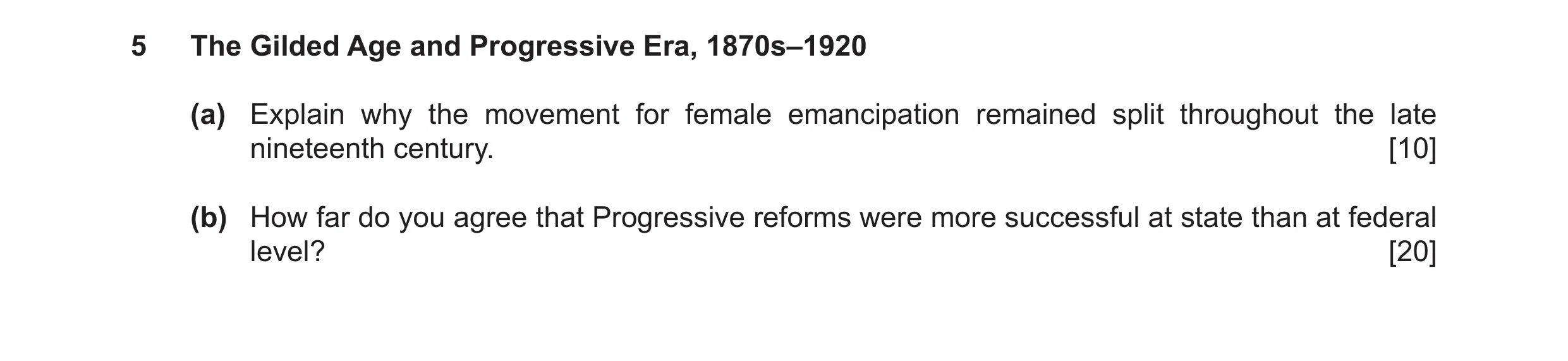
5 The Gilded Age and Progressive Era, 1870s–1920 (a) Explain why the movement for female emancipation remained split throughout the late nineteenth century. [10] (b) How far do you agree that Progressive reforms were more successful at state than at federal level? [20]
30 marks
Mark scheme: 5(a) Explain why the movement for female emancipation remained split 10 throughout the late nineteenth century. Indicative content • The initial split had come in 1869 as the movement was divided in its attitude to the Fifteenth Amendment. The issue of relative worthiness to vote was also raised in relation to foreign-born men. • Throughout the period there was disagreement about the main focus of the movement – should it be the vote or were other socio-economic issues (e.g. Temperance, Child Labour) with which it should be linked? In other words, should women’s organisations focus on a single issue? • There was also disagreement about the methods to be used: persuasion vs. actions (including violent actions). • Religions division – more fundamentalist religious groups were often strongly opposed to female emancipation • There were differences between State and Federal responses to the issue Accept any other valid responses. 5(b) How far do you agree that Progressive reforms were more successful at 20 state than at federal level? Indicative content State reform began in Illinois and Michigan then taken up by other states. especially Wisconsin under La Follette. The impulse towards social justice began at state level. For example, at state level, laws were introduced to regulate banks and businesses, limit the working hours of women and children, and protect workers from accidents at work. Arguably these reforms had a greater impact on the lives of Americans than federal government actions. Federal government passed the Seventeenth and Nineteenth Amendments making the US a more democratic country. Roosevelt intervened on behalf of workers, for example, miners. There were moves to break trusts and limit monopolies. Federal government took the initiative regarding working conditions for federal employees. Federal government was limited by the constitution regarding states’ rights in many areas. This limited the possibility for reform at federal level. In addition, each Progressive President had different views about the role of federal government, and much legislation was blocked by conservatives in Congress. Accept any other valid responses.
This question in 9489/22 Oct/Nov 2025
Q18 · The Gilded Age and Progressive Era, 1870s–1920 (a) Explain why new immigrants from… 9489/23 Oct/Nov 2025
5 The Gilded Age and Progressive Era, 1870s–1920 (a) Explain why new immigrants from Southern and Eastern Europe were often exploited. [10] (b) ‘Prohibition was introduced because the government was no longer reliant on liquor tax.’ How far do you agree? [20]
30 marks
Mark scheme: 5(a) Explain why new immigrants from Southern and Eastern Europe were 10 often exploited. Indicative content • Most new immigrants did not speak English. This meant that they were easily exploited by unscrupulous bosses who promised them accommodation and employment in a country in which they could not easily access these necessities. • Most did not have work skills needed for higher level jobs in the industrial cities, so had to rely on being found work. • The boss system that prevailed in industrial cities made them dependent by tying them to housing and employment while making money for the bosses. • Wages were kept low as there was no scope for unionisation, so it was easy to sack an entire workforce and replace them with cheaper immigrant labour. • Even if wages were low, they were still better than where they came from. • Lack of regulation from the Government (laissez faire approach) Accept any other valid responses. 5(b) ‘Prohibition was introduced because the government was no longer 20 reliant on liquor tax.’ How far do you agree? Indicative content Until the adoption of the Sixteenth Amendment in 1913 federal government was reliant on Liquor Tax for 30–40% of its funds. These taxes had been introduced during the Civil War and never lapsed. Federal government expenditure was increasing significantly during the Progressive Era in a way not envisaged by the founding fathers. Since the Supreme Court had ruled that income tax was constitutionally illegal, liquor tax remained an important part of federal income. Once the Sixteenth Amendment was passed, the federal government was no longer so reliant on liquor tax. However, there were other reasons for the introduction of Prohibition. Prohibition was closely linked with other Progressive aims: alcohol was viewed by the Temperance Movement as the underlying source of a long list of social ills and found common cause with Progressives trying to ameliorate the living conditions of immigrants crowded into squalid slums, protect the rights of young children working in mills and factories, improve public education, and secure women's rights. If rectifying these social ills was an aim, then prohibition was part of this. There were potential benefits associated with prohibition: improvements in public health and economic productivity would benefit employers. By the time of the Eighteenth Amendment, there were other reasons arising from the First World War. Since many American brewers were of German origin, and Germany was the enemy, prohibition could be associated with American patriotism. Note: do not accept tariffs as providing an alternative source of income as Wilson lowered tariffs in 1913. Accept any other valid responses.
This question in 9489/23 Oct/Nov 2025
![Question 5: The Gilded Age and Progressive Era, 1870s to 1920 (a) Explain why the railroad network grew quickly in the late nineteenth century. [10] (b…](https://img.pastlit.com/crops/3a108354-9e63-4dda-aa25-3f4e84d6528d/q5.webp) 1 / 4
1 / 4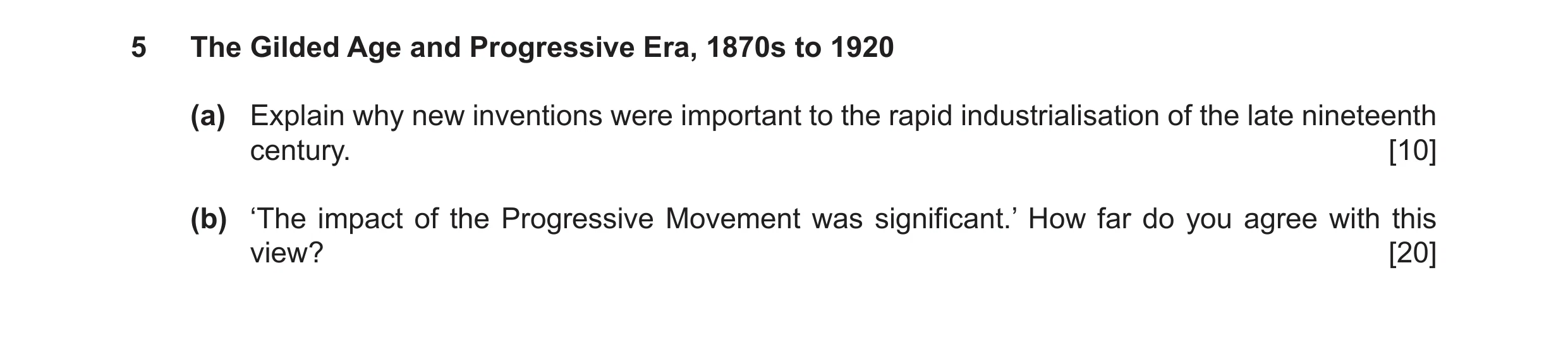

 2 / 4
2 / 4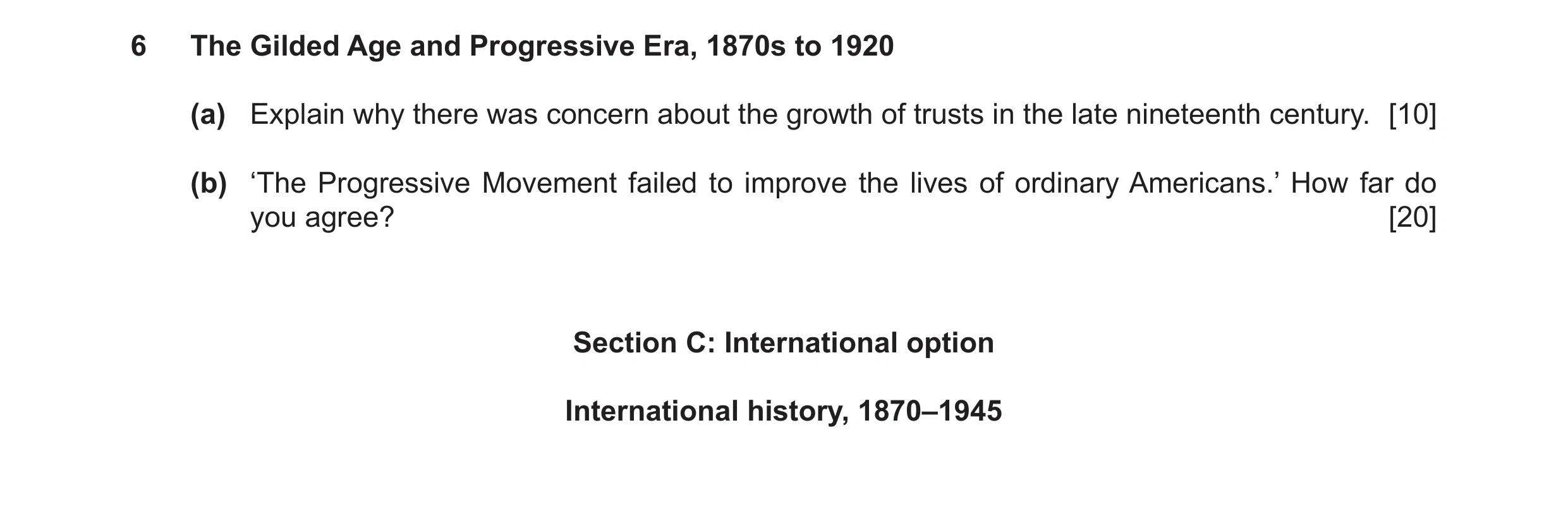
![Question 12: The Gilded Age and Progressive Era, 1870s to 1920 (a) Explain why there was an economic panic in 1873. [10] (b) ‘The 19th Amendment was the…](https://img.pastlit.com/crops/5a216cca-6ede-4d0a-8b84-12a4d3c58783/q6.webp)
![Question 14: The Gilded Age and Progressive Era, 1870s to 1920 (a) Explain why the Granger Movement was formed. [10] (b) ‘Constitutional change was the …](https://img.pastlit.com/crops/6f253293-5518-447c-bfd7-2df728a3c945/q6.webp) 3 / 4
3 / 4![Question 15: The Gilded Age and Progressive Era, 1870s to 1920 (a) Explain why living conditions in cities were poor. [10] (b) How far do you agree that…](https://img.pastlit.com/crops/e770a01d-6907-4b7f-a733-2f53128fb283/q5.webp)
![Question 16: The Gilded Age and Progressive Era, 1870s–1920 (a) Explain why many Progressive laws were passed during Woodrow Wilson’s presidency. [10] (…](https://img.pastlit.com/crops/f0ed21d0-0f48-4734-a6b3-a4cb32722fc7/q5.webp)
![Question 18: The Gilded Age and Progressive Era, 1870s–1920 (a) Explain why new immigrants from Southern and Eastern Europe were often exploited. [10] (…](https://img.pastlit.com/crops/2b5bfc49-c8bb-4041-b0c0-cf9d22e3808b/q5.webp) 4 / 4
4 / 4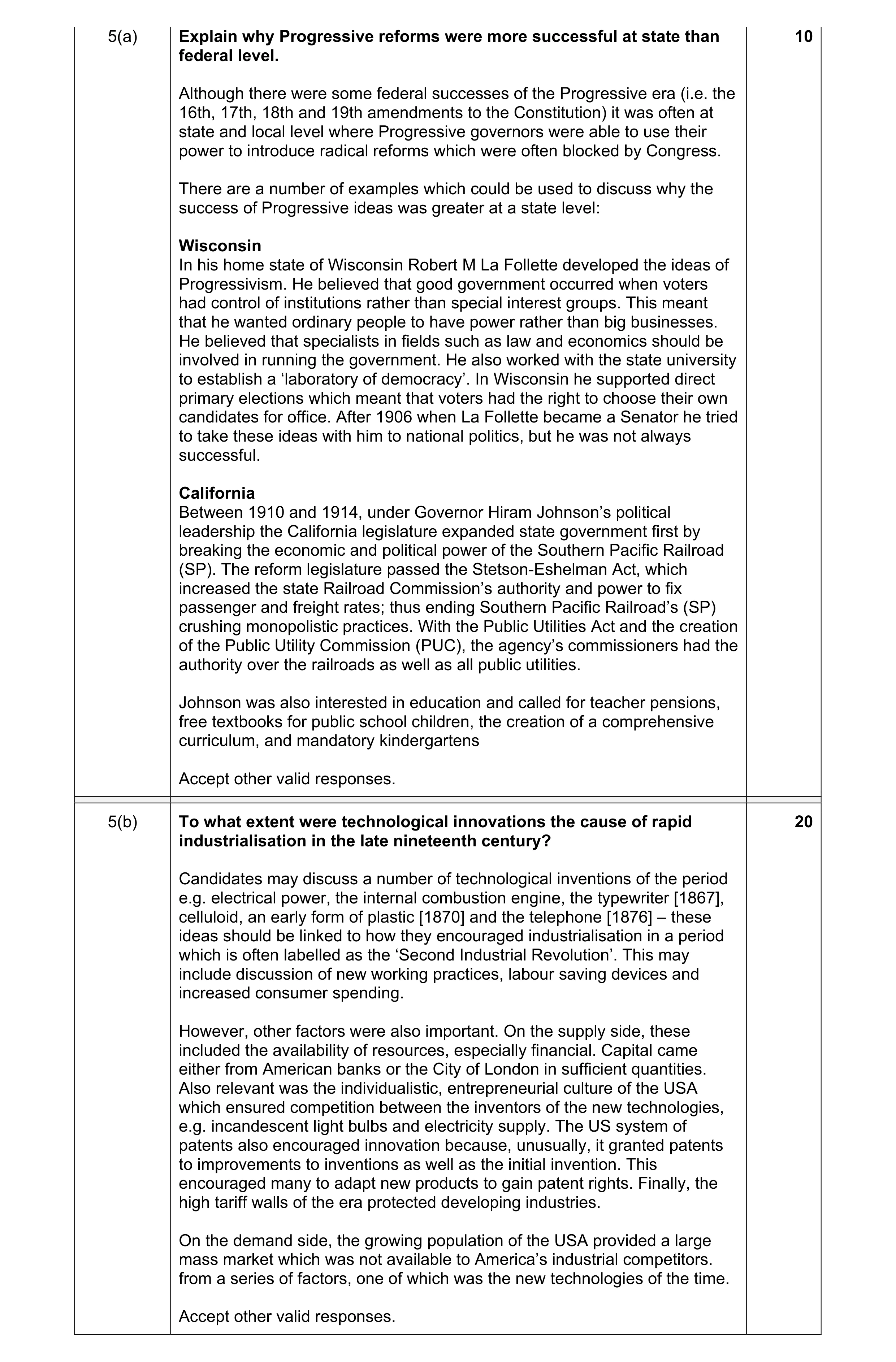 30
30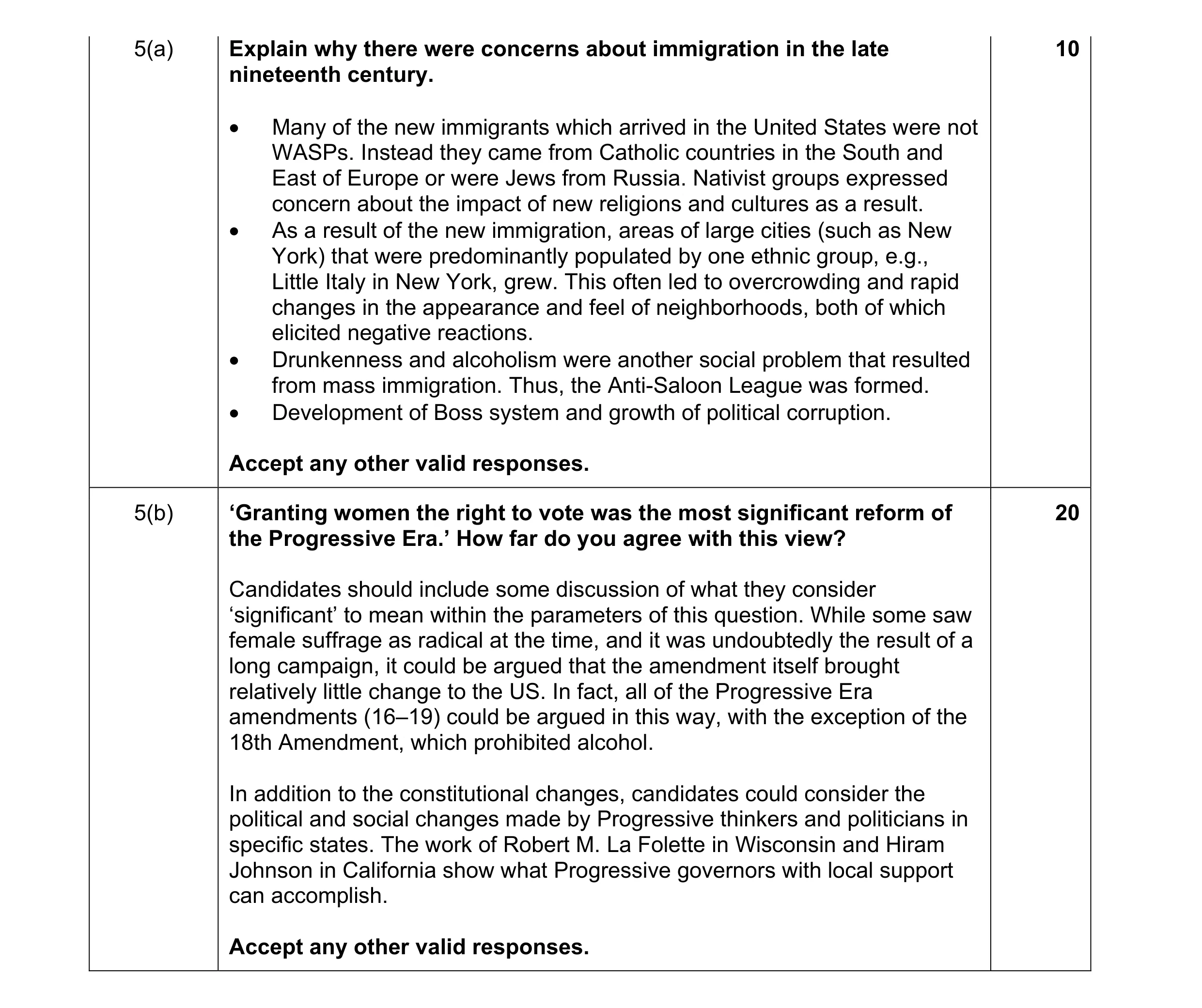 30
30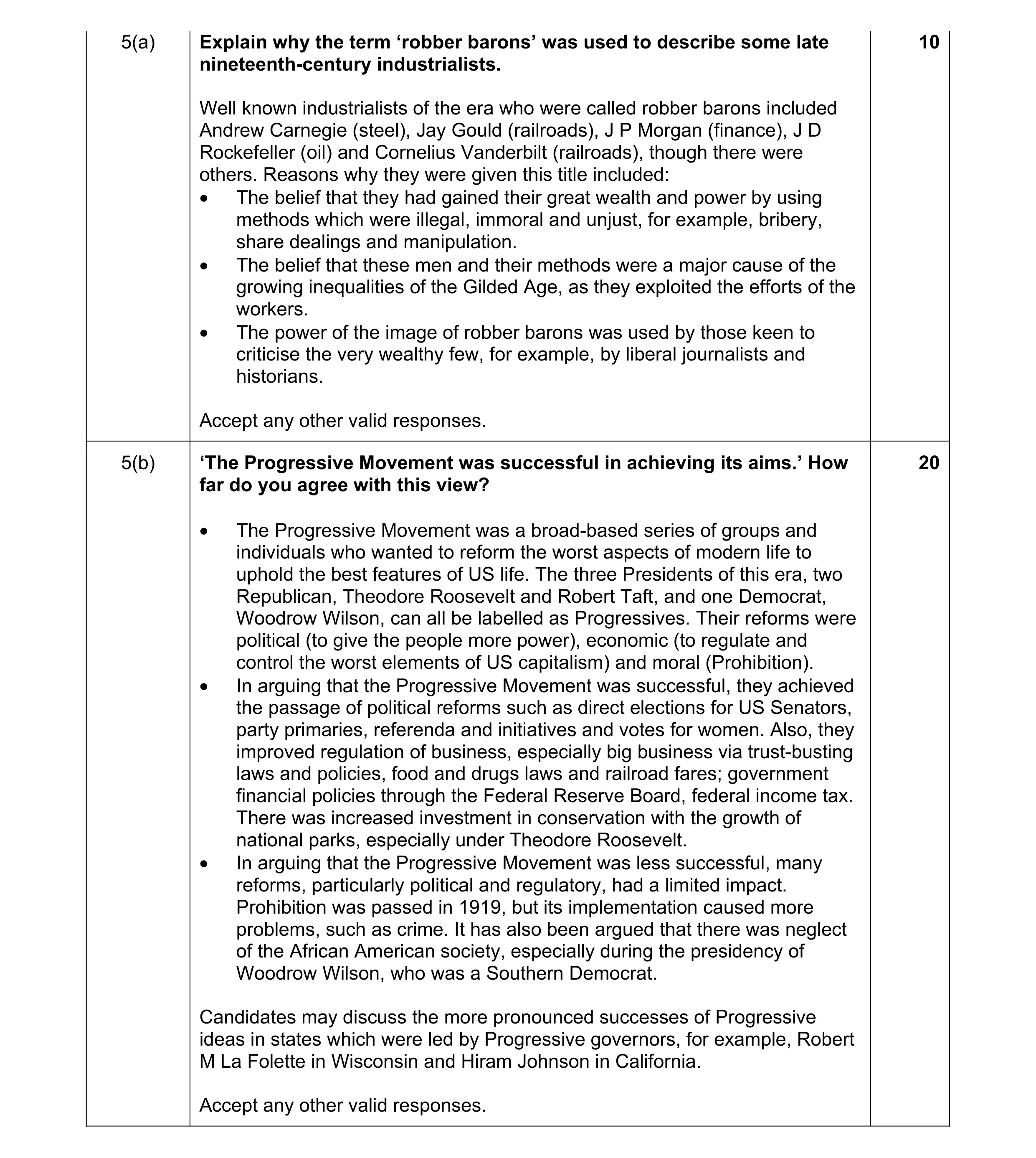 30
30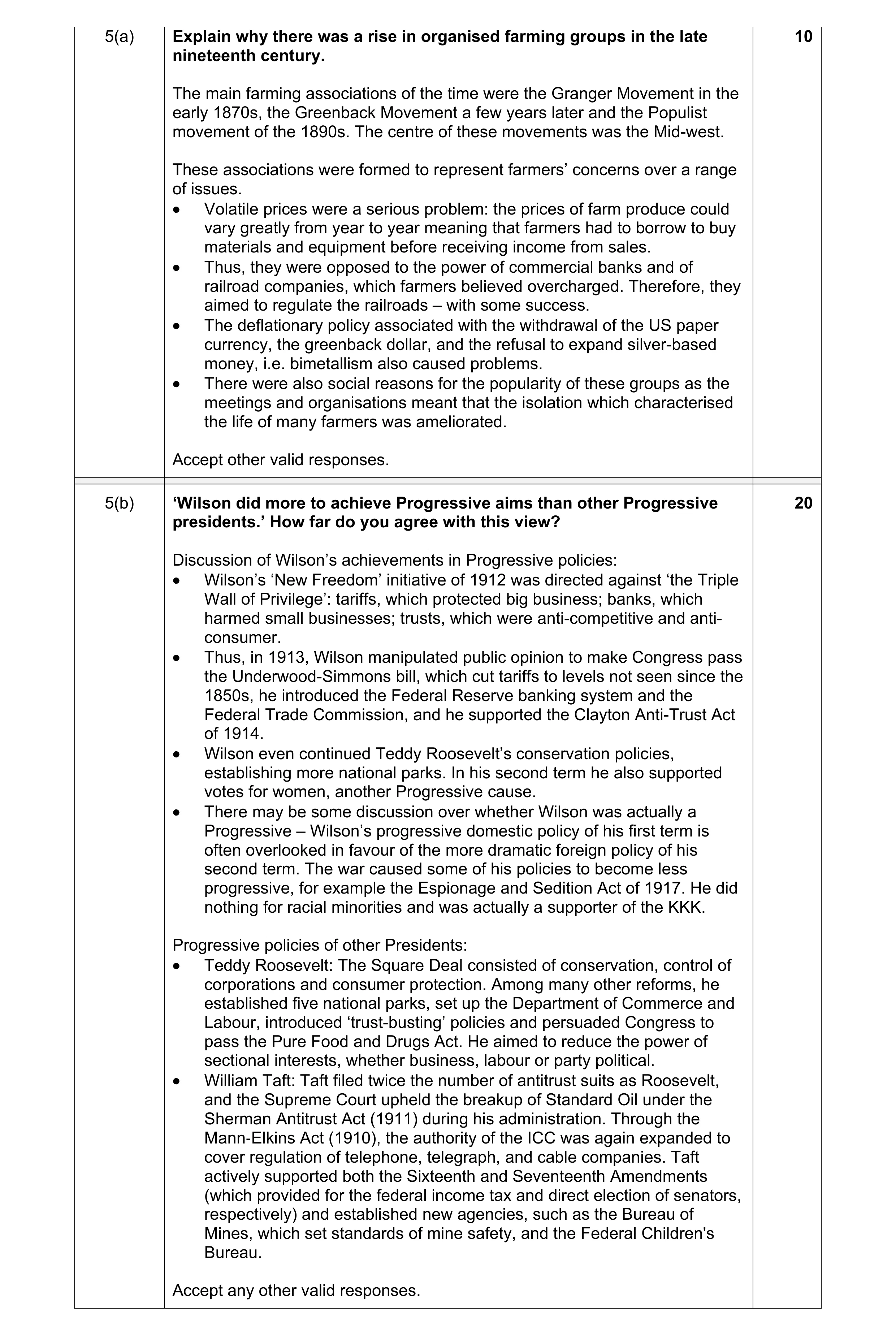 30
30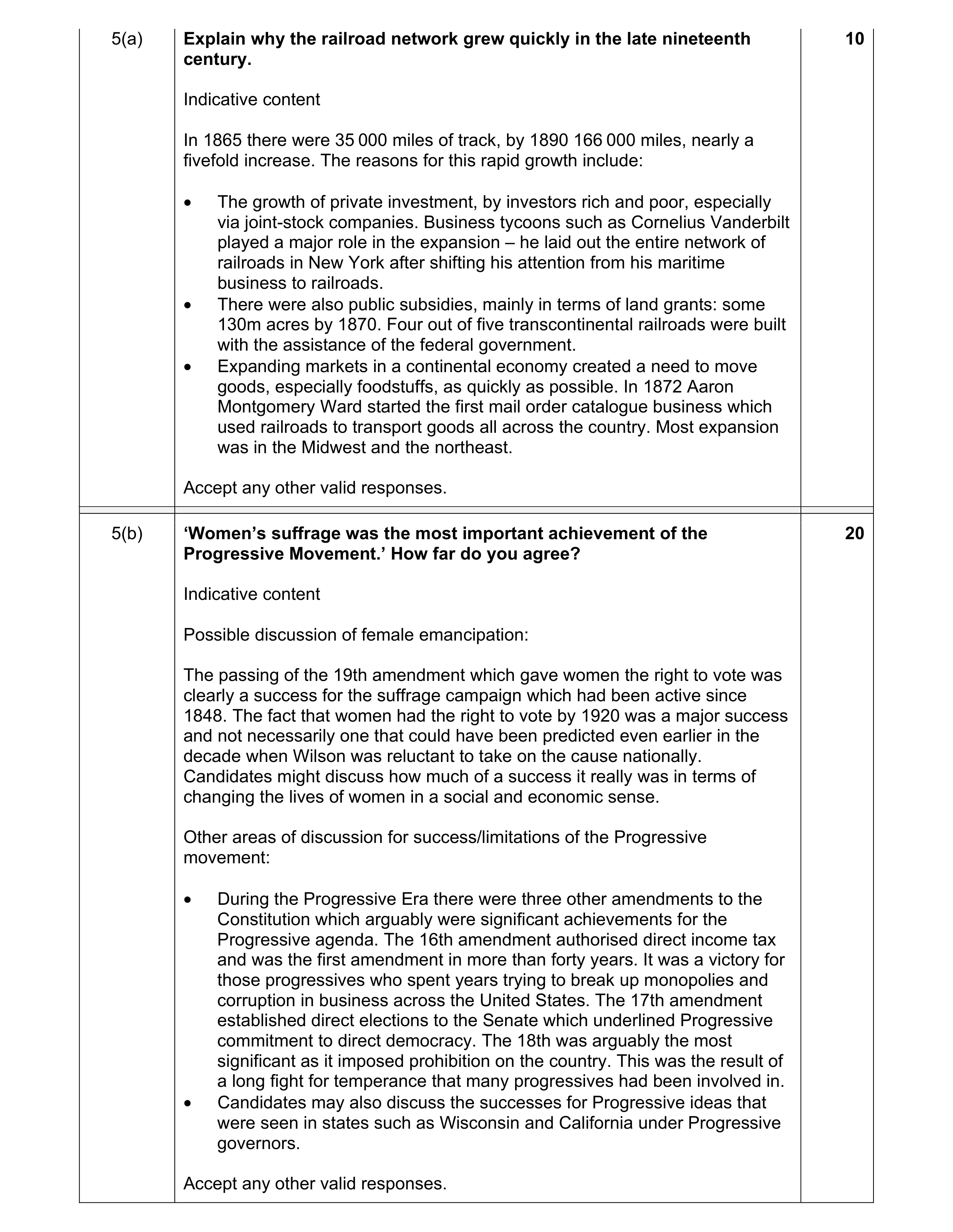 30
30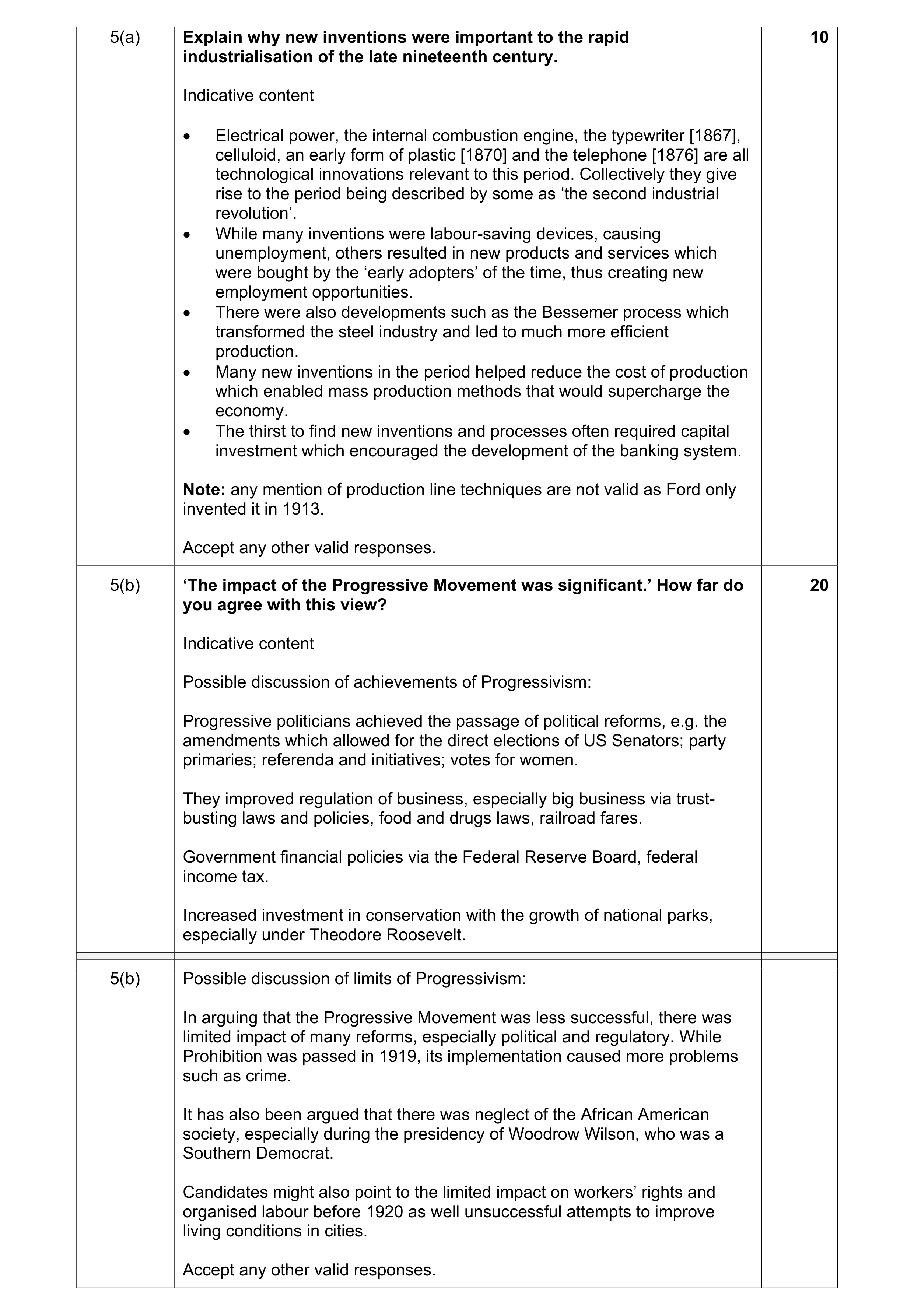 30
30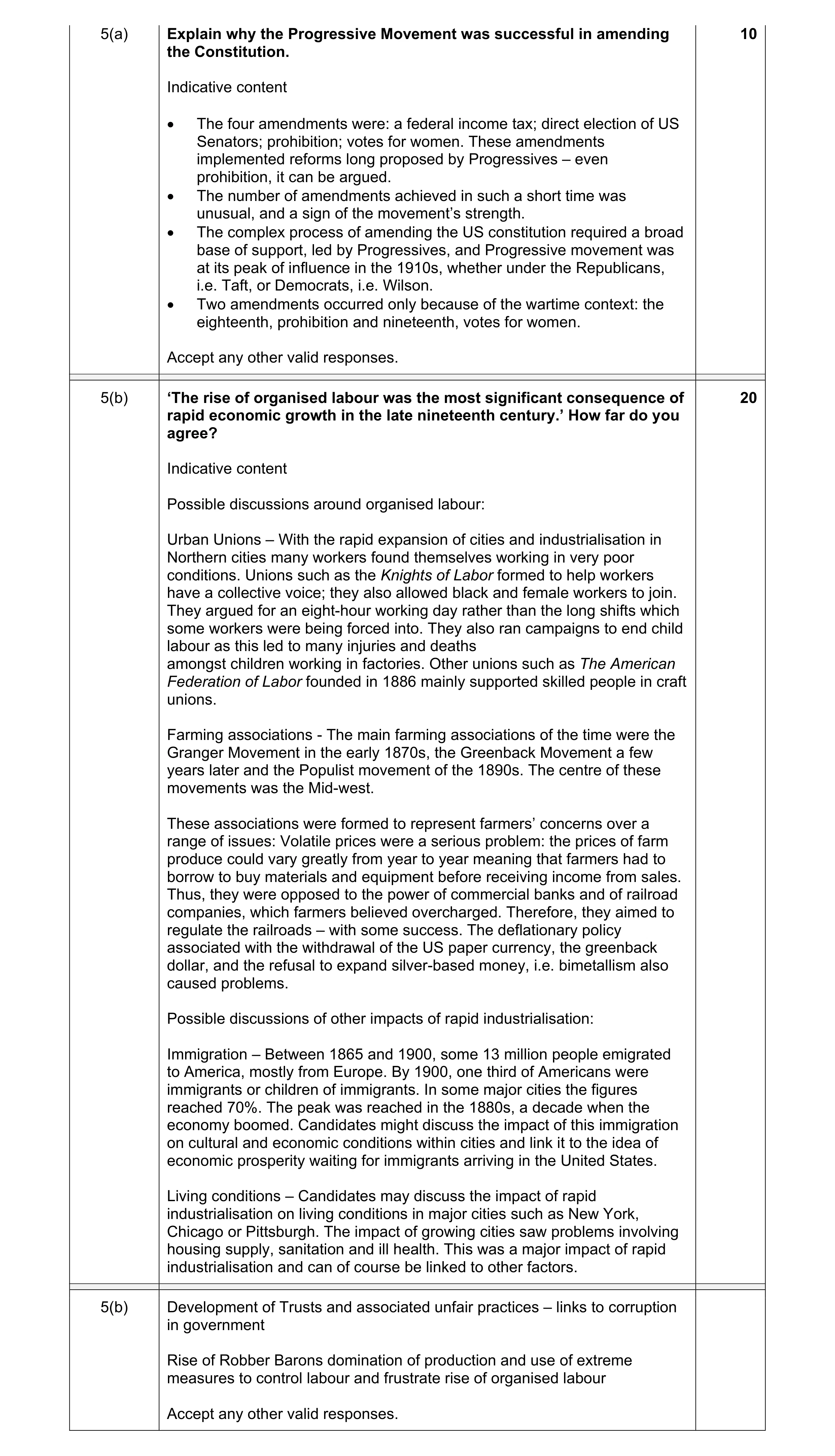 30
30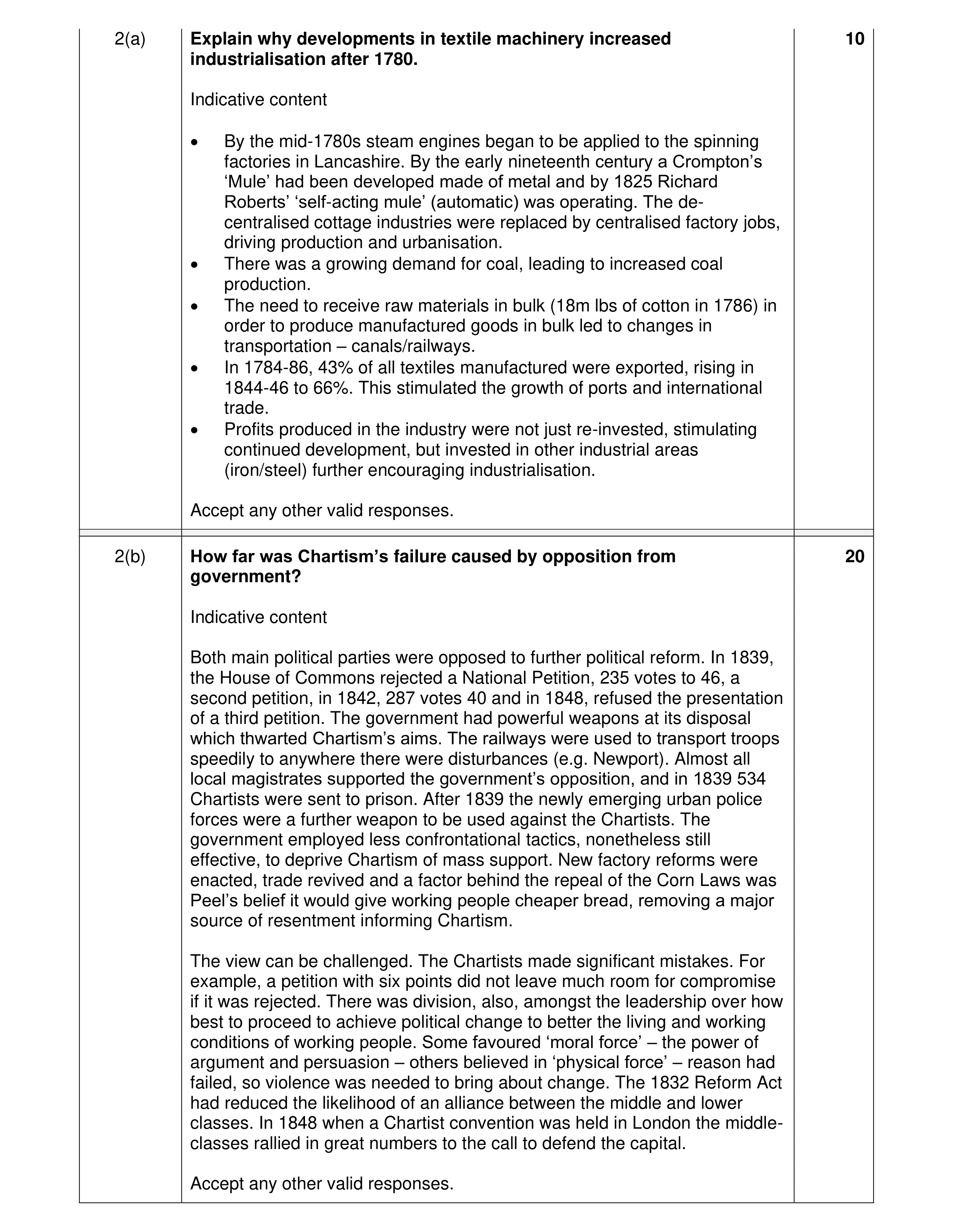 30
30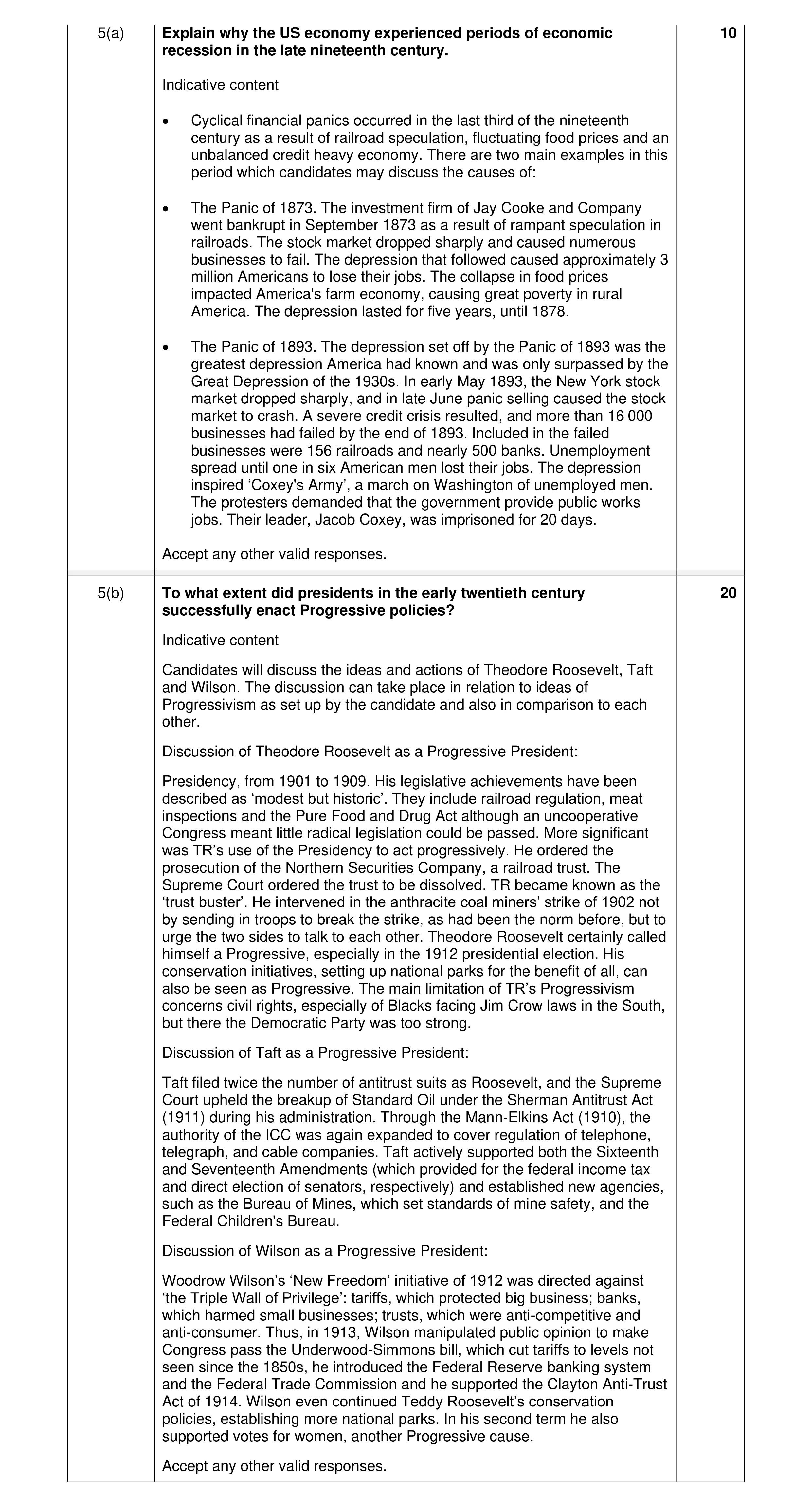 30
30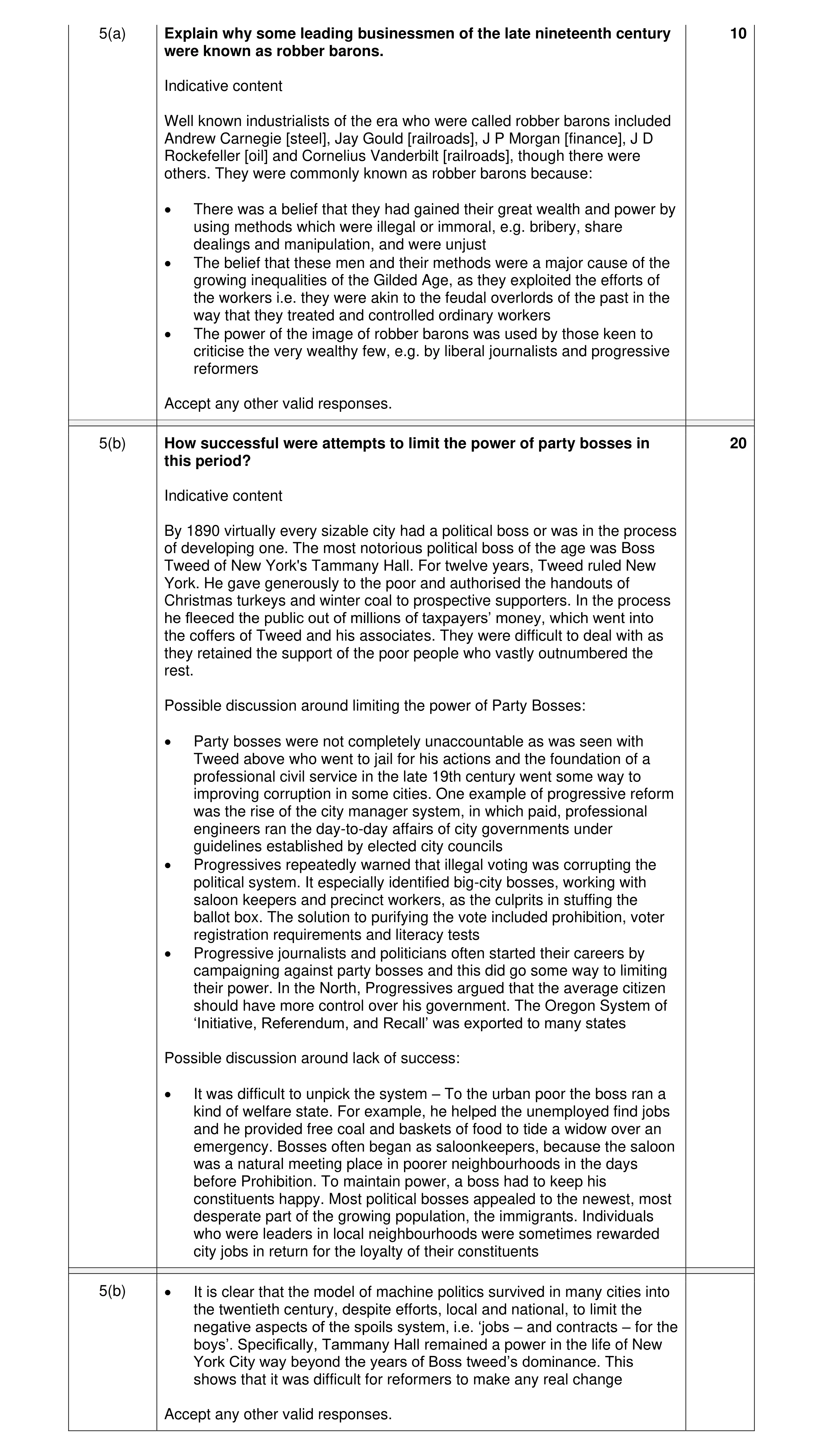 30
30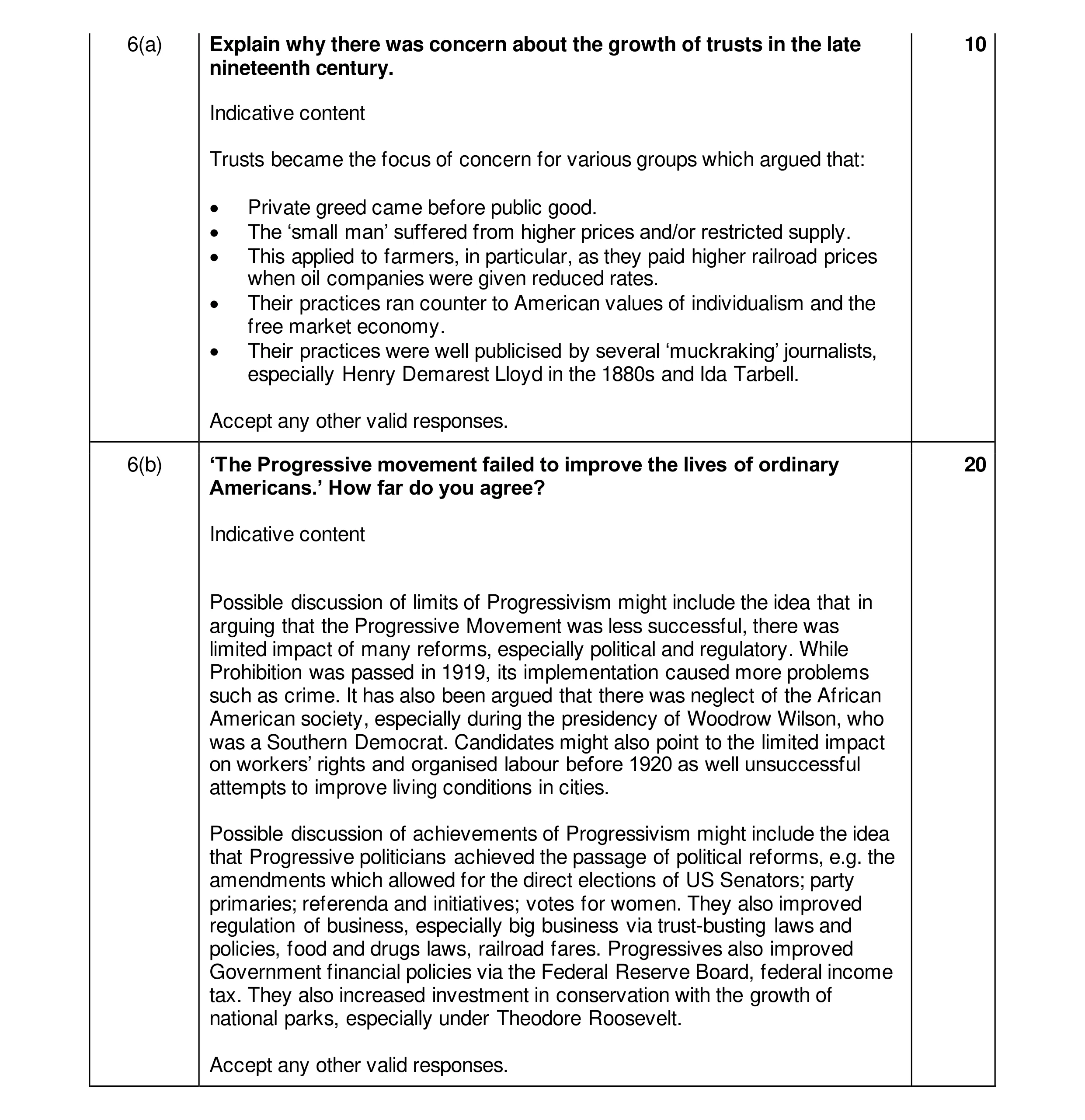 30
30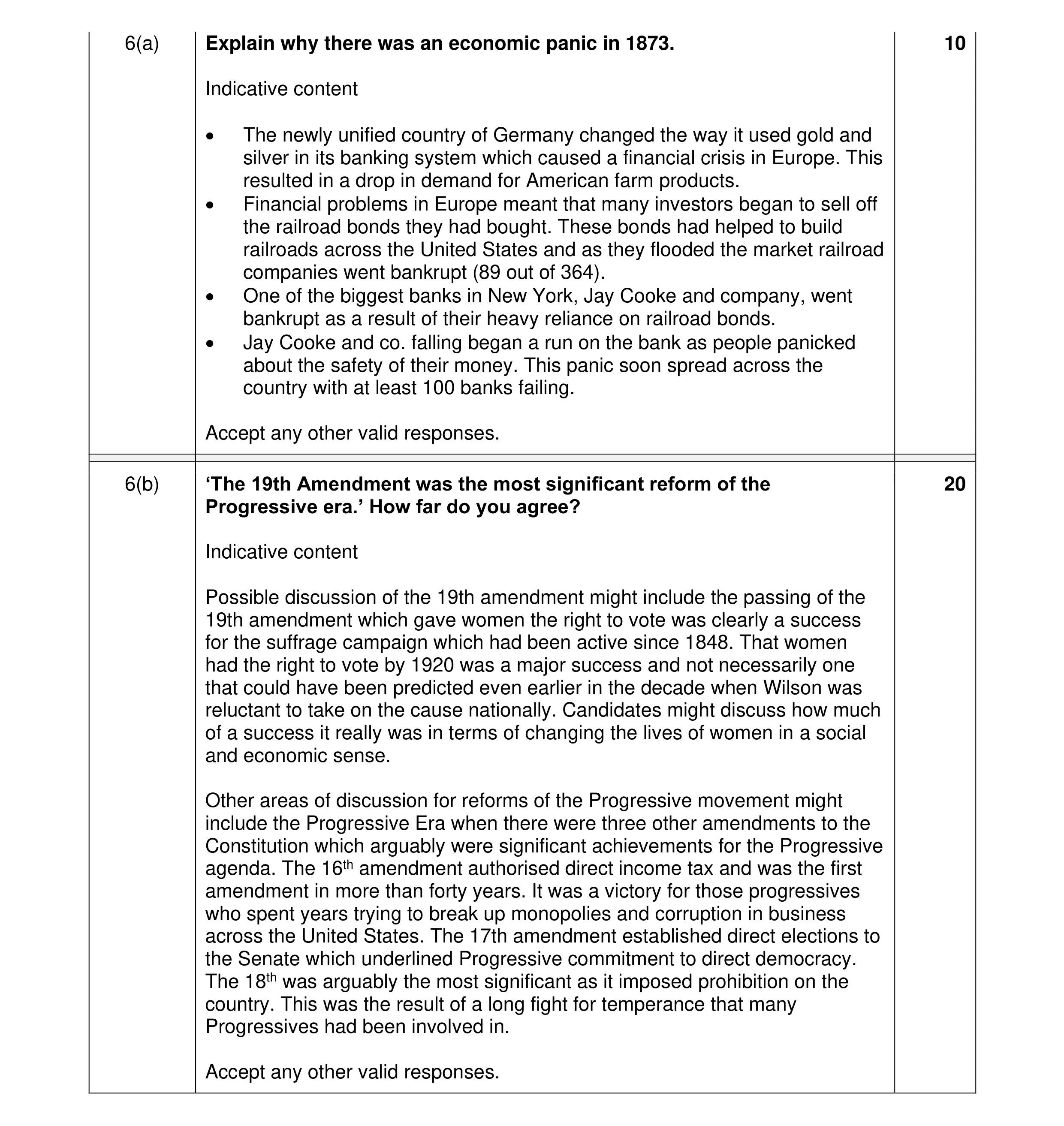 30
30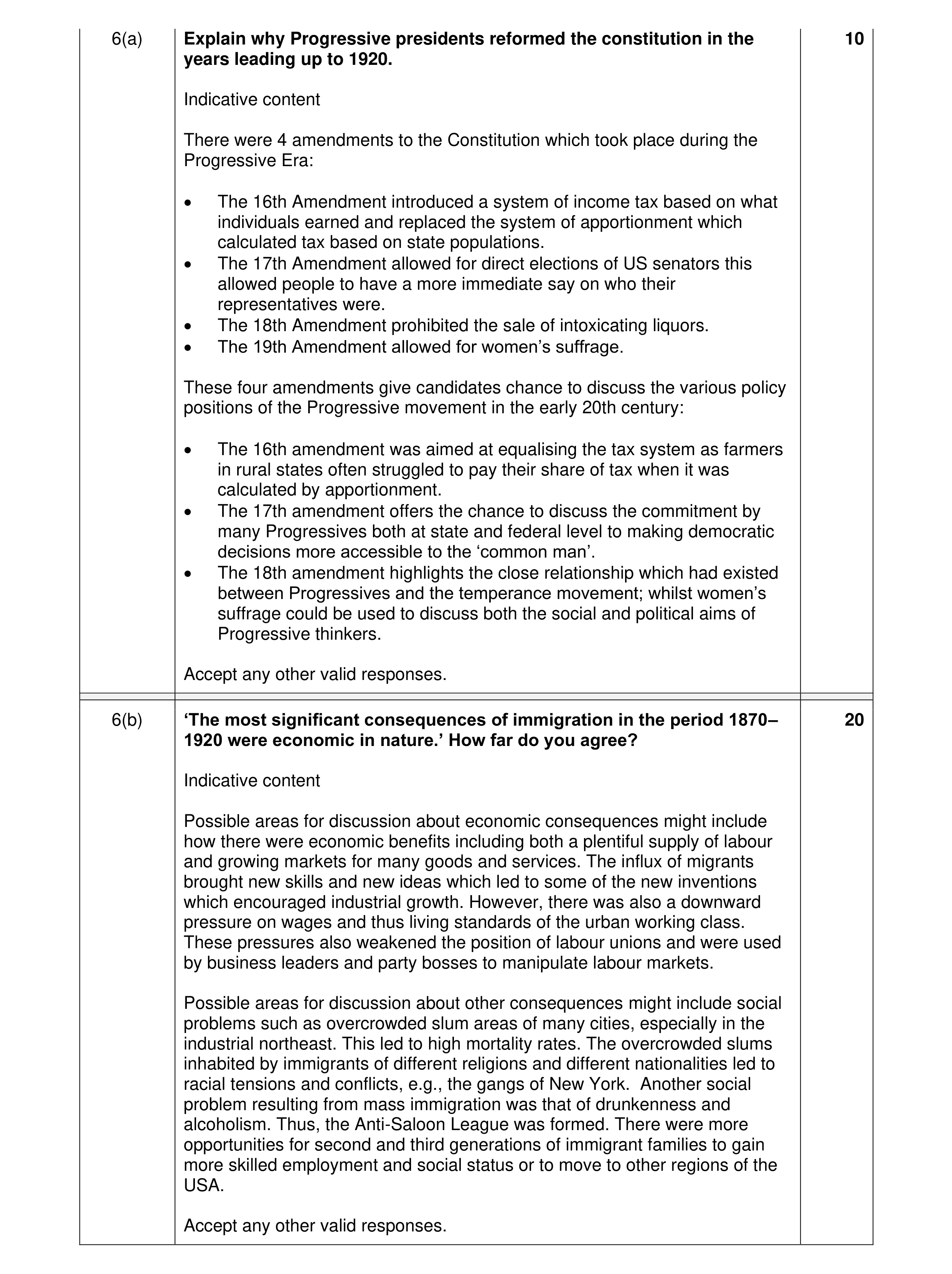 30
30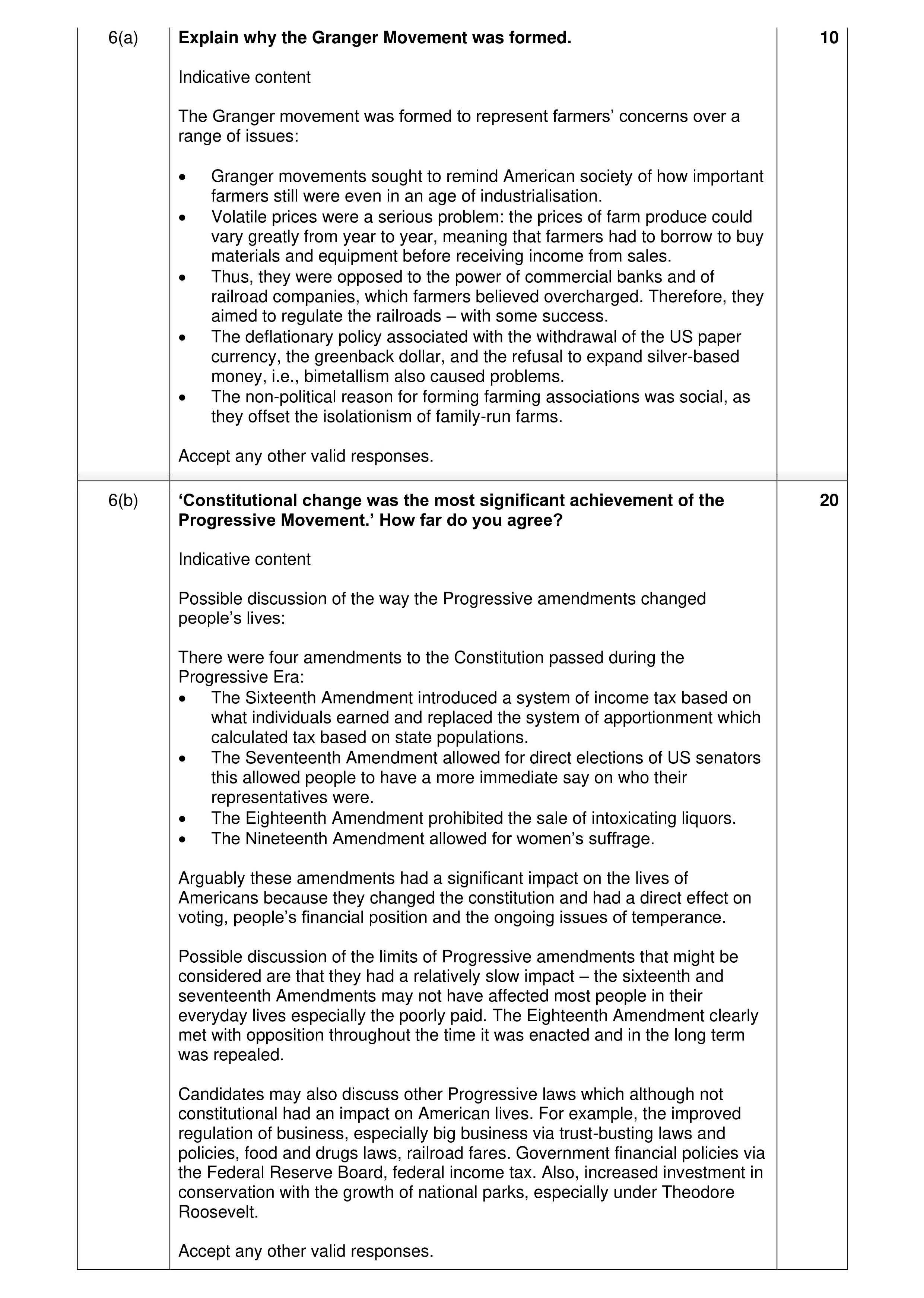 30
30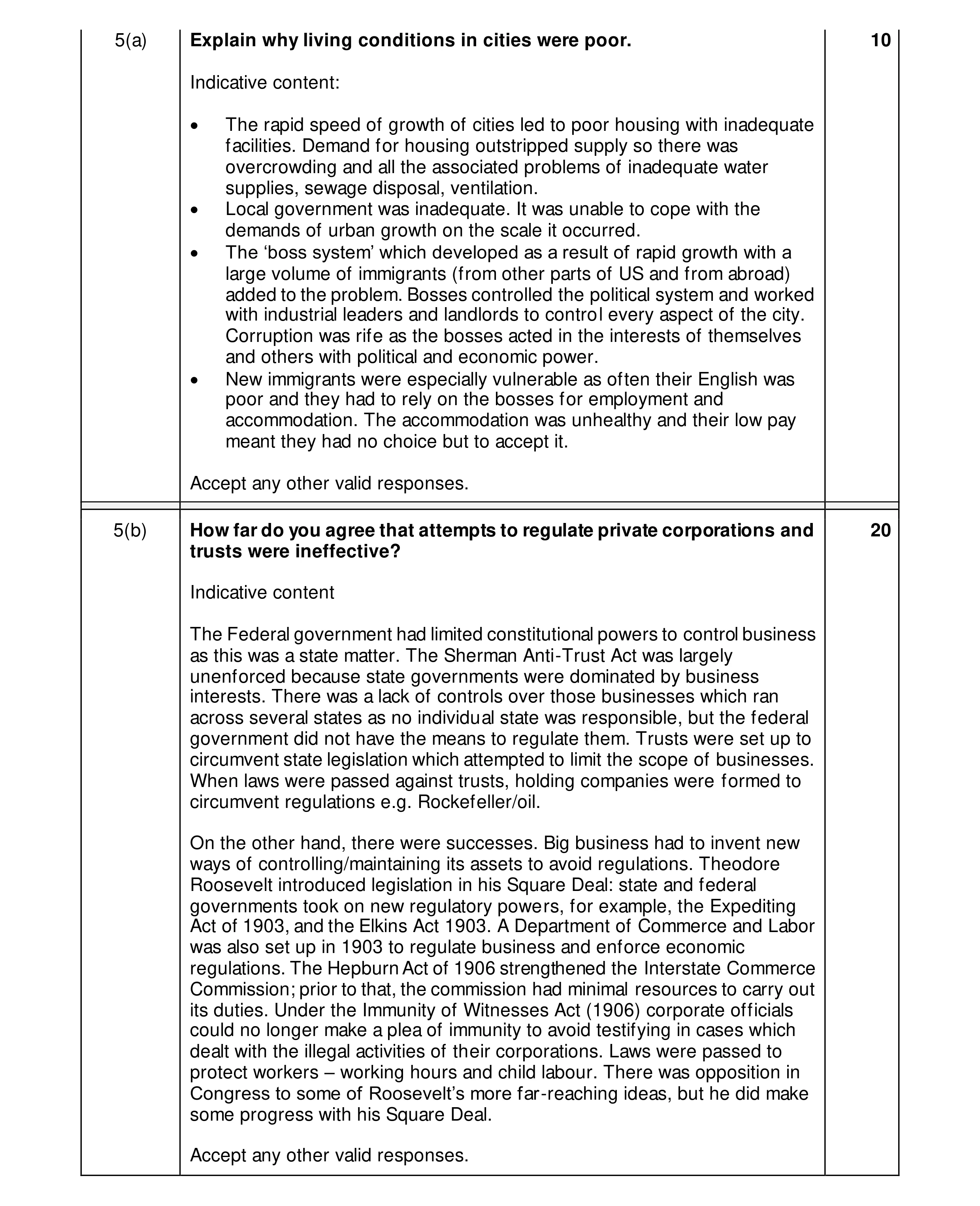 30
30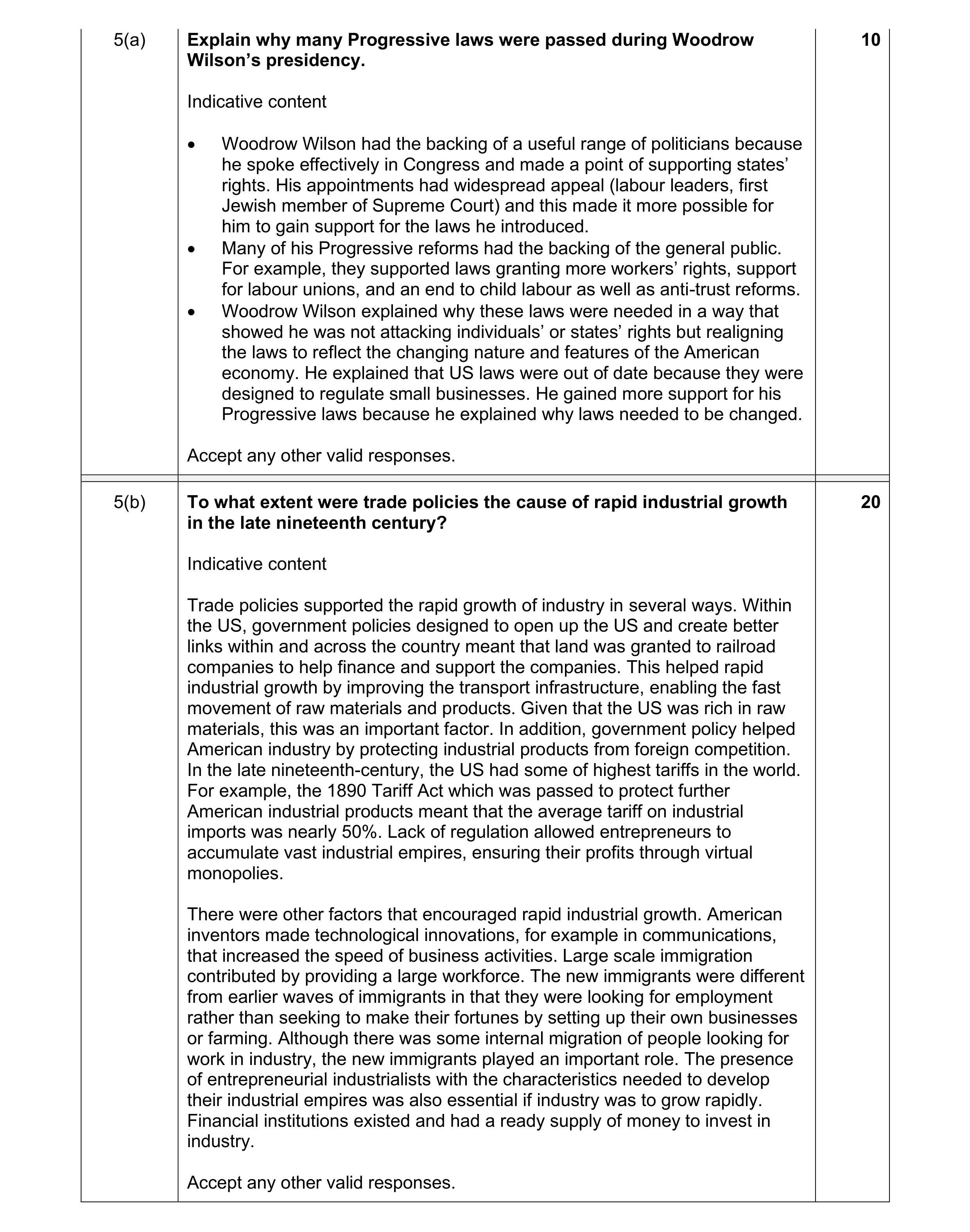 30
30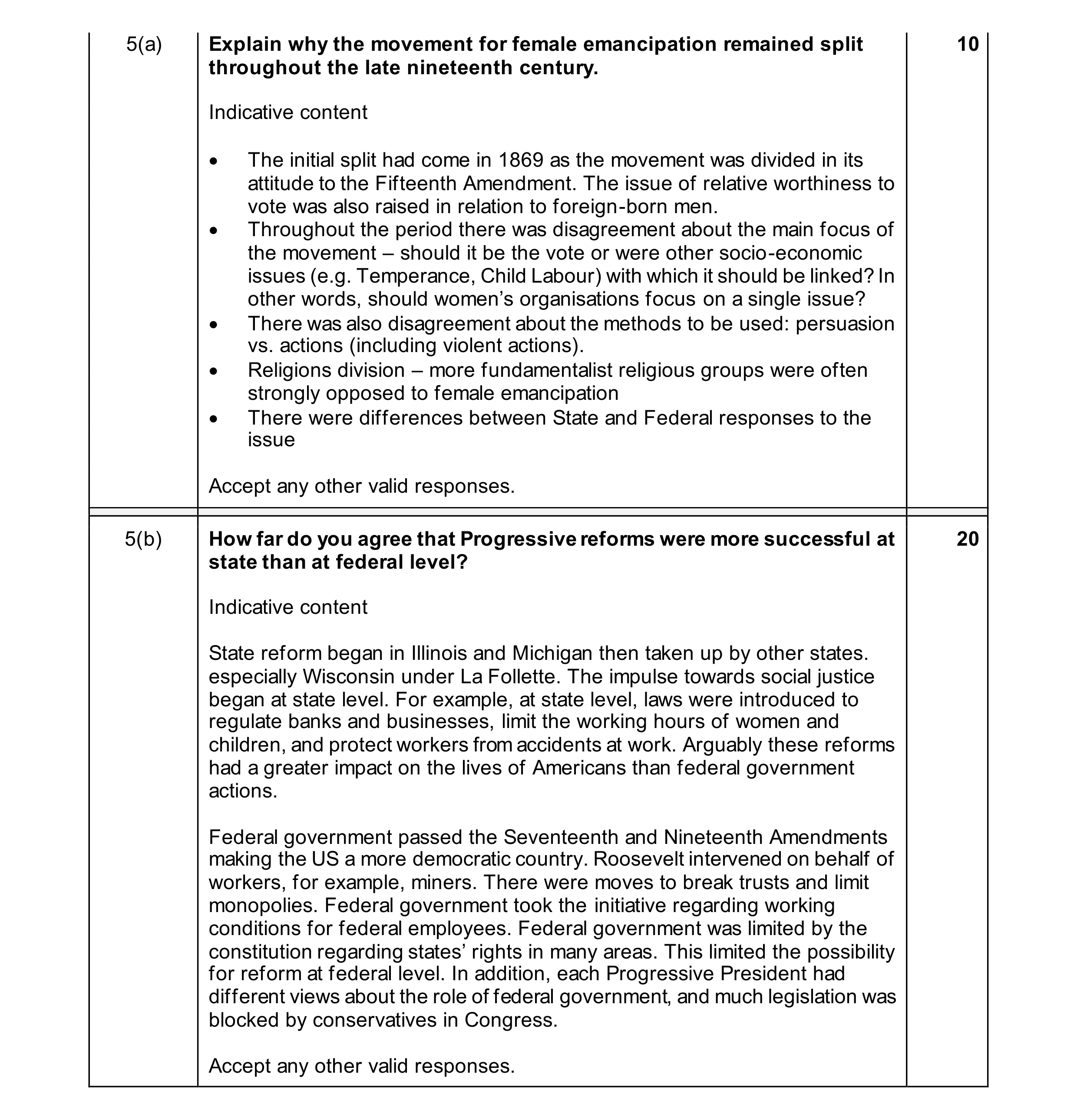 30
30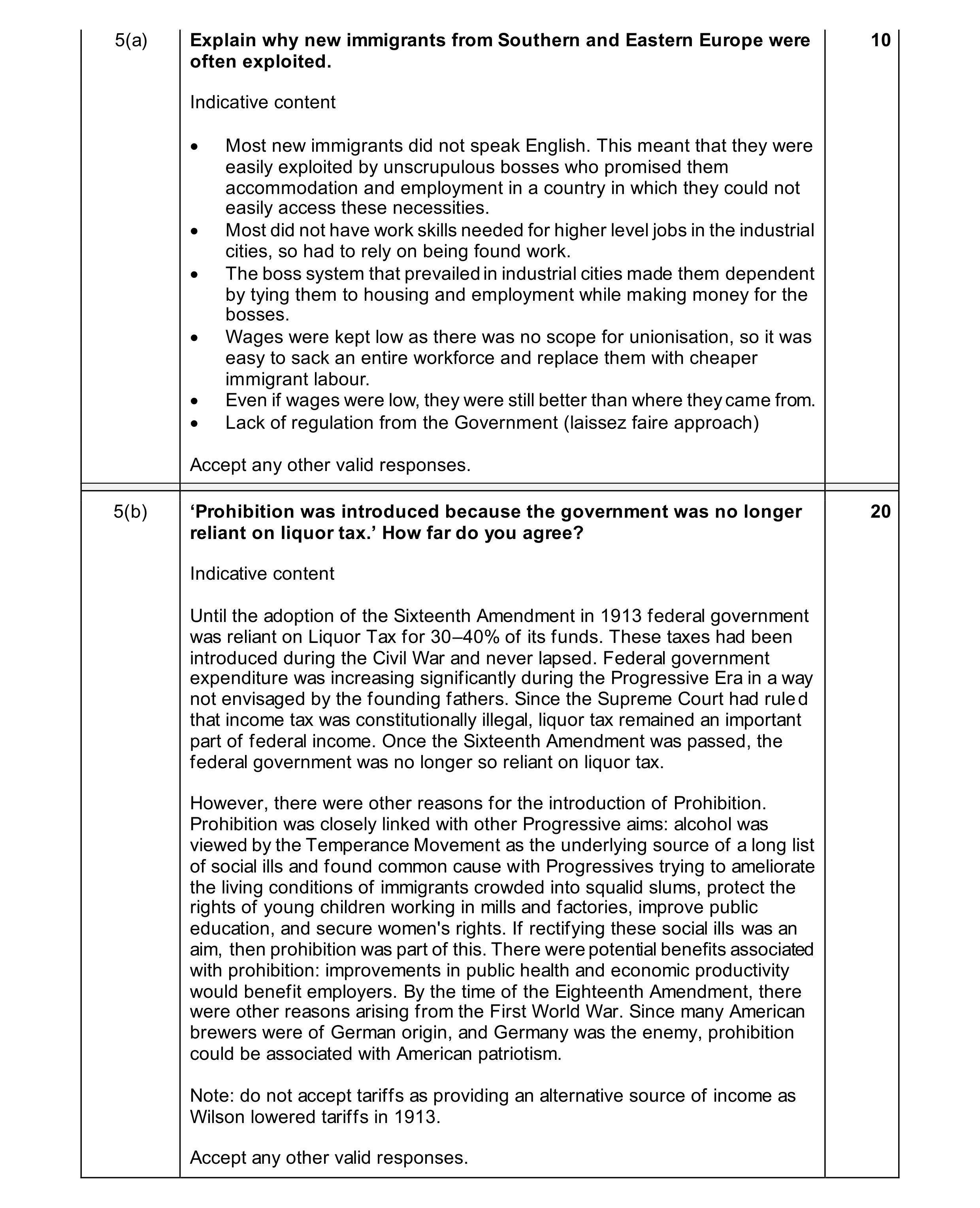 30
30