Questions as text
Q1 · France, 1774–1814 (a) Explain why the Estates General was not able to deal with the… 9489/21 May/June 2021
1 France, 1774–1814 (a) Explain why the Estates General was not able to deal with the issues France faced. [10] (b) How far did Napoleon as First Consul, 1799–1804, maintain the principles of the Revolution? [20]
30 marks
Mark scheme: Question Answer Marks 1(a) Explain why the Estates General was not able to deal with the issues 10 France faced. • Procedure: There was uncertainty because the previous meeting of the institution had been in 1614. Therefore, no one was sure how it should proceed. It was agreed that the Estates General represented three groups: clergy, nobility, and others. However, there were serious differences about voting, including how decisions should be made. • Over optimistic: The cahiers raised expectations in the country and amongst the deputies that the Estates General would bring about a fundamental overhaul of France. However, as an institution of the Ancien Regime it could never meet these expectations. • Lack of guidance: Finance was a major issue facing France, but the cahiers (lists of grievances sent to the Estates General) were contradictory in the solutions they proposed, as there had been no royal direction in their production, and this fed through to the early debates. • Frustration with the king created new issues: Louis XVI sought to keep the Estates General’s voting bias which discriminated against the Third Estate. In response it challenged the king’s power when it voted to call itself the National Assembly and claimed it had the right to decide on matters of taxation. This had never been a reason for the calling of the Estates General. • The king’s bad faith: Whilst the new National Assembly was becoming more strident, the fear grew, which was not unfounded, that Louis XVI was seeking to deploy additional troops in Paris to restore his authority. This led to disorder, e.g., the storming of the Bastille. The end of the Estates General had come a little earlier (9th. July) when the National Constituent Assembly was formed. Using the Estates General, an old institution of the Ancien Regime, had shown that the issues France faced could only be dealt with by new institutions based on new ideas. Accept any other valid responses. 1(b) How far did Napoleon as First Consul, 1799‒1804, maintain the 20 principles of the Revolution? Arguments to support the view that he did maintain the principles of the Revolution could be as follows. Napoleon was the figurehead of the coup in 1799 because his military successes had made him popular, and he had shown that he was a defender of the Revolution against its enemies (e.g., Toulon, 1793 and the royalist Vendémiaire uprising, 1795). His policies as First Consul can be said to have not openly contradicted his claim that he was continuing the best features of the Revolution. For example, plebiscites were used as a form of popular consent, albeit carefully managed. They did, nonetheless, pay some lip-service to the revolutionary idea of consent. There were three consuls to share power: a difference from the monarchy and Robespierre’s dictatorship. The Civil Code did enshrine the principle of equality for all before the law, a key revolutionary belief. The Concordat of 1801 with the Pope did uphold the principle of religious freedom, a clear revolutionary ideal. His actions regarding local administration and the fiscal system can be seen as completing work begun in 1789–1793 and 1795– 1799. However, the view can be challenged. The democratic element of elections was minimal, as they were more the presentation of candidates, restricted to the notables, seen as suitable for selection as deputies. The Civil Code emphasised male authority and the rights of the father, and so undermined many gains made by women during the Revolution. The Concordat with the Pope was seen by many revolutionaries as a betrayal of all that had been achieved since 1789 in limiting the power and influence of the Catholic Church in France. The Civil Code allowed for greater centralisation and, thereby, greater personal control for Napoleon. Accept any other valid responses.
This question in 9489/21 May/June 2021
Q2 · France, 1774–1814 (a) Explain why the National Constituent Assembly introduced the August… 9489/22 Oct/Nov 2021
1 France, 1774–1814 (a) Explain why the National Constituent Assembly introduced the August Decrees. [10] (b) ‘The ideas of the Revolution were ignored by the Directory.’ To what extent do you agree with this view? [20]
30 marks
Mark scheme: Question Answer Marks 1(a) Explain why the National Constituent Assembly introduced the August 10 Decrees. • To restore calm in the French provinces because, following the storming of the Bastille (14 July 1789), there was mass uproar which spread from Paris to the countryside. • This ‘Great Fear’ saw nobles families attacked and properties destroyed. The latter often occurred irrespective of whether they were noble owned. This frightened the property-owning members of the Assembly. However, they had no means available to restore order by force. • Liberal deputies from the Breton Club (forerunners of the Jacobin movement) believed only a grand gesture by the Assembly, such as reforming the social pattern of the nation, would calm the peasants. • The pressure of the moment led many deputies to go further than they had intended. • Aristocrats’ proponents, such as the Duc d’Aigullion, had a history of support for the cause of patriotic liberty, which includes supporting the military in America in the 1770s. Therefore, there was a perception that they were not posturing, but were driven by idealism. • Answers may focus specifically on the key terms of the August Decrees – abolition of feudalism and privilege of the Church. Accept any other valid responses. 1(b) ‘The ideas of the Revolution were ignored by the Directory.’ To what 20 extent do you agree with this statement? Arguments to support the view could be as follows. The Constitution of 1795 gave the Directory emergency powers to curb press freedom and the freedom of association, more in line with the ‘Ancien Regime’ than the Revolution of 1789. The coups faced by the Directory undermined its authority and made it appear to be solely concerned with political survival as an end, rather than continuing the ideas of the Revolution. Thus, the lack of an initial response to the coup of 1799 may have been because many saw it as a cosmetic move by the Directory – Consuls instead of Directors. In 1797, the Directory nullified elections in 49 departments and excluded 177 deputies. This anti-democratic sentiment, which ran counter to the Revolution’s ideas, resurfaced in 1799 when the Directory attempted to impose its own hand-picked candidates. The suppression of party activity was an attack on the ideas of the Revolution. This meant that those who had previously been politically active were replaced by inexperienced and previously politically inactive people. They followed a more loosely defined set of principles which suggested that the Directory did ignore the ideas of the Revolution. The view can, however, be challenged. The Directory managed to build on the huge achievements of 1791–92, and the 1795 Constitution established a franchise based on the payment of taxes, similar to the 1791 Constitution. For a time, the Directory made democratic institutions work, such as yearly elections and the secret ballot, as required by the 1795 Constitution and in accordance with the Revolution’s democratic ideas (the secret ballot was not adopted by Britain until 1872). There franchise was far broader than that of their British or Dutch neighbours, and the press was remarkably free. All of this is in line with revolutionary ideas. Despite a general economic depression, the Directory was able to maintain, and in some areas, increase French prosperity by 1799. Economic prosperity and security were goals of the Revolution and, indeed, the desire to establish them could be said to have played a large part in bringing about the Revolution of 1789. It is acceptable for responses to seek a definition of the ideas of the Revolution and use this as a template to organise their argument. Accept any other valid responses.
This question in 9489/22 Oct/Nov 2021
Q3 · France, 1774–1814 (a) Explain why France experienced the ‘Reign of Terror’ between 1792… 9489/23 Oct/Nov 2021
1 France, 1774–1814 (a) Explain why France experienced the ‘Reign of Terror’ between 1792 and 1794. [10] (b) To what extent did the ideas of the Enlightenment cause the outbreak of the Revolution in 1789? [20]
30 marks
Mark scheme: Question Answer Marks 1(a) Explain why France experienced the ‘Reign of Terror’ between 1792 and 10 1794. • After the declaration of war against Austria in 1792 there was the fear of invasion. This meant that the Revolution could be overturned. All methods had to be used to make sure this did not occur. • There was anti-Jacobin violence outside of Paris and counter-revolution gained ground. Cities like Lyon and Toulon were breaking away. Therefore, radical measures had to be taken to prevent the country from falling apart. • Given the circumstances the sans culottes, whose support was essential to the Jacobins, demanded that the Committee of Public Safety act firmly. • The Jacobins saw it as a way of consolidating their power by casting opponents as threats to the Revolution. • Robespierre believed in the notion of the ‘General Will’. This represented the interests of everyone, not just the few. The Revolution would bring about a Republic built for this ideal. Therefore, anyone who sought to oppose this ideal had to be dealt with in order to preserve the Republic of Virtue. Accept any other valid responses. 1(b) To what extent did the ideas of the Enlightenment cause the outbreak of 20 the Revolution in 1789? Arguments to support the view that the Enlightenment had the primary role in bringing about the Revolution could be as follows. The Enlightenment stressed the prominence of reason rather than that of tradition and dogma. Therefore, it was a challenge to absolute monarchy as it existed in France and to its principal supporter, the Catholic Church. This clearly influenced the demand brought by the Third Estate for voting by head and not by Estate. The August Decrees can be seen as a means to rationalise the political system of the Ancien Regime by ending feudalism, with its accretions of privileges for select groups, such as the nobility and the clergy. The Enlightenment emphasised individual liberty and the consent of the governed (Locke/Rousseau). This undoubtedly acted as an influence on the setting up of the National Assembly and the Tennis Court Oath, swearing to remain in session until a constitution had been established. The success of the American Revolution (1775–83) with its espousal of Enlightenment ideals inspired many Frenchmen who had served in America to play prominent roles in the French Revolution (e.g. Marquis de Lafayette and Duc d’Aigullion). However, this argument can be challenged. The inefficient tax system of the Ancien Regime, where the burden was not shared by either the Clergy or the Nobility, meant that it could not meet its debts, exacerbated by participation in the American Revolutionary War and profligate spending by the royal family. The resultant calling of the Estates General and drawing up of the cahiers de doleances to seek a solution to this problem only raised expectations to a level that would need careful handling by the royal government. A series of poor harvests led to rising prices and the resulting economic and social distress all helped create a febrile political atmosphere. Louis XVI, however, showed that he lacked any effective political skill to deal with this situation. He antagonised the Third Estate which led to the swearing of the Tennis Court Oath with its aim to create a constitution which would undoubtedly limit royal power. He brought about real fear in the summer of 1789 that he was going to use force to establish royal control. This led to the attack on the Bastille and wide-spread disorder in the countryside (‘The Great Fear’). The August Decrees were an attempt to placate the peasants by ending feudalism, the bedrock of the Ancien Regime. Accept any other valid responses.
This question in 9489/23 Oct/Nov 2021
Q4 · France, 1774–1814 (a) Explain why Necker resigned in 1781 9489/22 Feb/March 2022
1 France, 1774–1814 (a) Explain why Necker resigned in 1781. [10] (b) How firmly did Napoleon establish his control over France as First Consul, 1799–1804? [20]
30 marks
Mark scheme: Question Answer Marks 1(a) Explain why Necker resigned in 1781. 10 Indicative content • Necker’s publication of the first ever public balance sheet of the French monarchy’s finances (Le Compte Rendu au Roi) provoked controversy at court and undermined his position in government. • Conservatives at the court, such as the Comte de Vergennes (Foreign Minister), were appalled at the publication. They believed that the king’s subjects had neither the need nor the right to know the state of the kingdom’s finances. Such public airing of government issues was fine for a country such as Britain, but it was not the French way. • Critics of Necker claimed that revenue (annual surplus of 12m livres, based on 264m livres revenue set against 252m livres expenses) was over-estimated and expenses such as the cost of war in America were omitted. Necker was deliberately misleading the king and the country. • It was claimed that the aim was not to provide a true account of the kingdom’s accounts but to bolster Necker’s own position against his rivals at court, who questioned how long loans alone could sustain finances. His request, following publication, to be admitted to the king’s innermost council, despite being Swiss and a Protestant, seemed to show he was interested only in his advancement. On the advice of Maurepas and de Vergennes, who both threatened to resign if their advice was ignored, Louis XVI refused Necker’s request. Necker resigned Accept any other valid responses. 1(b) How firmly did Napoleon establish his control over France as First 20 Consul, 1799–1804? Indicative content Arguments to show he had established firm control could take the following form. Napoleon’s authority was established from the outset by the constitution of 1799, and as First Consul he overshadowed the other two Consuls. They were granted the right, only, to express an opinion (voix consultative), whilst Napoleon’s decision, in all matters, was final. In December 1800 he narrowly escaped assassination. This showed the potential fragility of the regime. Therefore, in 1802 Napoleon was offered the Consulship for life with the right to nominate his successor. His power was established further by his ability to appoint ministers and lesser officials. The Tribunate and Legislature were representative bodies, but they were controlled by Napoleon. In 1802, for example, the Tribunate was reduced from 100 to 50 members after criticising the Civil Code. The Legislature never rejected government bills after 1802. With regard to the Civil Code, Napoleon drew up its agenda and regularly attended sessions that approved it, making his views clear throughout. However, the extent of this control can be questioned. That an attempt was made on his life in and the year 1804 saw a series of royalist plots and counter-plots (The Duc d’ Enghieu, a member of the Bourbon family, allegedly sought to supplant Napoleon by murdering him and his family, and taking over the government) suggests that not all were willing to accept Napoleon’s authority. Moreover, his appeal to the Corsican law of the vendetta to justify the abduction and execution of d’Enghieu seems to suggest desperation rather than authoritative control. The sense of insecurity can be seen, also, in the use of censorship. In January 1800, the number of political journals in Paris were reduced from 73 to 13. The production of new ones was forbidden and by the end of 1800 only nine remained. Their editors had to rely on military bulletins or articled published in ‘Le Moniteur’, the official government journal. Candidates might offer a definition of ‘firmly’ and use this to organise their response. This is perfectly acceptable. Accept any other valid responses.
This question in 9489/22 Feb/March 2022
Q5 · France, 1774–1814 (a) Explain why Louis XVI issued the edict of 24 January 1789… 9489/21 May/June 2022
1 France, 1774–1814 (a) Explain why Louis XVI issued the edict of 24 January 1789, summoning the Estates General. [10] (b) To what extent was the Directory a failure? [20]
30 marks
Mark scheme: Question Answer Marks 1(a) Explain why Louis XVI issued the edict of 24 January 1789, 10 summoning the Estates General. Indicative content The king and his ministers had failed to find solutions to the range of problems that the Ancien Régime faced, in particular financial issues. The efforts of other institutions had proved to be no better. The Paris Parlement and Assembly of Notables failed to provide answers. There was severe economic distress in the country which was leading to social disorder (e.g., the Day of Tiles in Grenoble, 1788). The inability to provide solutions created a crisis of confidence amongst the money markets in the French government’s financial stability and credit was becoming more and more problematic to obtain. It was felt that the Estates General would provide the means to create new taxes and other changes to fix what was wrong with the system Accept any other valid responses. 1(b) To what extent was the Directory a failure? 20 Indicative content The fact that Napoleon’s coup of 1799 was successful shows that the Directory had lost support and indicates that its government had been a failure. There had been other coups (18 Fructidor V, 22 Floreal VI, 30 Prairial VII) which showed not only a lack of support for its policies but proved detrimental to its reputation. This was compromised further by manipulation of elections, such as in 1797 and 1799. In terms of the economy there was a partial bankruptcy and debt repudiation in 1797. It could be argued that the Directory was a temporary measure after the years of turmoil, and, as such, it could satisfy neither the radical nor conservative elements in France. Thus, there were significant neo-Jacobin and royalist gains in several elections. The view, however, can be challenged. The Directory did end the Terror and provided stability despite significant internal divisions. It made democratic institutions work for a time. For example, annual elections and the secret ballot. The constitution of 1795 created a broad electorate, with, by 18th century standards, an extensive franchise. There was a degree of peace and stability within France, which was greater than it had been since 1789. The decision to dispatch Napoleon to Italy had provided it with some military glory through his victories in the Italian campaign. Accept any other valid responses.
This question in 9489/21 May/June 2022
Q6 · France, 1774–1814 (a) Explain why the September Massacres of 1792 happened 9489/22 May/June 2022
1 France, 1774–1814 (a) Explain why the September Massacres of 1792 happened. [10] (b) How far was the passing of the August Decrees in 1789 caused by ideas of the Enlightenment? [20]
30 marks
Mark scheme: Question Answer Marks 1(a) Explain why the September Massacres of 1792 happened. 10 Indicative content After the events of August 10 1792 power no longer lay with the Legislative Assembly but with the new, more radical Paris Commune. The over-riding wish of the Commune was to exact revenge. Their targets were those who had aided the king, anyone who had resisted the popular will, prior to and during the events of 10 August, refractory priests and Lafayette, the latter seen as the butcher of the Champs de Mars (July 1791). Paranoia gripped the city of Paris – Prussia had invaded French territory and the fall of Longwy, with little French resistance, seemed to confirm that traitors were everywhere and a threat to the revolution. Danton called for 30 000 volunteers from the capital, but many feared leaving their families to the mercy of a counter-revolutionary prison breakout. There was frustration with the slow progress of the 17 August tribunal set up to try those guilty of a political crime. The arrest of an additional 3000 following the ‘domiciliary visits’ (searching for hidden arms and suspects), ordered by Danton in late August, led to Marat’s call for a massacre of these suspects, along with some ministers. Crisis came to a head when the hungry Sans Culottes persuaded the National Guard to storm the Tuileries and arrest the royal family. several hundred defenders were killed, and this triggered the attack on royalist supporters in general. News reached Paris that the Prussians who were besieging Verdun had passed it. Now, there was no other fortress on the road to Paris. This led to panic in the city and between 2 and 7 September up to 1400 people, about half the prison population of Paris, were killed. Accept any other valid responses. 1(b) How far was the passing of the August Decrees in 1789 caused by 20 ideas of the Enlightenment? Indicative content The abolition of feudalism, other privileges of the nobility and tithes gathered by the Church point, clearly, to the influence of the Enlightenment. It placed emphasis on the rational in the running of society and disapproved of the accretion of rights for a select few, sanctioned by custom alone. Aristocratic proponents of the Decrees such as the Duc D’Aigullion had seen service in America in the 1770s and, undoubtedly, were driven by Enlightenment ideas. The August Decrees created a fundamental change to the Ancien Régime. The domination and privilege of the few were stripped away and seemed to herald a society based on the individual, equality, and merit. These ideas were in accord with the Enlightenment. The abolition of the tithe halved the income of the Church. Thus, the influence of the Church would be lessened, something advocates of the Enlightenment strongly favoured. 1(b) The view can be challenged. The August Decrees were issued because of the pressure of immediate events. They were designed to restore calm in the country, following the storming of the Bastille (July 14 1789) turmoil was created, which spread from Paris to the countryside. This was known as the ‘Great Fear’ and saw noble families attacked and property destroyed. This frightened the property owners of the National Constituent Assembly, as the attacks on property were made, often, irrespective of whether they were noble owned. They had no means available, however, to restore order by force. Against this background members of the Breton Club felt that only a grand gesture such as completely transforming the nation’s social organisation would calm the peasants and restore order. This heightened atmosphere, it has been suggested, led deputies to go further in their proposals than, perhaps, they first intended. Candidates might offer a definition of what constituted Enlightenment ideas and organise their response accordingly. This is perfectly acceptable. Accept any other valid responses.
This question in 9489/22 May/June 2022
Q7 · France, 1774–1814 (a) Explain why the Assembly of Notables met in 1787 9489/23 May/June 2022
1 France, 1774–1814 (a) Explain why the Assembly of Notables met in 1787. [10] (b) To what extent did Napoleon’s domestic policies change France in the period 1799–1814? [20]
30 marks
Mark scheme: Question Answer Marks 1(a) Explain why the Assembly of Notables met in 1787. 10 Indicative content There was an urgent need to deal with the precarious state of France’s finances. The deficit stood at 112m livres, a quarter of expected income and nearly half of annual revenue was absorbed by debt service. Government credit was exhausted, and the country faced bankruptcy. Economies in government and court expenditure were popular, but would save only about 30%, at the most, of total expenses. The problem for the government was to increase revenue without attacking the fiscal privileges of the clergy and nobility. This, however, was impossible as indirect taxes on consumer goods were insufficient. This meant that the fiscal exemptions of the First and Second Estates would have to be addressed. Calonne, Controller-General of Finances since 1783, believed the solution lay with the calling of an Assembly of Notables. It was assumed that, as all the members were royal nominees, they would agree to rubber-stamp Calonne’s plan for a new graduated land tax. This public show of backing from the leading men of the country for Calonne’s plan would result in further loans being available. Accept any other valid responses. 1(b) To what extent did Napoleon’s domestic policies change France in the 20 period 1799–1814? Indicative content In terms of government and administration, reforms such as the inauguration of the Empire and the Civil Code replaced the loosely controlled and devolved popular sovereignty of the Revolution with an authority which was more centralised and autocratic. The Civil Code did away with the confused legal and judicial system which had existed prior to, and persisted after, 1789. The establishing of the principle of equality before the law was something never sought by the Ancien Régime nor achieved by revolutionary groups after 1789. The Concordat with the Church did establish the principle of religious toleration and established a more exacting control over the Church than that by the Ancien Régime and the following revolutionary governments. Education was widened and there was some attempt at social mobility with the ‘careers open to the talents’. For most of this period France did not experience any serious unrest, unlike that seen between 1789 and the fall of the Directory in 1799. It was not until the bad harvest of 1811, plus the increased burden of conscription (1812–14), that serious threats to order arose. 1(b) However, the extent of change can be challenged. The use of censorship and the secret police seemed a continuation of the Ancien Régime. The Civil Code was based on the authoritarianism of Roman Law rather than personal freedom espoused after 1789. In addition, it curtailed the changes made to women’s right, gained after 1789, by emphasising male authority and the father’s rights. France experienced no agricultural revolution, with farming continuing to use the same subsistence methods. This was no doubt the result of the plentiful harvests up to 1811. In industry, Napoleon did provide subsidies to manufacturers, but it did not appear to be a priority for him. The establishment of the Empire seemed a return to the absolutism of the Bourbons. Accept any other valid responses.
This question in 9489/23 May/June 2022
Q8 · France, 1774–1814 (a) Explain why Napoleon’s coup of 1799 against the Directory was… 9489/23 Oct/Nov 2022
1 France, 1774–1814 (a) Explain why Napoleon’s coup of 1799 against the Directory was successful. [10] (b) How far do you agree that the failure of the Estates General was caused by Louis XVI? [20]
30 marks
Mark scheme: Question Answer Marks 1(a) Explain why Napoleon’s coup of 1799 against the Directory was 10 successful. Indicative content • Napoleon was a successful general who had considerable appeal amongst the army and the people of France. Therefore, the coup seemed to offer a viable alternative • Napoleon displayed excellent political skill. The timing of his return to France meant that the news of the less than glorious outcome of his Egyptian expedition did not precede his arrival. Thus, his reputation was not tarnished and his appeal to the French people remained • There was a lot of disillusionment with the Directory. For example, its manipulation of the voting system in 1797 and 1799 seemed to show its concern was maintaining power rather than governing France • His brother, Lucien, just prior to the coup was elected President of the Five Hundred and was able to persuade them to accept the coup • The coup was well prepared. In the weeks before the coup the conspirators bought the allegiance of the deputies. A large number of the Ancients seemed to have had advance warning of the coup and agreed to support it. No difficulties were raised about moving the Councils to St. Cloud, which enabled the coup to take place Accept any other valid responses. 1(b) How far do you agree that the failure of the Estates General was 20 caused by Louis XVI? Indicative content Louis XVI failed to give a clear lead to the Estates General. For example, the cahiers, a list of grievances sent to the Estates General to inform its discussions, had had no input from the royal government. This meant that, at times, the solutions they suggested were contradictory. Louis XVI’s approach created disillusionment with the king, and, thereby, the whole procedure of the Estates General. The voting bias of the Estates General, which discriminated against the Third Estate, was not dealt with by Louis XVI. This created an impasse, as the Third Estate began to discuss separately the organisation of the legislature. The failure to reconcile the three Estates by the king led to the creation of the National Assembly. Louis XVI sought to restore the order of the Estates General by ordering the hall where the National Assembly met to be closed and guarded by royal troops. This reinforced the changes to the Estates General as the new National Assembly swore not to disband until they had settled the constitution of France (the Tennis Court Oath). This argument can be challenged. The last calling of the Estates General had been in 1614. This meant that there was no clear notion of how the newly convened Estates General should proceed. This lack of clarity was seen in the issue of voting – by Estate or by head? The cahiers seemed to promise a way to deal with the issues facing the kingdom. Undoubtedly, this raised expectations which the Estates General could never meet. The problem faced by France in 1789 required a complete overhaul of the Ancien Régime. Therefore, it is questionable just how effective such a seemingly disregarded institution of the Ancien Régime could be in restoring the system. Accept any other valid responses.
This question in 9489/23 Oct/Nov 2022
Q9 · France, 1774–1814 (a) Explain why Louis XVI recalled the Parlements at the start of his… 9489/22 Feb/March 2024
1 France, 1774–1814 (a) Explain why Louis XVI recalled the Parlements at the start of his reign in 1774. [10] (b) To what extent did internal divisions cause the counter-revolutionaries to fail in the period from 1790 to 1795? [20]
30 marks
Mark scheme: Question Answer Marks 1(a) Explain why Louis XVI recalled the Parlements at the start of his reign in 10 1774. Indicative content In 1771, Maupeou, Louis XV’s Chancellor, acted against Parlementaire resistance to royal policies. Judges were shorn of their administrative and political powers and resisting Parlements were exiled. • The death of Louis XV meant the bad relations that had existed between the Crown and the Parlements was no longer a factor. • As a young king of 20, Louis XVI wanted to put his mark on the reign. The recall of the Parlements was a way of signalling a new beginning. • The recalling would be a popular move as many saw the uprooting of these centuries-old institutions, almost coeval with the monarchy, as an example of ‘ministerial despotism’, which was not the French way. • To not recall the Parlements might cause the popular acclaim which had greeted Louis XVI on becoming king to wane. Accept any other valid responses. 1(b) To what extent did internal divisions cause the counter-revolutionaries 20 to fail in the period from 1790 to 1795? Indicative content Arguments to support the importance of internal division in causing the failure of the counterrevolutionaries, 1790–95, could be as follows. Division was engendered, in part, by poor leadership. None of the three Louis, XVI, XVII and XVIII proved to be able leaders and there was no other possible leader of any quality, appeal, or vision. The counterrevolutionaries became bitterly divided over a whole range of vital issues, the role of the Church, constitutionalism, foreign support as well as regional clashes. In addition, they were out of touch with French public opinion, particularly over whether to accept the ‘gains’ of 1789–1791.There was simply no sign of any concerted action. A factor behind the flight to Varennes was the desire by Louis XVI to forestall an émigré uprising, as they had often embarrassed him by speaking in his name but would have put him under the control of an aristocratic form of government he rejected. However, this view can be challenged. For example, the overwhelmingly popular demand for the ‘gains’ of 1789–91 to become permanent made any chance of attaining a restoration of anything resembling the Ancien Regime highly unlikely. The counterrevolutionaries support for the war against their own country made them look like traitors while the military successes of the Republic weakened their cause and limited their support. The Terror and repression generally damaged them, and the work of republican generals like Hoche was very effective. The unwillingness of supporters from one region, Brittany for example, to leave their region in support of others, also, led to the failure of the counterrevolutionaries. The lack of quality foreign support from, for example, Austria and the self-interest of Britain can be cited, also, as significant in bringing about the failure of the counterrevolutionaries. Accept any other valid responses.
This question in 9489/22 Feb/March 2024
Q10 · France, 1774–1814 (a) Explain why Napoleon became emperor in 1804 9489/21 May/June 2024
1 France, 1774–1814 (a) Explain why Napoleon became emperor in 1804. [10] (b) ‘Taxes caused the outbreak of the French Revolution in 1789.’ How far do you agree? [20]
30 marks
Mark scheme: Question Answer Marks 1(a) Explain why Napoleon became emperor in 1804. 10 Indicative content As a very successful general, glory and prestige for France were associated with his name. The imperial title appeared fitting and avoided the title of ‘king.’ It appeared the natural step. In 1802, he was confirmed, by plebiscite (i.e. popular demand) as Consul for Life. This included, also, the right to nominate his successor. It was the first step towards the introduction of hereditary rule. By1803 he was holding court in royal style – state ceremonies were multiplied, etiquette was formalised, official dress became more elaborate. The several failed plots, such as Cadoudal/Pichegru, 180304, against his life, led many to consider what would happen if Napoleon was assassinated. The Bourbon Pretender’s recent threat to restore all ‘stolen properties’ to their ‘rightful owners’ once he regained the throne caused many to become convinced that only Napoleon stood between them and the loss of all they had gained by the Revolution. In May 1804 a formal motion was approved by the Senate that Napoleon Bonaparte be declared Emperor of the French, and this was to be hereditary in his family. A plebiscite of November 1804 confirmed the request. Accept any other valid responses. 1(b) ‘Taxes caused the outbreak of the French Revolution in 1789.’ How far 20 do you agree? Indicative content Arguments to support the importance of taxes in causing the Revolution of 1789 could be as follows. Taxation was, clearly. a major issue when considering the causes. The inability to collect enough and the resulting bankruptcy of France was a prime cause of the summoning of the Estates General which, of course, led to the revolution itself. The corruption of the Ancien Régime system with its inefficiency and the gross unfairness of the various exemptions were vital to the condemnation of the old system. The reluctance of Louis and the monarchists to support significant change to the tax system further drove the events of 1789. This view, however, can be challenged. Louis XVI was inadequate to the task facing France in 1789. For example, on June 20 members of the National Assembly were barred from entering their meeting hall. This led to the swearing of the Tennis Court Oath whose demand for a constitution had not been part of the agenda when the Estates General was called. Events were moving away from royal control. Whilst he reversed course on June 27 and recognised the new Assembly, at the same time he ordered reliable army units to Paris. It was fear of a royal coup which led to the storming of the Bastille. This was all set against the background of widespread hunger. There had been a series of bad harvests in the 1780s which led to the rise in bread prices which drove many of the poor in France to the point of starvation. The Women’s March on Versailles, October 1789, was driven by the rise in prices. The ideas of the Enlightenment provided a theoretical framework for reorganising the Ancien Régime. Allied to this was the experience of fighting in the American Revolutionary War which showed that theory could be turned, successfully, into reality. Accept any other valid responses.
This question in 9489/21 May/June 2024
Q11 · France, 1774–1814 (a) Explain why Turgot’s policies faced opposition 9489/22 May/June 2024
1 France, 1774–1814 (a) Explain why Turgot’s policies faced opposition. [10] (b) ‘By avoiding radical policies, the Directory was able to survive for four years.’ How far do you agree? [20]
30 marks
Mark scheme: Question Answer Marks 1(a) Due to some issues with this question Cambridge has applied a mitigation. 10 When marking responses to this question examiners should do the following: 1 Mark all parts of the paper according to the mark scheme. 2 Compare the mark achieved on 1(a) and the mark achieved on part (a) of the candidate’s other question. 3 If the candidate has achieved the same mark or higher on 1(a), take no further action. 4 If the candidate has achieved a lower mark on 1(a), then change the mark for 1(a) to match the mark on part (a) of the other question. Indicate on the script that this change has been made by writing your original mark and ‘OMBA’ (i.e. original mark before adjustment) as an annotation at the end of the candidate’s response. Explain why Turgot’s policies faced opposition. Indicative content He was First Minister of State and Controller-General of Finances to Louis XVI, August 1774 to May 1776. One of his most significant plans involved redistribution of the tax burden to impose taxes on the wealthiest citizens who were paying nothing. This was strongly opposed by the first and second estates who used their influence at court to block these changes. As an advocate of the Enlightenment idea of Physiocracy (Law of Nature) he favoured a liberalisation of the French economy to generate the prosperity that would solve the government’s financial problems. This meant dismantling all obstacles to the flow of free trade, free labour, and free market pricing. Therefore, those of a more conservative economic outlook saw such actions as threatening. For example, those who held an interest in grain speculation, such as several Princes of the Blood. He sought to undo local tolls on grain, which were part of a well- established system of regulated supply, to establish a freer economy. However, the introduction of this policy occurred at the worst possible time as 1774 saw a bad harvest, the resumption of dearth and rising prices. This led to rioting and public disorder, known as ‘The Flour War.’ In 1776 he introduced his ‘Six Edicts’. Two proved particularly contentious. Abolition of the corvée. A forced labour service owed by commoners to the State which produced most of its road building programme. It would be replaced by a property tax payable by all sections of society. Nobles used their collective voice in the Parlements to declare that not only was this a dilution of noble privilege but, also, threatened the nobles’ right to demand comparable service from their own peasants on their estates. Abolishing the trade guilds. For the guild masters Turgot’s economic liberty would destroy their livelihood. They had sunk capital and years of apprenticeship in a system that guaranteed them both skilled labour and remunerative prices. Turgot’s response to this opposition to his policies was to use lits de justice and lettres de cachet to carry out the policies. These were seen as high-handed and only furthered opposition to his policies. Accept any other valid responses. 1(b) ‘By avoiding radical policies, the Directory was able to survive for four 20 years.’ How far do you agree? Indicative content Arguments to support this view could be as follows. The actions of the Committee of Public Safety, the représentants en mission, such as Fouché at Lyons, and the events of the Terror had produced a strong reaction against further radicalisation. Added to this was a deep dislike of the De- Christianisation campaign with its iconoclasm and violence. Therefore, the seemingly more conservative outlook of the Directory gave it a wide appeal. By 1799 many parish churches had already reopened, and priests persuaded to officiate. To many in France the Directory occupied an appealing middle ground between the excesses of the Ancien Regimé and the Jacobin terror. The view, however, that the lack of a radical agenda was the key to the Directory’s survival over four years can be questioned. The Directory was fortunate that the opposition it faced in the form of Jacobins and Royalists was weak and divided. They were never going to unite to form a united opposition, nor could they overcome their own internal divisions. Napoleon’s victories in Italy provided the Directory with some military glory which increased its appeal, allowing it to survive. The Directory had the support of the army. It was the loss of this support which contributed to its fall in 1799. It did adhere to some revolutionary beliefs. For example, annual elections and the secret ballot. By eighteenth-century standards the constitution of 1795 a broad electorate and an extensive franchise. Accept any other valid responses.
This question in 9489/22 May/June 2024
Q12 · France, 1774–1814 (a) Explain why the storming of the Bastille happened 9489/23 May/June 2024
1 France, 1774–1814 (a) Explain why the storming of the Bastille happened. [10] (b) ‘Napoleon was able to maintain his power by using propaganda.’ How far do you agree? [20]
30 marks
Mark scheme: Question Answer Marks 1(a) Explain why the storming of the Bastille happened. 10 Indicative content Failings by Louis XVI – these created an atmosphere of mistrust and apprehension amongst Parisians. For example, on June 23 he invalidated the decisions of the National Assembly and instructed all three estates to sit separately, but on 27 June he reversed these decisions. There was real concern about his commitment to change. Fear – the king moved additional troops to the vicinity of Paris. By early July over half the 25 000 troops were Swiss and German mercenaries, loyal to the king and not friendly to ordinary Parisians. Change in government – Necker, the Minister of Finance, popular amongst the people of Paris for his support of change, was dismissed by the king on 11 July. It suggested the start of a coup by conservative elements in the royal government. Defence – Parisians sought food, guns, and supplies to protect themselves against the seemingly inevitable royal assault. Whilst 29 000- 30 000 muskets were acquired from the Hôtel de Ville on the morning of 14 July there was neither powder nor shot. However, 250 barrels of gunpowder were stored at the Bastille. Negotiations were undertaken, initially, but gunfire began, and fighting became intense and violent. By 5:30 pm the Bastille had fallen. Symbolic– the Bastille was a monument to royal absolutism. Its storming signified a revolutionary assault on this system of government. Accept any other valid responses. 1(b) ‘Napoleon was able to maintain his power by using propaganda.’ How 20 far do you agree? Indicative content Arguments to support the central role played by propaganda in Napoleon’s maintenance of power, 17991814, could be as follows. Napoleon sold himself, successfully, as the real heir to the revolution. For example, making the Church an adjunct of the state and promoting the notion of ‘a career open to the talents’. This made his appeal widespread and helped to secure his power and authority. He took great care to present himself and his regime in an impressive light: his portraits of the coronation ceremony are good examples of this. Allied to propaganda was Napoleon’s great care over censoring and controlling the press. Furthermore, there was an endless emphasis on his military victories and the glory and gains that accrued to France as a result. Monuments such as the Arc de Triomphe could be cited. He, also, managed to present his failures, such as Trafalgar, in a good light, or blamed someone else. However, this view can be challenged. Napoleon’s power was established from the outset by the constitution of 1799, and as First Consul he overshadowed the other two Consuls. They were granted the right, only, to express an opinion (voix consultative), whilst Napoleon’s decision, in all matters, was final. In December 1800, Napoleon was offered the Consulship for life with the right to nominate his successor. His power was established further by his ability to appoint ministers and lesser officials. The Tribunate and Legislature were representative bodies, but they were controlled by Napoleon. In 1802, for example, the Tribunate was reduced from 100 to 50 members after criticising the Civil Code. In 1804 he became Emperor of the French, with the title being hereditary in his family. He provided good, stable, government and ensured that the most important gains of the revolution (at least to the middle class) were maintained. There were also sensible, popular, and lasting reforms such as the Concordat and the Civil Code which helped his longevity. Additionally, there was a lack of any alternative to Napoleon’s rule. The Bourbon Pretender Louis XVIII was hardly a threat. Napoleon’s military victories were also popular as were the territorial gains. Bonaparte, also, was not averse to manipulating plebiscites to ensure he obtained the result he wanted. Napoleon also used repressive measures like the secret police and censorship of the press to maintain his control. Accept any other valid responses.
This question in 9489/23 May/June 2024
Q13 · France, 1774–1814 (a) Explain why Napoleon agreed to the Concordat of 1801 9489/21 Oct/Nov 2024
1 France, 1774–1814 (a) Explain why Napoleon agreed to the Concordat of 1801. [10] (b) ‘The failings of Louis XVI led to the storming of the Bastille.’ How far do you agree? [20]
30 marks
Mark scheme: Question Answer Marks 1(a) Explain why Napoleon agreed to the Concordat of 1801. 10 Indicative content • It would provide stability after the disorder of church-state relations since 1789. • It was a matter of expediency – under the Directory many parish churches had been reopened and priests persuaded to officiate. Therefore, it was probable that the revival of Catholic public worship had gone so far that no government could safely have ignored or opposed it. • Most French people were Catholic, so a modus vivendi with the Catholic Church would be popular. This would make Bonaparte’s regime popular. • Catholicism had become identified with the royalist cause. Napoleon wanted it identified with the people, reunited with the State, loyal in its support to the head of state. Under his control it would be a force for peace and stability and draw Catholic support away from the Bourbons. • Whilst accepting the need to reach an accommodation with the Catholic Church, Napoleon was aware that there could be no restoration of the Catholic Church’s influence pre-1789, otherwise there would be a backlash against his rule. Therefore, those who purchased church lands kept them and other religious affiliations were to be tolerated. Accept any other valid responses. 1(b) ‘The failings of Louis XVI led to the storming of the Bastille.’ How far do 20 you agree? Indicative content Arguments to support this viewpoint might be as follows. It had been the failure of Louis XVI to manage earlier attempts to provide reform to the absolutist system which had led to the calling of the Estates General. The Estates General provided the backdrop to the storming of the Bastille The failings of Louis XVI helped to foster an atmosphere of mistrust and apprehension amongst Parisians. For example, on 23 June he invalidated the decisions of the National Assembly and instructed all three estates to sit separately, but on 27 June he reversed these decisions. There was real concern about his commitment to change. In addition, this failure to provide clear leadership over the question of voting by head or by estate led to a vacuum appearing around the running of the country. The lack of direction offered by Louis XVI over the cahiers led to an expansion of expectations over reform of the Ancien Regimé which could not be controlled by the royal government. This meant that events would be decided outside the orbit of the royal court as Louis XVI’s failings added to an already febrile atmosphere, where rumour dominated, and radicalism began to develop. The storming of the Bastille exemplified this – the Bastille was a monument to royal absolutism. Its storming signified a revolutionary assault on this system of government. However, this view can be challenged. There was real fear that Louis meant to restore his authority through violence. The king moved additional troops to the vicinity of Paris. By early July over half the 25 000 troops were Swiss and German mercenaries, loyal to the king and not friendly to ordinary Parisians. Changes to his government furthered this fear. Necker, Minister of Finance, popular amongst the people of Paris for his support of change, was dismissed by the king on 11 July. It suggested the start of a coup by conservative elements in the royal government. This was set against a background of rising food prices and growing lawlessness in the city. To provide a defence against any royal attack Parisians sought food, guns, and supplies to protect themselves against, what seemed, the inevitable royal assault. Whilst 29 000– 30 000 muskets were acquired from the Hôtel de Ville on the morning of 14 July there was neither powder nor shot. However, 250 barrels of gunpowder were stored at the Bastille. Negotiations were undertaken, initially, but gunfire began, and fighting became intense and violent. By 5:30 pm the Bastille had fallen. Accept any other valid responses.
This question in 9489/21 Oct/Nov 2024
Q14 · France, 1774–1814 (a) Explain why Necker’s ‘Le Compte Rendu au Roi’ was criticised when… 9489/23 Oct/Nov 2024
1 France, 1774–1814 (a) Explain why Necker’s ‘Le Compte Rendu au Roi’ was criticised when published in 1781. [10] (b) ‘Hunger caused the Great Fear of 1789 to happen.’ How far do you agree? [20]
30 marks
Mark scheme: Question Answer Marks 1(a) Due to issues with this question Cambridge has applied a mitigation. 10 When marking responses to this question examiners should do the following: 1 Mark all parts of the paper according to the mark scheme. 2 Compare the mark achieved on 1(a) and the mark achieved on part (a) of the candidate’s other question. 3 If the candidate has achieved the same mark or higher on 1(a), take no further action. 4 If the candidate has achieved a lower mark on 1(a), then change the mark for 1(a) to match the mark on part (a) of the other question. 5 Indicate on the script that this change has been made by writing your original mark and ‘OMBA’ (i.e. original mark before adjustment) as an annotation at the end of the candidate’s response. Explain why Necker’s ‘Le Compte Rendu au Roi’ was criticised when published in 1781. Indicative content The English translation is: ‘The Record of Accounts for the King.’ • It was claimed that the aim was not to provide a true account of the kingdom’s accounts but to bolster Necker’s own position against his rivals at court, who questioned how long loans alone could sustain finances. His request, following publication, to be admitted to the king’s innermost council, despite being Swiss and a Protestant, seemed to show he was interested only in his advancement. • Critics claimed that revenue (annual surplus of 12m livres, based on 264m livres revenue set against 252m livres expenses) was over- estimated, and expenses such as the cost of war in America were omitted. • Conservatives at the court, such as the king and the Comte de Vergennes (Foreign Minister), were appalled at the publication. They believed that the king’s subjects had neither the need nor the right to know the state of the kingdom’s finances. Such public airing of government issues was fine for a country such as Britain, but it was not the French way. • Its publication was seen as an assault on the principles of absolute monarchy – an attack on the notion of what France was. Accept any other valid responses. 1(b) ‘Hunger caused the Great Fear of 1789 to happen.’ How far do you 20 agree? Indicative content Arguments to support this view might be as follows. It was certainly a factor as events were often caused or fuelled by a hungry population. There was a clear link between the price of bread and its availability and popular unrest. Rural unrest had been present in France since the worsening grain shortage of the spring of 1788. Since 1783 successive harvests had been poor. The spring of 1788 saw a drought which threatened the harvest. Then storms and floods destroyed much of the summer harvest. Frost and snow destroyed and damaged vines and ruined chestnut and olive groves in the south. Everywhere there were calls for cheaper bread. Vagrancy became a serious problem in the countryside as peasants sought work. This led to the rumour that these groups were brigands in the pay of aristocrats as part of a plot to starve or burn out the population. This led to peasants and townspeople mobilising, and in some areas, peasants attacked manor houses. Allied to the role of hunger in causing the Great Fear is the argument that this hunger led to the consumption of ergot, a hallucinogenic fungus. In years of good harvests, rye contaminated with ergot was discarded, but when the harvest was poor, the peasants could not afford to be so choosy. This view on the primacy of the role of hunger, however, can be questioned. There was a political aspect to the causing of the Great Fear. The calling of the Estates General and the drafting of the cahiers had led to the raising of expectations amongst the peasants that something was going to be done. It was expected that these changes would be made swiftly. However, the weeks of deadlock of the Estates General at Versailles and the tales of riots and tumults in Paris and other urban centres served only to fan rural impatience. The lack of clear leadership by Louis XVI can be seen, also, as a cause of the Great Fear. The royal government did not manage the cahiers which led to expectations being inflated. The king’s about turns over policy led to the fear in Paris of a government coup against the National Assembly which was a key factor in the storming of the Bastille. In some rural areas this was taken as a signal to take their measures against the privileged orders. The belief was that they would only be doing what the Assembly was going to decree. Therefore, their attacks on manor houses and castles focused on the symbols of feudalism, such as seigneurial ovens and winepresses, but above all they made for muniment rooms where record of feudal obligations were kept. These rooms were ransacked and burned. Therefore, the cahiers had created the belief that the people’s opinion had a role in directly affecting policy, the Great Fear was an example of this change in belief. Accept any other valid responses.
This question in 9489/23 Oct/Nov 2024
Q15 · France, 1774–1814 (a) Explain why the Directory faced problems from its beginning in 1795 9489/22 Feb/March 2025
1 France, 1774–1814 (a) Explain why the Directory faced problems from its beginning in 1795. [10] (b) ‘The French Revolution of 1789 was caused by hunger.’ How far do you agree? [20]
30 marks
Mark scheme: Question Answer Marks 1(a) Explain why the Directory faced problems from its beginning in 1795. 10 Indicative content • Political – it faced opposition from both Jacobins and Royalists. • Foreign – it was at war with two major powers, Britain and Austria, and the latter hoped that Russia might join its side. • Financial – the Director overseeing financial matters stated that the Treasury was empty. The assignats were almost worthless (it printed 100 million in one day, only meeting one-third of the government’s needs) and public revenues were non-existent. • Famine – the harvest of 1795 did little to relieve famine conditions of the spring and the British blockade disrupted imports from overseas. The best of domestic produce was requisitioned for the army. Accept any other valid responses. 1(b) ‘The French Revolution of 1789 was caused by hunger.’ How far do you 20 agree? Indicative content Arguments to support this view might be as follows. It was clearly a factor as events had been caused, or fuelled, by it since the start of Louis XVI’s reign – The Flour War. There had been a series of bad harvests in the 1780s which led to the rise in bread prices which drove many of the poor in France to the point of starvation. This was the backdrop to the calling of the Estates General and the Great Fear. The former led to the creation of a National Assembly and the calling for a constitution. The latter led to the August Decrees and the abolition of feudalism. The rising price of bread and unstable supply of foodstuffs to Paris sparked the Women’s March to Versailles, October 1789. The view can be challenged. Lack of leadership by Louis XVI and his government was a factor. For example, on 20 June members of the National Assembly were barred from entering their meeting hall. This led to the swearing of the Tennis Court Oath whose demand for a constitution had not been part of the agenda when the Estates General was called. Events were moving away from royal control. Whilst he reversed course on 27 June and recognised the new Assembly, at the same time he ordered reliable army units to Paris. It was fear of a royal coup which led to the storming of the Bastille. The ideas of the Enlightenment provided a theoretical framework for reorganising the Ancien Régime. Allied to this was the experience of fighting in the American Revolutionary War which showed that theory could be turned, successfully, into reality. Accept any other valid responses.
This question in 9489/22 Feb/March 2025
Q16 · France, 1774–1814 (a) Explain why the March of the Women, 6 October 1789, happened 9489/22 May/June 2025
1 France, 1774–1814 (a) Explain why the March of the Women, 6 October 1789, happened. [10] (b) To what extent did the Directory, 1795–1799, restore order? [20]
30 marks
Mark scheme: Question Answer Marks 1(a) Explain why the March of the Women, 6 October 1789, happened. 10 Indicative content • On 5 October there were disturbances among women in the marketplaces of Paris due to the high price of bread. Most workers spent nearly half their income on bread. • On 1 October a lavish royal banquet had been held at Versailles for the officers of newly arrived troops. At a time of growing austerity, it seemed an affront to those suffering and was a source of great public outrage. • Lack of support from the King for reform. The outrage and unrest became mixed with the activities of revolutionaries seeking liberal political reforms and a constitutional monarchy. On October 4 Louis XVI had said he had reservations about the Declaration of the Rights of Man. • Revolutionary agitators encouraged the women to march on Versailles. The women believed once the king, his court and the Assembly returned to Paris the supply of food to the city would become reliable and affordable. • The storming of the Bastille in July 1789 had shown that the common people of Paris had the power to influence political events. There had been calls for a mass demonstration at Versailles since August. Accept any other valid responses. 1(b) To what extent did the Directory, 1795–1799, restore order? 20 Indicative content Arguments to show that the Directory was successful in restoring order might consider how the legislature was bicameral (Council of 500 and Council of Elders), as events since 1789 had shown how a single chamber did not support ordered government. It could be argued that the Directory was a period of comparative calm after the Terror and that the Revolution had been largely a destructive force before 1795 and as such the Directory genuinely tried to be constructive and restore order. It also managed a largely successful war against major enemies, including Britain and Austria, and tried to tackle issues left behind by previous regimes, such as the currency and the Church, with a degree of success. By the end of 1795, there was more peace and stability within France than there had been since 1789. Radicals like Babeuf were dealt with and a working constitution developed. The Constitution of 1795 was a remarkable document in the circumstances and may have been as close to a consensus as was possible in the times. Competent local government was established, and signs of a workable police system were emerging. This view can be challenged. Many saw the Directory as merely a temporary measure lacking in legitimacy. There were significant royalist and neo-Jacobin gains in many elections, and these were ominous for future stability and order. There was an evident lack of consensus about how France should be governed. Partial bankruptcy and debt repudiation occurred in 1797. Coups continued, such as 18 Fructidor V, 22 Floreal VI, 30 Prairial VII and the final one of Brumaire. The Jourdan Law on conscription, passed in September 1798, seemed to presage the undermining of order as the last time that military service had been imposed there had been an uprising in the Vendée and civil war, and this had been met with terror. It might be said that by the end of its life the Directory was bringing the Revolution full circle. Accept any other valid responses.
This question in 9489/22 May/June 2025
Q17 · France, 1774–1814 (a) Explain why the Assembly of Notables failed 9489/23 Oct/Nov 2025
1 France, 1774–1814 (a) Explain why the Assembly of Notables failed. [10] (b) ‘The insurrection of 10 August 1792 happened because of France’s war with Austria and Prussia.’ How far do you agree? [20]
30 marks
Mark scheme: Question Answer Marks 1(a) Explain why the Assembly of Notables failed. 10 Indicative content 144 chosen nominees were composed of princes of the blood, archbishops, noblemen and others of the traditional elites. They were convened in February 1787 to consider the king’s views on ‘the relief of his peoples, the ordering of his finances and the reform of various abuses.’ • Some argue that the Assembly members refused to bear the burden of increased taxation proposed by Calonne. • Others, like Schama, argue that they were willing to accept radical changes – the elimination of all tax exemptions conferred by noble status. Their opposition was prompted by Calonne not going far enough. • The Assembly of Notables disliked the ‘operational methods’ (Schama) built into Calonne’s programme (i. e., how it was to be carried out) – for Calonne the land tax was to be in kind, but the Assembly of Notables wanted it to be in cash. • The problems France faced were such that the Assembly of Notables were bound to fail, what was needed was a root and branch overhaul of the Ancien Régime. The Assembly members said that the only body which could deliberate on such a step was the Estates General. Accept any other valid responses. 1(b) ‘The insurrection of 10 August 1792 happened because of France’s war 20 with Austria and Prussia.’ How far do you agree? Indicative content Arguments to support this view could be as follows. Since declaring war on Austria in April 1792, the French had suffered continuous militarily setbacks and Prussia’s declaration of war against France in June added to French troubles. The initial invasion of the Austrian Netherlands was a failure, the army was disorganised, and troops deserted en masse. On the home front the fear of traitors and counterrevolutionaries grew. Volunteers from the urban working population began to fill the ranks. This led to a growing radicalisation as the sans culottes demanded a greater voice in decision making. War led to dislocation in the supply of food to Paris, further fuelling discontent and fear. The Brunswick Manifesto, July 1792, a product of the war, added to the mix of fear and tension in Paris. It threatened the people of Paris with retribution if any harm befell the king. This led to a growing demand for the dethronement of the king, and the Legislative Assembly agreed to debate the question on the 9 August. The view can be challenged. After Louis XVI’s failed attempt to flee France in June 1791 support for the monarchy began to fall markedly. The attempted escape was a threat to what the revolution had so far achieved. Economic considerations further influenced their actions. The 1791 harvest had been mediocre and grain prices rose. In 1792, there was a demand to halt the free trade in grain and for prices to be fixed by law. The sans culottes saw rising grain prices as a counter-revolutionary design to starve them into surrender. The Legislative Assembly’s decision not to indict Lafayette, now seen as an enemy of the revolution, convinced many that there would be no decision made about dethronement. In the early hours of 10 August, the sounding of the tocsin, the call to insurrection since the journées of 1789, marked the start of the seizure of power. Accept any other valid responses.
This question in 9489/23 Oct/Nov 2025
![Question 1: France, 1774–1814 (a) Explain why the Estates General was not able to deal with the issues France faced. [10] (b) How far did Napoleon as F…](https://img.pastlit.com/crops/13d46c47-39fa-4683-9180-45eba3203b62/q1.webp)
![Question 2: France, 1774–1814 (a) Explain why the National Constituent Assembly introduced the August Decrees. [10] (b) ‘The ideas of the Revolution we…](https://img.pastlit.com/crops/7b934edf-2381-45da-a7bc-e9de705ac1d2/q1.webp)
![Question 3: France, 1774–1814 (a) Explain why France experienced the ‘Reign of Terror’ between 1792 and 1794. [10] (b) To what extent did the ideas of …](https://img.pastlit.com/crops/3be512a5-fff3-4f44-ae8e-2b50e93415e8/q1.webp)
![Question 4: France, 1774–1814 (a) Explain why Necker resigned in 1781. [10] (b) How firmly did Napoleon establish his control over France as First Cons…](https://img.pastlit.com/crops/3a108354-9e63-4dda-aa25-3f4e84d6528d/q1.webp)
![Question 5: France, 1774–1814 (a) Explain why Louis XVI issued the edict of 24 January 1789, summoning the Estates General. [10] (b) To what extent was…](https://img.pastlit.com/crops/0632145a-fdbe-4ced-ad0e-98806fbd3a40/q1.webp)
![Question 6: France, 1774–1814 (a) Explain why the September Massacres of 1792 happened. [10] (b) How far was the passing of the August Decrees in 1789 …](https://img.pastlit.com/crops/add952c7-e96d-4797-b251-f72e907439e5/q1.webp) 1 / 3
1 / 3![Question 7: France, 1774–1814 (a) Explain why the Assembly of Notables met in 1787. [10] (b) To what extent did Napoleon’s domestic policies change Fra…](https://img.pastlit.com/crops/cdfe1459-4531-4ac2-8be6-4c93b03d18cd/q1.webp)
![Question 8: France, 1774–1814 (a) Explain why Napoleon’s coup of 1799 against the Directory was successful. [10] (b) How far do you agree that the fail…](https://img.pastlit.com/crops/32f76f59-0113-4885-afac-439c1ef17df6/q1.webp)
![Question 9: France, 1774–1814 (a) Explain why Louis XVI recalled the Parlements at the start of his reign in 1774. [10] (b) To what extent did internal…](https://img.pastlit.com/crops/fe40b30a-a626-4555-9a8e-9c296cf5d55d/q1.webp)
![Question 10: France, 1774–1814 (a) Explain why Napoleon became emperor in 1804. [10] (b) ‘Taxes caused the outbreak of the French Revolution in 1789.’ H…](https://img.pastlit.com/crops/1e9768d7-c225-4abe-a9c2-55fadd798beb/q1.webp)
![Question 11: France, 1774–1814 (a) Explain why Turgot’s policies faced opposition. [10] (b) ‘By avoiding radical policies, the Directory was able to sur…](https://img.pastlit.com/crops/d307473b-eb3d-42cb-b640-1158fb25930c/q1.webp)
![Question 12: France, 1774–1814 (a) Explain why the storming of the Bastille happened. [10] (b) ‘Napoleon was able to maintain his power by using propaga…](https://img.pastlit.com/crops/1ba80a66-7d3b-4183-b897-f2a4e68305f3/q1.webp) 2 / 3
2 / 3![Question 13: France, 1774–1814 (a) Explain why Napoleon agreed to the Concordat of 1801. [10] (b) ‘The failings of Louis XVI led to the storming of the …](https://img.pastlit.com/crops/5a216cca-6ede-4d0a-8b84-12a4d3c58783/q1.webp)
![Question 14: France, 1774–1814 (a) Explain why Necker’s ‘Le Compte Rendu au Roi’ was criticised when published in 1781. [10] (b) ‘Hunger caused the Grea…](https://img.pastlit.com/crops/6f253293-5518-447c-bfd7-2df728a3c945/q1.webp)
![Question 15: France, 1774–1814 (a) Explain why the Directory faced problems from its beginning in 1795. [10] (b) ‘The French Revolution of 1789 was caus…](https://img.pastlit.com/crops/e770a01d-6907-4b7f-a733-2f53128fb283/q1.webp)
![Question 16: France, 1774–1814 (a) Explain why the March of the Women, 6 October 1789, happened. [10] (b) To what extent did the Directory, 1795–1799, r…](https://img.pastlit.com/crops/f0ed21d0-0f48-4734-a6b3-a4cb32722fc7/q1.webp)
![Question 17: France, 1774–1814 (a) Explain why the Assembly of Notables failed. [10] (b) ‘The insurrection of 10 August 1792 happened because of France’…](https://img.pastlit.com/crops/2b5bfc49-c8bb-4041-b0c0-cf9d22e3808b/q1.webp) 3 / 3
3 / 3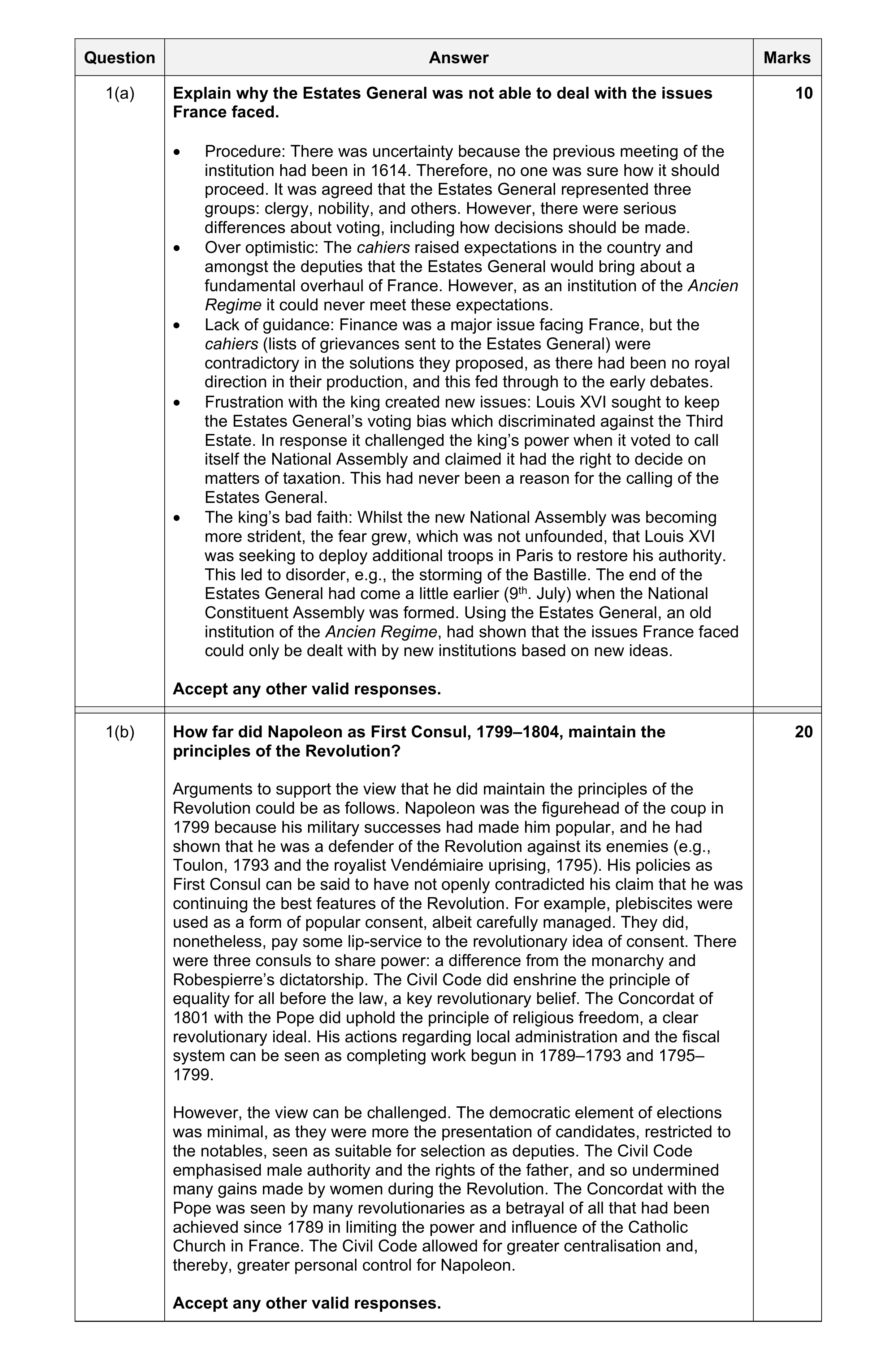 30
30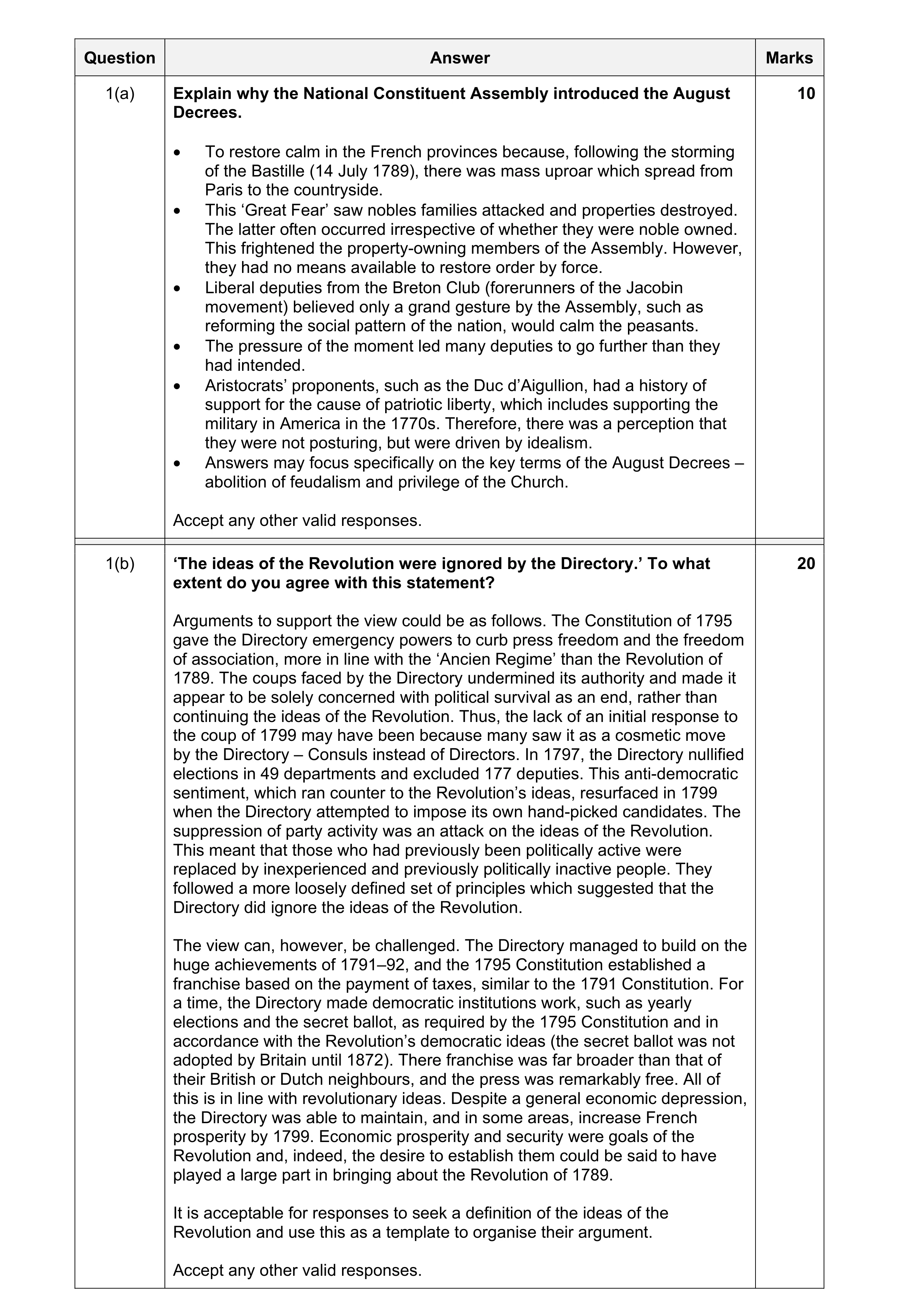 30
30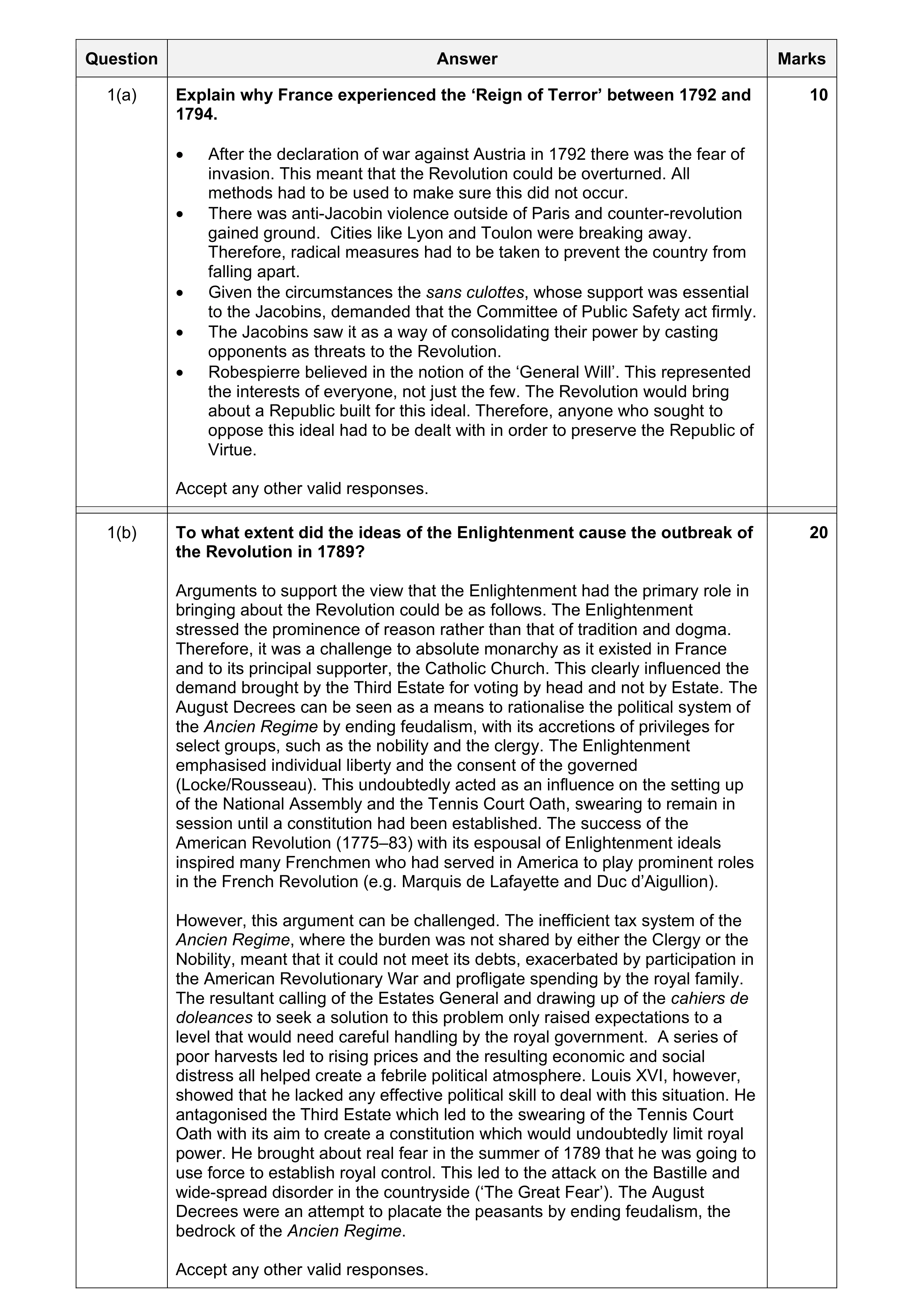 30
30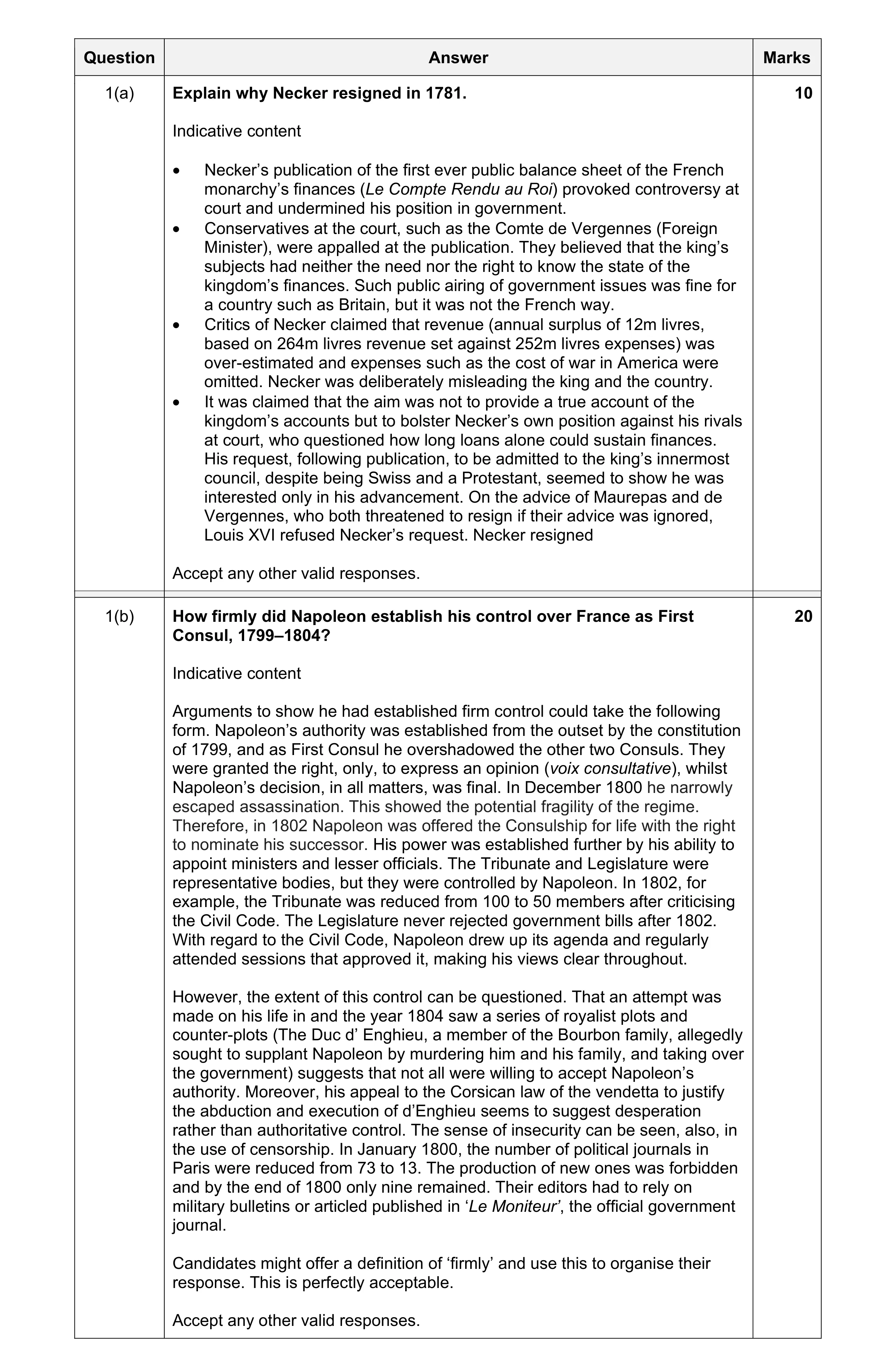 30
30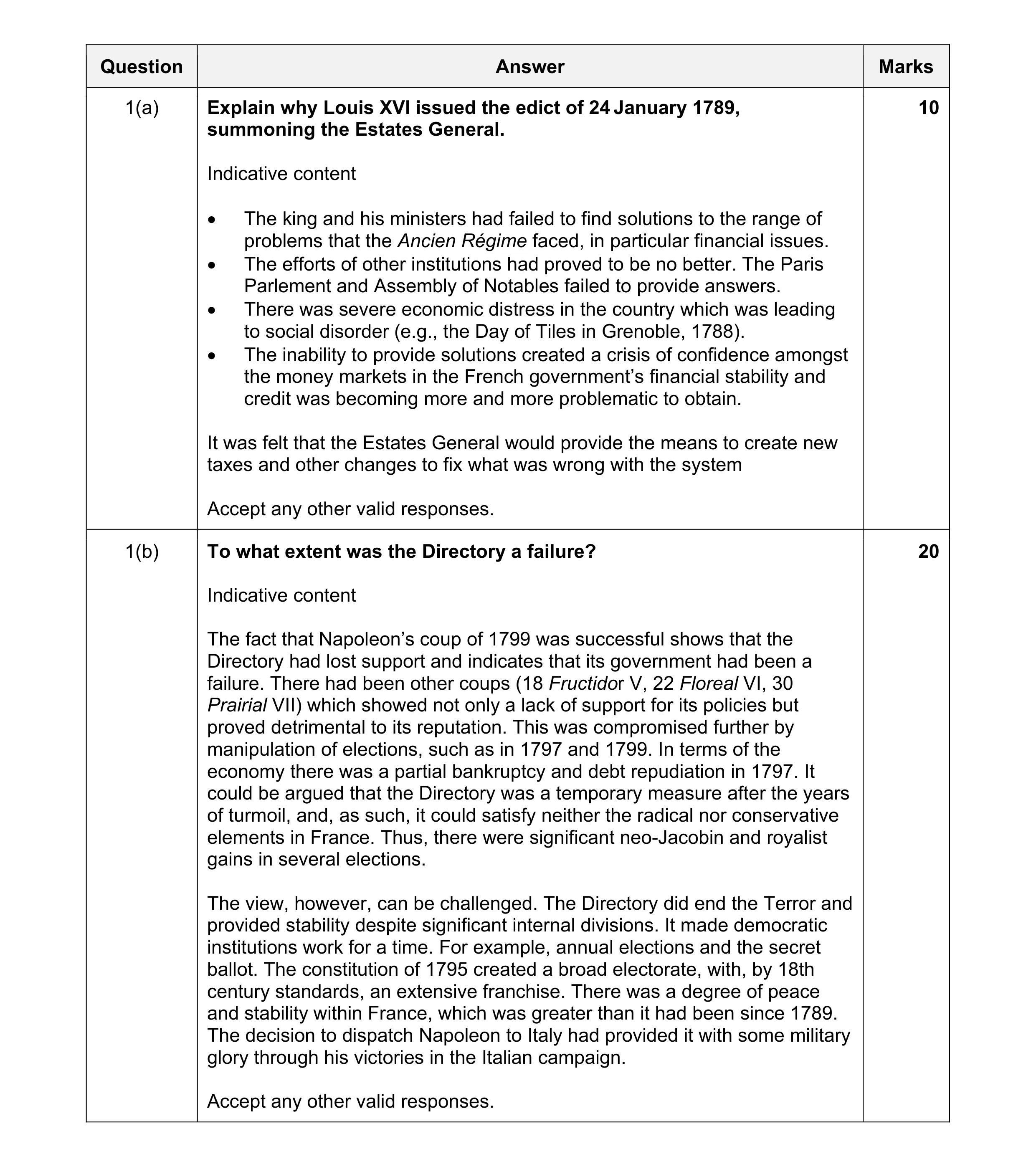 30
30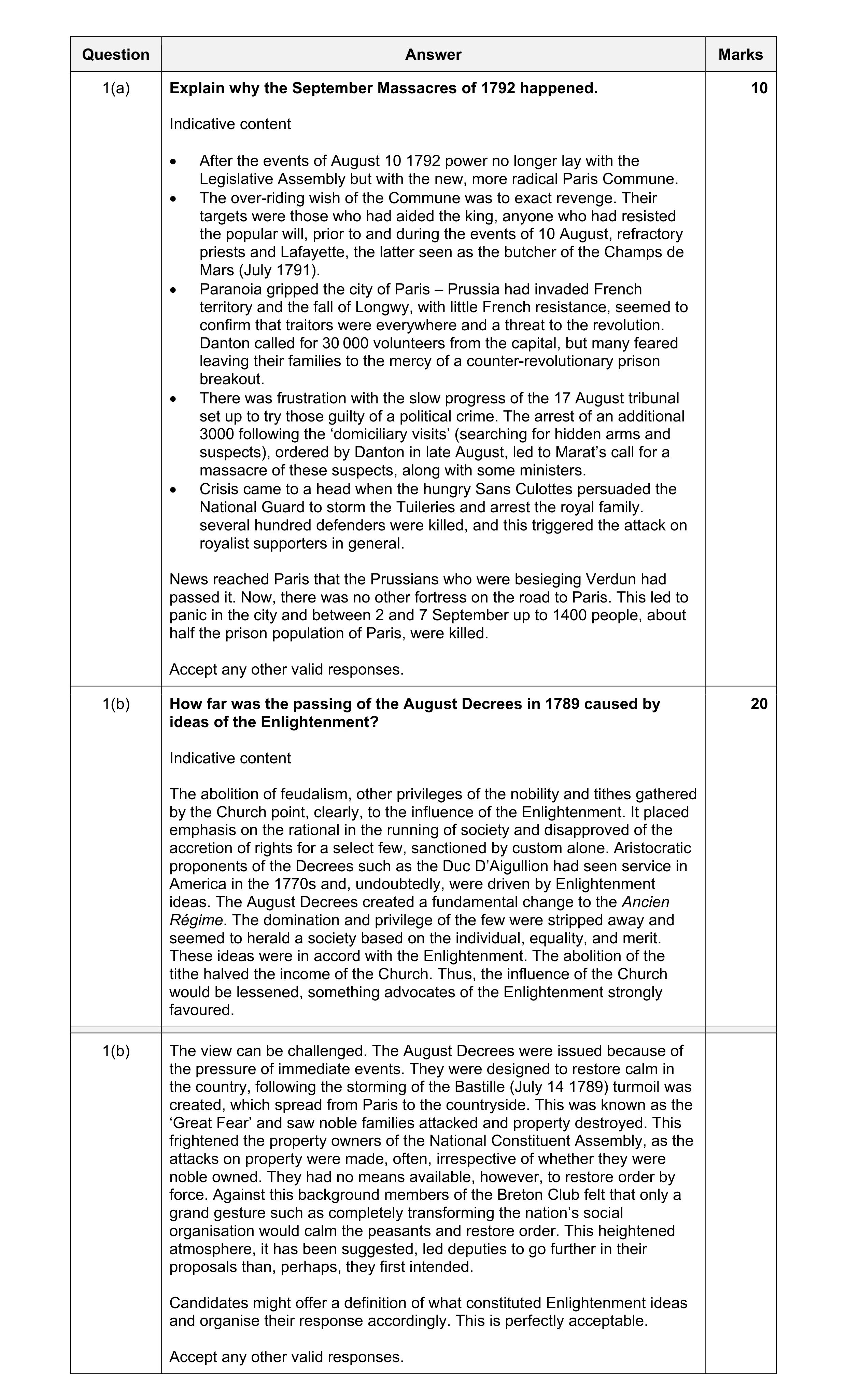 30
30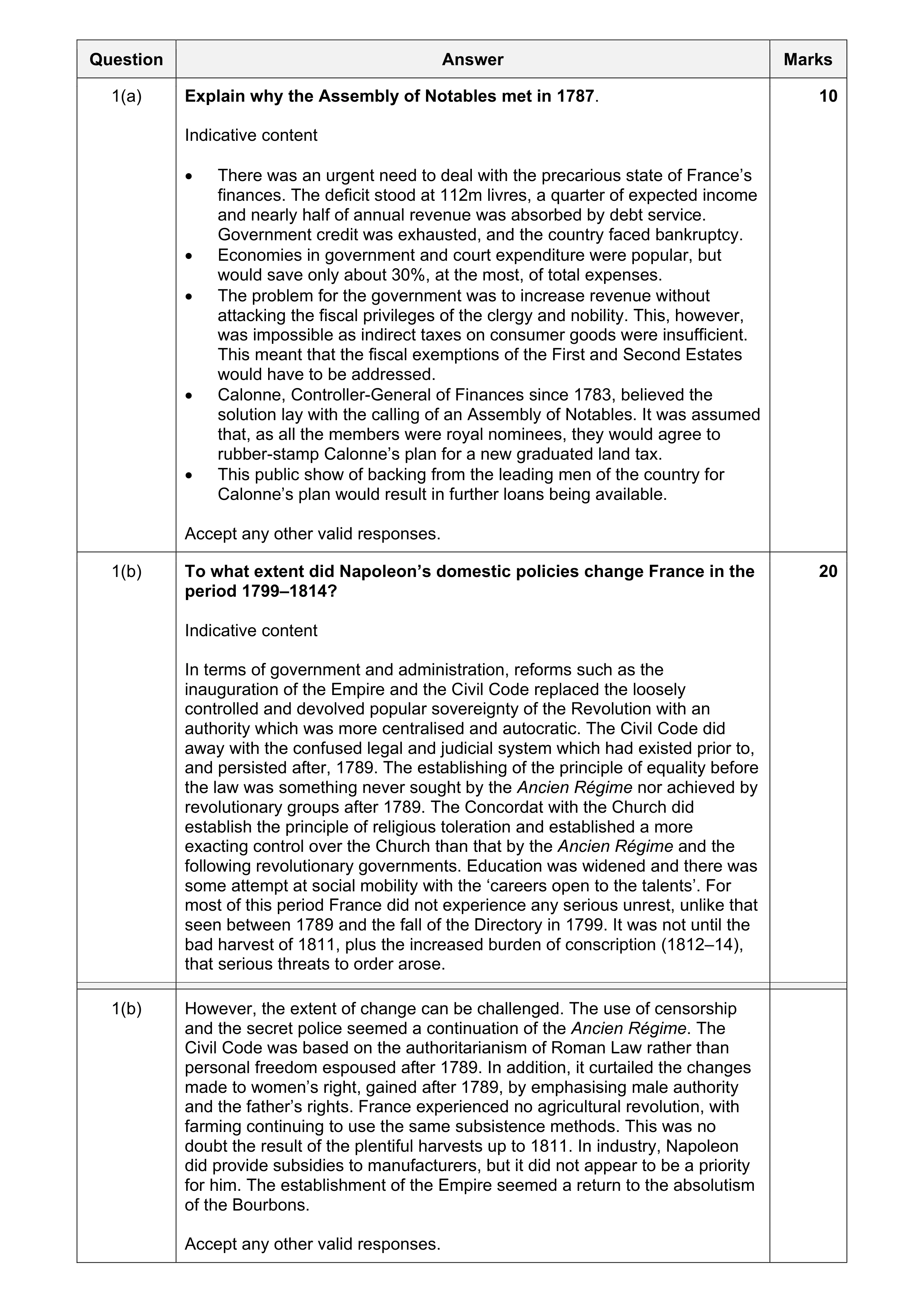 30
30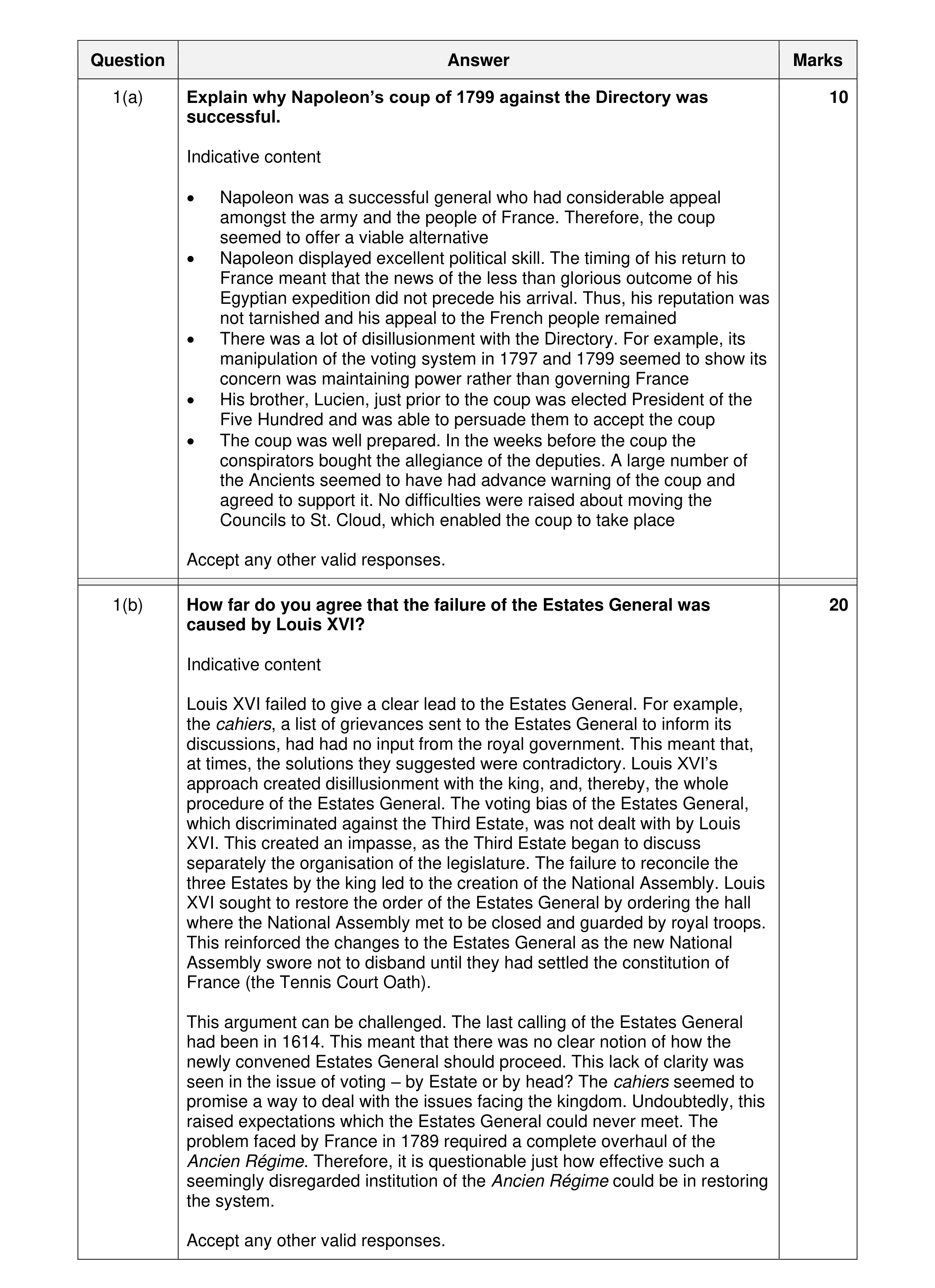 30
30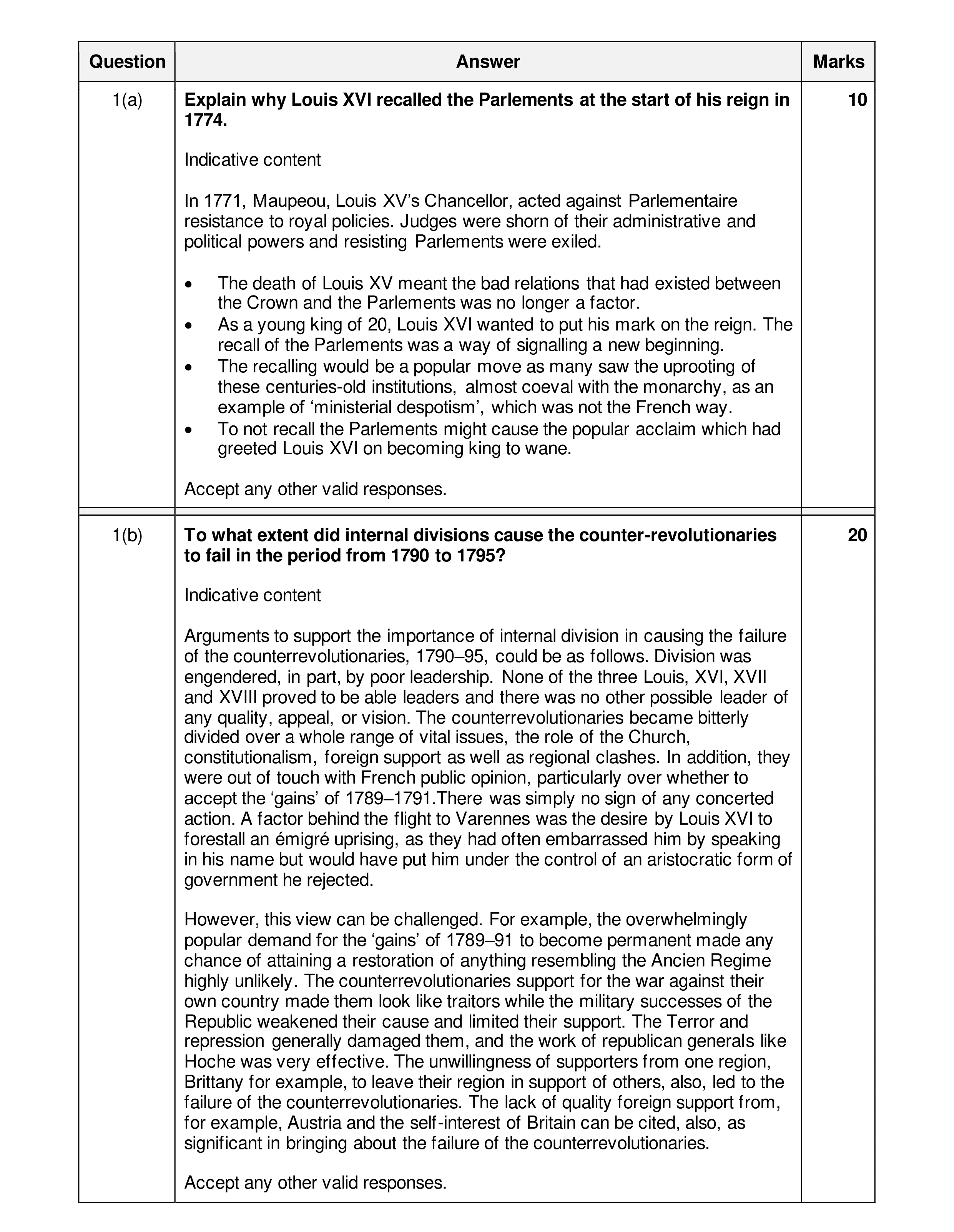 30
30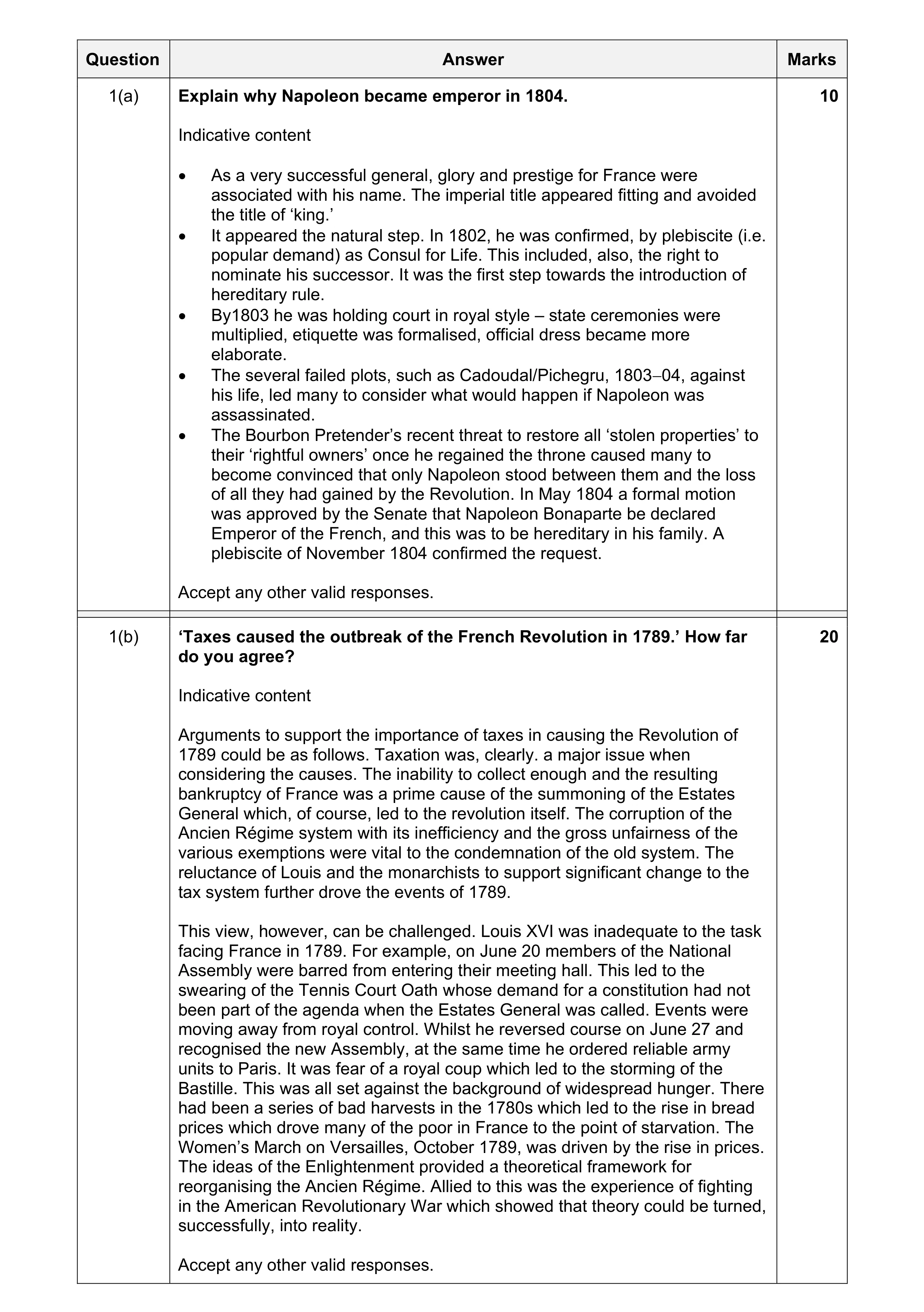 30
30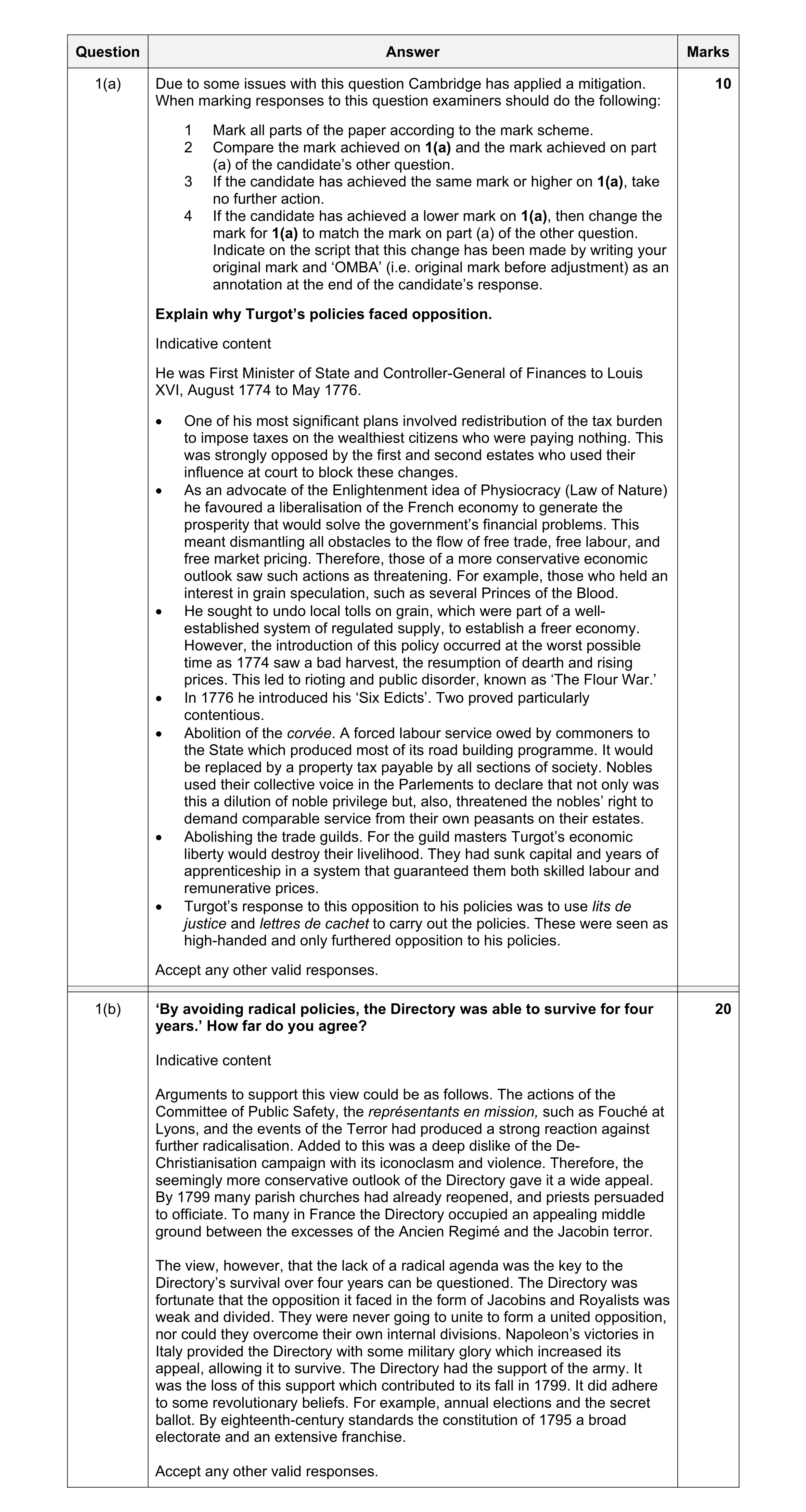 30
30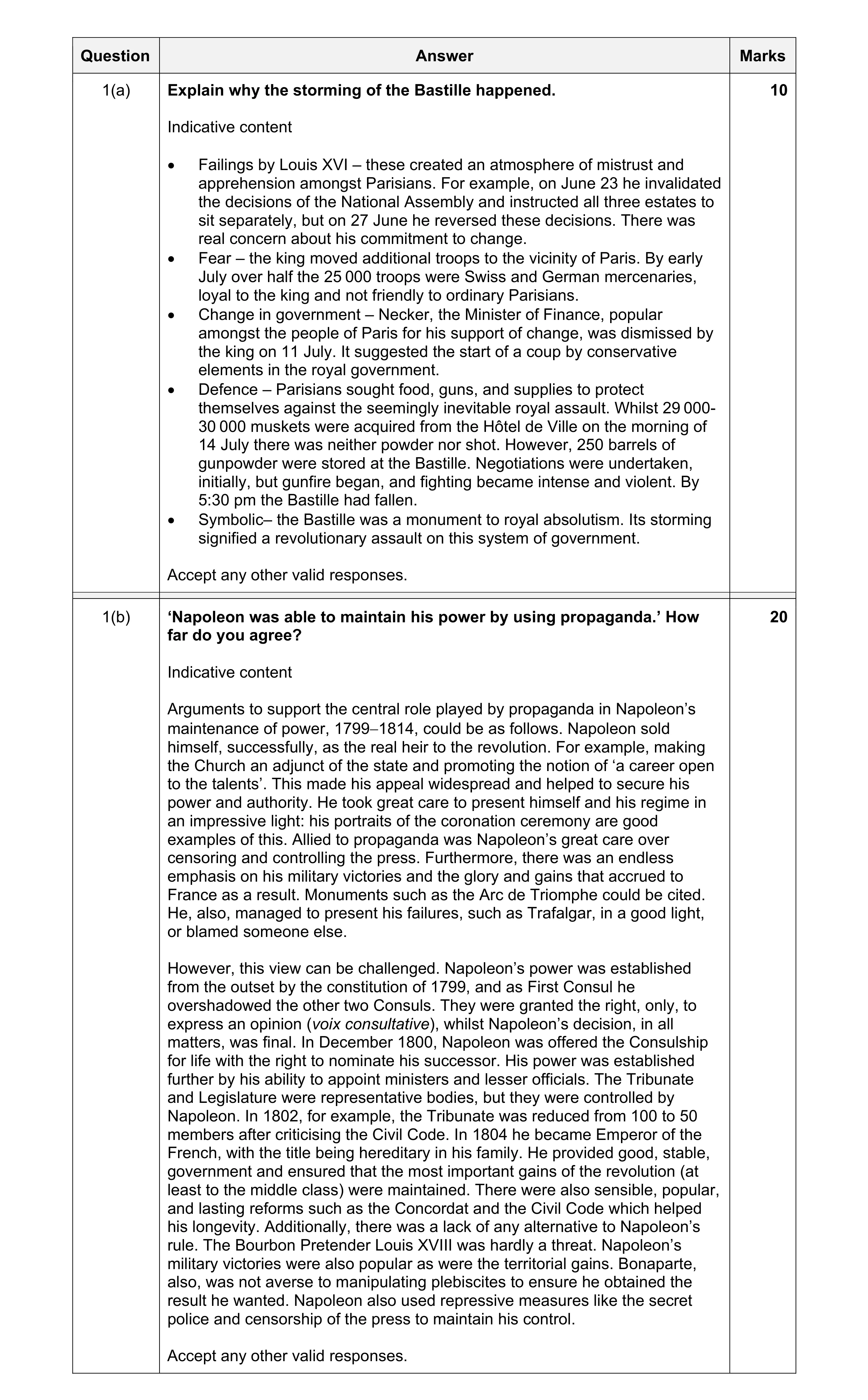 30
30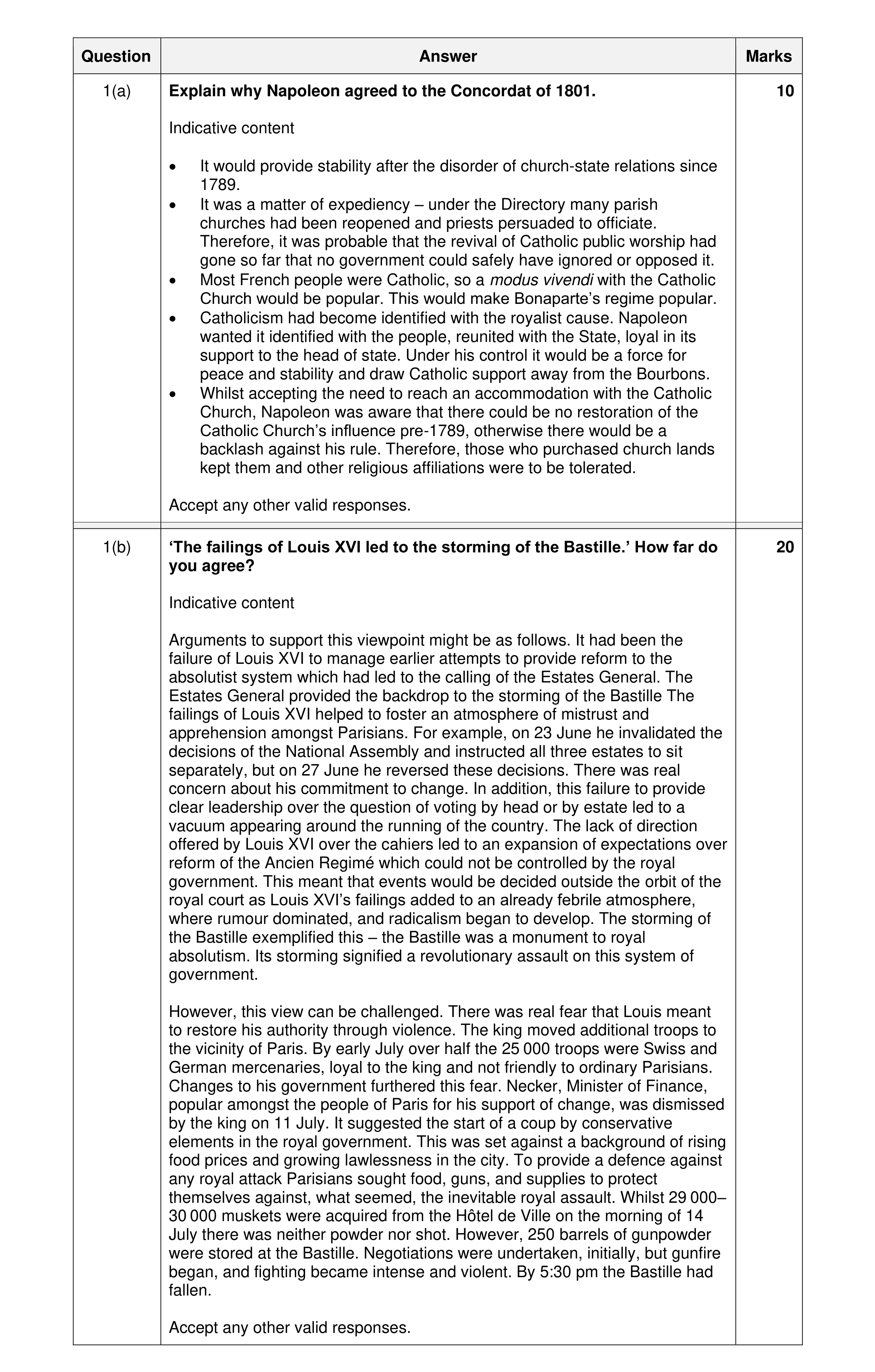 30
30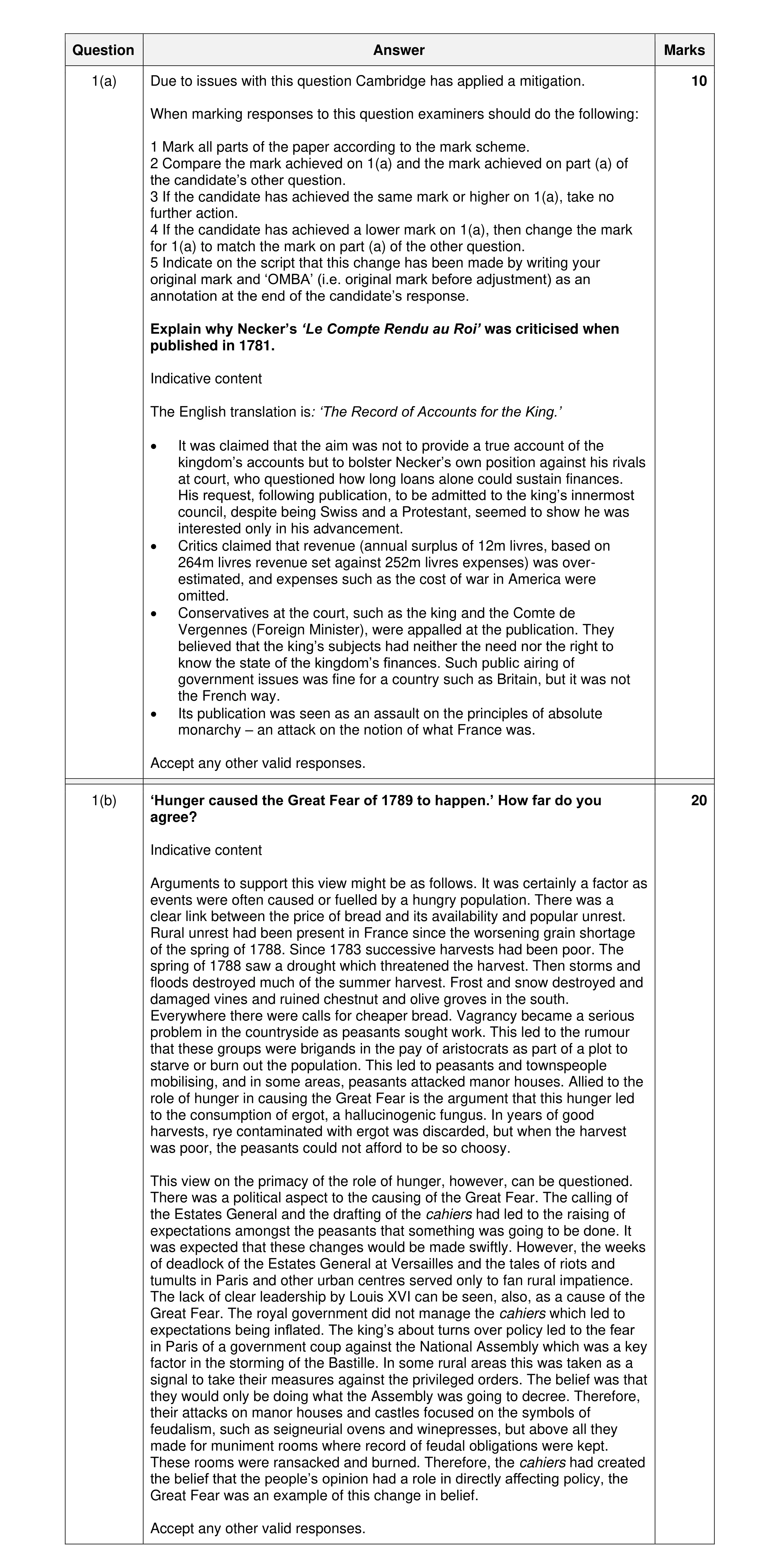 30
30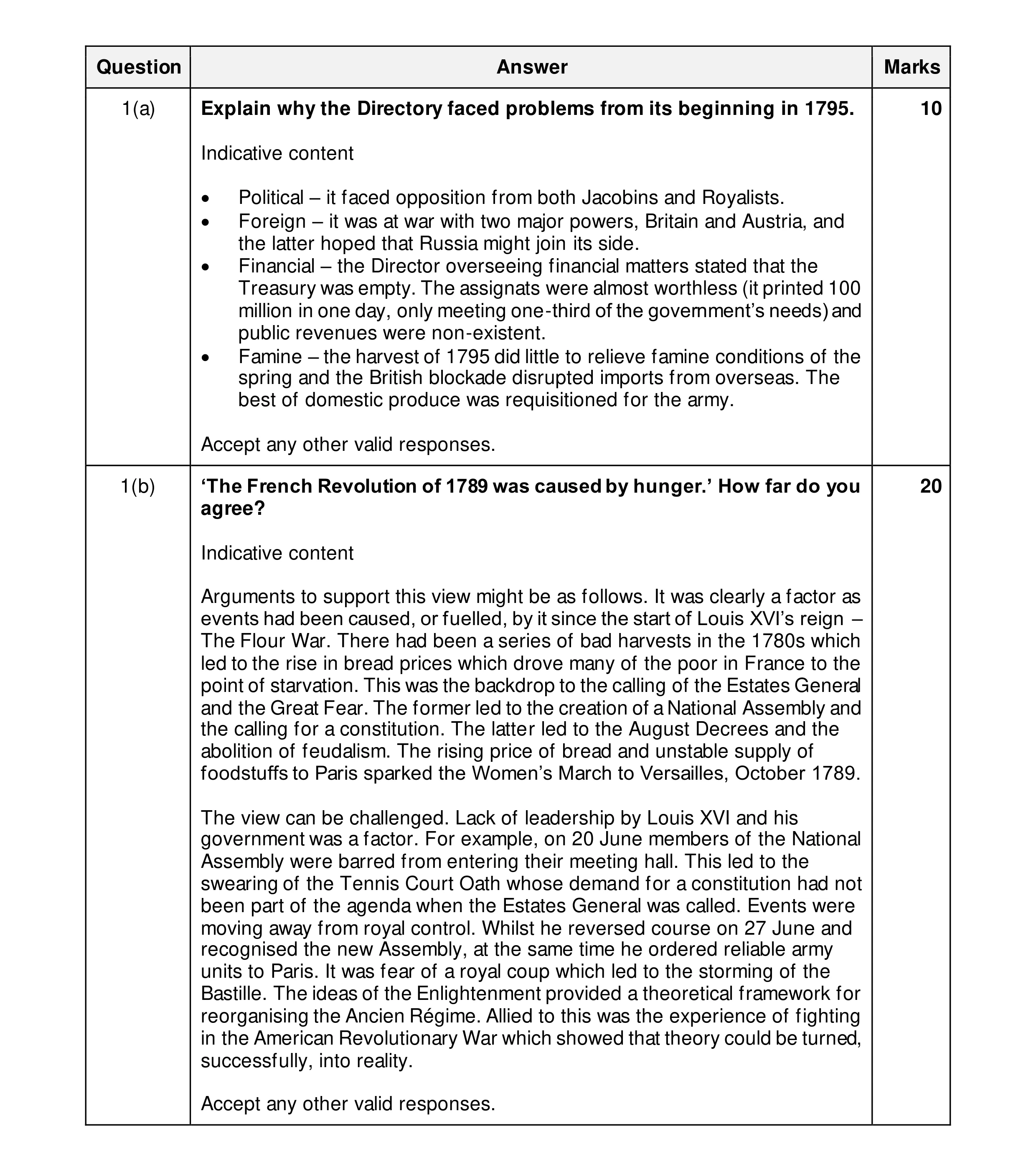 30
30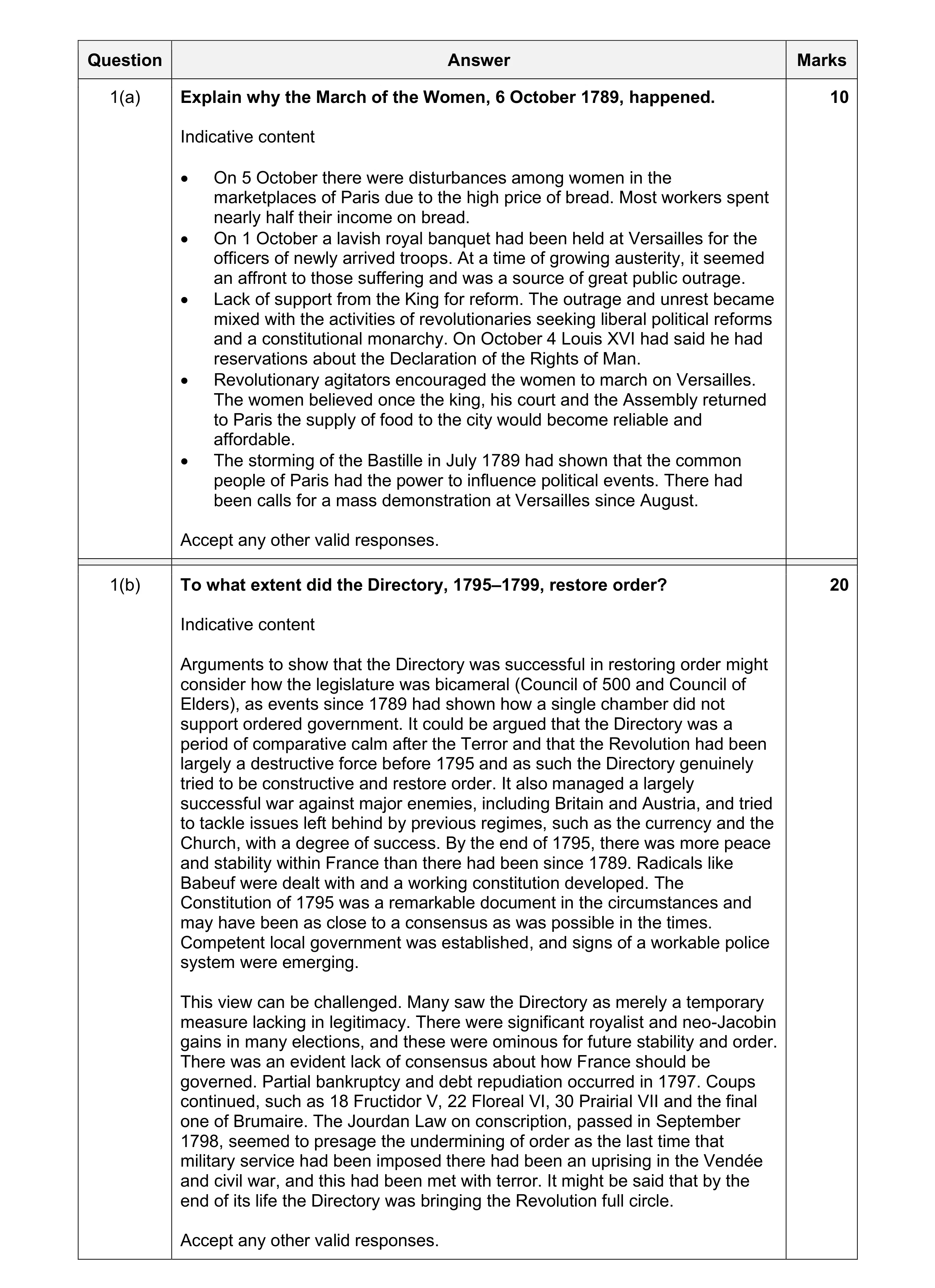 30
30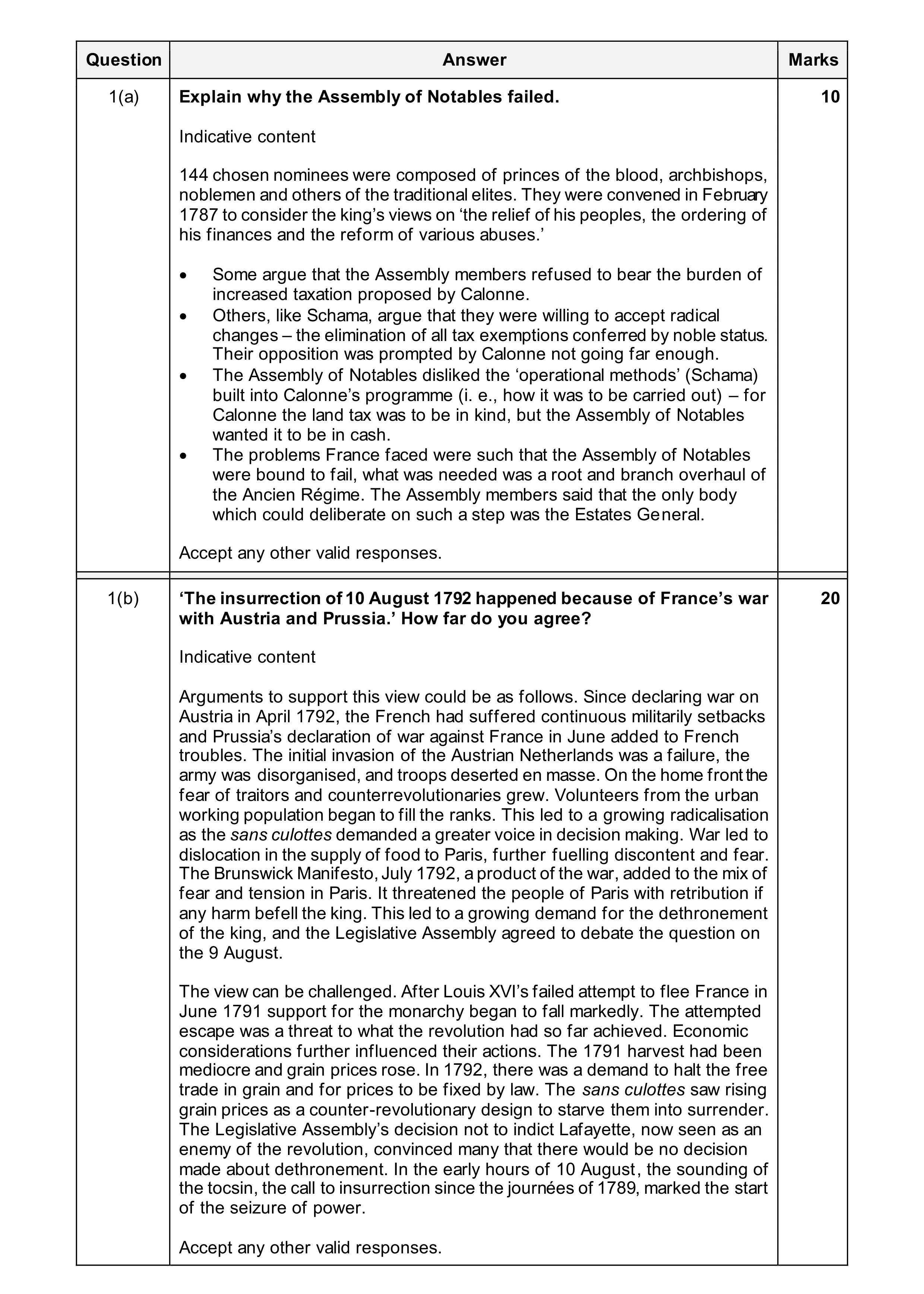 30
30