Questions as text
Q1 · Which is not a policy designed to correct market failure? 9708/31 Oct/Nov 2010
14 Which is not a policy designed to correct market failure? A competition policy B free inoculation against infectious diseases C minimum wage policy D regulations to limit river pollution
1 marks
Answer: C
This question in 9708/31 Oct/Nov 2010
Q2 · Which is not a policy designed to correct market failure? 9708/32 Oct/Nov 2010
14 Which is not a policy designed to correct market failure? A competition policy B free inoculation against infectious diseases C minimum wage policy D regulations to limit river pollution
1 marks
Answer: C
This question in 9708/32 Oct/Nov 2010
Q3 · Which is not a policy designed to correct market failure? 9708/33 Oct/Nov 2010
13 Which is not a policy designed to correct market failure? A competition policy B free inoculation against infectious diseases C minimum wage policy D regulations to limit river pollution
1 marks
Answer: C
This question in 9708/33 Oct/Nov 2010
Q4 · The diagram shows the private and social marginal costs and benefits at different volumes… 9708/31 May/June 2011
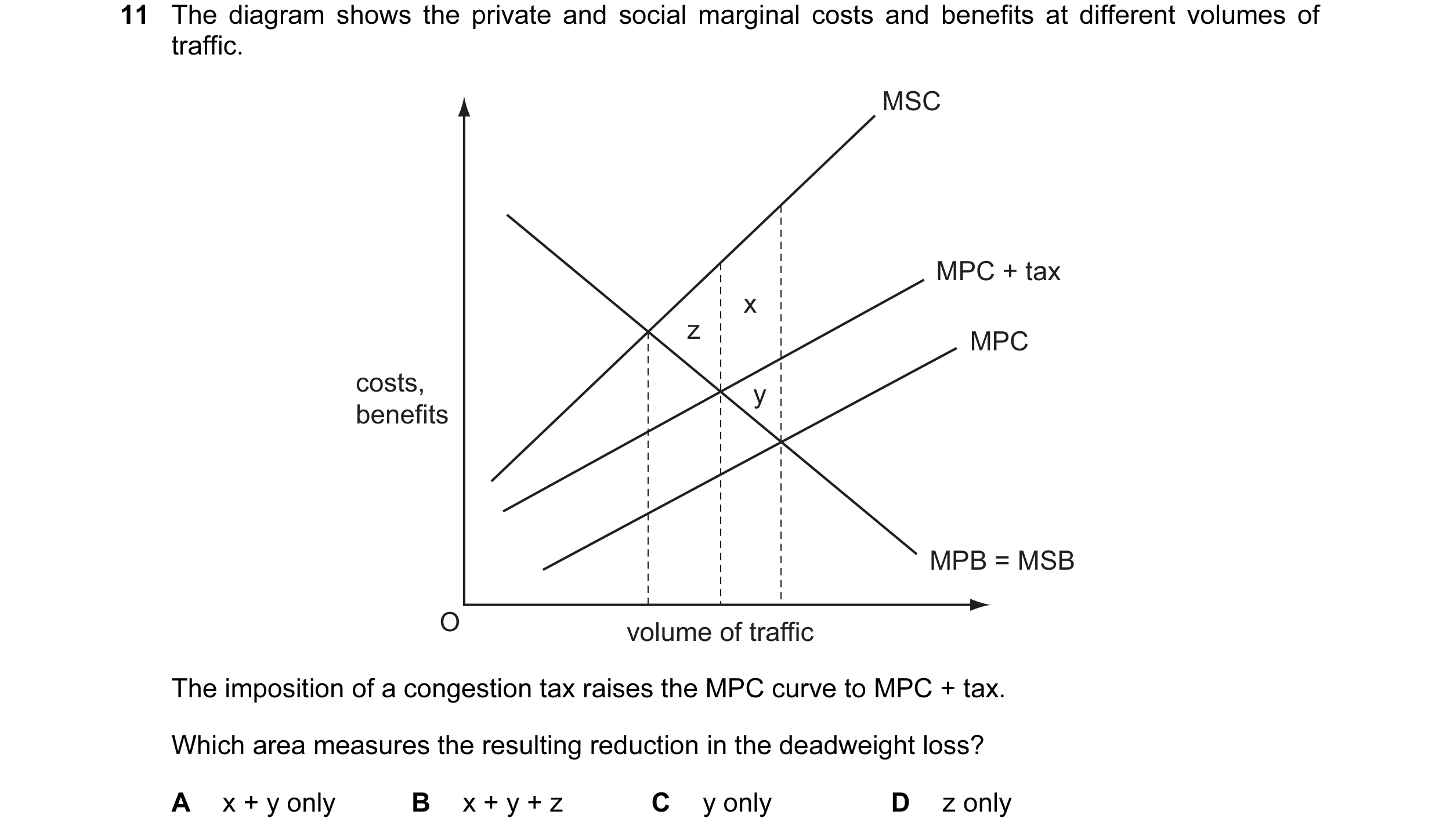
11 The diagram shows the private and social marginal costs and benefits at different volumes of traffic. MSC MPC + tax x z MPC costs, y benefits MPB = MSB O volume of tra f fi c The imposition of a congestion tax raises the MPC curve to MPC + tax. Which area measures the resulting reduction in the deadweight loss? A x + y only B x + y + z C y only D z only
1 marks
Answer: A
This question in 9708/31 May/June 2011
Q5 · The diagram shows the private and social marginal costs and benefits at different volumes… 9708/32 May/June 2011
10 The diagram shows the private and social marginal costs and benefits at different volumes of traffic. MSC MPC + tax x z MPC costs, y benefits MPB = MSB O volume of tra f fi c The imposition of a congestion tax raises the MPC curve to MPC + tax. Which area measures the resulting reduction in the deadweight loss? A x + y only B x + y + z C y only D z only
1 marks
Answer: A
This question in 9708/32 May/June 2011
Q6 · A government imposes a maximum price for electricity 9708/32 May/June 2011
11 A government imposes a maximum price for electricity. Which statement justifying this measure might be considered valid on economic grounds? A It will encourage electricity suppliers to invest in additional capacity. B It will increase the incentive for consumers to conserve energy. C It will prevent the monopolistic exploitation of consumers. D It will prevent the rationing of electricity through power cuts.
1 marks
Answer: C
This question in 9708/32 May/June 2011
Q7 · The diagram shows the private and social marginal costs and benefits at different volumes… 9708/33 May/June 2011
10 The diagram shows the private and social marginal costs and benefits at different volumes of traffic. MSC MPC + tax x z MPC costs, y benefits MPB = MSB O volume of tra f fi c The imposition of a congestion tax raises the MPC curve to MPC + tax. Which area measures the resulting reduction in the deadweight loss? A x + y only B x + y + z C y only D z only
1 marks
Answer: A
This question in 9708/33 May/June 2011
Q8 · What would economists agree should be the aim of any health care system? 9708/32 Oct/Nov 2011
13 What would economists agree should be the aim of any health care system? A to meet all the health care demands of the population B to provide every patient with the latest and best available treatment C to provide free medical treatment D to secure the maximum health gain from the resources available
1 marks
Answer: D
This question in 9708/32 Oct/Nov 2011
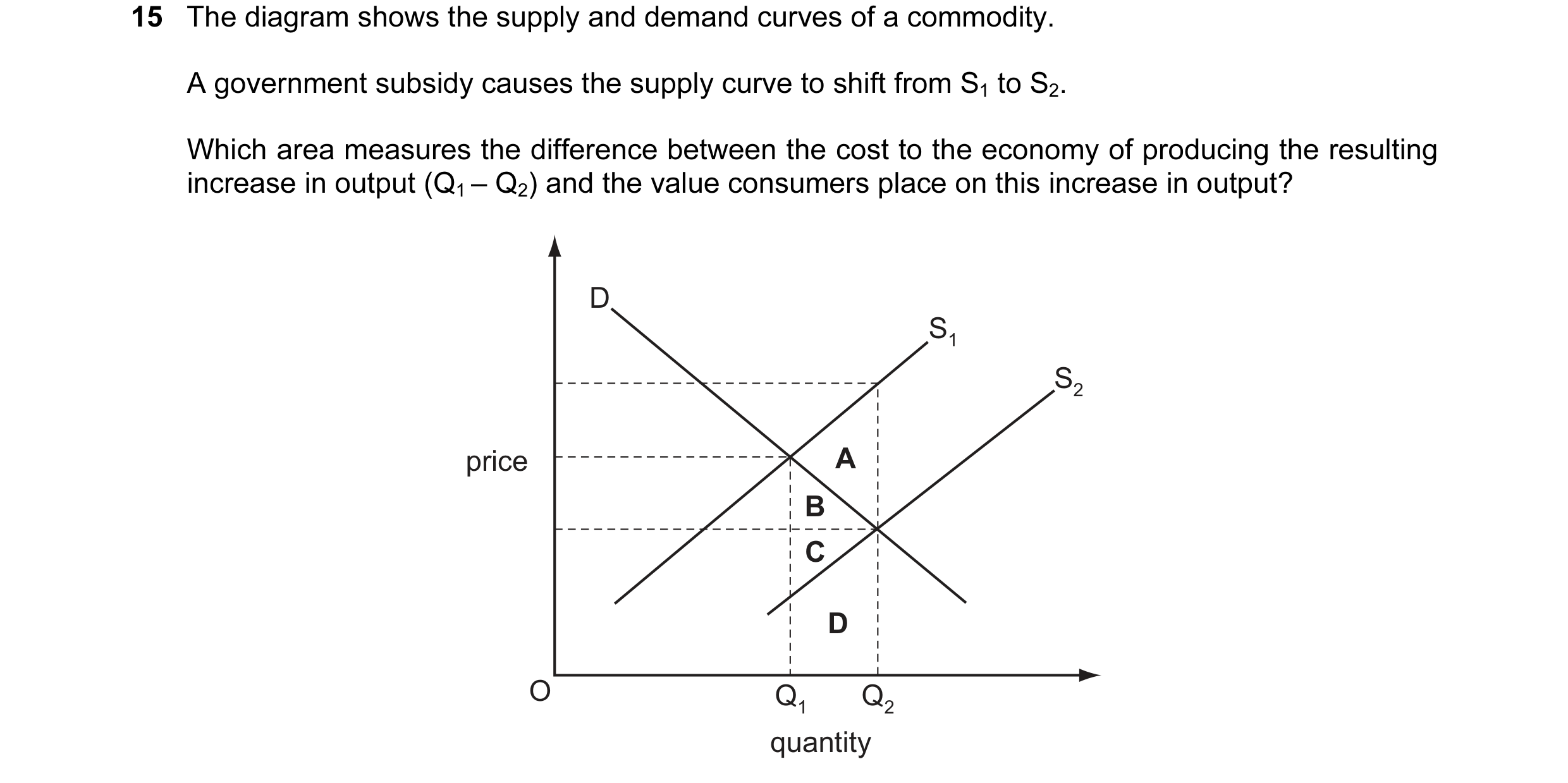
Q9 · The diagram shows the supply and demand curves of a commodity 9708/32 Oct/Nov 2011
15 The diagram shows the supply and demand curves of a commodity. A government subsidy causes the supply curve to shift from S1 to S2. Which area measures the difference between the cost to the economy of producing the resulting increase in output (Q1 – Q2) and the value consumers place on this increase in output? D S1 S2 price A B C D O Q1 Q2 quantity
1 marks
Answer: A
This question in 9708/32 Oct/Nov 2011
Q10 · A government decides to privatise a state monopoly 9708/31 May/June 2012
15 A government decides to privatise a state monopoly. What should the government do to try to ensure that this will result in an improvement in efficiency? A allocate vouchers to all citizens entitling them to a share in the ownership of the monopoly B encourage competition C impose a maximum profit margin D privatise the monopoly as a going concern
1 marks
Answer: B
This question in 9708/31 May/June 2012
Q11 · A government decides to privatise a state monopoly 9708/33 May/June 2012
15 A government decides to privatise a state monopoly. What should the government do to try to ensure that this will result in an improvement in efficiency? A allocate vouchers to all citizens entitling them to a share in the ownership of the monopoly B encourage competition C impose a maximum profit margin D privatise the monopoly as a going concern
1 marks
Answer: B
This question in 9708/33 May/June 2012
Q12 · What will happen if a firm is subsidised by an amount equal to the external benefits that… 9708/32 Oct/Nov 2012
1 What will happen if a firm is subsidised by an amount equal to the external benefits that it confers on the rest of society? A There will be no effect upon production. B The firm will produce less. C There will be a misallocation of resources. D Resource allocation will be improved.
1 marks
Answer: D
This question in 9708/32 Oct/Nov 2012
Q13 · At present, a monopolist is required by the industry regulator to charge a price equal to… 9708/33 Oct/Nov 2012
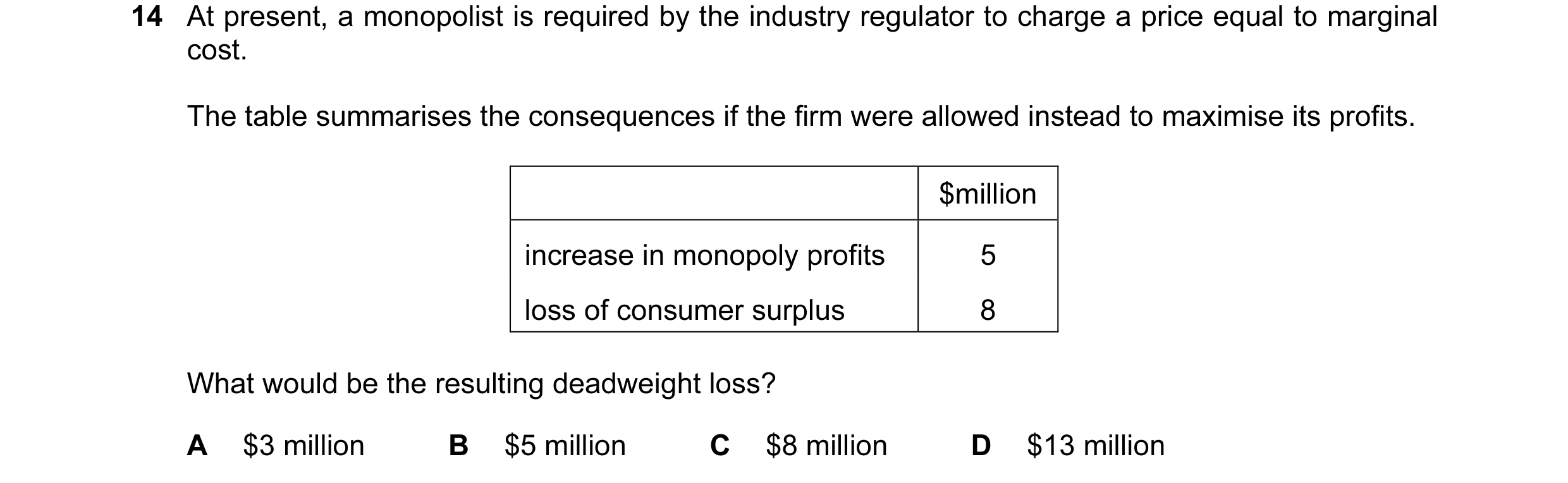
14 At present, a monopolist is required by the industry regulator to charge a price equal to marginal cost. The table summarises the consequences if the firm were allowed instead to maximise its profits. $million increase in monopoly profits 5 loss of consumer surplus 8 What would be the resulting deadweight loss? A $3 million B $5 million C $8 million D $13 million
1 marks
This question in 9708/33 Oct/Nov 2012
Q14 · The government introduces a congestion charge on motorists who drive their vehicles… 9708/33 Oct/Nov 2012
15 The government introduces a congestion charge on motorists who drive their vehicles within a designated urban zone. What will be the impact on the overall economic welfare of those who continue to use their cars and on those who switch to travelling by bus? impact on those who impact on those who continue to use their cars switch to buses A loss uncertain B loss loss C uncertain loss D uncertain uncertain
1 marks
This question in 9708/33 Oct/Nov 2012
Q15 · A government regulates the price charged by a monopolist 9708/31 Oct/Nov 2013
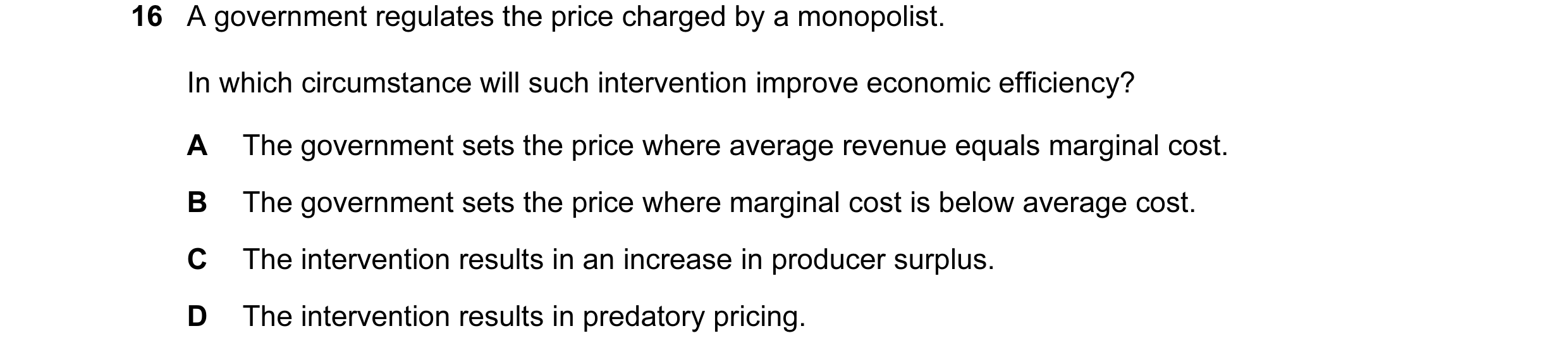
16 A government regulates the price charged by a monopolist. In which circumstance will such intervention improve economic efficiency? A The government sets the price where average revenue equals marginal cost. B The government sets the price where marginal cost is below average cost. C The intervention results in an increase in producer surplus. D The intervention results in predatory pricing.
1 marks
Answer: A
This question in 9708/31 Oct/Nov 2013
Q16 · The diagram shows the initial cost and revenue curves of a profit-maximising monopolist 9708/32 Oct/Nov 2013
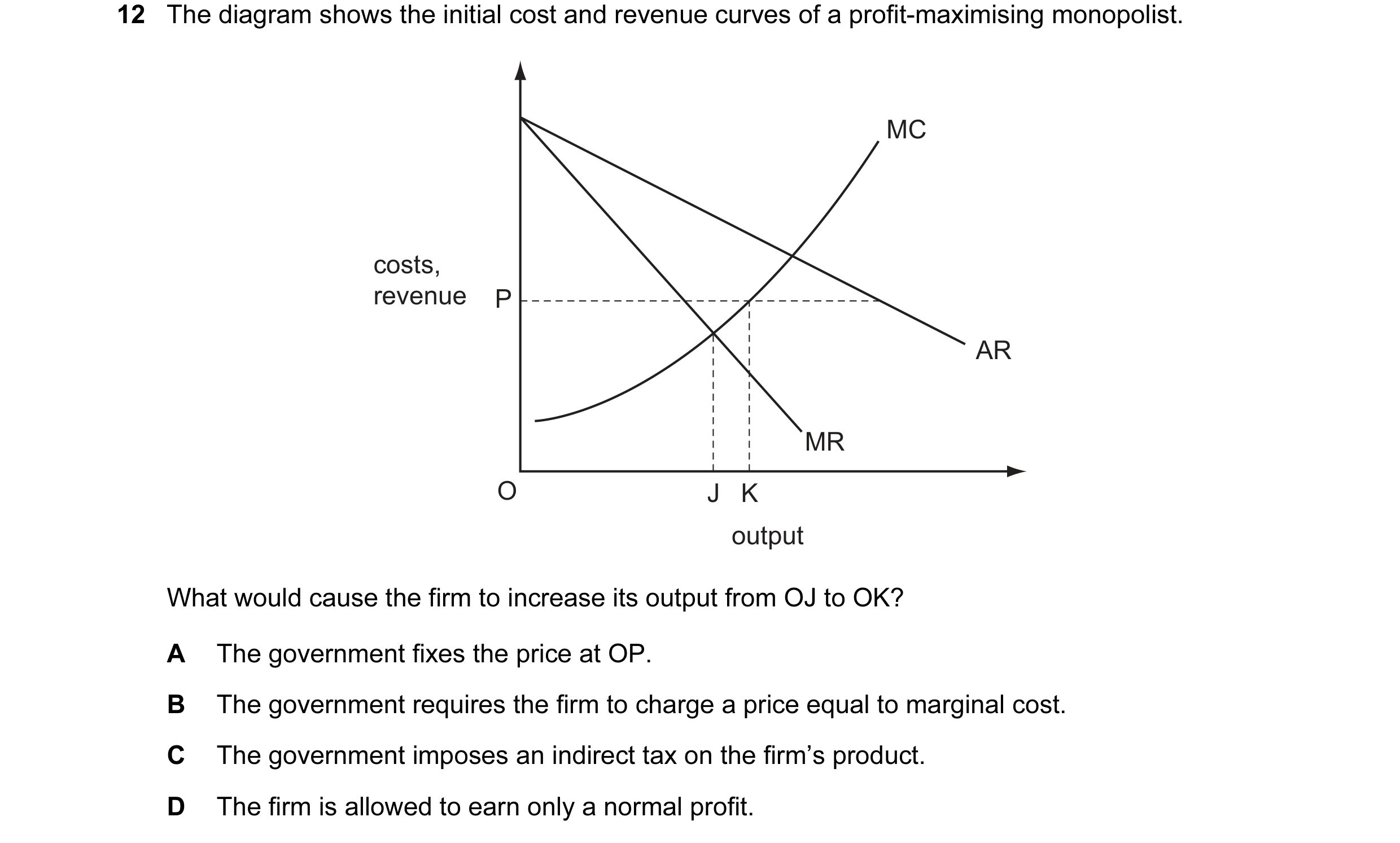
12 The diagram shows the initial cost and revenue curves of a profit-maximising monopolist. MC costs, revenue P AR MR O J K output What would cause the firm to increase its output from OJ to OK? A The government fixes the price at OP. B The government requires the firm to charge a price equal to marginal cost. C The government imposes an indirect tax on the firm’s product. D The firm is allowed to earn only a normal profit.
1 marks
Answer: A
This question in 9708/32 Oct/Nov 2013
Q17 · The firms in a perfectly competitive industry combine to form a monopoly 9708/32 Oct/Nov 2013
16 The firms in a perfectly competitive industry combine to form a monopoly. What would prevent a deadweight welfare loss resulting? A The government imposes an indirect tax on the monopolist’s product. B The government requires the monopolist to charge a price equal to average cost. C The monopolist adopts marginal cost pricing. D The monopolist charges the same price to all consumers.
1 marks
Answer: C
This question in 9708/32 Oct/Nov 2013
Q18 · In the diagram, D is the demand curve for cigarettes, S is the supply curve and MSC is… 9708/31 May/June 2015
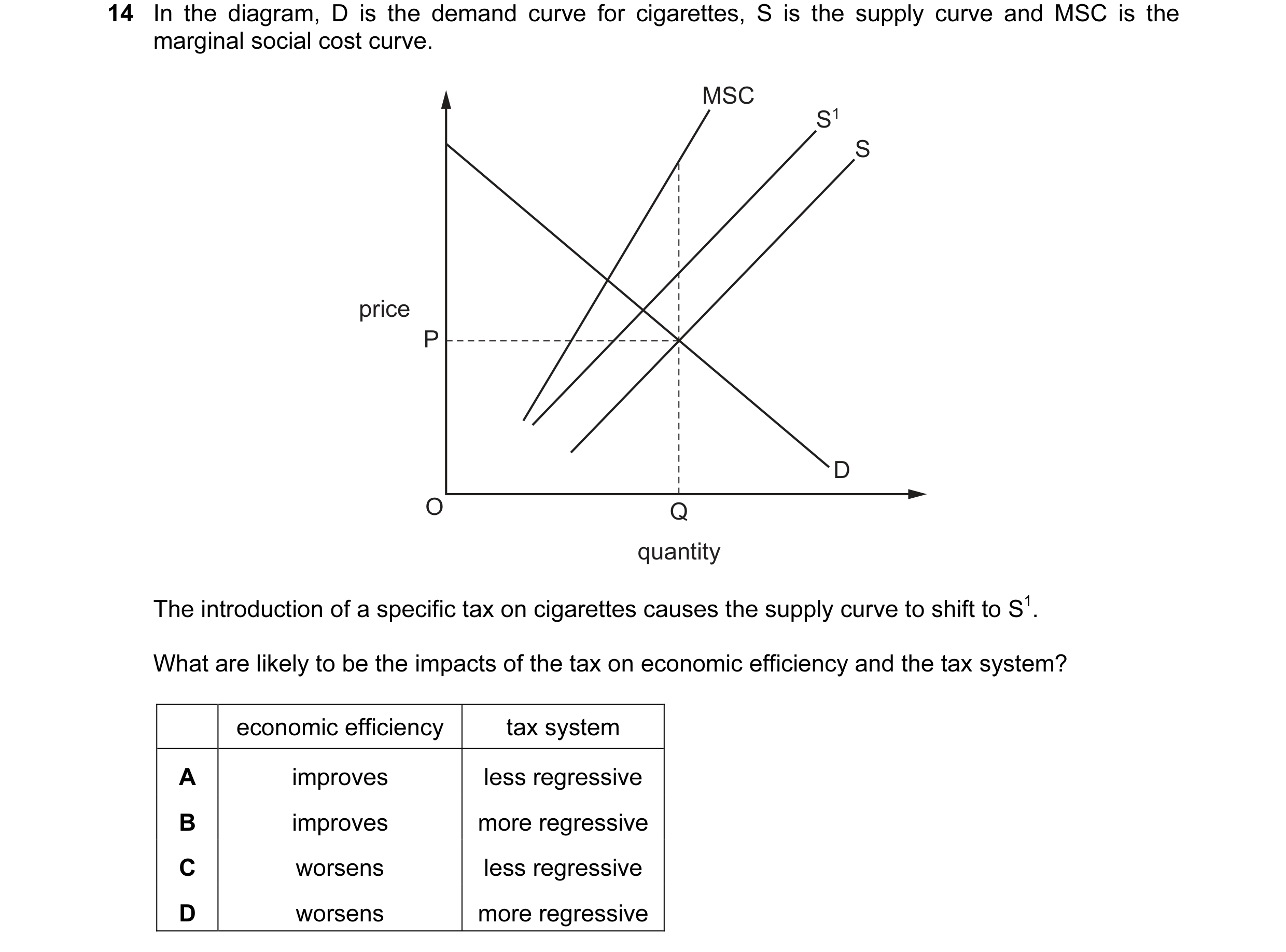
14 In the diagram, D is the demand curve for cigarettes, S is the supply curve and MSC is the marginal social cost curve. MSC S1 S price P D O Q quantity The introduction of a specific tax on cigarettes causes the supply curve to shift to S1. What are likely to be the impacts of the tax on economic efficiency and the tax system? economic efficiency tax system A improves less regressive B improves more regressive C worsens less regressive D worsens more regressive
1 marks
Answer: B
This question in 9708/31 May/June 2015
Q19 · In order to reduce milk production, all producers are given a quota which limits the… 9708/31 May/June 2015
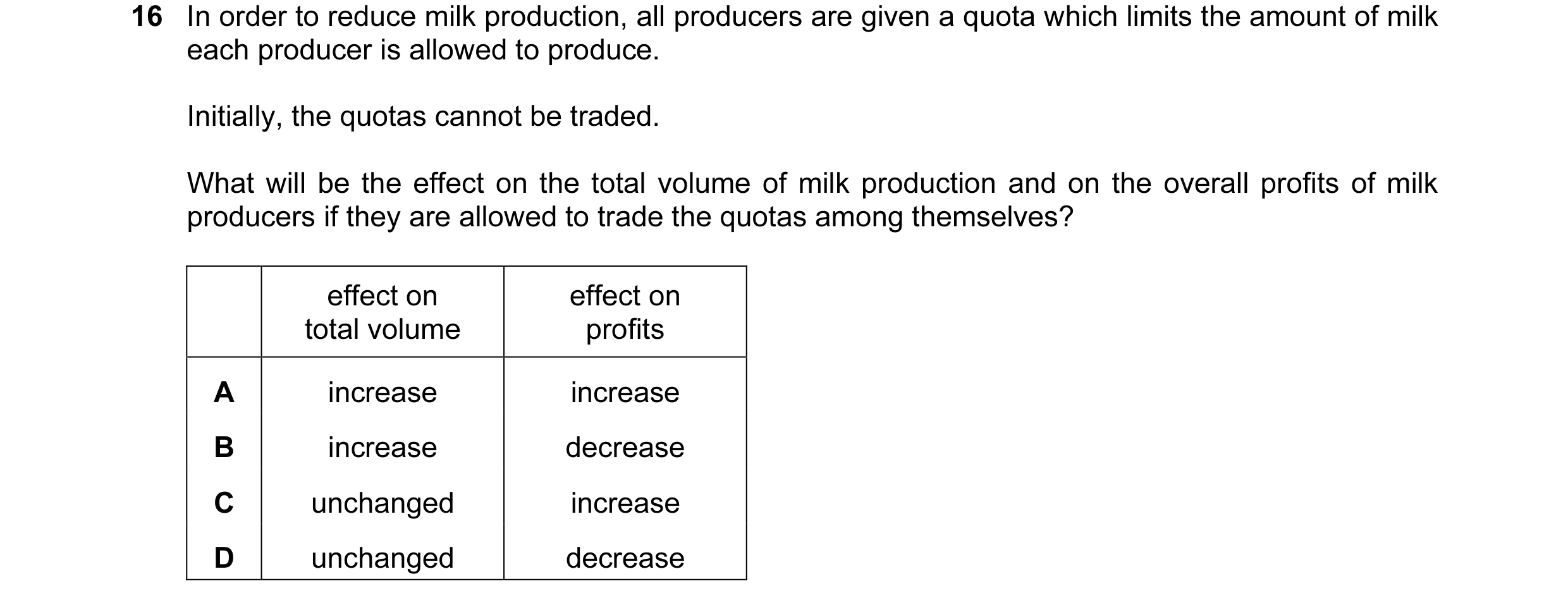
16 In order to reduce milk production, all producers are given a quota which limits the amount of milk each producer is allowed to produce. Initially, the quotas cannot be traded. What will be the effect on the total volume of milk production and on the overall profits of milk producers if they are allowed to trade the quotas among themselves? effect on effect on total volume profits A increase increase B increase decrease C unchanged increase D unchanged decrease
1 marks
Answer: C
This question in 9708/31 May/June 2015
Q20 · Which government policy would not be classified as regulation? 9708/32 May/June 2015
17 Which government policy would not be classified as regulation? A bans on heroin and cocaine consumption B compulsory wearing of seatbelts in cars and coaches C licences for the extraction of water from lakes and rivers D taxation of cigarettes and tobacco products
1 marks
Answer: D
This question in 9708/32 May/June 2015
Q21 · At present, motorists who drive their cars within area 1 on the map pay a daily… 9708/31 Oct/Nov 2015
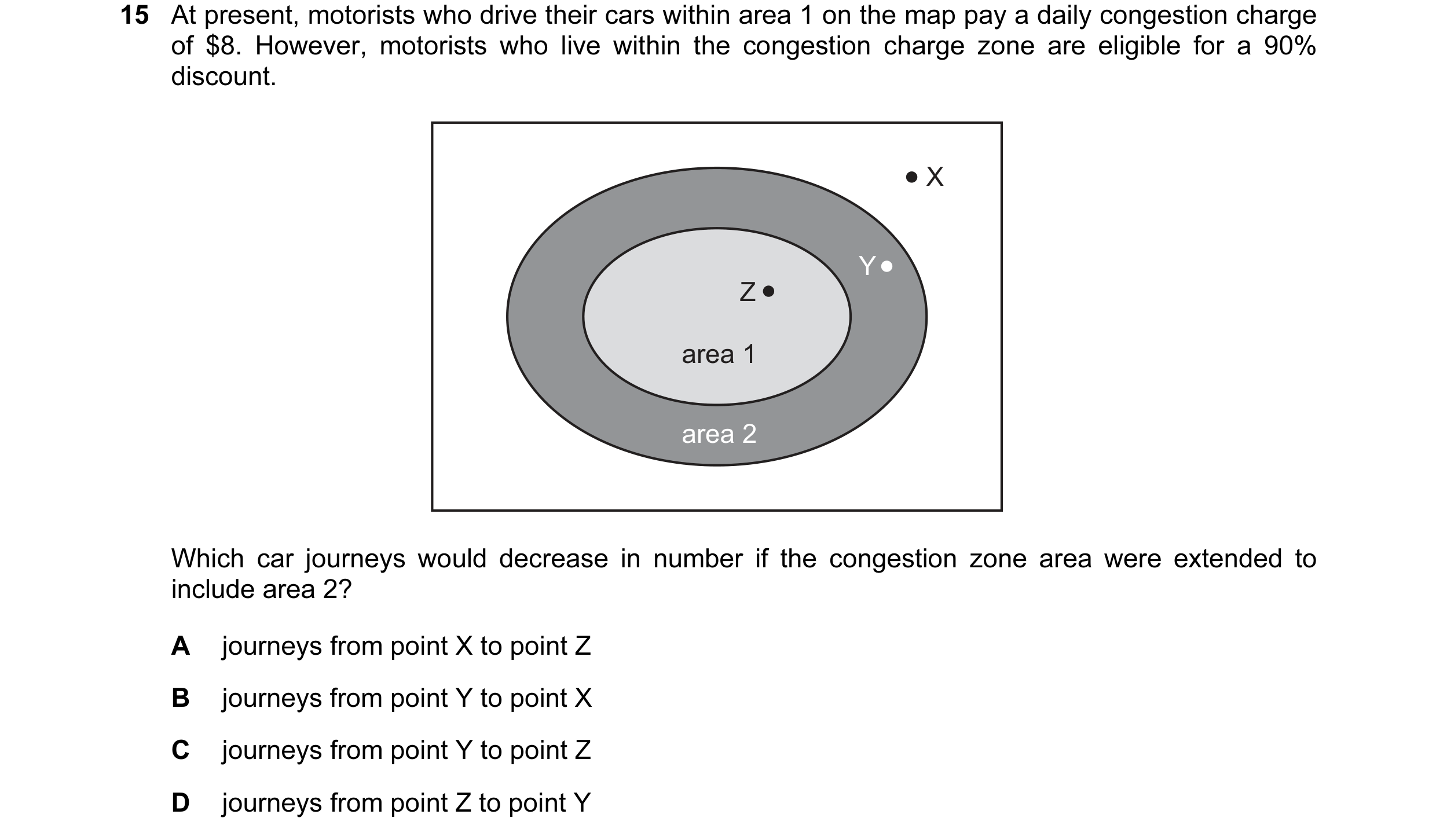
15 At present, motorists who drive their cars within area 1 on the map pay a daily congestion charge of $8. However, motorists who live within the congestion charge zone are eligible for a 90% discount. X Y Z area 1 area 2 Which car journeys would decrease in number if the congestion zone area were extended to include area 2? A journeys from point X to point Z B journeys from point Y to point X C journeys from point Y to point Z D journeys from point Z to point Y
1 marks
This question in 9708/31 Oct/Nov 2015
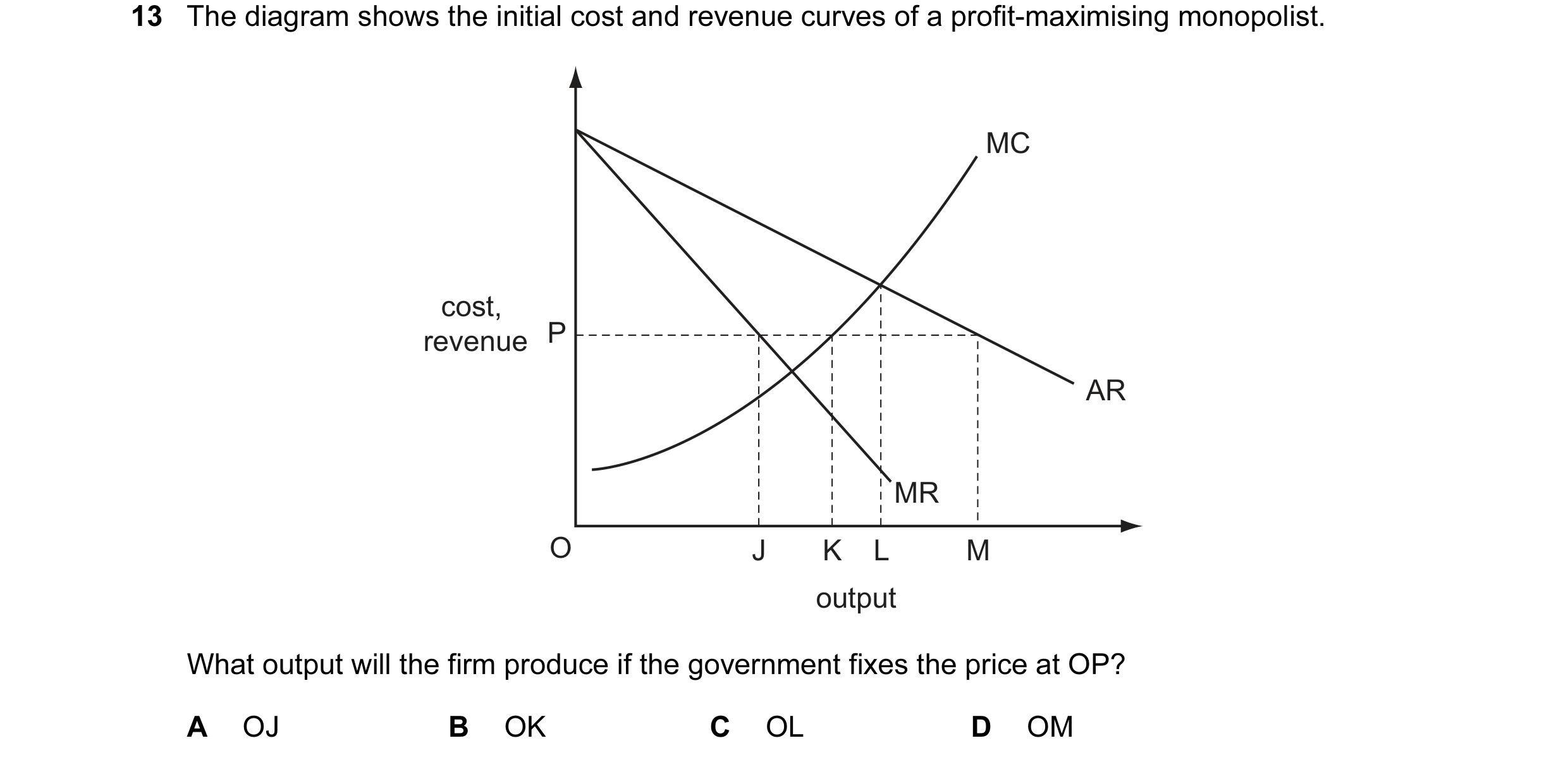
Q22 · The diagram shows the initial cost and revenue curves of a profit-maximising monopolist 9708/32 Oct/Nov 2015
13 The diagram shows the initial cost and revenue curves of a profit-maximising monopolist. MC cost, revenue P AR MR O J K L M output What output will the firm produce if the government fixes the price at OP? A OJ B OK C OL D OM
1 marks
Answer: B
This question in 9708/32 Oct/Nov 2015
Q23 · Which government microeconomic policy is not usually aimed at correcting allocative… 9708/32 Oct/Nov 2015
16 Which government microeconomic policy is not usually aimed at correcting allocative inefficiency in an economy? A anti-monopoly legislation B congestion charges for the use of roads in cities C pollution taxes imposed on various firms D subsidies for agricultural producers
1 marks
Answer: D
This question in 9708/32 Oct/Nov 2015
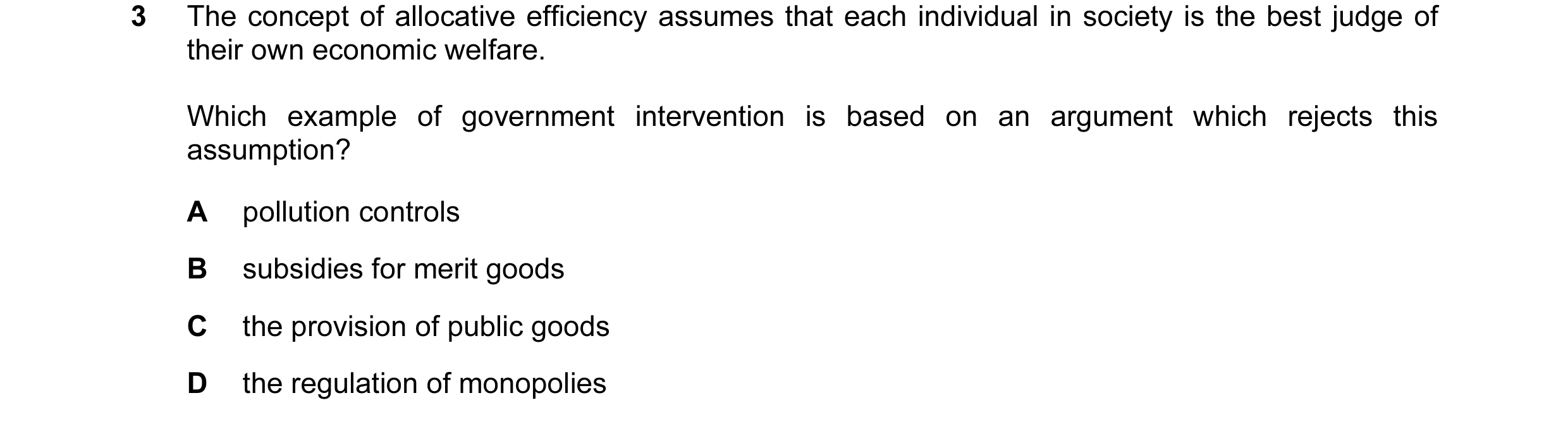
Q24 · The concept of allocative efficiency assumes that each individual in society is the best… 9708/32 May/June 2016
3 The concept of allocative efficiency assumes that each individual in society is the best judge of their own economic welfare. Which example of government intervention is based on an argument which rejects this assumption? A pollution controls B subsidies for merit goods C the provision of public goods D the regulation of monopolies
1 marks
Answer: B
This question in 9708/32 May/June 2016
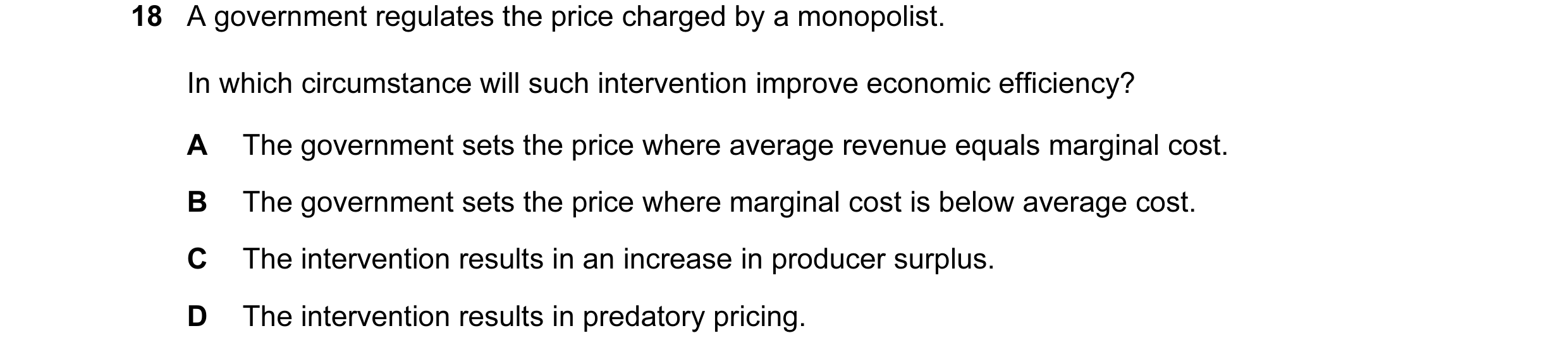
Q25 · A government regulates the price charged by a monopolist 9708/32 May/June 2016
18 A government regulates the price charged by a monopolist. In which circumstance will such intervention improve economic efficiency? A The government sets the price where average revenue equals marginal cost. B The government sets the price where marginal cost is below average cost. C The intervention results in an increase in producer surplus. D The intervention results in predatory pricing.
1 marks
Answer: A
This question in 9708/32 May/June 2016
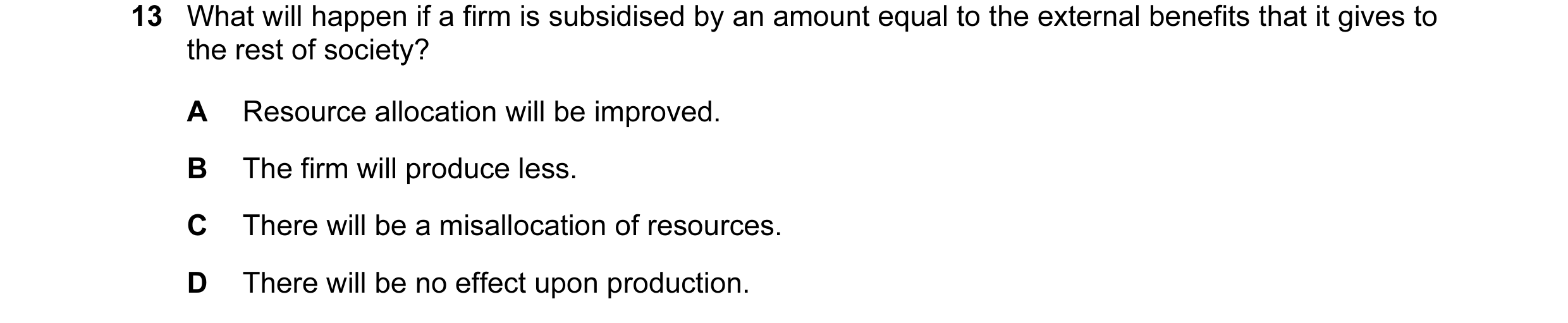
Q26 · What will happen if a firm is subsidised by an amount equal to the external benefits that… 9708/33 May/June 2016
13 What will happen if a firm is subsidised by an amount equal to the external benefits that it gives to the rest of society? A Resource allocation will be improved. B The firm will produce less. C There will be a misallocation of resources. D There will be no effect upon production.
1 marks
Answer: A
This question in 9708/33 May/June 2016
Q27 · The diagram shows the market for new cars 9708/33 May/June 2016
18 The diagram shows the market for new cars. Currently the quantity supplied is fixed by the government at S1. S1 S2 x y price z w D O quantity If the market was deregulated the supply curve would be S2. Which area measures the net welfare gain of removing the restriction on the quantity supplied? A w + y B x + y C z + w D z + x + y + w
1 marks
Answer: A
This question in 9708/33 May/June 2016
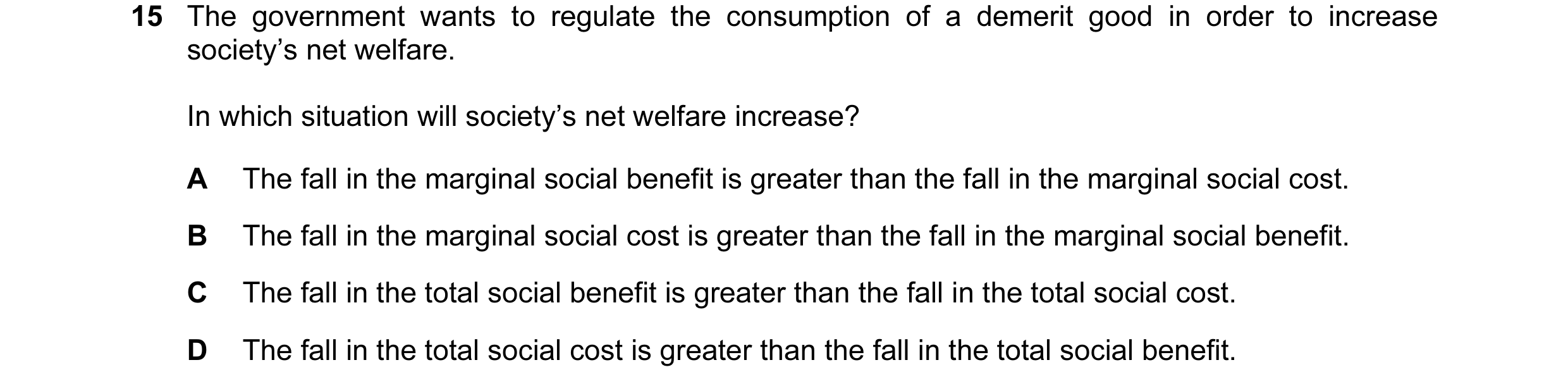
Q28 · The government wants to regulate the consumption of a demerit good in order to increase… 9708/32 Oct/Nov 2016
15 The government wants to regulate the consumption of a demerit good in order to increase society’s net welfare. In which situation will society’s net welfare increase? A The fall in the marginal social benefit is greater than the fall in the marginal social cost. B The fall in the marginal social cost is greater than the fall in the marginal social benefit. C The fall in the total social benefit is greater than the fall in the total social cost. D The fall in the total social cost is greater than the fall in the total social benefit.
1 marks
Answer: D
This question in 9708/32 Oct/Nov 2016
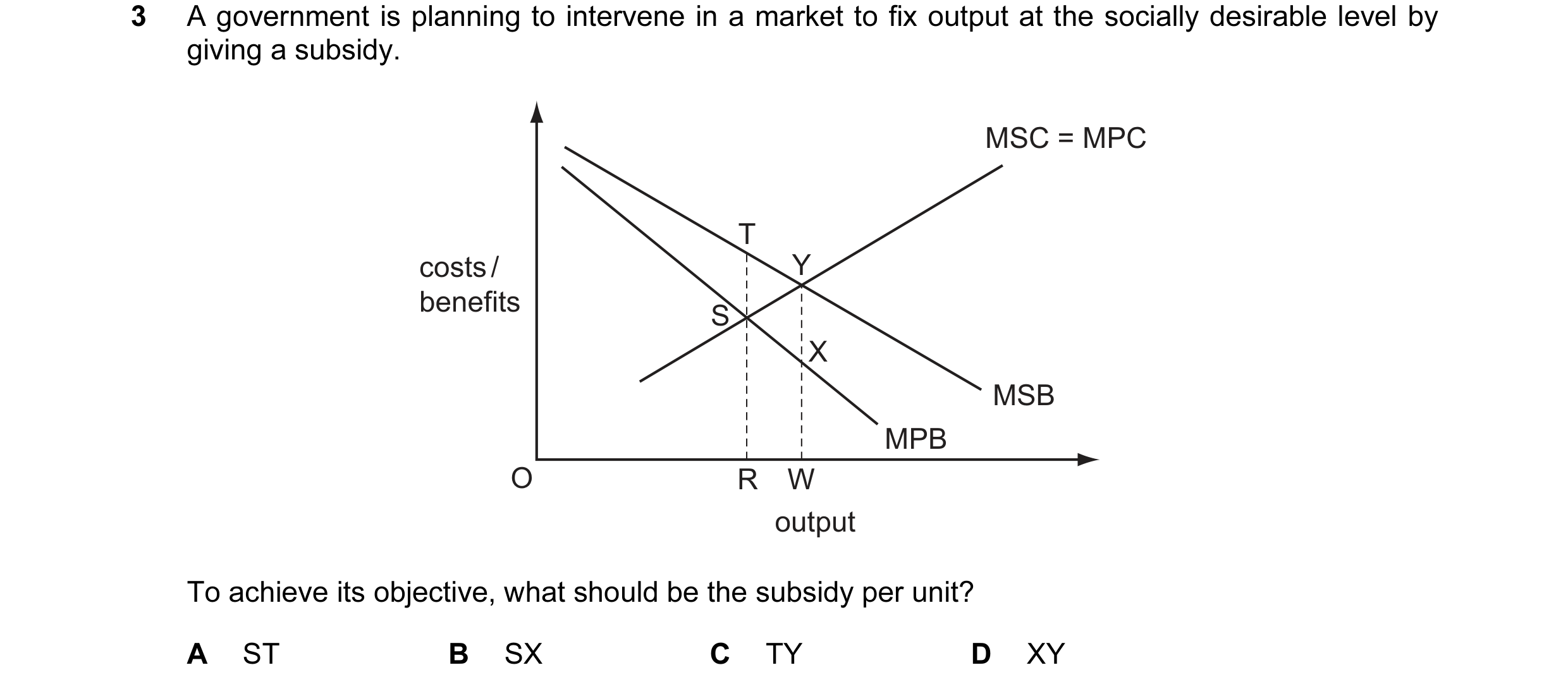
Q29 · A government is planning to intervene in a market to fix output at the socially desirable… 9708/33 Oct/Nov 2016
3 A government is planning to intervene in a market to fix output at the socially desirable level by giving a subsidy. MSC = MPC T costs / Y benefits S X MSB MPB O R W output To achieve its objective, what should be the subsidy per unit? A ST B SX C TY D XY
1 marks
Answer: D
This question in 9708/33 Oct/Nov 2016
Q30 · A government wishes to discourage tax avoidance 9708/32 May/June 2017
16 A government wishes to discourage tax avoidance. Which policy to achieve this would be an example of the behavioural approach of nudge theory? A compelling direct tax deduction by employers B making random inspections of individual tax records C providing information on how the tax is spent by the government D using penalties, such as fines and imprisonment for tax avoidance
1 marks
Answer: C
This question in 9708/32 May/June 2017
Q31 · A government is planning to intervene in a free market to fix output at the level that… 9708/33 May/June 2017
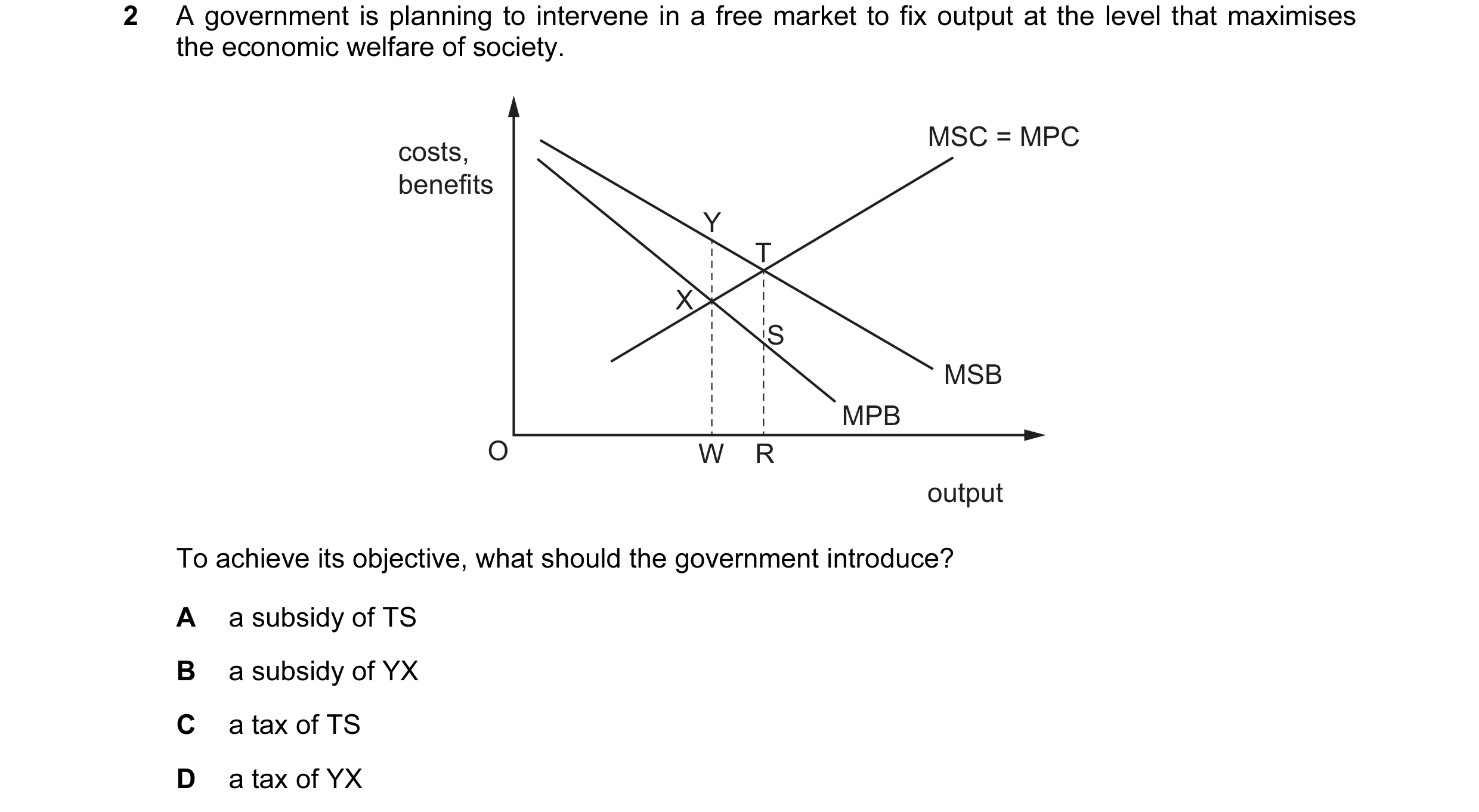
2 A government is planning to intervene in a free market to fix output at the level that maximises the economic welfare of society. MSC = MPC costs, benefits Y T X S MSB MPB O W R output To achieve its objective, what should the government introduce? A a subsidy of TS B a subsidy of YX C a tax of TS D a tax of YX
1 marks
Answer: A
This question in 9708/33 May/June 2017
Q32 · Transport economists estimate the price elasticity of demand for private car use is very… 9708/32 Oct/Nov 2018
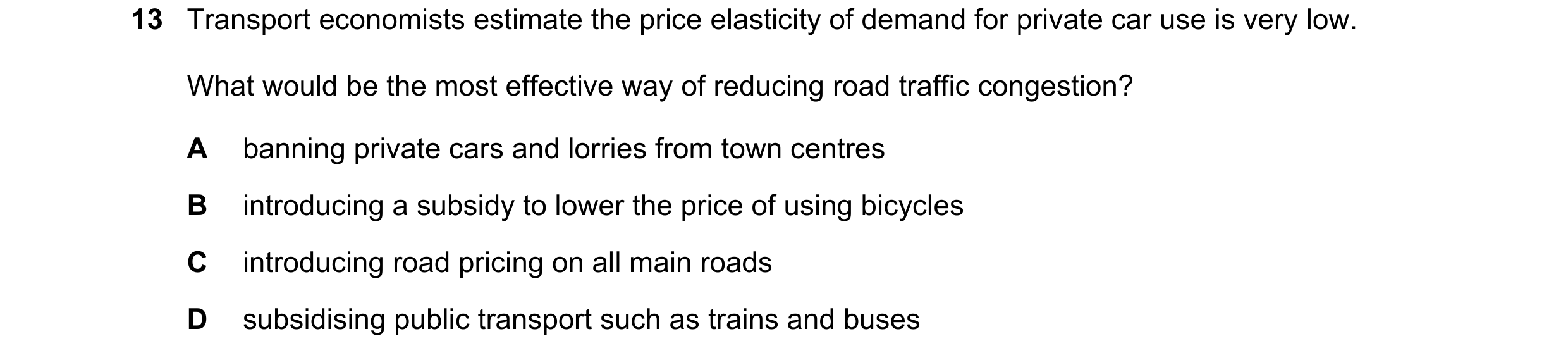
13 Transport economists estimate the price elasticity of demand for private car use is very low. What would be the most effective way of reducing road traffic congestion? A banning private cars and lorries from town centres B introducing a subsidy to lower the price of using bicycles C introducing road pricing on all main roads D subsidising public transport such as trains and buses
1 marks
Answer: A
This question in 9708/32 Oct/Nov 2018
Q33 · Which statement about government intervention is correct? 9708/32 Feb/March 2019
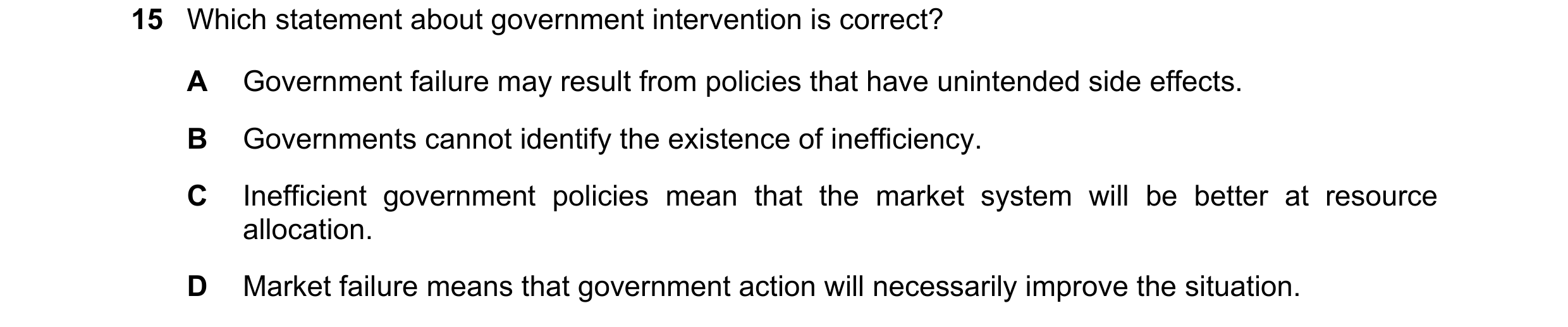
15 Which statement about government intervention is correct? A Government failure may result from policies that have unintended side effects. B Governments cannot identify the existence of inefficiency. C Inefficient government policies mean that the market system will be better at resource allocation. D Market failure means that government action will necessarily improve the situation.
1 marks
Answer: A
This question in 9708/32 Feb/March 2019
Q34 · The diagram shows the market for a good that creates a negative externality in production… 9708/32 Feb/March 2019
17 The diagram shows the market for a good that creates a negative externality in production and no positive externalities. The current level of consumption is OQ1. S4 price Z S3 Y S2=MSC=MPC+MEC P4 P3 S1=MPC X P2 W P1 V D=MPB=MSB O Q4 Q3 Q2 Q1 quantity The government decides to tax producers of the good. Which size of tax on producers would result in a socially efficient allocation of resources? A VW B VX C VY D VZ
1 marks
Answer: B
This question in 9708/32 Feb/March 2019
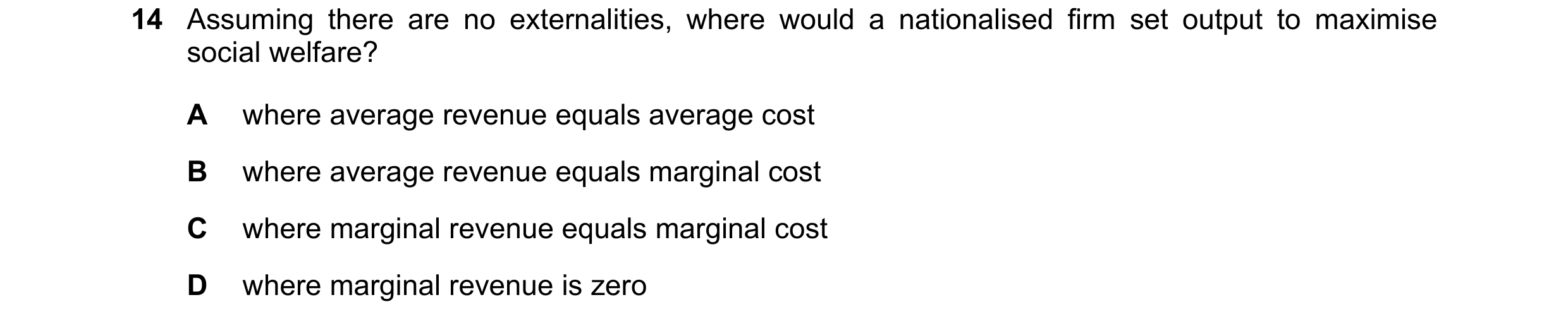
Q35 · Assuming there are no externalities, where would a nationalised firm set output to… 9708/32 May/June 2019
14 Assuming there are no externalities, where would a nationalised firm set output to maximise social welfare? A where average revenue equals average cost B where average revenue equals marginal cost C where marginal revenue equals marginal cost D where marginal revenue is zero
1 marks
Answer: B
This question in 9708/32 May/June 2019
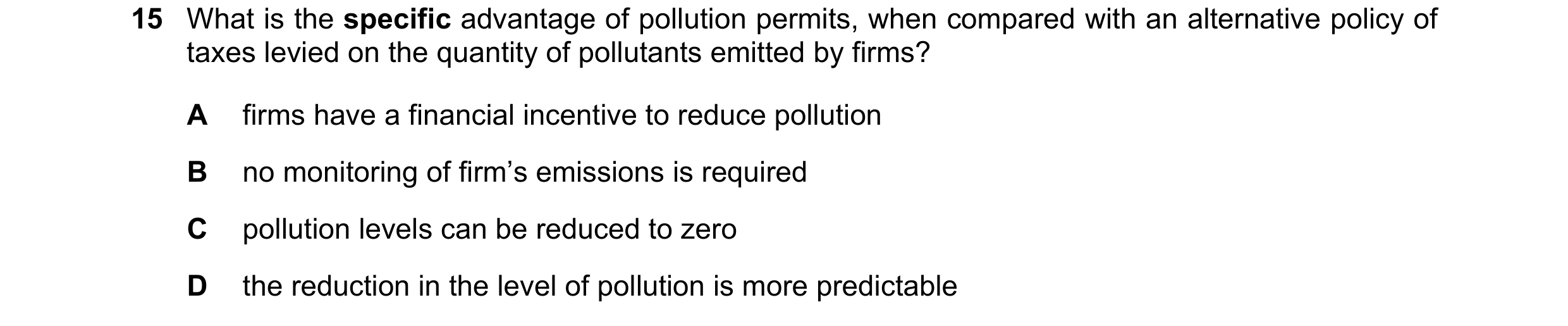
Q36 · What is the specific advantage of pollution permits, when compared with an alternative… 9708/32 May/June 2019
15 What is the specific advantage of pollution permits, when compared with an alternative policy of taxes levied on the quantity of pollutants emitted by firms? A firms have a financial incentive to reduce pollution B no monitoring of firm’s emissions is required C pollution levels can be reduced to zero D the reduction in the level of pollution is more predictable
1 marks
Answer: D
This question in 9708/32 May/June 2019
Q37 · A government is worried about the increasing monopsony power of employers in the wage… 9708/32 Oct/Nov 2019
17 A government is worried about the increasing monopsony power of employers in the wage bargaining process. Which policy combination is most likely to improve the wages and employment prospects of workers? trade union immigration national powers controls minimum wage A strengthen relax cut B strengthen strengthen raise C weaken relax cut D weaken strengthen raise
1 marks
Answer: B
This question in 9708/32 Oct/Nov 2019
Q38 · A government regards fresh fruit and vegetables as merit goods, and subsidises… 9708/32 Oct/Nov 2019
19 A government regards fresh fruit and vegetables as merit goods, and subsidises agriculture to boost their production. What could be a government failure arising from these subsidies? A cheaper fresh fruit and vegetables B land clearance reducing wildlife C lower spending on treating dietary illnesses D more jobs picking fruit and vegetables
1 marks
Answer: B
This question in 9708/32 Oct/Nov 2019
Q39 · At present, motorists who drive their cars within area 1 on the map pay a daily… 9708/32 Feb/March 2020
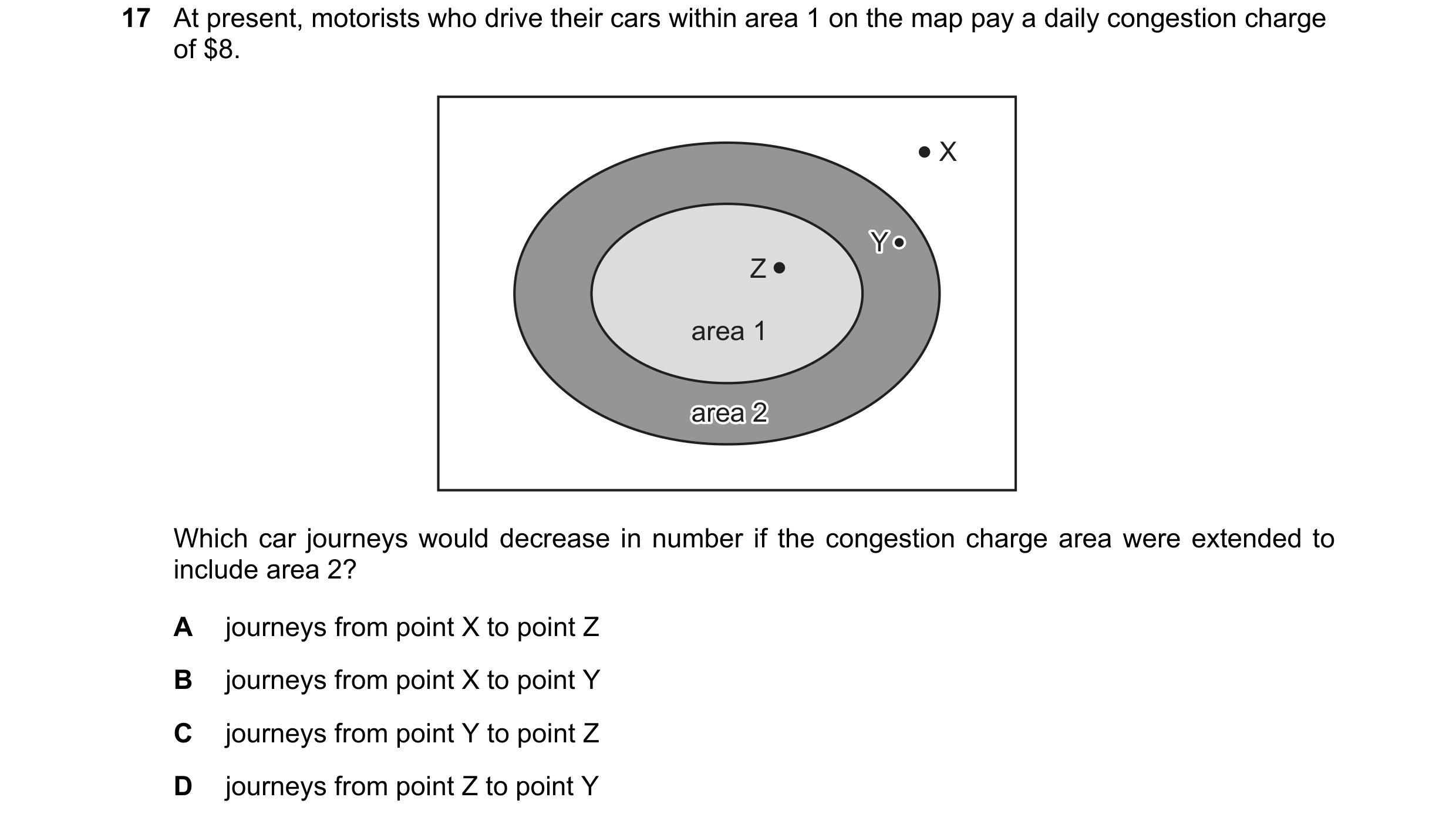
17 At present, motorists who drive their cars within area 1 on the map pay a daily congestion charge of $8. X Y Y Z area 1 area 2 area 2 area 2 Which car journeys would decrease in number if the congestion charge area were extended to include area 2? A journeys from point X to point Z B journeys from point X to point Y C journeys from point Y to point Z D journeys from point Z to point Y
1 marks
Answer: B
This question in 9708/32 Feb/March 2020
Q40 · The diagram shows an industry’s supply and demand curves 9708/31 Oct/Nov 2020
13 The diagram shows an industry’s supply and demand curves. S price u v w x D O Q quantity In the absence of externalities, which area in the diagram measures the net loss in economic welfare if the government restricts the level of output to OQ? A u + v B v + w C x D v + w + x
1 marks
Answer: B
This question in 9708/31 Oct/Nov 2020
Q41 · In 2007 the United Kingdom’s government banned cigarette smoking in enclosed public… 9708/31 Oct/Nov 2020
14 In 2007 the United Kingdom’s government banned cigarette smoking in enclosed public spaces, such as offices, shops, bars and restaurants. What is a government failure arising from this ban? A decreased consumption of cigarettes by smokers B decreased levels of passive cigarette smoking by non-smokers C increased litter from used cigarettes outside offices and shops D increased sales of cigarette substitutes like nicotine patches and gum
1 marks
Answer: C
This question in 9708/31 Oct/Nov 2020
Q42 · The expected marginal private benefits (MPB), marginal social benefits (MSB), marginal… 9708/32 Oct/Nov 2020
3 The expected marginal private benefits (MPB), marginal social benefits (MSB), marginal private costs (MPC) and marginal social costs (MSC) for the building of a new road are shown in the diagram. The government intervenes so that the socially desirable output is achieved. MSC price MPC MSB MPB O Q1 Q2Q3 Q4 quantity Which combination shows the equilibrium output without government intervention and with government intervention? without government with government intervention intervention A Q4 Q1 B Q3 Q2 C Q3 Q4 D Q4 Q1
1 marks
Answer: B
This question in 9708/32 Oct/Nov 2020
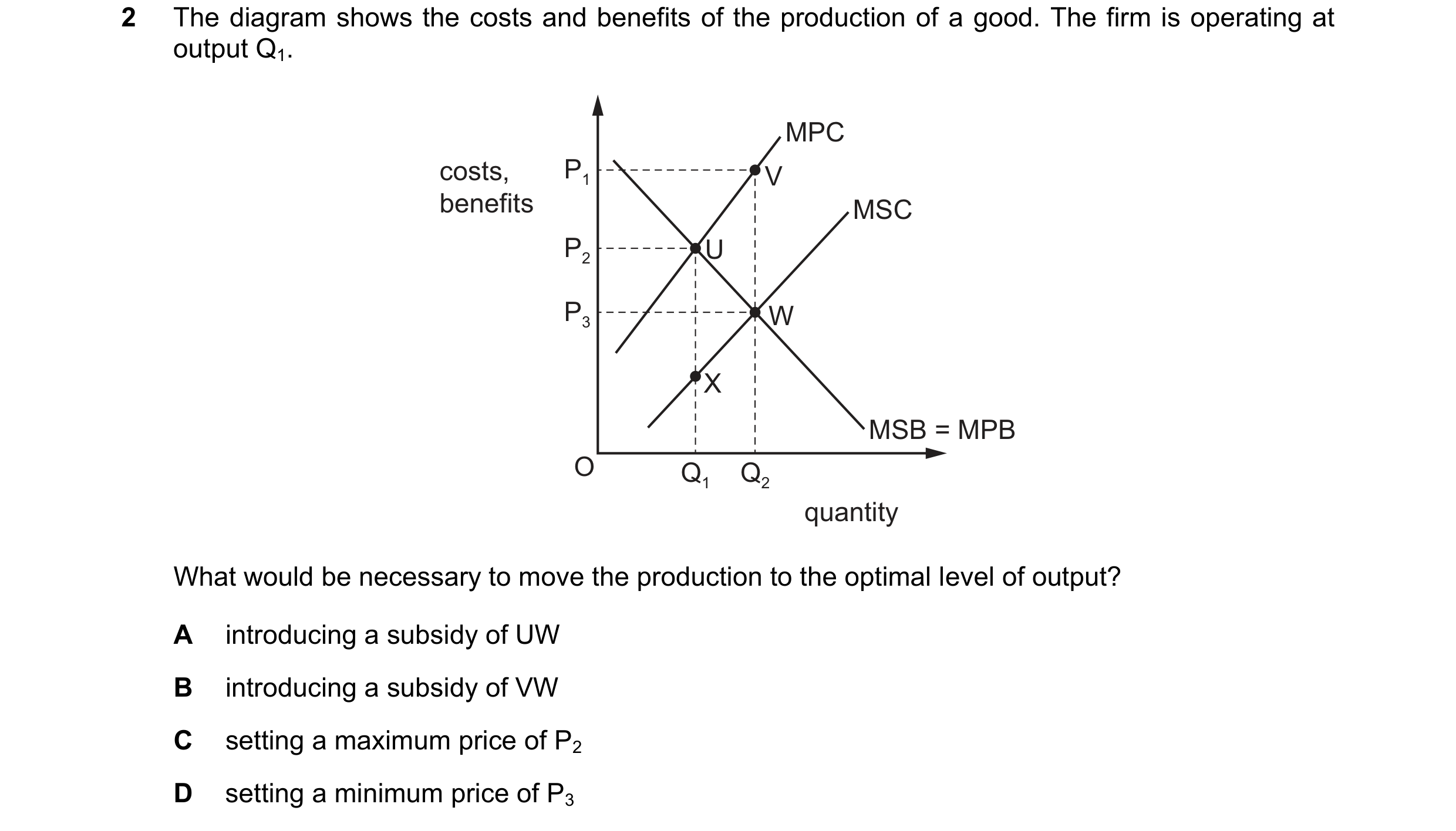
Q43 · The diagram shows the costs and benefits of the production of a good 9708/33 Oct/Nov 2020
2 The diagram shows the costs and benefits of the production of a good. The firm is operating at output Q1. MPC costs, P1 V benefits MSC P2 U P3 W X MSB = MPB O Q1 Q2 quantity What would be necessary to move the production to the optimal level of output? A introducing a subsidy of UW B introducing a subsidy of VW C setting a maximum price of P2 D setting a minimum price of P3
1 marks
Answer: B
This question in 9708/33 Oct/Nov 2020
Q44 · Which measure to reduce the abuse of monopoly power is an example of regulation? 9708/33 Oct/Nov 2020
13 Which measure to reduce the abuse of monopoly power is an example of regulation? A legislation to forbid price fixing by cartels B removal of import tariffs C subsidising small firms D taxation of monopoly profits
1 marks
Answer: A
This question in 9708/33 Oct/Nov 2020
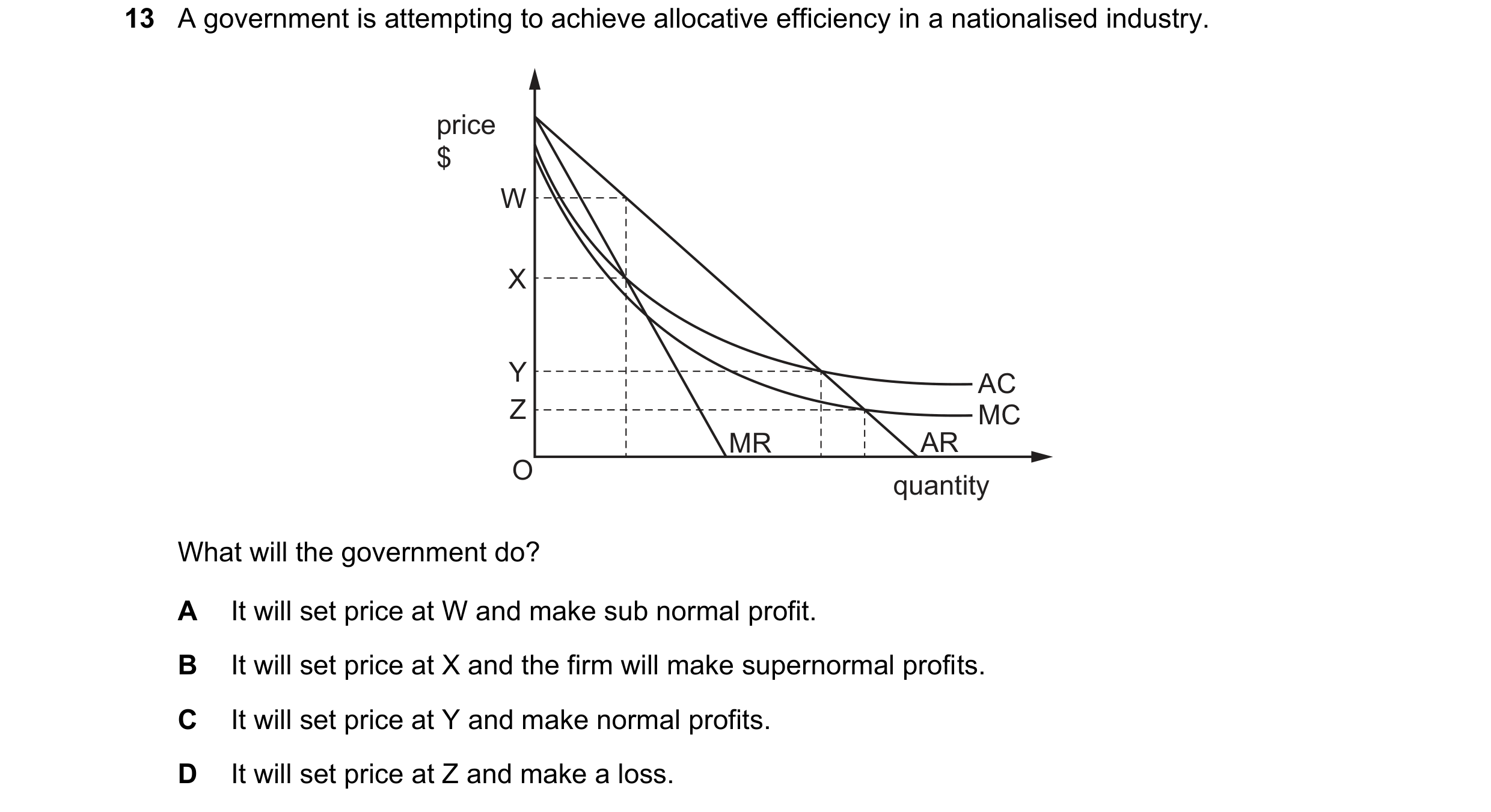
Q45 · A government is attempting to achieve allocative efficiency in a nationalised industry 9708/32 Feb/March 2021
13 A government is attempting to achieve allocative efficiency in a nationalised industry. price $ W X Y AC Z MC MR AR O quantity What will the government do? A It will set price at W and make sub normal profit. B It will set price at X and the firm will make supernormal profits. C It will set price at Y and make normal profits. D It will set price at Z and make a loss.
1 marks
Answer: D
This question in 9708/32 Feb/March 2021
Q46 · Recent research has shown that consumption of some foods might be harmful 9708/32 Feb/March 2021
15 Recent research has shown that consumption of some foods might be harmful. A government committee considers how to intervene in the markets. Which intervention is most likely to reduce consumption of these foods without reducing income equality? A a minimum price for the harmful foods B a subsidy for substitute foods C an ad valorem tax on the harmful foods D an indirect tax on the harmful foods
1 marks
Answer: B
This question in 9708/32 Feb/March 2021
Q47 · What is an argument against government intervention when there is market failure? 9708/32 May/June 2021
2 What is an argument against government intervention when there is market failure? A Government intervention could increase positive externalities. B Government intervention could increase the availability of merit goods. C Government intervention could lead to a less efficient outcome. D Government intervention could reduce information failure.
1 marks
Answer: C
This question in 9708/32 May/June 2021
Q48 · The diagram shows the long-run cost and revenue curves for a public sector monopoly 9708/32 May/June 2021
10 The diagram shows the long-run cost and revenue curves for a public sector monopoly. revenue and costs AR LRAC MR LRMC O output The government decides to set a price that maximises social welfare. What will be the consequence of this decision? A The firm will experience diseconomies of scale. B The firm will make a loss. C The firm will maximise profits. D The firm will maximise total revenue.
1 marks
Answer: B
This question in 9708/32 May/June 2021
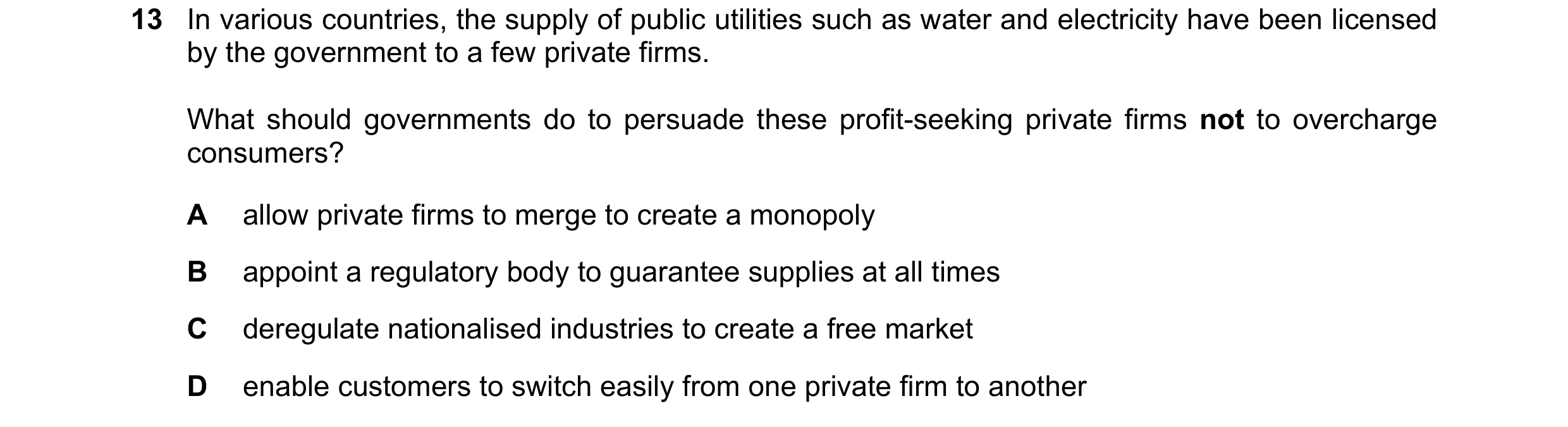
Q49 · In various countries, the supply of public utilities such as water and electricity have… 9708/32 May/June 2021
13 In various countries, the supply of public utilities such as water and electricity have been licensed by the government to a few private firms. What should governments do to persuade these profit-seeking private firms not to overcharge consumers? A allow private firms to merge to create a monopoly B appoint a regulatory body to guarantee supplies at all times C deregulate nationalised industries to create a free market D enable customers to switch easily from one private firm to another
1 marks
Answer: D
This question in 9708/32 May/June 2021
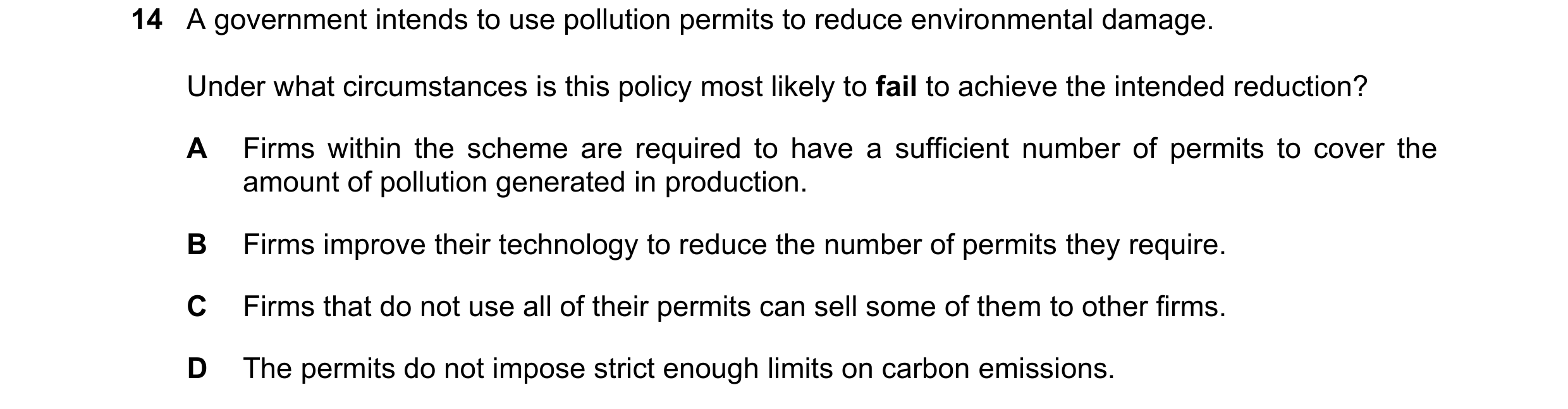
Q50 · A government intends to use pollution permits to reduce environmental damage 9708/32 May/June 2021
14 A government intends to use pollution permits to reduce environmental damage. Under what circumstances is this policy most likely to fail to achieve the intended reduction? A Firms within the scheme are required to have a sufficient number of permits to cover the amount of pollution generated in production. B Firms improve their technology to reduce the number of permits they require. C Firms that do not use all of their permits can sell some of them to other firms. D The permits do not impose strict enough limits on carbon emissions.
1 marks
Answer: D
This question in 9708/32 May/June 2021
Q51 · In country X the marginal rate of income tax imposed on the highest earners was 83% which… 9708/33 May/June 2021
29 In country X the marginal rate of income tax imposed on the highest earners was 83% which increased to 98% if income was received from interest or dividends. The highest marginal rate was then reduced to 40%. Despite this reduction, the tax revenue raised from the highest earners increased substantially. Which theoretical concept illustrates this relationship between tax rates and tax revenue? A the J curve B the Laffer curve C the Marshall-Lerner condition D the Phillips curve
1 marks
Answer: B
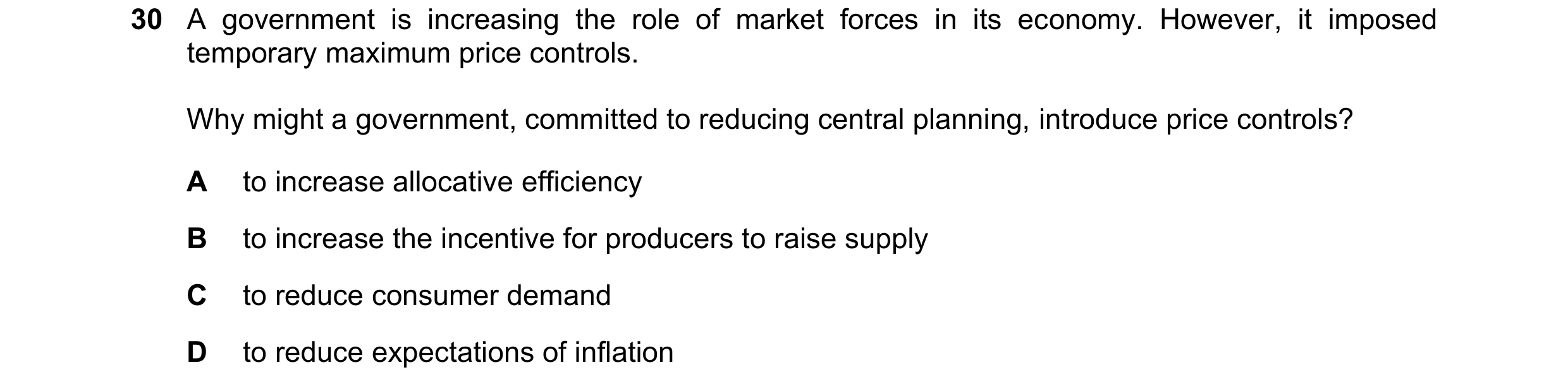
This question in 9708/33 May/June 2021
Q52 · A government is increasing the role of market forces in its economy 9708/33 May/June 2021
30 A government is increasing the role of market forces in its economy. However, it imposed temporary maximum price controls. Why might a government, committed to reducing central planning, introduce price controls? A to increase allocative efficiency B to increase the incentive for producers to raise supply C to reduce consumer demand D to reduce expectations of inflation
1 marks
Answer: D
This question in 9708/33 May/June 2021
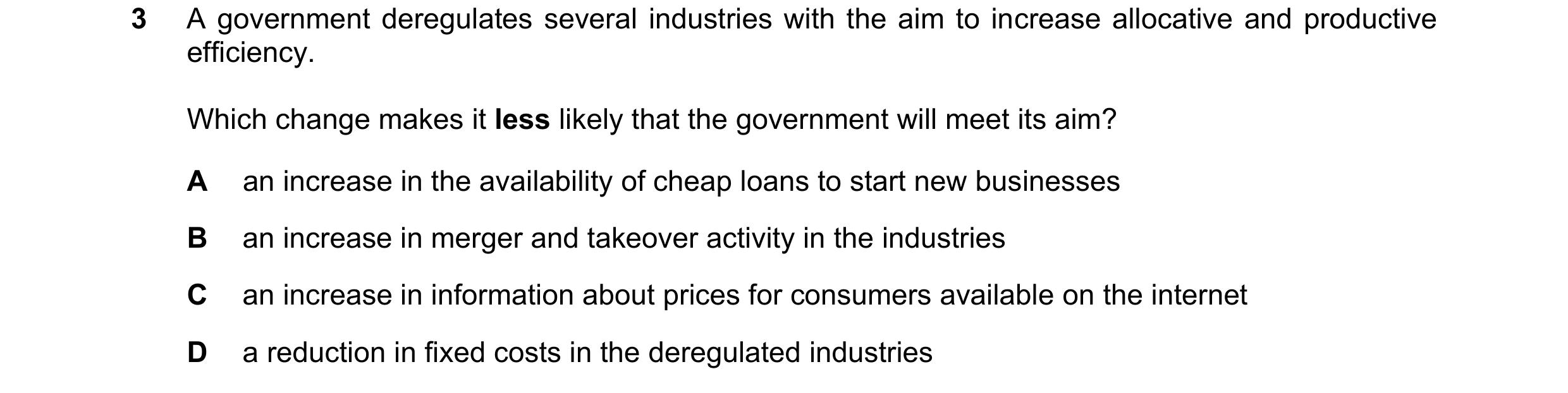
Q53 · A government deregulates several industries with the aim to increase allocative and… 9708/31 Oct/Nov 2021
3 A government deregulates several industries with the aim to increase allocative and productive efficiency. Which change makes it less likely that the government will meet its aim? A an increase in the availability of cheap loans to start new businesses B an increase in merger and takeover activity in the industries C an increase in information about prices for consumers available on the internet D a reduction in fixed costs in the deregulated industries
1 marks
Answer: B
This question in 9708/31 Oct/Nov 2021
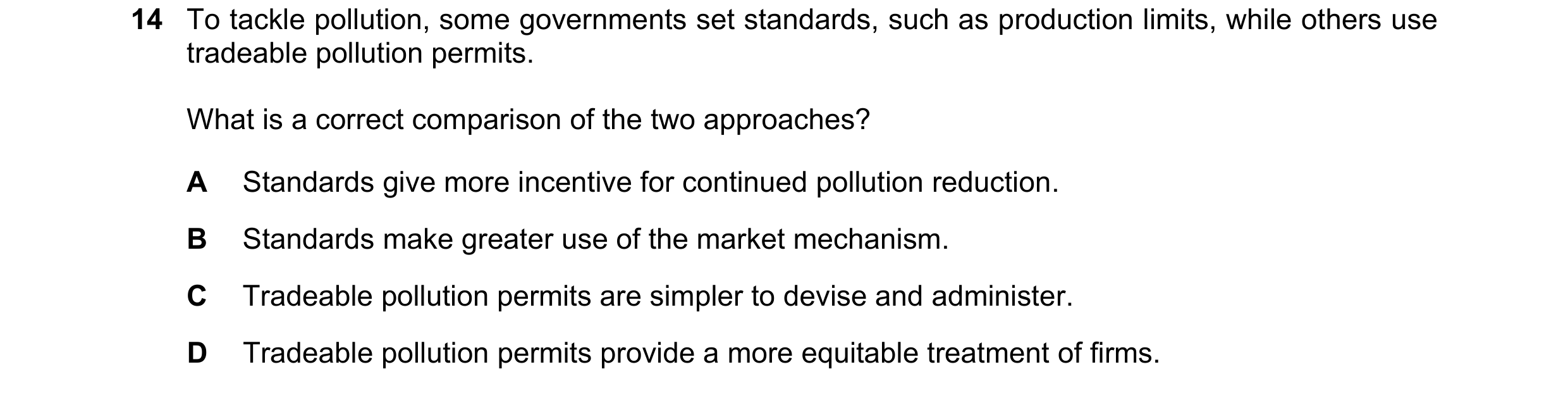
Q54 · To tackle pollution, some governments set standards, such as production limits, while… 9708/31 Oct/Nov 2021
14 To tackle pollution, some governments set standards, such as production limits, while others use tradeable pollution permits. What is a correct comparison of the two approaches? A Standards give more incentive for continued pollution reduction. B Standards make greater use of the market mechanism. C Tradeable pollution permits are simpler to devise and administer. D Tradeable pollution permits provide a more equitable treatment of firms.
1 marks
Answer: D
This question in 9708/31 Oct/Nov 2021
Q55 · Medical researchers indicated that drinking too many sugary drinks is bad for health 9708/32 Oct/Nov 2021
2 Medical researchers indicated that drinking too many sugary drinks is bad for health. Government intervention to impose a tax on the sale of sugary drinks might help solve which market failures? negative negative over- externalities of externalities of consumption of consumption production demerit goods A no yes yes B yes yes no C yes no yes D yes no no
1 marks
Answer: C
This question in 9708/32 Oct/Nov 2021
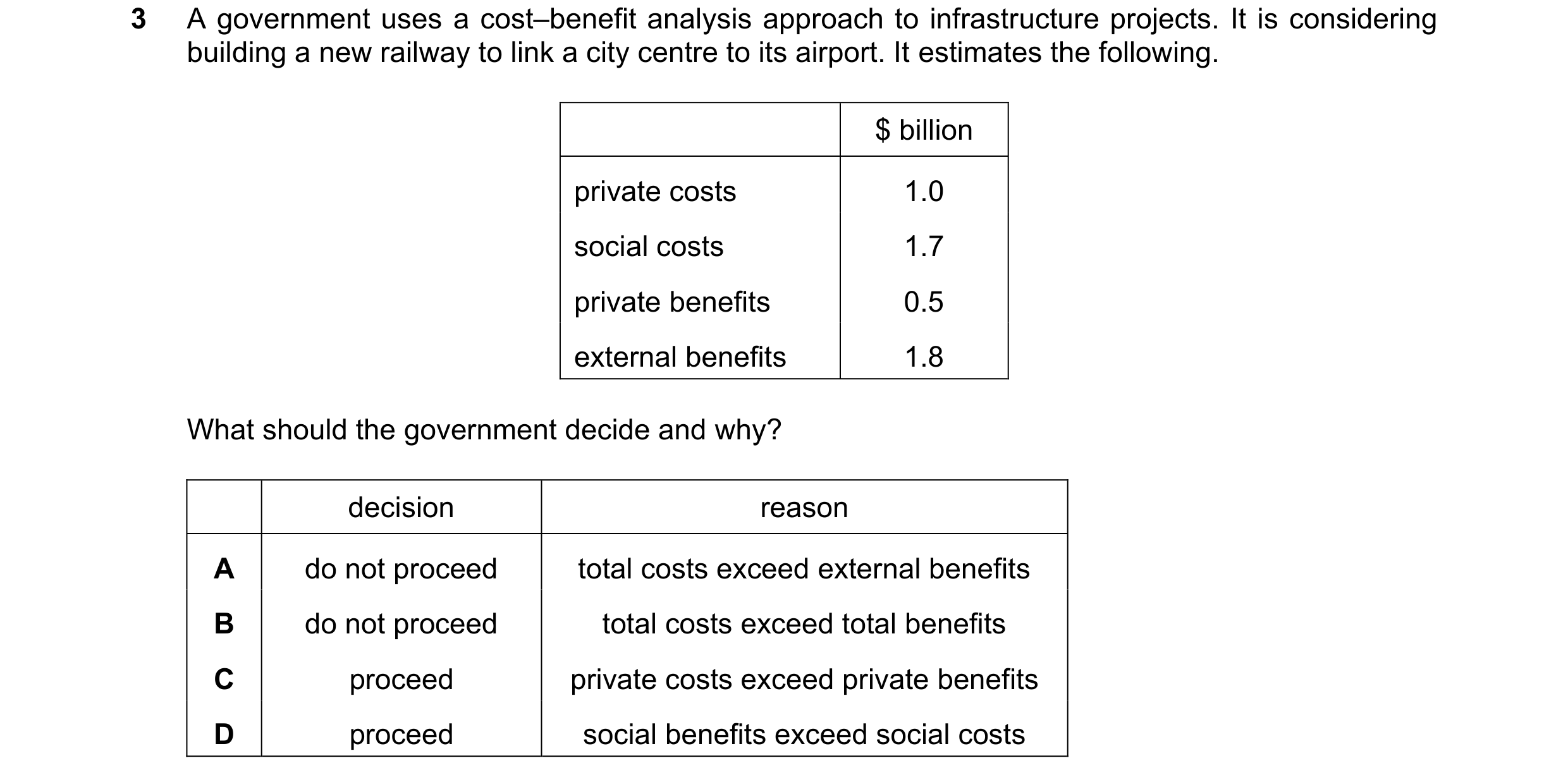
Q56 · A government uses a cost–benefit analysis approach to infrastructure projects 9708/32 Oct/Nov 2021
3 A government uses a cost–benefit analysis approach to infrastructure projects. It is considering building a new railway to link a city centre to its airport. It estimates the following. $ billion private costs 1.0 social costs 1.7 private benefits 0.5 external benefits 1.8 What should the government decide and why? decision reason A do not proceed total costs exceed external benefits B do not proceed total costs exceed total benefits C proceed private costs exceed private benefits D proceed social benefits exceed social costs
1 marks
Answer: D
This question in 9708/32 Oct/Nov 2021
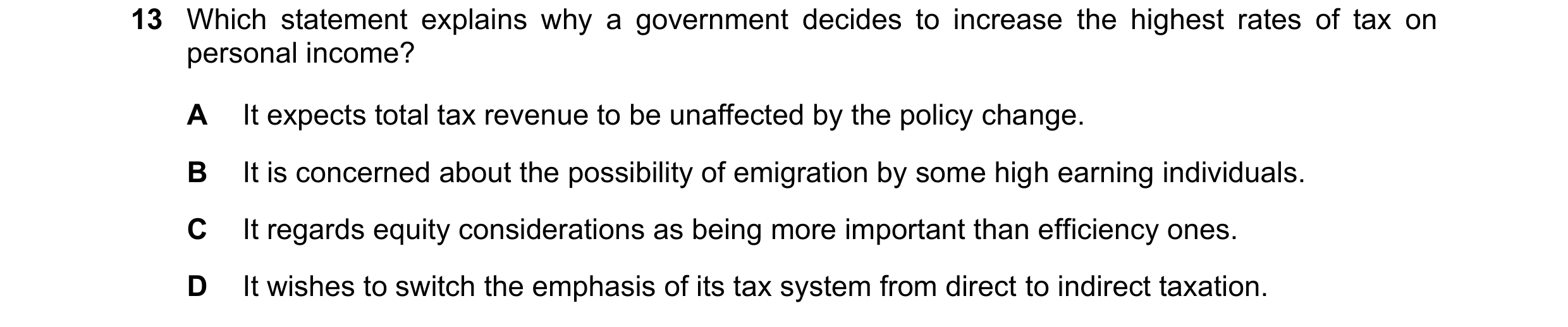
Q57 · Which statement explains why a government decides to increase the highest rates of tax on… 9708/32 Oct/Nov 2021
13 Which statement explains why a government decides to increase the highest rates of tax on personal income? A It expects total tax revenue to be unaffected by the policy change. B It is concerned about the possibility of emigration by some high earning individuals. C It regards equity considerations as being more important than efficiency ones. D It wishes to switch the emphasis of its tax system from direct to indirect taxation.
1 marks
Answer: C
This question in 9708/32 Oct/Nov 2021
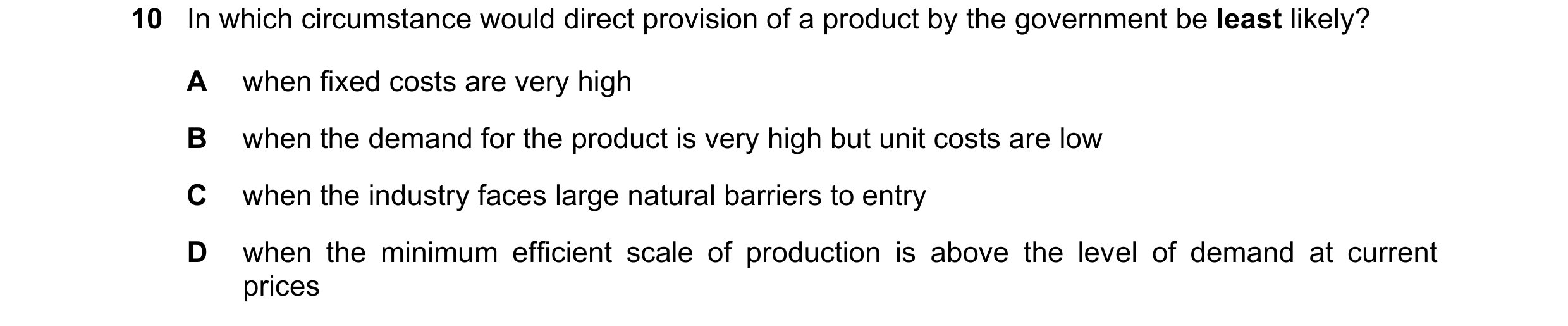
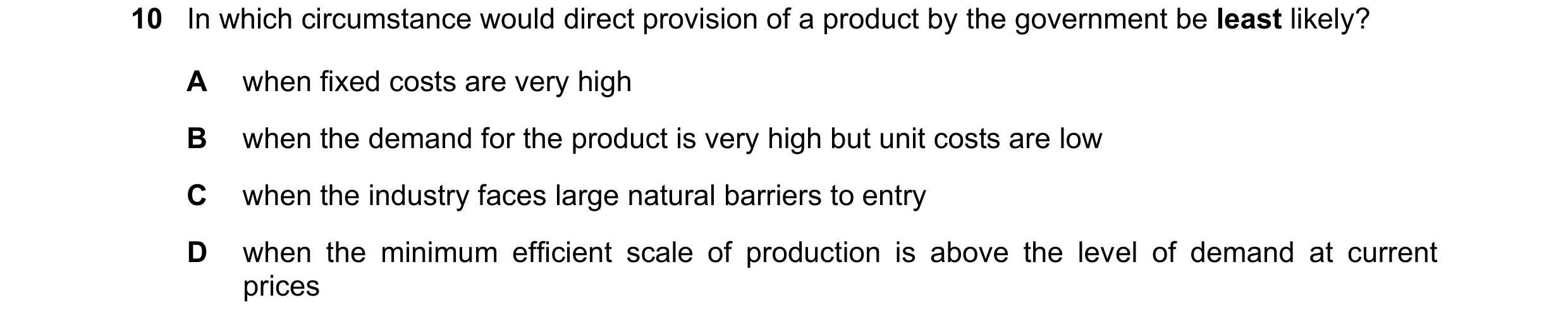
Q58 · In which circumstance would direct provision of a product by the government be least… 9708/31 May/June 2022
10 In which circumstance would direct provision of a product by the government be least likely? A when fixed costs are very high B when the demand for the product is very high but unit costs are low C when the industry faces large natural barriers to entry D when the minimum efficient scale of production is above the level of demand at current prices
1 marks
Answer: B
This question in 9708/31 May/June 2022
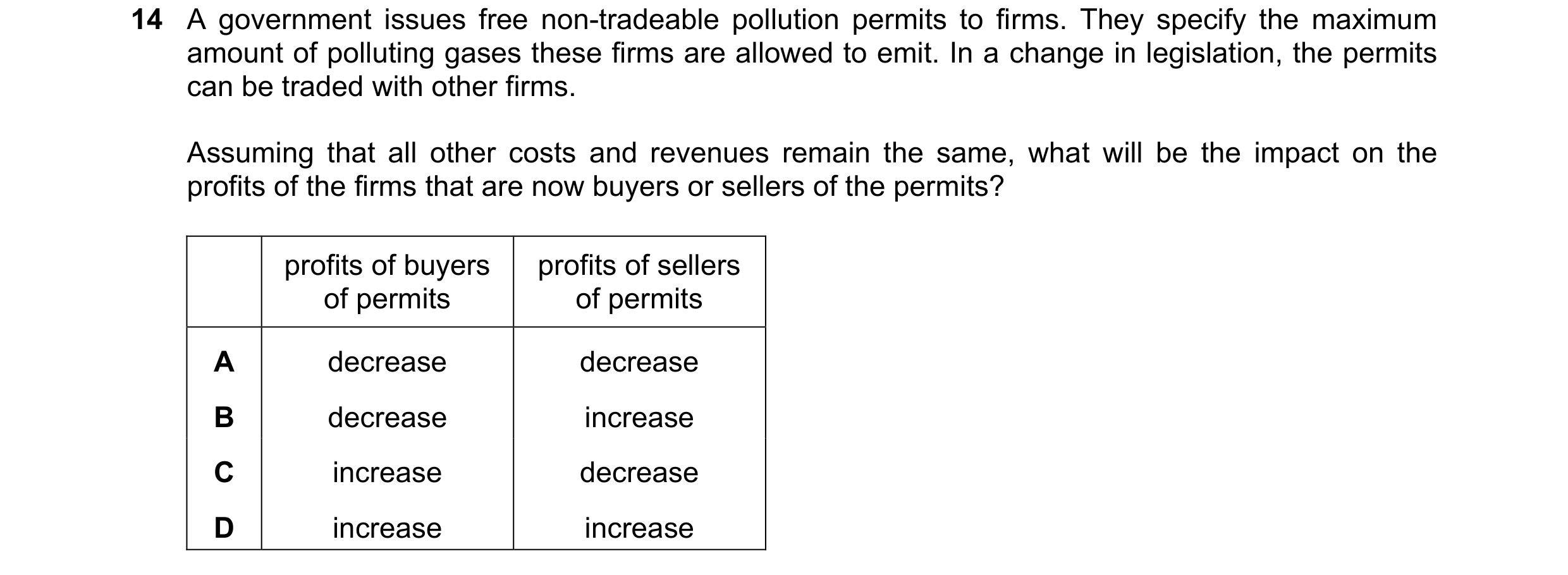
Q59 · A government issues free non-tradeable pollution permits to firms 9708/31 May/June 2022
14 A government issues free non-tradeable pollution permits to firms. They specify the maximum amount of polluting gases these firms are allowed to emit. In a change in legislation, the permits can be traded with other firms. Assuming that all other costs and revenues remain the same, what will be the impact on the profits of the firms that are now buyers or sellers of the permits? profits of buyers profits of sellers of permits of permits A decrease decrease B decrease increase C increase decrease D increase increase
1 marks
Answer: B
This question in 9708/31 May/June 2022
Q60 · What is an example of ‘nudge’ theory when applied to encouraging healthy eating? 9708/31 May/June 2022
15 What is an example of ‘nudge’ theory when applied to encouraging healthy eating? A advertising the benefits of healthy eating B increasing tax on sugary foods C introducing a subsidy for fruit growers D supermarkets putting fruit near cash registers
1 marks
Answer: D
This question in 9708/31 May/June 2022
Q61 · In which circumstance would direct provision of a product by the government be least… 9708/33 May/June 2022
10 In which circumstance would direct provision of a product by the government be least likely? A when fixed costs are very high B when the demand for the product is very high but unit costs are low C when the industry faces large natural barriers to entry D when the minimum efficient scale of production is above the level of demand at current prices
1 marks
Answer: B
This question in 9708/33 May/June 2022
Q62 · A government issues free non-tradeable pollution permits to firms 9708/33 May/June 2022
14 A government issues free non-tradeable pollution permits to firms. They specify the maximum amount of polluting gases these firms are allowed to emit. In a change in legislation, the permits can be traded with other firms. Assuming that all other costs and revenues remain the same, what will be the impact on the profits of the firms that are now buyers or sellers of the permits? profits of buyers profits of sellers of permits of permits A decrease decrease B decrease increase C increase decrease D increase increase
1 marks
Answer: B
This question in 9708/33 May/June 2022
Q63 · What is an example of ‘nudge’ theory when applied to encouraging healthy eating? 9708/33 May/June 2022
15 What is an example of ‘nudge’ theory when applied to encouraging healthy eating? A advertising the benefits of healthy eating B increasing tax on sugary foods C introducing a subsidy for fruit growers D supermarkets putting fruit near cash registers
1 marks
Answer: D
This question in 9708/33 May/June 2022
Q64 · Too many flights in the airline industry cause unnecessary damage to the environment 9708/31 Oct/Nov 2022
15 Too many flights in the airline industry cause unnecessary damage to the environment. Which measure is most likely to result in the socially optimal number of flights? A a complete ban on flights removing all private and external costs B greater deregulation of the global airline industry C publishing information to highlight the negative effects of flying on the environment D the payment of a subsidy per passenger equal to the difference between the private and social benefit
1 marks
Answer: C
This question in 9708/31 Oct/Nov 2022
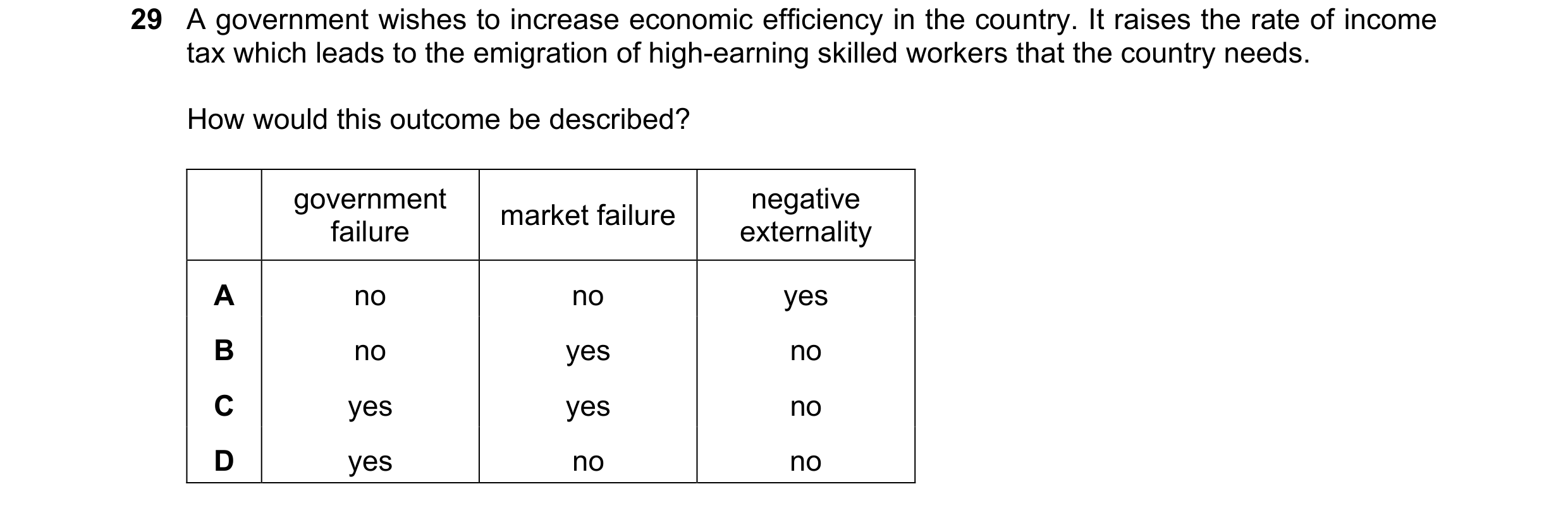
Q65 · A government wishes to increase economic efficiency in the country 9708/31 Oct/Nov 2022
29 A government wishes to increase economic efficiency in the country. It raises the rate of income tax which leads to the emigration of high-earning skilled workers that the country needs. How would this outcome be described? government negative market failure failure externality A no no yes B no yes no C yes yes no D yes no no
1 marks
Answer: D
This question in 9708/31 Oct/Nov 2022
Q66 · The government wants to regulate the consumption of a demerit good in order to increase… 9708/32 Oct/Nov 2022
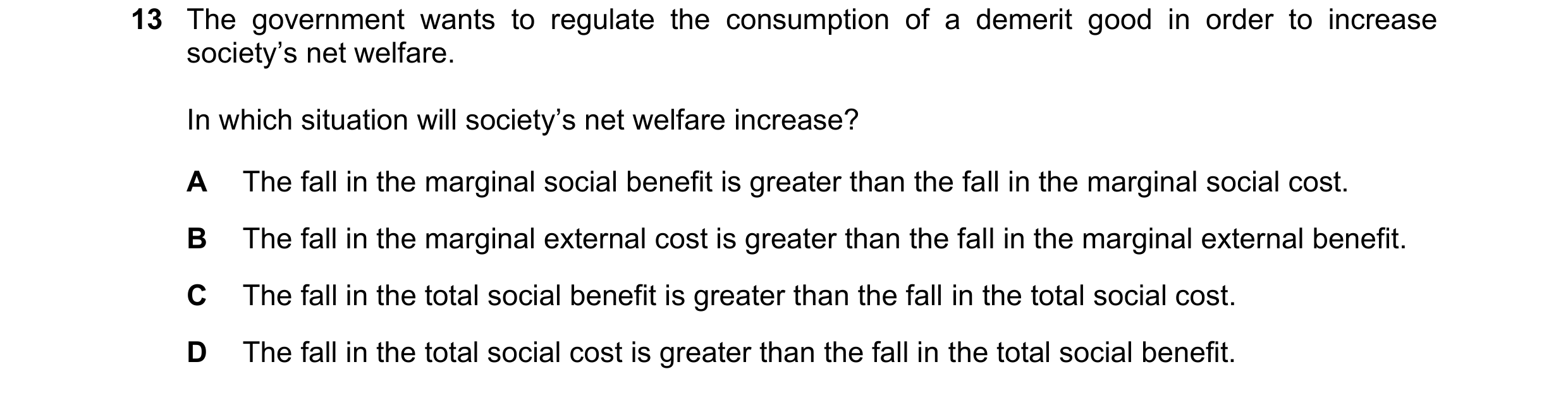
13 The government wants to regulate the consumption of a demerit good in order to increase society’s net welfare. In which situation will society’s net welfare increase? A The fall in the marginal social benefit is greater than the fall in the marginal social cost. B The fall in the marginal external cost is greater than the fall in the marginal external benefit. C The fall in the total social benefit is greater than the fall in the total social cost. D The fall in the total social cost is greater than the fall in the total social benefit.
1 marks
Answer: D
This question in 9708/32 Oct/Nov 2022
Q67 · The diagram shows the marginal private benefit (MPB), the marginal private cost (MPC) and… 9708/33 Oct/Nov 2022
3 The diagram shows the marginal private benefit (MPB), the marginal private cost (MPC) and the marginal social cost (MSC) of a firm producing chemicals. In a free market, price is at P1. price MSC MPC P2 P1 MPB O Q1 Q2 Q3 Q4 quantity Which quantity measures the overproduction of chemicals resulting in the negative production externality? A Q1,Q2 B Q1,Q3 C Q2,Q3 D Q3,Q4
1 marks
Answer: C
This question in 9708/33 Oct/Nov 2022
Q68 · A government regards fresh fruit and vegetables as merit goods, and subsidises… 9708/33 Oct/Nov 2022
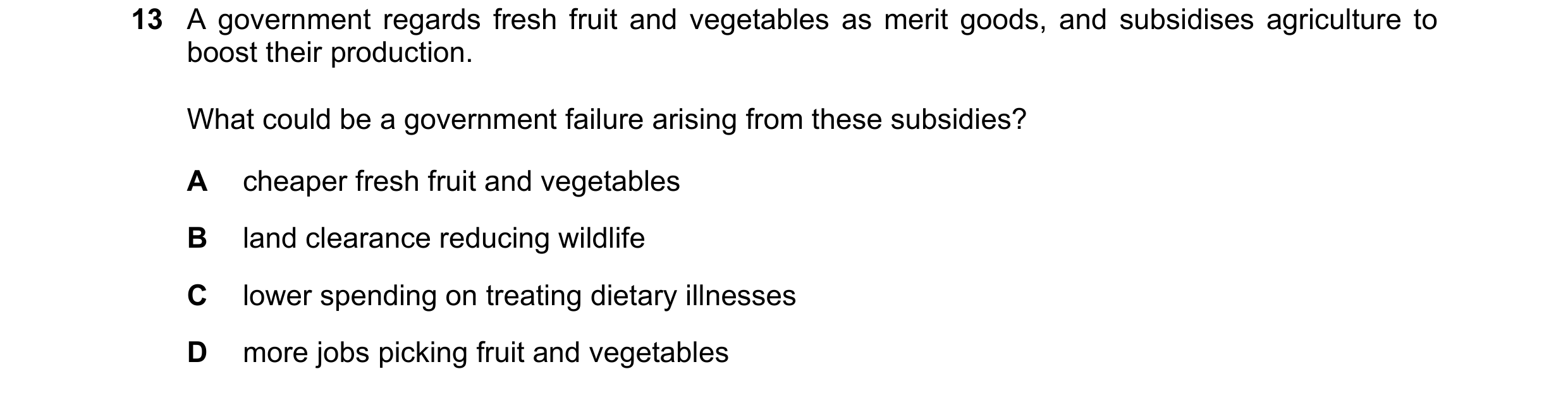
13 A government regards fresh fruit and vegetables as merit goods, and subsidises agriculture to boost their production. What could be a government failure arising from these subsidies? A cheaper fresh fruit and vegetables B land clearance reducing wildlife C lower spending on treating dietary illnesses D more jobs picking fruit and vegetables
1 marks
Answer: B
This question in 9708/33 Oct/Nov 2022
Q69 · The table shows a firm that has four possible methods of production 9708/33 Oct/Nov 2022
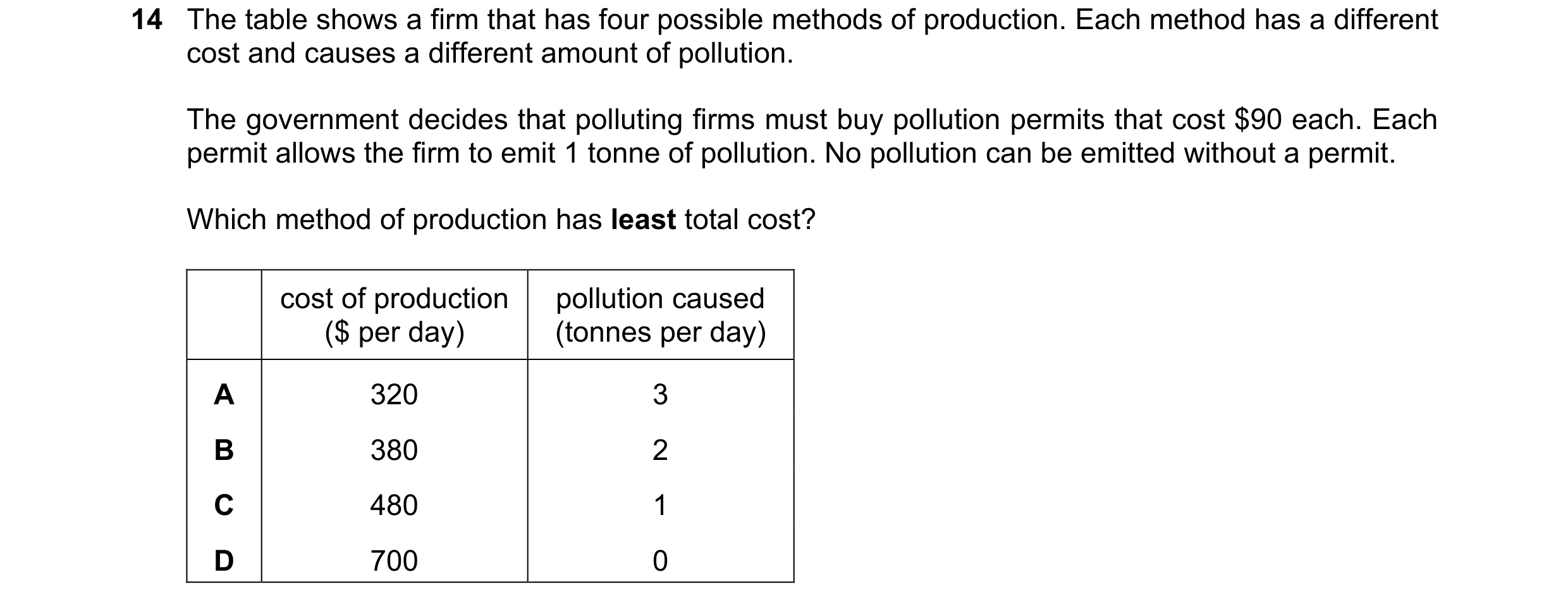
14 The table shows a firm that has four possible methods of production. Each method has a different cost and causes a different amount of pollution. The government decides that polluting firms must buy pollution permits that cost $90 each. Each permit allows the firm to emit 1 tonne of pollution. No pollution can be emitted without a permit. Which method of production has least total cost? cost of production pollution caused ($ per day) (tonnes per day) A 320 3 B 380 2 C 480 1 D 700 0
1 marks
Answer: B
This question in 9708/33 Oct/Nov 2022
Q70 · A government wishes to reduce the use of cars in cities 9708/32 Feb/March 2023
15 A government wishes to reduce the use of cars in cities. Which policy should be used? A a decrease in parking charges B lowering tax on petrol (gasoline) C restricting cycling D subsidising public transport
1 marks
Answer: D
This question in 9708/32 Feb/March 2023
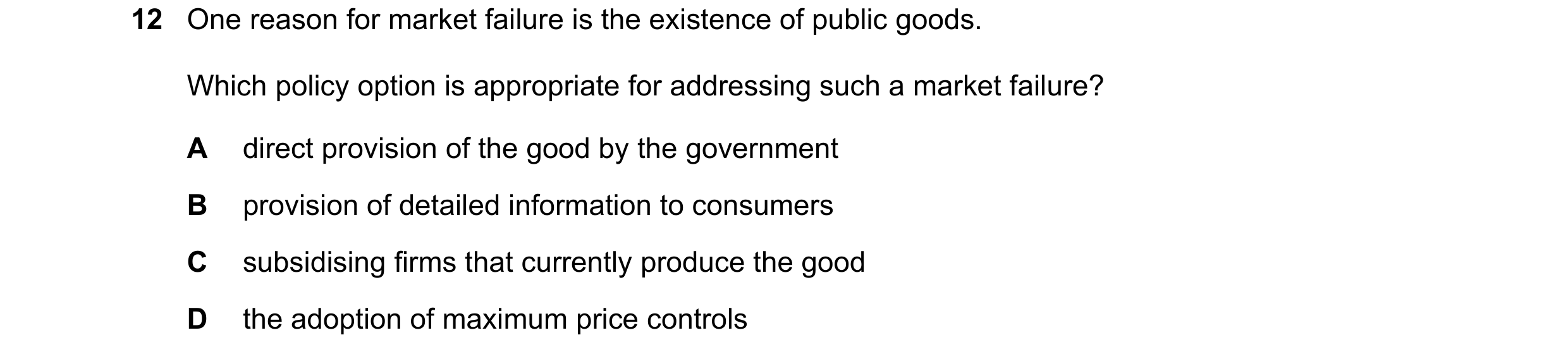
Q71 · One reason for market failure is the existence of public goods 9708/31 May/June 2023
12 One reason for market failure is the existence of public goods. Which policy option is appropriate for addressing such a market failure? A direct provision of the good by the government B provision of detailed information to consumers C subsidising firms that currently produce the good D the adoption of maximum price controls
1 marks
Answer: A
This question in 9708/31 May/June 2023
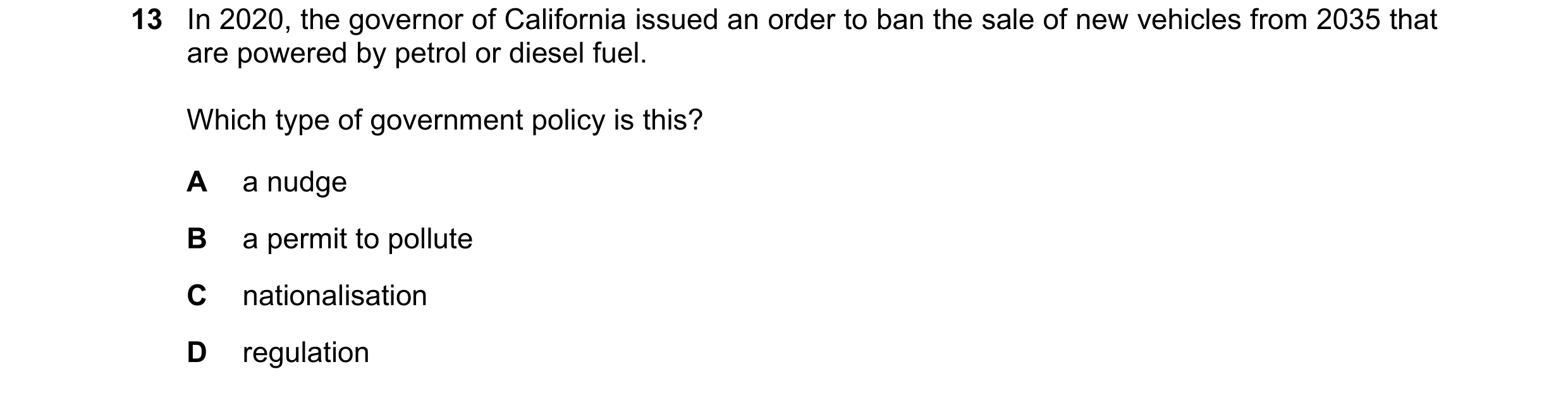
Q72 · In 2020, the governor of California issued an order to ban the sale of new vehicles from… 9708/31 May/June 2023
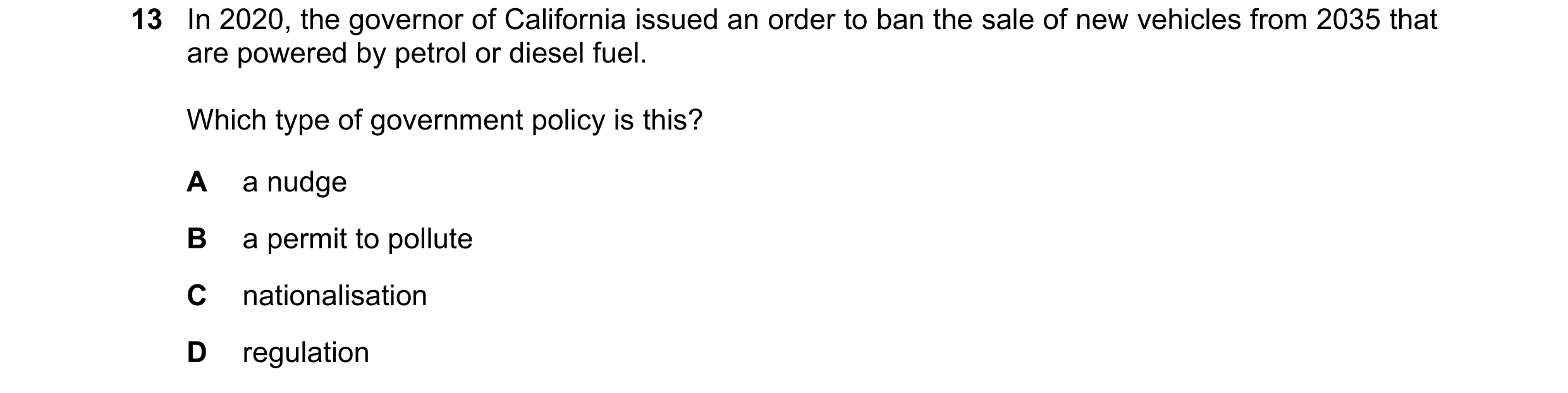
13 In 2020, the governor of California issued an order to ban the sale of new vehicles from 2035 that are powered by petrol or diesel fuel. Which type of government policy is this? A a nudge B a permit to pollute C nationalisation D regulation
1 marks
Answer: D
This question in 9708/31 May/June 2023
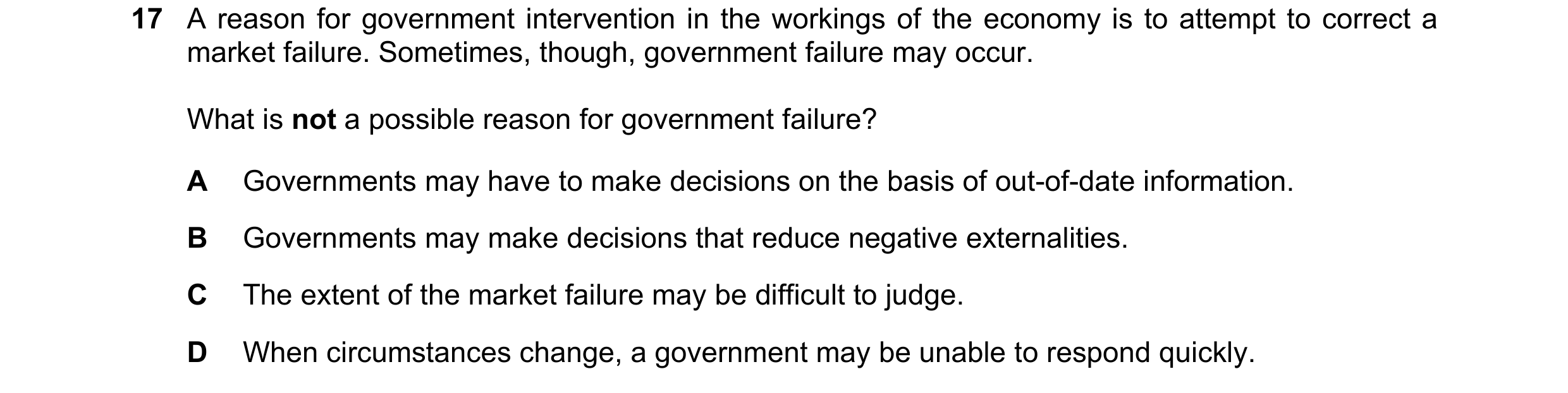
Q73 · A reason for government intervention in the workings of the economy is to attempt to… 9708/31 May/June 2023
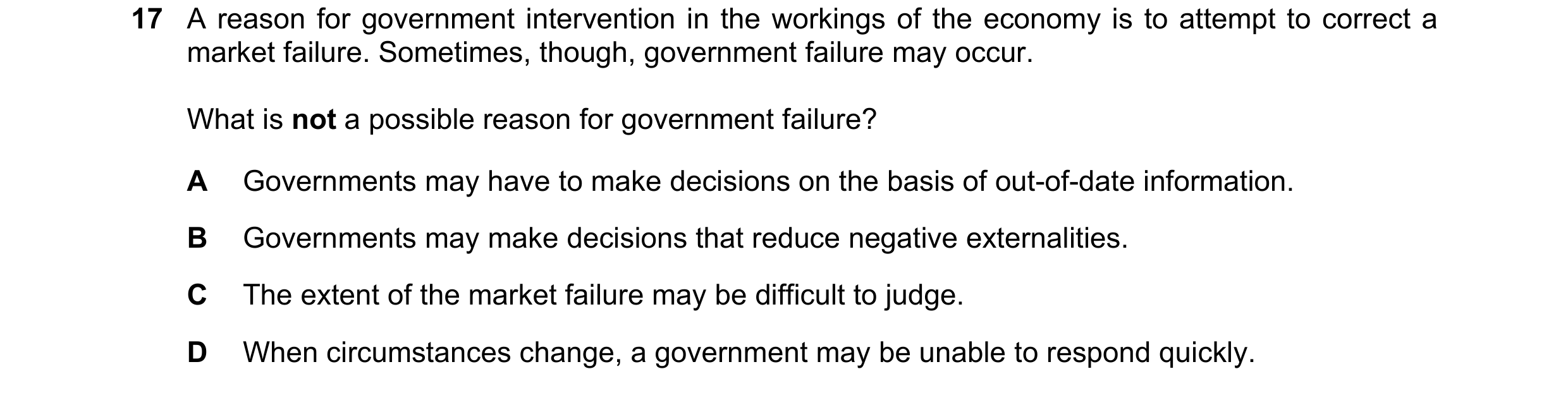
17 A reason for government intervention in the workings of the economy is to attempt to correct a market failure. Sometimes, though, government failure may occur. What is not a possible reason for government failure? A Governments may have to make decisions on the basis of out-of-date information. B Governments may make decisions that reduce negative externalities. C The extent of the market failure may be difficult to judge. D When circumstances change, a government may be unable to respond quickly.
1 marks
Answer: B
This question in 9708/31 May/June 2023
Q74 · A government imposes a maximum price for electricity 9708/32 May/June 2023
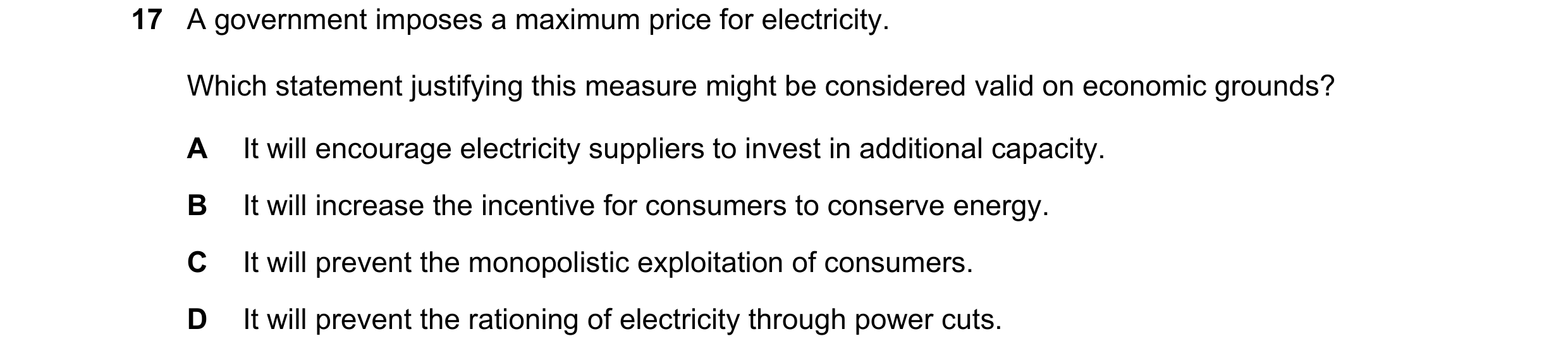
17 A government imposes a maximum price for electricity. Which statement justifying this measure might be considered valid on economic grounds? A It will encourage electricity suppliers to invest in additional capacity. B It will increase the incentive for consumers to conserve energy. C It will prevent the monopolistic exploitation of consumers. D It will prevent the rationing of electricity through power cuts.
1 marks
Answer: C
This question in 9708/32 May/June 2023
Q75 · One reason for market failure is the existence of public goods 9708/33 May/June 2023
12 One reason for market failure is the existence of public goods. Which policy option is appropriate for addressing such a market failure? A direct provision of the good by the government B provision of detailed information to consumers C subsidising firms that currently produce the good D the adoption of maximum price controls
1 marks
Answer: A
This question in 9708/33 May/June 2023
Q76 · In 2020, the governor of California issued an order to ban the sale of new vehicles from… 9708/33 May/June 2023
13 In 2020, the governor of California issued an order to ban the sale of new vehicles from 2035 that are powered by petrol or diesel fuel. Which type of government policy is this? A a nudge B a permit to pollute C nationalisation D regulation
1 marks
Answer: D
This question in 9708/33 May/June 2023
Q77 · A reason for government intervention in the workings of the economy is to attempt to… 9708/33 May/June 2023
17 A reason for government intervention in the workings of the economy is to attempt to correct a market failure. Sometimes, though, government failure may occur. What is not a possible reason for government failure? A Governments may have to make decisions on the basis of out-of-date information. B Governments may make decisions that reduce negative externalities. C The extent of the market failure may be difficult to judge. D When circumstances change, a government may be unable to respond quickly.
1 marks
Answer: B
This question in 9708/33 May/June 2023
Q78 · A government wishes to support growth in the economy’s fishing industry 9708/33 May/June 2023
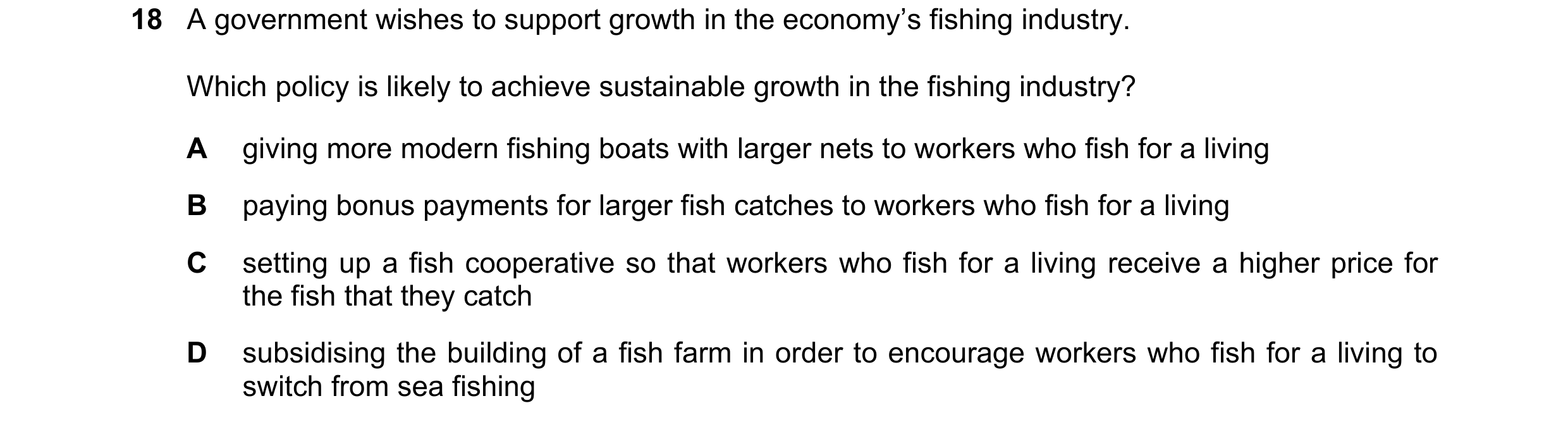
18 A government wishes to support growth in the economy’s fishing industry. Which policy is likely to achieve sustainable growth in the fishing industry? A giving more modern fishing boats with larger nets to workers who fish for a living B paying bonus payments for larger fish catches to workers who fish for a living C setting up a fish cooperative so that workers who fish for a living receive a higher price for the fish that they catch D subsidising the building of a fish farm in order to encourage workers who fish for a living to switch from sea fishing
1 marks
Answer: D
This question in 9708/33 May/June 2023
Q79 · Which statement is not an example of government failure? 9708/31 Oct/Nov 2023
11 Which statement is not an example of government failure? A government intervention leading to a less efficient allocation of resources B government intervention leading to a net loss of economic welfare C government intervention leading to an increase in consumer surplus D government intervention leading to social costs exceeding social benefits
1 marks
Answer: C
This question in 9708/31 Oct/Nov 2023
Q80 · Under which circumstances will a subsidy from the government be most beneficial if there… 9708/31 Oct/Nov 2023
16 Under which circumstances will a subsidy from the government be most beneficial if there are externalities from producing good X? externality caused price elasticity of by good X demand of good X A negative <1 B negative >1 C positive <1 D positive >1
1 marks
Answer: D
This question in 9708/31 Oct/Nov 2023
Q81 · Which policy to counter climate change is considered to be regulatory rather than market… 9708/31 Oct/Nov 2023
19 Which policy to counter climate change is considered to be regulatory rather than market based? A the introduction of carbon taxes on pollution B the operation of tradable pollution permits C the provision of government subsidies D the setting of industrial emission standards
1 marks
Answer: D
This question in 9708/31 Oct/Nov 2023
Q82 · Which policy is not designed to correct a market failure? 9708/33 Oct/Nov 2023
14 Which policy is not designed to correct a market failure? A government provision of healthcare B price controls on large firms C regulations to limit smoke pollution D introducing import quotas
1 marks
Answer: D
This question in 9708/33 Oct/Nov 2023
Q83 · The government can use policies to try and reduce the environmental damage caused by the… 9708/31 May/June 2024
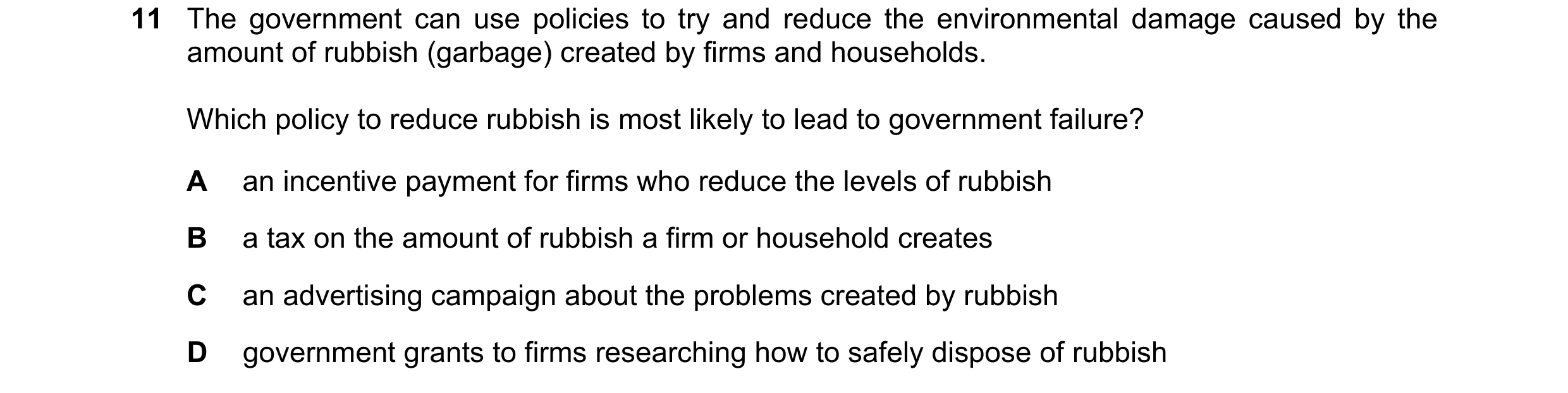
11 The government can use policies to try and reduce the environmental damage caused by the amount of rubbish (garbage) created by firms and households. Which policy to reduce rubbish is most likely to lead to government failure? A an incentive payment for firms who reduce the levels of rubbish B a tax on the amount of rubbish a firm or household creates C an advertising campaign about the problems created by rubbish D government grants to firms researching how to safely dispose of rubbish
1 marks
Answer: B
This question in 9708/31 May/June 2024
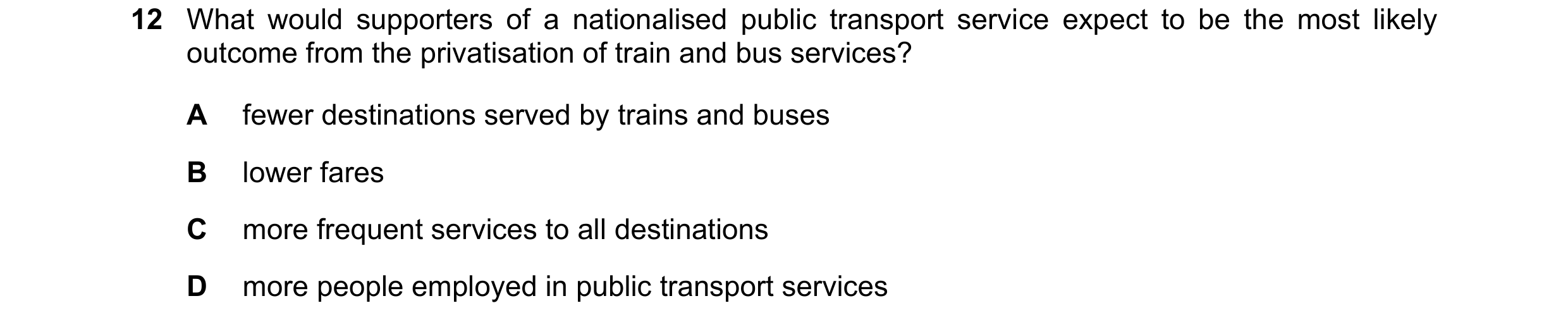
Q84 · What would supporters of a nationalised public transport service expect to be the most… 9708/31 May/June 2024
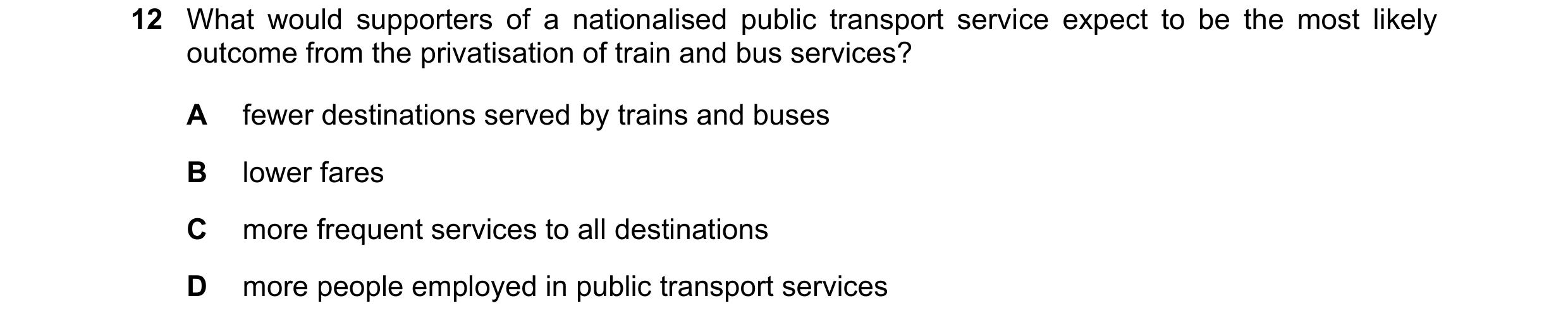
12 What would supporters of a nationalised public transport service expect to be the most likely outcome from the privatisation of train and bus services? A fewer destinations served by trains and buses B lower fares C more frequent services to all destinations D more people employed in public transport services
1 marks
Answer: A
This question in 9708/31 May/June 2024
Q85 · The government can use policies to try and reduce the environmental damage caused by the… 9708/33 May/June 2024
11 The government can use policies to try and reduce the environmental damage caused by the amount of rubbish (garbage) created by firms and households. Which policy to reduce rubbish is most likely to lead to government failure? A an incentive payment for firms who reduce the levels of rubbish B a tax on the amount of rubbish a firm or household creates C an advertising campaign about the problems created by rubbish D government grants to firms researching how to safely dispose of rubbish
1 marks
Answer: B
This question in 9708/33 May/June 2024
Q86 · What would supporters of a nationalised public transport service expect to be the most… 9708/33 May/June 2024
12 What would supporters of a nationalised public transport service expect to be the most likely outcome from the privatisation of train and bus services? A fewer destinations served by trains and buses B lower fares C more frequent services to all destinations D more people employed in public transport services
1 marks
Answer: A
This question in 9708/33 May/June 2024
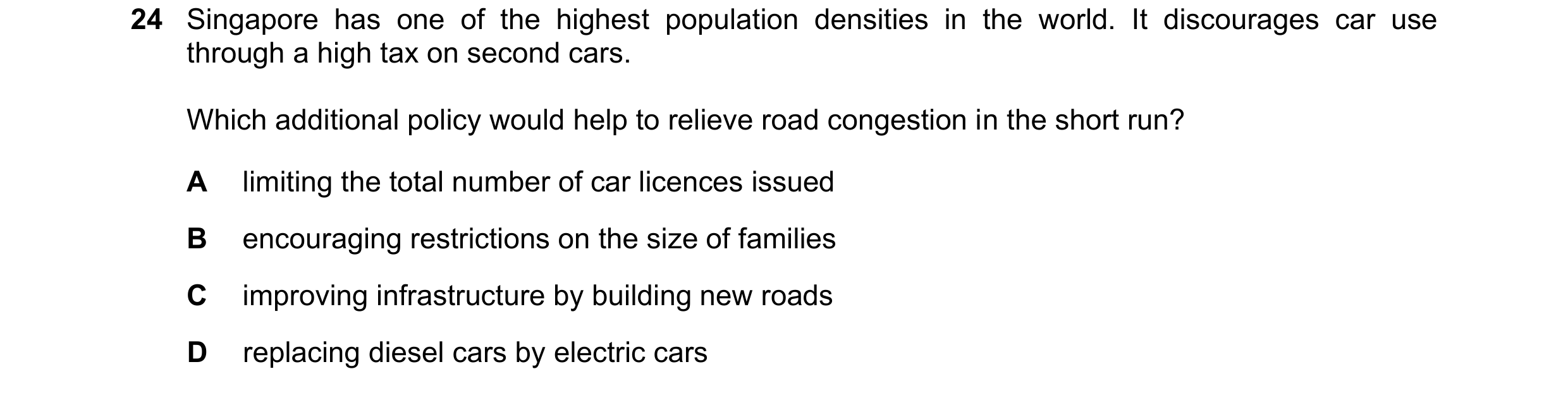
Q87 · Singapore has one of the highest population densities in the world 9708/33 May/June 2024
24 Singapore has one of the highest population densities in the world. It discourages car use through a high tax on second cars. Which additional policy would help to relieve road congestion in the short run? A limiting the total number of car licences issued B encouraging restrictions on the size of families C improving infrastructure by building new roads D replacing diesel cars by electric cars
1 marks
Answer: A
This question in 9708/33 May/June 2024
Q88 · What is not an example of government failure? 9708/32 Feb/March 2025
8 What is not an example of government failure? A decreased maximum price causing producers to leave the market B higher guaranteed price encouraging suppliers to overproduce C increased minimum wage leading to employers dismissing workers D increased subsidies encouraging the consumption of a socially desirable product
1 marks
Answer: D
This question in 9708/32 Feb/March 2025
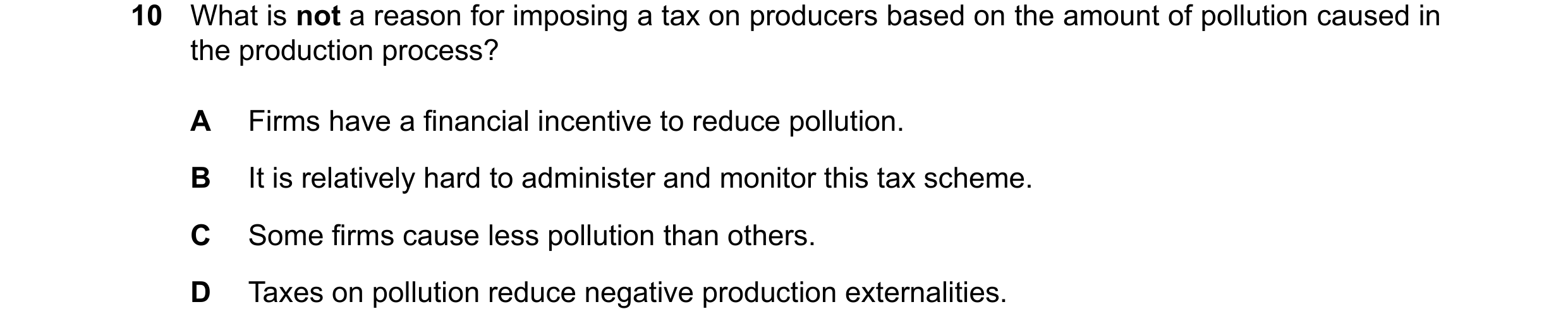
Q89 · What is not a reason for imposing a tax on producers based on the amount of pollution… 9708/32 Feb/March 2025
10 What is not a reason for imposing a tax on producers based on the amount of pollution caused in the production process? A Firms have a financial incentive to reduce pollution. B It is relatively hard to administer and monitor this tax scheme. C Some firms cause less pollution than others. D Taxes on pollution reduce negative production externalities.
1 marks
Answer: B
This question in 9708/32 Feb/March 2025



 1 / 25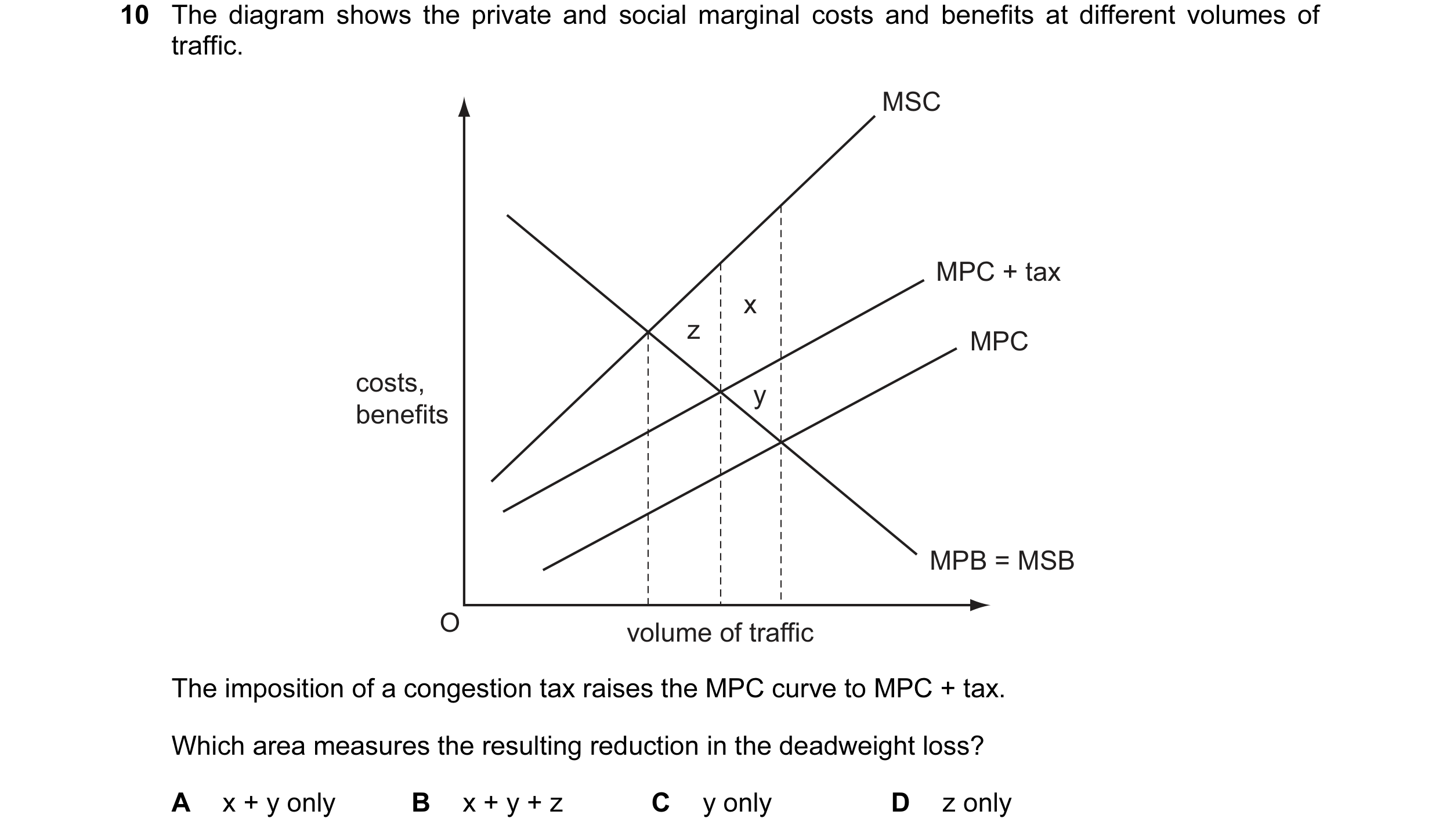
 2 / 25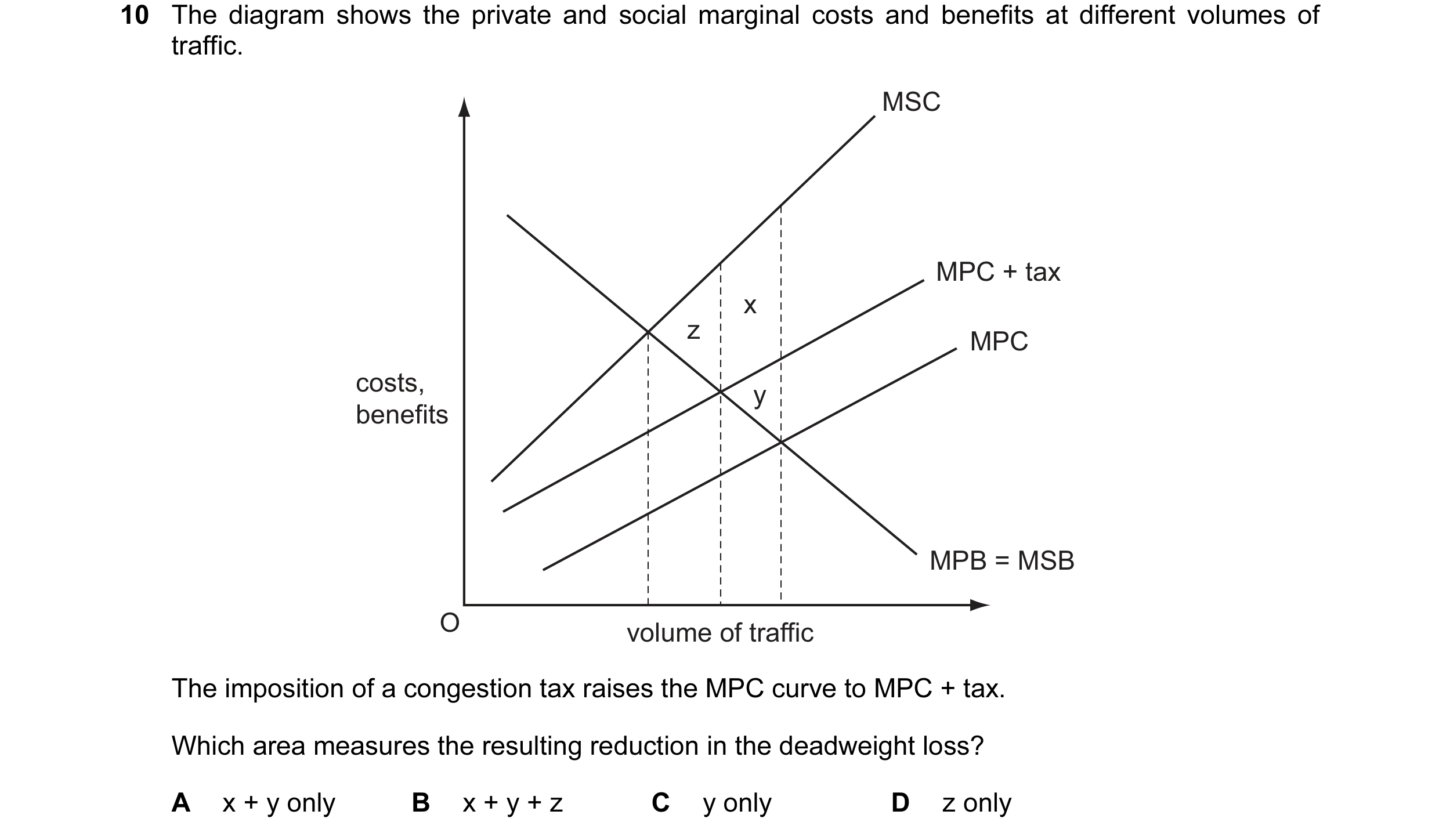

 3 / 25
 4 / 25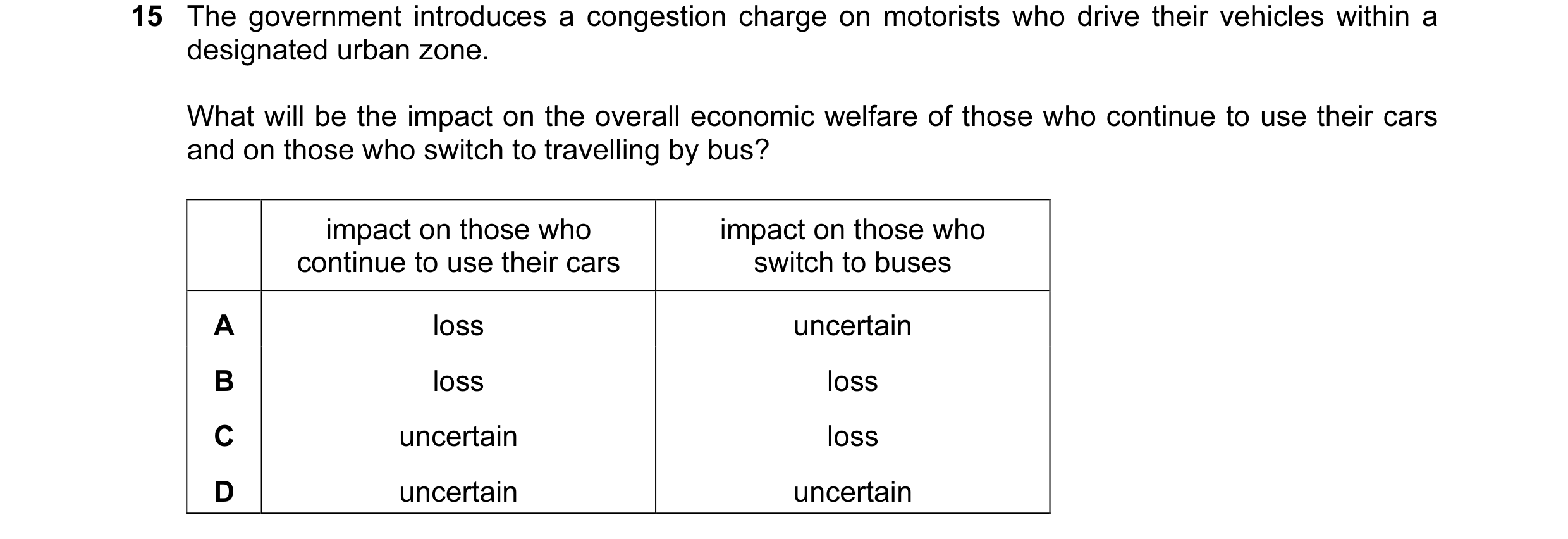
 5 / 25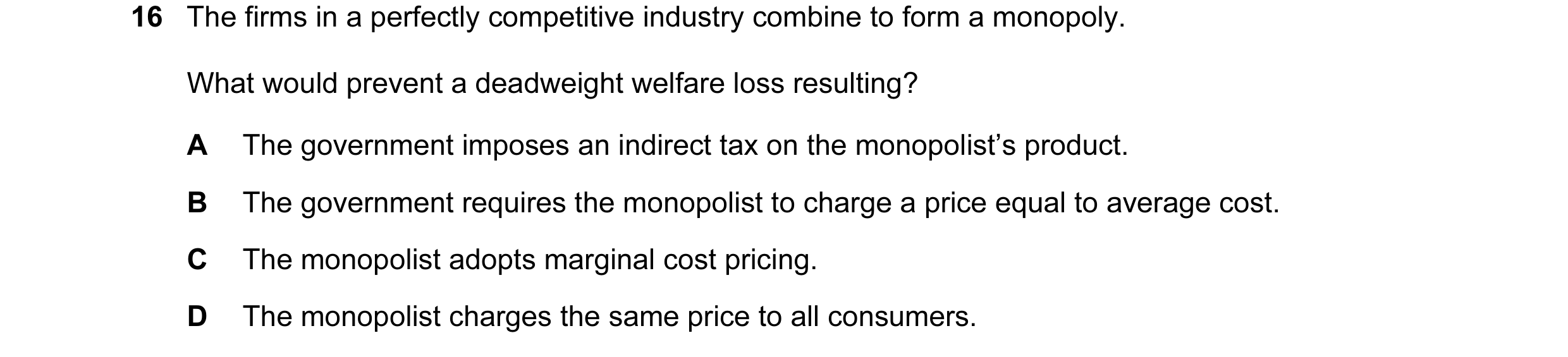
 6 / 25
 7 / 25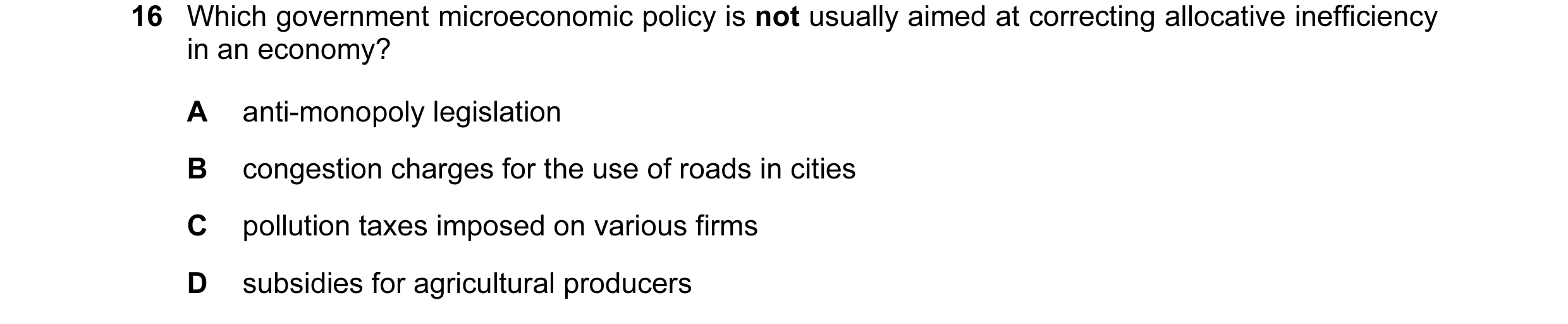
 8 / 25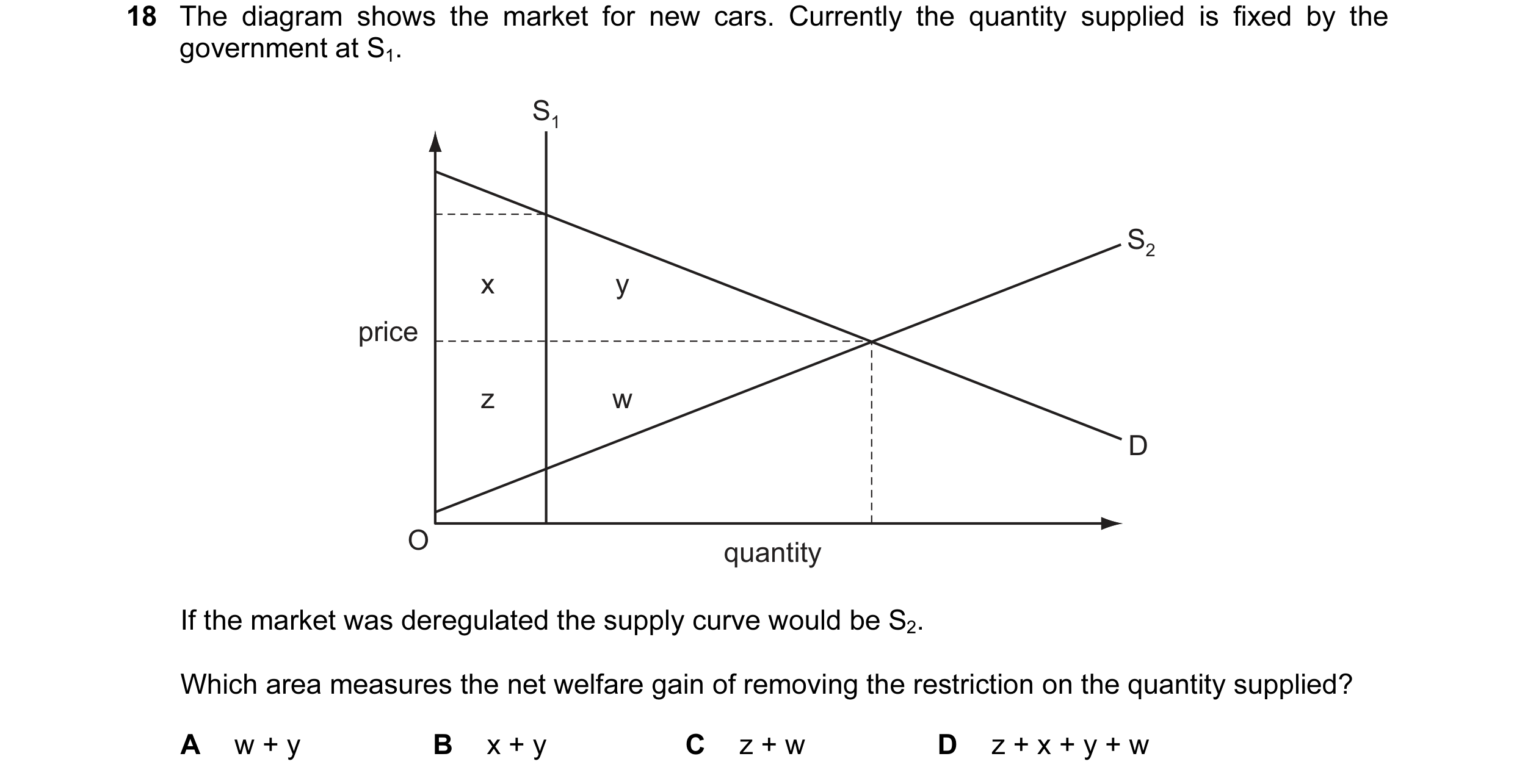
 9 / 25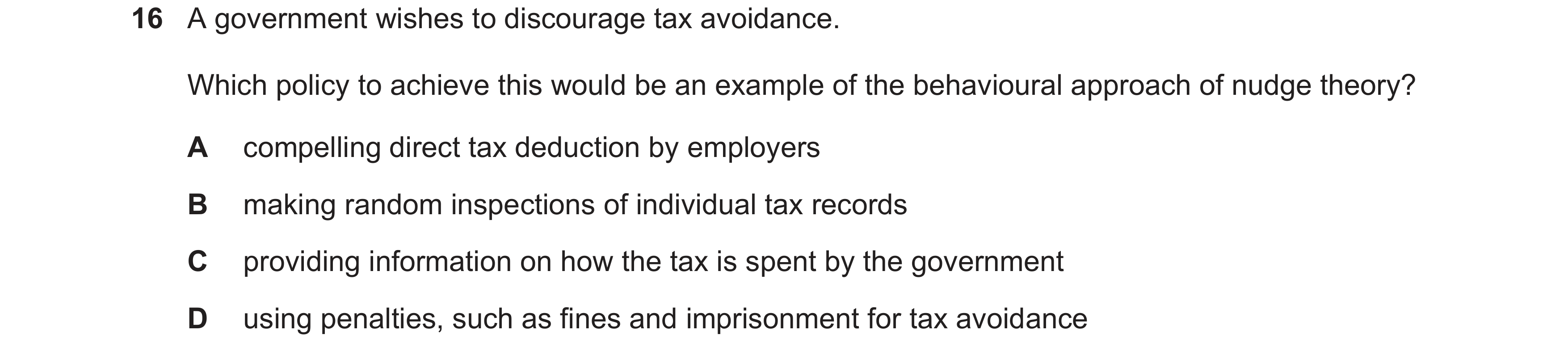
 10 / 25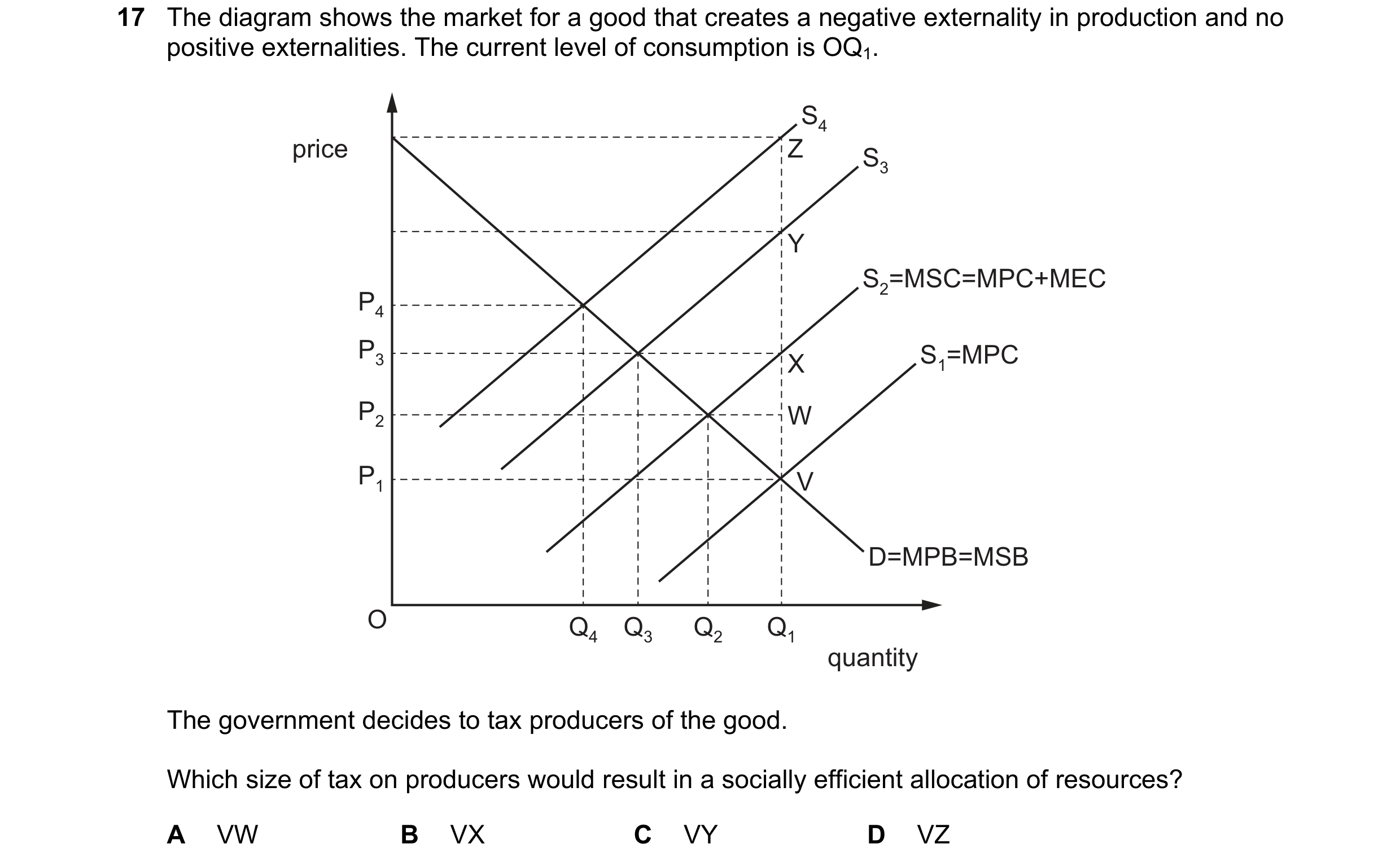
 11 / 25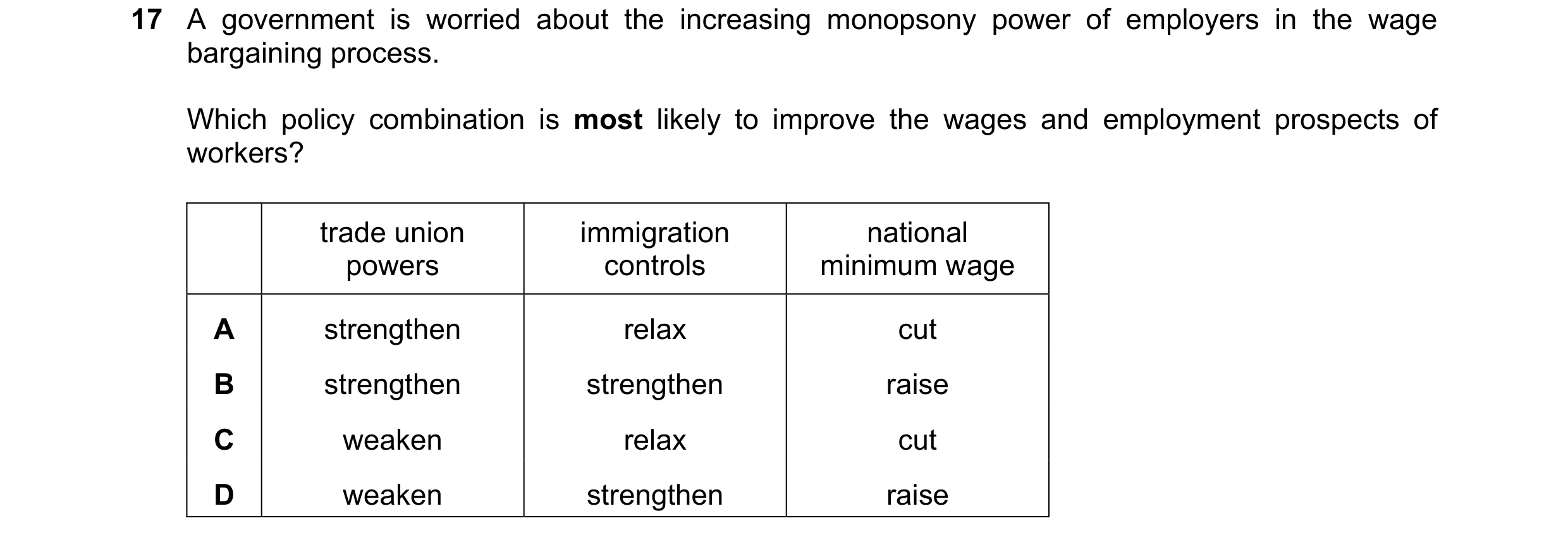
 12 / 25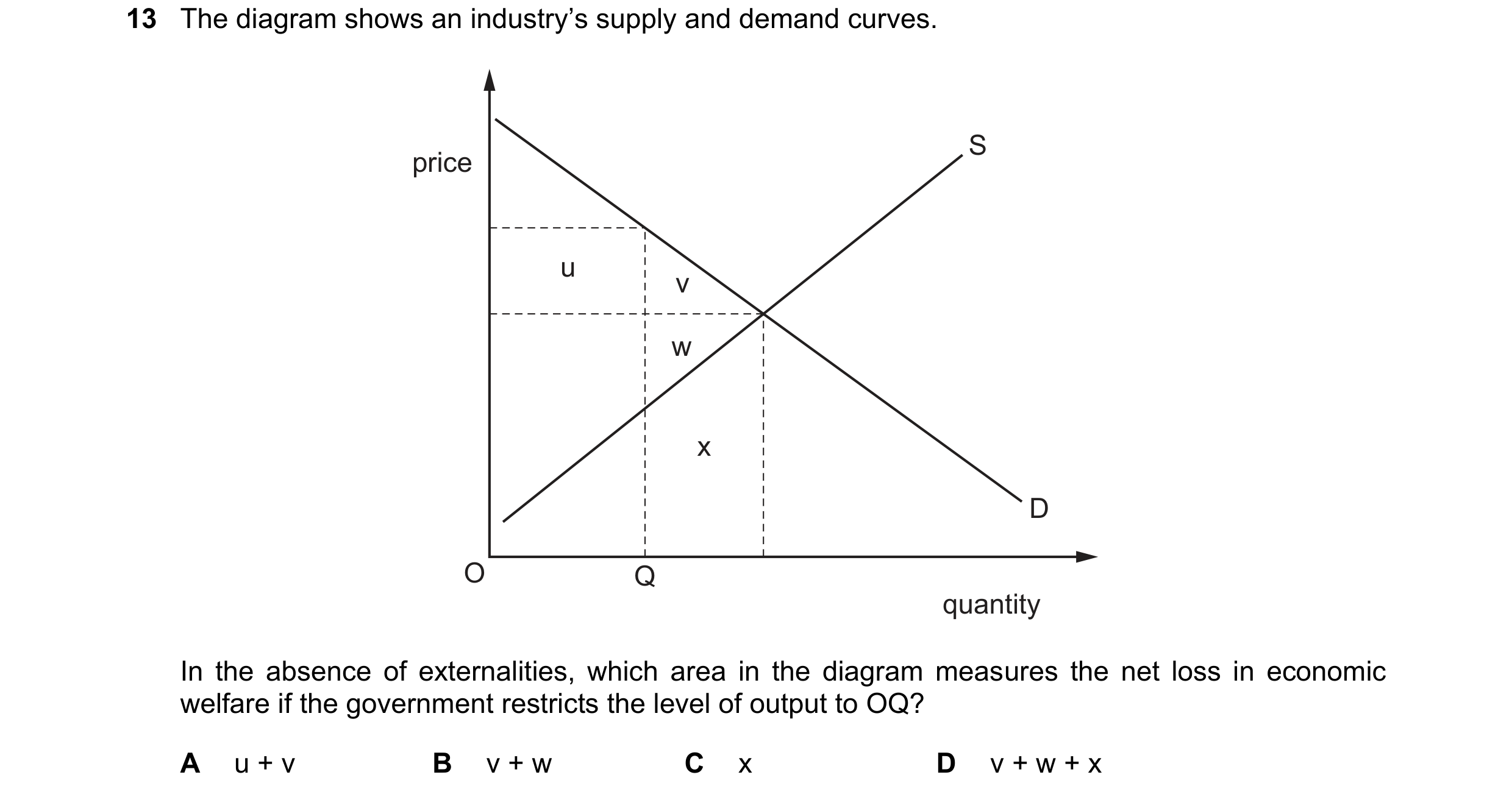
 13 / 25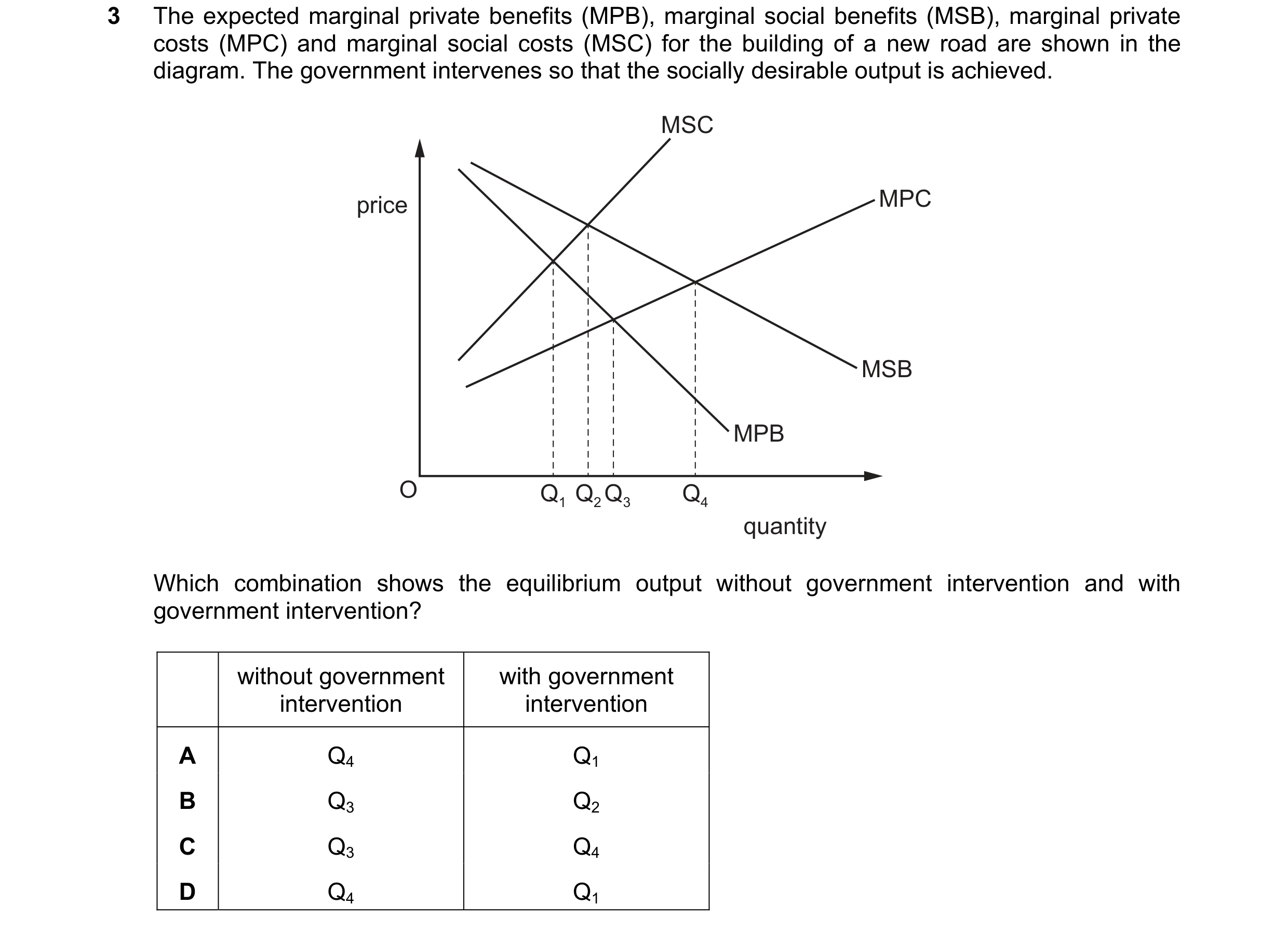
 14 / 25
 15 / 25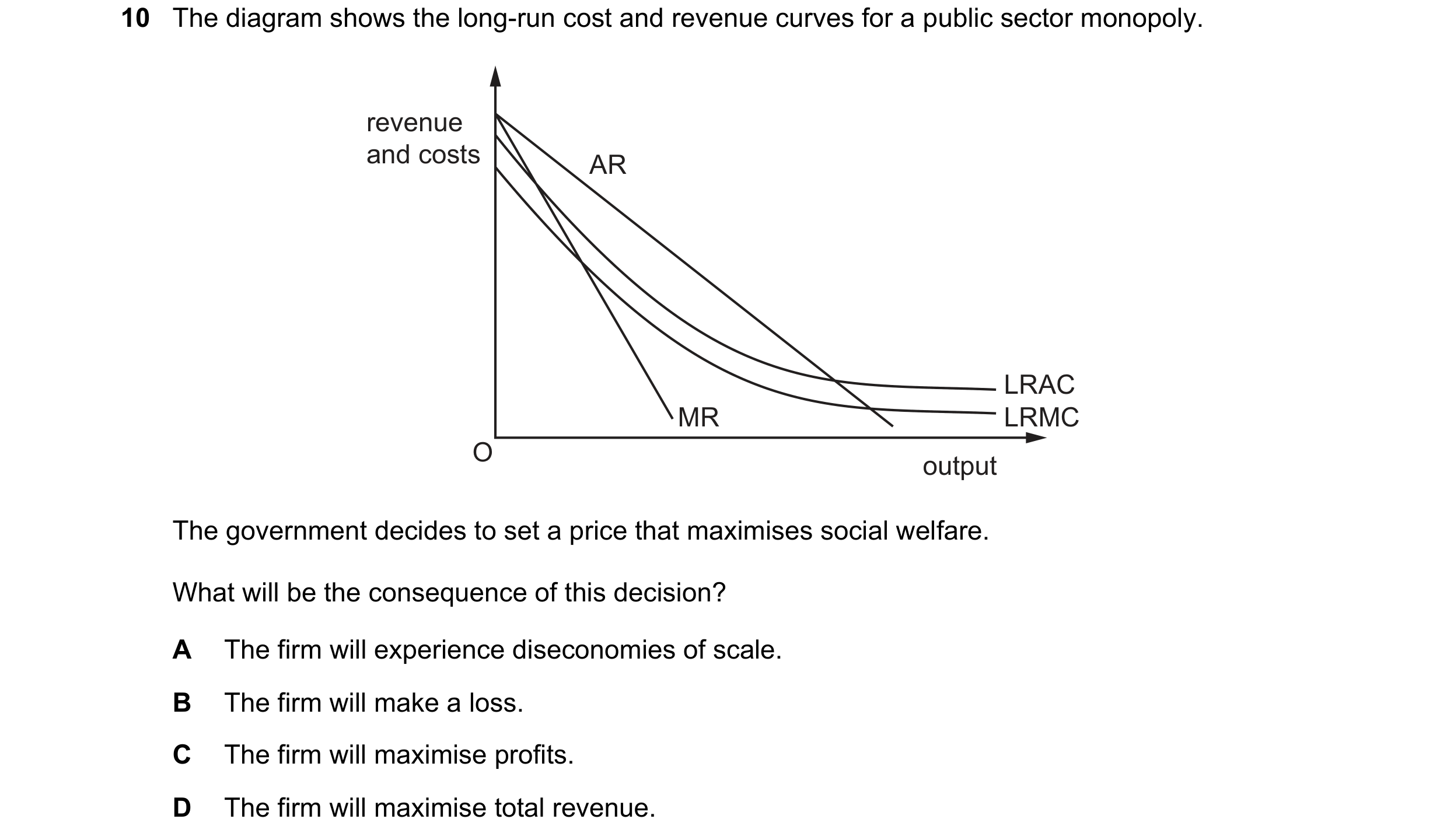
 16 / 25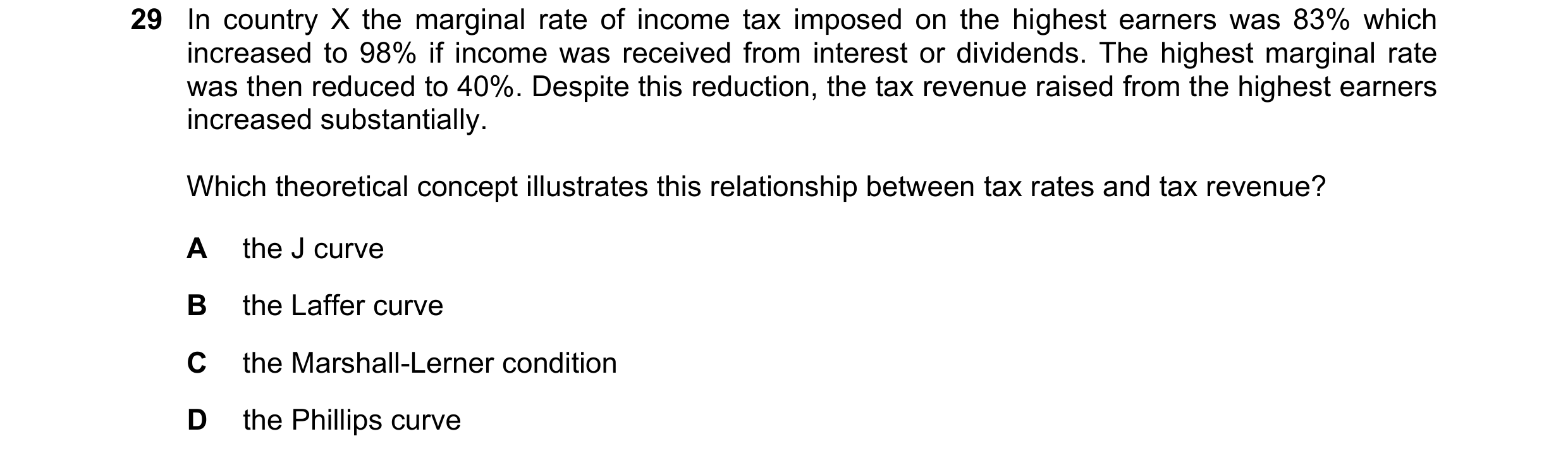
 17 / 25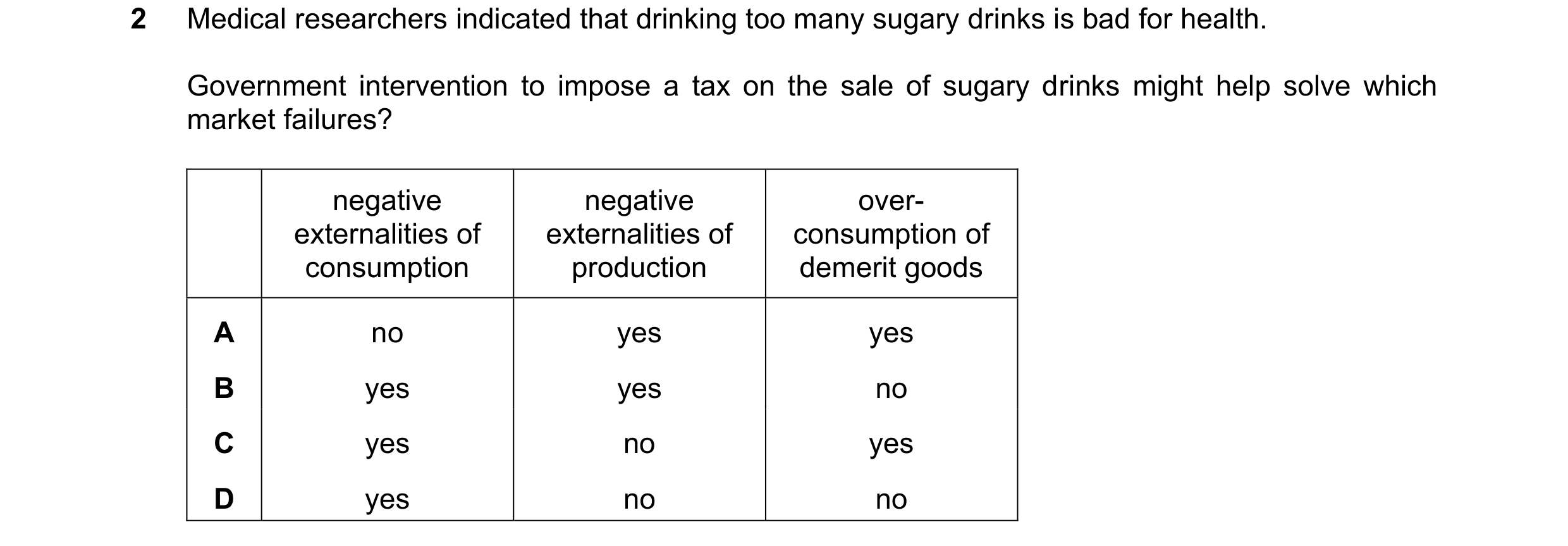
 18 / 25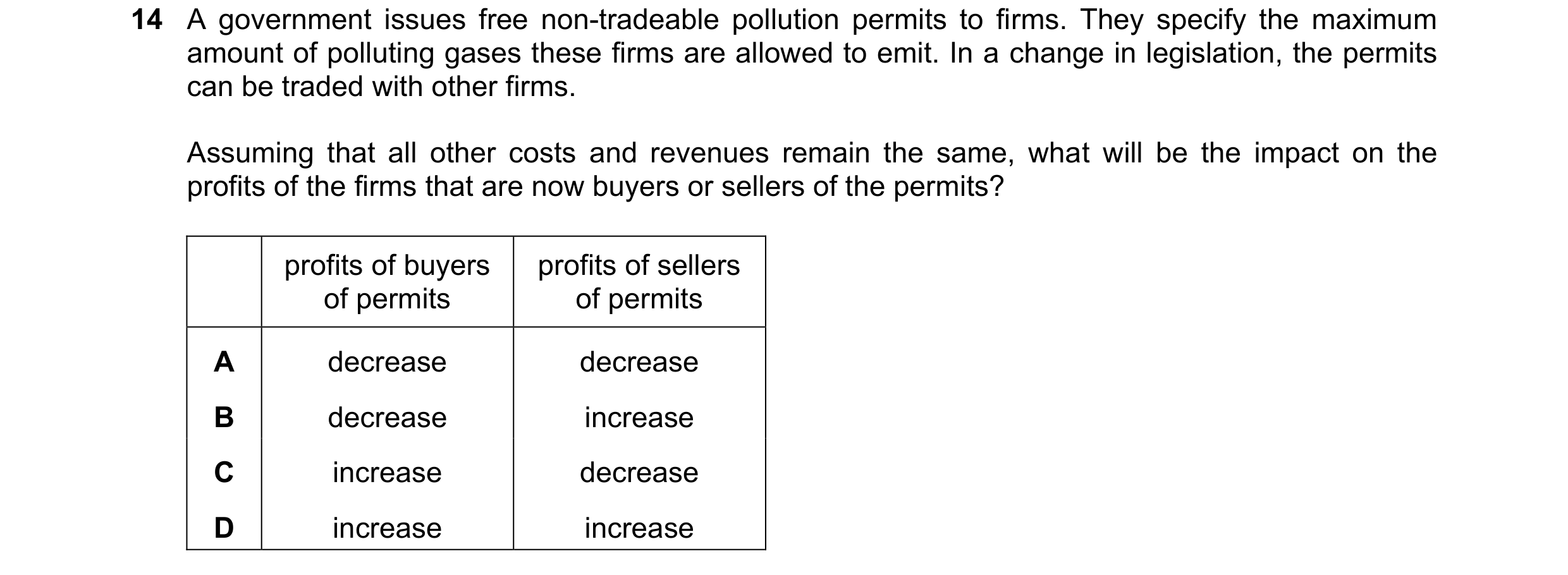

 19 / 25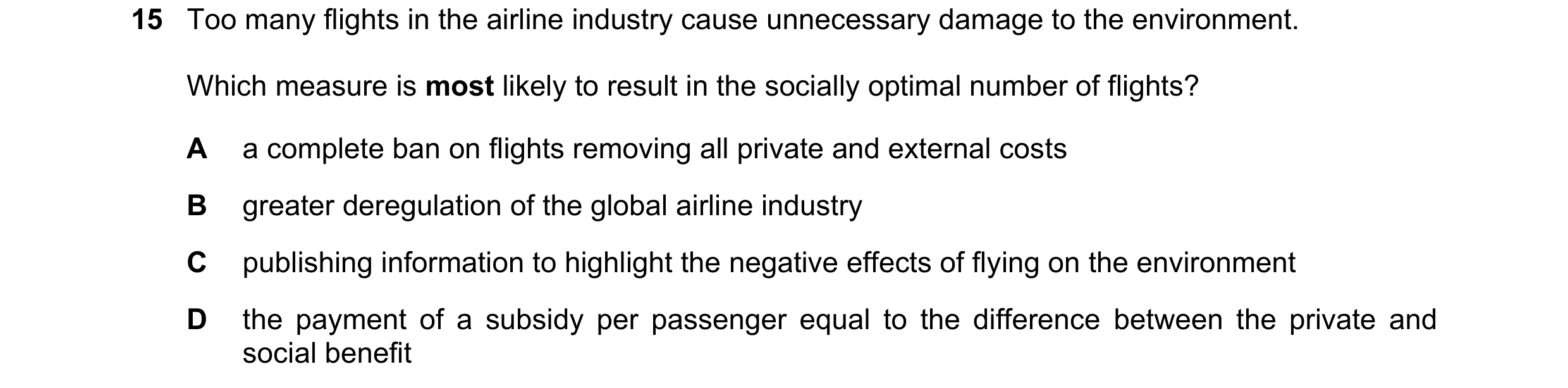
 20 / 25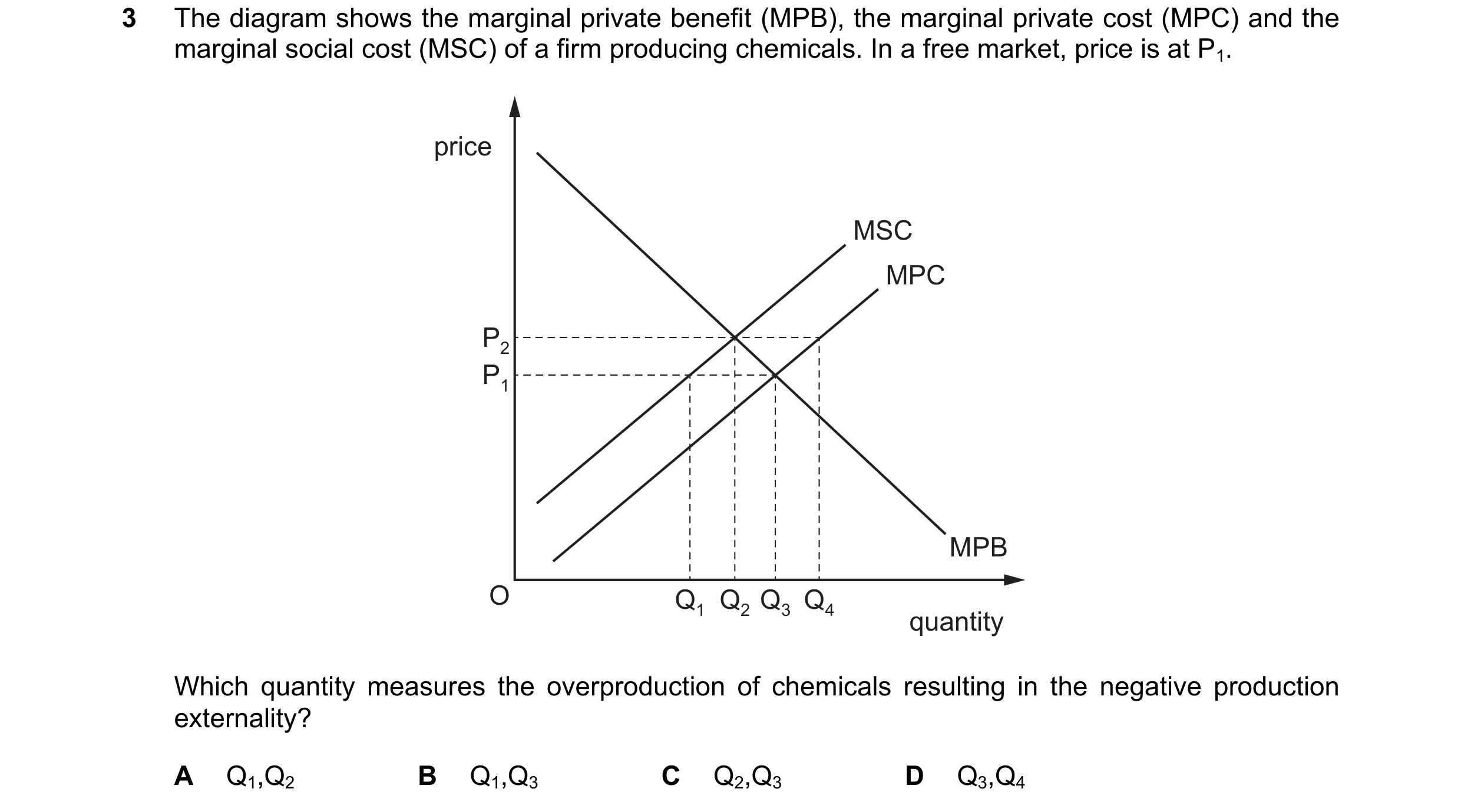
 21 / 25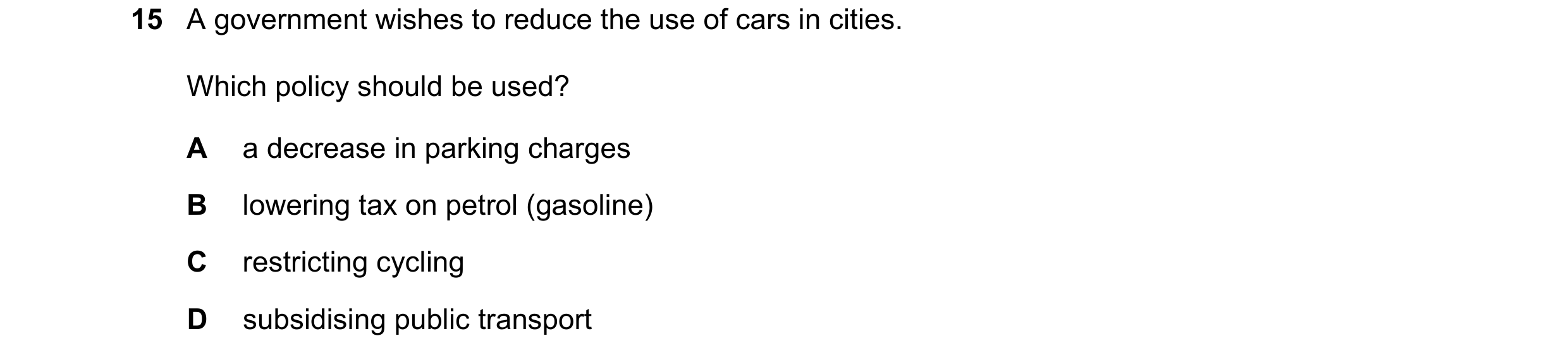
 22 / 25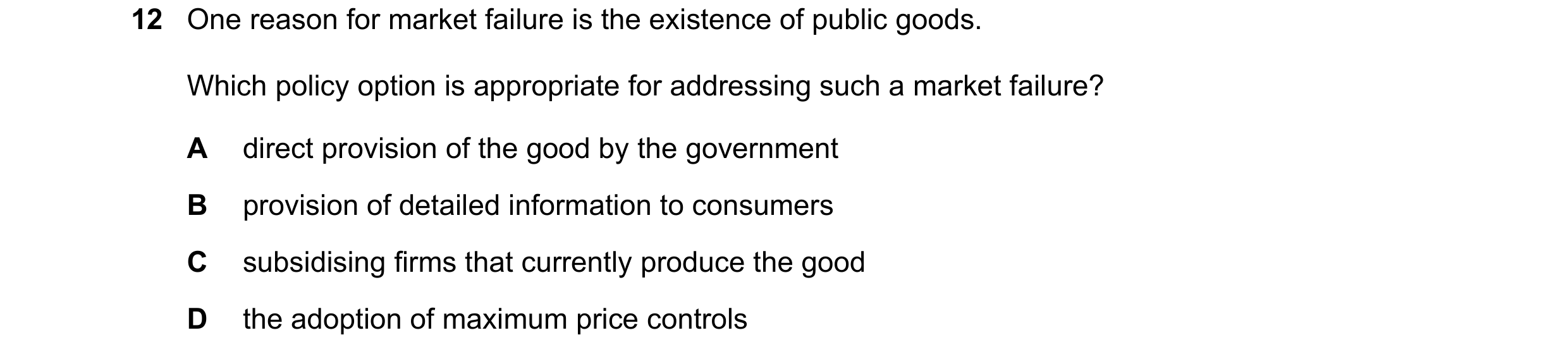
 23 / 25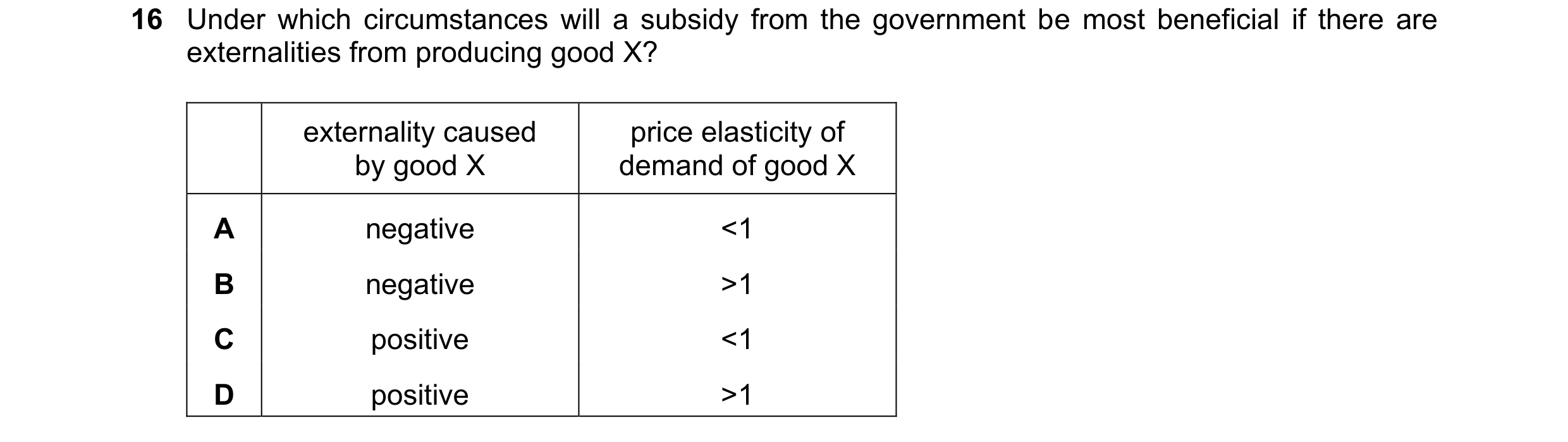


 24 / 25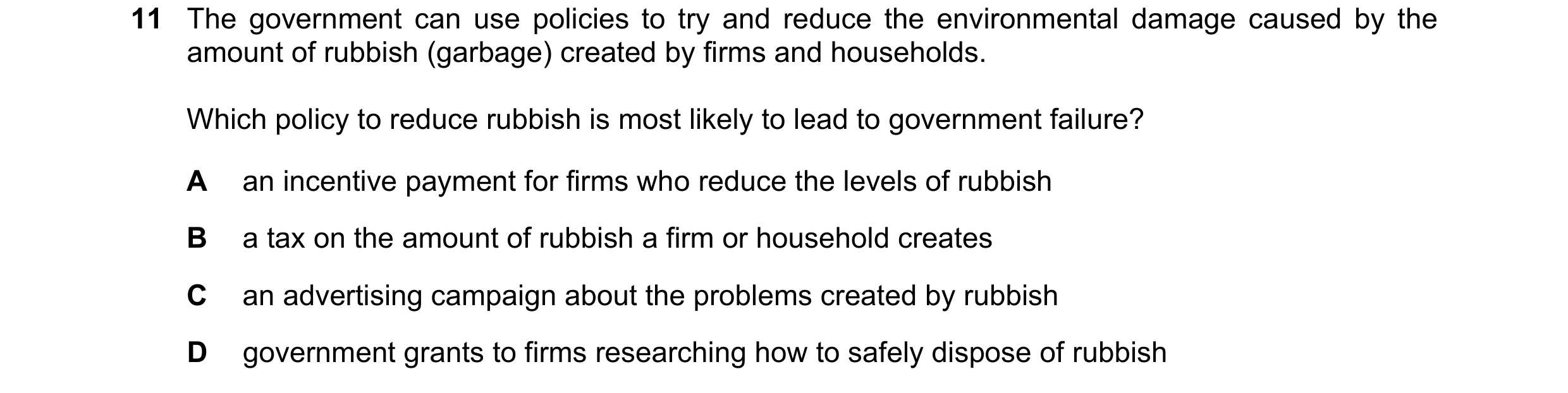

 25 / 25