Questions as text
Q1 · A government is planning to intervene in a market to fix output at the economically… 9708/11 May/June 2009
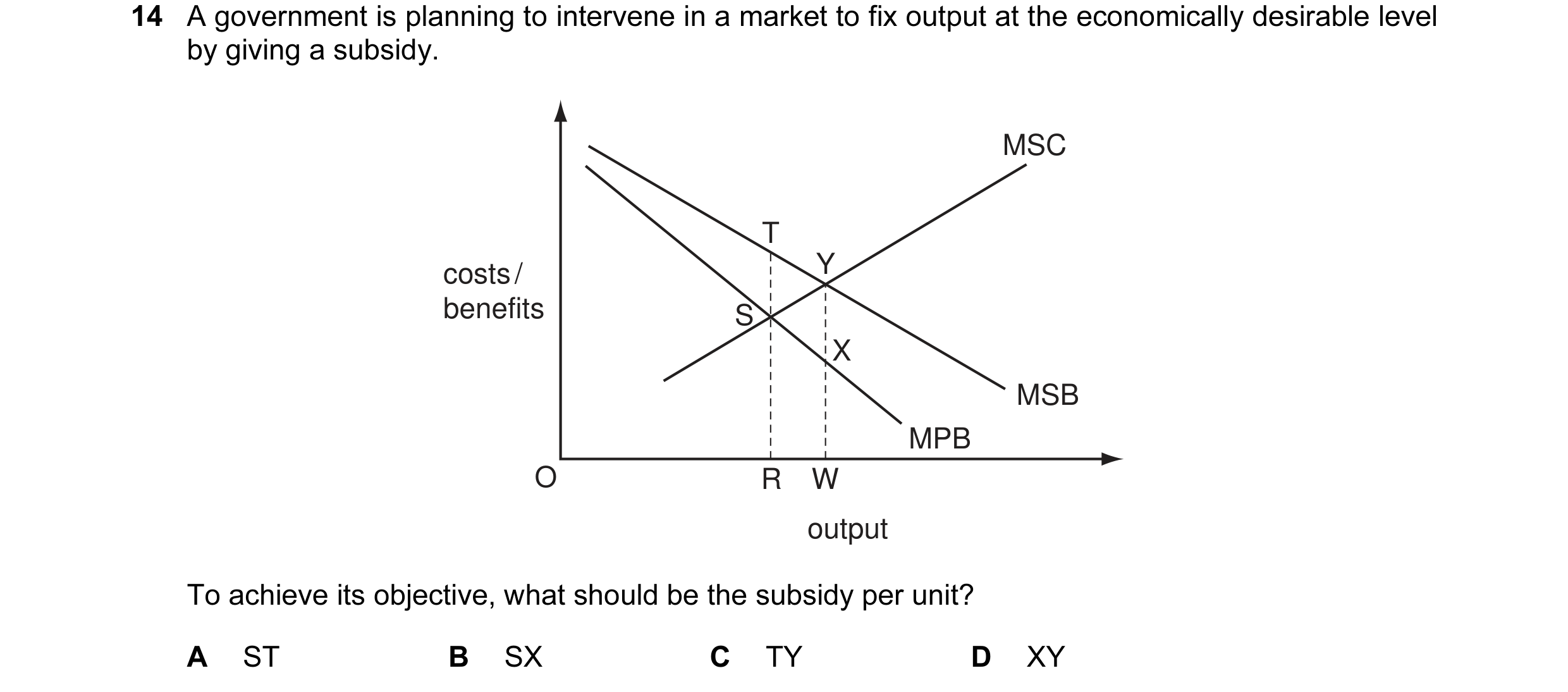
14 A government is planning to intervene in a market to fix output at the economically desirable level by giving a subsidy. MSC T costs / Y benefits S X MSB MPB O R W output To achieve its objective, what should be the subsidy per unit? A ST B SX C TY D XY
1 marks
Answer: D
This question in 9708/11 May/June 2009
Q2 · When would cost-benefit analysis definitely indicate that a government project should be… 9708/11 May/June 2009
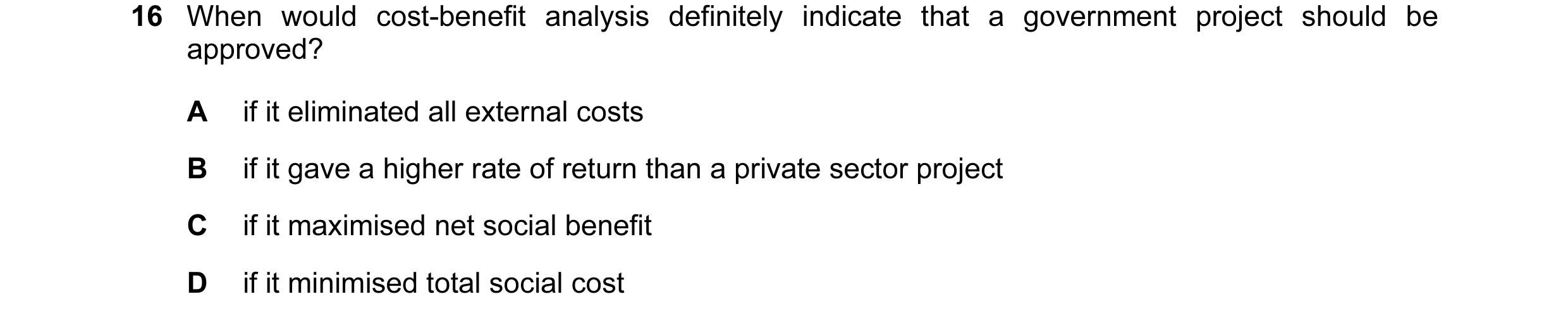
16 When would cost-benefit analysis definitely indicate that a government project should be approved? A if it eliminated all external costs B if it gave a higher rate of return than a private sector project C if it maximised net social benefit D if it minimised total social cost
1 marks
Answer: C
This question in 9708/11 May/June 2009
Q3 · The government is considering building flood defences along a river 9708/11 Oct/Nov 2009
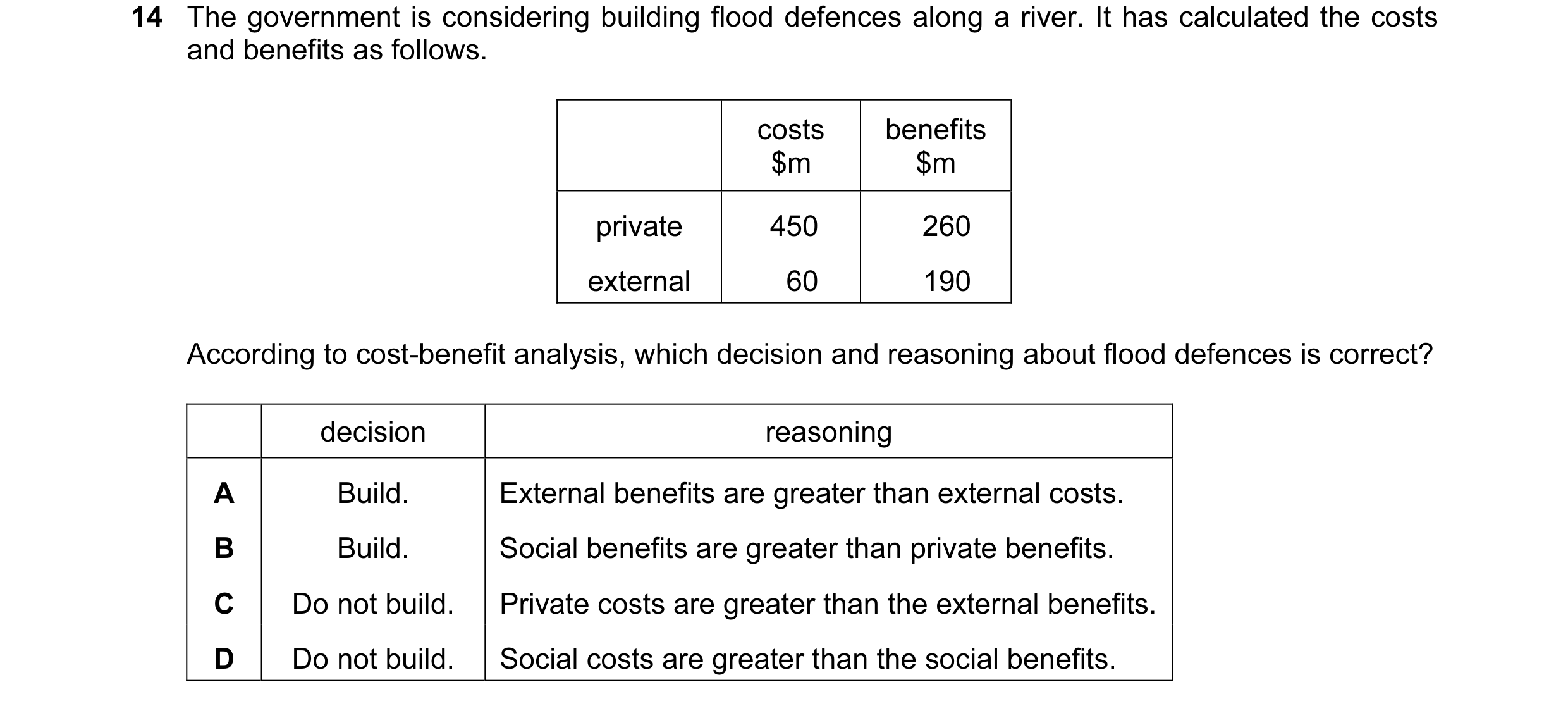
14 The government is considering building flood defences along a river. It has calculated the costs and benefits as follows. costs benefits $m $m private 450 260 external 60 190 According to cost-benefit analysis, which decision and reasoning about flood defences is correct? decision reasoning A Build. External benefits are greater than external costs. B Build. Social benefits are greater than private benefits. C Do not build. Private costs are greater than the external benefits. D Do not build. Social costs are greater than the social benefits.
1 marks
Answer: D
This question in 9708/11 Oct/Nov 2009
Q4 · The government is considering building flood defences along a river 9708/12 Oct/Nov 2009
13 The government is considering building flood defences along a river. It has calculated the costs and benefits as follows. costs benefits $m $m private 450 260 external 60 190 According to cost-benefit analysis, which decision and reasoning about flood defences is correct? decision reasoning A Build. External benefits are greater than external costs. B Build. Social benefits are greater than private benefits. C Do not build. Private costs are greater than the external benefits. D Do not build. Social costs are greater than the social benefits.
1 marks
Answer: D
This question in 9708/12 Oct/Nov 2009
Q5 · What will make it more likely that road tolls will reduce traffic congestion? 9708/13 Oct/Nov 2010
16 What will make it more likely that road tolls will reduce traffic congestion? A Cross-elasticity of demand between private and public transport is zero. B Demand for car use is income-elastic. C Demand for car use is price-elastic. D Supply of public transport is price-inelastic.
1 marks
Answer: C
This question in 9708/13 Oct/Nov 2010
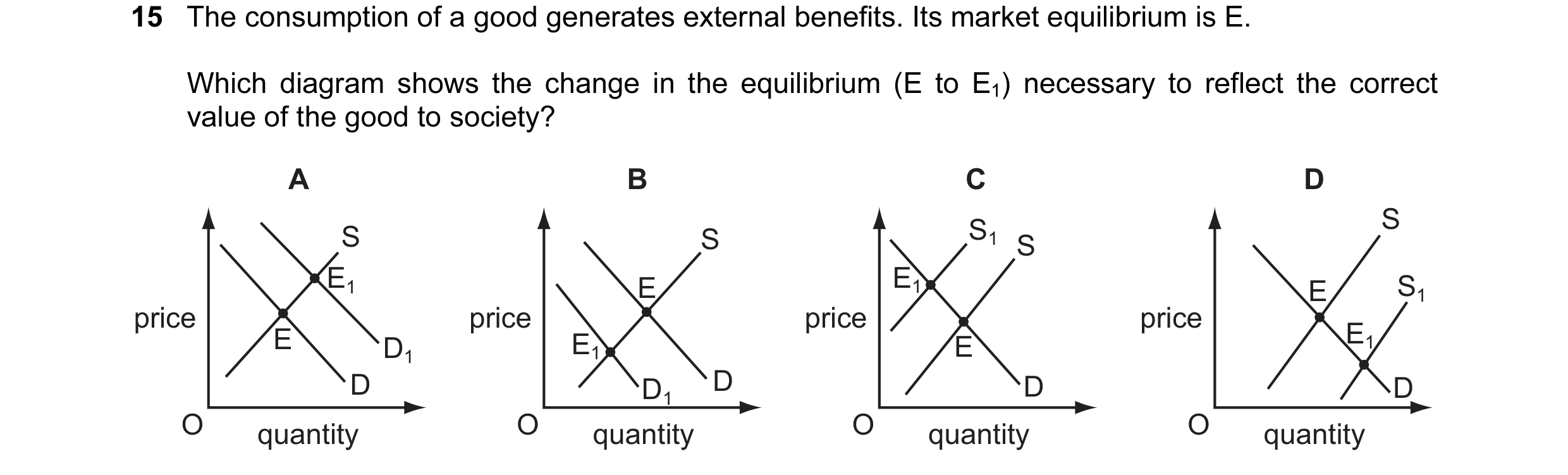
Q6 · The consumption of a good generates external benefits 9708/11 May/June 2011
15 The consumption of a good generates external benefits. Its market equilibrium is E. Which diagram shows the change in the equilibrium (E to E1) necessary to reflect the correct value of the good to society? A B C D S1 S S S S E1 E E1 S1 E price price price price E E1 E1 D1 E D D1 D D D O quantity O quantity O quantity O quantity
1 marks
Answer: A
This question in 9708/11 May/June 2011
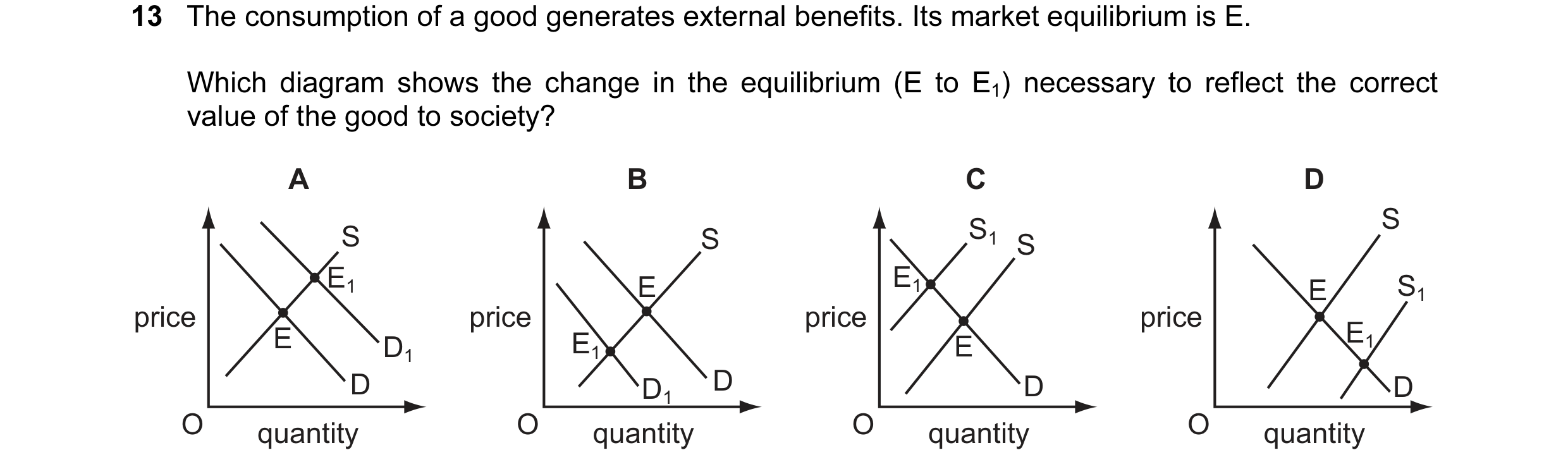
Q7 · The consumption of a good generates external benefits 9708/13 May/June 2011
13 The consumption of a good generates external benefits. Its market equilibrium is E. Which diagram shows the change in the equilibrium (E to E1) necessary to reflect the correct value of the good to society? A B C D S1 S S S S E1 E E1 S1 E price price price price E E1 E1 D1 E D D1 D D D O quantity O quantity O quantity O quantity
1 marks
Answer: A
This question in 9708/13 May/June 2011
Q8 · A government is planning to intervene in a market to fix output at the socially desirable… 9708/13 Oct/Nov 2012
14 A government is planning to intervene in a market to fix output at the socially desirable level by giving a subsidy. MSC = MPC T costs / Y benefits S X MSB MPB O R W output To achieve its objective, what should be the subsidy per unit? A ST B SX C TY D XY
1 marks
Answer: D
This question in 9708/13 Oct/Nov 2012
Q9 · A government carries out a cost-benefit analysis on the building of a new airport 9708/13 Oct/Nov 2012
16 A government carries out a cost-benefit analysis on the building of a new airport. It calculates that the cost of constructing and running the airport will be less than the revenue the airport will generate. It also estimates that benefits to third parties will be greater than the cost to third parties. Which reason might the government give for not building this airport? A The external costs exceed the external benefits. B The net private benefit is greater on another project. C The net social benefit is greater on another project. D The social costs exceed the social benefits.
1 marks
Answer: C
This question in 9708/13 Oct/Nov 2012
Q10 · The government is considering building flood defences along a river 9708/11 Oct/Nov 2013
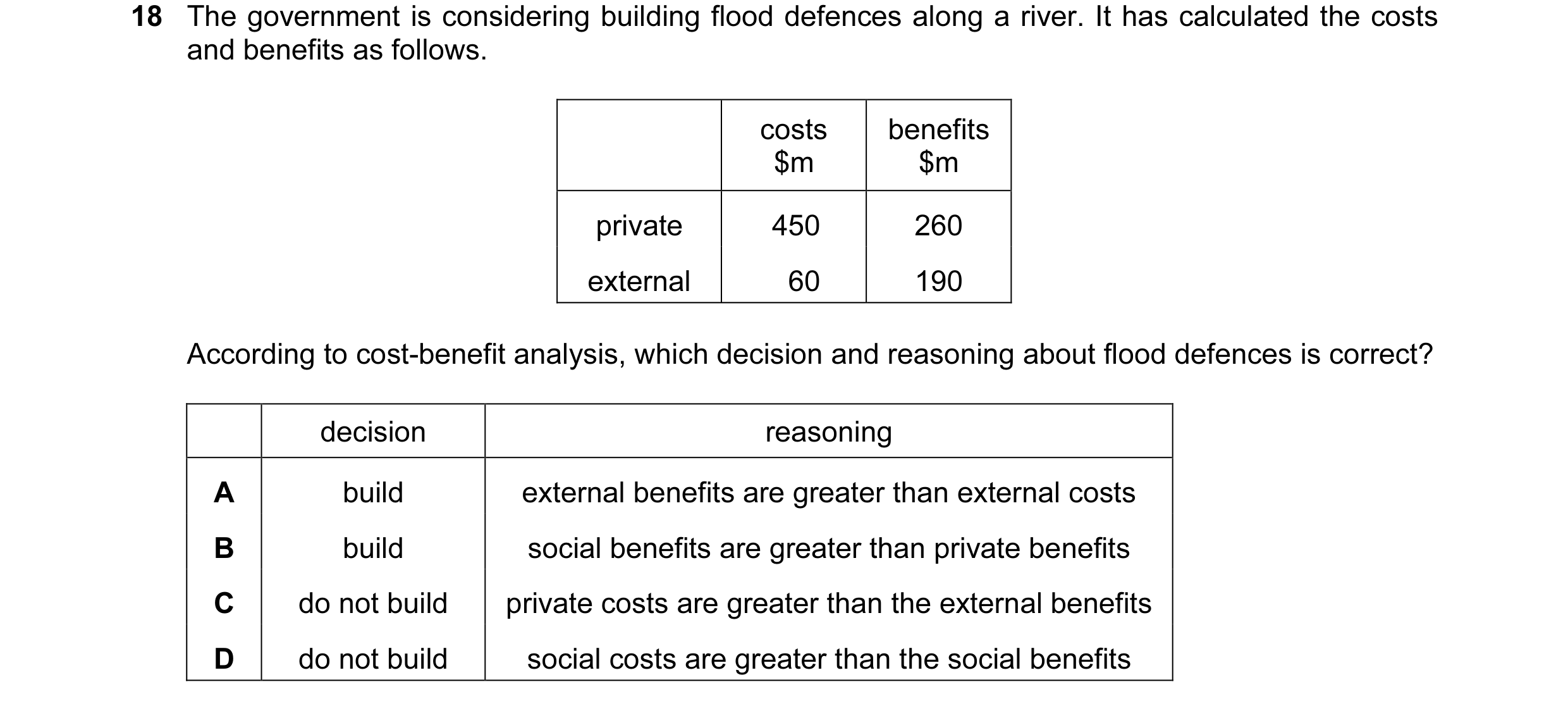
18 The government is considering building flood defences along a river. It has calculated the costs and benefits as follows. costs benefits $m $m private 450 260 external 60 190 According to cost-benefit analysis, which decision and reasoning about flood defences is correct? decision reasoning A build external benefits are greater than external costs B build social benefits are greater than private benefits C do not build private costs are greater than the external benefits D do not build social costs are greater than the social benefits
1 marks
Answer: D
This question in 9708/11 Oct/Nov 2013
Q11 · A government is planning to intervene in a free market to fix output at the currently… 9708/13 Oct/Nov 2013
14 A government is planning to intervene in a free market to fix output at the currently economically desirable level. MSC = MPC Y costs/ T benefits X S MSB MPB O W R output To achieve its objective, what should the government introduce? A a subsidy of TS B a subsidy of YX C a tax of TS D a tax of YX
1 marks
Answer: A
This question in 9708/13 Oct/Nov 2013
Q12 · What is least likely to be included in a cost-benefit analysis of a proposed new… 9708/11 May/June 2014
16 What is least likely to be included in a cost-benefit analysis of a proposed new university? A the costs of building the new university B the extra income earned by the new university’s graduates C the future staffing costs of other universities D the staffing costs of the new university five years into the future
1 marks
Answer: C
This question in 9708/11 May/June 2014
Q13 · What impact would internalising negative externalities have on the output and price of a… 9708/13 May/June 2014
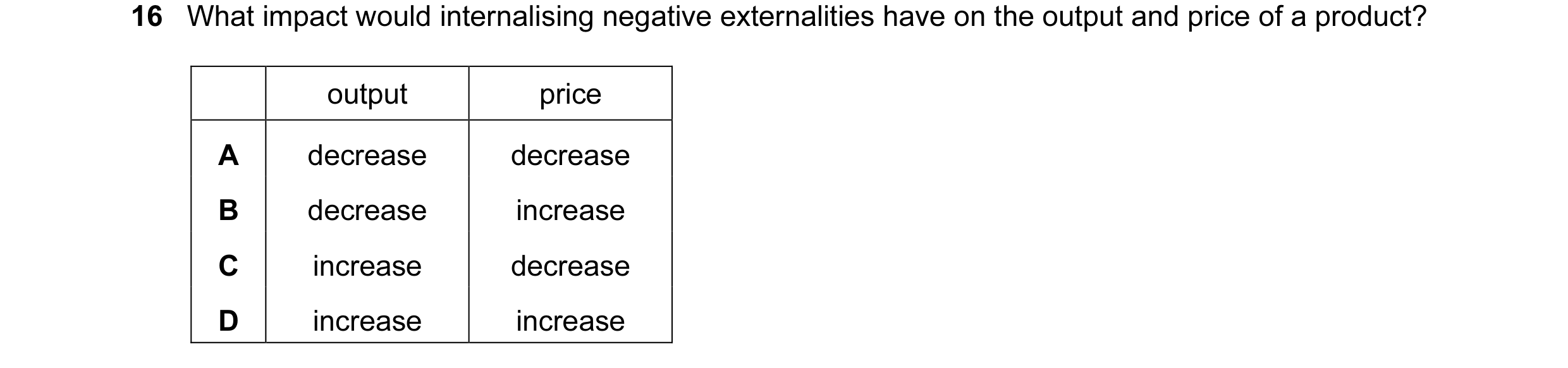
16 What impact would internalising negative externalities have on the output and price of a product? output price A decrease decrease B decrease increase C increase decrease D increase increase
1 marks
Answer: B
This question in 9708/13 May/June 2014
Q14 · A government is considering building a high-speed rail link 9708/11 May/June 2015
16 A government is considering building a high-speed rail link. Why would it not proceed with the project? A The external benefit is greater than the external cost. B The private cost is greater than the private benefit. C The social benefit is greater than the social cost. D The social cost is greater than the social benefit.
1 marks
Answer: D
This question in 9708/11 May/June 2015
Q15 · The production of a product generates a negative externality that increases as output… 9708/11 May/June 2015
17 The production of a product generates a negative externality that increases as output rises. Which form of government intervention in the market is most suitable to tackle this externality? A a direct income tax B a specific indirect tax C a subsidy D an ad valorem indirect tax
1 marks
Answer: D
This question in 9708/11 May/June 2015
Q16 · The production of what is most likely to require a government cost-benefit analysis? 9708/12 May/June 2015
16 The production of what is most likely to require a government cost-benefit analysis? A houses B medicines C roads D schools
1 marks
Answer: C
This question in 9708/12 May/June 2015
Q17 · A government conducts a cost-benefit analysis into the construction of a new high-speed… 9708/13 May/June 2015
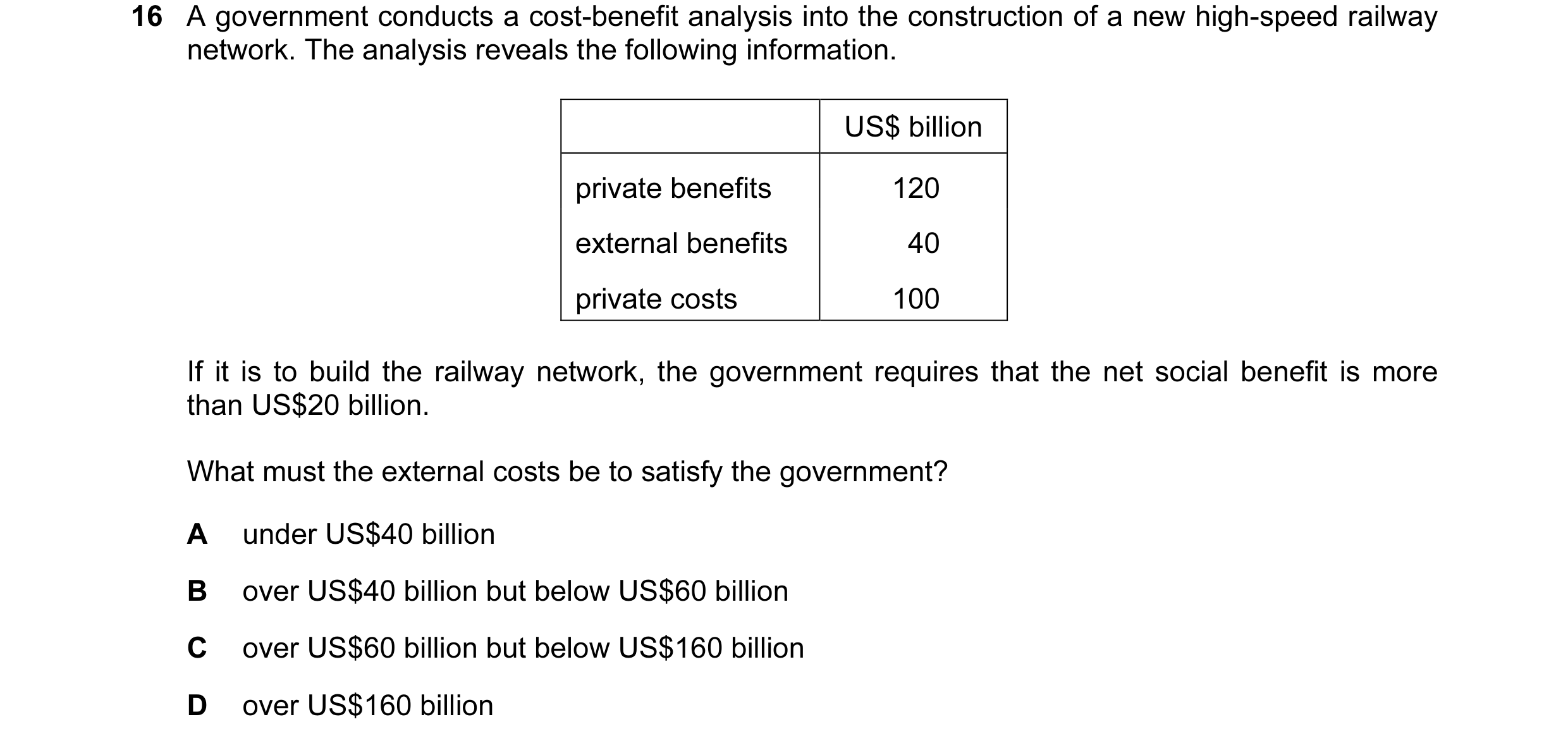
16 A government conducts a cost-benefit analysis into the construction of a new high-speed railway network. The analysis reveals the following information. US$ billion private benefits 120 external benefits 40 private costs 100 If it is to build the railway network, the government requires that the net social benefit is more than US$20 billion. What must the external costs be to satisfy the government? A under US$40 billion B over US$40 billion but below US$60 billion C over US$60 billion but below US$160 billion D over US$160 billion
1 marks
Answer: A
This question in 9708/13 May/June 2015
Q18 · A government has sufficient funds to pay for two transport projects 9708/11 Oct/Nov 2015
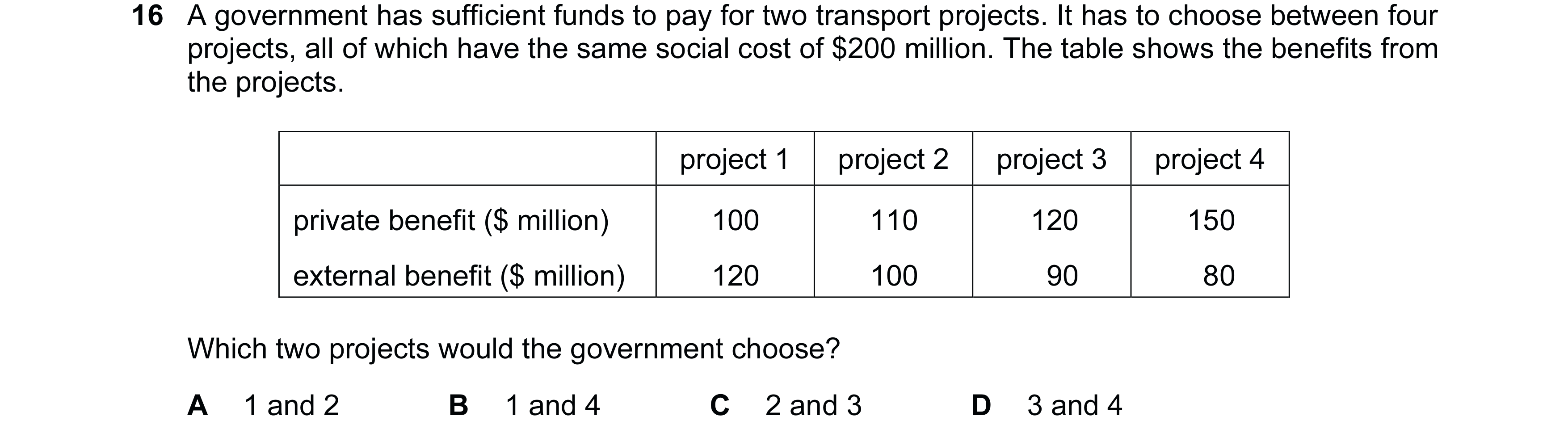
16 A government has sufficient funds to pay for two transport projects. It has to choose between four projects, all of which have the same social cost of $200 million. The table shows the benefits from the projects. project 1 project 2 project 3 project 4 private benefit ($ million) 100 110 120 150 external benefit ($ million) 120 100 90 80 Which two projects would the government choose? A 1 and 2 B 1 and 4 C 2 and 3 D 3 and 4
1 marks
Answer: B
This question in 9708/11 Oct/Nov 2015
Q19 · What will make it most likely that road tolls will reduce traffic congestion? 9708/11 Oct/Nov 2015
17 What will make it most likely that road tolls will reduce traffic congestion? A Cross-elasticity of demand between private and public transport is zero. B Demand for car use is income-elastic. C Demand for car use is price-elastic. D Supply of public transport is price-inelastic.
1 marks
Answer: C
This question in 9708/11 Oct/Nov 2015
 1 / 6
1 / 6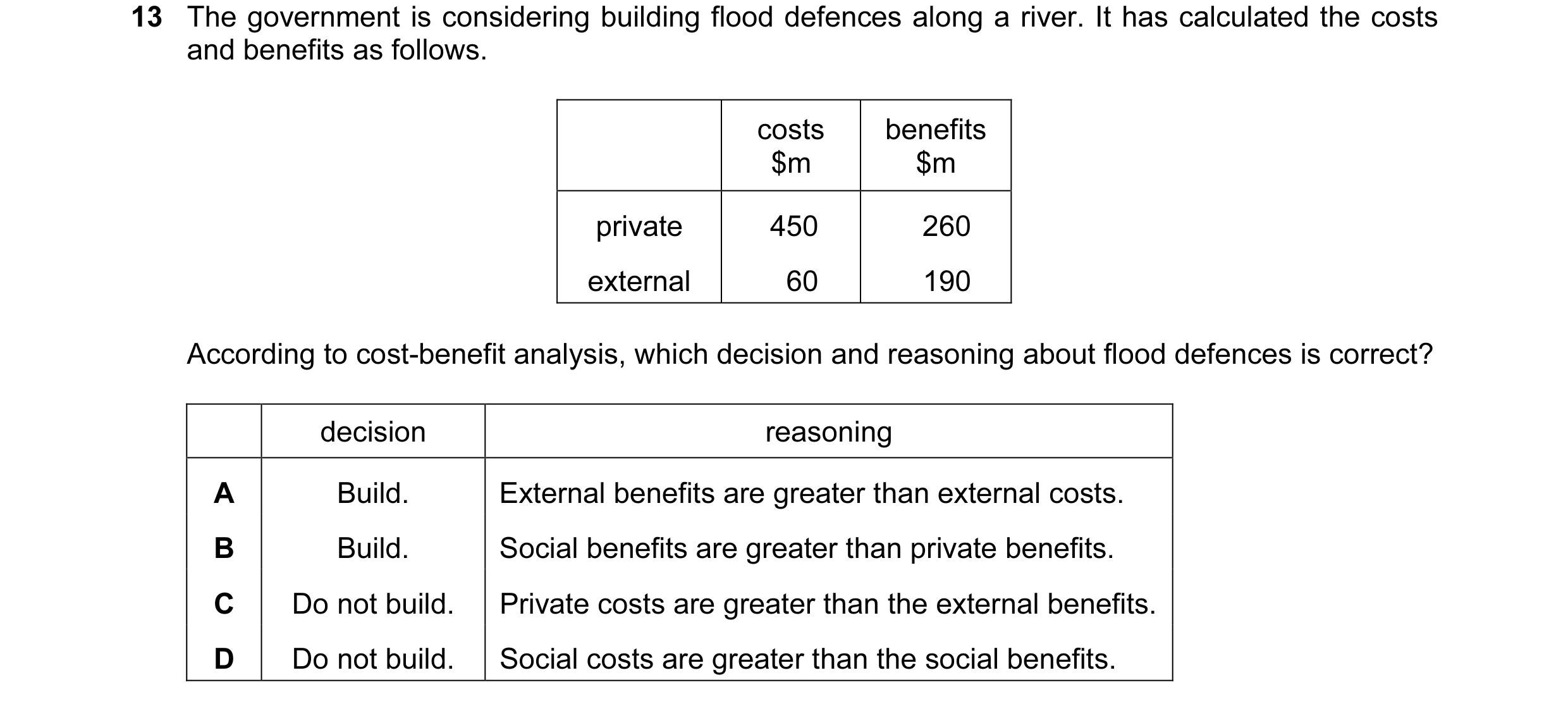

 2 / 6
2 / 6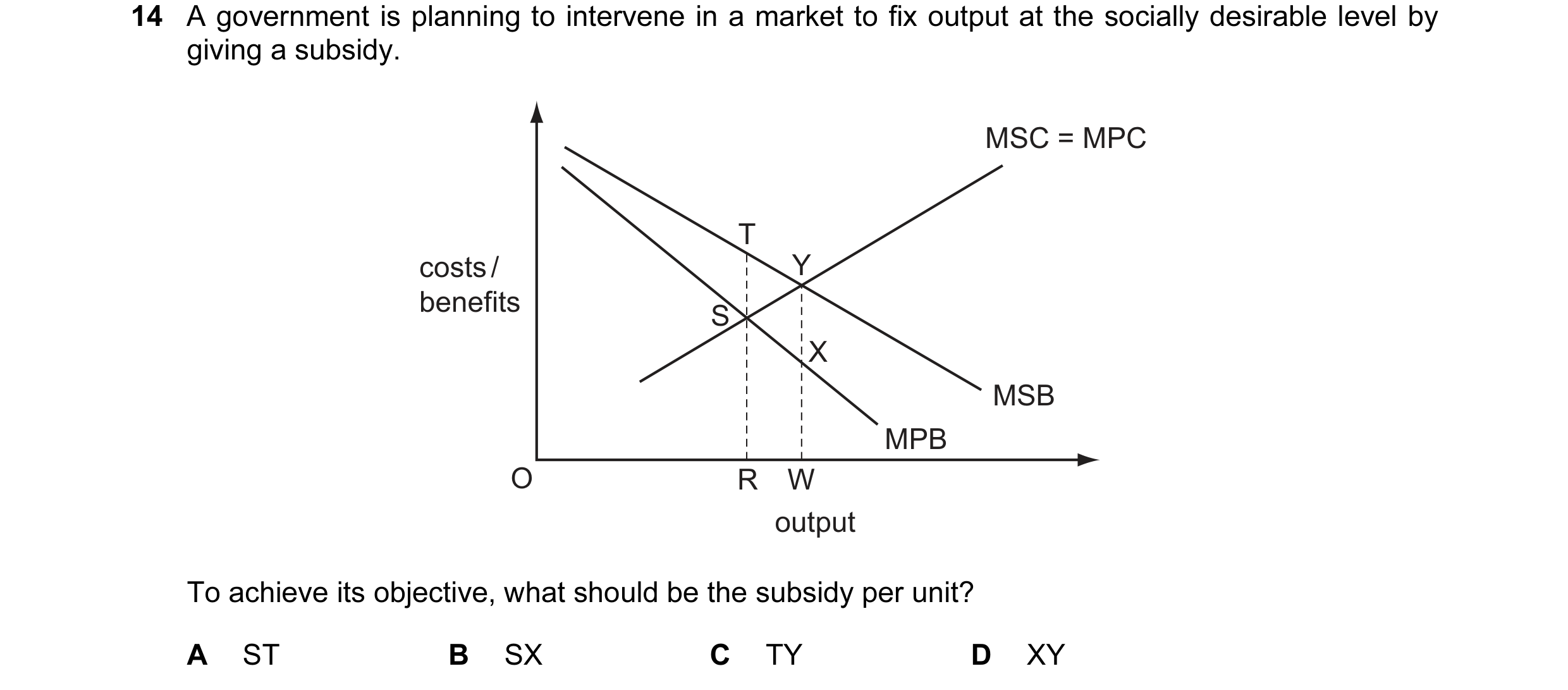
 3 / 6
3 / 6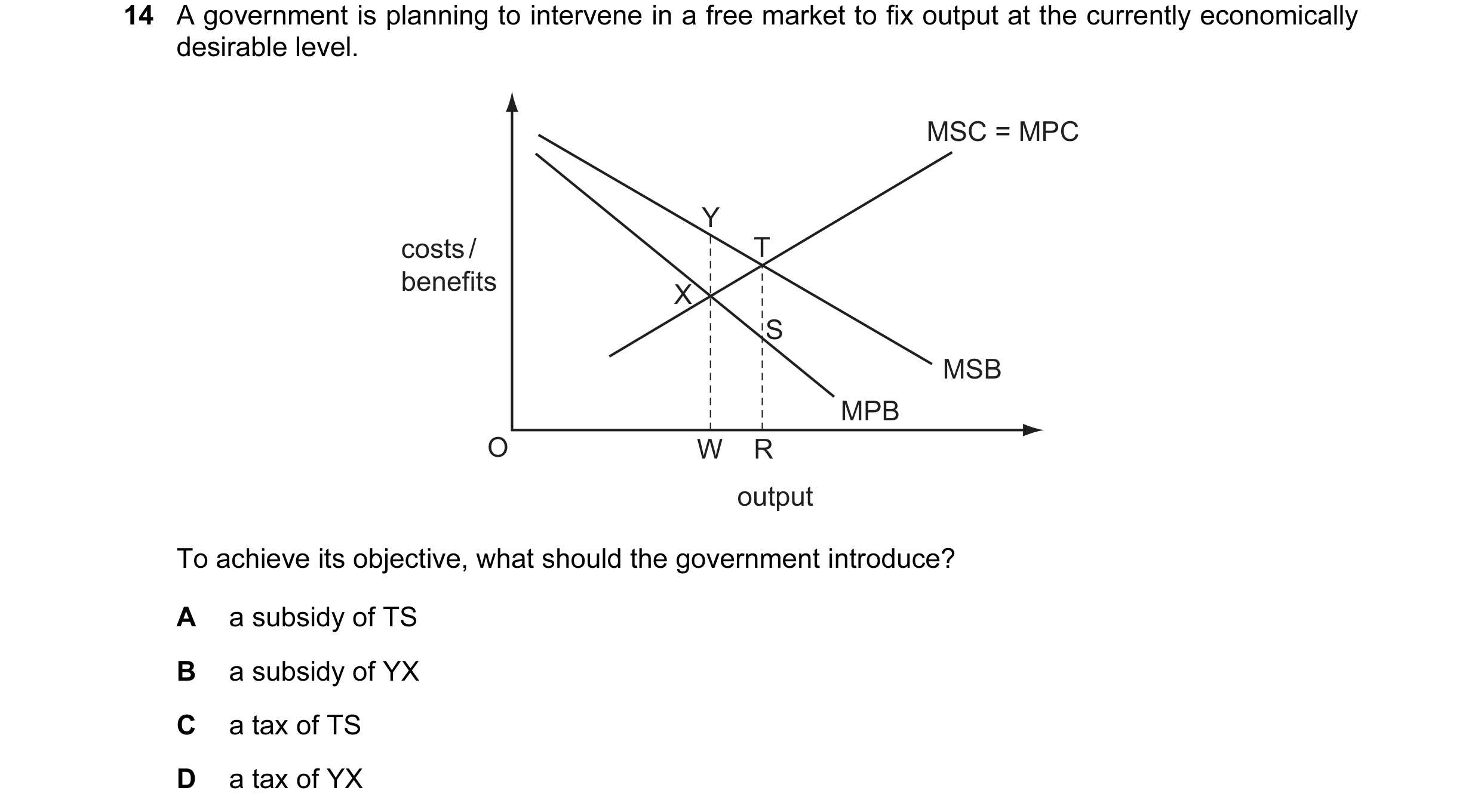

 4 / 6
4 / 6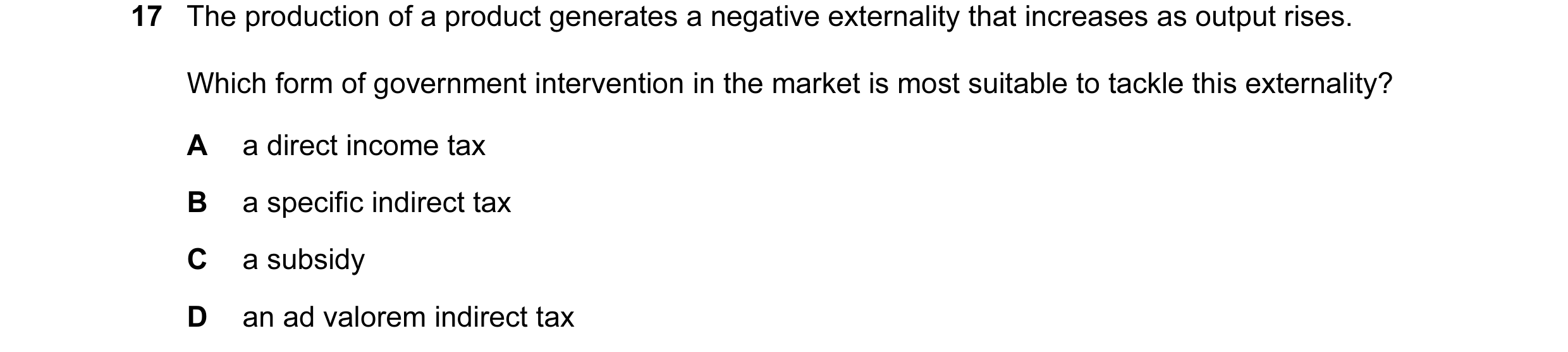

 5 / 6
5 / 6 6 / 6
6 / 6