Questions as text
Q1 · The schedule shows the total utility derived by a consumer of a good X at different… 9708/31 Oct/Nov 2009
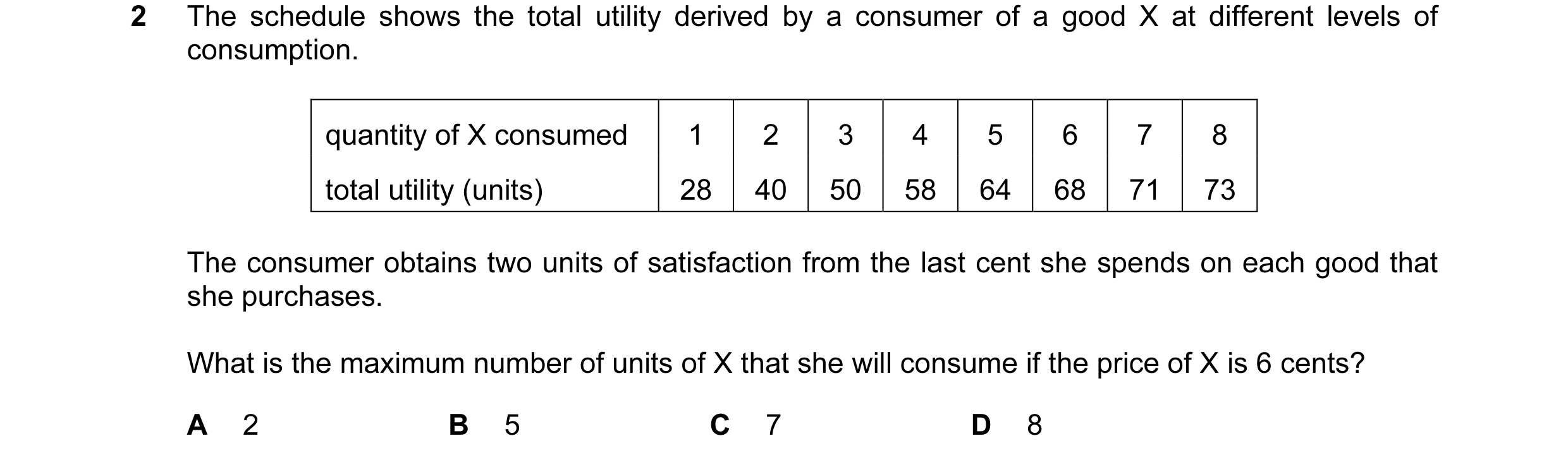
2 The schedule shows the total utility derived by a consumer of a good X at different levels of consumption. quantity of X consumed 1 2 3 4 5 6 7 8 total utility (units) 28 40 50 58 64 68 71 73 The consumer obtains two units of satisfaction from the last cent she spends on each good that she purchases. What is the maximum number of units of X that she will consume if the price of X is 6 cents? A 2 B 5 C 7 D 8
1 marks
Answer: A
This question in 9708/31 Oct/Nov 2009
Q2 · The schedule shows the total utility derived by a consumer of a good X at different… 9708/32 Oct/Nov 2009
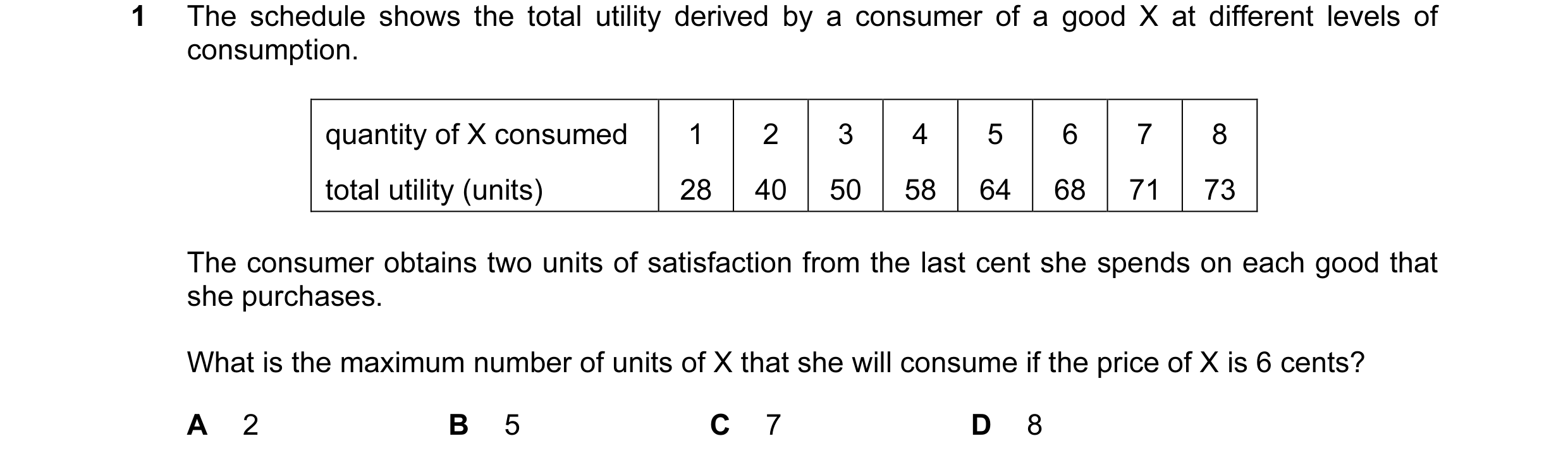
1 The schedule shows the total utility derived by a consumer of a good X at different levels of consumption. quantity of X consumed 1 2 3 4 5 6 7 8 total utility (units) 28 40 50 58 64 68 71 73 The consumer obtains two units of satisfaction from the last cent she spends on each good that she purchases. What is the maximum number of units of X that she will consume if the price of X is 6 cents? A 2 B 5 C 7 D 8
1 marks
Answer: A
This question in 9708/32 Oct/Nov 2009
Q3 · The diagram shows the marginal utility (MU) that an individual derives from a good at… 9708/31 May/June 2010
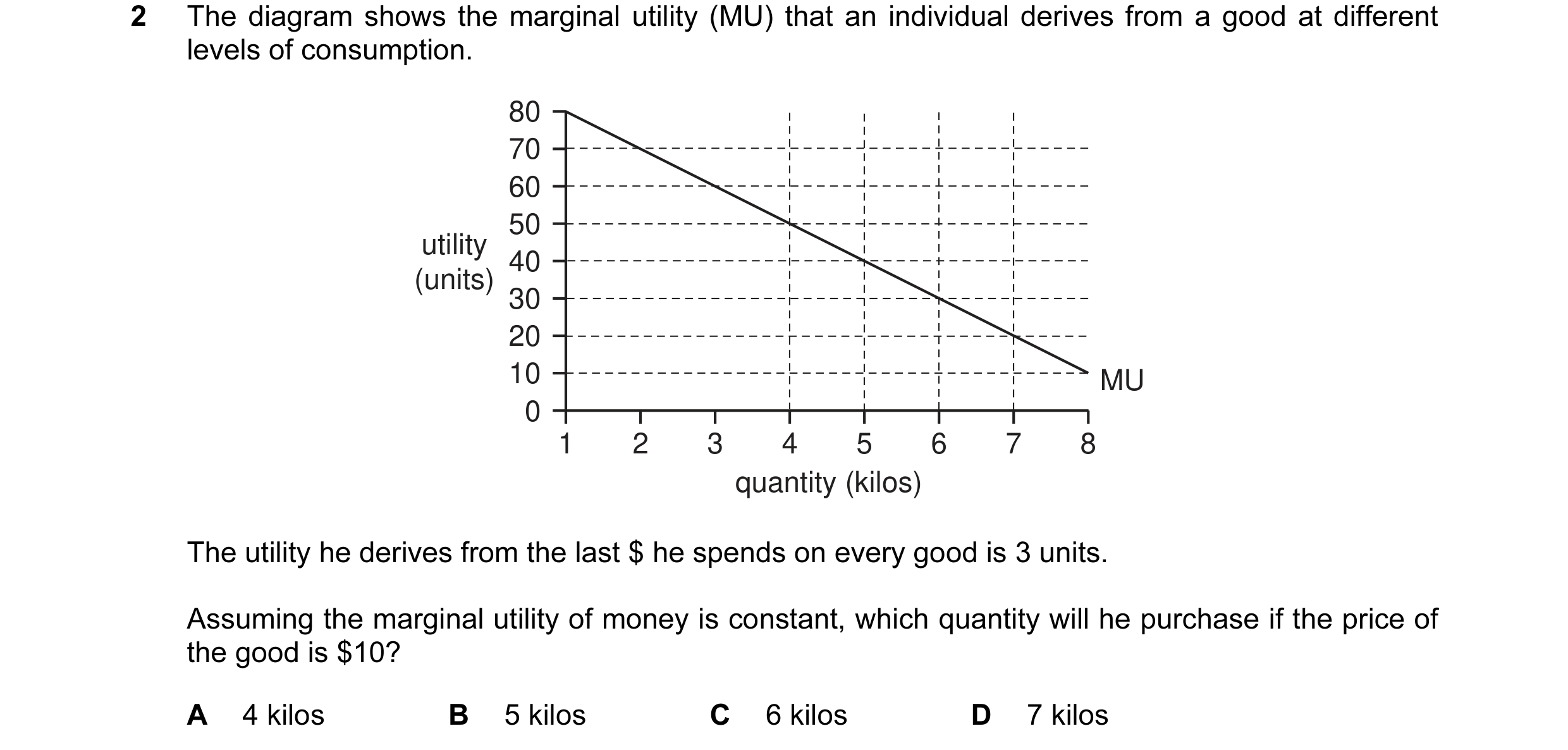
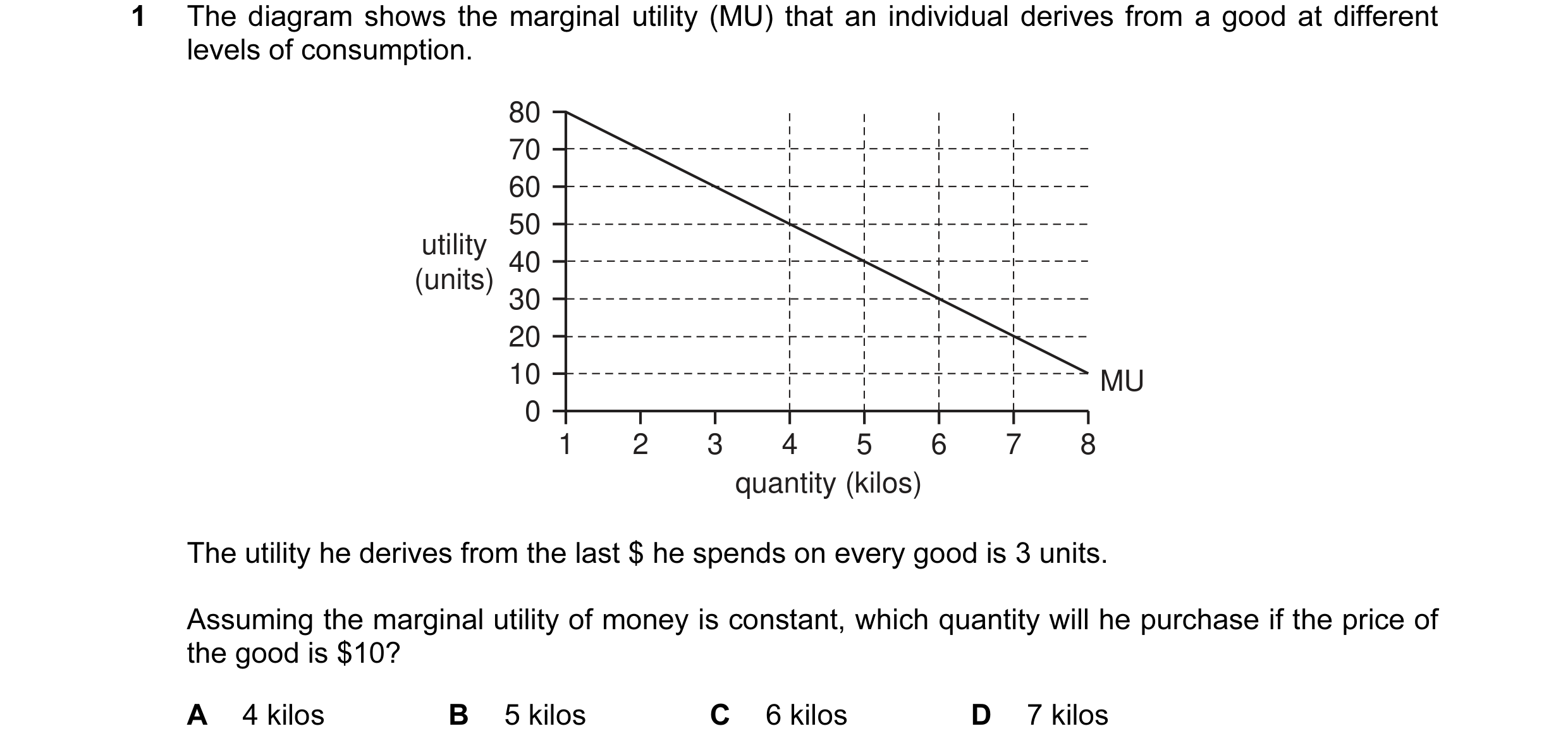
2 The diagram shows the marginal utility (MU) that an individual derives from a good at different levels of consumption. 80 70 60 50 utility 40 (units) 30 20 10 MU 0 1 2 3 4 5 6 7 8 quantity (kilos) The utility he derives from the last $ he spends on every good is 3 units. Assuming the marginal utility of money is constant, which quantity will he purchase if the price of the good is $10? A 4 kilos B 5 kilos C 6 kilos D 7 kilos
1 marks
Answer: C
This question in 9708/31 May/June 2010
Q4 · The diagram shows the marginal utility (MU) that an individual derives from a good at… 9708/32 May/June 2010
1 The diagram shows the marginal utility (MU) that an individual derives from a good at different levels of consumption. 80 70 60 50 utility 40 (units) 30 20 10 MU 0 1 2 3 4 5 6 7 8 quantity (kilos) The utility he derives from the last $ he spends on every good is 3 units. Assuming the marginal utility of money is constant, which quantity will he purchase if the price of the good is $10? A 4 kilos B 5 kilos C 6 kilos D 7 kilos
1 marks
Answer: C
This question in 9708/32 May/June 2010
Q5 · The diagram shows the marginal utility (MU) that an individual derives from a good at… 9708/33 May/June 2010
1 The diagram shows the marginal utility (MU) that an individual derives from a good at different levels of consumption. 80 70 60 50 utility 40 (units) 30 20 10 MU 0 1 2 3 4 5 6 7 8 quantity (kilos) The utility he derives from the last $ he spends on every good is 3 units. Assuming the marginal utility of money is constant, which quantity will he purchase if the price of the good is $10? A 4 kilos B 5 kilos C 6 kilos D 7 kilos
1 marks
Answer: C
This question in 9708/33 May/June 2010
Q6 · The schedule shows the total utility derived by a consumer of a good X at different… 9708/31 Oct/Nov 2010
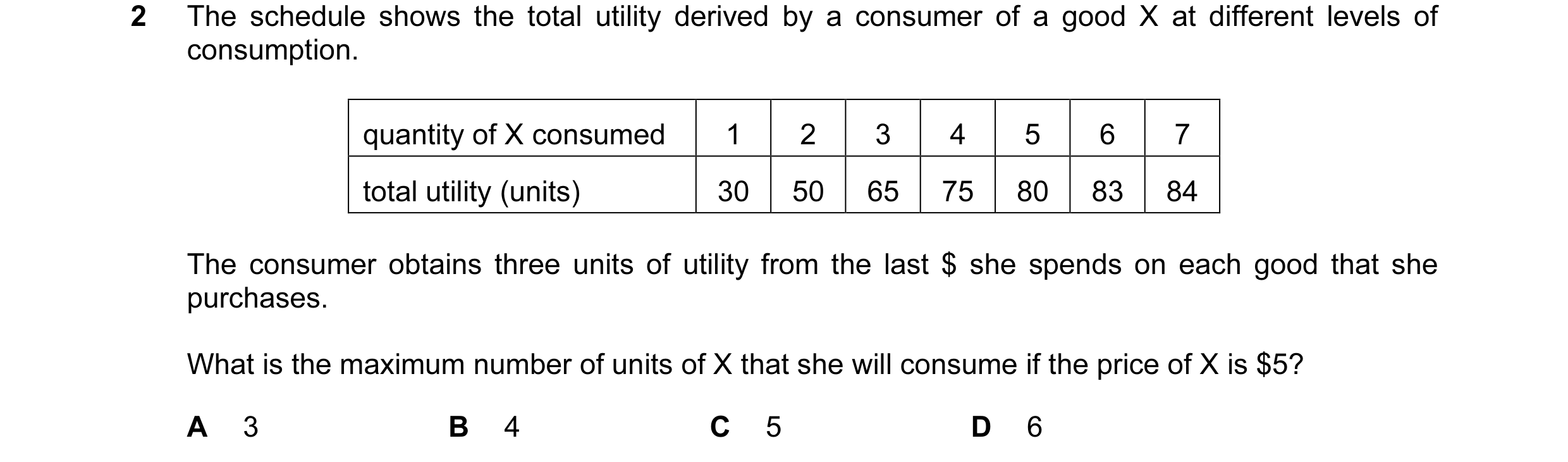
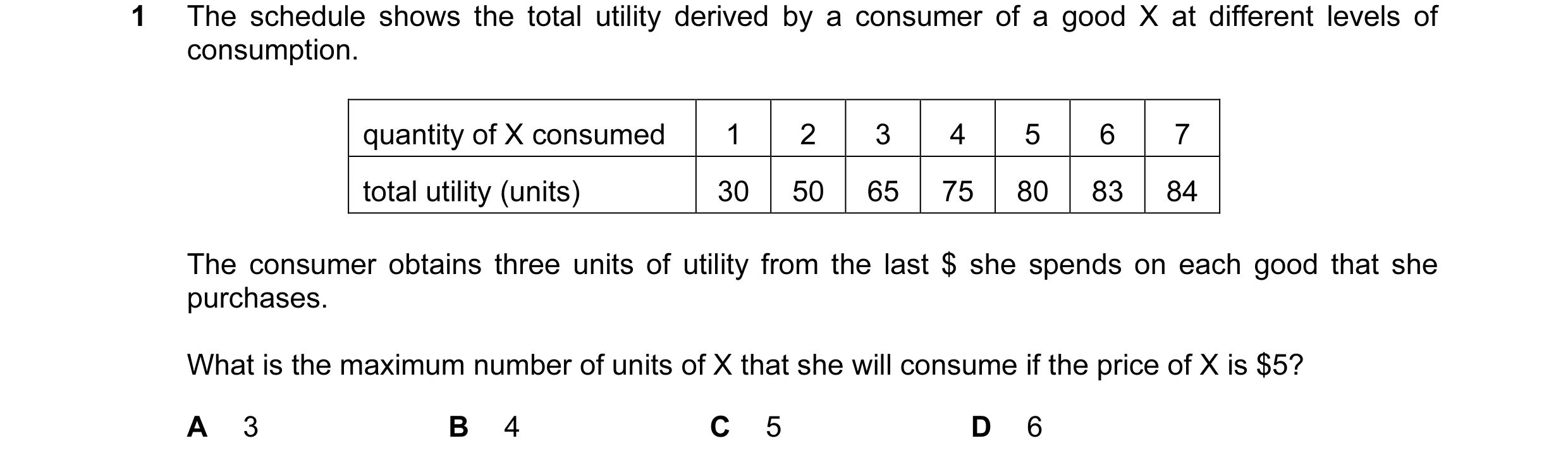
2 The schedule shows the total utility derived by a consumer of a good X at different levels of consumption. quantity of X consumed 1 2 3 4 5 6 7 total utility (units) 30 50 65 75 80 83 84 The consumer obtains three units of utility from the last $ she spends on each good that she purchases. What is the maximum number of units of X that she will consume if the price of X is $5? A 3 B 4 C 5 D 6
1 marks
Answer: A
This question in 9708/31 Oct/Nov 2010
Q7 · The schedule shows the total utility derived by a consumer of a good X at different… 9708/32 Oct/Nov 2010
2 The schedule shows the total utility derived by a consumer of a good X at different levels of consumption. quantity of X consumed 1 2 3 4 5 6 7 total utility (units) 30 50 65 75 80 83 84 The consumer obtains three units of utility from the last $ she spends on each good that she purchases. What is the maximum number of units of X that she will consume if the price of X is $5? A 3 B 4 C 5 D 6
1 marks
Answer: A
This question in 9708/32 Oct/Nov 2010
Q8 · The schedule shows the total utility derived by a consumer of a good X at different… 9708/33 Oct/Nov 2010
1 The schedule shows the total utility derived by a consumer of a good X at different levels of consumption. quantity of X consumed 1 2 3 4 5 6 7 total utility (units) 30 50 65 75 80 83 84 The consumer obtains three units of utility from the last $ she spends on each good that she purchases. What is the maximum number of units of X that she will consume if the price of X is $5? A 3 B 4 C 5 D 6
1 marks
Answer: A
This question in 9708/33 Oct/Nov 2010
Q9 · A consumer seeks to maximise his utility 9708/31 May/June 2011
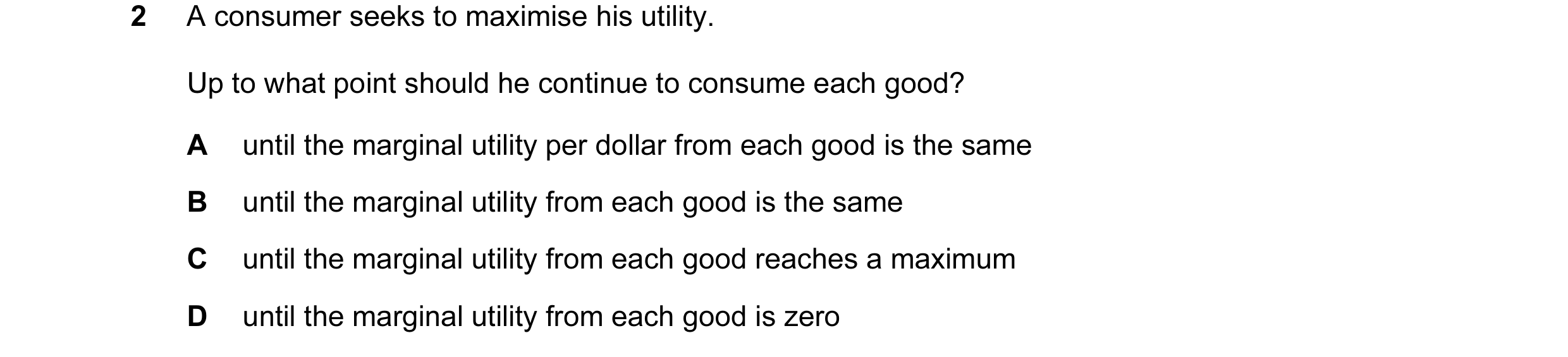
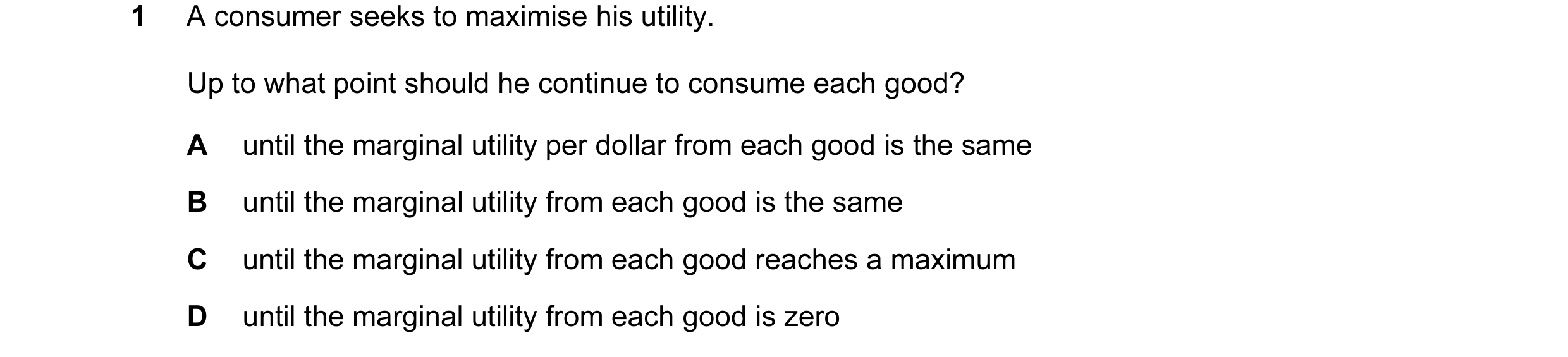
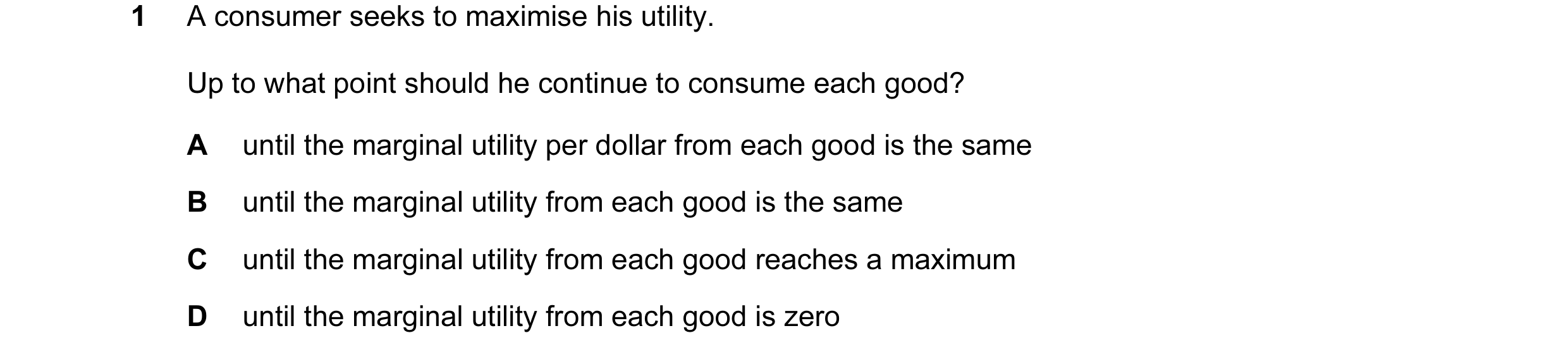
2 A consumer seeks to maximise his utility. Up to what point should he continue to consume each good? A until the marginal utility per dollar from each good is the same B until the marginal utility from each good is the same C until the marginal utility from each good reaches a maximum D until the marginal utility from each good is zero
1 marks
Answer: A
This question in 9708/31 May/June 2011
Q10 · A consumer seeks to maximise his utility 9708/32 May/June 2011
1 A consumer seeks to maximise his utility. Up to what point should he continue to consume each good? A until the marginal utility per dollar from each good is the same B until the marginal utility from each good is the same C until the marginal utility from each good reaches a maximum D until the marginal utility from each good is zero
1 marks
Answer: A
This question in 9708/32 May/June 2011
Q11 · A consumer seeks to maximise his utility 9708/33 May/June 2011
1 A consumer seeks to maximise his utility. Up to what point should he continue to consume each good? A until the marginal utility per dollar from each good is the same B until the marginal utility from each good is the same C until the marginal utility from each good reaches a maximum D until the marginal utility from each good is zero
1 marks
Answer: A
This question in 9708/33 May/June 2011
Q12 · To maximise the satisfaction he derives from a given level of expenditure on two goods, X… 9708/31 Oct/Nov 2011
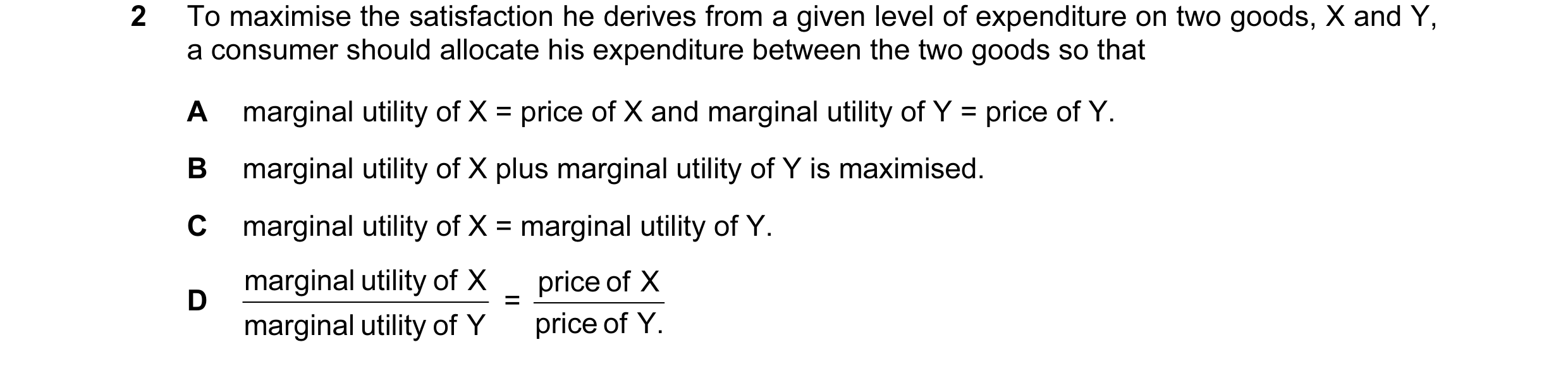
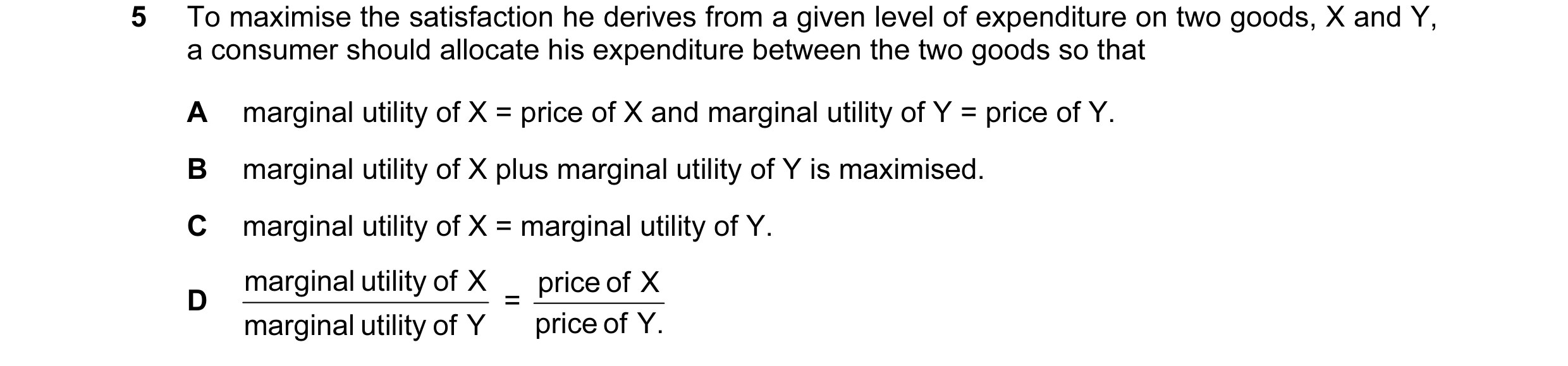
3 To maximise the satisfaction he derives from a given level of expenditure on two goods, X and Y, a consumer should allocate his expenditure between the two goods so that A marginal utility of X = price of X and marginal utility of Y = price of Y. B marginal utility of X plus marginal utility of Y is maximised. C marginal utility of X = marginal utility of Y. marginal utility of X price of X D = marginal utility of Y price of Y.
1 marks
Answer: D
This question in 9708/31 Oct/Nov 2011
Q13 · Why does a normal demand curve for a product slope downwards from left to right? 9708/32 Oct/Nov 2011
1 Why does a normal demand curve for a product slope downwards from left to right? A Buyers’ additional satisfaction declines as consumption rises. B Consumers are faced with choices between competing products. C Sellers are willing to accept lower prices on larger orders. D The average cost of production falls as the scale of production increases.
1 marks
Answer: A
This question in 9708/32 Oct/Nov 2011
Q14 · For the purposes of measuring the income effect of a change in the price of a good, what… 9708/32 Oct/Nov 2011
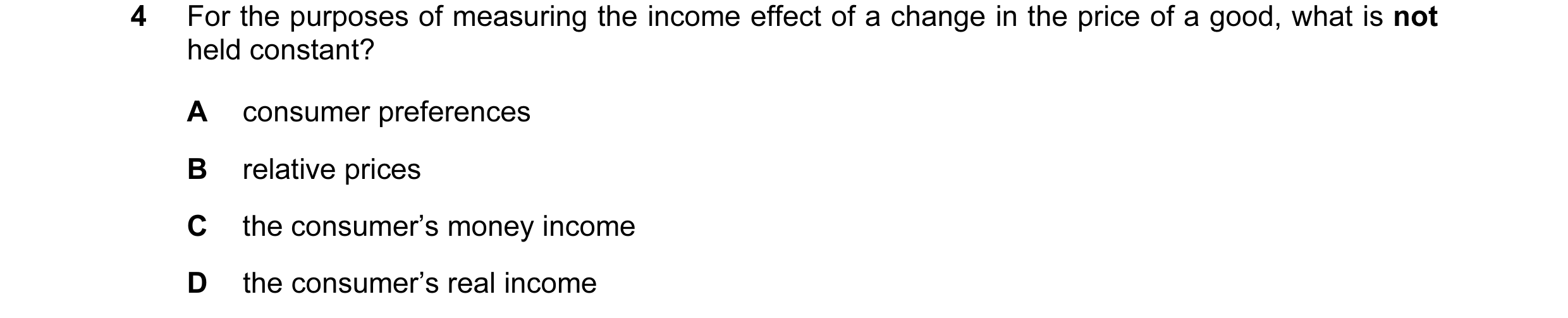
4 For the purposes of measuring the income effect of a change in the price of a good, what is not held constant? A consumer preferences B relative prices C the consumer’s money income D the consumer’s real income
1 marks
Answer: D
This question in 9708/32 Oct/Nov 2011
Q15 · What would economists agree should be the aim of any health care system? 9708/32 Oct/Nov 2011
13 What would economists agree should be the aim of any health care system? A to meet all the health care demands of the population B to provide every patient with the latest and best available treatment C to provide free medical treatment D to secure the maximum health gain from the resources available
1 marks
Answer: D
This question in 9708/32 Oct/Nov 2011
Q16 · To maximise the satisfaction he derives from a given level of expenditure on two goods, X… 9708/33 Oct/Nov 2011
2 To maximise the satisfaction he derives from a given level of expenditure on two goods, X and Y, a consumer should allocate his expenditure between the two goods so that A marginal utility of X = price of X and marginal utility of Y = price of Y. B marginal utility of X plus marginal utility of Y is maximised. C marginal utility of X = marginal utility of Y. marginal utility of X price of X D = marginal utility of Y price of Y.
1 marks
Answer: D
This question in 9708/33 Oct/Nov 2011
Q17 · The table shows the total utility that an individual obtains from consuming different… 9708/31 May/June 2012
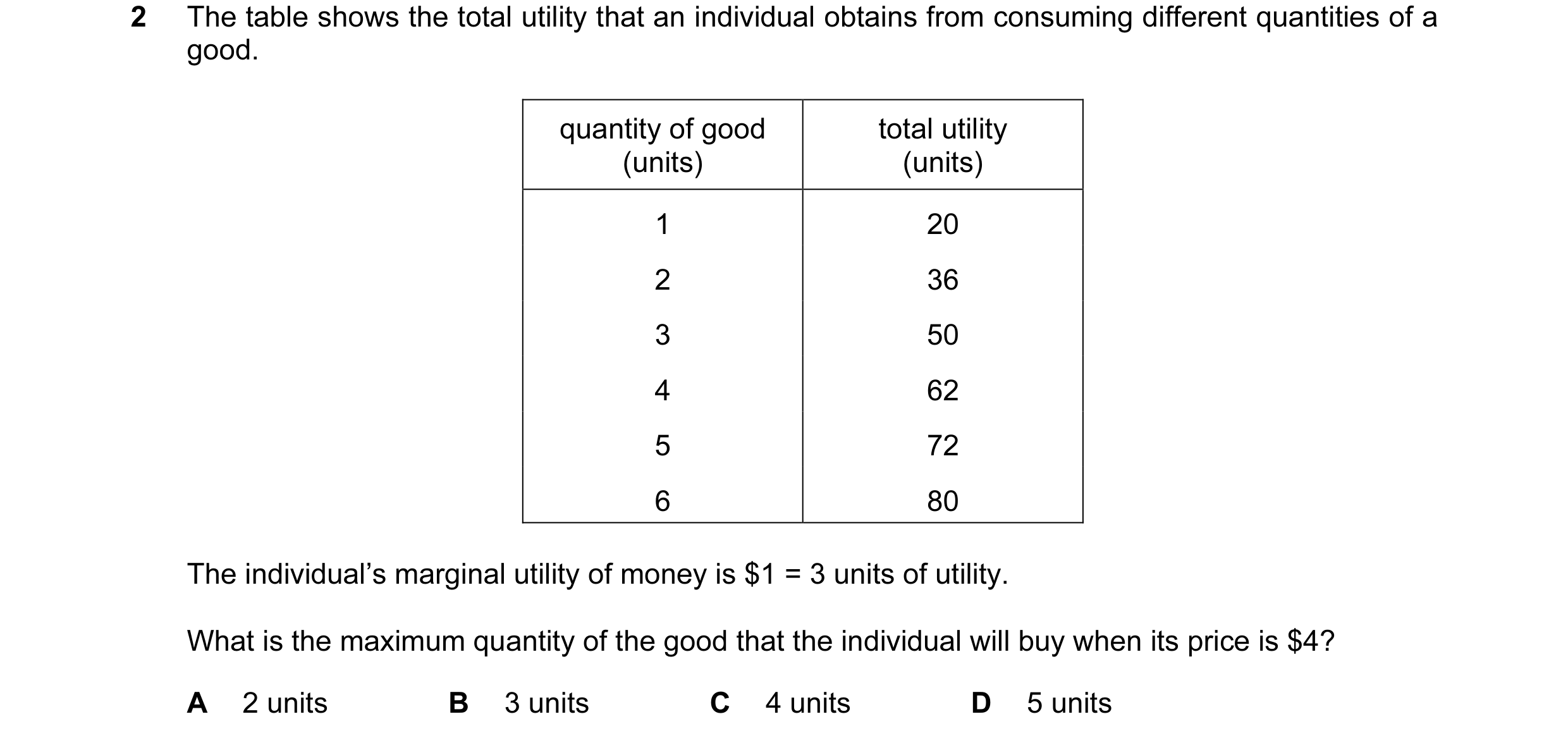
2 The table shows the total utility that an individual obtains from consuming different quantities of a good. quantity of good total utility (units) (units) 1 20 2 36 3 50 4 62 5 72 6 80 The individual’s marginal utility of money is $1 = 3 units of utility. What is the maximum quantity of the good that the individual will buy when its price is $4? A 2 units B 3 units C 4 units D 5 units
1 marks
Answer: C
This question in 9708/31 May/June 2012
Q18 · The table shows the total utility that an individual obtains from consuming different… 9708/32 May/June 2012
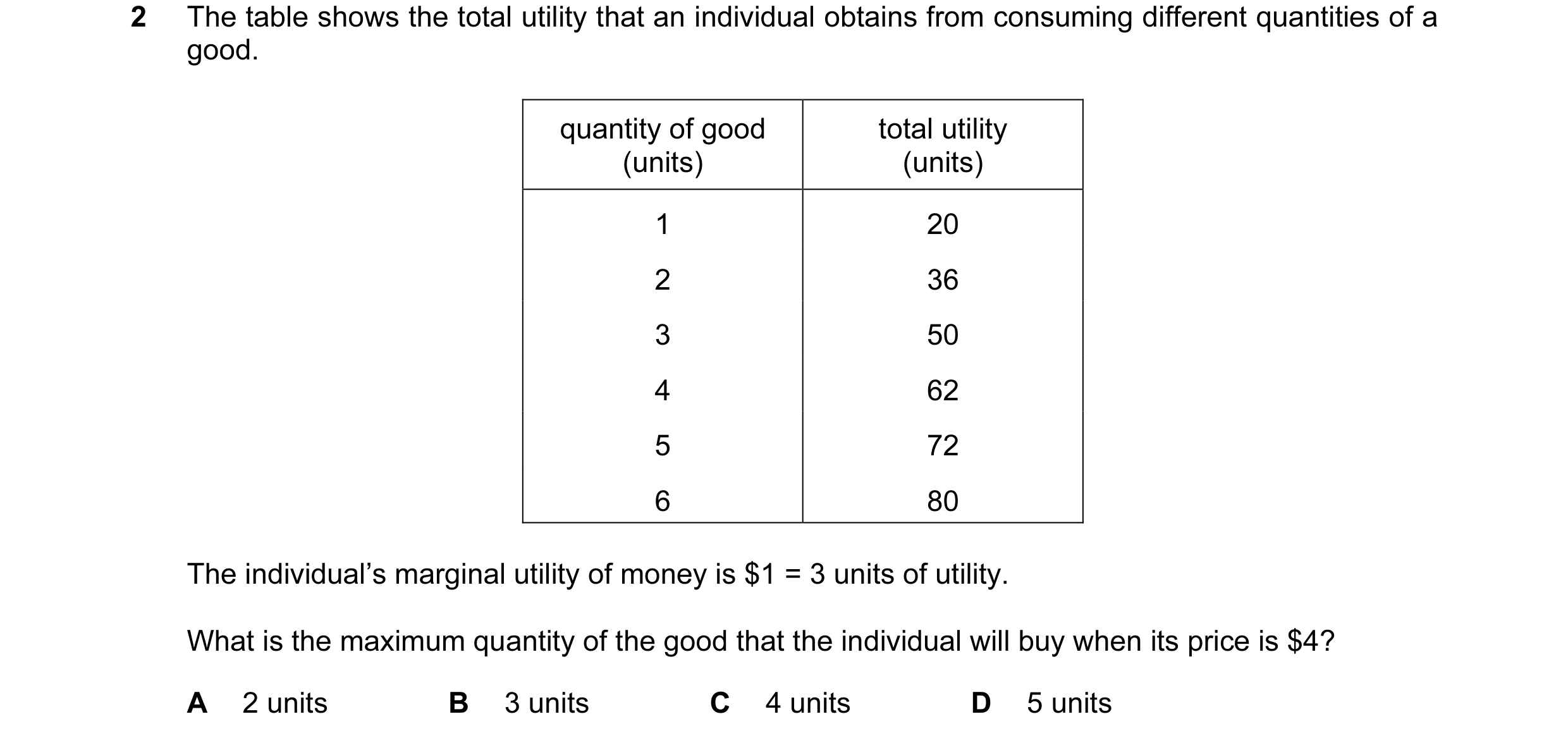
2 The table shows the total utility that an individual obtains from consuming different quantities of a good. quantity of good total utility (units) (units) 1 20 2 36 3 50 4 62 5 72 6 80 The individual’s marginal utility of money is $1 = 3 units of utility. What is the maximum quantity of the good that the individual will buy when its price is $4? A 2 units B 3 units C 4 units D 5 units
1 marks
Answer: C
This question in 9708/32 May/June 2012
Q19 · A utility maximising consumer spends the whole of his disposable income of $40 on food… 9708/33 May/June 2012
2 A utility maximising consumer spends the whole of his disposable income of $40 on food and clothing. The table shows the price of food, the quantity purchased by the consumer, and the marginal utility he derives from food consumption. food price per unit $5 quantity demanded 5 marginal utility (units) 10 His marginal utility from clothing is 2 units. What is the price of clothing per unit and the quantity purchased by the consumer? clothing price quantity ($) (units) A 0.5 30 B 1.0 15 C 3.0 5 D 5.0 3
1 marks
Answer: B
This question in 9708/33 May/June 2012
Q20 · A consumer who aims to maximise his utility will arrange his consumption so that A the… 9708/32 Oct/Nov 2012
2 A consumer who aims to maximise his utility will arrange his consumption so that A the total utility obtained from each commodity is the same. B the total utility per $ spent on each commodity is the same. C the same utility is obtained from the last unit of each commodity. D the same utility is obtained from the last unit of expenditure on each commodity.
1 marks
Answer: D
This question in 9708/32 Oct/Nov 2012
Q21 · A household which spends all of its income on bananas and apples makes the following… 9708/33 Oct/Nov 2012
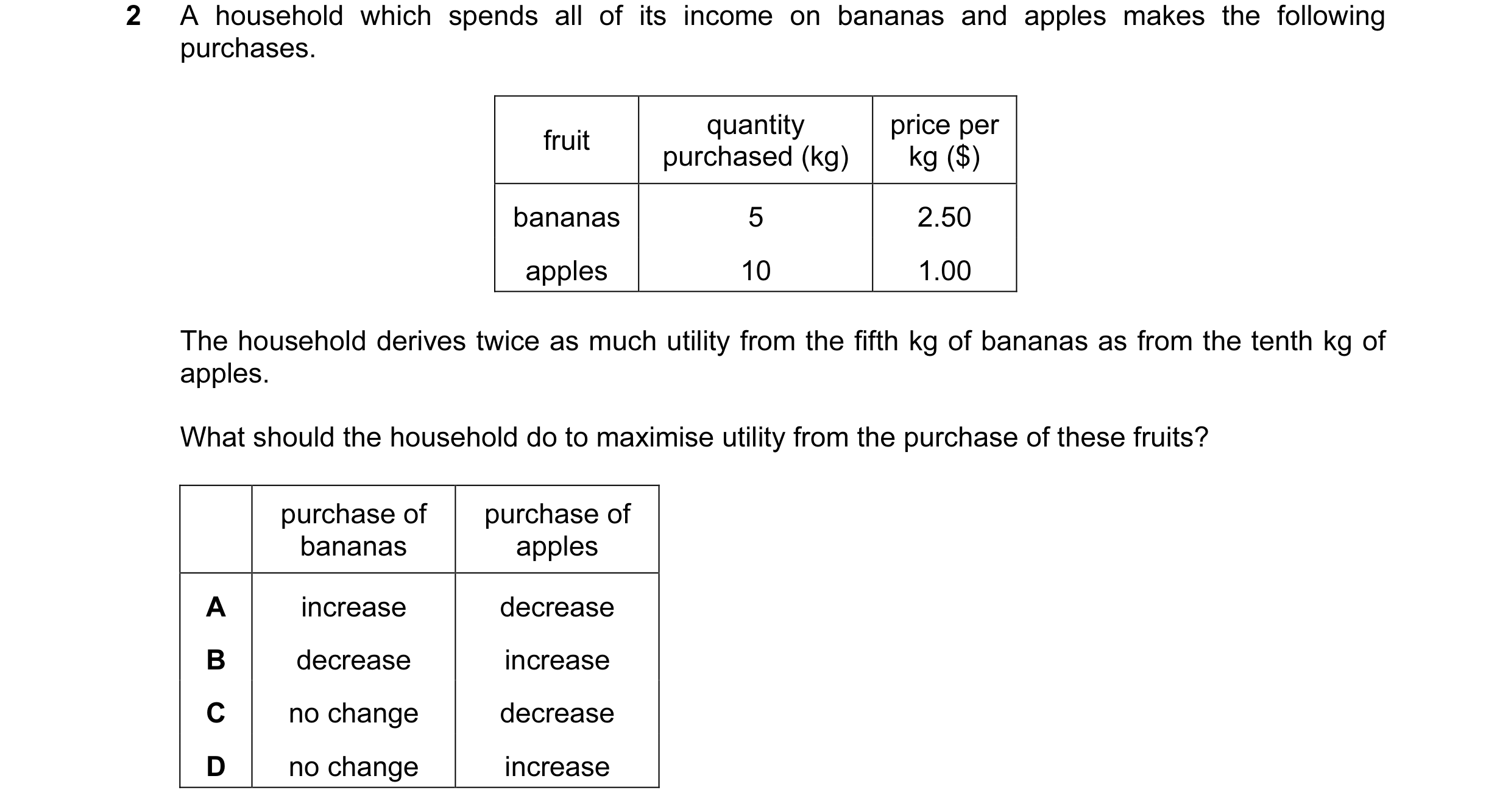
2 A household which spends all of its income on bananas and apples makes the following purchases. quantity price per fruit purchased (kg) kg ($) bananas 5 2.50 apples 10 1.00 The household derives twice as much utility from the fifth kg of bananas as from the tenth kg of apples. What should the household do to maximise utility from the purchase of these fruits? purchase of purchase of bananas apples A increase decrease B decrease increase C no change decrease D no change increase
1 marks
This question in 9708/33 Oct/Nov 2012
Q22 · The table shows the total utility that an individual derives from consuming different… 9708/31 May/June 2013
2 The table shows the total utility that an individual derives from consuming different quantities of a good. quantity of total utility good (units) (units) 1 20 2 36 3 48 4 56 5 60 6 62 The individual’s marginal utility of money is $1 = 2 units of utility. What is the maximum quantity of the good that the individual will buy when its price is $6? A 2 units B 3 units C 4 units D 5 units
1 marks
Answer: B
This question in 9708/31 May/June 2013
Q23 · The table shows the total utility that an individual derives from consuming different… 9708/32 May/June 2013
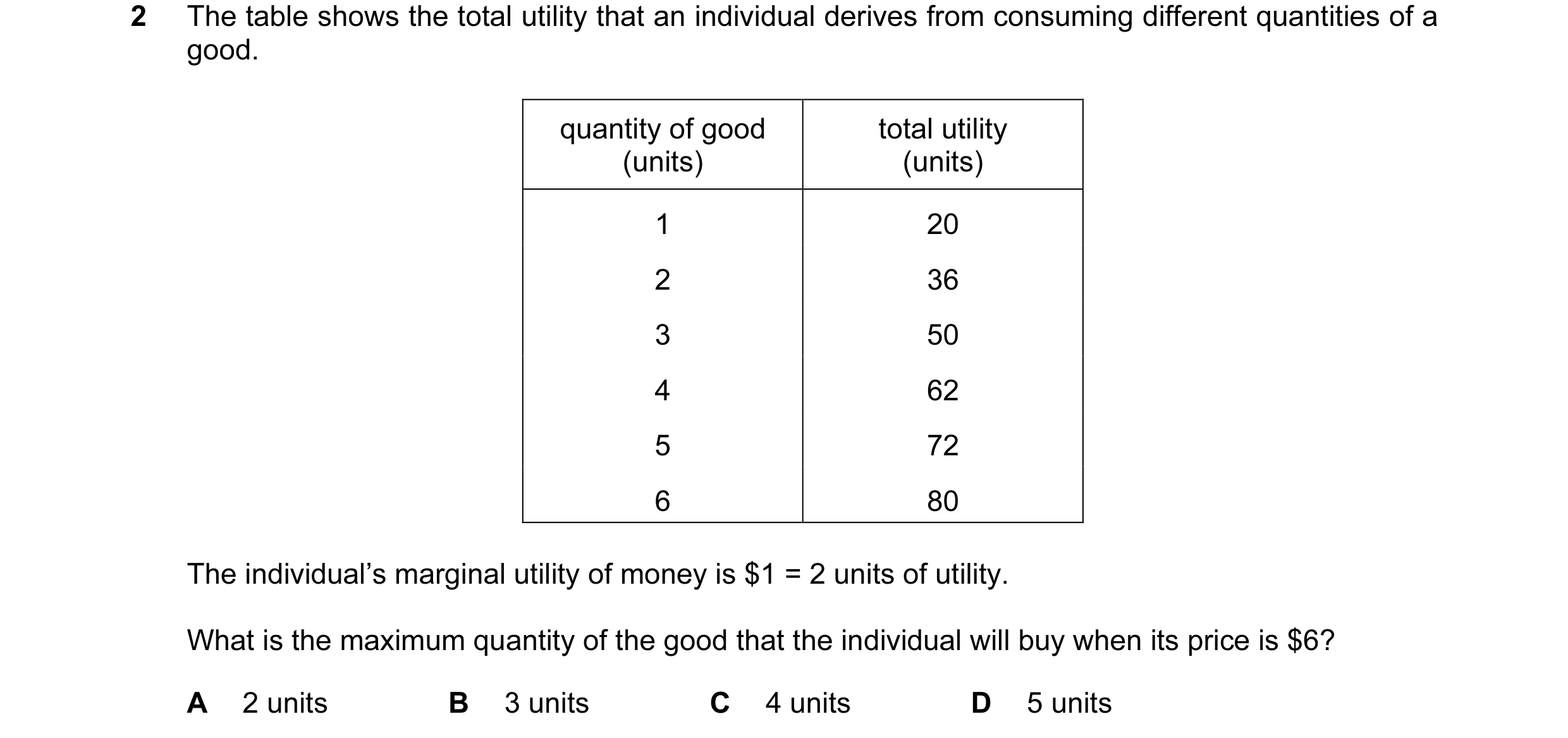
2 The table shows the total utility that an individual derives from consuming different quantities of a good. quantity of good total utility (units) (units) 1 20 2 36 3 50 4 62 5 72 6 80 The individual’s marginal utility of money is $1 = 2 units of utility. What is the maximum quantity of the good that the individual will buy when its price is $6? A 2 units B 3 units C 4 units D 5 units
1 marks
Answer: C
This question in 9708/32 May/June 2013
Q24 · The table shows the total utility that an individual derives from consuming different… 9708/33 May/June 2013
2 The table shows the total utility that an individual derives from consuming different quantities of a good. quantity of total utility good (units) (units) 1 20 2 36 3 48 4 56 5 60 6 62 The individual’s marginal utility of money is $1 = 2 units of utility. What is the maximum quantity of the good that the individual will buy when its price is $6? A 2 units B 3 units C 4 units D 5 units
1 marks
Answer: B
This question in 9708/33 May/June 2013
Q25 · The table shows the marginal utility derived by a consumer who devotes the whole of his… 9708/31 Oct/Nov 2013
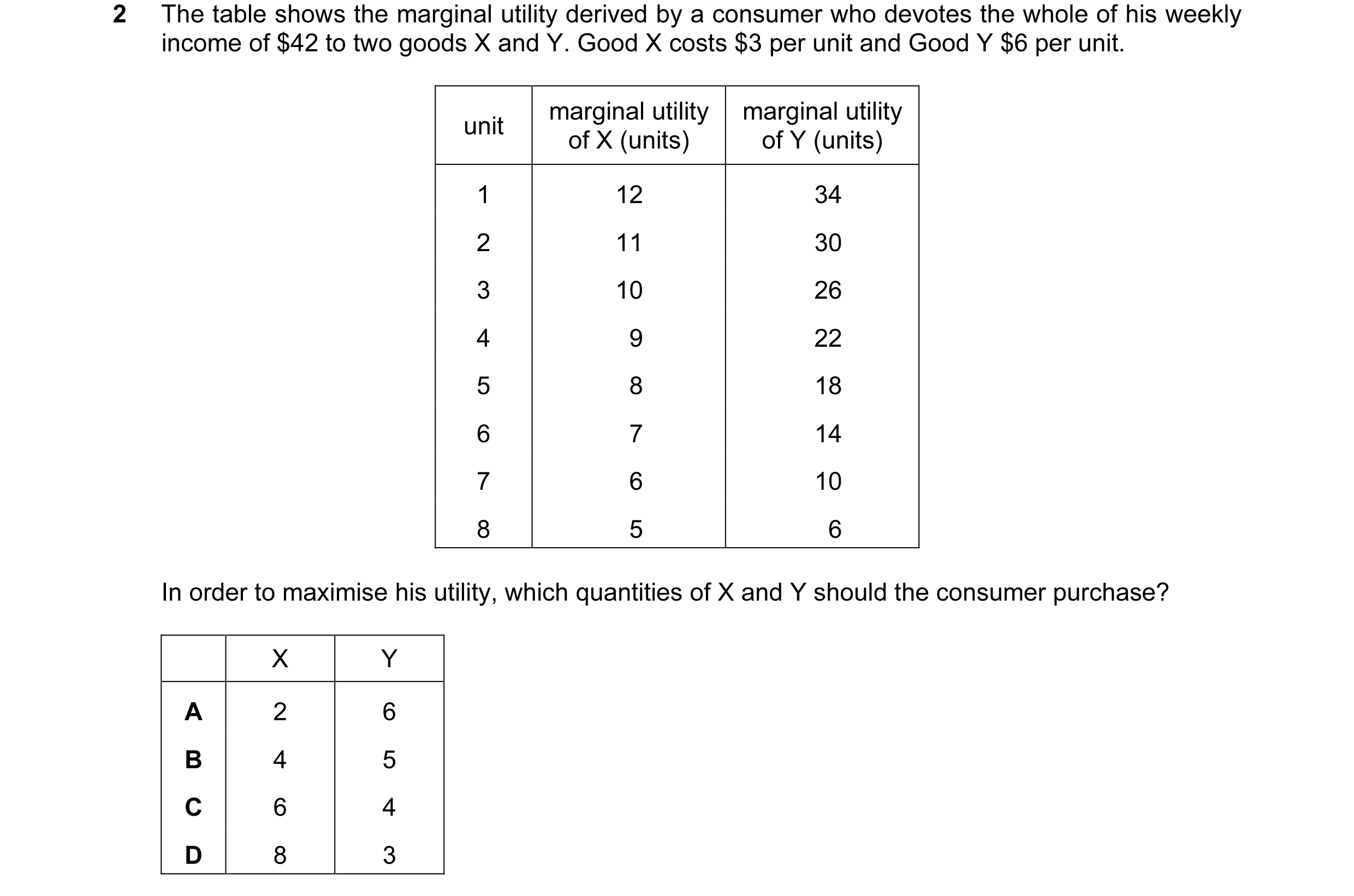
2 The table shows the marginal utility derived by a consumer who devotes the whole of his weekly income of $42 to two goods X and Y. Good X costs $3 per unit and Good Y $6 per unit. marginal utility marginal utility unit of X (units) of Y (units) 1 12 34 2 11 30 3 10 26 4 9 22 5 8 18 6 7 14 7 6 10 8 5 6 In order to maximise his utility, which quantities of X and Y should the consumer purchase? X Y A 2 6 B 4 5 C 6 4 D 8 3
1 marks
Answer: B
This question in 9708/31 Oct/Nov 2013
Q26 · The table shows the total utility that an individual derives from consuming different… 9708/32 Oct/Nov 2013
2 The table shows the total utility that an individual derives from consuming different quantities of a good. quantity of good total utility (units) (units) 1 24 2 45 3 63 4 78 5 90 6 99 The individual’s marginal utility of money is $1 = 2 units of utility. What is the maximum quantity of the good that the individual will buy when its price is $6? A 2 units B 3 units C 4 units D 5 units
1 marks
Answer: D
This question in 9708/32 Oct/Nov 2013
Q27 · The table shows the marginal utility derived by a consumer who devotes the whole of his… 9708/33 Oct/Nov 2013
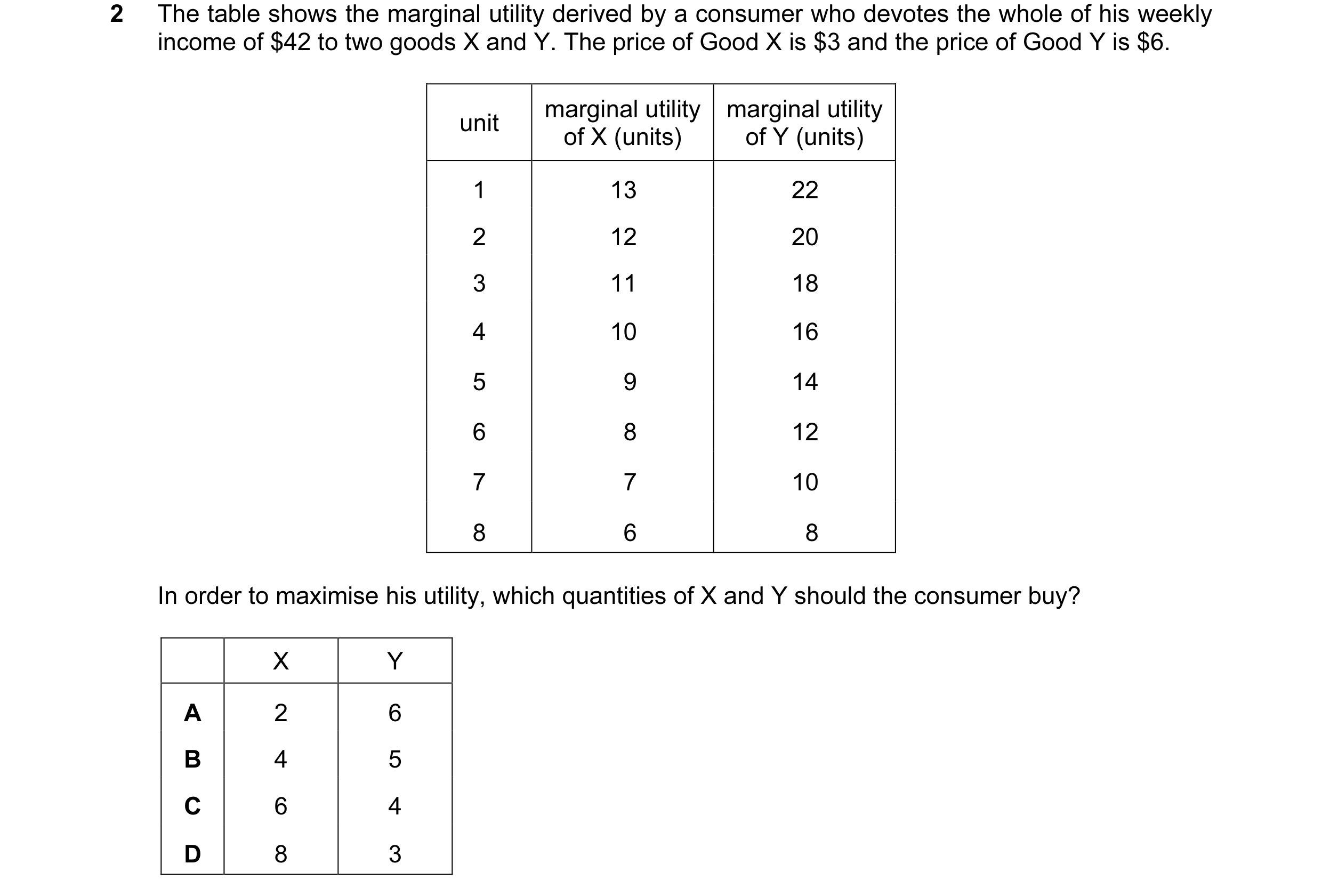
2 The table shows the marginal utility derived by a consumer who devotes the whole of his weekly income of $42 to two goods X and Y. The price of Good X is $3 and the price of Good Y is $6. marginal utility marginal utility unit of X (units) of Y (units) 1 13 22 2 12 20 3 11 18 4 10 16 5 9 14 6 8 12 7 7 10 8 6 8 In order to maximise his utility, which quantities of X and Y should the consumer buy? X Y A 2 6 B 4 5 C 6 4 D 8 3
1 marks
Answer: C
This question in 9708/33 Oct/Nov 2013
Q28 · The schedule shows the total utility derived by a consumer of a good X at different… 9708/31 Oct/Nov 2014
2 The schedule shows the total utility derived by a consumer of a good X at different levels of consumption. quantity of X consumed 1 2 3 4 5 6 7 total utility (units) 30 50 65 75 80 83 84 The consumer obtains two units of utility from the last $ she spends on each good that she purchases. What is the maximum number of units of X that she will consume if the price of X is $5? A 3 B 4 C 5 D 6
1 marks
Answer: B
This question in 9708/31 Oct/Nov 2014
Q29 · A consumer allocates his expenditure between three goods, X, Y and Z 9708/33 Oct/Nov 2014
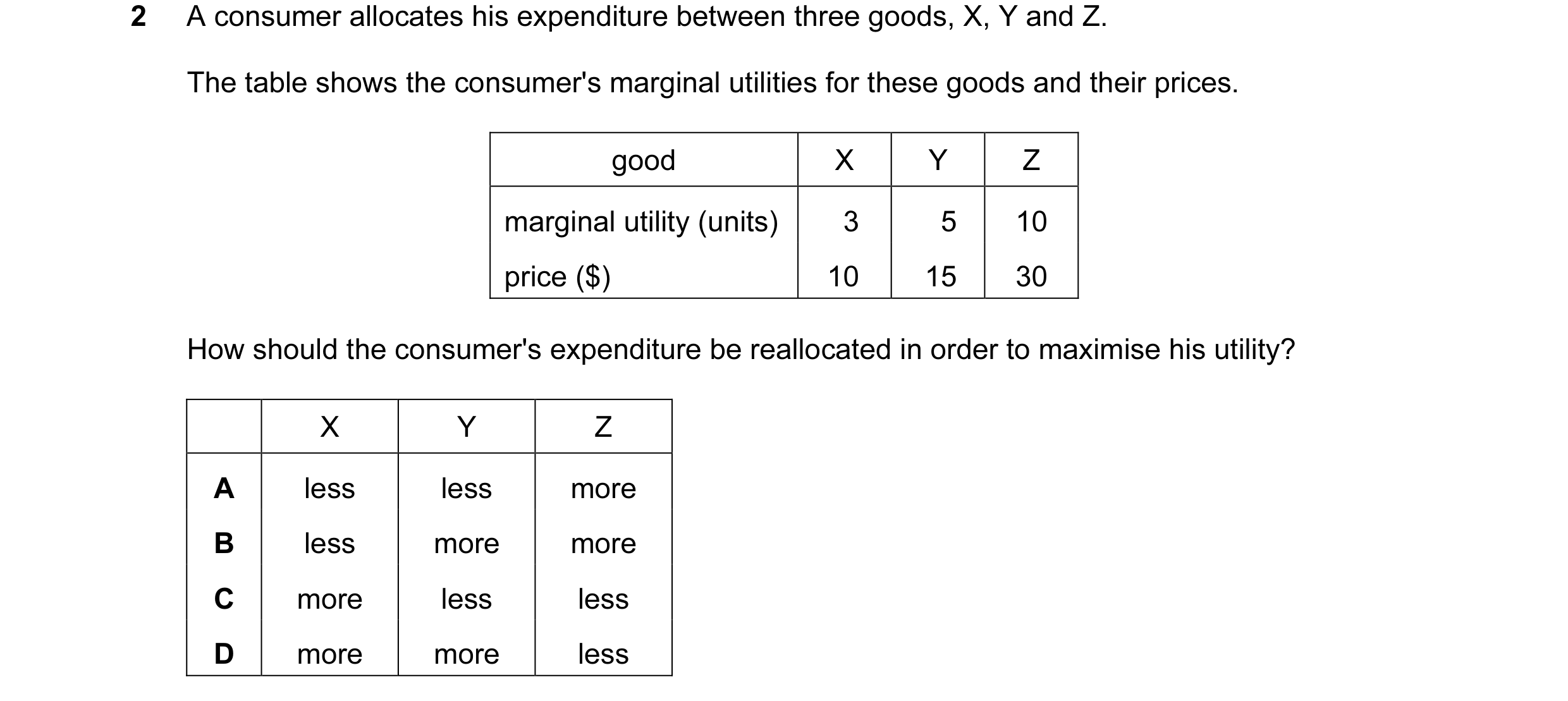
2 A consumer allocates his expenditure between three goods, X, Y and Z. The table shows the consumer's marginal utilities for these goods and their prices. good X Y Z marginal utility (units) 3 5 10 price ($) 10 15 30 How should the consumer's expenditure be reallocated in order to maximise his utility? X Y Z A less less more B less more more C more less less D more more less
1 marks
Answer: B
This question in 9708/33 Oct/Nov 2014
Q30 · A household which spends all of its income on bananas and apples makes the following… 9708/31 May/June 2015
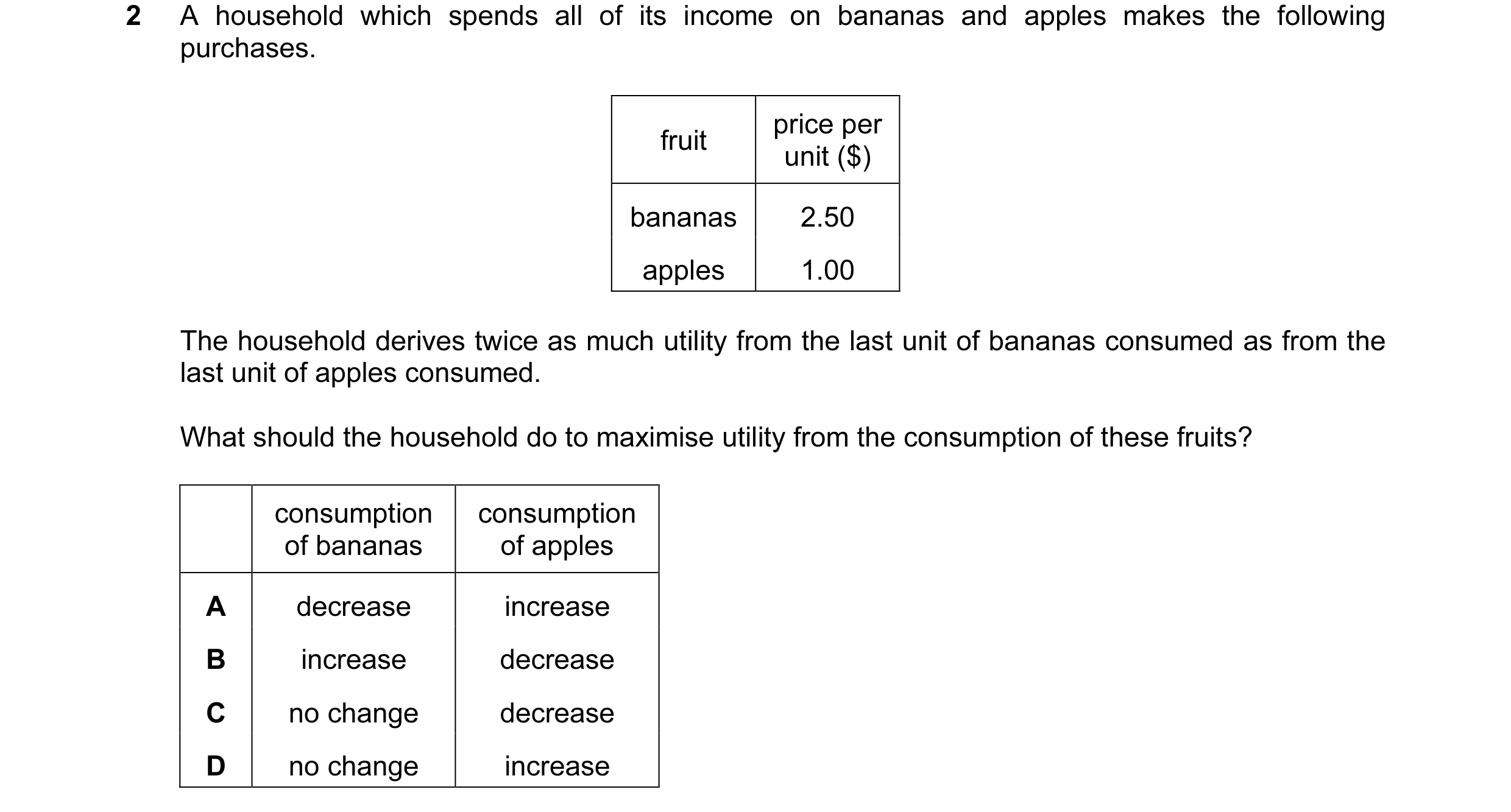
2 A household which spends all of its income on bananas and apples makes the following purchases. price per fruit unit ($) bananas 2.50 apples 1.00 The household derives twice as much utility from the last unit of bananas consumed as from the last unit of apples consumed. What should the household do to maximise utility from the consumption of these fruits? consumption consumption of bananas of apples A decrease increase B increase decrease C no change decrease D no change increase
1 marks
Answer: A
This question in 9708/31 May/June 2015
Q31 · A utility-maximising consumer spends the whole of his disposable income of $40 on food… 9708/32 May/June 2015
2 A utility-maximising consumer spends the whole of his disposable income of $40 on food and clothing. The table shows the price of food, the quantity purchased by the consumer, and the marginal utility he derives from food consumption. food price per unit $5 quantity demanded 5 marginal utility (units) 10 His marginal utility from clothing is 2 units. What is the price of clothing per unit and the quantity purchased by the consumer? clothing price quantity ($) (units) A 0.5 30 B 1.0 15 C 3.0 5 D 5.0 3
1 marks
Answer: B
This question in 9708/32 May/June 2015
Q32 · The table shows the total utility that an individual obtains from consuming different… 9708/31 Oct/Nov 2015
2 The table shows the total utility that an individual obtains from consuming different quantities of a good. quantity of good total utility (units) (units) 1 20 2 36 3 50 4 62 5 72 6 80 The individual’s marginal utility of money is $1 = 3 units of utility. What is the maximum quantity of the good that the individual will buy when its price is $4? A 2 units B 3 units C 4 units D 5 units
1 marks
This question in 9708/31 Oct/Nov 2015
Q33 · The diagram shows an individual’s total utility from consuming glasses of fruit juice 9708/32 Oct/Nov 2015
2 The diagram shows an individual’s total utility from consuming glasses of fruit juice. total utility total utility O number of glasses of fruit juice How can this information help to derive the individual’s demand curve for fruit juice? A by revealing the individual’s marginal utility curve B by revealing the money value of marginal utility C by showing how total utility is maximised D by showing the relationship between utility and expenditure
1 marks
Answer: A
This question in 9708/32 Oct/Nov 2015
Q34 · To maximise the satisfaction she derives from a given level of expenditure on two goods… 9708/33 Oct/Nov 2015
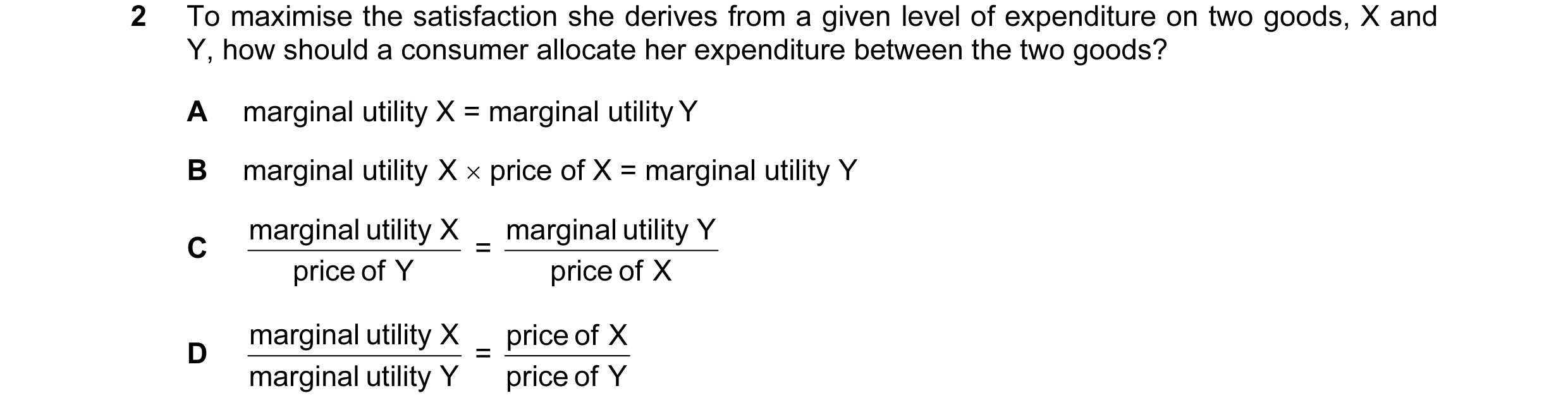
2 To maximise the satisfaction she derives from a given level of expenditure on two goods, X and Y, how should a consumer allocate her expenditure between the two goods? A marginal utility X = marginal utility Y B marginal utility X × price of X = marginal utility Y marginal utility X marginal utility Y C = price of Y price of X marginal utility X price of X D = marginal utility Y price of Y
1 marks
Answer: D
This question in 9708/33 Oct/Nov 2015
Q35 · To maximise the satisfaction he derives from a given level of expenditure on two goods, X… 9708/32 May/June 2016
5 To maximise the satisfaction he derives from a given level of expenditure on two goods, X and Y, a consumer should allocate his expenditure between the two goods so that A marginal utility of X = price of X and marginal utility of Y = price of Y. B marginal utility of X plus marginal utility of Y is maximised. C marginal utility of X = marginal utility of Y. marginal utility of X price of X D = marginal utility of Y price of Y.
1 marks
Answer: D
This question in 9708/32 May/June 2016
Q36 · What will happen if, in response to a fall in its price, a consumer buys more of a good? 9708/32 Oct/Nov 2016
4 What will happen if, in response to a fall in its price, a consumer buys more of a good? A a fall in the total utility derived from consuming the good B a movement along the consumer’s demand curve C a rise in the marginal utility derived from consuming the good D a shift in the consumer’s demand curve
1 marks
Answer: B
This question in 9708/32 Oct/Nov 2016
Q37 · Which act of purchase or consumption is most likely to illustrate the law of diminishing… 9708/33 Oct/Nov 2016
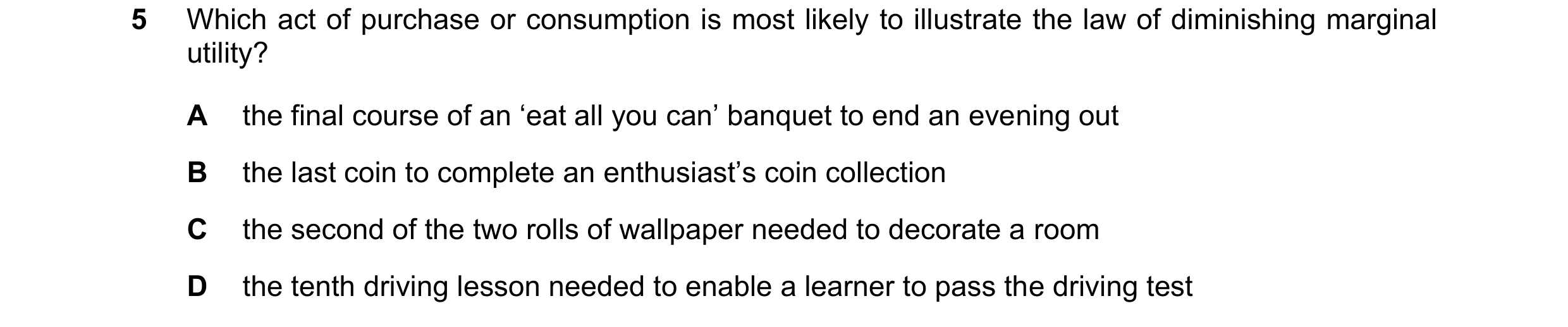
5 Which act of purchase or consumption is most likely to illustrate the law of diminishing marginal utility? A the final course of an ‘eat all you can’ banquet to end an evening out B the last coin to complete an enthusiast’s coin collection C the second of the two rolls of wallpaper needed to decorate a room D the tenth driving lesson needed to enable a learner to pass the driving test
1 marks
Answer: A
This question in 9708/33 Oct/Nov 2016
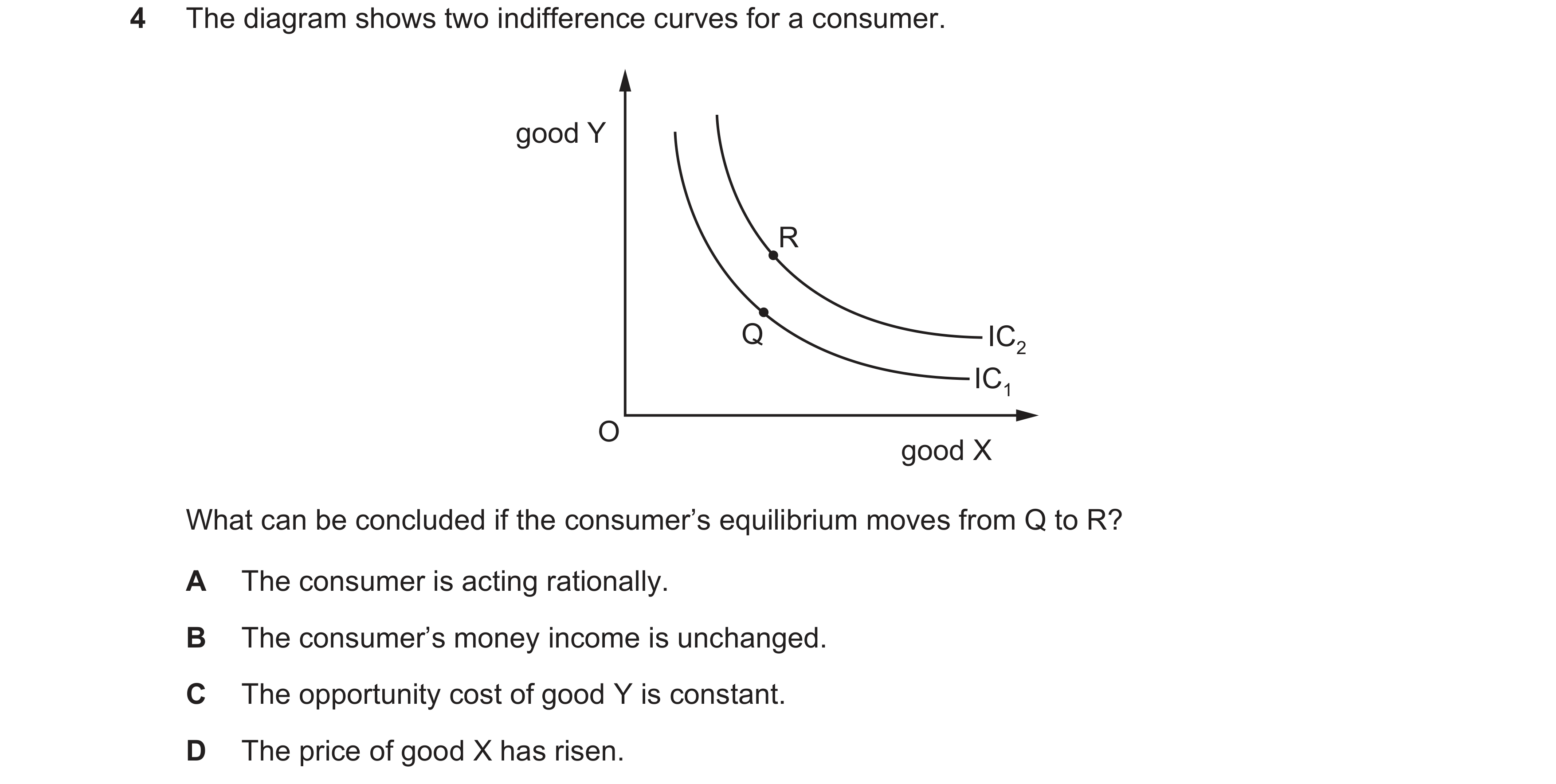
Q38 · The diagram shows two indifference curves for a consumer 9708/32 May/June 2017
4 The diagram shows two indifference curves for a consumer. good Y R Q IC2 IC1 O good X What can be concluded if the consumer’s equilibrium moves from Q to R? A The consumer is acting rationally. B The consumer’s money income is unchanged. C The opportunity cost of good Y is constant. D The price of good X has risen.
1 marks
Answer: A
This question in 9708/32 May/June 2017
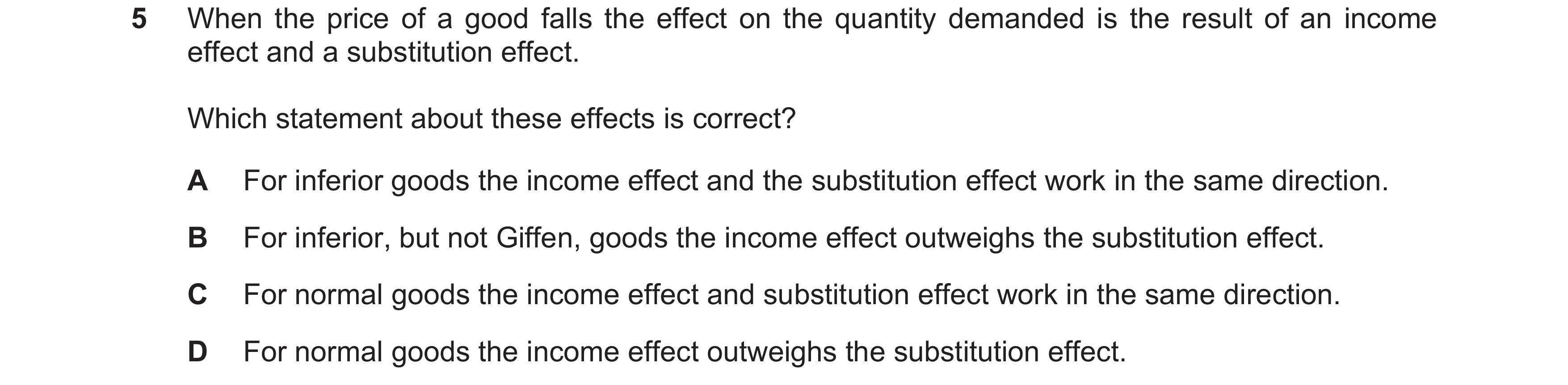
Q39 · When the price of a good falls the effect on the quantity demanded is the result of an… 9708/32 May/June 2017
5 When the price of a good falls the effect on the quantity demanded is the result of an income effect and a substitution effect. Which statement about these effects is correct? A For inferior goods the income effect and the substitution effect work in the same direction. B For inferior, but not Giffen, goods the income effect outweighs the substitution effect. C For normal goods the income effect and substitution effect work in the same direction. D For normal goods the income effect outweighs the substitution effect.
1 marks
Answer: C
This question in 9708/32 May/June 2017
Q40 · The table shows the total utility gained by a consumer as they consume more apples 9708/32 Feb/March 2019
4 The table shows the total utility gained by a consumer as they consume more apples. apples total utility consumed 0 0 1 10 2 18 3 24 4 28 5 30 6 30 At which level of consumption would the marginal utility be zero? A 1 B 4 C 5 D 6
1 marks
Answer: D
This question in 9708/32 Feb/March 2019
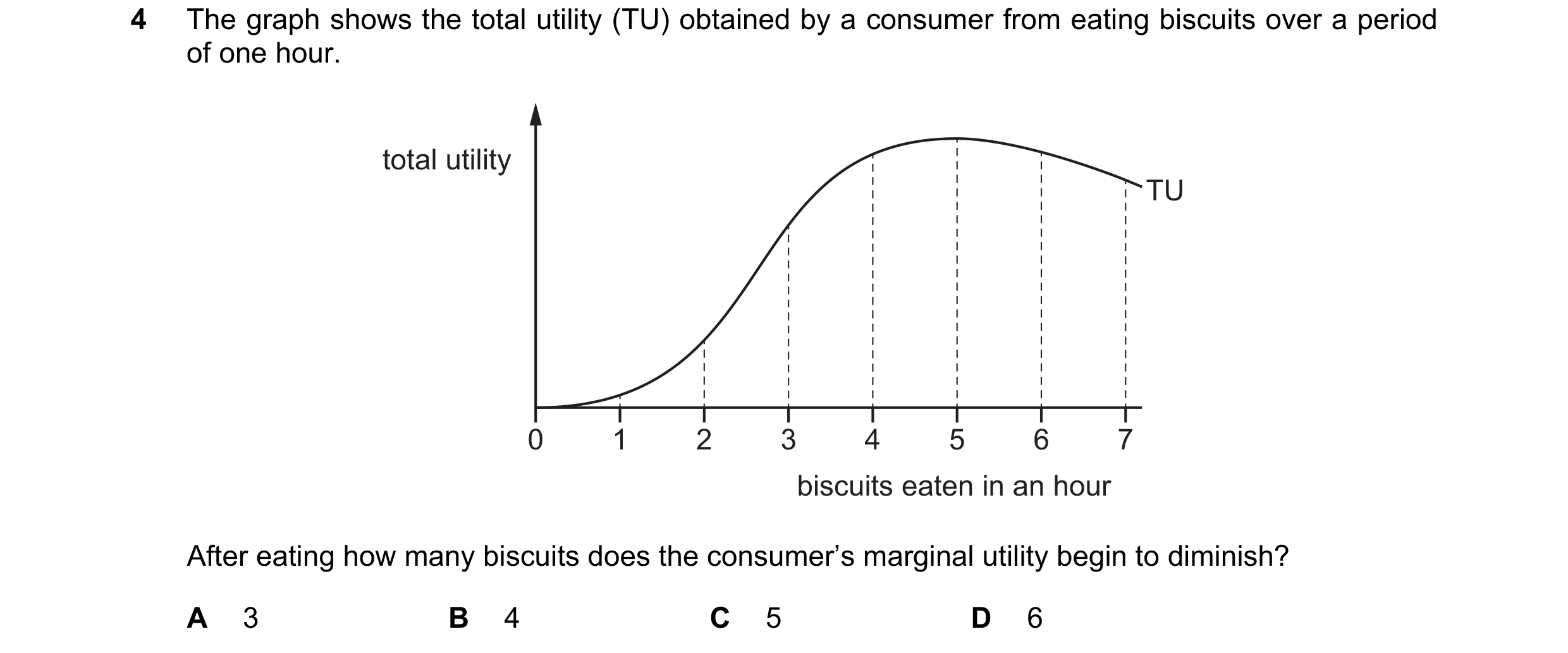
Q41 · The graph shows the total utility (TU) obtained by a consumer from eating biscuits over a… 9708/32 May/June 2019
4 The graph shows the total utility (TU) obtained by a consumer from eating biscuits over a period of one hour. total utility TU 0 1 2 3 4 5 6 7 biscuits eaten in an hour After eating how many biscuits does the consumer’s marginal utility begin to diminish? A 3 B 4 C 5 D 6
1 marks
Answer: A
This question in 9708/32 May/June 2019
Q42 · What is it called when a consumer’s marginal utility is greater than the price paid for… 9708/32 Oct/Nov 2019
4 What is it called when a consumer’s marginal utility is greater than the price paid for the good? A a Giffen good B an inferior good C consumer surplus D producer surplus
1 marks
Answer: C
This question in 9708/32 Oct/Nov 2019
Q43 · A consumer has $3 to spend each day on chocolate bars or toffee bars, which all cost $1… 9708/32 Oct/Nov 2019
5 A consumer has $3 to spend each day on chocolate bars or toffee bars, which all cost $1 each. The table below shows the units of additional satisfaction she gets from consuming each bar. 1st chocolate bar 2nd chocolate bar 3rd chocolate bar 16 13 10 1st toffee bar 2nd toffee bar 3rd toffee bar 14 12 9 What should she buy to maximise her total utility? A 1 chocolate bar and 2 toffee bars B 2 chocolate bars and 1 toffee bar C 3 chocolate bars D 3 toffee bars
1 marks
Answer: B
This question in 9708/32 Oct/Nov 2019
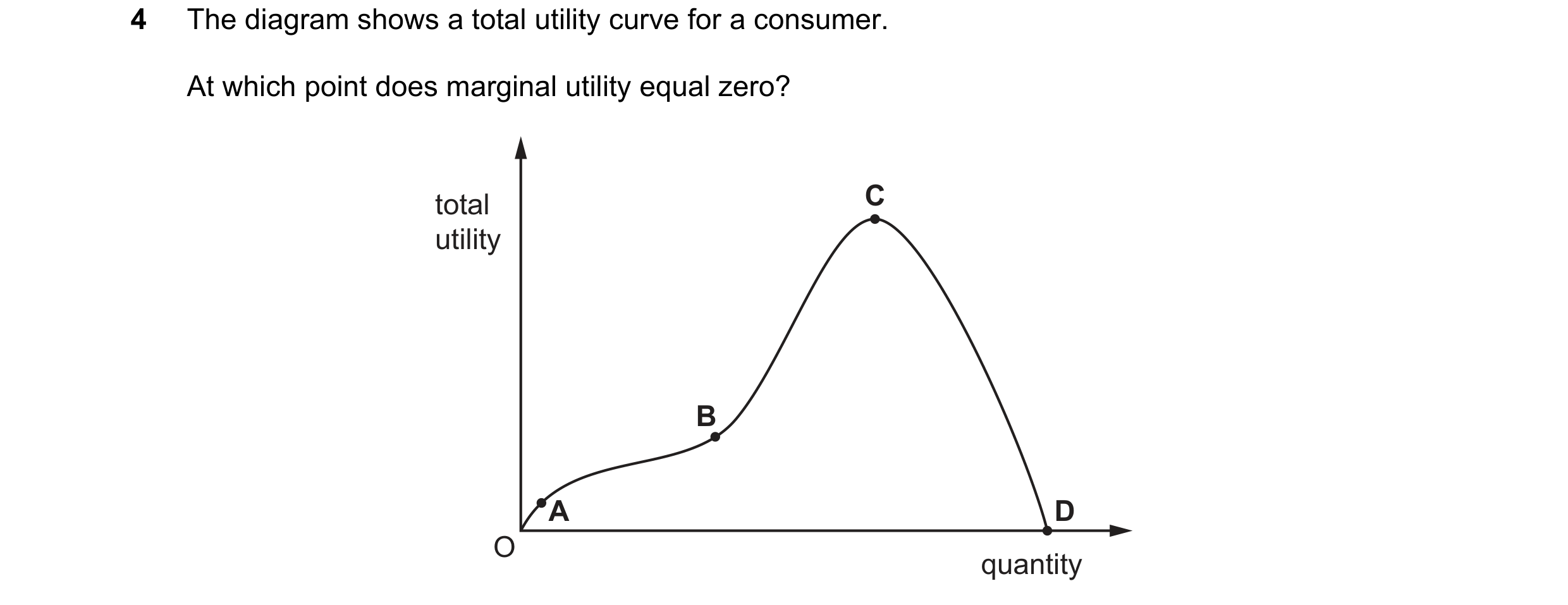
Q44 · The diagram shows a total utility curve for a consumer 9708/32 Feb/March 2020
4 The diagram shows a total utility curve for a consumer. At which point does marginal utility equal zero? total C utility B A D O quantity
1 marks
Answer: C
This question in 9708/32 Feb/March 2020
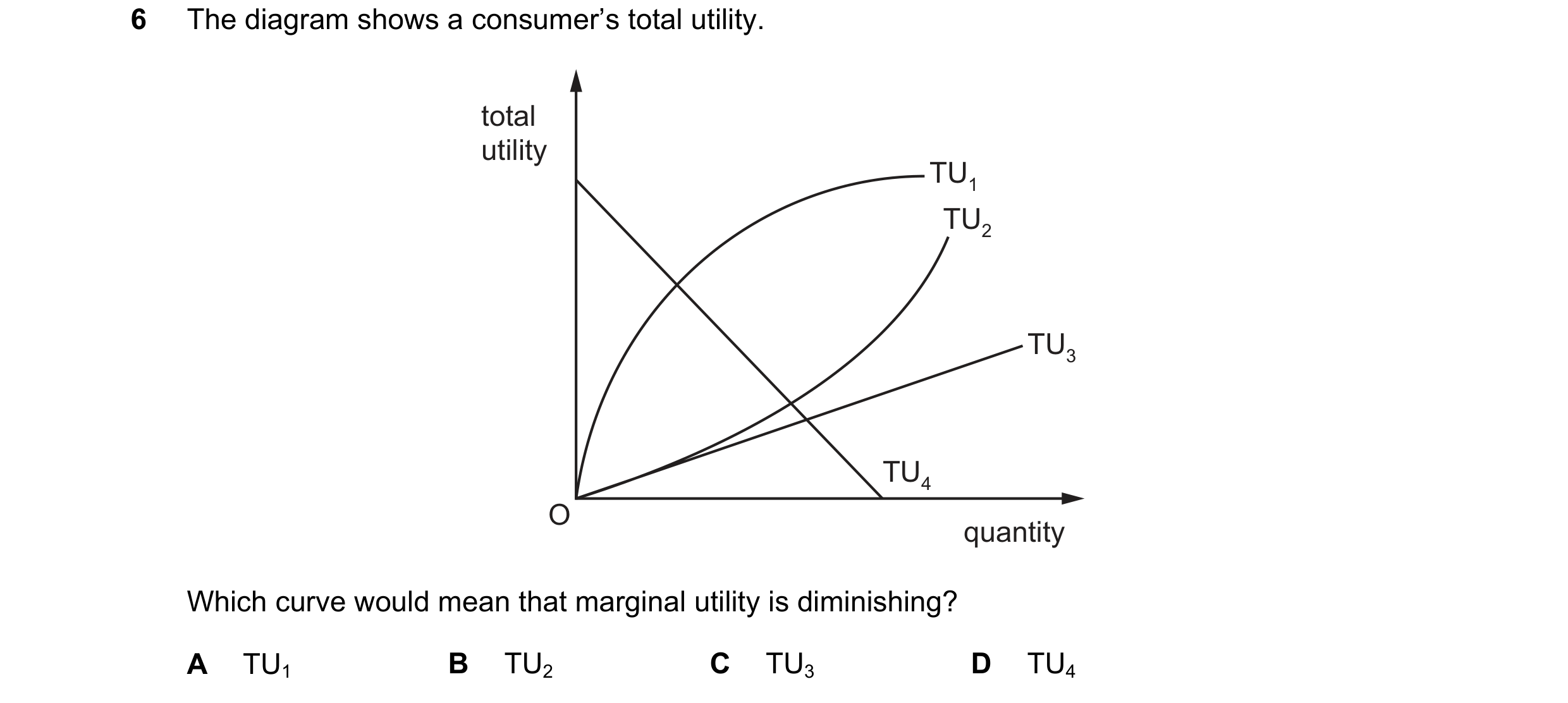
Q45 · The diagram shows a consumer’s total utility 9708/32 Feb/March 2020
6 The diagram shows a consumer’s total utility. total utility TU1 TU2 TU3 TU4 O quantity Which curve would mean that marginal utility is diminishing? A TU1 B TU2 C TU3 D TU4
1 marks
Answer: A
This question in 9708/32 Feb/March 2020
Q46 · The table contains data on the total utility gained by a consumer from eating biscuits… 9708/31 Oct/Nov 2020
4 The table contains data on the total utility gained by a consumer from eating biscuits and chocolates in one day. biscuits / chocolates total utility (units) eaten biscuits chocolates 1 20 10 2 38 20 3 52 32 4 62 38 5 70 42 6 74 42 7 74 40 What can be concluded from the table? A The consumer gets diminishing marginal utility after eating the first chocolate. B The consumer gets negative marginal utility from the seventh chocolate eaten. C The consumer will never eat chocolates if biscuits are available. D The second biscuit eaten gives the same marginal utility as the fourth chocolate eaten.
1 marks
Answer: B
This question in 9708/31 Oct/Nov 2020
Q47 · A rational consumer chooses what quantities of two products Y and Z to purchase with a… 9708/32 Oct/Nov 2020
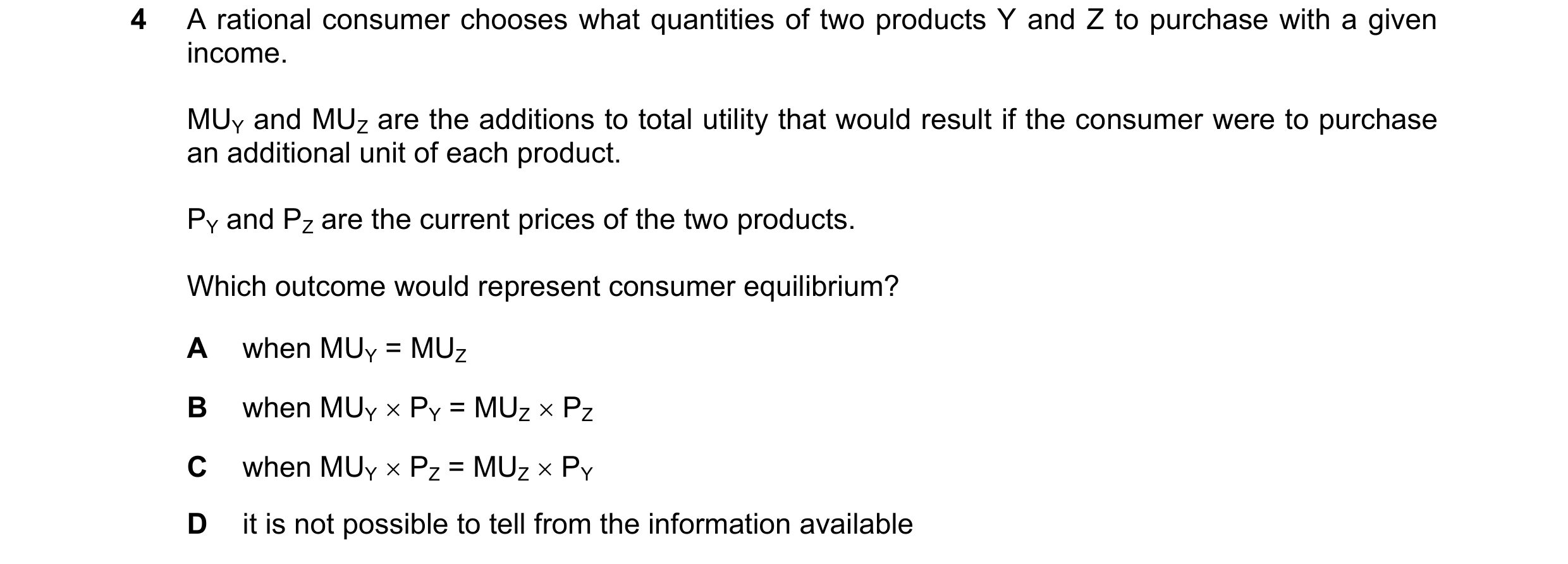
4 A rational consumer chooses what quantities of two products Y and Z to purchase with a given income. MUY and MUZ are the additions to total utility that would result if the consumer were to purchase an additional unit of each product. PY and PZ are the current prices of the two products. Which outcome would represent consumer equilibrium? A when MUY = MUZ B when MUY PY = MUZ PZ C when MUY PZ = MUZ PY D it is not possible to tell from the information available
1 marks
Answer: C
This question in 9708/32 Oct/Nov 2020
Q48 · A consumer maximises his utility by spending all his income on goods X and Y 9708/33 Oct/Nov 2020
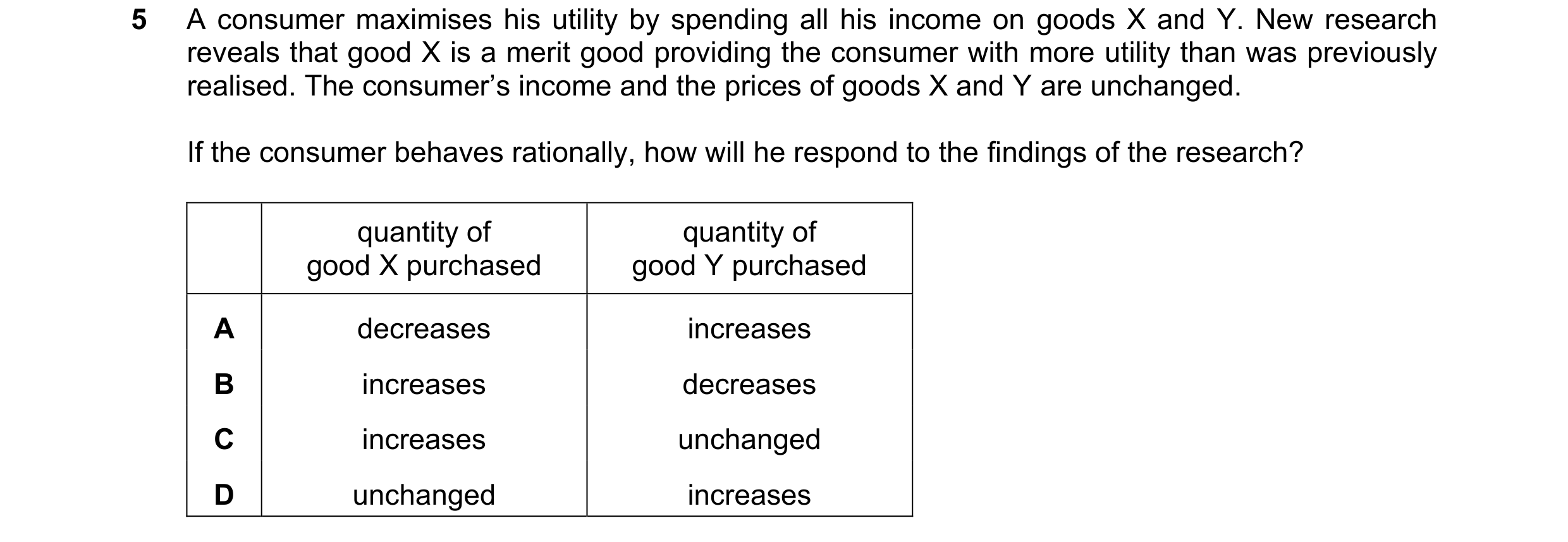
5 A consumer maximises his utility by spending all his income on goods X and Y. New research reveals that good X is a merit good providing the consumer with more utility than was previously realised. The consumer’s income and the prices of goods X and Y are unchanged. If the consumer behaves rationally, how will he respond to the findings of the research? quantity of quantity of good X purchased good Y purchased A decreases increases B increases decreases C increases unchanged D unchanged increases
1 marks
Answer: B
This question in 9708/33 Oct/Nov 2020
Q49 · A utility-maximising consumer has a fixed income and can choose between good X and good Y 9708/32 Feb/March 2021
4 A utility-maximising consumer has a fixed income and can choose between good X and good Y. The diagram shows her budget line and different consumption combinations (F, G, H, J, K and L) of products X and Y. F good G Y J H K L O good X Which consumption combinations are currently available to her? A F, G, H and L B F, G, J, and L C G, J and L only D G, H, J and L
1 marks
Answer: D
This question in 9708/32 Feb/March 2021
Q50 · Rational consumer Romesh spent 90 rupees buying herb X and spice Y 9708/32 Feb/March 2021
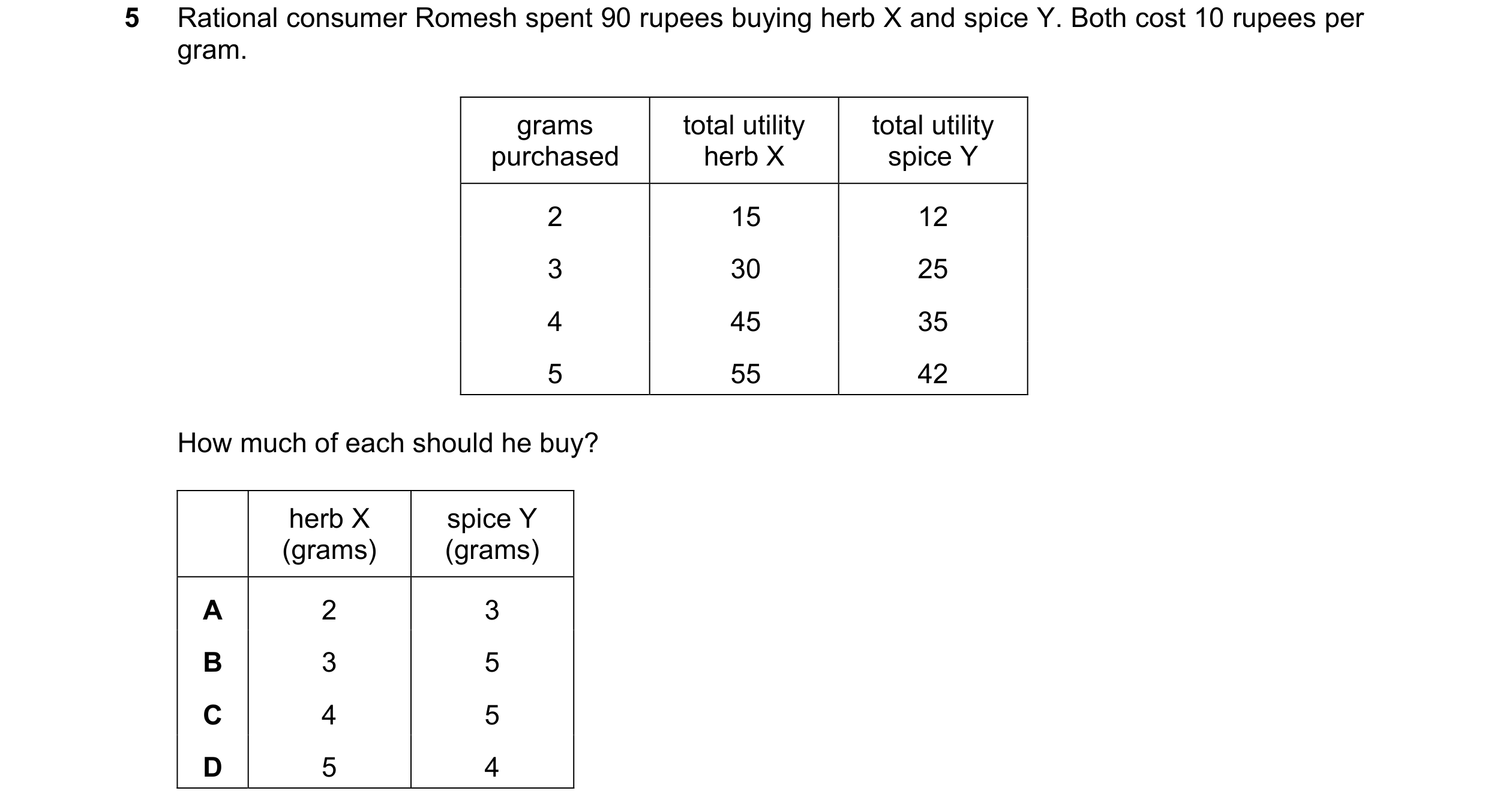
5 Rational consumer Romesh spent 90 rupees buying herb X and spice Y. Both cost 10 rupees per gram. grams total utility total utility purchased herb X spice Y 2 15 12 3 30 25 4 45 35 5 55 42 How much of each should he buy? herb X spice Y (grams) (grams) A 2 3 B 3 5 C 4 5 D 5 4
1 marks
Answer: D
This question in 9708/32 Feb/March 2021
Q51 · Which act of purchase or consumption is most likely to illustrate the law of diminishing… 9708/31 May/June 2021
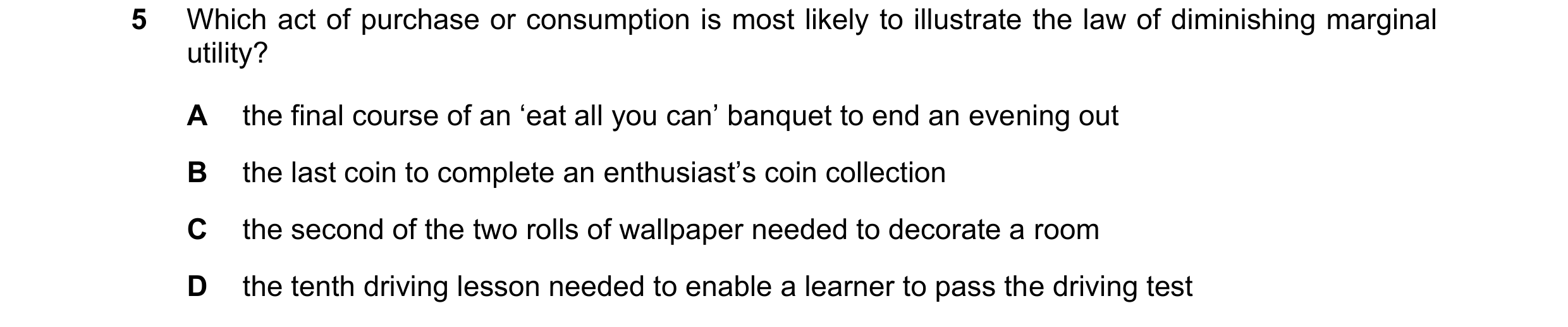
5 Which act of purchase or consumption is most likely to illustrate the law of diminishing marginal utility? A the final course of an ‘eat all you can’ banquet to end an evening out B the last coin to complete an enthusiast’s coin collection C the second of the two rolls of wallpaper needed to decorate a room D the tenth driving lesson needed to enable a learner to pass the driving test
1 marks
Answer: A
This question in 9708/31 May/June 2021
Q52 · Donald maximises his utility when buying paperback books and audio books 9708/32 May/June 2021
4 Donald maximises his utility when buying paperback books and audio books. The price of a paperback book = $3 and the price of an audio book = $6. If the marginal utility of the last paperback book was 12 units of utility (utils), what was the marginal utility of the last audio book purchased? A 2 utils B 12 utils C 16 utils D 24 utils
1 marks
Answer: D
This question in 9708/32 May/June 2021
Q53 · Which act of purchase or consumption is most likely to illustrate the law of diminishing… 9708/33 May/June 2021
5 Which act of purchase or consumption is most likely to illustrate the law of diminishing marginal utility? A the final course of an ‘eat all you can’ banquet to end an evening out B the last coin to complete an enthusiast’s coin collection C the second of the two rolls of wallpaper needed to decorate a room D the tenth driving lesson needed to enable a learner to pass the driving test
1 marks
Answer: A
This question in 9708/33 May/June 2021
Q54 · A rational consumer maximises satisfaction by buying three units of good X and four units… 9708/31 Oct/Nov 2021
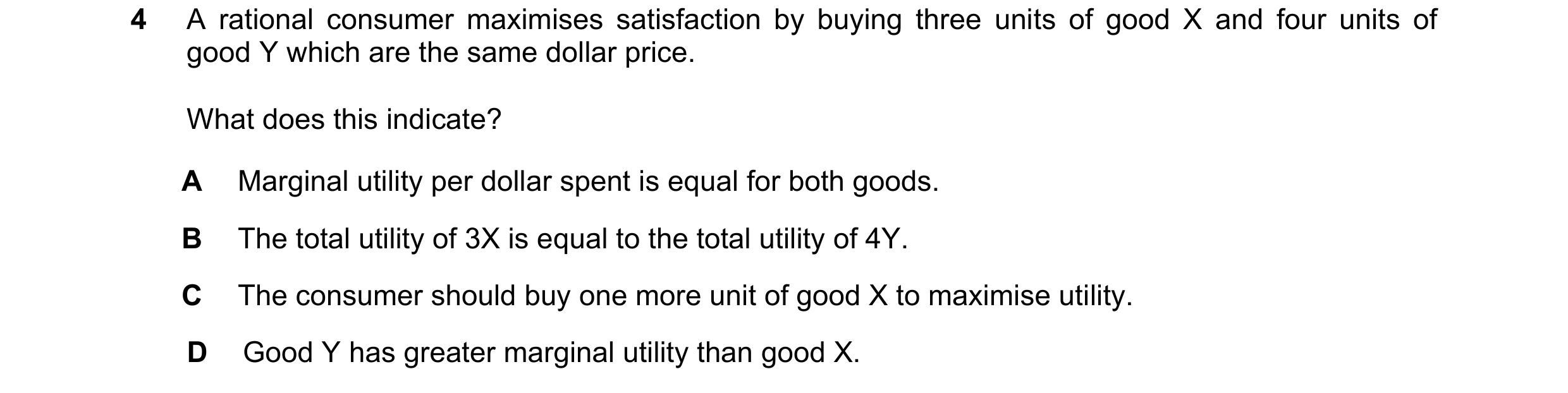
4 A rational consumer maximises satisfaction by buying three units of good X and four units of good Y which are the same dollar price. What does this indicate? A Marginal utility per dollar spent is equal for both goods. B The total utility of 3X is equal to the total utility of 4Y. C The consumer should buy one more unit of good X to maximise utility. D Good Y has greater marginal utility than good X.
1 marks
Answer: A
This question in 9708/31 Oct/Nov 2021
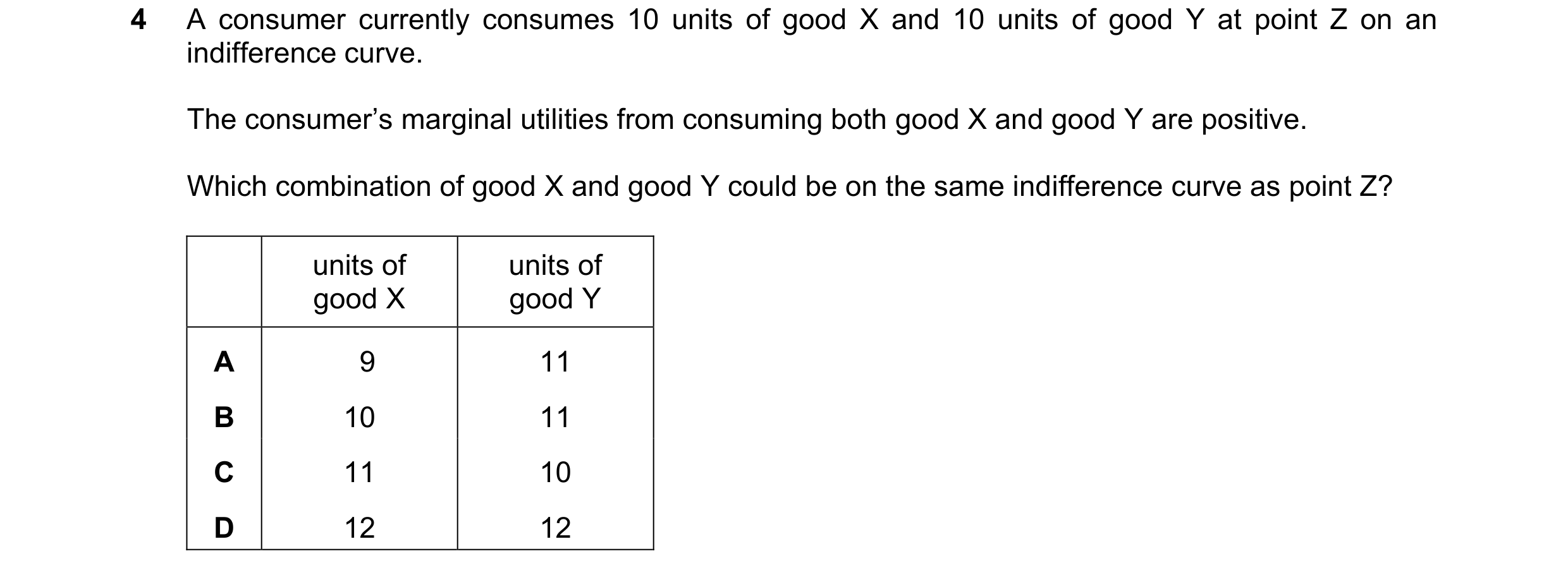
Q55 · A consumer currently consumes 10 units of good X and 10 units of good Y at point Z on an… 9708/32 Oct/Nov 2021
4 A consumer currently consumes 10 units of good X and 10 units of good Y at point Z on an indifference curve. The consumer’s marginal utilities from consuming both good X and good Y are positive. Which combination of good X and good Y could be on the same indifference curve as point Z? units of units of good X good Y A 9 11 B 10 11 C 11 10 D 12 12
1 marks
Answer: A
This question in 9708/32 Oct/Nov 2021
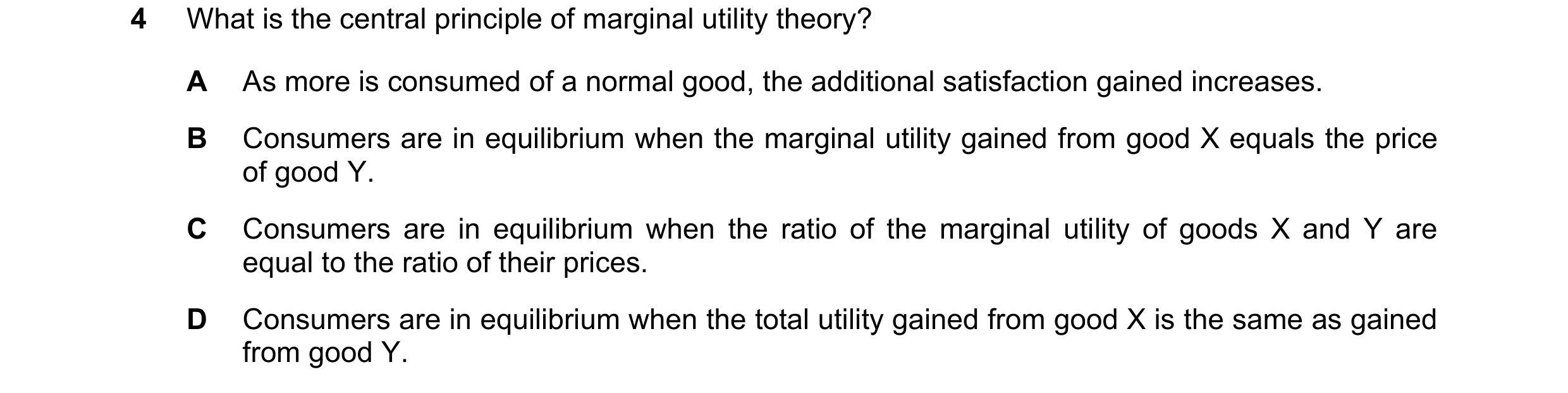
Q56 · What is the central principle of marginal utility theory? 9708/31 May/June 2022
4 What is the central principle of marginal utility theory? A As more is consumed of a normal good, the additional satisfaction gained increases. B Consumers are in equilibrium when the marginal utility gained from good X equals the price of good Y. C Consumers are in equilibrium when the ratio of the marginal utility of goods X and Y are equal to the ratio of their prices. D Consumers are in equilibrium when the total utility gained from good X is the same as gained from good Y.
1 marks
Answer: C
This question in 9708/31 May/June 2022
Q57 · What is the central principle of marginal utility theory? 9708/33 May/June 2022
4 What is the central principle of marginal utility theory? A As more is consumed of a normal good, the additional satisfaction gained increases. B Consumers are in equilibrium when the marginal utility gained from good X equals the price of good Y. C Consumers are in equilibrium when the ratio of the marginal utility of goods X and Y are equal to the ratio of their prices. D Consumers are in equilibrium when the total utility gained from good X is the same as gained from good Y.
1 marks
Answer: C
This question in 9708/33 May/June 2022
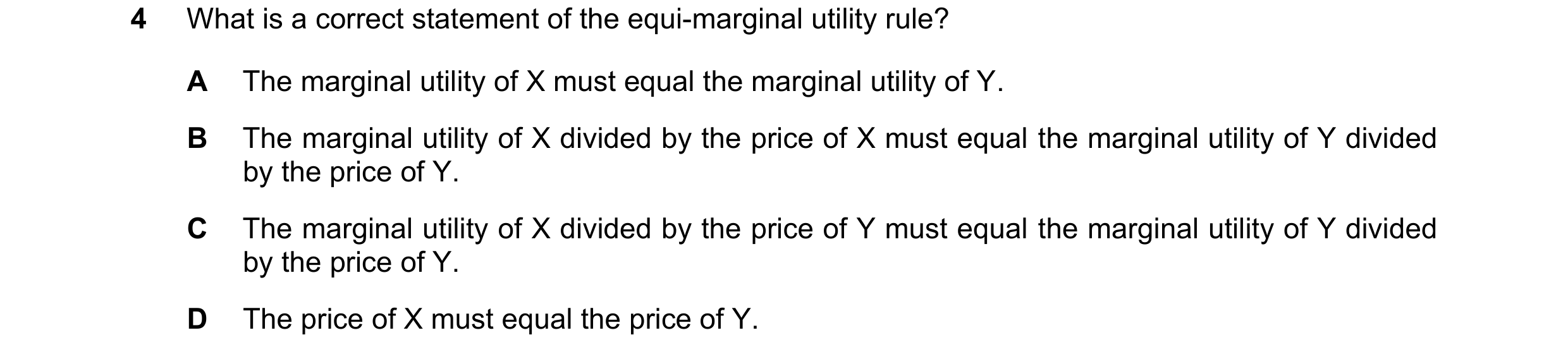
Q58 · What is a correct statement of the equi-marginal utility rule? 9708/31 Oct/Nov 2022
4 What is a correct statement of the equi-marginal utility rule? A The marginal utility of X must equal the marginal utility of Y. B The marginal utility of X divided by the price of X must equal the marginal utility of Y divided by the price of Y. C The marginal utility of X divided by the price of Y must equal the marginal utility of Y divided by the price of Y. D The price of X must equal the price of Y.
1 marks
Answer: B
This question in 9708/31 Oct/Nov 2022
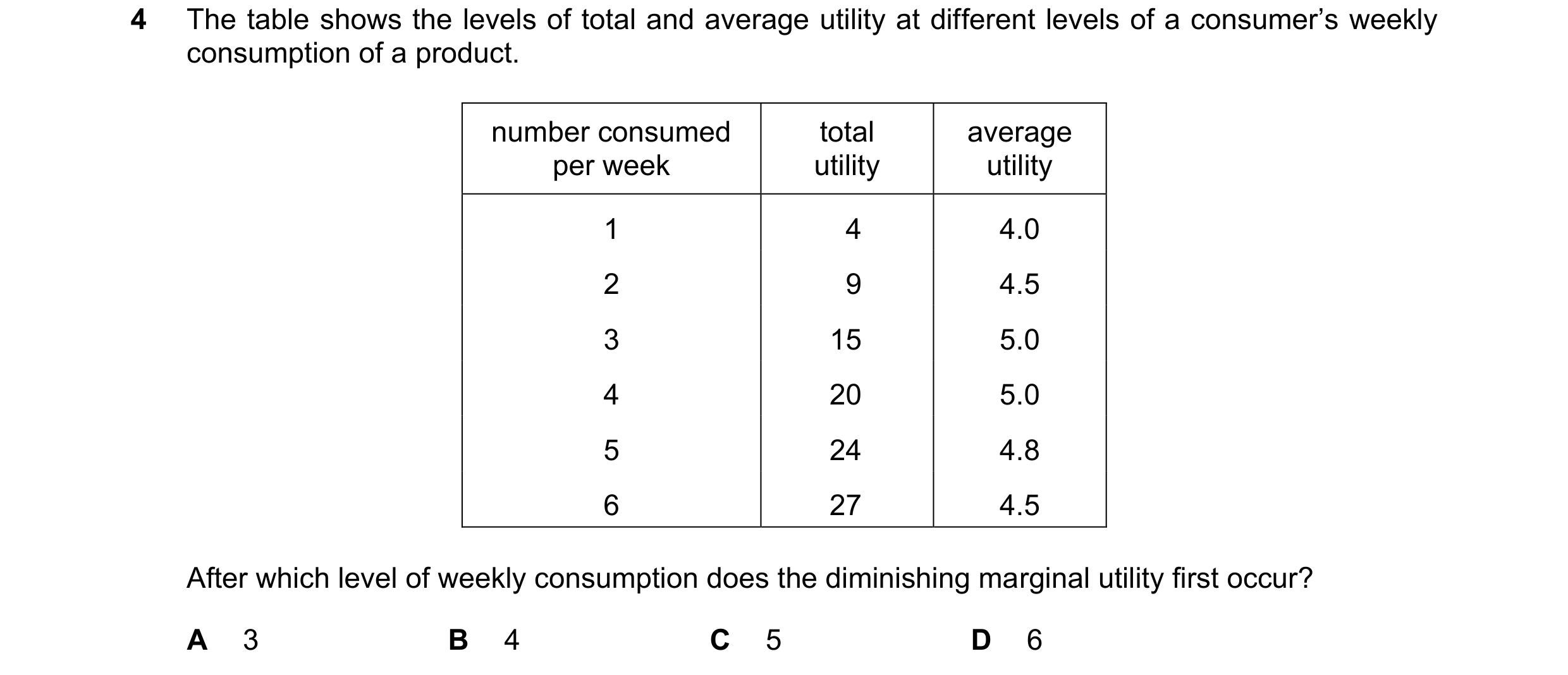
Q59 · The table shows the levels of total and average utility at different levels of a… 9708/32 Oct/Nov 2022
4 The table shows the levels of total and average utility at different levels of a consumer’s weekly consumption of a product. number consumed total average per week utility utility 1 4 4.0 2 9 4.5 3 15 5.0 4 20 5.0 5 24 4.8 6 27 4.5 After which level of weekly consumption does the diminishing marginal utility first occur? A 3 B 4 C 5 D 6
1 marks
Answer: A
This question in 9708/32 Oct/Nov 2022
Q60 · The diagram shows the market price and equilibrium quantity of coffee consumed by an… 9708/33 Oct/Nov 2022
4 The diagram shows the market price and equilibrium quantity of coffee consumed by an individual, Jo. Jo buys X cups of coffee at $2 per cup when she visits her favourite café. supply price $ 2 demand 0 X Y quantity When she is there, the café owner says it is offering unlimited free refills. How is her consumption most likely to change? A Jo’s demand for coffee will increase from X to Y where her total utility for coffee is zero. B Jo’s demand for coffee will increase from X to Y where her marginal utility for coffee is zero. C Jo will not drink extra coffee because its marginal utility is less than $2. D Jo will not drink extra coffee because her total utility will fall.
1 marks
Answer: B
This question in 9708/33 Oct/Nov 2022
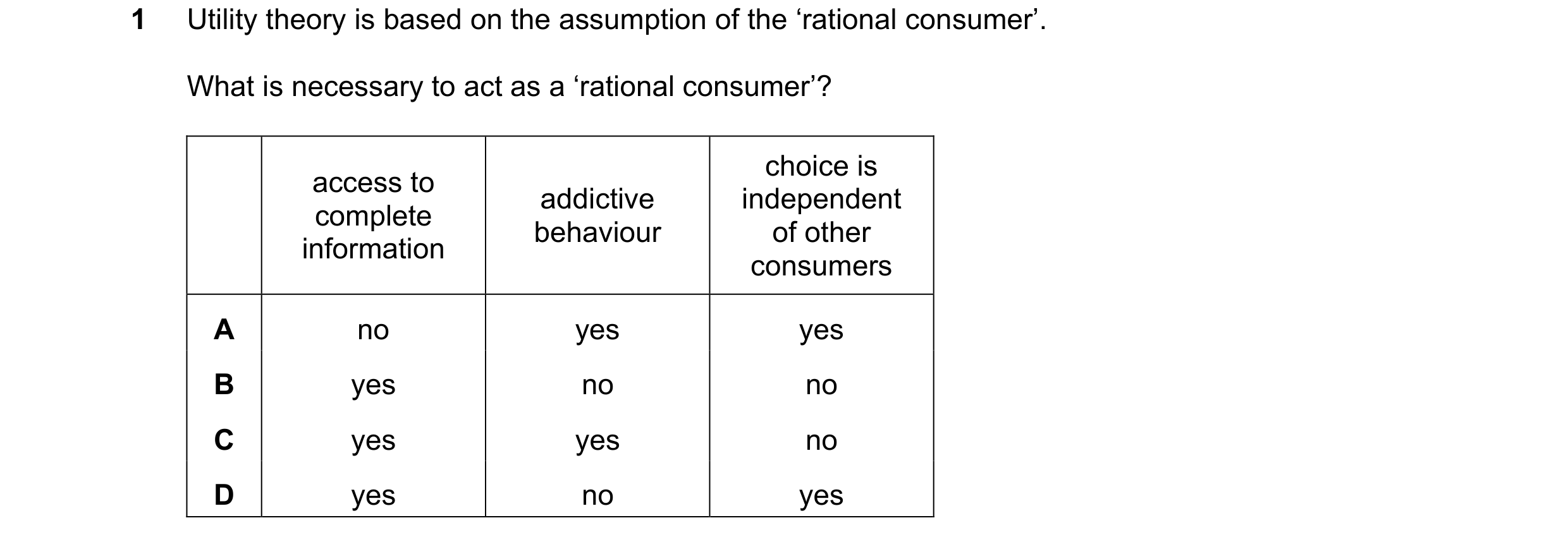
Q61 · Utility theory is based on the assumption of the ‘rational consumer’ 9708/32 Feb/March 2023
1 Utility theory is based on the assumption of the ‘rational consumer’. What is necessary to act as a ‘rational consumer’? choice is access to addictive independent complete behaviour of other information consumers A no yes yes B yes no no C yes yes no D yes no yes
1 marks
Answer: D
This question in 9708/32 Feb/March 2023
Q62 · The price of good S is $6 and the price of good T is $8 9708/32 Feb/March 2023
2 The price of good S is $6 and the price of good T is $8. A consumer’s marginal utility for each good is shown. marginal utility marginal utility units of good S of good T 1 36 32 2 24 22 3 18 20 4 9 18 5 0 9 If this consumer wants to maximise total utility, which combination of goods would they consume? good S good T A 1 1 B 2 1 C 3 4 D 5 5
1 marks
Answer: B
This question in 9708/32 Feb/March 2023
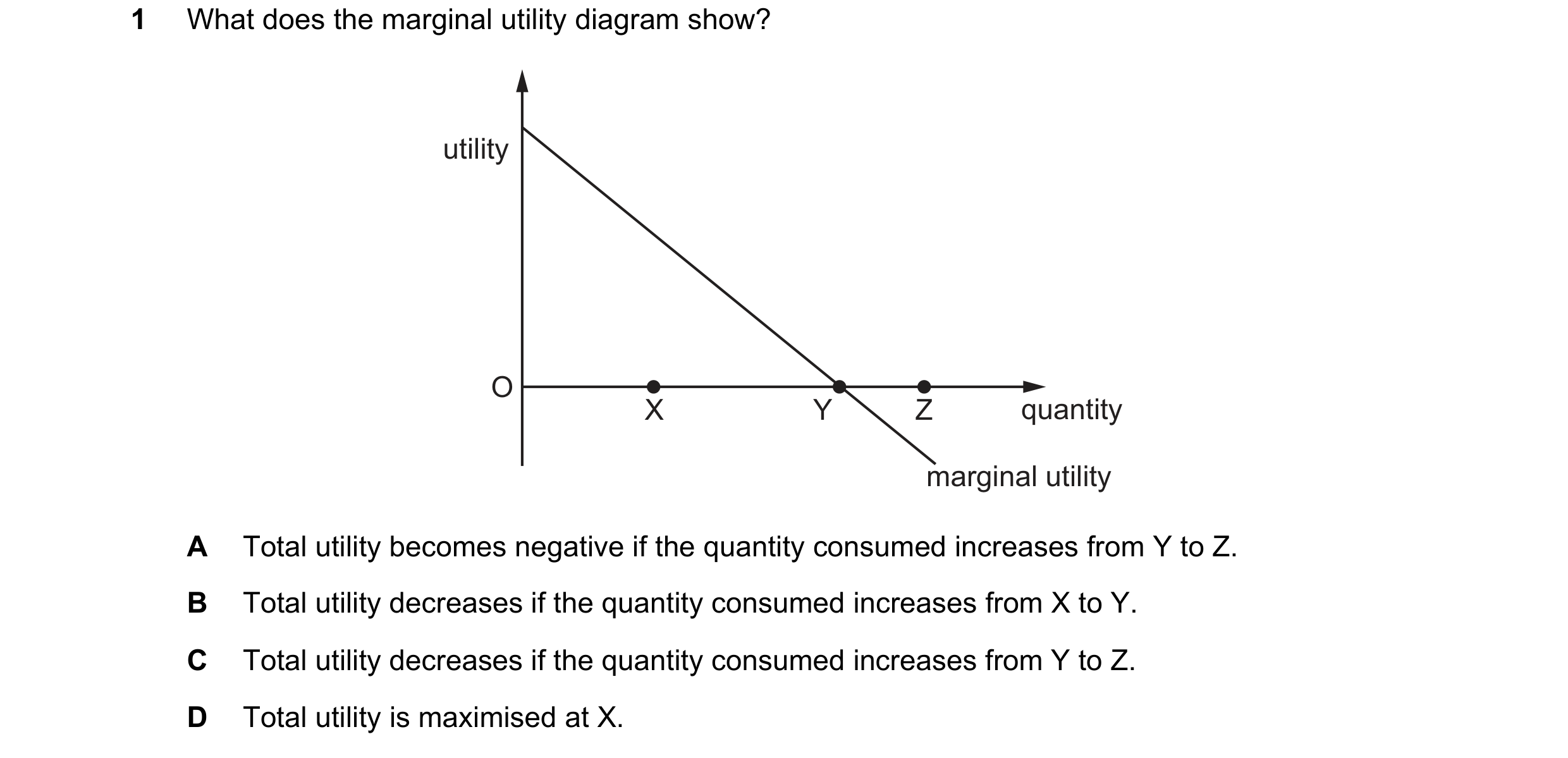
Q63 · What does the marginal utility diagram show? 9708/31 May/June 2023
1 What does the marginal utility diagram show? utility O X Y Z quantity marginal utility A Total utility becomes negative if the quantity consumed increases from Y to Z. B Total utility decreases if the quantity consumed increases from X to Y. C Total utility decreases if the quantity consumed increases from Y to Z. D Total utility is maximised at X.
1 marks
Answer: C
This question in 9708/31 May/June 2023
Q64 · The diagram shows an individual’s indifference curve, I1, for apples and pears 9708/32 May/June 2023
2 The diagram shows an individual’s indifference curve, I1, for apples and pears. apples 19 Y X 12 I1 0 0 2 4 pears What can be concluded from the movement from point X to point Y on this curve? A The individual can afford more apples than pears. B The individual has not changed their total utility. C The individual prefers apples to pears. D The individual has gained more utility by moving from point X to point Y.
1 marks
Answer: B
This question in 9708/32 May/June 2023
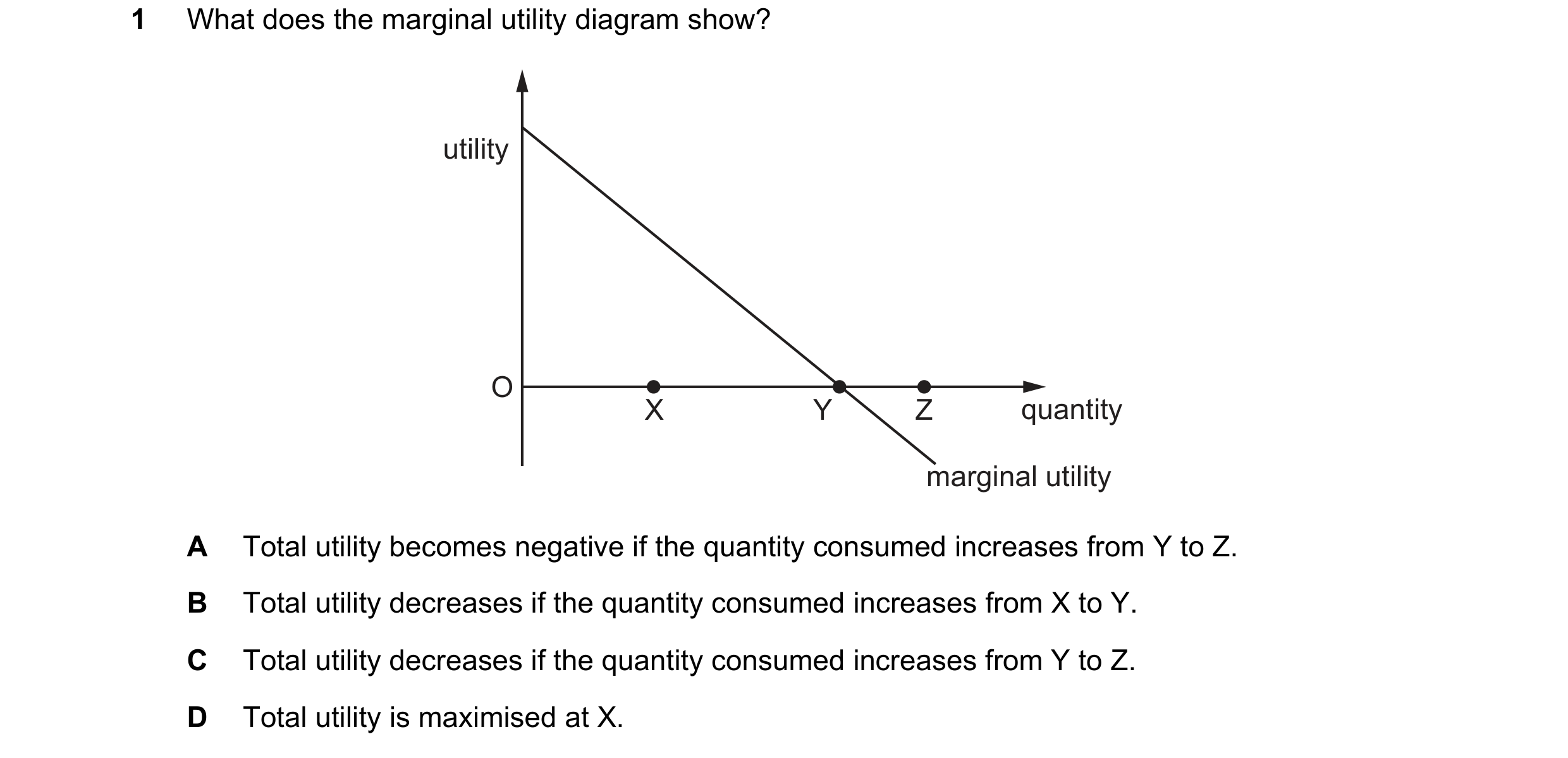
Q65 · What does the marginal utility diagram show? 9708/33 May/June 2023
1 What does the marginal utility diagram show? utility O X Y Z quantity marginal utility A Total utility becomes negative if the quantity consumed increases from Y to Z. B Total utility decreases if the quantity consumed increases from X to Y. C Total utility decreases if the quantity consumed increases from Y to Z. D Total utility is maximised at X.
1 marks
Answer: C
This question in 9708/33 May/June 2023
Q66 · Economists normally assume that the marginal utility from consuming additional goods is… 9708/31 Oct/Nov 2023
1 Economists normally assume that the marginal utility from consuming additional goods is positive and diminishing. What is the effect on total satisfaction of consuming extra units of the good? A Total satisfaction falls at a decreasing rate. B Total satisfaction falls at an increasing rate. C Total satisfaction rises at a decreasing rate. D Total satisfaction rises at an increasing rate.
1 marks
Answer: C
This question in 9708/31 Oct/Nov 2023
Q67 · The diagram shows the marginal utility (MU) from the consumption of quantities of good X 9708/33 Oct/Nov 2023
1 The diagram shows the marginal utility (MU) from the consumption of quantities of good X. 10 marginal 8 utility 6 4 MU 2 0 0 1 2 3 4 5 6 quantity of X What happens to the total utility as consumption of X rises from 1 to 6 units? A It falls continuously. B It falls and then rises. C It rises continuously. D It rises and then falls.
1 marks
Answer: D
This question in 9708/33 Oct/Nov 2023
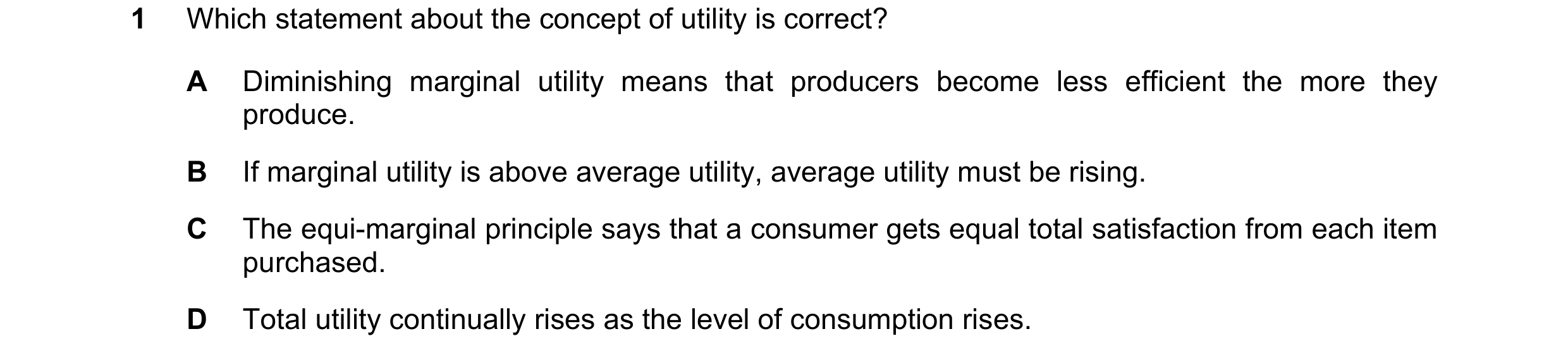
Q68 · Which statement about the concept of utility is correct? 9708/31 May/June 2024
1 Which statement about the concept of utility is correct? A Diminishing marginal utility means that producers become less efficient the more they produce. B If marginal utility is above average utility, average utility must be rising. C The equi-marginal principle says that a consumer gets equal total satisfaction from each item purchased. D Total utility continually rises as the level of consumption rises.
1 marks
Answer: B
This question in 9708/31 May/June 2024
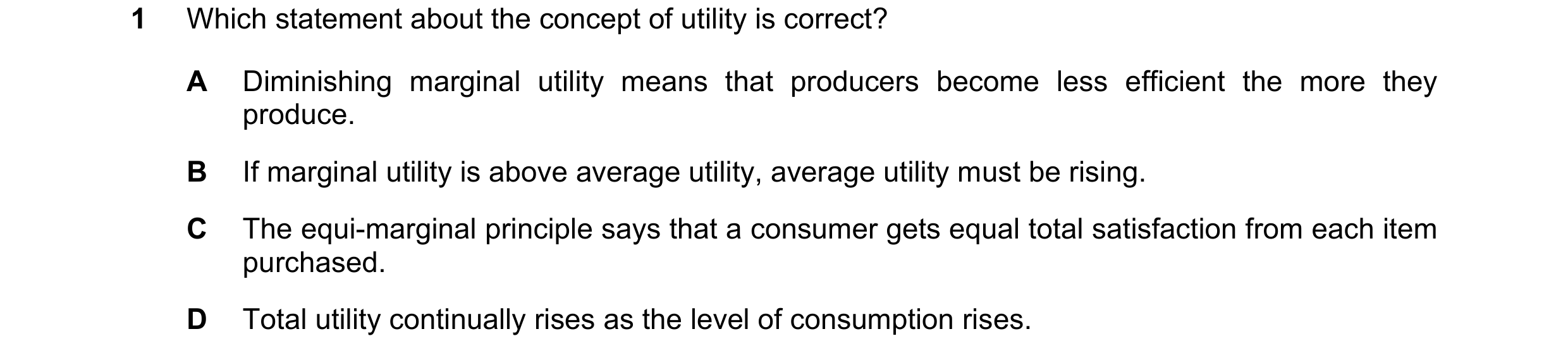
Q69 · Which statement about the concept of utility is correct? 9708/33 May/June 2024
1 Which statement about the concept of utility is correct? A Diminishing marginal utility means that producers become less efficient the more they produce. B If marginal utility is above average utility, average utility must be rising. C The equi-marginal principle says that a consumer gets equal total satisfaction from each item purchased. D Total utility continually rises as the level of consumption rises.
1 marks
Answer: B
This question in 9708/33 May/June 2024
 1 / 23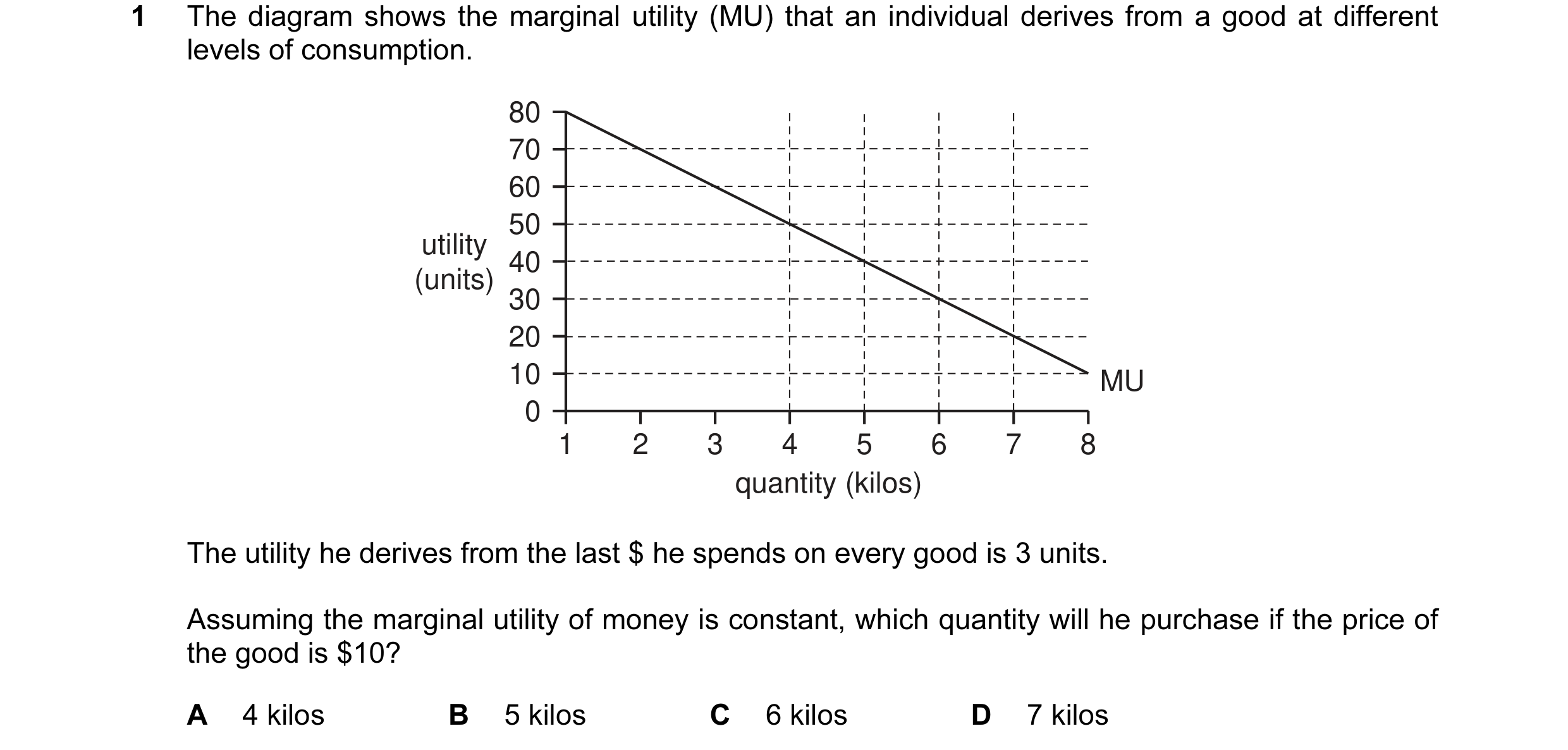
 2 / 23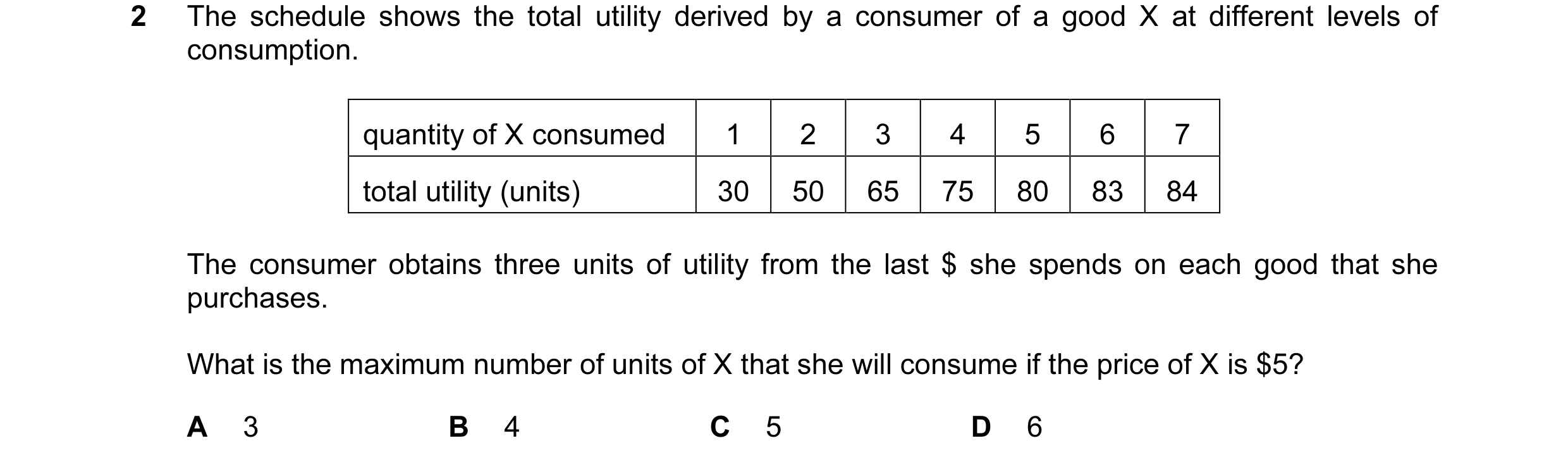
 3 / 23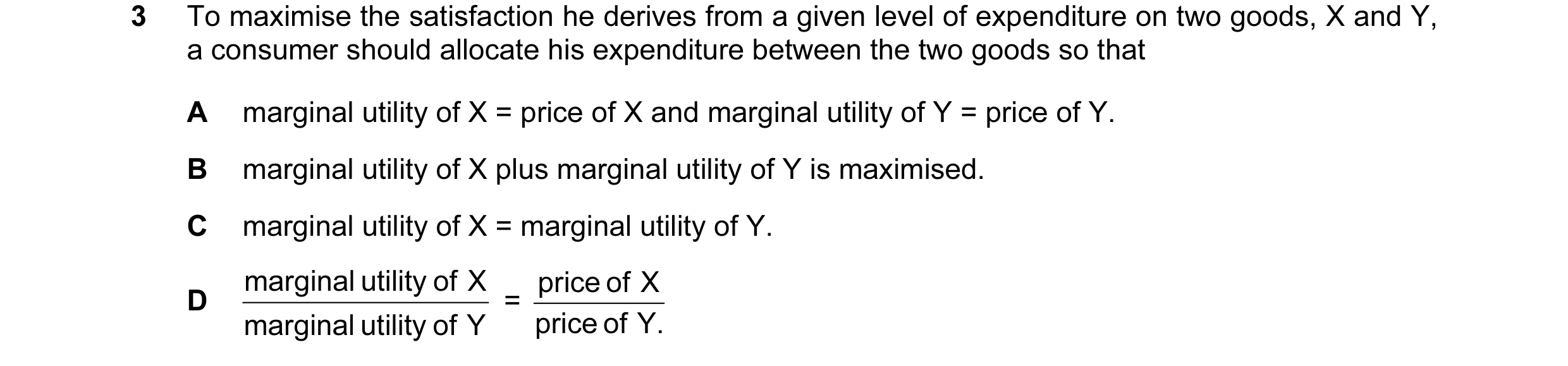


 4 / 23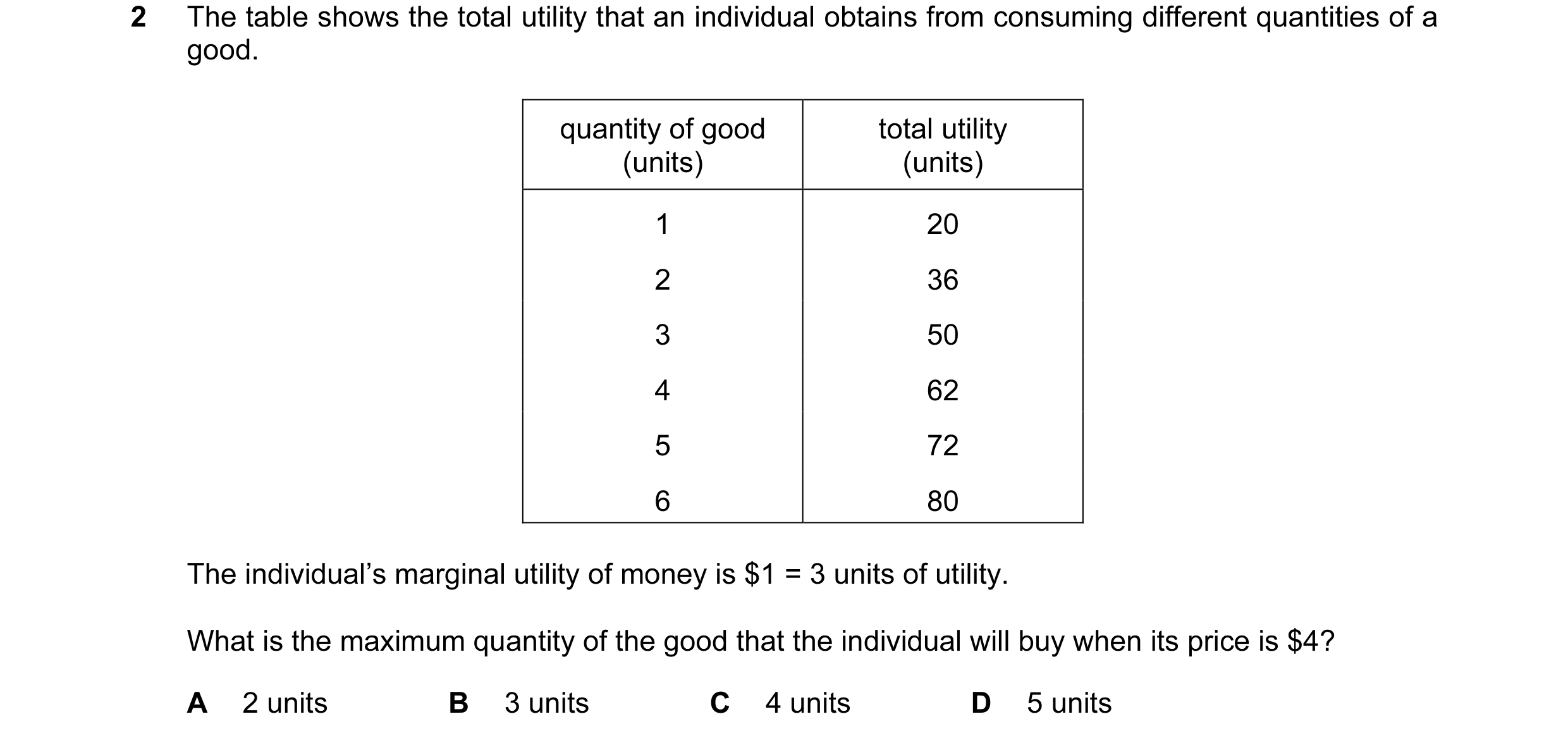
 5 / 23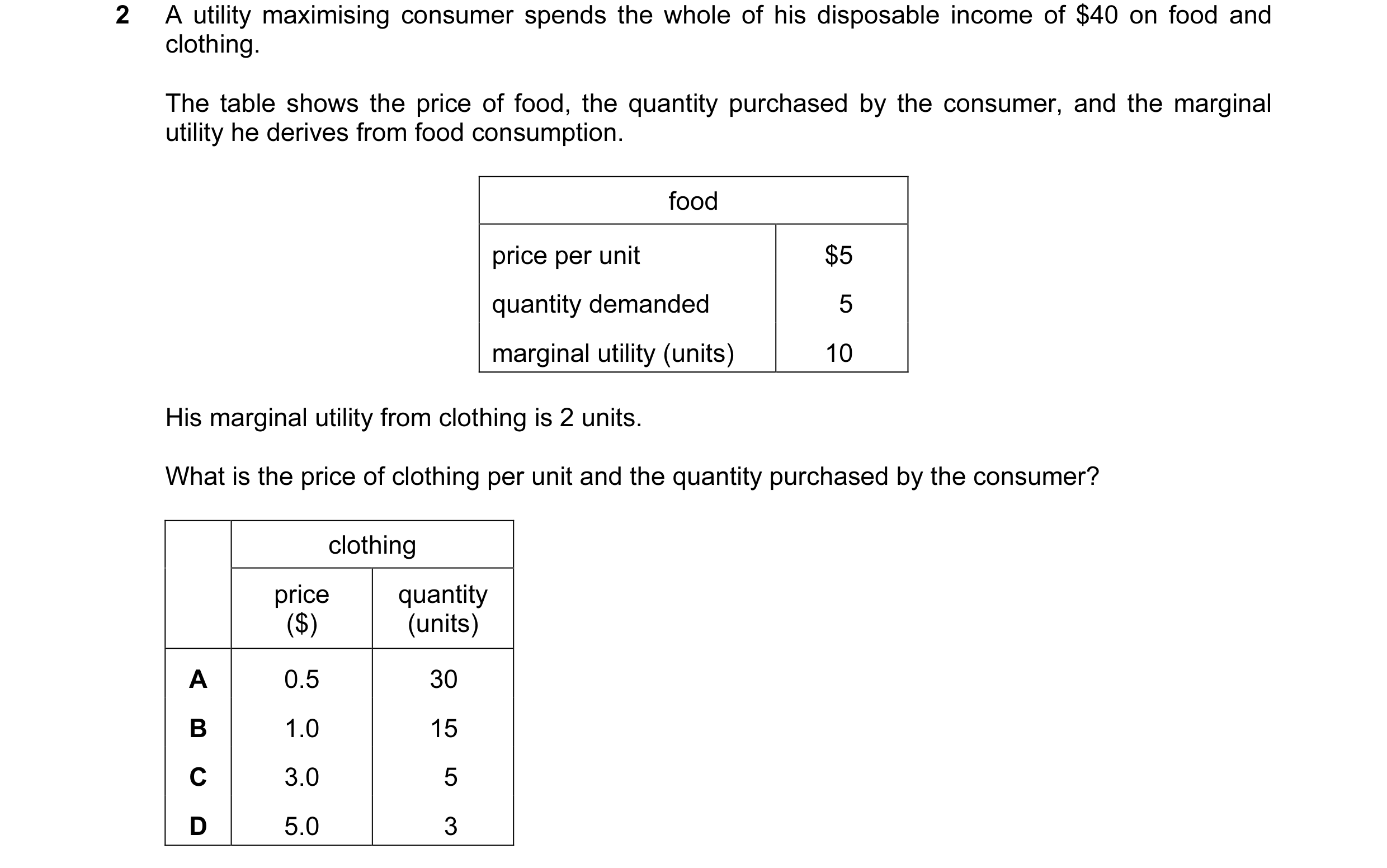

 6 / 23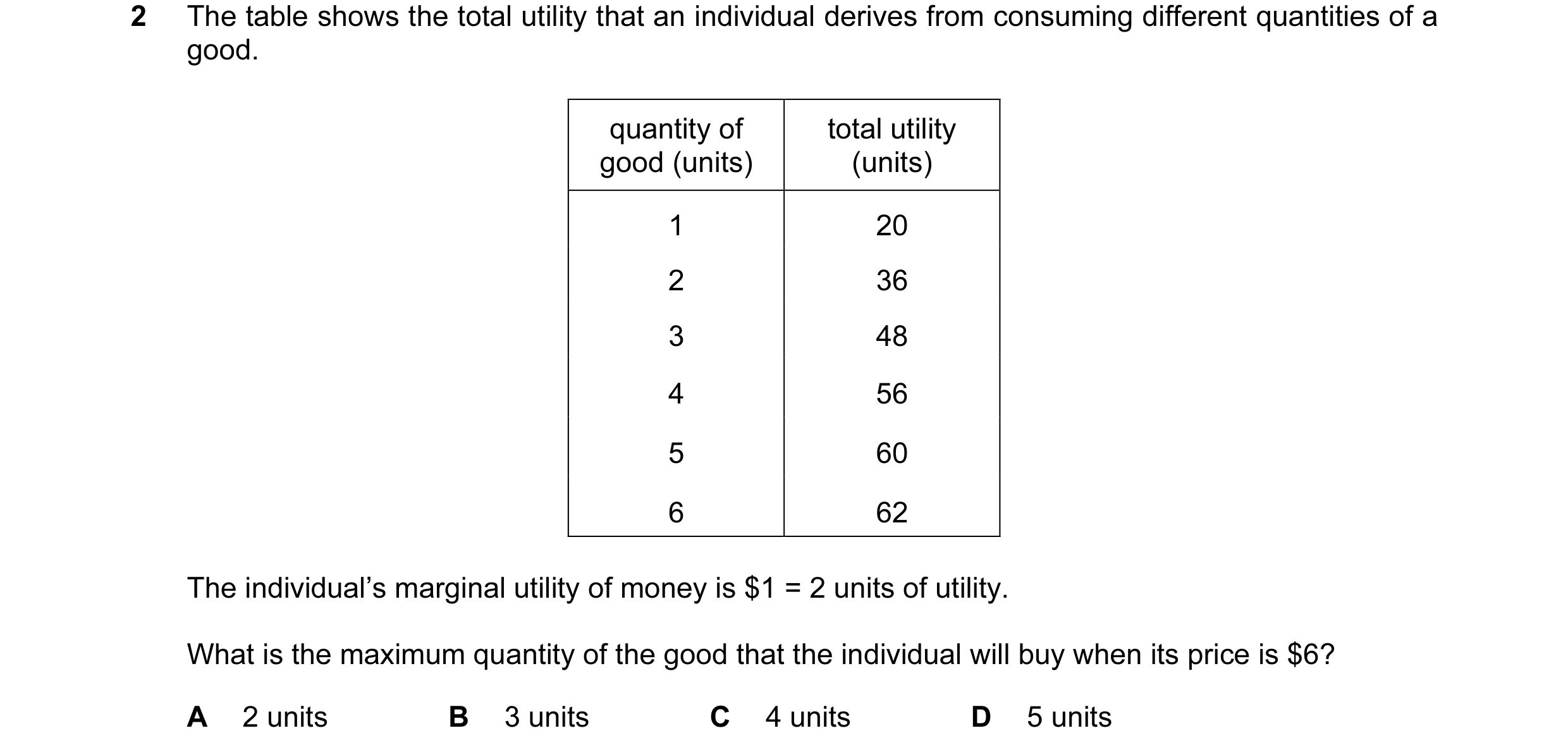
 7 / 23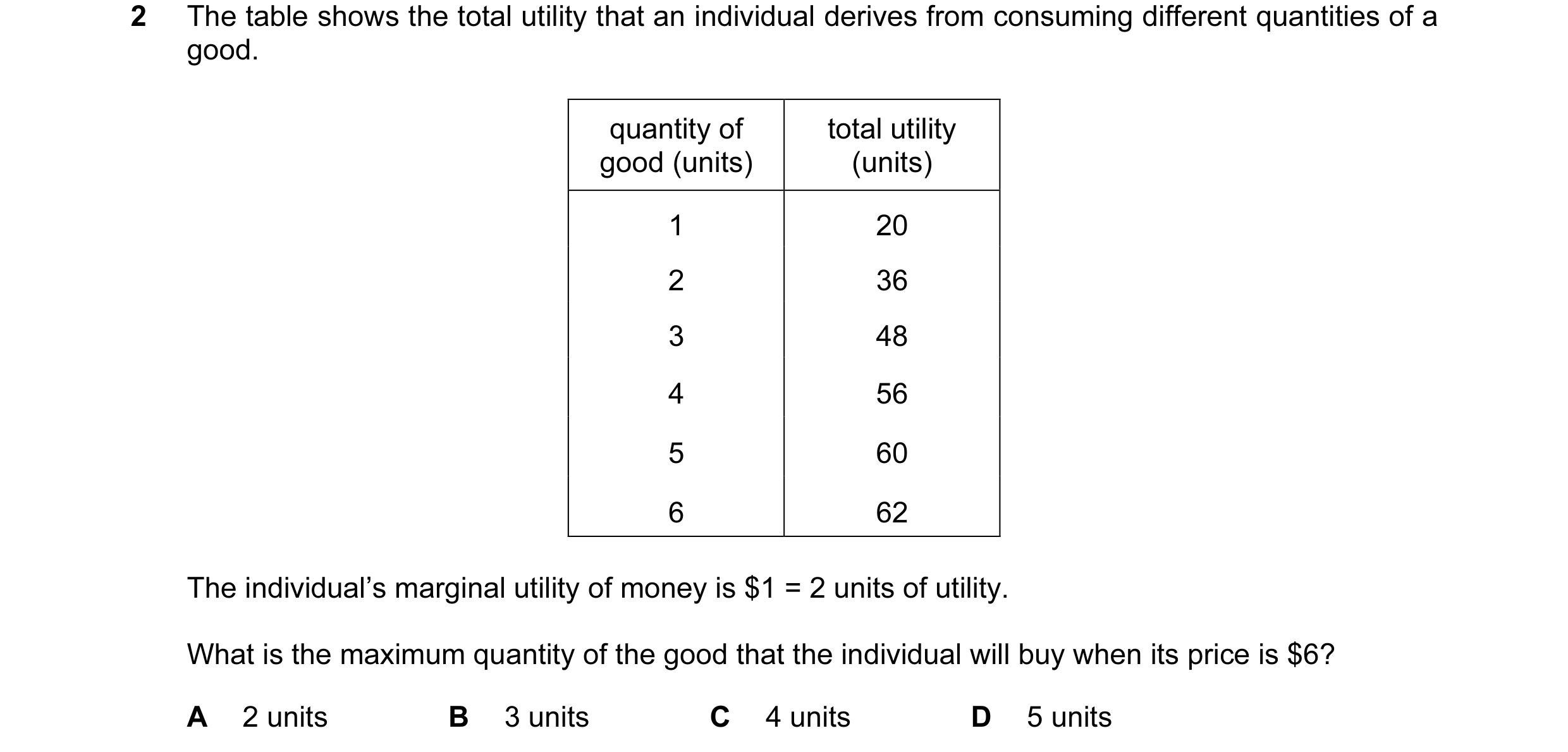
 8 / 23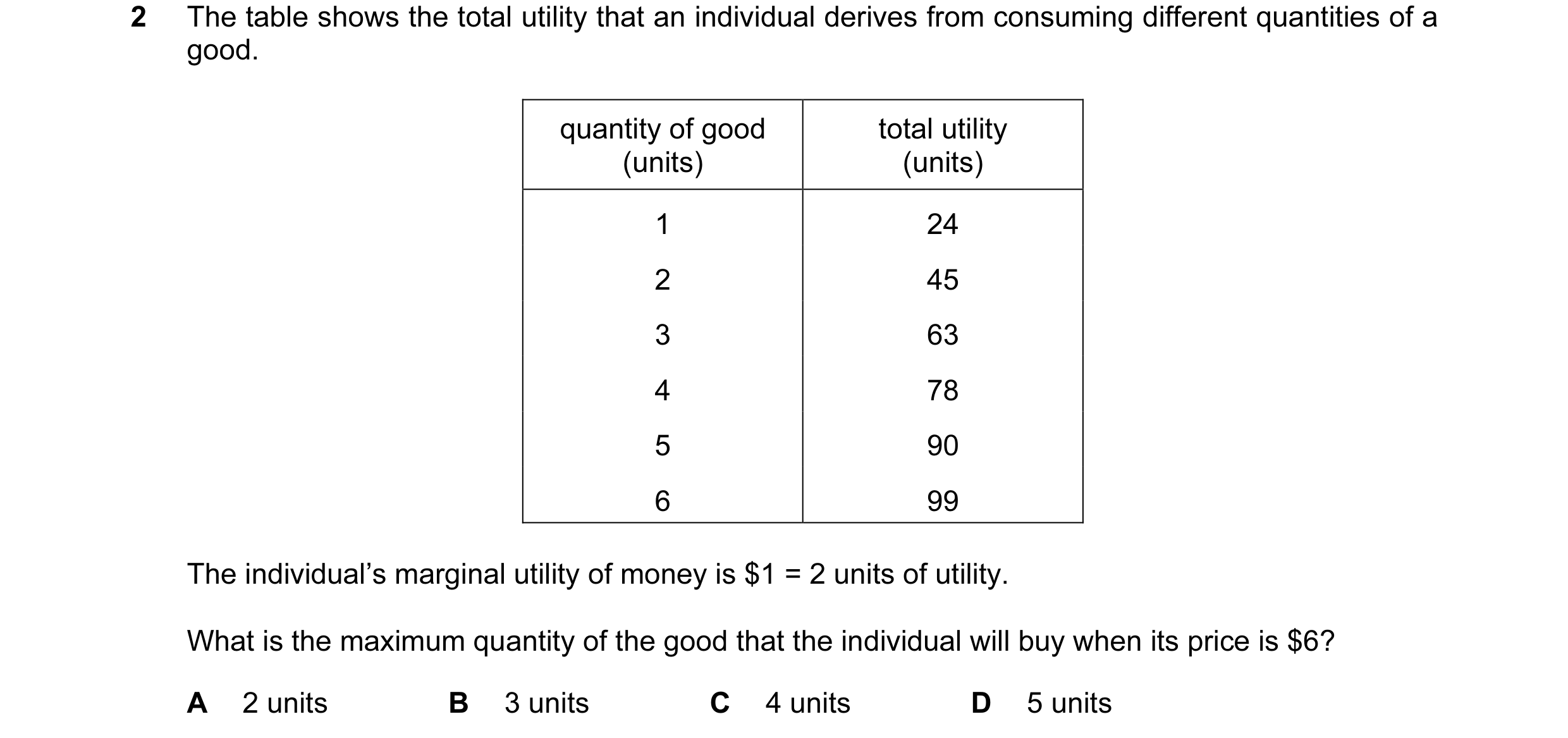
 9 / 23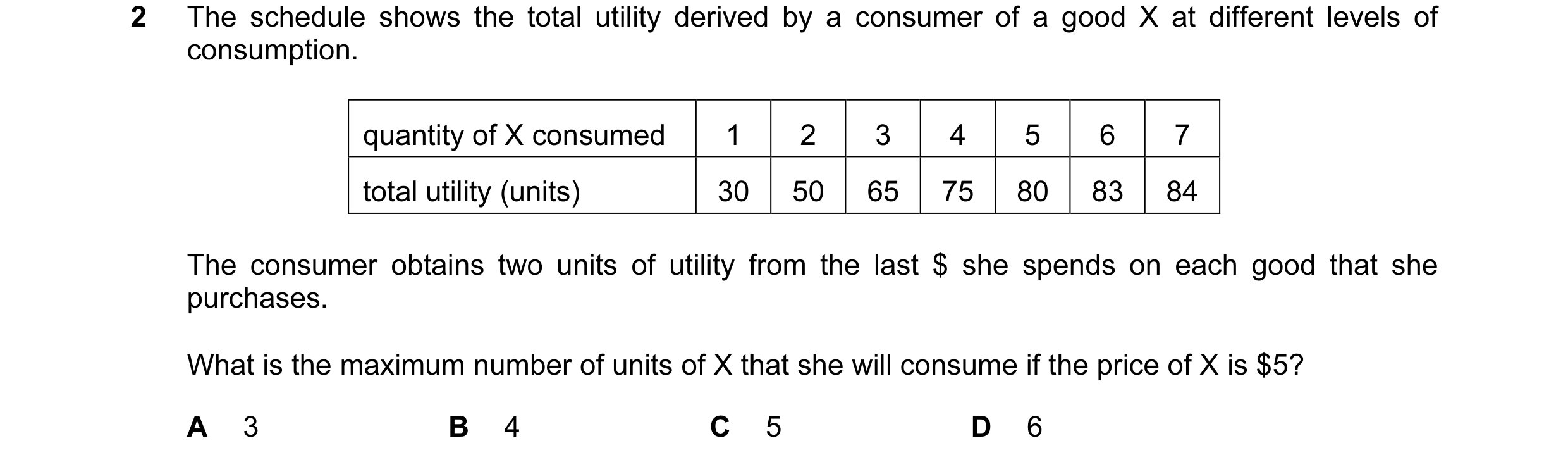
 10 / 23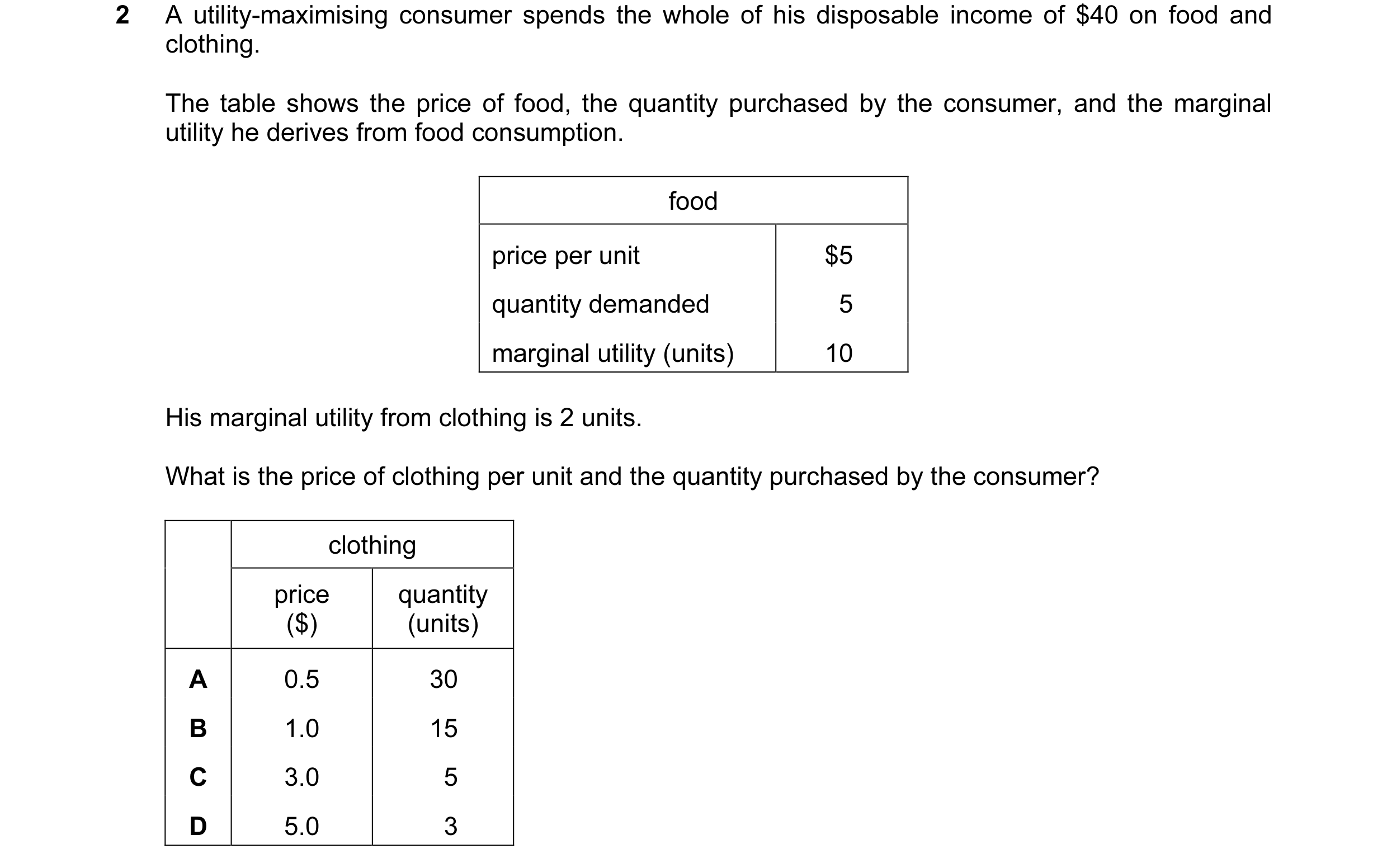
 11 / 23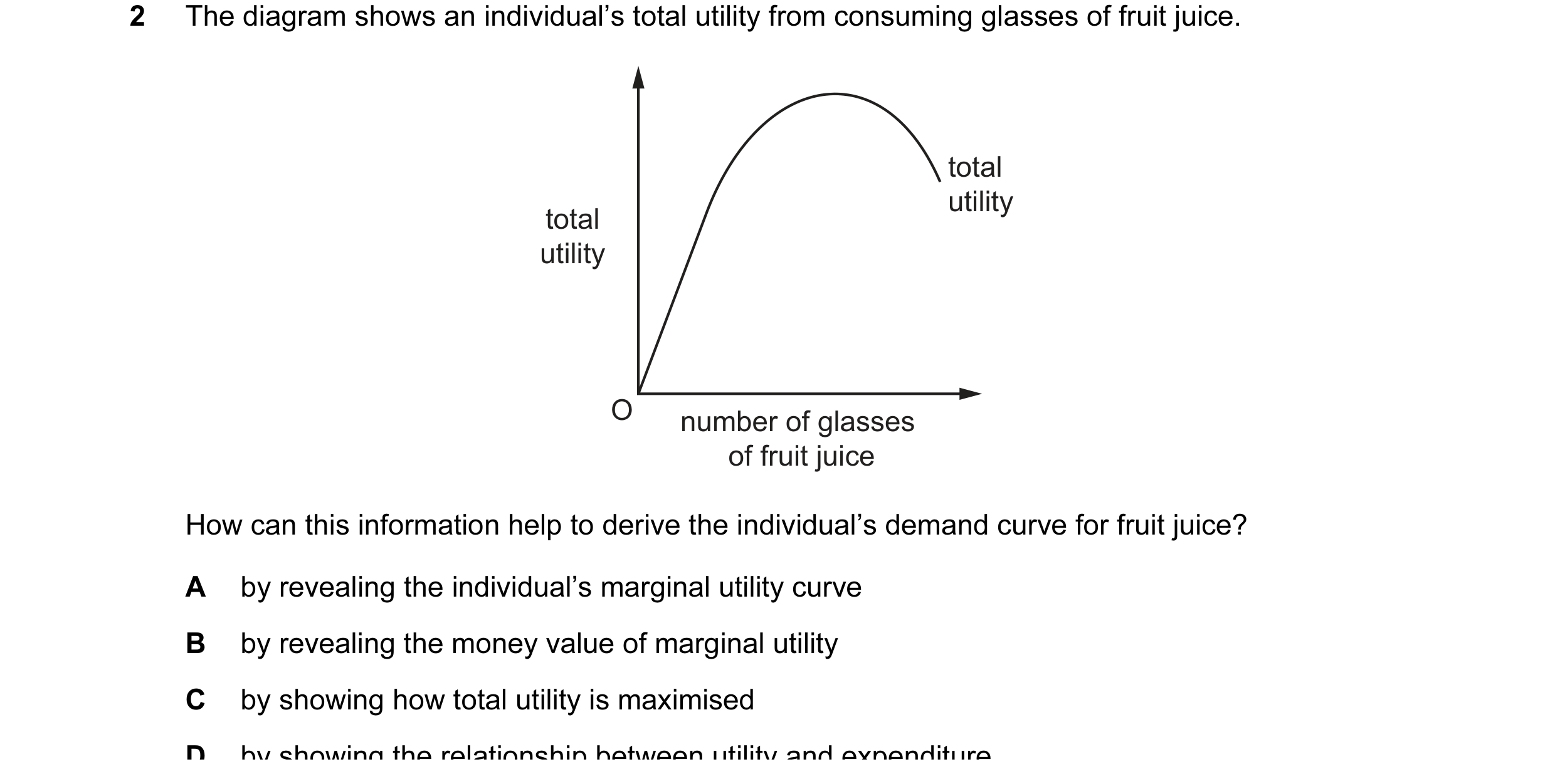
 12 / 23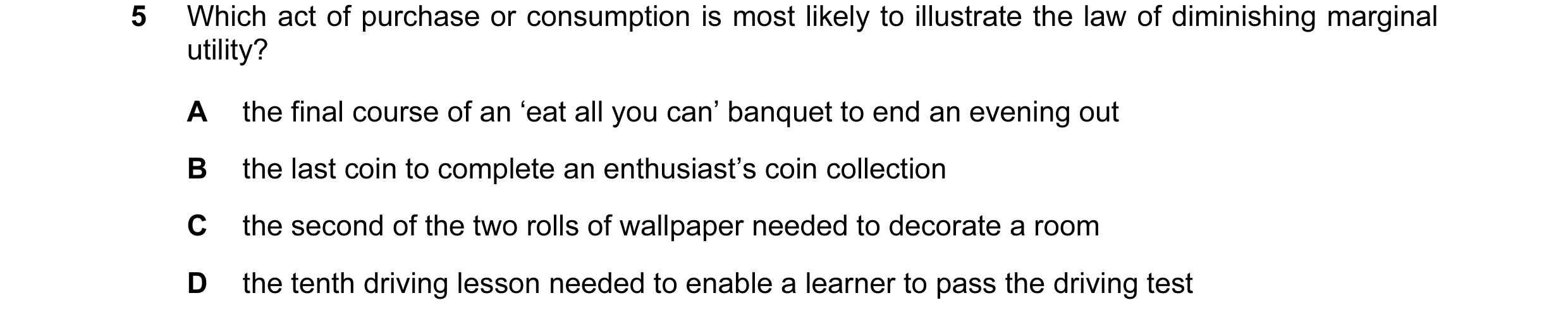
 13 / 23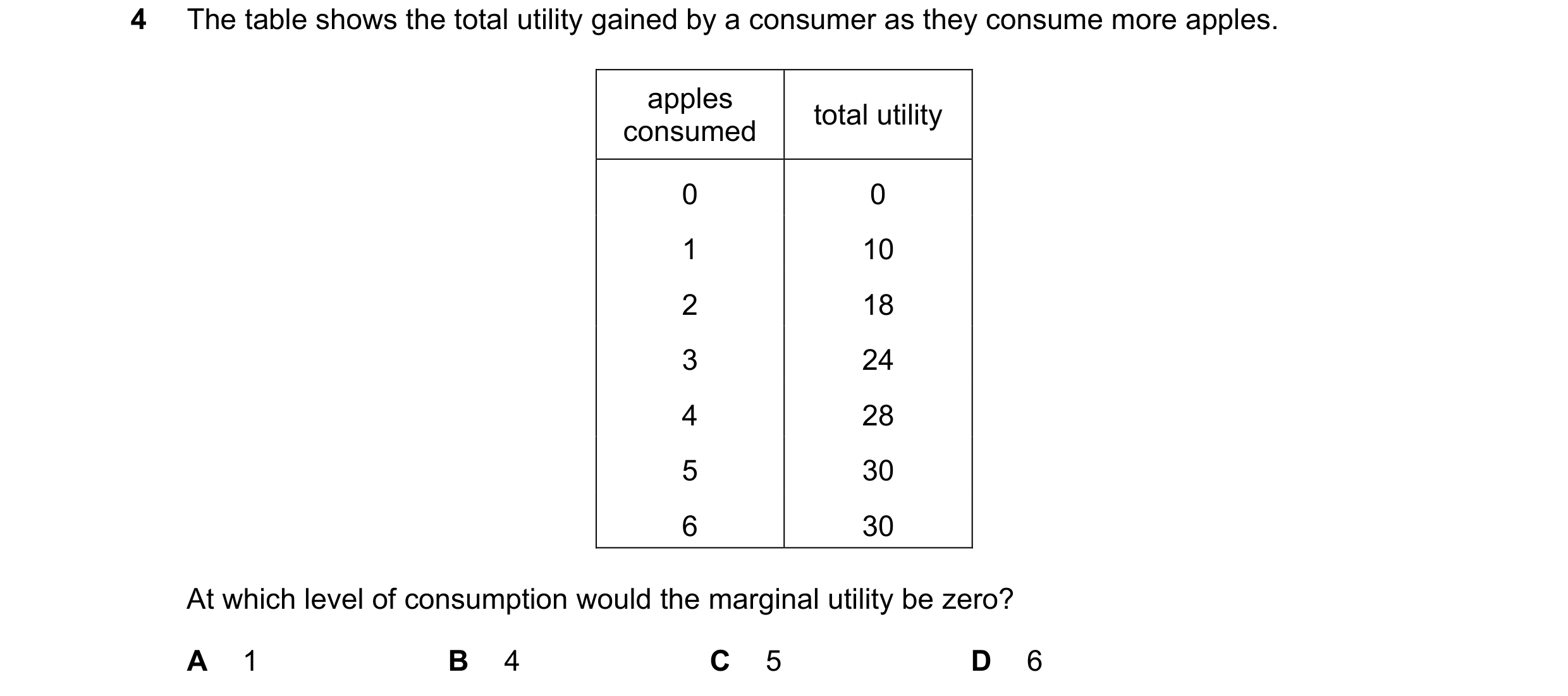
 14 / 23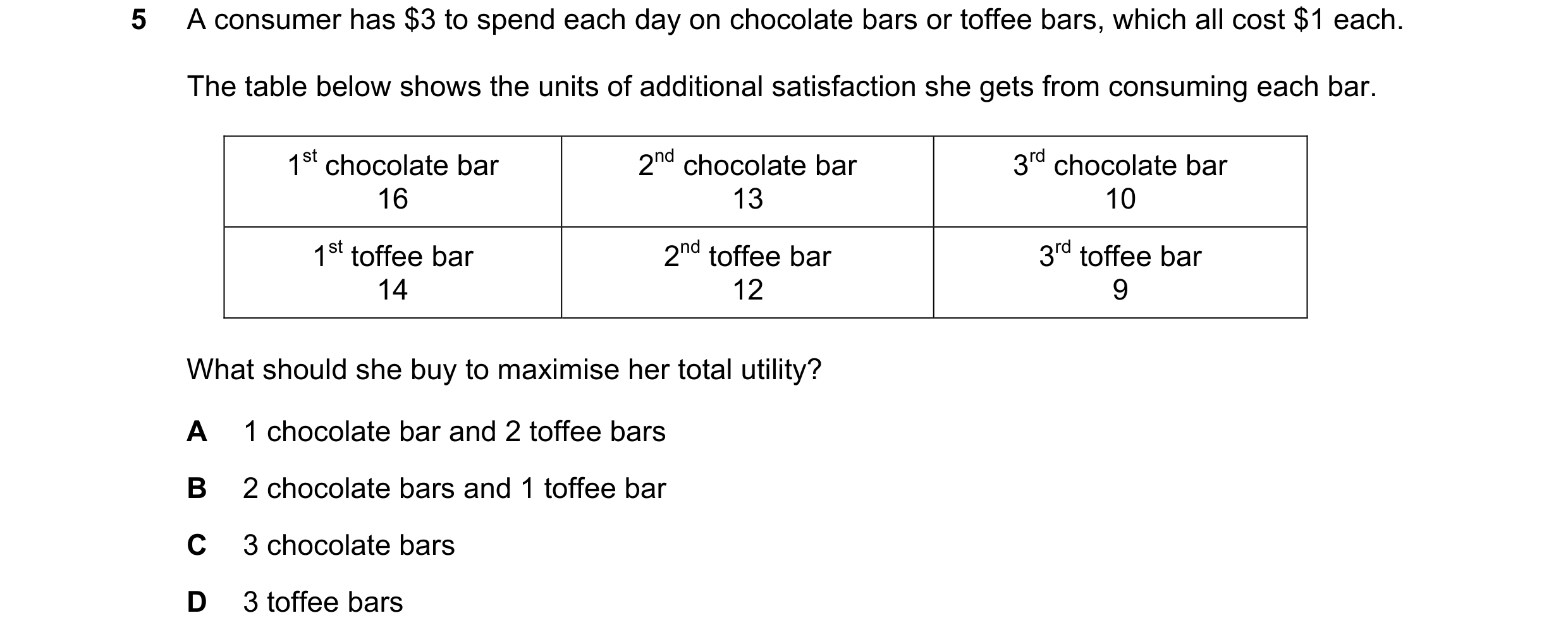
 15 / 23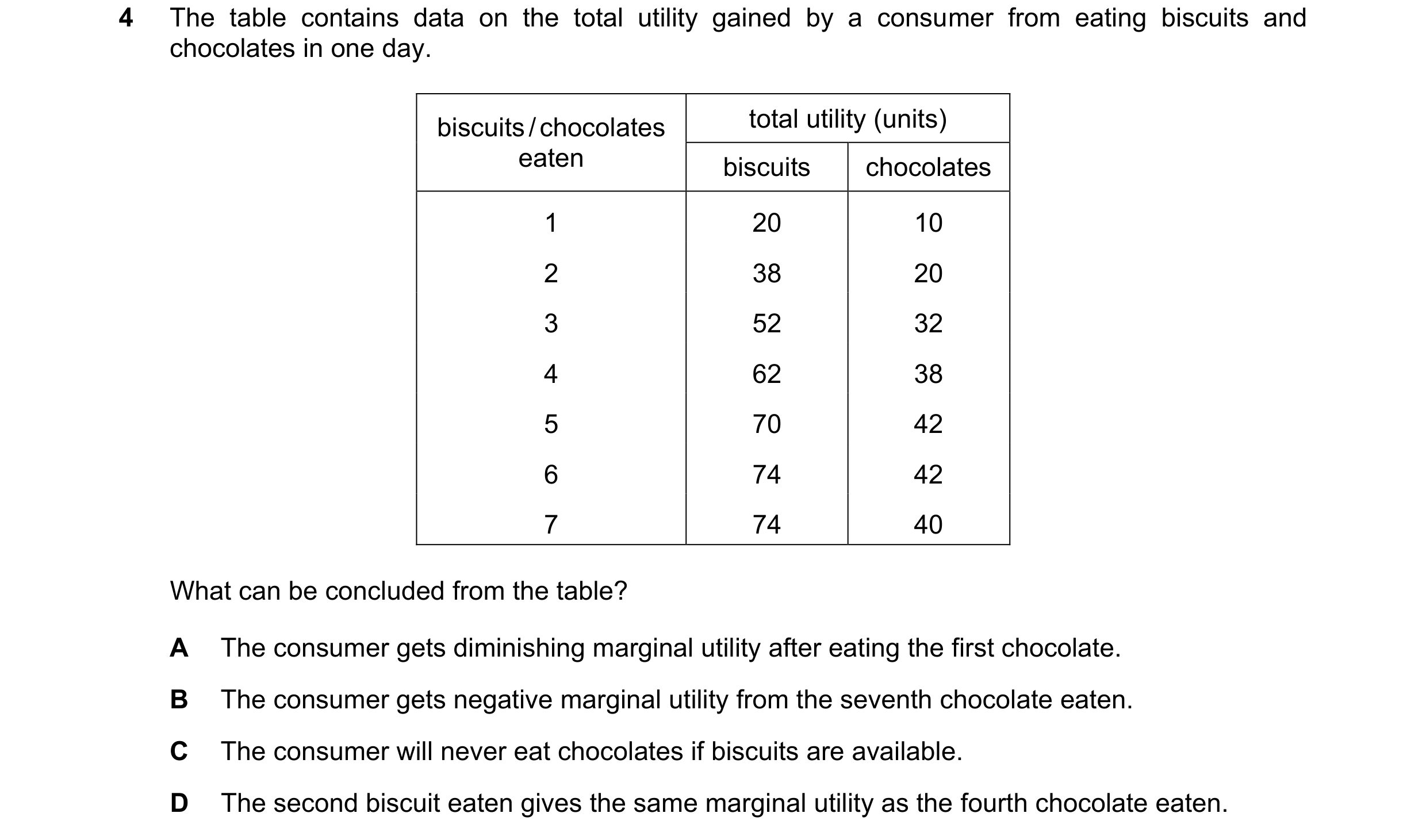
 16 / 23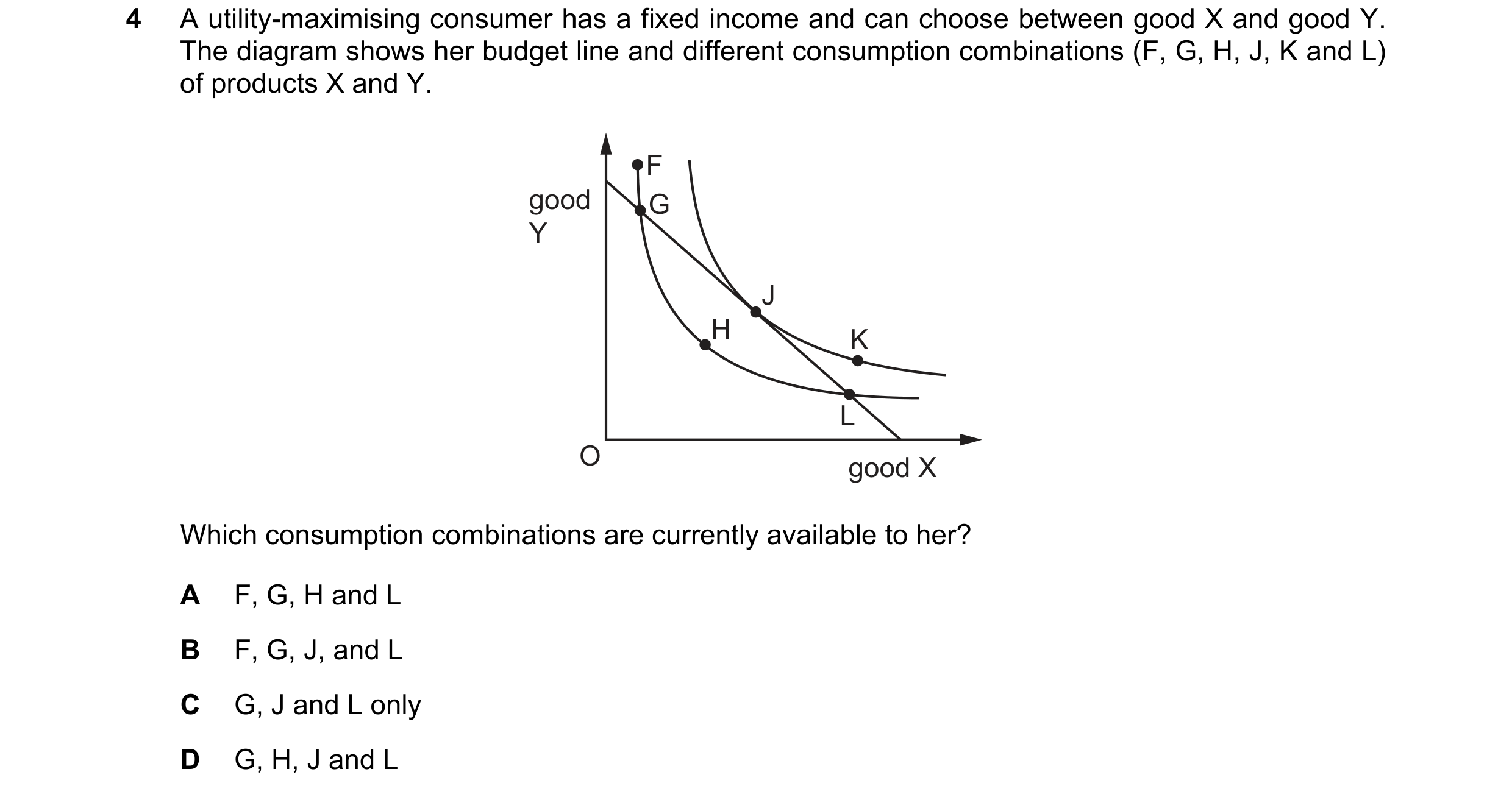
 17 / 23
 18 / 23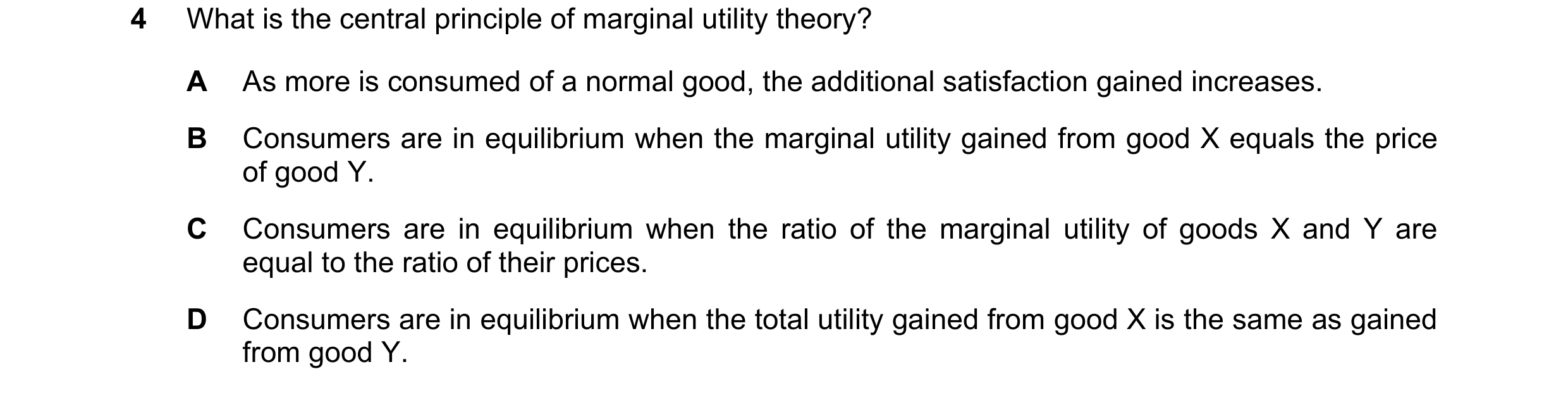
 19 / 23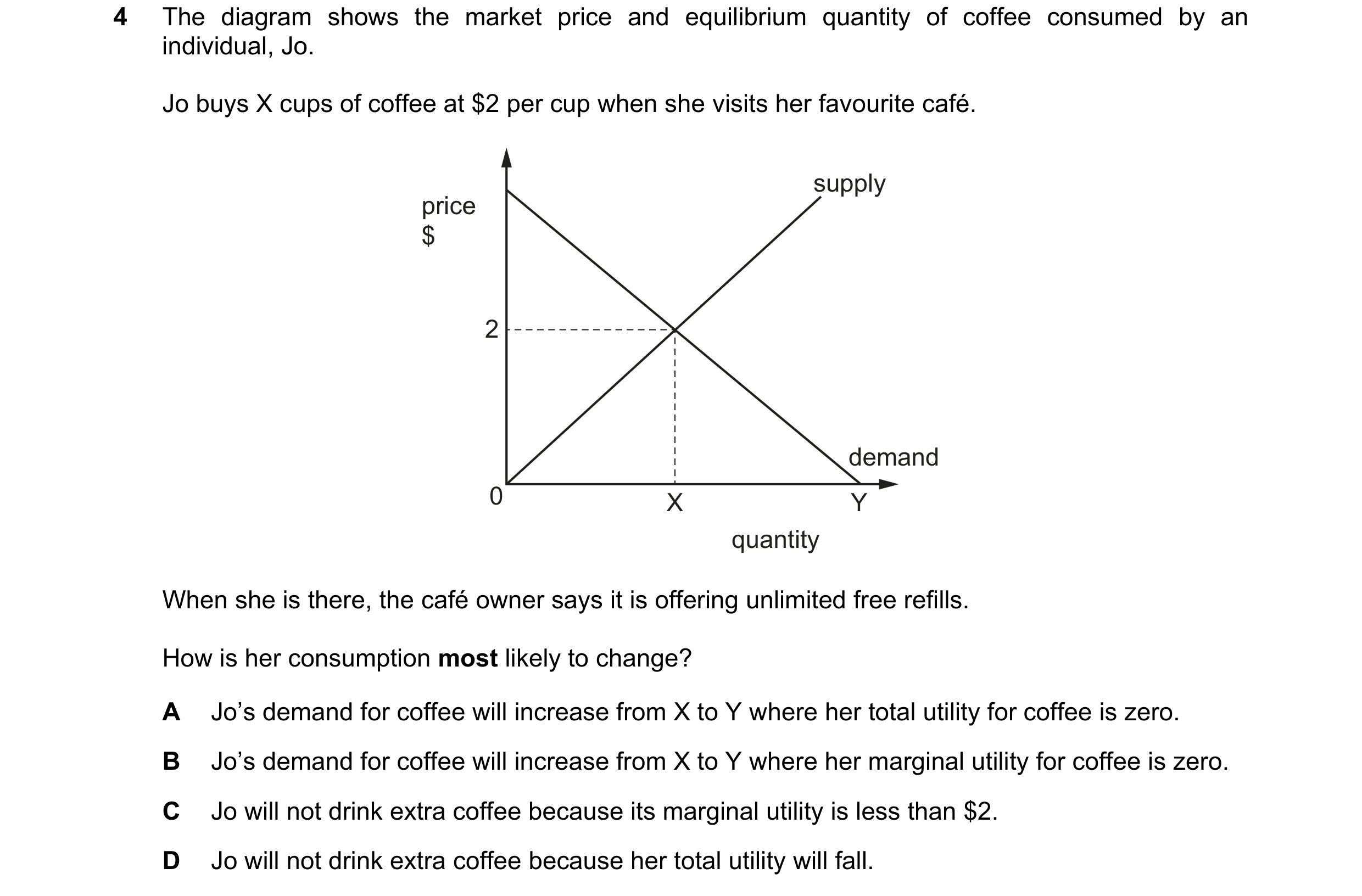
 20 / 23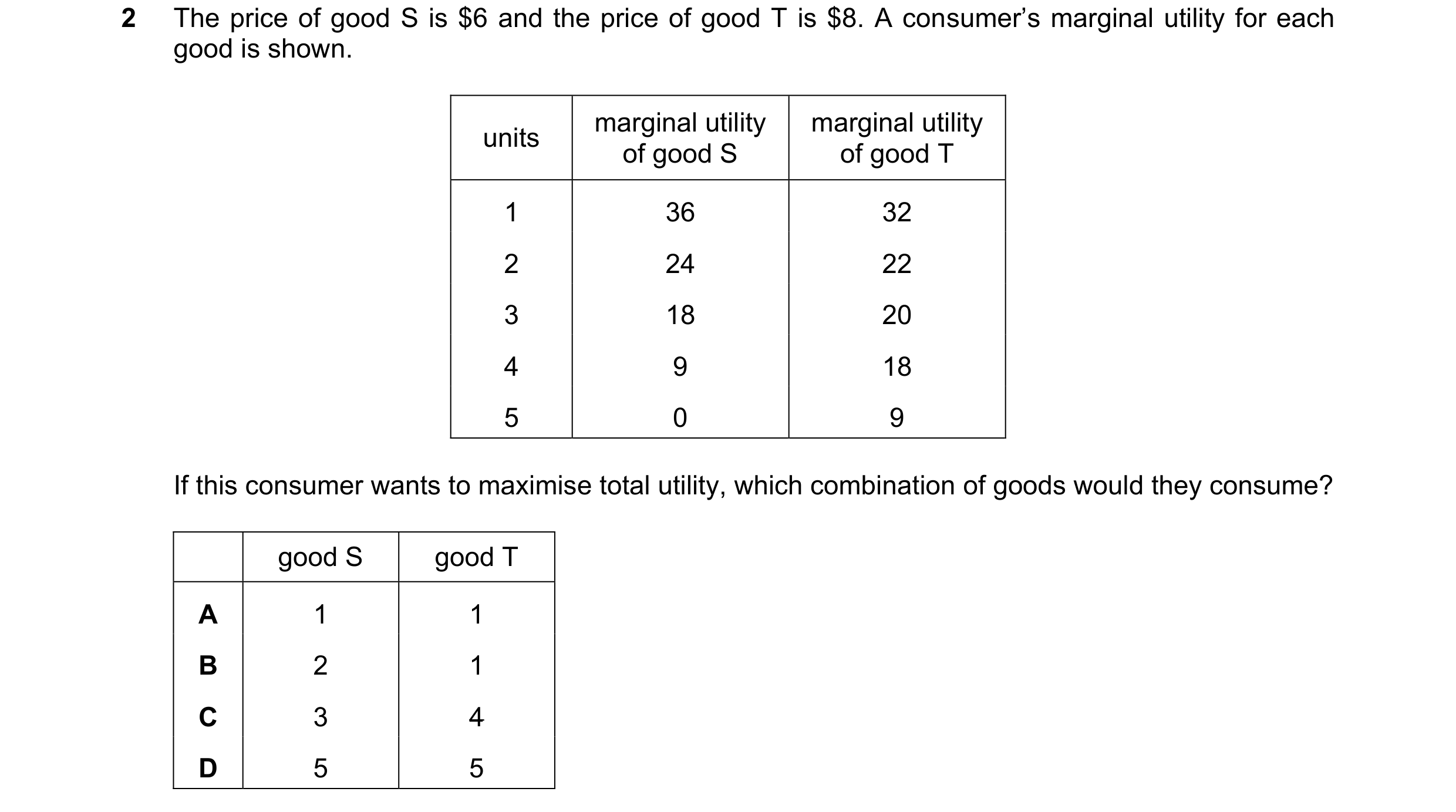
 21 / 23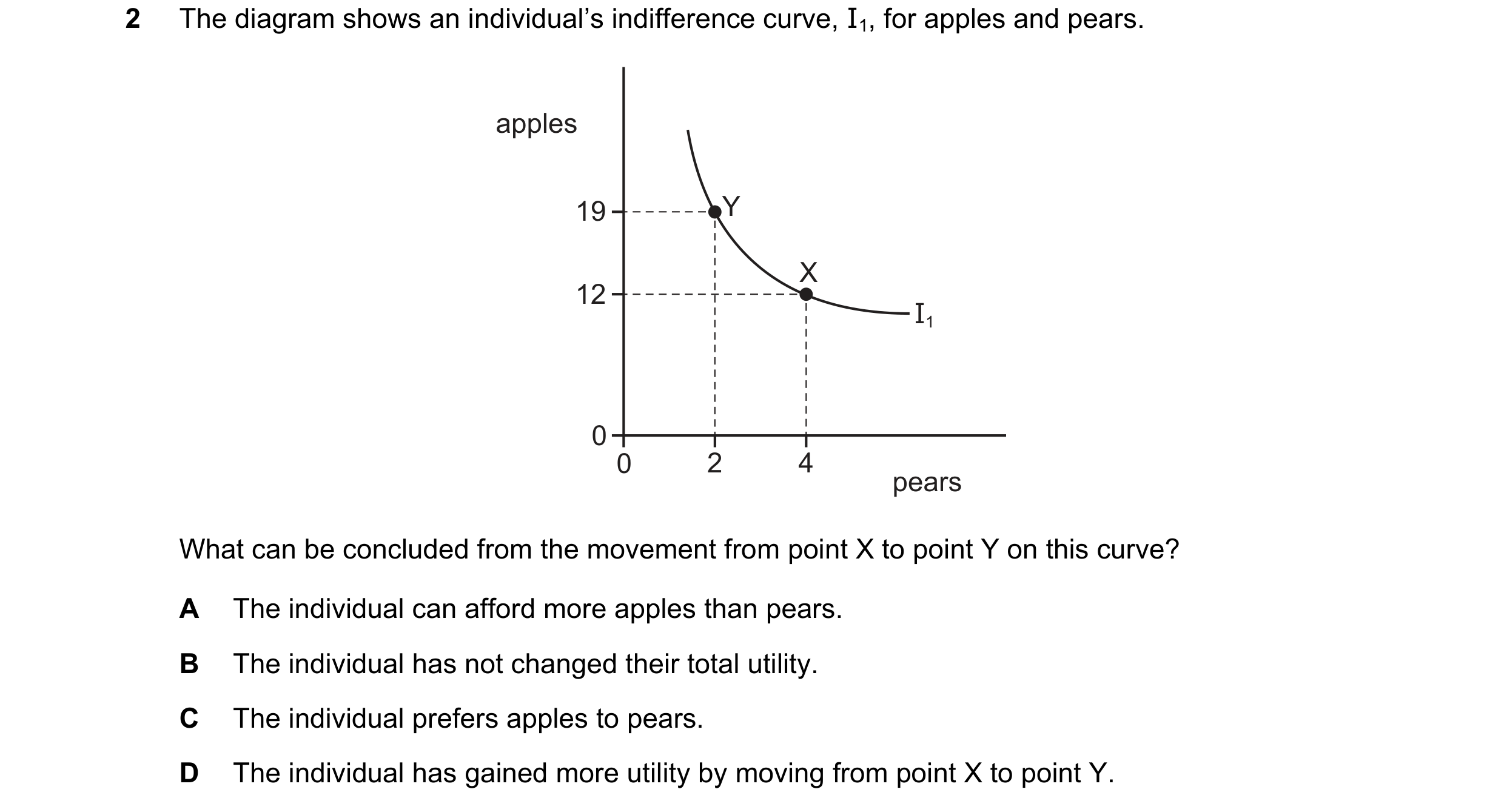
 22 / 23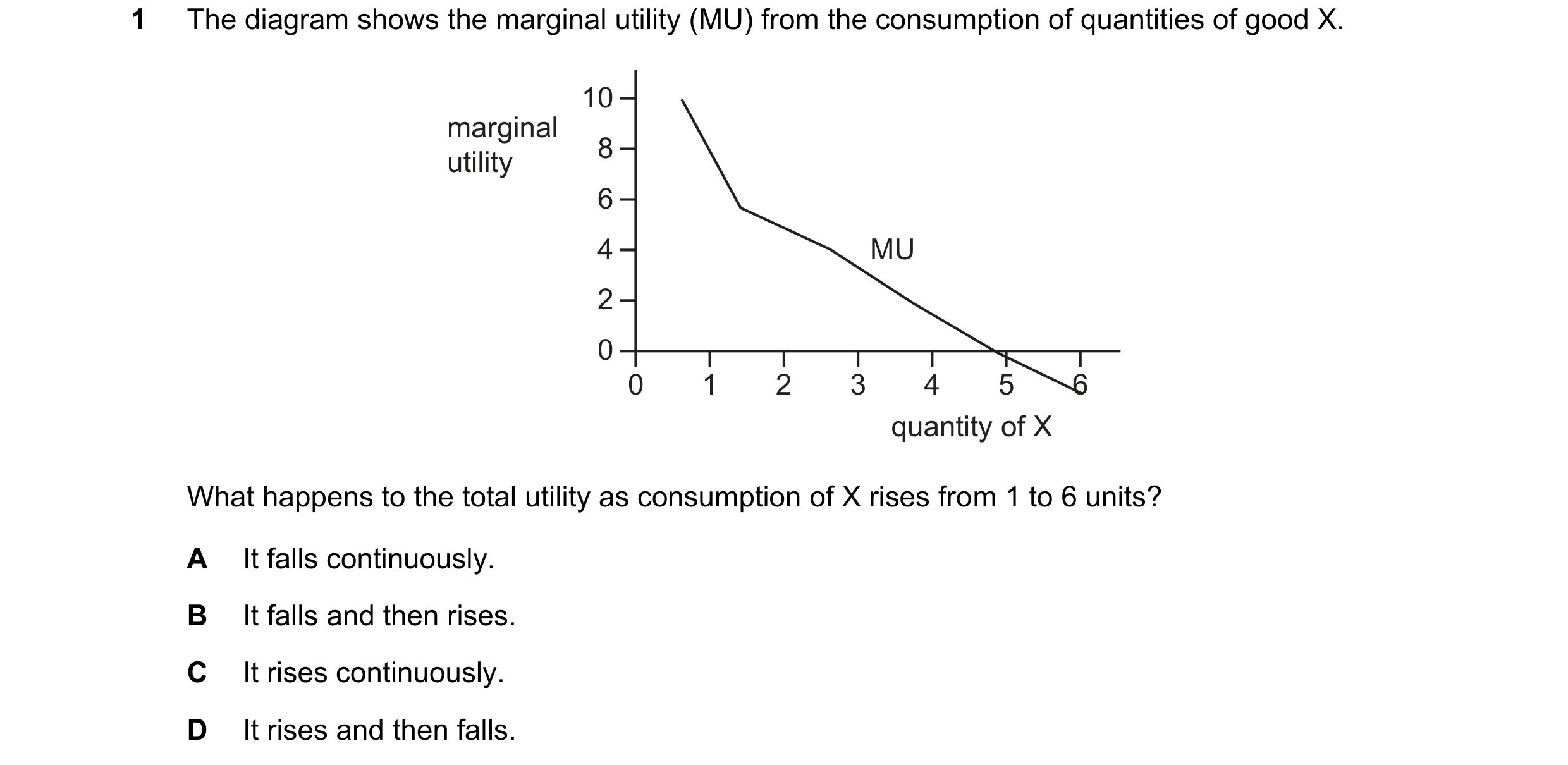
 23 / 23