Questions as text
Q1 · Useful products containing hydrocarbons are obtained from petroleum 0654/31 Oct/Nov 2018
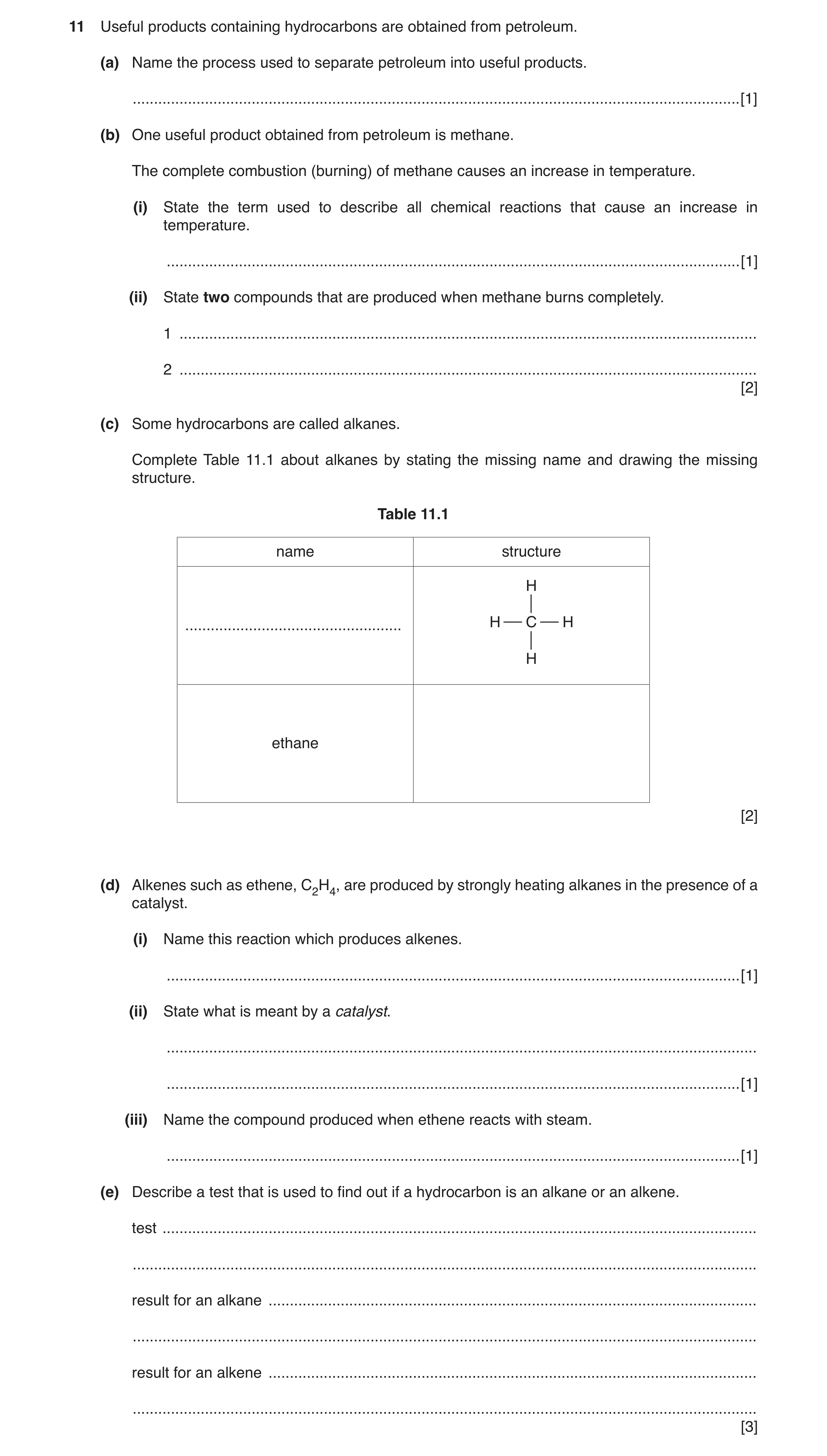
11 Useful products containing hydrocarbons are obtained from petroleum. (a) Name the process used to separate petroleum into useful products. … [1] (b) One useful product obtained from petroleum is methane. The complete combustion (burning) of methane causes an increase in temperature. (i) State the term used to describe all chemical reactions that cause an increase in temperature. … [1] (ii) State two compounds that are produced when methane burns completely. 1 … 2 … [2] (c) Some hydrocarbons are called alkanes. Complete Table 11.1 about alkanes by stating the missing name and drawing the missing structure. Table 11.1 name structure H … H C H H ethane [2] (d) Alkenes such as ethene, C2H4, are produced by strongly heating alkanes in the presence of a catalyst. (i) Name this reaction which produces alkenes. … [1] (ii) State what is meant by a catalyst. … … [1] (iii) Name the compound produced when ethene reacts with steam. … [1] (e) Describe a test that is used to find out if a hydrocarbon is an alkane or an alkene. test … … result for an alkane … … result for an alkene … … [3]
12 marks
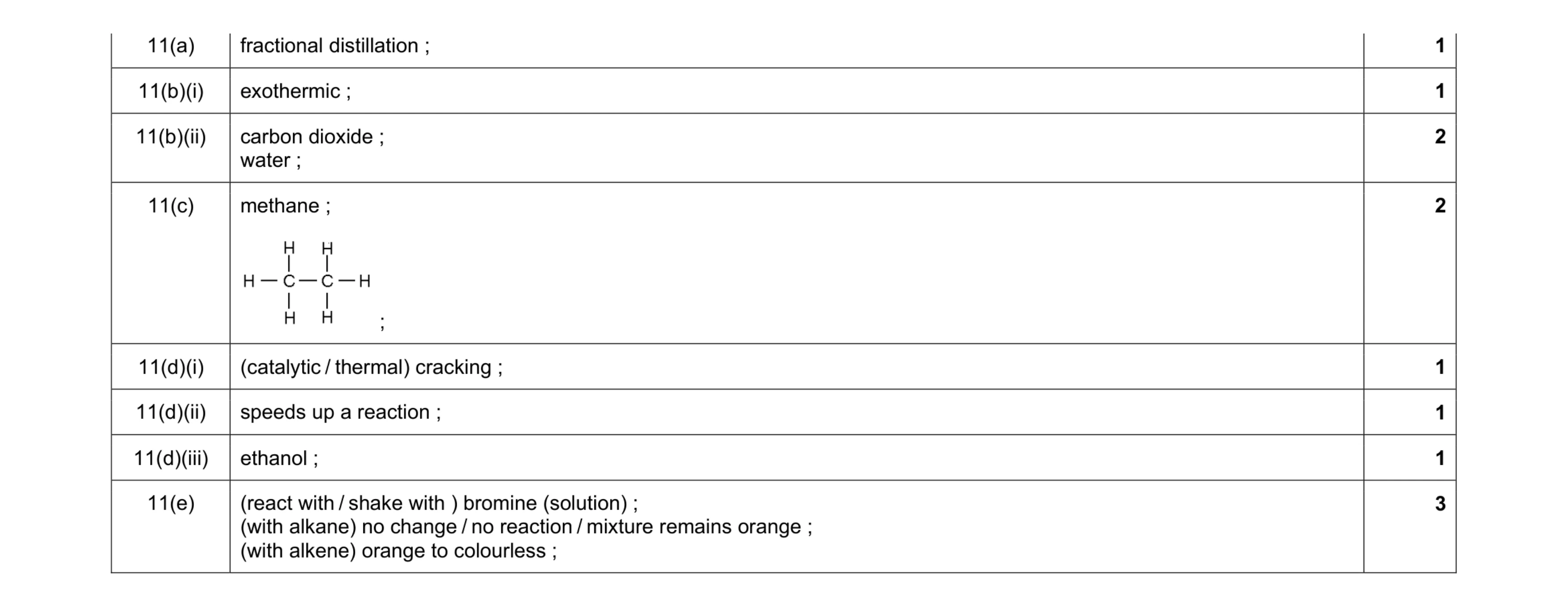
Mark scheme: 11(a) fractional distillation ; 1 11(b)(i) exothermic ; 1 11(b)(ii) carbon dioxide ; water ; 2 11(c) methane ; ; 2 11(d)(i) (catalytic / thermal) cracking ; 1 11(d)(ii) speeds up a reaction ; 1 11(d)(iii) ethanol ; 1 11(e) (react with / shake with ) bromine (solution) ; (with alkane) no change / no reaction / mixture remains orange ; (with alkene) orange to colourless ; 3
This question in 0654/31 Oct/Nov 2018
Q2 · Alkanes and alkenes are types of hydrocarbons 0654/33 Oct/Nov 2018
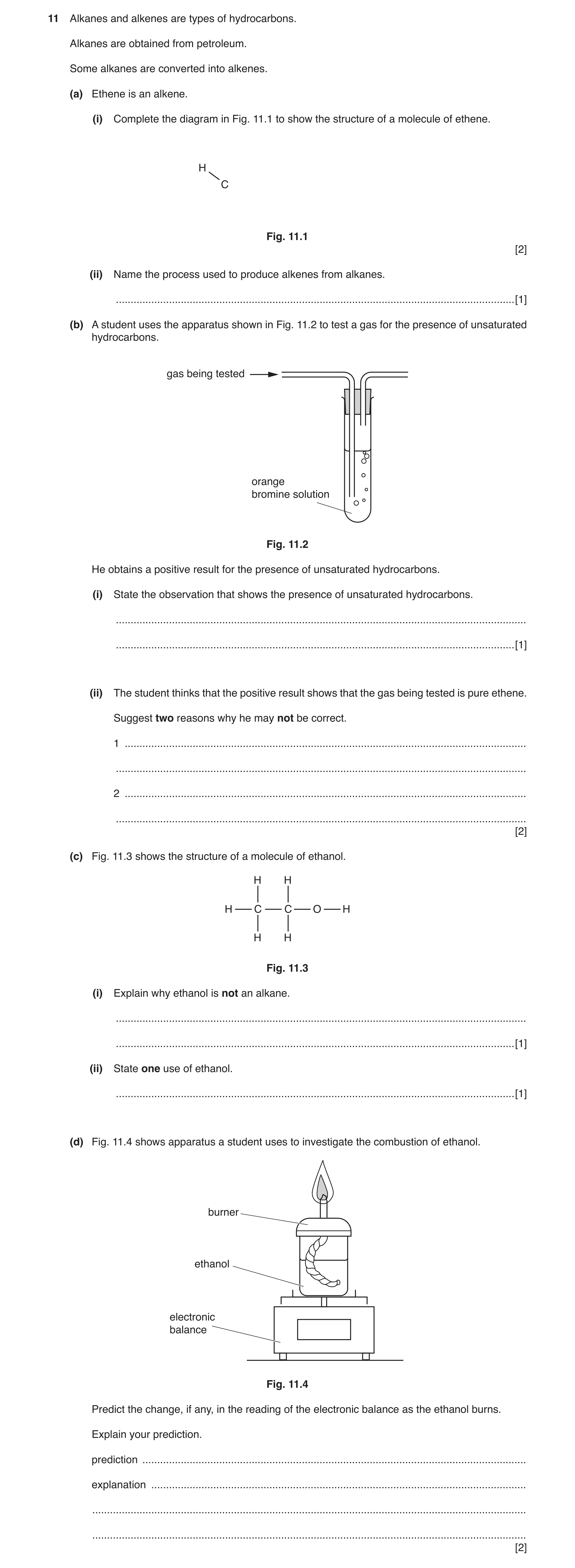
11 Alkanes and alkenes are types of hydrocarbons. Alkanes are obtained from petroleum. Some alkanes are converted into alkenes. (a) Ethene is an alkene. (i) Complete the diagram in Fig. 11.1 to show the structure of a molecule of ethene. H C Fig. 11.1 [2] (ii) Name the process used to produce alkenes from alkanes. … [1] (b) A student uses the apparatus shown in Fig. 11.2 to test a gas for the presence of unsaturated hydrocarbons. gas being tested orange bromine solution Fig. 11.2 He obtains a positive result for the presence of unsaturated hydrocarbons. (i) State the observation that shows the presence of unsaturated hydrocarbons. … … [1] (ii) The student thinks that the positive result shows that the gas being tested is pure ethene. Suggest two reasons why he may not be correct. 1 … … 2 … … [2] (c) Fig. 11.3 shows the structure of a molecule of ethanol. H H H C C O H H H Fig. 11.3 (i) Explain why ethanol is not an alkane. … … [1] (ii) State one use of ethanol. … [1] (d) Fig. 11.4 shows apparatus a student uses to investigate the combustion of ethanol. burner ethanol electronic balance Fig. 11.4 Predict the change, if any, in the reading of the electronic balance as the ethanol burns. Explain your prediction. prediction … explanation … … … [2]
10 marks
Mark scheme: 11(a)(i) carbon - carbon double bond ; 4 carbon hydrogen bonds ; 2 11(a)(ii) (catalytic / thermal) cracking ; 1 11(b)(i) (orange solution) becomes colourless ; 1 11(b)(ii) get the same result if ethene is impure ; get the same result with other alkenes ; 2 11(c)(i) alkanes contain only hydrogen and carbon / do not contain oxygen ; 1 11(c)(ii) solvent / fuel ; 1 11(d) reading decreases ; water (vapour) / carbon dioxide are released / the idea that the amount of matter in the burner reduces ; 2
This question in 0654/33 Oct/Nov 2018
Q3 · A beaker containing sand and aqueous sodium chloride 0654/32 May/June 2019
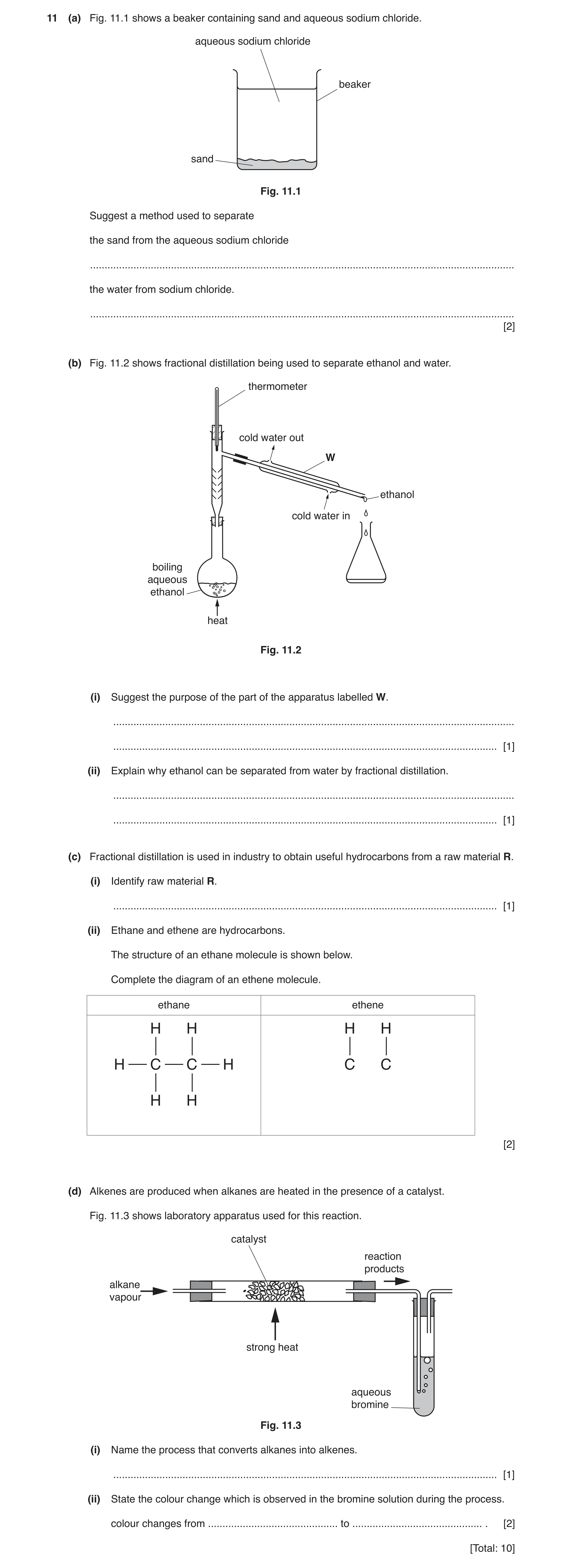
11 (a) Fig. 11.1 shows a beaker containing sand and aqueous sodium chloride. aqueous sodium chloride beaker sand Fig. 11.1 Suggest a method used to separate the sand from the aqueous sodium chloride … the water from sodium chloride. … [2] (b) Fig. 11.2 shows fractional distillation being used to separate ethanol and water. thermometer cold water out W ethanol cold water in boiling aqueous ethanol heat Fig. 11.2 (i) Suggest the purpose of the part of the apparatus labelled W. … … [1] (ii) Explain why ethanol can be separated from water by fractional distillation. … … [1] (c) Fractional distillation is used in industry to obtain useful hydrocarbons from a raw material R. (i) Identify raw material R. … [1] (ii) Ethane and ethene are hydrocarbons. The structure of an ethane molecule is shown below. Complete the diagram of an ethene molecule. ethane ethene H H H H H C C H C C H H [2] (d) Alkenes are produced when alkanes are heated in the presence of a catalyst. Fig. 11.3 shows laboratory apparatus used for this reaction. catalyst reaction products alkane vapour strong heat aqueous bromine Fig. 11.3 (i) Name the process that converts alkanes into alkenes. … [1] (ii) State the colour change which is observed in the bromine solution during the process. colour changes from … to … . [2] [Total: 10]
10 marks
Mark scheme: 11(a) filtration / decantation ; crystallisation / (heat to) evaporate the water ; 2 11(b)(i) condense ethanol vapour ; 1 11(b)(ii) liquids have different boiling points ; 1 11(c)(i) petroleum / crude oil ; 1 11(c)(ii) 1 for double bond between carbons ; 1 for four single C-H bonds ; 2 11(d)(i) (catalytic / thermal) cracking ; 1 11(d)(ii) from orange ; to colourless ; 2
This question in 0654/32 May/June 2019
Q4 · A beaker containing sand and aqueous sodium chloride 0654/33 May/June 2019
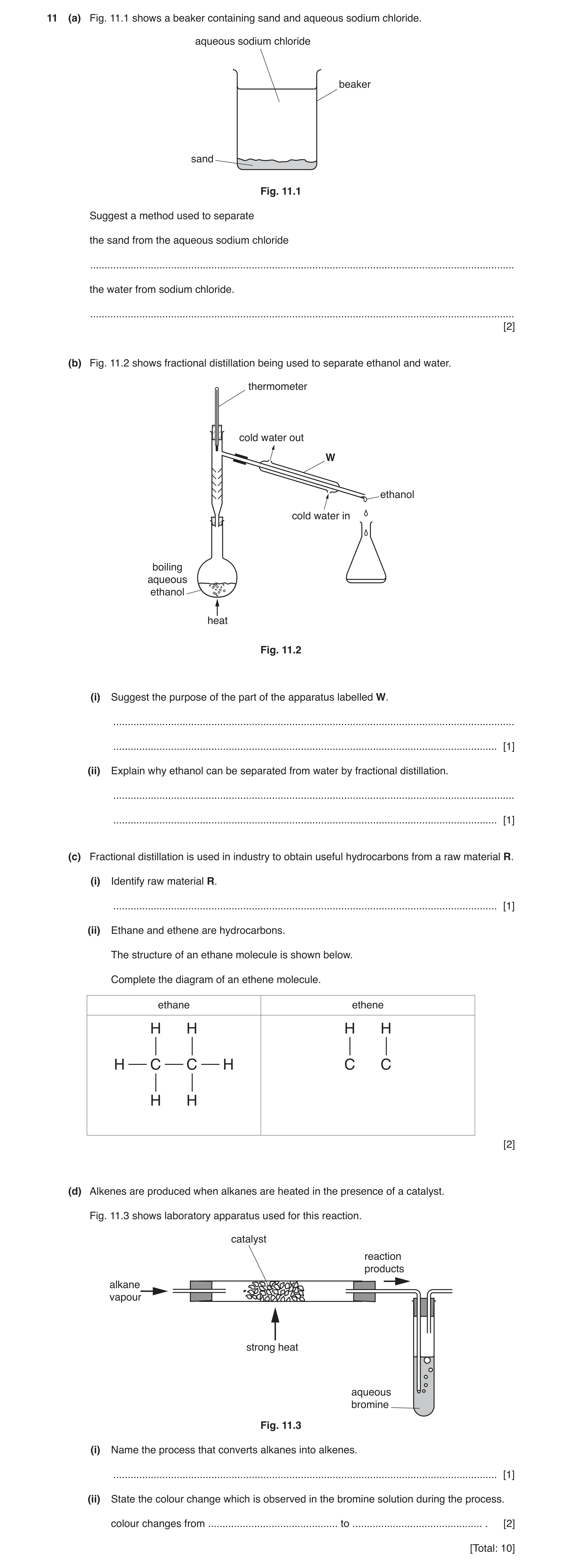
11 (a) Fig. 11.1 shows a beaker containing sand and aqueous sodium chloride. aqueous sodium chloride beaker sand Fig. 11.1 Suggest a method used to separate the sand from the aqueous sodium chloride … the water from sodium chloride. … [2] (b) Fig. 11.2 shows fractional distillation being used to separate ethanol and water. thermometer cold water out W ethanol cold water in boiling aqueous ethanol heat Fig. 11.2 (i) Suggest the purpose of the part of the apparatus labelled W. … … [1] (ii) Explain why ethanol can be separated from water by fractional distillation. … … [1] (c) Fractional distillation is used in industry to obtain useful hydrocarbons from a raw material R. (i) Identify raw material R. … [1] (ii) Ethane and ethene are hydrocarbons. The structure of an ethane molecule is shown below. Complete the diagram of an ethene molecule. ethane ethene H H H H H C C H C C H H [2] (d) Alkenes are produced when alkanes are heated in the presence of a catalyst. Fig. 11.3 shows laboratory apparatus used for this reaction. catalyst reaction products alkane vapour strong heat aqueous bromine Fig. 11.3 (i) Name the process that converts alkanes into alkenes. … [1] (ii) State the colour change which is observed in the bromine solution during the process. colour changes from … to … . [2] [Total: 10]
10 marks
Mark scheme: 11(a) filtration / decantation ; crystallisation / (heat to) evaporate the water ; 2 11(b)(i) condense ethanol vapour ; 1 11(b)(ii) liquids have different boiling points ; 1 11(c)(i) petroleum / crude oil ; 1 11(c)(ii) 1 for double bond between carbons ; 1 for four single C-H bonds ; 2 11(d)(i) (catalytic / thermal) cracking ; 1 11(d)(ii) from orange ; to colourless ; 2
This question in 0654/33 May/June 2019
Q5 · The structure of three molecules, ethene, ethanol and methane 0654/33 Oct/Nov 2019
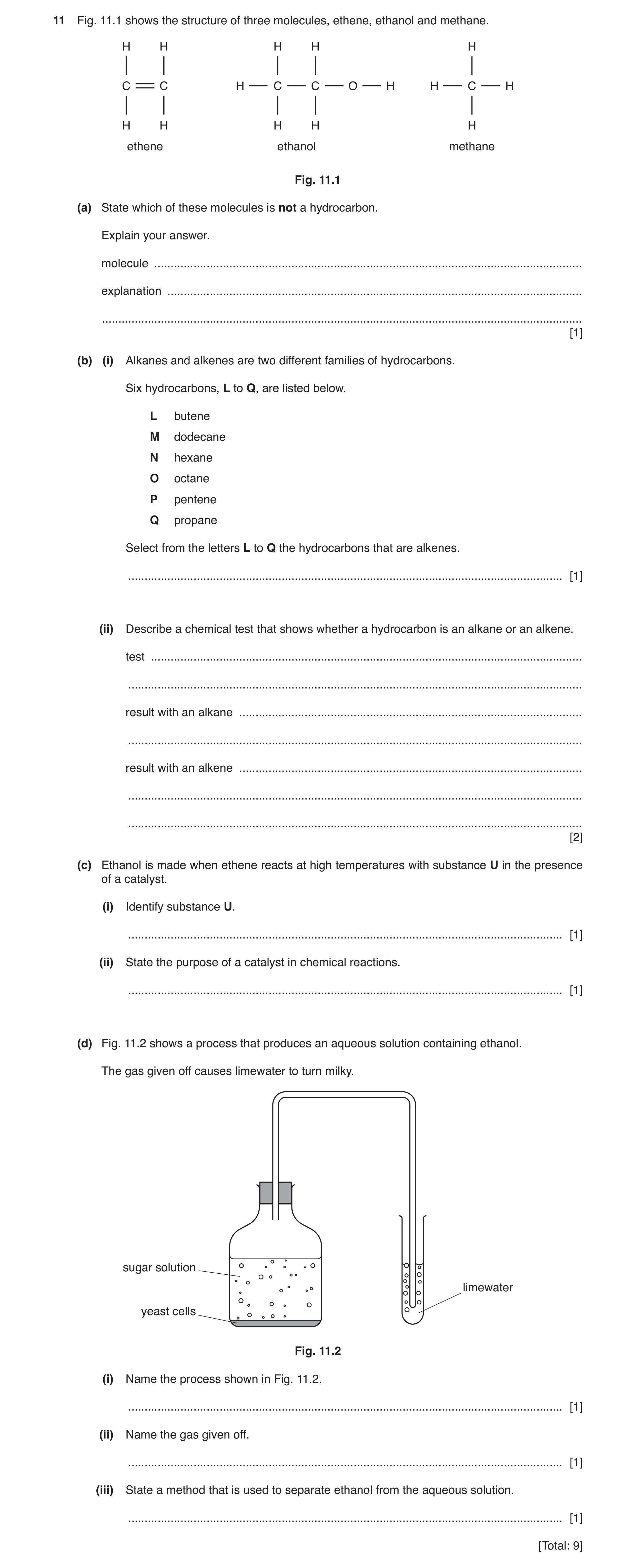
11 Fig. 11.1 shows the structure of three molecules, ethene, ethanol and methane. H H H H H C C H C C O H H C H H H H H H ethene ethanol methane Fig. 11.1 (a) State which of these molecules is not a hydrocarbon. Explain your answer. molecule … explanation … … [1] (b) (i) Alkanes and alkenes are two different families of hydrocarbons. Six hydrocarbons, L to Q, are listed below. L butene M dodecane N hexane O octane P pentene Q propane Select from the letters L to Q the hydrocarbons that are alkenes. … [1] (ii) Describe a chemical test that shows whether a hydrocarbon is an alkane or an alkene. test … … result with an alkane … … result with an alkene … … … [2] (c) Ethanol is made when ethene reacts at high temperatures with substance U in the presence of a catalyst. (i) Identify substance U. … [1] (ii) State the purpose of a catalyst in chemical reactions. … [1] (d) Fig. 11.2 shows a process that produces an aqueous solution containing ethanol. The gas given off causes limewater to turn milky. sugar solution limewater yeast cells Fig. 11.2 (i) Name the process shown in Fig. 11.2. … [1] (ii) Name the gas given off. … [1] (iii) State a method that is used to separate ethanol from the aqueous solution. … [1] [Total: 9]
9 marks
Mark scheme: 11(a) (ethanol) hydrocarbons contain only carbon and hydrogen / do not contain oxygen / (ethanol) contains oxygen ; 1 11(b)(i) L and P ; 1 11(b)(ii) reaction with (aqueous) bromine ; alkanes – no reaction / remains orange / coloured and alkenes – orange to colourless / bromine decolourised ; 2 11(c)(i) steam / H2O ; 1 11(c)(ii) increases reaction rate ; 1 11(d)(i) fermentation ; 1 11(d)(ii) carbon dioxide ; 1 11(d)(iii) distillation ; 1
This question in 0654/33 Oct/Nov 2019
Q6 · Petroleum and natural gas are extracted from the Earth 0654/31 May/June 2020
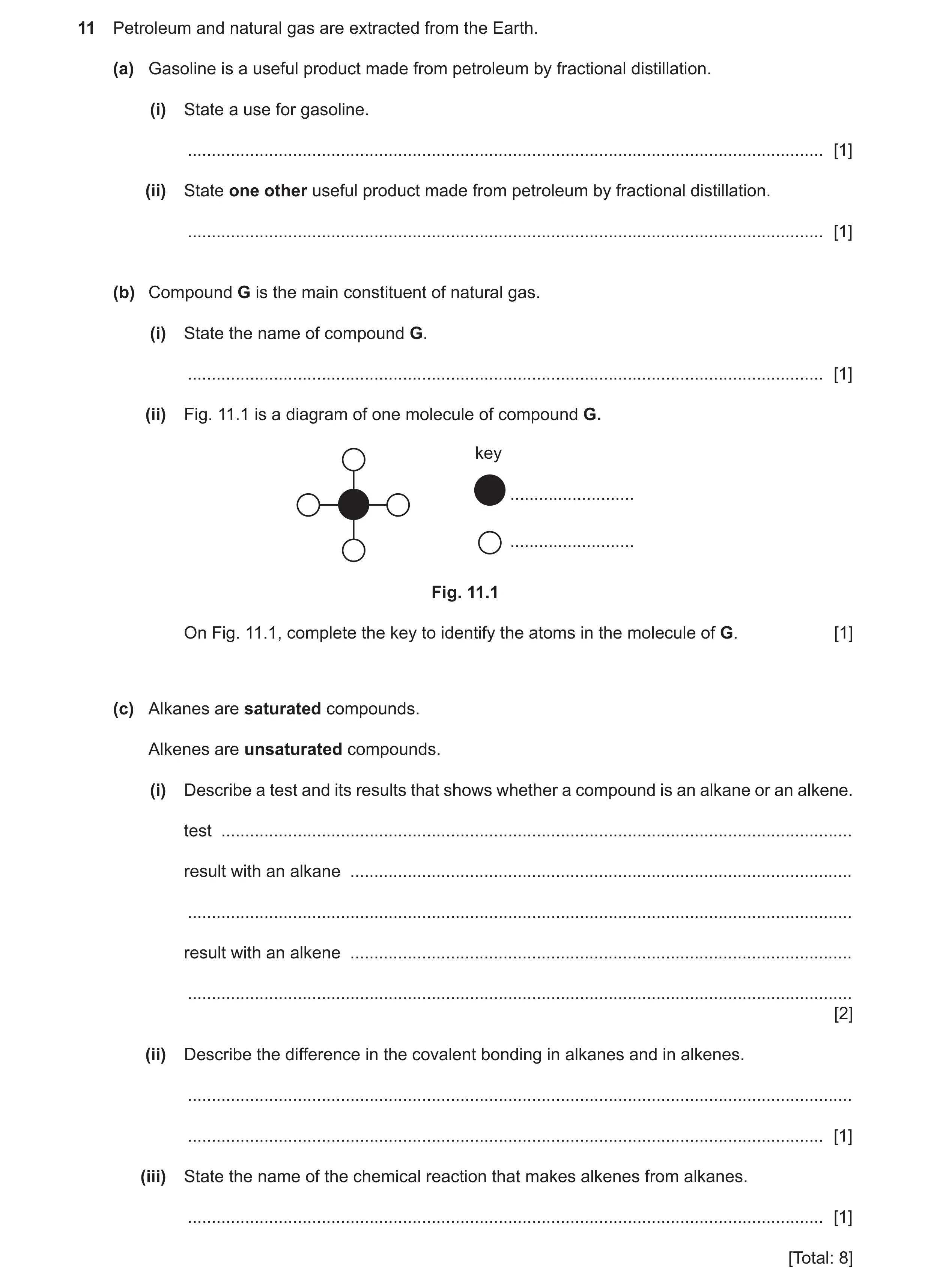
11 Petroleum and natural gas are extracted from the Earth. (a) Gasoline is a useful product made from petroleum by fractional distillation. (i) State a use for gasoline. … [1] (ii) State one other useful product made from petroleum by fractional distillation. … [1] (b) Compound G is the main constituent of natural gas. (i) State the name of compound G. … [1] (ii) Fig. 11.1 is a diagram of one molecule of compound G. key … … Fig. 11.1 On Fig. 11.1, complete the key to identify the atoms in the molecule of G. [1] (c) Alkanes are saturated compounds. Alkenes are unsaturated compounds. (i) Describe a test and its results that shows whether a compound is an alkane or an alkene. test … result with an alkane … … result with an alkene … … [2] (ii) Describe the difference in the covalent bonding in alkanes and in alkenes. … … [1] (iii) State the name of the chemical reaction that makes alkenes from alkanes. … [1] [Total: 8]
8 marks
Mark scheme: 11(a)(i) car fuel ; 1 11(a)(ii) refinery gas / naphtha / diesel (gas oil) / bitumen ; 1 11(b)(i) methane ; 1 11(b)(ii) carbon and hydrogen ; 1 11(c)(i) (aqueous) bromine ; no reaction with alkane and orange to colourless / decolourised with alkene ; 2 11(c)(ii) alkenes contain a double bond (between carbon atoms) / alkanes contain only single bonds ; 1 11(c)(iii) cracking ; 1
This question in 0654/31 May/June 2020
Q7 · Thermal decomposition happens when compounds are heated and break down into simpler… 0654/31 Oct/Nov 2020
5 Thermal decomposition happens when compounds are heated and break down into simpler substances. (a) Limestone thermally decomposes to produce lime in a lime kiln. Fig. 5.1 shows a lime kiln. waste gases limestone burning carbon (provides heat) air Fig. 5.1 (i) State the chemical names of limestone and lime. limestone ��������������������������������������������������������������������������������������������������������������������������� lime ������������������������������������������������������������������������������������������������������������������������������������ [2] (ii) Suggest why the limestone and carbon inside the lime kiln are in small pieces. (iii) Explain why farmers often treat soil with limestone. (b) Fig. 5.2 shows apparatus used for the thermal decomposition of sodium hydrogencarbonate. test-tube sodium hydrogencarbonate iced water heat limewater cobalt chloride paper Fig. 5.2 When the sodium hydrogencarbonate in the test‑tube is heated for several minutes, the following observations are made. • A gas is released that turns limewater milky. • The cobalt chloride paper changes colour from blue to pink. • A different compound, sodium carbonate, remains in the test‑tube. (i) Use this information to complete the word equation for the thermal decomposition of sodium hydrogencarbonate. sodium hydrogencarbonate [2] (ii) The mass of sodium carbonate that remains after the reaction is smaller than the original mass of sodium hydrogencarbonate. Explain why. (c) Cracking of hydrocarbons is another example of thermal decomposition. Fig. 5.3 shows the cracking of hydrocarbons. mixture of mixture of reaction hydrocarbons hydrocarbons vessel X Y Fig. 5.3 (i) Both X and Y in Fig. 5.3 are mixtures of hydrocarbons. Describe two ways in which molecules in mixture X are different from molecules in mixture Y. (ii) Predict the change in colour, if any, when mixture Y is shaken with aqueous bromine. [Total: 10]
10 marks
Mark scheme: 5(a)(i) calcium carbonate ; calcium oxide ; 2 5(a)(ii) speeds up reaction rate (of both reactions) 1 5(a)(iii) treat acidic soil ; 1 5(b)(i) (sodium hydrogencarbonate →) sodium carbonate + carbon dioxide + water ;; 2 5(b)(ii) gaseous products removed from sodium hydrogencarbonate ; 1 5(c)(i) mixture Y contains unsaturated hydrocarbons (and X does not) ; molecules (on average) are smaller in Y ; 2 5(c)(ii) orange to colourless ; 1
This question in 0654/31 Oct/Nov 2020
Q8 · Three hydrocarbon molecules X, Y and Z 0654/32 Feb/March 2021
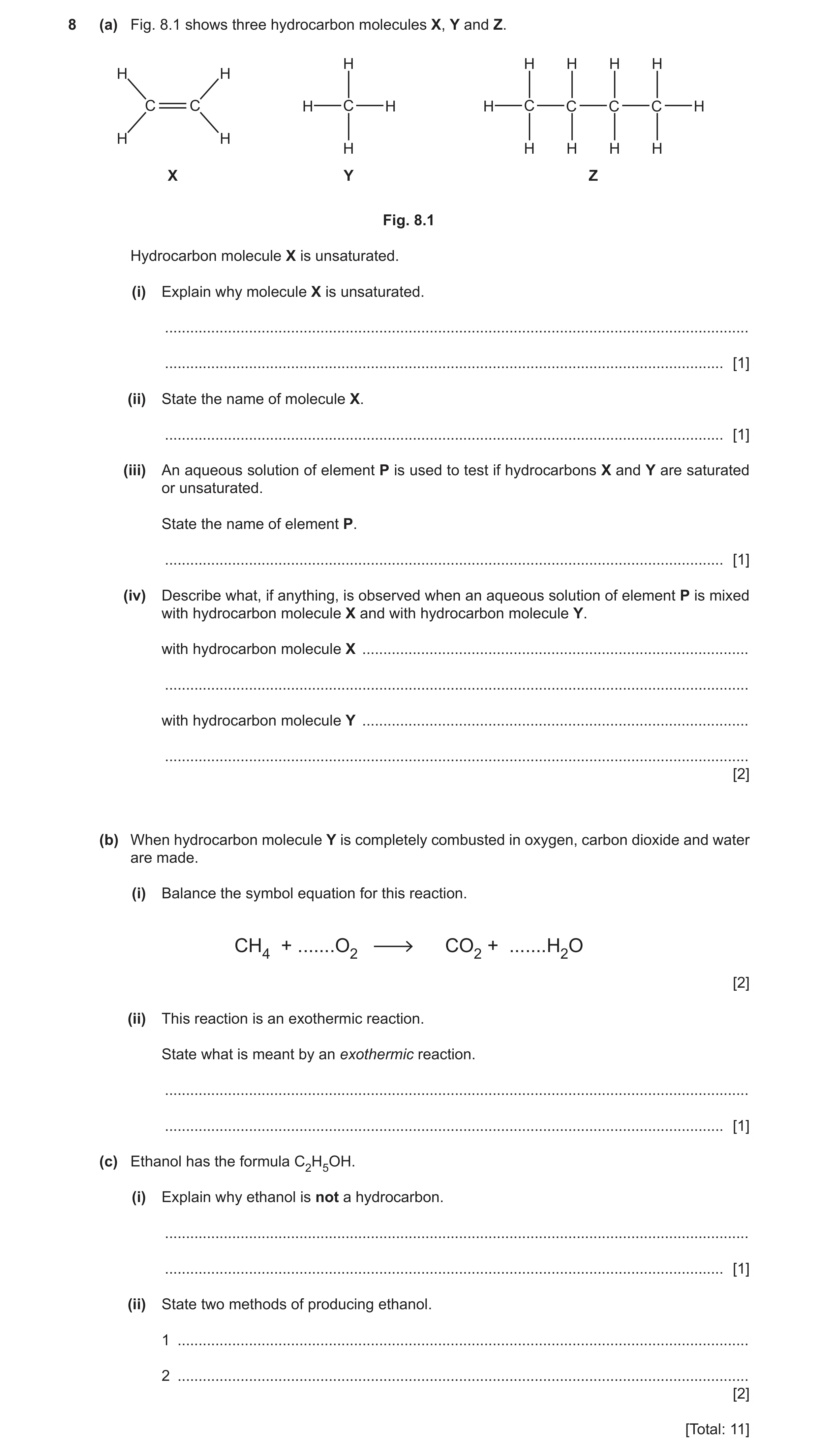
8 (a) Fig. 8.1 shows three hydrocarbon molecules X, Y and Z. H H H H H H H C C H C H H C C C C H H H H H H H H X Y Z Fig. 8.1 Hydrocarbon molecule X is unsaturated. (i) Explain why molecule X is unsaturated. … … [1] (ii) State the name of molecule X. … [1] (iii) An aqueous solution of element P is used to test if hydrocarbons X and Y are saturated or unsaturated. State the name of element P. … [1] (iv) Describe what, if anything, is observed when an aqueous solution of element P is mixed with hydrocarbon molecule X and with hydrocarbon molecule Y. with hydrocarbon molecule X … … with hydrocarbon molecule Y … … [2] (b) When hydrocarbon molecule Y is completely combusted in oxygen, carbon dioxide and water are made. (i) Balance the symbol equation for this reaction. CH4 + … O2 CO2 + … H2O [2] (ii) This reaction is an exothermic reaction. State what is meant by an exothermic reaction. … … [1] (c) Ethanol has the formula C2H5OH. (i) Explain why ethanol is not a hydrocarbon. … … [1] (ii) State two methods of producing ethanol. 1 … 2 … [2] [Total: 11]
11 marks
Mark scheme: 8(a)(i) has a carbon-carbon double bond; 1 8(a)(ii) ethene; 1 8(a)(iii) bromine; 1 8(a)(iv) decolourises/becomes colourless; stays orange/does not decolourise; 2 8(b)(i) CH4 + 2O2 → CO2 + 2H2O ;; 2 8(b)(ii) thermal energy released; 1 Question Answer Marks 8(c)(i) contains oxygen / does not contain only carbon and hydrogen; 1 8(c)(ii) fermentation; reaction of ethene and steam; 2
This question in 0654/32 Feb/March 2021
Q9 · Information about three Group VII elements 0654/31 May/June 2021
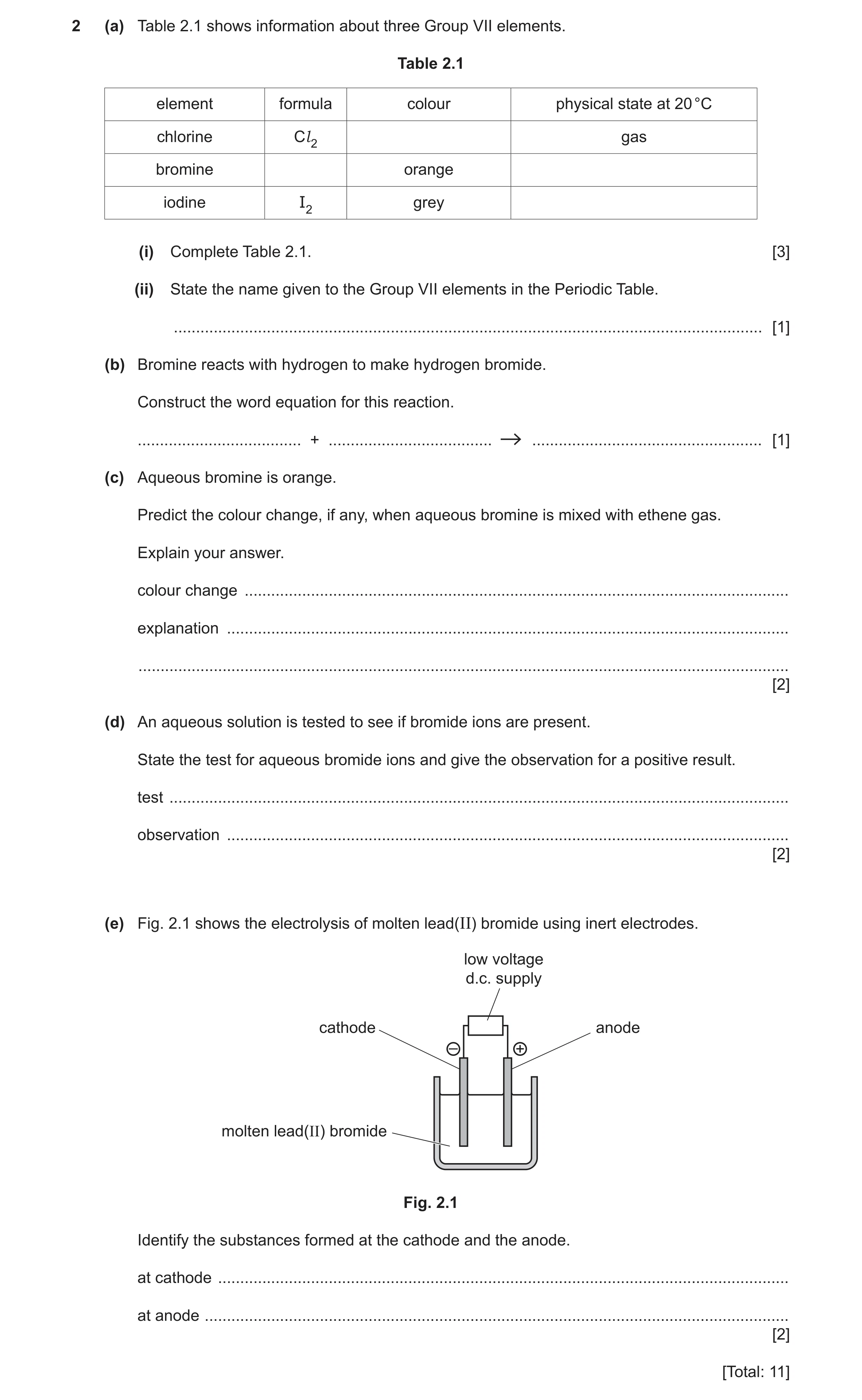
2 (a) Table 2.1 shows information about three Group VII elements. Table 2.1 element formula colour physical state at 20 °C chlorine Cl 2 gas bromine orange iodine I2 grey (i) Complete Table 2.1. [3] (ii) State the name given to the Group VII elements in the Periodic Table. … [1] (b) Bromine reacts with hydrogen to make hydrogen bromide. Construct the word equation for this reaction. … + … … [1] (c) Aqueous bromine is orange. Predict the colour change, if any, when aqueous bromine is mixed with ethene gas. Explain your answer. colour change … explanation … … [2] (d) An aqueous solution is tested to see if bromide ions are present. State the test for aqueous bromide ions and give the observation for a positive result. test … observation … [2] (e) Fig. 2.1 shows the electrolysis of molten lead(II) bromide using inert electrodes. low voltage d.c. supply cathode anode – + molten lead(II) bromide Fig. 2.1 Identify the substances formed at the cathode and the anode. at cathode … at anode … [2] [Total: 11]
11 marks
Mark scheme: 2(a)(i) formula Br2; colour (pale) green for Cl2 ; physical state liquid for Br2 and solid for I2 ; 3 2(a)(ii) halogens ; 1 2(b) hydrogen + bromine → hydrogen bromide ; 1 2(c) (orange to) colourless; ethene is unsaturated / has a double bond ; 2 Question Answer Marks 2(d) (aqueous) silver nitrate ; cream coloured precipitate ; 2 2(e) cathode – lead ; anode – bromine ; 2
This question in 0654/31 May/June 2021
Q10 · Petroleum is a fossil fuel 0654/31 Oct/Nov 2021
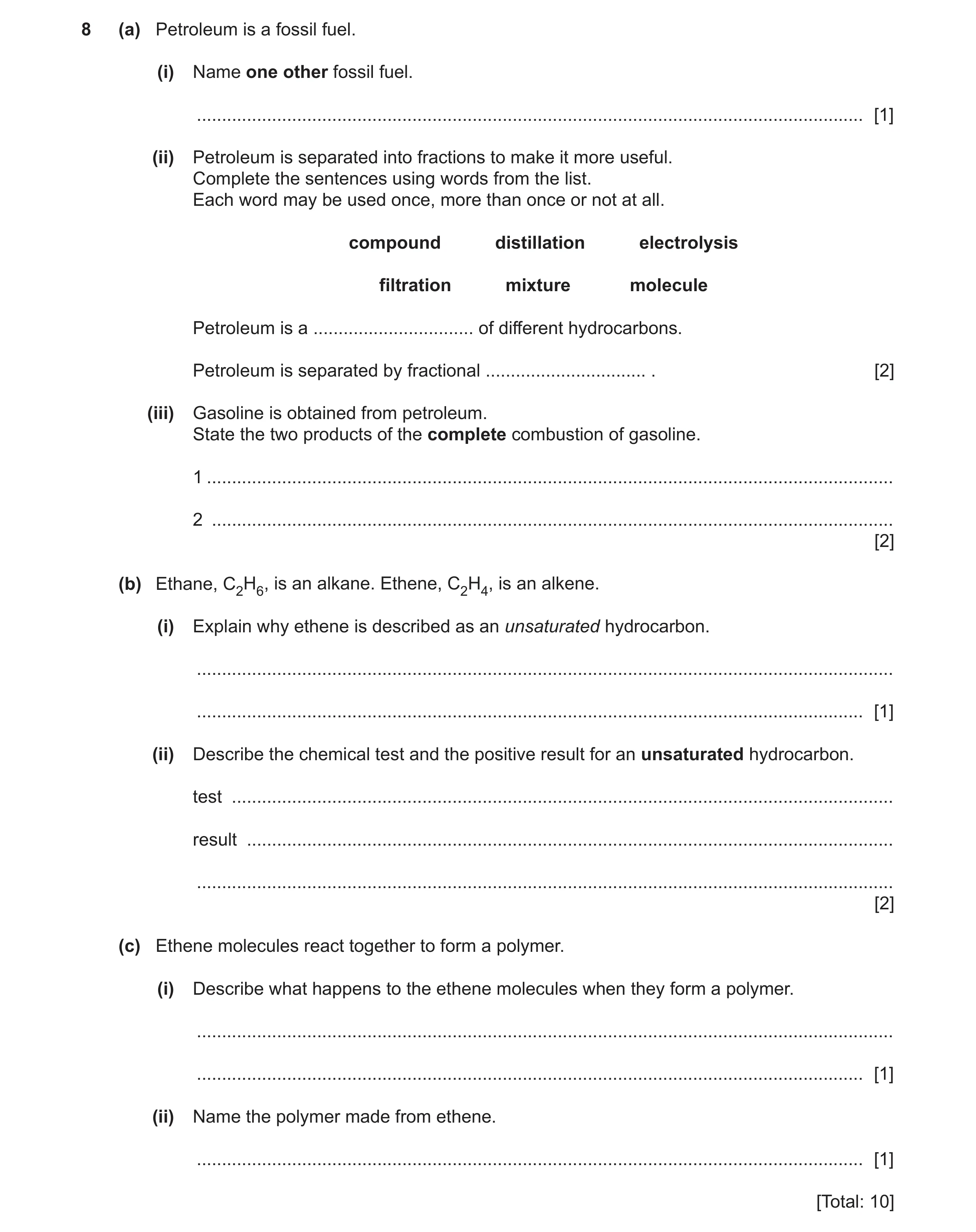
8 (a) Petroleum is a fossil fuel. (i) Name one other fossil fuel. … [1] (ii) Petroleum is separated into fractions to make it more useful. Complete the sentences using words from the list. Each word may be used once, more than once or not at all. compound distillation electrolysis filtration mixture molecule Petroleum is a … of different hydrocarbons. Petroleum is separated by fractional … . [2] (iii) Gasoline is obtained from petroleum. State the two products of the complete combustion of gasoline. 1 … 2 … [2] (b) Ethane, C2H6, is an alkane. Ethene, C2H4, is an alkene. (i) Explain why ethene is described as an unsaturated hydrocarbon. … … [1] (ii) Describe the chemical test and the positive result for an unsaturated hydrocarbon. test … result … … [2] (c) Ethene molecules react together to form a polymer. (i) Describe what happens to the ethene molecules when they form a polymer. … … [1] (ii) Name the polymer made from ethene. … [1] [Total: 10]
10 marks
Mark scheme: 8(a)(i) coal / natural gas ; 1 8(a)(ii) mixture ; distillation ; 2 8(a)(iii) carbon dioxide ; water ; 2 8(b)(i) contains a (carbon – carbon) double bond ; 1 8(b)(ii) aqueous bromine ; decolourises ; 2 8(c)(i) join together (into long chains) ; 1 8(c)(ii) polyethene ; 1
This question in 0654/31 Oct/Nov 2021
Q11 · Petroleum is separated into useful fractions by fractional distillation 0654/33 Oct/Nov 2021
5 (a) Petroleum is separated into useful fractions by fractional distillation. Fig. 5.1 shows a simplified diagram for the fractional distillation of petroleum. fraction refinery gas 50 °C … naphtha diesel oil hot 400 °C petroleum … Fig. 5.1 (i) On Fig. 5.1 write the names of the missing fractions in their correct place. [2] (ii) State one use for the refinery gas fraction. … [1] (iii) State why the process of fractional distillation is a physical change and not a chemical change. … … [1] (b) The diesel oil fraction is used as a fuel. (i) Diesel oil is a mixture of hydrocarbons. State what is meant by the term hydrocarbon. … … … [2] (ii) State the two products of the complete combustion of a hydrocarbon. 1 … 2 … [2] (c) (i) Name the process that produces small alkene molecules from larger alkane molecules. … [1] (ii) State how the molecular structure of an alkane molecule differs from the molecular structure of an alkene molecule. … … [1] (iii) Aqueous bromine is used to test for an alkene. State the colour change when aqueous bromine reacts with an alkene. from … to … [2] [Total: 12]
12 marks
Mark scheme: 5(a)(i) gasoline ; bitumen ; 2 5(a)(ii) fuel ; 1 5(a)(iii) no new substances formed ; 1 5(b)(i) substance that contains carbon and hydrogen (atoms) ; only ; 2 5(b)(ii) carbon dioxide ; water ; 2 Question Answer Marks 5(c)(i) cracking ; 1 5(c)(ii) alkane does not contain a C-C double bond / alkene does contain a C-C double bond / contains only single bonds ; 1 5(c)(iii) orange ; to colourless ; 2
This question in 0654/33 Oct/Nov 2021
Q12 · Methane is a hydrocarbon 0654/32 Feb/March 2022
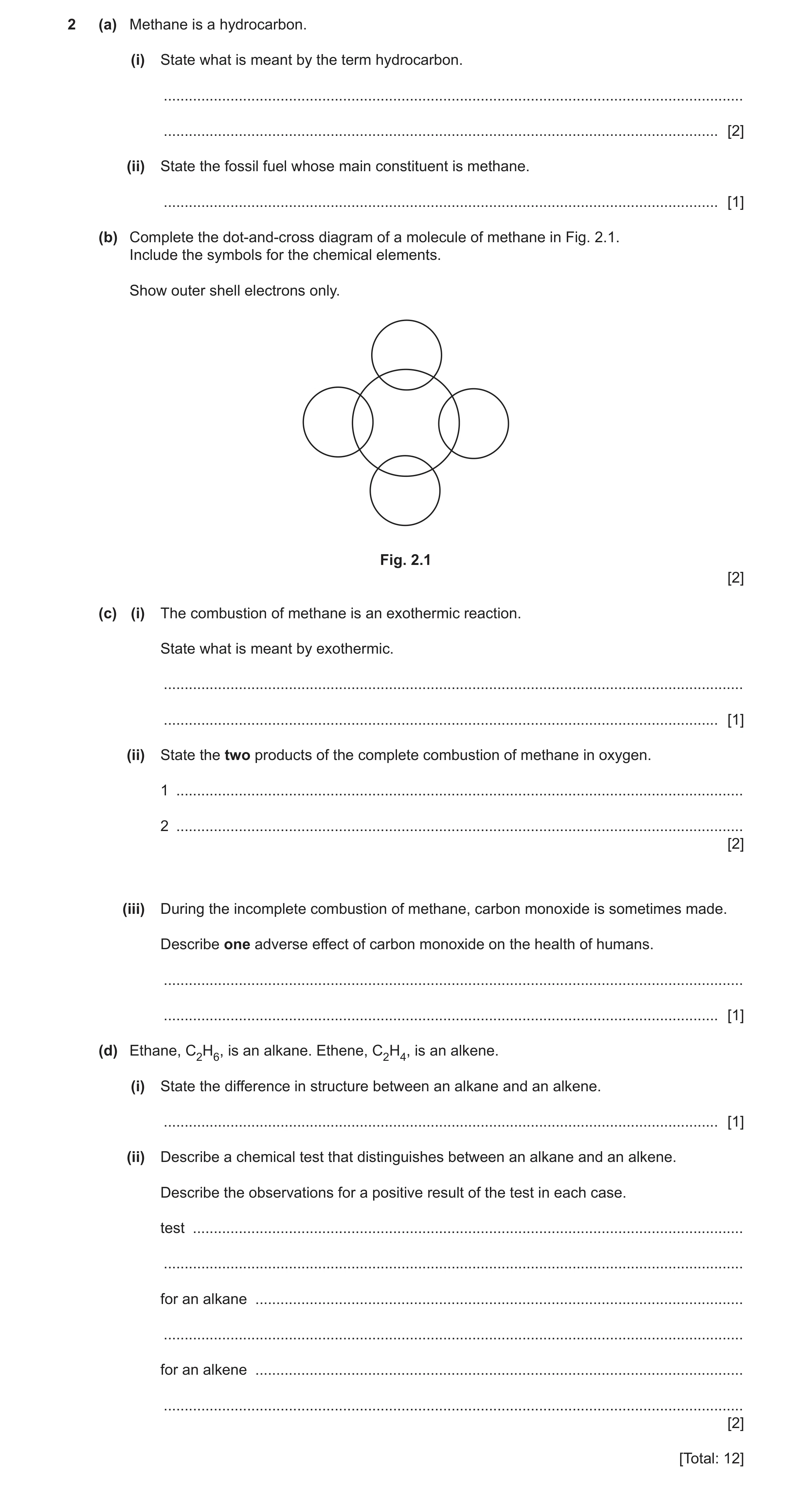
2 (a) Methane is a hydrocarbon. (i) State what is meant by the term hydrocarbon. … … [2] (ii) State the fossil fuel whose main constituent is methane. … [1] (b) Complete the dot-and-cross diagram of a molecule of methane in Fig. 2.1. Include the symbols for the chemical elements. Show outer shell electrons only. Fig. 2.1 [2] (c) (i) The combustion of methane is an exothermic reaction. State what is meant by exothermic. … … [1] (ii) State the two products of the complete combustion of methane in oxygen. 1 … 2 … [2] (iii) During the incomplete combustion of methane, carbon monoxide is sometimes made. Describe one adverse effect of carbon monoxide on the health of humans. … … [1] (d) Ethane, C2H6, is an alkane. Ethene, C2H4, is an alkene. (i) State the difference in structure between an alkane and an alkene. … [1] (ii) Describe a chemical test that distinguishes between an alkane and an alkene. Describe the observations for a positive result of the test in each case. test … … for an alkane … … for an alkene … … [2] [Total: 12]
12 marks
Mark scheme: 2(a)(i) contains carbon and hydrogen (atoms); only ; 2 2(a)(ii) natural gas; 1 2(b) correct symbols; 4 bonding pairs and all else correct; 2 2(c)(i) gives out (thermal) energy; 1 2(c)(ii) carbon dioxide; water; 2 Question Answer Marks 2(c)(iii) death / poisoning / CO is toxic / reduces the oxygen carrying capacity of the red blood cells ; 1 2(d)(i) alkene contains a double bond / alkane only has single bonds; 1 2(d)(ii) aqueous bromine ; alkane – no colour change and alkene – orange to colourless / goes colourless; 2
This question in 0654/32 Feb/March 2022
Q13 · The structures of four molecules, P, Q, R and S 0654/32 May/June 2022
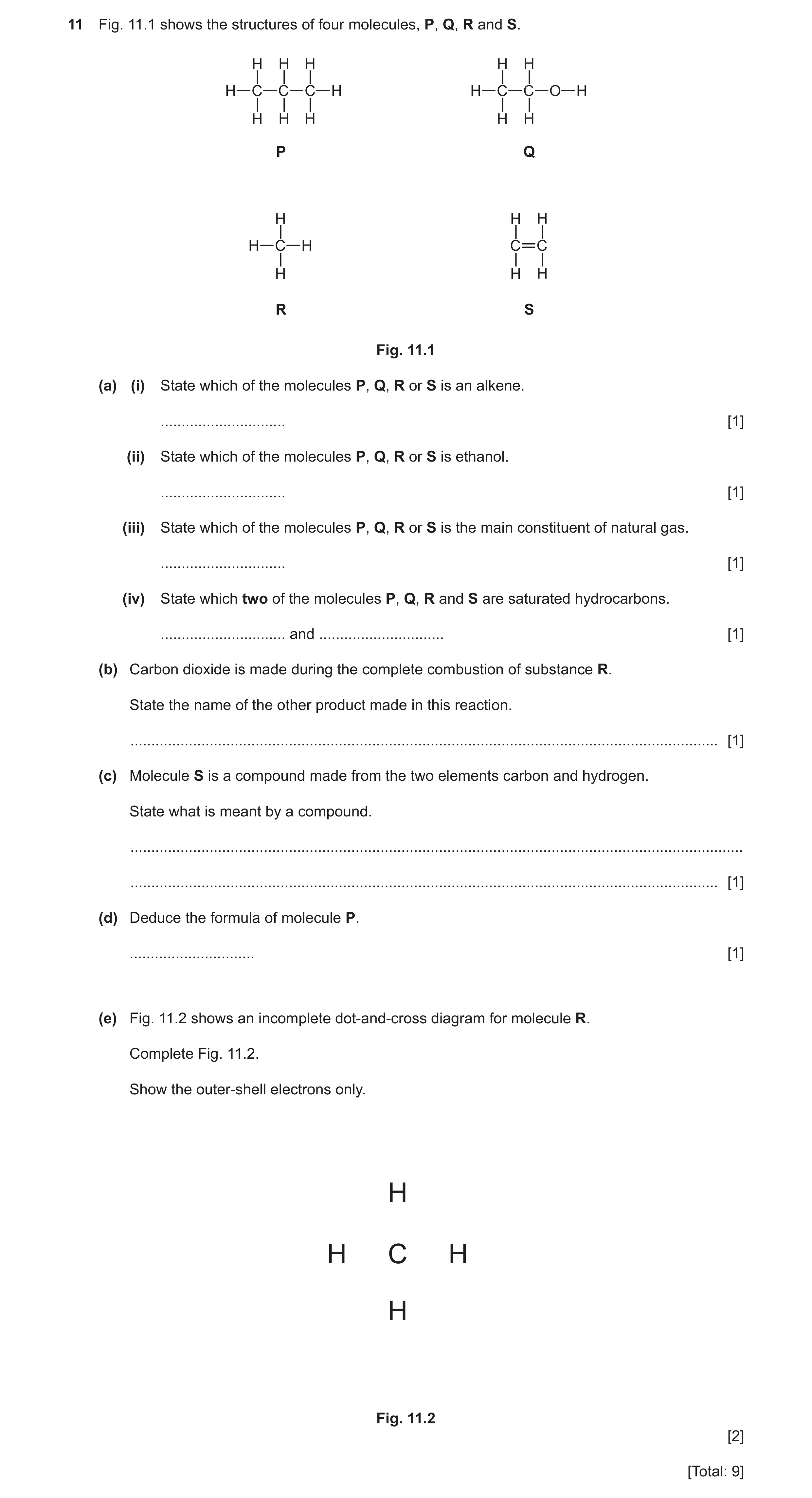
11 Fig. 11.1 shows the structures of four molecules, P, Q, R and S. H H H H H H C C C H H C C O H H H H H H P Q H H H H C H C C H H H R S Fig. 11.1 (a) (i) State which of the molecules P, Q, R or S is an alkene. … [1] (ii) State which of the molecules P, Q, R or S is ethanol. … [1] (iii) State which of the molecules P, Q, R or S is the main constituent of natural gas. … [1] (iv) State which two of the molecules P, Q, R and S are saturated hydrocarbons. … and … [1] (b) Carbon dioxide is made during the complete combustion of substance R. State the name of the other product made in this reaction. … [1] (c) Molecule S is a compound made from the two elements carbon and hydrogen. State what is meant by a compound. … … [1] (d) Deduce the formula of molecule P. … [1] (e) Fig. 11.2 shows an incomplete dot-and-cross diagram for molecule R. Complete Fig. 11.2. Show the outer-shell electrons only. H H C H H Fig. 11.2 [2] [Total: 9]
9 marks
Mark scheme: 11(a)(i) S; 1 11(a)(ii) Q; 1 11(a)(iii) R; 1 Question Answer Marks 11(a)(iv) P and R ; 1 11(b) water ; 1 11(c) a compound contains two or more elements chemically combined; 1 11(d) C3H8 ; 1 11(e) one bonding pairs; all else correct ; 2
This question in 0654/32 May/June 2022
Q14 · The structures of four molecules, P, Q, R and S 0654/33 May/June 2022
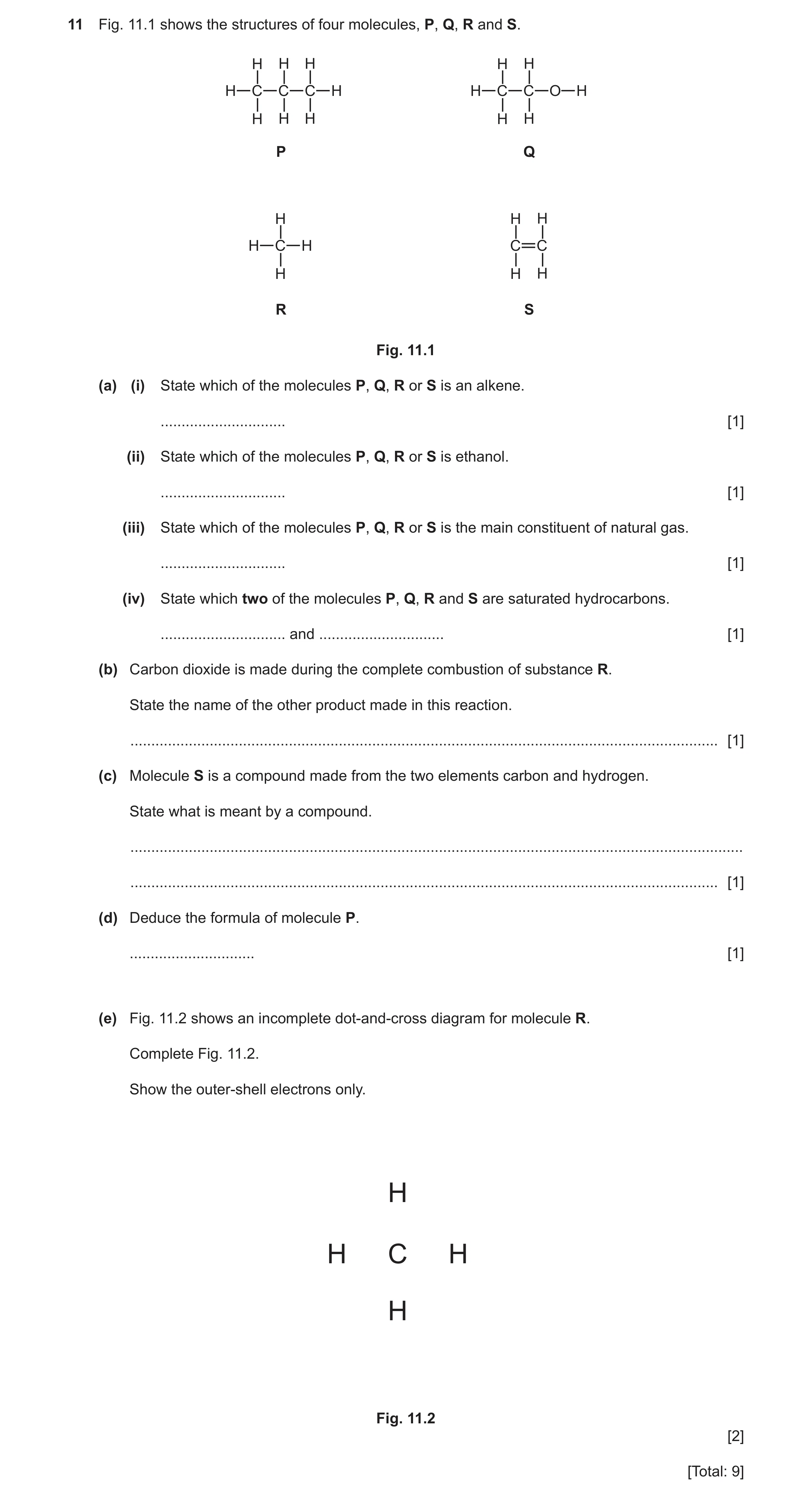
11 Fig. 11.1 shows the structures of four molecules, P, Q, R and S. H H H H H H C C C H H C C O H H H H H H P Q H H H H C H C C H H H R S Fig. 11.1 (a) (i) State which of the molecules P, Q, R or S is an alkene. … [1] (ii) State which of the molecules P, Q, R or S is ethanol. … [1] (iii) State which of the molecules P, Q, R or S is the main constituent of natural gas. … [1] (iv) State which two of the molecules P, Q, R and S are saturated hydrocarbons. … and … [1] (b) Carbon dioxide is made during the complete combustion of substance R. State the name of the other product made in this reaction. … [1] (c) Molecule S is a compound made from the two elements carbon and hydrogen. State what is meant by a compound. … … [1] (d) Deduce the formula of molecule P. … [1] (e) Fig. 11.2 shows an incomplete dot-and-cross diagram for molecule R. Complete Fig. 11.2. Show the outer-shell electrons only. H H C H H Fig. 11.2 [2] [Total: 9]
9 marks
Mark scheme: 11(a)(i) S; 1 11(a)(ii) Q; 1 11(a)(iii) R; 1 Question Answer Marks 11(a)(iv) P and R ; 1 11(b) water ; 1 11(c) a compound contains two or more elements chemically combined; 1 11(d) C3H8 ; 1 11(e) one bonding pairs; all else correct ; 2
This question in 0654/33 May/June 2022
Q15 · Petroleum is a fossil fuel 0654/33 Oct/Nov 2022
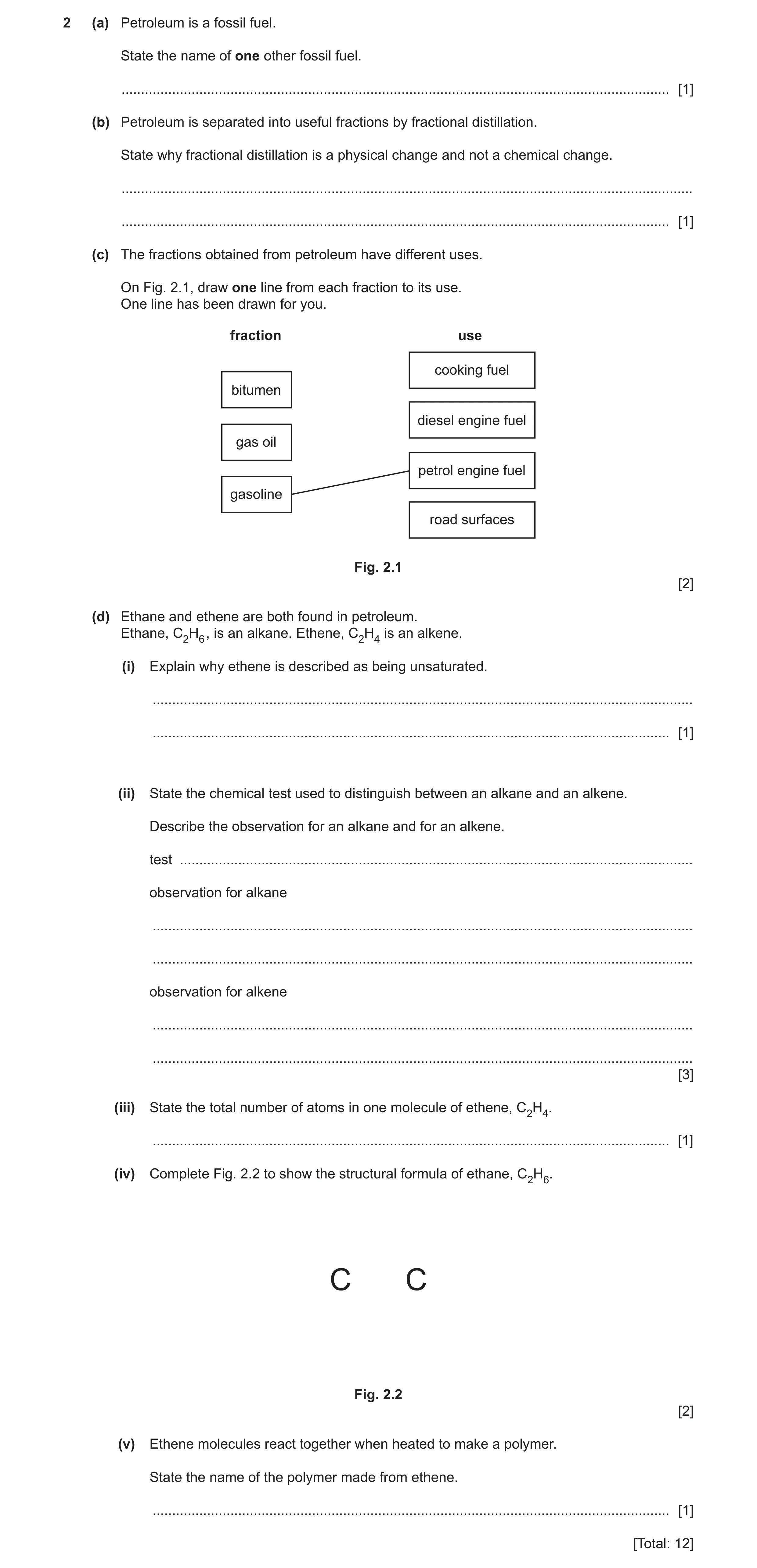
2 (a) Petroleum is a fossil fuel. State the name of one other fossil fuel. … [1] (b) Petroleum is separated into useful fractions by fractional distillation. State why fractional distillation is a physical change and not a chemical change. … … [1] (c) The fractions obtained from petroleum have different uses. On Fig. 2.1, draw one line from each fraction to its use. One line has been drawn for you. fraction use cooking fuel bitumen diesel engine fuel gas oil petrol engine fuel gasoline road surfaces Fig. 2.1 [2] (d) Ethane and ethene are both found in petroleum. Ethane, C2H6 , is an alkane. Ethene, C2H4 is an alkene. (i) Explain why ethene is described as being unsaturated. … … [1] (ii) State the chemical test used to distinguish between an alkane and an alkene. Describe the observation for an alkane and for an alkene. test … observation for alkane … … observation for alkene … … [3] (iii) State the total number of atoms in one molecule of ethene, C2H4. … [1] (iv) Complete Fig. 2.2 to show the structural formula of ethane, C2H6. C C Fig. 2.2 [2] (v) Ethene molecules react together when heated to make a polymer. State the name of the polymer made from ethene. … [1] [Total: 12]
12 marks
Mark scheme: 2(a) coal / natural gas ; 1 2(b) change is reversible / no new products formed ; 1 2(c) bitumen – road surfaces ; 2 gas oil – diesel engine fuel ; 2(d)(i) contains a carbon-carbon double bond ; 1 2(d)(ii) aqueous bromine ; 3 alkane – no change / stays orange ; alkene – decolourises ; OWTTE 2(d)(iii) six ; 1 2(d)(iv) 2 single carbon – carbon bond ; all else correct ; 2(d)(v) polyethene / polythene ; 1
This question in 0654/33 Oct/Nov 2022
Q16 · Five compounds, A, B, C, D and E, and the formula of each compound 0654/31 Oct/Nov 2023
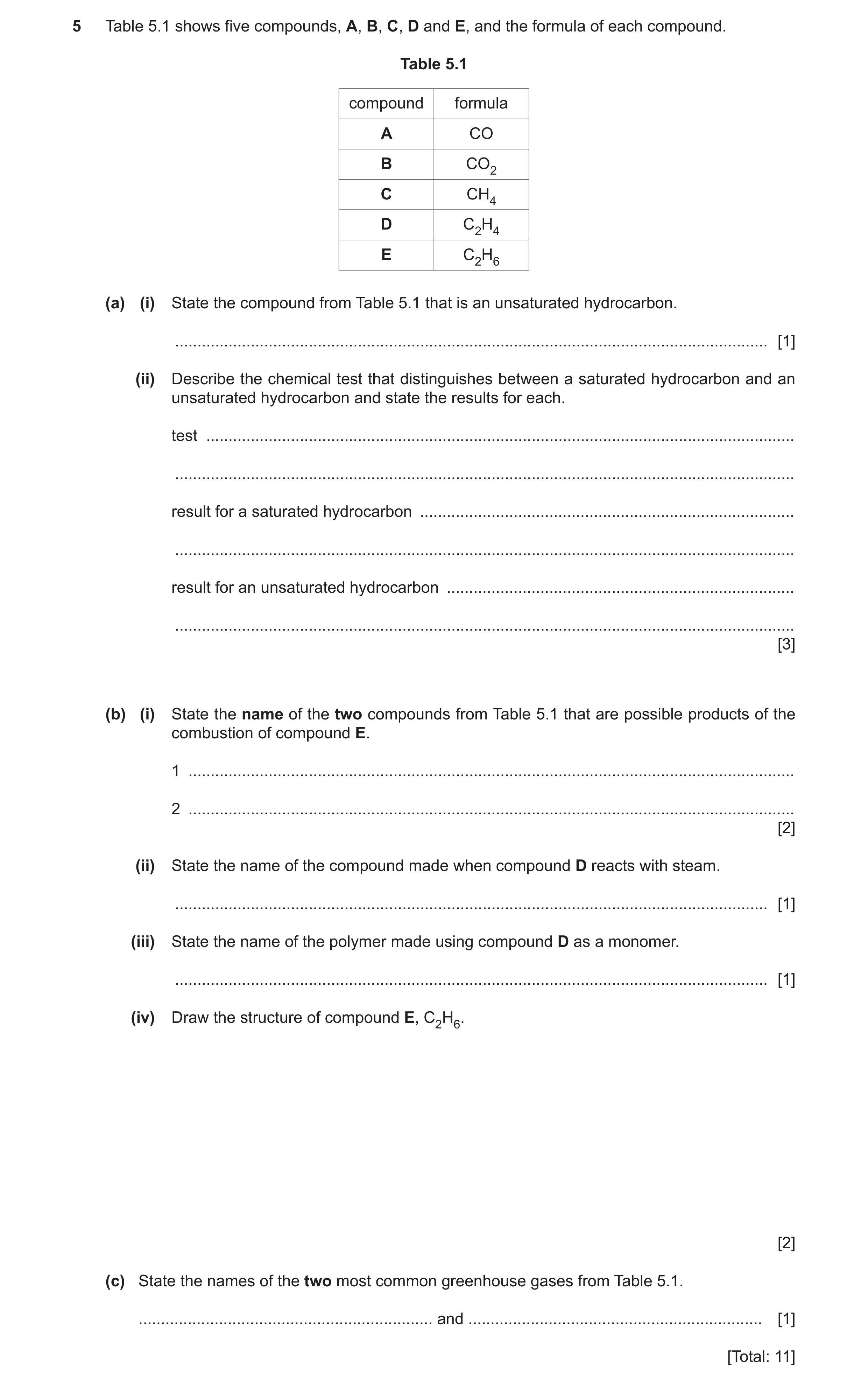
5 Table 5.1 shows five compounds, A, B, C, D and E, and the formula of each compound. Table 5.1 compound formula A CO B CO2 C CH4 D C2H4 E C2H6 (a) (i) State the compound from Table 5.1 that is an unsaturated hydrocarbon. … [1] (ii) Describe the chemical test that distinguishes between a saturated hydrocarbon and an unsaturated hydrocarbon and state the results for each. test … … result for a saturated hydrocarbon … … result for an unsaturated hydrocarbon … … [3] (b) (i) State the name of the two compounds from Table 5.1 that are possible products of the combustion of compound E. 1 … 2 … [2] (ii) State the name of the compound made when compound D reacts with steam. … [1] (iii) State the name of the polymer made using compound D as a monomer. … [1] (iv) Draw the structure of compound E, C2H6. [2] (c) State the names of the two most common greenhouse gases from Table 5.1. … and … [1] [Total: 11]
11 marks
Mark scheme: 5(a)(i) D ; 1 5(a)(ii) (aqueous) bromine ; 3 saturated – stays orange ; unsaturated – goes colourless ; 5(b)(i) carbon monoxide ; 2 carbon dioxide ; 5(b)(ii) ethanol ; 1 5(b)(iii) poly(ethene) ; 1 5(b)(iv) C–C single bond ; 2 3 hydrogens each attached to a different carbon atom ; 5(c) carbon dioxide and methane ; 1
This question in 0654/31 Oct/Nov 2023
Q17 · The molecular structure of ethene 0654/31 Oct/Nov 2024
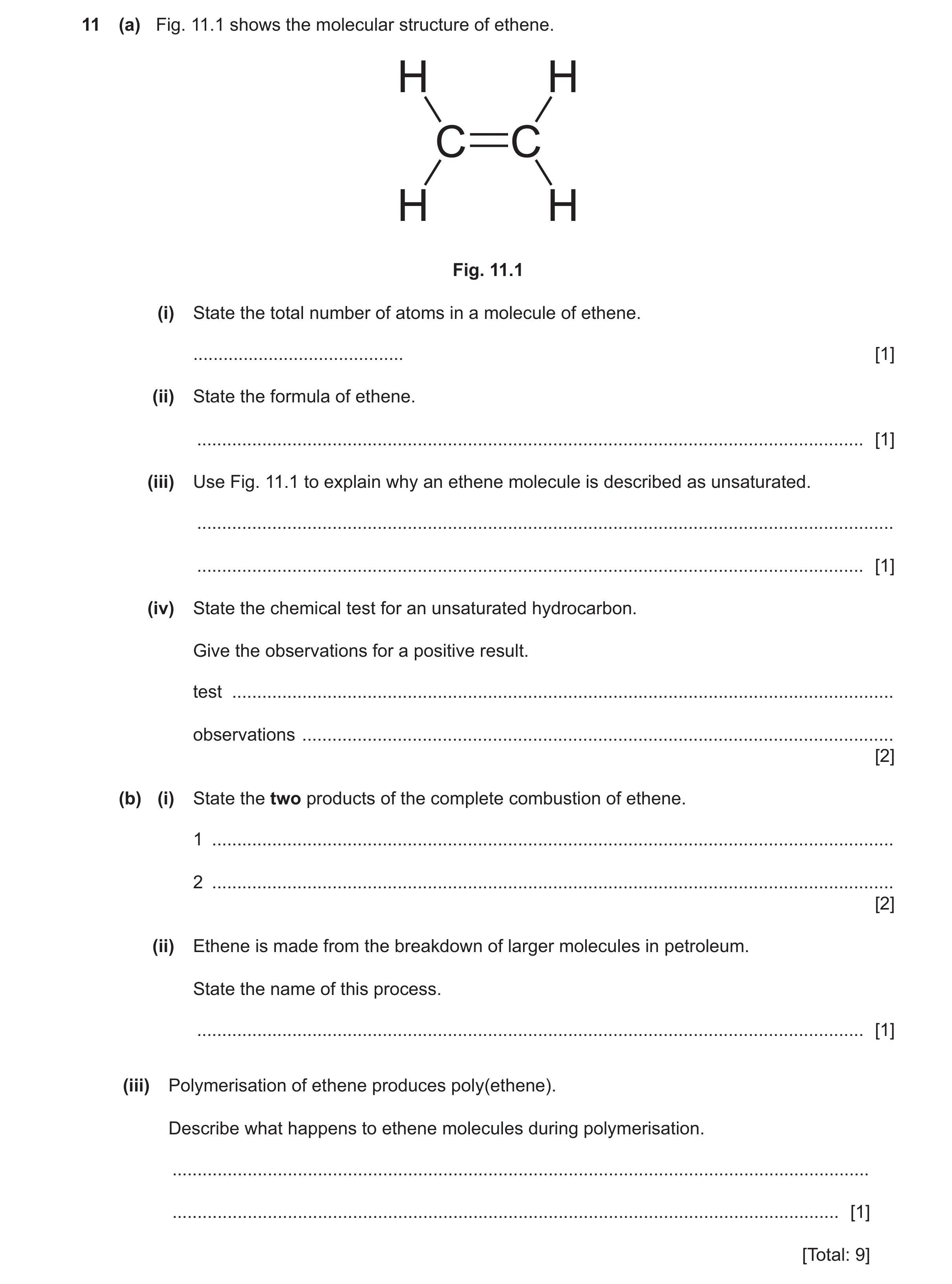
11 (a) Fig. 11.1 shows the molecular structure of ethene. H H C C H H Fig. 11.1 (i) State the total number of atoms in a molecule of ethene. … [1] (ii) State the formula of ethene. … [1] (iii) Use Fig. 11.1 to explain why an ethene molecule is described as unsaturated. … … [1] (iv) State the chemical test for an unsaturated hydrocarbon. Give the observations for a positive result. test … observations … [2] (b) (i) State the two products of the complete combustion of ethene. 1 … 2 … [2] (ii) Ethene is made from the breakdown of larger molecules in petroleum. State the name of this process. … [1] (iii) Polymerisation of ethene produces poly(ethene). Describe what happens to ethene molecules during polymerisation. … … [1] [Total: 9]
9 marks
Mark scheme: 11(a)(i) 6 ; 1 11(a)(ii) C2H4 ; 1 11(a)(iii) C=C double bond ; 1 11(a)(iv) aqueous bromine ; 2 orange to colourless ; 11(b)(i) carbon dioxide ; 2 water ; 11(b)(ii) cracking ; 1 11(b)(iii) join together / make a long chain ; 1
This question in 0654/31 Oct/Nov 2024
Q18 · The proton numbers and nucleon numbers of carbon and hydrogen are shown in Table 11.1 0654/32 Oct/Nov 2024
11 (a) The proton numbers and nucleon numbers of carbon and hydrogen are shown in Table 11.1. Table 11.1 proton number nucleon number carbon 6 12 hydrogen 1 1 (i) State the number of neutrons in a carbon atom and the number of neutrons in a hydrogen atom. carbon … hydrogen … [2] (ii) State the number of electrons in a carbon atom. … [1] (b) (i) State the difference between a saturated hydrocarbon and an unsaturated hydrocarbon. … … [1] (ii) Aqueous bromine is used to show the difference between a saturated hydrocarbon and an unsaturated hydrocarbon. Describe the result of the test with a saturated hydrocarbon. … … [1] (c) Fig. 11.1 shows the apparatus used for the catalytic cracking of a saturated hydrocarbon. catalyst reaction vessel saturated mixture of saturated hydrocarbons and unsaturated hydrocarbons Fig. 11.1 (i) State the purpose of the catalyst in the cracking of a saturated hydrocarbon. … … [1] (ii) Cracking is an endothermic reaction. State what is meant by an endothermic reaction. … … … [1] (d) The complete combustion of hydrocarbons produces the greenhouse gas carbon dioxide. (i) Name one other greenhouse gas. … [1] (ii) Identify the gas in the air that reacts with hydrocarbons during combustion. … [1] (iii) Carbon dioxide is one of the gases found in clean air. State the name of the two gases found in clean air in the greatest proportions. 1 … 2 … [2] [Total: 11]
11 marks
Mark scheme: 11(a)(i) carbon = 6 ; 2 hydrogen = 0 ; 11(a)(ii) 6 ; 1 11(b)(i) unsaturated has a C=C double bond ; 1 11(b)(ii) aqueous bromine remains orange ; 1 11(c)(i) speed up the reaction ; 1 11(c)(ii) temperature decreases / thermal energy is absorbed (from the surroundings) ; 1 11(d)(i) methane ; 1 11(d)(ii) oxygen ; 1 11(d)(iii) oxygen ; 2 nitrogen ;
This question in 0654/32 Oct/Nov 2024
Q19 · The proton numbers and nucleon numbers of carbon and hydrogen are shown in Table 11.1 0654/33 Oct/Nov 2024
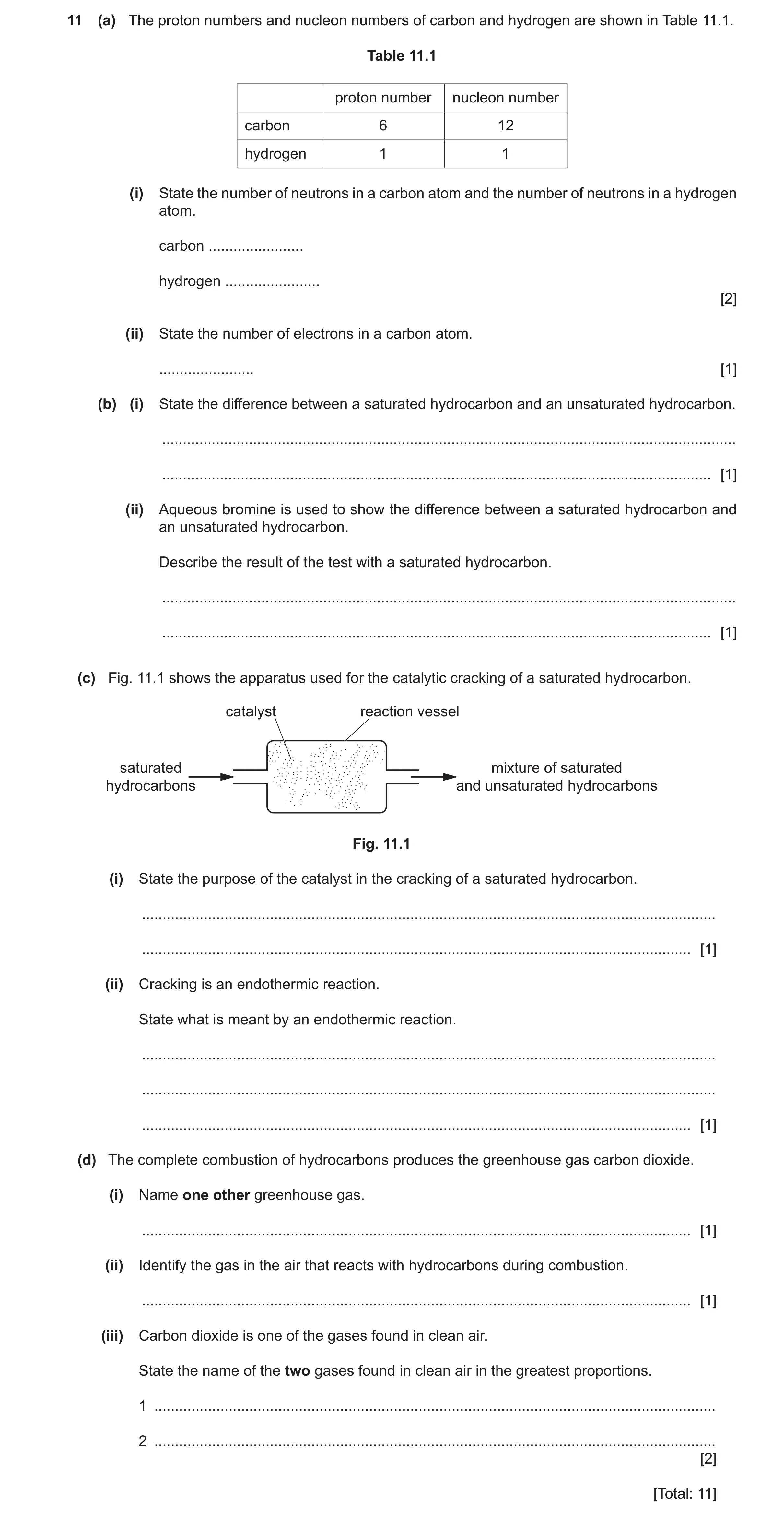
11 (a) The proton numbers and nucleon numbers of carbon and hydrogen are shown in Table 11.1. Table 11.1 proton number nucleon number carbon 6 12 hydrogen 1 1 (i) State the number of neutrons in a carbon atom and the number of neutrons in a hydrogen atom. carbon … hydrogen … [2] (ii) State the number of electrons in a carbon atom. … [1] (b) (i) State the difference between a saturated hydrocarbon and an unsaturated hydrocarbon. … … [1] (ii) Aqueous bromine is used to show the difference between a saturated hydrocarbon and an unsaturated hydrocarbon. Describe the result of the test with a saturated hydrocarbon. … … [1] (c) Fig. 11.1 shows the apparatus used for the catalytic cracking of a saturated hydrocarbon. catalyst reaction vessel saturated mixture of saturated hydrocarbons and unsaturated hydrocarbons Fig. 11.1 (i) State the purpose of the catalyst in the cracking of a saturated hydrocarbon. … … [1] (ii) Cracking is an endothermic reaction. State what is meant by an endothermic reaction. … … … [1] (d) The complete combustion of hydrocarbons produces the greenhouse gas carbon dioxide. (i) Name one other greenhouse gas. … [1] (ii) Identify the gas in the air that reacts with hydrocarbons during combustion. … [1] (iii) Carbon dioxide is one of the gases found in clean air. State the name of the two gases found in clean air in the greatest proportions. 1 … 2 … [2] [Total: 11]
11 marks
Mark scheme: 11(a)(i) carbon = 6 ; 2 hydrogen = 0 ; 11(a)(ii) 6 ; 1 11(b)(i) unsaturated has a C=C double bond ; 1 11(b)(ii) aqueous bromine remains orange ; 1 11(c)(i) speed up the reaction ; 1 11(c)(ii) temperature decreases / thermal energy is absorbed (from the surroundings) ; 1 11(d)(i) methane ; 1 11(d)(ii) oxygen ; 1 11(d)(iii) oxygen ; 2 nitrogen ;
This question in 0654/33 Oct/Nov 2024
Q20 · Methane, CH4, is a saturated hydrocarbon 0654/31 Oct/Nov 2025
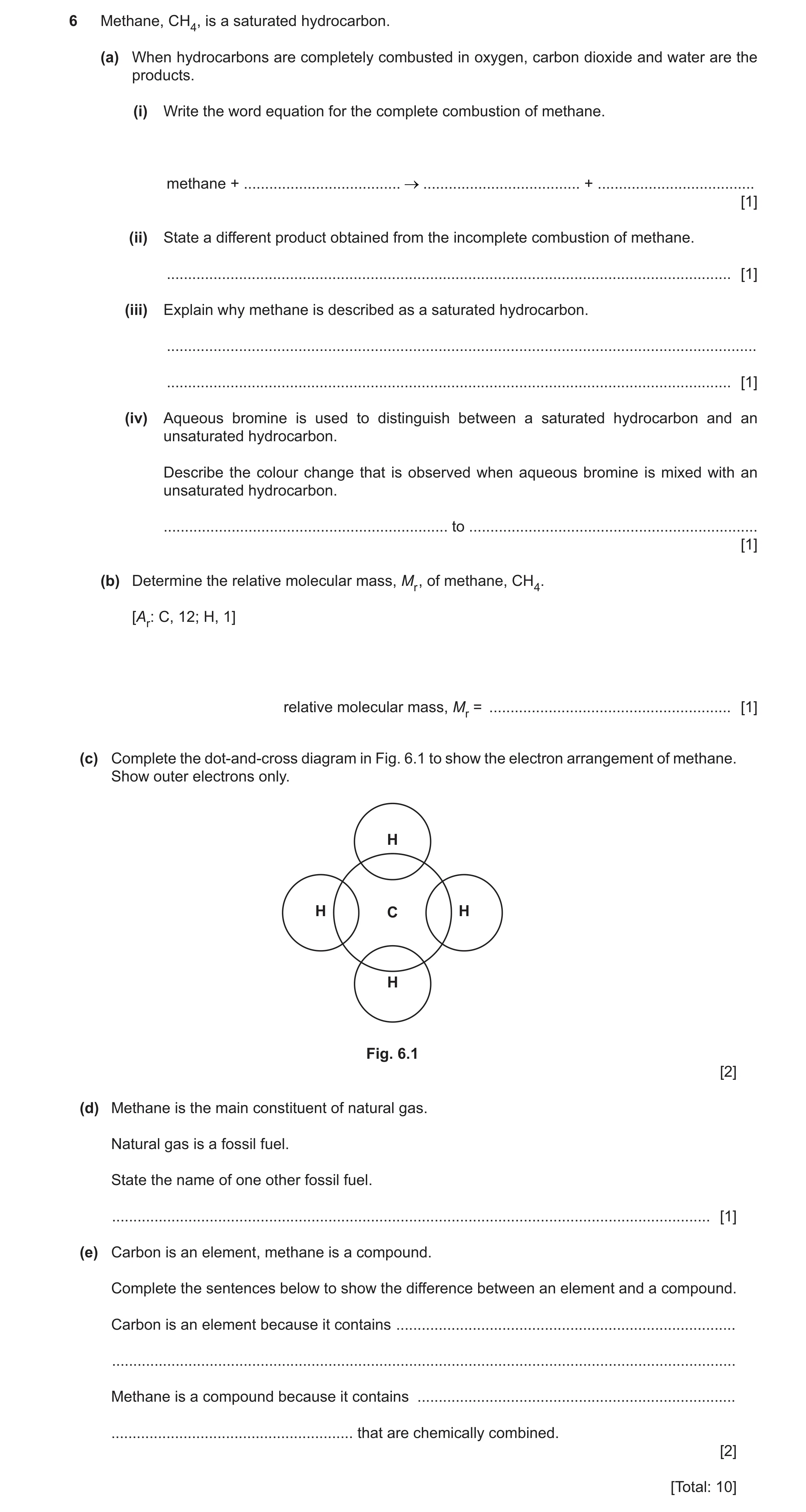
6 Methane, CH4, is a saturated hydrocarbon. (a) When hydrocarbons are completely combusted in oxygen, carbon dioxide and water are the products. (i) Write the word equation for the complete combustion of methane. methane + … … + … [1] (ii) State a different product obtained from the incomplete combustion of methane. … [1] (iii) Explain why methane is described as a saturated hydrocarbon. … … [1] (iv) Aqueous bromine is used to distinguish between a saturated hydrocarbon and an unsaturated hydrocarbon. Describe the colour change that is observed when aqueous bromine is mixed with an unsaturated hydrocarbon. … to … [1] (b) Determine the relative molecular mass, Mr , of methane, CH4. [Ar: C, 12; H, 1] relative molecular mass, Mr = … [1] (c) Complete the dot-and-cross diagram in Fig. 6.1 to show the electron arrangement of methane. Show outer electrons only. H H C H H Fig. 6.1 [2] (d) Methane is the main constituent of natural gas. Natural gas is a fossil fuel. State the name of one other fossil fuel. … [1] (e) Carbon is an element, methane is a compound. Complete the sentences below to show the difference between an element and a compound. Carbon is an element because it contains … … Methane is a compound because it contains … … that are chemically combined. [2] [Total: 10]
10 marks
Mark scheme: 6(a)(i) methane + oxygen → carbon dioxide + water ; 1 6(a)(ii) carbon monoxide / carbon ; 1 6(a)(iii) contains only single bonds ; 1 6(a)(iv) orange to colourless ; 1 6(b) 16 ; 1 6(c) one shared pair correct ; 2 all else correct ; 6(d) coal or petroleum; 1 6(e) (element) 2 only one type of atom ; (compound) two (or more) elements / two (or more) types of atom ;
This question in 0654/31 Oct/Nov 2025
 11 / 32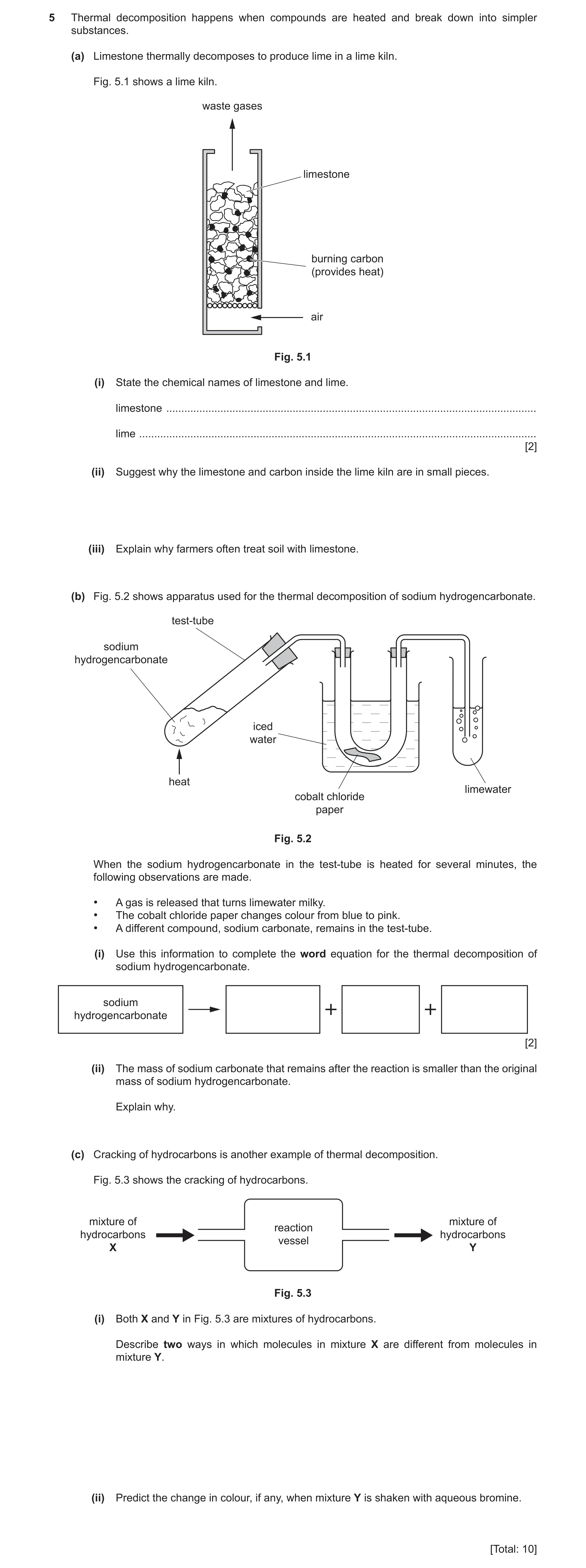
 17 / 32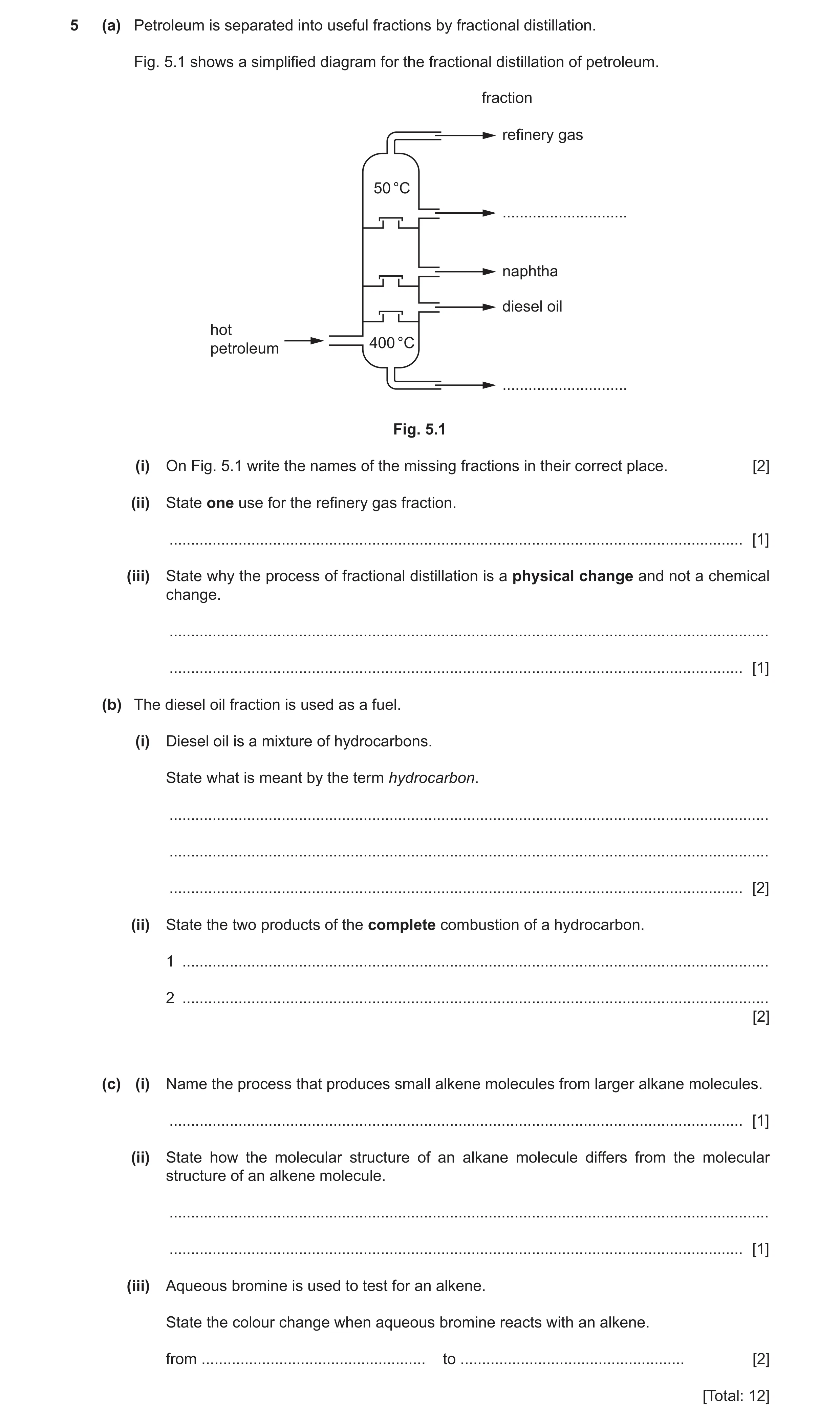
 27 / 32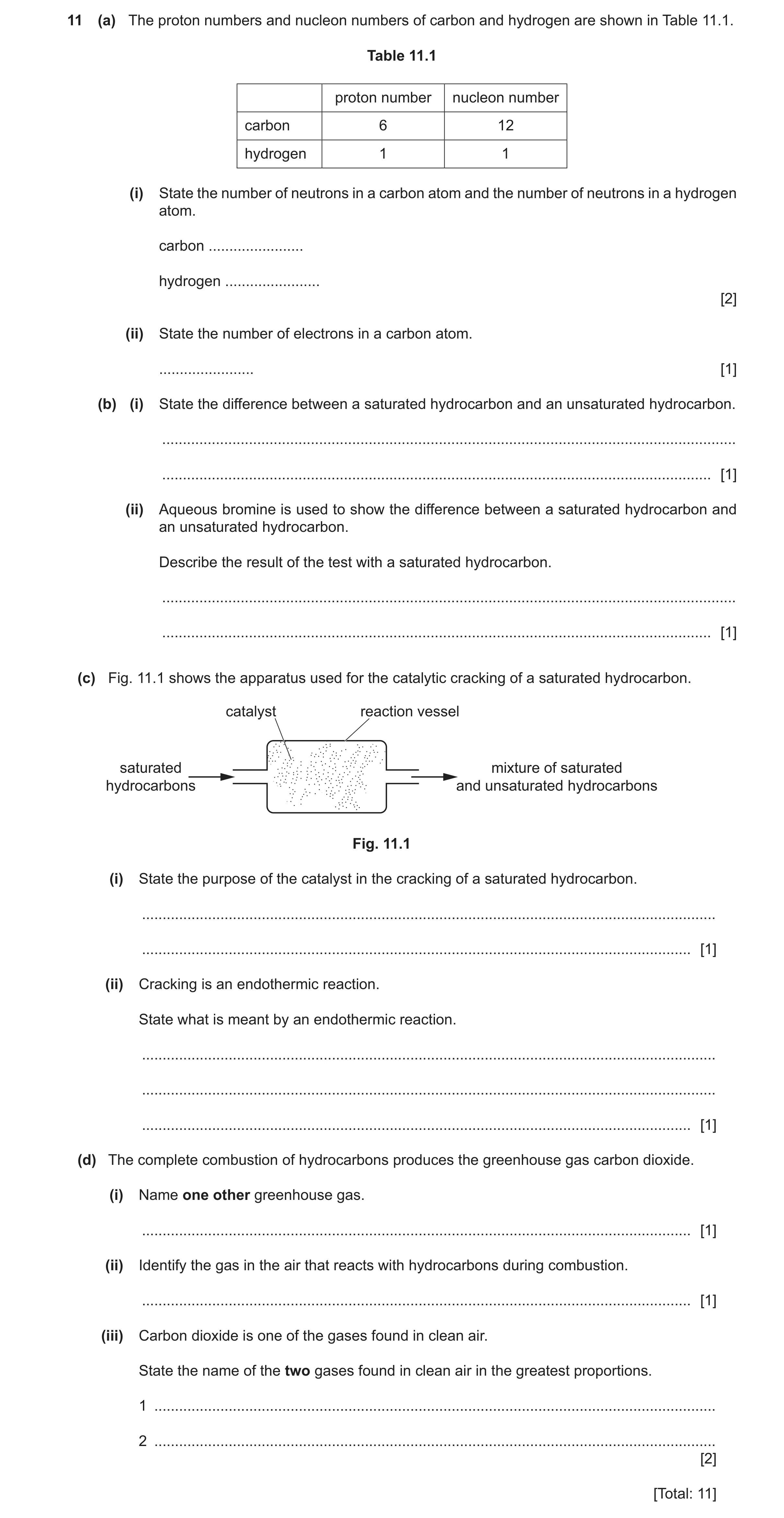
 12
12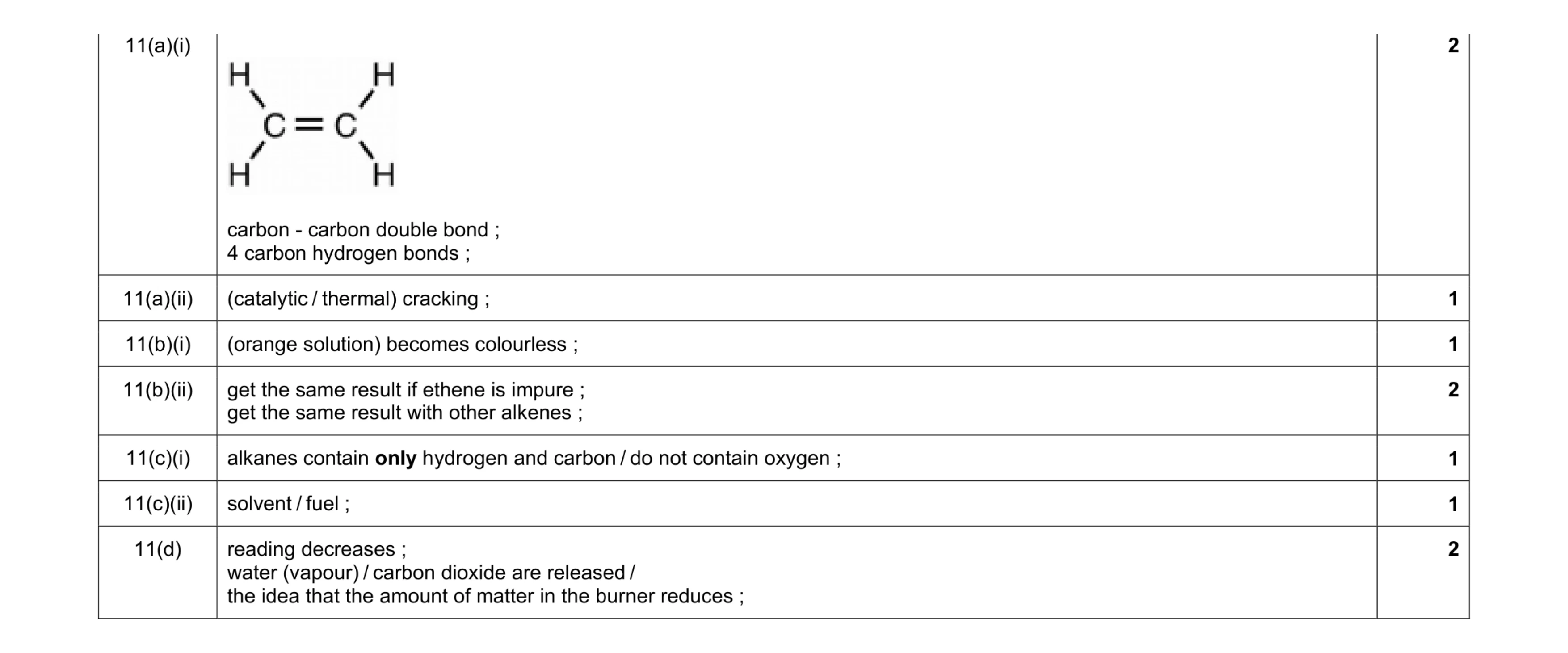 10
10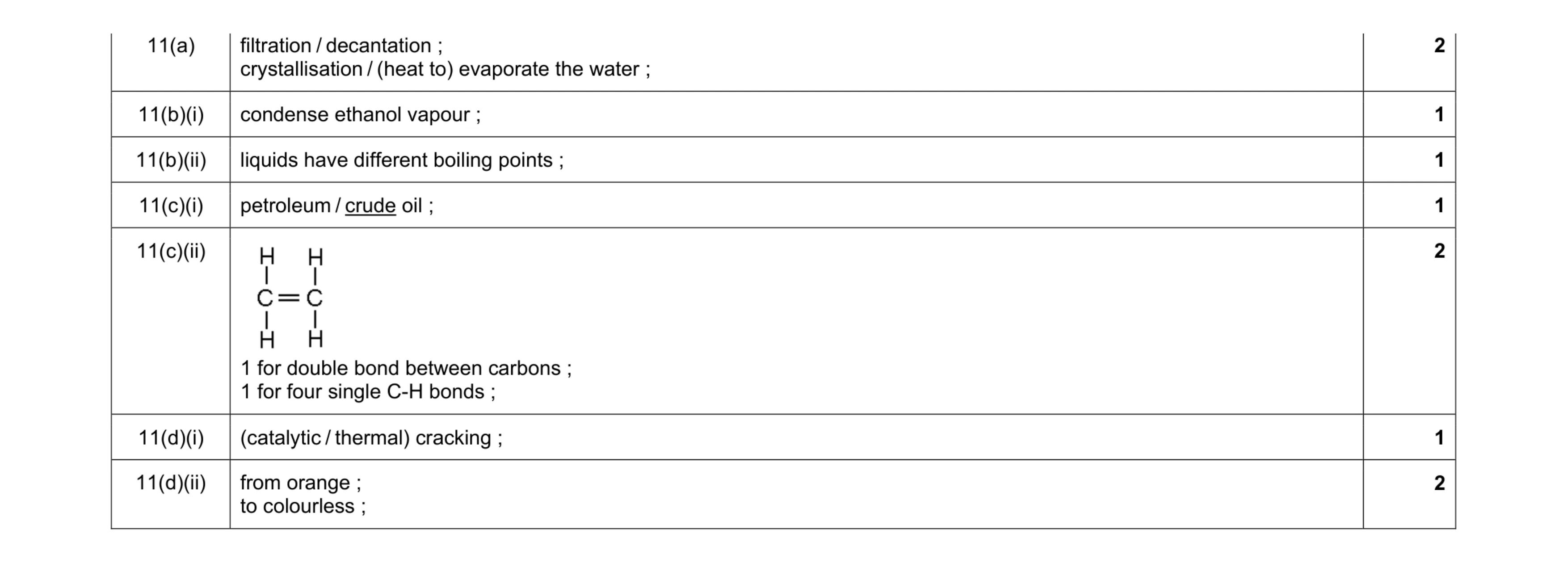 10
10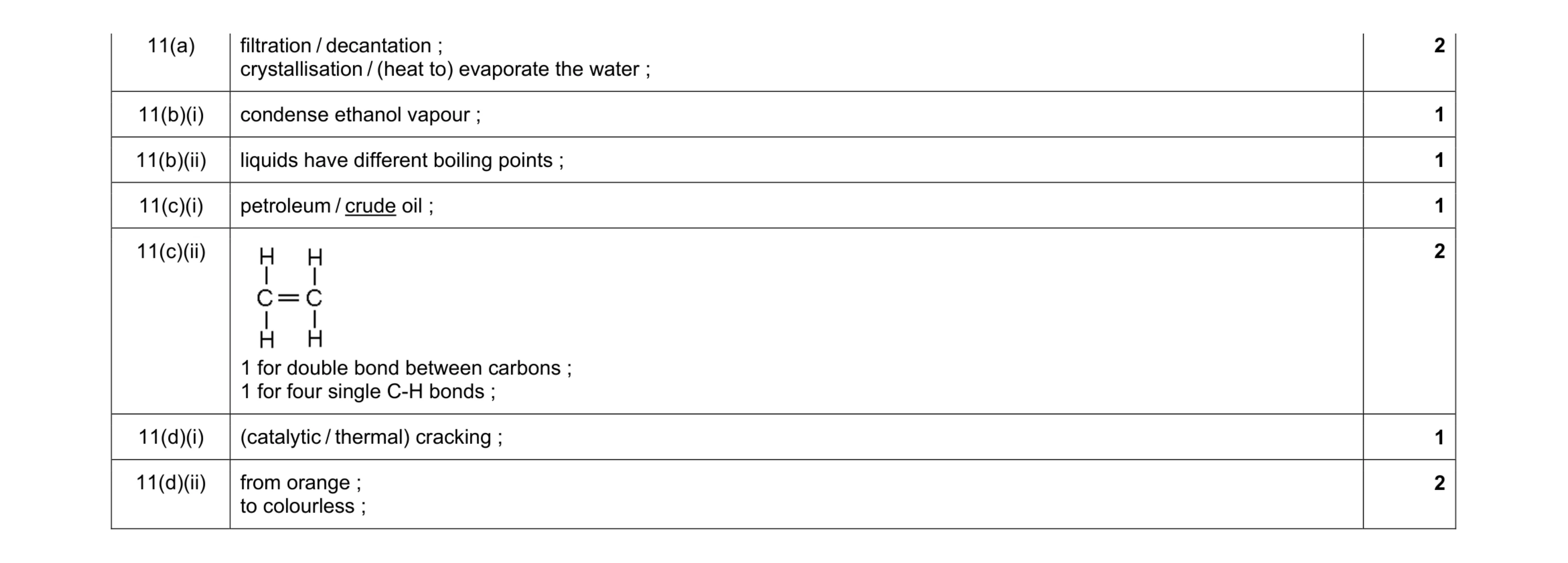 10
10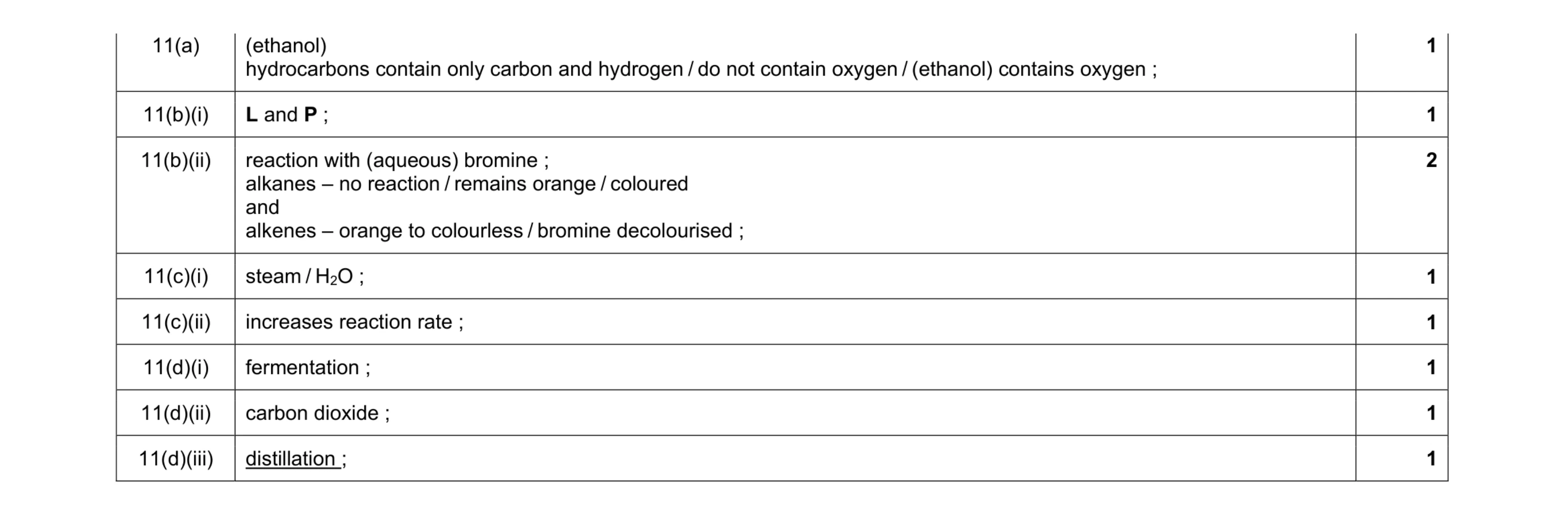 9
9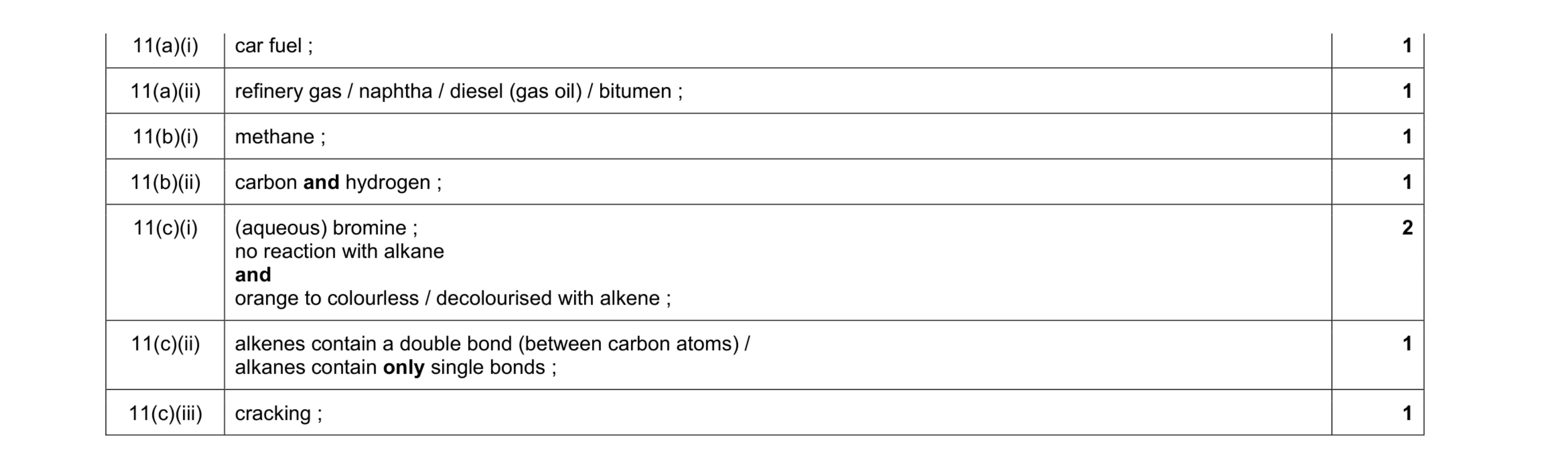 8
8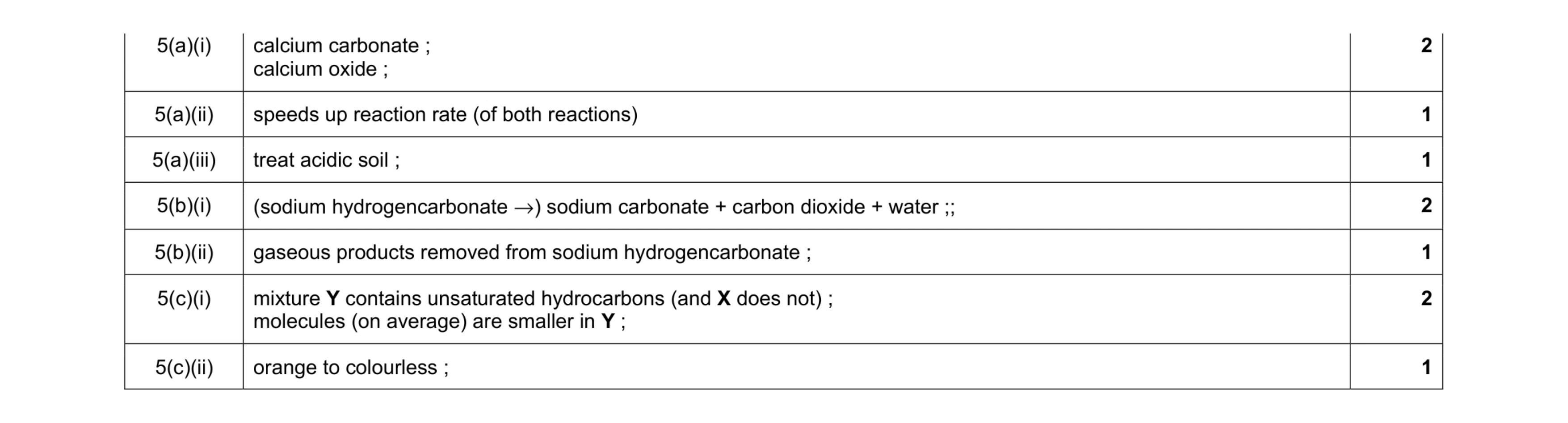 10
10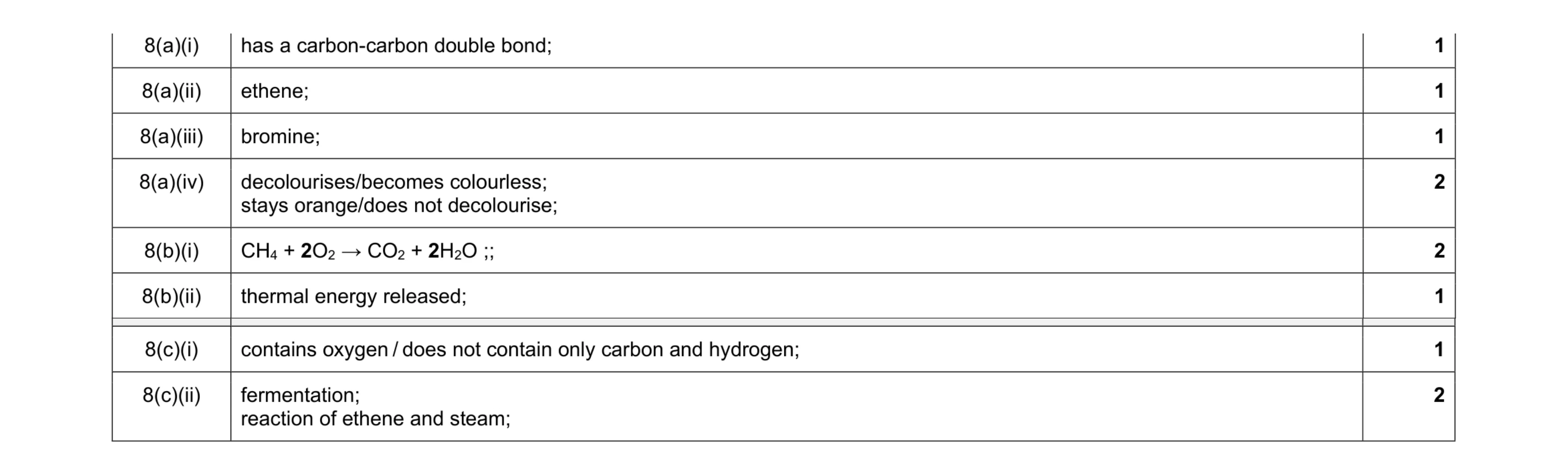 11
11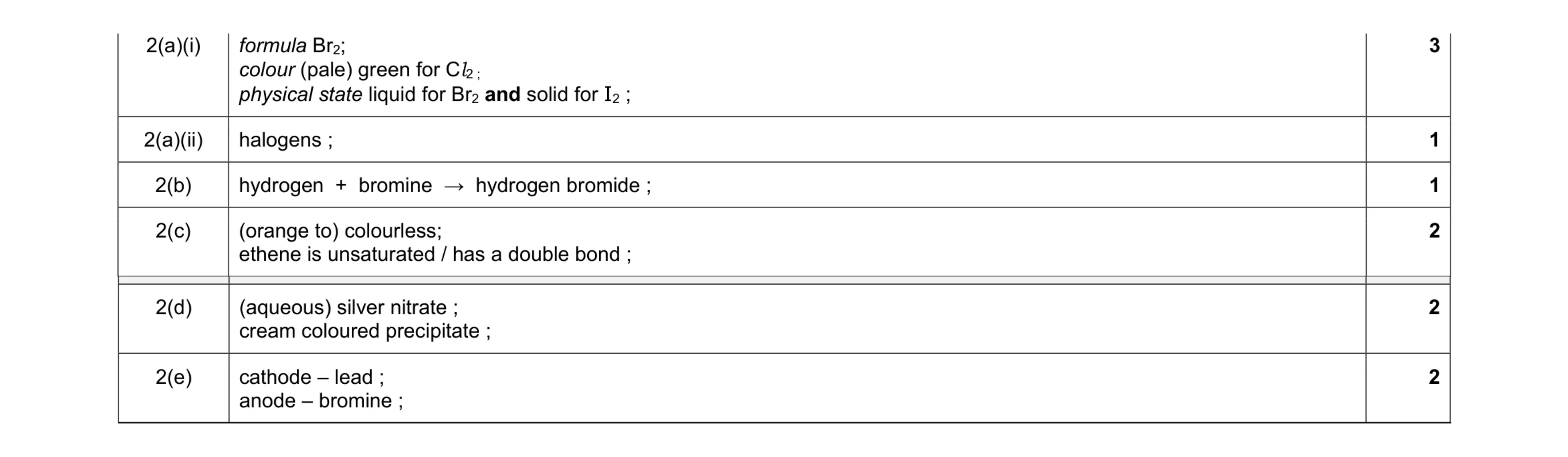 11
11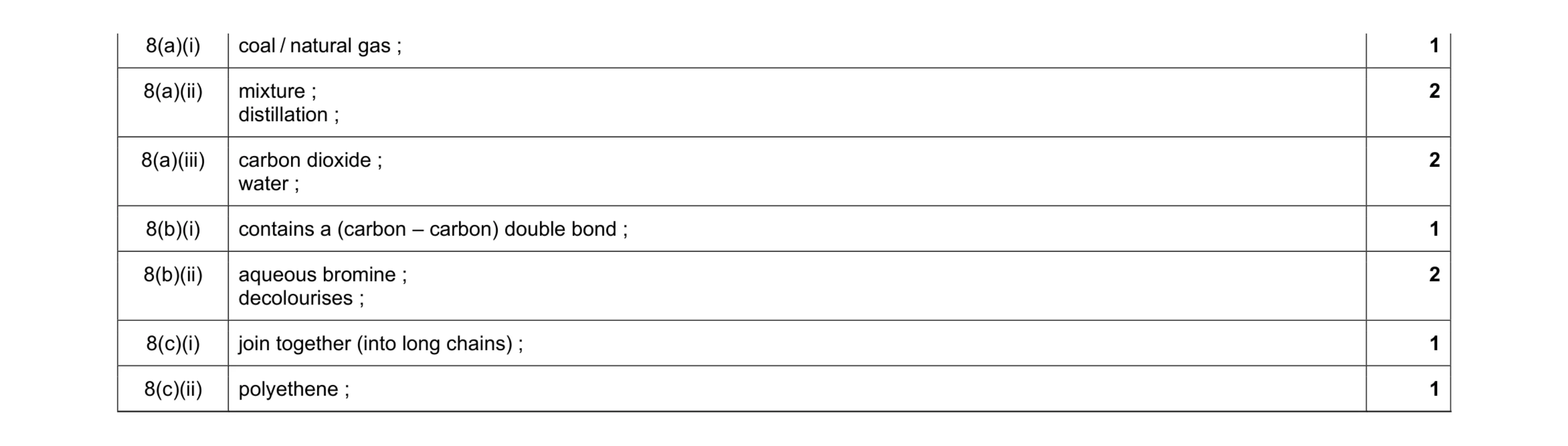 10
10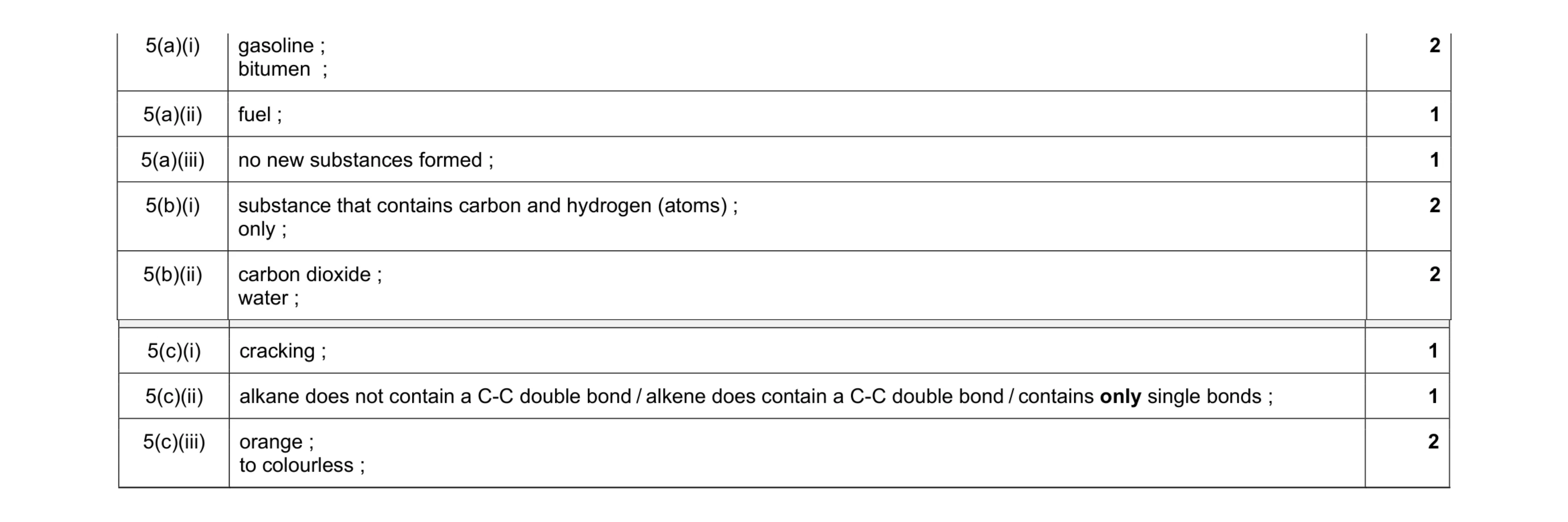 12
12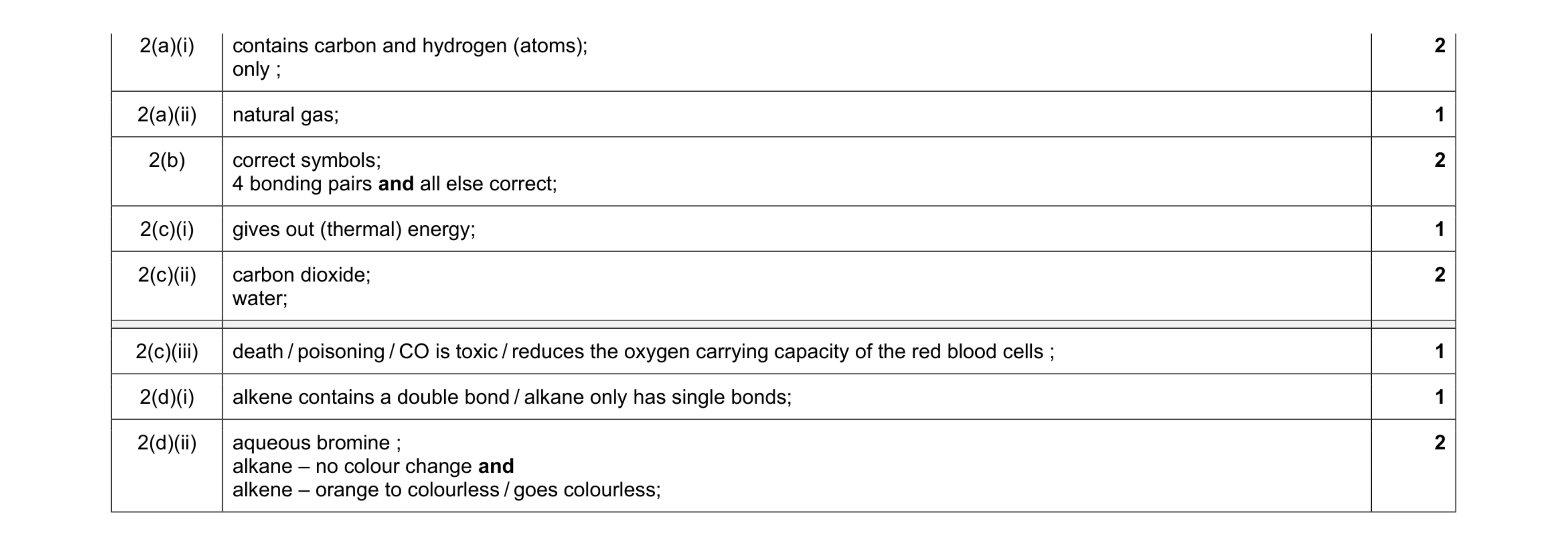 12
12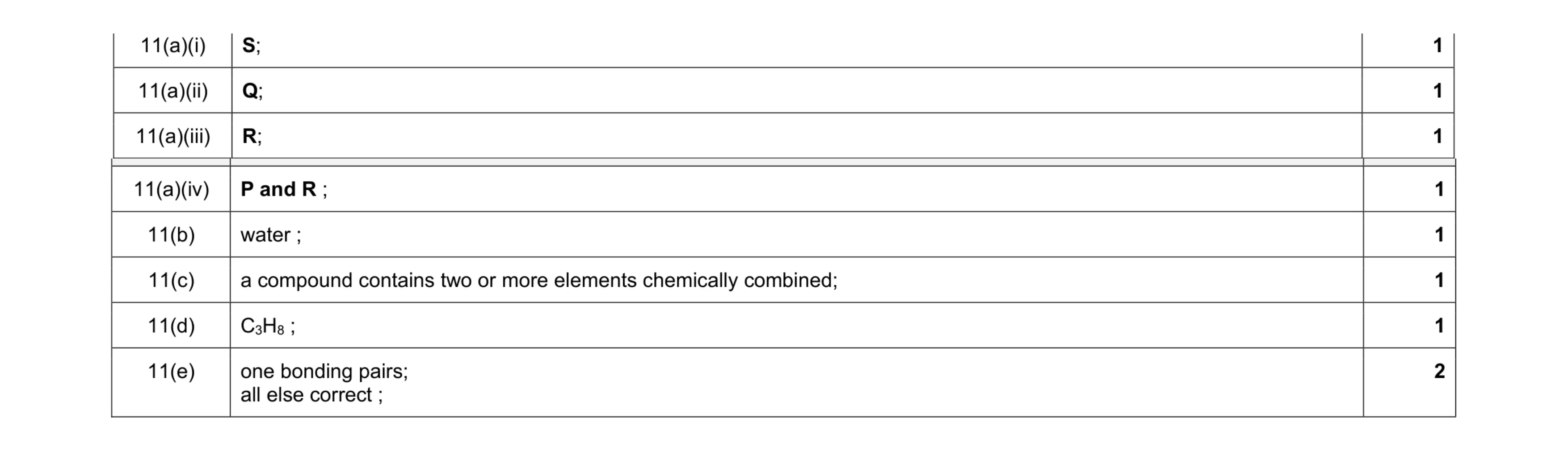 9
9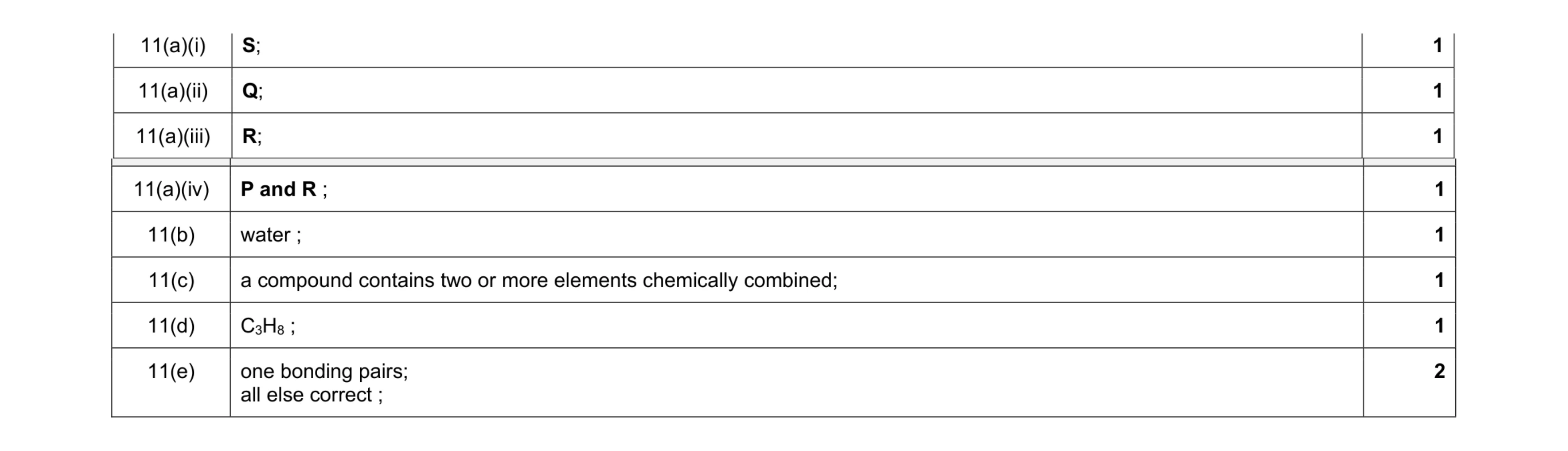 9
9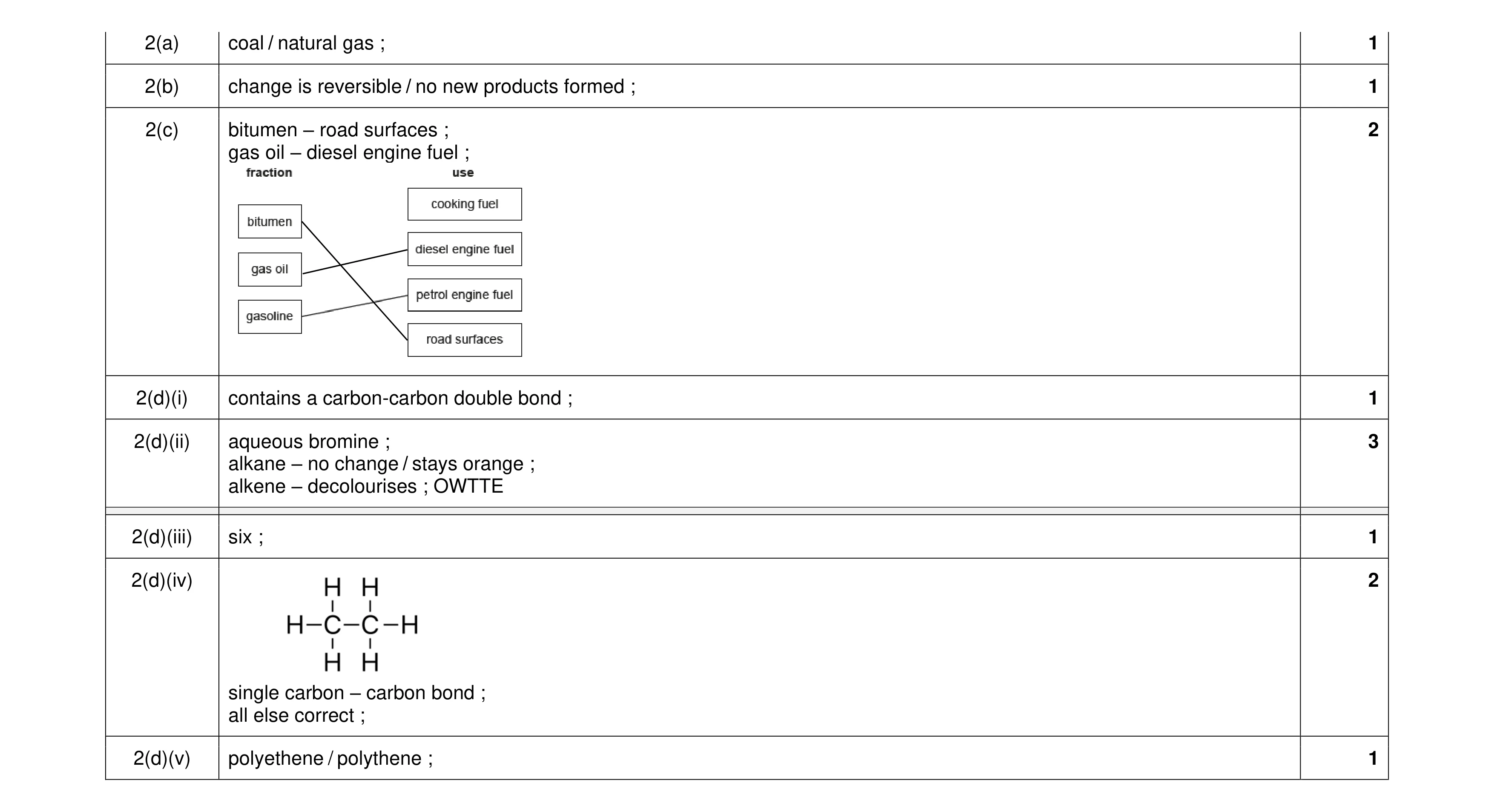 12
12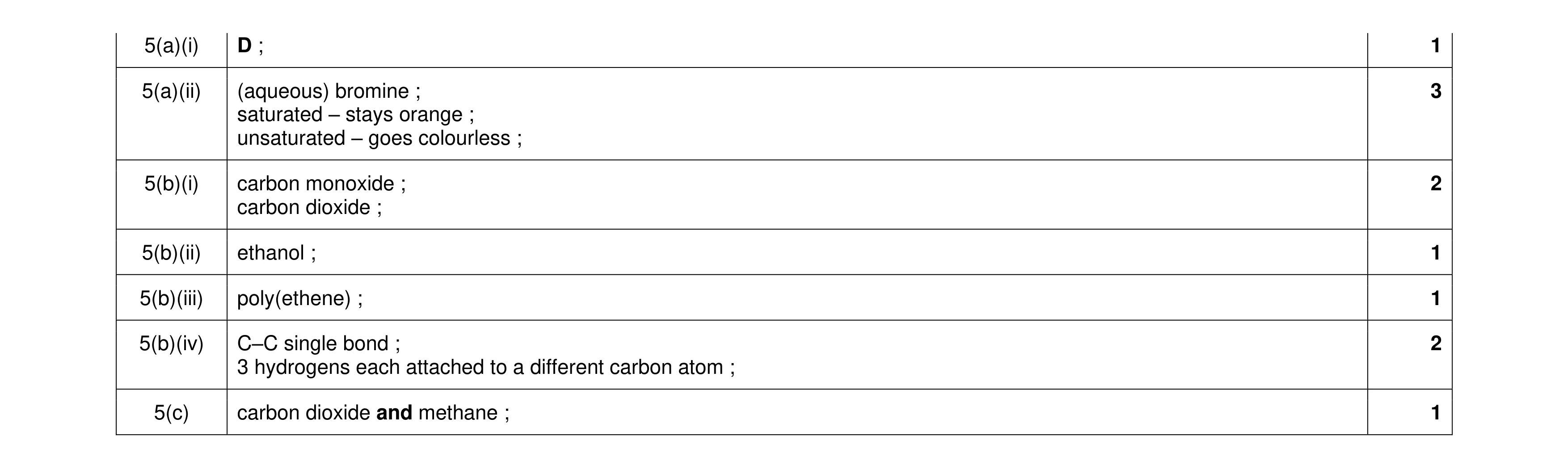 11
11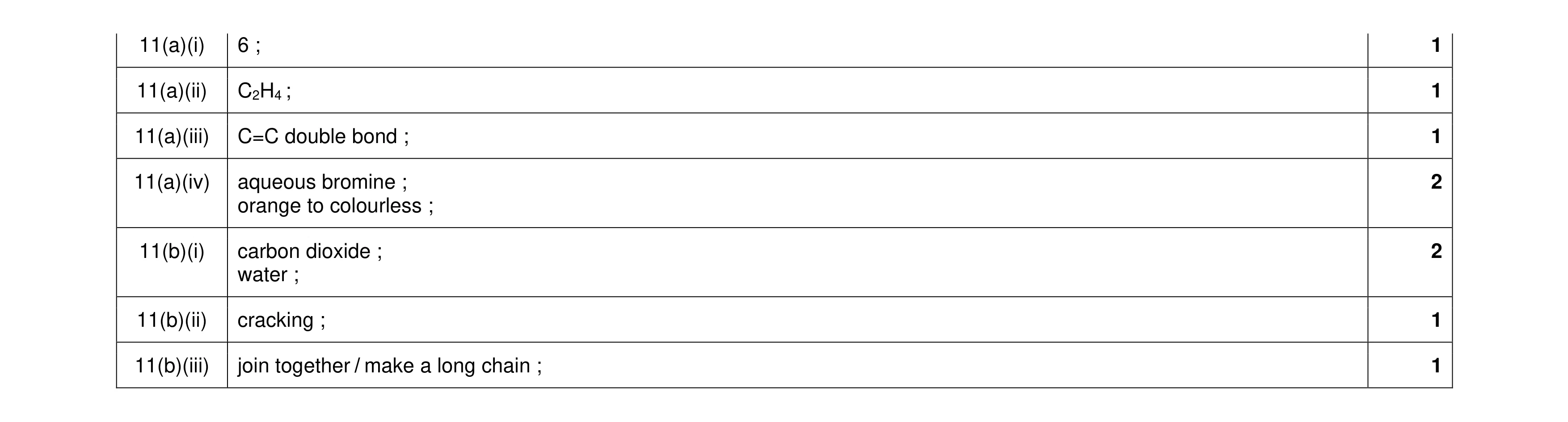 9
9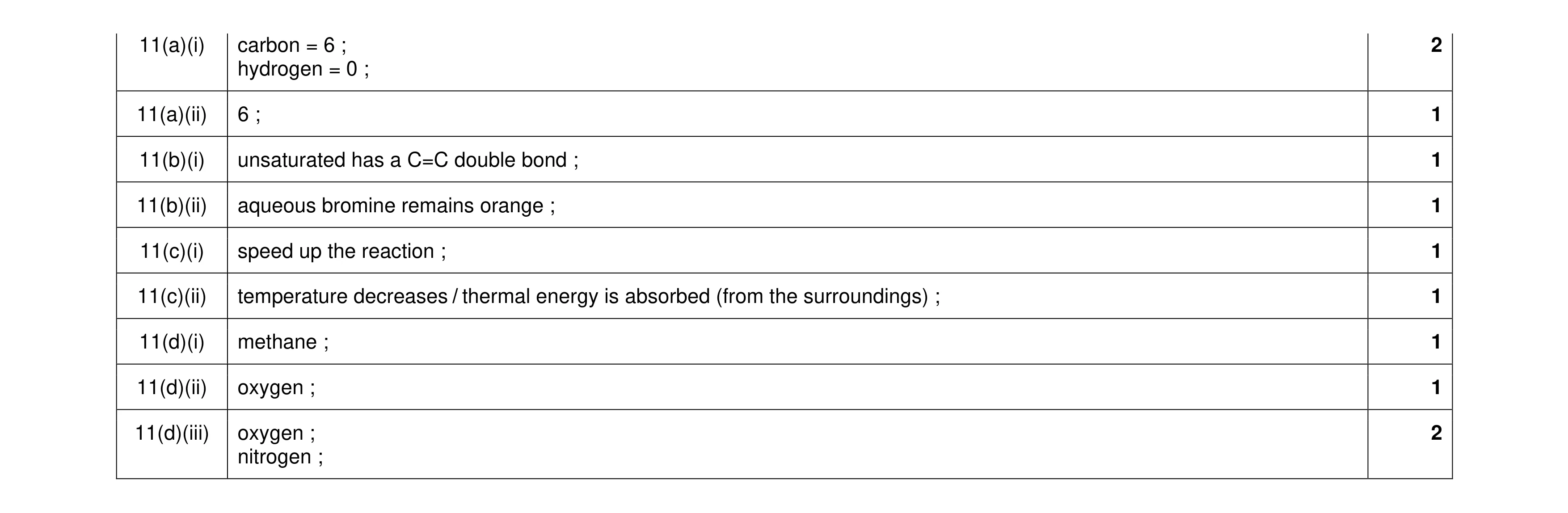 11
11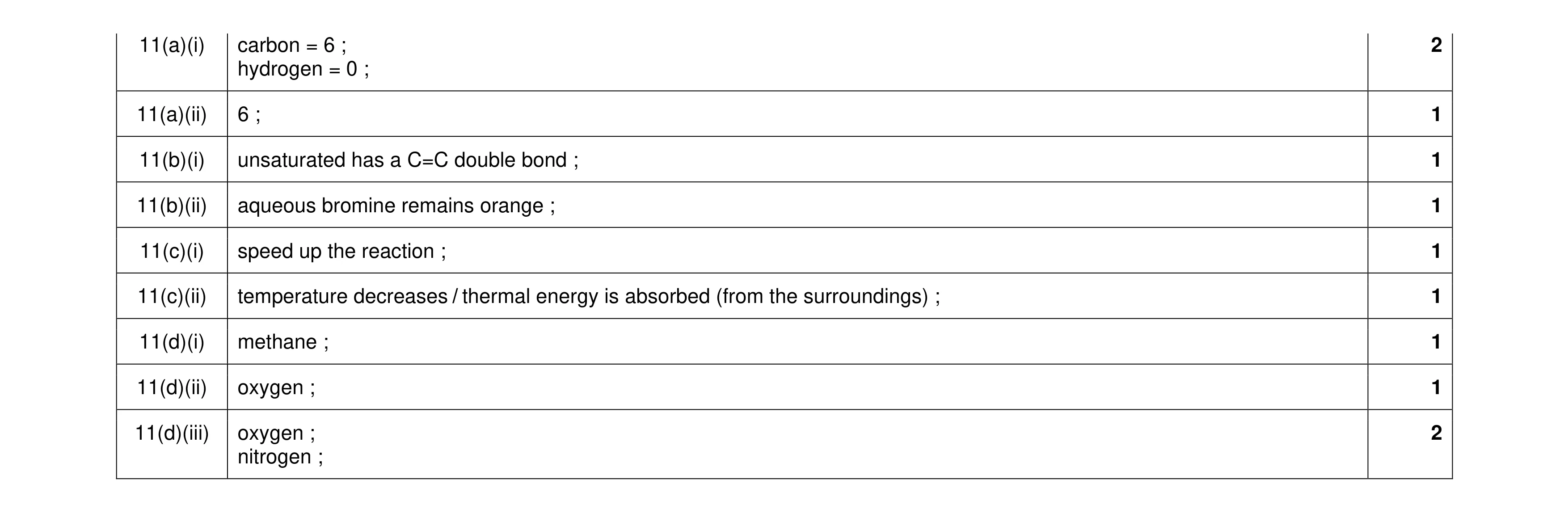 11
11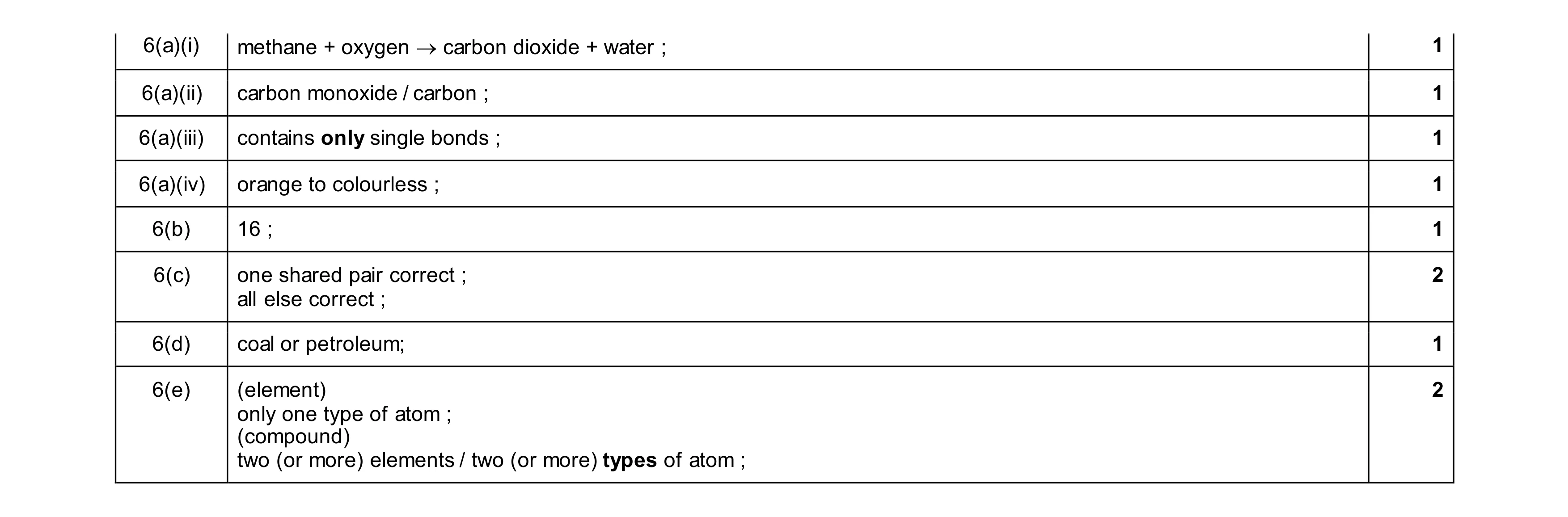 10
10