Questions as text
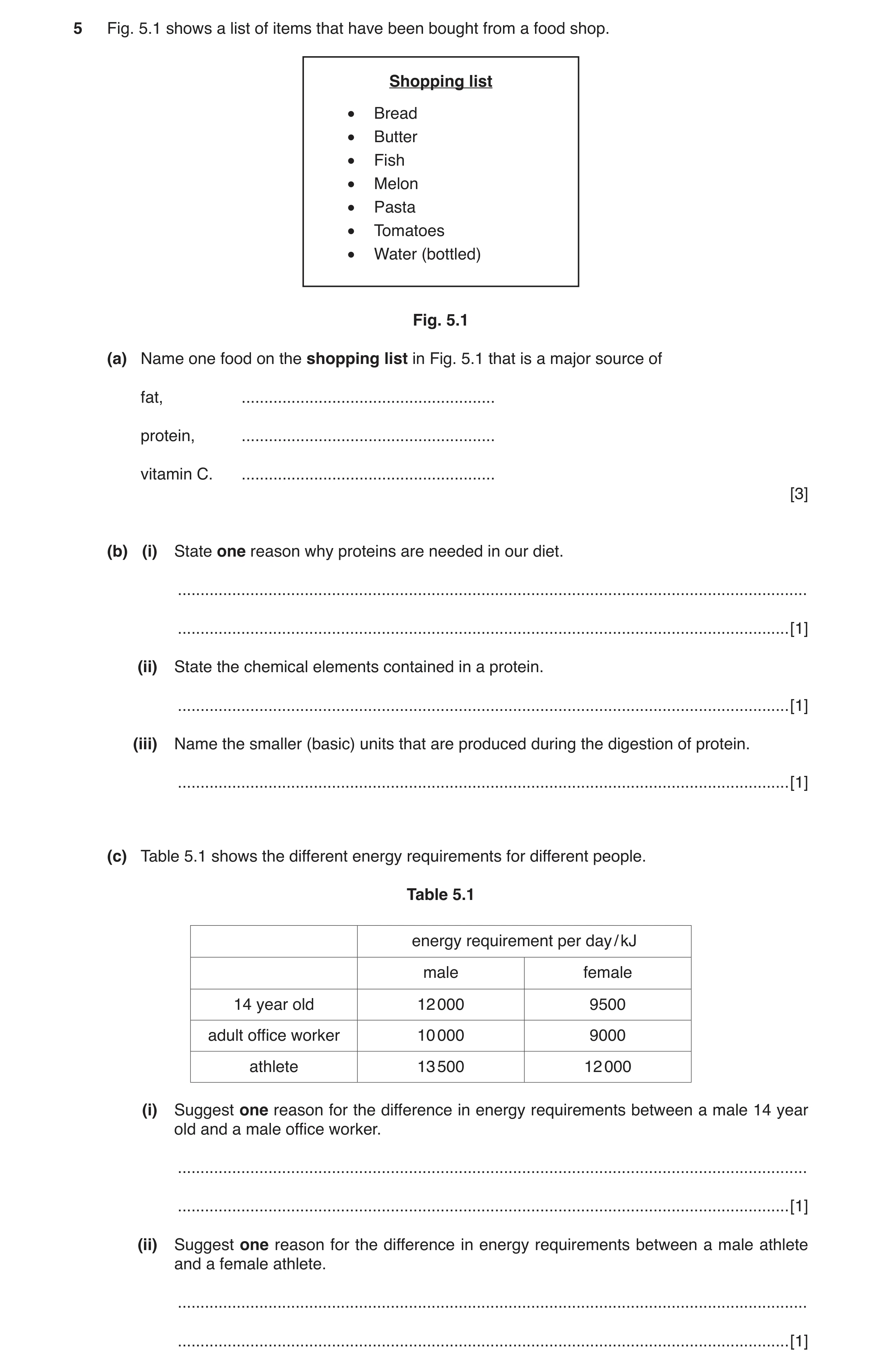
Q1 · A list of items that have been bought from a food shop 0654/31 May/June 2017
5 Fig. 5.1 shows a list of items that have been bought from a food shop. Shopping list • Bread • Butter • Fish • Melon • Pasta • Tomatoes • Water (bottled) Fig. 5.1 (a) Name one food on the shopping list in Fig. 5.1 that is a major source of fat, … protein, … vitamin C. … [3] (b) (i) State one reason why proteins are needed in our diet. … … [1] (ii) State the chemical elements contained in a protein. … [1] (iii) Name the smaller (basic) units that are produced during the digestion of protein. … [1] (c) Table 5.1 shows the different energy requirements for different people. Table 5.1 energy requirement per day / kJ male female 14 year old 12 000 9500 adult office worker 10 000 9000 athlete 13 500 12 000 (i) Suggest one reason for the difference in energy requirements between a male 14 year old and a male office worker. … … [1] (ii) Suggest one reason for the difference in energy requirements between a male athlete and a female athlete. … … [1]
8 marks
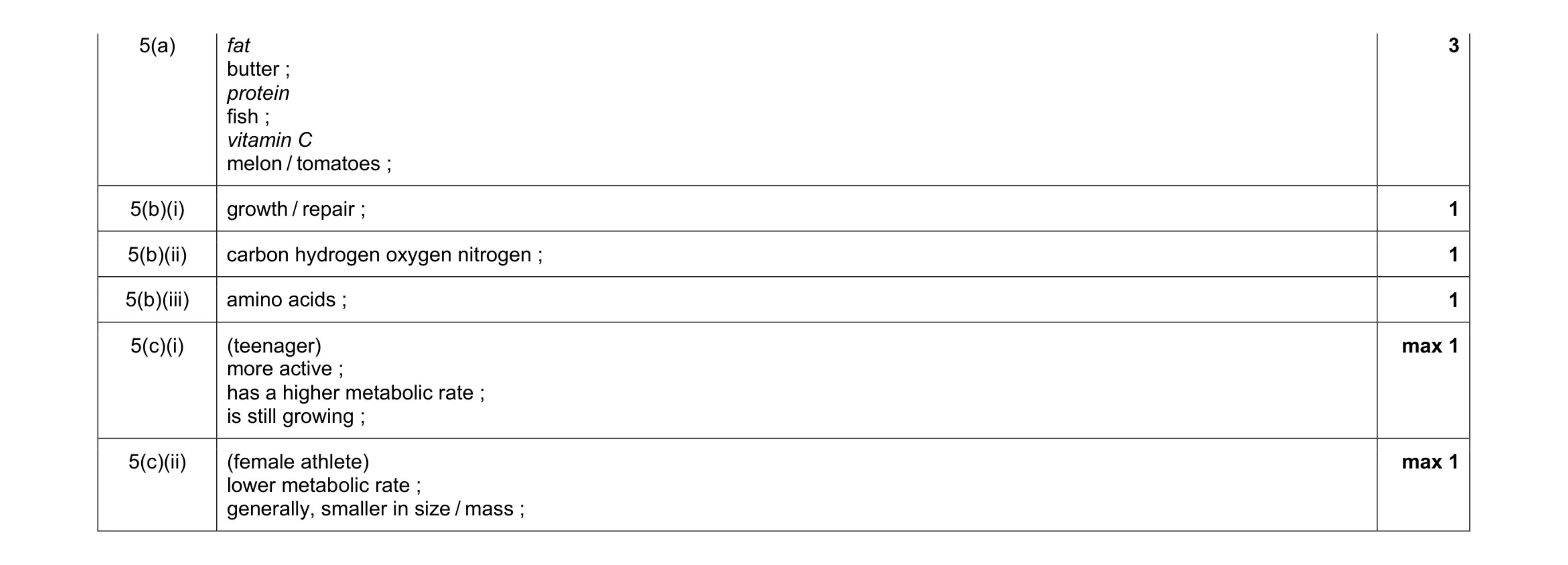
Mark scheme: 5(a) fat butter ; protein fish ; vitamin C melon / tomatoes ; 3 5(b)(i) growth / repair ; 1 5(b)(ii) carbon hydrogen oxygen nitrogen ; 1 5(b)(iii) amino acids ; 1 5(c)(i) (teenager) more active ; has a higher metabolic rate ; is still growing ; max 1 5(c)(ii) (female athlete) lower metabolic rate ; generally, smaller in size / mass ; max 1
This question in 0654/31 May/June 2017
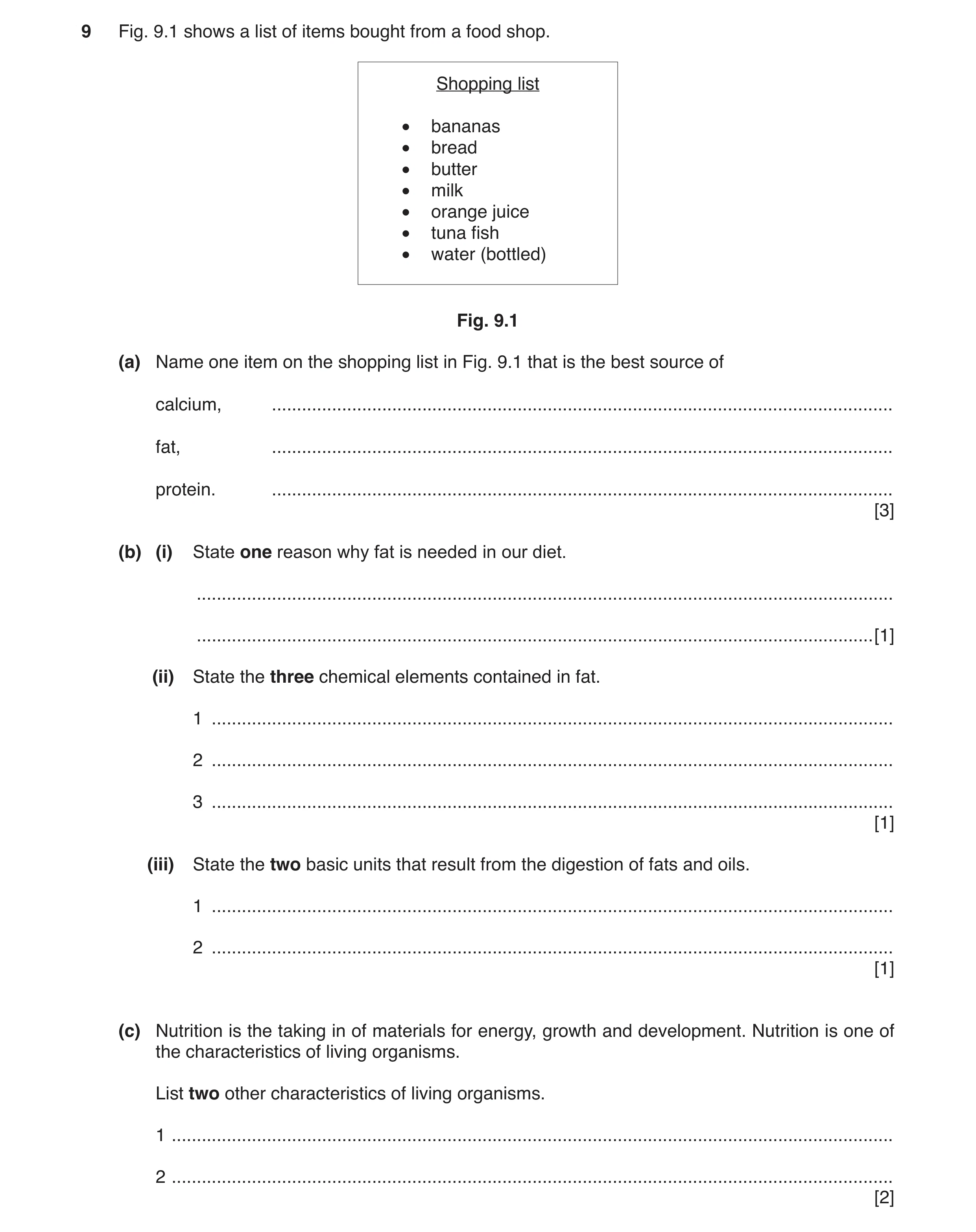
Q2 · A list of items bought from a food shop 0654/33 May/June 2017
9 Fig. 9.1 shows a list of items bought from a food shop. Shopping list • bananas • bread • butter • milk • orange juice • tuna fish • water (bottled) Fig. 9.1 (a) Name one item on the shopping list in Fig. 9.1 that is the best source of calcium, … fat, … protein. … [3] (b) (i) State one reason why fat is needed in our diet. … … [1] (ii) State the three chemical elements contained in fat. 1 … 2 … 3 … [1] (iii) State the two basic units that result from the digestion of fats and oils. 1 … 2 … [1] (c) Nutrition is the taking in of materials for energy, growth and development. Nutrition is one of the characteristics of living organisms. List two other characteristics of living organisms. 1 … 2 … [2]
8 marks
Mark scheme: 9(a) milk ; butter ; tuna fish ; 3 9(b)(i) provide energy / insulation ; 1 9(b)(ii) carbon, hydrogen and oxygen ; 1 9(b)(iii) fatty acids and glycerol ; 1 9(c) any two of the following movement respiration excretion sensitivity reproduction growth ;; max 2
This question in 0654/33 May/June 2017
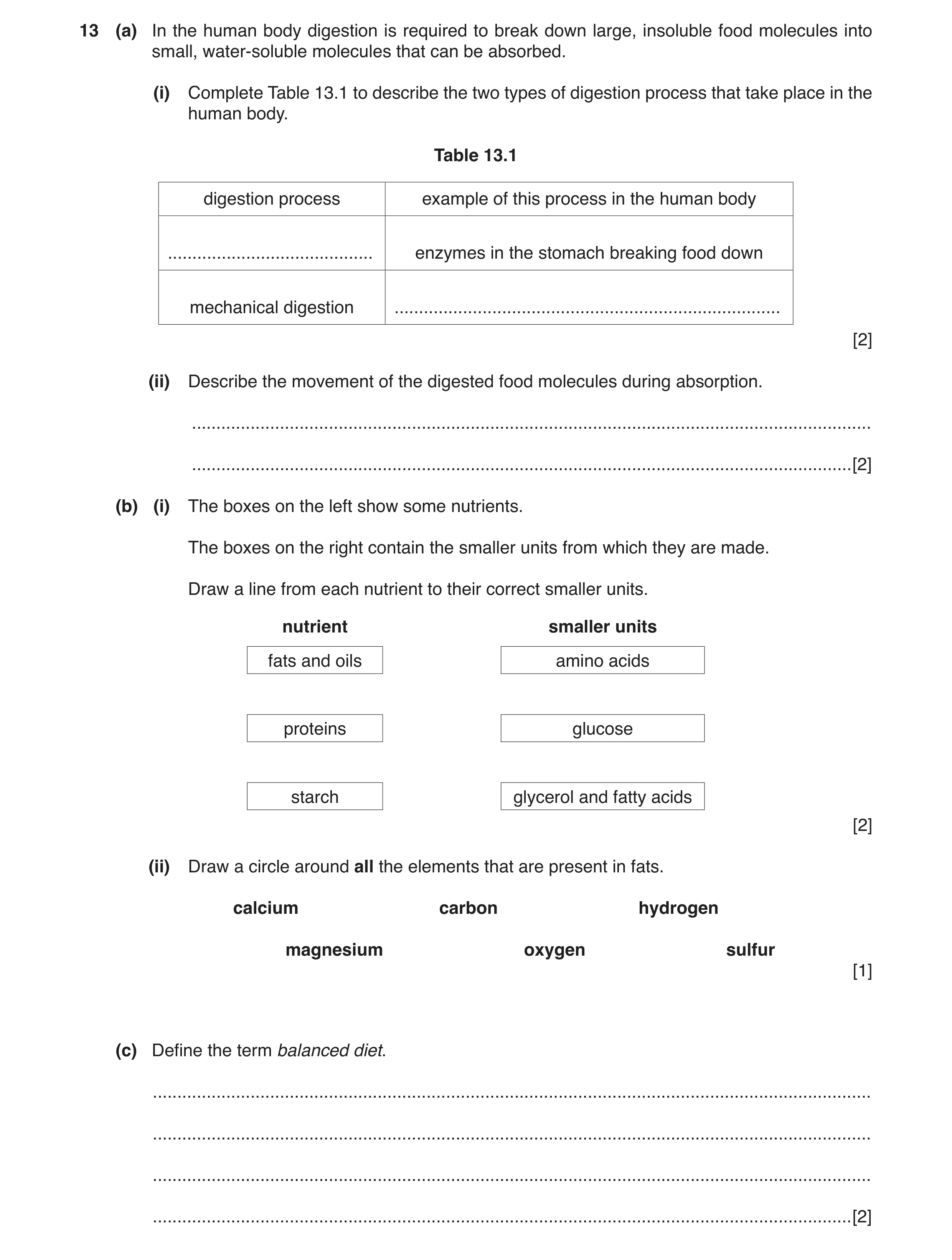
Q3 · In the human body digestion is required to break down large, insoluble food molecules… 0654/32 Oct/Nov 2018
13 (a) In the human body digestion is required to break down large, insoluble food molecules into small, water‑soluble molecules that can be absorbed. (i) Complete Table 13.1 to describe the two types of digestion process that take place in the human body. Table 13.1 digestion process example of this process in the human body … enzymes in the stomach breaking food down mechanical digestion … [2] (ii) Describe the movement of the digested food molecules during absorption. … … [2] (b) (i) The boxes on the left show some nutrients. The boxes on the right contain the smaller units from which they are made. Draw a line from each nutrient to their correct smaller units. nutrient smaller units fats and oils amino acids proteins glucose starch glycerol and fatty acids [2] (ii) Draw a circle around all the elements that are present in fats. calcium carbon hydrogen magnesium oxygen sulfur [1] (c) Define the term balanced diet. … … … … [2]
9 marks
Mark scheme: 13(a)(i) digestion process example of this process in the human body chemical digestion enzymes in the stomach breaking food down mechanical digestion food chewed / ground by teeth owtte 2 13(a)(ii) (across wall of) small intestine; into the blood; 2 13(b)(i) nutrient smaller units fats and oils amino acids proteins glucose starch glycerol and fatty acids 1 or 2 correct; 3 correct; 2 13(b)(ii) carbon, hydrogen and oxygen circled; 1 13(c) (diet contains) all required nutrients; in sufficient / correct proportions; 2
This question in 0654/32 Oct/Nov 2018
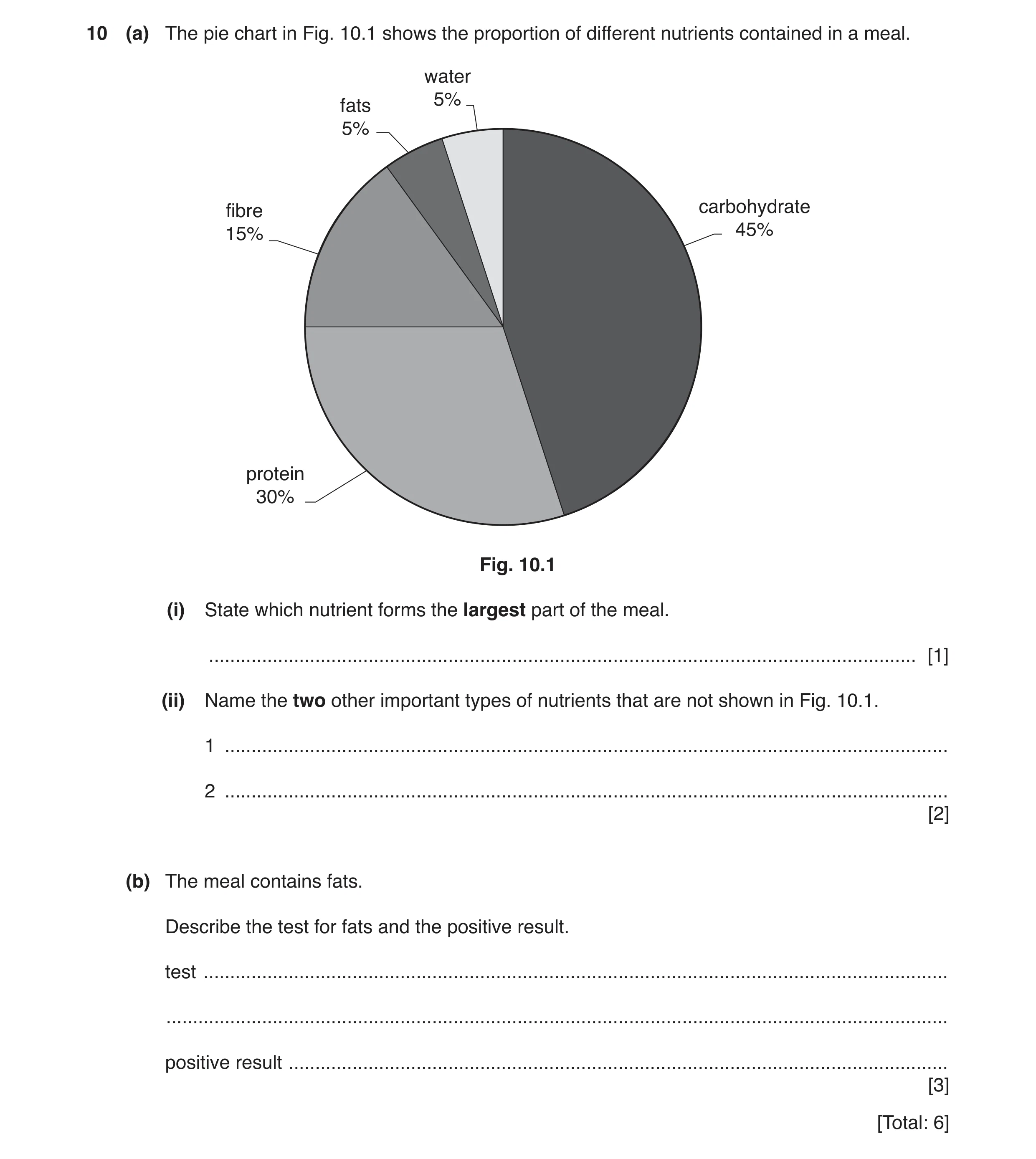
Q4 · The pie chart in Fig 0654/31 May/June 2019
10 (a) The pie chart in Fig. 10.1 shows the proportion of different nutrients contained in a meal. water 5% fats 5% fibre carbohydrate 15% 45% protein 30% Fig. 10.1 (i) State which nutrient forms the largest part of the meal. … [1] (ii) Name the two other important types of nutrients that are not shown in Fig. 10.1. 1 … 2 … [2] (b) The meal contains fats. Describe the test for fats and the positive result. test … … positive result … [3] [Total: 6]
6 marks
Mark scheme: 10(a)(i) carbohydrate ; 1 10(a)(ii) vitamins ; minerals ; 2 10(b) test add ethanol ; add water ; positive result emulsion ; 3
This question in 0654/31 May/June 2019
Q5 · In plants, glucose produced by photosynthesis is stored in leaves as starch 0654/32 Oct/Nov 2019
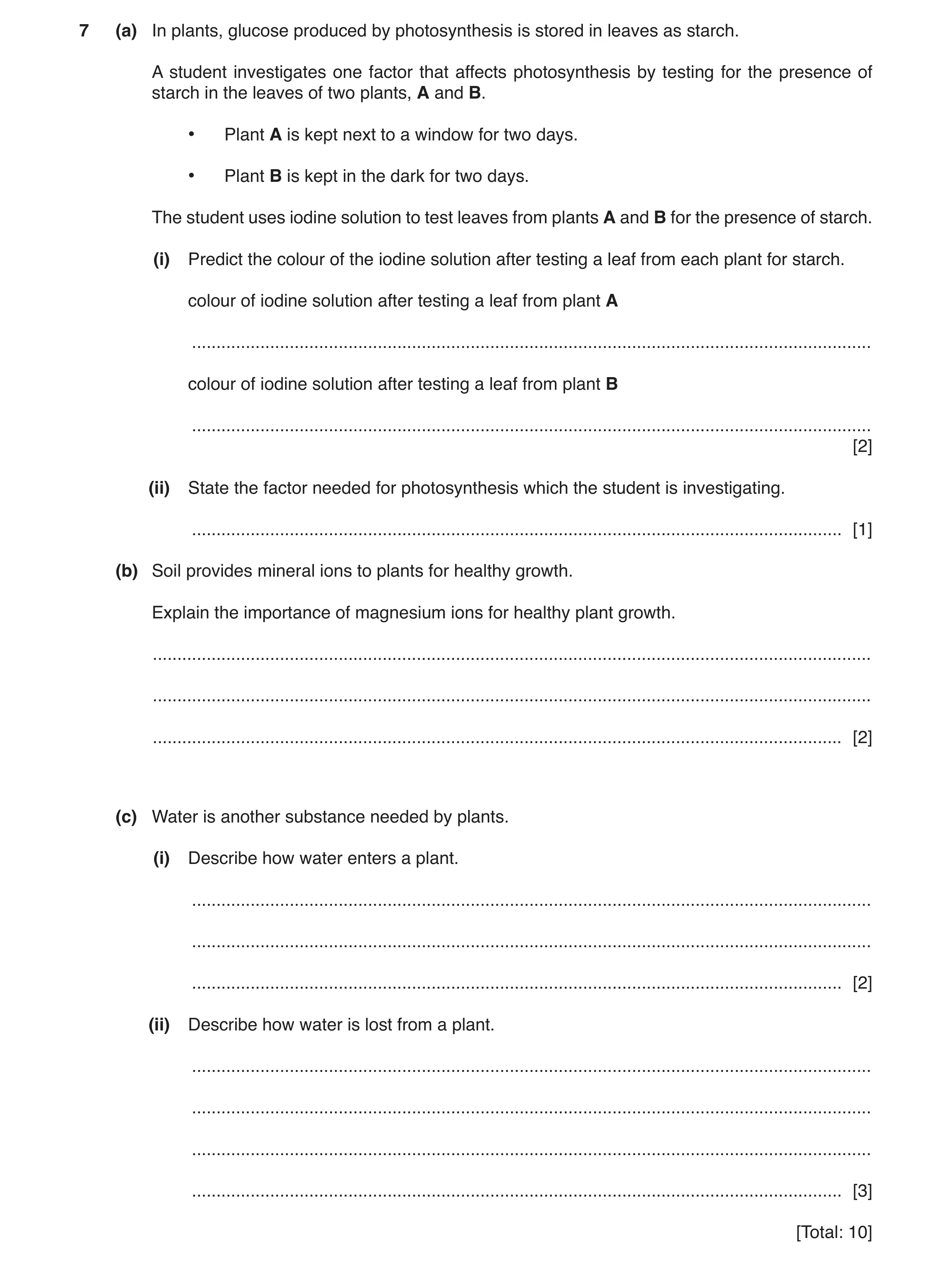
7 (a) In plants, glucose produced by photosynthesis is stored in leaves as starch. A student investigates one factor that affects photosynthesis by testing for the presence of starch in the leaves of two plants, A and B. • Plant A is kept next to a window for two days. • Plant B is kept in the dark for two days. The student uses iodine solution to test leaves from plants A and B for the presence of starch. (i) Predict the colour of the iodine solution after testing a leaf from each plant for starch. colour of iodine solution after testing a leaf from plant A … colour of iodine solution after testing a leaf from plant B … [2] (ii) State the factor needed for photosynthesis which the student is investigating. … [1] (b) Soil provides mineral ions to plants for healthy growth. Explain the importance of magnesium ions for healthy plant growth. … … … [2] (c) Water is another substance needed by plants. (i) Describe how water enters a plant. … … … [2] (ii) Describe how water is lost from a plant. … … … … [3] [Total: 10]
10 marks
Mark scheme: 7(a)(i) part A blue-black ; part B orange / yellow / brown ; 2 7(a)(ii) light ; 1 7(b) (magnesium ions are) needed for production of chlorophyll ; chlorophyll is necessary for photosynthesis ; 2 7(c)(i) (water enters) through the root hair cell ; by osmosis ; 2 7(c)(ii) ref. to transpiration ; evaporation of water (from mesophyll cells) ; diffusion (of water vapour) ; through the stomata ; max 3 3
This question in 0654/32 Oct/Nov 2019
Question 6 0654/32 Oct/Nov 2020
4 (a) In Fig. 4.1, the boxes on the left show some of the components of a balanced diet for an adult. The boxes on the right show some principal sources of these components. Draw four lines to link each component with its principal source. component principal source carbohydrate fish fat grapefruit protein noodles vitamin C olive oil [3] Fig. 4.1 (b) A person has to choose between two different menus, A and B. Fig. 4.2 shows each menu. Menu A Menu B meat burger and chicken, rice and potato chips mixed salad chocolate cake fruit and yoghurt Fig. 4.2 (i) A doctor advises a patient to eat menu B rather than menu A. Suggest two reasons why. 1 … … 2 … … [2] (ii) Both meals contain water. Table 4.1 lists some statements. Place a tick (3) to show the statement that describes why water is needed by the body. Table 4.1 as a reactant for respiration as a solvent to carry genetic information to carry oxygen in the blood to provide insulation for the body [1] (c) The food we ingest is absorbed and assimilated inside the body. (i) State where ingestion occurs. … [1] (ii) Describe one similarity and one difference between absorption and assimilation. similarity … … difference … … [2] (d) Nutrition is one of the characteristics of living things. Name two other characteristics. 1 … 2 … [2] [Total: 11]
11 marks
Mark scheme: 4(a) carbohydrate fish fats grapefruit protein noodles vitamin C olive oil ;;; 3 4(b)(i) any two from it has a greater variety of nutrients / food types ; also contains (more) fruit / vegetables ; contains less fats ; contains less sugar ; it contains more vitamins / minerals ; max 2 2 4(b)(ii) as a solvent ticked ; 1 4(c)(i) mouth ; 1 4(c)(ii) similarity – both involve movement of (digested) food; difference – absorption is into the blood / assimilation is into the cells ; 2 4(d) any two from movement ; respiration ; sensitivity ; growth ; excretion ; reproduction ; max 2 2
This question in 0654/32 Oct/Nov 2020
Q7 · It is recommended that people eat a balanced diet 0654/32 Feb/March 2021
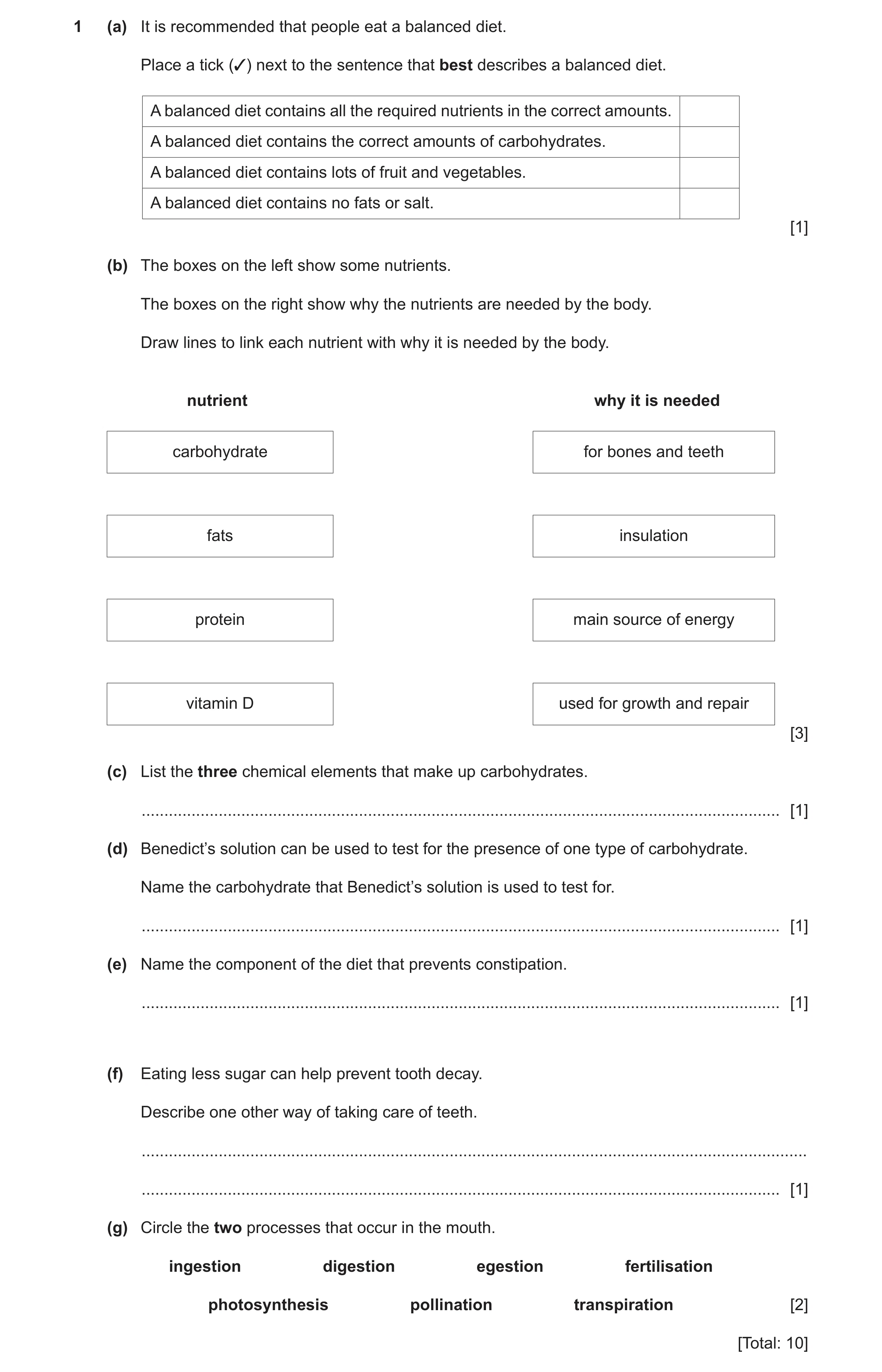
1 (a) It is recommended that people eat a balanced diet. Place a tick (3) next to the sentence that best describes a balanced diet. A balanced diet contains all the required nutrients in the correct amounts. A balanced diet contains the correct amounts of carbohydrates. A balanced diet contains lots of fruit and vegetables. A balanced diet contains no fats or salt. [1] (b) The boxes on the left show some nutrients. The boxes on the right show why the nutrients are needed by the body. Draw lines to link each nutrient with why it is needed by the body. nutrient why it is needed carbohydrate for bones and teeth fats insulation protein main source of energy vitamin D used for growth and repair [3] (c) List the three chemical elements that make up carbohydrates. … [1] (d) Benedict’s solution can be used to test for the presence of one type of carbohydrate. Name the carbohydrate that Benedict’s solution is used to test for. … [1] (e) Name the component of the diet that prevents constipation. … [1] (f) Eating less sugar can help prevent tooth decay. Describe one other way of taking care of teeth. … … [1] (g) Circle the two processes that occur in the mouth. ingestion digestion egestion fertilisation photosynthesis pollination transpiration [2] [Total: 10]
10 marks
Mark scheme: 1(a) A diet containing all the required nutrients in the correct amounts ticked ; 1 1(b) carbohydrate for bones and teeth fats insulation protein main source of energy vitamin D used for growth and repair ;;; 3 1(c) carbon, hydrogen and oxygen ; 1 1(d) (reducing) sugar ; 1 1(e) fibre ; 1 1(f) regular brushing / AVP ; 1 1(g) ingestion circled ; digestion circled ; 2
This question in 0654/32 Feb/March 2021
Q8 · State the word equation for photosynthesis 0654/32 Oct/Nov 2021
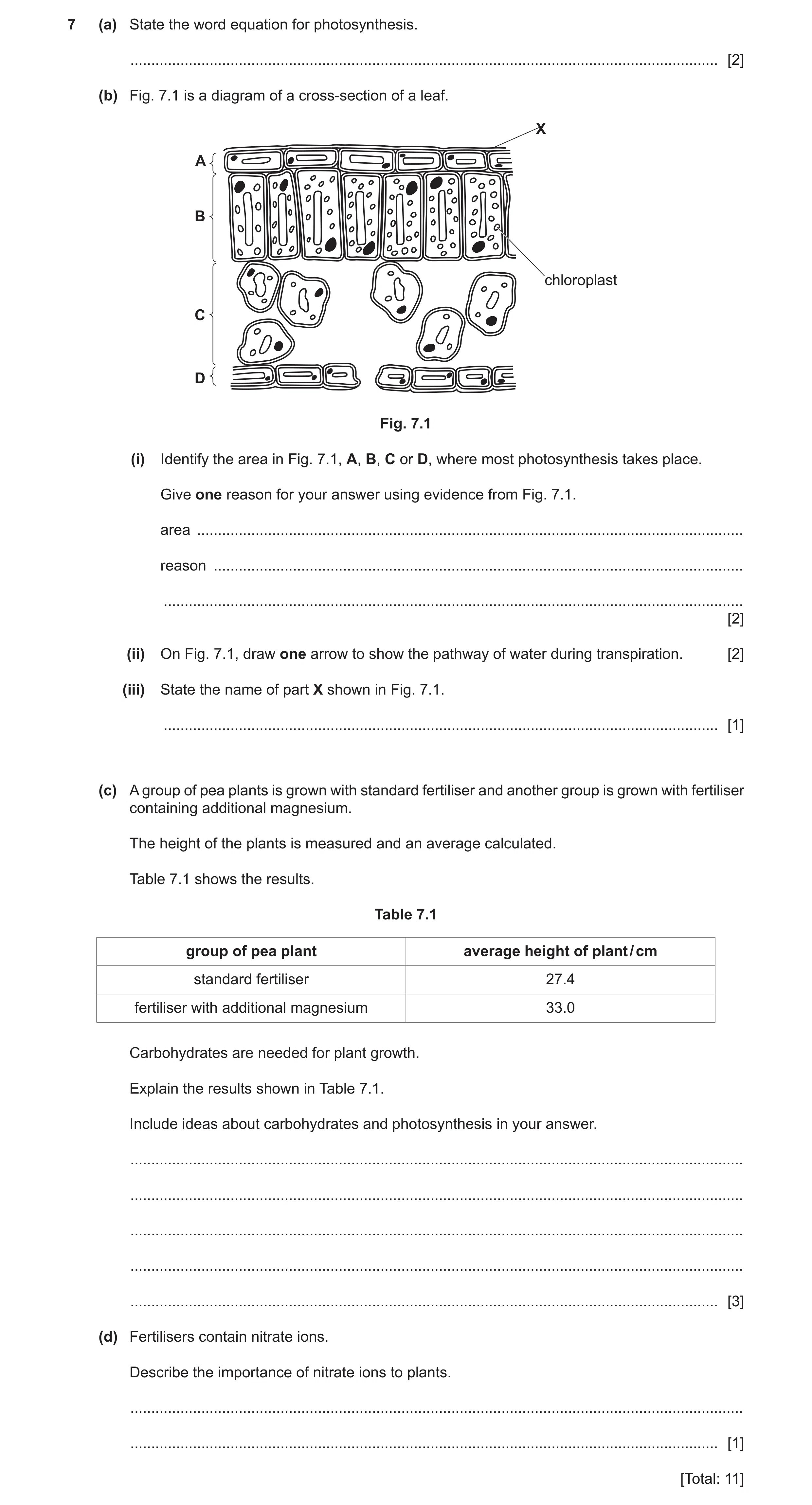
7 (a) State the word equation for photosynthesis. … [2] (b) Fig. 7.1 is a diagram of a cross‑section of a leaf. X A B chloroplast C D Fig. 7.1 (i) Identify the area in Fig. 7.1, A, B, C or D, where most photosynthesis takes place. Give one reason for your answer using evidence from Fig. 7.1. area … reason … … [2] (ii) On Fig. 7.1, draw one arrow to show the pathway of water during transpiration. [2] (iii) State the name of part X shown in Fig. 7.1. … [1] (c) A group of pea plants is grown with standard fertiliser and another group is grown with fertiliser containing additional magnesium. The height of the plants is measured and an average calculated. Table 7.1 shows the results. Table 7.1 group of pea plant average height of plant / cm standard fertiliser 27.4 fertiliser with additional magnesium 33.0 Carbohydrates are needed for plant growth. Explain the results shown in Table 7.1. Include ideas about carbohydrates and photosynthesis in your answer. … … … … … [3] (d) Fertilisers contain nitrate ions. Describe the importance of nitrate ions to plants. … … [1] [Total: 11]
11 marks
Mark scheme: 7(a) carbon dioxide + water → glucose + oxygen ;; 2 7(b)(i) B ; area with the most chloroplasts ; 2 7(b)(ii) arrow starting at the surface of any of the mesophyll cells ; pointing to / through, the stomata ; 2 7(b)(iii) cuticle ; 1 7(c) magnesium required to produce chlorophyll ; chlorophyll is required for photosynthesis ; photosynthesis produces carbohydrates (for growth) ; 3 7(d) nitrate ions are needed to produce amino acids ; 1
This question in 0654/32 Oct/Nov 2021
Q9 · A person keeps a food diary for one day 0654/31 Oct/Nov 2022
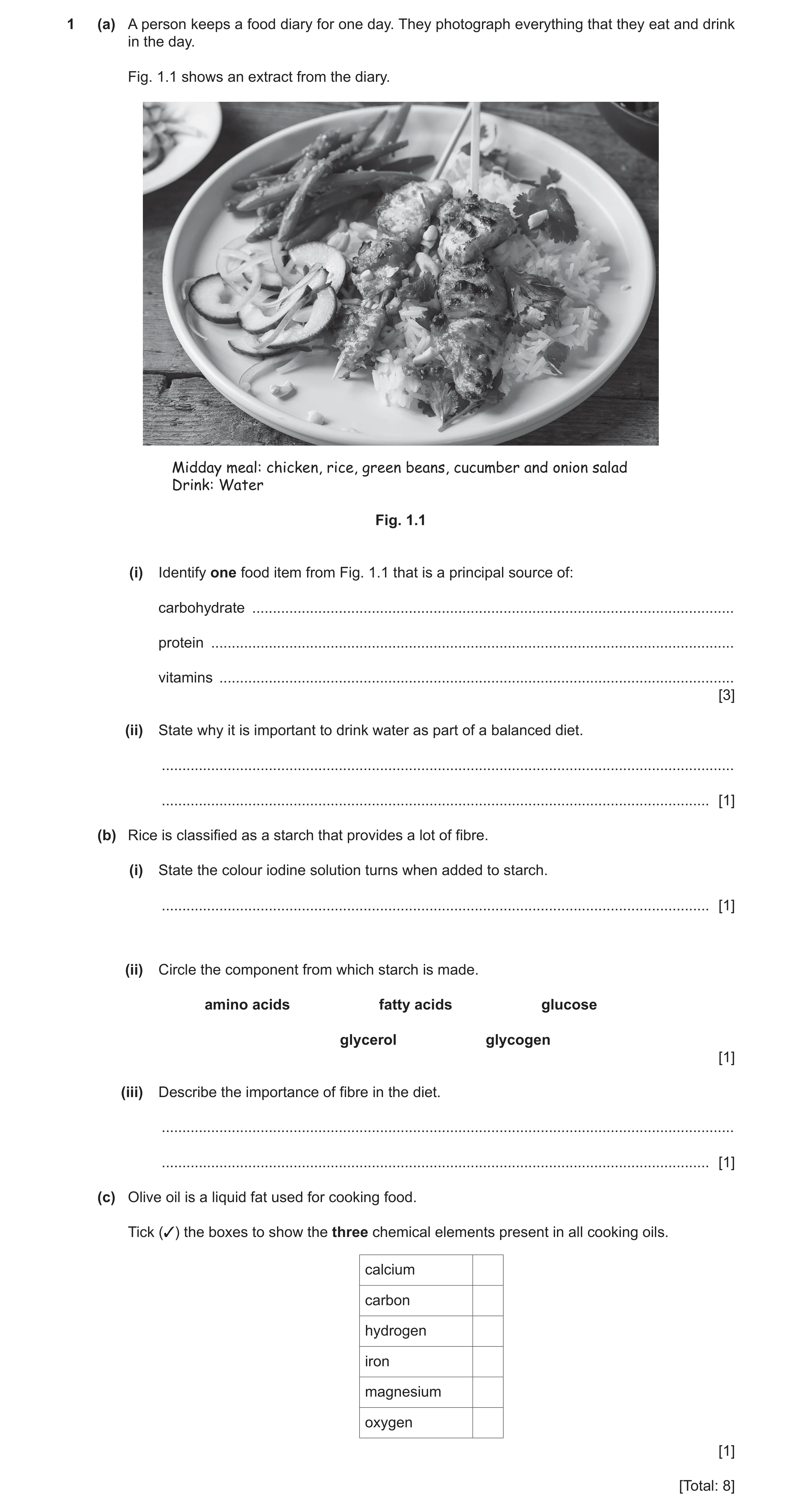
1 (a) A person keeps a food diary for one day. They photograph everything that they eat and drink in the day. Fig. 1.1 shows an extract from the diary. Midday meal: chicken, rice, green beans, cucumber and onion salad Drink: Water Fig. 1.1 (i) Identify one food item from Fig. 1.1 that is a principal source of: carbohydrate … protein … vitamins … [3] (ii) State why it is important to drink water as part of a balanced diet. … … [1] (b) Rice is classified as a starch that provides a lot of fibre. (i) State the colour iodine solution turns when added to starch. … [1] (ii) Circle the component from which starch is made. amino acids fatty acids glucose glycerol glycogen [1] (iii) Describe the importance of fibre in the diet. … … [1] (c) Olive oil is a liquid fat used for cooking food. Tick (3) the boxes to show the three chemical elements present in all cooking oils. calcium carbon hydrogen iron magnesium oxygen [1] [Total: 8]
8 marks
Mark scheme: Question Answer Marks 1(a)(i) rice ; 3 chicken ; (green) beans / cucumber / onions / salad ; 1(a)(ii) as a solvent / any valid point ; 1 1(b)(i) blue-black ; 1 1(b)(ii) glucose circled ; 1 1(b)(iii) prevents constipation / keeps food moving through the gut ; 1 1(c) carbon, hydrogen and oxygen ticked ; 1
This question in 0654/31 Oct/Nov 2022
Q10 · A diagram of the alimentary canal and associated organs in a human 0654/33 Oct/Nov 2022
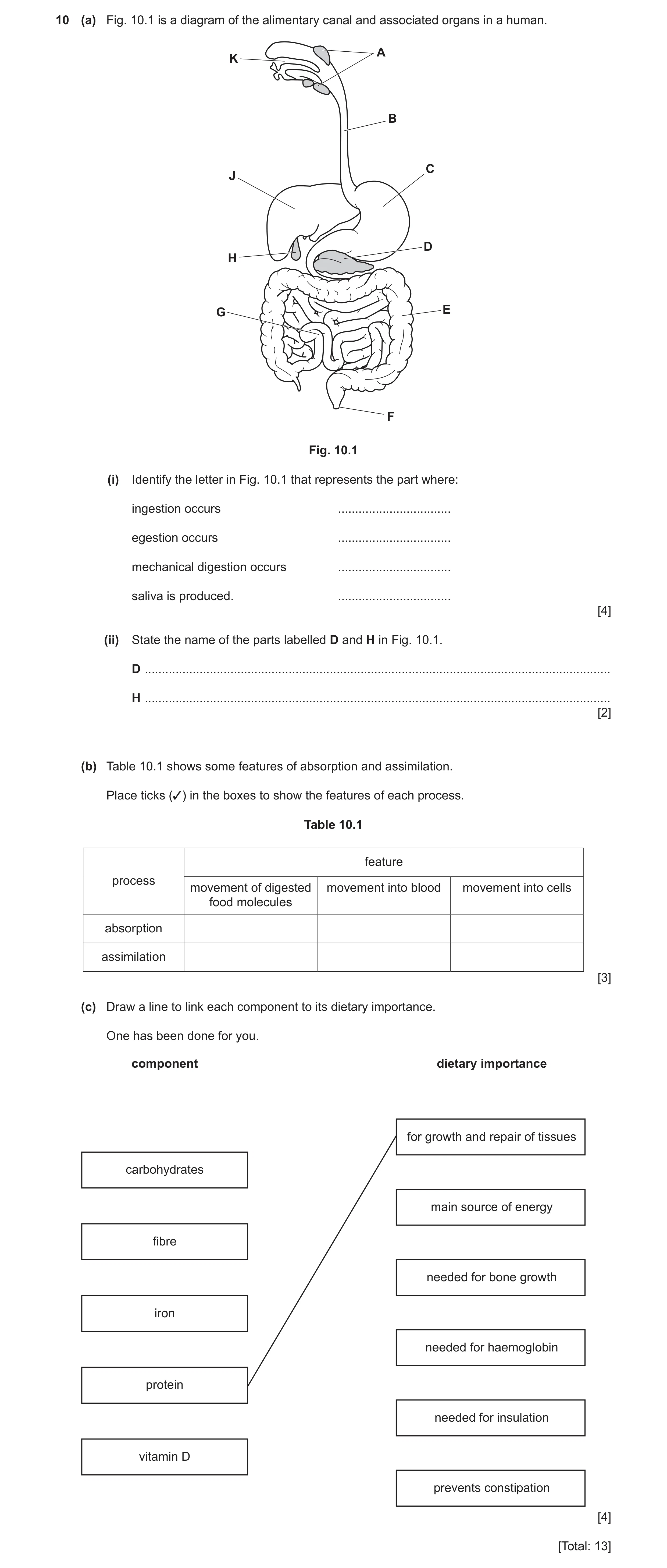
10 (a) Fig. 10.1 is a diagram of the alimentary canal and associated organs in a human. A K B C J D H G E F Fig. 10.1 (i) Identify the letter in Fig. 10.1 that represents the part where: ingestion occurs … egestion occurs … mechanical digestion occurs … saliva is produced. … [4] (ii) State the name of the parts labelled D and H in Fig. 10.1. D … H … [2] (b) Table 10.1 shows some features of absorption and assimilation. Place ticks (3) in the boxes to show the features of each process. Table 10.1 feature process movement of digested movement into blood movement into cells food molecules absorption assimilation [3] (c) Draw a line to link each component to its dietary importance. One has been done for you. component dietary importance for growth and repair of tissues carbohydrates main source of energy fibre needed for bone growth iron needed for haemoglobin protein needed for insulation vitamin D prevents constipation [4] [Total: 13]
13 marks
Mark scheme: 10(a)(i) K ; 4 F ; K / C ; A ; 10(a)(ii) D – pancreas ; 2 H – gall bladder ; 10(b) 3 feature process movement of movement into movement into digested food blood cells molecules absorption assimilation ;;; 1 mark for each column 10(c) 4 for growth and repair of tissues carbohydrates main source of energy fibre needed for bone growth iron needed for haemoglobin protein needed for insulation vitamin D prevents constipation ;;;; 1 mark for each correct link
This question in 0654/33 Oct/Nov 2022
Q11 · A diagram of the alimentary canal and associated organs 0654/32 Oct/Nov 2023
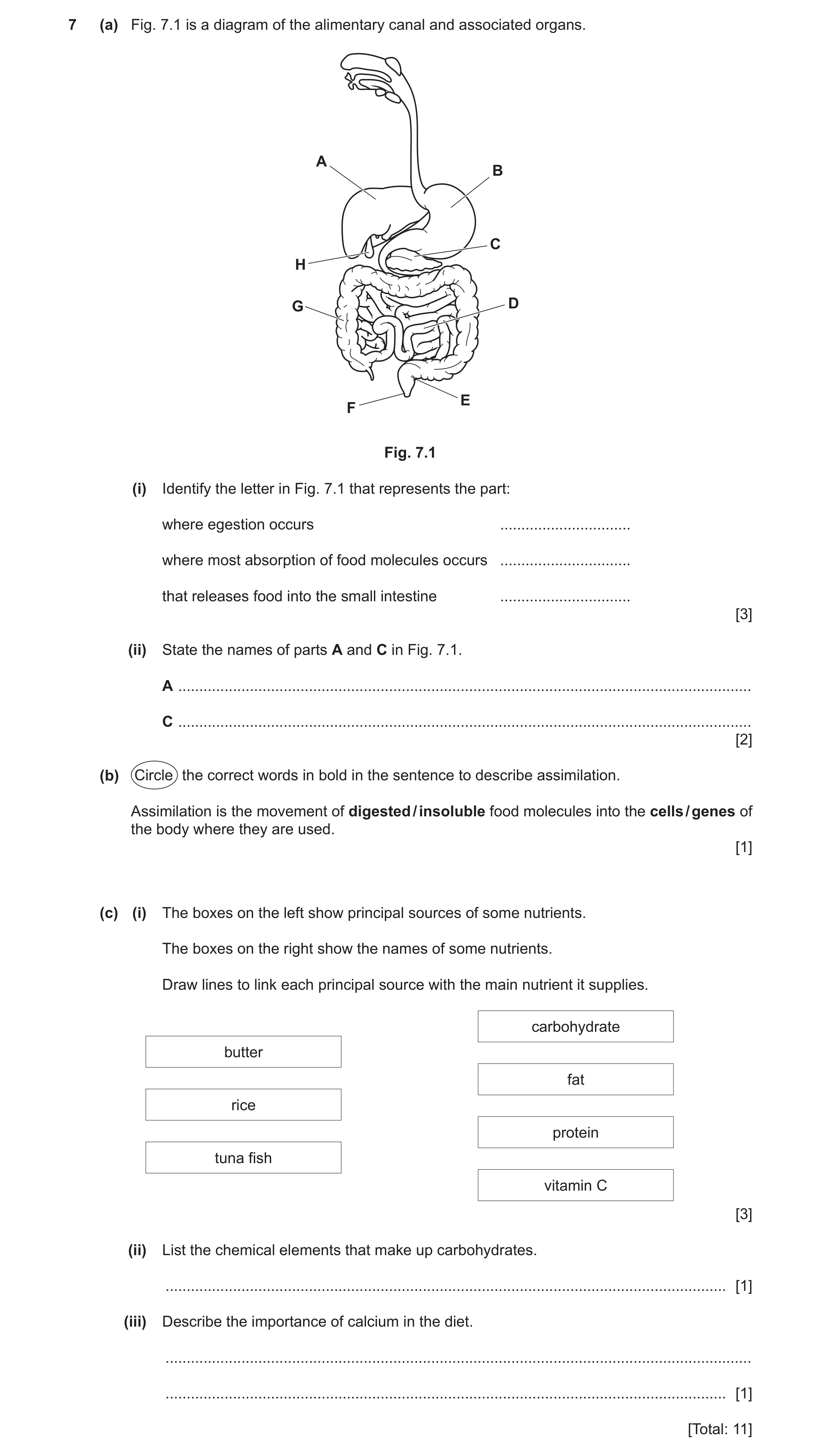
7 (a) Fig. 7.1 is a diagram of the alimentary canal and associated organs. A B C H G D E F Fig. 7.1 (i) Identify the letter in Fig. 7.1 that represents the part: where egestion occurs … where most absorption of food molecules occurs … that releases food into the small intestine … [3] (ii) State the names of parts A and C in Fig. 7.1. A … C … [2] (b) Circle the correct words in bold in the sentence to describe assimilation. Assimilation is the movement of digested / insoluble food molecules into the cells / genes of the body where they are used. [1] (c) (i) The boxes on the left show principal sources of some nutrients. The boxes on the right show the names of some nutrients. Draw lines to link each principal source with the main nutrient it supplies. carbohydrate butter fat rice protein tuna fish vitamin C [3] (ii) List the chemical elements that make up carbohydrates. … [1] (iii) Describe the importance of calcium in the diet. … … [1] [Total: 11]
11 marks
Mark scheme: 7(a)(i) F ; 3 D ; B ; 7(a)(ii) A – liver ; 2 C – pancreas ; 7(b) digested and cells ; 1 7(c)(i) 3 carbohydrate butter fat rice protein tuna fish vitamin C ;;; 7(c)(ii) carbon, hydrogen, oxygen ; 1 7(c)(iii) strengthen bones / teeth ; 1
This question in 0654/32 Oct/Nov 2023
Q12 · A student investigates the effect of light on an aquatic plant 0654/32 May/June 2024
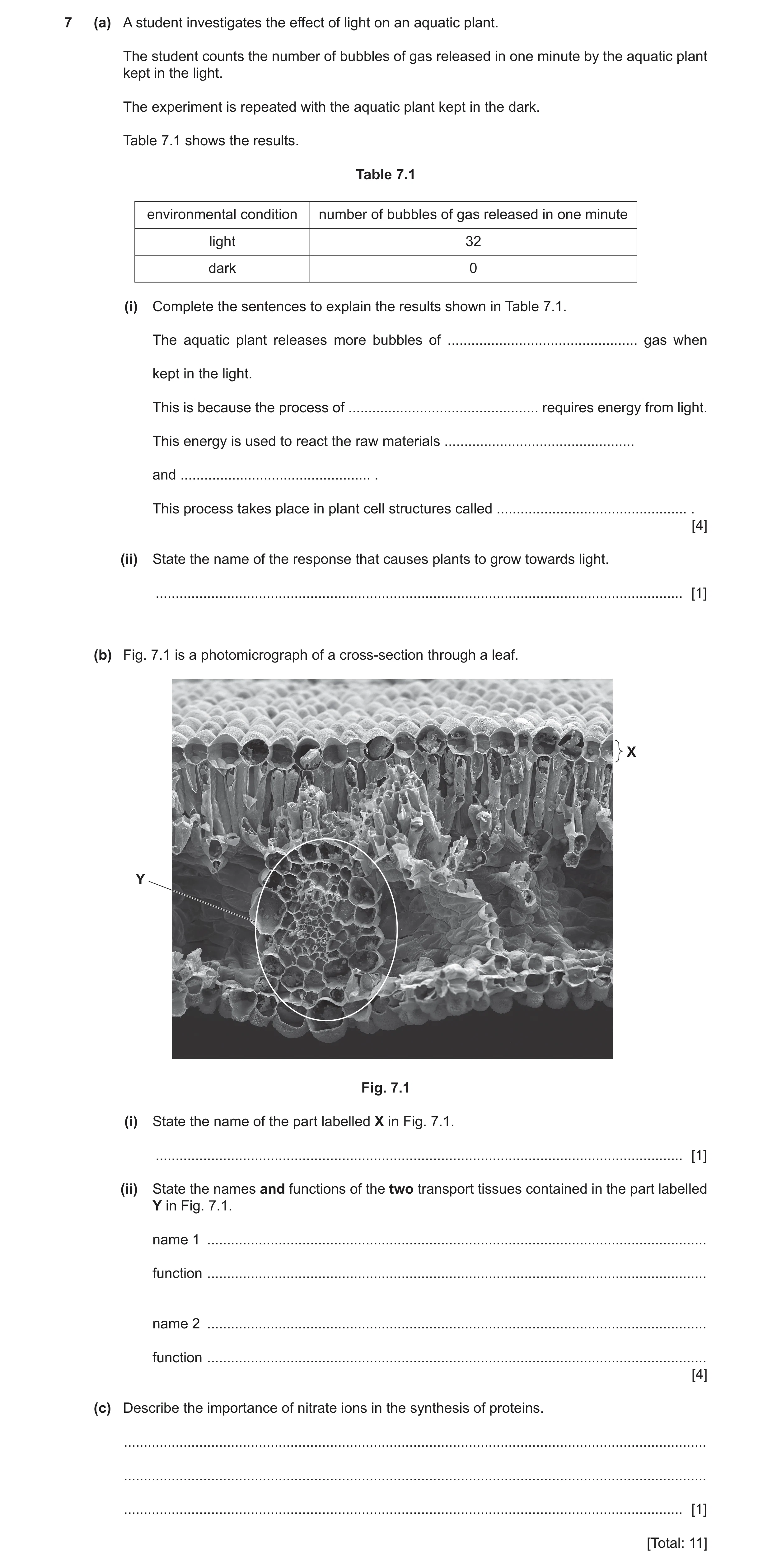
7 (a) A student investigates the effect of light on an aquatic plant. The student counts the number of bubbles of gas released in one minute by the aquatic plant kept in the light. The experiment is repeated with the aquatic plant kept in the dark. Table 7.1 shows the results. Table 7.1 environmental condition number of bubbles of gas released in one minute light 32 dark 0 (i) Complete the sentences to explain the results shown in Table 7.1. The aquatic plant releases more bubbles of … gas when kept in the light. This is because the process of … requires energy from light. This energy is used to react the raw materials … and … . This process takes place in plant cell structures called … . [4] (ii) State the name of the response that causes plants to grow towards light. … [1] (b) Fig. 7.1 is a photomicrograph of a cross‑section through a leaf. X Y Fig. 7.1 (i) State the name of the part labelled X in Fig. 7.1. … [1] (ii) State the names and functions of the two transport tissues contained in the part labelled Y in Fig. 7.1. name 1 … function … name 2 … function … [4] (c) Describe the importance of nitrate ions in the synthesis of proteins. … … … [1] [Total: 11]
11 marks
Mark scheme: 7(a)(i) oxygen ; photosynthesis ; carbon dioxide and water ; chloroplasts ; 4 7(a)(ii) phototropism ; 1 7(b)(i) (upper) epidermis ; 1 Question Answer Marks 7(b)(ii) xylem ; transports mineral ions / water or xylem is for support (of leaf) ; phloem ; transports dissolved sugars ; 4 7(c) nitrates are required to synthesise, amino acids (which make proteins) ; 1
This question in 0654/32 May/June 2024
Q13 · A photomicrograph of a cross-section through a root 0654/32 Oct/Nov 2024
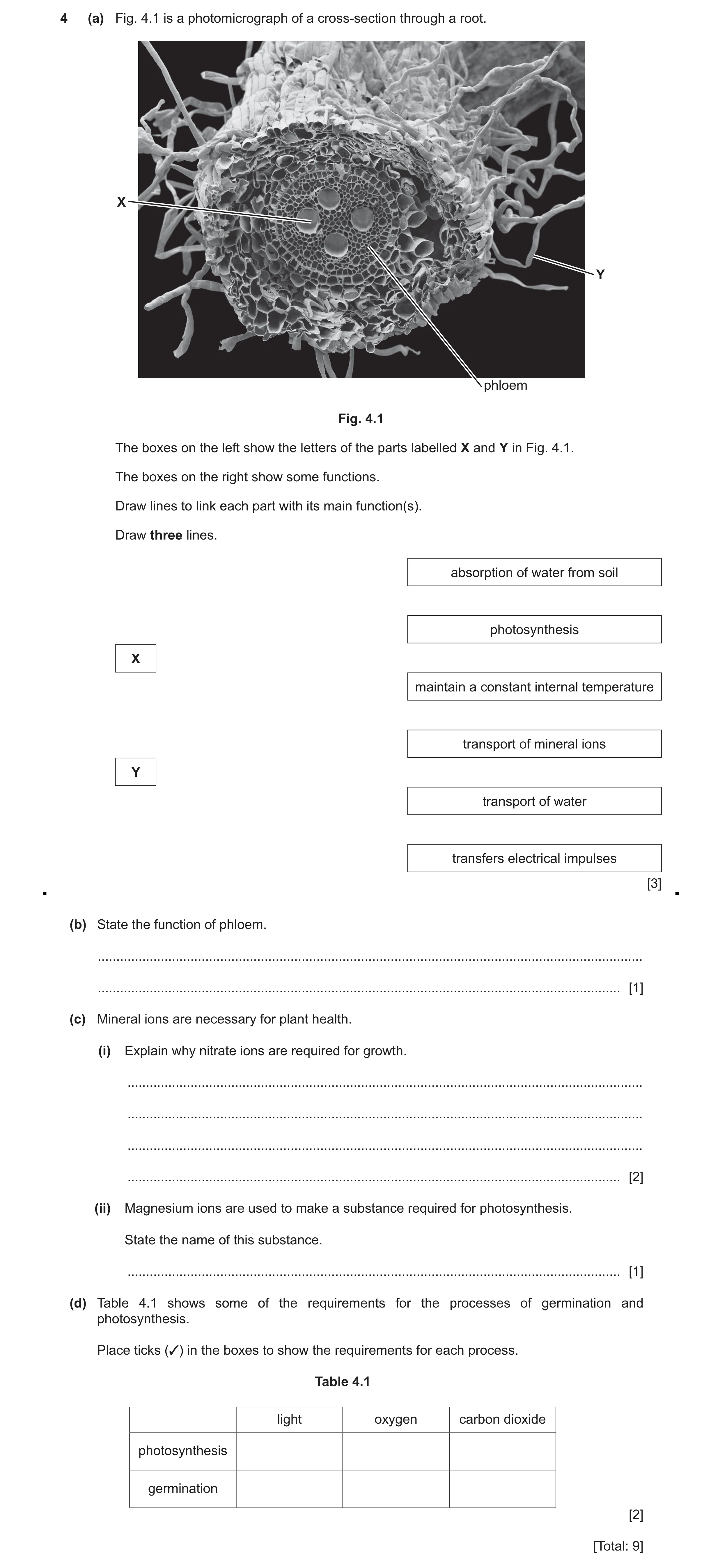
4 (a) Fig. 4.1 is a photomicrograph of a cross-section through a root. X Y phloem Fig. 4.1 The boxes on the left show the letters of the parts labelled X and Y in Fig. 4.1. The boxes on the right show some functions. Draw lines to link each part with its main function(s). Draw three lines. absorption of water from soil photosynthesis X maintain a constant internal temperature transport of mineral ions Y transport of water transfers electrical impulses [3] (b) State the function of phloem. … … [1] (c) Mineral ions are necessary for plant health. (i) Explain why nitrate ions are required for growth. … … … … [2] (ii) Magnesium ions are used to make a substance required for photosynthesis. State the name of this substance. … [1] (d) Table 4.1 shows some of the requirements for the processes of germination and photosynthesis. Place ticks (✓) in the boxes to show the requirements for each process. Table 4.1 light oxygen carbon dioxide photosynthesis germination [2] [Total: 9]
9 marks
Mark scheme: 4(a) absorption of water 3 photosynthesis X maintain a constant internal temperature transport of mineral ions Y transport of water transfers electrical impulses one mark for each correct line ;;; 4(b) transport of, dissolved sugars / sucrose / amino acids ; 1 4(c)(i) (nitrate ions) are needed to, synthesise / make, amino acids ; 2 amino acids make up proteins (which are required for growth) ; 4(c)(ii) chlorophyll ; 1 4(d) 2 light oxygen carbon dioxide photosynthesis germination 1 mark for each correct row ;;
This question in 0654/32 Oct/Nov 2024
Q14 · A diagram of the human digestive system 0654/31 May/June 2025
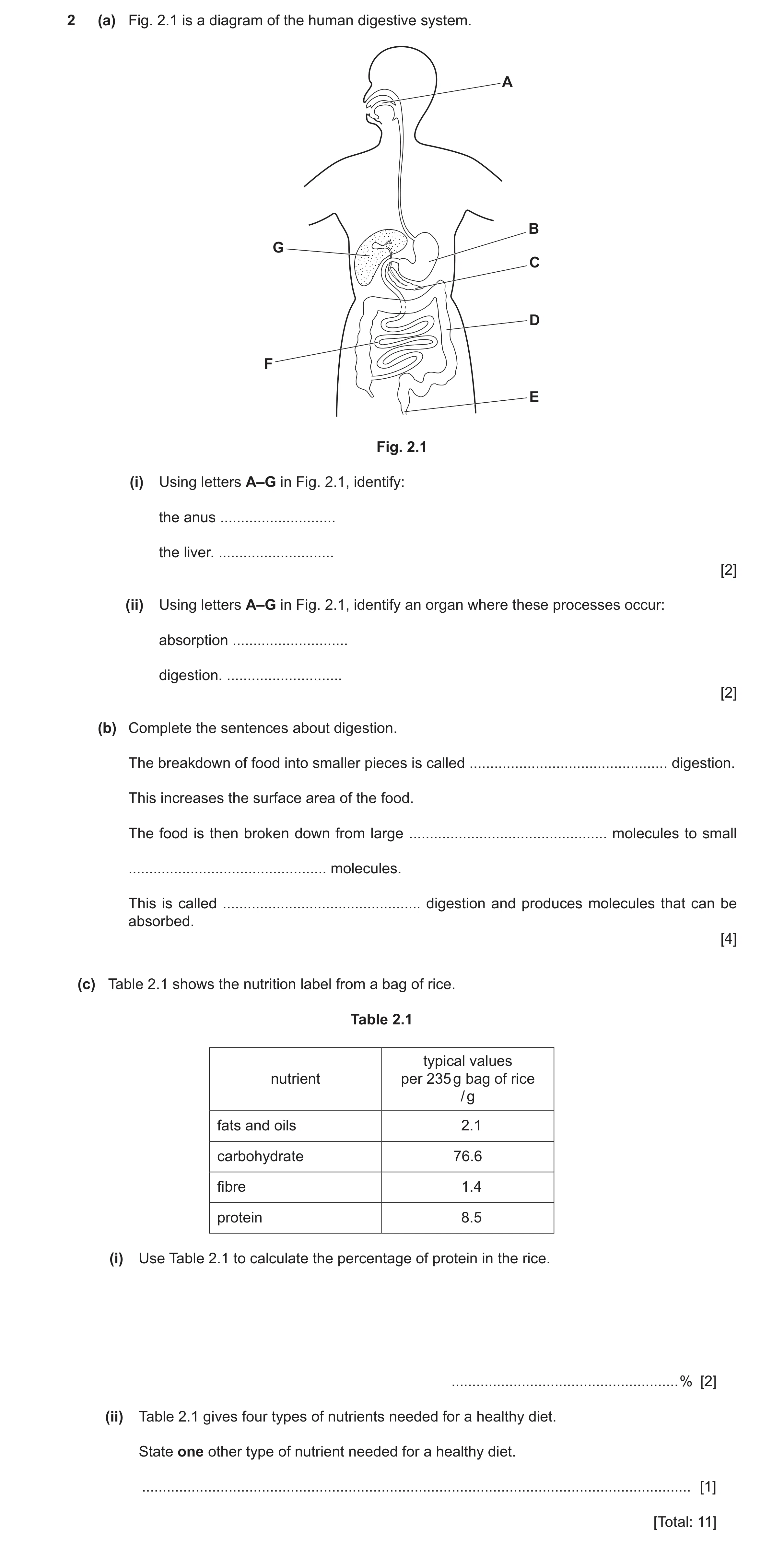
2 (a) Fig. 2.1 is a diagram of the human digestive system. A B G C D F E Fig. 2.1 (i) Using letters A–G in Fig. 2.1, identify: the anus … the liver. … [2] (ii) Using letters A–G in Fig. 2.1, identify an organ where these processes occur: absorption … digestion. … [2] (b) Complete the sentences about digestion. The breakdown of food into smaller pieces is called … digestion. This increases the surface area of the food. The food is then broken down from large … molecules to small … molecules. This is called … digestion and produces molecules that can be absorbed. [4] (c) Table 2.1 shows the nutrition label from a bag of rice. Table 2.1 typical values nutrient per 235 g bag of rice / g fats and oils 2.1 carbohydrate 76.6 fibre 1.4 protein 8.5 (i) Use Table 2.1 to calculate the percentage of protein in the rice. … % [2] (ii) Table 2.1 gives four types of nutrients needed for a healthy diet. State one other type of nutrient needed for a healthy diet. … [1] [Total: 11]
11 marks
Mark scheme: 2(a)(i) E ; 2 G ; 2(a)(ii) D or F ; 2 A or B or F ; 2(b) physical / mechanical ; 4 insoluble ; soluble ; chemical ; 2(c)(i) 8.5 and 235 ; 2 3.6 ; 2(c)(ii) vitamins / minerals / water ; 1
This question in 0654/31 May/June 2025
 3 / 20
 4 / 20
 5 / 20
 6 / 20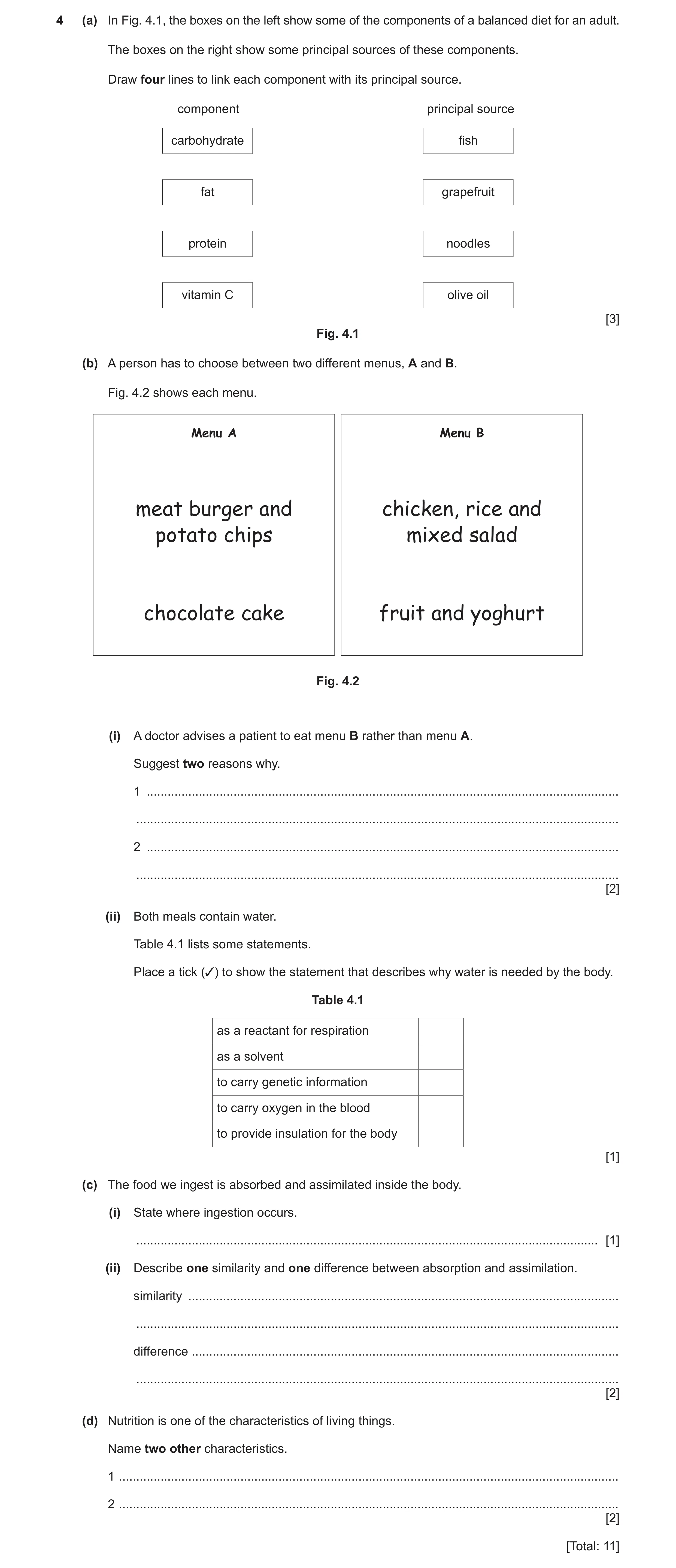
 8
8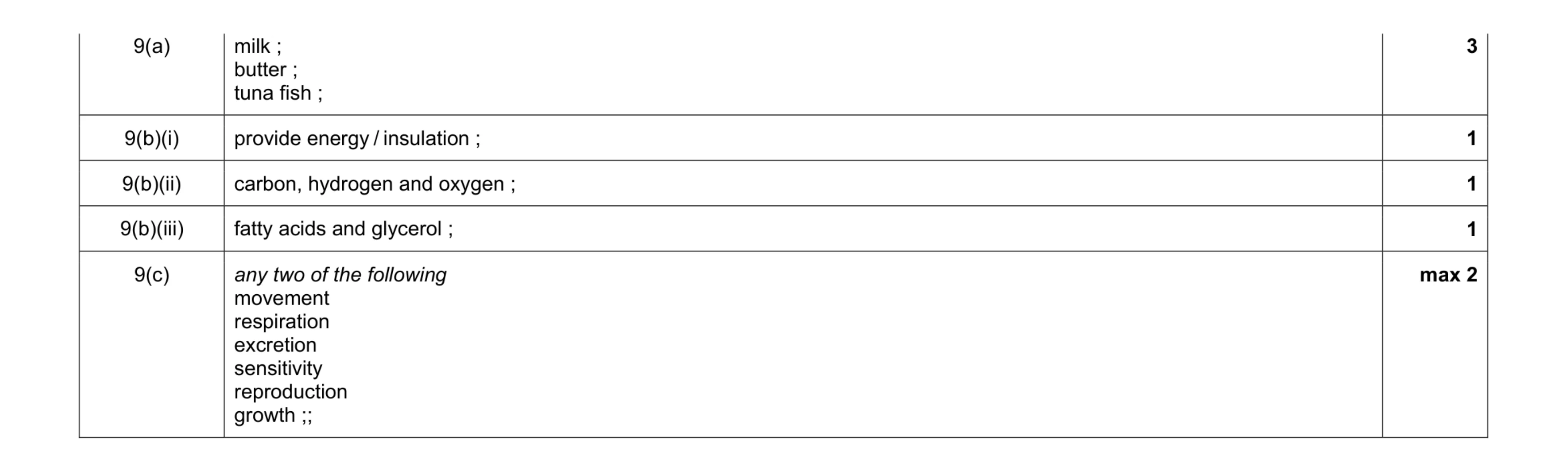 8
8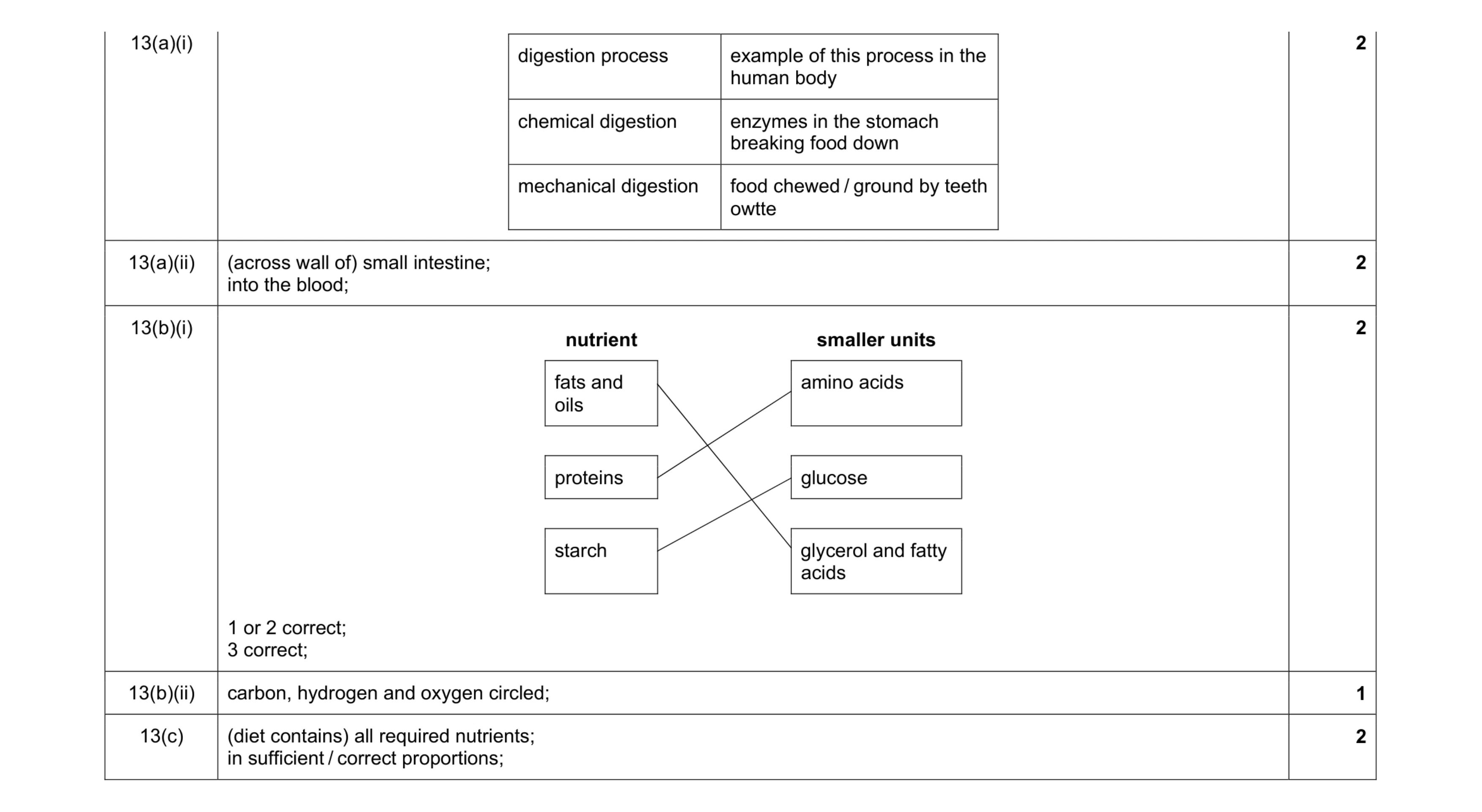 9
9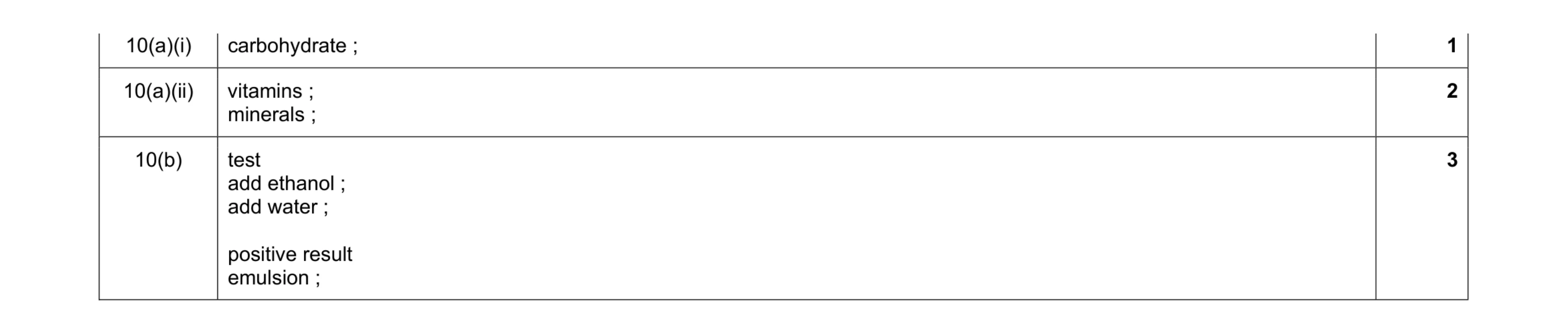 6
6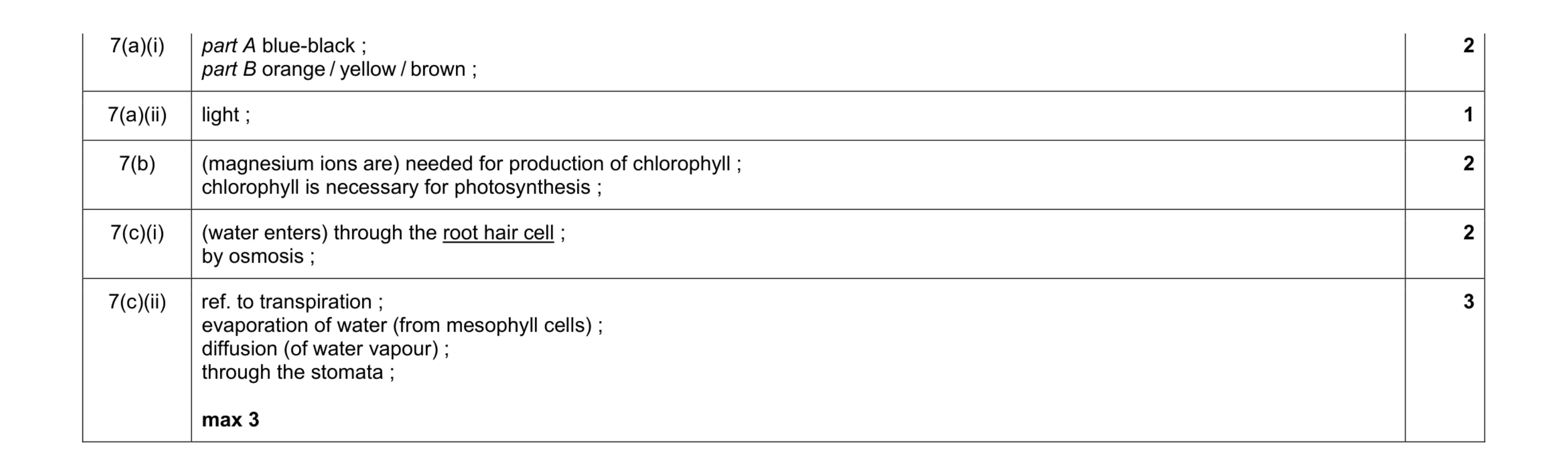 10
10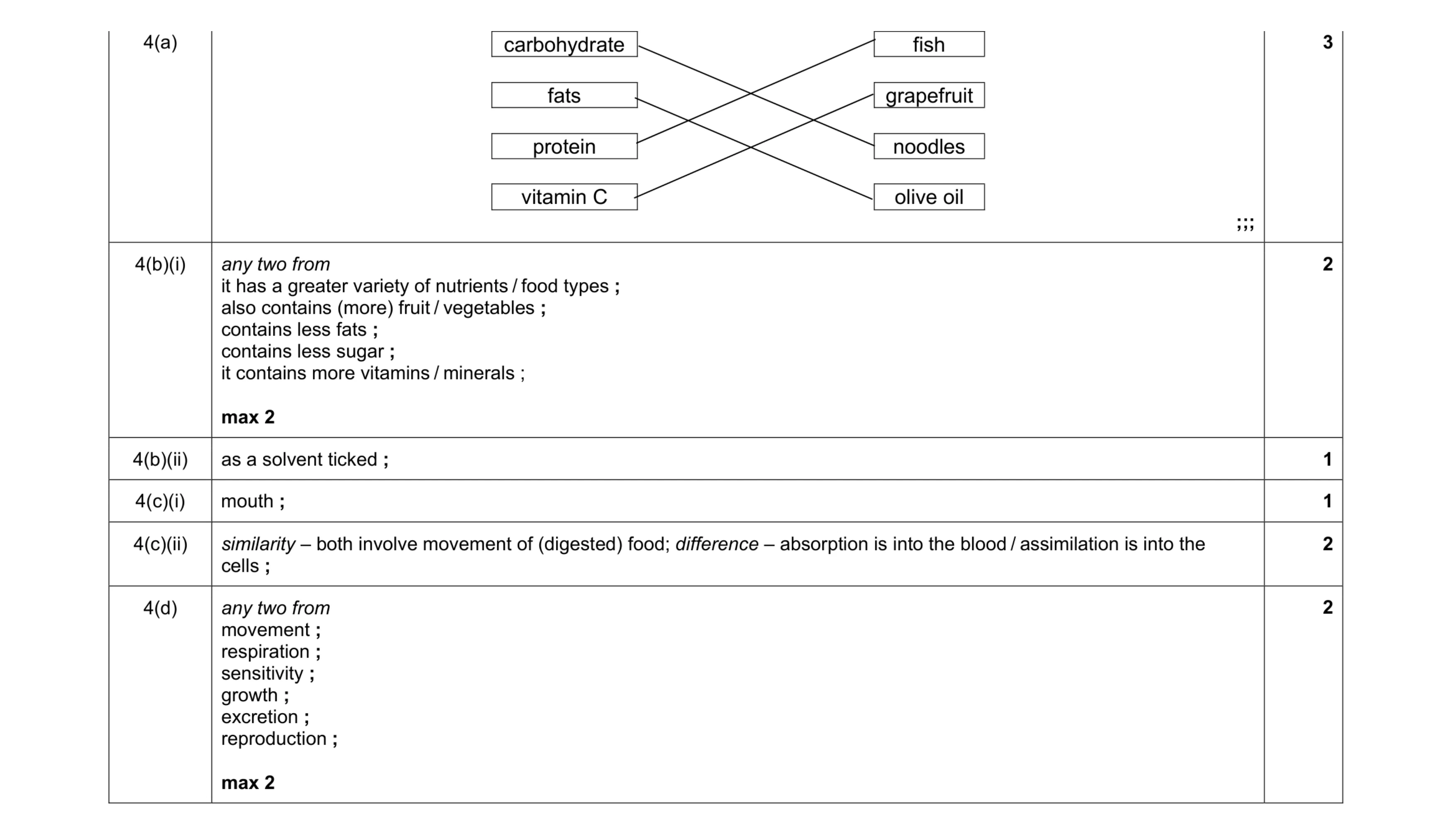 11
11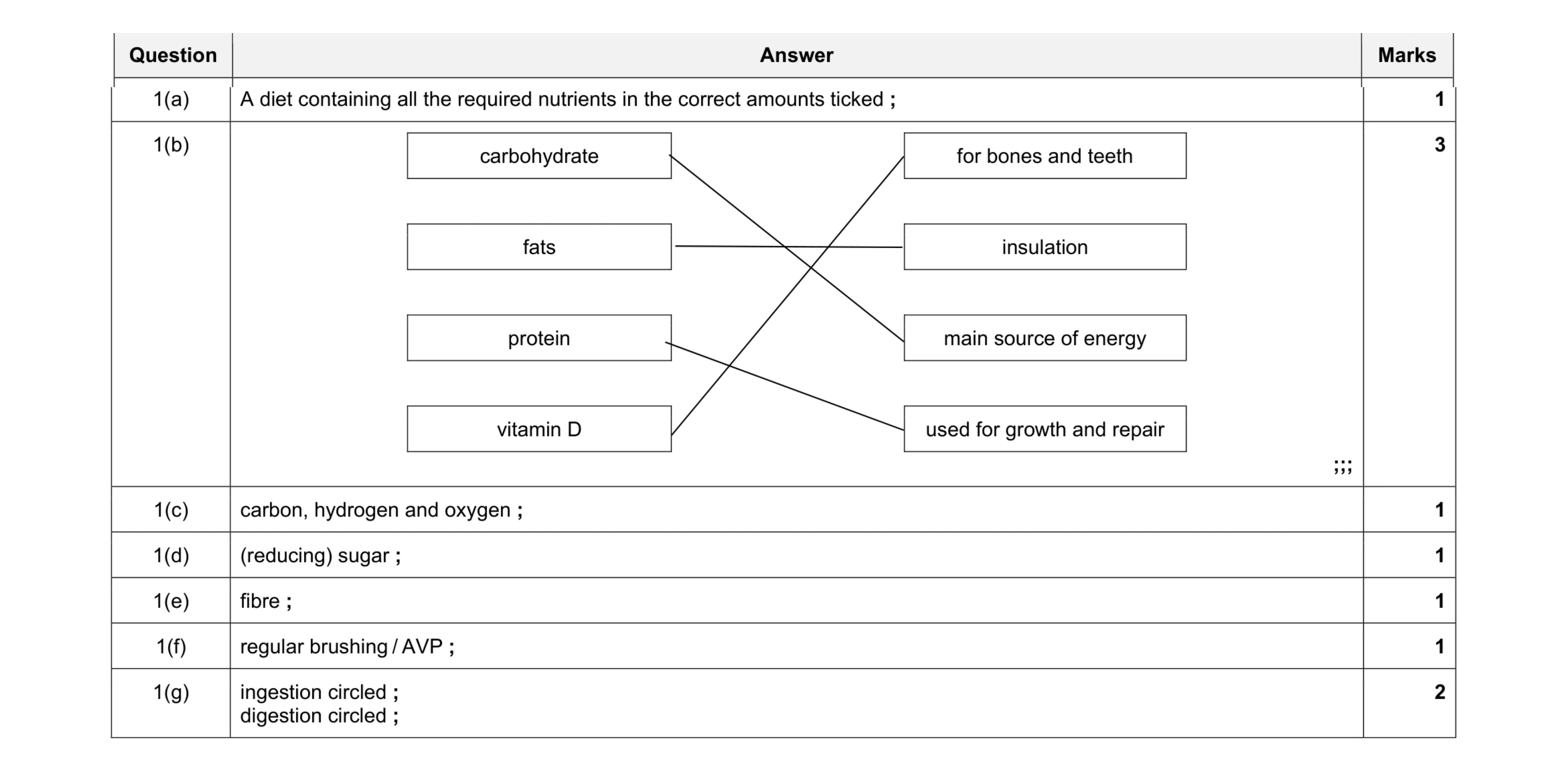 10
10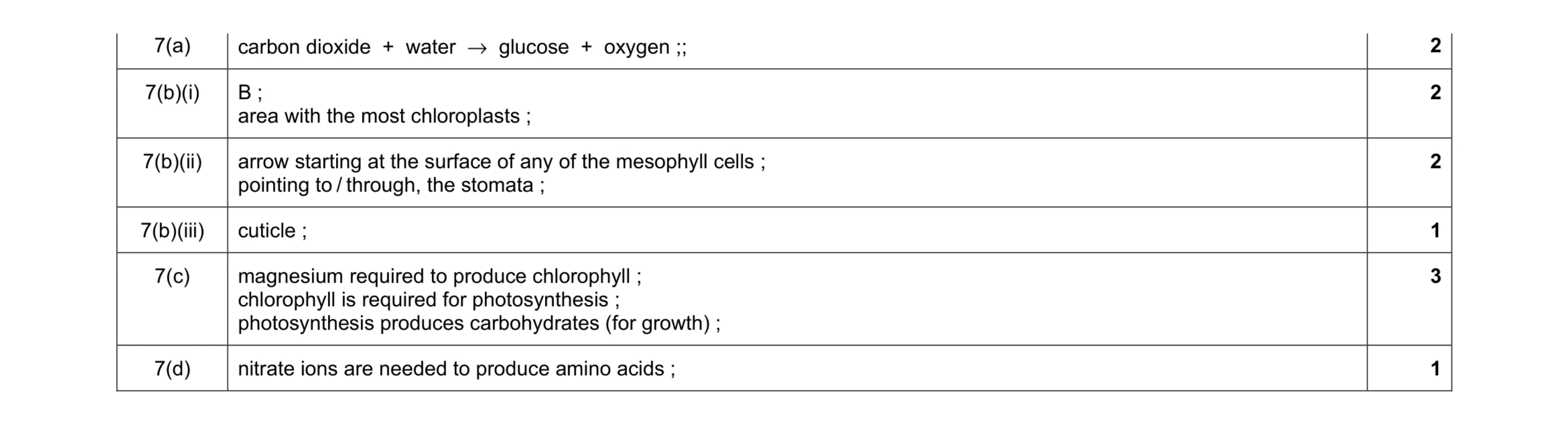 11
11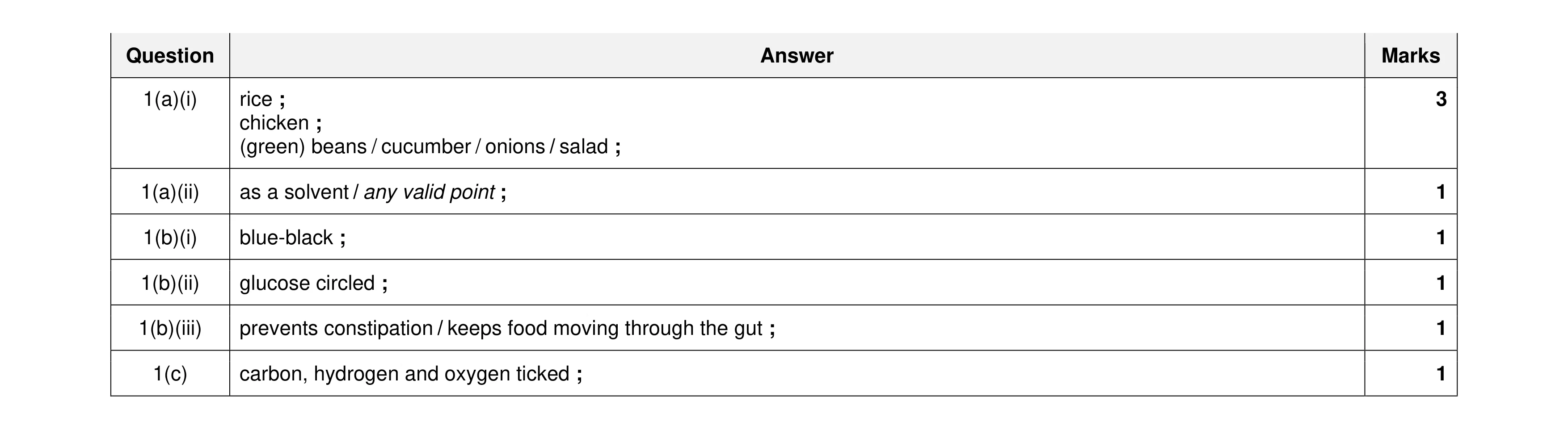 8
8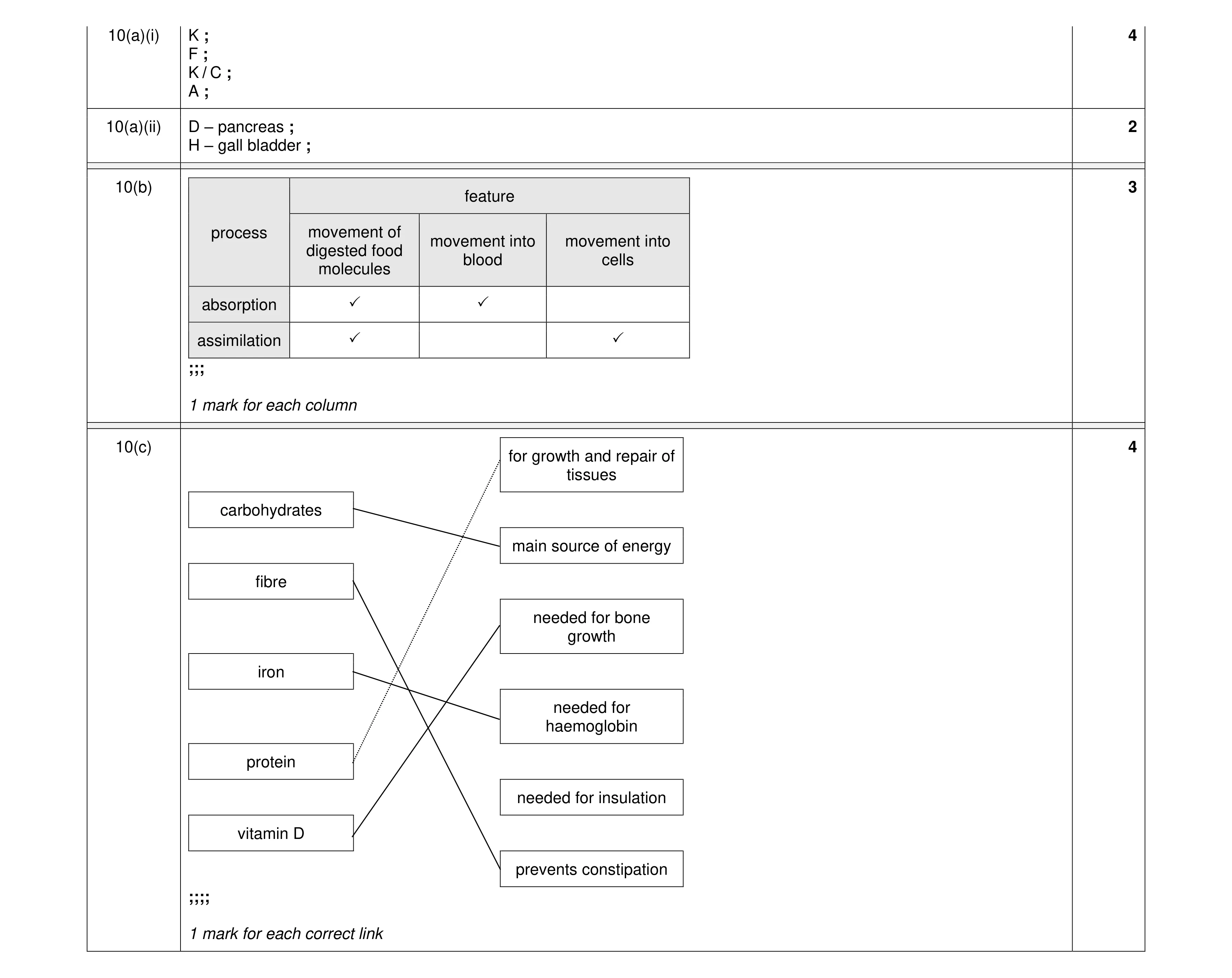 13
13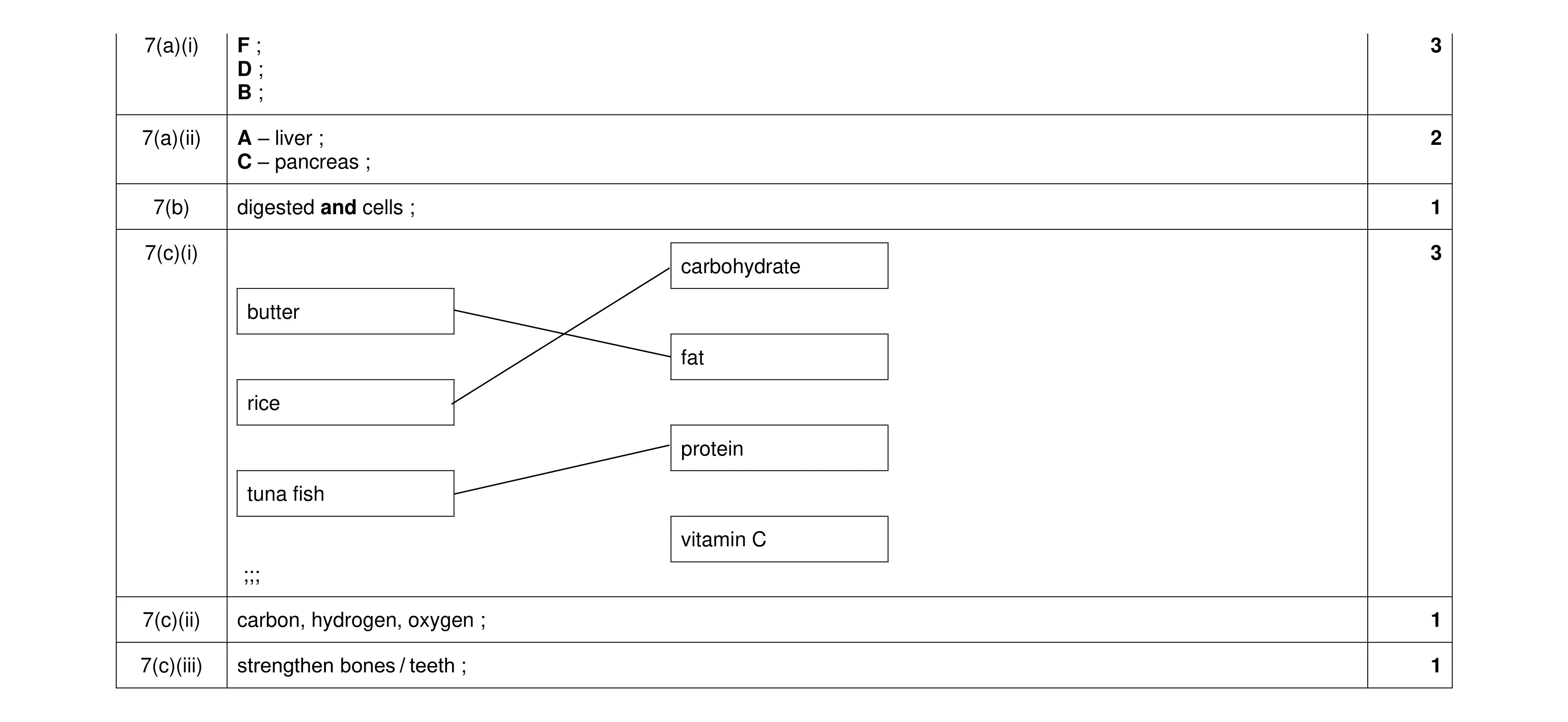 11
11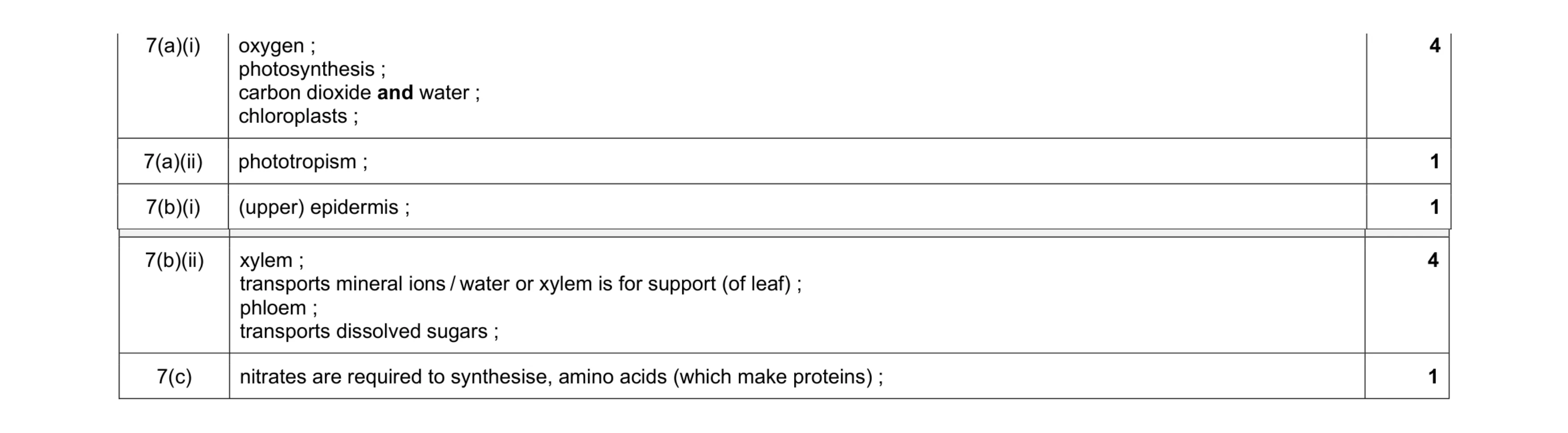 11
11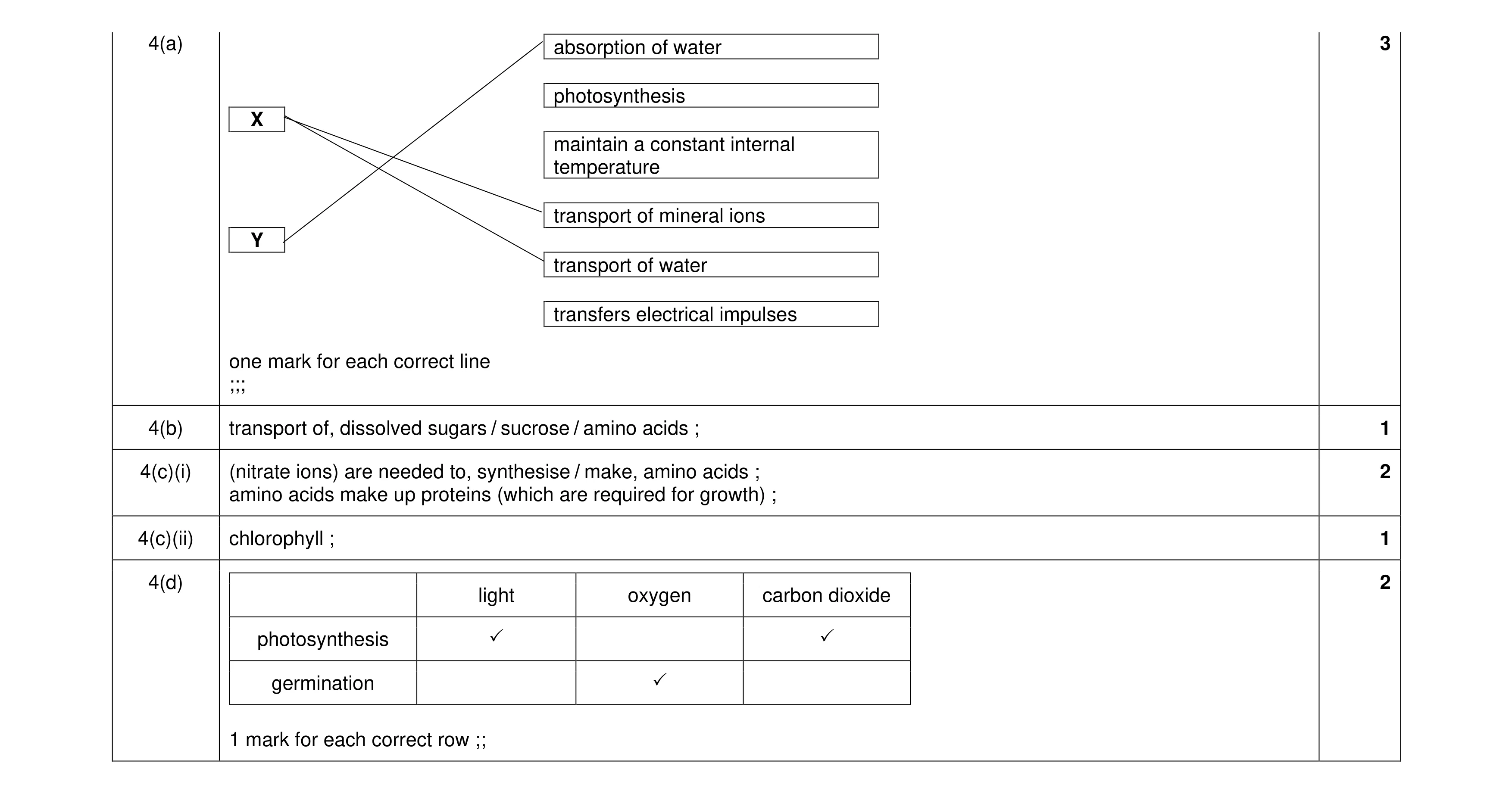 9
9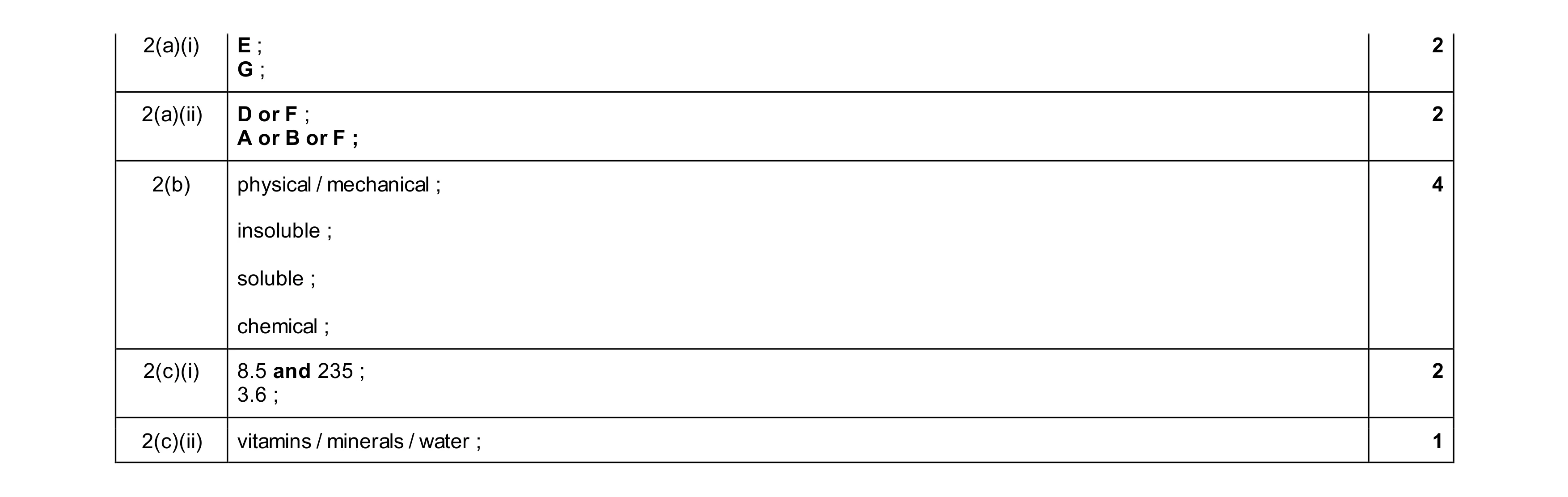 11
11