Questions as text
Q1 · Plants need to use several substances in order to photosynthesise 0654/41 May/June 2017
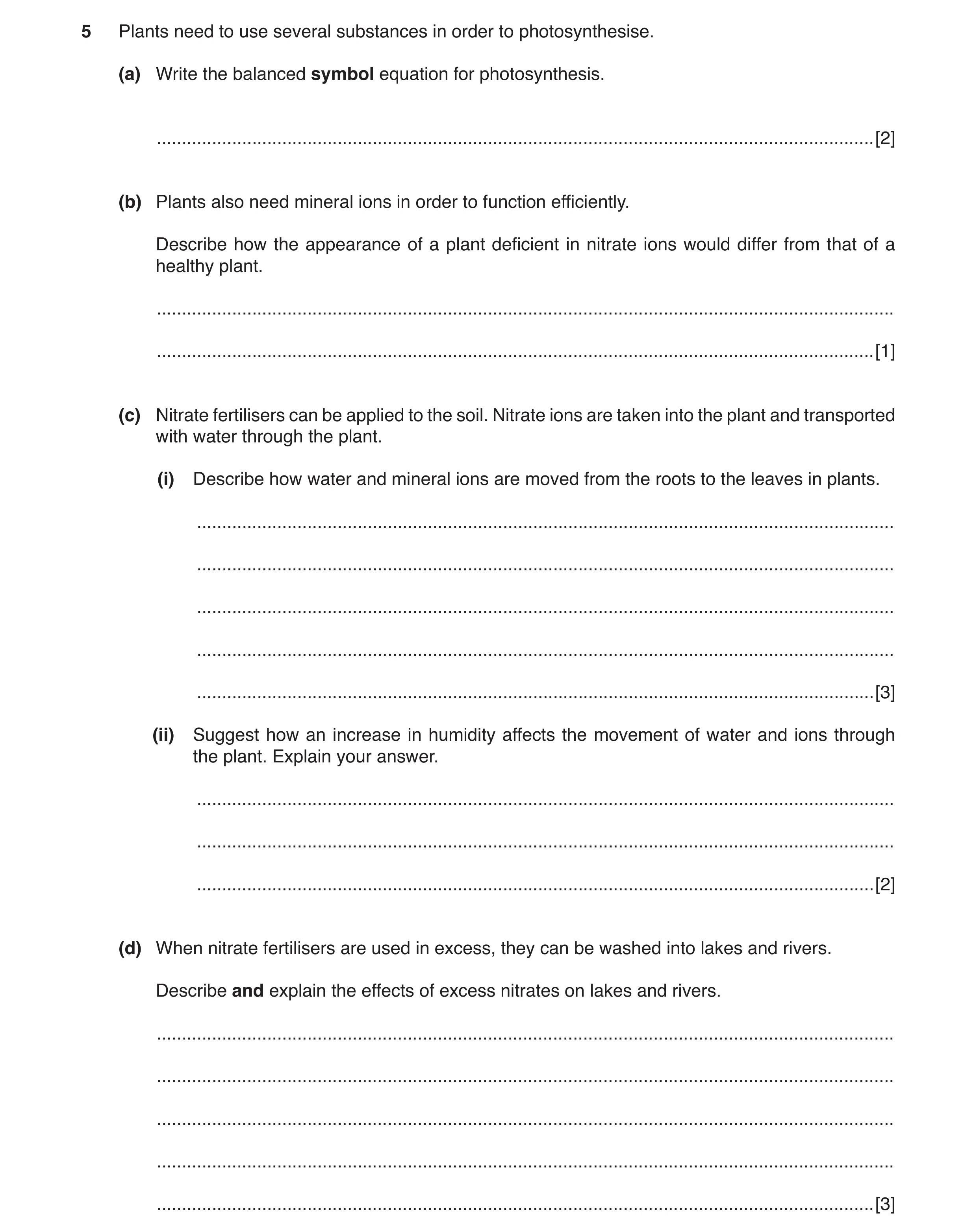
5 Plants need to use several substances in order to photosynthesise. (a) Write the balanced symbol equation for photosynthesis. … [2] (b) Plants also need mineral ions in order to function efficiently. Describe how the appearance of a plant deficient in nitrate ions would differ from that of a healthy plant. … … [1] (c) Nitrate fertilisers can be applied to the soil. Nitrate ions are taken into the plant and transported with water through the plant. (i) Describe how water and mineral ions are moved from the roots to the leaves in plants. … … … … … [3] (ii) Suggest how an increase in humidity affects the movement of water and ions through the plant. Explain your answer. … … … [2] (d) When nitrate fertilisers are used in excess, they can be washed into lakes and rivers. Describe and explain the effects of excess nitrates on lakes and rivers. … … … … … [3]
11 marks
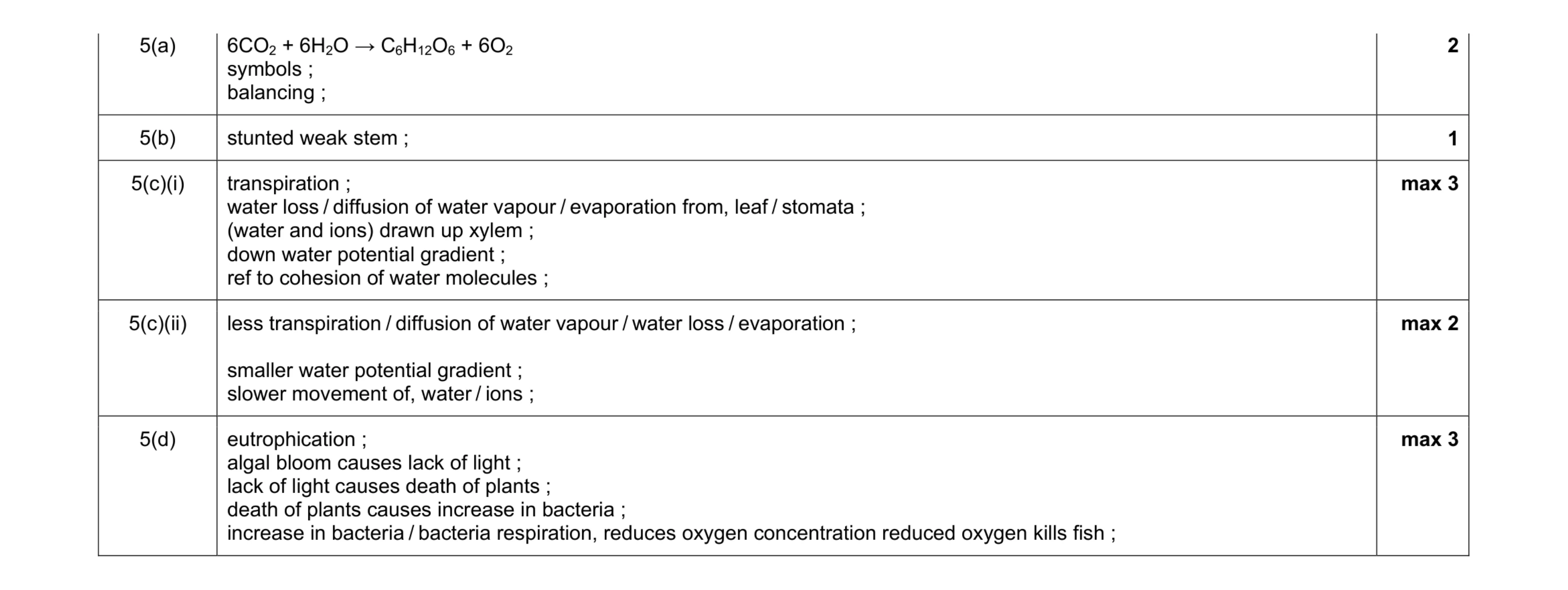
Mark scheme: 5(a) 6CO2 + 6H2O → C6H12O6 + 6O2 symbols ; balancing ; 2 5(b) stunted weak stem ; 1 5(c)(i) transpiration ; water loss / diffusion of water vapour / evaporation from, leaf / stomata ; (water and ions) drawn up xylem ; down water potential gradient ; ref to cohesion of water molecules ; max 3 5(c)(ii) less transpiration / diffusion of water vapour / water loss / evaporation ; smaller water potential gradient ; slower movement of, water / ions ; max 2 5(d) eutrophication ; algal bloom causes lack of light ; lack of light causes death of plants ; death of plants causes increase in bacteria ; increase in bacteria / bacteria respiration, reduces oxygen concentration reduced oxygen kills fish ; max 3
This question in 0654/41 May/June 2017
Q2 · The stages involved in the production of yoghurt 0654/42 Oct/Nov 2018
4 (a) Fig. 4.1 shows the stages involved in the production of yoghurt. stage 1 – pasteurisation milk is heated to 90 °C milk is then cooled to 45 °C bacteria added stage 2 – incubation milk and bacteria mixture kept at 45 °C for several hours milk and bacteria mixture thickens to form yoghurt stage 3 – cooling yoghurt is cooled to 4 °C Fig. 4.1 (i) Suggest why the milk is pasteurised during stage 1. … … [1] (ii) Explain why the acidity of the milk mixture increases during stage 2. … … … [2] (iii) Explain why cooling to 4 °C stops the yoghurt production during stage 3. … … … [2] (b) (i) Yoghurt contains some of the nutrients needed for a balanced diet. The boxes on the left show some of the nutrients needed for a balanced diet. The boxes on the right show good sources of these nutrients. Draw four lines to link each nutrient with its good source. nutrient good source carbohydrate butter fat rice protein satsuma fruit vitamin C tuna fish [3] (ii) Name a deficiency disease that is caused by a lack of vitamin C. … [1]
9 marks
Mark scheme: 4(a)(i) sterilises it / kills, harmful / unwanted bacteria ; 1 4(a)(ii) bacteria, anaerobically respiring ; producing lactic acid ; 2 4(a)(iii) bacteria / enzymes become inactive at low temperature ; enzyme-controlled reaction ; lower rate of collisions between enzyme and substrate / less energy of particles ; max 2 4(b)(i) carbohydrate butter fat rice protein satsuma fruit vitamin C tuna fish 1 correct ; 2 or 3 correct ; 4 correct ; 3 4(b)(ii) scurvy ; 1
This question in 0654/42 Oct/Nov 2018
Q3 · The deficiency diseases of children of different ages admitted to a hospital 0654/43 Oct/Nov 2020
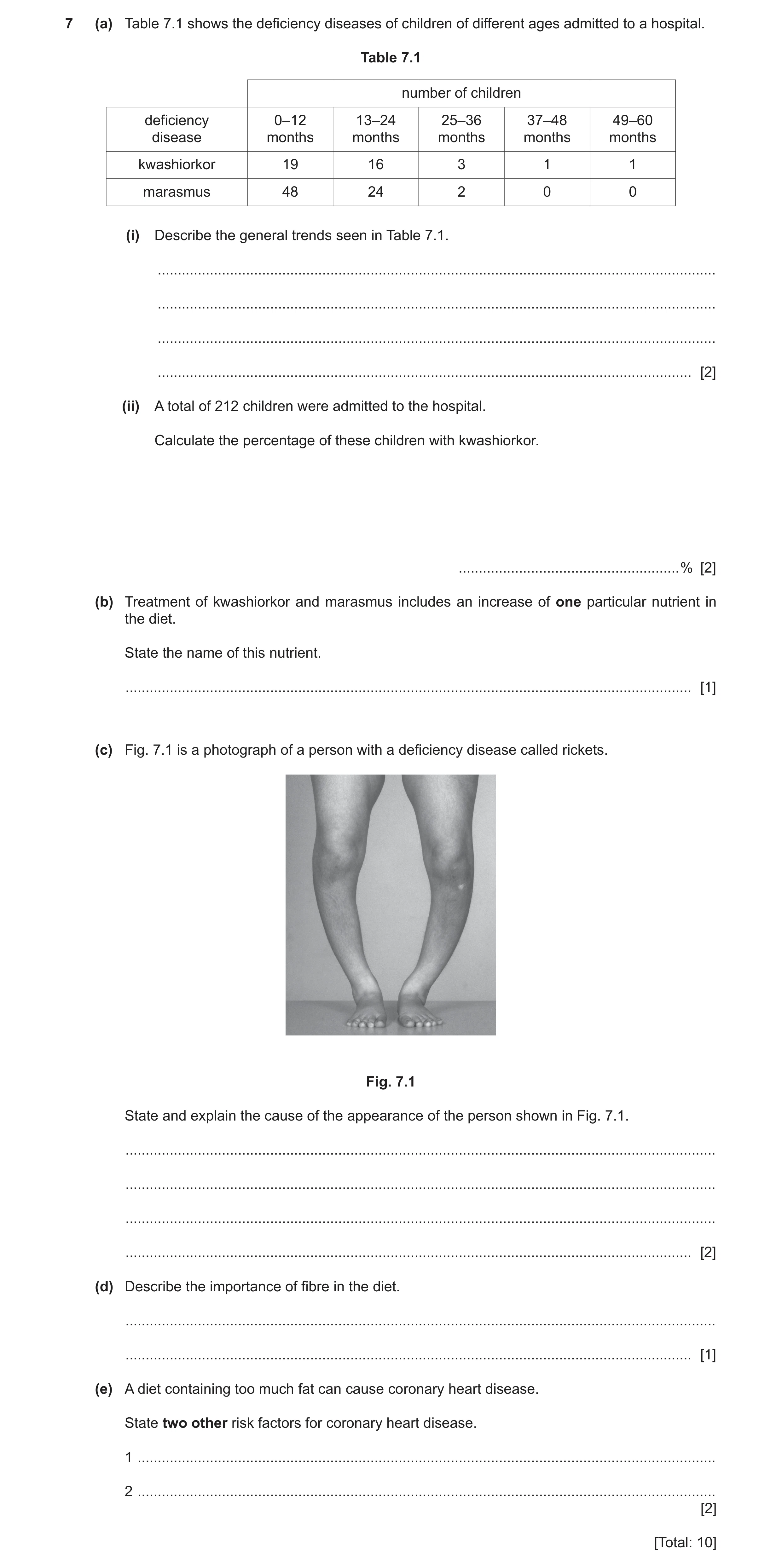
7 (a) Table 7.1 shows the deficiency diseases of children of different ages admitted to a hospital. Table 7.1 number of children deficiency 0–12 13–24 25–36 37–48 49–60 disease months months months months months kwashiorkor 19 16 3 1 1 marasmus 48 24 2 0 0 (i) Describe the general trends seen in Table 7.1. … … … … [2] (ii) A total of 212 children were admitted to the hospital. Calculate the percentage of these children with kwashiorkor. … % [2] (b) Treatment of kwashiorkor and marasmus includes an increase of one particular nutrient in the diet. State the name of this nutrient. … [1] (c) Fig. 7.1 is a photograph of a person with a deficiency disease called rickets. Fig. 7.1 State and explain the cause of the appearance of the person shown in Fig. 7.1. … … … … [2] (d) Describe the importance of fibre in the diet. … … [1] (e) A diet containing too much fat can cause coronary heart disease. State two other risk factors for coronary heart disease. 1 … 2 … [2] [Total: 10]
10 marks
Mark scheme: 7(a)(i) fewer cases of kwashiorkor with age ; fewer cases of marasmus with age ; AVP ; 2 7(a)(ii) (19 + 16 + 3 +1 +1) = 40 ; (= 40 / 212) = 19(%) ; 2 7(b) protein ; 1 7(c) lack of vitamin D ; leads to weak / bendy bones ; 2 7(d) prevents constipation ; 1 7(e) any two from: age ; smoking ; stress ; genetic predisposition ; gender ; AVP ;; 2
This question in 0654/43 Oct/Nov 2020
Q4 · The vitamin D content in 100 g of different foods 0654/41 May/June 2021
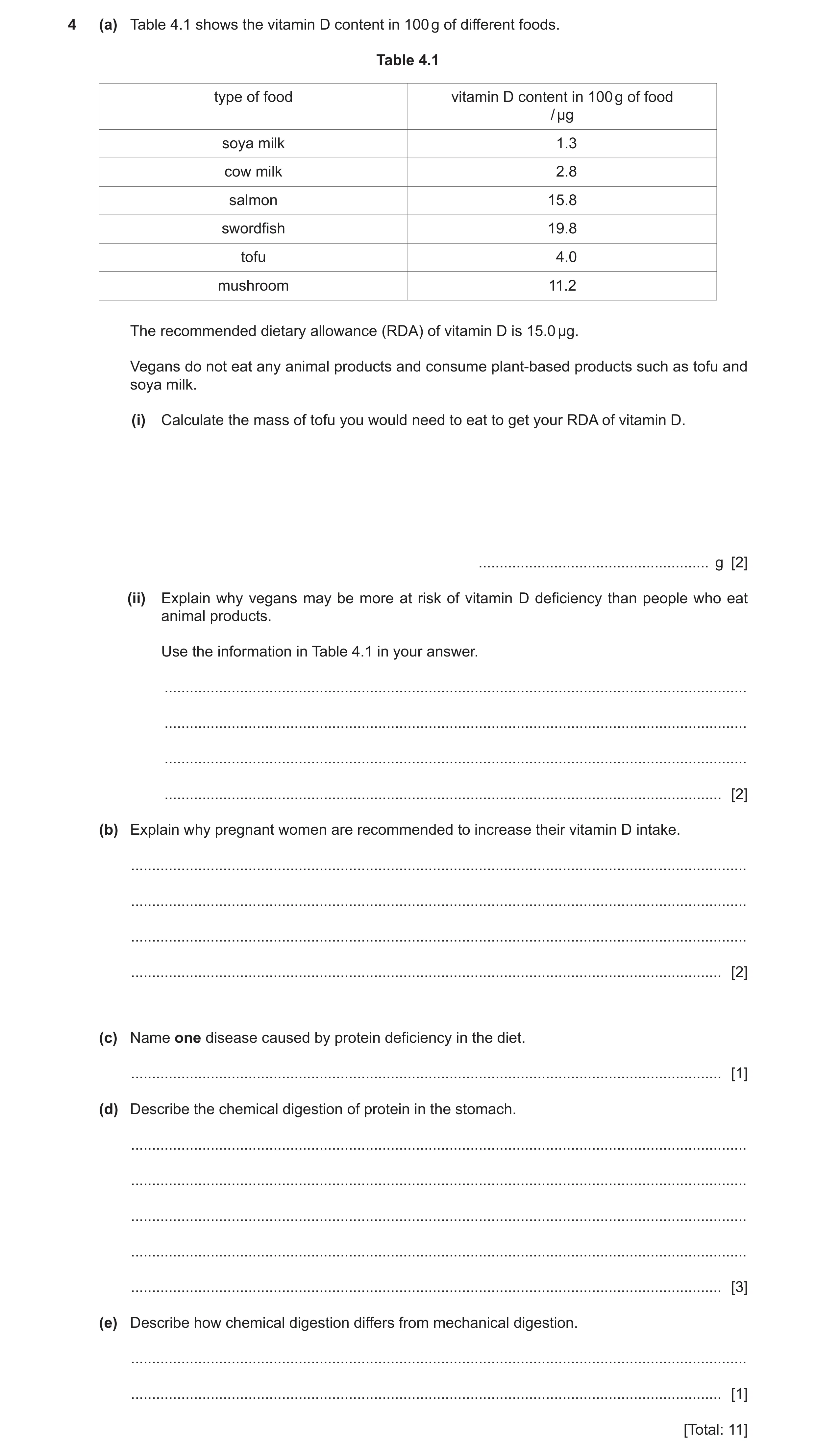
4 (a) Table 4.1 shows the vitamin D content in 100 g of different foods. Table 4.1 type of food vitamin D content in 100 g of food / µg soya milk 1.3 cow milk 2.8 salmon 15.8 swordfish 19.8 tofu 4.0 mushroom 11.2 The recommended dietary allowance (RDA) of vitamin D is 15.0 µg. Vegans do not eat any animal products and consume plant‑based products such as tofu and soya milk. (i) Calculate the mass of tofu you would need to eat to get your RDA of vitamin D. … g [2] (ii) Explain why vegans may be more at risk of vitamin D deficiency than people who eat animal products. Use the information in Table 4.1 in your answer. … … … … [2] (b) Explain why pregnant women are recommended to increase their vitamin D intake. … … … … [2] (c) Name one disease caused by protein deficiency in the diet. … [1] (d) Describe the chemical digestion of protein in the stomach. … … … … … [3] (e) Describe how chemical digestion differs from mechanical digestion. … … [1] [Total: 11]
11 marks
Mark scheme: 4(a)(i) 15.0 100 4.0 × 380 (g) ; 4(a)(ii) plant-based foods / tofu / soya milk, contain less vitamin D than (equivalent) animal products ; they would need to eat a larger amount of food to get enough vitamin D / comparison of data / ref. to per 100 g ; 2 4(b) (vitamin D is needed) for (the formation of) bones ; by the (growing) baby ; 2 4(c) marasmus / kwashiorkor ; 1 Question Answer Marks 4(d) large / insoluble molecules broken down to small / soluble molecules ; to form amino acids ; by protease ; ref to acidic conditions (in the stomach) ; max 3 3 4(e) food is broken into smaller molecules / involves enzymes ; 1
This question in 0654/41 May/June 2021
Q5 · The daily energy requirements of different females 0654/42 Oct/Nov 2021
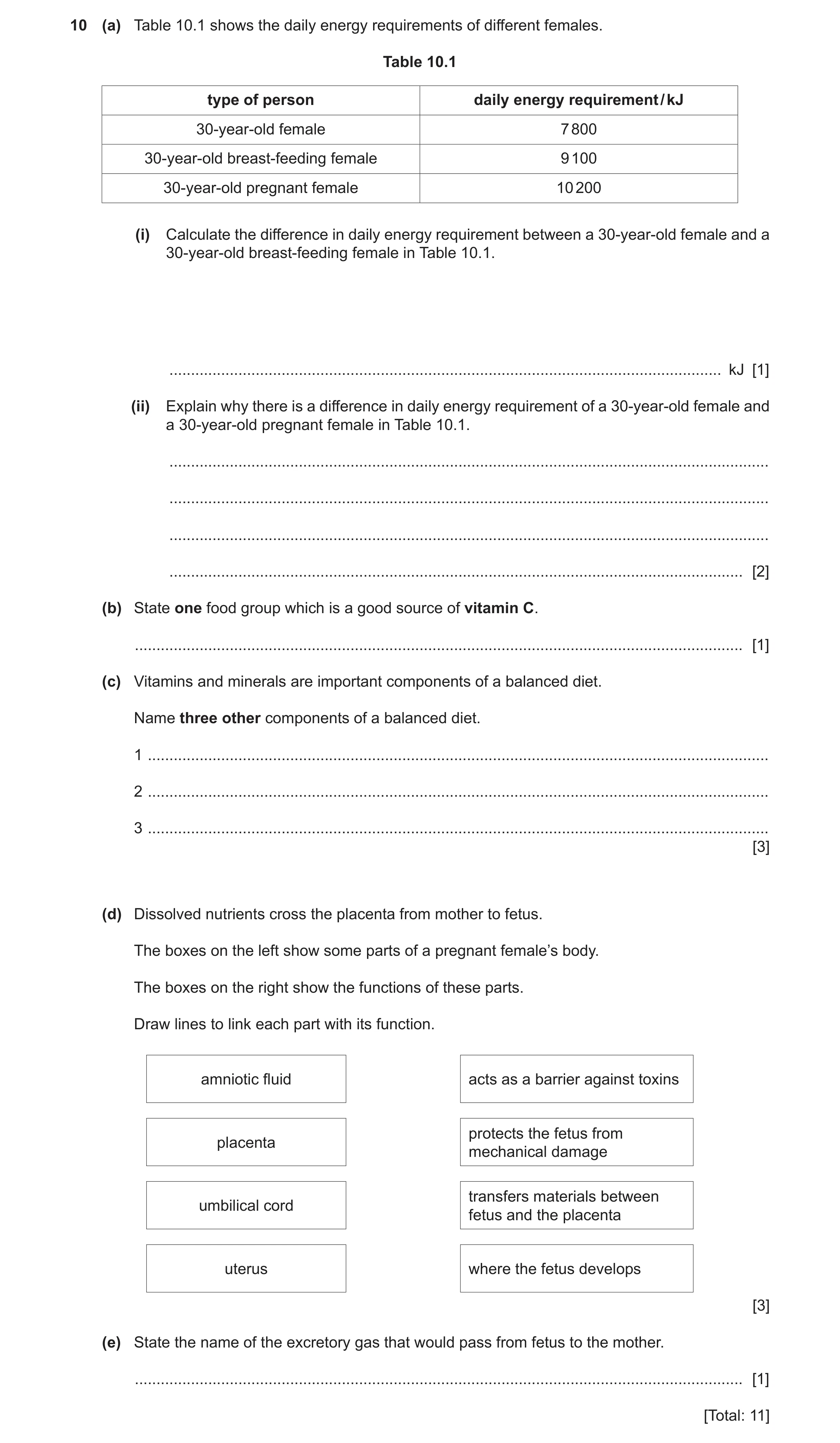
10 (a) Table 10.1 shows the daily energy requirements of different females. Table 10.1 type of person daily energy requirement / kJ 30-year-old female 7 800 30-year-old breast-feeding female 9 100 30-year-old pregnant female 10 200 (i) Calculate the difference in daily energy requirement between a 30-year-old female and a 30-year-old breast-feeding female in Table 10.1. … kJ [1] (ii) Explain why there is a difference in daily energy requirement of a 30-year-old female and a 30-year-old pregnant female in Table 10.1. … … … … [2] (b) State one food group which is a good source of vitamin C. … [1] (c) Vitamins and minerals are important components of a balanced diet. Name three other components of a balanced diet. 1 … 2 … 3 … [3] (d) Dissolved nutrients cross the placenta from mother to fetus. The boxes on the left show some parts of a pregnant female’s body. The boxes on the right show the functions of these parts. Draw lines to link each part with its function. amniotic fluid acts as a barrier against toxins protects the fetus from placenta mechanical damage transfers materials between umbilical cord fetus and the placenta uterus where the fetus develops [3] (e) State the name of the excretory gas that would pass from fetus to the mother. … [1] [Total: 11]
11 marks
Mark scheme: 10(a)(i) (9100 – 7800) = 1300 (kJ) ; 1 10(a)(ii) a fetus requires energy ; for, growth / development (of the fetus) ; 2 10(b) (named), fruit / vegetables ; 1 10(c) any three from: carbohydrates ; fats ; protein ; fibre ; water ; 3 10(d) amniotic fluid acts as a barrier against toxins placenta protects the fetus from mechanical damage umbilical cord transfers materials between fetus and the placenta uterus where the fetus develops ;;; 3 10(e) carbon dioxide ; 1
This question in 0654/42 Oct/Nov 2021
Q6 · A student monitors his pulse rate at rest and during exercise 0654/42 May/June 2022
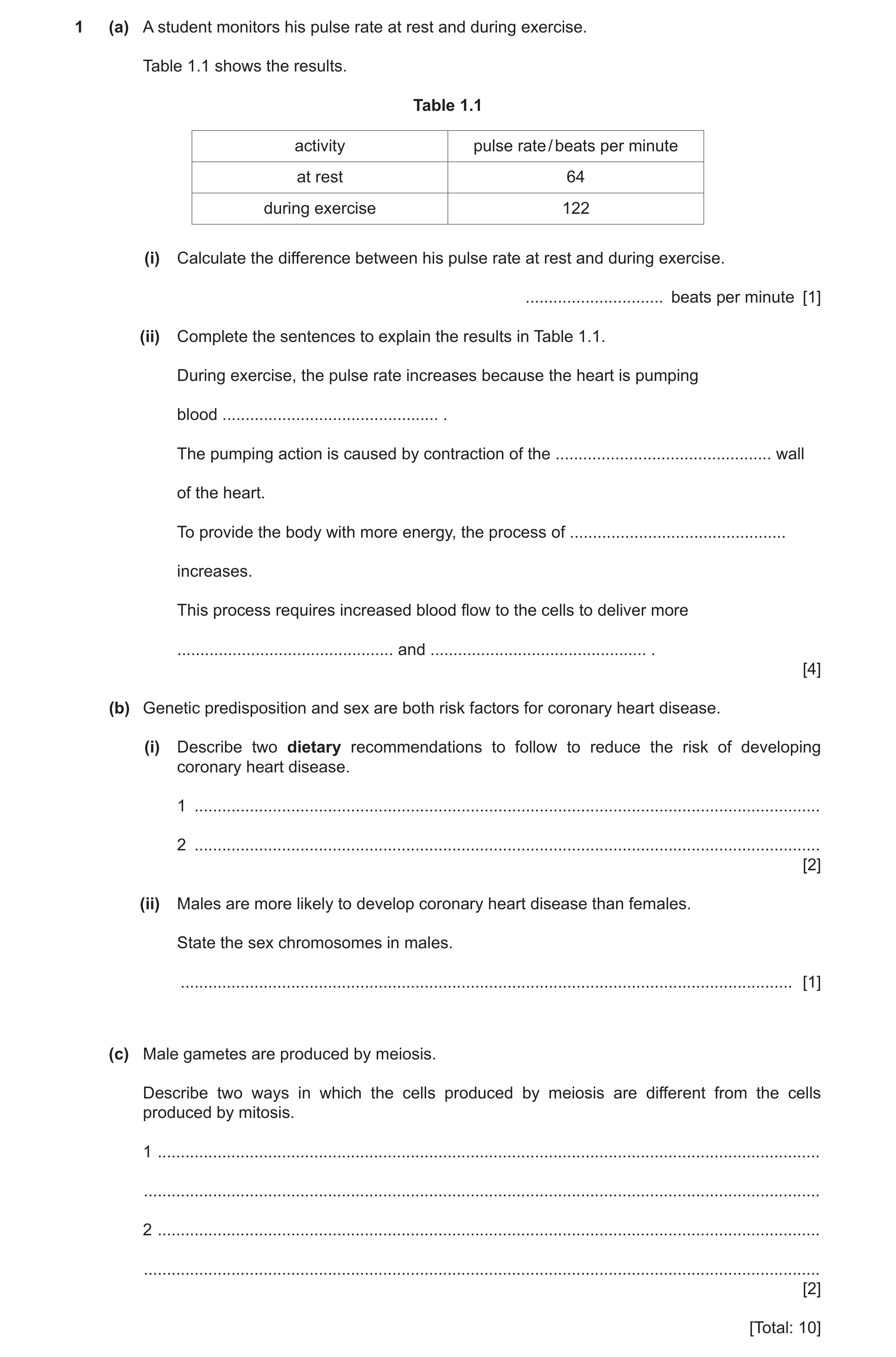
1 (a) A student monitors his pulse rate at rest and during exercise. Table 1.1 shows the results. Table 1.1 activity pulse rate / beats per minute at rest 64 during exercise 122 (i) Calculate the difference between his pulse rate at rest and during exercise. … beats per minute [1] (ii) Complete the sentences to explain the results in Table 1.1. During exercise, the pulse rate increases because the heart is pumping blood … . The pumping action is caused by contraction of the … wall of the heart. To provide the body with more energy, the process of … increases. This process requires increased blood flow to the cells to deliver more … and … . [4] (b) Genetic predisposition and sex are both risk factors for coronary heart disease. (i) Describe two dietary recommendations to follow to reduce the risk of developing coronary heart disease. 1 … 2 … [2] (ii) Males are more likely to develop coronary heart disease than females. State the sex chromosomes in males. … [1] (c) Male gametes are produced by meiosis. Describe two ways in which the cells produced by meiosis are different from the cells produced by mitosis. 1 … … 2 … … [2] [Total: 10]
10 marks
Mark scheme: 1(a)(i) 58 (beats per minute) ; 1 1(a)(ii) faster ; muscular ; (aerobic) respiration ; glucose and oxygen ; 4 1(b)(i) any two from: don’t consume too much fat ; don’t consume, too much carbohydrate / energy / calories ; don’t consume too much, salt ; don’t consume excessive alcohol ; consume, a balanced diet ; consume plenty of fibre ; 2 1(b)(ii) XY ; 1 1(c) genetically different (to each other) ; contain half the number of chromosomes / are haploid / contains 23 chromosomes / contains unpaired chromosomes ; 2
This question in 0654/42 May/June 2022
Q7 · A diagram of the carbon cycle 0654/42 May/June 2022
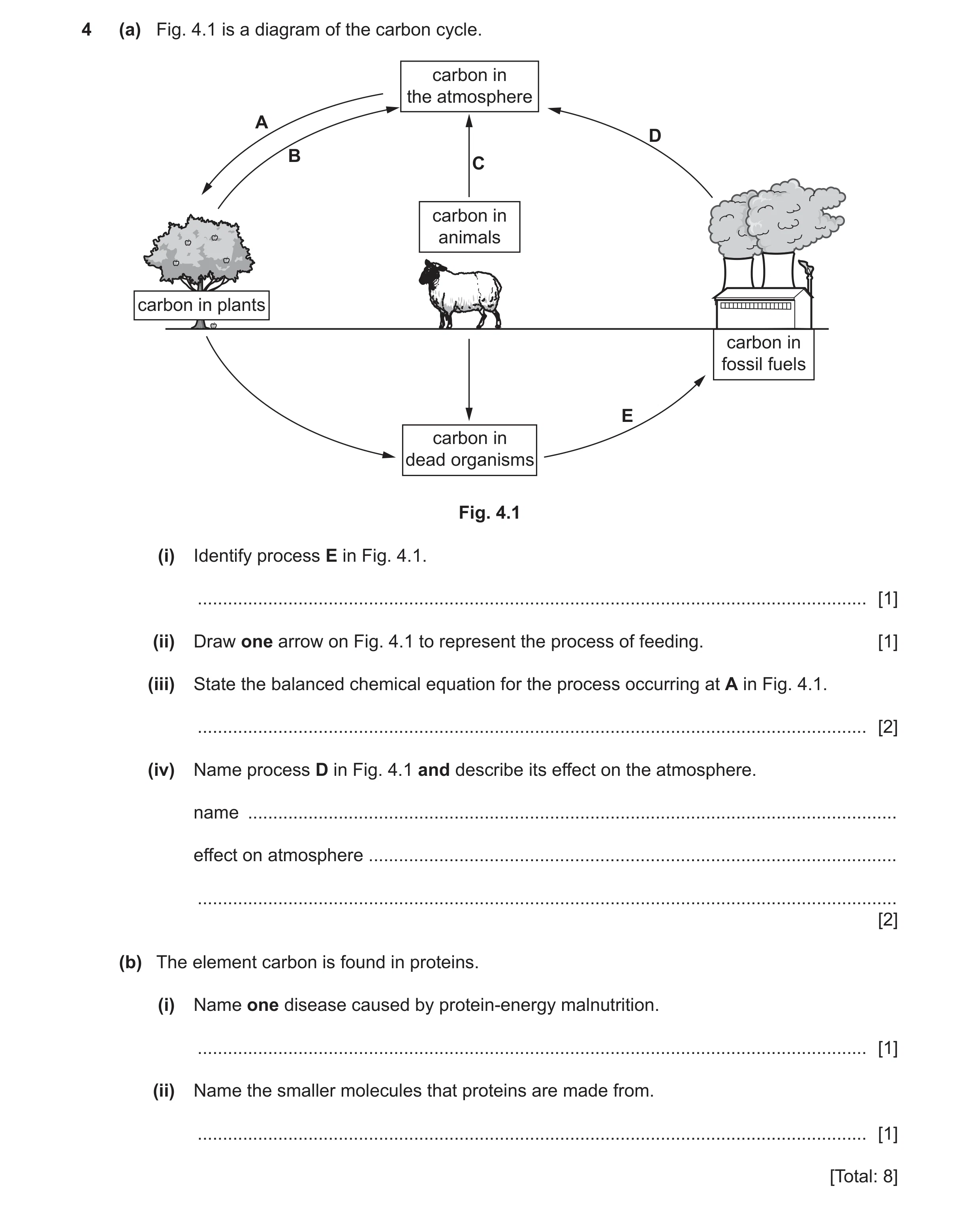
4 (a) Fig. 4.1 is a diagram of the carbon cycle. carbon in the atmosphere A D B C carbon in animals carbon in plants carbon in fossil fuels E carbon in dead organisms Fig. 4.1 (i) Identify process E in Fig. 4.1. … [1] (ii) Draw one arrow on Fig. 4.1 to represent the process of feeding. [1] (iii) State the balanced chemical equation for the process occurring at A in Fig. 4.1. … [2] (iv) Name process D in Fig. 4.1 and describe its effect on the atmosphere. name … effect on atmosphere … … [2] (b) The element carbon is found in proteins. (i) Name one disease caused by protein‑energy malnutrition. … [1] (ii) Name the smaller molecules that proteins are made from. … [1] [Total: 8]
8 marks
Mark scheme: 4(a)(i) fossilisation ; 1 4(a)(ii) arrow drawn from carbon in plants to carbon in animals ; 1 4(a)(iii) light 6CO2 + 6H2O → C6H12O6 + 6O2 ;; chlorophyll 2 4(a)(iv) combustion (of fossil fuels) ; increases concentration of carbon dioxide (in the atmosphere) ; 2 4(b)(i) kwashiorkor / marasmus ; 1 4(b)(ii) amino acids ; 1
This question in 0654/42 May/June 2022
Q8 · A photograph of a person with a deficiency disease that has affected their bone growth 0654/41 Oct/Nov 2022
7 (a) Fig. 7.1 is a photograph of a person with a deficiency disease that has affected their bone growth. Fig. 7.1 (i) State the name of the vitamin the person in Fig. 7.1 is deficient in. … [1] (ii) Taking vitamin supplements can prevent the deficiency disease shown in Fig. 7.1. Suggest two other ways to prevent the effects seen in Fig. 7.1. 1 … 2 … [2] (b) Kwashiorkor is a deficiency disease caused by a lack of protein in the diet. Table 7.1 shows the ages of children admitted to a hospital with kwashiorkor disease. Table 7.1 age group number of children 4 and under 88 over 4 7 Total 95 (i) Use Table 7.1 to calculate the percentage of children of age 4 and under with kwashiorkor disease admitted to the hospital. Give your answer to the nearest whole number. … % [2] (ii) The recommended daily intake of protein per kg of body mass for a child is greater than that of an adult. State why. … … [1] (c) State the name of one other deficiency disease caused by protein-energy malnutrition. … [1] (d) State the names of the four elements that all proteins contain. … … [2] (e) State the name of the enzyme that breaks down proteins. … [1] [Total: 10]
10 marks
Mark scheme: 7(a)(i) (vitamin) D ; 1 7(a)(ii) exposure to sunlight ; 2 (named) food high in vitamin D ; 7(b)(i) (88 / 95) 100 ; 2 93 (%) ; 7(b)(ii) proteins required for growth / children are still growing ; 1 7(c) marasmus ; 1 7(d) carbon, hydrogen, oxygen ; 2 nitrogen ; 7(e) protease ; 1
This question in 0654/41 Oct/Nov 2022
Q9 · A diagram of parts of a tooth 0654/43 May/June 2023
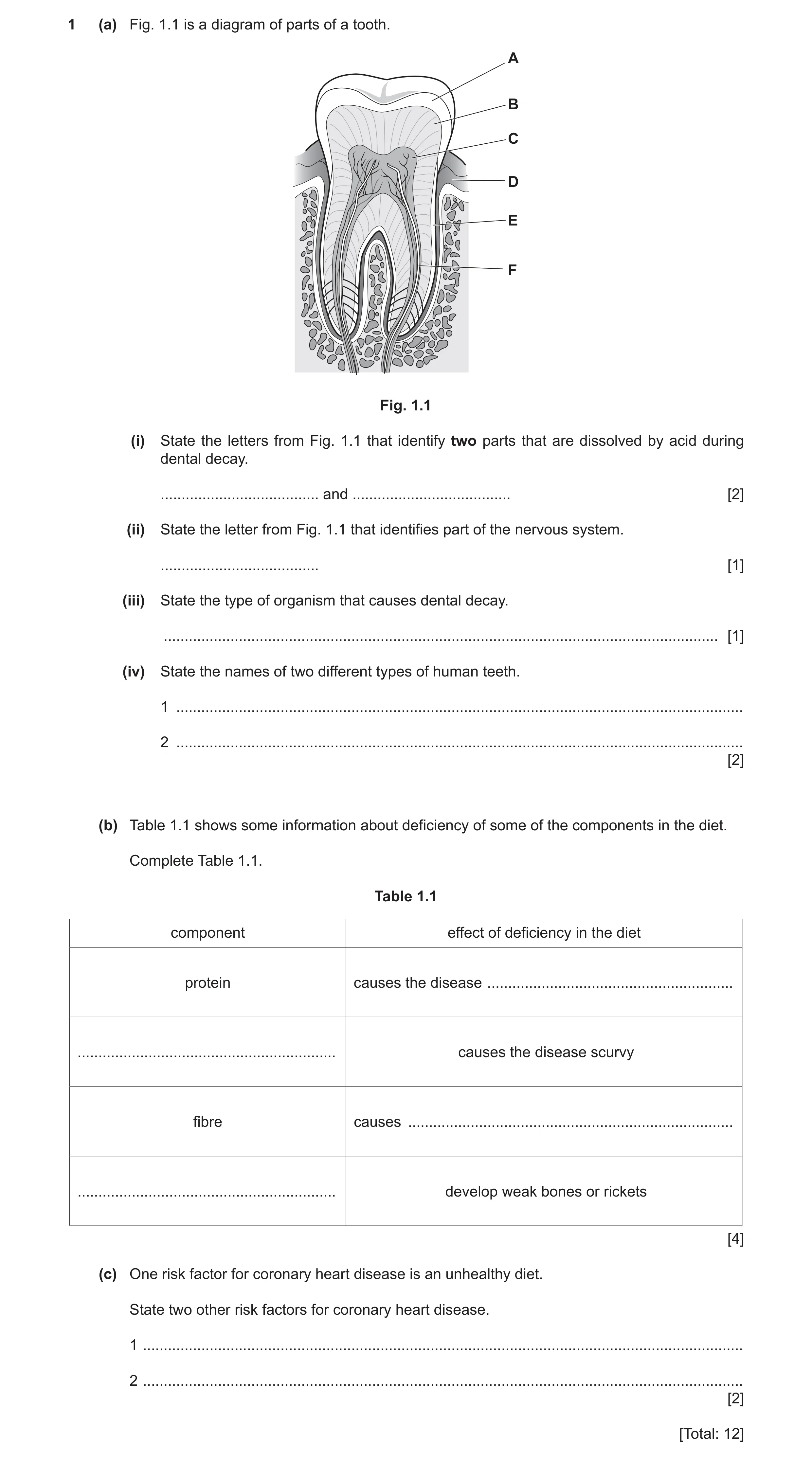
1 (a) Fig. 1.1 is a diagram of parts of a tooth. A B C D E F Fig. 1.1 (i) State the letters from Fig. 1.1 that identify two parts that are dissolved by acid during dental decay. … and … [2] (ii) State the letter from Fig. 1.1 that identifies part of the nervous system. … [1] (iii) State the type of organism that causes dental decay. … [1] (iv) State the names of two different types of human teeth. 1 … 2 … [2] (b) Table 1.1 shows some information about deficiency of some of the components in the diet. Complete Table 1.1. Table 1.1 component effect of deficiency in the diet protein causes the disease … … causes the disease scurvy fibre causes … … develop weak bones or rickets [4] (c) One risk factor for coronary heart disease is an unhealthy diet. State two other risk factors for coronary heart disease. 1 … 2 … [2] [Total: 12]
12 marks
Mark scheme: 1(a)(i) A ; B ; 2 1(a)(ii) F ; 1 1(a)(iii) bacteria ; 1 1(a)(iv) any two from: incisor ; canine ; pre-molar ; molar ; 2 1(b) protein kwashiorkor / marasmus ; vitamin C ; scurvy fibre causes constipation ; vitamin D / calcium ; rickets / weak bones 4 1(c) any two from: stress ; smoking ; genetic predisposition ; age ; gender ; AVP ; 2
This question in 0654/43 May/June 2023
Q10 · Phenylketonuria (PKU) is an inherited disorder controlled by a single gene 0654/42 Feb/March 2024
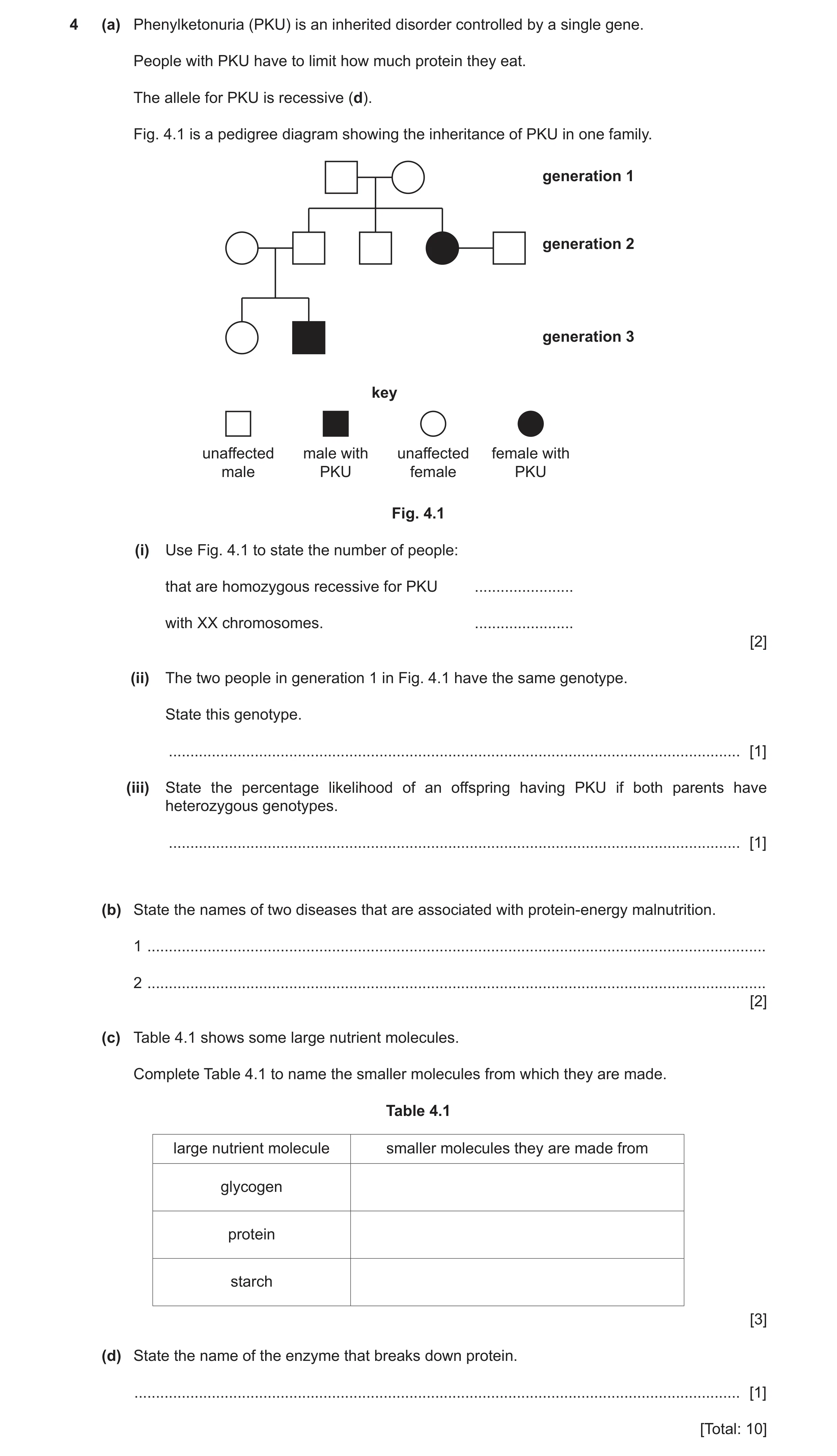
4 (a) Phenylketonuria (PKU) is an inherited disorder controlled by a single gene. People with PKU have to limit how much protein they eat. The allele for PKU is recessive (d). Fig. 4.1 is a pedigree diagram showing the inheritance of PKU in one family. generation 1 generation 2 generation 3 key unaffected male with unaffected female with male PKU female PKU Fig. 4.1 (i) Use Fig. 4.1 to state the number of people: that are homozygous recessive for PKU … with XX chromosomes. … [2] (ii) The two people in generation 1 in Fig. 4.1 have the same genotype. State this genotype. … [1] (iii) State the percentage likelihood of an offspring having PKU if both parents have heterozygous genotypes. … [1] (b) State the names of two diseases that are associated with protein-energy malnutrition. 1 … 2 … [2] (c) Table 4.1 shows some large nutrient molecules. Complete Table 4.1 to name the smaller molecules from which they are made. Table 4.1 large nutrient molecule smaller molecules they are made from glycogen protein starch [3] (d) State the name of the enzyme that breaks down protein. … [1] [Total: 10]
10 marks
Mark scheme: 4(a)(i) 2 ; 2 4 ; 4(a)(ii) Dd ; 1 4(a)(iii) 25 (%) ; 1 4(b) marasmus ; 2 kwashiorkor ; 4(c) glucose ; 3 amino acids ; glucose ; 4(d) protease ; 1
This question in 0654/42 Feb/March 2024
Q11 · A diagram of the alimentary canal and some of the associated organs in humans 0654/43 May/June 2024
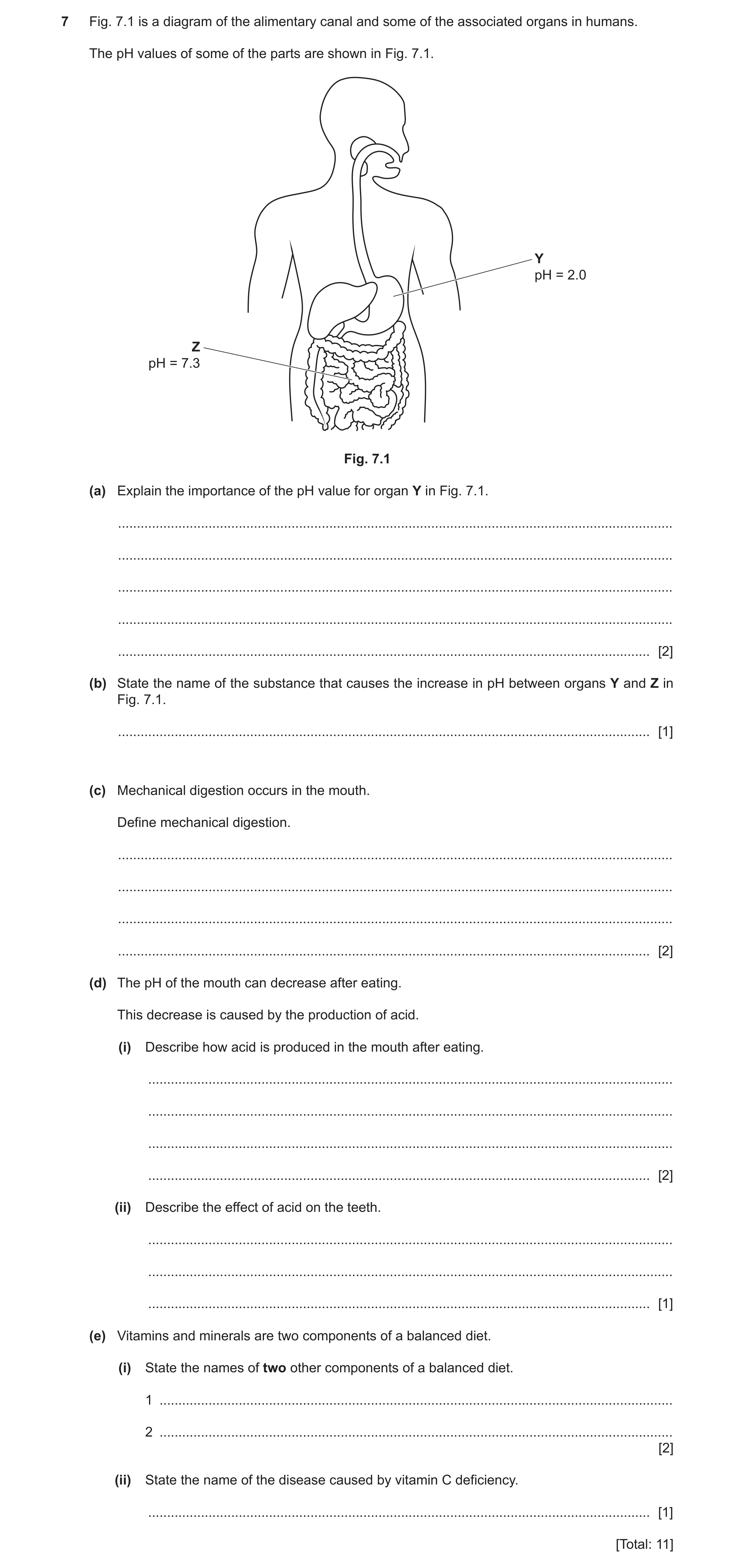
7 Fig. 7.1 is a diagram of the alimentary canal and some of the associated organs in humans. The pH values of some of the parts are shown in Fig. 7.1. Y pH = 2.0 Z pH = 7.3 Fig. 7.1 (a) Explain the importance of the pH value for organ Y in Fig. 7.1. … … … … … [2] (b) State the name of the substance that causes the increase in pH between organs Y and Z in Fig. 7.1. … [1] (c) Mechanical digestion occurs in the mouth. Define mechanical digestion. … … … … [2] (d) The pH of the mouth can decrease after eating. This decrease is caused by the production of acid. (i) Describe how acid is produced in the mouth after eating. … … … … [2] (ii) Describe the effect of acid on the teeth. … … … [1] (e) Vitamins and minerals are two components of a balanced diet. (i) State the names of two other components of a balanced diet. 1 … 2 … [2] (ii) State the name of the disease caused by vitamin C deficiency. … [1] [Total: 11]
11 marks
Mark scheme: 7(a) (acidic environment) kills, bacteria / microorganisms / denatures enzymes in microorganisms or bacteria ; provides, optimum / suitable, pH for protease ; 7(b) bile ; 1 7(c) the breakdown of food into smaller pieces / AW ; without chemical change (to the food molecules) ; 2 7(d)(i) ref to bacteria ; respiring (sugars) ; 2 7(d)(ii) dissolving enamel or dentine / (dental) decay ; 1 7(e)(i) any two from: carbohydrates ; fats ; protein ; fibre ; water ; 2 Question Answer Marks 7(e)(ii) scurvy ; 1
This question in 0654/43 May/June 2024
 1 / 15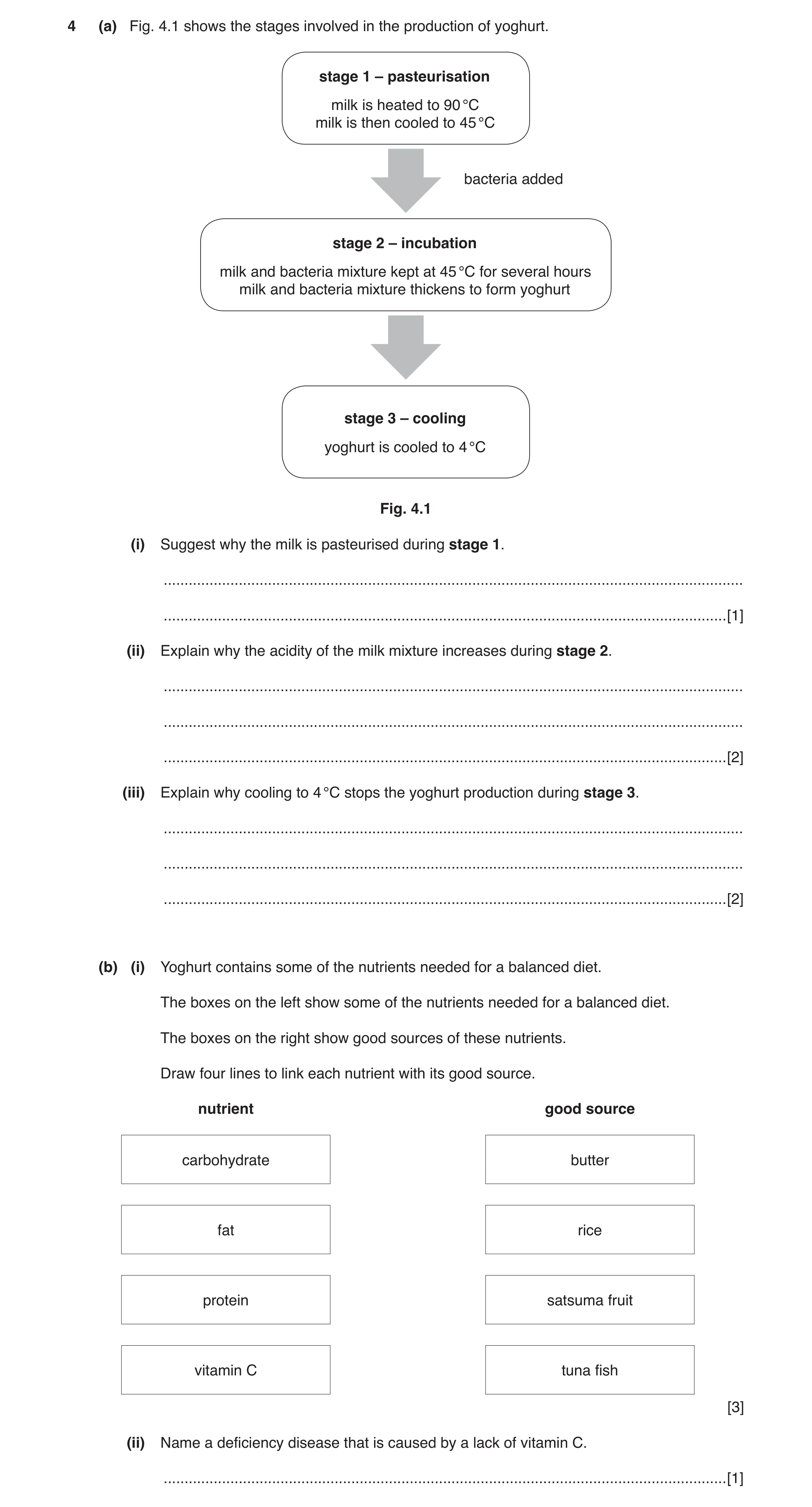
 9 / 15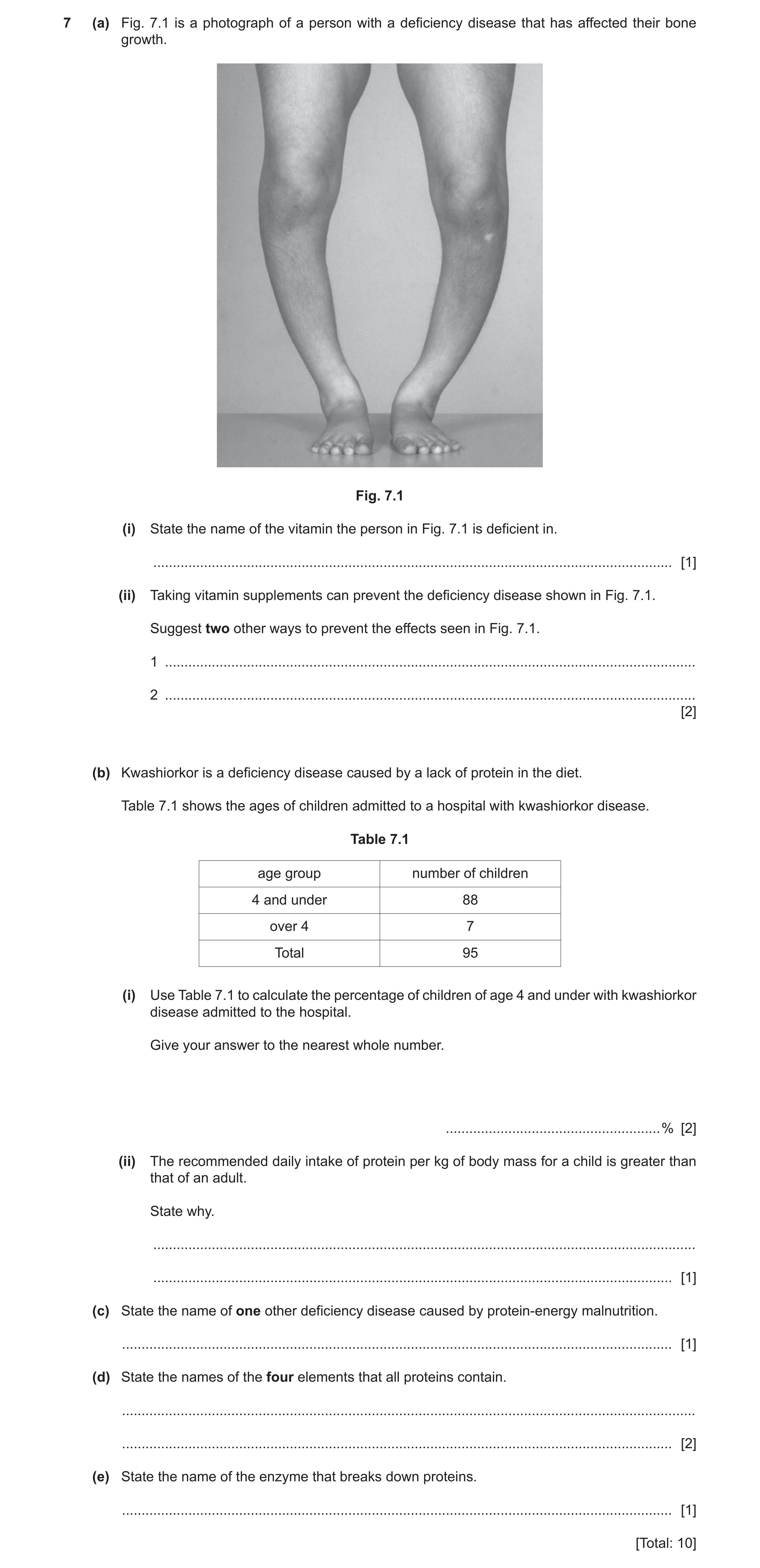
 11
11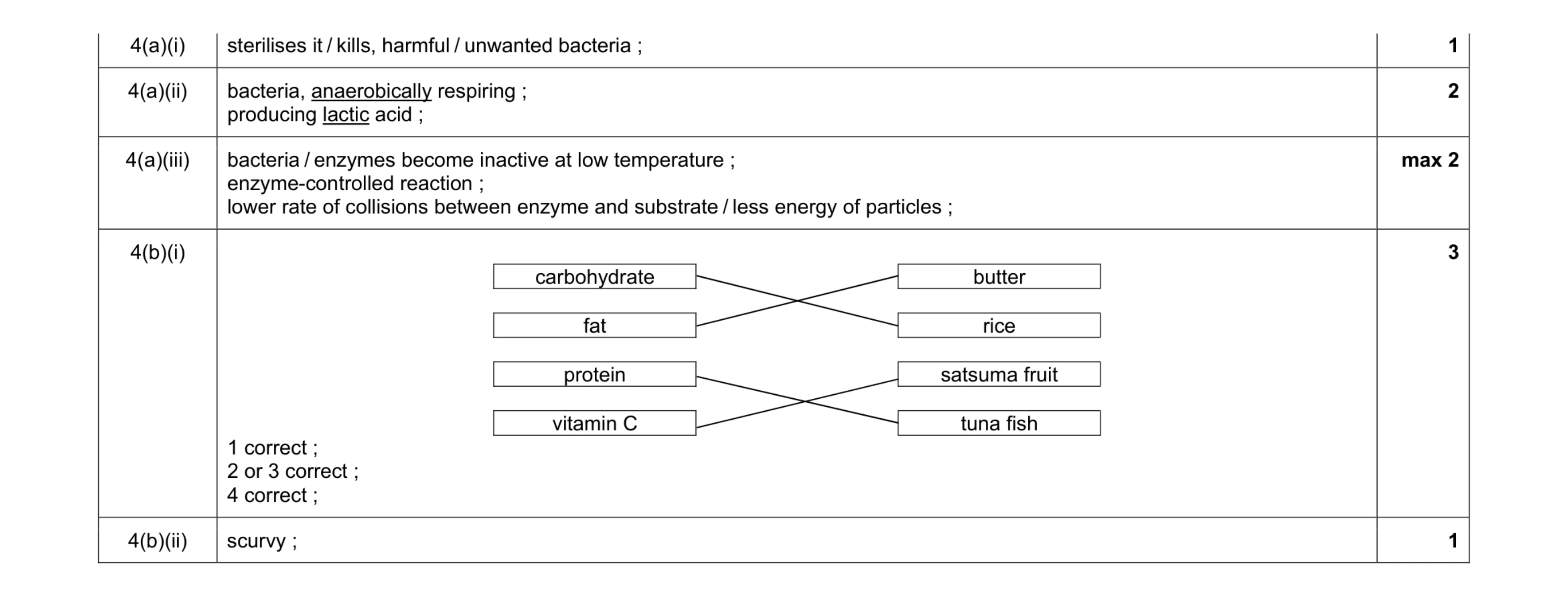 9
9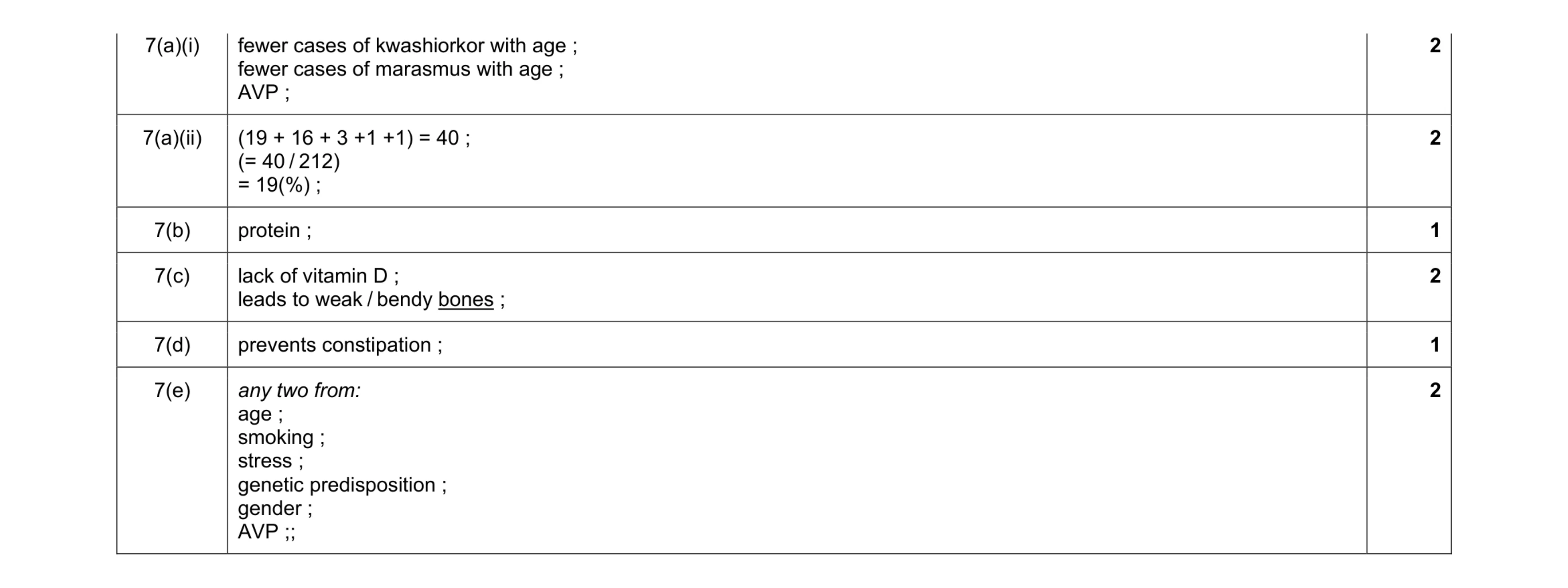 10
10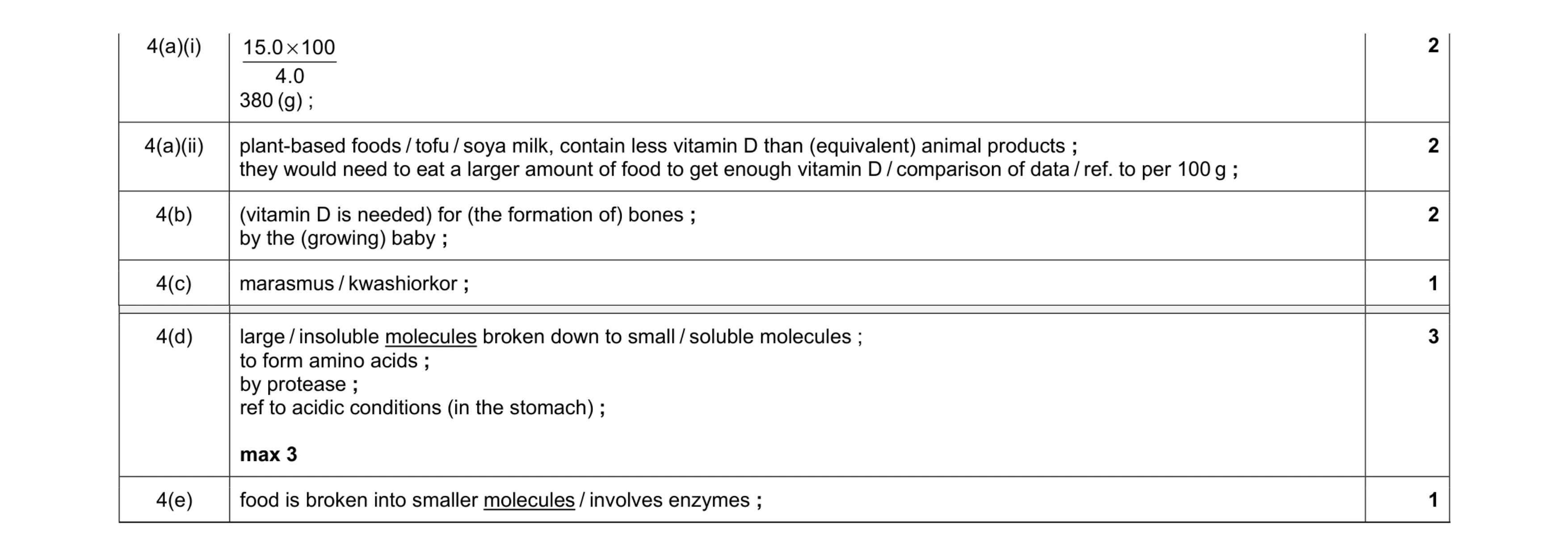 11
11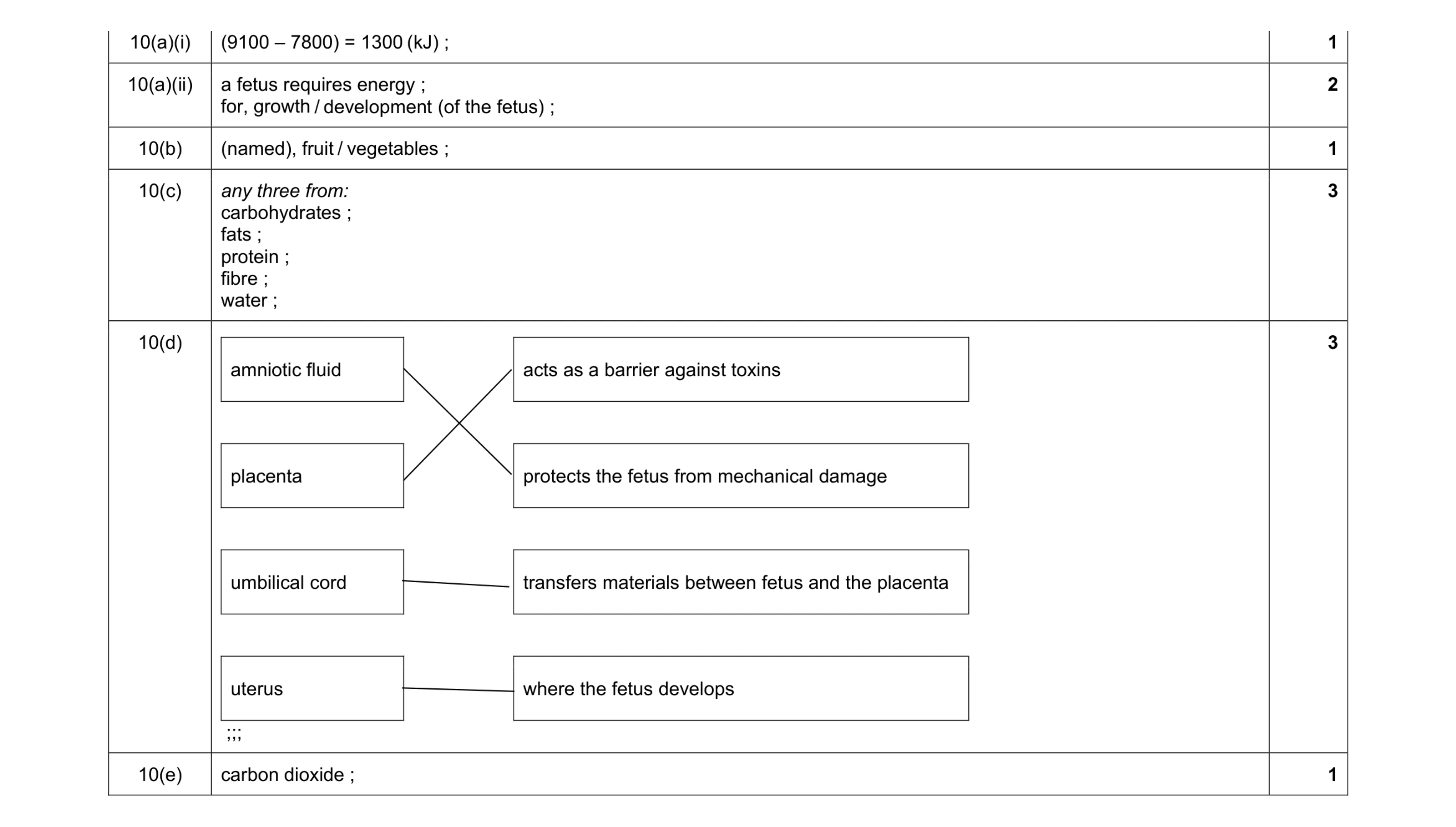 11
11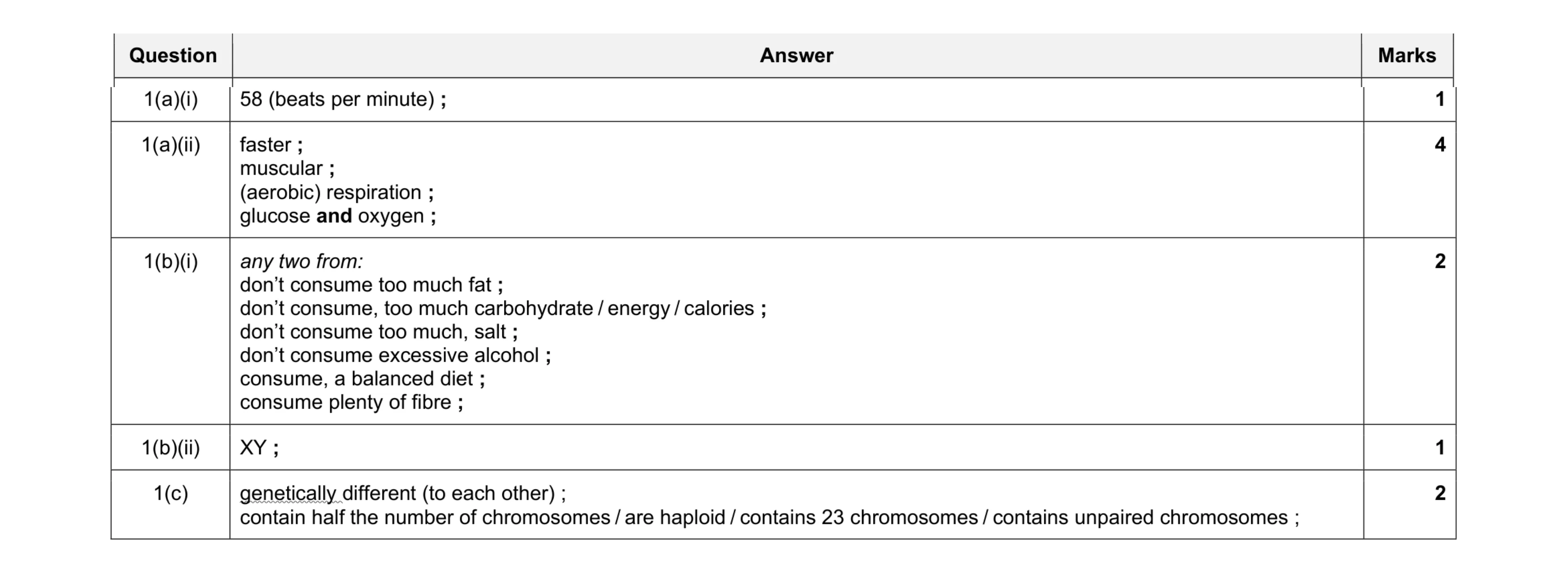 10
10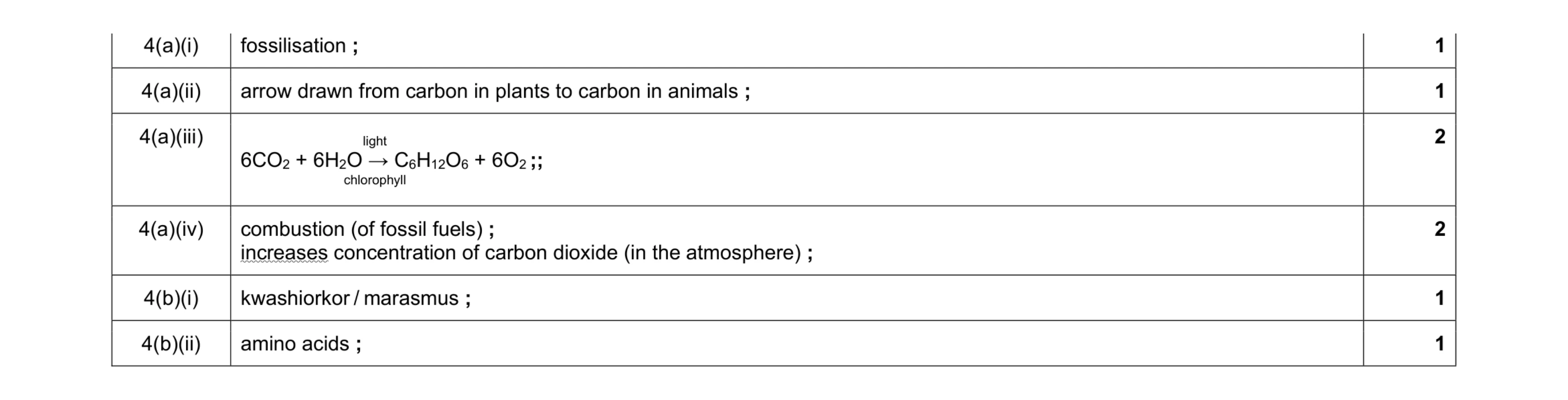 8
8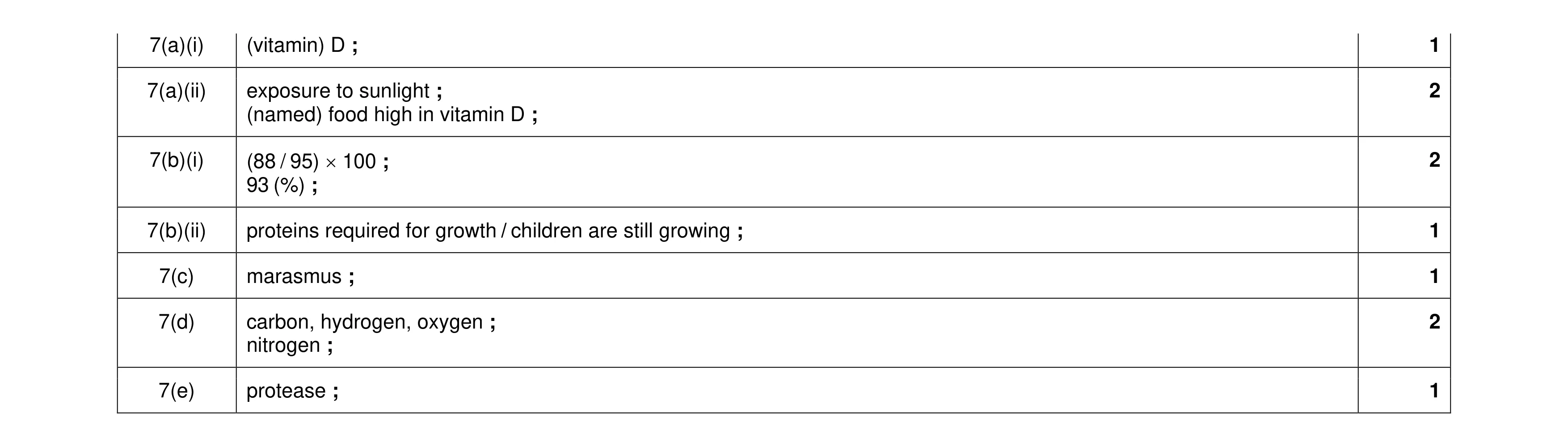 10
10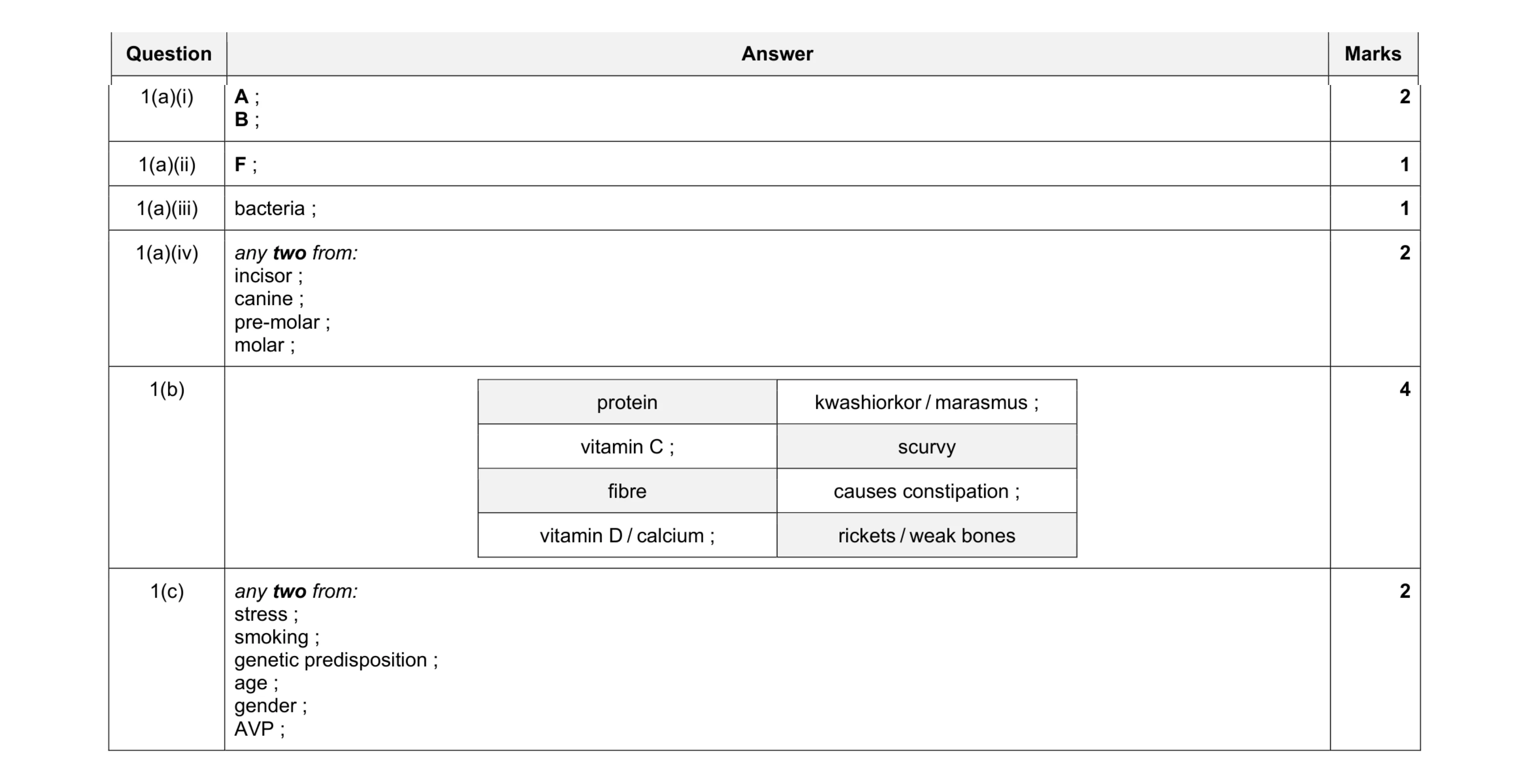 12
12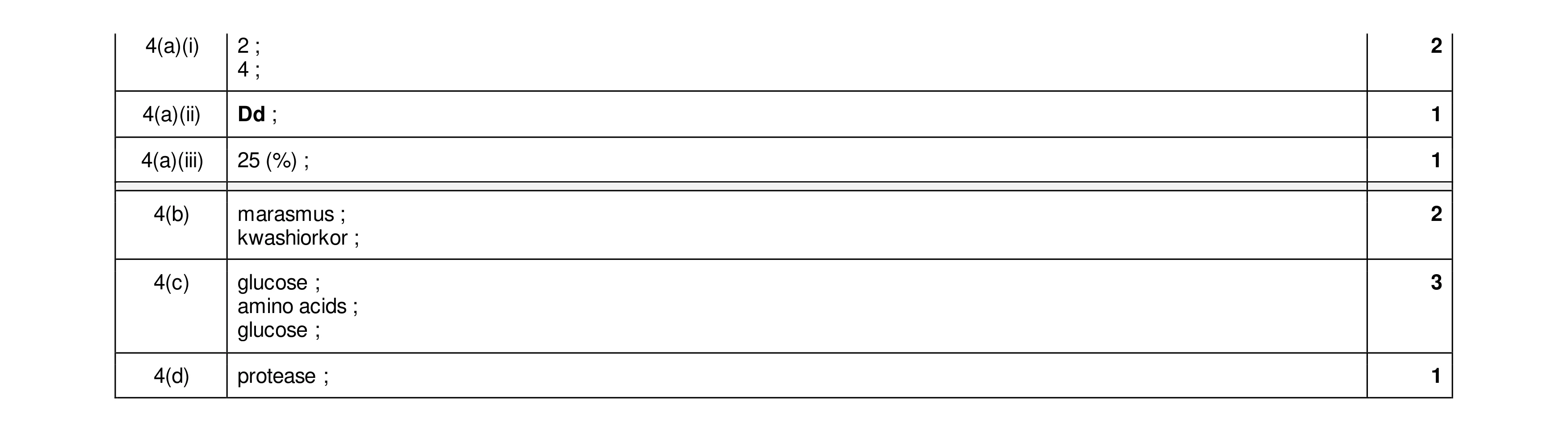 10
10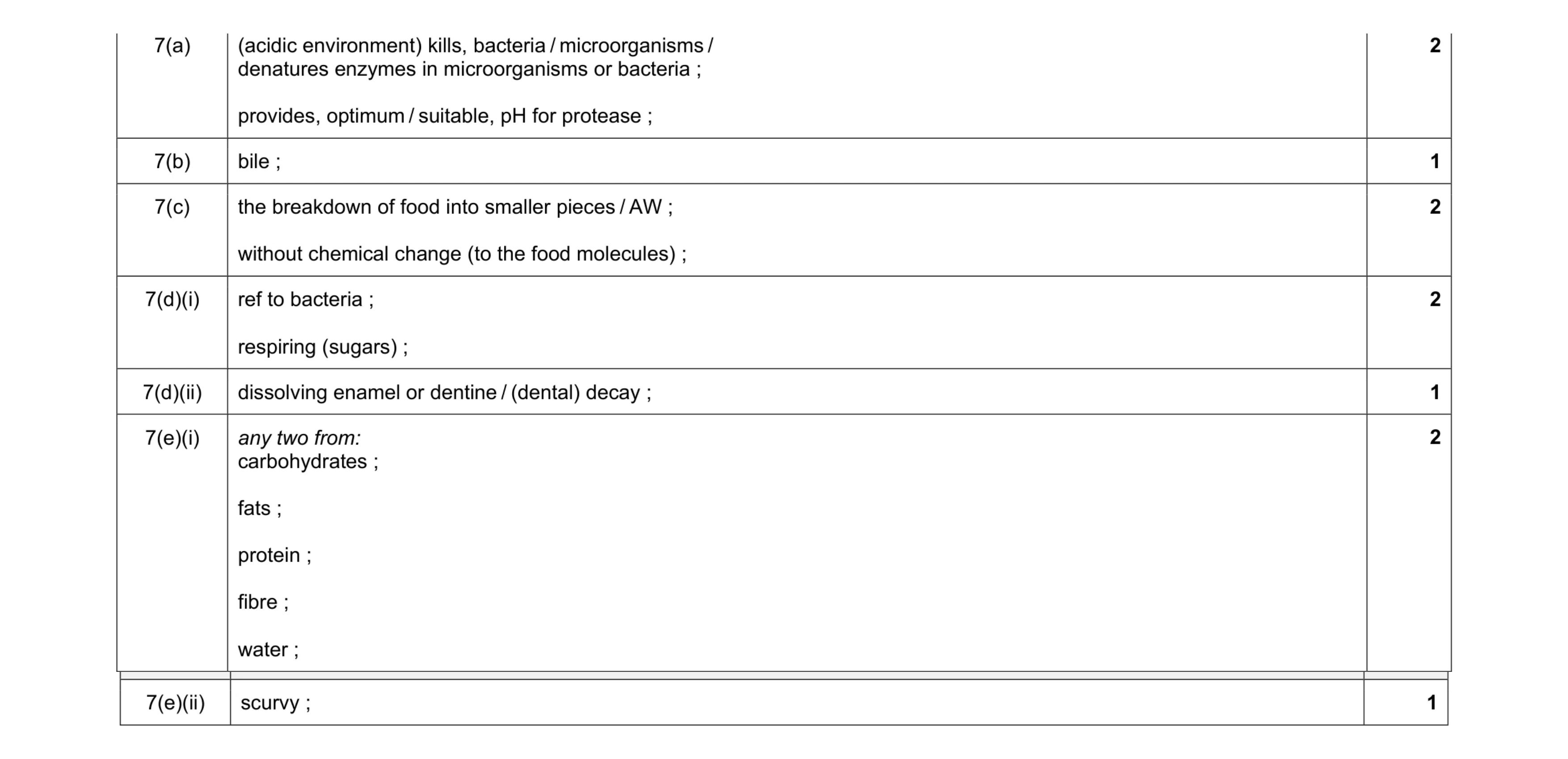 11
11