Questions as text
Question 1 0653/33 Oct/Nov 2017
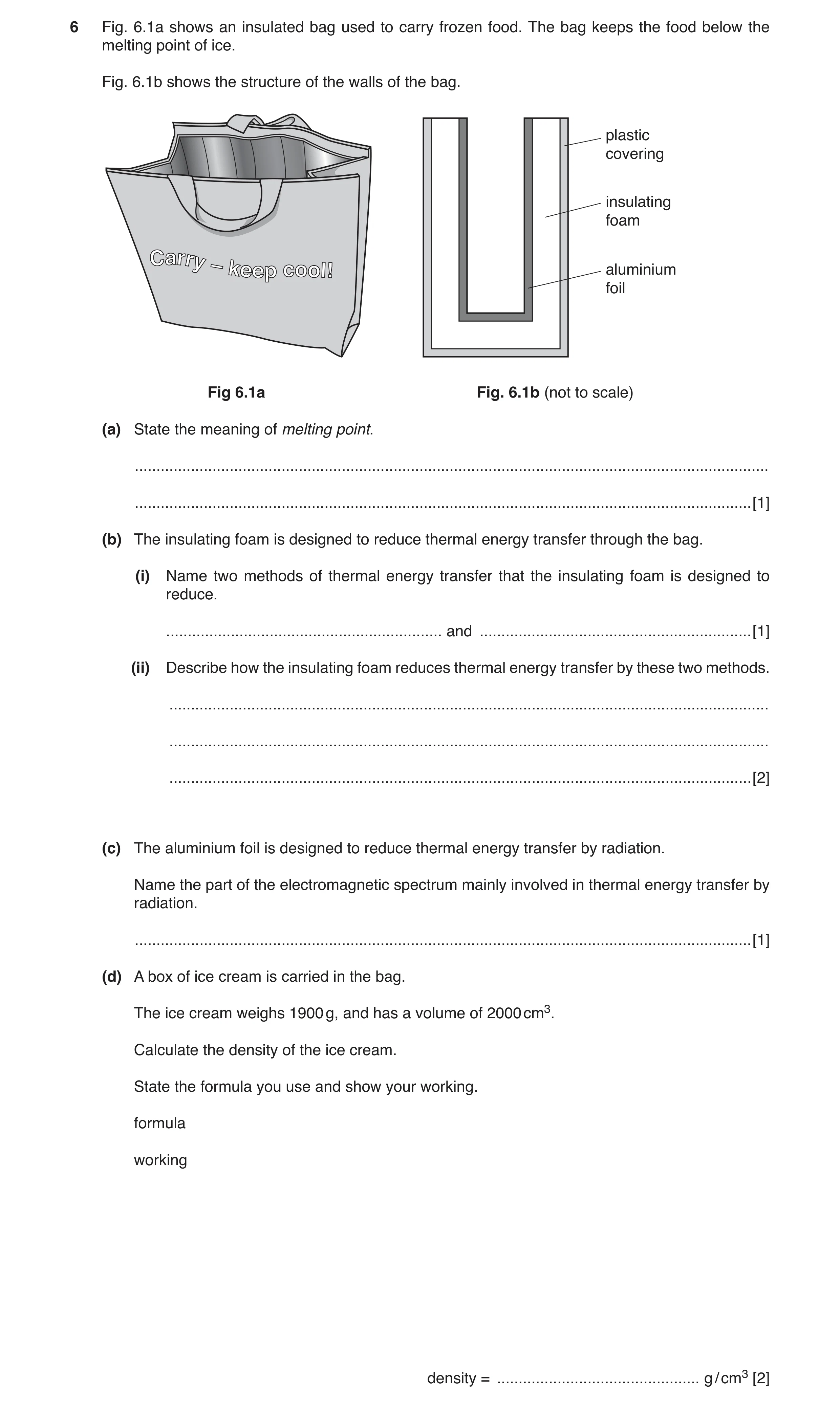
6 Fig. 6.1a shows an insulated bag used to carry frozen food. The bag keeps the food below the melting point of ice. Fig. 6.1b shows the structure of the walls of the bag. plastic covering insulating foam aluminium Carry– keep cool! foil Fig 6.1a Fig. 6.1b (not to scale) (a) State the meaning of melting point. … … [1] (b) The insulating foam is designed to reduce thermal energy transfer through the bag. (i) Name two methods of thermal energy transfer that the insulating foam is designed to reduce. … and … [1] (ii) Describe how the insulating foam reduces thermal energy transfer by these two methods. … … … [2] (c) The aluminium foil is designed to reduce thermal energy transfer by radiation. Name the part of the electromagnetic spectrum mainly involved in thermal energy transfer by radiation. … [1] (d) A box of ice cream is carried in the bag. The ice cream weighs 1900 g, and has a volume of 2000 cm3. Calculate the density of the ice cream. State the formula you use and show your working. formula working density = … g / cm3 [2]
7 marks
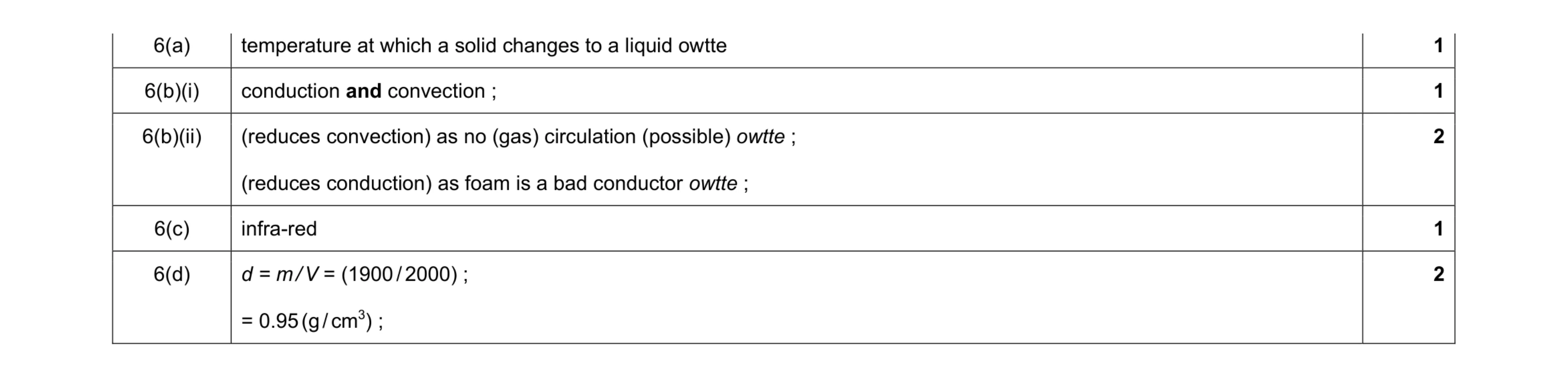
Mark scheme: 6(a) temperature at which a solid changes to a liquid owtte 1 6(b)(i) conduction and convection ; 1 6(b)(ii) (reduces convection) as no (gas) circulation (possible) owtte ; (reduces conduction) as foam is a bad conductor owtte ; 2 6(c) infra-red 1 6(d) d = m / V = (1900 / 2000) ; = 0.95 (g / cm3) ; 2
This question in 0653/33 Oct/Nov 2017
Q2 · A diagram which shows the International Space Station which is kept in orbit around the… 0653/32 Feb/March 2018
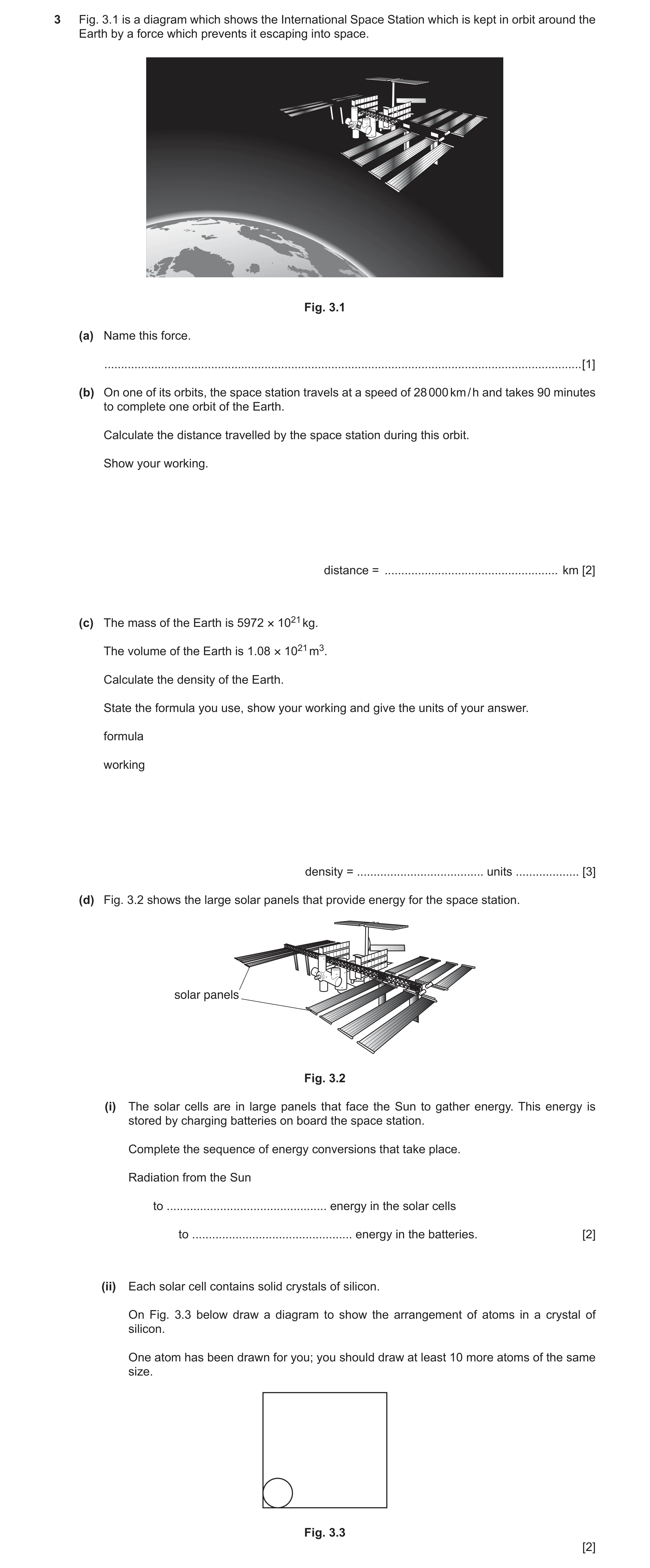
3 Fig. 3.1 is a diagram which shows the International Space Station which is kept in orbit around the Earth by a force which prevents it escaping into space. Fig. 3.1 (a) Name this force. … [1] (b) On one of its orbits, the space station travels at a speed of 28 000 km / h and takes 90 minutes to complete one orbit of the Earth. Calculate the distance travelled by the space station during this orbit. Show your working. distance = … km [2] (c) The mass of the Earth is 5972 × 1021 kg. The volume of the Earth is 1.08 × 10²¹ m3. Calculate the density of the Earth. State the formula you use, show your working and give the units of your answer. formula working density = … units … [3] (d) Fig. 3.2 shows the large solar panels that provide energy for the space station. solar panels Fig. 3.2 (i) The solar cells are in large panels that face the Sun to gather energy. This energy is stored by charging batteries on board the space station. Complete the sequence of energy conversions that take place. Radiation from the Sun to … energy in the solar cells to … energy in the batteries. [2] (ii) Each solar cell contains solid crystals of silicon. On Fig. 3.3 below draw a diagram to show the arrangement of atoms in a crystal of silicon. One atom has been drawn for you; you should draw at least 10 more atoms of the same size. Fig. 3.3 [2]
10 marks
Mark scheme: 3(a) gravitational force / weight ; 1 3(b) speed = distance / time or AV ; distance (= speed × time) = 28 000 × 90 / 60 = 42 000 (km) ; 2 3(c) density = mass / volume ; = 5972 × 1021 / 1.08 × 1021 = 5530 ; (units) kg / m3 ; 3 3(d)(i) electrical (energy in solar cells) ; chemical (energy in the batteries) ; 2 3(d)(ii) regular arrangement of at least 10 atoms of similar size ; all touching ; 2
This question in 0653/32 Feb/March 2018
Q3 · An airship carrying a heavy load 0653/31 May/June 2018
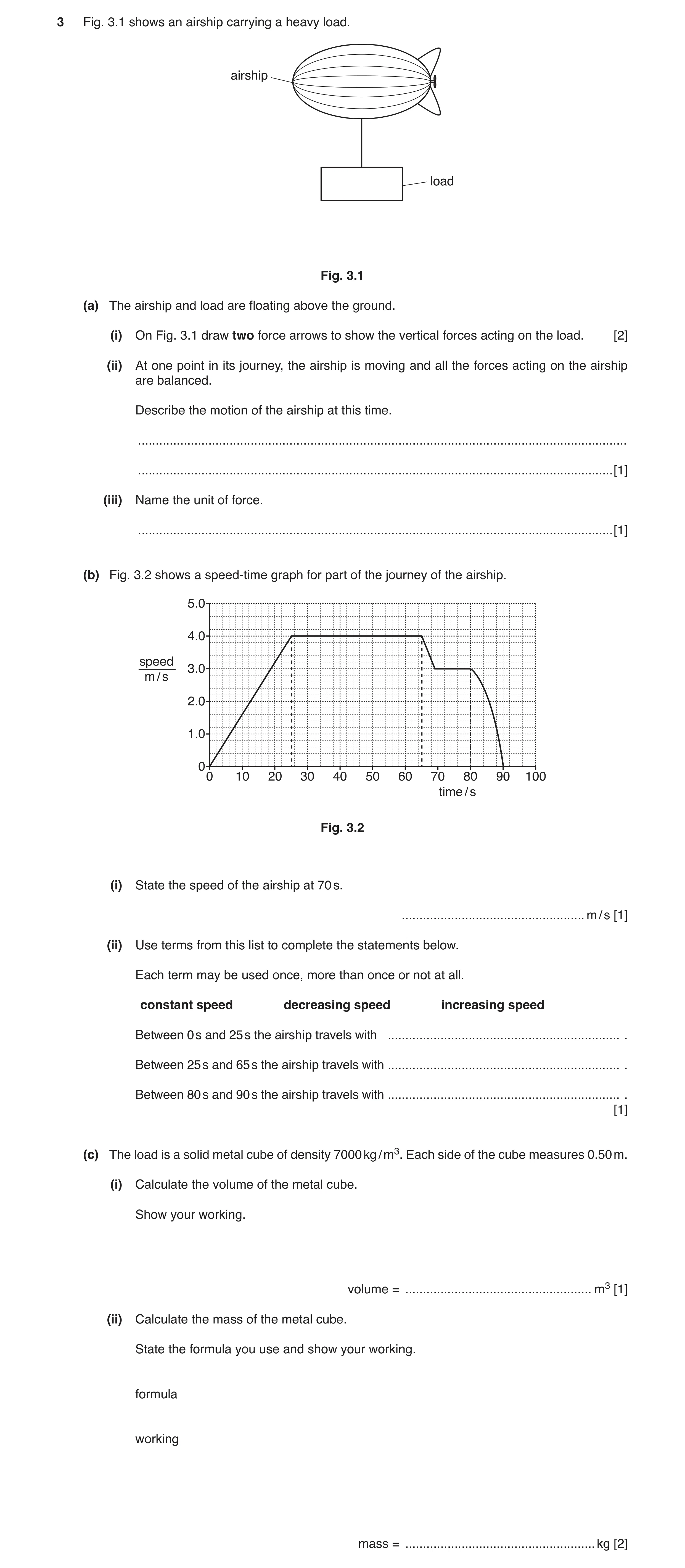
3 Fig. 3.1 shows an airship carrying a heavy load. airship load Fig. 3.1 (a) The airship and load are floating above the ground. (i) On Fig. 3.1 draw two force arrows to show the vertical forces acting on the load. [2] (ii) At one point in its journey, the airship is moving and all the forces acting on the airship are balanced. Describe the motion of the airship at this time. … … [1] (iii) Name the unit of force. … [1] (b) Fig. 3.2 shows a speed‑time graph for part of the journey of the airship. 5.0 4.0 speed 3.0 m / s 2.0 1.0 00 10 20 30 40 50 60 70 80 90 100 time / s Fig. 3.2 (i) State the speed of the airship at 70 s. … m / s [1] (ii) Use terms from this list to complete the statements below. Each term may be used once, more than once or not at all. constant speed decreasing speed increasing speed Between 0 s and 25 s the airship travels with … . Between 25 s and 65 s the airship travels with … . Between 80 s and 90 s the airship travels with … . [1] (c) The load is a solid metal cube of density 7000 kg / m3. Each side of the cube measures 0.50 m. (i) Calculate the volume of the metal cube. Show your working. volume = … m3 [1] (ii) Calculate the mass of the metal cube. State the formula you use and show your working. formula working mass = … kg [2]
9 marks
Mark scheme: 3(a)(i) two opposing vertical force arrows ; both arrows acting on the load ; 2 3(a)(ii) moving at constant speed ; 1 3(a)(iii) newton / N ; 1 3(b)(i) 3 (m / s) 1 3(b)(ii) increasing speed, constant speed, decreasing speed in this order only 1 Question Answer Marks 3(c)(i) volume of cube = 0.50 × 0.50 × 0.50 = 0.125 (m3) ; 1 3(c)(ii) density = mass / volume or d = m / V or m = V × d or mass = 0.125 × 7000 ; = 875 (kg) or 880 (kg) ; 2
This question in 0653/31 May/June 2018
Q4 · A crane carrying a load 0653/32 May/June 2018
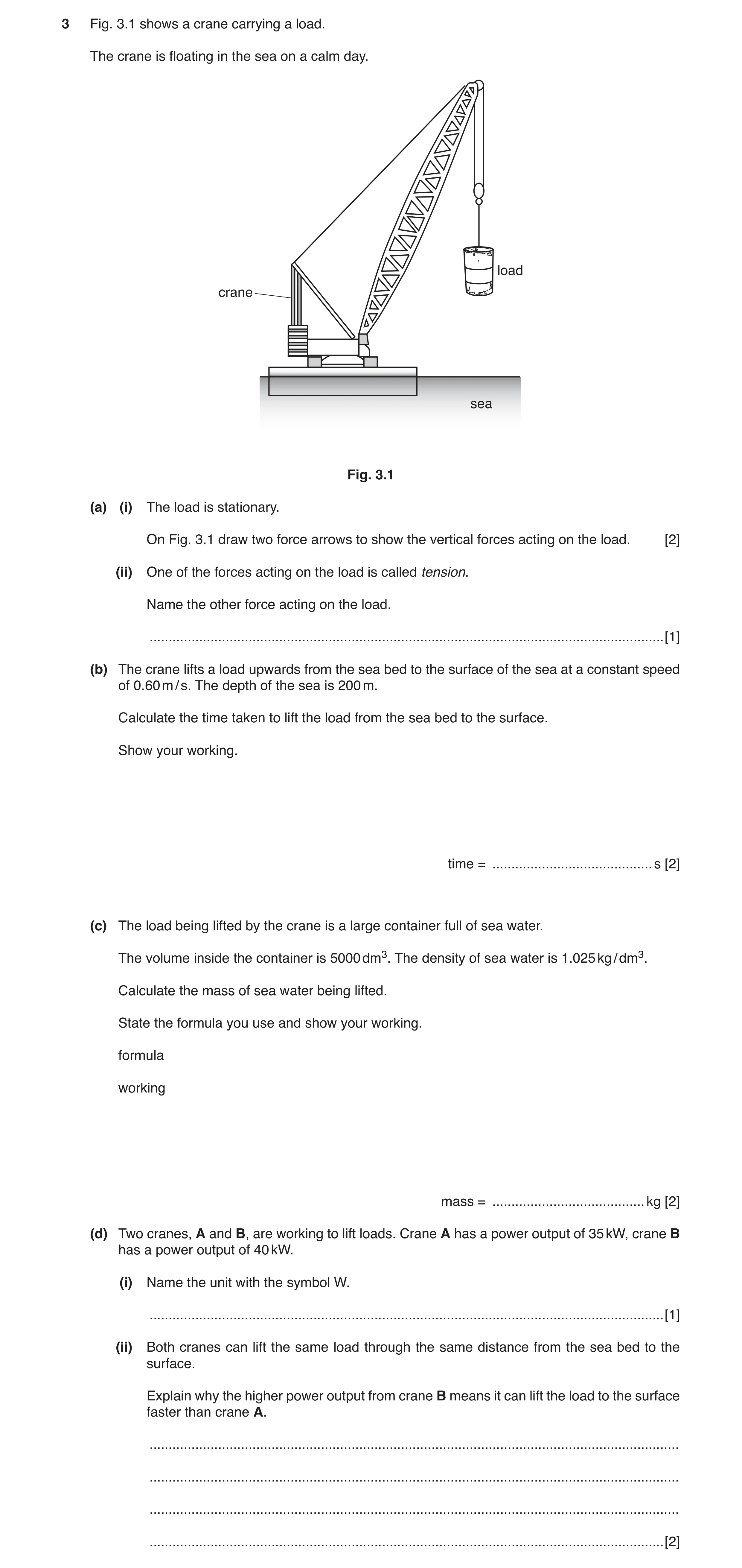
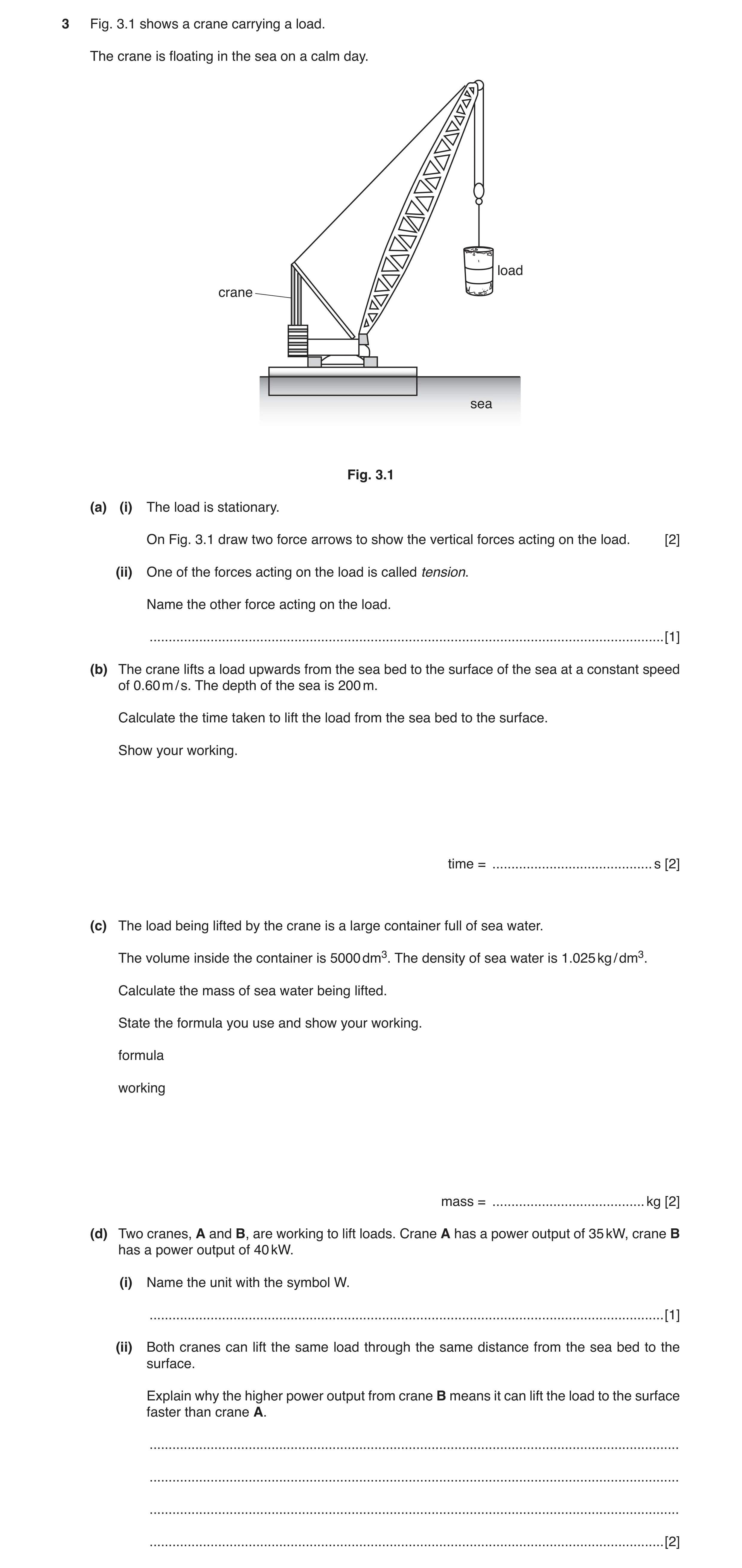
3 Fig. 3.1 shows a crane carrying a load. The crane is floating in the sea on a calm day. load crane sea Fig. 3.1 (a) (i) The load is stationary. On Fig. 3.1 draw two force arrows to show the vertical forces acting on the load. [2] (ii) One of the forces acting on the load is called tension. Name the other force acting on the load. … [1] (b) The crane lifts a load upwards from the sea bed to the surface of the sea at a constant speed of 0.60 m / s. The depth of the sea is 200 m. Calculate the time taken to lift the load from the sea bed to the surface. Show your working. time = … s [2] (c) The load being lifted by the crane is a large container full of sea water. The volume inside the container is 5000 dm3. The density of sea water is 1.025 kg / dm3. Calculate the mass of sea water being lifted. State the formula you use and show your working. formula working mass = … kg [2] (d) Two cranes, A and B, are working to lift loads. Crane A has a power output of 35 kW, crane B has a power output of 40 kW. (i) Name the unit with the symbol W. … [1] (ii) Both cranes can lift the same load through the same distance from the sea bed to the surface. Explain why the higher power output from crane B means it can lift the load to the surface faster than crane A. … … … … [2]
10 marks
Mark scheme: 3(a)(i) two opposing vertical force arrows ; both arrows from the load ; 2 3(a)(ii) weight / gravitational force ; 1 3(b) speed = distance / time or time = 200 / 0.60 ; = 333 s ; 2 3(c) density = mass / volume or mass = volume × density = 5000 × 1.025 ; = 5125 (kg) ; 2 3(d)(i) watt ; 1 3(d)(ii) idea that the same amount of energy is transferred / work done ; the same amount of energy is transferred / work done in less time ; 2
This question in 0653/32 May/June 2018
Q5 · A crane carrying a load 0653/33 May/June 2018
3 Fig. 3.1 shows a crane carrying a load. The crane is floating in the sea on a calm day. load crane sea Fig. 3.1 (a) (i) The load is stationary. On Fig. 3.1 draw two force arrows to show the vertical forces acting on the load. [2] (ii) One of the forces acting on the load is called tension. Name the other force acting on the load. … [1] (b) The crane lifts a load upwards from the sea bed to the surface of the sea at a constant speed of 0.60 m / s. The depth of the sea is 200 m. Calculate the time taken to lift the load from the sea bed to the surface. Show your working. time = … s [2] (c) The load being lifted by the crane is a large container full of sea water. The volume inside the container is 5000 dm3. The density of sea water is 1.025 kg / dm3. Calculate the mass of sea water being lifted. State the formula you use and show your working. formula working mass = … kg [2] (d) Two cranes, A and B, are working to lift loads. Crane A has a power output of 35 kW, crane B has a power output of 40 kW. (i) Name the unit with the symbol W. … [1] (ii) Both cranes can lift the same load through the same distance from the sea bed to the surface. Explain why the higher power output from crane B means it can lift the load to the surface faster than crane A. … … … … [2]
10 marks
Mark scheme: 3(a)(i) two opposing vertical force arrows ; both arrows from the load ; 2 3(a)(ii) weight / gravitational force ; 1 3(b) speed = distance / time or time = 200 / 0.60 ; = 333 s ; 2 3(c) density = mass / volume or mass = volume × density = 5000 × 1.025 ; = 5125 (kg) ; 2 3(d)(i) watt ; 1 3(d)(ii) idea that the same amount of energy is transferred / work done ; the same amount of energy is transferred / work done in less time ; 2
This question in 0653/33 May/June 2018
Q6 · A game played on a sloping board 0653/32 Oct/Nov 2019
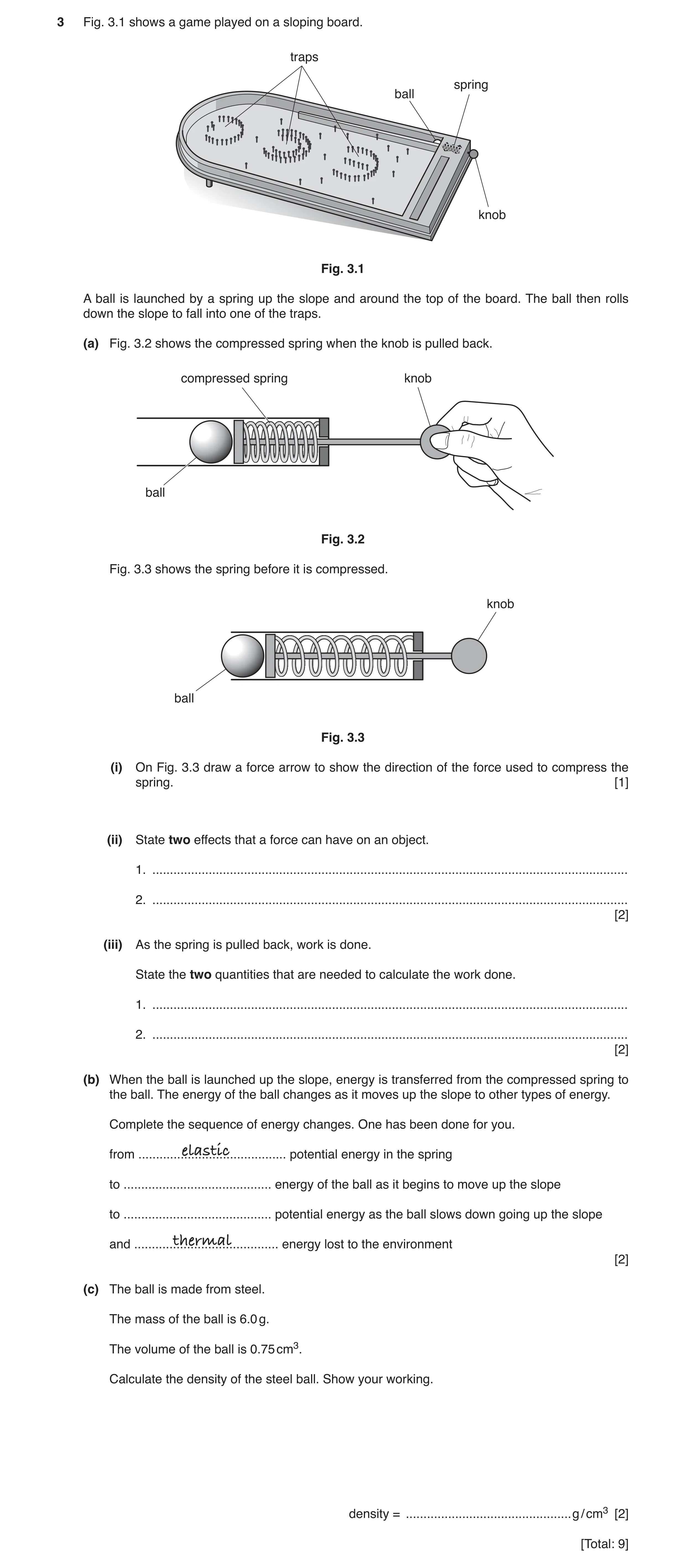
3 Fig. 3.1 shows a game played on a sloping board. traps spring ball knob Fig. 3.1 A ball is launched by a spring up the slope and around the top of the board. The ball then rolls down the slope to fall into one of the traps. (a) Fig. 3.2 shows the compressed spring when the knob is pulled back. compressed spring knob ball Fig. 3.2 Fig. 3.3 shows the spring before it is compressed. knob ball Fig. 3.3 (i) On Fig. 3.3 draw a force arrow to show the direction of the force used to compress the spring. [1] (ii) State two effects that a force can have on an object. 1. … 2. … [2] (iii) As the spring is pulled back, work is done. State the two quantities that are needed to calculate the work done. 1. … 2. … [2] (b) When the ball is launched up the slope, energy is transferred from the compressed spring to the ball. The energy of the ball changes as it moves up the slope to other types of energy. Complete the sequence of energy changes. One has been done for you. from … elastic potential energy in the spring to … energy of the ball as it begins to move up the slope to … potential energy as the ball slows down going up the slope and … thermal energy lost to the environment [2] (c) The ball is made from steel. The mass of the ball is 6.0 g. The volume of the ball is 0.75 cm3. Calculate the density of the steel ball. Show your working. density = … g / cm3 [2] [Total: 9]
9 marks
Mark scheme: 3(a)(i) horizontal arrow to the right ; 1 3(a)(ii) any two from: changes (object’s) shape ; changes (object’s) size ; changes (object’s) motion ; 2 3(a)(iii) force (applied) ; distance (moved) ; 2 3(b) kinetic ; gravitational ; 2 3(c) density = mass / volume or density = 6.0 (g) / 0.75 (cm3) ; = 8.0 or 8 (g/cm3) ; 2
This question in 0653/32 Oct/Nov 2019
Q7 · A game played on a sloping board 0653/33 Oct/Nov 2019
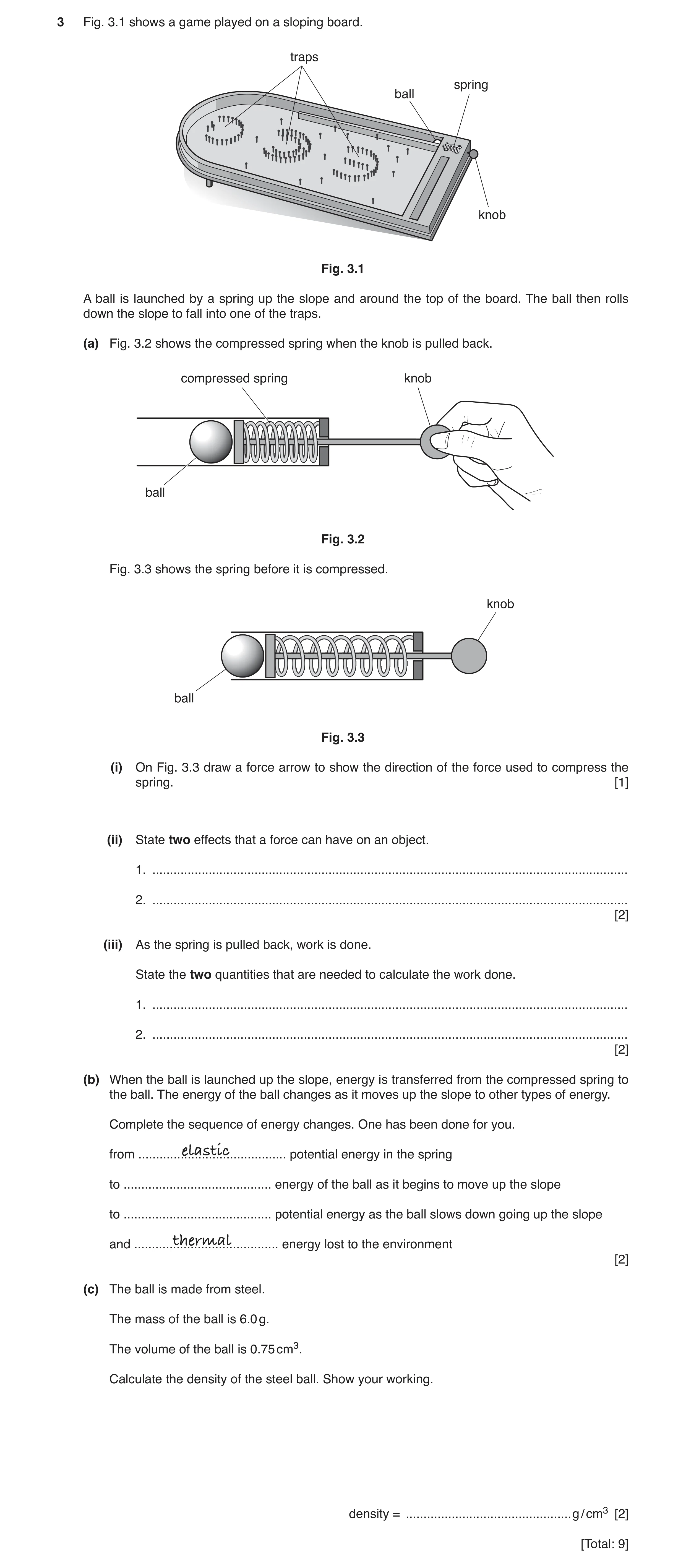
3 Fig. 3.1 shows a game played on a sloping board. traps spring ball knob Fig. 3.1 A ball is launched by a spring up the slope and around the top of the board. The ball then rolls down the slope to fall into one of the traps. (a) Fig. 3.2 shows the compressed spring when the knob is pulled back. compressed spring knob ball Fig. 3.2 Fig. 3.3 shows the spring before it is compressed. knob ball Fig. 3.3 (i) On Fig. 3.3 draw a force arrow to show the direction of the force used to compress the spring. [1] (ii) State two effects that a force can have on an object. 1. … 2. … [2] (iii) As the spring is pulled back, work is done. State the two quantities that are needed to calculate the work done. 1. … 2. … [2] (b) When the ball is launched up the slope, energy is transferred from the compressed spring to the ball. The energy of the ball changes as it moves up the slope to other types of energy. Complete the sequence of energy changes. One has been done for you. from … elastic potential energy in the spring to … energy of the ball as it begins to move up the slope to … potential energy as the ball slows down going up the slope and … thermal energy lost to the environment [2] (c) The ball is made from steel. The mass of the ball is 6.0 g. The volume of the ball is 0.75 cm3. Calculate the density of the steel ball. Show your working. density = … g / cm3 [2] [Total: 9]
9 marks
Mark scheme: 3(a)(i) horizontal arrow to the right ; 1 3(a)(ii) any two from: changes (object’s) shape ; changes (object’s) size ; changes (object’s) motion ; 2 3(a)(iii) force (applied) ; distance (moved) ; 2 3(b) kinetic ; gravitational ; 2 3(c) density = mass / volume or density = 6.0 (g) / 0.75 (cm3) ; = 8.0 or 8 (g/cm3) ; 2
This question in 0653/33 Oct/Nov 2019
Q8 · Liquid (molten) iron being poured from a furnace into a mould to form a rectangular block… 0653/32 Feb/March 2020
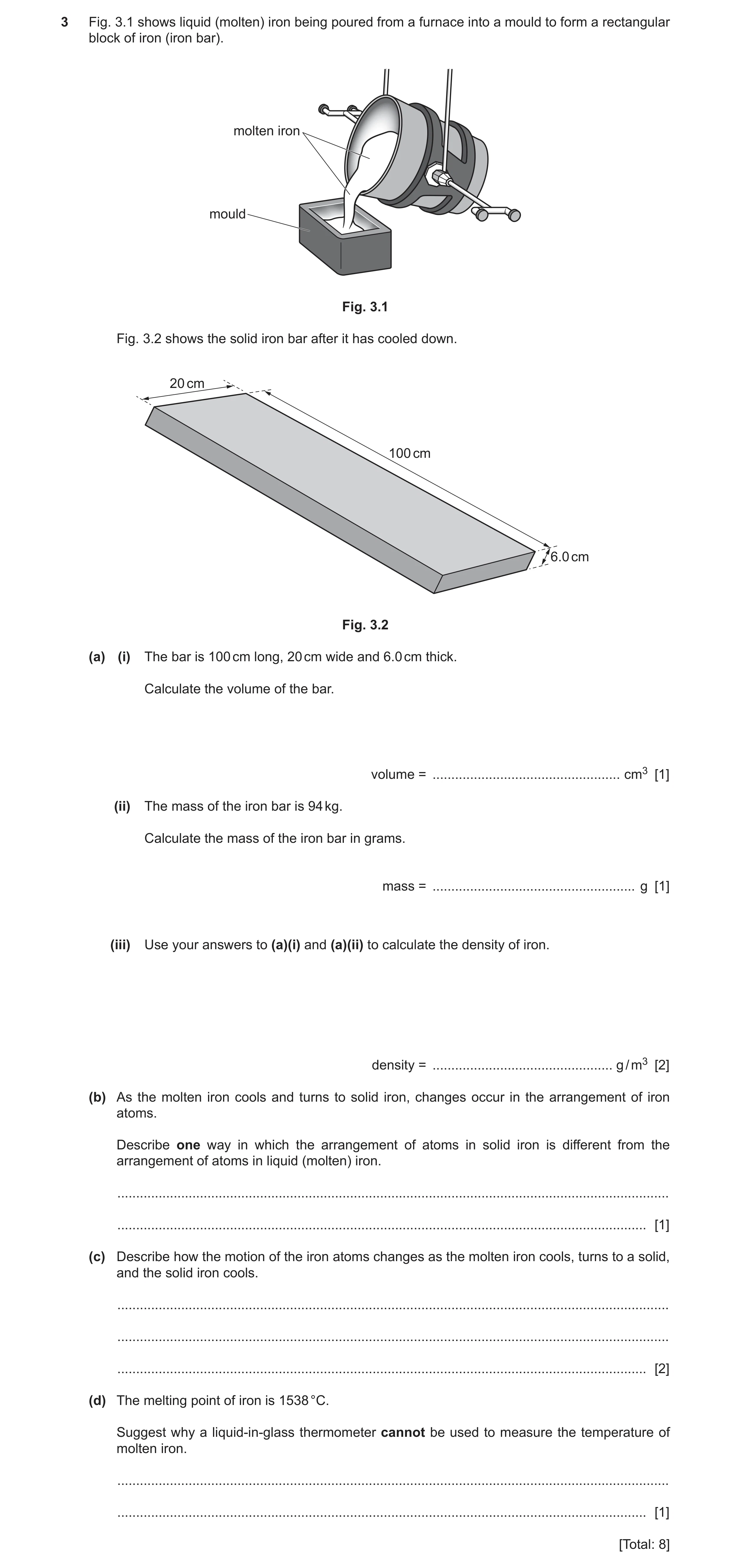
3 Fig. 3.1 shows liquid (molten) iron being poured from a furnace into a mould to form a rectangular block of iron (iron bar). molten iron mould Fig. 3.1 Fig. 3.2 shows the solid iron bar after it has cooled down. 20 cm 100 cm 6.0 cm Fig. 3.2 (a) (i) The bar is 100 cm long, 20 cm wide and 6.0 cm thick. Calculate the volume of the bar. volume = … cm3 [1] (ii) The mass of the iron bar is 94 kg. Calculate the mass of the iron bar in grams. mass = … g [1] (iii) Use your answers to (a)(i) and (a)(ii) to calculate the density of iron. density = … g / m3 [2] (b) As the molten iron cools and turns to solid iron, changes occur in the arrangement of iron atoms. Describe one way in which the arrangement of atoms in solid iron is different from the arrangement of atoms in liquid (molten) iron. … … [1] (c) Describe how the motion of the iron atoms changes as the molten iron cools, turns to a solid, and the solid iron cools. … … … [2] (d) The melting point of iron is 1538 °C. Suggest why a liquid-in-glass thermometer cannot be used to measure the temperature of molten iron. … … [1] [Total: 8]
8 marks
Mark scheme: 3(a)(i) (volume = 100 × 20 × 6.0 =) 12 000 (cm3) ; 1 3(a)(ii) 94 000 (g) ; 1 3(a)(iii) mass 94000 density = = ; volume 12000 = 7.8 (g / m3) ; 2 3(b) solid iron: more closely packed / liquid iron: further apart ; OR solid iron: regular arrangement / liquid iron: random arrangement ; 1 3(c) fast moving atoms in molten iron slow down as it cools ; atoms slow down again as solid iron cools ; 2 Question Answer Marks 3(d) glass would melt or break / mercury or liquid would boil ; 1
This question in 0653/32 Feb/March 2020
Q9 · A bucket of crushed ice used to cool drinks 0653/31 May/June 2020
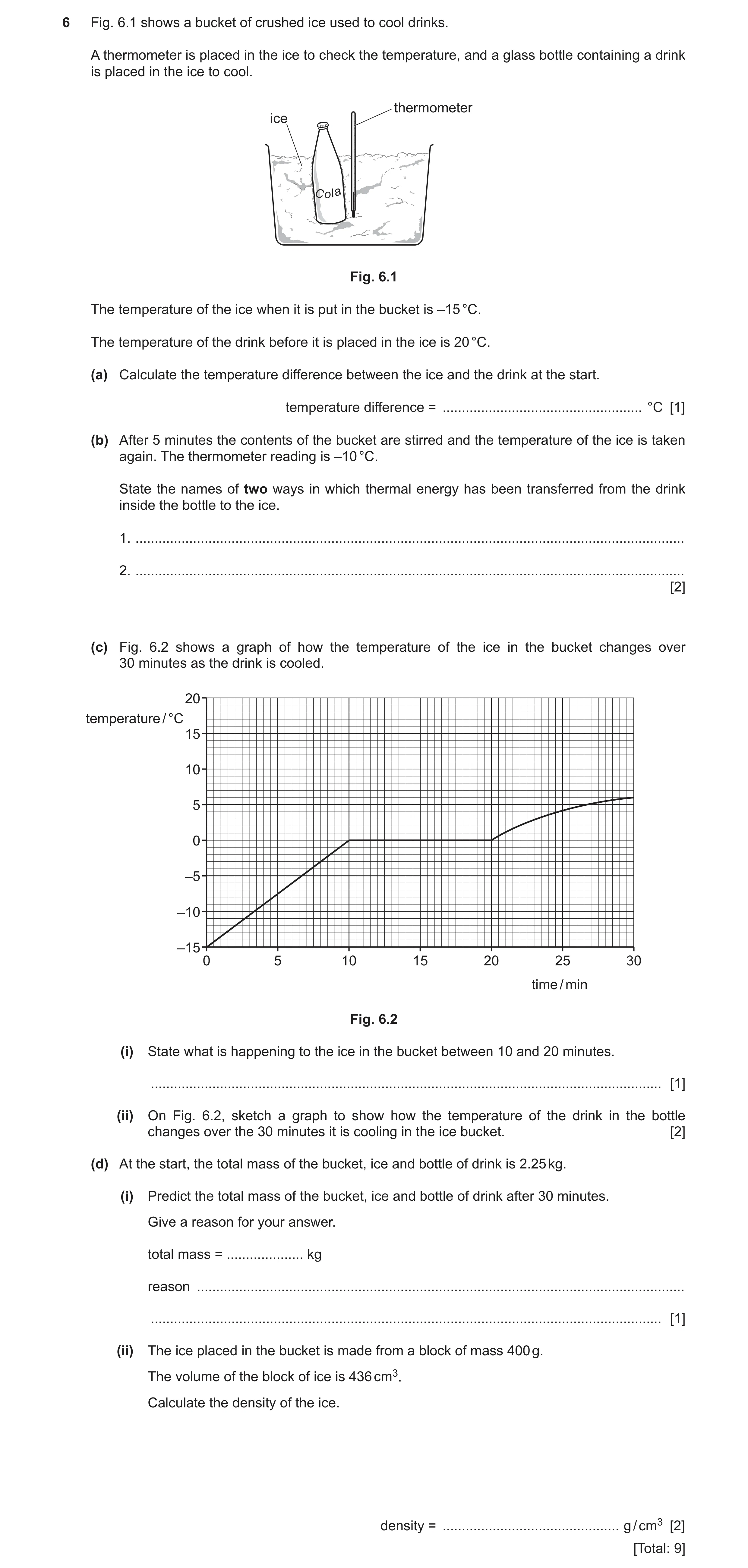
6 Fig. 6.1 shows a bucket of crushed ice used to cool drinks. A thermometer is placed in the ice to check the temperature, and a glass bottle containing a drink is placed in the ice to cool. thermometer ice Fig. 6.1 The temperature of the ice when it is put in the bucket is –15 °C. The temperature of the drink before it is placed in the ice is 20 °C. (a) Calculate the temperature difference between the ice and the drink at the start. temperature difference = … °C [1] (b) After 5 minutes the contents of the bucket are stirred and the temperature of the ice is taken again. The thermometer reading is –10 °C. State the names of two ways in which thermal energy has been transferred from the drink inside the bottle to the ice. 1. … 2. … [2] (c) Fig. 6.2 shows a graph of how the temperature of the ice in the bucket changes over 30 minutes as the drink is cooled. 20 temperature / °C 15 10 5 0 –5 –10 –15 0 5 10 15 20 25 30 time / min Fig. 6.2 (i) State what is happening to the ice in the bucket between 10 and 20 minutes. … [1] (ii) On Fig. 6.2, sketch a graph to show how the temperature of the drink in the bottle changes over the 30 minutes it is cooling in the ice bucket. [2] (d) At the start, the total mass of the bucket, ice and bottle of drink is 2.25 kg. (i) Predict the total mass of the bucket, ice and bottle of drink after 30 minutes. Give a reason for your answer. total mass = … kg reason … … [1] (ii) The ice placed in the bucket is made from a block of mass 400 g. The volume of the block of ice is 436 cm3. Calculate the density of the ice. density = … g / cm3 [2] [Total: 9]
9 marks
Mark scheme: 6(a) 35 (°C) ; 1 6(b) conduction (through glass and ice) ; convection (inside bottle) ; 2 6(c)(i) ice melting ; 1 6(c)(ii) 2 6(d)(i) (total mass = 2.25 kg – no mark) (reason) mass does not change with temperature ; 1 6(d)(ii) d = m / V (in any form) = 400 / 436 ; = 0.917 (g / cm3) ; 2 line starts at +20 °C, comes down ; continuous line from t = 0 to t = 30 and does not go below 6 °C ;
This question in 0653/31 May/June 2020
Q10 · A thermometer in a solution of salt in water 0653/31 May/June 2021
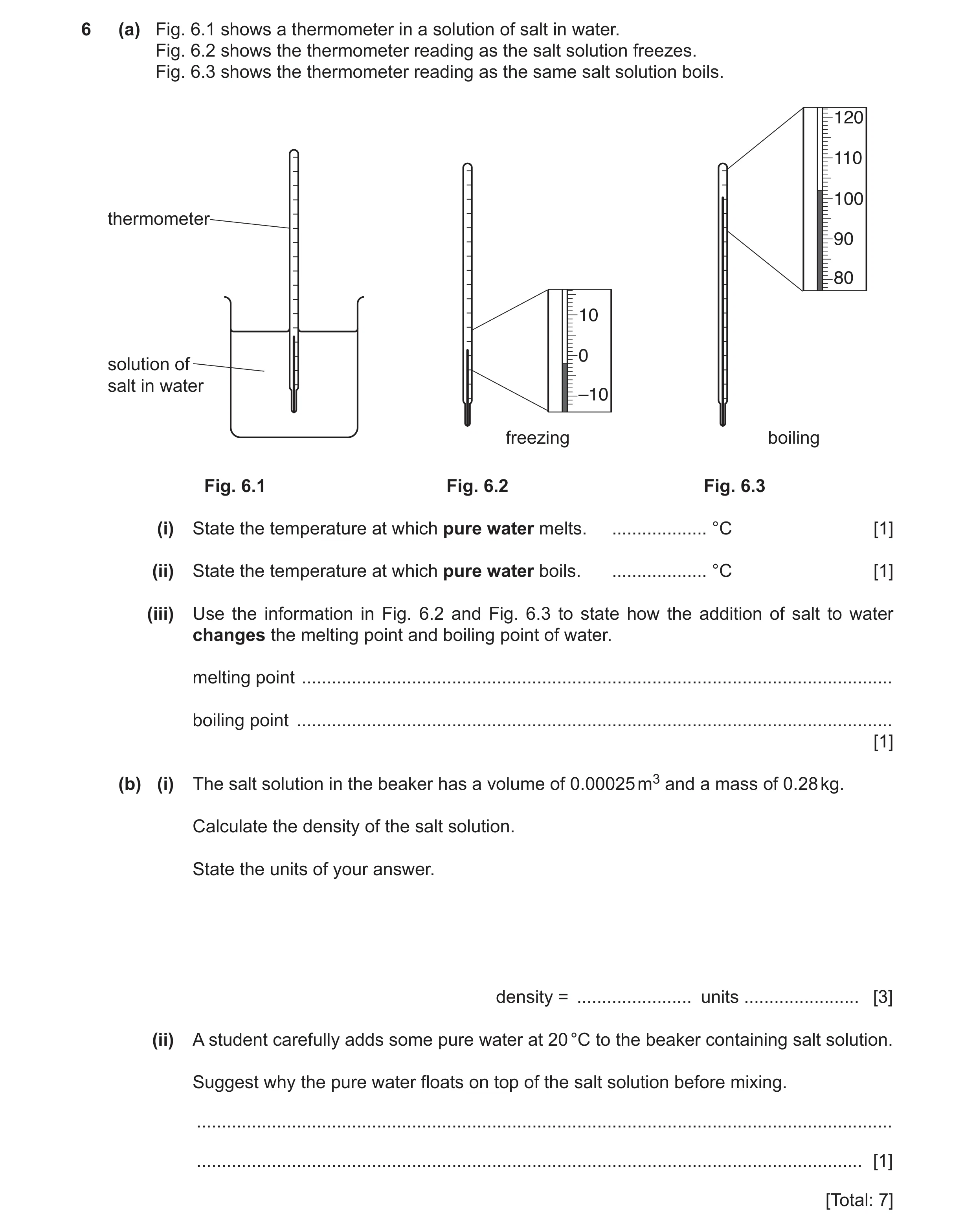
6 (a) Fig. 6.1 shows a thermometer in a solution of salt in water. Fig. 6.2 shows the thermometer reading as the salt solution freezes. Fig. 6.3 shows the thermometer reading as the same salt solution boils. 120 110 100 thermometer 90 80 10 0 solution of salt in water –10 freezing boiling Fig. 6.1 Fig. 6.2 Fig. 6.3 (i) State the temperature at which pure water melts. … °C [1] (ii) State the temperature at which pure water boils. … °C [1] (iii) Use the information in Fig. 6.2 and Fig. 6.3 to state how the addition of salt to water changes the melting point and boiling point of water. melting point … boiling point … [1] (b) (i) The salt solution in the beaker has a volume of 0.00025 m3 and a mass of 0.28 kg. Calculate the density of the salt solution. State the units of your answer. density = … units … [3] (ii) A student carefully adds some pure water at 20 °C to the beaker containing salt solution. Suggest why the pure water floats on top of the salt solution before mixing. … … [1] [Total: 7]
7 marks
Mark scheme: 6(a)(i) 0 (°C) ; 1 6(a)(ii) 100 (°C) ; 1 6(a)(iii) melting point: (–2°C means salt) lowers melting point (of water) AND boiling point: (102°C means salt) raises boiling point (of water) ; 1 6(b)(i) density = m/V = 0.28 / 0.00025 ; (density =) 1120 OR 1100 ; (units) kg / m3 ; 3 6(b)(ii) (pure water / it is) less dense / has lower density (than salt solution) ; 1
This question in 0653/31 May/June 2021
Q11 · A cylinder made of solid copper 0653/32 May/June 2021
3 (a) Fig. 3.1 shows a cylinder made of solid copper. Fig. 3.1 The cylinder has a: • height of 25 cm • radius of 10 cm • mass of 70 000 g. (i) Show that the volume of the copper cylinder is 7850 cm3. π = 3.14 [2] (ii) Use the information above to calculate the density of copper in g / cm3. density = … g / cm3 [2] (b) Fig. 3.2 shows two electrically charged copper spheres next to each other. + – + + – – + + – – + + – – + + – – – – + + + – sphere A sphere B Fig. 3.2 (i) State which sphere is charged with an excess of electrons. Give a reason for your answer. sphere … reason … … [1] (ii) On Fig. 3.2 the force arrow shows the direction of the force exerted on sphere A by sphere B. Explain why sphere B exerts this force on sphere A. … … [2] (c) A length of thin copper wire has a resistance of 3 Ω. The potential difference (p.d.) across the wire is 12 V. Calculate the current in the copper wire. State the unit of your answer. current = … unit … [3] [Total: 10]
10 marks
Mark scheme: 3(a)(i) volume of cylinder = πr2 l ; 3.14 × 100 × 25 (= 7850 cm3) ; 3(a)(ii) density = mass ÷ volume / ρ = m ÷ V / = 70 000 ÷ 7850 ; (density =) 8.9(2) (g / cm3) ; 2 3(b)(i) sphere: B (no mark) reason: negatively charged ; 1 3(b)(ii) opposite charges ; attract ; 2 Question Answer Marks 3(c) R = V ÷ I / I = V ÷ R / = 12 ÷ 3 ; (current =) 4 ; (unit) amp / A ; 3
This question in 0653/32 May/June 2021
Q12 · A meteorite is a rock from space that travels through the Earth’s atmosphere and hits the… 0653/32 Oct/Nov 2021
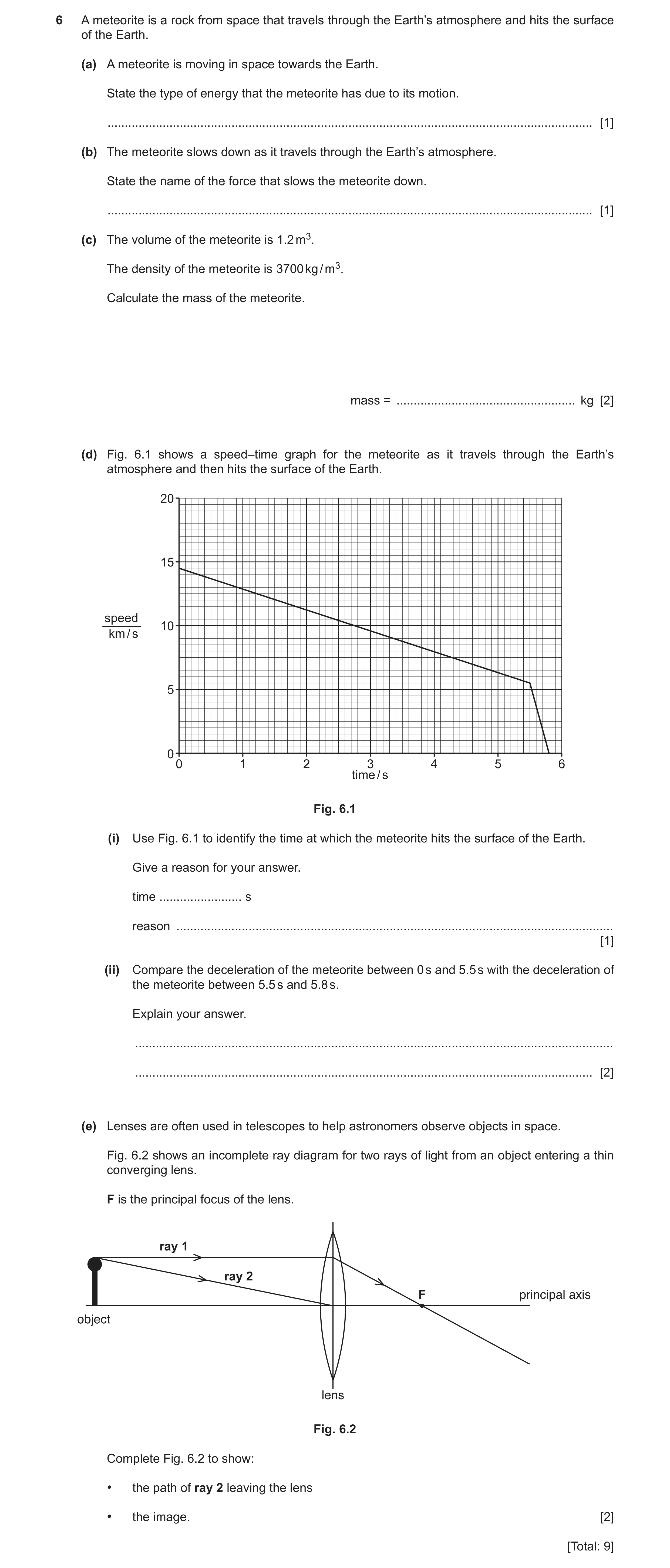
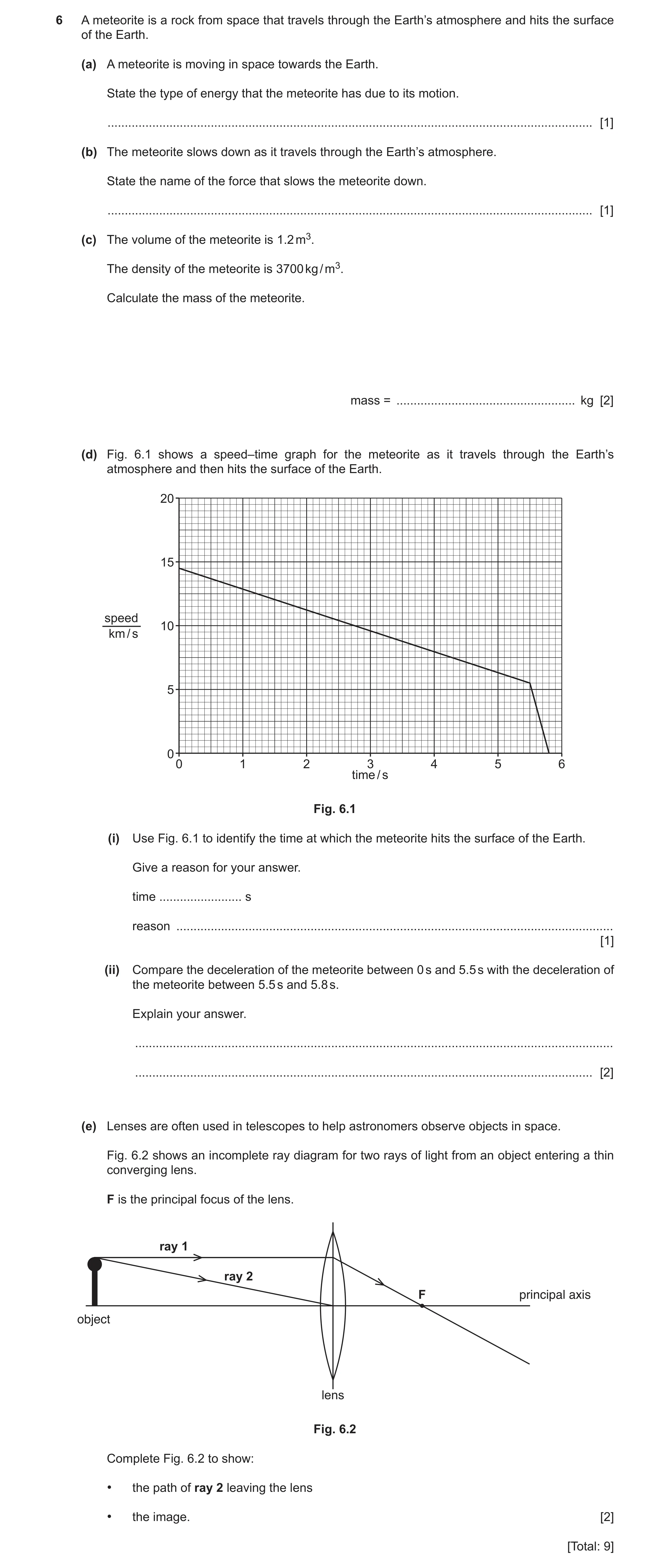
6 A meteorite is a rock from space that travels through the Earth’s atmosphere and hits the surface of the Earth. (a) A meteorite is moving in space towards the Earth. State the type of energy that the meteorite has due to its motion. … [1] (b) The meteorite slows down as it travels through the Earth’s atmosphere. State the name of the force that slows the meteorite down. … [1] (c) The volume of the meteorite is 1.2 m3. The density of the meteorite is 3700 kg / m3. Calculate the mass of the meteorite. mass = … kg [2] (d) Fig. 6.1 shows a speed–time graph for the meteorite as it travels through the Earth’s atmosphere and then hits the surface of the Earth. 20 15 speed 10 km / s 5 0 0 1 2 3 4 5 6 time / s Fig. 6.1 (i) Use Fig. 6.1 to identify the time at which the meteorite hits the surface of the Earth. Give a reason for your answer. time … s reason … [1] (ii) Compare the deceleration of the meteorite between 0 s and 5.5 s with the deceleration of the meteorite between 5.5 s and 5.8 s. Explain your answer. … … [2] (e) Lenses are often used in telescopes to help astronomers observe objects in space. Fig. 6.2 shows an incomplete ray diagram for two rays of light from an object entering a thin converging lens. F is the principal focus of the lens. ray 1 ray 2 F principal axis object lens Fig. 6.2 Complete Fig. 6.2 to show: • the path of ray 2 leaving the lens • the image. [2] [Total: 9]
9 marks
Mark scheme: 6(a) kinetic (energy) ; 1 6(b) air resistance ; 1 6(c) density = mass ÷ volume in any form / 3700 × 1.2 ; 4400 (kg) ; 2 6(d)(i) 5.5–5.8 s AND sudden decrease in speed / large deceleration ; 1 6(d)(ii) smaller deceleration for (0–5.5) s ; less steep gradient on graph ; 2 6(e) (ray 2) undeviated straight line ; (image) inverted AND from principal axis to intersection of ray 1 and ray 2 ; 2
This question in 0653/32 Oct/Nov 2021
Q13 · A meteorite is a rock from space that travels through the Earth’s atmosphere and hits the… 0653/33 Oct/Nov 2021
6 A meteorite is a rock from space that travels through the Earth’s atmosphere and hits the surface of the Earth. (a) A meteorite is moving in space towards the Earth. State the type of energy that the meteorite has due to its motion. … [1] (b) The meteorite slows down as it travels through the Earth’s atmosphere. State the name of the force that slows the meteorite down. … [1] (c) The volume of the meteorite is 1.2 m3. The density of the meteorite is 3700 kg / m3. Calculate the mass of the meteorite. mass = … kg [2] (d) Fig. 6.1 shows a speed–time graph for the meteorite as it travels through the Earth’s atmosphere and then hits the surface of the Earth. 20 15 speed 10 km / s 5 0 0 1 2 3 4 5 6 time / s Fig. 6.1 (i) Use Fig. 6.1 to identify the time at which the meteorite hits the surface of the Earth. Give a reason for your answer. time … s reason … [1] (ii) Compare the deceleration of the meteorite between 0 s and 5.5 s with the deceleration of the meteorite between 5.5 s and 5.8 s. Explain your answer. … … [2] (e) Lenses are often used in telescopes to help astronomers observe objects in space. Fig. 6.2 shows an incomplete ray diagram for two rays of light from an object entering a thin converging lens. F is the principal focus of the lens. ray 1 ray 2 F principal axis object lens Fig. 6.2 Complete Fig. 6.2 to show: • the path of ray 2 leaving the lens • the image. [2] [Total: 9]
9 marks
Mark scheme: 6(a) kinetic (energy) ; 1 6(b) air resistance ; 1 6(c) density = mass ÷ volume in any form / 3700 × 1.2 ; 4400 (kg) ; 2 6(d)(i) 5.5–5.8 s AND sudden decrease in speed / large deceleration ; 1 6(d)(ii) smaller deceleration for (0–5.5) s ; less steep gradient on graph ; 2 6(e) (ray 2) undeviated straight line ; (image) inverted AND from principal axis to intersection of ray 1 and ray 2 ; 2
This question in 0653/33 Oct/Nov 2021
Q14 · A truck carrying a load moving horizontally along a flat level road 0653/32 Oct/Nov 2023
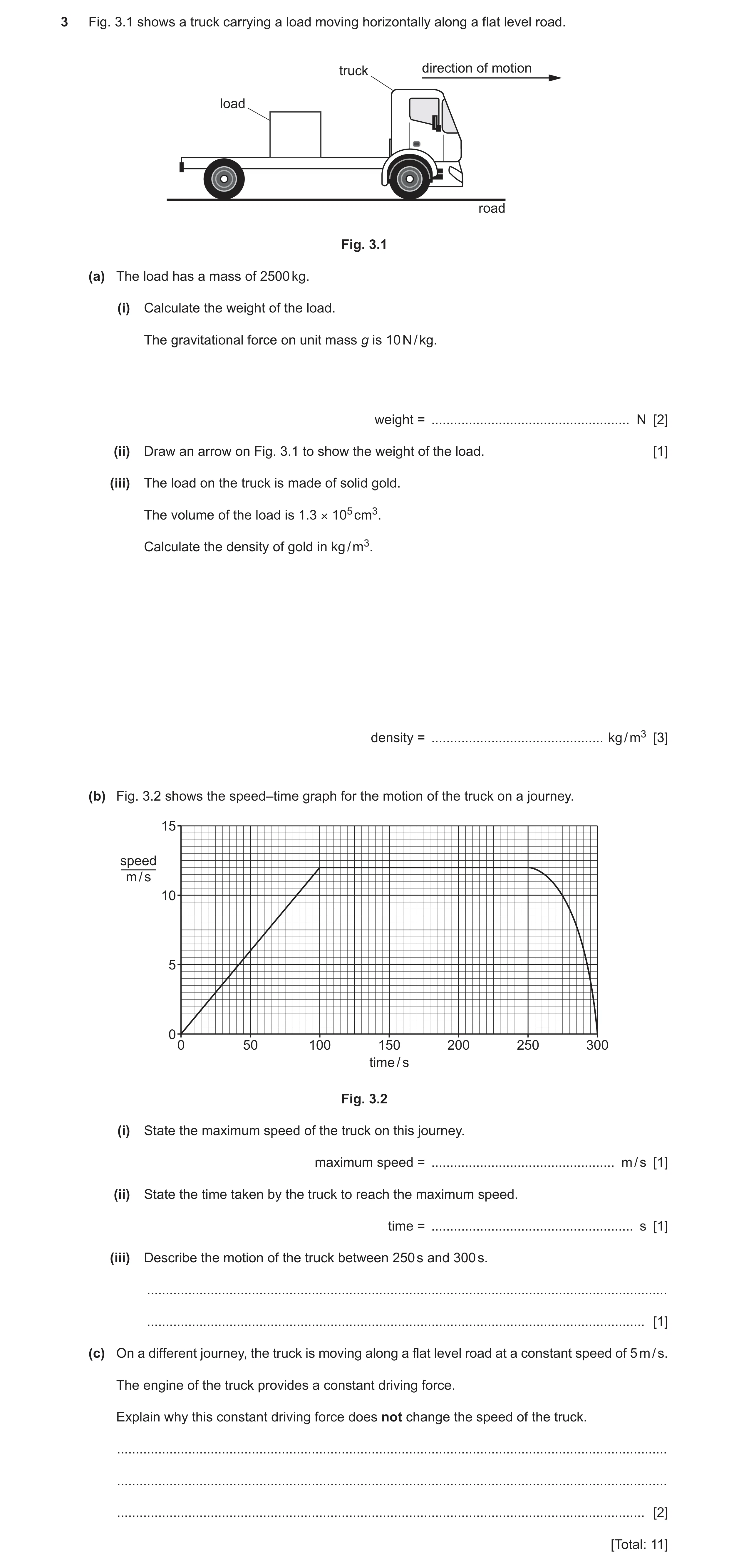
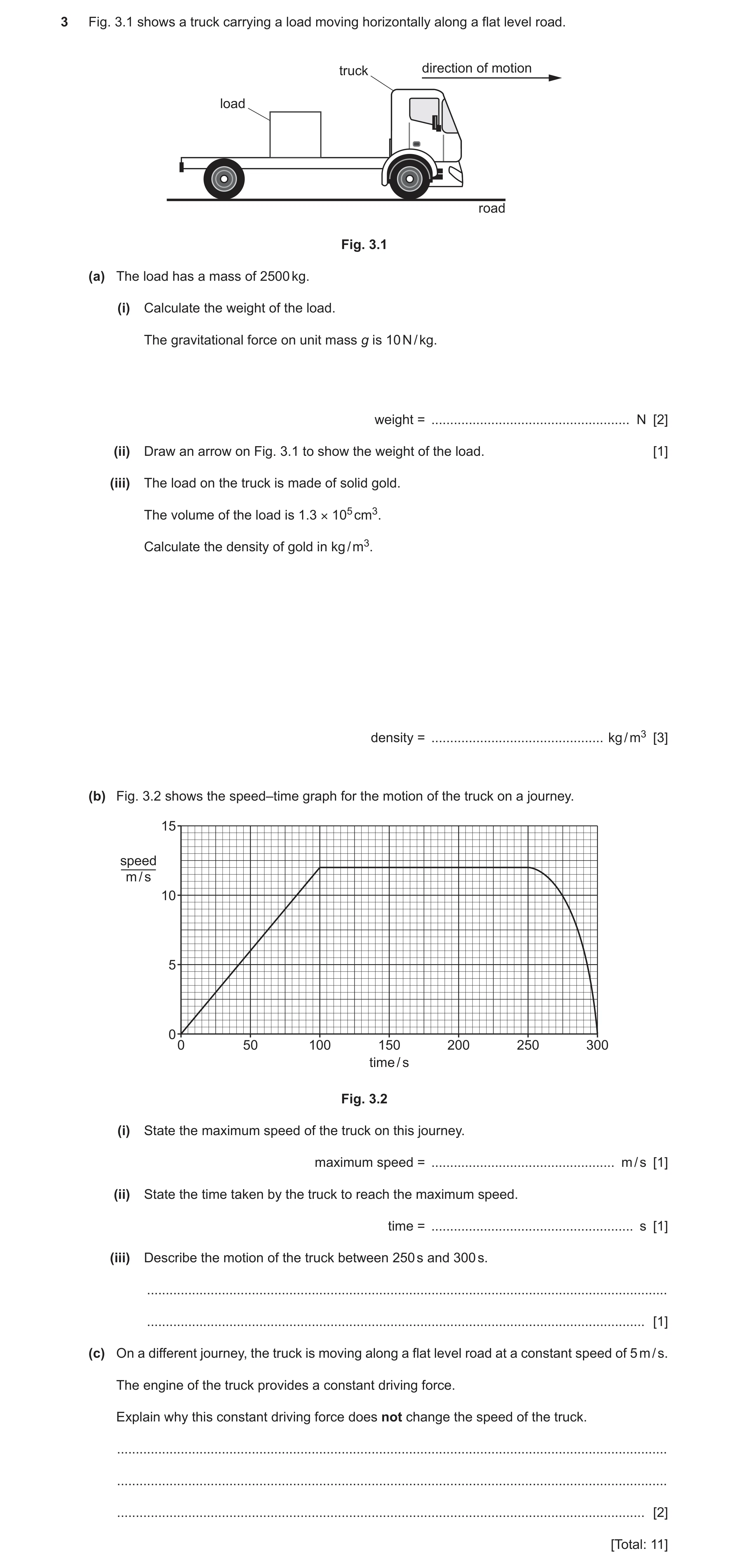
3 Fig. 3.1 shows a truck carrying a load moving horizontally along a flat level road. truck direction of motion load road Fig. 3.1 (a) The load has a mass of 2500 kg. (i) Calculate the weight of the load. The gravitational force on unit mass g is 10 N / kg. weight = … N [2] (ii) Draw an arrow on Fig. 3.1 to show the weight of the load. [1] (iii) The load on the truck is made of solid gold. The volume of the load is 1.3 × 105 cm3. Calculate the density of gold in kg / m3. density = … kg / m3 [3] (b) Fig. 3.2 shows the speed–time graph for the motion of the truck on a journey. 15 speed m / s 10 5 0 0 50 100 150 200 250 300 time / s Fig. 3.2 (i) State the maximum speed of the truck on this journey. maximum speed = … m / s [1] (ii) State the time taken by the truck to reach the maximum speed. time = … s [1] (iii) Describe the motion of the truck between 250 s and 300 s. … … [1] (c) On a different journey, the truck is moving along a flat level road at a constant speed of 5 m / s. The engine of the truck provides a constant driving force. Explain why this constant driving force does not change the speed of the truck. … … … [2] [Total: 11]
11 marks
Mark scheme: 3(a)(i) evidence of, W = mg / 2500 10 ; 2 25 000 (N) ; 3(a)(ii) arrow touching load and vertically downwards ; 1 3(a)(iii) conversion of volume to m3 correct / 1.3 105 ÷ 106 = 0.13 m3 ; 3 m evidence of, = / 2500 ÷ 0.13 ; V 19 000 (kg / m3) ; 3(b)(i) 12 (m / s) ; 1 3(b)(ii) 100 (s) ; 1 3(b)(iii) (non-constant) deceleration / decreasing in speed ; 1 3(c) idea of, frictional / resistive / opposing, force(s) ; 2 no resultant force ;
This question in 0653/32 Oct/Nov 2023
Q15 · A truck carrying a load moving horizontally along a flat level road 0653/33 Oct/Nov 2023
3 Fig. 3.1 shows a truck carrying a load moving horizontally along a flat level road. truck direction of motion load road Fig. 3.1 (a) The load has a mass of 2500 kg. (i) Calculate the weight of the load. The gravitational force on unit mass g is 10 N / kg. weight = … N [2] (ii) Draw an arrow on Fig. 3.1 to show the weight of the load. [1] (iii) The load on the truck is made of solid gold. The volume of the load is 1.3 × 105 cm3. Calculate the density of gold in kg / m3. density = … kg / m3 [3] (b) Fig. 3.2 shows the speed–time graph for the motion of the truck on a journey. 15 speed m / s 10 5 0 0 50 100 150 200 250 300 time / s Fig. 3.2 (i) State the maximum speed of the truck on this journey. maximum speed = … m / s [1] (ii) State the time taken by the truck to reach the maximum speed. time = … s [1] (iii) Describe the motion of the truck between 250 s and 300 s. … … [1] (c) On a different journey, the truck is moving along a flat level road at a constant speed of 5 m / s. The engine of the truck provides a constant driving force. Explain why this constant driving force does not change the speed of the truck. … … … [2] [Total: 11]
11 marks
Mark scheme: 3(a)(i) evidence of, W = mg / 2500 10 ; 2 25 000 (N) ; 3(a)(ii) arrow touching load and vertically downwards ; 1 3(a)(iii) conversion of volume to m3 correct / 1.3 105 ÷ 106 = 0.13 m3 ; 3 m evidence of, = / 2500 ÷ 0.13 ; V 19 000 (kg / m3) ; 3(b)(i) 12 (m / s) ; 1 3(b)(ii) 100 (s) ; 1 3(b)(iii) (non-constant) deceleration / decreasing in speed ; 1 3(c) idea of, frictional / resistive / opposing, force(s) ; 2 no resultant force ;
This question in 0653/33 Oct/Nov 2023
Q16 · A mechanical crane using force P to lift a box from the ground to the top of a building 0653/31 May/June 2024
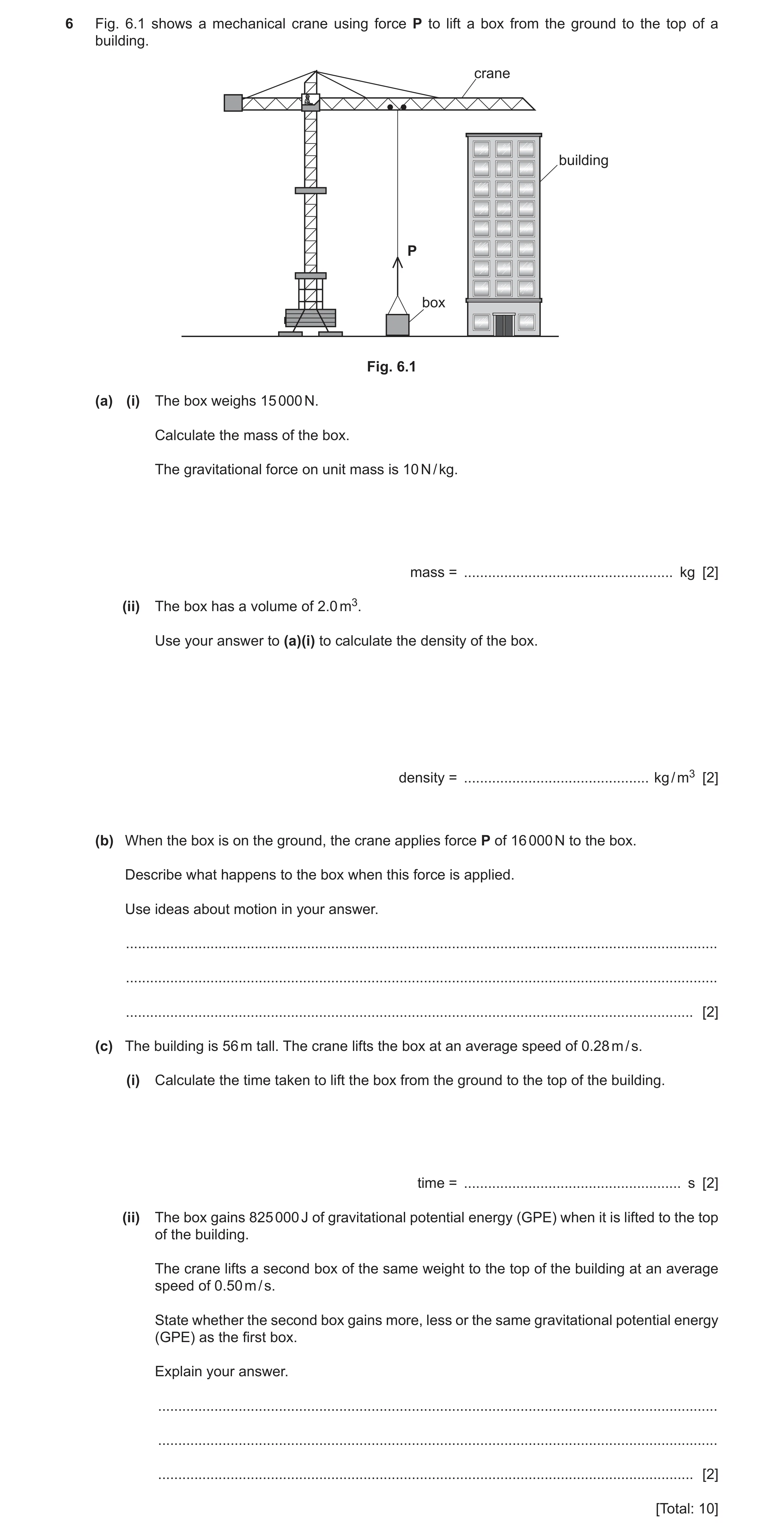
6 Fig. 6.1 shows a mechanical crane using force P to lift a box from the ground to the top of a building. crane building P box Fig. 6.1 (a) (i) The box weighs 15 000 N. Calculate the mass of the box. The gravitational force on unit mass is 10 N / kg. mass = … kg [2] (ii) The box has a volume of 2.0 m3. Use your answer to (a)(i) to calculate the density of the box. density = … kg / m3 [2] (b) When the box is on the ground, the crane applies force P of 16 000 N to the box. Describe what happens to the box when this force is applied. Use ideas about motion in your answer. … … … [2] (c) The building is 56 m tall. The crane lifts the box at an average speed of 0.28 m / s. (i) Calculate the time taken to lift the box from the ground to the top of the building. time = … s [2] (ii) The box gains 825 000 J of gravitational potential energy (GPE) when it is lifted to the top of the building. The crane lifts a second box of the same weight to the top of the building at an average speed of 0.50 m / s. State whether the second box gains more, less or the same gravitational potential energy (GPE) as the first box. Explain your answer. … … … [2] [Total: 10]
10 marks
Mark scheme: 6(a)(i) 1500 (kg) ; 2 Question Answer Marks 6(a)(ii) d = m V in any form / 1500 2.0 ; 750 (kg / m3) ; 2 6(b) moves upward ; accelerates / speed increases ; 2 6(c)(i) speed = distance time in any form OR 56 0.28 ; 200 (s) ; 2 6(c)(ii) same (gravitational PE) gain ; gain (in PE) only depends on height gained / does not depend on speed / different speed does not affect PE ; 2
This question in 0653/31 May/June 2024
Q17 · The list shows some types of wave 0653/33 May/June 2024
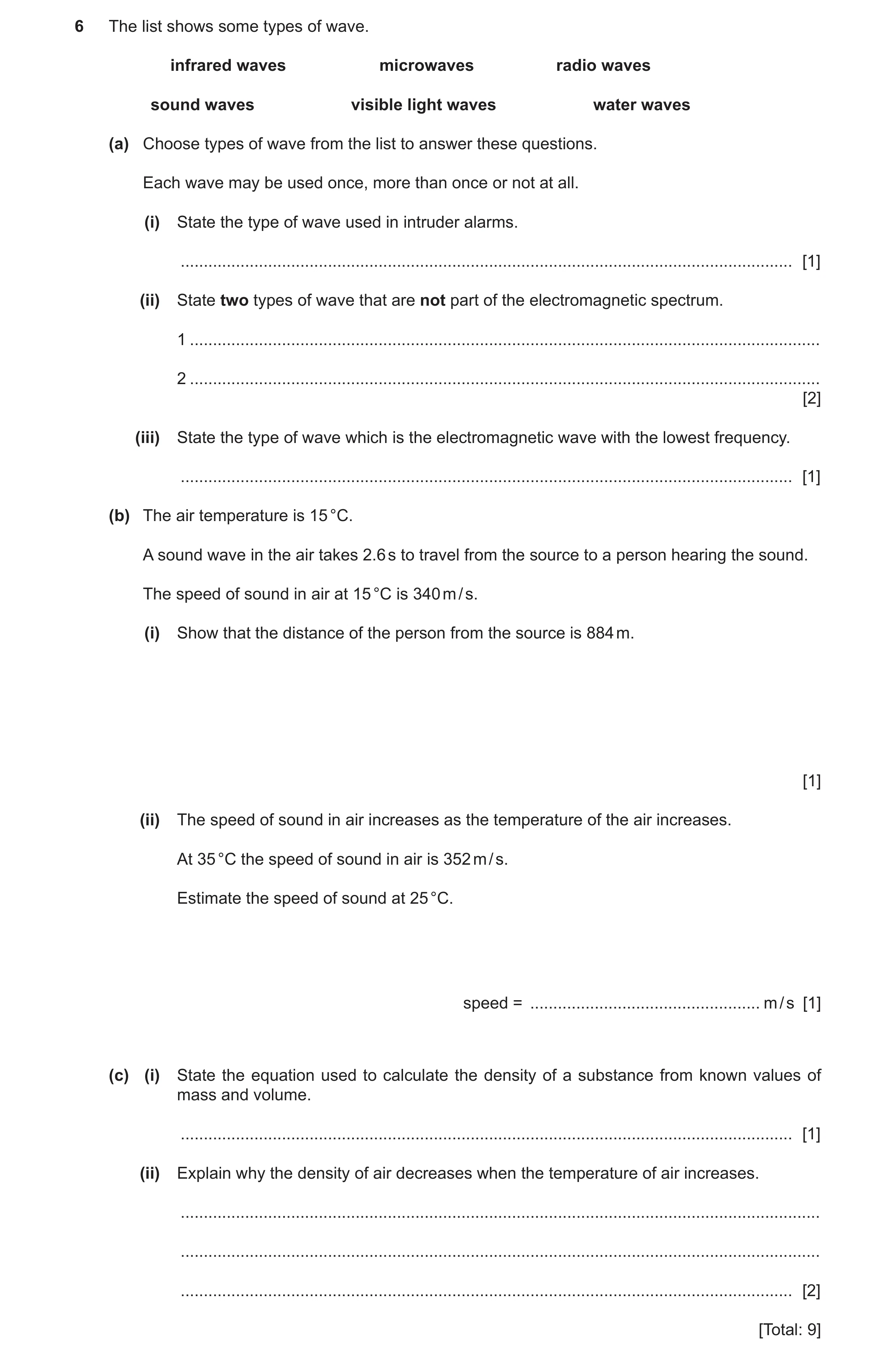
6 The list shows some types of wave. infrared waves microwaves radio waves sound waves visible light waves water waves (a) Choose types of wave from the list to answer these questions. Each wave may be used once, more than once or not at all. (i) State the type of wave used in intruder alarms. … [1] (ii) State two types of wave that are not part of the electromagnetic spectrum. 1 … 2 … [2] (iii) State the type of wave which is the electromagnetic wave with the lowest frequency. … [1] (b) The air temperature is 15 °C. A sound wave in the air takes 2.6 s to travel from the source to a person hearing the sound. The speed of sound in air at 15 °C is 340 m / s. (i) Show that the distance of the person from the source is 884 m. [1] (ii) The speed of sound in air increases as the temperature of the air increases. At 35 °C the speed of sound in air is 352 m / s. Estimate the speed of sound at 25 °C. speed = … m / s [1] (c) (i) State the equation used to calculate the density of a substance from known values of mass and volume. … [1] (ii) Explain why the density of air decreases when the temperature of air increases. … … … [2] [Total: 9]
9 marks
Mark scheme: 6(a)(i) infrared (waves) ; 1 6(a)(ii) water (waves) ; sound (waves) ; 2 Question Answer Marks 6(a)(iii) radio (waves) ; 1 6(b)(i) 340 2.6 (= 884 m) ; 1 6(b)(ii) any value between 343 and 349 (m / s) ; 1 6(c)(i) density = mass volume / = m V in any form ; 1 6(c)(ii) any two from: particles move further apart ; air / gas, expands / volume increases ; mass unchanged (so density decreases) ; 2
This question in 0653/33 May/June 2024
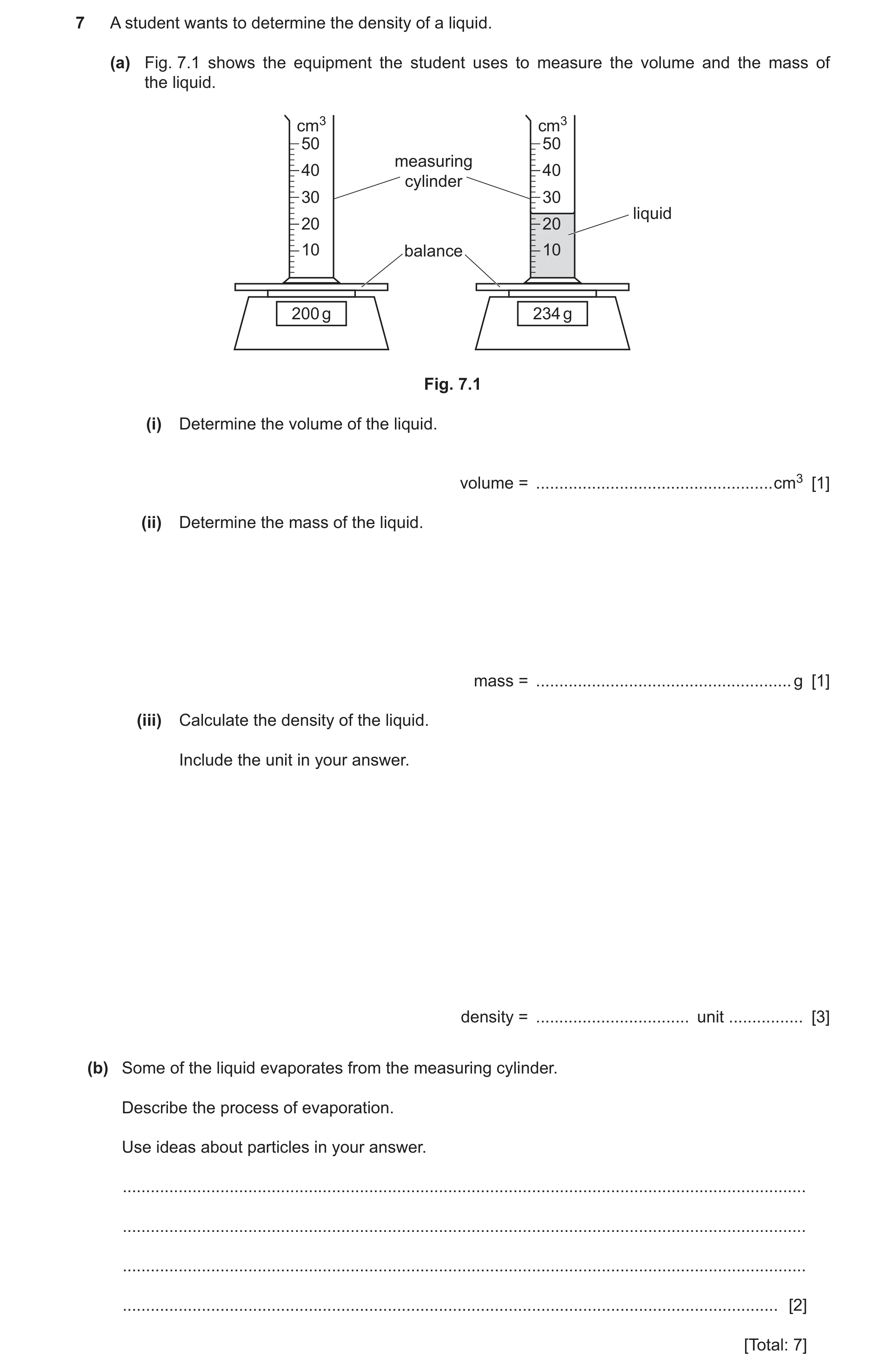
Q18 · A student wants to determine the density of a liquid 0653/32 Oct/Nov 2025
7 A student wants to determine the density of a liquid. (a) Fig. 7.1 shows the equipment the student uses to measure the volume and the mass of the liquid. cm3 cm3 50 50 measuring 40 40 cylinder 30 30 liquid 20 20 10 balance 10 200 g 234 g Fig. 7.1 (i) Determine the volume of the liquid. volume = … cm3 [1] (ii) Determine the mass of the liquid. mass = … g [1] (iii) Calculate the density of the liquid. Include the unit in your answer. density = … unit … [3] (b) Some of the liquid evaporates from the measuring cylinder. Describe the process of evaporation. Use ideas about particles in your answer. … … … … [2] [Total: 7]
7 marks
Mark scheme: 7(a)(i) 24 (.0) (cm3) ; 1 7(a)(ii) (234 – 200 =) 34 (g) ; 1 7(a)(iii) density = mass ÷ volume / 34 ÷ 24 ; 3 1.4 ; g / cm3 ; 7(b) the (more) energetic particles escape / fast(er) particles escape / particles with more (kinetic) energy escape ; 2 from the surface (of the liquid) ;
This question in 0653/32 Oct/Nov 2025
Q19 · A student wants to determine the density of a liquid 0653/33 Oct/Nov 2025
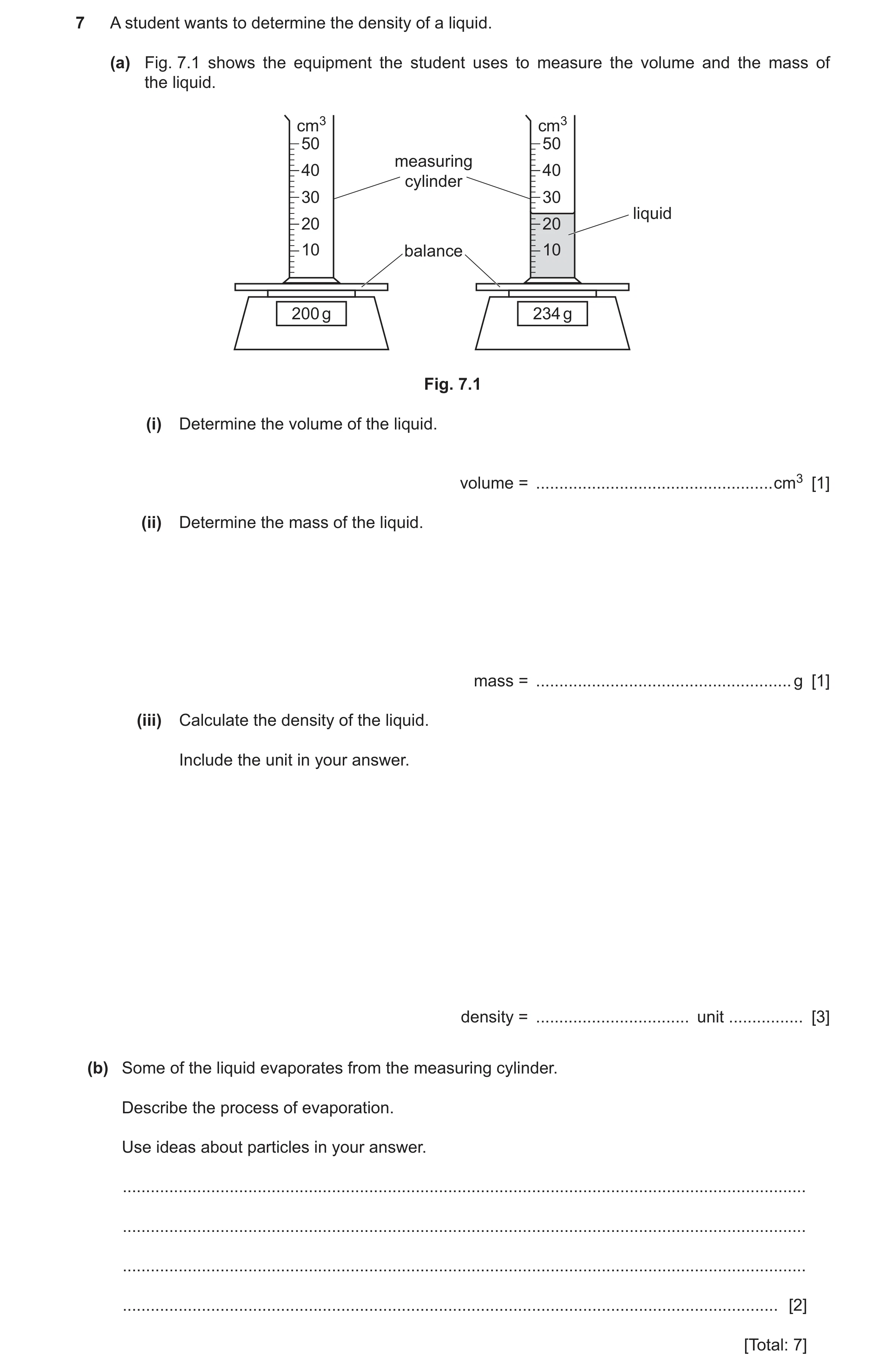
7 A student wants to determine the density of a liquid. (a) Fig. 7.1 shows the equipment the student uses to measure the volume and the mass of the liquid. cm3 cm3 50 50 measuring 40 40 cylinder 30 30 liquid 20 20 10 balance 10 200 g 234 g Fig. 7.1 (i) Determine the volume of the liquid. volume = … cm3 [1] (ii) Determine the mass of the liquid. mass = … g [1] (iii) Calculate the density of the liquid. Include the unit in your answer. density = … unit … [3] (b) Some of the liquid evaporates from the measuring cylinder. Describe the process of evaporation. Use ideas about particles in your answer. … … … … [2] [Total: 7]
7 marks
Mark scheme: 7(a)(i) 24 (.0) (cm3) ; 1 7(a)(ii) (234 – 200 =) 34 (g) ; 1 7(a)(iii) density = mass ÷ volume / 34 ÷ 24 ; 3 1.4 ; g / cm3 ; 7(b) the (more) energetic particles escape / fast(er) particles escape / particles with more (kinetic) energy escape ; 2 from the surface (of the liquid) ;
This question in 0653/33 Oct/Nov 2025
 16 / 30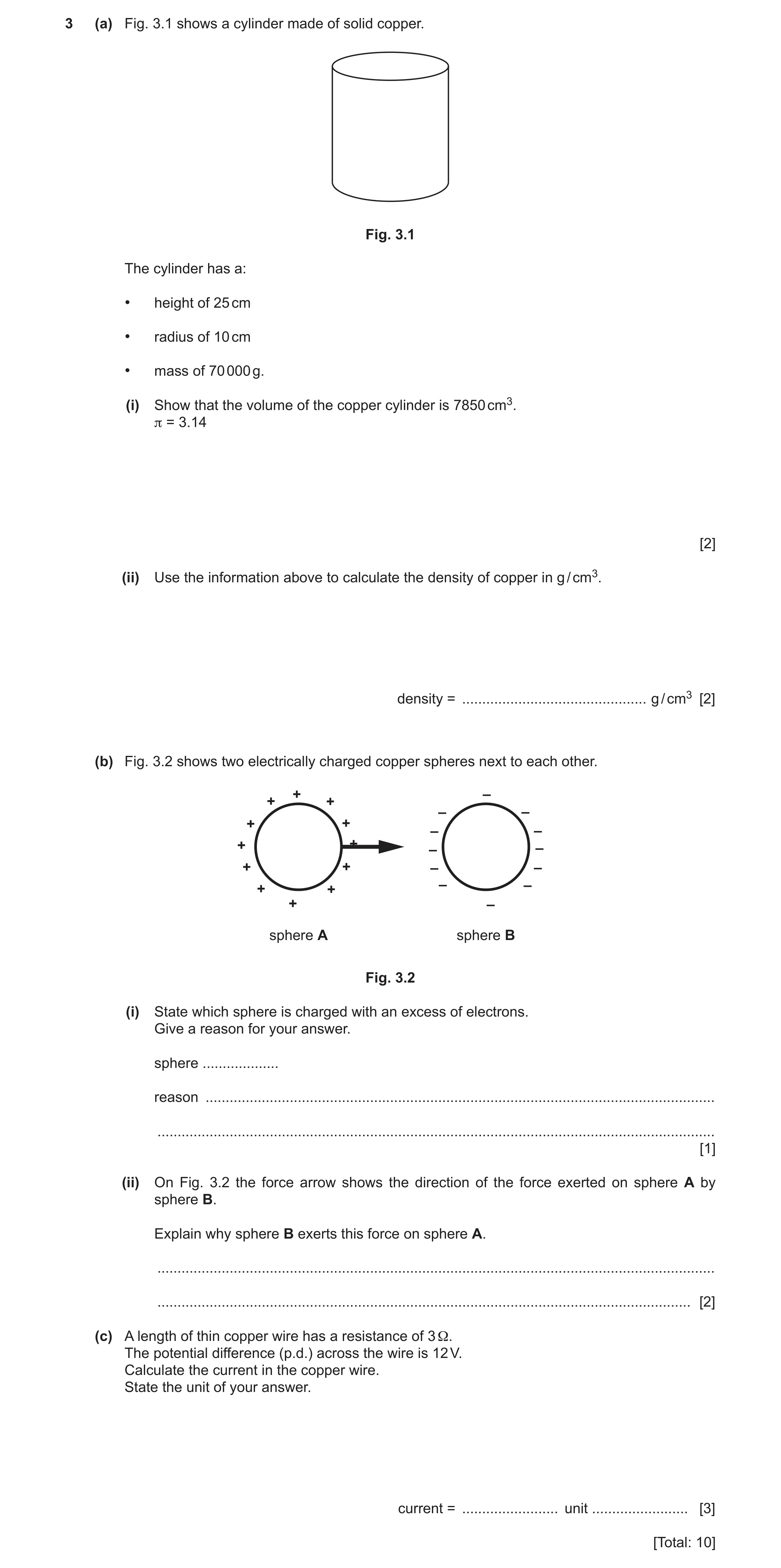
 7
7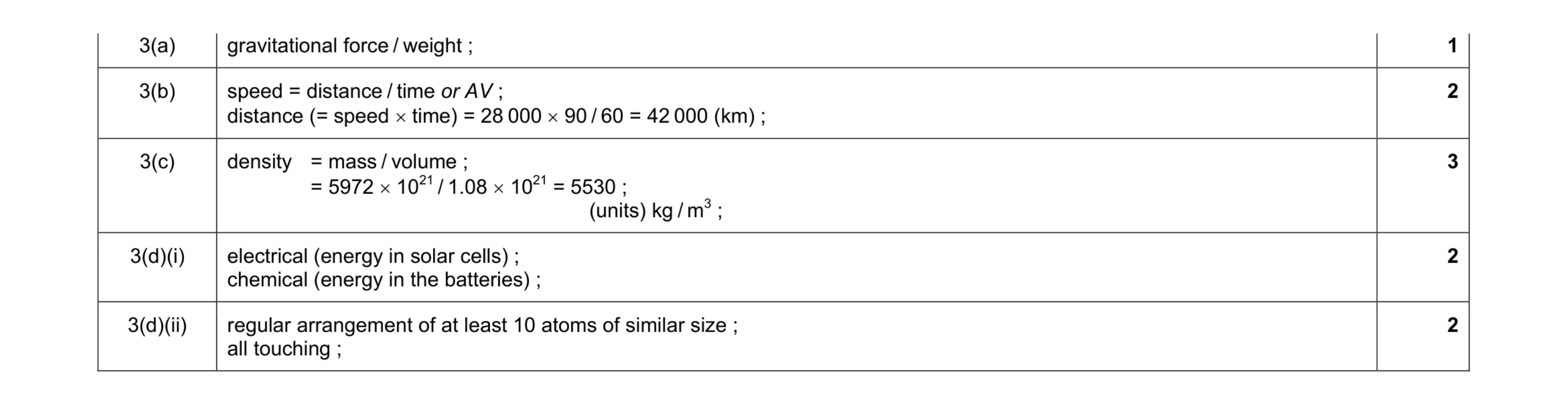 10
10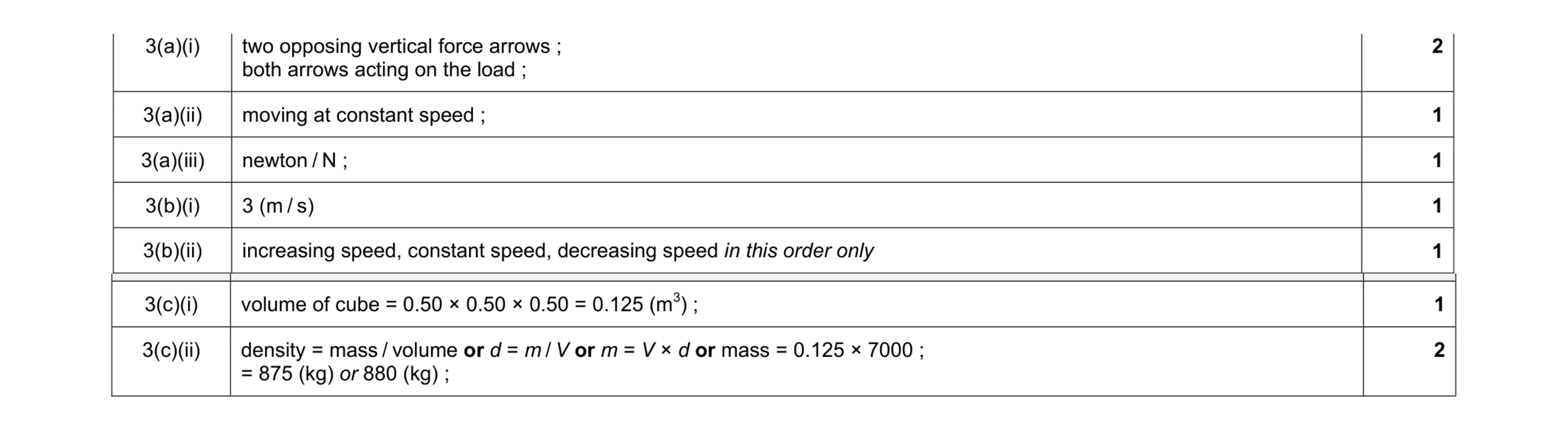 9
9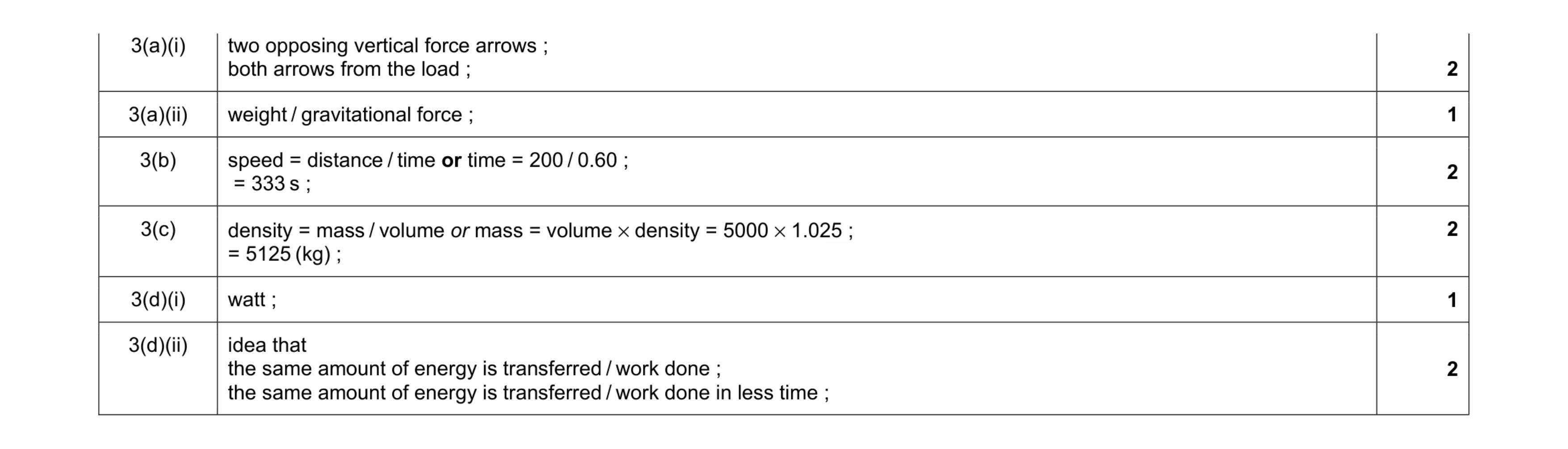 10
10 10
10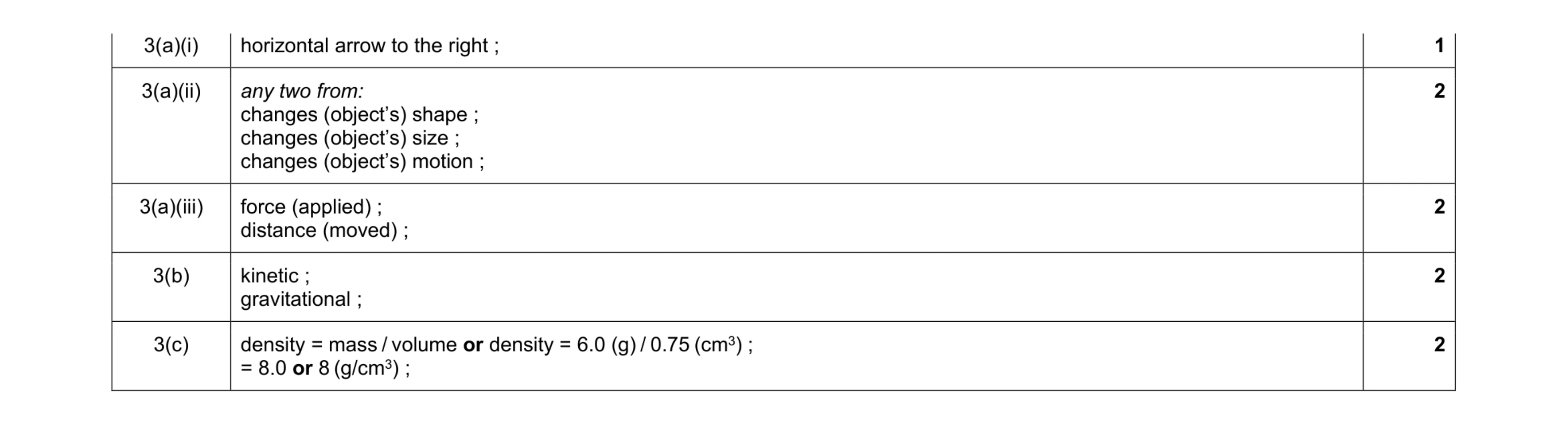 9
9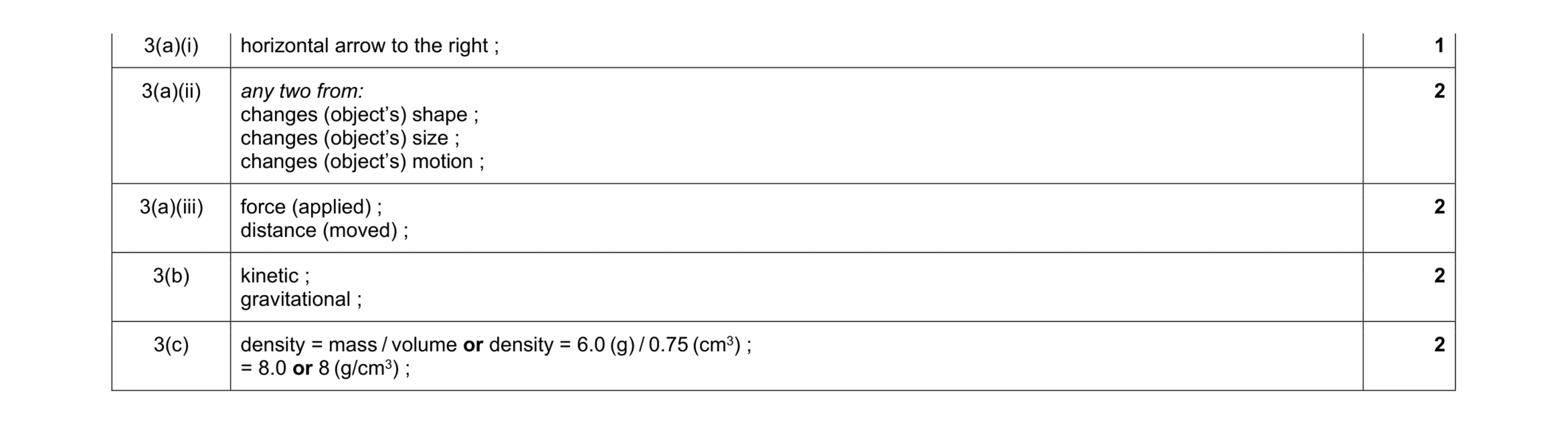 9
9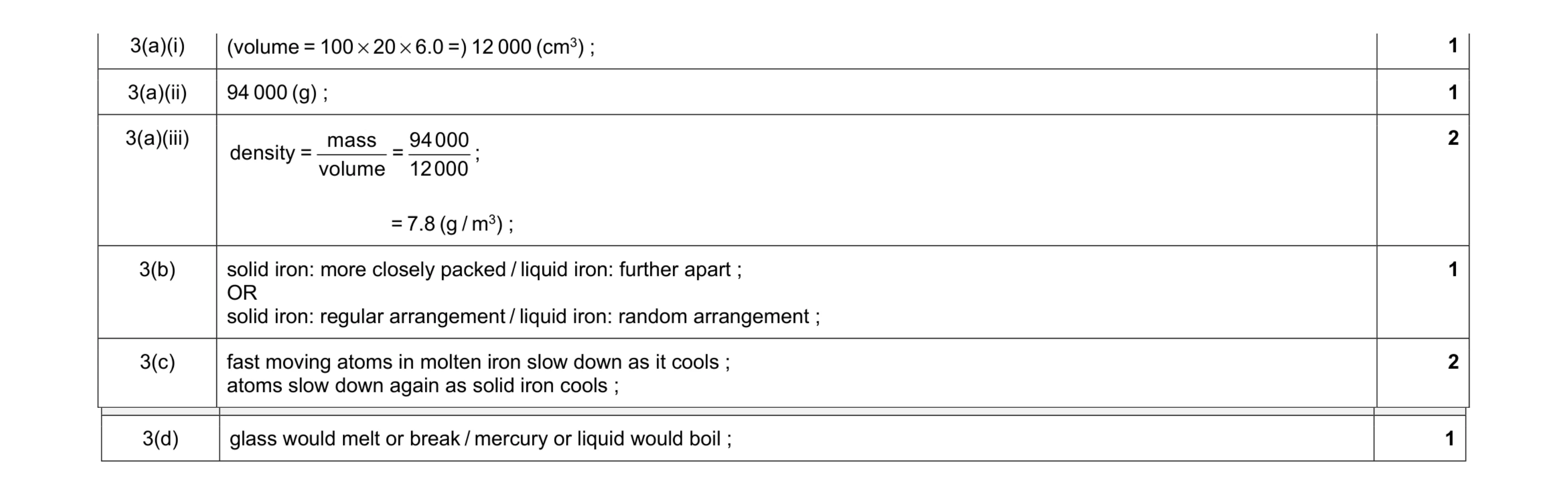 8
8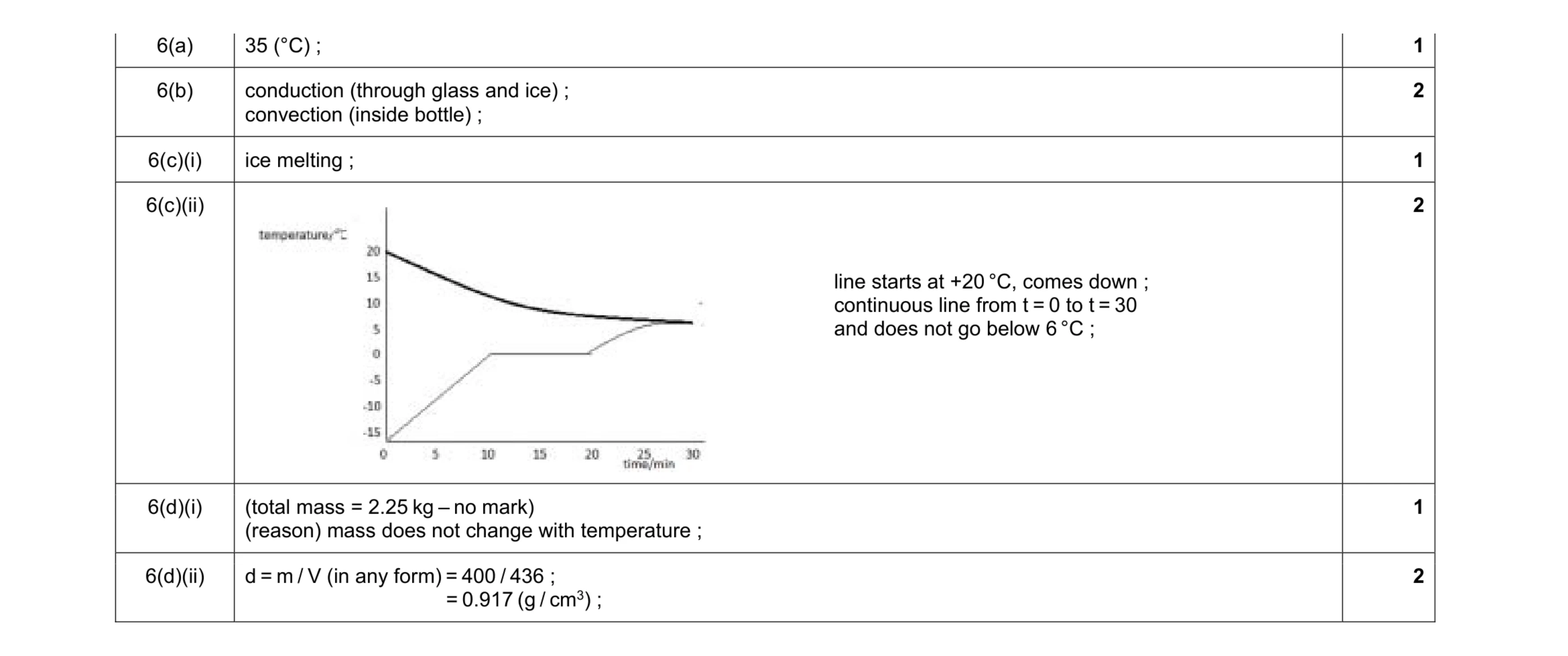 9
9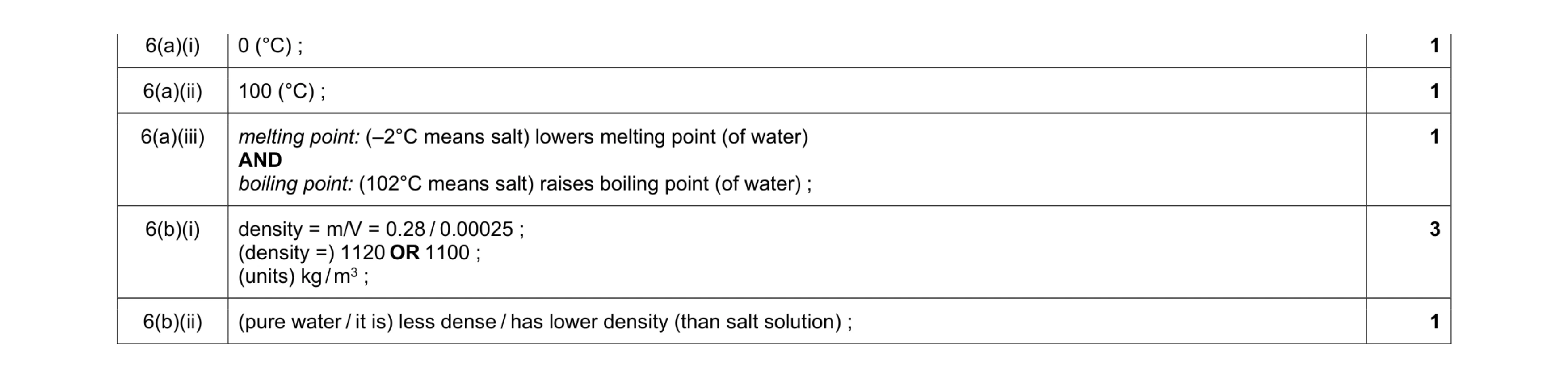 7
7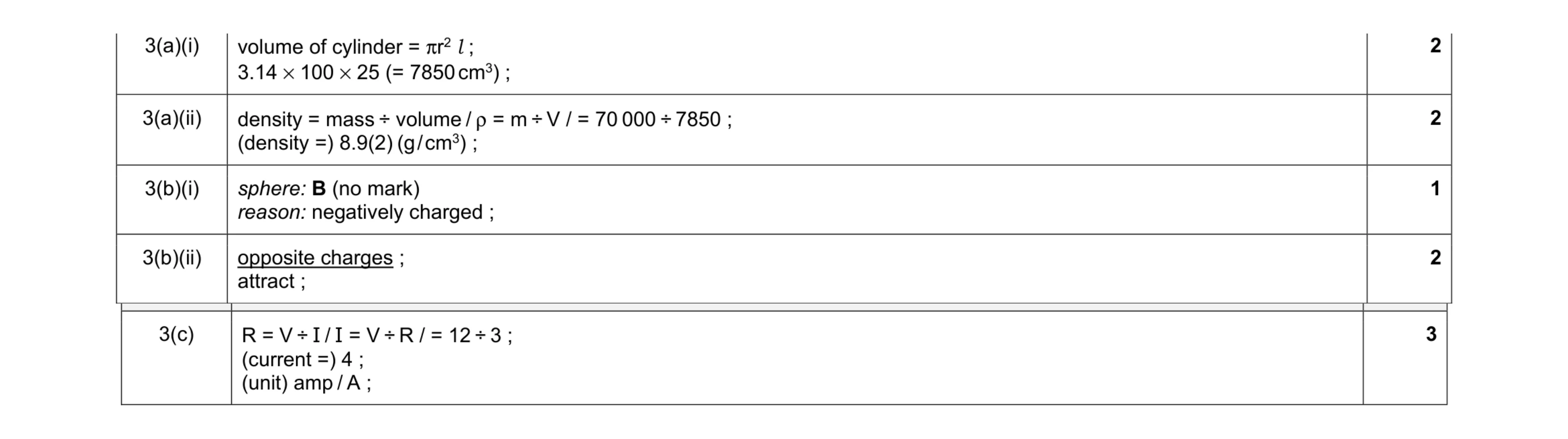 10
10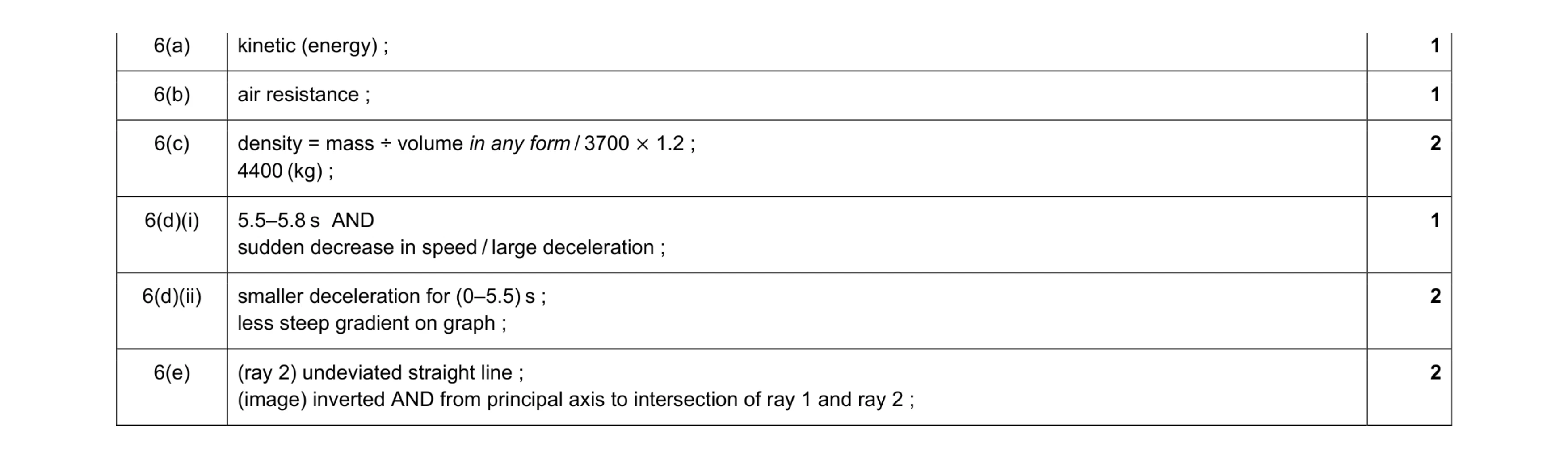 9
9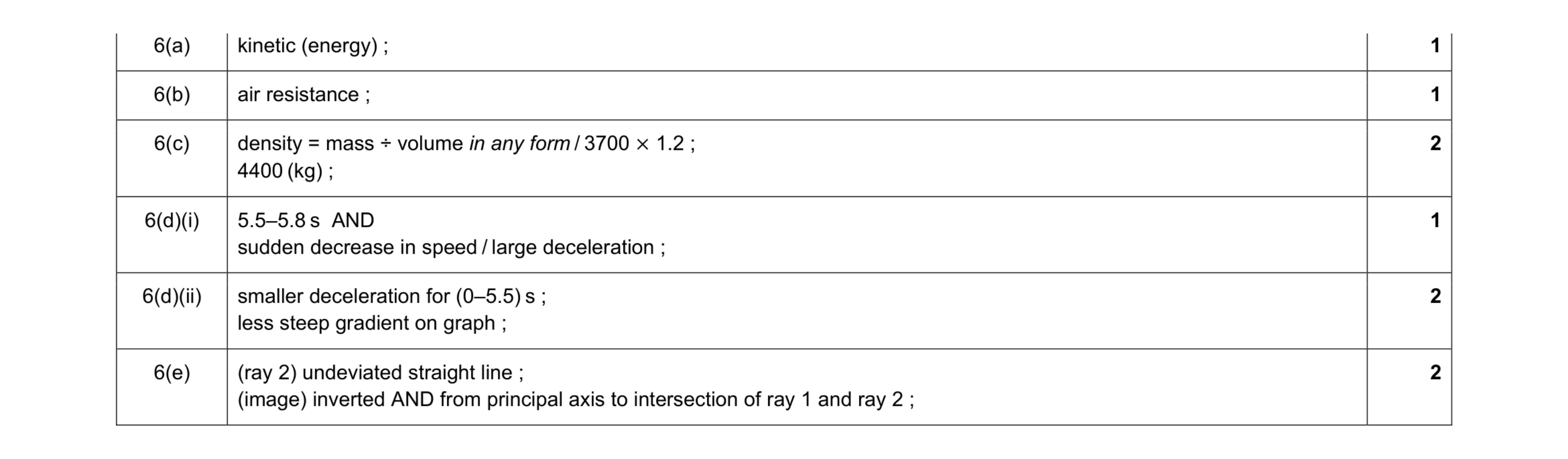 9
9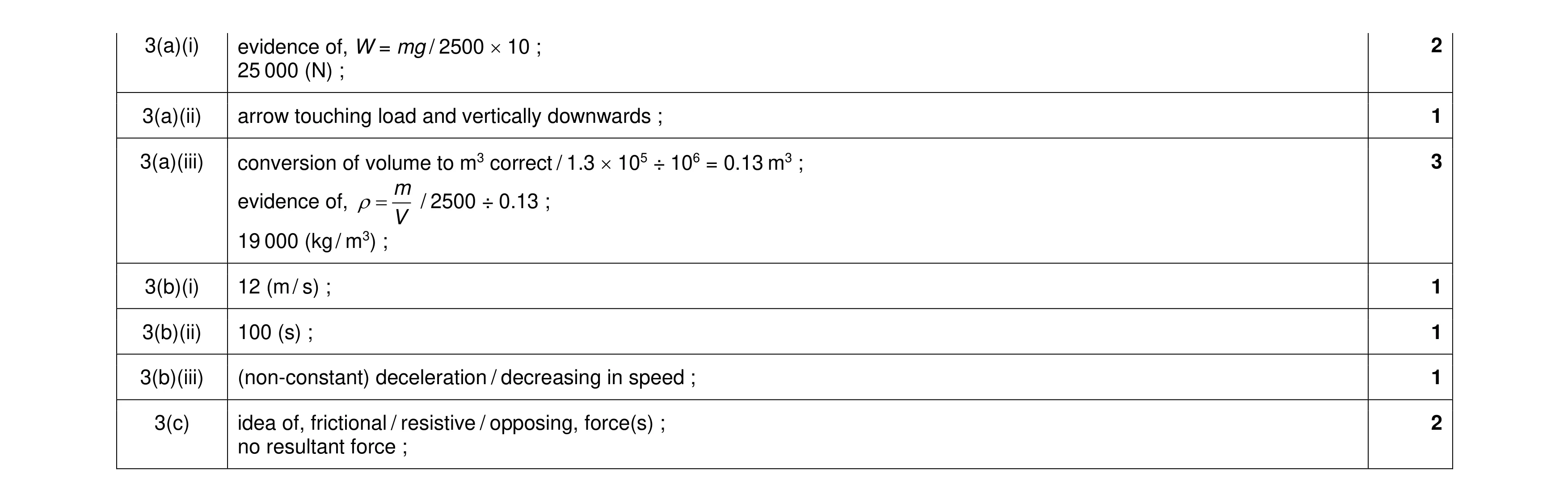 11
11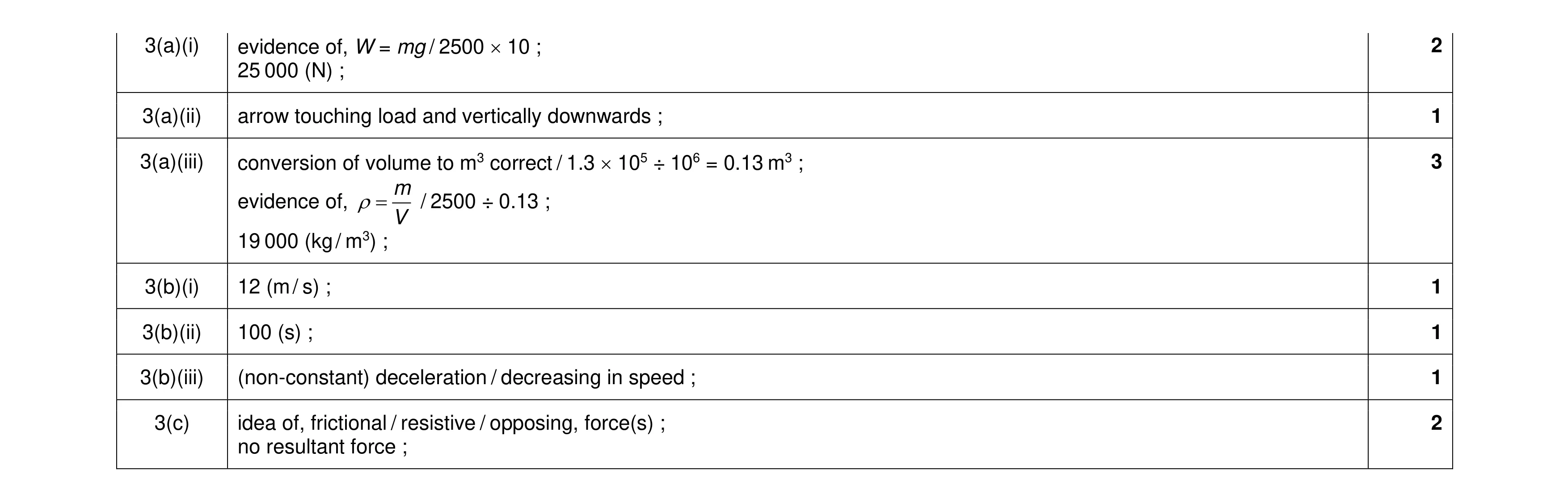 11
11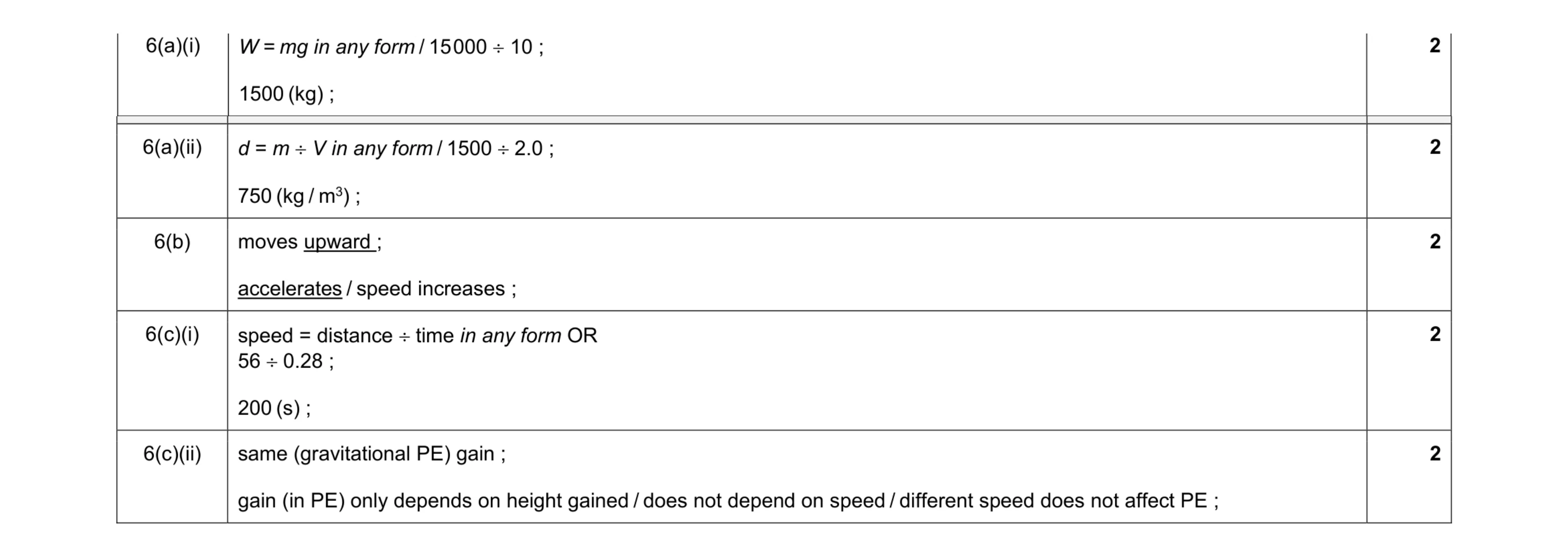 10
10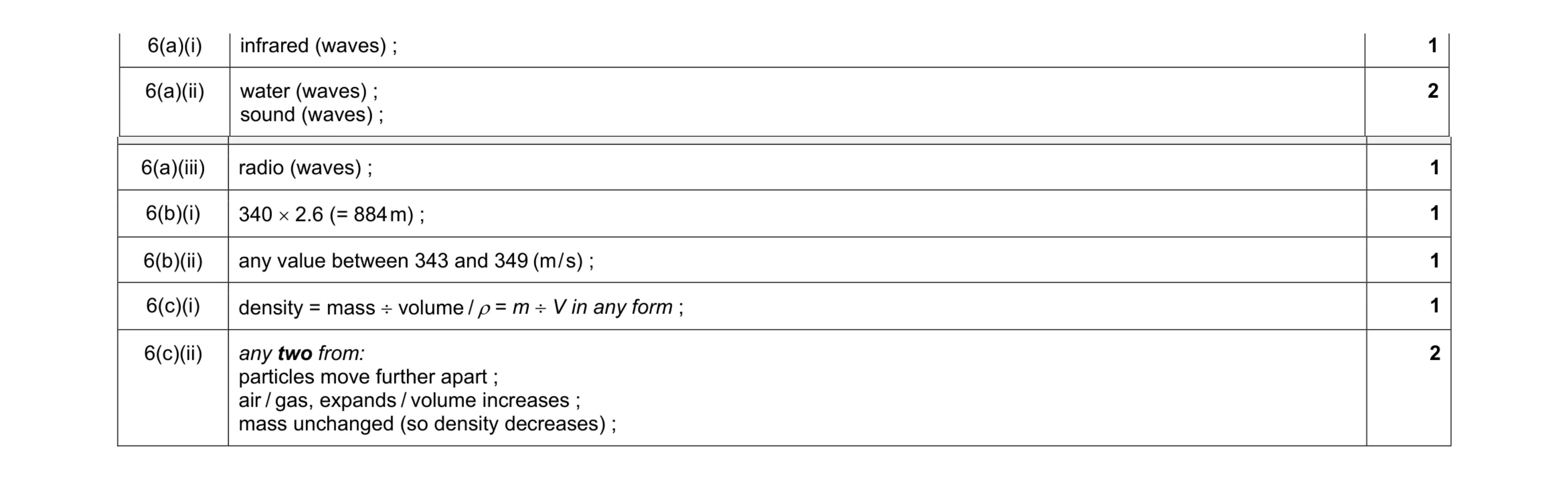 9
9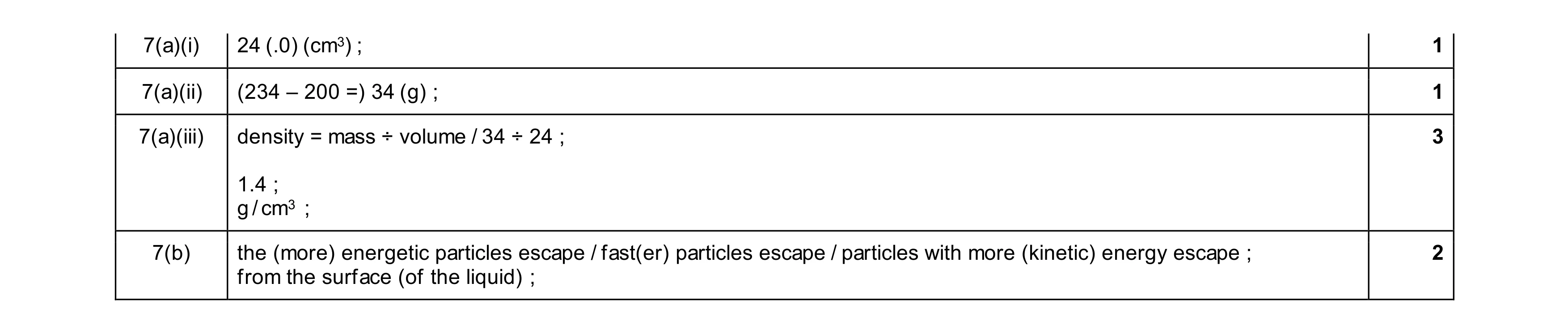 7
7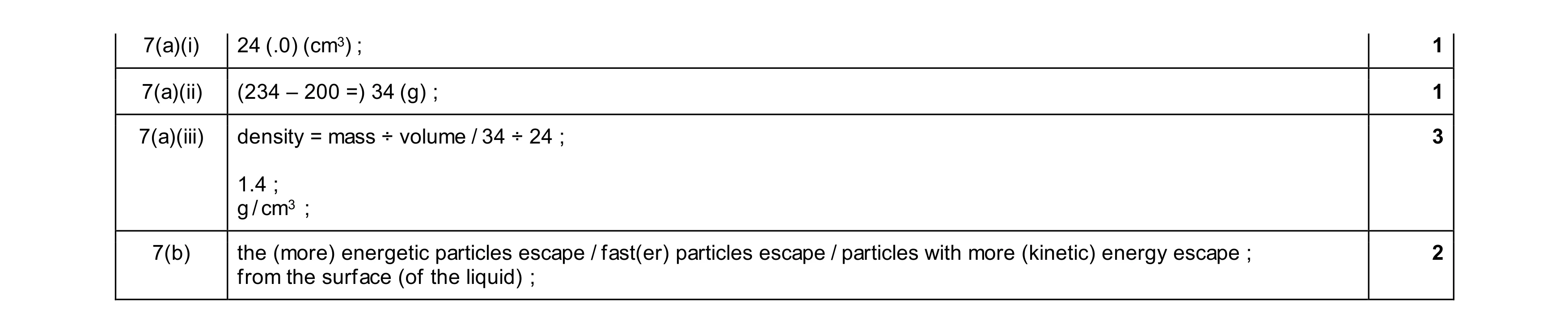 7
7