Questions as text
Q1 · A teacher places the first three metals of Group I in the Periodic Table into separate… 0653/32 May/June 2017
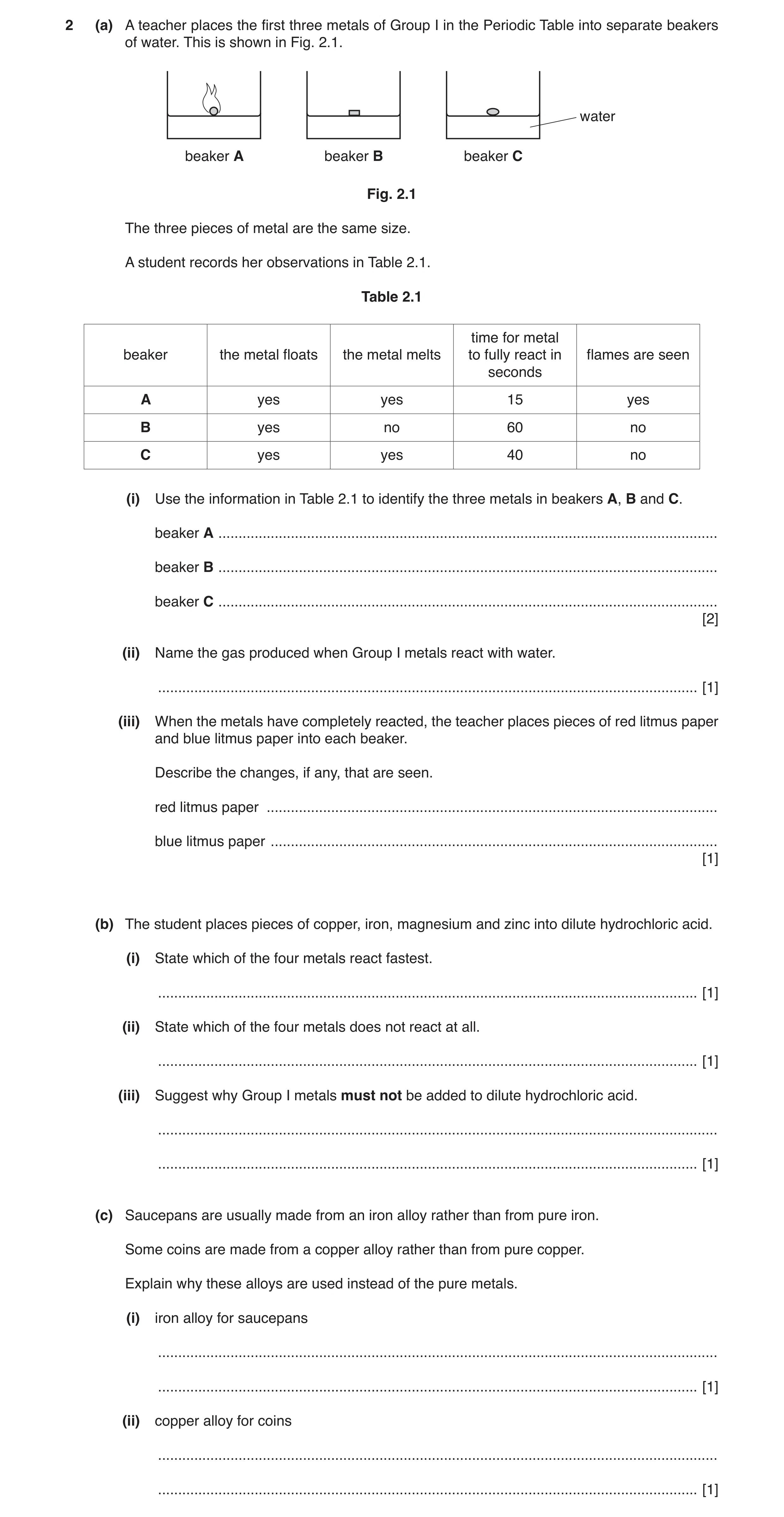
2 (a) A teacher places the first three metals of Group I in the Periodic Table into separate beakers of water. This is shown in Fig. 2.1. water beaker A beaker B beaker C Fig. 2.1 The three pieces of metal are the same size. A student records her observations in Table 2.1. Table 2.1 time for metal beaker the metal floats the metal melts to fully react in flames are seen seconds A yes yes 15 yes B yes no 60 no C yes yes 40 no (i) Use the information in Table 2.1 to identify the three metals in beakers A, B and C. beaker A … beaker B … beaker C … [2] (ii) Name the gas produced when Group I metals react with water. … [1] (iii) When the metals have completely reacted, the teacher places pieces of red litmus paper and blue litmus paper into each beaker. Describe the changes, if any, that are seen. red litmus paper … blue litmus paper … [1] (b) The student places pieces of copper, iron, magnesium and zinc into dilute hydrochloric acid. (i) State which of the four metals react fastest. … [1] (ii) State which of the four metals does not react at all. … [1] (iii) Suggest why Group I metals must not be added to dilute hydrochloric acid. … … [1] (c) Saucepans are usually made from an iron alloy rather than from pure iron. Some coins are made from a copper alloy rather than from pure copper. Explain why these alloys are used instead of the pure metals. (i) iron alloy for saucepans … … [1] (ii) copper alloy for coins … … [1]
9 marks
Mark scheme: 2(a)(i) potassium / K lithium / Li sodium / Na ;; 2 2(a)(ii) hydrogen / H2 ; 1 2(a)(iii) turns blue and stays blue / no change ; 1 2(b)(i) magnesium / Mg ; 1 2(b)(ii) copper / Cu ; 1 2(b)(iii) (too) dangerous / (risk of) explosion ; 1 2(c)(i) resists corrosion / does not rust ; 1 2(c)(ii) stronger / does not get damaged ; 1
This question in 0653/32 May/June 2017
Q2 · A teacher places the first three metals of Group I in the Periodic Table into separate… 0653/33 May/June 2017
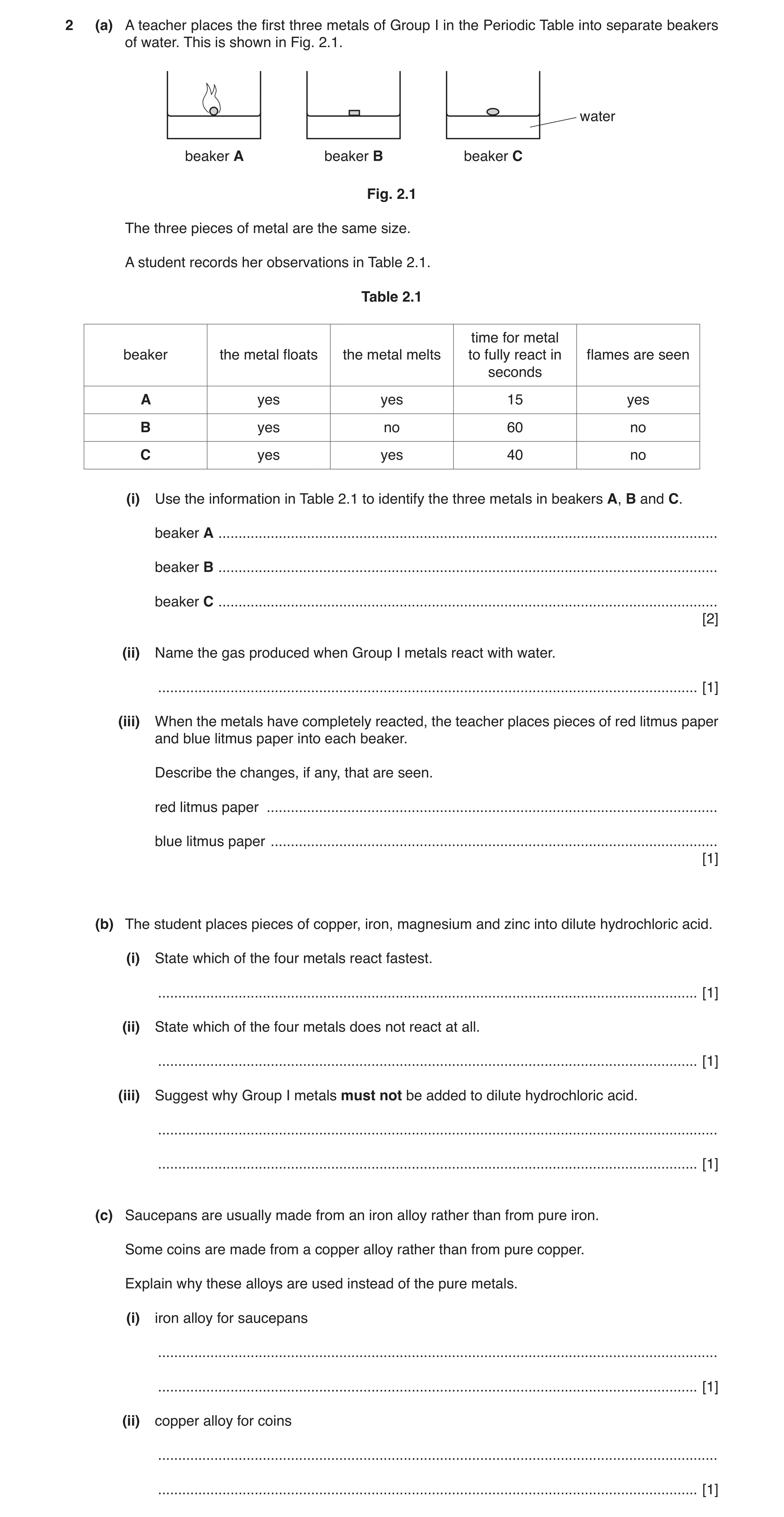
2 (a) A teacher places the first three metals of Group I in the Periodic Table into separate beakers of water. This is shown in Fig. 2.1. water beaker A beaker B beaker C Fig. 2.1 The three pieces of metal are the same size. A student records her observations in Table 2.1. Table 2.1 time for metal beaker the metal floats the metal melts to fully react in flames are seen seconds A yes yes 15 yes B yes no 60 no C yes yes 40 no (i) Use the information in Table 2.1 to identify the three metals in beakers A, B and C. beaker A … beaker B … beaker C … [2] (ii) Name the gas produced when Group I metals react with water. … [1] (iii) When the metals have completely reacted, the teacher places pieces of red litmus paper and blue litmus paper into each beaker. Describe the changes, if any, that are seen. red litmus paper … blue litmus paper … [1] (b) The student places pieces of copper, iron, magnesium and zinc into dilute hydrochloric acid. (i) State which of the four metals react fastest. … [1] (ii) State which of the four metals does not react at all. … [1] (iii) Suggest why Group I metals must not be added to dilute hydrochloric acid. … … [1] (c) Saucepans are usually made from an iron alloy rather than from pure iron. Some coins are made from a copper alloy rather than from pure copper. Explain why these alloys are used instead of the pure metals. (i) iron alloy for saucepans … … [1] (ii) copper alloy for coins … … [1]
9 marks
Mark scheme: 2(a)(i) potassium / K lithium / Li sodium / Na ;; 2 2(a)(ii) hydrogen / H2 ; 1 2(a)(iii) turns blue and stays blue / no change ; 1 2(b)(i) magnesium / Mg ; 1 2(b)(ii) copper / Cu ; 1 2(b)(iii) (too) dangerous / (risk of) explosion ; 1 2(c)(i) resists corrosion / does not rust ; 1 2(c)(ii) stronger / does not get damaged ; 1
This question in 0653/33 May/June 2017
Q3 · Duralumin is a mixture of aluminium and copper 0653/32 Oct/Nov 2019
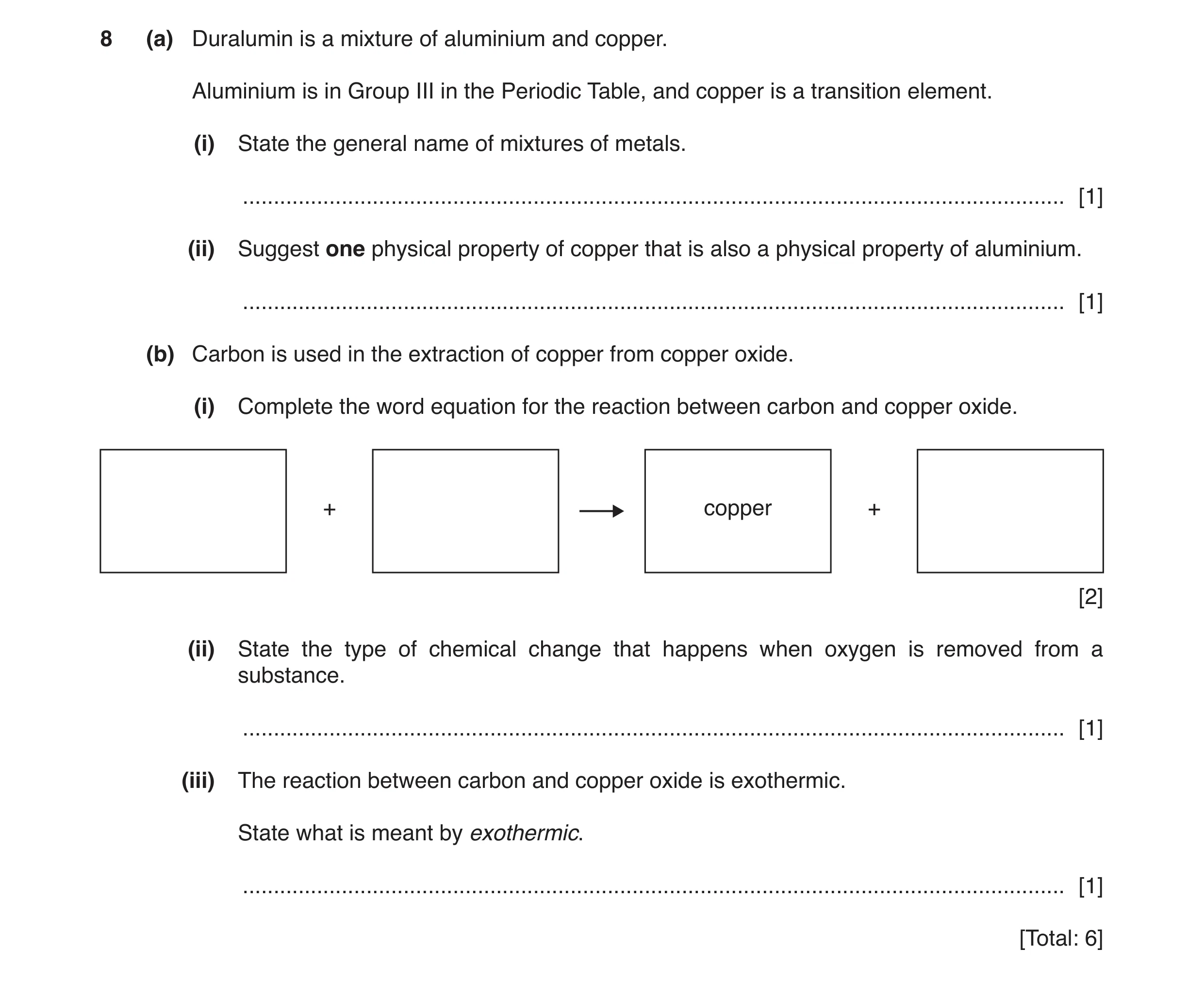
8 (a) Duralumin is a mixture of aluminium and copper. Aluminium is in Group III in the Periodic Table, and copper is a transition element. (i) State the general name of mixtures of metals. … [1] (ii) Suggest one physical property of copper that is also a physical property of aluminium. … [1] (b) Carbon is used in the extraction of copper from copper oxide. (i) Complete the word equation for the reaction between carbon and copper oxide. + copper + [2] (ii) State the type of chemical change that happens when oxygen is removed from a substance. … [1] (iii) The reaction between carbon and copper oxide is exothermic. State what is meant by exothermic. … [1] [Total: 6]
6 marks
Mark scheme: 8(a)(i) alloy(s) ; 1 8(a)(ii) (electrical / heat / thermal) conductor / malleable / high melting point / high boiling point ; 1 8(b)(i) LHS ; carbon dioxide ; 2 8(b)(ii) reduction ; 1 8(b)(iii) releases / gives out (heat / thermal) energy ; 1
This question in 0653/32 Oct/Nov 2019
Q4 · Duralumin is a mixture of aluminium and copper 0653/33 Oct/Nov 2019
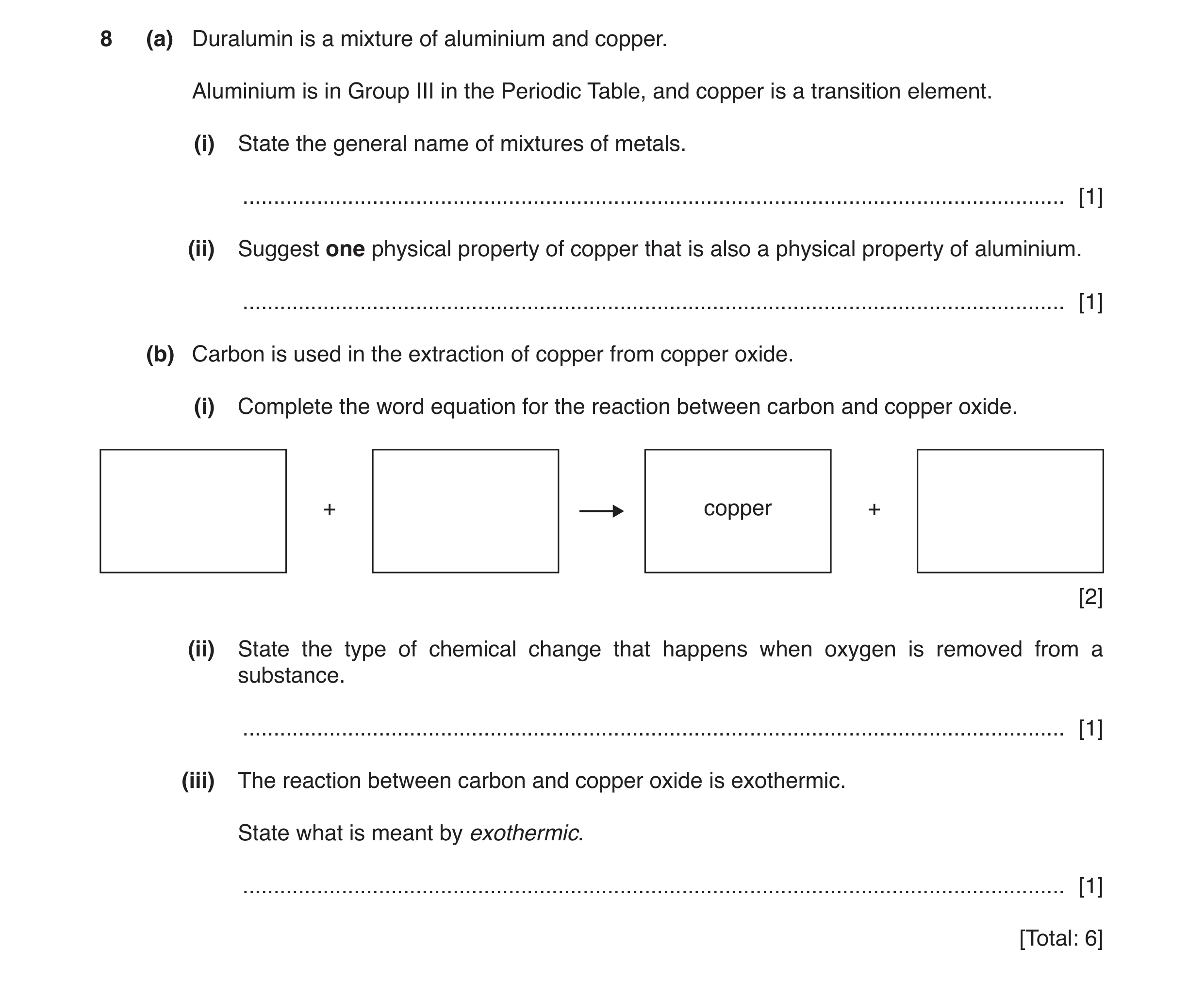
8 (a) Duralumin is a mixture of aluminium and copper. Aluminium is in Group III in the Periodic Table, and copper is a transition element. (i) State the general name of mixtures of metals. … [1] (ii) Suggest one physical property of copper that is also a physical property of aluminium. … [1] (b) Carbon is used in the extraction of copper from copper oxide. (i) Complete the word equation for the reaction between carbon and copper oxide. + copper + [2] (ii) State the type of chemical change that happens when oxygen is removed from a substance. … [1] (iii) The reaction between carbon and copper oxide is exothermic. State what is meant by exothermic. … [1] [Total: 6]
6 marks
Mark scheme: 8(a)(i) alloy(s) ; 1 8(a)(ii) (electrical / heat / thermal) conductor / malleable / high melting point / high boiling point ; 1 8(b)(i) LHS ; carbon dioxide ; 2 8(b)(ii) reduction ; 1 8(b)(iii) releases / gives out (heat / thermal) energy ; 1
This question in 0653/33 Oct/Nov 2019
Q5 · Brass is a mixture of copper and zinc 0653/32 Oct/Nov 2020
2 (a) Brass is a mixture of copper and zinc. The water tap in Fig. 2.1 is made of brass. Fig. 2.1 (i) Name the type of substance that contains a metal mixed with other elements. … [1] (ii) Suggest one property of brass that makes it suitable for use as a water tap. … [1] (b) An atom of zinc is represented by the symbol shown. 6530Zn (i) Deduce the number of neutrons in this atom of zinc. number of neutrons = … [1] (ii) State the number of electrons in this atom of zinc. number of electrons = … [1] (iii) Zinc atoms form zinc ions, Zn2+. Deduce the number of electrons in a Zn2+ ion. number of electrons = … [1] (c) Zinc reacts with dilute hydrochloric acid to form zinc chloride and hydrogen. (i) Complete the word equation for this reaction. zinc + + [1] (ii) Zinc chloride contains twice as many chloride ions as zinc ions. Deduce the formula of zinc chloride. … [1] [Total: 7]
7 marks
Mark scheme: 2(a)(i) alloy ; 1 2(a)(ii) unreactive / does not react (with water) ; 1 2(b)(i) (65 – 30 =) 35 ; 1 2(b)(ii) 30 ; 1 2(b)(iii) (30 – 2 =) 28 ; 1 2(c)(i) ; (zinc) + (dilute) hydrochloric acid → zinc chloride + hydrogen 1 2(c)(ii) ZnCl2 ; 1 Question Answer Marks
This question in 0653/32 Oct/Nov 2020
Q6 · An iron paperclip, shown in Fig 0653/32 Feb/March 2021
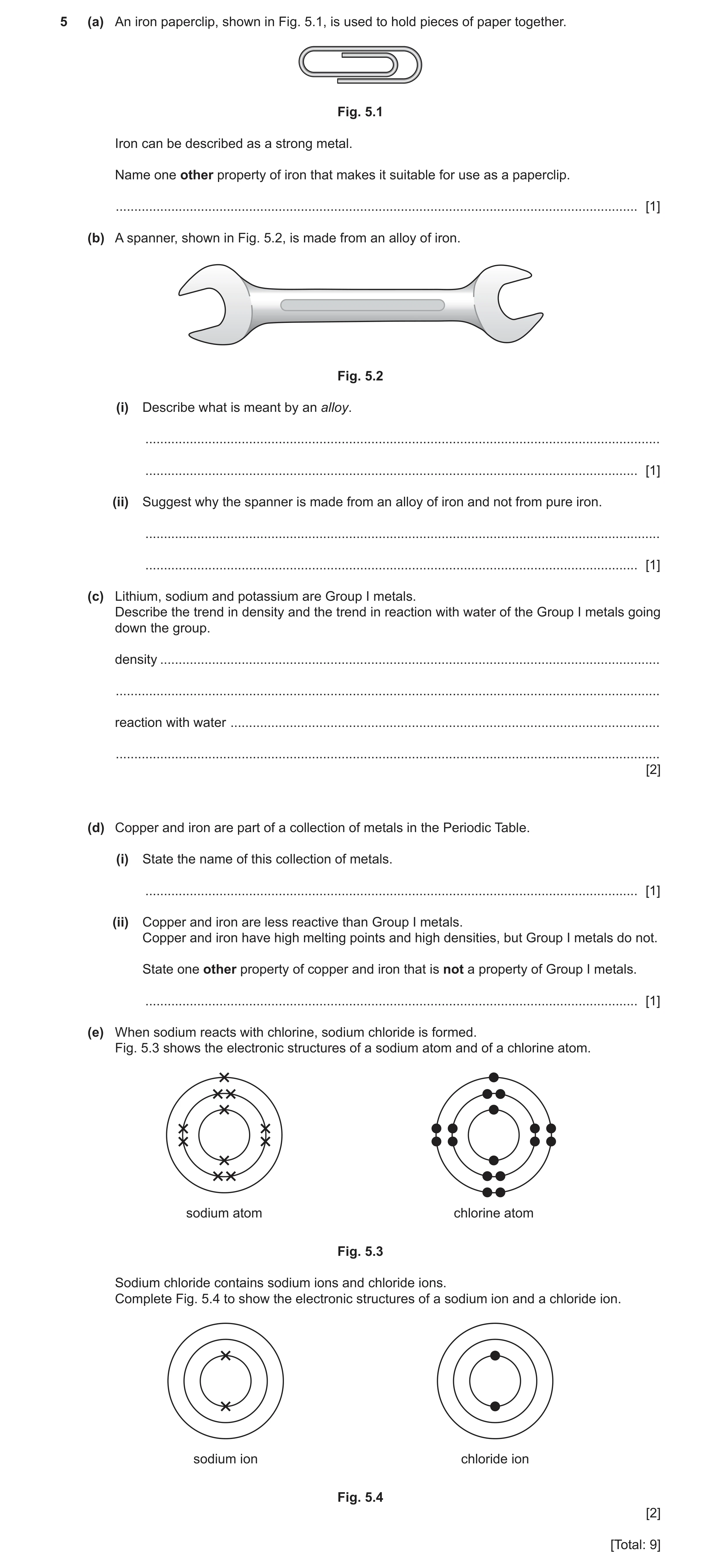
5 (a) An iron paperclip, shown in Fig. 5.1, is used to hold pieces of paper together. Fig. 5.1 Iron can be described as a strong metal. Name one other property of iron that makes it suitable for use as a paperclip. … [1] (b) A spanner, shown in Fig. 5.2, is made from an alloy of iron. Fig. 5.2 (i) Describe what is meant by an alloy. … … [1] (ii) Suggest why the spanner is made from an alloy of iron and not from pure iron. … … [1] (c) Lithium, sodium and potassium are Group I metals. Describe the trend in density and the trend in reaction with water of the Group I metals going down the group. density … … reaction with water … … [2] (d) Copper and iron are part of a collection of metals in the Periodic Table. (i) State the name of this collection of metals. … [1] (ii) Copper and iron are less reactive than Group I metals. Copper and iron have high melting points and high densities, but Group I metals do not. State one other property of copper and iron that is not a property of Group I metals. … [1] (e) When sodium reacts with chlorine, sodium chloride is formed. Fig. 5.3 shows the electronic structures of a sodium atom and of a chlorine atom. sodium atom chlorine atom Fig. 5.3 Sodium chloride contains sodium ions and chloride ions. Complete Fig. 5.4 to show the electronic structures of a sodium ion and a chloride ion. sodium ion chloride ion Fig. 5.4 [2] [Total: 9]
9 marks
Mark scheme: 5(a) malleable ; 1 5(b)(i) a mixture of a metal with other element(s) ; 1 5(b)(ii) pure iron is too soft / alloys are stronger / alloys resist, corrosion / rusting ; 1 5(c) (density) increases (down the group) ; (reaction with water) reactivity increases (down the group) ; 2 5(d)(i) transition (elements/metals) ; 1 5(d)(ii) form coloured compounds / (act as) catalysts ; 1 5(e) (sodium ion) 2,8 ; (chloride ion) 2,8,8 ; 2
This question in 0653/32 Feb/March 2021
Q7 · A student reacts a piece of magnesium with dilute hydrochloric acid, as shown in Fig 0653/31 May/June 2021
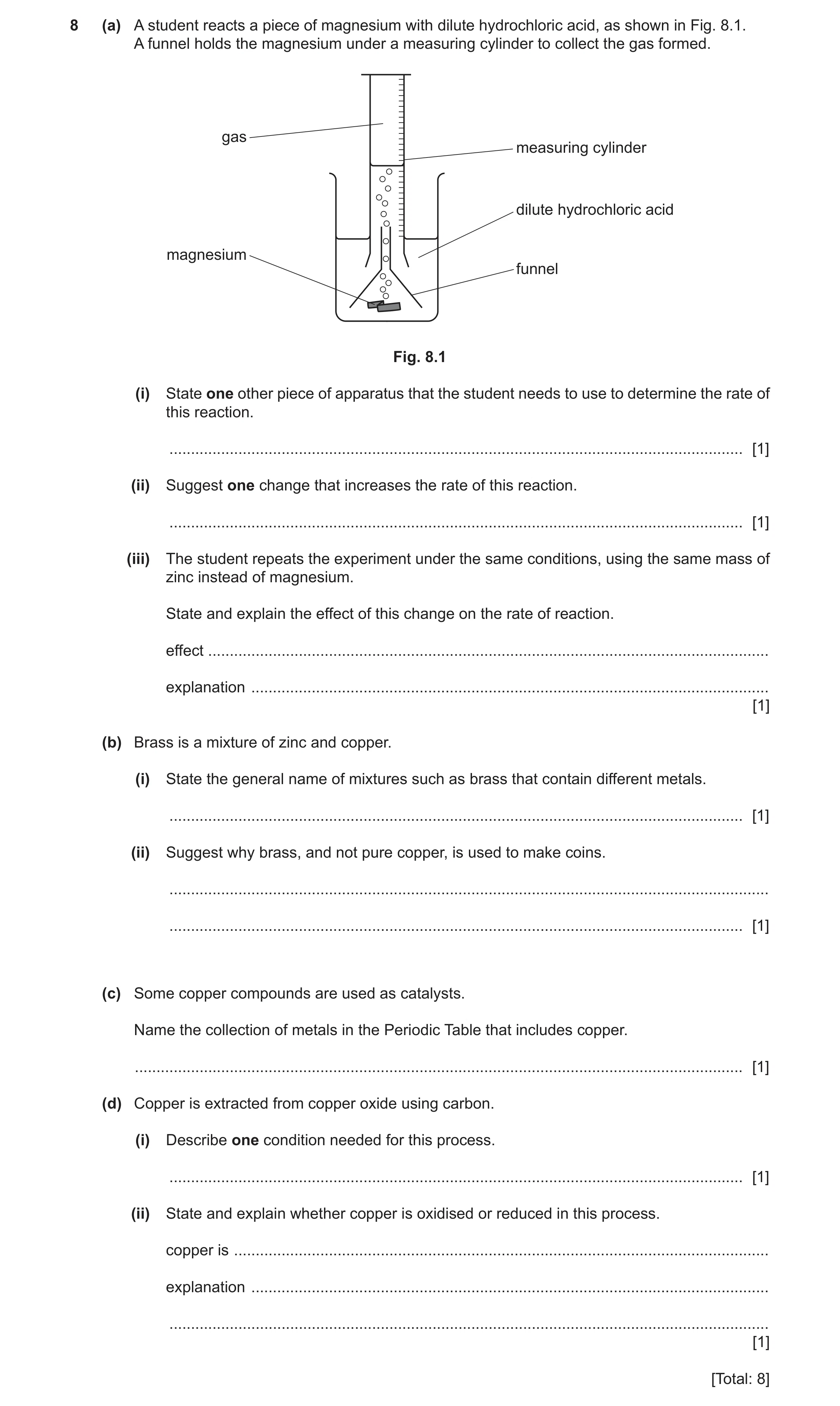
8 (a) A student reacts a piece of magnesium with dilute hydrochloric acid, as shown in Fig. 8.1. A funnel holds the magnesium under a measuring cylinder to collect the gas formed. gas measuring cylinder dilute hydrochloric acid magnesium funnel Fig. 8.1 (i) State one other piece of apparatus that the student needs to use to determine the rate of this reaction. … [1] (ii) Suggest one change that increases the rate of this reaction. … [1] (iii) The student repeats the experiment under the same conditions, using the same mass of zinc instead of magnesium. State and explain the effect of this change on the rate of reaction. effect … explanation … [1] (b) Brass is a mixture of zinc and copper. (i) State the general name of mixtures such as brass that contain different metals. … [1] (ii) Suggest why brass, and not pure copper, is used to make coins. … … [1] (c) Some copper compounds are used as catalysts. Name the collection of metals in the Periodic Table that includes copper. … [1] (d) Copper is extracted from copper oxide using carbon. (i) Describe one condition needed for this process. … [1] (ii) State and explain whether copper is oxidised or reduced in this process. copper is … explanation … … [1] [Total: 8]
8 marks
Mark scheme: 8(a)(i) stop-clock ; 1 Question Answer Marks 8(a)(ii) any one from: increase temperature ; increase concentration (of acid) ; increase surface area (of Mg) / use Mg powder / use smaller pieces ; add a catalyst ; 1 8(a)(iii) effect: decrease / slower (rate) AND explanation: zinc is less reactive (than magnesium) ORA ; 1 8(b)(i) alloy ; 1 8(b)(ii) brass is, stronger / harder / less malleable / hardwearing / durable / corrodes or oxidises less / doesn’t go green ; 1 8(c) transition (elements / metals) ; 1 8(d)(i) high temperature ; 1 8(d)(ii) copper is: reduced AND explanation: (copper) loses, oxygen / O ; 1
This question in 0653/31 May/June 2021
Q8 · Copper is extracted from copper(II) oxide by heating with carbon 0653/33 May/June 2021
5 (a) Copper is extracted from copper(II) oxide by heating with carbon. (i) Complete the word equation for this reaction. + copper + [2] (ii) Copper(II) oxide is reduced to copper in this reaction. Explain what is meant by the term reduced. … … [1] (b) Brass is a mixture of copper and zinc. (i) State the name of this type of mixture. … [1] (ii) Door keys are sometimes made from brass. Suggest why brass, rather than pure copper, is used to make door keys. … … [1] (c) Aluminium is extracted from aluminium oxide. (i) The ratio of aluminium atoms to oxygen atoms in aluminium oxide is shown. Al : O 1 : 1.5 Deduce the formula of aluminium oxide. … [1] (ii) State the method used to extract aluminium from aluminium oxide. … [1] (iii) Suggest why carbon cannot be used to extract aluminium from aluminium oxide. Use ideas about reactivity in your answer. … … [1] (d) Copper is a transition element. Aluminium is not a transition element. (i) Suggest one property of copper that is not shown by aluminium. … [1] (ii) Suggest one physical property that is shown by both copper and aluminium. … [1] [Total: 10]
10 marks
Mark scheme: 5(a)(i) copper oxide + carbon → copper + carbon dioxide LHS correct (either order) ; RHS correct ; 2 5(a)(ii) loss of oxygen (from copper oxide) ; 1 5(b)(i) alloy ; 1 5(b)(ii) brass is, hard-wearing / harder / stronger / corrosion resistant ; 1 5(c)(i) Al2O3 ; 1 5(c)(ii) electrolysis ; 1 5(c)(iii) carbon is less reactive (than aluminium) / aluminium is more reactive (than either carbon or copper) ; 1 5(d)(i) (copper) forms coloured compounds / catalytic activity / higher density / higher melting point ; 1 5(d)(ii) (electrical / heat / thermal) conductor / malleable / ductile ; 1
This question in 0653/33 May/June 2021
Q9 · The order of reactivity for some metals is shown in Fig 0653/31 Oct/Nov 2021
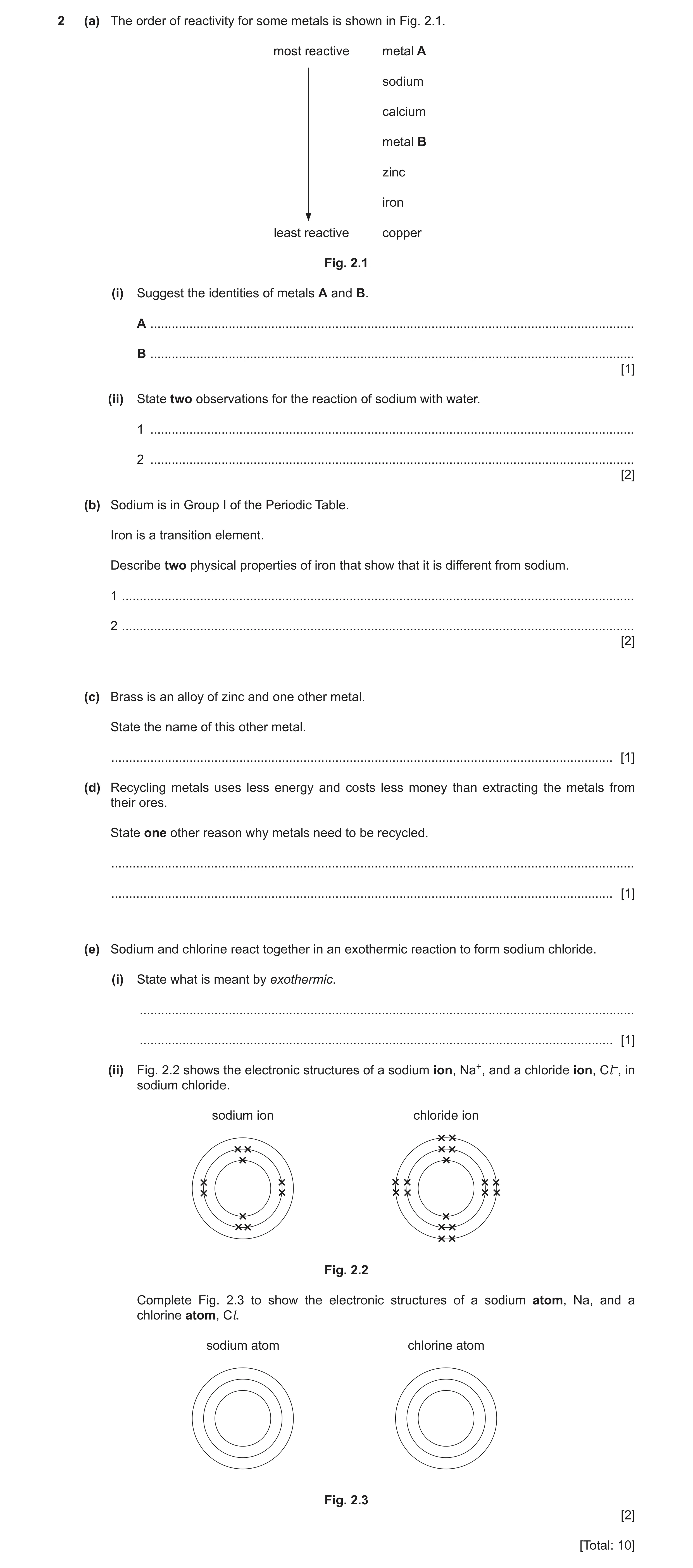
2 (a) The order of reactivity for some metals is shown in Fig. 2.1. most reactive metal A sodium calcium metal B zinc iron least reactive copper Fig. 2.1 (i) Suggest the identities of metals A and B. A … B … [1] (ii) State two observations for the reaction of sodium with water. 1 … 2 … [2] (b) Sodium is in Group I of the Periodic Table. Iron is a transition element. Describe two physical properties of iron that show that it is different from sodium. 1 … 2 … [2] (c) Brass is an alloy of zinc and one other metal. State the name of this other metal. … [1] (d) Recycling metals uses less energy and costs less money than extracting the metals from their ores. State one other reason why metals need to be recycled. … … [1] (e) Sodium and chlorine react together in an exothermic reaction to form sodium chloride. (i) State what is meant by exothermic. … … [1] (ii) Fig. 2.2 shows the electronic structures of a sodium ion, Na+, and a chloride ion, Cl–, in sodium chloride. sodium ion chloride ion ×× ×× ×× × × ×× ×× ×××× ×× ×× × × ×× ×× × × Fig. 2.2 Complete Fig. 2.3 to show the electronic structures of a sodium atom, Na, and a chlorine atom, Cl. sodium atom chlorine atom Fig. 2.3 [2] [Total: 10]
10 marks
Mark scheme: 2(a)(i) A potassium AND B magnesium / aluminium ; 1 2(a)(ii) any two from: fizzes / bubbles ; gets smaller ; floats ; moves ; 2 2(b) any two from: (iron has) high(er) density / ORA ; (iron has) high(er) melting point / ORA ; (iron is) magnetic / ORA ; 2 2(c) copper ; 1 2(d) metals are finite (resources) / will run out ; 1 2(e)(i) (thermal) energy is released ; 1 2(e)(ii) (sodium atom) 2, 8, 1 ; (chlorine atom) 2, 8, 7 ; 2
This question in 0653/31 Oct/Nov 2021
Q10 · The Periodic Table lists all of the known elements 0653/32 Oct/Nov 2021
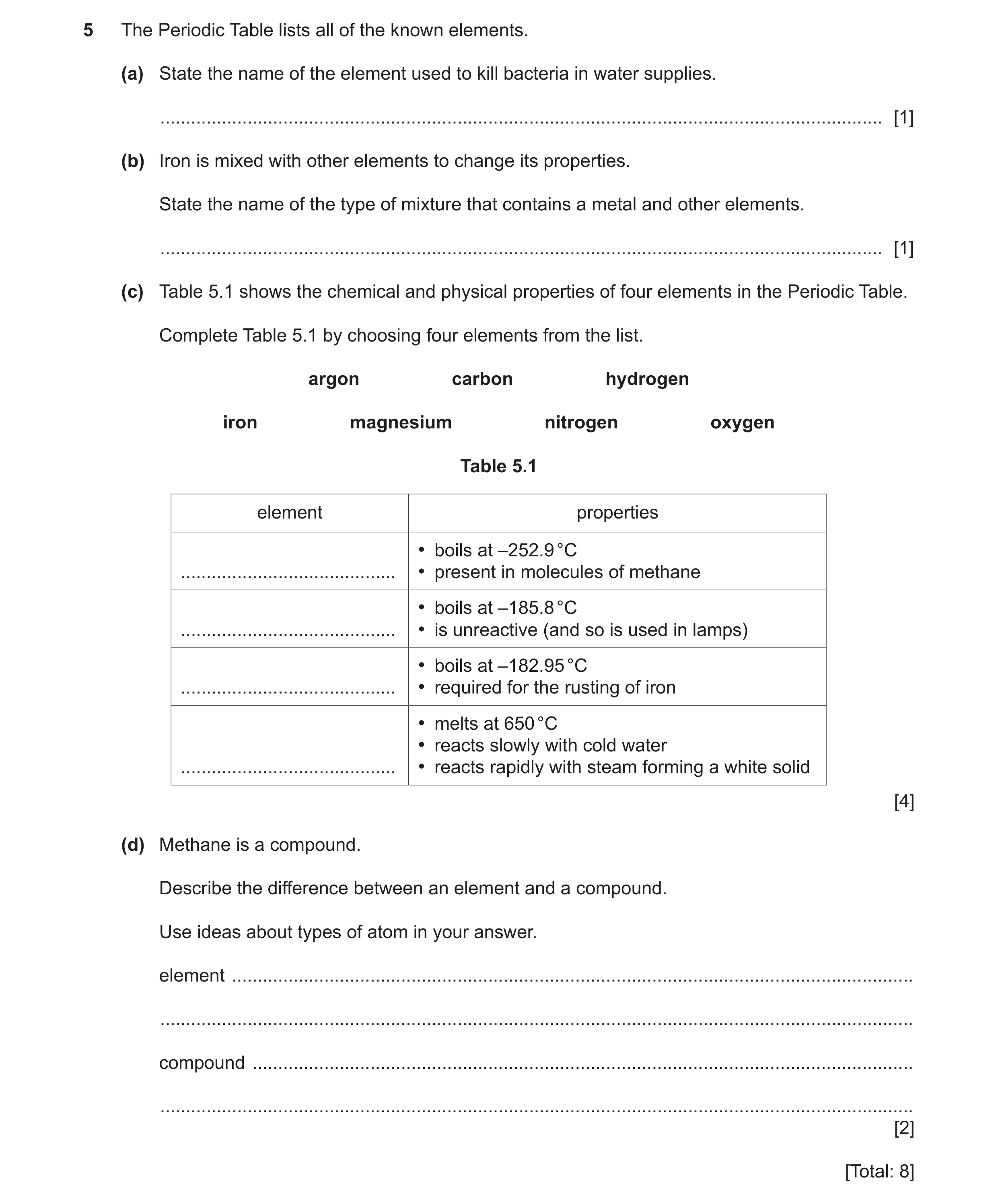
5 The Periodic Table lists all of the known elements. (a) State the name of the element used to kill bacteria in water supplies. … [1] (b) Iron is mixed with other elements to change its properties. State the name of the type of mixture that contains a metal and other elements. … [1] (c) Table 5.1 shows the chemical and physical properties of four elements in the Periodic Table. Complete Table 5.1 by choosing four elements from the list. argon carbon hydrogen iron magnesium nitrogen oxygen Table 5.1 element properties • boils at –252.9 °C … • present in molecules of methane • boils at –185.8 °C … • is unreactive (and so is used in lamps) • boils at –182.95 °C … • required for the rusting of iron • melts at 650 °C • reacts slowly with cold water … • reacts rapidly with steam forming a white solid [4] (d) Methane is a compound. Describe the difference between an element and a compound. Use ideas about types of atom in your answer. element … … compound … … [2] [Total: 8]
8 marks
Mark scheme: 5(a) chlorine ; 1 5(b) alloy(s) ; 1 5(c) hydrogen ; argon ; oxygen ; magnesium ; 4 5(d) element: contains only one type of atom ; compound: contains two (or more) types of atom ; 2 Question Answer Marks
This question in 0653/32 Oct/Nov 2021
Q11 · The Periodic Table lists all of the known elements 0653/33 Oct/Nov 2021
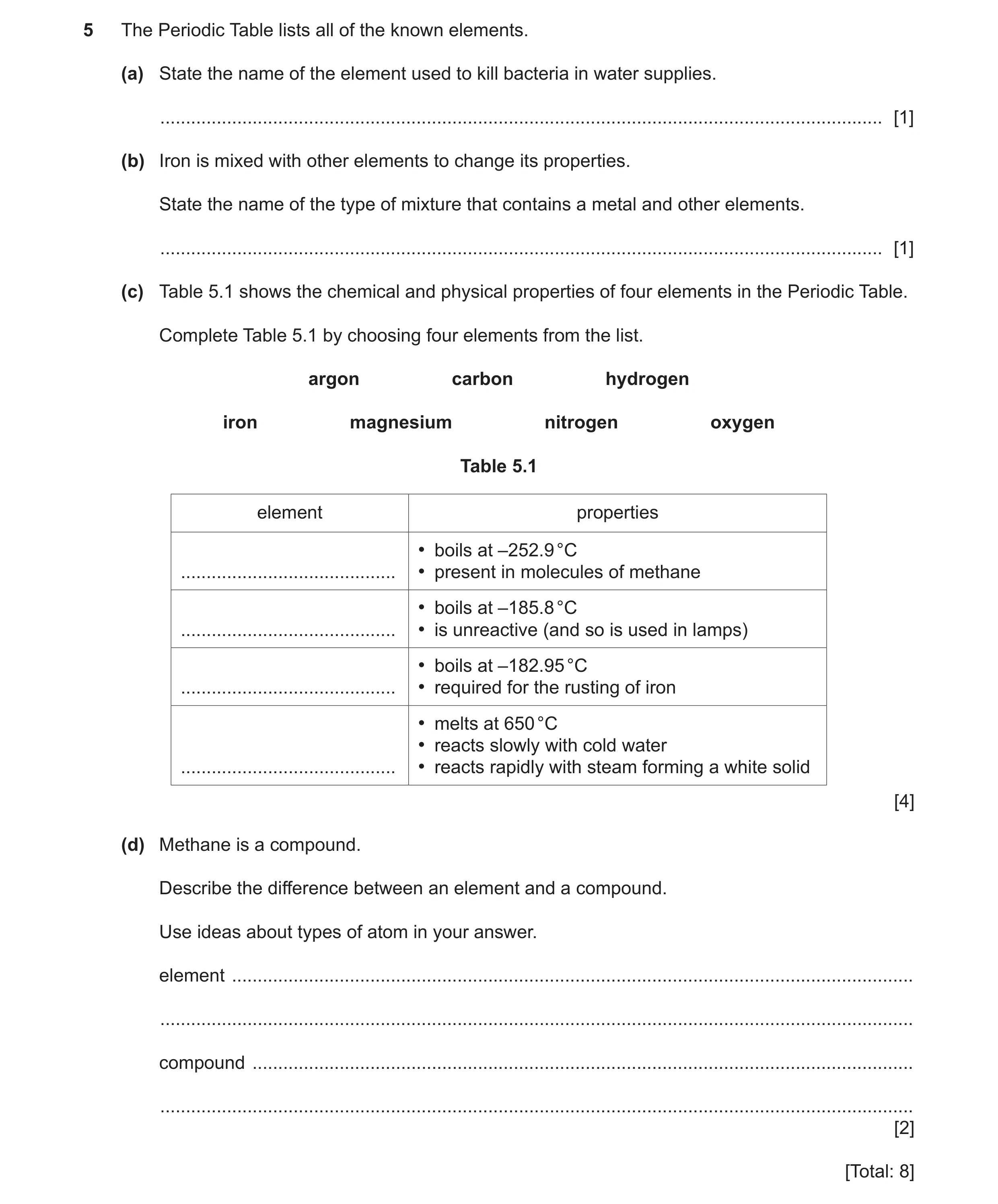
5 The Periodic Table lists all of the known elements. (a) State the name of the element used to kill bacteria in water supplies. … [1] (b) Iron is mixed with other elements to change its properties. State the name of the type of mixture that contains a metal and other elements. … [1] (c) Table 5.1 shows the chemical and physical properties of four elements in the Periodic Table. Complete Table 5.1 by choosing four elements from the list. argon carbon hydrogen iron magnesium nitrogen oxygen Table 5.1 element properties • boils at –252.9 °C … • present in molecules of methane • boils at –185.8 °C … • is unreactive (and so is used in lamps) • boils at –182.95 °C … • required for the rusting of iron • melts at 650 °C • reacts slowly with cold water … • reacts rapidly with steam forming a white solid [4] (d) Methane is a compound. Describe the difference between an element and a compound. Use ideas about types of atom in your answer. element … … compound … … [2] [Total: 8]
8 marks
Mark scheme: 5(a) chlorine ; 1 5(b) alloy(s) ; 1 5(c) hydrogen ; argon ; oxygen ; magnesium ; 4 5(d) element: contains only one type of atom ; compound: contains two (or more) types of atom ; 2 Question Answer Marks
This question in 0653/33 Oct/Nov 2021
Q12 · Copper is a transition element 0653/31 Oct/Nov 2023
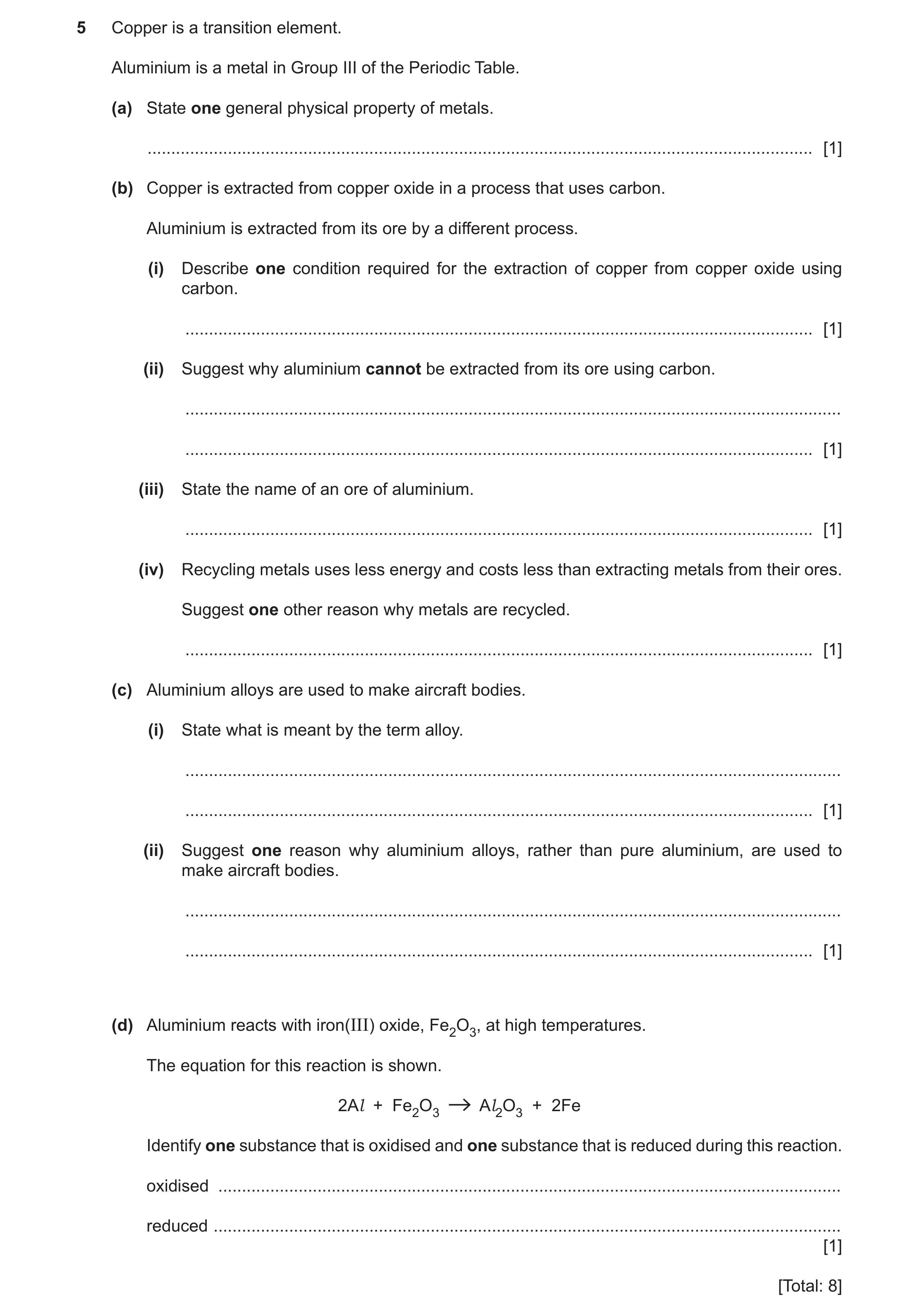
5 Copper is a transition element. Aluminium is a metal in Group III of the Periodic Table. (a) State one general physical property of metals. … [1] (b) Copper is extracted from copper oxide in a process that uses carbon. Aluminium is extracted from its ore by a different process. (i) Describe one condition required for the extraction of copper from copper oxide using carbon. … [1] (ii) Suggest why aluminium cannot be extracted from its ore using carbon. … … [1] (iii) State the name of an ore of aluminium. … [1] (iv) Recycling metals uses less energy and costs less than extracting metals from their ores. Suggest one other reason why metals are recycled. … [1] (c) Aluminium alloys are used to make aircraft bodies. (i) State what is meant by the term alloy. … … [1] (ii) Suggest one reason why aluminium alloys, rather than pure aluminium, are used to make aircraft bodies. … … [1] (d) Aluminium reacts with iron(III) oxide, Fe2O3, at high temperatures. The equation for this reaction is shown. 2Al + Fe2O3 Al2O3 + 2Fe Identify one substance that is oxidised and one substance that is reduced during this reaction. oxidised … reduced … [1] [Total: 8]
8 marks
Mark scheme: 5(a) any one from: 1 malleable ; (good) electrical / heat / thermal, conductor ; high, melting / boiling, point ; 5(b)(i) heat / high temperature ; 1 5(b)(ii) (aluminium is) more reactive (than carbon) / ORA ; 1 5(b)(iii) bauxite ; 1 5(b)(iv) metal ores are a finite resource / may run out ; 1 5(c)(i) a mixture of a metal with other element(s) ; 1 5(c)(ii) stronger (for the same mass) OR less dense (for the same strength) ; 1 5(d) (oxidised) Al / aluminium AND 1 (reduced) Fe ions / iron(III) / Fe3+ ;
This question in 0653/31 Oct/Nov 2023
Q13 · Lithium is an element in Group I of the Periodic Table 0653/32 Feb/March 2024
2 Lithium is an element in Group I of the Periodic Table. (a) An atom of lithium is represented as shown. 73Li Complete Table 2.1 to show the number of protons, electrons and neutrons in one atom of 73Li. Table 2.1 number of protons number of electrons number of neutrons [2] (b) Describe what happens when an atom of lithium becomes an ion of lithium. … … [1] (c) Lithium reacts slowly with oxygen at room temperature to form lithium oxide. This reaction is exothermic. (i) Balance the symbol equation for this reaction. [1] ……. Li + .…... O2 ……. Li2O (ii) Circle the word that describes the reaction between lithium and oxygen. decomposition distillation neutralisation oxidation [1] (iii) Describe one observation that shows the reaction is exothermic. … … [1] (d) There is an alloy that contains lithium and aluminium only. Tick (3) one box to show which statement describes this alloy. It contains one type of atom only. It is a mixture. It has the chemical properties of aluminium only. It has the physical properties of lithium only. [1] (e) Aluminium is used to make cooking pans. Suggest why lithium is not used to make cooking pans. … … [1] (f) Recycling aluminium is cheaper than producing it from its ore. Suggest one other reason why aluminium is recycled. … … [1] [Total: 9]
9 marks
Mark scheme: 2(a) 2 number of protons number of electrons number of neutrons 3 3 4 ;; 3 correct = [2] 1–2 correct = [1] 2(b) loss of one electron (from its outer shell) ; 1 2(c)(i) 4Li + O2 → 2Li2O ; 1 2(c)(ii) oxidation circled ; 1 2(c)(iii) idea that heat is transferred from reactants / temperature (of reaction mixture) increases ; 1 2(d) second box ticked (It is a mixture.) ; 1 2(e) too reactive / melting point too low / too soft ; 1 2(f) (aluminium is a) finite resource / will run out / non-renewable ; 1
This question in 0653/32 Feb/March 2024
Q14 · A student investigates the reaction of magnesium with excess dilute hydrochloric acid… 0653/32 May/June 2024
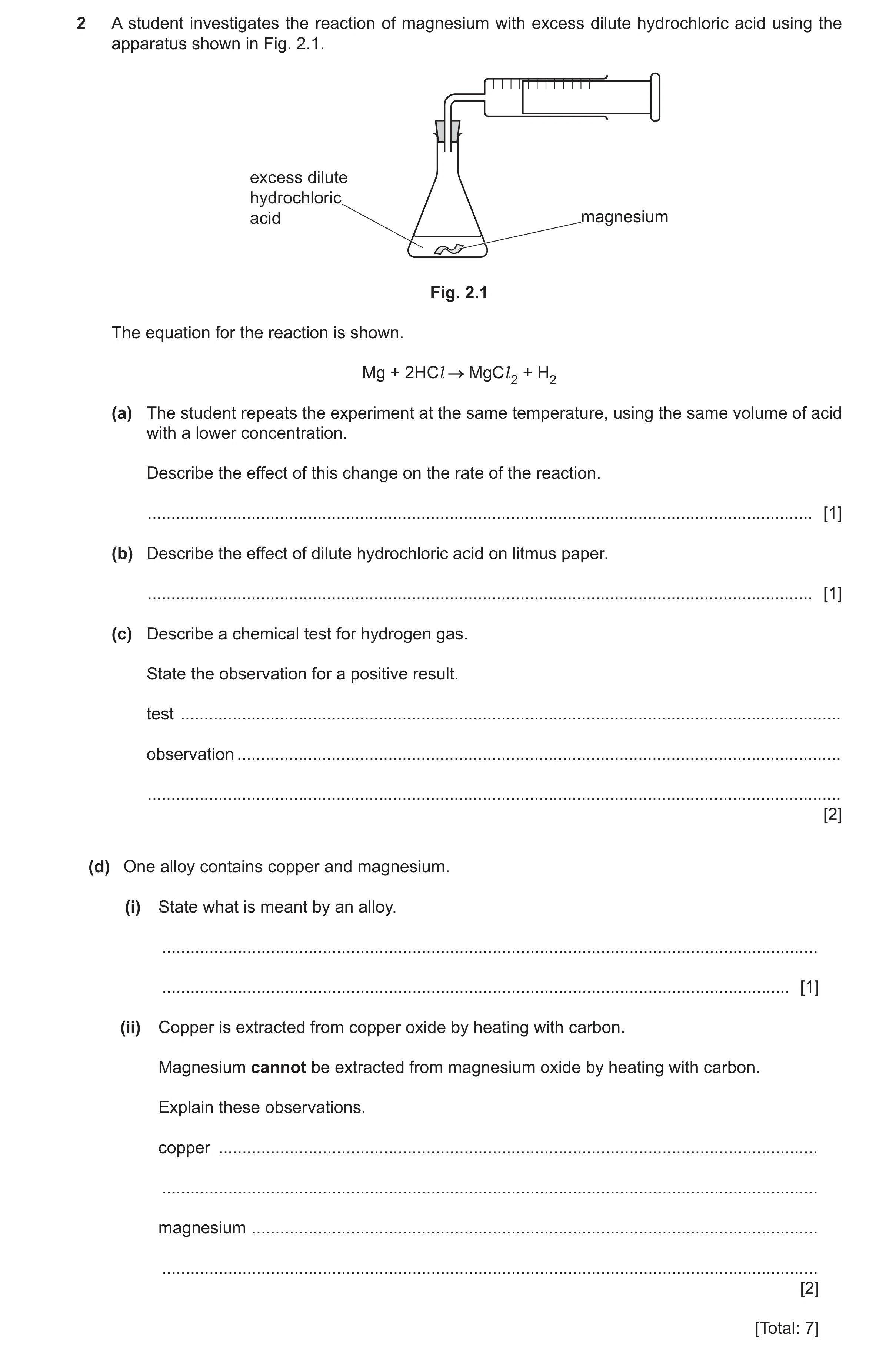
2 A student investigates the reaction of magnesium with excess dilute hydrochloric acid using the apparatus shown in Fig. 2.1. excess dilute hydrochloric acid magnesium Fig. 2.1 The equation for the reaction is shown. Mg + 2HCl MgCl2 + H2 (a) The student repeats the experiment at the same temperature, using the same volume of acid with a lower concentration. Describe the effect of this change on the rate of the reaction. … [1] (b) Describe the effect of dilute hydrochloric acid on litmus paper. … [1] (c) Describe a chemical test for hydrogen gas. State the observation for a positive result. test … observation … … [2] (d) One alloy contains copper and magnesium. (i) State what is meant by an alloy. … … [1] (ii) Copper is extracted from copper oxide by heating with carbon. Magnesium cannot be extracted from magnesium oxide by heating with carbon. Explain these observations. copper … … magnesium … … [2] [Total: 7]
7 marks
Mark scheme: 2(a) (rate of reaction) decreases / slows down ; 1 2(b) (turns blue litmus paper) red ; 1 2(c) (test) lighted splint ; (observation) ‘pops’ ; 2 2(d)(i) a mixture of a metal with another element(s) ; 1 2(d)(ii) (copper) is less reactive than carbon ORA ; (magnesium) is more reactive than carbon ORA ; 2
This question in 0653/32 May/June 2024
Q15 · Lithium, sodium and potassium are elements in Group I of the Periodic Table 0653/32 Feb/March 2025
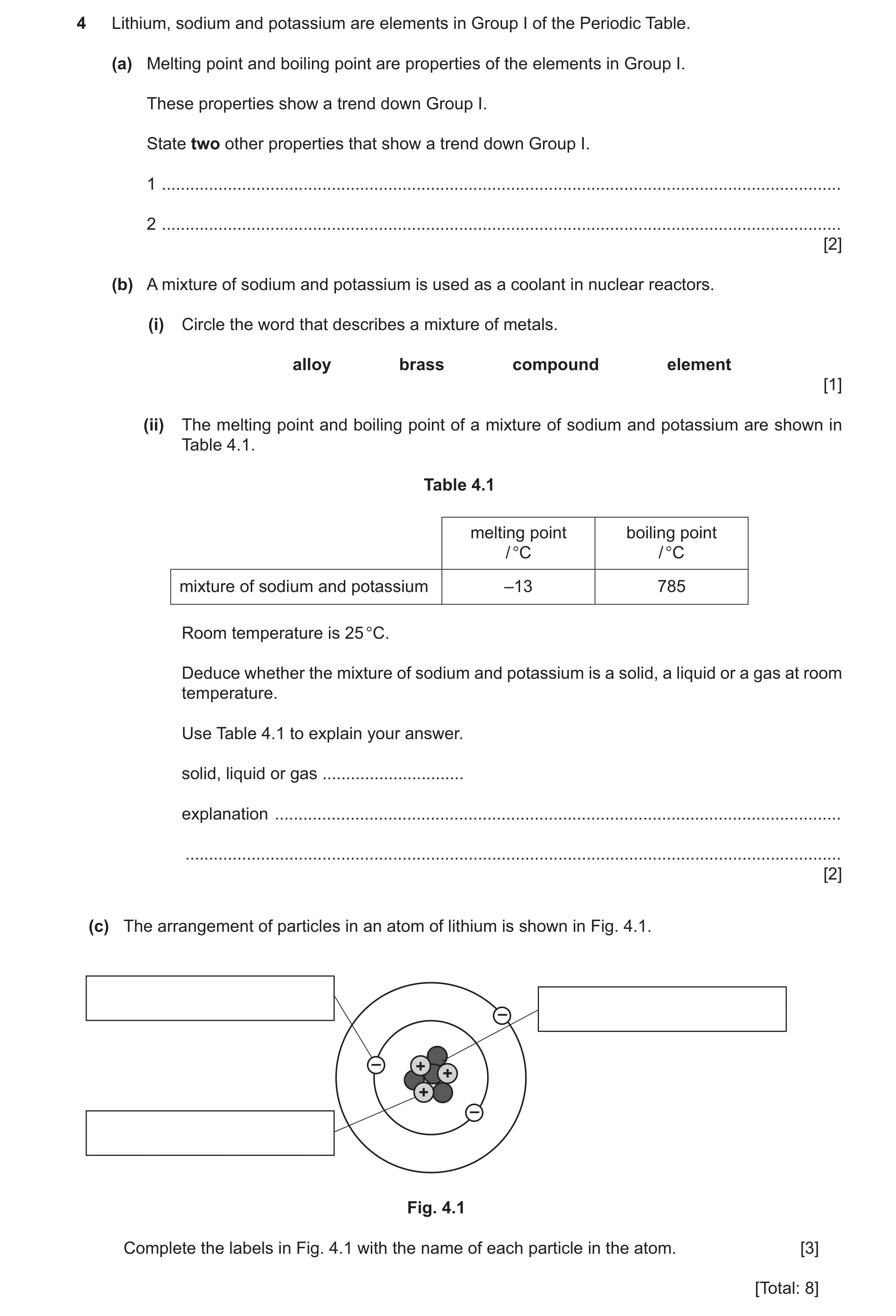
4 Lithium, sodium and potassium are elements in Group I of the Periodic Table. (a) Melting point and boiling point are properties of the elements in Group I. These properties show a trend down Group I. State two other properties that show a trend down Group I. 1 … 2 … [2] (b) A mixture of sodium and potassium is used as a coolant in nuclear reactors. (i) Circle the word that describes a mixture of metals. alloy brass compound element [1] (ii) The melting point and boiling point of a mixture of sodium and potassium are shown in Table 4.1. Table 4.1 melting point boiling point / °C / °C mixture of sodium and potassium –13 785 Room temperature is 25 °C. Deduce whether the mixture of sodium and potassium is a solid, a liquid or a gas at room temperature. Use Table 4.1 to explain your answer. solid, liquid or gas … explanation … … [2] (c) The arrangement of particles in an atom of lithium is shown in Fig. 4.1. – – + + + – Fig. 4.1 Complete the labels in Fig. 4.1 with the name of each particle in the atom. [3] [Total: 8]
8 marks
Mark scheme: 4(a) density ; 2 reactivity with water ; 4(b)(i) alloy ; 1 more than one answer circled = 0 marks 4(b)(ii) liquid ; 2 melting point is below room temperature and / or boiling point is above room temperature / owtte ; 4(c) electron ; 3 neutron ; proton ;
This question in 0653/32 Feb/March 2025
Q16 · Potassium and magnesium are metals 0653/31 May/June 2025
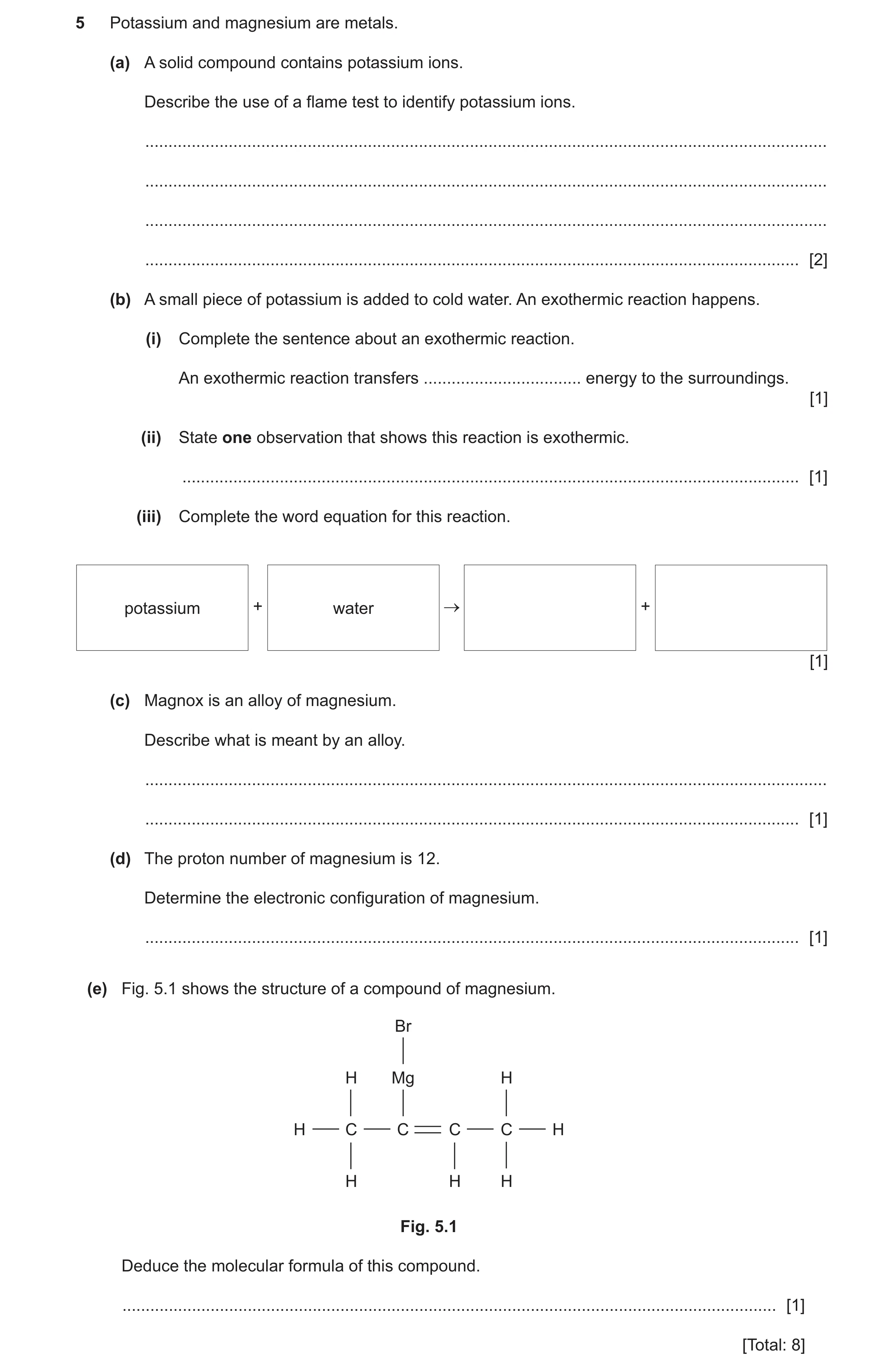
5 Potassium and magnesium are metals. (a) A solid compound contains potassium ions. Describe the use of a flame test to identify potassium ions. … … … … [2] (b) A small piece of potassium is added to cold water. An exothermic reaction happens. (i) Complete the sentence about an exothermic reaction. An exothermic reaction transfers … energy to the surroundings. [1] (ii) State one observation that shows this reaction is exothermic. … [1] (iii) Complete the word equation for this reaction. potassium + water + [1] (c) Magnox is an alloy of magnesium. Describe what is meant by an alloy. … … [1] (d) The proton number of magnesium is 12. Determine the electronic configuration of magnesium. … [1] (e) Fig. 5.1 shows the structure of a compound of magnesium. Br H Mg H H C C C C H H H H Fig. 5.1 Deduce the molecular formula of this compound. … [1] [Total: 8]
8 marks
Mark scheme: 5(a) any two from: 2 dip (nichrome) wire or splint in potassium compound ; at (edge of) a blue Bunsen flame ; lilac flame observed ; 5(b)(i) thermal ; 1 5(b)(ii) a flame (is observed) ; 1 5(b)(iii) potassium hydroxide and hydrogen ; 1 5(c) mixture of a metal and other element(s) ; 1 5(d) 2,8,2 ; 1 5(e) C4H7MgBr ; 1
This question in 0653/31 May/June 2025
 4 / 20
 5 / 20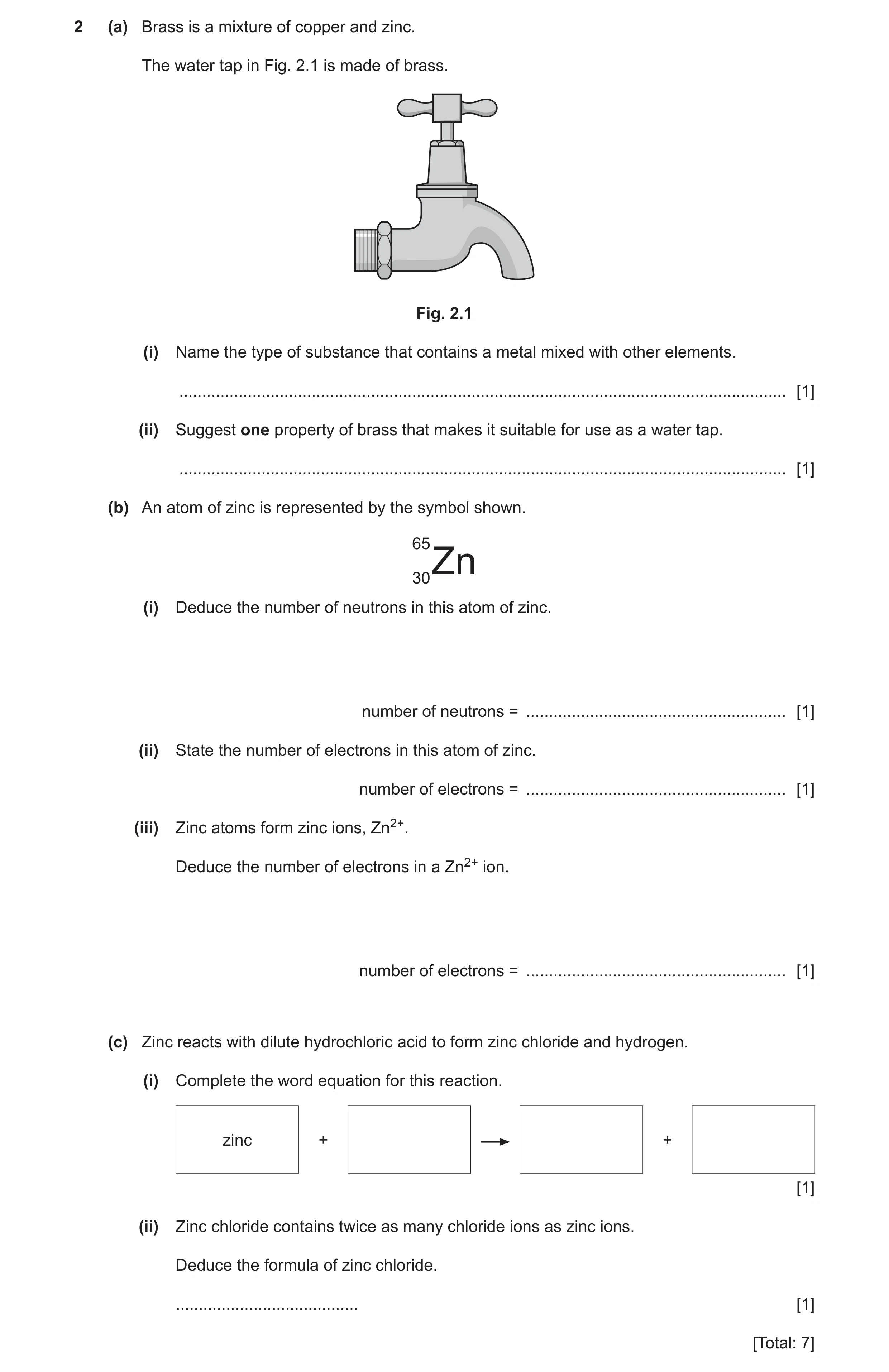
![Question 8: (a) Copper is extracted from copper(II) oxide by heating with carbon. (i) Complete the word equation for this reaction. + copper + [2] (ii)…](https://img.pastlit.com/crops/dfdc1920-96aa-496a-a9cc-2f1e98a44802/q5.webp)
 13 / 20
 14 / 20
 15 / 20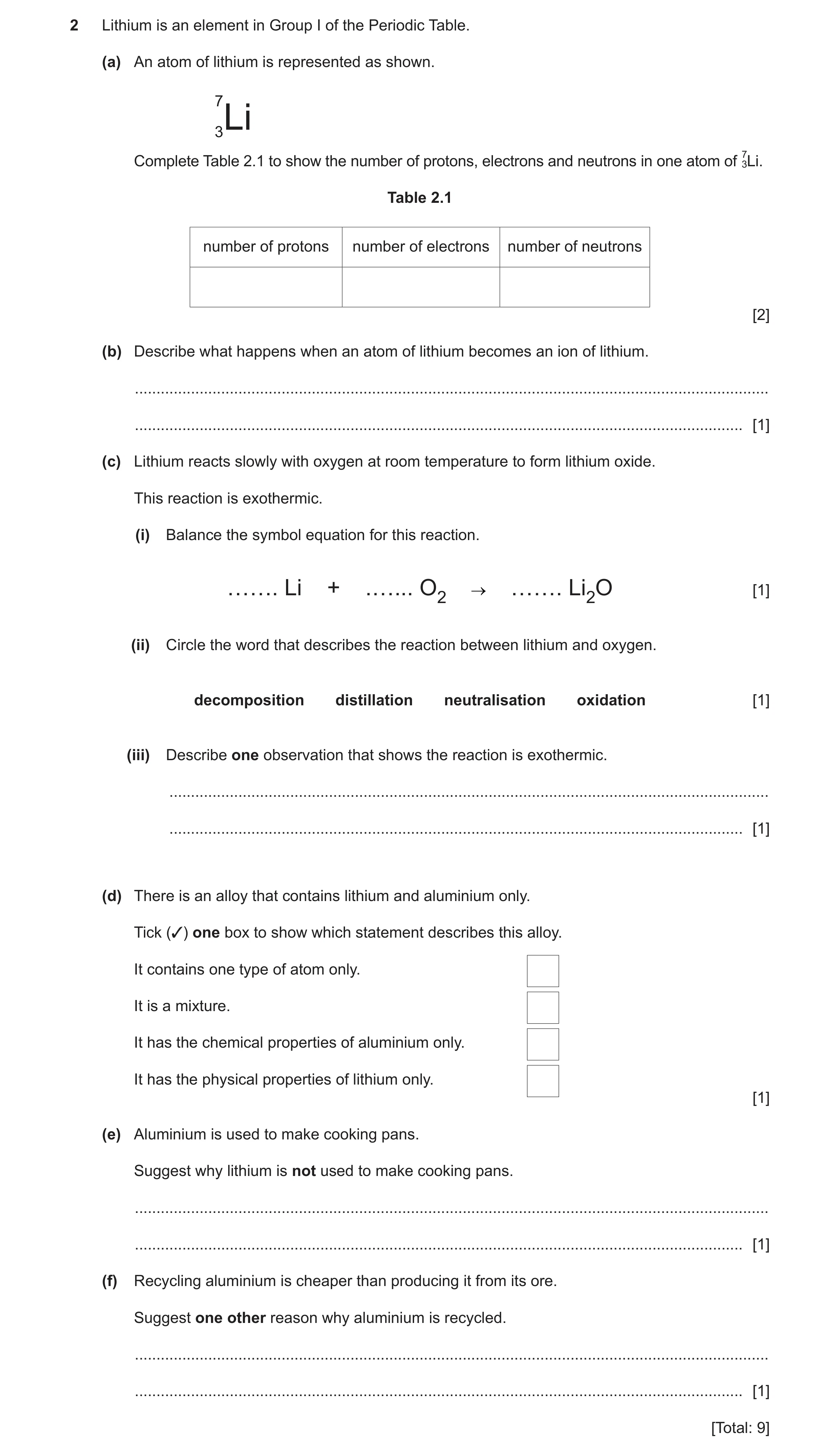
 9
9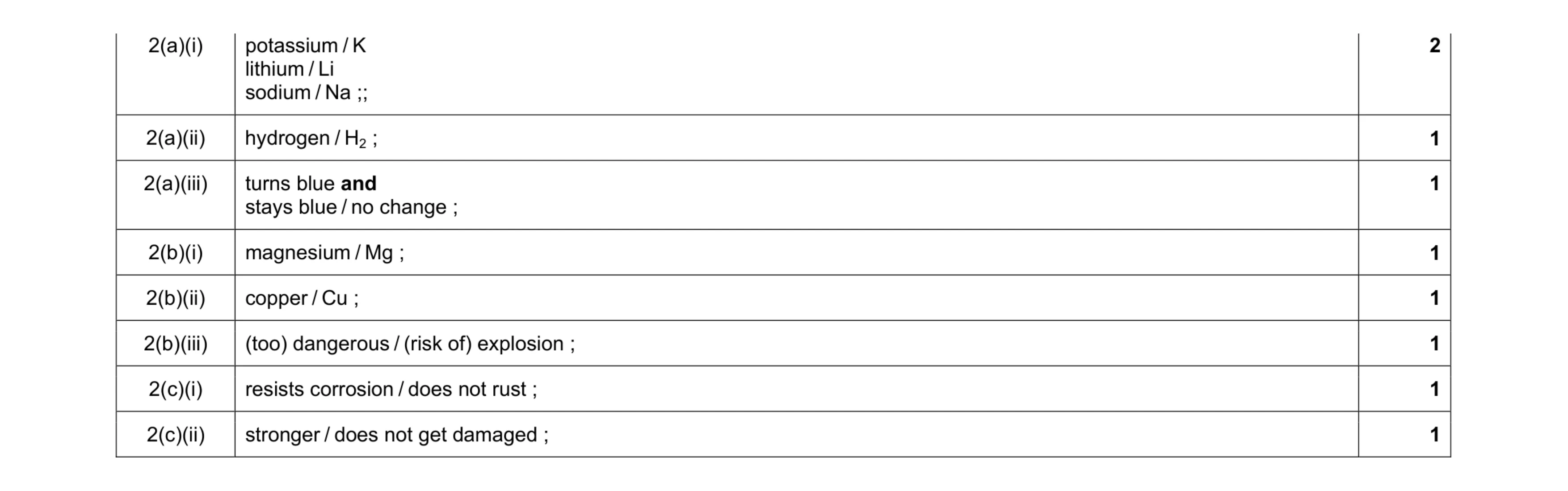 9
9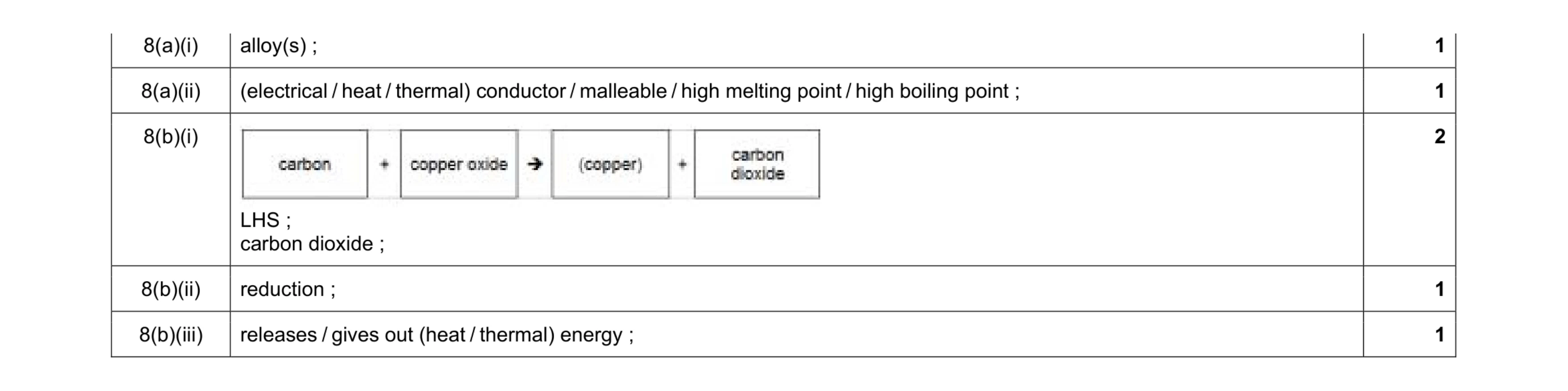 6
6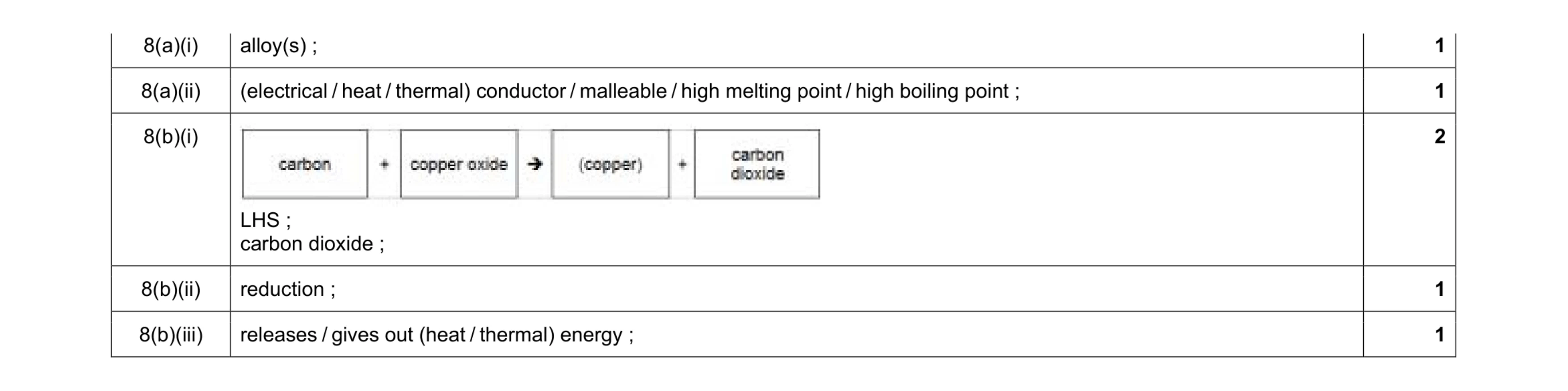 6
6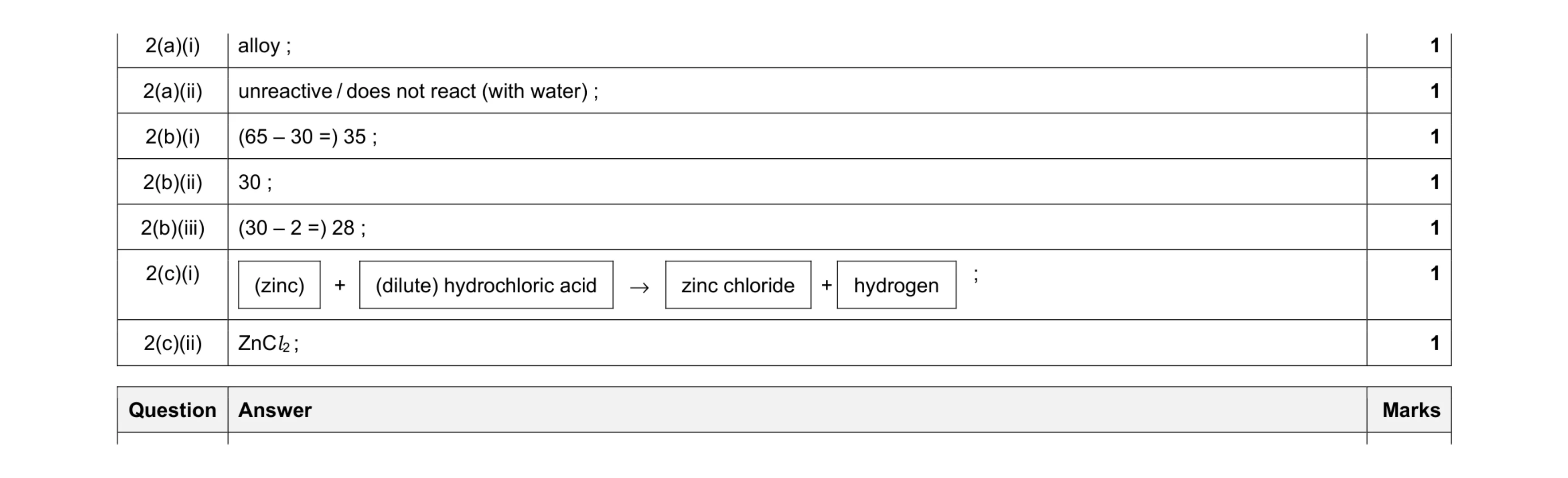 7
7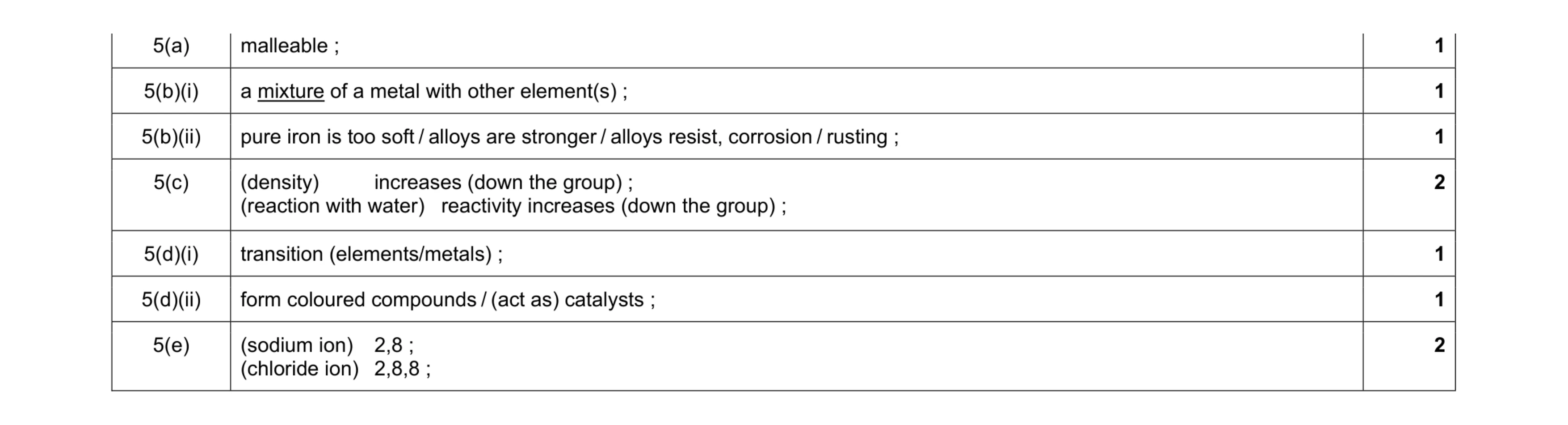 9
9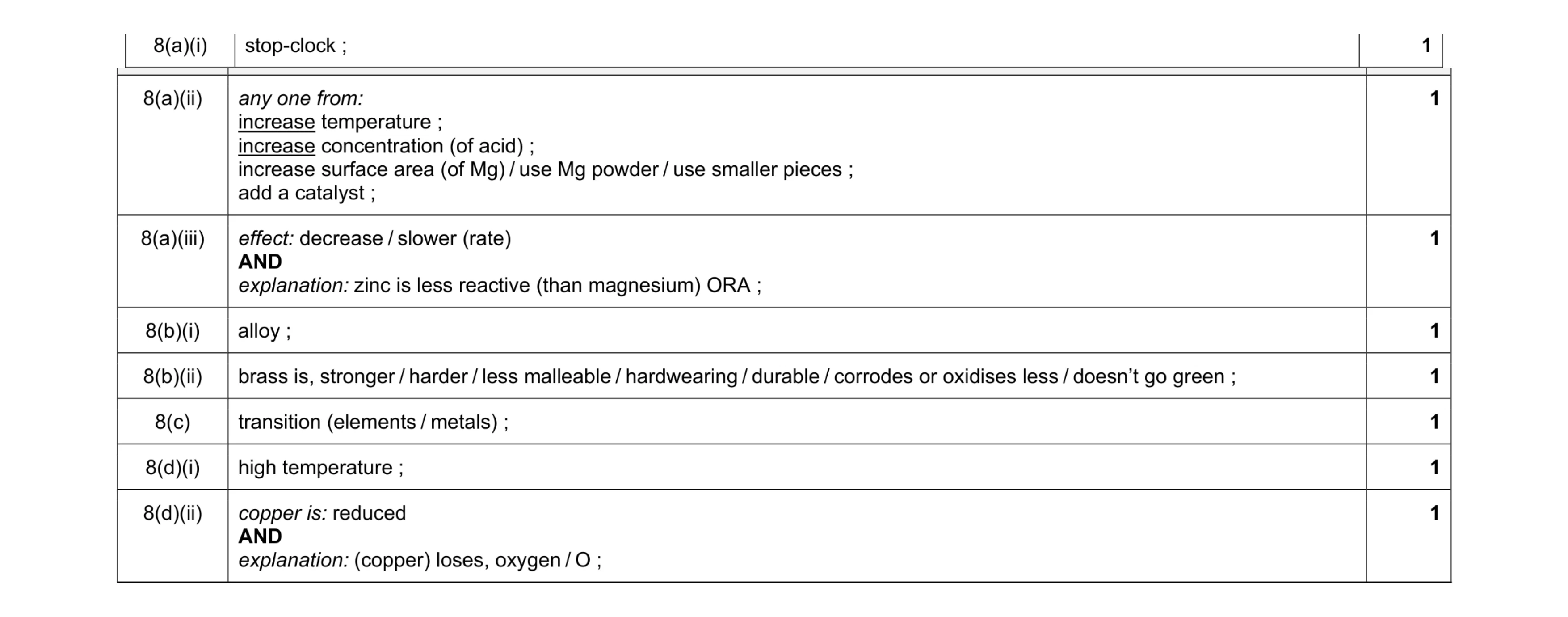 8
8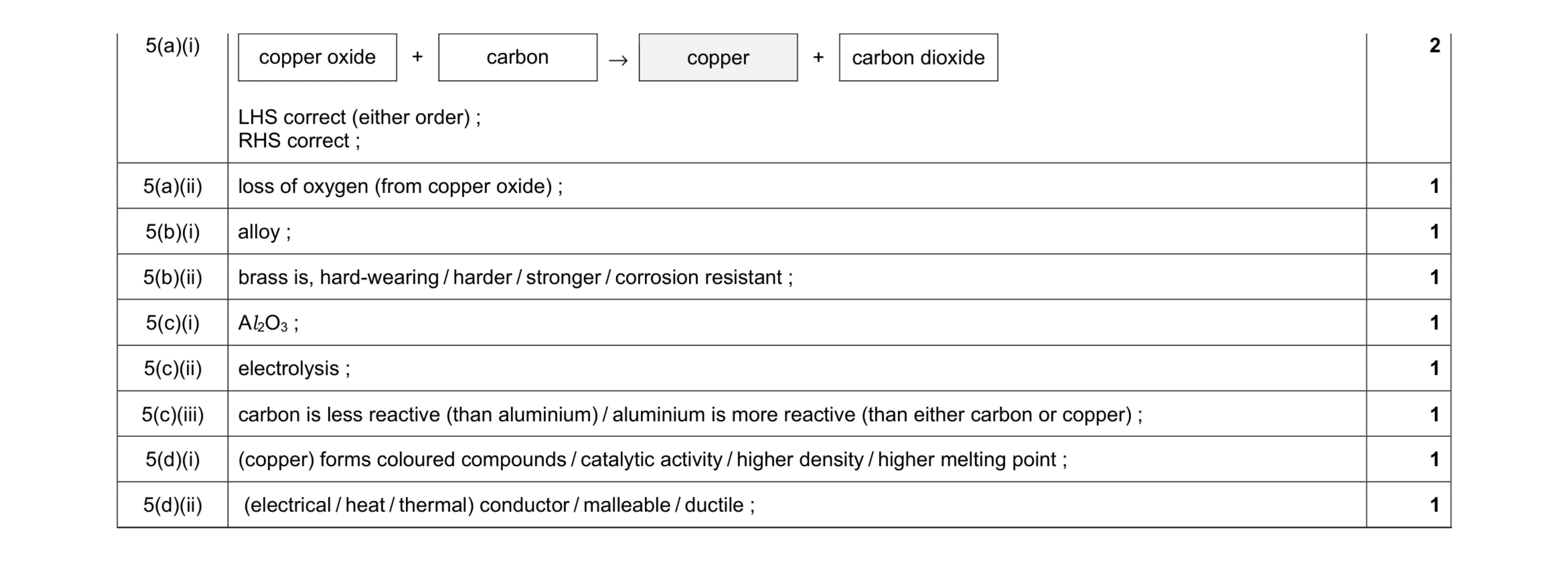 10
10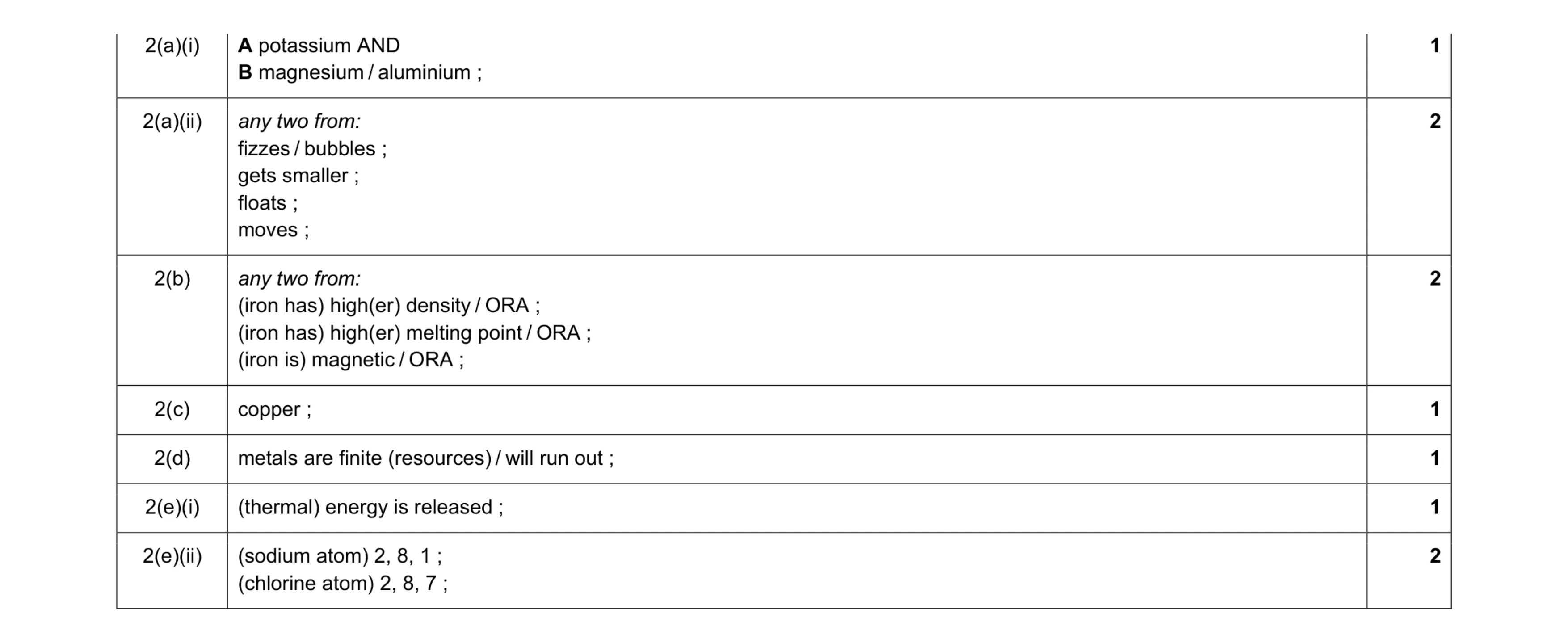 10
10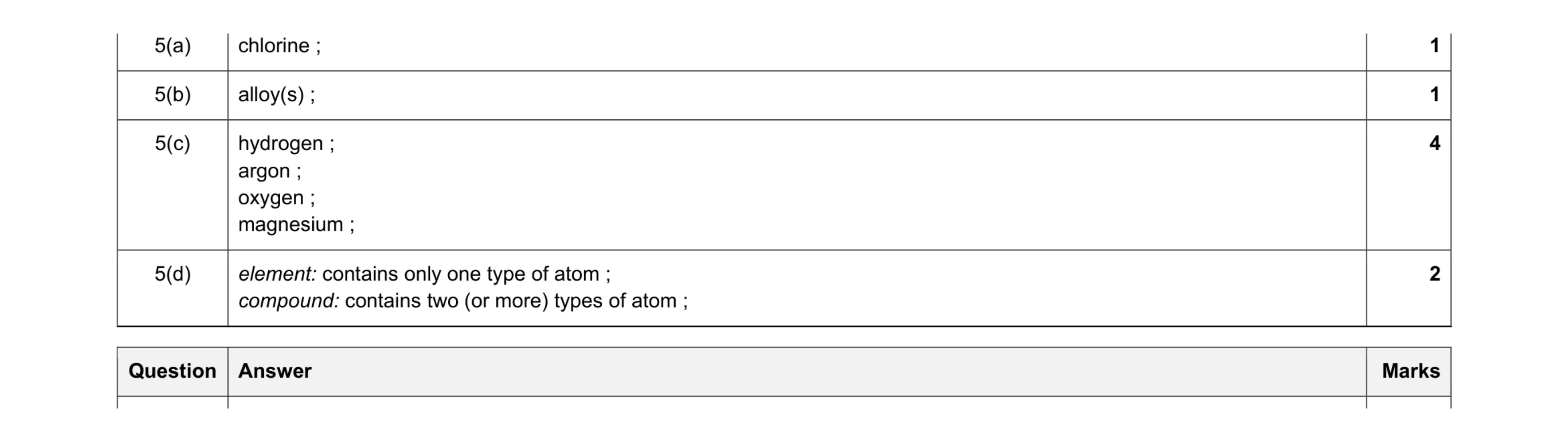 8
8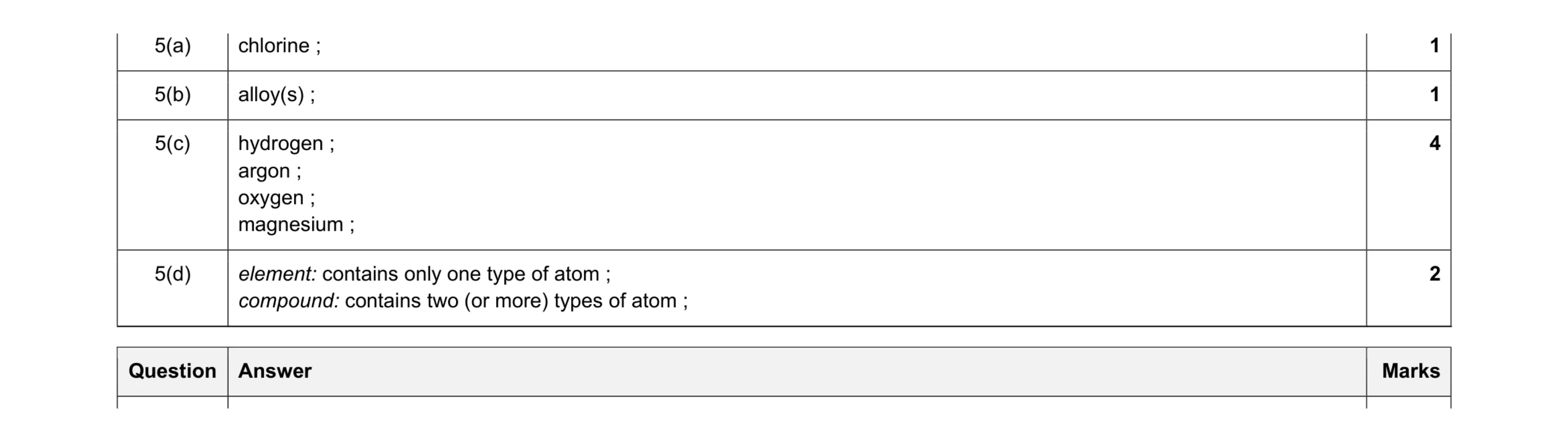 8
8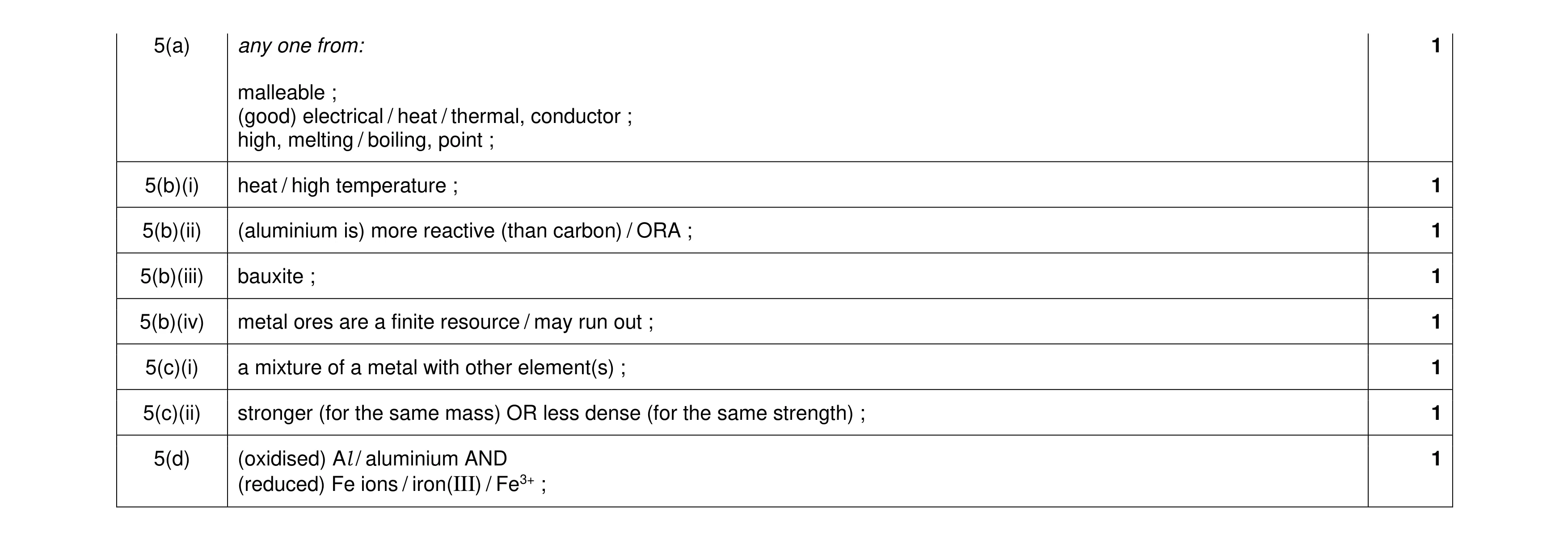 8
8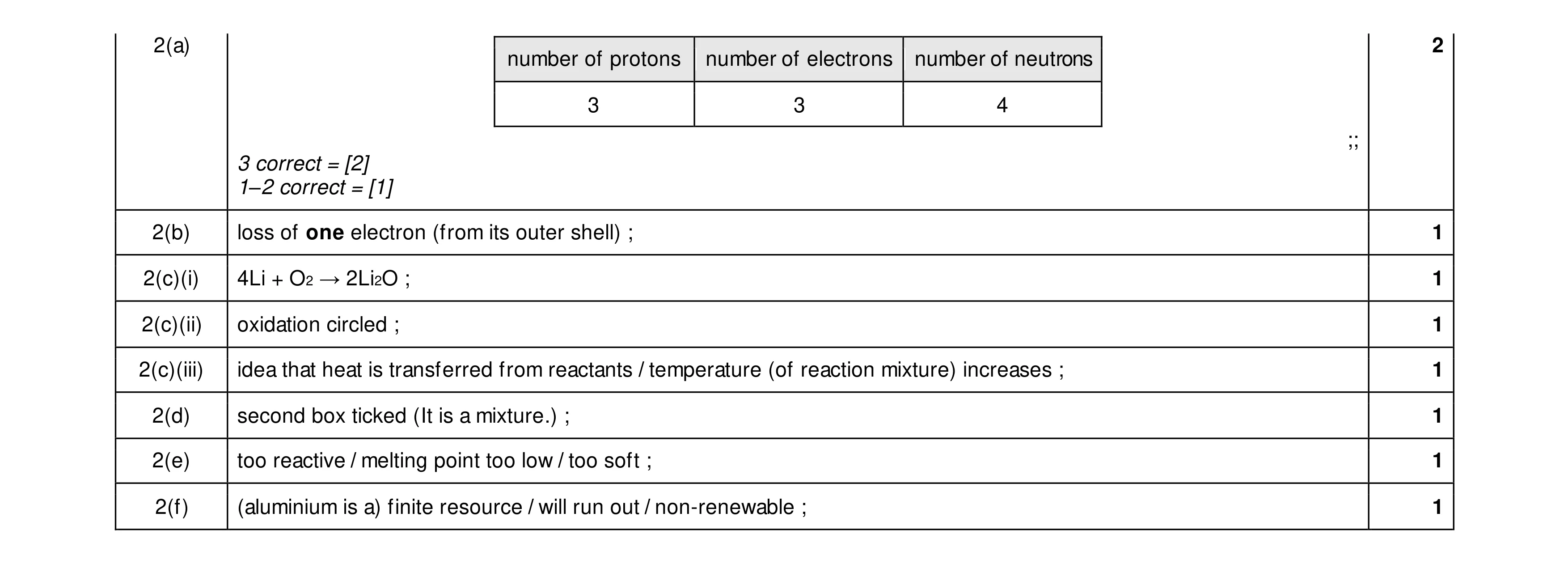 9
9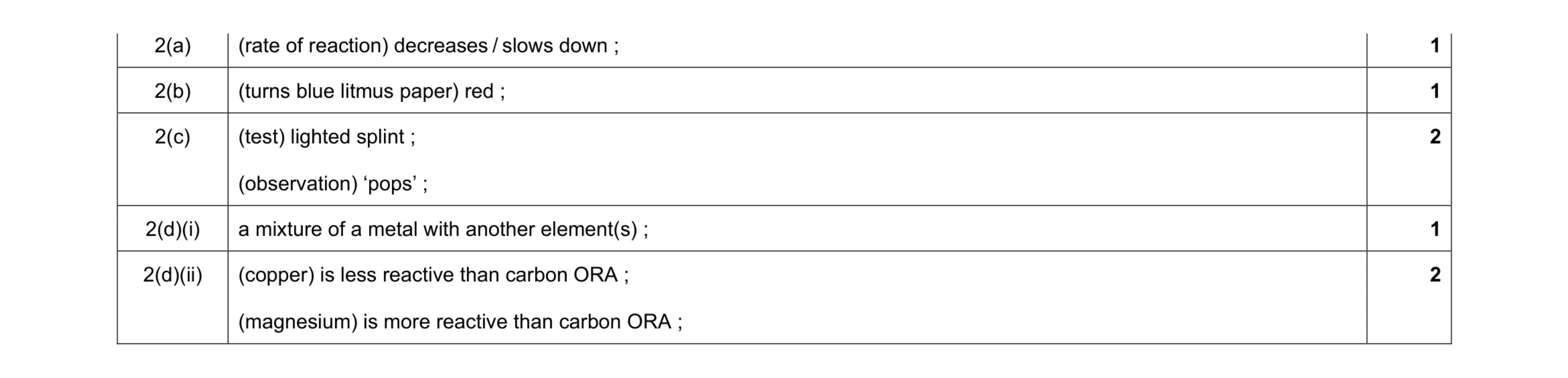 7
7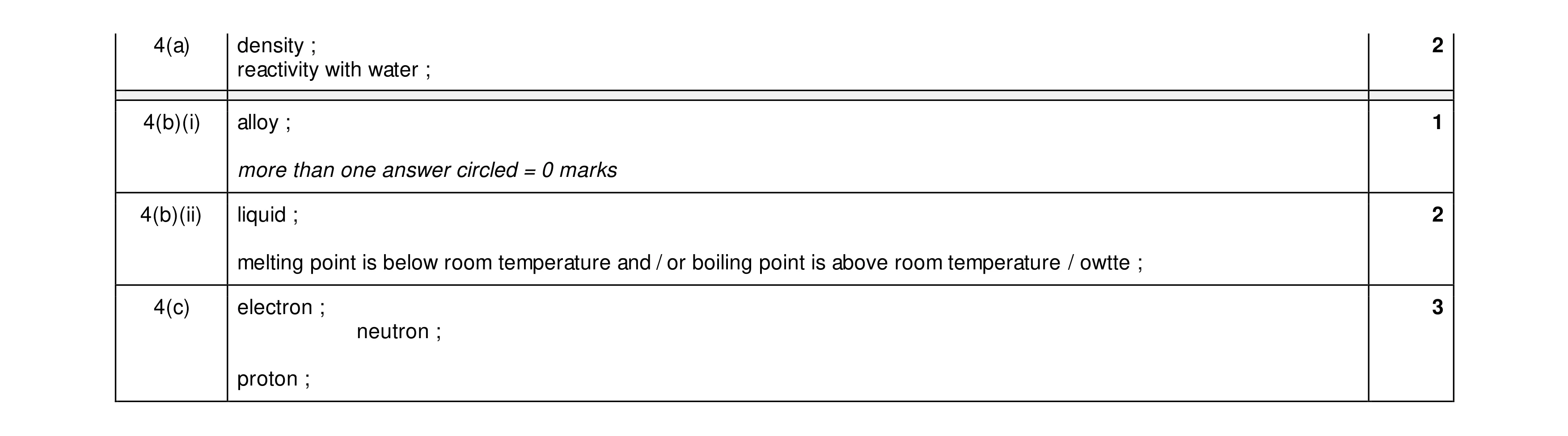 8
8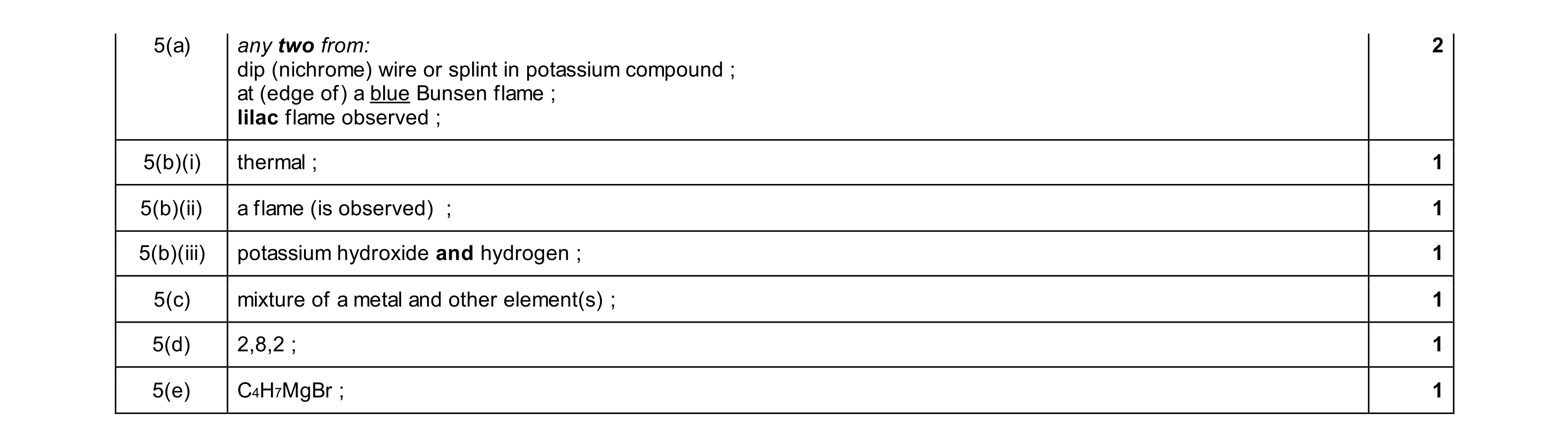 8
8