Questions as text
Q1 · A student places identical sized pieces of four metals, A, B, C and D, into separate… 0653/42 Oct/Nov 2017
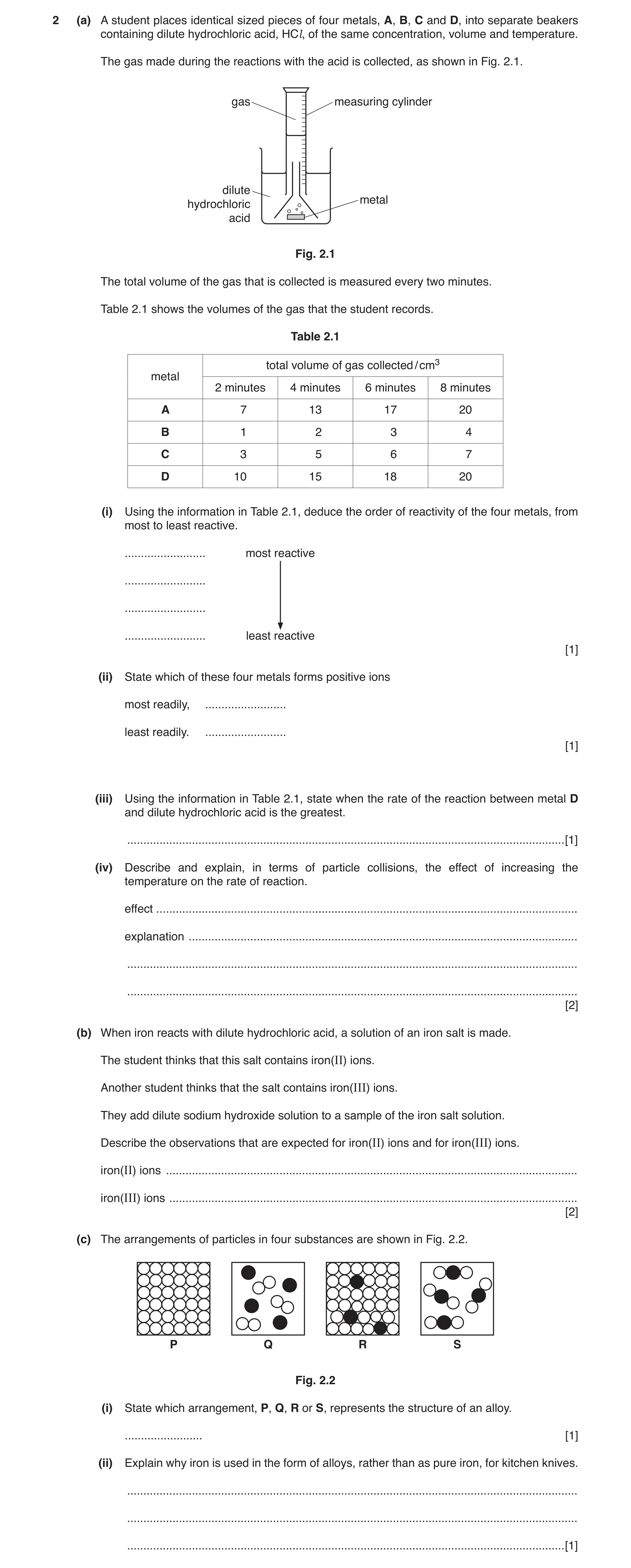
2 (a) A student places identical sized pieces of four metals, A, B, C and D, into separate beakers containing dilute hydrochloric acid, HCl, of the same concentration, volume and temperature. The gas made during the reactions with the acid is collected, as shown in Fig. 2.1. gas measuring cylinder dilute metal hydrochloric acid Fig. 2.1 The total volume of the gas that is collected is measured every two minutes. Table 2.1 shows the volumes of the gas that the student records. Table 2.1 total volume of gas collected / cm3 metal 2 minutes 4 minutes 6 minutes 8 minutes A 7 13 17 20 B 1 2 3 4 C 3 5 6 7 D 10 15 18 20 (i) Using the information in Table 2.1, deduce the order of reactivity of the four metals, from most to least reactive. … most reactive … … … least reactive [1] (ii) State which of these four metals forms positive ions most readily, … least readily. … [1] (iii) Using the information in Table 2.1, state when the rate of the reaction between metal D and dilute hydrochloric acid is the greatest. … [1] (iv) Describe and explain, in terms of particle collisions, the effect of increasing the temperature on the rate of reaction. effect … explanation … … … [2] (b) When iron reacts with dilute hydrochloric acid, a solution of an iron salt is made. The student thinks that this salt contains iron(II) ions. Another student thinks that the salt contains iron(III) ions. They add dilute sodium hydroxide solution to a sample of the iron salt solution. Describe the observations that are expected for iron(II) ions and for iron(III) ions. iron(II) ions … iron(III) ions … [2] (c) The arrangements of particles in four substances are shown in Fig. 2.2. P Q R S Fig. 2.2 (i) State which arrangement, P, Q, R or S, represents the structure of an alloy. … [1] (ii) Explain why iron is used in the form of alloys, rather than as pure iron, for kitchen knives. … … … [1]
9 marks
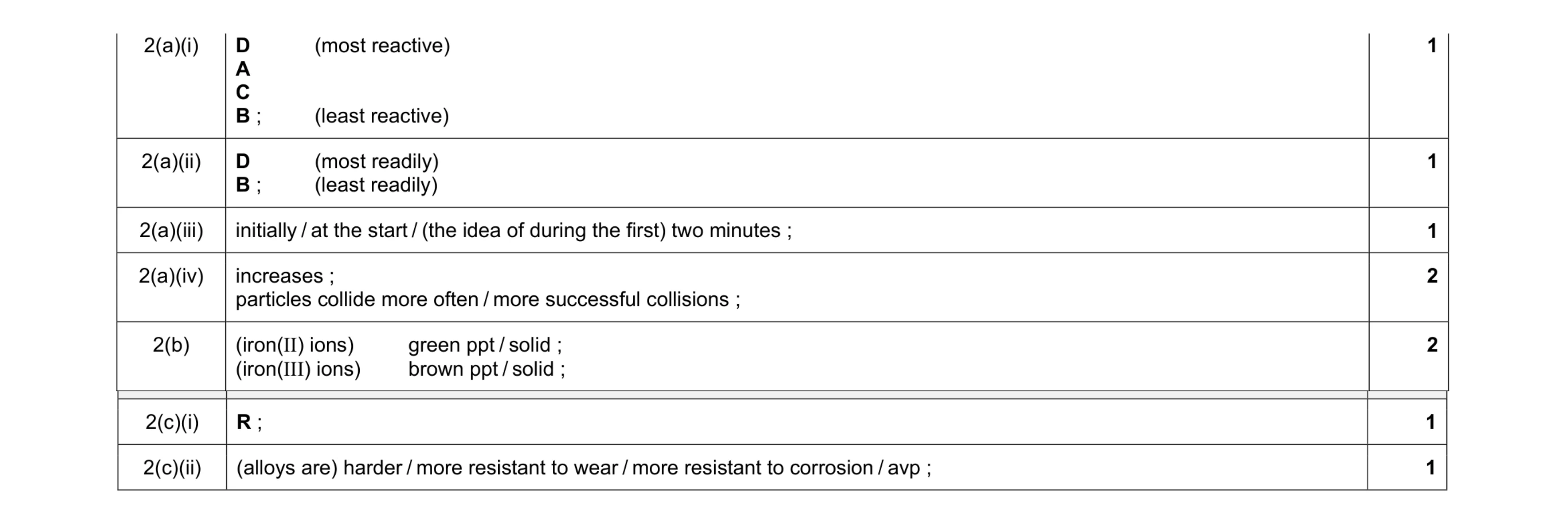
Mark scheme: 2(a)(i) D (most reactive) A C B ; (least reactive) 1 2(a)(ii) D (most readily) B ; (least readily) 1 2(a)(iii) initially / at the start / (the idea of during the first) two minutes ; 1 2(a)(iv) increases ; particles collide more often / more successful collisions ; 2 2(b) (iron(II) ions) green ppt / solid ; (iron(III) ions) brown ppt / solid ; 2 Question Answer Marks 2(c)(i) R ; 1 2(c)(ii) (alloys are) harder / more resistant to wear / more resistant to corrosion / avp ; 1
This question in 0653/42 Oct/Nov 2017
Q2 · Iron is an element in Period 4 of the Periodic Table shown on page 24 0653/42 Feb/March 2019
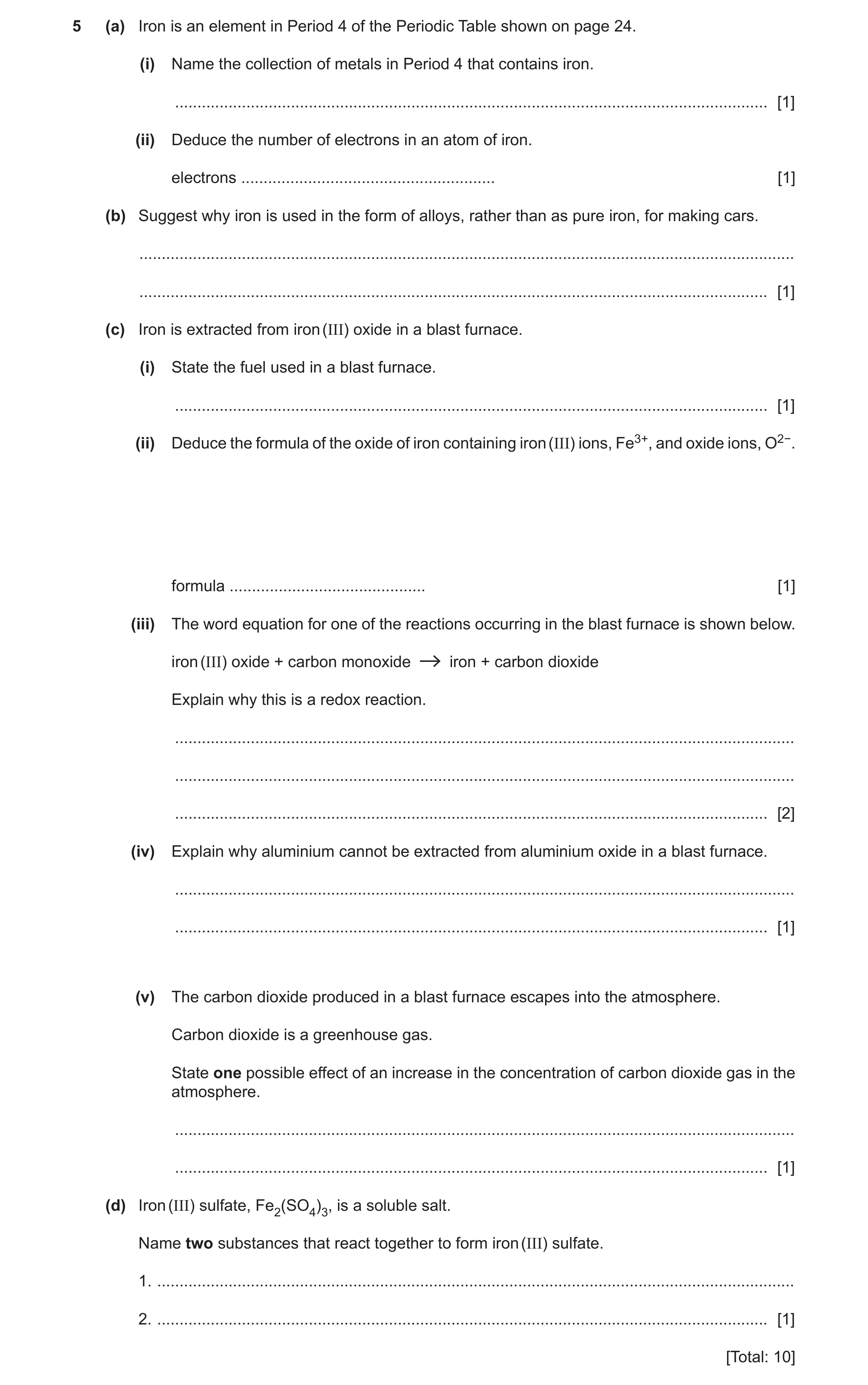
5 (a) Iron is an element in Period 4 of the Periodic Table shown on page 24. (i) Name the collection of metals in Period 4 that contains iron. … [1] (ii) Deduce the number of electrons in an atom of iron. electrons … [1] (b) Suggest why iron is used in the form of alloys, rather than as pure iron, for making cars. … … [1] (c) Iron is extracted from iron (III) oxide in a blast furnace. (i) State the fuel used in a blast furnace. … [1] (ii) Deduce the formula of the oxide of iron containing iron (III) ions, Fe3+, and oxide ions, O2−. formula … [1] (iii) The word equation for one of the reactions occurring in the blast furnace is shown below. iron (III) oxide + carbon monoxide iron + carbon dioxide Explain why this is a redox reaction. … … … [2] (iv) Explain why aluminium cannot be extracted from aluminium oxide in a blast furnace. … … [1] (v) The carbon dioxide produced in a blast furnace escapes into the atmosphere. Carbon dioxide is a greenhouse gas. State one possible effect of an increase in the concentration of carbon dioxide gas in the atmosphere. … … [1] (d) Iron (III) sulfate, Fe2(SO4)3, is a soluble salt. Name two substances that react together to form iron (III) sulfate. 1. … 2. … [1] [Total: 10]
10 marks
Mark scheme: 5(a)(i) transition metals / elements ; 1 5(a)(ii) electrons = 26 ; 1 5(b) stronger more resistant to corrosion ; 1 5(c)(i) coke / carbon ; 1 5(c)(ii) Fe2O3 ; 1 5(c)(iii) iron oxide / Fe3+ reduced ; carbon monoxide oxidised ; 2 5(c)(iv) aluminium is too reactive / aluminium is above carbon in reactivity series ; 1 5(c)(v) (increases) global warming / climate change / consequence of climate change described ; 1 5(d) iron and sulfuric acid ; or iron oxide / iron (III) oxide and (dilute) sulfuric acid ; 1
This question in 0653/42 Feb/March 2019
Q3 · The apparatus a student uses to investigate the reaction between magnesium powder and… 0653/42 Feb/March 2019
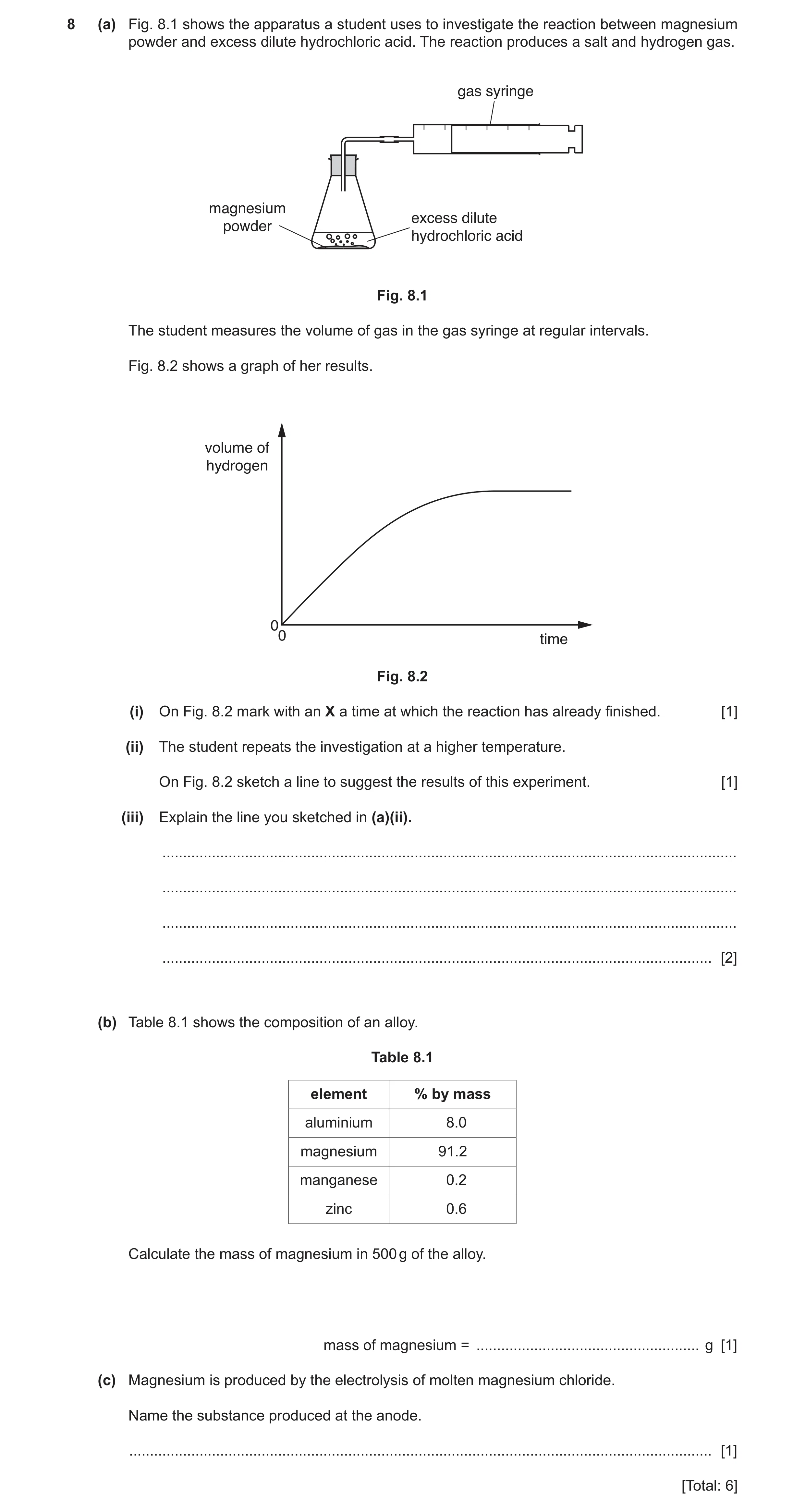
8 (a) Fig. 8.1 shows the apparatus a student uses to investigate the reaction between magnesium powder and excess dilute hydrochloric acid. The reaction produces a salt and hydrogen gas. gas syringe magnesium excess dilute powder hydrochloric acid Fig. 8.1 The student measures the volume of gas in the gas syringe at regular intervals. Fig. 8.2 shows a graph of her results. volume of hydrogen 0 0 time Fig. 8.2 (i) On Fig. 8.2 mark with an X a time at which the reaction has already finished. [1] (ii) The student repeats the investigation at a higher temperature. On Fig. 8.2 sketch a line to suggest the results of this experiment. [1] (iii) Explain the line you sketched in (a)(ii). … … … … [2] (b) Table 8.1 shows the composition of an alloy. Table 8.1 element % by mass aluminium 8.0 magnesium 91.2 manganese 0.2 zinc 0.6 Calculate the mass of magnesium in 500 g of the alloy. mass of magnesium = … g [1] (c) Magnesium is produced by the electrolysis of molten magnesium chloride. Name the substance produced at the anode. … [1] [Total: 6]
6 marks
Mark scheme: 8(a)(i) X anywhere on horizontal part of graph ; 1 8(a)(ii) curved portion steeper and horizontal line at same volume ; 1 8(a)(iii) rate of reaction faster (so steeper curve) ; same final volume of gas (so horizontal line at same height (volume)) ; 2 8(b) 456 (g) ; 1 8(c) chlorine ; 1
This question in 0653/42 Feb/March 2019
Q4 · Aluminium ore is mainly aluminium oxide 0653/42 Oct/Nov 2019
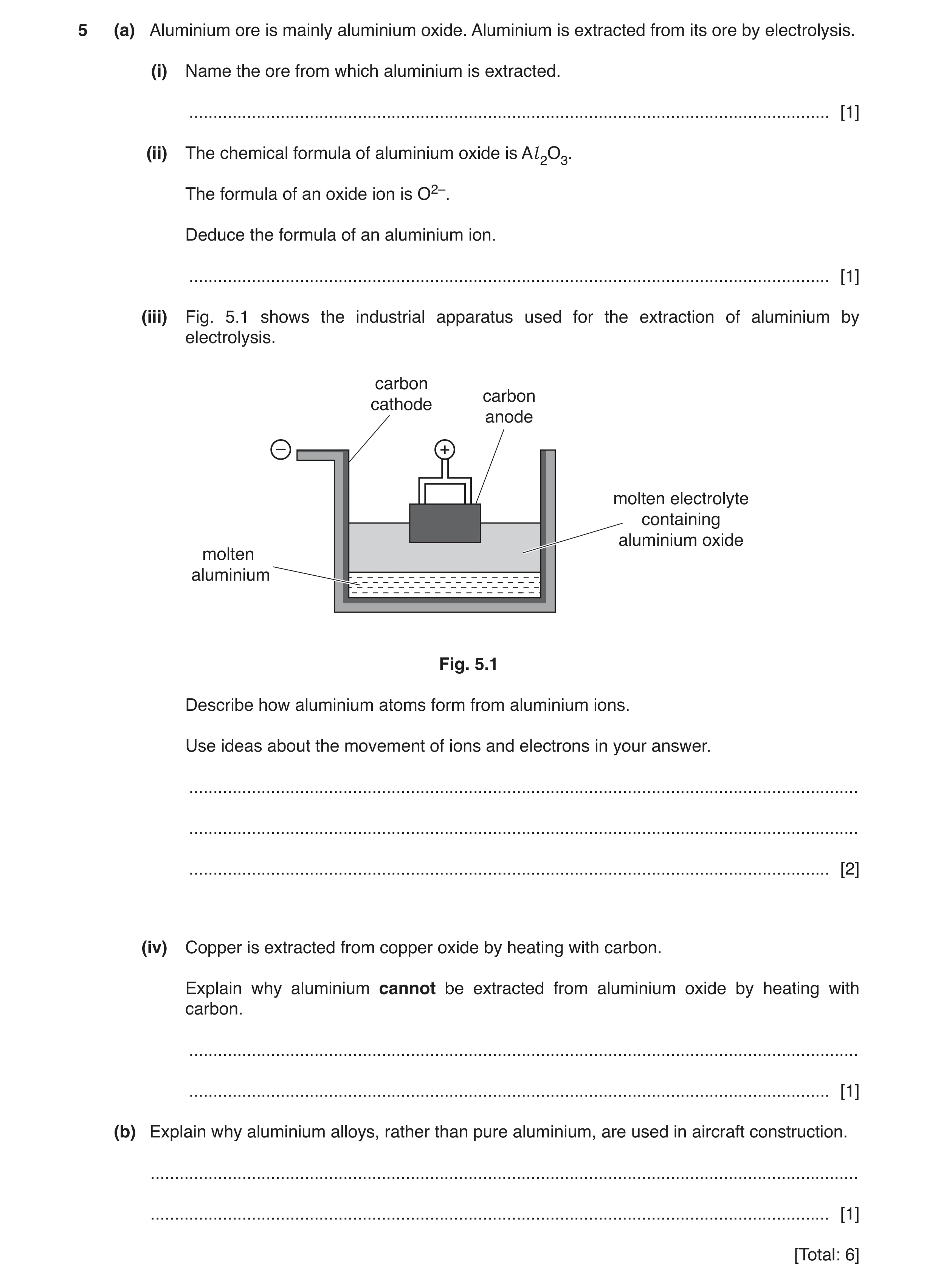
5 (a) Aluminium ore is mainly aluminium oxide. Aluminium is extracted from its ore by electrolysis. (i) Name the ore from which aluminium is extracted. … [1] (ii) The chemical formula of aluminium oxide is Al 2O3. The formula of an oxide ion is O2–. Deduce the formula of an aluminium ion. … [1] (iii) Fig. 5.1 shows the industrial apparatus used for the extraction of aluminium by electrolysis. carbon carbon cathode anode – + molten electrolyte containing aluminium oxide molten aluminium Fig. 5.1 Describe how aluminium atoms form from aluminium ions. Use ideas about the movement of ions and electrons in your answer. … … … [2] (iv) Copper is extracted from copper oxide by heating with carbon. Explain why aluminium cannot be extracted from aluminium oxide by heating with carbon. … … [1] (b) Explain why aluminium alloys, rather than pure aluminium, are used in aircraft construction. … … [1] [Total: 6]
6 marks
Mark scheme: 5(a)(i) bauxite ; 1 5(a)(ii) Al 3+ ; 1 5(a)(iii) (positive) aluminium ions move to / are attracted to (negative) cathode ; and gain (three) electrons ; 2 5(a)(iv) aluminium is too reactive / aluminium above carbon in reactivity series / aluminium is more reactive than carbon ; 1 5(b) (alloys are) stronger / more resistant to corrosion ; 1
This question in 0653/42 Oct/Nov 2019
Q5 · A student places a spot of copper chloride solution onto a piece of chromatography paper… 0653/42 Feb/March 2020
5 (a) A student places a spot of copper chloride solution onto a piece of chromatography paper, as shown in Fig. 5.1. She places the chromatography paper in a solvent until the solvent front reaches the position shown in Fig. 5.2. solvent front pencil line cm cm copper chloride initial solvent solution level Fig. 5.1 Fig. 5.2 Copper chloride contains copper ions, Cu2+. The R f value for Cu2+ ions is 0.6. On Fig. 5.2, draw a small circle to show the position of the Cu2+ ions. [1] (b) Copper is extracted from copper oxide by heating with carbon. (i) The word equation for this reaction is shown. copper oxide + carbon copper + carbon dioxide State whether copper oxide is oxidised or reduced in this reaction. Explain your answer. … … … [1] (ii) Explain why sodium oxide does not react with heated carbon. … … [1] (c) Copper is also extracted by electrolysis of molten copper chloride. (i) State one other product obtained during this electrolysis. … [1] (ii) Describe what happens to a copper ion, Cu2+, at the cathode during this electrolysis. Use ideas about electrons in your answer. … … … [2] (d) Bronze is an alloy of copper and tin. Bronze is used to make coins. Explain why pure copper is not used to make coins. … [1] [Total: 7]
7 marks
Mark scheme: 5(a) circle above original sample and at 6 cm (by inspection) ; 1 5(b)(i) reduced because oxygen is, lost / removed ; 1 5(b)(ii) carbon is less reactive than sodium (or reverse argument) ; 1 5(c)(i) chlorine / Cl2 ; 1 5(c)(ii) gains electrons ; gains 2 electrons / so that the ion is discharged ; 2 5(d) (bronze is) stronger / harder / more resistant to damage / more resistant to corrosion ; 1
This question in 0653/42 Feb/March 2020
Q6 · Iron is a transition element 0653/41 May/June 2020
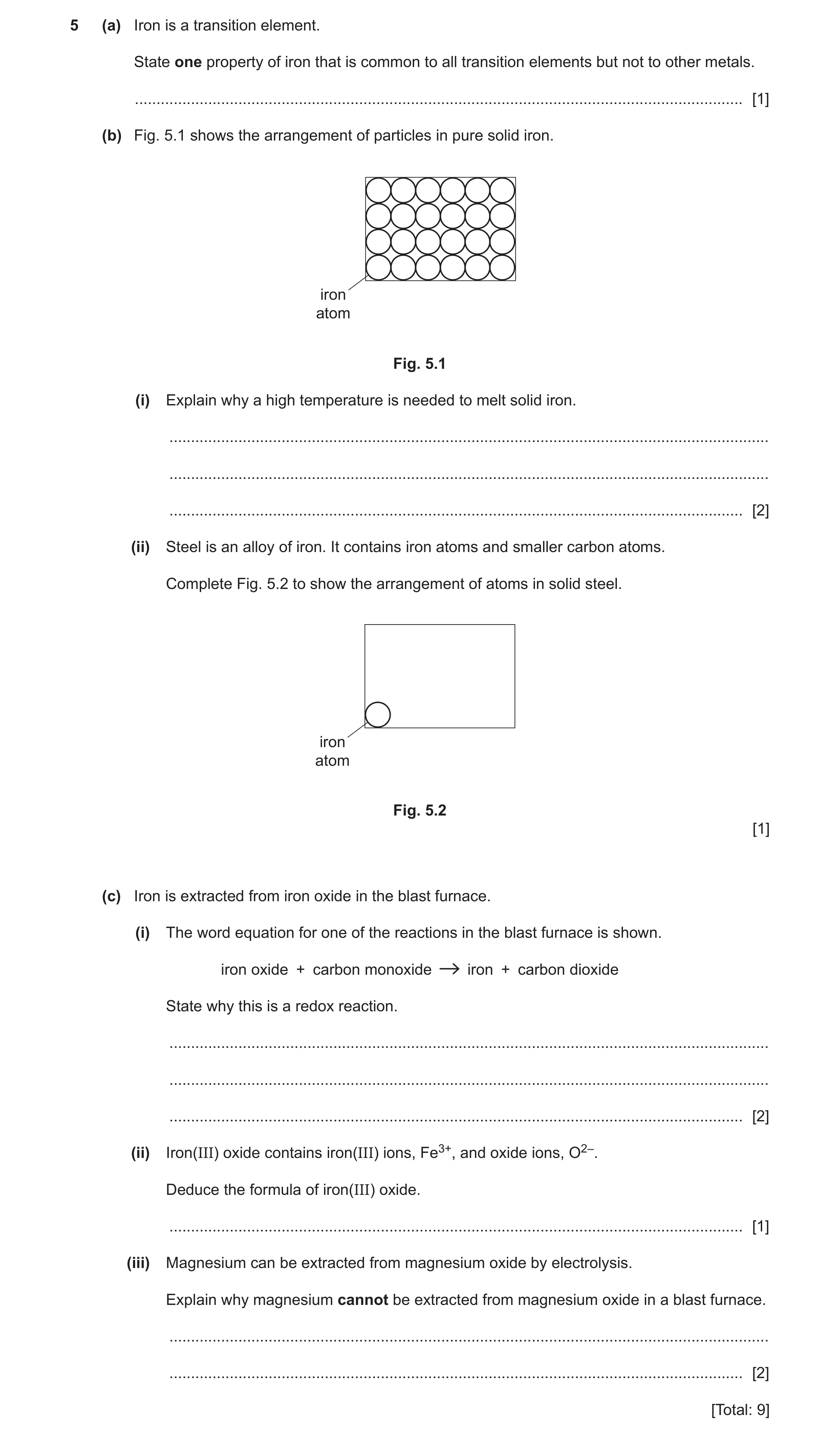
5 (a) Iron is a transition element. State one property of iron that is common to all transition elements but not to other metals. … [1] (b) Fig. 5.1 shows the arrangement of particles in pure solid iron. iron atom Fig. 5.1 (i) Explain why a high temperature is needed to melt solid iron. … … … [2] (ii) Steel is an alloy of iron. It contains iron atoms and smaller carbon atoms. Complete Fig. 5.2 to show the arrangement of atoms in solid steel. iron atom Fig. 5.2 [1] (c) Iron is extracted from iron oxide in the blast furnace. (i) The word equation for one of the reactions in the blast furnace is shown. iron oxide + carbon monoxide iron + carbon dioxide State why this is a redox reaction. … … … [2] (ii) Iron(III) oxide contains iron(III) ions, Fe3+, and oxide ions, O2–. Deduce the formula of iron(III) oxide. … [1] (iii) Magnesium can be extracted from magnesium oxide by electrolysis. Explain why magnesium cannot be extracted from magnesium oxide in a blast furnace. … … [2] [Total: 9]
9 marks
Mark scheme: 5(a) forms coloured compounds / has high melting point / has high density / catalyst ; 1 5(b)(i) (to provide) energy ; (energy) needed, for work to be done against attractive forces / to break interatomic ‘bonds’ / for particles to break free from solid state ; 2 Question Answer Marks 5(b)(ii) two different atoms and semi-regular / most touching ; 1 5(c)(i) iron oxide is reduced / iron oxide loses oxygen ; carbon monoxide is oxidised / carbon monoxide gains oxygen ; 2 5(c)(ii) Fe2O3 ; 1 5(c)(iii) magnesium is too reactive ; above carbon in reactivity series ; 2
This question in 0653/41 May/June 2020
Q7 · A key made from the alloy brass 0653/42 May/June 2022
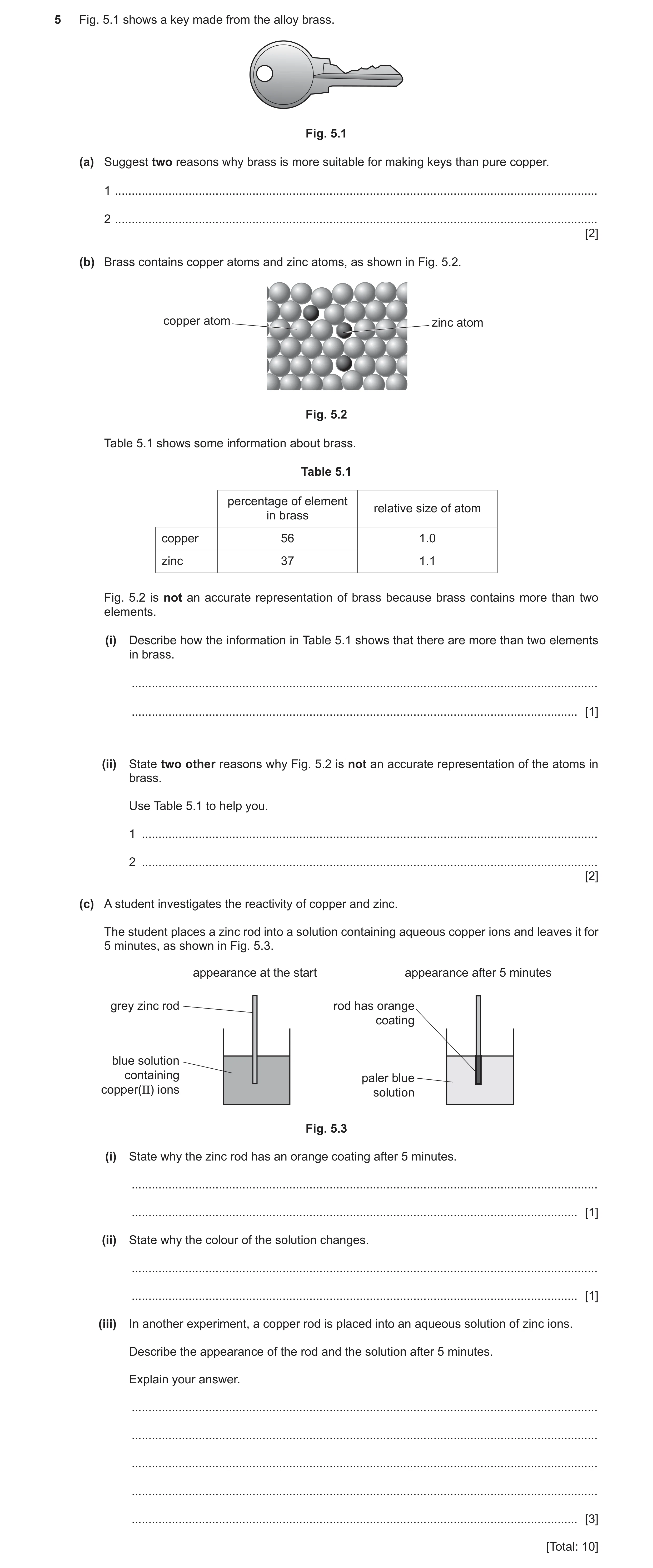
5 Fig. 5.1 shows a key made from the alloy brass. Fig. 5.1 (a) Suggest two reasons why brass is more suitable for making keys than pure copper. 1 … 2 … [2] (b) Brass contains copper atoms and zinc atoms, as shown in Fig. 5.2. copper atom zinc atom Fig. 5.2 Table 5.1 shows some information about brass. Table 5.1 percentage of element relative size of atom in brass copper 56 1.0 zinc 37 1.1 Fig. 5.2 is not an accurate representation of brass because brass contains more than two elements. (i) Describe how the information in Table 5.1 shows that there are more than two elements in brass. … … [1] (ii) State two other reasons why Fig. 5.2 is not an accurate representation of the atoms in brass. Use Table 5.1 to help you. 1 … 2 … [2] (c) A student investigates the reactivity of copper and zinc. The student places a zinc rod into a solution containing aqueous copper ions and leaves it for 5 minutes, as shown in Fig. 5.3. appearance at the start appearance after 5 minutes grey zinc rod rod has orange coating blue solution containing paler blue copper(II) ions solution Fig. 5.3 (i) State why the zinc rod has an orange coating after 5 minutes. … … [1] (ii) State why the colour of the solution changes. … … [1] (iii) In another experiment, a copper rod is placed into an aqueous solution of zinc ions. Describe the appearance of the rod and the solution after 5 minutes. Explain your answer. … … … … … [3] [Total: 10]
10 marks
Mark scheme: 5(a) any two from: brass is, stronger ; brass is, harder / more hardwearing ; brass does not corrode (as easily) ; ORA 2 5(b)(i) percentage of copper (56) plus zinc (37), is 93 / is less than 100 / 7% unaccounted for ; 1 5(b)(ii) atoms of zinc should be larger than copper ; too many Cu atoms / too few Zn atoms / percentage of zinc needs to be higher ; 2 5(c)(i) because copper forms on the rod ; 1 5(c)(ii) because copper ions are used up / less copper ions left ; 1 5(c)(iii) orange rod and colourless solution ; no reaction ; because zinc is more reactive (than copper) ; 3
This question in 0653/42 May/June 2022
Q8 · Iron is extracted from hematite in the blast furnace 0653/42 Oct/Nov 2022
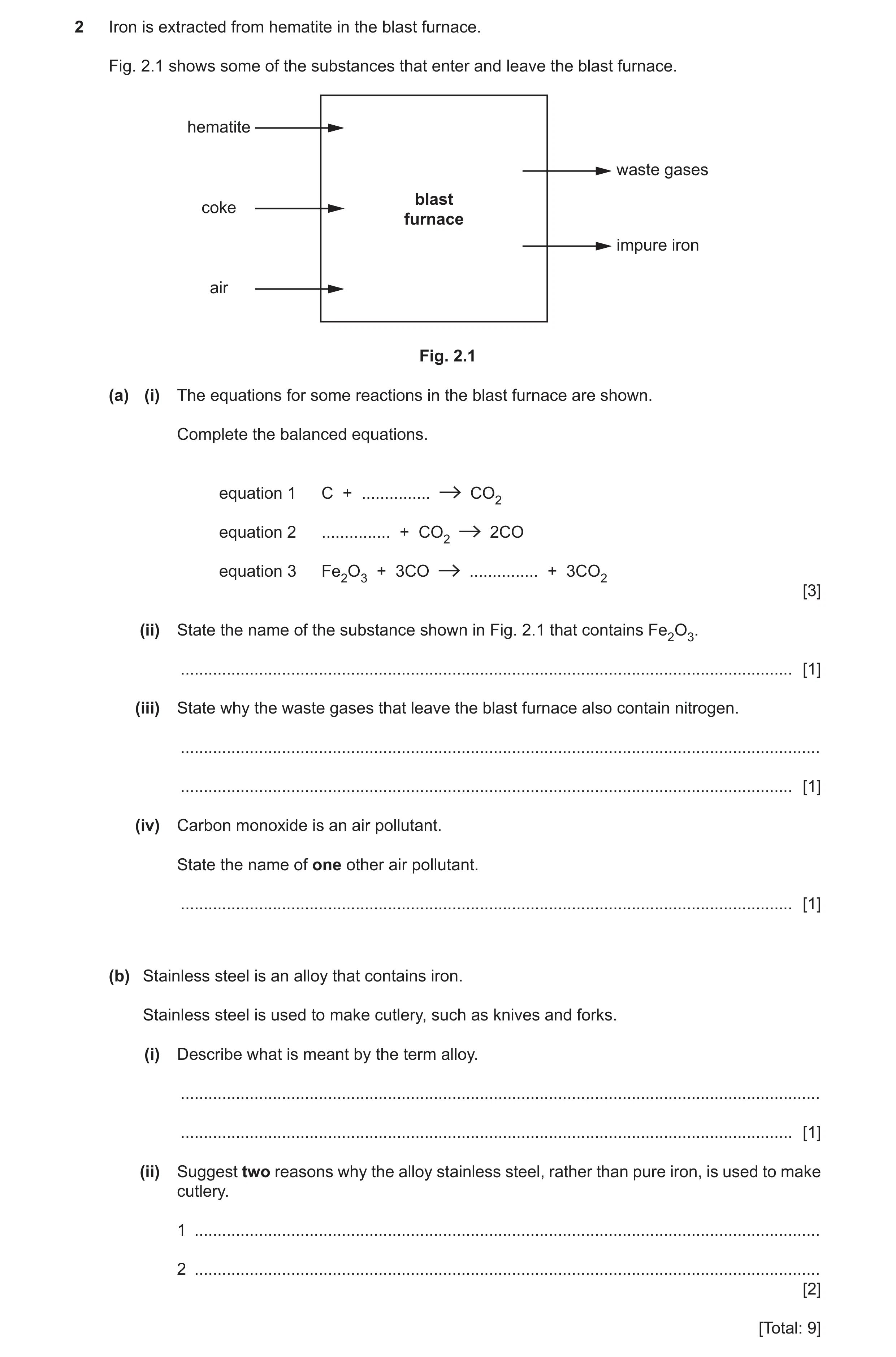
2 Iron is extracted from hematite in the blast furnace. Fig. 2.1 shows some of the substances that enter and leave the blast furnace. hematite waste gases blast coke furnace impure iron air Fig. 2.1 (a) (i) The equations for some reactions in the blast furnace are shown. Complete the balanced equations. equation 1 C + … CO2 equation 2 … + CO2 2CO equation 3 Fe2O3 + 3CO … + 3CO2 [3] (ii) State the name of the substance shown in Fig. 2.1 that contains Fe2O3. … [1] (iii) State why the waste gases that leave the blast furnace also contain nitrogen. … … [1] (iv) Carbon monoxide is an air pollutant. State the name of one other air pollutant. … [1] (b) Stainless steel is an alloy that contains iron. Stainless steel is used to make cutlery, such as knives and forks. (i) Describe what is meant by the term alloy. … … [1] (ii) Suggest two reasons why the alloy stainless steel, rather than pure iron, is used to make cutlery. 1 … 2 … [2] [Total: 9]
9 marks
Mark scheme: 2(a)(i) O2; 3 C ; 2Fe ; 2(a)(ii) hematite ; 1 2(a)(iii) (nitrogen) comes from the air (which enters the furnace) ; 1 2(a)(iv) sulfur dioxide ; 1 2(b)(i) mixture of a metal with (an)other element(s) ; 1 2(b)(ii) any two from: 2 (stainless steel / ORA) is strong(er) ; is (more) malleable ; does not, corrode / rust (as easily) ; AVP ;
This question in 0653/42 Oct/Nov 2022
Q9 · Sodium is in Group I of the Periodic Table 0653/42 Feb/March 2025
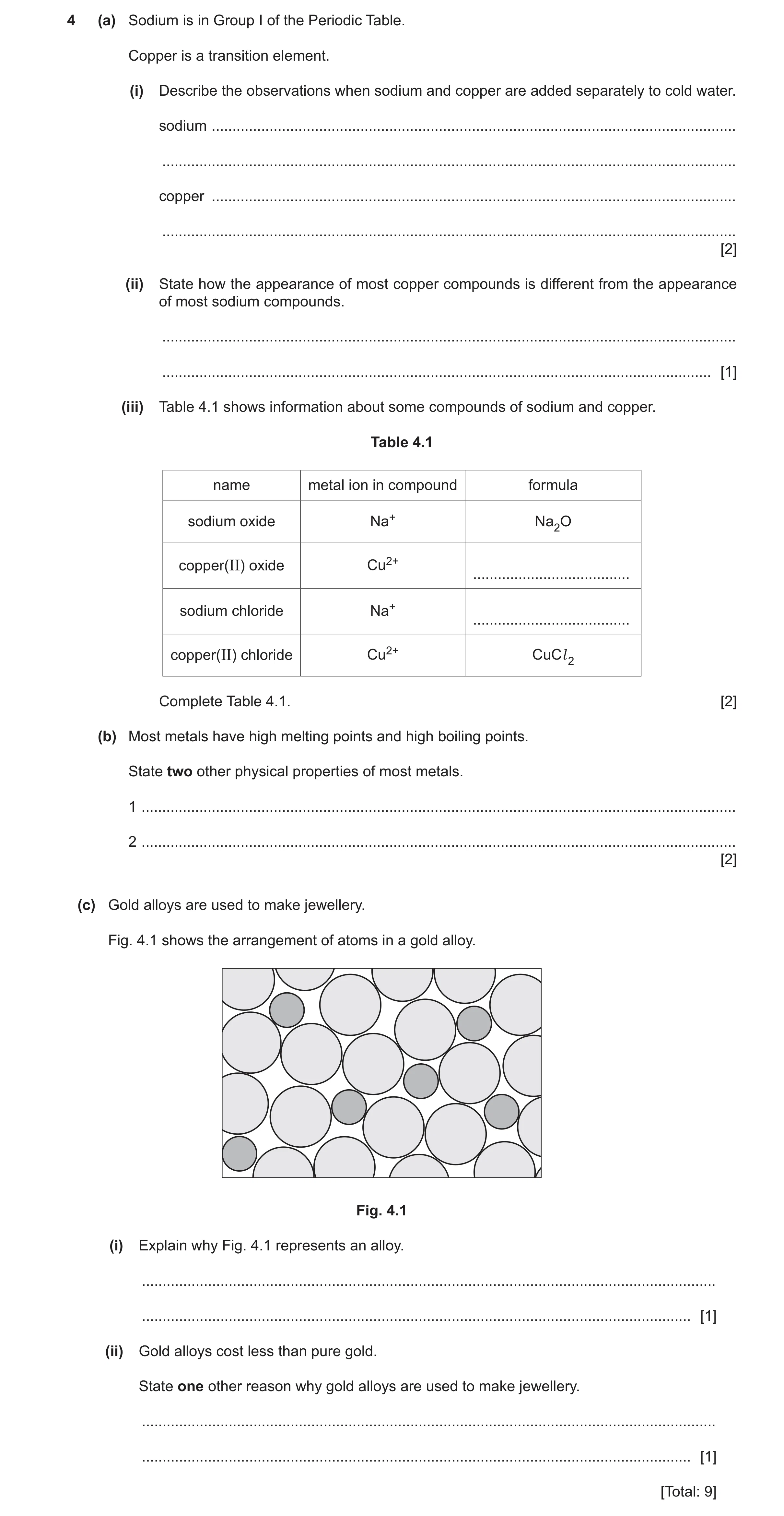
4 (a) Sodium is in Group I of the Periodic Table. Copper is a transition element. (i) Describe the observations when sodium and copper are added separately to cold water. sodium … … copper … … [2] (ii) State how the appearance of most copper compounds is different from the appearance of most sodium compounds. … … [1] (iii) Table 4.1 shows information about some compounds of sodium and copper. Table 4.1 name metal ion in compound formula sodium oxide Na+ Na2O copper(II) oxide Cu2+ … sodium chloride Na+ … copper(II) chloride Cu2+ CuCl 2 Complete Table 4.1. [2] (b) Most metals have high melting points and high boiling points. State two other physical properties of most metals. 1 … 2 … [2] (c) Gold alloys are used to make jewellery. Fig. 4.1 shows the arrangement of atoms in a gold alloy. Fig. 4.1 (i) Explain why Fig. 4.1 represents an alloy. … … [1] (ii) Gold alloys cost less than pure gold. State one other reason why gold alloys are used to make jewellery. … … [1] [Total: 9]
9 marks
Mark scheme: 4(a)(i) sodium: reacts violently / produces effervescence / bubbles / melts / moves around surface / becomes smaller / yellow flame ; 2 copper: does not react with water / no reaction / no change ; 4(a)(ii) (most) copper compounds are coloured (and (most) sodium compounds are colourless / white) ; 1 4 (a)(iii) CuO ; 2 NaCl ; 4(b) any two from: 2 malleable ; ductile ; (good) conductors of heat ; (good) conductors of electricity ; 4(c)(i) shows different atoms / atoms of different sizes / arrangement of atoms is not regular ; 1 4(c)(ii) alloy is, harder / stronger / more hardwearing / more durable / ora ; 1
This question in 0653/42 Feb/March 2025
Q10 · Iron is a metal 0653/41 May/June 2025
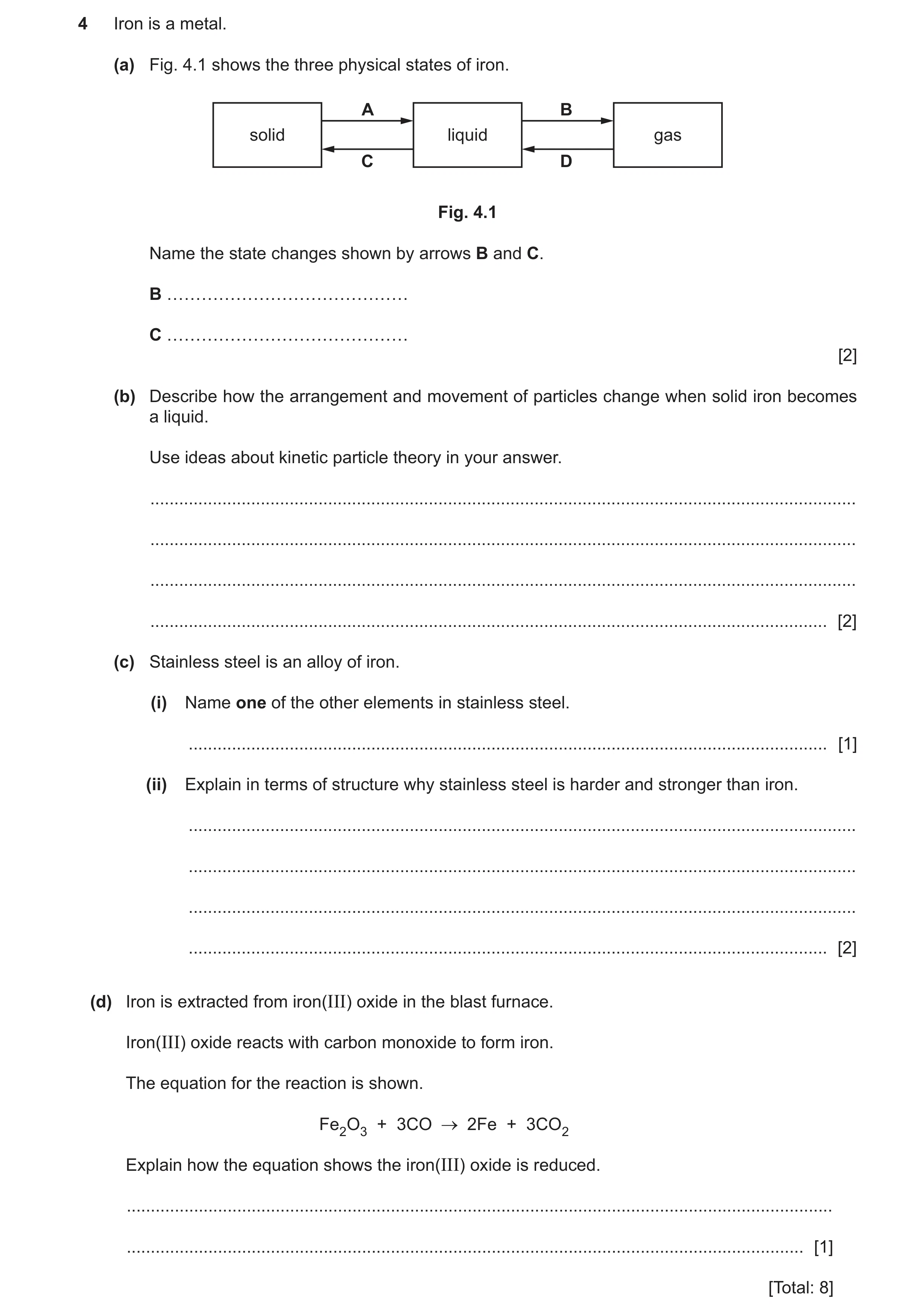
4 Iron is a metal. (a) Fig. 4.1 shows the three physical states of iron. A B solid liquid gas C D Fig. 4.1 Name the state changes shown by arrows B and C. B …………………………………… C …………………………………… [2] (b) Describe how the arrangement and movement of particles change when solid iron becomes a liquid. Use ideas about kinetic particle theory in your answer. … … … … [2] (c) Stainless steel is an alloy of iron. (i) Name one of the other elements in stainless steel. … [1] (ii) Explain in terms of structure why stainless steel is harder and stronger than iron. … … … … [2] (d) Iron is extracted from iron(III) oxide in the blast furnace. Iron(III) oxide reacts with carbon monoxide to form iron. The equation for the reaction is shown. Fe2O3 + 3CO 2Fe + 3CO2 Explain how the equation shows the iron(III) oxide is reduced. … … [1] [Total: 8]
8 marks
Mark scheme: 4(a) evaporation ; 2 freezing ; 4(b) (changing arrangement) from regular / fixed, to irregular / random ; 2 (changing movement) from (particle) vibration to idea of, moving / sliding over each / move more freely ; 4(c)(i) chromium / nickel / carbon ; 1 4(c)(ii) different sized atoms ; 2 (layers/atoms) can no longer slide over each other (in an alloy) / owtte; 4(d) (Fe2O3) loses oxygen ; 1
This question in 0653/41 May/June 2025
Q11 · The electrolysis of molten zinc chloride, ZnCl 2, using inert electrodes 0653/41 Oct/Nov 2025
5 (a) Fig. 5.1 shows the electrolysis of molten zinc chloride, ZnCl 2, using inert electrodes. Fig. 5.1 (i) The switch is closed. Describe the observation at the positive electrode. … … [1] (ii) Write the ionic equation for the formation of zinc. Include state symbols in your equation. … [2] (b) A metal alloy contains metal A and metal B. Fig. 5.2 shows an atom of metal A and an atom of metal B. metal A metal B Fig. 5.2 (i) The alloy contains 80% of metal A and 20% of metal B. Sketch a possible structure for this alloy in Fig. 5.3. Fig. 5.3 [2] (ii) This alloy is harder and stronger than pure metal A and pure metal B. Explain in terms of structure why this alloy is harder and stronger. … … … … [2] [Total: 7]
7 marks
Mark scheme: 5(a)(i) bubbles / chlorine / gas produced ; 1 5(a)(ii) Zn2+(l) + 2e– → Zn(s) 2 correct equation ; correct state symbols ; 5(b)(i) two types of atom shown, most touching at least one other atom and mixed ; 2 more metal A atoms than metal B atoms ; 5(b)(ii) atoms are different sizes ; 2 (layers / atoms) can no longer slide ;
This question in 0653/41 Oct/Nov 2025
 6 / 16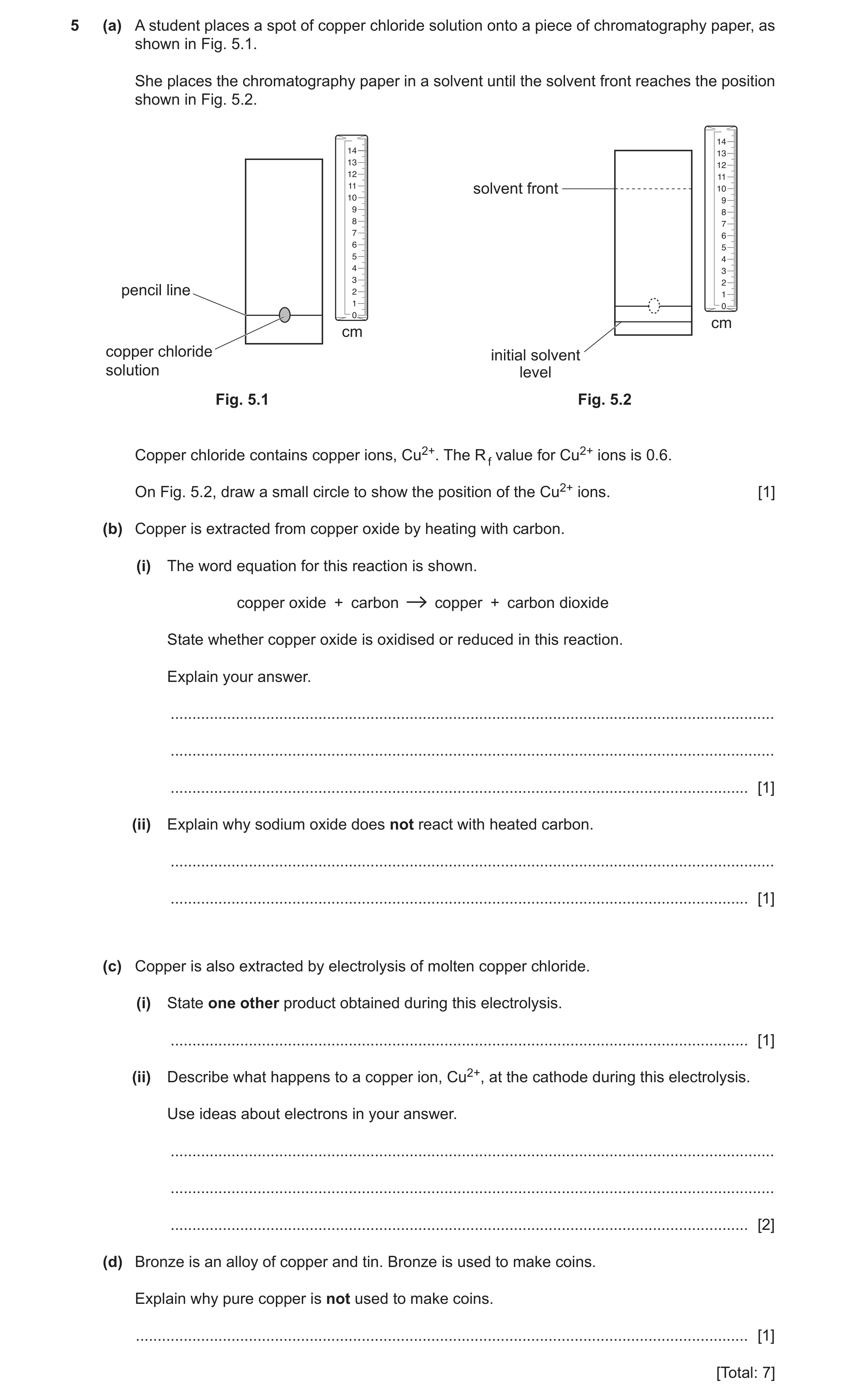
 14 / 16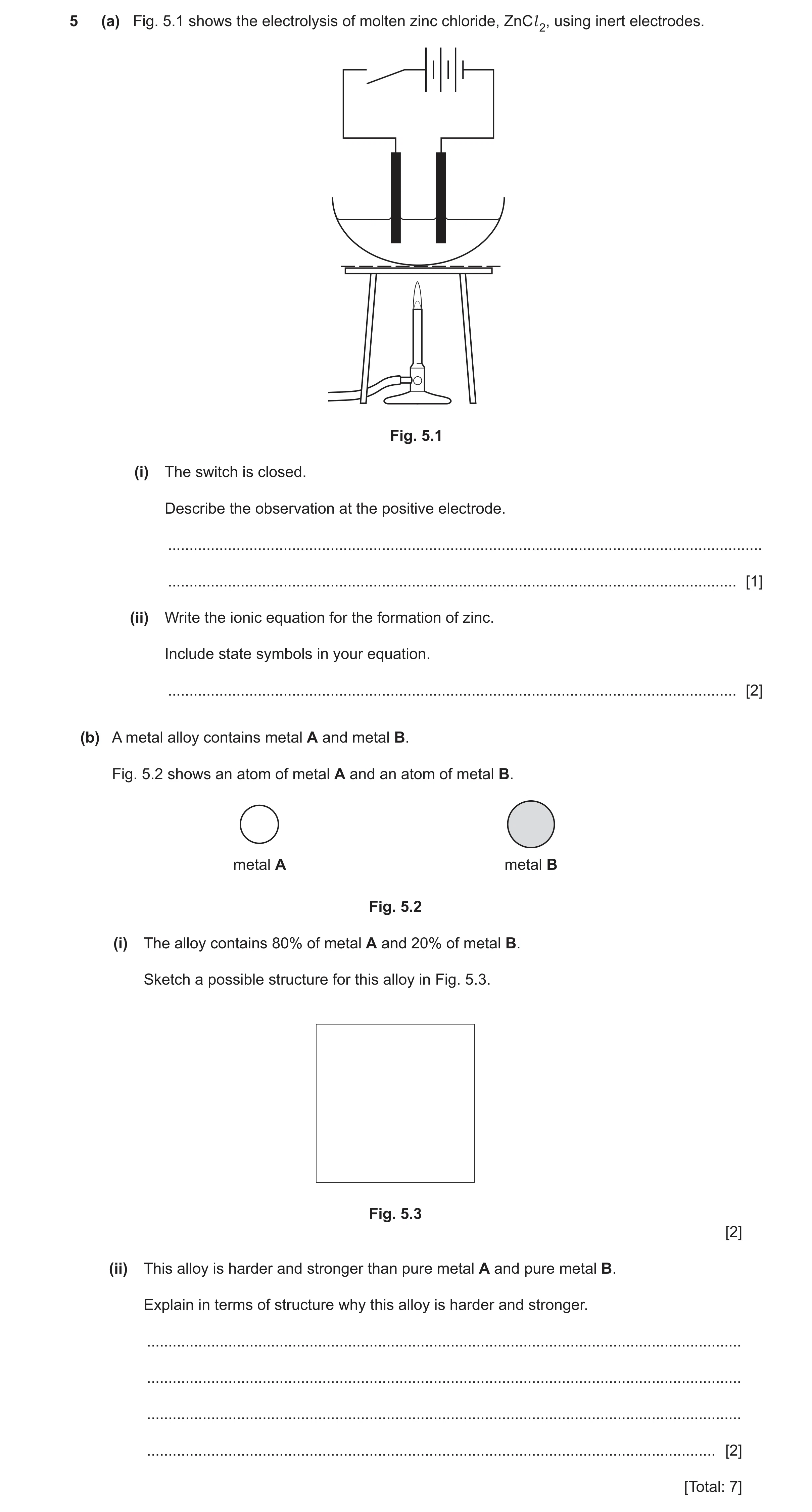
 9
9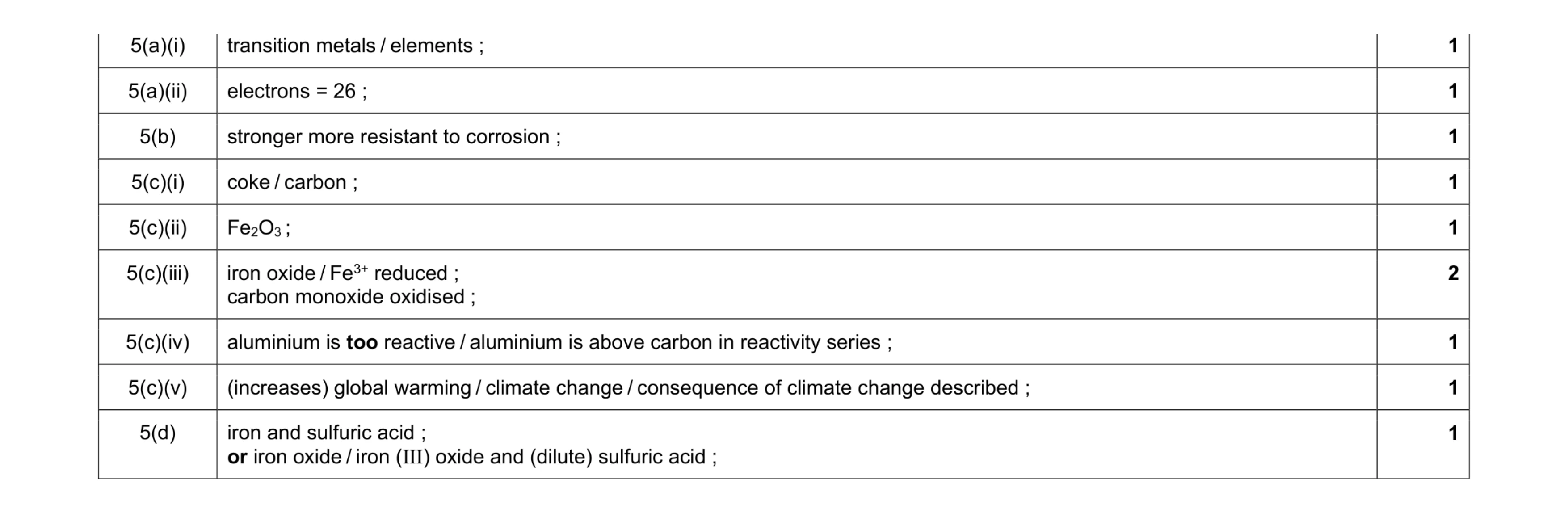 10
10 6
6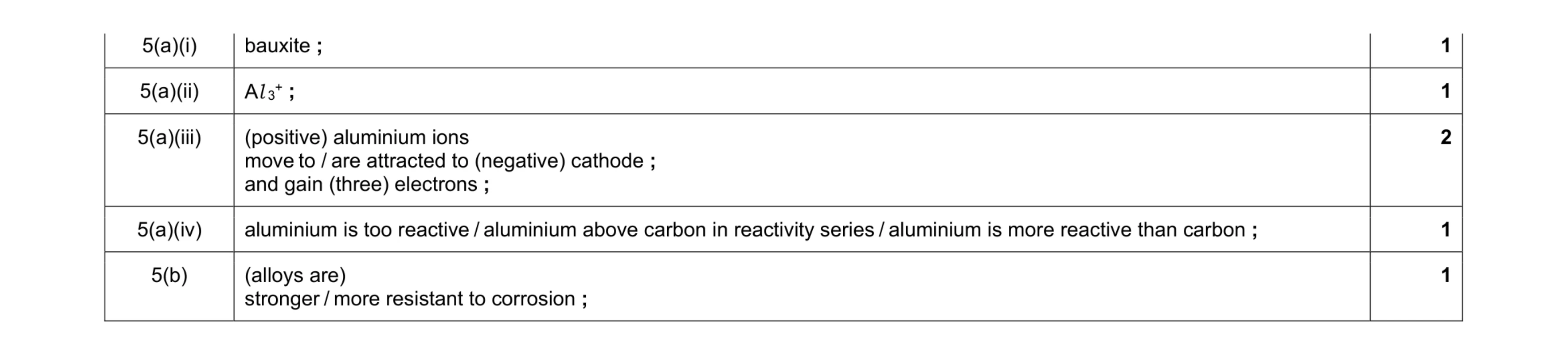 6
6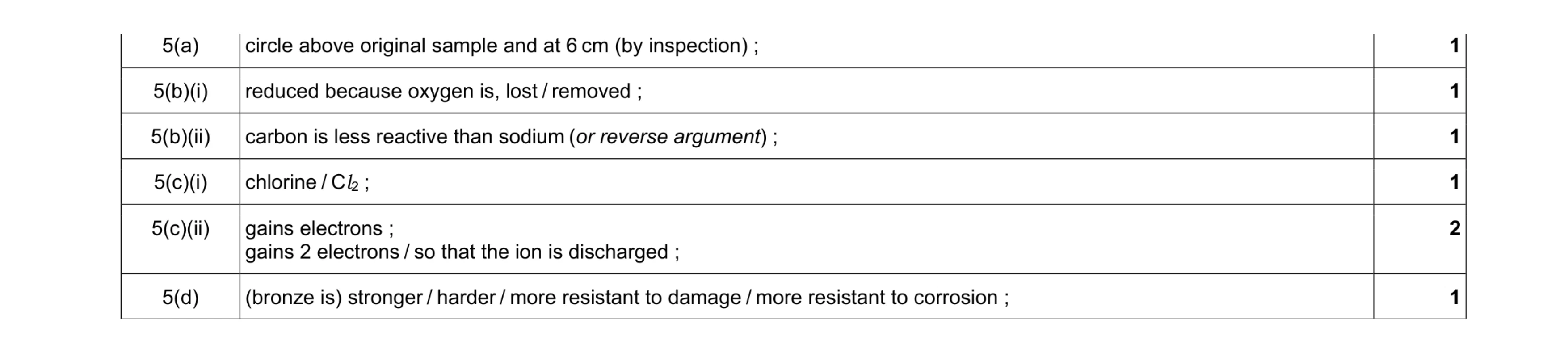 7
7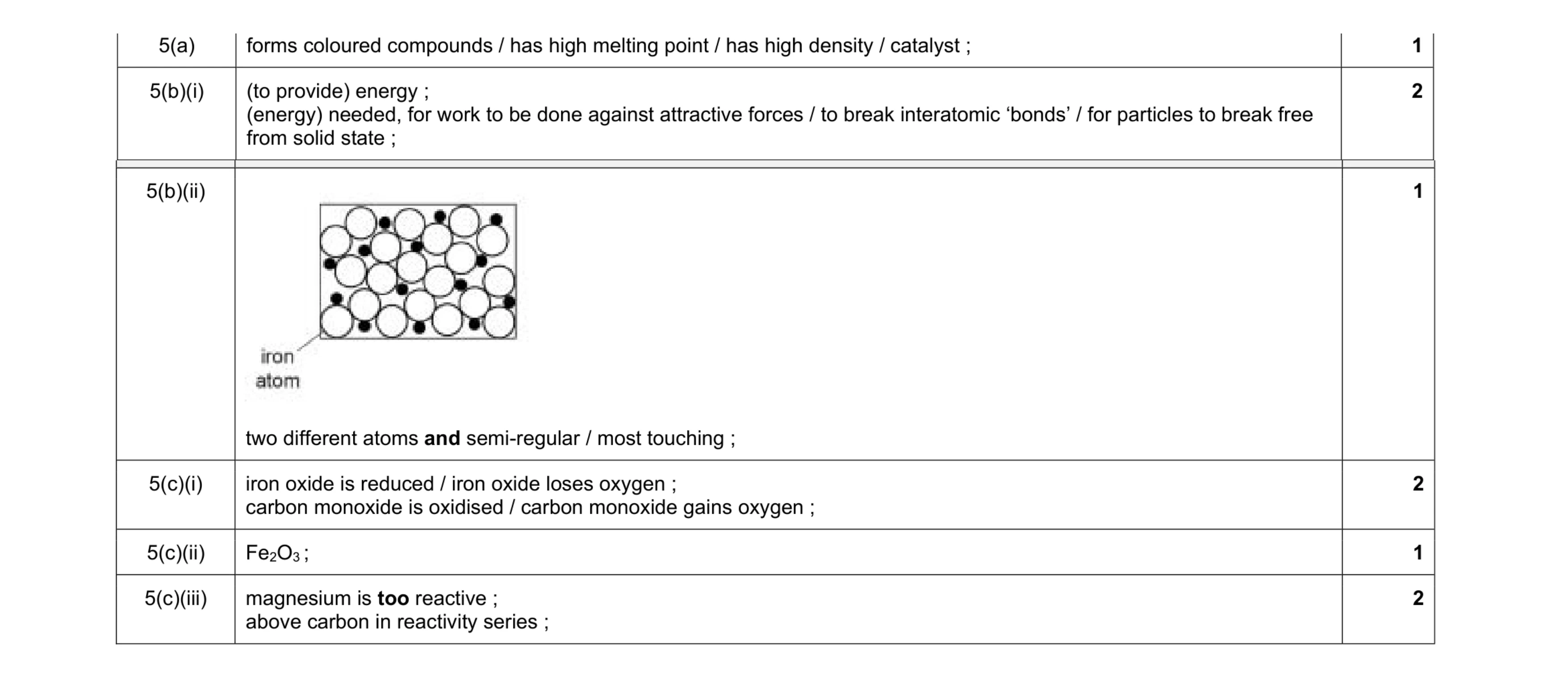 9
9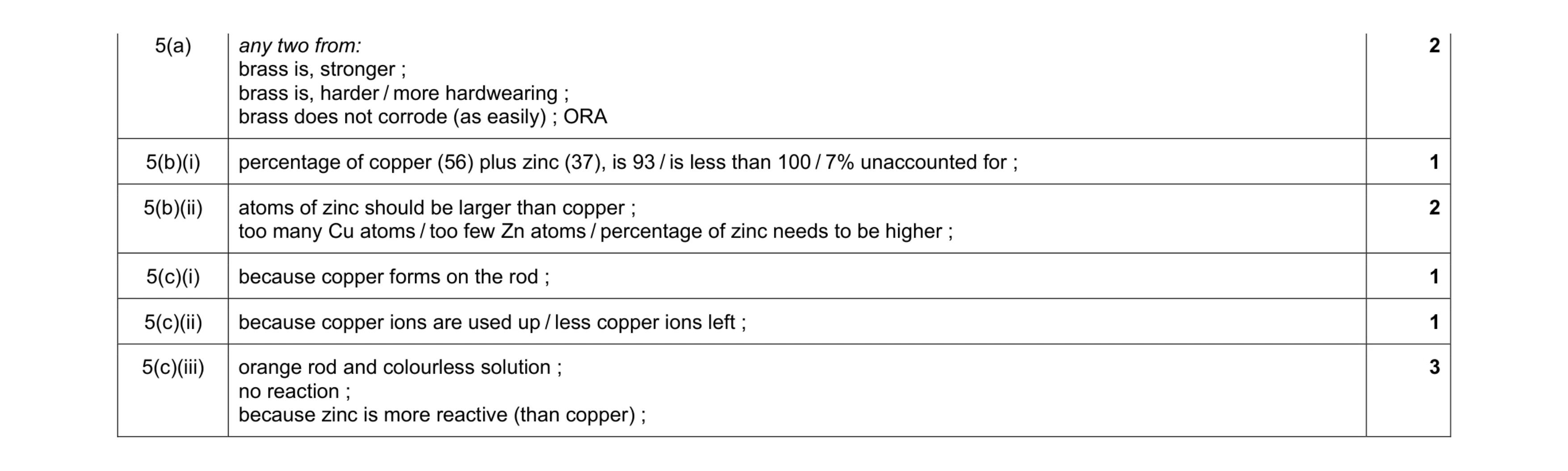 10
10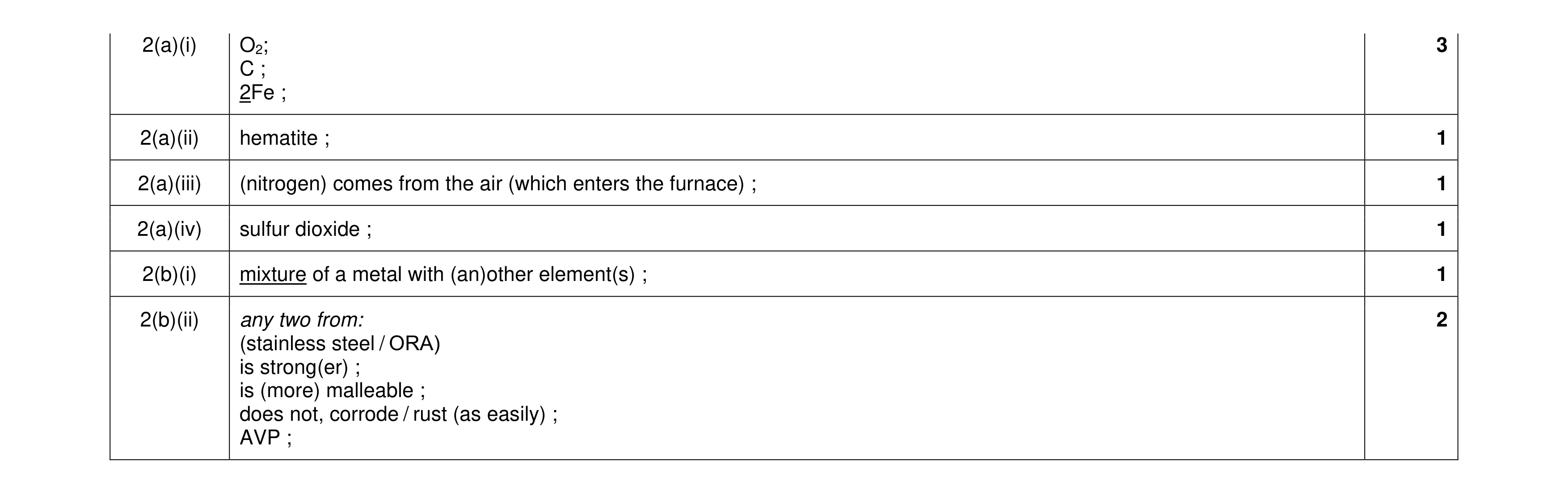 9
9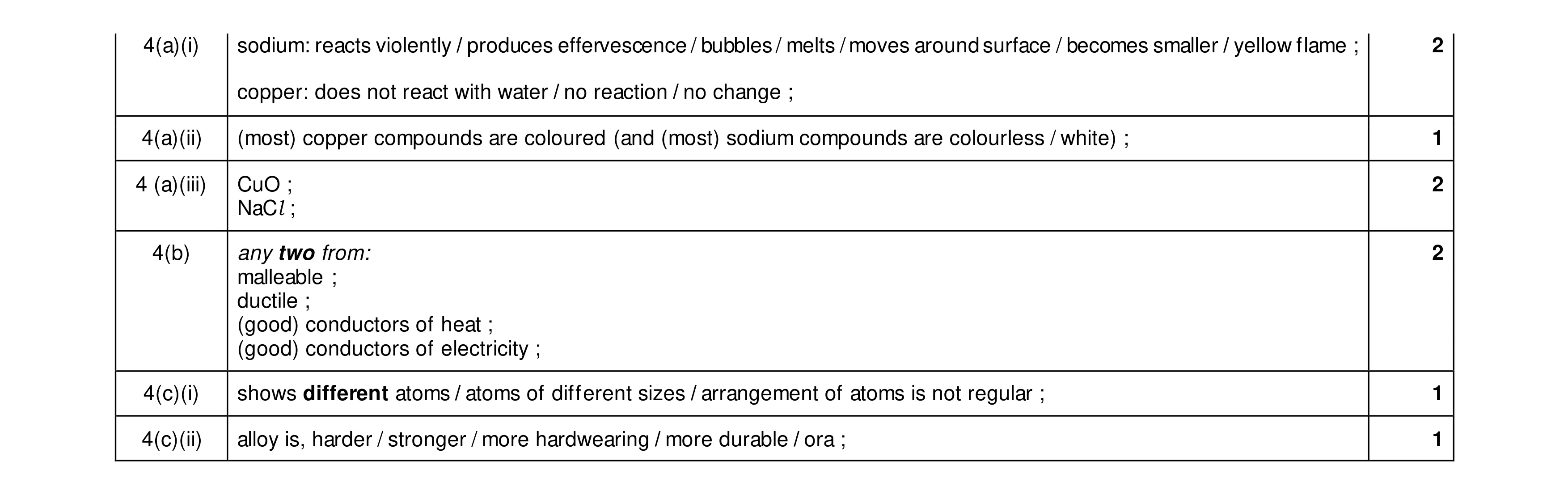 9
9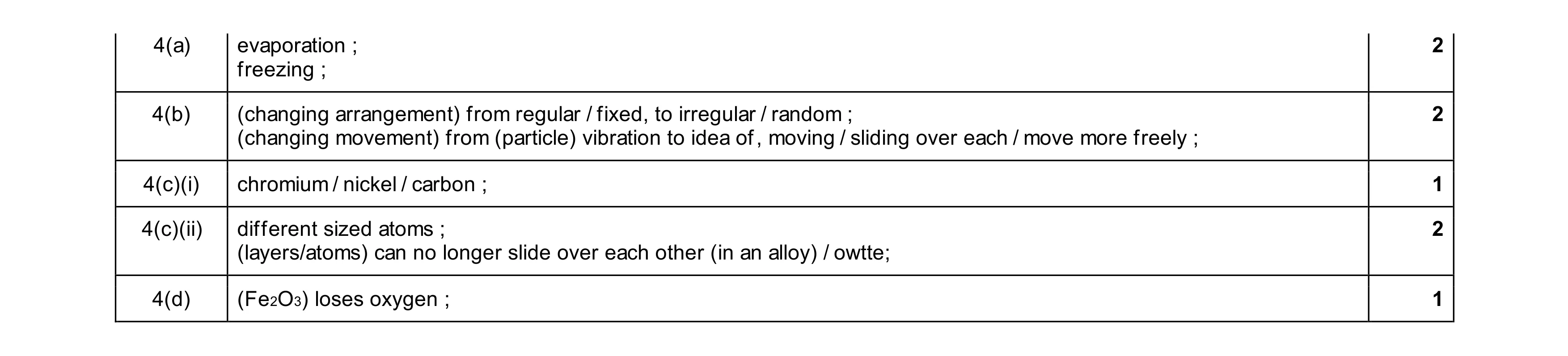 8
8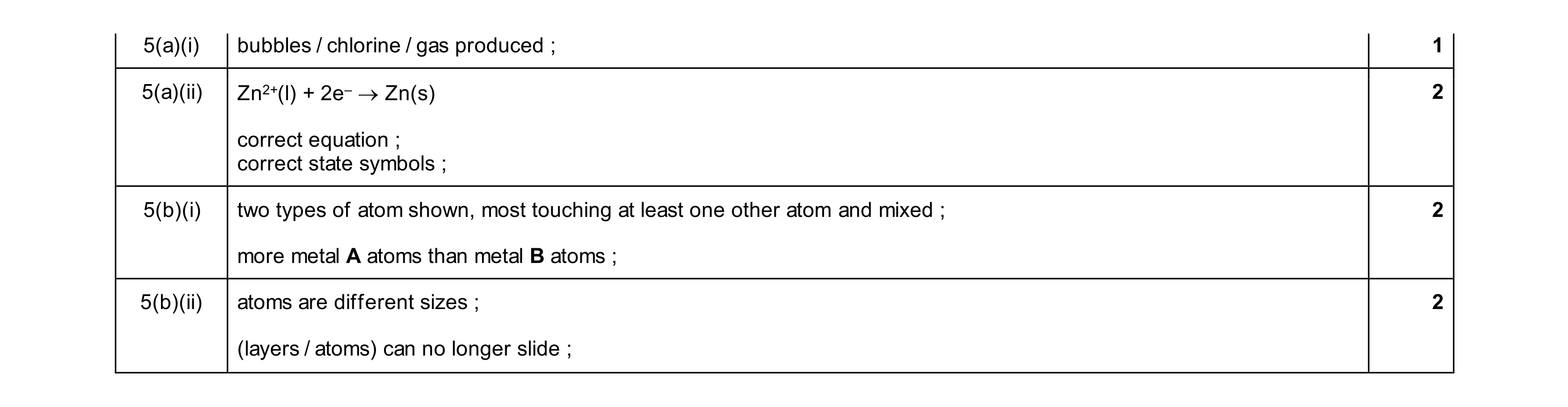 7
7