Questions as text
Q1 · Which process is an example of thermal decomposition? 0653/21 Oct/Nov 2017
27 Which process is an example of thermal decomposition? A cracking an alkane B electrolysis of molten lead(II) bromide C extraction of iron in a blast furnace D fractional distillation of petroleum
1 marks
Answer: A
This question in 0653/21 Oct/Nov 2017
Q2 · Which substances react to produce a mixture of an element and a compound? 0653/22 Oct/Nov 2017
16 Which substances react to produce a mixture of an element and a compound? A copper oxide and carbon B hydrochloric acid and sodium carbonate C hydrogen and oxygen D nitric acid and sodium hydroxide
1 marks
Answer: A
This question in 0653/22 Oct/Nov 2017
Q3 · Some changes are listed 0653/21 May/June 2018
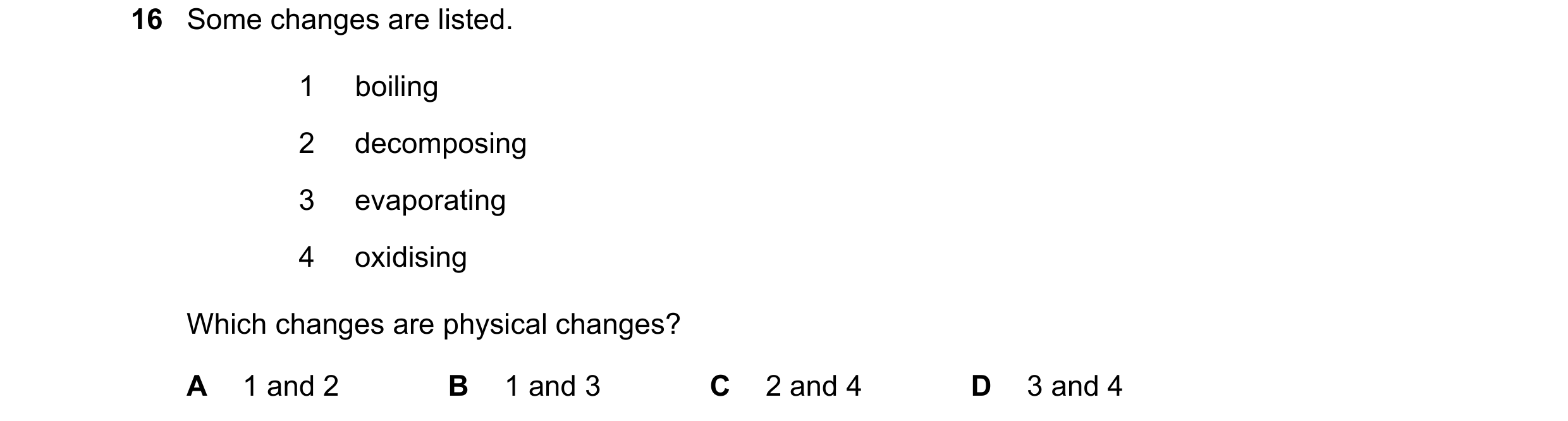
16 Some changes are listed. 1 boiling 2 decomposing 3 evaporating 4 oxidising Which changes are physical changes? A 1 and 2 B 1 and 3 C 2 and 4 D 3 and 4
1 marks
Answer: B
This question in 0653/21 May/June 2018
Q4 · Which process involves a physical change? 0653/22 May/June 2018
16 Which process involves a physical change? A adding magnesium to nitric acid B burning methane C evaporating petroleum D rusting iron
1 marks
Answer: C
This question in 0653/22 May/June 2018
Q5 · Which process produces a gas that contributes to climate change? 0653/22 May/June 2018
26 Which process produces a gas that contributes to climate change? A the electrolysis of molten lead(II) bromide B the reaction of calcium with water C the reaction of copper oxide with dilute sulfuric acid D the thermal decomposition of calcium carbonate
1 marks
Answer: D
This question in 0653/22 May/June 2018
Q6 · Which process is not a chemical change? 0653/23 May/June 2018
16 Which process is not a chemical change? A the electrolysis of molten lead bromide B the fractional distillation of petroleum C the oxidation of copper D the rusting of iron
1 marks
Answer: B
This question in 0653/23 May/June 2018
Q7 · Four processes are listed 0653/21 Oct/Nov 2019
15 Four processes are listed. 1 melting of ice 2 electrolysis of molten lead(II) bromide 3 combustion of carbon 4 rusting of iron Which processes are chemical changes? A 1 and 3 only B 1, 2 and 3 C 2 and 4 only D 2, 3 and 4
1 marks
Answer: D
This question in 0653/21 Oct/Nov 2019
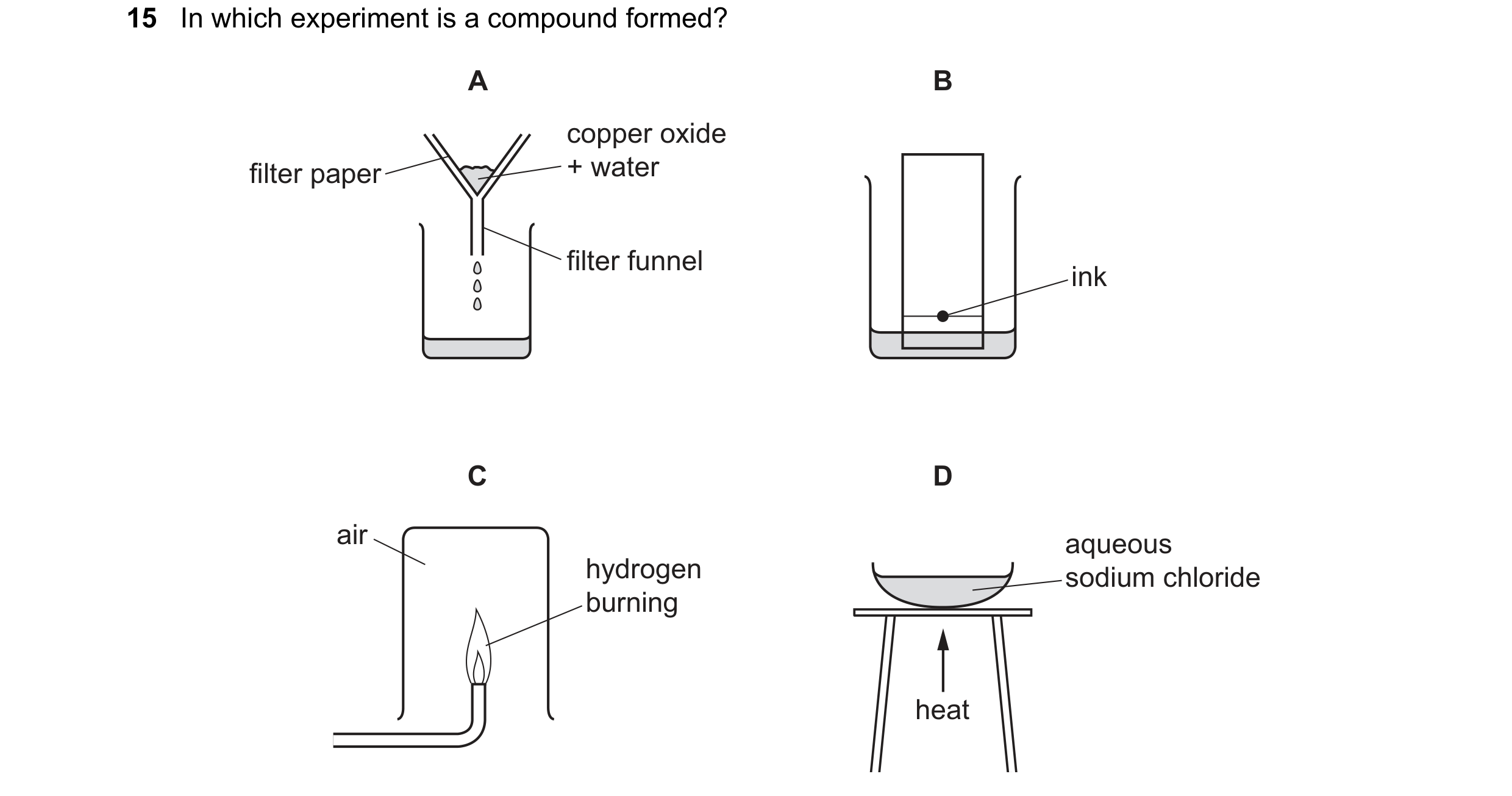
Q8 · In which experiment is a compound formed? 0653/22 May/June 2020
15 In which experiment is a compound formed? A B copper oxide filter paper + water filter funnel ink C D air aqueous hydrogen sodium chloride burning heat
1 marks
Answer: C
This question in 0653/22 May/June 2020
Q9 · What is an example of a physical change? 0653/21 May/June 2021
15 What is an example of a physical change? A carbon dioxide turning limewater milky B the crystallisation of copper(II) sulfate from solution C the electrolysis of molten lead(II) bromide D the thermal decomposition of calcium carbonate
1 marks
Answer: B
This question in 0653/21 May/June 2021
Q10 · What is an example of a physical change? 0653/22 May/June 2021
15 What is an example of a physical change? A carbon dioxide turning limewater milky B the crystallisation of copper(II) sulfate from solution C the electrolysis of molten lead(II) bromide D the thermal decomposition of calcium carbonate
1 marks
Answer: B
This question in 0653/22 May/June 2021
Q11 · What is an example of a physical change? 0653/23 May/June 2021
16 What is an example of a physical change? A carbon dioxide turning limewater milky B the crystallisation of copper(II) sulfate from solution C the electrolysis of molten lead(II) bromide D the thermal decomposition of calcium carbonate
1 marks
Answer: B
This question in 0653/23 May/June 2021
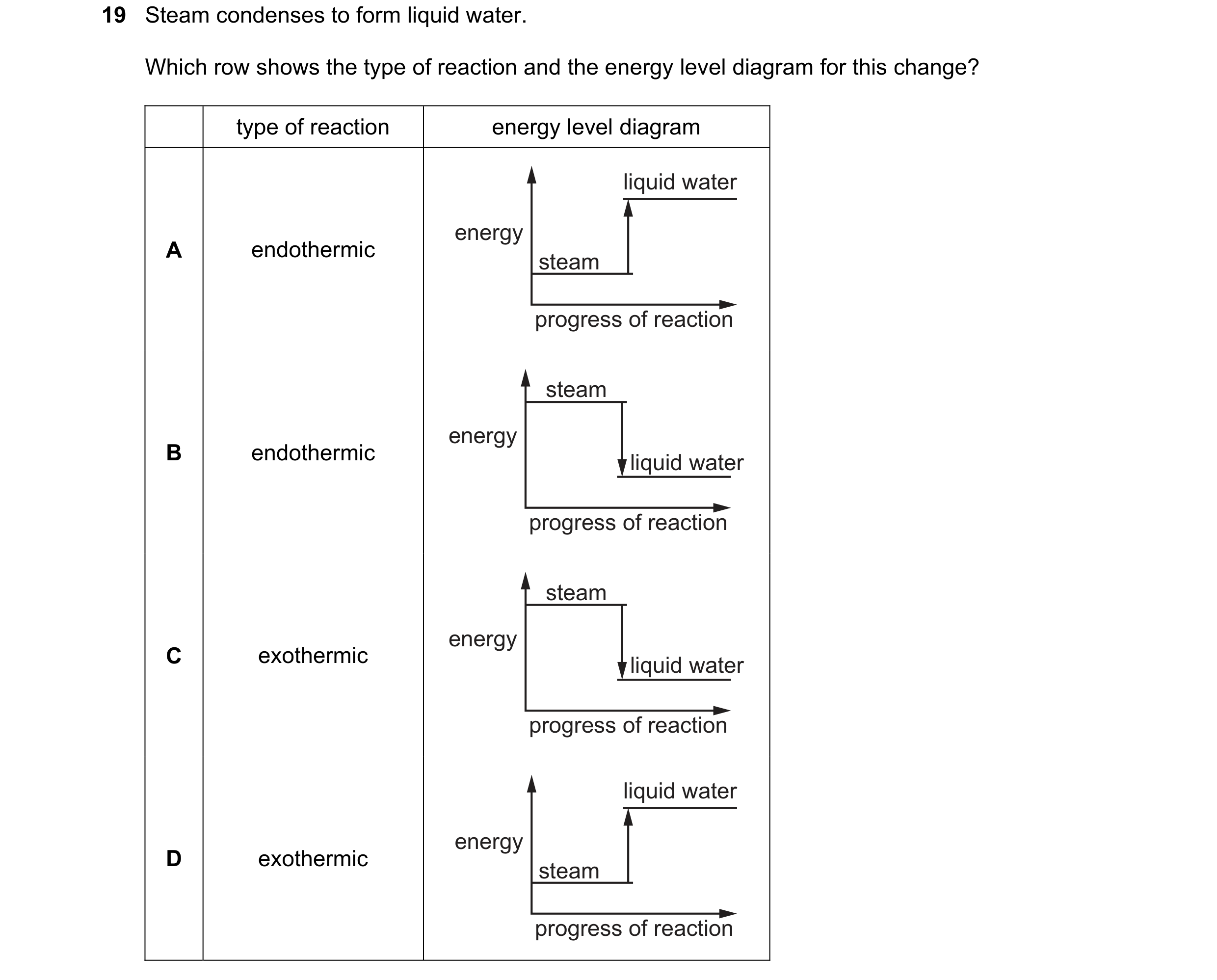
Q12 · Steam condenses to form liquid water 0653/22 Feb/March 2022
19 Steam condenses to form liquid water. Which row shows the type of reaction and the energy level diagram for this change? type of reaction energy level diagram liquid water energy A endothermic steam progress of reaction steam energy B endothermic liquid water progress of reaction steam energy C exothermic liquid water progress of reaction liquid water energy D exothermic steam progress of reaction
1 marks
Answer: C
This question in 0653/22 Feb/March 2022
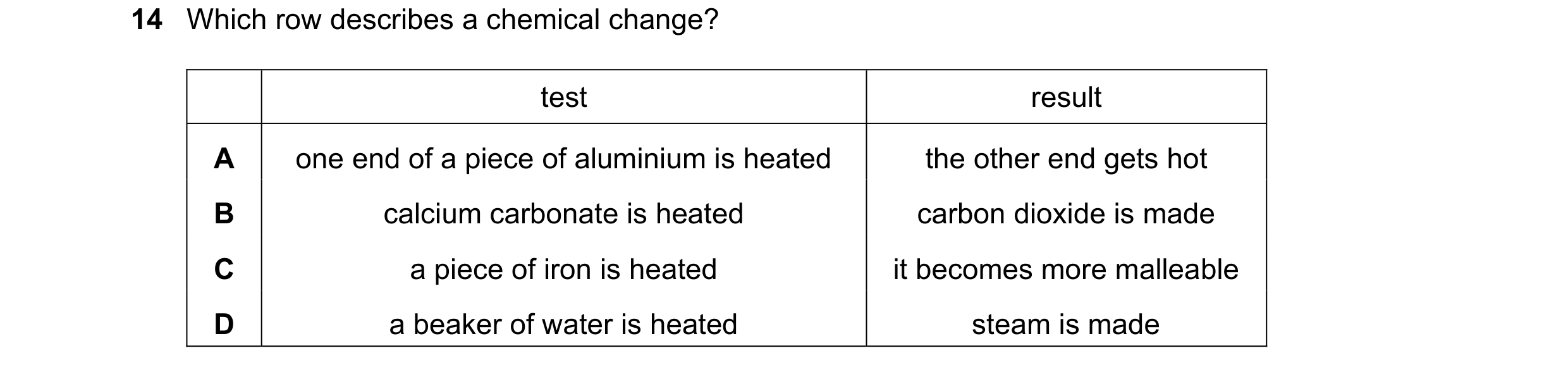
Q13 · Which row describes a chemical change? 0653/21 May/June 2022
14 Which row describes a chemical change? test result A one end of a piece of aluminium is heated the other end gets hot B calcium carbonate is heated carbon dioxide is made C a piece of iron is heated it becomes more malleable D a beaker of water is heated steam is made
1 marks
Answer: B
This question in 0653/21 May/June 2022
Q14 · Three changes are listed 0653/22 May/June 2022
14 Three changes are listed. 1 Dilute hydrochloric acid is reacted with aqueous sodium hydroxide. 2 The mixture formed is then heated until all of the water is evaporated. 3 The solid that is formed is then heated until it melts. Which row describes changes 1, 2 and 3? 1 2 3 A chemical chemical physical B chemical physical physical C physical physical chemical D physical chemical chemical
1 marks
Answer: B
This question in 0653/22 May/June 2022
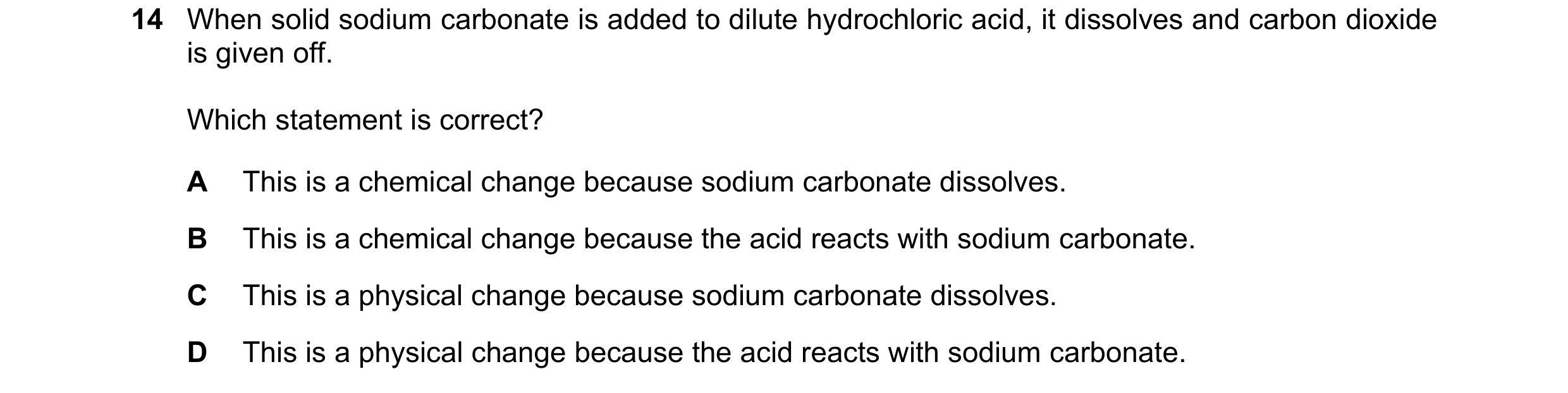
Q15 · When solid sodium carbonate is added to dilute hydrochloric acid, it dissolves and carbon… 0653/23 May/June 2022
14 When solid sodium carbonate is added to dilute hydrochloric acid, it dissolves and carbon dioxide is given off. Which statement is correct? A This is a chemical change because sodium carbonate dissolves. B This is a chemical change because the acid reacts with sodium carbonate. C This is a physical change because sodium carbonate dissolves. D This is a physical change because the acid reacts with sodium carbonate.
1 marks
Answer: B
This question in 0653/23 May/June 2022
Q16 · Which process is an example of thermal decomposition? 0653/21 Oct/Nov 2022
27 Which process is an example of thermal decomposition? A cracking an alkane B electrolysis of molten lead(II) bromide C extraction of iron in the blast furnace D fractional distillation of petroleum
1 marks
Answer: A
This question in 0653/21 Oct/Nov 2022
Q17 · Which process is an example of thermal decomposition? 0653/22 Oct/Nov 2022
27 Which process is an example of thermal decomposition? A cracking an alkane B electrolysis of molten lead(II) bromide C extraction of iron in the blast furnace D fractional distillation of petroleum
1 marks
Answer: A
This question in 0653/22 Oct/Nov 2022
Q18 · What is an example of a physical change? 0653/21 May/June 2024
15 What is an example of a physical change? A carbon dioxide turning limewater milky B the crystallisation of copper(II) sulfate from solution C the electrolysis of molten lead(II) bromide D the thermal decomposition of calcium carbonate
1 marks
Answer: B
This question in 0653/21 May/June 2024
Q19 · Which process is not a chemical change? 0653/21 Oct/Nov 2024
15 Which process is not a chemical change? A electrolysis of molten lead bromide B fractional distillation of petroleum C oxidation of copper D rusting of iron
1 marks
Answer: B
This question in 0653/21 Oct/Nov 2024
Q20 · Which processes involve a chemical change? 0653/21 May/June 2025
22 Which processes involve a chemical change? 1 cracking of an alkane 2 polymerisation of ethene 3 corrosion of iron A 1, 2 and 3 B 1 and 2 only C 1 and 3 only D 2 and 3 only
1 marks
Answer: A
This question in 0653/21 May/June 2025
Q21 · Which process is a physical change? 0653/22 May/June 2025
24 Which process is a physical change? A combustion of solid carbon B cracking of an alkane to give an alkene C fractional distillation of petroleum D rusting of iron
1 marks
Answer: C
This question in 0653/22 May/June 2025
Q22 · Which process is a physical change? 0653/23 Oct/Nov 2025
16 Which process is a physical change? A addition of carbon dioxide to limewater B addition of sodium to water C electrolysis of molten lead(II) bromide D separation of petroleum by fractional distillation
1 marks
Answer: D
This question in 0653/23 Oct/Nov 2025




 1 / 5
1 / 5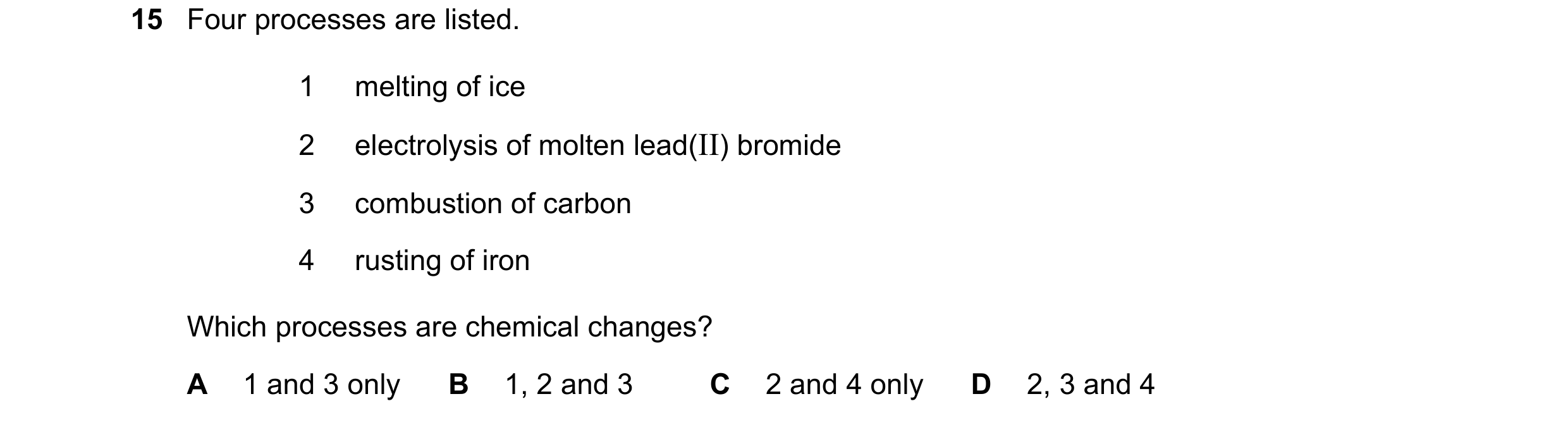

 2 / 5
2 / 5
 3 / 5
3 / 5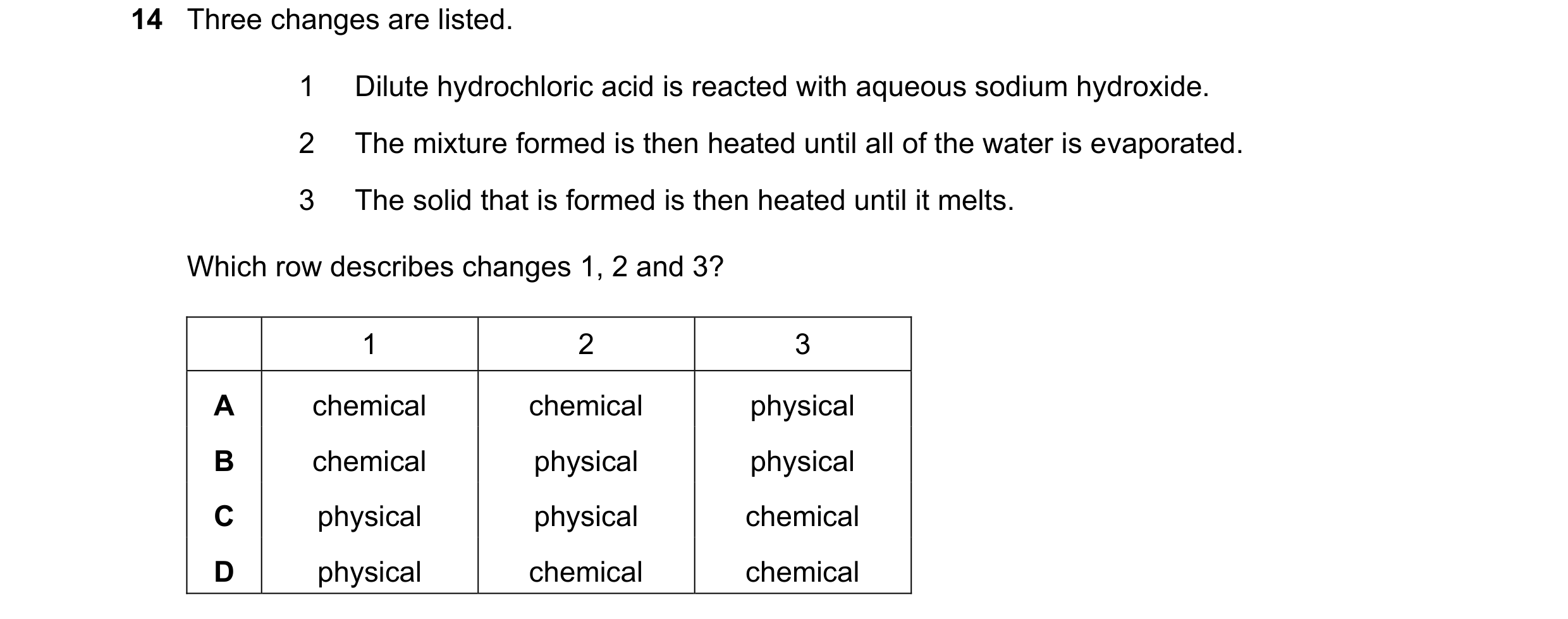


 4 / 5
4 / 5


 5 / 5
5 / 5