Questions as text
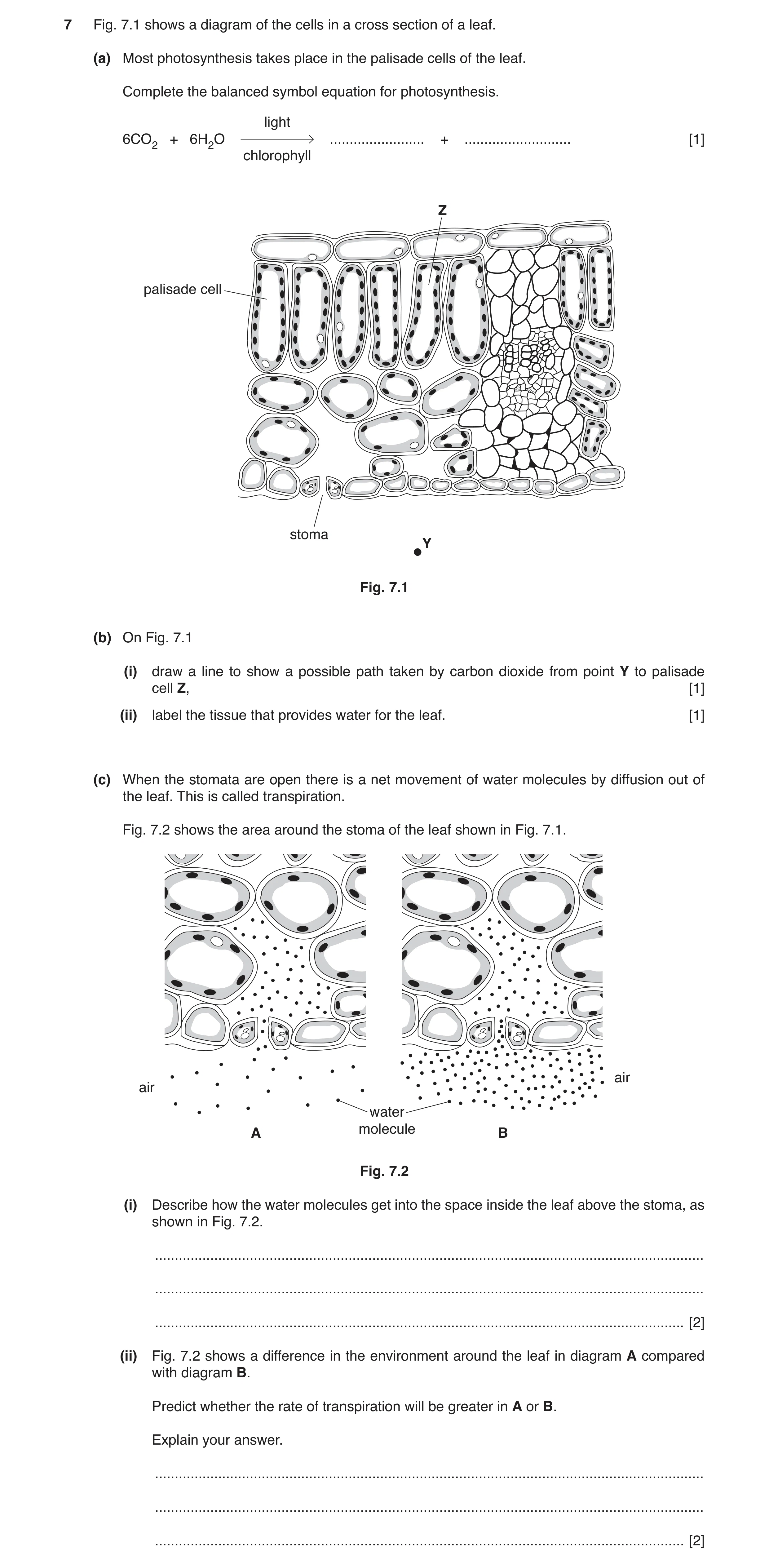
Q1 · A diagram of the cells in a cross section of a leaf 0653/43 May/June 2017
7 Fig. 7.1 shows a diagram of the cells in a cross section of a leaf. (a) Most photosynthesis takes place in the palisade cells of the leaf. Complete the balanced symbol equation for photosynthesis. light 6CO2 + 6H2O … + … [1] chlorophyll Z palisade cell stoma Y Fig. 7.1 (b) On Fig. 7.1 (i) draw a line to show a possible path taken by carbon dioxide from point Y to palisade cell Z, [1] (ii) label the tissue that provides water for the leaf. [1] (c) When the stomata are open there is a net movement of water molecules by diffusion out of the leaf. This is called transpiration. Fig. 7.2 shows the area around the stoma of the leaf shown in Fig. 7.1. air air water A molecule B Fig. 7.2 (i) Describe how the water molecules get into the space inside the leaf above the stoma, as shown in Fig. 7.2. … … … [2] (ii) Fig. 7.2 shows a difference in the environment around the leaf in diagram A compared with diagram B. Predict whether the rate of transpiration will be greater in A or B. Explain your answer. … … … [2]
7 marks
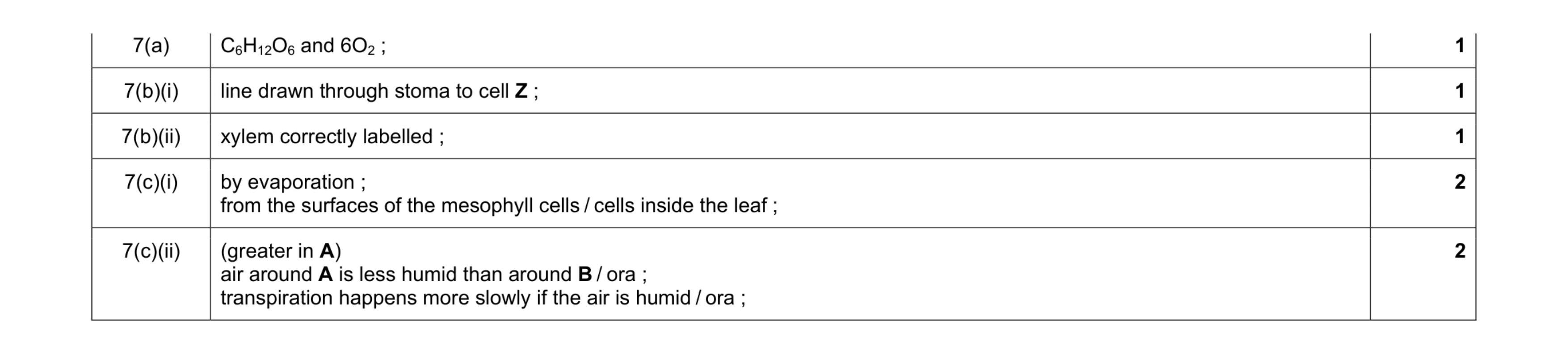
Mark scheme: 7(a) C6H12O6 and 6O2 ; 1 7(b)(i) line drawn through stoma to cell Z ; 1 7(b)(ii) xylem correctly labelled ; 1 7(c)(i) by evaporation ; from the surfaces of the mesophyll cells / cells inside the leaf ; 2 7(c)(ii) (greater in A) air around A is less humid than around B / ora ; transpiration happens more slowly if the air is humid / ora ; 2
This question in 0653/43 May/June 2017
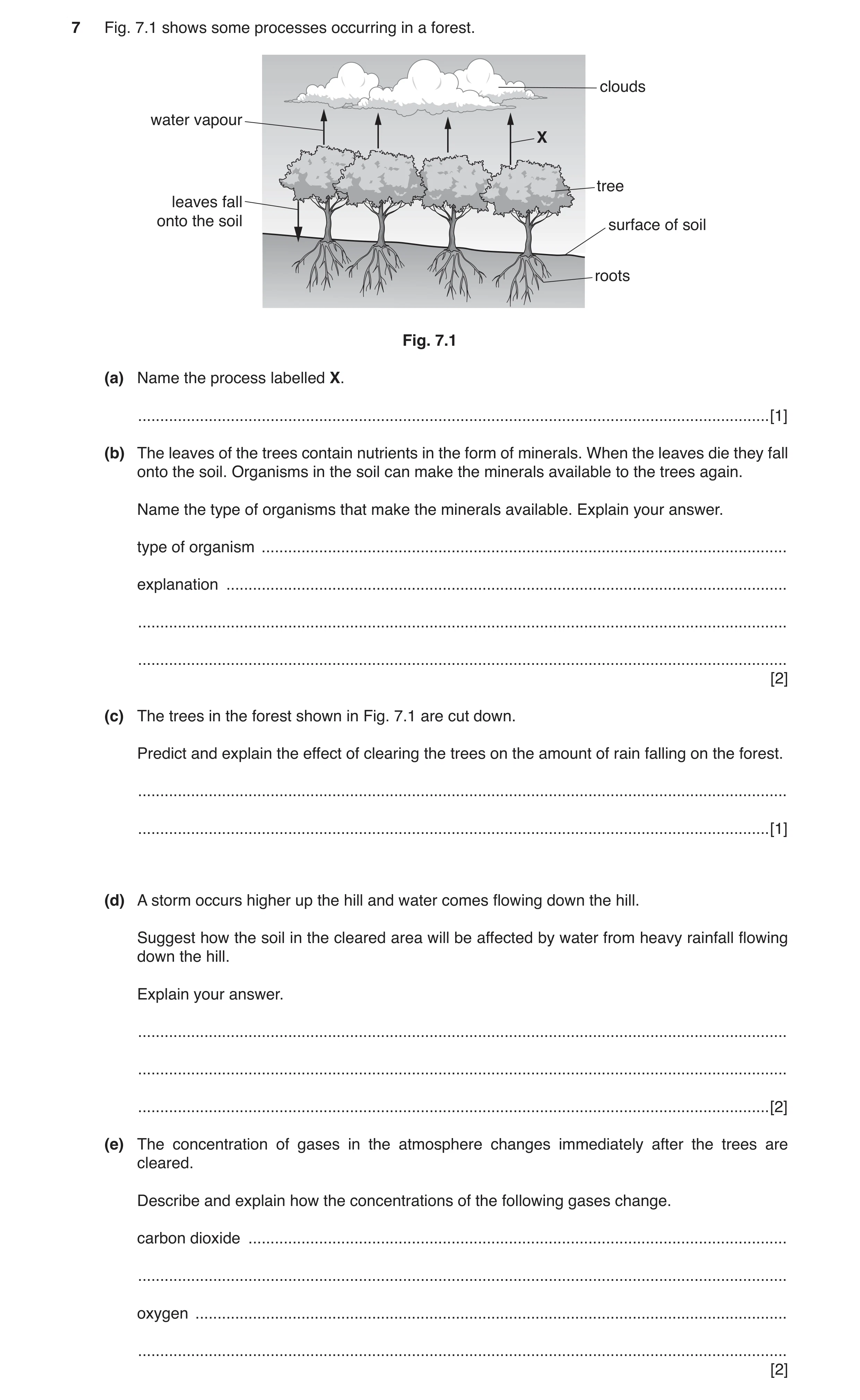
Q2 · Some processes occurring in a forest 0653/43 Oct/Nov 2017
7 Fig. 7.1 shows some processes occurring in a forest. clouds water vapour X tree leaves fall onto the soil surface of soil roots Fig. 7.1 (a) Name the process labelled X. … [1] (b) The leaves of the trees contain nutrients in the form of minerals. When the leaves die they fall onto the soil. Organisms in the soil can make the minerals available to the trees again. Name the type of organisms that make the minerals available. Explain your answer. type of organism … explanation … … … [2] (c) The trees in the forest shown in Fig. 7.1 are cut down. Predict and explain the effect of clearing the trees on the amount of rain falling on the forest. … … [1] (d) A storm occurs higher up the hill and water comes flowing down the hill. Suggest how the soil in the cleared area will be affected by water from heavy rainfall flowing down the hill. Explain your answer. … … … [2] (e) The concentration of gases in the atmosphere changes immediately after the trees are cleared. Describe and explain how the concentrations of the following gases change. carbon dioxide … … oxygen … … [2]
8 marks
Mark scheme: 7(a) transpiration ; 1 7(b) decomposers ; break down dead organisms (or their leaves) ; 2 7(c) rainfall reduced because less water is being transpired / evaporated from trees ; 1 7(d) soil will be eroded ; no trees / tree roots to stabilise the soil ; 2 7(e) carbon dioxide increases (no mark) less taken in during photosynthesis ; oxygen decreases (no mark) less given out by photosynthesis ; 2
This question in 0653/43 Oct/Nov 2017
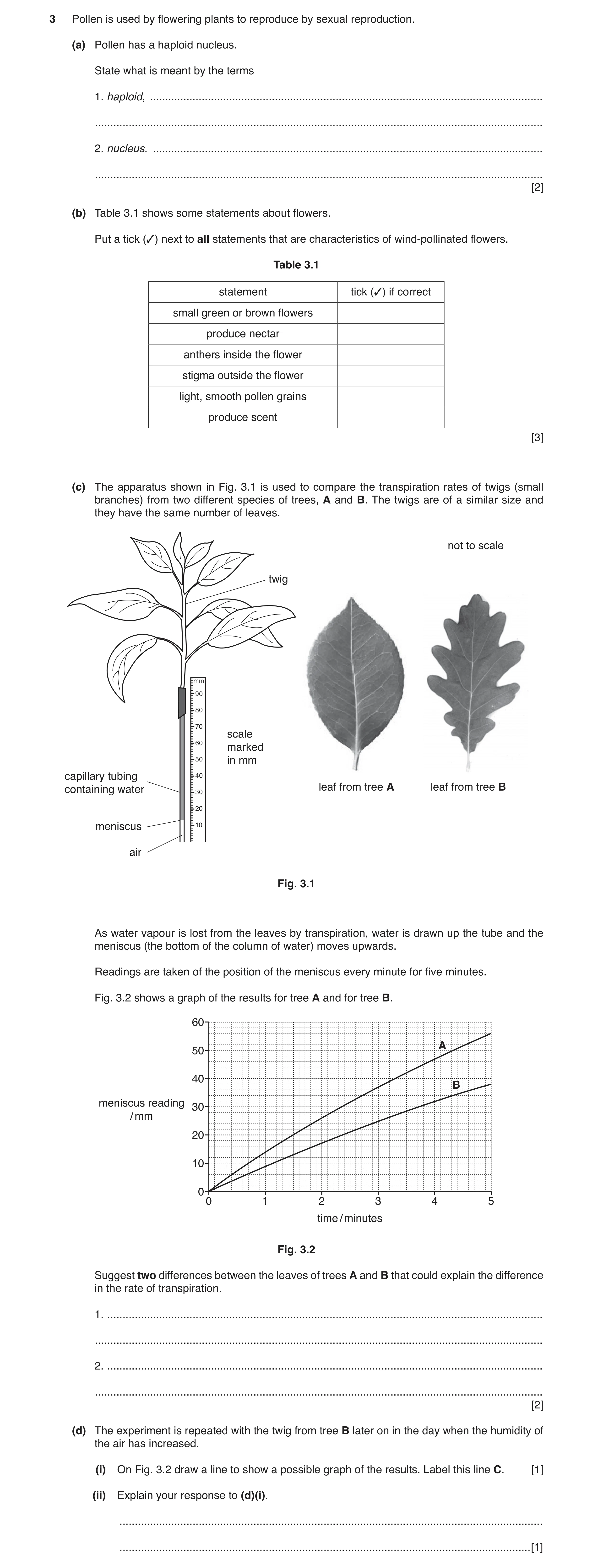
Q3 · Pollen is used by flowering plants to reproduce by sexual reproduction 0653/42 Oct/Nov 2018
3 Pollen is used by flowering plants to reproduce by sexual reproduction. (a) Pollen has a haploid nucleus. State what is meant by the terms 1. haploid, … … 2. nucleus. … … [2] (b) Table 3.1 shows some statements about flowers. Put a tick (3) next to all statements that are characteristics of wind-pollinated flowers. Table 3.1 statement tick (3) if correct small green or brown flowers produce nectar anthers inside the flower stigma outside the flower light, smooth pollen grains produce scent [3] (c) The apparatus shown in Fig. 3.1 is used to compare the transpiration rates of twigs (small branches) from two different species of trees, A and B. The twigs are of a similar size and they have the same number of leaves. not to scale twig mm 90 80 70 scale 60 marked 50 in mm capillary tubing 40 containing water 30 leaf from tree A leaf from tree B 20 meniscus 10 air Fig. 3.1 As water vapour is lost from the leaves by transpiration, water is drawn up the tube and the meniscus (the bottom of the column of water) moves upwards. Readings are taken of the position of the meniscus every minute for five minutes. Fig. 3.2 shows a graph of the results for tree A and for tree B. 60 A 50 40 B meniscus reading 30 / mm 20 10 0 0 1 2 3 4 5 time / minutes Fig. 3.2 Suggest two differences between the leaves of trees A and B that could explain the difference in the rate of transpiration. 1. … … 2. … … [2] (d) The experiment is repeated with the twig from tree B later on in the day when the humidity of the air has increased. (i) On Fig. 3.2 draw a line to show a possible graph of the results. Label this line C. [1] (ii) Explain your response to (d)(i). … … [1]
9 marks
Mark scheme: 3(a) contains half the full number of chromosomes / half the full amount of genetic material ; the controlling centre of the cell / contains genetic material ; 2 3(b) tick next to small green or brown flowers ; stigma outside the flowers ; light, smooth pollen grains ; 3 3(c) any two of A might have a larger (overall) leaf area than B ; A might have more stomata (per leaf) than B ; B might have a thicker / waxy cuticle ; Max 2 2 3(d)(i) similar line to B drawn below it with a gentler gradient ; 1 3(d)(ii) rate of transpiration is reduced when the humidity increases ; 1
This question in 0653/42 Oct/Nov 2018
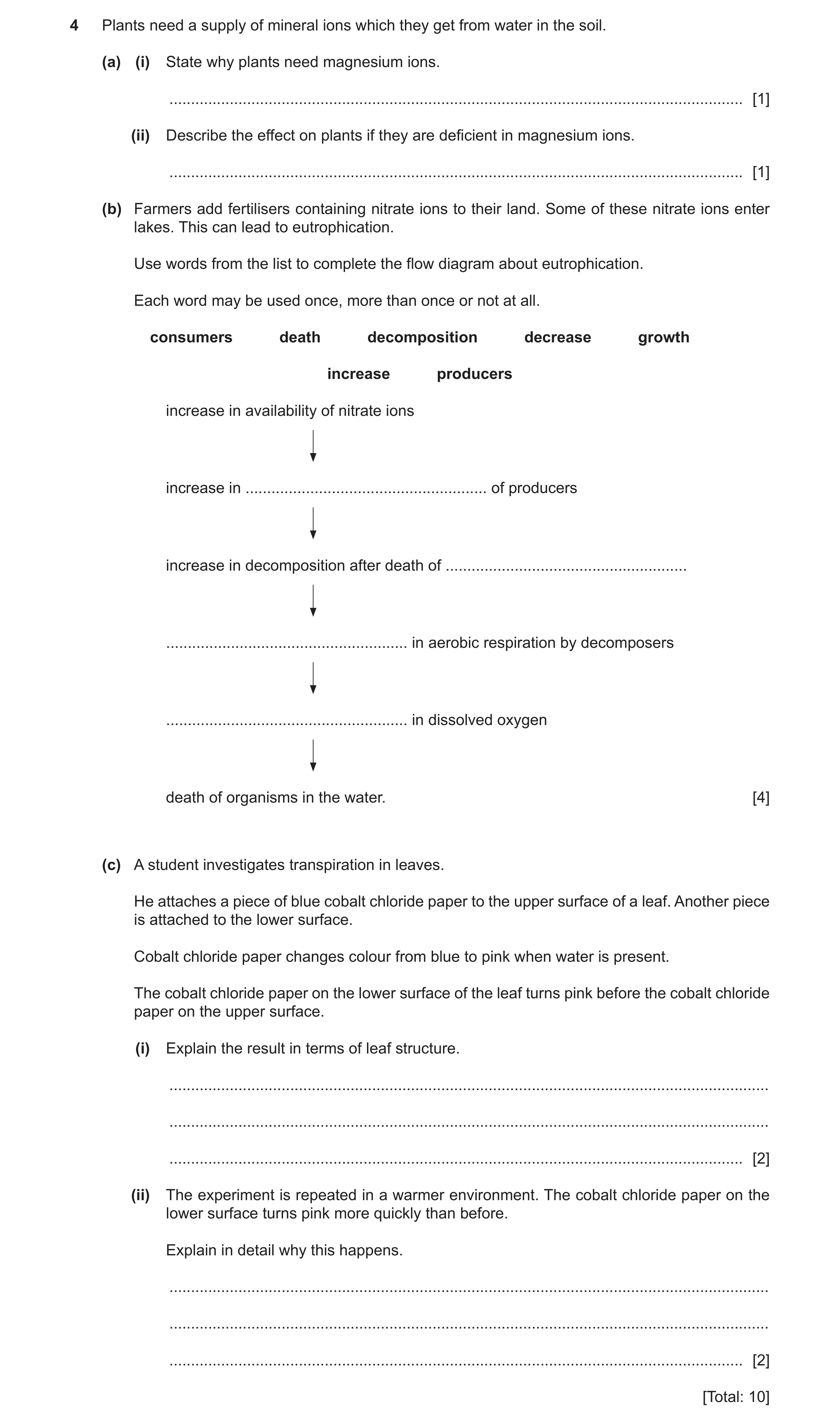
Q4 · Plants need a supply of mineral ions which they get from water in the soil 0653/43 May/June 2019
4 Plants need a supply of mineral ions which they get from water in the soil. (a) (i) State why plants need magnesium ions. … [1] (ii) Describe the effect on plants if they are deficient in magnesium ions. … [1] (b) Farmers add fertilisers containing nitrate ions to their land. Some of these nitrate ions enter lakes. This can lead to eutrophication. Use words from the list to complete the flow diagram about eutrophication. Each word may be used once, more than once or not at all. consumers death decomposition decrease growth increase producers increase in availability of nitrate ions increase in … of producers increase in decomposition after death of … … in aerobic respiration by decomposers … in dissolved oxygen death of organisms in the water. [4] (c) A student investigates transpiration in leaves. He attaches a piece of blue cobalt chloride paper to the upper surface of a leaf. Another piece is attached to the lower surface. Cobalt chloride paper changes colour from blue to pink when water is present. The cobalt chloride paper on the lower surface of the leaf turns pink before the cobalt chloride paper on the upper surface. (i) Explain the result in terms of leaf structure. … … … [2] (ii) The experiment is repeated in a warmer environment. The cobalt chloride paper on the lower surface turns pink more quickly than before. Explain in detail why this happens. … … … [2] [Total: 10]
10 marks
Mark scheme: 4(a)(i) to make chlorophyll ; 1 4(a)(ii) leaves turn yellow ; 1 4(b) growth ; producers ; increase ; decrease ; 4 4(c)(i) faster rate of transpiration / water loss from lower surface / cell surfaces ; more stomata on lower surface ; 2 4(c)(ii) transpiration rate increases / increased evaporation from stomata / mesophyll cell surfaces ; water molecules have more kinetic energy due to higher temperature ; correct reference to diffusion of water molecules / vapour from air spaces in the leaf ; max 2
This question in 0653/43 May/June 2019
Q5 · Plants make glucose by the process of photosynthesis 0653/41 Oct/Nov 2019
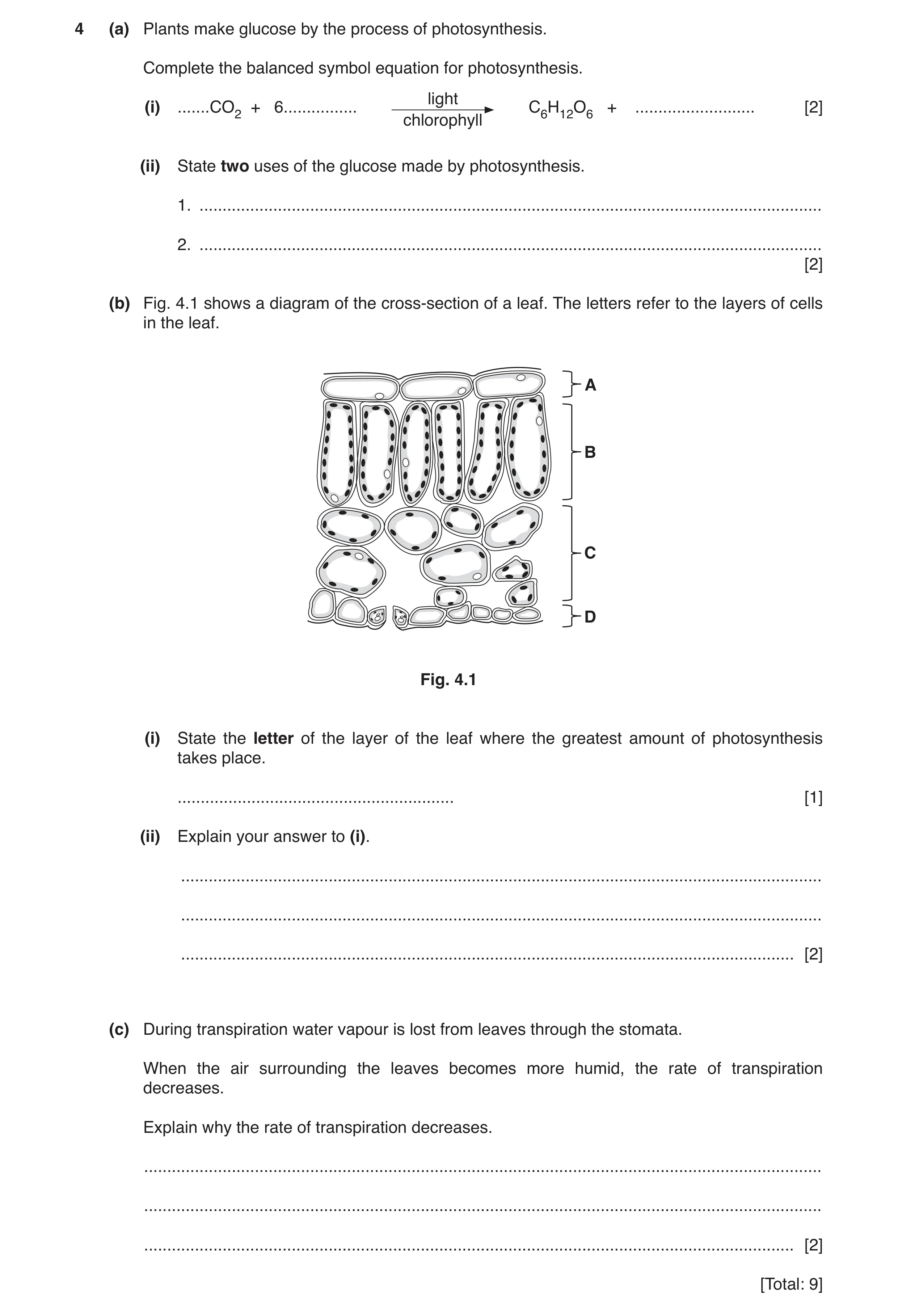
4 (a) Plants make glucose by the process of photosynthesis. Complete the balanced symbol equation for photosynthesis. light (i) … CO2 + 6 … C6H12O6 + … [2] chlorophyll (ii) State two uses of the glucose made by photosynthesis. 1. … 2. … [2] (b) Fig. 4.1 shows a diagram of the cross-section of a leaf. The letters refer to the layers of cells in the leaf. A B C D Fig. 4.1 (i) State the letter of the layer of the leaf where the greatest amount of photosynthesis takes place. … [1] (ii) Explain your answer to (i). … … … [2] (c) During transpiration water vapour is lost from leaves through the stomata. When the air surrounding the leaves becomes more humid, the rate of transpiration decreases. Explain why the rate of transpiration decreases. … … … [2] [Total: 9]
9 marks
Mark scheme: 4(a)(i) LHS ; RHS ; 2 4(a)(ii) respiratory substrate / for respiration / to release energy ; to make starch (for storage) ; 2 4(b)(i) B ; 1 4(b)(ii) greatest number of chloroplasts / large amounts of chlorophyll present ; to absorb light / needed for photosynthesis ; 2 4(c) (less transpiration means) less diffusion of water (vapour through the stomata / out of leaf) ; due to increased concentration of water vapour in the air / due to reduced difference in water potential ; 2
This question in 0653/41 Oct/Nov 2019
Q6 · Two similar stalks of celery, X and Y 0653/42 May/June 2020
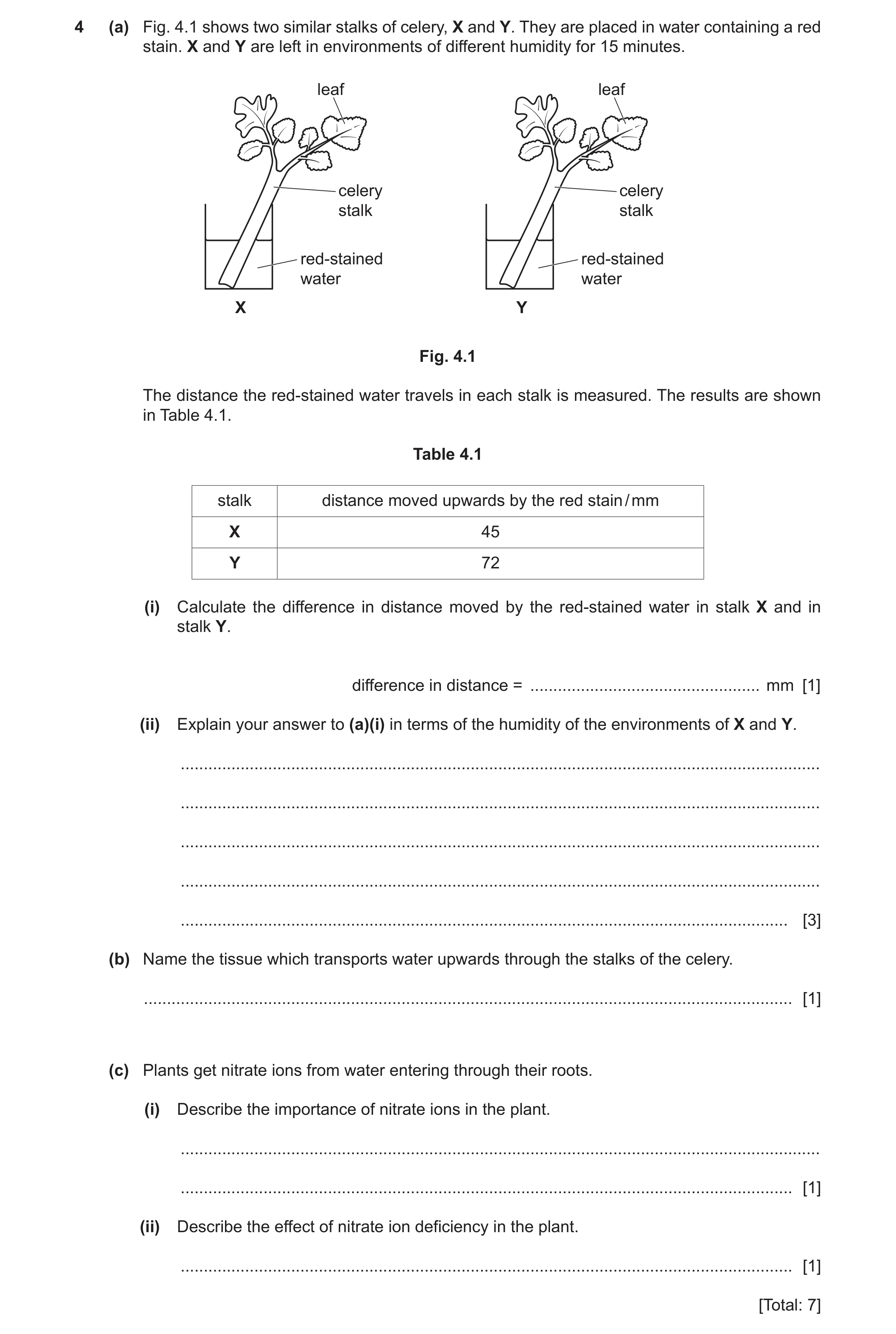
4 (a) Fig. 4.1 shows two similar stalks of celery, X and Y. They are placed in water containing a red stain. X and Y are left in environments of different humidity for 15 minutes. leaf leaf celery celery stalk stalk red-stained red-stained water water X Y Fig. 4.1 The distance the red-stained water travels in each stalk is measured. The results are shown in Table 4.1. Table 4.1 stalk distance moved upwards by the red stain / mm X 45 Y 72 (i) Calculate the difference in distance moved by the red-stained water in stalk X and in stalk Y. difference in distance = … mm [1] (ii) Explain your answer to (a)(i) in terms of the humidity of the environments of X and Y. … … … … … [3] (b) Name the tissue which transports water upwards through the stalks of the celery. … [1] (c) Plants get nitrate ions from water entering through their roots. (i) Describe the importance of nitrate ions in the plant. … … [1] (ii) Describe the effect of nitrate ion deficiency in the plant. … [1] [Total: 7]
7 marks
Mark scheme: 4(a)(i) (72 – 45 =) 27 (mm) ; 1 4(a)(ii) the environment for stalk Y had a lower humidity than stalk X ; transpiration rate increases at lower humidity ; due to increased water vapour gradient ; 3 4(b) xylem ; 1 4(c)(i) needed to make amino acids ; 1 Question Answer Marks 4(c)(ii) poor growth ; 1
This question in 0653/42 May/June 2020
Q7 · A cross-sectional diagram of a leaf 0653/42 Oct/Nov 2020
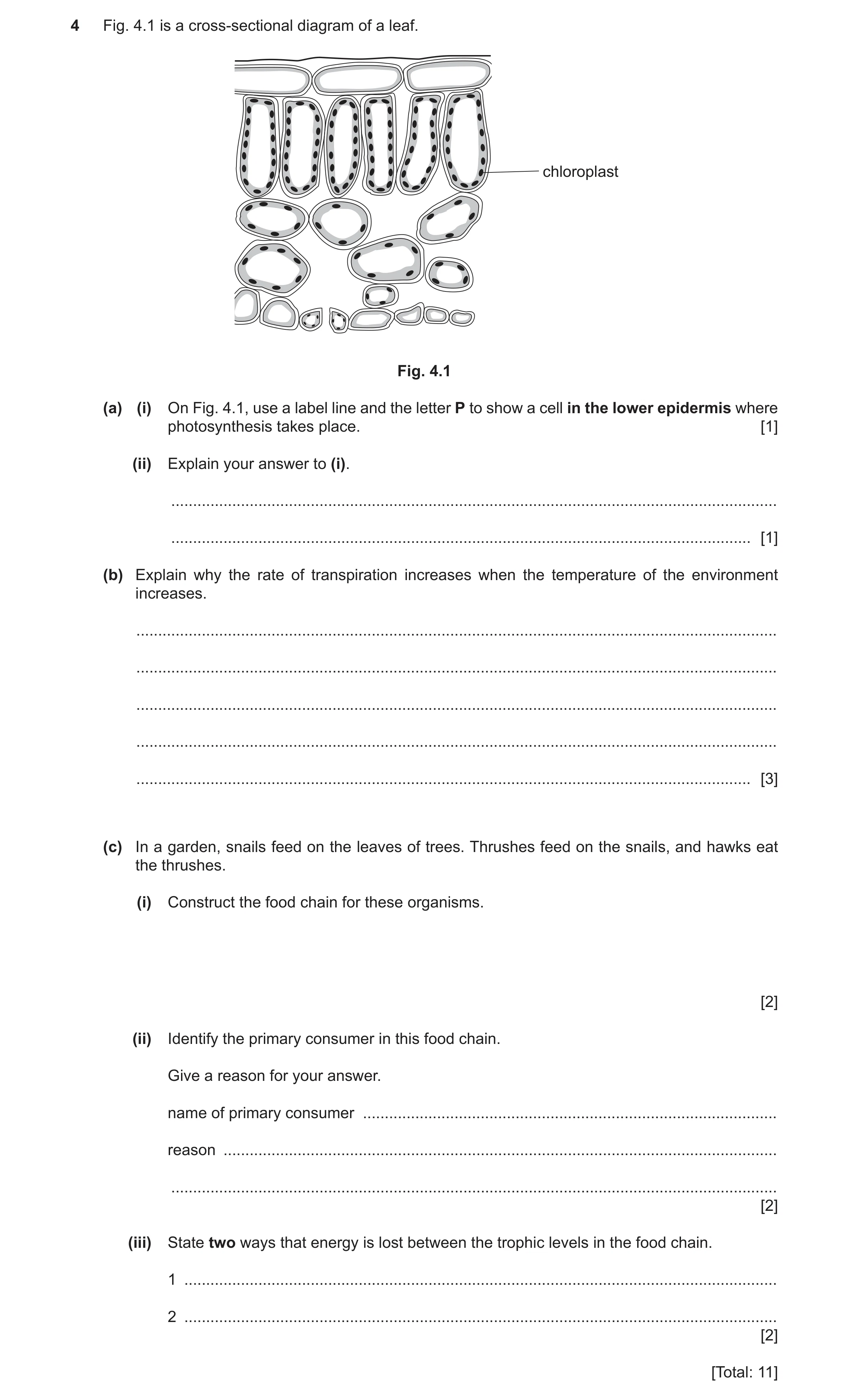
4 Fig. 4.1 is a cross-sectional diagram of a leaf. chloroplast Fig. 4.1 (a) (i) On Fig. 4.1, use a label line and the letter P to show a cell in the lower epidermis where photosynthesis takes place. [1] (ii) Explain your answer to (i). … … [1] (b) Explain why the rate of transpiration increases when the temperature of the environment increases. … … … … … [3] (c) In a garden, snails feed on the leaves of trees. Thrushes feed on the snails, and hawks eat the thrushes. (i) Construct the food chain for these organisms. [2] (ii) Identify the primary consumer in this food chain. Give a reason for your answer. name of primary consumer … reason … … [2] (iii) State two ways that energy is lost between the trophic levels in the food chain. 1 … 2 … [2] [Total: 11]
11 marks
Mark scheme: 4(a)(i) guard cell labelled with letter P ; 1 4(a)(ii) contains, chloroplasts / chlorophyll ; 1 4(b) any three from: water molecules have increased (kinetic) energy ; increased (rate of) evaporation (from surface of mesophyll cells) ; increased (rate of) diffusion, through stomata / out of leaves ; 3 4(c)(i) leaves / trees → snails → thrushes → hawks organisms in correct order ; arrows in correct direction ; 2 Question Answer Marks 4(c)(ii) snails ; herbivores / feed on producers / second trophic level ; 2 4(c)(iii) any two from: respiration / heat / movement ; death ; excretion (of waste / urine) / loss of solid waste / faeces ; not all organisms in the chain, eaten / digested ; 2
This question in 0653/42 Oct/Nov 2020
Q8 · The boxes on the left show the names of different types of cell 0653/41 Oct/Nov 2021
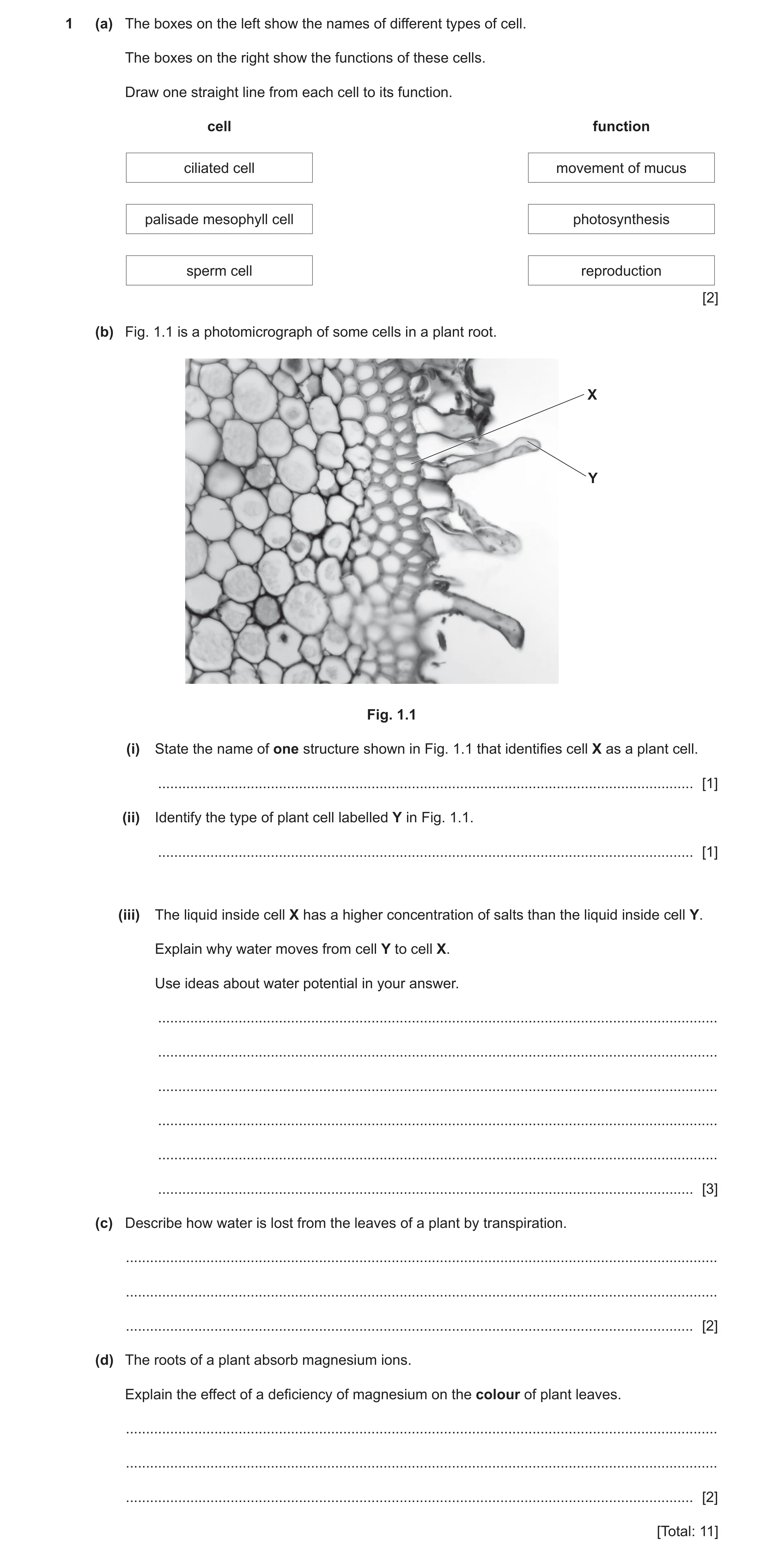
1 (a) The boxes on the left show the names of different types of cell. The boxes on the right show the functions of these cells. Draw one straight line from each cell to its function. cell function ciliated cell movement of mucus palisade mesophyll cell photosynthesis sperm cell reproduction [2] (b) Fig. 1.1 is a photomicrograph of some cells in a plant root. X Y Fig. 1.1 (i) State the name of one structure shown in Fig. 1.1 that identifies cell X as a plant cell. … [1] (ii) Identify the type of plant cell labelled Y in Fig. 1.1. … [1] (iii) The liquid inside cell X has a higher concentration of salts than the liquid inside cell Y. Explain why water moves from cell Y to cell X. Use ideas about water potential in your answer. … … … … … … [3] (c) Describe how water is lost from the leaves of a plant by transpiration. … … … [2] (d) The roots of a plant absorb magnesium ions. Explain the effect of a deficiency of magnesium on the colour of plant leaves. … … … [2] [Total: 11]
11 marks
Mark scheme: 1(a) ciliated cell movement of mucus palisade mesophyll cell photosynthesis sperm cell reproduction one correct line ; three lines correct ; 2 1(b)(i) vacuole / cell wall ; 1 1(b)(ii) root hair (cell) ; 1 1(b)(iii) water moves by osmosis ; from high water potential to a low water potential / down a water potential gradient / (because) cell X has a lower water potential than cell Y ORA ; through a partially permeable membrane ; 3 1(c) evaporation from (surface of) mesophyll cells ; diffusion (of water vapour) through stomata ; 2 1(d) (magnesium deficiency causes) leaves (to) turn yellow ; (because magnesium) needed to make chlorophyll ; 2
This question in 0653/41 Oct/Nov 2021
Q9 · A diagram of a wind-pollinated flower 0653/41 May/June 2022
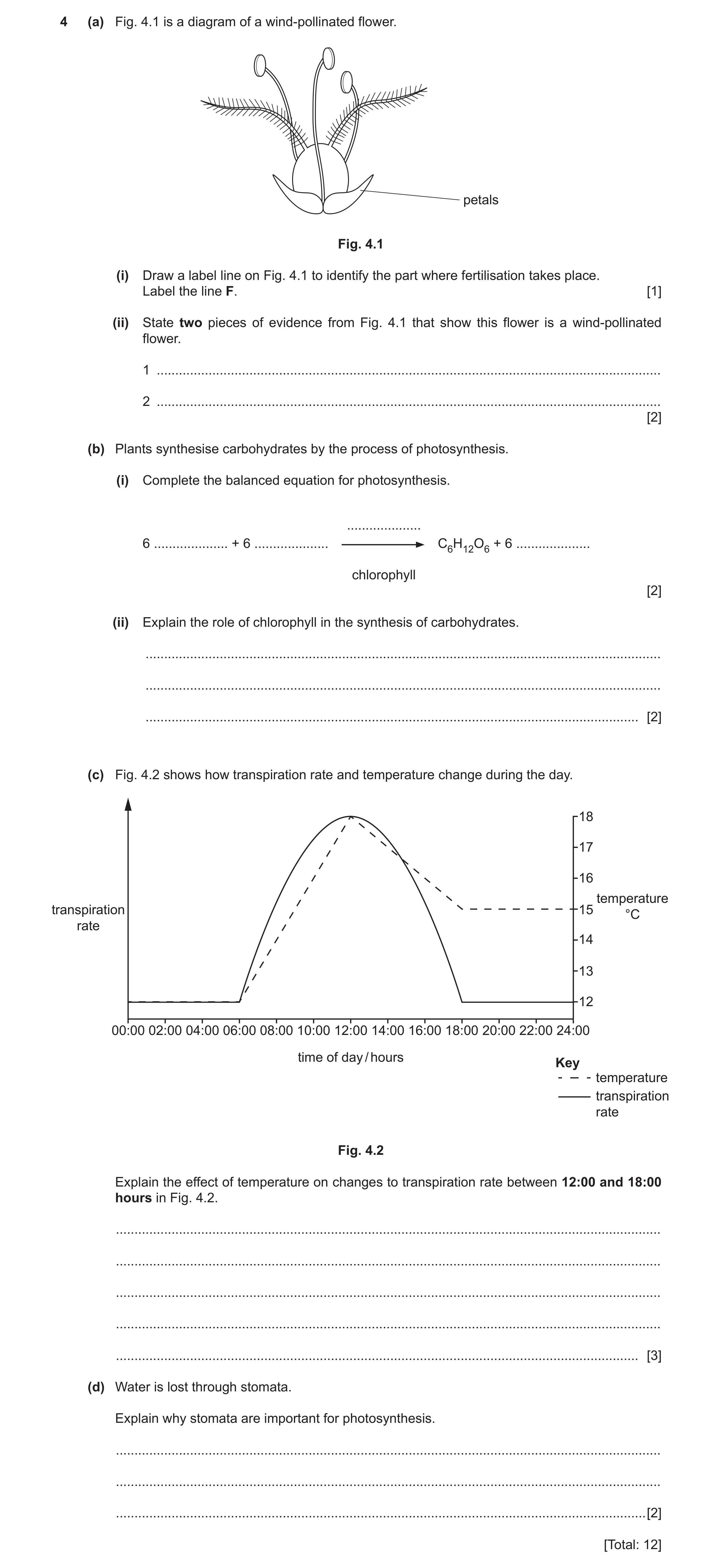
4 (a) Fig. 4.1 is a diagram of a wind-pollinated flower. petals Fig. 4.1 (i) Draw a label line on Fig. 4.1 to identify the part where fertilisation takes place. Label the line F. [1] (ii) State two pieces of evidence from Fig. 4.1 that show this flower is a wind-pollinated flower. 1 … 2 … [2] (b) Plants synthesise carbohydrates by the process of photosynthesis. (i) Complete the balanced equation for photosynthesis. … 6 … + 6 … C6H12O6 + 6 … chlorophyll [2] (ii) Explain the role of chlorophyll in the synthesis of carbohydrates. … … … [2] (c) Fig. 4.2 shows how transpiration rate and temperature change during the day. 18 17 16 temperature transpiration 15 °C rate 14 13 12 00:00 02:00 04:00 06:00 08:00 10:00 12:00 14:00 16:00 18:00 20:00 22:00 24:00 time of day / hours Key temperature transpiration rate Fig. 4.2 Explain the effect of temperature on changes to transpiration rate between 12:00 and 18:00 hours in Fig. 4.2. … … … … … [3] (d) Water is lost through stomata. Explain why stomata are important for photosynthesis. … … … [2] [Total: 12]
12 marks
Mark scheme: 4(a)(i) ovary labelled ; 1 4(a)(ii) any two from: small petals ; feathery stigma ; pollen / anther / filaments / stamens / stigma outside (flower) ; 2 4(b)(i) (6) CO2 + (6) H2O ; light and (6) O2 ; 2 4(b)(ii) absorbs / traps / uses light energy ; (light energy is) transferred / converted to chemical energy ; 2 4(c) any three from: (as temperature decreases) transpiration rate decreases ; so less water lost ; correct reference to evaporation from (mesophyll) cells ; correct reference to diffusion (of water vapour) from stomata ; 3 4(d) carbon dioxide enters leaf through stomata ; carbon dioxide is needed for photosynthesis ; 2
This question in 0653/41 May/June 2022
Q10 · Water moves from the roots of a plant through the stem to the leaves 0653/42 Oct/Nov 2022
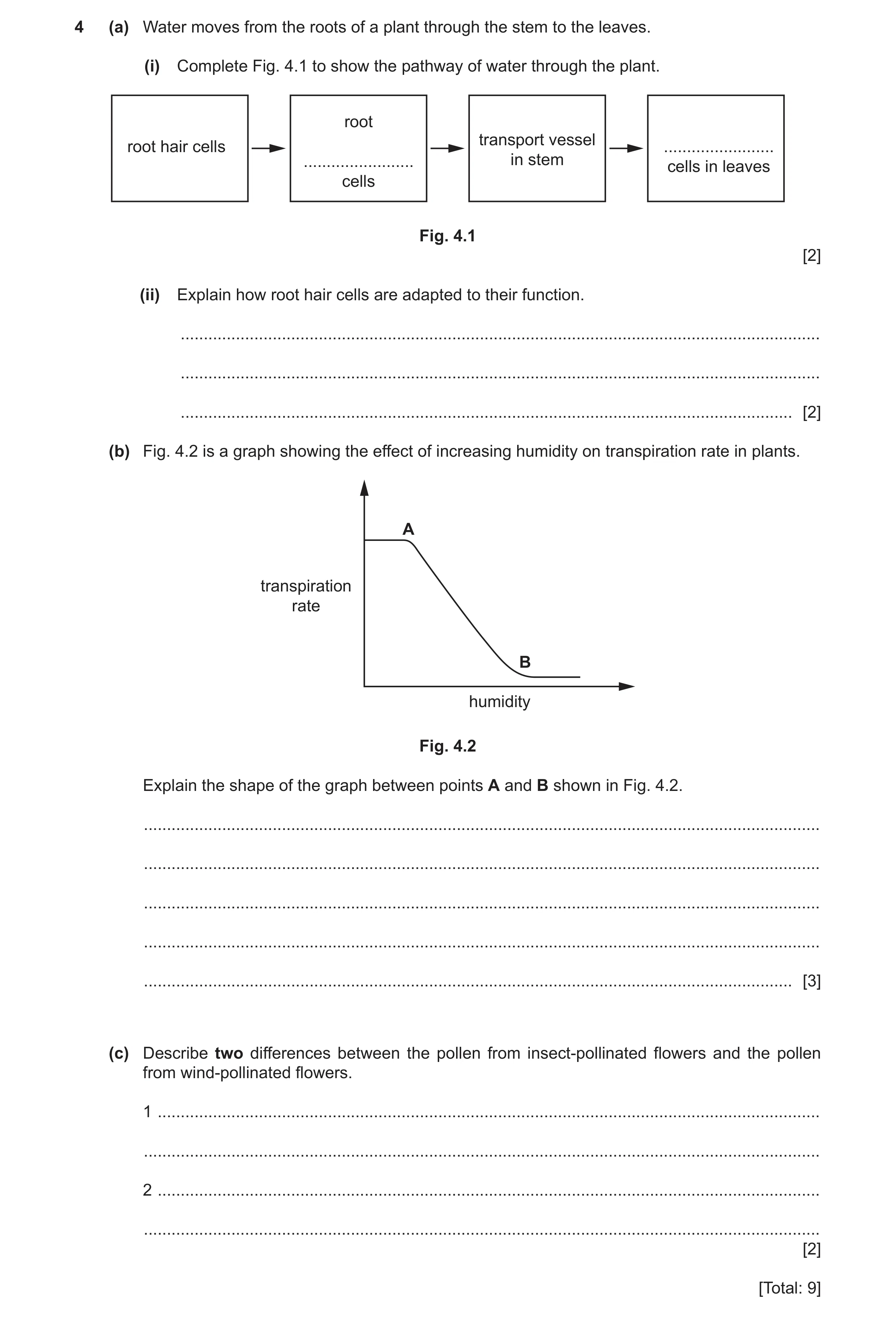
4 (a) Water moves from the roots of a plant through the stem to the leaves. (i) Complete Fig. 4.1 to show the pathway of water through the plant. root transport vessel root hair cells … … in stem cells in leaves cells Fig. 4.1 [2] (ii) Explain how root hair cells are adapted to their function. … … … [2] (b) Fig. 4.2 is a graph showing the effect of increasing humidity on transpiration rate in plants. A transpiration rate B humidity Fig. 4.2 Explain the shape of the graph between points A and B shown in Fig. 4.2. … … … … … [3] (c) Describe two differences between the pollen from insect‑pollinated flowers and the pollen from wind‑pollinated flowers. 1 … … 2 … … [2] [Total: 9]
9 marks
Mark scheme: 4(a)(i) cortex ; 2 (spongy / palisade) mesophyll ; 4(a)(ii) large surface area ; 2 increases rate of absorption (of water) ; 4(b) at higher humidity there is more water vapour in the air ; 3 diffusion / concentration gradient, decreases (as humidity increases) ; less evaporation / less diffusion ; 4(c) any two from: 2 (pollen from) • insect-pollinated flowers is, sticky / covered in spikes ; • insect-pollinated flowers is produced in smaller quantities ; • wind-pollinated flowers is lighter ;
This question in 0653/42 Oct/Nov 2022
Q11 · A diagram of a palisade cell and a root hair cell 0653/43 May/June 2023
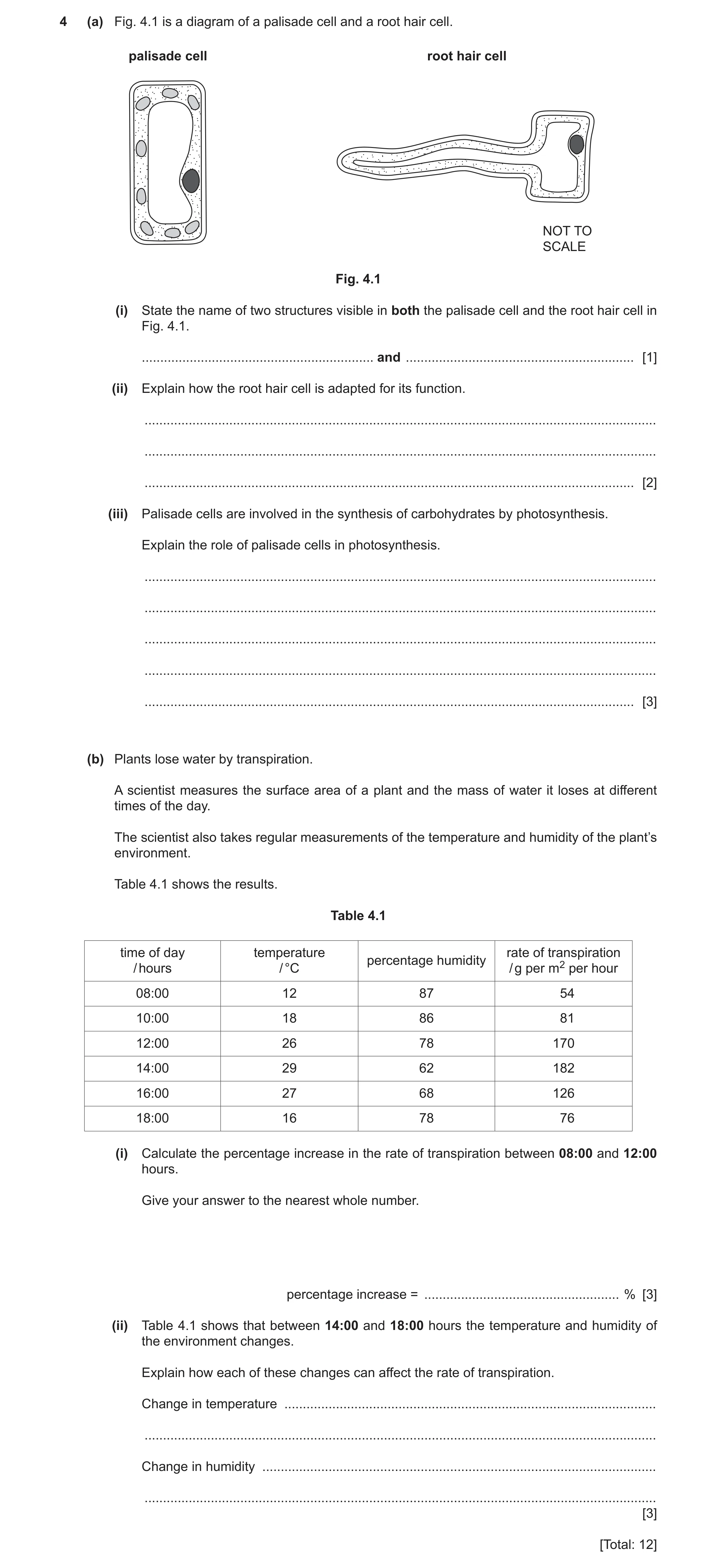
4 (a) Fig. 4.1 is a diagram of a palisade cell and a root hair cell. palisade cell root hair cell NOT TO SCALE Fig. 4.1 (i) State the name of two structures visible in both the palisade cell and the root hair cell in Fig. 4.1. … and … [1] (ii) Explain how the root hair cell is adapted for its function. … … … [2] (iii) Palisade cells are involved in the synthesis of carbohydrates by photosynthesis. Explain the role of palisade cells in photosynthesis. … … … … … [3] (b) Plants lose water by transpiration. A scientist measures the surface area of a plant and the mass of water it loses at different times of the day. The scientist also takes regular measurements of the temperature and humidity of the plant’s environment. Table 4.1 shows the results. Table 4.1 time of day temperature rate of transpiration percentage humidity / hours / °C / g per m2 per hour 08:00 12 87 54 10:00 18 86 81 12:00 26 78 170 14:00 29 62 182 16:00 27 68 126 18:00 16 78 76 (i) Calculate the percentage increase in the rate of transpiration between 08:00 and 12:00 hours. Give your answer to the nearest whole number. percentage increase = … % [3] (ii) Table 4.1 shows that between 14:00 and 18:00 hours the temperature and humidity of the environment changes. Explain how each of these changes can affect the rate of transpiration. Change in temperature … … Change in humidity … … [3] [Total: 12]
12 marks
Mark scheme: 4(a)(i) any two from: (large) vacuole ; cell membrane ; cell wall ; nucleus ; cytoplasm ; 4(a)(ii) large surface area ; increases (rate of) absorption of, water / mineral ions ; 2 4(a)(iii) ref to (large numbers of) chloroplasts ; that contain chlorophyll ; transfers light energy to chemical energy ; 3 4(b)(i) 170 – 54 / 116 ; (170 – 54) ÷ 54 100 / 116 ÷ 54 100 / (170 ÷ 54 100) – 100 / 214.814 ; 215 (%) ; 3 4(b)(ii) any three from: rate of transpiration decreases ; (idea of higher humidity causes) increased concentration of water surrounding leaves / lower concentration gradient ; decrease in evaporation (from mesophyll cells) ; decrease in diffusion from, stomata / leaves ; 3
This question in 0653/43 May/June 2023
Q12 · A student draws diagrams to show the position of xylem in different parts of a plant 0653/42 Feb/March 2024
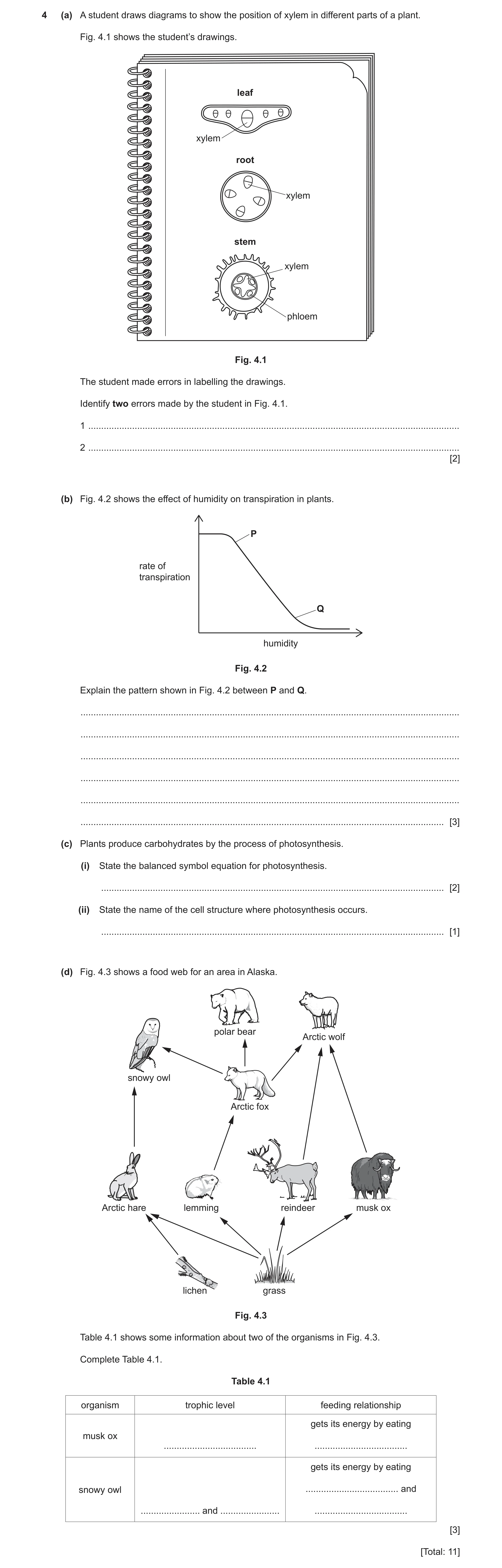
4 (a) A student draws diagrams to show the position of xylem in different parts of a plant. Fig. 4.1 shows the student’s drawings. leaf xylem root xylem stem xylem phloem Fig. 4.1 The student made errors in labelling the drawings. Identify two errors made by the student in Fig. 4.1. 1 … 2 … [2] (b) Fig. 4.2 shows the effect of humidity on transpiration in plants. P rate of transpiration Q humidity Fig. 4.2 Explain the pattern shown in Fig. 4.2 between P and Q. … … … … … … [3] (c) Plants produce carbohydrates by the process of photosynthesis. (i) State the balanced symbol equation for photosynthesis. … [2] (ii) State the name of the cell structure where photosynthesis occurs. … [1] (d) Fig. 4.3 shows a food web for an area in Alaska. polar bear Arctic wolf snowy owl Arctic fox Arctic hare lemming reindeer musk ox lichen grass Fig. 4.3 Table 4.1 shows some information about two of the organisms in Fig. 4.3. Complete Table 4.1. Table 4.1 organism trophic level feeding relationship gets its energy by eating musk ox … … gets its energy by eating snowy owl … and … and … … [3] [Total: 11]
11 marks
Mark scheme: 4(a) root and stem labels are the wrong way around ; 2 xylem label incorrect in leaf ; 4(b) any three from: 3 (description of trend) increased humidity causes decrease in rate of transpiration / ref to inverse relationship between humidity and transpiration rate ; higher humidity means higher water (vapour) concentration in air (surrounding the leaf) ; the idea that at higher humidity the concentration gradient between the leaf and the air is reduced ; reference to reduced, evaporation / diffusion (from leaf at higher humidity) ; 4(c)(i) 6CO2 + 6 H2O ; 2 C6H12O6 + 6O2 ; 4(c)(ii) chloroplast ; 1 4(d) 3 trophic organism feeding relationship level musk ox 2 (gets its energy by eating) grass (gets its energy by eating) snowy owl 3 and 4 (Arctic) fox and (Arctic) hare ;;; correct trophic levels = [1] grass = [1] (Arctic) fox and (Arctic) hare = [1]
This question in 0653/42 Feb/March 2024
Q13 · A graph showing the effect of humidity on the rate of transpiration in a plant 0653/41 Oct/Nov 2024
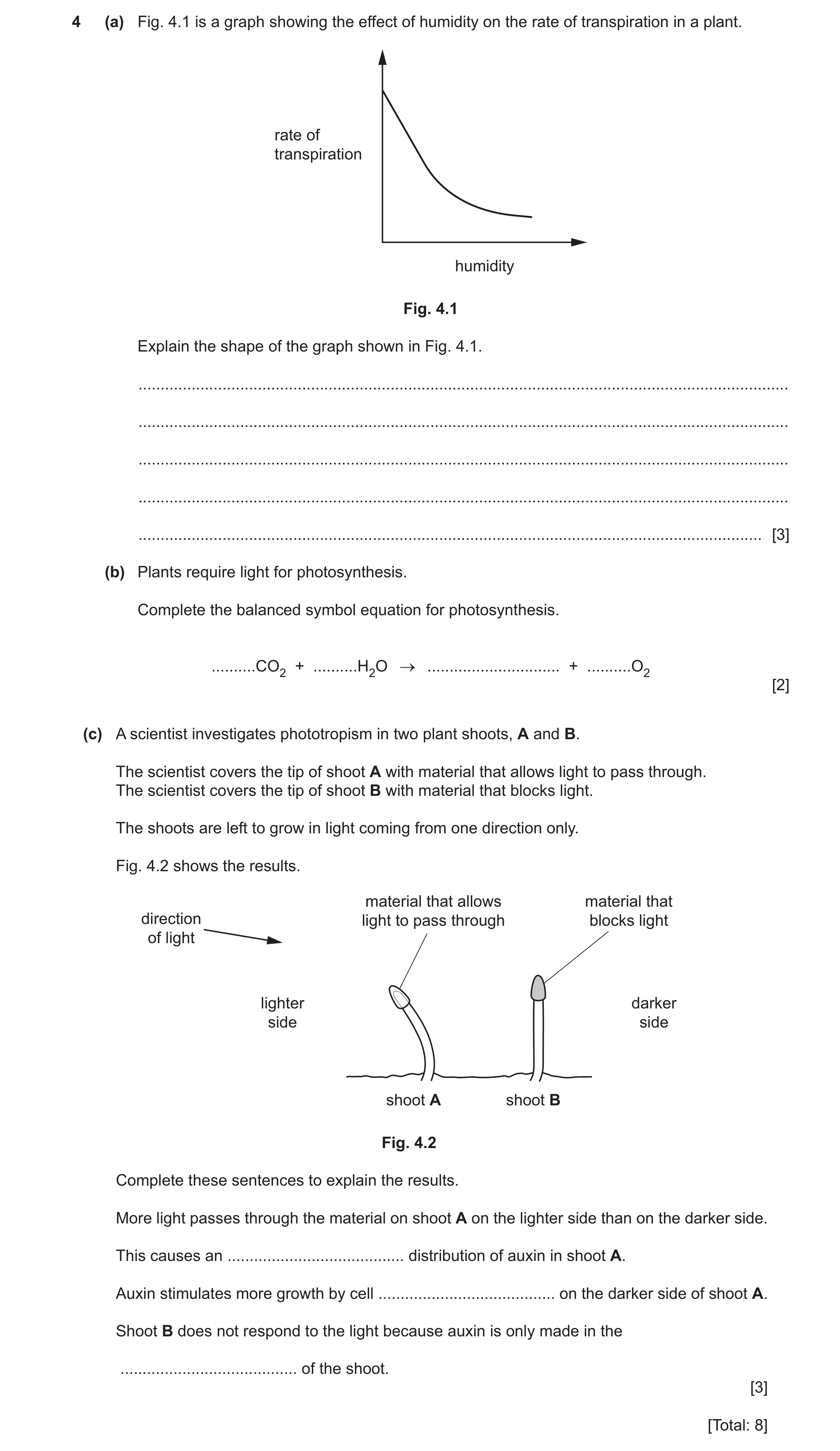
4 (a) Fig. 4.1 is a graph showing the effect of humidity on the rate of transpiration in a plant. rate of transpiration humidity Fig. 4.1 Explain the shape of the graph shown in Fig. 4.1. … … … … … [3] (b) Plants require light for photosynthesis. Complete the balanced symbol equation for photosynthesis. … CO2 + … H2O … + … O2 [2] (c) A scientist investigates phototropism in two plant shoots, A and B. The scientist covers the tip of shoot A with material that allows light to pass through. The scientist covers the tip of shoot B with material that blocks light. The shoots are left to grow in light coming from one direction only. Fig. 4.2 shows the results. material that allows material that direction light to pass through blocks light of light lighter darker side side shoot A shoot B Fig. 4.2 Complete these sentences to explain the results. More light passes through the material on shoot A on the lighter side than on the darker side. This causes an … distribution of auxin in shoot A. Auxin stimulates more growth by cell … on the darker side of shoot A. Shoot B does not respond to the light because auxin is only made in the … of the shoot. [3] [Total: 8]
8 marks
Mark scheme: 4(a) any three from: 3 increasing humidity causes decrease in transpiration rate ; concentration / percentage of water outside leaf increases ; reduces (water) concentration gradient ; reduces (rate of), diffusion / evaporation ; 4(b) 6 CO2 + 6H2O C6H12O6 + 6O2 2 correct formula for glucose ; equation correctly balanced dependent on glucose formula ; 4(c) unequal / AW ; 3 elongation ; tip / AW ;
This question in 0653/41 Oct/Nov 2024
Q14 · The structure of a plant root 0653/42 May/June 2025
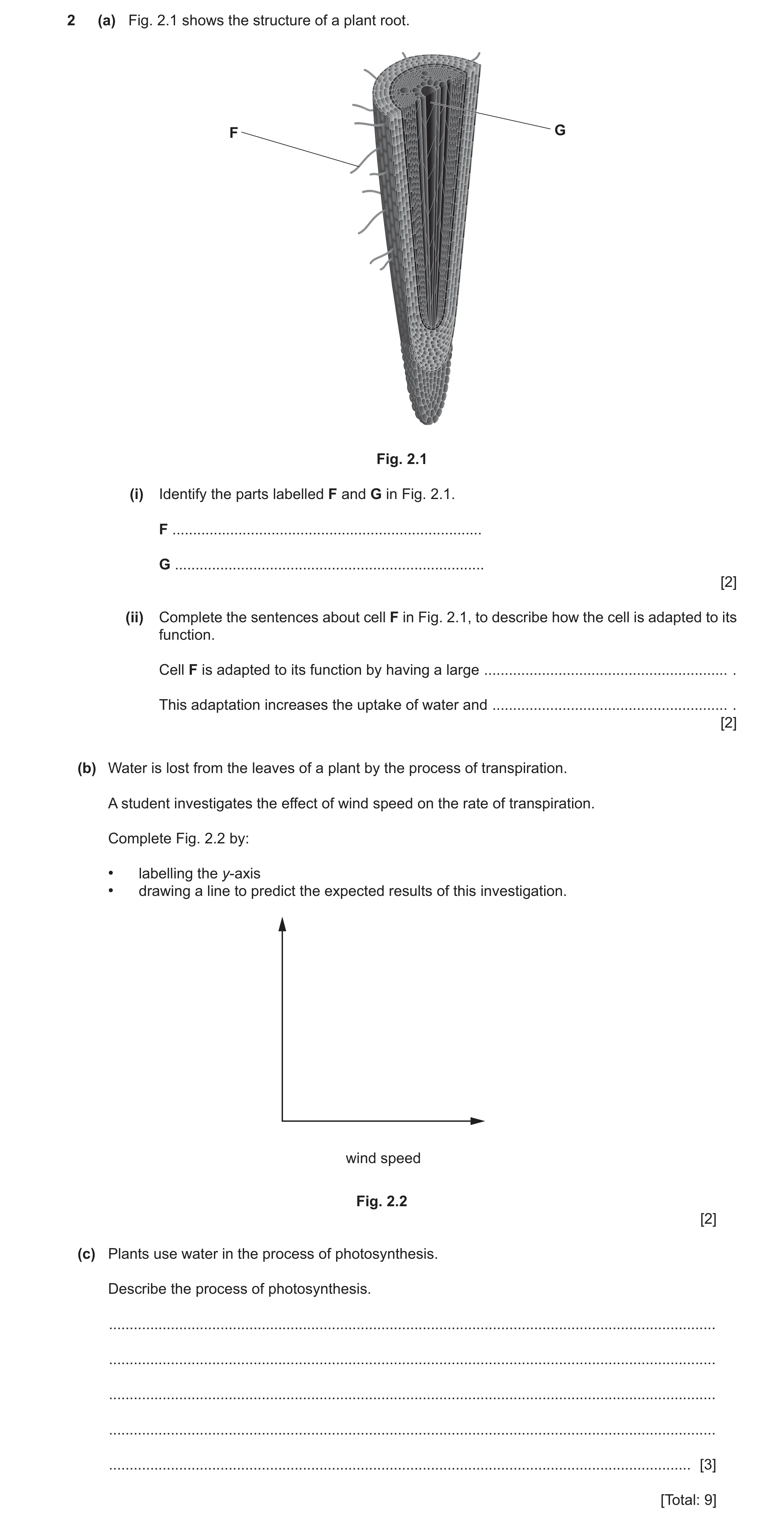
2 (a) Fig. 2.1 shows the structure of a plant root. F G Fig. 2.1 (i) Identify the parts labelled F and G in Fig. 2.1. F … G … [2] (ii) Complete the sentences about cell F in Fig. 2.1, to describe how the cell is adapted to its function. Cell F is adapted to its function by having a large … . This adaptation increases the uptake of water and … . [2] (b) Water is lost from the leaves of a plant by the process of transpiration. A student investigates the effect of wind speed on the rate of transpiration. Complete Fig. 2.2 by: • labelling the y-axis • drawing a line to predict the expected results of this investigation. wind speed Fig. 2.2 [2] (c) Plants use water in the process of photosynthesis. Describe the process of photosynthesis. … … … … … [3] [Total: 9]
9 marks
Mark scheme: 2(a)(i) (F) root hair (cell) ; 2 (G) xylem ; 2(a)(ii) surface area ; 2 mineral ions ; 2(b) y-axis labelled as rate of transpiration ; 2 line constantly increasing / constantly increasing then levelling off ; 2(c) any three from: 3 (requires) carbon dioxide / CO2 and water / H2O ; (requiring presence of) chlorophyll ; light energy converted to chemical energy ; (synthesis of), carbohydrates / glucose / C6H12O6 and oxygen / O2 formed (as a by product) ;
This question in 0653/42 May/June 2025
Question 15 0653/43 Oct/Nov 2025
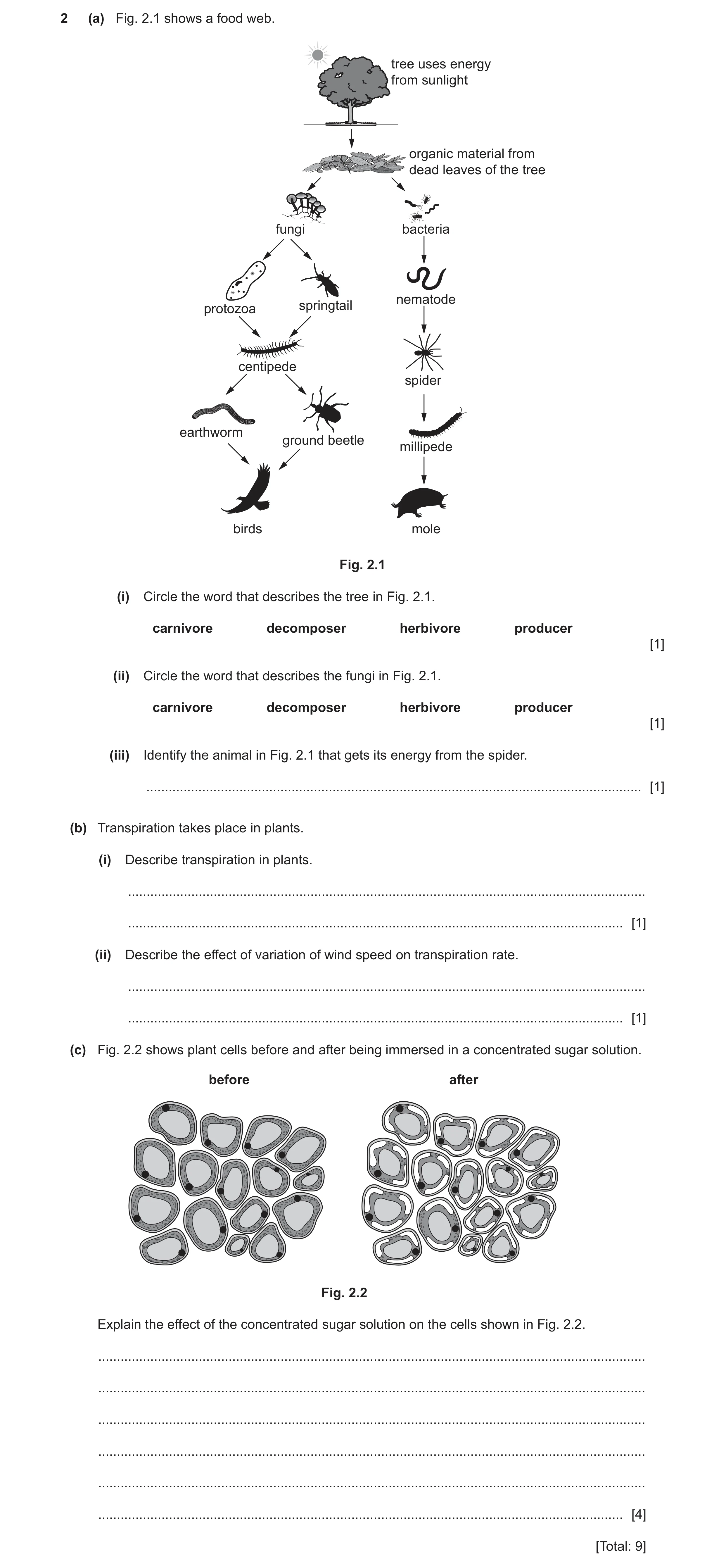
2 (a) Fig. 2.1 shows a food web. tree uses energy from sunlight organic material from dead leaves of the tree fungi bacteria nematode protozoa springtail centipede spider earthworm ground beetle millipede birds mole Fig. 2.1 (i) Circle the word that describes the tree in Fig. 2.1. carnivore decomposer herbivore producer [1] (ii) Circle the word that describes the fungi in Fig. 2.1. carnivore decomposer herbivore producer [1] (iii) Identify the animal in Fig. 2.1 that gets its energy from the spider. … [1] (b) Transpiration takes place in plants. (i) Describe transpiration in plants. … … [1] (ii) Describe the effect of variation of wind speed on transpiration rate. … … [1] (c) Fig. 2.2 shows plant cells before and after being immersed in a concentrated sugar solution. before after Fig. 2.2 Explain the effect of the concentrated sugar solution on the cells shown in Fig. 2.2. … … … … … … [4] [Total: 9]
9 marks
Mark scheme: 2(a)(i) producer ; 1 2(a)(ii) decomposer ; 1 2(a)(iii) millipede ; 1 2(b)(i) loss of water vapour from leaves ; 1 2(b)(ii) increasing wind speed increases transpiration/rate / ora ; 1 2(c) any four from: 4 water leaves the cells ; references to osmosis ; cytoplasm/vacuole shrinks or cell membrane pulled away from the cell wall or cytoplasm pulled away from cell wall ; turgor pressure decreases ; cells are plasmolysed ; cells have a high(er) water potential or (external/sugar) solution has low(er) water potential ;
This question in 0653/43 Oct/Nov 2025
 7
7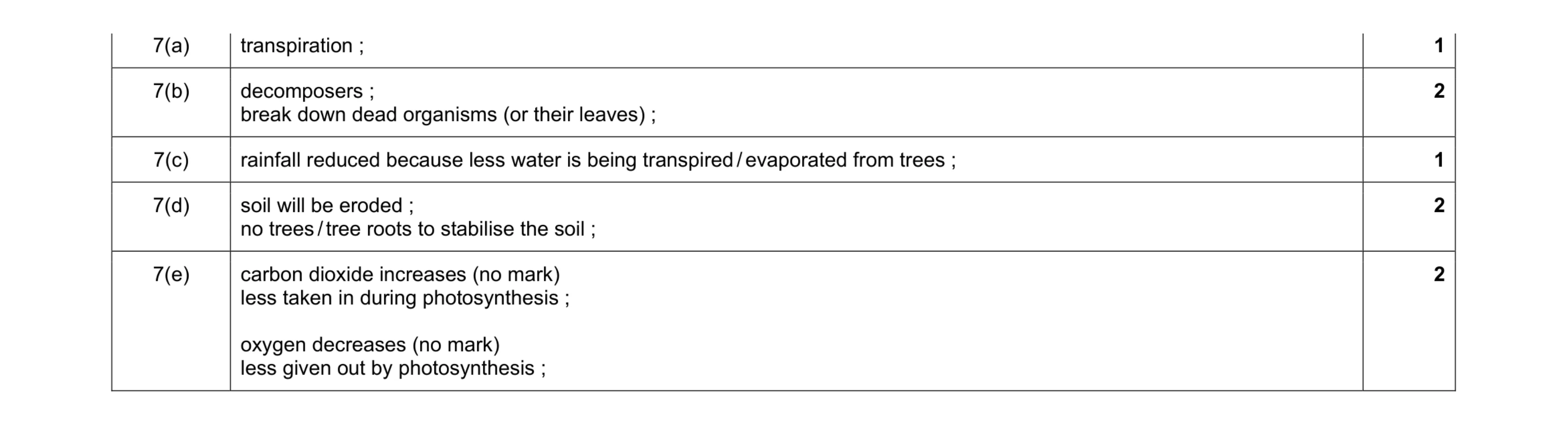 8
8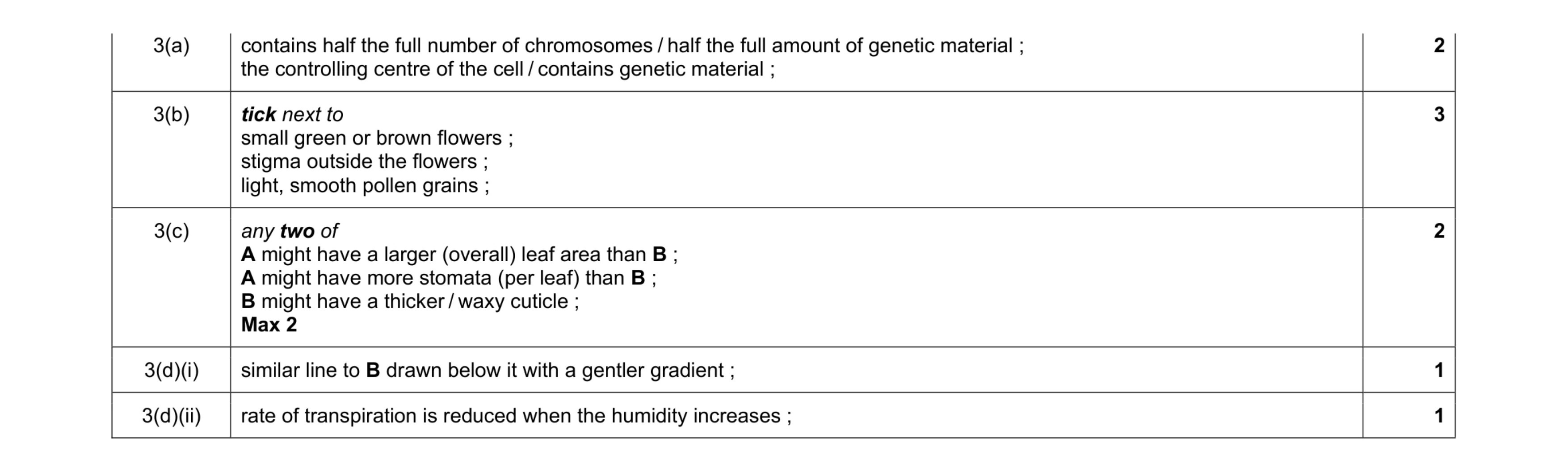 9
9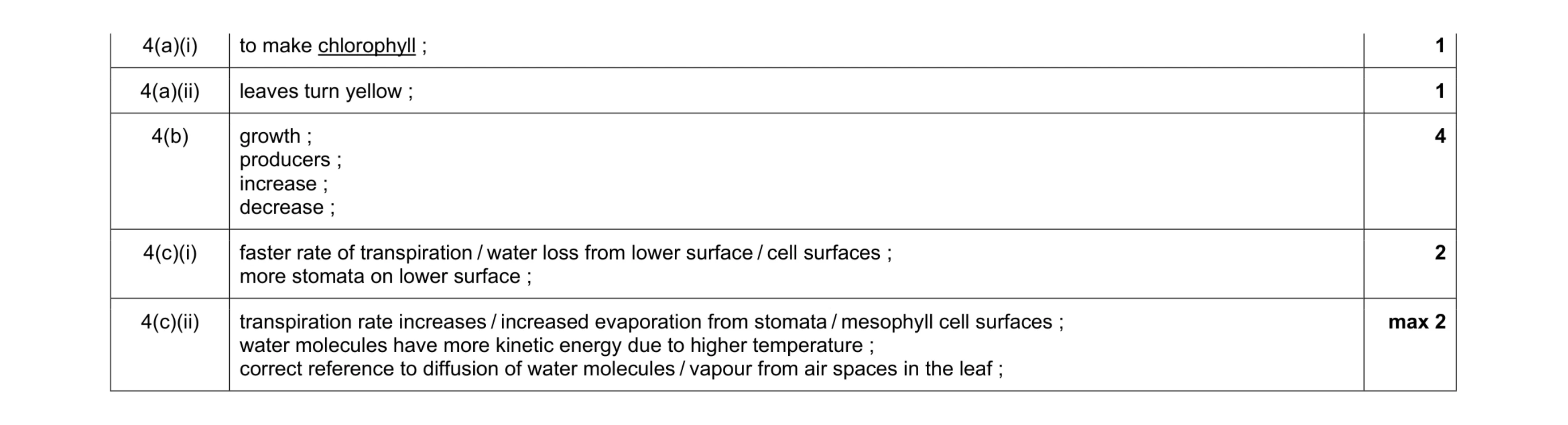 10
10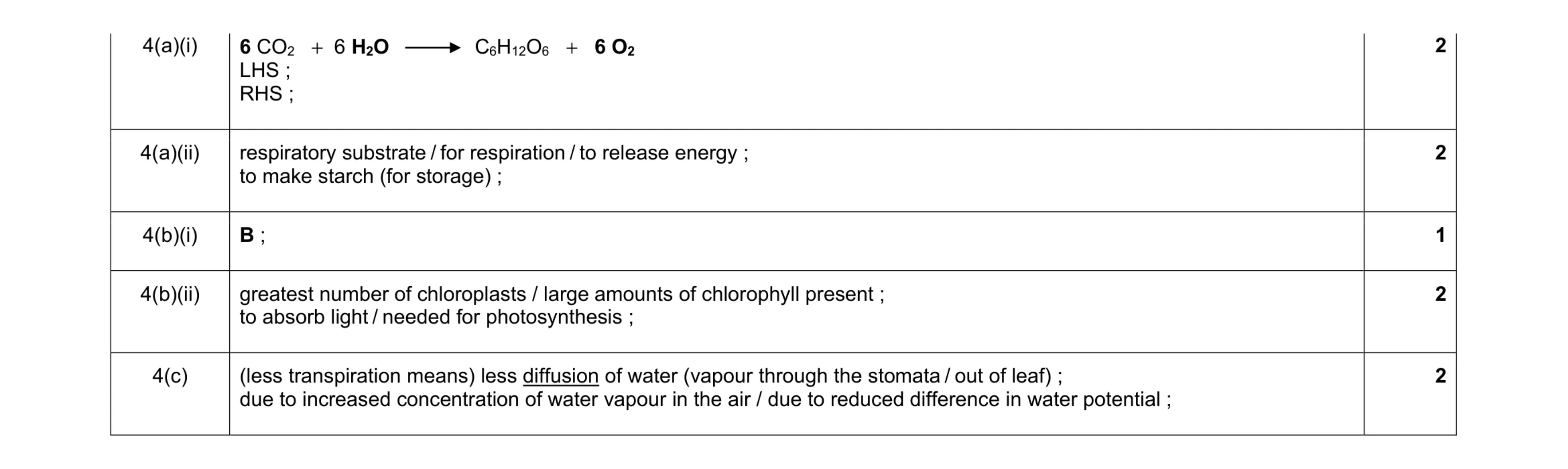 9
9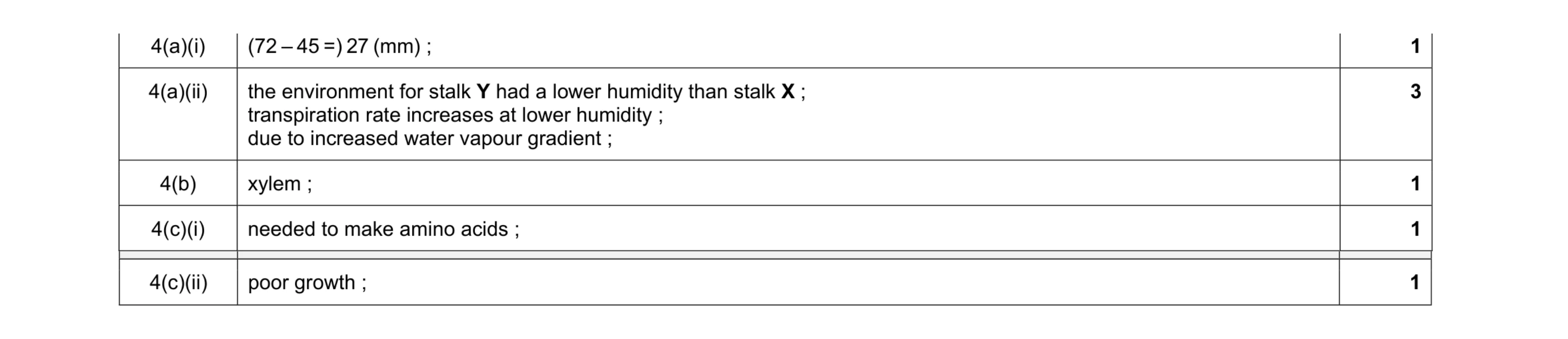 7
7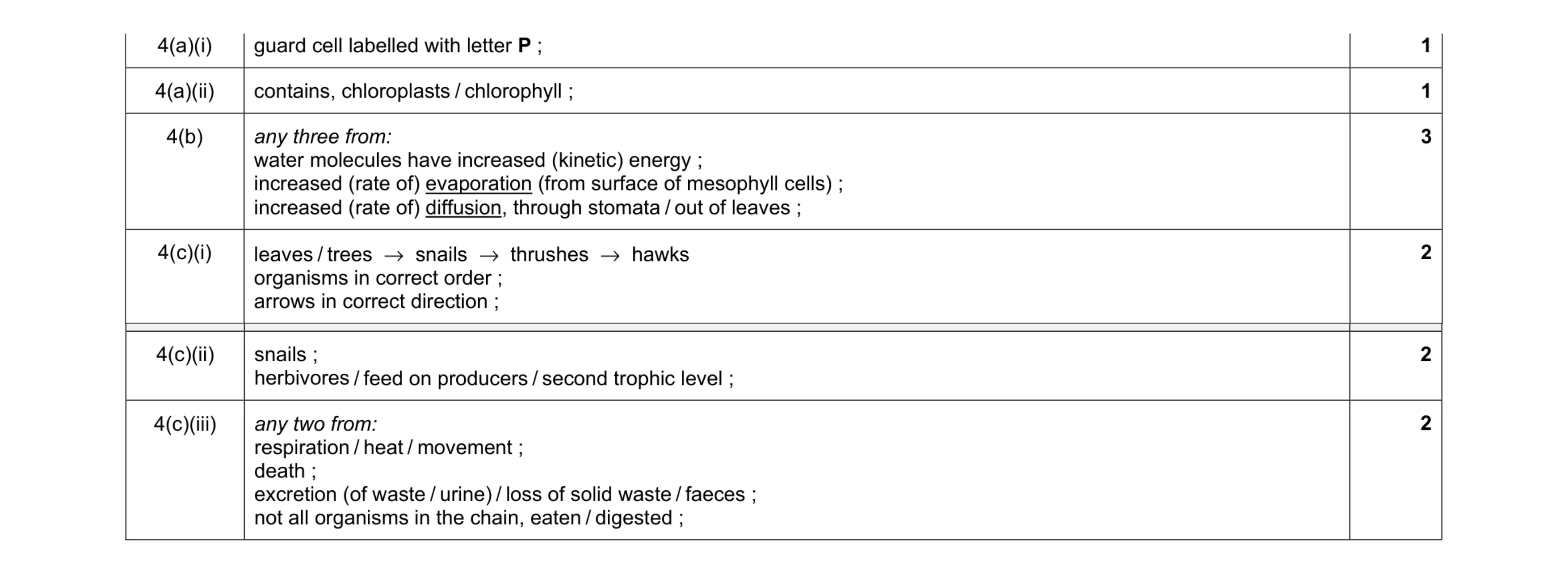 11
11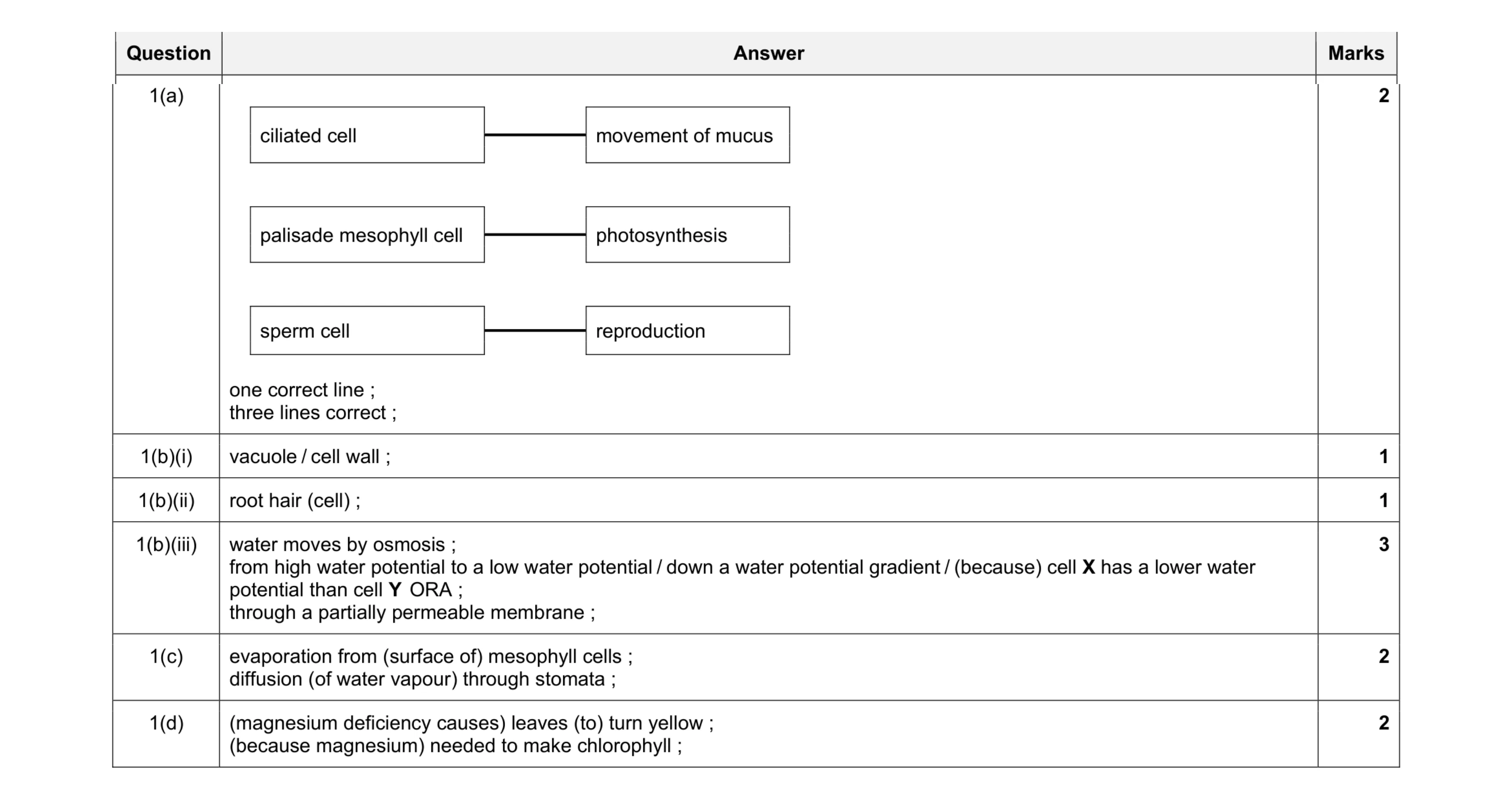 11
11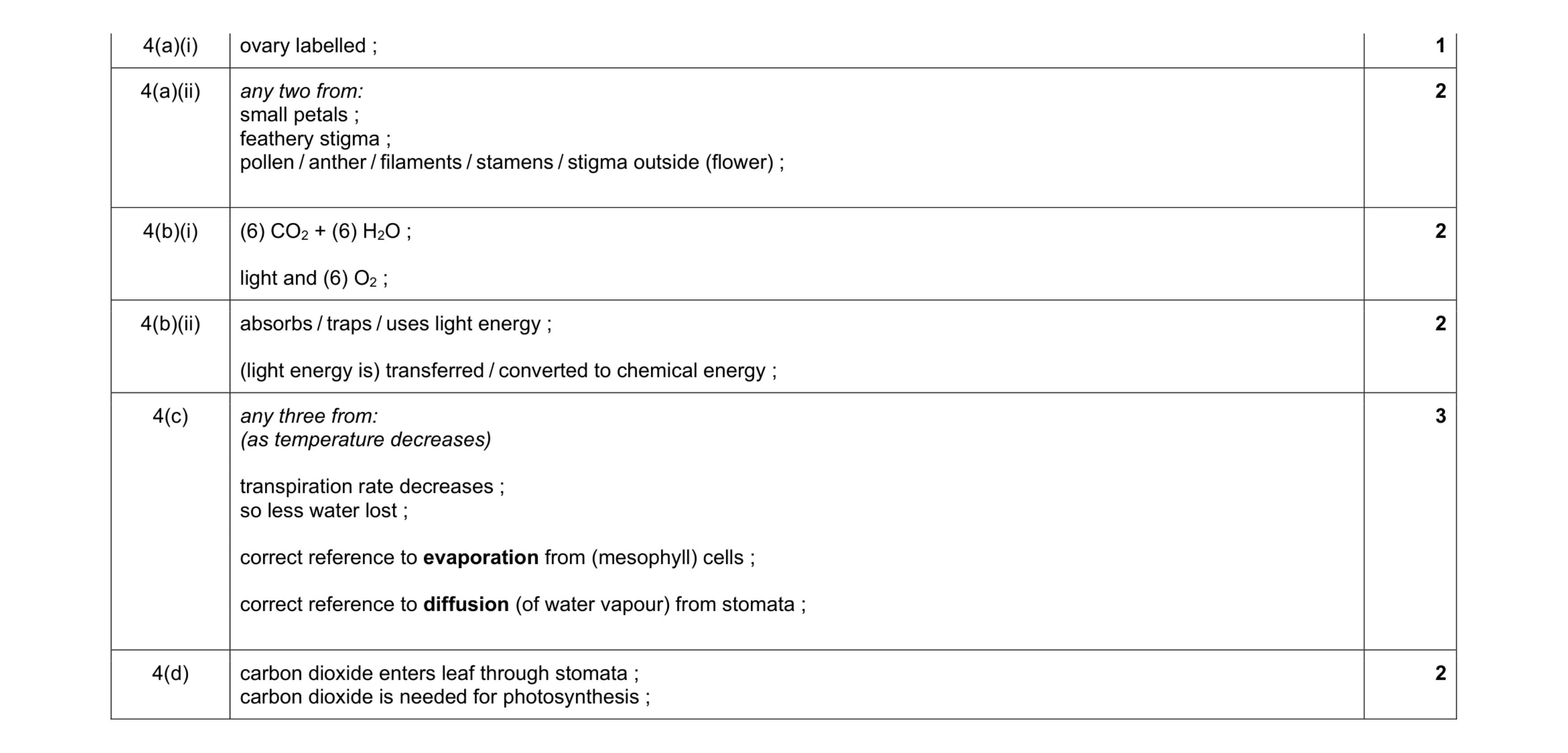 12
12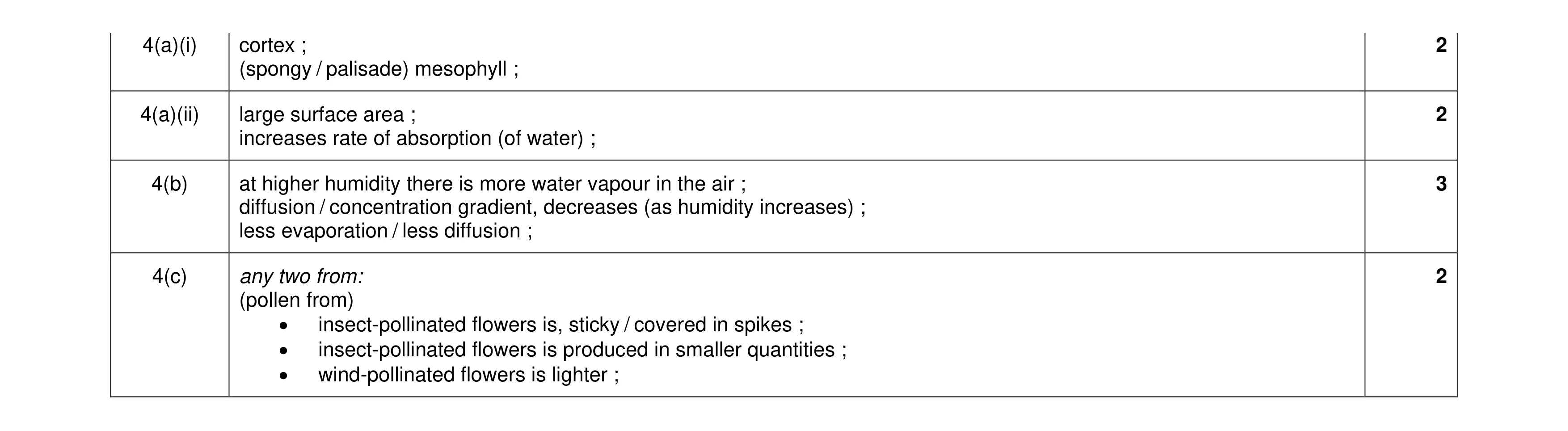 9
9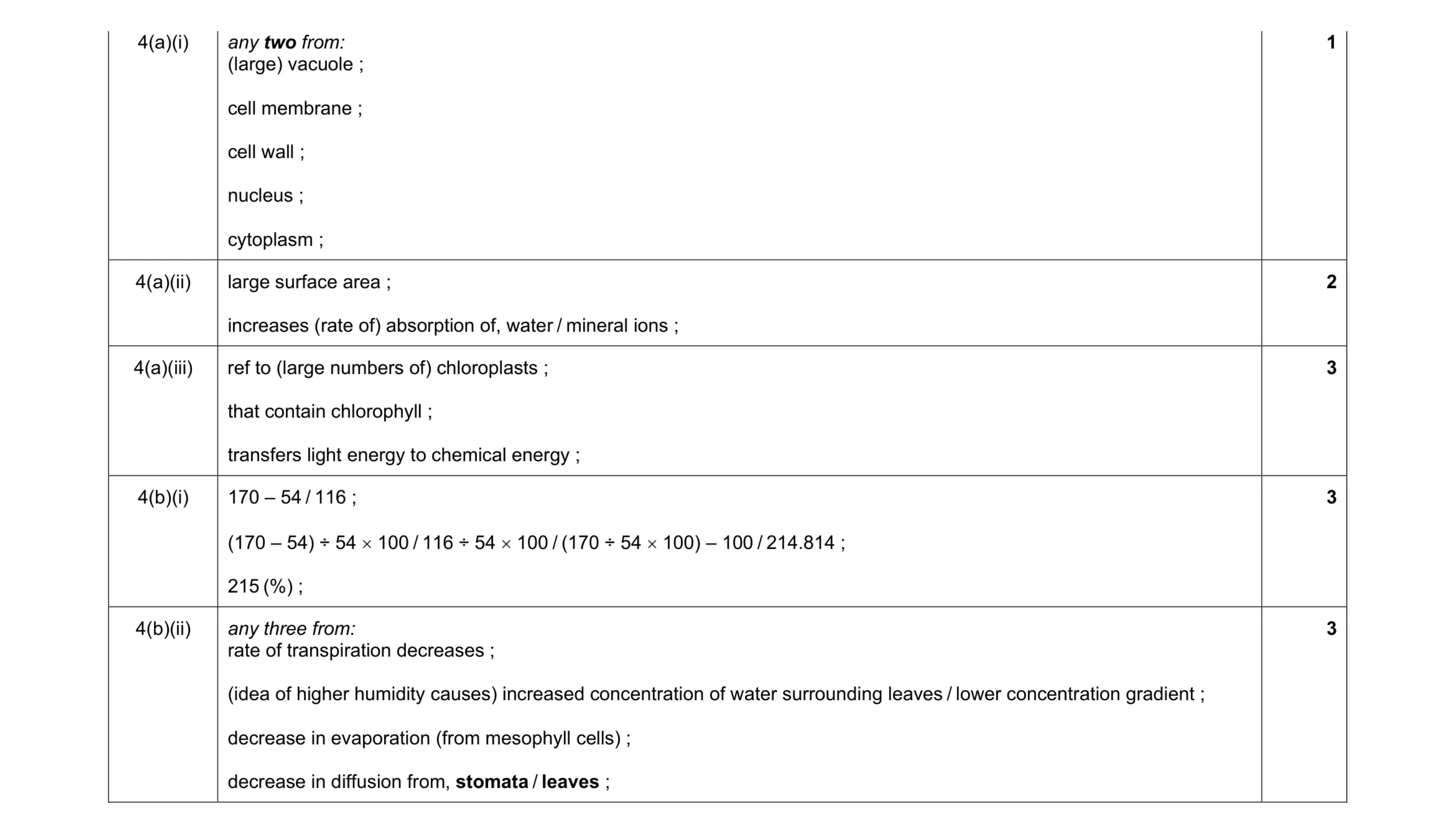 12
12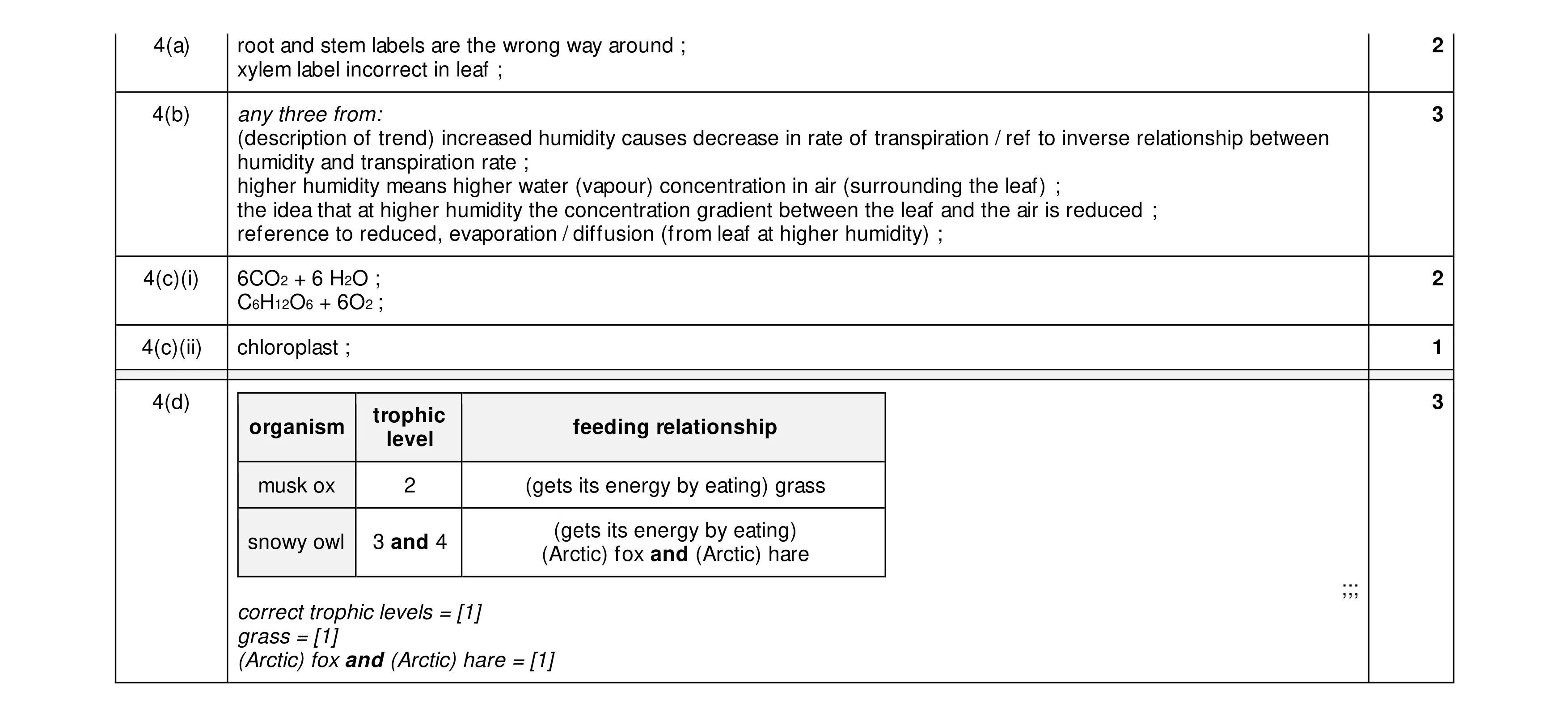 11
11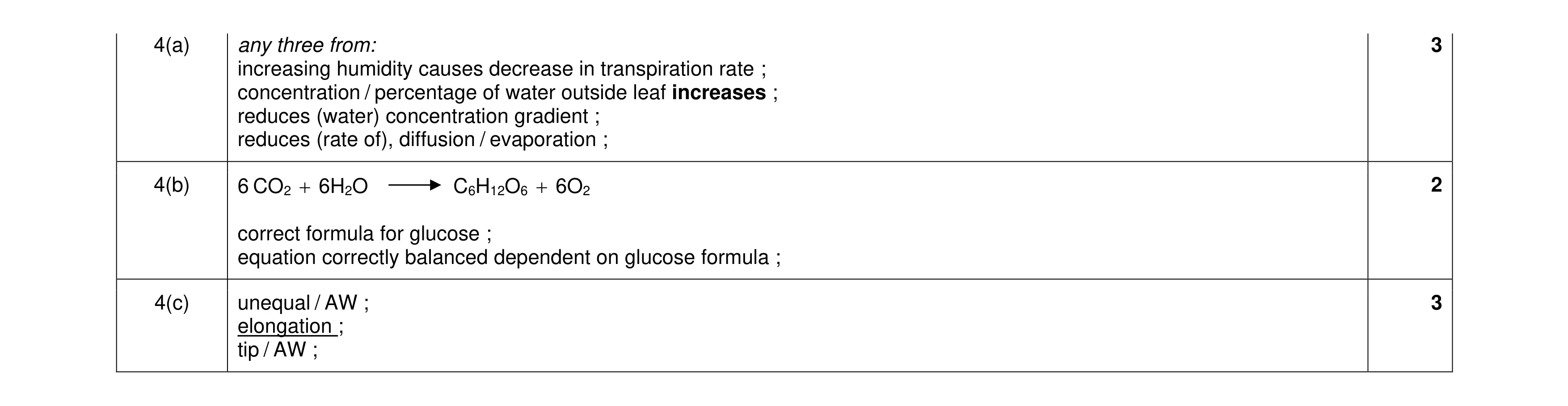 8
8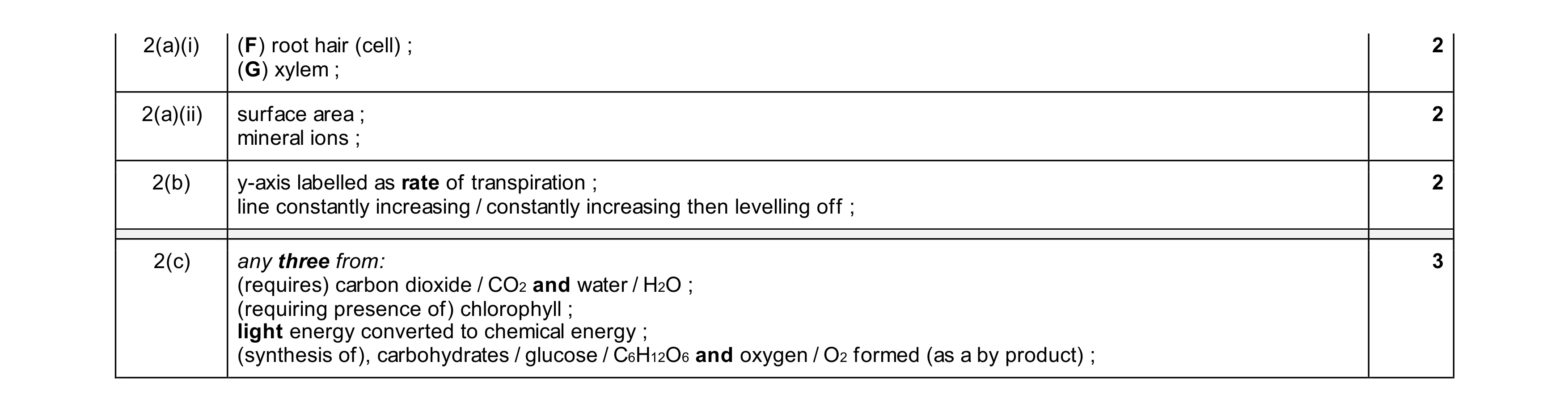 9
9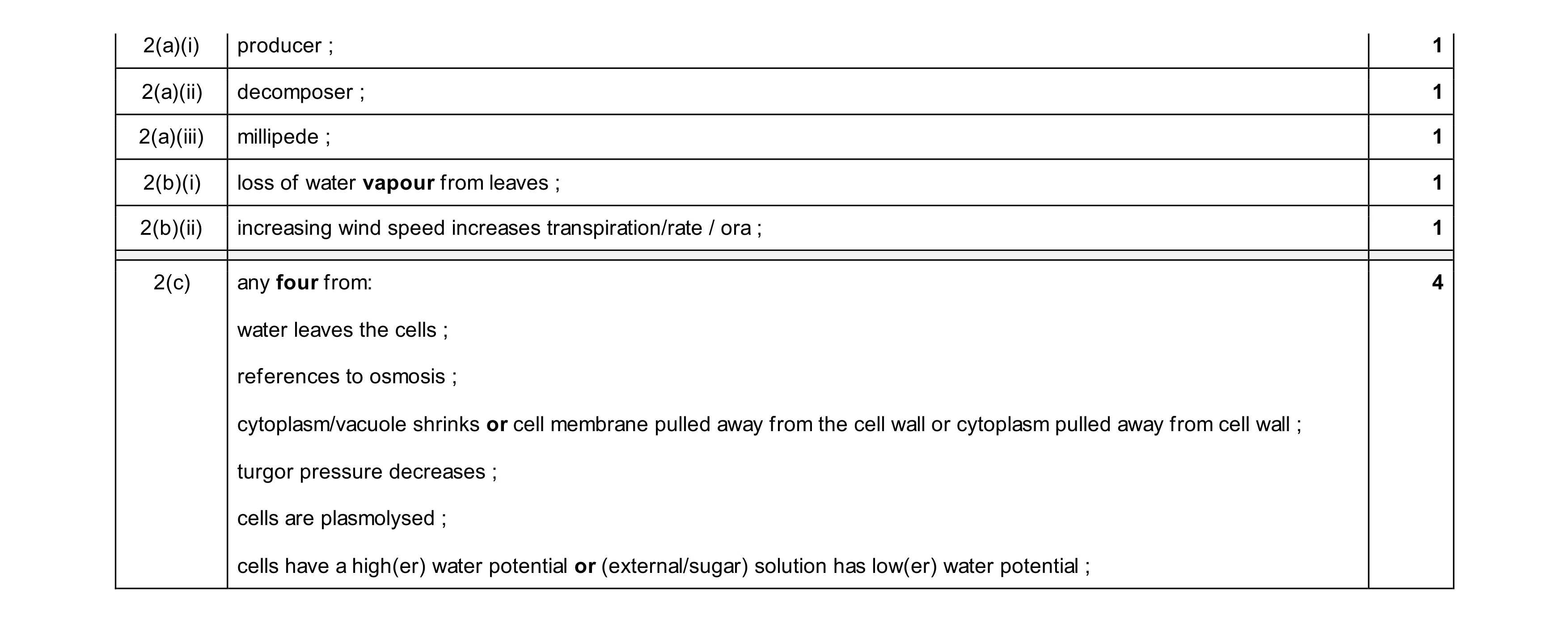 9
9