Questions as text
Q1 · Use lines to connect the box on the left to different boxes on the right to make correct… 0653/32 May/June 2017
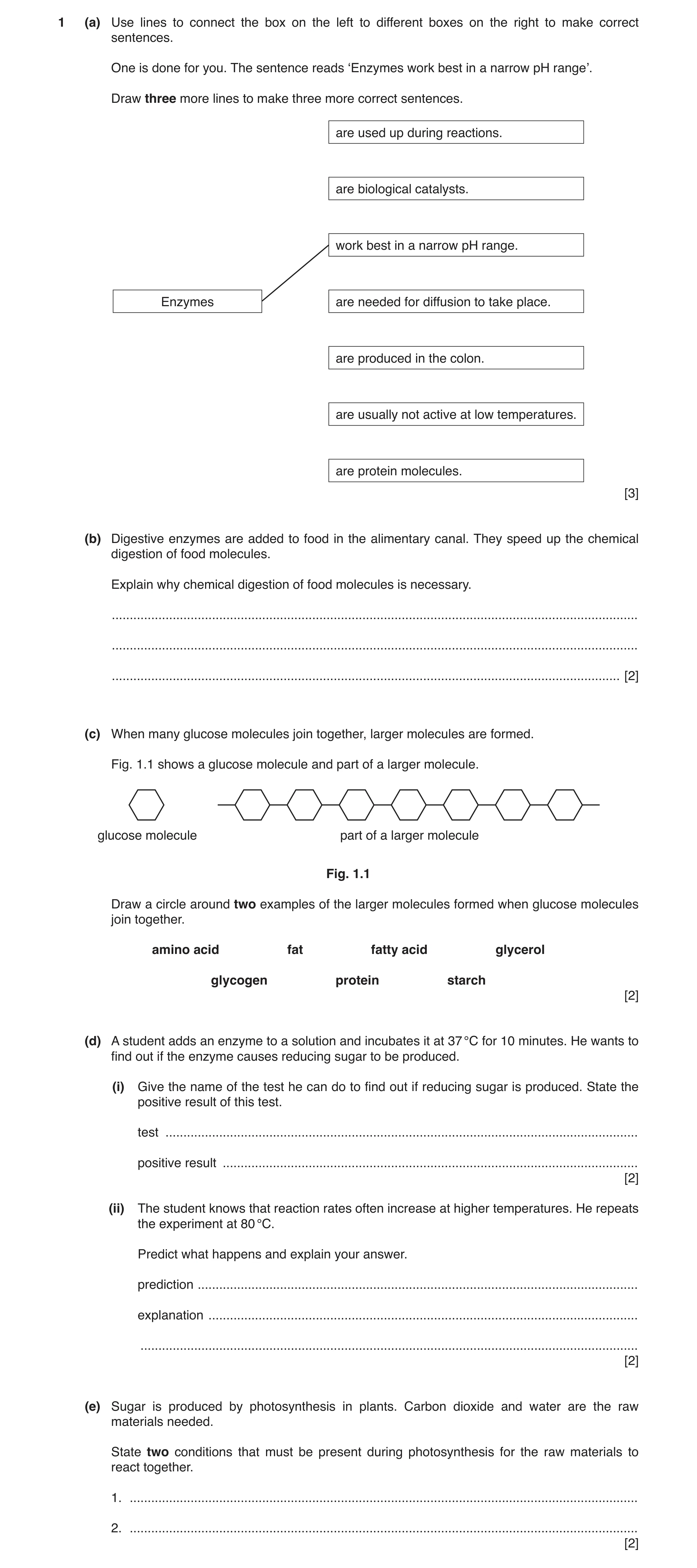
1 (a) Use lines to connect the box on the left to different boxes on the right to make correct sentences. One is done for you. The sentence reads ‘Enzymes work best in a narrow pH range’. Draw three more lines to make three more correct sentences. are used up during reactions. are biological catalysts. work best in a narrow pH range. Enzymes are needed for diffusion to take place. are produced in the colon. are usually not active at low temperatures. are protein molecules. [3] (b) Digestive enzymes are added to food in the alimentary canal. They speed up the chemical digestion of food molecules. Explain why chemical digestion of food molecules is necessary. … … … [2] (c) When many glucose molecules join together, larger molecules are formed. Fig. 1.1 shows a glucose molecule and part of a larger molecule. glucose molecule part of a larger molecule Fig. 1.1 Draw a circle around two examples of the larger molecules formed when glucose molecules join together. amino acid fat fatty acid glycerol glycogen protein starch [2] (d) A student adds an enzyme to a solution and incubates it at 37 °C for 10 minutes. He wants to find out if the enzyme causes reducing sugar to be produced. (i) Give the name of the test he can do to find out if reducing sugar is produced. State the positive result of this test. test … positive result … [2] (ii) The student knows that reaction rates often increase at higher temperatures. He repeats the experiment at 80 °C. Predict what happens and explain your answer. prediction … explanation … … [2] (e) Sugar is produced by photosynthesis in plants. Carbon dioxide and water are the raw materials needed. State two conditions that must be present during photosynthesis for the raw materials to react together. 1. … 2. … [2]
13 marks
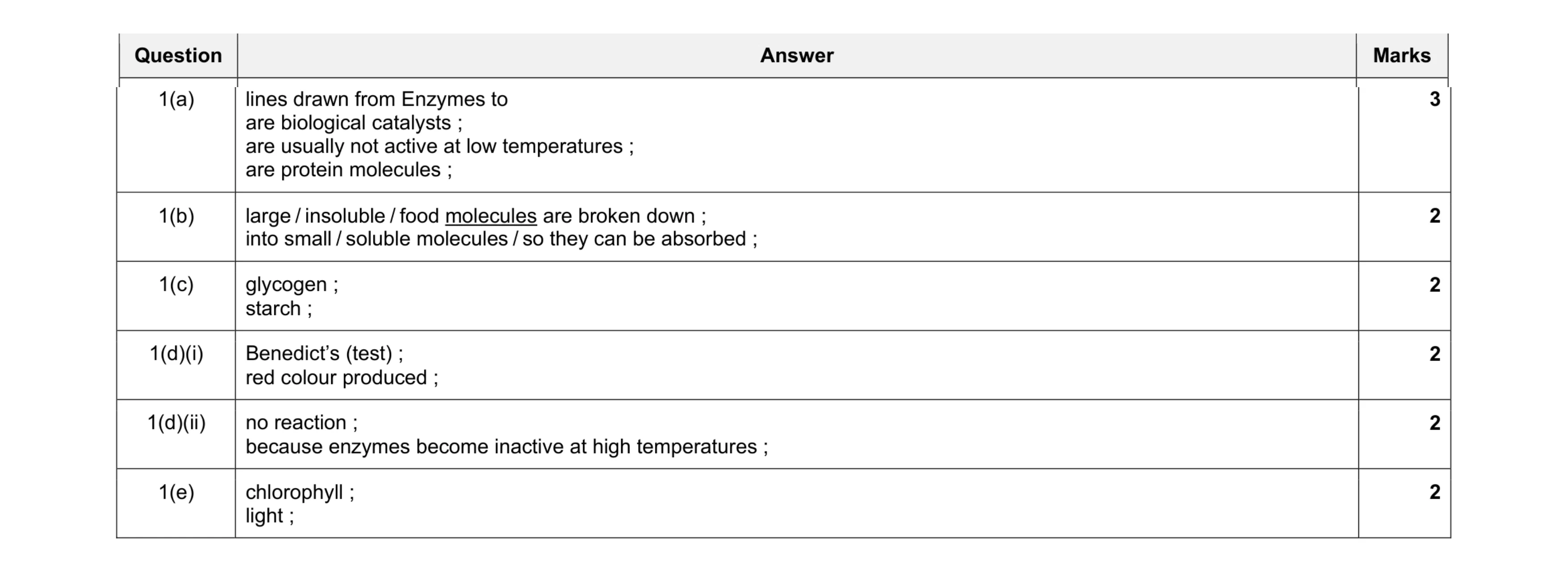
Mark scheme: 1(a) lines drawn from Enzymes to are biological catalysts ; are usually not active at low temperatures ; are protein molecules ; 3 1(b) large / insoluble / food molecules are broken down ; into small / soluble molecules / so they can be absorbed ; 2 1(c) glycogen ; starch ; 2 1(d)(i) Benedict’s (test) ; red colour produced ; 2 1(d)(ii) no reaction ; because enzymes become inactive at high temperatures ; 2 1(e) chlorophyll ; light ; 2
This question in 0653/32 May/June 2017
Q2 · Use lines to connect the box on the left to different boxes on the right to make correct… 0653/33 May/June 2017
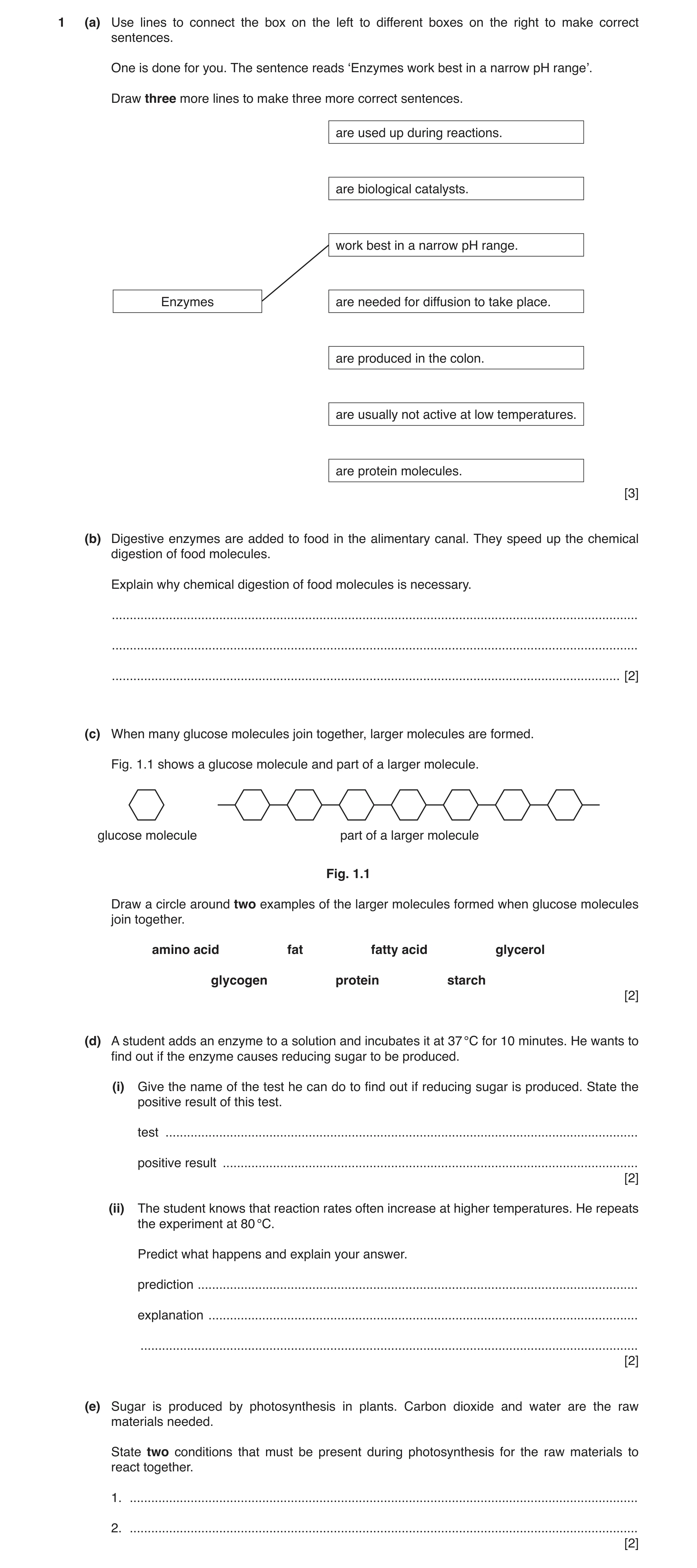
1 (a) Use lines to connect the box on the left to different boxes on the right to make correct sentences. One is done for you. The sentence reads ‘Enzymes work best in a narrow pH range’. Draw three more lines to make three more correct sentences. are used up during reactions. are biological catalysts. work best in a narrow pH range. Enzymes are needed for diffusion to take place. are produced in the colon. are usually not active at low temperatures. are protein molecules. [3] (b) Digestive enzymes are added to food in the alimentary canal. They speed up the chemical digestion of food molecules. Explain why chemical digestion of food molecules is necessary. … … … [2] (c) When many glucose molecules join together, larger molecules are formed. Fig. 1.1 shows a glucose molecule and part of a larger molecule. glucose molecule part of a larger molecule Fig. 1.1 Draw a circle around two examples of the larger molecules formed when glucose molecules join together. amino acid fat fatty acid glycerol glycogen protein starch [2] (d) A student adds an enzyme to a solution and incubates it at 37 °C for 10 minutes. He wants to find out if the enzyme causes reducing sugar to be produced. (i) Give the name of the test he can do to find out if reducing sugar is produced. State the positive result of this test. test … positive result … [2] (ii) The student knows that reaction rates often increase at higher temperatures. He repeats the experiment at 80 °C. Predict what happens and explain your answer. prediction … explanation … … [2] (e) Sugar is produced by photosynthesis in plants. Carbon dioxide and water are the raw materials needed. State two conditions that must be present during photosynthesis for the raw materials to react together. 1. … 2. … [2]
13 marks
Mark scheme: 1(a) lines drawn from Enzymes to are biological catalysts ; are usually not active at low temperatures ; are protein molecules ; 3 1(b) large / insoluble / food molecules are broken down ; into small / soluble molecules / so they can be absorbed ; 2 1(c) glycogen ; starch ; 2 1(d)(i) Benedict’s (test) ; red colour produced ; 2 1(d)(ii) no reaction ; because enzymes become inactive at high temperatures ; 2 1(e) chlorophyll ; light ; 2
This question in 0653/33 May/June 2017
Q3 · A giant panda which lives in bamboo forests in China 0653/32 Feb/March 2018
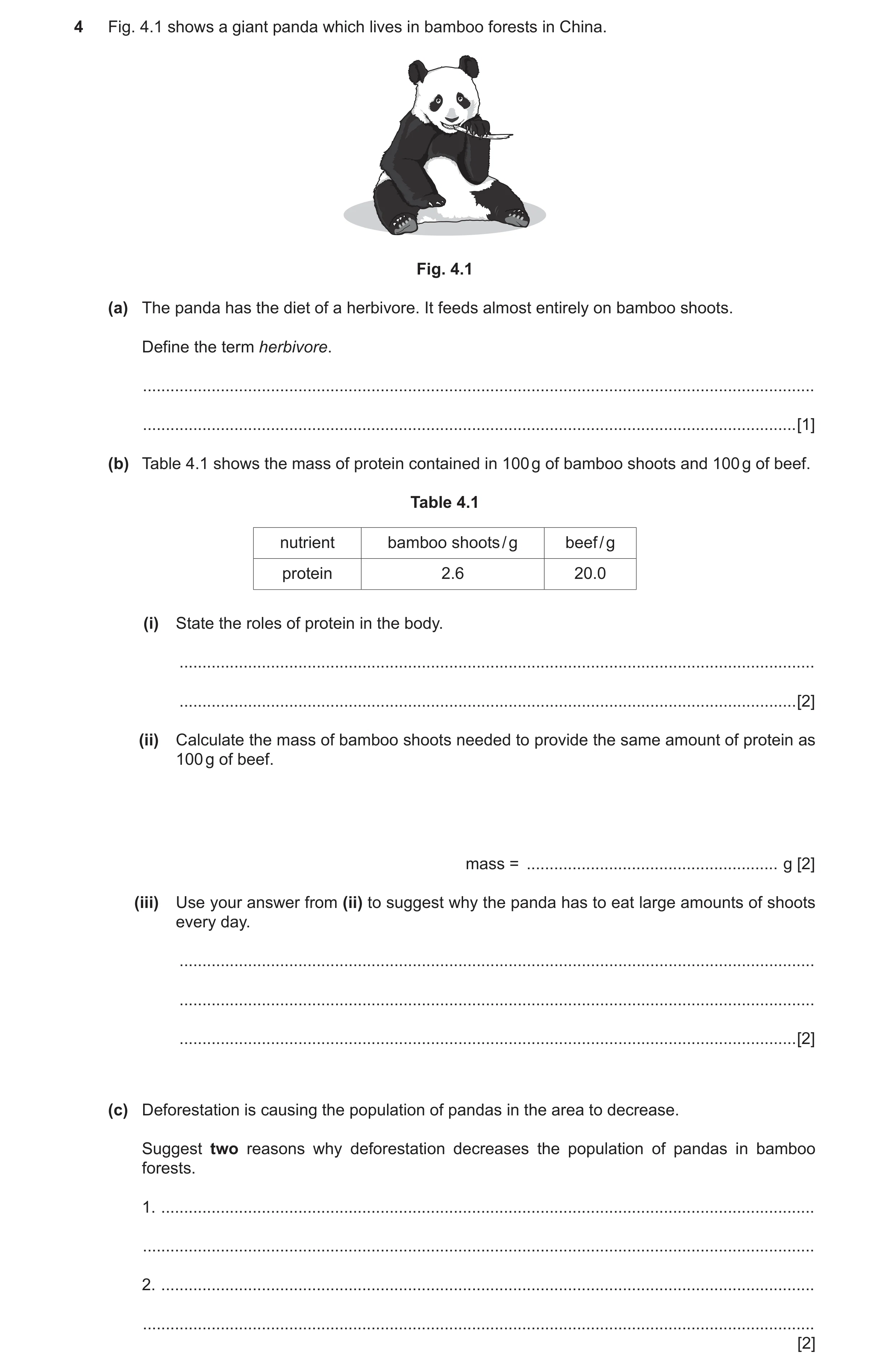
4 Fig. 4.1 shows a giant panda which lives in bamboo forests in China. Fig. 4.1 (a) The panda has the diet of a herbivore. It feeds almost entirely on bamboo shoots. Define the term herbivore. … … [1] (b) Table 4.1 shows the mass of protein contained in 100 g of bamboo shoots and 100 g of beef. Table 4.1 nutrient bamboo shoots / g beef / g protein 2.6 20.0 (i) State the roles of protein in the body. … … [2] (ii) Calculate the mass of bamboo shoots needed to provide the same amount of protein as 100 g of beef. mass = … g [2] (iii) Use your answer from (ii) to suggest why the panda has to eat large amounts of shoots every day. … … … [2] (c) Deforestation is causing the population of pandas in the area to decrease. Suggest two reasons why deforestation decreases the population of pandas in bamboo forests. 1. … … 2. … … [2]
9 marks
Mark scheme: 4(a) an animal that gets its energy / feeds only on plants ; 1 4(b)(i) growth (of tissues) ; repair (of tissues) ; 2 4(b)(ii) 20.0 / 2.6 ; ×100 = 770 ; 2 4(b)(iii) the bamboo does not contain much protein / nutrition ; a lot needed to satisfy need / panda needs a lot because it is big ; 2 4(c) only food supply disappearing ; danger of loss of habitat ; more difficult to find a mate ; max 2
This question in 0653/32 Feb/March 2018
Q4 · Substances in food can be identified using test solutions 0653/31 May/June 2018
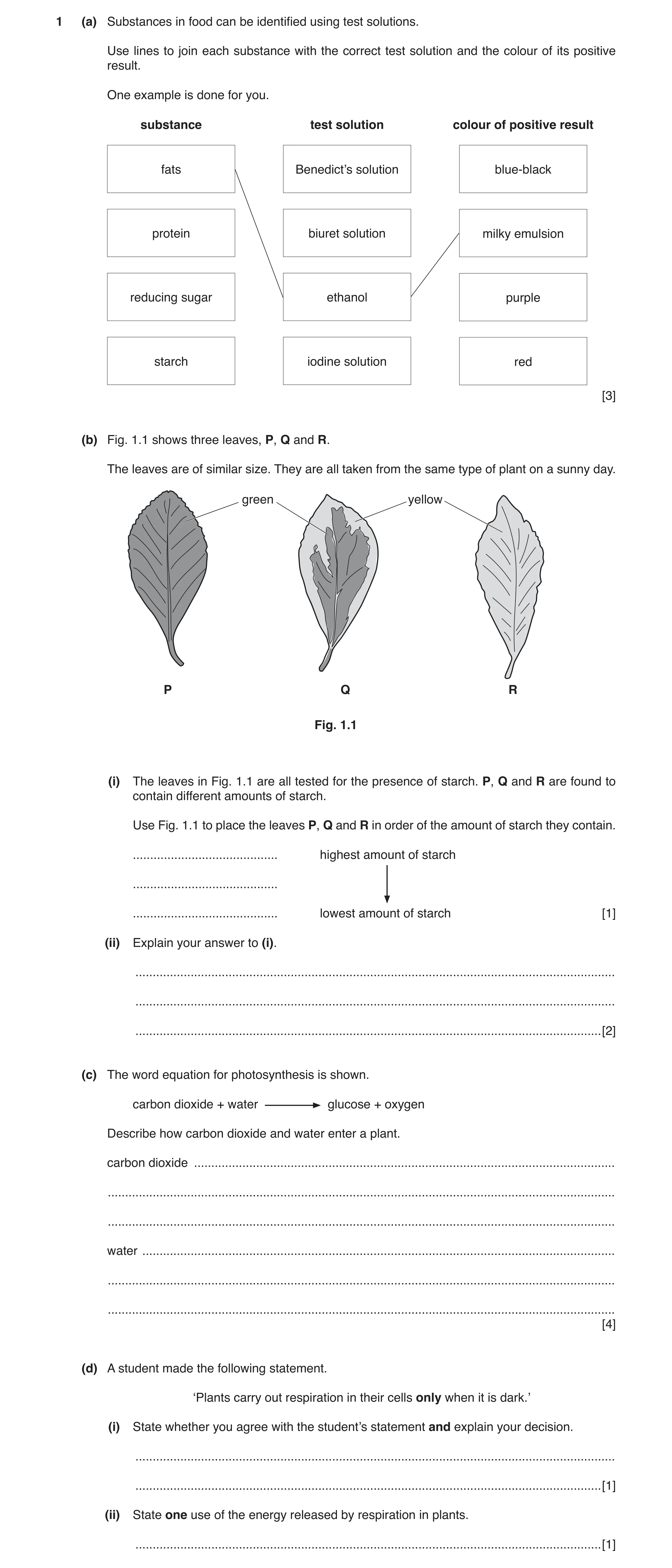
1 (a) Substances in food can be identified using test solutions. Use lines to join each substance with the correct test solution and the colour of its positive result. One example is done for you. substance test solution colour of positive result fats Benedict’s solution blue‑black protein biuret solution milky emulsion reducing sugar ethanol purple starch iodine solution red [3] (b) Fig. 1.1 shows three leaves, P, Q and R. The leaves are of similar size. They are all taken from the same type of plant on a sunny day. green yellow P Q R Fig. 1.1 (i) The leaves in Fig. 1.1 are all tested for the presence of starch. P, Q and R are found to contain different amounts of starch. Use Fig. 1.1 to place the leaves P, Q and R in order of the amount of starch they contain. … highest amount of starch … … lowest amount of starch [1] (ii) Explain your answer to (i). … … … [2] (c) The word equation for photosynthesis is shown. carbon dioxide + water glucose + oxygen Describe how carbon dioxide and water enter a plant. carbon dioxide … … … water … … … [4] (d) A student made the following statement. ‘Plants carry out respiration in their cells only when it is dark.’ (i) State whether you agree with the student’s statement and explain your decision. … … [1] (ii) State one use of the energy released by respiration in plants. … [1]
12 marks
Mark scheme: 1(a) boxes connected as shown fats Benedict’s solution blue / black protein biuret solution milky emulsion reducing sugar ethanol purple starch iodine solution red ;;; 1 mark for each 2 correct lines 3 1(b)(i) P,Q and R in the correct order ; 1 1(b)(ii) green areas contain chlorophyll ; reference to photosynthesis ; 2 1(c) (carbon doxide) through stomata ; by diffusion ; (water) through root hair cells; from the soil / ground / by diffusion ; 4 1(d)(i) false – no mark respiration takes place all the time / owtte ; 1 1(d)(ii) any one of protein synthesis ; cell division ; growth ; max1
This question in 0653/31 May/June 2018
Q5 · Diagrams of two plant cells as seen using a light microscope 0653/32 Feb/March 2019
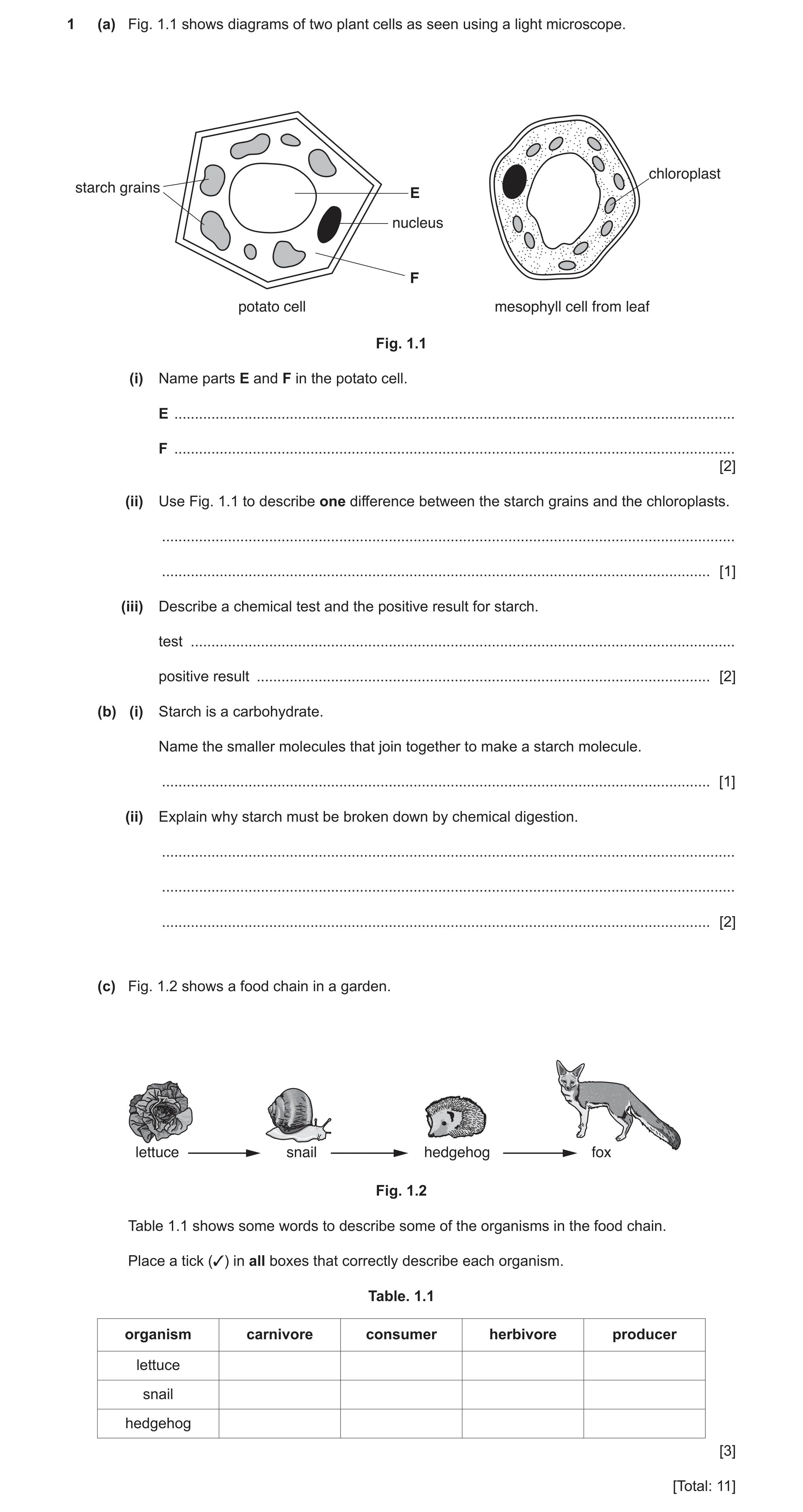
1 (a) Fig. 1.1 shows diagrams of two plant cells as seen using a light microscope. chloroplast starch grains E nucleus F potato cell mesophyll cell from leaf Fig. 1.1 (i) Name parts E and F in the potato cell. E … F … [2] (ii) Use Fig. 1.1 to describe one difference between the starch grains and the chloroplasts. … … [1] (iii) Describe a chemical test and the positive result for starch. test … positive result … [2] (b) (i) Starch is a carbohydrate. Name the smaller molecules that join together to make a starch molecule. … [1] (ii) Explain why starch must be broken down by chemical digestion. … … … [2] (c) Fig. 1.2 shows a food chain in a garden. lettuce snail hedgehog fox Fig. 1.2 Table 1.1 shows some words to describe some of the organisms in the food chain. Place a tick (✓) in all boxes that correctly describe each organism. Table. 1.1 organism carnivore consumer herbivore producer lettuce snail hedgehog [3] [Total: 11]
11 marks
Mark scheme: 1(a)(i) (E) vacuole ; (F) cytoplasm ; 2 1(a)(ii) starch grains irregular shapes / sizes and chlorophyll all the same shapes / sizes ; 1 1(a)(iii) add iodine solution ; goes blue-black ; 2 1(b)(i) glucose ; 1 1(b)(ii) produces small molecules ; that can be absorbed ; 2 1(c) one mark for each correct line organism carnivore consumer herbivore producer lettuce 3 snail 3 3 hedgehog 3 3 ; ; ; 3
This question in 0653/32 Feb/March 2019
Q6 · When a banana is peeled the exposed surface turns from white to brown, as shown in Fig 0653/32 May/June 2019
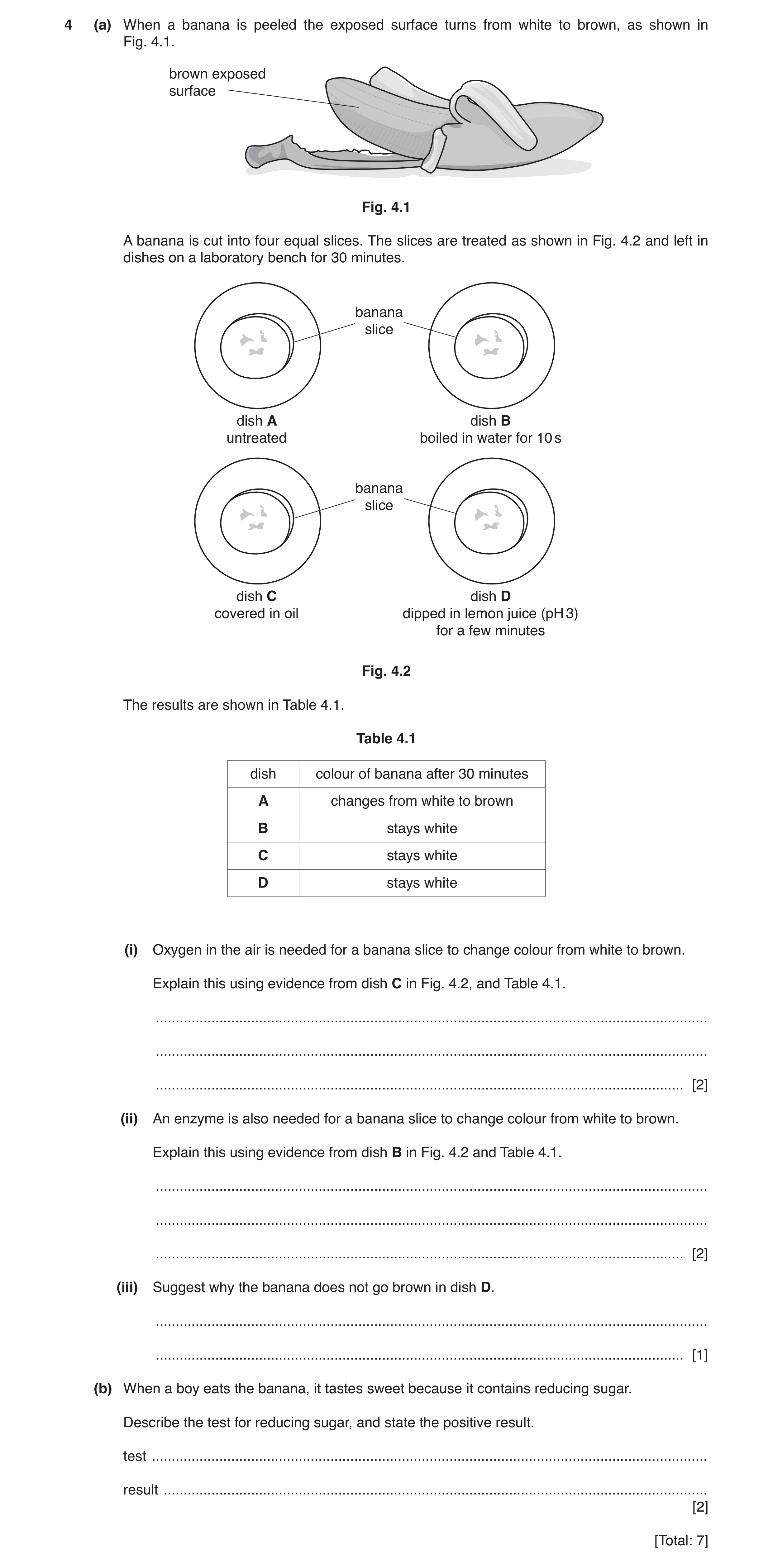
4 (a) When a banana is peeled the exposed surface turns from white to brown, as shown in Fig. 4.1. brown exposed surface Fig. 4.1 A banana is cut into four equal slices. The slices are treated as shown in Fig. 4.2 and left in dishes on a laboratory bench for 30 minutes. banana slice dish A dish B untreated boiled in water for 10 s banana slice dish C dish D covered in oil dipped in lemon juice (pH 3) for a few minutes Fig. 4.2 The results are shown in Table 4.1. Table 4.1 dish colour of banana after 30 minutes A changes from white to brown B stays white C stays white D stays white (i) Oxygen in the air is needed for a banana slice to change colour from white to brown. Explain this using evidence from dish C in Fig. 4.2, and Table 4.1. … … … [2] (ii) An enzyme is also needed for a banana slice to change colour from white to brown. Explain this using evidence from dish B in Fig. 4.2 and Table 4.1. … … … [2] (iii) Suggest why the banana does not go brown in dish D. … … [1] (b) When a boy eats the banana, it tastes sweet because it contains reducing sugar. Describe the test for reducing sugar, and state the positive result. test … result … [2] [Total: 7]
7 marks
Mark scheme: 4(a)(i) banana stay white / colour remains unchanged ; oil prevents / blocks / stops / provides a barrier to oxygen / air (from reaching the banana) ; 2 4(a)(ii) boiling / heat / high temperature affects the enzyme ; makes the enzyme inactive / destroys the enzyme / can’t speed up the reaction ; 2 4(a)(iii) acidic / acid ; 1 4(b) add Benedict’s solution (and heat); (Benedict’s solution) goes red ; 2
This question in 0653/32 May/June 2019
Q7 · A cross-section of a leaf as viewed under a microscope 0653/32 Feb/March 2020
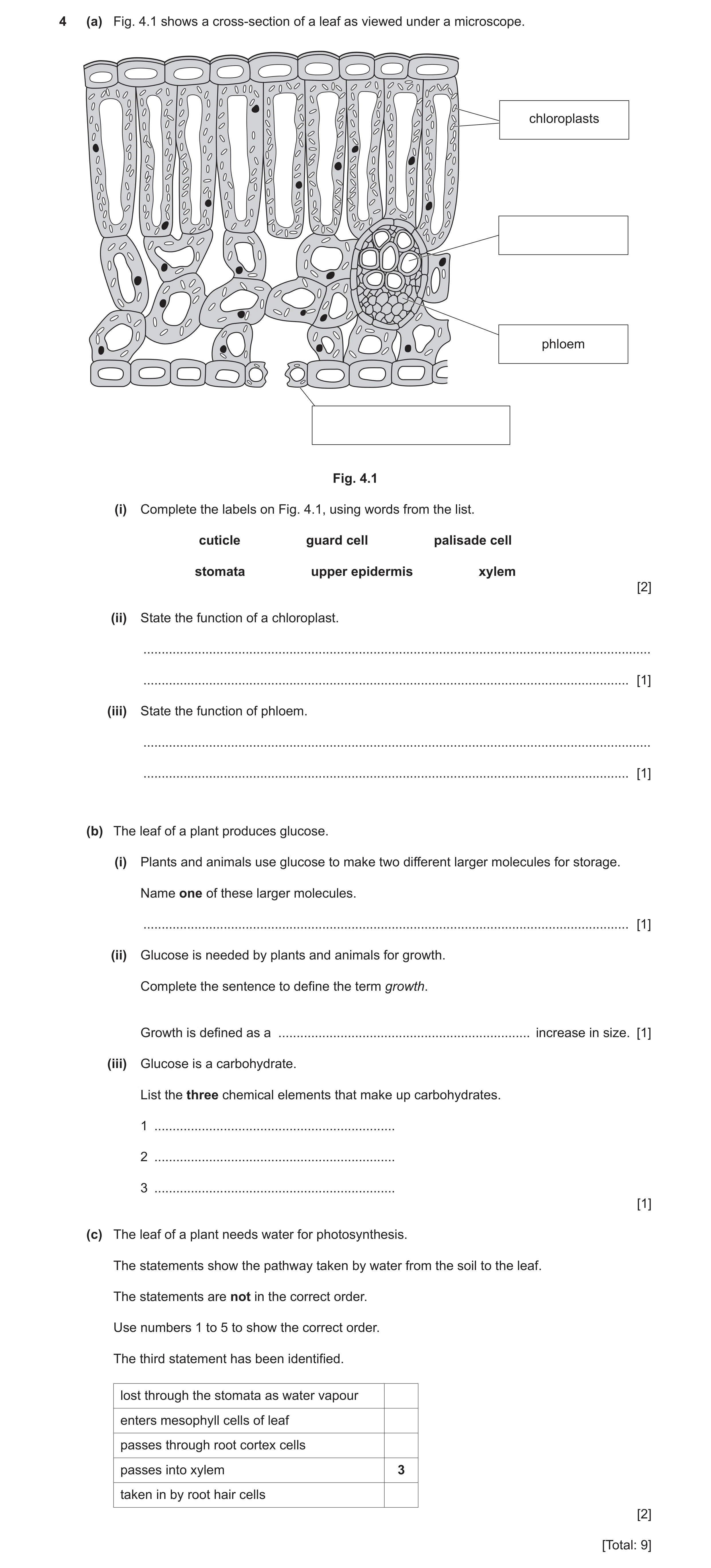
4 (a) Fig. 4.1 shows a cross-section of a leaf as viewed under a microscope. chloroplasts phloem Fig. 4.1 (i) Complete the labels on Fig. 4.1, using words from the list. cuticle guard cell palisade cell stomata upper epidermis xylem [2] (ii) State the function of a chloroplast. … … [1] (iii) State the function of phloem. … … [1] (b) The leaf of a plant produces glucose. (i) Plants and animals use glucose to make two different larger molecules for storage. Name one of these larger molecules. … [1] (ii) Glucose is needed by plants and animals for growth. Complete the sentence to define the term growth. Growth is defined as a … increase in size. [1] (iii) Glucose is a carbohydrate. List the three chemical elements that make up carbohydrates. 1 … 2 … 3 … [1] (c) The leaf of a plant needs water for photosynthesis. The statements show the pathway taken by water from the soil to the leaf. The statements are not in the correct order. Use numbers 1 to 5 to show the correct order. The third statement has been identified. lost through the stomata as water vapour enters mesophyll cells of leaf passes through root cortex cells passes into xylem 3 taken in by root hair cells [2] [Total: 9]
9 marks
Mark scheme: 4(a)(i) (top) xylem ; (bottom) guard cell ; 2 4(a)(ii) photosynthesis ; 1 4(a)(iii) transport sugars / transport sucrose ; 1 4(b)(i) starch / glycogen ; 1 4(b)(ii) permanent ; 1 4(b)(iii) carbon AND hydrogen AND oxygen ; 1 4(c) lost through the stomata as water vapour 5 enters mesophyll cells of leaf 4 passes though root cortex cells 2 passes into xylem (3) taken in by root hair cells 1 ;; all correct = 2 marks any two correct = 1 mark 2
This question in 0653/32 Feb/March 2020
Q8 · A graph showing the vitamin C content in 100 g of different foods 0653/31 May/June 2020
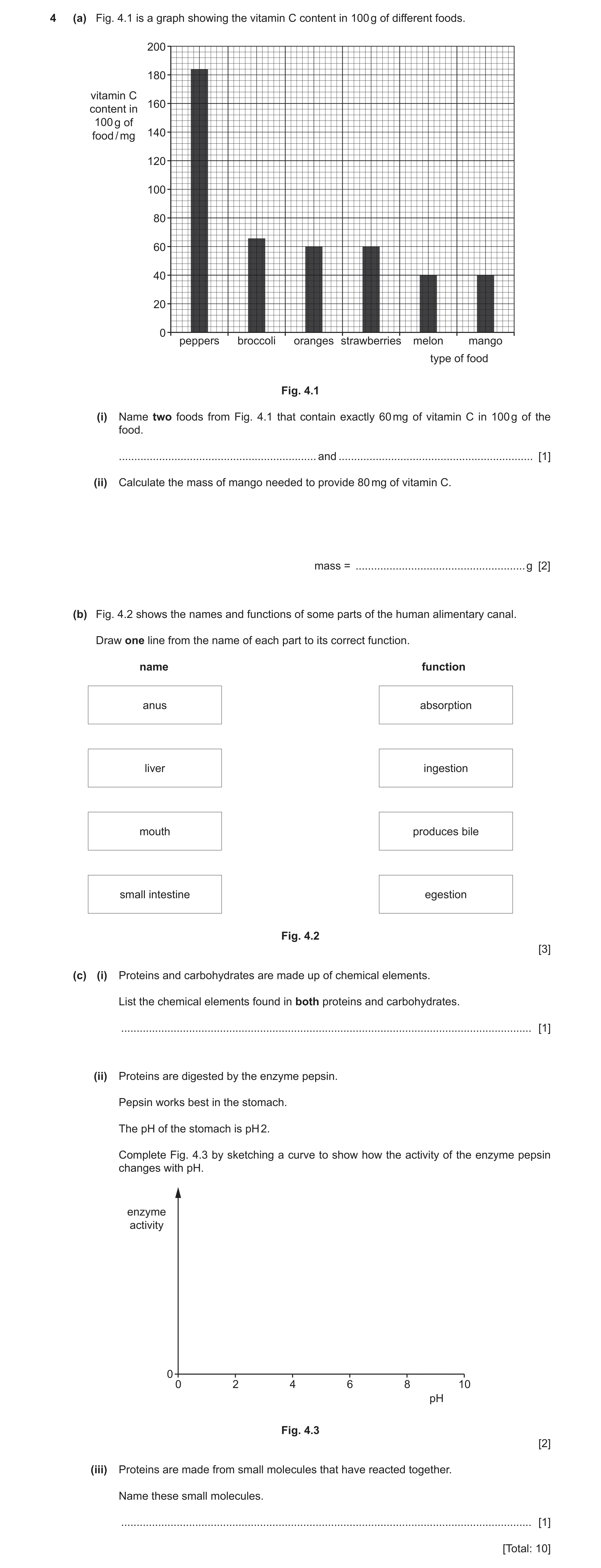
4 (a) Fig. 4.1 is a graph showing the vitamin C content in 100 g of different foods. 200 180 vitamin C 160 content in 100 g of food / mg 140 120 100 80 60 40 20 0 peppers broccoli oranges strawberries melon mango type of food Fig. 4.1 (i) Name two foods from Fig. 4.1 that contain exactly 60 mg of vitamin C in 100 g of the food. … and … [1] (ii) Calculate the mass of mango needed to provide 80 mg of vitamin C. mass = … g [2] (b) Fig. 4.2 shows the names and functions of some parts of the human alimentary canal. Draw one line from the name of each part to its correct function. name function anus absorption liver ingestion mouth produces bile small intestine egestion Fig. 4.2 [3] (c) (i) Proteins and carbohydrates are made up of chemical elements. List the chemical elements found in both proteins and carbohydrates. … [1] (ii) Proteins are digested by the enzyme pepsin. Pepsin works best in the stomach. The pH of the stomach is pH 2. Complete Fig. 4.3 by sketching a curve to show how the activity of the enzyme pepsin changes with pH. enzyme activity 0 0 2 4 6 8 10 pH Fig. 4.3 [2] (iii) Proteins are made from small molecules that have reacted together. Name these small molecules. … [1] [Total: 10]
10 marks
Mark scheme: 4(a)(i) oranges AND strawberries ; 1 4(a)(ii) (mass =) 200 (g) ;; (if answer is incorrect then 100 80 40 × for one mark) 2 Question Answer Marks 4(b) anus absorption liver ingestion mouth produces bile small intestine egestion ;;; all 4 correct = 3 marks 2–3 correct = 2 marks 1 correct = 1 mark 3 4(c)(i) carbon AND oxygen AND hydrogen ; 1 4(c)(ii) line going up and coming back down ; peak / optimum, at pH 2; 2 4(c)(iii) amino acids ; 1
This question in 0653/31 May/June 2020
Q9 · The human alimentary canal and associated organs 0653/32 May/June 2020
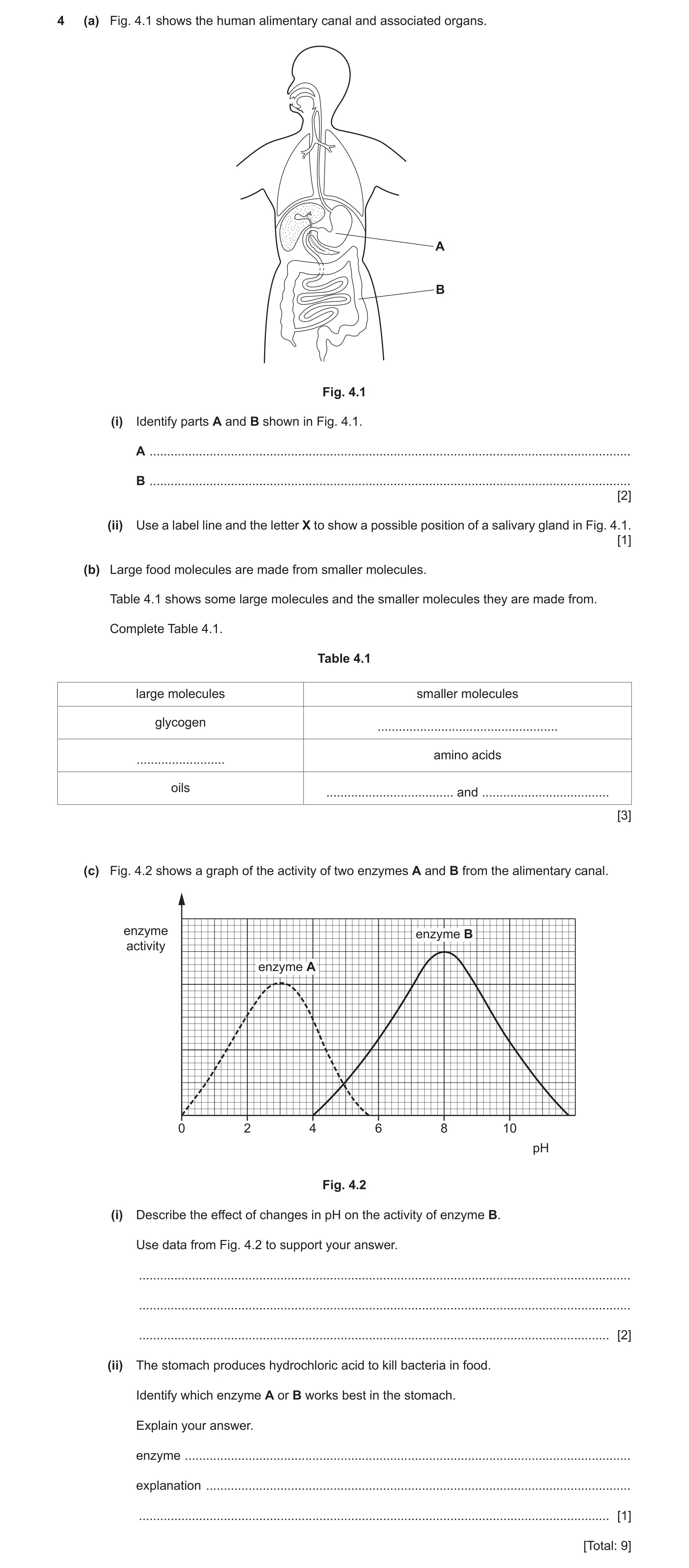
4 (a) Fig. 4.1 shows the human alimentary canal and associated organs. A B Fig. 4.1 (i) Identify parts A and B shown in Fig. 4.1. A … B … [2] (ii) Use a label line and the letter X to show a possible position of a salivary gland in Fig. 4.1. [1] (b) Large food molecules are made from smaller molecules. Table 4.1 shows some large molecules and the smaller molecules they are made from. Complete Table 4.1. Table 4.1 large molecules smaller molecules glycogen … amino acids … oils … and … [3] (c) Fig. 4.2 shows a graph of the activity of two enzymes A and B from the alimentary canal. enzyme enzyme B activity enzyme A 0 2 4 6 8 10 pH Fig. 4.2 (i) Describe the effect of changes in pH on the activity of enzyme B. Use data from Fig. 4.2 to support your answer. … … … [2] (ii) The stomach produces hydrochloric acid to kill bacteria in food. Identify which enzyme A or B works best in the stomach. Explain your answer. enzyme … explanation … … [1] [Total: 9]
9 marks
Mark scheme: 4(a)(i) A stomach ; B large intestine ; 2 4(a)(ii) label line to salivary gland area ; 1 4(b) glucose ; protein ; fatty acids and glycerol ; 3 4(c)(i) as pH increases enzyme activity increases then falls ; peaks at pH 8 ; 2 4(c)(ii) (enzyme) A (no mark) (explanation) enzyme A activity is higher, in acidic conditions / pH 2 ; 1
This question in 0653/32 May/June 2020
Q10 · A blue dye is dissolved in water to make a blue liquid 0653/32 Oct/Nov 2021
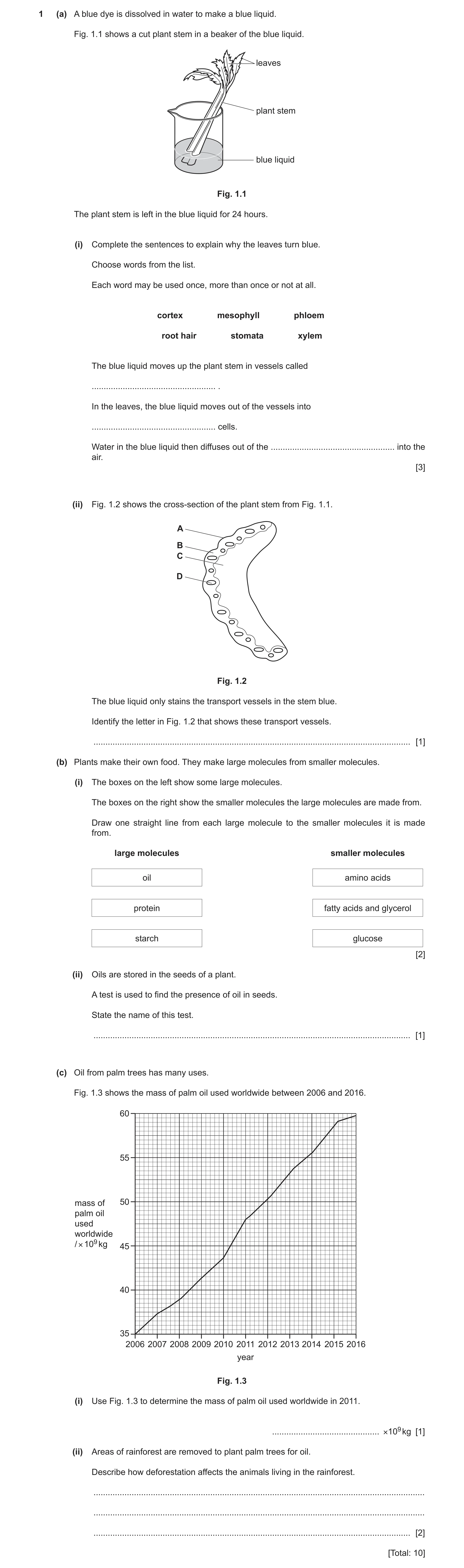
1 (a) A blue dye is dissolved in water to make a blue liquid. Fig. 1.1 shows a cut plant stem in a beaker of the blue liquid. leaves plant stem blue liquid Fig. 1.1 The plant stem is left in the blue liquid for 24 hours. (i) Complete the sentences to explain why the leaves turn blue. Choose words from the list. Each word may be used once, more than once or not at all. cortex mesophyll phloem root hair stomata xylem The blue liquid moves up the plant stem in vessels called … . In the leaves, the blue liquid moves out of the vessels into … cells. Water in the blue liquid then diffuses out of the … into the air. [3] (ii) Fig. 1.2 shows the cross-section of the plant stem from Fig. 1.1. A B C D Fig. 1.2 The blue liquid only stains the transport vessels in the stem blue. Identify the letter in Fig. 1.2 that shows these transport vessels. … [1] (b) Plants make their own food. They make large molecules from smaller molecules. (i) The boxes on the left show some large molecules. The boxes on the right show the smaller molecules the large molecules are made from. Draw one straight line from each large molecule to the smaller molecules it is made from. large molecules smaller molecules oil amino acids protein fatty acids and glycerol starch glucose [2] (ii) Oils are stored in the seeds of a plant. A test is used to find the presence of oil in seeds. State the name of this test. … [1] (c) Oil from palm trees has many uses. Fig. 1.3 shows the mass of palm oil used worldwide between 2006 and 2016. 60 55 mass of 50 palm oil used worldwide / × 109 kg 45 40 35 2006 2007 2008 2009 2010 2011 2012 2013 2014 2015 2016 year Fig. 1.3 (i) Use Fig. 1.3 to determine the mass of palm oil used worldwide in 2011. … ×109 kg [1] (ii) Areas of rainforest are removed to plant palm trees for oil. Describe how deforestation affects the animals living in the rainforest. … … … [2] [Total: 10]
10 marks
Mark scheme: 1(a)(i) xylem ; mesophyll ; stomata ; 3 1(a)(ii) D ; 1 1(b)(i) oil amino acids protein fatty acids and glycerol starch glucose one correct ; three correct ; 2 1(b)(ii) ethanol (emulsion) ; 1 1(c)(i) 48 (× 109 kg ) ; 1 1(c)(ii) any two from: loss of habitat ; less food OR disruption to food, webs / chains ; less shelter ; migration (of species) ; extinction (of species) ; 2
This question in 0653/32 Oct/Nov 2021
Q11 · A blue dye is dissolved in water to make a blue liquid 0653/33 Oct/Nov 2021
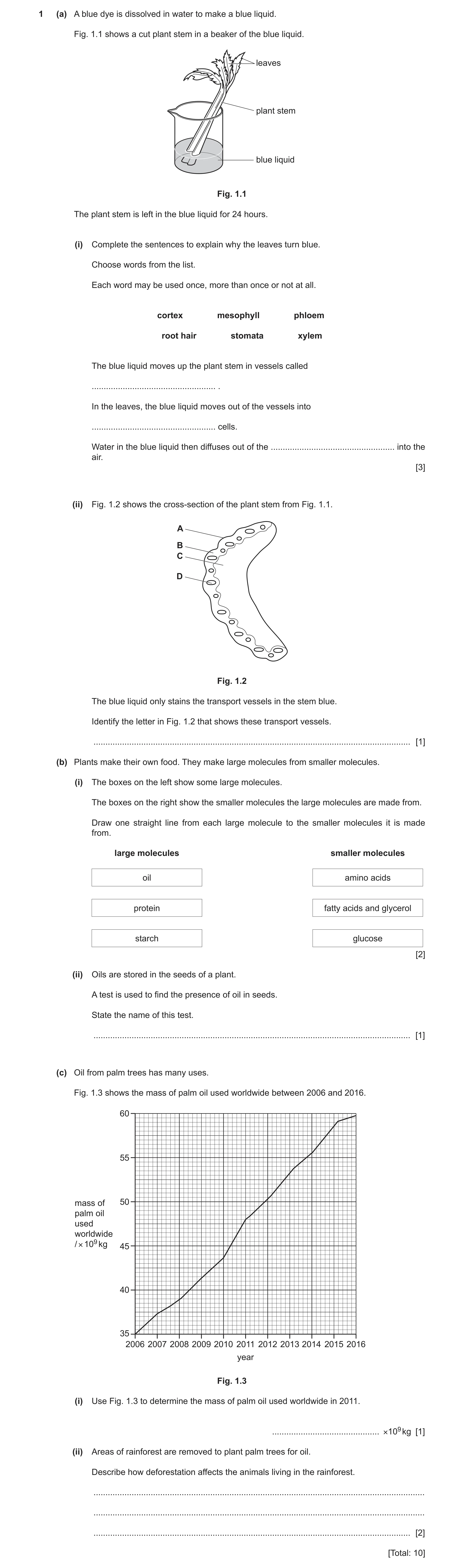
1 (a) A blue dye is dissolved in water to make a blue liquid. Fig. 1.1 shows a cut plant stem in a beaker of the blue liquid. leaves plant stem blue liquid Fig. 1.1 The plant stem is left in the blue liquid for 24 hours. (i) Complete the sentences to explain why the leaves turn blue. Choose words from the list. Each word may be used once, more than once or not at all. cortex mesophyll phloem root hair stomata xylem The blue liquid moves up the plant stem in vessels called … . In the leaves, the blue liquid moves out of the vessels into … cells. Water in the blue liquid then diffuses out of the … into the air. [3] (ii) Fig. 1.2 shows the cross-section of the plant stem from Fig. 1.1. A B C D Fig. 1.2 The blue liquid only stains the transport vessels in the stem blue. Identify the letter in Fig. 1.2 that shows these transport vessels. … [1] (b) Plants make their own food. They make large molecules from smaller molecules. (i) The boxes on the left show some large molecules. The boxes on the right show the smaller molecules the large molecules are made from. Draw one straight line from each large molecule to the smaller molecules it is made from. large molecules smaller molecules oil amino acids protein fatty acids and glycerol starch glucose [2] (ii) Oils are stored in the seeds of a plant. A test is used to find the presence of oil in seeds. State the name of this test. … [1] (c) Oil from palm trees has many uses. Fig. 1.3 shows the mass of palm oil used worldwide between 2006 and 2016. 60 55 mass of 50 palm oil used worldwide / × 109 kg 45 40 35 2006 2007 2008 2009 2010 2011 2012 2013 2014 2015 2016 year Fig. 1.3 (i) Use Fig. 1.3 to determine the mass of palm oil used worldwide in 2011. … ×109 kg [1] (ii) Areas of rainforest are removed to plant palm trees for oil. Describe how deforestation affects the animals living in the rainforest. … … … [2] [Total: 10]
10 marks
Mark scheme: 1(a)(i) xylem ; mesophyll ; stomata ; 3 1(a)(ii) D ; 1 1(b)(i) oil amino acids protein fatty acids and glycerol starch glucose one correct ; three correct ; 2 1(b)(ii) ethanol (emulsion) ; 1 1(c)(i) 48 (× 109 kg ) ; 1 1(c)(ii) any two from: loss of habitat ; less food OR disruption to food, webs / chains ; less shelter ; migration (of species) ; extinction (of species) ; 2
This question in 0653/33 Oct/Nov 2021
Q12 · The nuts in Fig 0653/33 May/June 2022
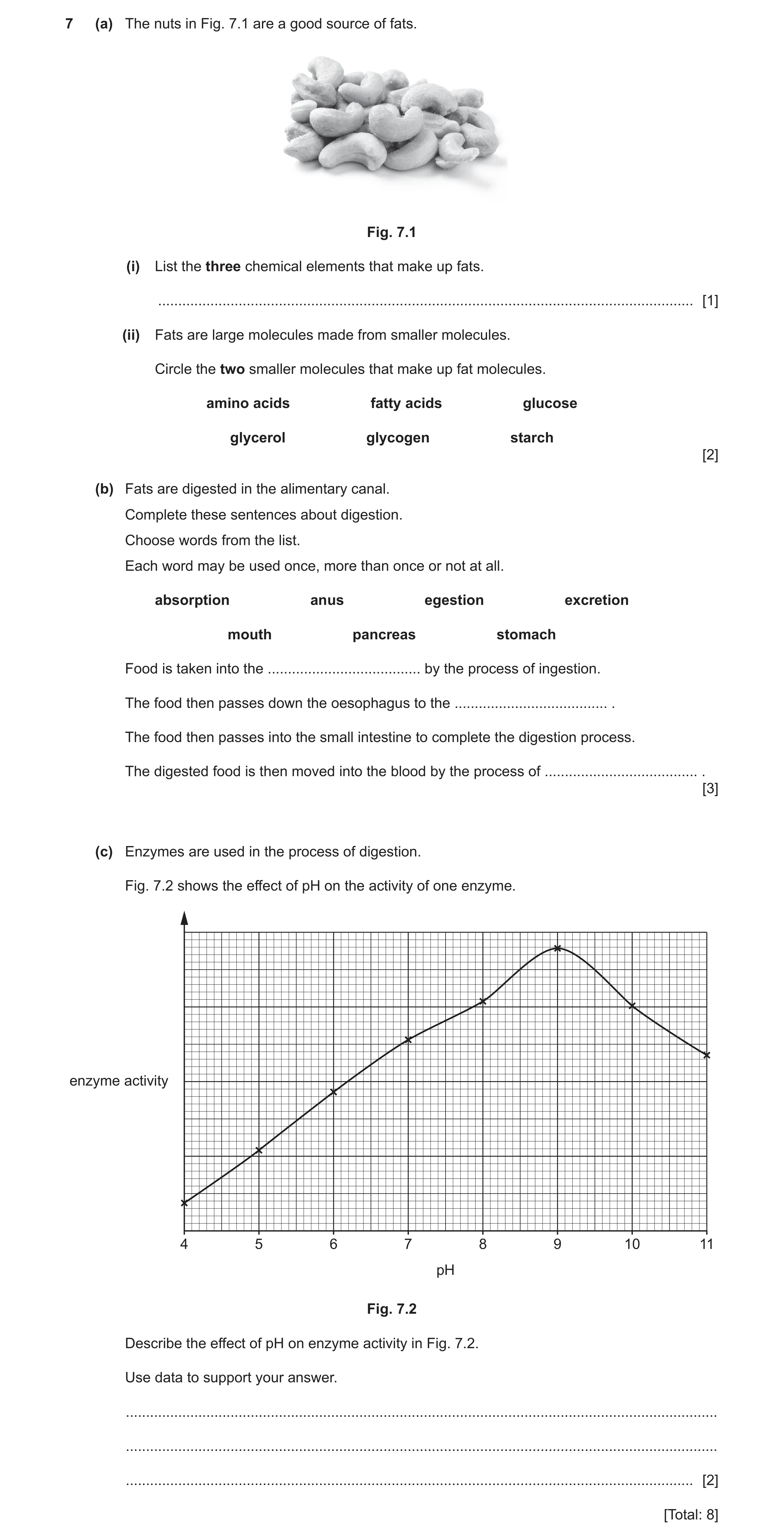
7 (a) The nuts in Fig. 7.1 are a good source of fats. Fig. 7.1 (i) List the three chemical elements that make up fats. … [1] (ii) Fats are large molecules made from smaller molecules. Circle the two smaller molecules that make up fat molecules. amino acids fatty acids glucose glycerol glycogen starch [2] (b) Fats are digested in the alimentary canal. Complete these sentences about digestion. Choose words from the list. Each word may be used once, more than once or not at all. absorption anus egestion excretion mouth pancreas stomach Food is taken into the … by the process of ingestion. The food then passes down the oesophagus to the … . The food then passes into the small intestine to complete the digestion process. The digested food is then moved into the blood by the process of … . [3] (c) Enzymes are used in the process of digestion. Fig. 7.2 shows the effect of pH on the activity of one enzyme. enzyme activity 4 5 6 7 8 9 10 11 pH Fig. 7.2 Describe the effect of pH on enzyme activity in Fig. 7.2. Use data to support your answer. … … … [2] [Total: 8]
8 marks
Mark scheme: 7(a)(i) carbon, hydrogen, oxygen ; 1 7(a)(ii) fatty acids ; glycerol ; 2 7(b) mouth ; stomach ; absorption ; 3 7(c) as pH increases enzyme activity increases then decreases ; idea of peak at pH 9 ; 2
This question in 0653/33 May/June 2022
Q13 · A diagram of the alimentary canal and associated organs 0653/32 Oct/Nov 2022
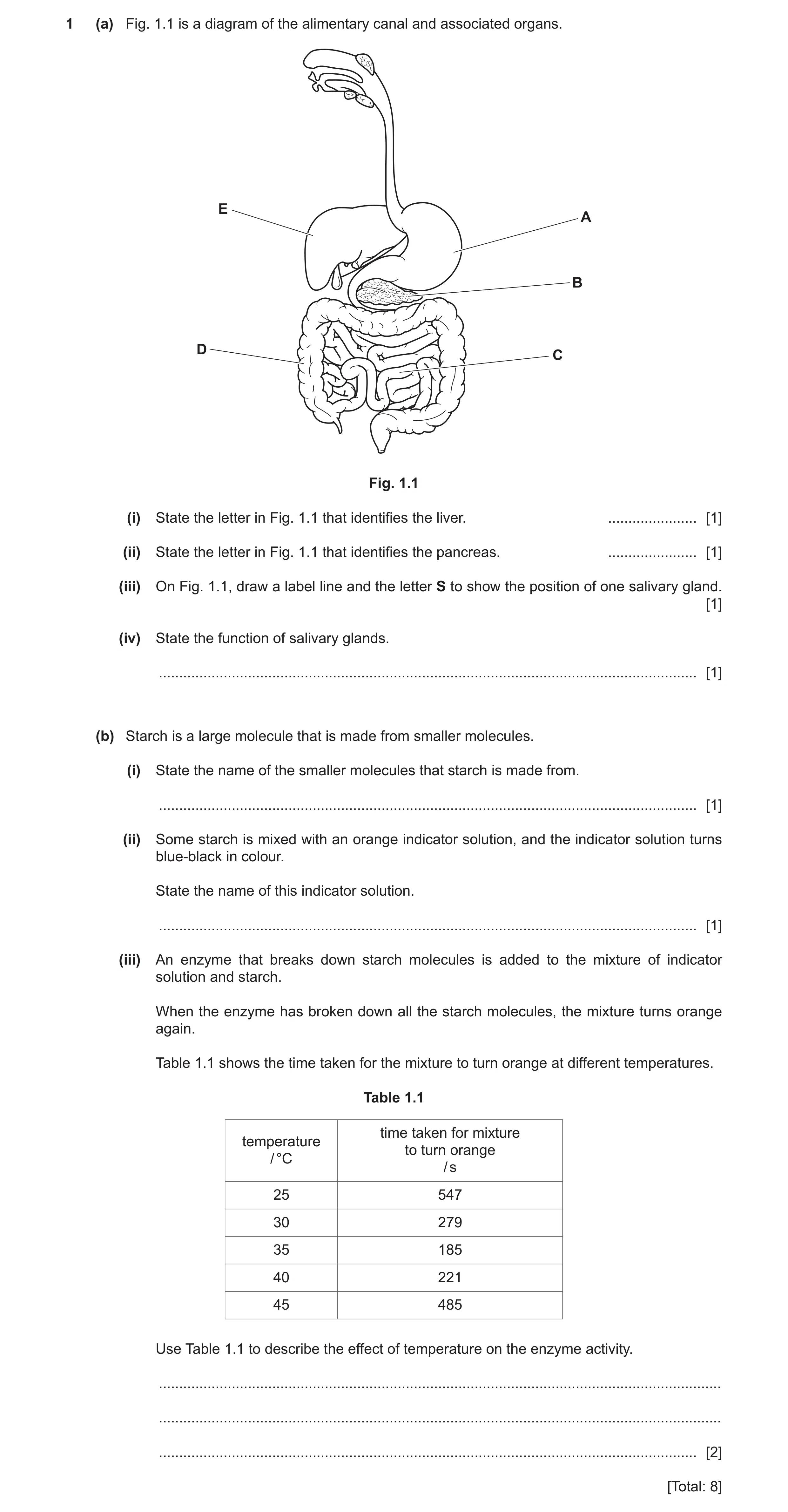
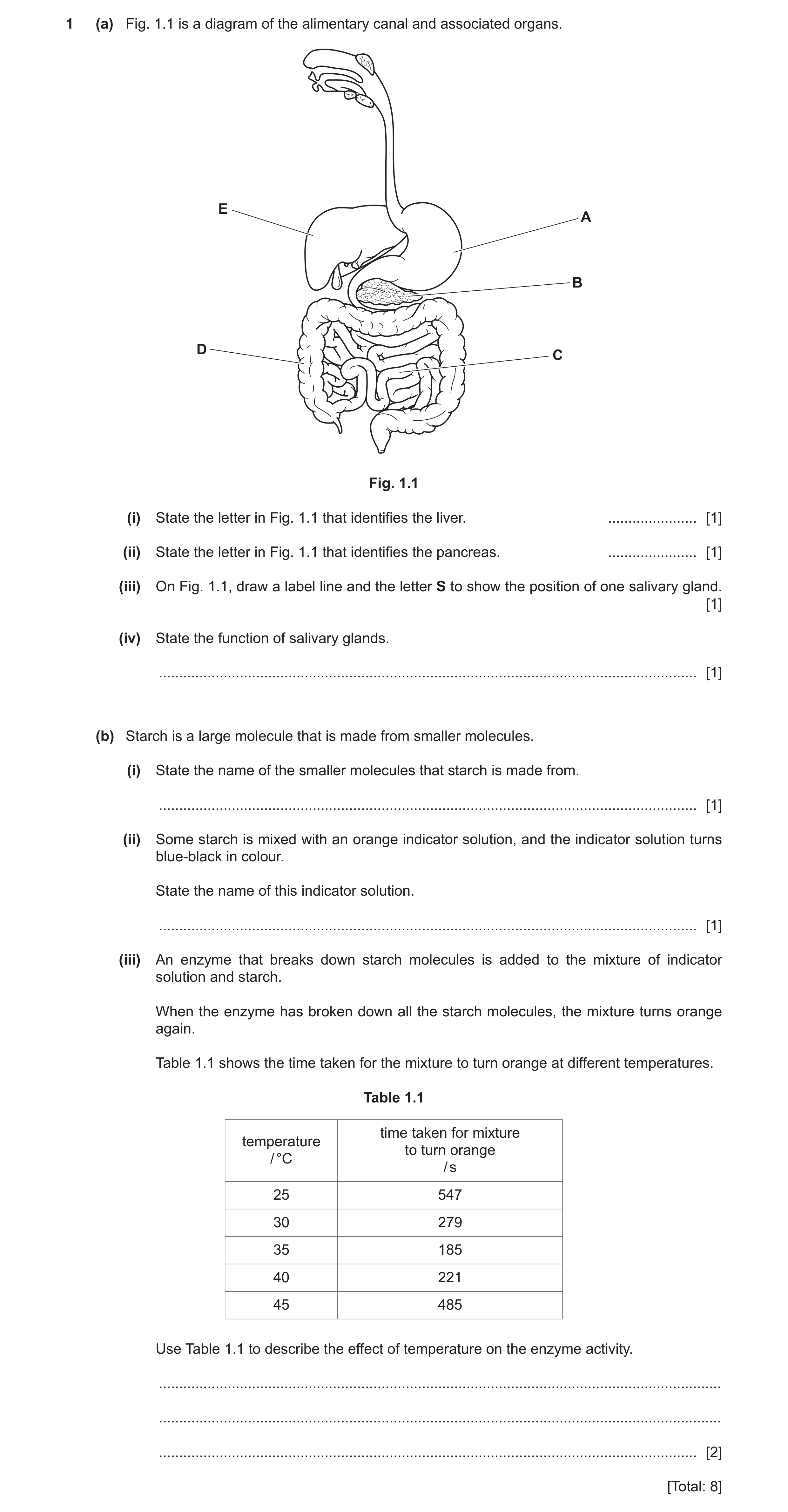
1 (a) Fig. 1.1 is a diagram of the alimentary canal and associated organs. E A B D C Fig. 1.1 (i) State the letter in Fig. 1.1 that identifies the liver. … [1] (ii) State the letter in Fig. 1.1 that identifies the pancreas. … [1] (iii) On Fig. 1.1, draw a label line and the letter S to show the position of one salivary gland. [1] (iv) State the function of salivary glands. … [1] (b) Starch is a large molecule that is made from smaller molecules. (i) State the name of the smaller molecules that starch is made from. … [1] (ii) Some starch is mixed with an orange indicator solution, and the indicator solution turns blue‑black in colour. State the name of this indicator solution. … [1] (iii) An enzyme that breaks down starch molecules is added to the mixture of indicator solution and starch. When the enzyme has broken down all the starch molecules, the mixture turns orange again. Table 1.1 shows the time taken for the mixture to turn orange at different temperatures. Table 1.1 time taken for mixture temperature to turn orange / °C / s 25 547 30 279 35 185 40 221 45 485 Use Table 1.1 to describe the effect of temperature on the enzyme activity. … … … [2] [Total: 8]
8 marks
Mark scheme: Question Answer Marks 1(a)(i) E ; 1 1(a)(ii) B ; 1 1(a)(iii) label line to any of the salivary glands ; 1 1(a)(iv) make / secrete, saliva / enzymes ; 1 1(b)(i) glucose ; 1 1(b)(ii) iodine (solution) ; 1 1(b)(iii) as temperature increases, enzyme activity increases then decreases / AW ; 2 idea of highest activity between 30 °C and 40 °C ;
This question in 0653/32 Oct/Nov 2022
Q14 · A diagram of the alimentary canal and associated organs 0653/33 Oct/Nov 2022
1 (a) Fig. 1.1 is a diagram of the alimentary canal and associated organs. E A B D C Fig. 1.1 (i) State the letter in Fig. 1.1 that identifies the liver. … [1] (ii) State the letter in Fig. 1.1 that identifies the pancreas. … [1] (iii) On Fig. 1.1, draw a label line and the letter S to show the position of one salivary gland. [1] (iv) State the function of salivary glands. … [1] (b) Starch is a large molecule that is made from smaller molecules. (i) State the name of the smaller molecules that starch is made from. … [1] (ii) Some starch is mixed with an orange indicator solution, and the indicator solution turns blue‑black in colour. State the name of this indicator solution. … [1] (iii) An enzyme that breaks down starch molecules is added to the mixture of indicator solution and starch. When the enzyme has broken down all the starch molecules, the mixture turns orange again. Table 1.1 shows the time taken for the mixture to turn orange at different temperatures. Table 1.1 time taken for mixture temperature to turn orange / °C / s 25 547 30 279 35 185 40 221 45 485 Use Table 1.1 to describe the effect of temperature on the enzyme activity. … … … [2] [Total: 8]
8 marks
Mark scheme: Question Answer Marks 1(a)(i) E ; 1 1(a)(ii) B ; 1 1(a)(iii) label line to any of the salivary glands ; 1 1(a)(iv) make / secrete, saliva / enzymes ; 1 1(b)(i) glucose ; 1 1(b)(ii) iodine (solution) ; 1 1(b)(iii) as temperature increases, enzyme activity increases then decreases / AW ; 2 idea of highest activity between 30 °C and 40 °C ;
This question in 0653/33 Oct/Nov 2022
Q15 · Carbohydrates are part of a balanced diet for humans 0653/32 Oct/Nov 2023
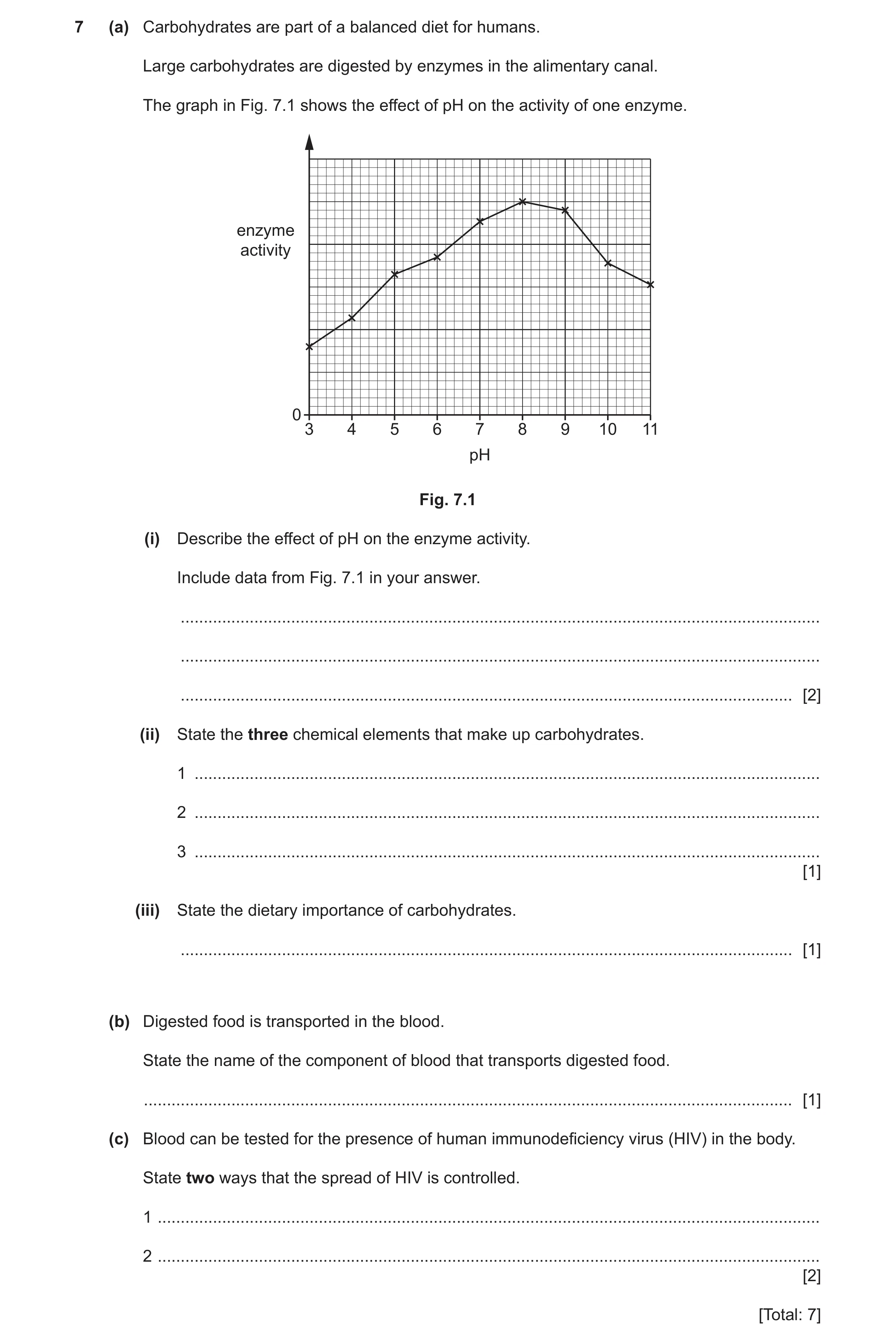
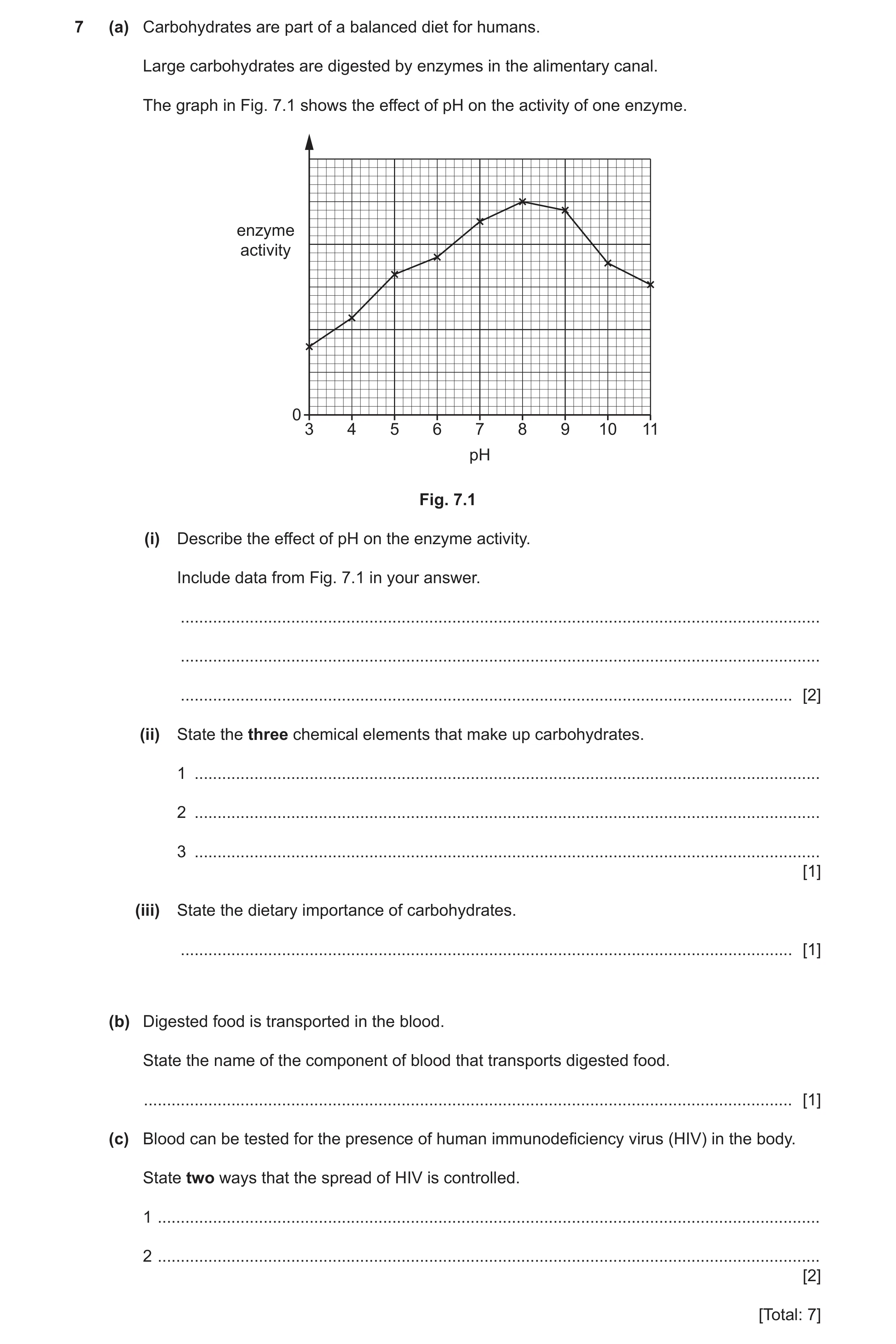
7 (a) Carbohydrates are part of a balanced diet for humans. Large carbohydrates are digested by enzymes in the alimentary canal. The graph in Fig. 7.1 shows the effect of pH on the activity of one enzyme. enzyme activity 0 3 4 5 6 7 8 9 10 11 pH Fig. 7.1 (i) Describe the effect of pH on the enzyme activity. Include data from Fig. 7.1 in your answer. … … … [2] (ii) State the three chemical elements that make up carbohydrates. 1 … 2 … 3 … [1] (iii) State the dietary importance of carbohydrates. … [1] (b) Digested food is transported in the blood. State the name of the component of blood that transports digested food. … [1] (c) Blood can be tested for the presence of human immunodeficiency virus (HIV) in the body. State two ways that the spread of HIV is controlled. 1 … 2 … [2] [Total: 7]
7 marks
Mark scheme: 7(a)(i) as pH increases, the enzyme activity first increases and then decreases ; 2 maximum at pH 8 ; 7(a)(ii) carbon AND hydrogen AND oxygen ; 1 7(a)(iii) provide energy ; 1 7(b) plasma ; 1 7(c) any two from: 2 using condoms / protected sexual intercourse ; idea of (sexual) abstinence ; not sharing needles ; using sterile surgical instruments ;
This question in 0653/32 Oct/Nov 2023
Q16 · Carbohydrates are part of a balanced diet for humans 0653/33 Oct/Nov 2023
7 (a) Carbohydrates are part of a balanced diet for humans. Large carbohydrates are digested by enzymes in the alimentary canal. The graph in Fig. 7.1 shows the effect of pH on the activity of one enzyme. enzyme activity 0 3 4 5 6 7 8 9 10 11 pH Fig. 7.1 (i) Describe the effect of pH on the enzyme activity. Include data from Fig. 7.1 in your answer. … … … [2] (ii) State the three chemical elements that make up carbohydrates. 1 … 2 … 3 … [1] (iii) State the dietary importance of carbohydrates. … [1] (b) Digested food is transported in the blood. State the name of the component of blood that transports digested food. … [1] (c) Blood can be tested for the presence of human immunodeficiency virus (HIV) in the body. State two ways that the spread of HIV is controlled. 1 … 2 … [2] [Total: 7]
7 marks
Mark scheme: 7(a)(i) as pH increases, the enzyme activity first increases and then decreases ; 2 maximum at pH 8 ; 7(a)(ii) carbon AND hydrogen AND oxygen ; 1 7(a)(iii) provide energy ; 1 7(b) plasma ; 1 7(c) any two from: 2 using condoms / protected sexual intercourse ; idea of (sexual) abstinence ; not sharing needles ; using sterile surgical instruments ;
This question in 0653/33 Oct/Nov 2023
Q17 · A diagram of the alimentary canal and associated organs in humans 0653/31 May/June 2024
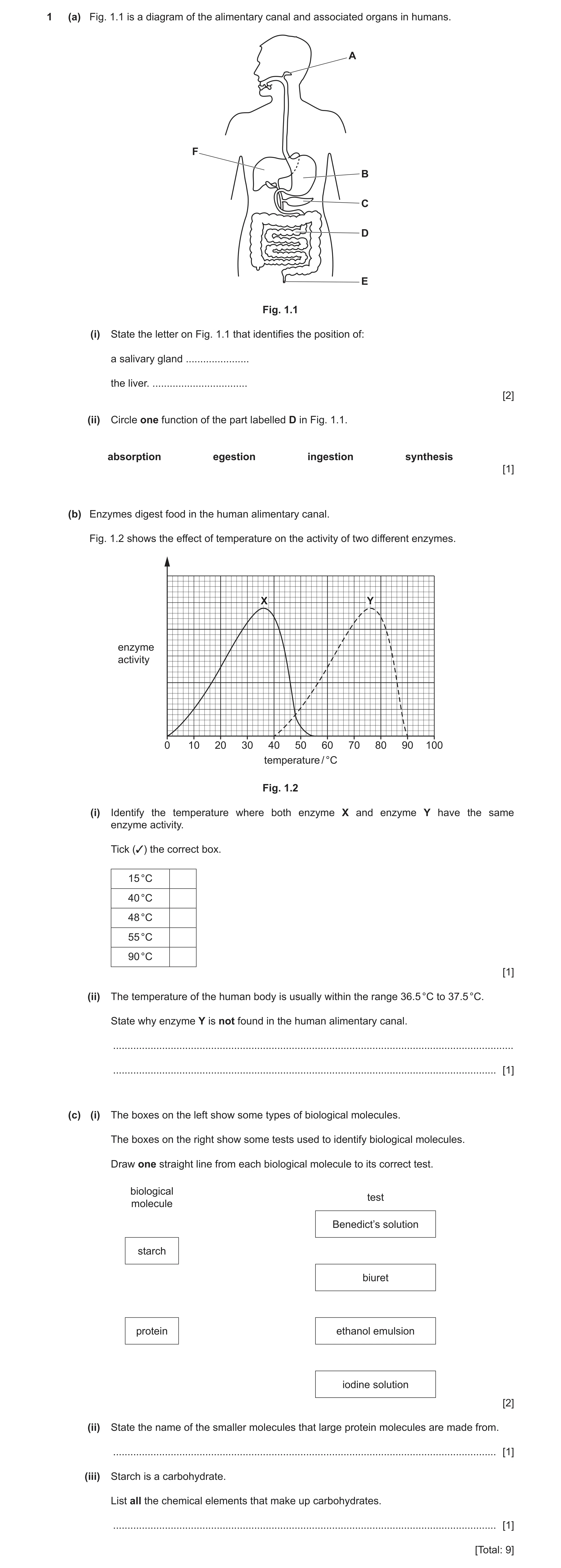
1 (a) Fig. 1.1 is a diagram of the alimentary canal and associated organs in humans. A F B C D E Fig. 1.1 (i) State the letter on Fig. 1.1 that identifies the position of: a salivary gland … the liver. … [2] (ii) Circle one function of the part labelled D in Fig. 1.1. absorption egestion ingestion synthesis [1] (b) Enzymes digest food in the human alimentary canal. Fig. 1.2 shows the effect of temperature on the activity of two different enzymes. X Y enzyme activity 0 10 20 30 40 50 60 70 80 90 100 temperature / °C Fig. 1.2 (i) Identify the temperature where both enzyme X and enzyme Y have the same enzyme activity. Tick (✓) the correct box. 15 °C 40 °C 48 °C 55 °C 90 °C [1] (ii) The temperature of the human body is usually within the range 36.5 °C to 37.5 °C. State why enzyme Y is not found in the human alimentary canal. … … [1] (c) (i) The boxes on the left show some types of biological molecules. The boxes on the right show some tests used to identify biological molecules. Draw one straight line from each biological molecule to its correct test. biological test molecule Benedict’s solution starch biuret protein ethanol emulsion iodine solution [2] (ii) State the name of the smaller molecules that large protein molecules are made from. … [1] (iii) Starch is a carbohydrate. List all the chemical elements that make up carbohydrates. … [1] [Total: 9]
9 marks
Mark scheme: 1(a)(i) A ; F ; 2 1(a)(ii) absorption (circled) ; 1 1(b)(i) 48 °C (ticked) ; 1 1(b)(ii) inactive in that temperature range (36.5–37.5 °C) / active at temperatures above body temperature ; 1 1(c)(i) Benedict’s solution starch biuret protein ethanol emulsion iodine solution one mark for each correct answer ;; 2 1(c)(ii) amino acids ; 1 1(c)(iii) carbon and hydrogen and oxygen ; 1
This question in 0653/31 May/June 2024
Q18 · A diagram of the human digestive system 0653/31 Oct/Nov 2025
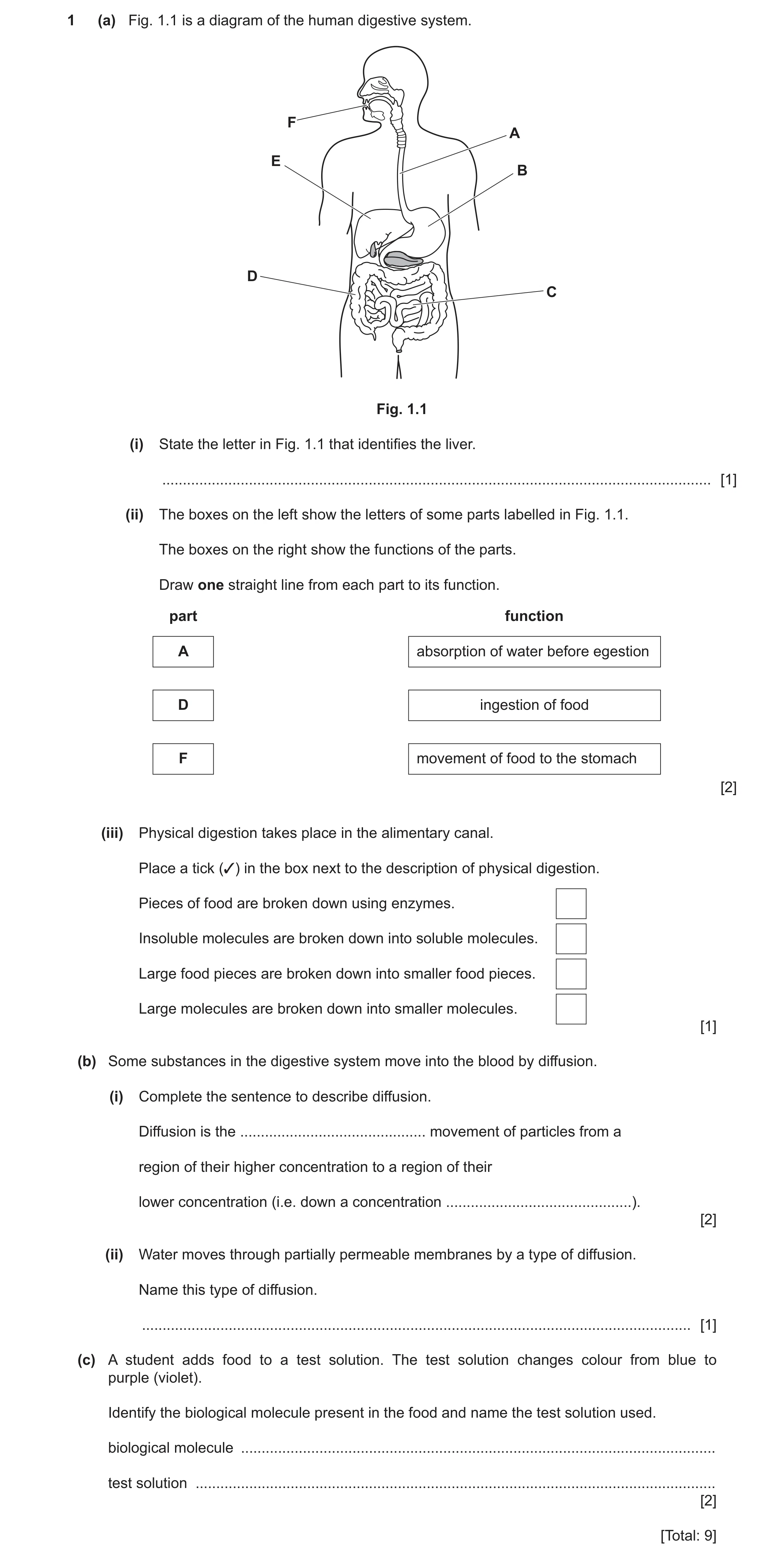
1 (a) Fig. 1.1 is a diagram of the human digestive system. F A E B D C Fig. 1.1 (i) State the letter in Fig. 1.1 that identifies the liver. … [1] (ii) The boxes on the left show the letters of some parts labelled in Fig. 1.1. The boxes on the right show the functions of the parts. Draw one straight line from each part to its function. part function A absorption of water before egestion D ingestion of food F movement of food to the stomach [2] (iii) Physical digestion takes place in the alimentary canal. Place a tick (✓) in the box next to the description of physical digestion. Pieces of food are broken down using enzymes. Insoluble molecules are broken down into soluble molecules. Large food pieces are broken down into smaller food pieces. Large molecules are broken down into smaller molecules. [1] (b) Some substances in the digestive system move into the blood by diffusion. (i) Complete the sentence to describe diffusion. Diffusion is the … movement of particles from a region of their higher concentration to a region of their lower concentration (i.e. down a concentration … ). [2] (ii) Water moves through partially permeable membranes by a type of diffusion. Name this type of diffusion. … [1] (c) A student adds food to a test solution. The test solution changes colour from blue to purple (violet). Identify the biological molecule present in the food and name the test solution used. biological molecule … test solution … [2] [Total: 9]
9 marks
Mark scheme: Question Answer Marks 1(a)(i) E ; 1 1(a)(ii) 2 part function A absorption of water before egestion D ingestion of food F movement of food to the stomach one line correct ; three lines correct ; 1(a)(iii) large food pieces are broken down into smaller food pieces ; 1 1(b)(i) net ; 2 gradient ; 1(b)(ii) osmosis ; 1 1(c) protein ; 2 biuret (solution) ;
This question in 0653/31 Oct/Nov 2025
Question 19 0653/31 Oct/Nov 2025
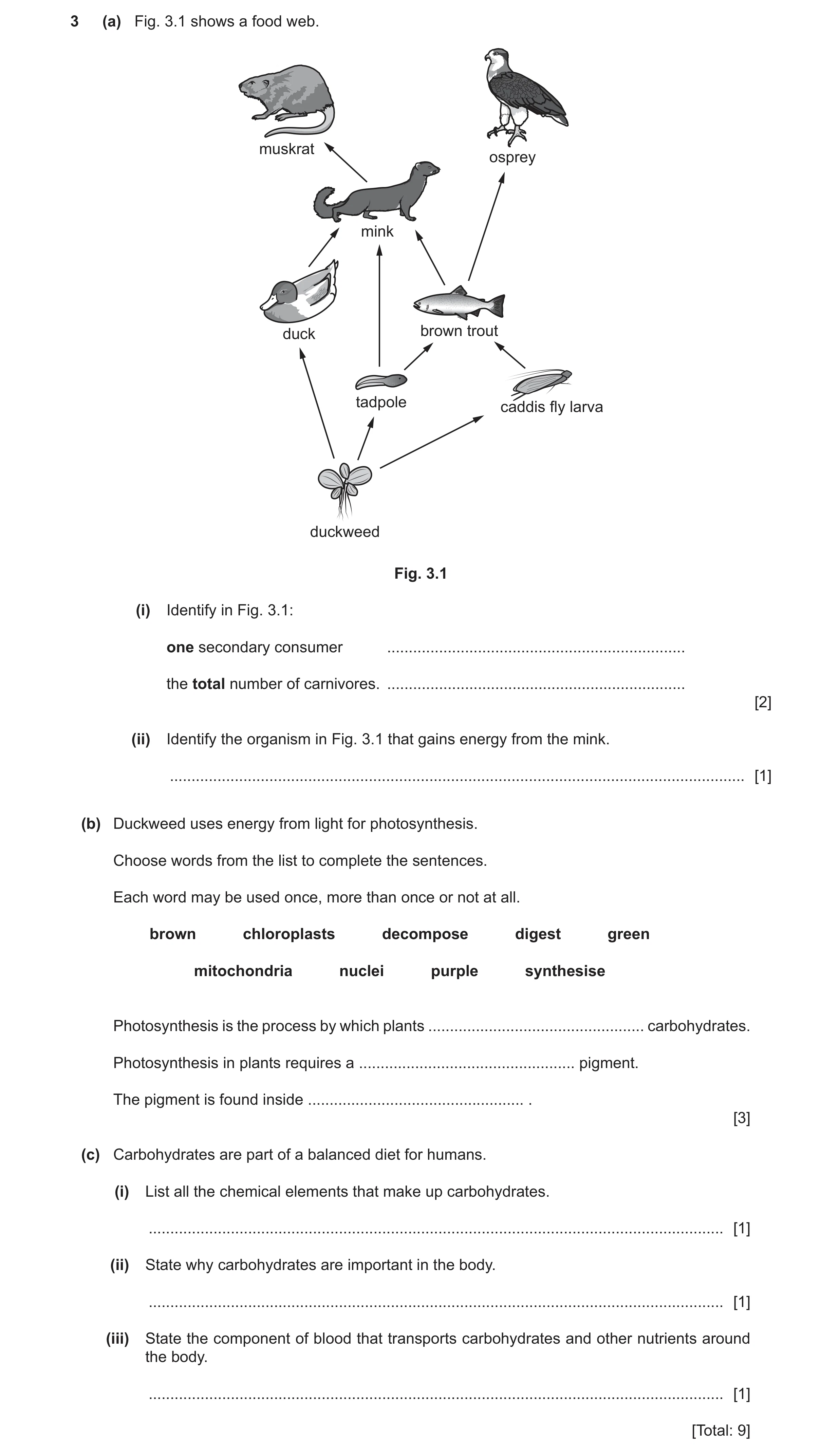
3 (a) Fig. 3.1 shows a food web. muskrat osprey mink duck brown trout tadpole caddis fly larva duckweed Fig. 3.1 (i) Identify in Fig. 3.1: one secondary consumer … the total number of carnivores. … [2] (ii) Identify the organism in Fig. 3.1 that gains energy from the mink. … [1] (b) Duckweed uses energy from light for photosynthesis. Choose words from the list to complete the sentences. Each word may be used once, more than once or not at all. brown chloroplasts decompose digest green mitochondria nuclei purple synthesise Photosynthesis is the process by which plants … carbohydrates. Photosynthesis in plants requires a … pigment. The pigment is found inside … . [3] (c) Carbohydrates are part of a balanced diet for humans. (i) List all the chemical elements that make up carbohydrates. … [1] (ii) State why carbohydrates are important in the body. … [1] (iii) State the component of blood that transports carbohydrates and other nutrients around the body. … [1] [Total: 9]
9 marks
Mark scheme: 3(a)(i) as (brown) trout / mink ; 2 4 ; 3(a)(ii) muskrat ; 1 3(b) synthesise ; 3 green ; chloroplasts ; 3(c)(i) carbon AND oxygen AND hydrogen ; 1 3(c)(ii) (needed) for energy ; 1 3(c)(iii) plasma ; 1
This question in 0653/31 Oct/Nov 2025
 13
13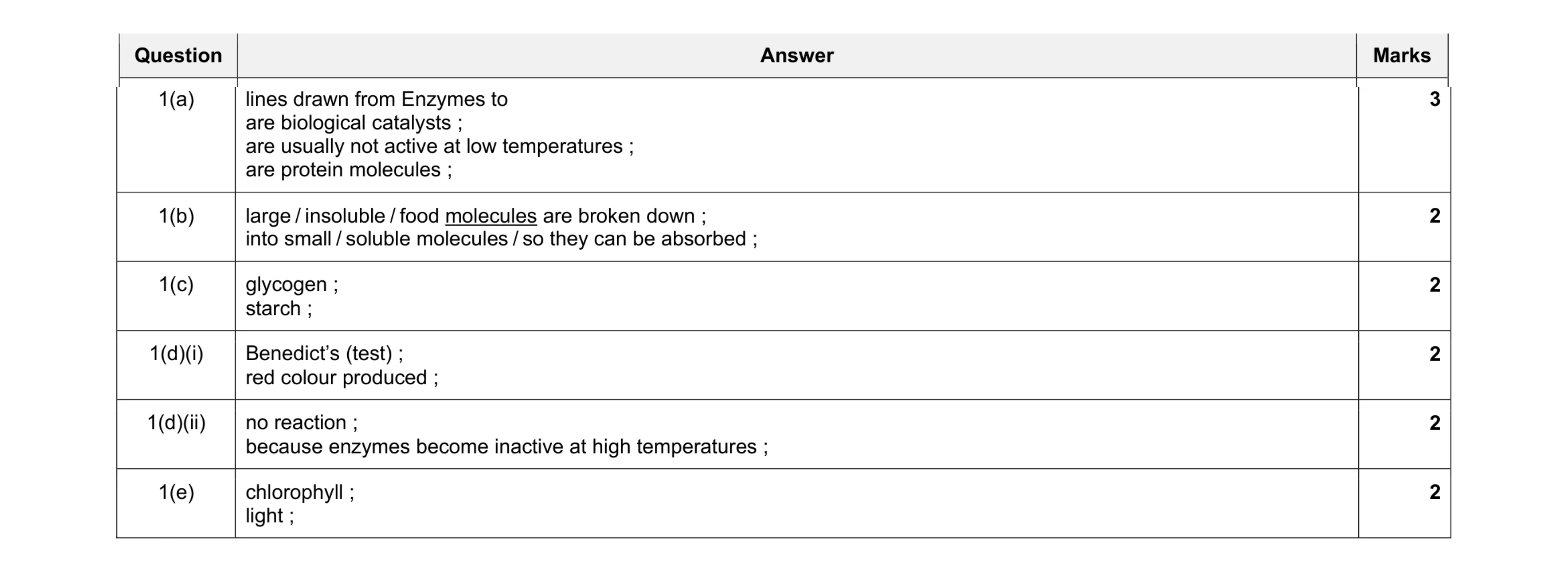 13
13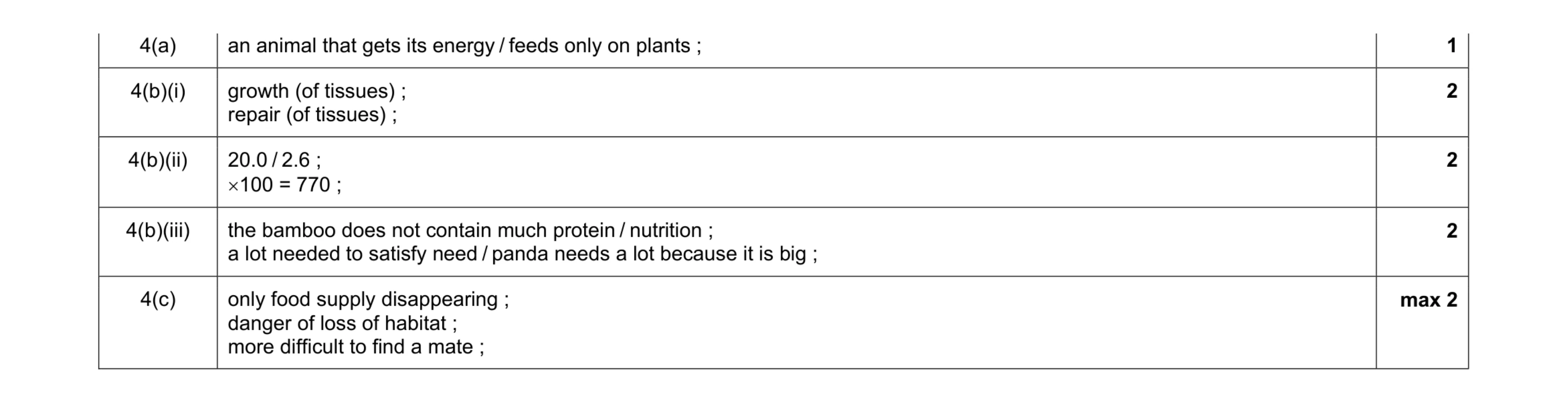 9
9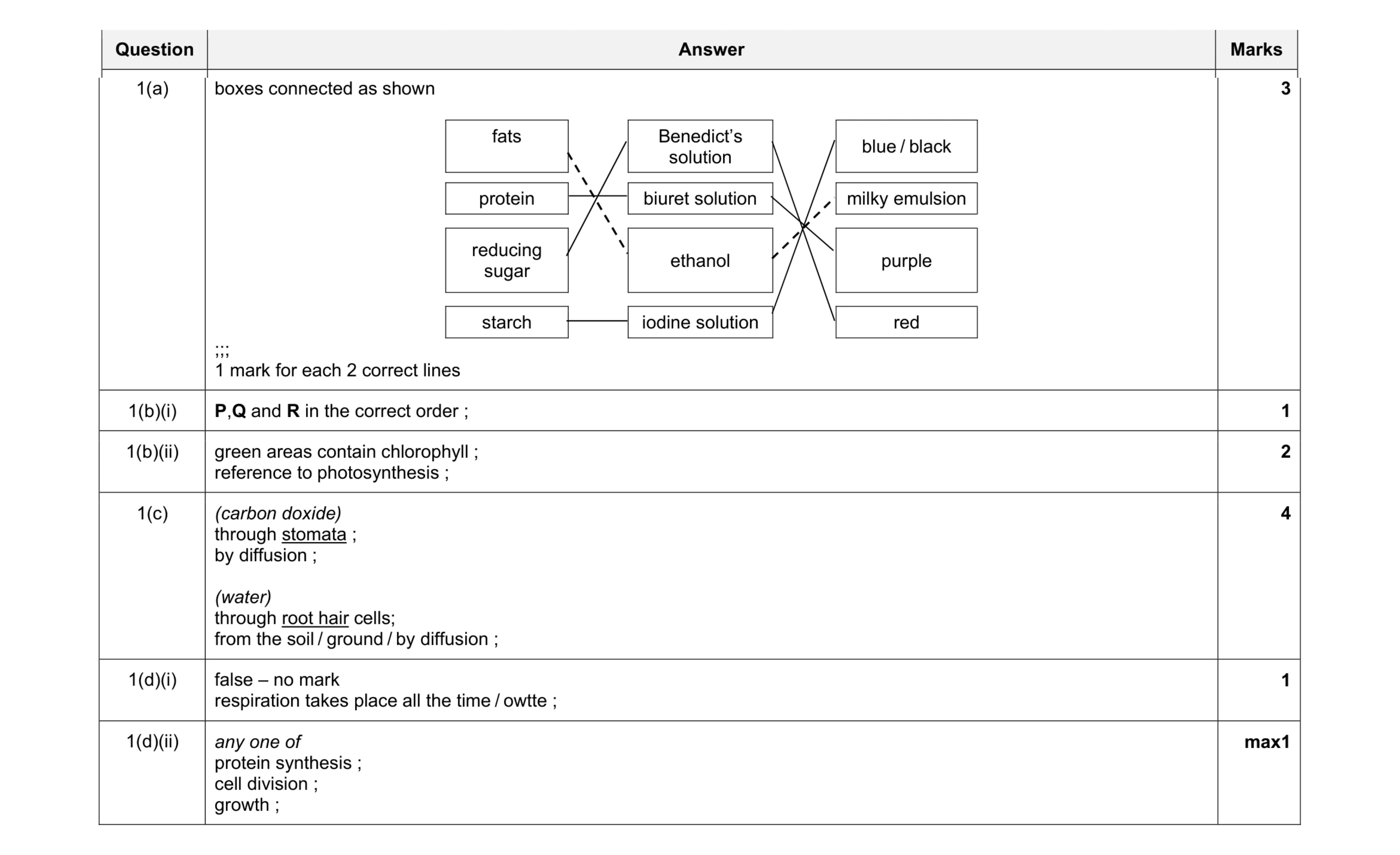 12
12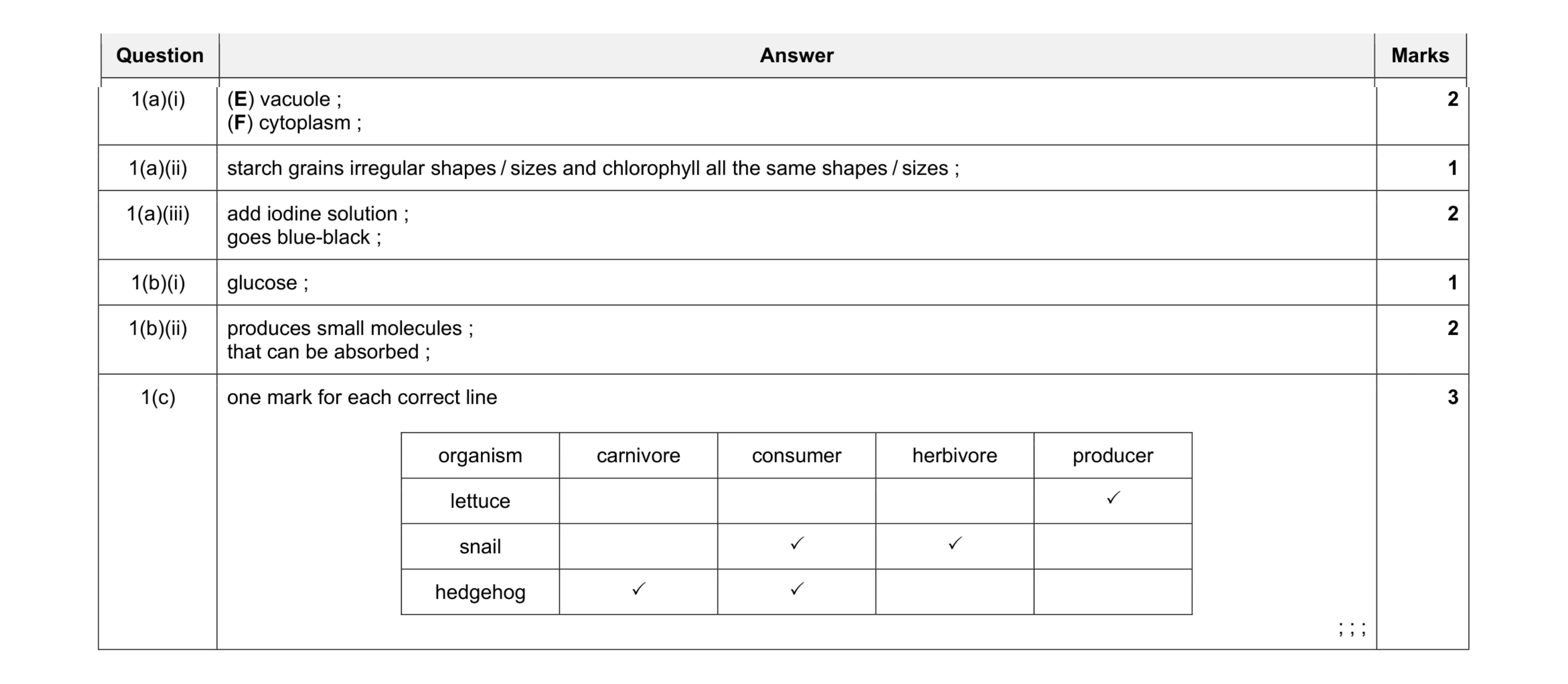 11
11 7
7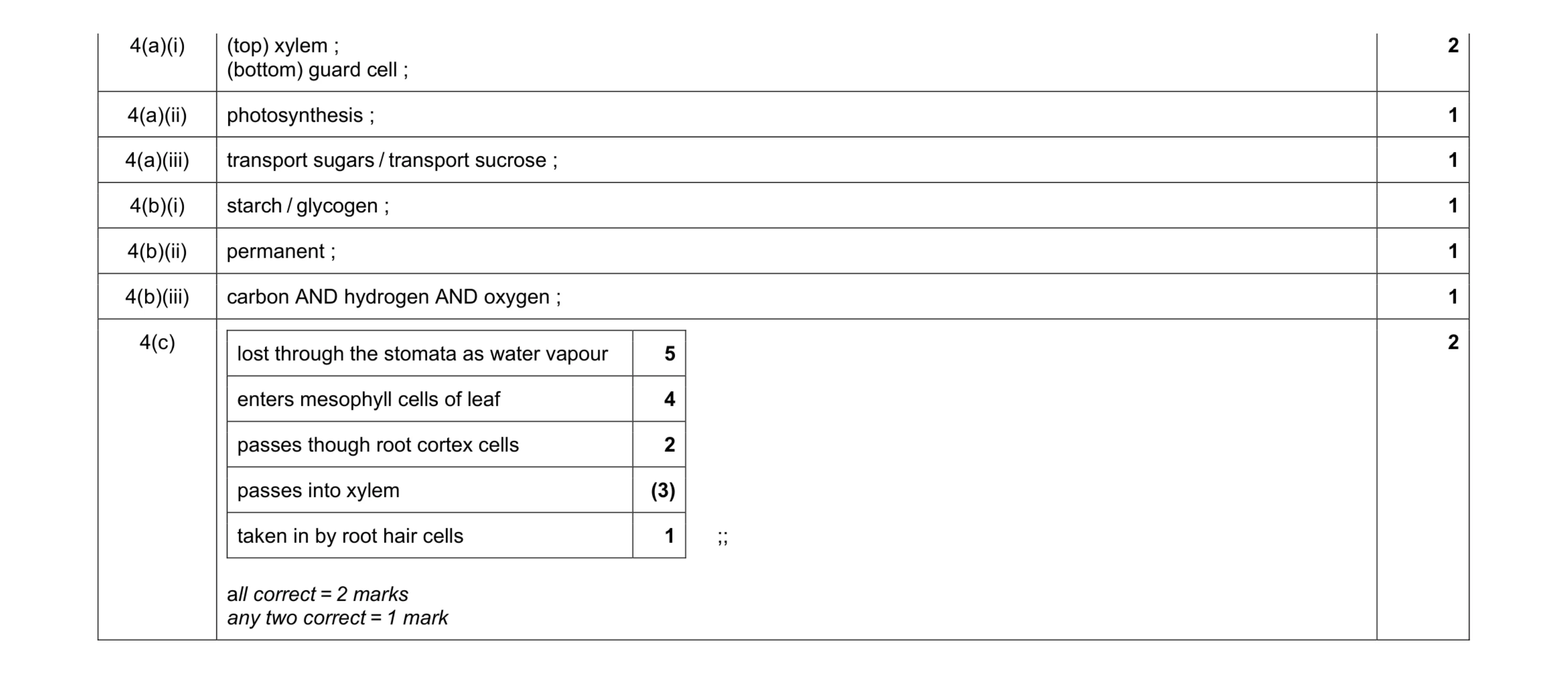 9
9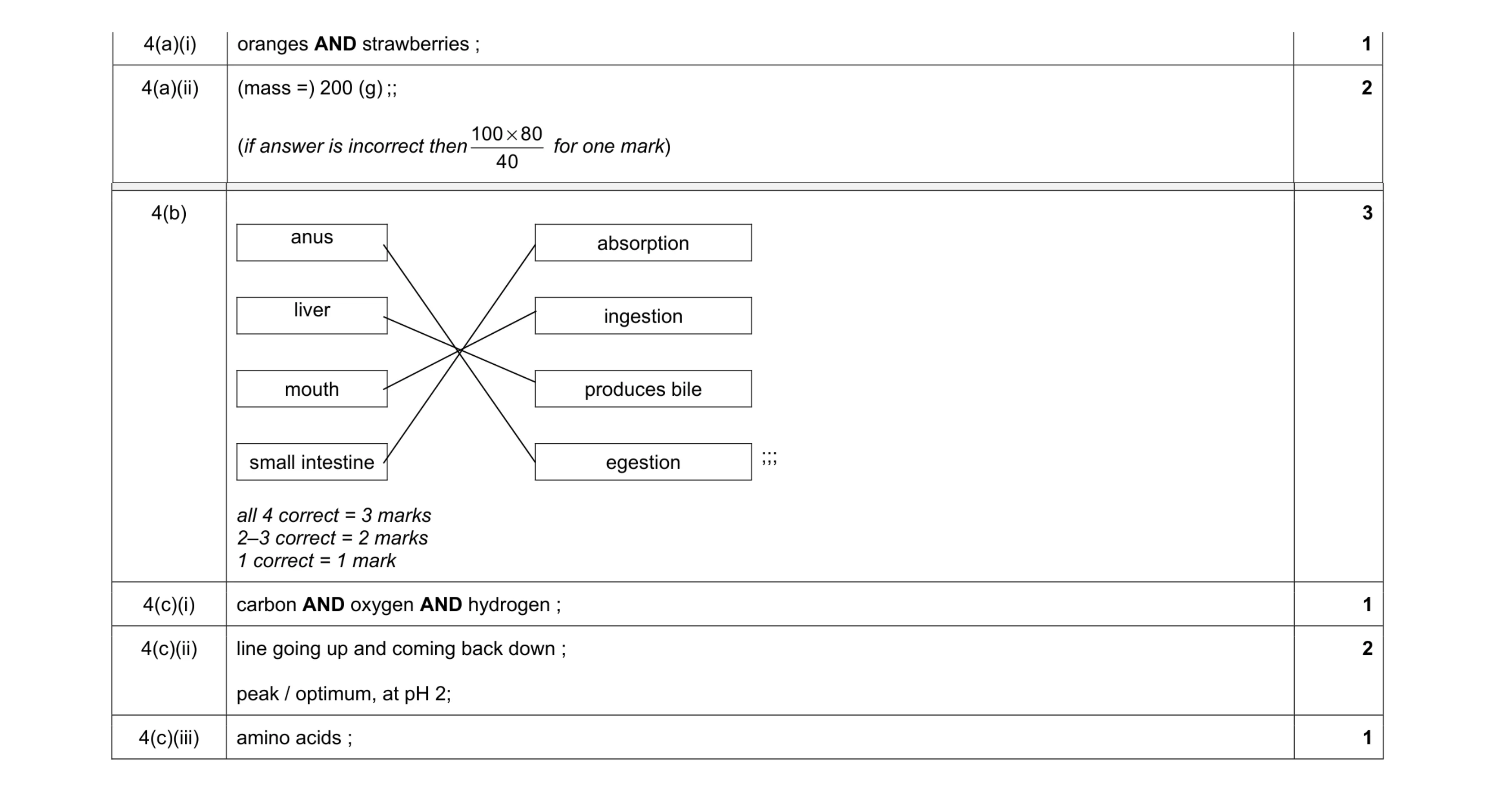 10
10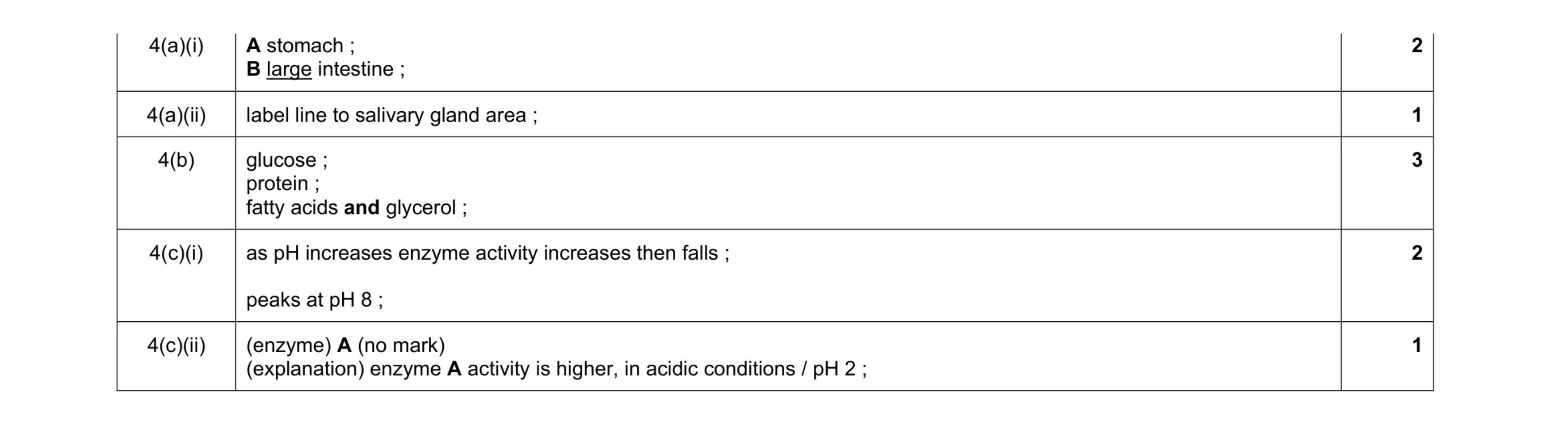 9
9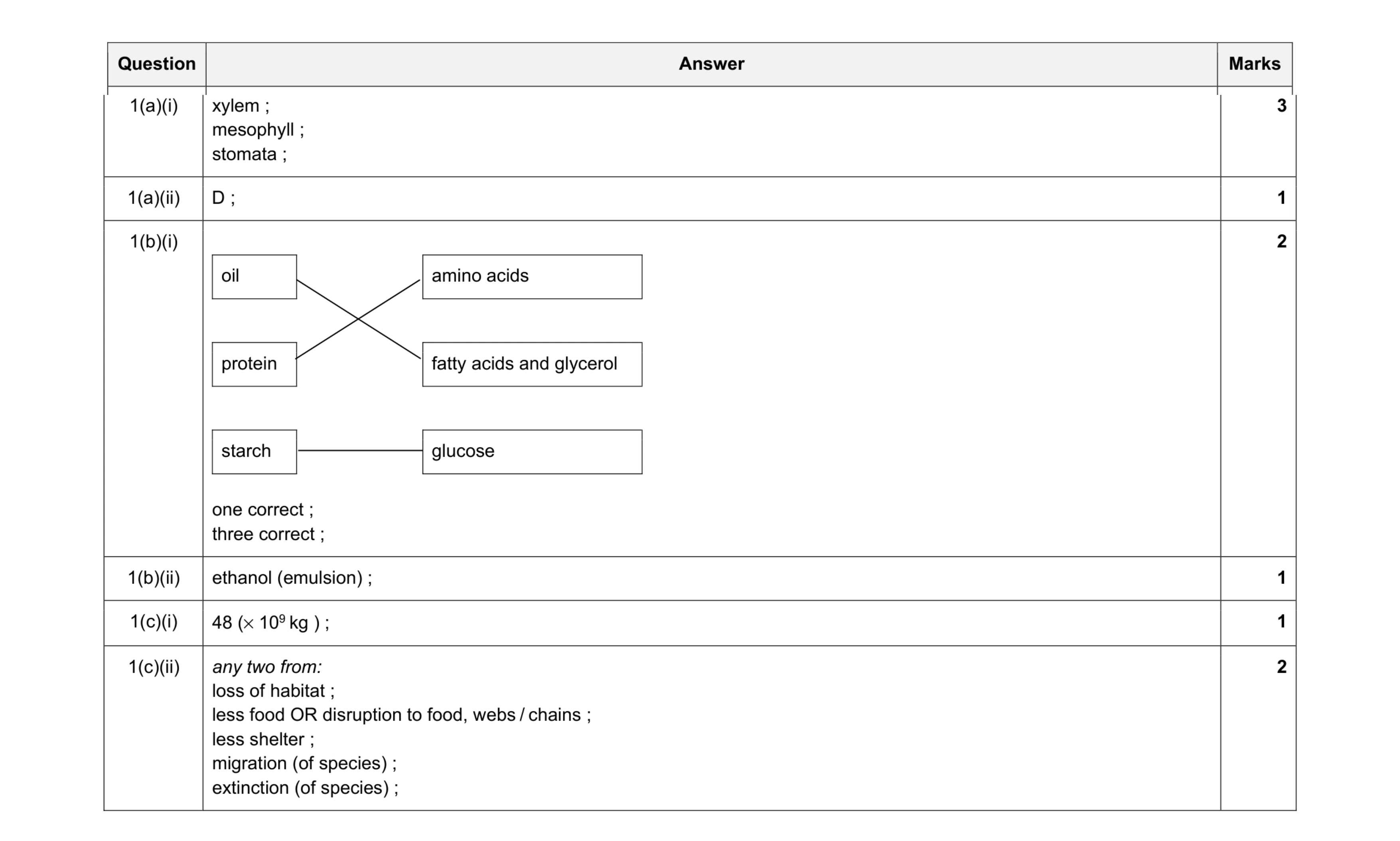 10
10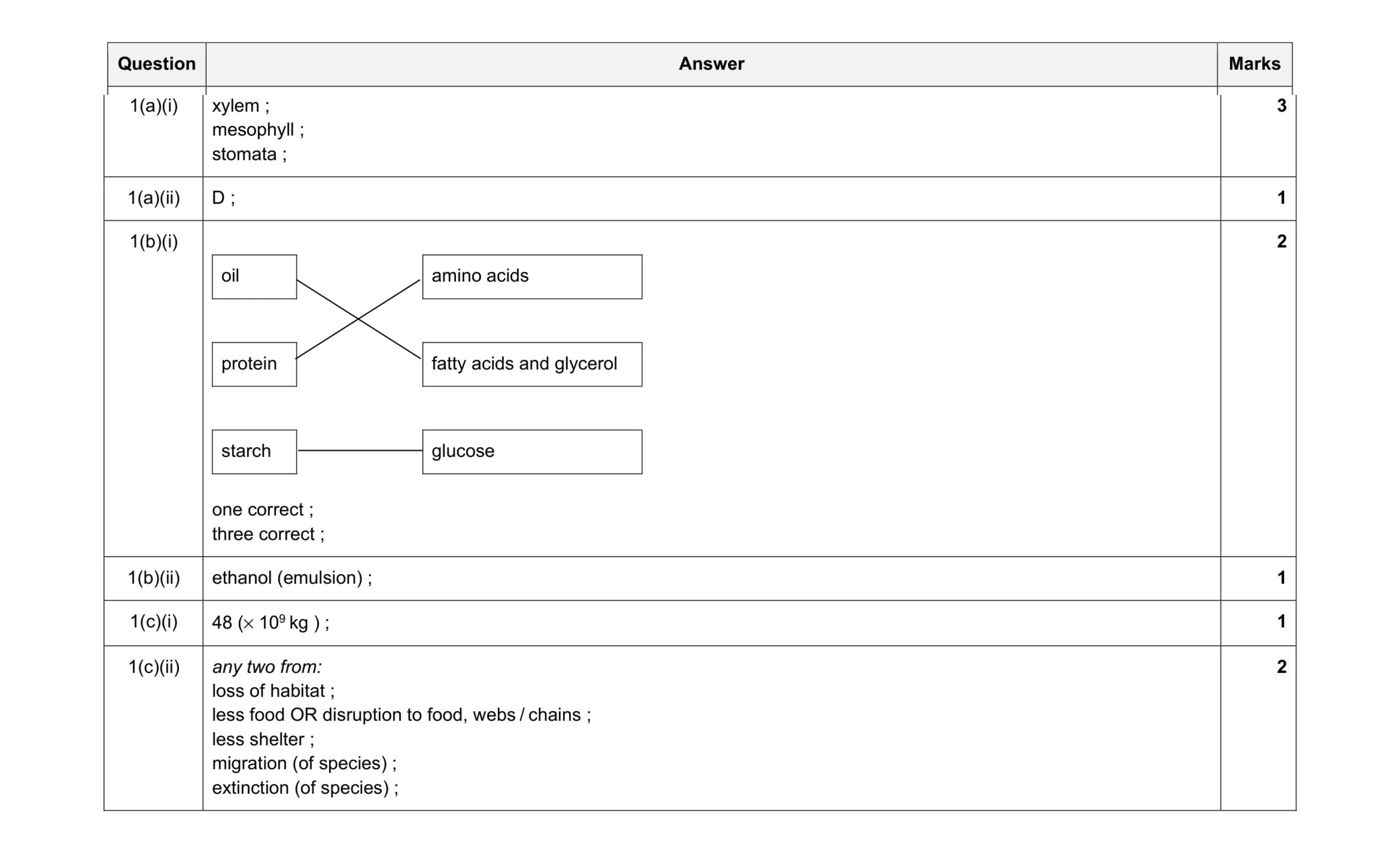 10
10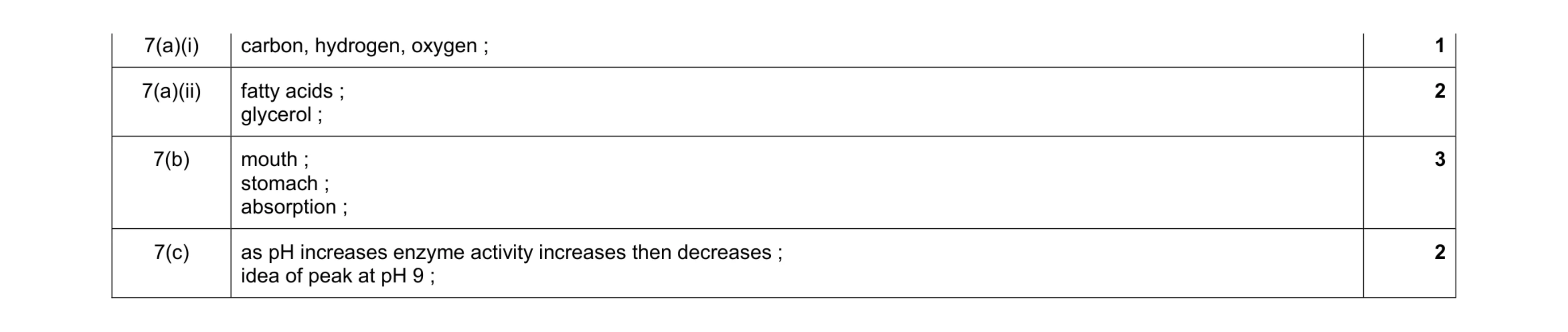 8
8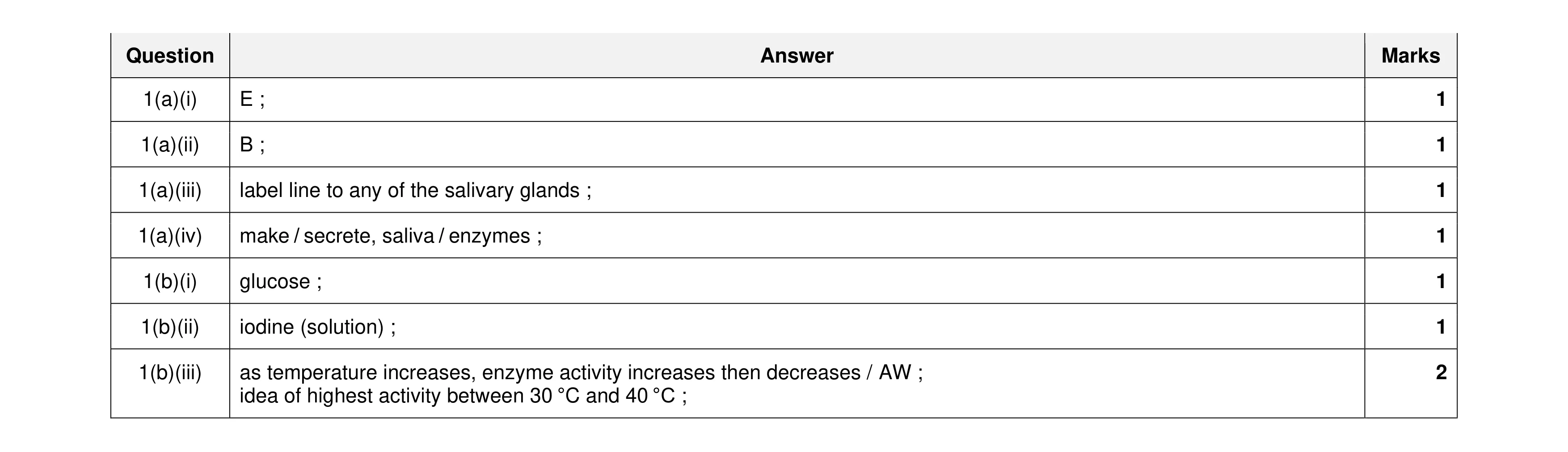 8
8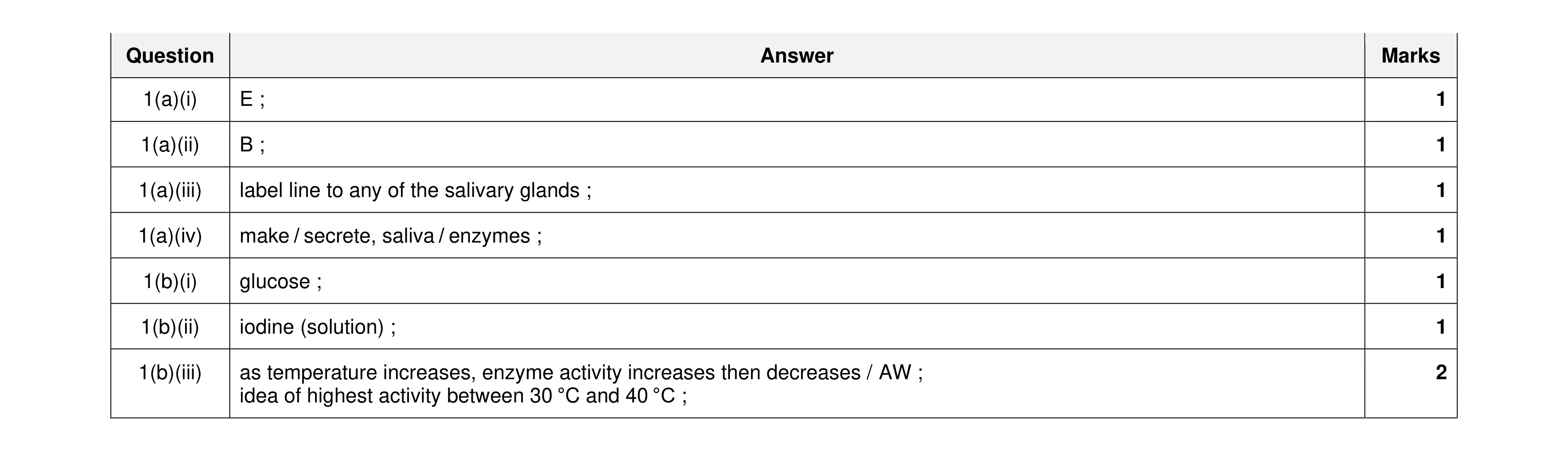 8
8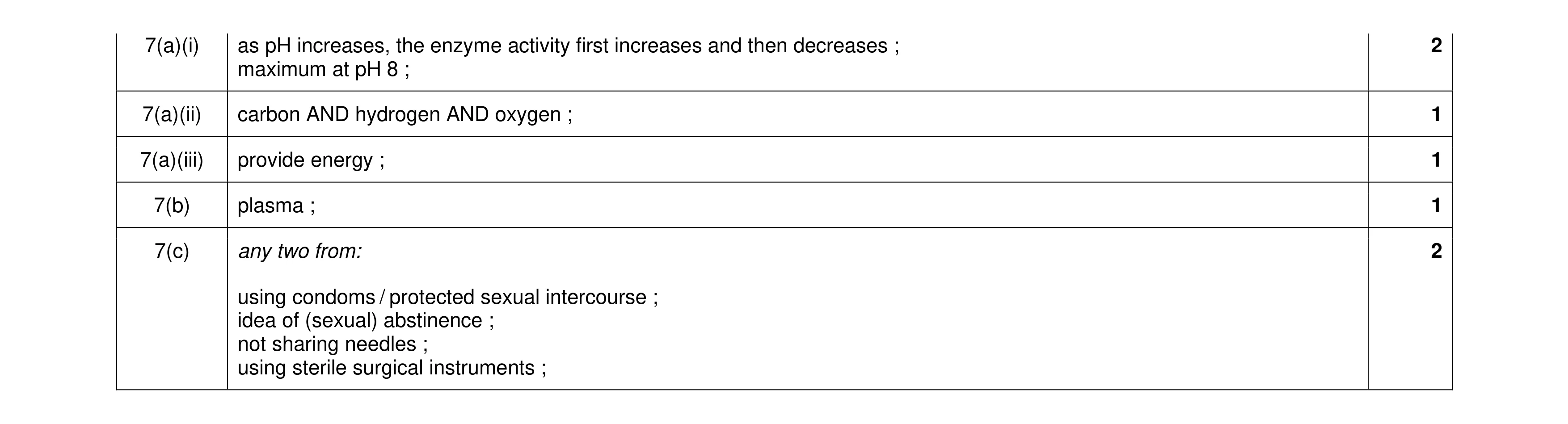 7
7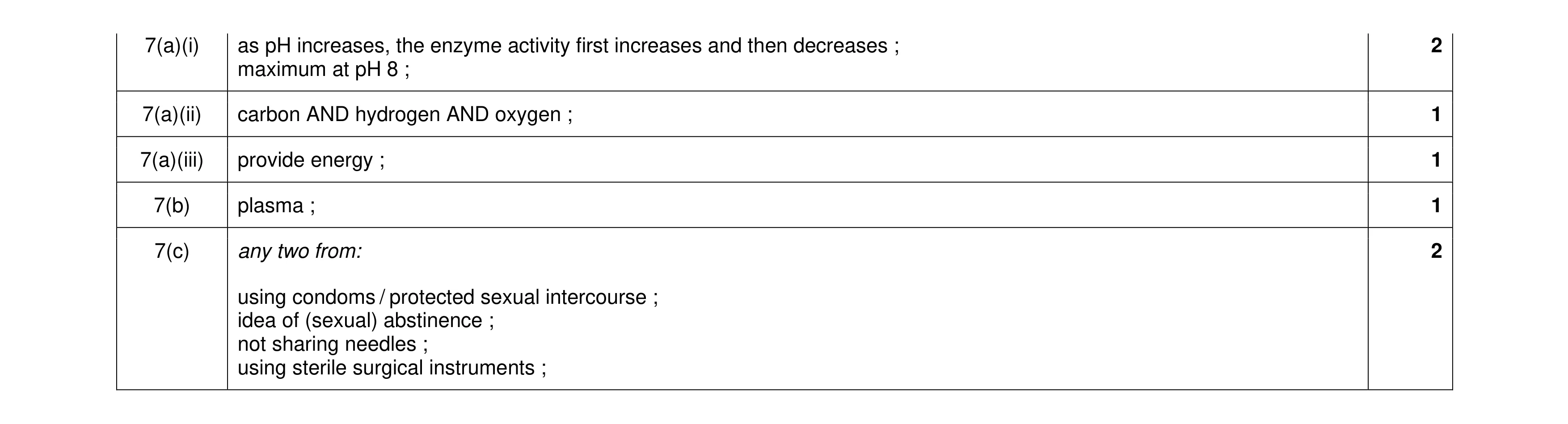 7
7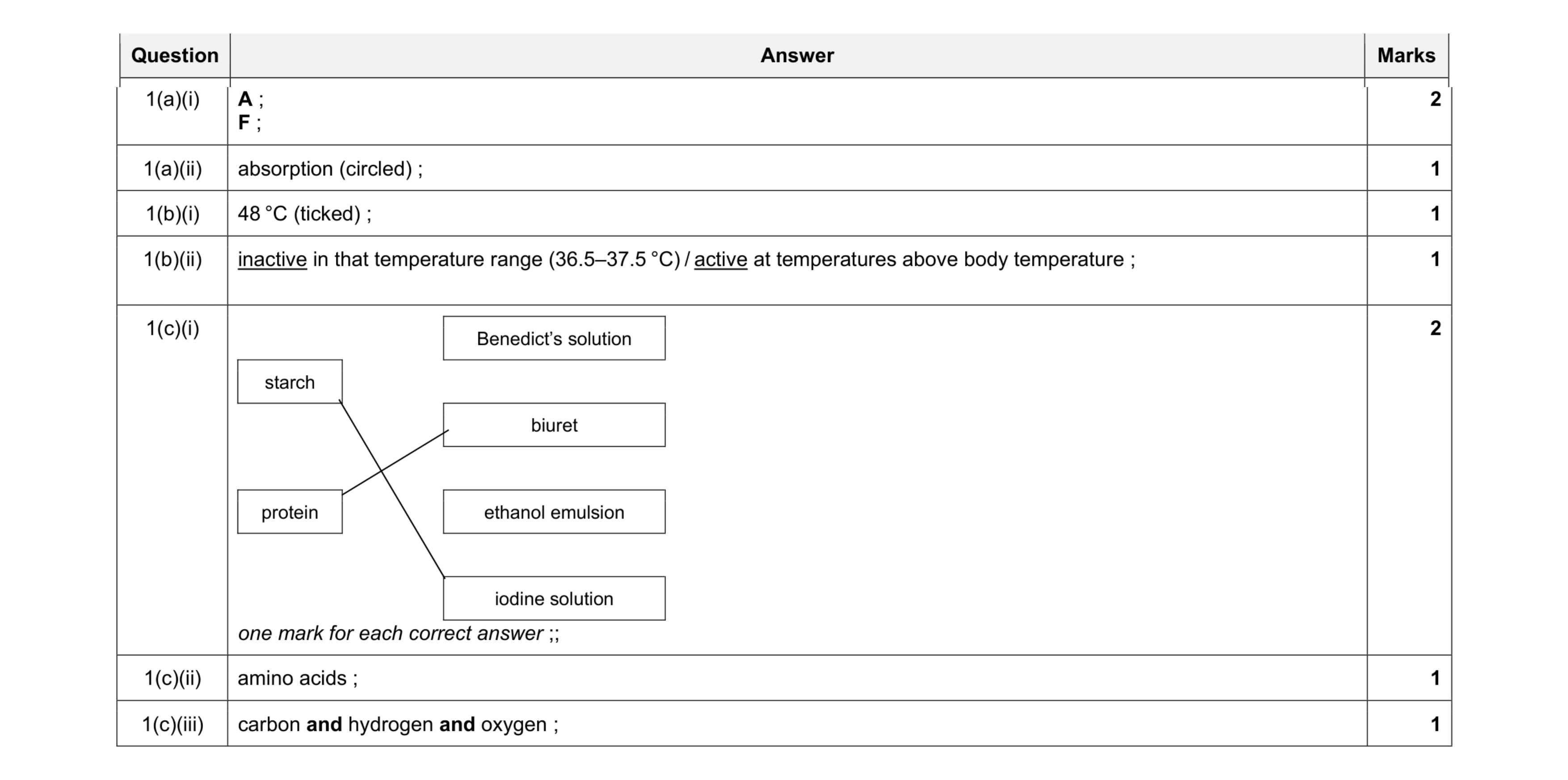 9
9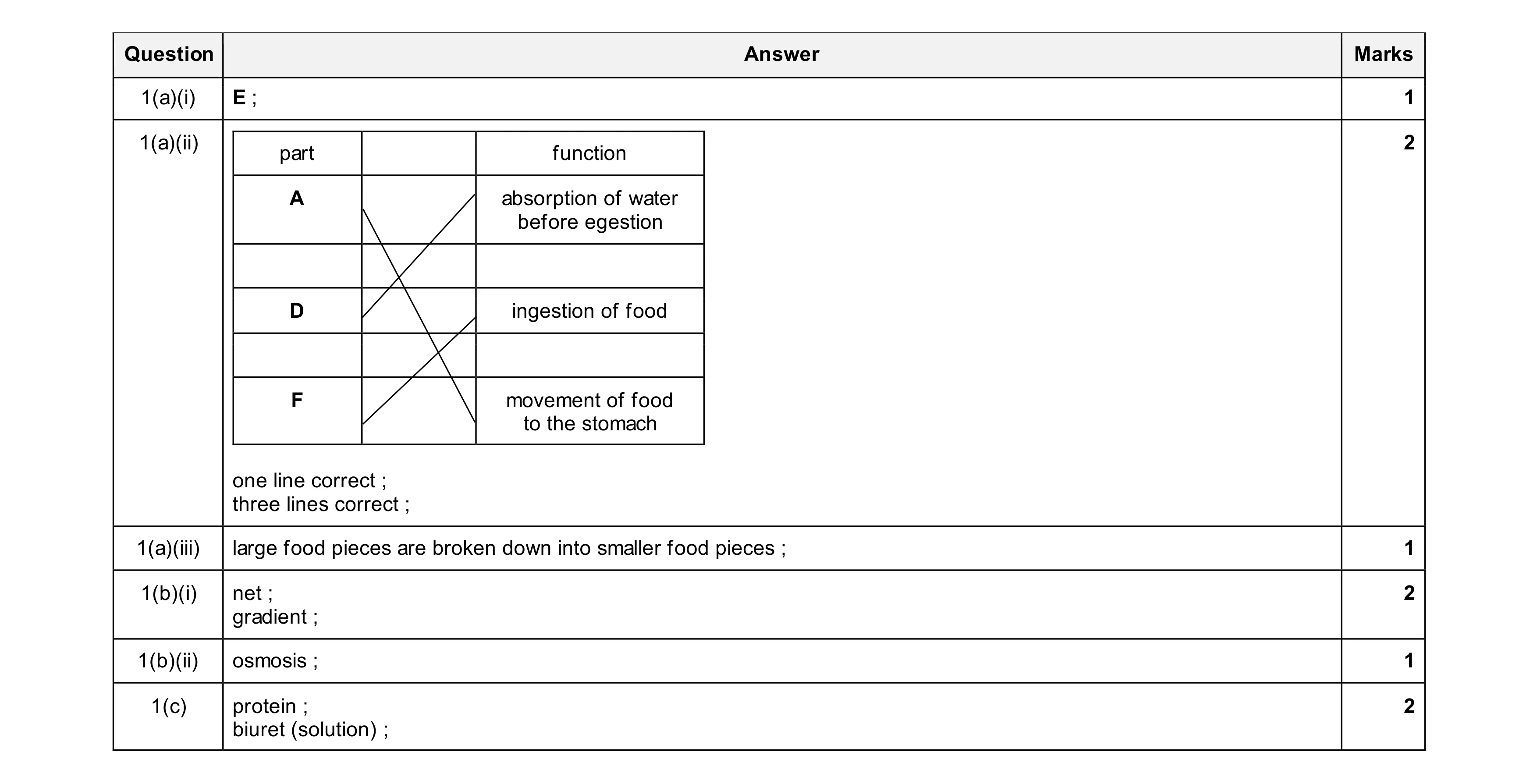 9
9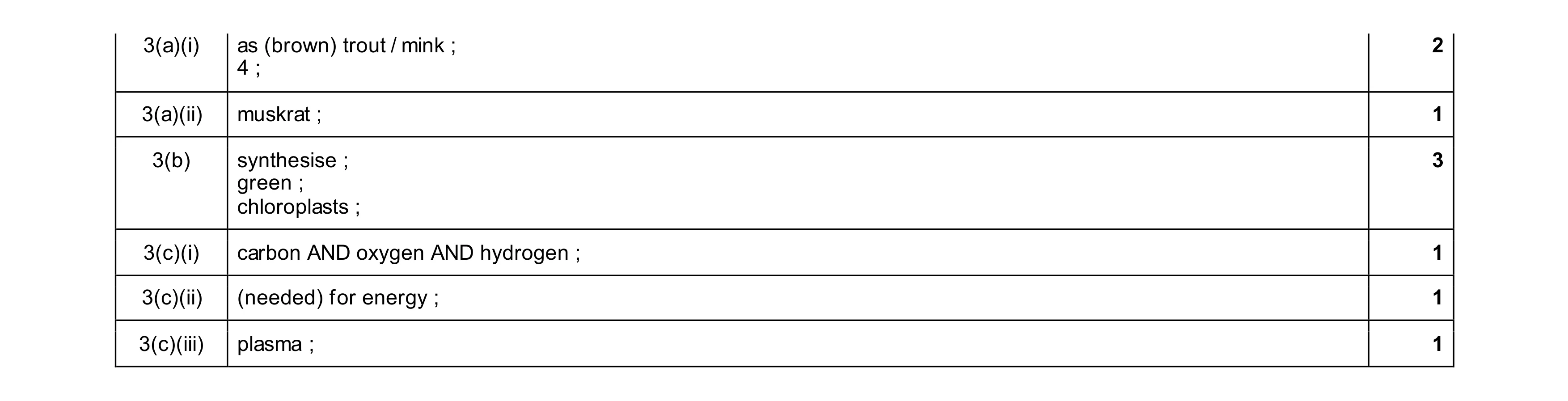 9
9