Questions as text
Q1 · Use lines to connect the box on the left to different boxes on the right 0653/42 Feb/March 2017
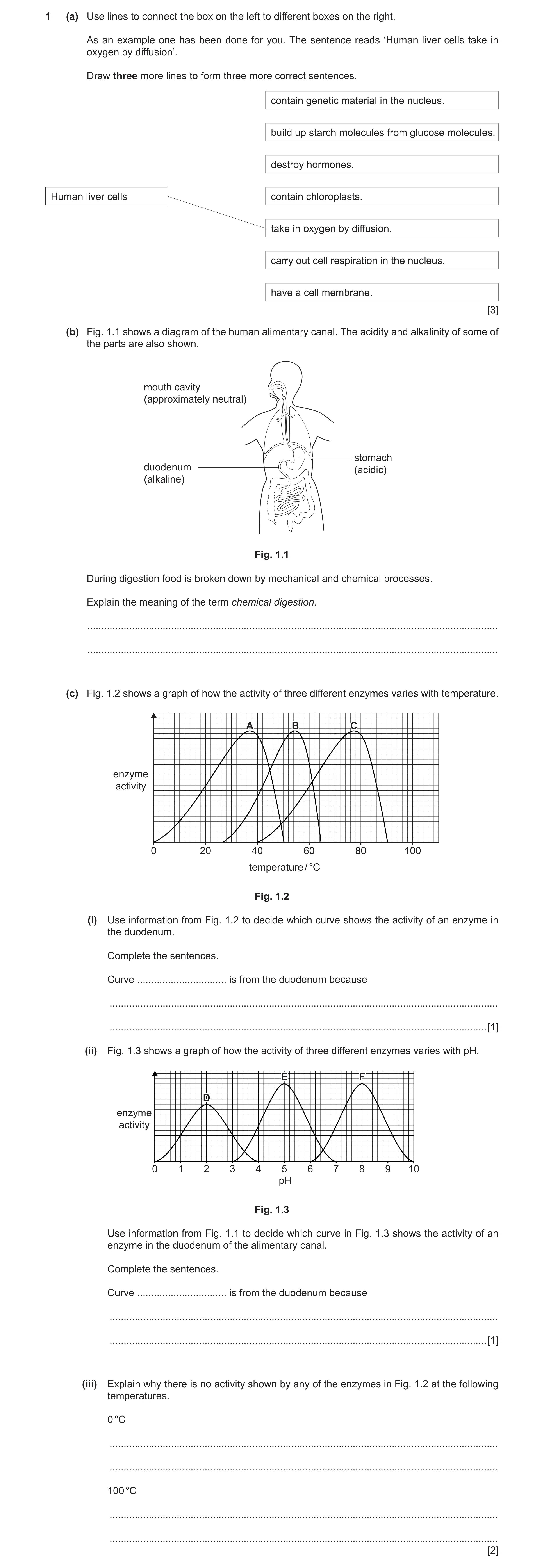
1 (a) Use lines to connect the box on the left to different boxes on the right. As an example one has been done for you. The sentence reads ‘Human liver cells take in oxygen by diffusion’. Draw three more lines to form three more correct sentences. contain genetic material in the nucleus. build up starch molecules from glucose molecules. destroy hormones. Human liver cells contain chloroplasts. take in oxygen by diffusion. carry out cell respiration in the nucleus. have a cell membrane. [3] (b) Fig. 1.1 shows a diagram of the human alimentary canal. The acidity and alkalinity of some of the parts are also shown. mouth cavity (approximately neutral) stomach duodenum (acidic) (alkaline) Fig. 1.1 During digestion food is broken down by mechanical and chemical processes. Explain the meaning of the term chemical digestion. … … (c) Fig. 1.2 shows a graph of how the activity of three different enzymes varies with temperature. AA BB CC enzyme activity 0 20 40 60 80 100 temperature / °C Fig. 1.2 (i) Use information from Fig. 1.2 to decide which curve shows the activity of an enzyme in the duodenum. Complete the sentences. Curve … is from the duodenum because … … [1] (ii) Fig. 1.3 shows a graph of how the activity of three different enzymes varies with pH. E F DD enzyme activity 0 1 2 3 4 5 6 7 8 9 10 pH Fig. 1.3 Use information from Fig. 1.1 to decide which curve in Fig. 1.3 shows the activity of an enzyme in the duodenum of the alimentary canal. Complete the sentences. Curve … is from the duodenum because … … [1] (iii) Explain why there is no activity shown by any of the enzymes in Fig. 1.2 at the following temperatures. 0 °C … … 100 °C … … [2]
9 marks
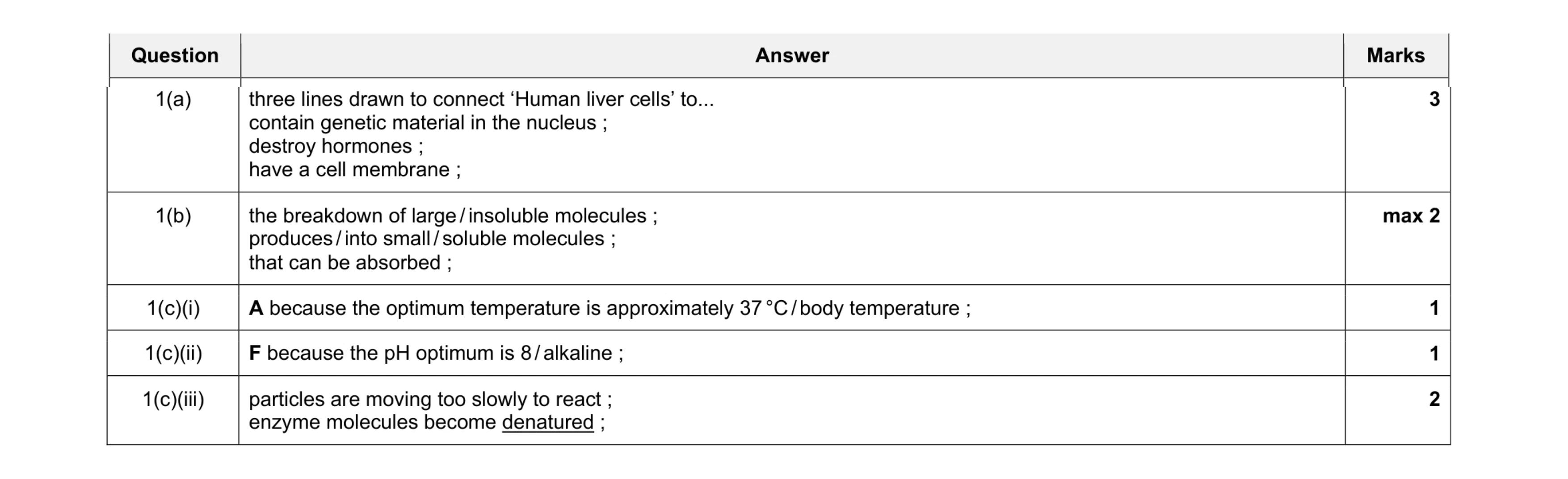
Mark scheme: 1(a) three lines drawn to connect ‘Human liver cells’ to... contain genetic material in the nucleus ; destroy hormones ; have a cell membrane ; 3 1(b) the breakdown of large / insoluble molecules ; produces / into small / soluble molecules ; that can be absorbed ; max 2 1(c)(i) A because the optimum temperature is approximately 37 °C / body temperature ; 1 1(c)(ii) F because the pH optimum is 8 / alkaline ; 1 1(c)(iii) particles are moving too slowly to react ; enzyme molecules become denatured ; 2
This question in 0653/42 Feb/March 2017
Q2 · A cross-section of a leaf 0653/42 Feb/March 2018
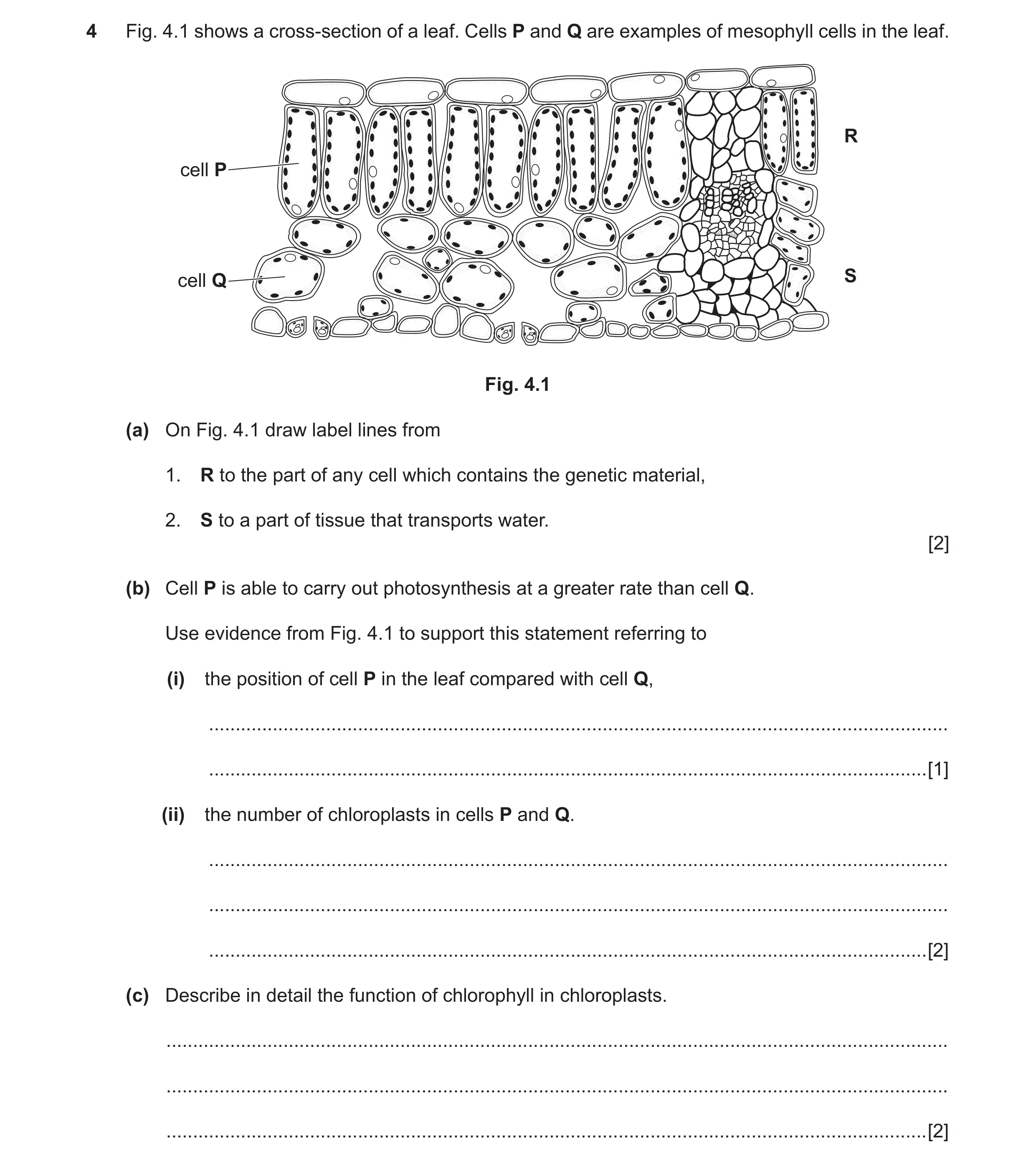
4 Fig. 4.1 shows a cross-section of a leaf. Cells P and Q are examples of mesophyll cells in the leaf. R cell P cell Q S Fig. 4.1 (a) On Fig. 4.1 draw label lines from 1. R to the part of any cell which contains the genetic material, 2. S to a part of tissue that transports water. [2] (b) Cell P is able to carry out photosynthesis at a greater rate than cell Q. Use evidence from Fig. 4.1 to support this statement referring to (i) the position of cell P in the leaf compared with cell Q, … … [1] (ii) the number of chloroplasts in cells P and Q. … … … [2] (c) Describe in detail the function of chlorophyll in chloroplasts. … … … [2]
7 marks
Mark scheme: 4(a) line drawn from R to any nucleus ; line drawn from S to any xylem tube cross section ; 2 4(b)(i) P is nearer to the surface / top so it captures more light ; 1 4(b)(ii) P has more chloroplasts than Q ; chloroplast is the site of photosynthesis ; reference to increased light absorption / increased amounts of chlorophyll ; max 2 4(c) traps light energy ; converts it to chemical energy / for formation of carbohydrates ; 2
This question in 0653/42 Feb/March 2018
Q3 · A diagram of a cell which lines the human airway 0653/43 Oct/Nov 2018
1 (a) Fig. 1.1 is a diagram of a cell which lines the human airway. B C A Fig. 1.1 Table 1.1 shows the names and functions of parts of the cell shown in Fig. 1.1. Complete Table 1.1. Table 1.1 letter name functions A nucleus controls the activities of the cell B C [4] (b) Fig. 1.2 shows a drawing of a wind-pollinated flower. X Y Fig. 1.2 (i) Describe how the structure of X is adapted to its function. … … … [2] (ii) Structure Y is not brightly coloured. Explain why a bright colour is not necessary for structure Y. … … … [2]
8 marks
Mark scheme: 1(a) (B) cilia ; removes mucus from airway ; (C) cytoplasm ; place where chemical reactions / respiration takes place ; 4 1(b)(i) feathery / large surface area ; for collecting pollen ; 2 1(b)(ii) no need to attract insects ; because they are not needed for pollination / pollination is by wind / not by insects ; 2
This question in 0653/43 Oct/Nov 2018
Question 4 0653/41 Oct/Nov 2019
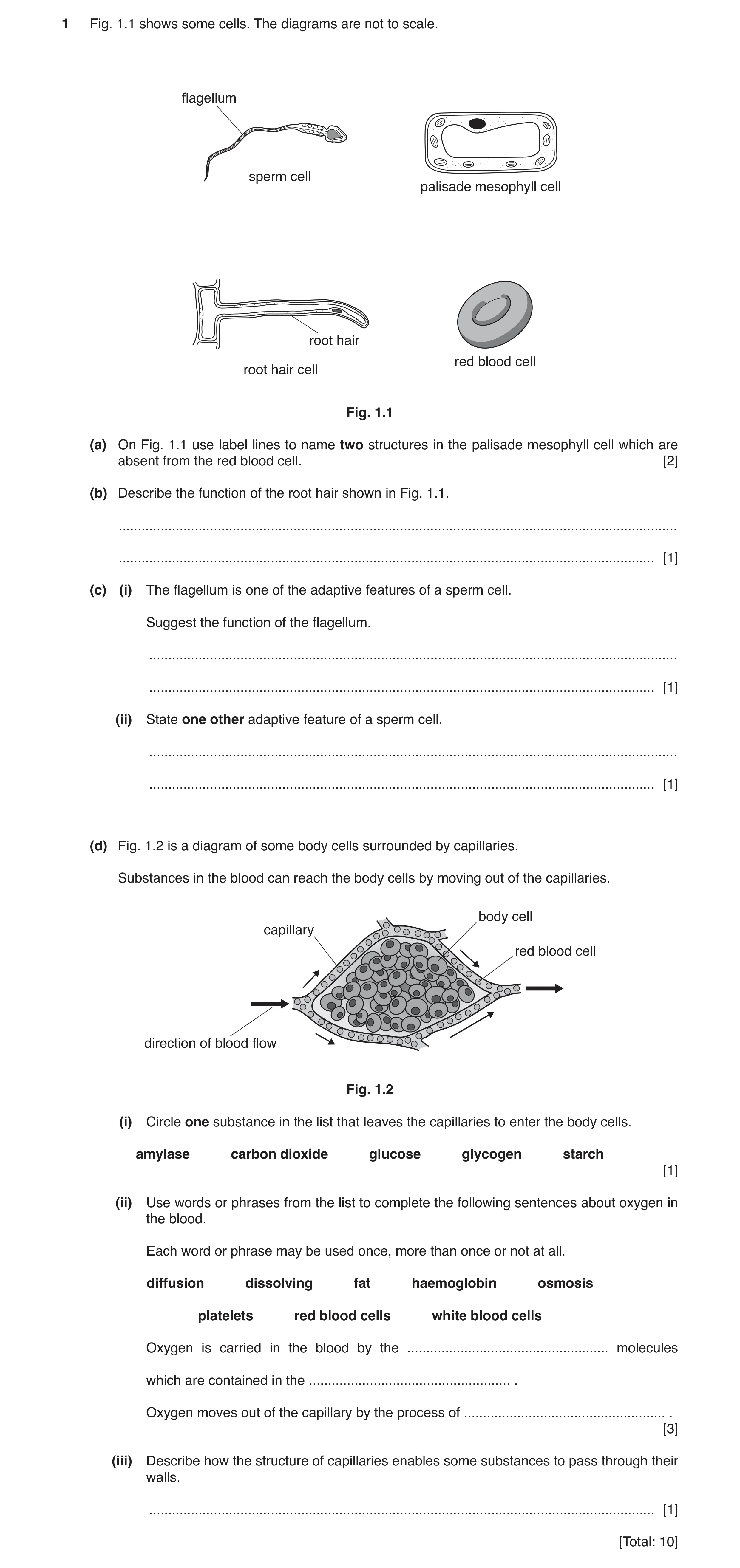
1 Fig. 1.1 shows some cells. The diagrams are not to scale. flagellum sperm cell palisade mesophyll cell root hair red blood cell root hair cell Fig. 1.1 (a) On Fig. 1.1 use label lines to name two structures in the palisade mesophyll cell which are absent from the red blood cell. [2] (b) Describe the function of the root hair shown in Fig. 1.1. … … [1] (c) (i) The flagellum is one of the adaptive features of a sperm cell. Suggest the function of the flagellum. … … [1] (ii) State one other adaptive feature of a sperm cell. … … [1] (d) Fig. 1.2 is a diagram of some body cells surrounded by capillaries. Substances in the blood can reach the body cells by moving out of the capillaries. body cell capillary red blood cell direction of blood flow Fig. 1.2 (i) Circle one substance in the list that leaves the capillaries to enter the body cells. amylase carbon dioxide glucose glycogen starch [1] (ii) Use words or phrases from the list to complete the following sentences about oxygen in the blood. Each word or phrase may be used once, more than once or not at all. diffusion dissolving fat haemoglobin osmosis platelets red blood cells white blood cells Oxygen is carried in the blood by the … molecules which are contained in the … . Oxygen moves out of the capillary by the process of … . [3] (iii) Describe how the structure of capillaries enables some substances to pass through their walls. … [1] [Total: 10]
10 marks
Mark scheme: 1(a) any two of the following correctly labelled: nucleus ; chloroplast ; cell wall ; vacuole ; 2 1(b) for (rapid) absorption of water ; 1 1(c)(i) for movement ; 1 1(c)(ii) acrosome containing enzymes used in fertilisation / many mitochondria to release energy for swimming ; 1 1(d)(i) glucose ; 1 1(d)(ii) haemoglobin ; red blood cells ; diffusion ; 3 1(d)(iii) capillary walls are thin ; 1
This question in 0653/41 Oct/Nov 2019
Q5 · A root hair cell and soil particles 0653/42 Oct/Nov 2019
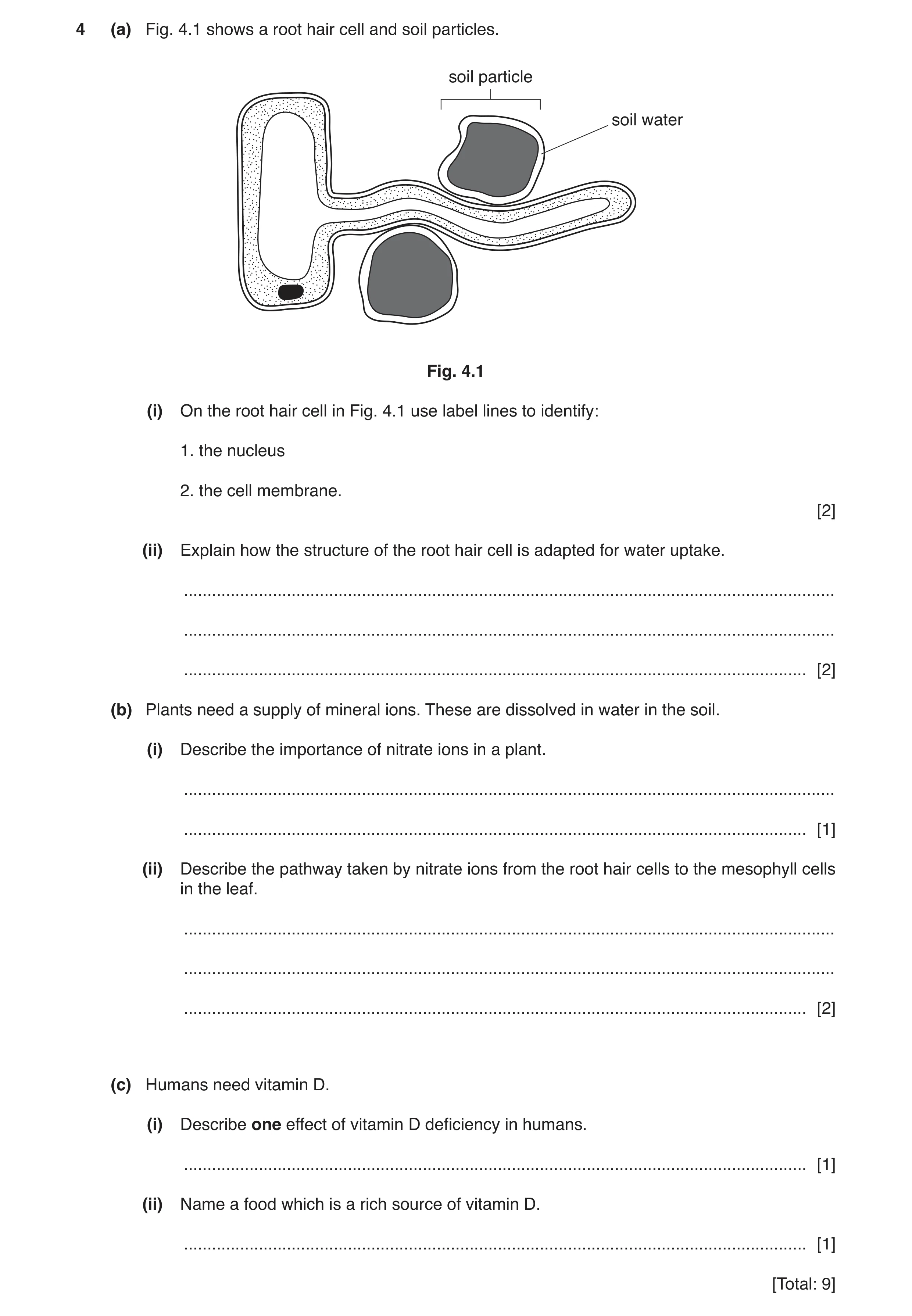
4 (a) Fig. 4.1 shows a root hair cell and soil particles. soil particle soil water Fig. 4.1 (i) On the root hair cell in Fig. 4.1 use label lines to identify: 1. the nucleus 2. the cell membrane. [2] (ii) Explain how the structure of the root hair cell is adapted for water uptake. … … … [2] (b) Plants need a supply of mineral ions. These are dissolved in water in the soil. (i) Describe the importance of nitrate ions in a plant. … … [1] (ii) Describe the pathway taken by nitrate ions from the root hair cells to the mesophyll cells in the leaf. … … … [2] (c) Humans need vitamin D. (i) Describe one effect of vitamin D deficiency in humans. … [1] (ii) Name a food which is a rich source of vitamin D. … [1] [Total: 9]
9 marks
Mark scheme: 4(a)(i) nucleus correctly labelled ; cell membrane correctly labelled ; 2 4(a)(ii) large surface area ; increases rate of water uptake ; 2 4(b)(i) needed to make amino acids ; 1 4(b)(ii) across root cortex ; up stem ; in xylem ; Max. 2 4(c)(i) rickets / soft (and deformed) bones ; 1 4(c)(ii) butter / margarine / egg (yolks) / milk ; 1
This question in 0653/42 Oct/Nov 2019
Question 6 0653/42 May/June 2020
1 (a) Fig. 1.1 represents a plant cell. Fig. 1.1 Add labels to Fig. 1.1 to name two structures that are only present in plant cells. [2] (b) Fig. 1.2 represents an animal cell from the trachea. Fig. 1.2 Describe how the structure of this cell is adapted to its function. … … … [2] (c) Fig. 1.3 shows part of a food web. foxes frogs owls stoats spiders rabbits voles insects grass Fig. 1.3 (i) Define the term consumer. … … [1] (ii) List all of the tertiary consumers shown in the food web in Fig. 1.3. Explain how you identified these consumers using the term trophic level. tertiary consumers … … explanation … … [2] (iii) Complete the food chain containing five organisms from the food web in Fig. 1.3. grass [1] (iv) Describe what the arrows in the food chain represent. … [1] (d) Use words from the list to complete the sentences about photosynthesis. chemical chlorophyll cytoplasm glucose light oxygen starch thermal Each word may be used once, more than once or not at all. During photosynthesis … energy is transferred into … energy by … molecules. [2] [Total: 11]
11 marks
Mark scheme: 1(a) any two of the following correctly labelled: chloroplast ; (large) vacuole ; cell wall ; 2 1(b) (presence of) cilia ; move mucus ; 2 1(c)(i) an organism that gets its energy by feeding on other organisms ; 1 1(c)(ii) (tertiary consumers) foxes and frogs and owls ; (explanation) organisms are at the fourth trophic level ; 2 1(c)(iii) (grass) insects spiders frogs foxes ; 1 1(c)(iv) transfer of energy ; 1 1(d) light (energy is transferred into) chemical (energy) ; chlorophyll ; 2
This question in 0653/42 May/June 2020
Q7 · A diagram of a human sperm cell 0653/41 May/June 2021
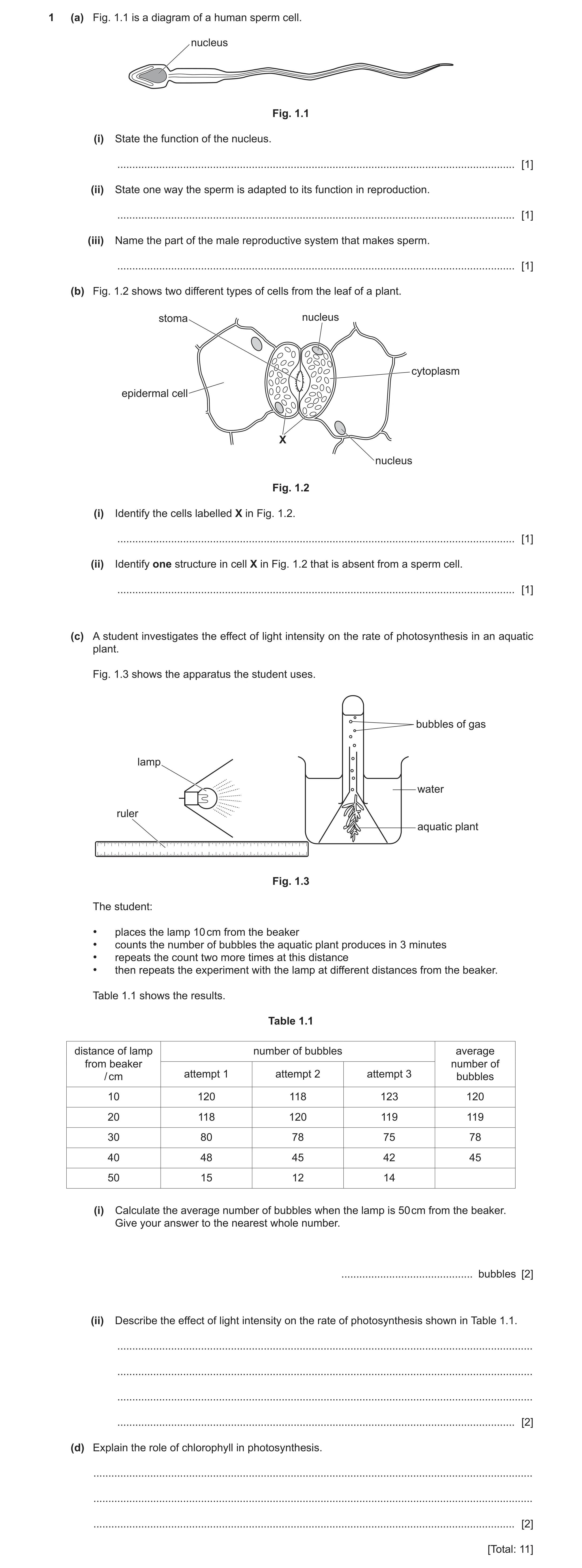
1 (a) Fig. 1.1 is a diagram of a human sperm cell. nucleus Fig. 1.1 (i) State the function of the nucleus. … [1] (ii) State one way the sperm is adapted to its function in reproduction. … [1] (iii) Name the part of the male reproductive system that makes sperm. … [1] (b) Fig. 1.2 shows two different types of cells from the leaf of a plant. stoma nucleus cytoplasm epidermal cell X nucleus Fig. 1.2 (i) Identify the cells labelled X in Fig. 1.2. … [1] (ii) Identify one structure in cell X in Fig. 1.2 that is absent from a sperm cell. … [1] (c) A student investigates the effect of light intensity on the rate of photosynthesis in an aquatic plant. Fig. 1.3 shows the apparatus the student uses. bubbles of gas lamp water ruler aquatic plant Fig. 1.3 The student: • places the lamp 10 cm from the beaker • counts the number of bubbles the aquatic plant produces in 3 minutes • repeats the count two more times at this distance • then repeats the experiment with the lamp at different distances from the beaker. Table 1.1 shows the results. Table 1.1 distance of lamp number of bubbles average from beaker number of / cm attempt 1 attempt 2 attempt 3 bubbles 10 120 118 123 120 20 118 120 119 119 30 80 78 75 78 40 48 45 42 45 50 15 12 14 (i) Calculate the average number of bubbles when the lamp is 50 cm from the beaker. Give your answer to the nearest whole number. … bubbles [2] (ii) Describe the effect of light intensity on the rate of photosynthesis shown in Table 1.1. … … … … [2] (d) Explain the role of chlorophyll in photosynthesis. … … … [2] [Total: 11]
11 marks
Mark scheme: 1(a)(i) contains genetic material ; 1 1(a)(ii) has a flagellum / presence of enzymes ; 1 1(a)(iii) testes ; 1 1(b)(i) guard cell ; 1 1(b)(ii) chloroplast / cell wall ; 1 1(c)(i) (15 + 12 + 14) ÷ 3 ; (=) 14 (bubbles) ; 2 1(c)(ii) as light intensity increases or distance decreases the rate increases ORA ; the idea that the rate levels off (closer than 20 cm) ; 2 1(d) any two from: absorbs light (energy) ; (transfers) light to chemical energy ; for the synthesis of carbohydrates ; 2
This question in 0653/41 May/June 2021
Q8 · The boxes on the left show the names of different types of cell 0653/41 Oct/Nov 2021
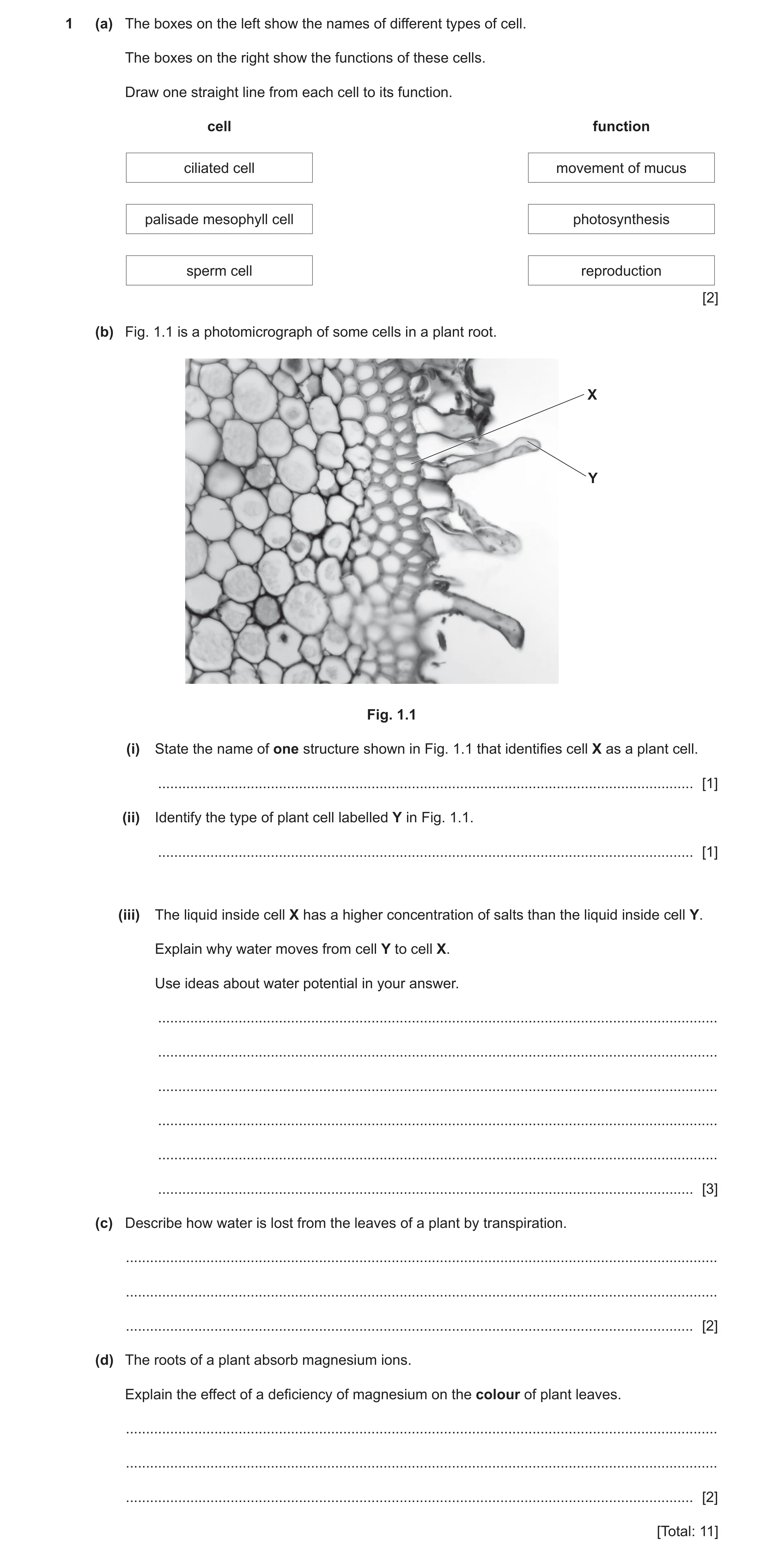
1 (a) The boxes on the left show the names of different types of cell. The boxes on the right show the functions of these cells. Draw one straight line from each cell to its function. cell function ciliated cell movement of mucus palisade mesophyll cell photosynthesis sperm cell reproduction [2] (b) Fig. 1.1 is a photomicrograph of some cells in a plant root. X Y Fig. 1.1 (i) State the name of one structure shown in Fig. 1.1 that identifies cell X as a plant cell. … [1] (ii) Identify the type of plant cell labelled Y in Fig. 1.1. … [1] (iii) The liquid inside cell X has a higher concentration of salts than the liquid inside cell Y. Explain why water moves from cell Y to cell X. Use ideas about water potential in your answer. … … … … … … [3] (c) Describe how water is lost from the leaves of a plant by transpiration. … … … [2] (d) The roots of a plant absorb magnesium ions. Explain the effect of a deficiency of magnesium on the colour of plant leaves. … … … [2] [Total: 11]
11 marks
Mark scheme: 1(a) ciliated cell movement of mucus palisade mesophyll cell photosynthesis sperm cell reproduction one correct line ; three lines correct ; 2 1(b)(i) vacuole / cell wall ; 1 1(b)(ii) root hair (cell) ; 1 1(b)(iii) water moves by osmosis ; from high water potential to a low water potential / down a water potential gradient / (because) cell X has a lower water potential than cell Y ORA ; through a partially permeable membrane ; 3 1(c) evaporation from (surface of) mesophyll cells ; diffusion (of water vapour) through stomata ; 2 1(d) (magnesium deficiency causes) leaves (to) turn yellow ; (because magnesium) needed to make chlorophyll ; 2
This question in 0653/41 Oct/Nov 2021
Q9 · A diagram of a palisade cell and a root hair cell 0653/43 May/June 2023
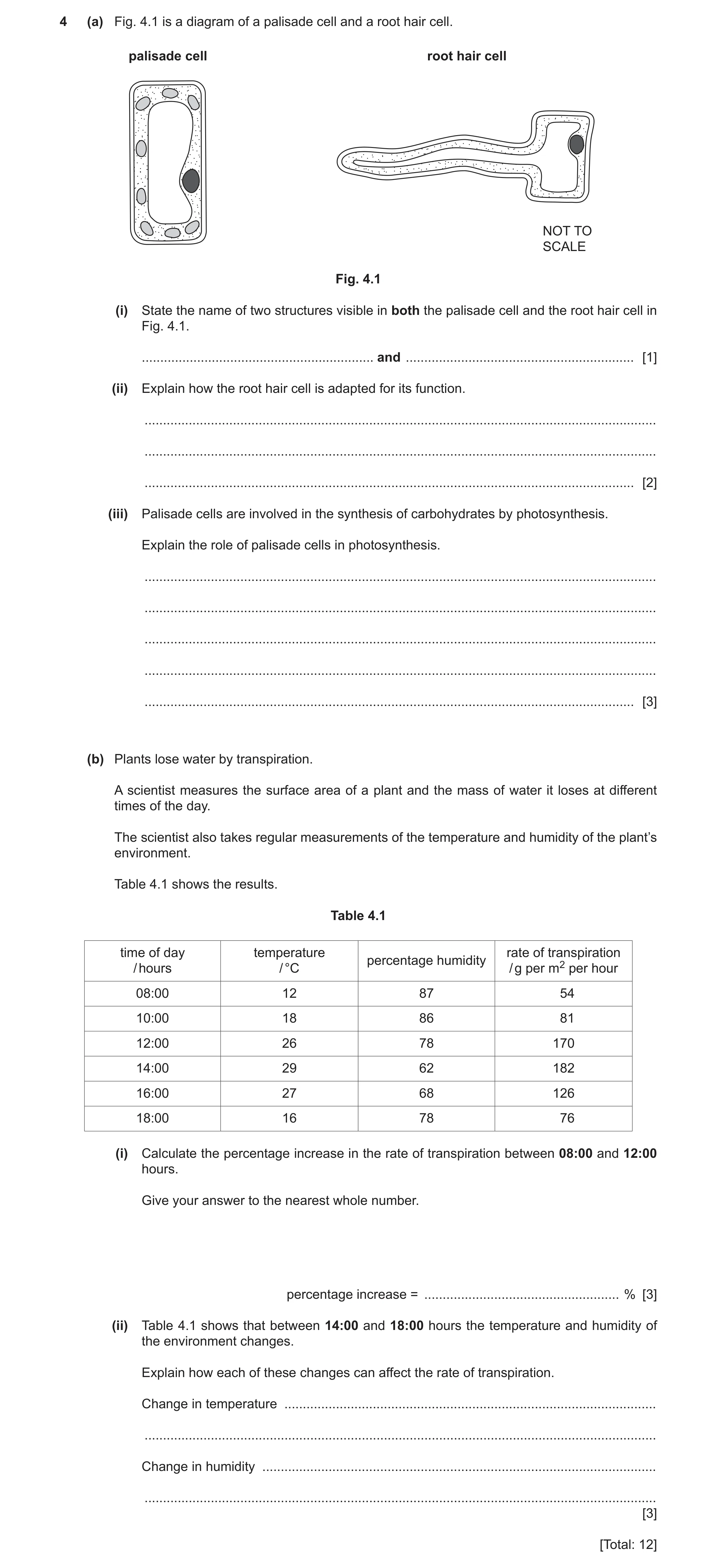
4 (a) Fig. 4.1 is a diagram of a palisade cell and a root hair cell. palisade cell root hair cell NOT TO SCALE Fig. 4.1 (i) State the name of two structures visible in both the palisade cell and the root hair cell in Fig. 4.1. … and … [1] (ii) Explain how the root hair cell is adapted for its function. … … … [2] (iii) Palisade cells are involved in the synthesis of carbohydrates by photosynthesis. Explain the role of palisade cells in photosynthesis. … … … … … [3] (b) Plants lose water by transpiration. A scientist measures the surface area of a plant and the mass of water it loses at different times of the day. The scientist also takes regular measurements of the temperature and humidity of the plant’s environment. Table 4.1 shows the results. Table 4.1 time of day temperature rate of transpiration percentage humidity / hours / °C / g per m2 per hour 08:00 12 87 54 10:00 18 86 81 12:00 26 78 170 14:00 29 62 182 16:00 27 68 126 18:00 16 78 76 (i) Calculate the percentage increase in the rate of transpiration between 08:00 and 12:00 hours. Give your answer to the nearest whole number. percentage increase = … % [3] (ii) Table 4.1 shows that between 14:00 and 18:00 hours the temperature and humidity of the environment changes. Explain how each of these changes can affect the rate of transpiration. Change in temperature … … Change in humidity … … [3] [Total: 12]
12 marks
Mark scheme: 4(a)(i) any two from: (large) vacuole ; cell membrane ; cell wall ; nucleus ; cytoplasm ; 4(a)(ii) large surface area ; increases (rate of) absorption of, water / mineral ions ; 2 4(a)(iii) ref to (large numbers of) chloroplasts ; that contain chlorophyll ; transfers light energy to chemical energy ; 3 4(b)(i) 170 – 54 / 116 ; (170 – 54) ÷ 54 100 / 116 ÷ 54 100 / (170 ÷ 54 100) – 100 / 214.814 ; 215 (%) ; 3 4(b)(ii) any three from: rate of transpiration decreases ; (idea of higher humidity causes) increased concentration of water surrounding leaves / lower concentration gradient ; decrease in evaporation (from mesophyll cells) ; decrease in diffusion from, stomata / leaves ; 3
This question in 0653/43 May/June 2023
Q10 · A student labels a diagram of a plant cell 0653/42 May/June 2024
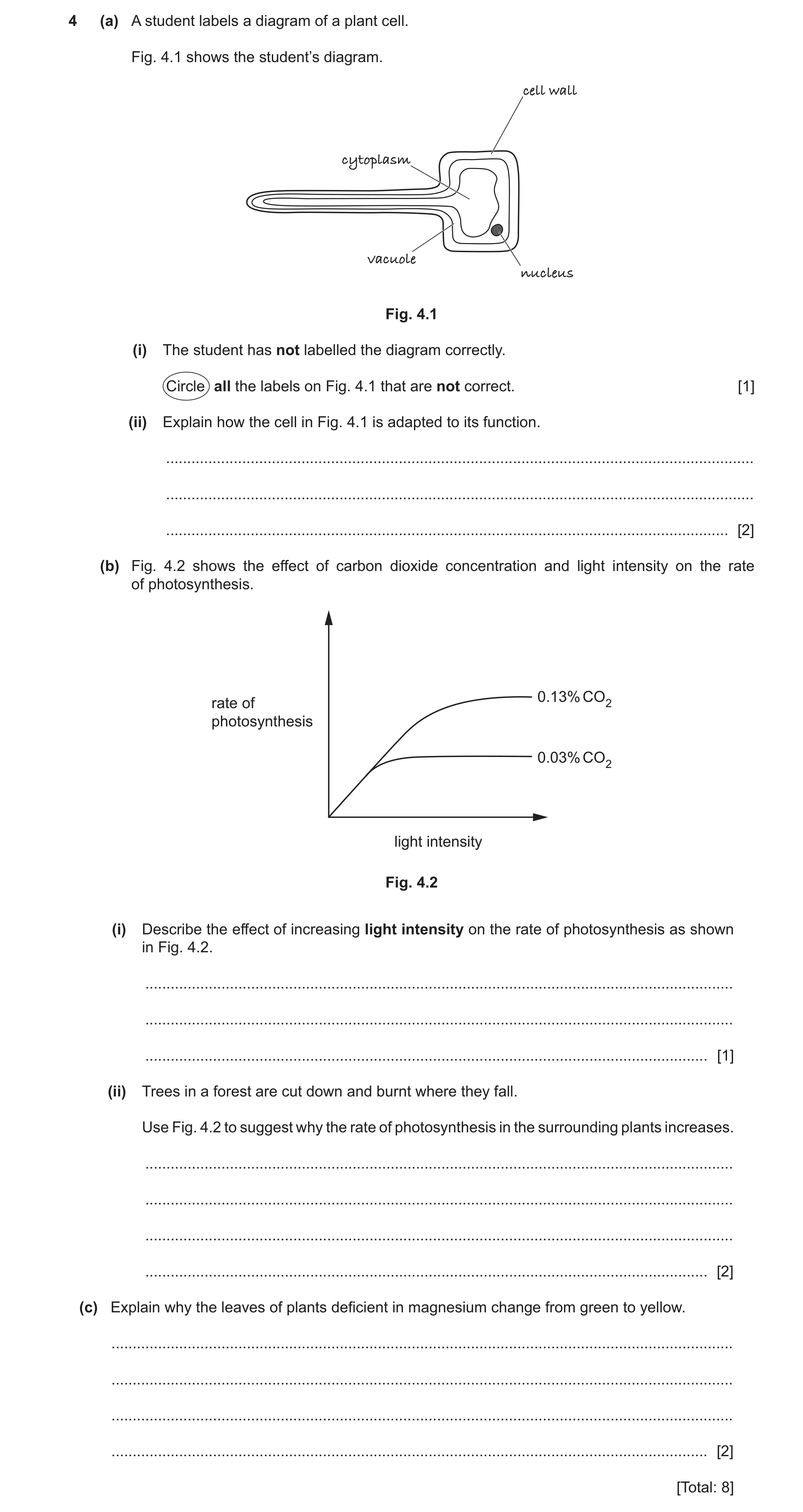
4 (a) A student labels a diagram of a plant cell. Fig. 4.1 shows the student’s diagram. cell wall cytoplasm vacuole nucleus Fig. 4.1 (i) The student has not labelled the diagram correctly. Circle all the labels on Fig. 4.1 that are not correct. [1] (ii) Explain how the cell in Fig. 4.1 is adapted to its function. … … … [2] (b) Fig. 4.2 shows the effect of carbon dioxide concentration and light intensity on the rate of photosynthesis. 0.13% CO2 rate of photosynthesis 0.03% CO2 light intensity Fig. 4.2 (i) Describe the effect of increasing light intensity on the rate of photosynthesis as shown in Fig. 4.2. … … … [1] (ii) Trees in a forest are cut down and burnt where they fall. Use Fig. 4.2 to suggest why the rate of photosynthesis in the surrounding plants increases. … … … … [2] (c) Explain why the leaves of plants deficient in magnesium change from green to yellow. … … … … [2] [Total: 8]
8 marks
Mark scheme: 4(a)(i) vacuole and cytoplasm circled ; 1 4(a)(ii) large surface area / elongated shape ; increases, rate of absorption / uptake of water / uptake of mineral (ions) ; 2 Question Answer Marks 4(b)(i) (as light intensity increases) rate of photosynthesis increases, and then levels off / is constant ; 1 4(b)(ii) more light / less competition for light ; more CO2 / less competition for CO2 / CO2 is released by combustion ; 2 4(c) magnesium is required to make chlorophyll ; chlorophyll is a green pigment ; 2
This question in 0653/42 May/June 2024
Q11 · A diagram showing a cross‑section of a bacterial cell 0653/41 May/June 2025
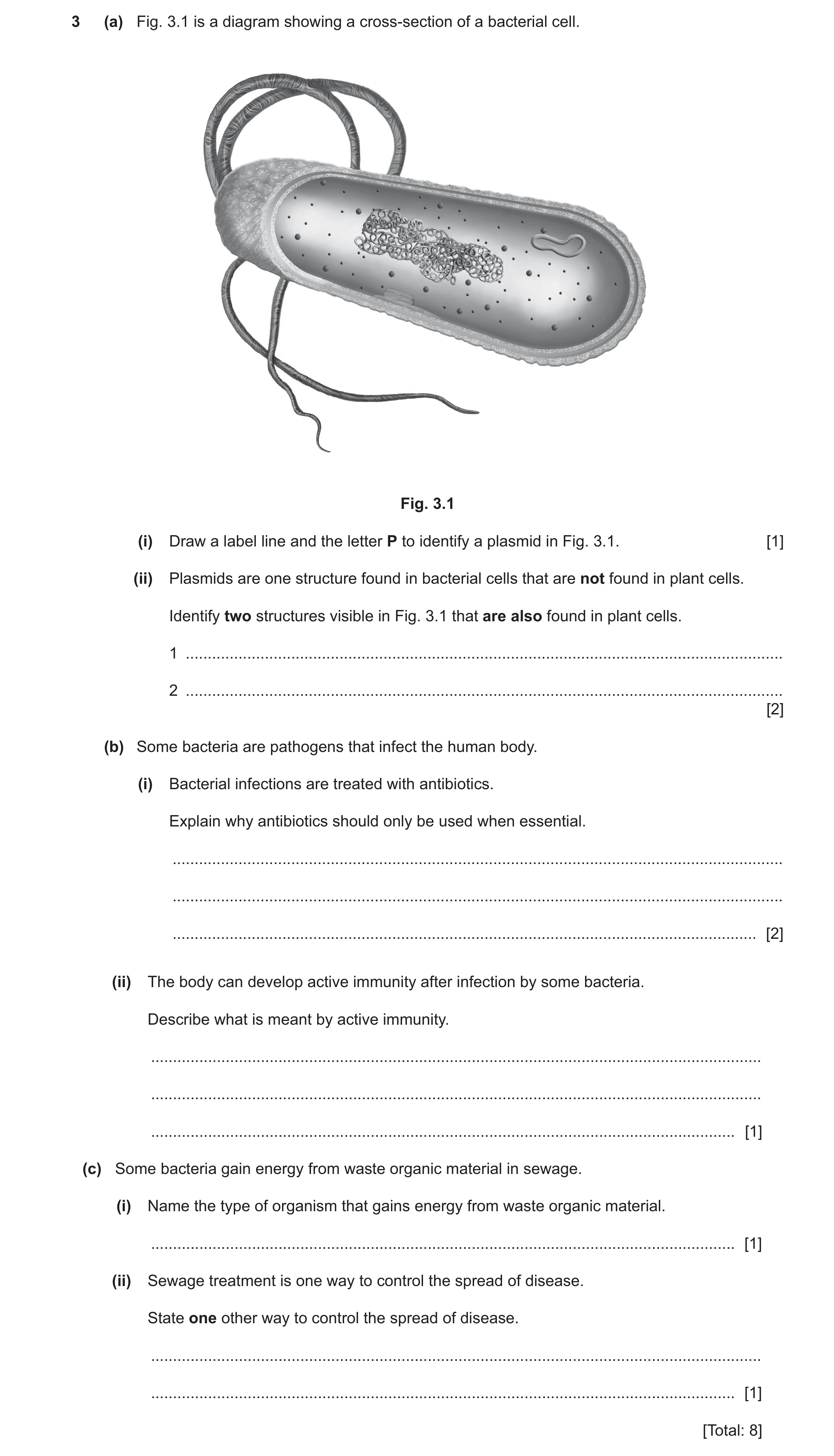
3 (a) Fig. 3.1 is a diagram showing a cross‑section of a bacterial cell. Fig. 3.1 (i) Draw a label line and the letter P to identify a plasmid in Fig. 3.1. [1] (ii) Plasmids are one structure found in bacterial cells that are not found in plant cells. Identify two structures visible in Fig. 3.1 that are also found in plant cells. 1 … 2 … [2] (b) Some bacteria are pathogens that infect the human body. (i) Bacterial infections are treated with antibiotics. Explain why antibiotics should only be used when essential. … … … [2] (ii) The body can develop active immunity after infection by some bacteria. Describe what is meant by active immunity. … … … [1] (c) Some bacteria gain energy from waste organic material in sewage. (i) Name the type of organism that gains energy from waste organic material. … [1] (ii) Sewage treatment is one way to control the spread of disease. State one other way to control the spread of disease. … … [1] [Total: 8]
8 marks
Mark scheme: 3(a)(i) plasmid labelled ; 1 3(a)(ii) any two from: 2 cell wall ; ribosomes ; cell membrane ; cytoplasm ; 3(b)(i) idea that it helps prevent antibiotic resistance in bacteria ; 2 idea that antibiotic becomes less effective (due to over use) / owtte ; 3(b)(ii) (defence against a pathogen by) production of antibodies ; 1 3(c)(i) decomposer ; 1 3(c)(ii) any one from: 1 hygienic food preparation ; personal hygiene / good hygiene ; clean water supply ; waste disposal ; AVP, e.g. vaccination ;
This question in 0653/41 May/June 2025
Q12 · A diagram of a bacterial cell 0653/42 Oct/Nov 2025
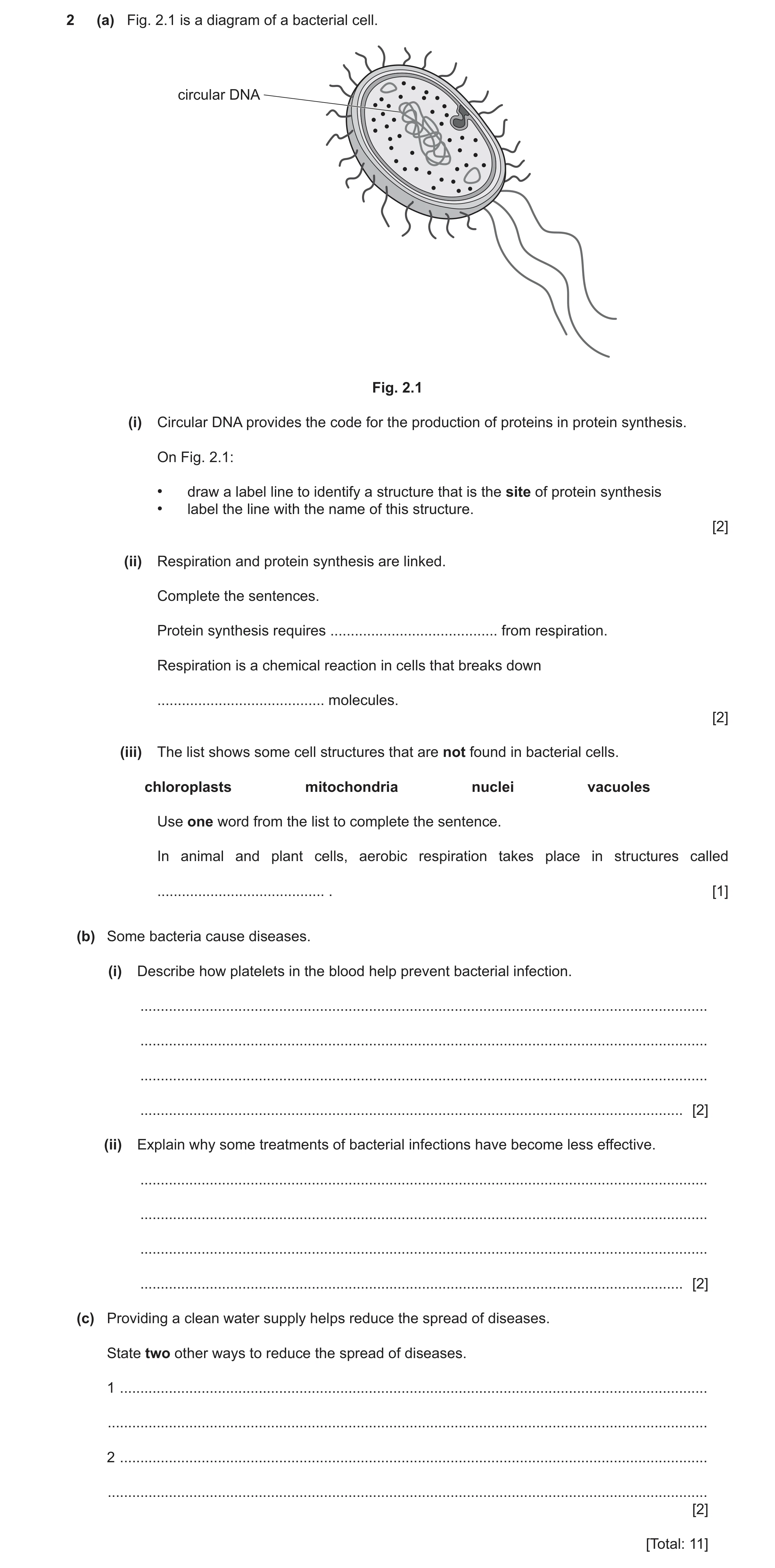
2 (a) Fig. 2.1 is a diagram of a bacterial cell. circular DNA Fig. 2.1 (i) Circular DNA provides the code for the production of proteins in protein synthesis. On Fig. 2.1: • draw a label line to identify a structure that is the site of protein synthesis • label the line with the name of this structure. [2] (ii) Respiration and protein synthesis are linked. Complete the sentences. Protein synthesis requires … from respiration. Respiration is a chemical reaction in cells that breaks down … molecules. [2] (iii) The list shows some cell structures that are not found in bacterial cells. chloroplasts mitochondria nuclei vacuoles Use one word from the list to complete the sentence. In animal and plant cells, aerobic respiration takes place in structures called … . [1] (b) Some bacteria cause diseases. (i) Describe how platelets in the blood help prevent bacterial infection. … … … … [2] (ii) Explain why some treatments of bacterial infections have become less effective. … … … … [2] (c) Providing a clean water supply helps reduce the spread of diseases. State two other ways to reduce the spread of diseases. 1 … … 2 … … [2] [Total: 11]
11 marks
Mark scheme: 2(a)(i) one of the small dots labelled ; 2 ribosome ; 2(a)(ii) energy ; 2 nutrient ; 2(a)(iii) mitochondria ; 1 2(b)(i) idea of involved in blood clotting ; 2 clot prevents entry of bacteria / clotting forms a barrier to bacteria ; 2(b)(ii) antibiotics and overuse / increased use / incorrect use / non-essential use 2 resulted in bacteria become resistant to (antibiotics) ; 2(c) any two from : 2 hygienic food preparation ; personal hygiene / good hygiene; waste disposal ; sewage treatment ; AVP, e.g. vaccination ; ;
This question in 0653/42 Oct/Nov 2025
Q13 · The structure of a virus and a bacterial cell 0653/43 Oct/Nov 2025
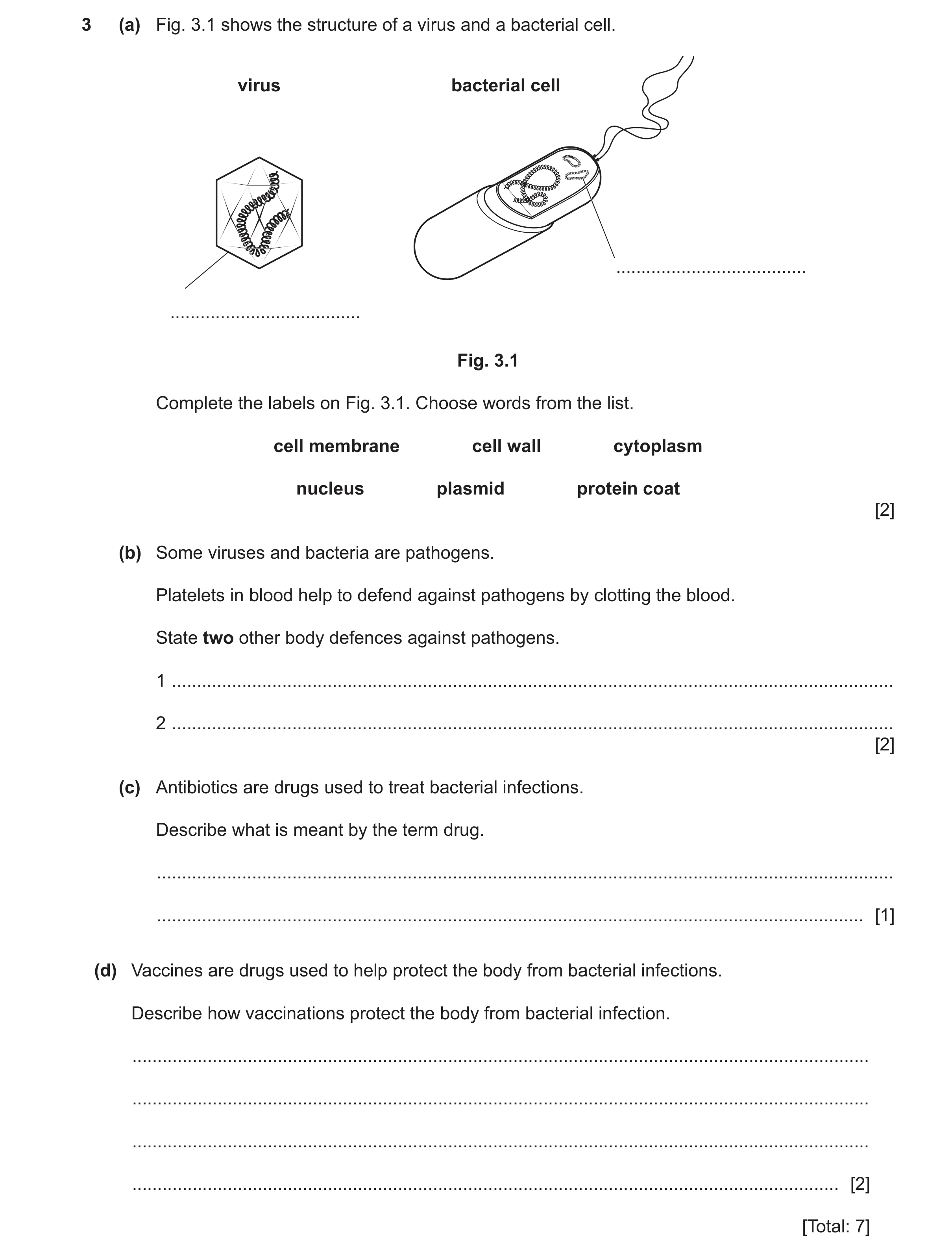
3 (a) Fig. 3.1 shows the structure of a virus and a bacterial cell. virus bacterial cell … … Fig. 3.1 Complete the labels on Fig. 3.1. Choose words from the list. cell membrane cell wall cytoplasm nucleus plasmid protein coat [2] (b) Some viruses and bacteria are pathogens. Platelets in blood help to defend against pathogens by clotting the blood. State two other body defences against pathogens. 1 … 2 … [2] (c) Antibiotics are drugs used to treat bacterial infections. Describe what is meant by the term drug. … … [1] (d) Vaccines are drugs used to help protect the body from bacterial infections. Describe how vaccinations protect the body from bacterial infection. … … … … [2] [Total: 7]
7 marks
Mark scheme: 3(a) as (virus) protein coat ; 2 (bacterial cell) plasmid ; 3(b) any two from: 2 skin ; hairs in the nose ; mucus ; stomach acid ; white blood cells / antibodies ; AVP ; 3(c) substance (taken into the body) that modifies/affects (chemical) reactions in the body ; 1 3(d) cause the body to make antibodies ; 2 provide active immunity ;
This question in 0653/43 Oct/Nov 2025
 3 / 19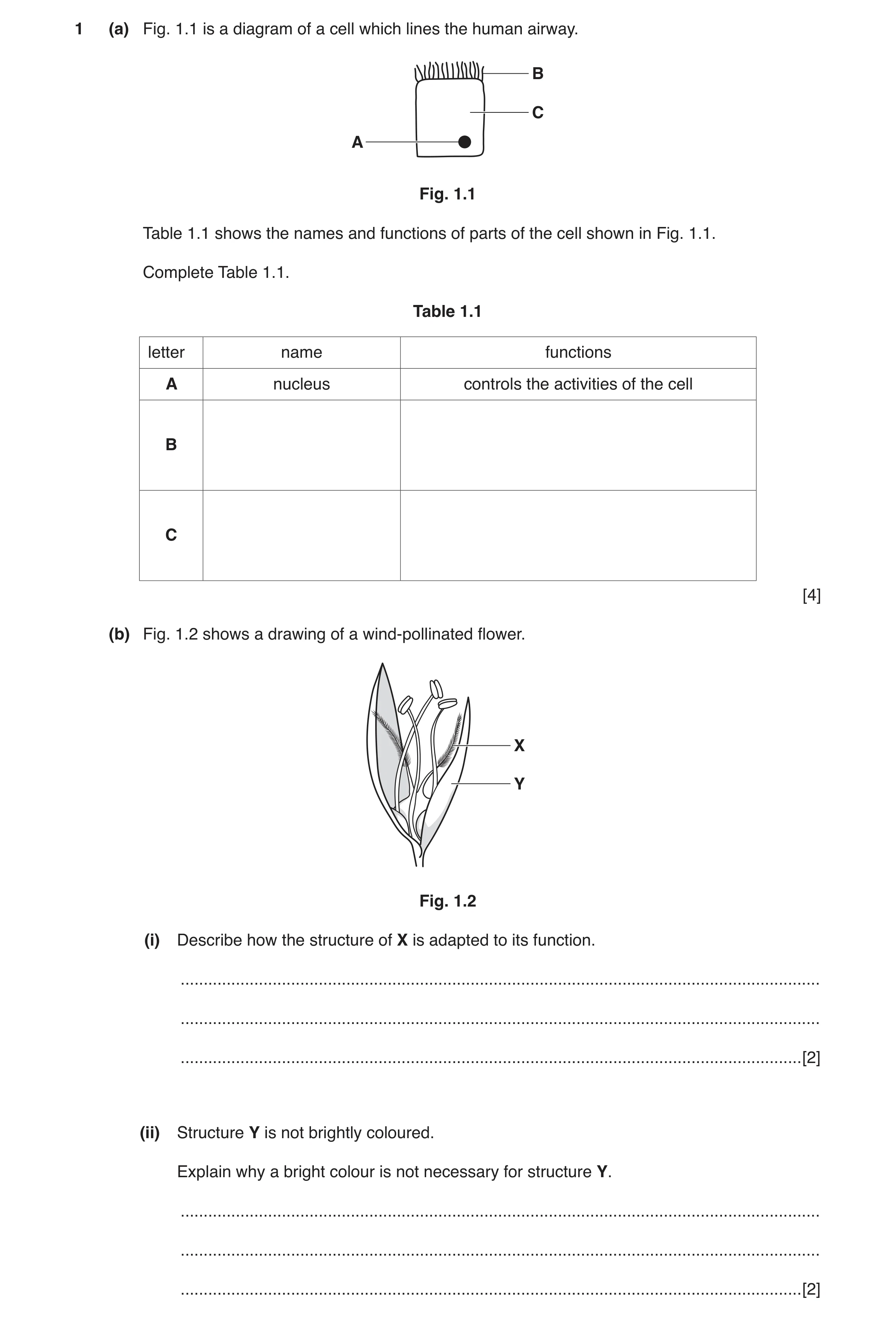
 7 / 19
![Question 6: (a) Fig. 1.1 represents a plant cell. Fig. 1.1 Add labels to Fig. 1.1 to name two structures that are only present in plant cells. [2] (b) …](https://img.pastlit.com/crops/1f783e97-1b33-4816-ae7a-e40f7ac4b774/q1.webp)
 19 / 19
 9
9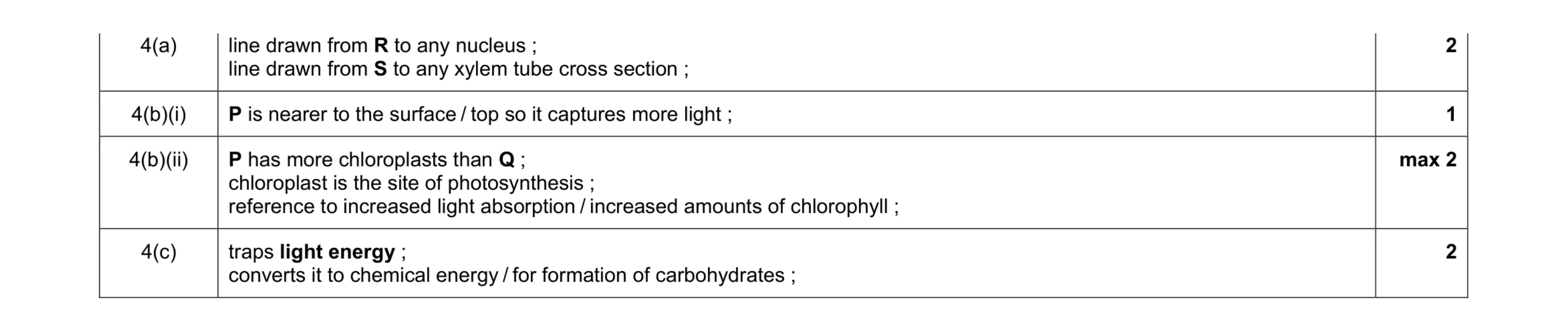 7
7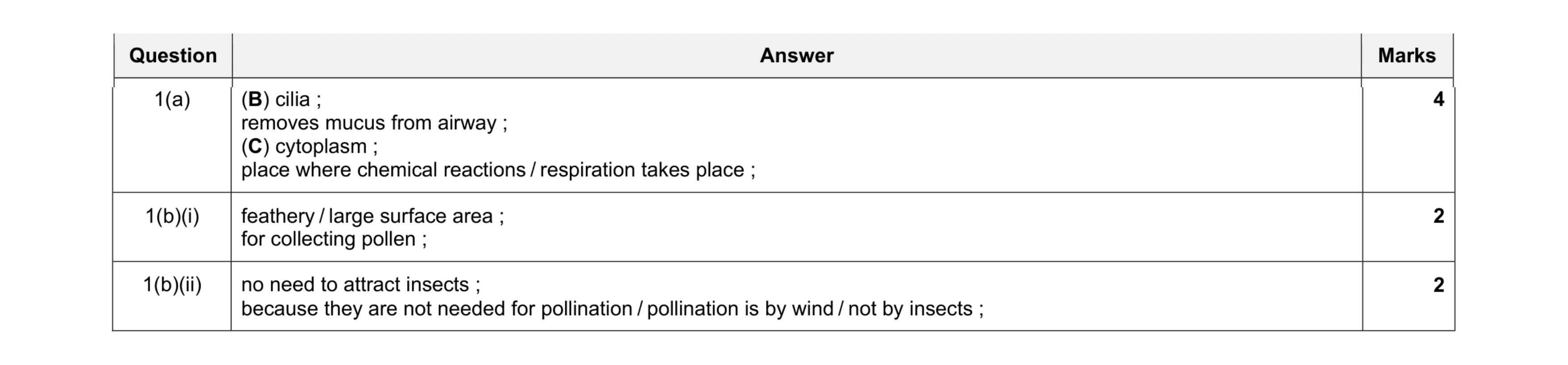 8
8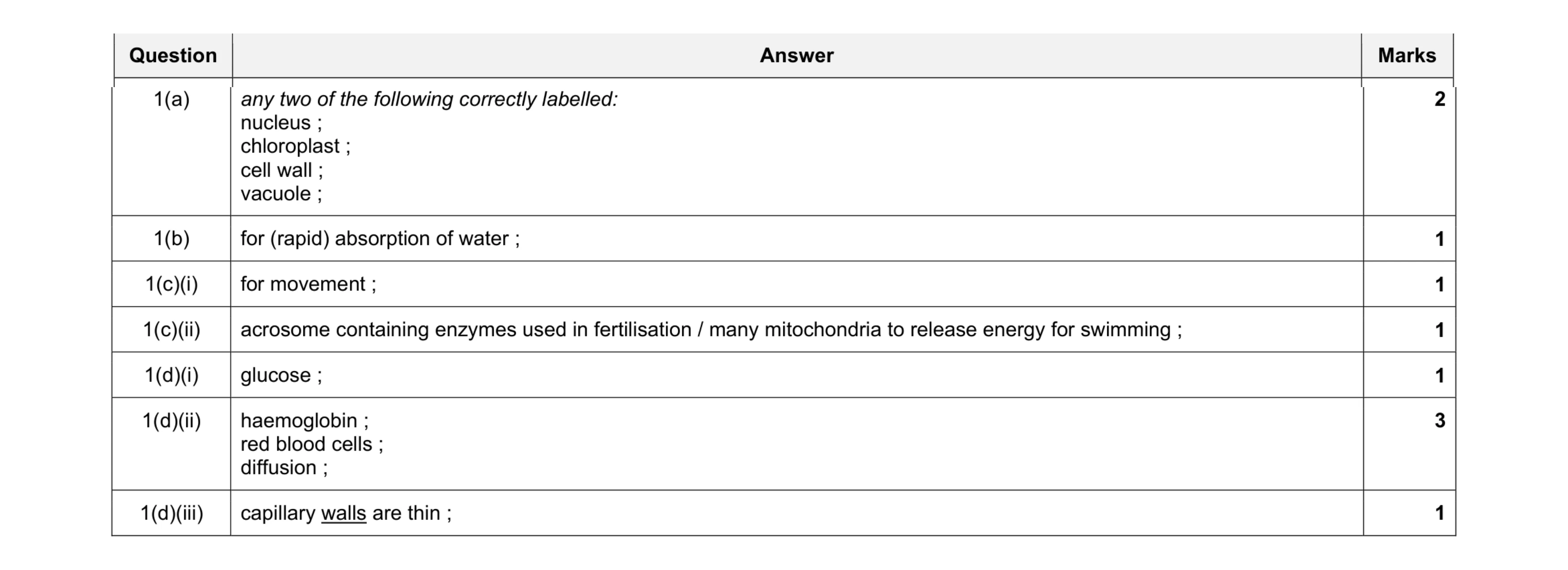 10
10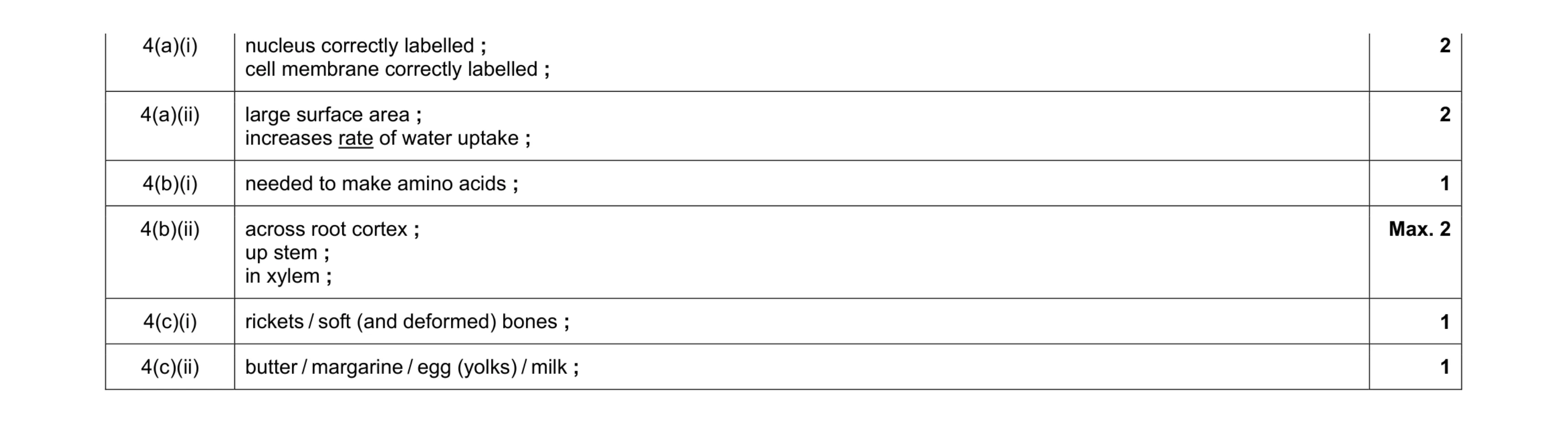 9
9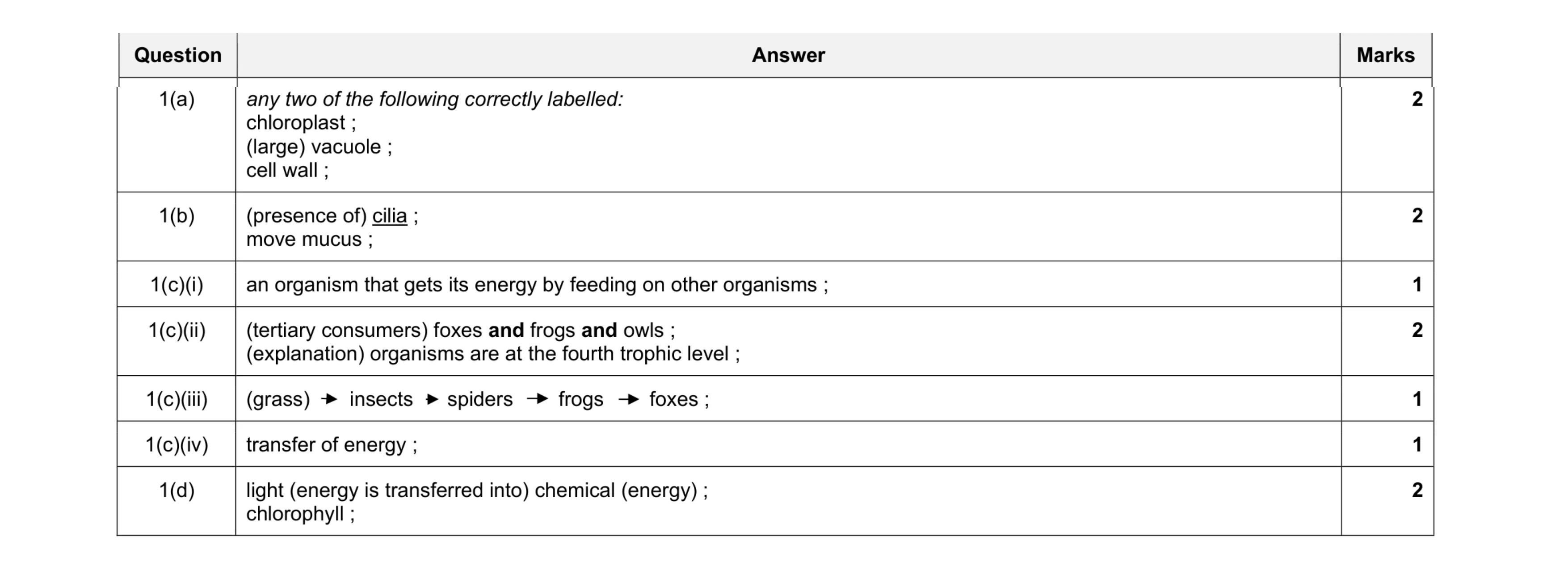 11
11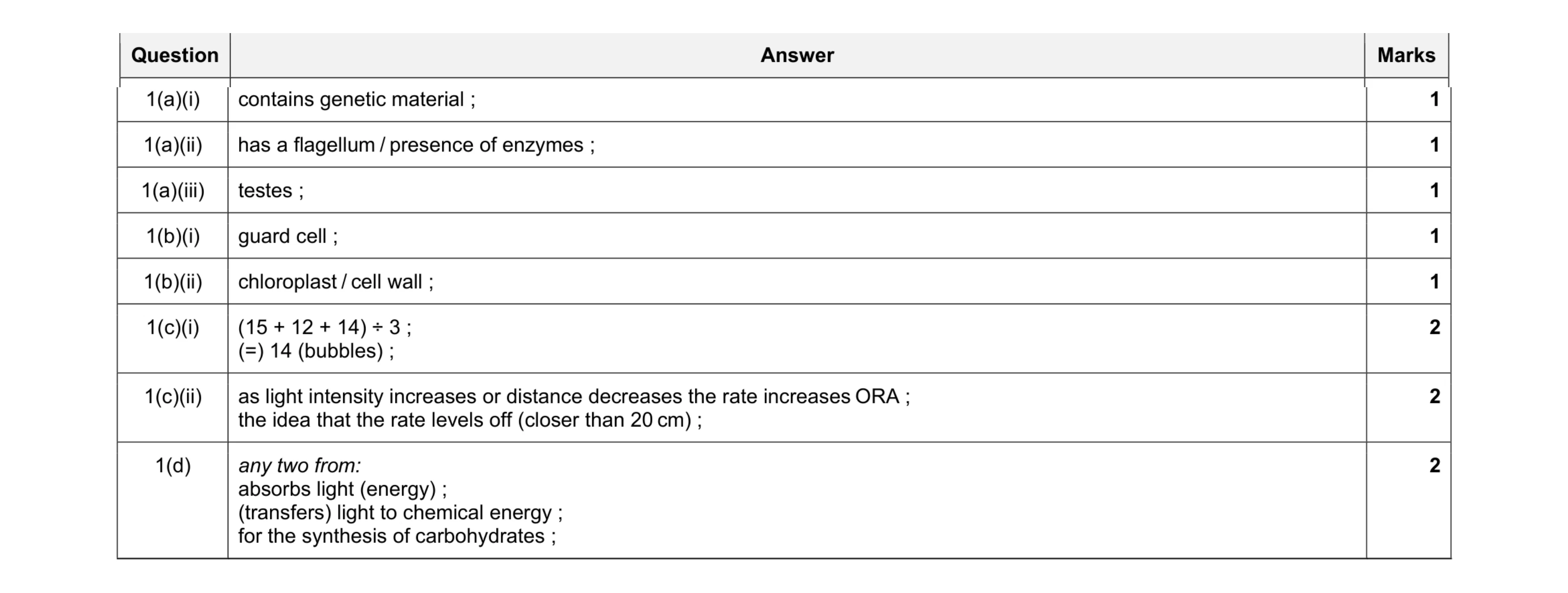 11
11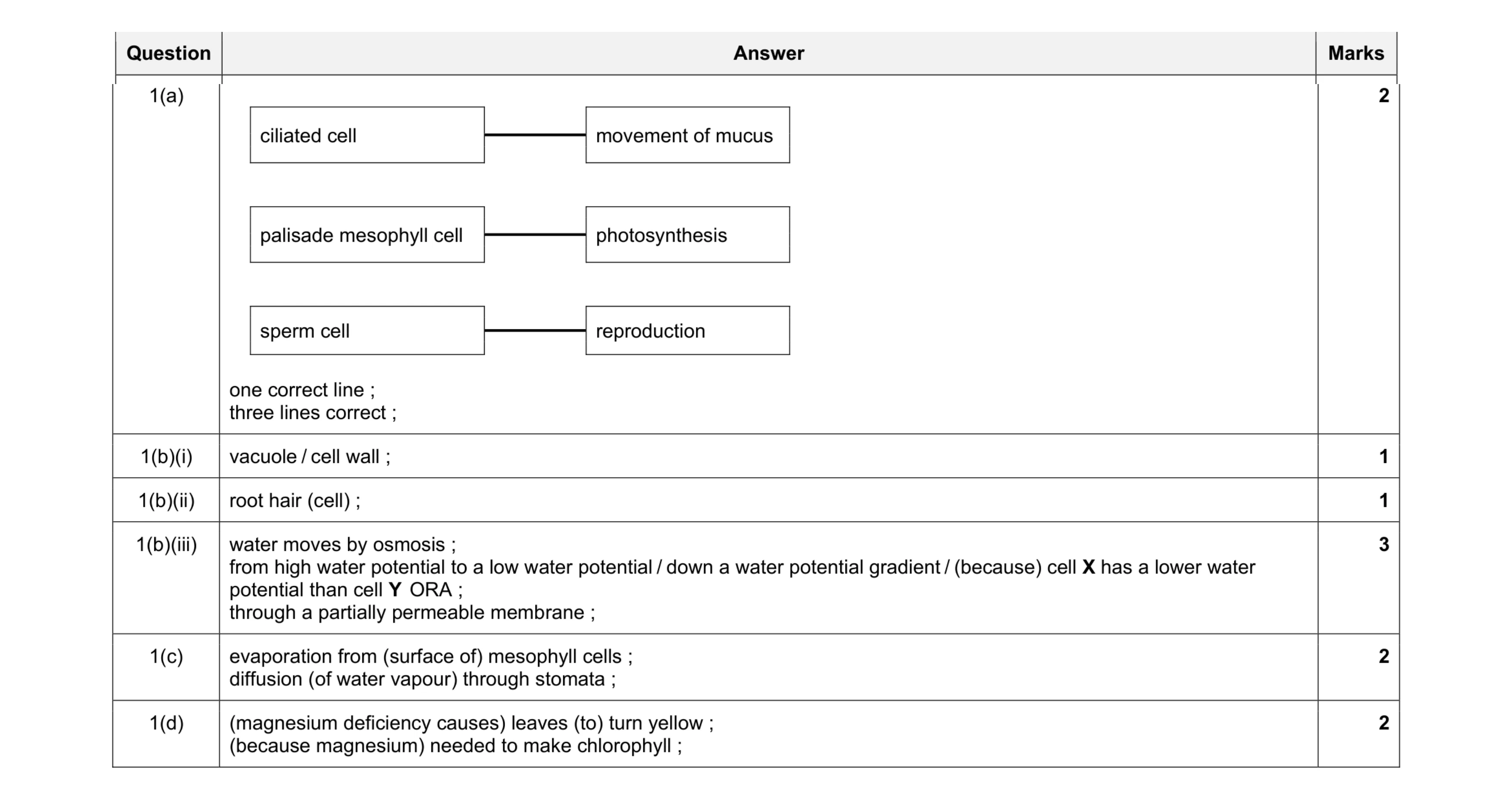 11
11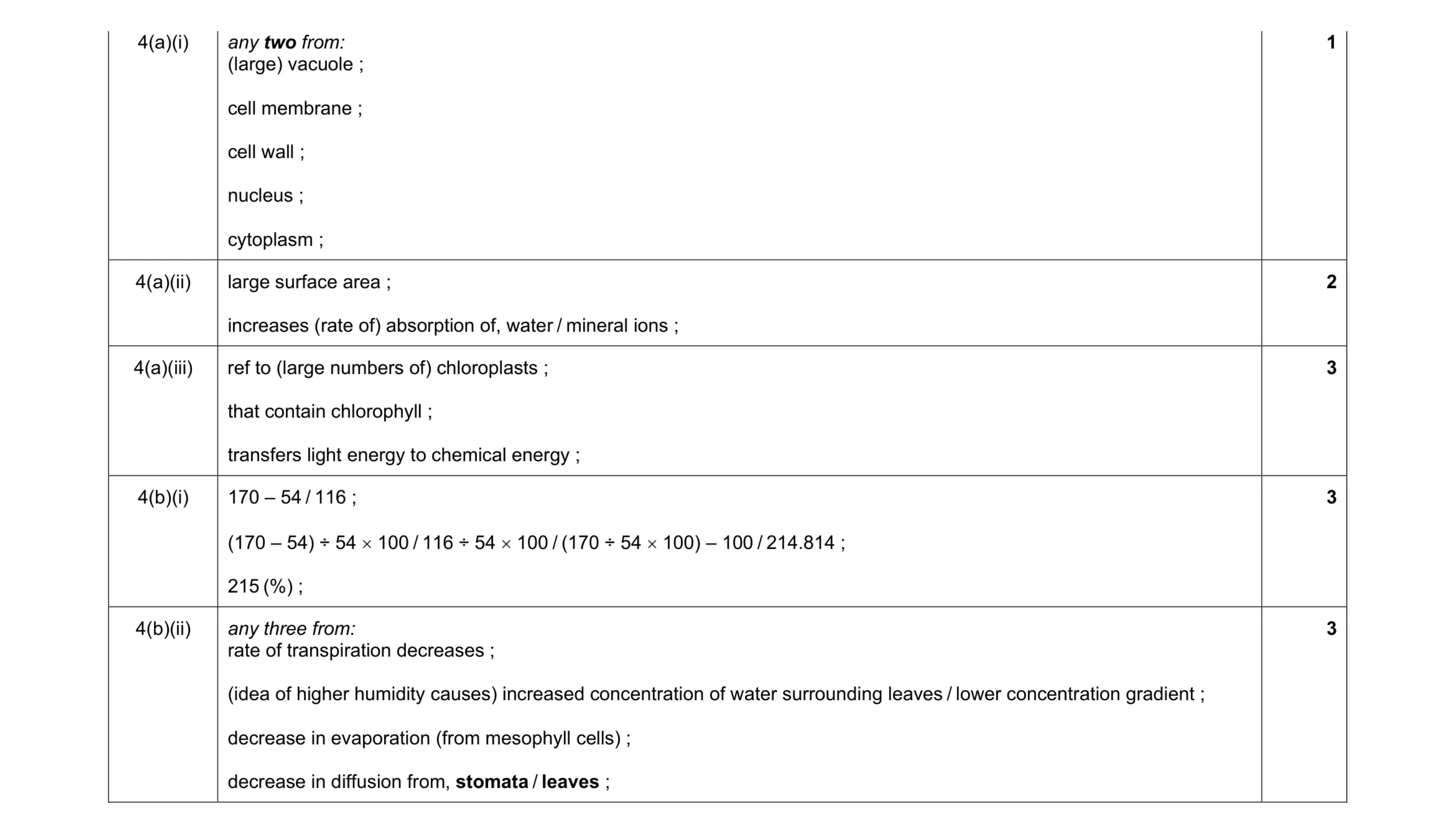 12
12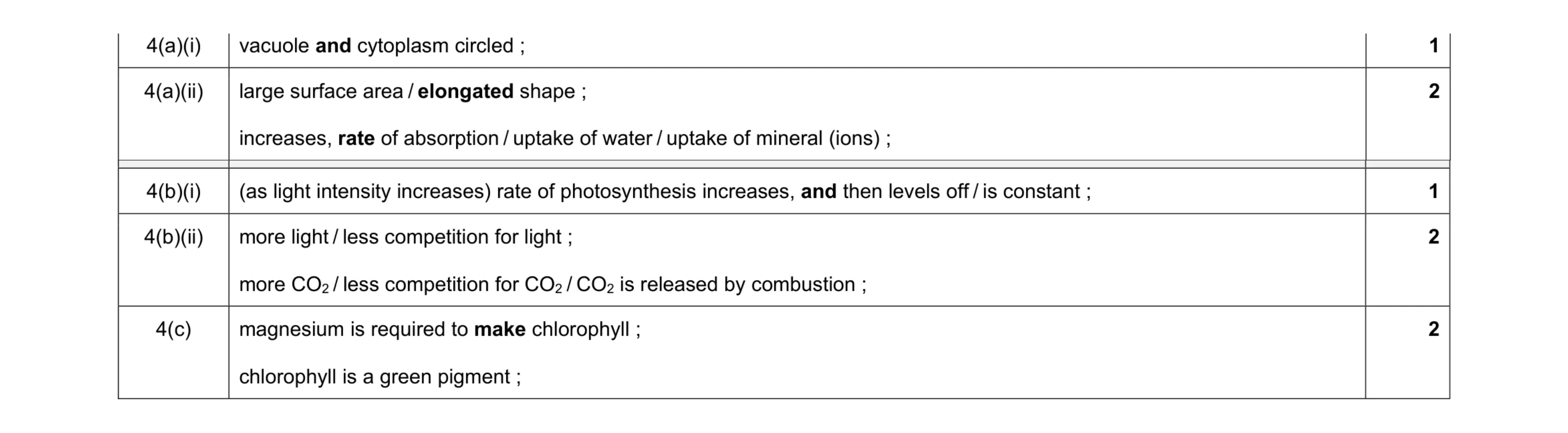 8
8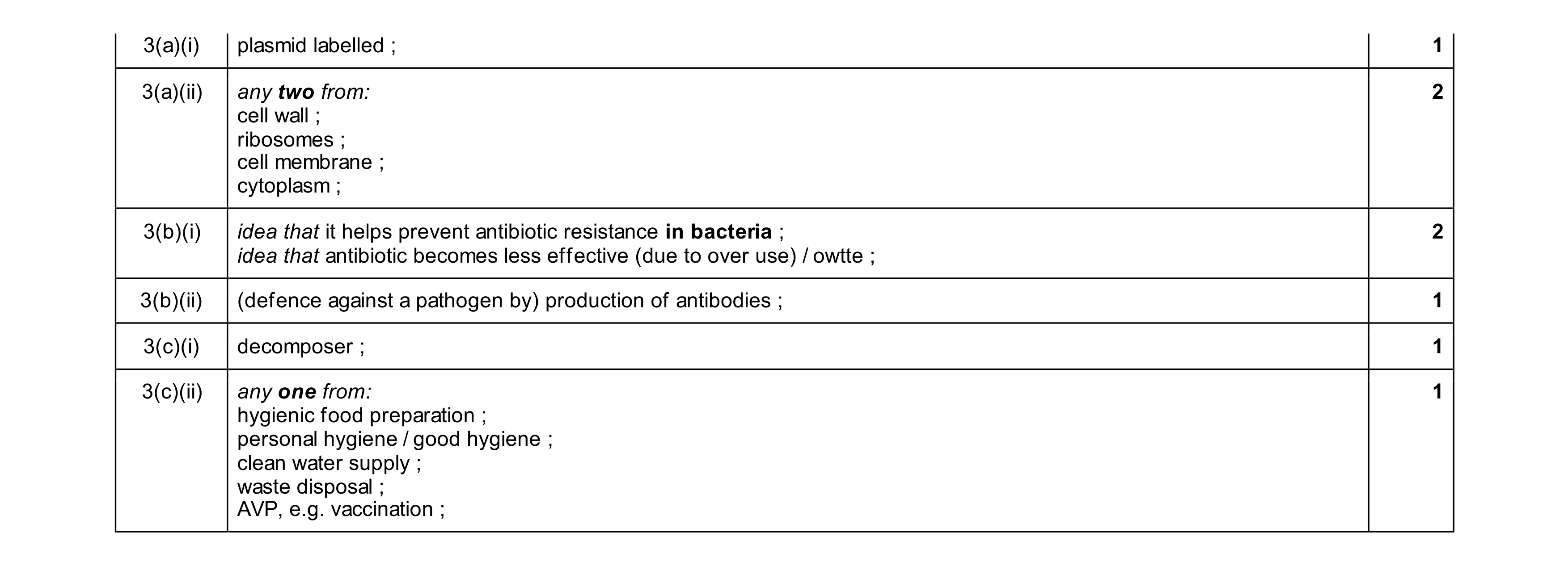 8
8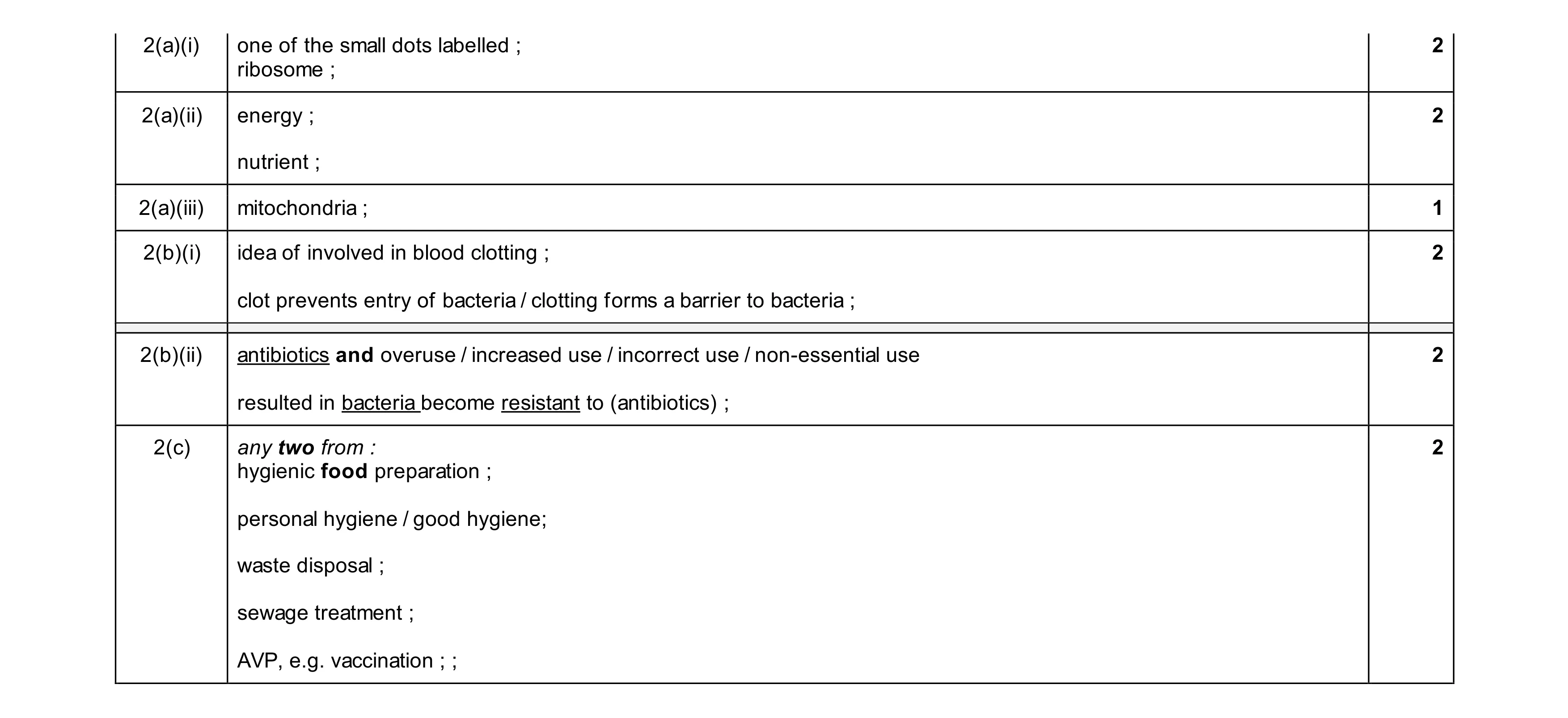 11
11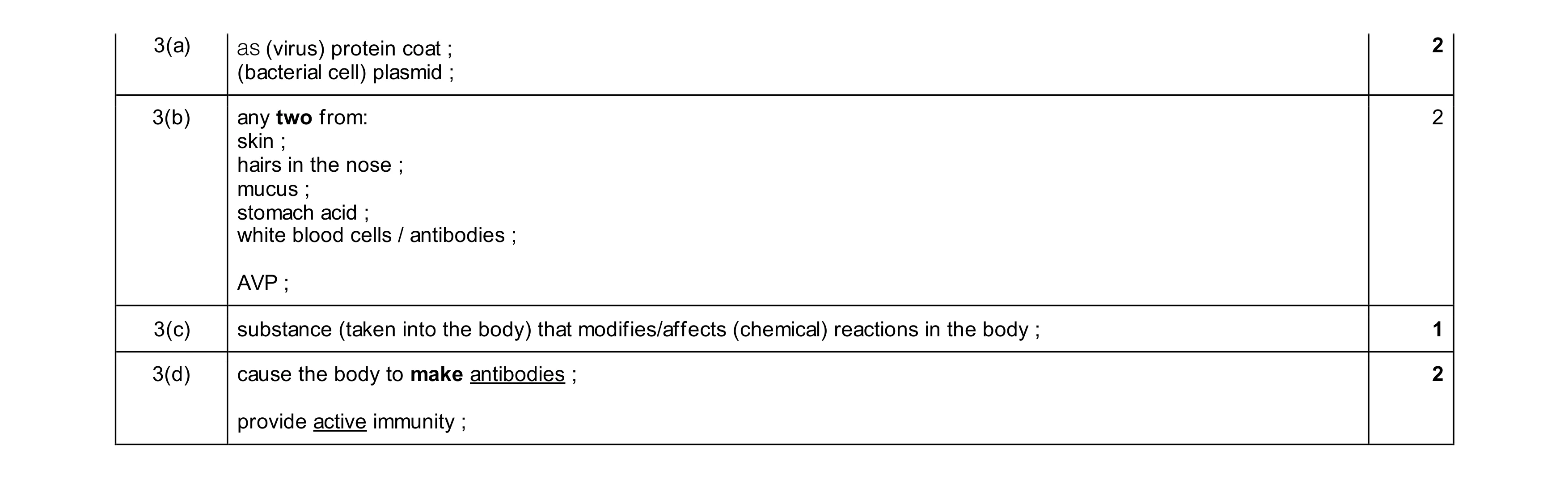 7
7